Test · Second language acquisition
Common European Framework of Reference for Languages
Language proficiency reference framework
The Common European Framework of Reference for Languages is a reference framework that informs teaching, learning and assessment in language education.[1][2]
It defines six levels of language competence.[2] Research on the framework increased significantly between 1990 and the end of 2017.[1] The levels lack empirical support from language-use data.[3]
Key facts
| 6 | number of proficiency levels defined by the framework, per Oscarson (2015)[2] |
|---|---|
| 2001 | year the framework was published, per Runnels (2019)[1] |
| 90 | new written mediation descriptors judged by experts and teachers, per Stathopoulou (2020)[4] |
| 31.88% | share of B2-level reading items in one alignment study, per Tangsakul and Poonpon (2024)[5] |
Overview
What the framework is and where it came from
The Common European Framework of Reference for Languages is a reference document. It sets out what people need to learn to communicate in one or several languages. International experts wrote the document. It was a way to coordinate language learning, teaching and assessment across Europe.[6] Since publication it has come to dominate discussion of second-language curricula and of second-language proficiency assessment. It also leads discussion of second-language teaching and learning in Europe.[7]
The framework describes proficiency on a scale of six levels. The descriptions are written to apply to all languages in Europe. They are not for one language alone.[8] Beyond summaries of these levels, the framework is still relatively little known. Those summaries are the global scale and the self-assessment grid.[7]
The framework also aims to help educational institutions and employers judge the language qualifications of candidates. These candidates may be applying for admission or for a job.[8] The framework also serves as a basis for developing curricula throughout Europe. It also works to promote multiculturalism and multilingualism.[6]
The framework grew out of work the Council of Europe began in the early 1970s. That work aimed to identify levels of language learning in a way that was clear and could be applied generally. The project produced six cardinal levels of competence. These were set out in a descriptive model known as the Common European Framework of Reference for Languages.[2]
The framework was set up after the Second World War. Political, social and historical aspects shaped how it developed. Language teachers in Europe and beyond were seen as needing such a framework.[9]
The framework made a strong and lasting impact. The concept is now used in Europe and beyond. It is an important tool for talking about goals and activities in language teaching and assessment.[2] The European Language Portfolio is one way to apply the framework. It reports proficiency and learning achievements clearly and in plain terms.[6]
History
The framework's origins and purpose
The Common European Framework of Reference for Languages is usually shortened to CEFR. It is a document about learning, teaching and assessing languages. The Council of Europe prepared it within a project called "Learning languages for European citizenship". The project ran from 1989 to 1996. The English edition appeared in 2000. In November 2001, the Council of the European Union advised using the CEFR to build systems for checking language ability. A first Arabic edition was published in 2008 and runs to 264 pages. It was translated from the 2001 German edition.[10]
The CEFR works as a standard for assessment. It is like earlier standards, such as the American ILR scales, the ACTFL standards and the Australian ISLPR standards. The document is a reference book. People who teach foreign languages consult it in their different areas of work. It has become the guiding document for language teaching in Europe and in many countries around the world. This includes institutions that teach Arabic to speakers of other languages. Curricula, teaching materials and language assessment are built on it.[10]
The Council of Europe has forty-seven member states. It is best known for human rights and legal affairs. It has also run many language education initiatives. These include a central part in introducing and promoting the communicative approach to language teaching. The Council of Europe promoted the communicative approach to language teaching, according to Green (2022).[11] The framework has three versions, dated 2001, 2018 and 2020. Using it can link policy, teaching, learning and assessment in a coherent way.[12]
Main ideas
The six levels and what they describe
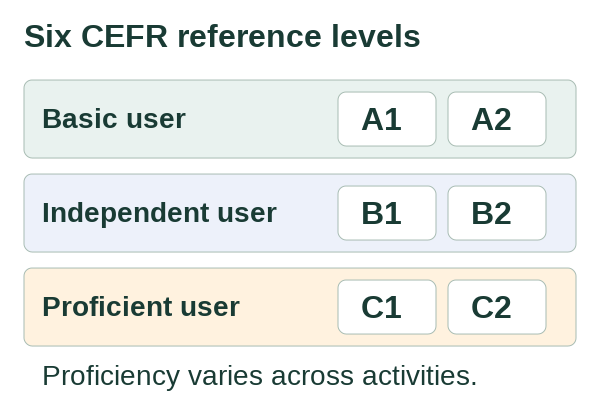
The Common European Framework of Reference for Languages (CEFR) sorts learners into six levels, from A1 to C2.[13] Experienced raters can assign these levels to learners' written texts.[14]
Researchers have found the level descriptions for speech vague. One exploratory study tested the idea with learners of English. Their first languages were Spanish and German. Listeners at different proficiency levels heard short narratives. The researchers analysed written records of their answers. Proficiency level and first-language background did affect how people judged intelligibility. The effect was not always as expected. The results only partly confirmed the step-by-step progression the framework proposes.[15]
The texts came from 54 learners of English, 38 learners of French and 28 learners of Italian. Each wrote a short letter and a narrative. In all three languages, the link between level and complexity was weak to fairly strong. At level A, sentence complexity looked similar across the three languages. At level B it differed, especially between English and French.[14]
Estimating vocabulary size was beyond the framework's original aim. Few studies have tried to link the two. One study tested 311 Spanish learners of English spread across all six levels. It used a placement test and a vocabulary test. The vocabulary test covered up to 14,000 word families. Receptive vocabulary size ranged from 5,300 word families at A1 to 11,200 at C2. Vocabulary scores differed significantly by level. Some pairs of adjacent levels did not differ significantly from each other.[13]
The framework's descriptors say little about some kinds of knowledge. Those kinds matter for communication. Conceptual knowledge is the ability to express oneself in a second language using that language's own system of concepts. Conceptual errors come from weakly developed conceptual knowledge. They can block communication just as linguistic errors do. The framework says relatively little about conceptual knowledge. One proposal has developed descriptors and sample activities for each level from A2 to C2.[16]
The Companion Volume and mediation
The Companion Volume grew out of a project that ran from 2014 to 2020. One of its co-authors described the volume as an elaboration of ideas already present in the 2001 text rather than a replacement for it. According to the co-author, those four ideas needed years of research and classroom work before they could be spelled out in detail and spread more widely.[17]
The Companion Volume gives mediation a central place among the framework's ideas.[18] Mediation covers the role of language in making the conditions for communication or learning. It also covers building new meaning together and passing on information. This can mean simplifying, elaborating, illustrating or otherwise adapting it. The term has been called a nomadic notion. It sits at the centre of many scientific fields and carries different senses in different contexts.[19] A Council of Europe project by two researchers developed example descriptors for aspects of mediation. The Companion Volume later presented new scales for written mediation.[19][4]
The Companion Volume also created new categories and example descriptors. These included descriptors for sign language.[18] Plurilingualism was one of the four concepts the 2001 framework had already put forward. The volume draws on several research views. These include an integrationist or enactive view, a complex ecological view, an agentive view, a socio-constructivist or sociocultural view, and a plurilingual view. When the framework first appeared, many language professionals saw it only as a way to promote communicative language teaching. They also saw it as having some useful levels and descriptors.[17]
The action-oriented approach is different from earlier communicative trends. The difference lies in the kind of syllabus it implies. One researcher treats didactic audiovisual translation as a mediation strategy for learners. The latest version of the framework includes sign languages. It also stresses accessibility. That researcher argues that all such translation modes can fit within it. The same work proposes a new category for these modes. It also develops example descriptors for didactic audio description.[18]
Leung and Jenkins argue that some parts of mediation are hard to rate on any scale built outside the context. In their view it misses how actively multilingual speakers communicate. That communication can open up new ranges of meaning and produce fluid exchanges. They suggest there is room for a more flexible account of mediation. It would allow for language sensibilities and practices tied to particular situations.[20]
A study in Greece explored whether the new written mediation descriptors can be used in one local setting. In the second phase, 94 language teachers in Greece judged the same 90 descriptors. They judged how far each matched the level it was designed for. On that evidence the paper argues that language testers should treat cross-lingual written mediation as a basic ability. It should be both taught and tested.[4]
How the framework describes language ability
The 2020 Companion Volume sets out updated scales for sociolinguistic competences and sociolinguistic appropriateness. El Zahraa examines how these apply to Arabic, especially speaking. The 2020 Companion Volume, an update to the 2001 text, revised these scales and gave them what one analysis calls a more inclusive and practical approach. That analysis applied the revised scales to Arabic. It found them usable for learning and assessing speaking in that language.[21]
Dolmaci and Sezgin state that culture is at the very core of the framework. They report that its main purpose is to protect cultural diversity. Dolmaci and Sezgin compared the 2001 text with the 2018 and 2020 Companion Volumes. They used an n-gram tool to list frequent culture-related word sequences in each.[22]
In this account, learning a language is not limited to grammar knowledge. It requires social, cultural and pragmatic skills to be combined. The learner sits at the centre of the learning process.[23]
One 2014 paper argues that the framework confuses levels of language proficiency with intellectual abilities. The same paper says the framework fails to distinguish consistently between a level of proficiency, a static state, and language development, a process over time. It also raises the possibility of mismatches between a second-language learner's communicative competence and linguistic competence. More broadly, the paper states that the view of proficiency behind the framework and its six levels lacks evidence from language-use data.[3]
What the level descriptors are made of
The 2001 framework acknowledges that orthoepic competence relates to the comprehension of characters. It does not give descriptors for it. Descriptors for levels A1 and A2 were already set using changed techniques. A later paper re-examined descriptors for levels B1 to C2. Combining the two sets produced descriptors for levels A1 to C2 overall. The work was done for Japanese language education. The framework was mainly aimed at languages written in alphabetic script.[24]
Harsch, Koval, Delgado-Osorio and Hartig describe building a rating scale for academic writing from sources. The scale uses separate analytic criteria. The required skills are listed as separate criteria. Academic integrated writing, which means writing from source texts, requires mining sources for relevant ideas, presenting them with precision and depth, paraphrasing efficiently and attributing sources properly. The scale was built by combining four approaches: theory-based, descriptor-based, empirical and intuitive. The study paid special attention to how usable the scales are. The scales come from the CEFR Companion Volume. Four content experts trialled and refined the first draft of the scale in a workshop. A separate mixed-methods study was left to check the scale. So the paper reports only how the scale was developed.[25]
Eizaga-Rebollar and Heras-Ramírez studied pragmatic competence as the framework defines it. They asked how far it appears in the tasks and rating scales of two oral proficiency interviews at C1. One study analysed how far the pragmatic competence defined by the framework appeared in two oral proficiency interviews at level C1. It looked at the task descriptions and rating scales. Eizaga-Rebollar and Heras-Ramírez compared two oral proficiency interviews, spoken tests in which an examiner and a candidate talk, at the C1 level. The task descriptions mostly included aspects of discourse and design competence. Each interview gave priority to different aspects in its rating scale. One focused mostly on discourse competence and fluency. The other focused on functional competence. They also found a mismatch. The skills a task tested did not always match the skills its rating scale described.[26]
Descriptors for beginner writing have been turned into model test tasks at levels A1 and A2. A desk study analysed reading and writing sources on language testing forms. That study concluded that the framework's method is effective for measuring students' abilities. It also found that writing test models can be classified for beginners.[27]
Abdusalimovna treats creative writing competence as a higher form of communicative competence. In her account it joins accuracy of language, coherence of text, awareness of style, sensitivity to culture and pragmatic effectiveness. A qualitative analysis of framework documents and writing research argued for teaching and assessment. It said these should balance creativity with control of the language.[28]
Criteria-based assessment using the framework's descriptors has been proposed. It could judge students' knowledge fairly. It could also improve teaching and learning.[29]
Research
What the levels look like in real work
A 2012 study tested 181 adult learners of Dutch as a second language on eight speaking tasks. On average per speaking task, raters placed about 80 of these learners at level B1. They placed about 30 at level B2. Every competence that was measured told the two levels apart. Speed of speech was the one exception. The gap between B1 and B2 learners was smaller for high-frequency words. It was larger for medium- and low-frequency words. Scores on the vocabulary test pointed to average productive vocabularies of 4000 words at B1 and 7000 words at B2. B2 learners also did better than B1 learners in all 10 domains of the grammar test.[30]
A 2025 study tracked eleven features of spoken output. It followed them from level A2 to level B2. The speakers were 60 teenaged learners of English in Finland. The researchers analysed about 20 seconds of semi-spontaneous speech from each person. Three measures all rose with proficiency: speed of delivery, number of words produced, and length of speech between pauses. Silent pauses in unusual places, such as the middle of a clause, became fewer. The study suggests that learners could gain from practice. The practice would focus on speed of delivery and pausing. It adds that these aspects could be treated more consistently. This applies to scales that rate language proficiency.[31]
Mapping real students onto the levels
Abu Sufi and Engku Ibrahim placed 46.3% of students at B2+. This was on the general linguistic range scale. They placed 0.2% at B1.[32]
A study at a university in Fiji followed 120 first-year students in writing at the start and end of their first year. 62 students began at A1. By the end of the year, 21 had moved to B1 and 41 had moved to B2. Another 49 students began at A2; 44 of them reached B2 and 5 reached C1. The study reported that the framework was useful for judging how ready students were for university study and work.[33]
Graduating undergraduates do not all leave at the same level. At the International Islamic University of Malaysia, 46.3% of graduating undergraduates were placed at B2+ on the CEFR scale. This was for general language range. The same students' scores on the university's own English test fell in its middle bands. 48% were in Band 6. The study concluded that these students could write effectively. They could handle fairly complicated language in familiar situations, despite some errors.[32]
Efendi and Sejati tested 103 eighth-grade pupils at SMPN 40 Surabaya. They used the Cambridge Key English Test. Most sat at A1 for reading and writing and at A2 for listening. A study looked at 103 eighth-grade pupils at a junior high school in Surabaya, Indonesia. The study read this as showing that the pupils could communicate in English for daily use.[34]
Teachers and lecturers form another group that has been measured. Widodo, Setiawan and An placed German language teachers in Vietnam at B2. Widodo, Setiawan and An blamed the lower Indonesian results on language attrition. They also blamed few chances to get language training.[35]
At one Indonesian health sciences institution, lecturers in five programmes were all placed at A2 Elementary. The placement came from a test converted to the CEFR scale. Their average scores ranged from 369 for diploma Nursing to 439 for Pharmacy.[36]
Kaloeti gave a business English test to 10 Management undergraduates and 10 Management diploma students. Most sat at or below A1. A few reached A1, A2 or at most B1.[37]
A survey of 168 learners in non-English departments asked students to rate their own listening level on the CEFR scale. Students in higher course levels were more likely to rate themselves higher. A chi-square test of independence found this difference significant. Subekti, Widodo and Andriyanti asked 168 learners to rate their own listening level against the framework's levels.[38]
A survey asked 421 Italian physiotherapists about scientific English. Of these, 47% were undergraduates and 53% postgraduates. Both groups agreed they could fully understand a scientific paper and physiotherapy-specific English. They agreed on 4 of 10 statements. On a 10-point test, however, both groups averaged below the 60% pass mark. Participants who had studied at a university in southern Italy had 2.56 times higher odds of failing the test.[39]
Building new tests on the levels
Some research teams have built new tests from scratch. Deeprom developed a model that randomizes items. Najiyah and colleagues developed Arabic reading items.[40][41]
One 2026 study developed an algorithm-based model that assembles test forms from a pre-validated item bank, a stored pool of questions already checked for quality. The model has five parts: Listening, Vocabulary, Usage and Functional Language, Structure, and Reading. The test as a whole is mapped to levels A2 to C1. Experts in English met in a focus group. They designed a test plan with random assignment. The psychometric properties were then checked on 300 undergraduates. The checks used confirmatory factor analysis and reliability testing. The test showed excellent model fit and high internal consistency. Alpha values ran from .806 to .894. Usage and Functional Language was the strongest predictor of overall proficiency. The algorithm kept a balance of topics and avoided repeating items. It also kept difficulty at the level intended.[40]
A second project built Arabic reading test items linked to the level descriptors. The researchers used a development model with four stages: define, design, develop, disseminate. They stopped after the first three. The participants were 259 fifth-grade students. They attended Pondok Modern Darussalam Gontor Putri 1. The first blueprint held 119 items spread across six levels, from A1 to C2. The formats were multiple-choice, true-false and matching. Experts checked the items, and small field trials followed. Then 72 items met the validity criteria and were judged suitable for use. Reliability was 0.99, which is very high. Yet most valid items counted as easy. Several needed revision to tell high and low performers apart.[41]
A third study set out criteria for Arabic vocabulary tests at the beginner level. It used a review of past studies, not new test data. Its main source was the vocabulary items in Ali Khuly's al-Ikhtibârât al-Lughawiyah. Material on the framework and on language assessment supplied supporting evidence. For beginners it recommended about 60% of tasks be receptive and 40% productive. The study argued that Arabic vocabulary tests must weigh validity, reliability and practicality. They must also stay aligned with the framework for international comparability.[42]
Tests of second language ability commonly aim to measure one general trait. They also measure several sub-traits, such as reading and grammar. A 2020 paper compares factor model structures for this problem. The bifactor model is one of them. That model posits one general factor that all items load on. It also proposes a set of skill-specific factors that do not correlate with each other.[43]
Machine scoring and automatic level estimates
One approach trains a classifier on texts. Human raters have already placed these texts at a level. A 2025 study trained such a classifier for Finnish as a second or foreign language. It used the FinBERT model. The classifier reached an F1-score of 72.7%. Its predictions matched human assessors at .86 on the Pearson scale. Learners' gender was not related to accuracy. Their first language background may have had some effect.[44]
Text length seemed to cause some errors. Very short or very long samples were often rated lower or higher than expected. The study's authors concluded that more annotated data is needed before the model suits higher-stakes assessment. Tarvainen, Toivanen and Huhta judged the open-source model likely to be useful for formative feedback. Formative feedback is feedback meant to guide learning.[44]
A 2022 study applied Kolmogorov complexity, a measure from information theory, to 774 argumentative essays by Chinese learners of English. The measure covers overall, syntactic and morphological complexity at once. Overall and syntactic Kolmogorov complexity each separated every adjacent pair of levels. The levels were beginner, lower-intermediate and upper-intermediate learners. The morphological version and the traditional complexity measures did not separate all pairs of adjacent levels. Kolmogorov syntactic complexity was not correlated, or only weakly correlated, with fine-grained syntactic measures. The two may pick up different features.[45]
A 2021 study applied relative entropy to a large set of learner language. It represented vocabulary and grammar through lemmas, tokens, part-of-speech trigrams and conjunctions. Discrimination between learners rose steadily from lower to higher levels, matching the idea that learners move toward more complex and diverse language. Traditional frequency-based methods on the same corpus rarely showed such regularity.[46]
Not every study finds that complexity tracks level. A 2019 study analysed 40 writings from 20 grade three senior high school students. They came from two bands of test scores, grouped as high or low proficiency. Yan and Zou found no significant link between syntactic complexity and L2 proficiency level. The two genres did differ significantly on clauses per T-unit. They also differed on complex nominals per clause.[47]
Research trends and where the evidence is thin
Sahib and Stapa used a bibliometric method. They drew a sample of 770 scholarly works on the framework from the Scopus database. A 2022 bibliometric study examined 770 scholarly works on the framework. Sahib and Stapa found that the framework has spread widely and had a large impact. More publications now come from outside Europe. This includes North America and Asia. The same analysis found very little research collaboration between countries across Asia. It also noted concerns about how far the framework's influence reaches. The concern covers different fields and countries. The study called the literature on global trends in this area scarce.[48]
A 2011 agenda paper set out where research on the framework might usefully go next. It proposed papers that weigh what is known and suggest future research needs, alongside papers that judge what research does and does not reach the language classroom. That agenda was presented as a practical exercise, not a summary of findings.[49]
Some scholars treat the framework as an instrument of power, not only a description of ability. Wright notes that the Council of Europe introduced the framework in 2001. It was meant as a tool for educational policy and practice.[50]
People have directly questioned whether the framework fits Pacific and Pacific Rim countries. A 2010 article notes that many officials find the framework almost irresistible. Investment in it is extensive in some parts of the world. The article reports that the framework runs to about 200 pages. Appendices come on top of that. Read closely, the article concludes the framework has much less to offer than it claims. It advises language educators in Pacific and Pacific Rim countries to be very cautious. They should not adopt its recommended approaches too readily. This applies especially to those teaching indigenous languages.[51]
Other work looks at how the framework moves into national systems. A 2024 paper describes Austria's Matura foreign language exam. It tests reading, listening, language in use and writing, and requires a B2 level. The paper suggests that standard formats built on the levels reduce stigma. They also make evaluation fairer. It recommends that Ukraine build the framework into its school reform. It also advises training teachers to use it for assessment.[52]
Evidence on engagement and learning gains
One action research study took place in a public school in the United Arab Emirates. It lowered the English curriculum for Grade 9 General Stream students from B1 to A1. The researcher judged engagement from classroom observations, a teacher journal, formative assessments and short end-of-lesson exit tickets. Lowering the level raised student engagement. It also lowered classroom noise. It also increased how much students said they enjoyed lessons. The report links this result to cognitive load theory. That theory says learning suffers when too much information is held in mind at once.[53]
Matching materials to a level does not always change written work. In Malang, Indonesia, 45 students at A2 to B1 level spent one semester writing German essays. The two classes scored the same on the pre-test. Their post-test writing scores also showed no difference. The analysis of variance table gives sig 0.326. Students on the platform gained digital skills and responded well to it. Their scores did not improve, though.[54]
An online vocabulary system was built around the A1 and A2 levels. In one trial with 32 students, it produced large gains. The system held 349 words in nine categories. Each had word forms, pronunciation, pictures, parts of speech, definitions, example sentences and self-test exercises. The 32 first-year university students had low English placement scores. They improved significantly from pre-test to post-test (p < .05). The effect size was large (Cohen's d = 1.09). Short-term retention reached 92.16%. Students also rated the system's ease of use and visual content highly. The report itself warns that the small sample and the lack of a control group limit how far the results can be generalized.[55]
A larger study compared three reading conditions over 13 weeks. It involved 171 Saudi undergraduate learners of English. One group read C1 texts closely. A second read B2 texts extensively. A third read A2 texts extensively. The groups had 55, 58 and 58 students. All three groups improved a lot in reading comprehension. The B2 extensive reading group scored highest on the post-test. The A2 group gave the most favorable ratings on the questionnaire. The researchers concluded that moderately challenging texts were linked to stronger comprehension. Easier texts went with more positive attitudes.[56]
In one study, 24 Chinese university students at different English levels scored their own writing with a rubric. They then described their thoughts and feelings. Self-assessment proved hard both mentally and emotionally. Students with high proficiency moved back and forth through the rubric in a recursive way. They reported more positive emotions of low intensity. Students at lower levels followed the rubric more directly. They also reported more negative experiences.[57]
In practice
National and local test examples
A Thai team developed a CEFR-based English test. It is used to place new students and for exit exams at the end of a program. A sample of 2,248 first-year students sat the first round of testing. A second round involved 3,655 students in their first and second years.[58]
A second Thai project produced the Silpakorn Test of English Proficiency (STEP). It was built to match CEFR levels. The test covered listening, semi-speaking, reading and semi-writing. The results showed the test could be matched to CEFR levels. It could also measure proficiency at a specific level.[59]
A Malaysian university compared its own course-based English score with a CEFR-aligned test called Linguaskill. The score is called the English Language Competence Score Average (ELCSA). The overall correlation was 0.371. This is a positive but weak relationship between the two measures. The strongest link was with the CEFR Writing score, at 0.417, which is moderate in strength.[60]
In Italy, a team at Roma Tre University developed Certit, a certification in Italian as a second language. The team aligned its written test with the CEFR. The work followed the CEFR Alignment Handbook. The British Council and others published it in 2022. A familiarization phase ran from March to November 2022 with the test designers. It built a shared understanding of what a CEFR task is. The team then looked at writing prompts together. They discussed how well each one matched CEFR principles. The process led to better prompt design and clearer test records. It also gave a basis for further validation of the writing component.[61]
In Korea, the Test of Proficiency in Korean (TOPIK) is aimed at overseas Koreans. It also serves foreigners whose first language is not Korean. The test is split into TOPIK I and TOPIK II. TOPIK I has Beginner 1 and 2. TOPIK II has Intermediate 1 and 2 and Advanced 1 and 2. A comparison with a German test run under the CEFR found similar test methods and criteria. But the Goethe-Institute's test information was far more detailed than TOPIK's. The comparison also noted that TOPIK has no speaking test. Its beginner level has no writing test. The paper argued that speaking, listening, reading and writing should all be assessed to understand proficiency.[62]
Teachers using the framework in classrooms
Malaysia began using the framework nationwide in 2017. It started with Year one and Year two students. A survey asked 205 English teachers from 101 schools in the Bangsar Pudu district of Kuala Lumpur how they felt about this change. Some teachers had more than 30 years of teaching experience. Their concerns differed significantly from those of other teachers. The English teachers' academic level made no significant difference to their concerns. The researchers hoped the results would help the Ministry of Education. They wanted it to spot and improve how the curriculum is carried out.[63]
Malaysia trained its teachers through a chain of courses. Cambridge English Super Trainers trained National Master Trainers. These trained District Trainers, who finally trained the classroom teachers. A National Master Trainer went through this chain. That person wrote a reflection on the process in 2018. That trainer concluded that several parts of the training still needed improvement. This was true despite long and careful planning.[64]
A 2022 study asked 88 randomly chosen teachers of Turkish to foreigners how well they knew and accepted the framework. The researchers grouped the teachers' answers into themes. This method is called content analysis. They concluded that more research is needed on teachers' knowledge of the framework. They also recommended that teachers of Turkish as a foreign language be encouraged to develop professionally. The teachers should also learn the framework better.[65]
A 2026 study combined a review of studies from 2018 to 2025 with a survey. The survey covered 120 university English teachers in five major cities of Pakistan. The teachers showed moderate awareness of the framework. Their mean score was 3.21 on the survey scale, with a standard deviation of 0.78. Their practical use of it in teaching was low. The mean was 2.70, with a standard deviation of 0.88. Awareness, teaching experience, professional development and institutional support together predicted implementation. The R-squared value was .61. The study called for specific professional development programmes, policy support and institutional involvement. These would help universities use the framework meaningfully in their curricula.[66]
In Thailand, a 2026 survey looked at 59 English teachers in ten secondary schools in Nonthaburi province. It found the framework largely in use. Teachers rated three things as highly effective: how well the curriculum was aligned, the teaching strategies, and institutional support. The teaching workforce there was young and mostly made up of migrant teachers from the Philippines. It lacked enough ongoing training specific to the framework. Teachers also reported trouble adapting the framework to local culture. They also reported limited guidance from administrators. The study concluded that fitting the framework into a system is not enough on its own. It also needs investment in developing the people who teach. It proposed a targeted programme to raise teacher competency and make institutions more responsive.[67]
Assessment in the classroom and self-assessment
Classroom assessment asks learners to show progress and to reveal strengths and weaknesses. Results should be reported so that learners and others can understand them. A 2026 report described a project in a global secondary language programme. It showed how teaching materials were mapped to the framework. It also showed how standard set-up notes were written for assessment tasks. They also developed assessment tools and training. Teachers then put the approach into practice. Feedback showed the system made assessment more objective and clearer. But problems remained with feasibility and with alignment to the framework's Companion Volume.[68]
Self-assessment is one other practice. It asks students to give their opinion on their own work. They also judge how far it meets set goals and criteria. A 2024 study surveyed 124 teachers of Greek as a second language in public intercultural schools. Twelve of them were also interviewed. Most of these teachers had a positive attitude toward self-assessment. They saw its benefits.[69]
Group discussion offers another setting for classroom assessment. Students can be asked to mediate texts and concepts. They can also work together on shared tasks. A 2020 paper looked at how students at B1 and B2 levels of the framework handled such tasks. The outcome is a classroom test. It includes criteria for judging mediation. These apply when mediation forms part of a group discussion.[70]
The framework's way of describing proficiency clearly involves the identity and agency of the learner. Both are central to its companion piece, the European Language Portfolio. Self-assessment matters a great deal there. Together, the framework and the portfolio point to an assessment culture. In it, learning and assessment feed into each other. Much work still remains, however. Learner agency in self-assessment and peer assessment must grow, and these must line up with other forms of assessment.[71]
Policy promises and classroom realities
Vietnam has issued national policies and projects to raise foreign language proficiency. These include a Vietnamese version of the framework known as CEFR-V. A survey of 122 non-English majors at one large Vietnamese university found positive beliefs. The beliefs were about the national standards for undergraduate proficiency.[72]
Thai higher education introduced an English Exit Exam to check the proficiency of graduates. The framework's proficiency scales were treated as a key sign of success. A study examined 12 sets of exit exam materials from 12 institutions. It also looked at 44 questionnaire responses from lecturers and administrators. It also examined 17 online interviews with people who helped develop the exams. The exams at different institutions tested different skills, sub-skills and language knowledge. They had sections on listening, reading, vocabulary and grammar. It was still unclear how exam results matched the framework's scales. About half of the people interviewed doubted the quality of the exam. Critics worried that test scores might not show a student's real ability. They meant the ability to communicate in English. The study concluded that an exit exam on its own may not be enough. It may not change teaching practice in classrooms.[73]
At a Saudi Arabian university, staff assumed their own English tests were linked to the framework. The tests were based on textbooks the publisher called framework-linked. A case study asked the academic staff who wrote those tests about this assumption. It used mixed methods. All the participants held one view. Their exams were linked to the framework for exactly that reason: the textbooks' stated learning outcomes. The study pointed to context problems in applying the official manual for linking exams to the framework. It offered recommendations for the institution and for publishers that make such claims.[74]
A project across several universities first analysed 14 contributed tests. These held 70 assessment tasks. Most of those tasks, 87%, were in English. Another 12.8% were in both Ukrainian and English. Of that 12.8%, 11% were translation tasks. No assessment task used two or more languages. The project then trained 16 teachers in procedures and instruments for plurilingual assessment, meaning assessment that lets learners use more than one language. Teachers reported that such assessment reflects real-life and professional situations. Students may face these situations. They also said it does not represent common practice in their teaching context.[75]
One Indian engineering college designed its own English course around the framework. Its report describes the design and the problems teachers faced in running it. The college's Department of Communication Skills created the course. The paper presents it as a model that could be used across Gujarat and India.[76]
Reading, writing and materials in practice
The framework has guided teachers, curriculum writers, test developers and textbook authors. It has done so since it appeared in 2001. Each skill is defined by descriptors for levels A1 to C2. Descriptors are short statements of what a learner can do. The aim is more transparency in teaching and learning. Students can then build their foreign-language competence efficiently.[77]
Reading tests can be sorted by level. One study did this for a university's academic reading tests. The researchers used two standard setting procedures from the framework's manual to judge the level of the tests. The procedures are called familiarization and specification. They picked three academic reading tests at random. They used a content analysis grid for reading to describe the test items and tasks. Of 18 reading texts, 9 were estimated to sit at level B2. Texts rated at B1 and C1 were spread evenly. No text was classified as A1 or C2. B2 items made up the largest share at 31.88%, closely followed by B1 items at 25.12%.[5]
Medical track students took a standardized writing exam at the end of a one-year Preparatory Year Programme. The programme teaches English at beginner, intermediate and advanced levels. Scores from all three groups of assessors reliably separated students by programme level. The results suggest the framework can help describe writing skill. This may hold even outside Europe.[78]
Vocabulary is a key part of writing ability, especially in classrooms where several languages are spoken. A Malaysian study asked how primary school English teachers judge upper primary students' word-level writing. The levels ran from A1 to B1. It gathered questionnaire data from 100 English language teachers in the Melaka Tengah district. It then interviewed three teachers from one school. Teachers' assessment practice was not the same everywhere. Inconsistencies came from three sources. These were different interpretations of vocabulary appropriateness, workload pressures and learner diversity. Most participants valued the framework as a guide. But steady use was limited by the lack of local rubrics, annotated exemplars and regular professional development. Earlier research found that most teachers relied on intuition, not standardized descriptors.[79]
In Algeria, a teacher-led action research project worked with 50 first-year secondary students. Their English was too low compared with their classmates. Placement tests set starting points, and tasks were differentiated by level. Progress was checked with a writing assessment checklist. The combined approach improved students' writing performance. It also produced a writing instruction framework. That framework could bring low-performing students back in.[80]
Textbooks shape how a language is taught. So researchers have asked whether they build vocabulary at each level. One article examined how students' lexical competence at different levels is developed. The levels are as the framework defines them. The article looked at some of the most commonly used German language textbooks. The framework was translated into Slovenian only in 2011.[77]
Aligning large tests to the framework
Makwana argues that the framework gives language testing a more standard process. It also shifts assessment from accuracy alone to the ability to communicate. Many important exams are linked to it. One review argues that this mapping makes language testing more standardised and shifts attention from mere accuracy to communicative competence.[81]
A study at Binawan University in Indonesia gave a paper-based TOEFL prediction test to 169 students. It then matched their scores to framework levels. The mean score was 413 and the median was 397. This placed the group as a whole at level A2, called Basic User. Individually, 78 students (46.2 %) reached A1 and 35 (20.7 %) reached A2. Another 43 (25.4 %) reached B1, 12 (7.1 %) reached B2, and 1 student (0.6 %) reached C1. Supeni concluded that almost 50% of the students were at a low level, A2.[82]
The Shanghai Municipal Educational Examinations Authority asked Cambridge University Press and Assessment to start aligning its six foreign language tests, the Shanghai Gaokao papers, to the framework. One aim was to compare how hard each language version of the Shanghai Gaokao is. The framework was the tool. The project ran from September 2021 to January 2022. It combined online delivery with a cascaded training model. In that model, trained staff then train others. It involved linked training and mapping activities and workshops. The published report describes practical aspects, reflections, recommendations and participant feedback. The report includes some outcomes that relate directly to the framework. It leaves out results that are confidential.[83]
Demirdöven and Okur examined Turkish proficiency exams. They compared them with the example descriptors in the framework. One study examined the 2020 Turkish proficiency exams. University language centres ran these exams. These included centres at İstanbul University, Gazi University and Hacettepe University. Demirdöven and Okur grouped the test items by the example descriptors they aimed to measure. They found that items clustered around certain descriptors and scales. They concluded that this clustering lowered the content validity of those exams. The suggested fix was to add more descriptor scales and more kinds of descriptors to the tests.[84]
A study of the TOSA (Test of Standard Arabic) at IAIN Surakarta found that its competency standard follows the framework in part. Its listening section (fahmu al-masmu') is equivalent to A1 to C1. Its grammar section (fahmu at-tarakib al-lughawiyyah) is equivalent to A1 to B2. Zaenuri, Kholis and Barokah report that the TOSA was built with an integrative, communicative and pragmatic approach. It measures how well the person tested knows Arabic. It does not measure mastery of material that has been taught.[85]
Difficulty was ideal. 65.7 % of items were rated moderate, and 78.6 % of items clearly separated high- and low-proficiency students. The study judged the test valid and reliable. It still recommended revising a small set of weak items.[86]
Yasin, Haroon, Abdullah and Mahadi describe how a writing test for students entering university was linked to the framework's scales. Item writers first identify the lowest level of proficiency to be measured on the framework scale. They then build the items. They also review how hard each item is. They check the scoring scale to set the criteria and score range for each level. After the test is given, a sample of student scores is rated. The scores are then adjusted against the framework rubric. High agreement between raters is then used to support the validity of the reported scores. The project notes that linking a test to the framework can make the test being developed more valid.[87]
A Thai university's five-skill test, the URU-TEP, shows this work at an early stage. A report on its first development phase covers English testing at the university today. It also covers the building of the five-skill test. It also covers how validity and reliability were obtained. It looks at the chances and the problems ahead. The report stresses that the test must be linked to the framework. Only then can results be read under its levels. It adds that validity and reliability must be considered. Both can make the exam process better.[88]
One stated aim of the framework is to help test providers and users describe the proficiency levels. These are the levels that existing standards, tests and examinations require. This makes it possible to compare different systems of qualifications. Language assessment providers in Europe and beyond use various methods to align their assessments with the framework levels. Several case studies show this.[89] Most language proficiency exams in Europe are now built so that scores can be tied to framework levels.[90]
A test should be shown to be both valid and reliable. This comes before any linking process can take place. One testing scholar put it bluntly. If an exam is not valid or reliable, linking it to the framework means nothing. The results showed the test was consistently measuring a single dimension of listening ability. The study also collected teacher judgements of candidates' listening proficiency. These confirmed that the test had items at the correct difficulty level. The test told A2 and B1 candidates apart well. With suitable cut scores, the score could be seen as an accurate picture of framework B1 listening proficiency.[90]
In one 2026 study, a panel of experts judged where framework levels fell on a listening and reading test. The test was made of multiple-choice items, and the technique is called the Bookmark method. Panel members said they agreed strongly with one another. They were comfortable with the cut scores they recommended. They were also satisfied with the standard setting process. A few small adjustments were made after the study. They keep results consistent across English proficiency assessments. These assessments share items or task types.[91]
A paper on alignment issues lists the kinds of validity evidence. Such evidence should support a claim of this kind.[89] The framework's own wording is flexible. One analysis explored whether that flexible wording can usefully guide test development. The analysis used the A1 service encounter descriptor. Examples include airline ticket sales and open-air markets. It pointed to clear weak points in the framework's wording. Even so, the analysis argued that the framework is a valuable starting point for building language tests. It is even an optimistic one, if a test's effect is kept in mind throughout development.[92]
How teachers learn to use the levels
A 2026 mixed-methods study of two Indian colleges found limited awareness of the framework. Both students and teachers knew little about it. Students and staff from two Indian institutions took part. These were Lady Doak College in Madurai and SRM Institute of Science and Technology in Kattankulathur. Its participants came from both Arts and Engineering. English is a required first-year course across subjects there. The study concluded that putting the framework into a curriculum needs enough teacher training and continuous evaluation. It also needs adaptation to the local context.[93]
A single-school case study from Palembang, Indonesia, describes what implementation looked like in one English classroom. Researchers observed lessons and interviewed one English teacher. They analysed curriculum documents such as lesson plans. They also gave questionnaires to 66 students in grades 7, 8 and 9. The teacher used differentiated instruction, meaning lessons adjusted to students at different proficiency levels. The teacher also used communicative activities. All students kept the same learning goals. That teacher had a positive view of the framework. It gave clear learning goals. It also supported students' confidence and participation. Most students also said they had positive views. They said they understood the objectives, took part actively and felt more motivated to learn English.[94]
University language centres have used the framework and its companion portfolio, a record of a learner's work and self-assessment, to encourage student reflection. A 2016 report summarized five examples given at a 2015 seminar at Trinity College Dublin. Its Centre for Language and Communication Studies hosted the seminar. The report says the examples show the framework and portfolio meeting a growing need to benchmark, meaning compare against a standard, language learning outcomes in higher education.[95]
Students gave the framework an average rating of 3.78 on the study's scale. The researchers call this a positive view. Interviews showed that lecturers and students both endorsed the descriptors, giving four grounds. These were the demands of jobs, the needs of communication, what the community expects, and help with their own studies.[96]
Designing lessons and materials around the levels
A 2023 study at an Indonesian business and informatics institute taught an English for Communication course. The course had 63 first-semester students in Informatics Engineering and Information Systems. The course set learning goals from the students' measured level. The average score rose from 55 to 72 between the pre-test and the post-test. That study concludes that the CEFR is a framework, not a curriculum. So it must be adjusted to the context and needs of each group of students.[97]
A 2021 project built Arabic materials at level A1 for a primary school in Yogyakarta. It used a ten-step model of research and development. A team of validators placed the textbook in the Good (B) category. It scored 74.47% out of a maximum of 100%. The 14 students who responded gave it an average of 10.73 out of 12, an ideal percentage of 89.4%. In a wider trial the average score rose from 58 on the pre-test to 69 on the post-test.[98]
A 2024 development study designed reading and writing materials for beginners at levels A1 and A2. It took place at a madrasah in Central Maluku Regency, where students live in a dormitory. That study names two barriers. The school did not check students' ability level at entry. The textbooks used did not focus on reading and writing lessons.[99]
Analyses of existing Arabic textbooks find uneven coverage of the levels.[100][101] A 2022 content analysis looked at Arabic books for the first three primary grades. It sorted their contents by CEFR level. Of the contents, 7.69% fell below level A1, 84.62% fit level A1, and 7.69% fit level A2.[100]
A 2025 analysis looked at a 2022 Quadra textbook for year 11 of an Islamic high school. It found speaking tasks matched levels A2 and B1. Shopping and health topics sat at A2. Travel and technology sat at B1. At that level, learners give longer speech and structured opinions.[101]
English materials have been designed for speaking, video and cartoons.[102][103][104] A 2025 project made eleven speaking units for A2 students at a language institute in Metro, Lampung. Two experts rated the materials very good. Across 15 students the speaking score improved by 38 points in total. That is an average gain of 2.53 per student.[104]
A 2022 design described a web platform that tags film scenes with CEFR levels. Learners can then meet words suited to their own level.[103] A 2016 study taught 22 hours of cartoon lessons built on a communicative approach and the CEFR to secondary students and reported very good efficiency and effectiveness, without giving scores.[102]
One 2025 trial tested Arabic conversation materials through an online classroom application with 15 students. It viewed the materials through the CEFR. The reported t-value of 8.8 was above the 1% table value of 2.977. It was also above the 5% table value of 2.145. So the study accepted its alternative hypothesis.[105]
How the levels are used in practice
In the Azores, Portugal, a team appointed in 2017 designed English curriculum guidelines for primary school. They were published in July 2022. The guidelines set proficiency levels for different grades. They designed descriptors for communicative activities, not for the traditional four skills of reading, writing, listening and speaking. Over a hundred teachers in thirty schools took part in training. It was built on the guidelines and on the needs the teachers reported.[106] In Saudi Arabia, a comparison of two English degree programs found that one university's learning objectives mapped to levels B2 and C1, while the other defined no learning objectives at all.[107]
English instructors in higher education regularly struggle to teach English for Specific Purposes, meaning English for a particular job or field, because their students arrive at different levels. One study described how matching students to levels helped instructors set learning objectives. It also helped them pick text types and build materials suited to actual skill levels.[108]
In Thailand, a survey questioned 179 people working in industry sectors of the Eastern Economic Corridor. It put the average English proficiency needed for logistics work at B2. This covered 24 skill elements. The highest C1 needs were in logistics rules and regulations, and in critical and analytical thinking. The main problem reported was weak listening.[109]
In Japan, the CEFR-J project began in 2008. It produced Can Do descriptors for 10 sub levels from Pre-A1 to B2.2, plus word and phrase lists. Those English lists were translated into 27 other languages by machine. A team of language experts then corrected them by hand.[110]
In Slovenia, a questionnaire study looked at teachers of German as a foreign language. It found that they did not consider the framework an important aid when setting criteria for evaluating written assignments. All foreign language curricula in Slovenia refer to the framework. A questionnaire study asked teachers of German how far it guided their assessment of writing. They may have relied instead on criteria already used in outside evaluation of writing. They may also have used personal criteria or other circumstances.[111]
At a public university in Vietnam, in-depth interviews with administrators showed conflicting policy positions among teacher-cum-administrators carrying out a national framework based on the levels. Vietnam built a national framework on the European model to reform curriculum design, materials and testing, and interviews with university administrators showed conflicting positions among staff who were both teachers and administrators. The study argued that a main barrier to putting the framework into practice was limits and low motivation among participants. This was especially true for those at higher levels of decision-making.[112]
In Ontario, Canada, 103 French-as-a-second-language teachers reported their teaching practices. They did so before and after professional learning about the framework. The same article reported the strengths and gaps of 434 Grade 12 students. An exam matched to the framework measured them.[113]
What this looks like when you study
In one study, 25 listeners at B1 and C2 levels wrote down 32 speech samples. In all, they produced 800 sentences in written form. On one stimulus, the lowest score was 16 percent correct, for German B1 listeners. Some groups wrote down some stimuli at 100 percent. Across speakers, the Spanish B1 group wrote down as little as 47 percent of one speaker's words correctly. The Spanish C2 group reached 94 percent for another speaker. For Speakers 1, 2 and 4, B1 listeners generally wrote down fewer words correctly than C2 listeners. For Speaker 4, the German B1 listeners matched the Spanish C2 listeners.[15]
One study looked at 60 Finnish teenagers. The learners were at levels A2, B1 and B2. Silent pauses in the middle of clauses fell as proficiency rose. Both their number and their length dropped. Vasu and colleagues suggest that learners practise fluency by focusing on speed of delivery and on pausing.[31]
Their ratings were matched to the B1 and B2 levels of the framework. Hulstijn and colleagues conclude that the word and grammar differences between B1 and B2 learners are a matter of degree. They are not a matter of category or domain.[30]
Later developments
How the framework spread around the world
It informs teaching, learning and assessment in language education. A 2019 bibliometric analysis counted publications about the framework. It covered the period from its formal origins in 1990 to the end of 2017. Research on the framework rose a lot over that period. Most publications about the framework come from Europe. Numbers are rising outside Europe, particularly in Asia. The framework appears in many kinds of publication. It covers many topics in language education. Diffusion of innovations theory, which studies how new ideas spread through a population, suggests that the framework's influence is likely to grow over the next ten years, especially in Asia.[1]
Adoption in national policy has often been studied as a case of policy borrowing, in which one country takes up another country's education policy. A qualitative case study in Vietnam examined how one public university put the framework into practice. That quick fix leaves some critical issues in teaching and learning the language unaddressed, the paper says.[114]
That article sets out stages in the framework's development: 2001 to 2018, 2018 to 2020, 2020 to 2023, and beyond. The article judges that looking at the 2020 version of the framework is not enough. It supports this by analysing state documents on language teaching. The documents analysed include state standards for secondary and high education. They also include foreign language curricula and syllabi, textbooks and manuals, national tests, and research on methods for teaching foreign languages. The article calls for updating all the main documents. They should follow the changes made in the 2020 version. The changes listed include improved descriptors and clearer meanings of interaction and mediation. They also include extended interpretations of the terms multilingual and multicultural. Further tasks include detailing the set of competencies for development at each level of schooling. They also include writing a system specification for all types of national tests.[115]
Applying the framework to many languages
A 2025 literature study compared two things. One was the language skills curriculum of the Arabic education department at UIN Raden Mas Said Surakarta in Indonesia. The other was the framework's levels A1 to C2. The curriculum's descriptors did reflect work on the four skills: listening, speaking, reading and writing. These were set in everyday, professional and academic settings. Most of the stated competencies, however, sat between levels A2 and C1. They did not fully show the links between skills that the framework sets out. The study argued that adapting the framework to Arabic should take account of several things. These are social context, culture, national education policy, learner needs and features typical of Arabic. It also treated intercultural communication as a key part of putting the framework into practice. This means the ability to work across cultures.[116]
A separate project built a test of receptive proficiency in Arabic. That means listening and reading. It was made at IAIN Sheikh Nurjati Cirebon. The resulting instrument was reported as valid, reliable and effective at testing receptive proficiency at framework levels. It was built to suit the specifics of Arabic.[117]
Indonesian for foreign speakers has its own six-level textbook series. The series is mapped to the framework. A 2023 content analysis examined the series, titled Sahabatku Indonesia. It looked at each level: A1, A2, B1, B2, C1 and C2. The books build materials and tasks from texts. Learners practise listening, speaking, reading and writing across text types. Materials and assignments are also designed to build insight into Indonesia. Each unit ends with a structured set of exercises for evaluation. The series was prepared with support from a government body. That body is responsible for developing Indonesian as an international language.[118]
Basque shows how the framework can serve as a common yardstick. The yardstick covers qualifications issued by different bodies. In the Basque Country, more than 140,000 people hold accredited qualifications in Euskara, the Basque language. Several official bodies dependent on the Basque Government issued these qualifications. Until recently, no one had checked them against each other. The Basque Government asked a group of experts to do the work. Their task was to validate the qualifications against one another and adapt them to the framework.[119]
Sign language has been brought into the framework's orbit as well. Universal newborn hearing screening has grown quickly in Canada. Families with deaf children need stronger early intervention services. A 2015 article draws on parent sign language courses developed in the Netherlands. It outlines the reasons for a Canadian parent curriculum aligned with the framework, and the first steps toward it.[120]
Adapting the framework to other languages
The framework was designed for European languages. Since then it has been applied to languages from other parts of the world.[121][122] The Council of Europe produced the framework, which first appeared in 2001. A Companion Volume followed in 2020.[121]
A 2023 review of Arabic studies found that Saudi Arabia was among the first countries to measure Arabic proficiency against the framework. The sites named were Umm al-Qura University in Mecca and Saudi Electronic University. That review reports agreement among some Arabic experts. They agree that a proficiency standard for Arabic should be set alongside those of other world languages.[122]
Arabic shows what has to be rethought when a language differs from the European pattern. A case study applied the framework to an Arabic corpus of 214 texts. The texts were written by first-year students at Zayed University in the United Arab Emirates. One challenge was diglossia in Arabic. This means using two distinct varieties of the language, one for writing and one for speaking. Arabic grammar also has formal features that appear only in writing. Everyday life in Arab societies also brings many English expressions into use. Despite these issues, the level descriptors are general. That let raters apply them successfully to the written Arabic texts.[121]
The framework acknowledges orthoepic competence, which concerns understanding characters. But it gives no descriptors for it. Descriptors for the two lowest levels, A1 and A2, had already been written. The writers used changed techniques. A 2021 study wrote descriptors for levels B1 to C2, which had not been attempted before. It combined them with the lower levels to cover A1 to C2.[123]
Öztürk reviews Çalışkan's vocabulary proposal for Turkish at A1 and A2. It was built from current textbooks and aligned with the framework. It treated the word as an orthographic unit, meaning a unit defined by its written form. Its list came to 1152 words for A1 and 1653 words for A2. The list split vocabulary into words and units longer than a word. The second group was split into four kinds of unit. These were morpheme units, lexical units, syntactic units and discourse units.[124]
Sign languages have seen only a few attempts to adapt the framework. Most uses of it are for spoken languages. A project began in the Czech Republic in 2019. It first aimed to adapt the outcomes of an earlier project led by the European Centre for Modern Languages. The team found that a mere translation or slight adaptation was neither possible nor appropriate. So the project grew into two new documents. The writing team faced three issues. These were working with Deaf and hearing colleagues, terminology problems, and the status of Czech Sign Language as a less-taught language. Further difficulties came from the culture of the Czech deaf community and from the visual modality of the language. The lack of standardisation and the failure to treat the language as a full code added more.[125]
Adapting the levels to other languages and subjects
The framework was written for European languages, and researchers have asked whether its six levels can describe other languages, including Arabic. A 2020 study in Indonesia asked whether the framework could guide Arabic teaching there. Arabic is a foreign language for Indonesian learners. One change was that the age of a student's formal schooling no longer set the level; placement followed the learner's ability in Arabic instead. The study reported that examples of the framework in use for Arabic in Indonesia were still hard to find. This was true in formal and non-formal education alike, without government support.[126]
Extending the framework beyond its first design
A 2026 study examined how translation tests can assess proficiency in Arabic. It used the framework's levels as its theoretical base. At C1 and C2, the tests measured analytical and evaluative skills. They also measured how accurately meaning was reproduced in Arabic cultural and pragmatic contexts.[127]
A 2023 study looked at 16 levels of an online Arabic reading program. It found that its texts, vocabulary and exercises matched the framework's standards.[128] A 2024 proposal argued that Arabic grammar rules should be sorted and sequenced by framework level, because textbooks present too many rules at once.[129]
Ben Haj Rhouma (2026) proposes Math-CEFR. It is a framework for describing mathematical readiness in remedial and gateway placement after secondary school. It draws on the design of the language framework. A 2026 paper on ideas proposed Math-CEFR. It is a framework for describing whether students are ready for college mathematics. It keeps broad placement bands, labelled M0 to M5, apart from a profile that records several separate skills. These are procedural fluency, conceptual understanding, structural awareness and transfer. The paper gives its reason: single-score placement tests often put students in the wrong course. They also give little guidance for teaching. Its author states plainly that no validity evidence exists yet. Transparency is a design goal, not an established property. The proposal is offered as a structure for future testing. It is not a finished instrument.[130]
Transparency and defensibility depend on a validation agenda still to be carried out.[130] That tool has regulatory force. It says this silences local teaching traditions in the languages it covers.[131]
A 2023 evaluation looked at an English program for 249 Indian nurses preparing to work in the United Kingdom. It reported a 40% pass rate on the required nursing registration test. Candidates who took one English test, the OET, did better than those who took British Council provision. More than half passed at the required level. The India English Language Programme had an overall cost per pass of £4139. Of 249 nurses, 89 met the registration body's proficiency requirements, a pass rate of 40%.[132]
Criticism
Criticism, limits and open questions
One co-author of the framework, North, answered these charges in 2020. North adds that criticism only shapes future revisions if critics work with the framework constructively over time. North also says that some innovations in the framework have been overlooked. The newer Companion Volume strengthens and develops them.[133]
Since 2001 the framework has been translated into 40 languages. It is used around the world. A 2023 study by Delibaş analysed Turkish translations of the framework. It used Reiss's text typology, a scheme for sorting texts by function. The study treated the framework as an informative text. It found that the Turkish version matched the source text in function and content. Delibaş concluded that the translators chose an approach that served the text's purpose and the target audience's needs.[134]
A 2014 study by Nguyen examined training programs at six foreign-language universities. The universities were in three regions of Vietnam. Nguyen found that a mechanical, rigid introduction of the framework caused several problems. Some of the changes were positive. One problem was a mismatch. The levels the framework sets did not fit how teaching and learning were organized. A second was a risk that teaching would become too practical and too focused on functions. A third was too much attention to testing language knowledge and performance level. Less attention went to the ability to use resources and build competence over the long term. Nguyen suggested possible ways to build a reference frame. It would guide teaching and learning French in Vietnam.[135]
A 2024 study by Dwinalida, Muflihah and Maulia surveyed 94 students. It asked how well the framework matched their expectations. These were expectations of English teacher training graduates. The questionnaire was built from C1-level descriptors. Interviews came next with some of the respondents. The students' average score was 3.78. The study read this as a generally positive perception. Interviews gave four reasons for agreeing with the descriptors. They fit job requirements, work as communication tools, reflect community expectations, and support learning. The study notes that adoption in Indonesian universities has stayed limited compared with other regions.[136]
Common misconceptions
The framework's level descriptions suggest learners move up in a straight line. They go from one level to the next. Beinhoff notes that some assumptions have not been tested enough. One example is a straight line from level to level.[15]
Key studies
| Year | Study | Sample | Design | Finding |
|---|---|---|---|---|
| 2012 | Hulstijn et al.[30] | 181 adult learners of Dutch as a second language | eight speaking tasks plus non-communicative language tests | B2 learners knew about 7,000 words against about 4,000 for B1 learners and scored higher on all ten grammar domains. |
| 2014 | Gyllstad et al.[14] | study of written texts by 54 English, 38 French and 28 Italian learners in Sweden | Assigned CEFR levels showed weak to medium-strong correlations with three measures of syntactic complexity. | |
| 2019 | Beinhoff[15] | 25 listeners at B1 and C2 levels with Spanish or German as first language | exploratory transcription study | Correct transcriptions ranged from 16 percent to 100 percent, with B1 listeners generally lower than C2 listeners. |
| 2019 | Kee & Hj Iksan[63] | 205 English teachers from 101 schools in Kuala Lumpur | survey using the Stages of Concern Questionnaire | Teachers with more than 30 years of experience differed significantly in their concerns about implementing the framework. |
| 2019 | University of Bedfordshire & Runnels[1] | bibliometric analysis of publications from 1990 to 2017 | Research on the framework increased significantly over the period, mostly European but growing in Asia. | |
| 2021 | Abu Sufi & Engku Ibrahim[32] | graduating undergraduates at the International Islamic University of Malaysia | mapping of writing scores to the framework's 'General linguistic range' descriptor | 46.3 percent of students were at B2+, while only 0.2 percent were at B1. |
| 2024 | Tangsakul & Poonpon[5] | three academic reading tests from one university | alignment using the CEFR Manual's Familiarization and Specification procedures | 9 of 18 reading texts were estimated at B2, and B2 items made up 31.88 percent of items, followed by B1 at 25.12 percent. |
| 2024 | Waluyo et al.[58] | development and validation of a CEFR-based test with 2,248 and 3,655 students | The listening and reading tests showed favorable item difficulty and high reliability, with significant predictive validity on TOEIC scores. | |
| 2025 | Tampere University et al.[31] | 60 teenaged learners of English in Finland | analysis of about 20 seconds of speech per learner at A2, B1 and B2 | Tempo, word count and length of speech between pauses rose with proficiency, while mid-clause silent pauses fell. |
| 2025 | Tarvainen et al.[44] | training and testing a CEFR classifier | The model matched human raters on 72.8 percent of texts, and the correlation between machine and human ratings was .86. | |
| 2025 | Asian Scholars Network[79] | 100 English teachers in Melaka Tengah district, Malaysia, plus three interviewed teachers | mixed-methods sequential explanatory survey | Assessment practice varied because of differing interpretations of vocabulary appropriateness, workload pressures and learner diversity. |
| 2026 | Gesa[13] | 311 Spanish learners of English across the six levels | vocabulary size test up to 14,000 word families plus a placement test | Receptive vocabulary rose from about 5,300 word families at A1 to about 11,200 at C2. |
| 2026 | Juganas & Tubera[67] | 59 English teachers across ten schools in Nonthaburi, Thailand | quantitative descriptive-correlational survey | Teachers reported high effectiveness for curriculum alignment, teaching strategies and institutional support, yet 30.5 percent had attended no framework training in the last three years. |
| 2026 | Dr. Taimoor Gurmani et al.[66] | 120 university teachers in five Pakistani cities | survey of 120 teachers, with correlation, ANOVA and regression | Awareness was moderate (mean 3.21) and practical implementation low (mean 2.70), with four factors predicting implementation (R² = .61). |
See also
References
- University of Bedfordshire, & Runnels, J. (2019). Impact of the Common European Framework of Reference—A bibliometric analysis of research from 1990-2017. CEFR Journal - Research and Practice, 1, 18-32. doi:10.37546/jaltsig.cefr1-2
- Oscarson, M. (2015). Bedömning på systemnivå - En komparativ studie av stegsystemet i språk i den svenska skolan och språknivåer i Europarådets Common European Framework of Reference for Languages (CEFR). Educare(2), 128-153. doi:10.24834/educare.2015.2.1135
- Hulstijn, J. H. (2014). The Common European Framework of Reference for Languages: A challenge for applied linguistics. ITL - International Journal of Applied Linguistics, 165(1), 3-18. doi:10.1075/itl.165.1.01hul
- Hellenic Open University / National Technical University of Athens, & Stathopoulou, M. (2020). The new CEFR descriptors for the assessment of written mediation: Exploring their applicability in a local context in an effort towards multilingual testing. CEFR Journal - Research and Practice, 2, 40-78. doi:10.37546/jaltsig.cefr2-3
- Tangsakul, S., & Poonpon, K. (2024). Aligning Academic Reading Tests to the Common European Framework of Reference for Languages (CEFR). rEFLections, 31(2), 614-638. doi:10.61508/refl.v31i2.275057
- Bogdanović, D. (2014). Language competencies, achievements and qualifications in the common european framework of reference for languages. EMC Review - Časopis za ekonomiju - APEIRON, 7(1). doi:10.7251/emc1401094b
- Little, D. (2006). The Common European Framework of Reference for Languages : Content, purpose, origin, reception and impact. Language Teaching, 39(3), 167-190. doi:10.1017/s0261444806003557
- Prajapati, M. (2022). Introductory Guide to the Common European Framework of Reference (CEFR) for English Language Teachers. Integrated Journal for Research in Arts and Humanities, 2(6), 291-296. doi:10.55544/ijrah.2.6.40
- Valax, P. (2010). Contextualizing the Common European Framework of Reference for Languages. He Puna Kōrero: Journal of Māori and Pacific Development, 11(2), 3-26. doi:10.15663/k10.14201
- علي, إ. ي. (1970). مراجعة كتاب الإطار المرجعي الأوروبي المشترك للغات: دراسة، تدريس، تقييم / The Common European Framework of Reference for Languages: Learning, Teaching, Assessment. مجلة الدراسات اللغوية والأدبية (Journal of Linguistic and Literary Studies), 7(1). doi:10.31436/jlls.v7i1.383
- Green, A. (2022). The council of europe, the common european framework of reference for languages and english profile. Focus on Language Education and Research, 1(1), 35-38. doi:10.35213/2686-7516-2019-1-1-35-38
- Novawan, A., Tosalem, S. M. P. A., Binarkaheni, S., & Mariana, E. R. (2023). Reflecting on the Common European Framework of Reference for Languages: Learning, Teaching, and Assessment (CEFR) in the Indonesian Context. Journal of English in Academic and Professional Communication, 9(1), 1-10. doi:10.25047/jeapco.v9i1.3754
- Gesa, F. (2026). EFL Learners’ Receptive Vocabulary Size and the Common European Framework of Reference for Languages: Estimates Across Levels. International Journal of Applied Linguistics. doi:10.1111/ijal.70313
- Gyllstad, H., Granfeldt, J., Bernardini, P., & Källkvist, M. (2014). Linguistic correlates to communicative proficiency levels of the CEFR: The case of syntactic complexity in written L2 English, L3 French and L4 Italian. EUROSLA Yearbook, 14, 1-30. doi:10.1075/eurosla.14.01gyl
- Beinhoff, B. (2019). The Common European Framework of Reference for Languages: a European framework for foreign language speech development. Language Value, 6(1). doi:10.6035/languagev.2014.6.5
- Galantomos, I. (2021). Developing “conceptual knowledge” descriptors for CEFR-based proficiency levels. Journal of Second Language Studies, 4(1), 96-120. doi:10.1075/jsls.19029.gal
- CEFR and CEFR/CV co-author, & North, B. (2021). The CEFR Companion Volume - What's new and what might it imply for teaching/learning and for assessment? CEFR Journal - Research and Practice, 4, 5-24. doi:10.37546/jaltsig.cefr4-1
- Navarrete, M. (2024). The CEFR CV revisited: Aligning didactic audiovisual translation to the Common European Framework of Reference for Languages. CEFR Journal - Research and Practice, 1(6), 43-55. doi:10.37546/jaltsig.cefr6-3
- North, B., & Piccardo, E. (2016). Developing illustrative descriptors of aspects of mediation for the Common European Framework of Reference (CEFR): A Council of Europe project. Language Teaching, 49(3), 455-459. doi:10.1017/s0261444816000100
- Leung, C., & Jenkins, J. (2020). Mediating communication – ELF and flexible multilingualism perspectives on the Common European Framework of Reference for Languages. Australian Journal of Applied Linguistics, 3(1), 26-41. doi:10.29140/ajal.v3n1.285
- Fatima El Zahraa (2024). Kompetensi dan Kesesuaian Sosiolinguistik dalam Konteks Bahasa Arab Berdasarkan Skala Common European Framework of Reference For Languages. al-Ittijah : Jurnal Keilmuan dan Kependidikan Bahasa Arab, 16(2), 1-24. doi:10.32678/alittijah.v16i2.10882
- Dolmaci, M., & Sezgin, H. (2021). Culture and the Common European Framework for Languages: A Comparative Corpus Analysis of 2001, 2018 and 2020 Texts. European Journal of Educational Sciences, 8(4), 15-27. doi:10.19044/ejes.v8no4a15
- Mera, R. (2026). The role of the common european framework of reference for languages in developing communicative competence and structuring national curricula. STUDIME ALBANOLOGJIKE Numri 1 Viti 2024(1), 67-74. doi:10.70827/zlvc8492.2026.1.04
- ITO, H. (2020). Orthoepic Competence Descriptors in Japanese Language Education: CEFR Levels B1 to C2. Acta Linguistica Asiatica, 10(1), 49-66. doi:10.4312/ala.10.1.9-26
- Harsch, C., Koval, V., Delgado-Osorio, X., & Hartig, J. (2024). Usability of CEFR Companion Volume scales for the development of an analytic rating scale for academic integrated writing assessment. CEFR Journal - Research and Practice, 1(6), 155-177. doi:10.37546/jaltsig.cefr6-9
- Eizaga-Rebollar, B., & Heras-Ramírez, C. (2020). Assessing pragmatic competence in oral proficiency interviews at the C1 level with the new CEFR descriptors. Lodz Papers in Pragmatics, 16(1), 87-121. doi:10.1515/lpp-2020-0005
- Mahmudi, I., Nisa, S., Maha, M. B., & Hasna, L. (2023). Model Language Tests for the Writing Skill of the Beginner Level Based on CEFR (Common European Framework of Reference). PALAPA, 11(2), 837-856. doi:10.36088/palapa.v11i2.4016
- PhD student, Navoi State University, Uzbekistan, & Abdusalimovna, J. U. (2026). Creative Writing Competence Of Philology Students Within The Common European Framework Of Reference For Languages (CEFR): Learning, Teaching, And Assessment. International Journal of Pedagogics, 06(01), 322-325. doi:10.37547/ijp/volume06issue01-70
- Khodjieva, Z. (2024). Enhancing students' communication and academic success through criteria-based assessment based on cefr documents. TAMADDUN NURI JURNALI, 5(56), 402-406. doi:10.69691/weshyc59
- Hulstijn, J. H., Schoonen, R., de Jong, N. H., Steinel, M. P., & Florijn, A. (2012). Linguistic competences of learners of Dutch as a second language at the B1 and B2 levels of speaking proficiency of the Common European Framework of Reference for Languages (CEFR). Language Testing, 29(2), 203-221. doi:10.1177/0265532211419826
- Tampere University, Vasu, E., & University of Jyväskylä (2025). Utterance fluency development across CEFR-based proficiency assessments from A2 to B2. Studies in Language Assessment, 14(1), 153-177. doi:10.58379/lepj2220
- Abu Sufi, M. K., & Engku Ibrahim, E. H. (2021). Mapping IIUM Students’ English Language Writing Proficiency to CEFR. Pertanika Journal of Social Sciences and Humanities, 29(S3). doi:10.47836/pjssh.29.s3.05
- Goundar, P. (2023). Examining Fijian first-year university students’ English proficiency on CEFR levels. Australian Journal of Applied Linguistics, 6(2), 73-93. doi:10.29140/ajal.v6n2.1050
- Achmad Efendi, T., & Bayu Panggah Sejati, D. (2024). Scruntinizing english proficiency of junior high school students based on CEFR. JURNAL KOULUTUS, 7(1), 21-30. doi:10.51158/koulutus.v7i1.1109
- Widodo, P., Setiawan, A. K., & An, L. H. (2016). Competencies of german language teachers in indonesia and vietnam based on common european framework of reference for languages (CEFR). LITERA, 15(1). doi:10.21831/ltr.v15i1.9772
- Kristianus Kaloeti, A. (2024). English Proficiency of Lecturers at a Private University in Indonesia: TOEFL and CEFR Standards. SAGA: Journal of English Language Teaching and Applied Linguistics, 5(2), 136-148. doi:10.21460/saga.2024.52.198
- Kaloeti, A. K. (2024). Assessing English Proficiency of Management and Accounting Students Using Linguaskill Business Tests Aligned with CEFR Standards. Journal of English Education, 2(2), 59-69. doi:10.61994/jee.v2i2.764
- Subekti, A. S., Widodo, P., & Andriyanti, E. (2023). Indonesian L2 Learners’ CEFR-based Listening Proficiency: Interactions with Attitudes towards Teachers’ Use of L1. Acta Paedagogica Vilnensia, 50, 37-51. doi:10.15388/actpaed.2023.50.3
- Cutolo, R., Battista, S., & Testa, M. (2021). Actual and Perceived Level of Scientific English across Italian Physiotherapy Courses: A Cross-Sectional Study. Healthcare, 9(9), 1135. doi:10.3390/healthcare9091135
- Deeprom, J. (2026). Development and Validation of an Algorithmic Randomization Model for a CEFR-Aligned English Proficiency Test in College Students. PASAA, 73(spc), 166-201. doi:10.66947/pasaa.v73ispc.2068
- Najiyah, S. A., Mahmudi, I., Muhammad Ismail, & Sa’diyah, L. F. (2026). Development of Arabic Reading Skills Test Items Based on Common European Framework of Reference for Languages Theory. An Nabighoh, 28(1), 47-70. doi:10.32332/an-nabighoh.v28i1.47-70
- Ihwan Mahmudi, Syifa Firdausi Putri, Diana Fitri Islami, Khansa Nabila, & Raihana Nur Azizah (2025). Arabic Vocabulary Test Standars for Beginners According to Common European Framework of Reference for Languages (CEFR). Arabiyat : Jurnal Pendidikan Bahasa Arab dan Kebahasaaraban, 12(2), 157-172. doi:10.15408/a.v12i2.47096
- Dunn, K. J., & McCray, G. (2020). The Place of the Bifactor Model in Confirmatory Factor Analysis Investigations Into Construct Dimensionality in Language Testing. Frontiers in Psychology, 11. doi:10.3389/fpsyg.2020.01357
- Tarvainen, J., Toivanen, I., Huhta, A., University of Jyväskylä, & University of Jyväskylä (2025). Automatic language proficiency assessment of written texts: Training a CEFR classifier in L2 Finnish. Studies in Language Assessment, 14(2). doi:10.58379/ywav5140
- Wang, G., Wang, H., & Wang, L. (2022). Kolmogorov complexity metrics in assessing L2 proficiency: An information-theoretic approach. Frontiers in Psychology, 13. doi:10.3389/fpsyg.2022.1024147
- Sun, K., & Wang, R. (2021). Using the Relative Entropy of Linguistic Complexity to Assess L2 Language Proficiency Development. Entropy, 23(8), 1080. doi:10.3390/e23081080
- Yan, M., & Zou, F. (2019). Different Genres and Proficiency Levels: Relationships Among Syntactic Complexity, Genres and Students with Different L2 Proficiency Levels. English Language and Literature Studies, 9(4), 85. doi:10.5539/ells.v9n4p85
- Sahib, F. H., & Stapa, M. (2022). Global trends of the Common European Framework of Reference: A bibliometric analysis. Review of Education, 10(1). doi:10.1002/rev3.3331
- Little, D. (2011). The Common European Framework of Reference for Languages : A research agenda. Language Teaching, 44(3), 381-393. doi:10.1017/s0261444811000097
- Wright, N. (2022). Towards a European Plurilingual Habitus? A Critical Analysis of the Common European Framework of Reference (CEFR) and its Symbolic Power. Education, Language and Sociology Research, 3(3), p10. doi:10.22158/elsr.v3n3p10
- Crombie, W. (2010). The Common European Framework of Reference for Languages: Should Pacific and Pacific Rim countries get on board the bandwagon? He Puna Kōrero: Journal of Māori and Pacific Development, 11(1), 3-18. doi:10.15663/k10.14191
- Bacher, M., Bacher, S., & Binytska, K. (2024). A didactical approach to fostering language sensitivity in multilingual classroom settings: The common european framework of reference for languages (CEFR) as a tool to unite nations. Continuing Professional Education: Theory and Practice, 79(2), 77-88. doi:10.28925/2412-0774.2024.2.6
- Cummings, D., & Anderson, P. (2025). The Impact of CEFR (Common European Framework of Reference for Languages) Level Adjustments on Student Engagement in Emirates School Establishments. Gulf Education and Social Policy Review (GESPR), 6(2), 130-145. doi:10.18502/gespr.v6i2.17685
- Kharis, M., Ebner, M., Wijayati, P. H., Hidayat, E., & Afifah, L. (2020). Microblogging with Padlet: Students’ New Writing Experience on A2–B1 Common European Framework of Reference for Languages (CEFR). International Journal of Emerging Technologies in Learning (iJET), 15(01), 176. doi:10.3991/ijet.v15i01.11804
- Chansri-ngam, T. (2026). Using a CEFR-Aligned Online System to Enhance Low-Proficiency EFL Learners' Vocabulary Knowledge and Retention. Interdisciplinary Academic and Research Journal, 6(5), e297237. doi:10.60027/iarj.2026.e297237
- Alghamdi, L. H., & Alghizzi, T. M. (2026). Proficiency-Calibrated AI-Generated Reading Input in EFL: A CEFR-Aligned Comparison of Extensive- and Intensive-Oriented Pathways. Education Sciences, 16(7), 1068. doi:10.3390/educsci16071068
- Li, X. (2026). Cognitive Processes and Emotional Experiences in Rubric-Based L2 Writing Self-Assessment: Differences Across Proficiency Levels. Educational Innovation Research, 4(3), 187-192. doi:10.18063/eir.v4i3.1787
- Waluyo, B., Zahabi, A., & Ruangsung, L. (2024). Language Assessment at a Thai University: A CEFR-Based Test of English Proficiency Development. rEFLections, 31(1), 25-47. doi:10.61508/refl.v31i1.270418
- Sridhanyarat, K., Pathong, S., Suranakkharin, T., & Ammaralikit, A. (2021). The Development of STEP, the CEFR-Based English Proficiency Test. English Language Teaching, 14(7), 95. doi:10.5539/elt.v14n7p95
- Baharum, N. N., Ismail, L., Nordin, N., & Razali, A. B. (2021). Aligning a University English Language Proficiency Measurement Tool with the CEFR: A Case in Malaysia. Pertanika Journal of Social Sciences and Humanities, 29(S3). doi:10.47836/pjssh.29.s3.09
- Velásquez, D. C., & Nuzzo, E. (2026). Aligning Certit’s written proficiency tests with CEFR standards. CEFR Journal - Research and Practice, 8(1), 9. doi:10.37546/jaltsig.cefr8-2
- Won, Y. (2016). Common European Framework of Reference for Language (CEFR) and Test of Proficiency in Korean (TOPIK). International Journal of Area Studies, 11(1), 39-58. doi:10.1515/ijas-2016-0003
- Kee, S. L., & Hj Iksan, Z. (2019). Level of teachers’ concerns in the implementation of CEFR (the common european framework of reference for languages). International Journal of Modern Education, 39-50. doi:10.35631/ijmoe.11004
- Aziz, A. H. A. A., Rasid, R. A., & Zainudin, W. Z. W. (2018). The enactment of the Malaysian common European framework of reference (CEFR): National master trainer’s reflection. Indonesian Journal of Applied Linguistics, 8(2). doi:10.17509/ijal.v8i2.13307
- Fişekcioğlu, A. (2022). The Common European Framework of Reference for Languages Literacy of Teachers Working in Turkish Teaching Centers. International Journal of Education and Literacy Studies, 10(2), 141-148. doi:10.7575/aiac.ijels.v.10n.2p.141
- Dr. Taimoor Gurmani, Ayesha Iqbal, & Parsa Khan (2026). University Teachers’ Awareness, Perceptions, and Classroom Implementation of the Common European Framework of Reference (CEFR) in Pakistan. Journal for Social Science Archives, 4(1), 1921-1931. doi:10.59075/jssa.v4i1.627
- Juganas, M. J., & Tubera, R. (2026). Implementation of Common European Framework of Reference (CEFR) for Languages in Secondary English Education in Nonthaburi, Thailand: Basis for Enhancement Program. Asian Research Journal of Education, 3(3). doi:10.66206/eduheart.2026.381
- Westbrook, C., & Holland, A. (2026). “Every teacher was an island”: Teacher perceptions of a CEFR alignment project to implement a standardized approach to assessment. CEFR Journal - Research and Practice, 8(1), 55. doi:10.37546/jaltsig.cefr8-7
- Rousoulioti, T., Ventouris, A., Blatsioti, O., & Tsalta, D. (2024). Teachers’ insights on self-assessment of multilingual students according to the CEFR. CEFR Journal - Research and Practice, 1(6), 80-103. doi:10.37546/jaltsig.cefr6-5
- St. Petersburg State University, & Lankina, O. Y. (2020). Classroom-based assessment of group discussion: Challenges and opportunities. CEFR Journal - Research and Practice, 3, 116. doi:10.37546/jaltsig.cefr3-8
- Little, D., & Erickson, G. (2015). Learner Identity, Learner Agency, and the Assessment of Language Proficiency: Some Reflections Prompted by the Common European Framework of Reference for Languages. Annual Review of Applied Linguistics, 35, 120-139. doi:10.1017/s0267190514000300
- Nguyen, L. D. (2023). Non-English Majors’ Perceptions of English Proficiency Standards and CEFR-V in Tertiary Education in Vietnam. Vietnam Journal of Education, 136-145. doi:10.52296/vje.2023.281
- Rukthong, A., Pojanapunya, P., & Khongput, S. (2026). Assessing the impact of the Common European Framework of Reference for Languages on policy and testing practices in Thai higher education. RELC Journal. doi:10.1177/00336882261445654
- Shehata, G., & Sheik, A. (2020). Test Writers’ Perceptions of English Language Tests in Relation to the Common European Framework of Reference (CEFR) at a Saudi Arabian University. International Journal of English Language Education, 8(2), 151. doi:10.5296/ijele.v8i2.17578
- Osidak, V., Natsiuk, M., & Vogt, K. (2025). Understanding the perspective of plurilingual assessment in teaching English at tertiary level in Ukraine. CEFR Journal - Research and Practice, 7(1), 19-50. doi:10.37546/jaltsig.cefr7-2
- Jigar P. Abhani (2016). Common European Framework of Reference for Languages (CEFR) at Work: From Concept to Classroom. Vidhyayana, 1(4). doi:10.58213/gxxfwx10
- Retelj, A. (2014). Evaluation of textbooks for German as a foreign language in the basis of the Common European Framework of Reference for Languages: learning, teaching, assessment. Linguistica, 54(1), 61-75. doi:10.4312/linguistica.54.1.61-75
- Abdulhaleem, E., & Harsch, C. (2025). Assessing writing proficiency in a Saudi Arabian university: Comparing students, tutors, and raters’ assessment using selected CEFR scales. CEFR Journal - Research and Practice, 7(1), 69-99. doi:10.37546/jaltsig.cefr7-4
- (2025). Evaluating the Word-Level Proficiency in Upper Primary Students' Writing Using CEFR Levels by Teachers of Primary Schools. Asian Journal of Research in Education and Social Sciences. doi:10.55057/ajress.2025.7.9.10
- Benaicha, F., Ghermaoui, A., & Boudjelal, M. (2026). Everyone Matters: Scaffolding EFL Low Proficiency Students Writing Performances with a Practical CEFR-based Writing Instruction Framework. Ahmet Keleşoğlu Eğitim Fakültesi Dergisi. doi:10.38151/akef.2026.162
- Vijay Makwana (2021). The Common European Framework of Reference for Languages (CEFR): Implications for Language Testing. Journal of English Language Teaching, 63(3), 10-14. doi:10.66121/fbpgvs90
- Supeni, S., & Fauziah, A. (2020). Sr aligning the TOEFL prediction scores to the common european framework of reference for languages (CEFR) level. Journal of English Language and Literature (JELL), 5(01), 33-42. doi:10.37110/jell.v5i01.93
- Lloyd, J., Seed, G., Wen, X., & Yue, H. (2024). Mapping the SMEEA Gaokao tests to the CEFR. CEFR Journal - Research and Practice, 1(6), 56-79. doi:10.37546/jaltsig.cefr6-4
- Demirdöven, G. H., & Okur, A. (2025). An Examination Turkish Proficiency Exams in Terms of CEFR (2020) Illustrative Descriptors. Mevzu – Sosyal Bilimler Dergisi, 383-432. doi:10.56720/mevzu.1795835
- Zaenuri, M., Kholis, M. N., & Barokah, A. (2020). Analisis Soal TOSA (Test of Standard Arabic) Mengacu Pada CEFR (Common European Framework of Reference For Language). An Nabighoh: Jurnal Pendidikan dan Pembelajaran Bahasa Arab, 22(02), 169. doi:10.32332/an-nabighoh.v22i02.2219
- Miqdarul Khoir Syarofit, Hanik Mahliatussikah, Muhammad Alfan, & Salma, R. F. (2025). Analysing the Placement Test Questions at University in Egypt Based on the Common European Framework of Reference for Languages (CEFR). Arabi : Journal of Arabic Studies, 10(2), 121-136. doi:10.24865/ajas.v10i2.984
- Yuziana Yasin, Harshita Aini Haroon, Sharmini Abdullah, & Rozilawati Mahadi (2024). Kajian bagi menyelaraskan ujian penulisan kepada common european framework of reference (CEFR). Journal of Human Development and Communication (JoHDeC), 12, 120-124. doi:10.58915/johdec.v12.2023.640
- Yamo, P., Klinklan, K., & Kosenarak, B. (2024). Lesson Learned from the Initial Phase of the Development Process of CEFR-Based Uttaradit Rajabhat University Test of English Proficiency. Interdisciplinary Academic and Research Journal, 4(1), 793-804. doi:10.60027/iarj.2024.273940
- Papageorgiou, S. (2019). Issues in aligning assessments to the Common European Framework of Reference. Language Value, 6(1). doi:10.6035/languagev.2014.6.3
- Shackleton, C. (2018). Developing CEFR-related language proficiency tests: A focus on the role of piloting. Language Learning in Higher Education, 8(2), 333-352. doi:10.1515/cercles-2018-0019
- Hille, K., Schmidgall, J., Oh, S., & Ohta, R. (2026). Mapping TOEIC® Link™ Scores to the Common European Framework of Reference for Languages. ETS Research Report Series. doi:10.64634/4amdns26
- Davidson, F., & Fulcher, G. (2007). The Common European Framework of Reference (CEFR) and the design of language tests: A matter of effect. Language Teaching, 40(3), 231-241. doi:10.1017/s0261444807004351
- E., S. J., & N., H. (2026). Navigating Language Education: Embracing the Common European Framework of Reference (CEFR) in Higher Education Language Programs. World Journal of English Language, 16(3), 428. doi:10.5430/wjel.v16n3p428
- Pitaloka, P., Tahrun, T., & Jaya, A. (2026). The implementation of common european framework of reference (CEFR) in english language teaching at SMPIT zain al-muttaqin palembang. Esteem Journal of English Education Study Programme, 9(2), 1440-1451. doi:10.31851/p76rap73
- Carson, L. (2016). Fostering engagement with the Common European Framework of Reference for Languages and the European Language Portfolio: Learning from good practice in university language centres. Language Learning in Higher Education, 6(2). doi:10.1515/cercles-2016-0013
- Dwinalida, K., Maulia, B. P., Purwaningrum, A. Y., Karlepi, E. F., Setiaji, S., & Budiman, A. (2024). Exploring the Applicability of the Common European Framework of Reference (CEFR) in Shaping English Curriculum: Insights From Lecturers and Students. Journal of Higher Education Theory and Practice, 24(2). doi:10.33423/jhetp.v24i2.6798
- Rifiyanti, H. (2023). Implementing framework of CEFR for teaching english language in non-english study program. Jurnal Pendidikan Bahasa Inggris Proficiency, 5(2), 1. doi:10.32503/proficiency.v5i2.3386
- Habibur Rohman, & Faiq Ilham Rosyadi (2021). Pengembangan Bahan Ajar Bahasa Arab Berbasis CEFR Untuk Meningkatkan Keterampilan Bahasa Arab Siswa / Development of Arabic Teaching Materials Based on the Common European Framework of Reference (CEFR) to Improve Students' Arabic Language Skills. al Mahāra: Jurnal Pendidikan Bahasa Arab, 7(2), 163-183. doi:10.14421/almahara.2021.072-01
- Sa'idah, U., Budiyanto, M. A., & Tahir, S. Z. B. (2024). Arabic Reading and Writing at Education Based on the Common European Framework of Reference (CEFR). Vifada Journal of Education, 2(1), 70-100. doi:10.70184/idah.arab1c
- Suaibah, L., Asrori, I., & Rosyidi, A. W. (2022). Content Analysis Of Books In Learning Arabic For Primary School On The Basis Of The Common European Framework Of Reference (CEFR)/ تحليل محتوى الكتب في تعليم للغة العربية للإبتدائية على أساس الإطار المرجعي الأوروبي المشترك ( CEFR). Ijaz Arabi Journal of Arabic Learning, 5(3). doi:10.18860/ijazarabi.v3i5.16691
- Fitriasari, R. N., Nurhidayati, Alfan, M., Maknuna, S. L., & Ibrahim, A. (2025). Analysis of Arabic Language Textbooks Published by Quadra in 2022 for Class XI of Islamic High School Based on Common European Framework of Reference for Languages. Mantiqu Tayr: Journal of Arabic Language, 5(2), 312-327. doi:10.25217/mantiqutayr.v5i2.6240
- Deepaen, W. (2016). Research and Development of the ASEAN Cartoon Lesson using the Communicative Language Teaching Approach and the Common European Framework of Reference for Languages. Global Journal of Foreign Language Teaching, 6(2), 104. doi:10.18844/gjflt.v6i2.715
- KARAGÖZ, E., & ÇOBANOĞLU, H. K. (2022). Design of Common European Framework of Reference for Languages (CEFR) Based Web Platform for Learning English through Video Scenes. Mehmet Akif Ersoy Üniversitesi Uygulamalı Bilimler Dergisi, 6(1), 78-91. doi:10.31200/makuubd.929728
- Yuniarti, Y. (2025). Developing speaking materials based on the common european framework of reference (CEFR) for increasing the students’ speaking skill. Pedagogy : Journal of English Language Teaching, 4(2), 143-156. doi:10.32332/pedagogy.v4i2.384
- Syafriansyah, M., & Rosalinda, R. (2025). Implementasi desain pembelajaran muhadatsah berbasis common european framework of reference for languages (CERF) melalui google classroom. Jurnal Dedikasi Pendidikan, 9(1). doi:10.30601/dedikasi.v9i1.5764
- Gregorio, J., & Sliveira, J. (2024). PACIS XXI: Aligning English language curriculum with the CEFR/CV for 21st century learning. CEFR Journal - Research and Practice, 1(6), 7-26. doi:10.37546/jaltsig.cefr6-1
- Altamimi, A. A. (2026). Benchmarking Two Saudi BA English Programs: Accreditation Alignment, Exit Points, and CEFR Proficiency Targets. University of Bisha Journal for Educational Sciences, 9(2). doi:10.65073/1658-9548.1095
- Fitra Elia (2026). Mapping student levels using the common european framework of reference for languages (CEFR) as a first step in developing english language materials. Akrab Juara : Jurnal Ilmu-ilmu Sosial, 11(1), 498-507. doi:10.58487/akrabjuara.v11i1.2755
- Buthphorm, O. (2023). Evaluating English Proficiency Requirement for logistics core competency: CEFR framework for entry-level logisticians in Thailand’s EEC context. Asia Social Issues, e262134. doi:10.48048/asi.2024.262134
- Tokyo University of Foreign Studies, & Tono, Y. (2019). Coming Full Circle - From CEFR to CEFR-J and back. CEFR Journal - Research and Practice, 1, 5-17. doi:10.37546/jaltsig.cefr1-1
- Kosevski Puljić, B. (2014). The impact of the Common European Framework of Reference (CEFR) on the assessment of the writing skills in German language teaching in Slovenia. Linguistica, 54(1), 47-59. doi:10.4312/linguistica.54.1.47-59
- Van Huy, N., Hamid, M. O., & Renshaw, P. (2016). Language education policy enactment and individual agency: The cauldron of conflicts in policy positions in implementing the Common European Framework of Reference for languages in Vietnam. Language Problems and Language Planning, 40(1), 69-84. doi:10.1075/lplp.40.1.04van
- Rehner, K., Popovich, A., & Lasan, I. (2021). How the CEFR Is Impacting French-as-a-Second-Language in Ontario, Canada: Teachers’ Self-Reported Instructional Practices and Students’ Proficiency Exam Results. Languages, 6(1), 15. doi:10.3390/languages6010015
- Van Huy, N., & Hamid, M. O. (2015). Educational policy borrowing in a globalized world: A case study of Common European Framework of Reference for languages in a Vietnamese University. English Teaching: Practice & Critique, 14(1), 60-74. doi:10.1108/etpc-02-2015-0014
- Nikolaeva, S. (2024). The Common European Famework of Reference for Languages 2020: impacton teaching foreign languages in Ukraine. The scientific and methodological journal "Foreign Languages"(2), 3-14. doi:10.32589/1817-8510.2024.2.306338
- Zaenuri, M., Sukirman, Umi Baroroh, & Mustofa, T. (2025). Analysis of the Arabic Language Skills Curriculum in Arabic Education Department in the Perspective of Common European Framework of Reference for Languages (CEFR). Asalibuna, 9(01), 197-211. doi:10.30762/asalibuna.v9i01.6536
- Gazali, E., & Saefuloh, H. (2023). Development of an Arabic Receptive Proficiency Test Instrument Based on the Common European Framework of Reference for Languages. Al-Ta'rib : Jurnal Ilmiah Program Studi Pendidikan Bahasa Arab IAIN Palangka Raya, 11(2), 293-308. doi:10.23971/altarib.v11i2.6721
- Fitria, T. N. (2023). Common European Framework of Reference for Languages (CEFR) Standard in Bahasa Indonesia bagi Penutur Asing (BIPA) Textbook: A Competency Mapping Analysis. Lingua Didaktika: Jurnal Bahasa dan Pembelajaran Bahasa, 17(2), 139. doi:10.24036/ld.v17i2.124244
- Pikabea Torrano, I., Lukas Mujika, J. F., & Figueras Casanovas, N. (2019). Methodology for the process of validating qualifications in the Basque language and their adaptation to the Common European Framework of Reference for Languages (CEFR). Language Value, 6(1). doi:10.6035/languagev.2014.6.2
- Snoddon, K. (2015). Using the Common European Framework of Reference for Languages to Teach Sign Language to Parents of Deaf Children. The Canadian Modern Language Review, 71(3), 270-287. doi:10.3138/cmlr.2602
- Zaher, A. (2025). Application of the CEFR to an Arabic Corpus: A Case Study. CEFR Journal - Research and Practice, 7(1), 100-111. doi:10.37546/jaltsig.cefr7-5
- Abdullah, M. R., Yaakob, M. A., Zulkifli, M. F., & Sahrir, M. S. (2023). A Review Of Studies Related To Arabic Language Learning Based On The Common European Framework Of Reference For Language (CEFR). Ijaz Arabi Journal of Arabic Learning, 6(2). doi:10.18860/ijazarabi.v6i2.20386
- ITO, H. (2021). Orthoepic Competence Descriptors in Japanese Language Education: CEFR Levels B1 to C2. Acta Linguistica Asiatica, 10(1), 49-66. doi:10.4312/ala.10.1.49-66
- ÖZTÜRK, B. (2022). Kitap İncelemesi: Türkçe A1 ve A2 Düzeylerine Yönelik Diller İçin Avrupa Ortak Öneriler Çerçevesi ile Uyumlanmış Bir Söz Varlığı Önerisi. Kuramsal Eğitimbilim, 15(3), 716-720. doi:10.30831/akukeg.1105740
- Charles University, & Hulešová, M. (2022). Development of a Framework of Reference for Sign Languages and Reference Level Descriptors for Czech Sign Language. CEFR Journal - Research and Practice, 5, 45-55. doi:10.37546/jaltsig.cefr5-4
- Talqis Nurdianto, & Noor Azizi bin Ismail (2020). Pembelajaran Bahasa Arab Berbasis Common European Framework Of Reference For Language (CEFR) Di Indonesia. al Mahāra: Jurnal Pendidikan Bahasa Arab, 6(1), 1-22. doi:10.14421/almahara.2020.061.01
- Desal Putri Ramdhani, Ihwan Mahmudi, Amelda Dahni, Rizki Alifia Putri, Ratna Ayu, Tina ‘Ulwiana, & Rifka Zakiatunnisa (2026). Translation Tests in The Assessment of Arabic Language Proficiency: A Theoretical and Practical Study Based on CEFR Levels : Tes Terjemahan dalam Penilaian Kemahiran Bahasa Arab: Kajian Teoretis dan Praktis Berdasarkan Tingkatan CEFR. al Mahāra: Jurnal Pendidikan Bahasa Arab, 12(1), 18-36. doi:10.14421/almahara.2026.0121-02
- Mahmudah, U., & Musthofa, T. (2023). Reading Skills Learning in the "Arabic-Online.net" Application by Saudi Electronic University Based on the Common European Framework of Reference for Languages (CEFR). Scaffolding: Jurnal Pendidikan Islam dan Multikulturalisme, 5(3), 370-385. doi:10.37680/scaffolding.v5i3.3377
- Mohamed Ahmed Abdalla, E. A. (2024). A Model For Teaching Arabic Grammar In Light Of The Common European Framework Of Reference For Languages. Ijaz Arabi Journal of Arabic Learning, 7(3). doi:10.18860/ijazarabi.v7i3.27825
- Ben Haj Rhouma, M. (2026). Toward a Multi-Dimensional Framework for Mathematical Proficiency in Remedial Education Inspired by the Common European Framework of Reference for Languages. Education Sciences, 16(7), 1091. doi:10.3390/educsci16071091
- Herrera Pineda, J. H. (2024). Glotopolítica, Gestell y monotecnología en el Marco Común Europeo de Referencia para las Lenguas. Revista Ciencias Pedagógicas e Innovación, 12(1), 13-22. doi:10.26423/rcpi.v12i1.706
- Goldstone, R., McCarthy, R., Byrne, G., & Keen, D. (2023). Levelling the playing field for the international migration of nurses: the India English Language Programme. BMC Nursing, 22(1). doi:10.1186/s12912-023-01308-7
- CEFR and CEFR/CV co-author, & North, B. (2020). Trolls, unicorns and the CEFR: Precision and professionalism in criticism of the CEFR. CEFR Journal - Research and Practice, 2, 8-24. doi:10.37546/jaltsig.cefr2-1
- DELİBAŞ, H. (2023). Investigating the Cross-Cultural Impact: An Analysis of Turkish Translations of Common European Framework of Reference (CEFR) through Reiss’s Text Typology. Ondokuz Mayis University Journal of Education Faculty. doi:10.7822/omuefd.1322430
- Nguyen, V. a. (2014). Challenges of the introduction of the Common European Framework of Reference for Languages at foreign-language universities in Vietnam. Linguistica, 54(1), 471-484. doi:10.4312/linguistica.54.1.471-484
- Dwinalida, K., Muflihah, & Maulia, B. P. (2024). Does CEFR (Common European Framework of Reference) fit the expectation: Voices from the classroom. INSANIA : Jurnal Pemikiran Alternatif Kependidikan, 29(2), 168-185. doi:10.24090/insania.v29i2.11027
Cite this page: Atlas Nova editors. (2026). Common European Framework of Reference for Languages. Atlas Nova. https://velocer.io/atlas/cefr/