Method · Teaching
Lesson planning
Teacher instructional planning activity
Lesson planning is the work teachers do to prepare instruction, and it matters to the teaching of every school subject. Teachers' competence in planning can be developed through training in initial teacher education and professional development.[1]
Teachers, especially novices, find planning difficult and need support.[1] Training can improve the quality of teachers' written plans.[2] Plans that fit learners' thinking help guide students into their zone of proximal development.[3]
Key facts
| 158 | elementary preservice teachers whose lesson plans were studied for inspiration and justification (Sawyer et al., 2020)[4] |
|---|---|
| 45 | teacher candidates whose plans were compared before and after UDL training (Courey et al., 2013)[5] |
| 172 | preservice teachers in Germany whose written demonstration lesson plans were analyzed (König et al., 2020)[3] |
| 337 | demonstration lesson plans written by teacher candidates during induction in Germany (König et al., 2021)[6] |
Overview
What a lesson plan is
A lesson plan is a written or mental guide to a single lesson, prepared by a teacher before teaching begins.[7] Planning of this kind lets teachers settle on suitable objectives, on the activities learners will do, and on the methods they will use. It also prompts teachers to judge their own strategies and to think about ways to teach better.[8] Lessons that are planned well, in turn, help learners learn more and take a better attitude to their work.[9]
In an analysis of plans written by four EFL teachers, some plans omitted learning purposes, and two of the teachers treated the learning indicator as the same thing as the learning purpose.[10] An examination of the original daily plans of 23 physical education and sports teachers in Istanbul, Sakarya, Duzce and Kastanomu found that the teachers paid little attention to curriculum and achievements and focused mainly on activities. Those teachers used various methods to practise activities but did not include sufficient detail in their plans about the context of the methods.[11]
Teachers in the case study chose learning media and searched for learning resources as steps in preparing their lesson plans.[7] The four EFL teachers in the analysis understood the elements a plan should contain, but not the system of learning assessment, which they found too complicated because it required an assessment system and a rubric.[10] The physical education and sports teachers likewise paid little attention to the assessment part and to reflection.[11]
In the Majalengka case study, the activities compiled in the lesson plans were not all implemented, because of disruptions such as meetings, teachers' professionalism training and other school activities. When some learning activities were not carried out, the teachers made transactional decisions to make up the class.[7] Student teachers observed during a three-month teaching practice attachment at the University of Zimbabwe showed a wide range of planning problems. These included little real sense that lessons need planning, and failure to address lesson objectives or to match the maturity and social setting of the learners. About 20-25% of those student teachers were thought to be experiencing problems.[9]
History
Origins and standard planning models
A 2025 article describes a formalized lesson plan for teaching poetry, developed for 36 prospective teachers at Chitkara University in Panjab, India, during an expert-led demonstration lesson. The same article argues that the Bachelor of Education curriculum in Indian universities is overloaded with theory, so prospective teachers remain unsure how to apply planning skills in practice.[12] A second template integrates behavior support into reading instruction: a four-step plan for combining foundational reading skills with positive behavior practices inside an integrated multi-tiered system of support, a framework that layers academic and behavioral help by level of need.[13]
In a 2013 study, 45 teacher candidates in a preparation program wrote lesson plans before and after UDL training. After the training, the plans contained more differentiated options and more varied teacher strategies drawn from UDL principles, so content was more accessible to all students.[5] A separate inclusive template, published in 2008, was designed for teacher educators to use with preservice teachers across the curriculum, and it rests on foundational concepts of inclusive education and student-centered design.[14]
A 2023 article describes the Lesson Analysis and Plan template, created through a research-practice partnership in a teacher preparation program, which gives preservice teachers repeated cycles of analyzing lessons and then planning them so that professional knowledge is applied step by step. The approach draws on research on professional vision, the ability to notice and interpret what matters in teaching, and it asks teachers to reason about the likely learning effects of instructional choices.[15] The CODE-PLAN model, proposed in 2021, treats planning as a set of cognitive skills and names six demands: transforming content, creating tasks, fitting tasks to how students learn, keeping objectives clear, placing the lesson in a unit, and phasing the lesson.[6]
Digital systems form a further strand of planning support, though most existing software tools represent a lesson only as text or as a filled-in form. A 2019 paper presents PLATON, a web-based prototype that shows a lesson as a graphical, time-based layout and adds automatic analyses, management of lessons in units, and modeling of teacher and student resources. The prototype was evaluated with 61 prospective teachers in Berlin, Germany, including bachelor's and master's preservice teachers and teacher trainees in post-university training, focusing on usability.[16]
Main ideas
Objectives and alignment in plans
A learning objective states what a student should be able to do at the end of a lesson, and lesson-plan research commonly checks objectives against three parts: the condition under which the performance occurs, the observable behavior itself, and the criterion that marks acceptable performance. A study of five English teachers' lesson plans, chosen for different topics and teachers, found that two of the five were incomplete on these three parts, and the condition was most often missing. All five teachers did use observable verbs in their objectives, which the study treats as a separate requirement from completeness.[17]
In a study of 31 student teachers in one physical education teacher education program, trained coders rated only 7% of unit goals (n = 145) as both assessable and feasible, and only 8% of lesson outcomes (n = 476) met that bar. Interobserver reliability, the agreement between coders, was 93% across the full sample. The researchers described instructional alignment in these unit and lesson plans as limited and called for more support for student teachers in building it.[18]
In a study of three students in a master's program in English language teaching, each contributing one lesson plan, the content objectives were clear, though their observability was the main weakness. Language objectives fared worse: most were rated as not clear, they concentrated almost entirely on language skills, grammar and language structures, and their verbs called for low-order cognitive work. Although all three were trained English teachers, they had more difficulty writing language objectives than content objectives, and the study recommended that materials and directions draw students' attention to these difficulties.[19]
Pre-service English teachers in a teacher professional education program at the University of Bengkulu designed 25 lesson plans holding 65 learning objectives. A 10-item checklist scored them for clarity, measurability and fit with the principles of Kurikulum Merdeka, among them student-centeredness, competency orientation and differentiated instruction. Overall the objectives were of good quality, and a majority showed satisfactory alignment with curriculum demands.[20]
A case study in the city and suburb areas of Badung Regency combined a 17-item questionnaire with document analysis to check English teachers' readiness to insert 21st-century skills into their lesson plans. Teachers said they were ready, but the documents showed they mostly inserted skills of learning and innovation, and skills of information, media and technology. The study recommended that teachers compare their plans with standards for 21st-century education and attend related seminars.[21]
Why planning supports learning
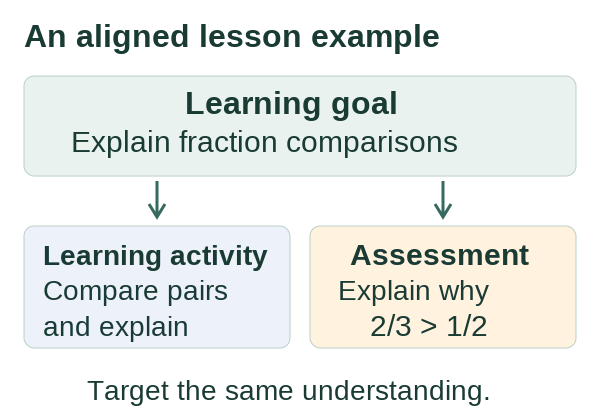
One proposal is that a plan works as a thinking tool: when the objectives, the assessment and the classroom activities in a plan line up with one another, the teacher can use that alignment to reason about what students need. A study of 10 elementary school teacher candidates, each supplying four to five daily lesson plans with matching videos and written commentaries, tested this idea. The candidates rarely took account of what their students needed to learn. One candidate did use assessment data to think about learning needs and to plan later lessons around them. The researchers concluded that teacher education programs should do more to build two skills: aligning plan features, and reading assessment data as tools for this kind of thinking.[22]
Two preservice physical education teachers each taught four frisbee units of 6 lessons across two different high schools. They received feedback on their plans before teaching, guided reflection after lessons and repeated chances to teach the same material. The two teachers made 589 adaptations across six core teaching practices, most often in management (28%), then task presentation, content development and active supervision (16% each), goals and assessment (7%) and rules and routines (3%). Between 16% and 30% of the adaptations came in the last of three iterations of each plan, and the number of adaptations fell from the first school placement to the second and from Lesson 1 to Lesson 6. The researchers concluded that plan feedback, guided reflection and repeated teaching supported the growth of adaptive competence during the placements.[23]
Eleven secondary preservice mathematics teachers took part in a qualitative content analysis of their lesson plans and their written reflections on those plans, with six subdomains of mathematical knowledge for teaching defined in terms of teaching rehearsals. Knowledge of Content and Teaching appeared most often, as the teachers described mathematical tasks and the instructional activities tied to them. Knowledge of Content and Students appeared when the teachers described how their students would engage with the proposed tasks. The teachers struggled, however, to plan activities that built on students' potential mathematical thinking and reasoning, and Horizon Content Knowledge, the link between advanced mathematics and classroom teaching, appeared only in limited instances. The researchers proposed other forms of teaching rehearsal to give preservice teachers more chances to show and develop this knowledge.[24]
Planning knowledge itself can be measured and appears to grow during teacher training, though unevenly. Earlier studies from German-speaking parts of Europe had found no substantial development in the competences and pedagogical content knowledge of prospective history teachers during training. A newer German study confirmed development of lesson planning knowledge using different test instruments and found significant differences in knowledge level among cohorts of prospective history teachers (n = 282), while also identifying some deficits in history teacher training.[25]
Trainee teachers in North Macedonia used both affordance-based and outcomes-based lesson plans, then took part in a survey and interviews; an affordance-based plan is organized around the teaching opportunities a classroom situation offers rather than around preset outcomes. Respondents found both types useful, but in different ways and for different reasons, and they disagreed in a number of areas.[26]
Research
Evidence on planning and teaching quality
A 2024 study of 240 instructors at Neijiang Vocational and Technical College in China rated their instructional planning proficiency as commendable and reported positive correlations between that proficiency and teaching performance, student engagement and effective classroom management. The study framed its analysis with cognitive load theory, the idea that instruction should avoid overloading the limited capacity of working memory, and it called for targeted professional development to strengthen planning capability.[27] A separate 2024 survey of 105 university teachers in the social sciences in Pakistan, using two researcher-built five-point rating scales with Cronbach alpha values of .82 and .86, found a moderate correlation between teachers' instructional planning and the quality of their teaching. That study recommended that institutions run sessions, seminars and workshops in which experienced academics share how planning can be carried out in ways that improve teaching quality.[28]
An experimental study published in 1986 trained preservice teachers in cognitive monitoring, the habit of checking and steering one's own thinking while planning, and found that both the lesson plans and the later lesson implementation of the trained prospective teachers were significantly more effective.[29] A 2020 study of 172 preservice teachers in Germany analysed written plans for their first demonstration lesson during induction. It scored what the researchers called pedagogical adaptivity: how far lesson assignments match learners' cognitive level and guide them into their zone of proximal development, the range of tasks a learner can manage with help but not yet alone. Declarative general pedagogical knowledge of adaptivity, measured by a standardised test, significantly predicted the situation-specific skill of adaptivity in the written plans. Adaptivity in the plans in turn affected how the preservice teachers said they taught that lesson.[3]
One study followed 35 elementary teachers learning to build mathematics lesson plans around three recommendations from the Institute of Education Sciences. The recommendations were interweaving worked examples with practice problems, connecting concrete and abstract representations, and asking deep questions that elicit student self-explanations. Comparisons of pre- and post-surveys and of initial, revised and end-of-course plans showed growth in all three planning practices.[30] A study of 18 preservice teachers after one year of teacher preparation used a lesson analysis and plan template to assess how far they connected professional knowledge with their plans. The study then compared the preservice teachers' planning connections with their ability to connect professional knowledge with observations of teaching, assessed with a validated instrument that measures professional vision. The links found between planning and observation abilities pointed to ways that teacher education programmes could draw professional knowledge nearer to practice.[31]
A 2020 study of 226 teachers in training built a rubric to score didactic lesson planning and reported a Cronbach alpha of .703. A factor analysis yielded one factor that explained 53.046% of the variance, and no items needed removal. The researchers read this as adequate reliability and construct validity while calling for further studies to confirm the results.[32] A case study of portfolio-based assessment on a part-time higher education course for in-service teachers and trainers in the north of England argued that the validity and reliability of such assessment is contestable. The ways portfolios are assessed, it held, mask complexities and contradictions in how students create them.[33]
Subject differences in planning
A systematic review of 20 empirical studies of mathematics lesson planning, covering work published in the previous decade, found that teachers, and novice teachers in particular, struggle with planning and that their knowledge and competence fall short of an expert level. The same review reported that teachers can build this competence through training in initial teacher education and professional development. It argued that teachers need support in setting out plans that sharpen their awareness of students' thinking, of possible learning trajectories, of curriculum and teaching resources, and of pedagogies that use new technology.[1] A mapping review of 25 English-language studies published between 2000 and April 2023 examined how planning for primary mathematics teaching is represented to pre-service teachers. Few of those studies addressed the representations themselves, and the review suggested that future research make their use more explicit and explore how different representations shape what pre-service teachers learn.[34]
In music, a yearlong qualitative study of 10 undergraduate pre-service teachers who planned classes and individual lessons in a university string project identified five themes. These were concern about knowing how to begin planning, difficulty identifying what the children needed to learn, the prominence of decisions made on the fly, and comparisons between thinking about teaching and planning and the actual written plans.[35] A study of 58 pre-service and experienced teachers from 7 universities asked participants to plan a hypothetical beginning band lesson from one page of a band method book. Experienced teachers used fewer words than undergraduates but showed the same number of strategies and the same level of detail on average. The variety of strategies varied by institution, which suggests that some institutions value a broader range of strategies and activities in beginning band classes.[36] A study of second-year Bachelor of Education (Music) and Diploma in Education (Music) students at an Australian university, conducted in the first semester of 1994, found that the pre-service teachers worked from two sets of lesson agendas. One was a written agenda shaped by the university pedagogical programme, and the other was an unwritten agenda shaped by the pre-service teachers' beliefs about teaching.[37]
Physical education initial teacher training in England, as in many other countries, has traditionally required trainees to complete detailed lesson plans for every lesson taught in the school practicum and then to evaluate those lessons. A questionnaire study of 289 physical education trainees in England, completed after a block school-based practicum, found mixed responses and no single method followed by all trainees. Most trainees found the plan useful in the lesson, though others found it too detailed to use, and some did not deviate from the plan while others adapted it. The majority said that evaluation let them see whether objectives had been achieved.[38]
Science planning has been studied with instruments that score written plans directly. The Science Lesson Plan Analysis Instrument was developed and validated for quantitative evaluation of teacher-generated lesson plans that span several days, as a complement to surveys and classroom observation.[39] A qualitative study of 16 pre-service teachers in a mathematics methods course found that 15 showed at least an emerging ability to create an integrated science, technology, engineering and mathematics lesson. Such a lesson contained an engineering problem, constraints, a prototype or model, testing of the model, and collection and analysis of data about it. The study concluded that experiencing engineering design problems could better prepare pre-service teachers to design and implement integrated STEM education.[40]
A Thai national training programme for 900 in-service science, mathematics and computer teachers working with gifted students found that 75.90 % of the total STEM lesson plans produced during training were of a good level. Collaboration among teachers from different subjects helped them see what the STEM activity involves and how it carries over into an active classroom. The teachers could then design lessons that connect STEM to students' daily life and create evaluation and assessment for the STEM classroom.[41]
Vocational planning has been examined through the readiness of teachers to prepare learning tools under the 2013 curriculum in vocational schools in Banten, Indonesia. The study drew on 957 respondents from 2017 to 2018, all of them vocational teachers or vice-principals in the curriculum field, across four cities and three districts. Readiness stood at 45.31% for analysis of Core Competencies and Basic Competencies, 38.37% for program mapping, 39.45% for preparation of the learning plan and 36.78% for learning evaluation. On the Science Lesson Plan Analysis Instrument, the lesson plans fell into a quality category for the instructional program and instructional plan aspects and a moderate category for instructional media, assessment and other aspects.[42]
Assessment of plans and open questions
Lesson plans can be judged with structured instruments. One such instrument was developed within a university-wide evaluation project, paid for by the U.S. Department of Education, that assessed multicultural and diversity outcomes for student teachers.[43] Other work has examined plans through the elements of instructional design proposed by Reiser and Dick in 1996, applying them as an analysis framework to Dokdo lesson plans written by 12 university students in a pre-teacher course in Korea. In that analysis, the plans set cognitive area-centered goals, built content around Dokdo history and the grounds of the Dokdo controversy, used learner-centered methods, evaluated content comprehension and output, and used video media to draw attention and deliver content.[44]
Policy requirements shape what teachers put into plans and how much freedom they have in making them.[45] In Indonesia, a need analysis of teachers working with the 2013 curriculum found that teachers wanted all 13 components of the lesson plan set out in Permendikbud No. 22 of 2016. These run from school identity and time allocation to learning steps and assessment, adjusted to students' needs and learning styles.[46]
In practice
How planning is taught to new teachers
A survey of 64 physical education teacher education faculty members in the United States, together with 38 lesson plan templates they used, found that most programs raised the demands on lesson plans as preservice teachers moved through the program. The same survey found that faculty spent less than 30 min reviewing each lesson plan. The templates collected in that survey were built mainly around three areas: a lesson overview, tasks and activities, and reflection.[47]
Interviews with 11 physical education teacher education faculty members identified four themes in how planning is taught. They were strategies for building preservice teachers' understanding, obstacles to teaching and giving feedback, the value of adapting a template and agreeing on shared expectations, and the struggles faculty see in their students.[48] Because preservice teachers have limited teaching experience, planning requires them to weigh content, goals and objectives, task aims, activities, the actions of teachers and students, time allocation, grouping, organization and assessment. Published recommendations for these programs call for continual reflection on planning practice and regular updating of the planning process and of lesson plan templates.[49]
One professional training program assessed participants on personality, learning, lesson plan development and microteaching.[50] A community service project in Malang, Indonesia, coached graduates of the national teacher professional education program in three phases. Initiation used a seminar and focused group discussion, implementation gave help revising lesson plans and scored them with a constructed instrument, and evaluation used microteaching and reflection. The teachers in that project knew the required process and content standards for lesson plans, yet some components were still not written properly and some parts of the plans did not match each other.[51]
Some programs reduce the load of planning by supplying preselected teaching materials, an approach called material-based planning. Think-aloud protocols, in which planners speak their thoughts while working, were collected from 13 preservice biology teachers at a German university as they planned lessons on photosynthesis and digestion. These teachers concentrated on core dimensions such as instructional strategies, the visible structures of a lesson, and student understanding, the deeper structures, while secondary dimensions such as judging task authenticity were comparatively rare. The analysis also found an imbalance between visible and deep structures that appeared more often in planning for photosynthesis, which the researchers read as a sign that the complexity of the topic could overload students. The study concluded that successful planning by preservice teachers depends on both the planning task and the choice of topic.[52]
One study examined an asynchronous online course in an elementary education program that focused on designing instruction and integrating technology into teaching, and analyses of variance showed statistically significant gains across the three semesters the course was offered. Candidates' comments about the course were mostly positive and concerned its flexibility, the feedback they received, and the authenticity of the assignments.[53]
A quantitative study at Pamukkale University in the 2018-2019 academic year used a researcher-developed Competency Scale for Lesson Planning. Its participants were third-year and final-year students majoring in classroom teaching, preschool teaching, science teaching, social sciences teaching, mathematics teaching and Turkish language teaching. It found that the preservice teachers had an optimal level of competency in lesson planning.[54]
Planning for inclusion and language
A case study of 8 student-teachers at a university in Salatiga, Indonesia, examined lesson plans written for junior high school English learners during a microteaching course in the second half of 2021. The trainees included every required element of a plan (identity, learning objective, material, activity, choice of media, choice of learning source, and evaluation), and their differentiation was visible in teaching through readiness, learning profile, and interest. Most trainees improved on their most frequent weaknesses across the first four teaching sessions, yet formulating the learning objective remained their greatest difficulty. The study concluded that a differentiated instruction plan supported learning for mixed groups of students.[55]
A true experimental study with a control group tested whether a short training session changed the lesson plans that special and general educators produced in a college classroom. A one-hour session introduced UDL to the experimental group, and the control group received the same training later.[2] A later intervention with 52 preservice and inservice teacher candidates in 2 special education method courses combined UDL with universal design for transition, a framework for planning around students' academic and transition needs. Candidates improved significantly in incorporating UDL and transition components into their plans and largely agreed that the frameworks helped them plan lessons inclusive of all students.[56]
A study of 56 preservice elementary teachers at a large urban research university analysed 56 lesson plans across English language arts, social studies, math and science. It looked for pedagogical translanguaging, the planned use of more than one language to support learning. The preservice teachers identified key vocabulary and used multimodal resources, meaning several modes such as text, images and speech, to support emergent bilinguals. They needed more training in drawing on students' home languages, in strategic grouping, in multilingual collaboration, and in translanguaging assessments.[57] A planning model for subject teachers in South Africa addresses the same problem from the other direction, integrating language and content instruction so that learners acquire the academic language skills needed to study in English as the language of learning and teaching. The model takes a subject teacher through lesson design, working backward from the goal, and then through lesson presentation, working forward.[58]
The plans were written for secondary-school learners who usually received two hours of English per week. Language-driven CLIL followed forward design, gave more weight to content than to explicit knowledge of the language, and aimed at revising language with older learners.[59]
How experienced teachers organize plans
Surveys of working teachers suggest that much planning goes on without being written down. A substantial majority of those teachers reported using no expert's planning format, such as the model associated with Hunter (1984) or one suggested during preservice training. The survey listed 14 components that preservice lesson plans and instructional design models usually contain. Even so, the teachers urged beginning teachers to write detailed plans. At least one third of respondents recommended each of the 14 components, and a majority recommended 8 of them.[60]
Document studies of written plans show uneven attention across components. One analysis examined 16 lesson plans written by 16 teachers from 16 schools in Bantul Regency, Yogyakarta. The plans covered physical education units on large ball games oriented toward higher order thinking skills. Across eight indicators, including objectives, methods, media, materials, resources and assessment, the plans as a whole fell in the sufficient category, with scores ranging from 29 to 84. Learning resources received the lowest mean score, 1.94, while learning activities received the highest, 19.12.[61]
A case study of one middle school teacher in inclusive classes, where students with learning disabilities learn alongside peers, traced how she decided when to individualize instruction. In the first year, her planning and teaching centered on content, and this appeared as a prominent theme. In the second year, her planning and instruction shifted toward the academic diversity of the students in her classes.[62]
Collaboration and lesson study in planning
Collaborative lesson planning gives student teachers a shared setting in which to design lessons and to assess one another's work. In one program, student teachers evaluated their peers from multiple perspectives, with patterns differing by sex and by English language proficiency. In an English as a Foreign Language teacher education program in Japan, student teachers spent 10 weeks on a collaborative planning task. They designed a 50-minute English lesson and wrote peer assessments of one another's plans. A content analysis of those written assessments found that participants judged their peers from several perspectives at once, and that evaluation tendencies differed by sex and by English language proficiency. Men in the group tended to prefer formal verbal interactions, and women tended to put group cohesion and harmony first. Student teachers with high English proficiency stressed logical reasoning and critical thinking and often took leadership roles, though some found collaborative engagement difficult. The study concluded that balanced group composition matters for supporting different collaboration styles, and it described the peer assessments as rubric-free, leaving student teachers to define effective collaboration themselves.[63]
Workshop settings have been used to raise teachers' skill in writing lesson plans where initial plans fell short of the required format. At one madrasah in Padang, 4 physical education teachers took part in a lesson plan preparation workshop held through their subject teacher working group, run as action research over two cycles and four meetings. The average score for the teachers' ability to prepare lesson plans rose from 73.06 in the first cycle, rated sufficient, to 84.23 in the second cycle, rated good.[64]
Planning with internet resources and AI
New teachers draw lesson ideas from cooperating teachers, family and friends, university courses, and internet resources, and sometimes simply follow plans handed to them. A study of 158 elementary preservice teachers' plans across eight courses found that some of them instead collected, curated, synthesized and applied ideas from these inspirations, a habit the study describes as critical curation.[4] Follow-up interviews suggested the inclusive early childhood group had more practicum field experiences, which increased their use of physical resources and reduced their use of internet resources.[65]
In one study, 21 pre-service mathematics teachers used ChatGPT while designing 5E lesson plans. Interviews with them revealed both what the tool offered and where it fell short, including that it often needed well-structured prompts to produce relevant results. Twenty-one preservice mathematics teachers used ChatGPT across the stages of the 5E lesson plan model (engage, explore, explain, elaborate, evaluate) for fourteen distinct purposes, and interviews found that it offered creative and practical ideas but often needed well-structured prompts to give relevant results.[66] A review of seven chemistry and science education studies concluded that the written plan, teachers' reasoning and revisions, and students' learning each need separate evidence, so a completed template or a teacher's positive impression does not by itself show better learning.[67]
In a survey of 59 undergraduate and graduate students, participants reported that ChatGPT's output needed revision before use, and they still intended to use the tool for lesson planning as practicing educators. The study surveyed 59 undergraduate and graduate students in STEM, TESOL and social studies methods courses. After analyzing ChatGPT's output, students rated its ability to write a complete plan in their content area, and a detailed plan for a substitute teacher, lower than before, yet they still planned to use it as practicing educators.[68]
What this looks like when you study
A survey of special education teachers found that most did not write out plans for each lesson they taught. Their planning was often done in the head, or the step was performed by habit or instinct. None of the 14 components regularly included in preservice plans was written out by a majority. Just 3 of the 14 components appeared in written form from more than one third of the teachers surveyed. The same teachers strongly recommended that beginning teachers write detailed plans.[60]
In a German study, 13 preservice biology teachers planned lessons on photosynthesis and digestion out loud while using preselected materials. They concentrated on instructional strategies and student understanding, and rarely reflected on whether tasks were authentic.[52]
Emiliasari (2019) reports that the teachers in the case study prepared plans by reviewing the core and basic competences in the syllabus, finding learning resources, choosing media, settling the material, selecting a method, and setting out indicators and goals. Read material relevant to what will be taught, then think about the objectives and the procedures to be used. Think about the difficulties students may face, and check the time needed for each stage. Make sure there is enough time for interaction between teacher and student, and add varied activities.[7]
Later developments
Technology and digital planning tools
A scoping review of 16 empirical studies from nine countries and three continents found that most of these studies built their definitions on the TPACK model, while also treating ICT integration in lesson plans as a skill in its own right. The review describes that skill as situation-specific: it is predicted by what teachers know and believe, and it in turn predicts how they perform in class. Intervention studies in the same review report that learning opportunities in initial teacher education and in professional development change how teachers integrate ICT into their plans.[69]
In 45 preservice teachers' literacy lesson plans that integrated digital texts or tools, 41 percent showed TPACK and 42 percent combined technological content knowledge with pedagogical content knowledge, the knowledge of subject-specific teaching methods. Pedagogical content knowledge alone appeared in 13 percent of the plans, combinations of technological content knowledge with technological pedagogical knowledge in 1 percent, technological content knowledge alone in 1 percent, and technological pedagogical knowledge alone in 0 percent. Only 2 percent of the plans showed none of these combinations. The study noted that its pattern, pedagogical content knowledge without technological pedagogical knowledge, differed from earlier work that found the reverse.[70]
A semester-long science methods course for 27 preservice science teachers, assessed through lesson plans and microteaching observations with two TPACK instruments, changed participants' TPACK to varying degrees. The clearest gain was knowledge of how to use educational technology tools effectively.[71] When 37 preservice teachers received technological, pedagogical and content information separately and 36 received it integrated, the integrated group gave relatively more design justifications that combined technology with pedagogy, yet this reasoning did not produce higher-quality lesson plans.[72]
After 38 undergraduates designed an inquiry-based, technology-enhanced lesson plan on a virtual platform, their TPACK self-efficacy rose significantly, and their plans generally followed the phases of inquiry-based learning while integrating online scaffolding tools and virtual laboratories at a moderate level.[73] In a microteaching course in Indonesia, 23 preservice English teachers worked with a technology-based instruction lesson plan developed through Niess's technology integration framework. The treatment had a positive effect on their TPACK self-efficacy, and six participants said in interviews that the plan improved their microteaching performance and their confidence in using technology.[74]
A qualitative single-case study followed one pair of first-semester preservice physics teachers planning a lesson on motion on an inclined plane with GeoGebra, a graphing and geometry software. The pair showed emerging technological content knowledge when they interpreted and modified vector representations, technological pedagogical knowledge when they reasoned about static and dynamic visualisations, and TPACK when they structured simulations to support conceptual understanding in mechanics. The same case recorded uncertain moments, among them the ambiguous reading of vectors that were unlabelled or overlapped.[75]
For augmented reality, a scoring rubric called EVAR (Evaluating Augmented Reality in Education) was built from an existing framework for analysing augmented reality in science and engineering teaching. It was extended with concepts of instructional design and lesson organisation, and it has 18 items in five subscales, each rated on a four-point Likert scale. Five experts used it to assess augmented reality learning scenarios designed by eleven master's seminar preservice teachers majoring in biology, chemistry or physics at the University of Konstanz. The rubric showed high inter-rater reliability and could tell groups apart by the educational quality of the augmented reality and by how it was built into lesson planning.[76]
A development study using the ADDIE model (analysis, design and development phases with expert judgments) drew on a literature review and interviews with English teachers to identify what such plans need. The list included presenting all components of a lesson plan, covering both language skills and content, addressing various learning styles, and giving relevant examples. It went on to supporting intrinsic motivation, weighing the difficulty of the material and the development level of students, and providing constructive feedback on all assignments and assessments. Expert judgments led to revisions of the learning objectives, teaching activities and assessment sections, and the resulting product was judged applicable for use.[77]
In a qualitative study, Indonesian preservice secondary school teachers produced sample lesson plans with student-led corpus consultation after a short private online training course, live online planning workshops and detailed suggestions from a data-driven learning expert. Teacher educators rated the plans for the level and fit of TPACK in their objectives, target language focus and activity instructions, and the analysis described plans representing low, medium and high levels of TPACK for data-driven learning.[78] A quantitative study of teacher professional education students scored lesson plans for TPACK and higher-order thinking skills, the analysis skills of analysing, evaluating and creating. It found that pedagogical ability and technology-based pedagogical ability affected TPACK indirectly, while technology-based content capability and technology-based pedagogical ability affected it directly. The TPACK components related to higher-order thinking skills in a negative direction, except content capability, which affected them positively.[79]
Generative AI in lesson planning
A qualitative document analysis of schoolteacher education found that generative language models can supply specific materials and support, including lesson plans, to practising teachers and student teachers. The same analysis reported that these tools opened access to lesson plans to all teachers, and it argued that the models should be approached with caution, with their limitations and potential biases evaluated critically, because they support teaching rather than replace teachers.[80] A paper on initial teacher education in Ireland described how a teacher who supplies specific requirements and objectives can obtain structured lesson plans and subject plans, and it held that teachers will always need to add their own insights and experience before making pedagogical decisions.[81]
In a mixed-methods study of 55 undergraduates in their first semester of a teacher education program, each student wrote two lesson plans, one by traditional methods and one with AI support. Scores on the Instructional Planning Assessment Rubric were significantly higher for the AI-supported plans (p < .05). The same students reported significantly higher enjoyment, motivation and perceived value after using AI (p < .05), while their self-confidence rose slightly without reaching statistical significance.[82] A longitudinal intervention with 103 participants compared an experimental group that received feedback from an analytical AI platform on lesson plans developed over a semester with a control group that received human feedback. AI feedback matched or surpassed human feedback in some dimensions, improving planning aspects such as certain content-related sustainability aspects, action orientation, relatedness, technology use, lesson structure and learner engagement. On the wider measures, the mere use of AI did not automatically raise AI literacy, change attitudes or improve motivation.[83]
Focus group interviews with 50 preservice mathematics teachers after targeted training sessions identified time saving, the production of innovative activities and general support as the main benefits, while the study held that teacher agency, pedagogical knowledge and content alignment remained vital.[84] A case study of preservice teachers of English as a foreign language at a South Korean university found generative AI used for topic selection, material creation, lesson organization and language checking. Gains in efficiency and creativity came with uneven output quality and limited incorporation of effective pedagogical strategies.[85]
In an Irish primary teacher program, preservice teachers used generative AI for personal and academic purposes more often than for lesson planning. Academic use correlated positively with recognizing the tool's opportunities for planning and with wanting professional development, and negatively with perceiving challenges and ethical concerns. That study recorded substantial concerns about over-reliance, potential skill diminishment, educational equity and data privacy.[86] A survey of 170 prospective teachers found broad acceptance of AI for automating the planning of lessons, for personalizing learning tasks and for giving feedback on student learning outcomes.[87]
Fifty preservice early childhood teachers worked in 25 pairs to write two lesson plans on sustainability topics, received GenAI feedback and revised their plans, producing 50 pair-authored reflections for qualitative analysis. The feedback prompted the pairs to reconsider lesson content and teaching strategies, yet they seldom accepted recommendations outright, often modifying or discarding suggestions that did not fit developmental appropriateness or classroom realities. The authors concluded that future educators should be prepared to treat GenAI as a complement to professional reasoning rather than a replacement for it.[88]
Most participants saw gains in pedagogical knowledge, content knowledge and idea generation, while concerns arose about dependency, communication barriers and ethics.[89] One article set out prompting practices for generating lesson scenarios that draw explicitly on psycho-pedagogical frameworks and disciplinary knowledge together.[90] A relational survey of 412 preservice teachers in Turkey found high self-reported readiness for AI-supported instructional design and high lesson planning competencies, with readiness predicting planning competencies significantly and strongly.[91]
Planning for sustainability and local contexts
Some lesson plans are built around a theme that crosses subject boundaries, and sustainability is one such theme. A mixed-methods case study at a state university in Türkiye involved 35 pre-service teachers from different subject areas. It investigated how cross-curricular lesson planning influenced their understanding of sustainable development and their capacity to apply education for sustainable development principles. The study reported that this cross-curricular planning improved the participants' overall grasp of sustainable development and their ability to teach it within several disciplines. Working together on the plans widened the participants' views of sustainability issues and supported the connected character of education for sustainable development.[92]
An exploratory study in Higaonon communities in Esperanza, Agusan Del Sur, in the Philippines, drew on the views of school officials, teachers in the indigenous peoples education programme, tribal leaders, parents, students and outside stakeholders to propose a rights-based planning approach. The proposal argues for a shift from culture-based teaching to a rights-based approach. In that approach, indigenous peoples' rights to their ancestral domains, to cultural integrity, to self-governance and to social justice become content that learners understand and protect. It also identifies factors that may help or hinder putting such an approach into practice.[93]
One design developed a lesson plan that inserts disaster mitigation material into reading instruction, using the ADDIE model of analysis, design, development, implementation and evaluation. Expert validation gave an average of 89.58, and student responses in a limited scale test reached 89.7%.[94] In Indonesia, one study examined indigenous artifacts from a mountainous area on the border between Yogyakarta and Central Java. It asked how those objects relate to mathematics curriculum content and concluded that pre-service math teachers can use them to design lesson plans, since the artifacts carry mathematical value and are close to students' thinking. The study notes that remote areas need adaptable, creative and innovative teachers, yet teachers are not evenly distributed there in quantity or quality.[95]
Key studies
| Year | Study | Sample | Design | Finding |
|---|---|---|---|---|
| 1996 | Searcy & Maroney[60] | special education teachers surveyed | survey | Most teachers did not write out plans for every lesson, but each of the 14 components drew a recommendation from at least one third of them. |
| 2013 | Courey et al.[5] | Comparison of lesson plans by 45 teacher candidates before and after UDL training | After training, teachers built more differentiated options and a wider range of teacher strategies, drawn from UDL principles, into their lesson plans. | |
| 2019 | Capel et al.[38] | 289 physical education trainees in England | questionnaire after a block school-based practicum | Trainees did not all plan the same way; the largest share reported spending half an hour to one-and-a-half hours on each lesson plan. |
| 2019 | Strickroth[16] | 61 prospective teachers in Berlin | usability evaluation of a graphical planning prototype | The graphical, time-based approach proved usable and had positive effects on perception of time and self-reflection. |
| 2020 | Brito-Lara et al.[32] | 226 teachers in training | rubric reliability and validity study | The rubric had a Cronbach alpha of .703 and one factor explained 53.046% of the variance. |
| 2020 | Maiorca & Mohr‐Schroeder[40] | 16 preservice teachers in a mathematics methods course | qualitative content analysis of STEM lesson plans | 15 of the 16 preservice teachers showed at least a beginning capacity to build an integrated STEM lesson around an engineering problem. |
| 2020 | Arya et al.[70] | 45 preservice teachers' literacy lesson plans | a priori coding and content analysis | 41% demonstrated TPACK, and 42% combined technological content knowledge with pedagogical content knowledge. |
| 2020 | König et al.[3] | 172 preservice teachers in Germany | standardised analysis of written demonstration lesson plans | Declarative knowledge of adaptivity predicted pedagogical adaptivity in written plans, which in turn predicted self-reported practice. |
| 2022 | Fadoli[17] | five English teachers' lesson plans | descriptive qualitative document analysis | Two of five teachers had incomplete objectives, and condition was the lowest aspect. |
| 2023 | Koberstein-Schwarz & Meisert[52] | 13 preservice biology teachers at a German university | think-aloud protocols with qualitative content analysis | Planning focused on instructional strategies and student understanding, while reflecting on task authenticity was rare. |
| 2024 | Dehandschutter et al.[23] | two physical education preservice teachers | case study across two high school placements | They made 589 adaptations across six core teaching practices, with 28% in management. |
| 2024 | Cevikbas et al.[1] | Systematic review of 20 empirical studies on mathematics lesson planning | Teachers, especially novices, face difficulties in lesson planning and their overall competence is not at an expert level, but they can acquire such competence through training. | |
| 2025 | Iserbyt et al.[18] | 31 physical education student teachers | document analysis of unit and lesson plans | Only 7% of unit goals and 8% of lesson outcomes were assessable and feasible. |
| 2026 | Tsuda et al.[47] | 64 physical education teacher education faculty and 38 lesson plan templates | descriptive quantitative survey and content analysis | Most programs increased demands on plans as preservice teachers progressed and spent less than 30 min per plan review. |
See also
References
- Cevikbas, M., König, J., & Rothland, M. (2024). Empirical research on teacher competence in mathematics lesson planning: recent developments. ZDM – Mathematics Education, 56(1), 101-113. doi:10.1007/s11858-023-01487-2
- Spooner, F., Baker, J. N., Harris, A. A., Ahlgrim-Delzell, L., & Browder, D. M. (2007). Effects of Training in Universal Design for Learning on Lesson Plan Development. Remedial and Special Education, 28(2), 108-116. doi:10.1177/07419325070280020101
- König, J., Bremerich-Vos, A., Buchholtz, C., & Glutsch, N. (2020). General pedagogical knowledge, pedagogical adaptivity in written lesson plans, and instructional practice among preservice teachers. Journal of Curriculum Studies, 52(6), 800-822. doi:10.1080/00220272.2020.1752804
- Sawyer, A. G., Dredger, K., Myers, J., Barnes, S., Wilson, R., Sullivan, J., & Sawyer, D. (2020). Developing Teachers as Critical Curators: Investigating Elementary Preservice Teachers’ Inspirations for Lesson Planning. Journal of Teacher Education, 71(5), 518-536. doi:10.1177/0022487119879894
- Courey, S. J., Tappe, P., Siker, J., & LePage, P. (2013). Improved Lesson Planning With Universal Design for Learning (UDL). Teacher Education and Special Education: The Journal of the Teacher Education Division of the Council for Exceptional Children, 36(1), 7-27. doi:10.1177/0888406412446178
- König, J., Krepf, M., Bremerich-Vos, A., & Buchholtz, C. (2021). Meeting Cognitive Demands of Lesson Planning: Introducing the CODE-PLAN Model to Describe and Analyze Teachers’ Planning Competence. The Teacher Educator, 56(4), 466-487. doi:10.1080/08878730.2021.1938324
- Raynesa Noor Emiliasari (2019). Lesson Planning in EFL Classroom: A Case Study in Lesson Plan Preparation and Implementation. Wiralodra English Journal, 3(2), 367-375. doi:10.31943/wej.v3i2.67
- Kola, M. (2021). Pre-service teachers’ action research: technology education lesson planning in a South African University. Educational Action Research, 29(1), 99-117. doi:10.1080/09650792.2019.1686043
- Manyarara, B. C. (2018). Lesson planning for teacher effectiveness. The Namibia CPD Journal for Educators, 76-87. doi:10.32642/ncpdje.vi.1280
- Putri, A. (2017). EFL teachers’ understanding in developing lesson plan. Indonesian EFL Journal, 2(1), 1. doi:10.25134/ieflj.v2i1.632
- Güneş, B., MIRZEOGLU, A. D., KARADAG, O., ATLI, K., & YALCINKAYA, N. (2022). Evaluation of Daily Lesson Planning Competency of Physical Education and Sports Teachers. Journal of Qualitative Research in Education, 22(32). doi:10.14689/enad.32.1550
- Guleria, D. J. (2025). Development And Demonstration Of A Structured Lesson Plan: Enhancing Poetry Instruction. International Journal of Environmental Sciences, 994-1005. doi:10.64252/711znb89
- Melton, C., Power, M. E., Duble Moore, T., Plumb, A., Bourget, J., Coyne, M., & Simonsen, B. (2024). A Four-Step Plan to Integrate Behavioral Practices Into Tier 1 Foundational Reading Instruction With an Integrated Lesson Plan Template. Intervention in School and Clinic, 60(1), 6-16. doi:10.1177/10534512241247556
- Causton‐Theoharis, J. N., Theoharis, G. T., & Trezek, B. J. (2008). Teaching pre‐service teachers to design inclusive instruction: a lesson planning template. International Journal of Inclusive Education, 12(4), 381-399. doi:10.1080/13603110601156509
- Zaragoza, A., Seidel, T., & Santagata, R. (2023). Lesson analysis and plan template: scaffolding preservice teachers’ application of professional knowledge to lesson planning. Journal of Curriculum Studies, 55(2), 138-152. doi:10.1080/00220272.2023.2182650
- Strickroth, S. (2019). PLATON: Developing a Graphical Lesson Planning System for Prospective Teachers. Education Sciences, 9(4), 254. doi:10.3390/educsci9040254
- Fadoli, J. (2022). Exploring Lesson Plans Through Learning Objectives Written by English Teachers. Journal Of Education And Teaching Learning (JETL), 4(3), 265-273. doi:10.51178/jetl.v4i3.917
- Iserbyt, P., Lund, J., & Lux, F. (2025). Instructional Alignment in Physical Education Student Teachers’ Lesson Plans for Individual Sports. Journal of Teaching in Physical Education, 44(2), 343-353. doi:10.1123/jtpe.2024-0041
- Arias de la Cruz, A. (2021). EFL Teachers’ Challenges to Write Content and Language Objectives for CBI Lesson Plans at a Mexican University. Latin American Journal of Content & Language Integrated Learning, 13(2), 215-240. doi:10.5294/laclil.2020.13.2.4
- Ronel, D., Puspita, H., & Mulyadi, M. (2025). Learning Objectives in Lesson Plans based on Kurikulum Merdeka Designed by PPG Students of Bengkulu University. Journal of English Education and Teaching, 9(1), 241-258. doi:10.33369/jeet.9.1.241-258
- Luciana, N. L. R. (2020). Teachers' Readiness in Inserting the 21st Century Skills in the Lesson Plan in Teaching English. Jurnal Pendidikan dan Pengajaran, 53(2), 168. doi:10.23887/jpp.v53i2.26406
- Chizhik, E. W., & Chizhik, A. W. (2018). Using Activity Theory to Examine How Teachers' Lesson Plans Meet Students' Learning Needs. The Teacher Educator, 53(1), 67-85. doi:10.1080/08878730.2017.1296913
- Dehandschutter, T., van der Mars, H., Ward, P., & Iserbyt, P. (2024). Two Preservice Teachers’ Adaptive Competence in Lesson Planning Across Two High School Placements. Journal of Teaching in Physical Education, 43(4), 707-716. doi:10.1123/jtpe.2023-0283
- Sapkota, B., & Hayes, A. H. (2024). Preservice teachers' mathematical knowledge for teaching: Focus on lesson planning and reflection. School Science and Mathematics, 124(5), 323-339. doi:10.1111/ssm.12644
- Wolf, J., Rothland, M., & Brauch, N. (2022). The effectiveness of history teacher education concerning the development of lesson planning knowledge: an example from Germany. History Education Research Journal, 19(1). doi:10.14324/herj.19.1.08
- Ončevska Ager, E., & Anderson, J. (2025). Affordance-based lesson planning in pre-service teacher education. ELT Journal, 79(1), 1-11. doi:10.1093/elt/ccae048
- Gao, W. (2024). Instructional Planning Proficiency of Instructors in the Vocational College as a Predictor of Teaching Performance. Pacific International Journal, 7(2), 33-38. doi:10.55014/pij.v7i2.560
- Zafar, S., Maqbool, R., & Kamran, Z. (2024). Effect of Instructional Planning on Quality Teaching at University Level. International Journal of Social Science, Technology and Economics Management, 1(2). doi:10.59781/nymo3623
- Neely, A. M. (1986). Planning and Problem Solving in Teacher Education. Journal of Teacher Education, 37(3), 29-33. doi:10.1177/002248718603700306
- Ding, M., & Carlson, M. A. (2013). Elementary Teachers' Learning to Construct High-Quality Mathematics Lesson Plans: A Use of the IES Recommendations. The Elementary School Journal, 113(3), 359-385. doi:10.1086/668505
- Zaragoza, A., Seidel, T., & Hiebert, J. (2024). Exploring preservice teachers’ abilities to connect professional knowledge with lesson planning and observation. European Journal of Teacher Education, 47(1), 120-139. doi:10.1080/02619768.2021.1996558
- Brito-Lara, M., López-Loya, J., & Tobón, S. (2020). Validity and reliability of a rubric to assess didactic lesson planning of preservice teachers. Journal of Teaching and Educational Research, 8. doi:10.35429/jter.2020.18.6.8.17
- Tummons, J. (2010). The assessment of lesson plans in teacher education: a case study in assessment validity and reliability. Assessment & Evaluation in Higher Education, 35(7), 847-857. doi:10.1080/02602930903125256
- Jones, M. E., Erixon, E., & Christiansen, I. M. (2026). Representations of lesson planning practices in primary mathematics teacher education: A mapping review. Review of Education, 14(2). doi:10.1002/rev3.70174
- Schmidt, M. (2005). Preservice String Teachers' Lesson-Planning Processes: An Exploratory Study. Journal of Research in Music Education, 53(1), 6-25. doi:10.1177/002242940505300102
- Brittin, R. V. (2005). Preservice and Experienced Teachers' Lesson Plans for Beginning Instrumentalists. Journal of Research in Music Education, 53(1), 26-39. doi:10.1177/002242940505300103
- Killen, R. (1996). Preservice music teachers: influences on lesson planning. British Journal of Music Education, 13(1), 31-47. doi:10.1017/s026505170000293x
- Capel, S., Bassett, S., Lawrence, J., Newton, A., & Zwozdiak-Myers, P. (2019). How trainee physical education teachers in England write, use and evaluate lesson plans. European Physical Education Review, 25(4), 964-982. doi:10.1177/1356336x18785053
- Jacobs, C. L., Martin, S. N., & Otieno, T. C. (2008). A Science Lesson Plan Analysis Instrument for formative and summative program evaluation of a teacher education program. Science Education, 92(6), 1096-1126. doi:10.1002/sce.20277
- Maiorca, C., & Mohr‐Schroeder, M. J. (2020). Elementary preservice teachers' integration of engineering into STEM lesson plans. School Science and Mathematics, 120(7), 402-412. doi:10.1111/ssm.12433
- Chatmaneerungcharoen, S., & Sricharoen, N. (2021). Supporting interdisciplinary instruction on science, mathematics and technology for Thai gifted students: centered on Raiwa lesson plan. Journal of Physics: Conference Series, 1835(1), 012039. doi:10.1088/1742-6596/1835/1/012039
- Nurtanto, M., Kholifah, N., Masek, A., Sudira, P., & Samsudin, A. (2021). Crucial problems in arranged the lesson plan of vocational teacher. International Journal of Evaluation and Research in Education (IJERE), 10(1), 345. doi:10.11591/ijere.v10i1.20604
- Ambrosio, A. L., Seguin, C. A., Hogan, E. L., & Miller, M. (2001). Assessing Performance-Based Outcomes of Multicultural Lesson Plans: A Component Within a Comprehensive Teacher Education Assessment Design. Multicultural Perspectives, 3(1), 15-22. doi:10.1207/s15327892mcp0301_4
- Korean Association For Learner-Centered Curriculum And Instruction, & Kang, K. (2023). A Study on the Plans of Dokdo Instructional Design in Teacher Training Education: Focusing on the Dokdo Lesson Plan. Korean Association For Learner-Centered Curriculum And Instruction, 23(22), 413-431. doi:10.22251/jlcci.2023.23.22.413
- Nurkamto, J., & Putra, K. A. (2025). Unpacking Government Policy's Impact on EFL Teachers' Lesson Planning. International Journal of Pedagogy and Teacher Education, 9(1), 179. doi:10.20961/ijpte.v9i1.99123
- Aisyiah, P. N., Arrasyid, F. I., & Rifai, A. (2025). The Teacher's Need Analysis to Develop A Lesson Plan Align with The 2013 Curriculum. DEWANTECH Jurnal Teknologi Pendidikan, 2(1), 22-28. doi:10.61434/dewantech.v2i1.88
- Tsuda, E., Olsen, E., Xie, X., Wyant, J., Watson, L., & Machamer, L. (2026). Current Practices of Lesson Planning in Physical Education Teacher Education Programs. Journal of Teaching in Physical Education, 45(2), 381-389. doi:10.1123/jtpe.2024-0335
- Tsuda, E., Xie, X., Olsen, E., & Wyant, J. (2026). The Teaching of Lesson Planning in Physical Education Teacher Education Programs. Journal of Teaching in Physical Education, 1-9. doi:10.1123/jtpe.2025-0377
- Tsuda, E., Wyant, J., Xie, X., & Olsen, E. (2026). Recommendations for Teaching Lesson Planning in Physical Education Teacher Education Programs. Journal of Physical Education, Recreation & Dance, 1-5. doi:10.1080/07303084.2026.2721270
- Sutirna, S., & Intisari, I. (2023). Analysis of Pre-Service Teacher Abilities in Professional Training Program on Aspects of Personality, Learning, Micro-Teaching, and Lesson Plan Development. International Journal of Learning and Instruction (IJLI), 5(2), 45-50. doi:10.26418/ijli.v5i2.58259
- Sabilah, F., Abidasari, E., & Husamah, H. (2021). Teacher professional education coaching to produce high quality lesson plan. Journal of Community Service and Empowerment, 2(1), 13-21. doi:10.22219/jcse.v2i1.15905
- Koberstein-Schwarz, M., & Meisert, A. (2023). Facilitating Preservice Biology Teacher Development through Material-Based Lesson Planning. Education Sciences, 14(1), 42. doi:10.3390/educsci14010042
- Polly, D. (2016). Elementary Education Teacher Candidates’ Development of Lesson Planning Skills in an Online Instructional Design Course. Journal of Applied Educational and Policy Research, 2(1). doi:10.55370/jaepr.v2i1.480
- Süral, S. (2019). An Examination of Pre-Service Teachers’ Competencies in Lesson Planning. Journal of Education and Training Studies, 7(3), 1. doi:10.11114/jets.v7i3.3902
- Abdillah, M., Hartono, R., & Wuli Fitriati, S. (2022). The Implementation of Differentiated Instruction Lesson Plan In The Practice of Teaching English For Adult Learners (TEAL) Course. English Education Journal, 12(4), 705-727. doi:10.15294/eej.v12i4.67518
- Scott, L., Bruno, L., Gokita, T., & Thoma, C. A. (2022). Teacher candidates’ abilities to develop universal design for learning and universal design for transition lesson plans. International Journal of Inclusive Education, 26(4), 333-347. doi:10.1080/13603116.2019.1651910
- Elshafie, M., & Zhang, J. (2024). Pedagogical Translanguaging in Content Areas: Exploring Preservice Teachers’ Lesson Plans for Emergent Bilinguals. Education Sciences, 14(7), 702. doi:10.3390/educsci14070702
- Reyneke, M. (2014). English language-in-education: A lesson planning model for subject teachers. Journal for Language Teaching, 48(1), 31. doi:10.4314/jlt.v48i1.2
- Banegas, D. (2015). Sharing views of CLIL lesson planning in language teacher education. Latin American Journal of Content and Language Integrated Learning, 8(2), 104-130. doi:10.5294/laclil.2015.8.2.3
- Searcy, S., & Maroney, S. A. (1996). Lesson Planning Practices of Special Education Teachers. Exceptionality, 6(3), 171-187. doi:10.1207/s15327035ex0603_3
- Suhadi, S., Handoko, R. D., Mawarti, S., Santoso, N., Antoni, M. S., & Andriyani, F. D. (2023). Teachers’ lesson plan in the implementation of HOTS oriented physical education learning. Jurnal Keolahragaan, 11(1), 131-139. doi:10.21831/jk.v11i1.59655
- Boudah, D. J., Deshler, D. D., Schumaker, J. B., Lenz, B. K., & Cook, B. (1997). Student-Centered or Content-Centered? A Case Study of a Middle School Teacher's Lesson Planning and Instruction in Inclusive Classes. Teacher Education and Special Education: The Journal of the Teacher Education Division of the Council for Exceptional Children, 20(3), 189-203. doi:10.1177/088840649702000302
- Nagamine, T. (2025). Building teacher agency through collaborative lesson planning: Student teachers’ evaluative perspectives. Studies in English Language and Education, 12(2), 542-559. doi:10.24815/siele.v12i2.42271
- Hayati, N. (2023). Improving Teachers' Pedagogic Competence in Preparing Lesson Plan Through Workshops for Preparation of Lesson Plan at MGMP Activities in MTSN 4 Padang. TOFEDU: The Future of Education Journal, 2(1), 360-367. doi:10.61445/tofedu.v2i1.65
- Sawyer, A. G., & Myers, J. (2018). Seeking comfort: How and why preservice teachers use internet resources for lesson planning. Journal of Early Childhood Teacher Education, 39(1), 16-31. doi:10.1080/10901027.2017.1387625
- Yanar, A. N., & Ergene, Ö. (2025). Integrating artificial intelligence in education: How pre-service mathematics teachers use ChatGPT for 5E lesson plan design. Journal of Pedagogical Research. doi:10.33902/jpr.202533163
- Gong, R., Luo, X., & Zhao, Y. (2026). Evaluating Generative AI Assisted Lesson Planning for Secondary Chemistry: A Critical Review of Planning Quality and Teacher Judgment. Education Insights, 3(10), 104-115. doi:10.70088/q1ge5q11
- Kalenda, P. J., Rath, L., Abugasea Heidt, M., & Wright, A. (2025). Pre-service Teacher Perceptions of ChatGPT for Lesson Plan Generation. Journal of Educational Technology Systems, 53(3), 219-241. doi:10.1177/00472395241301388
- König, J., Heine, S., Jäger-Biela, D., & Rothland, M. (2024). ICT integration in teachers’ lesson plans: A scoping review of empirical studies. European Journal of Teacher Education, 47(4), 821-849. doi:10.1080/02619768.2022.2138323
- Arya, P., Christ, T., & Wu, W. (2020). Patterns of Technological Pedagogical and Content Knowledge in Preservice-Teachers’ Literacy Lesson Planning. Journal of Education and Learning, 9(5), 1. doi:10.5539/jel.v9n5p1
- Canbazoglu Bilici, S., Guzey, S. S., & Yamak, H. (2016). Assessing pre-service science teachers’ technological pedagogical content knowledge (TPACK) through observations and lesson plans. Research in Science & Technological Education, 34(2), 237-251. doi:10.1080/02635143.2016.1144050
- Janssen, N., Knoef, M., & Lazonder, A. W. (2019). Technological and pedagogical support for pre-service teachers’ lesson planning. Technology, Pedagogy and Education, 28(1), 115-128. doi:10.1080/1475939x.2019.1569554
- Kapici, H. O., & Akcay, H. (2023). Improving student teachers’ TPACK self-efficacy through lesson planning practice in the virtual platform. Educational Studies, 49(1), 76-98. doi:10.1080/03055698.2020.1835610
- Muslimin, A. I., Mukminatien, N., & Ivone, F. M. (2022). The Effect of Technology Based Instruction Lesson Plan on EFL Pre-Service Teachers’ TPACK Self-Efficacy. World Journal of English Language, 12(6), 304. doi:10.5430/wjel.v12n6p304
- Solvang, L., & Haglund, J. (2026). Preservice Physics Teachers’ Expression of TPACK in Lesson Planning – Using Geogebra Simulations in Physics Teaching. Research in Science Education. doi:10.1007/s11165-026-10361-6
- Henne, A., Syskowski, S., Krug, M., Möhrke, P., Thoms, L. J., & Huwer, J. (2024). How to Evaluate Augmented Reality Embedded in Lesson Planning in Teacher Education. Education Sciences, 14(3), 264. doi:10.3390/educsci14030264
- Akmaliyah, A., & Hidayat, H. (2022). Developing Online Learning Based Lesson Plan for Teaching Speaking in 21st Century. FLIP: Foreign Language Instruction Probe, 1(2), 140-150. doi:10.54213/flip.v1i2.173
- Crosthwaite, P., Luciana, & Wijaya, D. (2023). Exploring language teachers’ lesson planning for corpus-based language teaching: a focus on developing TPACK for corpora and DDL. Computer Assisted Language Learning, 36(7), 1392-1420. doi:10.1080/09588221.2021.1995001
- Wakhidah, N., Juhaeni, J., Safaruddin, S., Erman, E., & Lodhi, S. S. (2025). Measuring TPACK and HOTS of Teacher Professional Education Students Based on Lesson Plans. Journal of Innovation in Educational and Cultural Research, 6(2), 267-276. doi:10.46843/jiecr.v6i1.1796
- van den Berg, G., & du Plessis, E. (2023). ChatGPT and Generative AI: Possibilities for Its Contribution to Lesson Planning, Critical Thinking and Openness in Teacher Education. Education Sciences, 13(10), 998. doi:10.3390/educsci13100998
- Kehoe, F. (2023). Leveraging Generative AI Tools for Enhanced Lesson Planning in Initial Teacher Education at Post Primary. Irish Journal of Technology Enhanced Learning, 7(2), 172-182. doi:10.22554/ijtel.v7i2.124
- Weathers, A., & Curtis, D. (2025). The Role of Generative AI in Mathematics Instruction: Effects on Preservice Teachers’ Lesson Planning and Attitudes. Journal of Technology and Teacher Education, 33(3), 529-553. doi:10.70725/287565oescsc
- Pargmann, J., Berding, F., Rebmann, K., & Riebenbauer, E. (2025). How AI feedback supports lesson planning in vocational teacher education: a longitudinal intervention study using an analytical AI platform. Empirical Research in Vocational Education and Training, 17(1). doi:10.1186/s40461-025-00202-7
- Alreiahi, N. J., & Alrwaished, N. (2025). Integrating AI tools into preservice mathematics teacher education: A qualitative study of lesson planning practices. Contemporary Educational Technology, 17(4), ep617. doi:10.30935/cedtech/17549
- Professor, Department of English Education, Keimyung University, Kerr, R. C., & Kim, H. (2025). From Prompts to Plans: A Case Study of Pre-Service EFL Teachers’ Use of Generative AI for Lesson Planning. English Teaching, 80(1), 95-118. doi:10.15858/engtea.80.1.202503.95
- Hsu, H. P., Mak, J., Werner, J., White-Taylor, J., Geiselhofer, M., Gorman, A., & Torrejon Capurro, C. (2024). Preliminary Study on Pre-Service Teachers’ Applications and Perceptions of Generative Artificial Intelligence for Lesson Planning. Journal of Technology and Teacher Education, 32(3), 409-437. doi:10.70725/869859beoezu
- Ashfaq, S., Amjad, A. I., Ashfaq, H., Shafqat, F., & Uludag, K. (2026). Integrating AI into Lesson Planning: Implications for Teacher Education and Professional Development. International Journal of Education in Mathematics, Science and Technology, 14(4), 1286-1299. doi:10.46328/ijemst.5940
- Özüdoğru, F., & Delen, İ. (2026). Beyond Acceptance: How Early Childhood Preservice Teachers Critically Engage with GenAI Feedback in Lesson Planning. Education Sciences, 16(9), 1420. doi:10.3390/educsci16091420
- Willcox, L., & Williams, R. D. (2026). Preservice teachers’ perceptions of AI as a creative partner in lesson planning. International Journal of Education Through Art, 22(1), 85-101. doi:10.1386/eta_00223_1
- “Alexandru Ioan Cuza” University of Iași, Romania, & GHIAȚĂU, R. (2025). Using GAI for Lesson Planning in Teacher Education: Connecting Content Knowledge to Psycho-pedagogical Theories. JOURNAL OF INNOVATION IN PSYCHOLOGY, EDUCATION AND DIDACTICS, 29(2), 153-160. doi:10.29081/jiped.2025.29.2.01
- Süral, S., & Demir, İ. (2025). The predictive power of preservice teachers' readiness levels for artificial intelligence supported instructional design on lesson planning competencies. European Journal of Education Studies, 12(11). doi:10.46827/ejes.v12i11.6402
- Özdemir‐Yılmazer, M. (2025). Towards a Holistic Understanding of Sustainable Development in Teacher Education: Insights From Pre‐Service Teachers' Cross‐Curricular Lesson Planning. European Journal of Education, 60(4). doi:10.1111/ejed.70229
- Bastida, E. J., Quimbo, M. A., Ortega-Dela Curuz, R., Serrano, E., Paunlagui, M., & Centeno, E. (2023). Towards Liberating Education: A Proposed Rights-based Instructional Planning Approach for Teaching Higaonon Learners in the Philippines. International Journal of Asian Education, 4(3), 132-149. doi:10.46966/ijae.v4i3.345
- Umaemah, A., & Hidayat, H. (2023). The Development of Lesson Plan with Disaster Mitigation Material Insertion to Teach Reading Skills. FLIP Foreign Language Instruction Probe, 1(2), 160-177. doi:10.54213/flip.v1i2.235
- Utami, N. W., Sayuti, S. A., & Jailani, J. (2021). Indigenous artifacts from remote areas, used to design a lesson plan for preservice math teachers regarding sustainable education. Heliyon, 7(3), e06417. doi:10.1016/j.heliyon.2021.e06417
Cite this page: Atlas Nova editors. (2026). Lesson planning. Atlas Nova. https://velocer.io/atlas/lesson-planning/