Theory · Teaching
TPACK framework
Teacher knowledge framework
TPACK is a framework for the knowledge teachers need in order to teach with technology. It extends Lee Shulman's idea of pedagogical content knowledge by adding technology knowledge, and it treats content, pedagogy and technology as bodies of knowledge that interact.[1]
Teachers with more knowledge of AI tools understand their pedagogical contributions better.[2] The framework's domains are hard to separate in practice.[3] Teachers need this knowledge to plan lessons that use technology well.[4]
Main ideas
Origins and the seven knowledge domains
The framework extends Lee Shulman's idea of pedagogical content knowledge, set out in 1986 and 1987, by adding knowledge of technology.[1] Pedagogical content knowledge is the special blend of subject knowledge and teaching knowledge that belongs to teachers rather than to subject experts or to psychologists who study students.[8] Twenty years after Shulman's work, a 2006 extension made technology a third domain, and the result was named technological pedagogical content knowledge.[8][9] The framework was first called TPCK and later became known as TPACK.[1]
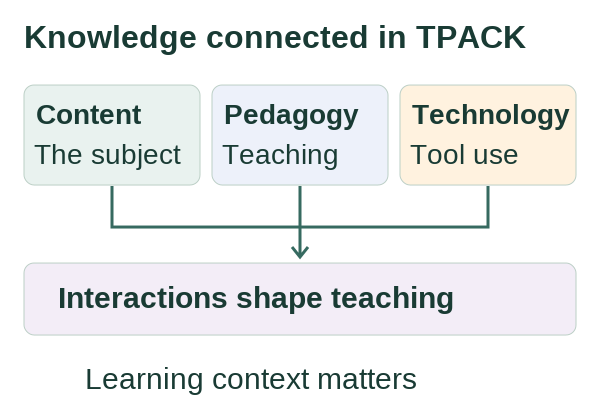
TPACK treats teaching as complex and ill-structured work, and it treats technologies, both analog and digital, as adding further complication when they enter pedagogy. In the framework, content, pedagogy and technology are three bodies of knowledge that interact in complex ways. That interaction, in theory and in practice, is said to produce the flexible knowledge a teacher needs in order to integrate technology into teaching successfully.[1] One account of the framework's history argues that technology should not be an occasional visitor to the classroom, present only when a teacher chooses to invite it. On that account, teaching and learning should be viewed through a digital lens suited to the 21st century.[10]
The framework is commonly set out as seven knowledge domains.[11] Content knowledge is knowledge of the subject matter being taught, and pedagogical knowledge is knowledge of teaching and learning processes.[12]
Pedagogical content knowledge (PCK) is the pairing of pedagogy and content, the knowledge of how to teach a particular subject. Technological content knowledge (TCK) is the pairing of technology and content, the knowledge of how technology and subject matter shape each other. Technological pedagogical knowledge (TPK) is the pairing of technology and pedagogy, the knowledge of how teaching and learning change when particular tools are used.[12] The seventh domain, TPACK itself, combines all three bodies of knowledge.[1][12]
TPACK is presented as a dynamic framework for describing the knowledge teachers need in order to design, carry out, and evaluate curriculum and instruction with technology. Its strategic side is knowing when, where, and how to use subject-specific knowledge and strategies to guide students' learning with appropriate information and communication technologies. The framework has been described in several visual and verbal forms, and these descriptions have changed as teacher educators and researchers worked out how to describe and develop teachers' TPACK.[4] One analysis holds that the framework can help teachers hold together much of the complexity and tension found in teaching and learning.[12]
What the framework adds to teacher knowledge
Technological pedagogical content knowledge (TPACK) names the knowledge a teacher draws on when teaching a subject with technology, and it is built from three bases: knowledge of the subject matter, knowledge of how to teach, and knowledge of technology.[13][14] The framework was first developed by Shulman in 1986 and was later expanded by Mishra and Koehler in 2006, who added the technology element.[13] In practice the model covers mastery of technology, of pedagogy and of learning content, and it enters the work of writing learning designs, choosing learning models and strategies, and assessing and rearranging a connected curriculum.[14] Teacher education built on the model aims to prepare pre-service teachers to match three things: what the curriculum emphasizes, the teaching methods they choose, and the technologies, digital or not, that they bring in.[15]
Koehler, Mishra, Bouck, DeSchryver, Kereluik, Shin and colleagues (2011) observe that most technologies are not made for teaching. Turning a tool into an educational technology therefore calls for creative work from the teacher, who may redesign it or even work against the designer's original purpose. Turning a tool into an educational technology takes creative input from the teacher, who may re-design it or even subvert the intentions of its designer.[16] Shafie, Abd Majid and Ismail (2019) add that training in how to teach those skills is uneven among teachers, and that adding technology to the task makes the shortfall harder to manage.[17]
Applications of the framework to particular settings have taken several forms. Campbell, Al-Harthi and Karimi (2015) used it to judge how far cloud-based learning sites matched its elements. Taopan (2020) followed one experienced high school English teacher in Indonesia through a narrative inquiry of the challenges and opportunities of technology integration.[18][13] Malaysia's government gave 10,000 public primary and secondary schools 4G internet connections and a cloud-based learning environment. Campbell, Al-Harthi and Karimi (2015) built a rubric from the framework and used it to analyse 152 sites in that environment. Most areas were somewhat aligned with the framework, three areas were fully aligned (use of links, design navigation flow, and design functionality), and one area, interactivity, was minimally aligned.[18]
A narrative inquiry of one experienced high school English teacher in Indonesia found technology integration in teaching English to be quite complicated: the teacher faced limits in IT literacy, the internet connection, and a lack of ideas for creating meaningful tasks with technology. The same teacher reported a pleasant and flexible classroom, students and teacher motivated to improve themselves, and various opportunities to develop multimodal products.[13] Anjarani (2020) reviewed 20 peer-reviewed journal articles on TPACK in English as a foreign language, all published from 2015 to 2019. The review records two criticisms: that the framework is hard to put to practical use, and that most TPACK studies had been done in mathematics and science.[19]
Tadjibaeva (2026) proposes a TPACK-reflective framework for undergraduate philology programmes. It runs through repeated rounds of design, implementation and reflection, and it recommends digital portfolios for multimodal reflection, feedback among peers, and assessment at each stage of learning. Tadjibaeva (2026) reports that international research offers few studies that are multimodal or that follow learners over time, and that Russian and Uzbek settings are thinly represented.[20]
Research
How the framework is measured
A review of 60 studies of English teachers' TPACK, covering 40 articles, 14 dissertations and 6 conference papers, sorted 128 instruments into five kinds: open-ended questionnaires, observation, performance assessment, interviews and self-report.[21] Self-report has a further limit: a rating of what a teacher says about technology integration does not show what that teacher does when planning, teaching and reviewing a lesson.[22]
A science instrument for elementary teachers in the Surakarta region, tested on 8 grade IV teachers, kept 18 items, with item correlations from 0.504 to 0.904 and a Cronbach's alpha of 0.856.[23] Cronbach's alpha, also called coefficient alpha, is a number that expresses the internal consistency of a test, that is, how closely its parts, such as its items, relate to one another.[24] An instrument built on the seven TPACK components for 34 pre-service teachers at Madrasah Ibtidaiyah retained 39 of 40 items, with an alpha of 0.970.[25] For secondary English teachers in Selangor, Malaysia, content validity was judged by the Content Validity Index, whose item values ran from 0.83 to 1.00, and reliability by a Cronbach's alpha of 0.966.[26] Some instruments are specified before testing: one proposal for Indonesian pre-service science teachers set out 31 indicators and 116 items and left validation to later work.[27]
Observation instruments rate teaching directly rather than by self-description. One biology observation instrument was tried on 11 teachers in Yogyakarta and Central Java in August 2018 with 4 raters. Every item was valid against a biserial correlation above 0.602, with an intraclass correlation coefficient of 1.000 for reliability.[28] The EnTPACK rubric was built to score enacted TPACK, meaning knowledge as it shows in performance, across three phases of teaching: lesson planning, implementation and reflection. Its developers narrowed the target to one use of digital media, student-generated explainer videos and animations, and grounded the rubric in a systematic review of existing enacted-TPACK instruments and of instructional criteria for such videos.[22]
Rasch measurement, a statistical model that places items and persons on one difficulty scale, is used to test how well a TPACK questionnaire works. A 25-item, four-point questionnaire for 32 model lecturers gave respondent reliability of 0.91 and person separation of 3.24. Item reliability was 0.45 and item separation 0.91, which the authors read as limited variation in item difficulty. Item difficulty ran from −0.68 to 1.43 logits, with PCK4 the hardest item and TK1 and TK4 the easiest. The items CK1, CK2, PK3, PCK4 and TPACK1 misfit the model and needed revision. Responses clustered in the upper categories of the rating scale, which points to a ceiling effect and weaker discrimination among the more able respondents.[29]
A survey of 24 items given to 596 online teachers across the United States produced three major factors. The only clear domain to distinguish itself was technology, which the authors took to call into question whether the domains exist separately in practice.[3] The TPACK-21 questionnaire, grounded in twenty-first century skills, was validated with confirmatory factor analysis, a method that tests a proposed factor structure against the data, and yielded a six factor model.[30] The earlier development of that instrument was tested on 94 pre-service teachers and then, after revision, on 267.[31]
Evidence from pre-service teacher samples
One line of research treats technology integration as a knowledge-building problem rather than a matter of learning software. A study of technology-capable preservice teachers who each chose a content area for a project found that participants struggled to develop new knowledge. A lack of pedagogical experience limited the development of appropriate technology integration approaches.[32]
A second line of work asks how candidates reason when they decide whether and why to use technology in a lesson. In three content teaching design tasks they explained how they would integrate technology and why. Rationales grounded in content-specific knowledge and in general pedagogical knowledge grew significantly. Rationales tied to general technological knowledge did not change.[33]
An instructional model with three phases (building acceptance and technical proficiency, pedagogical modeling, and pedagogical application) was tested with 74 preservice teachers. Analysis of their course reflections found that they mainly developed technological knowledge and technological pedagogical knowledge.[34] A technology integration course in a teacher education program surveyed candidates before and after the course with the Schmidt et al. (2009) instrument. Every dimension of TPACK self-efficacy beliefs changed significantly, with a medium effect size. In that course, pedagogical content knowledge and technological pedagogical knowledge predicted TPACK in both the pre-survey and the post-survey, and content knowledge became a significant predictor in the post-survey.[35]
Thirty-three preservice teachers played a virtual internship over 8 weeks. Network analysis of their chat records showed that their TPACK representations gradually became more complex, both in the number of pedagogical considerations and in the strength of connections among pedagogy, technology and content.[36] Case-based lesson planning served as a context in which 21 pre-service chemistry teachers holding a bachelor's degree, enrolled in a pedagogical certificate program in Turkey, developed content knowledge, technological knowledge, pedagogical knowledge and TPACK as a basis for designing technology-integrated chemistry lessons.[37] A Learning by Design approach helped EFL pre-service teachers in East Kalimantan, Indonesia, combine technological tools and applications with teaching, and the teachers reported a positive change in designing teaching materials.[38]
A descriptive qualitative survey of pre-service English teachers found a high overall understanding of TPACK (M=3.81). Content knowledge was highest (M=3.98), followed by pedagogical knowledge (M=3.92), TPACK (M=3.69) and technology knowledge (M=3.65). In the same sample, 47.33% did not use technology often when teaching English, and 56.67% reported problems helping others coordinate content, technologies and teaching approaches at school. A further 72.6% could not choose technologies suited to strengthening what is taught, how it is taught and what students learn.[39]
A survey of 385 fifth-year pre-service teachers at a Thai university during teaching practice rated learner-centered management highest (mean 3.00, S.D. 0.77). Knowledge of teaching design followed (mean 2.96, S.D. 0.72), then assessment and evaluation methods (mean 2.95, S.D. 0.74). Integration of technology came lowest (mean 2.70, S.D. 0.78).[40]
A multiple case study of ten science and nine mathematics pre-service teachers in a teaching practice course found problems especially in the technological and pedagogical components. Both groups lacked adequate knowledge of assessment tools, which they valued least. Those candidates generally used standard technologies such as presentations or office programs. Using the same tools to identify and teach the subject indicated limited conceptions of technological pedagogical knowledge and technological content knowledge.[41]
Twelve primary student-teachers specializing in mathematics worked a mathematical task as learners, then adapted it for pupils with graphics calculators and taught it during placement. Despite good levels of TPACK, their earlier beliefs and attitudes about graphics calculators returned and outweighed the positive experience.[42] A survey covered 215 preservice teachers in the last year of teacher education and teaching certificate programs at three Turkish universities. It found a positive relation between the support strategies of their programs and their TPACK. Reflection and teacher educators acting as role models were the most frequently used strategies.[43]
Subject differences across the disciplines
A systematic review of eight empirical studies published between 2015 and 2024, drawn from 118 records, reported that mathematics teachers use TPACK to build conceptual understanding and student engagement through dynamic visualizations, interactive simulations and scaffolded digital tasks. The same review listed limited subject-specific professional development, resource constraints and uneven teacher proficiency as common obstacles.[44] A qualitative study of 15 mathematics teachers and 36 students in West Sumatra found that teachers wove TPACK into planning, execution and evaluation and that technology use helped create an engaging learning environment.[45] Among 57 Turkish secondary mathematics teachers, most integrated technology at the replacement level, meaning the tool substituted for an older method without changing the task, and self-confidence was moderate.[46]
A survey of 166 pre-service primary teachers found that contextual knowledge and technological knowledge best predicted their attitudes toward using information and communication technology in the mathematics classroom.[47] A case study of 6 prospective mathematics teachers at a university in Karawang found that most had a limited grasp of technology integration and focused on the tools without regard to mathematical context or teaching strategy, though some showed a better understanding.[48] Among primary mathematics teachers in mainland China surveyed after the pandemic, most had adequate knowledge unrelated to technology but lacked technology-related knowledge. Teaching experience correlated positively with TPACK while gender and grade taught showed no significant difference.[49]
Science teaching has been studied with a practical variant of the framework, TPACK-Practical (TPACK-P), which judges proficiency in real classroom settings across assessment, planning, design and enactment.[50] A questionnaire study of 1,292 secondary science teachers in Taiwan found that male teachers rated their technology knowledge significantly higher than female teachers did. Experienced Taiwanese science teachers rated content knowledge and pedagogical content knowledge in context higher than novices did. Less experienced teachers rated technology knowledge and technological content knowledge in context higher than their more experienced colleagues did.[5]
In biology, a quasi-experimental time-series study of 49 prospective biology teachers in Bandung tested embryology learning built on TPACK and measured logical thinking three times: before the program, after the first four main subjects, and at the end. The TPACK-based learning moved students from concrete and transitional reasoning to formal reasoning and broadened their reasoning modes, with the exception of variable control.[51] A workshop program for science teachers in Kuala Lumpur and Yogyakarta reported that 96 percent of participants held knowledge about TPACK-P while 88 percent had classroom experience applying it.[52]
A survey of 108 Saudi middle school EFL teachers found moderate-to-high levels on all TPACK dimensions and a strong positive relationship between TPACK and attitudes toward technology.[53] A study of 84 Kenyan pre-service EFL teachers that also analyzed 12 lesson plans found a significant gap between confidence in integrative knowledge (technological pedagogical knowledge and technological content knowledge) and what appeared in planning.[54] A qualitative study at a private Vietnamese university found wide variation among EFL teachers in the knowledge and skills that technology integration requires.[55] A two-dimensional scale completed by 525 EFL teachers measured TPACK alongside the teaching of thinking skills and found the teachers less confident about teaching higher-order thinking skills, with confidence differing across cultures (F(6, 518) = 7.83, p < .05).[56] Two fifth-grade teachers in South Sulawesi mainly used PowerPoint slides on a laptop with an LCD projector to show lesson objectives and reading texts. Nurwahidah, Sulfasyah and Rukli traced this practice to the teachers seeing technology as a way to make teaching easier, together with their limited reading-comprehension strategies.[57]
In music, a study of Thailand's secondary music programs adapted the framework as MTPACK and surveyed 38 teachers across 19 schools, interviewing 5 teachers from schools with many music students. A priority needs index analysis found gaps among technological pedagogical knowledge, technological content knowledge and pedagogical content knowledge, and the study called for practical training, exposure to music education software, and structured lesson planning.[58] In engineering education, a self-assessment administered to 220 teachers at two universities in Dhaka found significant differences in technological knowledge and in conventional pedagogical and content knowledge by the teacher's field of study, and a significant difference in technology-enhanced instruction by age group. That study concluded that the availability of technology and teachers' technology knowledge alone may not speed the adoption of technology-enhanced teaching.[59] For middle school art, one paper proposed a structural model of smart teaching ability under the framework, covering technology application, teaching design, content integration, evaluation, classroom management and resource development. The model links these abilities to students' gains in knowledge such as sketching, color and composition, in skills such as art perception, appreciation and creativity, and in aesthetic, humanistic and innovative qualities.[60]
Self-efficacy, attitudes and their links to TPACK
The largest answer comes from a meta-analysis, a statistical pooling of separate studies, that combined 28 independent effect sizes covering 7,777 subjects. A test of heterogeneity showed that the studies varied more than sampling error alone would produce, so the analysis used a random effects model, which allows each study's true effect to differ. The pooled correlation between teachers' information technology integration self-efficacy and TPCK was r = 0.607 (P < 0.001), a significant positive relationship. Career stage changed the strength of that relationship. Gender, teaching stage, discipline and measurement tool did not.[61]
At Shah Abdul Latif University in Khairpur, 123 teaching assistants holding master's degrees rated themselves high on all pedagogy-related skills but low on all technology-based domains.[62] A mixed-method sequential case study ran from July 2024 to January 2025 at a public university in Mexico. Most had high levels of TPACK and were confident in using technology, while limited training and inadequate facilities constrained integration in schools. That study could not carry out classroom observations to check reported practice against actual practice.[63]
A survey of 280 in-service teachers of English as a foreign language examined school culture, professional development, TPACK and teaching and learning beliefs against three kinds of technology use: content delivery, learning enrichment, and transformation toward self-directed learning. School culture, professional development and TPACK predicted integration more strongly than beliefs about teaching and learning did. The factors also differed by use: a favourable school culture mattered for content delivery and for supporting self-directed learning, while TPACK was most critical for learning enrichment.[64]
In a quasi-experimental study with a pretest-posttest control group, 43 pre-service mathematics teachers in their third year at a Turkish state university were taught transformation geometry over four weeks (12 lesson hours) with technology-supported argumentation-based teaching. Participants rated their technology knowledge relatively low, and their post-test means on pedagogical knowledge, pedagogical content knowledge and TPACK were high. The practice did not affect the experimental group's TPACK self-evaluation.[65]
Context, gender and the wider conditions
Context in the TPACK framework means the setting in which a teacher's technological, pedagogical and content knowledge is put to work, and one line of scholarship has argued for a broader notion of it, described along two dimensions called scope and actor. That proposal treats context as more complex than a single classroom, and it pairs the argument with teachers' written narratives of their own practice as a way to reveal how knowledge is built.[66] A two-year interview and observation study of five teachers learning to integrate geospatial technology, meaning mapping and location-based digital tools, identified five contextual factors that shaped growth in the TPACK domains and the use of those tools in instruction.[67] School conditions can also work against technology use: teacher educators at five teacher education institutes said little attention was given to preparing students to use technology for early literacy, partly because many new devices such as tablets are not used much in schools. Those teacher educators also struggled with technology in their own courses, and pre-service educators reported a lack of integrated expertise in their institutions even where technology and early literacy specialists were on staff.[68]
In a Spanish study that gathered data over three academic years from 914 trainee teachers and 194 professors at several universities, female participants rated their own digital teaching competence very poorly compared with men and showed a lower predisposition toward technologies.[69] A survey of 256 faculty members at public universities in Karachi, Pakistan, during the COVID-19 pandemic found adequate knowledge across all TPACK domains, with content knowledge highest and technological knowledge lowest, and it reported a significant difference by gender and by teaching experience.[70]
At the Faculty of Accounting and Administration of the Autonomous University of Sinaloa in Mexico, professors scored above the mean on all seven knowledge dimensions of the model, with a mean of 3.6 on a scale where above 3.6 counts as a high level.[71] A Chinese paper on applied universities combined the TPACK framework with outcome-based teaching and learning, analyzed teachers' teaching ability through questionnaires, interviews and statistical software, and proposed strategies for improvement.[72]
The COVID-19 pandemic moved much teaching online and made technology integration an urgent matter for institutions.[70] Writing about English as a foreign language, one review treated TPACK as a framework for understanding how technology is incorporated into settings such as language classes, and it linked teachers' digital literacy and professional identity to their teaching practices during the pandemic.[73]
Reviews of the field and where it stands
A systematic review of 37 publications from 2014 to 2017, indexed in the Web of Science and Scopus databases and searched with TPACK and TPCK as descriptors, found that the reviewed work concentrated on basic and higher education. Case studies, quantitative empirical studies and mixed studies were the predominant designs in that set. The same review reported a lack of longitudinal studies that follow teachers applying TPACK in their daily practice over time.[74]
A bibliometric review of 114 eligible studies on pre-service teachers' TPACK development traced the topic back to 2007. That review described interest in the subject among the scientific community as irregular rather than steadily rising.[75]
Evidence that training changes teacher TPACK
The strongest summary of whether training changes teacher TPACK comes from a meta-analysis that pooled published studies of teacher education programmes and found a positive overall effect on TPACK of d = 0.839 (p < 0.0001). The same review reported that several features of a study were linked to how large the effect came out: the type of experiment, the length of the intervention, the type of intervention, the measurement method, the sample type and the learning environment. Randomised experiments produced a significantly larger effect than quasi-experiments, and longer teaching interventions produced stronger improvement in teachers' TPACK. Ning, Zhou, Wijaya and Chen (2022) found that the types of intervention differed significantly from one another in how much they raised TPACK. The effect was greater for theoretical knowledge than for practical knowledge. Cultural background, the participants in the experiment, the sample type and the learning environment showed no significant influence on the size of the effect.[76]
A meta-analysis of six articles examined the effect of TPACK on pre-service mathematics teachers' ability to teach mathematics.[77] A separate meta-analysis by Sanju Aprilisia (2024) drew on 15 national journals published between 2022 and 2024. It examined TPACK-based discovery learning in elementary school classes and reported a significant influence on student learning outcomes, with rES = 1,114 and P < 0.001. Sanju Aprilisia (2024) included only experimental or quasi-experimental studies with samples above 20 students, in mathematics and Indonesian language, published in journals indexed by SINTA and Garuda. The authors analyzed 15 national journals published from 2022 to 2024, all reporting experiments or quasi-experiments with elementary school students in mathematics and Indonesian language.[78]
Classroom applications of the framework report changes in student outcomes alongside changes in teaching. In a study of 90 high school chemistry teachers in four northern provinces, lessons using augmented reality (computer-generated images layered over the real classroom view) and designed with the TPACK model were followed by better student understanding of chemistry, stronger engagement and greater satisfaction.[79] A qualitative study of augmented reality in elementary environmental science described teachers moving from a technological orientation toward pedagogical and conceptual alignment in three stages: technological familiarization, conceptual reinforcement and reflective contextualization. That study concluded that successful use depended on teachers' evaluative competence and institutional support as well as on access to the technology, and it called for professional development and policy support to sustain the work.[80]
In practice
Professional development and in-service effects
Professional development in the TPACK framework (technological pedagogical content knowledge, the idea that teaching with technology draws on separate bodies of knowledge about content, pedagogy and tools, and on their overlaps) has been studied through short workshops, year-long design programmes and multi-decade research efforts.[81][6] Meletiou-Mavrotheris and Paparistodemou describe 18 years of TPACK-guided professional development for teachers of mathematics supported by information and communications technology, written as a self-narrative using autoethnography, a method in which researchers analyse their own experience.[81]
The TPACK-21CL study tested a year-long programme built around design teams, in which teachers worked at length with peers and researchers. Teachers used TPACK rubrics and design heuristics (practical guides for planning technology-rich lessons) to judge their current ICT lessons and set design goals. They then redesigned the lessons, taught them, evaluated student learning outcomes and reflected on their practice. The implementation study involved 37 teachers from a Singapore primary school, organised into seven lesson design teams. The process had positive effects on teachers' confidence for TPACK for 21st century learning and on their lesson design practices. Five of the seven design teams changed their pedagogy toward 21st century learning. Six of the teams showed better student learning outcomes.[6]
A 2-week TPACK-based programme used four activities, described as Explore-Engage-Reflection-Transformation, with 30 pre-service teachers (5 male and 25 female) at a public university in Indonesia. Posttest scores were significantly higher than pretest scores on all TPACK dimensions, with large effect sizes. Participants' reflections indicated that they understood the role of technology integration in creating meaningful learning experiences.[82] Rohmitawati studied online training for 30 Indonesian junior secondary school mathematics teachers.[83]
A descriptive, non-experimental study of 825 teachers in public schools used a validated 47-item questionnaire covering the seven TPACK dimensions and a multivariate analysis of variance (a statistical test for differences across several outcome measures at once) against socio-demographic variables. The clearest differences were found by educational stage and by age of the participants, and the study set out adapted training proposals aimed at the weaker areas of in-service teachers.[84] A comparative study divided 311 Indonesian science teachers into four groups. Two were pre-service teachers, one enrolled in the government's PPG professional education programme and one not. The other two were in-service teachers, one group with less than two years of experience and one with more than two years. Analysis of variance showed a significant positive effect of the PPG programme on TPACK scores, except when non-PPG pre-service teachers were compared with in-service teachers who had less than two years of experience. Pre-service PPG teachers were more confident in the technology-related TPACK components. In-service teachers with more than two years of experience scored higher overall, especially in pedagogical knowledge, content knowledge and pedagogical content knowledge.[85]
Worked examples for technology integration were built on Gagne's nine events of instruction and used by three instructors in a teacher education programme. Bajracharya reported that they reduced instructors' extraneous cognitive load (mental effort spent on material that does not aid learning) and improved pre-service teachers' learning outcomes.[86] The programme served teachers from the Organization of Eastern Caribbean States. Collaboration with colleagues, autonomy in teaching and access to technology were each associated with differences in TPACK levels. These differences were in turn related to urbanicity, the age of students and parental involvement, and school or school system culture.[87] A quasi-experimental study at two comparable provincial vocational colleges in Central China assigned 115 full-time teachers per group and confirmed baseline equivalence across all dimensions.[88]
In a programme for 216 teachers, educational neuroscience training improved teachers' understanding of neuroscience-related knowledge and was correlated with their TPACK, but it did not raise well-being and satisfaction.[89] A survey of English teachers who joined professional development in Surabaya in 2020 reported that applying TPACK gradually improved their English instructional assessments, with three contributing factors: greater comfort in making assessments, the availability of alternative assessment options, and improved review of instruction.[90] A study of 113 Mongolian secondary school biology teachers covered five topics judged difficult to teach: respiration, regulation of the living body, biotechnology and genetic engineering, enzymes, and immunity. For each topic, technological content knowledge was the heaviest of the knowledge types and content knowledge the lightest.[91]
Practice questions
Question 2: What kind of review did Brantley-Dias and Ertmer publish, and what did it examine? Answer: They published a critical review of the TPACK construct in 2013 that addressed its development, verification, usefulness, application and appropriateness as an explanation of the teacher cognition needed for effective technology integration.[11]
How teacher education programmes use TPACK
Teacher educators have used TPACK to audit what their courses already cover. Campbell and Baroutsis (2011) mapped the electronic course profiles at The University of Queensland's School of Education and found that course coordinators generally under-represented the technology components. Ching, Yang, Baek and Baldwin (2016) used the framework to guide graduate students' reflections in e-portfolios.[92][93] One Australian project, Teaching Teachers for the Future, involved all 39 teacher education universities in the country and aimed to raise the information and communication technology skills of graduate teachers by building the capacity of teacher educators. As a first step, staff at the University of Queensland's School of Education audited and mapped the electronic course profiles, the unit outlines for each subject, against the framework. The initial findings indicated that course coordinators generally under-represented the technology components in their courses.[92]
TPACK has also been used to structure how pre-service teachers reflect on their own learning. In one graduate programme in educational technology, students wrote e-portfolios, electronic collections of work and commentary used as a summative assessment, meaning a graded judgement at the end of a course, while guided by the framework. A content analysis of those reflections and of open-ended survey responses found that students demonstrated interconnected technological pedagogical knowledge when justifying their competencies, and that they reacted positively to writing the reflection paper. The discipline-specific framework helped students stay focused on their reflection.[93]
Mariette (2022) surveyed 100 pre-service English teachers during a microteaching course, a scaled-down practice lesson given to peers before a real classroom placement. The pre-service teachers held very positive perceptions of TPACK and already had good knowledge of how to apply it, though classroom management needed improvement.[94]
Putriani (2023) examined 21 fourth-semester elementary teacher education students as they developed teaching materials for the Merdeka curriculum. Their scores ranged from 81% for technological knowledge down to 57% for pedagogical content knowledge and technological content knowledge. The weaker pedagogical content and technological content scores were tied to a low understanding of the process and principles of the curriculum.[95] Suryanti, Rostikawati and Budiana (2022) studied 15 pre-service teachers at Pakuan University in the 2020-2021 academic year. Online learning had not reached its maximum effect on their ability to write TPACK-based teaching instruments, a result the study rated as fair, and the teachers still needed to learn how to combine materials with digital applications.[96]
A systematic review of 5 studies examined how assistive technology, devices and services that help learners with disabilities, and Universal Design for Learning, an approach to planning lessons so that diverse learners can take part, can be combined with TPACK in pre-service education. The review presented an extended version of the model that treats assistive technology as a way of building inclusive teaching practice, and it distinguished instructional technology from assistive technology as related but separate ideas.[97]
What this looks like when you study
In a technology integration course, pre-service teachers completed surveys based on the Schmidt et al. (2009) instrument at the start and end of the course.[35] Ten science and nine mathematics pre-service teachers took a Teaching Practice 2 course whose theoretical part was online and practical part face-to-face.[41]
Komariah and Atthaya advise pre-service English teachers to take up technology by adapting technology and literacy in ways that raise the quality of teaching and of learning outcomes.[39] A source recommends that TPACK training programmes be included in teacher education programmes, so that pre-service teachers learn to integrate technology, content and pedagogy in their subjects.[82] Abebe, Gaskill, Hansen and Liu advise that instructional technology courses weigh the factors that shape TPACK when they design curricula and deliver courses.[35] A source recommends that pre-service teachers acquire pedagogical content knowledge before integrating technology, and that this development be supported with actual teaching experience.[32]
Later developments
Artificial intelligence and newer extensions
Mishra, Warr and Islam argued in 2023 that GenAI tools share traits with earlier digital tools: they are protean (ever-changing), opaque and unstable. The tools also add traits that make them revolutionary, because they are generative and social.[98] A 2024 survey of 606 pre-service teachers, built on a model of technology acceptance, found that GenAI anxiety, social influence and performance expectancy each significantly predicted the intention to design GenAI-assisted teaching. Effort expectancy and facilitating conditions showed no statistically significant association with that intention.[7]
A 2023 study developed a scale for teachers' knowledge of instructional AI use and extended TPACK with ethical aspects, because AI raises novel ethical issues that teachers must be able to assess. Its results indicated that teachers who know more about interacting with AI-based tools understand the pedagogical contributions of AI better, and that technological knowledge helps teachers judge the decisions such tools make.[2] A 2024 framework called AI-TPACK set out seven components: pedagogical knowledge, content knowledge, AI-technological knowledge, pedagogical content knowledge, AI-technological pedagogical knowledge, AI-technological content knowledge and AI-TPACK itself. Using factor analysis and structural equation modeling, that study found all six other knowledge elements predicted the AI-TPACK variable, with differing explanatory power. The core elements (pedagogical knowledge, content knowledge and AI-technological knowledge) influenced AI-TPACK indirectly, through the composite elements. Non-technical knowledge elements explained less of teachers' AI-TPACK than technology-related ones.[99]
One instrument, developed for pre-service primary school teachers of mathematics through a four-stage design process, reported good content validity, adequate construct validity (Kaiser-Meyer-Olkin value of 0.86, factor loadings from 0.54 to 0.83) and high reliability (Cronbach's alpha of 0.92).[100] Another tool, designed for teacher educators and scored from 60 authentic instructional artifacts rather than self-report questionnaires, comprised 4 components (AI knowledge, AI pedagogical knowledge, AI content knowledge and integration), 14 criteria and 65 indicators. AI pedagogical knowledge correlated strongly with integration (r = 0.78).[101]
A qualitative case study of 13 pre-service English teachers in a chatbot-integrated course, drawing on weekly reflection journals, reported growing capacity to combine chatbots with language teaching and greater confidence as English teachers.[102] In a study of 85 college students who spent five weeks building augmented reality projects for language teaching, participants lacked practical knowledge of creating and implementing such content. The main difficulties lay at the technological pedagogical knowledge intersection, because the participants had been trained to use augmented reality only as recipients, not as content creators and educators.[103]
A proposed program for STEM teachers specified each TPACK component for AI use. Subject knowledge meant understanding STEM content and the scientific principles of AI. Pedagogical knowledge meant command of didactic approaches to AI. Technological knowledge meant the ability to use AI tools and grasp their capabilities, limitations and risks.[104] In a participatory study of 76 pre-service teachers at a university in China, analyzed through 48 forum comments and discussion threads with TPACK as an analytical lens, participants saw pedagogical promise in AI but doubted it could replicate the relational, context-sensitive work of human teachers.[105]
TPACK in vocational, health and language settings
In Germany, vocational education and training (VET) prepares students for working life and sits close to the labour market, and a 2023 theoretical article argued that this position changes what vocational teachers need to know. The article proposed an N-TPACK framework that keeps the existing areas and adds Networking and Collaborative Knowledge (NK) as a further part of vocational teachers' professional knowledge. Its focus was the vocational subjects of nutritional science and home economics, in the non-technical personal service sector of the German vocational school system. The article is theoretical and calls for a survey of how far prospective vocational teachers in those subjects actually hold these knowledge areas.[106]
A qualitative study of vocational training instructors in Namibia, drawing on questionnaires and focus-group interviews, reported that teaching experience widened instructors' knowledge beyond technology integration and produced a new reading of the framework's constructs. Nepembe and Simuja (2023) also found that instructors' attitude toward the framework changed as teaching technologies became available to them, and that what students needed to learn shaped the instructors' technological pedagogical content knowledge.[107] In health professions education, a 2023 review searched 4 databases and selected 76 articles, of which nine met its criteria. The nine papers fell into four themes: measuring the level of technological pedagogical content knowledge, its relationship with other variables, its application, and professional development. The review concluded that research in this area is still lacking, while the framework as a theoretical foundation produced positive outcomes that can guide practitioners and researchers.[108]
Maloney (2026) sets out five areas in which the framework could be used in computer-assisted language learning teacher education and research for AI-powered tools.[109][19][110] UÇAR (2023) synthesized 22 studies of pre-service and in-service English as a foreign language teachers in Turkey: 11 articles and 11 theses published between 2017 and 2022. Most of the reviewed research measured teachers' perceptions of their knowledge or tested how traits such as gender, age and educational background related to it.[109] A 2025 literature review of senior high school English teachers described three obstacles to technology integration: difficulty combining technology with pedagogy and content knowledge, too little time and too few resources, and psychological resistance to innovation. It proposed tailored training with reflective activities, flexible and collaborative use of resources, and gradual integration backed by a supportive environment and incentive mechanisms.[111]
A qualitative case study of three elementary school teachers who used augmented reality climbing content linked the Technology Acceptance Model's perceived usefulness, perceived ease of use and behavioral intention to the framework's technological content knowledge and technological pedagogical knowledge. Perceived usefulness and ease of use influenced goal-setting, instructional feasibility and judgments about content alignment, while behavioral intention shaped pedagogical intentions and design decisions.[112] A 2026 review of physical education teachers' digital literacy found progress in theory, application and assessment tools, alongside weak integration of the framework with digital literacy, similar methods across studies, uneven coverage of populations and long neglect of rural physical education teachers.[113]
Criticism
Criticism, contested constructs and open questions
A questionnaire study of 400 teacher candidates in physics, mathematics, biology and chemistry tested the links among the framework's domains. Of 18 relationships examined, 12 were direct, and of those 12, 10 were positive and statistically significant.[114]
Limits of the framework in practice
Wong, Chai, Zhang and King (2015) observe that many teachers lack the socio-techno-pedagogical know-how and the time needed to design technology-enhanced interventions. The researchers therefore built a mobile-assisted language learning environment with content and pedagogical tools already in place, to reduce the design effort asked of teachers.[115] In Indonesia, a surge in demand for blended learning during the Covid-19 pandemic was not matched by sufficient skills to organize online learning, and many teachers did not know how to use information and communication technology in their teaching. The professional development activities developed in response were judged suitable for teachers at the K12 level, while use with early childhood teachers would require redesign. That programme also concluded that institutions should set aside dedicated hours for professional development and count them as teaching or additional teacher hours.[116]
Sherpa, Upreti, Aryal and Paudel (2026) list lack of personal hardware devices and lack of internet service among the obstacles their participants faced. Sherpa, Upreti, Aryal and Paudel (2026) conducted a narrative inquiry with 18 Master of Education students specializing in Health Education at three campuses of Tribhuvan University in Nepal. The students lacked personal hardware devices, internet service and the knowledge to use digital learning resources such as Zoom, Google Meet and Microsoft Teams, and they faced financial and pedagogical problems as well. Although the university had adopted online classroom teaching guidelines, the study judged their implementation ineffective and the curriculum outdated.[117]
Oladunni and Oredein (2023) review virtual classroom management in Nigeria, where the COVID-19 pandemic broke down physical teaching and learning. The authors suggest in-service training, workshops and seminars on digital leadership for school leaders, teachers and students. A qualitative review of virtual classroom management in Nigeria, a country the study describes as facing challenges in adopting technology for teaching and learning, found that the Covid-19 pandemic disrupted physical teaching and learning and that virtual teaching brought its own difficulties.[118]
Common misconceptions
TPACK is most often measured by asking teachers to report on their own knowledge, and such self-reports do not support conclusions about the TPACK a teacher actually enacts in a classroom. Self-report is the usual way of measuring TPACK, yet it cannot support conclusions about TPACK as teachers enact it, and enactment is seldom measured in actual classrooms. A rubric built to assess enacted TPACK in lesson planning, implementation and reflection was developed to address this gap.[22]
Brantley-Dias and Ertmer (2013) question whether a construct with 7 knowledge domains is too large, vague or ambiguous to be applied in a reasonable way. Brantley-Dias and Ertmer propose a return to a simpler conceptualization, so that attention goes back to what teachers need in order to achieve learning that technology meaningfully supports.[11]
Key studies
| Year | Study | Sample | Design | Finding |
|---|---|---|---|---|
| 2010 | Archambault & Barnett[3] | factor analysis of a 24-item survey with 596 online teachers in the United States | The domains were difficult to separate, and only the technology domain clearly distinguished itself. | |
| 2012 | Graham et al.[33] | elementary teacher candidates at Brigham Young University | pre- and post-treatment assessment of three content teaching design tasks | Rationales based on content-specific knowledge and on general pedagogical knowledge increased significantly, while those based on general technological knowledge held steady. |
| 2013 | Jang & Tsai[5] | 1,292 secondary school science teachers in Taiwan | questionnaire survey with factor analysis | Male science teachers gave their technology knowledge significantly higher ratings than female teachers did, and teachers with more experience rated their content knowledge and their pedagogical content knowledge in context significantly higher than novices did. |
| 2013 | Koehler et al.[1] | conceptual paper describing the framework | In the framework, content, pedagogy and technology are three bodies of knowledge that interact in complex ways. | |
| 2017 | Koh et al.[6] | 37 teachers from a Singapore primary school in seven lesson design teams | year-long implementation study | Five of the seven design teams shifted their pedagogy toward 21st century learning, and student learning outcomes improved in six of the teams. |
| 2021 | Abebe et al.[35] | pre-service teachers in a technology integration course | pre- and post-survey using the Schmidt et al. (2009) instrument | All dimensions of TPACK self-efficacy beliefs changed significantly with a medium effect size; PCK and TPK predicted TPACK in both surveys. |
| 2022 | Diamah et al.[82] | 30 pre-service teachers (5 male; 25 female) at a public university in Indonesia | mixed methods with a one-group pre-post-post design | On every TPACK dimension, posttest scores were significantly above pretest scores, and the effect sizes were large. |
| 2022 | Nithitakkharanon & Nuangchalerm[40] | 385 fifth-year pre-service teachers at Ubon Ratchathani Rajabhat University, Thailand | questionnaire and semi-structured interview during teaching practice | Integration of technology was rated lowest among teaching practice aspects, at a mean of 2.70 (S.D.=0.78). |
| 2022 | Zeng et al.[61] | 28 independent effect sizes with 7,777 subjects | meta-analysis | Teachers' self-efficacy for integrating information technology showed a significant positive correlation with TPACK (r = 0.607, P < 0.001). |
| 2022 | Ning et al.[76] | published literature on teacher education programmes | meta-analysis | Teacher education intervention positively affected TPACK (d = 0.839, p < 0.0001). |
| 2023 | KORKMAZ & BİBER[65] | 43 pre-service mathematics teachers in their third year at a Turkish state university | quasi-experimental pretest-posttest control group | Technology-supported argumentation-based teaching did not affect the experimental group's TPACK self-evaluation. |
| 2024 | Endang Komariah & Atthaya[39] | pre-service English language teachers | descriptive qualitative study with a standardized questionnaire | Overall TPACK understanding was high (M=3.81), but 72.6% could not select appropriate technologies for the classroom. |
| 2024 | Armistead et al.[87] | teachers from the Organization of Eastern Caribbean States in an online professional development programme | sequential mixed methods investigation | Collaboration with colleagues, autonomy in teaching and access to technology were associated with differences in TPACK levels. |
| 2025 | Chang et al.[85] | 311 science teachers in four groups, including pre-service PPG teachers and in-service teachers | comparative analysis with ANOVA | Scores on the TPACK measure were significantly higher after the PPG programme, except in one comparison: pre-service teachers outside the programme and practising teachers with under 2 years of experience did not differ significantly. |
See also
References
- Koehler, M. J., Mishra, P., & Cain, W. (2013). What is Technological Pedagogical Content Knowledge (TPACK)? Journal of Education, 193(3), 13-19. doi:10.1177/002205741319300303
- Celik, I. (2023). Towards Intelligent-TPACK: An empirical study on teachers’ professional knowledge to ethically integrate artificial intelligence (AI)-based tools into education. Computers in Human Behavior, 138, 107468. doi:10.1016/j.chb.2022.107468
- Archambault, L. M., & Barnett, J. H. (2010). Revisiting technological pedagogical content knowledge: Exploring the TPACK framework. Computers & Education, 55(4), 1656-1662. doi:10.1016/j.compedu.2010.07.009
- Niess, M. L. (2011). Investigating TPACK: Knowledge Growth in Teaching with Technology. Journal of Educational Computing Research, 44(3), 299-317. doi:10.2190/ec.44.3.c
- Jang, S. J., & Tsai, M. F. (2013). Exploring the TPACK of Taiwanese secondary school science teachers using a new contextualized TPACK model. Australasian Journal of Educational Technology, 29(4). doi:10.14742/ajet.282
- Koh, J. H. L., Chai, C. S., & Lim, W. Y. (2017). Teacher Professional Development for TPACK-21CL: Effects on Teacher ICT Integration and Student Outcomes. Journal of Educational Computing Research, 55(2), 172-196. doi:10.1177/0735633116656848
- Wang, K., Ruan, Q., Zhang, X., Fu, C., & Duan, B. (2024). Pre-Service Teachers’ GenAI Anxiety, Technology Self-Efficacy, and TPACK: Their Structural Relations with Behavioral Intention to Design GenAI-Assisted Teaching. Behavioral Sciences, 14(5), 373. doi:10.3390/bs14050373
- Kanti Halder, T. (2023). Historical Development of Technology Integration in Teaching Learning: From PCK to TPACK. International Journal of Multidisciplinary Research and Growth Evaluation, 4(4), 524-530. doi:10.54660/.ijmrge.2023.4.4.524-530
- Wang, W., Schmidt-Crawford, D., & Jin, Y. (2018). Preservice Teachers' TPACK Development: A Review of Literature. Journal of Digital Learning in Teacher Education, 34(4), 234-258. doi:10.1080/21532974.2018.1498039
- Samarji, A. (2015). Technological, pedagogical and content knowledge (TPACK): Unpacking the TPACK features. QScience Proceedings, 2015(3). doi:10.5339/qproc.2015.coe.4
- Brantley-Dias, L., & Ertmer, P. A. (2013). Goldilocks and TPACK: Is the Construct ‘Just Right?’. Journal of Research on Technology in Education, 46(2), 103-128. doi:10.1080/15391523.2013.10782615
- Zhang, J. E. (2021). Integrative Analytics for Technological Pedagogical Content Knowledge. Complexity, 2021(1). doi:10.1155/2021/5774789
- Taopan, L. L. (2020). TPACK framework: Challenges and opportunities in EFL classrooms. Research and Innovation in Language Learning, 3(1). doi:10.33603/rill.v3i1.2763
- Rizqiyah, N. (2021). Implementasi technological pedagogical content knowledge sebagai modernisasi di bidang pendidikan. NIAGAWAN, 10(2), 159-171. doi:10.24114/niaga.v10i2.25004
- Jose, R. (2026). Integrating the TPACK Framework into 21st Century Teacher Education: A Conceptual Analysis. Journal of Artificial Intelligence and Information, 8(7), 3-7. doi:10.66069/ojspub.5170260702
- Koehler, M. J., Mishra, P., Bouck, E. C., DeSchryver, M., Kereluik, K., Shin, T. S., & Wolf, L. G. (2011). Deep-play: developing TPACK for 21st century teachers. International Journal of Learning Technology, 6(2), 146. doi:10.1504/ijlt.2011.042646
- Shafie, H., Abd Majid, F., & Ismail, I. S. (2019). Technological Pedagogical Content Knowledge (TPACK) in Teaching 21st Century Skills in the 21st Century Classroom. Asian Journal of University Education, 15(3), 24. doi:10.24191/ajue.v15i3.7818
- Campbell, C., Al-Harthi, A., & Karimi, A. (2015). TPACK Framework: Implications for Teacher Education. ASCILITE Publications, 399-403. doi:10.14742/apubs.2015.948
- Anjarani, S. (2020). Unpacking the TPACK framework in EFL context: A review of empirical studies from 2015 to 2019. IdeBahasa, 2(2), 81-90. doi:10.37296/idebahasa.v2i2.42
- Tadjibaeva, A. (2026). Designing A TPACK-Reflective Framework for Undergraduate Philology Programs. Current Research Journal of Pedagogics, 06(04), 55-58. doi:10.37547/pedagogics-crjp-07-04-06
- ARSLAN, A. (2020). Reliability and Validity of Instruments Measuring English Teachers’ TPACK. International Journal of Assessment Tools in Education, 7(3), 343-360. doi:10.21449/ijate.679876
- Aumann, A., Schnebel, S., & Weitzel, H. (2023). The EnTPACK rubric: development, validation, and reliability of an instrument for measuring pre-service science teachers’ enacted TPACK. Frontiers in Education, 8. doi:10.3389/feduc.2023.1190152
- Desstya, A. (2018). Validitas reliabilitas instrument technologycal pedagogical content knowledge (TPACK) guru sekolah dasar muatan pelajaran ipa. AL-ASASIYYA: Journal Of Basic Education, 3(1), 126. doi:10.24269/ajbe.v3i1.1338
- NCME Glossary of Important Assessment and Measurement Terms (n.d.). coefficient alpha. NCME Glossary of Important Assessment and Measurement Terms. https://ncme.org/resources/professional-learning/glossary/
- Annur, A. F., Jaeni, M., Musthofa, M., & Musa, M. M. (2024). Development of TPACK Self-Assessment Instrument for Madrasah Ibtidaiyah Preservice Teachers. FONDATIA, 8(3), 542-553. doi:10.36088/fondatia.v8i3.4954
- Shafie, H., Majid, F. A., & Ismail, I. S. (2022). Developing a 21st Century Technological Pedagogical Content Knowledge (TPACK) Instrument: Content Validity and Reliability. International Journal of Education, 14(3), 100. doi:10.5296/ije.v14i3.19980
- Hidayat, A. (2019). Technological pedagogical content knowledge (TPACK) instrument for indonesia science pre-service teacher: Framework, indicators, and items development. Unnes Science Education Journal, 8(2). doi:10.15294/usej.v8i2.35166
- Khoirul Antony, M., & Paidi (2019). TPACK Observation Instrument: Development, Validation, and Reliability. Journal of Physics: Conference Series, 1241(1), 012029. doi:10.1088/1742-6596/1241/1/012029
- Susanti, N., Iriani, D., & Aina, M. (2026). Assessing the Measurement Quality of a Model Lecturer TPACK Instrument: Evidence from Rasch Analysis. Educational Leadership and Management Journal, 4(1), 141-159. doi:10.22437/element.v4i1.56664
- Valtonen, T., Sointu, E., Kukkonen, J., Kontkanen, S., Lambert, M. C., & Mäkitalo-Siegl, K. (2017). TPACK updated to measure pre-service teachers’ twenty-first century skills. Australasian Journal of Educational Technology, 33(3). doi:10.14742/ajet.3518
- Valtonen, T., Sointu, E. T., Mäkitalo-Siegl, K., & Kukkonen, J. (2015). Developing a TPACK measurement instrument for 21st century pre-service teachers. Seminar.net, 11(2). doi:10.7577/seminar.2353
- Pamuk, S. (2012). Understanding preservice teachers' technology use through TPACK framework. Journal of Computer Assisted Learning, 28(5), 425-439. doi:10.1111/j.1365-2729.2011.00447.x
- Graham, C. R., Borup, J., & Smith, N. B. (2012). Using TPACK as a framework to understand teacher candidates' technology integration decisions. Journal of Computer Assisted Learning, 28(6), 530-546. doi:10.1111/j.1365-2729.2011.00472.x
- Koh, J. H. L., & Divaharan, H. (2011). Developing Pre-Service Teachers' Technology Integration Expertise Through the Tpack-Developing Instructional Model. Journal of Educational Computing Research, 44(1), 35-58. doi:10.2190/ec.44.1.c
- Abebe, F. F., Gaskill, M., Hansen, T., & Liu, X. (2021). Investigating K-12 Pre-Service Teacher TPACK in Instructional Technology Learning: . International Journal of Teacher Education and Professional Development, 5(1), 1-16. doi:10.4018/ijtepd.2022010104
- Oner, D. (2020). A virtual internship for developing technological pedagogical content knowledge. Australasian Journal of Educational Technology. doi:10.14742/ajet.5192
- ÖZDİLEK, Z., & ROBECK, E. C. (2019). Enabling Pre-service Chemistry Teachers' Development of Technological, Pedagogical, and Content Knowledge (TPACK) through Case-Based Lesson Planning. Uludağ Üniversitesi Eğitim Fakültesi Dergisi, 32(1), 207-225. doi:10.19171/uefad.533233
- Syamdianita, S., & Cahyono, B. Y. (2021). The EFL pre-service teachers' experiences and challenges in designing teaching materials using TPACK framework. Studies in English Language and Education, 8(2), 561-577. doi:10.24815/siele.v8i2.19202
- Endang Komariah, & Atthaya, S. (2024). Pre-Service English Teachers TPACK Framework Understanding Overview. U-Jet Unila Journal of English Language Teaching, 13(2), 62-73. doi:10.23960/ujet.v2.87
- Nithitakkharanon, P., & Nuangchalerm, P. (2022). Enhancing pre-service teachers in learning management competency by TPACK framework study and professional requirement. International Journal of Evaluation and Research in Education (IJERE), 11(3), 1473. doi:10.11591/ijere.v11i3.22181
- Kocagül, M., & Ünal Çoban, G. (2024). Evaluation of pre-service Science and Math teachers’ online teaching experiences within the TPACK framework. Journal of Educational Technology and Online Learning, 7(2), 149-167. doi:10.31681/jetol.1332419
- Honey, S. (2018). Graphics Calculators in the Primary Classroom: Student-Teachers’ Beliefs and the TPACK Framework. International Journal for Technology in Mathematics Education, 25(3), 3-16. doi:10.1564/tme_v25.3.01
- Baran, E., Canbazoglu Bilici, S., Albayrak Sari, A., & Tondeur, J. (2019). Investigating the impact of teacher education strategies on preservice teachers' TPACK. British Journal of Educational Technology, 50(1), 357-370. doi:10.1111/bjet.12565
- Priyanda, R., Herman, T., Amalia, R., & Ihsan, I. R. (2025). Exploring teachers’ pedagogical reasoning in mathematics education using the TPACK framework. Frontiers in Education, 10. doi:10.3389/feduc.2025.1552760
- Putri, A. D., Dadang Juandi, Al Jupri, Turmudi, & Muchsin, S. B. (2024). Mastering the TPACK framework: Innovative approaches by mathematics teachers. Jurnal Elemen, 10(3), 582-594. doi:10.29408/jel.v10i3.26311
- ARDIÇ, M. A. (2021). Examination of Turkish Mathematics Teachers Technology Integration Levels and Their Self-Confidence in TPACK. Malaysian Online Journal of Educational Technology, 9(4), 31-49. doi:10.52380/mojet.2021.9.4.253
- Marbán, J. M., & Sintema, E. J. (2021). Pre-Service Teachers' TPACK and Attitudes Toward Integration of ICT in Mathematics Teaching. International Journal for Technology in Mathematics Education, 28(1), 37-46. doi:10.1564/tme_v28.1.03
- Adirakasiwi, A., Priatna, N., & Fatimah, S. (2025). Investigating Prospective Teachers' Mathematical Technology Understanding Within the TPACK Framework. Kreano, Jurnal Matematika Kreatif-Inovatif, 16(2), 275-287. doi:10.15294/kreano.v16i2.5934
- Li, M. (2023). Chinese mathematics teachers’ TPACK and attitudes toward ICT integration in the post-pandemic era. Eurasia Journal of Mathematics, Science and Technology Education, 19(7), em2301. doi:10.29333/ejmste/13346
- Uçar, M. B., & Sahin, E. (2026). Science Teachers’ Technology Integration through TPACK-P: Proficiency and Component Interactions. Journal of Science Education and Technology. doi:10.1007/s10956-026-10331-7
- Nurdiani, N., Rustaman, N. Y., Setiawan, W., & Priyandoko, D. (2019). Reasoning patterns and modes of prospective biology teachers on embryology learning with TPACK framework. JPBI (Jurnal Pendidikan Biologi Indonesia), 5(1), 93-100. doi:10.22219/jpbi.v5i1.7375
- Wilujeng, I., Purwasih, D., Putri, M. N. F. N., & Susilowati, S. (2026). Strengthening Science Literacy Framework 2025 through the TPACK-P Framework for Science Teachers. Bubungan Tinggi: Jurnal Pengabdian Masyarakat, 8(1), 130. doi:10.20527/btjpm.v8i1.17043
- Alghamdi, N. M. (2025). TPACK Framework in an EFL Context in Saudi Arabia: Relationship Between EFL Teachers' TPACK Level and Attitudes and Factors Influencing TPACK. Journal of Language Teaching and Research, 16(3), 1023-1031. doi:10.17507/jltr.1603.33
- Nyairo, F. (2026). Assessing kenyan pre-service EFL teachers' readiness for technology integration using the TPACK framework. European Journal of Education Studies, 13(5). doi:10.46827/ejes.v13i5.6651
- Nguyen, T. D. (2022). Understanding EFL teachers’ knowledge and skills via TPACK framework. Tạp chí Nghiên cứu Khoa học và Phát triển, 93-102. doi:10.58902/tcnckhpt.v1i2.23
- Wang, A. Y. (2022). Understanding levels of technology integration: A TPACK scale for EFL teachers to promote 21st-century learning. Education and Information Technologies, 27(7), 9935-9952. doi:10.1007/s10639-022-11033-4
- Nurwahidah, N., Sulfasyah, S., & Rukli, R. (2023). Investigating Grade Five Teachers’ Integration of Technology in Teaching Reading Comprehension Using the TPACK Framework. Journal of Language Teaching and Research, 14(4), 927-932. doi:10.17507/jltr.1404.09
- Korean Music Education Society, Thawin, L., Dneya, U., & Jintavee, K. (2025). Needs and Solutions for Secondary Music Teachers in Thailand through the Lens of TPACK Framework. Korean Music Education Society, 54(1), 333-350. doi:10.30775/kmes.54.1.333
- Department of Technical and Vocational Education (TVE), Islamic University of Technology (IUT), Bangladesh, jfahadi@gmail.com, Fahadi, M., Khan, M. S. H., & Corresponding author, Department of Technical and Vocational Education (TVE), Islamic University of Technology (IUT), Bangladesh, skha8285@uni.sydney.edu.au (2022). Technology-enhanced Teaching in Engineering Education: Teachers’ Knowledge Construction Using TPACK Framework. International Journal of Instruction, 15(2), 519-542. doi:10.29333/iji.2022.15229a
- Wang, J. (2024). Middle School Art Teachers’ Smart Teaching Ability under the TPACK Framework: Structural Model, Mechanism and Enhancement Strategy. International Journal of Learning and Teaching, 10(4). doi:10.18178/ijlt.10.4.458-466
- Zeng, Y., Wang, Y., & Li, S. (2022). The relationship between teachers' information technology integration self-efficacy and TPACK: A meta-analysis. Frontiers in Psychology, 13. doi:10.3389/fpsyg.2022.1091017
- Firdous Bugti, Fatima Dar, Pir Suhail Ahmed Sarhandi (2022). Teachers’ self-perceptions for technology integration in teaching through the lens of TPACK framework. Pakistan Journal of Educational Research, 5(2). doi:10.52337/pjer.v5i2.527
- Narvaez Trejo, O. M., & Mejia Rosales, N. P. (2025). Confidence Meets Competence: TPACK, Self-Efficacy, and Technology Integration in Mexican EFL Contexts. Enletawa Journal, 18(2), 1-42. doi:10.19053/uptc.2011835x.20436
- Lai, C., Wang, Q., & Huang, X. (2022). The differential interplay of TPACK, teacher beliefs, school culture and professional development with the nature of in‐service EFL teachers' technology adoption. British Journal of Educational Technology, 53(5), 1389-1411. doi:10.1111/bjet.13200
- KORKMAZ, S., & BİBER, A. Ç. (2023). The Effect of Technology Assisted Argumentation Based Teaching on Technological Pedagogical Content Knowledge Self Assessments of Preservice Teachers. Kastamonu Eğitim Dergisi, 31(1), 121-132. doi:10.24106/kefdergi.1246448
- Porras-Hernández, L. H., & Salinas-Amescua, B. (2013). Strengthening Tpack: A Broader Notion of Context and the Use of Teacher's Narratives to Reveal Knowledge Construction. Journal of Educational Computing Research, 48(2), 223-244. doi:10.2190/ec.48.2.f
- Alexander, C., Brown, K., & Weinburgh, M. (2025). Circles on a Map: Navigating Contextual Factors that Influence TPACK-focused Professional Learning and the Integration of Geospatial Technology. Journal of Technology and Teacher Education, 33(4), 595-630. doi:10.70725/337959mwbwag
- Voogt, J., & McKenney, S. (2017). TPACK in teacher education: are we preparing teachers to use technology for early literacy? Technology, Pedagogy and Education, 26(1), 69-83. doi:10.1080/1475939x.2016.1174730
- Gómez-Trigueros, I., & Yáñez de Aldecoa, C. (2021). The Digital Gender Gap in Teacher Education: The TPACK Framework for the 21st Century. European Journal of Investigation in Health, Psychology and Education, 11(4), 1333-1349. doi:10.3390/ejihpe11040097
- Akram, H., Yingxiu, Y., Al-Adwan, A. S., & Alkhalifah, A. (2021). Technology Integration in Higher Education During COVID-19: An Assessment of Online Teaching Competencies Through Technological Pedagogical Content Knowledge Model. Frontiers in Psychology, 12. doi:10.3389/fpsyg.2021.736522
- Universidad Autónoma de Sinaloa, González Romero, G., & López Sánchez, D. E. (2023). The integration of technology in university teachers following the TPACK Model. Apertura, 15(2), 120-133. doi:10.32870/ap.v15n2.2396
- Wang, Z., Xu, N., & Wang, J. (2024). Research on the Improvement of Teachers' Teaching Ability in Applied Universities Based on TPACK Framework. Journal of Higher Education Teaching, 1(5), 284-290. doi:10.62517/jhet.202415546
- Su, Y. (2023). Delving into EFL teachers’ digital literacy and professional identity in the pandemic era: Technological Pedagogical Content Knowledge (TPACK) framework. Heliyon, 9(6), e16361. doi:10.1016/j.heliyon.2023.e16361
- Rodríguez Moreno, J., Agreda Montoro, M., & Ortiz Colón, A. M. (2019). Changes in Teacher Training within the TPACK Model Framework: A Systematic Review. Sustainability, 11(7), 1870. doi:10.3390/su11071870
- Su, J. (2023). Preservice teachers’ technological pedagogical content knowledge development: A bibliometric review. Frontiers in Education, 7. doi:10.3389/feduc.2022.1033895
- Ning, Y., Zhou, Y., Wijaya, T. T., & Chen, J. (2022). Teacher Education Interventions on Teacher TPACK: A Meta-Analysis Study. Sustainability, 14(18), 11791. doi:10.3390/su141811791
- Helsa, Y., Sartono, S., Fajri, B. R., & Lofandra, W. (2024). Meta-Analysis of TPACK Research on Mathematics Education. Plusminus: Jurnal Pendidikan Matematika, 4(2), 397-408. doi:10.31980/plusminus.v4i2.1674
- Sanju Aprilisia (2024). Meta-analysis of TPACK-based Discovery Learning Model on Learning Outcomes in Elementary School Students. Indonesia Journal of Engineering and Education Technology (IJEET), 2(2), 304-313. doi:10.61991/ijeet.v2i2.54
- Duc, N. M., Nguyen Vinh Quang, Nguyen Hoang Kien, Cao Thi Van Giang, Ngo Gia Khanh, & Le Thi My Quyen (2024). Developing augmented reality classroom using TPACK modelfor teaching general chemistry in high schools. Journal of Science Educational Science, 170-182. doi:10.18173/2354-1075.2024-0074
- Nurulaeni, F., & Suprapmanto, J. (2026). Augmented Reality in the TPACK Framework: A Qualitative Analysis of Environmental Science Learning in Elementary Schools. Journal of General Education and Humanities, 5(2). doi:10.58421/gehu.v5i2.1372
- Meletiou-Mavrotheris, M., & Paparistodemou, E. (2024). Sustaining Teacher Professional Learning in STEM: Lessons Learned from an 18-Year-Long Journey into TPACK-Guided Professional Development. Education Sciences, 14(4), 402. doi:10.3390/educsci14040402
- Diamah, A., Rahmawati, Y., Paristiowati, M., Fitriani, E., Irwanto, I., Dobson, S., & Sevilla, D. (2022). Evaluating the effectiveness of technological pedagogical content knowledge-based training program in enhancing pre-service teachers’ perceptions of technological pedagogical content knowledge. Frontiers in Education, 7. doi:10.3389/feduc.2022.897447
- Rohmitawati, R. (2018). The Implementation of TPACK (Technology, Pedagogy, and Content Knowledge) Framework on Indonesian Online Mathematics Teachers Training. Southeast Asian Mathematics Education Journal, 8(1), 61-68. doi:10.46517/seamej.v8i1.64
- Ortiz Colón, A. M., Izquierdo Rus, T., Rodríguez Moreno, J., & Agreda Montoro, M. (2023). TPACK model as a framework for in-service teacher training. Contemporary Educational Technology, 15(3), ep439. doi:10.30935/cedtech/13279
- Chang, C. F., Annisa, N., & Chen, K. Z. (2025). Pre-service teacher professional education program (PPG) and Indonesian science teachers' TPACK development: A career-path comparative study. Education and Information Technologies, 30(7), 8689-8711. doi:10.1007/s10639-024-13160-6
- Bajracharya, J. R. (2019). TPACK-integrated Worked Examples for Technology Integration. Journal of Training and Development, 4, 46-63. doi:10.3126/jtd.v4i0.26837
- Armistead, L., Cohen, J., Darling-Aduana, J., & Calandra, B. (2024). Examining the Relationship between Contextual Factors and TPACK Development in an Online Teacher Professional Development Program in the Caribbean. Journal of Technology and Teacher Education, 32(3), 287-316. doi:10.70725/364151yqwehs
- Cui, H., Dong, H., & Ulanbek, M. (2026). Digital literacy development of vocational college teachers: An industry-integrated TPACK framework and intervention study. Australasian Journal of Educational Technology. doi:10.14742/ajet.10462
- Cui, Y., & Zhang, H. (2021). Educational Neuroscience Training for Teachers’ Technological Pedagogical Content Knowledge Construction. Frontiers in Psychology, 12. doi:10.3389/fpsyg.2021.792723
- Zuhri, F. (2022). Teacher Professional Development in Developing English Assessments Through TPACK. Jurnal Penelitian Pendidikan, 22(2), 135-144. doi:10.17509/jpp.v22i2.48687
- Bariushaa, O., & Balgan, A. (2024). Enhancing Biology Teachers' Professional Development: Insights From Implementing the TPACK Model. International Journal of Teacher Education and Professional Development, 7(1), 1-15. doi:10.4018/ijtepd.349579
- Campbell, C., & Baroutsis, A. (2011). Auditing education courses using the TPACK framework as a preliminary step to enhancing ICTs. ASCILITE Publications, 200-204. doi:10.14742/apubs.2011.1855
- Ching, Y. H., Yang, D., Baek, Y., & Baldwin, S. (2016). Enhancing Graduate Students’ Reflection in E-portfolios Using the TPACK Framework. Australasian Journal of Educational Technology. doi:10.14742/ajet.2830
- Mariette, K. S. (2022). Pre-Service English Teacher’s Perception and Understanding Toward TPACK Framework During Microteaching Course. Journal of Educational Study, 2(2), 151-158. doi:10.36663/joes.v2i2.272
- Putriani, I. (2023). Analysis Of Technological Pedagogical Content Knowledge (TPACK) of Elementary School Teacher Education Students In Developing Merdeka Curriculum Lesson Plans: Analysis Of Technological Pedagogical Content Knowledge (TPACK) Of Elementary School Teacher Education Students In Developing Merdeka Curriculum Lesson Plans. JOSAR (Journal of Students Academic Research), 8(1), 171-179. doi:10.35457/josar.v9i1.2782
- Suryanti, Y., Rostikawati, T., & Budiana, S. (2022). The Effectiveness of Online Learning on Students’ TPACK based Teaching Instrument. Pedagonal : Jurnal Ilmiah Pendidikan, 6(1), 89-94. doi:10.55215/pedagonal.v6i1.4526
- Wang, S., & Sitthiworachart, J. (2025). Enhancing preservice teacher education: Integrating assistive technology and UDL within the TPACK framework: A systematic literature review. Edelweiss Applied Science and Technology, 9(4), 2706-2721. doi:10.55214/25768484.v9i4.6642
- Mishra, P., Warr, M., & Islam, R. (2023). TPACK in the age of ChatGPT and Generative AI. Journal of Digital Learning in Teacher Education, 39(4), 235-251. doi:10.1080/21532974.2023.2247480
- Ning, Y., Zhang, C., Xu, B., Zhou, Y., & Wijaya, T. T. (2024). Teachers’ AI-TPACK: Exploring the Relationship between Knowledge Elements. Sustainability, 16(3), 978. doi:10.3390/su16030978
- ERNAWATI, E. (2026). Development and Validation of an AI-TPACK Instrument for Pre-Service Elementary Teachers in Mathematics Learning. Celebes Journal of Elementary Education, 4(1), 185-195. doi:10.31605/cjee.v4i1.6503
- Eyal, L. (2025). Developing and Validating an AI-TPACK Assessment Framework: Enhancing Teacher Educators’ Professional Practice Through Authentic Artifacts. Education Sciences, 15(11), 1452. doi:10.3390/educsci15111452
- Choi, L. J., Kim, R., & Chung, S. J. (2025). Integrating chatbot technology in language teacher education: A TPACK-based analysis of pre-service teachers’ professional development. Language Learning & Technology, 29(1), 1-15. doi:10.64152/10125/73621
- Belda-Medina, J., & Calvo-Ferrer, J. R. (2022). Integrating augmented reality in language learning: pre-service teachers’ digital competence and attitudes through the TPACK framework. Education and Information Technologies, 27(9), 12123-12146. doi:10.1007/s10639-022-11123-3
- Osadchyi, V., & Krasheninnik, I. (2026). Modeling of a STEM teacher professional development program in the field of using artificial intelligence technologies based on TPACK methodology. Continuing Professional Education Theory and Practice, 2(87), 174. doi:10.28925/2412-0774.2026.2.13
- Day, M. J. (2026). Can artificial intelligence replace human teachers? Preservice teachers’ perspectives on AI in education through the TPACK framework. Artificial Intelligence in Education, 2(1), 147-168. doi:10.1108/aiie-08-2025-0216
- Torggler, C., Miesera, S., & Nerdel, C. (2023). From TPACK to N-TPACK Framework for Vocational Education and Training With a Focus on Nutritional Science and Home Economics. International Journal for Research in Vocational Education and Training, 10(2), 168-190. doi:10.13152/ijrvet.10.2.2
- Nepembe, V., & Simuja, C. (2023). Instructors’ perspectives of TPACK in a vocational training classroom in Namibia. Journal of Vocational, Adult and Continuing Education and Training, 6(1), 18. doi:10.14426/jovacet.v6i1.315
- Ait Ali, D., El Meniari, A., El Filali, S., Morabite, O., Senhaji, F., & Khabbache, H. (2023). Empirical Research on Technological Pedagogical Content Knowledge (TPACK) Framework in Health Professions Education: A Literature Review. Medical Science Educator, 33(3), 791-803. doi:10.1007/s40670-023-01786-z
- UÇAR, S. (2023). A Meta-Synthesis Study: An Investigation of Studies on EFL Teachers’ Technological Pedagogical Content Knowledge (TPACK) Competencies in Turkey. Journal of Computer and Education Research, 11(22), 1003-1021. doi:10.18009/jcer.1355595
- Maloney, J. (2026). The TPACK Framework in CALL Teacher Education for AI: Five Areas of Application. CALICO Journal. doi:10.3138/calico-2024-0034
- Qian, L. (2025). Exploring Senior High School English Teachers’ Professional Development:Challenges and Pathways within the TPACK Framework. World Journal of Educational Research, 12(4), p73. doi:10.22158/wjer.v12n4p73
- Park, S. W., Lee, S. B., & Sung, K. J. (2025). Toward Sustainable Integration of Digital Technology in Physical Education: A Teacher-Centered TAM–TPACK Framework for Instructional Design. Sustainability, 17(23), 10476. doi:10.3390/su172310476
- Luo, L. (2026). Research on Physical Education Teachers' Digital Literacy under the TPACK Framework: Progress, Problems, and Prospects. Frontiers in Humanities and Social Sciences, 6(10), 24-33. doi:10.54691/7g6qnk03
- Susanti, N., Hadiyanto, & Mukminin, A. (2022). The Effects of TPACK Instrument Variables on Teacher Candidates in Higher Education. Journal of Higher Education Theory and Practice, 22(2). doi:10.33423/jhetp.v22i2.5041
- Wong, L. H., Chai, C. S., Zhang, X., & King, R. B. (2015). Employing the TPACK Framework for Researcher-Teacher Co-Design of a Mobile-Assisted Seamless Language Learning Environment. IEEE Transactions on Learning Technologies, 8(1), 31-42. doi:10.1109/tlt.2014.2354038
- Ardi Nugraha, C., Kuswandi, D., & Praherdhiono, H. (2022). Teacher Professional Development to Train Digital Skills with Technological Pedagogical Content Knowledge (TPACK). JTP - Jurnal Teknologi Pendidikan, 24(3), 330-340. doi:10.21009/jtp.v24i3.31019
- Sherpa, P. T., Upreti, Y. R., Aryal, B., & Paudel, P. (2026). Challenges of Using Digital Learning Resources among Higher Education Students in Nepal: A TPACK Framework Analysis. Malaysian Online Journal of Educational Technology, 14(1), 1-12. doi:10.52380/mojet.2026.14.1.608
- Oladunni, F. J., & Oredein, A. O. (2023). Virtual Classroom Management during COVID-19 in Nigeria: Insights from TPACK. Edumania-An International Multidisciplinary Journal, 01(02), 188. doi:10.59231/edumania/8983
Cite this page: Atlas Nova editors. (2026). TPACK framework. Atlas Nova. https://velocer.io/atlas/tpack/