Method · Teaching
Think-pair-share
Cooperative learning classroom strategy
Think-pair-share is an instructional strategy used to promote student participation and support learning.[1]
In one study, students said the thinking and pairing time mattered most.[1] In a study of 21 students, perception scores rose from before to after the intervention, t(20) = -2.27, p = .035.[2]
Key facts
| 21 | students in a study of participation at a primary school (Dorji and Thinley, 2026)[2] |
|---|---|
| 19 | fourth-grade students in a social studies study (Dewi and Fihayati, 2026)[3] |
| 30 | medical students in a reading study (Phothong and colleagues, 2026)[4] |
| 40 | high school students in a writing study (Yen, 2022)[5] |
Overview
What think-pair-share is and where it came from
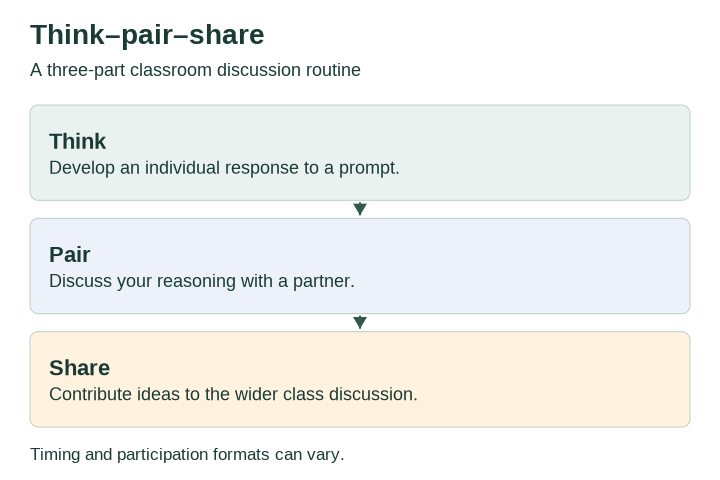
Think-pair-share is a classroom routine with three steps: think alone, pair with one partner, share with the class.[1][6] In the first step, each student thinks alone to find an answer. The answer is to the assignment the teacher has given.[7] In the second step, the student turns to one partner and discusses the answer. In the third step, pairs share their thinking with the whole class.[1] It is a widely known active-learning technique.[6]
Think-pair-share belongs to a family of teaching methods called cooperative learning models, in which students work together in small groups. One study looked at mathematics teaching in Manokwari, West Papua, Indonesia. It changed the model to fit local high school students. Group members should already know each other well, but should not have a similar level of knowledge. The number of members must start from two students.[7]
Published advice on the routine treats it as a technique with best practices to use and pitfalls to avoid. That advice covers writing the question and running the activity. It also covers assessment and useful uses in the science classroom. One described activity used think-pair-share to teach about biotechnology.[6]
The routine has also been studied in early medical education. That work used three small groups of first-year medical students. In that setting, students reported that the thinking time and the pairing time were especially important to their learning.[1]
Sutrianti studied the routine in the teaching of writing. Students' work was scored with a rubric, a written guide that lists the criteria for judging a piece of work. That study reported that think-pair-share worked better when it was followed by scoring with an analytic rubric. The study also reported positive results for think-pair-share with a holistic rubric. It reported positive results too for a different cooperative method scored with an analytic rubric. It added that these findings need further testing in other studies before they can be treated as firm.[8]
Main ideas
Why pairing before sharing changes talk and thinking
In a study of 110 animal science students, only 64% answered a multiple-choice question correctly after thinking alone. The share of correct answers rose to 87% after students discussed the question in pairs (P<0.001). It reached 99% after the class discussion that came next. A further 13% answered incorrectly twice, even after talking with a partner.[9]
A qualitative study looked at a biology class in a private school in Tangerang. It described how think-pair-share built students' initiative through thinking, discussing in pairs, and sharing. The researcher called this self-starting. It means students take part because they want to, not because they are told to. Students in that class began to ask questions and respond to the teacher. The study also reported a persistent quality, shown when students kept working on a problem until it was solved.[10]
The animal science study linked this peer interaction to gains in student competency. About 96.4% of students wrote a successful critique, against 62% of the students a year earlier. Those students had the same material without think-pair-share (P<0.001).[9]
A study of 90 third-year nursing students in a scholarly inquiry course compared scores on a learning perception scale. The scores came before and after the method was used. The before-and-after comparison showed no significant change in the mean scores. The same students did report high levels of learning perception in every category of the scale. The categories were integration of learning, understanding content, and increase in skills. Those categories were also positively related to a measure of attitude toward cooperative learning. The study concluded that cooperative learning should continue to be used.[11]
A newer line of work adds a software partner to the pair stage. One quasi-experimental study looked at 140 computer science undergraduates, of whom 80 students used a chatbot for scaffolding and the other 60 used a standard platform. The chatbot group showed 30-37% productivity gains and a 99% increase in thematic diversity. The researchers reported moderate effects on lexical standardization and placed the best balance of support and freedom at similarity scores between 0.3 and 0.7, a range reached by 70% of participants.[12]
Research
What the studies measure and how large the gains are
Dewi and Fihayati studied 19 fourth-grade students in a social studies class. Scores after the lessons were significantly higher than before them (p < 0.001, Z = -3.712). The test had 15 multiple-choice items. Its reliability coefficient (Cronbach's Alpha, a measure of internal consistency) was 0.902. The pretest data were not normally distributed, so the analysis used the Wilcoxon Signed Rank Test.[3]
Studies in language classes report gains in the share of students reaching a set score.[13][14] Ihsan ran a two-month classroom action research study with 20 university students learning vocabulary. In cycle 1, 8 students (40%) scored above 75; in cycle 2, 15 students (75%) did.[13] In an Arabic class of 35 students, 25 reached the minimum score of 76 in cycle I (71% class completeness), and in cycle II, 33 did so (94%). Student responses to the method in that class were 84%.[14]
Two writing studies report improvement after think-pair-share.[15][5] One study tested 30 secondary students before and after, with no control group. Their argumentative texts were significantly better in structure, content and language style. More students reached the very good and good categories.[15] An experiment used 40 high school students, split evenly between a think-pair-share group and a control group. It found considerable improvements in writing performance for the method group.[5]
One study of 15 fifth-grade students combined think-pair-share with problem-based learning. Afterward, 14 students (93.33%) scored in the very good category, with an average value of 90-100. The significance value was 0.003 at a 0.05 level. The abstract of that study describes both a one-group pretest-posttest design and a non-equivalent control group design, which do not match.[16]
The reading studies described here come from English classrooms in Indonesia. They include ninth-grade students in Sleman, eleventh-grade students in Blitar, and fourth-semester students at a university in Mataram.[17][18][19] In one study, 35 ninth-grade students at a public secondary school in Pandowoharjo, Sleman, took a 20-item multiple choice reading test. They took it after a series of reading lessons. The mean reading performance was 63,85 in the first cycle and rose to 66,00 in the second. Sumekto reports that these results met the minimal passing grade criteria. The study also reports more student participation, discussion and decision taking in group work.[17]
A second study followed 28 eleventh-grade students in a senior high school classroom in Blitar over two cycles. Their mean reading comprehension score was 62.4 before the cycles, 67.8 after Cycle I and 81.8 after Cycle II. The study measured comprehension with reading tests and recorded classroom participation with observation sheets and field notes.[18]
A third study worked with 30 fourth-semester students in an English language department at a university in Mataram. In the first cycle, 14 of the 30 students, or 47%, reached the minimum passing grade of 75, and the average score was 67.[19]
One study compared think-pair-share with a version that adds the metacognitive reading strategy. Both classes improved in reading comprehension. The modified group improved significantly more, with a t-value of 4.625 and a significance level of 0.000, below the 0.05 threshold.[20] The reading studies drew on small groups: 35 students in Sleman, 28 in Blitar, 30 at a university in Mataram, and two classes of 30 students each in Bandar Lampung.[17][18][19][20]
Effects on language skills and subject learning
Several small studies have tested think-pair-share in a single school subject and report gains on a test given after the lessons.[21][22][4][23][24] The studies are modest in size, and several compare one class with another.[22][23][24]
Listening to short stories was the target in one classroom action study. It took place at a senior high school in Pangkep, Indonesia, in 2024. Classroom action research aims to improve the quality of practice or solve a problem in the classroom being studied. Before the cycle the class average was 45. Only 4 students, or 11%, reached the school's mastery standard, called the KKM. After the first cycle the average was 64, and 10 students, or 28%, reached it. After the second cycle the average was 81, and 33 students, or 92%, did. The report names boredom with uninteresting materials as one reason the students' listening had been low.[21]
Reading comprehension has also been tested, and the results point the same way.[22][4][23] A quasi-experiment with 64 seventh graders in Parepare, Indonesia, split two classes, one taught with think-pair-share and one without. The think-pair-share class averaged 52,58 on the pretest and 72,58 on the posttest, while the control class moved from 46,66 to 63,33. The reported t-test value was 2.166, against a table value of 2.000 at the 0.05 level, with 62 degrees of freedom.[22]
A second quasi-experiment took place with eleventh graders at a sports high school in Palembang. It found a pretest average of 55 in the experimental group and 53.91 in the control group, and posttest averages of 80 and 75. The t-obtained was 2.049, against a t-table of 1.684 at 74 degrees of freedom and the 0.05 level.[23]
One reading study used a single group of 30 second-year medical students in Laos, tested before and after five lessons built on think-pair-share. The lessons reached an efficiency index of 95,74/89.33, above the 80/80 standard the researchers had set. The effectiveness index was 0.67, or 67% of the possible learning gain, above the set criterion of 0.50. Satisfaction with the approach averaged 4.16 on a rating scale, with a standard deviation of 0.21, which the report calls a high level.[4]
Speaking was the focus of a quasi-experiment with eighth graders. The school was a junior high school in Luwuk, Indonesia. The think-pair-share class rose from a mean of 46.3 on the pretest to 81.2 on the posttest. The control class rose from 45.8 to 61.6. The reported t-counted was 14.984 against a t-table of 1.667 at the 0.05 level.[24]
In mathematics, one comparative study asked which method served mathematical communication better, choosing between think-pair-share and another cooperative method, think talk write. The students in the study were in grade VII classes at SMP Negeri 2 Ngabang, and the material was algebraic forms operations, with one class using each method. The t-test value of 2.049 was above the table value of 1.995 at the 0.05 level, so the classes differed. The class using think talk write came out ahead on the knowledge aspect.[25]
One small classroom study tested think-pair-share with students learning to speak English at a university in Indonesia. Manurung carried out action research whose steps were planning, action and observation, and reflection. It took place at Tridinanti University in Palembang in the 2016/2017 academic year, and the sample was one class of 10 second-semester students. The data came from tests and observation. The class set a target of an average score above 70, with more than 85% of students scoring above 70.[26]
The average speaking score was 66, and the observation result was 62.82, so a second cycle was needed. The class had reached the target, and the cycle was stopped. The study concluded that think-pair-share clearly improved the students' speaking achievement.[26]
Elismawati and colleagues report an overall effect size of 1.41 and place it in the large effect category.[27] An effect size is a statistical calculation of how large a measurable effect is, for example the difference between the averages of two groups divided by the standard deviation.[28] The combined effect size across the pooled studies was 1.41, which falls in the large category. The combined effect was 1.67 in Sumatra, 1.2 in Java and 1.18 in Sulawesi. By educational level it was 1.25 in Junior High School, 1.61 in Senior High School and 0.98 at university. The meta-analysis recommended that English teachers and curriculum designers use and develop think-pair-share in the English classroom to improve students' language skills.[27] A meta-analysis is a statistical method that combines the estimates from two or more similar studies into one overall estimate of an effect.[29]
What changes the result: age, subject and grouping
The studies below come from elementary school and high school classrooms, and each one tested the method under its own conditions.[30][31][32] One study looked at 153 second-grade students at a school called SD ABC. The two methods gave different results in critical thinking, with a significance level of 0.017. No difference appeared among students with an auditory learning style, where the significance value was 0.211.[32]
At the high school level, a quasi-experimental study tested twelfth-grade students on argumentative speaking, comparing think-pair-share with think-pair-square, and both versions used podcast recordings. Class XII-4 was the experimental class, and class XII-5 was the control class. Think-pair-square worked better than think-pair-share. The post-test comparison gave a significance value of 0.036, and the N-gain value was 0.41 in the experimental class and 0.27 in the control class. Students with extraverted personality types scored higher in both classes.[31]
One study looked at tenth-grade students at SMA YP Unila Bandar Lampung and compared think-pair-share with small group discussion for writing descriptive text. Small group discussion did better, with a mean score of 39.2963 against 18.9375 for think-pair-share, and the difference was significant.[30]
Speaking, reading and writing outcomes
One action study took place in an Indonesian elementary school, and another took place in a Central Java boarding high school; each measured speaking participation before and after think-pair-share lessons.[33][34] Active speaking participation rose from about 20 to 25 percent at the start to more than 65 to 70 percent by the end of the single action cycle. Ghifari and colleagues also reported that students showed more confidence and were more willing to express ideas in English.[33] A second action study followed 26 students, and the average participation score in that speaking class rose from 30.69 to 45.42. Student responses to a questionnaire were all positive.[34]
A quasi-experiment tested think-pair-share combined with a chain drill in seventh-grade English classes, with two seventh-grade classes taking part: one was taught with the combined method, and one in the usual way. The experimental class's mean score rose from 60.5 on the pre-test to 81 on the post-test, and the control class scored 79.[35] A quasi-experiment with physics students at Tadulako University compared two intact classes. The experimental group's post-test mean speaking score was 70.50, against 67 for the control group, and the reported t value of 3.255 was above the table value of 2.002. The researcher read this as an improvement in speaking skill.[36]
At Muhammadiyah University of Mataram, 30 fourth-semester students took a reading course. In the first cycle only 14 met the passing grade of 75, with an average of 67. After a second cycle, 20 of the 30 students reached 75 and the average was 72. Students also said the technique pushed them to think, explore and share ideas. It also helped them work with others.[37]
At SMA Mathla'ul Anwar, the mean reading comprehension score rose across three cycles. It went from 59.6 to 67.5, then to 77.[38] One study looked at 26 grade X students at SMK Kihajar Dewantara in Jambe. It set a target of 80 percent of students reaching a minimum score of 75. In the first cycle 16 percent of students beat the minimum score of 75. In the second cycle 58 percent did.[39]
One reading study compared think-pair-share with a control class. Another tested a single class before and after teaching.[40][41] A quasi-experiment with 60 senior high school students found a post-test mean of 84.44. The pre-test mean was 63.11, with a t value of 5.747 above the table value of 2.002.[40]
A pre-experimental study of 27 eleventh-grade students reported a rise from 58.44 to 85.11. The t value was 12.59, above the table value of 1.795. The single-class study reported a pre-test mean of 58.44 and a post-test mean of 85.11.[41]
A quasi-experiment with 108 tenth-grade students in three classes of 36 compared three methods. These were think-pair-share, reciprocal teaching and conventional teaching. The think-pair-share class averaged 68.94 on the reading post-test. That was below the 71.81 of the reciprocal teaching class.[42]
At SMP Plus Nurulhidayah Pasundan the average writing score was 47.1 before the study. It was 51.8 after the first cycle and 71.09 after the second. The researchers also reported that the writing classroom became a better place to learn.[43]
Mathematics, science and other subjects
Mathematics teachers answered a survey in Banten Province, Indonesia, and reported strong belief that think-pair-share helps students understand concepts. The survey drew 26 respondents, all mathematics teachers or lecturers, who answered 45 statements on a five-point scale. The same teachers considered that adding technology supported the strategy's implementation.[44] The think-pair-share group's mean rose from 53.47 to 81.90, and the conventional group's mean rose from 53.00 to 68.33.[45]
In chemistry, a quasi-experiment in the Awka Education Zone of Nigeria compared think-pair-share with lecture teaching and involved 120 secondary students, 60 male and 60 female. Students taught with think-pair-share scored higher than those taught by lecture.[46] A later chemistry study paired think-pair-share with an online classroom platform, and the lessons covered electrolysis. That study found significantly higher achievement than with lecture. Students in that study reported too little time among their difficulties, and they also reported unstable internet connections and unstable power supply.[47]
A physics study looked at 30 high school students in West Java. Its flipped lessons used discovery learning plus think-pair-share. The experimental group reached an N-gain of 0.85, against 0.64 for the control group.[48] A biology study looked at 70 tenth-grade students in Indonesia. It used think-pair-share within flipped lessons on climate change. The experimental group's mean N-gain was 0,76, against 0,66 for the control group.[49]
The 91 students in the think-pair-share group did better than the 82 in a conventional flipped classroom on achievement and self-efficacy. The trial used two different teachers, and the authors list this as a limitation.[50] One classroom action research study in mathematics paired discovery learning with think-pair-share and gave pairs a question sheet arranged from easy to difficult items. That study reported that students' mathematics learning activities improved from the first cycle of lessons to the second.[51]
Religious education has also used the method, and a qualitative study looked at a class VIII group studying Al-Qur'an Hadith. It found that the think stage trained independent thinking and the pair stage encouraged exchange of ideas, while the share stage was linked to greater courage in stating opinions. Participation in that class was uneven, and the study traced this to differences in motivation and self-confidence.[52]
Confidence, motivation and self-esteem
Studies of think-pair-share have measured feelings as well as scores, including motivation, confidence and self-esteem.[53][54][55] A 2024 survey in Jos North, Plateau State, Nigeria, drew on a target population of 1334 Junior Secondary School II social studies students spread across 22 public schools. The researcher wrote separate questionnaires for students and teachers, and their reliability was 0.67 and 0.71. The survey design describes what respondents reported; it did not compare a taught class with an untaught one.[55]
A 2025 classroom action research study took place in an Indonesian secondary English classroom and followed two cycles of planning, acting, observing and reflecting. The researchers gathered observations, field notes and interviews, and they also used reading tests. Pratolo and colleagues described learners who had been passive and disengaged and who became confident, motivated participants who valued working with peers. The study reported improvements in both motivation and understanding. Its design was classroom action research in two cycles, and reading scores rose from a pre-test mean of 57.22 to 78.26 in Cycle II.[53]
A 2026 quasi-experimental study tested a blend of flipped classroom and think-pair-share with 80 first-semester university students in an English language course. The experimental group used the blended model, and the control group followed conventional instruction. Engagement was measured with questionnaires, interviews and classroom observations. Student engagement rose a lot, and classroom discussions went up by 38.71%. Students in interviews said the blended model was more engaging and interactive, and they said it built collaboration and confidence in using the language.[54]
In practice
How the three steps are run in a classroom
Darwish and Maznouk present a teaching model built around think-pair-share together with concept maps. They also give a science lesson that shows how the two fit together. Darwish and Maznouk argue that teachers still rely on rote instruction and memorization. They propose think-pair-share and concept maps as methods that get students thinking.[58]
In another, the method is built into a set of teaching tools. The tools cover global warming material for grade XI high school students. Those tools include a Learning Implementation Plan, a Student Worksheet and a Learning Outcome Test. Validators rated all three as high, with average scores of 3.07, 3.16 and 3.13.[59]
A 2026 study at Damthang Primary School paired grade VIB learners and combined think-pair-share with a second strategy, mix-pair-share. The study involved 21 students. Their perception scores rose from before the intervention to after it, t(20) = -2.27, p = .035. Four participants were interviewed, and their answers fell into three themes: greater participation and engagement, sharing knowledge while working together, and growing confidence and courage. The highest mean score went to the item saying interactive teaching improves classroom interaction skills.[2]
Sharing is the public step, in which pairs present or share the results of their discussion with the class. The 2026 study reports that the strategies changed more than the amount of talking. This shifted the classroom learning dynamic and active participation.[2]
A classroom action research study at Sekolah Palembang Harapan ran the method with mind mapping. It involved four students of grade VIII A across 3 cycles, each with 5 stages. Four instruments supplied the data. They were a quiz, a sheet on which the mentor recorded observations, the mentor's written feedback, and a journal of reflections. The result was improved understanding of mathematical concepts, in a class where students had been struggling with that understanding.[60]
What this looks like when you study
Think-pair-share increased student participation and improved the quality of discussion in those groups. Students said the thinking and pairing time mattered most for their learning.[1] The class held 25 sixth-grade students. Over one action research cycle, active speaking participation climbed from roughly 20 to 25 percent to more than 65 to 70 percent.[33]
A class of 110 animal science students watched a 5-minute video on faulty animal training, then answered a multiple-choice question. After the think stage, 64 percent answered correctly; after pairing, 87 percent; after sharing, 99 percent. About 31 percent switched from incorrect to correct after peer discussion, while 13 percent answered incorrectly twice.[9]
The share of students meeting the passing grade of 75 rose from 27 percent to 47 percent to 67 percent across those stages.[19] In a mathematics classroom study, teachers reported an overall average of 3.98 on a 5-point scale for understanding and belief in think-pair-share. The same teachers gave an overall average of 3.94 for their implementation of the strategy.[44]
In a think-pair-share, students first think on their own, then discuss in pairs, and then share with the class.[1] When you share with the class, state your pair's answer and the reason behind it, since the share stage raised correct answers from 87 percent to 99 percent in one study.[9] If you teach, allow enough time for students to think before discussion and give feedback after they share, two practices teachers rated 4.19 out of 5 in a survey.[44]
Later developments
Digital versions and classroom routines
Teachers can run think-pair-share through online classroom tools.[61][62] In one writing class, a teacher built the activity on an online platform. The teacher added a scoring guide, called a rubric, for judging student work. A day later the students completed an open-ended questionnaire online. Most reported satisfaction and a willingness to do the activity again.[61]
One study looked at reading lessons at a vocational school. It described how 3 English teachers used the strategy on Google Classroom with 117 students. The teachers set up several online forums for the steps. These were posting a text, giving questions, having pairs work together, and gathering what each discussion produced. Teachers rated the approach highly, with 84.37% of their responses very good and 15.63% good. Student responses were more mixed: 8.82% very good, 70,6% good, and 20,58% enough. One reason teachers gave for using the strategy online was that it raised students' enthusiasm. It also raised their motivation to read a text.[62]
A small descriptive study looked at 20 eighth-grade students and examined how the strategy was carried out in speaking lessons. The lessons followed the stages in the teacher's own lesson plan. Students' reactions to the approach were quite good, and students said the strategy helped them get past the difficulties they met during speaking activities.[63]
Adapting the technique with other strategies
Kesuma, Sutarsyah and Nurweni write that one technique's limits can be addressed by adding another technique to it. Think-pair-share has limits of its own. A 2024 study tested whether adding a metacognitive reading strategy could address them. The metacognitive reading strategy is the second technique that Kesuma, Sutarsyah and Nurweni added to think-pair-share.[20]
Criticism
Limits, weak spots and open questions
The medical education study used video recordings and equity mapping software to check how evenly talk was spread. It reported a fairer spread of participation, and students also interacted more.[1]
Common misconceptions
A survey in Jos North asked social studies teachers and students about think-pair-share. Shittu Lukman Olayinka (2024) reported that few of them knew the strategy. The same study reported that the strategy plays a significant role in developing students' self-esteem in junior secondary school. The researcher recommended seminars and conferences to familiarize teachers with the approach.[55]
Key studies
| Year | Study | Sample | Design | Finding |
|---|---|---|---|---|
| 2018 | Hudri & Irwandi[19] | 30 fourth-semester university students | classroom action research, two cycles | Mean reading score rose from 54 to 67 to 72, and the share meeting the passing grade rose from 27 to 47 to 67 percent. |
| 2020 | Rullu[24] | eighth-grade students in two classes | quasi-experimental, non-equivalent design | The experimental class mean rose from 46.3 to 81.2, compared with 45.8 to 61.6 in the control class. |
| 2021 | Elismawati et al.[27] | studies of English teaching and learning in Indonesia | meta-analysis | The overall effect size was 1.41, a large effect, with 1.84 for speaking, 1.67 for reading and 0.9 for writing. |
| 2021 | Alfandi[22] | 64 seventh-grade students in two classes | quasi-experimental, pretest and posttest | The experimental class averaged 52,58 on the pretest and 72,58 on the posttest; the control class averaged 46,66 and 63,33 on the same two tests. |
| 2022 | Damayanti[23] | eleventh-grade students in two classes | quasi-experimental | The experimental class mean rose from 55 to 80, compared with 53.91 to 75 in the control class. |
| 2023 | Sabilla & Ahkas[14] | classroom action research, two cycles | Students reaching the minimum score rose from 25 of 35 in cycle I to 33 of 35 in cycle II. | |
| 2024 | Guenther & Abbott[1] | three small groups of first-year medical students | content analysis of video recordings, equity mapping and surveys | Think-pair-share increased participation and improved discussion quality, with thinking and pairing time especially important. |
| 2024 | Shittu Lukman Olayinka[55] | 1334 junior secondary social studies students across 22 public schools | quantitative descriptive survey | The strategy was not widely known, and it played a significant role in developing students' self-esteem. |
| 2025 | Ramadhani et al.[44] | 26 mathematics teachers and lecturers | quantitative descriptive survey | Respondents rated understanding and belief in think-pair-share at an overall average of 3.98 and implementation at 3.94 on a 5-point scale. |
| 2026 | Clark et al.[9] | 110 animal science students | classroom exercise with audience response system | Correct answers rose from 64 percent after thinking to 87 percent after pairing and 99 percent after sharing. |
| 2026 | Ghifari et al.[33] | 25 sixth-grade students | classroom action research, one cycle | Active speaking participation rose from about 20 to 25 percent to more than 65 to 70 percent. |
| 2026 | Susana et al.[18] | 28 eleventh-grade students | classroom action research, two cycles | Mean reading score rose from 62.4 to 67.8 in Cycle I and 81.8 in Cycle II. |
| 2026 | PHOTHONG et al.[4] | 30 second-year medical students | one-group pretest and posttest | The effectiveness index was 0.67, or 67 percent of the possible learning gain, and satisfaction averaged 4.16 out of 5. |
| 2026 | Dewi & Fihayati[3] | one-group pretest-posttest with 19 fourth-grade students | Posttest scores were significantly higher than pretest scores (p < 0.001). |
See also
References
- Guenther, A. R., & Abbott, C. M. (2024). Think-Pair-Share: Promoting Equitable Participation and In-Depth Discussion. PRiMER, 8. doi:10.22454/primer.2024.444143
- Dorji, C., & Thinley, T. (2026). Enhancing Students’ Active Classroom Participation through Interactive Teaching Strategies: Think-Pair-Share and Mix-Pair-Share at Damthang Primary School. International Journal For Multidisciplinary Research, 8(2). doi:10.36948/ijfmr.2026.v08i02.70618
- Dewi, T., & Fihayati, Z. (2026). The Effect of the Think-Pair-Share Cooperative Learning Model on Elementary School Students Social Studies Learning Outcomes: Pengaruh Model Pembelajaran Kooperatif tipe Think-Pair-Share terhadap hasil belajar IPS siswa Sekolah Dasar. Indonesian Journal of Education Methods Development, 21(1). doi:10.21070/ijemd.v21i1.1093
- PHOTHONG, B., PHONEKEO, S., & SOUKHAVONG, B. (2026). IMPROVING ENGLISH READING COMPREHENSION OF THE 2ND YEAR STUDENTS AT THE DEPARTMENT OF MEDICINE, FACULTY OF MEDICAL DOCTOR, UNIVERSITY OF HEALTH SCIENCES BY USING THINK-PAIR-SHARE TECHNIQUE: ການພັດທະນາຄວາມສາມາດໃນການອ່ານເຂົ້າໃຈພາສາອັງກິດຂອງນັກສຶກສາຊັ້ນປີທີ 2 ພາກວິຊາແພດສາດ ຄະນະແພດສາດ ມະຫາວິທະຍາໄລວິທະຍາສາດສຸຂະພາບ ໂດຍການນຳໃຊ້ເຕັກນິກ Think-Pair-Share. ວາລະສານວິທະຍາສາດສຶກສາສາດ, 3(2), 21-30. doi:10.71026/sje.3.2.118.2026
- Lecturer from Thai Nguyen University of Education, Thai Nguyen, Viet Nam, & Yen, T. T. (2022). Improving English Writing Performance for High School Students through the Think-Pair-Share Technique. International Journal of Social Science and Human Research, 05(04). doi:10.47191/ijsshr/v5-i4-07
- (2017). Best Practices for the Think-Pair-Share Active-Learning Technique. The American Biology Teacher, 79(1), 3-8. doi:10.1525/abt.2017.79.1.3
- Tanujaya, B., & Mumu, J. (2019). Implementation of think-pair-share to mathematics instruction. Journal of Education and Learning (EduLearn), 13(4), 510-517. doi:10.11591/edulearn.v13i4.14353
- Sutrianti, E. (2017). Think-Pair-Share Technique and Analytic Rubric Assesment for English Writing Learning. Jurnal Evaluasi Pendidikan, 8(1), 7-16. doi:10.21009/jep.081.02
- Clark, A., Youssef, M., & Ali, A. (2026). COLLABORATIVE LEARNING IMPROVES EDUCATION: The influence of Think-Pair-Share on improving student learning and critical thinking. NACTA Journal, 69(1). doi:10.56103/nactaj.v69i1.213
- Situmeang, R. S., & Tammu, R. (2024). Penerapan Model Pembelajaran Think Pair Share Sebagai Upaya Mengembangkan Inisiatif Siswa Kelas XI IPA Dalam Pembelajaran: (Implementation of the Think Pair Share Learning Model as an Effort to Develop Initiatives of Class XI IPA Students in Biology Learning). BIODIK, 10(4), 714-727. doi:10.22437/biodik.v10i4.25324
- Abdelkader, A. M. (2022). effect of using think-pair-share cooperative learning strategy on nursing students' perception of their learning. International journal of health sciences, 2897-2911. doi:10.53730/ijhs.v6ns6.9937
- Lobo-Quintero, R. (2025). AI-Enhanced Think-Pair-Share: A Learning Analytics Approach to Foster Linguistic Creative Thinking and Collaborative Learning. Journal of Learning Analytics, 12(2), 19-34. doi:10.18608/jla.2025.8807
- Ihsan, M. (2019). Applying Think-Pair-Share Model in Vocabulary Learning. Loquen: English Studies Journal, 12(1), 11. doi:10.32678/loquen.v12i1.1918
- Sabilla, S., & Ahkas, A. W. (2023). Improving Student Learning Outcomes in Arabic Learning Through the Think Pair Share (TPS) Model. Edumaspul: Jurnal Pendidikan, 7(1), 1698-1707. doi:10.33487/edumaspul.v7i1.6373
- Tampubolon, D. N. B., Perangin-angin, E., & Ginting, S. D. B. (2024). Efektivitas Metode Think Pair Share dalam Meningkatkan Kemampuan Menulis Teks Argumentasi Siswa: The Effectiveness of the Think-Pair-Share Method in Improving the Argumentative Writing Skills. Transformatika: Jurnal Bahasa, Sastra, dan Pengajarannya, 9(4), 951-974. doi:10.31002/transformatika.v9i4.2899
- Nur Hikmah, Rahma Ashari Hamzah, & Abdul Wahid (2025). The Effect of the Think-Pair-Share and Problem-Based Learning Models on the Indonesian Language Learning Outcomes of Fifth-Grade Students at SDN 169 Sadar: Pengaruh Model Think Pair Share dan Problem Based Learning terhadap Hasil Belajar Bahasa Indonesia Siswa Kelas V SDN 169 Sadar. Bestari: Jurnal Pendidikan dan Kebudayaan, 7(1), 145-157. doi:10.46368/bjpd.v7i1.4981
- Sumekto, D. R. (2018). Investigating the Influence of Think-Pair-Share Approach toward Students’ Reading Achievement. Lingua Cultura, 12(2), 195. doi:10.21512/lc.v12i2.4011
- Susana, I., Nur Rohmi R., L., & Mahmudah, L. (2026). Enhancing Students’ Reading Comprehension through Think-Pair-Share Technique in EFL Classroom. JOSAR (Journal of Students Academic Research), 11(1), 97-108. doi:10.35457/h3xn1j03
- Hudri, M., & Irwandi, H. (2018). Improving Students’ Reading Skill Through Think-Pair-Share (TPS) Technique. IJECA (International Journal of Education and Curriculum Application), 90. doi:10.31764/ijeca.v0i0.1993
- Student of Master of English Education, University of Lampung, Indonesia, Kesuma, S. W., Sutarsyah, C., Professor of English Education, University of Lampung, Indonesia, Nurweni, A., & Lecturer of English Education, University of Lampung, Indonesia (2024). Modifying The Think Pair Share Technique based on The Metacognitive Reading Strategy to Enhance Students’ Reading Comprehension. International Journal of Current Science Research and Review, 07(08). doi:10.47191/ijcsrr/v7-i8-27
- Rahmadhani, N., Muin, N., & Puspitasari, A. (2024). Peningkatan Keterampilan Menyimak Melalui Model Pembelajaran Think-Pair-Share Siswa SMA Negeri 1 Pangkep: Improving Listening Skills Through Think-Pair-Share Learning Model for Students of SMA Negeri 1 Pangkep. Edu Cendikia: Jurnal Ilmiah Kependidikan, 4(02), 560-573. doi:10.47709/educendikia.v4i02.4554
- Alfandi, A. (2021). The Use of Think-Pair-Share Technique to improve reading comprehension of seventh grade Students of SMP Negeri 10 Parepare: Think-Pair-Share Technique improve the Students Reading Comprehension at SMP Negeri 10 Parepare. La Parole : Journal of Language Teaching and Pedagogy, 4(2), 93-103. doi:10.31850/laparole.v4i2.913
- Damayanti, M. (2022). Teaching Narrative Reading By Applying Think-Pair-Share Model. Darussalam English Journal (DEJ), 2(1), 1-19. doi:10.30739/dej.v2i1.1512
- Rullu, S. M. (2020). Think-pair-share strategy to improve the students’ speaking ability. BABASAL English Education Journal, 1(2). doi:10.32529/beej.v1i2.864
- Ellissi, W. (2020). Comparative Study of Think Talk Write Method and Think Pair Share Method Against Mathematical Communication Ability. AlphaMath : Journal of Mathematics Education, 6(1), 19. doi:10.30595/alphamath.v6i1.7389
- Manurung, J. E. (2017). Using think-pair-share to improve speaking achievement of the second semester english study program of tridinanti university palembang. English Community Journal, 1(2), 86. doi:10.32502/ecj.v1i2.765
- Elismawati, E., Azmi, H. A., Hadeli, H., Zulyusri, Z., & Syukri, A. (2021). Meta-Analysis Study of Think-Pair-Share Strategy on English Language Teaching and Learning in Indonesia. Ta'dib, 24(2), 281. doi:10.31958/jt.v24i2.4882
- ERIC Thesaurus (n.d.). Effect Size. ERIC Thesaurus. https://eric.ed.gov/?ti=Effect+Size
- GET-IT Glossary (plain-language health research terms) (n.d.). meta-analysis. GET-IT Glossary (plain-language health research terms). https://getitglossary.org/term/meta-analysis
- Erika, H. J. (2022). Comparative study of think-pair-share technique andsmall group discussion technique in writing descriptive text. Inspiratif Pendidikan, 11(1), 78-84. doi:10.24252/ip.v11i1.27909
- Hanan, M. J., & Pristiwati, R. (2026). The Effectiveness of Argumentative Speaking Skills Learning Using Think-Pair-Square and Think-Pair-Share Models Assisted by Podcast Based on Students’ Personality Types. Jurnal Pembelajaran, Bimbingan, dan Pengelolaan Pendidikan, 6(3), 8. doi:10.17977/um065.v6.i3.2026.8
- Levina, J., Yarmi, G., & Soekisno, R. B. A. (2022). Pengaruh model problem-based learning and cooperative learning tipe think-pair-share ditinjau dari gaya belajar terhadap kemampuan berpikir kritis siswa kelas 2 SD ABC [the effect of the think-pair-share type of problem-based learning and cooperative learning model on the critical thinking skills of second grade students of ABC school]. Polyglot: Jurnal Ilmiah, 18(1), 97-113. doi:10.19166/pji.v18i1.4406
- Ghifari, A. G., Syahriwan, M., Fahreza, N., & Syahid, A. (2026). Improving Speaking Participation Through Think-Pair-Share in an EFL Classroom. IJCAR: Indonesian Journal of Classroom Action Research, 4(1), 16-18. doi:10.53866/ijcar.v4i1.1150
- Kerimov, N., Rais, D., & Setyaningsih, E. (2017). Improving Students’ Participation in Speaking Class Through Think-Pair-Share Technique. English Education, 6(1), 93. doi:10.20961/eed.v6i1.35937
- Student of Master of English Education, University of Lampung, Indonesia, Rahman, F. A., Flora, F., Professor of English Education, University of Lampung, Indonesia, Sukirlan, M., & Professor of English Education, University of Lampung, Indonesia (2025). Integrating Think-Pair-Share with Chain Drill to Enhance Students’ Speaking Achievement. International Journal of Current Science Research and Review, 08(12). doi:10.47191/ijcsrr/v8-i12-36
- Maghfira, M. (2020). The Implementation of Think-Pair-Share Technique in Improving Students' Speaking Skill. Jurnal Studi Guru dan Pembelajaran, 3(3), 511-517. doi:10.30605/jsgp.3.3.2020.495
- Hudri, M., & Irwandi, I. (2019). Improving Students’ Reading Skill Through Think-Pair-Share (TPS) Technique. Linguistics and Elt Journal, 6(2), 1. doi:10.31764/leltj.v12i2.746
- Rosmiati, E., & Nuryani, M. (2020). Improving students’ reading comprehension through think-pair-share (tps) technique. PROJECT (Professional Journal of English Education), 3(1), 93. doi:10.22460/project.v3i1.p93-100
- Berliana, A., & Imam Sudarmaji (2025). Improve students' reading comprehension using narrative text through think-pair-share techniques. PROGRES PENDIDIKAN, 6(3), 226-233. doi:10.29303/prospek.v6i3.928
- Agussatriana, A. (2020). Developing Students’ Reading Comprehension through Think-Pair-Share Strategy. ELS Journal on Interdisciplinary Studies in Humanities, 3(1), 41-50. doi:10.34050/els-jish.v3i1.9369
- Oktaviani, N., & Rofiqoh, R. (2021). Increasing students’ reading comprehension through think-pair-share technique. e-Journal of ELTS (English Language Teaching Society), 9(2), 157-163. doi:10.22487/elts.v9i2.1872
- Alviani, F., Khusaini, K., & Christine, L. (2025). The Application of Think-Pair-Share and Reciprocal Teaching Strategy on Improving Students’ Reading Comprehension. Foremost Journal, 6(1), 93-103. doi:10.33592/foremost.v6i1.7210
- Febriyantika, R., & Parmawati, A. (2021). Improving students’ writing descriptive text through think-pair-share technique. PROJECT (Professional Journal of English Education), 4(2), 261. doi:10.22460/project.v4i2.p261-266
- Ramadhani, A., Karida, M. P., & Wahyunengsih, W. (2025). Understanding the Role of Think-Pair-Share Strategy in Mathematics Classroom. Kognitif: Jurnal Riset HOTS Pendidikan Matematika, 5(3). doi:10.51574/kognitif.v5i3.3414
- Noverica, S. (2026). Wordwall-Assisted Think-Pair-Share for Improving Students’ Mathematics Outcomes. Jurnal Pendidikan, Media, Strategi, dan Metode., 399-407. doi:10.67507/jupen.v2i05.418
- Nnoli, J. N. (2024). Enhancing Senior Secondary School Students' Academic Performance in Chemistry Through the Implementation of Think-Pair-Share Strategy. Social Education Research, 370-379. doi:10.37256/ser.5220244727
- Nwafor, S. C., & Tsakeni, M. (2026). Think-pair-share strategy integrated with Google Classroom: Investigating its effect on students with different cognitive styles for learning about electrolysis. Multidisciplinary Science Journal, 9(3), 2027068. doi:10.31893/multiscience.2027068
- Handayani, W., Adwasyifa, K., & Nuryantini, A. Y. (2025). Impact of a Collaborative Flipped Classroom with Think-Pair-Share on Physics Problem-Solving Skills. Science Education and Application Journal, 7(2), 189-199. doi:10.30736/seaj.v7i2.1190
- Widiani, K., Citrawathi, D. M., Heny, A. P., & Andriani, N. P. F. (2026). Effectiveness of Think-Pair-Share in a Flipped Classroom for Improving Students’ Cognitive Outcomes on Climate Change. SEARCH: Science Education Research Journal, 5(1), 1-14. doi:10.47945/search.v5i1.2935
- Samaila, K., Tsong, C. K., Masood, M., & Bervell, B. (2024). Think-pair-share based flipped classroom: A model for improving students’ learning achievement and self-efficacy. Journal of Digital Educational Technology, 4(1), ep2410. doi:10.30935/jdet/14422
- Pangaribuan, L. R. (2022). Meningkatkan aktivitas belajar matematika melalui model discovery learning dengan think-pair-share pada siswa. Ensiklopedia Education Review, 3(3), 1-5. doi:10.33559/eer.v3i3.151
- Salmah, U., & Husarida, H. (2026). Analysis Of Learning Using The Think-Pair-Share Model On Students' Social Interaction. At- Ta'lim : Jurnal Pendidikan, 12(1), 96-105. doi:10.55210/attalim.v12i1.2428
- Pratolo, B. W., Bao, D., & Palaguna, S. (2025). Enhancing reading comprehension and motivation through Think-Pair-Share: Classroom action research in an Indonesian EFL context. English Language Teaching Educational Journal, 8(1), 54-65. doi:10.12928/eltej.v8i1.13992
- Dian Anggraini (2026). The Effectiveness of Flipped Classroom and Think-Pair-Share in Enhancing English Proficiency and Student Engagement among EFL Learners in Higher Education. Journal of Intelligent Decision Making and Information Science, 3(4s), 1655-1668. doi:10.59543/jidmis.v3.1180
- Shittu Lukman Olayinka (2024). Assessment of Think-Pair-Share Strategy on Students Self-Esteem Development in Jos North Schools, Plateau State. Matondang Journal, 3(1), 50-58. doi:10.33258/matondang.v3i1.1047
- Ugwu, E. O. (2019). Effect of Student Teams Achievement Division and Think-Pair-Share on Students' Achievement in Reading Comprehension. African Journal of Teacher Education, 8, 218-237. doi:10.21083/ajote.v8i0.5209
- Student of Master of English Education, University of Lampung, Indonesia, Fania, F., Setiyadi, A. B., Professor of English Education, University of Lampung, Indonesia, Flora, F., & Professor of English Education, University of Lampung, Indonesia (2023). Modifying Think-Pair-Share based on Suggestopedia Principles to Teach Speaking. International Journal of Current Science Research and Review, 06(07). doi:10.47191/ijcsrr/v6-i7-35
- Darwish, A. A., & Maznouk, M. S. (2026). An Integrated Teaching Model Based on (Think-Pair-Share) and Concepts Map Methods. Social Science and Human Research Bulletin, 03(09). doi:10.55677/sshrb/2026-3050-0909
- Bella, S., & Azhar, A. (2023). Development of Think-Pair-Share (Tps) Model Based Learning Tools for Global Warming Materials. Journal of Education and Learning Research, 1(1), 20-29. doi:10.62208/jelr.1.1.p.20-29
- Yojinato, F., & Hidayat, D. (2020). Penerapan model pembelajaran think-pair-share dengan mind mapping untuk meningkatkan pemahaman konsep matematis murid kelas VIII a sekolah palembang harapan [the implementation of the think-pair-share learning model with mind mapping to improve grade 8-a students’ understanding of mathematical concepts at sekolah palembang harapan]. Polyglot: Jurnal Ilmiah, 16(1), 110. doi:10.19166/pji.v16i1.2252
- Demirci, C., & Duzenli, H. (2017). Formative Value of an Active Learning Strategy: Technology Based Think-Pair-Share in an EFL Writing Classroom. World Journal of Education, 7(6), 63. doi:10.5430/wje.v7n6p63
- K.P.D. Wijaya, N.M. Raminingsih, & I.G. Budasi (2021). An analysis of think-pair-share strategy on google classroom in reading at SMKN 1 kuta selatan. Jurnal Pendidikan Bahasa Inggris Indonesia, 9(2), 90-100. doi:10.23887/jpbi.v9i2.489
- Apriyanti, D., & Ayu, M. (2020). Think-pair-share: Engaging students in speaking activities in classroom. Journal of English Language Teaching and Learning, 1(1), 13-19. doi:10.33365/jeltl.v1i1.246
Cite this page: Atlas Nova editors. (2026). Think-pair-share. Atlas Nova. https://velocer.io/atlas/think-pair-share/