Method · Teaching
Reciprocal teaching
Reading comprehension instructional procedure
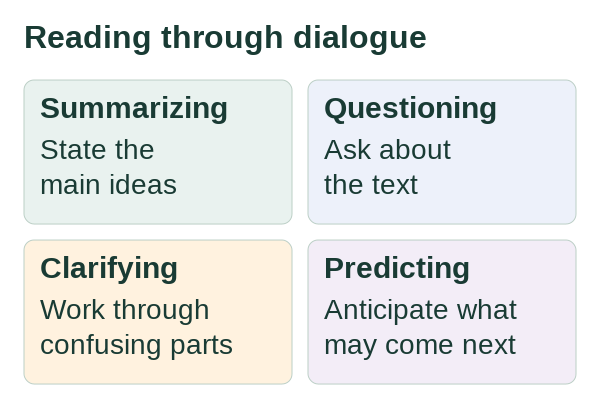
Reciprocal teaching is an instructional procedure in which a teacher and students take turns leading a dialogue about a text, using four strategies: summarizing, questioning, clarifying, and predicting.[1][2]
Reviews report median effect sizes of .32 on standardized tests and .88 on experimenter-developed tests [8].[2] Gains depend on how well teachers carry out the method.[3] It helped seventh-grade poor comprehenders improve their comprehension [7].[1]
Overview
What reciprocal teaching is
Reciprocal teaching is a small-group reading routine. Students take turns leading a discussion about a text.[4][5] The discussion follows the comprehension strategies of predicting, questioning, clarifying and summarizing.[6][7] The method is also called reciprocal reading. People sometimes describe it as a form of cooperative teaching.[7][5]
The teacher begins by demonstrating the strategies openly, so that students see an expert use them on a real text. A review of the method names three key elements. They are scaffolding, active and meaningful involvement, and feedback.[7]
The routine was first designed for seventh grade students. Later work has adapted it for younger children.[4] One teacher used puppets to model the strategies with her kindergarten students. They practised retelling, asking questions and predicting during a story read aloud. In that study the children shared authority in the discussion. They also took responsibility for their own learning.[8]
Reciprocal teaching is presented as an inclusive instructional strategy, one meant to serve a range of learners in the same classroom.[9] The method is also described as researched-based, and its strategies are taught explicitly.[6][4] Discussion and assessment are treated as part of the routine. The separate duties of the teacher and the students are part of it too.[6]
History
Where the method came from
Reciprocal teaching began with two teaching studies of seventh graders who read poorly. They were reported in 1984. Students were trained in four activities: summarizing, questioning, clarifying and predicting. Summarizing served as self-review. The training used reciprocal teaching. Study 1 compared the reciprocal teaching method with a second intervention. That intervention was modeled on typical classroom practice. The reciprocal procedure produced larger gains. Those gains lasted over time.[1]
In Study 1, an adult model showed students how to work with the text in more advanced ways. The summaries and questions students produced became much better.[1]
Study 2 differed from Study 1 in who ran the lessons. Study 2 looked at group interventions. Volunteer teachers ran them with their existing reading groups. Study 2 repeated many of the results from Study 1.[1]
Later writers explain the design through social constructivism, the view that students build knowledge through social interaction. A 2018 discussion names social constructivism as the philosophical root of reciprocal teaching.[10]
Main ideas
The four strategies students learn
Researchers call these metacognitive strategies. Without such training, students tend to read texts paying attention only to words. They do not attend to meaning.[11]
Reciprocal teaching as a whole is described as using metacognitive awareness and comprehension monitoring through these strategies. One study compared 42 students taught with the method and 42 taught with skill-oriented instruction. It found a significant positive effect on reading for the first group. Both skilled and less-skilled learners in that group benefited. The skill-based method helped only the less-skilled learners.[12]
Why dialogue helps comprehension
A 2023 study looked at 301 Grade 3 students. Of these, 77 had learning difficulties. It measured their knowledge of reading strategies before and after a teaching period. That knowledge improved a lot. But it improved by a similar amount in the intervention and control groups. The gain in metacognitive knowledge helped reading comprehension only in the intervention group. It did not help in the control group.[13]
A 2015 study compared 77 junior college students in two reading courses taught with reciprocal teaching against 30 students in a course without it. The two groups differed clearly on reading comprehension. They also differed on 2 of the 8 scales of a metacognitive awareness inventory: conditional knowledge and debugging strategy. The researcher suggested that metacognitive awareness may affect how well a student understands a text. It may not set the level of understanding the student reaches.[14]
A 2016 study taught expository texts for 11 weeks. It involved 54 primary school students in Konya province. The experimental group's understanding of expository texts improved more than the control group's. The difference was statistically significant.[15]
A 2020 study in a Grade 4 Turkish class used 25 students per group. It found a significant advantage for reciprocal teaching in reading comprehension achievement and in keeping what was learned. The same study found no significant difference between the groups in self-efficacy.[16]
A 2016 analysis recorded third-grade students during a reciprocal teaching reading activity. The researchers transcribed the video in fine detail. One group came from a teacher-centered background. The other came from a student-centered one. But the steps they followed showed no significant difference. The researchers read this as evidence that reciprocal teaching does not depend on context. It creates a varied setting rich in interaction.[17]
Some studies look beyond comprehension scores to critical thinking and to specific reading difficulties.[18][19] A 2020 case study looked at ninth-grade students at an Islamic junior high school in Tasikmalaya. It used observation, interviews and a questionnaire. Most students' views of the method were good. The paper recommends it for promoting students' critical thinking in reading.[18]
A 2024 study used reciprocal teaching for 12 weeks. It involved 25 word callers and 21 independent readers. The word callers often had trouble with rapid naming, verbal working memory and attention. Their reading comprehension improved significantly over the 12 weeks.[19]
A 2019 development study with 60 second-semester students extended the four activities to six. The two added activities were self-monitoring and evaluating. The model that came out of the study was judged supportive of critical reading instruction. Students finished the written tasks with success.[20]
Research
What the research evidence shows
A review by Rosenshine and Meister gathered sixteen quantitative studies. These were published journal articles and unpublished dissertations. On standardized tests, the median effect size was .32.[2] An effect size is a statistical calculation of how large a measurable effect is, for example the difference between the averages of two groups divided by the standard deviation.[21] On tests the researchers wrote themselves, the median effect size was .88.[2]
A 1990 experiment gave a school-based result. It involved 72 poor comprehenders in grades 4 and 7. Trained students had 13 sessions of reading-strategy instruction. Control students read the same materials without strategy teaching. The trained group improved more from pre-test to post-test than the control group did. The measure was a standardized reading comprehension test.[22]
A 2021 review searched five major databases. It found 18 articles on reciprocal teaching as a reading comprehension method. The learners were studying English as a second language. Significant gains were mostly seen in the studies that used reciprocal teaching as the intervention.[23]
A 2023 review covered January 2013 to February 2022. It reported that reciprocal teaching improved understanding of the subject being studied. It also strengthened cooperative learning.[24] A 2025 review found that the method works well for teaching physics, algebra and reading comprehension. It also found that it suits learners at every skill level, including weak students.[25]
One quasi-experiment took place at a junior high school in Banyuwangi. Its 30 students were split into an experimental group of 16 and a control group of 14.[26] A quasi-experimental design is a kind of experiment that does not rely on randomly assigning participants to conditions.[27] Pre-test scores did not differ much (p = 0.383). Post-test results improved a lot (p < 0.001).[26]
A study of 90 grade 7 girls in a public secondary school found a statistically significant positive effect on reading comprehension in English.[28] One experiment had 64 university students in two groups of 32. It reported a t-value of 3.50 against a table value of 2.00.[29] Another study looked at eleventh-grade students, 36 per class. It reported a t-value of 34.21 against a table value of 4.11.[30]
University samples show similar results.[31] At Mutah University in Jordan, 176 first-year students were split into two groups. One was taught with reciprocal teaching. The other was taught in the traditional way. The experimental group showed a significant statistical difference in reading comprehension achievement compared with the control group.[32]
A quasi-experiment with 30 English education students found that those taught through reciprocal teaching read better than those taught through Direct Reading Thinking Activities.[31] An experiment with 800 students in Vadodara district, Gujarat, found real gains in comprehension, speed and vocabulary learning over the usual method. The gains were statistically significant.[33]
An experiment took place in two classes at a school in Cirebon. The t-value was 4.47 against a table value of 2.012, with 48 degrees of freedom.[34] An experiment at a school in Banda Aceh reported a t-test score of 2.45. The table value was 1.70. In that study, the experimental group's ability rose by up to 21%. The control group reached only 9%.[35]
In practice
Adapting it for different learners
A Swedish study trained 30 third graders twice a week for twelve weeks. The children lived in a poor neighbourhood. The children practised "text talk" in large groups of 15, in sessions of 15 to 20 minutes. Their reading comprehension rose a lot. The study could not rule out other influences on the results, though.[36]
An earlier study worked with 10 primary school girls. It ran 21 days of 20 to 25 minutes of instruction. The lessons covered summarising, questioning, clarifying and predicting. All groups improved on comprehension tests. Two groups matched the scores of the above average controls. The gains were still present eight weeks later.[37]
Students with learning disabilities have been taught the routine inside ordinary subject lessons. One study followed students in grades 4, 5 and 6. They were in social studies classes in inclusive classrooms. Several of them had learning disabilities. All students improved on comprehension measures compared with control groups. In grades 4 and 6, the improvement lasted 30 days. Students with learning disabilities also wrote much better summaries than control students.[38]
Pupils with specific language impairment, a condition that makes understanding and producing speech difficult, have been included too. Six coordinated interventions of 10 to 15 lessons ran for fourth and sixth graders. Three were in mainstream classes and three in special classes. The method helped most in the mainstream fourth grade class. The language impairment groups also showed some positive progress.[39]
Students with mild and moderate intellectual disability have also learned the strategies. They learned them by talking together. One study included 35 students aged 15 to 21. They took part in 24 sessions of reading strategy teaching or remedial lessons. The strategy group did better on every measure. This challenges the common view that people labelled intellectually disabled cannot become literate.[40]
For readers who decode print poorly, a tape-assisted version has been tried. Two single-subject studies each used a group of six students. Each group mixed three poor decoders with three adequate decoders. All six were poor comprehenders. The poor decoders improved their use of strategies. Their comprehension also rose on researcher-made and standardised tests. The gains held on the maintenance and transfer measures.[41]
English learners with learning disabilities have been studied in seventh and eighth grade. All 26 students did reciprocal teaching for 15 days. They were then randomly split for 12 days. One part used cooperative grouping, the other cross-age tutoring. The two versions did not differ significantly on two comprehension measures. Both groups made significant progress. Gains seemed tied to reading ability at the start. They also seemed tied to oral language proficiency.[42]
A changed small-group version was tested in three seventh-grade social studies classes. The same teacher taught all three. One class used it twice a week for 8 weeks. Those students scored higher on comprehension tests and writing samples. They improved their second-quarter social studies grades and had better conduct records.[43]
Struggling secondary readers have been taught the routine in remedial classes. One study looked at 53 high school students in five reading classes that stayed together. They got teaching in strategies. They were compared with 22 students in three control classes. Strategy instruction beat traditional remedial reading on tests designed by the experimenters. No differences appeared on two standardised measures.[44]
Writers on middle and high school teaching argue that the routine suits reading and writing alike. It teaches learners to ask questions, clarify issues, summarise text and predict content.[45] At college level, 50 at-risk students at a community college were split into two groups. One got reciprocal teaching, the other cooperative learning. The reciprocal teaching group did significantly better on reading comprehension and on gaining strategies. The groups did not differ in how students rated their study skills. Poorer readers in that group gained the most, which has implications for remedial courses at two- and four-year colleges.[46]
Reciprocal teaching in class and college
A 2026 Indonesian study used four structured sessions on quadrilateral and triangle geometry. It covered 32 seventh-grade students. The sessions were built around predicting, questioning, clarifying and summarizing.[47]
A New Zealand high school trial gave 20 students between 12 and 16 sessions. It gave 15 students between six and eight. Only the longer programme produced significant gains on a standardized reading test. The short programme did not differ significantly from a no-treatment group of 11 students. Follow-up checks 3 to 7 months later found the comprehension gains of the extended group had held.[48]
A 2026 study used mixed methods to teach secondary students a full novel, Treasure Island, during the intervention. The experimental group's post-test scores were significantly higher than the control group's. The effect size was large (t(58) = −4.43, p < .001, d = −1.37).[49] A 2021 action research project used IELTS reading texts with 28 English majors. It reported that the method improved comprehension of that material.[50] Action research is research designed to yield practical results that are immediately applicable to a specific situation or problem.[51]
The average score rose from 72.63 in a preliminary study to 79.88 in the first cycle.[52] Another study of 40 students recorded means of 57, 48 on the orientation test, 69, 75 in cycle I and 81.28 in cycle II.[53] A 2019 study of ninth graders reported a mean of 52.57 on the pretest. The mean was 63.14 after cycle I and 71.71 after cycle II.[54]
In Iran, 70 first-year students at a technology university were paired by rank. They were split between reciprocal teaching and transmission teaching. The groups differed significantly on the post-test at the 0.05 level.[55] A cluster randomized trial in Myanmar upper secondary schools found a strong effect on English reading achievement. The version tested was based on reflection.[56]
A 2024 Indonesian quasi-experiment with 56 students found an average comprehension score of 91.92 in the reciprocal group. The conventional group scored 77.99 (p < 0.001).[57] A 2022 study of 100 elementary students found the method helped most those with low self-concept. The two methods worked equally well for students with high self-concept.[58]
What teachers change when they adopt it
A 1993 article in The Elementary School Journal gave 4 first-person accounts. They described moving that passage from a graduate course to real lessons. A college professor described how she presented reciprocal teaching and other strategies in a graduate course. Three teachers then described teaching the strategies in their own classrooms at grades 1, 4, and 7. The teachers worked out how to fit reciprocal teaching to their own classes. They tried things, made mistakes and learned from one another. They combined strategies in ways that produced results. Those results differed from what the original proponents had envisioned.[59]
Teacher education courses have been one route into the method. A February 2006 mini-grant from the Georgia Reading Association paid for 21 copies of a book on reciprocal teaching. It also paid for one companion video for her classes. She ran a qualitative action research project across the Spring and Fall semesters of 2006. It took place in two reading classes at North Georgia College & State University. The project aimed to build her teacher education students' knowledge of reciprocal teaching. It also aimed to build their use of it with elementary students in reading comprehension.[60]
Modeling by the teacher shapes how students talk about a text. Researchers studied fifth grade teachers who had been exposed to constructivist thinking. The lessons ran as part of the normal school day. The lessons took place during the normal school day in science classrooms. The authors describe earlier reciprocal teaching research as highly controlled, unlike this. Students' own dialogues echoed their teachers' when teachers modeled all four strategies clearly and steadily. The teachers also showed what a good discussion sounds like, watched over practice, and praised and corrected them. Students then checked their own understanding and gained deeper insight into text ideas. Both experimenter-designed and standardized tests showed high comprehension.[61]
For English learners, the questioner role calls for extra support. English learners often struggle to ask questions in class. They need help becoming confident questioners when confusion arises during reading. That skill matters more as these learners move into mainstream classrooms. Questioning and clarifying help all students. They are especially useful for helping English learners ask questions with confidence. The article states that supporting comprehension strategies such as reciprocal teaching requires explicit instruction. Transcript examples showed these students using questioning well to understand what they read.[62]
Results from specific classrooms and trials
One was run in 1994 in two parallel classes of Standard 3 and 4 children in a regular primary school. Mixed-ability reading groups were taught four moves while reading nonfiction. They summarized, questioned themselves, clarified and predicted. Their scores rose on the Progressive Achievement Test. They also rose on daily comprehension tests across the 20 days of instruction. A comparison group showed no such gains. It received no treatment, story reading only or attention only. The treatment groups kept their gains at an 8-week follow-up. Test probes on fiction material suggested the improvement carried over to that kind of text as well.[63]
At a Makassar high school in 2023, 49 tenth-grade students formed the population of a pre-experimental study. The technique significantly improved their reading skill.[64] A study looked at 25 tenth-grade students at a Kupang high school. It reported a significance test result of P = 0.00 in favour of the technique.[65]
In Iran, two intact groups of intermediate learners had 15 reading sessions. The group taught with reciprocal teaching improved more than the group taught by the usual method.[66] A classroom action research study of 24 students over two cycles found that the strategy increased learning activities and reading skills.[67]
Two Indonesian studies compared classes taught with reciprocal teaching against classes taught the usual way. One had 60 students and one had 44.[68][69] The study looked at 60 eleventh-grade students in Indonesia. The group taught with the method scored significantly higher on a narrative text test. The t-observed was 4,00 against a t-table of 2.00 at the 0.05 level.[68]
Another Indonesian school had 44 students in two classes of 22. They began at the same reading level. The class taught with the method finished with better results than the class taught conventionally.[69] A Pakistani trial with 33 students in the experimental group and 32 in the control group taught General Science for ten weeks and found reciprocal teaching more effective than lecturing.[70]
Summarizing has been tested on its own among Moroccan university students, who wrote summaries of three articles using five rules such as deleting trivia and redundancy. Both groups performed the same on the pre-test. After three weeks of training, the experimental group scored higher on the immediate post-test.[71] A study in Kendari combined the method with critical thinking. It found significant improvement in post-test reading scores.[72] Among 20 future teachers, mean scores rose from 59, 29 on the pre-test to 77,62 on the post-test.[73]
How the method runs in a classroom
Reciprocal teaching runs as a structured classroom dialogue about one shared text, built on four moves: predicting, questioning, clarifying and summarizing.[74][75] Abdelmoati Mohamed (2023) describes scaffolded activities that include reading aloud, dialogue, structured comprehension work and peer teaching. In Abdelmoati Mohamed's (2023) account, students and teacher work through scaffolded activities and share responsibility for monitoring progress in reading comprehension. In the scaffolded routine, students take part in read-aloud, dialogue, structured comprehension work and peer teaching.[75]
Komariah, Ramadhona and Silviyanti (2015) describe students working in groups of four or five, with members taking the roles of leader, predictor, clarifier, questioner and summarizer.[76] Working in groups and sharing ideas helps students get past difficulties in the text and become more independent readers. In one study of 60 second-grade students, the sequence of activities made them more active and critical during lessons.[77]
M.Pd. (2019) lists problems in applying reciprocal teaching, including controlling classroom situations and some students relying on friends to do the work. Teachers using the method reported problems with controlling the classroom situation. Some students relied on their friends to do the work, and others felt that explaining their opinions to the group slowed them down. In a university reading class of fourth-semester students, 43.47% met the success criteria in the first cycle, against a target of 75%. After a second cycle, the success rate reached 82.60%, and the teacher reported higher motivation and more interaction.[78]
Trials in schools and universities
Komariah, Ramadhona and Silviyanti (2015) studied 24 twelfth-grade students at a high school in Banda Aceh. The method uses four comprehension strategies, and students work in groups of four or five. Observers found those students more active and productive in the reading classroom, and their reading proficiency improved. The students also said they preferred the method to their usual reading instruction.[76] A mixed methods study of 30 eleventh-grade students in a secondary English class reported significant gains in reading comprehension and in grades after the intervention.[79] In a quasi-experiment with 64 vocational high school students in Majalengka, Indonesia, the group taught with reciprocal teaching showed a statistically significant increase in scores compared with the control group.[80]
Smaller studies report similar gains. Abrori, Hifdil Islam and Hamdani (2023) ran a quasi-experiment with 28 tenth-grade students at MAN 2 Probolinggo, 14 in a control class and 14 in an experimental class. The reciprocal teaching group read better than the group taught by conventional methods.[81] With 21 eighth-grade students at a school in Bah Jambi, Sipayung (2018) reported a mean pre-test score of 25,95 and a mean post-test score of 69,76, a mean difference of 43,81.[82] A study of 13 third-semester English department students found that reciprocal teaching improved their reading comprehension, with materials, teacher knowledge, student interaction and assessment activities named as factors in the gain.[83] With 13 sixth-semester prospective teachers, Satriani and colleagues (2022) reported a mean score of 59, 29 on the pre-test and 77,62 on the post-test.[84]
A classroom action research project with mathematics education students in West Sumatra reported gains in both activity and learning achievement across two cycles.[85] A study of 90 public school students found that the method encouraged active engagement, moving learning from passive reception to active participation.[86]
Reading different kinds of text
Classroom studies of reciprocal teaching have used several kinds of text, including narrative, descriptive, recount and report text.[87][88][89][90][91] An action research study of 49 tenth-grade students in Medan, 22 male and 27 female, used 25 multiple-choice items and found mean scores of 61.79, then 72.24, then 81.71 across three treatments.[88] Febria Lestari (2024) ran a quasi-experiment with 62 eleventh-grade students, 31 in each class. The study reported a significant effect on narrative reading, and the control class averaged 2.230 against 2.158 for the experimental class.[92]
Descriptive text has also been tested. Fajariyah and Sy (2023) report a pre-test average of 47.4 and a post-test average of 89.9 in one class of second-grade English department students. At a university English department, one class averaged 47.4 on a pre-test and 89.9 after reciprocal teaching, a significant difference.[89] Yulianti and Setiawan (2019) tested the method on report text with class XI Animation students at a vocational school in Cimahi. They report a pre-test score of 80 and a post-test score of 95.[91]
Ismayani and Christine (2022) found that post-test reading scores after reciprocal teaching were lower than scores after a metacognitive strategy.[93] A separate experiment with 43 tenth-grade students did find higher reading comprehension scores for the reciprocal teaching group than for a conventional class.[94] One study in Kuwait with 40 seventh-grade students, 20 in each group, found significantly higher comprehension scores but no significant difference in attitude toward reading.[95]
What this looks like when you study
In a New Zealand high school, the students with the lowest scores on a standardized reading comprehension test in seven eighth-grade classes were chosen for a trial. After 3 hours of training, four classroom teachers and two support teachers led eight reciprocal teaching groups. Students in the extended program, who had 12 to 16 sessions, made significant gains, while those with only six to eight sessions did not differ from the comparison group.[48]
When teachers consistently modeled all four strategies and gave guided practice, praise, and feedback, fifth graders' dialogues mirrored their teachers'. This led to comprehension monitoring and deeper insight into science text concepts.[61] In a college study, 50 at-risk students in a community college were assigned to reciprocal teaching or cooperative learning.[46]
Predicting is one of the four activities: the reader says what the text may say next. Questioning is another activity: the reader asks about important ideas in the text. Clarifying is a third activity: the reader works out words or points that are hard to understand. Summarizing is the fourth activity: the reader states what the text said in his or her own words. The tutor and the students take turns leading a dialogue centered on these features of the text.[1]
Later developments
Reciprocal teaching beyond reading lessons
The moves are summarizing, asking questions, clarifying and predicting, and students take turns leading each one.[96][97] Two meta-analyses of mathematics trials report large average effects. One found 1.07 across 8 articles, and the other found 1.27 across 6 articles.[98][99]
A 2025 meta-analysis of 8 articles found an effect size of 1.07. The review places that in the high category. That analysis left out related studies that failed its inclusion rules, so the pooled figure rests on a small set.[98] A second 2025 meta-analysis of 6 articles reported an average effect size of 1.27. That falls in the strong category.[99]
In one quasi-experiment with eighth graders, the reciprocal teaching class averaged 79.7414 on a test of mathematical concepts. The control class averaged 60.2778.[100] A study of seventh graders found that students taught this way improved their mathematical reasoning more than students taught the usual way.[101] Reciprocal teaching also raised eighth graders' motivation to learn mathematics at one school. This came from a quasi-experiment using a motivation questionnaire.[102] The abstract of that paper says six articles were sampled but also describes ten, an inconsistency readers should weigh.[103]
In tenth-grade biology at one school, reciprocal teaching raised learning interest (p = 0.034) and learning outcomes (p = 0.000) compared with usual teaching.[104] Fifty third-year Japanese language students took part in a writing experiment, with 25 in each class. The reciprocal teaching group wrote better essays than a drill group.[105] In a listening course, mean scores rose from 37.4 on the pre-test to 70.4 and then 81 across two post-tests.[106] A qualitative study of fourth-semester Arabic students found the strategy workable for grammar instruction, and a classroom study in history reported results rising from 50% to 85%.[107][108]
Online, flipped and language-support versions
Reciprocal teaching has been tested through a course platform with 53 students. It has also been tested inside a flipped classroom with 42 students, and in an English-medium psychology course with 62 students.[109][110][111] In one trial, 53 first-year English reading students in Taiwan used a Moodle-based version of reciprocal teaching. The students rated the method as helpful. Their scores on multiple-choice comprehension tests rose from the pre-test to the post-test. Their written summaries did not improve in the same way. The post-test summaries carried no more information per unit of text than the pre-test ones, and sometimes less. The researcher read this as a sign that students struggled to express their understanding in written English.[109]
A 2025 quasi-experimental study placed reciprocal teaching inside flipped lessons. It covered 42 randomly selected high school students. Students rated anonymous feedback forms on a five-point Likert scale. Scores rose significantly from before to after the treatment. The study's small sample and single context led its author to call for broader research.[110] A qualitative study of five secondary school students in West Java reported that the flipped version encouraged interest in learning new vocabulary and supported collaborative reading of recount texts.[112]
One classroom action research project paired reciprocal teaching with communicative language teaching. Students reported greater confidence and a more engaging class. Pre-tests, post-tests and questionnaires pointed to better reading comprehension and greater self-confidence. They also pointed to a more engaging learning environment.[113] A quasi-experimental study of 60 eighth-grade students compared reciprocal teaching helped by picture series with traditional teaching. But the group taught with reciprocal teaching and picture series made more progress.[114]
At a Taiwan university, 62 students in an English-medium educational psychology course were taught by lecture for about 2 months. They were then taught by reciprocal teaching for about 2 months. Their scores on 2 in-class quizzes and 2 achievement tests differed significantly before and after the change.[111]
In a project-based engineering course, 12 graduate students took part in a first study. Ten took part in a second, where reciprocal teaching was added to the flipped classroom. Students in the second study carried a lighter load. They also showed better high-level cognitive skills than those in the first.[115]
Wider uses and remaining questions
Maithri and Suresh (2020) argue that the same strategies could build listening skills and support active conversation in secondary classrooms. That paper reviews earlier research rather than reporting a new classroom trial of its own.[116] In a small writing study, 29 eleventh-grade students practised writing summary essays with an introduction, body and conclusion. The highest pre-test score was 70 and the highest post-test score was 90, and the reported t-test value of 9 exceeded the table value of 2.05 at the 0.05 significance level. Maulidda, Wahyuni and Sofia (2024) used a pre-experimental one group pretest posttest design with 29 eleventh-grade students.[117]
Mathematics lessons have also used the method, in studies by Amelia, MS and Aspikal (2025), Rosyidah and Ahmadi (2026) and Afdhal (2020).[118][119][120] A community service activity used peer teaching with a collaborative approach for 19 fourth-grade students and reported better mathematical ability and higher self-efficacy, meaning students' belief in their own capability.[118] Rosyidah and Ahmadi (2026) studied 104 fifth-grade students and found a significant difference between pre-test and post-test scores. The N-Gain value was 0,4399, or 43,99%, which the authors place in the medium category.[119]
Afdhal (2020) ran a classroom action study with 29 eighth-grade students. The share reaching mastery in critical thinking rose from 0% before the action to 72, 41% in the first cycle and 79,31% at the end of the second.[120] Rosyidah and Ahmadi (2026) used a one group pre-test post-test design, and Afdhal (2020) used classroom action research.[119][120]
Chu (2021) tested digital media integrated reciprocal teaching with 216 elementary students. Yu and colleagues (2026) reviewed 24 studies of reciprocal teaching in technology-enhanced settings.[121][122] The study reported effects on reading ability and reading motivation.[121] A systematic review screened 150 studies and included 24, finding that digitally supported reciprocal teaching improved comprehension and engagement through adaptive scaffolding, meaning support adjusted to the learner. The same review names unequal access to technology, differing teacher readiness, and problems of sustainability and digital equity as barriers to scaling up.[122]
Criticism
Problems teachers meet and criticisms
One study looked at 3 teachers. One taught grade 1, one taught middle school special education, and one taught high school English. All four strategies were still in use after at least a school year. Those teachers still changed the method in substantial ways. In all 3 classrooms, reciprocal teaching came after the text had been read. It did not come during the first reading. The student leader role was altered to draw more students into the group dialogue. The method also ran for 7 months to several years. That is far longer than in the research that validated it. The teachers treated the original version as a starting point. They changed it for instruction they judged more powerful for their own goals.[123]
A 3-year qualitative study looked at 17 elementary school teachers in 2 schools. It recorded the obstacles they met and the changes they made. The researchers checked whether three elements survived the changes. They were strategy use, dialogue, and scaffolded instruction. Teachers did change their practice. The study used the results to build guidelines for helping other teachers use the method.[124]
In a 1-year study, 10 experimental teachers received extensive training and coaching. Ten control teachers kept their regular method. The classes held 369 students with a mean age of 13.01. After the year, the study found no main effects of the treatment on reading comprehension. Gains appeared only when the experimental teachers gave high-quality strategy instruction. Implementation was far from optimal. Teachers could not give detailed guidance to small groups. Modelling the strategies needed more experience and theoretical insight. The researchers concluded that teachers need a lot of training and coaching. Only then do they become experts in the method.[3]
Students describe both difficulties and benefits.[125] A small early study looked at 14 Malaysian students who struggled to read English. It pointed to a challenge of its own. In the first lesson, the students could not yet link story events to suggest an alternative ending. In guided recall, the four groups could supply the information that made up the gist of the story. In the final unguided recall, two groups gave evaluations. They remembered only scattered details, not major events. The findings point to one major challenge. Groups need help dividing the work of checking their own understanding.[126]
Teachers' own views have also been surveyed. A descriptive quantitative case study in Egypt asked teachers in experimental language secondary schools about the method. They answered a questionnaire. The results supported using reciprocal teaching to improve students' reading comprehension.[127] A review of recent studies on English and Arabic learners called the method somewhat paradoxical. It said its uses, contributions and limits need more study.[128]
Open questions and the overall verdict
Two small classroom action studies reported rising mean scores across successive rounds of teaching. One had 49 tenth-grade students in Medan and the other 35 eighth-grade students in Jakarta.[129][130] A controlled comparison with Iranian intermediate students found a rival team-based method ahead of reciprocal teaching on a reading test. The result was significant at the P≤0.05 level.[131]
One close reading of the founding research questions some of its original claims. That enquiry argues the founding article presented the method in ways that shaped later versions. It also says a well-regarded teaching handbook led one English teacher to use it poorly for a year. The same teacher found more success only after teaching it in a more imaginative way.[5]
Common misconceptions
Many people believe that students with intellectual disabilities cannot learn reading comprehension strategies. On all the measures used, including two tests of comprehension and one of strategy use, the strategy instruction group did better than the group given traditional remedial lessons in basic reading skills.[40]
Key studies
| Year | Study | Sample | Design | Finding |
|---|---|---|---|---|
| 1984 | Palinscar & Brown[1] | seventh grade poor comprehenders | two instructional studies | Reciprocal teaching led to sizable gains on comprehension tests, maintenance over time, and transfer to new tasks. |
| 1990 | Lysynchuk et al.[22] | 72 poor comprehenders in grades 4 and 7 | 13 sessions of strategy instruction versus reading practice | Trained students showed a greater increase on a standardized reading comprehension test. |
| 1994 | Rosenshine & Meister[2] | Review of quantitative studies. | Median effect size was .32 on standardized tests and .88 on experimenter-developed tests. | |
| 1995 | Westera & Moore[48] | experimental evaluation with extended and short programs | Students in the extended program (12 to 16 sessions) made significant gains, maintained at follow-up. | |
| 1996 | Klingner & Vaughn[42] | 26 seventh and eighth graders with learning disabilities who used English as a second language | randomized comparison of two reciprocal teaching formats | Both cooperative grouping and cross-age tutoring groups made significant progress in reading comprehension. |
| 1998 | Hart & Speece[46] | 50 at-risk students in a community college | experimental comparison | The reciprocal teaching group performed significantly better on reading comprehension and strategy acquisition. |
| 1998 | Alfassi[44] | 53 students in five intact high school remedial reading classes | quasi-experimental comparison | Strategy instruction was superior to traditional methods on experimenter-designed tests, but no differences were found on two standardized measures. |
| 2000 | Lederer[38] | mixed-design MANOVA | All students improved on comprehension measures compared with control groups, and improvement continued after 30 days. | |
| 2009 | Alfassi et al.[40] | 35 students aged 15 to 21 with mild and moderate intellectual disability | 24 sessions of strategy instruction versus remedial lessons | Strategy instruction was superior to traditional remedial methods on all measures. |
| 2014 | Reichenberg & Löfgren[36] | 30 third-grade students in a disadvantaged neighborhood | twelve-week intervention with pre- and post-tests | Students' reading comprehension increased significantly. |
| 2018 | Okkinga et al.[3] | 369 students (mean age 13.01) in 20 classes | year-long intervention with observations | Reciprocal teaching improved comprehension only when teachers provided high-quality strategy instruction. |
| 2021 | Oo et al.[56] | Cluster randomized trial with upper secondary students in Myanmar. | The reflection-based reciprocal teaching approach had a strong effect on English reading comprehension achievement. | |
| 2023 | Juhkam et al.[13] | 301 third-grade students, including 77 with learning difficulties | intervention study with path analysis | Reciprocal teaching improved reading comprehension, especially for students with learning difficulties. |
See also
References
- Palinscar, A. S., & Brown, A. L. (1984). Reciprocal Teaching of Comprehension-Fostering and Comprehension-Monitoring Activities. Cognition and Instruction, 1(2), 117-175. doi:10.1207/s1532690xci0102_1
- Rosenshine, B., & Meister, C. (1994). Reciprocal Teaching: A Review of the Research. Review of Educational Research, 64(4), 479. doi:10.2307/1170585
- Okkinga, M., van Steensel, R., van Gelderen, A. J. S., & Sleegers, P. J. C. (2018). Effects of reciprocal teaching on reading comprehension of low‐achieving adolescents. The importance of specific teacher skills. Journal of Research in Reading, 41(1), 20-41. doi:10.1111/1467-9817.12082
- Pilonieta, P., & Medina, A. L. (2009). Reciprocal Teaching for the Primary Grades: “We Can Do It, Too!”. The Reading Teacher, 63(2), 120-129. doi:10.1598/rt.63.2.3
- Gilbert, F. (2018). Riding the Reciprocal Teaching Bus. A Teacher’s Reflections on Nurturing Collaborative Learning in a School Culture Obsessed by Results. Changing English, 25(2), 146-162. doi:10.1080/1358684x.2018.1452606
- Stricklin, K. (2011). Hands‐On Reciprocal Teaching: A Comprehension Technique. The Reading Teacher, 64(8), 620-625. doi:10.1598/rt.64.8.8
- Moore, P. J. (1988). Reciprocal teaching and reading comprehension: a review. Journal of Research in Reading, 11(1), 3-14. doi:10.1111/j.1467-9817.1988.tb00144.x
- Myers, P. A. (2005). The Princess Storyteller, Clara Clarifier, Quincy Questioner, and the Wizard: Reciprocal Teaching Adapted for Kindergarten Students. The Reading Teacher, 59(4), 314-324. doi:10.1598/rt.59.4.2
- McAllum, R. (2014). Reciprocal Teaching: Critical Reflection on Practice. Kairaranga, 15(1), 26-35. doi:10.54322/kairaranga.v15i1.183
- Ardiansyah, W., & Ujihanti, M. (2018). Social constructivist learning theory and reciprocal teaching to teach reading comprehension. International Journal of Learning and Teaching, 10(1), 70-77. doi:10.18844/ijlt.v10i1.3147
- Ahmadi, M. R., & Gilakjani, A. P. (2012). Reciprocal Teaching Strategies and Their Impacts on English Reading Comprehension. Theory and Practice in Language Studies, 2(10). doi:10.4304/tpls.2.10.2053-2060
- Soonthornmanee, R. (2002). The Effect of the Reciprocal Teaching Approach On the Reading Comprehension of Efl Students. RELC Journal, 33(2), 125-141. doi:10.1177/003368820203300206
- Juhkam, M., Jõgi, A. L., Soodla, P., & Aro, M. (2023). Development of reading fluency and metacognitive knowledge of reading strategies during reciprocal teaching: do these changes actually contribute to reading comprehension? Frontiers in Psychology, 14. doi:10.3389/fpsyg.2023.1191103
- HOU, Y. J. (2015). Reciprocal Teaching, Metacognitive Awareness, and Academic Performance in Taiwanese Junior College Students. International Journal of Teaching and Education, III(4), 15-32. doi:10.20472/te.2015.3.4.003
- Pilten, G. (2016). The Evaluation of Effectiveness of Reciprocal Teaching Strategies on Comprehension of Expository Texts. Journal of Education and Training Studies, 4(10). doi:10.11114/jets.v4i10.1791
- Kula, S. S., & Budak, Y. (2020). The effects of reciprocal teaching on reading comprehension, retention on learning and self-efficacy perception. Pegem Eğitim ve Öğretim Dergisi, 10(2), 493-522. doi:10.14527/pegegog.2020.017
- Tarchi, C., & Pinto, G. (2016). Reciprocal teaching: Analyzing interactive dynamics in the co-construction of a text's meaning. The Journal of Educational Research, 109(5), 518-530. doi:10.1080/00220671.2014.992583
- Sriwahyuni, F. L., Febriani, R. B., & Thoyyibah, L. (2020). Reciprocal teaching of reading to promote students’ critical thinking. JALL (Journal of Applied Linguistics and Literacy), 4(2). doi:10.25157/jall.v4i2.3894
- Öksüz, H. İ., & Akyol, H. (2024). Effect of reciprocal teaching on comprehension, attention, rapid naming and working memory. Turkish Journal of Education, 13(3), 180-198. doi:10.19128/turje.1453025
- Budiasih, B., & Dewi, F. A. I. (2019). A learning model development of critical reading comprehension through reciprocal teaching. Leksema: Jurnal Bahasa dan Sastra, 4(1), 77-83. doi:10.22515/ljbs.v4i1.1516
- ERIC Thesaurus (n.d.). Effect Size. ERIC Thesaurus. https://eric.ed.gov/?ti=Effect+Size
- Lysynchuk, L. M., Pressley, M., & Vye, N. J. (1990). Reciprocal Teaching Improves Standardized Reading-Comprehension Performance in Poor Comprehenders. The Elementary School Journal, 90(5), 469-484. doi:10.1086/461627
- Dew, T. P., Swanto, S., & Pang, V. (2021). The effectiveness of reciprocal teaching as reading comprehension intervention: A systematic review. Journal of Nusantara Studies (JONUS), 6(2), 156-184. doi:10.24200/jonus.vol6iss2pp156-184
- Mafarja, N., Mohamad, M. M., Zulnaidi, H., & Fadzil, H. M. (2023). Using of reciprocal teaching to enhance academic achievement: A systematic literature review. Heliyon, 9(7), e18269. doi:10.1016/j.heliyon.2023.e18269
- Vuong, T. L., & Steklács, J. (2025). Trends in research on reciprocal teaching: a systematic review. Cogent Education, 12(1). doi:10.1080/2331186x.2025.2491963
- Rama Arisandi, Imro'atul Husna Afriani, & Devi Novitasari (2025). Improving reading comprehension through reciprocal teaching technique. Esteem Journal of English Education Study Programme, 8(2), 1222-1231. doi:10.31851/9468zx22
- Noba textbook series: Psychology (n.d.). Quasi-experimental design. Noba textbook series: Psychology. https://nobaproject.com/modules/research-designs
- Khan, S., Ullah, S., Siraj, D., & Islam Amjad, A. (2025). Examining Classroom Strategies: Reciprocal Teaching and its Effect on Reading Comprehension. Sage Open, 15(4). doi:10.1177/21582440251380709
- (2021). The effects of applying reciprocal teaching method to the students’ achievement in reading comprehension. English Teaching and Linguistics Journal (ETLiJ), 2(2). doi:10.30596/etlij.v2i2.6951
- Sihite, M. R., Harahap, Y. M., & Nandasari, T. (2022). The effect of reciprocal teaching method on students’ reading comprehension. Warta Dharmawangsa, 16(2), 170-185. doi:10.46576/wdw.v16i2.1983
- Hamdani, B. (2020). Teaching reading through reciprocal teaching method. Celtic: A Journal of Culture, English Language Teaching, Literature and Linguistics, 7(1), 23. doi:10.22219/celtic.v7i1.11936
- AlSaraireh, M. Y. A., & Hamid, K. M. N. K. (2016). The Effect of the Reciprocal Teaching Model on Developing Jordanian Students' Reading Comprehension at Mutah University. International Journal of Linguistics, 8(6), 69. doi:10.5296/ijl.v8i6.10448
- Patel, V. B. (2023). "A Study on Reciprocal Teaching Strategy As A Reading Improving Technique in English". International Journal of English Learning & Teaching Skills, 5(4), 3431-3437. doi:10.15864/ijelts.5402
- Afrizatama, D. (2018). Teaching Reading through Reciprocal Teaching Strategy. Academic Journal Perspective : Education, Language, and Literature, 4(2), 88-95. doi:10.33603/perspective.v4i2.1541
- Syarfuni (2011). The implementation of reciprocal teaching in teaching reading comprehension (an experimental research at SMPN 4 banda aceh). Visipena, 2(2), 17-30. doi:10.46244/visipena.v2i2.43
- Reichenberg, M., & Löfgren, K. (2014). An Intervention Study in Grade 3 Based Upon Reciprocal Teaching. Journal of Education and Learning (EduLearn), 8(2), 122-131. doi:10.11591/edulearn.v8i2.214
- Gilroy, A., & Moore, D. W. (1988). Reciprocal Teaching of Comprehension‐fostering and Comprehension‐monitoring Activities with Ten Primary School Girls. Educational Psychology, 8(1-2), 41-49. doi:10.1080/0144341880080105
- Lederer, J. M. (2000). Reciprocal Teaching of Social Studies in Inclusive Elementary Classrooms. Journal of Learning Disabilities, 33(1), 91-106. doi:10.1177/002221940003300112
- Takala, M. (2006). The Effects of Reciprocal Teaching on Reading Comprehension in Mainstream and Special (SLI) Education. Scandinavian Journal of Educational Research, 50(5), 559-576. doi:10.1080/00313830600953824
- Alfassi, M., Weiss, I., & Lifshitz, H. (2009). The efficacy of reciprocal teaching in fostering the reading literacy of students with intellectual disabilities. European Journal of Special Needs Education, 24(3), 291-305. doi:10.1080/08856250903016854
- Le Fevre, D. M., Moore, D. W., & Wilkinson, I. A. G. (2003). Tape‐assisted reciprocal teaching: Cognitive bootstrapping for poor decoders. British Journal of Educational Psychology, 73(1), 37-58. doi:10.1348/000709903762869905
- Klingner, J. K., & Vaughn, S. (1996). Reciprocal Teaching of Reading Comprehension Strategies for Students with Learning Disabilities Who Use English as a Second Language. The Elementary School Journal, 96(3), 275-293. doi:10.1086/461828
- Dean Miller, C., Miller, L. F., & Rosen, L. A. (1988). Modified Reciprocal Teaching in a Regular Classroom. The Journal of Experimental Education, 56(4), 183-186. doi:10.1080/00220973.1988.10806485
- Alfassi, M. (1998). Reading for Meaning: The Efficacy of Reciprocal Teaching in Fostering Reading Comprehension in High School Students in Remedial Reading Classes. American Educational Research Journal, 35(2), 309. doi:10.2307/1163426
- Slater, W. H., & Horstman, F. R. (2002). Teaching Reading and Writing to Struggling Middle School and High School Students: The Case for Reciprocal Teaching. Preventing School Failure: Alternative Education for Children and Youth, 46(4), 163-166. doi:10.1080/10459880209604416
- Hart, E. R., & Speece, D. L. (1998). Reciprocal teaching goes to college: Effects for postsecondary students at risk for academic failure. Journal of Educational Psychology, 90(4), 670-681. doi:10.1037//0022-0663.90.4.670
- Adibah, F., Wutsqa, D. U., Ananta, P. A., & Rahmah, N. (2026). Reciprocal Teaching as a Participatory Teaching Method to Improve Mathematical Reasoning and Self-Confidence in Middle School Students. International Journal of Mathematics And Computer Research, 14(05). doi:10.47191/ijmcr/v14i5.07
- Westera, J., & Moore, D. W. (1995). Reciprocal teaching of reading comprehension in a New Zealand high school. Psychology in the Schools, 32(3), 225-232. doi:10.1002/1520-6807(199507)32:3<225::aid-pits2310320310>3.0.co;2-f
- Alnour, N., Karrar, R., Mohammed, W., & Abdelrady, A. (2026). The Effectiveness of Using the Reciprocal Teaching Strategy in Teaching English Literature: Pedagogical Analysis of “Treasure Island” Novel. Northern Europe Academy for Studies and Research, 5(31). doi:10.53348/nea1a31
- Universitas Islam Negeri Kiai Haji Achmad Siddiq Jember, & Rojabi, A. R. (2021). Exploring Reciprocal Teaching Method on EFL Learners’ Reading Comprehension. VELES Voices of English Language Education Society, 5(2), 132-142. doi:10.29408/veles.v5i2.3860
- ERIC Thesaurus (n.d.). Action Research. ERIC Thesaurus. https://eric.ed.gov/?ti=Action+Research
- Islam, S. (2020). Implementing reciprocal teaching method in improve the students’ reading comprehension ability. ETERNAL (English, Teaching, Learning, and Research Journal), 6(1), 96. doi:10.24252/eternal.v61.2020.a9
- Siti Aisah Ginting, H. H. L. A. (2014). Improving students’ achievement in readingcomprehension through reciprocal teaching strategy. REGISTER Journal of English Language Teaching of FBS-Unimed, 3(3). doi:10.24114/reg.v3i3.1381
- Nurdianti, S., Rosita, R., & Fadloeli, O. (2019). Imrpoving students’ reading comprehension through reciprocal teaching strategy on narrative text. PROJECT (Professional Journal of English Education), 2(2), 131. doi:10.22460/project.v2i2.p131-139
- Ostovar-Namaghi, S. A., & Shahhosseini, M. R. (2011). On the Effect of Reciprocal Teaching Strategy on EFL Learners’ Reading Proficiency. Journal of Language Teaching and Research, 2(6). doi:10.4304/jltr.2.6.1238-1243
- Oo, T. Z., Magyar, A., & Habók, A. (2021). Effectiveness of the reflection-based reciprocal teaching approach for reading comprehension achievement in upper secondary school in Myanmar. Asia Pacific Education Review, 22(4), 675-698. doi:10.1007/s12564-021-09707-8
- Wahyudi, R., & Rozimela, Y. (2024). The Reciprocal Teaching and Reading Interest Impact on Students’ Reading Comprehension. Elsya : Journal of English Language Studies, 6(3), 209-230. doi:10.31849/elsya.v6i3.22593
- Tantowie, T. A., Sunendar, D., Rahman, & Hartati, T. (2022). The Effect of Reciprocal Teaching Learning Model and Self-Concept on Reading Comprehension Ability. JPI (Jurnal Pendidikan Indonesia), 11(4). doi:10.23887/jpiundiksha.v11i4.52363
- Coley, J. D., DePinto, T., Craig, S., & Gardner, R. (1993). From College to Classroom: Three Teachers' Accounts of Their Adaptations of Reciprocal Teaching. The Elementary School Journal, 94(2), 255-266. doi:10.1086/461765
- Holmes, L. A. (2009). Getting into Reciprocal Teaching. Georgia Journal of Literacy, 32(1), 19-23. doi:10.56887/galiteracy.87
- King, C. M., & Parent Johnson, L. M. (1998). Constructing meaning via reciprocal teaching. Reading Research and Instruction, 38(3), 169-186. doi:10.1080/19388079909558287
- Williams, J. A. (2010). Taking on the Role of Questioner: Revisiting Reciprocal Teaching. The Reading Teacher, 64(4), 278-281. doi:10.1598/rt.64.4.6
- Kelly, M., Moore, D. W., & Tuck, B. F. (1994). Reciprocal Teaching in a Regular Primary School Classroom. The Journal of Educational Research, 88(1), 53-61. doi:10.1080/00220671.1994.9944834
- Trista Udin, I. (2023). Approach of reciprocal teaching as the solution for an english readers. KLASIKAL : JOURNAL OF EDUCATION, LANGUAGE TEACHING AND SCIENCE, 5(2), 391-397. doi:10.52208/klasikal.v5i2.946
- Taka, S. D. (2020). The Efficacy of Using Reciprocal Teaching Technique in Teaching Reading to Indonesian English as Foreign Language (EFL) Students. IDEAS: Journal on English Language Teaching and Learning, Linguistics and Literature, 8(1). doi:10.24256/ideas.v8i1.1345
- Ashegh Navaie, L. (2018). The Effects of Reciprocal Teaching on Reading Comprehension of Iranian EFL Learners. Advances in Language and Literary Studies, 9(4), 26. doi:10.7575/aiac.alls.v.9n.4p.26
- Pornita, D. D., Maximilian, A., & Herlisya, D. (2023). Teaching EFL reading skill using reciprocal teaching strategy: A classroom action research. Jurnal Smart, 9(2), 157-166. doi:10.52657/js.v9i2.2113
- Tjut Ernidawati, Y. S. A. (2015). The effect of using reciprocal teaching method on students’ achievement in reading comprehension. REGISTER Journal of English Language Teaching of FBS-Unimed, 4(2). doi:10.24114/reg.v4i2.2107
- Ayun, Q., & Yunus, M. (2017). The efficacy of reciprocal teaching method in teaching reading comprehension to EFL students. ELT Echo : The Journal of English Language Teaching in Foreign Language Context, 2(2), 134. doi:10.24235/eltecho.v2i2.2174
- Mehmood, S., & Alvi, M. M. (2017). Effectiveness of reciprocal teaching versus traditional teaching. PONTE International Scientific Researchs Journal, 73(5). doi:10.21506/j.ponte.2017.5.12
- El Hamydy, E. M., & Hind, B. (2023). Investigating the Effect of Reciprocal Teaching on Summarizing among Moroccan College Students. Journal of English Language Teaching and Applied Linguistics, 5(1), 45-52. doi:10.32996/jeltal.2023.5.1.6
- Lestari, A. A. (2019). The Effectiveness of Reciprocal Teaching Method Embedding Critical Thinking Towards MIA Second Graders’ Reading Comprehension of MAN 1 Kendari. Journal of Teaching English, 4(1), 1. doi:10.36709/jte.v4i1.13898
- Satriani, Munawir, A., Khair, U., & Putriani, N. (2022). The Impact of Using A Reciprocal Teaching Strategy on Reading Comprehension By Prospective Teachers. ETDC: Indonesian Journal of Research and Educational Review, 1(2), 169-175. doi:10.51574/ijrer.v1i2.334
- Rodli, M., & Prastyo, H. (2017). Applying Reciprocal Teaching Method in Teaching Reading. Studies in Linguistics and Literature, 1(2), 112. doi:10.22158/sll.v1n2p112
- Abdelmoati Mohamed, R. A. (2023). Reciprocal Teaching as a Cognitive and Metacognitive Strategy in Promoting Saudi University Students’ Reading Comprehension. Open Education Studies, 5(1). doi:10.1515/edu-2022-0200
- Komariah, E., Ramadhona, P. A. R., & Silviyanti, T. M. (2015). Improving reading comprehension through Reciprocal Teaching Method. Studies in English Language and Education, 2(2), 87-102. doi:10.24815/siele.v2i2.2693
- Ika Dewi, F. A. (2023). The implementation of reciprocal teaching strategy in teaching critical reading. INSANIA : Jurnal Pemikiran Alternatif Kependidikan, 28(2), 248-261. doi:10.24090/insania.v28i2.7954
- M.Pd., I. T. (2019). The implementation of reciprocal teaching in reading class. JURNAL ILMIAH BAHASA DAN SASTRA, 6(1), 22-31. doi:10.21067/jibs.v6i1.3709
- Dadabhoy, K., & Dadabhoy, M. (2021). Implementation of Reciprocal Teaching Strategies: Improving Reading Skills and Academic Performance of Secondary Students. Review of Applied Management and Social Sciences, 4(3), 751-760. doi:10.47067/ramss.v4i3.180
- Ginanjar, T., Nurhidayat, E., & Dwika Herdiawan, R. (2024). Effectiveness of Reciprocal Teaching in Enhancing Reading Comprehension in Majalengka. Papanda Journal of English Education, 3(2), 56-60. doi:10.56916/pjee.v3i2.1814
- Abrori, A., Hifdil Islam, M., & Hamdani, B. (2023). The Effectiveness of Reciprocal Teaching Method on Students’ Reading Comprehension in Descriptive Text. JADEs Journal of Academia in English Education, 4(1), 71-88. doi:10.32505/jades.v4i1.5755
- Sipayung, R. W. (2018). Improving Students’ Achievement in Reading Descriptive Text through Reciprocal Teaching Strategy. Budapest International Research and Critics in Linguistics and Education (BirLE) Journal, 1(1), 29-48. doi:10.33258/birle.v1i1.81
- Maspufah, M. (2019). Improving Students’ Reading Comprehension by Using Reciprocal Teaching Strategy. J-SHMIC : Journal of English for Academic, 6(1), 26-32. doi:10.25299/jshmic.2019.vol6(1).2639
- Satriani, Hasbi, M., Razaq, Y., Muzkiyah, N., & Fahira, A. (2022). Reciprocal Teaching Strategy on Reading Comprehension: A Review for Prospective Teachers. ETDC: Indonesian Journal of Research and Educational Review, 1(2), 217-222. doi:10.51574/ijrer.v1i2.339
- Edriati, S., & Yunita, A. (2017). Efektivitas strategi reciprocal teaching dalam meningkatkan aktivitas dan prestasi belajar mahasiswa. Jurnal Pelangi, 9(1). doi:10.22202/jp.2016.v8i2.2018
- T. Ruiz, E., & MAED, L. (2025). The Use of Reciprocal Teaching: A Tool to Improve Understanding. International Journal of Management Studies and Social Science Research, 07(04), 269-301. doi:10.56293/ijmsssr.2025.5733
- Nisa', I., & Heriyawati, D. F. (2022). The Effect of Reciprocal Teaching Strategy on Students’ Reading Comprehension in Narrative Text. EDUTEC : Journal of Education And Technology, 6(2). doi:10.29062/edu.v6i2.407
- Sumarsih, R. A. S. A. (2012). Improving students’ achievement in reading narrative text by using reciprocal teaching method. REGISTER: Journal of English Language Teaching of FBS-Unimed, 1(2). doi:10.24114/reg.v1i2.404
- Fajariyah, K., & Sy, E. N. (2023). The effectiveness of using reciprocal teaching technique in teaching descriptive text at second grade english department. The Ellite of Unira, 5(2). doi:10.53712/ellite.v5i2.1729
- Hermansyah, S., Asrifan, A., Nadirah, N., & Imran, I. (2022). The Use Of Reciprocal Teaching Procedure In Teaching Recount Text To Improve Students Reading Comprehension. La Ogi : English Language Journal, 8(2), 177-182. doi:10.55678/loj.v8i2.683
- Yulianti, E., & Setiawan, E. (2019). Improving students’ reading comprehension through reciprocal teaching strategy on report text. PROJECT (Professional Journal of English Education), 2(3), 385. doi:10.22460/project.v2i3.p385-391
- Febria Lestari, E. (2024). The effect of reciprocal teaching technique towardthe students’ ability in reading narrative text. Journal of English Education and Literature, 1(2), 38-49. doi:10.67045/joeeal.v1i2.39
- Ismayani, A., & Christine, L. (2022). The Effect of Reciprocal Teaching Technique and Metacognitive Strategy on Improving Students' Reading Comprehension. Foremost Journal, 3(2), 91-98. doi:10.33592/foremost.v3i2.2858
- Putri Mareza, Destri Wahyuningsih, & Widi Syaftinentias (2026). The effect of the reciprocal teaching method on students reading comprehension. J-Shelves of Indragiri (JSI), 8(1), 99-112. doi:10.61672/jsi.v8i1.3570
- Almaian, H. A. (2013). The Effect of Using Reciprocal Teaching Strategy on Students’ Reading Comprehension and Attitude toward Reading in Seventh Grade Students in Kuwait. Journal of Educational and Psychological Studies, 7(3), 344-354. doi:10.53543/jeps.vol7iss3pp344-354
- Hadi, H. S., Farwati, W. W., & Irhas, I. (2026). Innovative Learning Strategies: The Influence of Inquiry Learning and Reciprocal Teaching on Students’ Critical Thinking Skills in Mathematics Learning. Jurnal Simki Pedagogia, 9(2), 341-348. doi:10.29407/jsp.v9i2.1426
- Afdhal, M. (2020). Peningkatan Kemampuan Berpikir Kritis dan Antusiasme Belajar Pada Pembelajaran Matematika Berbasis Reciprocal Teaching. Journal of Innovation in Teaching and Instructional Media, 1(1), 1-9. doi:10.52690/jitim.v1i1.831
- Laia, H. O., & Dasari, D. (2025). Meta-Analysis: Effectiveness of Reciprocal Teaching Model on Mathematics Learning Outcomes. Mathline : Jurnal Matematika dan Pendidikan Matematika, 10(1), 29-43. doi:10.31943/mathline.v10i1.688
- Ulfiyati, U., Scolastika, M., Mariani, I. R., Pujiastuti, E., & Mulyono, M. (2025). Meta Analysis: Reciprocal Teaching Learning Model to Improve Mathematics Learning Outcomes. MATHEMA: JURNAL PENDIDIKAN MATEMATIKA, 7(1), 162. doi:10.33365/jm.v7i1.4800
- Hariyati, H., & R, N. (2020). Pengaruh penerapan model pembelajaran reciprocal teaching terhadap kemampuan pemahaman konsep matematika siswa. Mathematics Education And Application Journal (META), 2(2), 25-34. doi:10.35334/meta.v1i2.1238
- Muhsin, M. (2019). Meningkatkan Kemampuan Penalaran Matematis melalui Pembelajaran Model Reciprocal Teaching. Jurnal Sains Riset, 7(3). doi:10.47647/jsr.v7i3.20
- Rezki, R., Noviantari, I., Susanti, D., & Hermansyah, H. (2023). Model pembelajaran reciprocal teaching : Apakah mempengaruhi motivasi belajar matematika? Mathematics Education And Application Journal (META), 5(1), 1-7. doi:10.35334/meta.v5i1.3367
- Marpaung, R. R. (2023). Meta-Analysis of the Effect of the Reciprocal Teaching Learning Model on the Mathematical Communication Ability of Junior High School Students. Indonesian Journal of Advanced Research, 2(4), 253-268. doi:10.55927/ijar.v2i4.3770
- Dwijayanti Ramadani, S., & Qibtiyah, M. (2021). Apakah Model Pembelajaran Reciprocal Teaching dapat Meningkatkan Minat Belajar dan Hasil Belajar Biologi Siswa SMA?: (Does Reciprocal Teaching Learning Model can Increase Learning Interest and Biology Learning Outcomes of High School Students). BIODIK, 7(3), 123-132. doi:10.22437/bio.v7i3.13369
- Rohman, Y. L. (2019). Efektifitas metode cooperative learning teknik reciprocal teaching dalam pembelajaran sakubun. Chi'e: Journal of Japanese Learning and Teaching, 7(1), 117-124. doi:10.15294/chie.v7i1.29603
- Rokhaniyah, H. (2020). Applying Reciprocal Teaching to Overcome Learners' Barriers to Effective Listening. IDEAS: Journal on English Language Teaching and Learning, Linguistics and Literature, 8(1). doi:10.24256/ideas.v8i1.1259
- Fidlya, A., Fadilah, M. I. N., & Mufidah, N. (2025). Implementation of Reciprocal Teaching Learning Strategies for Teaching Nahwu. Arabiyyatī: Journal of Arabic Language Education, 2(1), 77-88. doi:10.65679/arabiyyat.v2i1.173
- Khusniah, L. (2023). Meningkatkan minat baca siswa dalam pembelajaran sejarah melalui metode reciprocal teaching. SOCIETY, 13(2). doi:10.20414/society.v13i2.6059
- Chang, M. M., & Lan, S. W. (2021). Exploring undergraduate EFL students’ perceptions and experiences of a Moodle-based reciprocal teaching application. Open Learning: The Journal of Open, Distance and e-Learning, 36(1), 29-44. doi:10.1080/02680513.2019.1708298
- Amina, A. (2025). The Impact of Flipped Instruction and Reciprocal Teaching on Reading Comprehension Skills. Turkish Academic Research Review - Türk Akademik Araştırmalar Dergisi [TARR], 10(2), 349-361. doi:10.30622/tarr.1463321
- I-Chia Chou (2016). Helping Students Learn in EMI Courses Using Reciprocal Teaching: A Case Study of a Taiwan University. Asian Education Studies, p37. doi:10.20849/aes.v1i2.57
- Rukmanta, N. A., & Yanto, E. S. (2022). Secondary school students’ experience in reciprocal teaching strategy on reading comprehension through the flipped classroom. PROJECT (Professional Journal of English Education), 5(2), 432. doi:10.22460/project.v5i2.p432-440
- Krismayani, N. W. (2025). Enhancing Students’ Reading Comprehension: The Integration of Reciprocal Teaching and Communicative Language Teaching. International Journal of English Education and Linguistics (IJoEEL), 7(2), 320-328. doi:10.33650/ijoeel.v7i2.12375
- Waas, G. J., & Galuh Kirana Dwi Areni (2026). Reciprocal Teaching Assisted by Picture Series to Improve Students’ Reading Comprehension. ELT Forum: Journal of English Language Teaching, 15(2), 93-103. doi:10.15294/elt.v15i2.62339
- Hwang, W. Y., Wu, T. H., & Shadiev, R. (2023). Applications of Reciprocal Teaching in Flipped Classroom to Facilitate High Level of Cognition for Sustainable Learning Practices. Sustainability, 15(7), 5848. doi:10.3390/su15075848
- Maithri, V., & Suresh, D. P. (2020). Reciprocal Teaching in Fostering Listening Skills among Secondary Level Students. SMART MOVES JOURNAL IJELLH, 8(7), 287-301. doi:10.24113/ijellh.v8i7.10694
- Maulidda, W., Wahyuni, A., & Sofia, P. (2024). The use of reciprocal teaching technique on students' ability to write a summary essay. Journal of English Teaching and Linguistics Studies (JET Li), 6(1), 33-41. doi:10.55215/jetli.v6i1.9574
- Amelia, R., MS, A. T., & Aspikal, A. (2025). Penguatan Reciprocal Teaching melalui Pengembangan Self-Efficacy Matematis pada Siswa Sekolah Dasar. Jurnal ABDINUS : Jurnal Pengabdian Nusantara, 9(1), 190-199. doi:10.29407/ja.v9i1.23845
- Rosyidah, U., & Ahmadi, F. (2026). Pengaruh Model Pembelajaran Reciprocal Teaching terhadap Peningkatan Hasil Belajar Matematika Pada Materi Luas Daerah Bangun Datar Siswa SD kelas V Gugus Ki Hajar Dewantara. Journal of Classroom Action Research, 8(2). doi:10.29303/jcar.v8i2.15036
- Afdhal, M. (2020). Penerapan Pembelajaran Matematika Berbasis Reciprocal Teaching untuk Meningkatkan Kemampuan Berpikir Kritis dan Antusiasme Belajar. Journal of Innovation in Teaching and Instructional Media, 1(1), 1-9. doi:10.52690/jitim.v1i1.22
- CHU, Z. (2021). Effects of Digital Media Integrated Reciprocal Teaching on Students’ Reading Ability and Motivation. Revista de Cercetare si Interventie Sociala, 73, 299-311. doi:10.33788/rcis.73.19
- Yu, X., Lian, W., Bin Mansor, M. A., & Annamalai, N. (2026). A Systematic Review on the Integration of Reciprocal Teaching in Smart Classrooms. Journal of Educational and Social Research, 16(2), 545. doi:10.36941/jesr-2026-0310
- Marks, M., Pressley, M., Coley, J. D., Craig, S., Gardner, R., DePinto, T., & Rose, W. (1993). Three Teachers' Adaptations of Reciprocal Teaching in Comparison to Traditional Reciprocal Teaching. The Elementary School Journal, 94(2), 267-283. doi:10.1086/461766
- Hacker, D. J., & Tenent, A. (2002). Implementing reciprocal teaching in the classroom: Overcoming obstacles and making modifications. Journal of Educational Psychology, 94(4), 699-718. doi:10.1037//0022-0663.94.4.699
- Munandar, S. A., Aminah, A., & Arifin, M. A. (2020). Students’ Perceptions of Reciprocal Teaching in Reading Comprehension Class. Tamaddun, 19(2), 74-92. doi:10.33096/tamaddun.v19i2.78
- Raslie, H., Mikeng, D., & Ting, S. H. (2015). Reciprocal Teaching and Comprehension of Struggling Readers. International Journal of Education, 7(1), 131. doi:10.5296/ije.v7i1.7027
- Ahmed, E., Abdellatief, H., & Mohammed, R. (2025). Exploring Teachers' Perspectives on the Use of Reciprocal Teaching in Reading Comprehension. Journal of Learning and Development Studies, 5(1), 12-21. doi:10.32996/jlds.2025.5.1.2
- Abu Hatab, S. (2017). Reciprocal Teaching for English and Arabic Language Learners in Recent Studies. International Journal of English Linguistics, 7(6), 178. doi:10.5539/ijel.v7n6p178
- Sianturi, R. A. (2014). Improving students™ achievement in reading narrative text by using reciprocal teaching method. TRANSFORM: Journal of English Language Teaching and Learning, 3(3). doi:10.24114/tj.v3i3.1368
- Hutasoit, M. S. (2018). Improving Students’ Reading Comprehension by Using Reciprocal Teaching at SMP YADIKA 2 Tegal Alur, Jakarta Barat. JET (Journal of English Teaching), 3(3), 214. doi:10.33541/jet.v3i3.763
- Salari, F., & Hosseini, S. M. H. (2019). Competitive Team-based Learning vs. Reciprocal Teaching of Reading: A Study in Reading Classes. Journal of Language Teaching and Research, 10(3), 489. doi:10.17507/jltr.1003.12
Cite this page: Atlas Nova editors. (2026). Reciprocal teaching. Atlas Nova. https://velocer.io/atlas/reciprocal-teaching/