Method · Teaching
Team teaching
Teaching method in education
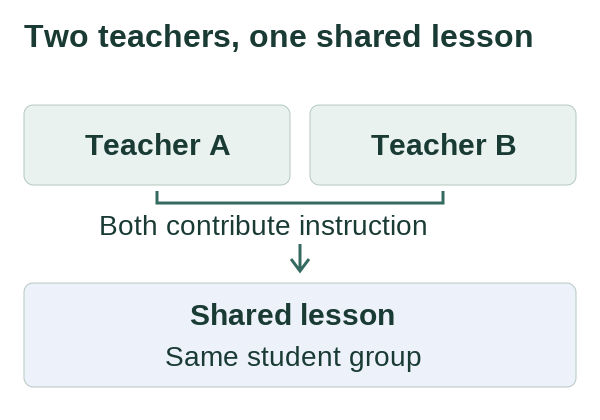
Team teaching is collaboration by two or more educators in planning, preparing and teaching a course or lesson. Co-teaching is a way of organizing instruction in which two or more professionals teach a shared group of students in one room, and the group may mix students of different backgrounds and abilities. The pairing is often a general education teacher and a special education teacher or another specialist.[1][2]
A review of 32 qualitative studies found co-teachers generally supported co-teaching.[3] The most common arrangement was one teacher teaching and one assisting.[3] Co-teaching can give students with disabilities access to the same curriculum as others.[4]
Key facts
| 32 | qualitative investigations of co-teaching included in a metasynthesis by Scruggs and colleagues (2007)[3] |
|---|---|
| 555 | teachers surveyed in a large-scale study of collaboration and shared responsibility by Decuyper and colleagues (2023)[5] |
| 7 | professors whose co-taught courses were analyzed by Buckingham and colleagues (2021)[6] |
Overview
What team teaching and co-teaching mean
Co-teaching and team teaching name a way of organizing instruction in which two or more professionals teach a shared group of students in one room. The remaining components concern the shared group of students and the single room in which the professionals work together.[2]
Co-teaching is not the same as mentoring a new teacher, and it is not the same as apprentice student teaching, although the label has recently been applied to the latter. The two practices differ in overall program structure, in the characteristics of the participating individuals, and in the nature of the professional relationship between them. Using one term for both models carries risks for teacher candidates and for the faculty members who supervise them.[7]
Descriptions of the practice usually list a small set of arrangements, each suited to different purposes within a lesson. Zumwald (2025) examines the co-teaching forms as organizational arrangements and weighs the potential of each one against findings from empirical studies.[8]
Decuyper, Tack, Vanblaere, Simons and Vanderlinde (2023) built a scale for collaboration and shared responsibility in team teaching and used it in a survey of 555 teachers, who on average reported high scores on both dimensions. Scores did not differ significantly by years of teaching experience or by type of education, but they did differ by how often the teachers taught as a team.[5] Small interview and observation studies at the postgraduate level report that co-teaching is a useful strategy there despite the challenges it brings.[9]
History
Where the practice came from and why it spread
Edoc (2026) notes that the Philippines supports inclusive education through laws and policies such as Republic Act 7277 and the Enhanced Basic Education Act of 2013. International bodies support inclusive education through the Salamanca Statement and Sustainable Development Goal 4, which call for equitable and quality education for all. Implementation has lagged behind the policy in many places, with overcrowded classrooms, limited instructional materials, too few trained special education teachers and insufficient professional development named as obstacles.[10]
Dieker and Murawski (2003) describe issues specific to secondary classrooms, including block scheduling, higher standards, high stakes testing and a more diverse society, and ask how co-teaching can address them.[11] A 2015 study of fifteen pairs of general and special education teachers in Greece examined co-teaching under a parallel support arrangement, in which a special education teacher assists a student with learning disabilities inside a mainstream classroom. After in-service training, almost all of the pairs improved their collaboration and applied what they had learned to meet the different needs of all students. Tzivinikou (2015) reports that in most cases the model first adopted was replaced by parallel co-teaching, in which each teacher instructs different students, or moved toward team teaching, in which both teachers plan together and share instruction of all students.[12]
Suwarlis, Hermanto and Pujaningsih (2025) examined teacher collaboration in inclusive kindergarten education at two institutions in East Kutai Regency, Indonesia. A 2025 qualitative case study at two kindergartens in East Kutai Regency, Indonesia, examined how classroom teachers and special education support teachers divide their work for children with special needs. It found two models. Spontaneous collaboration is marked by solving problems on the spot and adapting roles flexibly; structured collaboration emphasizes planning and preparation in advance. Both worked through complementary expertise, shared accountability and trust-based relationships, while communication inconsistencies, limited specialized resources and informal documentation caused difficulty.[13]
Recent accounts tie the spread of co-teaching to broader demands on schools, including learner diversity, inclusive education and digital transformation. Each model has distinct features and advantages in how teacher roles are distributed, how students are grouped, how instruction is organized and where it applies. The analysis concluded that co-teaching succeeds when teachers divide roles clearly and communicate well, when assessment is systematic and improvement continuous, when policy and institutions provide support, and when the school culture and physical setting are collaborative.[14]
Main ideas
How co-teachers divide the work
Placing two teachers in one room does not by itself produce a team, and research on co-teaching has treated that distinction as a starting point. The protocol is presented as scaffolding, meaning temporary structured support, for partnerships that aim at positive outcomes for students with disabilities in general education settings.[15]
Studies of what co-teachers do in the room have looked closely at the small exchanges of classroom talk. King (2018) examined co-teaching pairs in which the two teachers held equal roles and equal skill sets, a dynamic the study calls virtually unexamined. The analysis focused on IRF sequences, the common pattern in which a teacher initiates a question, a student responds, and the teacher gives feedback. King identified two collaborative practices, joint initiation and joint feedback, in which co-teachers occupy not only the same sequence but the same component of it. Joint initiation was found to enhance the progressivity and the pedagogical effectiveness of question-and-answer exchange during instruction. Joint feedback reflected distinct advantages of having two instructors in one classroom: feedback became more salient for learners, more one-on-one teacher-student interaction became possible, and problems in student understanding were more likely to be spotted and addressed.[16]
Bernedo and Bergeron (2025) studied elementary and English Language Learner co-teaching teams in K-6 Indiana classrooms using the Collaborative Instructional Cycle of Honigsfeld and Dove (2015), which runs through co-planning, co-instruction, co-assessment and co-reflection. Findings from two focus groups showed that shared planning tools, clear roles and responsibilities, attention to students' background knowledge, and flexible reflection on lessons measurably changed instruction and raised student outcomes.[17]
Killingsworth, Xue, Reed, Eseryel and Johnson-Snyder (2026) examined how students perceive role conflict and role clarity in a team-taught course and how those perceptions relate to their perceived competency and satisfaction. Killingsworth, Xue, Reed, Eseryel and Johnson-Snyder (2026) surveyed 184 undergraduates in a team-taught course at a large public university in the United States and added qualitative feedback from open-ended course evaluations. Students who saw a positive team-teaching climate reported less role conflict and clearer roles. Role conflict was negatively related to perceived competency and satisfaction, while role clarity showed a positive relationship with learning outcomes. The qualitative findings described how students experienced instructional coordination, clarity and confusion in team-taught courses. The study recommends faculty development that supports communication, coordination and consistent instructional messaging.[18]
A second survey of 184 college students, this one in an Introduction to Computers course taught by an instructor team, examined mission clarity, affiliation, innovativeness and fairness. Instructor team mission clarity, affiliation and fairness were significantly related to students' satisfaction, while mission clarity and fairness were significantly related to students' competency.[19]
Pesonen, Rytivaara, Palmu and Wallin (2021) collected primary school teachers' accounts using empathy-based stories, frame stories varied so that a co-teaching situation was experienced as either positive or negative. Qualitative analysis found that teachers' sense of belonging was built through three dimensions: their work practices, the mutual relationship, and individual characteristics. The study concludes that a sense of belonging in co-teaching is multidimensional and grows within a close collegial relationship between two teachers.[20]
Burks-Keeley and Brown (2014) investigated student and teacher perceptions of five co-teaching models and compared the two groups' views. Students and teachers perceived differences among the five models, and the results supported earlier findings that the one teach/one assist model is ineffective.[21]
Conditions that make co-teaching work or fail
Do (2020) reports that Korean English teachers need to plan lessons with native English-speaking teachers for successful co-teaching, and Kurata and Rinchen (2024) list scheduling restrictions among the problems some teachers reported.[22][23] In a survey of Korean English teachers and native English-speaking teachers who co-taught elementary English classes, the Korean teachers were generally satisfied with the practice but reported that lessons needed to be planned jointly with their partners for co-teaching to succeed. Those Korean teachers also described a heavy burden in managing their native-speaker partners, a load that drew attention away from teaching itself. Most of the native English-speaking teachers held educational qualifications but lacked actual teaching experience, and the study concluded that they needed a better grasp of the local educational context.[22] In Lesotho, a qualitative case study of six religious education instructors found that some were still unfamiliar with team teaching, that teamwork was inconsistent, and that scheduling restrictions limited the approach, so the study called for specialized professional development programs.[23]
Nuraini (2022) found that native English-speaking teachers and local English teachers in Indonesian secondary schools held different beliefs about their roles in team teaching. Interviews and classroom observations of two pairs of English teachers in Ponorogo, Indonesia, showed that the native English-speaking teachers saw their role as mainly linguistic and cultural, while the local teachers led the classes, wrote lesson plans, chose materials, delivered basic theory and assessed students. Training, teaching experience and the teachers' own learning experience were the three factors the study identified as shaping those beliefs.[24] In Japan, a qualitative study examined two pairs of team teachers and their students in two public high schools, with data collected from December 2011 to March 2012. The participants held complex and idiosyncratic views of why team-taught classes existed, what they were meant to achieve and how they should be run. The study argued that the public praise for team teaching through the Japan Exchange and Teaching program should be examined against these varied classroom realities, given the number of people affected and the money spent.[25]
Conflict can arise even where co-teaching is valued in principle. A qualitative study of 37 teachers and four administrators in bilingual private schools found the practice itself regarded as valuable. Conflicts clustered around avoidance of responsibility, inability to adapt, not knowing the system, partners paying more attention to their own subject, an intense program, lack of communication and differing educational philosophies. Teachers and administrators in that study disagreed about where the solution lay: teachers credited effective administrators for resolving conflict, while administrators attributed it to the competence of fellow teachers. Teachers asked for more in-service training and workshops, and administrators replied that they already offered sufficient training opportunities.[26]
Shaffer and Thomas-Brown (2015) examined a pedagogical approach that combines co-teaching with embedded professional development in two inclusive classrooms and theorized it as the Co-teaching Professional Development (CoPD) Approach. A qualitative study of two inclusive social studies classrooms developed this into a Co-teaching Professional Development approach and reported that it supported both teachers and students with disabilities, with special educators gaining content knowledge and general educators widening their teaching methods.[27] Teachers in a Turkish study of 12 primary teachers in the city center of Muş expected the co-teaching model to ease classroom management, free time, allow more individual attention and reduce teacher workload, particularly in crowded classes that include students with special needs.[28]
Research
What the evidence says about student outcomes
In secondary school algebra, a 2025 study used a pre-test, treatment, post-test design and found a significant improvement in achievement for the group taught by team teaching strategies. Post-test mean scores in that study did not differ significantly by gender, study habits, or parents' educational qualifications and occupations.[29] A study of 118 eighth grade students in a public school in Sargodha district, Pakistan, compared co-teaching with a single teacher over a module of 20 one-hour lessons covering algebra and geometry. Co-teaching proved more effective than single-teacher instruction in raising achievement scores in algebra and geometry with mathematical proficiencies, as measured by a test built from items developed and validated by the Pakistan National Educational Assessment System.[30]
In English as a foreign language, a 2024 quasi-experimental study assigned 150 Thai undergraduates to a control group of 70 students and an experimental group of 80 students in a reading and writing course. At a significance threshold of 0.05, the experimental group outperformed the control group on the post-test, and most students said they preferred team teaching because it allowed knowledge exchange between students and instructors and encouraged respect for differing views.[31] A smaller 2019 experiment at a college of basic education followed 24 female students through a six-week summer course with daily classes of one hour and twenty minutes. The co-taught class showed significant improvement in overall academic performance, while the class taught by a single instructor showed less improvement in overall academic skills.[32]
In an Introduction to Philosophy course studied over a semester, students overwhelmingly preferred team teaching to individual instruction and thought it improved their learning and classroom experience, yet delivery method showed no statistically significant relationship with classroom performance. A semester-long, multi-section study of an Introduction to Philosophy course found that students overwhelmingly preferred team teaching to individual instruction and believed it helped their learning and classroom experience. That study found no statistically significant link between delivery method and students' classroom performance, and it noted limitations in the research design.[33] A 2024 study of tertiary students in Nigeria's South-West region found that both single-instructor teaching and team teaching positively affected academic performance, but that single-instructor teaching was more effective. That study recommended that team members follow the same grading layout, plan together, follow the course outline format and coordinate teaching and learning objectives.[34]
In aviation vocational schools, cadets taught by team teaching averaged higher English scores (M = 85.4, SD = 3.2) than cadets taught by traditional methods (M = 78.6, SD = 4.1), a statistically significant difference at p < 0.05. In aviation vocational schools, a 2024 ex post facto comparison found that students taught by team teaching averaged higher English scores (mean 85.4, standard deviation 3.2) than students taught traditionally (mean 78.6, standard deviation 4.1), with p < 0.05.[35] At one school in Bhutan, an eight-week action research study with 126 students and 4 teachers examined grade 8 science and grade 10 mathematics after three years of underperformance. Science scores rose from 33.5% to 44.6%, an increase of 11.1 percentage points, and mathematics scores rose from 32.0% to 48.7%, an increase of 16.7 percentage points. The Bhutanese study listed no control group, possible researcher bias, a short intervention and non-board-standard marking among its limitations, and it described research on co-teaching in that context as limited.[36]
Maija, Tiinamaija and Antti (2023) used qualitative methods with direct interviews and reported that with the team teaching method students took a more controlled part in active learning in class. The researchers also found that schools had difficulty applying the method because teachers had limited knowledge of how to organize it.[37]
Co-teaching in teacher education and professional learning
Meredith Brown and Graham Viator (2019) note that some teacher education programs have integrated co-teaching into their required clinical practice experiences so that candidates can develop collaborative skills in the classroom.[38] A case study of two pairs of preservice teachers who co-taught for a semester with teams of cooperating teachers found that peer support was comfortable and that personality shaped how the pairing worked.[39] In a case study of two teacher candidates co-planning and co-teaching in a secondary social studies classroom, both reported similar positive views of co-planning. Both struggled with competition inside the classroom and with personal and professional confidence as instructors, which left their views of collaboration mixed.[38] An action research project in which two teacher educators placed preservice candidates as co-teachers in an early field experience found that co-teaching among peers helped create a collaborative atmosphere.[40]
Field experiences can be organized around particular team teaching formats, and one study compared two of them, parallel teaching and sequential teaching, from the student teachers' point of view. Student teachers held positive feelings toward both models, and collaboration was experienced significantly more in sequential teaching than in parallel teaching. Each model carried its own advantages and disadvantages, but the advantages clearly outweighed the disadvantages; reduced workload and better management appeared as new advantages, while interdependence and complex management appeared as new disadvantages. The condition the student teachers rated most important for putting either model into practice was preparation for new roles.[41]
Co-teaching during student teaching has been studied for its effect on professional identity, the mix of beliefs, motivation, reflection and self-efficacy through which a new teacher comes to see himself or herself as a teacher. An experimental study randomly assigned 464 student teachers at a Flemish college of education to one of three formats: team teaching, team teaching with support, or traditional teaching. Bayesian structural equation modelling showed significant effects of team teaching with support compared with both team teaching alone and traditional teaching, and a significant effect of team teaching over traditional teaching on three components of professional identity: learning and regulation activities, reflective thinking, and motivation.[42] A case study of a senior university faculty member co-teaching with two doctoral students reported that the mentoring built collaborative and mutually beneficial relationships resting on individual accountability and professionalism, mutual respect, reciprocal growth and development, and attention to issues of power. That study called for further exploration of mentorship for junior faculty and of how co-teaching contributes to the professional identities of junior faculty entering the academy.[43] A study of a co-teaching model for student teaching, viewed through the ethics of care, described teacher candidates and their mentor teachers developing caring relationships, acknowledging and negotiating differences in power, and cultivating a caring climate through dialogue and modelling.[44]
Co-teaching also serves as professional development for the practicing teachers and faculty who take part, including school teachers who teach alongside university teacher educators in initial teacher education courses.[45][46] Interviews, surveys and co-teaching meeting records from four such school-based co-teachers over one academic year showed that they found many opportunities to share their knowledge and experience with preservice science teachers and also sought out opportunities to learn and grow themselves. The study stressed sharing aims and purposes so that each partner understands the context, and building shared knowledge through peer reflection on teaching.[45] Faculty who proposed, developed and implemented co-taught courses in an undergraduate dual certification program in elementary and special education described benefits for preservice teachers and faculty members. They noted that organizational systems and collegial dynamics can pose barriers to co-teaching in higher education, as they can in schools.[46]
A collaborative team teaching model was used in inquiry-based primary science projects in four Finnish cities, with 98 preservice teachers and 51 in-service class teachers. Both groups saw it as an adequate approach, reported enthusiasm and gained ideas, knowledge and skills for carrying out inquiries, and became more confident in using the approach. Those findings indicate that the model combined the preservice teachers' professional development with the in-service teachers' expertise and supported inquiry-based practice in primary science.[47] A qualitative case study of university supervisors and cooperating teachers in PreK-4 settings found that organic co-teaching occurred often while planned co-teaching was rare. Collaboration, modelling and responsiveness to student needs were key to success, and personality conflicts and unequal access to co-teaching opportunities were barriers.[48]
Teachers' beliefs and self-efficacy in co-taught classes
Among 56 elementary special education teachers in two regions of Virginia who co-taught mathematics, the perceived quality of the co-teaching relationship correlated positively with self-efficacy for teaching mathematics (rs = 0.41, p = 0.002). A survey of 103 elementary special education teachers in two regions of Virginia who co-taught mathematics at least one class period per day drew 56 responses, a 54% response rate. The strength of the working relationship between co-teachers rose together with their confidence in teaching mathematics. The link was moderate, positive and statistically significant (rs = 0.41, p = 0.002). The grade level co-taught showed a similar moderate positive correlation with self-efficacy (rs = 0.43, p = 001, as printed in the source). Years of experience co-teaching mathematics correlated only weakly with self-efficacy (rs = 0.20), and that relationship was not statistically significant (p = 0.14). Special education teachers who co-taught Grade 5 recorded the highest mean self-efficacy score (M = 92.85, SD = 13.39). Lower means followed for Grade 2 (M = 83.38, SD = 13.49), Grade 3 (M = 81.00, SD = 12.49) and Grade 4 (M = 80.90, SD = 15.61).[49]
A qualitative study in Malaysia explored collaborative practice among mainstream teachers and special education teachers working with students with special educational needs. The researchers held focus group sessions with teachers in four categories: mainstream teachers in training, serving mainstream teachers, special education teachers in training, and serving special education teachers. Mainstream teachers treated collaboration as a way to get advice and swap ideas with special education colleagues. Special education teachers wanted joint work that carried inclusive classroom practices through. Special education teachers also regarded collaboration with parents as essential to their teaching. Knowledge of and experience in special education shaped teachers' levels of teacher efficacy, and perceptions of students with special educational needs differed by teachers' roles.[50]
Two instructors taught an undergraduate course in English Language Teaching Methodology together at Ternopil Volodymyr Hnatiuk National Pedagogical University. The 60 students in the course took part in the study for one semester. Reflective journals, focus group discussions and an end-of-semester survey indicated that co-teaching engaged learners, supported the pre-service teachers' professional development and served as a model of instructional technique for their future classrooms. The study concluded that co-teaching in pre-service teacher education develops reflective skills and collaborative practices in both teachers and students.[51] In a rural elementary school in North Sumatera, Indonesia, interviewed teachers reported feeling comfortable and helped by team teaching, described learning improvements, and held positive perceptions of the approach.[52]
In practice
How school leaders and administrators shape co-teaching
School leaders set the conditions under which co-teaching teams work, and their vision and support shape how far a co-teaching initiative can go. Leaders at 150 Norwegian elementary schools answered open and closed survey questions about their beliefs and support practices. The schools were part of a multi-year initiative on co-teaching for literacy instruction, and the study used mixed methods. Leaders who described co-teaching with cautious optimism tended to give more thoughtful support than leaders who were overly optimistic and underestimated the difficulties of putting co-teaching into practice. Most of the leaders put structural support first, such as arranging time and space, and gave less attention to the psychological and emotional support that self-determination theory (a theory of what sustains people's motivation) would predict teachers need. The study's recommendations for school leaders were built on the principles of self-determination theory and arranged by the phases through which an initiative passes.[53]
A study of administrator practices in New Jersey found considerable inconsistency in what administrators knew about co-teaching and in how they supervised and evaluated co-teachers in inclusive classrooms. Three themes organized the findings: professional preparation and training, expectations and perspectives on co-teaching and inclusive practice, and the supporting, supervising and evaluating of co-teachers. The study concluded that professional development for administrators was warranted. It also reported that research identifies administrative support as a critical factor in whether co-teaching works.[54]
Pizana (2022) recommended that co-teaching teams receive the same planning time, collaborate, and reach a shared understanding of their roles.[55] In two case schools with innovative learning environments (open, larger spaces built for team-based teaching), placing teachers together and coordinating their work prepared the ground for shared space, but reaching real pedagogical cooperation took deliberate strategies tied to a stated pedagogical vision.[56]
Co-teaching across subjects and school settings
Interviews, a focus group and surveys in that qualitative study pointed to advantages and weaknesses of co-teaching and to planning as a recurring concern. Teachers pointed to three obstacles to carrying out co-teaching: too little planning time, insufficient classroom support, and gaps in professional development. The researchers also found inconsistency in how co-teaching was carried out.[57]
Mathematics in Pakistan is usually taught by a single teacher, and a 2023 experiment tested co-teaching against that arrangement. The study used a Solomon Four Group design, a setup that divides classes into taught and untested groups so that the act of testing can be separated from the effect of instruction, in one public-sector school chosen for convenience with the headmaster's permission. Its aim was to examine whether co-teaching raises students' scores in mathematics.[58]
A Spanish didactic proposal taught musical notation and solfège sight-singing, the reading of notes aloud on syllables, through co-teaching in which secondary school students served as co-teachers beside the teacher. The mixed-method study analyzed quantitative data first and qualitative data second, and pre-test to post-test results improved with statistical significance for all participating students. The researchers traced the gains to personalized support from the student co-teachers, peer assessment that let progress be monitored and feedback given, and the chance to learn by teaching.[59]
An eighth grade middle school built a STEAM team model that folded language arts into science, technology, engineering and mathematics, and researchers observed more than 100 class sessions of the team's work. The teachers called their approach transdisciplinary co-teaching and combined it with flexible scheduling and several kinds of physical space. Of the co-teaching dimensions observed, the reconstructed form appeared most often, followed by predisciplinary, correlated and shared forms. Instruction of the other three kinds did not match the school's own definition of transdisciplinary co-teaching.[60]
At a Sino-Foreign Cooperative University in China, an exploratory case study followed co-teaching in a foundation year across four academic years, drawing on seminar and lecture recordings and on responses from teachers and students. Co-teaching there ranged from complex team teaching to a second teacher assisting. Students generally felt more engaged, and instructors observed that language learning in the classroom was helped. The researchers explained the interaction between the two teachers through Bandura's social learning theory, since teachers could model social skills by doing rather than by prescribing them, and staged dialogues presenting different perspectives. In that multicultural setting, students could watch skills such as critical thinking and intercultural interaction being carried out, and the study calls for more research on the challenges of implementing co-teaching.[61]
Students' views and engagement under team teaching
Zach and Avugos (2024) found that a short intensive co-taught seminar placed heavy demands on the lecturers' time and effort, which the authors named as a possible barrier to wider use of the method.[62] Most of the included studies reported gains in classroom participation, motivation and student satisfaction. Students in those studies were described as benefiting from diverse instructional perspectives and increased academic support. Whether team teaching worked well varied with how far the instructors worked together, how clearly each role was defined, how well they communicated, the size of the class, and the support the institution gave.[63]
A study of 50 undergraduate student teachers in two sports sciences seminar courses, each jointly taught by two lecturers, traced three parallel processes. Emotionally, students moved from feelings of chaos, frustration and incompetence toward satisfaction and a sense of accomplishment. Socially, they learned to listen, request assistance, support and encourage one another, and cognitively they learned to ask fruitful questions, plan experiments, summarize and present.[62]
A study using constructivist learning theory to examine student appraisals of collaborative team teaching reported that deeper engagement came through motivating students, communicating clearly and involving them in the learning process. Multiple explanations from a teaching team, the study argued, allow key aspects of a course to be elaborated, with reflection and timely feedback rather than delayed feedback. The same study warned that miscommunication, if not handled well, may hamper learning and engagement through mixed messages.[64]
Survey data covered student teachers in elementary, middle and secondary programs. In every program area, team teaching grew more over the semester than any other co-teaching strategy. Pilot survey data in that study indicated that about one-fourth of the student teacher's time was spent teaching alone. The study concluded that both student teachers and cooperating teachers need more preparation in how to draw on the full set of co-teaching strategies.[65]
What this looks like when you study
In a Bhutanese secondary school, four teachers co-taught grade 8 Science and grade 10 Mathematics for an eight-week intervention. The 126 students took pre-intervention and post-intervention examinations, and the researchers compared the two sets of scores. In the same survey, 84% of students agreed that co-teaching improved their access to teacher help.[36]
A study of 14 pairs of co-teachers in South Korea observed primary, middle and high school English classes and interviewed the teachers. Across the 14 pairs, 10 dyads mainly used the model in which one teacher teaches and the other assists, while four dyads used team teaching. The researchers rated collaboration on a spectrum from no collaboration to full collaboration, and pairs differed in where they fell. The authors suggest that supporting fuller collaboration and more varied models could raise the effectiveness of co-teaching.[66]
In the experimental group of 331 students in 18 classes, teachers were required to co-teach, and support staff worked only in an advisory role. The control group of 290 students in 18 classes had no requirement to co-teach and no fixed setting. Students in the experimental group perceived learning support and classroom management more negatively than the control group over the school year.[67]
At a large public American university, 184 undergraduates in a team-taught course completed an online survey on team-teaching climate, role conflict and role clarity. A positive team-teaching climate was associated with lower role conflict and higher role clarity.[18]
In one Indonesian case study, the local English teachers took charge of lesson plans, materials, basic theory and final assessment, while the native-English-speaking teachers concentrated on language and culture.[24] Teachers in the study named a shortage of time to plan as one of the problems they met when carrying out co-teaching. Teachers interviewed by Hays, Janna Brendle and Lock (2023) named insufficient time for planning, along with classroom support and professional development, as problems in carrying out co-teaching.[57] Team teaching can fail when communication is poor: miscommunication may hamper learning and engagement by sending students potentially mixed messages.[64]
Later developments
Team teaching in universities and online courses
A scoping review of team teaching in higher education language classrooms found the practice to be fluid, experimental and non-traditional, best described as an ad-hoc strategy used mainly to enrich teachers' professional development or to improve students' language learning and cultural understanding.[68] Students in those courses appreciated the different co-teachers' perspectives and the extra resources and instructor help, though the student sample was limited and students did not always receive a balanced biomedical perspective.[69] At one university, a software English course taught by an instructor in AI information security and an instructor in English language and literature drew 28 students, none of whom had previously taken a course with more than one instructor.[70]
An experiment in three schools formed eight groups of thirty students and compared face-to-face and virtual co-teaching in history, mathematics and a foreign language.[71] A scoping review examined virtual co-teaching in primary and secondary schools, a practice that the COVID-19 pandemic accelerated. It concluded that virtual co-teaching supported by artificial intelligence is an effective alternative to traditional methods that raises both efficiency and flexibility, while calling for experiments in other subjects.[72] In an online doctoral program, two instructors who team taught a course reported that the arrangement reduced instructors' isolation, increased content knowledge and developed teaching skills, and students reported feelings of community and support.[73] A qualitative case study of six doctoral students in an online course at a private university in the Southwestern United States found that access to the instructor, instructor feedback and student support mattered, and participants said the team teaching model enhanced their learning experience.[74]
Co-teaching has been proposed as a way to move undergraduate science, technology, engineering and mathematics instructors toward evidence-based teaching, and a review of the emerging evidence concluded that how co-teaching is enacted and the context in which it occurs are likely to shape its impact.[75] In mathematics teacher preparation, three mathematics teacher educators in the United States co-planned and co-taught a mathematics content course for future elementary teachers over fifteen weeks, using twice-weekly journal entries and classroom observation records.[76] A team teaching and blended learning approach was introduced to an initial teacher education music methods unit and studied in two phases. The first phase covered pre-service teachers' perceived competency and knowledge during the unit; the second covered their application of those skills in professional settings afterward.[77]
Buckingham, López-Hernández and Strotmann (2021) analyzed 11 reflective teacher diaries from eight co-taught courses and found that comparison with the co-teacher was the main force behind the professors' learning. Seven professors in Education and Translation and Interpreting kept 11 reflective teacher diaries across eight co-taught courses over two academic years, and the diaries pointed to comparison with the co-teacher as the main force behind their learning.[6]
Criticism
Criticisms, weak results and open questions
Among 14 pairs of English co-teachers across primary, middle and high schools in South Korea, the one teaching, one assisting model was prevalent for 10 pairs and the team-teaching model for four, and the remaining models were not used or reported. That study described collaboration as falling along a spectrum, from none at all to full collaboration, with differing levels of engagement throughout. It suggested that co-teaching might work better if fuller collaboration and more varied approaches were supported.[66]
A longitudinal study in 36 primary school classes with 621 learners found that students' perceptions did not simply improve when co-teaching was required. The control group of 290 learners in 18 classes had neither the obligation nor set requirements for a teaching setting, and specialists could work directly with students.[67]
Several questions remain open.[66][78] Research has not established which co-teaching models suit which students, and the South Korean study notes that research had yet to examine the models applied and the extent of collaboration across multiple pairs in different teaching contexts before its own analysis.[66] The account of co-teaching for students with learning disabilities leaves the overall efficacy of the arrangement unsettled and treats the fit between a program and a school's own goals and students as something each school must determine for itself.[78]
Common misconceptions
A systematic review of 20 studies found that team teaching generally produced positive educational outcomes, though results varied with how it was carried out. A systematic review of 20 studies found mostly positive results, with effectiveness shaped by how well instructors collaborated and communicated, how clear roles were, class size and institutional support.[63] A German longitudinal study found that students in required co-taught classes perceived learning support and classroom management more negatively than students in control classes.[67]
A systematic analysis sorts co-teaching into seven models, which differ in how the two teachers divide their roles and how students are grouped. A review by Kim (2026) sorts co-teaching into seven models, among them One Teach, One Observe and One Teach, One Assist.[14]
In a short intensive seminar co-taught by two lecturers, students moved from initial frustration to satisfaction, but the planning and management demands were a barrier, and course outcomes showed no signs of higher quality than traditional instruction. In a study of 50 undergraduate student teachers in two jointly taught sports sciences seminars, the time and effort demands of planning and managing the course were a significant barrier. The authors also found no indications of higher course quality compared with traditional instruction.[62]
Key studies
| Year | Study | Sample | Design | Finding |
|---|---|---|---|---|
| 2007 | Scruggs et al.[3] | metasynthesis of 32 qualitative investigations of co-teaching in inclusive classrooms | Co-teachers generally supported co-teaching, but identified needs for planning time, student skill level and training; the dominant role was one teach, one assist. | |
| 2019 | Kostko & Philosophy Documentation Center[33] | students in multiple sections of an Introduction to Philosophy course | semester-long multi-section study | Students overwhelmingly preferred team teaching, but there was no statistically significant relationship between delivery method and classroom performance. |
| 2020 | Simons et al.[41] | student teachers in teacher education field experiences | survey and self-report study of parallel and sequential teaching | Student teachers were positive toward both models, and collaboration was significantly higher in sequential teaching. |
| 2021 | Moser Opitz et al.[67] | 621 learners in 36 primary classes in Germany | longitudinal study with experimental and control groups | Students in required co-taught classes perceived learning support and classroom management more negatively than the control group. |
| 2022 | Smith-Moyler & Grooms[49] | 56 elementary special education teachers in Virginia | survey study with correlation and ANOVA | The co-teaching relationship correlated with self-efficacy for teaching mathematics (rs = 0.41, p = 0.002). |
| 2023 | McTigue et al.[53] | 150 Norwegian elementary schools | mixed-methods survey study | Leaders with cautious optimism provided more thoughtful support, and most prioritized structural support over psychological and emotional support. |
| 2023 | Decuyper et al.[5] | 555 teachers | large-scale cross-sectional survey | Teachers overall reported high scores on collaboration and shared responsibility, with significant differences by frequency of team teaching. |
| 2023 | Hays et al.[57] | teachers in 4th to 8th grade English Language Arts inclusion classrooms | qualitative study with interviews, focus group and surveys | All participants used the one teach, one assist approach regularly and identified lack of planning time, classroom support and professional development as problems. |
| 2023 | Mariën et al.[79] | team interviews with beginning team teaching teams from elementary schools | The more complex dimensions, such as adaptive teaching and activating learning, were seen as clear added value; the more basic dimensions, such as efficient classroom management and clear instruction, were reported less often. | |
| 2024 | Zach & Avugos[62] | 50 undergraduate student teachers in two sports sciences seminars | qualitative study with reflections and course evaluations | Students moved from frustration to satisfaction, but the time and effort demands were a significant barrier and no higher quality was seen compared with traditional instruction. |
| 2026 | Wangchuk & Wangdi[36] | 126 students and 4 teachers in a Bhutanese secondary school | action research with mixed methods over eight weeks | Science scores rose from 33.5% to 44.6% and Mathematics scores from 32.0% to 48.7%. |
| 2026 | Killingsworth et al.[18] | 184 undergraduates at a large public American university | mixed-methods survey study | A positive team-teaching climate was associated with lower role conflict and higher role clarity, and role clarity was positively related to learning outcomes. |
| 2026 | Kim & Moodie[66] | 14 pairs of co-teachers in South Korea | qualitative study with classroom observations and interviews | Of the 14 pairs, 10 dyads mainly used the one teaching, one assisting model, and four dyads used team teaching. |
| 2026 | Rejollo et al.[63] | 20 studies from a search of 263 records | systematic review following PRISMA 2020 | Team teaching generally produced positive outcomes, but effectiveness depended on collaboration, communication, role clarity, class size and institutional support. |
See also
References
- St. Bonaventure University (n.d.). Team-teaching policy. St. Bonaventure University. https://web.sbu.edu/friedsam/governing/academic_policies/Team%20Teaching.pdf
- Cook, L., & Friend, M. (2017). Co-Teaching: Guidelines for Creating Effective Practices. Focus on Exceptional Children, 28(3). doi:10.17161/foec.v28i3.6852
- Scruggs, T. E., Mastropieri, M. A., & McDuffie, K. A. (2007). Co-Teaching in Inclusive Classrooms: A Metasynthesis of Qualitative Research. Exceptional Children, 73(4), 392-416. doi:10.1177/001440290707300401
- Friend, M., Cook, L., Hurley-Chamberlain, D., & Shamberger, C. (2010). Co-Teaching: An Illustration of the Complexity of Collaboration in Special Education. Journal of Educational and Psychological Consultation, 20(1), 9-27. doi:10.1080/10474410903535380
- Decuyper, A., Tack, H., Vanblaere, B., Simons, M., & Vanderlinde, R. (2023). Collaboration and Shared Responsibility in Team Teaching: A Large-Scale Survey Study. Education Sciences, 13(9), 896. doi:10.3390/educsci13090896
- Buckingham, L. R., López-Hernández, A., & Strotmann, B. (2021). Learning by Comparison: The Benefits of Co-Teaching for University Professors’ Professional Development. Frontiers in Education, 6. doi:10.3389/feduc.2021.776991
- Friend, M., Embury, D. C., & Clarke, L. (2015). Co-Teaching Versus Apprentice Teaching: An Analysis of Similarities and Differences. Teacher Education and Special Education: The Journal of the Teacher Education Division of the Council for Exceptional Children, 38(2), 79-87. doi:10.1177/0888406414529308
- Zumwald, B. (2025). Co-Teaching-Formen gezielt einsetzen: Das Potenzial von Co-Teaching-Formen auf der Tiefenebene. Schweizerische Zeitschrift für Heilpädagogik, 31(01), 8-14. doi:10.57161/z2025-01-02
- Dhanapal, S., & Kanapathy, R. (2014). Understanding the Implication of Co-teaching in a Post-graduate Classroom. Journal of Education and Training, 1(2), 199. doi:10.5296/jet.v1i2.5762
- Edoc, F. E. (2026). Effectiveness of co-teaching model in an inclusive classroom in buguias, benguet. Cognizance Journal of Multidisciplinary Studies, 6(5), 718-729. doi:10.47760/cognizance.2026.v06i05.051
- Dieker, L. A., & Murawski, W. W. (2003). Co-Teaching at the Secondary Level: Unique Issues, Current Trends, and Suggestions for Success. The High School Journal, 86(4), 1-13. doi:10.1353/hsj.2003.0007
- Tzivinikou, S. (2015). Collaboration between general and special education teachers: Developing co-teaching skills in heterogeneous classes. Problems of Education in the 21st Century, 64(1), 108-119. doi:10.33225/pec/15.64.108
- Suwarlis, S., Hermanto, H., & Pujaningsih, P. (2025). Collaborative Teaching in Inclusive Kindergarten Education: A Qualitative Study of Spontaneous and Structured Partnership Models. Journal of Innovation and Research in Primary Education, 4(4), 2260-2272. doi:10.56916/jirpe.v4i4.2182
- Korean Association For Learner-Centered Curriculum And Instruction, & Kim, H. (2026). Co-Teaching Models: A Systematic Analysis of Types, Implementation, and Effectiveness. Korean Association For Learner-Centered Curriculum And Instruction, 1(1), 47-63. doi:10.22251/jlcep.2026.1.1.47
- Mainzer, L. H., Nunn, J. A., Bautz, A., & Mainzer Jr., R. W. (2016). Strengthening Co-Teaching Partnerships for High Productivity. International Journal of Technology and Inclusive Education, 5(1). doi:10.20533/ijtie.2047.0533.2016.0095
- KING, A. H. (2018). Joint Initiation and Joint Feedback: Connecting Collaboration with Pedagogy in Co-teaching. Hacettepe University Journal of Education, 1-12. doi:10.16986/huje.2018038793
- Bernedo, K. D., & Bergeron, M. (2025). From Co-Planning to Co-Reflection: The Power of Elementary and ELL Co-Teaching Teams Using the Collaborative Instructional Cycle. INTESOL Journal, 22(1). doi:10.18060/29297
- Killingsworth, B., Xue, Y., Reed, A., Eseryel, U. Y., & Johnson-Snyder, A. (2026). Role Clarity and Conflict in Team Teaching: Impacts on Student Learning Outcomes in Higher Education. Journal of University Teaching and Learning Practice, 23(2). doi:10.53761/gqwz8255
- L Killingsworth, B., & Xue, Y. (2015). Investigating factors influencing students’ learning in a team teaching setting. International Journal of Cognitive Research in Science, Engineering and Education, 3(2), 9-16. doi:10.23947/2334-8496-2015-3-2-9-16
- Pesonen, H. V., Rytivaara, A., Palmu, I., & Wallin, A. (2021). Teachers’ Stories on Sense of Belonging in Co-Teaching Relationship. Scandinavian Journal of Educational Research, 65(3), 425-436. doi:10.1080/00313831.2019.1705902
- Burks-Keeley, R. G., & Brown, M. R. (2014). Student and Teacher Perceptions of the Five Co-Teaching Models: A Pilot Study. Journal of the American Academy of Special Education Professionals, 149-185. doi:10.64546/jaasep.256
- The Korea English Education Society, & Do, J. (2020). What’s Still Missing?: How Co-teachers View Co-teaching Practices in Elementary EFL Classrooms in Korea. The Korea English Education Society, 19(4), 1-23. doi:10.18649/jkees.2020.19.4.1
- Kurata, L., & Rinchen, D. S. (2024). Exploring the Viability of Team Teaching as a Solution to Enhance the Teaching and Learning of Religious Education in Lesotho Secondary Schools. International Journal of Research Publication and Reviews, 5(3), 4474-4484. doi:10.55248/gengpi.5.0324.07116
- Nuraini, E. I. (2022). The Team Teachers' Beliefs about Their Roles in Collaborative Team Teaching in Indonesia Context. Journal of English Language Teaching and Learning (JETLE), 3(2), 80-87. doi:10.18860/jetle.v3i2.15888
- Hiratsuka, T. (2013). Beyond the rhetoric: Teachers’ and students’ perceptions of student learning in team-teaching classes. The Language Teacher, 37(6), 9. doi:10.37546/jalttlt37.6-2
- Baran, M. A., & Demirkasımoğlu, N. (2024). Conflict and Collaboration: Co-Teaching Dynamics in Bilingual Private Schools. Participatory Educational Research, 11(3), 59-78. doi:10.17275/per.24.34.11.3
- Shaffer, L., & Thomas-Brown, K. (2015). Enhancing Teacher Competency through Co-Teaching and Embedded Professional Development. Journal of Education and Training Studies, 3(3). doi:10.11114/jets.v3i3.685
- Turan, M., & Bayar, B. (2017). Examining Teachers View on Primary Teaching Practices Based on Co-Teaching Model. Journal of Education and Training Studies, 5(11), 82. doi:10.11114/jets.v5i11.2708
- Sattanathan, D. P., & Gugan, A. (2025). Effectiveness of Team Teaching on Achievement in Algebra at Secondary Level. International Journal of Research Publication and Reviews, 6(7), 1053-1057. doi:10.55248/gengpi.6.0725.2434
- Iqbal, M. Z. (2019). Co-teaching Effectiveness: Students’ Achievement in Mathematical Proficiencies and Content Strands. Pakistan Journal of Education, 35(3). doi:10.30971/pje.v35i3.772
- Duklim, B., & Hasan, K. (2024). The Effectiveness of Team Teaching in Improving Reading Skill among Thai EFL Undergraduates and Their Attitudes toward this Strategy. International Journal of Learning, Teaching and Educational Research, 23(2), 248-274. doi:10.26803/ijlter.23.2.12
- Boland, D. E., Alkhalifa, K. B., & Al-Mutairi, M. A. (2019). Co-Teaching in EFL Classroom: The Promising Model. English Language Teaching, 12(12), 95. doi:10.5539/elt.v12n12p95
- Kostko, A., & Philosophy Documentation Center (2019). The Impact of Team Teaching on Student Attitudes and Classroom Performance in Introductory Philosophy Courses. Teaching Philosophy, 42(4), 329-354. doi:10.5840/teachphil20191017111
- Yusuf, K. T., Kasali, W. A., Owolabi, A. T., Chimezie, M. E., & Amosa, B. S. (2024). Single Instructor and Team Teaching: Effects on Tertiary Students’ Academic Performance. OALib, 11(01), 1-16. doi:10.4236/oalib.1111148
- Rochmawati, L., Sylvia, T., & Diriyanti Novalina, S. (2024). The impact of team teaching on student achievement and perceptions in aviation vocational schools. Celtic : A Journal of Culture, English Language Teaching, Literature and Linguistics, 11(2). doi:10.22219/celtic.v11i2.37434
- Wangchuk, T., & Wangdi, U. (2026). Evaluating the effectiveness of co-teaching practices as a pedagogical leadership strategy. International Journal of Education and Social Science Research, 09(05), 57-89. doi:10.37500/ijessr.2026.9504
- Maija, G., Tiinamaija, G., & Antti, T. (2023). The Use of Team Teaching Methods to Increase Student Interest and Achievement. World Psychology, 2(1), 1-10. doi:10.55849/wp.v2i1.388
- Meredith Brown, C., & Graham Viator, M. (2019). Investigating teacher candidates’ perceptions of collaboration during a co-teaching experience. Advances in Social Sciences Research Journal, 6(1), 312-325. doi:10.14738/assrj.61.5914
- Kamens, M. W. (2007). Learning about Co-teaching: A Collaborative Student Teaching Experience for Preservice Teachers. Teacher Education and Special Education: The Journal of the Teacher Education Division of the Council for Exceptional Children, 30(3), 155-166. doi:10.1177/088840640703000304
- Montgomery, M. S., & Akerson, A. (2019). Facilitating Collaboration Through a Co-Teaching Field Experience. Networks: An Online Journal for Teacher Research, 21(1). doi:10.4148/2470-6353.1284
- Simons, M., Baeten, M., & Vanhees, C. (2020). Team Teaching During Field Experiences in Teacher Education: Investigating Student Teachers’ Experiences With Parallel and Sequential Teaching. Journal of Teacher Education, 71(1), 24-40. doi:10.1177/0022487118789064
- De Backer, L., Schelfhout, W., Simons, M., Vandervieren, E., & Rivera Espejo, J. (2023). Impact of Team Teaching on Student Teachers’ Professional Identity: A Bayesian Approach. Education Sciences, 13(11), 1087. doi:10.3390/educsci13111087
- Sachs, G., Fisher, T., & Cannon, J. (2011). Collaboration, Mentoring and Co-Teaching in Teacher Education. Journal of Teacher Education for Sustainability, 13(2), 70-86. doi:10.2478/v10099-011-0015-z
- Rabin, C. (2020). Co-Teaching: Collaborative and Caring Teacher Preparation. Journal of Teacher Education, 71(1), 135-147. doi:10.1177/0022487119872696
- Cooper, R., & Marangio, K. (2022). Views across the boundary: School-based co-teachers experiences with co-teaching in initial teacher education. Frontiers in Education, 7. doi:10.3389/feduc.2022.908910
- Damiani, M., & Drelick, A. (2024). Co-teaching in Teacher Preparation: Programmatic Priorities, Promising Practices, and Potential Pitfalls. Journal of Special Education Preparation. doi:10.33043/9fn8gca2
- Havu-Nuutinen, S., Kervinen, A., Uitto, A., Laine, A., Koliseva, A., Pyykkö, L., Impiö, P., & Aittola, T. (2019). Pre-service and in-service teachers’ experiences of inquiry-based primary science teaching: A collaborative team teaching model. Journal of Baltic Science Education, 18(4), 583-594. doi:10.33225/jbse/19.18.583
- Orville, A. (2025). Enhancing traditional student teaching: Advancing co-teaching models in Pennsylvania elementary schools. Pennsylvania Teacher Educator, 24(1), 62. doi:10.46951/pte-2025-1-62
- Smith-Moyler, T. D., & Grooms, L. D. (2022). Examining the Relationship between Co-teaching and Special Education Teachers’ Self-efficacy for Teaching Elementary Mathematics. American Journal of Education and Learning, 7(2), 69-84. doi:10.55284/ajel.v7i2.707
- (2019). The impact of collaborative teaching on teaching efficacy among inclusive teachers in Malaysia. Jurnal Pendidikan Bitara UPSI(12), 84-95. doi:10.37134/bitara.vol12.sp.9.2019
- Zadorozhna, I., Datskiv, O., & Shepitchak, V. (2020). Pre-service english teachers’ attitudes to co-teaching. Advanced Education, 7(15), 41-46. doi:10.20535/2410-8286.197576
- Nurhasanah, U., & Dewi, U. (2023). Rural Elementary Teachers’ Perceptions of Team Teaching. Scope : Journal of English Language Teaching, 8(1), 244. doi:10.30998/scope.v8i1.16671
- McTigue, E. M., Gourvennec, A. F., Solheim, O. J., & Jensen, M. T. (2023). Co-Teaching Implementation: How Do School Leaders Support Teachers? Education Sciences, 13(12), 1197. doi:10.3390/educsci13121197
- Kamens, M. W., Susko, J. P., & Elliott, J. S. (2013). Evaluation and Supervision of Co-Teaching: A Study of Administrator Practices in New Jersey. NASSP Bulletin, 97(2), 166-190. doi:10.1177/0192636513476337
- Pizana, R. F. (2022). Collective Efficacy and Co-Teaching Relationships in Inclusive Classrooms. International Journal of Multidisciplinary: Applied Business and Education Research, 3(9), 1812-1825. doi:10.11594/ijmaber.03.09.22
- Frelin, A., Grannäs, J., & Mörck Riekki, W. (2025). Unpacking team teaching in innovative learning environments - teachers’ experience in practice. Education Inquiry, 1-15. doi:10.1080/20004508.2025.2564508
- Hays, S. J., Janna Brendle, & Lock, R. (2023). The Effectiveness of Co-Teaching in Middle School ELA Inclusion Classrooms. Texas Educator Preparation, 7(2), 73-89. doi:10.59719/txep.v7i2.22
- Muhammad Zafar Iqbal, Jahan Ara Shams (2023). Co-teaching Effectiveness: Students’ Achievement in Mathematical Proficiencies and Content Strand. PJE, 35(3). doi:10.30971/pje.v35i3.919
- Quiñones-Ramírez, F., Duran, D., & Viladot, L. (2023). Co-Teaching with High School Students for Music Teaching. Education Sciences, 13(10), 972. doi:10.3390/educsci13100972
- Wu, Y., Cheng, J., & Koszalka, T. A. (2020). Transdisciplinary Approach in Middle School: A Case Study of Co-teaching Practices in STEAM Teams. International Journal of Education in Mathematics, Science and Technology, 9(1), 138-162. doi:10.46328/ijemst.1017
- Picucci-Huang, S. C. (., Miani, M., & Smith, R. (2025). Two is better than one? A case study of co-teaching in a transnational university in China. Research in Comparative and International Education, 20(3), 372-396. doi:10.1177/17454999251343808
- Zach, S., & Avugos, S. (2024). Co-teaching in higher education: implications for teaching, learning, engagement, and satisfaction. Frontiers in Sports and Active Living, 6. doi:10.3389/fspor.2024.1424101
- Rejollo, M. R. A., Tagalog Jr, R. B., Laping, I. P., Cayabyab, M. A. S., Ybañez-Lauron, L. K. A., & M. Rayco-Caya, R. C. (2026). The Effectiveness of Team Teaching on Academic Performance, Student Engagement, and Satisfaction: A Systematic Review. Journal of Advanced Multidisciplinary Studies (JAMS). doi:10.68050/jams.2026.696
- (2023). Student appraisals of collaborative team teaching: A quest for student engagement. Journal of Applied Learning & Teaching, 6(1). doi:10.37074/jalt.2023.6.1.26
- Stobaugh, R., & Everson, K. (2020). Student Teacher Engagement in Co-Teaching Strategies. Educational Renaissance, 8(1), 30-47. doi:10.33499/edren.v8i1.137
- Kim, S. Y., & Moodie, I. (2026). The models of co-teaching and a spectrum for assessing collaboration: Examining English language co-teaching practices in South Korea. Language Teaching Research, 30(6), 3396-3417. doi:10.1177/13621688231218816
- Moser Opitz, E., Maag Merki, K., Pfaffhauser, R., Stöckli, M., & Garrote, A. (2021). Die Wirkung von unterschiedlichen Formen von co-teaching auf die von den Schülerinnen und Schülern wahrgenommene Unterrichtsqualität in inklusiven Klassen. Unterrichtswissenschaft, 49(3), 443-466. doi:10.1007/s42010-021-00103-0
- Álvarez, I., Fuertes Gutiérrez, M., & Gallardo Barbarroja, M. (2024). Team teaching in languages: a scoping review of approaches and practices in higher education. Innovation in Language Learning and Teaching, 18(1), 59-77. doi:10.1080/17501229.2023.2229798
- Rooks, R. N., Scandlyn, J., Pelowich, K., & Lor, S. (2022). Co-teaching Two Interdisciplinary Courses in Higher Education. International Journal for the Scholarship of Teaching and Learning, 16(2). doi:10.20429/ijsotl.2022.160208
- Yi, Y. (2024). A Study on Effectiveness of Converged Education Using Co-teaching Methodology. Asia-pacific Journal of Convergent Research Interchange, 10(9), 615-624. doi:10.47116/apjcri.2024.09.48
- Kursch, M., Jaroslav, K., & Veteška, J. (2024). Effectiveness of Virtual Co-Teaching: A New Perspective on Teaching. International Journal of Cognitive Research in Science, Engineering and Education (IJCRSEE), 12(1), 31-40. doi:10.23947/2334-8496-2024-12-1-31-40
- Svobodová, Z., Kříž, J., & Veteška, J. (2024). Transformation of Teaching through Co-Teaching and Innovative Methods. Acta Educationis Generalis, 14(3), 41-55. doi:10.2478/atd-2024-0017
- Rogers Shaw, C., Brion, C., & Case, K. (2026). Overcoming Current Challenges in Higher Education through Team Teaching. Journal on Empowering Teaching Excellence, 10(1). doi:10.59620/2644-2132.1177
- Davis, M., & Winter, R. (2019). Team Teaching the Active Way: A Case Study about the Student Learning Experience. Journal of Instructional Research, 8(1). doi:10.9743/jir.2019.1.3
- Haag, K., Pickett, S. B., Trujillo, G., & Andrews, T. C. (2023). Co-teaching in Undergraduate STEM Education: A Lever for Pedagogical Change toward Evidence-Based Teaching? CBE—Life Sciences Education, 22(1). doi:10.1187/cbe.22-08-0169
- Marzocchi, A. S., Druken, B. K., & Brye, M. V. (2021). Careful Co-Planning for Effective Team Teaching in Mathematics. International Electronic Journal of Mathematics Education, 16(3), em0663. doi:10.29333/iejme/11299
- Monash University, Crawford, R., Jenkins, L., & Monash University (2018). Making Pedagogy Tangible: Developing Skills and Knowledge Using a Team Teaching and Blended Learning Approach. Australian Journal of Teacher Education, 43(1), 127-142. doi:10.14221/ajte.2018v43n1.8
- Murphy, M. R., & Christle, C. A. (2024). Co-teaching for students with learning disabilities: One middle school’s journey. Preventing School Failure: Alternative Education for Children and Youth, 68(1), 16-25. doi:10.1080/1045988x.2022.2138250
- Mariën, D., Vanderlinde, R., & Struyf, E. (2023). Teaching in a Shared Classroom: Unveiling the Effective Teaching Behavior of Beginning Team Teaching Teams Using a Qualitative Approach. Education Sciences, 13(11), 1075. doi:10.3390/educsci13111075
Cite this page: Atlas Nova editors. (2026). Team teaching. Atlas Nova. https://velocer.io/atlas/team-teaching/