Technology · Online and digital learning
Lecture capture
Lecture capture is the real-time recording of live lectures, which students can then watch online.[1][2]
Lecture capture records live lectures and makes them available online for students to watch later.[1] Students often use recordings to catch up on missed lectures and to prepare for exams.[3] In one study, attendance dropped in three lectures after capture became available.[4]
Key facts
| 890 | student observations in a study of business courses with lecture capture (Terry et al., 2015)[5] |
|---|---|
| 75% | of surveyed students used recorded lectures in an Australian psychology study (Chapin, 2018)[6] |
| 63% | of students were satisfied with lecture capture in a mixed-method study (Groen et al., 2016)[7] |
| 1.6 percentage points | drop in correct exam answers for lower-ability students taught by pre-recorded lectures (Le, 2022)[8] |
Overview
What lecture capture is and how it spread
Lecture capture makes a live lecture available to students as a recording. They can review it afterwards.[9] The tools that do this have been widely available for more than two decades.[10] Recording software became more capable. Lecture capture applications were built to record all the activity of a lecture. That activity can include audio, video, screen capture, a white board and slides.[11]
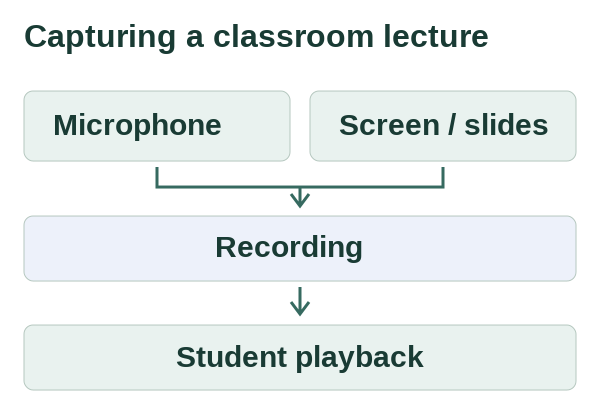
Recording lectures has become common in many tertiary institutions.[11] More and more universities offered recorded lectures. Students preferred courses that came with them.[3] In the United Kingdom, many institutions adopted a capture-all approach. They recorded every lecture.[12] A survey of 149 British universities in 2015 and 2016 found that lecture capture had become part of the digitalization of the university sector.[13]
History
Early audio and the move to video
Monash University's Faculty of Law had long given undergraduates audio tapes of lectures. For many years the Faculty of Law at Monash University gave undergraduate students audio tapes of lectures. Students traditionally borrowed a tape and listened to it inside the library. In 1999 the university library started buying digital recording equipment. Chosen lectures could then be sent to students over servers as a stream. By Semester 1 of 2006, 64 undergraduate law classes were being taped. Some classes registered over 7000 hits for the semester. Students relied on these online lectures more and more. Teachers faced growing pressure to tape their lectures.[14]
An early evaluation of audio recordings found that students valued hearing lectures they had missed. The recordings also meant fewer students came to academic staff with questions. Students used their ability to make copies to learn away from the library. This eased pressure on library facilities. Few students skipped lectures on purpose week after week. This held even when they knew a recording was being made.[15]
Podcasting in higher education most often took the form of lecture capture, sometimes called coursecasting. In it, instructors record lectures and spread them. Studies published in the past five years still put podcasting of lectures for students first. Those studies tested how effective such podcasts were. They used traditional pencil and paper assessments covering the material delivered by podcast. One pilot study took place in an online ICT class for teacher education students. Students investigated podcasting and made reflective podcasts. Students assessed their own podcasts and shared them online. This let peers give formative feedback. The studies reported a range of positive outcomes. Students learned about podcasting and through it, and they took part in reflection, problem solving and interactive formative assessment.[16][17]
Digital video later became common in higher education. Part of the reason was the growth in blended pedagogies, which mix face-to-face and online teaching. Cheaper media production equipment also played a part. Faster internet connections did too. So did students' access to mobile devices and a growth in media production skills. One case study described the creation and distribution of around 6000 digital video items. They were made for a new suite of completely online undergraduate degrees. Two main goals drove the development of that content: a focus on high quality and a focus on accessibility. Subtitles were included with all videos as a minimum requirement.[18]
Main ideas
How recordings are made and searched
One such system, eClass, was studied over three years. Its designers later published suggestions for improving how future systems capture, combine and give access to lectures.[19] Early video systems depended on university infrastructure, such as video technicians and post-production facilities. This made capture expensive. That cost forced schools to choose carefully which courses could be video taped. Consumer grade high definition cameras and powerful desktop computers let each faculty member record lectures with modest effort. One fixed camera could frame an entire chalkboard. So no accurate tracking of the teacher was needed. An undergraduate Operating Systems course was recorded in Spring 2006. Its lectures used more than five days of the university's external network link bandwidth. This happened over the twelve months from February 2006 to February 2007. Distributing every lecture taught at a university can cost too much in network use.[20]
Recordings can also be made by capturing activity on an ordinary desktop computer. For a third-year mechanical engineering course, thirteen videos were created with screen recording software. The videos combined audio with PowerPoint slides. The video files were distributed to students on five CD's.[21] Faculty from nine disciplines used this method in undergraduate courses. 23 students took part in a qualitative study of their experiences.[22]
Recorded lectures are long and hard to search. Students often have no way to find the parts they want. In one experiment, 255 students could use expert-made tags to find their way through 18 recorded lectures. Use of the tagging interface increased over time. Students who used it reduced the amount of video they viewed. Students who used the tagging interface scored higher grades than students who used the regular interface.[23]
A different system, an e-librarian service, accepts a student's complete question in ordinary language. It returns a few short multimedia documents that fit the question. It relies on a formal map of the subject's concepts. It also needs a way to cut learning objects out of a knowledge source, and a search engine that answers freely worded questions. The designers ran experiments on whether students would type full questions instead of keywords. They also tested the benefits of such a virtual personal teacher.[24]
Questions can be built into online modules that include recorded lectures. In one study, graduate occupational therapy students completed three online modules. The modules mixed lectures, slides, demonstrations and video clips. At certain points, called Learning Moments, students got different tasks. Some were asked a question, some read a statement confirming the content, and some did nothing. The questioned group did better on the exam than the study and no-task groups together (p < .01). The study and no-task groups did not differ (p = .67).[25] Audience response systems and digital inking can add interaction to recorded lectures. Students valued three things most: seeing other students' responses, getting immediate feedback, and having class material reinforced.[26]
Lecture capture services can include transcripts and captions. A survey of US Colleges of Osteopathic Medicine counted how many offered each. A survey went to the 34 fully accredited US Colleges of Osteopathic Medicine. It drew 21 responses, or 62%. Lecture recording was widespread at 95% of the responding colleges. But transcript and caption offerings varied. Of those recording, 7 (33%) provided both transcripts and captions. Another 5 (24%) offered closed captions only, and 3 (14%) offered transcripts only. Overall, 71% offered at least one of these services.[27]
Research
What the evidence says about attendance and grades
In large general microbiology courses, attendance did not fall. This held true when video recordings of lectures were made available. Most students in those courses said the videos did not make them skip class. They used them as a study tool instead.[28]
A different result came from a required second year research methods module. It was part of an undergraduate BSc degree. There, attendance dropped a lot in three matched lectures after recordings became available. The study compared 161 students before with 160 after.[4]
About 75% of Australian undergraduate psychology students used recorded lectures. Final grades did not differ with higher or lower attendance. They also did not differ with more or less use of recordings.[6]
Recordings did not change how well students with high grade point averages learned the material. One of those recorded courses had students with low grade point averages. They earned significantly lower grades than similar students in a class without recordings.[29] In the research methods module, viewing recordings showed no significant link to attainment once attendance was taken into account. Viewing also failed to make up for the lower attainment that went with low attendance.[4]
A study of business students compared those with access to lecture capture to those without. Those with access scored about three percent higher on a final exam.[5] In an operations management course, students who watched lecture videos scored higher on exams than those who did not. The gap remained after earlier exam performance was taken into account.[30]
One study covered 299 students and 982 exam observations. The students were in three in-person courses. Students who viewed recordings scored 66.1% on average. Those who did not scored 59.4%. That analysis found effects that pulled in opposite directions. Scores rose by 1.74% for each hour of total viewing time. They fell by 1.92% for each extra lecture viewed.[31]
A randomised trial compared live, video recorded and audio recorded lectures directly. The 94 fourth-year dental students were split at random among the three formats. Scores on a basic knowledge question did not differ much between the groups. One question required analytical thinking. The live and video groups scored significantly higher on it than the audio group.[32]
What recordings do to learning and teaching
A 2017 study looked at close to 700 students in principles of economics courses, 55% of them online. It found that online students who watched recorded lectures earned significantly higher course grades than those who did not. Students in the face-to-face sections of the same courses also benefited significantly from watching the recordings.[33]
A 2024 pilot study looked at undergraduate viewing habits and their link to grades. It found no statistically significant link between lecture capture use and final course grades. In that study, 32 students used effective viewing strategies and kept them up. Their mean course grade was 3.29% higher than that of the 18 who did not. The mean was 90.61, with a standard deviation of 5.68. Krautscheid and colleagues write that their findings could help educators make it a priority to teach students how to use recordings well.[34]
Whether recordings help may depend on whether they replace live lectures or add to them. Freyens and Gong (2022) proposed a measure called the technical rate of substitution. It records how far one delivery mode can stand in for another while student performance stays the same. Applied to a pilot sample in a first-year quantitative methods class, it found imperfect substitutability. Live lectures used fewer resources than the matching online recording to reach a given exam score. The authors describe the evidence on whether recordings improve performance as contested.[35]
Smith and Sodano (2011) compared two groups of students. One group used lecture capture to critique their own presentations, and the other did not. Students in both groups lacked confidence and skill in presentation skills. Some students used the recordings. They were more likely to apply what they learned from self-assessment when preparing later presentations. The authors suggest that teachers pay attention to how presentations are delivered, not only to their content.[36]
Joseph-Richard and colleagues (2018) asked how recording lectures affects lecturers' own academic practice. A 2018 study in the United Kingdom used mixed methods. It found that recording lectures raised lecturers' self-awareness, planning and deliberate performance. The same study found that recording reduced spontaneity and weakened interaction. It also bred wariness through constant surveillance. The researchers ask whether capture is making teaching more bland and instrumental. They advise proceeding with caution so that learning is not dehumanised.[37] A 2021 survey asked 202 first-year medical students. 76.83% agreed the capture system helped them understand concepts better, yet 70.78% still preferred face-to-face lecturing.[38]
Different students, different benefits
In one pilot course, students whose first language was not English gained more from lecture capture than other students. A pilot project took place at a podiatric medical school. A biochemistry course taught with lecture capture produced test scores almost 6% higher than the same course the year before. They improved by 10.0 points.[39]
One survey asked students at a college of podiatric medicine about recordings. Another asked faculty at a veterinary college.[40][41] Surveys went to every student at the Kent State University College of Podiatric Medicine. They also went to all full-time and part-time faculty there. They found very high use of the Mediasite lecture capture system. Preparing for exams was the most important reason given. Both groups ranked the system easy to use. The authors called lecture capture a vital supplement to course work and study, but said it should not replace class attendance.[40]
A veterinary college in the southeastern United States invited all 134 faculty members. 50 responded. Many instructors had not adopted lecture capture. Concerns about class attendance, teaching styles and technical problems had put them off. A fourth theme was that many faculty did not know recording was available in their teaching spaces. Others had not been trained to use it.[41]
Travel restrictions kept some international students learning remotely, and other students missed lectures to finish assessments or because of outside commitments.[42][43] At a British university, international students still faced travel restrictions from their home countries. This was at the start of the 2022-2023 academic year. A hybrid model used lecture capture to give face-to-face and remote students the same learning experience.[42]
Among first-year biology students, 87% attended live lectures as a rule. Only 52% used recordings, and only 13% watched more than two-thirds of those on offer. Students turned to recordings to make up for lectures they had missed (64%). Revising was not the main reason. Attenders mostly missed lectures to finish assessments due that week (68%).[43]
A case study described two projects at Cardiff University. In both, students and staff worked together. The projects studied how students experience recorded lectures. The case study argued that understanding how students use recordings needs careful, detailed study. It said partnership between students and staff is an effective way to reach that understanding. It also reported benefits from pairing students with professional-services staff, specifically learning technologists, the specialists who support teaching technology.[44]
Staff attitudes vary with their teaching beliefs: in a pre-registered study of 159 higher education teachers, appreciation of active learning predicted more positive attitudes towards recordings as an educational support tool. Teachers with higher teacher-centred scores were more concerned that recordings harm learning. The effects observed were small.[45]
In practice
How students use recordings and what staff think
In 2010, a survey asked 128 first-year nursing students in Australia about recordings. Most found the recordings useful for understanding material. They also helped them prepare for assessment. Recordings helped the two older groups, aged 22 to 30 and over 30, revise at their own pace. The youngest group, under 19, gained the most in adjusting to university life.[46] In a mixed-method study, 79% of students said they used recordings to learn what they had missed in class. 72% used them after an absence. In that study, 70% reported watching at least half of the recorded material and 8% watched none.[7]
In a second-year biochemistry course, topics students saw as harder drew more video views in several analyses. The link was weak and did not hold across all topics. A surface learning approach score and gender were also linked to the number of accesses. Course grade and comfort with technology were not.[47]
In the Canadian study, students with lower course marks accessed recordings more often. Those with higher marks accessed them less. Instructors there thought recordings mainly helped average and below-average students. They gained slightly better marks.[7]
Students with disabilities may benefit from watching recordings at their own pace. Students with ADHD have said recordings give them a sense of control over pace, place and time.[28][48] In focus groups, students said recordings reduced anxiety. This was especially true for students with disabilities.[49] Interviews with 12 students with ADHD found that recorded lectures gave them a sense of control. They controlled pace, place, time and convenience.[48]
Staff and students tend to hold different views of what a lecture is for. This shapes how each group sees recordings. Focus groups included 8 staff and 17 students. Both groups said recording could reduce interaction in the live lecture and stop staff from using anecdotes and humour.[49]
Some patterns of use worry researchers. A survey asked 694 biological sciences students. Many said they spent a lot of time making word-for-word notes from recordings, which left little time for independent study. About one-third of those students said they skipped more classes. Those same students tended to put off catching up on lectures they had missed.[1]
Published guidance asks students to keep attending and taking effective notes. It asks them to treat recordings as a catch-up or revision aid. It asks instructors to teach students how to learn from recordings. Instructors should decide case by case, on teaching grounds. They should not record everything or nothing. On attendance, that guidance argues the discussion should move to a new question. It should ask why students miss lectures and how they use the recordings.[50] One commentator has seen wide-scale lecture capture since 2008. That writer notes it is not easy to balance the needs of hard-to-reach students against academic concerns, technical barriers and policy.[51]
Design choices that change how recordings work
Second year engineering students took an introductory circuit analysis course. Its lectures were recorded between 2008 and 2010. The 2008 recordings were sound only. The later ones included video. End-of-course surveys of those students showed strong support for having video lecture capture. Students said they watched chosen parts, not whole recordings. The effect on attendance differed by course. The circuit analysis course showed little impact. A later introductory programming course showed more missed lectures when recordings were available.[52]
Questions placed inside a recorded lecture are another design choice. In an experiment, 40 university students watched a recorded lecture. Some students saw open-ended questions embedded in it and some did not. No feedback was given on their answers. Students engaged significantly more with the version containing questions. That engagement was not linked to knowledge test results. Students who saw embedded questions scored higher on the knowledge test than students who saw the plain video. The difference was significant.[53]
The layout of the picture itself can be rearranged while recording is still taking place. One system put learning content, images of the instructor and images of students into lecture videos. The videos were posted on a website for review after school. One experiment had two groups: 153 students in the experimental group and 149 in the control group. It compared the new system with traditional recording. The researchers used analysis of covariance. This is a statistical adjustment for prior scores. It suggested that a suitable rearrangement of visual elements significantly affected learning performance.[54]
Mobile technology lets an instructor move freely around the room while recording. This approach is called untethered lecture capture. Some students were the first in their family to attend university. Others spoke a first language other than English. Both groups reported greater confidence and less stress.[55]
Video logs from university students show a pattern. In about 60% of watching sessions, only a small part of the video is watched. The average is 7%. Opening a video page does not always mean the student watched it.[56]
Who benefits and under what conditions
Danielson and colleagues surveyed veterinary students and faculty members. They asked the students about lecture capture. Students were more likely than faculty to see the recordings as good for learning. Students also preferred recordings in courses they saw as highly relevant to future success. They preferred them in courses holding information not available in other formats. A greater percentage of students than faculty saw lecture capture as good for learning. Some disciplines used less straight lecture and taught basic science in an applied context. In those, the number of views showed no significant link to test scores.[57]
In a qualitative survey, neurodivergent and disabled students raised concerns about accessibility. They described recordings as vital beyond attendance. In a qualitative survey, such students named pausing and speed adjustment as vital. These helped them manage their learning. Participants also said recordings need self-discipline. They can also pull attention away from other sources of information. Horlin and colleagues found many examples of students using recordings to stay engaged as successful self-regulated learners. This held despite the challenges.[58]
A case study at one Ontario university found that lecture capture can fit the principles of Universal Instructional Design. It can also fit the Accessibility for Ontarians with Disabilities Act.[59] In engineering courses, many students who had trouble paying attention during lectures relied on recordings to understand the material further. Use of recordings in those courses also varied. It differed between native and non-native English speaking students.[60]
In a randomized experiment, pre-recorded lectures lowered achievement for students in the bottom 50th percentile of ability. Ability was measured by grade point average at the start of the semester. That lowered the chance of a correct answer on exam questions by 1.6 percentage points. Recordings had no effect on the achievement of higher-ability students.[8] Some students said they held back from distractions more while listening to online lectures. Those students rated both pre-recorded and live online lectures much more favorably.[61]
Findings on recordings and grades differ. Doggrell found no link between watching recordings and grades in a medical laboratory science course. Baillie and colleagues found that offering recordings lowered exam and final grades.[62][63] In a medical laboratory science course in 2017 and 2018, average lecture attendance was 39 and 27 percent. Watching recordings showed no link with academic results.[62]
One biomedical science course was taught by the same instructor. It showed lower exam and final grades when recordings were available. It had more course failures and similar attendance.[63]
At a medical school during lockdown, attendance had a significant effect on outcomes in all groups. The effect was largest among top students and students at the bottom of the class. Nabbout and colleagues concluded that recordings can usefully add to live lectures. They should not replace them.[64]
What this looks like when you study
One study followed 1,014 students in a general microbiology course over 10 semesters. Daily attendance was tracked with clickers, and recordings were available for the last six semesters. Attendance did not fall when recordings were available. And 74% of students said they watched recordings to revisit concepts they missed in class. Only 8% said the recordings encouraged them to skip class. Students from non-English-speaking backgrounds and students older than 25 said the videos helped them keep up.[28]
In a second-year biochemistry course with 87 students, the link between rated topic difficulty and video accessions varied by topic. It was significant only for the metabolic integration module; protein metabolism and glycogenesis showed trends toward significance. Students who scored higher on a surface learning approach, a measure of how they study, accessed lecture capture videos more often.[47]
Many said they spent a lot of time watching recordings and writing verbatim notes, which are word-for-word copies of the lecture.[1] One study looked at 299 students across 982 exams. Each extra hour of total viewing was linked to a 1.74% higher exam score. But each additional lecture viewed was linked to a 1.92% lower score. Students who watched more minutes per lecture than the class median scored 8.02% higher. Viewing spikes above a student's own average came with lower scores.[31]
Students in the question condition spent more total time on the video and replayed parts more often.[53] Griswold, Overson and Benassi (2017) studied occupational therapy students in a graduate course. Students scored better on exam questions when online modules asked them questions during the lecture than when modules only asked them to read a confirming statement.[25]
Nordmann and colleagues recommend attending lectures and taking effective notes. They say recordings should be a catch-up or revision aid, not a replacement.[50] The drop was 0.84 percentage points per hour.[31]
Criticism
Open questions and points of disagreement
Reid and colleagues note findings that conflict. Studies disagree on whether lecture capture affects attendance and attainment.[65] A 2014 quasi-experiment looked at an introductory psychology course.[66] A quasi-experimental design is a kind of experiment that does not rely on randomly assigning participants to conditions.[67]
The section with recordings had much lower attendance than the section without them. Its final grades were lower too. Attendance explained that gap. The differences disappeared once students who skipped exams, activities and assignments were left out of the analysis.[66]
One study looked at 396 first-year psychology students. A large share used recordings instead of going to lectures.[2] At one osteopathic medical school, classroom attendance among first-year students fell by 78%. The drop ran from the start to the end of the 2015-2016 academic year.[68] Von Konsky and colleagues reported that making recordings available did not affect lecture attendance. Daniel also found that providing recordings did not directly contribute to class absenteeism.[69][70]
Bos and colleagues found that students who used recordings as a supplement scored significantly higher when building a knowledge base. Using recordings and attending lectures gave the same result.[2] A trial ran for three semesters. It took place in a large introductory political science course. Watching lectures did not appear to substantially improve individual performance.[71]
Ford and colleagues ran a quasi-experiment across four classes. Two had classroom capture technology and two did not. They found no link between the technology and course grade.[72]
In the medical school study, attendance and mean course grades were not significantly correlated (r = 0.17). One course was the exception (r = 0.22).[68] Reid and colleagues found a group of veterinary students. They relied too heavily on recordings. These students worked fewer hours. Even so, their workload felt overwhelming to them. They went on to earn lower exam results.[65]
Finnish high school teachers described a tension. Their educational goals clashed with the demands of the technology. Researchers interviewed eight Finnish high school STEM teachers. Some worried that recording would mean less interaction with students. They also feared a loss of spontaneity. Others feared a shift toward feeling like a performer in front of a camera. The same teachers saw promise in recordings for self-paced learning. They also saw promise for students at different levels. They called editing and sharing the materials time-consuming. They said school administration paid for only part of that work.[73]
Almost all students in the political science trial approved of the technology. That approval did not lead to better grades.[71] In the psychology study, students had favorable views of the technology and thought it should be available campus wide, but few actually viewed the recordings.[66]
Much of the literature has relied on asking students about their use of recordings, which records what students claim rather than what they do. One evaluation tracked actual viewings over two academic years. It found more use than the literature had identified up to that date. Viewings spiked in the days before tests.[74]
A 2008 study warned that its own findings were guesses. Students were not asked to explain how they used the resources.[75] A survey at Nanyang Technological University found that students used video recorded lectures far more than expected. They also reported a better learning experience.[76]
Common misconceptions
Instructors often fear that recordings will be used poorly. They worry this will harm students' attainment and experience.[50]
Students in one survey believed that lecture recordings improved their grades.[1] In a biomedical science course, exam averages fell after recordings were introduced.[63]
Key studies
| Year | Study | Sample | Design | Finding |
|---|---|---|---|---|
| 2012 | Gorissen et al.[3] | 517 students at two Dutch universities | Survey | Students turned to recordings chiefly to catch up on lectures they had missed and to prepare for exams, and many who opened a recording watched most of it. |
| 2014 | Drouin[66] | quasi-experiment with one recorded section | The recorded section had lower attendance and final grades, and attendance mediated the effect [45]. | |
| 2015 | Newton & McCunn[47] | 87 students in a second-year biochemistry course | video accession counts with learning approach, technology comfort and gender measures | Higher perceived topic difficulty was linked to more video accessions, though not for every topic [13]. |
| 2016 | McLean & Suchman[28] | 1,014 students in a general microbiology course | 10-semester observational study with attendance tracking | Attendance did not decrease when recordings were available, and 74% used them to revisit missed concepts [2]. |
| 2017 | Griswold et al.[25] | experiment with three conditions during online modules | Questions during modules led to better exam performance than reading a confirming statement or doing nothing [74]. | |
| 2018 | Chapin[6] | 71 Australian undergraduate psychology students | Survey with grade comparison | About 75% used recordings, and no differences in final grades were found based on attendance or recording access. |
| 2019 | Edwards & Clinton[4] | 161 students before and 160 after recordings were introduced | matched cohort study | Attendance dropped in three matched lectures, and attendance mediated a negative link between recording availability and attainment [4]. |
| 2019 | Dommett et al.[49] | 8 staff and 17 students | focus groups | Students felt recordings reduced anxiety, while staff felt capture reduced interaction and humour [22]. |
| 2021 | van der Meij & Bӧckmann[53] | 40 university students | experiment comparing video with and without embedded questions | Embedded open-ended questions raised test scores and increased time spent watching [55]. |
| 2022 | Baillie et al.[63] | 433 students before and 414 after recordings | two-group quasi-experiment | Exam averages fell after recordings were introduced, with more course failures, despite similar attendance and GPA [54]. |
| 2022 | Nordmann et al.[50] | Practical recommendations paper | The authors recommend using recordings as a catch-up or revision aid and giving students guidance on attendance and note-taking. | |
| 2023 | Voelkel et al.[1] | 694 biological science students | survey and focus groups | About one third skipped more classes, and many wrote verbatim notes and postponed catching up [15]. |
| 2023 | Levenberg & Reesh[48] | 12 students with ADHD | qualitative interviews | Students reported that recordings gave them control over pace, place, time and convenience [31]. |
| 2025 | Hillsley[31] | 299 students across 982 exams | analysis of viewing logs and exam scores | Viewers scored 66.1% versus 59.4% for nonviewers, but more lectures viewed was linked to lower scores [16]. |
See also
References
- Voelkel, S., Bates, A., Gleave, T., Larsen, C., Stollar, E. J., Wattret, G., & Mello, L. V. (2023). Lecture capture affects student learning behaviour. FEBS Open Bio, 13(2), 217-232. doi:10.1002/2211-5463.13548
- Bos, N., Groeneveld, C., van Bruggen, J., & Brand‐Gruwel, S. (2016). The use of recorded lectures in education and the impact on lecture attendance and exam performance. British Journal of Educational Technology, 47(5), 906-917. doi:10.1111/bjet.12300
- Gorissen, P., Van Bruggen, J., & Jochems, W. (2012). Students and recorded lectures: survey on current use and demands for higher education. Research in Learning Technology, 20. doi:10.3402/rlt.v20i0.17299
- Edwards, M. R., & Clinton, M. E. (2019). A study exploring the impact of lecture capture availability and lecture capture usage on student attendance and attainment. Higher Education, 77(3), 403-421. doi:10.1007/s10734-018-0275-9
- Terry, N., Macy, A., Clark, R., & Sanders, G. (2015). The Impact Of Lecture Capture On Student Performance In Business Courses. Journal of College Teaching & Learning (TLC), 12(1), 65-74. doi:10.19030/tlc.v12i1.9071
- Chapin, L. A. (2018). Australian university students’ access to web-based lecture recordings and the relationship with lecture attendance and academic performance. Australasian Journal of Educational Technology, 34(5). doi:10.14742/ajet.2989
- Groen, J. F., Quigley, B., & Herry, Y. (2016). Examining the Use of Lecture Capture Technology: Implications for Teaching and Learning. The Canadian Journal for the Scholarship of Teaching and Learning, 7(1). doi:10.5206/cjsotl-rcacea.2016.1.8
- Le, K. (2022). Pre-Recorded Lectures, Live Online Lectures, and Student Academic Achievement. Sustainability, 14(5), 2910. doi:10.3390/su14052910
- Germany, L. (2012). Beyond lecture capture: What teaching staff want from web-based lecture technologies. Australasian Journal of Educational Technology, 28(7). doi:10.14742/ajet.797
- Williams, B., Pfeifer, J., & Waller, V. (2013). Lecture Capture: Student Hopes, Instructor Fears. ASCILITE Publications, 913-924. doi:10.14742/apubs.2013.1334
- Patterson, J. (2009). Using lecture capture technologies for distance learning: A case study using Panopto. ASCILITE Publications, 746-748. doi:10.14742/apubs.2009.2327
- Witton, G. (2017). The value of capture: Taking an alternative approach to using lecture capture technologies for increased impact on student learning and engagement. British Journal of Educational Technology, 48(4), 1010-1019. doi:10.1111/bjet.12470
- Ibrahim, Y., Howarth, A., & Stone, I. (2021). Lecture Capture Policies: A Survey of British Universities. Postdigital Science and Education, 3(1), 144-161. doi:10.1007/s42438-020-00102-x
- Buxton, K., Jackson, K., DeZwart, M., Webster, L., & Lindsay, D. (2006). Recorded lectures: Looking to the future. ASCILITE Publications, 101-104. doi:10.65106/apubs.2006.2881
- Roberts, G. (1994). An evaluation of the use made by students of the audio recording of lectures. Australasian Journal of Educational Technology, 10(2). doi:10.14742/ajet.2088
- Forbes, D. (2011). Beyond lecture capture: Student-generated podcasts in teacher education. Waikato Journal of Education. doi:10.15663/wje.v16i1.70
- Forbes, D. (2015). Beyond lecture capture: Student-generated podcasts in teacher education. Waikato Journal of Education. doi:10.15663/wje.v20i3.234
- Dinmore, S. (2019). Beyond lecture capture: Creating digital video content for online learning – a case study. Journal of University Teaching and Learning Practice, 16(1). doi:10.53761/1.16.1.7
- Brotherton, J. A., & Abowd, G. D. (2004). Lessons learned from eClass: Assessing automated capture and access in the classroom. ACM Transactions on Computer-Human Interaction, 11(2), 121-155. doi:10.1145/1005361.1005362
- Chandra, S. (2007). Lecture video capture for the masses. ACM SIGCSE Bulletin, 39(3), 276-280. doi:10.1145/1269900.1268864
- McGrann, R. T. R. (2005). Enhancing Engineering Computer-Aided Design Education Using Lectures Recorded on the PC. Journal of Educational Technology Systems, 34(2), 165-175. doi:10.2190/2b89-mrnq-wd57-eu48
- Krautscheid, L., Williams, S., Kahn, B., & Adams, K. (2019). Untethered Lecture Capture: A Qualitative Investigation of College Student Experiences. Journal of Educational Technology Systems, 48(1), 97-111. doi:10.1177/0047239519833690
- Gorissen, P., van Bruggen, J., & Jochems, W. (2015). Does tagging improve the navigation of online recorded lectures by students? British Journal of Educational Technology, 46(1), 45-57. doi:10.1111/bjet.12121
- Linckels, S., Repp, S., Karam, N., & Meinel, C. (2007). The virtual tele-tASK professor: semantic search in recorded lectures. ACM SIGCSE Bulletin, 39(1), 50-54. doi:10.1145/1227504.1227330
- Griswold, L. A., Overson, C. E., & Benassi, V. A. (2017). Embedding Questions During Online Lecture Capture to Promote Learning and Transfer of Knowledge. American Journal of Occupational Therapy, 71(3), 426-433. doi:10.5014/ajot.2017.023374
- McCabe, B. K., & Hobohm, C. (2012). Promoting asynchronous interactivity of recorded lectures in blended learning environments. ASCILITE Publications, 612-621. doi:10.14742/apubs.2012.1563
- Khong, P., Holmes, D., Masoudian, B., Lund, G. C., & Garwood, S. (2024). Lecture Capture, Transcripts, and Captioning in US Colleges of Osteopathic Medicine: Descriptive Cross-Sectional Survey. Medical Science Educator, 35(2), 625-628. doi:10.1007/s40670-024-02224-4
- McLean, J. L., & Suchman, E. L. (2016). Video Lecture Capture Technology Helps Students Study without Affecting Attendance in Large Microbiology Lecture Courses. Journal of Microbiology & Biology Education, 17(3), 480-481. doi:10.1128/jmbe.v17i3.1123
- Stroup, M., Pickard, M., Kahler, K., & null, n. (2012). Testing the Effectiveness of Lecture Capture Technology Using Prior GPA as a Performance Indicator. TeacherScholar Journal of the State Comprehensive University. doi:10.58809/aywf2801
- Sloan, T. W., & Lewis, D. A. (2014). Lecture Capture Technology and Student Performance in an Operations Management Course. Decision Sciences Journal of Innovative Education, 12(4), 339-355. doi:10.1111/dsji.12041
- Hillsley, K. (2025). Exam‐level analysis of lecture capture viewing and student exam performance. FEBS Open Bio, 15(12), 2067-2079. doi:10.1002/2211-5463.70133
- Shqaidef, A. J., Abu‐Baker, D., Al‐Bitar, Z. B., Badran, S., & Hamdan, A. M. (2021). Academic performance of dental students: A randomised trial comparing live, audio recorded and video recorded lectures. European Journal of Dental Education, 25(2), 377-384. doi:10.1111/eje.12614
- Stockly, S. K., & Hemley, D. (2017). Using Lecture Capture to Improve Online and In-Class Student Performance in Principles of Economics. International Journal for Innovation Education and Research, 5(6), 205-2013. doi:10.31686/ijier.vol5.iss6.749
- Krautscheid, L., King, R., Lembke, K., McCormack, C., & Waldo, M. J. (2024). Lecture Capture Strategies with Embedded Retrieval Practices: Relationship with Academic Performance. Journal of Educational Technology Systems, 53(1), 30-45. doi:10.1177/00472395241255972
- Freyens, B. P., & Gong, X. (2022). Generalising the impact of lecture capture availability on student achievement: A method and its application. Australasian Journal of Educational Technology, 38(4), 160-175. doi:10.14742/ajet.7940
- Smith, C. M., & Sodano, T. M. (2011). Integrating lecture capture as a teaching strategy to improve student presentation skills through self-assessment. Active Learning in Higher Education, 12(3), 151-162. doi:10.1177/1469787411415082
- Joseph‐Richard, P., Jessop, T., Okafor, G., Almpanis, T., & Price, D. (2018). Big brother or harbinger of best practice: Can lecture capture actually improve teaching? British Educational Research Journal, 44(3), 377-392. doi:10.1002/berj.3336
- Pandey, A. K., Kotian, S. R., & Kalthur, S. G. (2021). Is “Lecture Capture System” a Blessing in Disguise for Teaching and Learning Anatomy? Journal of Datta Meghe Institute of Medical Sciences University, 16(3), 485-489. doi:10.4103/jdmimsu.jdmimsu_214_19
- Shaw‡, G. P., & Molnar, D. (2011). Non‐native english language speakers benefit most from the use of lecture capture in medical school. Biochemistry and Molecular Biology Education, 39(6), 416-420. doi:10.1002/bmb.20552
- DiBacco, P. M., Hetherington, V. J., & Putman, D. (2012). Lecture Capture: Enhancing Learning Through Technology at the Kent State University College of Podiatric Medicine. Journal of the American Podiatric Medical Association, 102(6), 491-498. doi:10.7547/1020491
- Kwiatkowski, A. C., & Demirbilek, M. (2016). Investigating Veterinary Medicine Faculty Perceptions of Lecture Capture: Issues, Concerns, and Promises. Journal of Veterinary Medical Education, 43(3), 302-309. doi:10.3138/jvme.0615-090r1
- Zhao, X. (2023). Hybrid Learning through Lecture Capture: Exploring Perspectives and Overcoming Challenges with Blackboard Encore Technology. International Journal of Emerging Technologies in Learning (iJET), 18(16), 210-221. doi:10.3991/ijet.v18i16.42321
- Simcock, D. C., Chua, W. H., Hekman, M., Levin, M. T., & Brown, S. (2017). A survey of first-year biology student opinions regarding live lectures and recorded lectures as learning tools. Advances in Physiology Education, 41(1), 69-76. doi:10.1152/advan.00117.2016
- Luke, K., & Evans, G. (2021). Students as partners in digital education: Exploring lecture capture in higher education through partnership between students and learning technologists. International Journal for Students as Partners, 5(2), 78-88. doi:10.15173/ijsap.v5i2.4508
- Nordmann, E., Clark, A., Spaeth, E., & MacKay, J. R. D. (2022). Lights, camera, active! appreciation of active learning predicts positive attitudes towards lecture capture. Higher Education, 83(3), 481-502. doi:10.1007/s10734-020-00674-4
- Cooke, M., Watson, B., Blacklock, E., Mansah, M., Howard, M., Johnston, A., Tower, M., & Murfield, J. (2012). Lecture Capture: first year student nurses’ experiences of a web‑based lecture technology. Australian Journal of Advanced Nursing, 29(3). doi:10.37464/2012.293.1642
- Newton, G., & McCunn, P. (2015). Student perception of topic difficulty: Lecture capture in higher education. Australasian Journal of Educational Technology, 31(3). doi:10.14742/ajet.1681
- Levenberg, A., & Reesh, S. A. (2023). Learning From Recorded Lectures: Perceptions of Students With ADHD. Journal of Attention Disorders, 27(9), 960-972. doi:10.1177/10870547231171725
- Dommett, E. J., Gardner, B., & van Tilburg, W. (2019). Staff and student views of lecture capture: a qualitative study. International Journal of Educational Technology in Higher Education, 16(1). doi:10.1186/s41239-019-0153-2
- Nordmann, E., Küepper-Tetzel, C. E., Robson, L., Phillipson, S., Lipan, G. I., & McGeorge, P. (2022). Lecture capture: Practical recommendations for students and instructors. Scholarship of Teaching and Learning in Psychology, 8(3), 174-193. doi:10.1037/stl0000190
- Newcombe, M. (2017). Lecture Capture – can it help ‘hard to reach’ students? The Journal of Educational Innovation, Partnership and Change, 3(1), 293. doi:10.21100/jeipc.v3i1.602
- Steele, A., & Schramm, C. (2012). Student perceptions and reported use of video recorded lectures in engineering courses. Proceedings of the Canadian Engineering Education Association (CEEA). doi:10.24908/pceea.v0i0.4686
- van der Meij, H., & Bӧckmann, L. (2021). Effects of embedded questions in recorded lectures. Journal of Computing in Higher Education, 33(1), 235-254. doi:10.1007/s12528-020-09263-x
- Yu, P. ‐., Wang, B. ‐., & Su, M. ‐. (2015). Lecture capture with real‐time rearrangement of visual elements: impact on student performance. Journal of Computer Assisted Learning, 31(6), 655-670. doi:10.1111/jcal.12109
- Krautscheid, L. (2021). Untethered Lecture Capture: Stimulating Educational Affordances Through Technology-Enhanced Teaching. Nursing Education Perspectives, 42(6), E176-E178. doi:10.1097/01.nep.0000000000000771
- Akçapınar, G., Er, E., & Bayazıt, A. (2024). Decoding Video Logs: Unveiling Student Engagement Patterns in Lecture Capture Videos. The International Review of Research in Open and Distributed Learning, 25(2), 94-113. doi:10.19173/irrodl.v25i2.7621
- Danielson, J., Preast, V., Bender, H., & Hassall, L. (2014). Is the effectiveness of lecture capture related to teaching approach or content type? Computers & Education, 72, 121-131. doi:10.1016/j.compedu.2013.10.016
- Horlin, C., Hronska, B., & Nordmann, E. (2024). I can be a “normal” student: the role of lecture capture in supporting disabled and neurodivergent students’ participation in higher education. Higher Education, 88(6), 2075-2092. doi:10.1007/s10734-024-01201-5
- Vajoczki, S., Watt, S., Fenton, N., Tarkowski, J., Voros, G., & Vine, M. M. (2014). Lecture capture: An effective tool for universal instructional design? Canadian Journal of Higher Education, 44(2), 1-29. doi:10.47678/cjhe.v44i2.183273
- Rahman, A., Shah, M. A. R., & Chowdhury, S. H. (2018). Lecture capture use in engineering education: Influence of students’ social and behavioral factors and teachers’ perceptions. Computer Applications in Engineering Education, 26(3), 500-508. doi:10.1002/cae.21902
- Kim, E. J., & Kim, M. J. (2024). Students’ Evaluation of Live Online Lectures Versus Pre-Recorded Video Lectures During COVID-19: Focusing on Students’ Study Behaviors. Sage Open, 14(4). doi:10.1177/21582440241305325
- Doggrell, S. A. (2020). No apparent association between lecture attendance or accessing lecture recordings and academic outcomes in a medical laboratory science course. BMC Medical Education, 20(1). doi:10.1186/s12909-020-02066-9
- Baillie, L. D., Banow, R., & Botterill, J. J. (2022). The impact of lecture capture availability on academic performance in a large biomedical science course. Education and Information Technologies, 27(5), 7183-7203. doi:10.1007/s10639-022-10903-1
- Nabbout, G., Bchennaty, D., & Zalloua, P. (2021). Are recorded lectures suitable for medical students?: Impact of attending lectures on medical students' outcome. International Journal for Innovation Education and Research, 9(5), 812-818. doi:10.31686/ijier.vol9.iss5.3034
- Reid, A., Duret, D., & Noble, K. (2022). Lecture Capture: Friend or Foe? Journal of Veterinary Medical Education, 49(1), 126-137. doi:10.3138/jvme-2020-0052
- Drouin, M. A. (2014). If You Record It, Some Won’t Come: Using Lecture Capture in Introductory Psychology. Teaching of Psychology, 41(1), 11-19. doi:10.1177/0098628313514172
- Noba textbook series: Psychology (n.d.). Quasi-experimental design. Noba textbook series: Psychology. https://nobaproject.com/modules/research-designs
- Ikonne, U., Campbell, A. M., Whelihan, K. E., Bay, R. C., & Lewis, J. H. (2018). Exodus From the Classroom: Student Perceptions, Lecture Capture Technology, and the Inception of On-Demand Preclinical Medical Education. Journal of Osteopathic Medicine, 118(12), 813-823. doi:10.7556/jaoa.2018.174
- Von Konsky, B. R., Ivins, J., & Gribble, S. J. (2009). Lecture attendance and web based lecture technologies: A comparison of student perceptions and usage patterns. Australasian Journal of Educational Technology, 25(4). doi:10.14742/ajet.1130
- Daniel, B. K. (2017). Enterprise Lecture Capture Technologies and Value to Student Learning. International Journal of Information and Communication Technologies in Education, 6(2), 23-36. doi:10.1515/ijicte-2017-0009
- Mallinson, D. J., & Baumann, Z. D. (2015). Lights, Camera, Learn: Understanding the Role of Lecture Capture in Undergraduate Education. PS: Political Science & Politics, 48(03), 478-482. doi:10.1017/s1049096515000281
- Ford, M. B., Burns, C. E., Mitch, N., & Gomez, M. M. (2012). The effectiveness of classroom capture technology. Active Learning in Higher Education, 13(3), 191-201. doi:10.1177/1469787412452982
- Kukkonen, I., & Palo-oja, O. M. (2025). Lecture Capture in Finnish High Schools: Teachers’ Perspectives. International Conference on Education Research, 2(1), 87-94. doi:10.34190/icer.2.1.4156
- Elliott, C., & Neal, D. (2016). Evaluating the use of lecture capture using a revealed preference approach. Active Learning in Higher Education, 17(2), 153-167. doi:10.1177/1469787416637463
- Grabe, M., & Christopherson, K. (2008). Optional student use of online lecture resources: resource preferences, performance and lecture attendance. Journal of Computer Assisted Learning, 24(1), 1-10. doi:10.1111/j.1365-2729.2007.00228.x
- Soong, S. K. A., Chan, L. K., Cheers, C., & Hu, C. (2006). Impact of video recorded lectures among students. ASCILITE Publications, 789-793. doi:10.65106/apubs.2006.2970
Cite this page: Atlas Nova editors. (2026). Lecture capture. Atlas Nova. https://velocer.io/atlas/lecture-capture/