
Method · Teaching
Peer instruction
Teaching method
Peer instruction is a form of active learning in which students discuss ideas or share answers to questions during class, with chances to interact further with the instructor. Instructors pose a challenging question, students answer alone, discuss with a partner, then answer again.[1][2]
Students were more accurate and more confident after discussion than before it.[2] In interviews with 35 physics faculty, Dancy, Henderson and Turpen found that faculty generally modify instructional strategies and may modify out essential components.[3] Peer instruction lowered the share of students who dropped the course.[4]
Overview
What peer instruction is and where it came from
Peer instruction is a form of active learning. Students discuss ideas or share answers to questions during class. They also get more chances to interact with the instructor.[1] Every student in the room takes part.[6] The questions used are called ConcepTests. Cheng uses this term for the conceptual tests that go with the method.[7]
Eric Mazur, a Harvard University professor, advanced the method. It was developed in the introductory physics courses for non-majors at Harvard.[6][7] Mazur and Hilborn's 1997 user's manual gives a step-by-step guide to planning a peer instruction lecture. It also has a section on Concept Tests.[8]
A 2007 report described more than ten years of teaching with the method in those Harvard courses.[6] Teachers who use it face many choices. These cover group design, assignment format and grading.[1]
A 2001 article described how the method was changed for an introductory single variable calculus course. It covered the first and second semesters.[9] A 2009 article reported that peer instruction and i-clickers improved student participation and comprehension in calculus. I-clickers are a radio frequency classroom response system.[10]
A 2016 case study followed three physics classes. They were at an upper secondary school in the Czech Republic. The students were aged 17 to 18, with 28, 16 and 13 students.[11]
A 2024 review of chemistry teaching found studies from 1991 to 2022. Most were at higher education institutions in England, Turkey, the USA and Brazil. That review found only a few studies of peer instruction in chemistry. This was especially true in high school chemistry classes.[12] A 2025 study proposed combining the method with digital technology. The aim was to teach argumentative writing for the Brazilian Enem exam.[13]
Main ideas
Why discussion helps and what changes the results
Tullis and Goldstone explain the benefits of peer instruction in three ways. They point to how coherent students' explanations are, to social learning, and to context factors that shape confidence and accuracy. One study ran for a semester. It covered six classes and 208 undergraduate students. Students answered 86 course questions alone and rated their confidence. They then discussed with a partner and answered again. Students were more accurate and more confident after discussion than before. Students who were right at first were more likely to keep their answer. Students who were wrong at first were less likely to keep theirs. Confidence explained part of this but not all of it.[2]
A 2017 review of physics teaching methods notes a common view among many authors. Students learn better when they work interactively or with peers. This includes students who do poorly.[14]
The size of the gain depends on what students do between the two polls. In one study, 86 students were polled twice on the same nine conceptual questions. Different tasks came in between. Scores rose by 3% when students were distracted. They rose 10% when students reflected in silence, and 21% when they discussed with a peer. A second comparison looked at 108 students. Every peer instruction group learned more concepts than a lecture-based class. They also did better on traditional problems. Those groups differed in one way. Skipping consensus building, the step of agreeing on one answer, came with a significant drop in expert views and beliefs.[15]
Grading choices change how students talk to each other. Two large college astronomy classes used contrasting scoring. The scoring applied to answers recorded by an electronic classroom response system. In some cases wrong answers earned little credit. Then the more knowledgeable partner tended to dominate. The partner with less knowledge stayed passive. When wrong answers earned full credit, both partners looked at ideas more evenly. They were also much more likely to record different answers. That pattern suggests something about answer statistics in low-stakes classes. They better show what students understand at that time.[16]
Students in genetics courses for majors and nonmajors answered a first question alone. They then had one of three treatments before a second question. The treatments were peer discussion only, an instructor explanation only, or discussion then explanation. Discussion followed by explanation gave the largest average gain. Weak, medium and strong performers all gained most from that combination. For nonmajors, weak performers gained only a little more from the combination than from explanation alone. Strong performers in both courses were not helped by explanation alone.[17]
Turpen and Finkelstein found that differences in instructor practice set up clearly different classroom norms. Students noticed these norms. Turpen and Finkelstein described three classrooms that used peer instruction. The rooms differed in how much they stressed three things. One was collaboration between instructor and students. Another was students working together. The third was making sense of ideas rather than just getting answers. Students' end-of-term survey answers largely matched the researchers' readings of those classrooms.[18]
One eighth grade class had thirty pupils. Learning gain was strongly tied to which of four discussion roles a pupil took. The roles were passenger, standard discussant, advisor and dominant speaker. That study concluded that peer instruction needs suitable changes. The changes should raise the activity of passengers.[19]
Dancy, Henderson and Turpen interviewed 35 physics faculty. They found that faculty usually change instructional strategies. They may also change out essential parts. Informal social interactions were a big way the method spread, unlike workshops, papers and websites. Experience as a graduate student or through curriculum work could have a strong effect.[3] A 2015 review adds that instructors often adapt such practices rather than adopt them. In doing so they may harm their effectiveness without knowing it.[20]
Common misconceptions
Smith and colleagues raised a concern about this gain. Students might simply copy a neighbor's answer rather than learn to reason correctly. To test this, Smith and colleagues added a second question.[21]
Research
How large are the learning gains
Students used peer instruction for ten years in physics courses for nonmajors. The courses were calculus-based and algebra-based. Students showed a better grasp of concepts and of quantitative problem solving.[22]
The method's first use at a two-year college gave better conceptual learning and similar problem-solving ability compared with traditional lecturing. This matched what earlier studies found. That comparison also included a first use at a top-tier four-year research institution. Some students had less background knowledge. Under peer instruction they gained as much as students with more background knowledge gained in traditional classes. The method also lowered the share of students who dropped the introductory physics course. This held at both the four-year and the two-year institution.[4]
A medical physiology class had 256 first-year students. They answered more questions correctly after talking it over. This held for simple recall questions and for questions testing complex thinking alike.[23]
An exercise physiology class of 38 students was split at random into two groups of 19. Peer instruction improved mastery of the original material. It also improved the ability to solve new problems.[24] A physiology course used qualitative problem-solving questions. Average performance rose from 59.3 +/- 0.5% to 80.3 +/- 0.4% after peer instruction. After discussion, 56.8% of students changed a wrong answer to a right one.[25]
Feedback used peer instruction right after the exam. Retention of basic science knowledge then reached 39%, a rise of 15%.[5] An epidemiology lecture at Okayama University had 121 medical students. Across five questions, the share of correct answers after discussion ranged from 0.178 to 0.767. A measure of how much discussion improved each question ranged from -0.051 to 0.657. So some questions gained little or lost ground.[26]
In a physics course, 42 students were taught with peer instruction. Female and male students showed no statistically significant difference in conceptual learning. After peer instruction, male students did better than female students at solving quantitative problems. The comparison group of 56 students was taught in the usual way. It showed no noticeable change in either kind of performance.[27]
In practice
How a peer instruction class runs
A peer instruction class is built around a series of short conceptual questions. Each question is asked twice. A conceptual question is designed to help resolve a common student misconception about the subject.[28]
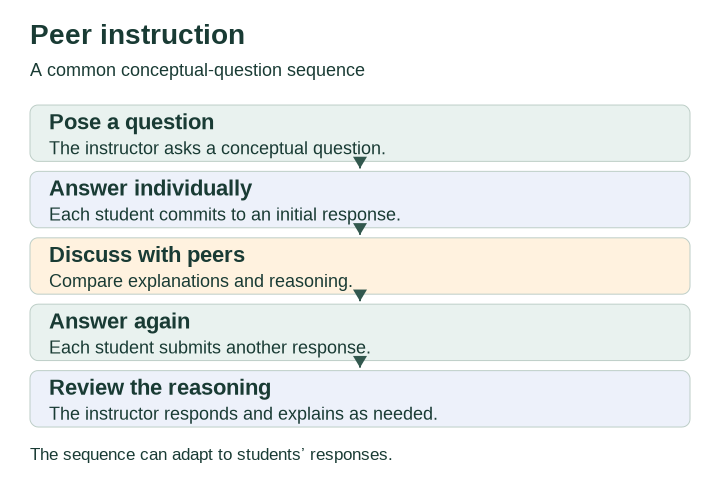
The teacher presents a concept first, then poses a related multiple-choice question to the whole room.[21] Students get time to think on their own and then answer individually, often with a clicker, a small handset that sends a choice to a receiver.[29][30] Students answer each question twice. They answer once after individual reflection and again after discussion with a peer.[28]
The individual thinking period matters more than it looks. In interviews, students described that quiet stretch as essential. It helped them build explanations and take part in the discussion that follows. Showing the class the first-vote results can damage the discussion. This is especially true when one answer holds a clear majority.[29] The teacher then asks students to turn to a neighbor and try to convince that person that their own answer is correct.[21] The method depends on strong interaction among students in the classroom.[31]
What happens inside those short conversations has been recorded and analyzed. Researchers studied one upper-level developmental biology class. They recorded and transcribed 83 discussions among groups of students working on 34 different clicker questions. Most of those discussions included exchanges of reasoning that used evidence. Many such exchanges ended with students reaching the correct answer. Some discussions traded ideas without reaching the right answer. The instructor prompted students to use reasoning. Then significantly more discussions contained reasoning tied to evidence.[32]
A separate study of an introductory physics course found a common mental step in peer talk. Students often worked out what the problem was asking. Explanations built on physics concepts usually led students to a wrong answer. Explanations built on physics models usually led them to the right one.[33]
The share of correct answers usually rises after peer discussion. Most students who were wrong at first switch to the correct answer. Not every switch is an improvement. Some students abandon a right answer, and some move from one wrong answer to another. Students took one semester of an introductory electricity and magnetism course at Harvard University. Those with low academic self-efficacy, meaning low belief in their own ability, changed their answers more than those with high self-efficacy. Students also switched to incorrect answers more often when the question was difficult. The researchers suggested that teachers give more support on hard questions. For example, teachers could offer cues during the lecture or allow more time for discussion.[28]
In the modified protocol, students revote on the first question and then answer a second, similar question. The protocol was also run with teacher's instruction in place of peer discussion. This compared the two for a pair of similar questions on Lenz's law. One worry is that the second vote rises only because students copy a confident neighbor. To rule out copying, some versions add a second question after the revote. It uses the same concept but a different cover story, meaning a different situation wrapped around the same physics. A simpler variant drops the revote and moves straight to a similar second question.[21] Clickers help an instructor pose multiple-choice conceptual questions. They also share the distribution of answers with the class.[30]
The method gets students involved in class through planned, frequent questions.[28] Because discussion takes time away from lecturing, teachers often plan ways to make up for the lost minutes. Clickers are also called classroom response systems. They are especially useful for starting and tracking peer learning in a large lecture hall. Used in class, they tend to have either a mild or a positive effect on exam performance, depending on how and how much they are used.[34]
Clickers and other ways to collect answers
A classroom response system lets students answer multiple-choice conceptual questions during class.[30] One university gave every level 4 student a free clicker. It asked students to register the device through the virtual learning environment, the online course system. Registration records showed big differences in progression and in participation by ethnicity and gender. They also showed differences in non-continuation rates for full-time, first degree entrants. In a survey at the same university, some students were less sure of their in-class answers. Those students were more inclined to avoid peer work. They also gave up on hard questions sooner.[35]
The devices do not by themselves guarantee learning. A 2008 comparison looked at two biology courses taught with clickers. Both had positive student opinion: an introductory class for nonmajors and a 200 level genetics class for majors. Exam scores were significantly higher on questions covering material taught with clickers. The gap was larger in the nonmajors course. Four months after the courses ended, retention of the clicker-taught material was higher in the nonmajors course. It was not higher in the genetics course.[36]
A quasi-experiment used two intact grade-11 classes (N = 58). It compared clicker-assisted peer instruction with conventional lecture over four weeks. The clicker group reached a normalized gain of 0.62, against 0.35 for the lecture group. The difference had a Hedges g of 1.64, a very large effect size.[37]
A history instructor noted that large classes of fifty or more students make participation hard to measure. It is hard to measure objectively, fairly and efficiently. Class participation gives the instructor feedback on student attention and understanding.[38]
The 2014 review suggests teachers study their own classes through pedagogical action research. This means reflecting on current practice, improving it, and judging the results for students and instructor.[39] The 2008 biology comparison advises getting comfortable with the technology before judging its effect. The two courses were compared only after a settling period from fall 2005 to spring 2006.[36]
Clickers are one of the most commonly studied technologies in STEM education.[30] Peer instruction was used in the pilot offering of a computer science principles course. The course ran at the University of California at San Diego in 2010-11. The paper describes it as a teaching method for building deep understanding in a lecture setting.[40]
A 2024 qualitative study asked pre-service teachers about cloud-based peer learning. The teachers were in a computer education and instructional technologies department. Participants said the method gave their groups communication and cooperation. They also named different perspectives, responsibility and self-confidence.[41]
What students and teachers say about it
Students in a 2017 introductory physics course took part in weekly, non-mandatory peer instruction classes. They then answered a short questionnaire. Those students said peer instruction had improved their grasp of physics concepts. They valued the activities and the way the classes ran. The researchers called this result important. Active and collaborative learning was almost absent in that setting.[42]
A 2022 reflection on physics teaching in basic education argued that peer instruction draws students in through conceptual tests. That reflection also stressed one point. Group discussion works best when groups mix students with different levels of experience.[43]
A 2024 review of literature on peer instruction in primary and secondary school reported gains in student engagement. It also reported gains in understanding of the concepts taught. The same review named teacher training as a challenge for putting the method into practice. It also named adapting classrooms.[44]
A 2025 review looked at studies from 2016 to 2023. It found that peer instruction widened understanding through discussion and immediate feedback. That review concluded the method supports critical thinking and student autonomy. It also said digital voting platforms make it more interactive.[45] A 2026 paper studied students born up to 2010 and after 2010. It said interactive tools give immediate feedback and encourage autonomy and group work.[46]
Confidence has been measured directly in at least one controlled comparison. A two-year college physics course had 98 students. One group learned by peer instruction with problem solving strategy steps, and the other by formal education with the same steps. Scores on the Problem Solving Confidence Questionnaire differed significantly between the group means. The difference favored the peer instruction group.[47] A 2024 experiment in one Jakarta primary school compared a flipped classroom of the peer instruction type with expository teaching in grade 4 social studies. Observed oral communication reached 90% in the peer instruction class and 82% in the control class.[48]
A 2024 account describes workshops designed to introduce teachers to peer instruction. Participants could learn the method in depth, try it out, and practice writing good questions. The method gives question creation a significant role. The teachers who took part gave their view. The workshops gave them space to meet an innovative method and collect ideas for their own teaching.[49] A 2022 bibliometric mapping and systematic review looked at 58 journal papers. It found that most peer instruction studies concern numerical subjects such as physics, chemistry and computer science.[50]
What this looks like when you study
They answered once alone and once after talking with a partner. Some students rated their own academic self-efficacy low. They switched their responses more often than students who rated it high. Miller and colleagues suggest giving cues during lectures, allowing more time for discussion, and arranging good pairings. One example is putting a student who has one right answer in the pair.[28]
After each talk, students had 1 minute to think and record an answer to a multiple-choice quiz question. They then had 1 minute to discuss with classmates and possibly change that answer. The share of correct answers rose significantly after discussion.[23]
She found that six ConcepTest questions in one 45-minute lesson was too many. She planned one or two next time. She also judged that the method works best right after a new topic is presented. For example, once a month. She preferred flashcards to an electronic voting system. The answers were immediately visible, which helped her group students.[11]
Write down your reasoning during peer instruction. That way, dominant group members do not lead the group astray.[10] After the revote, listen to the instructor's explanation. Discussion plus explanation beat either one alone.[17]
Later developments
Peer instruction beyond physics
Peer instruction has been studied in physiology, chromatography and trigonometry, among other subjects.[51][52][53] A randomized study looked at 317 first-year medical students. Peer instruction beat self-explanation on tests of physiological concepts. Post-test scores improved by 35 percent in the peer instruction group and by 23 percent in the self-explanation group. Peer instruction did better than self-explanation at p = 0.006. Both methods produced higher transfer scores than a control condition. Peer instruction tended toward higher near transfer scores.[51]
A chromatography course placed students at random in peer instruction or individual learning. Both conditions showed the same rise in correct answers. Students in that course still rated peer instruction as more satisfying, engaging and useful than working alone.[52]
In one trigonometry study, peer instruction had no significant effect on achievement. Two ninth-grade classes were randomly assigned to peer instruction or ordinary teaching for trigonometry. The researchers concluded that stronger studies are needed to establish the real effect.[53]
In an introductory business statistics course, students got hints alongside peer instruction. They scored highest on the final exam. That class also showed the most frequent successful conceptual changes. It beat individual problem solving and plain peer instruction.[54]
A study of high school chemistry combined peer instruction with an answer-collection application. It reported that students engaged. The teacher could also identify the concepts that caused the most difficulty.[55] The peer instruction group showed higher achievement in understanding historical concepts. Both high and low achievers in that group improved more than their counterparts.[56]
A smaller study looked at 25 Form Four students. It found peer instruction with historical sources significantly effective for historical thinking achievement and for keeping that gain.[57] A survey of 61 Form Four history students found a high level of acceptance of a flipped peer instruction model. There was no significant difference by achievement level.[58]
Language teaching studies report gains in speaking and writing.[59][60][61] A quasi-experimental study looked at eleventh-grade students. Under peer instruction, mean speaking scores rose from 41.13 on the pre-test to 57.65 on the post-test.[59] Two peer instruction groups worked in a flipped setting, one in pairs and one in groups. Both outscored a conventional teaching group on critical thinking in argumentative essays.[60]
A related analysis looked at 120 upper-intermediate students. It described their participation during in-class writing. Students interacted with each other and gave knowledge to others. They prepared before class and judged the quality of arguments.[62]
63 students did video dubbing. The 30 taught with peer instruction did better than the 33 taught by the teacher in English achievement and willingness to communicate. They also reported lower learning anxiety.[61]
Some studies look at pre-service teachers and some at college students. They report effects on comprehension, achievement and creative thinking.[63][64] The study involved 78 female postgraduate English teachers in a methodology course. Peer instruction was reported to raise conceptual understanding and to produce positive attitudes. The same report gives a t value of .181 and a significance of .857.[63]
A quasi-experimental study looked at social studies teaching students at a Turkish university. It found peer instruction improved achievement and creative thinking. The bigger effect was on course achievement.[64] The studies cover physiology, chromatography and trigonometry. Their results differ.[51][52][53]
Combining peer instruction with flipped and inquiry designs
One group learned the periodic table of elements in a flipped classroom with peer instruction. A control group used a flipped classroom without peer instruction. The peer instruction group showed a higher increase in conceptual understanding. The effect sizes were high.[65]
A two-group quasi-experiment took place with Grade 7 students in Laguna, Philippines. It compared a flipped classroom with peer instruction against a traditional classroom with peer instruction. Pre-class activities used science courseware and videos. Class time went to concept questions answered through peer instruction. Both groups improved their chemistry achievement. The flipped group scored higher and reported more participation.[66]
A study tested a tutorial model in upper-secondary physics. The model replaced a lecture-based approach. The model combined pre-class preparation, structured worksheets, demonstrations, peer discussion and mini-laboratories. It ran in two schools with 149 students. Scores on pre-tests and post-tests rose significantly. Cohen's d was 3.72 for conceptual understanding and 5.21 for problem solving. Normalized gains were g = 0.76 and g = 0.77. Coded answers showed a shift in reasoning. Students moved from prestructural and unistructural reasoning toward mostly relational reasoning. Interviews with 34 students suggested that worksheets and shared sense-making helped them past difficult points.[67]
One descriptive study followed 30 high school students in Bandung, Indonesia. They went through physics lessons built on peer instruction and guided inquiry. Students answered ranking task exercises before and after the guided inquiry activity. Average reasoning sat at the second level, called subfunctional. It also sat at the third level, called nearfunctional. At these levels students could name the variables that affected the phenomenon. Their explanations showed limited understanding. Reasoning tended to rise by one level between the first concept test and the second.[68]
A quasi-experiment in a junior high school in Malang compared guided inquiry with peer instruction against a conventional method. Each class had 32 students. The experimental class averaged 81 on a science process skill measure. The control class averaged 58. On a multiple-choice achievement test the averages were 77.8 and 71.3.[69]
Simulations offer another route. One study combined peer instruction with simulations and inquiry-based learning. Only one class of 40 students was available. So the design used a single group, with a pre-test, a post-test and qualitative data. The average N-Gain was 0.26, a low increase. N-Gain is a score for improvement from pre-test to post-test. Leaving out cases with negative gains raised it to 0.38. That is a moderate increase. Some misconceptions about distance, displacement and velocity equations were corrected. Difficulties with kinematics graphs and vertical motion remained.[70]
Just-in-time teaching is a learner-centered strategy. It has proven effective and popular, both alone and when combined with peer instruction. A study looked at pre-service teachers in a classroom management course. It compared peer instruction built on just-in-time teaching with conventional just-in-time teaching. The combined strategy did better on applying concepts. This held whatever the students' level of attention control.[71]
A quasi-experiment at one Indonesian high school in 2015 found an effect of peer instruction flip and flipped classroom models on cognitive outcomes in biology. It used three classes, one for each model.[72] It found effects of peer instruction flipped classroom and digital literacy on cognitive outcomes.[73] The kinematics study itself called for more analysis. It asked how student answers were distributed and which misconceptions survived.[70]
Key studies
| Year | Study | Sample | Design | Finding |
|---|---|---|---|---|
| 2000 | Rao & DiCarlo[23] | 256 first-year medical students | classroom study with quizzes | The percentage of correct answers increased significantly after discussion for recall and complex questions. |
| 2001 | Crouch & Mazur[22] | students in calculus- and algebra-based introductory physics courses over ten years | long-term teaching report | Peer instruction increased mastery of conceptual reasoning and quantitative problem solving. |
| 2005 | Cortright et al.[24] | 38 undergraduate exercise physiology students | randomized crossover | Peer instruction improved mastery of the material and the ability to solve novel problems. |
| 2006 | Giuliodori et al.[25] | students in a physiology course | classroom study with qualitative problems | Correct answers rose from 59.3% to 80.3% after peer instruction. |
| 2006 | James[16] | two large enrollment college astronomy classes | observation of peer discussions under two grading strategies | In the low stakes classroom, students examined ideas more evenly and were more likely to register dissimilar responses. |
| 2008 | Lasry et al.[4] | students at a two-year college and a top-tier four-year research institution | comparison of first implementations | Peer instruction improved conceptual learning and reduced student attrition at both institutions. |
| 2011 | Smith et al.[17] | students in majors' and nonmajors' genetics courses | comparison of three clicker approaches | Peer discussion followed by instructor explanation produced larger gains than either alone. |
| 2016 | Lasry et al.[15] | 86 students in one study and 108 in another | comparison of polling conditions | Scores rose 21% with peer discussion, 10% with silent reflection, and 3% with distraction. |
| 2016 | Šestáková[11] | three physics classes of 28, 16 and 13 students aged 17-18 in a Czech upper secondary school | case study with interviews, lesson observation and questionnaires | The teacher concluded that at most two ConcepTest questions should be used in a 45-minute lesson, and students said they learned more. |
| 2019 | Versteeg et al.[51] | 317 first-year medical students | randomized comparison with self-explanation | Peer instruction improved post-test scores by 35%, compared with 23% for self-explanation. |
| 2020 | Tullis & Goldstone[2] | 208 undergraduate students in six classes | six classes, 208 undergraduates, 86 different questions | The odds of a correct answer rose by 1.57 times from before to after discussion. |
| 2020 | Mitsuhashi[26] | 121 fourth-year medical students | single lecture with ConcepTests | Correct answers after discussion ranged from 0.178 to 0.767 across five questions. |
| 2021 | Nuri et al.[53] | randomized pre-test and post-test | Peer instruction had no significant effect on trigonometry achievement. | |
| 2024 | Irwanto et al.[65] | 64 tenth-grade students | quasi-experiment | Flipped classroom with peer instruction improved conceptual understanding more than flipped classroom alone. |
See also
References
- Knight, J. K., & Brame, C. J. (2018). Peer Instruction. CBE—Life Sciences Education, 17(2), fe5. doi:10.1187/cbe.18-02-0025
- Tullis, J. G., & Goldstone, R. L. (2020). Why does peer instruction benefit student learning? Cognitive Research: Principles and Implications, 5(1). doi:10.1186/s41235-020-00218-5
- Dancy, M., Henderson, C., & Turpen, C. (2016). How faculty learn about and implement research-based instructional strategies: The case of Peer Instruction. Physical Review Physics Education Research, 12(1). doi:10.1103/physrevphyseducres.12.010110
- Lasry, N., Mazur, E., & Watkins, J. (2008). Peer instruction: From Harvard to the two-year college. American Journal of Physics, 76(11), 1066-1069. doi:10.1119/1.2978182
- Passeri, S. M. R. R., & Mazur, E. (2019). Peer Instruction-Based Feedback Sessions Improve the Retention of Knowledge in Medical Students. Revista Brasileira de Educação Médica, 43(3), 155-162. doi:10.1590/1981-52712015v43n2rb20180230
- Crouch, C. H., Watkins, J., Fagen, A. P., & Mazur, E. (2007). Peer Instruction: Engaging Students One-on-One, All At Once. Reviews in Physics Education Research, 1(1), 1-55. doi:10.1119/revperv1.1.3
- Cheng, X. (2024). Peer Instruction: Assisting Active Learning in Science Education. Science Insights Education Frontiers, 23(1), 3633-3635. doi:10.15354/sief.24.co326
- Mazur, E., & Hilborn, R. C. (1997). Peer Instruction: A User's Manual. Physics Today, 50(4), 68-69. doi:10.1063/1.881735
- Pilzer, S. (2001). Peer instruction in physics and mathematics. PRIMUS, 11(2), 185-192. doi:10.1080/10511970108965987
- Lucas, A. (2009). Using Peer Instruction and I-Clickers to Enhance Student Participation in Calculus. PRIMUS, 19(3), 219-231. doi:10.1080/10511970701643970
- Šestáková, J. (2016). Case Study of Using Peer Instruction at Upper Secondary School. Scientia in educatione, 7(2), 111-127. doi:10.14712/18047106.298
- Herzer Griebeler, C., Passos, C. G., & Selvero Pazinato, M. (2024). Peer instruction in chemistry classes: systematic review on contributions and possibilities. Educación Química, 35(4), 108-126. doi:10.22201/fq.18708404e.2024.4.86704
- Santos, J. S. d. (2025). A aprendizagem baseada na metodologia peer instruction aplicada à produção textual dissertativa-argumentativa (ENEM): Learning based on peer instruction methodology applied to dissertative-argumentative text production (ENEM). RCMOS - Revista Científica Multidisciplinar O Saber, 1(2). doi:10.51473/rcmos.v1i2.2025.1413
- Souza, L. M. A. T. d., & Matos, R. S. (2017). Physics teaching methods: an analysis on peer instruction and modeling instruction. Estação Científica (UNIFAP), 7(3), 51. doi:10.18468/estcien.2017v7n3.p51-60
- Lasry, N., Charles, E., & Whittaker, C. (2016). Effective variations of peer instruction: The effects of peer discussions, committing to an answer, and reaching a consensus. American Journal of Physics, 84(8), 639-645. doi:10.1119/1.4955150
- James, M. C. (2006). The effect of grading incentive on student discourse in Peer Instruction. American Journal of Physics, 74(8), 689-691. doi:10.1119/1.2198887
- Smith, M. K., Wood, W. B., Krauter, K., & Knight, J. K. (2011). Combining Peer Discussion with Instructor Explanation Increases Student Learning from In-Class Concept Questions. CBE—Life Sciences Education, 10(1), 55-63. doi:10.1187/cbe.10-08-0101
- Turpen, C., & Finkelstein, N. D. (2010). The construction of different classroom norms during Peer Instruction: Students perceive differences. Physical Review Special Topics - Physics Education Research, 6(2). doi:10.1103/physrevstper.6.020123
- Zadražil, T. (2021). The Crucial Importance of Typical Discussion Roles of Pupils for the Effective Implementation of Peer Instruction in Teaching Elemantary School Mathematics. Scientia in educatione, 11(2), 53-70. doi:10.14712/18047106.1741
- Vickrey, T., Rosploch, K., Rahmanian, R., Pilarz, M., & Stains, M. (2015). Research-Based Implementation of Peer Instruction: A Literature Review. CBE—Life Sciences Education, 14(1), es3. doi:10.1187/cbe.14-11-0198
- Lan, B. L., Lim, P. M., & Ho, P. W. C. (2023). A Modified Peer Instruction Protocol: Peer vs. Teacher’s Instruction. The Physics Teacher, 61(4), 290-291. doi:10.1119/5.0071188
- Crouch, C. H., & Mazur, E. (2001). Peer Instruction: Ten years of experience and results. American Journal of Physics, 69(9), 970-977. doi:10.1119/1.1374249
- Rao, S. P., & DiCarlo, S. E. (2000). Peer instruction improves performance on quizzes. Advances in Physiology Education, 24(1), 51-55. doi:10.1152/advances.2000.24.1.51
- Cortright, R. N., Collins, H. L., & DiCarlo, S. E. (2005). Peer instruction enhanced meaningful learning: ability to solve novel problems. Advances in Physiology Education, 29(2), 107-111. doi:10.1152/advan.00060.2004
- Giuliodori, M. J., Lujan, H. L., & DiCarlo, S. E. (2006). Peer instruction enhanced student performance on qualitative problem-solving questions. Advances in Physiology Education, 30(4), 168-173. doi:10.1152/advan.00013.2006
- Mitsuhashi, T. (2020). Evaluation of epidemiological lectures using peer instruction: focusing on the importance of ConcepTests. PeerJ, 8, e9640. doi:10.7717/peerj.9640
- Gok, T. (2014). Peer instruction in the physics classroom: Effects on gender difference performance, conceptual learning, and problem solving. Journal of Baltic Science Education, 13(6), 776-788. doi:10.33225/jbse/14.13.776
- Miller, K., Schell, J., Ho, A., Lukoff, B., & Mazur, E. (2015). Response switching and self-efficacy in Peer Instruction classrooms. Physical Review Special Topics - Physics Education Research, 11(1). doi:10.1103/physrevstper.11.010104
- Nielsen, K. L., Hansen-Nygård, G., & Stav, J. B. (2012). Investigating Peer Instruction: How the Initial Voting Session Affects Students' Experiences of Group Discussion. ISRN Education, 2012, 1-8. doi:10.5402/2012/290157
- Milner-Bolotin, M., Fisher, H., & MacDonald, A. (2013). Modeling Active Engagement Pedagogy through Classroom Response Systems in a Physics Teacher Education Course. Lumat: International Journal of Math, Science and Technology Education, 1(5), 523-542. doi:10.31129/lumat.v1i5.1088
- Figueiredo, A. P. S., & Figueiredo, N. (2020). A quantitative analysis of the interaction among students in peer instruction classes. European Journal of Physics, 41(1), 015703. doi:10.1088/1361-6404/ab497b
- Knight, J. K., Wise, S. B., & Southard, K. M. (2013). Understanding Clicker Discussions: Student Reasoning and the Impact of Instructional Cues. CBE—Life Sciences Education, 12(4), 645-654. doi:10.1187/cbe.13-05-0090
- Gjerde, V., & Hagane, S. (2024). Enhancing peer instruction in physics: Understanding cognitive processes and refining rules. Physical Review Physics Education Research, 20(1). doi:10.1103/physrevphyseducres.20.010134
- Caldwell, J. E. (2007). Clickers in the Large Classroom: Current Research and Best-Practice Tips. CBE—Life Sciences Education, 6(1), 9-20. doi:10.1187/cbe.06-12-0205
- Orwell, S., Denholm-Price, J., & Butt, E. (2020). Classroom Response Systems: Inclusion, Attainment and Active Learning. New Directions in the Teaching of Physical Sciences(15). doi:10.29311/ndtps.v0i15.3467
- Crossgrove, K., & Curran, K. L. (2008). Using Clickers in Nonmajors- and Majors-Level Biology Courses: Student Opinion, Learning, and Long-Term Retention of Course Material. CBE—Life Sciences Education, 7(1), 146-154. doi:10.1187/cbe.07-08-0060
- Nurdiansyah, D., Rochman, C., & Permanasari, A. (2026). The Effectiveness of Clicker-Assisted Peer Instruction on Improving High School Students' Understanding of Electromagnetism Concepts. Eduvest - Journal of Universal Studies, 6(3), 4189-4195. doi:10.59188/eduvest.v6i3.53014
- Britten, T. (2011). Using Student Response Systems (Clickers) In The History Classroom. Teaching History: A Journal of Methods, 36(1), 14-21. doi:10.33043/th.36.1.14-21
- Watling, R., Clarke, R., & Rowell, C. (2014). Clickers in the classroom: The use of student response systems in teaching psychology. Psychology Teaching Review, 20(2), 36-38. doi:10.53841/bpsptr.2014.20.2.36
- Simon, B., & Cutts, Q. (2012). How to implement a peer instruction-designed CS principles course. ACM Inroads, 3(2), 72-74. doi:10.1145/2189835.2189858
- KOÇ, A., & GÜRBÜZTÜRK, O. (2024). Investigating Pre-service Teachers Views on Cloud-Based Peer Instruction. International Primary Education Research Journal. doi:10.38089/ekuad.2024.160
- Budini, N., Marino, L., Carreri, R., Cámara, C., & Giorgi, S. (2019). Perceptions of students after implementing peer instruction in an introductory physics course. Smart Learning Environments, 6(1). doi:10.1186/s40561-019-0101-6
- Oliveira, J. O. B. d., Silva, F. L. S. d., Santos, D. M. d., Pinheiro, R. P., & Silva, D. S. R. d. (2022). Uma reflexão sobre a metodologia Peer instruction como recurso motivador na aprendizagem de física na educação básica: A reflection on Peer instruction methodology as a motivating resource for learning physics in basic education. Brazilian Journal of Development, 8(12), 78925-78938. doi:10.34117/bjdv8n12-137
- Trindade, K. C., Santos, G. C. d., Lôbo, Í. M., Vicente, R. D., & Soares, Y. R. d. S. (2024). Inovação pedagógica com peer instruction um guia para educadores modernos. Revista Ibero-Americana de Humanidades, Ciências e Educação, 10(4), 1579-1585. doi:10.51891/rease.v10i4.13724
- Silveira, E., & Quinelato, E. (2025). A metodologia ativa peer instruction nos anos finais do ensino fundamental. Revista ft, 29(145), 21-22. doi:10.69849/revistaft/ra10202504092221
- Silvio Costa Torres (2026). Peer instruction: Proposta metodológica para ensinar jovens das gerações “z” e “a”. International Integralize Scientific, 6(56). doi:10.63391/nvwx5r74
- Gok, T. (2013). A comparison of students’ performance, skill and confidence with peer instruction and formal education. Journal of Baltic Science Education, 12(6), 747-758. doi:10.33225/jbse/13.12.747
- Ramadhina, K., Hidayat, O. S., & Soleh, D. A. (2024). Pengaruh Model Flipped Classroom Tipe Peer Instruction terhadap Keterampilan Komunikasi Siswa dalam Pembelajaran IPS Kelas IV Sekolah Dasar. Jurnal Basicedu, 8(1), 778-787. doi:10.31004/basicedu.v8i1.6993
- Beták, N., & Sándor, Z. (2024). Tapasztalatok a Peer Instruction interaktív oktatási módszer megismerését célzó műhelymunkákról. OxIPO, 6(2), 61-72. doi:10.35405/oxipo.2024.2.61
- OLPAK, Y. Z., & YILMAZ, R. (2022). Review of Trends in Peer Instruction: Bibliometric Mapping Analysis and Systematic Review. Journal of Learning and Teaching in Digital Age, 7(1), 42-50. doi:10.53850/joltida.978824
- Versteeg, M., van Blankenstein, F. M., Putter, H., & Steendijk, P. (2019). Peer instruction improves comprehension and transfer of physiological concepts: a randomized comparison with self-explanation. Advances in Health Sciences Education, 24(1), 151-165. doi:10.1007/s10459-018-9858-6
- Morice, J., Michinov, N., Delaval, M., Sideridou, A., & Ferrières, V. (2015). Comparing the effectiveness of peer instruction to individual learning during a chromatography course. Journal of Computer Assisted Learning, 31(6), 722-733. doi:10.1111/jcal.12116
- Nuri, B., Serkan, K., Abdullah, A., & Omarbek, N. (2021). The Impact of Peer Instruction on Ninth Grade Students’ Trigonometry Knowledge. Bolema: Boletim de Educação Matemática, 35(69), 206-222. doi:10.1590/1980-4415v35n69a10
- Ding, N., & Xu, X. (2014). Using peer instruction with hints in introductory business statistics. Journal of International Education in Business, 7(1), 60-71. doi:10.1108/jieb-09-2013-0034
- Queiroz, A. V. A. d., & Leite, B. S. (2025). A metodologia Peer Instruction e suas contribuições para o ensino de química. Revista Cocar, 23(41). doi:10.31792/rc.v23i41.10134
- Kaviza, M. (2018). Kesan Penggunaan Teknik Peer Instruction dengan Pendekatan Kelas Flipped terhadap Pencapaian Pemahaman Konsep Sejarah. Journal of ICT In Education, 5, 14-26. doi:10.37134/jictie.vol5.3.2018
- M. Kaviza (2021). Teknik Peer Instruction Dengan Penggunaan Sumber-Sumber Sejarah Terhadap Pencapaian Pemikiran Sejarah dan Kekekalannya: The Impact of Peer Instruction Technique via Using of Historical Resources Towards Historical Thinking Achievement and its Retention. ATTARBAWIY: Malaysian Online Journal of Education, 5(1), 10-18. doi:10.53840/attarbawiy.v5i1.54
- Kaviza, M. (2019). Persepsi Penerimaan Murid Terhadap Pelaksanaan Model Flipped Classroom Peer Instruction dalam Matapelajaran Sejarah: Students Acceptance Perception of Implementation Flipped Classroom Peer Instruction Model on History Subject. ATTARBAWIY: Malaysian Online Journal of Education, 3(2), 39-47. doi:10.53840/attarbawiy.v3i2.33
- Rahman, A. W., & Putri, D. R. (2023). Peer instruction method in improving students speaking ability. KLASIKAL : JOURNAL OF EDUCATION, LANGUAGE TEACHING AND SCIENCE, 5(1), 216-223. doi:10.52208/klasikal.v5i1.846
- Jageer Singh, A. K., & Raja Harun, R. N. S. (2021). Peer Instruction in a Flipped Learning Environment: Investigating ESL Students’ Critical Thinking Performance in Argumentative Essay Writing. EDUVELOP, 4(2), 51-70. doi:10.31605/eduvelop.v4i2.986
- Chang, C., & Yeh, H. C. (2024). Effects of Video-Dubbing Creations (Using Peer Instruction Approaches) on Learning Achievement, Willingness to Communicate and Learning Anxiety. The EuroCALL Review, 31(2), 17-33. doi:10.4995/eurocall.2024.21585
- Singh, A. K. J. (2022). Peer Instruction In A Flipped Learning Environment: Examining ESL Students’ Participation In Writing Argumentative Essays. JEELS (Journal of English Education and Linguistics Studies), 8(1), 69-96. doi:10.30762/jeels.v8i1.3134
- Al-Hebaishi, S. M. (2017). The Effect of Peer Instruction Method on Pre-Service Teachers’ Conceptual Comprehension of Methodology Course. Journal of Education and Learning, 6(3), 70. doi:10.5539/jel.v6n3p70
- Bulut, B. (2019). The Impact of Peer Instruction on Academic Achievements and Creative Thinking Skills of College Students. International Journal of Educational Methodology, 5(3), 503-512. doi:10.12973/ijem.5.3.503
- Irwanto, I., Rahmah, S. N., & Nanda, E. V. (2024). Flipped Classrooms With Peer Instruction: The Impact on Students’ Conceptual Understanding. TEM Journal, 1283-1289. doi:10.18421/tem132-42
- Macale, A., Lacsamana, M., Quimbo, M. A., & Centeno, E. (2021). Enhancing the performance of students in chemistry through flipped classroom with peer instruction teaching strategy. LUMAT: International Journal on Math, Science and Technology Education, 9(1). doi:10.31129/lumat.9.1.1598
- Eambaipreuk, A., Emarat, N., & Arayathanitkul, K. (2026). Supporting conceptual and cognitive progression: Integrating flipped design and peer instruction into an upper-secondary physics tutorial model. Journal of Baltic Science Education, 25(4), 617. doi:10.33225/jbse/26.25.617
- Abdurrahman, D. (2025). Analisis tingkat penalaran siswa dalam pembelajaran fisika berbasis peer instruction guided inquiry. Jurnal Kajian Pendidikan IPA, 5(1), 60-66. doi:10.52434/jkpi.v5i1.42488
- Pratiwi, H. Y., Hudha, M. N., Asri, M., & Ahmad, N. J. (2019). The Impact of Guided Inquiry Model Integrated with Peer Instruction towards Science Process Skill and Physics Learning Achievement. Momentum: Physics Education Journal, 78-85. doi:10.21067/mpej.v3i2.2768
- Pranata, O. D. (2024). Peer Instruction Using PhET Integrated with Inquiry-based Learning in Kinematics Physics Learning. Jurnal Ilmiah Pendidikan Fisika Al-Biruni, 13(2), 155. doi:10.24042/jipfalbiruni.v13i2.19299
- Ardiansyah, A., Anggraheni, I., & Ertanti, D. W. (2026). Bridging the theory-practice gap in classroom management with peer instruction in just-in-time teaching. Turkish Online Journal of Distance Education, 27(4), 308-334. doi:10.17718/tojde.1849547
- Rusdi, R., Evriyani, D., & Praharsih, D. K. (2018). Pengaruh model pembelajaran peer instruction flip dan flipped classroom terhadap hasil belajar kognitif siswa pada materi sistem ekskresi. BIOSFER: JURNAL PENDIDIKAN BIOLOGI, 9(1), 15-19. doi:10.21009/biosferjpb.9-1.3
- Yusuf, S. E., Sudarno, S., & Sangka, K. B. (2022). Pengaruh Peer Instruction Flipped Classroom dan Literasi Digital Terhadap Hasil Belajar Ekonomi Kelas XI BDP di SMKN 1 Surakarta. Jurnal Pendidikan Ekonomi (JUPE), 10(3), 194-201. doi:10.26740/jupe.v10n3.p194-201
Cite this page: Atlas Nova editors. (2026). Peer instruction. Atlas Nova. https://velocer.io/atlas/peer-instruction/