Method · Teaching
Peer tutoring
Instructional strategy
Peer tutoring is an instructional strategy in which students help each other learn content through repetition of key concepts.[1][2]
A meta-analysis of 26 experiments found moderate to large academic benefits.[2]
Overview
What peer tutoring is and where it came from
Peer tutoring is an arrangement in which students from similar social groups help one another learn. They are not professional teachers. The students who give the help learn from the act of teaching as well.[5] In higher education, the term usually means that more advanced learners help less advanced learners with their studies.[6] One review of the idea notes that children have a natural tendency to teach, help, cooperate and empathize with others. Those interactions can bring benefits for children's emotional, social and cognitive development.[7]
The tutor is the student who gives the help, and the tutee is the student who receives it. A program at Sydney Medical School described its pairs in these terms. Senior students acted as tutors and junior students as tutees. In 2014, Year 3 students (n = 46) were invited to tutor Year 1 students (n = 50). In total, 108 of 207 students (52 %) took part in the program. Senior students valued the chance to practice and improve both their medical knowledge and their teaching skills. Junior students valued extra practice and patient interaction in a relaxed, small group setting.[5]
The Frontier College Learning in the Workplace project used peer tutors. These tutors met with co-workers who wanted to improve their skills. That project was paid for under a contract with the Innovations Branch of the Canada Employment and Immigration Commission. The paper argued that the peer tutoring model helped find and meet the literacy needs of workers. These workers' first language was not English.[8]
A 2019 review asked whether the learning relationships of preschool children can rightly be called tutoring. Preschoolers prefer learning by mimicking or playing. They gain knowledge occasionally and without intending to. Definitions of tutoring set expectations that a young child cannot yet meet. These include high social skills, commitment to the relationship, professionalism and responsibility. A preschool child who has only begun learning numbers often cannot keep track of time. So planning and ordering activities is hard or even impossible without an adult. The review concluded that the general master-student relationship often shows up in childhood play, when one child can do more than another. The detailed assumptions of tutoring are harder to observe.[9]
A 1985 article on such programs noted one point. A student may need 80 repetitions of a rule before applying it consistently. That student has a problem only if the teacher has no time to give the repetitions. Time spent with one student is probably time taken from others. Those others may have already learned the rule or be at an earlier point in the curriculum. The article pointed to academic engaged time as a strong link to achievement. That is the time a student spends on school tasks of moderate difficulty. It also noted that a typical elementary classroom gives 90 minutes to 2 hours a day to language arts. Observations show far fewer minutes of actual engagement.[10]
A 1992 paper argued that recent developments and initiatives within higher education offered much encouragement for peer tutoring systems in colleges.[6] Medical schools have accepted peer tutoring as a source of support in many curricula. There, taking part and learning involve a process of socialization. Peer tutoring can ease the move junior students make from university classrooms to the hospital workplace. In the Sydney program, students saw the tutoring as offering chances not otherwise available within the curriculum.[5]
Main ideas
How and why tutoring works
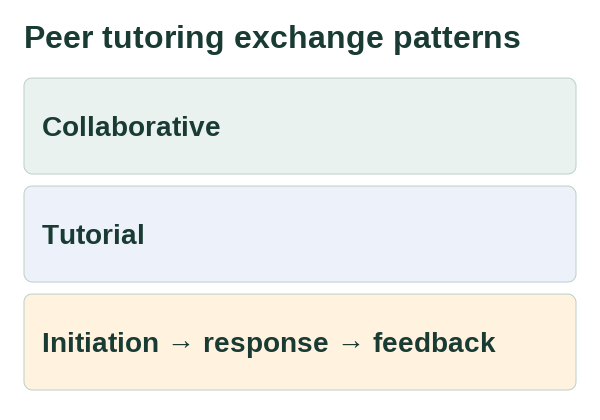
One study looked at 24 secondary students working in 12 pairs to learn Catalan. The researchers watched how the pairs worked together. Two patterns appeared. The tutor tended to take an active part, and the tutee tended to react. Tutors tended to send cooperative messages. Tutees tended to start collaborative ones. A step-by-step analysis of the exchanges found three kinds of sequence. They were collaborative, tutorial, and one of initiation, response and feedback.[11]
In a 1998 experiment, seventh graders were paired with classmates of the same ability. They used three versions of mutual peer tutoring. In one version, the partners only explained material to each other. The group that used sequenced inquiry plus explanation also learned to ask its questions in a set order. The tutoring sessions came after teacher-led science lessons and ran for 5 weeks. Students trained in the ordered questioning did better than the other groups at building knowledge. This held during the sessions and on written measures.[12]
The 1998 study showed that same-age peers of equal ability can support each other's higher order thinking. This works when the interaction is structured for it.[12] A later project aimed to help student tutors plan sessions before they happen. It used concept maps and knowledge maps.[13]
Observers have also listed the specific behaviors that show up in tutoring pairs and checked which ones predict learning. The behaviors used most often and the behaviors that predicted achievement overlapped only partly.[14]
Training tutors and the quality of talk
Training and experience change the quality of student explanations during tutoring. In a 1994 study, classrooms were assigned at random to peer tutoring. Some had prior training and experience, and some did not. The peer-tutoring teachers taught students a set verbal routine that included step-by-step feedback. Students then tutored each other on math operations twice a week for 10 weeks. The transcripts also showed a limit. In both conditions, student explanations were mostly step-by-step methods rather than underlying ideas.[15]
Researchers interviewed the tutors. They also made video recordings of three to four sessions for each one. The tutors' views did not fully match across the three cases. The study suggests training could look at each tutor's existing views. These views may predict natural teaching preferences. General training models often ignore those views that already exist.[16]
For elementary classrooms, a 2019 essay offers teachers a planning framework. It draws on cognitive load theory. The framework is meant to help working teachers prepare students to tutor well.[17]
Reciprocal and structured tutoring with rewards
Reciprocal peer tutoring is a strategy in which students exchange roles during sessions. A 1989 component analysis tested the strategy. It randomly assigned 100 students to one of four groups. The groups were built to compare the full strategy with its supposed parts. These were working in pairs, mutual exchange between partners, and a structured learning format. Earlier work had reported that the strategy produced cognitive gains, lowered subjective distress and raised course satisfaction.[18]
A 1992 study asked whether the structure of reciprocal tutoring or the group reward did the work. Sixty-four students were drawn at random from a pool of 80 fourth and fifth graders judged at high risk for academic failure. Students who received both parts reached the highest levels of accurate mathematics computation.[19]
A 1978 study paired college students. Both partners got bonus points only when each met a mastery criterion. Twenty-one undergraduates in a three-credit educational psychology course served as subjects. The class met for one and a half hours each weekday over five weeks. Pairs earned five bonus points on an exam only if both members scored 90% or better. Compared with the baseline, every student paired with a high-scoring partner improved. Students who studied alone did not improve. The report calls its between-group conclusions tentative, because students talked across groups about the procedures and were not equally assigned to the tutored and independent groups.[20]
A 1976 study gave second graders tokens they could not trade in for reducing disruptive classroom behavior. Four kinds of tutoring were then introduced in turn. Fifth-grade peers tutored either noncontingently or contingently. College students also tutored either noncontingently or contingently. Disruptive behavior did not differ much between children tutored by fifth graders and those tutored by college students. Tutoring that depended on the children's behavior significantly reduced disruption.[21]
Research
How large are the academic effects
One review combined 26 such experiments. They covered 938 students in Grades 1 to 12. Across 195 comparisons of phases, the effect size was 0.75. The confidence interval was 0.71 to 0.78.[2] A confidence interval is a range of values below and above an estimate that has a given probability of including the true value.[22] Within the group of students with disabilities, the largest benefits went to those with emotional and behavioral disorders.[2]
A 2021 meta-analysis looked at 46 single-case studies. It covered at-risk students and students with disabilities together.[23] A meta-analysis is a statistical method that combines the estimates from two or more similar studies into one overall estimate of an effect.[24]
Peer tutoring improved both academic and social-behavior outcomes by a statistically significant amount. The academic effect was slightly larger. The academic benefit also grew during the treatment phase. This suggests the intervention becomes more effective over time.[23]
A 2017 meta-analysis of 50 independent studies of math peer tutoring found that 88% of the programs had positive effects on performance. Several features did not change the result. These were the ages of the participants, their roles, whether tutees were disabled or at academic risk, and the length and frequency of sessions. Other features did matter. These included the educational stage, the study design, the program's duration, the tutors' level of knowledge, the time of day and the sample size.[25]
Emergent bilinguals, students still learning the language of instruction, show moderate gains. A 2025 meta-analysis looked at 14 studies published between 2010 and 2021. It found an overall effect size of 0.58, with a confidence interval of 0.22 to 0.94. Reading outcomes alone showed an effect size of 0.62. The confidence interval was 0.24 to 1.00. Nearly all the studies involved Spanish-speaking students. Most focused on elementary-aged children. Few studies addressed preschool or secondary-level emergent bilinguals. Only a limited number of effects came from students with disabilities.[26]
Do tutors learn as much as tutees
In a 1977 experiment, three elementary students learned spelling words in three ways. They tutored another child, were tutored, or did neither. Their spelling improved by nearly the same amount on words they taught as on words they were taught. It did not change on words they neither gave nor received. Dineen, Clark and Risley concluded that tutoring pays off in school for the student who gives it. It also helps the one who receives it.[27]
In total, 146 students took part in cooperative learning in pairs for 12 weeks. Another 149 served as a comparison group. On independent standardised reading comprehension tests, the students in pairs gained much more than the comparison classes. The gains were greater for tutors than for tutees.[28] A study of 373 Korean college students used a questionnaire before and after. It found that peer tutoring improved academic achievement and also communication and collaboration skills.[29]
On a practical test, the tutored group averaged 73.64 per cent. Students not tutored averaged 46.20 per cent, and the previous year's group averaged 56.83 per cent. The tutors themselves averaged 82.00 per cent. Students who did not act as tutors averaged 64.88 per cent.[30] Higher achievers tutored for many terms and across different subjects. The evidence suggested the experience expanded their academic expertise.[4]
A 2007 review of research on tutor learning found that tutor gains have been seen across diverse settings. The size of these gains is often underwhelming. The review examined two activities thought to support tutor learning: explaining and questioning. It found that tutors tend to show a widespread bias toward simply telling knowledge.[31]
Tutors also learned by revisiting basics and linking conceptual areas. They tested and clarified their understanding, and rehearsed ideas repeatedly. Long answer questions showed that tutors thought about their own learning. Rehearsing tutoring sessions in their heads also helped them spot gaps in their subject knowledge.[32]
What changes the results: age, training and setting
On standardized testing, oral reading grew by 0.19 years in the control group. Peer tutoring plus rewards at home produced a gain of 1.27 years.[44] A review of 20 articles on secondary settings found that peer tutoring generally improved the academic performance of students with mild disabilities. That review judged the practice to be evidence-based for this group.[45]
At undergraduate level, a survey looked at a peer tutoring project. The project served students with learning disabilities.[46] In a medical program at the University of Brasilia, 26 teacher-tutored groups were compared with 50 groups that had both teacher and peer tutoring. The comparison ran across 14 successive classes. Problem-solving test scores did not differ significantly between the two stages. Self-evaluations of skills did not differ significantly either. Scores for how meaningful the course felt and how useful group work was were much higher in the peer-tutoring stage.[47]
The secondary review found that training tutors in how to teach had a large effect on tutee outcomes.[45] Two studies with eight-year-old children compared two kinds of training. One taught only procedures; the other also taught the principles behind the task. Children gained from detailed training when an adult gave them the principles. Children were told to make up their own principles. Their performance was no better than after plain training. The training conditions differed in quality. These differences matched how tutors and tutees interacted. The researchers concluded that children who understand a task and why it works are better able to teach it to others.[48]
One study looked at low-performing first graders. Trained peer tutors taught number line steps for missing addend problems and gave feedback on accuracy. Student performance improved. The students, their tutors and their classroom teachers all liked the procedures. The researchers noted that math teaching often leaves too little time for practice.[49]
A home-based study taught math skills to 4 girls. The girls lagged in mathematics and had histories of abuse or neglect. The girls, who lived in the same home, were paired into tutoring dyads. Each girl served as tutor at some points and as tutee at others. An expert tutor first gave the designated peer tutor several 3-minute sessions. The sessions covered three or four mathematics skills. Participants improved on all target skills. Some skills needed extra work to reach accuracy. After 3 to 5 months without practice, tutors and tutees kept their accuracy on 7 of the 12 skills assessed.[50]
The program was carried out very faithfully to the peer tutoring elements. But learners spoke little with each other in their heritage language. More Turkish prompts from the coaches did not lead to more bilingual talk from the learners.[51]
A study of advanced financial accounting students found that case studies should match students' abilities. Regular guidance from instructors also helps tutors feel confident.[52] For college students with disabilities, an exploratory study found academic and social benefits for tutees and tutors. That study suggested professional guidance to reduce tutoring problems and increase benefits.[53]
Reading and literacy outcomes in detail
One line of reading research tests a fixed routine that tutors follow when a tutee stumbles. The procedure is called Pause, Prompt, and Praise. In a 1993 study, five pairs of 13-year-old students who read below average used these procedures. Earlier work taught the procedures to peer tutors all at once. This study taught them one part at a time. Each of the five tutors learned all parts of the procedure. Reading accuracy and understanding rose a lot for tutors and tutees alike.[54]
A 2011 meta-analysis asked what research shows about tutoring teenagers in literacy. The reviewers found 152 published studies. Twelve met their strict criteria for inclusion. Results varied across those 12 studies. Benefits appeared for cross-age tutoring, for reading, and for small programs of long duration.[55] A 2017 article describes peer tutoring as a reading technique. Making up questions and answering them lets students restate what they know about a text.[56]
Vocabulary knowledge also matters, because idioms are common in classroom language. Students with literacy or language weaknesses often struggle with them. Four 7th-grade girls took part in a single-subject study during an intensive reading class. Their mean age was 12 years and 6 months. After classwide peer tutoring began, understanding of most idiomatic phrases rose. Under visual analysis it stayed largely stable. The researchers found the approach adaptable, workable and quick to fit into an ordinary classroom.[57]
A 2019 experiment in Grade XI compared groups given peer tutoring with groups taught without it. Linear regression predicted that tutored male students scored 16.376 points higher (r = 0.860). Tutored female students scored 12.183 points higher (r = 0.813) than untutored peers.[58]
A 2025 mixed-methods study surveyed 40 Indonesian students of English as a foreign language who were tutored. It also interviewed 4 peer tutors. Those students struggled mainly with vocabulary, grammar, sentence structure and translation. Their difficulties were connected to one another. Most found tutoring beneficial, citing a supportive setting, personalized guidance and less pressure than with a teacher, but some reported minimal or no improvement, linked to low engagement or scheduling conflicts.[59]
Literacy tutoring can also aim at independence rather than skills alone. A 2007 article examines an elementary teacher's peer tutoring reading program. The article says the program developed learners' autonomy and self-esteem. The article says students lose interest when skills are drilled apart from real uses.[60]
Tutoring students with disabilities and special needs
Peer tutoring has been studied with students who have learning disabilities, students with emotional or behavioral disorders, and students in inclusive classrooms that mix those with and without disabilities.[61][62][63] A 1990 review weighed three earlier reviews, six essays and nine studies that collected data. Every study backed tutoring, though each stressed a different benefit. The benefits named were integration of these students, self-esteem and achievement. Others were classroom management and a reinforcing system for learning. The review described working models for tutoring learning-disabled students. It also offered advice on setting up programs in regular and special education.[61]
Students with emotional or behavioral disorders often show reading problems that feed a pattern of academic underachievement and school failure, and research on effective reading interventions for them has been limited. One program tested with students who have learning disabilities is Peer-Assisted Learning Strategies, or PALS. It combines teacher-led lessons with peer tutoring. One study looked at kindergarten PALS. The peer tutoring phase raised scores on letter-sound and blending tests for kindergarten students with emotional or behavioral disorders. The results suggested K-PALS is a promising way to raise reading performance for these students. They are at risk for reading failure.[64]
A 2006 review covered studies from 1972 to 2002. In them, students with emotional or behavioral disorders were tutors, tutees, or both. The studies used varied models. These included cross-age tutoring, where older students tutor younger ones, and same-age tutoring, where students of the same age tutor each other. Some studies added a reciprocal part. Students swapped roles, so each served as tutor and as tutee. Taken together, the results suggest these students can tutor and be tutored in reading, writing and math. Results in social studies looked promising. Recent research also looked at direct teaching of strategies in content-area classes. This went beyond basic skill practice and drill of facts.[62]
An earlier review of tutoring programs involving behaviorally disordered students reached a more mixed verdict. It found that tutoring helps the tutee's academic work. Under some conditions it also helps the tutor's schoolwork. It can improve relations within the pair and attitudes toward the subject. By contrast, informal reports of better general social functioning, self-esteem included, had no support in the research evidence. Little was known about how tutoring compares with other methods. This covers academic and social benefits. Teachers were therefore advised to check results often.[65]
One study looked at peer tutoring with a character education approach in inclusive classrooms. It covered nine elementary schools in East Sumba Regency, with 30 teachers, 525 students and 98 disabled students. The method was combined with various learning techniques. Character changed among students with special needs. It also changed among students without them. The study recommended peer tutoring for improving learning skills and forming student character. It called for future work on how peer tutoring shapes emotional intelligence in inclusive classes.[63]
A 2020 analysis called peer tutoring a flexible strategy. In it, students act as academic tutors and tutees. It set out the types used in inclusive classrooms and the conditions for their effectiveness.[66]
Observers, inference and untaught skills
One line of research asks whether students who watch a tutoring session also learn from it. A 2026 study tested learn units delivered by peers on written spelling. Nine fifth-grade students took part. All of them had already shown observational learning. The measure was the number of correct written spellings by tutors, tutees and observers.[67]
All three observers learned some of those words, but not all of them. In the second experiment, observers also wrote down the correct spelling. They did this for each item presented during the session. After that change, all tutors, tutees and observers learned all ten target words. The study concluded that showing observational learning on its own was not enough for students to gain from group instruction as observers. Teachers also need to design sessions so that observers watch the right features of the task.[67]
A second line of work asks whether tutoring can produce inference-making, in which students derive relations they were never taught directly. A 2022 paper reported two experiments with 8 third-grade participants, who acted as both tutors and tutees in reciprocal sessions. In Experiment 1, one tutor taught fraction and picture pairs. The other taught percentage and picture pairs. In Experiment 2, each tutor taught one half of each set of relations. In both experiments, tutors learned all the relations they taught. All participants also formed equivalence relations. They also showed transfer of functions for comparative relations. Comparing the two experiments, the researchers advised instructors to weigh how hard each relation is to train. This matters when arranging tutoring for inference-making.[68]
In practice
Classwide peer tutoring in classrooms
Teacher instructional procedures raised spelling performance above pretest levels. Classwide peer tutoring did the same. Peer tutoring produced statistically greater gains than the teachers' procedures. This held for both the low and the high groups formed on pretest levels. These results held for groups, classes, individuals and years during the project. Participants were generally very satisfied with the program.[69]
An earlier experiment with fourth and fifth graders compared two daily math sessions. In both, students worked problems of the same type and difficulty. Students tutored each other over the same problems they later worked. Accuracies and rates of performance were higher in the tutored sessions. An independent-study control condition kept the tutoring. It stopped students from interacting. Its results suggested that interaction between students caused part of the gains.[70]
A 1992 study asked how differences in carrying out the program relate to what students gain. Five volunteer elementary teachers were trained. Their use of the method was tracked for 19 weeks in a row during 1 school year. Specific differences in how tutoring was carried out were linked to how students responded. Different teachers' applications produced different levels of student outcome.[71]
Peer-assisted learning strategies for reading
One study included 20 first-grade teachers and 96 first-grade students. Of the students, 46 were low-achieving, 20 average-achieving and 20 high-achieving. Ten teachers used First-Grade PALS during normal reading time, and 10 taught reading as usual. All learner types gained from First-Grade PALS. Low-achieving students gained the most.[72] Results split by ethnic subgroup showed a different pattern of response to PALS for Hispanic and non-Hispanic students.[73]
Nine classes used PALS and 9 formed a contrast group. Sessions ran five times every 2 weeks for 16 weeks. PALS students gained more in reading comprehension. They also said more positive things about putting in effort to read better. The two groups grew about the same in reading fluency. They held similar beliefs about becoming better readers.[74]
An earlier review gathered 11 studies of peer tutoring in reading for students with disabilities. Peer tutoring was not more effective than other approaches led by a teacher. These included one-to-one teacher tutoring and small group instruction run by the teacher. Two features consistently produced strong effects: pairing students with disabilities with normally achieving peers, and letting the students with disabilities act as tutor at least part of the time.[75]
One classroom action research study took place at a Makassar high school. The mean score rose from 23.1 in the first cycle to 73.1 in the second. Seventeen students met the minimum completeness standard in cycle one, and 22 met it in cycle two.[76]
Another study picked 72 students at random from 253 tenth graders. It compared PALS with a control class. The PALS class averaged 38.44 on the reading comprehension test. The control class averaged 28.64.[77]
Mathematics, science and professional courses
In a modelling course, students worked in self-selected groups to build mathematical models. They studied published models and prepared a seminar for their peers. The evaluation suggested that students who prepared a topic understood it very well. The rest of the class gained most from the written notes prepared for them.[78]
A randomized study of 96 eleventh graders in chemistry lab work compared three arrangements. It ran over four weeks and eight lab tasks. Students in both the collaborative and the peer tutoring groups did better than students learning alone with hints. A delayed post-test came three months later. On it, the peer tutoring group outscored the collaborative group.[79]
In a two-year human anatomy and physiology program, students who had taken the course before were hired each year. They led optional discussion sessions. Students who attended more often tended to have higher course averages and overall grade-point averages. Post-test scores improved only a little.[80]
The setting was an internal medicine skills lab. There, 14 senior students were prepared by consultants to teach small groups of 3 to 4 students. Of 127 participating students, 66.9% answered a web survey. Acceptance of the model was very high, at 5.69 on a 6-point scale. Self-confidence ratings rose significantly for each trained skill. Also, 82% of tutees thought the peer teaching model was sufficient. Only 1% wished for skills training to be given by faculty staff alone.[81]
At the University of Liverpool, peer tutors were trained to lead group sessions in conceptual design. That is the early stage where ideas are generated and judged before one solution is chosen. Students improved their problem-solving skills and grew more confident. They also took more charge of their own learning. Tutors reported becoming more responsible and employable, improving their communication and leadership skills, and deepening their own understanding of design.[82]
The course was a first-year multidisciplinary design course in fall 2017. Fourth-year students tutored teams of four or five students. All involved groups appreciated the experience. It allowed more weekly supervision hours at low cost, though the effect on learning quality was not measured.[83]
Nursing programs have used several tutoring formats, not just one. Each pattern required different tutor skills and focused on different outcomes. All of them contributed to improved academic skills and performance.[84]
A formal program for undergraduate nursing students surveyed tutors and tutees. It found no statistically significant differences in their learning and studying strategies. Both groups used mostly superficial strategies. Yet both rated the program very positively.[85]
A review of literature from 2002 to 2012 found nineteen articles on peer-assisted learning in medical degrees. They covered teacher training, peer teaching and peer assessment. Reports of how tutors were recruited and trained, and of what they gained, varied widely. Burgess, McGregor and Mellis found no strong evidence that being a peer tutor raises a student's own exam performance.[86] A separate review of 19 studies found that peer teaching in highly selective contexts produced short-term learner outcomes comparable with faculty-based teaching. Little is known yet about how peer teaching in medical school affects students over the long term.[87]
In a patient-centred interviewing project, third-year students co-led sessions for first-year students. They did this after a preparatory workshop. More than 56% of students completely met all eight learning objectives. For four objectives, significantly more students in medical teacher groups did so. Two months later, trained observers and simulated patients rated interviewing skills the same in both groups. Simulated patients were happier with interviews from some students. These were students whose groups peer tutors had facilitated.[88] The tutored group showed moderate gains in total course performance. The gains were statistically significant, and they appeared in both semesters.[89]
Designing a program: roles, materials and support
Reciprocal peer tutoring is a common form of Peer-Assisted Learning Strategies. Students take turns as tutor and tutee. A 2026 review of studies from 2016 onward reports that careful matching of partners, scaffolding and monitoring can improve learning equality. This holds in inclusive and culturally diverse classrooms. The same review stresses tutor training, flexible sessions and systematic implementation as conditions for consistent gains.[90]
A 2025 case study looked at fourth-grade reading at a public elementary school in Indonesia. Peer tutoring ran through a team called Antaca, with a diagnostic test first, daily observations and informal interviews.[91] A 2026 study of 181 students in six schools compared standard peer tutoring with tutoring plus explicit training in mathematical discourse strategies. These are the ways students talk through problems. Both groups improved their problem solving. The group with discourse training gained much more.[92] A study at a vocational school in Payakumbuh, Indonesia, gave 30 students a structured module. They also received peer tutoring in basic electrical engineering.[93]
Advice is not always accepted. A 2005 study of a graduate writing centre examined how tutees resist it. Audio recordings of sessions between a tutor and a graduate student were written out in detail. They were analyzed with conversation analysis, a method for studying talk turn by turn. Tutees resisted advice on general academic writing, on content and on the mechanics of writing. Two things explained the pattern. One was the tutee's claim about identity. The other was competing expertise held by tutor and tutee.[94]
A 2007 study looked at tutors and students in higher education classrooms. It found that interaction did not always run smoothly. Tutors often spent an inordinate amount of time on impression management, that is, managing how they were seen by students. The tutor and student relationship could be full of misunderstanding and power struggles.[95]
The module paired tutoring experience with seminars on the psychology of adult learning and on learning through participation.[96] A 2021 study of 80 tenth-grade chemistry students in Mataram, Indonesia, found that positive interdependence, the sense that group members need one another, did not produce better learning outcomes. Group leaders scored lower than group members. The study suggested that habits of arguing a case within the group need to be built for interaction to be meaningful.[97]
College, medical and vocational settings
In higher education, peer tutoring is often described as a way to extend learning beyond the classroom. It also goes outside the teacher-student relationship. A peer tutor is a student at a similar level of achievement as the students being helped. The tutor acts as a guide and role model.[98]
The report names several key elements for success. They are trained tutors, well-informed students, structured sessions, personal support and steady feedback.[99] At a technical university, a peer-to-peer model was organized around academic support, career counseling, soft skills development and building a student community.[100]
Medical schools have built peer tutoring into their curricula and measured what it does.[101][102][103][104] At Imperial College London, first-year students and their peer tutors in clinical communication teaching reported a very positive experience.[101] In a pilot program at a new osteopathic medical school, 51 students took part during the 2013-2014 academic year. Of them, 39 answered a satisfaction survey. Course grades for tutored courses changed significantly at 3 to 4 and 8 to 9 months. This was among tutored students most at risk of failure (P =.001). Tutor course grades showed no significant change in any course (P =.445).[102] In a Korean medical college, 40 students took part. Both tutors and tutees reported gains in schoolwork, relationships and emotional aspects.[104]
Chemistry and statistics courses have produced their own accounts of peer tutoring.[105][16][106][107] The University of Jyväskylä has run paired peer tutoring in chemistry orientation since 2016. In it, two student tutors guide a group of first-year students. Questionnaires from 39 tutors between fall 2018 and 2022 gave paired tutoring a mean rating of 4,8 on a 5-point scale. It also helped settle difficult circumstances.[105] A multiple-case study looked at three graduate chemistry tutors. Each tutor's views of tutees and of the tutor's role showed up in the teaching behaviors they used during sessions.[16]
In a graduate statistics class, students were matched on a scholastic ability test. They joined a peer tutoring class or a control class. Achievement differed significantly in favor of the peer tutoring group. Anxiety and attitude toward the subject also differed between the groups.[107]
An online statistics course compared three approaches. These were usual online learning, a usual flipped class and a new kind of flipped class. The new flipped class differed a lot from the other two methods.[106]
Vocational programs have used peer tutoring for hands-on machine work.[108][109] A machining workshop had eight manual lathes. There, 32 students learning lathe technique took part in three action research cycles. The steps were choosing a tutor, forming groups, discussing assignments, having tutors guide classmates, and observing each student. Attitudes, knowledge and skills improved little by little. Students met the minimum competency criteria.[108]
A two-cycle study of 34 vocational high school students reported gains of 88.23% in knowledge and 91.17% in skills.[109] A reflective account describes peer-assisted learning on a UK veterinary degree course. It discusses possible reasons the activities there succeeded or failed.[110]
Cross-age tutoring and multi-grade classrooms
A 2023 observational study looked at a cross-age mathematics program. It ran in elementary and middle schools serving mostly Hispanic students. Observers watched classroom practices and the behavior of teachers and students during lessons. The strengths included positive emotions and good relationships among students. The classroom climate also felt warm and supportive. The same observations found several weaknesses in how the program was carried out. The researchers said teachers could use these findings to improve later mathematics tutoring programs.[111]
Multi-grade classes, in which one teacher teaches several grade levels together, have become more common as school-age populations decline. A 2025 study built a teaching model for such classes around peer tutoring activities. The model has stages: analyzing the multi-grade learners, setting a common theme with grade-specific goals, preparing the tutoring, running the tutoring activities, and reflecting and evaluating. Experts who had taught multi-grade classes reviewed the model. It was then tried in a multi-grade class at N Elementary School. The final version was reported as positively effective for both students and instructors. The developers proposed it as a strategy. It helps teachers meet the demands of multi-grade teaching. They also proposed it as a form of differentiated instruction.[112]
Peer tutoring in music and physical education
Peer tutoring has been studied in music lessons. It has also been studied in learning a motor skill, such as a table tennis stroke.[113][114] A 2023 literature review examined 51 studies of peer tutoring in music education. They appeared from 1980 to 2021 in peer-reviewed journals, dissertations and books. The review covered formal and informal music education at all academic stages, not only the school years. It reported benefits for music learners. It also listed limitations found in the studies it examined. The review discussed pairing students as tutor and tutee. This pairing might lower barriers to taking part in music education. It also named specific elements that teachers should consider to get the most from this teaching method.[113]
A French experiment looked at students tutoring each other in table tennis. The study compared pairs trained in tutoring, pairs left to tutor on their own, and a control group. It measured what students could state in words, their management skills, the effectiveness of their actions and the soundness of their choices. Lasting gains in both movement and knowledge appeared only when the tutors had been trained, the study found. The study checked whether gender changed the effect of the training. It found no interaction between condition and gender. The researchers discussed the results in light of work on the tutor effect. They argued for building tutors' knowledge and metacognition.[114]
What this looks like when you study
In a Sydney medical school in 2014, Year 3 students tutored Year 1 students. Year 4 students tutored Year 2 students. All took part voluntarily. Burgess and colleagues also reported that junior students described their learning as qualitatively different from traditional teaching by faculty.[5]
Belsi and Murtagh compared first-year students taught by peer tutors with those taught by course tutors. They found no significant difference between the two groups. Peer tutors said tutoring helped them understand teaching. It also improved their leadership and feedback skills. They also said it raised their confidence. It helped them think about their own communication skills.[101]
Since 2016, pairs of student tutors have led groups of first-year students in a chemistry orientation at the University of Jyväskylä. Tutors said a partner helped lower anxiety in new situations. It made hard situations easier to handle. The main challenges were being paired with someone unfamiliar and sharing work fairly. Others were coordinating schedules and managing different working styles.[105]
Evans and Moore built a web-based system. In it, a student had to answer a problem correctly on a computer before becoming eligible to teach it.[115] Seventh graders were trained to ask comprehension questions and questions that provoke thought. They did better than students who only explained.[12]
Later developments
Online, electronic and blended peer tutoring
A 2013 paper noted that face-to-face peer tutoring has well-documented positive effects. Studies of computer-aided peer tutoring are less common. Technology can also give students and instructors a lot of information about tutor skill and tutoring methods.[115] A 2019 paper reported that a review of the literature had found little research. It looked at how electronic peer tutoring affects student learning.[116]
One web-based system was called Opal (Online Peer-Assisted Learning). It was built for problem-based undergraduate courses. Each tutoring interaction on Opal centers on a single problem. Students must solve that problem correctly on a computer before they are allowed to teach it.[115]
A 2008 model for organizing peer support in e-learning systems works at two levels. At the first level, future peer tutors are picked using a mix of workload and competency indicators. At the second level, those tutors get tools and guidelines for the task at hand. The model assumes that lifelong learners can help one another if they are carefully taught and supported. Its designers built it because adding e-learning often increases the time staff spend on tutoring.[117]
A 2019 paper describes a smartphone app called MENTOR (Mobile Education Networked Tutoring On Request). It is for face-to-face and remote peer tutoring. The app aims to predict students' tutoring needs by matching tutors with tutees. It coordinates face-to-face sessions using location data from smartphones. It also supports remote sessions online. The paper notes a lack of tech tools to support online peer tutoring sessions and appointments at a distance.[116]
Reciprocal peer tutoring gives students both tutor and tutee roles. It has been tried over computer networks. A 1999 study used a broadband network with high-quality video conferencing, shared applications and multimedia resources. It was for language learning in French, English and Spanish.[118]
A 2022 paper reports a classroom study. It added a reciprocal peer tutoring activity to Cognitive Tutor Algebra. The study randomly put 62 participants into three conditions. One group got adaptive help for peer tutoring. One learned alone. All three conditions produced significant learning gains. Final outcomes did not differ between them. Tutors learned when they reflected on the problem-solving steps their tutees took. Tutees learned when the tutor's help answered those steps.[119]
A 2016 paper argues that peer tutors in higher education often get too little support. It says their role should be seen as that of learning and teaching partners to lecturers and students. It describes a tutor development program at a South African writing center. The program offered ongoing, cumulative learning through scholarly research and practice-based training. Tutors wrote narrative reports. These showed the kinds of growth in their thinking and action that such training made possible.[120]
A 2024 paper describes a peer tutoring program built in 2020 at the University of California, Irvine, School of Medicine. Medical students were the teachers. All of its tutors, 100%, were satisfied with their positions overall. More than 85% learned new skills, and more than 88% felt they were strong teachers. More than 88% felt they knew the medical curriculum better. All 100% kept their interest in a future role as a medical educator.[121]
Criticism
Criticisms, limits and open questions
A 2015 review argued that earlier meta-analyses, which pool the results of many studies, had theoretical and methodological flaws. That review said the earlier work had not used both fixed and mixed effects models, two statistical ways of combining study results. It also said earlier reviews had not tested common program features as moderators, meaning variables that may change how large an effect is. The earlier reviews had not properly addressed publication bias, the tendency for studies with positive results to be published more often. Many studies were also limited to particular groups and subjects. These were mainly mathematics and reading. Some were confounded, or mixed up, with other interventions. Examples are cooperative learning and adult-led tutoring.[122]
A study video-recorded nine tutor groups at one medical school between October 2014 and May 2015. The tutors were near-peers, clinical faculty and basic science faculty. All tutors tried to convey authority or insider status about the goals of medical education. Students prompted these displays by expressing gratitude and asking questions. The study noted that explanations of tutor effectiveness had been built largely from student surveys, focus groups and interviews. They had not come from watching sessions.[123]
Common misconceptions
Fuchs and colleagues compared trained and untrained peer tutoring pairs. They found that the experienced pairs explained material in a more interactional style. One study looked at sixteen classrooms. Experienced pairs gave explanations in a more back-and-forth style that applied sounder teaching principles. Even experienced students gave explanations that were mostly step by step, not about ideas.[15]
Key studies
| Year | Study | Sample | Design | Finding |
|---|---|---|---|---|
| 1991 | Barron & Foot[48] | Eight-year-old children in tutor-tutee pairs | Two studies comparing training types | Elaborated training in principles benefited tutors more than non-elaborated training. |
| 1994 | Kamps et al.[33] | 3 high-functioning students with autism and their typical peers | Multiple baseline design across subjects with a reversal | Classwide peer tutoring increased reading fluency and correct responses for students with autism and peers. |
| 1994 | Fuchs et al.[15] | Randomized study with videotape analysis | Experienced dyads provided explanations in a more interactional style with sounder instructional principles. | |
| 1998 | King et al.[12] | Seventh graders in pairs | Experimental study with three mutual peer-tutoring conditions | Students trained in sequenced inquiry plus explanation outperformed others on knowledge construction. |
| 1998 | DuPaul et al.[42] | Classwide peer tutoring contrasted with typical instruction | Under classwide peer tutoring, most of the 18 children with ADHD spent more time actively engaged in academic tasks and less time off task. Half of the children with ADHD improved in math or spelling, as measured by a treatment success index. | |
| 2005 | Sáenz et al.[3] | Randomized study of 132 Spanish-speaking English language learners in Grades 3 to 6 | PALS students outgrew contrast students on reading comprehension, and effects were not mediated by student type. | |
| 2008 | Klavina & Block[37] | Elementary school age students with severe and multiple disabilities and peers without disabilities | Study in inclusive physical education settings with three support conditions | Peer-mediated and voluntary peer support increased instructional and physical interactions, but social interactions remained low. |
| 2008 | Weyrich et al.[81] | 127 medical students and 14 senior student tutors | Pre/post web-based survey and a focus group | Acceptance was very high (5.69 on a 6-point scale) and self-confidence ratings increased significantly for each trained skill. |
| 2013 | Bowman-Perrott et al.[2] | Meta-analysis of 26 single-case experiments with 938 students in Grades 1 to 12 | Peer tutoring produced a TauU effect size of 0.75 (CI95 = 0.71 to 0.78), indicating moderate to large academic benefits. | |
| 2016 | Burgess et al.[5] | 108 medical students (42 tutors, 66 tutees) at Sydney Medical School | Focus groups, with framework analysis used to code and categorise the data into themes | Tutors valued practising knowledge and teaching skills; tutees valued extra practice and patient contact. |
| 2018 | Belsi & Murtagh[101] | First-year students and peer tutors at Imperial College London | Mixed methods with questionnaires and focus groups | No significant differences between students taught by peer tutors and course tutors. |
| 2025 | Romero et al.[26] | 14 studies of emergent bilingual students from preschool to Grade 12 | Meta-analysis | Peer tutoring yielded a moderate effect size of g = 0.58 on academic outcomes. |
| 2025 | Valto & Nuora[105] | 39 tutors in chemistry education at University of Jyväskylä | Qualitative and quantitative questionnaires from 2018 to 2022 | Tutors rated paired tutoring as meaningful with a mean of 4,8 on a 5-point scale. |
| 2026 | Sun & Chang[67] | 9 fifth-grade students who demonstrated observational learning | Two experiments with pre/post and multiple probe designs | All tutors, tutees and observers acquired correct spelling of all ten target words after intervention. |
See also
References
- Greenwood, C. R., Delquadri, J. C., & Hall, R. V. (1989). Longitudinal effects of classwide peer tutoring. Journal of Educational Psychology, 81(3), 371-383. doi:10.1037/0022-0663.81.3.371
- Bowman-Perrott, L., Davis, H., Vannest, K., Williams, L., Greenwood, C., & Parker, R. (2013). Academic Benefits of Peer Tutoring: A Meta-Analytic Review of Single-Case Research. School Psychology Review, 42(1), 39-55. doi:10.1080/02796015.2013.12087490
- Sáenz, L. M., Fuchs, L. S., & Fuchs, D. (2005). Peer-Assisted Learning Strategies for English Language Learners with Learning Disabilities. Exceptional Children, 71(3), 231-247. doi:10.1177/001440290507100302
- Sobral, D. T. (2002). Cross‐year peer tutoring experience in a medical school: conditions and outcomes for student tutors. Medical Education, 36(11), 1064-1070. doi:10.1046/j.1365-2923.2002.01308.x
- Burgess, A., Dornan, T., Clarke, A. J., Menezes, A., & Mellis, C. (2016). Peer tutoring in a medical school: perceptions of tutors and tutees. BMC Medical Education, 16(1). doi:10.1186/s12909-016-0589-1
- Saunders, D. (1992). Peer tutoring in higher education. Studies in Higher Education, 17(2), 211-218. doi:10.1080/03075079212331382677
- Jellison, J. A., Draper, E. A., & Brown, L. S. (2017). Learning Together: The Instinct to Do Good and Peer-Assisted Strategies That Work. Music Educators Journal, 104(2), 15-20. doi:10.1177/0027432117713823
- Nore, G. (1990). Peer Tutoring in Vocational Literacy Skills. TESL Canada Journal, 7(2), 66. doi:10.18806/tesl.v7i2.569
- Babiuk-Massalska, A. (2019). Does peer tutoring in kindergarten exist? Thinking around the tutoring concept. Studia z Teorii Wychowania, X(4 (29)), 63-84. doi:10.5604/01.3001.0014.1074
- Jenkins, J., & Jenkins, L. (1985). Peer tutoring in elementary and secondary programs. Focus on Exceptional Children, 17(6). doi:10.17161/foec.v17i6.7471
- Duran, D. (2010). Cooperative Interactions in Peer Tutoring. Middle Grades Research Journal, 5(1), 47-60. doi:10.1108/mgrj-02-2010-0005
- King, A., Staffieri, A., & Adelgais, A. (1998). Mutual peer tutoring: Effects of structuring tutorial interaction to scaffold peer learning. Journal of Educational Psychology, 90(1), 134-152. doi:10.1037/0022-0663.90.1.134
- Cui, Y. (2023). Supporting peer tutoring with graphical organisers and knowledge maps. ASCILITE Publications, 362-366. doi:10.14742/apubs.2023.555
- McKellar, N. A. (1986). Behaviors Used in Peer Tutoring. The Journal of Experimental Education, 54(3), 163-167. doi:10.1080/00220973.1986.10806416
- Fuchs, L. S., Fuchs, D., Bentz, J., Phillips, N. B., & Hamlett, C. L. (1994). The Nature of Student Interactions during Peer Tutoring with and without Prior Training and Experience. American Educational Research Journal, 31(1), 75. doi:10.2307/1163268
- Velasco, J. B., & Stains, M. (2015). Exploring the relationships between perceptions of tutoring and tutoring behaviours: a focus on graduate students serving as peer tutors to college-level chemistry students. Chemistry Education Research and Practice, 16(4), 856-868. doi:10.1039/c5rp00103j
- Russo, J. A. (2019). Peer tutoring in the elementary classroom: Putting (a) theory into practice. McGill Journal of Education, 53(3). doi:10.7202/1058419ar
- Fantuzzo, J. W., Riggio, R. E., Connelly, S., & Dimeff, L. A. (1989). Effects of reciprocal peer tutoring on academic achievement and psychological adjustment: A component analysis. Journal of Educational Psychology, 81(2), 173-177. doi:10.1037//0022-0663.81.2.173
- Fantuzzo, J. W., King, J. A., & Heller, L. R. (1992). Effects of reciprocal peer tutoring on mathematics and school adjustment: A component analysis. Journal of Educational Psychology, 84(3), 331-339. doi:10.1037/0022-0663.84.3.331
- Coyne, P. D. (1978). The effects of peer tutoring with group contingencies on the academic performance of college students 1. Journal of Applied Behavior Analysis, 11(2), 305-307. doi:10.1901/jaba.1978.11-305
- Robertson, S. J., DeReus, D. M., & Drabman, R. S. (1976). Peer and college‐student tutoring as reinforcement in a token economy 1. Journal of Applied Behavior Analysis, 9(2), 169-177. doi:10.1901/jaba.1976.9-169
- HTA Glossary (health technology assessment) (n.d.). confidence interval (CI). HTA Glossary (health technology assessment). https://htaglossary.net/confidence-interval-%28CI%29
- Moeyaert, M., Klingbeil, D. A., Rodabaugh, E., & Turan, M. (2021). Three-Level Meta-Analysis of Single-Case Data Regarding the Effects of Peer Tutoring on Academic and Social-Behavioral Outcomes for At-Risk Students and Students With Disabilities. Remedial and Special Education, 42(2), 94-106. doi:10.1177/0741932519855079
- GET-IT Glossary (plain-language health research terms) (n.d.). meta-analysis. GET-IT Glossary (plain-language health research terms). https://getitglossary.org/term/meta-analysis
- Alegre-Ansuategui, F. J., Moliner, L., Lorenzo, G., & Maroto, A. (2017). Peer Tutoring and Academic Achievement in Mathematics: A Meta-Analysis. EURASIA Journal of Mathematics, Science and Technology Education, 14(1). doi:10.12973/ejmste/79805
- Romero, M. E., Burns, M. K., Wan, H. T., Abdelnaby, H., & Crawford, T. J. (2025). A Meta‐Analysis on the Effects of Peer Tutoring on Emergent Bilinguals’ Academic Achievement. Psychology in the Schools, 62(6), 1953-1965. doi:10.1002/pits.23443
- Dineen, J. P., Clark, H. B., & Risley, T. R. (1977). Peer tutoring among elementary students: Educational benefits to the tutor 1. Journal of Applied Behavior Analysis, 10(2), 231-238. doi:10.1901/jaba.1977.10-231
- Thurston, A., Cockerill, M., & Chiang, T. H. (2021). Assessing the Differential Effects of Peer Tutoring for Tutors and Tutees. Education Sciences, 11(3), 97. doi:10.3390/educsci11030097
- Seo, E. H., & Kim, M. J. (2019). The Effect of Peer Tutoring for College Students: Who Benefits More from Peer Tutoring, Tutors or Tutees? The New Educational Review, 2019(Vol. 58), 97-106. doi:10.15804/tner.2019.58.4.07
- Comfort, P., & James McMahon, J. (2014). The effect of peer tutoring on academic achievement. Journal of Applied Research in Higher Education, 6(1), 168-175. doi:10.1108/jarhe-06-2012-0017
- Roscoe, R. D., & Chi, M. T. H. (2007). Understanding Tutor Learning: Knowledge-Building and Knowledge-Telling in Peer Tutors’ Explanations and Questions. Review of Educational Research, 77(4), 534-574. doi:10.3102/0034654307309920
- Galbraith, J., & Winterbottom, M. (2011). Peer‐tutoring: what’s in it for the tutor? Educational Studies, 37(3), 321-332. doi:10.1080/03055698.2010.506330
- Kamps, D. M., Barbetta, P. M., Leonard, B. R., & Delquadri, J. (1994). Classwide peer tutoring: An integration strategy to improve reading skills and promote peer interactions among students with autism and general education peers. Journal of Applied Behavior Analysis, 27(1), 49-61. doi:10.1901/jaba.1994.27-49
- Kohler, F. W., & Greenwood, C. R. (1990). Effects of collateral peer supportive behaviors within the classwide peer tutoring program. Journal of Applied Behavior Analysis, 23(3), 307-322. doi:10.1901/jaba.1990.23-307
- Dion, E., Fuchs, D., & Fuchs, L. S. (2005). Differential Effects of Peer-Assisted Learning Strategies on Students’ Social Preference and Friendship Making. Behavioral Disorders, 30(4), 421-429. doi:10.1177/019874290503000404
- Haring, T. G., Breen, C., Pitts-Conway, V., Lee, M., & Gaylord-Ross, R. (1987). Adolescent Peer Tutoring and Special Friend Experiences. Journal of the Association for Persons with Severe Handicaps, 12(4), 280-286. doi:10.1177/154079698701200404
- Klavina, A., & Block, M. E. (2008). The Effect of Peer Tutoring on Interaction Behaviors in Inclusive Physical Education. Adapted Physical Activity Quarterly, 25(2), 132-158. doi:10.1123/apaq.25.2.132
- Houston-Wilson, C., Dunn, J. M., Mars, H. v. d., & McCubbin, J. (1997). The Effect of Peer Tutors on Motor Performance in Integrated Physical Education Classes. Adapted Physical Activity Quarterly, 14(4), 298-313. doi:10.1123/apaq.14.4.298
- Lieberman, L. J., Dunn, J. M., Van der Mars, H., & McCubbin, J. (2000). Peer Tutors’ Effects on Activity Levels of Deaf Students in Inclusive Elementary Physical Education. Adapted Physical Activity Quarterly, 17(1), 20-39. doi:10.1123/apaq.17.1.20
- Flores, M., & Duran, D. (2013). Effects of Peer Tutoring on Reading Self-Concept. International Journal of Educational Psychology, 2(3), 297-324. doi:10.4471/ijep.2013.29
- Macario, N. M. (2026). Peer-Assisted Learning Strategies and Mathematics Anxiety. International Journal of Research on Multidisciplinary Studies, 1(9), 344. doi:10.67903/ijroms0517
- DuPaul, G. J., Ervin, R. A., Hook, C. L., & McGoey, K. E. (1998). Peer tutoring for children with attention deficit hyperactivity disorder: Effects on classroom behavior and academic performance. Journal of Applied Behavior Analysis, 31(4), 579-592. doi:10.1901/jaba.1998.31-579
- DuPaul, G. J., & Henningson, P. N. (1993). Peer Tutoring Effects on the Classroom Performance of Children with Attention Deficit Hyperactivity Disorder. School Psychology Review, 22(1), 134-143. doi:10.1080/02796015.1993.12085642
- Trovato, J., & Bucher, B. (1980). Peer tutoring with or without home‐based reinforcement, for reading remediation. Journal of Applied Behavior Analysis, 13(1), 129-141. doi:10.1901/jaba.1980.13-129
- Stenhoff, D. M., & Lignugaris/Kraft, B. (2007). A Review of the Effects of Peer Tutoring on Students with Mild Disabilities in Secondary Settings. Exceptional Children, 74(1), 8-30. doi:10.1177/001440290707400101
- Vogel, G., Fresko, B., & Wertheim, C. (2007). Peer Tutoring for College Students With Learning Disabilities: Perceptions of Tutors and Tutees. Journal of Learning Disabilities, 40(6), 485-493. doi:10.1177/00222194070400060101
- Sobral, D. T. (1994). Peer tutoring and student outcomes in a problem‐based course. Medical Education, 28(4), 284-289. doi:10.1111/j.1365-2923.1994.tb02713.x
- Barron, A., & Foot, H. (1991). Peer tutoring and tutor training. Educational Research, 33(3), 174-185. doi:10.1080/0013188910330302
- Fueyo, V., & Bushell, D. (1998). Using number line procedures and peer tutoring to improve the mathematics computation of low‐performing first graders. Journal of Applied Behavior Analysis, 31(3), 417-430. doi:10.1901/jaba.1998.31-417
- Mayfield, K. H., & Vollmer, T. R. (2007). Teaching math skills to at‐risk students using home‐based peer tutoring. Journal of Applied Behavior Analysis, 40(2), 223-237. doi:10.1901/jaba.2007.108-05
- Decristan, J., Schastak, M., Reitenbach, V., & Rauch, D. (2021). Außerunterrichtliches Peer Tutoring mit deutsch-türkischsprachigen Grundschulkindern: Umsetzungsgenauigkeit und Umfang von bilingualer Kommunikation. Zeitschrift für Erziehungswissenschaft, 24(4), 841-860. doi:10.1007/s11618-021-01023-6
- Fong, L. S. (2016). Facilitating Group Analysis of Two Case Studies Utilising Peer Tutoring: Comparison of Tasks and Outcomes. Journal of Educational Issues, 2(2), 90. doi:10.5296/jei.v2i2.9811
- Kowalsky, R., & Fresko, B. (2002). Peer Tutoring for College Students with Disabilities. Higher Education Research & Development, 21(3), 259-271. doi:10.1080/0729436022000020760
- Houghton, S., & Glynn, T. (1993). Peer Tutoring of Below Average Secondary School Readers Using Pause, Prompt, and Praise: The Successive Introduction of Tutoring Components. Behaviour Change, 10(2), 75-85. doi:10.1017/s0813483900005568
- Jun, S. W., Ramirez, G., & Cumming, A. (2011). Tutoring Adolescents in Literacy: A meta-analysis. McGill Journal of Education, 45(2), 219-238. doi:10.7202/045605ar
- Septarini Rahmasari, B. (2017). Peer Tutoring: An Effective Technique To Teach Reading Comprehension. KnE Social Sciences, 1(3), 245. doi:10.18502/kss.v1i3.745
- Lundblom, E. E. G., & Woods, J. J. (2012). Working in the Classroom: Improving Idiom Comprehension Through Classwide Peer Tutoring. Communication Disorders Quarterly, 33(4), 202-219. doi:10.1177/1525740111404927
- Akhtar, H., Khan, M. S., & Ayub, S. (2019). Peer Tutoring: An Effective Technique To Enhance Students English Writing Skills. Global Social Sciences Review, IV(III), 299-305. doi:10.31703/gssr.2019(iv-iii).39
- Silalahi, R. M. (2025). Improving EFL students’ writing through peer tutoring [meningkatkan keterampilan menulis mahasiswa pembelajar bahasa inggris sebagai bahasa asing melalui tutoring oleh teman sebaya]. Polyglot: Jurnal Ilmiah, 21(2), 72-105. doi:10.19166/pji.v21i2.9619
- Kingsley, J. (2007). Autonomy Building Through Peer Tutoring: Second Language Students Engage in Literacy Learning. LEARNing Landscapes, 1(1), 151-174. doi:10.36510/learnland.v1i1.244
- Byrd, D. E. (1990). Peer Tutoring With the Learning Disabled: A Critical Review. The Journal of Educational Research, 84(2), 115-118. doi:10.1080/00220671.1990.10886001
- Spencer, V. G. (2006). Peer Tutoring and Students with Emotional or Behavioral Disorders: A Review of the Literature. Behavioral Disorders, 31(2), 204-222. doi:10.1177/019874290603100206
- Manubey, J., Batlolona, J. R., & Leasa, M. (2021). Peer tutoring analysis in inclusive classes using character education approach. Journal of Education and Learning (EduLearn), 15(2), 303-311. doi:10.11591/edulearn.v15i2.19190
- Falk, K. B., & Wehby, J. H. (2001). The Effects of Peer-Assisted Learning Strategies on the Beginning Reading Skills of Young Children with Emotional or Behavioral Disorders. Behavioral Disorders, 26(4), 344-359. doi:10.1177/019874290102600404
- Scruggs, T. E., Mastropieri, M. A., & Richter, L. (1985). Peer Tutoring with Behaviorally Disordered Students: Social and Academic Benefits. Behavioral Disorders, 10(4), 283-294. doi:10.1177/019874298501000408
- Twardowski, A. (2020). Potential application of peer tutoring in the inclusive education of students with disability. Men Disability Society, 47(1), 25-36. doi:10.5604/01.3001.0014.0693
- Sun, Y., & Chang, H. (2026). The effects of peer tutoring on the acquisition of new operants for tutors, tutees and observers. Tizard Learning Disability Review, 1-17. doi:10.1108/tldr-10-2025-0054
- Verdun, V. R., Fienup, D. M., Chiasson, B. A., & Greer, R. D. (2022). Arranging peer‐tutoring instruction to promote inference‐making. Journal of Applied Behavior Analysis, 55(2), 369-394. doi:10.1002/jaba.895
- Greenwood, C. R., Dinwiddie, G., Bailey, V., Carta, J. J., Dorsey, D., Kohler, F. W., Nelson, C., Rotholz, D., & Schulte, D. (1987). Field replication of classwide peer tutoring. Journal of Applied Behavior Analysis, 20(2), 151-160. doi:10.1901/jaba.1987.20-151
- Harris, V. W., & Sherman, J. A. (1973). Effects of peer tutoring and consequences on the math performance of elementary classroom students 1. Journal of Applied Behavior Analysis, 6(4), 587-597. doi:10.1901/jaba.1973.6-587
- Greenwood, C. R., Terry, B., Arreaga‐Mayer, C., & Finney, R. (1992). The classwide peer tutoring program: Implementation factors moderating students' achievement. Journal of Applied Behavior Analysis, 25(1), 101-116. doi:10.1901/jaba.1992.25-101
- Mathes, P. G., Howard, J. K., Allen, S. H., & Fuchs, D. (1998). Peer‐Assisted Learning Strategies for First‐Grade Readers: Responding to the Needs of Diverse Learners. Reading Research Quarterly, 33(1), 62-94. doi:10.1598/rrq.33.1.4
- Calhoon, M. B., Al Otaiba, S., Greenberg, D., King, A., & Avalos, A. (2006). Improving Reading Skills in Predominantly Hispanic Title 1 First–Grade Classrooms: The Promise of Peer–Assisted Learning Strategies. Learning Disabilities Research & Practice, 21(4), 261-272. doi:10.1111/j.1540-5826.2006.00222.x
- Fuchs, L. S., Fuchs, D., & Kazdan, S. (1999). Effects of Peer-Assisted Learning Strategies on High School Students with Serious Reading Problems. Remedial and Special Education, 20(5), 309-318. doi:10.1177/074193259902000507
- Mathes, P. G., & Fuchs, L. S. (1994). The Efficacy of Peer Tutoring in Reading for Students with Mild Disabilities: A Best-Evidence Synthesis. School Psychology Review, 23(1), 59-80. doi:10.1080/02796015.1994.12085695
- Hasnani, H., & Ismail, A. (2020). Enhancing students' reading ability through peer-assisted learning strategies (PALS). Lentera Pendidikan : Jurnal Ilmu Tarbiyah dan Keguruan, 23(2), 260. doi:10.24252/lp.2020v23n2i6.
- Khotimah, D. N., Mulyana, A., & Nuraini, H. (2024). The Effect of Peer Assisted Learning Strategies (PALS) Toward Students' Reading Comprehension. Foremost Journal, 3(2), 108-114. doi:10.33592/foremost.v3i2.2859
- Houston, S., & Lazenbatt, A. (1999). Peer Tutoring in a Modelling Course. Innovations in Education & Training International, 36(1), 71-79. doi:10.1080/1355800990360110
- Ding, N., & Harskamp, E. G. (2011). Collaboration and Peer Tutoring in Chemistry Laboratory Education. International Journal of Science Education, 33(6), 839-863. doi:10.1080/09500693.2010.498842
- Hughes, K. S. (2011). Peer-Assisted Learning Strategies in Human Anatomy & Physiology. The American Biology Teacher, 73(3), 144-147. doi:10.1525/abt.2011.73.3.5
- Weyrich, P., Schrauth, M., Kraus, B., Habermehl, D., Netzhammer, N., Zipfel, S., Jünger, J., Riessen, R., & Nikendei, C. (2008). Undergraduate technical skills training guided by student tutors – Analysis of tutors' attitudes, tutees' acceptance and learning progress in an innovative teaching model. BMC Medical Education, 8(1). doi:10.1186/1472-6920-8-18
- Schleyer, G. K., Langdon, G. S., & James, S. (2005). Peer tutoring in conceptual design. European Journal of Engineering Education, 30(2), 245-254. doi:10.1080/03043790500087084
- Brousseau, J., & Sano-Gélinas, A. (2018). Peer Tutoring in Project-Based Course. Proceedings of the Canadian Engineering Education Association (CEEA). doi:10.24908/pceea.v0i0.13013
- Blowers, S., Ramsey, P., Merriman, C., & Grooms, J. (2003). Patterns of Peer Tutoring in Nursing. Journal of Nursing Education, 42(5), 204-211. doi:10.3928/0148-4834-20030501-06
- Sand-Jecklin, K., & Huber, S. (2019). Peer tutoring in nursing: Quantitative evaluation of a formalized undergraduate tutoring program. Journal of Nursing Education and Practice, 10(2), 55. doi:10.5430/jnep.v10n2p55
- Burgess, A., McGregor, D., & Mellis, C. (2014). Medical students as peer tutors: a systematic review. BMC Medical Education, 14(1). doi:10.1186/1472-6920-14-115
- Hill, A., Yu, Wilson, Hawken, Singh, & Lemanu (2011). Medical students-as-teachers: a systematic review of peer-assisted teaching during medical school. Advances in Medical Education and Practice, 157. doi:10.2147/amep.s14383
- Nestel, D., & Kidd, J. (2003). Peer tutoring in patient-centred interviewing skills: experience of a project for first-year students. Medical Teacher, 25(4), 398-403. doi:10.1080/01421590306792
- Arco-Tirado, J. L., Fernández-Martín, F. D., & Hervás-Torres, M. (2020). Evidence-based peer-tutoring program to improve students’ performance at the university. Studies in Higher Education, 45(11), 2190-2202. doi:10.1080/03075079.2019.1597038
- Gegone, V. G. (2026). Peer-Assisted Learning Strategies (Pals): A Literature Review. International Journal of Research and Innovation in Social Science, 10(6), 13662-13671. doi:10.47772/ijriss.2026.100600963
- Maria, E., & Susilowati, E. (2025). Exploration of the Application of the Peer Tutoring Method to Improve Reading Skills of Fourth Grade Students: A Case Study at SDN Tanjung Waras: Implementation of Peer Tutoring Method to Improve Reading Skills. Primary Education Insight, 1(2), 92-103. doi:10.65779/pedi.v1i2.49
- Bastart Jané, C., & Flores Coll, M. (2026). Mejora de la resolución de problemas matemáticos mediante tutoría entre iguales: el papel de las estrategias discursivas en educación obligatoria: Enhancing Mathematical Problem-Solving through Peer Tutoring: The Role of Discursive Strategies in Compulsory Education. Revista Complutense de Educación, 37(3), 419-445. doi:10.5209/rced.100537
- Kurniawan, A., & Usmeldi (2026). Implementasi Model Pembelajaran Peer Tutoring Berbantuan Modul Pada Mata Pelajaran Dasar-Dasar Ketenagalistrikan Di SMK N 2 Payakumbuh. Journal of Electrical Vocational Education, 1(2), 209-218. doi:10.24036/jeve.v1i2.56
- Waring, H. Z. (2005). Peer Tutoring in a Graduate Writing Centre: Identity, Expertise, and Advice Resisting. Applied Linguistics, 26(2), 141-168. doi:10.1093/applin/amh041
- Colvin, J. W. (2007). Peer tutoring and social dynamics in higher education. Mentoring & Tutoring: Partnership in Learning, 15(2), 165-181. doi:10.1080/13611260601086345
- Rae, J., & Baillie, A. (2005). Peer tutoring and the study of psychology: Tutoring experience as a learning method*. Psychology Teaching Review, 11(1), 53-63. doi:10.53841/bpsptr.2005.11.1.53
- Junaidi, E., & Nasirin, K. (2021). Hubungan Hasil Belajar dengan Positive Interdependence Pada Implementasi Model Peer-Assisted Learning Strategies. Jurnal Pijar Mipa, 16(3), 340-344. doi:10.29303/jpm.v16i3.1626
- Clements, J. (2025). Peer Tutoring as Pedagogy: An Exploratory Essay. Journal of College Academic Support Programs, 7(2). doi:10.58997/7.2ee1
- Redzimska, J., & Sulikowski, P. (2024). Peer tutoring and peer feedback: Effective methods of support for students in the academic environment. Beyond Philology An International Journal of Linguistics, Literary Studies and English Language Teaching(21/2), 111-138. doi:10.26881/bp.2024.2.05
- Кохужева, Р. Б. (2025). Реализация модели академического тьюторства «равный – равному» в техническом вузе: Implementation of the Peer-to-Peer Academic Tutoring Model in a Technical University. Higher education today(5), 87-91. doi:10.18137/rnu.het.25.05.p.087
- Belsi, A., & Murtagh, G. M. (2018). Peer tutoring in clinical communication teaching: the experience of 1st year students and their peer tutors. MedEdPublish, 7, 135. doi:10.15694/mep.2018.0000135.1
- Swindle, N., & Wimsatt, L. (2015). Development of Peer Tutoring Services to Support Osteopathic Medical Students’ Academic Success. Journal of Osteopathic Medicine, 115(11), e14-e19. doi:10.7556/jaoa.2015.140
- DeVoe, P. A. H., Couse, P., & Hess, PhD, M. (2016). Does peer tutoring facilitate medical student learner self-efficacy? MedEdPublish, 5, 28. doi:10.15694/mep.2016.000028
- ·, S. H. L., Jeon, W. T., & Yang, E. B. (2012). A Peer Tutoring Program Introduction and Effects Analysis in Medical College. Korean Medical Education Review, 14(2), 86-94. doi:10.17496/kmer.2012.14.2.086
- Valto, P., & Nuora, P. (2025). Paired peer tutoring in higher chemistry education: The tutors’ experiences of the tutoring. LUMAT: International Journal on Math, Science and Technology Education, 13(1), 17. doi:10.31129/lumat.13.1.2770
- Ramadoni, R., & Chien, K. T. (2023). Integrating peer tutoring video with flipped classroom in online statistics course to improve learning outcomes. Infinity Journal, 12(1), 13. doi:10.22460/infinity.v12i1.p13-26
- Itaas, E. C. (2009). Effects of Peer Tutoring on Students' Achievement in Statistics. JPAIR Multidisciplinary Research, 3(1), 42-57. doi:10.7719/jpair.v3i1.81
- Wijanarka, B. S. (2023). Improving Students’ Machining Competence by Applying Peer Tutoring Methods. European Journal of Education and Pedagogy, 4(2), 58-63. doi:10.24018/ejedu.2023.4.2.603
- Irmawan, S. (2019). Application of peer tutoring learning methods in vocational school students. Journal of Mechanical Engineering and Vocational Education (JoMEVE), 2(1), 46. doi:10.20961/jomeve.v2i1.28674
- Reid, A., MacDiarmid, R., Ormandy, E., Noble, K., & Penrose, F. (2017). Peer-assisted learning - an antidote for spoonfeeding? Reflections on peer-assisted learning activites in a veterinary curriculum. MedEdPublish, 6, 159. doi:10.15694/mep.2017.000159
- Barahona, E., Padrón, Y. N., & Waxman, H. C. (2023). Classroom observations of a cross-age peer tutoring mathematics program in elementary and middle schools. European Journal of Science and Mathematics Education, 11(3), 515-532. doi:10.30935/scimath/12983
- Center For Educational Research, Kim, J., & Kim, H. (2025). Development of an Instructional Model for Multi-grade Classes Using Peer Tutoring Activities. Korean Journal of Teacher Education, 41(1), 291-317. doi:10.14333/kjte.2024.41.1.13
- Fernández-Barros, A., Duran, D., & Viladot, L. (2023). Peer tutoring in music education: A literature review. International Journal of Music Education, 41(1), 129-140. doi:10.1177/02557614221087761
- Ensergueix, P., & Lafont, L. (2009). Reciprocal peer tutoring: tutor-students' training and cognitive and motor consequences in table tennis: . Staps, n° 86(4), 7-21. doi:10.3917/sta.086.0007
- Evans, M. J., & Moore, J. S. (2013). Peer tutoring with the aid of the Internet. British Journal of Educational Technology, 44(1), 144-155. doi:10.1111/j.1467-8535.2011.01280.x
- Chung, S. H., & Tan, S. C. (2019). MENTOR – Intelligent Mobile Online Peer Tutoring Application for Face-to-Face and Remote Peer Tutoring. ASCILITE Publications, 386-391. doi:10.14742/apubs.2019.293
- Van Rosmalen, P., Sloep, P., Kester, L., Brouns, F., De Croock, M., Pannekeet, K., & Koper, R. (2008). A learner support model based on peer tutor selection. Journal of Computer Assisted Learning, 24(1), 74-86. doi:10.1111/j.1365-2729.2007.00245.x
- Wong, J., & Fauverge, A. (1999). LEVERAGE: Reciprocal peer tutoring over broadband networks. ReCALL, 11(1), 133-142. doi:10.1017/s0958344000002172
- WALKER, E., RUMMEL, N., & KOEDINGER, K. R. (2022). Integrating collaboration and intelligent tutoring data in the evaluation of a reciprocal peer tutoring environment. Research and Practice in Technology Enhanced Learning, 4(3), 221-251. doi:10.58459/rptel.2009.4221-251
- Clarence, S. (2016). Peer tutors as learning and teaching partners: a cumulative approach to building peer tutoring capacity in higher education. Critical Studies in Teaching and Learning (CriSTaL), 4(1). doi:10.14426/cristal.v4i1.69
- Stokes, L., & Singh, H. (2024). From Tutor to Future Educator: Investigating the Role of Peer-Peer Tutoring in Shaping Careers in Medical Education. Medical Science Educator, 35(1), 179-192. doi:10.1007/s40670-024-02161-2
- Leung, K. C. (2015). Preliminary empirical model of crucial determinants of best practice for peer tutoring on academic achievement. Journal of Educational Psychology, 107(2), 558-579. doi:10.1037/a0037698
- Cianciolo, A. T., Kidd, B., & Murray, S. (2016). Observational analysis of near‐peer and faculty tutoring in problem‐based learning groups. Medical Education, 50(7), 757-767. doi:10.1111/medu.12969
Cite this page: Atlas Nova editors. (2026). Peer tutoring. Atlas Nova. https://velocer.io/atlas/peer-tutoring/
Social, behavioral and motivational outcomes
One study looked at 3 high-functioning students with autism in general education classrooms. Classwide peer tutoring lasted 25 to 30 minutes per session. Tutor and learner pairs worked on reading fluency and comprehension. All students then took part in 15- to 20-minute free-time activities. The tutoring raised reading fluency and correct answers to comprehension questions. This held for the students with autism and for their peers. Individual students varied, though.[33]
In an earlier classroom study, three students added untaught helping behaviors to the tutoring behaviors they had been taught. Those extra behaviors raised the academic response rates of 3 tutees. They also raised the weekly spelling scores of 1 target tutee. The rest of the class learned the same behaviors. They kept using them through the last 3 weeks of the school year.[34]
An experimental study of an elementary reading program built on Peer-Assisted Learning Strategies measured social preference and friendships. It measured them before and after the program. The effects were modest and positive. They appeared only for children who were disliked or friendless before the program began. The authors raised a possibility. Problem behaviors can cancel out the usual social benefits of peer-mediated activity.[35]
A semester-long program paired 15 high school peer tutors and 15 "special friends" with a class of 9 students with severe disabilities. They met daily. Both groups interacted more with a familiar student with autism than with unfamiliar peers. Both experimental groups also had much longer interactions than a control group.[36]
Elementary students with severe and multiple disabilities were studied under three support conditions. The conditions were teacher-directed, peer-mediated, and voluntary peer support. During the two peer support conditions, instructional and physical interactions between these students and their peers increased. Social interactions stayed low. Activity engagement time rose for all target students across the intervention sessions. Interactions between the students with disabilities and their teachers decreased toward the end of the intervention.[37]
Six students with developmental disabilities, ages 9 to 11, worked with six typically developing peer tutors. The study used a single-subject delayed multiple baseline design. Trained peer tutors helped the participants improve key parts of basic motor skills. Untrained peer tutors did not. A second protocol used trained tutors only. It repeated that result.[38]
Trained tutors also raised the physical activity of deaf students. These students were in inclusive elementary classes. Across 8 deaf participants ages 10 to 12, moderate to vigorous physical activity rose from 22% to 41.5%. The tutors' own activity rose from 19% to 37.9%.[39]
The qualitative analysis suggested that reading aloud, listening actively, judging their own effort and reflecting on their thinking helped tutors become aware of their capabilities and of ways to improve.[40] Thirty STEM students at a college in Zamboanga City completed questionnaires before and after Peer-Assisted Learning Strategies. Five of them were interviewed. Anxiety was high emotionally, cognitively and behaviorally before the intervention. The pre-post difference was significant (t = -2.295, p = .029). The authors cautioned that this was not direct proof of a decrease. Interviewed students said the sessions helped them feel relaxed and confident. They also said the sessions helped them understand concepts, take part in mathematics learning, and feel less fear and pressure. The study called for similar pre-tests and post-tests. It also asked for larger samples and longer interventions to strengthen the evidence.[41]
One study compared typical activities with classwide peer tutoring. It covered 18 children with ADHD and 10 peer comparison students in first- through fifth-grade general education classes. Tutoring increased active engagement in academic tasks. It also reduced off-task behavior for most participants. Half of the students with ADHD, 50%, improved in math or spelling during tutoring. A treatment success index measured this. Teachers and students who took part said they were very satisfied with the procedures.[42]
An earlier case description of one student with ADHD reported better attention to instruction. It also reported less activity unrelated to the task and gains in mathematics skills. That report proposed peer tutoring as a possible add-on to teacher-led behavior interventions, or as an alternative to them.[43]