Curriculum and policy · Teaching
PPG teacher professional education
Indonesian teacher professional education program
PPG teacher professional education is Indonesia's professional education program for teachers, required after the Law of Teachers and Lecturers made an educator certificate a condition for professional teachers. It lasts at least one year or two semesters.[1]
The program combines workshops, micro teaching, peer learning and field experience in schools.[1] Pre-service PPG science teachers scored higher on technology-related teaching knowledge than non-PPG peers.[2] English alumni said most material repeated their undergraduate study.[3] Teachers with high classroom management confidence credited PPG components with improving it.[4]
Key facts
| 311 | science teachers compared across four groups in Chang and colleagues 2025[2] |
|---|---|
| 971 | PPG participants surveyed on service satisfaction by Kafrawi and colleagues 2021[5] |
| 90 | PPG students whose performance test results Hanun 2021 reported[6] |
| 150 | teachers who completed PPG DALJAB sampled by Harapan and colleagues 2024[7] |
Overview
What PPG is and how it began
Pendidikan Profesi Guru, usually shortened to PPG, is Indonesia's teacher professional education program: a course of study that prepares people to work as teachers and leads to an educator certificate.[1][8] The program exists because the 2005 Teachers and Lecturers Law (Undang-Undang Guru dan Dosen) requires professional teachers to hold an educator certificate, and that certificate is obtained through professional education rather than through an undergraduate degree alone.[1][9][10]
PPG is professional education, meaning practical work in which a participant applies academic educational knowledge inside a school's professional activities, under systematic guidance and supervision, over a relatively adequate period of at least one year or two semesters.[1] The curriculum rests on four teacher competencies: pedagogic competence (the ability to plan and manage learning), professional competence (command of the subject), personal competence and social competence.[1][11] Its structure includes workshops on developing learning tools, teaching practice through micro teaching (short rehearsed lessons), learning with peers, a field experience program (PPL) in schools, and enrichment in the subject field or in pedagogy.[1]
Two routes lead into PPG, and they differ in what participants bring with them. The in-service route, called PPG Dalam Jabatan, serves people who are already teaching, and the pre-service route, PPG Pra Jabatan, serves people preparing to enter teaching.[8][10] Both routes aim to strengthen teachers' professional development, particularly their knowledge and competencies, with the ultimate goal that a professional teacher will lead to better student achievement.[8] Most pre-service vocational PPG participants are graduates of non-educational undergraduate programs, which is why the subject matter is assumed to be already in place.[10]
The routes also differ in the difficulties reported. For in-service teachers, commonly reported challenges include a lack of participants' proficiency in using information and communication technology, instructors' familiarity with the software, the quality of the materials provided and the availability of facilities. For pre-service teachers, recruitment is considered the main challenge, because government policy has changed over time and different regulations have applied to the recruitment process across the years.[8]
Why PPG matters for education quality
Pendidikan Profesi Guru, usually shortened to PPG, is a teacher professional education programme that Indonesian policy treats as an advanced stage of preparation rather than an entry point into teaching. A 2025 review of earlier studies describes PPG as an advanced curriculum of major importance for raising the standard of education in Indonesia. Its stated function is to bridge the gap between academic theory and practical field experience, so that aspiring teachers carry both the skills and the knowledge that classrooms demand. The same review sets out its aims as identifying ways to strengthen teacher professionalism through PPG and assessing how the programme affects the quality of education. The review states that PPG bridges academic theory and practical field experience, equipping aspiring teachers with the skills and knowledge they need.[12]
At the level of national goals, the review links PPG to Indonesia's ambition of high-quality education and gives the programme a large part in giving teachers the knowledge and skills they need. The reasoning runs from individual preparation to system quality: a programme that combines theory, field practice and ethical formation is expected to raise the standard of schooling as a whole. The evidence behind this reasoning comes from secondary analysis of earlier studies on PPG's effectiveness in raising academic standards and teacher professionalism, not from new field data. That design limits what the review can show about how much education quality changes, and it leaves the size of any improvement unstated. What the review does establish is the case made for PPG within Indonesian teacher education: an advanced stage that joins academic study to sustained practice, and a national investment justified by the professionalism it is meant to produce.[12]
History
The 2022 new pre-service model
In 2022 the Indonesian government published a New Model of the Pre-Service Teacher Professional Education Program, a redesigned route into teaching that replaced earlier arrangements for preparing new teachers.[13][14] The program is known in Indonesia as PPG Prajabatan, meaning pre-service teacher professional education, and it sits at the postgraduate level rather than the bachelor's level.[13] Its stated purpose is to increase the supply of professional teacher candidates and to produce highly qualified teachers.[15][13] A content analysis of official videos describes the program as a strategic response to a teacher crisis.[14]
The new model is a one-year program that follows a four-year undergraduate degree.[15] The 2022 launch drew many young graduates, and the number of graduates applying has remained high in each year since.[14]
The program's public presentation has changed since its launch. One change concerned placement: the guarantee of a teaching placement changed after 2022, yet applications stayed high. The analysis also found that the program is used to communicate changes to the Indonesian curriculum, and that when the curriculum changes, the program's courses change with it.[14]
A 2020 study used a research and development method, a process for developing and validating educational products, to draft a pre-service PPG design for social science teachers at the Department of Social Sciences Education at UIN Syarif Hidayatullah Jakarta. The draft was built through policy analysis and comparative studies, then discussed with education experts and people running pre-service PPG programs, then checked by validation testing and revised. The one obstacle the study named was student dormitories still under construction.[16]
Main ideas
Common misconceptions
One study of 150 in-service graduates in South Sumatra found no significant difference between their professional competence after PPG DALJAB and their competence before it. Work habits and discipline did predict competence in that sample, so the program alone did not account for the variation.[7]
A common assumption is that a high sense of self-efficacy among pre-service teachers means they are well prepared, yet one study describes the measured level as excessively high. The same study traced that confidence to mastery experience, vicarious experience, verbal persuasion and psychological arousal, not to a test of classroom skill.[15]
Research
Competencies the program is meant to build
Indonesian teacher professional education, known as PPG, is built around four competencies that every candidate teacher is expected to demonstrate: pedagogical, professional, social and personality competence.[17][18] Pedagogical competence covers the planning and conduct of teaching, while professional competence covers mastery of the subject matter a teacher will teach.[19][17] Social competence concerns how a teacher works with students, colleagues and the wider school community, and personality competence concerns the teacher's own character and conduct.[17][18]
One correlational study of 100 vocational teacher candidates who had finished teaching assistance activities used validated Likert-scale questionnaires scored from 1 to 5, then analyzed the answers with multiple regression and mediation analysis.[19] A survey in Malang City of early childhood educators used a two-way analysis of variance to test whether digital literacy differed by academic qualification, by participation in PPG, and by an interaction of the two.[20] Analysis of variance, also referred to as ANOVA, is a method of testing whether the means of three or more populations are equal.[21]
The PPG curriculum is aligned with TPACK principles, and a 2025 comparative study set out to test whether the program raised scores on it. Pre-service PPG teachers showed greater confidence in the technology-related components of TPACK than comparison groups did.[2]
Test developers have built instruments aimed at the four competencies as a set, because existing evaluation practices were dominated by traditional multiple-choice tests that mainly assessed lower-order cognitive skills and missed critical thinking, problem solving and reflection. One problem-based professional competency test for physics candidates was tried with 57 PPG physics students at a university in Malang in 2025. The instrument began with 35 items and was refined to 25 valid items, with a reliability coefficient of 0.788, and most items fell in the easy to moderate range of difficulty.[17] A second instrument, a 35-item competency test tryout for the elementary school PPG program, reported a reliability value of about 0.7, which indicates fairly good internal consistency. That tryout still contained many invalid items and ineffective distractors, the wrong answers offered alongside the correct one, so the instrument needed thorough revision before it could serve as a competency measure.[18]
A third instrument targeted pedagogical and content knowledge, written as PACK, for PPG students in mechanical engineering education at Universitas Negeri Malang. It contained 35 items, 25 simple multiple-choice and 10 complex multiple-choice, and experts judged 91.43% of the items valid. The field trial with 114 PPG students in the Specific Teachers batch, Phase 1 of 2025, produced a different picture: 11 items were valid and 24 were invalid, and 19 were reassembled after revision. Its Cronbach's Alpha reliability coefficient was 0.719, which the study describes as high reliability.[22] Cronbach's alpha, also called coefficient alpha, is a number that expresses the internal consistency of a test, that is, how closely its parts, such as its items, relate to one another.[23]
Evidence that PPG raises teacher competence
The strongest comparative design comes from a quasi-experimental study that drew its sample by cluster random sampling from teachers in North Sumatra and Aceh Provinces. That study placed teachers in an experimental group and a control group and measured competence through observation rather than self-report.[24] A quasi-experimental design is a kind of experiment that does not rely on randomly assigning participants to conditions.[25] The experimental group's mean competency score was higher than the control group's, and an independent sample t-test returned a significance value below 0.05, which the study read as a statistically significant difference between participants and non-participants. The study reports no effect size and no exact group sizes, so the size of the gap cannot be judged from it.[24] An effect size is a statistical calculation of how large a measurable effect is, for example the difference between the averages of two groups divided by the standard deviation.[26]
A smaller comparative study reached a similar conclusion for physical education teachers in public junior high schools in Gunungkidul Regency. Its population was 34 teachers, and purposive sampling on criteria of school level, sex, civil servant status and a completed questionnaire produced a sample of 29. Teachers with PPG qualifications scored better on pedagogical competence than those without, with a t value of 2.709 against a table value of 2.052 and a p-value of 0.012. The same study found a significant difference by length of teaching, comparing teachers with 5 years or less of experience against those with more than 5 years (t value 2.748, table value 2.052, p-value 0.011).[27] A p-value is the probability of observing a difference between groups, or an association between two variables, as large as or larger than the one found if only chance were at work.[28] Because the design compares existing groups rather than assigning teachers at random, differences in who chooses to enter PPG can mix with the program's own effect.[27]
A mixed-methods evaluation using an explanatory sequential design, in which quantitative results are followed up with interviews and classroom observation, reported improvement in every competency area assessed after participation. The largest gains appeared in pedagogical and professional competencies, and teachers described greater confidence, better classroom management and more adaptive instructional strategies. Interviews and observations pointed to the practical training components and reflective activities as the parts that shaped these changes. The evaluation gives no sample size and no effect size, and it concludes that such programs work when they connect theory with classroom practice.[29]
A systematic literature review examined three articles published between 2022 and 2023 and found a positive contribution to teacher competencies, especially curriculum mastery, innovative teaching strategies and work ethic. The same review holds that effectiveness depends on the quality of implementation, the readiness of the institution running the program and the motivation of participants.[30] A systematic review is a summary of the studies on a clearly stated question that uses explicit, systematic methods to find, select and critically appraise the relevant studies.[31] With three articles as its base, the review offers a summary of the field rather than an independent test of the program.[30]
Qualitative work adds detail on what changed in practice.[32][33] An intrinsic case study at one public elementary school in Sumedang Regency interviewed two physical education teachers who had completed PPG and the school principal, and analyzed the transcripts thematically with the aid of NVivo software. The teachers showed stronger pedagogical competence in designing adaptive and inclusive learning strategies, and stronger professional competence in subject mastery, creative use of instructional media and reflective assessment. The principal reported improved collaboration and effective resource management despite limited facilities.[32] A qualitative descriptive study at UMS Rappang compared prospective teachers before and after the program using interviews, observations and document analysis, and reported improvements in pedagogical skills, classroom management and teaching confidence.[33]
The evidence base has clear limits.[24][29][30][32][33][27] The remaining studies are a small comparative sample of 29 teachers, a mixed-methods evaluation without a stated sample size, a review of three articles, and two qualitative studies with few participants.[29][30][32][33][27] None of the studies followed teachers over time to see whether gains in measured competence persist in later classroom practice.[24][29][30][32][33][27]
Classroom management and teaching readiness
Classroom management self-efficacy is a teacher's belief in his or her own ability to run a classroom and keep it productive, and it is one of the readiness measures studied among candidates in Indonesia's Teacher Professional Education program, known as Pendidikan Profesi Guru (PPG).[4][15] The concept matters because teachers who hold this belief strongly are described as more prepared, more persistent, and better able to keep a learning environment productive for students with diverse needs.[4] A related measure, self-efficacy for teaching in general, refers to the belief in one's ability to carry out teaching tasks successfully.[15] Studies of PPG candidates have used both measures, and they differ in design, sample and result.[4][15]
An explorative study published in 2024 examined how PPG raised classroom management self-efficacy among certified English teachers. The study selected three junior high school teachers on purpose and collected data with a validated classroom management self-efficacy scale plus semi-structured interviews. Analysis followed the interactive model of Miles, Huberman and Saldana (2014) and produced two findings. Teachers with high self-efficacy consistently showed perseverance, motivation and sociability, which the study treats as traits that support effective classroom management. The participants credited PPG, and especially its structured parts (material deepening, development of learning devices, and teaching practice, or PPL), with a significant improvement in their classroom management self-efficacy. With three participants, the study reports experiences rather than an estimate of how large the change was across a population.[4]
A study of 37 pre-service teachers reported two outcomes: the pre-service teachers showed an excessively high measure of self-efficacy, and four sources contributed significantly to its development. Those four sources were mastery experience (having succeeded at a task oneself), vicarious experience (watching others succeed), verbal persuasion (encouragement from others) and psychological arousal (the bodily and emotional state felt during teaching).[15]
A correlational study published in 2025 tested how pedagogical competence and professional competence affect the teaching readiness of vocational teacher candidates in PPG. Multiple regression and mediation analysis showed that pedagogical competence had a significant and direct effect on teaching readiness. Professional competence, by contrast, influenced teaching readiness indirectly, through students' interest in becoming a teacher. Interest in teaching also had a direct and significant effect on readiness, so the study describes readiness as shaped by pedagogical skill, professional competence and the intrinsic motivation to enter the profession.[19]
A qualitative study published in 2022 examined innovative learning in PPG and its implications for teacher competence, using observation, interviews and documentation with data reduction and triangulation. That study concluded that the newer innovative learning model in PPG demands students' readiness, talent and seriousness to learn both independently and with guidance.[34]
The classroom management study rests on three purposively chosen teachers, and the self-efficacy study on 37 pre-service teachers, so neither supports a claim about PPG candidates in general.[4][15] The readiness study used 100 vocational candidates and a correlational design, which can show that variables move together but cannot establish that pedagogical training caused the readiness observed.[19] The 2022 qualitative study describes a program model and its demands rather than measuring competence before and after training.[34]
Subject-specific programs and their results
Studies of PPG in particular subjects tend to be small evaluations of a single program, and their results are reported as percentages of participants rather than as comparisons with teachers who did not take part.[35][36][6] A survey of 50 alumni of the PPG at two universities in Cirebon, all from the 2023 academic year, rated the program on learning materials, learning evaluation, lesson planning and learning media. On learning evaluation, 59% strongly agreed that PPG improved their ability to evaluate student learning, their knowledge of evaluation methods and their confidence in carrying out evaluations, and the rest agreed. For lesson planning and for learning media, 63% strongly agreed in each case that the program had developed the ability to design varied and engaging lessons or to use media to support student engagement and understanding. In the same survey, 72% of alumni believed the program had a significant impact on teacher professionalism, with the largest effect reported in professional and pedagogical competence.[36]
A qualitative study of English teaching to young learners examined 25 elementary school English teachers in a first survey and then followed three of them through classroom observation and in-depth interviews. Teachers in that study reported that PPG improved their lesson planning, their use of authentic assessment (tasks that mirror real use of the language rather than only tests), their differentiation of learning for different pupils, and their use of learner-centered approaches.[37]
What participants and graduates say
Surveys of PPG participants and graduates generally report favorable views of the program, with satisfaction varying by aspect and by campus.[38][3][5][39][40][41] A survey of 22 history education students in a class III PPG cohort, carried out between December 2015 and February 2016, found that 80.7% saw the program as the right way to produce qualified teachers and as a recommendation for history education graduates. In that same group, 65.46% knew the program was a route to an educator certificate, 93.96% had already decided to take it as their certification path, and 71.23% understood the purpose of certification within the program. The report also records some complaints from the class III students even though the program ran well and on time.[38]
A mixed method study of 62 students sampled from 164 civic education students of the 2020 cohort at the University of Mataram placed their perception of the pre-service PPG in the good category, with an average score of 69%.[42] A mixed method study at UIN Datokarama Palu found that most students considered the program relevant for improving teaching competencies and skills, including selecting, planning and using classroom materials and practicing digital learning. Students in that study also reported weak interaction in learning, internet connection problems and a mismatch between task load and available time.[41]
Alumni tracer surveys give a more mixed picture of curriculum and facilities. All 15 alumni of the 2018 subsidized PPG program at Riau University were surveyed with a questionnaire adapted from a ministry evaluation instrument. Among them, 84.6% said the curriculum matched the needs of pre-service English teachers, but 76.9% said most of the material had already been covered in their undergraduate degree. Only 23.1% were satisfied with the facilities, 46.2% called the lecture room inadequate, and 42.6% were satisfied with student services, with the rest answering only sufficient. On impact, 69.2% said the program significantly affected their professional development, with the largest effect on professional and pedagogical competencies.[3]
A 2025 survey of 402 pre-service PPG students found very high satisfaction with learning, especially lecturers' ability to explain material and guide practice. Administrative services were judged efficient, though students asked for clearer schedules and better coordination between parties, and facilities were judged adequate with requests for technical improvements and additional supporting facilities.[40] A 2021 descriptive study at the University of Palangka Raya, sampling 200 participating teachers, 20 facilitators and 10 learning management system administrators from a population of 650, placed the quality of program management in the very good category.[39]
A quantitative study of 816 PPG students, selected by purposive sampling, described their demographic profile and compared well-being across demographic aspects using descriptive statistics. Most of the students were women, the dominant age was 21 to 24 years, and most were unmarried, while honorary teachers showed a varied distribution of work experience. The study proposes using demographic characteristics to design psychosocial support aimed at improving well-being.[43]
Policy, budget and governance questions
The Ministry of Religious Affairs runs a mass PPG program aimed at Islamic Education teachers and madrasah educators. A 2026 qualitative evaluation of that program drew on participants, program administrators and official documents, using in-depth interviews, participatory observation and document analysis. It reported that the mass program improves teacher competencies and widens access to professional development. The same evaluation held that effectiveness depends on participant readiness, variation in program quality, participant motivation and digital literacy, and that disparities in teacher competencies and digital literacy limitations exist across regions. Its conclusion was that the mass program works when paired with strategies differentiated by competency assessment, stronger digital literacy, and integration with the teacher career system.[44]
An evaluation of elementary teacher certification through PPG in Gorontalo City scored context at 92%, input at 97%, process at 95% and product at 93%, each rated very good or excellent.[45] A separate evaluation used the CIPP model, which examines context, input, process and product, to describe the Teacher Professional Education Program delivered in an online mode for elementary school teachers by FKIP Muhammadiyah University Prof. The study set out to describe how the Teacher Professional Education Program (PPG) for elementary school teachers was carried out in an online format at the Faculty of Teacher Training and Education, Muhammadiyah University Prof. The program examined in the study is the Teacher Professional Education Program run in an online format for elementary school teachers by the Faculty of Teacher Training and Education at Muhammadiyah University Prof. The program examined in the study was the online in-service Teacher Professional Education program for elementary school teachers run by the Faculty of Teacher Training and Education at Muhammadiyah University Prof. Dr. Hamka. Hamka. The 2022 product evaluation of the UHAMKA PPG PGSD program reported a graduation rate above 84%, a result the study describes as satisfying and worth maintaining and improving.[46]
Motivation, career choice and program access
Field experience appears to matter less than program perception in at least one comparison. Among 150 economics education students at Surabaya State University from the 2020 to 2022 intakes, the School Field Introduction (PLP), a period of supervised observation in schools, had no significant effect on interest in becoming a teacher when tested on its own. Perception of PPG, by contrast, had a positive and significant effect, and the two variables together were significant, with perception making the larger contribution.[47]
Students weigh job security, career development, financial incentives and professional recognition when deciding whether to enter PPG. In a questionnaire study of 175 English education undergraduates, family support and how society views teachers carried more weight than academic or peer factors. The same students generally held positive views of PPG, especially of its role in building professional competence and preparing them for the labor market. Their knowledge of the program was uneven, however, with substantial gaps in understanding how selection works, how the program is run and what administrative requirements apply. The researchers proposed clearer communication, systematic career guidance and greater visibility for the successes of former participants as ways to strengthen engagement with the program.[48]
The Provus discrepancy model as an evaluation tool
One way to judge a teacher education program is to ask how far its actual performance falls short of the standards it set for itself. This is the logic of the discrepancy model, an evaluation framework developed by Malcolm Provus and applied to teacher professional education (PPG) in a 2023 study by Pratiwi, Rola, Rambe, Pratama, Sutopo and Adisaputra. The study used the model to analyze whether PPG is worth continuing, improving, or stopping. The framework asks evaluators to set out three things in detail and in measurable form: the standards a program is meant to meet, the performance it actually achieves, and the discrepancy, meaning the gap between the two.[49]
Applied to PPG, the model turned up several general weaknesses. One weakness is that the program stays largely theoretical, so teachers get little practice in actual teaching skills. Money is a second concern: the financial backing teachers need to direct their own work may be missing, both while they study and once they finish. Some programs may also fail to reflect the latest research and developments in education.[49]
Time is a further source of discrepancy. Teachers can find it hard to combine their classroom duties with professional study, and scheduling is not always flexible; training time may also be unevenly shared between pre-service and in-service teachers. Each of these findings is a gap between what the program promises and what it delivers, which is the kind of evidence the discrepancy model is built to organize. The study reports these as general weaknesses rather than as results for any particular institution or cohort.[49]
Bibliometric mapping of Islamic education PPG research
A 2022 bibliometric analysis by Evendi examined studies of teacher professional education programs in Islamic religious education, using the SCOPUS database as its only source of records. Bibliometric analysis is a quantitative method for describing a body of publications, counting documents by year, affiliation, country, type and subject area rather than reading each paper closely. The author filtered the database by keyword to keep records matching the study theme, then used the database's own analysis tools to tabulate the results. Screenshots of the database pages were reproduced in the article so that readers could see the raw output, and the counts were discussed in descriptive and narrative form. Beyond the counts, the author reviewed two articles judged most relevant to the theme and used further articles to represent the wider scope of the literature.[50]
The mapping found that research on teacher professional education in Islamic religious education was still being carried out intensively at the time of the analysis. Evendi attributes this activity to growing international attention to Islamic religious education, which the analysis links to Islamic teaching on lifelong learning and to the shift of such teaching toward professional appointments. The review portion of the study centered on the competence of professional Islamic religious education teachers. Its central finding concerns continuity: the reviewed work points to the importance of sustaining professional development for these teachers over time. Evendi warns that if similar programs are not run on a continuing basis, teachers' commitment to developing their professionalism may decline.[50]
Evaluation of how such programs are carried out is singled out as an area requiring more work. A second gap concerns the competencies expected of teachers if Islamic religious education teacher professional education is to be sustained. Evendi states that the findings carry implications for the development of a body of literature and studies on the theme. The study's evidence rests on a single database and on counts of documents, so its claims describe publication patterns and the content of reviewed articles rather than measured effects of the program on teachers or students.[50]
Certification policy and Islamic education quality
Teacher certification and teacher professional education, known in Indonesia as PPG (Pendidikan Profesi Guru), are government instruments intended to raise the competence of teachers, including those who teach Islamic subjects in schools and madrasah. A 2026 literature review by Sabrina, Yuliharti and Hasyim examined laws and regulations, government policies and academic literature on both instruments to explain how they contribute to the quality of Islamic education. The review used a qualitative approach, reading policy documents and scholarly writing rather than collecting new classroom data. Its central claim is that certification and PPG carry an important role in building the professional competencies teachers are expected to hold.[51]
The Indonesian government has taken many measures, through educational and non-educational programs, to ensure the quality of education, but these strategies have not been fully joined up, so dedicated programs are seen as needed to strengthen teacher professionalism. In this account, certification and PPG are best understood as targeted responses to that gap in integration rather than as stand-alone fixes. The review frames its own contribution as explaining how these instruments improve teachers' professional competence, with better Islamic education as the stated goal.[51]
Several limits follow from the design. A review of regulations and literature can describe what policy intends and what prior writing reports, but it cannot show how certification or PPG changes what teachers do in classrooms. The findings are also general: the review speaks of Islamic education in Indonesia as a whole and does not separate madrasah from general schools, or one region from another. Its conclusions about curriculum, staffing, facilities and field experience describe the conditions the review treats as necessary for the programs to work, not measured effects of each condition. The review nonetheless sets out the policy logic that connects certification and PPG to Islamic education quality, and it names the lack of integrated strategy as the main implementation challenge it identifies.[51]
Pedagogic and professional competence after PPG
Whether the Pendidikan Profesi Guru program, the Indonesian teacher professional education program known as PPG, raises teachers' pedagogic competence and professionalism has been examined mainly through the national teacher competency test and through a review of published reports. A 2023 study by Mardhatillah and Surjanti approached the question by mapping the results of teacher competency tests from 548 regions across Indonesia into low, medium and high categories, using the balance of education in each region as the basis for comparison. The mapping placed both the pedagogic competence and the professional competence of Indonesian teachers in the medium category.[52]
PPG and the professionalism of Islamic religion teachers
A 2025 descriptive qualitative study by Umam examined how teachers of Islamic Religious Education (PAI, from the Indonesian Pendidikan Agama Islam) carry the competencies gained in the Teacher Professional Education program (PPG) into their work in the Education 4.0 setting. The study begins from a stated problem rather than a measured baseline: an indication of low professionalism among PAI teachers in applying what the PPG program gave them, particularly when facing the challenges of Education 4.0. Umam attributes that gap to limited technological infrastructure, a shortage of continuing training, and resistance to digital-based teaching methods. The stated aim was to analyze the challenges and barriers PAI teachers face and to identify supports and solutions for improving their professionalism in the digital era.[53]
Data came from in-depth interviews and observations of PAI teachers, school principals, and education supervisors, which is the basis for calling the account descriptive and qualitative. The findings name limited infrastructure, a lack of advanced training, and inconsistent government policies as the main obstacles to implementing PPG. The same account holds that support from educational institutions, more consistent policies, and continuous training can accelerate improvement in PAI teachers' professionalism. Umam closes by calling for policies that give more weight to building PAI teachers' digital skills.[53]
Budget management and academic services in PPG
A 2024 study by Sapdi and Sugilar examined how money management, student support services and final results fit together in the Indonesian teacher professional education program, known by its Indonesian initials PPG. The researchers used a qualitative approach, meaning they gathered spoken and written accounts rather than test scores or statistics. Questionnaires and in-depth interviews supplied the material. The study examined budget management, academic services and learning outcomes.[54]
Budget management was measured by how easy managers found it to handle the PPG budget. The study reports that money coming from state and regional government budgets caused few difficulties. One reason given is that technical guidelines for spending the money were already in place before the funds arrived. A second reason is that the ministries of technology, research and higher education, and religion both monitored and evaluated how the guidelines were applied. The finding is limited to the four institutions studied and rests on the managers' own reports of ease.[54]
Academic services were judged against four indicators borrowed from service quality research: reliability, responsiveness, assurance and empathy. On these four indicators the study describes academic services as well implemented.[54]
Learning outcomes were also reported as favorable, and the graduation rate reached 80%. The study does not report a comparison group or a before-and-after measure, so the 80% figure describes one cohort of institutions rather than the effect of any single budget or service practice. It also does not separate the contribution of money management from that of academic services to the graduation figure.[54]
Governance of in-service PPG for early childhood teachers
In-service PPG (Pendidikan Profesi Guru, the Indonesian teacher professional education program) for Raudhatul Athfal teachers, who teach in Islamic early childhood settings, was examined in a 2022 case study at UIN Sunan Kalijaga Yogyakarta. The study used a mixed approach that combined qualitative and quantitative methods, and it drew its participants and respondents from program managers, partner lecturers and program participants. Its purpose was to look at the program's administrative procedures, its governance structure, how the program was carried out, and the outcomes that followed.[55]
A separate 2025 qualitative study of in-service PPG policy for early childhood teacher certification reached a less favorable conclusion about implementation. That study gathered data from 12 informants (1 from the teacher education institution, 6 lecturers and 5 PPG participants) through a literature study, interviews and documentation, and analyzed the material by coding, presenting the data and verifying it. Its results show that implementation was not optimal, particularly in learning theory, where interaction was minimal, and in administrative monitoring.[56] The two studies differ in setting and in method, so their conclusions about how well the program was governed do not settle the question for the program as a whole.[56][55]
The 2025 study recommends a collaborative strategy between the teacher education institution and the participants, built on stronger infrastructure and a more interactive approach to learning, to support the professional competence of early childhood teachers.[56] The 2022 case study likewise ties the program's value to the competencies it supplies, reporting gains in participants' understanding of early childhood education and in their teaching skills.[55]
The 2022 study treats certification through in-service PPG as only one part of raising teacher professionalism. It names two further steps: quality assurance after certification, and continuous development for teachers. On that view, the governance and service arrangements that carry a teacher through the program mark a beginning rather than an end, and their effect on classroom quality depends on what follows certification.[55]
Work habits and discipline after in-service PPG
A 2024 correlational survey of high school teachers in South Sumatra examined how work habits and discipline relate to professional competence after the in-service teacher professional education program, known in Indonesia by the acronym PPG and in this study as PPG-DALJAB. The study's authors report that many factors affect a teacher's professional competence and that work habits and discipline are two of the most dominant among them. The population was 29,950 secondary school teachers in the province, and a random sample of 150 teachers who had completed PPG-DALJAB supplied the data. Questionnaires and observations were used, and the analysis followed a data-based correlational method.[7]
Work habits and discipline each improved teaching professional competence in a positive and significant way, and so did the two together. In other words, the effect held both partially, for each factor on its own, and simultaneously, for the two factors taken together. The study therefore supports the claim that these two factors are among the most dominant influences on professional competence, at least within this sample of South Sumatran high school teachers.[7]
One result qualifies the picture: the professional competence of teachers after attending PPG-DALJAB did not differ significantly from their competence before it. The same survey thus found that work habits and discipline predicted competence while completion of the program was not associated with a significant change in that competence. The abstract does not report effect sizes, the specific items used to measure work habits or discipline, or the interval between program completion and measurement.[7]
The scope of the evidence is narrow: one province, one program track, 150 teachers, and a single correlational design. A correlational design shows that the factors move together, not which one causes the other.[7]
Self-assessment by physics graduates
One way to judge a teacher education program is to ask the teachers who completed it how well prepared they feel, and a 2025 study of a physics program in Indonesia did exactly that. The program studied was PPG, short for Teacher Professional Education, a national scheme that prepares graduates to become certified teachers. The study set out to evaluate how well the physics version of the program raised teacher professionalism, using the views of its graduates as the evidence. Data came from a self-assessment questionnaire, a survey in which each graduate rated their own professional competence. Each respondent rated that competence twice, once for the period before entering the program and once for the period after finishing it. Thirty-six physics PPG graduates took part in the survey.[57]
The ratings rose in every area the questionnaire covered. Graduates reported improvement in their grasp of educational foundations, the ideas from psychology and philosophy of education that underlie classroom decisions. They also reported improvement in preparing a teaching program, that is, planning lessons and units before instruction begins. Carrying out that program in the classroom drew higher ratings as well. Assessment, the work of judging what students have learned, and the building of student character completed the list of areas that improved.[57]
The size of the gains differed across the areas the survey named. The largest improvement appeared in mastery of educational foundations. The study attributes this to the fit between the program's curriculum and the stages of effective teaching, so that the theory graduates met in coursework matched the sequence of decisions they would make in a classroom. The smallest gain, though still a positive one, appeared in teaching implementation, the actual delivery of lessons.[57]
Taken together, the ratings indicate that graduates viewed the physics PPG program favorably. The study reads this as a sign that the program may help physics teachers develop professionally. The evidence consists of graduates' own recollections of how they taught before the program, compared with their self-ratings afterward, so the before and after scores come from the same people at a single sitting rather than from independent observation. The sample of 36 graduates is small and drawn from one subject, physics, so the results describe this group and do not establish how graduates of other subject programs would rate themselves. The study also reports no comparison group of teachers who did not attend the program, and it gathers no ratings from school principals, mentors or students. What the survey establishes, then, is a perceived improvement across the named areas of professional competence, largest in educational foundations and smallest in teaching implementation, among 36 physics graduates of one PPG program.[57]
Pedagogical competence of pre-service PPG teachers
A qualitative case study published in 2024 examined the pedagogical competence of one pre-service teacher enrolled in PPG-Prajabatan, the pre-service track of Indonesia's teacher professional education program, and how that teacher applied the competence in class. The subject was a single teacher of English as a foreign language at SMP Negeri 2 Pangkep, a state junior secondary school, selected by purposive sampling, a method that picks participants for qualities the study needs rather than at random. Data came from classroom observations and interviews, and the analysis was organized around nine pedagogical competencies.[58]
The teacher reached a fair level of competence in understanding students' characteristics, understanding learning theories and approaches, developing curriculum, developing assessment and evaluation, using technology in learning, and reflecting on learning. Competence was poor in two areas: creating engaging learning activities and developing students' potential. Communication with students was the area in which the teacher excelled. The study names the weak areas as the main targets for improvement, since the engaging activities and the identification and development of students' potential are where the classroom practice fell short.[58]
The nine competencies also served as the frame for describing how the teacher put pedagogical knowledge into practice. Across the lessons, the teacher used strategies aimed at keeping a supportive learning environment, and that habit drew on the competencies the teacher held. The case is a single teacher in one school, so its findings describe that classroom rather than the competence of pre-service PPG teachers in general. The study concludes that pedagogical development needs to be broad, covering all nine competencies, if teaching effectiveness is to improve.[58]
Two rural teachers in eastern Indonesia
A 2023 qualitative case study by Mukrim, Einsenring, Hastini and Hasyim turned instead to two English teachers working in disadvantaged rural schools in eastern Indonesia. Both teachers had completed PPG at Tadulako University in 2022, and both came from rural districts, one in Central Sulawesi and one in East Nusa Tenggara. The researchers chose a case study design, a method that examines a small number of cases in depth rather than measuring a large sample, because they wanted detail about how the program reached teachers far from the institutions that train them. The study noted that little research existed at the time on the positive impact of PPG on teachers in disadvantaged or rural areas, even though several studies had shown benefits of the program for English teachers generally.[59]
Data came from in-depth interviews with the two teachers, supported by documents and by observations made while the teachers were taking part in PPG. The interviews were analysed thematically, a procedure in which researchers group passages of talk and text into recurring topics instead of counting answers to fixed questions. Because the sample was two teachers, the findings describe what happened in these two rural classrooms and do not estimate how common such effects are among PPG graduates in general.[59]
Mind mapping for workshop module knowledge
A 2024 classroom action research study tested whether mind mapping raises teacher professional education students' knowledge of 21st century learning material in workshop modules. The study took place in one class of 15 Islamic religious education teachers. The researcher ran the work in two cycles, and each cycle moved through planning, implementation, observation and reflection.[60]
Students reached a maximum score of 82.67 on the knowledge test. That normalized gain reached 75.96%, which the study places in the high category for growth in student knowledge. The report presents the method as effective for raising conceptual knowledge of the workshop material.[60]
Speech acts in PPG teaching practice
A 2022 study by Novia Vernawati and Pramujiono examined the speech acts that students of the Teacher Professional Education program at PGRI Adi Buana University Surabaya used during their teaching practice. The study drew on Searle's theory of speech acts and used a descriptive qualitative method, in which the researchers describe what they find in words rather than test numbers. Data came from documents, and the analysis moved through data reduction, coding and data presentation.[61]
Virtual projects in vocational automotive painting
Vocational programs in automotive bodywork painting face practical limits: few practice facilities, exposure to hazardous chemicals, and little room for students to try out their own ideas. The work followed a Design and Development Research approach in three stages: building the model with the simulation software, having vocational education experts and industry practitioners validate it, and then running it on a limited basis at the partner school.[62]
Thirty-six students from the Automotive Body Engineering program took part. The researchers measured creativity with pretests and posttests, and added observations and interviews to record what students did during the project. Quantitative results were summarized with N-Gain scores, a way of expressing how far a score moves from pretest to posttest as a fraction of the possible improvement, while the interview and observation material was analyzed thematically, that is, grouped into recurring themes. Every creativity dimension improved, and the average N-Gain score was 0.52, which the study describes as a moderate improvement.[62]
Beyond the creativity scores, the virtual format gave students a digital space in which to explore design choices, and the study reports gains in digital literacy and in collaborative skills. The authors present the model as a practical framework for schools and teachers who want automotive learning that is safe and interactive, and that fits the demands of Industry 4.0 and the development of electric vehicle technology. The study frames its contribution as evidence that combining virtual reality support with project-based learning can raise creativity, digital competence and engagement in vocational education. Its scope was a single partner school, a single program and 36 students, so the moderate gain of 0.52 rests on a limited implementation rather than a broad trial.[62]
Academic expectations of pre-service students
A case study published in 2023 followed 8 pre-service students in the teacher professional education program, known in Indonesia as PPG, to see how their academic expectations formed and changed during the course. All 8 students were preparing to teach guidance and counseling, and they were selected by purposive sampling, a method that picks participants for qualities the researchers decide in advance rather than at random. The design was a qualitative case study, meaning the researchers studied a small group in depth rather than measuring a large sample with numbers. Data came from classroom observation, in-depth interviews, and journal entries the students wrote at the start of the semester and again at the end, submitted through an online form. The team analyzed the material with thematic analysis, a method that sorts repeated statements into named themes.[63]
The central finding was that the students' academic expectations were not fixed at entry but shifted over the semester. College experience, academic achievement, social support, and a growing set of self-expectations aimed at reaching academic goals were reported to shape that change. Expectations also differed from one student to another according to background, including the education level of the family, economic status, and earlier experience in education. The study further reported that these expectations affected how students planned their careers after finishing the pre-service program.[63]
With 8 participants from a single field of study, the findings describe how expectations developed in that group and do not establish how common each pattern is among PPG students generally. The two journal entries, one at the beginning and one at the end of the semester, mark the start and finish of the observed period rather than tracking change week by week. The study reports these influencing factors as its results and does not test which of them carries the most weight.[63]
For readers of the wider PPG literature, the case study treats academic expectations as something students revise while they study, not as a trait they bring in unchanged. Its list of influences, from family background to the college experience itself, places the formation of expectations inside the program as well as before it.[63]
Vocational calling in the career switch to teaching
Some young adults leave jobs outside education and enter teaching through the Teacher Professional Education Program, known in Indonesia as PPG, and a 2026 qualitative study examined how a sense of vocational calling took shape during that move. Vocational calling here means the feeling that a line of work fits a person's values and life goals rather than merely paying a wage. The study used interpretative phenomenological analysis, a qualitative design in which a small number of interviews are read closely for shared themes in how people make sense of an experience. Data came from in-depth semi-structured interviews, and the analysis followed phenomenological procedures: bracketing, in which the researcher sets aside prior assumptions; horizontalization, in which every statement is given equal initial weight; grouping of themes; and synthesis of the meaning of the experiences.[64]
Taken together, the themes describe vocational calling as a dynamic psychological process rather than a single decision made at one moment. The findings are offered as a broadening of how vocational calling is understood in the context of career transitions, with implications for career counseling services that help individuals find work aligned with their identity, values, and life goals.[64]
The design sets limits on what the results can claim. With 4 participants from one university and one program, the study describes the meaning of experiences in depth and does not measure how common those experiences are among PPG entrants generally. The themes are therefore best read as a proposed account of how calling develops during the transition, open to testing with larger and more varied groups.[64]
Perceptions of PPG and interest in teaching
Interest, in the sense used by researchers on teacher education, is a desire that arises inside a person from an attraction to something, and it produces strong curiosity.[65] Two survey studies have asked whether students' views of the PPG, Indonesia's professional teacher education programme, and of teaching as a profession are connected to their wish to become teachers. Both used quantitative designs and questionnaires, and both reported a positive and significant link between a favourable perception of the PPG and interest in a teaching career. The studies differ in setting, sample and analysis, so their numbers are best read side by side rather than combined.[65][66]
A proportionate stratified random sample answered a questionnaire, and the answers were analysed with descriptive statistics and simple linear regression. Students rated their perception of the PPG in the good category, and that perception had a positive and significant effect on interest in becoming a teacher. The study put the result as a direction rather than a single figure: the more positive the perception of the PPG, the higher the interest in a teaching career.[66]
The geography study began from a gap it observed in the field: not every student in an education study programme has a strong interest in working as a teacher. It treated perception of the PPG as one candidate factor behind that variation in interest.[66] The Palembang study likewise treated interest as something that arises from attraction to an object, which places perception of the programme among the conditions that can precede it.[65] Neither report shows that a change in perception would produce a change in career choice, because both measured perceptions and interest at one point in time.[65][66]
The two results agree on sign and significance, but they are not a replication of one another. One sample came from future teachers of Islamic primary schools in Palembang and the other from geography students in Singaraja, and the first reported coefficients while the second reported a category rating and a regression result. Whether that ordering holds in other departments and regions is not established by either report.[65][66]
The sample consisted of 66 respondents chosen by purposive sampling, a method in which the researchers select participants according to set criteria rather than at random. Data came from questionnaires and were analyzed with multiple linear regression, which estimates the separate contribution of each predictor while holding the other constant. The analysis also used t-tests, an F-test and the coefficient of determination, a measure of how much of the variation in the outcome the predictors account for.[67]
Interest in becoming a teacher raised motivation to take part in PPG in a positive and significant way, with p = 0.007. Parental income raised the same motivation in a positive and significant way, with p < 0.001.[67]
The design places both predictors in one model, so the effect attributed to interest is estimated alongside parental income rather than on its own. The authors describe research that examines interest in becoming a teacher and parental income simultaneously as still limited, particularly among education students, which is the gap the study was designed to fill. The rest of the variance is left unexplained by the variables in this model.[67]
The findings led the authors to argue for strengthening students' career orientation toward the teaching profession while widening economic support and access to funding for professional education. The study reports a single sample of 66 economics education students at one university, so its estimates of the size of each effect carry the limits of that setting.[67]
Career planning and the cost of PPG
One survey of economics education students at Jambi University examined whether career planning and the cost of study shaped their interest in going on to teacher professional education, known in Indonesia by the abbreviation PPG. The study drew on students from the 2020 and 2021 intakes of the economics education programme in the Faculty of Teacher Training and Education, a population of 175 students from which 122 were sampled. Data came from a questionnaire distributed online through a web form, and the analysis was quantitative.[69]
Career planning was measured as a positive influence on the intention to continue to PPG. The statistical test gave a t-count of 5.313, above the t-table value of 1.9801, which the study reports as a significant positive effect. In plain terms, students who had thought through the teaching career they wanted were more inclined to see PPG as the next step.[69]
The cost of education moved interest in the opposite direction. Its t-count was -2.287, compared with the same t-table value of 1.9801, and the study describes this as a significant negative effect. Higher perceived costs were therefore associated with weaker interest in continuing to PPG among these students.[69]
Taken together, the two factors were reported as jointly significant, with an f-count of 16.255 against an f-table value of 3.07. The study labels this joint result positive and significant, even though the cost variable on its own carried a negative sign. The design is cross-sectional and covers a single programme at one university, so the findings describe that group of students rather than teacher education applicants in general.[69]
Learning motivation and parental income
One study asked whether students' own motivation to learn and the income of their parents help explain how strongly students want to enter the PPG program, the Indonesian professional teacher education route that leads to certification. The study surveyed 130 students admitted to the Department of Economic Education at Universitas Negeri Padang in the 2015 and 2016 admission years, selected by proportional random sampling, and analyzed the answers with multiple regression. Three variables were measured: interest in joining PPG, learning motivation, and parents' income. The design was associative descriptive, meaning the aim was to describe the strength of relationships among variables rather than to test a causal mechanism.[70]
Taken one at a time, the two predictors pointed in opposite directions. Learning motivation had a significant negative influence on interest in joining PPG: students who reported stronger motivation to learn expressed weaker interest in the program. Parents' income had a significant positive effect, so students from higher-income families showed greater interest in joining PPG. Examined together, the two variables had a significant positive effect on interest in joining PPG.[70]
The two predictors explained little of the variation in interest. The coefficient of determination, a measure of how much of the variation in one variable is accounted for by the others, was 0.086.[70]
The negative sign on learning motivation is the result that invites caution. A general expectation might be that students who are more motivated to learn would be more eager to enter a teacher education program, yet this sample showed the reverse. The study offers no explanation for the direction of the effect, and its single-department sample of students from two admission years limits how far the pattern can be generalized. The finding is best read as a description of one economics education department at one point in time, not as a rule about motivation and teaching careers.[70]
Growth mindset, family and school field introduction
Interest among Indonesian undergraduates in becoming economics teachers is low, according to a 2026 study of students preparing to teach the subject in East Java. The study reports that pre-research data and unstructured interviews found most of the students surveyed did not hold a strong interest in working as economics teachers. Its author, Aji with Surjanti, proposed that this weak interest is shaped by factors inside the student and by factors in the surroundings, and tested four such factors together. The four were growth mindset, family environment, the school field introduction component of teacher training, and how students perceive the national Teacher Professional Education Program, known by its Indonesian initials PPG.[71]
In the study, a stronger growth mindset went with greater interest in becoming an economics teacher, and the association was statistically significant when the other factors were held constant. The same held for family environment: students reporting a more supportive home background showed more interest in the teaching career, again with a positive and significant partial effect. The study does not report which features of the home, such as parental occupation or encouragement, carried the association.[71]
The author reads the joint result as a sign that internal and external supports need to work together if more students are to choose economics teaching. A positive and significant coefficient in such a model shows association, not that a change in mindset or schooling would by itself raise interest. The study reports no effect sizes, so the relative weight of the four factors cannot be compared from it.[71]
Documentation management for pre-service PPG
The population in the study was 300 people, and 35 were taken as samples. The research method was associative quantitative research, a design that looks for a statistical relationship between variables rather than a cause confirmed by an experiment. Sampling was purposive, meaning the 35 respondents were chosen by judgment rather than at random. Data were collected with a questionnaire.[72]
The results indicated an influence of the online learning variable on the students' creativity variable of 51.4 percent. On that basis the study stated that online learning had a strong enough effect on the creativity of the class XI accounting students at SMK PGRI 3 Jakarta.[72]
The abstract reports the sample, the instrument and the 51.4 percent figure, and it does not describe the documentation procedures themselves, such as which records were kept, who kept them or how they were stored. It also does not report how the program's administration used those records. A reader looking for a detailed account of record keeping in pre-service PPG will therefore find the study's stated scope narrower than its title suggests.[72]
In practice
How the program is organized and taught
The PPG program is taught through an online learning system, and the Arabic teacher program at one Indonesian university combined pedagogical and professional materials within its curriculum structure in that online format. That arrangement integrated technological, pedagogical and content knowledge, a combination the study describes as able to develop teacher competence.[73] A survey of 128 PPG students at Walisongo State Islamic University in Semarang in 2022, drawn from 11 different provinces, measured how online learning affected professional competence in cognitive, affective and psychomotor aspects. Online learning had a significant positive effect on all three, with the psychomotor aspect showing the highest influence at 45.7% of coefficient determination, the affective aspect at 44.2% and the cognitive aspect at 37.6%.[74]
The learning management system, the software platform through which courses, tasks and materials are delivered, is the main channel for PPG coursework. A literature review of scientific articles, journals, government websites and related documents concluded that use of the learning management system had not yet fully produced a positive effect on the competence of prospective teachers. The review traced the shortfall to limited ability to adapt, low motivation and weak support from people around the students. Earlier studies cited in the review found some students struggling to carry out the program, including difficulty completing course assignments on the platform.[75]
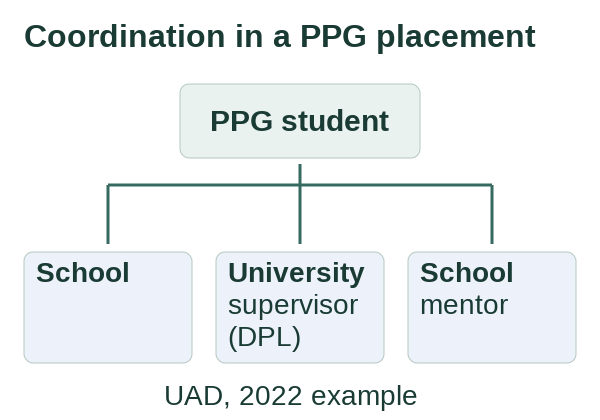
Mentor teachers carry several roles in the program. A qualitative case study at the teacher training institute UIN Datokarama Palu, using field observation, in-depth interviews and document analysis, found mentor teachers acting as facilitators, guides, evaluators, counselors, communicators, scaffolders and mentors. Students who took part in the training improved in four core competencies: pedagogical, personality, social and professional. The study listed future opportunities as integrating institutional systems and strengthening collaborative academics, and named challenges as lack of connectivity, weak time management, poor coordination across roles and weak digital literacy among students. It concluded that mentor teachers play a strategic role in raising student professionalism and that government should involve them actively in running future teacher professional education.[76]
Mentoring has also been supported by a purpose-built digital platform. Mentors and supervisors saw the platform as useful for organizing tasks and consolidating mentoring processes, and the trial identified needs for greater customization and advanced analytics to suit diverse educational settings.[77]
Assessment and reflective practice
Assessment in PPG has been described in the research literature less as a single test and more as a set of practices through which candidates show what they can do and reflect on who they are becoming as teachers. A 2026 qualitative case study of Indonesia's Teacher Professional Education program examined how humanistic and sustainability-oriented assessment is carried out, drawing on interviews, observations and document analysis with student teachers, lecturers and field mentors.[78]
Reflection is the axis on which this account of assessment turns.[78] A 2020 paper on English teachers in the program connects teacher professional development, teacher learning and teacher identity, and proposes reflective activities designed to develop a professional identity. That paper prefers the reflection model of Kolb (2015) because it is considered simpler and better suited to the Indonesian program context. It holds that reflective practice during the program is fundamental to a lifelong identity as a teacher who keeps learning.[79]
Collaborative forms of reflection have been studied as well. A 2023 case study followed three English teachers in the same reflection group during a three-month offline program and collected narratives through a semi-structured focus group discussion. Appreciative collaborative reflection, which builds reflection around positive inquiry, was found to shape the teachers' professional identities through recollections of professional experience, equal engagement and interconnectedness, and positivity. The study concludes that identity-related reflection should be built into teacher professional development programs so that teachers can cultivate and clarify their professional calling.[80]
Digital tools for assessment and for assessed work appear in the program's research record.[81][82] A 2023 needs analysis at one Indonesian faculty surveyed 2 lecturers and 46 students in a course on new technologies for teaching and learning, using a questionnaire of 16 questions across 5 aspects of data collection. Respondents asked for interactive question tools rather than those then available in the program's learning management system, and they agreed that such a product should assess understanding in the cognitive domain at various levels of Bloom's Taxonomy. Lecturers expected question development to range from level C3 to C6, with lower-order questions not ruled out. The study notes that the program at that faculty lacked a digital assessment component at the time.[81]
A content analysis of learning videos made by program students checked the videos against Gagne's nine instructional steps. Most videos succeeded in getting students' attention and stating the learning objectives clearly at the start.[82]
One evaluation looked at how candidates experienced multimedia they built themselves with a media authoring program, using the Indonesian version of the User Experience Questionnaire. Five scales were rated excellent: Attractiveness, Efficiency, Dependability, Stimulation and Novelty. The scale of Perspicuity, meaning clarity of use, was rated Above Average against the questionnaire's benchmark intervals.[83]
Policy implications for teacher competence
The last of these is a gap between what participants know and what they do, and the review treats it as a limit on how far the policy's competence aims are realized. Administrative burdens are listed among the factors that bear on how well the policy works. Because these factors vary across institutions, the review's account of PPG's contribution is conditional rather than uniform.[84]
The policy lever the review presses most firmly is a more sustainable system of mentoring after PPG completion. Such a system is proposed to secure competency development over the long term and to keep it aligned with the real challenges teachers face in schools. The review's overall judgment is that PPG is both a transformative and a necessary policy for raising national education quality by professionalizing teaching. That judgment rests on a reading of documents and published studies rather than on new field data, and the review presents its conclusions in that light.[84]
Information and communication technology in English teaching
Pre-service English teachers in PPG (Pendidikan Profesi Guru, the Indonesian teacher professional education programme) used a range of digital tools to reach their learning goals during teaching practice, called PPL (Praktik Pengalaman Lapangan). Analysis moved through reduction or condensation, then data display, then conclusion drawing or verification. Tool choice followed learning needs, students' needs and preferences, the learning objectives, the availability of facilities and the possible challenges.[85]
Three main obstacles appeared, coming from technical problems, the teachers' TPACK and the students. Technical problems covered poor internet access, too few devices and school rules that restricted use. On the TPACK side, the teachers struggled to select suitable tools, to manage time when integrating them and to keep up with the rapid development of technology. The students faced no significant problems, though negligence of the task sometimes arose when they became too attached to the ICT tools.[85]
The dictogloss strategy in listening instruction
A 2023 qualitative study by Alamsyah, Ramli and Safhida examined the strategy with teachers enrolled in Pre-Occupational Teacher Professional Education (PPG) Batch I of 2022 at the Faculty of Teacher Training and Education, Universitas Syiah Kuala. The participants were Indonesian language subject teachers and English subject teachers. The study set out to implement the strategy, record its advantages and disadvantages in practice, and recommend whether it is feasible for improving listening skills in Indonesian and English at the school level. Data came from documentation, observation and interviews, and were analysed using the principles of qualitative data analysis.[86]
Two practical advantages were recorded for teachers: the strategy is easy to design and implement, and it serves as a precise and effective tool for measuring students' listening skills. The study also reported that teachers can apply the strategy at all grade levels, provided they adjust the reading texts to the demands of the relevant Basic Competency. The recommendations drawn from the trial concern the feasibility of using the strategy to improve listening skills in Indonesian and English at the school level. The study was qualitative and drew on one cohort of PPG participants at a single faculty, so its findings describe that implementation rather than establishing effects against a comparison group.[86]
Pancasila education for tolerance in PPG
A 2026 study by Iskandar, Ardiansyah and Ahmad set out this model and connected it to global citizenship education, the idea that learners should be prepared to act as members of a wider world community. The study used a qualitative literature-based approach, meaning it drew its conclusions by synthesizing recent scholarly work rather than by collecting new data from classrooms. Its analysis combined three bodies of writing: contextual learning, character education, and civic pedagogy, the teaching of citizenship.[87]
The central claim is that contextual learning strategies and social character values together strengthen the internalization of Pancasila principles. Internalization here means that tolerance moves from a normative concept, a rule stated in official texts, to a lived civic practice carried out in everyday social interactions. The study describes an effective tolerance-oriented model as contextually relevant, participatory in its learning, and reflective in how it integrates ethical values. Contextual relevance means that the material connects to the situations participants actually face, and participatory learning means that participants take an active part rather than only listening.[87]
Specific learning strategies are named as ways to give PPG participants direct experience of social diversity. Project-based learning, in which participants work on an extended task, is one such strategy, and case studies are another. Community engagement, in which participants work with people outside the program, is the third. Alongside these strategies, character-based approaches are said to cultivate empathy, respect, justice, and social responsibility. The study argues that combining these strategies with character approaches makes PPG participants more tolerant, more aware as citizens, and more committed ethically.[87]
Anti-bullying workshops for PPG students
Bullying in schools is a serious problem that affects students' psychological health and their academic achievement. Teachers hold a strategic position in preventing and handling bullying, because they stand at the front line of education. A community service activity carried out in 2026 built on this reasoning by training students in the Teacher Professional Education program, known in Indonesia as PPG (Pendidikan Profesi Guru), to recognize, prevent and handle bullying in schools. The activity used a campaign-based workshop approach, and its stated aims were to raise participants' understanding, awareness and practical skills.[88]
The workshop was run through participatory learning, a method in which participants work actively on cases and products rather than only listening to presentations. Nineteen PPG students at Universitas Muhammadiyah Tapanuli Selatan took part as participants. The sessions combined the presentation of material, reflection on cases, and an assignment to produce anti-bullying posters for teachers and students.[88]
Results reported after the activity showed that participants' understanding increased on three points: what characterizes bullying, what effects it has, and what role teachers play as preventers, detectors and interveners. Every participant produced an anti-bullying poster that met the stated criteria. Those criteria were an emotional message, a call to change behavior, a clear reporting flow, language that is easy to understand, and relevance to the school context. The activity was expected to strengthen the competence of future teachers in building a school environment that is safe and supportive for all students.[88]
Tourism as a PPG subject area
Tourism earns foreign exchange for the country, and a 2020 discussion of teacher professional education (PPG) in tourism treats that economic role as the starting point for asking what tourism teachers should know. The same discussion notes that the tourism sector faces a number of challenges and obstacles as it develops. It adds that the education sector has the same conditions, so the difficulties of one field are not treated as separate from the difficulties of the other. On that basis the discussion argues for a PPG program in tourism whose competencies cover attitudes, knowledge, and the professional skills of a teacher.[89]
The proposed program spreads its academic work over the first and second semesters. In the first semester, students take part in workshops on developing learning tools, present the results of that development, and do peer teaching, in which they practise teaching in front of fellow students. The first semester also includes deepening or strengthening of material in the field of study or skill. The second semester covers Field Experience Practice (PPL) and Classroom Action Research (PTK), and vocational PPG adds practical work in industry.[89]
Preparing teachers before they enter PPG
A community service activity at SMAN 1 Seram Barat, a senior high school, was designed to prepare teachers for teacher professional education, known in Indonesia as PPG, before they took part in it. The activity was organized in response to interviews in which teachers said they knew little about PPG and found it hard to assemble the portfolio the program requires. Its stated aim was to give teachers complete information about PPG, so the sessions combined lectures with training in portfolio preparation. Twenty-three teachers took part.[90]
A questionnaire given after the activity measured how participants rated it on ease of understanding, usefulness and satisfaction. Satisfaction with taking part reached 87.83 percent. The share reporting that the material was easy to understand was 86.52 percent, and the share rating the material as useful was 89.13 percent. These figures describe how the 23 participants judged the sessions; they do not show whether the training changed later performance in PPG.[90]
Support and mentoring as a pillar of quality
Mentoring and accompaniment form one of the supports that programs for teacher professional education, known in Indonesia by the short form PPG, are expected to provide to their participants. A 2025 account of accompaniment in the PPG program describes such support as a main pillar on the road to quality education today, and treats it as a complement to the competency-based training that the government uses to raise the quality of educators. The same account reports that the PPG program has had a positive effect on teachers' professionalism, yet its operation in the field still meets a number of challenges. Heavy workloads, limited access to technology and financial pressure are named as obstacles that participants often encounter.[91]
The proposed response to these problems is a more innovative approach, and the account lists technology training, blended learning (mixing face-to-face and online study), adequate financial support and the strengthening of learning community networks among its elements. Accompaniment is thus placed alongside material and organizational measures rather than presented as a substitute for them. The account argues that if these steps are carried out consistently and thoroughly, the PPG program can be expected to produce teachers who are competent academically and also carry high professionalism that makes a real difference to the quality of education in the country.[91]
A decision support system for PPG graduates
In East Kalimantan Province, a web-based decision support system was built to help decide who takes part in Teacher Professional Education (PPG) for senior high schools and vocational high schools. A decision support system is software that ranks or recommends options so that a person or office can make a choice with the help of calculated criteria. PPG for these schools is higher education that follows an undergraduate program and prepares students for work that carries special skill requirements for becoming a teacher. The system was described in a 2021 paper by Rahman, Pratiwi and Ekawati in the journal TEPIAN.[92]
The problem it addressed sat in the registration process at the East Kalimantan Provincial Education and Culture Office. There, the calculation of test data was still done by hand. The proposed system was therefore meant to take over that calculation once testing had been carried out.[92]
The system uses the SMART method, a ranking technique that weights each criterion and scores each candidate against it, and it runs in a web browser. Data were gathered by observation. Development followed the stages of decision support system work: intelligence, design, choice and implementation. The paper gives clear, practical stages as its reason for choosing that sequence. Testing used white box testing, which examines the internal logic of the program, together with beta testing, in which users try the finished system.[92]
A questionnaire was given to 10 respondents. More than 78.2% of them answered that the system met the criteria for a good website or web application. That figure comes from a small group of users and describes their judgment of the website, not the accuracy of the selection decisions it supports. The paper reports no comparison between the system's rankings and decisions reached by hand, and no follow-up on the graduates who were selected.[92]
What this looks like when you study
In one study, 19 students in a teacher professional education program (PPG) took part in an anti-bullying workshop that used participatory learning, with case reflection and an assignment to make posters. All 19 participants produced anti-bullying posters that met five criteria, including emotional messaging at 95 to 100 percent and a call to change behavior at 100 percent. The workshop raised their understanding of what bullying looks like and of the teacher's role as preventor, detector and interventor.[88]
A different study followed 36 physics graduates of PPG who enrolled around October to November 2022 and finished in 2023. They rated their own professional competence before and after the program on a 24-item questionnaire with a 1 to 4 scale. The largest reported gain was in mastery of educational foundations, and the smallest, though still positive, was in carrying out teaching.[57] In a third study, 37 pre-service teachers filled in the Teachers' Sense of Efficacy Scale and a sources-of-self-efficacy inventory, and some were interviewed.[15]
Three junior high school English teachers who had completed PPG described how the program's material deepening, learning device development and teaching practice (PPL) changed their classroom management.[4] In a study of 100 vocational teacher candidates who had finished teaching assistance, pedagogical competence had a direct effect on teaching readiness. Professional competence worked indirectly, through the candidates' interest in becoming a teacher, and that interest also had a direct effect.[19]
Two English teachers in rural eastern Indonesia, from Central Sulawesi and East Nusa Tenggara and graduates of PPG at Tadulako University in 2022, were interviewed in depth and observed during the program. Their participation raised their pedagogical knowledge and skills and their awareness, changed their teaching practices, and in turn affected student motivation.[59] Subiyantoro, Fauziyah, Putra, Setyawan and Thao (2026) conclude that teacher professional education programs strengthen teaching competencies when their design links theory to classroom practice, and they report that practical training components and reflective activities shaped the improvements they observed.[29] Before entering PPG, you can ask for complete information about the program and prepare a portfolio, as 23 teachers at one senior high school did in a community service activity. In that activity, satisfaction reached 87.83 percent, ease of understanding the material 86.52 percent and usefulness of the material 89.13 percent.[90]
Criticism
Difficulties graduates meet in schools
Graduates of Indonesia's teacher professional education program, known as PPG, report difficulties at each of the three stages of teaching: planning a lesson, carrying it out, and evaluating what students learned. A narrative study of PPG graduates examined these three stages and found challenges at all of them.[93]
One recurring problem concerns the fit between what a lesson plan says and what the teacher actually does in class. A qualitative descriptive study of teachers in an in-service PPG program analyzed mistakes made when applying problem-based learning, a method in which students work on an open problem rather than receive material directly. The study traced the planning errors to teachers not yet understanding or mastering the syntax of the model, meaning its prescribed sequence of steps. It also found a mismatch between the steps set out in the lesson plan and the way the model was actually applied in the classroom.[94]
Some difficulties arise from the demands of the program itself rather than from the classroom alone. A qualitative descriptive study of in-service PPG students in the first cohort at one teacher training institution listed weak socialization of the program, coursework that requires students to understand and master learning technology, the average age of the students, and a complex certification process. The same study noted that Minister of Education and Culture Regulation Number 38 of 2020 and Minister of Education, Culture, Research and Technology Regulation Number 54 of 2022 differ from each other. That study nonetheless judged the in-service program effective in supporting the improvement of teachers' abilities as professional teachers.[95]
A review of published literature on PPG in elementary schools identified a high administrative burden and differences between regions in the infrastructure that supports the program as practical obstacles to its effectiveness. The same review reported that, through in-depth material and practical field experience, elementary school teachers became more capable of designing learning innovations and integrating digital technology. It called for continuing systemic evaluation and for curriculum adjustments that focus on the characteristics of elementary school aged students.[96]
Open questions and limits of the evidence
A phenomenological study of pre-service physical education teachers drew on five participants selected by purposive sampling and interviewed in depth.[97] A survey of the educational philosophies of pre-service elementary teachers involved 29 respondents enrolled in the program.[98] An evaluation at Kuningan University reported high pass rates among 150 participants, with 147 passing the Knowledge Test (UP), 149 passing the Achievement Test (Ukin) and 147 passing the PPG Student Competency Test (UKMPPG). The same evaluation names its limited sample at one university as a limitation and recommends a follow-up study comparing implementation across universities.[99] A case study of causal inference thinking in solving mathematical problems examined four pre-service students from one elementary teacher education program.[100]
An evaluative survey of 250 teachers in the 2024 PPG program in the Greater Jakarta area used a closed-ended questionnaire on a 5-point Likert scale, a format in which respondents rate their own agreement with statements. That survey reported a Cronbach's alpha of 0.89, a statistic expressing how consistently the questionnaire items hang together, and found that 71% of respondents rated the program's instructional methods as highly relevant to classroom practice while 68% reported increased confidence in classroom management.[101] A qualitative study combining interviews, observation and document analysis with participants, supervisors and program managers likewise reported gains in pedagogical and professional competence, alongside obstacles such as time constraints, high academic load and weak links between theory and field practice.[102]
Longitudinal evidence, meaning repeated measurement of the same teachers over time, is scarce, and one study that followed English teachers found the timing of change hard to pin down. That study surveyed and assessed the proficiency of ninety English teachers, then interviewed and observed a subsample selected on their scores.[103] A study of a heutagogy-informed model, in which heutagogy means self-determined learning, reported insights on its effectiveness compared with traditional teacher training, but the abstract gives no sample size or effect size for that comparison.[104]
Whether the program's classroom process follows established learning theory is itself an open question. One case study analysed 3 purposively selected learning recordings against Gagné's learning theory and found most of its steps implemented well, especially gaining attention, conveying objectives and provoking recall, with weaknesses in presenting content and strengthening concepts. The study recommends more varied learning media and more detailed feedback.[105]
The 250-teacher survey identified remaining challenges in curriculum implementation and post-program mentoring and argued that PPG should serve as an instrument for improving teaching and learning, not only as a certification route.[101] A program evaluation using the CIPP model, which examines context, input, process and product, concluded that a physical, health and recreation cohort had been implemented as well as possible but needed better facilities, funding and coordination between the ministry and the teacher training institute.[106] An overview of PPG's role in Indonesian education quality describes the program as an important route to improving educators, a claim about policy intent rather than a measured outcome.[107]
Reconstructing the PPG curriculum
A 2023 paper by Smith, Arent and Thesalonika proposes rebuilding the curriculum of PPG, Indonesia's in-service teacher professional training programme, by joining two traditions of thought: the perennialism of Seyyed Hossein Nasr and the Tri Education Center of Ki Hadjar Dewantara. The paper reports that the PPG curriculum is still the same as the S-1 education curriculum, and it treats this as a sign of unpreparedness, since under the KKNI a profession sits at a higher level than S-1. The paper argues that future teachers need more than the pedagogical skill that traditional training supplies, since they also need spiritual and moral character. The proposal is a response to what the paper describes as unpreparedness in the existing PPG curriculum, which it says still looks the same as an undergraduate education degree (S-1).[108]
The argument rests on a comparison of qualification levels in Indonesia's national framework, the KKNI, under which a profession ranks higher than an undergraduate degree. Because of that gap in level, the paper holds that PPG must carry a distinctive feature that sets its graduates apart from graduates of S-1 education programmes. It adds that PPG should not be reduced to a detour through the pedagogical material that already characterises undergraduate teacher education.[108]
The motive for reconstruction is the shift from a manual era to a digital era, which the paper says affects the quality of learning and raises the qualifications expected of teachers. In that setting, the paper states, teachers need expertise beyond what traditional learning demanded. The government's route to producing future teacher candidates is the PPG programme itself, which makes the content of its curriculum the point at which the pressure is felt. The paper reports its claims as observations about the PPG curriculum rather than as the results of a controlled study, and it offers a conceptual integration rather than a tested model.[108]
The transformative plus policy for madrasah graduates
The PPG Transformatif Plus policy is a Teacher Professional Education (PPG) policy directed at graduates of Madrasah Ibtidaiyah Teacher Education (PGMI), the study programme that prepares teachers for the primary grades of Islamic schools. A 2025 study examined the policy through library research, a qualitative method in which the material analysed is written documents rather than people. The researcher read the letter through content analysis, a method for sorting the content of a document into categories, carried out in three stages: planning, organizing and reporting.[109]
The findings of the study concern who is allowed to work as a class teacher, the teacher who takes charge of one group of pupils across their subjects in the primary grades. The policy permits graduates of education majors other than PGMI or PGSD, the equivalent primary teacher programme in general schools, to become class teachers. Because those graduates can enter the classroom teacher role, the study reports that the acceptance of PGMI graduates is minimized. The arrangement is one-sided in the study's account: graduates of other majors may take work that belongs to the PGMI field, while PGMI graduates cannot become subject teachers.[109]
Key studies
| Year | Study | Sample | Design | Finding |
|---|---|---|---|---|
| 2020 | Daud et al.[3] | survey of 15 alumni of the 2018 subsidized PPG program at Riau University | 84.6% said the curriculum matched pre-service English teachers' needs, but 76.9% said most material had been studied in the undergraduate program. | |
| 2021 | Silitonga & Mataheru[90] | 23 teachers at SMAN 1 Seram Barat | community service with lectures, portfolio training and a questionnaire | Satisfaction reached 87.83 percent, ease of understanding 86.52 percent and usefulness of the material 89.13 percent. |
| 2021 | Hanun[6] | qualitative study of PPG in-service Islamic religious education at UIN Serang Banten, 90 students | 100% of the 90 students passed the performance test, while 58 participants (64%) passed the knowledge test and 32 (36%) did not. | |
| 2021 | Kafrawi et al.[5] | descriptive survey of 971 of 1632 PPG in-service students in 2020 at the State University of Surabaya | Service satisfaction in the 2020 PPG in-service program was good, though shortcomings remained, especially in interactions in the learning management system. | |
| 2023 | Mukrim et al.[59] | 2 English teachers in rural eastern Indonesia, graduates of PPG at Tadulako University in 2022 | qualitative case study with in-depth interviews, documentation and observation | Participation increased pedagogical knowledge and skills and awareness, changed teaching practices, and affected student motivation. |
| 2023 | Musthofa et al.[74] | survey with simple regression of 128 PPG students at Walisongo State Islamic University in 2022 | Online learning had a significant positive effect on professional competence, with coefficients of determination of 45.7% for psychomotor, 44.2% for affective and 37.6% for cognitive aspects. | |
| 2024 | Purniningtyas et al.[4] | 3 purposively selected junior high school English teachers | explorative qualitative study with a validated scale and semi-structured interviews | Teachers credited material deepening, learning device development and teaching practice with significantly improving their classroom management self-efficacy. |
| 2024 | Putra et al.[15] | 37 pre-service teachers | explanatory sequential mixed-method study | Pre-service teachers showed an excessively high measure of self-efficacy, shaped by mastery experience, vicarious experience, verbal persuasion and psychological arousal. |
| 2024 | Sapdi & Sugilar[54] | 12 PPG managers and 10 academic staff at four higher education institutions of the Ministry of Religion | qualitative study of budget management, academic services and learning outcomes, using questionnaires and in-depth interviews with 12 PPG managers and 10 academic staff across four higher education institutions | Budget management posed few challenges, academic services were well implemented, and the graduation rate was 80 percent. |
| 2024 | Dewi & Priyana[85] | 5 pre-service English PPG students at one university in Yogyakarta | descriptive qualitative study with document analysis, interviews and observation | The students used tools such as Google Form, Canva, Kahoot and Quizizz, mostly at the augmented level of the SAMR framework, and faced technical problems, gaps in their technological knowledge and time management. |
| 2025 | Nidhom[19] | 100 vocational teacher candidates who had completed teaching assistance | quantitative correlational study with multiple regression and mediation analysis | Pedagogical competence had a direct effect on teaching readiness, while professional competence worked indirectly through interest in teaching. |
| 2025 | Baihaqi & Arimurti[57] | 36 physics PPG graduates from six universities | self-assessment survey with a 24-item questionnaire on a 1 to 4 scale | Graduates reported improvement in all aspects, with the greatest gain in mastery of educational foundations and the smallest in teaching implementation. |
| 2026 | Daud et al.[67] | 66 economics education students at Universitas Negeri Gorontalo | quantitative correlational survey with multiple linear regression | Interest in becoming a teacher (p = 0.007) and parental income (p < 0.001) each had a positive and significant effect, together explaining 57.7 percent of the variance in motivation to join PPG. |
| 2026 | Khairunnisah et al.[88] | 19 PPG students at Universitas Muhammadiyah Tapanuli Selatan | community service workshop with participatory learning | All 19 participants produced anti-bullying posters meeting the five criteria, with emotional messaging at 95 to 100 percent and a call to change behavior at 100 percent. |
See also
References
- Fauzan, F., & Bahrissalim, B. (2017). Curriculum analysis teacher professional education program (PPG) of islamic education in indonesia. TARBIYA: Journal of Education in Muslim Society, 148-161. doi:10.15408/tjems.v4i2.6400
- Chang, C. F., Annisa, N., & Chen, K. Z. (2025). Pre-service teacher professional education program (PPG) and Indonesian science teachers' TPACK development: A career-path comparative study. Education and Information Technologies, 30(7), 8689-8711. doi:10.1007/s10639-024-13160-6
- Daud, A., Novitri, N., & Hardian, M. (2020). Evaluation of the teacher professional education program (PPG): English students’ perspective. AL-ISHLAH: Jurnal Pendidikan, 12(2), 185-200. doi:10.35445/alishlah.v12i2.286
- Purniningtyas, A., Endang Fauziati, & Dewi Rochsantiningsih (2024). Enhancing Classroom Management Self-Efficacy through Teacher Professional Education Program: An Explorative Study. Voices of English Language Education Society, 8(3). doi:10.29408/veles.v8i3.27532
- Kafrawi, F. R., Sodiq, S., & Julianto, J. (2021). The analysis of service satisfaction level in the implementation of teacher professional education program in 2020. Education and Human Development Journal, 6(1), 18-30. doi:10.33086/ehdj.v6i1.1925
- Hanun, F. (2021). Implementasi Penyelenggaraan Program Pendidikan Profesi Guru (PPG) Pendidikan Agama Islam di LPTK UIN Serang Banten. EDUKASI: Jurnal Penelitian Pendidikan Agama dan Keagamaan, 19(3), 268-285. doi:10.32729/edukasi.v19i3.1158
- Harapan, E., Marisya, F., Marsinah, M., Malini, S., & Purwanto, M. B. (2024). Assessing Work Habits and Discipline: High School Teachers in South Sumatra Province Post In-Service Teacher Professional Education Program (PPG-DALJAB). Gema Wiralodra, 15(2), 726-737. doi:10.31943/gw.v15i2.707
- Agustiani, M. (2024). Teacher professional education program in indonesia: Benefit and challenge. Enrich: Jurnal Pendidikan, Bahasa, Sastra dan Linguistik, 5(2), 28-37. doi:10.36546/enrich.v5i2.1314
- Sampun, J. (2022). Improved Management Teacher Professional Education Program Surabaya State University Through Alumni Tracer (Tracer Study): Pendidikan Profesi Guru (PPG). Education and Human Development Journal, 7(01), 55-65. doi:10.33086/ehdj.v7i01.2544
- Handayani, M. N., & Djohar, A. (2020). Model Pendidikan Profesi Guru (PPG) Vokasi. Inovasi Kurikulum, 17(1), 12-23. doi:10.17509/jik.v17i1.36805
- Handayani, N. N. L., Muliastrini, N. K. E., & Suardipa, I. P. (2021). Pendidikan profesi guru dalam kaitannya dengan peningkatan profesionalisme guru. Sang Acharya : Jurnal Profesi Guru, 2(1), 1. doi:10.25078/sa.v2i1.2451
- Ardana, L., Yuniati, S., Kurniati, A., & Rahmi, D. (2025). The Importance of Pendidikan Profesi Guru (PPG) in Improving the Quality of Education in Indonesia. Jurnal Profesi Pendidikan, 4(1), 1-8. doi:10.22460/jpp.v4i1.26153
- PURWASIH, J. H. G., & BUSTAMI, M. R. (2026). Pre-service teacher professional education program in indonesia: A systematic literature review. Quantum Journal of Social Sciences and Humanities, 7(2), 259-265. doi:10.55197/qjssh.v7i2.1103
- PURWASIH, J. H. G., & BUSTAMI, M. R. (2026). Transformation of new model pre-service teacher professional education program in indonesia: A content analysis. Quantum Journal of Social Sciences and Humanities, 7(3), 411-423. doi:10.55197/qjssh.v7i3.1234
- Putra, T. K., Satya Purnama, A. P., & Setyanto, S. R. (2024). A Mixed-Method Study of Pre-service Teachers’ Self-efficacy in the Indonesian Teacher Professional Education Program. International Journal of Pedagogy and Teacher Education, 7(2), 58. doi:10.20961/ijpte.v7i2.78515
- Purwanto, I. (2020). Pengembangan desain pendidikan profesi guru (PPG) pra jabatan pada jurusan ilmu pendidikan sosial (IPS). Mimbar Agama Budaya, 36(2), 158-175. doi:10.15408/mimbar.v36i2.14181
- Sujito, S., Ekawati, R., & Pratiwi, H. Y. (2025). Development of Integrated Competency-Based Physics Academic Test for Teacher Professional Education Program Students. Teaching, Learning, and Development, 4(1), 49-58. doi:10.62672/telad.v4i1.108
- Rini, T. A., & Yuniawatika (2026). Analysis of Tryout Test Item for Students of the Elementary School Teacher Professional Education Program. Sekolah Dasar: Kajian Teori dan Praktik Pendidikan, 35(1), 30-40. doi:10.17977/um009v35i12026p30-40
- Nidhom, A. M. (2025). The Effect of Pedagogical and Professional Competence on Teaching Readiness of Vocational Teacher Candidates in the Teacher Professional Education Program (PPG). TEKNO, 35(1), 55. doi:10.17977/um034v35i1p55-64
- Anisa, N., Robbaniyah, I., Sutama, I. W., & Astuti, W. (2023). The Effect of Educational Qualifications and Teacher Professional Education Program on the Digital Literacy Skills of Early Childhood Educators. Jurnal Obsesi : Jurnal Pendidikan Anak Usia Dini, 7(6), 7123-7130. doi:10.31004/obsesi.v7i6.5589
- OpenStax Introductory Statistics 2e (n.d.). analysis of variance. OpenStax Introductory Statistics 2e. https://openstax.org/details/books/introductory-statistics-2e
- Sudjimat, D. A., & Satyananda, D. (2025). Development of PACK-Based Learning Outcome Tests for the Mechanical Engineering Education Study Program of Teacher Professional Education. Jurnal Pendidikan: Teori, Penelitian, dan Pengembangan, 10(11), 499-507. doi:10.17977/2502-471x.1142
- NCME Glossary of Important Assessment and Measurement Terms (n.d.). coefficient alpha. NCME Glossary of Important Assessment and Measurement Terms. https://ncme.org/resources/professional-learning/glossary/
- Muluk, S., & Lubis, A. H. (2026). The impact of teacher professional education program on improving teacher competences in Indonesia: A comparative study. Englisia: Journal of Language, Education, and Humanities, 13(2), 643-657. doi:10.22373/englisia.172
- Noba textbook series: Psychology (n.d.). Quasi-experimental design. Noba textbook series: Psychology. https://nobaproject.com/modules/research-designs
- ERIC Thesaurus (n.d.). Effect Size. ERIC Thesaurus. https://eric.ed.gov/?ti=Effect+Size
- Department of Sport Science, Yogyakarta State University, Yogyakarta Indonesia, Radityatama, A. T., ., N., & Department of Sport Science, Yogyakarta State University, Yogyakarta Indonesia (2025). Differences in Pedagogical Abilities of PJOK (Physical Education Sports Health) Teachers in Public Junior High Schools in Gunungkidul Regency in Terms of PPG (Teacher Professional Education Program) And Non PPG Qualifications and Length of Teaching Time. INTERNATIONAL JOURNAL OF MULTIDISCIPLINARY RESEARCH AND ANALYSIS, 08(06). doi:10.47191/ijmra/v8-i06-22
- Principles of Epidemiology in Public Health Practice, glossary (n.d.). P value. Principles of Epidemiology in Public Health Practice, glossary. https://archive.cdc.gov/www_cdc_gov/csels/dsepd/ss1978/glossary.html#Pvalue
- Subiyantoro, S., Fauziyah, S., Putra, H. K., Setyawan, A., & Thao, L. T. (2026). Do Teacher Professional Education Programs Improve Teaching Competencies? A Comprehensive Evaluation. International Journal of Applied Educational Research (IJAER), 4(2), 141-152. doi:10.59890/ijaer.v4i2.257
- Wahyudin, & Aripin, S. (2025). A systematic analysis of the impact of the teacher professional education program on teacher professionalism in teaching and learning activities in indonesia. AL-ADABIYAH: Jurnal Pendidikan Agama Islam, 6(3), 234-241. doi:10.35719/adabiyah.v6i3.1130
- GET-IT Glossary (plain-language health research terms) (n.d.). systematic review. GET-IT Glossary (plain-language health research terms). https://getitglossary.org/term/systematic+review
- Dini Septiani, Anggi Setia Lengkana, & Aam Ali Rahman (2025). Analysis of The Teacher Professional Education Program On Teachers' Pedagogical And Professional Competencies: A Case Study At One Elementary School In Sumedang. COMPETITOR: Jurnal Pendidikan Kepelatihan Olahraga, 17(3), 2324-2333. doi:10.26858/cpjok.v17i3.307
- Aswadi, A., Hermansyah, S., Sadapotto, A., Buhari, B., Manda, I., T, S., Hanafi, M., Jala, J., & Amalia, A. (2024). Comparative Study: Teaching Expriences of Prospective Teachers before and After Participating in the Teacher Professional Education Program at UMS Rappang. Edumaspul: Jurnal Pendidikan, 8(2), 5029-5034. doi:10.33487/edumaspul.v8i2.8737
- Sahroni, S., & Subroto, T. (2022). Implications of Innovative Learning for Pendidikan Profesi Guru (PPG) for Increasing Professional Teacher Competence. QALAMUNA: Jurnal Pendidikan, Sosial, dan Agama, 14(2), 725-738. doi:10.37680/qalamuna.v14i2.3693
- Angelina, P. (2024). Evaluating english pre-service teacher professional education program implementation. LLT Journal: A Journal on Language and Language Teaching, 27(2), 1078-1089. doi:10.24071/llt.v27i2.7172
- Sukoco, N. B., Charisma, D., & Winarto, E. R. (2024). The Effectiveness of Teacher Professional Education Program in English Teaching. Proceedings Series on Social Sciences & Humanities, 18, 243-246. doi:10.30595/pssh.v18i.1257
- Ulfa, S. M., Tera Athena, & Zainal Arifin (2026). Professional Development of Elementary School English Teachers in the Teacher Professional Education Program (PPG): A Qualitative Study of Teaching English to Young Learners (TEYL) Practices. English Teaching Journal : A Journal of English Literature, Language and Education, 14(1). doi:10.25273/etj.v14i1.24749
- Galih, A., & Iriani, C. (2018). Persepsi Mahasiswa Program Pendidikan Profesi Guru (PPG) Pendidikan Sejarah Terhadap Program PPG. Jurnal Pendidikan Sejarah, 7(1), 66-83. doi:10.21009/jps.071.05
- Azahari, A. R., Sion, H., Kartiwa, W., & Qadariah, A. (2022). Mutu pengelolaan program pendidikan profesi guru (PPG) universitas palangka raya. Equity In Education Journal, 4(2), 111-117. doi:10.37304/eej.v4i2.7438
- Yuniawatika, Y., Prestiadi, D., Hanafi, Y., Alfan, M., Nofitasari, N., Sari, N. A. K., & Febrianti, F. O. (2025). Evaluation of Student Satisfaction with Aspects of Learning, Facilities, and Administration in the Pre-Service Teacher Professional Education Program. Teaching, Learning, and Development, 4(1), 6-14. doi:10.62672/telad.v4i1.99
- Erniati, E., Nadirah, S., Nurdin, N., Ubadah, U., & Anirah, A. (2025). Effectiveness of Teacher Professional Education Program (PPG) of UIN Datokarama Palu from Students' Perspective (A Mixed Method Approach). QALAMUNA: Jurnal Pendidikan, Sosial, dan Agama, 17(2), 1019-1030. doi:10.37680/qalamuna.v17i2.7269
- Nurizzati, K., Sumardi, L., & Alqadri, B. (2026). Persepsi Mahasiswa tentang Pendidikan Profesi Guru (PPG) Prajabatan (Studi pada Mahasiswa PPKn Angkatan 2020). Empiricism Journal, 7(2), 1017-1029. doi:10.36312/ej.v7i2.5343
- Nurwidawati, D., Jannah, M., Santosa, R. P., Halida, A. N., Fahmiya, A., Rachman, N., Prihadi, K. D., Maulidiyah, E. F., Kafrawi, F. R., Nurhayati, F., & Reza, M. (2024). Psychological Well-Being of Teacher Professional Education Program (TPEP) Students: A Demographic Analysis. IJORER : International Journal of Recent Educational Research, 5(6), 1461-1473. doi:10.46245/ijorer.v5i6.669
- Khotibul Umam, Muhaiminah Darajat, Muhammad Yusuf Arwiarto, Andi Patta Yusuf, & Ainur Alam Budi Utomo (2026). Efektivitas Program Pendidikan Profesi Guru (PPG) Masal di Bawah Naungan Kementerian Agama dalam Menjawab Kebutuhan Guru Profesional. Jurnal Bintang Pendidikan Indonesia, 4(2), 147-164. doi:10.55606/jubpi.v4i2.4496
- Sumar, W. T., & Ansar, A. (2024). Evaluation Of The Implementation Of Elementary Teacher Certification Policies Through Teacher Professional Education Programs In Gorontalo City. Journal of Social Research, 3(7). doi:10.55324/josr.v3i7.2160
- Maryatun, M., Nuriadin, L., & Supamo, S. (2023). Evaluation Of Program Implementation Teacher Professional Education In Online Office For Elementary School Teachers. Jurnal Studi Guru dan Pembelajaran, 6(3), 293-303. doi:10.30605/jsgp.6.3.2023.2936
- Siti Taufiqurrohmah, & Wida Wulandari (2025). Pengaruh Pengalaman Pengenalan Lapangan Persekolahan (PLP) bagi Mahasiswa dan Persepsi Pendidikan Profesi Guru (PPG) terhadap Minat Menjadi Guru. JURNAL RISET RUMPUN ILMU PENDIDIKAN, 4(3), 78-89. doi:10.55606/jurripen.v4i3.6489
- Wulandari, B. A., Daud, A., Mirizon, S., Yelia, Y., & Abrar, M. (2025). English Education Students’ Perceptions and Interests in the Teacher Professional Education Program. Mimbar Ilmu, 30(2), 339-352. doi:10.23887/mi.v30i02.103450
- Pratiwi, S. H., Rola, F., Rambe, T. R., Pratama, A., Sutopo, A., Adisaputra, A., & Murad, A. (2023). The Evaluation Of Teacher Professional Education Program. PIONIR: JURNAL PENDIDIKAN, 12(3). doi:10.22373/pjp.v12i3.21034
- Evendi, E. (2022). Teacher Professional Education Program in Islamic Religious Education: Bibliometric Analysis and Review. Prisma Sains : Jurnal Pengkajian Ilmu dan Pembelajaran Matematika dan IPA IKIP Mataram, 10(3), 591. doi:10.33394/j-ps.v10i3.5322
- Sabrina, A., Yuliharti, Y., & Hasyim, H. (2026). Implementation of Teacher Certification and Teacher Professional Education (PPG) and Challenges in Developing the Quality of Islamic Education. Al-Hikmah: Jurnal Agama dan Ilmu Pengetahuan, 23(1), 52-61. doi:10.25299/ajaip.2026.vol23(1).27128
- Mardhatillah, O., & Surjanti, J. (2023). Peningkatan Kompetensi Pedagogik dan Profesionalitas Guru di Indonesia Melalui Pendidikan Profesi Guru (PPG). Jurnal Pendidikan Ekonomi Undiksha, 15(1), 102-111. doi:10.23887/jjpe.v15i1.65200
- Umam, R. (2025). Professionalism of Islamic Religious Education Teachers in the Implementation of Teacher Professional Education (PPG): A Descriptive Qualitative Analysis in the Era of Education 4.0: Profesionalitas Guru PAI dalam Implementasi Pendidikan Profesi Guru (PPG): Analisis Kualitatif Deskriptif di Era Pendidikan 4.0. Zawayatul Fikr: Journal of Islamic Education, 1(1), 48-58. doi:10.67198/zafie.v1i1.7
- Sapdi, R. M., & Sugilar, H. (2024). The Teacher Professional Education Program: Budget Management, Academic Services, And Learning Outcomes. Educational Administration: Theory and Practice. doi:10.53555/kuey.v30i4.2026
- Munastiwi, E., & Sumarni, S. (2023). Study on Governance and Service of the In-Service Teacher Certification Program for Raudhatul Athfal from the Perspective of PPG (Teacher Professional Education) Participants. Jurnal Pendidikan Islam, 12(2), 229-242. doi:10.14421/jpi.2023.122.229-242
- Ragil, Y. A., Rahmawati, Y., & Supena, A. (2025). Implementasi Kebijakan Penyelenggaraan Pendidikan Profesi Guru (PPG) untuk Sertifikasi Guru PAUD. JEA (Jurnal Edukasi AUD), 11(1), 41-54. doi:10.18592/jea.v11i1.15243
- Baihaqi, H. K., & Arimurti, D. A. (2025). Pre-Service Physics Teachers' Self-Assessment of Professional Competence After Following PPG (Teacher Professional Education). Jurnal Materi dan Pembelajaran Fisika, 15(1), 41. doi:10.20961/jmpf.v15i1.94430
- Qadrianty, N., Dollah, S., & A. Muliati (2024). An Analysis of Pedagogical Competence of Pre-Service Teacher Professional Education (PPG-Prajabatan) Teacher. ARRUS Journal of Social Sciences and Humanities, 4(3), 300-309. doi:10.35877/soshum2562
- Mukrim, M., Einsenring, M. A. A., Hastini, H., & Hasyim, Z. (2023). Exploring impacts of teacher professional education (PPG) on teacher practice: A case of two eastern indonesian rural school teachers. Jurnal As-Salam, 7(2), 264-275. doi:10.37249/assalam.v7i2.675
- Universitas Islam Negeri Raden Mas Said Surakarta Indonesia, Hakiman, H., Muharom, F., & Universitas Islam Negeri Raden Mas Said Surakarta Indonesia (2024). Mind Mapping Method in Improving Conceptual Knowledge in Workshop Modules for Teacher Professional Education Students. International Journal of Innovative Research in Multidisciplinary Education, 03(03). doi:10.58806/ijirme.2024.v3i3n06
- Novia Vernawati, & Pramujiono, A. (2022). Tindak tutur dalam praktik mengajar mahasiswa pendidikan profesi guru (ppg) universitas PGRI adi buana surabaya. Buana Bastra, 7(1), 27-34. doi:10.36456/bastra.vol7.no1.a5045
- Irawan, D., Kurniawan, C., Suhartadi, S., & Mindarta, E. K. (2025). Enhancing Vocational Students’ Creativity via Virtual Project Based Automotive Paint Mixing in Teacher Professional Education Program (PPG) Partner School. Jurnal Riset dan Inovasi Pembelajaran, 5(3), 1094-1105. doi:10.51574/jrip.v5i3.4000
- Harum, A., Anas, M., Latif, S., Samad, S., & Bakhtiar, M. I. (2023). Development of Academic Expectations of Pre-Service Teacher Professional Education (PPG) Students. TERAPUTIK: Jurnal Bimbingan dan Konseling, 7(2), 43-52. doi:10.26539/teraputik.722035
- Tambunan, R. S. P., Syahputri, N. R., & Masril, M. (2026). Penghayatan Panggilan Karier (Vocational Calling) pada Dewasa Awal dalam Transisi Karier Menjadi Guru melalui Program Pendidikan Profesi Guru (PPG): Studi IPA pada Peserta PPG. Journal of Society Counseling, 4(1), 361-377. doi:10.59388/josc.v4i1.925
- Anggraini, B., Hawi, A., & Zainuri, A. (1970). Pengaruh Persepsi tentang Program Pendidikan Profesi Guru (PPG) dan Profesi Guru terhadap Minat Mahasiswa untuk Menjadi Guru. Intizar, 26(2), 107-116. doi:10.19109/intizar.v26i2.6104
- BR Sitepu, R. D., Sriartha, I. P., & Wesnawa, I. G. A. (2026). Pengaruh Persepsi Mahasiswa Jurusan Geografi tentang Program Pendidikan Profesi Guru (PPG) terhadap Minat Menjadi Guru di Universitas Pendidikan Ganesha. Jurnal Pustaka Cendekia Pendidikan, 4(1), 2657-2671. doi:10.70292/jpcp.v4i1.646
- Daud, S. M., Panigoro, M., Maruwae, A., Hasiru, R., & Dama, M. N. (2026). Pengaruh minat mahasiswa menjadi guru dan pendapatan orang tua terhadap motivasi mengikuti pendidikan profesi guru (PPG). EDUCATOR : Jurnal Inovasi Tenaga Pendidik dan Kependidikan, 6(3), 430-445. doi:10.51878/educator.v6i3.12691
- Indraswati, D., Utami, P. S., Suyitno, S., & Kariadi, D. (2020). Pengaruh Persepsi Mahasiswa Tentang Status Sosial Guru Dan Pendidikan Profesi Guru (PPG) Terhadap Motivasi Menjadi Guru Sekolah Dasar. Madrasah: Jurnal Pendidikan dan Pembelajaran Dasar, 12(2), 140-153. doi:10.18860/mad.v12i2.8963
- Yuliyanti, R., Liputo, M. A., & Putra, I. (2024). Pengaruh perencanaan karir dan biaya pendidikan terhadap minat melanjutkan pendidikan profesi guru (PPG). Journal of Economic Education, 3(1), 20-24. doi:10.22437/jeec.v3i1.38399
- Trianwenda, S., Marwan, M., & Rahmi, E. (2020). Pengaruh Motivasi Belajar dan Pendapatan Orang Tua Terhadap Minat Mahasiswa Mengikuti Pendidikan Profesi Guru (PPG). Jurnal Ecogen, 3(3), 354. doi:10.24036/jmpe.v3i3.9909
- Aji, B. C., & Surjanti, J. (2026). The Influence of Growth Mindset, Family Environment, School Field Introduction (PLP), and Student Perception of the Teacher Professional Education Program (PPG) on Interest in Becoming an Economics Teacher in East Java. Economic Education Analysis Journal, 15(2), 180-198. doi:10.15294/eeaj.v15i2.48086
- Dwiyanti, U., & Gabriel, T. (2023). Documentation Management Of Teacher Professional Education Program (PPG) For Pre-Service Teacher. HAMKA INSIGHT, 2(1), 21-28. doi:10.51574/hamka.v2i1.93
- Hanifah, U., Mukhoiyaroh, M., & Gumilar, R. (2022). Online Learning System for Arabic Teacher Professional Education Program in the Digital Era. Jurnal Al Bayan: Jurnal Jurusan Pendidikan Bahasa Arab, 14(1), 117-135. doi:10.24042/albayan.v14i1.11321
- Musthofa, M., Nasikhin, Junaedi, M., & Hasanah, S. (2023). The influence of online learning on student professionalism Teacher professional Education Program: Studies in Islamic higher Education in Indonesia. Cogent Education, 10(2). doi:10.1080/2331186x.2023.2276025
- Rahmadiena Maulany, S., & Maya Simon, I. (2023). Literature review: Learning management system (LMS), pijakan mahasiswa pendidikan profesi guru (PPG) prajabatan menuju profesionalisme kompetensi guru. Jurnal MIPA dan Pembelajarannya, 3(12), 4. doi:10.17977/um067v3i122023p4
- Postgraduate Studies, Islamic Education Department, Universitas Islam Negeri Datokarama Palu, Indonesia, Arifuddin, A., S. Thahir, L., Postgraduate Studies, Islamic Education Department, Universitas Islam Negeri Datokarama Palu, Indonesia, Mashuri, S., & Postgraduate Studies, Islamic Education Department, Universitas Islam Negeri Datokarama Palu, Indonesia (2025). The Role of Mentor Teacher in Improving Teacher Professional Education Training Program Through Learning Management System at State Islamic University of Datokarama Palu, Indonesia. International Journal of Social Science and Human Research, 08(08). doi:10.47191/ijsshr/v8-i8-89
- Ibrohim, I., Muksar, M., Yulianti, E., Sumberartha, I. W., & Hajar, M. U. (2024). Development of The Insightful EducatorHub Platform to Enhance Technology-Based Mentoring Collaboration in The Teacher Professional Education Program. PAEDAGOGIA, 27(3), 357. doi:10.20961/paedagogia.v27i3.95398
- Effendi, Y. R., Iswahyudi, D., Romadhon, R., & Zuhriyah, L. M. (2026). Reconceptualizing assessment in teacher education: A humanistic and sustainability-oriented framework from Indonesia’s teacher professional education program. International Journal of Education and Learning, 8(3), 380-391. doi:10.31763/ijele.v8i3.2867
- Prabandari, C. S. (2020). Attending to EFL Teacher Identity: Reflective Practice in Optimising Teacher Professional Education Program. Indonesian Journal of English Language Studies (IJELS), 6(2), 93-100. doi:10.24071/ijels.v6i2.2820
- Universitas Sanata Dharma, Yogyakarta, Indonesia, Ardi, P., Universitas Negeri Malang, Malang, Indonesia, Widyaningsih, T. L., Universitas Bhinneka PGRI, Tulungagung, Indonesia, Universitas Negeri Malang, Malang, Indonesia, Widiati, U., & Universitas Negeri Malang, Malang, Indonesia (2023). Appreciative Collaborative Reflection to Catalyze Indonesian EFL Teachers’ Identity Configuration in a Teacher Professional Education Program. Education & Self Development, 18(2), 10-26. doi:10.26907/esd.18.2.02
- Supriyadi, S., Dari, T. R. W., & Sari, A. (2023). Digital Learning Assessment: Investigating the Needs of Lecturers and Students in Teacher Professional Education Program. Edukasi: Jurnal Pendidikan dan Pengajaran, 10(2), 179-194. doi:10.19109/v02g2106
- Syahrial, Asrial, Sabil, H., Kurniawan, D. A., Nawahdani, A. M., Triani, E., & Azzahra, M. Z. (2024). Content Analysis of Student Learning Videos for Teacher Professional Education Programs Based on Gagne's Learning Theory. Jurnal Ilmiah Pendidikan Profesi Guru, 7(3), 552-563. doi:10.23887/jippg.v7i3.84354
- Salehudin, M., Nurbayani, E., & Toba, R. (2020). User experience (UX) of multimedia; program of auto play media studio for teacher professional education (PPG). Abjadia, 5(2), 111-121. doi:10.18860/abj.v5i2.8722
- Yusminingsih (2025). Implikasi Kebijakan Pendidikan Profesi Guru (PPG) Terhadap Peningkatan Kompetensi Guru. Aafiyah: Jurnal Multidisiplin Ilmu, 3(02), 1-11. doi:10.70610/ja.v3i02.1033
- Dewi, I. L., & Priyana, J. (2024). The Integration of ICT in ELT of Pre-Service Teacher Professional Education (PPG) Students. International Journal of Multicultural and Multireligious Understanding, 11(5), 341. doi:10.18415/ijmmu.v11i5.5671
- Alamsyah, T., Ramli, R., & Safhida, M. (2023). Implementasi strategi pembelajaran menyimak model dictogloss pada guru peserta pendidikan profesi guru (PPG) pra-jabatan FKIP universitas syiah kuala. Jurnal Dedikasi Pendidikan, 7(1), 275-290. doi:10.30601/dedikasi.v7i1.3692
- Iskandar, D., Ardiansyah, S., & Ahmad, A. (2026). Character-based pancasila education as a model for strengthening tolerance in the teacher professional education program (PPG): A global citizenship perspective. Veredas do Direito, 23(11), e237319. doi:10.18623/rvd.v23.7319
- Khairunnisah, Normita Ika Saputri, Nursahara, Fitri Agustina, Sarmila Hasibuan, & Atika Nazla Ritonga (2026). Kampanye workshop anti-bullying kepada mahasiswa pendidikan profesi guru (PPG). PAKAT: Jurnal Pengabdian Kepada Masyarakat, 3(1), 7-19. doi:10.64733/pakat.v3i1.202
- Priatini, W. (2020). Pendidikan Profesi Guru (PPG) Pariwisata. Inovasi Kurikulum, 17(1), 1-11. doi:10.17509/jik.v17i1.36770
- Silitonga, R. H. Y., & Mataheru, W. (2021). Pengembangan diri guru untuk menghadapi pendidikan profesi guru (PPG). PAKEM : Jurnal Pengabdian Kepada Masyarakat, 1(1), 9-14. doi:10.30598/pakem.1.1.9-14
- Ahmad Riyadi, Isnaini Khoirotun Ni’mah, & Bambang Suryaningrat (2025). Pendampingan program pendidikan profesi guru (PPG): Pilar utama menuju pendidikan bermutu di masa kini. DEVELOPMENT: Journal of Community Engagement, 4(1), 189-205. doi:10.46773/djce.v4i1.1980
- Rahman, D. A., Pratiwi, H., & Ekawati, H. (2021). Decision Support System for Teacher Decision Following Teacher Professional Education (PPG) SMA / SMK East Kalimantan Province with Web-Based Smart Method. TEPIAN, 2(2), 64-68. doi:10.51967/tepian.v2i2.339
- Hidayati, L. N., Widiati, U., & Irawati, E. (2020). The Challenges Faced by Graduates of Teacher Professional Education Program. Jurnal Pendidikan: Teori, Penelitian, dan Pengembangan, 5(12), 1754. doi:10.17977/jptpp.v5i12.14322
- Yuliawati, F., & Aminah Pangestu, S. (2022). Analysis of teacher errors in applying the problem-based leaning model in the teacher professional education program-in-service program. Al-Bidayah : Jurnal Pendidikan Dasar Islam, 14(1), 81-94. doi:10.14421/albidayah.v14i1.1023
- Roni Rustandi, Mas Fierna Lusie, Nurdiyana, & Nurhemah, N. (2024). Efektifitas Program Pendidikan Profesi Guru (PPG) Dalam Jabatan Dalam Jabatan Dalam Rangka Mempersiapkan Guru Profesional Di Indonesia Pada Mahasiswa PPG Dalam Jabatan Angkatan 1 LPTK Universitas Pamulang. Jurnal Pendidikan Kewarganegaraan, 11(2), 122-133. doi:10.32493/jpkn.v11i2.y2024.p122-133
- Estorina, S., Rayantie, R., Hilman, A., & Halimah, L. (2026). Analysis of the Implementation of the Teacher Professional Education Program (PPG) to Improve Teacher Competence and Professionalism in Elementary Schools. Literasi: Jurnal Pendidikan Guru Indonesia, 5(2), 1100-1108. doi:10.58218/literasi.v5i2.3308
- Department of Physical Education, Faculty of Sport and Health Sciences, Yogyakarta State University, & HS, H. S. (2025). Physical Education Teacher Candidates' Experiences in Professional Development Through Pre-Service Teacher Professional Education Programs. INTERNATIONAL JOURNAL OF MULTIDISCIPLINARY RESEARCH AND ANALYSIS, 08(06). doi:10.47191/ijmra/v8-i06-20
- Natalia Destiana Putri, & Ouda Teda Ena (2025). The Educational Philosophy of the Pre-Service Elementary Teachers in the Teacher Professional Education Program. Journal of Education Research and Evaluation, 9(1), 165-174. doi:10.23887/jere.v9i1.85485
- Simbolon, M. E., Iskandar, A. N., & Hardiyanti, D. (2024). Implementation of the teacher professional education program (PPG) for elementary school teacher education at universitas kuningan. Indonesian Journal of Learning and Instruction, 7(2). doi:10.25134/ijli.v7i2.10839
- Darmawan, P., Rofiki, I., Yuniawatika, Y., Hidayah, F., Alaiya, S. V., Sani, M., & Wahyuni, S. (2024). Causal Inference Thinking of Elementary School Teacher Professional Education Program Students in Determining Digital Strategies to Solve Mathematical Problems. Kontinu: Jurnal Penelitian Didaktik Matematika, 8(2), 98. doi:10.30659/kontinu.8.2.98-119
- Ridwanudin, D., & Takiddin, T. (2026). Evaluasi efektivitas program pendidikan profesi guru (PPG) dalam meningkatkan kompetensi profesional guru mi. Elementar : Jurnal Pendidikan Dasar, 5(2), 127-136. doi:10.15408/elementar.v5i2.48581
- Adelia Javiarma, Suci Yuniati, Annisah Kurniati, & Depriwana Rahmi (2025). Peran pendidikan profesi guru (PPG) dalam meningkatkan profesionalitas dan kualitas pembelajaran di indonesia. Guruku: Jurnal Pendidikan Profesi Guru, 4(1), 67-78. doi:10.19109/guruku.v4i1.27677
- Widya Mandala Surabaya Catholic University, Lie, A., Tamah, S. M., Widya Mandala Surabaya Catholic University, Gozali, I., & Widya Mandala Surabaya Catholic University (2022). The Impact of a Teacher Professional Education Program on English Language Use. Teaching English as a Second or Foreign Language--TESL-EJ, 25(4). doi:10.55593/ej.25100a6
- Handayani, S., Peddell, L., & Yeigh, T. (2023). Participants’ Experiences in Heutagogy Teacher Professional Education in Indonesia. Australian Journal of Teacher Education, 48(6). doi:10.14221/1835-517x.5739
- Yusnidar, Y., Kurniawan, D. A., Triani, E., Azzahra, M. Z., & Nawahdani, A. M. (2025). Evaluation of the Alignment of the Learning Process of the Elementary School Teacher Professional Education Program with Gagné's Learning Theory: An Analysis of Records. International Journal of Elementary Education, 9(3), 543-553. doi:10.23887/ijee.v9i3.83231
- Setiawan, I. (2018). The evaluation of teacher professional education program bachelor of education in the foremost, outer and behind program the education of physical, health and recreation in state university of jakarta. JIPES - JOURNAL OF INDONESIAN PHYSICAL EDUCATION AND SPORT, 4(1), 100-117. doi:10.21009/jipes.041.10
- Nika, S. S., & Rahayu, N. (2024). Pengembangan profesionalitas guru melalui pendidikan profesi guru (PPG) dalam peningkatan mutu pendidikan indonesia. NIZHAMIYAH, 14(1), 81. doi:10.30821/niz.v14i1.1630
- Smith, G., Arent, E., & Thesalonika, E. (2023). Teacher Professional Education Curriculum Reconstruction (PPG) (An Overview of the Integration Between Nasr's Perennialism with Tri Education Center KH. Dewantara). KnE Social Sciences. doi:10.18502/kss.v8i10.13434
- Shulhan, S. (2025). Kebijakan Pendidikan Profesi Guru (PPG) Transformatif Plus terhadap Lulusan Pendidikan Guru Madrasah Ibtidaiyah. Awwaliyah: Jurnal Pendidikan Guru Madrasah Ibtidaiyah, 8(1), 84-93. doi:10.58518/awwaliyah.v8i1.3480
Cite this page: Atlas Nova editors. (2026). PPG teacher professional education. Atlas Nova. https://velocer.io/atlas/teacher-professional-education/
Social status, motivation and primary teaching
One survey asked whether students who plan to teach in primary school are moved by how they see teachers' standing in society and by what they know of the PPG, the Indonesian teacher professional education programme that leads to certification. The study took place at the University of Mataram, in a primary teacher education study programme (PGSD), and drew on 7th-semester students as its population. That population numbered 315 students, and the Slovin formula, a standard way of fixing a sample size from a known population, produced a sample of 177. Data came from a questionnaire, and the analysis moved from descriptive statistics through tests of normality, linearity and multicollinearity to simple and multiple linear regression. The design was ex post facto, meaning the researchers measured conditions as they already stood rather than manipulating them, within a quantitative approach.[68]
Students' perceptions of teachers' social status had a positive and significant effect on their motivation to become teachers. All three findings point in the same direction: students who viewed the profession and the programme more favourably reported stronger motivation to teach in primary school.[68]