Method · Teaching
Problem-based learning
Instructional approach in education
Problem-based learning is an instructional approach in which learners work on a defined problem, conduct research, and apply knowledge and skills to develop a solution. It is learner-centered and has been used for over 30 years.[1]
Reviews find PBL improves longer-term knowledge retention and application of knowledge.[2] PBL may initially reduce levels of learning but may increase retention over years.[3] PBL enhances intrinsic interest in the subject matter and appears to enhance self-directed learning skills.[3]
Overview
What problem-based learning is
Problem-based learning is usually shortened to PBL. It is a teaching approach in which a problem drives what students learn. It is learner-centred. The approach asks learners to do research and to join theory with practice. They use knowledge and skills to reach a workable solution to a defined problem. The approach is described as both instructional and curricular. PBL has been used for over 30 years. It has been accepted in several fields.[1]
One framework has three main principles. The first treats the problem as the stimulus for learning. The second principle is that PBL is a way of teaching. It is not a single teaching technique. The third is that it is a student-centred approach. The same framework names four criteria for judging how the approach affects learning. They are active processing of information, use of prior knowledge, a meaningful context, and chances to elaborate and organise knowledge. Beyond these shared features, PBL curricula differ along a set of dimensions. This makes it possible to describe and compare different practices.[6]
PBL can be placed on a continuum. This stresses the range of options. It helps avoid a split between enthusiasts and traditionalists. Task-based learning is the last step at the problem-based end of that range. Two things define a position on this continuum. They are the problem itself, and the information or principles that studying it yields. The continuum gives a taxonomy, a scheme for sorting teaching methods. It can also be a tool for judging and improving a curriculum.[7] The literature gives many examples. So a description often makes it hard to tell whether the approach is really PBL.[6]
The project-work method has become more common in recent years in engineering education. A comparison of the models looked at how problems are framed, what teachers do, how the educational process works, and the principles the method rests on.[8] Project work and problem-based learning both stress the learning process. They do not stress the teaching process. Their focus on different parts of that process can be a fruitful base. It can lead to shared inspiration and growth.[9]
History
Origins at McMaster and after
McMaster University in Canada was the first institution to use problem-based learning on a large scale in medicine. Universities in Europe and Australia used the method soon after.[10] Medical schools in many countries have used the approach for over 50 years. Students have been both undergraduates and graduates.[11] A 2009 account described how problem-based learning had spread through medical education. This happened in the 40 years since it was introduced.[12]
For the teacher, problem-based learning calls for skills in guiding and supporting students. It does not call for didactic, directive ones.[13] Students did not have traditional lectures, laboratory practical classes or a tutorial system. Instead they met in small groups with a problem they had to try to solve. A facilitator helped the group state the problem and gave general advice. The facilitator did not give out information. The students decided what information they needed. They found it and shared it with the others in the group.[11]
Jones wrote in 2006. By then, few western medical schools left problem-based learning out of their teaching plans entirely.[10] A bibliometric review counts publications and their patterns. It looked at 14,130 documents on problem-based learning in Scopus from 1972 through the end of 2019. Output began low and flat in the 1970s and 1980s. It then rose steadily in the decades that followed. Of all the studies, 58% were published between 2010 and 2019.[14]
One complaint is that it does not present a coherent curriculum, and that the curriculum is not necessarily covered. Another is that many medical schools have carried out the method poorly.[11] One reason is that studies define a problem-based learning curriculum in different ways. They also define differently how it is delivered. They also measure results differently. Supporters and critics still dispute the cognitive basis of the approach. Even so, there is evidence about graduates of problem-based learning curricula. They show professional competencies equal or superior to those of graduates of more traditional curricula.[12]
Main ideas
Why it might work
Problem-based learning is often justified by ideas from cognitive psychology, the science of how people take in, store and use information. A 1992 review tested each claimed advantage of problem-based learning. It checked them against the psychology of learning and the experimental evidence. The review found theoretical support for several claims but concluded that the evidence was uneven.[3]
A 1993 article argued that problem-based learning, above all, helps students activate prior knowledge. It also encourages the elaboration that follows. The article reviewed evidence that these processes really happen in small-group tutorials. It also reported that discussing a relevant problem helps students process new information. The article traced these effects to a change in how students' knowledge is organized. This reorganization came from problem-oriented study.[15]
The 1992 review suggested that learning in a problem-based format may at first lower levels of learning. But over periods up to several years, that format may increase how much knowledge students keep. The same review found some early evidence. Problem-based courses may help students use ideas on new problems. The review also found early evidence that such curricula may help students. They may help them fit basic science ideas into clinical problems. The review was careful about one popular claim. It found no evidence that problem-based curricula improve general problem-solving skills. These are skills not tied to any subject.[3]
A 1997 paper argued that cognitive science and education research suggests students can reach both aims. This happens when they learn by solving problems. That paper described problem-based learning as well suited to these aims. It stresses both strategies and content. In this approach, learning starts from a problem that students must solve. It includes repeated reflection on the experience of solving it.[16]
The 1993 article argued that problem-oriented study allows a mental process called epistemic curiosity. This means intrinsic interest.[15] The 1992 review reached the same conclusion. Problem-based learning raises intrinsic interest in the subject matter. The review also concluded that problem-based learning appears to improve self-directed learning skills. This improvement may last.[3]
Motivation may not rise equally for every student. A 2017 study examined this question in a real course. The study took place in a college anthropology course. It had 49 students. The students differed in how much subject matter experience they had. None had met active learning before. Student motivation was measured in three ways: surveys, peer evaluations and self-reflection exercises. At the start of the course, students with more subject matter experience showed higher motivation. As the course went on, motivation fell as subject matter experience rose. By the end, 76.7% of students were more motivated toward problem-based learning. That is a clear majority. The researchers were surprised by one group of students. Their motivation was still low at the end of the course. The figure was 78%.[17]
What makes a good problem
A problem-based learning unit begins when learners meet an ill-structured problem, one with no single obvious route to a solution.[18] One model rates problem difficulty by complexity. Complexity covers how much knowledge is needed and how involved the procedures are. From these features the model sorts problems into four classes. It describes three kinds: decision-making, diagnosis-solution, and policy problems. The writers then ask which classes and kinds suit a problem-based curriculum. They urge designers to weigh problem difficulty when they plan.[19]
The problem space means the ideas and concepts that belong to the goals of the problem at hand. The learning space includes that problem space and also the wider set of related ideas. One example is the anatomy and physiology of a disorder. Another is the clinical medicine of other disorders in a differential diagnosis. An early study looked at one tutorial run by Howard Barrows. It found that much of the students' talk fell in these related conceptual spaces. A large part of the overall learning space was used in the group discussion.[20]
A study of 34 biomedical students asked what makes a good problem. The students wrote reflective essays, which were analyzed as text. The students named eleven characteristics. They gave the highest rating to how well a problem leads to the learning outcomes the course intends. The eleven characteristics fell into two groups: features and functions. The split was based on the role each was seen to play. The writers offer this list as a basis for designing and judging future problems.[21]
Problem-based learning stresses students actively making their own learning issues. Students and teachers both tend to worry that this method will leave some important knowledge unlearned. Three studies at the University of Limburg in The Netherlands in 1990-91 tested the worry. They used about 120 second-year students and 12 faculty tutors. The students were put at random into 12 tutorial groups. Each group received the same 12 problems, which were based on 51 faculty objectives. Across the 12 problems, student-generated learning issues overlapped with faculty objectives by 64.2% on average. Individual problems ranged from 27.7% to 100%. Of the 51 objectives, 30 were missed by at least one tutorial group. On average each group missed 7.4 objectives, or 15%. The groups raised 520 learning issues. Of these, 32 (6%) were unexpected. Of those, 15 were judged at least fairly relevant to course content.[22]
Designers have offered a step-by-step process for building problem-based learning units. It is easy to use. It starts by finding possible topics. Then it builds brainstorming maps to test whether a topic can carry a unit. Then comes the design of the student's role, the opening situation, and the unit's assessments.[18]
In accounting, a typical end-of-chapter exercise can be turned into a problem-based problem. The writer describes how that change is made. Such problems are meant to be complex and drawn from the real world. Students then identify the concepts and principles they need. They research them.[23]
In computer science, one teaching team set out criteria that mark a problem as good. They tested them against a robot competition. That team argues that freedom, in its different forms, makes the competition a good setting. It is a good place to learn to program. The team also notes that few good problems are available. This makes it hard for new practitioners to put problem-based learning into practice.[24]
How PBL differs from other active methods
Anazifa and Djukri (2017) compared project-based learning with problem-based learning. They did this in three eleventh-grade classes. Both raised creativity and critical thinking. A quasi-experiment studied 102 eleventh-grade students in Indonesia. The two methods had different effects on creativity. No difference appeared in their effect on critical thinking.[25]
Direct instruction sits at the opposite end. The subject is delivered through face-to-face interaction with lecturers, and materials are sequenced deliberately and taught explicitly. Winarno, Muthu and Ling (2017) used a quasi-experimental design. It involved 276 third-year students in a Computer Networks subject at a university in Indonesia. Five lecturers also took part. The study asked for views on Direct Problem-Based Learning. This approach combines direct instruction with problem-based activities. Under the combined approach, creative thinking scores rose 8.4%, teamwork scores rose 11.5%, and knowledge scores rose 25.9%. Most students reported difficulty with the direct instruction approach, at a mean of 4.71 on the scale used. The combined approach got a low difficulty rating of 1.99.[26]
Scott (2017) describes problem-based learning and action learning as two experiential methods. Both are used to develop agile practitioners while solving challenges found in the workplace. The article offers a framework that combines the design features of both. It is meant for research in management and leadership development. Scott sets the two literatures side by side. This shows where their features match and where research is still missing.[27]
Byun (2020) taught 62 students in a single course. It mixed action learning, problem-based learning and mentoring. Pre-tests and post-tests showed gains in satisfaction with team learning, in problem solving and in communication.[28]
Hakim and Wutsqo (2026) combined a flipped classroom with problem-based learning. They compared it with problem-based learning on its own. The combined group did better on conceptual understanding and problem solving. Self-regulated learning, meaning the students' own management of their study, showed no statistically significant difference between the groups. Hakim and Wutsqo (2026) concluded that student-centered approaches alone cannot build self-regulation. Students also need clear scaffolding.[29]
Problem analysis and interdisciplinary work
One 2020 paper by Thomassen and Stentoft argues that problem analysis, the work of examining a problem, deserves more attention in problem-based learning. The paper notes that supporters of problem-based learning often say it builds students' skill at solving problems. But some problems are complex and have no easy answers. Existing methods and theories may not be enough to solve them. The paper therefore proposes a shift in focus. It moves from problem-solving to problem analysis and to handling complexity. The paper names authenticity, exemplarity and interdisciplinarity as the key educational concepts for building that competence. It treats problem analysis as the most important skill to gain in higher education. Its reason is that problems are always interrelated. The UN's Sustainable Development Goals reflect this.[30]
An early account from 1993 by Stepien, Gallagher and Workman describes problem-based learning as giving students realistic, ill-structured problems of the kind professionals face. Students then work with the same techniques and habits of mind that professionals use. The 1993 article describes two applications at the Illinois Mathematics and Science Academy. There, problems examined modern dilemmas arising from advances in science and technology. The other was a more traditional required sophomore course, American Studies. There, problems gave students a feel for the critical decisions that drove the nation's development. The article also describes research projects under way to document the program's effectiveness.[31]
A 2017 article asks what a claim of interdisciplinary problem-based learning actually means in practice. It compares the aims and principles of interdisciplinary learning with those of problem-based learning. The comparison finds considerable overlap between the two. The article argues this makes problem-based learning a potentially strong approach for learning across disciplines. The article then names three separate barriers to realising that potential. They concern three things. These are how the curriculum is organised, students' competence in working with interdisciplinary problems, and teachers' competence in meeting students' needs. Stentoft ends by saying that interdisciplinary learning should not be assumed to follow automatically from problem-based settings. Stentoft adds a condition. Problem-based learning earns its name as an approach that scaffolds interdisciplinary learning in higher education only if interdisciplinary issues get explicit attention. The article calls for more research, particularly into how such support works in problem-based learning.[32]
A 2021 literature review set out to identify the key components needed to apply problem-based learning effectively in university courses. It notes that Korean universities are moving away from rote teaching. They are turning to methods that build students' problem-solving ability. It also reports that studies had not yet named the essential parts of problem-based learning in specific terms.[33]
Research
How large are the effects
A 1993 meta-analysis combined 35 studies from 19 institutions. It compared problem-based learning with more traditional ways of teaching medicine.[4] A meta-analysis is a statistical method that combines the estimates from two or more similar studies into one overall estimate of an effect.[34]
Students in problem-based programs rated their programs more favorably. The weighted standardized difference between means was +.55. The 95% confidence interval was +.40 to +.70. Measures of clinical performance also favored problem-based learning. The two approaches did not differ on mixed tests of factual knowledge. There the difference was -.09 (95% confidence interval +.06 to -.24).[4]
A 2005 meta-analysis asked whether the assessment method explains the mixed results. It sorted tested knowledge into three levels. These were understanding of concepts, understanding of the principles that link concepts, and linking concepts and principles to the conditions and steps for applying them. Problem-based learning had its most positive effects when assessment targeted understanding of the principles that link concepts.[35]
A meta-analysis of 98 studies calculated an average effect size of 0.83 for PBL on academic achievement. It used a random effects model. That analysis found no publication bias. It also found no significant change in the effect with the size of the problem-based groups. The achievement effect did not change with the field of science. It also did not change with the level of education. Nor did it change with how long the approach was applied.[36] A 2016 meta-analysis of 47 studies found that problem-based learning improved students' attitudes toward courses. The effect size was low, at g = 0.44.[37]
A 2008 systematic review looked further ahead. It studied doctors' skills assessed after graduation. The search found 102 articles. Of these, 15 met the inclusion criteria. Another 13 entered the final analysis. Most of the competencies with strong evidence were in the social and cognitive dimensions. Only 4 competencies had moderate to strong evidence on both kinds of assessment. Coping with uncertainty was strong. So was appreciation of legal and ethical aspects of health care. Communication skills were moderate and strong respectively. Self-directed continuing learning was moderate.[5]
Only a few of those studies used a high-evidence design. Examples are a randomized design or a systematic review with meta-analysis. Most were single-center studies with small samples. There were no large multi-center studies. Problem-based learning drew a high level of satisfaction, especially among students. It beat lecture-based methods at building social and communication skills. It also beat them at problem solving and at self-learning skills. Knowledge retention and academic performance were not worse than with traditional methods. In many studies they were better.[38]
Mixed findings and failed comparisons
A controlled experiment published in 2004 tested two intact classes. One instructor taught both. Each class learned one concept by problem-based learning and one by lecture and discussion. The first assessment came 6 weeks after teaching. The two groups were equal on the other concept.[39]
A randomized controlled trial published in 2006 compared two ways of teaching acute care skills. One was full-scale simulation. The other was interactive problem-based learning. Thirty-one fourth-year medical students took part in a week-long course. They were put by chance into one of the two groups. The two groups started with similar checklist scores. The problem-based group scored 0.44 and the simulation group 0.47. On the final test, the simulation group scored higher. Its mean was 0.72, against 0.53 for the problem-based group. The simulation group improved more as well. It gained 25 percentage points, against 8 for the problem-based group. The trial concluded that simulation was better for gaining critical assessment and management skills.[40]
A comparison at two medical schools asked students and faculty about problem-based learning and case-based learning. Case-based learning is a guided inquiry method with more structure in small-group sessions. Questionnaires came back from 286 students and 31 faculty. All had experienced both formats. Case-based learning was preferred by 255 students, or 89%, and by 26 faculty, or 84%. Students who preferred case-based learning cited fewer unfocused tangents and less busy-work. They also named more chances to apply clinical skills. The comparison could not say which method produces better practicing physicians.[41]
A two-track medical school compared students from nine graduating classes. One track used a problem-based curriculum. The other used a standard curriculum. The two tracks had similar mean scores and pass rates on the USMLE Step 1 and Step 2 examinations.[42]
A 2024 study of 90 second-semester students measured general problem-solving skills at three time points. It used three parts of an intelligence test. The problem-based group showed a significant gain in general problem-solving ability over a short period.[43]
A 2004 discussion argued that the growing dominance of PBL could make information management problems in medical education worse. One cost was the impression that a defined core of facts is enough for clinical competence. Meanwhile medical knowledge keeps expanding. Another was that teachers were put off from improving the educational value of didactic methods. A third was less faculty time for building reusable resources that teach facts efficiently.[44]
Evidence from subject-area meta-analyses
A 2021 meta-analysis looked at 50 primary studies of Indonesian students. It found that problem-based learning helped mathematical problem-solving skills more than conventional teaching did, using a random-effects model. That review also found that education level and research area clearly changed how much effect sizes differed from study to study.[45] In a meta-analysis, a random-effects model is a statistical model that includes both the variance within each study and the variance between studies when it assesses how uncertain the combined effect is.[46] A 2021 study of 16 Indonesian articles found a high overall effect on mathematical problem-solving skills. Effect sizes did not differ by education level, class, sample size or study year.[47]
A 2025 meta-analysis combined articles published between 2014 and 2024. They covered mathematics, physics, biology and chemistry, and the review found positive, statistically significant effects on problem-solving skills. That review reported considerable heterogeneity among studies, meaning the results varied widely from one study to another, and it named educational level, assessed skills, country context and discipline as factors to weigh.[48]
Busyairi and Kusuma (2023) combined 30 articles on science learning in Indonesia. They reported an average effect size on critical thinking of 1.08 for physics and 1.06 for biology. Both are in the high category.[49] Fitri and Mufit (2024) combined studies of problem-based learning and critical thinking. The average effect size was 0.52, in the medium range. The authors name optical instruments at the high school level as the material where the model worked best.[50]
Alvionita (2025) looked at 14 articles on chemistry learning outcomes. The average effect size was 2.659984005. Alvionita (2025) combined 14 articles published in the previous 10 years. It was 2.571626429 at the high school level and 3.190129466 at the university level.[51] A 2024 meta-analysis of 17 studies of ethnochemistry-based problem-based learning, which ties chemistry to local cultural practices, reported a mean effect size of d = 0.997 (p < 0.001) on problem-solving ability.[52]
A related 2024 review by Christiana and Rohaeti looked at ethnoscience-based problem-based learning. It found a significant effect on creative thinking skills (z = 7,189; p < 0.001; 95% CI [0.816; 1.345]).[53] In physics, Nora and Asrizal (2021) combined 18 national and 2 international articles.[54]
Dewi, Siregar, Putra and Hidayati (2023) combined 17 articles on physics problem solving. The overall effect was 1.985. It was strongest on temperature and heat material (4.135). It was weakest on effort and energy (0.365).[55]
In English language teaching, a 2026 systematic review and meta-analysis examined 30 articles. These were published from 2016 to 2024. Of these, 13 covered speaking, 10 covered writing and 7 covered reading. Problem-based learning had its highest impact on writing ability (Cohen's d = 1.2 to 2.1). Speaking came next (d = 0.5 to 1.5), then reading (d = 0.7 to 1.5). Students in tertiary education benefited most. The review asked for future studies that measure long-term retention.[56]
In social sciences, Lubna (2020) drew six sub-studies from four journals. The overall effect on learning achievement was 0,795, measured in standard deviation units. Lubna (2020) found a significant result for highly motivated and gifted students. The author judged the method relevant to all stages of education.[57]
Xu, Ye and Wang (2021) pooled nine studies of problem-based learning in medical cell biology. All nine were rated high quality. A 2021 meta-analysis looked at 9 studies of Chinese medical students. The pooled difference was 0.89 (0.52, 1.26) for total examination scores. It was 0.53 (0.29, 0.78) for the broader examination scores. Student satisfaction did not differ reliably between the two methods (risk ratio 1.18; 0.96, 1.46). The results varied widely between studies (I² = 89.7%, P < .001). Xu, Ye and Wang (2021) name three factors that raised the differences among studies. They are different teachers, similar or identical exam papers, and more than 100 students in the PBL and lecture groups.[58]
Research methods used to study PBL
Path analysis is a statistical method. It estimates the size and significance of supposed causal links among sets of variables. Chua (2023) describes path analysis as a form of multiple regression analysis. Its strength is that it lets researchers measure both direct and indirect effects. Several independent variables can be tested against one or more dependent variables. One path analysis studied 1041 preservice teachers. The sample had 333 males and 662 females. Another 46 preservice teachers did not state their gender. The mean age was 25.6, with a standard deviation of 5.41.[59]
Hallinger (2023) introduces bibliometric review methods, which use publication data to map a field. It explains what they are for and how data are collected, analysed and interpreted. Such reviews have grown more popular since the mid-2010s. Yet many readers are still unsure what their purpose and method are. Hallinger (2023) applied author co-citation analysis to the recent literature. It revealed four dominant schools of thought.[60]
Nexus analysis is an approach developed by Scollon and Scollon. It studies how small-scale interactions connect with wider social discourses. It is meant to join small-scale interactions with society-wide discussions in a single frame. One paper argues that problem-based learning research often splits toward either micro or macro views. It rarely links the two. That paper also argues that nexus analysis is still rarely used in the study of problem-based learning.[61]
Kloeg (2023) offers a hermeneutical approach to problem-based learning. It is meant to add to behavioral-science research. Jørgensen (2024) draws on Foucault and Arendt. The paper describes problem-based learning as a personal process of self-formation.[62][63]
A hermeneutic approach interprets meaning. It offers the idea of the open question as a way to study problem-based learning. Kloeg (2023) warns that problem-based learning risks being used as a tool. This happens if behavioral-science research becomes the only focus.[62] Jørgensen (2024) argues that problem-based learning is more than a method. It should not be seen only as a way to join theory to practice.[63]
Some researchers now call for methods that combine micro and macro perspectives. They do not want researchers to choose just one. Nexus analysis is proposed as one framework for that integration. The proposal comes from a single paper and has not yet been widely taken up.[61] Hermeneutic work makes a similar case from another direction. It presents interpretation as a complement to behavioral-science research rather than a replacement.[62]
In practice
The seven steps of a tutorial
In PBL, students work through a problem in a group. They then look for the information the problem needs.[11] In this approach, all learning grows out of the students' first questions about the problem situation.[64] Students work on it together as a group. This is one way the method differs from a curriculum built on lectures.[65]
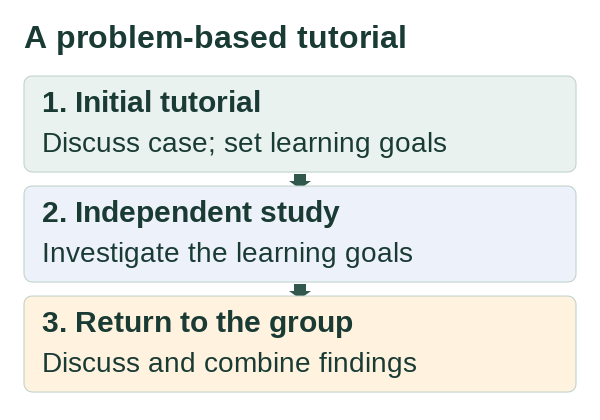
The cycle starts with analyzing the problem. The cycle includes a phase of self-directed learning.[66] The method aims to build self-directed learning skills. It also aims to build problem-solving and teamwork skills.[65]
A study of 218 students tested whether this private study builds on the group discussion that came before it. The researchers measured which scientific concepts students could remember. They did this at the end of each phase of the cycle. One model said each phase depended on the phase before it. This model fitted the data well.[66]
A review of the process reports on causal studies. These have shown that every phase of problem-based learning is needed. All of them affect students' learning outcomes. The same review notes that studies of process are still not settled. They do not show which part of the method most affects learning.[2]
One early test took it to high school. The course was an experimental problem-based course for gifted students. It was called Science, Society and the Future. In that interdisciplinary course, students examined current science issues. Examples were the effect of electromagnetic fields on childhood leukemia and the health care system. Students in the course and a comparison group were tested. The test looked at how often students used problem-solving steps on their own. They were given an ill-structured problem to consider. The course group showed some significant changes that the comparison group did not show.[64]
Self-directed learning and self-regulation
A 2008 review set out to show how self-directed learning is carried out in problem-based learning. It also asked how this connects to self-regulated learning. Self-directed learning adds one more premise. Students take a wider role in choosing and judging learning materials. Self-directed learning can include self-regulated learning. The reverse is not true. The review also looked at empirical studies of both ideas in problem-based learning. Its results suggested that both are processes that develop over time. They also suggested that the self aspect matters. The review concluded that clearer definitions would help. So would guidance for teachers and students. Together they could help problem-based learning produce self-directed learners.[67]
A 2006 study tested self-regulated learning directly. It used the Motivated Strategies for Learning Questionnaire. This is a standard survey of motivation and study tactics. The participants were 61 tenth-grade students in 2 whole biology classes. The same teacher taught both. One class was assigned at random to problem-based learning with ill-structured problems. The other was assigned to teacher-centered, textbook-oriented instruction. PBL students also scored higher on metacognitive self-regulation.[68]
Several parts of a problem-based curriculum may change what students do to learn. A 1994 study asked which parts of the curriculum shape those decisions. It used interviews followed by a questionnaire. Students reported that all of these elements could affect what they chose to study. The pull of those elements generally fell across the four years. The pull of the tutorial discussion tended to rise. The findings suggest that students become better self-directed learners over four years of the curriculum. This holds even with many clues guiding their choices.[69]
A 2024 longitudinal study surveyed 250 medical students in a problem-based curriculum. It sampled students across academic performance levels. The survey measured self-directed learning through goal setting, time management and self-assessment. It measured self-regulated learning through motivation, self-efficacy, cognitive strategies and behavioural regulation. Goal setting and intrinsic motivation were significantly engaged (p = 0.001). Links between self-directed skills and self-regulated outcomes were moderate. Self-regulation skills did not differ much across performance levels (p > 0.05). This points to fairly even development, whatever the students' prior achievement. The study concluded that self-directed learning in problem-based learning has a positive but modest impact. The effect is on self-regulated outcomes, on management and on self-assessment.[70]
A 2020 case study at one medical college compared two groups. One had 63 students in their third and fourth levels, taught through problem-based learning. The other had 51 students in their fifth and sixth levels, taught traditionally. It used an analytical descriptive method and a scale of self-learning skills. The problem-based group came out ahead. The differences between the groups were statistically significant. The size of the effect varied by skill. It was strong for managing information and for carrying out learning strategies. Effects were moderate for attitude toward learning and for learning responsibility. They were also moderate for motivation and self-confidence. The effects were also moderate for planning and for use of learning opportunities. The effects were moderate for assessing the learning process. They were also moderate for judging results.[71]
The tutor as facilitator
The teacher's role in PBL needs to change. Teaching staff also need new skills. A 1999 review described the tutor role as a mix of teacher, facilitator and evaluator. The review found several disputes. Researchers disagreed about the best role for the faculty person in a tutorial group. These disputes concern how much the tutor takes part, the tutor's knowledge of the subject, and the tutor's role in grading students. The review found no completely satisfactory resolution of these controversies. It used pieces of evidence that often conflicted. Together they built a picture of an effective tutor.[72]
Researchers studied video from two meetings of problem-based learning groups. They studied one expert facilitator at work. The facilitator used particular strategies. These helped students build causal explanations and reason effectively. They also helped them become self-directed learners. All of this happened while the facilitator kept the learning process centered on students. The analysts argued that putting these strategies into words is a step toward teaching others. It helps others learn the craft of facilitation.[73]
Staff development is a required part of starting problem-based learning. It described how problem-based learning was brought into the Nursing and Midwifery curricula at the University of Dundee. The authors argued that staff development there mattered. It affected how well the later implementation worked.[74]
A 2000 article asked what past research showed. The question was how to train faculty to conduct problem-based learning. Many faculty find the change hard when they retrain for problem-based learning.[75]
An action-research project studied academics who were learning to teach with problem-based learning. The project examined how a community of practice supported this change. The teachers were keen on problem-based learning. But they met many problems during the change. One specific concern was the varied input teachers gave their tutor groups. Another was the possible unfairness in student learning. But its structure was seen as too hierarchical. The group could have worked better. It would have helped to adopt the principles behind a community of practice. Then teachers could take a more critical stance on how they operated and taught.[76]
Groups, engagement and talk
A 1997 paper argued that schools and universities rarely teach these interpersonal skills. So students often muddle through group processes on their own.[77] A 2003 study in a graduate-entry medical programme reported the most common group problems. It also reported the ones that got in the way of learning most. The study looked at problems as seen by both students and tutors in the same setting. Earlier research had not done this. It offered an exploratory model of how groups break down. The model covered possible causes of one student staying quiet and another dominating. It also covered the effects such problems may have on the tutorial. The authors asked for more evidence. They wanted it before writing guidelines for tutors and students on handling group problems.[78]
A 2011 study designed and tested a short self-report instrument. It measures cognitive engagement with the topic at hand in problem-based learning. The questionnaire was shown to be valid and reliable. Students' cognitive engagement rose significantly during a one-day problem-based learning event.[79]
Raters coded 6 hours of transcripts against a framework of 5 critical thinking stages. They calculated a critical thinking ratio for each stage. Raters agreed 85.5% of the time on average. This showed that independent raters could use the code reliably. The ratios seemed to differ between 2 problem-based learning groups taught in 2 different ways. The authors concluded that the approach could give useful information. It could show the effect of case modality.[80]
Students' academic engagement depends on many factors at once. These include the learner's own traits, the teacher and the teaching method. Peers and the wider learning setting also count. These factors can be cognitive, metacognitive, affective or social. They can also be task-related, communicative or language-related. They overlap rather than sit apart. A 2021 study looked at the link between the engagement of 34 students and their views of three instructors. The setting was a teacher education programme for pre-service English teachers in Austria. An online questionnaire asked about effort, dedication and learning success. The course was a university course that used problem-based learning. It compared this with conventional teaching methods. The study also asked how students saw their instructors' caring and credibility. It also asked about their communication style and feedback. This gave new information on how problem-based learning shapes student-teacher relationships. Because of Covid-19, the course was taught online. It would normally have met face to face. The paper notes that relationships between students and teachers seem to strongly affect engagement in academic work. So do students' perceptions of their teachers.[81]
Scaffolds, worksheets and assessment
Learning of the topic was measured with concept recall tests. Students took them before and after the lesson. The two groups showed no statistically significant difference in how well they understood the material. Students also rated what affected their learning, and the worksheet came last. The tutor was rated the strongest influence. Team and class dynamics came next. The study concluded that worksheets may not play a significant role in enhancing learning. This applies within problem-based learning's social setting.[82]
A progress test samples knowledge across all areas of medicine. It reflects the end goals of the curriculum. It is given periodically to all medical students, whatever their year of training. Because the format covers everything, students cannot prepare for it specifically. Fifteen years of experience showed that the format works well. Progress tests brought several unexpected educational benefits. It also brought a few drawbacks.[83]
Self, peer and tutor ratings were collected at the same time. They covered responsibility and respect, communication, and critical analysis. They did this through a case summary. Tutor scores matched self-assessment ratings poorly, at r = 0.31 to 0.41. Students consistently under-marked their own performance. Students with greater self-efficacy gave their own performance higher scores. Peer assessment was a little more accurate. Peer-averaged scores correlated with tutor ratings at r = 0.40 at first. Over time the correlation was r = 0.60. This was especially true of those sceptical of the peer-assessment process. Self-assessment still has a role in supporting reflection and self-awareness.[84]
Group exams fit problem-based learning. But higher education also requires individual assessment. A 2024 study explored whether an individual reflection paper can support individual assessment within group examinations. It used 152 individual reflection papers. These checked whether students had gained the theoretical and analytical knowledge the group examination required. The completed papers clearly matched what students had learned with what the examination asked for. This held except on a few occasions. The findings suggest that such papers can support individual assessment. They also suggest that tutorial groups can learn together. Group work can still be assessed for each student.[85]
Where PBL has been used
Veterinary faculties worldwide have adopted PBL. They use it for both curriculum content and the learning process itself. In veterinary courses, clinical cases are chosen to push students toward deep learning. This covers basic science and clinical knowledge.[86]
Students worked through real cases in stages. They kept records in e-portfolios (online collections of their work). They were judged to gain critical thinking and problem-solving skills.[87]
Maastricht University used PBL as an overall plan for several programmes. Medicine was one of them. In later phases, project work is a strong alternative. That analysis judged PBL less suitable as an overall plan for engineering education.[88]
A study at a federal university in Northeastern Brazil used action research, in which the teacher studies changes made in a real course. Students saw the practical side, teamwork and the presence of an entrepreneur or manager in class as factors that helped learning. Students said teamwork and the time involved limited their learning.[89]
Ergonomics, the study of designing workplaces to fit human performance and well-being, has also hosted PBL. One undergraduate course asked a question. How can we assess and reduce people's daily noise exposure to protect hearing? Some students did all the activities. Of these, 60% strongly agreed and 32% agreed that PBL helped them understand the subject. Only 8% said PBL added nothing important to learning the topic. The framework built for noise could be adapted to other topics in the course.[90]
In 2010, one undergraduate program replaced a traditional content-driven syllabus with a problem-based approach. The semester lasted 13 weeks. In that time, 150 pre-service teachers each chose a real world problem for a Design and Make project. They spent one week combining PBL with open scientific inquiry. They displayed their working models at a public science museum.[91]
The US Department of Education paid for Project Insights. It asked whether PBL would help students show academic potential that had gone unseen. The researchers compared test scores, teacher ratings and independent ratings. These findings supported treating that group as distinct from two other groups. One group was students traditionally identified as gifted. The other was general education students.[92]
Adaptations for school levels and special groups
One fifth-grade science class was the subject of a two-cycle classroom action study. It tracked students meeting the mastery standard. The share rose from 50% before the study to 68% in cycle I and 90% in cycle II.[93] A second elementary mathematics study, at Grade V, saw mastery rise from 55.55% in the first cycle. It reached 92.59% in the second. Average scores moved from 69.33 to 80.48.[94]
At secondary level, Rahayu and Afisah (2025) ran two cycles with 37 students. The students were in Class X.6 at a school in Palembang. The average observed interest score in mathematics rose from 65.28% to 78.73%. Questionnaire scores rose from 82.32% to 86.81%.[95]
A quasi-experimental study in a madrasah, an Islamic school, compared two Fiqh classes. Post-test scores were 81.7 for the PBL group and 70.4 for conventional instruction. The significance value was 0.001.[96]
Nursing programs have adopted PBL for clinical preparation; a quasi-experimental study of 68 seventh-semester nursing students found better learning outcomes in the PBL group than in a conventional-instruction group.[97] Ma and Lu (2019) studied pediatric medical education in China. They pooled 12 randomized controlled trials with 1003 medical students. PBL raised theoretical knowledge scores (95% confidence interval 0.79 to 1.52) and skill scores (0.87 to 2.25). It also raised case analysis scores, each at P < .00001. Ma and Lu (2019) asked for more controlled trial designs. They wanted firmer conclusions about pediatric education.[98]
Yuliyanti and Pamungkas (2026) worked with students who have learning difficulties. They combined PBL with the Concrete-Representational-Abstract method. They did this in one inclusive elementary classroom. Yuliyanti and Pamungkas (2026) ran two cycles with 28 Grade VI students. Five of them had identified learning difficulties. The class mean rose from 58.86 to 78.61 and then 88.82, and mastery rose from 43% to 100%. The five focal students improved from a group mean of 17.00 to 77.60, and all reached mastery.[99]
Redesigning courses and virtual settings
Klindt describes two content courses in a master's program. Their syllabi were revised to stress problem-orientation, group work and exemplarity. A study reform from the department management had cut project work each semester from 15 to 10 ECTS credits. This led to the revisions. Klindt describes how the study board weighed its options. He also examines what students said about the revised courses.[100]
Phungsuk, Viriyavejakul and Ratanaolarn built a problem-based learning model for a virtual learning environment. They tested it with undergraduates. The model was made for undergraduate students in a Photography for Communication Arts course. The design and assessment phases drew on instructional systems design and a systems approach. An efficiency test of the model reached 80/83.93 against a set of criteria. The researchers treated this as above average. The group taught through the virtual model scored higher on a test than a group in a normal classroom. The result was significant at .05. Students in that model chose their own topics and study times. Their work was rated as showing more knowledge of information technology.[101]
Kenny, Bullen and Loftus ran an exploratory study. It looked at an online undergraduate problem-based course in Agricultural Sciences. It used an instrument built to measure problem formulation and resolution. The study used a content analysis instrument. Students did engage in both processes. Their work matched the course's problem-based approach. Yet the teaching tied the problems closely to a set assignment structure. This seemed to limit those processes in their early and late stages.[102]
Susiyawati, Erman, Nurita, Qosyim and Roqobih studied students in two interdisciplinary courses. The courses combined problem-based learning with blended learning. A study of undergraduates in two interdisciplinary courses collected surveys and one-to-one semi-structured interviews on that combination. Students generally liked the flexibility and interactive nature of the blended format. They also liked the active learning of the problem-based approach. A few students struggled with team coordination and time management. They also found the amount of guidance during the work intense. The study recommends careful course design to strengthen collaboration.[103]
Chang, Yan and Lu designed a teaching process around flipped classrooms. They combined problem-based learning with different collaborative learning strategies. The experimental group worked in mixed subgroups. The control group worked in random subgroups. The experimental group showed higher improvements in learning outcomes than the control group. Participants gave positive ratings to the flipped model on every questionnaire item.[104]
The overall effect was large, with partial η² = 0.455. The researchers call for randomized studies across several institutions to test how far it generalizes.[105] A meta-analysis of studies on this combination in mathematics reported a pooled effect size of g = 1.06. Effectiveness varied by media platform and by type of publication.[106] A 2x2 factorial experiment compared the combined model with problem-based learning alone. It found differences in achievement between the models and by academic ability, but no interaction between the two.[107]
What this looks like when you study
In one undergraduate anthropology course, 49 students worked on open-ended case scenarios in small groups. The course had students with different amounts of subject experience and no earlier exposure to active learning. One group did not rise: 88% of the forensic specialists reported low motivation at the end. Those students said the workload outside class was unmanageable and that they were given too little direction.[17]
In a Singapore teacher education institute, 1041 preservice teachers took a core educational psychology course taught with problem-based learning. The scaffolding and connecting processes predicted the learning strategies students reported afterward. Students who regulated their own thinking well before the course rated those processes as more important.[59]
When you prepare for a tutorial, write down what you already know about the problem before you search for anything.[15] Then list the questions you cannot yet answer and turn them into your own learning issues.[22] Search for sources yourself, and judge whether each source fits the problem rather than only the test.[67] Bring what you found back to the group and explain it in your own words, because discussion of the problem is what drives the learning.[15]
Criticism
Criticisms and open questions
People disagree about what counts as PBL. This makes it hard for researchers to judge how well it works. A 2008 guide argued that the definition of problem-based learning was as hard to pin down then as it had been since the concept first appeared over forty years earlier.[108]
A 2023 paper on meta-analysis noted several related problem-centered pedagogies. These include case-based, project-based and inquiry-based learning. Even within problem-based learning, primary studies measure things in widely varied ways. They cover many audiences and many fields. The paper added that control groups are defined in multiple ways. It said some designs are pre-experimental, and some studies test several treatments at once.[109]
A 2020 scoping review searched eight academic databases. It found 66 peer-reviewed articles that were eligible for review.[110] A scoping review is a review that scopes the body of literature on a topic in order to identify gaps in knowledge and clarify concepts.[111]
The review found many different views on what critical thinking means. It also found many on how it relates to problem-based learning. Most of the reviewed work gave no clear reason for the link between the two. It did not explain why the link is thought to exist.[110]
A 2014 review compared processes inside PBL courses with studies of outcomes. It reported that students held a range of views about the idea of problem-based learning. They also differed on how to approach study in such curricula. How students approached their studies was closely tied to how they conceived of problem-based learning. It was also related to how they perceived the goals and standards of their courses.[112]
A 2025 special issue of a journal on problem-based learning was devoted to designing intentionally for equity. The focus was problem-based and project-based learning. Its editors said the aim was to advance justice. They also said it promotes deeper, more meaningful learning experiences for all students.[113]
A 1996 article asked whether problem-based learning would become the norm in education. It also asked whether its popularity would fade. Would a newer innovation replace it?[114] What works best, that paper said, depends on many variables. These include the intended outcomes and the group of students being taught. They also include the assessment formats and teachers' experience with these methods.[115]
A 2025 article on creativity in higher education argued that finding problems requires students to build a basis of critical judgment. That lets them question social conventions and worldviews people take for granted. The article used two real examples. They came from social science and humanities programs at Aalborg University in Denmark.[116]
A 2000 review of medical education research from 1992 through 1998 found no convincing evidence. It found no proof that problem-based learning improves the knowledge base and clinical performance. The gains were smaller than one would expect. A problem-based curriculum needs a lot of resources. That review also judged the links between the educational theory behind problem-based learning and the research evidence. It found them loose at best.[117]
Dysfunctional curricula and implementation barriers
A problem-based learning curriculum can fail if it mixes two opposing teaching philosophies. This can happen without expert oversight. One common variant is called hybrid problem-based learning. It places conventional teaching methods alongside problem-based learning. A 2012 paper argued that mixing these two approaches can weaken problem-based learning. The mix can cancel out its positive benefits. Some schools use hybrid problem-based learning without staff trained in medical education. They may end up with a curriculum that does not work. Such a curriculum can be worse off than the traditional approach it replaced. The paper advised schools to check their curriculum regularly for signs of breakdown. That way, corrections can come in time. Lim lists four requirements for a successful move to standard problem-based learning. They are handling resistance from staff, clarifying what lectures are for, allowing enough preparation time, and having administrative leaders behind the change.[118]
Azer's 2001 review looked at the main problems medical schools reported. These arose while they prepared and ran a problem-based curriculum. That review noted that no available review had yet evaluated these barriers critically.[119]
A 1998 paper made a related point about support structures. Problem-based learning treats student independence as one of its basic tenets. This may suggest that a learning support structure matters less. That paper challenged the idea that support matters less in such a setting.[120]
Students themselves name the factors that help or hinder problem-based learning. A 2023 qualitative study interviewed 10 second-year medical students. They were at a private university in Malaysia. The analysis generated codes covering how students saw themselves and their own traits, the facilitators, team dynamics, and how the sessions were organised and run. The codes were then grouped into themes. These covered the student, the facilitator and the learning environment. The study concluded that each of these areas has both pros and cons. These may help or block the realisation of problem-based learning outcomes.[121]
Abdullah and Girei reviewed 22 articles on technology-based scaffolding in problem-based learning. They found that question prompts given in a complicated or difficult way could hinder learning rather than help it. A 2022 scoping review analysed 22 full articles that met its inclusion criteria.[122]
One large medical school moved away from problem-based learning altogether. Student satisfaction with the problem-based model at the Sydney Medical Program had fallen over recent years. Student numbers grew, and standardisation across cohorts became a worry. In 2017, team-based learning replaced problem-based learning in Years 1 and 2 of the program. That year, 625 students in Years 1 and 2 took part in weekly team-based learning sessions. Each class had about 60 students. Students asked for pre-reading tasks that fit the patient case more closely. They also wanted less class time, more chances to practise clinical reasoning, and more feedback on the mechanistic flowchart. The school found savings in resources, such as fewer teaching sessions and fewer required facilitators.[123]
Critical and sociocultural critiques
A 2019 perspective paper by Cavanagh, Vanstone and Ritz argues that problem-based medical education rests on a biomedical worldview. The paper says that worldview fixes rigid habits of thought about health disparities in the minds of medical trainees. Cavanagh, Vanstone and Ritz argue that this worldview fixes deterministic ways of thinking about health disparities shaped by social and cultural conditions. The aim is health equity. It also aims to train health professionals who respond to marginalized and vulnerable communities. The paper argues that problem-posing medical education could change how physicians relate to knowledge. It could also change how they see their own identity and their patients.[124]
A 2009 article by Thomas links problem-based learning to education about sustainability. The concepts and terms of that field are disputed. The terms in this field are contested, the article notes: education for sustainable development and education for sustainability mark increasing levels of change required in curricula. The article adds that sustainable education would require even greater change than either. Teaching for sustainability should focus on the processes of learning. It should not focus on piling up knowledge. Critical thinking is named as the key link between three things. These are transformative learning, sustainable education and problem-based learning. The article concludes that the challenge is to change teaching across all disciplines. Academics and students should then think critically.[125]
An earlier line of argument links problem-based learning to reform of higher education itself. A 1994 article argues that the predicament of higher education under government-imposed reforms is partly a result of the education government members themselves received. Higher education therefore carries some responsibility for the nature of those reforms. Read as problem-focused, problem-based learning skips important parts of that view. It suggests better ways to think and act. Margetson sees gains that last longer, for education and for the wider community alike.[126]
Birch also held that it could bring academic and operational approaches to higher education together. In Birch's account it also builds strong motivation and the ability to learn actively. The 1986 paper gave examples of successful adoption. It examined the conditions needed for a general model, then outlined a possible structure for one.[127]
Common misconceptions
Many people believe that problem-based learning builds general problem-solving skill that carries over to any new problem. The same review found preliminary evidence that PBL may help students transfer concepts to new problems and integrate basic science into clinical problems.[3]
Key studies
| Year | Study | Sample | Design | Finding |
|---|---|---|---|---|
| 1992 | Gallagher et al.[64] | gifted high school students in an interdisciplinary problem-based course and a comparison group | pre-post comparison on an ill-structured problem task | The problem-based group showed some significant changes in spontaneous use of problem-solving steps that the comparison group did not show. |
| 1992 | Norman & Schmidt[3] | Review of experimental evidence on PBL claims | No evidence that PBL improves general problem-solving skills; PBL may initially reduce learning but increase retention over years. | |
| 1993 | Dolmans et al.[22] | about 120 second-year medical students and 12 tutors in 12 tutorial groups | three linked studies in a six-week course | Student-generated learning issues covered 64.2% of faculty objectives on average, and each group missed about 15% of objectives. |
| 1993 | Vernon & Blake[4] | Meta-analysis of 35 studies from 19 institutions, 1970-1992 | PBL was superior for program evaluations (dw = +.55) and clinical performance (dw = +.28), but traditional students scored higher on NBME I (dw = -.18). | |
| 2006 | Sungur & Tekkaya[68] | 61 tenth-grade students in 2 intact biology classes | randomized class comparison of PBL and traditional instruction | Students taught through problem-based learning reported stronger intrinsic goal orientation and placed more value on the tasks than control students did. They also used elaboration strategies more, thought more critically, regulated their own learning more, managed their effort better and learned more with peers. |
| 2006 | Steadman et al.[40] | randomized controlled trial of simulation versus PBL | The simulation group improved by 25 percentage points on the final assessment, against 8 points for the PBL group. | |
| 2007 | Papinczak et al.[84] | comparison of self-, peer- and tutor assessment in tutorials | Tutor scores correlated poorly with self-assessment (r = 0.31 to 0.41), while peer scores correlated moderately and improved over time (r = 0.40 to 0.60). | |
| 2011 | Choo et al.[82] | randomized experiment with and without a worksheet scaffold | Understanding did not differ significantly between groups, and students rated the tutor as the strongest influence on their learning. | |
| 2016 | Yew & Goh[2] | Review of studies on PBL process and effectiveness | Studies consistently show PBL's superior efficacy for longer-term knowledge retention and application of knowledge. | |
| 2017 | Fukuzawa et al.[17] | 49 undergraduates in an anthropology course | survey, peer evaluation and self-reflection study | 76.7% of students increased their motivation toward PBL by the end, but 88% of forensic specialists reported low motivation at the end. |
| 2017 | Phungsuk et al.[101] | undergraduates in a Photography for Communication Arts course | development and evaluation of a PBL model in a virtual learning environment | The PBL group via virtual learning environment scored higher than a normal classroom group, with statistical significance at .05. |
| 2020 | Moustaffa[71] | 114 medical students, 63 taught with PBL and 51 with traditional methods | analytical descriptive study with a self-learning skills scale | PBL students scored higher on self-learning skills overall, with a strong effect size of 1.06. |
| 2021 | Xu et al.[58] | 1269 students in 9 Chinese medical cell biology studies | systematic meta-analysis | Problem-based learning students outscored lecture-based students on total examination scores (SMD 0.89) and on scores across combined examination sections (SMD 0.53). The pooled estimates varied widely between studies (I2 = 89.7%). |
| 2023 | Chua[59] | 1041 preservice teachers in Singapore | path analysis of survey data before and after a PBL course | Scaffolding and connecting processes predicted later learning strategies, and pre-course metacognitive self-regulation shaped how important students found those processes. |
See also
References
- Savery, J. R. (2006). Overview of Problem-based Learning: Definitions and Distinctions. Interdisciplinary Journal of Problem-Based Learning, 1(1). doi:10.7771/1541-5015.1002
- Yew, E. H. J., & Goh, K. (2016). Problem-Based Learning: An Overview of its Process and Impact on Learning. Health Professions Education, 2(2), 75-79. doi:10.1016/j.hpe.2016.01.004
- Norman, G. R., & Schmidt, H. G. (1992). The psychological basis of problem-based learning: a review of the evidence. Academic Medicine, 67(9), 557-65. doi:10.1097/00001888-199209000-00002
- Vernon, D. T., & Blake, R. L. (1993). Does problem-based learning work? A meta-analysis of evaluative research: . Academic Medicine, 68(7), 550-63. doi:10.1097/00001888-199307000-00015
- Koh, G. C. H., Khoo, H. E., Wong, M. L., & Koh, D. (2008). The effects of problem-based learning during medical school on physician competency: a systematic review. Canadian Medical Association Journal, 178(1), 34-41. doi:10.1503/cmaj.070565
- CHARLIN KAREN MANN PENNY HANSEN, B. (1998). The many faces of problem-based learning: a framework for understanding and comparison. Medical Teacher, 20(4), 323-330. doi:10.1080/01421599880742
- M. HARDEN MARGERY H. DAVIS, R. (1998). The continuum of problem-based learning. Medical Teacher, 20(4), 317-322. doi:10.1080/01421599880733
- Servant-Miklos, V. (2020). Problem-oriented Project Work and Problem-based Learning: "Mind the Gap!". Interdisciplinary Journal of Problem-Based Learning, 14(1). doi:10.14434/ijpbl.v14i1.28596
- KOLMOS, A. (1996). Reflections on Project Work and Problem-based Learning. European Journal of Engineering Education, 21(2), 141-148. doi:10.1080/03043799608923397
- Jones, R. W. (2006). Problem-based Learning: Description, Advantages, Disadvantages, Scenarios and Facilitation. Anaesthesia and Intensive Care, 34(4), 485-488. doi:10.1177/0310057x0603400417
- Wood, E. J. (2004). Problem-based learning. Acta Biochimica Polonica, 51(2), XXI-XXVI. doi:10.18388/abp.2004_3571
- Neville, A. J. (2009). Problem-Based Learning and Medical Education Forty Years On. Medical Principles and Practice, 18(1), 1-9. doi:10.1159/000163038
- Bligh, J. (1995). Problem-based learning in medicine: an introduction. Postgraduate Medical Journal, 71(836), 323-326. doi:10.1136/pgmj.71.836.323
- Hallinger, P. (2021). Tracking the Evolution of the Knowledge Base on Problem-based Learning: A Bibliometric Review, 1972-2019. Interdisciplinary Journal of Problem-Based Learning, 15(1). doi:10.14434/ijpbl.v15i1.28984
- SCHMIDT, H. G. (1993). Foundations of problem‐based learning: some explanatory notes. Medical Education, 27(5), 422-432. doi:10.1111/j.1365-2923.1993.tb00296.x
- Hmelo, C. E., & Ferrari, M. (1997). The Problem-Based Learning Tutorial: Cultivating Higher Order Thinking Skills. Journal for the Education of the Gifted, 20(4), 401-422. doi:10.1177/016235329702000405
- Fukuzawa, S., Boyd, C., & Cahn, J. (2017). Student Motivation in Response to Problem-based Learning. Collected Essays on Learning and Teaching, 10, 175-188. doi:10.22329/celt.v10i0.4748
- Stepien, W. J., & Pyke, S. L. (1997). Designing Problem-Based Learning Units. Journal for the Education of the Gifted, 20(4), 380-400. doi:10.1177/016235329702000404
- Jonassen, D. H., & Hung, W. (2008). All Problems are Not Equal: Implications for Problem-Based Learning. Interdisciplinary Journal of Problem-Based Learning, 2(2). doi:10.7771/1541-5015.1080
- Hmelo-Silver, C. E. (2013). Creating a Learning Space in Problem-based Learning. Interdisciplinary Journal of Problem-Based Learning, 7(1). doi:10.7771/1541-5015.1334
- Sockalingam, N., & Schmidt, H. G. (2011). Characteristics of Problems for Problem-Based Learning: The Students’ Perspective. Interdisciplinary Journal of Problem-Based Learning, 5(1). doi:10.7771/1541-5015.1135
- Dolmans, D. H., Gijselaers, W. H., Schmidt, H. G., & van der Meer, S. B. (1993). Problem effectiveness in a course using problem-based learning: . Academic Medicine, 68(3), 207-13. doi:10.1097/00001888-199303000-00013
- Hansen, J. D. (2006). Using Problem-Based Learning in Accounting. Journal of Education for Business, 81(4), 221-224. doi:10.3200/joeb.81.4.221-224
- O'Kelly, J., & Gibson, J. P. (2006). RoboCode & problem-based learning: a non-prescriptive approach to teaching programming. ACM SIGCSE Bulletin, 38(3), 217-221. doi:10.1145/1140123.1140182
- Anazifa, R. D., & Djukri, D. (2017). Project- Based Learning and Problem-Based Learning: Are They Effective to Improve Student’s Thinking Skills? Jurnal Pendidikan IPA Indonesia, 6(2), 346. doi:10.15294/jpii.v6i2.11100
- Winarno, S., Muthu, K. S., & Ling, L. S. (2017). Direct Problem-Based Learning (DPBL): A Framework for Integrating Direct Instruction and Problem-Based Learning Approach. International Education Studies, 11(1), 119. doi:10.5539/ies.v11n1p119
- Scott, K. S. (2017). An Integrative Framework for Problem-Based Learning and Action Learning: Promoting Evidence-Based Design and Evaluation in Leadership Development. Human Resource Development Review, 16(1), 3-34. doi:10.1177/1534484317693090
- Byun, H. W. (2020). Efficacy Verification of Team Learning Satisfaction, Problem Solving Ability, and Communication Ability of Problem Solving Process Classes Applying Action Learning, Problem-Based Learning, and Mentoring. Journal of Problem-Based Learning, 7(2), 63-73. doi:10.24313/jpbl.2020.00269
- Hakim, R. N., & Wutsqo, D. U. (2026). Flipped Classroom Integrates Problem-Based Learning: Enhancing Conceptual comprehension, Problem-Solving Abilities, and Self-Regulated Learning. Journal of Mathematics Science and Computer Education, 6(1), 332. doi:10.20527/jmscedu.v6i1.18599
- Thomassen, A. O., & Stentoft, D. (2020). Educating Students for a Complex Future: Why Integrating a Problem Analysis in Problem-Based Learning Has Something to Offer. Interdisciplinary Journal of Problem-Based Learning, 14(2). doi:10.14434/ijpbl.v14i2.28804
- Stepien, W. J., Gallagher, S. A., & Workman, D. (1993). Problem-Based Learning for Traditional and Interdisciplinary Classrooms. Journal for the Education of the Gifted, 16(4), 338-357. doi:10.1177/016235329301600402
- Stentoft, D. (2017). From saying to doing interdisciplinary learning: Is problem-based learning the answer? Active Learning in Higher Education, 18(1), 51-61. doi:10.1177/1469787417693510
- Cho, H., Cho, S. M., Cho, B. M., Jeong, S. H., & Cho, S. Y. (2021). A Study on Key Components of Problem-Based Learning through Literature Review. Journal of Problem-Based Learning, 8(2), 69-74. doi:10.24313/jpbl.2021.00045
- GET-IT Glossary (plain-language health research terms) (n.d.). meta-analysis. GET-IT Glossary (plain-language health research terms). https://getitglossary.org/term/meta-analysis
- Gijbels, D., Dochy, F., Van den Bossche, P., & Segers, M. (2005). Effects of Problem-Based Learning: A Meta-Analysis From the Angle of Assessment. Review of Educational Research, 75(1), 27-61. doi:10.3102/00346543075001027
- Dağyar, M., & Demirel, M. (2015). Effects of Problem-Based Learning on Academic Achievement: A Meta-Analysis Study. Education and Science, 40(181), 139-174. doi:10.15390/eb.2015.4429
- Dağyar, M., & Demirel, M. (2016). Effects of Problem-Based Learning on Attitude: A Meta-analysis Study. EURASIA Journal of Mathematics, Science and Technology Education, 12(8). doi:10.12973/eurasia.2016.1293a
- Trullàs, J. C., Blay, C., Sarri, E., & Pujol, R. (2022). Effectiveness of problem-based learning methodology in undergraduate medical education: a scoping review. BMC Medical Education, 22(1). doi:10.1186/s12909-022-03154-8
- Capon, N., & Kuhn, D. (2004). What's So Good About Problem-Based Learning? Cognition and Instruction, 22(1), 61-79. doi:10.1207/s1532690xci2201_3
- Steadman, R. H., Coates, W. C., Huang, Y. M., Matevosian, R., Larmon, B. R., McCullough, L., & Ariel, D. (2006). Simulation-based training is superior to problem-based learning for the acquisition of critical assessment and management skills*: . Critical Care Medicine, 34(1), 151-157. doi:10.1097/01.ccm.0000190619.42013.94
- Srinivasan, M., Wilkes, M., Stevenson, F., Nguyen, T., & Slavin, S. (2007). Comparing Problem-Based Learning with Case-Based Learning: Effects of a Major Curricular Shift at Two Institutions: . Academic Medicine, 82(1), 74-82. doi:10.1097/01.acm.0000249963.93776.aa
- Distlehorst, L. H., Dawson, E., Robbs, R. S., & Barrows, H. S. (2005). Problem-Based Learning Outcomes: The Glass Half-Full: . Academic Medicine, 80(3), 294-299. doi:10.1097/00001888-200503000-00020
- Knöpfel, M., Kalz, M., & Meyer, P. (2024). General Problem-solving Skills Can be Enhanced by Short-time Use of Problem-Based Learning (PBL). Journal of Problem Based Learning in Higher Education. doi:10.54337/ojs.jpblhe.v12i1.7871
- Epstein, R. J. (2004). Learning from the problems of problem-based learning. BMC Medical Education, 4(1). doi:10.1186/1472-6920-4-1
- Suparman, Juandi, D., & Tamur, M. (2021). Review of problem-based learning trends in 2010-2020: A meta-analysis study of the effect of problem-based learning in enhancing mathematical problem-solving skills of Indonesian students. Journal of Physics: Conference Series, 1722(1), 012103. doi:10.1088/1742-6596/1722/1/012103
- HTA Glossary (health technology assessment) (n.d.). random effects model. HTA Glossary (health technology assessment). https://htaglossary.net/random-effects-model
- Musna, R. R., Juandi, D., & Jupri, A. (2021). A meta-analysis study of the effect of Problem-Based Learning model on students’ mathematical problem solving skills. Journal of Physics: Conference Series, 1882(1), 012090. doi:10.1088/1742-6596/1882/1/012090
- Panda, F. M., Sajidan, S., & Suryana, R. (2025). Effectiveness Of Problem-Based Learning Model To Empower Problem-Solving Skills In Science Learning: Meta-Analysis. Journal of Physics: Conference Series, 3148(1), 012020. doi:10.1088/1742-6596/3148/1/012020
- Busyairi, A., & Kusuma, A. S. (2023). The Effectiveness of Problem-Based Learning Model In Improving Critical Thinking Skills in Science Learning: a Meta-Analysis. Kappa Journal, 7(1), 128-137. doi:10.29408/kpj.v7i1.15886
- Fitri, A. M., & Mufit, F. (2024). Meta-analysis of the effect of problem-based learning model on critical thinking skills. Journal of Learning and Technology in Physics, 2(1), 9. doi:10.24114/jltp.v2i1.56668
- Siska Alvionita (2025). Meta-analysis of the effect of problem-based learning (PBL) on chemistry learning outcomes. BALANGA: Jurnal Pendidikan Teknologi dan Kejuruan, 13(1), 22-29. doi:10.37304/balanga.v13i1.17368
- Gultom, H., & Rohaeti, E. (2024). The Effectiveness of the Ethnochemistry-based Problem Based Learning Model on Students' Problem-Solving Ability in Chemistry Learning: A Meta-analysis Study in 2021-2024. Jurnal Penelitian Pendidikan IPA, 10(7), 508-514. doi:10.29303/jppipa.v10i7.8089
- Christiana, L., & Rohaeti, E. (2024). Does Ethnoscience Based Problem Based Learning Model Improve Student’s Creative Thinking Skill in Chemistry Learning? Meta-analysis. Jurnal Penelitian Pendidikan IPA, 10(3), 96-104. doi:10.29303/jppipa.v10i3.6915
- Nora, A., & Asrizal (2021). Meta Analysis of The Influence of Problem Based Learning Models in High School Physics Students on Student Learning Outcomes. PILLAR OF PHYSICS EDUCATION, 13(4), 494. doi:10.24036/10318171074
- Dewi, W. S., Siregar, R., Putra, A., & Hidayati, H. (2023). Effect of Problem-Based Learning Model on Students' Physics Problem Solving Ability: A Meta-Analysis. Jurnal Penelitian Pendidikan IPA, 9(4), 2103-2109. doi:10.29303/jppipa.v9i4.3291
- Assefa, A., Bachore, M. M., & Daniel, T. (2026). The Effectiveness of Problem-Based Learning in Enhancing Learners’ English Language Skills: Meta-Analysis and Systematic Review. Journal of Problem Based Learning in Higher Education. doi:10.54337/ojs.jpblhe.v14i1.10569
- Lubna, L. (2020). Meta-analysis effectiveness of problem-based learning model in social sciences. Jurnal Tatsqif, 18(1), 22-35. doi:10.20414/jtq.v18i1.2447
- Xu, W., Ye, T., & Wang, X. (2021). The effectiveness of the problem-based learning in medical cell biology education: A systematic meta-analysis. Medicine, 100(39), e27402. doi:10.1097/md.0000000000027402
- Chua, B. L. (2023). Path Analysis: The Predictive Relationships of Problem-based Learning Processes on Preservice Teachers’ Learning Strategies. Interdisciplinary Journal of Problem-Based Learning, 17(2). doi:10.14434/ijpbl.v17i2.37322
- Hallinger, P. (2023). Bibliometric Review Methodology and State of the Science Bibliometric Review of Research on Problem-based Learning, 2017-2021. Interdisciplinary Journal of Problem-Based Learning, 17(2). doi:10.14434/ijpbl.v17i2.35761
- Velmurugan, G. (2024). Advocating for Nexus Analysis: Integrating Micro and Macro Perspectives in Problem-Based Learning Research. Journal of Problem Based Learning in Higher Education, 12(2), 69-77. doi:10.54337/ojs.jpblhe.v12i2.9023
- Kloeg, J. (2023). Education as an Open Question: A Hermeneutical Approach to Problem-Based Learning. Journal of Problem Based Learning in Higher Education, 11(1), 79-97. doi:10.54337/ojs.jpblhe.v11i1.7373
- Jørgensen, K. M. (2024). Storytelling: How to Become Who You Are Through Problem-Based Learning. Journal of Problem Based Learning in Higher Education, 12(2), 42-52. doi:10.54337/ojs.jpblhe.v12i2.9489
- Gallagher, S. A., Stepien, W. J., & Rosenthal, H. (1992). The Effects of Problem-Based Learning On Problem Solving. Gifted Child Quarterly, 36(4), 195-200. doi:10.1177/001698629203600405
- Jaganathan, S., Bhuminathan, S., & Ramesh, M. (2024). Problem-Based Learning – An Overview. Journal of Pharmacy and Bioallied Sciences, 16(Suppl 2), S1435-S1437. doi:10.4103/jpbs.jpbs_820_23
- Yew, E. H. J., Chng, E., & Schmidt, H. G. (2011). Is learning in problem-based learning cumulative? Advances in Health Sciences Education, 16(4), 449-464. doi:10.1007/s10459-010-9267-y
- Loyens, S. M. M., Magda, J., & Rikers, R. M. J. P. (2008). Self-Directed Learning in Problem-Based Learning and its Relationships with Self-Regulated Learning. Educational Psychology Review, 20(4), 411-427. doi:10.1007/s10648-008-9082-7
- Sungur, S., & Tekkaya, C. (2006). Effects of Problem-Based Learning and Traditional Instruction on Self-Regulated Learning. The Journal of Educational Research, 99(5), 307-320. doi:10.3200/joer.99.5.307-320
- DOLMANS, D. H. J. M., & SCHMIDT, H. G. (1994). What drives the student in problem‐based learning? Medical Education, 28(5), 372-380. doi:10.1111/j.1365-2923.1994.tb02547.x
- Nisa, W. U., Aman, K., Murtaza, S., Abdullah, Z., & Gul, N. (2024). Relationship between Self-Directed Learning and Self-Regulated Learning in Problem-Based Learning: Problem-Based Learning. Pakistan Journal of Health Sciences, 68-75. doi:10.54393/pjhs.v5i12.2501
- Moustaffa, N. A. (2020). Self-Learning Skills and Problem-Based Learning in Medical Education: Case Study. Revista Amazonia Investiga, 9(30), 50-59. doi:10.34069/ai/2020.30.06.5
- NEVILLE, A. J. (1999). The problem-based learning tutor: Teacher? Facilitator? Evaluator? Medical Teacher, 21(4), 393-401. doi:10.1080/01421599979338
- Hmelo-Silver, C. E., & Barrows, H. S. (2006). Goals and Strategies of a Problem-based Learning Facilitator. Interdisciplinary Journal of Problem-Based Learning, 1(1). doi:10.7771/1541-5015.1004
- Murray, I., & Savin-Baden, M. (2000). Staff Development in Problem-based Learning. Teaching in Higher Education, 5(1), 107-126. doi:10.1080/135625100114993
- Hitchcock, M. A., & Mylona, Z. H. ". (2000). Teaching Faculty To Conduct Problem-Based Learning. Teaching and Learning in Medicine, 12(1), 52-57. doi:10.1207/s15328015tlm1201_8
- Spronken-Smith, R., & Harland, T. (2009). Learning to teach with problem-based learning. Active Learning in Higher Education, 10(2), 138-153. doi:10.1177/1469787409104787
- Peterson, M. (1997). Skills to Enhance Problem-based Learning. Medical Education Online, 2(1), 4289. doi:10.3402/meo.v2i.4289
- Hendry, G. D., Ryan, G., & Harris, J. (2003). Group problems in problem-based learning. Medical Teacher, 25(6), 609-616. doi:10.1080/0142159031000137427
- Rotgans, J. I., & Schmidt, H. G. (2011). Cognitive engagement in the problem-based learning classroom. Advances in Health Sciences Education, 16(4), 465-479. doi:10.1007/s10459-011-9272-9
- Kamin, C. S., O'Sullivan, P. S., Younger, M., & Deterding, R. (2001). Measuring Critical Thinking in Problem-Based Learning Discourse. Teaching and Learning in Medicine, 13(1), 27-35. doi:10.1207/s15328015tlm1301_6
- Amerstorfer, C. M., & Freiin von Münster-Kistner, C. (2021). Student Perceptions of Academic Engagement and Student-Teacher Relationships in Problem-Based Learning. Frontiers in Psychology, 12. doi:10.3389/fpsyg.2021.713057
- Choo, S. S. Y., Rotgans, J. I., Yew, E. H. J., & Schmidt, H. G. (2011). Effect of worksheet scaffolds on student learning in problem-based learning. Advances in Health Sciences Education, 16(4), 517-528. doi:10.1007/s10459-011-9288-1
- Vleuten, C. P. M. V. D., Verwijnen, G. M., & Wijnen, W. H. F. W. (1996). Fifteen years of experience with progress testing in a problem-based learning curriculum. Medical Teacher, 18(2), 103-109. doi:10.3109/01421599609034142
- Papinczak, T., Young, L., Groves, M., & Haynes, M. (2007). An analysis of peer, self, and tutor assessment in problem-based learning tutorials. Medical Teacher, 29(5), e122-e132. doi:10.1080/01421590701294323
- Hammar Chiriac, E. (2024). Individual Reflection Papers as a Means to Support Individual Assessment in Group Examinations in Problem-Based Learning. Journal of Problem Based Learning in Higher Education. doi:10.54337/ojs.jpblhe.v12i1.8428
- Lane, E. A. (2008). Problem-Based Learning in Veterinary Education. Journal of Veterinary Medical Education, 35(4), 631-636. doi:10.3138/jvme.35.4.631
- Chung, E. Y. h. (2019). Facilitating learning of community-based rehabilitation through problem-based learning in higher education. BMC Medical Education, 19(1). doi:10.1186/s12909-019-1868-4
- Perrenet, J. C., Bouhuijs, P. A. J., & Smits, J. G. M. M. (2000). The Suitability of Problem-based Learning for Engineering Education: Theory and practice. Teaching in Higher Education, 5(3), 345-358. doi:10.1080/713699144
- Silva, A. B. D., Bispo, A. C. K. d. A., Rodriguez, D. G., & Vasquez, F. I. F. (2018). Problem-based learning: A proposal for structuring PBL and its implications for learning among students in an undergraduate management degree program. Revista de Gestão, 25(2), 160-177. doi:10.1108/rege-03-2018-030
- Ulutas, B. (2023). Using Problem-Based Learning (PBL) in an Undergraduate Ergonomics Course. Journal of Problem Based Learning in Higher Education. doi:10.54337/ojs.jpblhe.v11i3.7886
- Etherington, M. B. (2011). Investigative Primary Science: A Problem-based Learning Approach. Australian Journal of Teacher Education, 36(9). doi:10.14221/ajte.2011v36n9.2
- Gallagher, S. A., & Gallagher, J. J. (2013). Using Problem-based Learning to Explore Unseen Academic Potential. Interdisciplinary Journal of Problem-Based Learning, 7(1). doi:10.7771/1541-5015.1322
- Rudi Purwanto (2023). Increasing Elementary School Students' Science Learning Outcomes Through Problem-Based Learning. Classroom Experiences, 1(1), 30-34. doi:10.59535/care.v1i1.34
- Ramadhani, R., Putra, R. E., & Nofrianni, E. (2025). Student Learning Outcomes in Mathematics Through Problem-Based Learning: Hasil Belajar Matematika Siswa Melalui Problem-Based Learning. Academia Open, 10(2). doi:10.21070/acopen.10.2025.11954
- Rahayu, S. M., & Afisah (2025). Enhancing students' interest in learning mathematics through the implementation of problem-based learning: A classroom action research. Perpendicular : Journal of Mathematics Education and Learning, 1(1), 31-39. doi:10.61994/perpendicular.v1i1.939
- Khadafi, M., Suradi, A., & Mindani, M. (2026). Problem-Based Learning and Students Critical Thinking in Fiqh Learning: Problem-Based Learning dalam Berpikir Kritis dan Prestasi Belajar Fikih. Academia Open, 11(1). doi:10.21070/acopen.11.2026.11965
- Teknologi Pendidikan, Universitas Negeri Surabaya, Surabaya, Indonesia, & Hadi Saputro, S. (2022). The Impact of Problem Based Learning on Learning Outcomes in Nursing Students. International Journal of Multidisciplinary Research and Analysis, 05(10), 2784-2788. doi:10.47191/ijmra/v5-i10-29
- Ma, Y., & Lu, X. (2019). The effectiveness of problem-based learning in pediatric medical education in China: A meta-analysis of randomized controlled trials. Medicine, 98(2), e14052. doi:10.1097/md.0000000000014052
- Yuliyanti, Y., & Pamungkas, B. (2026). Improving Fraction Division Learning Outcomes for Students with Learning Difficulties Through Concrete-Representational-Abstract–Based Problem-Based Learning: A Classroom Action Research Study. Journal of Innovation and Research in Primary Education, 5(2), 3814-3822. doi:10.56916/jirpe.v5i2.3788
- Klindt, M. P. (2025). Striking a new Balance?: Courses, Project Work, and Problem-based Learning. Journal of Problem Based Learning in Higher Education. doi:10.54337/ojs.jpblhe.v13i1.10438
- Phungsuk, R., Viriyavejakul, C., & Ratanaolarn, T. (2017). Development of a problem-based learning model via a virtual learning environment. Kasetsart Journal of Social Sciences, 38(3), 297-306. doi:10.1016/j.kjss.2017.01.001
- Kenny, R., Bullen, M., & Loftus, J. (2006). A Pilot Study of Problem Formulation and Resolution in an Online Problem-based Learning Course. The International Review of Research in Open and Distributed Learning, 7(3). doi:10.19173/irrodl.v7i3.248
- Susiyawati, E., Erman, E., Nurita, T., Qosyim, A., & Roqobih, F. (2025). Collaborating Courses through Problem-Based Blended Learning: Analysis of Students’ Perspectives. Journal of Problem Based Learning in Higher Education. doi:10.54337/ojs.jpblhe.v13i1.9054
- Chang, Y. H., Yan, Y. C., & Lu, Y. T. (2022). Effects of Combining Different Collaborative Learning Strategies with Problem-Based Learning in a Flipped Classroom on Program Language Learning. Sustainability, 14(9), 5282. doi:10.3390/su14095282
- Surur, M., Puspitasari, Y., & Dewi, S. K. (2026). Integrating Flipped Classroom and Problem-Based Learning to Enhance Self-Efficacy and Problem-Solving in Higher Education. AL-ISHLAH: Jurnal Pendidikan, 18(1). doi:10.35445/alishlah.v18i1.9620
- Imaroh, Y. R., Haryanto, H., Cahyani, I. A., & Anggito, A. (2025). Integrating Problem-Based Learning and Flipped Classroom Models: Evaluating Their Impact on Mathematical Problem-Solving Skills. AL-ISHLAH: Jurnal Pendidikan, 17(2). doi:10.35445/alishlah.v17i2.6839
- Mardiyah, L., & Sunarsi, A. (2024). Problem-Based Learning and Flipped Classroom: Can it Improve Student Achievement? Edumatica : Jurnal Pendidikan Matematika, 14(01), 25-38. doi:10.22437/edumatica.v14i01.24948
- Taylor, D., & Miflin, B. (2008). Problem-based learning: Where are we now? Medical Teacher, 30(8), 742-763. doi:10.1080/01421590802217199
- Walker, A., & Leary, H. (2023). Conducting Problem-Based Learning Meta-Analysis: Complexities, Implications, and Best Practices. Interdisciplinary Journal of Problem-Based Learning, 17(2). doi:10.14434/ijpbl.v17i2.35844
- Thorndahl, K. L., & Stentoft, D. (2020). Thinking Critically About Critical Thinking and Problem-Based Learning in Higher Education: A Scoping Review. Interdisciplinary Journal of Problem-Based Learning, 14(1). doi:10.14434/ijpbl.v14i1.28773
- Medical Subject Headings (MeSH) (n.d.). Scoping Review. Medical Subject Headings (MeSH). https://meshb.nlm.nih.gov/record/ui?ui=D000098583
- Prosser, M., & Sze, D. (2014). Problem-based learning: Student learning experiences and outcomes. Clinical Linguistics & Phonetics, 28(1-2), 131-142. doi:10.3109/02699206.2013.820351
- Holincheck, N., Bergeron, L., & Butler, T. (2025). Special Issue: Designing for Equity within Problem-Based and Project-Based Learning. Interdisciplinary Journal of Problem-Based Learning, 18(1). doi:10.14434/ijpbl.v18i1.40819
- Camp, G. (1996). Problem-Based Learning: A Paradigm Shift or a Passing Fad? Medical Education Online, 1(1), 4282. doi:10.3402/meo.v1i.4282
- Dolmans, D., Compen, B., & Savelberg, H. (2026). Equipping Students for Wicked Problems: The Potential of Problem-based, Challenged-based and Transdisciplinary Learning to Encourage Contextual, Constructive, Collaborative and Self-regulated Learning. Journal of Problem Based Learning in Higher Education. doi:10.54337/ojs.jpblhe.v14i1.10581
- Jensen, J. B. (2025). Creativity in Higher Education: Finding the Problem in Problem-Based Learning. Journal of Problem Based Learning in Higher Education, 13(1), 1-24. doi:10.54337/ojs.jpblhe.v13i1.11015
- Colliver, J. A. (2000). Effectiveness of Problem-based Learning Curricula: Research and Theory. Academic Medicine, 75(3), 259-266. doi:10.1097/00001888-200003000-00017
- Lim, W. K. (2012). Dysfunctional problem-based learning curricula: resolving the problem. BMC Medical Education, 12(1). doi:10.1186/1472-6920-12-89
- Azer, S. A. (2001). Problem-based learning. Challenges, barriers and outcome issues. Saudi Medical Journal, 22(5), 389-397. doi:10.15537/1658-3175.1419
- Greening, T. (1998). Scaffolding for Success in Problem-Based Learning. Medical Education Online, 3(1). doi:10.3402/meo.v3i.4297
- (2023). Enhancing and impeding factors of problem-based learning in undergraduate medical education: A qualitative study. Journal of Medical Education Development, 17-26. doi:10.32592/jmed.2023.16.52.17
- Abdullah, Z., & Girei, M. M. (2022). Implementation of Instructional Scaffolding through Online to Support Problem-based Learning in Education - A Scoping Review. NeuroQuantology, 20(1), 178-188. doi:10.14704/nq.2022.20.1.nq22072
- Burgess, A., Bleasel, J., Hickson, J., Guler, C., Kalman, E., & Haq, I. (2020). Team-based learning replaces problem-based learning at a large medical school. BMC Medical Education, 20(1). doi:10.1186/s12909-020-02362-4
- Cavanagh, A., Vanstone, M., & Ritz, S. (2019). Problems of problem-based learning: Towards transformative critical pedagogy in medical education. Perspectives on Medical Education, 8(1), 38-42. doi:10.1007/s40037-018-0489-7
- Thomas, I. (2009). Critical Thinking, Transformative Learning, Sustainable Education, and Problem-Based Learning in Universities. Journal of Transformative Education, 7(3), 245-264. doi:10.1177/1541344610385753
- Margetson, D. (1994). Current educational reform and the significance of problem-based learning. Studies in Higher Education, 19(1), 5-19. doi:10.1080/03075079412331382103
- Birch, W. (1986). Towards a model for problem-based learning. Studies in Higher Education, 11(1), 73-82. doi:10.1080/03075078612331378471
Cite this page: Atlas Nova editors. (2026). Problem-based learning. Atlas Nova. https://velocer.io/atlas/problem-based-learning/