Method · Assessment
Portfolio assessment
Portfolio assessment is the use of a collection of a student's work, gathered over time, as the basis for judging learning. The portfolio may include reflective writing, selected tasks and evidence of progress, and it can serve both formative and summative purposes.[1][2]
Students whose writing was assessed by portfolio scored higher on a final examination than students assessed traditionally.[3] Portfolio building can be perceived to interfere with clinical learning when excessive paper evidence is required.[4] Portfolio assessment can give regular feedback and help students monitor their writing progress.[5]
Key facts
| 0.80 | Correlation of reflection quality with regular portfolio ratings, Driessen and colleagues (2006).[6] |
|---|---|
| 110 | Students completing questionnaires on portfolio perceptions, Segers and colleagues (2008).[7] |
| 233 | Portfolios assessed in a qualitative credibility study, Driessen and colleagues (2005).[8] |
| 178 | Second-year medical students rating a reflective portfolio, Rees and Sheard (2004).[9] |
Overview
What portfolio assessment is
In education, a portfolio is a collection of student work assembled with a purpose, and it includes reflection: students note where their knowledge and abilities fall short and plan how to close those gaps.[10] The word has a longer history outside schools. Schools and colleges now use the word for a smaller folder holding work from one project or from a whole course. In professional fields it names the material gathered to show competence for accreditation or to prepare for assessment.[11] One medical education guide describes the portfolio assessment process as five steps: documentation, reflection, evaluation, defence and decision.[1]
The electronic portfolio, or e-portfolio, is described as an evolution of the traditional paper portfolio. In higher education the term most often refers to portfolios authored by students themselves.[11]
One conceptual account describes portfolio assessment as gathering several kinds of data so that inferences can be drawn about a student's performance in a skill or content area that no single measure can sample directly. On that view the portfolio resembles construct validation, the work of gathering evidence that a score means what it is claimed to mean.[12] Portfolios have served a range of assessment purposes. Reported advantages include the influence they have on how students study and their capacity to measure outcomes such as professionalism, which traditional methods find hard to assess.[1] Two dental schools implemented portfolio assessment with different designs: one built programmatic portfolios around all program competencies, and the other centred its portfolios on specific competencies not easily captured by traditional measures, such as ethics and ethical decision making.[10]
History
Origins in classroom based assessment reform
At one school, mathematics teachers from grades 4 to 12 spent two weeks of a summer in an in-service program on assessment. They decided to start using portfolios with their students in the fall. One of those teachers wrote that the decision changed her approach to assessment, and to teaching in general, far more than she had expected.[13]
Main ideas
Reflection self regulation and autonomous learning
In an Indonesian university, 30 students in an essay writing class kept an essay writing module as a portfolio, and semi-structured interviews indicated that the portfolio motivated self-evaluation and reflection, drew students into peer review sessions and raised their awareness of their own weaknesses. The same account reported that specific criteria helped students set goals for improving their writing.[14] A quasi-experiment in economics classes used a randomized control group pretest-posttest design with class XI social science students in the 2021/2022 academic year, assigning 2 classes to a portfolio assessment model and 2 classes to no portfolio model. Self-regulated learning was measured by questionnaire and tested with a two-tailed t-test at a significance level of 0.05, and the study reported both a difference between the groups and an effectiveness of 0,31 for the portfolio model.[15] A multiple case study spanning one academic year followed 2 teachers and their Primary Six classes in different Hong Kong elementary schools through interviews, classroom observations and field notes. It concluded that portfolios were an empowering activity that contributed to students' development of self-regulated learning.[16]
In a British general practice attachment, 81 final-year medical students completed reflective significant event analyses, in which a student writes up a case and examines what it taught. These formed part of a portfolio built over a three-week clerkship that also contained an audit and a health needs assessment. Students said they thought more about the patients they wrote up, but the questionnaire produced no information on the nature or effect of that thinking. The study concluded that benefits to learning from reflective learning were limited.[17]
Electronic portfolios and digital tools
An electronic portfolio, usually shortened to e-portfolio, is a digital collection of artifacts such as audio and video clips, text, visuals and coursework that represents its owner, whether that owner is an individual, a group or an organization. Many electronic portfolios make personal reflection on one's work, achievement or thoughts a key component. The effective use of electronic portfolios in educational institutions has confirmed their value as a teaching and learning instrument. Some observers still question whether electronic portfolios actually benefit the educational process.[19] A later review of studies conducted mainly across Europe and the United States over 20 years identified tensions in e-portfolio theory and practice. These were grouped under the theory and research behind e-portfolios, their uses and purposes, and the challenges and opportunities of implementation.[20]
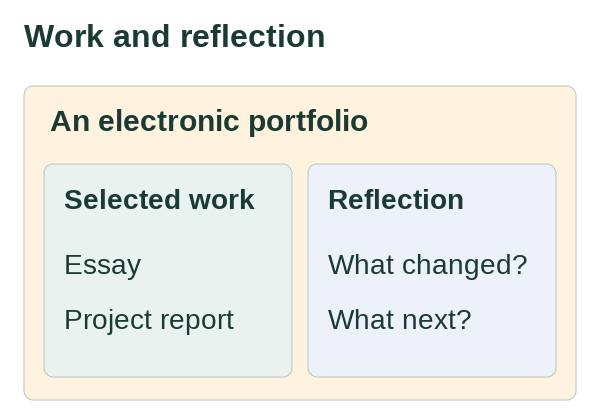
At a Malaysian public university, three instructors and 18 students in an advanced English language course described contributions of the e-portfolio to writing stages, digital artifacts, accessibility, a personalized writing experience, feedback and communication, and motivation.[21] An exploratory study used the ADDIE model, a staged instructional design process, to build an electronic portfolio assessment into speaking course materials. It found positive possibilities for developing speaking skills through such assessment.[22]
In one junior high school in Bandung during the 2019/2020 academic year, seven students in an English as a foreign language speaking class responded positively. The case study reported that the e-portfolio helped them as a speaking learning medium and was an interesting medium for listening skills.[23] A deductive analysis of recent case studies concluded that e-portfolios can motivate students to master skills taught in class sessions and can help them achieve higher scores. It noted that many recent learners have little information about e-portfolios.[24]
In chemistry classrooms, a survey of ten high school chemistry teachers in Sumedang Regency found that only 70% had implemented electronic portfolio assessment, and not optimally. All of those teachers had used the Google Classroom application as a learning medium. Students' mastery of chemical concepts and critical thinking skills remained quite low.[25] A literature review of articles published in national and international journals from 2012 to 2023 concluded that electronic portfolio assessment combined with feedback can enhance students' critical thinking skills. It added that features built into Google Classroom can further stimulate critical thinking during learning.[26]
Interviews with nine purposefully selected lecturers at a South African open distance e-learning university, together with a review of undergraduate and postgraduate e-portfolio modules, found that e-portfolios can promote active student engagement with lecturers, content and other students. That study recommended that lecturers design e-portfolio learning objects that call for a high level of student engagement. It also recommended that institutions give lecturers technical support and continuous training in designing and developing those learning objects.[27] An evaluation of e-portfolio systems in teacher education, where the portfolios document achievement of the Graduating Teacher Standards and assist in job hunting, used interviews, self-reports on a user information satisfaction instrument and a usability evaluation method to judge usability and learning design.[28]
In professional education, researchers took an existing e-portfolio environment and added learning analytics, the automated analysis of data about learners. The phases collected information about professional activities and assessment instruments, defined probabilistic student models, developed personalized feedback and visualization of development over time, implemented the prototype in professional training programs, and ran evaluation cycles. In the evaluation, 121 students and 30 supervisors from five institutes for professional education judged how useful they found the design. The e-portfolios with learning analytics were seen as helping students develop their professional competencies. The design succeeded only when it was developed and implemented with the users' perspective in view.[29]
A scale was designed to measure how useful it is to develop a digital portfolio in higher education, along curricular, communicative and informative lines. It was validated with exploratory factor analysis in a sample of 271 higher education students. The scale showed adequate validity and reliability indices and consisted of 22 items in 3 factors: development of curricular aspects, digital communication, and development of digital information.[30]
Research
Students attitudes and perceptions
At the University of Dundee Medical School in Scotland, a questionnaire was given to students in 1999, 2000, 2002 and 2003, with response rates of 83%, 70%, 89% and 88%. Students there reported that building a portfolio deepened their understanding of the exit learning outcomes, the statements of what a graduate should be able to do, and helped them reflect on their work. Over the 4 years, as the process evolved, student attitudes grew more positive. Even so, students judged that portfolio building interfered with clinical learning because of the excessive amounts of paper evidence required.[4]
Studies of reflective portfolios in medical and pharmacy education report broadly favorable views alongside concerns about time.[9][31] At the University of Nottingham, 178 second-year medical students completed an 18-item questionnaire about a reflective portfolio assessment of their communication skills three days before submitting it. Total scores on the questionnaire ran from 40 to 75, with a mean of 58.28 and a standard deviation of 7.08, a measure of how widely scores spread around that mean. Students with more positive views were more likely to rate their own reflection skills as good, to earn better marks for the portfolio and to feel confident about building another one.[9] In a survey of 154 final-year pharmacy students at the University of Manchester, a 75.5% response rate, most felt the portfolio both assessed and supported their learning and helped prepare them for continuing professional development.[31]
Translation students at a university in Spain, answering a questionnaire at the end of the semester, said portfolios encouraged reflection on their own learning and helped them revise for the final exam. The same students described assembling a portfolio as time consuming and hard work, yet felt it was rewarding because they received a better grade at the end of the semester.[32] One account comes from a part-time, non-traditional learner on a postgraduate teaching certificate at the University of Cumbria. She reports that learning to use the electronic portfolio application could be time consuming, and that learners could be hampered by unreasonable expectations and by a lack of understanding, confidence and technical skill. That learner also notes that at least 42% of learners in the United Kingdom study part time and are non-traditional, and argues that such learners are disadvantaged from the outset.[33]
Not all questionnaire studies find positive attitudes, and some find students markedly less enthusiastic than their teachers. Lecturers perceived a clear purpose for portfolio assessment, with a mean score of 4.20, and favored integrating it into every educational programme, with a mean of 4.40. Students expressed lower satisfaction on the same aspects, with mean scores of 2.15 and 2.42. Lecturers showed moderate attitudes, at 60.0%, and students predominantly showed low attitudes, at 59.6%. The two groups agreed on the importance of communicating objectives, giving feedback and using portfolios to diagnose strengths and weaknesses, but differed over how much guidance students should receive during the practices.[34]
Validity and reliability of portfolio scores
A 2006 study at a Dutch medical school tested this directly with an instrument called the Portfolio Analysis Scoring Inventory. Its 15 items came from interviews with experienced mentors, from the research literature and from the reflective competence criteria used in the regular assessment procedure. Two researchers independently rated 40 portfolios selected from 231 portfolios that already carried ratings from the regular assessment procedure. Agreement between the two raters ranged from 0.46 to 0.87 across the inventory items. Quality of reflection predicted most of the variance in the regular ratings, with a multiple correlation of 0.80. No other item accounted for a significant share of the variance, and writing style and layout had negligible effects. The researchers read the absence of an impact from irrelevant criteria as support for the validity of the procedure. They noted that the portfolio's validity for judging clinical competence still needed study.[6]
In a baccalaureate dental hygiene program, seven faculty raters scored 20 student portfolios with a primary trait analysis rubric, a scoring scheme that rates each separate quality of the work on its own scale. The seven subscales of the rubric were related to one another at r = .81 to .95 (p < .01), which the researchers took as evidence that they measured a common construct. Portfolio scores correlated with grade point average at r = .70 (p < .01) and with the National Board Dental Hygiene Examination at r = .60 (p < .01). The correlation with the Central Regional Dental Testing Service examination was weak and not significant, at r = .19 (p > .05).[35] A four-year study across two United States dental schools found significant but smaller correlations: r = 0.323 (p < 0.01) with Part I of the National Board Dental Examination and r = 0.268 (p < 0.05) with Part II. Correlations with grade point average and with scores on the Western Regional Examining Board exam were small and not significant.[36]
In the dental hygiene study, an analysis of variance showed that the scoring rubric itself was the largest source of variance, at 78 percent of the total. The interaction between portfolio and rubric accounted for 1.15 percent and faculty raters for 1.28 percent.[35] The two-school study reached a different conclusion about raters: faculty raters were the greatest source of variance, which suggested that each portfolio should be evaluated independently by two raters. That study's results generally supported holistic scoring, in which a portfolio receives one overall judgment, and it called for further research on analytical scoring, in which separate qualities are scored apart.[36] A reliability study followed 13 undergraduate music education majors completing student teaching. It found that portfolios can serve as a reliable and valid assessment tool for student teaching, and it recommended further work on reliability in preservice teacher education.[37]
Some programs argue that reliability statistics fit portfolio assessment poorly. Stricter criteria or more prescribed content would raise interrater agreement at the cost of the flexibility, personal orientation and authenticity that give portfolios their point. A 2005 case study resolved this tension by borrowing criteria from qualitative research instead of computing reliability. Five strategies supported credibility and dependability. Triangulation combined information from different sources, and prolonged engagement had mentors read portfolios at least twice during the year. Member checking meant discussing the mentor's recommended grade with the student, an audit trail meant thorough documentation of the process, and a dependability audit brought in external reviewers. Of 233 portfolios assessed, students and mentors disagreed on 7 (3%), 9 went to the full portfolio assessment committee, and the final decision differed from the mentor's recommendation for 29 (12%). The researchers judged that the procedure safeguarded the characteristics of portfolio assessment while building credibility and dependability into the judgment. They suggested that a study involving different assessment committees could add further support.[8]
A study of Connecticut's Beginning Educator Support and Training program examined the relationship among portfolio scores, the Praxis I and II tests of teacher knowledge, and changes in student achievement on the Degrees of Reading Power Test. Hierarchical linear modeling, a statistical method for nested data such as students within classes, indicated that the portfolio scores distinguished among teachers who were more and less successful in raising their students' achievement. The portfolios also added information not contained in the Praxis tests and were stronger predictors of teachers' contributions to student achievement gains.[38] At Dundee Medical School in Scotland, portfolio assessment was adopted to assess students summatively in their final examination. The evaluation found strong staff support and positive student responses, though students had some reservations. The researchers concluded that portfolio assessment reaches a range of curriculum outcomes that other methods assess with difficulty.[2]
What the outcome studies measured
The outcome studies of portfolio assessment differ widely in design, and their results differ with them.[39][40] A true experiment, meaning a study in which students were assigned at random to conditions, tested the method with ninth-grade physics students over eight weeks. Students assessed by portfolio constructed more knowledge than students who did not prepare a portfolio, but their attitudes towards physics did not differ from those of the comparison group.[39] A systematic review of portfolio assessment in science learning found that quasi-experimental designs, which compare existing classes rather than randomly assigned students, were the most frequent type, at 42.31% of the studies examined. That review reported the largest share of benefit, 61.54%, in studies classed as applied, influence or effectiveness research, and found upper secondary education the most common level, at 57.69%.[40]
Several studies of writing have measured gains with pre-test and post-test scores.[41][42] A quasi-experimental study of 50 students at a junior high school compared recount writing before and after portfolio assessment. The mean pre-test score was 66.76 and the post-test mean was 84.72. The reported t-value was 4.446 against a t-table value of 1667, and the significance value was 0.000, below 0.05.[42]
A classroom action research study of 31 secondary students in Makassar, run through two cycles of planning, teaching and review, reported improved expository writing and positive student responses, including greater willingness to revise drafts.[43] Another action research study described gains in content, organization, vocabulary, grammar accuracy and mechanics, together with increased motivation and more active engagement in revising drafts.[44] With 25 first-year Thai students who wrote eight drafts across two essay types, a repeated measures analysis of variance found significantly better essays and positive perceptions of the method.[45]
Engagement and self-belief have been measured separately from scores.[46][47] In a study that randomly assigned two high school classes to conditions, the group given portfolio assessment with self-assessment, peer assessment and teacher-student conferences showed greater writing engagement than the group given regular summative writing tests, and the difference was significant.[46] A mixed-method study of two high school classes found a statistically significant difference (p<.005) in writing self-concept, the students' view of themselves as writers, in favor of the portfolio group. The same study reported a gradual improvement within the portfolio group that was not statistically significant, and most participants described the method positively.[47] A qualitative study reported that 85% of students improved their writing autonomy. In the same study, 78% of teachers said they understood their students' needs better.[48]
Some results are mixed or negative.[49][50] A study of 73 ninth-class students in Multan placed 42 in the control group and 31 in the experimental group. The experimental group recorded 67.3% against 52.3% for the control group. The groups did not differ significantly in the first term, but did in the third term.[49]
Among 100 college students, perceptions of portfolio assessment were not significantly related to performance in trigonometry.[50] A quasi-experimental study of 152 high school science students in Singaraja found differences in scientific attitude between students taught physics with portfolio assessment and those taught with conventional assessment. The attitude measures were curiosity, respect for evidence, willingness to change ideas and critical reflection.[51] A questionnaire study of university engineering students aged 20 to 22 found portfolio assessment a more appropriate method of assessment than exams. The result rests on student reports rather than on measured achievement.[52]
An ex post facto study compares groups after the fact rather than assigning students to conditions. This one examined first-year students at two Islamic schools and found a mean achievement score of 60.00 for the class assessed by traditional tests and 70.31 for the class assessed by portfolios. The difference was significant at the 0.05 level, with a t ratio of 2.833 against a table value of 1.992. The study concluded that portfolio assessment worked better in small classes because the teacher could manage the class more easily.[53]
A two-group comparison in an algebra-based introductory college physics course pointed the other way on achievement. No significant differences in achievement appeared on that final examination or on a self-report survey of achievement given before and after instruction. Focus group discussions did suggest that the portfolio students felt less anxious about learning physics and spent considerable time reading and studying outside class.[54]
Several quasi-experimental studies of writing have reported gains for students assessed by portfolio.[5][55][3][56] A study of secondary level students found that portfolio assessment raised writing ability, with knowledge of global issues (content and organization) rising more than local issues (grammar, vocabulary and mechanics).[5] In a Moroccan English as a foreign language setting, 48 common core students were split into two groups of 24. The group given ongoing portfolio work with self-assessment, peer assessment and teacher-student conferences outperformed the control group in overall writing achievement and in various writing sub-skills.[55]
A study of 40 university students in a composition course found that those evaluated by portfolio improved in writing and scored higher on the final examination than those evaluated by the traditional system.[3] Another study randomly divided 40 Iranian English teaching majors into an experimental group of 20 and a control group of 20. The portfolio group outperformed the control group in writing performance and in the sub-skills of focus, elaboration, organization, conventions and vocabulary.[56] A study of 60 Iranian 16-year-old female high-school sophomores found that portfolio assessment contributed to achievement and that portfolio scores correlated significantly with teacher-made achievement test scores, with high inter-rater reliability.[57]
In practice
Feedback self peer and instructor assessment
A study of 41 physical therapy students who built a learning portfolio for a pathology course had each portfolio judged at midterm and at the final examination by this set of three assessors, described by the researchers as a synchronous tripod. The three sets of grades were more similar at the end of the semester than at the midterm. Most students responded favorably to the exercise and reported improvements in communication, teamwork and professional growth. The main complaints concerned the extra time required, stress for students and teachers, and doubt about the immediate and long-term value of the activity.[58]
In an exploratory case study of a class of 120 pre-service teachers, researchers interviewed 14 respondents, 12 of them pre-service teachers and 2 instructors, and reviewed all 120 student portfolios. Instructors and pre-service teachers went through a process of learning, unlearning and relearning pedagogical skills by reflecting on the assessment feedback recorded in their portfolios. The same process helped them adjust teaching strategies to suit learners' diverse needs, and instructors used the portfolio to support self-reflection, inquiry and self-regulated learning.[59]
In an action research study of English courses that used a student portfolio attitude survey and a teacher survey, most teachers found the portfolio practical, mainly for indicating students' problems and monitoring their learning progress. Most students in that study had a clear understanding of how a portfolio was made and agreed that it helped them learn to write better in several respects. The authors drew two implications: students need training in the skills required to use a portfolio as a lifelong learning tool, and language teachers should use various forms of assessment so that students engage more in learning and the targeted outcomes are reached.[60]
Portfolios in medical dental and professional programs
In a prospective cohort study of midwifery students in prenatal practical training, 40 fourth-semester students were randomly assigned to a portfolio group or a routine evaluation group. The two groups had similar mean age, mean pretest scores and prior coursework. The mean change from pretest to posttest in knowledge and comprehension did not differ significantly between the groups (P>0.05). On questions at the second and third levels of Bloom's taxonomy, the portfolio group's average scores were significantly higher (P=0.002 and P=0.03). The groups' mean clinical exam scores also differed significantly. The portfolio group scored higher on generating diagnostic and therapeutic solutions and on applying theory in practice. Satisfaction scores were relatively similar across the two evaluation methods.[61]
Portfolios have also been used to assess individual learning inside group projects, where a single report mark is usually given to every member. Final-year physiotherapy students carried out a group research project with objectives that included learning the research process, working as a team, managing their own time and producing a meaningful report. Portfolio assessment of learning has students reflect on and evaluate their own learning, and it lets teachers evaluate what each student learned in a group task.[62] In an undergraduate educational software course, project-based learning combined with electronic portfolio assessment was judged appropriate for the course. The electronic portfolio was judged valuable within it, in a small class of 8 students. That case study also notes insufficient classroom space and student difficulties with animation software.[63]
In analytical chemistry, third-year final-semester students designed the problem to be studied, planned the laboratory work and provided evidence of their learning in a portfolio. They worked on gas chromatography and high performance liquid chromatography for the analysis of amino acids. The students were highly committed, and as final-semester students they could see the relevance of the approach.[64]
Language literacy and content classrooms
A review of literacy assessment in Indonesian schools describes portfolio assessment as a form of authentic assessment, meaning assessment built around tasks that resemble real classroom work. That review describes the portfolio process in three steps, collection, selection and reflection, following a model proposed by Hamp-Lyons and Condon in 2000. It also recommends combining summative scoring of the finished portfolio with formative strategies such as ongoing teacher feedback, conferences and peer reviews.[65]
In one case study at an Indonesian teacher college, 25 of 78 student teachers volunteered to keep an online portfolio during a writing project. The report describes improvement in writing skill, positive attitudes and developed critical writing awareness.[66] A separate study compared two tenth grade classes in Martapura, one assessed by portfolio and one by traditional assessment, and found a difference in learning achievement between them. The same study argues that conventional test items fail the purpose of assessment because they do not represent the activities students typically perform in classrooms.[67]
In a Turkish state university, 307 students in an elective English preparatory class were studied to see how a placement test, short quizzes and portfolio assessment related to class attendance and language achievement. Portfolio tasks were the most important factor for both attendance and achievement, and female students were more successful than male students. Faculty had no significant effect on attendance.[68] An online elementary English course compared a group keeping an electronic portfolio with a group under traditional assessment and found significant learning gains in both groups but no significant difference between their post-test scores.[69]
In a quasi-experimental study of 120 students in civic education, those assessed by portfolio did not differ in learning outcomes from those assessed by objective assessment. Students taught with a conflict resolution model outperformed those taught conventionally.[70] In basic physics, a descriptive study of 60 physics education students examined experimental reports and reflection notes kept in a portfolio. It reported that students reflected on concepts, wrote reports systematically and showed cognitive and metacognitive development. The study reads this as clearer evidence of critical thinking and learning awareness.[71] Teaching materials for a physics learning evaluation course were developed around project-based learning and portfolio assessment and reached an expert validation score of 87.41, described as very valid.[72]
A case study at a Islamic boarding school in Muara Jambi used work portfolios to track students' understanding of verb forms in Arabic grammar and reported that portfolios helped monitor continuous development and encouraged collaboration, discussion and critical thinking.[73] At one vocational school, portfolio assessment of the Creative Products and Entrepreneurship chapter showed that students' competencies met the minimum completeness criteria.[74] A study of two junior high schools in Yogyakarta found portfolio assessment running effectively, supported by school policies and by parents and the wider community.[75]
How portfolios are built and scored
A portfolio is assembled for a stated purpose and a stated audience, and both decisions shape what goes into it. Foreign language teachers working with students of Japanese, Chinese, Korean and Russian at elementary and secondary levels designed portfolios to examine growth in language proficiency, and analysis of the finished portfolios showed that many factors bear on the choice of contents and objectives.[76] A framework for foreign language classrooms places technical decisions first: teachers set the purpose, identify clear objectives and establish meaningful criteria for the assessment. The framework then turns to deciding what goes into the portfolio, how it is organized, and how the process is monitored and evaluated.[77] In academic advisement, a portfolio holds a wide array of work and information, and each one is tailored to an individual student.[78] Schools that adopt portfolios must decide whether every student will be required to prepare one, whether administrators will set the contents, and who will approve what students include.[79]
A portfolio built for a job search identifies the student's goals and supplies evidence that the student holds the skills and qualities needed to reach them, with emphasis on communication skills because employers weigh those most heavily in initial screening. Students preparing such a portfolio are advised to consider several media, including paper, videotape and compact disk.[79] For students with mental retardation, portfolios are valued because they register small gains in functioning, gather data across many skill areas, and keep caregivers informed about development and support activities. Portfolios also let those students take part in the assessment itself, specifically in selecting and evaluating goals and artifacts.[80]
In the foreign language project, the contents of finished portfolios were analyzed to judge whether they could serve as a means of assessing language learning.[76] For students with cognitive disabilities, the selection and evaluation of goals and artifacts is itself part of the process, not a step reserved for the teacher.[80] In advisement, students and advisors set goals, develop strategies, monitor progress and share ownership, which the authors describe as a holistic approach to assessment that benefits both parties.[78]
Grading schemes for portfolios differ in how much structure they impose. That account presents the approach as an alternative grading strategy that supports student learning on conventional examinations and appears to carry additional benefits.[81] A history assessment built on the concept of historical thinking combined an essay test with an interview guide, and the package was reported as valid and reliable for depicting students' skill in organizing information from historical documents and reconstructing it as historical narratives.[82] In engineering courses with a significant design component, portfolios were assigned to freshmen and seniors to initiate student-centered learning and to address assessment issues raised by accreditation criteria, and 78% of seniors and 80% of freshmen believed the portfolios enhanced their learning. Among the freshmen, 69% of the sensing types on the Myers-Briggs Type Indicator found portfolios useful, compared with 87% of the intuitive types.[83]
Teachers' capacity to design the scheme is a practical constraint on any of these approaches. At one primary school, classroom teachers reached a competence level of 89,32% in designing portfolio assessment techniques, meaning all of them could design a portfolio with good ratings. Shortcomings remained, including little teacher attention to the documents that would be used as a portfolio and little willingness to record the portfolio design in writing.[84]
Portfolios across subjects and school levels
In mathematics, a teacher who added portfolios to the assigned assessment activities drew early ideas from a 1991 National Council of Teachers of Mathematics publication edited by Jean Kerr Stenmark. That publication noted that helping students value mathematics is a major goal of the council's evaluation standards, and a very hard goal to assess. Examples collected in portfolios over time, together with documented reactions to assignments and problems, let a teacher begin to see how close students come to that goal, according to the same 1998 account in The Mathematics Teacher.[85] In biology, a classroom action research study at a teacher education faculty in Indonesia, run from July to December 2017 with students taking a curriculum and biology textbook analysis course, reported an increase in students' higher order thinking skills when portfolio assessment was applied.[86]
Chemistry teachers have built electronic portfolios around particular topics and purposes.[87][88][89] One framework, developed through a literature review, was designed to improve students' habits of mind, meaning settled patterns of thoughtful behavior, along with mastery of chemistry concepts, and it guides teachers through setting goals, defining content, managing the portfolio and monitoring and evaluating the process.[88] A second study developed a project-based electronic portfolio for measuring creative thinking in chemical bonding, a topic described as abstract and complex, and tested it with five expert validators and five raters who scored the work of 19 students. Every task item reached a content validity ratio of 1.00, and inter-rater agreement, measured by the intraclass correlation coefficient, ranged from 0.949 to 0.981 for an open-ended essay task, 0.866 to 0.942 for a concept map and 0.850 to 0.936 for a digital poster.[89]
A third study, set in secondary school chemistry lessons on buffer solutions, interviewed two chemistry teachers. One taught in a public senior high school using the Kurikulum Merdeka, the other in a boarding school with limited digital infrastructure. The study identified four barriers to assessing students' thinking about their own learning: a feedback bottleneck from teacher workload, unequal digital access, students' overreliance on step-by-step procedures instead of conceptual understanding, and a gap between assessment ideals and classroom realities.[87]
Studio-based fields such as architecture, art and design combine theoretical and practical knowledge in a repeated cycle of collecting, processing, analyzing, translating, synthesizing, designing and delivering a project or artwork.[90] In vocational training, competency-based education has made standardized tests seem insufficient. The electronic portfolio has been analyzed there as a longitudinal platform for showing skills applied in practice, critical reflection and professional growth. It has also been described as a way to connect academic preparation with labor market requirements.[91]
At the primary level, a three-month study in Greece compared two groups of third-grade students from diverse cultural backgrounds, mostly Greek-Romani children, learning English. The experimental group received differentiated instruction, in which teaching is adjusted to students' needs, while the control group attended a traditional class. Pre- and post-tests showed greater progress in skills for the experimental group, but the statistical analysis found no significant differences, and the portfolio checklists, though few in number, pointed to a motivating role for portfolios in student engagement. The study's authors listed a wide attendance outflow, a short research period, a limited sample and a lack of equipment as reasons for more extended future research.[92]
At the university level, a survey of 132 students learning Japanese at a university in China found that most supported combining portfolio assessment with traditional written tests, and that gender had no significant effect on how applicable the method was.[93] In a qualitative study of ninth-grade English learners, questionnaires went to 40 students and semi-structured interviews to 2 of them. The surveys showed that 75% of the students were satisfied with portfolio-based assessment. Students also described portfolio administration as time-consuming, reported unclear grading standards, and asked for additional guidance.[94]
In a semester-long portfolio assignment in an intensive test preparation course in Aceh, Indonesia, seven undergraduates described the work as worthwhile but demanding. They reported gains in awareness of their own progress and in writing and speaking, alongside time pressure, delayed feedback and the emotional weight of continuous self-monitoring.[95] A classroom action research study with 83 students in an English correspondence course at a state university in Surabaya reported a 41% difference between pre-test and post-test scores, with 90% of students completing the study. Students found the portfolio hard to arrange and slow to prepare.[96]
Teachers roles and implementation problems
Reflection is often the part teachers must design most deliberately, because many instructors include it while fewer use the steps that shift responsibility for learning onto students. Fernsten and Fernsten (2005) offer guidelines for that design: a safe and supportive setting for honest reflection, and strategic prompts that move students toward metacognitive independence, the ability to monitor and judge their own thinking. The guidelines also include a shared vocabulary so students and teachers reflect from common understandings, and short rubrics that make the required tasks clear.[97] Feedback is expected to be iterative, returning to the student's writing across successive drafts rather than once at the end, and a conceptual model of self-regulated learning in writing portfolios is built around these repeated feedback cycles.[98] In classrooms where assessment as learning is used, students develop cognitive and metacognitive capacity by evaluating their own writing within the portfolio environment, a practice argued to support teacher competence in teaching writing, student motivation and improvement of texts.[99]
Teachers' own assessment literacy, meaning their working knowledge of how to gather and interpret evidence of learning, shapes how portfolios are used in practice. In a survey of lead teachers (n = 68) and instructors (n = 138) in a Canadian language program for newcomers, the conceptual, practical and socio-emotional dimensions of assessment literacy were found to be interrelated.[100] In Indonesian schools, the portfolio was one of the recommended assessment types in the 2013 Curriculum, yet reports from the field describe it as not yet used effectively, with many teachers still relying on traditional tests.[101]
A professional development program for 750 resource teachers in New Zealand made a professional practice portfolio the final paper, and early findings identified factors that may help or hinder portfolio development.[102] A review of portfolios in teacher education concluded that reflection may not reach a critical level unless the portfolio is introduced carefully and guided support is provided throughout the process.[103] Parental involvement becomes part of the teacher's task when portfolios are completed at home, and a study of portfolio assessment during the covid-19 pandemic found that parents' participation in guiding children's learning at home played a very important role, especially at the elementary level.[104]
Portfolio evidence can also carry messages that were never intended as part of the curriculum. Explicit exclusion of male students appeared in curricular emphasis on women's health and in a lack of support for acquiring gynaecological examination skills. Female students were excluded more implicitly, through modelling and brief remarks about so-called female-friendly career choices and the effect of motherhood on a career. The study concluded that e-portfolios can help track the hidden curriculum as it evolves. It added that responses may be developed more readily for the explicit processes affecting male students than for the implicit ones affecting female students, which often reflect structural issues in training and employment.[105]
What this looks like when you study
The portfolio group prepared packages with a complete report of each patient's history, physical examinations and management methods, checked against a checklist. On the last day the portfolio group's mean post-test score was 15.10, against 13.87 for the routine group, a significant difference (P=0.01). The portfolio group also scored higher on the practical test, 17.70 against 16.94 (P=0.01).[61]
One group of 24 students worked continuously on writing assessment tasks built around a portfolio, using reflection and assessment techniques that included self-assessment, peer assessment and conferences between teacher and student. A second group of 24 students took the usual summative writing achievement tests. On the post-test the experimental group's mean writing score was 14.7604, against 11.0052 for the control group (p=.002). Most students in the experimental group reported highly positive attitudes toward the portfolio work.[55]
At the University of Dundee Medical School, students built portfolios for their final summative examination, and the first cohort to be assessed this way was studied.[2] Students who rated their own reflection skills as good tended to hold more positive views of reflective portfolios and to receive better portfolio marks.[9]
A source recommends that you keep paperwork within manageable limits, because students at Dundee saw excessive paper evidence as interfering with clinical learning. Davis, Ponnamperuma and Ker (2009) suggest that an induction process for students should stress the value of evidence showing that every learning outcome has been met, rather than evidence of theoretical knowledge and skills alone.[4] A source recommends that you reflect on assessment feedback in your portfolio, since pre-service teachers who did so adjusted their teaching strategies to suit learners' diverse needs. A source recommends that you take part in peer review, which broadened pre-service teachers' perspectives on students and on pedagogical approaches.[59]
Later developments
Newer directions creativity and artificial intelligence
An interpretive qualitative study of marketing education interviewed and ran focus groups with 20 stakeholders in the United Kingdom, including academics, employers, recruiters, employability professionals and practitioners. It identified seven interrelated themes in how these groups interpret creative portfolios. Those findings informed the Portfolio CREATE Model, a framework for marketing education built on six principles: Communicate, Reflect, Embed, Assess, Tailor, and Engage. The model treats portfolios as assessment artefacts that are developmental, that span boundaries and that face the market. They carry a student's creative, strategic and professional capability across educational and professional settings. Its stated aim is to move portfolio assessment past models built around displaying employability. The aim is longitudinal, programme-level approaches to professional learning and to signalling capability.[106]
In chemistry teacher education, a development study built an e-portfolio instrument to measure prospective teachers' creativity in a Chemistry Learning Media Development course, where validated rubrics covering both creative processes and final media products were scarce. The instrument was judged feasible with minor revisions, and the study states that practicality, inter-rater reliability and classroom effectiveness still need testing.[107] A separate development study produced an electronic portfolio instrument for creative thinking on redox reaction material, reporting a content validity ratio (CVR) of 1.00 and Cronbach Alpha values of 0.702 to 0.982. That study reported an N-Gain of 0.72 in the high category for promoting creative thinking and an N-Gain of 0.61 in the medium category for effectiveness. Mastery-learning effectiveness was 9.66%.[108]
In a pretest-posttest control group design with 30 students in each group in Practical Inorganic Chemistry, students assessed by electronic portfolio gained more (mean N-gain 0.41) than students assessed by conventional portfolio (mean N-gain 0.14).[109] At a Siberian Federal University master's programme in pedagogical education, e-portfolio materials were used for authentic assessment of professional competencies across two years of training and before the State Final Examination. Second-year students' self-assessments of universal, general professional and professional competencies showed higher constructive and productive levels than first-year students' results. The study attributes this to accumulated evidence of achievement, and expert assessment before the final examination also indicated a rise in competency levels.[110]
A study at a graduate business school in Peru applied a generative AI evaluator, the GPT-eComplex Assistant, built from ChatGPT and configured with the eComplex rubric, to 120 student portfolios for complex thinking. Correlational analysis of human and AI-assisted ratings used a pilot subsample of 12 portfolios, while descriptive analysis of complex thinking levels covered the full sample of 120. The assistant closely mirrored human evaluators' judgments, strengthening consistency, traceability and transparency. It still required teacher calibration. The digital portfolio captured systemic and critical thinking, though it showed limitations in the scientific dimension. The study describes generative AI for assessment in higher education as incipient and under-researched, and it calls for empirical evidence and ethical guidelines.[111]
Criticism
Criticism limits and open questions
Teachers using portfolios in Kindergarten through Grade 5 classrooms make deliberate decisions about how to use them. Those decisions are heavily shaped by the maturity or skill level of the child, by the purpose of the application and by the classroom environment. They also depend on whether the portfolio is a working portfolio in a formative state or a performance portfolio in a final state.[112] Because the same design can be put to such different uses, the quality of learning appears to depend less on the assessment design itself. It depends more on the way it is carried out and on the way students' learning is stimulated through it.[7]
A third objection is that the people giving and receiving portfolio assessment may not share its purposes. The study concluded that addressing these differences in perception and attitude is needed for a shared understanding and acceptance of portfolio assessment practices.[34]
One is how the collaborative inquiry that norming sessions can generate among teachers, linking assessment to their own classroom teaching, can be sustained and studied rather than assumed.[113] Another is how feedback, which appears essential when portfolio assessment is implemented, can be organised so that it shapes students' approaches to learning rather than only their products.[7] A third is whether an adaptive portfolio that diagnoses problems in learning and how educators respond to them can be built and tested, since the available review work describes the idea rather than settled results.[114]
Common misconceptions
Driessen, Overeem, Van Tartwijk, Van Der Vleuten and Muijtjens (2006) note that the validity of portfolio assessment may be weakened by bias from irrelevant qualities such as lay-out and writing style. In their study of 40 portfolios, these items had negligible effects on the regular ratings. In a study of 40 medical student portfolios, the strongest predictor of the regular ratings was quality of reflection (R 0.80; R2 66%).[6]
Key studies
| Year | Study | Sample | Design | Finding |
|---|---|---|---|---|
| 1997 | Slater et al.[54] | two-group comparison with a common final examination | There were no significant differences in achievement on the final examination, but portfolio students reported less anxiety. | |
| 2003 | Gadbury‐Amyot et al.[35] | 20 student portfolios rated by seven faculty raters | validity and reliability study using Messick's framework | Portfolios correlated with GPA (r = .70) and the NBDHE (r = .60), and a phi coefficient of .86 was obtained. |
| 2004 | Rees & Sheard[9] | 178 second-year medical students | questionnaire study | Students who viewed reflective portfolios more favourably tended to judge their own reflection skills as good and to earn higher marks for their reflective portfolio assessment. |
| 2005 | Driessen et al.[8] | 233 portfolios | case study using qualitative research criteria | Students and mentors disagreed on 7 (3%) portfolios, and the final decision on 29 (12%) differed from the mentor's recommendation. |
| 2006 | Driessen et al.[6] | 40 portfolios selected from 231 | instrument rating with regression analysis | Quality of reflection was the strongest predictor of regular ratings (R 0.80; R2 66%), and writing style and layout had negligible effects. |
| 2007 | Grant et al.[17] | 81 final-year medical students, with 78 questionnaires returned | evaluation of a reflective portfolio with inter-rater reliability analysis | Agreement between pairs of markers varied widely. The course tutor and course organiser pair reached a Spearman correlation of 0.65, the course tutor and GP teacher pair 0.32, and the GP teacher and course organiser pair 0.16. Marking that involved GP tutors, who each marked only 1 to 3 portfolios, showed very low reliability. |
| 2008 | Segers et al.[7] | Questionnaire study of 110 first- and second-year students in a competency-based program. | Feedback is essential in portfolio assessment, and how the assessment is implemented influences the quality of learning more than the design itself. | |
| 2009 | Davis et al.[4] | medical students at the University of Dundee, with response rates of 83%, 70%, 89% and 88% | questionnaire study over 4 years | Students perceived that portfolio building heightened their understanding of exit learning outcomes, and attitudes became more positive over the 4 years. |
| 2011 | Kariman & Moafi[61] | 40 fourth-semester midwifery students | prospective cohort study with random allocation | The portfolio group's mean post-test score was 15.10 against 13.87 (P=0.01), and its practical test score was 17.70 against 16.94 (P=0.01). |
| 2014 | Gadbury‐Amyot et al.[36] | two U.S. dental school populations over four years | multivariate generalizability theory study | Portfolios correlated with National Board Dental Examination Part I (r=0.323) and Part II (r=0.268), with small non-significant correlations with GPA and the WREB exam. |
| 2020 | Sulistyo et al.[5] | Quasi-experimental study with secondary students, using writing pre-tests and post-tests and a questionnaire. | Portfolio assessment increased writing ability, with content and organization improving more than grammar, vocabulary and mechanics, and students had positive attitudes. | |
| 2021 | bn Zohr University, Morocco & Omarkaly[55] | 48 common core students, 24 per group | quasi-experimental pre-test and post-test | The experimental group's mean writing score was 14.7604 against 11.0052 for the control group (p=.002). |
| 2023 | Salim[42] | 50 students | quasi-experimental study with pre-test and post-test | The mean score rose from 66.76 on the pre-test to 84.72 on the post-test (tvalue 4.446 > ttable). |
| 2024 | Apeadido et al.[34] | 52 final-year science education students and five lecturers | survey with five-point Likert questionnaires | Lecturers perceived a clear purpose (mean 4.20) while students expressed lower satisfaction (mean 2.15). |
See also
References
- David, M. F. B., Davis, M. H., Harden, R. M., Howie, P. W., Ker, J., & Pippard, M. J. (2001). AMEE Medical Education Guide No. 24: Portfolios as a method of student assessment. Medical Teacher, 23(6), 535-551. doi:10.1080/01421590120090952
- Davis, M. H., Ben-David, M. F., Harden, R. M., Howie, P., Ker, J., McGhee, C., Pippard, M. J., & Snadden, D. (2001). Portfolio assessment in medical students' final examinations. Medical Teacher, 23(4), 357-366. doi:10.1080/01421590120063349
- Nezakatgoo, B. (2011). The Effects of Portfolio Assessment on Writing of EFL Students. English Language Teaching, 4(2), 231. doi:10.5539/elt.v4n2p231
- Davis, M. H., Ponnamperuma, G. G., & Ker, J. S. (2009). Student perceptions of a portfolio assessment process. Medical Education, 43(1), 89-98. doi:10.1111/j.1365-2923.2008.03250.x
- Sulistyo, T., Eltris, K. P. N., Mafulah, S., Budianto, S., Saiful, S., & Heriyawati, D. F. (2020). Portfolio assessment: Learning outcomes and students’ attitudes. Studies in English Language and Education, 7(1), 141-153. doi:10.24815/siele.v7i1.15169
- Driessen, E. W., Overeem, K., Van Tartwijk, J., Van Der Vleuten, C. P. M., & Muijtjens, A. M. M. (2006). Validity of portfolio assessment: which qualities determine ratings? Medical Education, 40(9), 862-866. doi:10.1111/j.1365-2929.2006.02550.x
- Segers, M., Gijbels, D., & Thurlings, M. (2008). The relationship between students’ perceptions of portfolio assessment practice and their approaches to learning. Educational Studies, 34(1), 35-44. doi:10.1080/03055690701785269
- Driessen, E., Van Der Vleuten, C., Schuwirth, L., Van Tartwijk, J., & Vermunt, J. (2005). The use of qualitative research criteria for portfolio assessment as an alternative to reliability evaluation: a case study. Medical Education, 39(2), 214-220. doi:10.1111/j.1365-2929.2004.02059.x
- Rees, C., & Sheard, C. (2004). Undergraduate medical students' views about a reflective portfolio assessment of their communication skills learning. Medical Education, 38(2), 125-128. doi:10.1111/j.1365-2923.2004.01750.x
- Gadbury‐Amyot, C. C., McCracken, M. S., Woldt, J. L., & Brennan, R. (2012). Implementation of Portfolio Assessment of Student Competence in Two Dental School Populations. Journal of Dental Education, 76(12), 1559-1571. doi:10.1002/j.0022-0337.2012.76.12.tb05419.x
- Madden, T. (2016). Supporting student e-portfolios. New Directions in the Teaching of Physical Sciences(3), 1-6. doi:10.29311/ndtps.v0i3.408
- Nolet, V. (1992). Classroom-Based Measurement and Portfolio Assessment. Diagnostique, 18(1), 5-26. doi:10.1177/153450849201800103
- Lambdin, D. V., & Walker, V. L. (1994). Planning for Classroom Portfolio Assessment. The Arithmetic Teacher, 41(6), 318-324. doi:10.5951/at.41.6.0318
- Tyas, P. A. (2020). Promoting Students' Autonomous Learning Using Portfolio Assessment in EFL Writing Class. JEES (Journal of English Educators Society), 5(1), 75-81. doi:10.21070/jees.v5i1.379
- Nastiti, D. P., Santoso, S., & Sudiyanto, S. (2022). The Effectiveness of Using the Portfolio Assessment Model to Improve Student Self-Regulated in Economic Learning. International Journal of Multicultural and Multireligious Understanding, 9(2), 424. doi:10.18415/ijmmu.v9i2.3484
- Mak, P., & Wong, K. M. (2018). Self-regulation through portfolio assessment in writing classrooms. ELT Journal, 72(1), 49-61. doi:10.1093/elt/ccx012
- Grant, A. J., Vermunt, J. D., Kinnersley, P., & Houston, H. (2007). Exploring students' perceptions on the use of significant event analysis, as part of a portfolio assessment process in general practice, as a tool for learning how to use reflection in learning. BMC Medical Education, 7(1). doi:10.1186/1472-6920-7-5
- Beckers, J., Dolmans, D., & Van Merriënboer, J. (2016). e-Portfolios enhancing students’ self-directed learning: A systematic review of influencing factors. Australasian Journal of Educational Technology. doi:10.14742/ajet.2528
- Zulfikar, Z. (2017). Benefits of web-based or electronic portfolio assessment in esl classroom. Englisia Journal, 4(1), 1. doi:10.22373/ej.v4i1.752
- Walland, E., & Shaw, S. (2022). E-portfolios in teaching, learning and assessment: tensions in theory and praxis. Technology, Pedagogy and Education, 31(3), 363-379. doi:10.1080/1475939x.2022.2074087
- Ngui, W., Pang, V., & Hiew, W. (2022). E-portfolio as an academic writing assessment tool in higher education: Strengths and challenges. Indonesian Journal of Applied Linguistics, 12(2), 556-568. doi:10.17509/ijal.v12i2.40122
- Taufik, M., Karmina, S., Cahyono, B. Y., & Bt Tengku Sharif, T. I. S. (2022). Integrating Electronic Portfolio Assessment into Teaching Materials: An Exploratory Study on Speaking Course Syllabus Development. Jurnal Pendidikan: Teori, Penelitian, dan Pengembangan, 7(8), 309. doi:10.17977/jptpp.v7i8.15539
- Aliyudin, D., Kusrin, K., & Ahmad, Y. B. (2021). E-portfolio based learning: Student response in learning speaking. JUDIKA (JURNAL PENDIDIKAN UNSIKA), 9(1), 49-61. doi:10.35706/judika.v9i1.3820
- Sakakini, D. A., & Khoder, D. M. (2025). The Importance of Using Electronic Portfolio as a Tool for Raising Awareness in the Assessment of English Language Students. مجلة الشرق الأوسط للعلوم الإنسانية والثقافية, 5(3), 474-451. doi:10.56961/mejhss.v5i3.1019
- Nuryanto, & Nahadi (2023). Electronic Portfolio Assessment Strategy Using Google Classroom to Improve Students’ Abilities in Learning Chemistry. Jurnal Penelitian Pendidikan IPA, 9(SpecialIssue), 885-892. doi:10.29303/jppipa.v9ispecialissue.6162
- Nuryanto, N., Nahadi, N., & Yuliani, G. (2024). The Implementation of Electronic Portfolio Assessment in Learning Chemistry through Google Classroom to Increase Students’ Critical Thinking Skills. AL-ISHLAH: Jurnal Pendidikan, 16(2). doi:10.35445/alishlah.v16i2.4744
- Kelebogile Mudau, P., & MP Modise, M. (2022). Using E-Portfolios for Active Student Engagement in the ODeL Environment. Journal of Information Technology Education: Research, 21, 425-438. doi:10.28945/5012
- San Jose, D. L. (2014). Does technology matter?: Students’ and teachers’ experiences of electronic portfolio (e-portfolio) systems in teacher education. ASCILITE Publications, 584-588. doi:10.14742/apubs.2014.1290
- van der Schaaf, M., Donkers, J., Slof, B., Moonen-van Loon, J., van Tartwijk, J., Driessen, E., Badii, A., Serban, O., & Ten Cate, O. (2017). Improving workplace-based assessment and feedback by an E-portfolio enhanced with learning analytics. Educational Technology Research and Development, 65(2), 359-380. doi:10.1007/s11423-016-9496-8
- Zambrano, C., Rojas, D., & Friz, M. (2023). Scale E-portfolio for Higher Education. Journal of Higher Education Theory and Practice, 23(3). doi:10.33423/jhetp.v23i3.5849
- Ashcroft, D. M., & Hall, J. (2006). Pharmacy students' attitudes and views about portfolio-based learning: A questionnaire survey. Pharmacy Education, 6(1), 1-5. doi:10.1080/15602210500528117
- Canga Alonso, A. (2013). Students' Beliefs on Portfolio Assessment. Revista Alicantina de Estudios Ingleses(26), 225. doi:10.14198/raei.2013.26.16
- McGowan, K. (2008). Symposium 8: E-Portfolios: A Student Perspective. Proceedings of the International Conference on Networked Learning, 6, 544-551. doi:10.54337/nlc.v6.9374
- Apeadido, S., Dzomeku, D., & Nanor, E. (2024). Navigating the Portfolio Landscape: Examining Lecturers’ and Students’ Perspectives on Portfolio Assessment Practices. Asian Journal of Education and Social Studies, 50(5), 563-582. doi:10.9734/ajess/2024/v50i51386
- Gadbury‐Amyot, C. C., Kim, J., Palm, R. L., Mills, G. E., Noble, E., & Overman, P. R. (2003). Validity and Reliability of Portfolio Assessment of Competency in a Baccalaureate Dental Hygiene Program. Journal of Dental Education, 67(9), 991-1002. doi:10.1002/j.0022-0337.2003.67.9.tb03697.x
- Gadbury‐Amyot, C. C., McCracken, M. S., Woldt, J. L., & Brennan, R. L. (2014). Validity and Reliability of Portfolio Assessment of Student Competence in Two Dental School Populations: A Four‐Year Study. Journal of Dental Education, 78(5), 657-667. doi:10.1002/j.0022-0337.2014.78.5.tb05718.x
- Draves, T. J. (2009). Portfolio Assessment in Student Teaching: A Reliability Study. Journal of Music Teacher Education, 19(1), 25-38. doi:10.1177/1057083709343906
- Wilson, M., Hallam, P. J., Pecheone, R. L., & Moss, P. A. (2014). Evaluating the Validity of Portfolio Assessments for Licensure Decisions. Education Policy Analysis Archives, 22, 6. doi:10.14507/epaa.v22n6.2014
- Ogan-Bekiroglu, F., & Gunay, A. (2014). Impact of Portfolio Assessment on Physics Students’ Outcomes: Examination of Learning and Attitude. EURASIA Journal of Mathematics, Science and Technology Education, 10(6). doi:10.12973/eurasia.2014.1227a
- Ulfa, J., Aldilla, E., Mufit, F., & Festiyed, F. (2023). The influence of implementing portfolio assessments in science learning on student learning outcomes: A systematic review. EduFisika: Jurnal Pendidikan Fisika, 8(3), 268-281. doi:10.59052/edufisika.v8i3.28677
- Ferlya Elyza, & Yusrizal (2018). Portfolio assessment impact to the students’ paragraph writing. Visipena, 9(1), 193-202. doi:10.46244/visipena.v9i1.452
- Salim, R. (2023). Using Portfolio Assessment to Improve the Students’ Recount Writing Performance at SMPN.6 Pare pare. International Journal of English Language and Pedagogy, 1(2), 110-120. doi:10.33830/ijelp.v1i2.6516
- Nur Gita Dahviyanti, W. (2019). Using portfolio assessment to improve EFL students’ expository-writing performance. International Journal of Humanities and Innovation (IJHI), 2(1), 1-12. doi:10.33750/ijhi.v2i1.29
- Eka Apriani (2024). Using Portfolio Assessment to Improve Students’ Writing Development. JELT : Journal of English Education, Teaching and Literature, 3(2), 16-24. doi:10.65787/jelt.v3i2.626
- Punyapratheep, K., & Wudthayagorn, J. (2022). Portfolio Assessment Among Thai EFL First-Year University Students: Perceptions and Progress. rEFLections, 29(2), 435-453. doi:10.61508/refl.v29i2.260768
- Ibn Zohr University, Morocco, & Omarakly, E. (2021). The Impact of Portfolio Assessment on The Moroccan EFL Students’ Writing Engagement. International Journal of Social Science and Human Research, 04(11). doi:10.47191/ijsshr/v4-i11-20
- Omarakly, E., & Tamer, Y. (2022). The Role of Portfolio Assessment in Enhancing the Moroccan EFL Students’ Writing Self-concept. International Journal of Language and Literary Studies, 4(1), 52-65. doi:10.36892/ijlls.v4i1.800
- Tomalá Guzman, I., & Almeida, E. (2025). effects of portfolio assessment on writing of EFL students. Kronos – The Language Teaching Journal, 6(1), 90-101. doi:10.29166/kronos.v6i1.7806
- Deeba, F., Raza, M. A., Gillani, I. G., & Yousaf, M. (2023). An Investigation of Role of Portfolio Assessment on Students’ Achievement. Journal of Social Sciences Review, 3(1), 149. doi:10.54183/jssr.v3i1.125
- Cabais, J. T., & Limjuco, R. P. (2016). Students’ Perceptions on the Use of Portfolio Assessment: It’s Relationship to Performance in Trigonometry. UIC Research Journal, 20(1). doi:10.17158/553
- Wartawan, P. (2017). Effect of using portfolio assessment to improve scientific attitude of students learning physics in high school. Journal of Education Research and Evaluation, 1(4), 259. doi:10.23887/jere.v1i4.12498
- Zaabalawi, R. S., & Zaabalawi, J. (2024). Portfolios versus exams: a study to gauge the better student assessment tool. Language Testing in Asia, 14(1). doi:10.1186/s40468-024-00296-y
- Sarifuddin Muhamad (2024). A Study on Student’s Learning Achievement with Traditional Assessment and Portfolio Assessment. Jurnal Cahaya Mandalika ISSN 2721-4796 (online), 5(1), 59-73. doi:10.36312/jcm.v5i1.2587
- Slater, T. F., Ryan, J. M., & Samson, S. L. (1997). Impact and dynamics of portfolio assessment and traditional assessment in a college physics course. Journal of Research in Science Teaching, 34(3), 255-271. doi:10.1002/(sici)1098-2736(199703)34:3<255::aid-tea4>3.0.co;2-r
- bn Zohr University, Morocco, & Omarkaly, E. (2021). The Impact of Portfolio Assessment on The Moroccan EFL Students’Writing Skills. International Journal of Social Science and Human Research, 04(10). doi:10.47191/ijsshr/v4-i10-23
- Tabatabaei, O., & Assefi, F. (2012). The Effect of Portfolio Assessment Technique on Writing Performance of EFL Learners. English Language Teaching, 5(5). doi:10.5539/elt.v5n5p138
- Barootchi, N., & Keshavarz, M. H. (2002). Assessment of achievement through portfolios and teacher-made tests. Educational Research, 44(3), 279-288. doi:10.1080/00131880210135313
- Senger, J. L., & Kanthan, R. (2012). Student Evaluations: Synchronous Tripod of Learning Portfolio Assessment—Self-Assessment, Peer-Assessment, Instructor-Assessment. Creative Education, 03(01), 155-163. doi:10.4236/ce.2012.31025
- Kihwele, J. E., Mwamakula, E. N., & Mtandi, R. (2025). Portfolio-based assessment feedback and development of pedagogical skills among instructors and pre-service teachers. Journal of Applied Research in Higher Education, 17(5), 1510-1523. doi:10.1108/jarhe-04-2023-0139
- Phothongsunan, S. (2020). Student and teacher engagement in Learning and assessment with portfolios. Cypriot Journal of Educational Sciences, 15(6), 1569-1573. doi:10.18844/cjes.v15i6.5317
- Kariman, N., & Moafi, F. (2011). Effect of portfolio assessment on student learning in prenatal training for midwives. Journal of Educational Evaluation for Health Professions, 8, 2. doi:10.3352/jeehp.2011.8.2
- Kuisma, R. (2007). Portfolio assessment of an undergraduate group project. Assessment & Evaluation in Higher Education, 32(5), 557-569. doi:10.1080/02602930601116904
- Gülbahar, Y., & Tinmaz, H. (2006). Implementing Project-Based Learning And E-Portfolio Assessment In an Undergraduate Course. Journal of Research on Technology in Education, 38(3), 309-327. doi:10.1080/15391523.2006.10782462
- Boyce, M. C., & Singh, K. (2008). Student Learning and Evaluation in Analytical Chemistry Using a Problem-Oriented Approach and Portfolio Assessment. Journal of Chemical Education, 85(12), 1633. doi:10.1021/ed085p1633
- Haliq, A., & Sakaria, S. (2019). Authentic Assessment: Portfolio-Based Assessment in Literacy Learning in Indonesian Schools. Tamaddun, 18(2), 53-61. doi:10.33096/tamaddun.v18i2.67
- Misdi, M. (2020). E-portfolio as an authentic learning assessment in a response to covid-19 outbreak in indonesian higher education: Toward critical student-writers. Research and Innovation in Language Learning, 3(2), 158. doi:10.33603/rill.v3i2.3565
- Farid, R. N. (2018). The significance of portfolio assessment in EFL classroom. Lentera: Jurnal Pendidikan, 13(1). doi:10.33654/jpl.v13i2.346
- AYSU, S. (2022). The Role of Portfolio Assessment and Quizzes on Class Attendance and Language Achievement. International e-Journal of Educational Studies, 6(11), 1-10. doi:10.31458/iejes.955176
- Baturay, M. H., & Daloğlu, A. (2010). E-portfolio assessment in an online English language course. Computer Assisted Language Learning, 23(5), 413-428. doi:10.1080/09588221.2010.520671
- Dr., Universitas Pendidikan Ganesha, Indonesia, bagus.sanjaya@undiksha.ac.id, Sanjaya, D. B., Suartama, I. K., Universitas Pendidikan Ganesha, Indonesia, ik-suartama@undiksha.ac.id, Suastika, I. N., Universitas Pendidikan Ganesha, Indonesia, nengah.suastika@undiksha.ac.id, Sukadi, S., & Universitas Pendidikan Ganesha, Indonesia, sukadi.sukadi@undiksha.ac.id (2022). The Effect of the Conflict Resolution Learning Model and Portfolio Assessment on the Students’ Learning Outcomes of Civic Education. International Journal of Instruction, 15(1), 473-488. doi:10.29333/iji.2022.15127a
- Agustini, S., Dahlan, A., Yani, A., & Swandi, A. (2025). Portfolio assessment as an alternative evaluation instrument in basic physics learning: A study of experimental reports and student reflections. KLASIKAL : JOURNAL OF EDUCATION, LANGUAGE TEACHING AND SCIENCE, 7(1), 361-368. doi:10.52208/klasikal.v7i1.1301
- Dewi, W. S., Murtiani, Sari, S. Y., & Mairizwan (2022). The validity of physics learning evaluation teaching material based on project-based learning and portfolio assessment. Journal of Physics: Conference Series, 2309(1), 012082. doi:10.1088/1742-6596/2309/1/012082
- Makfiro, N., Hermiwati, H., Sumiati, S., & Muzadi, N. H. (2024). Evaluation of Portfolio Assessment of Student Work in Arabic Language Learning. Tanwir Arabiyyah: Arabic As Foreign Language Journal, 4(2), 149-166. doi:10.31869/aflj.v4i2.6008
- Farida, N., & Octavira, R. (2023). Analysis of the Application of Portfolio Assessment in the Assessment of Student Learning Outcomes of SMK AL Asyariyah Prambon. Classroom Action Research Journal (CARJO), 5(2), 1-10. doi:10.17977/um013v5i22023p1-10
- Rahdiani, D., Ramadhan, A., & Prakoso, B. H. (2021). Portfolio Assessment at Featured Schools in Yogyakarta. Indonesian Journal of Educational Assessment, 3(2). doi:10.26499/ijea.v3i2.92
- Padilla, A. M., Aninao, J. C., & Sung, H. (1996). Development and Implementation of Student Portfolios in Foreign Language Programs. Foreign Language Annals, 29(3), 429-438. doi:10.1111/j.1944-9720.1996.tb01254.x
- Delett, J. S., Barnhardt, S., & Kevorkian, J. A. (2001). A Framework for Portfolio Assessment in the Foreign Language Classroom. Foreign Language Annals, 34(6), 559-568. doi:10.1111/j.1944-9720.2001.tb02103.x
- Funk, G. D., & Bradley, J. (1994). Student Portfolios: A Comprehensive Approach to Academic Advisement. NACADA Journal, 14(1), 46-49. doi:10.12930/0271-9517-14.1.46
- Powell, K. S., & Jankovich, J. L. (1998). Student Portfolios: A Tool to Enhance the Traditional Job Search. Business Communication Quarterly, 61(4), 72-82. doi:10.1177/108056999806100409
- Carothers, D. E., & Taylor, R. L. (2005). Using Portfolio Assessment to Develop Transition Programs for Students with Mental Retardation. Assessment for Effective Intervention, 30(4), 33-39. doi:10.1177/073724770503000405
- Slater, T. F. (1996). Portfolio assessment strategies for grading first-year university physics students in the USA. Physics Education, 31(5), 329-333. doi:10.1088/0031-9120/31/5/024
- Ningsih, T. Z., Sariyatun, & Sutimin, L. A. (2019). Development of Portfolio Assessment to Measure the Student’s Skill of Using Primary Source Evidence. The New Educational Review, 2019(Vol. 56), 101-113. doi:10.15804/tner.2019.56.2.08
- Christy, A. D., & Lima, M. (1998). The Use of Student Portfolios in Engineering Instruction. Journal of Engineering Education, 87(2), 143-148. doi:10.1002/j.2168-9830.1998.tb00334.x
- Maesaroh, F. (2017). Analysis of teacher's competence in designing a portfolio assessment techniques in primary school. DIDAKTIKA TAUHIDI: JURNAL PENDIDIKAN GURU SEKOLAH DASAR, 3(1). doi:10.30997/dt.v3i1.314
- Robinson, D. (1998). Implementing the Assessment Standards for School Mathematics: Student Portfolios in Mathematics. The Mathematics Teacher, 91(4), 318-325. doi:10.5951/mt.91.4.0318
- Rahmi, Y. L., & Alberida, H. (2017). Improving Students’ Higher Order Thinking Skills through Portfolio Assessment on Biology Curriculum and Textbook Analysis Course. Bioeducation Journal, 1(1), 22-33. doi:10.24036/bioedu.v1i1.21
- Nuraini, S. M., Nahadi, N., & Soja Siti Fatimah (2026). Electronic portfolio assessment for metacognitive development in chemistry: needs analysis and conceptual framework for AI-enhanced implementation. Journal of Counseling, Education and Society, 7(1), 178-186. doi:10.29210/08jces687000
- Mahardika, I., ., N., & Firman, H. (2024). Framework for Implementing e-Portfolio Assessment to Improve Student Habits of Mind and Mastery of Chemistry Studies Concepts. KnE Social Sciences. doi:10.18502/kss.v9i8.15559
- Mutmainah, A., Nahadi, N., Rahmawati, T., & Siswaningsi, W. (2026). Development and Feasibility Testing of a Project-Based Learning (PjBL)-Based Electronic Portfolio Assessment to Measure Creative Thinking Skills in Chemical Bonding. Jurnal Pelita: Jurnal Pembelajaran IPA Terpadu, 6(2), 867-881. doi:10.54065/pelita.6.2.2026.1700
- Mohamad, S. N. A., Mahazan, S. N. D., & Maaruf, S. Z. (2021). Authentic assessment in Studio-Based Learning (SBL) e-Portfolio. International Journal of e-Learning and Higher Education, 14(1), 5-18. doi:10.24191/ijelhe.v14n1.1411
- Pirmatov Barkamol Gayratovich (2026). The electronic portfolio as a paradigm of modern assessment: Enhancing and validating professional competence in vocational education. World Scientific Research Journal, 47(1), 250-254. doi:10.64941/jnnm7057
- Aikaterini, T. A., & Makrina, Z. (2022). Differentiated Instruction and Portfolio Assessment: Motivating Young Greek-Romani Students in the English Class. World Journal of English Language, 12(1), 258. doi:10.5430/wjel.v12n1p258
- Yu, Z., Di, X., & Chen, F. (2025). University-Level Students’ Perceptions of Using the Portfolio Assessment Method for Japanese Learning. Forum for Linguistic Studies. doi:10.30564/fls.v7i4.8635
- Fitriyani, F., & Miranty, D. (2025). Exploring Students’ Perceptions of Portfolio-Based Assessment in English Language Learning: Insight from an ELT Classroom Context. Journal of English Language Teaching and Cultural Studies, 8(2), 79-90. doi:10.48181/jelts.v8i2.31868
- Helmanda, C. M., Siti Hajarul Nadia, & Siti Safura (2026). Reimagining assessment: Learners’ voices on portfolio-based practice in an intensive TOEFL classroom. Jurnal Bahasa Lingua Scientia, 18(2), 175-203. doi:10.21274/ls.2026.18.2.175-203
- Pahlevi, T., Rosy, B., & Elizabeth Ranu, M. (2018). A Scientific Approach Based on Portfolio Assessment for Autonom Problem Solving. International Journal of Educational Research Review, 3(2), 29-36. doi:10.24331/ijere.406124
- Fernsten, L., & Fernsten, J. (2005). Portfolio assessment and reflection: enhancing learning through effective practice. Reflective Practice, 6(2), 303-309. doi:10.1080/14623940500106542
- Lam, R. (2014). Promoting self-regulated learning through portfolio assessment: testimony and recommendations. Assessment & Evaluation in Higher Education, 39(6), 699-714. doi:10.1080/02602938.2013.862211
- Lam, R. (2016). Assessment as learning: examining a cycle of teaching, learning, and assessment of writing in the portfolio-based classroom. Studies in Higher Education, 41(11), 1900-1917. doi:10.1080/03075079.2014.999317
- Abbott, M., & Lee, K. K. (2026). Assessment Literacy and Portfolio-Based Language Assessment in Language Instruction for Newcomers to Canada. TESL Canada Journal, 43(1). doi:10.18806/tesl.v43i1/1439
- Afrianto, A. (2017). Challenges of Using Portfolio Assessment as an Alternative Assessment Method for Teaching English in Indonesian Schools. International Journal of Educational Best Practices, 1(2), 106. doi:10.31258/ijebp.v1n2.p106-114
- Jones, E. (2000). Portfolio Assessment as a Means of Professional Development. The New Zealand Annual Review of Education, 10. doi:10.26686/nzaroe.v0i10.1396
- Nguyen, M. B. (2021). Portfolio assessment as a tool for promoting reflection in teacher education: A literature review. VNU Journal of Foreign Studies, 37(4), 26-38. doi:10.25073/2525-2445/vnufs.4751
- Mahmudah, M., Kapi, M. B., & Muslimah, M. (2021). Parental Participation-Based Portfolio Assessment during Covid-19 Pandemic. Bulletin of Science Education, 1(1), 1. doi:10.51278/bse.v1i1.98
- Phillips, C. B. (2009). Student portfolios and the hidden curriculum on gender: mapping exclusion. Medical Education, 43(9), 847-853. doi:10.1111/j.1365-2923.2009.03403.x
- McCulloch, M., & Colley, D. (2026). The Portfolio CREATE Model: Creative Portfolio Assessment for Market-Relevant Learning in Marketing Education. Journal of Marketing Education. doi:10.1177/02734753261468182
- Agussalim, H., Jusniar, & Ashari, A. (2026). Development and Content Validity of an E-Portfolio Assessment in a Chemistry Learning Media Development Course for Prospective Chemistry Teachers’ Creativity. East Asian Journal of Multidisciplinary Research, 5(6), 2013-2028. doi:10.55927/eajmr.v5i6.182
- Rahmawati, T., Mulyaningsih, T., Nahadi, N., Suhanda, H., Lee, W. K., Aziz, H. A., & Anwar, S. (2023). Electronic Portfolio Assessment Instruments in Improving Students' Creative Thinking Skills. Jurnal Pendidikan IPA Indonesia, 12(4), 598-610. doi:10.15294/jpii.v12i4.45639
- Ramlawati, R., Liliasari, L., Martoprawiro, M. A., & Wulan, A. R. (2014). The Effect of Electronic Portfolio Assessment Model to Increase of Students’ Generic Science Skills in Practical Inorganic Chemistry. Journal of Education and Learning (EduLearn), 8(3), 179-186. doi:10.11591/edulearn.v8i3.260
- Imanova, О. А., & Smolyaninova, О. G. (2023). Assessment of professional competencies of masters of pedagogy using electronic portfolio. Informatics and education, 38(1), 45-54. doi:10.32517/0234-0453-2023-38-1-45-54
- Portuguez-Castro, M., & Castillo-Martínez, I. M. (2026). GenAI-supported portfolio assessment for complex thinking: a GPT-based innovation in business education. Frontiers in Education, 11. doi:10.3389/feduc.2026.1729156
- Hall, B. W., & Hewitt-Gervais, C. M. (2000). The Application of Student Portfolios in Primary-Intermediate and Self- Contained-Multiage Team Classroom Environments: Implications for Instruction, Learning, and Assessment. Applied Measurement in Education, 13(2), 209-228. doi:10.1207/s15324818ame1302_5
- Addison, J., & VanDeWeghe, R. (1999). Portfolio-Based Assessment and Professional Development. English Education, 32(1), 16-33. doi:10.58680/ee19991537
- Afriadi, B. (2021). Portfolio assessment trends on future learning. Jurnal Evaluasi Pendidikan, 12(2), 78-85. doi:10.21009/jep.v12i2.25741
Cite this page: Atlas Nova editors. (2026). Portfolio assessment. Atlas Nova. https://velocer.io/atlas/portfolio-assessment/