Concept · Learning strategies
Metacognition
Cognitive process
Metacognition is awareness and control of thinking for learning.[1][2]
Metacognition is thinking about one's own thinking.[3] Teaching metacognition in schools has a very positive effect on pupil outcomes.[4] Many students struggle to engage in metacognitive processes.[2] Metacognitive strategies promote the monitoring and regulation of one's own cognitive processes.[1]
Key facts
| 279 | medical students in a study of metacognitive strategies and performance (Hayat et al., 2020)[5] |
|---|---|
| 56 | participants aged 11 to 41 in a study of metacognitive development (Weil et al., 2013)[6] |
| 178 | studies of metacognition in science education reviewed (Zohar and Barzilai, 2013)[7] |
| 165 | third graders studied for metacognition and mathematical problem solving (Desoete et al., 2001)[8] |
Overview
What metacognition means and where the term came from
A 2004 review covered three decades of work. It finds that the processes called metacognitive have varied origins.[9] A historical overview of the concept places its development within basic and applied psychological research. It also tracks how often the term appears in research databases.[10]
A 2019 review reports that fields disagree on how metacognition is defined and measured, and one conclusion is that thinking about thinking works well as a broad umbrella idea that covers many domains and both basic and applied research.[10] A later argument asks whether metacognition can remain a useful idea given its many contexts, and answers the question by proposing key features that tie its many roles into one shared framework. Central to the proposed framework is inhibitory cognitive control, the ability to hold back a response, which the argument treats as a necessary condition for metacognitive skill.[11]
Main ideas
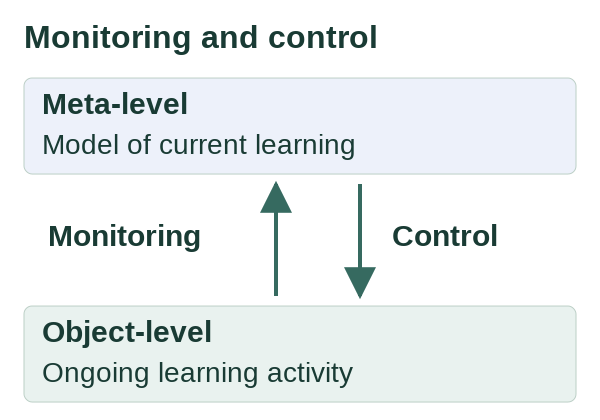
Knowledge, monitoring and control
Metacognition is often divided into two main parts. One is what a learner knows about thinking. The other is what a learner notices and does while working.[12][13] A 2024 study of 128 healthy participants measured this knowledge. It used two subscales of the Metacognitive Awareness Inventory.[12]
Biggs (1988) set out a model of student learning. In it, students must know their own motives, the demands of the task and their own thinking resources. They also need to exert control over the strategies that suit the task at hand. In that model, there are three common approaches to learning. Two of them, the deep and achieving approaches, come from the most effective metacognition.[14]
Papleontiou-louca (2003) notes that awareness and control cover more than thinking processes. They also cover feelings and motives.[1] A 2011 model of self-regulated learning treats metacognition, motivation and affect as parts that interact. Self-regulated learning means directing one's own learning. That model separates stable traits of a person from moment-to-moment experiences during a task. Traits include knowledge and skills about one's own thinking. One example of an experience is a feeling of difficulty.[15]
Metcalfe (2009) argues that people use these metacognitions to choose what to study within their own region of proximal learning, first trying to set aside material they already know well and then moving from easier to harder material.[16] Metacognitive sensitivity is how well a person can tell their own correct answers from their incorrect ones. In the 2024 study, higher prospective discrepancy scores predicted sensitivity, and lower retrospective scores also predicted it, but knowledge about one's own thinking did not.[12]
The 2024 study found that the online measures were linked to one another but showed little link to offline measures.[12] A 2021 review notes that educational science and cognitive neuroscience have mostly grown apart, with little exchange between them, and calls for research on one question: how closely do different measurement methods relate to the same metacognitive processes?[13] The 1988 model adds a practical point: study skills were taught in a setting that stressed thinking about one's own thinking, and afterward students improved in deep and achieving approaches.[14]
Metacognition and the brain and body
Metacognition is commonly defined as thinking about thinking. A 2025 review examines the brain networks that support it. A 2025 review reports that metacognition relies mainly on prefrontal-parietal circuits. These networks connect the prefrontal cortex with the parietal cortex. The same review gives supporting parts to the anterior cingulate cortex, which helps with monitoring. It also gives a part to the hippocampus, which helps with memory-related metacognition.[17]
A 2022 research proposal argues that metacognition overlaps closely with executive function. It focuses on the cold executive function parts of working memory. It also covers cognitive flexibility. It names them as close relatives of planning and regulation in metacognition. It also names the dorsolateral prefrontal cortex and the superior longitudinal fasciculus. Both are strongly tied to working memory and the ability to switch between tasks.[18]
Metacognitive calibration is the ability to judge one's own performance accurately. It is described as the basis for spotting errors and checking one's own work. Some students' self-assessment matched their actual performance more closely. These students used lateral prefrontal regions more than students with weaker self-assessment. Earlier imaging work had linked the lateral prefrontal and anterior cingulate regions to expert reasoning in science, technology, engineering and mathematics.[19]
Researchers have tested physical activity as a way to strengthen metacognition in young people. A 2017 meta-analysis, a statistical pooling of separate studies, combined 36 studies of exercise programs for children and adolescents. The combined effect on metacognition was 0.23, a small benefit. The 95% confidence interval ran from 0.13 to 0.32. Effects on higher-level executive functions (0.19) were also positive. So were effects on cognitive life skills (0.30). The most effective kinds were physical education built into the school curriculum. Programs that raised daily activity also worked best.[20]
Musical play has also been tested, with mixed results. A 2023 study gave 98 six-year-olds either 13 musical play sessions or 13 standard music lessons. Teacher ratings showed significantly greater gains in self-regulation and metacognition for the musical play group. Watching children work on a task directly did not confirm that result. The study used a teacher-reported assessment and an interview about metacognitive knowledge. Both showed a significant gain in the musical play group's knowledge of strategies.[21]
Emotion, motivation and confidence in monitoring
Curiosity is one such feeling, and it appears to act as a signal about how well a task is going. Three experiments had 264 participants who rated their curiosity on general knowledge questions. In one experiment, they also rated their confidence; in another they could skip a question instead. They were less confident on trials where they answered incorrectly and also reported more curiosity on those same trials.[22]
One study looked at 360 university students. Creative self-efficacy is a person's belief in their own creative ability, and it predicted how they expected to do on the first task and their metacognitive judgments. The perceived value of creativity mostly affected judgments and expectancies in indirect ways, working through task interest. Task performance alone was only a weak predictor of judgments, while perceived difficulty and interest gave more clues.[23] Self-efficacy can also change how other supports work. In one study, 70 students learned with hypermedia; they had no effect on reported strategy use or strategy quality, and no effect on learning outcomes.[24]
Only boredom strongly predicted vocabulary learning. The study covered 305 Italian second and third graders, with a mean age of 7.44 years. Students monitored and controlled their performance on an English vocabulary test. This predicted vocabulary gains over the school year.[25]
Attention difficulties show a clearer link to monitoring than anxiety does. A study of 50 college students found no significant difference between an anxiety group and a control group. The two groups scored alike on a learning autonomy scale. A group with attention deficit scored much lower than controls.[26]
A 2024 review describes confidence as inferential, drawing on a person's models of the world and of their own cognitive system. Those models may be more or less accurate, which is why confidence judgments sometimes differ from actual task performance.[27] The difficulty of a task changes how solving it feels. On Raven's matrices, suddenness and certainty dropped a lot from easy items to hard ones; easy items were about 80% correct and hard ones were about 20% correct. On easy items the experience matched that of insight problems, while difficult items felt like slow, step-by-step analysis with uncertain outcomes.[28]
Research
How researchers measure metacognition
A 2017 review of ten studies found that knowledge about cognition was assessed with off-line measures only.[34] A 2012 study looked at 39 fifth graders and found no link between a self-report questionnaire on metacognitive activities and performance in solving word problems.[35] A 2022 study of 155 participants found that offline self-reports reflected online metacognitive bias but did not reflect online metacognitive efficiency. That result supports doubt about questionnaires: they may not be a useful stand-in for task-based metacognition, and they may rest on introspection that is not reliable or on distorted memory.[36]
Confidence ratings work by asking a person, after each answer, how sure they are that the answer is correct. The logic is simple: confident people are more often correct, so the strength of that link can measure metacognition. These measures are described as free of bias and connect to measures of calibration and discrimination that come from research on estimating probabilities. Metacognitive bias is a difference in subjective confidence while basic task performance stays the same, and metacognitive efficiency is that sensitivity at a given level of task performance.[37]
Think-aloud protocols ask learners to say aloud what they are thinking while they work, and a 2012 study calls this a proven valid but time consuming method. A new instrument combined how well they judged their own performance with how they pictured problems. That tool overlapped with the think-aloud measure, and each one also added its own separate part to predicting performance.[35]
A 2018 review looked at individual differences and brain imaging and reported a meta-analysis of studies on behavior, which combines the results of many studies. In that study, perceptual metacognitive ability was linked across the senses, but thinking about one's own perception was not linked to thinking about one's own memory. That review warns that behavioral evidence may be too weak to show that the skill applies across domains, and may miss links between the measures that index metacognitive efficiency.[38] The 2022 study also found a mix of general and specific parts: metacognition about perceptual judgments was mostly tied to the task.[36]
How strong is the link to achievement
A 1992 study built a measure of how well people monitor their own understanding while reading, made for Spanish secondary school students. That ability was significantly related to grade point average, though the correlations were not high, and this held across several high school courses. They also fell as grade level rose, and the measure showed no link to gender.[39]
Exam scores rose as students used more thinking strategies and more resource management strategies.[40] A separate study looked at undergraduate students in a business and economics programme. It looked at how metacognition is organized. A 2006 paper notes that studies show metacognitive skills are much harder to teach than cognitive ones.[41]
One study looked at 8,773 secondary students in Hong Kong from three cohorts, examining mastery goals, the use of learning strategies, and academic achievement, and how these influence one another over time. Mastery goals and thinking-about-thinking strategies affected each other, each one influencing the other, which went against earlier research. Achievement predicted later mastery goal adoption and later use of metacognitive strategies, but it did not work the other way round. The model held for students of different genders, year levels and school bands.[42]
Five studies looked at how well three things predicted learning disabilities: motivation, metacognition and psychopathology. Classification accuracy was measured with receiver operating characteristic curves and ranged from 77% to 96%, rates much higher than chance. Cognitive indices sometimes give rates of 50% to 55%, which is about the level of chance.[43]
Why monitoring accuracy matters for learning
A study of 65 students compared each student's expected grade with the grade actually earned. Performance was clearly tied to both accuracy and bias in monitoring, and it also clearly predicted both. Students differed in how they formed judgments and how they revised them, and the differences followed four parts of learning.[44]
One experiment had 161 participants, who studied five lists of 20 words each and aimed to recall as many items as possible on a final test of all the material. After each of the first four lists, participants did one of four things: they restudied the list, made judgments with complete words, or made judgments with word stems, and a fourth group was tested on word stems. Compared with restudy, retrieval practice and judgments made with word stems improved recall of the fifth list and also led to fewer intrusions from earlier lists. Judgments made with complete words did not produce this benefit.[45]
One study tested 56 people aged 11 to 41 on a visual task that separated real performance from the ability to judge one's own thinking. Metacognitive ability rose a lot with age through adolescence, peaked in late adolescence, and then leveled off on the way into adulthood. The researchers concluded that knowing one's own perceptual decisions takes a long time to develop, and that this change happens during the teen years.[6]
Metacognitive accuracy is the degree to which confidence judgments separate correct trials from incorrect ones.[46][47] Snyder and colleagues (2011) measured how well students judged their own learning during four biology exams. They collected students' global confidence judgments before and after tests and their item-by-item confidence during the tests.[46][48]
The study took place in a semester-long biology course. There, 44 gifted and 23 typical high school students gave confidence judgments across four exams. Gifted students judged their own work better, item by item. They were also better on global judgments made after the test. The gifted and typical students showed no statistically significant difference in overall predictions made before a test. They also found no difference in calibration bias. Local calibration accuracy partly explained the link between giftedness and exam performance.[46]
Straka and colleagues (2021) note one open question that still has no convincing answer: do gifted children have better metacognitive skills than their typically developing peers? Eye-tracking records of gifted and average fourth and fifth graders showed no significant group differences in gaze transition entropy, mean fixation duration, or number of regressions after controlling for trial duration. The groups did differ in time spent on the task, and only gifted children tended to spend more time when they felt less confident.[49] Mathematical metacognition awareness and metacognitive calibration showed no significant relationship. Those students judged their answers better on medium and difficult maths questions and less well on easy ones, and they were overconfident on hard and easy questions, compared with medium ones.[48]
Overconfidence is common, and it is largest among students of poorer ability, who lack both the knowledge and the awareness of what they do not know. This mistaken belief that information is understood is called the illusion of knowing.[50] Low-performing university students also gave less confidence to their estimates, which suggests some awareness of poor calibration. For secondary school students, calibration accuracy was unrelated to confidence scores, which suggests less developed metacognitive awareness.[51] Primary school students relied too much on memory inside their heads, and this bias was linked to how accurate their monitoring was.[52]
A simulation study checked false positive rates. It looked at several measures of how accurately people judge their own thinking. A false positive rate is the share of results called real when no effect exists. The false positive rate of HMeta-d depended on study design and prior specification. Logistic mixed models showed greatly inflated rates when random slopes were omitted. Rausch and Zehetleitner argue that a measure of metacognitive accuracy should not be used yet. Its false positive rate must first be shown to be acceptable.[47]
Metacognition in reading, writing and mathematics
Reading draws on what a child knows about the goals, tasks and strategies of reading. That knowledge can shape how well the child plans and checks the reading. A 1987 review noted this appeal. Yet few studies had measured or encouraged how children think about reading. The same review offered an Index of Reading Awareness. This is an informal test of how well children understand reading comprehension. Scores on that index differed with children's age and with the instruction they had received.[53]
Better readers tend to know more about reading than poor readers. Children get better at reading when they are taught reading strategies. A 2015 study compared 22 readers with dyslexia and 22 readers who developed normally. It looked at three forms of metacognition: knowledge, strategies and experiences. The readers with dyslexia knew they had reading problems. But they knew less about how to approach a text in general. They also said more often that they had no reading strategies to use. The two groups did not differ in their use of deep and surface strategies. They also did not differ in how well their predicted performance matched their learning. The study concluded that reading and spelling problems in dyslexia are not usually linked to lower metacognitive knowledge.[54]
A survey of undergraduate students found a correlation of r = 0.721, with a significance level of 0.000, between reported metacognitive strategies and reading achievement.[55] Two studies of middle-school students linked self-reported planning and evaluation strategies to reading comprehension scores on questions that required inferences. How accurately students judged their comprehension was tied to how they performed at different levels of understanding, including questions that ask students to draw conclusions.[56]
In math, a metacognitive view assumes a close link between learning skills and the processes that monitor them. A 1997 study looked at 397 third-grade and 394 fourth-grade children who took a standard mathematics test that asked about their control processes: prediction, planning, monitoring and evaluation. Number and geometry problem-solving skills were most strongly linked to metacognitive abilities, while in arithmetic that link showed up clearly only for the third-graders.[57]
One study looked at 165 children of average intelligence in Grade 3, and at metacognition and math problem solving. Three parts of metacognition explained 66% to 67% of the shared variance: global metacognition, off-line metacognition, and attribution to effort. Off-line metacognition means mainly prediction and evaluation.[8]
A long-term study followed second graders in September and again in January. It measured effort attributions, thinking about one's own math learning, and strategy use. Effort attributions measured at both time points were significantly related to metacognition. The results fit self-system theories. These hold that metacognition, motivation and strategy use work together to help learning.[58]
Science, language learning and other domains
A 2013 review found 178 studies of metacognition in science education, published between 2000 and 2012, and judged the field to be growing. That review reported that understanding science concepts had become a main aim of this research, which earlier reviews had not found. The most common teaching practice in the reviewed studies was giving learners cues and prompts during instruction. The same review found few controlled studies that could show that teaching metacognition causes better science learning. It also found little research on preschool and early elementary learners, and little about what teachers themselves know about metacognition.[7]
Research reviewed in 2000 shows that teaching students to think about their own thinking helps and sharpens their ideas about science.[3] One middle school curriculum was the ThinkerTools Inquiry Curriculum, which organized scientific inquiry around a metacognitive model of research known as the Inquiry Cycle. In trials in city classrooms, students' scores improved a lot on both the physics and the inquiry assessments. A controlled comparison showed that adding Reflective Assessment helped learning a great deal, and helped low-achieving students the most: their project and inquiry test scores came much closer to those of high-achieving students, while control classes did not.[59]
A review looked at 33 studies published from 1999 to 2013 and found that teaching about thinking may improve language performance. Overall, however, the evidence was mixed, and it was unclear whether those interventions raised learners' metacognitive awareness or their use of strategies.[60] One 2024 study looked at 145 Thai engineering students learning English, split into an experimental group of 82 and a control group of 63. For 13 weeks, one group was taught ways to think about their own reading, while the control group was taught from a textbook. The experimental group's average reading comprehension score went up from 35.30% to 50.04%, and the control group's rose from 35.58% to 43.28%. Students strongly agreed with planning strategies (84.32%), monitoring strategies (90.24%) and evaluating strategies (82.95%).[61]
A 2024 survey of 108 English majors found their skill in using metacognitive strategies was at a high level, and using metacognitive strategies was positively linked to better English writing performance.[62] A 2025 study tested teaching of metacognitive listening strategies with an experimental group and a control group. The instructed group clearly improved in listening comprehension. How well strategy use worked changed with how anxious students felt about listening, and the two had a significant interaction. Within the experimental group, high-anxiety and low-anxiety students performed very differently. Grasping details was the strongest predictor of listening comprehension achievement.[63]
How metacognition develops with age
Children seem able to develop basic metacognition after age three, according to a 2014 paper on early childhood education.[64] One developmental account treats early metacognition as management of cognitive resources, and it needs no formal rules or inner symbols. In that account, implicit and perceptual metacognition grows from back-and-forth interaction between the baby and the caregiver. Taking turns in early talk gives caregiver and infant a starting point, and that base supports shared routines for checking and correcting. The adult serves the infant in two ways: as a teacher who remarks on and corrects the infant's efforts, and as a cognitive resource for the infant.[65]
Two studies measured how much thinking about thinking appeared in parents' spoken directions, which preschool children were given during a problem-solving task. Children improved on several problem-solving measures after a parent helped them. Those data did not support Wertsch's 1979 social interactional hypothesis, which explains where metacognitive skill comes from: social interaction. The results were read as support for an account of how strategic knowledge grows, one that considers both self-regulation and other-regulation.[66]
The early school years bring a clear rise in executive functions, and metacognition also goes up at that time. A long-term study followed 84 children from kindergarten to second grade and tested whether these two sets of skills affect each other. Children with stronger inhibition skills in kindergarten were less overconfident later, in elementary school, in their monitoring.[67]
A 2025 study put 214 six-year-old kindergarteners into three groups, which got feedback on performance, feedback on checking, or an active control. The children did 12 training sessions and were tested before and after training with memory learning tasks. Neither type of feedback made students check their work more accurately. Choice latency, the time a child takes to answer, was confirmed as a valid cue children use when judging their confidence. Students got feedback many times, but it was never clearly built into later judgments about their own learning.[68]
A 1998 article on thinking about thinking called metacognitive skill meta-learning and traced how this skill develops in children. A 1998 article argues that teachers should help children become aware of their own thinking, and it also names the factors that make this kind of thinking grow stronger. Fisher (1998) also calls thinking about thinking a key part of moving learning to new tasks.[69] A 2014 study suggested that interesting activities run in an enjoyable way could help young children build metacognitive skills and become effective learners. A 2014 study gives one example, physical activity during reciprocal and self-check teaching styles, which can lead young students to reflect on their own learning.[64]
Metacognition across the lifespan and in everyday skill
The professionals showed broad awareness of their own thinking about technical matters and about interpretation, concentration, planning, monitoring and evaluation. The beginners showed a complex link between growing skill and their use of planning strategies. Strategies were similar across musicians but varied a lot because of individual need.[70] A 1993 study looked at 24 computer programmers, some experts and some beginners. Experts had a clear idea of an ideal working strategy and seemed to follow it.[71]
Learning to write academically also uses awareness of one's own thinking. A semester-long study looked at beginning academic writers and linked how they saw the task to awareness of when to use a strategy, meaning knowing how and why to adapt writing strategies to a task's requirements. That awareness seemed to work both ways with self-regulation and had a two-way relationship with students' development of individual writing approaches.[72]
One study looked at 340 Chinese undergraduates and another looked at 540 people. Some students wrote English as a foreign language and reported metacognitive experiences, which were linked to higher writing test scores.[73] A 2026 study looked at 318 German-speaking primary school children who were good at spotting correctly spelled words but poor at finding errors. Children marked some words as uncertain, and only about 24% of those words were actually changed when they could revise. The researchers linked these difficulties to low sensitivity to spelling errors and to a reluctance or inability to fix misspelled words.[74]
In health professional education, metacognition is treated as an essential skill for critical thinking and for learning on one's own, for life. Instructors can build these skills through planned questioning, modeling and reflection, in classrooms and in hands-on settings.[75] Medical students solved clinical reasoning tasks in a computer tutoring system, and one study found they monitored their learning inaccurately and were too sure of themselves on both tasks. Heavy use of thinking-about-thinking support predicted more accurate monitoring; this scaffolding is computer-based support aimed at monitoring. Thinking-about-thinking support also predicted better problem-solving efficiency, while strategic scaffolding was negatively related to it.[76]
Both dimensions were significantly linked to a deep approach to learning and to organized studying, and both were negatively linked to an unreflective approach. Three learning profiles differed on both measures, and students with a dissonant profile scored much lower on knowledge about cognition compared with unorganized students who took a deep approach. A 2023 study concluded that students with different study profiles need different kinds of support for awareness of their own learning.[77] A 2026 study of 108 Grade 10 students found no significant link between awareness of one's own thinking and understanding of texts; being aware did not predict understanding.[78] A 2025 study tracked the eye movements of 96 university students as they read explanatory texts that contained inconsistencies.[79]
Teaching can change metacognitive awareness, though not for everyone. A chemistry classroom study used the phrase "learning is constructing" as a metaphor; the students generally did not think about how they learned, some students became more metacognitive and changed how they learned, and others found little or no effect. The researchers argued that context largely decides whether students improve their metacognition.[80] A quasi-experiment used 27 microbiology students, and the class taught with thinking-about-thinking control strategies reached a gain score of g = 0.59.[81] A 2026 quasi-experiment used two groups of 35 students each; teaching reading strategies with guiding questions raised summary writing scores (86.23 vs. 78.11) and metacognitive awareness (85.71 vs. 77.17).[82]
Technology, games and new tools for metacognition
A 2026 three-level meta-analysis combined 33 studies of interventions that used technology and of learners' metacognition. On average, the programs were linked to higher thinking-about-thinking outcomes, with a Hedges' g of 0.653 and a 95% confidence interval of [0.520, 0.786]. The results varied a lot between studies. The type of technology did not significantly change the effects. Some interventions gave larger estimates on paper: those that used guidance on technology use, immediate feedback, or learner control set by the system. None stayed significant after adjusting for multiple comparisons, with an adjusted p of .095 for each. These features overlapped, so the review calls the patterns a source of hypotheses, not proof of separate effects.[83]
The combined estimate rests mostly on self-report and on regulation, so it should be read with care. Most of the combined effects, 77 of 94 (81.9%), measured how people regulate their own thinking. Nearly all of them, 90 (95.7%), came from self-report measures. Interventions most often targeted evaluation and reflection, monitoring, and strategic control, while planning showed up less often.[83]
A 2026 systematic review looked at 22 empirical studies and sorted artificial intelligence tools into two kinds. Learning-oriented AI gives guiding feedback without giving the answers, and it was more often tied to guided interaction. General-purpose AI gives answers or corrects errors directly. Positive results appeared for regulation, for awareness, and for shared metacognition. But some studies of general-purpose AI tools found students leaning too much on the tool and accepting answers without thinking enough.[84]
A 2023 review looked at virtual reality games used as an intervention. The aim was to train meta-skills in people with special educational needs and disabilities. A 2023 review screened 1100 records. It kept 26 studies on virtual reality games. It concluded that such games could raise motivation and build thinking-about-thinking skills. Motivation, metacognition, and emotional intelligence acted as mediators.[85]
One classroom platform combined computer animations, science experiments, electronic diaries and metacognitive prompts. The study used a pre-test and post-test control group design with 7th graders on the topic of static and current electricity. The experimental group scored significantly higher on the control and monitoring subscales of a metacognition scale, and the same group also did better on essay questions about electricity. Student views of the software backed these results.[86]
Schools and teacher training programmes have tried several routes to raise metacognition, among them explicit teaching of meta-strategic knowledge through visible thinking routines. One route is professional development: a review argues that metacognition is underdeveloped in preservice teaching programmes. The aim is to close the gap between theory and practice in teaching higher-order thinking skills.[87] A study of 120 pre-primary and school-level teachers found that teachers create some chances for students to build self-regulated learning skills.[88]
One 2023 study placed primary school teachers in a professional learning community. The community focused on self-regulated learning in mathematics. The study then measured how they thought about their own learning in math teaching. The statistical test's mean showed that teachers' metacognition for math instruction improved significantly.[89] A survey of 100 high school teachers in Dindigul district found a significant link between classroom management and metacognition. ArockiaSamy (2017) writes that metacognitive strategies such as planning, monitoring and self-evaluation may come with stress, strain and anxiety that leave teaching restless.[90]
A separate study looked at 87 future teachers in Sivas, Turkey. It used journals and questions about thinking in a course. The strategies raised two scores among the prospective teachers: awareness of their own thinking, and belief in their own teaching capability. Belief in their science teaching capability rose too little to differ much from the pre-test. The same strategies did not raise belief in one's own science teaching ability enough. The change was not significant compared with the pre-test.[91]
Reflective tasks are another route. Swanson and colleagues (2024) offered four weeks of reflection after a strategies workshop, and Ekstam (2018) analysed reading logs kept by student teachers.[92][93] One intervention gave students a workshop on metacognitive learning strategies, then four weeks of chances to reflect. Some students reported growing more confident in the first week, and they were twice as likely to finish the intervention. Finishing it went with a higher semester GPA, whatever the student's identity or earlier grades, and whatever their strategy choice and outcome description in the first week.[92] Student teachers kept reading logs in a Norwegian teacher education course in autumn 2016, and the logs were sorted by five reading stances. The logs let the students see how their comments had changed, and the article says this process promotes metacognitive thinking.[93]
Clickers are a classroom response tool whose use in teaching has grown increasingly common in the United States. In Malaysian college English classes, teaching with clickers gave stronger learning outcomes than traditional multimedia teaching, and it also gave higher metacognitive levels.[94] Two parallel classes of 80 students each got different teaching. The two classes did not differ much in their online collaborative learning experience (P = 0.3542), but they did differ in metacognitive planning and monitoring, and in regulation and evaluation. The study reads this as teacher intervention that promotes thinking about thinking.[95] A systematic review of 10 articles from 2004 to 2024 reached a conclusion: commercial video games help metacognition about as well as more traditional methods or tools.[96]
Programmes and single cases have also been reported: Chen and colleagues (2024) trained early childhood teachers, MacNeil and colleagues (2024) built a co-curriculum for organic chemistry, and Panáčová and Veseláková (2026) describe a one-year intervention with one gifted student.[97][98][99] One study looked at 110 children (average age 60 months) and 20 teachers in rural Idaho. A science programme driven by metacognition raised the children's self-regulated learning scores, and teachers' confidence in teaching science rose, as did their knowledge about their own thinking. Their scores for metacognitive regulation skill did not.[97]
A co-curricular programme for introductory organic chemistry used self-assessments of confidence and predictions of test performance. Exposure brought overall performance and confidence gains, but some students gained more than others. At first, Dunning-Kruger effects appeared: low performers overestimated their grades, and high performers underestimated theirs. These effects decreased with more exposure.[98] A one-year individual intervention worked with a mathematically gifted student, aiming to widen his problem-solving strategies and develop his metacognition.[99]
Open questions researchers still argue about
Borkowski (1996) proposed a model based on development. It was meant to help bring together the very different parts of metacognition. A 1996 analysis weighed four articles against Pintrich's classification system. That system sorts metacognition into knowledge states, judgments and monitoring skills, and control processes. The model was meant to bring together the conceptually diverse parts of metacognition. It also aimed to extend them to areas such as motivation. It also argued for more long-term, interactive research in the field.[100]
A 1989 article listed four questions that should be tested with data. One was how to measure knowing about knowing more accurately. The other was how to measure the effects of teaching strategies. The other two questions asked how content knowledge relates to strategy knowledge. They also asked what role achievement motivation plays in strategy use.[101]
A 2026 reliability generalization meta-analysis pooled 137 Cronbach's alphas from 61 studies with 21,407 participants to estimate the average reliability of the Metacognition Awareness Inventory. It found good reliability for the Metacognition Awareness Inventory, above 0.75. The large variation was blamed on differences between studies, and the test dimension and the test version explained part of that variation. There were no strong signs of publication bias.[102] A 2012 study looked at 97 seventh-grade students and found strong links between two measures of metacognition: the Junior Metacognitive Awareness Inventory and a version of Swanson's metacognition measure that uses open-ended questions. Both measures of the students showed sound measurement properties, and both predicted science achievement well.[103]
How best to assess metacognition in children is unsettled. A 2017 review mapped the methods used with children aged 4 to 16 years between 1992 and 2012, checking the tools for reliability, validity and replicability. After that, 80 tools were left in the analysis, and self-report measures made up 61% of the included tools. Some observational methods do not ask students to think aloud, and these had been used only with students aged 9 and under. Reports did not always give reliability and validity information for each tool, and sometimes they gave it inaccurately. How a study defines metacognition also shapes how it measures the construct, so the two can fall out of line.[104] Two studies in 2020 had 245 undergraduate students, then 138. They concluded that understanding individual differences in monitoring needs several kinds of judgment, and several measures of how accurate judgments are.[105]
Metacognition in music, drama and the arts
A 2013 article in Music Educators Journal described ways to teach. These ask music students to reflect, assess their own playing, and speak their thoughts aloud. The same article offered writing prompts for reflection and rubrics for self-assessment. It also gave questions for think-aloud sessions with learning partners. It argued that metacognition crosses subject boundaries and grade levels. So it can move from the music classroom to other subjects. Its author expected results such as greater self-reliance and more independent learning.[106]
One experiment tested whether teaching with metacognitive strategies improves guitar playing. The study took place in Turkey during the 2018 to 2019 academic year and involved 20 preservice music teachers enrolled in a guitar course at Muğla Sıtkı Koçman University. It used a randomized pretest and posttest design with a control group. Both groups improved their guitar performance: the control group used traditional curriculum-based teaching, and the experimental group used teaching based on metacognitive strategies. Yokuş suggested that the metacognitive practice could serve as an alternative to the traditional method for improving guitar performance, while noting that the small sample left the comparison without a significant difference.[107]
Johnson argues for raising the status of drama in primary schools and in teacher training. Johnson refers to practice in primary education, which covers ages 5 to 11. A 2002 paper argued that children need activities that help them understand their own thinking, and drama can offer activities like these. That argument is a proposal about potential, not a report of an experiment with performance results.[108]
Metacognition in information literacy and source evaluation
Tardiff (2024) asked a question about librarians. Do they teach metacognitive concepts directly when they teach students to evaluate sources? The study looked at online library guides about judging sources. The guides came from colleges and universities in Washington state. It also asked librarians who taught students to judge sources. Tardiff found that self-reflection is rarely treated or taught as a core step in judging sources.[109]
The Association of College and Research Libraries has a framework for information literacy, and it treats metacognition as a central part of information literacy. The final document mentions metacognition only once, and earlier drafts gave it more emphasis.[109]
Metacognition in physics and chemistry education
Reviews of metacognition research in physics education are rare, while reviews of metacognition in education more broadly appear regularly. One 2025 systematic review examined 17 physics education papers published from 2013 to 2021 in peer-reviewed journals. The review sorted the papers using the framework of Flavell. It found that studies focused more on metacognitive knowledge than on metacognitive experience. Only 7 of the 17 articles gave much attention to metacognitive instruction in physics learning. Research had not addressed training future physics teachers in metacognition at all, and it had not addressed serving teachers either.[110]
A 2019 review turned to chemistry in secondary and higher education. It describes metacognition as knowledge of cognition, or being aware of what one knows. It also describes control of thinking: consciously managing how one learns. The review notes that earlier chemistry studies had left out detailed assignments. These assignments would have covered a range of metacognitive strategies. To fill that gap, it gives example assignments on energy for high school classrooms. These assignments use metacognitive prompts, short questions that ask students to reflect. They also use the levels of chemistry understanding: macroscopic, microscopic, symbol and process. Lavi, Shwartz and Dori offer advice for educators and a rubric for researchers.[111]
The physics review reports a gap: studies of metacognition in teacher training have not yet been done, for both pre-service and in-service teachers. The physics review asks for more work on training teachers in how to teach, and for fitting thinking about one's own learning into the physics curriculum.[110]
How classroom interventions change metacognition
A 2021 review grouped these approaches under a three-step routine. It calls the routine wait-generate-validate. The review says these routines helped students judge their learning more objectively. The judgments covered lectures, course concepts, text comprehension, problem solving and readiness for tests. Students using them made better study decisions and learned more, according to the review.[112]
One introductory biology course combined weekly written self-assessments with individual feedback, and it also used learning communities in the classroom. Students took a learning strategies inventory at the start and end of the semester. The results showed clear changes in both thinking about one's own learning and study behaviours. The course also had a positive effect on learning, measured by broad and single measures.[113]
A course in Taiwan taught thinking skills, covering facts versus opinions, question stems and thinking from different perspectives. It had 78 students, while general English classes had 196 students. The thinking instruction had statistically significant positive effects on students' metacognition. Students used the skills in other subjects too, and they also used them in personal life.[114]
In one study of 86 students, exam wrappers used in a single course produced no improvement on any of three exams, on final grades, or on metacognitive ability as measured by the Metacognitive Awareness Inventory.[115] In a laboratory comparison of five methods for improving how well students judge their own test performance, only well-timed salient feedback and a lecture warning students against being biased by the grades they wanted raised prediction accuracy from the first test to the second. Review, incentives and reflection produced no gain in predictive or postdictive calibration.[116]
A study of 86 students tested exam wrappers, short exercises with metacognitive instruction. It compared them with fake wrappers and with no wrappers. When wrappers were used in just one course per term, the study found no gains. Scores did not rise on three exams or on final grades. Metacognitive ability did not rise either. All students raised their scores on that inventory over the semester, whatever their condition.[115]
Recent trials add conditions and limits.[117][118] A short digital training in self-regulated learning raised metacognitive awareness; it involved 37 secondary students, and the comparison group had 32 controls. It had no effect on essay performance, knowledge gains or learning transfer.[117] Metacognitive scaffolding helped more as tasks grew more complex, but it showed no clear link with awareness of one's own thinking, and it also showed no link with programming achievement.[118]
Metacognition in the early years
Metacognition is the monitoring and control of one's own thinking. It appears in children well before they can describe it in words. In one study, 2.5-year-olds and 3.5-year-olds took a forced-choice test of perceptual identification. They rated how sure they were of each decision. In both age groups, children asked for a cue to help them decide. They did this more often after a wrong answer than after a right one. This shows an ability to introspect implicitly on the results of their thinking. Yet none of these children showed metacognitive sensitivity when giving explicit confidence judgments. This fits earlier evidence that clear metacognition develops later.[119]
Preschoolers and kindergarten children usually expect to do better than they really do, and this happens in many different settings. Two experiments tested 4-year-olds and 6-year-olds to find what drove these overpredictions, with task familiarity, memory monitoring or wishful thinking as the possible causes. The overpredictions came from wishful thinking, not from poor metacognition, and they were more common in unfamiliar task settings than in familiar ones.[120] A study of 107 children aged 4 to 6 years found a difference: the 6-year-olds showed more knowledge about thinking, and more monitoring, than the 4-year-olds. Control ability means spotting rules that needed to be learned again, and it improved significantly between ages 4 and 5.[121]
Older children also taught a puppet to play a card game, and they were better at teaching content and at teaching strategies. The links between metacognition and teaching ability remained after age and vocabulary were taken into account. The researchers concluded that teaching others gives young children useful chances to use their metacognitive abilities.[121] A qualitative study looked at young children in a reading intervention programme. Videotapes and stimulated recall showed a wide range of metacognitive behaviour. Most responses during sessions involved managing one's own learning, and answers during recall showed awareness of reading strategies.[122]
Some children have specific disabilities in learning mathematics. These children scored much lower on prediction and evaluation than peers of the same age.[123] In first-grade children, metacognitive monitoring and academic self-concept showed only a weak link. This was when compared at the absolute level of confidence. Comparing the two by their biases instead revealed a more substantial link.[124]
Links to achievement and open problems
Akpur (2024) combined the results of 36 studies, all published between 2008 and April 2023, and the review reported a strong link between metacognitive awareness and academic achievement. The overall effect size linking metacognitive awareness to academic achievement was .824, a figure described as a strong link on the overall effect size scale.[125] The 74 effect sizes came from 29 of those studies and covered 30 independent populations.[126]
Muncer and colleagues (2022) found a pattern: how metacognition and math performance were measured was linked to larger effect sizes. Heterogeneity means variation in results between studies, and it stayed high in all of those analyses.[126] In a questionnaire study of 308 mathematics students across different grades, metacognition was positively correlated with mathematical scores, and self-monitoring was central to that relationship (p<0.05). Among 308 mathematics students, thinking about thinking was linked to higher math scores, and self-monitoring was central to this link (p < .05).[127] Metacognitive awareness linked problem solving skills and mathematics achievement.[128]
One sample had 206 female and 70 male college seniors in Turkey, aged 21 to 27. Metacognition and self-regulated learning scores did not predict grade point average in the expected positive direction. The link was negative.[129] General self-efficacy, a person's belief in handling general demands, partly mediated the link between metacognition and academic success.[130]
Researchers argue over whether metacognition is one construct or several separate factors. One survey looked at 644 students at a large Midwestern university. A two-factor model of knowledge and regulation fit better than a five-factor model.[131] Muncer and colleagues (2022) report significant differences between the 31 studies in their review.[126] A questionnaire study looked at 1051 university students. Self-reported planning of writing differed by sex, high school diploma track and learning domain.[132]
Metacognition in adult and later life learning
One is keeping track of internal states, and the other is the flexible use of control strategies based on that checking. A review of studies on aging found that getting older does not really affect the accuracy of basic monitoring, which covers encoding and retrieval states in episodic memory tasks. Aging does affect episodic memory itself, the memory for events tied to a time and place. Hertzog and Dunlosky (2011) propose that accurate monitoring can give older adults a basis for using compensatory strategies that help them reach their learning goals, even when aging affects the mechanisms of learning. Hertzog and Dunlosky (2011) report that interventions built on this idea produced larger learning gains than the usual strategy-training programmes. Hertzog and Dunlosky (2011) suggest that self-regulatory strategies guided by monitoring may help older adults keep their thinking effective in daily life.[133]
Kuiper and Pesut (2004) argue that nurses cannot reason well in clinical settings unless both cognitive skills and metacognitive skills grow. Their integrative review of the literature argued that attention to critical thinking alone is only one view of how clinical reasoning develops, and that this view falls short without metacognition or reflection. The review found evidence that critical thinking and reflective practice are tightly connected, and that prompts based on self-regulated learning bring the two together. Kuiper and Pesut (2004) say nursing students and working nurses can strengthen both kinds of skill in clinical settings, and that self-regulated learning strategies can help.[134]
A scale of metacognitive writing was developed for adult writing and tested with 805 Turkish university students. The scale had 19 items in four dimensions: writing knowledge, planning, monitoring and evaluation.[135]
Metacognition in multilingual and second language learning
Thinking about thinking in language learning makes learners more aware of their own thoughts. This helps them plan, monitor and evaluate the strategies they use.[136] A 2022 article is about multilingual learners. It treats awareness of many languages as the central part of thinking about one's own thinking. Jessner and Allgäuer-Hackl (2022) say multilingual awareness has two parts. They are metalinguistic awareness and cross-linguistic awareness. Studies in the Austrian and South Tyrolean context found this awareness to be a core factor in learning and teaching. The article argues it must be trained in multilingual teaching approaches.[137]
Susilo, Widiati and Wulyani (2026) studied 58 students at an Indonesian boarding school, whose mean score on the strategy survey was 3.7. Problem-solving strategies scored highest, at 4.026, but in the boarding school study problem-solving strategy use did not relate significantly to reading achievement. Scores on the language program test did relate significantly to three things: overviewing, guessing and handling information.[138] A 2021 mixed-method study of Indonesian undergraduates found most strategies were used to a high degree, and male students guessed meaning more often (F = 0.232, p < 0.05). Andriani and Mbato (2021) used qualitative analysis and found 20 strategy variations among female students and 18 among male students.[139]
A survey of 590 Chinese university students found that self-efficacy belief (confidence in one's own ability) predicted English achievement. Metacognitive strategies and motivation for language learning explained part of that effect.[140] A study of 113 learners likewise reported that achievement motivation and metacognitive strategies relate to self-reported language proficiency.[141]
Metacognition and the wider web of mental skills
Metacognition does not work alone. Bryce and Eberhart (2026) describe a competition for resources. Cognitive resources can be used up by resolving conflict or holding items in memory. When that happens, less attention is left for monitoring. A study of children aged 7 and 9 found that executive functions and metacognitive monitoring depend on each other in childhood. That dependency grew stronger with age for inhibition, the ability to hold back a response. It also grew stronger with repeated practice, for both inhibition and working memory. Working memory is the short-term store used to keep items in mind. The researchers explain this as a competition for resources. Mental effort can go into settling conflict or holding items in memory. Less effort then remains for monitoring, so judgments of one's own accuracy suffer.[142]
In college students the picture is narrower. Wu and Was (2023) tested three skills, updating, inhibition and shifting, and updating was the only one of the three that correlated significantly with how accurately people monitored their own thinking. Monitoring accuracy was measured with a knowledge monitoring accuracy test, and the executive functions were measured with three tasks: one task measured updating, a color-word interference test measured inhibition, and a letter-number task measured shifting. So metacognitive monitoring is tied to at least one component of executive functioning, not to all of them equally.[143]
Attention is a third area of study. Mulvihill and colleagues (2025) designed a questionnaire that measures what adolescents know about watching and controlling their own attention. Study One used 293 high-school students and Study Two used 83. Its items fell into three dimensions: control of attention, monitoring of attention, and knowledge of strategies for managing attention. Strategy knowledge was linked to inhibitory control. The studies also found a group that was overconfident, whose beliefs about their attention did not match the strategies they could name.[144]
Metacognition also sits inside self-regulated learning. Efklides (2017) argues that affect plays a major part in that process through its interactions with cognition and metacognition. Surprise and curiosity are called epistemic emotions, and they attach to states such as gaps in knowledge and feelings of difficulty or confidence. These interactions make thinking about thinking a hot process, not a cold one.[145]
Metacognition in higher education and adult learning
One sample was Moroccan university students learning English as a third language. The students knew about metacognitive writing strategies but still did not actively use them. In one study, second-year university students in Morocco wrote an argumentative essay. They also answered a questionnaire on their awareness of metacognitive writing strategies, meaning their knowledge of plans for monitoring and checking their own writing. Their awareness was moderate. It related only weakly to how well they wrote, with a correlation of r=0.192. Women scored a little higher than men on both awareness and writing. The researchers recommended clear teaching and guided support. This would help students use the strategies in their academic writing.[146]
Cascella (2025) asked undergraduates to rate two monitoring strategies, active comprehension monitoring and audible elaborative rehearsal, after using each on homework assignments. The course was an introduction to communication disorders, in which 64 junior-level students used two ways of monitoring their work in 10 homework assignments covering 192 key terms. One strategy was active comprehension monitoring, or checking whether one has understood a passage. The other was audible elaborative rehearsal, or saying material aloud and connecting it to what one already knows. A majority, 62.5%, felt that checking their understanding helped them learn the terms, and another 40.0% reported a similar benefit from rehearsal. Students who often used both strategies were more likely to call them effective, and they also liked the comprehension monitoring more. Their confidence in reading textbooks did not change over the semester or with the strategy used.[147]
Judgments of learning can also drift from actual recall as study and test cycles continue. People predict their recall across repeated study and test cycles, and they usually underestimate how much they will remember. This error is called the underconfidence-with-practice effect. In one experiment, participants learned action phrases such as "squeeze the lemon" and made judgments of learning, which are predictions of later recall. Underconfidence appeared in cycles 2 and 3, and the first cycle did not show overconfidence. People got better at judging what they had learned, telling recalled items from unrecalled ones, and this skill increased across cycles. Judgments for study-test items rose faster across cycles than judgments for study-study items.[148]
Memory itself weakens with age, but judging one's own memory well seems to hold up. Younger and older adults showed similar efficiency in judging their own thinking on word and word-pair recognition tests, measured as meta-d'/d'. Memory performance showed a significant age effect favoring younger adults. Metacognitive efficiency was higher for word pairs than for single words in both age groups.[149]
A review covered 376 articles on thinking about thinking in higher education, published between 1988 and 2023. It found that teaching methods built on metacognition worked better than traditional methods; self-regulation strategies are one example.[150]
In practice
Teaching metacognitive strategies in classrooms
A 2025 set of meta-analyses combined 349 effect sizes from 67 studies of preschool and elementary school children with typical development. Metacognition programs raised results by g = 0.48 right after the test, with a 95% confidence interval of [0.35, 0.61]. At follow-up the average effect was smaller, g = 0.29, with a 95% confidence interval of [0.17, 0.40]. That delay suggests the benefits of such training can appear over a longer period.[151]
A 2019 review of more than 50 studies found a similar result for school pupils. It found strong evidence that teaching metacognition well in schools improves pupil outcomes. Evidence on pupil wellbeing was thinner, but the evidence that did exist was positive too.[4]
A six-week training program taught 40 undergraduate students to plan, monitor and evaluate. The trained group improved clearly in academic performance, self-reflection and strategic learning behaviors.[152] A six-month classroom study trained 64 Grade 9 and 11 students in knowledge, awareness and control, covering seven goals for students. A central feature was practice in using evaluative thinking strategies during lessons. All goals were met, and students became more purposeful learners with more control over their learning. But classroom factors outside the learner limited the improvement.[153]
A 2006 paper proposed a broader view of scaffolding with four elements: agency, domain, the link between self-scaffolding and metacognition, and six zones of scaffolding activity. In that view, a major aim of teaching is to hand support step by step to the learner.[154] A group teaching project took place in a college general chemistry course with 537 control students and 464 treatment students. It began with a feeling of cognitive imbalance meant to trigger reflection, followed by reflective prompting and peer interaction. The treatment group scored much higher on a self-report measure of metacognition awareness. The treatment group also solved harder chemistry problems that had no set steps, and their percent correct was higher. The researchers proposed that purposeful social interaction and reflective prompting drive the growth of metacognition, and teachers can build both into ordinary instruction.[155]
Self-Regulated Strategy Development, or SRSD, is a method that teaches students self-regulation skills directly and helps them use those skills. Its benefit for writing quality is well confirmed, but why it works, and for whom, has stayed unclear. A 2024 quasi-experimental study, which compares groups without random assignment, compared fourth- and fifth-graders. One group had regular writing instruction, the other had SRSD. Students in the SRSD group wrote better texts and judged the quality of their work more accurately, though they still overestimated. Better planning skills explained the gain in text quality, and students wrote stories with better structure and more ideas.[156]
Metacognitive skills are described as general across tasks, and in principle they can move to many different learning tasks. A 2020 experiment put 233 fifth-grade students into six training groups at random. Two conditions were mixed, combining thinking skills with one of two learning strategies, two taught only a cognitive strategy, and two were controls. After 15 weeks, hybrid training improved near transfer, meaning transfer to tasks like the training tasks. Then came a second 15-week training with a new cognitive strategy. Use of cognitive strategies rose in at least one hybrid condition, but students used metacognitive skills only a little, and more support for transfer is needed.[157]
Teaching students to think about their own learning has been tested in specific courses. These include linear algebra, elementary school writing, and reading comprehension for Iraqi English learners.[158][159][160] In mathematics, a 2026 intervention trained first-year students in metacognitive strategies. The students were studying linear algebra and analytic geometry. The aim was what the authors call solving problems with constant self-reflection. The program paired strategy training with a supportive social setting. It ran at two universities, in Saratov and Omsk. The researchers compared groups using the Mann-Whitney U-test. The researchers reported that the training helped students with low abilities. It helped them make up for weak math problem solving. They also described gains in emotional intelligence and a desire for personal growth.[158]
Reading has been studied both through teaching experiments and through surveys. Tawfeeq (2022) taught thinking strategies to Iraqi English learners. Koç and Arslan (2015) surveyed 618 secondary students about reading strategies.[160][161][162] A 2022 experiment taught thinking-about-thinking learning strategies to fifth-grade girls in Baghdad. It found a statistically significant gain in reading comprehension over the control group.[160]
A 2020 study of 143 polytechnic students compared reciprocal teaching with other language learning strategies. Mean reading scores were 7.65478 for reciprocal teaching and 7.64276 for the other strategies. Both approaches produced significant results.[162] A survey of 618 secondary students in Sivas found that awareness of reading strategies differed by class year and gender. It did not differ by parents' education.[161]
Khan and Sanosi (2024) surveyed 170 business undergraduates and found a correlation between grade point average and most of the cognitive and metacognitive strategies examined.[163][164][165] Among 170 business undergraduates, self-reported use of metacognitive strategies was fairly high, higher than their use of cognitive strategies.[163] In contrast, a study of 207 fourth graders found high awareness of their own thinking but no significant link to grades in Social Studies. The researcher suggested the pupils had not yet fully developed these strategies.[164] One study used mixed methods and looked at 1,565 Vietnamese undergraduates. It found sound knowledge of themselves as learners, but their knowledge of the language and of the learning process was weak, and it also found weak planning, monitoring and evaluating.[165]
Classroom studies have examined integrated speaking tasks in English and legal English lessons at Masaryk University.[166][167] One study looked at 130 university students doing integrated speaking tasks. Their use of metacognitive strategies depended on how hard they judged each task to be, and those learners were not active users of the strategies.[166] A three-year action research project ran in an English for Lawyers course at Masaryk University from 2019 to 2021. It added support for planning, monitoring and evaluating, and it also collected student reflections through a questionnaire.[167]
What teachers do and what learners bring
Classroom studies ask how a teacher's words and actions shape how children watch their own learning. One study observed teachers and 308 children in 2nd and 4th grade as the children did a secret code task. Teachers covered thinking strategies and metacognitive strategies, but they more often taught children about thinking strategies. Their teaching was also more often led by the teacher than centered on the child. Teaching thinking strategies showed no link to the children's outcome measures. Teaching cognitive strategies went with better performance in children and with more accurate self-monitoring. Teaching thinking strategies did not predict good choices about what to restudy.[168]
Tasks in successful thinking-about-thinking programs tend to be well-defined problems that are short and have known solutions. Teaching differs from such tasks because teachers often face situations that change a lot.[169]
Self-efficacy means confidence in one's ability to reach specific goals, and metacognitive learning strategies include planning, monitoring, and evaluating one's own thinking.[170] A study tested these links in 279 medical students at Shiraz University of Medical Sciences, using a structural equation model. Students' self-efficacy shaped the emotions they felt about learning and their strategies for learning how to learn. These in turn shaped their school results, and those strategies carried the effect of emotions on performance.[5]
Parent involvement covered six areas. These were six things: perception of support, organization, interest in the educational process, expectations, school relationship, and time of support with homework. Expectations predicted academic achievement better than any other measure. Metacognitive strategies carried the link for every measure of parent involvement. This held at both levels of analysis.[171]
A systematic review searched the Scopus database and found 319 titles, which screening cut down to 12 articles. It reported that growth mindset was the most often studied construct. Metacognitive strategies strongly predicted grade point average and how well students regulate their learning.[172]
Gifted, struggling and twice-exceptional learners
A 1993 review looked at the link between metacognition and giftedness and covered several theories of what giftedness is. That review concluded that theory and research support an important role, and that metacognition helps explain giftedness. The same review also listed open questions and did not treat the relationship as clear-cut or settled.[173]
A 2008 study looked at boys labeled learning-disabled, gifted, or twice exceptional. Each read a history text that contained unknown words. The text also contradicted itself in places. It also broke rules of prior knowledge.[174]
A 1990 paper focused on students who struggle in school. They do not know how to judge and manage their own resources for learning. Such students often build expectations and habits that work against them. These harm learning in school and block the transfer of effective learning strategies. It argued that knowing how one thinks can lead to flexible, confident problem solving. It can also bring feelings of self-efficacy and pride.[175]
A 2017 study compared 244 first-year students with such a history to 603 students without one. Students who had struggled with reading before earned a lower grade point average and passed fewer credits, and these patterns differed somewhat by subject. They also scored lower on several scales covering reading and study strategies that use metacognition, but those scores were not linked to their school results.[176]
A second 2017 study looked at strategy use in 77 university students with a history of reading difficulties and compared them with 295 students without one.[177]
Metacognition in teacher development and professional learning
Gunstone and Northfield (1994) treat teacher development as conceptual change, in which teachers come to understand and control their own learning about teaching. The authors place this process under metacognition. A 1994 article argued that this greater metacognition should be central to expected changes in teacher development. The article set out its case around three issues: first, how metacognition and learning about teaching are conceived as conceptual change; second, how to promote both; third, the article gives data examples of the results. Its examples came mainly from pre-service education, that is the training of teachers before they take up a post, and evidence for in-service settings, where practising teachers receive further training, was brief.[178]
Training in a cognitive programme can raise teachers' metacognitive skills, but not to mastery. One study tested 28 teachers before and after 90 hours of training in Instrumental Enrichment. This is a stand-alone cognitive programme developed by Feuerstein, Rand, Hoffman and Miller. On the pre-test, fairly many teachers had trouble solving at least some of the programme's tasks. Writing out their problem-solving strategies in words was even harder for them. After training, the teachers improved significantly on cognitive problem solving. They also improved on metacognitive skills. Yet the changes fell short of complete mastery of thinking or of thinking about thinking.[179]
Tocco and colleagues (2023) describe learning communities as good settings for active reflection on teaching. One study built teaching-focused metacognition into a faculty learning community curriculum. Pedagogical metacognition is the reflective actions teachers take on their own teaching. Participants wrote reflections on their own thinking once a month for one school year. Each was tied to a principle of learning based on research.[180]
Teachers who know about metacognition do not always use it on purpose. An early-stage study at a Maltese vocational education and training institution interviewed three working teachers. All three already knew about metacognition. But their accounts showed no specific details of metacognitive processes in their teaching. The strategies they described did not show deliberate use of thinking about thinking. Two of the three said more training as part of ongoing professional development would help them.[181]
Earlier work reported a gap between research on thinking about thinking and classroom practice. This covered primary and secondary schooling. Dennis and Somerville (2023) asked whether the same gap appears in college. Among those who knew the term, most stressed knowing about cognition rather than regulating it, that is, monitoring and adjusting one's own thinking. All respondents used at least two practices that support metacognition. But they usually used them in a limited way that stressed knowledge of subject content.[182]
Jing (2006) describes a project that taught thinking about thinking in a normal English reading course. The learners were second-year undergraduates at a Chinese university. They were in a BA programme for teaching English as a foreign language. Resistance appeared partly as mismatches between the teacher's goals and expectations and those of the students. The paper traced this to institutional pressures and social expectations around an influential national test, TEM-4. These produced a culture of exams. It also pointed to a practical approach focused on products in the classroom. Students saw themselves as learners getting ready for exams.[183]
What this looks like when you study
In a college general chemistry course, 464 students took part in an intervention that began with a surprising result to trigger reflection, then used reflective prompts and peer discussion. The treatment group was compared with 537 control students. The treatment group showed a significant rise in metacognitive awareness. They also solved harder chemistry problems that were not algorithmic and got a higher percentage of them correct.[155]
In a training study, 233 fifth-grade students were randomly assigned to six conditions, one of which was hybrid training that combined metacognitive skills with one cognitive strategy.[157] Programs run by teachers did better than programs run by the researchers themselves, and programs built into task materials also did better.[151]
One training study taught elementary school children to set goals and plan for math. Their students said they used these strategies more often than a control group.[168] While you work, monitor your understanding and ask for feedback when you are unsure. Shared monitoring responses helped students judge whether their chemistry solutions were correct.[184]
After finishing, compare your judgment of the work with its actual quality.[156] Then reflect on what worked and what did not. Reflective assessment in the ThinkerTools curriculum helped students learn physics and inquiry.[59] Finally, practise the same monitoring steps on a new kind of task. Hybrid training helped fifth-graders transfer metacognitive skills to new learning tasks.[157]
Criticism
Criticisms, limits and open questions
The idea of metacognition has drawn steady scientific interest. Yet basic questions remain open: what it is, how it works and where it stops.[185] A 1993 study of 126 high school students used a self-report measure and found six parts of metacognition. Together these accounted for 62% of the explained variance.[186]
Two studies looked at self-report measures of thinking about thinking. They also looked at how accurately students rated their test performance. The self-report measures agreed with each other. They also related positively to strategy use and to motivation.[187] A 1993 analysis argued that metacognition research had followed the experimental search for universal principles. So metacognition played only a small part in explaining why individuals differ in cognition.[188]
A study of Dutch primary schools compared three groups. One group got direct instruction. One used cognitive apprenticeship, which means learning a skill under an expert's guidance. One was a control group of teachers. Two groups scored higher on thinking-about-thinking skills and knowledge than control pupils. These were the direct instruction group and the cognitive apprenticeship group. The link between learning environment and student intelligence was not significant for either measure.[189]
A 2021 teaching guide notes that metacognition can grow with practice over time. But many students struggle to use thinking about their own thinking in a meaningful way.[2] A 2004 paper on engineering education argues that metacognitive goals are harder to reach than cognitive ones. Education for the two kinds of objective also differs.[190]
Several questions are still open.[185][186] Researchers still ask which specific parts underlie the concept, and whether those parts are used differently in different settings.[186] A 2004 paper suggested metacognition might be the link that could join cognitive psychology and classroom practice. Educators talk about critical thinking, while researchers prefer ideas that can be defined and measured more exactly. Whether that bridge holds is presented as a potential rather than a settled result.[191]
A 2020 study looked at 18 students solving stoichiometric problems. The study found that group metacognitive activities affected their socially motivated metacognitive experiences. Working together helped when students asked for feedback and checked the replies, which shaped how they judged whether their answers were correct and how satisfied they felt. Effects differed by ability group and by chemistry task. That study had only 18 participants, so it is a small base for general claims.[184]
Kuhn and Dean (2004) argue that teachers would gain from knowing how metacognition works and how best to encourage it.[191] A 2004 engineering education paper says active learning formats mostly lack a clear theory behind them, so their goals for development are unclear. That paper suggests thinking about one's own thinking as a promising way to fill the gap.[190] The 2020 pillar paper recommends that the pillars of metacognition become the cornerstone of education, covering general, special, vocational and academic education.[185]
When metacognition does not help
Metacognition is often presented as helpful. But research describes ways it can lower achievement or well-being. A 2020 review set out three ways this can happen. First, thinking about one's own thinking can get in the way of doing the task. Second, a metacognitive strategy can cost more than it helps. Third, judgments or feelings that involve a negative self-evaluation can harm psychological well-being. The review suggests teachers ask whether the task lets metacognition get in the way. They should also ask whether the strategy demands more mental effort than it is worth.[192]
Confidence in one's own thoughts can push performance either way. Three studies asked students to think positively or negatively about exams in their major (Study 1). In Studies 2 and 3, they thought about themselves. Confidence in those thoughts, rather than doubt, made them affect performance more. When the thoughts were positive, higher confidence improved performance. When the thoughts were negative, the same confidence lowered performance. Performance was measured in three ways. These were a knowledge test, a geometric shapes task, and questions from the Graduate Record Examination.[193]
Asking people how well they monitor their own thinking can give a misleading answer. Some people gave their own monitoring ability high ratings. The study concludes that questionnaires may be a problematic way to measure metacognitive ability. They may show unrealistic views of oneself.[194]
Even the word itself is hard to pin down, because the prefix can mean about or above ordinary cognition. That flexibility has let researchers build very different theories of the field they call metacognitive. One philosopher, Joëlle Proust, asks whether two leading groups of researchers offer rival accounts of the same thing. She argues that the inclusivists answer yes, while her own exclusivist camp answers no.[195]
An exploratory study asked whether thinking about thinking might help learning transfer, which means using learning in new situations. The study surveyed 74 staff and 118 students from five institutions in Australia, Belgium, the UK and the USA. Many staff and a majority of students did not clearly understand what learning transfer involves. The survey also found many points of mismatch between staff and students: they differed in how they saw learning transfer, how they felt about it, and what they did about it. Thinking about transfer was linked to thinking about how learning works, and it also correlated with the likelihood of using awareness of metacognition to guide practice.[196]
Metacognitive estimates of one's own knowledge do not always track learning. In a blurred picture task, learning was best predicted by a learner's view of their knowledge gap. This was especially so when they were on the verge of knowing. That learning effect did not depend on curiosity. This points to limits on how much curiosity affects learning.[197]
Common misconceptions
One question is still open: does thinking about thinking draw on a general capacity used across tasks, or on separate modules for each domain? One review of behavioral studies found a link across the senses, but the same review found no such correlation between metacognition of perception and of memory.[38]
Questionnaire items ask people to rate their own monitoring. Double (2025) tested whether such ratings match online measures of monitoring. In one study, questionnaire responses were negatively correlated with online measures of monitoring. These measures came from confidence ratings during a perceptual task and Raven's Progressive Matrices. Those who said they monitored well tended to do worse on the online ratings. High self-perceptions were tied to higher confidence and lower performance.[194]
Furnes and Norman (2015) compared 22 readers with dyslexia and 22 typical readers. This was how accurately their predictions and judgments of learning forecast their learning. Furnes and Norman (2015) read this as showing that dyslexic reading and spelling problems are not generally accompanied by lower metacognitive knowledge. The same holds for strategy use and sensitivity to metacognitive experiences.[54]
Key studies
| Year | Study | Sample | Design | Finding |
|---|---|---|---|---|
| 1998 | White & Frederiksen[59] | middle school science students in urban classrooms | controlled comparison of curriculum with and without reflective assessment | Adding reflective assessment greatly facilitated learning, and low-achieving students came significantly closer to high-achieving students than in control classes. |
| 2001 | Desoete et al.[8] | two studies of 165 third graders with average intelligence | Off-line metacognition (prediction and evaluation) distinguished average from above-average problem solvers and students with mathematics learning disability. | |
| 2011 | Sandi‐Urena et al.[155] | 537 control and 464 treatment college general chemistry students | quasi-experimental study | The treatment group showed a significant increase in metacognitive awareness and solved harder non-algorithmic chemistry problems with a higher percentage correct. |
| 2013 | Weil et al.[6] | 56 participants aged 11 to 41 | cross-sectional developmental study | Metacognitive ability improved with age during adolescence and plateaued in adulthood. |
| 2015 | Furnes & Norman[54] | 22 dyslexic readers and 22 normally developing readers | comparison study | Readers with dyslexia knew they had reading problems but knew less about how to work through a text. The two groups did not differ in how accurately their predictions and judgments of learning forecast their learning. |
| 2019 | Perry et al.[4] | review of over 50 studies of teaching metacognition in schools | When metacognition is effectively taught, there is a very positive effect on pupil outcomes. | |
| 2020 | Schuster et al.[157] | 233 fifth-grade students | randomized training study with six conditions | Hybrid training improved both near and far transfer of metacognitive skills compared with non-hybrid and control training. |
| 2020 | Hayat et al.[5] | structural equation model with 279 medical students | Metacognitive learning strategies mediated the effect of self-efficacy on academic performance, and also the effect of learning-related emotions. | |
| 2021 | van Loon et al.[168] | observational classroom study | Child-centered instruction positively predicted restudy selections, and self-monitoring was more accurate in classrooms with more child-centered practices. | |
| 2022 | Lehmann et al.[36] | 155 participants | individual differences study with confidence ratings | Metacognition showed a mixture of domain-general and domain-specific components, with perceptual metacognition mostly domain-specific. |
| 2024 | Noipa & Phusawisot[61] | 145 Thai engineering students | quasi-experimental pre-test post-test study | The metacognitive strategy group improved from 35.30% to 50.04% on reading comprehension, while the control group improved from 35.58% to 43.28%. |
| 2025 | Eberhart et al.[151] | 67 studies with 349 effect sizes of typically developing pre- and elementary school children | meta-analysis | Metacognition interventions had an overall effect of g = 0.48 at immediate post-test and g = 0.29 at follow-up. |
| 2025 | Double[194] | Study with 2 parts: a new self-report scale of monitoring, then a comparison of its scores with online monitoring measures | Questionnaire responses were negatively correlated with online measures of metacognitive monitoring. | |
| 2026 | Yuan & Du[83] | 33 studies with 94 effect sizes | three-level meta-analysis | Across 33 studies, technology-supported interventions showed a pooled Hedges' g = 0.653 for metacognitive outcomes, with substantial heterogeneity. |
See also
References
- Papleontiou-louca, E. (2003). The concept and instruction of metacognition. Teacher Development, 7(1), 9-30. doi:10.1080/13664530300200184
- Stanton, J. D., Sebesta, A. J., & Dunlosky, J. (2021). Fostering Metacognition to Support Student Learning and Performance. CBE—Life Sciences Education, 20(2), fe3. doi:10.1187/cbe.20-12-0289
- Rickey, D., & Stacy, A. M. (2000). The Role of Metacognition in Learning Chemistry. Journal of Chemical Education, 77(7), 915. doi:10.1021/ed077p915
- Perry, J., Lundie, D., & Golder, G. (2019). Metacognition in schools: what does the literature suggest about the effectiveness of teaching metacognition in schools? Educational Review, 71(4), 483-500. doi:10.1080/00131911.2018.1441127
- Hayat, A. A., Shateri, K., Amini, M., & Shokrpour, N. (2020). Relationships between academic self-efficacy, learning-related emotions, and metacognitive learning strategies with academic performance in medical students: a structural equation model. BMC Medical Education, 20(1). doi:10.1186/s12909-020-01995-9
- Weil, L. G., Fleming, S. M., Dumontheil, I., Kilford, E. J., Weil, R. S., Rees, G., Dolan, R. J., & Blakemore, S. J. (2013). The development of metacognitive ability in adolescence. Consciousness and Cognition, 22(1), 264-271. doi:10.1016/j.concog.2013.01.004
- Zohar, A., & Barzilai, S. (2013). A review of research on metacognition in science education: current and future directions. Studies in Science Education, 49(2), 121-169. doi:10.1080/03057267.2013.847261
- Desoete, A., Roeyers, H., & Buysse, A. (2001). Metacognition and Mathematical Problem Solving in Grade 3. Journal of Learning Disabilities, 34(5), 435-447. doi:10.1177/002221940103400505
- Georghiades, P. (2004). From the general to the situated: three decades of metacognition. International Journal of Science Education, 26(3), 365-383. doi:10.1080/0950069032000119401
- Norman, E., Pfuhl, G., Sæle, R. G., Svartdal, F., Låg, T., & Dahl, T. I. (2019). Metacognition in Psychology. Review of General Psychology, 23(4), 403-424. doi:10.1177/1089268019883821
- Kuhn, D. (2022). Metacognition matters in many ways. Educational Psychologist, 57(2), 73-86. doi:10.1080/00461520.2021.1988603
- Terneusen, A., Quaedflieg, C., van Heugten, C., Ponds, R., & Winkens, I. (2024). The many facets of metacognition: comparing multiple measures of metacognition in healthy individuals. Metacognition and Learning, 19(1), 53-63. doi:10.1007/s11409-023-09350-1
- Fleur, D. S., Bredeweg, B., & van den Bos, W. (2021). Metacognition: ideas and insights from neuro- and educational sciences. npj Science of Learning, 6(1). doi:10.1038/s41539-021-00089-5
- Biggs, J. (1988). The Role of Metacognition in Enhancing Learning. Australian Journal of Education, 32(2), 127-138. doi:10.1177/000494418803200201
- Efklides, A. (2011). Interactions of Metacognition With Motivation and Affect in Self-Regulated Learning: The MASRL Model. Educational Psychologist, 46(1), 6-25. doi:10.1080/00461520.2011.538645
- Metcalfe, J. (2009). Metacognitive Judgments and Control of Study. Current Directions in Psychological Science, 18(3), 159-163. doi:10.1111/j.1467-8721.2009.01628.x
- Hulbig, P. (2025). The Neurological Implications of Metacognition. Journal of Neurology Research Review & Reports, 1. doi:10.47363/jnrrr/2025(7)238
- Brooks, M. (2022). Bridging Metacognition and Executive Function: Enhancing Metacognition Via Development of the Dorsolateral Prefrontal Cortex. The Nebraska Educator. doi:10.32873/unl.dc.ne037
- Behrendt, M. G., Clark, C., Elliott, M., & Dauer, J. (2024). Relation of life sciences students’ metacognitive monitoring to neural activity during biology error detection. npj Science of Learning, 9(1). doi:10.1038/s41539-024-00231-z
- Álvarez-Bueno, C., Pesce, C., Cavero-Redondo, I., Sánchez-López, M., Martínez-Hortelano, J. A., & Martínez-Vizcaíno, V. (2017). The Effect of Physical Activity Interventions on Children’s Cognition and Metacognition: A Systematic Review and Meta-Analysis. Journal of the American Academy of Child & Adolescent Psychiatry, 56(9), 729-738. doi:10.1016/j.jaac.2017.06.012
- Zachariou, A., Bonneville-Roussy, A., Hargreaves, D., & Neokleous, R. (2023). Exploring the effects of a musical play intervention on young children’s self-regulation and metacognition. Metacognition and Learning, 18(3), 983-1012. doi:10.1007/s11409-023-09342-1
- Kim, S., Harris, P. L., & Néher, B. (2025). Curiosity can influence metacognitive processes. Metacognition and Learning, 20(1). doi:10.1007/s11409-025-09444-y
- Urban, K., & Urban, M. (2025). Metacognition and motivation in creativity: examining the roles of self-efficacy and values as cues for metacognitive judgments. Metacognition and Learning, 20(1). doi:10.1007/s11409-025-09421-5
- Gentner, N., & Seufert, T. (2020). The Double-Edged Interactions of Prompts and Self-efficacy. Metacognition and Learning, 15(2), 261-289. doi:10.1007/s11409-020-09227-7
- Palladino, P., Trotta, E., Bonvino, A., Carlucci, L., & Cottini, M. (2025). How do you feel during English class? Emotions and metacognition in primary school children learning English as a second language. Metacognition and Learning, 20(1). doi:10.1007/s11409-025-09414-4
- Wang, H. (2023). Adverse effects of anxiety disorder and attention deficit on metacognitive monitoring of autonomous learning in college students. CNS Spectrums, 28(S2), S68-S68. doi:10.1017/s1092852923004224
- Fleming, S. M. (2024). Metacognition and Confidence: A Review and Synthesis. Annual Review of Psychology, 75(1), 241-268. doi:10.1146/annurev-psych-022423-032425
- Chuderski, A., Jastrzębski, J., Kroczek, B., Kucwaj, H., & Ociepka, M. (2021). Metacognitive experience on Raven’s matrices versus insight problems. Metacognition and Learning, 16(1), 15-35. doi:10.1007/s11409-020-09236-6
- Merkebu, J., & Samuel, A. (2026). Harnessing Shared Metacognition: Elevating collaborative learning in online education. eLearn, 2026(4). doi:10.1145/3807459.3700138
- ATAŞ, A. H., & YILDIRIM, Z. (2022). Adaptation of the shared-metacognition questionnaire (SMQ) into Turkish for online collaborative learning environments. Journal of Educational Technology and Online Learning, 5(3), 585-599. doi:10.31681/jetol.1106008
- Morrissey, A. M. (2011). Maternal Scaffolding of Analogy and Metacognition in the Early Pretence of Gifted Children. Exceptional Children, 77(3), 351-366. doi:10.1177/001440291107700306
- Josephsen, J. M. (2017). A Qualitative Analysis of Metacognition in Simulation. Journal of Nursing Education, 56(11), 675-678. doi:10.3928/01484834-20171020-07
- Kitchner, K. S. (2009). Cognition, Metacognition, and Epistemic Cognition. Human Development, 222-232. doi:10.1159/000272885
- OZTURK, N. (2017). Assessing Metacognition: Theory and Practices. International Journal of Assessment Tools in Education, 134-134. doi:10.21449/ijate.298299
- Jacobse, A. E., & Harskamp, E. G. (2012). Towards efficient measurement of metacognition in mathematical problem solving. Metacognition and Learning, 7(2), 133-149. doi:10.1007/s11409-012-9088-x
- Lehmann, M., Hagen, J., & Ettinger, U. (2022). Unity and diversity of metacognition. Journal of Experimental Psychology: General, 151(10), 2396-2417. doi:10.1037/xge0001197
- Fleming, S. M., & Lau, H. C. (2014). How to measure metacognition. Frontiers in Human Neuroscience, 8. doi:10.3389/fnhum.2014.00443
- Rouault, M., McWilliams, A., Allen, M. G., & Fleming, S. M. (2018). Human Metacognition Across Domains: Insights from Individual Differences and Neuroimaging. Personality Neuroscience, 1. doi:10.1017/pen.2018.16
- Otero, J., Campanario, J. M., & Hopkins, K. D. (1992). The Relationship between Academic Achievement and Metacognitive Comprehension Monitoring Ability of Spanish Secondary School Students. Educational and Psychological Measurement, 52(2), 419-430. doi:10.1177/0013164492052002017
- Vrugt, A., & Oort, F. J. (2008). Metacognition, achievement goals, study strategies and academic achievement: pathways to achievement. Metacognition and Learning, 3(2), 123-146. doi:10.1007/s11409-008-9022-4
- Tempelaar, D. T. (2006). The Role of Metacognition in Business Education. Industry and Higher Education, 20(5), 291-297. doi:10.5367/000000006778702292
- King, R. B., & McInerney, D. M. (2016). Do goals lead to outcomes or can it be the other way around?: Causal ordering of mastery goals, metacognitive strategies, and achievement. British Journal of Educational Psychology, 86(2), 296-312. doi:10.1111/bjep.12107
- Sideridis, G. D., Morgan, P. L., Botsas, G., Padeliadu, S., & Fuchs, D. (2006). Predicting LD on the Basis of Motivation, Metacognition, and Psychopathology: An ROC Analysis. Journal of Learning Disabilities, 39(3), 215-229. doi:10.1177/00222194060390030301
- Gutierrez de Blume, A. P., & Montoya Londoño, D. M. (2021). Relation between Performance and Metacognitive Monitoring and How Students Develop Metacognitive Judgments. Psychologia, 15(2), 13-31. doi:10.21500/19002386.5425
- Kubik, V., Koslowski, K., Schubert, T., & Aslan, A. (2022). Metacognitive judgments can potentiate new learning: The role of covert retrieval. Metacognition and Learning, 17(3), 1057-1077. doi:10.1007/s11409-022-09307-w
- Snyder, K. E., Nietfeld, J. L., & Linnenbrink-Garcia, L. (2011). Giftedness and Metacognition: A Short-Term Longitudinal Investigation of Metacognitive Monitoring in the Classroom. Gifted Child Quarterly, 55(3), 181-193. doi:10.1177/0016986211412769
- Rausch, M., & Zehetleitner, M. (2023). Evaluating false positive rates of standard and hierarchical measures of metacognitive accuracy. Metacognition and Learning, 18(3), 863-889. doi:10.1007/s11409-023-09353-y
- Türker, E., & Gürel, R. (2024). Investigating the metacognition calibrations and mathematical metacognition awareness of 8th grade students; skill-based mathematics questions. Mehmet Akif Ersoy Üniversitesi Eğitim Fakültesi Dergisi(70), 115-143. doi:10.21764/maeuefd.1394272
- Straka, O., Portešová, Š., Halámková, D., & Jabůrek, M. (2021). Metacognitive monitoring and metacognitive strategies of gifted and average children on dealing with deductive reasoning task. Journal of Eye Movement Research, 14(4). doi:10.16910/jemr.14.4.1
- Avhustiuk, M. (2020). Metacognitive monitoring accuracy and learning achievement success of university students. Psychological Prospects Journal(36), 10-21. doi:10.29038/2227-1376-2020-36-10-21
- Nederhand, M. L., Tabbers, H. K., De Bruin, A. B. H., & Rikers, R. M. J. P. (2021). Metacognitive awareness as measured by second-order judgements among university and secondary school students. Metacognition and Learning, 16(1), 1-14. doi:10.1007/s11409-020-09228-6
- Sun, J., Wang, Y., Hu, Z., Liu, Y., & Sun, Y. (2025). Cognitive offloading bias in primary and secondary school students and its relationship with metacognitive monitoring. British Journal of Developmental Psychology, 43(3), 645-659. doi:10.1111/bjdp.12540
- Jacobs, J. E., & Paris, S. G. (1987). Children's Metacognition About Reading: issues in Definition, Measurement, and Instruction. Educational Psychologist, 22(3-4), 255-278. doi:10.1080/00461520.1987.9653052
- Furnes, B., & Norman, E. (2015). Metacognition and Reading: Comparing Three Forms of Metacognition in Normally Developing Readers and Readers with Dyslexia. Dyslexia, 21(3), 273-284. doi:10.1002/dys.1501
- Sutiyatno, S., & Sukarno, S. (2019). A Survey Study: The Correlation between Metacognitive Strategies and Reading Achievement. Theory and Practice in Language Studies, 9(4), 438. doi:10.17507/tpls.0904.11
- Soto, C., Gutiérrez de Blume, A. P., Jacovina, M., McNamara, D., Benson, N., Riffo, B., & Kruk, R. (2019). Reading comprehension and metacognition: The importance of inferential skills. Cogent Education, 6(1). doi:10.1080/2331186x.2019.1565067
- Cornoldi, D. L. C. (1997). Mathematics and Metacognition: What Is the Nature of the Relationship? Mathematical Cognition, 3(2), 121-139. doi:10.1080/135467997387443
- Carr, M., Alexander, J., & Folds‐Bennett, T. (1994). Metacognition and mathematics strategy use. Applied Cognitive Psychology, 8(6), 583-595. doi:10.1002/acp.2350080605
- White, B. Y., & Frederiksen, J. R. (1998). Inquiry, Modeling, and Metacognition: Making Science Accessible to All Students. Cognition and Instruction, 16(1), 3-118. doi:10.1207/s1532690xci1601_2
- Raoofi, S., Heng Chan, S., Mukundan, J., & Md Rashid, S. (2013). Metacognition and Second/Foreign Language Learning. English Language Teaching, 7(1). doi:10.5539/elt.v7n1p36
- Noipa, J., & Phusawisot, P. (2024). The Effects of Metacognitive Reading Strategy Instruction on Thai EFL Engineering Students: Metacognitive Strategy Use and Students’ Attitudes. World Journal of English Language, 15(2), 263. doi:10.5430/wjel.v15n2p263
- Chen, C. (2024). Research of the Effect of Proficiency in the Use of Metacognitive Strategies on College Students' English Writing Achievement. Journal of Education and Educational Research, 11(3), 59-64. doi:10.54097/n2vn9q27
- Mulyani, D. D., & Elsaviana, M. O. (2025). The influenced of learning anxiety and metacognitive strategies on students’ listening comprehension achievement. Esteem Journal of English Education Study Programme, 8(2), 812-825. doi:10.31851/esteem.v8i2.18207
- Chatzipanteli, A., Grammatikopoulos, V., & Gregoriadis, A. (2014). Development and evaluation of metacognition in early childhood education. Early Child Development and Care, 184(8), 1223-1232. doi:10.1080/03004430.2013.861456
- Brinck, I., & Liljenfors, R. (2013). The Developmental Origin of Metacognition. Infant and Child Development, 22(1), 85-101. doi:10.1002/icd.1749
- Kontos, S. (1983). Adult-Child Interaction and the Origins of Metacognition. The Journal of Educational Research, 77(1), 43-54. doi:10.1080/00220671.1983.10885494
- Kälin, S., & Roebers, C. M. (2022). Longitudinal associations between executive functions and metacognitive monitoring in 5- to 8-year-olds. Metacognition and Learning, 17(3), 1079-1095. doi:10.1007/s11409-022-09306-x
- Kolloff, K., Ger, E., & Roebers, C. M. (2025). The role of metacognitive experience: Can feedback training affect kindergarteners'monitoring accuracy? Metacognition and Learning, 20(1). doi:10.1007/s11409-025-09422-4
- Fisher, R. (1998). Thinking About Thinking: Developing Metacognition in Children. Early Child Development and Care, 141(1), 1-15. doi:10.1080/0300443981410101
- Hallam, S. (2001). The development of metacognition in musicians: Implications for education. British Journal of Music Education, 18(1), 27-39. doi:10.1017/s0265051701000122
- Eteläpelto, A. (1993). Metacognition and the Expertise of Computer Program Comprehension. Scandinavian Journal of Educational Research, 37(3), 243-254. doi:10.1080/0031383930370305
- Negretti, R. (2012). Metacognition in Student Academic Writing: A Longitudinal Study of Metacognitive Awareness and Its Relation to Task Perception, Self-Regulation, and Evaluation of Performance. Written Communication, 29(2), 142-179. doi:10.1177/0741088312438529
- Sun, Q., Zhang, L. J., & Carter, S. (2021). Investigating Students' Metacognitive Experiences: Insights From the English as a Foreign Language Learners' Writing Metacognitive Experiences Questionnaire (EFLLWMEQ). Frontiers in Psychology, 12. doi:10.3389/fpsyg.2021.744842
- Tiffin-Richards, S. P., Lenhart, J., & Marx, P. (2026). Children’s metacognitive awareness and self-correction of their own spelling mistakes. Metacognition and Learning, 21(1). doi:10.1007/s11409-026-09491-z
- Medina, M. S., Castleberry, A. N., & Persky, A. M. (2017). Strategies for Improving Learner Metacognition in Health Professional Education. American Journal of Pharmaceutical Education, 81(4), 78. doi:10.5688/ajpe81478
- Wang, T., Zheng, J., Tan, C., & Lajoie, S. P. (2023). Computer‐based scaffoldings influence students' metacognitive monitoring and problem‐solving efficiency in an intelligent tutoring system. Journal of Computer Assisted Learning, 39(5), 1652-1665. doi:10.1111/jcal.12824
- Tuononen, T., Hyytinen, H., Räisänen, M., Hailikari, T., & Parpala, A. (2023). Metacognitive awareness in relation to university students’ learning profiles. Metacognition and Learning, 18(1), 37-54. doi:10.1007/s11409-022-09314-x
- D. Murillo, E. G. M., & D. Hinacay, J. J. (2026). Metacognitive Awareness and Students’ Textual Understanding. INTERNATIONAL JOURNAL OF MULTIDISCIPLINARY RESEARCH AND ANALYSIS, 09(04). doi:10.47191/ijmra/v9-i4-21
- Tibken, C., & Tiffin-Richards, S. P. (2025). Reading behavior as an indicator of comprehension monitoring when reading expository texts. Metacognition and Learning, 20(1). doi:10.1007/s11409-025-09440-2
- Thomas, G. P., & McRobbie, C. J. (2001). Using a metaphor for learning to improve students' metacognition in the chemistry classroom. Journal of Research in Science Teaching, 38(2), 222-259. doi:10.1002/1098-2736(200102)38:2<222::aid-tea1004>3.0.co;2-s
- Erlin, E., Rahmat, A., & Rejeki, S. (2020). Use of metacognitive regulation strategies to increase student academic achievement in microbiology course. Journal of Physics: Conference Series, 1521(4), 042016. doi:10.1088/1742-6596/1521/4/042016
- Ramadhanti, D., Permata Yanda, D., Afdetis Mana, L. H., & Zulfitriyani, Z. (2026). Metacognitive Reading Strategy Instruction (MRSI) With Guiding Questions: The Effect on Students’ Summary Writing Performance and Metacognitive Awareness in Reading. International Journal of Social Science and Human Research, 09(06). doi:10.47191/ijsshr/v9-i6-78
- Yuan, Y., & Du, Y. (2026). Technology-Supported Interventions and Learners’ Metacognition: A Three-Level Meta-Analysis. Educational Psychology Review, 38(1). doi:10.1007/s10648-026-10227-3
- Ji, C., & Tan, Q. (2026). The impact of artificial intelligence on students’ metacognition: a systematic review. Frontiers in Psychology, 17. doi:10.3389/fpsyg.2026.1947198
- Mitsea, E., Drigas, A., & Skianis, C. (2023). VR Gaming for Meta-Skills Training in Special Education: The Role of Metacognition, Motivations, and Emotional Intelligence. Education Sciences, 13(7), 639. doi:10.3390/educsci13070639
- Feyzioğlu, E. Y., Akpinar, E., & Tatar, N. (2018). Effects of technology-enhanced metacognitive learning platform on students’ monitoring accuracy and understanding of electricity. Journal of Baltic Science Education, 17(1), 43-64. doi:10.33225/jbse/18.17.43
- Mackie, A. (2025). Investigating Preservice Teachers’ Metacognition Skills by Developing Meta-Strategic Knowledge. Peer Beyond Graduate Research Conference, 1(1), 16-17. doi:10.55016/pbgrc.v1i1.81381
- ȘUTEU, L. (2021). Teachers' beliefs about classroom practices that develop students’ metacognition and self-regulated learning skills. Acta Didactica Napocensia, 14(1), 165-173. doi:10.24193/adn.14.1.13
- (2023). Exploring Teachers’ Metacognition in Mathematics Classroom under PLC for Students’ Self-Regulated Learning. International Journal of Advanced Research in Education and Society. doi:10.55057/ijares.2023.5.3.26
- ArockiaSamy, S. (2017). Classroom Management And Metacognition Of High School Teachers. i-manager's Journal on School Educational Technology. doi:10.26634/jsch.12.4.13549
- Yıldız, H., & Akdağ, M. (2017). The Effect of Metacognitive Strategies on Prospective Teachers’ Metacognitive Awareness and Self Efficacy Belief. Journal of Education and Training Studies, 5(12), 30. doi:10.11114/jets.v5i12.2662
- Swanson, H. J., Ojutiku, A., & Dewsbury, B. (2024). The Impacts of an Academic Intervention Based in Metacognition on Academic Performance. Teaching and Learning Inquiry, 12. doi:10.20343/teachlearninqu.12.12
- Ekstam, J. (2018). Metacognition and Reader Response: the use of reading logs in the envisionment-building classroom. Acta Didactica Norge, 12(2), 7. doi:10.5617/adno.6093
- Zhonggen, Y., & Liu, C. (2014). The Influence of Clickers Use on Metacognition and Learning Outcomes in College English Classroom: . International Journal of Information and Communication Technology Education, 10(2), 50-61. doi:10.4018/ijicte.2014040105
- Zheng, E., & Wang, Q. (2023). Influence of Teacher Intervention on College Students’ Metacognition in an Online Collaborative Learning Environment. International Journal of Emerging Technologies in Learning (iJET), 18(21), 149-160. doi:10.3991/ijet.v18i21.44823
- Checa-Romero, M., & Gimenez-Lozano, J. M. (2025). Video games and metacognition in the classroom for the development of 21st century skills: a systematic review. Frontiers in Education, 9. doi:10.3389/feduc.2024.1485098
- Chen, S., Sermeno, R., Hodge, K. (., Murphy, S., Agenbroad, A., Schweitzer, A., Tsao, L. L., & Roe, A. J. (2024). Young Children’s Self-Regulated Learning Benefited from a Metacognition-Driven Science Education Intervention for Early Childhood Teachers. Education Sciences, 14(6), 565. doi:10.3390/educsci14060565
- MacNeil, S. L., Wood, E., & Arslantas, F. (2024). Development of a metacognition co-curriculum for a university course in introductory organic chemistry. Frontiers in Education, 9. doi:10.3389/feduc.2024.1402599
- Panáčová, J., & Veseláková, J. (2026). Pedagogical intervention with a mathematically gifted student–Expanding problem-solving strategies and developing metacognition: A case study. European Journal of Science and Mathematics Education, 14(3), 427-448. doi:10.30935/scimath/18785
- Borkowski, J. G. (1996). Metacognition: Theory or chapter heading? Learning and Individual Differences, 8(4), 391-402. doi:10.1016/s1041-6080(96)90025-4
- Garner, R., & Alexander, P. A. (1989). Metacognition: Answered and Unanswered Questions. Educational Psychologist, 24(2), 143-158. doi:10.1207/s15326985ep2402_2
- Sánchez-Munilla, M., Fernández-Castilla, B., & Navarro-Asencio, E. (2026). Reliability Generalization Meta-analysis of the Metacognition Awareness Inventory. Review of Educational Research. doi:10.3102/00346543261466257
- Sperling, R. A., Richmond, A. S., Ramsay, C. M., & Klapp, M. (2012). The Measurement and Predictive Ability of Metacognition in Middle School Learners. The Journal of Educational Research, 105(1), 1-7. doi:10.1080/00220671.2010.514690
- Gascoine, L., Higgins, S., & Wall, K. (2017). The assessment of metacognition in children aged 4–16 years: a systematic review. Review of Education, 5(1), 3-57. doi:10.1002/rev3.3077
- Händel, M., de Bruin, A. B. H., & Dresel, M. (2020). Individual differences in local and global metacognitive judgments. Metacognition and Learning, 15(1), 51-75. doi:10.1007/s11409-020-09220-0
- Benton, C. W. (2013). Promoting Metacognition in Music Classes. Music Educators Journal, 100(2), 52-59. doi:10.1177/0027432113500077
- Yokuş, T. (2021). The effect of metacognitive strategies-based teaching practice in guitar education on performance achievement. Psychology of Music, 49(6), 1605-1619. doi:10.1177/0305735620968259
- Johnson, C. (2002). Drama and Metacognition. Early Child Development and Care, 172(6), 595-602. doi:10.1080/03004430215101
- Gonzaga University, & Tardiff, A. (2024). The Inclusion of Metacognition in Source Evaluation Instruction. Communications in Information Literacy, 18(2). doi:10.15760/comminfolit.2024.18.2.2
- Wicaksono, B. A., Purwaningsih, E., Diantoro, M., & Sunaryono, S. (2025). Metacognition Research Trends in Physics Education: A Systematic Literature Review with Flavel’s Metacognition Framework. Jurnal Ilmiah Pendidikan Fisika Al-Biruni, 14(1), 219-225. doi:10.24042/jipfalbiruni.v14i1.27584
- Lavi, R., Shwartz, G., & Dori, Y. J. (2019). Metacognition in Chemistry Education: A Literature Review. Israel Journal of Chemistry, 59(6-7), 583-597. doi:10.1002/ijch.201800087
- Hausman, H., Myers, S. J., & Rhodes, M. G. (2021). Improving Metacognition in the Classroom. Zeitschrift für Psychologie, 229(2), 89-103. doi:10.1027/2151-2604/a000440
- Siegesmund, A. (2016). Increasing Student Metacognition and Learning through Classroom-Based Learning Communities and Self-Assessment. Journal of Microbiology & Biology Education, 17(2), 204-214. doi:10.1128/jmbe.v17i2.954
- Chen, M. H. (2020). Enhancing metacognition through thinking instruction: A case study in a Taiwanese university. Journal of University Teaching and Learning Practice, 17(5). doi:10.53761/1.17.5.15
- Soicher, R. N., & Gurung, R. A. R. (2017). Do Exam Wrappers Increase Metacognition and Performance? A Single Course Intervention. Psychology Learning & Teaching, 16(1), 64-73. doi:10.1177/1475725716661872
- Saenz, G. D., Geraci, L., & Tirso, R. (2019). Improving metacognition: A comparison of interventions. Applied Cognitive Psychology, 33(5), 918-929. doi:10.1002/acp.3556
- Athavale, S., Lim, L., & Bannert, M. (2026). Effects of a self-regulated learning training on adolescents’ metacognitive awareness, learning processes and outcomes: a multi-method perspective. Metacognition and Learning, 21(1). doi:10.1007/s11409-026-09500-1
- Li, W., Li, W., Tseng, J. C. R., & Liu, C. Y. (2026). Exploring the interactive effects of task complexity and metacognitive scaffolding on students’ performance in collaborative programming. Metacognition and Learning, 21(1). doi:10.1007/s11409-026-09474-0
- Geurten, M., & Bastin, C. (2019). Behaviors speak louder than explicit reports: Implicit metacognition in 2.5‐year‐old children. Developmental Science, 22(2). doi:10.1111/desc.12742
- Schneider, W. (1998). Performance prediction in young children: Effects of skill, metacognition and wishful thinking. Developmental Science, 1(2), 291-297. doi:10.1111/1467-7687.00044
- Soc Cognitive Enhancement Intervention, Jun, S., & Jeong, J. (2024). Do Young Children with High Metacognition Teach Others Better? The Link Between Metacognition and Teaching Ability in Early Childhood. The Society for Cognitive Enhancement and Intervention, 15(4), 23-47. doi:10.21197/jcei.15.4.2
- Juliebö, M., Malicky, G., & Norman, C. (1998). Metacognition of young readers in an early intervention programme. Journal of Research in Reading, 21(1), 24-35. doi:10.1111/1467-9817.00040
- Desoete, A., & Roeyers, H. (2002). Off-Line Metacognition — A Domain-Specific Retardation in Young Children with Learning Disabilities? Learning Disability Quarterly, 25(2), 123-139. doi:10.2307/1511279
- Dapp, L. C., & Roebers, C. M. (2021). Metacognition and self-concept: Elaborating on a construct relation in first-grade children. PLOS ONE, 16(4), e0250845. doi:10.1371/journal.pone.0250845
- Akpur, U. (2024). Metacognitive awareness and academic achievement: A meta-analysis study. Elektronik Sosyal Bilimler Dergisi, 23(91), 1276-1293. doi:10.17755/esosder.1433740
- Muncer, G., Higham, P. A., Gosling, C. J., Cortese, S., Wood-Downie, H., & Hadwin, J. A. (2022). A Meta-Analysis Investigating the Association Between Metacognition and Math Performance in Adolescence. Educational Psychology Review, 34(1), 301-334. doi:10.1007/s10648-021-09620-x
- Ma, Y. (2024). The Effect of Metacognition on University Students' Performance in Mathematics. Journal of Education, Humanities and Social Sciences, 30, 56-61. doi:10.54097/85m7fy24
- Rahman, S., & Hassan, N. M. (2017). Problem Solving Skills, Metacognitive Awareness, and Mathematics Achievement: A Mediation Model. The New Educational Review, 2017(Vol. 49), 201-212. doi:10.15804/tner.2017.49.3.16
- Çetin, B. (2017). Metacognition and Self-regulated Learning in Predicting University Students' Academic Achievement in Turkey. Journal of Education and Training Studies, 5(4), 132. doi:10.11114/jets.v5i4.2233
- Koyuncuoglu, D. (2023). The mediating role of general self-efficacy in the relationship between metacognition and academic success of university students. International Journal of Modern Education Studies, 7(1). doi:10.51383/ijonmes.2023.302
- Scott, B. M., & Levy, M. (2013). Metacognition: Examining the Components of a Fuzzy Concept. Educational Research eJournal, 2(2), 120-131. doi:10.5838/erej.2013.22.04
- Escorcia, D., & Ros, C. (2019). Interactions between metacognition in university students and demographic and education variables. Electronic Journal of Research in Education Psychology, 17(49). doi:10.25115/ejrep.v17i49.2486
- Hertzog, C., & Dunlosky, J. (2011). Metacognition in Later Adulthood: Spared Monitoring Can Benefit Older Adults' Self-Regulation. Current Directions in Psychological Science, 20(3), 167-173. doi:10.1177/0963721411409026
- Kuiper, R. A., & Pesut, D. J. (2004). Promoting cognitive and metacognitive reflective reasoning skills in nursing practice: self‐regulated learning theory. Journal of Advanced Nursing, 45(4), 381-391. doi:10.1046/j.1365-2648.2003.02921.x
- Müldür, M., & Şimşek, N. D. (2024). Metacognitive writing and self-regulatory efficacy for writing among university students: Development and validation of the Metacognitive Writing Scale. Education Mind. doi:10.58583/em.3.2.11
- English teacher of Angren University, Uzbekistan, & qizi, T. G. F. (2026). Metacognition in languages learning. American Journal of Philological Sciences, 06(01), 19-21. doi:10.37547/ajps/volume06issue01-05
- Jessner, U., & Allgäuer-Hackl, E. (2022). Metacognition in multilingual learning and teaching: Multilingual awareness as a central subcomponent of metacognition in research and practice. AILA Review, 35(1), 12-37. doi:10.1075/aila.22010.jes
- Susilo, D., Widiati, U., & Wulyani, A. N. (2026). The relationship between reading achievement and metacognitive reading strategies of EFL students at islamic boarding school. Jurnal Visi Ilmu Pendidikan, 18(2), 68-77. doi:10.26418/jvip.v18i2.93027
- Andriani, E., & Mbato, C. L. (2021). Male and female Indonesian EFL undergraduate students’ metacognitive strategies in academic reading: planning, monitoring and evaluation strategies. Journal on English as a Foreign Language, 11(2), 275-296. doi:10.23971/jefl.v11i2.3006
- Teng, M. F., Wang, C., & Wu, J. G. (2023). Metacognitive Strategies, Language Learning Motivation, Self-Efficacy Belief, and English Achievement During Remote Learning: A Structural Equation Modelling Approach. RELC Journal, 54(3), 648-666. doi:10.1177/00336882211040268
- Ahmad, F., & Alam, S. (2024). Role of Achievement Motivation and Metacognitive Strategies Use for Defining Self-Reported Language Proficiency. World Journal of English Language, 14(6), 77. doi:10.5430/wjel.v14n6p77
- Bryce, D., & Eberhart, J. (2026). Testing the dependency of metacognitive monitoring and executive functions in children: A cross-sectional and longitudinal study. Metacognition and Learning, 21(1). doi:10.1007/s11409-026-09497-7
- Wu, M., & Was, C. A. (2023). The Relationship between Executive Functions and Metacognition in College Students. Journal of Intelligence, 11(12), 220. doi:10.3390/jintelligence11120220
- Mulvihill, A., Matthews, N., Chidley, K., Macmahon, S., Armitage, K. L., Sherlock, D., Dux, P. E., & Carroll, A. (2025). The meta-attention knowledge questionnaire (MAKQ): a new instrument for investigating meta-attention in a young adolescent sample. Metacognition and Learning, 20(1). doi:10.1007/s11409-025-09433-1
- Efklides, A. (2017). Affect, Epistemic Emotions, Metacognition, and Self-Regulated Learning. Teachers College Record: The Voice of Scholarship in Education, 119(13), 1-22. doi:10.1177/016146811711901302
- EL Hosayny, O., Razkane, H., & Yeou, M. (2025). Metacognition in Academic Writing: Analyzing Strategies and Gender Differences among Moroccan University EFL Learners. JURNAL ARBITRER, 12(1), 14-26. doi:10.25077/ar.12.1.14-26.2025
- Cascella, P. W. (2025). The Perceived Efficacy of Metacognitive Monitoring Among Undergraduate Students in an Introductory Communication Disorders Course. Perspectives of the ASHA Special Interest Groups, 10(4), 1201-1210. doi:10.1044/2025_persp-24-00236
- Kubik, V., Jemstedt, A., Eshratabadi, H. M., Schwartz, B. L., & Jönsson, F. U. (2022). The underconfidence-with-practice effect in action memory: The contribution of retrieval practice to metacognitive monitoring. Metacognition and Learning, 17(2), 375-398. doi:10.1007/s11409-021-09288-2
- Zakrzewski, A. C., Sanders, E. C., & Berry, J. M. (2021). Evidence for Age-Equivalent and Task-Dissociative Metacognition in the Memory Domain. Frontiers in Psychology, 12. doi:10.3389/fpsyg.2021.630143
- Mora Alvarado, K. G., Cabrera-Loayza, K. V., Ramírez Aguirre, G. A., Ripalda Asencio, V. J., & Chiluisa Ponce, Y. Y. (2024). Emerging Trends in Research on Metacognition and Learning in Higher Education. Revista Científica de Salud y Desarrollo Humano, 5(4), 01-15. doi:10.61368/r.s.d.h.v5i4.375
- Eberhart, J., Ingendahl, F., & Bryce, D. (2025). Are metacognition interventions in young children effective? Evidence from a series of meta-analyses. Metacognition and Learning, 20(1). doi:10.1007/s11409-024-09405-x
- Teacher of Foreign languages faculty, Karshi State University, Uzbekistan, qizi, Q. M. A., qizi, U. S. F., & Student of Foreign languages faculty, Uzbekistan (2025). Training Students In Metacognitive Strategies: Planning, Monitoring, And Evaluating. International Journal of Pedagogics, 5(10), 447-451. doi:10.37547/ijp/volume05issue10-111
- Baird, J. R. (1986). Improving learning through enhanced metacognition: a classroom study. European Journal of Science Education, 8(3), 263-282. doi:10.1080/0140528860080303
- Holton, D., & Clarke, D. (2006). Scaffolding and metacognition. International Journal of Mathematical Education in Science and Technology, 37(2), 127-143. doi:10.1080/00207390500285818
- Sandi‐Urena, S., Cooper, M. M., & Stevens, R. H. (2011). Enhancement of Metacognition Use and Awareness by Means of a Collaborative Intervention. International Journal of Science Education, 33(3), 323-340. doi:10.1080/09500690903452922
- Fernandez, J., & Guilbert, J. (2024). Self-regulated strategy development’s effectiveness: underlying cognitive and metacognitive mechanisms. Metacognition and Learning, 19(3), 1091-1135. doi:10.1007/s11409-024-09398-7
- Schuster, C., Stebner, F., Leutner, D., & Wirth, J. (2020). Transfer of metacognitive skills in self-regulated learning: an experimental training study. Metacognition and Learning, 15(3), 455-477. doi:10.1007/s11409-020-09237-5
- Bukusheva, A., Burmistrova, N., & Lukina, O. (2026). Monitoring the Impact of Metacognitive Strategies of Subject Preparation on Students’ Metacognitive Engagement in Educational Activities. Standards and Monitoring in Education, 14(1), 9-16. doi:10.12737/1998-1740-2026-14-1-9-16
- Nemat Tabrizi, A. R., & Rajaee, M. (2016). The Effect of Metacognitive and Cognitive Writing Strategies on Iranian Elementary Learners’ Writing Achievement. International Journal of Learning and Development, 6(3). doi:10.5296/ijld.v6i3.9935
- Assist. Lecturer Wasan Azeez Tawfeeq (2022). The effect of teaching iraqi EFL students metacognitive learning strategies on their achievement in reading comprehension. journal of the college of basic education, 26(109), 610-633. doi:10.35950/cbej.v26i109.5449
- Koç, C., & Arslan, A. (2015). An analysis of secondary school students' achievement goal orientations and metacognitive awareness of reading strategies. Pegem Eğitim ve Öğretim Dergisi, 5(5), 485-508. doi:10.14527/pegegog.2015.027
- (2020). The Metacognitive Self-Monitoring Strategies On Improving Students' Reading Comprehension Of 2 Nd Grade Students. i-manager's Journal on English Language Teaching. doi:10.26634/jelt.10.3.16870
- Khan, A. A., & Sanosi, A. B. (2024). Correlation of ESP Learners’ Cognitive, Metacognitive Strategies and Academic Achievement. Journal of Language Teaching and Research, 15(5), 1625-1633. doi:10.17507/jltr.1505.23
- Alecida, L., & Marcia, A. (2025). Metacognitive Strategies and Academic Achievement in Social Studies among Grade 4 Pupils. Psychology and Education: A Multidisciplinary Journal, 39(7), 982-987. doi:10.70838/pemj.390710
- Thuyloi University, Nguyen Van, S., Habók, A., & University of Szeged (2023). Metacognition in Language Learning among Non-English-major Tertiary Students. Mextesol Journal, 47(3), 1-15. doi:10.61871/mj.v47n3-12
- Zhang, W., Zhang, D., & Zhang, L. J. (2021). Metacognitive Instruction for Sustainable Learning: Learners’ Perceptions of Task Difficulty and Use of Metacognitive Strategies in Completing Integrated Speaking Tasks. Sustainability, 13(11), 6275. doi:10.3390/su13116275
- Bilová, Š. (2022). Enhancing Students’ Metacognition in Legal English Classes. Białostockie Studia Prawnicze, 27(4), 35-47. doi:10.15290/bsp.2022.27.04.03
- van Loon, M. H., Bayard, N. S., Steiner, M., & Roebers, C. M. (2021). Connecting teachers’ classroom instructions with children’s metacognition and learning in elementary school. Metacognition and Learning, 16(3), 623-650. doi:10.1007/s11409-020-09248-2
- Lin, X., Schwartz, D. L., & Hatano, G. (2005). Toward Teachers' Adaptive Metacognition. Educational Psychologist, 40(4), 245-255. doi:10.1207/s15326985ep4004_6
- Ale, A. M. F. (2025). The relationship between self-efficacy and metacognitive learning strategies in improving student academic achievement. Educational Praxis Journal, 1(1), 25-35. doi:10.32529/epj.v1i1.3859
- Veas, A., Castejón, J., Miñano, P., & Gilar‐Corbí, R. (2019). Relationship between parent involvement and academic achievement through metacognitive strategies: A multiple multilevel mediation analysis. British Journal of Educational Psychology, 89(2), 393-411. doi:10.1111/bjep.12245
- Tjalla, A., & Dewi, F. I. R. (2026). The Role of Growth Mindset, Metacognitive Strategies, and Grit in Improving Students’ Academic Achievement: A Systematic Literature Review. Architecture Image Studies, 7(1), 2393-2400. doi:10.62754/ais.v7i1.1226
- Cheng, P. w. (1993). Metacognition and Giftedness: The State of the Relationship. Gifted Child Quarterly, 37(3), 105-112. doi:10.1177/001698629303700302
- lynne hannah, c., & Shore, B. M. (2008). Twice-Exceptional Students' Use of Metacognitive Skills on a Comprehension Monitoring Task. Gifted Child Quarterly, 52(1), 3-18. doi:10.1177/0016986207311156
- Paris, S. G., & Winograd, P. (1990). Promoting Metacognition and Motivation of Exceptional Children. Remedial and Special Education, 11(6), 7-15. doi:10.1177/074193259001100604
- Bergey, B. W., Deacon, S. H., & Parrila, R. K. (2017). Metacognitive Reading and Study Strategies and Academic Achievement of University Students With and Without a History of Reading Difficulties. Journal of Learning Disabilities, 50(1), 81-94. doi:10.1177/0022219415597020
- Chevalier, T. M., Parrila, R., Ritchie, K. C., & Deacon, S. H. (2017). The Role of Metacognitive Reading Strategies, Metacognitive Study and Learning Strategies, and Behavioral Study and Learning Strategies in Predicting Academic Success in Students With and Without a History of Reading Difficulties. Journal of Learning Disabilities, 50(1), 34-48. doi:10.1177/0022219415588850
- Gunstone, R. F., & Northfield, J. (1994). Metacognition and learning to teach. International Journal of Science Education, 16(5), 523-537. doi:10.1080/0950069940160504
- Kozulin, A. (2021). Why Teachers Need Metacognition Training? Cultural-Historical Psychology, 17(2), 59-64. doi:10.17759/chp.2021170206
- Tocco, A. J., Mehrhoff, L. A., Osborn, H. M., McCartin, L. F., & Jameson, M. M. (2023). Learning communities promote pedagogical metacognition in higher education faculty. To Improve the Academy: A Journal of Educational Development, 42(1). doi:10.3998/tia.2044
- Formosa, M. R. (2024). An Exploratory Study on Teachers’ Awareness and Application of Metacognition in a Vocational Education and Training Institution in Malta. MCAST Journal of Applied Research & Practice, 8(4), 91-109. doi:10.5604/01.3001.0055.0457
- Dennis, J. L., & Somerville, M. P. (2023). Supporting thinking about thinking: examining the metacognition theory-practice gap in higher education. Higher Education, 86(1), 99-117. doi:10.1007/s10734-022-00904-x
- Jing, H. (2006). Learner resistance in metacognition training? An exploration of mismatches between learner and teacher agendas. Language Teaching Research, 10(1), 95-117. doi:10.1177/136216880601000107
- Fabelico, F. L. (2020). Collaborative metacognitive activities, students’ socially motivated metacognitive experiences, and stoichiometric problem-solving. Humanities & Social Sciences Reviews, 8(4), 267-276. doi:10.18510/hssr.2020.8428
- Drigas, A., & Mitsea, E. (2020). The 8 Pillars of Metacognition. International Journal of Emerging Technologies in Learning (iJET), 15(21), 162. doi:10.3991/ijet.v15i21.14907
- Allen, B. A., & Armour-Thomas, E. (1993). Construct Validation of Metacognition. The Journal of Psychology, 127(2), 203-211. doi:10.1080/00223980.1993.9915555
- Sperling, R. A., Howard, B. C., Staley, R., & DuBois, N. (2004). Metacognition and Self-Regulated Learning Constructs. Educational Research and Evaluation, 10(2), 117-139. doi:10.1076/edre.10.2.117.27905
- Roberts, M. J., & Erdos, G. (1993). Strategy Selection and Metacognition. Educational Psychology, 13(3-4), 259-266. doi:10.1080/0144341930130304
- de Jager, B., Jansen, M., & Reezigt, G. (2005). The Development of Metacognition in Primary School Learning Environments. School Effectiveness and School Improvement, 16(2), 179-196. doi:10.1080/09243450500114181
- Vos, H., & de Graaff, E. (2004). Developing metacognition: a basis for active learning. European Journal of Engineering Education, 29(4), 543-548. doi:10.1080/03043790410001716257
- Kuhn, D., & Dean, Jr., D. (2004). Metacognition: A Bridge Between Cognitive Psychology and Educational Practice. Theory Into Practice, 43(4), 268-273. doi:10.1207/s15430421tip4304_4
- Norman, E. (2020). Why Metacognition Is Not Always Helpful. Frontiers in Psychology, 11. doi:10.3389/fpsyg.2020.01537
- Moreno, L., Briñol, P., & Petty, R. E. (2022). Metacognitive Confidence Can Increase but Also Decrease Performance in Academic Settings. Metacognition and Learning, 17(1), 139-165. doi:10.1007/s11409-021-09270-y
- Double, K. S. (2025). Survey measures of metacognitive monitoring are often false. Behavior Research Methods, 57(3). doi:10.3758/s13428-025-02621-6
- Nagel, J. (2014). The Meanings of Metacognition. Philosophy and Phenomenological Research, 89(3), 710-718. doi:10.1111/phpr.12145
- Scharff, L., Draeger, J., Verpoorten, D., Devlin, M., Dvorakova, L. S., Lodge, J. M., & Smith, S. (2017). Exploring Metacognition as Support for Learning Transfer. Teaching & learning Inquiry: The ISSOTL Journal, 5(1). doi:10.20343/teachlearninqu.5.1.6
- Chen, X., Twomey, K. E., Hayes, M., & Westermann, G. (2025). The limits of curiosity? New evidence for the roles of metacognitive abilities and curiosity in learning. Metacognition and Learning, 20(1). doi:10.1007/s11409-024-09407-9
Cite this page: Atlas Nova editors. (2026). Metacognition. Atlas Nova. https://velocer.io/atlas/metacognition/