

Learners · Development and learning differences
Adolescence
Human developmental stage
Adolescence is the period of physical and psychological development that lies between childhood and adulthood.[1]
Adolescence is the stage between 10 and 24 years.[2] About one in four to five U.S. youth meets criteria for a mental disorder with severe impairment.[3] Most studies linking sport to health benefits are cross-sectional, so causal direction is uncertain.[4] Safe and supportive families, schools and peers help young people reach their best health.[5]
Key facts
| 10 and 24 years | Age range defining adolescence, according to Orben, Tomova and Blakemore (2020).[2] |
|---|---|
| 10,123 | U.S. adolescents aged 13 to 18 in the national survey by Merikangas and colleagues (2010).[3] |
| 80,850 | Participants across 212 studies in the coping meta-analysis by Compas and colleagues (2017).[6] |
| 51,576 | Healthy children and adolescents in the loneliness review by Loades and colleagues (2020).[7] |
Overview
What adolescence is and when it begins
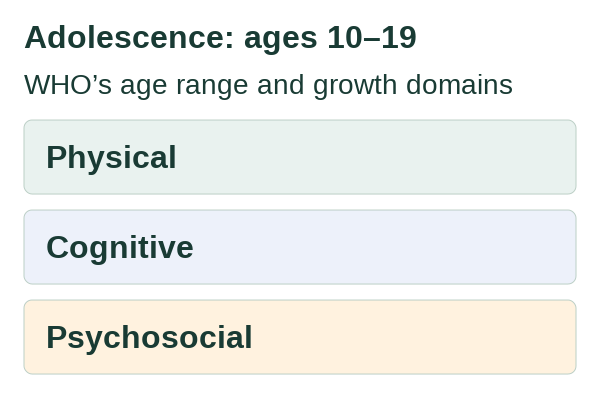
Researchers often treat it as a stage running from 10 to 24 years of age, and studies of adolescent health have used that same 10-24 year span.[2][5] The stage is best understood as distinguishable from childhood yet interdependent with it, since the changes of adolescence build on what came before. Adolescence is marked by observable change across all of these domains at once, which is why no single marker defines it.[8]
History
How the study of adolescence developed
Early clinical writing on the period named three major developmental theorists whose stage-based accounts shaped the field: Erik Erikson, Jean Piaget and Lawrence Kohlberg. That tradition also carried an older assumption that adolescence is uniformly a time of turmoil, and a 2008 review reported that large-scale studies have not substantiated this view. Most teenagers, that review stated, progress through the period with few obvious behavioral problems.[9]
A 2001 review by Steinberg and Morris took stock of research published since Petersen's 1988 review and identified the topics that had dominated the intervening years. Those topics included adolescent problem behavior, relations between parents and adolescents, puberty, the development of the self, and relations with peers.[10]
Developmental systems thinking treats the person and the setting as parts of a single developing system rather than as separate causes. A 2011 review by Eccles and Roeser adopted this developmental systems view of schooling and reported that the past decade had brought considerable progress in recognizing how central the cultural context of schooling is to adolescent development.[11]
Developmental science has also been brought to bear on public policy, and a 2009 review by Steinberg examined what studies of brain, cognitive and psychosocial development imply for the treatment of young people in the justice system. That review applied the findings to three issues in justice policy: the criminal culpability of adolescents, their competence to stand trial, and the effect of punitive sanctions on their development and behavior.[12]
Defining the boundaries of adolescence has itself been part of the field's history, because fixing the exact onset and conclusion of development is difficult when biological, psychological and social factors all play a part. Cultural factors also bear on what counts as normal development, and that review noted that behavior normal from one cultural perspective may appear aberrant through the lens of another.[9]
How adolescence became a recognized stage
Adolescence as a separate social stage is recent, and one account places its origin in the urban and industrial growth of North America. That account names three forces behind the change: technology applied to raise productivity, the affluence this produced, and a demographic transition that came with it. The structural shifts it lists include the rise of a biologically stable small-family system, population growth, the movement of adolescents from workplaces into schools, their dependence on parents, businesses aimed at young buyers, a wider range of occupations, and urbanization. The article presents these components as ways of explaining the "invention" of adolescence rather than as a settled causal model.[13]
Newspapers helped fix a public picture of the age group. A content analysis of British daily and Sunday papers checked that picture against the facts. The study defined adolescents as people aged between 11 and 19 years and examined the four most frequent categories: victims, crime, sport and unemployment. Reporting bore little relation to the importance of each area: victimization and criminal activity were overemphasized, while sport and unemployment were underemphasized, and some crime coverage was misleading. The typical adolescent of 1985, as the papers drew the person, was criminally inclined, fond of sport, likely to become a victim of many crimes and accidents, and very likely to be unemployed.[14]
Whether teenagers take up such images was tested directly with 40 Scottish school students aged 15 and 16, half of them female, split between those staying on for higher examinations and those leaving school. Using a Q sort, a ranking task in which participants order statements about themselves, the analysis produced 11 factors, the first 6 of which met the criterion for common factors. Little evidence showed that these adolescents were influenced by newspaper images, and some of their self-descriptions hinted at conflict while others did not. Falchikov concluded that if the results held up in later work, a more pluralistic view of adolescence may be required.[15]
Stereotypes of adolescence vary by culture, and a review of developmental, cultural and neuroscience research warns against a one-size-fits-all assumption about them. The same review reports that teen stereotypes affect young people's academic, behavioral, emotional and neural development, and describes an experimental intervention that changed youth's teen stereotypes and promoted positive youth development. Qu argues that social constructions of the phase partly drive how individuals move through the adolescent years. The article calls for attention to changing negative stereotypes at the policy and societal levels.[16]
Main ideas
Puberty and the changing adolescent brain
Puberty sets off a wave of hormonal change that coincides with the reshaping of the adolescent brain. Adolescence is also the final stretch of development in which talents, reasoning and complex adult behaviors mature.[17]
The frontal cortex is among the last regions to mature, and its development comes later in adolescence than changes elsewhere.[17][18] That later frontal development probably contributes to the refinement of reasoning, of goal and priority setting, of impulse control, and of the evaluation of long and short term rewards.[17] Early explanations of adolescent risk taking attributed it to deficiencies in executive control and to poor frontal lobe function, a conclusion supported by that late maturation. As researchers found substantial variation in prefrontal function from person to person, applications of neuroeconomic theory, which models choice in terms of costs and benefits, led to dual systems models of adolescent behavior.[18]
Imaging and other evidence point to a rise and fall in incentive motivation, the pull of rewarding cues, across the adolescent years. Theoretical models account for this pattern through brain-based accounts of subcortical-cortical integration, through puberty-based models of adolescent sensation seeking, and through neurochemical dynamics. Empirically sound tests of these mechanisms, and studies of how biology and context interact, remain the field's most challenging future goals.[18]
Large imaging studies now follow these changes in the same children over many years. Preliminary quality assurance and results provide evidence for the feasibility and age-appropriateness of the procedures and for the generalizability of findings to the existing literature.[19]
Diffusion tensor imaging, a method that maps the direction in which water diffuses along nerve fibers, has been used to study white matter, the fatty sheathed bundles that carry signals between brain regions. A systematic review searched online databases and identified 546 studies of early life stress and adolescent white matter, of which 22 met the inclusion criteria for adolescents aged 10-25 years. Compared with healthy controls, adolescents exposed to early life stress showed perturbed white matter integrity, indexed by both increased and decreased fractional anisotropy, a measure of how strongly diffusion is directed along a tract. The evidence base has limits: measurement of early life stress exposure was inconsistent across studies, and longitudinal research was lacking.[20]
Some periods of cortical development are critical in the sense that specific experiences drive major synaptic rearrangements and learning that occur only during that window. Findings of this kind support the view that adolescence is a critical period of cortical development important for establishing lifelong adult characteristics, which alcohol and drug use can disrupt.[17]
Reward seeking, risk taking and self-control
On this view, the subcortical reward system, which responds to incentives and emotional cues, emerges early, while the prefrontal-guided control system, which supports impulse control and self-regulation, emerges later.[21][22] The relative dominance of the earlier system over the later one is said to produce more risk-taking and sensation-seeking in mid-adolescence.[21] A 2008 review argued that traditional neurobiological and cognitive explanations could not account for the nonlinear changes in behavior seen in adolescence relative to both childhood and adulthood, and proposed differential development of bottom-up limbic systems and top-down control systems as the mechanism.[22]
A 2010 review described two opposing hypotheses about the striatum, a brain region implicated in reward processing, tested with functional magnetic resonance imaging (fMRI, which tracks brain activity through changes in blood flow) during reward tasks. One hypothesis holds that the striatum is relatively hypo-responsive to rewards in adolescence, so that more reward-seeking is needed to reach adult levels of activation; the other holds that it is hyper-responsive, which produces greater reward-seeking. Evidence for both has been reported, but the review judged that the field had generally converged on the hyper-responsive view.[23]
A 2018 review of behavioral and neuroscientific studies found the empirical support for a higher sensitivity to rewards in mid-adolescents to be rather mixed, and proposed that studies differ in the kinds and amounts of incentives they use. That review examined primary incentives such as sweets, secondary incentives such as money and social acceptance, and, within the secondary class, monetary, cognitive and social rewards. Electrophysiological studies (those recording electrical activity in the nervous system) showed enhanced processing efficiency during anticipation and receipt of incentives regardless of incentive type, again with no strong evidence of interactions with age. Brain imaging studies found overlapping regions activated by primary and secondary incentives and by social and non-social ones, and adolescents recruited similar reward-related and control-related regions as adults, but to a different degree.[21]
Self-control is often studied through impulsivity, measured as delay discounting (the tendency to take a smaller reward sooner over a larger one later) and through impulsive personality traits scored on the UPPS-P scales. A 2025 genome-wide association study (a scan of many genetic variants across many people for statistical links to a trait) examined these measures in 5,548 children aged 9 to 10 years from the Adolescent Brain Cognitive Development Study. Heritability estimates, the share of trait variation attributable to genetic differences in the sample, were 0.20 (S.E. = 0.10) for delay discounting and 0.08 to 0.11 (S.E. = 0.05) for the UPPS-P subscales, comparable to adult estimates. Genetic correlations between adult and child impulsivity were modest, at r g = 0.28 to 0.46, with positive urgency showing the strongest correlation at r g = 0.83. No genome-wide significant associations were identified, and polygenic scores (indices built from many small genetic effects) derived from adults explained small but significant variance in the child phenotypes, from 0.36% to 0.44%.[24]
The 2018 review concluded that although developmental studies directly comparing incentive types are scarce, the available behavioral results show only minor age differences, which sits uneasily with strong versions of the imbalance account.[21] The 2008 review presented the imbalance as a biologically plausible model of nonlinear behavioral change rather than a settled finding, and the social neuroscience framework treated peer presence as a condition that amplifies reward-seeking rather than a constant feature of adolescent decision making.[22][25]
Identity formation and its statuses
Later work treats identity less as a status a person occupies and more as a process that continues over time, and dual-cycle models describe young people forming and then maintaining commitments in repeated rounds.[26] The three-factor identity model captures this process through three dimensions: commitment, in-depth exploration (thinking carefully about the commitments one already holds) and reconsideration of commitment (feeling uncertain about current commitments and looking for new ones).[26][27] The model was developed and tested with 1,952 early and middle adolescents, and confirmatory factor analyses showed that the three-factor structure fitted the data better than one- and two-factor alternatives.[27] The extent to which an adolescent settles on a stable identity is closely tied to psychosocial functioning and well-being.[26]
Not all exploration carries the same meaning, and a study of 4,259 Belgian adolescents and emerging adults aged 14 to 30 years (64% female) distinguished two forms that carry risk. Reconsideration of commitment showed similar negative relationships with commitment making and with identification, and it rendered healthy forms of exploration ineffective, so that those forms no longer predicted strong commitments or identification with life choices. The findings describe a less favourable side of identity formation and are offered as relevant to counsellors who work with young people struggling in this area.[28]
Families, parenting and close relationships
Attachment theory holds that the bond an infant forms with a caregiver becomes an internal working model, a set of expectations about whether other people can be relied on, and researchers have asked whether that model still shapes functioning in adolescence.[38] A later review of the literature on parental bonding concluded that parental ties show clear connections with children's cognitive, social and emotional health, and that parents keep a large influence on development even though adolescents spend considerably less time with them than younger children do.[39]
Research on parenting styles sorts parents by how they combine warmth with control. A systematic review published in 2018 searched several databases for studies published between 2010 and 2016 and located 31,169 records, of which 31,019 were excluded as duplicates or as not meeting the inclusion criteria. Of the remaining articles, 17 had an adequate level of methodological quality and were included in the review. By contrast, the authoritative parental style, which combines firm expectations with warmth, and the dimensions of affection, communication and autonomy promotion were associated with positive results. The review judged that more studies are needed before firm conclusions can be drawn about differences between fathers' and mothers' styles or about the role of the adolescent's gender.[40]
A separate line of work observes how parents actually behave with their adolescents and follows the families over time. In the Orygen Adolescent Development Study, observed affective parenting behaviors predicted depressive symptoms and the onset of depressive disorder prospectively, that is, before the symptoms appeared.[41]
Parental autonomy support refers to parents' efforts to acknowledge an adolescent's perspective and to support decisions the adolescent endorses. The starting levels of the two measures were positively associated, but their rates of change were not. Life satisfaction did not significantly predict later autonomy support, whereas autonomy support predicted later life satisfaction from age 16 to 17 and from age 17 to 18, so the prospective link appeared only in the later years of secondary school.[42]
Divorce is better understood as a series of transitions than as a single event, because it often brings parental conflict, reduced contact with one parent, diminished parenting effectiveness, lower economic support, geographic moves, step-siblings and a new set of extended family members. A 1997 review of the literature found that adolescents experience divorce differently than younger children do, and that these transitions promote growth for some adolescents while constituting developmental vulnerabilities for others. Some adolescents acquire strengths from altered family structure and routines, including a sense of responsibility and competence, while research on multiple life transitions occurring in a relatively short time places certain adolescents at risk.[43]
In a study of 473 adolescents and emerging adults aged 12 to 24, older participants reported more dating experience, more times in love, and more passion, identity and intimacy, along with more commitment-related romantic beliefs but less romantic idealization.[44] Break-ups are part of this picture: in a sample of 910 adolescents, 23% reported a break-up, especially those with extensive romantic experience, and most were described as self-initiated, especially by girls.[45]
Mental health, coping and resilience
Anxiety disorders were the most common class, reported by 31.9% of participants over their lifetime, followed by behavior disorders at 19.1%, mood disorders at 14.3% and substance use disorders at 11.4%. About 40% of participants with one class of disorder also met criteria for another class of lifetime disorder. The prevalence of disorders with severe impairment or distress was 22.2% overall, made up of 11.2% with mood disorders, 8.3% with anxiety disorders and 9.6% with behavior disorders. Median age of onset was earliest for anxiety, at 6 years, then 11 years for behavior disorders, 13 years for mood disorders and 15 years for substance use disorders.[3]
A meta-analysis and narrative review pooled 212 studies with 80,850 participants to measure associations between coping and emotion regulation and symptoms of internalizing and externalizing psychopathology.[6] One developmental question concerns accommodative coping, the capacity to adjust goals to circumstances; a study of 535 early adolescents with a mean age of 12.60 years, plus their parents, used latent path modelling to test which components contributed to that capacity. Specific cognitive abilities and parental influences showed direct effects on accommodative coping, and positive experiences in life showed indirect effects.[51]
The hormonal stress response itself changes across adolescence. Studies in adolescent boys and girls suggested that stress contributes to vulnerability to anxiety, depression and drug abuse. The review noted that far less was known about how stress reactivity changes in the juvenile to adult transition than about adulthood, neonatal development and aging.[52] A systematic review of 29 studies published between January 2013 and June 2023 identified environmental risk factors for anxiety and depressive symptoms among adolescents aged 13 to 19 years in the United States. Sorting these factors with Bronfenbrenner's ecological systems theory, the review found that more risk factors came from the microsystem and mesosystem domains than from the exosystem domain.[53]
A systematic literature review following PRISMA 2020 guidelines searched Scopus, Web of Science, PubMed and Google Scholar for publications from 2015 to 2025, identified 842 records, and analyzed the 28 articles that met its inclusion criteria.[54] A separate review of longitudinal studies examined links between identity development and depression, anxiety and eating disorders, which it grouped as social-emotional disorders. That review found 20 studies with 13,787 participants (54.2% female, mean age 14.48 years, range 10 to 29 years), of which 55% were rated fair quality and 45% poor quality.[55]
Global crises are part of the setting in which adolescent resilience develops.[56] Five features were highlighted: structured teaching and learning materials with scaffolded support for mentors, dialogic teaching, experiential learning opportunities, safe spaces and trusting relationships, and mentors who serve as role models.[57]
Adolescent reasoning and legal responsibility
Courts in the United States have treated adolescents as capable of independent judgment in some settings and as too immature for it in others, and psychological evidence bears on which view is better supported. Moshman (2010) examined two decisions of the United States Supreme Court on the authority of public secondary schools over student expression. In the first, the Court upheld substantial school authority over the content of a school newspaper; in the second, it upheld students' right of equal access to hold meetings on school premises. The two rulings rest on inconsistent assumptions about the intellectual competence of adolescents, and Moshman argues that such inconsistencies are common well beyond the American legal context. A more consistent approach, in his account, would rest on either a rebuttable presumption of adolescent immaturity or a rebuttable presumption of adolescent maturity, meaning a starting assumption that the opposing side may argue against with evidence. He concludes that the psychological evidence available at the time fits the presumption of maturity better. The analysis extends to intellectual freedom in public secondary schools generally, to government constraints on adolescents, and to family issues.[58]
Evidence on how adolescents judge social situations suggests that their reasoning changes across the teenage years rather than staying fixed. Crone (2013) reviewed brain imaging studies of adolescents playing the Ultimatum Game and the Trust Game, two tasks in which one person decides how to divide money with another and must weigh fairness against self-interest. In early adolescence, players were relatively focused on the self, while impulse control and the ability to take another person's perspective increased in later adolescence and early adulthood. These behavioral changes came with a shift in which brain regions contribute most. The dorsomedial prefrontal cortex, which handles self-referential processing, gave way to the dorsolateral prefrontal cortex and the temporal-parietal junction, which help control selfish impulses and take another person's perspective. That shift in balance may tip early adolescents toward more self-oriented choices and allow later adolescents to consider consequences for others. The same review describes a marked change across adolescence in how fairness, trust and reciprocity are evaluated, leading to more altruistic behavior and tendencies oriented toward others.[59]
Understanding what other people think and feel, called theory of mind, continues to develop in adolescence, though the evidence on how much it changes is mixed. A short longitudinal study followed 233 Polish adolescents who were 13 and 16 years old at the start, testing their theory of mind with a task that asks them to interpret ambiguous stories. Over 18 months, the younger and older groups did not differ, although the full sample showed a small increase in the quality of the explanations participants gave about mental states. Controlling for language, females outperformed males on the advanced theory of mind measure.[60]
Self-reports of how adolescents felt are shaped by stable features of personality, which limits how far such reports can serve as a record of adolescent judgment. One Swiss sample comprised 118 students in grades 8 and 9, with a mean age of 15.15 years and a standard deviation of 0.89. Their momentary affect was recorded on smartphones over seven consecutive days at 42 randomly generated occasions, six per day, yielding 1059 reports on current events. At the end of that phase, students completed a questionnaire on personality and on their retrospective affective experience, and teachers rated their behavior. Adolescents high in extraversion overestimated positive affect and underestimated negative affect when recalling how they had felt, while those high in neuroticism overestimated negative affect, with no significant effect for positive affect. Internalizing behavior did not predict a negative recall bias.[61]
Impulsivity, a personality trait marked by a lack of careful thought, is often invoked in discussions of adolescent risk, but the evidence assembled in a 2026 literature review is largely descriptive. That review traces impulsivity to neurophysiological, neural biological, limbic system and psychological factors, and reports that adolescents affected by interpersonal problems may be more likely to engage in risky behavior and to experience increased psychological pressure. It recommends preventive measures including positive reinforcement, mindfulness practice, self-control training and Impulsive Decision Reduction Training for Youth, and advises addressing impulsivity in early adolescence to promote more mature thinking. The review draws on searches of scientific journals and databases and presents no new sample of its own, so its claims about prevention rest on the studies it summarizes rather than on a direct test.[62]
Executive function is the set of mental operations that let a person hold information in mind, plan a sequence of steps, and hold back an impulse, and these operations continue to improve through adolescence. Research on adolescent executive function has drawn on several approaches at once, including studies of cognition, of emotion, of individual differences and of training. Far less is known about how affective and social factors shape executive performance at this age, or about the biological processes behind those sensitivities, than about the cognitive gains themselves. A 2009 review of this work described adolescence as a period of vulnerabilities and also of opportunities, particularly for training and intervention.[63]
A study of this ability tested female participants in a behavioral study of 178 people aged 7 to 27 years and in a functional magnetic resonance imaging study of 37 people aged 11 to 30 years. Accuracy on the relational reasoning task changed non-linearly with age, and performance was poorer during mid-adolescence than before or after it. The task draws on the rostrolateral prefrontal cortex, a region of the frontal lobes that undergoes substantial structural change during adolescence. Performance and structural change accounted in part for age-related change in activity in the rostrolateral prefrontal cortex and the medial superior frontal gyrus, but not for a drop in activation in the anterior insula and frontal operculum between mid-adolescence and adulthood. That remaining functional change may instead reflect the maturation of neurocognitive strategies.[64]
Some perceptual abilities that support reasoning also mature slowly, and the changes extend into the teenage years. The brain must work out which sights and sounds belong together, and it appears to base that judgment in part on how close the stimuli are in space and in time. A study of an audiovisual simultaneity judgment task in participants aged 6 to 23 years found that the multisensory temporal binding window, the interval within which sights and sounds are likely to be perceived as one event, shrank with age.[65]
Inhibition, the ability to stop a prepared response, has been studied with the stop-signal task, in which a person must cancel a movement when a signal appears. A 2026 analysis applied a formal computational model to stop-signal task data from 6,469 children aged 9 to 11 years in the Adolescent Brain Cognitive Development Study and related the model's parameters to task-related brain activation. The model parameters were more closely related to brain activation than were standard performance scores, with average variance explained as high as R2 = 26.86 ± 1.69% against a largest R2 = 20.89 ± 1.41% for the performance measures. Greater activity in the salience network, namely the insula and anterior cingulate, on correct go trials went with worse evidence accumulation for the go choice. More activity in visual cortex on error trials went with fewer attentional lapses that prevent the stop process from starting, a failure the study calls trigger failure. The model parameters also related to separate measures of inhibition, impulsivity and cognition, which the study reported as evidence of the model's construct validity.[66]
Achievement motivation and classroom goals
Achievement motivation in early adolescence covers several related concerns: the wish to do well, the fear that success carries costs, beliefs about why grades are earned, and the goals students pursue in class. Elmen (1991) argues that early adolescence is a useful period in which to study concerns and behavior tied to achievement. The article traces how achievement motivation, fear of success, gender role ideology and school performance patterns develop, and it examines the social correlates of achievement at that age. That review also argues that developmental questions about psychological phenomena in adolescence often involve curvilinear relations among variables, meaning that a relation changes direction or strength across the range of a variable rather than running in one straight line.[67]
Achievement goal theory, the framework that sorts students' purposes in class into distinct goals, was applied to early adolescents by Wentzel (1993) in a study of 423 sixth- and seventh-grade students. Students reported their efforts to reach mastery goals (learning the material), evaluation goals (earning good grades) and social responsibility goals (meeting classroom duties). Grades rose with students' pursuit of each of the three classroom goals. To gauge causal belief systems, the beliefs students hold about what produces a grade, the study had each student pick one of three explanations for working toward good grades. Those belief systems predicted classroom grades and standardized test scores over time. Wentzel draws a distinction between goals and the processes that regulate goal pursuit, and discusses the part social goals may play in promoting academic achievement.[68]
Pintrich, Roeser and de Groot (1994) followed 100 seventh graders (mean age 12.3 years) in a Midwestern middle school, measuring intrinsic value, self-efficacy, test anxiety, cognitive strategy use and self-regulation in the fall and again in the spring with the Motivated Strategies for Learning Questionnaire. Positive motivational beliefs were positively related to higher levels of self-regulated learning. Three further constructs, self-efficacy, cognitive strategy use and self-regulation, tracked both the early individual difference measures and classroom experience. Pintrich, Roeser and de Groot (1994) describe motivation and self-regulated learning as standing in reciprocal relations.[69]
Teachers' classroom behavior and parents' academic involvement both bear on early adolescents' motivational beliefs and math performance. Puklek Levpušček and Zupančič (2009) studied 365 Slovene eighth graders. During the first school term these students reported on their parents' academic pressure, support and help, and on their math teachers' support, academic press (the demand for serious academic work) and mastery goal. Motivational beliefs about math were measured in the second term, and the final math grade came from school records. Students' perceptions of their math teachers' behavior predicted both motivational beliefs and math achievement over and above their evaluations of parental involvement.[70]
Aspirations to leadership follow a different pattern with age, and the beliefs that predict them change between the middle and later years of secondary school. Singer (1990) surveyed 52 fourth-form and 78 seventh-form high school students on overall leadership aspirations, 13 valence-instrumentality expectancies for 13 leadership outcomes, self-efficacy perceptions and attributions of effective leadership. Valence scores differed significantly by gender, and the self-efficacy and attribution measures differed significantly by age. Regression analyses showed that fourth formers' leadership aspirations were significantly predicted by their ease-of-success self-efficacy expectation. For seventh formers, valence perceptions predicted aspirations among males, while self-efficacy and attribution scores predicted them among females.[71]
Peer influence and susceptibility
Adolescents adjust their behavior to match peers, and the average size of that shift has been measured across many experiments. A pre-registered meta-analysis pooled 79 independent reports covering more than 9500 participants and found an overall effect of peer influence of g = 0.47, a moderate-sized change in behavior after exposure to peers. The studies varied widely in their results, with an I 2 of 85% and a τ 2 of 0.20, so the average conceals large differences between settings and designs. Peer norms emerged as a significant moderator (β = 0.36, p < 0.05), and moderation by type of behavior did not emerge. Adolescents were more likely to act after seeing peers perform a behavior or hearing about the norm than after simply being in peers' presence or receiving peers' feedback. The type of behavior did not moderate the effect, but the evidence base is lopsided: 196 studies examined risk-taking, compared with 16 on prosocial behavior and 11 on antisocial behavior.[72]
Peer pressure also shows links to outcomes beyond delinquency and drug use, according to a longitudinal study that followed adolescents from age 13 to 24. The sample comprised 99 female and 85 male participants, assessed through peer, parent and romantic partner reports and observational data. Teens exposed to high levels of pressure from close friends later experienced more coercive behavior from romantic partners, as those partners reported, and lower functional independence as reported by parents. These associations held after accounting for baseline levels of teen assertiveness.[73]
Identity development appears to moderate the link between peer group pressure and risk behavior. The sample was 1070 adolescents with a mean age of 15.45 years. Identity commitment, the degree to which a person has secured a personal identity, buffered substance use in more pressuring peer groups. Identity exploration, the degree to which a person has examined self-relevant values, beliefs and goals, buffered general deviancy in those groups. Where peer groups were more controlling, risk behavior was lower among teens with strong identity commitment than among teens with weak commitment. The results suggest identity development as a target for deterring negative effects of peer pressure in high-risk adolescents.[74]
In one study about 30% of social groups stayed stable over a one-year interval, meaning they kept at least 50% of their members. Group stability depended on classroom stability, with a correlation of rs = .97 between the two. Stability depended on the classroom: only 6.8% of groups were stable in schools that did not promote classrooms as a unit, compared with 55% where the school did.[75]
Popularity, friendship and romantic ties
Popularity among adolescents is not a single quality, and researchers measure it in two ways that move differently over time. Sociometric popularity is how well liked a student is by classmates, while perceived popularity is the reputation of being popular, and a growth curve analysis followed 303 initially popular students (167 girls and 136 boys) from Grades 5 to 12 to track both. Sociometric popularity changed along a straight line across those eight years, whereas perceived popularity followed a curved path. The two popularity measures and aggression formed stable but separate dimensions of development, meaning a student's standing on one did not simply mirror standing on another. Overt aggression, such as hitting or open conflict, predicted low sociometric popularity but a rise in perceived popularity during the second half of the study. Relational aggression, which works through gossip, exclusion or damage to friendships, predicted a drop in sociometric popularity, especially for girls, yet sustained high perceived popularity for both genders. That effect of relational aggression on perceived popularity was strongest around the move from middle school to high school.[76]
Friendships and romantic relationships are linked, but the link runs through quality rather than through whether a romance happens at all. A meta-analysis of 28 studies, with sample sizes from 946 to 4,040 adolescents up to age 18, found that friendship qualities were not related to romantic involvement. The same analysis found strong evidence of continuity between the quality of friendships and the quality of romantic relationships. Adolescents rated the quality of their romantic relationships as more negative than the quality of their friendships. The authors called for more work on which specific qualities carry over and on the processes that explain the carryover.[77] Attachment security, a person's general confidence that close others will be available and responsive, also strongly predicted many of these outcomes. The researchers read the pattern partly as a sign that parents judge the parent-teen relationship with difficulty and partly as evidence that close friendships grow more important during this period.[78]
Identity formation and close relationships develop together in adolescence, so peer ties are contexts in which a sense of self takes shape. A review of ten papers on this intersection described close relationships as a central context for developing self-awareness and self-representation. It also noted methods that allow several relationship types to be studied at once, along with culture and gender.[79]
A study of 2,178 middle adolescents examined identity styles, which are habitual ways of exploring and committing to values and roles, alongside romantic attachment, the expectations a person brings to close romantic bonds. Identity styles had unique and direct associations with identity commitment, meaning the strength of a settled sense of self. Attachment anxiety was linked to commitment only indirectly, while attachment avoidance showed both direct and indirect associations with it. Gender, race and relationship status did not change those direct associations, and few differences in association strength appeared by gender or race. Relationship status did matter in one respect: the romantic experiences adolescents brought to their exploration shaped how identity and intimacy connected.[80]
Emotion regulation and emotional intelligence
Emotional intelligence is the set of abilities or self-reported tendencies by which a person perceives, understands and manages emotions, and researchers measure it in different ways.[81][82] A systematic review of 32 studies found that higher emotional intelligence went with fewer internalizing problems, meaning difficulties turned inward such as depression and anxiety, and with less substance abuse and better coping strategies. Those associations differed slightly depending on whether emotional intelligence was measured by self-report or by a test of maximum performance. The review also pointed to methodological limits in this literature and named areas for future research.[81]
A meta-analysis of 41 studies of adolescents aged 10 to 19 years, 37 of which were pooled, found a positive link between emotional intelligence and well-being. The estimated effect size was 0.35 for affective well-being, the emotional side of feeling good, and 0.27 for cognitive well-being, the reasoned judgment about one's life. Results varied by the model used to define emotional intelligence: the self-report ability model gave effect sizes of 0.33 for affective and 0.27 for cognitive well-being, while the self-report mixed model gave 0.42 and 0.37. The authors proposed that teaching emotional intelligence in educational and clinical settings could raise subjective well-being and contribute to preventing emotional disorders in adolescents.[82]
Cognitive reappraisal is an emotion regulation strategy in which a person reinterprets a situation so that its emotional force changes. A scoping review of 63 studies of early adolescents found that 58 reported a positive link between cognitive reappraisal and psychological well-being. The review tracked well-being through positive affect, negative affect and life satisfaction. Most studies that examined age found no association between how often adolescents used reappraisal and their age. Findings on sex differences and on contrasts between discrete emotions were inconsistent. The review called for research that specifies the direction of the relationship, how it develops, and how well it holds across sexes and separate emotions.[83]
A systematic review of 36 school-based interventions aimed at emotional regulation in adolescent students found small to moderate effect sizes for mental health and for emotional regulation skills. The programs rested on different theoretical frameworks and targeted different components of regulation, and some addressed a whole class while others served selected students considered at risk. Only a few studies measured risky behaviors, and those that did reported reductions with moderate to large effect sizes. Studies of high-risk populations showed medium to high effect sizes on regulation skills, whereas studies of unselected student samples showed greater variability in their outcome estimates. Only one-third of the studies used manualized programs, meaning programs delivered from a fixed written protocol. Attendance rates and acceptability analyses suggested students received the interventions well. The most frequent methodological weaknesses were the absence of follow-up assessments and the failure to calculate sample size in advance.[84]
The research base itself is spread across subdisciplines and lacks an overarching theoretical framework. A text-mining review of 6,305 articles mapped the phenomena studied in connection with adolescent emotion regulation.[85]
Purpose, life satisfaction and positive development
A sense of purpose means having identified something a person intends to commit to, and in adolescence it tends to grow rather than appear all at once. Growth curve analyses, a method for estimating how a score changes over repeated measurements, showed that purpose identification rose over the first two years of high school, and the rise looked similar for boys and girls. Students whose purpose identification increased also reported higher life satisfaction and fewer depressive symptoms by the final survey, for both boys and girls. One gender difference appeared: the link between the purpose trajectory and lower depressive symptoms was stronger for girls than for boys.[86]
Research on positive mental health asks how many adolescents are doing well, not only how many are struggling. Among 539 students aged 13 to 18 (43.2% girls) in Delhi, 46.4% were classified as flourishing, 51.2% as moderately mentally healthy, and 2.4% as languishing, using the Mental Health Continuum model. Flourishing, the top category in that model, was more common among girls and among younger adolescents than among boys and older adolescents. Students who were flourishing reported less depression and fewer adjustment difficulties, and they showed more prosocial behavior, meaning voluntary action intended to help others.[87]
Higher prosocial behavior went with lower externalizing behaviors, the outward-directed problems such as aggression and delinquency, and with fewer internalizing symptoms, the inward-directed problems such as depression and emotional difficulties. Follow-up analyses tied prosocial behavior specifically to less aggression, less association with deviant peers, less risky sexual behavior, less substance use, less delinquency, and fewer depressive symptoms. The review considered age and sex as possible moderators, that is, factors that change the strength of an association, and it noted weaknesses in the existing literature.[88]
Gender differences in prosocial behavior are small and depend on which kind of behavior is measured. A meta-analysis of 32 studies (215 effect sizes, 12,024 adolescents aged 10 to 18, 51% male) found absolute gender differences ranging from d = 0 to d = 0.35, where d is an effect size expressing the gap between group averages in standard units. Differences were larger for gender-typed behaviors such as altruism (d = 0.35) than for gender-neutral ones such as anonymous helping (d = 0.03). The type of prosocial behavior and the region of the sample both changed the size of the gender gap, and the authors concluded that male and female adolescents are generally more similar than different in prosociality.[89]
Positive youth development treats adolescents as resources to be empowered rather than as problems to be solved, on the view that all adolescents have strengths that develop when those strengths meet healthy resources in their environments. The sample was 176 adolescents aged 11 to 15 (mean 12.89 years, standard deviation 0.90) from two similar high schools in rural settings. Alexithymia, difficulty identifying and describing one's own emotions, fell significantly, and academic performance was better. The authors described the program as effective for promoting positive adolescent development and as filling a gap, since few such programs exist for rural areas.[90]
The developmental assets framework counts personal qualities and contextual conditions that support positive development, and thriving is its term for doing well across several areas at once. The sample was 503 Portuguese students aged 13 to 19 (mean 15.92 years, standard deviation 1.17, 63% female). A subset of developmental assets explained 36% of the variance in scores on a Thriving Index and between 9% and 33% of the variance in individual thriving indicators. Because thriving is multidimensional, the students varied in their interests and capabilities, and the study reported that variation rather than a single score for positive development.[91]
Developmental tasks and psychological symptoms
Developmental tasks are the age-typical jobs of growing up, such as joining a peer group, forming friendships, preparing for a career and building a personal identity. A meta-analysis published in 2020 by Pinquart and Pfeiffer pooled 310 longitudinal studies to ask whether reaching these tasks goes together with fewer psychological symptoms, meaning problems such as anxiety, depression or outward-directed behavior. Studies of this kind follow the same young people over time, so they can test whether task success at one point predicts symptoms at a later point after the starting level of symptoms is taken into account. The relationship ran in both directions: higher initial symptom levels predicted less attainment of these tasks later and less progress in reaching them.[92]
Two tasks did not follow the same pattern. More romantic or sexual involvement at the start predicted an increase in symptoms over time, and higher initial symptoms predicted an increase in romantic or sexual involvement. The link with autonomy depended on which form of autonomy was measured, and acquiring a gender role showed no relationship with psychological symptoms. The results therefore support the idea that task attainment and symptoms influence each other, but they do not show that reaching a task causes symptoms to fall.[92]
A separate line of work asks how competence itself should be measured across childhood and adolescence. Obradović and colleagues examined competence in the social, cognitive and emotional well-being domains. They covered early childhood, middle childhood, early adolescence and middle adolescence. The study drew on 191 participants from a prospective study of at-risk children and combined several methods and several informants, meaning that different people such as parents, teachers and the children themselves supplied the ratings. Inter-individual differences in cognitive and social competence held steady across time. Differences in emotional well-being held steady only between early and middle adolescence. The stability of cognitive competence was similar at the different time points, but the stability of social competence declined after middle childhood, which suggests more variation between individuals in how social competence changes. The structure and the stability of competence were similar for boys and girls.[93]
Family conditions also shape adjustment during the years when several transitions arrive at once. A longitudinal study of 2,020 German children aged 8 to 12, including 1,035 boys and 985 girls, predicted internalizing and externalizing problems from the parent-child relationship and the family's educational background. Positive resource effects ran especially through the parent-child relationship, and the effects were stronger when early puberty onset and the move to secondary school occurred together. The study concluded that support is important for this group during periods of multiple transitions.[94] At the level of populations rather than individuals, a cross-temporal meta-analysis of 85 papers covering 48,817 Chinese adolescent college students found that scores on psychological security, a sense of safety in oneself and one's surroundings, declined significantly between 2004 and 2020. Seven broad social indicators predicted these changes, and the decline appeared in both male and female students, with no significant difference between them.[95]
Health literacy and health behaviors
Health literacy in adolescence is the set of skills a young person uses to find, understand and judge health information, including information from the mass media, and to act on it. The studies defined and measured health literacy in different ways and worked from different theoretical frameworks, which makes their results hard to compare directly.[96]
Sexuality education has been organized and tested differently across countries, and a 2019 review compared programs in the United States, the United Kingdom, Hong Kong, Mainland China and Taiwan. The review began from figures reported by the World Health Organization in 2017: more than 2 million young people were living with HIV worldwide, and about a third of all new HIV infections were estimated to occur among people aged 15 to 25. The same review noted that teen pregnancy rates were rising in many places, and it treated these trends as a sign that existing programs may be inadequate or ineffective. The 1994 Programme of Action of the International Conference on Population and Development set out a role for governments in offering sex education to young people, yet the related initiatives have been inconsistent across the global context. From its comparison, the review drew out lessons for policy and practice and proposed directions for later research with young people.[97]
Mental health literacy programs in schools have been tested with randomized designs, though the evidence base remains limited and earlier studies carried many methodological limitations. One cluster randomized controlled trial assigned 380 students in 22 classes from 10 non-government secondary schools either to a program called HeadStrong or to ordinary Personal Development, Health and Physical Education classes. Students were assessed before and after the intervention and again at a 6-month follow-up. Literacy improved and stigma fell in both groups relative to baseline at the post-intervention and follow-up points, but the changes were significantly greater among students who received HeadStrong. The trial authors read these results as showing the potential of the program to raise mental health literacy and reduce stigma.[98]
Depression literacy, a narrower form of mental health literacy, covers knowledge about depression, help-seeking and stigmatizing attitudes, and a 2019 systematic review examined how it has been measured and what the studies found. The review searched nine electronic databases and one grey literature source for English-language studies published between January 2006 and December 2018 that involved adolescents aged 10 to 19. Of 14,626 references identified, 50 met the inclusion criteria. Depression literacy was most commonly assessed with vignette-based tools, short written scenarios about a person with symptoms, in 58% of the studies, and reporting of depression literacy was not uniform across them. Adolescents in these studies had trouble recognising depression, leaned toward informal sources of help, and tended to attach stigma to depression.[99]
Sleep, sedentary behavior and physical health
Sleep loss in adolescence is common and carries consequences for school performance, health and safety, according to a 2014 review of sleep patterns in adolescents and young adults.[100] A 2011 summary of correlational, case-control, quasi-experimental and experimental studies concluded that inadequate sleep quality or quantity can cause sleepiness and inattention. It added that other cognitive and behavioral deficits very likely follow, and that these affect children and adolescents in everyday settings. That summary supports adding sleep screening and interventions to routine clinical care and supports public policy changes aimed at improving sleep in young people.[101]
Night-time mobile phone use and sleep habits appear to change together during the early teenage years. A longitudinal study followed 1,101 students, 43% of them male, from age 13 to age 16 and used latent growth models, a method for tracing how a group's average level of a behavior shifts over time. Over the period studied, night-time mobile phone use and poor sleep behavior both grew in a positive linear trend. Increases in night-time phone use were directly associated with increases in externalizing behavior, meaning conduct that acts outward such as rule breaking or aggression, and with decreases in self-esteem and coping. Sleep behavior changes mediated the link between early changes in night-time phone use and later outcomes. Those outcomes were increases in depressed mood and externalizing behavior and declines in self-esteem and coping, so sleep sat in the pathway between the phone use and the later outcomes.[102]
Sleep spindles are short bursts of brain activity during sleep, and their relation to thinking skills shifts across development. In adults, higher sleep spindle activity generally goes with better cognitive performance. Studies in children often show the reverse. A 2018 meta-analysis pooled 12 studies published between 2009 and 2016 and found a positive overall relationship between spindles and cognition in adolescents, with a correlation of r = 0.27. The size of the relationship depended on the cognitive domain. Moderate positive correlations appeared for fluid IQ (r = 0.44), for working memory and executive function (r = 0.40) and for speed and accuracy (r = 0.33). Full IQ and verbal IQ showed no significant association (r = −0.05). Age and gender did not significantly influence the effect sizes, and the review suggests that individual neural makeup and brain maturation likely shape the relationship.[103]
A 2010 survey of 1,934 Japanese junior high school students linked weaker impulse control to bedtimes after midnight. Going to sleep after midnight went with several lifestyle factors: older age, more hours of television watching, no extracurricular activity, greater use of convenience stores and more attendance at cram schools.[104] A 2019 review covered sleep disruption, sleep biology changes across puberty and the developing adolescent brain. The brain keeps developing from the onset of puberty into the early 20s, which makes the behavioral and neural effects of sleep loss a particular concern for this age group. That review also reports significant gaps in knowledge about which populations have been sampled and about methodological challenges, and it calls for better communication between sleep researchers and developmental neuroscientists.[105]
Sedentary behavior, meaning time spent sitting or otherwise inactive, is an established determinant of health in adults, but studies in young people have been less consistent. A 2016 systematic review and meta-analysis examined 88 eligible observational studies of 2- to 18-year-olds to test whether the total amount and the patterns of objectively measured sedentary behavior, including breaks and bouts, were associated with health outcomes independently of moderate-intensity to vigorous-intensity physical activity. Outcomes covered adiposity, cardio-metabolic health, fitness, respiratory health, bone and musculoskeletal health, psychosocial outcomes, cognition and academic achievement, and gross motor development. Level of evidence grading and quantitative meta-analyses found limited available evidence that the total volume or the patterns of sedentary behavior are associated with health in children and adolescents. That held once moderate-intensity to vigorous-intensity physical activity was taken into account, or when the analysis was restricted to studies with low risk of bias. The review calls for studies with strong designs and methods, objective measures of sitting and a range of health outcomes to establish whether sedentary behavior is an independent determinant of health in young people.[106]
Body mass index (BMI) follows different paths across the first decade of life, and those paths are linked to psychosocial well-being in early adolescence. Predictors of membership in the moderate and high increasing groups included smoking in pregnancy (odds ratios of 1.17 and 1.97), maternal BMI (1.10 and 1.14), skipping breakfast (1.66 and 1.76) and nonregular bedtimes (1.22 and 1.55).[107]
School burnout is a public health issue among adolescents and may carry long-term consequences. A systematic review following PRISMA guidelines (a standard checklist for reporting reviews) examined articles published between January 2002 and February 2021 that measured academic burnout quantitatively in longitudinal designs with secondary school students. The most-documented risk factors for academic burnout are female gender and enrollment in a high school academic track, and relationships with parents serve as a protective factor. Exhaustion is the first dimension of burnout to develop. School burnout is followed by weaker engagement at school, less settled identity development and less satisfaction with life. Links between burnout and problematic internet use, problematic social media use and depressive symptoms are complex: the three are likely caused by burnout but probably develop in vicious cycles with it. The review calls for more research on how the organization of schools influences burnout across different educational systems.[108]
Sleep problems in early adolescence follow different paths, and those paths move together with burnout. Liu, Wu and Zhang (2025) followed 1226 Chinese junior high school students over 2 years, with survey data from four waves that began in November 2018. The students averaged 12.73 years of age (SD = 0.68), and 50.2% were male. Latent class growth analysis, which sorts participants into groups that follow similar paths of change, found three trajectories for sleep problems. The largest group stayed low (54%), a second rose slowly (40%), and a third rose quickly (6%). Parallel latent growth curve modeling showed synchronized growth between sleep problems and academic burnout. At the between-person level, meaning differences among students, sleep problems were significantly positively correlated with burnout. At the within-person level, meaning change over time inside each student, sleep problems and burnout reciprocally reinforced each other. Liu, Wu and Zhang (2025) argue that research on the joint development of sleep problems and school burnout must keep within-person states apart from between-person traits.[109]
Emotional problems in childhood and adolescence are associated with poorer school attainment later. Riglin, Petrides, Frederickson and Rice (2014) pooled 26 community-based studies of children and adolescents. The pooled result was a prospective link between emotional problems and poorer school attainment, with the problems measured before the attainment outcome. Associations were more consistent for depression than for anxiety. Moderator analyses suggested that age and gender account for part of the variation among studies. Variation shrank in particular for school grades in early adolescence and for anxiety when gender was taken into account. Spotting emotional problems early and giving young people support may help improve academic outcomes such as school attainment, the authors suggest.[110]
Ethnic identity, diversity and prejudice
Ethnic-racial identity can be studied through how adolescents describe their own ethnic or racial group membership. The same study also tracked how strongly that identity is felt. A longitudinal mixed-methods study followed 732 middle and high school students in a semi-rural, ethnically diverse school district, measuring ethnic-racial identity with the Multigroup Ethnic Identity Measure each fall and spring and interviewing students once a year. Across four waves of data, 22% of students changed their ethnic-racial self-classification at least once. Self-classification changed more often among Multiracial youth, boys and 8th graders than among White youth, girls and 10th graders. The strength of ethnic-racial identity did not change over time, although African American and Hispanic youth had the strongest identity over time compared with the others. A change in self-classification was significantly related to a change in the strength of ethnic-racial identity, but the direction of that relationship varied by the race of the students.[120]
Peers shape this identity, and a longitudinal social network study of 1,349 early adolescents (mean age 13.3) in six ethnically diverse schools in Western Germany found that same-ethnic friends influenced ethnic-racial identity attachment and private regard more than cross-ethnic friends did.[121] A curriculum-based program, the Identity Project, was tested alongside the classroom's cultural diversity climate in 906 mid-adolescents in Italy (mean age 15.12) and 504 early adolescents in Germany (mean age 12.82). In both countries, cultural identity exploration at post-test was higher for adolescents who took part in the Identity Project and for those in classrooms with a stronger critical consciousness climate before the intervention. Effects of the intervention and of facets of the diversity climate on later resolution of identity questions appeared only in Italy. Some evidence indicated that the intervention could change the classroom cultural diversity climate in Germany. In the slightly older Italian sample, it could offset a less positive diversity climate.[122]
Classroom features also bear on prejudice toward immigrants through perceptions of the group's warmth and competence. The study covered 2,904 Italian adolescents (mean age 13.70) in 168 classrooms. Multilevel structural equation analyses showed that classroom socio-economic status, an open-to-discussion climate and classroom educational achievements indirectly affected, at the class level, perceived warmth and competence of immigrants, with perceived competition and status of immigrants as mediators.[123]
Classroom norms and teacher responses are linked to ethnic victimization, the targeting of students because of their ethnic, cultural or religious background. Among 963 adolescents in Sweden (mean age 13.11), those who perceived positive contact norms in class were less likely to engage in ethnic victimization, and this held across youth with different levels of tolerance toward immigrants. Adolescents who saw their teachers as not tolerating ethnic victimization were less likely to engage in it if they had high tolerance toward immigrants. Teacher reactions did not affect the behavior of adolescents with low or moderate tolerance.[124]
Openness to diversity itself changes during adolescence, and it changes in different directions for different young people. The sample was 1,362 adolescents in Sweden (mean age 13.18). Latent growth analysis showed that openness to diversity grew over time on average, with clear heterogeneity among adolescents. Three trajectories were identified: high-increasing, average-increasing and average-declining.[125]
Meta-analytic evidence on age differences in prejudice comes from 113 research reports worldwide, covering 121 cross-sectional and 7 longitudinal studies of ethnic, racial or national prejudice among children and adolescents. Overall, prejudice peaked in middle childhood (5 to 7 years) and then decreased slightly until late childhood (8 to 10 years). Findings differed by how prejudice was measured, by whether the outgroup had higher or lower status, and by contact opportunities with the outgroup, which had positive effects on the development of prejudice. Prejudice changes systematically with age during childhood, but no developmental trend was found in adolescence, which the review reads as a stronger influence of social context on prejudice as young people grow older.[126]
School composition has been linked to mental health as well as to attitudes, and a systematic review of 13 articles from the United States, the United Kingdom and the Netherlands, covering ages 11 to 17, distinguished two measures of composition. Density is the proportion of one race or ethnic group enrolled in a school, while diversity is an index of the range and size of all race and ethnic groups enrolled. A higher density of same race or ethnic peers went with better mental health for all adolescents. Schools with increased diversity showed no overall strong evidence of a mental health advantage.[127]
Racism, migration and minority development
Research on how racism shapes adolescent development has largely passed over Indigenous youth, and a 2022 scoping review set out to map what empirical work exists. The search found 32 studies, with samples drawn from the United States, Canada, Australia and New Zealand. Studies were limited to self-reported experiences of racism, so they primarily focused on perceived discrimination. Quantitative studies found effects of perceived discrimination on adolescent psychopathology and on academic outcomes that ranged from small to moderate. Qualitative studies described structural forms of racism that self-reports do not capture, and the review calls for future work on both overt and covert racism.[128]
One study followed 83 adolescents aged 12 to 19 from the former Republic of Yugoslavia and measured psychosocial adjustment through global self-worth and peer social acceptance. Adolescents with the most positive attitudes toward both cultures scored highest on self-worth and peer social acceptance, while those with negative attitudes toward both cultures scored lowest. The pattern is consistent with the proposal that peer social support carries the effect of acculturation on adjustment.[129]
Population data from the United Kingdom show that ethnic minority children follow different trajectories of mental health problems than white children. Ethnic minority children differed from white children in mean levels, in rate of change across age, or in both, for internalizing and externalizing problems.[130]
Assari (2020) describes minorities' diminished returns as weaker effects of parental educational attainment on reducing behavioral risk factors for non-Hispanic Black youth than for non-Hispanic White youth. A cross-sectional analysis of 4,188 youth in the Adolescent Brain Cognitive Development study compared non-Hispanic Black and non-Hispanic White youth on inhibitory control, the capacity to hold back an impulse, measured with the stop-signal task and checked against parent reports on the Child Behavior Checklist. In the pooled sample, race and ethnicity interacted significantly with parental educational attainment, indicating that high parental education gave a smaller boost to inhibitory control for non-Hispanic Black youth than for non-Hispanic White youth. The analysis concludes that parental education raises inhibitory control for non-Hispanic White youth but not for non-Hispanic Black youth. It points to structural barriers such as segregation, racism and discrimination as reasons parents may be unable to convert their education into outcomes for their children.[131]
Neighborhoods, activity spaces and community
Research on how neighborhoods shape adolescents has moved in two directions over the past decade. One line of work borrows ideas from space-time geography, the study of where people go and when, to examine development within activity spaces: the routine locations and settings where adolescents actually spend time, such as home blocks, school routes and gathering spots. A second line comes from cultural-developmental researchers, who treat neighborhood settings as places where competencies and processes that matter for minoritized youth take shape. A decade review of this literature covers studies of externalizing problems (acting out), internalizing problems (such as anxiety and low mood), academic achievement, health and cultural development in neighborhoods and activity spaces. The review recommends joining the cultural-developmental and activity space strands of scholarship rather than keeping them apart.[132]
Whether living among many people of one's own ethnic-racial group helps or harms adolescents has been an open question in the United States. A meta-analysis pooled 40 effect sizes from 17 records, 24% of them unpublished, with a combined sample of 11,858 adolescents. Averaged across studies, the association between neighborhood ethnic-racial concentration and adolescent behavior problems did not differ significantly from zero (r = -0.001, 95% CI -0.048, 0.046, p = .964). The studies varied widely around that average: systematic heterogeneity was large (I 2 = 77.1%), and the moderators the analysts tested did not explain it. The meta-analysis also found heavy reliance on a small number of parent datasets and critical gaps in reporting, and it recommends work that can inform policies and programs addressing residential segregation.[133]
Community-level comparisons show that the overall health of a community, not only the traits of individual youths, is linked to adolescent outcomes. A 1995 study compared 12 communities as experienced by students in grades 9 through 12, treating the community as the unit of analysis. The share of youths who experienced community strengths varied widely from one type of community to another. Similar types of youths, grouped as vulnerable, average and high-asset, were affected differently by the overall health of the community. Vulnerable youths, those with few personal assets, benefited from living in healthier communities, and these effects appeared across all types of community. The analyses also revealed grade differences among the different types of youths.[134]
Coping with stress and relationship stress
Relationship stress in adolescence covers strain with parents, with peers and with romantic partners, and a decade-in-review article on the topic describes a period in which stress levels among adolescents were high and their capacity to cope was being taxed. That review examined how adolescents cope with stress in each of these close relationships, whether particular coping strategies work across cultures and developmental periods, and how coping relates to other automatic and reflective responses to stress. It also describes newer methods for studying coping, including laboratory-based tasks and ambulatory assessment, in which adolescents report on experiences as they occur in daily life. The review recommends research on how the success of a coping strategy varies with the intensity of relationship stress, and on repeated real-time measurement that can capture coping as a process rather than a single act.[135]
Stressful life events have been linked consistently to outcomes such as well-being and psychological problems, and identity theory proposes that such events may also predict a regression, meaning a step backward, in identity development. Analyses using latent difference score models, which estimate change within persons over time, found that experiencing an event did not predict regressions in educational or relational identity. Whether the event matched the identity domain (educational or relational) made no difference to the strength of the effects, and neuroticism and support from parents and peers did not significantly moderate the link. Social support was related to both relational and educational identity, and the study concludes that the path from stressful events to identity may be less straightforward than identity theory would suggest, since no evidence of a link appeared for all adolescents.[136]
The emotional climate of the family, defined in one Swedish study as parent-adolescent emotional closeness together with the adolescent's feeling of being overly controlled by parents, shapes how communication and parenting affect psychosocial functioning. That study followed 1,515 adolescents (51% girls, mean ages 13.0 and 14.3 years at the two waves) and used cross-lagged models, which test whether one variable at the first wave predicts another at the second while controlling for the reverse direction. Multi-group analyses showed that the negative links between parental control at the first wave and later delinquency, between parental solicitation of information and later conduct problems and delinquency, and between earlier emotional problems and later adolescent disclosure were all moderated by the family's emotional climate. Where the climate was positive, parenting strategies had a more positive effect on psychosocial functioning. Adolescents with emotional problems also communicated more openly with their parents. The findings identify the relational context of the family as an important protective factor, and the authors suggest that efforts to strengthen the family's emotional climate should be considered before teaching specific parenting strategies in preventive work.[137]
Parents' own willingness to talk about difficult experiences has been examined as one source of adolescent coping and concern for others. Teachers (N = 92) rated the adolescents' prosocial behavior, meaning actions intended to help or benefit others, in the classroom. Maternal disclosure about distressing events and about rule transgressions both related to adolescent prosocial behavior through positive coping. This suggests that mothers' willingness to discuss their own negative experiences can help adolescents cope better and show greater empathy and concern for others.[138]
The COVID-19 pandemic changed family life for adolescents worldwide. A systematic review of 189 articles published from 2020 to 2022 asked how the pandemic affected family functioning, relationship qualities and parenting, and how pandemic-related stressors interacted with these family processes to affect adolescent well-being and adjustment.[139]
Career aspirations and vocational development
Rogers, Creed and Praskova (2018) measured adolescent career development tasks through career planning, exploration, certainty and world-of-work knowledge. In a survey of 415 Australian adolescents and their parents, adolescents' scores on the career development tasks (planning, certainty and world-of-work knowledge, though not exploration) explained 48% of the variance in their vocational identity. Parents' own ratings of the same tasks explained 38% of the variance in adolescent vocational identity, and world-of-work knowledge added nothing to that figure. Parent perceptions did not explain any additional variance beyond what adolescents reported themselves, and the correlations between adolescent and parent views were moderate, which the researchers read as meaningful but not substantial agreement.[140]
The socioeconomic standing of the jobs adolescents aspire to shifts during the secondary years, though only slightly. Longitudinal data from the German National Educational Panel Study, covering 5,964 secondary students (50% female) in Grades 8 to 10, ages 14 to 16, showed small increases in the socioeconomic status of occupational aspirations over that period. Females began with higher-status aspirations than males and their aspirations grew more over time, yet the researchers note that women often reach lower-status occupations than men in adulthood. The pattern matches findings from some other countries but not all, which points to cross-cultural variation, while trajectories within a culture looked similar across age cohorts over the previous 30 years.[141]
Career transitions are counted among the most demanding tasks of adolescence, and the personal resources an adolescent brings to them appear to shape how well the transition goes. A study of 626 Italian adolescents with a mean age of 17.18 years sorted students into four groups by their levels of career adaptability (the readiness to adjust to changing work demands), hope, optimism and resilience. The 253 students in the Career Adjusted profile, with high resources, showed the best personal adjustment, while the 187 in the Career Maladjusted profile showed poorer adjustment. The 63 students in the Unbalanced profile, who had the lowest hope and resilience, fared worst of all, with medium-high anxiety and depression and low life satisfaction. The researchers concluded that career adaptability on its own may not be enough for good personal adaptation and should be accompanied by good levels of hope and resilience.[142]
Parents take part in adolescent career transitions, and a small pilot study of 38 German adolescents and their mothers examined this shared effort through self-regulation and other-regulation, meaning the adolescent's own management of a goal and the support a parent provides. Each adolescent rated the importance of and engagement in one transition-related personal goal, reported the intensity of career exploration, and rated the mother's career-related behaviors and her confidence in the adolescent's transition management; the mothers rated the same measures. Ratings within and across family members were associated, showing both similarities and differences in how each side saw the behaviors linking together, and specific maternal behavior that was not contingent on her general warmth was associated with the child's behavior.[143]
Math anxiety in adolescence follows more than one course, and the course taken predicts whether a student later chooses a science, technology, engineering or mathematics career. Using 7 years of data from the Longitudinal Study of American Youth younger cohort, a nationally representative sample of 3,116 students who were in 7th grade at the start (48% female, 70% European American), researchers identified four trajectory groups for math anxiety. The consistently low group made up 34.68% of the sample, the decreasing group 23.72%, the increasing group 21.90% and the consistently high group 20.12%. Trajectories differed by race and ethnicity but not by gender, and belonging to the consistently low or the decreasing group predicted a later STEM career choice. The researcher suggested that preventive interventions may work better if they target math anxiety during adolescence.[144]
A 2006 review of vocational development placed adolescents' work experiences in social context, covering the changing social and cultural setting for vocational development, the influence of work experience on development and educational achievement, and the theories that guide studies of career maturity. Zimmer-Gembeck and Mortimer also weighed policy proposals meant to give adolescents more room to act on their own behalf and to support their preparation for work.[145]
Researchers have asked how the people adolescents look up to relate to their behavior and their schooling. Bryant and Zimmerman surveyed 679 African American ninth-graders in urban settings about whom they admired and about substance use, delinquency, academic engagement and psychological well-being. Problem behavior was most common among boys with no male role model and among girls who named a brother. Students with a father as their male role model had the best school outcomes. Psychological well-being did not differ by male role model. Distress was lowest among adolescents with a mother as their female role model, and grades and school attitudes were worst among those with no female role model. The results stayed the same after parental support, family conflict and whether the father lived in the household were taken into account. Bryant and Zimmerman read this as a sign that role model effects stand apart from parenting effects.[146]
Religiosity, civic engagement and values
One analysis used data from more than 9,300 youth in 11 national or within-nation ethnic groups and compared four outcomes: social initiative, antisocial behavior, self-esteem and depression. Levels of all four outcomes differed significantly across combinations of national-ethnic group and religious tradition. National-ethnic group, rather than religious tradition, accounted for these differences. The analysis separated religiosity into a between-group part, which compares one group with another, and a within-group part, which compares a young person with others in the same group. Between-group religiosity predicted youth reports of antisocial behavior and self-esteem, while within-group religiosity predicted all four outcomes.[147]
Civic engagement in adolescence has been examined alongside identity, the developing sense of who one is and what one stands for. A study of 392 Italian high school students aged 14 to 20 years (mean age 16.23 years, standard deviation 1.53) asked about volunteer and political participation. Students whose identity status was described as achieved took part in more volunteer activities than students whose identity status was described as diffused. They also reported higher civic efficacy (confidence in one's ability to act as a citizen) and stronger aspirations to contribute to their communities.[148]
The moral emotions and moral thinking that support social justice values take shape between middle childhood and early adolescence. A representative sample of 1,273 Swiss children was assessed at 6 years of age, again at 9 years and again at 12 years. Sympathy, defined as concern for another person's distress, predicted later increases in moral emotion attributions (the emotions a child expects to feel after a moral transgression) and in moral reasoning, but not the reverse. Sympathy and moral reasoning measured at 6 and 9 years of age related to social justice values at 12 years of age. The researchers read the results as evidence of increasing integration of feeling and thinking in children's morality, and of a role for moral development in the emergence of social justice values.[149]
Companion animals and non-school leisure
A systematic review examined whether pet ownership is associated with emotional, behavioural, cognitive, educational and social developmental outcomes in children and adolescents. The search covered databases and grey literature (reports and other material not issued by commercial publishers) and found 22 studies that met the selection criteria. The strongest evidence concerned emotional health, particularly self-esteem and loneliness, where pet ownership was associated with benefits from childhood onward. Findings on anxiety and depression were inconclusive, and evidence on behavioural development was unclear because high quality research was lacking.[150]
Leisure outside school has been surveyed in its own right. A 1991 questionnaire study of 1,248 adolescent high school students measured how often they took part in more than 60 leisure pursuits and how interested they were in each. Factor analyses, a statistical method for grouping items that vary together, reduced both the participation items and the interest items to six factors each. Students also named up to three activities they wanted to join but could not and gave the reason for not taking part, which allowed the study to compare participation with interest directly.[151]
Homeschooling removes adolescents from school-based services, and one analysis asked how U.S. homeschoolers fare on the risk behaviours and socialization problems that schools now address. An estimated 3.4% of U.S. youth were homeschooled at the time of the analysis. That group also more often reported lax parental attitudes toward substance use. On these findings the author described homeschoolers with weaker religious ties as an at-risk group.[152]
Parents, peers and self-regulation
Self-regulation, the ability to manage one's own behavior and emotions, predicts success in school and in social relationships during adolescence. A 2014 review of research on adolescent self-regulation found that parents had received the most attention from researchers, while peers and friends had received little and romantic partners even less. The studies reviewed tested one-way models, in which relationships shape self-regulation, rather than two-way models, in which each influences the other. Because relationships and self-regulation develop together, the review proposed that each relationship builds on earlier ones and that self-regulation and relationship context develop in both directions.[159]
Attachment to parents and to peers has been measured with the Inventory of Parent and Peer Attachment, a self-report questionnaire developed with 179 college students aged 16 to 20 years. In a second study of 86 adolescents from that sample, perceived quality of both parent and peer attachment was significantly related to psychological well-being, including self-esteem, life satisfaction and affective status. Adolescents whose attachments were classified as highly secure were more satisfied with themselves, were more likely to seek social support, and showed fewer symptoms when stressful life events occurred.[160]
A study of 247 ninth-grade students and their parents in the southeast and midwest of the United States compared two dimensions of parenting style, demandingness and responsiveness, with parental involvement as predictors of achievement. Adolescents' reports of parenting correlated only moderately with parents' reports, and adolescents' reports, but not parents' reports, significantly predicted achievement. Parental involvement predicted achievement above and beyond the dimensions of parenting style.[161] A study of 362 high school juniors in two North Carolina county school systems found only equivocal support for the hypothesis that parental involvement predicts development, with results depending on how involvement and outcomes were defined.[162] Among late adolescents, those who perceived more tolerance for individuality and intimacy within family relationships reported higher psychosocial maturity, and the lowest scores came from males in less differentiated families with a problematic mother-son relationship.[163]
Puberty, hormones and body image
Puberty is a central process in the set of changes that carries a child into adolescence, and researchers often need to measure it without physical examination, especially in school settings. A self-report scale developed by Petersen, Crockett, Richards and Boxer in 1988 asked young adolescents about their own pubertal status. It was used twice a year for three years in a longitudinal study of 335 boys and girls, with data reported on a subsample of 253. The scale showed good reliability, judged by coefficient alpha, a statistic for the internal consistency of a set of items, and several sources of data suggested the reports were valid. Such a measure matters for studies, including those based in schools, where more direct measures of puberty may not be possible.[164]
One line of research asks whether maturing earlier than peers predicts behavior problems, and a meta-analysis by Dimler and Natsuaki in 2015 put the association between early pubertal timing and externalizing behaviors, meaning outward-directed conduct problems, at r = 0.180. That effect is small but significant, and it fits models holding that early maturation goes with higher levels of such behaviors. Neither sex nor the type of pubertal timing assessment changed the effect significantly, but the association was stronger when timing and behavior were measured at the same time than when timing was used to predict later behavior.[165]
Body dissatisfaction often comes from a gap between the body a person perceives and the body they hold as ideal, and it raises the risk of depression and eating pathologies, particularly in adolescence. A systematic review by Muscolino, Dockray, Dempsey and Tomei, published in 2026, searched five databases for English-language publications from 2000 to 2025 and screened 259 studies in full text, leaving 103 suitable for data extraction. The review found a relationship among body dissatisfaction, emotion regulation (the processes by which people manage their emotional responses) and puberty, with the strength of the correlation varying partly with pubertal stage. A positive body image went with positive emotional responses to pubertal onset. Greater negative affect went with greater body dissatisfaction. When puberty arrives earlier and advances faster, the negative effects on psychological well-being carry into adolescence. The review describes its own evidence as preliminary and calls for a theoretical framework that treats development explicitly.[166]
Qualitative research by Sommer, Skolnik, Ramirez, Lee, Rasoazanany and Ibitoye in 2020 used participatory activities with girls in rural and urban Madagascar, plus interviews with adults in girls' lives, to follow their transitions through early puberty. The study found gaps in girls' knowledge and support during puberty, differing guidance about sexuality after menarche (a girl's first menstruation), and difficulties managing menstruation at school. The findings pointed to a need for educational material on puberty for early adolescents, training for teachers about puberty, and better toilet facilities to improve the school experience of girls who are menstruating.[167]
Thinking, feeling and the adolescent brain
Brain imaging studies of adolescents point to a mismatch in timing between neural systems: those that respond to rewards and emotional cues mature earlier than those that support top-down control.[168][169] A 2010 review reached a similar conclusion. It located the relevant interaction in the amygdala, the ventral striatum and the prefrontal cortex. Responsiveness to incentives and emotional cues is heightened at a time when the capacity for cognitive and emotion regulation is still relatively immature.[169] The 2008 review argued that traditional neurobiological and cognitive accounts could not explain why adolescent behavior changes in a nonlinear way relative to childhood and adulthood, and proposed the reward-control mismatch as a biologically plausible account. That review added that the pattern may be stronger in adolescents with a predisposition toward risk-taking, which would raise the risk of poor outcomes.[168]
Direct evidence for exaggerated emotional reactivity comes from an emotional go-nogo task, in which participants respond to some emotional faces and withhold responses to others, studied with functional magnetic resonance imaging in 60 children, adolescents and adults. Adolescents showed exaggerated amygdala activity relative to both children and adults, and the age-related difference shrank with repeated exposures to the stimuli. Individual differences in self-rated anxiety predicted how much the amygdala adapted: individuals with higher trait anxiety, meaning a stable tendency to feel anxious, showed less habituation over repeated exposures. Weaker functional connectivity between the ventral prefrontal cortex and the amygdala accompanied that failure to habituate. The study concluded that exaggerated emotional reactivity in adolescence may increase the need for top-down control and place individuals with less control at greater risk of poor outcomes.[170]
The 2010 review also considered influences beyond neural maturation, including hormonal fluctuations and the social environment, as contributors to heightened reward and emotion processing in adolescence.[169] A 2000 meta-analysis of sex differences in facial expression processing, the reading of emotion from faces, reported a female advantage from infancy through adolescence, and its findings were consistent with an integrated neurobehavioral and social constructivist model. That meta-analysis called for research examining both neurological maturation and socialization as factors in the development of these differences.[171] The Queensland Twin Adolescent Brain Project collected multimodal neuroimaging, cognitive and mental health data from adolescent twins in two sessions, the first with 422 participants aged 9 to 14 years and the second with 304 participants aged 10 to 16 years.[172]
Family knowledge, autonomy and divorce
Parental knowledge of where adolescents are and what they are doing tends to fall as children grow older, and a German study tracked the reasons across five annual surveys. The sample was a time-sequential one, meaning several age groups were followed at the same time, and it comprised 2,415 adolescents aged 13 to 18 years. Each year, parental knowledge declined by .10 SD, that is, by one tenth of a standard deviation, a standard deviation being a measure of how spread out scores are. The strongest mediator, or variable carrying the effect of age, was the adolescent's building of a private sphere, shown in less disclosure to parents and in defiance. Declining parental control together with this private sphere accounted for 37.5% of the age-related decline in knowledge. Once disclosure and defiance were taken into account, parental control no longer predicted knowledge on its own. Some mediating variables were stronger in early-to-mid adolescence, while others slowed the decline in mid-to-late adolescence, which the study read as parents and adolescents trying to balance autonomy with staying connected.[182]
A study of East German adolescents compared two same-aged cohorts, assessed in 1991 and in 1996, on when they gained behavioral autonomy, such as privileges and responsibilities. Adolescents who took on autonomy privileges at an earlier age showed more deviant behavior. When privileges and responsibilities came later, the timing was tied to structural constraints, in particular to parental unemployment. Between 1991 and 1996, significant timing differences appeared for some autonomy transitions in the East, which the authors took to imply adaptation to Western timetables.[183]
A 1984 review examined four aspects of how parental divorce affects adolescents. It covered recent changes in the American family, especially the number of divorces, and reviewed effects on adolescent development, with attention to intellectual performance and academic achievement as well as to personality development and social relations. The review also discussed differences in how adolescents react to a parental divorce and identified factors that either facilitate or retard adjustment to it. The review closes with proposals for school-based interventions that might lessen some of the harm parental divorce does to adolescent functioning.[184]
Family functioning, autonomy and parenting
The instrument was developed with a sample of 413 Year 10 students, and its developers reported satisfactory reliability and validity.[185] An earlier study used the Family Environment Scale with 24 young adolescents newly referred to psychiatric clinics and 24 control students from local schools, matched individually on several variables. The referred adolescents described their families less favourably, whether as impaired relationships or as restricted chances for personal growth.[186]
Separation from the family is one developmental demand of adolescence, and the whole family has to cope with that demand. A family can work against separation in two ways: by holding the adolescent inside the family system, or by pressing for independence too early. Families in the study that had a teenager referred for treatment fell into one of these two types.[187]
Familism, the weight a family places on obligation to relatives and on closeness among members, has shown inconsistent links to academic outcomes among adolescents from Latino immigrant families. A study of 1,801 adolescents aged 14 to 17 (mean age 14.1 years, standard deviation 0.83) from the Children of Immigrant Longitudinal Studies separated family obligation from family cohesion. Family cohesion was positively associated with grade point average and educational expectations, while family obligation was negatively associated with both. For Latino adolescents the negative link between obligation and grade point average was stronger in high socioeconomic status families than in low ones.[188]
A brief randomized trial tested whether parents could be the channel for raising eighth grade achievement in the United States. Experienced parents delivered the main messages in a parent panel format, and parents assigned to observe the panel planned to discuss future opportunities with their adolescents sooner and to respond more positively to academic difficulty than control parents. Student grades rose significantly, and the gain was mediated by parents' responses to academic difficulty.[189]
Research
Measuring adolescent development across informants
Adolescent research often gathers reports from several people who see the young person in different settings, and the degree to which those reports agree is itself a research question. A meta-analysis of 341 studies published between 1989 and 2014 found that reports from different informants, such as adolescents, parents and teachers, corresponded at low to moderate levels. The mean correlation was .25 for internalizing concerns, which are problems turned inward such as anxiety and low mood, .30 for externalizing concerns, which are problems turned outward such as aggression, and .28 overall. Which pair of informants was compared, the mental health domain and the measurement method each changed how closely the reports matched. Low agreement can mean that a young person shows a concern in one setting and not another, so the review treated the multi-informant approach as a way to locate the contexts in which difficulties appear. The same review identified gaps in knowledge about the incremental and construct validity of these assessments, meaning whether added informants improve accuracy and whether the reports measure what they claim to measure.[190]
Retrospective reports of feelings raise a separate problem, because adolescents asked to recall their emotional experience may remember it differently from how they recorded it at the time. Students high in extraversion later overestimated positive affect and underestimated negative affect, while students high in neuroticism tended to overestimate negative affect and showed no significant effect for positive affect.[61]
When many studies address one question, reviewers combine them in a meta-analysis, and a 2020 paper introduced adolescent development researchers to a Bayesian alternative to the standard frequentist approach. Thompson and Semma (2020) present a non-technical introduction to Bayesian meta-analysis and re-analyze data from a meta-analysis of media literacy interventions. The demonstration re-analyzed data from a meta-analysis of media literacy interventions and their links to media literacy skills and to attitudes and behavioral intentions toward risky health behaviors. It showed how to run unconditional models and subgroup analyses by risk behavior type (drinking, sexual behavior or smoking). Results appeared as plots of marginal posterior distributions and as central tendency measures with highest posterior density intervals, which are ranges that hold a stated share of the posterior probability. Analyzing effect sizes at the level of the risk behavior changed several interpretations. The paper stated that Bayesian methods are not superior to frequentist methods and that frequentist methods should not be abandoned, describing the two as familial approaches with their own advantages and disadvantages, and it provided all R code for reuse.[191]
Participatory methods go further by involving young people themselves as co-researchers rather than only as sources of data. A wide variety of methods and activities was used to enable children to participate, but few studies gave sufficient evidence of their participatory approach. The review suggested that reporting could improve through guidelines that treat participatory approaches as both a research method and a means of enabling action and change.[192]
What the evidence says about adolescent change
Adolescence is the span of life between childhood and adulthood, and a 2024 narrative review describes it as a time of major physical, emotional, cognitive and social change in which interaction with the environment shapes the resources that support well-being and health. The same review places hormonal, metabolic and neural changes alongside the emergence of behavioral strategies that go on to define an individual's emotional, social and cultural identity. It argues that health and well-being result from the interaction of biological, psychological, social, cultural and physical factors, and that psychosocial strengths built in childhood may help prevent frailty and illness later in adolescence.[193] A 2020 review of personal development in adolescence and youth characterizes the period by the importance of contacts, intense socialization and interest in one's own personality, with self-awareness developing through reflection and a sense of maturity emerging.[194]
Ma, Liu, Pan, Ji, and Zhang (2026) tested 858 Chinese adolescents in five waves over 4 years. Data from ages 10 to 11 and from ages 15 and older fit a two-factor model in which inhibition and switching merged, while a clearly separated three-factor structure appeared between ages 11 and 15. In a study of 858 Chinese adolescents followed for five waves over 4 years, performance on eight cognitive tasks improved with age cohort and with time point. The tasks measured three parts of executive function, the mental control processes that manage planning and self-regulation: inhibition (holding back an automatic response), switching (changing rules) and updating (revising what is held in mind). The researchers read this pattern as specialization combined with functional integration, which challenges the prevailing view of a linear increase in specialization across adolescence. Executive function predicted academic achievement, peer relationships and internalizing and externalizing symptoms differently across the fifth, seventh and ninth grade cohorts, with no significant effects on planning performance.[195]
Slavny, Sebastian, and Pote (2019) found that age had a positive linear association with three cognitive biases: threat interpretation, negative attributions, and overgeneralizing scores. In a United Kingdom community sample of 540 young people aged 10 to 17 years, of whom 309 were female, age showed a positive linear association with three of seven cognitive biases measured by self-report: threat interpretation, negative attributions and overgeneralizing.[196] Hampel (2007) found that middle adolescents, the seventh graders in a sample of 494 Austrian children and adolescents aged 8 to 14 years, reported less problem-focused and emotion-focused coping and more passive avoidance and aggression.[197]
Self-control had only a direct effect on externalizing behavior for boys, and adolescents of 15 and 16 years showed a stronger link between negative self-concept and externalizing behavior than younger and older adolescents. Internalizing problems such as anxiety and depression predicted aggressive and delinquent behavior.[198] In 260 students from three Dublin schools aged 12 to 18 years, high satisfaction in interpersonal relationships predicted low emotional distress, whereas high criticism and exclusion predicted high distress, and high support and disclosure were also linked to distress. Girls reported more positive qualities in relationships with mothers and best friends than boys, and younger students reported more positive qualities with parents than older students.[199]
Using the Oregon Healthy Teens Survey, researchers calculated indicators of 7 positive and 23 negative behaviors for 22,898 eighth grade and 15,828 eleventh grade students across two school years. The behaviors were strongly interrelated within each set but not between the sets, the likelihood of negative behaviors given other negative behaviors was much stronger than the likelihood of positive behaviors given other positive behaviors, and positive behaviors offered little protection against negative ones.[200] Young and Mroczek (2003) found that 6 of the self-concept domains they studied were stable over time, while the remaining 3 showed a significant increase in perceived competency. Growth curve modeling of 253 adolescents aged 11 to 20 found six self-concept domains stable over time and a significant increase in perceived competence in the remaining three, with individual differences in level and change partly accounted for by age and gender.[201]
A cross-sectional analysis of 24 character strengths assessed with the VIA-Youth covered 12,871 youth aged 10 to 17 from four countries. Older adolescents generally scored lower on many traits than younger ones. Girls on average scored higher on most strengths but declined more consistently across ages.[202]
Stattin and Kerr (2009) described challenges facing intervention and prevention researchers, including coordinating family-based and school-based interventions across contexts within a local community's broader policies and using better designs to understand how interventions affect young people's future health and adjustment. A 2009 discussion of intervention and prevention studies with adolescents notes that most intervention research takes place in family and school settings. It asks how separate programs can be coordinated across contexts and integrated into a local community's broader policies and activities. The same discussion calls for better designs so that researchers can understand how interventions into young people's lives affect their future health and adjustment, and it concludes that the studies illustrate the many challenges faced in moving from theory to practice.[203]
Training cognition, creativity and number sense
Huyck and Wright (2013) compared how adolescents and adults respond to auditory perceptual training. Adolescents aged 11 to 17 years (n = 20) and adults aged 18 years or older (n = 11) practiced detecting a backward-masked tone for about 1 hour a day over 10 days. Nearly every adult improved across sessions, but only half of the adolescents did, and the adolescents who learned improved more slowly than the adults. The adolescents and adults who learned showed the same generalization pattern, improving on untrained backward-masking conditions but not on forward- or simultaneous-masking conditions. A separate subset of 6 adolescents got worse on the trained condition, and this worsening carried over to an untrained forward-masking condition but not to backward masking. Within a session both age groups performed worse as time passed, and the decline was larger for adolescents. The researchers concluded that late-maturing processes shape how adolescents respond to perceptual training, and that learning, generalization and worsening may have different origins.[204]
Number sense is the grasp of quantity that links sets of objects to written numerals, and a 4-week training study tested whether short practice could mimic long development. Children aged 7 to 10 years took part, and before training the similarity of brain activity patterns for dot sets and Arabic numerals correlated with arithmetic fluency in regions including the parietal and prefrontal cortices. After training that association was no longer observed, which the researchers read as short-term training reproducing the separation between symbolic and non-symbolic quantity that normally emerges between childhood and adolescence. The study enrolled children rather than adolescents, so its relevance to teenage learners rests on the developmental comparison it draws.[205]
Proposals for creativity training in adolescence treat creativity as a set of learnable parts rather than a fixed trait. A 1969 discussion described three trainable components: creative attitudes, especially a favorable attitude toward highly imaginative solutions; cognitive abilities that support fluent production of original ideas; and techniques for deliberately producing new combinations of ideas. The paper set out a program for developing creativity in adolescents built on that three-part model, and it offered a strategy rather than experimental results.[206] Verbal behavior training has been tested experimentally in younger learners: 54 children aged 6 to 12 years were divided into two teaching conditions, one combining pure tacts with intraverbals and one combining pure tacts with impure tacts.[207]
In practice
School as a developmental setting
Achievement and identity are linked in early adolescence, though not in a single direction. Students with higher Diffusion scores, the status in which a person has not settled on commitments, had a lower absence rate and lower math achievement scores. Students with higher Moratorium scores, the status of active exploration without commitment, had a higher absence rate and higher math scores. Students who scored higher on the Interpersonal Achievement scale did better on the math achievement measure than their peers. Higher Foreclosure scores, the status of adopting commitments without exploration, were negatively related to absence, math scores and language scores. The relationship between identity status and achievement was significant, and it was strongest for students who scored high on the Foreclosure measure.[208]
The timing and number of school transitions during early adolescence have been studied directly. One investigation compared 253 adolescents in three groups: those making a single early transition before sixth grade, those making a single later transition before seventh grade, and those making a double transition before both sixth and seventh grades. Adjustment was measured by course grades and self-image. Negative effects appeared for both early and repeated transitions, and the double transition was especially debilitating. The effects were seen mainly in course grades rather than in self-image.[209]
Schooling shapes opportunity unevenly, and the barriers can sit at the household, community and system levels at the same time. Qualitative research in rural Ethiopia followed 150 girls and boys aged 10 to 19 years, together with their caregivers and key informants, in pastoralist Afar, highland Amhara and lowland Oromia. Ethiopia increased secondary enrolment markedly since 2000, yet intersecting barriers put vulnerable adolescents' educational opportunities at risk. Adolescents from poor households, those with disabilities, and those who were internally displaced, out of school or working faced challenges that gender norms also shaped, often in contrasting ways for girls and boys.[210]
Extracurricular activities, sport and work
After-school programs are one organized setting in which adolescents negotiate complex social situations and work on building an integrated identity, tasks the 2013 study describes as major tasks of adolescence. A qualitative study of an urban after-school program used participant observation and interviews to examine how well the setting fit participants at different ages. The study found that program activities and relationships shift as young people mature, providing levels of support matched to their changing social and emotional needs and to how they represent themselves. Those shifts, the study concluded, create contexts aligned with contemporary theories of adolescent development, and prosocial growth can be encouraged when supportive structures are aligned with developmental needs.[211]
A systematic review published in 2013 searched 14 electronic databases in June 2012 and considered studies published since 1990 on mental and social health benefits of sport for children and adolescents. Of 3668 publications initially identified, 30 met the selection criteria, and the benefits most commonly reported were improved self-esteem, social interaction and fewer depressive symptoms. Sport may be associated with improved psychosocial health beyond what participation in physical activity alone would explain, and team sport seems to be associated with better health outcomes than individual activities because of its social nature. The review cautioned that most of the studies it identified (n=21) were cross-sectional, which limits the capacity to determine whether participation causes better health or the reverse.[4]
A two-part ethnography of a youth performance basketball club studied psychosocial development in ordinary organized sport rather than in purpose-built interventions.[212][213] The first paper drew on the perceptions of former and current parents, players and coaches to build programme theories, meaning accounts of how the club is supposed to produce development, covering outcomes for the self, emotions, social life, morals and cognition.[212]
Classroom belonging and student engagement
Sense of belonging in a classroom is the feeling of being liked, respected and valued by classmates and by the teacher. Principal components analysis identified three belonging and support factors, and each contributed significantly to explaining variance in expectancies and value. Teacher support related to motivation more closely among girls than among boys. Class effort and grades were predicted chiefly by expectancy.[214]
Peer relationships carry part of the same effect in mathematics classrooms. Among African American and White early adolescents, spring sense of belonging was greater when students perceived a more supportive peer context, saw little emotional risk in participating, and were recognized by peers as strong math tutors, after controlling for fall sense of belonging. Peer networks that began the school year below average in belonging became more alienated over the year, while networks above average stayed at their fall levels.[215] A qualitative study of ninth-grade English classes found that opportunities to connect assignments with students' own identities and backgrounds contributed significantly to belonging for an ethnically diverse group.[216]
Belonging also shapes how students ask for help with classwork. Changes in expedient help-seeking tracked peer academic reputation. Asking higher achieving non-friends for help was positively related to expedient help-seeking, and this association was weaker among friends and best friends. The findings led the researchers to recommend that teachers explain how and when to seek help from peers.[217]
How schools group students changes belonging. Curricular tracking, the practice of placing students in separate classes by prior attainment, is common in many countries. Academic identity, students' view of themselves as learners, positively mediated that association.[218]
A cross-sectional study of 383 Taiwanese aboriginal adolescents, 39.7 percent of them male, compared students in mixed-sex and mixed-ethnicity classes (113 students), single-sex classes (122) and minority-only classes (148). After controlling for socioeconomic status, students with a chronic need to belong perceived higher social acceptance in diverse classes, while those in homogeneous classes reported greater feelings of rejection.[219]
Researchers have also built instruments to measure whether school meets adolescents' basic psychological needs. A scale developed with Chinese students across four studies and four independent samples (total n = 1872) was tested for factorial structure, internal consistency, convergent and divergent validity, measurement invariance across gender and age, test-retest reliability and predictive validity. The preliminary results were described as promising.[220] Longitudinal work on student engagement in adolescence from 2010 to 2020 was gathered in a scoping review published in 2021.[221]
Bullying, aggression and classroom climate
Bullying is common among adolescents and harms everyone involved, whether as perpetrator, target or bystander. A meta-analysis published in 2016 searched the literature from 1985 to July 2014 for longitudinal studies of adolescent samples and kept 18 of the 4698 articles it identified. Social problems and conduct problems were the two risk factors that held up consistently, and the review noted that the literature assesses predictors too inconsistently for firm conclusions and that replication is needed.[222]
Victimisation is not evenly spread across student groups. In a Spanish cross-sectional study of 449 gifted adolescents (mean age 11.72) and 950 nongifted students (mean age 12.72), 41.1% of the gifted sample were pure victims, compared with 21.8% of the nongifted sample. Gifted students were more likely to be victims (odds ratio 3.20, confidence interval 2.40 to 4.28). Pure victims and bully-victims in both groups reported more stress, anxiety and depression and lower health-related quality of life than students in other roles, and gifted pure victims reported significantly higher stress than nongifted pure victims.[223]
In a meta-analysis of 46 studies covering 35,468 adolescents, Casper, Card, and Barlow (2020) found a strong intercorrelation between relational aggression and relational victimization (r = .48). A meta-analysis of 46 studies covering 35,468 adolescents (mean age 12.4 years, with sample means between 10 and 17 years) found a strong correlation of .48 between relational aggression and relational victimisation. On average, boys and girls did not differ in their experiences of relational aggression or of relational victimisation.[224]
Low-level antisocial behaviour that disrupts lessons, called classroom incivility, follows its own developmental course. A Canadian sample of 559 students in grades 8 to 12 (54% boys, mean age 14.9 years) was tracked across ten timepoints over four waves between autumn 2022 and spring 2024. Incivility rose in early adolescence and tapered off in grades 11 and 12. Classroom incivility is associated with other antisocial behaviour such as bullying and predicts later aggressive behaviour, which makes early adolescence a candidate period for promoting civil conduct.[225]
Behrhorst, Sullivan, and Sutherland (2020) found that sixth-, seventh-, and eighth-graders who reported better student-teacher relationships at the first time point showed less aggression and less victimization 6 months later. Yun and Juvonen (2020) reported that bullied students averaged fewer depressive symptoms in classrooms where bully-oriented defending, confronting the bully, was relatively common than in classrooms where defending was victim-oriented, comforting the victim.[226][227] Students who reported greater awareness and reporting of violence at the first measurement had more positive student-teacher relationships and lower frequencies of aggression at the second.[226] The healthy context paradox names an unexpected pattern in which victims fare worse psychologically as overall victimisation in a classroom or school falls, so that reducing the number of incidents does not by itself help those still targeted. Among 1373 adolescents (40% girls, mean age 14 years) in 54 classrooms in South Korean middle schools, victimised students reported fewer depressive symptoms in classrooms where victimisation was more common.[227]
Social dominance describes students who actively establish peer norms, influence classmates' opinions and attract attention. Among 5468 seventh graders (mean age 13.3, 53% girls) in 266 classrooms, dominance was linked to positive and negative adjustment alike. Its associations with achievement and disruptive behaviour depended on how normal those behaviours were in the classroom. Latent profile analysis in that study sorted highly dominant students into 4 distinct types, 2 of them well adjusted and 2 poorly adjusted.[228]
A meta-analysis of 53 articles (N = 71,661) by Liu, Yu, An, and Wang (2023) found a small negative association between school bullying and self-efficacy among adolescents (r = −.07, p < .001). Pabian and Vandebosch (2016), in a four-wave panel study of 1,103 adolescents, found that nonstop traditional bullies had the lowest levels of social intelligence and that their level remained low.[229][230] That association varied by participant role (bullies, victims, bully-victims and defenders), by type of bullying (traditional, cyber or both) and by whether self-efficacy was general or specific to a domain.[229] Social intelligence, a sociocognitive characteristic proposed as a possible regulator of bullying, distinguished perpetrator groups in a four-wave panel study of 1103 adolescents surveyed at six-month intervals over two years. Four trajectories emerged: nonstop traditional bullies, bullies of both traditional and cyber kinds whose perpetration decreased, bullies of both kinds whose perpetration increased, and noninvolved students, with no separate class of nonstop cyberbullies.[230]
Executive function is the set of mental processes that support planning, holding information in mind and inhibiting impulses, and a three-level meta-analysis of 18 studies reporting 73 effect sizes (21,725 participants) linked it to bullying. Both bullies and victims showed lower executive function than other students, with an overall effect size of r = -0.154 for bullies and r = -0.187 for victims. For bullies, the correlation was moderated by which executive function component was measured, but not by gender, age or measurement method. For victims, no moderator tested altered the correlation: not the form of bullying, the source of the report, the facet of executive function, the measurement method, gender, age or culture. The meta-analysis concluded that weaker inhibitory control, the capacity to hold back an impulse, is more likely to be a risk factor for bullying behaviour.[231]
Health, isolation and intervention
The main threats to adolescent health are the risk behaviors adolescents choose, and their social context shapes those choices. Suicidality and violence went together with having guns easy to reach at home. Cigarette, alcohol and marijuana use went together with substances being available at home. High school students who worked 20 or more hours a week showed more emotional distress and more use of cigarettes, alcohol and marijuana. Adolescents whose parents expected school achievement showed fewer health risk behaviors. Adolescents whose parents disapproved of early sex began intercourse at a later age.[232]
Whole-school interventions, which involve the key people in an adolescent's life in a systems-based approach to promotion and prevention, have an inconclusive evidence base. An updated systematic review and meta-analysis included 28 studies reported in 58 publications from 12,897 search results. Compared with control groups, participants in whole-school interventions showed lower odds of cyber-bullying by 25%, of regular smoking by 31% and of cyber-aggression by 37%.[233]
A meta-analysis of 33 methodologically rigorous studies of early adolescents aged 10 to 15, drawn mostly from North America (58%) and Western Europe (30%), found a small but significant overall intervention effect on self-regulation (Hedges g = 0.12). Only the approaches centered mainly on emotion regulation produced a significant effect (g = 0.20). Those approaches improved behavioral outcomes and emotional outcomes alike. Effects for cognitive regulation, parent training, physical activity and working memory approaches were not significantly different from zero. Across intervention types, the largest effects appeared for youth report of emotional distress, which suggests that emotion regulation may be an important self-regulation mechanism in early adolescence.[234]
How peers and friends shape daily behavior
Many children show declines in motivation, engagement and achievement as they enter early adolescence. Researchers have paid growing attention to the part peer relationships play in these shifts in academic adjustment. A special issue of a journal on early adolescence gathered studies on this topic, and its introductory article summarized the key findings and proposed directions for later research on peer relationships and academic adjustment.[235]
Best friendships in early adolescence often do not last a whole school year: in a study of 174 seventh-grade students surveyed in the fall and spring, about 50% of reciprocated best friendships remained stable across the year. Friendship quality and how well each friend knew the other were unrelated to whether the friendship stayed stable. Conflict-resolution strategies did predict friendship stability, but the direction differed by gender. Boys' friendships held together more often when conflicts were minimized. For girls, minimization went with less stable friendships, while confrontational strategies went with more stable ones.[236]
A systematic review of studies conducted in the United States, covering adolescents aged 10 to 18, concluded that peers and friends have an important role in adolescents' physical activity behavior. The review named 6 routes by which peers and friends may matter: support from them, their presence, peer norms, friendship quality and acceptance, peer crowds, and victimization by peers. The review drew on cross-sectional, longitudinal and experimental research and discussed peer-related physical activity programs for adolescents as a practical application.[237]
In a meta-analysis of 20 experimental economics studies, children and adolescents gave more to members of their own group than to outsiders, with a small overall effect size (d = 0.22). A meta-analysis pooled 20 experimental economics studies: 69 effect sizes, 5,268 participants aged 3 to 19 in 12 countries, published 2008 to 2019. Children and adolescents cooperated more with their own group than with outsiders, a small overall effect of d = 0.22 (95% confidence interval [0.07, 0.38]). This preference for the ingroup, called parochial cooperation, did not vary with participants' age. It was larger in non-interdependent games of the dictator type than in interdependent bargaining and social dilemma games, and it did not vary with group type, how membership was manipulated, or whether rewards were monetary. The authors called for primary studies to report age ranges more precisely and to use narrower age groups.[238]
In a 5-year panel of Swedish majority youth, classroom diversity raised the likelihood of cross-ethnic friendships, and those friendships were in turn associated with lower anti-immigrant attitudes. In a five-year panel of Swedish majority youth followed from a mean age of 13.40 to 17.30, ethnic classroom diversity had only limited direct effects on anti-immigrant attitudes. The effect of classroom diversity on friendships persisted after adolescents moved to new schools.[239]
Among 3,225 students in grades 7 to 9 in Germany and Switzerland, classroom climate had an indirect positive effect on counterspeech through all 3 facets of social skills. Classroom climate also had an indirect positive effect on countering hate speech through each of the three skills.[240] Among 216,460 15-year-olds in 30 OECD countries, bullying at school went with significantly lower life satisfaction in every context studied, and the link was strongest in the Arab and Anglo clusters. Good relationships with teachers went with higher life satisfaction and softened the harm done by bullying. In countries with weaker societal well-being, bullying's negative impact grew stronger.[241]
Across 111 studies, one review found that schools shape adolescent identity in ways teachers rarely plan. Messages about who a student should or can be reach adolescents through how schools sort and select students, through teaching strategies, through teacher expectations and through peer norms. The same review describes three kinds of explorative learning experience that schools can organize on purpose: exploring new identity positions, further specifying existing self-understandings, and reflecting on self-understandings. Such exploration appears to work best when it is meaningful to students and set in a supportive classroom climate. The review's overall reading of the evidence is that teachers and schools seldom recognize how much influence they have on how adolescents come to see themselves.[242]
A meta-analysis of 124 studies published between 1966 and 2005 examined how identity status changes over the school years, using statuses such as moratorium (active exploration without commitment) and identity achieved (commitment after exploration). Longitudinal studies in the meta-analysis gave a mean proportion of .36 for adolescents whose identity status moved forward, .15 for those whose status moved backward, and .49 for those who stayed in the same status. In cross-sectional studies, the mean share of adolescents in moratorium climbed steadily until age 19 years and fell after that. The mean share in the achieved status grew across late adolescence and young adulthood. The foreclosure and diffusion statuses became less common during the high school years, then moved up and down through late adolescence and young adulthood. The meta-analyses also showed that large mean proportions of the samples had not reached identity achievement by young adulthood.[243]
The move from secondary to tertiary education is a normative transition that may serve as an opportunity for psychological growth. A nine-wave Dutch longitudinal study followed 685 participants (47.0% girls, mean age 17.29 years at the transition), with surveys from 4 years before the final year of secondary school to 4 years after. Development was adaptive for the majority of adolescents, but a sizable minority showed distinct patterns of struggle, and these patterns were associated with sociodemographic, academic, individual and relational characteristics.[244]
One study treated the ethnic mix of a classroom as a setting where adolescents do identity work. Spitzerová, Crocetti and Kudrnáč drew on the 2023 first wave of the Czech Education Panel Survey, a nationally representative sample. The sample comprised 23,466 high school freshmen (49.3% males, 49.9% females, 0.8% others; mean age 15.6 years; 84.4% Czech majority and 15.6% ethnic minority) from 249 schools. Adolescents using informational and normative identity strategies held more positive attitudes toward ethnic outgroups, a diffuse/avoidant strategy was not associated with those attitudes, and higher classroom ethnic diversity was linked to more positive attitudes among adolescents using the informational and normative strategies.[245]
Communication, curiosity and self-directed learning
Turkish high school students aged 12 to 18 ranked up to five people they most enjoyed talking with, felt most intimate with, and spoke with most often. In a study of Turkish high school students between the ages of 12 and 18, participants rank ordered up to five people for enjoying conversation, for intimacy and for frequency of talk. For both sexes, the most preferred communication partners were a friend of the same sex and the mother. With increasing age, both sexes cited more friends and less family, and the trend was more prevalent for males.[246]
Questioning, a common behavioral sign of curiosity, declines once children enter formal schooling, and one intervention tested whether teaching students to question could raise curiosity itself. The quasi-experimental study drew on 3173 adolescents from four public high schools in the United States, grouped within the English/Language Arts classrooms of 43 teachers. The 43 teachers were randomly assigned to two groups, one receiving professional development in the Question Formulation Technique (QFT, a direct-instruction student brainstorming method) in fall 2015 and the other in winter 2016. Clark, Harbaugh and Seider (2019) conclude that directly teaching students to question can raise dispositional curiosity, the lasting tendency rather than a passing state, by a significant amount.[247]
Questionnaire data came from 754 German adolescents (mean age 13.56, standard deviation 1.2, 49.4% girls) who attended the intervention. The only measures on which boys scored higher were introjected and extrinsic regulation, two forms of motivation that come from outside the task itself. Two restricted multigroup structural equation models turned up further gender differences. Autonomy was more strongly tied to intrinsic and identified motivation among boys than among girls, and competence was tied to intrinsic motivation only among girls. The study reports fewer gender-based differences in needs satisfaction and academic self-regulation in the SDL intervention than earlier research had observed in teacher-directed learning contexts, and it found needs satisfaction explicitly associated with higher forms of academic motivation.[248]
Work, leisure and out-of-school time
In a longitudinal study of students in Baltimore, over half of the youth held paid work during the school year at ages 13 and 14. Around 70% of those students worked during the summers. Youths who had done more chores at home were the ones who began working at the youngest ages. Employment rates were lower for African American youth than for White youth, and the pattern for these relatively low socioeconomic status students matched youth employment patterns elsewhere in the country. The lowest socioeconomic status African American boys at age 13, though their academic records were weaker, held proportionately more semi-skilled jobs (clerical, sales, and craft) than White students of either gender or African American girls.[249]
Starting a new activity was seen as blocked by parents denying permission, lack of skills, and lack of transportation. Early adolescents who stopped taking part gave reasons such as losing interest, disliking the leaders, moving away, and feeling too old. The study also suggested that early adolescents perceive these constraints somewhat differently than adults do.[250]
Outdoor play preference changes as children move into middle school, according to a one-year observational study of 133 boys and girls in sixth and seventh grade. Boys' greater preference than girls' for playing outdoors appeared only in sixth grade.[251] Skate parks are one unstructured leisure setting that has drawn research attention, and three studies using interviews, observation, and questionnaires examined their links to adolescent development. Skate parks draw polarized views, yet the adolescents who used them reported personal adjustment and social integration at levels comparable to other adolescents.[252]
Intervention trials and school-based programs
Saarinen, Hintsanen, Vahlberg, Hankonen, and Volanen (2022) randomized 369 adolescents in grades 6 to 8 with at least mild depressive symptoms into a 9-week school-based mindfulness intervention, an active control group receiving a relaxation program, or an inactive control group. Giannotta, Settanni, Kliewer, and Ciairano (2009) randomly assigned 153 Italian seventh graders to write about personal emotional events related to recent problems with peers or about trivial topics. An expressive writing trial in Italy found no overall effect on symptoms, and a mindfulness trial in Finland was exploratory and reported preliminary findings.[253][254]
One Italian trial assigned 153 seventh graders, 48% of them male and about 12.24 years old on average, either to write about personal emotional events tied to recent problems with peers or to write about trivial topics. Data were collected before the writing and 2 months afterward. The level of peer victimization did change the picture for coping strategies: victimized adolescents in the writing group showed increases in cognitive restructuring, a way of reinterpreting a stressful event, and in avoidance coping, compared with the other groups. Expressive writing thus affected coping strategies but not internalizing problems, which are difficulties turned inward such as sadness and anxiety, in this early adolescent sample.[254]
A trial tested a 9-week school-based mindfulness program, in which students practice paying attention to the present moment without judgment, against an active control group that received a relaxation program and an inactive control group. The longitudinal data covered 369 adolescents in the 6th to 8th grades, 68.4% of them female, all with at least mild depressive symptoms at the baseline. Executive functions (the mental skills used to plan and control attention), rumination (repetitive dwelling on distress), and emotion regulation were assessed at the start. Depressive symptoms were measured then and again at the 9-week and 6-month follow-ups. Among these adolescents, high catastrophizing (treating a difficulty as a disaster), high acceptance, and low executive functions were each found to increase the effectiveness of the mindfulness program against depressive symptoms, and there seemed to be some sex differences. The investigators described the analysis as exploratory, applied no corrections for multiple testing (the raised chance of false positives when many comparisons are run), and called the findings preliminary and in need of confirmation in further studies.[253]
Parent and family training programs
One randomized controlled trial tested a program called Parents and Children Talking Together (PCTT) with 78 self-referred families whose children were aged 9 to 16 (mean age 13.09, standard deviation 1.75). An intention-to-treat analysis, which counts every family assigned to the program whether or not it finished, used data from an immediate posttest only and retained 95% of families. Participation significantly improved parents' communication skills (F(1,70) = 11.77, p < 0.01) and problem solving skills (F(1,70) = 12.87, p < 0.01), and reduced dysfunctional disciplining in conflict situations (F(1,70) = 5.25, p < 0.05). The program worked best for parents with higher socioeconomic status and for parents whose children were between the ages of 14 and 16, and no consistent gender effects were found.[259]
Vermote, Soenens, Vansteenkiste, Coenye, Verschueren, and Beyers (2023) studied how late adolescents decide on a course of study. The team asked whether parental involvement and a felt sense of an authentic inner compass each predicted how engaged and how self-directed those decisions were. They looked at parental involvement in the process and at adolescents' sense of having an authentic inner compass. A cross-sectional questionnaire study surveyed 331 twelfth-grade adolescents in the Flemish part of Belgium (68.3% female, mean age 18.04, standard deviation 0.48) in the spring of 2017 and 2018. More controlling parental involvement or uninvolvement was linked to more controlled regulation, and parental control was also linked to less commitment. Adolescents perceived mothers as more involved than fathers. Even so, involvement by either parent was related to the study choice tasks with equal strength. The sense of an authentic inner compass and parental involvement were related to the outcomes independently, with the inner compass showing the strongest associations.[260]
Stress, effort and school-based prevention
Stress inoculation training teaches people to change how they interpret stressful events, to manage anxious feelings and to solve problems, and one high school program tested it with six adolescents. Five of the six students improved on self-reported state anxiety (how anxious they felt at the moment) and trait anxiety (how anxious they generally were) once training began. Scores on state anxiety, trait anxiety and trait anger also improved significantly from the start to the end of the program. Self-reports of negative stress events (total, daily, and major) decreased, though not significantly. Depression, self-esteem, and anger expression showed no change. A follow-up 3 months later showed a similar pattern.[261]
A Swedish program for social and emotional learning, which teaches skills such as handling emotions and getting along with others, was tested over five years for its effect on adolescent substance use. Students who received the program were compared with students who did not, using latent class analysis, a statistical method that sorts students into hidden subgroups with similar levels and patterns of use. Statistically significant interactions between the program and its duration, with medium to large effect sizes favoring the trained students, appeared for drugs, volatile substances, alcohol and tobacco in one or more of the subgroups, but not in all of them. Favorable patterns were found for non-users and light users of drugs, moderate sniffers, non-users and light users of alcohol, and occasional smokers, while heavy smokers showed a possible harmful effect. Programs of this kind, given for two years or more, may slow the rise in use with age and discourage early first use, even though they do not target substance use directly.[262]
A Swiss study followed two groups of lower secondary graduates, both with a mean age of 15.7 years at the first survey in 2016. One group of 1266 moved into vocational education and training, learning in a company and a vocational school; the other, 517 in number, moved into upper secondary general education and stayed in school. Self-efficacy in lower secondary school (confidence in one's own ability) and the adolescent-instructor relationship in upper secondary school each predicted later effort indirectly, through the fit students perceived between themselves and their environment, after controlling for earlier effort. The pattern was similar for general education and vocational school, but the positive effect of the instructor relationship on perceived fit was significantly weaker in general education than in vocational training with a company.[263]
Empowerment, literacy and skills for work
Programs that build skills in early adolescent girls vary in what they measure, and a study in Bangladesh found that empowerment itself takes several distinct forms. A three-class model fit best at baseline and a four-class model at endline; both included a least empowered class, a mobile and socially active class, and a socially progressive class, and at endline a fourth, most empowered class combined all three of those traits. Marital status, religion, and parents' level of education predicted class membership. Household wealth predicted it at baseline but not at endline. Membership in the Gender-Rights Awareness Arm was also linked to class at endline, and girls in that arm were the most likely to fall in the most empowered class.[264]
In sub-Saharan Africa, secondary education is expected to prepare young people for labour markets that shift with changes in work and with shocks to environmental, health and economic systems. A synthesis of a foundation's secondary education programming drew on these efforts and the wider evidence base; the programming included its flagship report on preparing youth for the future of work, a donor collaborative on innovation and practice in secondary education, and a scholars program. Baxter, Novy-Marx, and D'Angelo (2022) set out three insights: targeted financing to widen access, flexible approaches that raise completion, and entrepreneurship programming that builds skills relevant to work. The synthesis argues that a systems-based approach is needed to improve access and relevance, and that gender-equitable approaches accounting for intersecting barriers are needed to include disadvantaged youth.[265]
A separate account treats adolescents' core literacy as both the starting point and the ultimate goal of education, and as a standard for judging the quality of talent and the level of education. Zhang (2024) says countries treat adolescent core literacy as important and vary in how they define and apply it. The article calls for changes to literacy monitoring, examinations, evaluation methods, employers' hiring orientation, and the social education environment.[266]
A systematic review following PRISMA guidelines, a standard checklist for reporting such reviews, analysed 30 peer-reviewed studies published between 2015 and 2024 from PubMed, Scopus and Google Scholar. Karagi and Garg (2025) report that interventions centred on adolescents' skills raise self-esteem, strengthen interpersonal communication, support better study habits, and help adolescents adjust to social and academic settings. The review recommends integrating life skills training into school curricula to support holistic adolescent development.[267]
What this looks like when you study
In one study, 208 sixth, seventh and eighth graders completed a measure of identity status, and their school records supplied absence rates and math scores. Students who scored higher on Foreclosure showed a negative relationship with absence, math scores and language scores.[208]
A separate study drew on 353 students in the sixth, seventh, and eighth grades. These students rated how much they felt liked, respected, and valued by classmates and by the teacher in a single academic class. Students also reported their expectancies for success and their intrinsic interest and value in the course. English teachers supplied course grades and effort ratings for each student. Each of three belonging and support factors helped explain variance in expectancies and value, and teacher support had the most consistently substantial influence across student subgroups. The link between support and motivation weakened markedly between the sixth and the eighth grade.[214]
A study of 423 sixth and seventh graders asked students to report their efforts to achieve mastery, evaluation and social responsibility goals at school. Each student also picked one of 3 explanations for why he or she works toward good grades. Grades rose with each of the 3 goals, and the evaluation and social goals predicted grades more strongly than the mastery goal did. The top grades went to students who said they work for grades because learning is fun and exciting.[68]
A study of 365 Slovene eighth graders asked students about their parents' academic involvement and their math teachers' classroom behavior. Later in the year, students filled in questionnaires on their motivational beliefs about math, and final math grades came from school records. How students saw their math teachers' classroom behavior forecast their motivational beliefs and their math achievement even after their reports of parental involvement were taken into account. Parental academic pressure and support were directly and negatively related to students' math grades. Students' self-efficacy in math carried the influence of parental pressure, of teachers' academic press and of teachers' mastery goal on to math achievement.[70]
Criticism
Criticism, contested claims and open questions
One long-running argument asks whether antisocial behavior in adolescence reflects a distinct group of young people or a temporary rise in behavior across the whole age group. A 1993 dual taxonomy proposed that delinquency hides two categories of individuals: a small group antisocial at every life stage, and a larger group antisocial only during adolescence. The taxonomy reconciled two facts that seemed to conflict, namely that antisocial behavior shows impressive continuity over age while its prevalence increases almost 10-fold temporarily during adolescence. In that account, the larger adolescence-limited group is described as responding to a contemporary maturity gap by mimicking antisocial behavior in ways that are normative and adjustive.[268] Later work on trajectories from adolescence to young adulthood identified four latent classes in a national sample of 6,244 respondents: low, desister, decliner, and chronic, with the chronic class found only among males. That study also reported gender differences in the levels of nonviolent and violent delinquency between classes of males and females, and in the prevalence of the classes across genders.[269]
Singletons did show advantages over laterborns from families with two or more siblings on educational expectations and grades, and spent more time on homework than laterborns with three or more siblings. On psychosocial outcomes, singletons did not differ from firstborns or laterborns with any number of siblings.[270]
Common misconceptions
Many people believe that adolescents are simply more sensitive to rewards than adults are, a view that dual-systems models propose. Across the studies reviewed, incentives changed behavior in much the same way at different ages, with only small age differences.[21]
People often assume that the young learn most readily. Huyck and Wright (2013) trained 20 adolescents aged 11 to 17 years and 11 adults on a tone detection task; almost all the adults improved from session to session, while only half the adolescents did. Among the adolescents who improved, gains came more slowly than in adults, and a further group of 6 adolescents performed worse on the trained condition.[204]
Key studies
| Year | Study | Sample | Design | Finding |
|---|---|---|---|---|
| 1989 | Streitmatter[208] | 208 sixth, seventh and eighth graders | regression analysis of data from 208 sixth, seventh, and eighth graders | Students with higher Moratorium scores had higher absence rates and higher math scores, and higher Foreclosure scores showed a negative relationship with absence, math scores and language scores. |
| 1989 | Phinney[32] | In-depth interviews with 91 American-born tenth-grade students from integrated urban high schools | About one-half of minority subjects had not explored their ethnicity, about one-quarter were exploring, and about one-quarter had explored and were committed; ethnic-identity-achieved subjects scored highest on ego identity and adjustment. | |
| 1993 | Goodenow[214] | survey with teacher grades and effort ratings | Each of three belonging and support factors contributed significantly to expectancies and value, and teacher support had the most consistently substantial influence. | |
| 1993 | Wentzel[68] | 423 sixth- and seventh-grade students | survey of classroom goals and causal beliefs | Mastery, evaluation and social responsibility goals each went with higher grades, and the best grades belonged to students who gave enjoyment of learning as their reason for working toward grades. |
| 2008 | Crocetti et al.[27] | Scale development and validation with 1,952 early and middle adolescents | A three-factor model of commitment, in-depth exploration and reconsideration of commitment fit better than one- and two-factor models and held across gender, age group and ethnic minority samples. | |
| 2009 | Puklek Levpušček & Zupančič[70] | 365 Slovene eighth graders | longitudinal survey with school records | Math teachers' behavior predicted motivational beliefs and achievement over and above parents' involvement, and parental academic pressure and support were directly and negatively related to math grades. |
| 2013 | Huyck & Wright[204] | 20 adolescents aged 11 to 17 years and 11 adults | 10 days of auditory perceptual training | Almost all adults improved across sessions, against half of the adolescents, and a further group of 6 adolescents did worse on the trained condition. |
| 2013 | Eime et al.[4] | Systematic review of 14 electronic databases yielding 30 included studies, 21 of them cross-sectional | Sport participation was most commonly linked to improved self-esteem, social interaction and fewer depressive symptoms, and team sport seemed associated with better outcomes than individual activities. | |
| 2015 | De Los Reyes et al.[190] | 341 studies published between 1989 and 2014 | meta-analysis of cross-informant correspondence | Cross-informant correspondence was low-to-moderate, with mean internalizing r = .25, mean externalizing r = .30 and mean overall r = .28. |
| 2017 | Compas et al.[6] | Meta-analysis of 212 studies with 80,850 participants | Adaptive coping and emotion regulation were related to lower symptoms of psychopathology, while maladaptive coping, disengagement coping, emotional suppression, avoidance and denial were related to higher symptoms. | |
| 2020 | Pinquart & Pfeiffer[92] | 310 longitudinal studies | meta-analysis | Students who were doing better early on at joining a peer group, making friends, preparing for a career, accepting their bodies, forming an identity, building a value system, and acting responsibly showed fewer symptoms later. Holding initial symptom levels constant, they also showed a steeper fall in symptoms over time. |
| 2025 | Liu et al.[109] | 1,226 Chinese junior high school students, mean age 12.73 years | 2-year longitudinal study with four waves | Sleep problems followed 3 paths: stable low (54%), slow-increasing (40%) and rapid-increasing (6%). Within a person, sleep problems and school burnout each raised the other over time. |
| 2026 | McDonald et al.[113] | systematic review and meta-analysis | Greater social media use was associated with higher total empathy (r = 0.057), a small but significant association. | |
| 2026 | Meehan & Hubbard[72] | 79 independent reports and over 9,500 participants | pre-registered meta-analysis of experimental studies | A significant overall effect of peer influence emerged (g = 0.47), and peer norms were a significant moderator (β = 0.36, p < 0.05). |
See also
References
- Blakemore, S., Burnett, S., & Dahl, R. E. (2010). The role of puberty in the developing adolescent brain. Human Brain Mapping, 31(6), 926-933. doi:10.1002/hbm.21052
- Orben, A., Tomova, L., & Blakemore, S. J. (2020). The effects of social deprivation on adolescent development and mental health. The Lancet Child & Adolescent Health, 4(8), 634-640. doi:10.1016/s2352-4642(20)30186-3
- Merikangas, K. R., He, J. p., Burstein, M., Swanson, S. A., Avenevoli, S., Cui, L., Benjet, C., Georgiades, K., & Swendsen, J. (2010). Lifetime Prevalence of Mental Disorders in U.S. Adolescents: Results from the National Comorbidity Survey Replication–Adolescent Supplement (NCS-A). Journal of the American Academy of Child & Adolescent Psychiatry, 49(10), 980-989. doi:10.1016/j.jaac.2010.05.017
- Eime, R. M., Young, J. A., Harvey, J. T., Charity, M. J., & Payne, W. R. (2013). A systematic review of the psychological and social benefits of participation in sport for children and adolescents: informing development of a conceptual model of health through sport. International Journal of Behavioral Nutrition and Physical Activity, 10(1), 98. doi:10.1186/1479-5868-10-98
- Viner, R. M., Ozer, E. M., Denny, S., Marmot, M., Resnick, M., Fatusi, A., & Currie, C. (2012). Adolescence and the social determinants of health. The Lancet, 379(9826), 1641-1652. doi:10.1016/s0140-6736(12)60149-4
- Compas, B. E., Jaser, S. S., Bettis, A. H., Watson, K. H., Gruhn, M. A., Dunbar, J. P., Williams, E., & Thigpen, J. C. (2017). Coping, emotion regulation, and psychopathology in childhood and adolescence: A meta-analysis and narrative review. Psychological Bulletin, 143(9), 939-991. doi:10.1037/bul0000110
- Loades, M. E., Chatburn, E., Higson-Sweeney, N., Reynolds, S., Shafran, R., Brigden, A., Linney, C., McManus, M. N., Borwick, C., & Crawley, E. (2020). Rapid Systematic Review: The Impact of Social Isolation and Loneliness on the Mental Health of Children and Adolescents in the Context of COVID-19. Journal of the American Academy of Child & Adolescent Psychiatry, 59(11), 1218-1239.e3. doi:10.1016/j.jaac.2020.05.009
- Chauhan, K., Kapoor, K., & Singh, D. Y. (2026). Multidimensional Perspectives on Child and Adolescent Development: A Review of Major Theories and Principles. INTERNATIONAL JOURNAL OF INNOVATIVE RESEARCH IN MULTIDISCIPLINARY EDUCATION, 05(04). doi:10.58806/ijirme.2026.v5i4n11
- Hazen, E., Schlozman, S., & Beresin, E. (2008). Adolescent Psychological Development. Pediatrics In Review, 29(5), 161-168. doi:10.1542/pir.29.5.161
- Steinberg, L., & Morris, A. S. (2001). Adolescent Development. Annual Review of Psychology, 52(1), 83-110. doi:10.1146/annurev.psych.52.1.83
- Eccles, J. S., & Roeser, R. W. (2011). Schools as Developmental Contexts During Adolescence. Journal of Research on Adolescence, 21(1), 225-241. doi:10.1111/j.1532-7795.2010.00725.x
- Steinberg, L. (2009). Adolescent Development and Juvenile Justice. Annual Review of Clinical Psychology, 5(1), 459-485. doi:10.1146/annurev.clinpsy.032408.153603
- Fasick, F. A. (1994). On the "Invention" of Adolescence. The Journal of Early Adolescence, 14(1), 6-23. doi:10.1177/0272431694014001002
- Falchikov, N. (1986). Images of adolescence: an investigation into the accuracy of the image of adolescence constructed by British newspapers. Journal of Adolescence, 9(2), 167-180. doi:10.1016/s0140-1971(86)80019-7
- Falchikov, N. (1989). Adolescent images of adolescence. Journal of Adolescence, 12(2), 139-154. doi:10.1016/0140-1971(89)90004-3
- Qu, Y. (2023). Stereotypes of adolescence: Cultural differences, consequences, and intervention. Child Development Perspectives, 17(3-4), 136-141. doi:10.1111/cdep.12489
- Crews, F., He, J., & Hodge, C. (2007). Adolescent cortical development: A critical period of vulnerability for addiction. Pharmacology Biochemistry and Behavior, 86(2), 189-199. doi:10.1016/j.pbb.2006.12.001
- Luciana, M. (2013). Adolescent brain development in normality and psychopathology. Development and Psychopathology, 25(4pt2), 1325-1345. doi:10.1017/s0954579413000643
- Casey, B. J., Cannonier, T., Conley, M. I., Cohen, A. O., Barch, D. M., Heitzeg, M. M., Soules, M. E., Teslovich, T., Dellarco, D. V., Garavan, H., Orr, C. A., Wager, T. D., Banich, M. T., Speer, N. K., Sutherland, M. T., Riedel, M. C., Dick, A. S., Bjork, J. M., Thomas, K. M., & ... Dale, A. M. (2018). The Adolescent Brain Cognitive Development (ABCD) study: Imaging acquisition across 21 sites. Developmental Cognitive Neuroscience, 32, 43-54. doi:10.1016/j.dcn.2018.03.001
- Gunatilake, N., Boyes, A., Elwyn, R., Brunet, A., Hermens, D. F., & Driver, C. (2025). Adolescent Brain Development Following Early Life Stress: A Systematic Review of White Matter Alterations from Diffusion Tensor Imaging Studies. Adolescent Research Review, 10(4), 593-640. doi:10.1007/s40894-025-00263-5
- Kray, J., Schmitt, H., Lorenz, C., & Ferdinand, N. K. (2018). The Influence of Different Kinds of Incentives on Decision-Making and Cognitive Control in Adolescent Development: A Review of Behavioral and Neuroscientific Studies. Frontiers in Psychology, 9. doi:10.3389/fpsyg.2018.00768
- Casey, B. J., Jones, R. M., & Hare, T. A. (2008). The Adolescent Brain. Annals of the New York Academy of Sciences, 1124(1), 111-126. doi:10.1196/annals.1440.010
- Galvan (2010). Adolescent development of the reward system. Frontiers in Human Neuroscience. doi:10.3389/neuro.09.006.2010
- Deng, W. Q., Elsayed, M., Belisario, K. L., Sanchez‐Roige, S., Palmer, A. A., & MacKillop, J. (2025). Genome‐Wide Association Studies of Delay Discounting and Impulsive Personality Traits in Children From the Adolescent Behavior and Cognitive Development Study. Genes, Brain and Behavior, 24(4). doi:10.1111/gbb.70033
- Steinberg, L. (2008). A social neuroscience perspective on adolescent risk-taking. Developmental Review, 28(1), 78-106. doi:10.1016/j.dr.2007.08.002
- Crocetti, E. (2017). Identity Formation in Adolescence: The Dynamic of Forming and Consolidating Identity Commitments. Child Development Perspectives, 11(2), 145-150. doi:10.1111/cdep.12226
- Crocetti, E., Rubini, M., & Meeus, W. (2008). Capturing the dynamics of identity formation in various ethnic groups: Development and validation of a three‐dimensional model. Journal of Adolescence, 31(2), 207-222. doi:10.1016/j.adolescence.2007.09.002
- Beyers, W., & Luyckx, K. (2016). Ruminative exploration and reconsideration of commitment as risk factors for suboptimal identity development in adolescence and emerging adulthood☆. Journal of Adolescence, 47(1), 169-178. doi:10.1016/j.adolescence.2015.10.018
- Adams, G. R. (1985). Family correlates of female adolescents' ego‐identity development. Journal of Adolescence, 8(1), 69-82. doi:10.1016/s0140-1971(85)80008-7
- Wong, T. M. L., Branje, S. J. T., VanderValk, I. E., Hawk, S. T., & Meeus, W. H. J. (2010). The role of siblings in identity development in adolescence and emerging adulthood. Journal of Adolescence, 33(5), 673-682. doi:10.1016/j.adolescence.2009.11.003
- Streitmatter, J. L., & Pate, G. S. (1989). Identity Status Development and Cognitive Prejudice in Early Adolescents. The Journal of Early Adolescence, 9(1-2), 142-152. doi:10.1177/0272431689091011
- Phinney, J. S. (1989). Stages of Ethnic Identity Development in Minority Group Adolescents. The Journal of Early Adolescence, 9(1-2), 34-49. doi:10.1177/0272431689091004
- Streitmatter, J. L. (1988). Ethnicity as a mediating variable of early adolescent identity development. Journal of Adolescence, 11(4), 335-346. doi:10.1016/s0140-1971(88)80033-2
- DeCuir-Gunby, J. T. (2009). A Review of the Racial Identity Development of African American Adolescents: The Role of Education. Review of Educational Research, 79(1), 103-124. doi:10.3102/0034654308325897
- Spiegler, O., Wölfer, R., & Hewstone, M. (2019). Dual Identity Development and Adjustment in Muslim Minority Adolescents. Journal of Youth and Adolescence, 48(10), 1924-1937. doi:10.1007/s10964-019-01117-9
- Archer, S. L. (1989). Gender differences in identity development: issues of process, domain and timing. Journal of Adolescence, 12(2), 117-138. doi:10.1016/0140-1971(89)90003-1
- Shek, D. T. L., Yu, L., & Fu, X. (2013). Confucian virtues and Chinese adolescent development: a conceptual review. ijamh, 25(4), 335-344. doi:10.1515/ijamh-2013-0031
- Allen, J. P., Moore, C., Kuperminc, G., & Bell, K. (1998). Attachment and Adolescent Psychosocial Functioning. Child Development, 69(5), 1406-1419. doi:10.1111/j.1467-8624.1998.tb06220.x
- Joseph, V., & Kotian, S. (2022). A Systematic Review on the Role of Parental Bonding in Adolescent Psychosocial Development. International Journal of Management, Technology, and Social Sciences, 615-633. doi:10.47992/ijmts.2581.6012.0240
- Ruiz-Hernández, J. A., Moral-Zafra, E., Llor-Esteban, B., & Jiménez-Barbero, J. A. (2018). Influence of Parental Styles and Other Psychosocial Variables on the Development of Externalizing Behaviors in Adolescents: A Sytematic Review. The European Journal of Psychology Applied to Legal Context, 11(1), 9-21. doi:10.5093/ejpalc2018a11
- Schwartz, O. S., Simmons, J. G., Whittle, S., Byrne, M. L., Yap, M. B. H., Sheeber, L. B., & Allen, N. B. (2017). Affective Parenting Behaviors, Adolescent Depression, and Brain Development: A Review of Findings From the Orygen Adolescent Development Study. Child Development Perspectives, 11(2), 90-96. doi:10.1111/cdep.12215
- Kim, B., & Jeong, Y. (2026). Developmental Trajectories and Prospective Associations Between Life Satisfaction and Perceived Parental Autonomy Support During Adolescence. Journal of Adolescence. doi:10.1002/jad.70256
- Hines, A. M. (1997). Divorce-Related Transitions, Adolescent Development, and the Role of the Parent-Child Relationship: A Review of the Literature. Journal of Marriage and the Family, 59(2), 375. doi:10.2307/353477
- Montgomery, M. J. (2005). Psychosocial Intimacy and Identity: From Early Adolescence to Emerging Adulthood. Journal of Adolescent Research, 20(3), 346-374. doi:10.1177/0743558404273118
- Connolly, J., & McIsaac, C. (2009). Adolescents’ explanations for romantic dissolutions: A developmental perspective. Journal of Adolescence, 32(5), 1209-1223. doi:10.1016/j.adolescence.2009.01.006
- Tarrant, M., MacKenzie, L., & Hewitt, L. A. (2006). Friendship group identification, multidimensional self‐concept, and experience of developmental tasks in adolescence. Journal of Adolescence, 29(4), 627-640. doi:10.1016/j.adolescence.2005.08.012
- Dishion, T. J., & Tipsord, J. M. (2011). Peer Contagion in Child and Adolescent Social and Emotional Development. Annual Review of Psychology, 62(1), 189-214. doi:10.1146/annurev.psych.093008.100412
- Troop‐Gordon, W. (2017). Peer victimization in adolescence: The nature, progression, and consequences of being bullied within a developmental context ☆. Journal of Adolescence, 55(1), 116-128. doi:10.1016/j.adolescence.2016.12.012
- Rubin, K. H., Coplan, R. J., & Bowker, J. C. (2009). Social Withdrawal in Childhood. Annual Review of Psychology, 60(1), 141-171. doi:10.1146/annurev.psych.60.110707.163642
- Laursen, B., & Hartl, A. C. (2013). Understanding loneliness during adolescence: Developmental changes that increase the risk of perceived social isolation. Journal of Adolescence, 36(6), 1261-1268. doi:10.1016/j.adolescence.2013.06.003
- Thomsen, T., & Greve, W. (2013). Accommodative coping in early adolescence: An investigation of possible developmental components. Journal of Adolescence, 36(5), 971-981. doi:10.1016/j.adolescence.2013.08.003
- Romeo, R. D. (2010). Adolescence: A central event in shaping stress reactivity. Developmental Psychobiology, 52(3), 244-253. doi:10.1002/dev.20437
- Corbin, B. M., & Kauzlarich, A. S. (2026). Environmental Risk Factors for the Development of Adolescent Anxiety and Depression Symptoms: A Systematic Review. Adolescent Psychiatry, 16. doi:10.2174/0122106766420696260318060457
- Kholisna, T., & Handayani, S. (2026). Resilience Across Developmental Transitions: A Systematic Literature Review from Adolescence to Adulthood. Journal of Education and Pedagogy, 3(2), 92-109. doi:10.62354/jep.v3i2.69
- Potterton, R., Austin, A., Robinson, L., Webb, H., Allen, K. L., & Schmidt, U. (2022). Identity Development and Social-Emotional Disorders During Adolescence and Emerging Adulthood: A Systematic Review and Meta-Analysis. Journal of Youth and Adolescence, 51(1), 16-29. doi:10.1007/s10964-021-01536-7
- D'Angelo, S. (2022). Building resilience now and for the future: Adolescent skills to address global challenges. Development Policy Review, 40(S2). doi:10.1111/dpr.12670
- D’Angelo, S., Marcus, R., & Ngabonzima, E. (2022). Teaching and learning for life skills development: Insights from Rwanda’s 12+ programme for adolescent girls: Special Issue Youth & Adolescent Skills Development: Preparing young people for diverse global challenges. Development Policy Review, 40(S2). doi:10.1111/dpr.12622
- Moshman, D. (2010). Adolescent Reasoning and Adolescent Rights. Human Development, 27-40. doi:10.1159/000277287
- Crone, E. A. (2013). Considerations of Fairness in the Adolescent Brain. Child Development Perspectives, 7(2), 97-103. doi:10.1111/cdep.12022
- Stępień-Nycz, M., Bosacki, S., & Białecka-Pikul, M. (2021). Theory of Mind in Adolescence: Developmental Change and Gender Differences. The Journal of Early Adolescence, 41(3), 424-436. doi:10.1177/0272431620919164
- Schmidt, P., Jendryczko, D., Zurbriggen, C. L. A., & Nussbeck, F. W. (2023). Recall bias of students' affective experiences in adolescence: The role of personality and internalizing behavior. Journal of Adolescence, 95(5), 893-906. doi:10.1002/jad.12162
- Almuthii'ah, K., Luthfiyah, L., & Nadiya Dewi Syahida (2026). Early Adolescent Impulsivity in New Trends and Impact on Psychosocial Development. Jurnal Biologi Tropis, 26(1), 483-490. doi:10.29303/jbt.v26i1.11350
- Crone, E. A. (2009). Executive functions in adolescence: inferences from brain and behavior. Developmental Science, 12(6), 825-830. doi:10.1111/j.1467-7687.2009.00918.x
- Dumontheil, I., Houlton, R., Christoff, K., & Blakemore, S. (2010). Development of relational reasoning during adolescence. Developmental Science, 13(6). doi:10.1111/j.1467-7687.2010.01014.x
- Hillock‐Dunn, A., & Wallace, M. T. (2012). Developmental changes in the multisensory temporal binding window persist into adolescence. Developmental Science, 15(5), 688-696. doi:10.1111/j.1467-7687.2012.01171.x
- Barrows, A., Weigard, A., McCabe, M., Potter, A., Garavan, H., & Allgaier, N. (2026). Cognitive Process Models Reveal Meaningful Brain–Behavior Associations in the Adolescent Brain Cognitive Development Study Stop-signal Task. Journal of Cognitive Neuroscience, 38(7), 1437-1449. doi:10.1162/jocn.a.2487
- Elmen, J. (1991). Achievement Orientation in Early Adolescence: Developmental Patterns and Social Correlates. The Journal of Early Adolescence, 11(1), 125-151. doi:10.1177/0272431691111006
- Wentzel, K. R. (1993). Motivation and Achievement in Early Adolescence: The Role of Multiple Classroom Goals. The Journal of Early Adolescence, 13(1), 4-20. doi:10.1177/0272431693013001001
- Pintrich, P. R., Roeser, R. W., & de Groot, E. A. M. (1994). Classroom and Individual Differences in Early Adolescents' Motivation and Self-Regulated Learning. The Journal of Early Adolescence, 14(2), 139-161. doi:10.1177/027243169401400204
- Puklek Levpušček, M., & Zupančič, M. (2009). Math Achievement in Early Adolescence: The Role of Parental Involvement, Teachers' Behavior, and Students' Motivational Beliefs About Math. The Journal of Early Adolescence, 29(4), 541-570. doi:10.1177/0272431608324189
- Singer, M. (1990). Cognitive correlates of adolescents' aspirations to leadership: a developmental study. Journal of Adolescence, 13(2), 143-155. doi:10.1016/0140-1971(90)90004-q
- Meehan, Z. M., & Hubbard, J. A. (2026). A Meta‐Analysis of Susceptibility to Peer Influence Effects in Adolescence: The Role of Method of Influence and Type of Behavior. Journal of Adolescence, 98(7), 2163-2179. doi:10.1002/jad.70214
- Allen, J. P., Costello, M. A., Stern, J. A., & Bailey, N. (2025). Beyond delinquency and drug use: Links of peer pressure to long-term adolescent psychosocial development. Development and Psychopathology, 37(4), 1930-1940. doi:10.1017/s0954579424001482
- Dumas, T. M., Ellis, W. E., & Wolfe, D. A. (2012). Identity development as a buffer of adolescent risk behaviors in the context of peer group pressure and control. Journal of Adolescence, 35(4), 917-927. doi:10.1016/j.adolescence.2011.12.012
- Neckerman, H. J. (1996). The Stability of Social Groups in Childhood and Adolescence: The Role of the Classroom Social Environment. Social Development, 5(2), 131-145. doi:10.1111/j.1467-9507.1996.tb00076.x
- Cillessen, A. H. N., & Borch, C. (2006). Developmental trajectories of adolescent popularity: A growth curve modelling analysis. Journal of Adolescence, 29(6), 935-959. doi:10.1016/j.adolescence.2006.05.005
- Kochendorfer, L. B., & Kerns, K. A. (2020). A Meta‐Analysis of Friendship Qualities and Romantic Relationship Outcomes in Adolescence. Journal of Research on Adolescence, 30(1), 4-25. doi:10.1111/jora.12505
- Allen, J. P., Costello, M., Kansky, J., & Loeb, E. L. (2022). When friendships surpass parental relationships as predictors of long-term outcomes: Adolescent relationship qualities and adult psychosocial functioning. Child Development, 93(3), 760-777. doi:10.1111/cdev.13713
- Galliher, R. V., & Kerpelman, J. L. (2012). The intersection of identity development and peer relationship processes in adolescence and young adulthood: Contributions of the special issue. Journal of Adolescence, 35(6), 1409-1415. doi:10.1016/j.adolescence.2012.09.007
- Kerpelman, J. L., Pittman, J. F., Saint‐Eloi Cadely, H., Tuggle, F. J., Harrell‐Levy, M. K., & Adler‐Baeder, F. M. (2012). Identity and intimacy during adolescence: Connections among identity styles, romantic attachment and identity commitment. Journal of Adolescence, 35(6), 1427-1439. doi:10.1016/j.adolescence.2012.03.008
- Resurrección, D. M., Salguero, J. M., & Ruiz‐Aranda, D. (2014). Emotional intelligence and psychological maladjustment in adolescence: A systematic review. Journal of Adolescence, 37(4), 461-472. doi:10.1016/j.adolescence.2014.03.012
- Llamas‐Díaz, D., Cabello, R., Megías‐Robles, A., & Fernández‐Berrocal, P. (2022). Systematic review and meta‐analysis: The association between emotional intelligence and subjective well‐being in adolescents. Journal of Adolescence, 94(7), 925-938. doi:10.1002/jad.12075
- Shum, C., Dockray, S., & McMahon, J. (2025). The Relationship Between Cognitive Reappraisal and Psychological Well-Being During Early Adolescence: A Scoping Review. The Journal of Early Adolescence, 45(1), 104-133. doi:10.1177/02724316241231918
- Pedrini, L., Meloni, S., Lanfredi, M., & Rossi, R. (2022). School‐based interventions to improve emotional regulation skills in adolescent students: A systematic review. Journal of Adolescence, 94(8), 1051-1067. doi:10.1002/jad.12090
- van Lissa, C. J. (2022). Mapping Phenomena Relevant to Adolescent Emotion Regulation: A Text-Mining Systematic Review. Adolescent Research Review, 7(1), 127-139. doi:10.1007/s40894-021-00160-7
- Chen, H., & Cheng, C. (2020). Developmental trajectory of purpose identification during adolescence: Links to life satisfaction and depressive symptoms. Journal of Adolescence, 80(1), 10-18. doi:10.1016/j.adolescence.2020.01.013
- Singh, K., Bassi, M., Junnarkar, M., & Negri, L. (2015). Mental health and psychosocial functioning in adolescence: An investigation among Indian students from Delhi. Journal of Adolescence, 39(1), 59-69. doi:10.1016/j.adolescence.2014.12.008
- Memmott‐Elison, M. K., Holmgren, H. G., Padilla‐Walker, L. M., & Hawkins, A. J. (2020). Associations between prosocial behavior, externalizing behaviors, and internalizing symptoms during adolescence: A meta‐analysis. Journal of Adolescence, 80(1), 98-114. doi:10.1016/j.adolescence.2020.01.012
- Xiao, S. X., Hashi, E. C., Korous, K. M., & Eisenberg, N. (2019). Gender differences across multiple types of prosocial behavior in adolescence: A meta‐analysis of the prosocial tendency measure‐revised (PTM‐R). Journal of Adolescence, 77(1), 41-58. doi:10.1016/j.adolescence.2019.09.003
- Paricio, D., Rodrigo, M. F., Viguer, P., & Herrera, M. (2020). Positive Adolescent Development: Effects of a Psychosocial Intervention Program in a Rural Setting. International Journal of Environmental Research and Public Health, 17(18), 6784. doi:10.3390/ijerph17186784
- Soares, A. S. B. (2023). Personal and Contextual Developmental Assets Predictors of Thriving in Adolescence. Psychology & Psychological Research International Journal, 8(1), 1-13. doi:10.23880/pprij-16000326
- Pinquart, M., & Pfeiffer, J. P. (2020). Longitudinal Associations of the Attainment of Developmental Tasks With Psychological Symptoms in Adolescence: A Meta‐Analysis. Journal of Research on Adolescence, 30(S1), 4-14. doi:10.1111/jora.12462
- Obradović, J., van Dulmen, M. H. M., Yates, T. M., Carlson, E. A., & Egeland, B. (2006). Developmental assessment of competence from early childhood to middle adolescence. Journal of Adolescence, 29(6), 857-889. doi:10.1016/j.adolescence.2006.04.009
- Gniewosz, G., & Gniewosz, B. (2020). Psychological Adjustment During Multiple Transitions Between Childhood and Adolescence. The Journal of Early Adolescence, 40(4), 566-598. doi:10.1177/0272431619858422
- Zhang, H., & Zhao, H. (2023). Changes in Chinese adolescent college students' psychological security during 2004–2020: A cross‐temporal meta‐analysis. Journal of Adolescence, 95(4), 631-646. doi:10.1002/jad.12147
- Fleary, S. A., Joseph, P., & Pappagianopoulos, J. E. (2018). Adolescent health literacy and health behaviors: A systematic review. Journal of Adolescence, 62(1), 116-127. doi:10.1016/j.adolescence.2017.11.010
- Leung, H., Shek, D. T. L., Leung, E., & Shek, E. Y. W. (2019). Development of Contextually-relevant Sexuality Education: Lessons from a Comprehensive Review of Adolescent Sexuality Education Across Cultures. International Journal of Environmental Research and Public Health, 16(4), 621. doi:10.3390/ijerph16040621
- Perry, Y., Petrie, K., Buckley, H., Cavanagh, L., Clarke, D., Winslade, M., Hadzi‐Pavlovic, D., Manicavasagar, V., & Christensen, H. (2014). Effects of a classroom‐based educational resource on adolescent mental health literacy: A cluster randomised controlled trial. Journal of Adolescence, 37(7), 1143-1151. doi:10.1016/j.adolescence.2014.08.001
- Singh, S., Zaki, R. A., & Farid, N. D. N. (2019). A systematic review of depression literacy: Knowledge, help‐seeking and stigmatising attitudes among adolescents. Journal of Adolescence, 74(1), 154-172. doi:10.1016/j.adolescence.2019.06.004
- Owens, J., ADOLESCENT SLEEP WORKING GROUP, COMMITTEE ON ADOLESCENCE, Au, R., Carskadon, M., Millman, R., Wolfson, A., Braverman, P. K., Adelman, W. P., Breuner, C. C., Levine, D. A., Marcell, A. V., Murray, P. J., & O’Brien, R. F. (2014). Insufficient Sleep in Adolescents and Young Adults: An Update on Causes and Consequences. Pediatrics, 134(3), e921-e932. doi:10.1542/peds.2014-1696
- Beebe, D. W. (2011). Cognitive, Behavioral, and Functional Consequences of Inadequate Sleep in Children and Adolescents. Pediatric Clinics of North America, 58(3), 649-665. doi:10.1016/j.pcl.2011.03.002
- Vernon, L., Modecki, K. L., & Barber, B. L. (2018). Mobile Phones in the Bedroom: Trajectories of Sleep Habits and Subsequent Adolescent Psychosocial Development. Child Development, 89(1), 66-77. doi:10.1111/cdev.12836
- Reynolds, C. M., Short, M. A., & Gradisar, M. (2018). Sleep spindles and cognitive performance across adolescence: A meta‐analytic review ☆. Journal of Adolescence, 66(1), 55-70. doi:10.1016/j.adolescence.2018.04.003
- Abe, T., Hagihara, A., & Nobutomo, K. (2010). Sleep patterns and impulse control among Japanese junior high school students. Journal of Adolescence, 33(5), 633-641. doi:10.1016/j.adolescence.2009.11.007
- Galván, A. (2019). The Unrested Adolescent Brain. Child Development Perspectives, 13(3), 141-146. doi:10.1111/cdep.12332
- Cliff, D. P., Hesketh, K. D., Vella, S. A., Hinkley, T., Tsiros, M. D., Ridgers, N. D., Carver, A., Veitch, J., Parrish, A. ‐., Hardy, L. L., Plotnikoff, R. C., Okely, A. D., Salmon, J., & Lubans, D. R. (2016). Objectively measured sedentary behaviour and health and development in children and adolescents: systematic review and meta‐analysis. Obesity Reviews, 17(4), 330-344. doi:10.1111/obr.12371
- Kelly, Y., Patalay, P., Montgomery, S., & Sacker, A. (2016). BMI Development and Early Adolescent Psychosocial Well-Being: UK Millennium Cohort Study. Pediatrics, 138(6). doi:10.1542/peds.2016-0967
- Vansoeterstede, A., Cappe, E., Lichtlé, J., & Boujut, E. (2023). A systematic review of longitudinal changes in school burnout among adolescents: Trajectories, predictors, and outcomes. Journal of Adolescence, 95(2), 224-247. doi:10.1002/jad.12121
- Liu, X., Wu, S., & Zhang, Y. (2025). Developmental Changes in Longitudinal Associations Between Sleep Problems and School Burnout in Early Adolescence. Journal of Adolescence, 97(8), 2147-2158. doi:10.1002/jad.70027
- Riglin, L., Petrides, K. V., Frederickson, N., & Rice, F. (2014). The relationship between emotional problems and subsequent school attainment: A meta‐analysis. Journal of Adolescence, 37(4), 335-346. doi:10.1016/j.adolescence.2014.02.010
- Avci, H., Baams, L., & Kretschmer, T. (2025). A Systematic Review of Social Media Use and Adolescent Identity Development. Adolescent Research Review, 10(2), 219-236. doi:10.1007/s40894-024-00251-1
- Te'Neil Lloyd, B. (2002). A Conceptual Framework for Examining Adolescent Identity, Media Influence, and Social Development. Review of General Psychology, 6(1), 73-91. doi:10.1037/1089-2680.6.1.73
- McDonald, E. M., Tobin, K. E., Cooper, A. M., & Tully, E. C. (2026). A Systematic Review and Meta‐Analysis of Social Media Use and Empathy in Adolescence. Journal of Adolescence, 98(3), 643-658. doi:10.1002/jad.70092
- Schwartz, D., Zhang, M., Troop‐Gordon, W., Taylor, L. M., & Chung, J. (2025). Are social media use and popularity in the peer group linked during adolescence? A meta‐analytic review. Journal of Adolescence, 97(3), 575-592. doi:10.1002/jad.12442
- Zhou, Z., & Cheng, Q. (2022). Relationship between online social support and adolescents’ mental health: A systematic review and meta‐analysis. Journal of Adolescence, 94(3), 281-292. doi:10.1002/jad.12031
- Senekal, J. S., Ruth Groenewald, G., Wolfaardt, L., Jansen, C., & Williams, K. (2023). Social media and adolescent psychosocial development: a systematic review. South African Journal of Psychology, 53(2), 157-171. doi:10.1177/00812463221119302
- Pérez-Torres, V. (2024). Social media: a digital social mirror for identity development during adolescence. Current Psychology, 43(26), 22170-22180. doi:10.1007/s12144-024-05980-z
- Piccerillo, L., & Digennaro, S. (2025). Adolescent Social Media Use and Emotional Intelligence: A Systematic Review. Adolescent Research Review, 10(2), 201-218. doi:10.1007/s40894-024-00245-z
- Song, W. (2025). Digital Dilemmas: How Problematic Social Media Use Links Personality Traits to Adolescent Psychosocial Development. Child Abuse Review, 34(6). doi:10.1002/car.70077
- Booth, M. Z., Gerard, J. M., Deom, G. M., & Frey, C. J. (2022). Deconstructing adolescent ethnicity: A longitudinal analysis of ethnic‐racial identity development and self‐categorization. Journal of Adolescence, 94(3), 366-379. doi:10.1002/jad.12028
- Jugert, P., Leszczensky, L., & Pink, S. (2020). Differential Influence of Same- and Cross-Ethnic Friends on Ethnic-Racial Identity Development in Early Adolescence. Child Development, 91(3), 949-963. doi:10.1111/cdev.13240
- Schachner, M. K., Hölscher, S., Moscardino, U., Ceccon, C., Juang, L., & Pastore, M. (2024). Adolescent Cultural Identity Development in Context: The Dynamic Interplay of the Identity Project With Classroom Cultural Diversity Climate in Italy and Germany. Journal of Youth and Adolescence, 53(11), 2480-2498. doi:10.1007/s10964-024-02031-5
- Albarello, F., Manganelli, S., Cavicchiolo, E., Lucidi, F., Chirico, A., & Alivernini, F. (2023). Addressing Adolescents’ Prejudice toward Immigrants: The Role of the Classroom Context. Journal of Youth and Adolescence, 52(5), 951-966. doi:10.1007/s10964-022-01725-y
- Bayram Özdemir, S., & Özdemir, M. (2020). The Role of Perceived Inter-Ethnic Classroom Climate in Adolescents’ Engagement in Ethnic Victimization: For Whom Does it Work? Journal of Youth and Adolescence, 49(6), 1328-1340. doi:10.1007/s10964-020-01228-8
- Bayram Özdemir, S., Özdemir, M., & Boersma, K. (2021). How Does Adolescents’ Openness to Diversity Change Over Time? The Role of Majority-Minority Friendship, Friends’ Views, and Classroom Social Context. Journal of Youth and Adolescence, 50(1), 75-88. doi:10.1007/s10964-020-01329-4
- Raabe, T., & Beelmann, A. (2011). Development of Ethnic, Racial, and National Prejudice in Childhood and Adolescence: A Multinational Meta-Analysis of Age Differences. Child Development, 82(6), 1715-1737. doi:10.1111/j.1467-8624.2011.01668.x
- DuPont‐Reyes, M. J., & Villatoro, A. P. (2019). The role of school race/ethnic composition in mental health outcomes: A systematic literature review. Journal of Adolescence, 74(1), 71-82. doi:10.1016/j.adolescence.2019.05.006
- Uink, B., Bennett, R., Bullen, J., Lin, A., Martin, G., Woods, J., & Paradies, Y. (2022). Racism and Indigenous Adolescent Development: A Scoping Review. Journal of Research on Adolescence, 32(2), 487-500. doi:10.1111/jora.12754
- Kovacev, L., & Shute, R. (2004). Acculturation and social support in relation to psychosocial adjustment of adolescent refugees resettled in Australia. International Journal of Behavioral Development, 28(3), 259-267. doi:10.1080/01650250344000497
- Bains, S., & Gutman, L. M. (2021). Mental Health in Ethnic Minority Populations in the UK: Developmental Trajectories from Early Childhood to Mid Adolescence. Journal of Youth and Adolescence, 50(11), 2151-2165. doi:10.1007/s10964-021-01481-5
- Assari, S. (2020). Parental Education and Youth Inhibitory Control in the Adolescent Brain Cognitive Development (ABCD) Study: Blacks’ Diminished Returns. Brain Sciences, 10(5), 312. doi:10.3390/brainsci10050312
- White, R. M. B., Witherspoon, D. P., Wei, W., Zhao, C., Pasco, M. C., Maereg, T. M., & PLACE Development Working Group (2021). Adolescent Development in Context: A Decade Review of Neighborhood and Activity Space Research. Journal of Research on Adolescence, 31(4), 944-965. doi:10.1111/jora.12623
- White, R. M. B., Pasco, M. C., Korous, K. M., & Causadias, J. M. (2020). A systematic review and meta‐analysis of the association of neighborhood ethnic‐racial concentrations and adolescent behaviour problems in the U.S. Journal of Adolescence, 78(1), 73-84. doi:10.1016/j.adolescence.2019.12.005
- Blyth, D. A., & Leffert, N. (1995). Communities as Contexts for Adolescent Development: An Empirical Analysis. Journal of Adolescent Research, 10(1), 64-87. doi:10.1177/0743554895101005
- Erath, S. A., & Pettit, G. S. (2021). Coping with Relationship Stress in Adolescence: A Decade in Review. Journal of Research on Adolescence, 31(4), 1047-1067. doi:10.1111/jora.12603
- de Moor, E. L., Van der Graaff, J., Van Dijk, M. P. A., Meeus, W., & Branje, S. (2019). Stressful life events and identity development in early and mid‐adolescence. Journal of Adolescence, 76(1), 75-87. doi:10.1016/j.adolescence.2019.08.006
- Kapetanovic, S., & Skoog, T. (2021). The Role of the Family’s Emotional Climate in the Links between Parent-Adolescent Communication and Adolescent Psychosocial Functioning. Research on Child and Adolescent Psychopathology, 49(2), 141-154. doi:10.1007/s10802-020-00705-9
- Kil, H., Grusec, J. E., & Chaparro, M. P. (2018). Maternal disclosure and adolescent prosocial behavior: The mediating roles of adolescent disclosure and coping. Social Development, 27(3), 652-664. doi:10.1111/sode.12287
- Campione‐Barr, N., Skinner, A., Moeller, K., Cui, L., Kealy, C., & Cookston, J. (2025). The role of family relationships on adolescents' development and adjustment during the COVID ‐19 pandemic: A systematic review. Journal of Research on Adolescence, 35(1). doi:10.1111/jora.12969
- Rogers, M. E., Creed, P. A., & Praskova, A. (2018). Parent and Adolescent Perceptions of Adolescent Career Development Tasks and Vocational Identity. Journal of Career Development, 45(1), 34-49. doi:10.1177/0894845316667483
- Miyamoto, A., & Wicht, A. (2020). Developmental trajectories of the socioeconomic status of occupational aspirations during adolescence. Journal of Adolescence, 84(1), 26-35. doi:10.1016/j.adolescence.2020.08.001
- Parola, A., & Marcionetti, J. (2025). Resources and Personal Adjustment for Career Transitions Among Adolescents: A Latent Profile Analysis. Journal of Adolescence, 97(5), 1407-1419. doi:10.1002/jad.12507
- Dietrich, J., & Kracke, B. (2011). Brief report: Cross‐informant ratings of self‐ and other‐regulation at career transitions in adolescence. Journal of Adolescence, 34(5), 1097-1101. doi:10.1016/j.adolescence.2010.05.017
- Ahmed, W. (2018). Developmental trajectories of math anxiety during adolescence: Associations with STEM career choice. Journal of Adolescence, 67(1), 158-166. doi:10.1016/j.adolescence.2018.06.010
- Zimmer-Gembeck, M. J., & Mortimer, J. T. (2006). Adolescent Work, Vocational Development, and Education. Review of Educational Research, 76(4), 537-566. doi:10.3102/00346543076004537
- Bryant, A. L., & Zimmerman, M. A. (2003). Role Models and Psychosocial Outcomes Among African American Adolescents. Journal of Adolescent Research, 18(1), 36-67. doi:10.1177/0743558402238276
- Stolz, H. E., Olsen, J. A., Henke, T. M., & Barber, B. K. (2013). Adolescent Religiosity and Psychosocial Functioning: Investigating the Roles of Religious Tradition, National-Ethnic Group, and Gender. Child Development Research, 2013, 1-13. doi:10.1155/2013/814059
- Crocetti, E., Jahromi, P., & Meeus, W. (2012). Identity and civic engagement in adolescence. Journal of Adolescence, 35(3), 521-532. doi:10.1016/j.adolescence.2011.08.003
- Daniel, E., Dys, S. P., Buchmann, M., & Malti, T. (2014). Developmental relations between sympathy, moral emotion attributions, moral reasoning, and social justice values from childhood to early adolescence. Journal of Adolescence, 37(7), 1201-1214. doi:10.1016/j.adolescence.2014.08.009
- Purewal, R., Christley, R., Kordas, K., Joinson, C., Meints, K., Gee, N., & Westgarth, C. (2017). Companion Animals and Child/Adolescent Development: A Systematic Review of the Evidence. International Journal of Environmental Research and Public Health, 14(3), 234. doi:10.3390/ijerph14030234
- Garton, A. F., & Pratt, C. (1991). Leisure activities of adolescent school students: predictors of participation and interest. Journal of Adolescence, 14(3), 305-321. doi:10.1016/0140-1971(91)90023-k
- Green‐Hennessy, S. (2014). Homeschooled adolescents in the United States: Developmental outcomes. Journal of Adolescence, 37(4), 441-449. doi:10.1016/j.adolescence.2014.03.007
- Brass, N. R., & Ryan, A. M. (2025). Developmental trajectories of students' beliefs about social success: Differences between students with and without a middle school transition. Journal of Adolescence, 97(1), 278-291. doi:10.1002/jad.12419
- Mertens, E. C. A., Deković, M., Van Londen, M., & Reitz, E. (2021). The Role of Classmates’ Modeling and Reinforcement in Adolescents’ Perceived Classroom Peer Context. Journal of Youth and Adolescence, 50(2), 260-270. doi:10.1007/s10964-020-01325-8
- Bocskor, Á., & Kudrnáč, A. (2026). Ethnic Homophily in Friendship Selection Among High School Students: The Role of Ethnic and Socioemotional Classroom Composition. Journal of Adolescence. doi:10.1002/jad.70250
- Stevens, G. W. J. M., Veldkamp, C., Harakeh, Z., & Laninga-Wijnen, L. (2020). Associations between Ethnic Minority Status and Popularity in Adolescence: the role of Ethnic Classroom Composition and Aggression. Journal of Youth and Adolescence, 49(3), 605-617. doi:10.1007/s10964-020-01200-6
- Kiesner, J. (2002). Depressive Symptoms in Early Adolescence: Their Relations with Classroom Problem Behavior and Peer Status. Journal of Research on Adolescence, 12(4), 463-478. doi:10.1111/1532-7795.00042
- Wilson, T., Karimpour, R., & Rodkin, P. C. (2011). African American and European American Students’ Peer Groups During Early Adolescence: Structure, Status, and Academic Achievement. The Journal of Early Adolescence, 31(1), 74-98. doi:10.1177/0272431610387143
- Farley, J. P., & Kim‐Spoon, J. (2014). The development of adolescent self‐regulation: Reviewing the role of parent, peer, friend, and romantic relationships. Journal of Adolescence, 37(4), 433-440. doi:10.1016/j.adolescence.2014.03.009
- Armsden, G. C., & Greenberg, M. T. (1987). The inventory of parent and peer attachment: Individual differences and their relationship to psychological well-being in adolescence. Journal of Youth and Adolescence, 16(5), 427-454. doi:10.1007/bf02202939
- Paulson, S. E. (1994). Relations of Parenting Style and Parental Involvement with Ninth-Grade Students' Achievement. The Journal of Early Adolescence, 14(2), 250-267. doi:10.1177/027243169401400208
- Otto, L. B., & Atkinson, M. P. (1997). Parental Involvement and Adolescent Development. Journal of Adolescent Research, 12(1), 68-89. doi:10.1177/0743554897121005
- Bomar, J. A., & Sabatelli, R. M. (1996). Family System Dynamics, Gender, and Psychosocial Maturity in Late Adolescence. Journal of Adolescent Research, 11(4), 421-439. doi:10.1177/0743554896114003
- Petersen, A. C., Crockett, L., Richards, M., & Boxer, A. (1988). A self-report measure of pubertal status: Reliability, validity, and initial norms. Journal of Youth and Adolescence, 17(2), 117-133. doi:10.1007/bf01537962
- Dimler, L. M., & Natsuaki, M. N. (2015). The effects of pubertal timing on externalizing behaviors in adolescence and early adulthood: A meta‐analytic review. Journal of Adolescence, 45(1), 160-170. doi:10.1016/j.adolescence.2015.07.021
- Muscolino, I., Dockray, S., Dempsey, M., & Tomei, E. (2026). Body, Emotions, and Hormones: A Systematic Review of Body Dissatisfaction, Emotion Regulation, and Puberty in Adolescence. Journal of Adolescence, 98(7), 2207-2244. doi:10.1002/jad.70238
- Sommer, M., Skolnik, A., Ramirez, A., Lee, J., Rasoazanany, H., & Ibitoye, M. (2020). Early Adolescence in Madagascar: Girls’ Transitions Through Puberty in and out of School. The Journal of Early Adolescence, 40(3), 354-376. doi:10.1177/0272431619847529
- Casey, B. J., Getz, S., & Galvan, A. (2008). The adolescent brain. Developmental Review, 28(1), 62-77. doi:10.1016/j.dr.2007.08.003
- Somerville, L. H., Jones, R. M., & Casey, B. J. (2010). A time of change: Behavioral and neural correlates of adolescent sensitivity to appetitive and aversive environmental cues. Brain and Cognition, 72(1), 124-133. doi:10.1016/j.bandc.2009.07.003
- Hare, T. A., Tottenham, N., Galvan, A., Voss, H. U., Glover, G. H., & Casey, B. J. (2008). Biological Substrates of Emotional Reactivity and Regulation in Adolescence During an Emotional Go-Nogo Task. Biological Psychiatry, 63(10), 927-934. doi:10.1016/j.biopsych.2008.03.015
- McClure, E. B. (2000). A meta-analytic review of sex differences in facial expression processing and their development in infants, children, and adolescents. Psychological Bulletin, 126(3), 424-453. doi:10.1037/0033-2909.126.3.424
- Strike, L. T., Hansell, N. K., Chuang, K. H., Miller, J. L., de Zubicaray, G. I., Thompson, P. M., McMahon, K. L., & Wright, M. J. (2023). The Queensland Twin Adolescent Brain Project, a longitudinal study of adolescent brain development. Scientific Data, 10(1). doi:10.1038/s41597-023-02038-w
- Archer, S. L., & Waterman, A. S. (1983). Identity in Early Adolescence: A Developmental Perspective. The Journal of Early Adolescence, 3(3), 203-214. doi:10.1177/0272431683033003
- Enright, R. D., Ganiere, D. M., Buss, R. R., Lapsley, D. K., & Olson, L. M. (1983). Promoting Identity Development in Adolescents. The Journal of Early Adolescence, 3(3), 247-255. doi:10.1177/0272431683033007
- Becht, A. I., Nelemans, S. A., Branje, S. J. T., Vollebergh, W. A. M., & Meeus, W. H. J. (2021). Daily Identity Dynamics in Adolescence Shaping Identity in Emerging Adulthood: An 11-Year Longitudinal Study on Continuity in Development. Journal of Youth and Adolescence, 50(8), 1616-1633. doi:10.1007/s10964-020-01370-3
- Bosch, L. A., & Card, N. A. (2012). A meta‐analytic review of Berzonsky's Identity Style Inventory (ISI). Journal of Adolescence, 35(2), 333-343. doi:10.1016/j.adolescence.2011.08.007
- McLean, K. C., & Jennings, L. E. (2012). Teens telling tales: How maternal and peer audiences support narrative identity development. Journal of Adolescence, 35(6), 1455-1469. doi:10.1016/j.adolescence.2011.12.005
- Beyers, W., & Goossens, L. (2008). Dynamics of perceived parenting and identity formation in late adolescence. Journal of Adolescence, 31(2), 165-184. doi:10.1016/j.adolescence.2007.04.003
- Streitmatter, J. L. (1987). The Effect of Gender and Family Status on Ego Identity Development among Early Adolescents. The Journal of Early Adolescence, 7(2), 179-189. doi:10.1177/0272431687072005
- Tanti, C., Stukas, A. A., Halloran, M. J., & Foddy, M. (2011). Social identity change: Shifts in social identity during adolescence. Journal of Adolescence, 34(3), 555-567. doi:10.1016/j.adolescence.2010.05.012
- Sandberg, D. J., Frisén, A., Eriksson, P. L., & Syed, M. (2025). Who Benefits Most? Personality Traits as Predictors of Identity Intervention Outcomes in Adolescence. Journal of Youth and Adolescence, 54(8), 1879-1901. doi:10.1007/s10964-025-02163-2
- Masche, J. G. (2010). Explanation of normative declines in parents' knowledge about their adolescent children. Journal of Adolescence, 33(2), 271-284. doi:10.1016/j.adolescence.2009.08.002
- Haase, C. M., Silbereisen, R. K., & Reitzle, M. (2008). Adolescents’ transitions to behavioral autonomy after German unification. Journal of Adolescence, 31(3), 337-353. doi:10.1016/j.adolescence.2007.06.004
- Montemayor, R. (1984). Picking up the Pieces: The Effects of Parental Divorce on Adolescents with Some Suggestions for School-Based Intervention Programs. The Journal of Early Adolescence, 4(4), 289-314. doi:10.1177/0272431684044002
- Roelofse, R., & Middleton, M. R. (1985). The family functioning in adolescence questionnaire: a measure of psychosocial family health during adolescence. Journal of Adolescence, 8(1), 33-45. doi:10.1016/s0140-1971(85)80005-1
- Tyerman, A., & Humphrey, M. (1981). Dimensions of the family environment in adolescence. Journal of Adolescence, 4(4), 353-361. doi:10.1016/s0140-1971(81)80051-6
- Shulman, S., & Klein, M. M. (1982). The family and adolescence: a conceptual and experimental approach. Journal of Adolescence, 5(3), 219-234. doi:10.1016/s0140-1971(82)80026-2
- Toyokawa, N., & Toyokawa, T. (2019). Interaction effect of familism and socioeconomic status on academic outcomes of adolescent children of Latino immigrant families. Journal of Adolescence, 71(1), 138-149. doi:10.1016/j.adolescence.2018.10.005
- Destin, M., & Svoboda, R. C. (2017). A brief randomized controlled intervention targeting parents improves grades during middle school. Journal of Adolescence, 56(1), 157-161. doi:10.1016/j.adolescence.2017.02.010
- De Los Reyes, A., Augenstein, T. M., Wang, M., Thomas, S. A., Drabick, D. A. G., Burgers, D. E., & Rabinowitz, J. (2015). The validity of the multi-informant approach to assessing child and adolescent mental health. Psychological Bulletin, 141(4), 858-900. doi:10.1037/a0038498
- Thompson, C. G., & Semma, B. (2020). An alternative approach to frequentist meta‐analysis: A demonstration of Bayesian meta‐analysis in adolescent development research. Journal of Adolescence, 82(1), 86-102. doi:10.1016/j.adolescence.2020.05.001
- Freire, K., Pope, R., Jeffrey, K., Andrews, K., Nott, M., & Bowman, T. (2022). Engaging with Children and Adolescents: A Systematic Review of Participatory Methods and Approaches in Research Informing the Development of Health Resources and Interventions. Adolescent Research Review, 7(3), 335-354. doi:10.1007/s40894-022-00181-w
- Mastorci, F., Lazzeri, M. F. L., Vassalle, C., & Pingitore, A. (2024). The Transition from Childhood to Adolescence: Between Health and Vulnerability. Children, 11(8), 989. doi:10.3390/children11080989
- Kuban state University, Krasnodar, Russia, & Semyonova, A. V. (2020). Personal characteristics in adolescence and adolescence. Pedagogy: history, prospects, 3(3), 74-83. doi:10.17748/2686-9969-2020-3-3-74-83
- Ma, J., Liu, X., Pan, T., Ji, L., & Zhang, W. (2026). Developmental Changes in the Structure of Executive Function from Early To Late Adolescence. Journal of Youth and Adolescence, 55(4), 982-997. doi:10.1007/s10964-025-02293-7
- Slavny, R. J. M., Sebastian, C. L., & Pote, H. (2019). Age‐related changes in cognitive biases during adolescence. Journal of Adolescence, 74(1), 63-70. doi:10.1016/j.adolescence.2019.04.007
- Hampel, P. (2007). Brief report: Coping among Austrian children and adolescents. Journal of Adolescence, 30(5), 885-890. doi:10.1016/j.adolescence.2007.04.005
- Ybrandt, H. (2008). The relation between self‐concept and social functioning in adolescence. Journal of Adolescence, 31(1), 1-16. doi:10.1016/j.adolescence.2007.03.004
- Kenny, R., Dooley, B., & Fitzgerald, A. (2013). Interpersonal relationships and emotional distress in adolescence. Journal of Adolescence, 36(2), 351-360. doi:10.1016/j.adolescence.2012.12.005
- Boles, S., Biglan, A., & Smolkowski, K. (2006). Relationships among negative and positive behaviours in adolescence. Journal of Adolescence, 29(1), 33-52. doi:10.1016/j.adolescence.2005.01.007
- Young, J. F., & Mroczek, D. K. (2003). Predicting intraindividual self‐concept trajectories during adolescence. Journal of Adolescence, 26(5), 586-600. doi:10.1016/s0140-1971(03)00058-7
- Brown, M., Blanchard, T., & McGrath, R. E. (2020). Differences in self‐reported character strengths across adolescence. Journal of Adolescence, 79(1), 1-10. doi:10.1016/j.adolescence.2019.12.008
- Stattin, H., & Kerr, M. (2009). Challenges in intervention research on adolescent development. Journal of Adolescence, 32(6), 1437-1442. doi:10.1016/j.adolescence.2009.10.010
- Huyck, J. J., & Wright, B. A. (2013). Learning, worsening, and generalization in response to auditory perceptual training during adolescence. The Journal of the Acoustical Society of America, 134(2), 1172-1182. doi:10.1121/1.4812258
- Park, Y., Zhang, Y., Chang, H., & Menon, V. (2024). Short‐term number sense training recapitulates long‐term neurodevelopmental changes from childhood to adolescence. Developmental Science, 27(5). doi:10.1111/desc.13524
- DAVIS, G. A. (1969). Training Creativity in Adolescence: A Discussion of Strategy*. The Journal of Creative Behavior, 3(2), 95-104. doi:10.1002/j.2162-6057.1969.tb00050.x
- Maldonado, M. A., Alós, F. J., & Povedano-Díaz, A. (2020). Influence of Verbal Behavior Training on Performance for Sustainable Development in Childhood and Early Adolescence. Sustainability, 12(12), 5140. doi:10.3390/su12125140
- Streitmatter, J. L. (1989). Identity Development and Academic Achievement in Early Adolescence. The Journal of Early Adolescence, 9(1-2), 99-111. doi:10.1177/0272431689091008
- Crockett, L. J., Petersen, A. C., Graber, J. A., Schulenberg, J. E., & Ebata, A. (1989). School Transitions and Adjustment During Early Adolescence. The Journal of Early Adolescence, 9(3), 181-210. doi:10.1177/0272431689093002
- Devonald, M., Jones, N., & Yadete, W. (2021). Addressing educational attainment inequities in rural Ethiopia: Leave no adolescent behind. Development Policy Review, 39(5), 740-756. doi:10.1111/dpr.12523
- Jones, J. N., & Deutsch, N. L. (2013). Social and Identity Development in an After-School Program: Changing Experiences and Shifting Adolescent Needs. The Journal of Early Adolescence, 33(1), 17-43. doi:10.1177/0272431612462628
- Lara-Bercial, S., & McKenna, J. (2022). Looking Back and Looking Around: How Athletes, Parents and Coaches See Psychosocial Development in Adolescent Performance Sport. Sports, 10(4), 47. doi:10.3390/sports10040047
- Lara-Bercial, S., & McKenna, J. (2022). Roots to Grow and Wings to Fly: An Ethnography of Psychosocial Development in Adolescent Performance Sport. Sports, 10(4), 48. doi:10.3390/sports10040048
- Goodenow, C. (1993). Classroom Belonging among Early Adolescent Students: Relationships to Motivation and Achievement. The Journal of Early Adolescence, 13(1), 21-43. doi:10.1177/0272431693013001002
- Hamm, J. V., & Faircloth, B. S. (2005). Peer Context of Mathematics Classroom Belonging in Early Adolescence. The Journal of Early Adolescence, 25(3), 345-366. doi:10.1177/0272431605276932
- Faircloth, B. S. (2009). Making the Most of Adolescence: Harnessing the Search for Identity to Understand Classroom Belonging. Journal of Adolescent Research, 24(3), 321-348. doi:10.1177/0743558409334248
- Kilday, J. E., & Ryan, A. M. (2023). Who Do Students Ask for Help With Classwork? Sources of Help and Changes in Help-Seeking From Peers During Early Adolescence. The Journal of Early Adolescence, 43(6), 746-783. doi:10.1177/02724316221124784
- Legette, K. B., & Kurtz-Costes, B. (2021). Curricular Tracking, Students’ Academic Identity, and School Belonging. The Journal of Early Adolescence, 41(7), 961-981. doi:10.1177/0272431620977659
- Kuo, F. W., & Yang, S. C. (2017). The moderating effect of the need to belong and classroom composition on belongingness seeking of minority adolescents. Journal of Adolescence, 61(1), 22-30. doi:10.1016/j.adolescence.2017.09.003
- Tian, L., Han, M., & Huebner, E. S. (2014). Preliminary development of the Adolescent Students' Basic Psychological Needs at School Scale. Journal of Adolescence, 37(3), 257-267. doi:10.1016/j.adolescence.2014.01.005
- (2021). Student Engagement in Adolescence: A Scoping Review of Longitudinal Studies 2010–2020. Journal of Research on Adolescence, 31(4). doi:10.1111/jora.12703
- Kljakovic, M., & Hunt, C. (2016). A meta‐analysis of predictors of bullying and victimisation in adolescence. Journal of Adolescence, 49(1), 134-145. doi:10.1016/j.adolescence.2016.03.002
- González-Cabrera, J., Tourón, J., Ortega-Barón, J., Montiel, I., & Machimbarrena, J. M. (2023). Are Gifted Students More Victimized than Nongifted Students? A Comparison in Prevalence and Relation to Psychological Variables in Early Adolescence. The Journal of Early Adolescence, 43(1), 90-109. doi:10.1177/02724316211058065
- Casper, D. M., Card, N. A., & Barlow, C. (2020). Relational aggression and victimization during adolescence: A meta‐analytic review of unique associations with popularity, peer acceptance, rejection, and friendship characteristics. Journal of Adolescence, 80(1), 41-52. doi:10.1016/j.adolescence.2019.12.012
- Spadafora, N., Al‐jbouri, E., Andrews, N. C. Z., & Volk, A. A. (2025). Modeling Changes in Classroom Incivility Across Adolescence. Journal of Adolescence, 97(6), 1680-1686. doi:10.1002/jad.12509
- Behrhorst, K. L., Sullivan, T. N., & Sutherland, K. S. (2020). The Impact of Classroom Climate on Aggression and Victimization in Early Adolescence. The Journal of Early Adolescence, 40(5), 689-711. doi:10.1177/0272431619870616
- Yun, H. Y., & Juvonen, J. (2020). Navigating the Healthy Context Paradox: Identifying Classroom Characteristics that Improve the Psychological Adjustment of Bullying Victims. Journal of Youth and Adolescence, 49(11), 2203-2213. doi:10.1007/s10964-020-01300-3
- Jonkmann, K., Trautwein, U., & Lüdtke, O. (2009). Social Dominance in Adolescence: The Moderating Role of the Classroom Context and Behavioral Heterogeneity. Child Development, 80(2), 338-355. doi:10.1111/j.1467-8624.2009.01264.x
- Liu, Y., Yu, X., An, F., & Wang, Y. (2023). School bullying and self‐efficacy in adolescence: A meta‐analysis. Journal of Adolescence, 95(8), 1541-1552. doi:10.1002/jad.12245
- Pabian, S., & Vandebosch, H. (2016). Developmental Trajectories of (Cyber)Bullying Perpetration and Social Intelligence During Early Adolescence. The Journal of Early Adolescence, 36(2), 145-170. doi:10.1177/0272431614556891
- Jia, W., Huang, C., Hu, N., & Cai, D. (2024). The association between school bullying and executive functions in children and adolescents: A three‐level meta‐analysis. Journal of Adolescence, 96(8), 1713-1726. doi:10.1002/jad.12397
- Resnick, M. D. (1997). Protecting Adolescents From Harm: Findings From the National Longitudinal Study on Adolescent Health. JAMA, 278(10), 823. doi:10.1001/jama.1997.03550100049038
- Lekamge, R. B., Jain, R., Sheen, J., Solanki, P., Zhou, Y., Romero, L., Barry, M. M., Chen, L., Karim, M. N., & Ilic, D. (2025). Systematic Review and Meta-analysis of the Effectiveness of Whole-school Interventions Promoting Mental Health and Preventing Risk Behaviours in Adolescence. Journal of Youth and Adolescence, 54(2), 271-289. doi:10.1007/s10964-025-02135-6
- Murray, D. W., Kurian, J., Soliday Hong, S. L., & Andrade, F. C. (2022). Meta‐analysis of early adolescent self‐regulation interventions: Moderation by intervention and outcome type. Journal of Adolescence, 94(2), 101-117. doi:10.1002/jad.12010
- Ryan, A. M. (2011). Peer Relationships and Academic Adjustment During Early Adolescence. The Journal of Early Adolescence, 31(1), 5-12. doi:10.1177/0272431610387605
- Bowker, A. (2004). Predicting Friendship Stability During Early Adolescence. The Journal of Early Adolescence, 24(2), 85-112. doi:10.1177/0272431603262666
- Fitzgerald, A., Fitzgerald, N., & Aherne, C. (2012). Do peers matter? A review of peer and/or friends’ influence on physical activity among American adolescents. Journal of Adolescence, 35(4), 941-958. doi:10.1016/j.adolescence.2012.01.002
- Lazić, A., Purić, D., & Krstić, K. (2021). Does parochial cooperation exist in childhood and adolescence? A meta‐analysis. International Journal of Psychology, 56(6), 917-933. doi:10.1002/ijop.12791
- Bohman, A., & Miklikowska, M. (2021). Does classroom diversity improve intergroup relations? Short- and long-term effects of classroom diversity for cross-ethnic friendships and anti-immigrant attitudes in adolescence. Group Processes & Intergroup Relations, 24(8), 1372-1390. doi:10.1177/1368430220941592
- Wachs, S., Valido, A., Espelage, D. L., Castellanos, M., Wettstein, A., & Bilz, L. (2023). The relation of classroom climate to adolescents' countering hate speech via social skills: A positive youth development perspective. Journal of Adolescence, 95(6), 1127-1139. doi:10.1002/jad.12180
- Kim, S. (2026). Beyond the Classroom: How School Bullying and Societal Well‐Being Shape Adolescent Life Satisfaction Across OECD Countries. Journal of Adolescence, 98(2), 550-569. doi:10.1002/jad.70081
- Verhoeven, M., Poorthuis, A. M. G., & Volman, M. (2019). The Role of School in Adolescents’ Identity Development. A Literature Review. Educational Psychology Review, 31(1), 35-63. doi:10.1007/s10648-018-9457-3
- Kroger, J., Martinussen, M., & Marcia, J. E. (2010). Identity status change during adolescence and young adulthood: A meta‐analysis. Journal of Adolescence, 33(5), 683-698. doi:10.1016/j.adolescence.2009.11.002
- Christiaens, A. H. T., Nelemans, S. A., Meeus, W. H. J., & Branje, S. (2021). Identity development across the transition from secondary to tertiary education: A 9‐wave longitudinal study. Journal of Adolescence, 93(1), 245-256. doi:10.1016/j.adolescence.2021.03.007
- Spitzerová, M., Crocetti, E., & Kudrnáč, A. (2025). Identity Processing Strategies, Classroom Ethnic Diversity, and Attitudes Toward Ethnic Outgroups. Journal of Adolescence, 97(6), 1597-1609. doi:10.1002/jad.12521
- Hortaçsu, N. (1989). Targets of communication during adolescence. Journal of Adolescence, 12(3), 253-263. doi:10.1016/0140-1971(89)90076-6
- Clark, S., Harbaugh, A. G., & Seider, S. (2019). Fostering adolescent curiosity through a question brainstorming intervention. Journal of Adolescence, 75(1), 98-112. doi:10.1016/j.adolescence.2019.07.007
- Schweder, S., & Raufelder, D. (2021). Needs satisfaction and motivation among adolescent boys and girls during self‐directed learning intervention ☆. Journal of Adolescence, 88(1), 1-13. doi:10.1016/j.adolescence.2021.01.007
- Entwisle, D. R., Alexander, K. L., Olson, L. S., & Ross, K. (1999). Paid Work in Early Adolescence:: Developmental and Ethnic Patterns. The Journal of Early Adolescence, 19(3), 363-388. doi:10.1177/0272431699019003004
- Hultsman, W. Z. (1992). Constraints to Activity Participation in Early Adolescence. The Journal of Early Adolescence, 12(3), 280-299. doi:10.1177/0272431692012003004
- Pellegrini, A. D. (1992). Preference for outdoor play during early adolescence. Journal of Adolescence, 15(3), 241-254. doi:10.1016/0140-1971(92)90028-4
- Bradley, G. L. (2010). Skate Parks as a Context for Adolescent Development. Journal of Adolescent Research, 25(2), 288-323. doi:10.1177/0743558409357236
- Saarinen, A., Hintsanen, M., Vahlberg, T., Hankonen, N., & Volanen, S. (2022). School‐based mindfulness intervention for depressive symptoms in adolescence: For whom is it most effective? Journal of Adolescence, 94(2), 118-132. doi:10.1002/jad.12011
- Giannotta, F., Settanni, M., Kliewer, W., & Ciairano, S. (2009). Results of an Italian school‐based expressive writing intervention trial focused on peer problems. Journal of Adolescence, 32(6), 1377-1389. doi:10.1016/j.adolescence.2009.07.001
- Trower, P. (1978). Skills training for adolescent social problems: a viable treatment alternative? Journal of Adolescence, 1(4), 319-329. doi:10.1016/s0140-1971(78)80035-9
- Pease, J. J. (1979). A social skills training group for early adolescents. Journal of Adolescence, 2(3), 229-238. doi:10.1016/s0140-1971(79)80014-7
- Jacob, L., & Reddy, K. J. (2025). Social-cognitive Skills Training on Interpersonal Understanding of Social Norms During Adolescence. Indian Journal of Psychological Medicine, 47(6), 569-575. doi:10.1177/02537176241255052
- Rabbani, M. (2025). Effect Of Problem-Solving Training on Social Adjustment Among Adolescence in Kuala Lumpur. Malaysian Journal of Human Ecology, 6(1), 69. doi:10.47836/mjhe.6.1.4
- Leijten, P., Overbeek, G., & Janssens, J. M. A. M. (2012). Effectiveness of a parent training program in (pre)adolescence: Evidence from a randomized controlled trial. Journal of Adolescence, 35(4), 833-842. doi:10.1016/j.adolescence.2011.11.009
- Vermote, B., Soenens, B., Vansteenkiste, M., Coenye, J., Verschueren, K., & Beyers, W. (2023). The how and the why of study choice processes in higher education: The role of parental involvement and the experience of having an authentic inner compass. Journal of Adolescence, 95(8), 1749-1763. doi:10.1002/jad.12246
- Hains, A. A. (1992). A stress inoculation training program for adolescents in a high school setting: a multiple baseline approach. Journal of Adolescence, 15(2), 163-175. doi:10.1016/0140-1971(92)90045-7
- Kimber, B., & Sandell, R. (2009). Prevention of substance use among adolescents through social and emotional training in school: A latent‐class analysis of a five‐year intervention in Sweden. Journal of Adolescence, 32(6), 1403-1413. doi:10.1016/j.adolescence.2009.10.005
- Neuenschwander, M. P., Ramseier, L., & Hofmann, J. (2024). Adolescents' effort in vocational education and training and upper secondary general education: Analyses of stability, determinants, and group differences. Journal of Adolescence, 96(4), 720-731. doi:10.1002/jad.12293
- Misunas, C., & Amin, S. (2022). Identifying latent classes of empowerment among early adolescent girls and the factors that cultivate them: Evidence from a community‐based skills training program. Journal of Adolescence, 94(2), 148-165. doi:10.1002/jad.12014
- Baxter, M., Novy‐Marx, M., & D'Angelo, S. (2022). Improving pathways for girls and disadvantaged youth through secondary education and into work: Evidence and reflections from practice: Special Issue Youth & Adolescent Skills Development: Preparing young people for diverse global challenges. Development Policy Review, 40(S2). doi:10.1111/dpr.12651
- Zhang, L. (2024). Adolescent core literacy cultivation and institutional framework development. The Young Thinker's Review, 2024(4), 1-7. doi:10.62852/ytr/2024/71
- Karagi, M., & Garg, R. K. (2025). Evaluating The Impact Of Adolescent-Cantered Skill Development Interventions On Psychosocial Attributes And Academic Behaviours: A Systematic Review. Journal of Neonatal Surgery, 14(32S), 4119-4122. doi:10.63682/jns.v14i32s.8068
- Moffitt, T. E. (1993). Adolescence-limited and life-course-persistent antisocial behavior: A developmental taxonomy. Psychological Review, 100(4), 674-701. doi:10.1037/0033-295x.100.4.674
- Zheng, Y., & Cleveland, H. H. (2013). Identifying gender‐specific developmental trajectories of nonviolent and violent delinquency from adolescence to young adulthood. Journal of Adolescence, 36(2), 371-381. doi:10.1016/j.adolescence.2012.12.007
- Chen, Z. y., & Liu, R. X. (2014). Comparing Adolescent Only Children with Those Who Have Siblings on Academic Related Outcomes and Psychosocial Adjustment. Child Development Research, 2014, 1-10. doi:10.1155/2014/578289
Cite this page: Atlas Nova editors. (2026). Adolescence. Atlas Nova. https://velocer.io/atlas/adolescence/
Social media, online support and empathy
Reviews of social media and adolescent identity development suggest that what adolescents do on social media matters more for identity than how much time they spend there. More identity exploration went with active participation in social media rather than with the amount of time spent on it. Identity exploration is one of the processes through which adolescents test possible selves and commitments. Higher self-concept clarity, a steadier and more consistent sense of who one is, correlated with authenticity on social media rather than with idealized self-presentation. Adolescents who engaged in comparisons on social media showed higher levels of both identity exploration and identity distress.[111]
An earlier theoretical account, the adolescent identity, media, and sociocognitive schema framework published in 2002, proposed that media exposure links to identity formation and social competence and that its effects can be positive or negative. That framework drew on mass communication theory, developmental theory and ecological theory, and its author offered recommendations for testing it.[112] The 2025 review likewise treats social media as a new setting in which identity work takes place, and it notes that studies vary in which facets of social media engagement and which concepts of identity they measure.[111]
Greater social media use was associated with higher total empathy, but the association was small (r = 0.057). Social media use was not significantly associated with affective empathy or with cognitive empathy when each was examined separately. Associations with cognitive empathy, the capacity to infer what others think and feel, were stronger under three conditions. They were stronger in studies with younger sample mean ages, in studies with higher quality ratings, and in studies measuring how often adolescents used social media rather than how long they used it. The results slightly favor the augmentation hypothesis, which holds that social media adds opportunities to connect and empathize, over the social displacement hypothesis, which holds that it replaces face-to-face interaction. The review adds that social media use could produce better outcomes for some adolescents and worse outcomes for others, depending on why it is used, for example to connect with others or to make social comparisons, and on individual differences such as shyness and sociability.[113]
Social media activity is also linked to popularity in the peer group, though the evidence leaves questions open. A 2025 meta-analytic review synthesized 34 effect sizes from 12 studies with 7,776 participants (4,037 girls and 3,739 boys) using three-level meta-analytic techniques, a method that accounts for dependence among effect sizes drawn from the same study. Average effect sizes across studies were small to medium in magnitude and were not influenced by the meta-analytic moderators examined. The findings support expected positive associations between social media activity and popularity. The review states that unresolved questions remain.[114]
Support received through social networking sites has been examined as a separate contributor to adolescent mental health. A sensitivity analysis indicated that support from acquaintances met on the internet may not be as beneficial as support from real-life acquaintances.[115]
Social media give adolescents a setting in which much of their psychosocial development now takes place, and reviews of the research describe both benefits and risks rather than a single direction of effect. A systematic review of 20 studies published between 2008 and 2019 found a complex relationship, with potential risks from excessive and problematic use, from comparison with others, and from cyberbullying. That review reported that social support from peers and from parents may buffer these negative impacts, and that social media use can support identity development and the maintenance of existing peer relationships. The reviewers called for high-quality empirical research to clarify the long-term impact of social media use, and for psychoeducation for adolescents and parents about risks, benefits and constructive parental supervision.[116]
A review of the empirical evidence organizes identity construction on social media around four themes: self-presentation, social comparison, role models and the online audience. In this account, social media features let adolescents present interests, ideas and beliefs about themselves, which supports identification and role exploration. The image presented online exposes adolescents to feedback, audiences and comparison with peers or social models, and audiences affect how adolescents think about themselves, a process described as self-concept validation. Role models can support the learning of behaviors through imitation and identification, which the review links to exploration and commitment.[117]
A systematic review of 25 studies examined emotional intelligence, the ability to perceive, understand, express and regulate emotions, alongside social media use in adolescents. Lower levels of emotional intelligence were associated with increased problematic social media use, and social media use showed a negative correlation with self-esteem.[118]
A survey of 960 adolescents (mean age 14.9, 50.6% female) in one Chinese city tested resilience and self-control as personality traits against depression and aggression, with problematic social media use as a possible link between them. Both resilience and self-control had significant direct effects on adolescent depression and aggression. Gender moderated only the path from problematic social media use to depression, and that effect was stronger for female adolescents than for males.[119]