
Theory · Learning theories
Piaget's theory of cognitive development
Developmental psychology theory
Piaget's theory of cognitive development proposes four stages through which children's thinking develops: sensorimotor, preoperational, concrete operational, and formal operational.[1][2]
Critics say Piaget underestimated infants and neglected cultural and social factors.[1] One paper ties each of Piaget's stages to developmentally appropriate mathematics instruction.[3]
Key facts
| 4 | Number of cognitive developmental stages Piaget proposed, according to Pakpahan and Saragih (2022).[1] |
|---|---|
| 481 | Number of 14-year-olds tested on formal tasks by Shayer (1979).[4] |
| 30 | Adults in their 30s tested by Sinnott (2009) on Piagetian tasks.[5] |
| 8- to 9-year-old | Age of rural Baoulé children in Dasen's (1984) cross-cultural study.[6] |
Overview
Who Piaget was and what he proposed
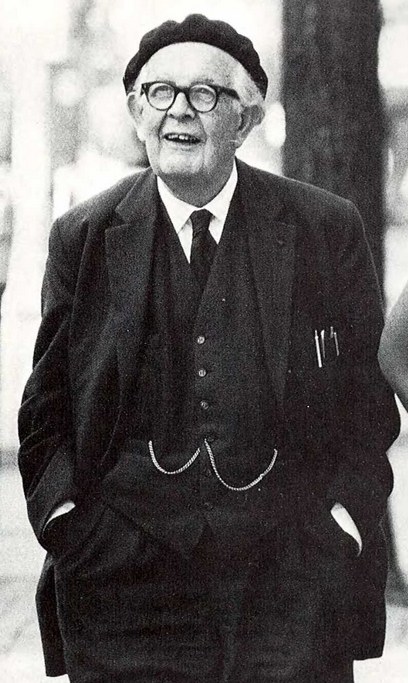
Piaget studied in Paris from 1919 to 1921. He got the chance to work in Binet's former laboratory. That chance gave his thinking and research a direction that lasted his whole life.[7]
Piaget's findings about children and how they learn changed psychology. In the 21st century, his theory has also been used to understand how children's thinking grows.[8]
The four stages at a glance
Jean Piaget proposed that children move through four stages of cognitive development.[1][9] The four stages are the sensorimotor stage, the preoperational stage, the concrete operational stage and the formal operational stage.[1][2][10] Piaget described the stages as qualitatively distinct. Each stage shows a different pattern of thinking and reasoning.[10]
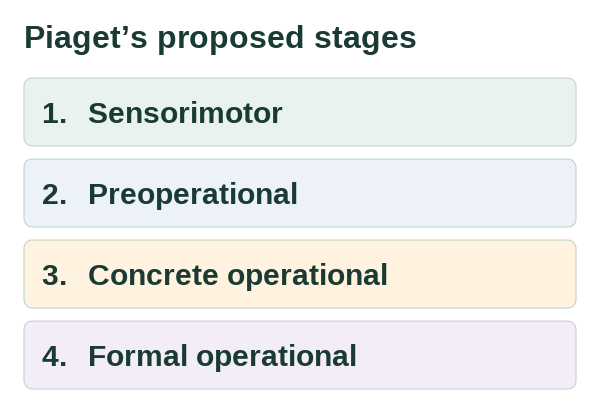
The sensorimotor stage runs from birth to 2 years.[9] The sensorimotor stage is the first period in Piaget's model of cognitive development, spanning birth to about two years, when children learn about their surroundings through sensory experience and motor actions.[11] Object permanence is one of the features listed for the sensorimotor stage.[9] Object permanence means holding an object in mind even when the senses can no longer reach it.[12] Piaget split the sensorimotor stage into six smaller stages. Each substage brings a new skill.[9]
The preoperational stage covers ages 2 to 7.[9] The preoperational stage is the second stage in Piaget's theory of cognitive development, covering roughly ages 2 to 7; during this period children begin to use symbols and language but do not yet understand mental operations and often think illogically.[13] Egocentrism and centration are both listed as features of the preoperational stage.[9] Centration is when preoperational children attend to only a single feature of an object or situation.[14] The preoperational stage also lists irreversibility as a feature.[9] Reversibility is the ability to run a change backward in thought.[15]
The concrete operational stage runs from 7 to 11 years.[9] The concrete operational stage is the third phase of Piaget's theory of cognitive development, occurring roughly between ages 7 and 11, when children can reason logically about tangible, real-world situations.[16] The formal operational stage begins at 11 years and continues beyond that age.[9] The formal operational stage is the final stage in Piaget's theory of cognitive development, emerging around age 11, when children can handle abstract ideas and hypothetical situations.[17]
One paper says that knowing this development helps teaching work well. It also helps learners understand what is taught. The span of ages covered by the stages matters to the child. It also matters to the teacher working in a classroom.[18]
Main ideas
How children build knowledge
Piaget described knowledge as something a child builds by interacting with the world around them. In his view, learning is an active and continuous process. The child builds understanding little by little while interacting with the environment.[19]
Equilibration is one of the main ideas in Piaget's theory. A 2009 review of his later work on equilibration presents his general model of the process. It also examines the idea of equilibrium itself. That review separates equilibration from dynamic equilibrium and from dialectical development. Piaget stressed self-organization and a rise in the level of equilibrium.[20]
A second 2009 paper treats equilibration as the hard core of Piaget's research program. It uses a framework for judging research programs that Lakatos set out in 1974. Within that framework, Piaget's 1977 model is described as a first refutable variant. It belongs to a possible series of models that grow more precise and easier to test. It predicts that equilibratory changes to a false theory will look like those seen for an oversimplified one. This holds at least in the early stages. The results supported this prediction. The paper raises a problem for teaching. Sometimes equilibration leaves false ideas in place, held in a more complex form.[21]
Piaget rejected the idea that random trial and error could explain development. He also rejected variation and selection as an explanation. He argued instead that goal-directed self-regulation was needed. It was needed to account for the facts of evolution and development. He called it teleonomy. A 2010 paper reports that this claimed necessity of teleonomy has been controversial. It has generally been rejected. This is especially true of its evolutionary form. The same paper argues that Piaget's structuralism is a badly flawed base for his account. Structuralism here means his assumption about the nature of knowledge. It links that flaw to several weak positions in his writings on knowledge, evolution and necessity. It then outlines a different view called interactivism.[22]
Conservation tasks and what they show
A conservation task asks a child whether an amount stays the same when its appearance changes. In one classroom demonstration, students saw how a circle can be deformed into an ellipse. A 1998 classroom demonstration showed that college students can be misled by a conservation task too.[23]
Piaget's account says that conservation depends on reversibility. Compensation is the other reversible operation named in the theory. Piaget insisted that seeing reversibility comes first and brings conservation with it. It does not work the other way around. Bruner tried to refute this claim in 1966, and many researchers have tested the question since. A 2009 review of that work reached a conclusion. Many of these researchers did not describe Piaget's theory accurately. So they tested it poorly.[15]
One study gave 168 middle-class children 3 area conservation tasks and 2 area measurement tasks. All were given in a single sitting. The children were ages 6 years 5 months to 9 years 4 months, in grades one through three. Whichever group of tasks came second scored higher. Scores on area conservation and scores on area measurement were significantly correlated. Boys and girls did not score much differently on either kind of task. Scores on the conservation tasks and on the measurement tasks rose from one grade to the next. The two rises did not differ significantly.[24]
Researchers have also compared conservation with mental imagery in young schoolchildren. First and second grade children were given tests of conservation and visual memory. The children also took tests of static and anticipatory imagery. Conservation and mental imagery were only weakly linked. Conservation and memory both had a significant link to IQ. Static and anticipatory imagery were both significantly related to age. The researchers suggested that anticipatory imagery and conservation may rest on different mental processes.[25]
Object permanence and spatial understanding
Piaget tested this ability with a series of standard tasks. These tasks involve visible and invisible displacements. In a 2024 study, six Oriental pied hornbills were tested on seven standard Piagetian tasks. The birds passed every stage before the invisible displacement stage without special training. Half of the subjects reached full stage 6 double invisible displacement object permanence. The other half reached stage 5 double visible displacement. The study proposed two possible factors behind this species' object permanence ability: breeding behaviour and the length of developmental stages.[12]
Piaget and Inhelder suggested a developmental sequence in how children recognise shapes. A 1986 study examined this sequence in children from 4 to 6 years of age. It used a method of similarity judgement. In a touch-vision condition, children felt a standard shape. They then chose which of two comparison shapes looked most like it. In a vision-vision condition, the procedure was the same. The only change was that the standard shape was presented visually. In the touch-vision condition, topologically based responses fell significantly with age. No such tendency appeared in the vision-vision condition. The number of topologically based responses also varied with the combination of shapes used.[26]
Perspective taking and communication in families
Visual perspective taking is the ability to know what another person can see. Research on this ability really began with Piaget's work in the 1950s. A 2026 review argues that current ideas about perspective taking do not match the evidence. The evidence shows that people are poor at knowing what others can see. People even have great difficulty reflecting on their own perspective, the review adds. The review concludes that a theory of visual perspective taking is still needed.[27]
What the theory says about invention and creativity
A 2016 paper argues that Jean Piaget's theory explains the mental steps inventors use when they create something new. The same paper notes that the process of creation differs from one person to another. It closes by asking how the mental steps Piaget described can best be developed. The aim is for young people to become the innovators of the future.[45]
A 2013 study applies Piaget's theory to creative thinking in mathematics. Piaget's work on how children develop focused on the growth of logic, the study notes. Logical operations belong to convergent thinking. So do the many kinds of sorting that follow accepted rules. Children and adults both think logically and think creatively, the study states.[46]
In the 2013 study, students were given an open mathematical problem to work on. The study expected students to draw on sensitivity, fluency, flexibility, originality and elaboration, traits it used to describe creative thinking.[46]
A 2021 article from Kazakhstan describes a study of logical thinking in children aged 12 to 14 years. The article argues that schoolchildren today need to think, imagine, draw conclusions and create ideas for drawings and designs on their own. It presents this early account of Piaget's ideas on the development and features of a child's thinking as background for that work.[47]
Contradiction, philosophy and the knowing subject
Piaget treated contradiction as something that happens between actions. It does not happen only inside the mind or only in the world outside. He traced it to the weight that actions give to their positive side. The negative side is harder to reach and to coordinate. He called the gradual balancing of these two sides equilibration. It is how contradictions get resolved. These ideas appeared in two volumes on the development of contradiction. The volumes were part of the series Studies of Genetic Epistemology.[48]
One 2009 analysis argued that Piaget's psychology is dialectical only in a loose sense. It lacks a developed philosophy behind it. On that reading, dialectical thinking ends up serving static concepts that work against it. The analysis compared Piaget with Hegel. Hegel's theory of interaction and contradiction gives dialectics a more exact meaning. Lawler (2009) observed that Piaget takes mastery of identity, noncontradiction and object permanence as the frame for analyzing the child's thinking. Piaget later suggested that even these categories are relative and temporary. Those remarks point toward a fuller scientific dialectics.[49]
Piaget built a general model by setting individual differences aside. He called the thinker in that model the epistemic subject. Pascual-Leone kept that subject but added a framework for individual differences. He studied what he called the metasubject. The metasubject is described as the psychological organization of the epistemic subject. It is the working organism inside that subject. A 1992 paper presented evidence that Pascual-Leone's theory of constructive operators models this organism. That paper treated the shift from Piaget's subject to Pascual-Leone's as a progressive problemshift. That means a move to a theory with greater explanatory power.[50]
The epistemic subject itself drew sharp disagreement.[51][52] Lawson argued in 1991 that the weight of evidence counts against the logical thinker Piaget postulated. He concluded that the epistemic subject is dead. Keeping it, he said, would do more harm than good.[52]
A 1993 comment on the exchange found no meeting of minds. It found little light shed on Piaget. Shayer (1993) added that neither writer presented the constructivist Piaget. So far as he went, that Piaget did settle the tension between contextual knowledge and abstract reasoning.[51]
One 2024 essay argues that this programme explored, well ahead of its time, what might be called the metamodern condition. On that reading, Piaget's project anticipates themes now linked to metamodernism. These include a relational view of subject and object. They also include a developmental view of ontology, epistemology and ethics. The same essay lists a normative perspective on knowledge and validity among those anticipated themes. It also names an overcoming of relativism and particularism.[53]
A 1993 paper takes interactionist relativism seriously. It reads Piaget's ideas about development in the light of Darwin's original ideas. The paper argues that Piaget's genetic conceptions had been increasingly neglected. This began once the information processing paradigm came to dominate cognitive science. The paper concludes that Piaget might have avoided empirical problems with balancing cognitive structures. These problems concern how schemes balance through assimilation and accommodation. They might not have arisen if Piaget had stayed a faithful relativist interactionist. The paper traces part of the problem to Piaget's bias. He favored the idea that intellectual structures build themselves on their own.[54]
A 2014 paper proposes Piaget's theory of equilibration as a candidate theory of perceptual learning. The paper states that the sensorimotor approach had until then offered no explicit theory of perceptual learning. It argues that equilibration explains how a sensorimotor organization copes with novelty or breakdowns. It does so by reshaping structures it already has, in step with regularities of the world. The paper gives a dynamical formalization of equilibration. The aim is an explicit micro-genetic account of sensorimotor learning. One general principle it draws is that the agent itself must make an intrinsic normative evaluation.[55]
Dodwell (1963) notes that psychologists have long tried to study thinking scientifically, with little success. A 1963 discussion of Piaget's genetic epistemology notes that psychologists had tried for many years to deal scientifically with the psychology of thinking. Those attempts met with little success. No agreement was reached on what thinking is or how it differs from other forms of behaviour. No satisfactory explanation of thinking had been produced either. The same discussion observes that explanations of thinking go in and out of fashion over time.[56]
Research
What the conservation studies measured
Sakkas and Samartzi (2024) used a conservation task of a certain kind. In it, water is poured from one glass into a glass of a different shape. In the liquid version, water is poured from one short, wide glass into one long, narrow glass. A 2024 study tested 86 five-year-olds, with equal numbers of girls and boys, on four such tasks. Two tasks measured the general idea of conservation. Two measured identity, compensation or reversibility.[57]
Gallagher and Reid (1978) tested 48 children in kindergarten and the first and second grades. The children faced three conservation problems of continuous quantity. On two of them, success on the conservation check was linked to an open, performance-based showing of reversibility. The effect of the judgments was taken out. Even then, the explanations still explained a large share of the variance. The second-graders did significantly better across tasks than the kindergarten children did. Gallagher and Reid (1978) proposed that a full assessment of cognitive structures needs two things. It needs the child's judgment and the child's explanation alike.[58]
The 2024 study also asked whether the general idea of conservation is linked to three narrower ideas: identity, compensation and reversibility.[57] The 1978 study tied an open display of reversibility to success on the conservation check.[58] Preece (1980) built a geometrical model of behavior in a conservation task. It was based on Thom's catastrophe theory. The model covers the sudden breaks in thinking found in such tasks.[59]
Conservation scores do not predict early school achievement well. Scores ran from 0 to 6. Three groups were divided by Piagetian stage of nonconservation and conservation.[60]
Training children to conserve
Lawson and Nordland (1975) tried to train conservation of area, weight and volume. The 16 teenagers in the study did not yet conserve, and they were aged 14.5 to 17.8 years. Training produced significant gains for area and weight conservation (p < .01). Volume proved harder to train. After the programme, the trained and untrained groups did not differ significantly on volume tasks. The gains did not clearly carry over to a conservation of length task. Both the trained and the untrained groups improved overall from pretest to posttest (p < .001).[61]
Martinko and Clifford (1978) compared two methods for causing conservation of area. One method rested on a view: inducing conservation requires an empirical specification of operational reversibility. The other used discrimination training. This draws attention to the relevant quantities and away from misleading perceptual features. Both methods worked well compared with a control group. The result suggests that making reversibility explicit is not required to produce conservation of area.[62]
Pennings (1991) put 48 boys and girls aged 7 to 8 into three groups. One group got training in restructuring perception. One got training in conservation of horizontality, and a control group got no training. Training that changed how children perceived the figures raised their scores on embedded-figures problems. In these problems, a hidden shape must be found inside a larger drawing. Despite these improvements, performance stayed tied to the task trained. It did not carry over to other tasks.[63]
A 1987 report described three intervention studies. They aimed to speed up cognitive development in early adolescents. The studies used three methods. One was Feuerstein's model of mediated learning. Another was training on formal operational schemata within science lessons. The third was training for field independence. In two of the three studies the effects were not transient. Two problems were common to all three studies. The report also found a major research issue. How can a successful intervention model be shared with practising teachers? The report argues that inferring cause from the results of intervention studies is problematical.[64]
A kindergarten programme was built on Pascual-Leone's 1970 neo-Piagetian model. Researchers analysed its effects on conceptual skills. The analysis predicted a result. Children in the experimental kindergarten would match regular grade-IV children on a verbal classification task. Both predictions turned out to be right. This was read as evidence that the model can join Piaget's developmental theory with Gagné's learning theory.[65]
Testing the stages with larger samples
A Piagetian task is a real, hands-on scenario built for measurement. It is set at a level of complexity that suits the child's age. An intelligence test, by contrast, is a paper-and-pencil test. Its items differ in how hard they are. One Austrian study tested three small samples. The first group was 40 kindergarten children aged four to six years. The second was 40 primary school children aged six to eight. The third was 41 aged nine to ten. The average correlation between intelligence scores and Piagetian task scores was r = .51. That is a moderate positive link. In factor analyses, both kinds of task loaded on one common factor of general intelligence. The two kinds of task were not identical, however. Mental speed correlated more strongly with the intelligence test (r = .50) than with the Piagetian tasks (r = .39). Piagetian scores were more closely tied to signs of parental education (r = .25). Intelligence scores (r = .20) and mental speed (r = .11) were tied less closely.[66]
A larger study in 1983 gave Piagetian tasks and traditional intelligence tests to 312 children. They came from kindergarten and elementary school Grades 1 to 4. The Piagetian tasks covered seriation, conservation and multiple classification. At the end of the same school year, the children also took early arithmetic tasks. These included number line comprehension, number language, addition and subtraction, and verbal arithmetic. Seriation and conservation together predicted number language better than the intelligence tests did. Seriation predicted number line understanding as well as the intelligence tests did. Both kinds of test were equally poor at predicting simple computation. Examples are addition, subtraction and reversal tasks. The authors concluded that three instruments were of good quality from a measurement viewpoint. They were not inferior to usual tests.[67]
A 1979 study followed 168 middle-class children first assessed in 1971, in first, second and third grades. Their scores on Piagetian area tasks were used to predict math achievement. The predictions covered each of the next four years. Some children were first assessed in second grade. For them, conservation and measurement scores often predicted teacher marks and Stanford Achievement Test scores. This held across those four years. An intelligence test, the Otis-Lennon, predicted outcomes for children first assessed in all three grades. For the second-grade group, the two Piagetian area scores helped predict two Stanford subtests. These were concepts and applications. This held even after intelligence was taken into account.[68]
The largest of these studies looked at nutrition. It tested 1,336 children aged 6 to 8 years. The test used seven Piagetian tasks from the concrete operational period. Each child also took the Wechsler intelligence scale for Indian Children. Some children were still in the first, preoperational stage. The share of malnourished children at that stage was much higher than the share of well-nourished children. More of the well-nourished children had reached the third stage, concrete operation. In boys, poor nutrition was linked to performance on all the tasks except class inclusion. For girls, this held only for conservation of liquid, conservation of substance and ordinal relation. Regression analysis showed that nutrition was the only factor weakly linked to poor task performance. The nutrition effect was strongest on conservation tasks. The researchers read this as poor verbal reasoning and comprehension in malnourished children.[69]
Individual differences among children
Fleck (1972) tested 88 boys in kindergarten and in the first and second grades. The study asked whether two pairs of traits were linked to conservation behavior. The pairs were field independence and dependence, and verbal mediation and nonmediation. The field-independent boys conserved much more often than the field-dependent boys (p < .05). Grade also made a difference (p < .01). Verbal mediation, the tendency to put reasoning into words, showed no main effect, and no interaction reached significance.[70]
A 1974 note described a 1971 study by Callahan and Passi. It looked at conceptual tempo and the ability to conserve length. Children with an impulsive tempo answered problems posed more quickly. They often did so without enough time to consider other responses. Callahan and Passi argued that mathematics is a field built on deduction. In it, being reflective rather than impulsive helps in problem solving.[71]
A 2022 study of 25 students aged 12 to 16 years examined personality type. Extroverted and introverted students had the same average score on the logical operations test, 47. This places the average student at the final concrete operations stage. The two groups differed only in the compatible type. There extroverted students showed high understanding and introverted students showed sufficient understanding.[72]
A 2022 study of mathematics education students at Timor University sorted performance by gender. It used a 14-item Logical Operations Test. Among females, 19.18% were at the initial concrete stage and 36.99% at the final concrete stage. Also, 13.70% were at the initial formal stage and 1.37% at the final formal stage. Among males, 9.59% were at the initial concrete stage and 6.85% at the final concrete stage. Also, 9.59% were at the initial formal stage and 2.74% at the final formal stage. Understanding was low for each of the seven logical operations.[73]
A 2023 interview study looked at 90 boys in the first to sixth grades in Rasht. It found that students could reach abstract thinking at younger ages than Piaget stated. On the theme of human nature, first to third grade students were at an objective thinking stage. Fourth to sixth grade students were at an abstract objective thinking stage. One theme was what separates humans from animals. The study suggested that cultural, religious and social factors may explain the earlier abstract thinking.[74]
Brain research on Piagetian tasks
Brain imaging has let researchers watch children solve Piaget's number conservation task. The pictures fit his stages.[75] Children under 7 say the longer row holds more coins, even though the count has not changed.[76] Children of 5 to 6 years, called nonconservers, fail the task. Children of 9 to 10 years, called conservers, pass it. Children stop trusting how the coins look and start keeping the number in mind at about 7 years of age.[75]
A functional magnetic resonance imaging study compared these two age groups while they did the task. The change that lets children conserve number was linked to a bilateral parietofrontal network. This is a set of areas in both the parietal and frontal lobes. That network is involved in number work and in managing mental tasks. The scans showed how the behavioral and cognitive stages Piaget described in the 20th century appear in the brain with age.[75]
A second fMRI study asked whether children must also stop an unhelpful habit of thought. The researchers measured brain activation during the conservation task. They compared it with scores on two other tasks. Activity in the right insula and inferior frontal gyrus was tied only to inhibitory control. The Stroop task was used to measure that control. Activation in the left intraparietal sulcus was linked only to handling numerical information in working memory. This was measured by the Backward Digit Span task. The results suggest that number conservation needs two things at once. The brain must switch on the reversibility of cognitive operations. The intraparietal sulcus supports this. It must also hold back a misleading strategy. That strategy treats a longer row as a larger number.[76]
Adults did a priming version of a Piaget-like number task. Just after they held back the length-equals-number bias, they showed a negative priming effect. The effect appeared at the N200 stage of information processing, shown by a larger N200 wave. For accurate number judgments, the adult brain still had to control childlike biases. The researchers called the store of these biases a developmental memory.[77]
An earlier ERP study tested girls aged 5 to 7 with a standard Piagetian conservation kit. The children then did a visual selective attention task. They also did an experimental version of the conservation of liquid quantity task. The share of correct responses on the analogue separated conservers from nonconservers. Standard Piagetian tests had already sorted the children this way. A broad positive ERP wave over the center and back of the scalp separated nonconservers from conservers. It did not separate age groups. Dipole analysis suggested more anterior sources for nonconservers. It suggested that conservers have more lateralized sources. The researchers concluded that ERPs can show how brain maturation relates to cognitive development stage by stage.[78]
In practice
What teachers take from the theory
Teachers who draw on Piaget's theory begin with materials children can handle and move.[79][80] A 2025 analysis of teaching practice describes activities based on direct experience. It calls them one way to turn the theory into lessons.[79]
A second 2025 review was a qualitative study of books and journal articles. It also stresses the use of concrete media. The review says children learn through direct exploration. It calls this active learning and constructivism.[80]
A second classroom move is cognitive conflict design. The 2025 analysis recommends planning such conflict on purpose. It calls this step scaffolded disequilibrium induction.[79]
The theory sees the child as an active builder of knowledge through contact with the surroundings.[81] A 2020 literature review found the theory quite influential in education. That review argues that everyone involved in schooling must adjust to how students are developing. Teachers above all must adjust. It also asks teachers to show appreciation for positive steps students take. It links this to cognitive growth.[82] A 1993 paper argues that Piaget's theory gave education something the learning theory of its day could not supply. That paper names assessment, early childhood education, curriculum design and remedial instruction as areas where its central conceptual structures have proved useful.[83]
The 2025 review sets out the obstacles to matching work to a stage. Students in one class differ in how far their thinking has developed. Facilities and equipment are often limited. The curriculum can be fixed and hard to change. Many teachers have little training in the constructivist approach the theory implies. Cultural and social factors add further difficulty. The review proposes three responses. They are teacher training, a curriculum adjusted to developmental stage, and process-based evaluation. It concludes that the theory stays useful when teaching methods are flexible. The learning setting must also be stimulating.[80]
One is that cultures vary. The other is the timing of formal operations.[79] A 1985 article defends the theory's place in education on two grounds. It argues that the theory holds up under psychological scrutiny. It answers five criticisms raised by Peter Bryant in a 1984 article in the same journal. It also argues that matching work to a child's level fits the theory. So does mismatching it.[84]
Mathematics and science in the classroom
A study tested geometry teaching built on the conservation parts of Piaget's theory. It used a pre-experimental design with one group, tested before and after the lessons. Learning achievement in the geometry unit did not vary by age among children of 9, 10 and 11 years. The study found no interaction effect on mathematics learning achievement. This held between ages 9 and 10, 9 and 11, and 10 and 11.[85]
A talk at a 2005 conference linked each of Piaget's stages to math teaching suited to that stage. It warned against forcing unfamiliar ideas on the child. It stressed the value of peer interaction.[3]
A qualitative study of books and articles looked at math learning in elementary classes. It drew on Piaget's theory. It reported that cognitive abilities grow more complete in higher elementary grades. They also change with the age stages of development. The review also noted that teaching aids can make understanding easier. Examples are media and learning models.[86]
For science, a 2025 literature review found elementary lessons still dominated by abstract lecture methods. That approach conflicts with what students aged 7 to 11 need. Most of them are in the concrete operational stage. The review named three pillars of effective implementation. The first is a shift in the teacher's role. The teacher becomes a helper who designs cognitive disequilibrium. The second pillar is concrete media, hands-on materials and interactive simulations. These turn abstract ideas into ones a child can observe. The third is constructivist models, such as inquiry-based learning and discovery learning. The review concluded that science teaching matched to concrete operational thinking improves three things: understanding of concepts, critical thinking and scientific literacy.[87]
A qualitative study looked at science learning in junior high school through the same lens. It used books, journals and other documents. It did not collect new classroom data. Its results suggest that using the theory helps educators find students' cognitive levels. It also helps them choose strategies that suit each student's stage of development.[88]
Language, play, nutrition and the arts
In nutrition education, the theory helps design lessons that fit the developmental stages of childhood.[89] A qualitative case study linked the constructivism approach to language learning. It interviewed 10 teachers and 20 students chosen for their experience with constructivist methods. Teachers who used Piagetian principles reported higher student motivation. These principles included learning by experience, reflection and working together. The study also reported more active participation and better critical thinking. It named time limits, a strict curriculum and few resources for project work as obstacles.[90]
Play has long been studied through Piaget's framework. A 2010 review describes his approach to play as part of his wider theory of cognitive development. That review argues his theory lacks a sociocultural dimension. This means a concern with how culture shapes thinking. That left room for Vygotsky's rival account.[91]
A 2009 article argues that children learn many concepts and form lifelong habits in the preschool years. It says Piaget's theory can guide nutrition education suited to their stage.[89] Children in the taught group raised their nutrition knowledge scores. Their food choices also got better. Body measurements, however, showed no significant difference between the two groups. The researcher suggested that families take part in children's nutrition programmes.[92]
A 2024 article proposes ways to teach piano to young children. The methods reflect the age traits of preschool children. It suggests that online lessons can use several kinds of media. Online education could also prove more effective soon. The article aims to weigh the pros and cons of online piano education. It also gives guidelines for it.[93]
Special education and early childhood settings
Teaching children with special educational needs raises a challenge. Teaching must be adjusted to the cognitive level of children, whose needs differ from one another. A 2025 qualitative study watched and interviewed special education teachers in several schools. It asked how they used the theory in practice.[94]
The strategies described as more effective were student-centered learning, suitable teaching aids, and hands-on activities. The researchers concluded that teaching matched to a child's level of cognitive development can help students with special educational needs learn better.[94]
In early childhood settings, the student center model is described as the most appropriate learning.[95] A literature review makes a related point. Understanding cognitive learning theory helps teachers provide learning suited to the child's developmental stage. That review places early childhood in the first two of Piaget's stages. These are the sensorimotor stage and the pre-operational stage.[96]
Play is one way to give students concrete experience. A 2022 article on primary school thinking notes that Piaget believed play builds intrinsic motivation. The same article stresses that the child is guided to discover a concept. The material is not handed over directly.[97] A 2025 library study adds that Piaget saw thinking as a gradual activity. It moves from concrete to abstract.[98]
How the theory reached schools and clinics
Piaget's influence in China has come through translations, replications and interpretations over nearly 100 years, Liu and colleagues (2026) write. A 2026 historical account divides the Chinese reception into four periods. The first was an early introduction, from 1920 to 1949. A second period of marginalization, revival and rejection ran from 1949 to 1978. Systematic translation and validation ran from 1978 to 2001. Creative application and sharing followed from 2001 to the present. Since 1978, studies and applications of Piaget's work in China have grown. This growth peaked in 2020 with a 10-volume collected works. In 2023 a Piaget research center was founded.[99]
Teachers have drawn practical methods from the theory. They use them for stateless children learning to read, write and count, and for students in special education.[100][101] That study reported learning through the senses and movement, through games, and through projects as methods suited to these learners.[100] A 2025 review of secondary data found that applying Piaget's cognitive theory strongly shaped how teaching strategies were formed for special education students. The review presented its implications as a reference and guide for teachers facing teaching and learning problems in that setting.[101]
Teachers and an examiner have also used Piagetian tasks to spot learning problems. A 1998 study assumed that performance on such tasks would predict learning problems in first graders. Three teachers rated 38 pupils on the Rhode Island Pupil Identification Scale. Each child then took 8 Piagetian tests, including conservation and logical tasks. Children who did well on the Piagetian tasks also tended to get good ratings for their schoolwork. Cardaci and colleagues (1998) closed by saying that operational intelligence and school learning are closely tied in children.[102]
Educators and researchers have cited Piaget's cognitive learning theory. They use it to justify their teaching practices and to support their studies. That borrowing had a cost. Applying the theory on its own can ignore newer biological findings about learning. One 2026 analysis of physics teaching argued that Piagetian constructivism and markers of cognitive neuroscience should be taught together in initial teacher training. The same analysis warned that moving neuroscience findings into the classroom needs care. The aim is to avoid biological reductionism. Curricular guidelines for the initial training of basic education teachers strongly encourage this overlap. The aim is for teachers to understand how students learn.[103]
A 2022 literature review concluded that elementary school students generally think at the concrete operational stage. On that basis the review recommended discovery learning and contextual learning methods. It made this call for mathematics at elementary school age.[104]
An experimental study worked with 5th grade students. It split them into an experimental group and a control group by cluster random sampling. Students' understanding was tested before and after. The scores were analyzed with the Polled Variance T test. The study reported a significant effect of using Piaget's theory in school mathematics learning.[105] A 2013 paper took a different route. It used Piaget's stages to describe how children think in mathematics, and set out the results in a table of what children can and cannot yet do.[106]
In a case study of two kindergarten teachers, both seemed to grasp Vygotsky's zone of proximal development to some degree. One teacher clearly saw the gap between what a child performed and what the child could actually do. The other confused the two. It compared their beliefs and practices with Piaget's structuralist approach. It also compared them with Vygotsky's zone of proximal development, the gap between what a child can do alone and with help. One teacher thought about the factors affecting a child's performance. That teacher clearly saw the difference between performance and actual ability. The other teacher confused performance with actual ability. So that teacher failed to judge the child's real developmental level accurately. But linking theory to practical teaching skills, such as dynamic assessment, took more knowledge and practice. The study concluded that teacher educators, and those who train them, must play a larger part. This is needed if constructivist theory is to settle more fully into early childhood settings and curricula.[107]
An analytical-descriptive 2025 study watched five randomly selected videos, from kindergarten interactive writing to 11th-grade mathematics lessons, to see how instructional strategies and classroom environment matched Piaget's and Vygotsky's principles. It reported that combining insights from the cognitive and sociocultural perspectives lets educators build more varied and suitable learning environments. In its account, the combined approaches improve student understanding and retention. They also support critical thinking and collaborative learning. The analysis also said both theories have shaped modern teaching methods, curriculum design and student engagement.[108]
A 2026 article sets out teaching techniques for preschool percussion lessons. They are matched to the cognitive levels of children aged 3 to 6. A 2026 article on preschool percussion teaching used Piaget's model. It drew on the symbolic function and self-centered thought of 3 to 6 year olds to design rhythm lessons. It identified a real-world problem in current music teaching: rhythm lessons do not match children's cognitive levels. It offered techniques meant to fit those levels.[109]
Orr (1991) argued that Piaget's theory of cognitive development is not limited to childhood. It also matters for adult learners, including students training to become nurses. In 1991, one nursing educator argued that the theory is not limited to childhood. That argument asked nurse educators to give students environments. In them, students can practise the schemas they already possess.[110]
Lefmann and Combs-Orme (2013) gave an example. Knowledge of early brain development can fit into Piaget's theory of cognitive development. The writers noted that the profession calls its approach bio-psychosocial. Flemmann and Combs-Orme (2013) add that the profession has not brought key physiological knowledge into its practice, its research or its teaching. Lefmann and Combs-Orme (2013) argued that the profession focuses on evidence-based practice. That focus requires it to add neuroscience to its body of knowledge.[111]
Cook-Cottone (2004) offered college counselors a framework. It views counseling as the client building healing narratives. In that framework, how far a client processes a story seems to depend on two things working together. One is knowledge about the experience, and the other is emotion about it. The article drew out what this means for college counselors and for researchers.[112]
A 1986 paper compared Piaget's account of formal operational thinking with Further Education Unit proposals for a common-core curriculum. It argued that both assume general abilities exist. It also said both assume such abilities transfer to new tasks. The paper reviewed a family of six general abilities. These are said to underlie formal operational thinking. It also reviewed six types of cognitive constraint. These limit how far general ability actually transfers. Its central conclusion was that Piaget's account is one intellectual resource among others for pre-vocational education.[113]
A 1974 article named three ideas as especially important for educators. Knowledge must be seen as self-constructed. Development must be seen as a process the child regulates itself. Sensation and action should count as forms of knowing. They are not incomplete bits waiting for language to finish them. Some studies looked at deaf children who lacked a shared symbol system in their early years. Those studies were said to show that intellectual development stands on its own. The article observed that most teachers agree schooling should challenge thinking. Yet they fall back on language instruction in class. It concluded that Piaget's theory gives language a real but not leading role in the child's thinking.[114]
Technology, toys and digital play
Kilag and colleagues (2022) conducted a descriptive qualitative study. They used thematic analysis of the study's primary source. It reported that using information and communication technology worked well for teachers and students. This was seen through Piaget's theory of cognitive development. The same study named one part of effective teaching. Teachers must keep learning about that technology.[115]
A 2026 review in Portuguese examined children aged 0 to 6 years. It read the results mainly through the sensorimotor and preoperational stages. It found that heavy use of electronic devices affected speech, memory and attention. It disturbed sleep hormones and affected how children socialized. That review concluded that keeping devices away in childhood avoids delay in language. Language develops through watching the family environment.[116]
Choi and Lee (2021) note that parents of young children choose board games. They pick them instead of digital games that children play alone. Halli Galli used few visual signs. Most were pictures of natural objects that were easy to grasp at a glance. Dobble used many signs, mixing natural and made objects. It combined pictorial, symbolic and indexical types of sign. The review judged ages 5 to 7 appropriate for Halli Galli. Dobble suited children aged 8 and over. It recommended natural objects, bright primary colors, few signs and little use of language or letters.[117]
Color play has been studied as a visual stimulus for cognitive growth in early childhood. A 2024 systematic review screened journals from three search services. It kept 10 that met its inclusion criteria. It reported that playing with color supported logical thinking, sorting and problem solving. It also had a significant effect on cognitive and fine motor development. The review stressed that learning media should match the child's stage of development.[118]
What this looks like when you study
A study of 52 middle-class white children aged 73 to 87 months gave each child a six-step conservation-of-fluid task, scored from 0 to 6. Eight weeks later, the children took the Stanford Achievement Test, Reading. The correlation between conservation scores and reading was .13, which is not significant. The mean reading scores of the nonconservers and the conservers did not differ significantly.[60]
One source recommends diagnostic assessment of cognitive stages before teaching. Induce disequilibrium in a scaffolded way. Design activities that give students concrete experience. Include social interaction in the activity.[79]
Later developments
Later revisions and the theory's standing
A 1987 review of these theories said they all came from one shared problem. Each tried to keep Piaget's strengths while removing his weaknesses. One strength was explaining features of thinking shared by all children. So most of the new theories kept the core structural postulates. These are the basic claims about how thought is organized. The theories resemble each other in their structural claims. They differ more in how they explain change. One reason is that the data less clearly disproved Piaget's transformation model. Theorists also disagreed about which approach from other branches of psychology was the best way to extend that model.[119]
Data came from a motor performance task, the Rho task. It showed step-by-step plateaus in children's performance. The ages of these plateaus matched the redefined Piagetian stages. The mental structures behind performance on that task seemed to sit in the left hemisphere of the brain.[120] A 2010 review covered 25 years of Piagetian research, from 1963 to 1988. It found no evidence that clearly confirms Piaget's cognitive structures in explicit form.[121]
In 1997, one researcher proposed developmental biology as that metatheory. One writer named an evolutionary view as especially promising.[122] In 2018, the same researcher examined a growing emphasis on biology in cognitive development research. The period covered was the past 2 decades. That article argued that developmental biology will keep shaping research and theory. It added that evolutionary theory is close to becoming a metatheory for developmental psychology as a whole.[123]
Other proposals took different directions. A 2009 article argued that Piaget put logical thought first. It said he neglected the vehicles that carry knowledge. It called for a post-Piagetian approach built around symbol systems and media.[124]
A 2016 review covered one researcher's 40 years in the field. It described three periods. First came Piaget's dominance, then efforts to build alternatives. Then came a growing focus on the link between cognitive development and education. That review suggested a possible way forward. It is building joined-up theories of cognitive development for particular domains.[125]
New probabilistic models of learning appeared over more than 10 years. They echo Piaget's work but claim to go further.[126] Work from the Genevan school on strategies and procedures remains largely unknown in the United States. That article argued that Piagetian psychology and American cognitive science need each other. Together they could give a complete theory of mind.[127]
Recent work asks how the theory holds up in technology-rich settings. A 2026 review of past research used work from several fields, published between 2000 and 2024.[128]
Neo-Piagetian models and cross-cultural findings
Miller, Pascual-Leone, Campbell and Juckes (1989) gave Pascual-Leone's tests of mental attention and energy to Zulu-speaking township children. The children were aged 7 to 12. The tests measure a capacity called M-power. In the first study, 292 children took the Compound Stimulus Visual Information task, or CSVI. This task trains children before testing them. On the Compound Stimulus Visual Information task, the children performed at the levels the theory predicted. They had the same M-power as Canadian children.[129]
Other work asked whether Piaget's stages hold beyond the school years. A 1979 review by Long, McCrary and Ackerman looked at research on adults. It asked three questions about the formal operations stage: is it necessary, is it universal, and does it last? The questions were whether that stage is necessary, whether it is universal, and whether it persists. The review concluded that each of the three questions still needed further study and clearer definition.[130]
A 1982 review by Nagy and Griffiths raised doubts about research that links Piaget's theory to adolescent thought. Attempts to design teaching that speeds up intellectual development had produced little result.[131]
A 2008 article argued that newer findings do not justify rejecting Piaget's approach outright. It presented two specific models from Geneva. They cover how children understand number and physical cause and effect.[132]
Case (2008) traced the idea of stages back to James Mark Baldwin. His 1894 theory described four universal stages of thought. Piaget renamed the second and third as preoperational and operational thought. Piaget also split operational thought into a concrete period and a formal period.[133]
A 2022 study of 25 students aged 12 to 16 found most were in the late concrete operations stage. That stage held 71.5% of extroverted and 72.8% of introverted students. It tested logical operations in mathematics and sorted the students by personality type. On Piaget's logical operations test, extroverted and introverted students both averaged 47. The study reads this as a tendency toward the final concrete stage.[134] A 1975 study of 60 fifth-grade children found that concrete operational children preferred more complex designs than preoperational children (p < .05).[135]
A study in Kohat District, Pakistan, compared 160 primary school children, 80 from rural and 80 from urban schools, on conservation tasks. The rural children did better than the urban children. The researchers linked this to late school enrolment. Girls performed slightly better than boys.[136]
A 2026 case study in rural Central Java followed nine children aged 6 to 8, nine parents and two teachers. Children with high family stimulation showed steady concrete operational thinking. This included conservation and classification. Children with moderate stimulation showed logical reasoning that appeared but was not steady. Children with low stimulation stayed in the preoperational stage. They had weak working memory and limited self-regulation.[137]
A 1992 study gave two Piagetian measures to 30 elderly patients with Alzheimer's disease. It gave the same measures to 30 elderly control subjects. Half of the patients, 15 in all, scored at the sensorimotor or preoperational stage. The other half and all the control subjects scored at the concrete operational stage (p < 0.001).[138]
A 1978 study gave seven Piagetian tasks to thirty-four people aged sixty-eight or older. It found that success rose with level of education. With education held constant, active elders living in the community did better than elders in institutions.[139]
A 1987 study of 52 elderly subjects offered rewards on Piagetian tasks. The reward group scored higher on every task, but the difference was not significant. Scores on conservation of volume were higher than scores on conservation of surface area. The researcher read this as a sign that older adults may be swayed by surface features of the task.[140]
Criticism
Criticisms of the stage model
The stages are not fully accepted without critique. One stated shortcoming is that the theory overestimates the ability of adolescence. It also underestimates what infants can do. Another is that Piaget neglected cultural and social interaction factors in how children's thinking grows.[1][2]
There is another problem with his method. Piaget studied his own children. This raised questions about ethics and bias.[2]
Theories of behavioural development use the word stage in three general senses. A 1978 review in Behavioral and Brain Sciences sorted the term into three uses. They were a metaphor. They also described behaviors that change with age and explained those changes. A stage model counts as explanatory only if it does three things. It must describe age-related changes, name their causes, and let each be measured on its own. Piaget's stages describe many age-related changes and propose some causes. But there are no procedures for measuring the two factors separately. The review concluded that nothing strong supports the claim that the stages do more. They may only describe how behavior changes with age.[141]
Piaget offered five criteria for checking whether his stages were real. They are invariant sequence, cognitive structure, integration, consolidation and equilibration. Three of these criteria predict learning sequences for certain behaviors. These sequences are the same across cultures. Someone has raised an objection to such predictions. Piagetian sequences are often just measurement sequences. In them, a late behavior is an earlier one plus additions. The cognitive structure criterion drew three criticisms. It yields descriptions at most. These often describe only the task, and they are not unique to the stages proposed. Predictions from the equilibration criterion conflict with the data on Piaget's stages.[141]
A 1977 review in the British Journal of Educational Psychology looked at data from studies built on the theory. It asked how far a stage can be defined in a meaningful way. It also asked what process of development the theory proposes. It suggested that an approach built on a skill-integration model might prove more profitable.[142]
A 1979 study tested 481 14-year-olds on five formal tasks. It found formal operational thinking to be a single construct. Even so, the study concluded that a theory with predictive power was still out of reach.[4] A 1978 critique aimed at secondary science teaching listed three problem areas in the Piagetian analysis. They were how the logical model of formal thought is specified, the assumptions behind Piaget's research methods, and problems in the evidence.[143]
One study gave Piagetian tasks to 144 primary school children in East Java. It analyzed the order in which success appeared. The sequences that emerged were not the same as those the Genevans described as universal. The study called this result important for planning education in Java.[144]
A mix of tasks cannot do it either. The review says the tasks measure grasp of particular concepts, not intelligence. Intelligence can be defined broadly as adapting to the environment. If so, we would reasonably expect different paths of cognitive development across cultures. That review presented the Baoulé idea of intelligence from Ivory Coast. The idea is called n'glouèlě. It linked ratings on it to Piagetian task performance in rural Baoulé children aged 8 to 9.[6]
The American philosopher Gareth B. Matthews. He also included children's attitude toward the world. He also included their ability to sense problems that great philosophers have dealt with for centuries. Piaget read these features of children's thinking as intellectual deficits.[145]
Deanna Kuhn argued in 1979 that trouble applying Piaget's theory to education shows unclear points inside the theory itself. She reached this view by reviewing experimental curricula that took their objectives from the stage sequences and programs that took their methods from Piaget's account of cognitive development. Kuhn held that educators who use developmental theory and theorists who build it should share their work. She argued that research across these separate settings must be brought together. Only then can it yield a fuller theory or an effective application.[146]
Common misconceptions
Dasen (1984) argues that no single task, and no combination of tasks, can measure a general cognitive level; the tasks measure whether a child has attained particular concepts.[6]
Brainerd (1978) concluded that the evidence does not compel the view that Piaget's stages explain age-related behavioral change rather than merely describe it. The review notes that procedures do not exist for measuring the proposed causes and the behavior changes independently.[141]
Key studies
| Year | Study | Sample | Design | Finding |
|---|---|---|---|---|
| 1975 | Taloumis[24] | 168 middle-class children aged 6 years 5 months to 9 years 4 months | task-order experiment with area tasks | Whichever group of area tasks was presented second produced higher scores, and boys and girls did not differ significantly. |
| 1976 | Orpet et al.[60] | 52 middle-class white children aged 73 to 87 months | Conservation task given, reading assessed 8 weeks later, 52 children aged 73 to 87 months | Liquid conservation scores did not significantly predict reading scores (r = .13). |
| 1978 | Gallagher & Reid[58] | 48 kindergarten, first-grade, and second-grade children | conservation of continuous quantity task study | Second-graders performed significantly better across tasks than kindergarten children, and both judgment and explanation criteria were needed to assess cognitive structures. |
| 1979 | Taloumis[68] | 168 middle-class children first assessed in Grades 1 to 3 | four-year prediction study | For children first tested in second grade, Piagetian area scores added significant prediction of Stanford concepts and applications scores beyond IQ. |
| 1983 | KINGMA & KOOPS[67] | 312 children from kindergarten and elementary Grades 1 to 4 | Tasks given at the start and end of one school year, 312 children in kindergarten and Grades 1 to 4 | Seriation and conservation together predicted number language better than intelligence tests did. |
| 1987 | Shayer[64] | early adolescents in three intervention studies | intervention studies on cognitive development | Effect sizes of about one standard deviation on Piagetian tests were achievable over a year or more, but transfer to students' learning was not shown. |
| 1989 | AGARWAL et al.[69] | 1336 children aged 6 to 8 years | nutritional status and cognitive development study | A significantly higher percentage of malnourished children were in the preoperational stage, and a higher percentage of wellnourished children were in the concrete operational stage. |
| 2009 | Sinnott[5] | task performance study with familiar and formal materials | Neither age group performed the tasks at mastery level, and the kind of materials used affected how the adults scored. | |
| 2011 | Houdé et al.[75] | preschool nonconservers aged 5 to 6 and school-age conservers aged 9 to 10 | functional magnetic resonance imaging (fMRI) study | The shift to number conservation was linked to a bilateral parietofrontal network used in numerical and executive functions. |
| 2012 | Poirel et al.[76] | children who succeeded and children who failed the number conservation task | fMRI study with Stroop and Backward Digit Span tasks | Right insula/inferior frontal gyrus activity was tied to inhibitory control, and left intraparietal sulcus activity to working memory manipulation. |
| 2019 | Soran University et al.[2] | Critical review of Piaget's theory | Piaget studied his own children, which raised ethical and bias problems. | |
| 2021 | Rindermann & Laura Ackermann[66] | correlational study with psychometric tests and Piagetian tasks | The average correlation between IQ and Piagetian tasks was r = .51. | |
| 2022 | Pakpahan & Saragih[1] | Review of Piaget's theory and its criticisms | Piaget proposed four stages, but critics say he overestimated adolescent ability and underestimated infants. | |
| 2024 | Yao & Garcia-Pelegrin[12] | six Oriental pied hornbills | seven standard Piagetian object permanence tasks | Half the birds reached full stage 6 double invisible displacement, and half reached stage 5 double visible displacement. |
See also
References
- Pakpahan, F. H., & Saragih, M. (2022). Theory Of Cognitive Development By Jean Piaget. Journal of Applied Linguistics, 2(2), 55-60. doi:10.52622/joal.v2i2.79
- Soran University, Babakr, Z. H., Mohamedamin, P., & Kakamad, K. (2019). Piaget’s Cognitive Developmental Theory: Critical Review. Education Quarterly Reviews, 2(3). doi:10.31014/aior.1993.02.03.84
- Ojose, B. (2015). Applying Piaget's Theory of Cognitive Development to Mathematics Instruction. THE MATHEMATICS EDUCATOR, 18(1). doi:10.63301/tme.v18i1.1923
- SHAYER, M. (1979). Has piaget's construct of formal operational thinking any utility? British Journal of Educational Psychology, 49(3), 265-276. doi:10.1111/j.2044-8279.1979.tb02425.x
- Sinnott, J. D. (2009). Everyday Thinking and Piagetian Operativity in Adults. Human Development, 430-443. doi:10.1159/000271504
- Dasen, P. R. (1984). The cross‐cultural study of intelligence: Piaget and the baoulé*. International Journal of Psychology, 19(1-4), 407-434. doi:10.1080/00207598408247539
- Harris, P. (2010). Piaget in Paris: From ‘Autism’ to Logic. Human Development, 109-123. doi:10.1159/000278711
- Saravanan, A., & Murphy, B. (2023). Jean Piaget and His Studies on Cognitive Development and Contributions to the Field of Psychology. Journal of Student Research, 12(3). doi:10.47611/jsrhs.v12i3.5070
- ., R., & Madanagopal, D. (2020). Piaget's Theory and Stages of Cognitive Development- An Overview. Scholars Journal of Applied Medical Sciences, 8(9), 2152-2157. doi:10.36347/sjams.2020.v08i09.034
- Md Anarul Hoque and Dr. Rajiv Kumar Awasthi (2022). Cognitive Development and Piaget’s Stages of Intellectual Growth. International Journal of Advanced Research in Science Communication and Technology, 853. doi:10.48175/ijarsct-8400i
- OpenStax Psychology 2e (n.d.). sensorimotor stage. OpenStax Psychology 2e. https://openstax.org/details/books/psychology-2e
- Yao, R., & Garcia-Pelegrin, E. (2024). Oriental pied hornbills ( Anthracoceros albirostris ) solve invisible displacement tasks in a test of Piagetian object permanence. Biology Letters, 20(1). doi:10.1098/rsbl.2023.0547
- OpenStax Psychology 2e (n.d.). preoperational stage. OpenStax Psychology 2e. https://openstax.org/details/books/psychology-2e
- OpenStax Lifespan Development (n.d.). centration. OpenStax Lifespan Development. https://openstax.org/details/books/lifespan-development
- Acredolo, C. (2009). Acquisition of Conservation: a Clarification of Piagetian Terminology, Some Recent Findings, and an Alternative Formulation. Human Development, 120-137. doi:10.1159/000272655
- OpenStax Psychology 2e (n.d.). concrete operational stage. OpenStax Psychology 2e. https://openstax.org/details/books/psychology-2e
- OpenStax Psychology 2e (n.d.). formal operational stage. OpenStax Psychology 2e. https://openstax.org/details/books/psychology-2e
- Mwamwenda, P. T. S. (2019). Piaget's theory of cognitive development and its educational implications. PONTE International Scientific Researchs Journal, 75(7). doi:10.21506/j.ponte.2019.7.11
- Rêgo, L. A. d., Monteiro, C. P. S. L., Pereira, M. d. R., Lima, F. O. d. S., & Monteiro, S. M. d. C. C. (2024). Concepção interacionista:"piaget e a construção do conhecimento: Implicações para a prática educacional e o desenvolvimento cognitivo infantil". Revista Ibero-Americana de Humanidades, Ciências e Educação, 10(12), 1903-1913. doi:10.51891/rease.v10i12.17406
- Moessinger, P. (2009). Piaget on Equilibration. Human Development, 255-267. doi:10.1159/000271589
- Rowell, J. A. (2009). Equilibration: Developing the Hard Core of the Piagetian Research Program. Human Development, 61-71. doi:10.1159/000272871
- Bickhard, M. H. (2010). Piaget on Variation and Selection Models: Structuralism, Logical Necessity, and Interactivism. Human Development, 274-312. doi:10.1159/000275815
- Shimoff, E. (1998). Piagetian Conservation in College Students: A Classroom Demonstration. Teaching of Psychology, 25(1), 48-49. doi:10.1207/s15328023top2501_16
- Taloumis, T. (1975). The Relationship of Area Conservation to Area Measurement as Affected by Sequence of Presentation of Piagetian Area Tasks to Boys and Girls in Grades One through Three. Journal for Research in Mathematics Education, 6(4), 232-242. doi:10.5951/jresematheduc.6.4.0232
- Anooshian, L., & Carlson, J. S. (2009). A Study of Mental Imagery and Conservation within the Piagetian Framework. Human Development, 382-394. doi:10.1159/000271289
- Kato, Y. (1986). Development of Spatial Recognition in Preschool Children: On Piaget and Inhelder's Hypothesis of Topological Space. Perceptual and Motor Skills, 63(2), 443-450. doi:10.2466/pms.1986.63.2.443
- Cole, G. G., & Samuel, S. (2026). What Piaget didn’t know: The paradox of visual perspective-taking. The Cognitive Psychology Bulletin, 1(11), 26-31. doi:10.53841/bpscog.2026.1.11.26
- Elkind, D. (2025). Piaget and Personality: A Cognitive-Developmental Hierarchy of Ego Defense. Human Development, 69(4), 191-200. doi:10.1159/000546148
- Enright, R. D. (2010). Piaget on the Moral Development of Forgiveness: Identity or Reciprocity? Human Development, 63-80. doi:10.1159/000278239
- Kaur, P. (2017). Social environment and construction of knowledge within piagetian perspective. GYANODAYA - The Journal of Progressive Education, 10(1). doi:10.5958/2229-4422.2017.00003.2
- Buss, A. R. (2009). Piaget, Marx, and Buck-Morss on Cognitive Development. A Critique and Reinterpretation. Human Development, 118-128. doi:10.1159/000271551
- Saritt Guadalupe, G. H., & Marai Meryan, O. V. (2025). Teoria de la Mente por Jean Piaget (Theory of Mind by Jean Piaget). Revista Veritas de Difusão Científica, 6(2), 2185-2194. doi:10.61616/rvdc.v6i2.742
- Eberhardt, N. (2014). Piaget and Durkheim: Competing paradigms in the anthropology of morality. Anthropological Theory, 14(3), 301-316. doi:10.1177/1463499614534552
- Barreto Zúñiga, W. W., Arévalo Paguay, J. F., Ulloa Valdivieso, J. H., Zavala Escobar, C. B., Andrade López, N. A., & Paguay Paguay, M. N. (2024). Análisis del aprendizaje infantil desde la teoría del desarrollo cognitivo de Jean Piaget: un enfoque etnográfico para evaluar la relación entre la inteligencia y las etapas cognitivas: Analysis of children's learning from Jean Piaget's cognitive development theory: an ethnographic approach to evaluate the relationship between intelligence and cognitive stages. LATAM Revista Latinoamericana de Ciencias Sociales y Humanidades, 5(5). doi:10.56712/latam.v5i5.2913
- Aurora, O., Syanu, F. F., Trianita, Y., & Khazim, I. A. (2023). Jean piaget theory persperctive on interpersonal communication between parents and children in the stage of gadget addiction. Journal of Digital Media Communication, 2(2), 110-119. doi:10.35760/dimedcom.2023.v2i2.10163
- Russell, J. (1999). Cognitive development as an executive process – in part: a homeopathic dose of Piaget. Developmental Science, 2(3), 247-270. doi:10.1111/1467-7687.00072
- Furth, H. G. (2009). Piaget, IQ and the Nature-Nurture Controversy. Human Development, 61-73. doi:10.1159/000271267
- DeVries, R. (1997). Piaget's Social Theory. Educational Researcher, 26(2), 4. doi:10.2307/1176032
- Kitchener, R. F. (2010). The Nature of the Social for Piaget and Vygotsky. Human Development, 243-249. doi:10.1159/000278474
- Tudge, J. R. H., & Winterhoff, P. A. (2010). Vygotsky, Piaget, and Bandura: Perspectives on the Relations between the Social World and Cognitive Development. Human Development, 61-81. doi:10.1159/000277297
- Bidell, T. (2010). Vygotsky, Piaget and the Dialectic of Development. Human Development, 329-348. doi:10.1159/000276332
- Yıldız, T. (2025). From constructivism to cultural cognition: A comparative analysis of piaget, vygotsky, and tomasello's theories of cognitive development. HUMANITAS - Uluslararası Sosyal Bilimler Dergisi, 13(25), 411-429. doi:10.20304/humanitas.1601228
- Dorgineide da Silva Oliveira (2026). As contribuições de piaget e vygotsky para a compreensão do desenvolvimento cognitivo na aprendizagem escolar. International Integralize Scientific, 5(53). doi:10.63391/bqd20v47
- Tomasello, M. (2010). Piagetian and Vygotskian Approaches to Language Acquisition. Human Development, 269-276. doi:10.1159/000278478
- Borges, K. S., & Fagundes, L. d. C. (2016). A teoria de Jean Piaget como princípio para o desenvolvimento das inovações. Educação, 39(2), 242-248. doi:10.15448/1981-2582.2016.2.21804
- SUPRATMAN, A. M. (2013). Piaget’s Theory in the Development of Creative Thinking. Mathematics Education Research and Practice, 17(4), 291-307. doi:10.63311/jksmed.2013.17.4.291
- al-Farabi Kazakh National University, Almaty, Kazakhstan, & Kusmoldaeva, A. Z. (2021). Analysis of the development of psyche in children based on the early concept of jean piaget. BULLETIN Series Psychology, 67(2). doi:10.51889/2021-2.1728-7847.09
- Moessinger, P. (2009). Piaget on Contradiction. Human Development, 178-184. doi:10.1159/000271556
- Lawler, J. (2009). Dialectical Philosophy and Developmental Psychology: Hegel and Piaget on Contradiction. Human Development, 1-17. doi:10.1159/000271472
- Niaz, M. (1992). From Piaget's Epistemic Subject to Pascual‐Leone's Metasubject: Epistemic Transition in the Constructivist—Rationalist Theory of Cognitive Development. International Journal of Psychology, 27(6), 443-457. doi:10.1080/00207599208246908
- Shayer, M. (1993). Piaget: Only the Galileo of cognitive development? Comment on Niaz and Lawson on genetic epistemology. Journal of Research in Science Teaching, 30(7), 815-818. doi:10.1002/tea.3660300719
- Lawson, A. E. (1991). Is Piaget's epistemic subject dead? Journal of Research in Science Teaching, 28(7), 581-591. doi:10.1002/tea.3660280704
- Kleineberg, M. (2024). Piaget as Metamodernist. Metamodern Theory & Praxis, 1(1), 22-60. doi:10.70613/2024.0003
- Salvador, L. L. (1993). Pour un relativisme interactionniste conséquent : de Piaget à Darwin et retour. Intellectica. Revue de l'Association pour la Recherche Cognitive, 16(1), 101-131. doi:10.3406/intel.1993.1429
- Di Paolo, E. A., Barandiaran, X. E., Beaton, M., & Buhrmann, T. (2014). Learning to perceive in the sensorimotor approach: Piaget’s theory of equilibration interpreted dynamically. Frontiers in Human Neuroscience, 8. doi:10.3389/fnhum.2014.00551
- Dodwell, P. C. (1963). Genetic Epistemology: Piaget's Theory of Cognitive Development and Intelligence. Dialogue, 1(4), 368-380. doi:10.1017/s0012217300039263
- Sakkas, C., & Samartzi, S. (2024). 5-Year-Old Children Performing Piaget’s Liquid Conservation Tasks Demonstrated in Physical and Digital Environment. International Journal of Psychological Studies, 16(1), 61. doi:10.5539/ijps.v16n1p61
- Gallagher, J. M., & Reid, D. K. (1978). An Empirical Test of Judgments and Explanations in Piagetian-Type Problems of Conservation of Continuous Quantity. Perceptual and Motor Skills, 46(2), 363-368. doi:10.2466/pms.1978.46.2.363
- Preece, P. F. W. (1980). A Geometrical Model of Piagetian Conservation. Psychological Reports, 46(1), 143-148. doi:10.2466/pr0.1980.46.1.143
- Orpet, R. E., Meyers, C. E., & Grein, S. (1976). Relationship Between Performance on a Piagetian Liquid Conservation Task and Reading Achievement in Seven Year Old Children. Educational and Psychological Measurement, 36(4), 1021-1024. doi:10.1177/001316447603600429
- Lawson, A. E., & Nordland, F. H. (1975). Training and Generalization of Conservation in Disadvantaged Black Teenagers: A Neo-Piagetian Approach. Perceptual and Motor Skills, 40(2), 503-513. doi:10.2466/pms.1975.40.2.503
- Martinko, M. J., & Clifford, M. M. (1978). Conservation of Area: Piagetian Versus Discrimination Training Methods. American Educational Research Journal, 15(4), 541-553. doi:10.3102/00028312015004541
- Pennings, A. H. (1991). Altering the Strategies in Embedded-Figure and Water-Level Tasks via Instruction: A Neo-Piagetian Learning Study. Perceptual and Motor Skills, 72(2), 639-660. doi:10.2466/pms.1991.72.2.639
- Shayer, M. (1987). Neo‐piagetian theories and educational practice. International Journal of Psychology, 22(5-6), 751-772. doi:10.1080/00207598708246801
- Case, R. (2009). Learning and Development: A Neo-Piagetian Interpretation. Human Development, 339-358. doi:10.1159/000271256
- Rindermann, H., & Laura Ackermann, A. (2021). Piagetian Tasks and Psychometric Intelligence: Different or Similar Constructs? Psychological Reports, 124(6), 2795-2821. doi:10.1177/0033294120965876
- KINGMA, J., & KOOPS, W. (1983). Piagetian tasks, traditional intelligence and achievement tests. British Journal of Educational Psychology, 53(3), 278-290. doi:10.1111/j.2044-8279.1983.tb02560.x
- Taloumis, T. (1979). Scores on Piagetian Area Tasks as Predictors of Achievement in Mathematics over a Four-Year Period. Journal for Research in Mathematics Education, 10(2), 120-134. doi:10.5951/jresematheduc.10.2.0120
- AGARWAL, D. K., UPADHYAY, S. K., & AGARWAL, K. N. (1989). Influence of Malnutrition on Cognitive Development Assessed by Piagetian Tasks. Acta Paediatrica, 78(1), 115-122. doi:10.1111/j.1651-2227.1989.tb10897.x
- Fleck, J. R. (1972). Cognitive Styles in Children and Performance on Piagetian Conservation Tasks. Perceptual and Motor Skills, 35(3), 747-756. doi:10.2466/pms.1972.35.3.747
- Schwebel, A. I., & Schwebel, C. R. (1974). The Relationship between Performance on Piagetian Tasks and Impulsive Responding. Journal for Research in Mathematics Education, 5(2), 98-104. doi:10.5951/jresematheduc.5.2.0098
- Sugianto, R., & Darmayanti, R. (2022). Stage of Cognitive Mathematics Students Development Based on Piaget's Theory Reviewing from Personality Type. Plusminus: Jurnal Pendidikan Matematika, 2(1), 17-26. doi:10.31980/plusminus.v2i1.1473
- Laja, Y. P. W., & Hijriani, L. (2022). Cognitive Development of Mathematics Education Students based on Piaget's Theory in terms of Gender Differences. Kreano, Jurnal Matematika Kreatif-Inovatif, 13(1), 33-42. doi:10.15294/kreano.v13i1.31731
- (2023). Cognitive Evolution of the “Human” Concept and Its Comparison with Piaget's Theory of Cognitive Development in Elementary School Boys. Journal of Early Childhood Haelth and Education, 17-36. doi:10.32592/jeche.4.3.17
- Houdé, O., Pineau, A., Leroux, G., Poirel, N., Perchey, G., Lanoë, C., Lubin, A., Turbelin, M. R., Rossi, S., Simon, G., Delcroix, N., Lamberton, F., Vigneau, M., Wisniewski, G., Vicet, J. R., & Mazoyer, B. (2011). Functional magnetic resonance imaging study of Piaget’s conservation-of-number task in preschool and school-age children: A neo-Piagetian approach. Journal of Experimental Child Psychology, 110(3), 332-346. doi:10.1016/j.jecp.2011.04.008
- Poirel, N., Borst, G., Simon, G., Rossi, S., Cassotti, M., Pineau, A., & Houdé, O. (2012). Number Conservation is Related to Children’s Prefrontal Inhibitory Control: An fMRI Study of a Piagetian Task. PLoS ONE, 7(7), e40802. doi:10.1371/journal.pone.0040802
- Daurignac, E., Houdé, O., & Jouvent, R. (2006). Negative Priming in a Numerical Piaget-like Task as Evidenced by ERP. Journal of Cognitive Neuroscience, 18(5), 730-736. doi:10.1162/jocn.2006.18.5.730
- Stauder, J. E. A., Molenaar, P. C. M., & van der Molen, M. W. (1993). Scalp Topography of Event-Related Brain Potentials and Cognitive Transition during Childhood. Child Development, 64(3), 769. doi:10.2307/1131217
- Jiang, S. (2025). An Applied Analysis of Piaget's Theory in Cognitive Development and Educational Practice. Lecture Notes in Education Psychology and Public Media, 111(1), 145-151. doi:10.54254/2753-7048/2025.nd26830
- Maftukha, H., Nasikhin, & Fihris (2025). Shaping the child's world: The application of jean piaget's theory of cognitive development in education. ARIMA : Jurnal Sosial Dan Humaniora, 2(4), 169-172. doi:10.62017/arima.v2i4.4637
- Biswas, P. (2025). The Role of Piagets Cognitive Development Theory in Child Development and Education. INTERNATIONAL JOURNAL OF NOVEL TRENDS AND INNOVATION, 3(6). doi:10.56975/ijnti.v3i6.231977
- Sidik, F. (2020). Actualization of the jean piaget cognitive development theory in learning. JURNAL PAJAR (Pendidikan dan Pengajaran), 4(6). doi:10.33578/pjr.v4i6.8055
- Case, R. (1993). Theories of learning and theories of development. Educational Psychologist, 28(3), 219-233. doi:10.1207/s15326985ep2803_3
- Smith, L. (1985). Making Educational Sense of Piaget's Psychology. Oxford Review of Education, 11(2), 181-191. doi:10.1080/0305498850110205
- Sampel Korompis, F. L. (2023). Piaget's Theory in Mathematics Education in Elementary School. International Journal of Research and Review, 10(6), 82-92. doi:10.52403/ijrr.20230612
- Jadidah, I. T., Annisah, R., Melinda, M., Padiman, P., & Anggilin, K. (2023). Analysis of the Implications of Learning Elementary Mathematics According to Jean Piaget's Theory. Journal Of Dehasen Educational Review, 4(02), 139-144. doi:10.33258/joder.v4i02.4256
- Aini, I. Q., Alim, R. F., & Firmansyah, Y. (2025). Implementation of Jean Piaget's Cognitive Development Theory in Science Learning in Elementary Schools and Its Relevance to SDGs 4. Journal on Smart Learning Technologies, 1(2), 77-97. doi:10.26740/jslt.v1i2.46866
- Anggraeni, N. D., Kumala Dwi Alviana, W., Fitriya Wahyuni, D., Kusuma Ainurrosyidah, L. D., Mahardika, I. k., Sutarto, S., & Wicaksono, I. (2024). Analisis perkembangan peserta didik menurut teori jean piaget dan pengimplementasianya pada pembelajaran ipa smp. EDUSAINTEK: Jurnal Pendidikan, Sains dan Teknologi, 11(3), 1503-1519. doi:10.47668/edusaintek.v11i3.1252
- Başkale, H., Bahar, Z., Başer, G., & Ari, M. (2009). Use of Piaget's theory in preschool nutrition education. Revista de Nutrição, 22(6), 905-917. doi:10.1590/s1415-52732009000600012
- Lalu Idham Halid (2024). Constructivist Approach to Language Learning: Linking Piaget's Theory to Modern Educational Practice. INTERACTION: Jurnal Pendidikan Bahasa, 11(2), 306-327. doi:10.36232/interactionjournal.v11i2.33
- Nicolopoulou, A. (2010). Play, Cognitive Development, and the Social World: Piaget, Vygotsky, and Beyond. Human Development, 1-23. doi:10.1159/000277285
- Başkale, H., & Bahar, Z. (2011). Outcomes of nutrition knowledge and healthy food choices in 5- to 6-year-old children who received a nutrition intervention based on Piaget's theory: Nutrition Education Based on Piaget's Theory. Journal for Specialists in Pediatric Nursing, 16(4), 263-279. doi:10.1111/j.1744-6155.2011.00300.x
- Li, Z. (2024). Piano Enlightenment Education within Piaget's Theory of Children’s Cognitive Development. Journal of Education, Humanities and Social Sciences, 34, 111-116. doi:10.54097/n7en4x85
- Ahmad Radenan Mohd Shukri, & Hasnah Toran (2025). Jean piaget cognitive learning theory and student teaching strategies with special education needs. Special Education [SE], 3(1), e0033. doi:10.59055/se.v3i1.41
- Khotimah, K., & Agustini, A. (2023). Implementasi Teori Perkembangan Kognitif Jean Piaget Pada Anak Usia Dini. Al Tahdzib: Jurnal Pendidikan Islam Anak Usia Dini, 2(1), 11-20. doi:10.54150/altahdzib.v2i1.196
- Lucia Sriastuti, & Musa Masing (2022). Application of jean piaget's cognitive learning theory in early childhood education. SOKO GURU: Jurnal Ilmu Pendidikan, 2(1), 14-22. doi:10.55606/sokoguru.v2i1.101
- Wardani, H. K. (2022). Pemikiran teori kognitif piaget di sekolah dasar. Khazanah Pendidikan, 16(1), 7. doi:10.30595/jkp.v16i1.12251
- Mubarak, H. (2025). Cognitive Developmental Jean Piaget dalam Pembelajarannya. Al-Madrasah Jurnal Pendidikan Madrasah Ibtidaiyah, 9(2), 703. doi:10.35931/am.v9i2.4383
- Liu, X., Pang, W., Li, Q., & Hsueh, Y. (2026). Jean Piaget in China: Past, Present, and Future. Human Development, 1-1. doi:10.1159/hde/adbag006
- Nurshid, D. S. N., & Ahmadun, M. (2025). The application of piaget theory in teaching and learning for stateless students: An empirical study. International Journal of Modern Education, 7(25), 415-431. doi:10.35631/ijmoe.725029
- Rabthah Abd. Rahim, & Syar Meeze Mohd Rashid (2025). Cognitive learning theory of piaget and teaching strategies for special education students. Special Education [SE], 3(1), e0033. doi:10.59055/se.v3i1.42
- Cardaci, M., Gangemi, A., Miragliotta, A., & Sprini, G. (1998). Operational Intelligence and School Problems Measured by Piagetian Tasks and Rhode Island Pupil Identification Scale. Psychological Reports, 82(3_suppl), 1307-1311. doi:10.2466/pr0.1998.82.3c.1307
- FREITAS, P. D. S. C. D., & SOUSA, C. E. B. D. (2026). The connection between piaget's theory and cognitive neuroscience in physics teaching. Educação em Revista, 42. doi:10.1590/0102-4698-58050t
- Agustyaningrum, N., Pradanti, P., & Yuliana (2022). Teori Perkembangan Piaget dan Vygotsky : Bagaimana Implikasinya dalam Pembelajaran Matematika Sekolah Dasar? Jurnal Absis: Jurnal Pendidikan Matematika dan Matematika, 5(1), 568-582. doi:10.30606/absis.v5i1.1440
- Sari, M. Y., Suarni, N. K., & Margunayasa, I. G. (2025). Penerapan Teori Perkembangan Kognitif Jean Piaget dalam Pembelajaran Matematika di Sekolah. Jurnal Ilmiah Universitas Batanghari Jambi, 25(1), 546. doi:10.33087/jiubj.v25i1.4806
- Ega Gradini (2013). Teaching mathematics with piaget's theory. Visipena, 4(1), 1-7. doi:10.46244/visipena.v4i1.98
- Korean Society of Children's Literature and Education, & Lee, C. (2016). A Case Study of Two Kindergarten Teachers' Practical Application of Piagetian and Vygotskian Theories. Korean Society of Children's Literature and Education, 17(3), 249-271. doi:10.22154/jcle.17.3.11
- Kwarteng, M. (2025). Practical Application of Piaget’s Cognitive Theory and Vygotsky’s Sociocultural Theory in Classroom Pedagogy. Journal of Studies in Education, 15(2), 68. doi:10.5296/jse.v15i2.22703
- Sun, Z., & Augustine, C. (2026). A Study on Percussion Teaching Strategies for Preschool Children Based on Piagets Theory of Cognitive Development. Contemporary Education Frontiers, 4(3), 36-41. doi:10.18063/cef.v4i3.1722
- Orr, J. (1991). Piaget's theory of cognitive development may be useful in deciding what to teach and how to teach it. Nurse Education Today, 11(1), 65-69. doi:10.1016/0260-6917(91)90127-v
- Lefmann, T., & Combs-Orme, T. (2013). Early Brain Development for Social Work Practice: Integrating Neuroscience with Piaget's Theory of Cognitive Development. Journal of Human Behavior in the Social Environment, 23(5), 640-647. doi:10.1080/10911359.2013.775936
- Cook‐Cottone, C. P. (2004). Using Piaget's Theory of Cognitive Development to Understand the Construction of Healing Narratives. Journal of College Counseling, 7(2), 177-186. doi:10.1002/j.2161-1882.2004.tb00249.x
- Smith, L. (1986). Common‐core Curriculum: a Piagetian conceptualisation. British Educational Research Journal, 12(1), 55-71. doi:10.1080/0141192860120105
- Youniss, J. (1974). A Piagetian Perspective on Thinking and Language. Journal of Education, 156(2), 43-51. doi:10.1177/002205747415600206
- Kilag, O. K. T., Ignacio, R., Lumando, E. B., Alvez, G. U., Abendan, C. F. K., Quiñanola, N. M. P., & Sasan, J. M. (2022). ICT Integration in Primary School Classrooms in the time of Pandemic in the Light of Jean Piaget's Cognitive Development Theory. International Journal of Emerging Issues in Early Childhood Education, 4(2), 42-54. doi:10.31098/ijeiece.v4i2.1170
- Machado, R. R., & Bastos, A. d. S. (2026). A influência da tecnologia no desenvolvimento infantil de acordo com os estágios cognitivos de jean piaget. Revista Ibero-Americana de Humanidades, Ciências e Educação, 12(4), 1-8. doi:10.51891/rease.v12i4.25320
- 강원대학교 산업대학원 디자인학과 석사과정, Choi, J. H., & Lee, C. (2021). A Review on the Visual Signs of Board Games - Focusing on the age corresponding to the 2nd preoperational stage in Piaget's theory of cognitive development -. Journal of The Korean Society of Illustration Research, 69, 17-28. doi:10.37379/jksir.2021.69.02
- Indriyani, R., Taswadi, & Sobandi, B. (2024). Analysis of Cognitive Development Theory by Jean Piaget on Color Games on Early Childhood Development. EduLine: Journal of Education and Learning Innovation, 4(4), 504-511. doi:10.35877/454ri.eduline3068
- Case, R. (1987). Neo‐piagetian theory: Retrospect and prospect. International Journal of Psychology, 22(5-6), 773-791. doi:10.1080/00207598708246802
- Pascual‐Leone, J. (1987). Organismic processes for neo‐piagetian theories: A dialectical causal account of cognitive development. International Journal of Psychology, 22(5-6), 531-570. doi:10.1080/00207598708246795
- Halford, G. S. (2010). Reflections on 25 Years of Piagetian Cognitive Developmental Psychology, 1963–1988. Human Development, 325-357. doi:10.1159/000276484
- Bjorklund, D. F. (1997). In Search of a Metatheory for Cognitive Development (Or, Piaget Is Dead and I Don't Feel So Good Myself). Child Development, 68(1), 144. doi:10.2307/1131932
- Bjorklund, D. F. (2018). A Metatheory for Cognitive Development (or “Piaget is Dead” Revisited). Child Development, 89(6), 2288-2302. doi:10.1111/cdev.13019
- Gardner, H. (2009). Developmental Psychology after Piaget. An Approach in Terms of Symbolization. Human Development, 73-88. doi:10.1159/000272430
- Siegler, R. S. (2016). Continuity and Change in the Field of Cognitive Development and in the Perspectives of One Cognitive Developmentalist. Child Development Perspectives, 10(2), 128-133. doi:10.1111/cdep.12173
- Tourmen, C. (2016). With or Beyond Piaget? A Dialogue between New Probabilistic Models of Learning and the Theories of Jean Piaget. Human Development, 59(1), 4-25. doi:10.1159/000446670
- Brown, T. (2009). Ships in the Night: Piaget and American Cognitive Science. Human Development, 60-64. doi:10.1159/000273204
- Bharti, J. (2026). Reimagining Piaget: Technology, social dynamics, and changing patterns of cognitive and emotional development in the 21st century — A narrative review. South Asian Journal of Health Sciences, 3, 9-14. doi:10.25259/sajhs_37_2025
- Miller, R., Pascual‐Leone, J., Campbell, C., & Juckes, T. (1989). Cross‐cultural similarities and differences on two neo‐piagetian cognitive tasks*. International Journal of Psychology, 24(1-5), 293-313. doi:10.1080/00207594.1989.10600049
- Long, H. B., McCrary, K., & Ackerman, S. (1979). Adult Cognition: Piagetian Based Research Findings. Adult Education, 30(1), 3-18. doi:10.1177/074171367903000101
- Nagy, P., & Griffiths, A. K. (1982). Limitations of Recent Research Relating Piaget's Theory to Adolescent Thought. Review of Educational Research, 52(4), 513. doi:10.2307/1170265
- Desrochers, S. (2008). From Piaget to Specific Genevan Developmental Models. Child Development Perspectives, 2(1), 7-12. doi:10.1111/j.1750-8606.2008.00034.x
- Case, R. (2008). I. Introduction: Reconceptualizing the nature of children’s conceptual structures and their delovepment in middle childhood. Monographs of the Society for Research in Child Development, 61(1-2), 1-26. doi:10.1111/j.1540-5834.1996.tb00535.x
- Sugianto, R., Darmayanti, R., & Vidyastuti, A. N. (2022). Stage of Cognitive Mathematics Students Development Based on Piaget's Theory Reviewing from Personality Type. Plusminus: Jurnal Pendidikan Matematika, 2(1), 17-26. doi:10.31980/plusminus.v2i1.1082
- Turner, J. R., & Arkes, H. R. (1975). Piagetian Stage and Preferred Level of Complexity. Psychological Reports, 37(3_suppl), 1035-1040. doi:10.2466/pr0.1975.37.3f.1035
- Naseer Ud Din, M., Qadeer, M. Z., & Gul Khan, M. (2019). A Study to Adopt the Primary School Children on Number Conservation Ability through Piaget Cognitive Theory. Global Social Sciences Review, IV(III), 364-374. doi:10.31703/gssr.2019(iv-iii).46
- Yulia, N., & Sriyanto, S. (2026). Cognitive Development in Rural Children Age 6-8 Years: Integrating Piaget's Theory and Neurocognitive Perspective. AL-ISHLAH: Jurnal Pendidikan, 18(1). doi:10.35445/alishlah.v18i1.9129
- Thornbury, J. M. (1992). Cognitive Performance on Piagetian Tasks by Alzheimer's Disease Patients. Research in Nursing & Health, 15(1), 11-18. doi:10.1002/nur.4770150104
- Chap, J. B., & Sinnott, J. D. (1978). Performance of Institutionalized and Community-Active Old Persons on Concrete and Formal Piagetian Tasks. The International Journal of Aging and Human Development, 8(3), 269-278. doi:10.2190/nlhq-t6n6-yb0q-2p0a
- Robinson, K., & Ross, S. M. (1987). Incentives as a Treatment Variable for Facilitation Performance of Elderly Adults on Concrete Piagetian Tasks. International Journal of Behavioral Development, 10(4), 501-508. doi:10.1177/016502548701000408
- Brainerd, C. J. (1978). The stage question in cognitive-developmental theory. Behavioral and Brain Sciences, 1(2), 173-182. doi:10.1017/s0140525x00073842
- BROWN, G., & DESFORGES, C. (1977). Piagetian psychology and education: Time for revision. British Journal of Educational Psychology, 47(1), 7-17. doi:10.1111/j.2044-8279.1977.tb02995.x
- Driver, R. (1978). When is a stage not a stage? A critique of Piaget's theory of cognitive development and its application to science education. Educational Research, 21(1), 54-61. doi:10.1080/0013188780210108
- Deer, C. E., & Kelly, M. (1982). Piagetian Tasks for Curriculum Construction in Java Using Sequence Analysis. Journal of Cross-Cultural Psychology, 13(2), 217-227. doi:10.1177/0022002182013002006
- Walczak, P. (2019). why piaget does not philosophize? critical discussion of gareth b. mathews with the piagetan concept of cognitive development. childhood & philosophy, 01-26. doi:10.12957/childphilo.2019.39320
- Kuhn, D. (1979). The Application of Piaget's Theory of Cognitive Development to Education. Harvard Educational Review, 49(3), 340-360. doi:10.17763/haer.49.3.h70173113k7r618r
Cite this page: Atlas Nova editors. (2026). Piaget's theory of cognitive development. Atlas Nova. https://velocer.io/atlas/piagets-theory/