
Theory · Learning theories
Behaviorism
Learning theory
Behaviorism is a learning theory that treats behavior as the most suitable object of research, more suitable than thoughts or emotions. It holds that desired behavior is formed through reinforcement and undesirable behavior is eliminated through punishment.[1]
Behavior is studied instead of thoughts or emotions.[1] Reward and punishment can change children's behavior and are widely used.[2] Overuse turns reward and punishment into a show of power and reduces autonomy.[2] Teachers can shape and strengthen desired student behavior.[1]
Overview
What behaviorism is and what it claims
Behaviorism is a theory of learning that treats behavior as the most suitable object of study, more suitable than thoughts or emotions.[1] On this view, the psychology of a person or an animal can be studied accurately only by examining and analyzing behavioral events that are objectively observable and quantifiable, in contrast with subjective mental states.[5] Learning, in behaviorist terms, is a change in what a student is able to do, produced through that interaction between stimulus and response. The theory therefore concentrates on developing an individual's behavior in a better direction rather than on describing inner experience.[6]
Because behavior is the object of study, behaviorism gives measurement a central place: measurement is the way to find out whether a child's behavior has changed or not. A teacher working in this tradition is expected to identify learning objectives, carry out a learning analysis, and identify the children's initial characteristics and abilities. The same sequence continues with determining indicators of learning success, developing teaching materials, and choosing the learning strategies to be used. The teacher next watches for the stimuli that could be offered to children, for instance practice exercises or assignments, and then observes and analyzes how the learners respond.[7][8] Reinforcement, either positive or negative, follows, and the final step is revising the learning activities.[8]
The core practical claim is that desired behavior is formed through reinforcement and undesirable behavior is eliminated through punishment.[1] Reinforcement in behaviorist practice often takes the form of a reward and punishment method applied to student behavior. One review of this practice argues that many teachers mistake the meaning of reinforcement and treat it as punishment, which the review calls negative reinforcement. The same review holds that reinforcement is not the same as rewarding and punishing, but is a way of shaping a student's behavior without violence, and that shaping behavior need not rely on punishment and reward at all but can proceed through continuous stimulus.[5] Shaping by successive approximation is the procedure of reinforcing small steps toward a target response, and it was described in chapter 8 of The Behavior of Organisms in 1938.[9] Many educators nonetheless regard punishment in learning as still an effective method.[5]
Advocates describe practical benefits: the approach makes teachers more alert to the situations and circumstances of learning, and it suits young children, who still need adult supervision. The theory is also often criticized on the ground that it cannot explain complex learning situations.[10] A literature review of the theory concludes that it has made a significant contribution to learning, particularly by helping teachers shape and strengthen desired behavior.[1] Within the theory, different accounts place the stimulus-response relationship in different settings. Watson treated student behavior as the product of genetic inheritance and environmental influences, and Pavlov described training procedures in which one stimulus comes to replace another in developing a response. Skinner described the relationship as arising through interaction with the environment.[6]
History
Origins in Pavlov, Thorndike and Watson
Behaviorism took shape in the United States in the early twentieth century. From the 1920s it dominated mainstream academic psychology in America for four or five decades.[11][3] The movement formed slowly, against a background that went back to Darwin and that involved comparative psychology taking shape in Britain, continental Europe and America. Watson gave it its early shape.[3] The school treated psychology as the science of behavior that can be observed and described objectively, and it held that behavior can be explained scientifically without reference to inner mental states. Mentalistic concepts such as consciousness, images or mind had no place in that objective study, and behaviorists accepted nothing beyond overt behavior, treating all behavior as a product of conditioning.[12]
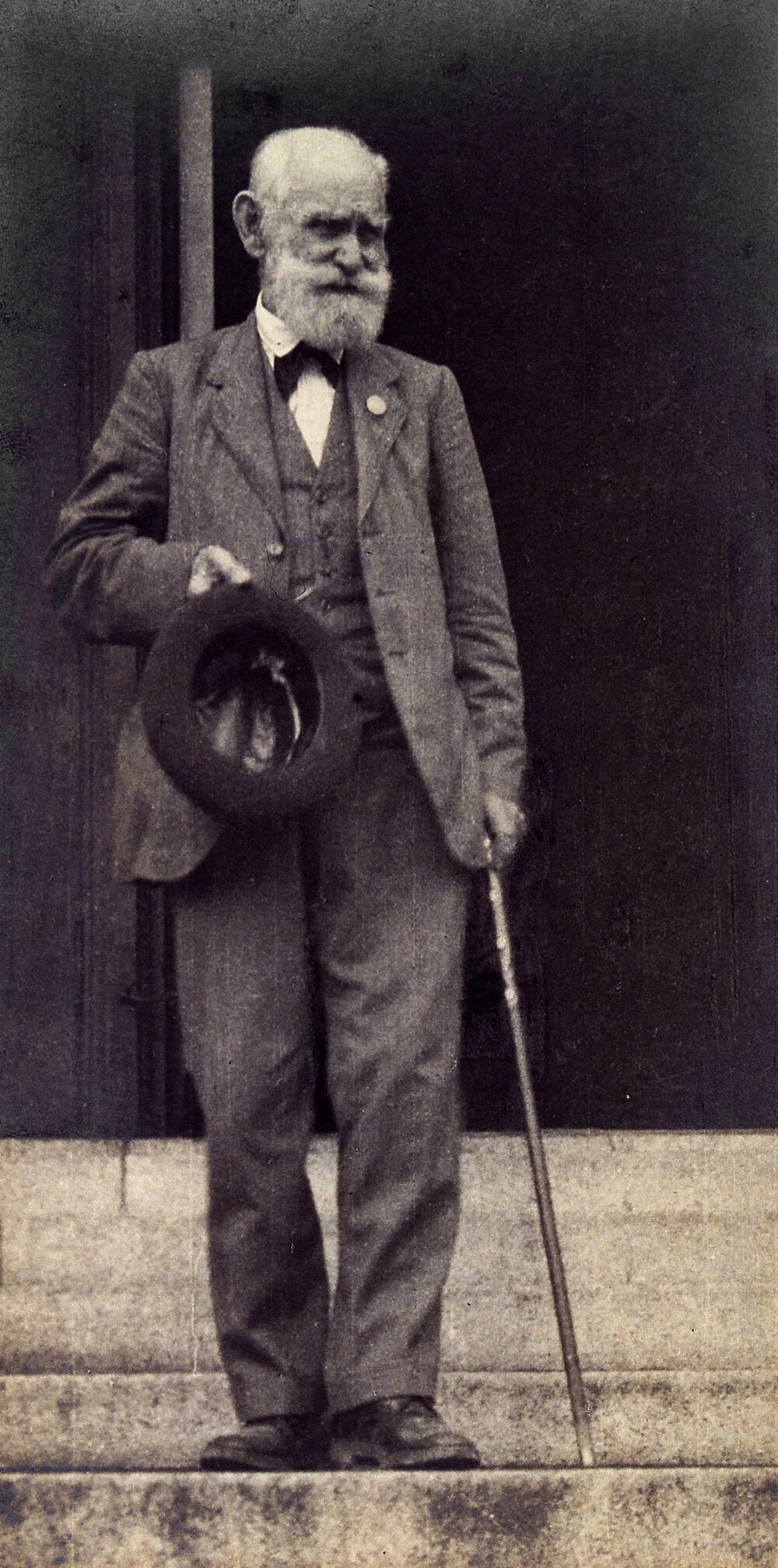
Ivan Pavlov's learning theory has been applied to classroom teaching, including the learning of Arabic by class VIII students at a state madrasah in Sukabumi City. A qualitative study used observation and interviews with one Arabic teacher and 12 students drawn from 4 classes. It found that the teacher made students learn by providing certain conditions, and that most students showed the expected response when the teacher often applied repetition and habituation to the material being studied. The study reported one drawback: the hour of study affected the response, and students who learned Arabic in the morning tended to respond quickly to the stimulus the teacher provided.[13]
Edward Lee Thorndike's account of learning rested on four laws: the law of readiness, the law of exercise, the law of effect and the law of attitude. A library study analyzed by content analysis found classical conditioning, repetition and reinforcement in behaviorist theory to be in use in Islamic education as well, and judged Thorndike's laws to be related to the learning process of Islamic religious education.[14]
John B. Watson and B. F. Skinner are the figures named as having popularized behaviorism, and the treatment of language acquisition turns on their models. For behaviorists, language is a learned behavior that arises through conditioning, which places the school among the proponents of an extreme empiricist model.[12]
In content the behaviorists worked mainly on learning. They paid no attention to perception or behavior genetics, and they said little about how motives are classified. Behaviorism still left a significant mark on mainstream empirical psychology in America and elsewhere. It did not restrict itself to data testable by intersubjective agreement, but it became critical about the data used, rigorous in experimental design and more critical in theorizing. Some of that trend may have helped generate behaviorism, but it appears mainly to be a heritage from behaviorism itself.[3]
Neobehaviorism and the move toward cognitivism
Neobehaviorism was a school of psychology that kept the behaviorist demand for strictly objective observational methods while allowing hidden processes inside the learner to enter the theory. Like Thorndike, Watson and Pavlov, the neobehaviorists held that a scientific psychology depends on studying learning and on observational methods that are rigorously objective. Unlike their predecessors, they worked more deliberately to formalize the laws of behavior, and they are associated with Tolman, Hull, Skinner, Hebb and Bandura. Their theories took abstraction and hidden variables into account and treated behavior as a whole rather than as a collection of separate reflexes.[15]
The transition from behaviorism to cognitivism was slow and progressive, and it changed the general direction of psychology. Computer systems that process representations were put forward as an alternative to the theoretical and epistemological shortcomings of behaviorism. The subject matter of the first scientific psychology was taken up again, but mental phenomena were now characterized and studied with a different methodological program and different instruments, closer to those of the behaviorists than to those of Wundtian psychology.[16]
Cognitive-behaviorism has been described as a union of opposites, because cognitive and behavioral theories carry opposing images of the person. Under cognitive-behaviorism people are viewed as both active and reactive, responding to cognitive factors and to environmental factors. The framework is said to have liberating effects on thinking in the areas of personality, psychotherapy and development.[17]
Both schools shared a philosophical commitment to determinism, the view that mental events have causes rather than arising from free choice. The radical behaviorist claim that higher mental processes are determined is pursued today in social cognition research on automaticity, the performance of mental processes without conscious control. Studies of automaticity have found that social interaction, evaluation and judgment, and the working of internal goal structures can all go forward without conscious acts of will steering the process.[18]
Jean Piaget's theory has been placed alongside behaviorism and other psychological and epistemological theories that have influenced education. On the psychological side, the relation between behaviorism and Piaget's theory is not one of mutual exclusion but a part-whole relation in which behaviorism is encompassed by Piaget's theory. On the epistemological side, Piaget's constructivist interactionism is presented as a synthesis that encompasses both empiricism and rationalism. Because education has rested mostly on empiricist assumptions, the conclusion drawn is that Piaget's theory implies a fundamental reconceptualization of curriculum and of methods of teaching.[19]
Behaviorism in literature, writing and communication
Gang (2011) traces lasting assumptions and techniques of close reading back to psychological behaviorism, starting with I. Richards's critical work of the 1920s. Gang (2011) argues that behaviorist psychology shaped the New Criticism from the start. Cleanth Brooks's The Well Wrought Urn and the essay on the intentional fallacy by Wimsatt and Beardsley kept behaviorism's influence alive in literary criticism, even though both openly dismissed Richards's behavioristic poetics. Wimsatt and Monroe Beardsley rejected Richards's behavioristic poetics in words, yet the influence of behaviorism carried on in their criticism. In the spring of 1926, Richards ran a seminar at Cambridge called Practical Criticism in which students received poems stripped of titles, identifying marks and clues about origin, and their written responses became the main evidence for the book of the same name. Wimsatt and Monroe Beardsley, in their essay on the intentional fallacy (the mistake of judging a poem by what its author meant to say), spoke against Richards's behavioristic poetics. Even so, their work carried behaviorism's influence forward into literary criticism. The New Critics turned behavioristic psychology into poetic formalism, an approach that treats the poem as a self-contained object whose effects on readers can be studied.[20]
Writing studies, the field that researches how people compose texts and how that skill is taught, has had a complex and uneasy relationship with behaviorism. A 2016 account in College Composition & Communication argues that the field's history is more tangled than its standard version suggests. That account asks writing scholars, teachers and program administrators to say which understandings of writing behaviors are productive and which are not.[21]
Dog training offers a parallel case: current practice generally relies either on the pack-and-dominance concept or on behaviorism and operant conditioning with heavy emphasis on positive reinforcement, and newer programs go beyond behaviorism by drawing on research on dogs' emotional and cognitive abilities. Trainers who write such programs go beyond the limits of behaviorism by using current knowledge of dogs' emotional and cognitive abilities, which trainers strongly attached to behaviorism tend to overlook. The newer approach does not oppose critical anthropomorphism, the careful reading of animal behavior in human terms, and it treats the dog-human relationship as a bond of mutual benefit rather than a one-way arrangement.[22]
Baldwin compares George Herbert Mead's work on emotions, seen from social behaviorism, with the modern behavioral analysis of emotions, and finds the two positions strikingly similar. George Herbert Mead's social behaviorism, as presented in a 1985 comparison, resembles the modern behavioral analysis of emotions closely. The modern analysis confirms most of Mead's basic observations and extends them.[23] A 1982 history of social behaviorism and social learning theory from 1870 to 1980 describes three generations of social behaviorists who disputed whether one, two or three factors are needed to account for social activity. Those generations shared a functional feedback view, stated in terms of self-reinforcement, and worked gradually toward operational definitions of the laws of contiguity, effect and observational learning.[24]
Main ideas
Skinner and operant conditioning
Skinner (1904 to 1990) built his account of learning on operant conditioning, the idea that what follows a behavior shapes it. A concise overview of the theoretical assumptions behind behaviorism, which generally informs traditional approaches to sport coaching, treats Skinner's operant conditioning as the central theory to be understood.[25]
The word radical in radical behaviorism is in current use as a label for the variety of behaviorism Skinner proposed. Historically, that qualifier was not applied only to Skinner's proposal, and its several meanings tend to produce incorrect interpretations of what characterizes his radical behaviorism. One analysis sets out to clarify the most appropriate sense of radical for Skinner's behaviorism through four linked activities.[26]
Skinner wrote About Behaviorism, published in 1974, partly because assumptions and principles attributed to his behaviorism were circulating widely in the press, in scientific articles and in academic debates at conferences. The book works as a kind of summary of his main themes, especially from an ethical angle, and covers proposals that apply not only to individual behavior but to the possibility of designing cultural practices.[27]
Evidence that the label is widely misunderstood comes from surveys of students. Results showed that many of the basic concepts and assumptions of radical behaviorism were misunderstood by these students.[28]
Skinner's own statement of the position, written when behaviorism was fifty years old, begins from the fact that each person is uniquely subject to particular forms of stimulation arising in a small part of the universe inside the skin. Mentalistic psychologies, in his account, insist that other kinds of events, which lack the physical dimensions of stimuli, can be reached by the person whose skin encloses them. One solution often regarded as behavioristic grants the distinction between public and private events and rules the private ones out of consideration, and Skinner judged that solution unsuccessful. The search for copies of the world inside the body, such as the sensations and images of conscious content, had also produced discouraging results, because the organism does not create duplicates: seeing, hearing and smelling are forms of action rather than of reproduction.[29]
Behaviorism in language teaching and acquisition
Behaviorist accounts of language learning treat speech as learned behavior, built from associations between stimuli and repeated responses and held in place by reinforcement, which is any consequence that makes a response more likely to recur. In this view a child acquires language from the surrounding environment rather than from an innate grammar, and vocabulary grows through dialogue, questions and interactive talk with caregivers.[30][31] A qualitative study looked at 5 children aged 0 to 5 years whose mothers worked full time and who were raised by different babysitters. It reported that the style of caregiving shaped language acquisition, because interaction between child and caregiver supplies the stimulus and the repeated response that form the habit. The same study concluded that the environment matters a great deal in language development, particularly for vocabulary.[31]
For second language learners, a study in applied linguistics found that features of behaviorism contributed to successful second language acquisition, naming reward, habit formation and stimulus-response processes. Reward was described as building a positive attitude toward exploring the unfamiliar, which in turn supports an affirmative language attitude. The same investigation listed limited exposure to the target language as a primary linguistic factor in students' collective performance, since a transition phase forced occasional switching between languages to complete a cycle of communication.[32]
A review of behaviorism and foreign language teaching methodology argued that the approach is gradually left behind as newer theories of language learning appear, yet remains useful in certain classroom activities.[33] A descriptive qualitative study of the behaviorist perspective concluded that behaviorist theories of language make a good contribution to the learning process, and defined learning as a change of behavior through experience. The same study noted that people use language for communication and to spread culture, so knowledge of a language is gained through learning.[30]
A 2022 literature review argued that Skinner's account of language acquisition can help teachers of Arabic choose which technology media and methods to use, and that synchronous online formats with direct communication suit that purpose best. A literature review applying Skinner's view to online Arabic learning found that the theory helps teachers decide which technology media and methods to use. It recommended synchronous learning, online instruction with direct communication such as a live meeting, as far as possible, on the reasoning that Arabic learning succeeds when the four language skills are habituated. Teachers were also advised to set rewards or reinforcement suited to each learner's psychological condition so that learners keep improving their skills during online study.[34] A case study of one Islamic boarding school in Southeast Sulawesi described Skinnerian principles carried out through daily Arabic conversation, vocabulary memorization, thematic speeches, and watching and summarizing Arabic media, with punishments or fines for breaking language rules. Internal factors (motivation, self-confidence, and the aspiration to study in the Middle East) and external factors (the school environment, social interaction and teacher support) contributed to the program's effectiveness, while student participation and limited facilities remained challenges.[35]
An ethnographic and narrative study of a prominent modern Islamic boarding school in East Java found that the school used both behaviorist and mentalist theories in its language learning. Students there communicated with one another in the foreign language in a daily language environment and were also required to study its structures and systems in class. The mentalist position it set beside habit formation rests on a language acquisition device, an innate capacity for learning language.[36]
Measuring behavior in controlled experiments
Behaviorism treats psychology as a natural science that works with publicly observable stimuli and responses rather than with introspection, and its laboratory procedures were built to keep observation on that public footing.[37][38] In the stimulus-response version, the experimenter predicts a response from the stimulus or situation presented; in the response-response version, one targeted response is predicted from another. Mental states that cannot be observed enter such designs only as intervening variables, hypothetical links that stand between the stimulus and the response and carry no claim to be studied directly. Its basic axioms state that behavior depends on lasting potentials for action and on temporary instigation to act. The axioms also hold that excitation and inhibition control behavior, and that behavior mixes coping, where the organism has control, with adaptation, where control is lacking.[37]
Skinner had described that method in print before he shaped an operant response by hand. He first did so by hand in 1943, during an incident in a flour mill in Minneapolis. Peterson describes the incident as a genuine eureka moment for Skinner, and it prompted him to coin the term shaping. The insight drew Skinner's attention to reinforcement that comes through biological ties to a living social environment, rather than through purely mechanical ties to a lifeless physical one. It also shifted his view of verbal behavior from antecedents and small topographical details toward consequences and more molar, functional properties, with the social dyad inherent to shaping becoming the definitive property of verbal behavior.[9]
Response strength is the behaviorist's central datum: it represents the probability that a particular operant response will occur among the many other responses available in the same repertoire. Strength is not directly observable and is inferred indirectly from observable behavioral events. Describing it requires identifying a form of response and the probability relations it holds with its independent variables, relations Skinner called functional units. A functional unit can be understood as the kind of functional relation established between a class of discriminative stimuli and a class of operant responses. Discriminative stimuli, emotional and motivational operations, and reinforcing stimuli all strengthen or weaken a given response form, and the notion of response strength groups these separate effects on the probability of occurrence. The cumulative record, the running plot of responding that Skinner named, carries the inference involved in this work and bears on his search for an interpretive system that would be both theoretically precise and practically effective. Response strength also supports a picture of behavior as a continuous phenomenon, sometimes called behavioral flow, which moves analysis away from an elementarist or associationist psychology.[39]
Functional analysis explains a capacity by identifying the function it serves rather than by subsuming it under a psychological law. Causal subsumption suits explanations of changes of state, but capacities are the central explananda of psychology, the things psychology most needs to explain. Clark Hull's motivational psychology makes little sense when construed along the subsumptivist lines Hull himself advocated, yet it emerges as interesting and methodologically sound when read as an exercise in functional analysis of the kind found in contemporary cognitive science.[40]
A related molar account defines behavior by its function, so that behavioral units are temporally extended patterns or activities, each an integrated whole composed of smaller-scale activities. In that account, phylogenetically important events are enhanced or mitigated by the activities they induce through natural selection, and induction is said to explain all the phenomena traditionally explained by reinforcement. The multiscale view swaps discrete responses and contiguity for multiscale activities and covariance. In it, a phylogenetically important event induces operant activity through a feedback relation, and a signal induces that activity through covariance with the event.[41]
Bar-Yam argues that empirical testing alone is limited in characterizing real world systems, because many conditions can affect their behavior, and that models are needed to describe behavior without observations of every possible condition. An analysis of the information obtainable from experimental observations concludes that empirical testing is inherently limited in characterizing real-world systems because of the large number of conditions that can affect behavior. Models are needed because they can characterize behavior without requiring observations under every possible condition, and testing models against observations increases the usefulness of those observations. Where adequate models have not been developed or are impractical, the limits of empirical testing leave uncertainty in knowledge and risk in individual, organizational and social policy decisions.[42]
Skinner's texts treat chance in two ways. In the first, chance conflicts with scientific knowledge, since laws, prediction and control are the goals of a behavioral science. In the second, chance fits that science when it enters explanations of how behavior evolves through variation and selection.[43]
Behaviorism in second language transfer and error
The behaviorist account of transfer in second language learning begins with Edward Thorndike, who proposed transfer theory in 1913 to describe how learners use knowledge or skills they already have when acquiring information or skills in a new situation. In its early behaviorist form, transfer theory treated transfer as unidirectional; later cognitive and sociocultural work added bidirectional transfer and situational factors. Later research on transfer theory moved from that one-way picture toward bidirectional transfer and toward the role of situational factors, as cognitive and sociocultural theories took hold.[44]
Behaviorism defines learning as a change of behavior through experience, meaning that people learn from their environments. Applied to language, this view holds that a child can learn language from the surrounding environment, and that people gain knowledge of a language through learning rather than through an innate faculty alone. The same perspective treats language as a tool for communication through which a person also spreads culture.[45] One account of human thought within this tradition holds that thinking arises through interaction with the outside world, or through the development of a stimulus-response connection. Behaviorism is described as having dominated learning theory in the United States for the past 50 years and as remaining one of the major schools of thought.[46]
Zhang concludes that guiding children's English teaching with behaviorism, and fixing what is learned through repeated practice, matters greatly for children's English learning. That review also recommends using behavioral teaching concepts rationally, to build more flexible learning strategies and to make correct analyses and improvements.[46] In higher education, behaviorism has been closely tied to the audio lingual method, which lecturers use to give students reinforcement and encouragement. A paper on an English program in an environmental health department argues that the psychological aspects of students learning online should be supported by a suitable method, given this link between behaviorist theory and the audio lingual method.[47]
Behaviorism is one of several theories used to explain why second language proficiency falls short of expectations, alongside innatism and interactionism. In Indonesia, English has been part of the school curriculum since the first grade of junior secondary school, and some elementary schools have offered it as local content since the fourth grade. Government efforts to raise graduates' English competency have not matched expectations, and students' English skills remain at a low proficiency level. The Education First English Proficiency Index ranked Indonesia 51 out of 88 countries in 2018.[48]
Private events, values and the radical behaviorist program
Radical behaviorism is the version of behaviorism that B. Skinner set out in his own writings, and it treats events that no other person can observe, such as thoughts and feelings, as private events. A 2002 analysis of this position describes the scientific treatment of private events as one of the least known but most important parts of radical behaviorist philosophy and behavior analysis. That analysis sorts the problems raised by private events into ontological, epistemological, theoretical, methodological and applied levels, meaning questions about what such events are, how they can be known, how they fit theory, how they can be studied and how they bear on practice. The same analysis sets out the answers radical behaviorism and behavior analysis have given to those problems across the history of behaviorism, and it compares that account with the one offered by cognitive psychology.[49] Skinner held that concepts are already in the world before anyone names them. He also held that they are bound up with social and cultural descriptions and predictions.[50]
A 2008 essay examines whether radical behaviorism can explain behavior without causes. The essay lists the parts of causal thinking as conditionality, uniqueness, necessary connection, one-sided dependence and genetic connection. It argues that radical behaviorism rejects all of these except conditionality, which makes a non-causal reading of its explanatory model plausible. On that reading, explaining behavior means describing how the flow of behavior works through relations of functional interdependence among events, states and processes, rather than searching for the causes of behavior. The essay concludes that ambiguities in Skinner's text on explanation can be resolved by dropping the logic and vocabulary of causality and adopting a dynamic explanation of behavior.[51]
Chance appears in Skinner's writings in two ways, according to a 2026 epistemological study. In the first, chance is incompatible with producing scientific knowledge because it is set against the goals of behavioral science: laws, prediction and control. The study reads these two uses as signs of a shift toward selectionist and indeterministic conceptions of science in Skinner's thinking.[52]
Values entered the behavior-analytic literature through Skinner and were later expanded by S. Brunkow and Dittrich (2026) found one area of agreement, three areas of divergence and three areas of direct contradiction between the two traditions, and they examined whether the accounts might also be complementary. Hayes and colleagues, and they are now a central part of acceptance and commitment therapy and of contextual behavioral therapies. A 2026 conceptual analysis compared how radical behaviorism and functional contextualism, a related approach that treats behavior in terms of its function in context, define values. It also explored whether the two accounts might complement each other. The analysis concludes that the two approaches give conceptually incompatible accounts of values, and it argues that each definition carries implicit normative commitments that shape the community's practices. Choosing between definitions is therefore presented as a question of which one best serves the behavior-analytic community's purposes and interests. It is not presented as a matter of which is correct in a realist or empiricist sense.[53]
Neo-Skinnerian psychology is a non-radical form of behaviorism, described in a 1988 paper as growing out of Skinner's writings from 1938 through 1950. The paper calls radical behaviorism's claim that an appeal to mind explains nothing at all implausible, and it argues that the Skinnerian research program does not need that claim. On the neo-Skinnerian conception, the behavior analytic program fits together with the central claims of cognitive psychology and of folk psychology.[54]
Research
Reward, punishment and student motivation
Operant conditioning, in Skinner's account, shapes behavior through the reinforcement that follows it.[55] Studies of classroom reinforcement have looked at what it does to students' motivation, engagement and confidence.[55][56]
One quasi-experimental study tested reinforcement in English speaking classes, comparing an experimental class that received reinforcement with a control class taught by conventional instruction. Pre-tests and post-tests, plus a motivation questionnaire on a Likert scale, were analyzed with t-tests. Mean speaking scores in the experimental group rose to a Satisfactory level of 82.37, against 69.12, described as Adequately, in the control group. Scores in the reinforced class also became more uniform, with the standard deviation, a measure of how widely scores spread around the average, falling from 10.21 to 6.01.[55]
A second quasi-experimental study examined motivation and learning outcomes through a behaviorism approach attributed to Albert Bandura, using a pretest, a posttest and a control group. The sample was drawn by saturated sampling, in which every member of the available classes is included: 25 students in class VB formed the control group and 28 students in class VA formed the experimental group. A MANOVA test, which compares groups on several outcome measures at once, gave a significance value of 0.011, below the 0.05 threshold, so the null hypothesis was rejected.[57]
Digital learning applications apply the same logic with points, badges, leaderboards and instant feedback as rewards for learning behaviors. A systematic literature review, which identifies, selects, extracts and synthesizes articles from international and national scientific databases, examined whether such rewards affect elementary school students' motivation and engagement. The review found that digital rewards can raise motivation of both the intrinsic and the extrinsic kind, strengthen engagement in its emotional, cognitive and behavioral forms, and promote consistency and independence in learning.[56]
Behaviorism in clinical psychology and addiction
One radical behaviorist restatement of psychopathology treats the standard diagnostic systems and their neurobiological reading of mental disorders as a claim to be examined rather than accepted. In radical behaviorism, radical carries several senses. It means total, in that nothing of interest to psychology is set aside, and pragmatic, in that knowledge is judged by its practical use. It also comes from the Latin word for root, so that change begins at a system's foundations. The restatement borrows the Aristotelian distinction between material and form, described as behaviorist before the term existed, and uses it as a critical tool to expose what the account calls the hoax of psychopathology as usually presented. Some implications of this restatement were already prepared for clinical practice at the time of writing.[58]
A conceptual study of activity in Skinnerian philosophy answers the charge that radical behaviorism treats the individual as passive. It distinguishes two senses of active: whatever begins or causes something, and whatever produces events, whether or not the variables behind that production are visible. The analysis argues that cause and effect are incompatible with a radical behaviorist perspective and that the second sense fits Skinnerian assumptions. Operant behavior is then related to that second sense as instance, class, probability and repertoire, with the production of consequences and the reflexive nature of behavior treated as its active dimension. On this account no initial cause and no split between behavior and environment are needed.[59]
A 2023 review describes how basic behavioral science developed by Howard Rachlin and his contemporaries has been applied to substance use disorder and related health behaviors. It summarizes innovations including molar behaviorism, which includes the matching law, a rule relating how choices are distributed to how rewards are distributed. The other innovations are behavioral economics and teleological behaviorism, which explains behavior by its final causes, meaning the outcomes toward which patterns of behavior are directed. The teleological perspective is said to merge with the contemporary socioecological model of health behavior, which widens the contextual influences considered to include community, economic conditions, infrastructure, health care access and policy. The review reports that translations from basic to applied work have been successful so far.[60]
Rachlin argued in 2003 that whether a particular act is autonomous depends on the pattern of behavior it belongs to. He called this conditional autonomy. His example is a person crossing the street: the act may serve a long-term pattern, such as regularly buying groceries at a supermarket across the street, or it may be done simply for its own sake. An act counted as autonomous regardless of its temporal context would have unconditional autonomy. Rachlin held that conditional autonomy is a highly useful and even necessary concept for any human society, while unconditional autonomy is useless and impedes efforts to understand and explain human behavior.[61]
An integrative review mapped harm reduction strategies for people with substance use disorders from 2018 to 2024 through the lens of behavior analysis. Harm reduction is presented there as an alternative to the usual model of punitive practices. The interventions found were sorted into groups including distribution of supplies, substance testing, substitution therapy, supervised consumption rooms, various strategies, and recurring aspects. The results indicate a high proportion of strategies that are heterogeneous, individualized and designed for specific contexts, with interventions aimed mostly at opioids and with emphasis on the distribution of supplies and on psychoeducation.[62]
A 2024 case study examined hebephrenic schizophrenia, a form of schizophrenia marked by disorganized behavior and disturbed mood, in a 21-year-old man with a history of drug abuse. The qualitative study used a case study approach at a psychiatric hospital in East Java over two weeks. Data came from documents, observation and interviews involving the man and his family, and were analyzed with the Miles and Huberman technique of data reduction, data presentation and conclusion drawing. The man showed disorganized behavior, affective disorders and fragmentary hallucinations.[63]
In practice
Classical and operant conditioning in the classroom
Classical conditioning and operant conditioning have both been applied to the problem of student truancy. Under classical conditioning, class attendance is linked with a pleasant experience. Under operant conditioning, rewards follow consistent attendance and consequences follow non-attendance.[64]
In elementary schools, reward and punishment are described in behaviorist theory as a form of reinforcement, which strengthens or weakens the link between a stimulus and a response. A 2018 qualitative study interviewed elementary school teachers from both the lower and the upper grades and combined those interviews with a review of published work. The teachers reported that giving rewards and punishments had a positive effect on students, who became more eager to do better in their learning and their conduct. The same study found that reward and punishment used as reinforcement also produced a competitive atmosphere in the classroom.[65]
A 2023 analysis built on Skinner's operant conditioning and his Skinner box experiment reached a similar conclusion about necessity, finding that reward and punishment are needed with school-aged children. That analysis, drawing on literature and case examples, reports that the two strategies act immediately, can increase prosocial behaviors, meaning actions that benefit others, and work better than reasoning when the learners are young. The same analysis records the opposing case: some researchers hold that reward and punishment address only short-term success, and that when overused they become a display of power and reduce children's autonomy. It recommends three conditions for effective use, namely applying the consequence immediately after the behavior, choosing the proper reinforcement, and concentrating on behaviors rather than on the children themselves.[2]
A 2025 quasi-experimental study with mixed methods tested reinforcement in classrooms working under the Merdeka Curriculum, a framework for Indonesian schooling, using classroom observations, student questionnaires and teacher interviews. The study found that positive reinforcement significantly raised student motivation, particularly when it was tailored to individual characteristics. It also found that excessive positive reinforcement risks undermining intrinsic motivation, the wish to learn for the activity itself rather than for a reward. Negative reinforcement in the form of task reduction improved student engagement, though the study warns that it needs careful application to avoid dependence on external support. In inclusive classrooms, where students with diverse needs and abilities learn together, the study concludes that reinforcement strategies must accommodate that diversity. Its overall recommendation is that reinforcement be personalized and balanced, supporting learning that is student-centered and independent and aligned with long-term educational goals.[66]
Instructional design and teaching methods
Instructional design is the planning of teaching materials, activities and assessments before a lesson is taught, and the theories a designer holds about how learning happens shape the choices made at that stage. A qualitative review of the literature concluded that 3 learning theories have centrally shaped the direction of instructional design: behaviorism, cognitivism and constructivism.[71]
A 1993 comparison of the three positions argued that learning theories give instructional designers verified instructional strategies and techniques for facilitating learning, along with a foundation for choosing a strategy intelligently.[72] In behaviorist teaching, the teacher supplies a stimulus in the form of material the student must act on, and the student responds by carrying out the assignment.[73]
In seventh-grade football instruction, the drill model was presented as an alternative for teaching sports techniques, with students repeating movements arranged by the teacher. The study concluded that a variety of exercise learning models lets students reach better and more active sports movements and feel happy while doing so, and that teachers need to keep innovating to design models suited to the characteristics of their students.[73] A qualitative study of thematic learning at a Madrasah Ibtidaiyah in Lumajang Regency, Indonesia, found that teachers often gave students a stimulus during lessons and often asked questions as reinforcement of the material studied. Assessment in that class took the form of daily assessments covering attitude, knowledge and skills.[74]
The muhadasah method of teaching Arabic, associated with Mukhtar Yahya, shows the same structure in a religious setting. An analysis using a historical and a psychological approach found that the method was strongly influenced by behaviorism, although Yahya never stated that influence explicitly. The theory was highly visible in the learning steps: the learning process occurs through the presence of a stimulus, which then produces learning responses from students. The analysis also recorded Yahya's institutional role in the birth of the State Islamic College (PTAIN) and the Sunan Kalijaga State Islamic Institute (IAIN), where he held important positions and frequently took on double positions.[75]
The Personalized System of Instruction used behaviorist principles in a self-paced, mastery-based course design. Fred S. Keller and colleagues applied Skinnerian radical behaviorism to higher education through the Personalized System of Instruction, or PSI, a self-paced system intended to accelerate learning within the classroom. Keller developed a mastery-based approach that used generalized reinforcers to cultivate higher-order learning behaviors, a different entry into education from Skinner's focus on educational technologies. PSI originated in the context of Brazilian revolutionary history and later circulated widely in the United States amid Cold War concerns about an engineering manpower crisis.[76]
Subject teaching in mathematics, science and reading
Behaviorism has been described as particularly relevant to procedural accuracy and fluency in mathematics. A 2026 conceptual review of mathematics learning describes behaviorism as explaining learning through observable changes in behavior shaped by stimulus and response relations, practice, reinforcement and feedback. The same review holds that this account suits procedural accuracy and fluency, meaning correct and smooth execution of calculation steps, while it gives a weaker account of conceptual understanding and strategic thinking. Its conclusion is that no single perspective explains mathematics learning fully, and that principles from different theories should be matched to learning objectives, task demands and the kind of mathematical knowledge being taught.[77]
Two related studies by the same pair of researchers describe web-based mathematics media built around the behaviorism of junior high school students.[78][79] The first used a development model with stages of design, validation and trial to build media for sharpening mathematical numeracy, the ability to work with numbers and quantitative reasoning. Validation scores were 76.66 percent from material experts, rated feasible, and 100 percent from media experts, rated very feasible, and a beta trial reached 95.33 percent, also in the very feasible category.[78]
In biology, a 2023 literature review examined the use of behaviorist learning theory to improve understanding of biological concepts in senior high school. It reports that regular provision of stimuli produced appropriate responses and raised understanding of concepts, and that flipbook media used in a behavioristic approach increased students' motivation, which in turn influenced learning outcomes or achievement.[80]
For reading, a 2024 review of the literature on English as a foreign language argues that several learning theories work together in the development of reading skills. In that account behaviorism supplies the foundational skills of reading, cognitivism addresses the mental processes involved, constructivism covers the making of meaning, and social learning theory covers interactive experience.[81]
Religious and Islamic education settings
Behaviorist learning theory has been studied in Islamic religious education (PAI, from the Indonesian term Pendidikan Agama Islam) in several settings, including high school classrooms, the planning of Arabic lessons and the framework of the national curriculum.[82][83][84][85] A qualitative study of high school Islamic education classes reported that Skinner's operant conditioning, in which a behavior becomes more or less frequent depending on what follows it, was successfully applied through planned stimuli and reinforcement. The same study described changes in student behavior in a positive direction, including the formation of learning motivation, greater activeness, reinforcement and improved student memory.[82]
A 2025 literature study compared behaviorism with cognitivism, the view that learning depends on internal mental processes such as understanding and reasoning, in Islamic religious education. That study concluded that behaviorism, with its emphasis on repetition, habituation and reinforcement, suits the teaching of basic religious practices such as prayer and Quran memorization. Behaviorism was said to support the formation of discipline and routine, while cognitivism was said to promote deeper comprehension and meaningful engagement with Islamic teachings.[83]
A 2020 literature study examined how Skinner's thinking could shape the planning of Arabic instruction. Its proposed plan analyzes the material being studied down to its smallest units, uses a module system for subject matter, and tells students in advance how they will be evaluated. Errors are corrected and correct answers are reinforced, and tests are weighted toward diagnosis of learning difficulties. The plan also favors changing the learning environment to prevent misbehavior rather than punishing it, rewards the behavior educators want, and breaks desired behavior into small steps that approach the goal. Mastery learning, in which material is studied thoroughly at each stage, is recommended because each child learns at a different rhythm.[84]
A qualitative descriptive study at MTs Al-Adli Palembang, a Islamic junior secondary school, described Arabic learning built on behaviorism theory across planning, process and evaluation. Planning there was structured, with objectives, teaching materials, methods, media and an assessment system adjusted to student needs. The learning process used an approach that was direct and individual, with intensive interaction between teachers and students. Evaluation included oral tests, written tests and observation, and covered the cognitive, affective and psychomotor domains, that is, knowledge, attitudes and physical skills.[86]
A 2026 systematic literature review examined 25 studies published between 2020 and 2025 on how behaviorism, cognitivism and constructivism figure in Islamic religious education under Indonesia's Kurikulum Merdeka, or Independent Curriculum. Cognitivism served as a bridge for complex conceptual knowledge in Fiqh (Islamic jurisprudence) and Aqidah (creed), partly through advanced organizers, introductory material that links new content to what students already know. Constructivism, the view that learners build knowledge from experience, was described as the central philosophical core. It is used in Project-Based Learning (P5) for critical character, religious moderation and the contextual application of Islamic values. The review concluded that PAI is moving away from a purely doctrinal approach toward a model that is adaptive and student-centered.[85]
A library study argued that behaviorism agrees with the aims of Islamic education, which instils knowledge by forming behavior and repeating habits with an Islamic character. That study treated the integration as equivalent, linking behaviorist ideas to Quranic verses and to connectionism, classical conditioning, operant conditioning and Clark Hull's theory.[87] Another library study described systematic steps for integrating behaviorism into PAI methodology, from analyzing material and formulating objectives to choosing strategies, evaluating, analyzing results and refining methods. The same study noted a limitation: behaviorism does not address the spiritual and inner aspects that lie at the core of Islamic education, so its integration needs to be aligned with Islamic values.[88]
Behaviorism in digital and diverse classrooms
For digital classrooms in higher education, one paper sets behaviorism against constructivism and recommends a blended method that draws on both. Behaviorism is described there as stressing observable behaviors, reinforcement and structured learning experiences. Constructivism, in the same account, centers on active learning, cognitive processes and knowledge built jointly by learners. The practical recommendations include learning management systems for structured content delivery, adaptive tools for personalized learning, and collaborative platforms that support social interaction.[89]
A mixed-methods study examined how constructivism, behaviorism and Universal Design for Learning (UDL), a framework for planning instruction so that varied learners can take part, can be combined in diverse classrooms. Data came from three sources and were checked against one another: classroom observations, teacher interviews, and assessments given before and after the intervention. Constructivist strategies enhanced by UDL raised participation by 40% in heterogeneous classrooms. Behaviorist techniques, in structured settings, improved skill mastery. Teacher training (p<0.01) and flexible curriculum design were reported as key success factors. Rural schools, despite technological limitations, achieved 28% higher outcomes by localizing UDL principles. The study concludes that contextually adapted blends outperform isolated approaches and that policymakers should prioritize teacher capacity-building to scale the model.[90]
In religious education, a library study of behaviorism in fiqh subjects, the Islamic jurisprudence curriculum, found that its principles fit learning that judges success by observable changes in behavior. Methods named for that setting include the lecture method, the demonstration method, drill or habituation, and memorization. In the digital era, the study suggests, teachers can use learning applications and other digital media as stimuli and reinforcement. The study lists challenges as well: technology is not equally accessible, digital content varies in quality, and too much focus on repeating external behaviors risks reducing cognitive and spiritual depth.[91]
An analysis of behaviorism as a pedagogical framework for K-12 education in Chile notes that its stimulus-response mechanisms and reinforcement schedules fit a national system that has put growing emphasis on academic accountability, standardization and measurable learning outcomes. Practical applications examined include reinforcement techniques, behavioral objectives, task analysis and feedback systems. The analysis also considers how behaviorist practices can be built into teacher training programs and assessment protocols. The analysis also addresses limitations, above all the risk of weakening student autonomy, creativity and critical thinking. It argues for balancing behaviorist techniques with constructivist and humanistic principles.[92]
Behaviorist ideas in nursing and health training
Learning theories serve as the main guide for planning teaching in nursing, both in the classroom and in clinical training, and teachers who know their general principles can apply them more effectively to different learning situations. Behaviorists hold that learning is a change in observable behavior, and that it occurs when a stimulus and a response are connected. One application of this approach in nursing education is its influence on learners' emotional reactions. Among the theories in this tradition, the work of Thorndike and Skinner is subject to review and critique. A review drawing on English and Persian databases, with a search period from 1990 to 2012, concluded that each learning theory is useful in its proper place.[93]
Hartrick addresses the limitations of behavioral communication curricula in nursing education and describes a nursing communication course built on the principles of transformational learning theory. A 1999 article argued that behavioral communication curricula have limitations and proposed a teaching process suited to the complexity of caring relationships and relational practice. The critique appeared during a period in which nursing education was engaged in a curriculum revolution that had already produced profound changes in nursing curricula.[94]
In the education of children with intellectual disabilities, a 2020 study examined how constructivist and behaviorist concepts apply and found that the two do not differ methodologically or substantively for this group of children compared with their peers. The differences between the approaches concerned only the duration of individual methods.[95]
Behaviorist principles also inform efforts to change patients' health behaviors, a task that primary care teams must handle to reach treatment goals. A 2023 paper described how health behaviors start and change through three kinds of theoretical model: motivational models, post-intentional models and multistage models. Motivational models describe the role of individual cognitive variables in forming the intention to change, and they include the Theory of Reasoned Action, the Theory of Planned Behavior and the Health Belief Model. Post-intentional models identify factors that raise the chance of turning motivation into action, committing the person to act when certain environmental circumstances are met. Multistage models treat a health behavior as passing through several separate stages, so the kind of intervention and information needed differs by stage. When patients are helped to set realistic goals, such as advancing to the next stage, the process of change can become easier.[96]
Staff should assess how much importance the patient attaches to health and treatment, and with it the willingness and motivation to follow recommendations. Providing information alone will not guarantee a change in behavior. Health professionals should use active listening techniques, including open-ended questions and reflective and summarizing statements, encourage patients to express concerns, and weigh the pros and cons of different treatment approaches.[96]
Behaviorist methods in Arabic language classrooms
Arabic language classrooms in Indonesian Islamic schools and boarding schools have served as sites for studying how behaviorist teaching works in practice.[97][98] Behaviorism treats learning as a change in measurable, observable behavior, and it relies on repetition and training until a response becomes a habit. Desired behavior receives positive reinforcement, unwanted behavior receives negative consequences, and assessment is based on behavior that can be seen. Arisnaini writes that behaviorism learning theory aims at results that can be measured and observed, and that repetition and training turn the desired behavior into a habit.[98] A 2024 descriptive analysis of Arabic learning videos found that both stimulus-response theory and cognitive theory carry strong implications for how Arabic is taught on screen.[99]
A qualitative case study at KMI Pondok Modern Gontor Ponorogo examined how students acquired speaking skills in Arabic. Students combined behaviorist and cognitive principles, though behaviorist principles were more dominant in practice. Speaking developed across three settings: language classes, Islamic studies classes, and extracurricular and everyday activities. The factors that supported acquisition included opportunities for simulation and practice, imitation and repetition, many settings for building habits, a mentor among the students, a language atmosphere inside and outside classrooms, language role models, feedback and reinforcement, and enforced discipline through a monitoring committee. Linguistic problems in the same setting included difficulties with the phonemic system, Arabicization of words, shifts in word meaning, errors in sentence structure, use of Indonesian particles, and local dialect. The institution responded by correcting speaking errors, training committee members, modeling good style, practicing pronunciation, teaching grammar to middle and upper level students, and imposing harder penalties for deliberate violations of the language rules.[97]
A 2024 literature review applied Julian Rotter's version of behaviorism, built on locus of control, to students who struggle with Arabic. Rotter's account lists four aspects of locus of control. They are potential behavior, expectations, the values of reinforcing elements, and psychological situations. The review concludes that all four aspects can be applied to motivate students to learn Arabic, and that locus of control offers an alternative perspective for guiding students with learning difficulties. Those difficulties are attributed to internal factors, described as psycho-physical, and external factors, described as social. The proposed sequence runs from case identification and problem identification through diagnosis, prognosis, remedial or referral steps, evaluation, and follow-up, with the locus of control system integrated at each stage.[100]
The masrahiyyah method uses drama to strengthen Kalam proficiency, the speaking skill, and a 2024 qualitative descriptive study set out its content and steps within behaviorism. Its content draws on local wisdom, including Sampuraga (birr al-walidayn, kindness to parents), Gordang Sambilan (music), Poqir Fatayat (Islamic boarding schools), Abdul Haris Nasution and Musthafa Husein (respected figures), and Williem Iskandar (occupation). The steps begin with forming group work, choosing the drama script, and faculty guidance, then continue with reading the script, casting, role-playing, discussion, and evaluation.[101]
A 2023 library study compared five schools of learning theory, behaviorism, cognitivism, constructivism, generativism, and humanism, for teaching Arabic. The study sets out each school's definitions, characteristics, principles, and teaching steps, together with its advantages and disadvantages. Its stated aim is to help prospective Islamic educators choose a theory before they teach, on the argument that each school educates students in its own way and so bears on learning outcomes.[102]
Behaviorism across school subjects and skills
Behaviorist ideas have been applied to school subjects whose goals are habits of performance rather than bodies of understanding. A review of research on behaviorism in social studies learning concluded that the theory suits learning that requires habituation, meaning the repeated practice of a routine until it becomes automatic. In that account, learning succeeds when behavior changes in a positive direction, and the desired behavior appears through practice and repetition until a study habit forms. How far behaviorist methods fit a social studies lesson depends on the learning objectives, the nature of the material, the characteristics of the students, and the media and facilities available. The same review argued that social studies content needs to be tied to situations and conditions relevant to students' daily lives.[103]
A second review described behaviorism as a theory that stresses observable, measurable and quantifiable changes in behavior as the outcome of learning, in contrast with cognitive theory, which treats learning as a hidden mental process.[104] A study of behaviorism and Albert Bandura's social cognitive theory in schools likewise described behavioral learning as visible, observable change shaped by the external environment. That study attributed differences among learning theories to the different kinds of learning each one studies.[105]
Handwriting is a typical work product expressed as letters, symbols and numbers, and a qualitative case study examined how legible the handwriting of class 1 primary school students was. The study used in-depth interviews, observation and document study, and checked its data by triangulating collection techniques and sources. Its results indicated that behaviorism explains how handwriting legibility develops through learning, experience and reinforcement, while other factors also need to be considered.[106]
Off-task behavior refers to disruptive actions by students during a lesson in which they are not engaged in the lesson itself. A 2025 analysis described three aspects of such behavior, verbal, motoric and passive, and traced it partly to behavior formation, a concept discussed within the behaviorist approach. The analysis reported that reinforcement, self-control, individual counseling with behavior contracts, sociodrama and a token economy, a system in which earned tokens are exchanged for rewards, raised student engagement and helped create a productive learning environment. It also named implementation challenges, including limited facilities and pressure from the curriculum, and concluded that collaboration among teachers, counselors and the school is key to success.[107]
A 1980 article examined the approaching dominance of behaviorism and systems theory in that field against the conventional history most learning disabilities theorists accept. That conventional history places the field's origins in 1930s work on brain-injured children, which makes behavioral and systems management procedures look like new innovations pointing toward progressive and humanistic ends. The article placed the field's origins instead in work by American educators on the problem of backwardness, from the turn of the century through the 1920s. Seen this way, behavioral and systems management procedures are old practices among American educators. They serve deeply conservative social and political purposes, which undercut the progressive and humanistic aims claimed for them. The article proposed that this revised history could temper contemporary theorists' willingness to accept behaviorism and systems theory and thus retard the emerging dominance of the twin perspective.[108]
Pearsall and Gawboy examine programmed instruction and behaviorism in the teaching of music theory, using Paul O. Harder's Harmonic Materials in Tonal Music as a case. The tenth edition, revised by Greg Steinke and released in 2010, was described as a time capsule of pedagogical thinking about music theory. As the article describes it, the book prompts wonder at relics of the past that have been discarded, and at the same time it shows that problems still faced today have persisted.[109]
Behaviorism in Islamic education and character formation
Studies have examined behaviorist ideas in early childhood Islamic religious education, in da'wah communication, and in the ngenger life of students at a boarding school in Fadllillah Waru Sidoarjo.[110][111][112] A 2023 qualitative study of early childhood Islamic religious education argued that behaviorism fits Islamic teaching. Every act a person performs, the study said, falls within limits and rules set out in the Qur'an, Hadith, Ijma and Qiyas, and errors in applying them carry sanctions that may be implicit or explicit. The same study described early childhood as a period of rapid growth in psychological, physiological, language, motor and cognitive development, and treated the changes produced by stimuli shared between children and their educators as the goal of education.[110] A 2022 review written from an Islamic education perspective identified weaknesses in the behaviorist account of learning, of the nature of learners and of learning motivation. Among them were the school's tendency to equate human psychology with animal psychology and its treatment of motivation as coming only from outside the person.[113]
A 2026 literature review proposed integrating Skinner's operant conditioning, in which consequences shape the frequency of behavior, and Bandura's social learning theory, in which learners imitate models, into the hidden curriculum of Islamic education. In the proposed design, positive reinforcement is applied through habituation to ritual and professional discipline as a means of controlling materialistic orientations, while educators model moral integrity, social responsibility and a modest lifestyle.[114]
A 2023 qualitative study examined the application of behaviorist principles to dakwah, the communication of Islamic teaching, asking how a suitable stimulus can elicit a desired response from an audience. The study reported that measurable methods such as motivating lectures, the formation of worship habits and positive reinforcement to encourage participation can change individual behavior, and that habits form through continuous repetition of the desired behavior. Classical conditioning, the pairing of a behavior with a particular stimulus, can also be used by associating dakwah behavior with certain environments or situations, and the social and cultural environment can itself act as a stimulus that shapes religious behavior.[111]
A 2023 phenomenological study at the Fadllillah Waru Sidoarjo Islamic Boarding School analyzed ngenger, a practice in which pesantren students, called santri, live in and serve the household of the school's leader, the kyai, and his wife, the bu nyai. Students who ngenger described goals that included learning tasawuf, the Islamic discipline of spiritual purification, recompense, devotion, seeking blessings and life expectancy. Their duties included cleaning the ndalem, the leader's residence, washing and ironing the clothes of the kyai and bu nyai, preparing their food, and accompanying them wherever they went. The study reported that ngenger can shape behavior, including obedience, patience, resignation, responsibility, simplicity, humility and gentleness, along with an ability to interpret life. The study also reported that a student who obeys the kyai more fully completes his duties better and more nimbly. It read the practice through Watson's stimulus-response account of behaviorism.[112]
A 2025 library study proposed a Behaviorism-Contributive model that integrates Skinner's operant conditioning with social-emotional values for Indonesian primary education. The study reported that steady reinforcement raised students' intrinsic motivation, self-discipline and social responsibility. Shaping, the gradual reinforcement of successive steps toward a behavior, helped form prosocial behavior. It presented the model as a reference for teachers and institutions seeking a peaceful, inclusive and equitable learning environment, and it was based on literature rather than on new classroom data.[115]
Behaviorism in online and technology-based teaching
One study placed behaviorist theories in an online course on cognition and critical thinking in education, treating them as foundational psychological frameworks for educational practice. Participants in that course applied the frameworks to instruction and learning design through analyses, lesson designs and project designs. The analyses were group discussions of the readings and their application to practice, and the lesson designs were full-length lessons. The project designs were group projects that turned theory into an educational resource. The analyses, lessons and projects were then examined for understanding and application of theory.[116]
Massive open online courses, or MOOCs, are large open courses delivered over the internet, and one account of them describes both their convenience and their limits. The account comes from an undergraduate who took MOOCs as an elective and observed that most instruction arrived as recorded videos. Because of that format, students who are confused about a topic cannot clarify the point with an instructor in real time. Students also tend to listen passively during lessons, which the account reads as a sign that they may take in little and may not positively reinforce what they have learned. The same account presents online education as a complement to conventional classrooms rather than a replacement for them.[117]
In Islamic religious education, a library review of journals, books and prior research examined how learning principles and the theories of behaviorism and cognitivism could support technology-based teaching. The review reports that behaviorism can guide the design of technological features that serve as reinforcement and that build religious habits. Cognitivism, by contrast, is said to support digital media that help learners process information and learn meaningfully. The review describes a gap between the demands of 21st-century learning and practice that remains predominantly teacher-centered, and it recommends empirical testing of the proposed model's effectiveness in further research.[118]
Content management systems, the software that organizes and publishes material for websites, have been analyzed against learning theories including behaviorism, cognitivism, constructivism and connectivism. The analysis notes that a wide range of such systems exists and that no single solution manages all types of content. Its inputs are the information to be published, and its outputs are the pages that visitors see. Content management in this sense covers the systematic supply, creation, processing, management, presentation, publishing and reuse of content. The educational question the analysis raises is which types of system fit each theory of learning.[119]
Behaviorism in economics, accounting and organizations
Edwards argues that there is a misunderstanding about what behaviorism means in recent discussions of the history of economics and psychology, and explores what is called the behaviorist myth. A 2016 historical essay argues that much recent discussion rests on a misunderstanding it calls the behaviorist myth, and it traces the confusion to the behaviorist use of control as a central concept.[120]
A different proposal holds that an approach worked out in animal studies also suits human choice. In this account, Daniel Kahneman and Amos Tversky's prospect theory, a two-part account of human choice, has evolved over some years into a classification of the ways choices depart from rational reward maximization. Animal choice, by contrast, is explained causally as a contest among possible responses of different strengths. Each strength is tied directly to that response's historical payoff probability, and the responses compete in winner-take-all fashion. The cumulative effects model has been tested in operant conditioning experiments. In a two-armed bandit situation with two identical probabilistic choices, animals fixate on one option when the payoff probabilities are high but are indifferent when they are low, a pattern not easily deduced from optimality theory. Kahneman's distinction between fast and slow systems, the proposal writes, cannot be told apart from the distinction between active and silent responses in that model.[121]
In accounting, a 2024 article asks how the psychological characteristics of individuals affect professional activity, in particular the preparation of accounting and financial statements. Reviewing Western European scientific literature, the article concludes that an irrational component is permanently present in management decision making, not only among managers and investors but also among accounting employees. To lessen the impact of cognitive errors, it proposes that methodological accounting procedures be unified.[122]
Organizational analysis has drawn a sustained critique of the new institutional economics, an approach that explains institutions through transaction costs and bounded rationality, the idea that decision makers reason within limits. Instead, the paper argues for an interest-interdependence approach that builds on the work of Blau and, more recently, Coleman.[123]
Behaviorism and humanistic psychology have been compared as two views of human nature in an individualistic society. A 1997 article outlines the philosophical antecedents of each position, discusses the aspects of each that concern personality and imply a view of human nature, and describes the philosophical flaws of those aspects. It describes how each theory has been formally applied in the United States. It suggests that both views of human nature were readily accepted because they are complementary sides of an underlying individualistic world-view. The article ends by looking for evidence that such views exist or are appearing in post-Soviet Lithuania.[124]
What this looks like when you study
The reinforced class's mean speaking score rose to 82.37, rated Satisfactory, against 69.12 for the control class. Most students in that class reported high motivation after reinforcement.[55]
At a boarding school studied in Indonesia, students practiced speaking Arabic in classes, in Islamic studies lessons and in daily activities. The school ran simulations, imitation and repetition, and set up a court and monitoring committee to enforce its language rules. Teachers corrected speaking errors and gave harder punishment to students who intentionally broke the language regulation. The researchers found behaviorist principles dominant in how students acquired speaking skill.[97]
At one Islamic secondary school, teachers built discipline through punctual attendance, timely task submission and orderly classroom behavior, repeated daily. They gave verbal praise, additional points or simple rewards for disciplined behavior, and used constructive warnings or reflective tasks instead of physical sanctions. Students showed increased awareness of rules and better time management, and some moved from depending on rewards to more intrinsic motivation.[68]
A review of 25 studies of Islamic religious education found behaviorism used for repetitive practical skills such as wudu and shalat. Reinforcement there was kept to build religious habits before the moral meaning was explored. The same review found teachers trained in behavioristic pedagogy struggled to act as facilitators of group discussion.[85] When a source recommends a step, it is this: analyze the material into small organic units and use a module system. Tell students the evaluation criteria in advance, correct errors and strengthen correct answers, and let each child learn at a different rhythm through mastery learning.[84]
Criticism
Criticisms, limits and open questions
One long-running dispute in behaviorism concerns internal states: feelings, motives and thoughts that lie between a stimulus and a response. Within behavior analysis itself, Baum and Staddon disagree on this point, according to a 2004 account of their exchange.[125] A related critique holds that theoretical behaviorism rested on the premise of a passive organism, even though the learning-theory movement it grew from promoted scientific understanding of the active organism.[126]
Another line of criticism concerns the philosophy that some behaviorists adopt rather than their findings. Some behaviorists treat positivism, the view that science should describe only what can be observed, as obsolete and propose pragmatism or its relative contextualism as the proper world view for studying behavior. That argument distinguishes empirical work, the inductive experimental approach put forward by Francis Bacon (1561 to 1626) and exemplified in the work of B. Skinner, from empiricism, a problematic theory of knowledge founded by John Locke (1632 to 1708) that leads to confusion about the connection between sensation and material reality. It concludes that behavioral materialism should replace the term radical behaviorism, since that philosophy is aligned with scientific materialism and not with pragmatism or contextualism.[127]
Behaviorism's record in early intervention and special education has drawn both criticism and defense.[128] A 2022 analysis of students with emotional and behavioral disorders compared behaviorist and constructivist teaching and concluded that authentic teaching situations should combine the two methods and be tailored to students' needs.[129]
A 2006 paper asked whether a Socratic educator, one who teaches by questioning, can be a constructivist or a behaviorist. It concluded that Socratic pedagogy has some similarities with each learning theory but is fundamentally incompatible with both.[130]
The relation between behavior analysis and neuroscience is analyzed in a 2016 case study of Skinner's arguments. Skinner defended the autonomy of behavior analysis from neuroscience, and a 2016 review examined his arguments as they appeared in 73 of his works published between 1933 and 1993. That review assessed the arguments against contemporary neuroscience, which advanced considerably after the 1930s and even after the late 1980s, when Skinner developed his ideas.[4]
New data on conditioning processes pushed behaviorism toward a middle position between nativism, the view that behavior is largely inborn, and environmentalism, the view that it is largely shaped by surroundings. A 1977 review in American Psychologist suggested that a theory of behavior based on conditioning can be reconciled with these data only by revising tacit behaviorist assumptions about the parameters of conditioning, particularly operant conditioning.[131]
Comparative and critical assessments of behaviorism
Muhajirah's 2020 overview treats behaviorism, cognitivism, constructivism and humanism as bodies of learning theory and sets out the basics of each.[132] A 2021 review compared behaviorism, cognitivism and constructivism and concluded that behaviorism studies behavior objectively, that cognitivism holds that learning and knowledge arise from each person's experience with the environment, and that constructivism tries to explain the nature of human knowledge. The same review examined connectivism, the theory that learning now happens across networks and digital connections, and judged that it lacks the appropriate foundations to count as a new educational paradigm.[133] A 2022 literature review reached a similar division of labor: behaviorism concentrates on students' attitudes or behavior, cognitivism on students' knowledge, and constructivism on building students' abilities, and the three theories complement each other rather than compete.[134]
Tasos presents a Vygotskian critique holding that behaviorism and reflexology, its Russian counterpart, fail to acknowledge the social character of man because of their reductionism. A 2024 article in a journal of Marxist thought argues that positivism, especially the version associated with Ernst Mach, shaped psychology's development as a science and drew sustained criticism from Marxist theorists, above all Lev Vygotsky. On this account, behaviorism and reflexology, its Russian counterpart, fail to acknowledge the social character of human beings because of their reductionism, the habit of explaining complex events by their simplest parts, and confine themselves to the simplest elements of behavior. The same critique holds that the drive to purify science of supposed metaphysical assumptions removed consciousness and the higher psychological functions from the field of research, and that the positivist spirit of behaviorism and reflexology produces a methodological dualism.[135]
Soviet psychologists tended to treat American behaviorism as a theoretically uniform position, although it was not one. That paper adds that both schools arose as reactions to introspection and to an idealistic orientation in psychology. Soviet psychology, as a Marxist science, holds that everything can be explained, consciousness, motives and purpose included.[136]
A 2012 analysis in Review of General Psychology observes that the standard story says the cognitive revolution displaced behaviorism and caused its decline or even its death. At the same time, the analysis notes, behaviorism saw the growth of behavior analysis, which remains a living behaviorist field.[137] Reese (2001) found that Uttal's book states its two goals but does not reach them, because key terms such as mind and behavior are left undefined and the proposed new behaviorism sets aside the old problems rather than solving them. Uttal's book on mentalism, behaviorism and the accessibility of mental processes, and found that the book's stated goals were not met because some of its key analyses were weak. Uttal on the war between mentalism and behaviorism reports the book's aims as showing that the conflict cannot be won because both sides are fundamentally flawed and as describing a new behaviorism that resolves it. The reviewer judges that the goals were not attained and cites weaknesses such as undefined key terms, including mind and behavior. Other weaknesses are a denial of the scientific admissibility of inference for philosophical reasons not relevant to inference as actually used, and a proposed new behaviorism that ignores rather than solves the old problems.[138]
Gruba-McCallister examines the parallels that Woolfolk and Sass (1988) drew between behaviorism and existentialism and finds the similarities more superficial than substantive. A 1991 article in the Journal of Humanistic Psychology reexamines an earlier attempt to draw parallels and affinities between behaviorism and existentialism and finds, using a theory-construction approach, that the similarities are more superficial than substantive. The article gives particular attention to differences between the two schools over the nature of subjectivity and free will.[139] A 2026 comparative analysis places Skinnerian behaviorism against Wundtian structuralism and Jamesian functionalism, and against a proposed fourth school called noetism. Noetism treats the mind as a culturally situated system that negotiates symbols, rather than as a mechanism that produces behavior.[140]
A 2024 review by Koreshnikova and Sorokin analyzes behaviorism, cognitivism and constructivism for how each bears on developing learners' capacity for independent creative action, which the review calls agency. A 2024 review of behaviorism, cognitivism and constructivism as classical learning theories judged constructivist theory most relevant to developing agency, the capacity for independent creative action, because it gives the learner an active role in exploring outcomes. That review also finds significant limits in constructivism. Its focus on cognitive abilities, and on knowledge and feelings supplied from outside, does not by itself yield the capacity for independent creative action that sustains and improves the social world. The authors propose grounds for a new theory, neo-construction, which treats the capacity for independent creative action as a key educational result. It also takes in some achievements of cognitivism and behaviorism as filtered through interpretations of constructivism.[141]
Common misconceptions
Zamzami (2018) writes that many teachers misunderstand reinforcement and often read it as punishment, which is negative reinforcement. Punishment is still widely regarded as an effective method in learning, though the source argues behavior can be shaped without violence.[5]
Too much positive reinforcement can weaken a student's intrinsic motivation. Negative reinforcement, such as reducing a task, can improve student engagement, but it needs careful use so that students do not become dependent on outside support.[66]
Some assume behaviorism treats the individual as entirely passive. A conceptual analysis argues that in Skinner's philosophy behavior is active, producing consequences and acting back on its environment.[59]
Key studies
| Year | Study | Sample | Design | Finding |
|---|---|---|---|---|
| 1993 | Ertmer & Newby[72] | Comparison of behavioral, cognitive and constructivist positions for instructional designers | Each learning perspective carries its own interpretation of learning and its own implications for instructional design. | |
| 1995 | O'Neil[3] | Historical and critical analysis of American behaviorism | From the 1920s, behaviorism dominated mainstream academic psychology in America for four or five decades. | |
| 2015 | Haghani et al.[93] | articles from Eric, Medline and Cochrane databases, 1990 to 2012 | review of learning theories in nursing education | Behaviorists view learning as a change in observable behavior occurring when a stimulus and a response are connected, with applications to learners' emotional reactions. |
| 2018 | Kaplan[116] | participants in an online teacher education course | course-based study of analyses, lessons and projects | Behaviorism theories served as foundational frameworks that participants applied in instruction and learning design. |
| 2020 | Gunawan et al.[97] | students of KMI Pondok Modern Gontor Ponorogo | descriptive qualitative case study | Students combined behaviorist and cognitivist principles, with behaviorist principles more dominant, supported by language atmosphere and discipline enforcement. |
| 2023 | Miftahul Ulum & Ahmad Fauzi[1] | Literature review using deductive and inductive analysis | Behaviorism contributes significantly to learning by building wanted behavior through reinforcement and removing unwanted behavior through punishment. | |
| 2023 | Chen[2] | Literature analysis and case analysis of school-aged children | Reward and punishment have an immediate effect and can increase prosocial behaviors, but overuse reduces children's autonomy. | |
| 2024 | Napitupulu & Bako[31] | five children aged 0-5 years raised by babysitters while mothers worked full time | descriptive qualitative study with observation and interviews | Parenting patterns strongly influenced language acquisition, with repeated stimulus and response forming reinforcement that determined success. |
| 2025 | Sahabuddin et al.[55] | an experimental class and a control class of EFL students | quasi-experimental, non-equivalent control-group design | Mean speaking scores rose to 82.37 in the reinforced class versus 69.12 in the control class, and the standard deviation fell from 10.21 to 6.01. |
| 2025 | Salmiah et al.[90] | 35 peer-reviewed studies and 12 schools in Indonesia, Finland and South Africa | mixed-methods review with case studies | Behaviorist techniques were most effective for discrete skill acquisition, with a Hedges' g of 0.74 for pure behaviorism on skill acquisition. |
| 2025 | Ismail Musa[66] | classrooms in the Merdeka Curriculum | quasi-experimental mixed-methods study | Positive reinforcement significantly boosted motivation when tailored to individual characteristics, but excessive positive reinforcement risked undermining intrinsic motivation. |
| 2026 | Qiqi Yuliati Zaqiah et al.[85] | 25 studies published between 2020 and 2025 | systematic literature review using the PRISMA-Lite protocol | Behaviorism remained essential for repetitive practical skills such as wudu and shalat, while constructivism served as the central philosophy for project-based learning. |
| 2026 | Ramadani et al.[68] | teachers and students at MTs Raodhatut Thalibin Tohri Mamuju | qualitative study with literature review and systematic observation | Ramadani, Tripitasai and Muhdin (2026) found that clear classroom rules, steady rewards, repeated practice and sanctions that do not involve physical contact improved students' discipline. |
| 2026 | Binti Azman & -[69] | previous studies of behaviorist practices in special education | literature review | Azman (2026) reports that praise, rewards, token systems and merit systems, all forms of positive reinforcement, helped students with ADHD pay attention and cut down on disruptive behavior. |
See also
References
- Miftahul Ulum, & Ahmad Fauzi (2023). Behaviorism Theory and Its Implications for Learning. Journal of Insan Mulia Education, 1(2), 53-57. doi:10.59923/joinme.v1i2.41
- Chen, X. (2023). A Study of Using Reward and Punishment in The Education of School-Aged Children— Based on Behaviorism Theory Operant Conditioning. Journal of Education, Humanities and Social Sciences, 10, 86-90. doi:10.54097/ehss.v10i.6896
- O'Neil, W. M. (1995). American Behaviorism: A Historical and Critical Analysis. Theory & Psychology, 5(2), 285-305. doi:10.1177/0959354395052008
- Zilio, D. (2016). On the Autonomy of Psychology from Neuroscience: A Case Study of Skinner's Radical Behaviorism and Behavior Analysis. Review of General Psychology, 20(2), 155-170. doi:10.1037/gpr0000067
- Zamzami, M. R. (2018). Penerapan reward and punishment dalam teori belajar behaviorisme. journal TA'LIMUNA, 4(1), 1-20. doi:10.32478/ta.v4i1.111
- Anggriani, N. (2023). Behaviorism category of individual Behavior profile. Indonesian Journal Education, 2(3), 70-74. doi:10.56495/ije.v2i3.375
- Veranica, N. (2024). Behaviorism Philosophy of Education (Doctrine and Its Influence in the Context of Modern Education. Journal of Innovation in Teaching and Instructional Media, 4(2), 154-160. doi:10.52690/jitim.v4i2.753
- Abidin, A. M. (2022). Penerapan teori belajar behaviorisme dalam pembelajaran (studi pada anak). AN-NISA, 15(1), 1-8. doi:10.30863/an.v15i1.3315
- Peterson, G. B. (2004). A day of great illumination: B. F. Skinner's discovery of shaping. Journal of the Experimental Analysis of Behavior, 82(3), 317-328. doi:10.1901/jeab.2004.82-317
- Ananda, Z. T., Yusuf, A., & Pitaloka, A. F. (2023). Efektivitas Implementasi Teori Behaviorisme dalam Proses Pembelajaran. MASALIQ, 3(5), 717-728. doi:10.58578/masaliq.v3i5.1354
- (2021). Behaviorism reinforcement learning and its application in mathematics teaching in primary and middle schools. Frontiers in Educational Research, 4(4). doi:10.25236/fer.2021.040419
- Banerjee, S. (2026). Behaviorism on Language Acquisition. International Journal For Multidisciplinary Research, 8(1). doi:10.36948/ijfmr.2026.v08i01.69371
- Nafila, A., Utami, D., & Mardani, D. (2023). Teori Belajar Behaviorisme Ivan Pavlov dan Implikasinya dalam Pembelajaran Bahasa Arab Siswa Madrasah Tsanawiyah Negeri. Journal on Education, 5(4), 12332-12344. doi:10.31004/joe.v5i4.2207
- Azizah, M. N. (2023). Relevansi Teori Behaviorisme Menurut Edward Lee Thorndike Dan J.B Watson Terhadap Pendidikan Agama Islam. Educatia : Jurnal Pendidikan dan Agama Islam, 13(2), 341-358. doi:10.69879/mczmkj50
- Ziafar, M., & Namaziandost, E. (2019). From Behaviorism to New Behaviorism: A Review Study. Loquen: English Studies Journal, 12(2), 109. doi:10.32678/loquen.v12i2.2378
- Zumalabe Makirriain, J. M. (2012). La transición del conductismo al cognitivismo = The transition of the behaviorism to the cognitivism. Edupsykhé. Revista de Psicología y Educación, 11(1). doi:10.57087/edupsykhe.v11i1.3861
- Berman, D. S. (2009). Cognitive-Behaviorism as a Dialectic Contradiction. The Unity of Opposites. Human Development, 248-254. doi:10.1159/000271588
- Bargh, J. A., & Ferguson, M. J. (2000). Beyond behaviorism: On the automaticity of higher mental processes. Psychological Bulletin, 126(6), 925-945. doi:10.1037/0033-2909.126.6.925
- Kamii, C. (1979). Piaget's Theory, Behaviorism, and Other Theories in Education. Journal of Education, 161(1), 13-33. doi:10.1177/002205747916100104
- Gang, J. (2011). Behaviorism and the Beginnings of Close Reading. ELH, 78(1), 1-25. doi:10.1353/elh.2011.0003
- Gallagher, C. W. (2016). What Writers Do: Behaviors, Behaviorism, and Writing Studies. College Composition & Communication, 68(2), 238-265. doi:10.58680/ccc201628880
- Pręgowski, M. P. (2015). Your Dog is Your Teacher: Contemporary Dog Training Beyond Radical Behaviorism. Society & Animals, 23(6), 525-543. doi:10.1163/15685306-12341383
- Baldwin, J. D. (1985). Social Behaviorism on Emotions: Mead and Modern Behaviorism Compared*. Symbolic Interaction, 8(2), 263-290. doi:10.1525/si.1985.8.2.263
- Woodward, W. R. (1982). The "discovery" of social behaviorism and social learning theory, 1870–1980. American Psychologist, 37(4), 396-410. doi:10.1037/0003-066x.37.4.396
- Leeder, T. M. (2022). Behaviorism, Skinner, and Operant Conditioning: Considerations for Sport Coaching Practice. Strategies, 35(3), 27-32. doi:10.1080/08924562.2022.2052776
- Universidade Estadual Paulista, Carrara, K., Strapasson, B. A., & Universidade Positivo–Curitiba (2014). Em que sentido(s) é radical o Behaviorismo Radical? ACTA COMPORTAMENTALIA, 22(1), 101-115. doi:10.32870/ac.v22i1.48854
- Carrara, K. (2025). Revisitando About Behaviorism: 1974-2024. Perspectivas em Análise do Comportamento, 16(2), xx-xx. doi:10.18761/kcar_04
- Yousef, J. M. S. (1992). Arabic Students' Understanding of Skinner's Radical Behaviorism. Psychological Reports, 71(1), 51-56. doi:10.2466/pr0.1992.71.1.51
- Skinner, B. F. (1984). Behaviorism at fifty. Behavioral and Brain Sciences, 7(4), 615-621. doi:10.1017/s0140525x00027618
- Abidin, K. R. (2016). The concept of language learning in behaviorism perspective. Register Journal, 2(2). doi:10.18326/rgt.v2i2.434
- Napitupulu, L. H., & Bako, E. N. (2024). Analysis of Language Acquisition in Children Aged 0-5 Years in the Care of Career Mother: Behaviorism Theory-B.F Skinner. ELT (English Language Teaching Prima Journal), 6(1), 1-21. doi:10.34012/elt.v6i1.5042
- L. Estremera, D. M. (2023). Features of Behaviorism in Second Language Acquisition (SLA): An Empirical Excerpt from Applied Linguistics View. International Journal of Social Sciences and Humanities Invention, 10(03), 7756-7777. doi:10.18535/ijsshi/v10i03.02
- Budiman, A. (2017). Behaviorism and Foreign Language Teaching Methodology. ENGLISH FRANCA : Academic Journal of English Language and Education, 1(2), 101. doi:10.29240/ef.v1i2.171
- Muhammad Sya'dullah Fauzi, Adik Laila Fitri Nawangsari, & Rosyada, M. F. (2022). The Role of Language Acquisition Theory in Arabic Online Learning (Skinner’s Behaviorism Perspective). Izdihar : Journal of Arabic Language Teaching, Linguistics, and Literature, 5(1), 75-86. doi:10.22219/jiz.v5i1.19648
- Khofifah Khofifah, Agung Setiyawan, Mujahid Al Ghifari, & Achmad Khairul Umam (2025). Behaviorism Theory in a Language Environment: A Case Study of Arabic Language Proficiency at Pesantren Al-Bukhari, Southeast Sulawesi: Teori Behaviorisme dalam Lingkungan Berbahasa: Studi Kasus Penguasaan Bahasa Arab di Pesantren Al-Bukhari Sulawesi Tenggara. Edulab : Majalah Ilmiah Laboratorium Pendidikan, 10(1), 102-118. doi:10.14421/edulab.2025.101.07
- Muhammad, F. R., & Ashadi, M. (2019). Behaviorism or mentalism? The case of foreign language learning process in modern islamic boarding schools. IJIET (International Journal of Indonesian Education and Teaching), 3(1), 58-66. doi:10.24071/ijiet.v3i1.1712
- Kimble, G. A. (2000). Behaviorism and Unity in Psychology. Current Directions in Psychological Science, 9(6), 208-212. doi:10.1111/1467-8721.00096
- Zuriff, G. E. (1986). Précis of Behaviorism: A conceptual reconstruction. Behavioral and Brain Sciences, 9(4), 687-699. doi:10.1017/s0140525x00051839
- Universidade Federal de São Carlos, Ferreira, P. R. S., de Rose, J. C. C., & Universidade Federal de São Carlos (2010). Sobre a noção de força da respostano Behaviorismo Radical de B. F. Skinner. ACTA COMPORTAMENTALIA, 18(3), 381-411. doi:10.32870/ac.v18i3.24312
- Cummins, R. (1983). Analysis and Subsumption in the Behaviorism of Hull. Philosophy of Science, 50(1), 96-111. doi:10.1086/289092
- Baum, W. M. (2018). Multiscale behavior analysis and molar behaviorism: An overview. Journal of the Experimental Analysis of Behavior, 110(3), 302-322. doi:10.1002/jeab.476
- Bar‐Yam, Y. (2016). The limits of phenomenology: From behaviorism to drug testing and engineering design. Complexity, 21(S1), 181-189. doi:10.1002/cplx.21730
- Reis, C. S. d., & Laurenti, C. (2026). “Questão de Acaso”: Uma Interpretação Epistemológica do Acaso no Comportamentalismo Radical. Psicologia: Teoria e Pesquisa, 42. doi:10.1590/0102.3772e42201.pt
- Meng, P. (2024). The Evolution of Transfer Theory in Second Language Acquisition: From Behaviorism to Sociocultural Perspectives. SHS Web of Conferences, 199, 02001. doi:10.1051/shsconf/202419902001
- Abidin, K. R. (2016). The concept of language learning in behaviorism perspective. Register Journal, 2(2), 107. doi:10.18326/rgt.v2i2.107-120
- Zhang, L. (2024). An analysis of the problems and effectiveness of children's English education from the perspective of behaviorism. Journal of Education, Humanities and Social Sciences, 27, 495-500. doi:10.54097/2jqfvw93
- Utami, B. N. P. (2021). The Behaviorism Perspectives on English Learning: Its Theorical and Implications for Foreign English Learner in Online Learning Era. Proceeding of International Conference on Islamic Education, 29-41. doi:10.51425/icie.vi.23
- Ratnasari, D. (2019). Behaviorism, innatism, and interactionism in english teaching and learning. The Journal of English Literacy Education: The Teaching and Learning of English as a Foreign Language, 6(1), 42-50. doi:10.36706/jele.v6i1.9990
- Gómez Bujedo, J., García García, A., Pérez Fernández, V., Bohorquez Zayas, C., & Gutiérrez Domínguez, M. T. (2002). Los hechos internos en una ciencia natural: conductismo radical y eventos privados. Apuntes de Psicología, 20(1), 119-134. doi:10.55414/pv21pb67
- Gunnars, F. (2024). Exploring Behaviorism: A Networked (Re)integration. Proceedings of the International Conference on Networked Learning, 12, 312-318. doi:10.54337/nlc.v12.8685
- Programa de Pós-Graduação em Filosofia da Universidade Federal de São Carlos, Lautenti, C., Lopes, C. E., & Universidade Federal do Mato Grosso do Sul – Campus Paranaíba (2008). Uma Explicação Não-Causal do Comportamento no Behaviorismo Radical. ACTA COMPORTAMENTALIA, 16(3), 379-397. doi:10.32870/ac.v16i3.18120
- Reis, C. S. d., & Laurenti, C. (2026). “A Matter of Chance”: An Epistemological Interpretation of Chance in Radical Behaviorism. Psicologia: Teoria e Pesquisa, 42. doi:10.1590/0102.3772e42201.en
- Brunkow, F., & Dittrich, A. (2026). Values in Radical Behaviorism and Functional Contextualism: Agreement, Divergence, Contradiction, or Complementarity? The Psychological Record. doi:10.1007/s40732-026-00675-2
- Smith, T. L. (1988). Neo-Skinnerian Psychology: A Non-Radical Behaviorism. PSA: Proceedings of the Biennial Meeting of the Philosophy of Science Association, 1988(1), 143-148. doi:10.1086/psaprocbienmeetp.1988.1.192979
- Sahabuddin, I., Rasyid, A., Maming, K., Sianna, S., & Wahyuddin, W. (2025). Behaviorism Approach through Operant Conditioning: Motivating Students in English Speaking Class. Journal of English Language and Education, 10(6), 812-821. doi:10.31004/jele.v10i6.1682
- Hasan Fauzi, Novita Barokah, & Ani Ani (2025). The Effect of Digital Application Rewards on Elementary School Students' Motivation and Learning Engagement Through Digital Behaviorism. International Journal Of Health Science, 5(3), 241-245. doi:10.55606/ijhs.v5i3.6186
- Hardiyana, M. R., & Maemonah, M. (2023). The effect of the application of Albert Bandura’s behaviorism theory on the motivation and learning outcomes. Jurnal Fundadikdas (Fundamental Pendidikan Dasar), 6(2), 93-110. doi:10.12928/fundadikdas.v6i2.8191
- Pérez-Álvarez, M. (2004). Psychopathology According to Behaviorism: A Radical Restatement. The Spanish Journal of Psychology, 7(2), 171-177. doi:10.1017/s113874160000487x
- Universidade Estadual de Maringá, & Silva dos Reis, C. (2019). Uma interpretação relacional da noção de atividade no comportamentalismo radical. ACTA COMPORTAMENTALIA, 27(1), 91-107. doi:10.32870/ac.v27i1.68757
- Vuchinich, R. E., Tucker, J. A., Acuff, S. F., Reed, D. D., Buscemi, J., & Murphy, J. G. (2023). Matching, behavioral economics, and teleological behaviorism: Final cause analysis of substance use and health behavior. Journal of the Experimental Analysis of Behavior, 119(1), 240-258. doi:10.1002/jeab.815
- Rachlin, H. (2003). Autonomy from the viewpoint of teleological behaviorism. Social Philosophy and Policy, 20(2), 245-264. doi:10.1017/s0265052503202107
- Gomes Pinheiro Vasconcelos, P. H., Teixeira Loureiro, P. C., Neiva Veloso Brasileiro, F., Valderlon, Y., & Andrade Campos, M. (2025). Estratégias de redução de danos na perspectiva do behaviorismo radical: uma revisão integrativa. PLURAL - Revista de Psicologia UNESP Bauru, 5, e025007. doi:10.59099/prpub.2025.125
- Pawasa, C. S., & Satiningsih, S. (2024). Exploring Hebephrenic Schizophrenia Through the Lens of Skinnerian Behaviorism with Consideration of Substance Abuse History. Proceedings of The International Conference on Psychology and Education, 3(1). doi:10.26740/icpe.v3i1.3700
- Abadi, D. P., Ramli, M., & Wahyuni, F. (2025). Analysis of Behaviorism Theory: Classical Conditioning and Operant Conditioning in Changing Students' Truancy Behavior. Jurnal Pembelajaran, Bimbingan, dan Pengelolaan Pendidikan, 5(2), 8. doi:10.17977/um065.v5.i2.2025.8
- Syawaludin, A., & Marmoah, S. (2018). Reward and punishment in the perspective of behaviorism learning theory and its implementation in elementary school. Social, Humanities, and Educational Studies (SHEs): Conference Series, 1(1). doi:10.20961/shes.v1i1.23614
- Ismail Musa (2025). "Independent Curriculum and Behaviorism-Based Learning: Analysis of Reinforcement Effectiveness". Journal of Media, Sciences and Education, 4(1), 23-27. doi:10.36312/jomet.v4i1.102
- Hafidz, H., Faizatul Maslahah, Nurul Latifatul Inayati, & Wafa, M. C. A. (2023). Implementation of Behaviorism Theory in the Formation of Positive Behavior at Muhammadiyah 1 Middle School Kartasura. Jurnal Ilmu Pendidikan dan Sains Islam Interdisipliner. doi:10.59944/jipsi.v2i4.105
- Ramadani, A. R., Tripitasai, D., & Muhdin, M. (2026). Analysis of the Implementation of Behavioristic Learning Theory in the Transformation of Student Discipline. Edusoshum : Journal of Islamic Education and Social Humanities, 6(2), 879-889. doi:10.52366/edusoshum.v6i2.364
- Binti Azman, A., & -, M. N. N. (2026). The Effectiveness of Behaviorism Theory in Controlling the Behavior of Students with ADHD in the Classroom. International Journal For Multidisciplinary Research, 8(3). doi:10.36948/ijfmr.2026.v08i03.80321
- Roby, M. (2025). Cyberbullying Analysis in Behaviorism Psychology Perspective. Abdi Psikonomi, 17-25. doi:10.23917/psikonomi.v6i1.8398
- Jabsheh, A. A. H. (2024). Behaviorism, Cognitivism, and Constructivism as the Theoretical Bases for Instructional Design. Technium Education and Humanities, 7, 10-28. doi:10.47577/teh.v7i.10576
- Ertmer, P. A., & Newby, T. J. (1993). Behaviorism, Cognitivism, Constructivism: Comparing Critical Features from an Instructional Design Perspective. Performance Improvement Quarterly, 6(4), 50-72. doi:10.1111/j.1937-8327.1993.tb00605.x
- Mustafa, P. S. (2021). Implementation of behaviorism theory-based training learning model in physical education in class VII junior high school football game materials. COMPETITOR: Jurnal Pendidikan Kepelatihan Olahraga, 13(1), 39. doi:10.26858/cjpko.v13i1.18131
- Istiqomariyah, I., Sutomo, M., & Fatmawati, E. (2023). Application of Behavioristic Learning Theory in Thematic Learning. EDUTEC : Journal of Education And Technology, 6(3). doi:10.29062/edu.v6i3.573
- Zuhdi, M. (2018). Mukhtar Yahya and the Method of Teaching Arabic: The Analysis of Muhadasah Method in the Perspective of Behaviorism Theory. Jurnal Pendidikan Islam, 7(1), 103. doi:10.14421/jpi.2018.71.103-122
- Akera, A. (2017). Bringing radical behaviorism to revolutionary Brazil and back: Fred Keller's Personalized System of Instruction and Cold War engineering education. Journal of the History of the Behavioral Sciences, 53(4), 364-382. doi:10.1002/jhbs.21871
- Bintay, T., & Chaborty, P. (2026). Behaviorism, Cognitivism, and Constructivism: Implications for Mathematics Learning. SMARTH: Journal of Mathematics Education and Learning, 2(2), 145-160. doi:10.66031/smarth.v2i2.737
- Ali, N. N., & Rahayu, D. V. (2024). Development of Website-Based Learning Media Based on Learner Behaviorism. Plusminus: Jurnal Pendidikan Matematika, 4(3), 533-544. doi:10.31980/plusminus.v4i3.2411
- Ali, N. N., & Rahayu, D. V. (2025). Analysis of learners' behaviorism towards the use of website-based learning media in mathematics learning. International Journal of Research Studies in Education, 14(10). doi:10.5861/ijrse.2025.25101
- Adinda Carissa Maharani, Fairuz Najla Rachmadani, Indana Zulfa, Muhammad Rafi Alfarizi, & Ade Suryanda (2023). Penggunaan Teori Belajar Behaviorisme Dalam Meningkatkan Pemahaman Konsep Biologi Di Sekolah Menengah Atas. Pragmatik : Jurnal Rumpun Ilmu Bahasa dan Pendidikan, 2(1), 58-69. doi:10.61132/pragmatik.v2i1.160
- Khadka, B. K. (2024). Interplay of Learning Theories in the Development of Reading Skills. Journal of Tikapur Multiple Campus, 7(1-2), 121-141. doi:10.3126/jotmc.v7i1-2.63185
- Yuli, Y. N., Firmansyah, A., Muqowim, M., & Nurdin, M. A. (2024). Application of b.f. Skinner's behaviorism learning theory in islamic education learning for high school students. JURNAL ILMIAH DIDAKTIKA: Media Ilmiah Pendidikan dan Pengajaran, 25(1), 27. doi:10.22373/jid.v25i1.24233
- Mutaqin, D. Z., Saripudin, U., Choiriyah, I., Wulandari, F., & Habibah, S. N. (2025). Comparative Analysis of Behaviorism and Cognitivism Theories in Islamic Religious Education Learning. El-Rusyd, 10(1), 11-19. doi:10.58485/elrusyd.v10i1.332
- Syafe'i, I., & Ulfah, A. F. (2020). Implementation of behaviorism learning theories in arabic learning planning. Al Mi'yar: Jurnal Ilmiah Pembelajaran Bahasa Arab dan Kebahasaaraban, 3(2), 197. doi:10.35931/am.v3i2.298
- Qiqi Yuliati Zaqiah, Eri Hadiana, Agus Hidayat, Ujang Koswara, Hamdan Maulana, & Naufal Abdillah (2026). The implications of behaviorism, cognitivism, and constructivism learning theories in the development of kurikulum merdeka islamic religious education (PAI): A systematic literature review. SOSIOEDUKASI : JURNAL ILMIAH ILMU PENDIDIKAN DAN SOSIAL, 15(2), 2409-2415. doi:10.36526/sosioedukasi.v15i2.6861
- Sari, A. F., Wasilah, W., Rohayati, E., Assefi, K. F., & Huda, M. (2025). Arabic Language Learning Based on Behaviorism Theory at MTs Al-Adli Palembang. IJ-ATL (International Journal of Arabic Teaching and Learning), 9(1). doi:10.33650/ijatl.v9i1.11313
- Puspitasari, D., Bahnur, K., Yusuf, R., & Saprin, S. (2025). Integration Of Islamic Education In The Implementation Of Behaviorism Theory. JPPI (Jurnal Pendidikan Islam Pendekatan Interdisipliner), 9(2), 77-93. doi:10.36915/jppi.v9i2.184
- (2025). Development of Islamic Education Learning Methodology Based on Learning Theory Approaches Behaviorisme. AR-RASYID : Jurnal Pendidikan Agama Islam. doi:10.30596/arrasyid.v5i2.26997
- Chen, L., Shu, C., & Hassan, A. (2025). CONSTRUCTIVISM VS. BEHAVIORISM OF PEDAGOGICAL THEORIES TO THE DIGITAL CLASSROOM: PRACTICAL STRATEGIES FOR HIGHER EDUCATORS. International Journal of Modern Education, 7(27), 207-216. doi:10.35631/ijmoe.727014
- Salmiah, S., Nabila, N., & Sok, V. (2025). From Theory to Practise: Applying Constructivism, Behaviorism, and UDL in Diverse Classrooms. Journal of Educational Teaching and Trends, 1(1), 42-55. doi:10.64840/jett.v1i1.20
- Dewi Kunthi, Y., Suwendi, & Khoirunnisa Az-Zahra (2025). Development of Behaviorism Learning Model in Fiqh Subjects in the Digital Era. Jurnal Iqra' : Kajian Ilmu Pendidikan, 10(3), 213-226. doi:10.25217/ji.v10i3.6095
- Department of Educational Psychology, Universidad de Santiago de Chile (USACH), Chile, Donoso, C., Fuentes, C. R., & Department of Educational Psychology, Universidad de Santiago de Chile (USACH), Chile (2025). Behaviorism as a Pedagogical Framework with Implications for K–12 Education. Asia-Pacific Journal of Educational Management Research, 10(1), 51-62. doi:10.21742/ajemr.2025.10.1.04
- Haghani, F., Aliakbari, F., Parvin, N., & Heidari, M. (2015). Learning theories application in nursing education. Journal of Education and Health Promotion, 4(1), 2. doi:10.4103/2277-9531.151867
- Hartrick, G. (1999). Transcending Behaviorism in Communication Education. Journal of Nursing Education, 38(1), 17-22. doi:10.3928/0148-4834-19990101-07
- ", Zlatkova-Doncheva, K., St. Cyril and Methodius", & University of Veliko Tarnovo (2020). Constructivism and behaviorism in teaching children with intellectual disabilities. Pedagogical Almanac, 28(2). doi:10.54664/oebh9743
- Prusaczyk, A., Oberska, J., Żuk, P., Guzek, M., & Bogdan, M. (2023). Behaviorism and the concepts of influencing the attitudes of patients towards health behaviors. Journal of Education, Health and Sport, 13(4), 108-114. doi:10.12775/jehs.2023.13.04.011
- Gunawan, G., Ainin, M., & Bahruddin, U. (2020). The Acquisition Of Speaking Skills For Students Based On The Behaviorism And Cognitivism Theories/ اكتساب مهارة الكلام لدى الطلاب في ضوء النظرية السلوكية والمعرفية. Ijaz Arabi Journal of Arabic Learning, 4(1). doi:10.18860/ijazarabi.v4i1.10581
- Arisnaini, A. (2022). Implementasi Teori Behavioris-Strukturalis dalam Pembelajaran Bahasa Arab. Serambi Tarbawi, 10(2), 193-210. doi:10.32672/tarbawi.v10i2.5048
- Master of Arabic Education Departement, Faculty of Education, State Islamic University Syarif Hidayatullah Jakarta, Indonesia, Ashfia, A., Septianti, A. P., & Master of Arabic Education Departement, Faculty of Education, State Islamic University Syarif Hidayatullah Jakarta, Indonesia (2024). Psychological Theories (Stimulus Response and Cognitive) in Arabic learning Videos (Descriptive Analysis). International Journal of Social Science and Human Research, 7(04). doi:10.47191/ijsshr/v7-i04-49
- Maksudin, M., & Hania, I. (2024). Behaviorism Approach: Julian Rotter's Theory And Its Reorientation In Addressing Students' Difficulties In Learning Arabic Language. Ijaz Arabi Journal of Arabic Learning, 7(2). doi:10.18860/ijazarabi.v7i2.19176
- Ritonga, N., Sahyoni, S., Munthe, B., Wahab, M. A., & Haq, S. (2024). The method of Masrahiyyah is based on local wisdom according to Behaviorism Theory in Learning Maharah Kalam. ALSUNIYAT: Jurnal Penelitian Bahasa, Sastra, dan Budaya Arab, 7(1), 102-112. doi:10.17509/alsuniyat.v7i1.67519
- Chikmah, K. R., Muniroh, S. Z., Putri, R. T. D., & Bakar, M. Y. A. (2023). Efektivitas 5 Madzhab Teori Belajar (Behavioris, Kognitifistik, Konstruktifistik, Generatif, Dan Humanistik Untuk Penerapan Pembelajaran Bahasa Arab: The Effectiveness of 5 Learning Theory Schools (Behaviorism, Cognitivism, Constructivism, Generativism, and Humanism) for Implementing Arabic Language Learning. MUHIBBUL ARABIYAH: Jurnal Pendidikan Bahasa Arab, 3(2), 103-118. doi:10.35719/pba.v3i2.130
- Sulaswari, M., Faidin, N., & Sholeh, M. (2021). Teori Belajar Behaviorisme: Teori dan Praktiknya dalam Pembelajaran IPS. Al Hikmah: Journal of Education, 2(2), 131-144. doi:10.54168/ahje.v2i2.49
- Rahmah, N. W., & Aly, H. N. (2023). Penerapan Teori Behaviorisme dalam Pembelajaran. Journal of Education and Instruction (JOEAI), 6(1), 89-100. doi:10.31539/joeai.v6i1.5425
- Habsy, B. A., Salsabila, A., Husna, A. M., & Putri, D. A. M. (2023). Penerapan Teori Belajar Behaviorisme dan Belajar Kognitif Sosial Albert Bandura di Sekolah. TSAQOFAH, 4(1), 378-393. doi:10.58578/tsaqofah.v4i1.2195
- Anggraini, A. E., Sukma, R., Suciptaningsih, O. A., Mardhatillah, Zamroni, M. R., Santoso, O. M. C., & Yati, M. (2024). Low Class Primary School Students' Handwriting Readability Using Behaviorism Theory. Jurnal Penelitian Pendidikan IPA, 10(SpecialIssue), 272-278. doi:10.29303/jppipa.v10ispecialissue.8114
- Supriatna, M. W., Widiastuti, H. T., Putri, N. A., Nisa, A. Z. K., & Hasna, C. F. (2025). Analysis of off-task behavior in behaviorism perspective. Jurnal Bikotetik (Bimbingan dan Konseling: Teori dan Praktik), 9(1), 156-163. doi:10.26740/bikotetik.v9n1.p156-163
- Franklin, B. M. (1980). From Backwardness to L.D.: Behaviorism, Systems Theory, and the Learning Disabilities Field Historically Reconsidered. Journal of Education, 162(4), 5-22. doi:10.1177/002205748016200403
- Pearsall, G., & Gawboy (Reviewer), A. (2017). The Case of the Tic Tac Toe-Playing Chicken: Programed Instruction and Behaviorism in Music Theory Pedagogy. Journal of Music Theory Pedagogy, 31(1). doi:10.71156/2994-7073.1249
- Mustakimah, & Agus Sutiyono (2023). Teori Belajar Behaviorisme Dalam Pendidikan Islam Anak Usia Dini. Indonesian Journal of Islamic Early Childhood Education, 8(1), 21-29. doi:10.51529/ijiece.v8i1.406
- Qudratullah, Q. (2023). Application of Behaviorism Theory in Dakwah. Palakka : Media and Islamic Communication, 4(2), 189-199. doi:10.30863/palakka.v4i2.5674
- Ishomudin, M., Haryanto, B., & Astutik, A. P. (2023). Review of behaviorism theory on ngenger way of life among santri. Ta dib Jurnal Pendidikan Islam, 12(1), 33-42. doi:10.29313/tjpi.v12i1.11752
- Arif, K. M. (2022). Revisiting Behaviourism Theory of Learning: an outline with Islamic Education. TSAQAFAH, 18(2), 291. doi:10.21111/tsaqafah.v18i2.8554
- Fakhrurrozi, F., Fira Nur Anisa, & Abdiel Muhammad Arkananta (2026). Integrating Behaviorism into Hidden Curriculum of Islamic Education: Constructing an Anti-Hedonistic Profile of Khalifah Allah. Berkala Ilmiah Pendidikan, 6(2), 221-235. doi:10.51214/bip.v6i2.1997
- Nahrowi, N., Santoso, A. R. W., & Anwariyah, N. K. P. (2025). Contribute of Behaviorism: Optimizing Skinner's Principles for Prosocial Character and SDG 16 in Primary Education. Journal on Smart Learning Technologies, 1(2), 67-76. doi:10.26740/jslt.v1i2.46899
- Kaplan, D. E. (2018). Behaviorism in Online Teacher Training. Psychology, 09(04), 570-577. doi:10.4236/psych.2018.94035
- Zhu, J. (2022). How Behaviorism Can Help Provide Insight into MOOCs in the Chinese Education Market. Journal of Contemporary Educational Research, 6(8), 96-101. doi:10.26689/jcer.v6i8.4281
- Ikhsan, M. (2026). Building Technology-Based Islamic Education Learning: A Review of Learning Principles, Behaviorism, and Cognitivism. Jurnal Hadratul Madaniyah, 13(1), 94-103. doi:10.33084/jhm.v13i1.11490
- Giurgiu, L., & Bârsan, G. (2015). Content Management Systems Viewed From A Behaviorism, Cognitivism, Constructivism & Connectivism Perspective. International conference KNOWLEDGE-BASED ORGANIZATION, 21(3), 688-693. doi:10.1515/kbo-2015-0116
- Edwards, J. (2016). Behaviorism and Control in the History of Economics and Psychology. History of Political Economy, 48(suppl_1), 170-197. doi:10.1215/00182702-3619262
- Staddon, J. (2016). Theoretical Behaviorism, Economic Theory, and Choice. History of Political Economy, 48(suppl_1), 316-331. doi:10.1215/00182702-3619334
- Mislavskaya, N. (2024). Behaviorism in Modern Accounting System. Auditor, 9(12), 23-27. doi:10.12737/1998-0701-2024-9-12-23-27
- Martin, R. (1993). The New Behaviorism: A Critique of Economics and Organization. Human Relations, 46(9), 1085-1101. doi:10.1177/001872679304600905
- KATILIŪTĖ - BOYDSTUN, D. (1997). Behaviorism and humanistic psychology: Two views of human nature in an indidualistic society. Psichologija, 16, 8-33. doi:10.15388/psichol.1997.16.9026
- Malone, J. C. (2004). Modern molar behaviorism and theoretical behaviorism: Religion and science. Journal of the Experimental Analysis of Behavior, 82(1), 95-102. doi:10.1901/jeab.2004.82-95
- White, S. H. (2009). The Active Organism in Theoretical Behaviorism. Human Development, 99-107. doi:10.1159/000271520
- Ulman, J. D. (2019). Radical behaviorism versus pragmatism. Reflexio, 12(1), 5-29. doi:10.25205/2658-4506-2019-12-1-5-29
- Strain, P. S., McConnell, S. R., Carta, J. J., Fowler, S. A., Neisworth, J. T., & Wolery, M. (1992). Behaviorism in Early Intervention. Topics in Early Childhood Special Education, 12(1), 121-141. doi:10.1177/027112149201200111
- Shi, K. (2022). Contrasting Behaviorist and Constructivist Perspectives on Learning for Students with Emotional and Behavioral Disorders. Psychology Research and Practice, 1(1), 43-52. doi:10.37155/2972-3086-0101-4
- Boghossian, P. (2006). Behaviorism, Constructivism, and Socratic Pedagogy. Educational Philosophy and Theory, 38(6), 713-722. doi:10.1111/j.1469-5812.2006.00226.x
- Herrnstein, R. J. (1977). The evolution of behaviorism. American Psychologist, 32(8), 593-603. doi:10.1037/0003-066x.32.8.593
- Muhajirah, M. (2020). Basic of Learning Theory: (Behaviorism, Cognitivism, Constructivism, and Humanism). International Journal of Asian Education, 1(1), 37-42. doi:10.46966/ijae.v1i1.23
- Mantuano, M. O. M., Caviedes, E. C. E., Ladines, K. V. O., Rogel, D. R. P., & Yuqui, C. E. P. (2021). Análisis del conductismo, cognitivismo, constructivismo y su interrelación con el conectivismo en la educación postpandemia: Analysis of behaviorism, cognitivism, constructivism and their interrelation with connectivism in post-pandemic education. South Florida Journal of Development, 2(5), 6850-6863. doi:10.46932/sfjdv2n5-038
- Sanjaya, G., Nur Fadhila, L., Rahmawati, K., Wahyuliani, E., Nur’Aini, L., & Hayani, A. (2022). Flows in Learning Theory (Behaviorisme, Cognitivisme and Constructivisme). Akhlaqul Karimah: Jurnal Pendidikan Agama Islam, 1(02), 102-110. doi:10.58353/jak.v1i02.70
- Tasos, T. (2024). Behaviorism, Positivism and Vygotskian Critique. Science & Society: A Journal of Marxist Thought and Analysis, 88(3), 395-421. doi:10.1521/siso.2024.88.3.395
- Holowinsky, I. Z. (1985). Soviet Psychology and its View of American Behaviorism. Psychological Reports, 56(3), 803-810. doi:10.2466/pr0.1985.56.3.803
- Watrin, J. P., & Darwich, R. (2012). On Behaviorism in the Cognitive Revolution: Myth and Reactions. Review of General Psychology, 16(3), 269-282. doi:10.1037/a0026766
- Reese, H. W. (2001). Review of the war between mentalism and behaviorism: On the accessibility of mental processes by william r. Uttal. Journal of the Experimental Analysis of Behavior, 76(1), 115-130. doi:10.1901/jeab.2001.76-115
- Gruba-McCallister, E. P. (1991). Behaviorism and Existentialism Revisited: Further Reflections. Journal of Humanistic Psychology, 31(1), 75-85. doi:10.1177/0022167891311007
- Dorbayani, D. M. (2026). A Comparative Analysis of Noetism, Structuralism, Functionalism, And Behaviorism. Journal of Interdisciplinary Social Sciences Review ISSN: 3078-8358, 3(01), 13-16. doi:10.60087/jissr.v3i01.355
- Корешникова, Ю., & Сорокин, П. (2024). From Behaviorism to Neoconstructivism: A Review of Educational Theories for the Development of Independence in the Conditions of Destruction. Voprosy obrazovaniya / Educational Studies Moscow(4). doi:10.17323/vo-2024-17084
Cite this page: Atlas Nova editors. (2026). Behaviorism. Atlas Nova. https://velocer.io/atlas/behaviorism/