Technology · Online and digital learning
Massive open online courses
Online course format
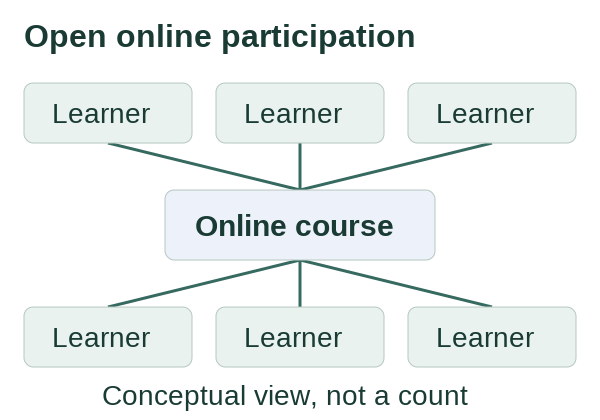
A massive open online course, usually shortened to MOOC, is an online class built so that anyone, anywhere, can take part.[1]
The average MOOC enrolled about 43,000 students, and 6.5% completed it.[2] Completion rates vary widely, from 0.7% to 52.1% across courses.[3]
Key facts
| 43,000 | Average number of students enrolled in a MOOC, according to Jordan (2014).[2] |
|---|---|
| 6.5% | Share of enrolled students who completed the average MOOC, reported by Jordan (2014).[2] |
| 12.6% | Median completion rate across 221 MOOCs, found by Jordan (2015).[3] |
| 2.1 million | Student observations analysed across 44 MOOCs by Evans, Baker and Dee (2016).[4] |
Overview
What a MOOC is and where it began
A massive open online course is usually shortened to MOOC. It is an online class built so that anyone, anywhere, can take part. The usual parts are video lectures, computer graded tests and discussion forums.[1] The term MOOC appeared in 2008. At that time, online learning already had many other formats.[5]
A survey of participants in the 2008 course CCK08 found it drew mainly adult, informal learners. Those learners were not much concerned about finishing the course. They named lack of time as the main reason for not completing it. Time limits, language barriers and information and communication technology skills shaped which tools participants chose. For example, learners preferred the passive, filtered mailing list over discussion forums and blogs, which were interactive but took more time. The CCK08 study also asked whether words such as course, drop-out and attrition suit open courses of this kind at all.[5]
In 2011, the rise of the MOOC raised questions about the roles of higher education institutions. It also raised questions about the roles of students around the world. Supporters claimed that MOOCs rested on sound teaching foundations. They said these were at least as good as those of face to face university courses. A review of the literature looked for evidence behind that claim. It found little research aimed directly at MOOCs. The evidence it did find gave no reason to think MOOCs teach less well than face to face courses. The review suggested that MOOCs may even improve learning outcomes in some ways.[6]
Early MOOCs were mostly one-offs. Each had a single instructor and a well-bounded subject. They almost never linked to another MOOC or to another part of the curriculum. One writer argued that this separation showed something. The college curriculum could easily be pictured as a series of disconnected events. That writer called for rebuilding the links that once joined general education. Those links once made it more than the sum of its separate parts.[7]
History
How MOOCs spread across higher education
Massive open online courses became well known quickly. Observers have called the growth dramatic over about five years. Individual courses have drawn very large audiences. Participant numbers for some reached hundreds of thousands.[8]
The courses spread into universities for several reasons. They delivered online teaching and shared scientific knowledge. They also helped market and fund the institutions.[9]
One early analysis examined the educational and business models of the courses. It compared their development with earlier waves of online learning. The courses began in an idealistic phase that the analysis called inspiring. It asked whether that phase would last. That analysis judged the courses a clear advance over earlier online learning systems. It said their performance was worth further research.[10] A later review found that the courses might have significantly affected several matters. These include definitions of completion, teaching approaches, delivery methods, certification and business models.[11]
Whether the courses would disrupt universities became a central theme of discussion in universities around the world. It was also a theme of much published writing on the subject.[11] Some commentators said the courses were disrupting existing teaching and practices in education. Others were far more doubtful about their impact. Expectations were high for opening access, widening participation and saving costs. A review of what was known about the courses raised concerns about a lack of evidence, an absence of pedagogy, a lack of support, and unrealistic expectations. These concerns applied particularly to beginner learners.[8]
National systems and policy responses
India has started several programmes to offer MOOC courses. It did so in response to rising enrollment from the country. India ranks second in the world for growth in MOOC enrollment, behind the United States.[12] SWAYAM is a government effort to make education easier for Indian youth to reach through MOOCs. A 2026 conceptual analysis argued that the platform's success depends on closing infrastructure gaps, supporting learner autonomy and building learning communities.[13]
Malaysia's Education Blueprint 2015-2025 (Higher Education) includes MOOCs under Shift No.9, Globalised Online Learning. Universiti Teknologi MARA ran one MOOC in 2014, four in 2015 and 16 in 2016. In 2017 it began developing 450 new MOOCs. A 2018 evaluation of two active courses at that university used a 45-question checklist. It was built from the UiTM MOOC Development guideline and the Guidelines for Credit Transfer for MOOC (MQA, 2016). The evaluation found areas for improvement. It asked whether the courses were ready for credit transfer.[14]
In Türkiye, adoption has moved more slowly. A 2026 document analysis examined 205 universities and their MOOC platform websites. It also examined 2024 self-evaluation reports. It found that few universities run MOOC platforms. Course numbers vary widely between platforms. Bilgeİş offers the most content, with 220 courses. Recent course publication dates suggest that some platforms have problems lasting over time. Most courses are taught in Turkish. Nearly all platforms issue certificates on successful completion. At present, just five universities in Türkiye offer academic credit for these courses.[15]
Faridi and Ebad (2018) recommend an adaptive, home grown introduction of blended learning with the MOOC platform in Saudi higher education. It also examined how the deanship of information technology and distance learning could move from a support role to a strategic one. The study discusses using learning strategies and tools to improve student employability. It notes that MOOCs enable lifelong learning at a virtual zero cost to students.[16]
In an Indonesian MOOC for English teachers, facilitator performance was related to student retention rates. One Indonesian MOOC gave English teachers practice with technology. The teachers were pre-service and in-service, and the practice was for teaching English in class. Ginting and colleagues (2022) report a link between how well facilitators performed and how many students stayed. Facilitators with low and high dropout rates differed in how they managed the program and motivated students.[17]
Main ideas
Who takes MOOCs and why
People who join a massive open online course, or MOOC, are a mixed group. They are not one kind of student. The classes were named Uninterested, Casuals, Performers, Explorers and Achievers.[18]
A virtual ethnographic study followed 12 adult learners with bachelors' and masters' degrees. They took a four-week MOOC on human trafficking. Their reasons for enrolling ranged from personal enjoyment to professional development. They also held differing definitions of what counts as completion or success in a MOOC. The study proposed a conceptual framework to guide course design. It covered adult learner MOOC motivations and goals.[19]
A case study of 27 MOOC learners used the instructional materials motivation survey. This survey rates attention, relevance, confidence and satisfaction. Most participants' motivation levels were positive, and they were satisfied with the instructional materials the courses provided. Those learners still expected some parts of the courses to improve.[20]
A large statistics MOOC drew 5,079 enrolments across six sections. Its participants had varied goals and needs. From the participants' point of view, even a highly structured course with a traditional teaching style can offer flexible learning for people with different goals.[21]
Self-regulated learning in open courses
A MOOC usually gives learners great control over their learning process. So studying in one calls for self-regulated learning. Learners, however, often find it hard to manage their own learning.[22]
Research on self-regulated learning in MOOCs grew from 2014 to 2016. Among behavioural and contextual regulation strategies, it identified help seeking, time management and effort regulation.[23]
One intervention tested whether short instruction could improve self-regulated learning. It covered three MOOCs. The intervention had a positive effect on learners' course completion. Compliance with the intervention was low, however. Most learners who did not comply dropped out of the MOOC. They left before they encountered the intervention.[22]
A second intervention put weekly self-regulated learning prompts into a MOOC as videos. Learners who watched the prompt videos took part in more course activities than those who did not. Prompt viewers tended to follow the course structure. Earlier research found this behaviour in students who scored higher on self-regulated learning.[24]
Satisfaction, motivation and continuing to study
A 2017 study surveyed 1,786 learners in four MOOCs. It asked which factors shaped their satisfaction. Three things all mattered: perceived usefulness, the teaching and learning aspects of the course, and interaction with the course content. Interaction with other learners had no effect on satisfaction in that sample. Interaction with the instructor had no effect either.[29]
A 2022 case study at a private university in Vietnam found a less positive result. It combined a survey and semi-structured interviews with 120 students. They were taking academic writing courses on Coursera, a large MOOC platform. Overall satisfaction was fairly low. Most learners were unhappy with their experience on the platform. The stated reasons were inappropriate assessment, lack of support, poor interaction with teachers, and improper plagiarism checking. Satisfaction showed moderate links with how useful students found the courses.[30]
A 2024 review of existing research examined how intrinsic motivation, engagement and satisfaction interact in MOOCs. The review concluded that intrinsic motivation sparks learners' interest. It also keeps them engaged during a course. It named personal interests, beliefs about one's own ability, and perceived relevance as motivating elements.[31]
Openness and the two MOOC traditions
The word open in massive open online courses can mean several different things. Rodriguez (2013) shows that c-MOOCs and x-MOOCs rest on different concepts of openness. All MOOCs share two features: their scale and their free access. Beyond those two features, the idea of openness behind each format differs greatly.[32]
The courses arose from the open educational resources movement. Pilli and Admiraal (2016) say so. One taxonomy places MOOCs on two dimensions: massiveness and openness. It gives four categories. They run from small scale and less open to large scale and more open.[33] A related argument holds that the word massive describes online availability and open access. It does not describe the traits of the people who enrol.[34]
The two main traditions of MOOCs differ in their underlying theory, their format and their structure.[32] Kop (2011) looks at the problems of self-directed learning on open online networks during one such course.[35] Rodriguez (2013) notes that c-MOOCs and x-MOOCs differ in their underpinning theory, format and structure. Earlier work had already found that the two types share some features. They clearly differ, though, in the learning theory and pedagogical model they rest on.[32] Over time, the early cMOOC versions changed in how they were used. Their name and structure also changed.[33]
Researchers have sorted the types of MOOCs in different ways. Pilli and Admiraal (2016) list types, pedagogies, orientations, target participants, resources and content as bases for earlier taxonomies. Courses have been categorized by type, pedagogy, orientation, target participants, resources and content.[33]
One typology was put into practice. Its categories were applied to MOOCs that were then advertised or already available. The same work argues that everyday discussion of MOOCs in higher education rarely says how varied these courses are.[36] A further proposal would drop the word massive altogether. Escudero Nahón and Núñez Urbina (2019) argue that success lies in seeing that potential users share similar situations, traits and educational needs.[34]
Openness also links MOOCs to the wider field of open education. That field includes open educational resources and open educational practices.[37] One paper examines how MOOCs relate to open education, online education and distance education. It asks which direction openness in education is taking. That paper also weighs the reasons behind MOOCs, their types and forms, and the good and bad sides of running them in universities. It closes by proposing sociocultural views of MOOCs. These views were named by the people with a stake in them.[38] The boundaries of the term therefore stay unsettled.[32][33]
Connectivist theory and its practical limits
Connectivism is the learning theory behind cMOOCs. There, communication and resources combine to create learning environments.[35] Courses built on this idea are called cMOOCs. The name is short for connectivist massive open online courses.[39] The approach became possible once communication tools and open resources could be combined into a single learning environment. A 2011 study of learners in one such course asked whether that possibility delivers a good learning experience in practice.[35]
A 2013 critique went further. It argued that the connectivist account of learning in Web 2.0 settings is inadequate and problematic. Clarà and Barberà (2013) call that view inadequate and problematic. They propose cultural psychology as better suited to explain learning in Web 2.0. It could also give MOOCs a less problematic pedagogy. It offered two general teaching principles drawn from that tradition as a starting point for a different pedagogy for massive open online courses.[39]
Cheng (2014) analysed forum postings from a computer science MOOC. The design was informed by virtual ethnography. A 2014 study of a computer science MOOC examined its discussion forum using virtual ethnography. That is a method of observing online communities as they interact. Two such emotions appeared in the postings. An altruistic emotion grew along with the collaborative learning community. It may have compensated for the small amount of emotional contact teachers can offer in a large, diverse class. Emotional resonance between generations also appeared. The study links this to managing age diversity in future courses.[40]
Blending MOOCs with classroom teaching
Shen, Li and Jiang (2014) propose a teaching model they call "MOOCs + flipped classroom". They also discuss the information technology that supports it. They also covered its technical framework, key supporting technologies and advantages. The paper set out the core ideas, the technical framework and the supporting technologies of this model. It reported that practice showed the model to be valid.[41]
Harvard University ran a pilot in the 2013-14 academic year. It used MOOCs to support blended learning in a set of its undergraduate and graduate courses. The Ancient Greek Hero was one of them. It put tuition-paying students seeking credit into one shared online unit. Non-paying online participants joined them on the edX platform.[42]
Students in all three versions of The Ancient Greek Hero used the online content in a transactional way. They spent time on the activities that would best secure their desired outcomes. Engagement among the open online participants was usually one of two things. It was either very deep or almost nonexistent. The for-credit college and extension students showed more uniform patterns. They viewed most of the content but interacted mostly with the parts that affected their course grades. The researchers concluded that educators using MOOC content for blended learning should think carefully about how each online element fits their overall teaching plan. This includes how to reward interaction with it.[42]
A cluster randomized controlled trial in China compared MOOC-based blended teaching with face-to-face classroom teaching. The course was fundamental nursing. The trial included 181 undergraduate nursing students at the University of Xiang Nan in China. It placed them in either the blended group or the face-to-face group. The blended group showed higher daily performance (P = .014) and operational performance (P = .001). It also showed higher theoretical achievement (P < .001) and final grades (P < .001). Most of the measured changes in critical thinking ability between the groups were statistically significant. Students also differed in how satisfied they were with the teaching they received (P < .001). They differed too in their ratings of overall learning effects (P = .030).[43]
A meta-analysis pooled 27 studies (25 records) of MOOC-based teaching in medical education in China. It searched four databases through March 3, 2020. Final exam knowledge scores were statistically higher in the MOOC group than in the control group. Hedges' g was 1.080 (95% confidence interval 0.592 to 1.567, p < 0.001). Gao and colleagues (2021) report clear differences across the 27 studies in their meta-analysis. A subgroup analysis showed a significant difference in favor of MOOC-based teaching. This held for both medical students and doctors. The authors noted that the effects of MOOC-based teaching on medical education were still controversial and unclear. They added that the method may be applicable in China.[44]
A questionnaire given to 917 primary school teachers found deficiencies in nearly all items on searching for and filtering information, data and digital content, with the highest percentages at the Basic level. On evaluating information, data and digital content, 26.4% of teachers reached the Intermediate B1 level on one item. Just 2.8% reached the highest level, Advanced C2. Five experts said that running the program would let these teachers improve their access to information and their information literacy. Lendínez Turón and colleagues (2024) used a non-experimental design with a quantitative approach. It was descriptive and propositional in type.[45]
How learners regulate their own study
It assumes learners can manage their own study without a tutor's guidance.[46] Research on e-learning links self-regulated learning, the learner's own management of study, to success in online courses. Learners who manage their own study well direct their learning more independently. They are also more likely to succeed in an online course.[47]
One line of research asks which outside factors shape a learner's self-regulation in a MOOC. Three factors influenced self-regulated learning in that study: service quality, attitude, and course quality.[47]
Interviews with 35 participants in a clinical trials MOOC offered by edX gave narrative descriptions. These described how working professionals regulated their learning. The descriptions covered how participants set goals and judged their own capability. They also covered how participants chose learning and task strategies and asked others for help. The study looked at whether these processes were carried out. This pointed to possible changes in how MOOCs are taught and built.[46]
A survey of 643 MOOC students measured their self-regulated learning. It used the Online Self-Regulated Learning Questionnaire. Students who completed their course reported significantly higher use of one part of self-regulation, namely goal setting, than students who did not complete. Open-ended answers also named task interest and values as contributors to completion. They also named causal attribution (the reasons learners give for their results), time management, self-efficacy and goal orientation.[48]
Perceived effectiveness is the learners' own rating of how well the course worked for them. It was significantly predicted by their self-regulated learning strategies and by task value, the worth they placed on the work. A further analysis found three specific strategies that predicted perceived effectiveness. They were meta-cognitive activities after learning, environmental structuring (arranging one's surroundings for study), and time management. Lee, Watson and Watson (2020) argue that instructors have given too little weight to three things when designing MOOCs. These are self-regulated learning, self-efficacy and task value, although they matter.[49]
Setting goals and keeping to them
A study of 500 Indonesian learners in one MOOC measured their learning strategies. It used a translated and modified version of the Motivated Strategies for Learning Questionnaire. The survey went to 359 female and 141 male learners. The study linked their reported strategies to how much they interacted with the instructor. The results described which strategies these learners used. They also showed a link between those strategies and learner-instructor interaction.[50]
A randomized trial tested an instructor's personalized email reminders. It ran in a nine week Israeli noncredit MOOC on negotiation management. Learners who missed a weekly quiz were assigned by chance to two groups. 576 received a tailored email from the instructor offering help with the past week's content, and 608 received nothing. The email raised quiz completion in the following week. The researchers called this an immediate impact. This was a cumulative impact on completion. Kurtz and colleagues (2022) suggest that an instructor can strengthen learners' commitment to the course. This may happen when the instructor notices learners and shows interest in them.[51]
One teacher training MOOC tried a different goal: learner perseverance, meaning continued participation, rather than completion alone. Of those enrolled, 3447 participants (67.5%) were active. That means they had accessed the course material at least once. Among active learners, 1201 (47.1%) took part in the discussion forum, producing 5023 threads and 9861 comments. The course reached a completion rate of 36.58% (1261 learners). The researchers compared this with the 6-7% average completion rate reported for xMOOCs, the large courses built from short videos and automated quizzes. A course completion survey indicated that teachers found these designs useful. They also found them relevant to their own practice.[52]
What instructors think they are doing
Instructors who teach massive open online courses, or MOOCs, do not agree on what the courses are for. A 2015 survey looked at 162 professors who had taught a MOOC. It found them divided about the purpose of MOOCs within higher education. Most of the professors surveyed had taught for years. But they had comparatively little experience of teaching online. The survey also recorded how satisfied the professors were with teaching their MOOCs. It asked how they thought their students had fared.[53]
The scheme distinguishes content-based, community or task-based, and network-based MOOC applications. The review placed these types along a single continuum of MOOC learning design. It then examined a series of hybrid courses that mix the types. The aim was to show where each use fits and which design problems remain.[54]
A typical MOOC combines short videos, digital readings and interactive assignments. It also includes discussion forums and quizzes. A 2020 set of twelve tips for teachers describes how to fold such content into ordinary classroom teaching. The aim is to create blended learning programs. Its advice covers choosing the right content and judging its quality and usefulness. It also covers building the blend inside an existing course.[55]
One thermodynamics MOOC was planned with the 5Es method: Engage, Explore, Explain, Elaborate and Evaluate. Everyday engineering examples gave the material familiar contexts. The audience was global: more than 3000 learners in 137 countries, aged from teenagers to people in their seventies. The course also included practical exercises that learners could carry out in their own kitchens. Worked examples came alongside them. It ran in parallel with an introductory undergraduate course. A little less than one-fifth of the 355 undergraduates took part.[56]
Machine learning and early warning
In a massive open online course, these methods can flag learners who are likely to stop before the course ends. A 2015 study built predictive models every week, across several runs of one course. The aim was to find students at risk of not finishing it. He and colleagues (2015) proposed two transfer learning algorithms. These add a regularization term to minimize the difference in failure probabilities between consecutive weeks. Tests on two runs of a Coursera course supported the approach.[57]
One obstacle keeps coming back: large education datasets have few annotations. Annotations are labels added to data. Semi-supervised learning addresses this by using both labelled and unlabelled records. A 2025 study compared ten self-labelled semi-supervised algorithms. It used real course data at several labelled ratios. The set included self-training, co-training and tri-training variants. Ensemble-based methods reached predictive accuracy comparable to fully supervised baselines. They did so with as little as 4% labelled data.[58]
Prediction can also come from raw activity records, called log data, rather than from test scores alone. A 2022 study compared the event logs of learners in 60 Korean courses. All had scored just next to the minimum passing grade. The study split them into those who completed and those who did not. Video viewing was the main activity on the platform. It showed no significant difference between the two groups. Textbook interactions differed significantly between the two groups. They differed in the percentage of learners who performed them and in the average number of logs per learner. The study suggests that such active behaviours may matter more for completion than passive watching.[59]
Some systems go beyond a warning and change what the learner sees next. The model gives at-risk learners a best learning path. It adapts their courses to their needs and skills. A 2023 paper identified learners at risk of dropping out. It then used classification algorithms to predict and an ant colony optimization algorithm to choose an optimal learning path for each one. The ant colony optimization (ACO) algorithm was used to improve learners' paths. The approach was checked in a single case study.[60]
Newer models try to capture how a learner's behaviour changes over time. A 2026 framework combined a Liquid Time Constant (LTC) network with a Long Short-Term Memory (LSTM) network. The design aims to handle uneven gaps between learning activities. It also aims to handle long-term patterns in behaviour. It reached accuracies of 92.10%, 84.65% and 94.48% on three public education datasets: KDD Cup 2015, Anon and Dropout. It also made smaller prediction errors and needed less training than a comparison method. That method was an image convolutional and bi-directional temporal model. These results come from three educational benchmark datasets: KDD Cup 2015, Anon and Dropout.[61]
Subject fields and professional audiences
Many massive open online courses address clinical topics, such as emergency medicine. Others address methods, such as statistics. Course sizes ranged from 45 participants to more than 23,000. Most courses came from universities working alone or with partner institutions, mainly in the US, Sweden and the UK, and were taught in English.[62]
Fourteen courses were developed specifically for nursing. Eleven of them came from Anglo-Saxon institutions with content in English. An exploratory study of course websites found 654 health courses, and these covered all five nursing areas recognised by the Peruvian College of Nurses.[63]
Zubkov (2018) concludes that MOOCs teach foreign language for specific purposes well. The students were engineering students. A 2018 paper set out criteria for deciding which courses to add to an engineering degree. It also described models for fitting them in. It also listed the benefits and the difficulties of that integration.[64]
A 2018 study of entrepreneurship MOOCs used desk research. It also analysed existing courses on the topic. That review weighed the opportunities and limits these courses present. It looked at what they mean for higher education institutions and their programmes.[65]
Legal education has a developed infrastructure. Yet no systematic methodology for integrating MOOCs into legal training has been developed. A 2026 paper argues that courses are often added to law programmes in a piecemeal or formal way. It sorts their teaching potential into four groups: instrumental, content, motivational and infrastructural. It also groups the barriers to their use as regulatory, institutional, didactic, resource and psychological-pedagogical. The paper states that existing studies describe either a techno-optimistic or a critical picture. None offers a combined method.[66]
Courses for teachers form another professional audience. One course on the fundamentals of educational dialogue was studied through questionnaires, interviews, forum posts and reflective reports. Engagement with dialogue in that course depended on a flexible structure, accountability through collaboration, and reflective inquiry as a guiding frame. Participants reported a deeper grasp of the theory behind educational dialogue. They also reported a change in how they thought about their own learning, and a long-term commitment to improving practice. The study builds on ten earlier design principles for online professional learning that supports practitioner reflection and agency.[67]
How learners find and choose courses
The number of online courses called massive open online courses, or MOOCs, has grown sharply in recent years. These courses sit on provider sites such as edX and Coursera. One result is less clarity about what each course offers. That makes choosing harder for applicants.[68]
Researchers describe this as information overload. The supply of online learning resources has grown exponentially.[69] One response is to rewrite course descriptions so that they serve the interests of the people choosing.[68]
A recommender system is software that suggests learning resources to a user. It bases the suggestions on that user's interests. A newer online recommender was tested on the COCO data-set. It beat standard KMeans and collaborative filtering methods on measures of predictive and classification accuracy.[69] A good description scheme on such a site should satisfy the academic community. It should also serve the interests of students choosing a course.[68]
Once a learner has a shortlist, the next question is whether a course is usable. A survey of undergraduates at Universiti Tun Hussein Onn Malaysia found only moderate positive views. The views covered usefulness, ease of use, ease of learning and satisfaction. The same students showed noticeable uncertainty about usability, and the researchers said these challenges need further study.[70]
Accessibility problems in the 56 Russian-language mathematics MOOCs came from platform shortcomings. They also came from errors by course developers. A check of 56 free Russian-language mathematics MOOCs on 5 platforms found that 96,4% had accessibility limitations, especially for people with visual impairment.[71]
A Latvian survey of 247 students found a link between readiness for MOOCs and self-directedness, socio-communication competencies and self-efficacy. In a survey of 247 students at Latvian universities, readiness for MOOCs was linked to self-directedness, social and communication skills, self-efficacy and technical skills. Most of those students still preferred face-to-face learning.[72] One participant spent 2 years in 16 attempted courses on 5 platforms. That person identified 10 dimensions that affect whether effective learning takes place. That participant concluded that not all MOOCs meet a learner's goals or teach effectively.[73]
Course design choices and learning outcomes
A 2022 coding course in Brazil followed a project-based learning approach, in which students learn by building a project rather than only watching lessons. The course ran from July 4 to 30, 2022, with 186 students. Each was asked to develop an individual coding project. Coding skills grew in three ways. Students watched video lectures, remixed peers' code and shared knowledge with each other. The project work also gave students chances to work together and share ideas.[74]
Assessment can be arranged in steps rather than as a single test at the end. Moving from one level to the next depends on reaching a minimum amount of subject knowledge. A prototype was tested in the algorithmic discipline. The aim was to check whether the approach was feasible.[75]
One analysis looked at 3,460 reviews of 5 MOOCs rated 5/5 on the CourseTalk site. It sorted the features behind success across all three presences. Teaching presence accounted for 36% and social presence for 23%. Cognitive presence accounted for 36% and technological for 5%. Four characteristics appeared most often: teacher, exercise, atmosphere and workload. A cluster analysis found 5 types of students. Students in each type had similar preferences for presence elements.[76]
Reuse of course materials is a further design question. A MOOC can hold a large amount of learning material. That material sometimes stays tied to the MOOC and is not used actively after the course ends. This happens without management support or an internal structure. A case study looked at three linked MOOCs on European History, Law and Governance at KU Leuven. It described formulas for making content reusable. The paper calls for clear guidelines to support content reuse and the long-term educational value of MOOCs.[77]
A survey looked at 350 students in Hunan Province, China. Students rated course designs as extremely effective and were extremely satisfied with their learning outcomes. Course design ranked highest among dimensions of effectiveness. Course materials ranked lowest, yet were still rated extremely effective. Students aged 20 and below gave higher scores for materials, structure and presentation than those aged 22. Ten interviewed teachers named heavy workload, substantial time commitment, insufficient support, difficulty giving individualized feedback and high dropout rates as challenges.[78]
A reflective study of the first Indonesian MOOC in 2017 set out 3 basic requirements. These were multimodal content matched to participants' critical thinking level and facilitation that accommodates different learning styles. They also included current, user-friendly digital tools.[79]
Research
Enrolment numbers and completion rates
A massive open online course, or MOOC, can draw tens of thousands of learners at once, yet only a small share of them finish. One analysis of publicly released figures found that the average MOOC enrolled around 43,000 students. Of them, 6.5% completed the course. That same analysis reported that enrolment numbers were falling over time. Completion rates stayed steady across time, university rank and total enrolment. Longer courses had higher enrolment. They also had lower completion.[2]
A later study widened the picture to 221 courses. It found completion rates from 0.7% to 52.1%, with a median of 12.6%. In that larger sample, enrolments had fallen since the early courses. Completion rates had risen.[3]
Other studies put the dropout rate, the share who leave without finishing, far higher.[80] One report put dropout between 91% and 93%. Another said most courses lose more than 90% of enrolees.[80][81] A third reported completion rates recently below 5%.[82]
A study of 44 courses used over 2.1 million student observations across more than 2,900 lectures. It traced how participation changes week by week. In every course, participation fell quickly in the first week. It then levelled off in later weeks. The fall was not identical everywhere, and some features of a course were linked to how long students stayed. Where a lecture sat within a batch of released videos was related to whether students watched it. So was how its title was worded. Students were more likely to finish if they filled in a survey before the course began. They were also more likely to finish if they chose a quantitative track rather than a qualitative or auditing one.[4]
Predicting dropout with learner data
The stored data cover learner profiles and final outcomes. They also cover the order in which each learner performs activities, such as reviewing a lecture video before starting an assignment.[83] One review calls this stream of usage information a gold mine for the field. So many learners interact with the same platform.[84]
A 2019 study proposed a hybrid algorithm called DT-ELM, which combines a decision tree with an extreme learning machine. That is a network trained in one pass rather than by repeated rounds. The decision tree picks the features that best separate dropouts from completers. It gives those features stronger weights. The method was tested on the benchmark KDD 2015 dataset. It scored 12.78%, 22.19% and 6.87% higher than baseline algorithms on accuracy, AUC and F1-score.[85]
Later work argued that behaviour measured over different time scales gives different predictions. It also said noise in the time-series data can distort results. A 2022 model combined a multiscale fully convolutional network with a variational information bottleneck. The network reads behavior sequences at several time scales, and the bottleneck suppresses the effect of noise. This method performed best compared with the baseline methods. The tests were repeated cross-validation experiments on the KDD CUP 2015 dataset.[86]
In the middle and late stages, task-oriented behavior gradually became a key factor. Video-based learning activities were especially important. High-frequency video watching did not always lower risk: when video activity was high but overall interaction was low, dropout risk was more likely to rise.[87]
Some models look beyond a single course. A 2021 analysis looked at 378,000 users and 1,000,000 registration events on a French national platform. It modeled how long students stay before dropping out. Interactions between courses were captured by a single engagement parameter. It was estimated from a user's registration profile. That engagement measure was linked to certificate rates in all courses, whatever their content. The survival approach also found certificate rate patterns. Conventional regression models had missed these.[88]
A 2017 study proposed a typology, a classification scheme, that judges success and dropout by each learner's intentions and later behaviour rather than by course completion alone. One early test looked at two MOOCs. By the traditional completion measure, success rates were 6.5% and 5.6%. Judged by the learners' own views, success rates were 59% and 70%.[89]
Access, equity and global reach
A later study looked at 3.5 million learners. They had registered for courses offered by the Massachusetts Institute of Technology. It reported significant differences in course use among students from different countries and at different economic levels. The study recommended better infrastructure and support for learners in developing countries. It also called for greater awareness of these courses and better access to them.[90]
A survey of medical students in Egypt used 2106 completed questionnaires. They came from 10 of 19 randomly selected medical schools, a response rate of 83.3%. Of these students, 456 (21.7%) knew the term massive open online courses or the names of websites offering them. Of those who knew the term, 136 (29.8%) had enrolled in at least one course. Only 25 (18.4%) had completed courses and earned certificates. The main reasons given for not finishing were lack of time (105 students, 77.2%). Slow Internet speed came next (73 students, 53.7%). Of the 25 who completed a course, 21 (84%) were satisfied with the overall experience. Satisfaction with learner-instructor and learner-learner interaction was lower.[91]
In a Malaysian public university, 48 undergraduates studying English as a second language took a course on writing. Their questionnaire answers and reflection essays showed positive views. The course helped them improve their writing skills.[92]
A Chinese study compared 57 blended learners with 4049 social learners. The blended learners studied at a university and through a course. The social learners studied online only. The two groups registered for a 16-week health assessment course. Completion rates were 100% for blended learners and 7.14% for social learners. Blended learners took part steadily across the course. Social learners started strongly and then fell away. The researchers recommended combining online and campus study in nursing education.[93]
Uses in professions, schools and development
Professional learning combines formal study with learning on the job. It matters for building and keeping expertise at work. Specific challenges in their roles led these learners to take part. Yet their effort went mainly into finishing course tasks and assignments.[94] A separate analysis looked at 13 business and technology courses with 72,668 active learners. It found that lecture-oriented, system interaction-oriented and discussion-oriented courses shared some interaction patterns but differed in others.[95]
Health and medicine have become a large area for these courses. They are offered through both commercial and noncommercial platforms. Courses run by reputable institutions can give access to reliable information without limits of time, location or prior level of education, and most current courses appear introductory in nature.[96]
A free COVID-19 course for medical students in low- and middle-income countries drew 16,237 unique visitors. Of these, 6,031 students from 71 medical schools registered. About 4,993 registrants, or 83%, completed it. The mean satisfaction score was 8.17 on a 10-point scale (SD = 1.49), and mean scores were above 90% on each assessment module. Free-text responses from 987 students produced 17 themes. Students mainly described the course as well organized and effective.[97] Between 76% and 95% of ratings were the highest possible choice on a 5-point scale. Ratings for effective teacher and overall did not differ statistically between the two formats.[98]
In health and social care in the United Kingdom, a programme of online, self-directed quality improvement courses began in 2015. It was relaunched in 2018. Participant feedback pointed to better understanding of quality improvement tools and methods. It also pointed to more energy for the work, a greater sense of community and more confidence in using the techniques. The programmes were described as working together. This was called key to their success.[99]
Teachers are another professional group that uses these courses. In one teacher education college in Israel, 84 student teachers could register on an international course for credit. All of them completed it.[100]
Researchers have also looked at sustainability education through these courses. The courses were mainly introductory and had no prerequisites. The teaching methods used most often were discussion forums and lecture videos, while team-based learning was not widely used.[101]
How these courses are evaluated varies widely. A systematic review searched seven databases for studies published from January 2008 to October 2018. It included 33 evaluations. Of these, 16 used a quantitative design, 11 a qualitative design and 6 a mixed methods design. In all, 16 evaluated learner characteristics and behaviour, and 20 evaluated learning outcomes and experiences. In all, 26 studies with a cross-sectional design, which looks at one point in time, had a low-quality assessment. Randomized controlled trials and quasi-experimental studies received a high-quality assessment.[102]
Criticisms and open questions
A large field experiment with 18,043 participants tested a scheduling nudge, a prompt that asked learners to set aside time for study. Random assignment to the nudge had no effect on near-term engagement. It had small negative effects on longer-term engagement, persistence and performance, only weakly significant.[103]
The gap between intending to study and actually studying points to self-control as a major contributor to low persistence.[103] Perceived usefulness and social influence predicted who took up these courses. Ease of use did not.[104]
One student-centred critique holds that the learner's view has been overlooked. Instructors promoted these courses as the next big thing.[105] A study of 428 language learners on an Iranian platform looked at instructional, peer and technical support, along with motivation. Instructional and peer support were positively correlated with a deep approach to learning. They were negatively correlated with a surface approach. Technical support was provided, but it did not shape learners' motivation or their deep approach. Learners who joined to learn a language for its own sake felt more instructional support. Those seeking a certificate felt more peer support.[106]
A 2014 course was studied through surveys and interviews. It drew mainly participants who were themselves educators. Three main reasons for completing stood out. Learners wanted to extend their existing knowledge and gain skills in learning design. They also wanted to apply a learning design method in practice.[107]
One study argues that a pedagogy of abundance, with plenty of materials, can give way to a pedagogy that supports human beings. That approach rests on connections, collaboration and the exchange of resources among people. It also rests on building a community of learners. It treats learning as emergent, meaning that actors and system change together. It also holds that the presence of actors influences outcomes.[108]
A review of 362 empirical articles published from 2008 to 2015 found an imbalance. Three of fifteen research areas held more than half of all work. Most articles took a neutral stance. Positive articles outnumbered negative ones, and more critical writing was appearing. Theoretical and conceptual studies were preferred. Yet the research generally did not use theoretical or conceptual lenses.[109]
A bibliometric analysis looked at 3,118 scholarly works in Scopus up to July 2019. It found that publications grew steadily in the 10 years after 2009. The field was well distributed but had yet to encourage inclusiveness. Research from some countries was scarcer than from others.[110]
Older learners and learners with disabilities
Older adults already take part in massive open online courses. The research on them is thin. A 2016 review examined pre-course survey data. The data came from 10 University of Reading courses on the FutureLearn platform. The share of learners over 66 ranged from 0.5% to 16.3%. The low figure was on Managing people and the high one on Our changing climate. Among learners over 56, the share ran from 3.0% to 39.5%. The low end was a beginners' guide to writing in English, the high end a course about heart health. The same review searched course catalogues. It found only six courses on topics related to aging. Three of those six sat on Coursera, two on FutureLearn and one on Open2Study. A literature search for that review found just three scholarly articles on MOOCs and older learners.[111]
Kosova and Izetova (2020) rated 56 Russian-language mathematics MOOCs against 70 criteria. They found low accessibility for people with disabilities, especially severe visual impairments. One study browsed the catalogues of five leading platforms with Russian-language content. It found 56 courses on undergraduate mathematics. Experts then rated those courses on 70 criteria. The criteria covered use by people with disabilities. The raters found no faults in how hyperlinks worked or how audio played. They also found no faults in mobile layout, colour contrast or keyboard controls. Yet 100% of the courses offered no way to change the user interface. None could be reached through a text browser. Screen readers convert on-screen text to speech. They misread 98% of digital documents, 82% of mathematics content and 91% of tests. Subtitles were missing from 64% of the courses. Shorthand transcripts were missing from 66%, and outlines to video lessons from 52%. No course offered sign language interpretation for its videos. In all of them, the audio track alone was not enough to follow a lesson. The study traced these problems to limits of the platforms and to mistakes by course developers. It recommended revising courses to meet the Web Content Accessibility Guidelines, known as WCAG2.1. It also recommended that platform administrators enforce them before new courses are posted.[112]
A second study looked at courses about web accessibility. Kosova (2021) searched four MOOC aggregators and browsed four Russian-language platforms. The search found 38 free and 28 paid courses on the topic. Just one Russian-language course turned up. It was called Web accessibility in e-learning and hosted on the Stepik platform. The typical course aimed at web developers or designers in 45% of cases. It aimed at developers or teachers of online courses in 24%. Most courses, 76%, required no starting skills. Also, 55% issued a certificate for an extra fee. The study concluded that such courses should cover universal design in learning and the WCAG guidelines. They should also cover methods for assessing web content accessibility and ways to build accessible online materials.[113]
MOOCs in health and medical education
A 2014 review looked at courses offered in 2013. It identified 225 health and medicine courses, of which 98 met the review's criteria. Over half of those courses, 58% (57/98), ran on the Coursera platform, and 94% (92/98) were taught in English. Universities supplied 90 of the courses. John Hopkins University supplied the most, 12 of the 90. Only three courses came from developing countries: China, the West Indies and Saudi Arabia. Course length ranged from 3 to 20 weeks, with an average of 6.7 weeks. Students were expected to work about 4.2 hours each week. Verified certificates were offered by 14 courses. Three others offered some other professional recognition. The review concluded that such courses could be a route to continuous medical education. They could also raise health literacy among the public.[114]
Schettino and Capone (2022) ran a scoping review of learning design strategies in MOOCs for physicians' training. It covered studies published from 2016 to 2021.[115] A 2021 scoping review looked at continuing education for nurses and other health professionals. It screened 1149 studies and included 31, most of them exploratory. The courses it found came mainly from the United States and from universities. They covered varied content including infectious diseases, and used both qualitative and quantitative assessment. Their audiences were multidisciplinary and ranged from 40 to 83 000 participants. Nurses were among them. Whether a course worked depended on its pedagogical background. It also depended on its design and delivery, and on the profile of its learners.[116] It sorted the evidence into four areas: teaching approaches, course structure, learner characteristics, and comparisons with traditional courses. That review judged the role of these courses in medical education to be still unclear.[115]
Newly graduated occupational therapists took a leadership skills course. They found the content a useful foundation, were comfortable with the technology, and wanted more interactive or synchronous sessions.[117] Team performance was significantly higher (P<.001) in the two arms that combined medical movies, a course, 3D computer-based or virtual reality simulation and co-debriefing. It was lower in the control arm. Simulator sickness scores rose significantly in the virtual reality arm (change of 21.0; P=.001). They did not rise in the computer-based arm (change of 5.3; P=.44).[118] Gargot and colleagues (2020) write that a MOOC can serve as a promotion tool for the provider. They add that its economic model must be taken into account to allow sustainability.[119]
Learner activity patterns and who drops out
Records of what learners click and submit, called activity logs, were used to classify learners and compare their course outcomes. Instructors or facilitators gave feedback on that forum. Timely feedback was linked to greater engagement in the course.[120]
In the natural risks course, some students earned better grades in some modules. These were students who started earlier and those who finished earlier. For last moment students, speed was linked to motivation but not to better grades. Students who completed tasks during the weekend took less time to finish the modules. They also obtained a better grade.[121]
A study of one educational technology MOOC found that learners' sense of the course's usefulness raised their use of the system. Greater use, in turn, was linked to a better learning outcome. That study found no significant effect of earlier MOOC experience on learning behavior or outcome in general. Prior experience did affect the performance of less active learners.[122]
Completion is low overall. As few as 5 to 10% of enrolled students earn a certificate of completion. Attrition is the share of learners who leave before finishing. It varied little between those who audited and those who actively took part in assessments. Levels of participation and the features of the course itself did not change that dropout rate much.[123]
A survey study tested demographic factors with a chi-square test. Gender, marital status, age and education level had no effect on how much of the course students completed. Gender, however, showed a statistically significant link with dropout (χ2 = 6.347, df = 1, p = 0.012).[124]
Why learners stop and what keeps them
Researchers criticize massive open online courses, or MOOCs, for their high dropout rate. The groups were course attributes, social status and cognitive ability. They also included emotional factors and learning behavior. The same review found that learners' activity tends to cluster at three points. These are the start, the middle and the end of a course.[125] A separate literature review examined what influences enrollment, completion and dropout. It described MOOCs as removing the time and space limits of traditional education.[126]
One line of research asks why learners who start a course keep using the platform, an outcome called continuance intention. A study tested a model built on the Expectation-Confirmation Model (ECM). It looked at 368 undergraduate students on a MOOC platform. Confirmation had significant effects on both perceived usefulness and satisfaction.[127]
A framework by Roy, D'Souza and Laghane (2026) links utilitarian values and hedonic values to MOOC student retention. The practical side covered perceived usefulness and the value of a certificate. It also covered time flexibility. The emotional side covered enjoyment, variety and newness, and how well the course matched personal interests. The study surveyed 200 MOOC learners at Christ University, Lavasa Campus. It analyzed the answers with Structural Equation Modelling (SEM). Goal orientation, self-efficacy and motivation clearly shaped both useful and enjoyable value perceptions. Those value dimensions in turn had significant positive effects on retention. Roy, D'Souza and Laghane (2026) note that the modest sample size affected some model fit indices.[128]
A study of learners at universities in Uttarakhand state, India, used structural equation modeling. It looked for factors that keep learners in courses.[129] The cited studies name different influences on retention and completion. These range from confirmation and satisfaction to credit mobility and goal orientation.[125][127][128][129]
In practice
Teaching, assessment and feedback at scale
A typical massive open online course breaks the usual cycle of teaching, learning and assessment. This comes from a 2014 paper on peer assessment. Formative assessment is feedback given during a course to guide learning. Without it, and without feedback, such a course becomes an information dump or a broadcast rather than an educational experience. Several remedies have been tried to bring formative assessment back into these courses. Each has its own limits and problems. The approach judged most widely applicable for all such courses to date is peer assessment, in which learners grade one another's work to supply the needed feedback. Peer assessment results produced without moderation, meaning without a check on the graders, lack credibility. Accurate results of this kind can also support peer learning and online discussion forums. They may possibly add to summative evaluation, the final grading used for credentials.[130]
The participants had designed and delivered a wide variety of subjects. They did this on the Coursera hosting platform. The strategies these participants reported fell into three themes: language, content and engagement. These strategies aimed to support learners with English language barriers. They also aimed to help learners without the necessary subject background to keep up, and learners unfamiliar with American education culture.[131]
A 2021 systematic review examined 65 peer-reviewed articles published between 2017 and 2019. The articles covered how learning outcomes are assessed in these courses. Assessment tasks throughout a course may differ in difficulty and complexity. This could match different levels of learner motivation.[132]
How a MOOC course is designed and run
The format has been criticized for relying on short video clip lectures. It has also been criticized for theoretical multiple-choice questions. One way course teams have tried to deepen the work is by adding virtual patients. Kononowicz and colleagues (2015) describe two such scenarios in a behavioral medicine MOOC. They were presented in the OpenLabyrinth system. It was offered on the EdX platform in autumn 2014.[133]
Course quality can be checked against an outside framework. Lowenthal and Hodges (2015) used the Quality Matters framework to study the quality of MOOCs. One study used the Quality Matters quality control framework to judge MOOCs. It paid attention to what the results mean for the day-to-day work of designing online courses.[134]
Kononowicz and colleagues (2015) report technical challenges in a behavioral medicine MOOC. These include poor or restricted access to videos in some parts of the world and occasional lost sessions. In the 2014 behavioral medicine course, the virtual patient system ran on four virtual servers. It coped well with the workload. The course reached 19,236 enrollments. Activity peaked at 359 user sessions per day.[133]
Assessment is a recurring subject in MOOC research. Ventista (2018) focuses on the assessment of open-format questions. Ventista (2018) argues that self-assessment should be the only method of formative assessment for essays in xMOOCs. It should replace peer-assessment. That argument rests on concerns about peer-assessment, which it says involves patriotic bias. It also rests on the high attrition rates of these courses.[135]
Kamarudin and colleagues (2020) built an e-assessment module for a Chemistry MOOC. They tested it with 129 Bachelor of Chemistry Education students. The 389 items in the content validity check reached an S-CVI/Ave value of 1.00. The module's reliability score was a Cronbach's alpha of 0.97. Students' mean rating of the module was 3.44, with a standard deviation of 0.58.[136]
Dias (2021) presents evaluation strategies for MOOC development. The emphasis is on Perspective-Based Evaluation. It applies the approach to a 30-hour extension course at the Universidade do Estado da Bahia. The evaluation found problems in the course. The designer's perspective noticed the most problems of the groups consulted. The paper concludes that MOOC development should add an evaluation stage.[137]
Lowenthal, Snelson and Perkins (2018) surveyed 186 MOOC instructors. They followed up with 15 interviews to explore what teaching a MOOC is like. Instructors named three main motives for teaching a MOOC. These were passion and interest in the topic, marketing and publicity, and incentives or benefits. Most had little online teaching experience before their first MOOC. Even so, they were satisfied with it. Most believed their own MOOC gave a high quality learning experience. But they thought MOOCs overall might not match face-to-face courses. The instructors also raised concerns about the future of MOOCs for online learning.[138]
Credentials, recognition and labour market returns
A verified certificate records a student's performance in a MOOC. Maas and colleagues (2014) write that such credentials help students show achievements. Students can show them to future employers and academic programs. Data from that provider suggest that verified certificate programs help raise student success rates in courses.[139]
One study in Colombia used a Coursera program. It gave away certificates free of charge during the COVID-19 pandemic. A learner's chance of a free certificate was decided at random. Few learners finished. Of those eligible, 6.2% completed one course or more. Getting a MOOC certificate raised formal employment by about 5 percentage points. The gains were larger for participants who were not employed at the start and for those from low-income households. There were no clear differences by gender. The extra employment was concentrated at larger firms. It was also concentrated in economic sectors that matched the course content.[140]
Surveys of learners have examined continuance intention. This is the plan to keep using a MOOC platform. Li and Zhao (2021) tested the unified theory of acceptance and use of technology. They used 312 valid samples.[141] A survey of 277 university students reported that task-technology fit had a positive effect on satisfaction and academic performance. Task-technology fit is the match between a learning task and the tool.[142]
Copyright, cost and institutional management
Educators who build a MOOC must deal with copyright and licensing. Legal openness rests on understanding which content may be used and how it may be shared. One study followed educators at the University of Cape Town. They moved from ordinary teaching to making MOOCs with the Centre for Innovation in Learning and Teaching. The university had an open access policy. The centre had long supported open educational resources, which are teaching materials shared for reuse. Even so, the study could not assume that these educators knew about such resources. Nor could it assume they cared about copyright as it applies to MOOCs. Legal openness means understanding copyright and using openly licensed content. It also means licensing new content openly in turn. Choosing an alternative licence therefore means dealing with copyright from the start.[143]
Teece (2018) argues that the status quo in university management is no longer adequate. He proposes a dynamic capabilities framework of sensing shifts, seizing opportunities and transforming the university. One management scholar argues that the university and its competitive and operating environment have grown very complex. The old way of running it no longer works. That essay borrows the dynamic capabilities framework from private sector strategy. In it, leaders sense shifts, seize opportunities and transform the organisation.[144]
Xia (2015) observes that many education institutions still question whether courses using extensive online technologies can last. The same analysis notes that adding online technology to higher education does not by itself support learning.[145] Vázquez Cano (2016) calls technology one determining element for the sustainability of the MOOC model. He argues that mass participation with acceptable teaching quality cannot be guaranteed without strong technological tools.[146]
A political economy critique asks who gains from MOOCs, and it answers in terms of capital rather than learners. That article places the rise of MOOCs inside what it calls capital's drive. The drive brings work practices under control by technology. It also questions claims that open networks deliver new forms of sociability. These forms are said to rise above structures of power.[147]
Teacher development and subject-specific uses
A 2025 review of research on massive open online courses for teachers found 68 relevant studies. Mixed methods were the most common design (57%), surveys appeared in 82%, and 52% reported descriptive statistics alone. The studies tended to measure participants' attitudes (41%) and engagement (40%). The reviewers recommended adding clickstream data, which record learners' clicks through a course, and objective performance measures. They also called for correlational, longitudinal and experimental designs.[148] Brugha and Ahmed (2023) analyse the format and structure of a MOOC for educators on the fundamentals of educational dialogue. They ask how it might support teacher communities of practice.[149]
An assessment looked at 162 online courses from three large international platforms. Most lacked enough coverage of key digital competences. Two areas were weakest. One was judging students' work online. The other was making online learning positive through group work and self-reflection.[150]
A survey of 162 future social science teachers examined their views on educational technologies, including massive open online courses. It also examined their views on the Sustainable Development Goals.[151] Pikalova (2015) analysed the content and structure of instructivist mathematics and computer science courses on Udacity, Coursera and edX. The study singled out the most useful ones for pre-service math teachers. That study recommended using such courses to support the teaching of particular subjects. It also recommended retraining teachers to develop new courses.[152]
A survey looked at language teaching MOOCs that promote intercultural competence. It found most of them under the keyword culture. English, Chinese and Spanish were the languages most widely taught. This was in courses with an intercultural competence component. China, the United States and Ireland offered the highest numbers of such courses.[153]
A course teaching Turkish as a foreign language enrolled 6,254 learners. They came from 104 countries and 136 nationalities. About two thirds of them lived in Turkey (n = 4,158, 66.49%). Arabic was the first language of 81.55% (n = 5,100). Most learners (73.82%, n = 4,617) had no prior experience of an online course.[154]
Hsu (2021) studied a hospitality English MOOC. Most participants viewed language MOOCs positively, though some doubted how useful they were. Most said they would keep using such courses, depending on the features of each course.[155]
A survey asked 132 computer science students at two Saudi universities. Of these, 98% said they needed more courses in programming languages. 94% accepted the idea of using massive open online courses for this purpose. Yet 77% had never attended a single programming course of this kind.[156] Statistics has also been taught this way: a fundamentals of statistics course was among the first courses launched on a French national platform on 16 January 2014.[157]
What this looks like when you study
A five-week course on thermodynamics enrolled more than 3000 learners from 137 countries. It taught with familiar engineering cases. It also used hands-on tasks learners could do in their own kitchens. The course also served 355 university undergraduates as an extra resource. Just under one fifth of them took part. Of those who took part, just over half said the course would be an acceptable substitute for traditional lectures. The completion rate was 28%, compared with 21% for other courses on the same platform.[56]
In three MOOCs at Yuan Ze University in Taiwan, researchers sorted 1489 students by their behaviour. The groups were active learners, passive learners and bystanders. Active learners who submitted assignments on time and watched videos often had higher completion rates. They also had better grades. Students who posted in the discussion forum passed at a higher rate than inactive classmates. They also scored better. The first two weeks were a critical point for keeping students in the course.[120]
In a nine-week negotiation course in Israel, learners who missed a weekly quiz got a personal email from the instructor. The email offered help. The treatment group had 576 learners and the control group had 608. The emails raised quiz completion within a week. They also raised completion of the final exam. The authors suggest that an instructor's acknowledgement and interest can raise learners' commitment.[51]
The videos were meant to support self-regulated learning, the ways learners direct their own study. The videos improved course completion. Learners who followed the intervention planned more before learning, sought more help and kept going longer. Most learners who skipped the videos had already dropped out before reaching them.[22]
Fini (2009) advises course designers to state clearly that learners may choose the tools they prefer.[5] Among Egyptian medical students who enrolled but did not finish, lack of time was the most common reason. 105 of them reported it (77.2%).[91]
Criticism
MOOCs in low-income and postcolonial settings
Many nations that were once colonized still feel the economic effects of the colonial period. Colonial rule left behind economic instability. Much of it persists to the present day. People in countries with high poverty may gain from massive open online courses. These courses are broadcast for free or for much less than traditional classes. Critics argue that the same courses can keep alive the inequalities created by colonialism. One way is that they give too little support to help people from low-income families finish the courses. A second is the expense of a fast internet connection. It also covers the other resources a learner needs to hand in work on time. Language, access to technology and economic insecurity can also make these courses less useful to low-income families. More privileged learners may benefit more.[158]
Morgan suggested offering MOOCs in the languages spoken by people in the Global South. Morgan (2023) also proposed avoiding offering these courses according to the xMOOC model.[158] A 2014 paper set out a plan for running MOOCs in Africa with limited resources. The strategy rests on five basic requirements. These are a national accredited MOOC curriculum and electronic content development. They also include an online and offline eLearning platform, funded MOOC coordination units at public higher education institutions, and MOOC access hubs at strategic locations. The paper argues that MOOCs can bring higher education to everyone in Africa only if governments meet these first requirements.[159]
A qualitative study at the University of Ghana asked 12 students about their experiences. All 12 were in one department and had enrolled in a MOOC. The students were mostly drawn to Coursera and edx rather than other platforms. They described MOOCs as affordable, easy to access and good quality. The problem they cited most often was internet that kept cutting out. Expecting more students in Ghanaian universities from 2020 onward under the government's Free Senior High School programme, the study recommended that institutions turn some courses into MOOCs to create more lecture spaces.[160]
Launois and colleagues (2021) evaluated a MOOC aimed at learners in low- and middle-income countries, where implementation challenges are encountered often. About 1 to 1.5 years after the course, 748 participants answered an anonymous survey of 43 questions. Nearly 70% of respondents came from Africa. Respondents said their knowledge of implementation research had improved to a large extent. They also said they used the knowledge and skills often in their work. As a result, they had changed their professional behaviour. The most frequently cited area of change was problem solving.[161]
A 2017 paper reviewed MOOC experiences in developing countries. It also reviewed them in business. These efforts began later than the first MOOCs. Those started at elite universities in the United States and spread through academia. In both settings the paper points to opportunities for education and vocational training. It also points to the difficulties that arise in developing programmes, and the adaptations needed to implement them well. It closes with reflections on what quality means in each local context and on how the teaching and learning process may evolve.[162]
Common misconceptions
Many people picture a MOOC as a filmed lecture broadcast to a huge audience. The early definition also included short videos with quizzes, peer and self-assessment, and a discussion forum.[6]
Key studies
| Year | Study | Sample | Design | Finding |
|---|---|---|---|---|
| 2015 | Aboshady et al.[91] | 2106 medical students in Egypt | multicentre cross-sectional survey | 21.7% knew the term MOOC, 29.8% of those had enrolled, and only 18.4% of enrollers earned a certificate; lack of time was the main reason. |
| 2015 | Jordan[3] | Analysis of enrolment and completion data from 221 MOOCs. | Completion rates ranged from 0.7% to 52.1%, with a median of 12.6%. | |
| 2015 | Greene et al.[163] | Survival analysis of MOOC learners examining student characteristics and commitment. | Learners' expected investment, including commitment and intended hours, related to retention likelihood. | |
| 2016 | Evans et al.[4] | over 2.1 million student observations in 44 MOOCs | fixed-effects analysis of engagement and completion | Across 44 courses, participation fell sharply in the first week and then leveled off. Finishing was more likely for students who filled in a survey before the course began, or who took a quantitative track where one was offered. |
| 2016 | Liyanagunawardena & Williams[111] | pre-course surveys from 10 University of Reading courses | review of survey data and literature | Learners over 66 ranged from 0.5% to 16.3% of respondents across courses, and only three scholarly articles on older learners were found. |
| 2016 | Tseng et al.[120] | 1489 students in three MOOCs in Taiwan | cluster analysis of log data | Active learners, who submitted assignments on time and watched lecture videos often, had a higher completion rate and better grades than other learners. |
| 2017 | Emanuel & Lamb[42] | three groups in one Harvard course | comparison of online behaviour across formats | Open participants engaged very deeply or hardly at all, while credit students viewed most content but interacted mainly with graded items. |
| 2020 | Jansen et al.[22] | learners in three MOOCs | intervention with three self-regulated learning videos | The intervention raised course completion, and compliant learners showed more planning, help seeking and persistence, though compliance was low. |
| 2021 | Patterson[56] | more than 3000 online learners and 355 undergraduates | course design study using the 5Es method | The completion rate was 28% against 21% for other courses on the platform, and just over half of participating undergraduates accepted it as a lecture substitute. |
| 2021 | Cao et al.[43] | 181 nursing students in China | cluster randomized controlled trial | MOOC-based blended teaching produced higher daily performance, operational performance, theory scores and final grades than face-to-face teaching. |
| 2021 | Gao et al.[44] | 27 studies of medical education in China | meta-analysis | Final exam scores were higher in the MOOC group, with a Hedges' g of 1.080 (95% CI 0.592 to 1.567). |
| 2021 | Launois et al.[161] | 748 survey respondents from a WHO implementation research MOOC | post-course survey using the Kirkpatrick model | Of 748 survey respondents, 69.4% came from Africa. Of 3858 registrants, 1163 (30.2%) completed the assessments needed for a certificate, and respondents reported applying what they learned in their work. |
| 2022 | Kurtz et al.[51] | randomized email intervention | Personal emails raised quiz completion within a week and raised final exam completion. | |
| 2026 | Majerowicz & Zárate[140] | eligible participants in a Coursera free-certificate initiative in Colombia | event-study design with randomized eligibility | Only 6.2% of eligible participants completed a course, but certificates raised formal employment by about 5 percentage points. |
See also
References
- Hoy, M. B. (2014). MOOCs 101: An Introduction to Massive Open Online Courses. Medical Reference Services Quarterly, 33(1), 85-91. doi:10.1080/02763869.2014.866490
- Jordan, K. (2014). Initial trends in enrolment and completion of massive open online courses. The International Review of Research in Open and Distributed Learning, 15(1). doi:10.19173/irrodl.v15i1.1651
- Jordan, K. (2015). Massive open online course completion rates revisited: Assessment, length and attrition. The International Review of Research in Open and Distributed Learning, 16(3). doi:10.19173/irrodl.v16i3.2112
- Evans, B. J., Baker, R. B., & Dee, T. S. (2016). Persistence Patterns in Massive Open Online Courses (MOOCs). The Journal of Higher Education, 87(2), 206-242. doi:10.1080/00221546.2016.11777400
- Fini, A. (2009). The Technological Dimension of a Massive Open Online Course: The Case of the CCK08 Course Tools. The International Review of Research in Open and Distributed Learning, 10(5). doi:10.19173/irrodl.v10i5.643
- Glance, D. G., Forsey, M., & Riley, M. (2013). The pedagogical foundations of massive open online courses. First Monday. doi:10.5210/fm.v18i5.4350
- Zemsky, R. (2014). With a MOOC MOOC here and a MOOC MOOC there, here a MOOC, there a MOOC, everywhere a MOOC MOOC. The Journal of General Education, 63(4), 237-243. doi:10.5325/jgeneeduc.63.4.0237
- Sinclair, J., Boyatt, R., Rocks, C., & Joy, M. (2015). Massive open online courses: a review of usage and evaluation. International Journal of Learning Technology, 10(1), 71. doi:10.1504/ijlt.2015.069450
- Caldera-Serrano, J., & León-Moreno, J. A. (2015). MOOC (Massive Online Open Courses) como método-plataforma educativa en el ámbito universitario. Documentación de las Ciencias de la Información, 38, 301-310. doi:10.5209/rev_dcin.2015.v38.50821
- Clarke, T. (2013). The advance of the MOOCs (massive open online courses): The impending globalisation of business education? Education + Training, 55(4/5), 403-413. doi:10.1108/00400911311326036
- Jacoby, J. (2014). The disruptive potential of the Massive Open Online Course: A literature review. Journal of Open, Flexible and Distance Learning, 18(1), 73-85. doi:10.61468/jofdl.v18i1.214
- Das, I., & Pawar, V. (2022). Massive open online courses(moocs) and indian education. PARIPEX INDIAN JOURNAL OF RESEARCH, 41-43. doi:10.36106/paripex/6204117
- Chhanhimi, L., & -, L. M. (2026). Educating Youth through Massive Open Online Courses: A Conceptual Analysis of SWAYAM Platform. International Journal For Multidisciplinary Research, 8(2). doi:10.36948/ijfmr.2026.v08i02.71953
- Aziz, A. (2018). Evaluating the Design Standard of UiTM Massive Open Online Courses. International Journal of Education and Literacy Studies, 6(4), 138. doi:10.7575/aiac.ijels.v.6n.4p.138
- Aksoy, D. A. (2026). Institutional Approaches to Massive Open Online Courses Among Universities in Türkiye. Yüksekögretim Dergisi, 16(2), 135-147. doi:10.53478/yuksekogretim.1769449
- Rishad Faridi, M., & Ebad, R. (2018). Transformation of higher education sector through massive open online courses in Saudi Arabia. Problems and Perspectives in Management, 16(2), 220-231. doi:10.21511/ppm.16(2).2018.20
- Ginting, D., Woods, R., Tantri, N. R., Rahayu, P. S., & Asfihana, R. (2022). Portraying the Performance of Indonesian’s Massive Open Online Course Facilitators. Sage Open, 12(3). doi:10.1177/21582440221116601
- Arora, S., Goel, M., Sabitha, A. S., & Mehrotra, D. (2017). Learner Groups in Massive Open Online Courses. American Journal of Distance Education, 31(2), 80-97. doi:10.1080/08923647.2017.1300461
- Loizzo, J., Ertmer, P. A., Watson, W. R., & Watson, S. L. (2017). Adult MOOC Learners as Self-Directed: Perceptions of Motivation, Success, and Completion. Online Learning, 21(2). doi:10.24059/olj.v21i2.889
- the Division of Information and Technology Studies, Faculty of Education at the University of Hong Kong, Pokfulam Road, Hong Kong, Huang, B., Hew, K. F., & the Division of Information and Technology Studies, Faculty of Education at the University of Hong Kong, Pokfulam Road, Hong Kong (2016). Measuring Learners’ Motivation Level in Massive Open Online Courses. International Journal of Information and Education Technology, 6(10), 759-764. doi:10.7763/ijiet.2016.v6.788
- Rieber, L. P. (2017). Participation patterns in a massive open online course (MOOC) about statistics. British Journal of Educational Technology, 48(6), 1295-1304. doi:10.1111/bjet.12504
- Jansen, R. S., van Leeuwen, A., Janssen, J., Conijn, R., & Kester, L. (2020). Supporting learners' self-regulated learning in Massive Open Online Courses. Computers & Education, 146, 103771. doi:10.1016/j.compedu.2019.103771
- Lee, D., Watson, S. L., & Watson, W. R. (2019). Systematic literature review on self-regulated learning in massive open online courses. Australasian Journal of Educational Technology, 35(1). doi:10.14742/ajet.3749
- Wong, J., Khalil, M., Baars, M., de Koning, B. B., & Paas, F. (2019). Exploring sequences of learner activities in relation to self-regulated learning in a massive open online course. Computers & Education, 140, 103595. doi:10.1016/j.compedu.2019.103595
- Almatrafi, O., & Johri, A. (2019). Systematic Review of Discussion Forums in Massive Open Online Courses (MOOCs). IEEE Transactions on Learning Technologies, 12(3), 413-428. doi:10.1109/tlt.2018.2859304
- Ouyang, F., Li, X., Sun, D., Jiao, P., & Yao, J. (2020). Learners’ Discussion Patterns, Perceptions, and Preferences in a Chinese Massive Open Online Course (MOOC). The International Review of Research in Open and Distributed Learning, 21(3). doi:10.19173/irrodl.v21i3.4771
- Poquet, O., Kovanović, V., De Vries, P., Hennis, T., Joksimović, S., Gašević, D., & Dawson, S. (2018). Social Presence in Massive Open Online Courses. The International Review of Research in Open and Distributed Learning, 19(3). doi:10.19173/irrodl.v19i3.3370
- Barak, M., Watted, A., & Haick, H. (2016). Motivation to learn in massive open online courses: Examining aspects of language and social engagement. Computers & Education, 94, 49-60. doi:10.1016/j.compedu.2015.11.010
- Gameel, B. G. (2017). Learner Satisfaction with Massive Open Online Courses. American Journal of Distance Education, 31(2), 98-111. doi:10.1080/08923647.2017.1300462
- Nguyen, L. Q. (2022). Learners’ satisfaction of courses on Coursera as a massive open online course platform: A case study. Frontiers in Education, 7. doi:10.3389/feduc.2022.1086170
- Nagpal, D. P., & M, D. R. (2024). Investigating the Nexus of Intrinsic Motivation, Learner Engagement, and Satisfaction in the Completion of MOOC Courses. SPAST Reports, 1(2). doi:10.69848/sreports.v1i2.4959
- Rodriguez, O. (2013). The concept of openness behind c and x-MOOCs (Massive Open Online Courses). Open Praxis, 5(1), 67. doi:10.5944/openpraxis.5.1.42
- Pilli, O., & Admiraal, W. (2016). A Taxonomy of Massive Open Online Courses. Contemporary Educational Technology, 7(3). doi:10.30935/cedtech/6174
- Escudero Nahón, A., & Núñez Urbina, A. A. (2019). Fundamentos teóricos para la transformación de los “Massive Open Online Courses” hacia “Customizable Open Online Courses”. EDMETIC, 8(2), 129-149. doi:10.21071/edmetic.v8i2.10988
- Kop, R. (2011). The challenges to connectivist learning on open online networks: Learning experiences during a massive open online course. The International Review of Research in Open and Distributed Learning, 12(3), 19. doi:10.19173/irrodl.v12i3.882
- Blackmon, S. J., & Major, C. H. (2017). Wherefore Art Thou MOOC: Defining Massive Open Online Courses. Online Learning, 21(4). doi:10.24059/olj.v21i4.1272
- Bucharest University of Economic Studies, & Condruz-Bacescu, M. (2024). Open education, open educational resources, massive open online courses, open educational practices. Professional Communication and Translation Studies, 17, 77-87. doi:10.59168/uwks7192
- Savelli, S. (2016). Massive Online Open Courses: Towards Openness. DigitCult - Scientific Journal on Digital Cultures, 1(2), 49-66. doi:10.54103/2531-5994/31190
- Clarà, M., & Barberà, E. (2013). Learning online: massive open online courses (MOOCs), connectivism, and cultural psychology. Distance Education, 34(1), 129-136. doi:10.1080/01587919.2013.770428
- Cheng, J. C. Y. (2014). An Exploratory Study of Emotional Affordance of a Massive Open Online Course. European Journal of Open, Distance and E-Learning, 17(1), 43-55. doi:10.2478/eurodl-2014-0003
- Shen, B., Li, S. Q., & Jiang, Y. Y. (2014). Information-Technology-Enabled Teaching Paradigm Reform Based on Massive Open Online Courses and Flipped Classroom. Applied Mechanics and Materials, 635-637, 2081-2084. doi:10.4028/www.scientific.net/amm.635-637.2081
- Emanuel, J. P., & Lamb, A. (2017). Open, Online, and Blended: Transactional Interactions with MOOC Content by Learners in Three Different Course Formats. Online Learning, 21(2). doi:10.24059/olj.v21i2.845
- Cao, W., Hu, L., Li, X., Li, X., Chen, C., Zhang, Q., & Cao, S. (2021). Massive Open Online Courses-based blended versus face-to-face classroom teaching methods for fundamental nursing course. Medicine, 100(9), e24829. doi:10.1097/md.0000000000024829
- Gao, J., Yang, L., Zou, J., & Fan, X. (2021). Comparison of the influence of massive open online courses and traditional teaching methods in medical education in China : A meta‐analysis. Biochemistry and Molecular Biology Education, 49(4), 639-651. doi:10.1002/bmb.21523
- Lendínez Turón, A., Ortiz Marcos, J. M., Lorenzo Quiles, O., & Fernández-Otoya, F. A. (2024). Proposal for a Flipped Classroom Program with Massive Open Online Courses to Improve Access to Information and Information Literacy in Primary School Teachers. Societies, 14(5), 68. doi:10.3390/soc14050068
- Milligan, C., & Littlejohn, A. (2016). How health professionals regulate their learning in massive open online courses. The Internet and Higher Education, 31, 113-121. doi:10.1016/j.iheduc.2016.07.005
- ALBELBISI, N. A., & YUSOP, F. D. (2019). Factors Influencing Learners’ Self –Regulated Learning Skills in a Massive Open Online Course (MOOC) Environment. Turkish Online Journal of Distance Education, 20(3), 1-16. doi:10.17718/tojde.598191
- Handoko, E., Gronseth, S. L., McNeil, S. G., Bonk, C. J., & Robin, B. R. (2019). Goal Setting and MOOC Completion. The International Review of Research in Open and Distributed Learning, 20(3). doi:10.19173/irrodl.v20i4.4270
- Lee, D., Watson, S. L., & Watson, W. R. (2020). The Influence of Successful MOOC Learners’ Self-Regulated Learning Strategies, Self-Efficacy, and Task Value on Their Perceived Effectiveness of a Massive Open Online Course. The International Review of Research in Open and Distributed Learning, 21(3). doi:10.19173/irrodl.v21i3.4642
- Astuti, E. R., Alexandro, M., & Purnawarman, P. (2017). The Relationship between Indonesian Online Learners’ Learning Strategies and Learner-Instructor Interaction in Massive Open Online Course (MOOC). Humaniora, 8(3), 253. doi:10.21512/humaniora.v8i3.3737
- Kurtz, G., Kopolovich, O., Segev, E., Sahar-Inbar, L., Gal, L., & HAmmer, R. (2022). Impact of an Instructor's Personalized Email Intervention on Completion Rates in a Massive Open Online Course (MOOC). Electronic Journal of e-Learning, 20(3), pp325-335. doi:10.34190/ejel.20.3.2376
- WARRIEM, J. M., MURTHY, S., & IYER, S. (2016). Shifting the focus from Learner Completion to Learner Perseverance: Evidences from a Teacher Professional Development MOOC. International Conference on Computers in Education. doi:10.58459/icce.2016.1308
- Evans, S., & Myrick, J. G. (2015). How MOOC instructors view the pedagogy and purposes of massive open online courses. Distance Education, 36(3), 295-311. doi:10.1080/01587919.2015.1081736
- Anders, A. (2015). Theories and Applications of Massive Online Open Courses (MOOCs) : The Case for Hybrid Design. The International Review of Research in Open and Distributed Learning, 16(6). doi:10.19173/irrodl.v16i6.2185
- de Jong, P. G. M., Pickering, J. D., Hendriks, R. A., Swinnerton, B. J., Goshtasbpour, F., & Reinders, M. E. J. (2020). Twelve tips for integrating massive open online course content into classroom teaching. Medical Teacher, 42(4), 393-397. doi:10.1080/0142159x.2019.1571569
- Patterson, E. A. (2021). Using everyday engineering examples to engage learners on a massive open online course. International Journal of Mechanical Engineering Education, 49(1), 3-24. doi:10.1177/0306419018818551
- He, J., Bailey, J., Rubinstein, B., & Zhang, R. (2015). Identifying At-Risk Students in Massive Open Online Courses. Proceedings of the AAAI Conference on Artificial Intelligence, 29(1). doi:10.1609/aaai.v29i1.9471
- Raftopoulos, G., Kostopoulos, G., Davrazos, G., Panagiotakopoulos, T., Kotsiantis, S., & Kameas, A. (2025). Comparative Analysis of Self-Labeled Algorithms for Predicting MOOC Dropout: A Case Study. Applied Sciences, 15(22), 12025. doi:10.3390/app152212025
- Kim, S., & Park, T. (2022). Analyzing Log Data of Students Who Have Achieved Scores Adjacent to the Minimum Passing Grade for a K-MOOC Completion in the Context of Learning Analytics. Sustainability, 14(18), 11136. doi:10.3390/su141811136
- Smaili, E. M., Daoudi, M., Oumaira, I., Azzouzi, S., & Charaf, M. E. H. (2023). Towards an Adaptive Learning Model using Optimal Learning Paths to Prevent MOOC Dropout. International Journal of Engineering Pedagogy (iJEP), 13(7), 128-144. doi:10.3991/ijep.v13i7.40075
- Devi S, K. Maharajan, & Jayalakshmi Murugan (2026). An LTC-LSTM Framework for Early Prediction of Course Completion Time and Student Dropout Risk. International Journal of Computer Information Systems and Industrial Management Applications, 18(7s), 201-215. doi:10.70917/ijcisim-2026-3067
- Longhini, J., De Colle, B., Rossettini, G., & Palese, A. (2021). What knowledge is available on massive open online courses in nursing and academic healthcare sciences education? A rapid review. Nurse Education Today, 99, 104812. doi:10.1016/j.nedt.2021.104812
- Bendezu-Quispe, G., Quijano-Escate, R., Hernández-Vásquez, A., Inga-Berrospi, F., & Condor, D. F. (2020). Massive Open Online Courses for continuing education for nursing professionals in Peru. Revista Latino-Americana de Enfermagem, 28. doi:10.1590/1518-8345.3803.3297
- Zubkov, A. (2018). Massive open online courses in professional development of Engineering students. SHS Web of Conferences, 55, 03004. doi:10.1051/shsconf/20185503004
- Żur, A. (2018). Changing Entrepreneurship Learning Ecosystems: Massive Open Online Courses. Opportunities and Limitations. Przedsiębiorczość - Edukacja, 14, 473-482. doi:10.24917/20833296.14.32
- Середа, С. П. (2026). Проблемы интеграции массовых открытых онлайн-курсов в процесс профессиональной подготовки юристов: дидактический потенциал и ограничения: Problems of integrating massive open online courses into the process of professional training of lawyers: didactic potential and limitations. Pedagogical Education, 7(4), 153-159. doi:10.62257/2712-9950-2026-4-153-159
- Brugha, M., & Ahmed, F. (2025). Teacher professional development in educational dialogue: lessons from a massive open online course. Routledge Open Research, 2, 15. doi:10.12688/routledgeopenres.17681.2
- Galizina, E. G., Feoktistova, A. B., Makushkin, S. A., Korotaeva, I. E., Kartseva, E. Y., & Udaltsova, N. (2021). Customer-Oriented Aggregators of Massive Open Online Courses: Opportunities and Prospects. Webology, 18(SI05), 420-435. doi:10.14704/web/v18si05/web18238
- Khalid, A., Lundqvist, K., Yates, A., & Ghzanfar, M. A. (2021). Novel online Recommendation algorithm for Massive Open Online Courses (NoR-MOOCs). PLOS ONE, 16(1), e0245485. doi:10.1371/journal.pone.0245485
- Syahid, A. S., Kamri, K., & Azizan, S. (2021). Usability of Massive Open Online Courses (MOOCs): Malaysian Undergraduates’ Perspective. The Journal of Educators Online, 18(3). doi:10.9743/jeo.2021.18.3.11
- Kosova, E. A., & Khalilova, M. Y. (2019). Web Accessibility Analysis of Massive Open Online Courses in Mathematical Disciplines. Vysshee Obrazovanie v Rossii = Higher Education in Russia, 28(10), 157-166. doi:10.31992/0869-3617-2019-28-10-157-166
- Birzina, R., & Cedere, D. (2020). Students’ readiness for massive open online courses (moocs) in latvia. SOCIETY. INTEGRATION. EDUCATION. Proceedings of the International Scientific Conference, 4, 403. doi:10.17770/sie2020vol4.4957
- GAMAGE, D., PERERA, I., & FERNANDO, S. (2024). Effective eLearning through MOOC: Lessons learnt in selecting a MOOC. International Conference on Computers in Education. doi:10.58459/icce.2014.411
- Arantes do Amaral, J. A. (2023). Using Scratch to Teach Coding in Massive Online Open Courses: A Systemic Analysis. Journal of Problem Based Learning in Higher Education, 11(3), 130-144. doi:10.54337/ojs.jpblhe.v11i3.7390
- Lynda, H., & Bouarab-Dahmani, F. (2019). Gradual Learners' Assessment in Massive Open Online Courses Based on ODALA Approach: . Journal of Information Technology Research, 12(3), 21-43. doi:10.4018/jitr.2019070102
- Cohen, A., & Holstein, S. (2018). Analysing successful massive open online courses using the community of inquiry model as perceived by students. Journal of Computer Assisted Learning, 34(5), 544-556. doi:10.1111/jcal.12259
- Roberta Pireddu, & Frederik Truyen (2024). Enhancing Reusability Practices in Massive Online Open Courses. European Conference on e-Learning, 23(1), 307-312. doi:10.34190/ecel.23.1.3124
- Xu, Q. (2023). Learning Outcome of Course Plantform, Teacher Ability and Students Satisfaction in Utilizing Massive Open Online Course (MOOCs). Academic Journal of Management and Social Sciences, 5(1), 64-69. doi:10.54097/ajmss.v5i1.13927
- Triyoko, H., & Hasbi, M. (2019). Attributes for the fundamental requirements of a good practice of online course: A reflective study on the 1st indonesian massive open online course (IMOOC). LET: Linguistics, Literature and English Teaching Journal, 8(2), 141-157. doi:10.18592/let.v8i2.2396
- Goel, Y., & Goyal, R. (2020). On the Effectiveness of Self-Training in MOOC Dropout Prediction. Open Computer Science, 10(1), 246-258. doi:10.1515/comp-2020-0153
- Chi, Z., Zhang, S., & Shi, L. (2023). Analysis and Prediction of MOOC Learners’ Dropout Behavior. Applied Sciences, 13(2), 1068. doi:10.3390/app13021068
- Li, F., & Wei, Z. (2021). MOOC Dropout Prediction Based on Multi-view Learning. Journal of Physics: Conference Series, 2010(1), 012120. doi:10.1088/1742-6596/2010/1/012120
- Chen, Q., Yue, X., Plantaz, X., Chen, Y., Shi, C., Pong, T. C., & Qu, H. (2020). ViSeq: Visual Analytics of Learning Sequence in Massive Open Online Courses. IEEE Transactions on Visualization and Computer Graphics, 26(3), 1622-1636. doi:10.1109/tvcg.2018.2872961
- Romero, C., & Ventura, S. (2017). Educational data science in massive open online courses. WIREs Data Mining and Knowledge Discovery, 7(1). doi:10.1002/widm.1187
- Chen, J., Feng, J., Sun, X., Wu, N., Yang, Z., & Chen, S. (2019). MOOC Dropout Prediction Using a Hybrid Algorithm Based on Decision Tree and Extreme Learning Machine. Mathematical Problems in Engineering, 2019(1). doi:10.1155/2019/8404653
- Shou, Z., Chen, P., Wen, H., Liu, J., & Zhang, H. (2022). MOOC Dropout Prediction Based on Multidimensional Time-Series Data. Mathematical Problems in Engineering, 2022, 1-12. doi:10.1155/2022/2213292
- Xiang, X., Song, J., Duan, S., Wang, L., & Yan, J. (2026). Stage-Dependent Behavioral Patterns in MOOC Dropout: An Explainable Learning Analytics Study. Education Sciences, 16(7), 999. doi:10.3390/educsci16070999
- Wintermute, E. H., Cisel, M., & Lindner, A. B. (2021). A survival model for course-course interactions in a Massive Open Online Course platform. PLOS ONE, 16(1), e0245718. doi:10.1371/journal.pone.0245718
- Henderikx, M. A., Kreijns, K., & Kalz, M. (2017). Refining success and dropout in massive open online courses based on the intention–behavior gap. Distance Education, 38(3), 353-368. doi:10.1080/01587919.2017.1369006
- Cagiltay, N. E., Toker, S., & Cagiltay, K. (2023). Exploring the Influence of Countries’ Economic Conditions on Massive Open Online Course (MOOC) Participation: A Study of 3.5 Million MITx Learners. The International Review of Research in Open and Distributed Learning, 24(2), 1-17. doi:10.19173/irrodl.v24i2.7123
- Aboshady, O. A., Radwan, A. E., Eltaweel, A. R., Azzam, A., Aboelnaga, A. A., Hashem, H. A., Darwish, S. Y., Salah, R., Kotb, O. N., Afifi, A. M., Noaman, A. M., Salem, D. S., & Hassouna, A. (2015). Perception and use of massive open online courses among medical students in a developing country: multicentre cross-sectional study. BMJ Open, 5(1), e006804. doi:10.1136/bmjopen-2014-006804
- Hasan, M. M., & Hoon, T. B. (2017). ESL Learners’ Perceptions of a Massive Open Online Course on Writing. EAST WEST JOURNAL OF HUMANITIES, 107-120. doi:10.70527/ewjh.vi.25
- Jia, M., Gong, D., Luo, J., Zhao, J., Zheng, J., & Li, K. (2019). Who can benefit more from massive open online courses? A prospective cohort study. Nurse Education Today, 76, 96-102. doi:10.1016/j.nedt.2019.02.004
- Milligan, C., & Littlejohn, A. (2014). Supporting professional learning in a massive open online course. The International Review of Research in Open and Distributed Learning, 15(5). doi:10.19173/irrodl.v15i5.1855
- Egloffstein, M., Şahin, M., & Ifenthaler, D. (2023). Course Design Approaches and Behavioral Patterns in Massive Open Online Courses for Professional Learning. Online Learning, 27(4). doi:10.24059/olj.v27i4.4054
- Goldberg, L., & Crocombe, L. (2017). Advances in medical education and practice: role of massive open online courses. Advances in Medical Education and Practice, Volume 8, 603-609. doi:10.2147/amep.s115321
- Yilmaz, Y., Sarikaya, O., Senol, Y., Baykan, Z., Karaca, O., Demiral Yilmaz, N., Altintas, L., Onan, A., & Sayek, İ. (2021). RE-AIMing COVID-19 online learning for medical students: a massive open online course evaluation. BMC Medical Education, 21(1). doi:10.1186/s12909-021-02751-3
- Robinson, R. (2016). Delivering a medical school elective with massive open online course (MOOC) technology. PeerJ, 4, e2343. doi:10.7717/peerj.2343
- Guest, C., Wainwright, P., Herbert, M., & Smith, I. M. (2021). Driving quality improvement with a massive open online course (MOOC). BMJ Open Quality, 10(1), e000781. doi:10.1136/bmjoq-2019-000781
- Donitsa-Schmidt, S., & Topaz, B. (2018). Massive open online courses as a knowledge base for teachers. Journal of Education for Teaching, 44(5), 608-620. doi:10.1080/02607476.2018.1516350
- Zhan, Z., Fong, P., Mei, H., Chang, X., Liang, T., & Ma, Z. (2015). Sustainability Education in Massive Open Online Courses: A Content Analysis Approach. Sustainability, 7(3), 2274-2300. doi:10.3390/su7032274
- Alturkistani, A., Lam, C., Foley, K., Stenfors, T., Blum, E. R., Van Velthoven, M. H., & Meinert, E. (2020). Massive Open Online Course Evaluation Methods: Systematic Review. Journal of Medical Internet Research, 22(4), e13851. doi:10.2196/13851
- Baker, R., Evans, B., & Dee, T. (2016). A Randomized Experiment Testing the Efficacy of a Scheduling Nudge in a Massive Open Online Course (MOOC). AERA Open, 2(4). doi:10.1177/2332858416674007
- Abu-Shanab, E. A., & Musleh, S. (2018). The Adoption of Massive Open Online Courses: Challenges and Benefits. International Journal of Web-Based Learning and Teaching Technologies, 13(4), 62-76. doi:10.4018/ijwltt.2018100104
- Chamberlin, L., & Parish, T. (2011). MOOCs: Massive Open Online Courses or Massive and Often Obtuse Courses? eLearn, 2011(8). doi:10.1145/2016016.2016017
- Rahimi, A. R. (2024). A tri-phenomenon perspective to mitigate MOOCs' high dropout rates: the role of technical, pedagogical, and contextual factors on language learners' L2 motivational selves, and learning approaches to MOOC. Smart Learning Environments, 11(1). doi:10.1186/s40561-024-00297-7
- Salmon, G., Pechenkina, E., Chase, A., & Ross, B. (2017). Designing Massive Open Online Courses to take account of participant motivations and expectations. British Journal of Educational Technology, 48(6), 1284-1294. doi:10.1111/bjet.12497
- Kop, R., Fournier, H., & Mak, J. S. F. (2011). A pedagogy of abundance or a pedagogy to support human beings? Participant support on massive open online courses. The International Review of Research in Open and Distributed Learning, 12(7), 74. doi:10.19173/irrodl.v12i7.1041
- Bozkurt, A., Akgün-Özbek, E., & Zawacki-Richter, O. (2017). Trends and Patterns in Massive Open Online Courses: Review and Content Analysis of Research on MOOCs (2008-2015). The International Review of Research in Open and Distributed Learning, 18(5). doi:10.19173/irrodl.v18i5.3080
- Wahid, R., Ahmi, A., & Alam, A. S. A. F. (2020). Growth and Collaboration in Massive Open Online Courses: A Bibliometric Analysis. The International Review of Research in Open and Distributed Learning, 21(4), 292-322. doi:10.19173/irrodl.v21i4.4693
- Liyanagunawardena, T. R., & Williams, S. A. (2016). Elderly Learners and Massive Open Online Courses: A Review. interactive Journal of Medical Research, 5(1), e1. doi:10.2196/ijmr.4937
- Kosova, Y., & Izetova, M. (2020). Accessibility of Massive Open Online Courses on Mathematics for Students with Disabilities. Voprosy Obrazovaniya / Educational Studies Moscow(1), 205-229. doi:10.17323/1814-9545-2020-1-205-229
- Kosova, Y. A. (2021). Analysis of massive open online courses on web accessibility. Informatics and education(1), 38-46. doi:10.32517/0234-0453-2021-36-1-38-46
- Liyanagunawardena, T. R., & Williams, S. A. (2014). Massive Open Online Courses on Health and Medicine: Review. Journal of Medical Internet Research, 16(8), e191. doi:10.2196/jmir.3439
- Schettino, G., & Capone, V. (2022). Learning Design Strategies in MOOCs for Physicians’ Training: A Scoping Review. International Journal of Environmental Research and Public Health, 19(21), 14247. doi:10.3390/ijerph192114247
- Longhini, J., Rossettini, G., & Palese, A. (2021). Massive open online courses for nurses’ and healthcare professionals’ continuous education: a scoping review. International Nursing Review, 68(1), 108-121. doi:10.1111/inr.12649
- Duncan, A., Premnazeer, M., & Sithamparanathan, G. (2022). Massive open online course adoption amongst newly graduated health care providers. Advances in Health Sciences Education, 27(4), 919-930. doi:10.1007/s10459-022-10113-x
- Narajeenron, K., Chintakovid, T., Phutrakool, P., Ritsamdang, J., Viriyopase, A., Musikatavorn, K., Srikasem, S., Boonbumrong, N., Jaipang, C., Seephom, S., Susantitapong, K., Chaichanawongsaroj, N., Khongwirotphan, S., Suayod, S., Sunpawut, P., Pavavimol, T., Kheawwan, P., Thanomlikhit, C., Rojnawee, S., & ... ER-VIPE study group (Emergency Room – Virtual Interprofessional Education) (2025). Enhancing Team Strategies and Tools to Enhance Performance and Patient Safety Performance Through Medical Movies, Massive Open Online Courses, and 3D Virtual Simulation–Based Interprofessional Education: Mixed Methods Double-Blind Quasi-Experimental Study. Journal of Medical Internet Research, 27, e67001. doi:10.2196/67001
- Gargot, T., Arnaoutoglou, N. A., Costa, T., Sidorova, O., Liu-Thwaites, N., Moorey, S., & Hanon, C. (2020). Can we really teach cognitive behavioral therapy with a massive open online course? European Psychiatry, 63(1). doi:10.1192/j.eurpsy.2020.29
- Tseng, S. F., Tsao, Y. W., Yu, L. C., Chan, C. L., & Lai, K. R. (2016). Who will pass? Analyzing learner behaviors in MOOCs. Research and Practice in Technology Enhanced Learning, 11(1). doi:10.1186/s41039-016-0033-5
- Ricart, S., Villar-Navascués, R. A., Gil-Guirado, S., Hernández-Hernández, M., Rico-Amorós, A. M., & Olcina-Cantos, J. (2020). Could MOOC-Takers’ Behavior Discuss the Meaning of Success-Dropout Rate? Players, Auditors, and Spectators in a Geographical Analysis Course about Natural Risks. Sustainability, 12(12), 4878. doi:10.3390/su12124878
- (2014). Analysis of learners’ behaviors and learning outcomes in a massive open online course. Knowledge Management & E-Learning: An International Journal, 281-298. doi:10.34105/j.kmel.2014.06.019
- Glance, D., & Barrett, P. H. R. (2014). Attrition patterns amongst participant groups in Massive Open Online Courses. ASCILITE Publications, 12-20. doi:10.14742/apubs.2014.1057
- Sherimon, V., Leena Francis, Sherimon P.C., Disha Devassy, & Walid Aboraya (2022). Exploring the impact of learners’ demographic characteristics on course completion and dropout in massive open online courses. International Journal of Research -GRANTHAALAYAH, 10(1), 149-160. doi:10.29121/granthaalayah.v10.i1.2022.4469
- Huang, H., Jew, L., & Qi, D. (2023). Take a MOOC and then drop: A systematic review of MOOC engagement pattern and dropout factor. Heliyon, 9(4), e15220. doi:10.1016/j.heliyon.2023.e15220
- Upadhyay, S., & Khode, S. (2023). Factors influencing student enrollment, completion, and dropout in massive open online course: A literature review study. Journal of Library and Information Communication Technology, 12(1), 121-126. doi:10.5958/2456-9399.2023.00012.3
- (2019). The effects of perceived usefulness, confirmation and satisfaction on continuance intention in using massive open online course (MOOC). Knowledge Management & E-Learning: An International Journal, 201-214. doi:10.34105/j.kmel.2019.11.010
- Roy, B., D'Souza, M., & Laghane, M. (2026). Developing a Framework for MOOC Dropout: The Role of Utilitarian and Hedonic Values in Student Retention. Northeast Journal of Complex Systems (NEJCS), 8(3). doi:10.63562/2577-8439.1147
- Pant, H. V., Lohani, M. C., & Pande, J. (2022). Decrypting the Learners’ Retention Factors in Massive Open Online Courses. Journal of Learning for Development, 9(1), 37-54. doi:10.56059/jl4d.v9i1.570
- Suen, H. K. (2014). Peer assessment for massive open online courses (MOOCs). The International Review of Research in Open and Distributed Learning, 15(3). doi:10.19173/irrodl.v15i3.1680
- Phan, T. (2018). Instructional Strategies that Respond to Global Learners’ Needs in Massive Open Online Courses. Online Learning, 22(2). doi:10.24059/olj.v22i2.1160
- Wei, X., Saab, N., & Admiraal, W. (2021). Assessment of cognitive, behavioral, and affective learning outcomes in massive open online courses: A systematic literature review. Computers & Education, 163, 104097. doi:10.1016/j.compedu.2020.104097
- Kononowicz, A. A., Berman, A. H., Stathakarou, N., McGrath, C., Bartyński, T., Nowakowski, P., Malawski, M., & Zary, N. (2015). Virtual Patients in a Behavioral Medicine Massive Open Online Course (MOOC): A Case-Based Analysis of Technical Capacity and User Navigation Pathways. JMIR Medical Education, 1(2), e8. doi:10.2196/mededu.4394
- Lowenthal, P., & Hodges, C. (2015). In Search of Quality: Using Quality Matters to Analyze the Quality of Massive, Open, Online Courses (MOOCs). The International Review of Research in Open and Distributed Learning, 16(5). doi:10.19173/irrodl.v16i5.2348
- Ventista, O. M. (2018). Self-assessment in Massive Open Online Courses. E-Learning and Digital Media, 15(4), 165-175. doi:10.1177/2042753018784950
- Kamarudin, N., Lee, T. T., Mohamad Sharif, A., Taha, H., & Abdul Rahim, N. (2020). Development and perception of students on e-Assessment Module for Chemistry Massive Open Online Course (MOOC). Journal of Science and Mathematics Letters, 8(2), 109-121. doi:10.37134/jsml.vol8.2.13.2020
- Dias, J. M. (2021). Estratégias de avaliação para o desenvolvimento de MOOC – Massive Open Online Course. Revista Meta: Avaliação, 13(38), 101. doi:10.22347/2175-2753v13i38.3117
- Lowenthal, P., Snelson, C., & Perkins, R. (2018). Teaching Massive, Open, Online, Courses (MOOCs): Tales from the Front Line. The International Review of Research in Open and Distributed Learning, 19(3). doi:10.19173/irrodl.v19i3.3505
- Maas, A., Heather, C., Do, C. (., Brandman, R., Koller, D., & Ng, A. (2014). Offering Verified Credentials in Massive Open Online Courses: MOOCs and technology to advance learning and learning research (Ubiquity symposium). Ubiquity, 2014(May), 1-11. doi:10.1145/2591684
- Majerowicz, S., & Zárate, R. A. (2026). Massive Open Online Courses and Labor Market Outcomes: Evidence from Colombia. The Economic Journal. doi:10.1093/ej/ueag129
- Li, Y., & Zhao, M. (2021). A Study on the Influencing Factors of Continued Intention to Use MOOCs: UTAUT Model and CCC Moderating Effect. Frontiers in Psychology, 12. doi:10.3389/fpsyg.2021.528259
- Alyoussef, I. Y. (2021). Massive Open Online Course (MOOCs) Acceptance: The Role of Task-Technology Fit (TTF) for Higher Education Sustainability. Sustainability, 13(13), 7374. doi:10.3390/su13137374
- Czerniewicz, L., Deacon, A., & Walji, S. (2018). Educators, Copyright and Open Education Resources in Massive Open Online Courses. Proceedings of the International Conference on Networked Learning, 11, 264-271. doi:10.54337/nlc.v11.8765
- Teece, D. J. (2018). Managing the university: Why “organized anarchy” is unacceptable in the age of massive open online courses. Strategic Organization, 16(1), 92-102. doi:10.1177/1476127017732760
- Xia, B. S. (2015). Benefit and Cost Analysis of Massive Open Online Courses: Pedagogical Implications on Higher Education. International Journal of Cyber Behavior, Psychology and Learning, 5(3), 47-55. doi:10.4018/ijcbpl.2015070104
- Vázquez Cano, E. (2016). El reto tecnológico para la sostenibilidad de los massive open online course (MOOC). Panorama, 9(17), 51-60. doi:10.15765/pnrm.v9i17.791
- Hall, R. (2015). For a political economy of massive open online courses. Learning, Media and Technology, 40(3), 265-286. doi:10.1080/17439884.2015.1015545
- Anghel, E., Littenberg-Tobias, J., & Von Davier, M. (2025). What Did We Learn About Massive Open Online Courses for Teachers? A Scoping Review. The International Review of Research in Open and Distributed Learning, 26(2), 130-161. doi:10.19173/irrodl.v26i2.8311
- Brugha, M., & Ahmed, F. (2023). Teacher professional development in educational dialogue: lessons from a massive open online course. Routledge Open Research, 2, 15. doi:10.12688/routledgeopenres.17681.1
- Bitakou, E., Ntaliani, M., Demestichas, K., & Costopoulou, C. (2023). Assessing Massive Open Online Courses for Developing Digital Competences among Higher Education Teachers. Education Sciences, 13(9), 900. doi:10.3390/educsci13090900
- Ortega-Sánchez, D., & Gómez-Trigueros, I. M. (2019). Massive Open Online Courses in the Initial Training of Social Science Teachers: Experiences, Methodological Conceptions, and Technological Use for Sustainable Development. Sustainability, 11(3), 578. doi:10.3390/su11030578
- Pikalova, V. V. (2015). Improving professional training of pre-service math teachers on the basis of massive open online courses. CTE Workshop Proceedings, 3, 180-189. doi:10.55056/cte.262
- Rai, L., Deng, C., Lin, S., & Fan, L. (2023). Massive Open Online Courses and intercultural competence: analysis of courses fostering soft skills through language learning. Frontiers in Psychology, 14. doi:10.3389/fpsyg.2023.1219478
- OZAN, Ö., & ÖZARSLAN, Y. (2019). Kitlesel Açık Çevrimiçi Ders Yoluyla Yabancı Dil Olarak Türkçe Öğrenenlerin Profili. Ege Eğitim Dergisi, 20(2), 366-382. doi:10.12984/egeefd.471057
- Hsu, R. L. W. (2021). A Grounded Theory Exploration of Language Massive Open Online Courses (LMOOCs): Understanding Students’ Viewpoints. Sustainability, 13(5), 2577. doi:10.3390/su13052577
- (2021). Online Programming Language Learning Using Massive Open Online Courses in Saudi Universities. International Journal of Emerging Trends in Engineering Research, 9(2), 116-131. doi:10.30534/ijeter/2021/16922021
- Bar-Hen, A. (2014). MOOC qui peut (MOOC qui veut) (MOOC « Fondamentaux en statistique » sur la plateforme FUN). Statistique et Enseignement, 5(1), 91-99. doi:10.3406/staso.2014.1293
- Morgan, H. (2023). Improving Massive Open Online Courses to Reduce the Inequalities Created by Colonialism. Education Sciences, 13(8), 772. doi:10.3390/educsci13080772
- Oyo, B., & Kalema, B. M. (2014). Massive open online courses for Africa by Africa. The International Review of Research in Open and Distributed Learning, 15(6). doi:10.19173/irrodl.v15i6.1889
- Eshun, S. N., Addae, D., & Manu, A. A. O. (2020). Massive Open Online Courses (MOOCs) for University Education: a study on students’ experiences at the University of Ghana: Massive Open Online Courses (MOOCs) for University Education: a study on students’ experiences at the University of Ghana. Ghana Journal of Education: Issues and Practice (GJE), 6. doi:10.47963/gje.v6i.460
- Launois, P., Maher, D., Certain, E., Ross, B., & Penkunas, M. J. (2021). Implementation research training for learners in low- and middle-income countries: evaluating behaviour change after participating in a massive open online course. Health Research Policy and Systems, 19(1). doi:10.1186/s12961-021-00703-3
- Savelli, S. (2017). Massive Online Open Courses: The New Frontiers of Experience. DigitCult - Scientific Journal on Digital Cultures, 2(1), 25-38. doi:10.54103/2531-5994/31175
- Greene, J. A., Oswald, C. A., & Pomerantz, J. (2015). Predictors of Retention and Achievement in a Massive Open Online Course. American Educational Research Journal, 52(5), 925-955. doi:10.3102/0002831215584621
Cite this page: Atlas Nova editors. (2026). Massive open online courses. Atlas Nova. https://velocer.io/atlas/moocs/