Technology · Machine learning
Decision tree
Machine learning model
A decision tree is a flowchart-like structure that splits data into subsets based on feature values to make predictions. It starts at a root node and divides data at each node using rules derived from the data.[1][2][3]


Decision trees are widely used due to their simplicity and interpretability.[3]
Overview
What Decision Trees Are and Their Origins
Decision trees are models used in machine learning and data mining to classify data or predict numbers. They split data into branches based on feature values, forming a tree-like structure for decisions.[2][3] Each internal node tests a feature, each branch shows the test outcome, and each leaf holds a prediction.[4][3]
Decision trees differ from neural networks by showing a clear, step-by-step path from input to output, so users can see which features influenced a decision and why.[2][5] This transparency helps in fields like medicine and finance, where understanding decisions is important.[3][5] While other models may perform better on average, decision trees explain how predictions are made.[5] Recent advances include ensemble methods like random forests and gradient-boosted trees, which combine many trees to improve accuracy.[3]
A decision tree is a step-by-step model that splits data into smaller groups using input values to make predictions.[6][7][8] Each split checks one feature, data goes into branches, and leaf nodes show final class labels or values.[8][9]
What a decision tree classifier is
A decision tree classifier is a multistage classification strategy: a method that sorts an item into one of several classes by passing it through a series of stages rather than a single test. The basic concepts of this strategy were set out in 1977, in a paper that also described two methods for designing such trees and reported experimental results for each. The same paper noted the relative advantages and disadvantages of the two design methods and listed a spectrum of typical applications in remote sensing.[10] Decision tree classifiers are among the best known methods for representing data classification, and researchers in machine learning, pattern recognition and statistics have all worked on extending a tree from available data.[11]
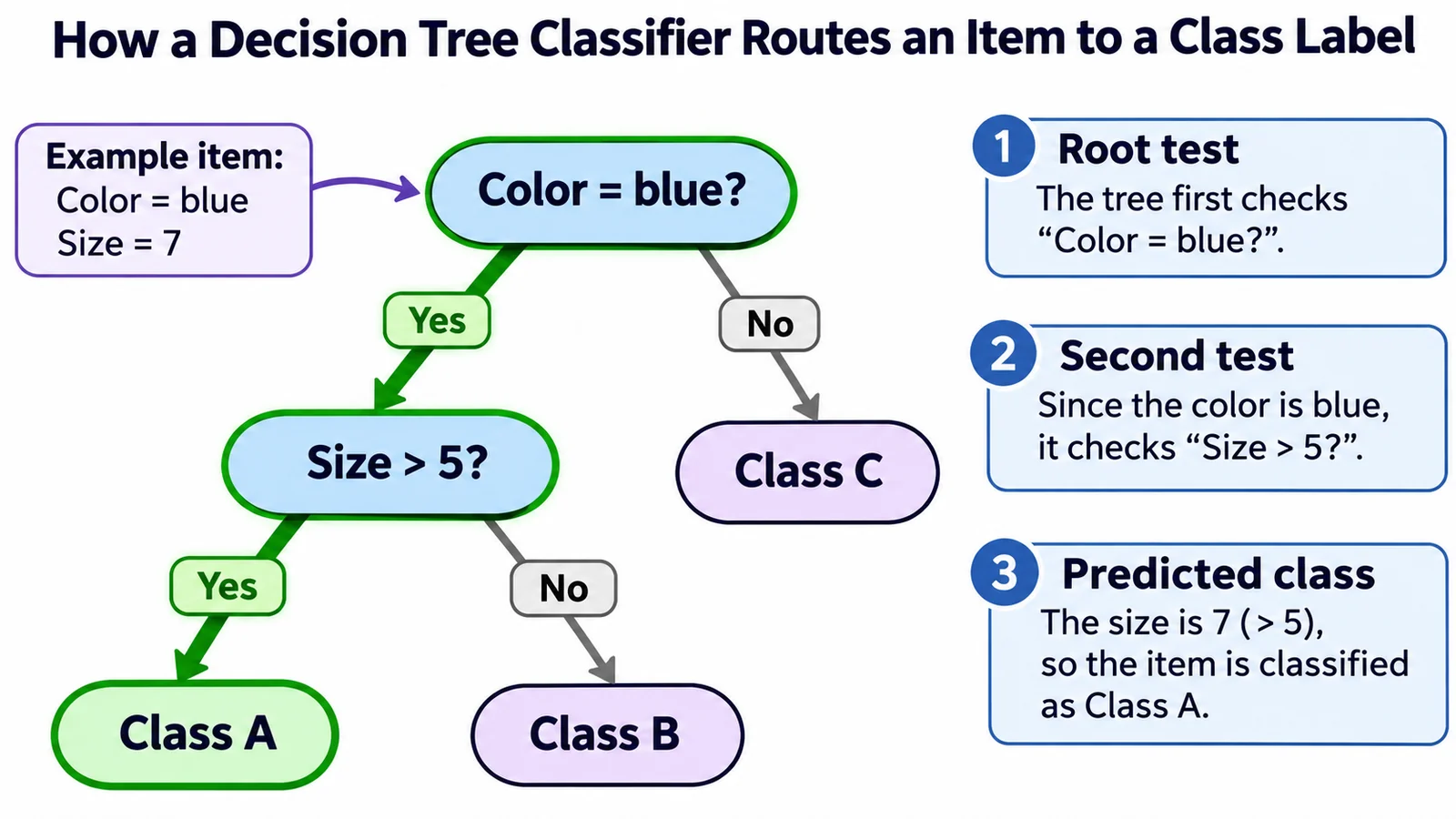
The structure is hierarchical: each internal node poses a test on an attribute of the item, and each terminal node, called a leaf, carries a class label.[12][13] A 2020 survey describes the most significant feature of the decision tree classifier as its ability to turn complicated decision making problems into simple processes, so that the solution reached is understandable and easier to interpret.[12] The C4.5 decision tree reached an accuracy of 78 per cent, ahead of the Naïve Bayes and k-nearest neighbors methods, which each reached 72 per cent.[13]
Trees built for fixed-length vector data, the usual input format, have known limits when the data are sequences, and the common workaround converts a sequential dataset into a vector dataset before applying an existing tree-based classifier. That two-step procedure depends heavily on how the features are generated, and features that matter for building the tree may be missed. A 2021 method instead builds a concise decision tree directly from a feature space made up of all subsequences present in the training sequences, and on fourteen real datasets it performed better than established sequence classification algorithms.[14]
Main ideas
How Decision Trees Are Built: Splitting Criteria
Decision trees split data into groups using feature values. The goal is pure class labels.[15] The choice of splitting criterion determines which feature and threshold are selected at each node to divide the data.[16] Common criteria include information gain. This reduces uncertainty about the class. The Gini index measures the chance of misclassifying an instance.[15]
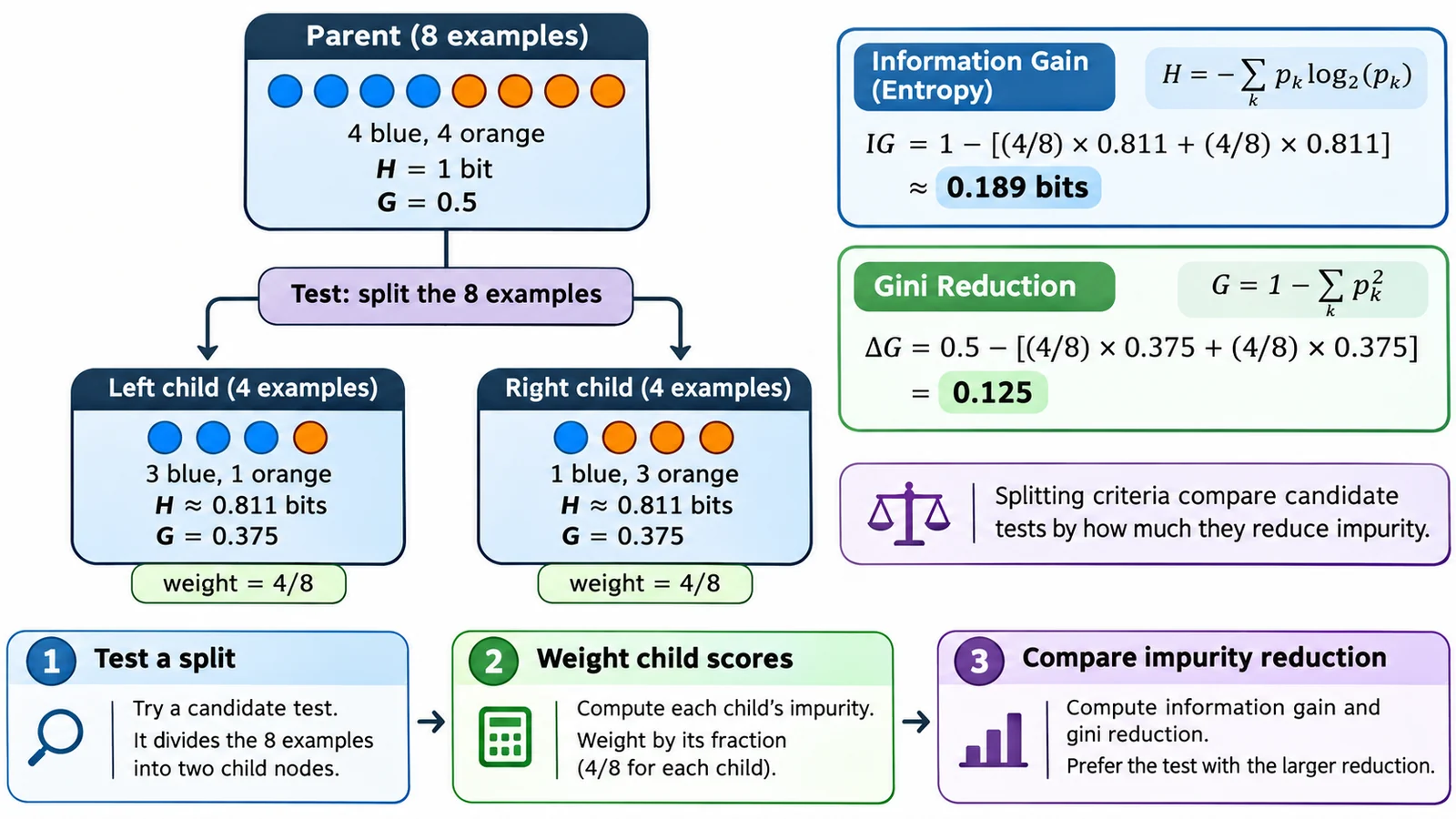
Information gain uses entropy, a measure of disorder. It favors splits that reduce disorder. Each rule reduces impurities in different ways using math.[16]
Other split rules use correlation or similarity to guide decisions. One method uses the absolute correlation between a feature and the target to select the best split at each node.[17] Another method uses how similar data points are to guide splits. The goal is to group similar cases. This method, called mstree, was tested on benchmark datasets and showed higher precision than ID3 and C4.5 in some cases.[18]
A 2023 review compared six decision tree algorithms. It used six splitting criteria across eleven datasets. The Friedman and Nemenyi tests showed the performance differences were statistically significant.[16] A 1992 study found random split rules raised error rates. This contradicted earlier claims of little effect. This suggests that the impact of splitting criteria may depend on the data and setup.[19]
The splitting criterion affects accuracy, tree size, construction time, and how easy the tree is to understand.[16] BOAT reduces construction time by scanning data only twice to build multiple tree levels. BOAT uses an optimistic approach, building an initial tree from a small data sample and refining it with more scans. BOAT also allows updates when new data arrives. It adjusts the tree when old data is removed.[20] How well a split works depends on the data, the method, and the metric used.[16] No one rule beats all others in every situation.[15]
At each internal node, a decision tree must choose a test that divides the data reaching that node into two groups, and most algorithms score candidate tests with a measure of impurity, meaning how mixed the class labels are within a group.[21][22] Information gain is an information-theoretic score built on entropy, a quantity that measures the disorder of a set of labels, and the gain compares the disorder before a split with the disorder after it.[21][23] The usual procedures for estimating information gain are biased, and replacing them with improved estimators of discrete and differential entropy yields better decision trees and improved predictive performance, with the changes simple to implement in any decision tree code.[21] Gini impurity is the other common purity-based score, and impurity measures of this kind do not properly capture the geometric structure in the data.[22]
Alternatives to purity scores exist. A split rule can be judged instead by how linearly separable the two groups are. A correlation-based optimization technique called the Alopex algorithm finds the rule that optimizes this function at each node. The algorithm applies only to 2-class problems.[24]
Pearson's correlation coefficient has also served as a splitting measure, but it cannot handle uncertainty. It does not measure the relation between attributes and their degree of disorder. Deng entropy measures the uncertain degree of a basic belief assignment. It has been used instead to build an evidential decision tree for fuzzy dataset classification.[23]
In regression trees, the choice of splitting criterion affects where a tree places its cuts. The BT method shows a weak bias toward edge splits. Clark and Pregibon's CP method shows a strong bias toward central splits when main effects are present. A third criterion, the SM method, shows no bias toward a particular split position.[25]
At each decision node, a univariate tree tests only one feature, a linear multivariate tree splits the input space with a hyperplane, and a nonlinear multivariate tree uses a multilayer perceptron that divides the space arbitrarily. A nonlinear multivariate tree places a multilayer perceptron at each node and can divide the input space arbitrarily, at the cost of increased complexity and a higher risk of overfitting. Omnivariate trees let each node be univariate, linear or nonlinear according to comparative statistical tests on accuracy. Node complexity thus matches the subproblem defined by the data reaching that node. Simulation results indicate that such trees generalize better than trees with the same type of node everywhere, and that they induce small trees.[26] For oblique trees, one approach finds clustering hyperplanes for both classes at each node and uses their angle bisectors as the split rule, which empirical studies link to small decision trees and better performance.[22]
Common Algorithms for Decision Tree Construction
Decision tree construction relies on algorithms that build a tree by splitting data at each node based on feature values.[1] The ID3 algorithm, introduced by J.R. Quinlan, uses information gain to select the best feature for splitting at each node.[27] Information gain shows how well a feature splits data into different classes. It favors features that reduce uncertainty the most.[1]
ID3 works only with categorical features. C4.5, made by Quinlan, improves on ID3. It uses gain ratio instead of information gain to pick splits.[27]
Gain ratio fixes bias toward features with many values. It divides information gain by the split's intrinsic information.[1] C4.5 handles both continuous and categorical features. It deals with missing data by assigning probabilities to branches.[27]
C5.0, an upgrade of C4.5, trains faster, uses less memory, and has better pruning methods.[27] CART was introduced by Breiman, Friedman, Olshen, and Stone. It uses Gini impurity to find splits. Gini impurity shows how likely a random item would be mislabeled if given the label distribution in the subset.[1]
Recent research tested non-greedy methods. They optimize the whole tree at once instead of making local choices. A 2015 study showed that jointly optimizing splits across all tree levels can lead to better performance than greedy approaches. The algorithm is feasible for deep trees and works well on large datasets.[28]
A 2022 study introduced the Max-Cut decision tree. It uses a new split rule that increases distances between different class groups. At each node, a local version of principal component analysis helps pick the best features. On the CIFAR-100 dataset, this method raised accuracy by 49%. It also ran 6.8 times faster than standard CART Gini.[29]
Decision tree construction uses algorithms that differ in how they pick features to split on. They also differ in handling data types.[1][2][30] Quinlan's method uses information gain based on entropy. It picks splits that reduce uncertainty in class labels. It handles missing data by spreading instances proportionally. CART uses the Gini index to measure how mixed a group is. It only makes binary splits, so it works for both classification and regression. CHAID uses chi-squared tests to find splits. It works well with categorical data and allows more than two branches when results are statistically significant.[1][27][30] C5.0, another Quinlan algorithm, improves on C4.5. It trains faster, uses less memory, and handles missing values better with weighting.[1][27]
Some algorithms use splitting criteria beyond entropy and Gini index. These aim to improve performance.[1][17] A 2011 study used a rule based on correlation to pick the feature most linked to the target. It also used support vector machine ideas to set split points.[17]
Max-Cut uses a measure that increases the distance between data points from different classes on opposite sides of a split.[29] OC1 builds oblique decision trees. It uses hyperplane splits instead of axis-parallel ones to better capture complex patterns in numeric data. OC1 uses hill-climbing with random steps to find good oblique splits. It builds smaller, more accurate trees than axis-parallel methods.[31]
Pruning reduces tree size after building, which improves generalization and reduces overfitting.[1][32][33][34] On a liver disease dataset, pruning improved accuracy: the unpruned model got 73.58% right and the pruned model got 73.76% right.[35]
Handling Uncertainty and Fuzzy Data in Decision Trees
Fuzzy decision trees use fuzzy logic with regular decision trees. They manage data that is unclear or vague. Fuzzy decision trees use fuzzy rules for uncertain conditions. Fuzzy representation, by contrast, is built to handle information that is inexact or uncertain, and output that changes gradually.[36]
Some decision tree methods work with ordinal data, where class labels have a natural order, like 'low', 'medium', 'high'. Ordinal classification uses the order of classes as meaningful, while nominal classification ignores class order.[37]
For monotonic classification, higher input values should lead to better or equal output classes. A new measure called rank mutual information helps keep this consistent. The Rank Entropy-Based Decision Tree (REMT) algorithm uses this measure to build trees that respect monotonic constraints. The method was tested on datasets with monotonic constraints. It worked well even when data had noise.[38]
In streaming data, confidence intervals help decide when enough new data has been gathered to justify a split.[39] A confidence interval is a range of values below and above an estimate that has a given probability of including the true value.[40] Confidence intervals in Hoeffding trees help ensure splits use statistically significant evidence. The method works in selective sampling, where the model picks which labels to request based on uncertainty. Experiments show the active learning module uses fewer labels while performance stays nearly the same compared to standard methods.[39]
Postpruning removes branches after the tree is built, and it improved accuracy more than prepruning on a heart disease dataset.[41] Dynamic programming creates a pruning method that builds trees that are optimal in size and accuracy, and this outperforms cost-complexity pruning.[42]
Evolutionary algorithms like NSGA-II have been used to prune decision trees. They balance goals like small size and high accuracy.[34] Other methods, like African Buffalo Optimization, have been used to make decision trees more accurate overall.[43]
For data with rankings or severity levels, special decision tree methods make sure better inputs lead to better or equal outcomes. The Rank Mutual Information (RMI) measure finds features that keep a steady relationship. This works even when data has noise. The algorithm works well even with noisy training data. It keeps monotonic consistency when data is consistent.[38]
In real-time power grid security, decision trees use phasor measurements. These help assess system stability and suggest control actions. The entire path through the tree, not just the final node, is used to assess system conditions, improving reliability. The method was tested on a real power system with 2100 buses. It found key signs for checking system safety over time.[44]
Pruning reduces overfitting by simplifying the model after it is built, helping it perform better on new data. Overfitting occurs when a tree learns patterns from training data that do not work on new data, which leads to poor predictions. Pruning removes branches that do not help classify new examples well, which improves the model's accuracy.[45][32][34][35][42][46] This makes the tree smaller and easier to read, and it keeps most of the accuracy.[34][46]
Several pruning methods exist.[42][46] Dynamic programming-based pruning uses optimization to find the best sequence of pruned trees by size.[42] The evolutionary approach made smaller trees, and it sometimes improved accuracy.[34]
Privacy and Security Considerations in Decision Trees
Decision trees in data mining and network intrusion detection can reveal sensitive details like IP addresses and network setups, and their rule-based design makes this possible. To reduce this risk, researchers made pruning methods that remove or simplify parts of the tree that show sensitive data. Standard sensitive pruning hides specific values of sensitive attributes, concealing particular values of sensitive attributes. Optimistic sensitive pruning simplifies the tree when few sensitive splits exist, reducing complexity with little loss in accuracy. Pessimistic sensitive pruning removes entire subtrees with sensitive data, which gives stronger privacy by aggressively removing entire subtrees. These methods were tested on three large network intrusion datasets: GureKDDCup, UNSW-NB15, and CIDDS-001. The J48 decision tree algorithm was used. A rolling-origin method was used to test time-dependent attack patterns, replacing standard cross-validation for a more realistic test. IP address truncation and port bilateral classification were added, which reduce exposure of sensitive network details. All three pruning methods cut down exposure to sensitive data, and they also simplified tree shapes and only slightly lowered accuracy.[47]
Another method uses data-swapping to lower the risk of classification attacks, which could expose private records. This method uses entropy-based measures to identify records with high disclosure risk and applies swapping to lower that risk. The method protects privacy while keeping data useful, so that meaningful data mining can continue. It works on both numeric and categorical data and was tested on six real-world datasets. Experiments showed the method protects privacy well and also keeps strong performance in classification tasks.[48]
In cloud-based machine learning, decision tree predictions may leak sensitive input data if processed on untrusted servers. A leaf node pruning algorithm finds the most useful leaf nodes and keeps only those during prediction. The system keeps prediction accuracy high and works much faster in secure settings.[49]
Differential privacy gives a formal guarantee that no individual’s data can be guessed from the model output. It ensures that the model’s output remains nearly unchanged whether or not any one individual’s data is included.[50]
Decision trees can risk privacy when their visible rules carry sensitive information. Chew, Ooi, Wong, Pang and Lee (2022) propose pruning a tree on the basis of an IP truncation anonymisation scheme, so that real IP addresses are removed before the tree is built. The 2022 study showed IP truncation cut the number of nodes and kept classification accuracy the same.[51] A 2026 study used C4.5 to find sleep quality and academic load as key factors, and these helped classify student depression levels.[52]
Decision Trees in Real-Time and Streaming Data Applications
Decision trees can handle streaming data. They update their structure as new data comes in. In streaming environments, models must predict and update without retraining from scratch. Knowing when to split a node needs statistical confidence in the split's benefit. The Hoeffding tree algorithm uses confidence intervals to estimate split gain and only makes splits when evidence is strong. This approach lets the tree grow step by step. Experiments show trees built with this method are more accurate than those using standard techniques with the same number of leaves.[39]
Selective sampling allows the model to decide which data points to label, reducing the need for full supervision. It keeps high performance, which helps when labeling is expensive. Theory shows the chance of misclassifying the next example stays low with this method. The method was tested on real and synthetic data streams. It showed better accuracy than existing techniques.[39]
The system builds decision trees offline. It uses them to find signs of system stability and updates them over time. The method uses full paths through the tree, not just final leaf results. This gives better security checks when system conditions change. Testing on a 2100-bus, 2600-line, 240-generator model of the Entergy system showed reliable and accurate online dynamic security predictions.[44]
The Adaptive Cylindrical-Pruning Decision Tree Method was made for detecting conflicts in low-altitude UAV flights, where fast conflict detection is critical. The method was tested in simulations involving 100 to 800 UAVs under dense and crossing-route conditions. A double-layer cylinder zone was made, with a core area for conflict and an outer area for warning.[53]
Decision trees predict if power systems stay stable after a fault, and they help with real-time monitoring and control. The method uses a short window of post-fault phasor data, which enables quick assessment of system stability.[54] A decision tree was used to decide when to start controlled islanding during power system emergencies. The decision tree finds system conditions that mean controlled islanding is needed. Senroy, Heydt and Vittal (2006) train decision trees on simulation data and then evaluate their online performance as part of a controlled islanding strategy.[55]
In video coding, a fast decision method uses coding tree pruning. It reduces computation during block size selection. The method skips subtree computations when the current node is sufficient, such as in SKIP mode, reducing unnecessary processing. Skipping unnecessary calculations makes decision-making faster during video encoding.[56]
Purwanti (2026) applied a decision tree to a maternal health risk dataset and reports accuracy reaching 100%, and proposes the resulting model as an aid in classifying health risk during pregnancy. It classified risk levels correctly.[57] In another case, a decision tree helped check security at U.S. border crossings, aiming to stop terrorist attacks, and the model weighed security costs and benefits. It found that improving security at Mexican ports is not worth it because false alarms are too expensive, and it suggested stronger checks at U.S. ports only when attack risk was high. The model's security decisions depended mainly on the probability of attack and on parameters that affect the overall cost of false alarms.[58]
Theoretical guarantees and their limits
Some of the strongest guarantees for decision trees come from viewing a tree as a sum of simple pieces rather than as a set of rules. In 1993, Kushilevitz and Mansour gave a polynomial time algorithm for learning decision trees under the uniform distribution, meaning every input is equally likely. Their model permits a linear operation at each node, namely a sum of a subset of the input variables over GF(2), the two-element field. Boolean decision trees with linear operations fall inside that class, so they can be learned in polynomial time, and functions with polynomial L1 norm can be learned deterministically.[59]
Standard top-down heuristics such as ID3, C4.5 and CART choose each split from the correlation between the target function and one attribute at a time, and impossibility results show that such heuristics fare poorly even for simple target functions. A 2020 extension keeps the top-down structure but adds a splitting criterion that also considers correlations between the target and small subsets of its attributes. For every target function from n binary inputs to two labels, every size s and every error parameter epsilon, the extension builds a tree of size s raised to a power of order (log s)^2 divided by epsilon^2. That tree achieves error at most O(opt_s) plus epsilon, where opt_s is the error of the best tree of size s. The analysis rests on noise stability, a smoothness measure of the target function that had been studied before.[60]
Greedy top-down induction itself has provable limits, and a 2019 analysis pins them down with near-matching upper and lower bounds. The heuristic places the most influential variable at the root, recurses on the two subfunctions, and stops once the tree approximates the target within epsilon. For every function whose smallest decision tree has size s and every epsilon between 0 and one half, the heuristic builds a tree of size at most s raised to a power of order log(s/epsilon) times log(1/epsilon). For monotone functions the bounds are s raised to a power of order the square root of log s divided by epsilon, and s raised to a power of order the fourth root of log s. The upper bounds yield new algorithms that properly learn decision trees under the uniform distribution. Blanc, Lange and Tan report that these compare favorably with the fastest algorithm then known, from Ehrenfeucht and Haussler in 1989.[61]
A separate line of work asks whether a tree can extend what it learned to inputs unlike those in the training set, and the answer is largely no. A 2010 paper by Bengio, Delalleau and Simard proves formally that the curse of dimensionality can seriously hurt decision trees, in a sense somewhat different from other nonparametric statistical methods. A tree also fails to generalize to variations absent from the training set. It partitions the input space, and each region tied to a leaf needs at least one training example before a sensible prediction can be made there.[62]
The choice of splitting criterion carries its own biases, and a 2021 analysis reports that the Gini index has less bias than entropy information when missing values and variables with many possible values are present. Zhao and Nie (2021) report that a noise variable with more missing values is more likely to be chosen, while an informative variable is not. When many noise variables enter the building process, the computational complexity grows linearly with their number.[63]
Scaling trees to large and distributed data
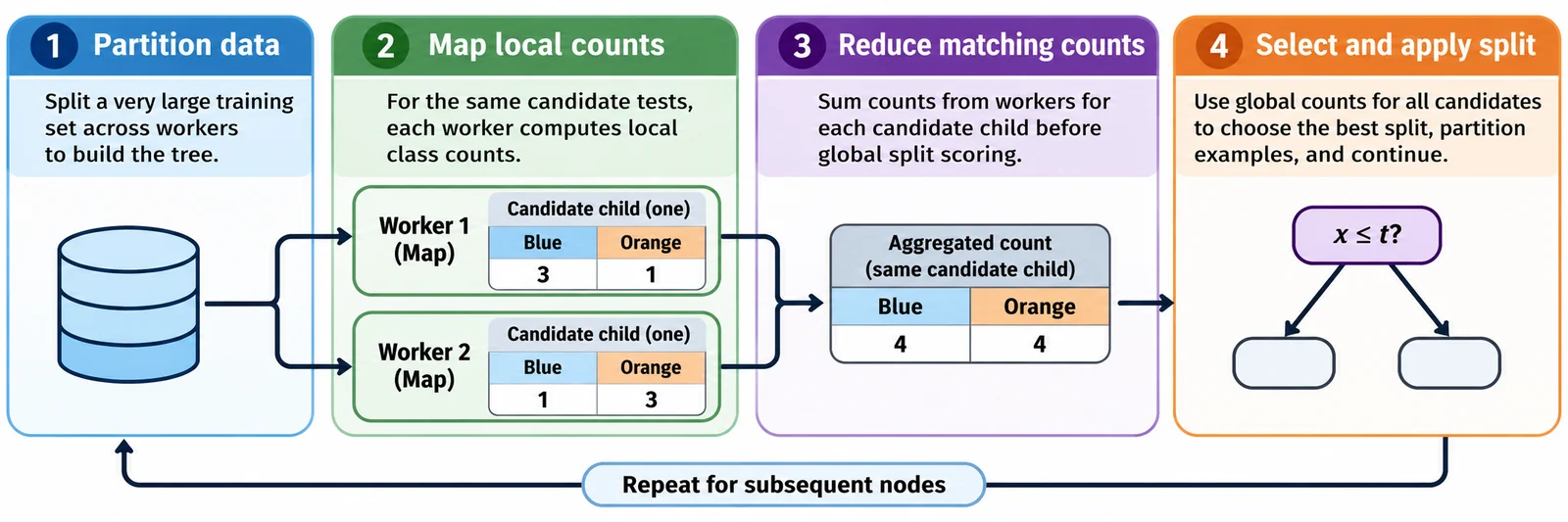
Growing a decision tree on a very large dataset runs into two practical obstacles. As the dataset becomes extremely big, the process of building the tree can be quite time consuming. Because the data can no longer fit in memory, some computation must be moved to external storage, which increases the cost of input and output operations. One response is to rewrite a standard tree algorithm as a series of Map and Reduce procedures, the two stages of the MapReduce programming model for splitting work across many machines. A 2014 implementation of this kind took C4.5, a widely used tree algorithm, and added data structures designed to keep communication between machines to a minimum. Experiments on a massive dataset indicated both time efficiency and scalability.[64]
Cross-validation, the practice of fitting a model repeatedly on different parts of the data and testing it on the rest, is a useful and generally applicable technique in machine learning, including decision tree induction. A straightforward implementation carries a serious disadvantage: its computational overhead. For decision trees, Blockeel and Struyf show that this overhead can be cut substantially by folding the cross-validation into the normal tree induction process instead of running the two separately. A 2001 analysis described how existing tree algorithms can be adapted for this purpose and what speedups the adaptations may yield, and supported the analysis with experimental results.[65]
The choice of splitting criterion, the rule that scores candidate tests at each node, can affect the accuracy of the resulting model. A 2022 comparison of splitting criteria in decision trees and random forests, using data splits, cross-validation and a confusion matrix, found that the choice of criterion influenced the accuracy values of the models produced.[66] Reviews of tree algorithms treat these criteria as a central object of study, since the algorithms differ in the specific mechanisms and criteria they use. One review set out to identify and inspect the vital criteria of tree algorithms and to provide a path for selecting a specific factor when improving an algorithm for a particular requirement or problem. The same review notes that a tree copes with a large database and handles numerical and categorical variables alike.[67] A separate review of prominent algorithms such as C4.5 and ID3 reported accuracy on a variety of datasets.[68] A 2018 review argued that C4.5 works better than ID3, whose weakness is that it gives more importance to attributes having multiple values when selecting an item that affects the decision tree.[69]
Pruning, overfitting and how trees are grown
When examples are partitioned too specifically, a few exceptional samples can harm the tree, and the result is a tree too large to be understood that classifies and predicts new data less well. In tree generation based on the rough set model, a model that groups examples by shared attributes, algorithms often partition examples too specifically in pursuit of classification accuracy. A few exceptional samples then have a negative effect on the tree, and the result is a tree too large to be understood and weaker at classifying and predicting new data. One proposed fix adds a restrained factor: besides the traditional stopping condition, a node stops expanding once the restrained factor of its sample is higher than a given threshold, which keeps the tree from growing too large to be understood.[70]
Chang and Pavlidis (1977) prune subtrees unlikely to be traversed, and Jiang, Liu and He (2011) improve the pruning strategy of the SLIQ algorithm for quality control in SMT assembly.[71][72] A 1977 paper on fuzzy decision trees, trees whose tests allow partial membership rather than a clean yes or no, described a branch-bound-backtrack algorithm that prunes subtrees unlikely to be traversed and installs tree-traversal pointers. That backtracking mechanism reaches the optimal solution. It usually needs time on the order of the logarithm of n, where n is the number of decision classes.[71] In a data-mining application to quality control in SMT assembling, a method of placing electronic components on circuit boards, a 2011 study built on the SLIQ decision tree algorithm and improved its pruning strategy to make decision analysis more accurate and predictable.[72]
Pruning also describes what people do when they plan, since considering every possible future sequence of actions is usually infeasible. In a sequential reinforcement-based task, people stopped evaluating a sequence of choices once a large loss appeared. The study called the strategy Pavlovian. Large losses evoked it reflexively, and it persisted even when it was overwhelmingly counterproductive. The strength of this pruning tendency was selectively predicted by how much sub-clinical mood disturbance each subject showed. The study linked this to theories that give Pavlovian behavioural inhibition, acting through serotonin, a role in mood disorders.[73]
Research
Performance Evaluation and Benchmarking of Decision Trees
Decision trees are tested using accuracy, precision, and recall. These show how well the model places data in correct categories. Accuracy is the fraction of all predictions that are correct. It includes both true positives and true negatives. Precision shows how many predicted positive cases are truly positive. It reduces false alarms. Recall shows how many actual positive cases the model finds. It helps reduce the number of missed cases.[32][33][35][41] It displays these values clearly.[33][35][41]
Pruning removes branches that fit training data too closely, which helps avoid overfitting and improves tree performance.[32][33][35][41] A study on liver disease data found pruning raised accuracy from 73.58% to 73.76%.[35] A 2024 study used a heart disease dataset from Kaggle and found that postpruning gave higher accuracy than prepruning. Postpruning improved recall and precision, and it also raised the F1 score, showing better performance than prepruning. Postpruning has been shown to reduce overfitting better than prepruning, and it also improves prediction accuracy.[41]
A 1997 study compared pruning methods and found differences in how much computing power they need and how often they overprune or underprune. Different experiment setups can lead to different conclusions about the best pruning method.[33] Using multiple fairness metrics during tree building improves fairness while accuracy stays high. A 2024 study found Fair C4.5 models were fairer than standard C4.5 and FFTree across fourteen datasets with sensitive traits. Using multiple fairness criteria can help design decision trees that are both fair and accurate.[74]
Cross-validation estimates how well a model works on new data. It splits the data into several training and test sets.[16][45][18][19][33][75] A rolling-origin resampling scheme splits data in time order. This mimics real-world time-dependent patterns like those in network intrusion detection. This method stops future data from affecting past observations. It prevents inflated accuracy in time-sensitive cases.[47]
Classification accuracy is the share of correctly classified instances. It is a common way to compare decision tree models.[16][45][18][19][33][75] On eleven benchmark datasets, I.D.3 and CART had higher accuracy than other methods tested. Accuracy was measured as the share of correct predictions. The Friedman and Nemenyi post hoc tests were used to analyze differences in performance among the six decision tree algorithms. Tree depth, number of leaf nodes, and construction time are used to compare decision tree algorithms. These are performance metrics.[16]
Decision tree performance varies by domain and dataset: some models work well in medical classification, while others do better in network security.[47][16][75] On a lung cancer dataset with 1,010 records and seven features, a tree without feature selection got 64.85% accuracy, which beat random forest at 52.62%.[75] A modified tree using Max Cut and node-based PCA improved accuracy by 49% on CIFAR-100.[29]
The split choice strongly affects how well the model works, and methods based on information theory, like ID3 and C4.5, are widely used.[16][27][17] A correlation-based split picked features most closely tied to the target, which reduced tree height and cut classification time.[17] Another study used a similarity-based split rule, which beat ID3 and C4.5 in precision and worked better with different training set sizes.[18] Differences in experiment design may explain why results vary across studies.[19][33]
Pruning methods like reduced error pruning and cost-complexity pruning reduce overfitting and improve generalization.[45][33][35] The leaf node pruning algorithm cut prediction time by about 85% compared to older methods. Pruning leaf nodes in a privacy-safe system cut prediction time by up to 50%, and accuracy stayed the same.[49]
Decision trees can be changed to reduce unfair results in automated choices like hiring or loans by adding fairness rules.[74][76] Tests on fourteen datasets showed the new Fair C4.5 model was fairer than standard C4.5 and FFTree, and it kept high accuracy too.[74]
The framework finds strategies that work even when key values are uncertain. This is important for long-term planning in finance and public policy. It also helps decision-makers see which inputs are most important. They can then focus on getting better data for those inputs. This method is simple. Managers can use it without advanced statistical training.[77]
How trees are pruned after growing
A tree grown until every leaf is pure can be larger than the patterns in the data justify, and pruning cuts parts of it back after growth finishes. Trees built by top-down induction keep growing as the sample grows, Elomaa and Kaariainen observed in 2001, yet their accuracy stops improving.[78] A 1997 survey of tree simplification observed that trees from induction algorithms are often too large and complex for users to understand, and that simplification has usually been treated as secondary to accuracy.[79] Pruning is applied to combat overfitting, the problem in which a tree fits the training cases so closely that it classifies new cases worse; the aim is the lowest error rate on previously unobserved instances, with ties broken in favour of smaller trees.[80]
Reduced error pruning is a representative method, and the 2001 analysis examined its behaviour in three settings. The analysis showed that the chance of pruning a node that fits pure noise is bounded by a function that falls exponentially as the tree grows. Under an assumption that examples are distributed uniformly over the tree, the analysis also approximated how many subtrees are pruned because they receive no pruning examples at all. The paper clarified the variants of the algorithm and added the previously overlooked empty subtrees to the analysis.[78]
Cost complexity pruning comes from the classification and regression trees work of Breiman and colleagues in 1984, and a 1989 paper reinterpreted and extended that algorithm to source coding and modelling applications. Among the uses Chou, Lookabaugh and Gray list are vector quantization whose trees vary their rate, decision trees built to minimize expected cost, Markov models of variable order, allocation of bits at an optimum, and quadtrees for graphics and image processing. In the experiments reported there, variable-rate tree-structured vector quantization outperformed both the fixed-rate variety and full-search vector quantization. Its successive approximation character lets it degrade gracefully when the rate is reduced at the encoder, which bears on the problem of buffer overflow.[81]
A post-pruning method published in 2018 estimates risk with Bayes minimum risk and works bottom-up, turning the parent of a subtree into a leaf when the parent's estimated risk rate is lower than the risk rates of its leaves. The experiments compared the method on attribute selection, accuracy, tree complexity, time taken to prune, precision and recall scores, true positive and false negative rates, and area under the ROC curve. The method produced better classification accuracy, and its complexity was not much different from that of reduced-error pruning and minimum-error pruning.[80]
A genetic algorithm has been used to prune the C4.5 decision tree, whose tendency to keep growing leaves unnecessary nodes and branches that lead to overfitting. The study used four datasets from the UC Irvine machine learning repository: IRIS, Car Evaluation, GLASS and WINE. The results confirmed that the genetic algorithm pruned the effect of overfitting on all four datasets and optimized the confidence factor of C4.5, reaching about 92% accuracy.[82]
Pruning has also been applied outside classification, as a decision tree pruning method for detecting and resolving conflicts among four-dimensional flight trajectories in air traffic management. The trajectory data covered 58% of the whole Brazilian air traffic, and the method handled massive data sets where pairwise conflict detection needs at least O(n2) time. The conflict resolution approach found near-optimal solutions for the conflicts the framework identified.[83]
Making trees easier to read and explain
Decision trees are often described as easy to explain, and that reputation is the main reason they are used as stand-alone classifiers or as the building blocks of larger ensembles.[84] The usual explanation for a tree's prediction is the path from the root of the tree down to the leaf that produced it, and because trees are ideally shallow, such a path is expected to name far fewer features than the data contain. A 2022 analysis challenged that expectation on formal grounds. Izza, Ignatiev and Marques-Silva proved that some functions force trees whose paths carry explanation redundancy arbitrarily larger than the actual explanation, and that trees free of such redundancy cover only a narrow class of functions.[85]
The redundancy is not a rare curiosity. Experiments in the same analysis found path explanation redundancy in trees produced by different learning algorithms and in a wide range of publicly available trees. The analysis offers a remedy as well: polynomial-time algorithms that remove redundant conditions from a path, which in practice take negligible time to compute and yield irreducible, and therefore succinct, explanations.[85] Size is a related obstacle, since a tree that grows large is hard to read however clean each path is, and one line of work has changed how splits are chosen so that the rules come out short.[86]
A splitting criterion proposed in 2020 selects splits to produce homogeneous rules that cover a significant number of instances while staying short. The criterion examines just one side of a split and scales a ratio of sample sizes by a tunable parameter that sets how much data the rules cover. It is applied anew at each split. A heuristic sets that hyperparameter for each split, and on 17 benchmark datasets the criterion with the heuristic built trees judged more interpretable, with predictive performance comparable to that of other popular criteria.[86]
Another route to readable output is to convert an ensemble of trees into decision rules, which are valued for their transparency as a way to extract knowledge from data. In a 2025 study, CART and ID3 grew trees from bootstrapped datasets, and a greedy algorithm then derived rules true across several trees. As a parameter alpha, with 0≤alpha<1, rose, the rules came out shorter, and the accuracy of the rule-based models could also rise.[87]
Explanations can also be computed after a tree model is fitted, for a single prediction or for the model as a whole. A 2020 set of tools for tree-based models such as random forests and gradient boosted trees has three parts. It gives the first polynomial-time method for computing optimal game-theoretic explanations, a measure of local feature interaction effects, and ways to combine many local explanations into a picture of global model structure. Tried on three medical machine learning problems, the combined explanations picked out mortality risk factors in the US population that are strong but rare and act non-linearly. They also marked out subgroups of the population sharing risk characteristics and showed non-linear interactions among risk factors for chronic kidney disease. The same approach was used to monitor a model deployed in a hospital by finding which features were degrading its performance over time.[88]
One limit on readability comes from trees that split on combinations of features rather than single features, which are used to improve classification performance. A 2021 review described 37 multivariate tree induction algorithms and compared 19 of them across 57 databases. It reported which algorithms performed best for different kinds of database.[84] Visual support has also been tested: an interactive visual process for building trees was reported to produce trees with relatively high classification accuracy and small size, and to improve users' understanding of the algorithm and their satisfaction with the task.[89]
Costs, class imbalance and missing values
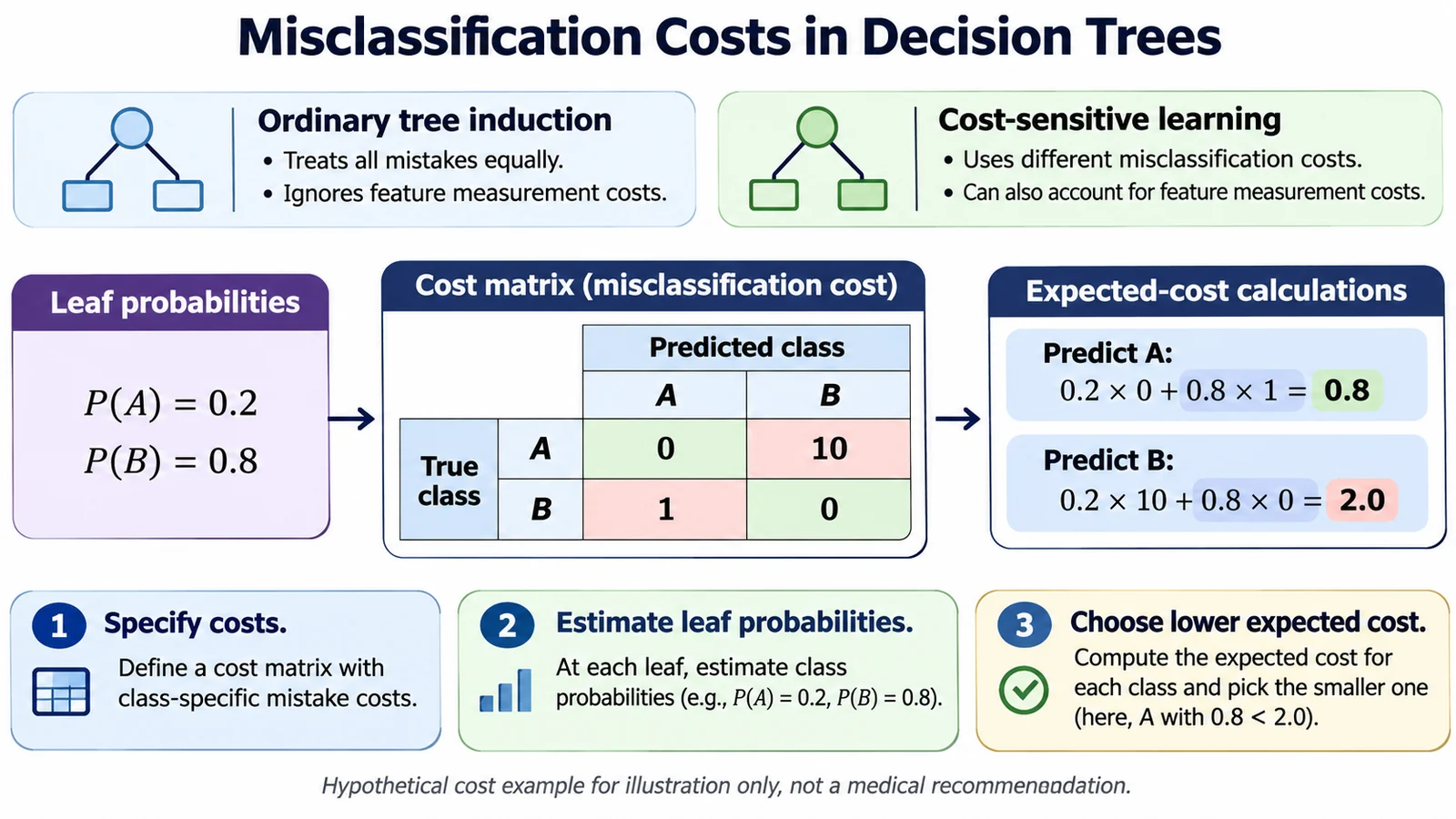
Ordinary tree induction treats every mistake as equally costly, but many applications do not: a missed diagnosis and a false alarm carry different prices, and some features cost money or time to measure. A survey published in 2013 identified more than 50 algorithms for cost-sensitive decision tree induction, meaning methods that account for the cost of misclassification and the cost of acquiring the features used to make a decision. The surveyed approaches include direct adaptations of accuracy-based methods, methods built on genetic algorithms, anytime methods, and methods that use boosting and bagging. The survey also organizes the field with a taxonomy and a historical timeline of how it developed.[90] One pair of software packages supports cost-sensitive learning by letting the user define a misclassification cost matrix, and it also supports weight-sensitive learning, in which training examples carry weights.[91]
A different problem arises when the goal is not to predict an outcome but to decide whether an action will change it. Often an action follows classification, such as sending an offer or treating a patient. Rzepakowski and Jaroszewicz argue in 2012 that the quantity to model is then the shift in class probabilities that the action causes, not the probabilities themselves. The action should then be performed on the objects for which it will be most profitable. Rzepakowski and Jaroszewicz (2012) note that this problem, called uplift modeling, differential response analysis or true lift modeling, had drawn very little attention in the machine learning literature. The same paper presented tree-based classifiers for uplift modeling in a single treatment case and in a case with several possible actions, where the model must also choose which action to use for each object in order to maximize profit. The authors designed new splitting criteria and pruning methods for this purpose, and their experiments showed significant improvement over previous uplift modeling techniques.[92]
Training data are often limited because collecting, preparing and storing examples costs money, and learning from them costs computation as well. A 2003 study of twenty-six data sets asked, for a fixed training-set size, how the classes should be represented in proportion. The naturally occurring class distribution generally performed well when performance was judged by undifferentiated error rate, also called 0/1 loss, which counts every error the same. When performance was judged by the area under the ROC curve, a measure of how well the classifier ranks examples across thresholds, a balanced distribution performed well. Because neither choice of class distribution always produced the best classifier, the study introduced a budget-sensitive progressive sampling algorithm that selects training examples according to their class. An empirical analysis showed that the class distribution of the resulting training set yielded classifiers with good, nearly optimal classification performance.[93]
Incomplete data pose a further problem, and a 2009 study compared seven techniques for tolerating missing values in training and test data for decision trees. Twala (2009) drew on 21 complete data sets held in the University of California, Irvine machine-learning database collection and simulated missing data at different proportions, in different patterns and by different mechanisms. All methods had strengths and weaknesses, but listwise deletion, which discards any record with a missing value, was substantially inferior to the other six techniques. Multiple imputation using the expectation maximization algorithm, which fills in missing values several times and combines the results, represented a superior approach. Decision tree single imputation and surrogate variables splitting were more severely affected when missing values were distributed among all attributes than when they occurred on only a single attribute. The study concluded that multiple imputation should always be used, especially when the data contain many missing values, while any of the techniques might be considered if few values are missing. It also judged the use of older techniques such as listwise deletion and mean or mode single imputation no longer justifiable, given the accessibility of more advanced methods such as multiple imputation and supervised learning imputation.[94]
In practice
Trees for prediction and decision analysis
A decision tree sorts cases into groups by asking a series of yes-or-no questions about their attributes, and that structure suits problems where a person must act on the result.[95][96] Clinical decision analysis uses such trees to weigh evidence and uncertainty when a medical choice is complex, and its results are meant to be applied in shared decisions that take account of the patient's values.[96] A 2024 review by Abdulqader and Abdulazeez describes uses in diagnosis, prognosis and health monitoring, on data that range from genetic markers to electronic health records and live patient data. The same review counts sensitive data, privacy worries and the need for large annotated datasets among the limits of the approach.[97] One early application classified thyroid data into three classes of thyroid disorder, using five splitting rules to build the tree.[98]
In finance and utilities, trees are used to flag transactions and firms that warrant a closer look.[99][100][101] A 2010 study applied decision trees to business failure prediction and reported numerical results suggesting that trees could be superior predictors of failure compared with discriminant analysis, a standard statistical method.[100] For electricity theft, a scheme combined a decision tree with a support vector machine, a second classifier, so that data processed by the tree were fed as input to the second classifier. The reported results indicate that the scheme reduced false positives to a great extent.[99] A 2023 paper proposed a theoretical model for detecting and preventing credit card fraud with a decision tree algorithm. In a survey of 102 students from universities in different countries, 95.9% said they knew how credit or debit card fraud occurs, and 81.6% said they would use a tool built on the proposed model.[101]
Trees also serve where the output is a rule that operators or planners can follow.[95][102] A 2008 comparison for the Shihmen Reservoir system weighed a conventional decision tree algorithm, C5.0, against a neural decision tree and a fuzzy decision tree, in which attributes take membership grades rather than sharp values. The conventional algorithm runs quickly and translates easily into if-then-else rules, but it cannot discover dependencies among attributes and cannot treat class boundaries that are not parallel to the attribute axes. In that case study the fuzzy tree performed better than C5.0, the neural tree and the reservoir's current operating rules.[95] The map's area under the curve, a summary of how well predicted classes match observed ones, was 89.6%, which the study judged good enough performance.[102]
In education, a 2016 study at the Faculty of Economics in Osijek classified undergraduates into two categories by their success at the end of the first academic year, using high school records, first-year course results and the rank of preferences assigned to the faculty. The highest classification rate, 79%, came from the REPTree algorithm, but that tree was not as successful at classifying both classes. Averaged over the two classes, the best result came from a model built with the J48 algorithm. The variables that mattered most were the total points on the state exam, the points from high school and the points on the Croatian language exam.[103] A 2017 review by Venkatasubramaniam, Wolfson, Mitchell, Barnes, JaKa and French notes that trees partition a population into subgroups that share similar values of an outcome. Both the older CART method and the newer CTree method predicted more accurately than regression-based approaches when subgroups were truly present in the data.[104]
Choosing and tuning a tree in practice
Quinlan (1990) examines techniques that represent knowledge about classified tasks as decision trees, from basic methods of building them to ways of using them noncategorically.[105] A 2012 study compared two such strategies on a single medical problem, the diagnosis of acute abdominal pain. The first group of approaches ignored expert knowledge and built the classifier only from a learning set, the collection of past cases used to grow the tree. The second group let experts specify the structure of the tree while the learning set determined how decisions were made at each node, using Bayes decision theory, a rule for picking the class that is most probable given the evidence. The study asked whether it is worth using expert knowledge and a learning set at the same time, and it judged all classifiers through computer experiments rather than a field trial.[106]
Milanović and Stamenković (2016) apply the CHAID algorithm in a study of leadership, building a classification model for the dominant leadership style from a sample of 417 managers of privately owned small enterprises in Serbia. A 2016 paper set out the conceptual characteristics of this method and argued that its explorative nature makes it well suited to detecting structure in data. The empirical part applied CHAID to leadership studies, testing how selected personal characteristics of managers relate to their leadership style. The sample was 417 managers of privately owned small enterprises in Serbia, surveyed with a purpose-built questionnaire. The resulting classification model identified six personal characteristics as statistically significant predictors of dominant leadership style.[107]
Several named algorithms dominate comparisons for classification tasks: ID3, C4.5, C5.0 and CART (Classification and Regression Trees).[108] A 2015 study compared ID3, C4.5 and C5.0 and reported that C5.0 gave the more accurate and efficient result. That study combined C5.0 with feature selection, which drops redundant features that carry no useful information, and with reduced error pruning, which removes branches that do not improve accuracy. The proposed system was reported to gain 1 to 3% in accuracy, with a lower error rate and a tree built in less time than the comparison techniques.[109] A 2018 paper surveyed ID3, C4.5 and CART and noted that the algorithms differ in accuracy and cost of effectiveness, so knowing which suits a given decision situation matters.[110]
Quinlan's 1990 treatment of decision trees and decision-making sketched techniques ranging from basic tree construction to ways of using trees when classes are not treated as fixed categories. That paper also discussed which characteristics suggest whether a classification task is likely to suit tree-based methods at all.[105] A 2004 tutorial reviewed traditional tree construction and the state of tree modeling, with emphasis on features that fit chemical and biochemical applications.[111] A 2019 review set out to gather improvements to tree algorithms in one place, noting that no available literature had yet done so.[108]
Where decision trees are applied
Decision trees appear in surveys of medical prediction, where a 2015 review of machine learning in cancer research lists them among the methods widely applied to build models of cancer risk and patient outcomes. The same review notes that an appropriate level of validation is needed before such models can be considered in everyday clinical practice.[112] In drug development, a study of 153 compounds built decision tree models of blood-brain barrier permeability, the ease with which a molecule crosses from the blood into brain tissue, and reported a corrected classification rate of 90%. Those trees pointed to lipophilicity (a measure of how readily a molecule dissolves in fats) and charge, measured as polar surface area, as predictive descriptors, and also linked molecular geometry and connectivity to an active transport component.[113]
Remote sensing supplied an early large test: a 1997 study compared decision tree classifiers with maximum likelihood and linear discriminant function classifiers on three remote sensing data sets and found the trees consistently more accurate for land cover mapping. A hybrid tree that could include several different classification algorithms within a single structure produced the highest accuracies of the methods tested.[114] In agriculture, a study of soybean data for solitary larvae of Spodoptera moths sorted the data into four classes based on Economic Threshold Level, the pest density at which control measures are warranted.[13]
Education is another documented area: a study of 1,144 valid graduation records from a Bengkulu university trained a tree with the Gini criterion and reported 82.1% test accuracy, with graduation honors and grade point average category as the most influential factors for timely graduation.[115] A separate study used learning management system activity data to test whether student activity predicts academic performance and obtained 71,667% accuracy with the C5.0 algorithm.[116] For network security, a 2023 review of intrusion detection systems proposes the decision tree as a model for detecting result anomalies. The review describes the decision tree as fast and easy for users.[117]
Two studies below compare classifiers on short texts: product reviews and posts about divorce after infidelity. A comparison of five classifiers on Amazon product-review data included a decision tree among the methods evaluated. A study of 3,450 tweets about divorce due to infidelity reported 96.95% accuracy for a decision tree against 73.59% for Naive Bayes on an imbalanced data set.[118][119]
What this looks like in practice
A 2005 survey by Rokach and Maimon described how trees are grown from data in a top-down manner, presenting the many construction methods within one shared algorithmic framework and comparing their splitting criteria and pruning methods.[1] Aaboub, Chamlal and Ouaderhman (2023) gathered six tree algorithms built on six different attribute evaluation measures, drawn from four categories: information theory, distance, statistical criteria, and other criteria.[16]
Hu and colleagues (2012) designed a tree algorithm called REMT around rank mutual information, a measure that combines Shannon entropy with dominance rough sets to capture ordinal structure in monotonic data. Their analysis showed that REMT produces monotonically consistent trees when the training samples are themselves monotonically consistent, and that its performance remains good when the data contain noise.[38] Sun and colleagues (2007) built an online dynamic security assessment scheme in which trees are trained and periodically updated offline to identify critical security indicators, then applied online to real-time phasor measurements.[44]
Later developments
Recent Advances and Future Directions in Decision Tree Research
New research has introduced splitting rules that focus on generalization error, the error a model makes on data it has not seen, in order to improve decision tree accuracy. A 2025 study created two splitting rules based on generalization error. One came from a math model, and the other used leave-one-out cross-validation. The LOOCV-informed split rule improved the balance between model complexity and accuracy.[120]
A 2019 algorithm gave the first working way to build optimal decision trees for binary data. The 2019 algorithm used analytical bounds and custom data structures, and it solved decision tree optimization efficiently.[121]
Researchers are testing ways to join decision trees with neural networks, a trend called neural-tree integration that aims to boost both performance and clarity.[122][123] The soft decision tree from a neural network works better on new data than one trained directly. The soft decision tree keeps a hierarchical structure, and it also captures complex patterns from neural networks.[123]
Evolutionary algorithms help build decision trees that are globally better, not just locally, which helps reduce instability and overfitting.[124][43] The method uses two levels of optimization. It separates splitting the state space from assigning actions to each part. The method was tested on three reinforcement learning tasks and a pandemic control problem. It matched top methods in performance while staying easy to understand.[124]
Interpretable reinforcement learning is growing in importance, and it is used in areas like pandemic control where understanding agent choices matters.[124] In healthcare, decision trees are being improved using synthetic data with over 55,000 records. The goal is to balance depth, clarity, and accuracy. Shallow trees are easier to understand but may not classify well, while deep trees can overfit. Pruning helps balance simplicity and accuracy.[125]
The pruning method for decision and game trees uses scenario trees. These require joint probabilities along paths, not conditional probabilities on edges. This method improves efficiency in Bayesian updating, in which probabilities are revised repeatedly.[126]
Decision trees are being tested in low-data settings. Knowledge distillation transfers knowledge from large models to small ones. Rectified decision trees use soft labels from a teacher model. These labels come from a jackknife-based method and improve performance without changing the split paths. Model size is reduced by cutting down nodes and rules. This was seen during training with soft labels.[127]
Federated learning with decision trees lets institutions train models together without sharing raw data. This supports privacy-safe machine learning. Wang and Gai (2024) describe decision tree models as simpler and easier to interpret than traditional neural networks or linear models, and they treat data security and communication efficiency as central concerns when trees are trained across multiple parties. Data privacy matters here, and communication efficiency is a major challenge.[128] The entrepreneurship path planning system uses a better pruning algorithm. It has a dynamic strategy and a multiobjective optimization method.[129]
From single trees to forests and boosting
A single decision tree can be unstable: a small change in the training data can produce a different tree, and one tree may fit the training data closely while predicting new cases poorly. Combining many trees into an ensemble, meaning a group of models whose predictions are pooled into one answer, is one response to this problem. One early combination method, Decision Forest, built each tree from its own set of input descriptors and combined trees of similar predictive quality. In an example predicting the binding affinity of 232 chemicals to the estrogen receptor, the combined model improved consistently and significantly over the individual trees in both training and testing. Tong, Hong, Fang, Xie and Perkins warned that resampling techniques, which alter the training set for each model, can lower the predictive quality of the individual models or overfit the noise in the data. The combined model may then predict worse than its parts.[130]
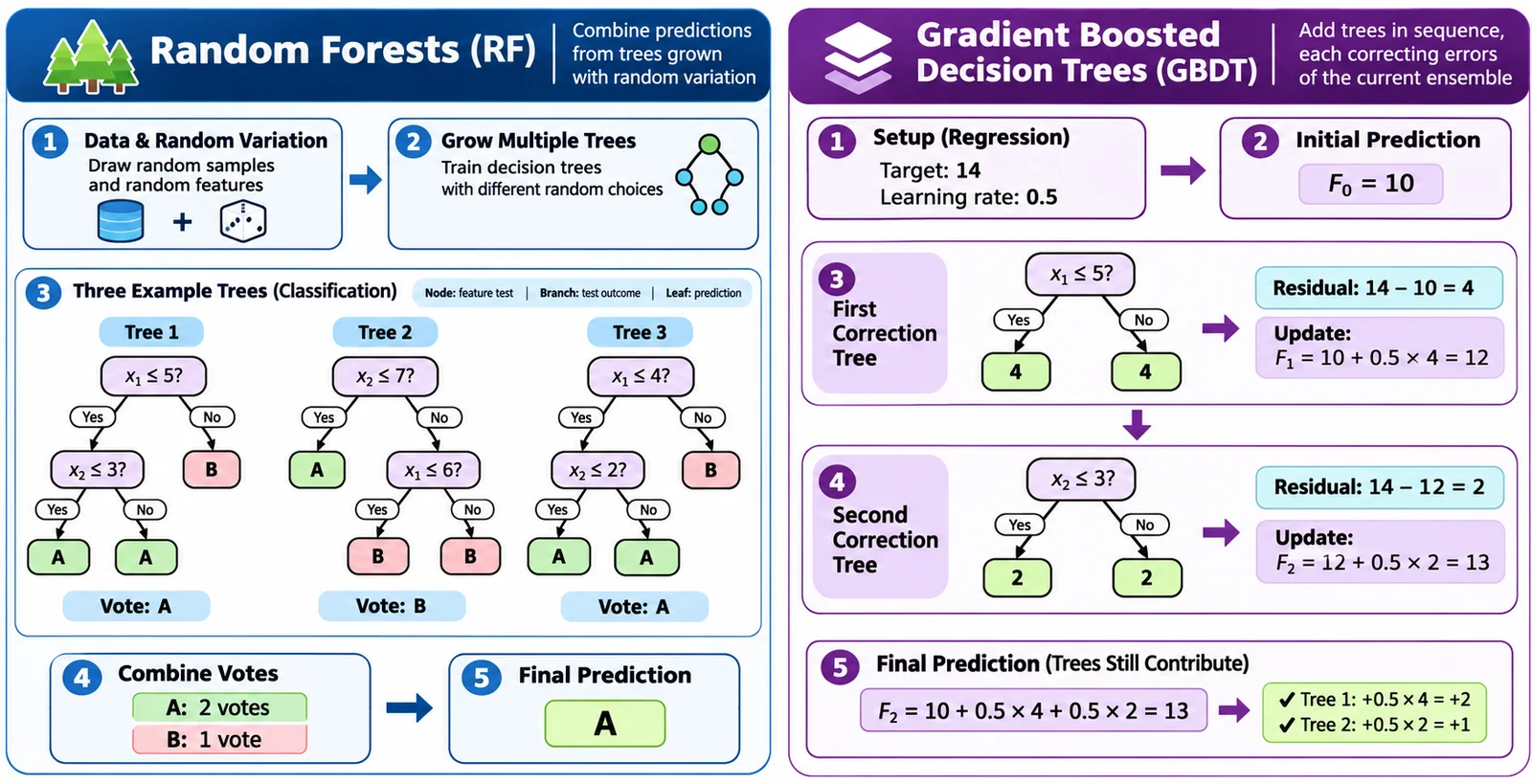
A 2007 experimental comparison tested bagging against seven other randomization-based ways of building an ensemble of decision tree classifiers, using statistical tests on results from 57 publicly available data sets. Judged instead by average ranks across the group of data sets, boosting, random forests and randomized trees were all statistically significantly better than bagging. The same comparison introduced an algorithm that decides when an ensemble holds enough classifiers, using the out-of-bag error estimate, which is measured on the training cases each tree did not see. The algorithm gave an accurate ensemble for methods that build bagging into the ensemble's construction.[131]
A random forest is an ensemble of decision trees in which each tree is grown with an element of randomness, and the forest's predictions are formed by combining the trees. The random forest classifier can explicitly eliminate irrelevant features, a step that regularized regression methods such as principal component regression and partial least squares regression cannot perform. Its trees split the feature space orthogonally, though, and so may not be ideally adapted to spectral data. The spectral data sets came from medical diagnostics, chemotaxonomy, biomedical analytics, food science and synthetic modification. On them, a feature selection based on the Gini importance of a random forest, followed by a regularized classifier, performed as well as or better than filtering by univariate statistical tests or backward elimination using regression coefficients. That combined procedure outperformed both the random forest classifier applied directly and the regularized classifiers applied to the full set of features.[132]
Gradient boosted decision trees form another family of ensembles, built by adding trees in sequence so that each new tree corrects errors of the trees already present. A 2020 review by Hancock and Khoshgoftaar describes CatBoost, a member of this family that appeared in late 2018, as fitting machine learning tasks with categorical, heterogeneous data. Studies across disciplines show both its effectiveness and its shortcomings in classification and regression. The review also identifies sensitivity to hyper-parameters, the settings chosen before training, and stresses the importance of tuning them.[133]
Importance scores read from an ensemble describe how much each input feature contributes to the combined model rather than to any one tree. In the spectral study, the Gini importance of the random forest measured feature relevance better than the alternatives tested. A selection based on it could come before a regularized linear classifier, gaining both a reduction in dimensionality and the removal of noise from the classification task. The same study found that once an optimal subset of features was chosen, the regularized classifiers might be the better choice over the random forest classifier, even though they model only linear dependencies.[132]
Criticism
Challenges and Limitations of Decision Trees
When a decision tree fits training data too closely, it may fail on new data, a problem called overfitting.[35] Overfitting happens when a tree learns rare or odd examples from training data, which leads to poor results on new data.[35][41]
Limits and open questions
Classical decision tree classifiers assume each data value is known and exact. Tsang, Kao, Yip, Ho and Lee (2011) extended these classifiers to tuples whose values are uncertain, and their experiments found the extended trees more accurate than trees built from value averages. Value uncertainty arises during data collection from sources such as measurement and quantization errors, data staleness, and multiple repeated measurements, and an uncertain value is often represented by several values forming a probability distribution rather than by one number. Classical tree-building algorithms assume known values, and extending them to uncertain values makes construction more demanding on the processor, because processing probability density functions costs more computation than processing single values such as averages. Experiments reported with that extension found the resulting classifiers more accurate than classifiers built from value averages, and a series of pruning techniques was proposed to improve construction efficiency.[134]
Tree size itself can work against accuracy as the number of prespecified outcome classes grows: the trees generated by a single-tree inducer often become overly complex in leaves and nodes, and classification accuracy drops as a result. An alternative, multi-decision-tree induction, builds a different tree for each outcome class, and an analytical and empirical comparison found that in some situations it outperforms the traditional approach on cardinality, conciseness and classification accuracy.[135] Labels that are continuous in the data raise a further difficulty. One approach first converts the continuous label into a class label made of a finite set of non-overlapping intervals, then applies a tree algorithm. A second applies a regression tree directly to the continuous label. Both have drawbacks. Where such ranges are organised in a hierarchy, the ranges at lower levels are more specific and inherently harder to predict, while upper-level ranges are less specific and easier, so prediction specificity and prediction accuracy must both be weighed when building a tree.[136]
A survey of evolutionary algorithms for decision-tree induction covers approaches that evolve trees as an alternative to the traditional top-down divide-and-conquer method. It also covers methods that use evolutionary algorithms to improve particular components of tree classifiers. The survey closes by addressing open questions for future research.[137] Other surveys organise the field differently: one reviews fuzzy decision trees, which apply fuzzy representation to continuous or multi-valued data and to missing or noisy features, and another reviews neural trees, which integrate neural networks and decision trees and are analysed for interpretability and performance.[138][139] A review of fuzzy decision trees concluded that fuzzy decision making with trees is an emerging technique in terms of applications and that enough scope for research remains in the area.[140]
Key studies
| Year | Study | Sample | Design | Finding |
|---|---|---|---|---|
| 2001 | Li et al.[42] | Multiple datasets used in experimental study | Dynamic programming vs. cost-complexity pruning | The dynamic-programming-based pruning method achieved higher classification accuracy than cost-complexity pruning in the experimental study. |
| 2004 | Myles et al.[111] | Tutorial on decision tree modeling in chemical applications | Decision trees are well suited to handle complex data in chemical and biochemical problems. | |
| 2005 | Rokach & Maimon[1] | The survey covers current methods for constructing decision tree classifiers using a top-down approach. | Decision trees are a common method for building classifiers using splitting criteria and pruning techniques. | |
| 2007 | Sun et al.[44] | 2100-bus, 2600-line, 240-generator model of Entergy system | Online dynamic security assessment using decision trees | The scheme accurately predicted system security and provided reliable control guidelines. |
| 2011 | Tsang et al.[134] | Experiments on uncertain data using probability distributions | Using the complete information of uncertain data, including the probability density function, improves classifier accuracy compared to using averages. | |
| 2012 | Hu et al.[38] | Monotonic datasets with noisy samples | Evaluation of Rank Mutual Information (RMI) in decision trees | The REMT algorithm generates decision trees that are consistent with monotonic constraints when training data meet those constraints, and it maintains performance under noisy conditions. |
| 2013 | de Ville[2] | Historical and methodological review of decision trees across disciplines | Decision trees can handle missing data and require few assumptions to be applied in practice. | |
| 2023 | Aaboub et al.[16] | 11 datasets with varying sizes and types | Comparative evaluation of six decision tree algorithms | Iterative Dichotomizer 3 and classification and regression trees performed better than the other methods in terms of classification accuracy across 11 datasets. |
See also
References
- Rokach, L., & Maimon, O. (2005). Top-Down Induction of Decision Trees Classifiers—A Survey. IEEE Transactions on Systems, Man and Cybernetics, Part C (Applications and Reviews), 35(4), 476-487. doi:10.1109/tsmcc.2004.843247
- de Ville, B. (2013). Decision trees. WIREs Computational Statistics, 5(6), 448-455. doi:10.1002/wics.1278
- Mienye, I. D., & Jere, N. (2024). A Survey of Decision Trees: Concepts, Algorithms, and Applications. IEEE Access, 12, 86716-86727. doi:10.1109/access.2024.3416838
- Moret, B. M. E. (1982). Decision Trees and Diagrams. ACM Computing Surveys, 14(4), 593-623. doi:10.1145/356893.356898
- Blockeel, H., Devos, L., Frénay, B., Nanfack, G., & Nijssen, S. (2023). Decision trees: from efficient prediction to responsible AI. Frontiers in Artificial Intelligence, 6. doi:10.3389/frai.2023.1124553
- Strobl, C., Malley, J., & Tutz, G. (2009). An introduction to recursive partitioning: Rationale, application, and characteristics of classification and regression trees, bagging, and random forests. Psychological Methods, 14(4), 323-348. doi:10.1037/a0016973
- Safavian, S. R., & Landgrebe, D. (1991). A survey of decision tree classifier methodology. IEEE Transactions on Systems, Man, and Cybernetics, 21(3), 660-674. doi:10.1109/21.97458
- Gupta, B., Rawat, A., Jain, A., Arora, A., & Dhami, N. (2017). Analysis of Various Decision Tree Algorithms for Classification in Data Mining. International Journal of Computer Applications, 163(8), 15-19. doi:10.5120/ijca2017913660
- Talekar, B. (2020). A Detailed Review on Decision Tree and Random Forest. Bioscience Biotechnology Research Communications, 13(14), 245-248. doi:10.21786/bbrc/13.14/57
- Swain, P. H., & Hauska, H. (1977). The decision tree classifier: Design and potential. IEEE Transactions on Geoscience Electronics, 15(3), 142-147. doi:10.1109/tge.1977.6498972
- Charbuty, B., & Abdulazeez, A. (2021). Classification Based on Decision Tree Algorithm for Machine Learning. Journal of Applied Science and Technology Trends, 2(01), 20-28. doi:10.38094/jastt20165
- Priyanka, N. A., & Kumar, D. (2020). Decision tree classifier: a detailed survey. International Journal of Information and Decision Sciences, 12(3), 246. doi:10.1504/ijids.2020.108141
- V JINUBALA, & R LAWRANCE (2016). Classification of soybean pest data using decision tree algorithm: CLASSIFICATION OF SOYBEAN PEST DATA USING DECISION TREE ALGORITHM. Journal of Oilseeds Research, 33(3). doi:10.56739/jor.v33i3.137984
- He, Z., Wu, Z., Xu, G., Liu, Y., & Zou, Q. (2021). Decision Tree for Sequences. IEEE Transactions on Knowledge and Data Engineering, 1-1. doi:10.1109/tkde.2021.3075023
- Tangirala, S. (2020). Evaluating the Impact of GINI Index and Information Gain on Classification using Decision Tree Classifier Algorithm*. International Journal of Advanced Computer Science and Applications, 11(2). doi:10.14569/ijacsa.2020.0110277
- Aaboub, F., Chamlal, H., & Ouaderhman, T. (2023). Statistical analysis of various splitting criteria for decision trees. Journal of Algorithms & Computational Technology, 17. doi:10.1177/17483026231198181
- Salehi-Moghaddami, N., Yazdi, H., & Poostchi, H. (2011). Correlation based splitting criterionin multi branch decision tree. Open Computer Science, 1(2). doi:10.2478/s13537-011-0017-x
- Zhang, X., & Jiang, S. (2012). A Splitting Criteria Based on Similarity in Decision Tree Learning. Journal of Software, 7(8). doi:10.4304/jsw.7.8.1775-1782
- Buntine, W., & Niblett, T. (1992). A further comparison of splitting rules for decision-tree induction. Machine Learning, 8(1), 75-85. doi:10.1007/bf00994006
- Gehrke, J., Ganti, V., Ramakrishnan, R., & Loh, W. Y. (1999). BOAT—optimistic decision tree construction. ACM SIGMOD Record, 28(2), 169-180. doi:10.1145/304181.304197
- Nowozin, S. (2012). Improved Information Gain Estimates for Decision Tree Induction. arXiv. doi:10.48550/arxiv.1206.4620 Free full text
- Manwani, N., & Sastry, P. S. (2012). Geometric Decision Tree. IEEE Transactions on Systems, Man, and Cybernetics, Part B (Cybernetics), 42(1), 181-192. doi:10.1109/tsmcb.2011.2163392
- Li, M., Xu, H., & Deng, Y. (2019). Evidential Decision Tree Based on Belief Entropy. Entropy, 21(9), 897. doi:10.3390/e21090897
- Shah, S., & Sastry, P. S. (1999). New algorithms for learning and pruning oblique decision trees. IEEE Transactions on Systems, Man and Cybernetics, Part C (Applications and Reviews), 29(4), 494-505. doi:10.1109/5326.798764
- Bremner, A. P., & Taplin, R. H. (2004). Performance of localized regression tree splitting criteria on data with discontinuities. Australian & New Zealand Journal of Statistics, 46(3), 367-381. doi:10.1111/j.1467-842x.2004.00336.x
- Yildiz, C. T., & Alpaydin, E. (2001). Omnivariate decision trees. IEEE Transactions on Neural Networks, 12(6), 1539-1546. doi:10.1109/72.963795
- HSSINA, B., MERBOUHA, A., EZZIKOURI, H., & ERRITALI, M. (2014). A comparative study of decision tree ID3 and C4.5. International Journal of Advanced Computer Science and Applications, 4(2). doi:10.14569/specialissue.2014.040203
- Norouzi, M., Collins, M. D., Johnson, M., Fleet, D. J., & Kohli, P. (2015). Efficient non-greedy optimization of decision trees. arXiv. doi:10.48550/arxiv.1511.04056 Free full text
- Bodine, J., & Hochbaum, D. S. (2022). A Better Decision Tree: The Max-Cut Decision Tree with Modified PCA Improves Accuracy and Running Time. SN Computer Science, 3(4). doi:10.1007/s42979-022-01147-4
- (2016). A Survey on Decision Tree Algorithms of Classification in Data Mining. International Journal of Science and Research (IJSR), 5(4), 2094-2097. doi:10.21275/v5i4.nov162954
- Murthy, S. K., Kasif, S., & Salzberg, S. (1994). A System for Induction of Oblique Decision Trees. Journal of Artificial Intelligence Research, 2, 1-32. doi:10.1613/jair.63
- Patil, D. D., Wadhai, V. M., & Gokhale, J. A. (2010). Evaluation of Decision Tree Pruning Algorithms for Complexity and Classification Accuracy. International Journal of Computer Applications, 11(2), 23-30. doi:10.5120/1554-2074
- Esposito, F., Malerba, D., Semeraro, G., & Kay, J. (1997). A comparative analysis of methods for pruning decision trees. IEEE Transactions on Pattern Analysis and Machine Intelligence, 19(5), 476-493. doi:10.1109/34.589207
- University of Udine, Udine, Italy, Brunello, A., Marzano, E., Montanari, A., & Sciavicco, G. (2017). Decision Tree Pruning via Multi-Objective Evolutionary Computation. International Journal of Machine Learning and Computing, 7(6), 167-175. doi:10.18178/ijmlc.2017.7.6.641
- Wardhani, A. K., Nugraha, E., & Ulfiana, Q. (2022). Optimization of the Decision Tree Method using Pruning on Liver Disease Classification. Journal of Applied Informatics and Computing, 6(2), 136-140. doi:10.30871/jaic.v6i2.4350
- Janikow, C. Z. (1998). Fuzzy decision trees: issues and methods. IEEE Transactions on Systems, Man and Cybernetics, Part B (Cybernetics), 28(1), 1-14. doi:10.1109/3477.658573
- Ayllón-Gavilán, R., Martínez-Estudillo, F. J., Guijo-Rubio, D., Hervás-Martínez, C., & Gutiérrez, P. A. (2026). Splitting criteria for ordinal decision trees: An experimental study. Pattern Recognition, 171, 112273. doi:10.1016/j.patcog.2025.112273
- Hu, Q., Che, X., Zhang, L., Zhang, D., Guo, M., & Yu, D. (2012). Rank Entropy-Based Decision Trees for Monotonic Classification. IEEE Transactions on Knowledge and Data Engineering, 24(11), 2052-2064. doi:10.1109/tkde.2011.149
- De Rosa, R., & Cesa-Bianchi, N. (2017). Confidence Decision Trees via Online and Active Learning for Streaming Data. Journal of Artificial Intelligence Research, 60, 1031-1055. doi:10.1613/jair.5440
- HTA Glossary (health technology assessment) (n.d.). confidence interval (CI). HTA Glossary (health technology assessment). https://htaglossary.net/confidence-interval-%28CI%29
- Syahputri, C. N., & Hasibuan, M. S. (2024). Optimasi klasifikasi decision tree dengan teknik pruning untuk mengurangi overfitting. JSiI (Jurnal Sistem Informasi), 11(2), 87-96. doi:10.30656/jsii.v11i2.9161
- Li, X. B., Sweigart, J., Teng, J., Donohue, J., & Thombs, L. (2001). A Dynamic Programming Based Pruning Method for Decision Trees. INFORMS Journal on Computing, 13(4), 332-344. doi:10.1287/ijoc.13.4.332.9732
- Panhalkar, A. R., & Doye, D. D. (2022). Optimization of decision trees using modified African buffalo algorithm. Journal of King Saud University - Computer and Information Sciences, 34(8), 4763-4772. doi:10.1016/j.jksuci.2021.01.011
- Sun, K., Likhate, S., Vittal, V., Kolluri, V. S., & Mandal, S. (2007). An Online Dynamic Security Assessment Scheme Using Phasor Measurements and Decision Trees. IEEE Transactions on Power Systems, 22(4), 1935-1943. doi:10.1109/tpwrs.2007.908476
- Patel, N., & Upadhyay, S. (2012). Study of Various Decision Tree Pruning Methods with their Empirical Comparison in WEKA. International Journal of Computer Applications, 60(12), 20-25. doi:10.5120/9744-4304
- Esposito, F., Malerba, D., Semeraro, G., & Tamma, V. (1999). The effects of pruning methods on the predictive accuracy of induced decision trees. Applied Stochastic Models in Business and Industry, 15(4), 277-299. doi:10.1002/(sici)1526-4025(199910/12)15:4<277::aid-asmb393>3.0.co;2-b
- Chew, Y. J., Ooi, S. Y., Pang, Y. H., & Lim, Z. Y. (2025). Decision Tree Pruning with Privacy-Preserving Strategies. Electronics, 14(15), 3139. doi:10.3390/electronics14153139
- Li, X. B., & Sarkar, S. (2009). Against Classification Attacks: A Decision Tree Pruning Approach to Privacy Protection in Data Mining. Operations Research, 57(6), 1496-1509. doi:10.1287/opre.1090.0702
- Fukui, S., Wang, L., & Ozawa, S. (2025). Efficient and Privacy-Preserving Decision Tree Inference via Homomorphic Matrix Multiplication and Leaf Node Pruning. Applied Sciences, 15(10), 5560. doi:10.3390/app15105560
- Fletcher, S., & Islam, M. Z. (2020). Decision Tree Classification with Differential Privacy: A Survey. ACM Computing Surveys, 52(4), 1-33. doi:10.1145/3337064
- Chew, Y. J., Ooi, S. Y., Wong, K. S., Pang, Y. H., & Lee, N. (2022). Adoption of IP Truncation in a Privacy-Based Decision Tree Pruning Design: A Case Study in Network Intrusion Detection System. Electronics, 11(5), 805. doi:10.3390/electronics11050805
- Adhelia, M., Wiwenar, G. R., & Wafa, H. S. (2026). Klasifikasi Tingkat Depresi Mahasiswa Menggunakan Algoritma Decision Tree C4.5. JUSIFOR : Jurnal Sistem Informasi dan Informatika, 5(1), 219-226. doi:10.70609/jusifor.v5i1.8831
- Liu, X., Chen, Z., Li, Z., & Luo, D. (2026). An Adaptive Cylindrical-Pruning Decision Tree Method for Conflict Detection During Low-Altitude Multi-UAV Operations. Aerospace, 13(7), 652. doi:10.3390/aerospace13070652
- Rovnyak, S., Kretsinger, S., Thorp, J., & Brown, D. (1994). Decision trees for real-time transient stability prediction. IEEE Transactions on Power Systems, 9(3), 1417-1426. doi:10.1109/59.336122
- Senroy, N., Heydt, G. T., & Vittal, V. (2006). Decision Tree Assisted Controlled Islanding. IEEE Transactions on Power Systems, 21(4), 1790-1797. doi:10.1109/tpwrs.2006.882470
- Choi, K., & Jang, E. S. (2012). Fast coding unit decision method based on coding tree pruning for high efficiency video coding. Optical Engineering, 51(03), 1-4. doi:10.1117/1.oe.51.3.030502
- Purwanti, W. R. (2026). Riset Data Risiko Kehamilan Menggunakan Decision Tree Dari Dataset Risk Maternal Health. Jurnal Dinamika Informatika, 15(1), 169-178. doi:10.31316/jdi.v15i1.421
- Bakır, N. O. (2008). A Decision Tree Model for Evaluating Countermeasures to Secure Cargo at United States Southwestern Ports of Entry. Decision Analysis, 5(4), 230-248. doi:10.1287/deca.1080.0124
- Kushilevitz, E., & Mansour, Y. (1993). Learning Decision Trees Using the Fourier Spectrum. SIAM Journal on Computing, 22(6), 1331-1348. doi:10.1137/0222080
- Blanc, G., Neha, G., Lange, J., & Tan, L. Y. (2020). Universal guarantees for decision tree induction via a higher-order splitting criterion. arXiv. doi:10.48550/arxiv.2010.08633 Free full text
- Blanc, G., Lange, J., & Tan, L. Y. (2019). Top-down induction of decision trees: rigorous guarantees and inherent limitations. arXiv. doi:10.48550/arxiv.1911.07375 Free full text
- Bengio, Y., Delalleau, O., & Simard, C. (2010). Decision trees do not generalize to new variations. Computational Intelligence, 26(4), 449-467. doi:10.1111/j.1467-8640.2010.00366.x
- Zhao, X., & Nie, X. (2021). Splitting Choice and Computational Complexity Analysis of Decision Trees. Entropy, 23(10), 1241. doi:10.3390/e23101241
- Dai, W., & Ji, W. (2014). A MapReduce Implementation of C4.5 Decision Tree Algorithm. International Journal of Database Theory and Application, 7(1), 49-60. doi:10.14257/ijdta.2014.7.1.05
- Blockeel, H., & Struyf, J. (2001). Efficient algorithms for decision tree cross-validation. arXiv. doi:10.48550/arxiv.cs/0110036 Free full text
- Nugroho, A. (2022). Analisa Splitting Criteria Pada Decision Tree dan Random Forest untuk Klasifikasi Evaluasi Kendaraan. JSITIK: Jurnal Sistem Informasi dan Teknologi Informasi Komputer, 1(1), 41-49. doi:10.53624/jsitik.v1i1.154
- Gulati, P., Sharma, A., & Gupta, M. (2016). Theoretical Study of Decision Tree Algorithms to Identify Pivotal Factors for Performance Improvement: A Review. International Journal of Computer Applications, 141(14), 19-25. doi:10.5120/ijca2016909926
- Rana, A., & Pandey, R. (2021). A review of popular decision tree algorithms in data mining. Asian Journal of Multidimensional Research, 10(10), 230-237. doi:10.5958/2278-4853.2021.00837.5
- Moses, D. (2018). A Review Of Decision Tree Algorithms For Predictive Analysis In Data Mining. i-manager's Journal on Software Engineering. doi:10.26634/jse.12.1.13923
- Gao, J. (2013). Decision Tree Generation Algorithm without Pruning. Applied Mechanics and Materials, 441, 731-737. doi:10.4028/www.scientific.net/amm.441.731
- Chang, R. L. P., & Pavlidis, T. (1977). Fuzzy Decision Tree Algorithms. IEEE Transactions on Systems, Man, and Cybernetics, 7(1), 28-35. doi:10.1109/tsmc.1977.4309586
- Jiang, H., Liu, T. L., & He, H. L. (2011). The Pruning Strategy of Decision Tree of SMT Assembling Quality Control Based on Data Mining. Advanced Materials Research, 204-210, 704-707. doi:10.4028/www.scientific.net/amr.204-210.704
- Huys, Q. J. M., Eshel, N., O'Nions, E., Sheridan, L., Dayan, P., & Roiser, J. P. (2012). Bonsai Trees in Your Head: How the Pavlovian System Sculpts Goal-Directed Choices by Pruning Decision Trees. PLoS Computational Biology, 8(3), e1002410. doi:10.1371/journal.pcbi.1002410
- Bagriacik, M., & Otero, F. E. B. (2024). Multiple fairness criteria in decision tree learning. Applied Soft Computing, 167, 112313. doi:10.1016/j.asoc.2024.112313
- Adawiyah, R., & Cahya Julia Kartikasari, D. (2025). Comparison Of Lung Cancer Classification Using Decision Tree And Random Forest: Perbandingan Klasifikasi Penyakit Kanker Paru-Paru Menggunakan Decision Tree Dan Random Forest. Komputika : Jurnal Sistem Komputer, 14(1), 79-85. doi:10.34010/komputika.v14i1.15501
- Castelnovo, A. (2022). Extending Decision Tree to Handle Multiple Fairness Criteria. Proceedings of the Thirty-First International Joint Conference on Artificial Intelligence, 5839-5840. doi:10.24963/ijcai.2022/822
- Kamiński, B., Jakubczyk, M., & Szufel, P. (2018). A framework for sensitivity analysis of decision trees. Central European Journal of Operations Research, 26(1), 135-159. doi:10.1007/s10100-017-0479-6
- Elomaa, T., & Kaariainen, M. (2001). An Analysis of Reduced Error Pruning. Journal of Artificial Intelligence Research, 15, 163-187. doi:10.1613/jair.816
- BRESLOW, L. A., & AHA, D. W. (1997). Simplifying decision trees: A survey. The Knowledge Engineering Review, 12(01), 1-40. doi:10.1017/s0269888997000015
- Ahmed, A. M., Rizaner, A., & Ulusoy, A. H. (2018). A novel decision tree classification based on post-pruning with Bayes minimum risk. PLOS ONE, 13(4), e0194168. doi:10.1371/journal.pone.0194168
- Chou, P. A., Lookabaugh, T., & Gray, R. M. (1989). Optimal pruning with applications to tree-structured source coding and modeling. IEEE Transactions on Information Theory, 35(2), 299-315. doi:10.1109/18.32124
- Mijwil, M. M., & Abttan, R. A. (2021). Utilizing the Genetic Algorithm to Pruning the C4.5 Decision Tree Algorithm. Asian Journal of Applied Sciences, 9(1). doi:10.24203/ajas.v9i1.6503
- Monteiro, L. B., Ribeiro, V. F., Garcia, C. P., Rocha Filho, G. P., & Weigang, L. (2023). 4D Trajectory Conflict Detection and Resolution Using Decision Tree Pruning Method. IEEE Latin America Transactions, 21(2), 277-287. doi:10.1109/tla.2023.10015220
- Canete-Sifuentes, L., Monroy, R., & Medina-Perez, M. A. (2021). A Review and Experimental Comparison of Multivariate Decision Trees. IEEE Access, 9, 110451-110479. doi:10.1109/access.2021.3102239
- Izza, Y., Ignatiev, A., & Marques-Silva, J. (2022). On Tackling Explanation Redundancy in Decision Trees. Journal of Artificial Intelligence Research, 75, 261-321. doi:10.1613/jair.1.13575
- Hwang, S., Yeo, H. G., & Hong, J. S. (2020). A New Splitting Criterion for Better Interpretable Trees. IEEE Access, 8, 62762-62774. doi:10.1109/access.2020.2985255
- Tetteh, E. T., & Zielosko, B. (2025). Greedy Algorithm for Deriving Decision Rules from Decision Tree Ensembles. Entropy, 27(1), 35. doi:10.3390/e27010035
- Lundberg, S. M., Erion, G., Chen, H., DeGrave, A., Prutkin, J. M., Nair, B., Katz, R., Himmelfarb, J., Bansal, N., & Lee, S. I. (2020). From local explanations to global understanding with explainable AI for trees. Nature Machine Intelligence, 2(1), 56-67. doi:10.1038/s42256-019-0138-9
- Chen, Z. Y., & Zhao, T. X. (2014). Meta-Analysis and Evaluation of Visualization Support to Decision Trees Classification. Advanced Materials Research, 989-994, 1692-1694. doi:10.4028/www.scientific.net/amr.989-994.1692
- Lomax, S., & Vadera, S. (2013). A survey of cost-sensitive decision tree induction algorithms. ACM Computing Surveys, 45(2), 1-35. doi:10.1145/2431211.2431215
- Gajowniczek, K., & Ząbkowski, T. (2021). Interactive Decision Tree Learning and Decision Rule Extraction Based on the ImbTreeEntropy and ImbTreeAUC Packages. Processes, 9(7), 1107. doi:10.3390/pr9071107
- Rzepakowski, P., & Jaroszewicz, S. (2012). Decision trees for uplift modeling with single and multiple treatments. Knowledge and Information Systems, 32(2), 303-327. doi:10.1007/s10115-011-0434-0
- Weiss, G. M., & Provost, F. (2003). Learning When Training Data are Costly: The Effect of Class Distribution on Tree Induction. Journal of Artificial Intelligence Research, 19, 315-354. doi:10.1613/jair.1199
- Twala, B. (2009). An empirical comparison of techniques for handling incomplete data using decision trees. Applied Artificial Intelligence, 23(5), 373-405. doi:10.1080/08839510902872223
- Wei, C., & Hsu, N. (2008). Derived operating rules for a reservoir operation system: Comparison of decision trees, neural decision trees and fuzzy decision trees. Water Resources Research, 44(2). doi:10.1029/2006wr005792
- Bae, J. M. (2014). Clinical Decision Analysis using Decision Tree. Epidemiology and Health, e2014025. doi:10.4178/epih/e2014025
- Abdulqader, H. A., & Abdulazeez, A. M. (2024). Review on Decision Tree Algorithm in Healthcare Applications. Indonesian Journal of Computer Science, 13(3). doi:10.33022/ijcs.v13i3.4026
- JacqulinMargret, J., Lakshmipathi, B., & Aswani Kumar, S. (2012). Diagnosis of Thyroid Disorders using Decision Tree Splitting Rules. International Journal of Computer Applications, 44(8), 43-46. doi:10.5120/6287-8474
- Jindal, A., Dua, A., Kaur, K., Singh, M., Kumar, N., & Mishra, S. (2016). Decision Tree and SVM-Based Data Analytics for Theft Detection in Smart Grid. IEEE Transactions on Industrial Informatics, 12(3), 1005-1016. doi:10.1109/tii.2016.2543145
- Gepp, A., Kumar, K., & Bhattacharya, S. (2010). Business failure prediction using decision trees. Journal of Forecasting, 29(6), 536-555. doi:10.1002/for.1153
- Alraddadi, A. S. (2023). A Survey and a Credit Card Fraud Detection and Prevention Model using the Decision Tree Algorithm. Engineering, Technology & Applied Science Research, 13(4), 11505-11510. doi:10.48084/etasr.6128
- Nefeslioglu, H. A., Sezer, E., Gokceoglu, C., Bozkir, A. S., & Duman, T. Y. (2010). Assessment of Landslide Susceptibility by Decision Trees in the Metropolitan Area of Istanbul, Turkey. Mathematical Problems in Engineering, 2010(1). doi:10.1155/2010/901095
- Faculty of Economics in Osijek, University of Josip Juraj Strossmayer in Osijek, Gajev trg 7, 31000 Osijek, Croatia, Mesarić, J., Šebalj, D., & Faculty of Economics in Osijek, University of Josip Juraj Strossmayer in Osijek, Gajev trg 7, 31000 Osijek, Croatia (2016). Decision trees for predicting the academic success of students. Croatian Operational Research Review, 7(2), 367-388. doi:10.17535/crorr.2016.0025
- Venkatasubramaniam, A., Wolfson, J., Mitchell, N., Barnes, T., JaKa, M., & French, S. (2017). Decision trees in epidemiological research. Emerging Themes in Epidemiology, 14(1). doi:10.1186/s12982-017-0064-4
- Quinlan, J. R. (1990). Decision trees and decision-making. IEEE Transactions on Systems, Man, and Cybernetics, 20(2), 339-346. doi:10.1109/21.52545
- Burduk, R., & Wozniak, M. (2012). Different decision tree induction strategies for a medical decision problem. Open Medicine, 7(2), 183-193. doi:10.2478/s11536-011-0142-x
- Milanović, M., & Stamenković, M. (2016). CHAID Decision Tree: Methodological Frame and Application. Economic Themes, 54(4), 563-586. doi:10.1515/ethemes-2016-0029
- Mienye, I. D., Sun, Y., & Wang, Z. (2019). Prediction performance of improved decision tree-based algorithms: a review. Procedia Manufacturing, 35, 698-703. doi:10.1016/j.promfg.2019.06.011
- Pandya, R., & Pandya, J. (2015). C5. 0 Algorithm to Improved Decision Tree with Feature Selection and Reduced Error Pruning. International Journal of Computer Applications, 117(16), 18-21. doi:10.5120/20639-3318
- Patel, H. H., & Prajapati, P. (2018). Study and Analysis of Decision Tree Based Classification Algorithms. International Journal of Computer Sciences and Engineering, 6(10), 74-78. doi:10.26438/ijcse/v6i10.7478
- Myles, A. J., Feudale, R. N., Liu, Y., Woody, N. A., & Brown, S. D. (2004). An introduction to decision tree modeling. Journal of Chemometrics, 18(6), 275-285. doi:10.1002/cem.873
- Kourou, K., Exarchos, T. P., Exarchos, K. P., Karamouzis, M. V., & Fotiadis, D. I. (2015). Machine learning applications in cancer prognosis and prediction. Computational and Structural Biotechnology Journal, 13, 8-17. doi:10.1016/j.csbj.2014.11.005
- Suenderhauf, C., Hammann, F., & Huwyler, J. (2012). Computational Prediction of Blood-Brain Barrier Permeability Using Decision Tree Induction. Molecules, 17(9), 10429-10445. doi:10.3390/molecules170910429
- Friedl, M. A., & Brodley, C. E. (1997). Decision tree classification of land cover from remotely sensed data. Remote Sensing of Environment, 61(3), 399-409. doi:10.1016/s0034-4257(97)00049-7
- Nabhan, M. D., Gunawan, G., Apridiansyah, Y., & Rifqo, M. H. (2026). Student Graduation Analysis Using The Decision Tree Algorithm With Decision Tree Visualization. Jurnal Komputer Indonesia, 5(3), 193-202. doi:10.37676/jki.v5i3.1911
- Benediktus, N., & Oetama, R. S. (2020). The Decision Tree C5.0 Classification Algorithm for Predicting Student Academic Performance. Ultimatics : Jurnal Teknik Informatika, 12(1), 14-19. doi:10.31937/ti.v12i1.1506
- Azam, Z., Islam, M. M., & Huda, M. N. (2023). Comparative Analysis of Intrusion Detection Systems and Machine Learning-Based Model Analysis Through Decision Tree. IEEE Access, 11, 80348-80391. doi:10.1109/access.2023.3296444
- Pranckevičius, T., & Marcinkevičius, V. (2017). Comparison of Naive Bayes, Random Forest, Decision Tree, Support Vector Machines, and Logistic Regression Classifiers for Text Reviews Classification. Baltic Journal of Modern Computing, 5(2). doi:10.22364/bjmc.2017.5.2.05
- Rompas, P. T. D., Sasoeng, S., & Rorimpandey, G. C. (2026). Decision Tree Outperforms Naive Bayes For Infidelity Divorce Sentiment Classification: Decision Tree Mengungguli Naive Bayes Untuk Klasifikasi Sentimen Perceraian Akibat Perselingkuhan. Academia Open, 11(1). doi:10.21070/acopen.11.2026.14689
- Yang, Y., Wang, S., & Laporte, G. (2025). Improved Regression Tree Models Using Generalization Error‐Based Splitting Criteria. Naval Research Logistics (NRL), 72(8), 1097-1116. doi:10.1002/nav.22270
- Hu, X., Rudin, C. D., & Seltzer, M. (2019). Optimal Sparse Decision Trees. arXiv. doi:10.48550/arxiv.1904.12847 Free full text
- Humbird, K. D., Peterson, J. L., & Mcclarren, R. G. (2019). Deep Neural Network Initialization With Decision Trees. IEEE Transactions on Neural Networks and Learning Systems, 30(5), 1286-1295. doi:10.1109/tnnls.2018.2869694
- Frosst, N., & Hinton, G. E. (2017). Distilling a Neural Network Into a Soft Decision Tree. arXiv. doi:10.48550/arxiv.1711.09784 Free full text
- Custode, L. L., & Iacca, G. (2023). Evolutionary Learning of Interpretable Decision Trees. IEEE Access, 11, 6169-6184. doi:10.1109/access.2023.3236260
- Alkattan, H., Alhumaima, A. S., Mohmood, M. S., & AL-Thabhawee, G. D. M. (2025). Optimizing Decision Tree Classifiers for Healthcare Predictions: A Comparative Analysis of Model Depth, Pruning, and Performance. Mesopotamian Journal of Artificial Intelligence in Healthcare, 2025, 124-135. doi:10.58496/mjaih/2025/013
- Shenoy, P. P. (2013). A New Pruning Method for Solving Decision Trees and Game Trees. arXiv. doi:10.48550/arxiv.1302.4981 Free full text
- Li, Y., Bai, J., Li, J., Yang, X., Jiang, Y., & Xia, S. (2020). Rectified Decision Trees: Exploring the Landscape of Interpretable and Effective Machine Learning. arXiv. doi:10.48550/arxiv.2008.09413 Free full text
- Wang, Z., & Gai, K. (2024). Decision Tree-Based Federated Learning: A Survey. Blockchains, 2(1), 40-60. doi:10.3390/blockchains2010003
- Gao, L., & Zhang, R. (2026). Improvement of the Decision Support System Model for College Students' Entrepreneurship Path Planning Based on Tree Pruning Algorithm. Engineering Reports, 8(3). doi:10.1002/eng2.70695
- Tong, W., Hong, H., Fang, H., Xie, Q., & Perkins, R. (2003). Decision Forest: Combining the Predictions of Multiple Independent Decision Tree Models. Journal of Chemical Information and Computer Sciences, 43(2), 525-531. doi:10.1021/ci020058s
- Banfield, R. E., Hall, L. O., Bowyer, K. W., & Kegelmeyer, W. P. (2007). A Comparison of Decision Tree Ensemble Creation Techniques. IEEE Transactions on Pattern Analysis and Machine Intelligence, 29(1), 173-180. doi:10.1109/tpami.2007.250609
- Menze, B. H., Kelm, B. M., Masuch, R., Himmelreich, U., Bachert, P., Petrich, W., & Hamprecht, F. A. (2009). A comparison of random forest and its Gini importance with standard chemometric methods for the feature selection and classification of spectral data. BMC Bioinformatics, 10(1). doi:10.1186/1471-2105-10-213
- Hancock, J. T., & Khoshgoftaar, T. M. (2020). CatBoost for big data: an interdisciplinary review. Journal of Big Data, 7(1). doi:10.1186/s40537-020-00369-8
- Tsang, S., Kao, B., Yip, K. Y., Ho, W. S., & Lee, S. D. (2011). Decision Trees for Uncertain Data. IEEE Transactions on Knowledge and Data Engineering, 23(1), 64-78. doi:10.1109/tkde.2009.175
- Chang, N., & Sheng, O. R. L. (2008). Decision-Tree-Based Knowledge Discovery: Single- vs. Multi-Decision-Tree Induction. INFORMS Journal on Computing, 20(1), 46-54. doi:10.1287/ijoc.1060.0215
- Jeyalakshmi, K., & Jenifer, J. (2013). Survey of Decision-Tree Method for Structured Continuous-Label Classification. International Journal of Data Mining And Emerging Technologies, 3(2), 47-50. doi:10.5958/j.2249-3220.3.2.006
- Barros, R. C., Basgalupp, M. P., de Carvalho, A. C. P. L. F., & Freitas, A. A. (2012). A Survey of Evolutionary Algorithms for Decision-Tree Induction. IEEE Transactions on Systems, Man, and Cybernetics, Part C (Applications and Reviews), 42(3), 291-312. doi:10.1109/tsmcc.2011.2157494
- Chen, Y. l., Wang, T., Wang, B. s., & Li, Z. j. (2009). A Survey of Fuzzy Decision Tree Classifier. Fuzzy Information and Engineering, 1(2), 149-159. doi:10.1007/s12543-009-0012-2
- Li, H., Song, J., Xue, M., Zhang, H., & Song, M. (2025). A Survey of Neural Trees: Co-Evolving Neural Networks and Decision Trees. IEEE Transactions on Neural Networks and Learning Systems, 36(7), 11718-11737. doi:10.1109/tnnls.2024.3446891
- A. Gupta, V., & Soni, S. (2014). Review of Fuzzy Decision Tree: An improved Decision Making Classifier. International Journal of Computer Science and Engineering, 1(9), 12-17. doi:10.14445/23488387/ijcse-v1i9p106
Cite this page: Atlas Nova editors. (2026). Decision tree. Atlas Nova. https://velocer.io/atlas/decision-trees/