Technology · Machine learning
Dropout (neural networks)
Neural network regularization technique
Dropout in neural networks is a regularization technique that randomly sets a fraction of input units to zero during training. This prevents units from co-adapting and reduces overfitting.[1]
It randomly removes neurons during training to prevent overfitting.[1]
Overview
What Is Dropout in Neural Networks
Dropout is a technique used in neural networks to prevent overfitting by randomly turning off some neurons during training.[2][3] During training, dropout randomly deactivates neurons, which prevents the features from co-adapting and encourages diverse representations. Overfitting happens when a model learns patterns in training data that do not apply to new, unseen data.[3] By randomly removing neurons, dropout reduces the chance that neurons will co-adapt in a way that harms generalization.[1]
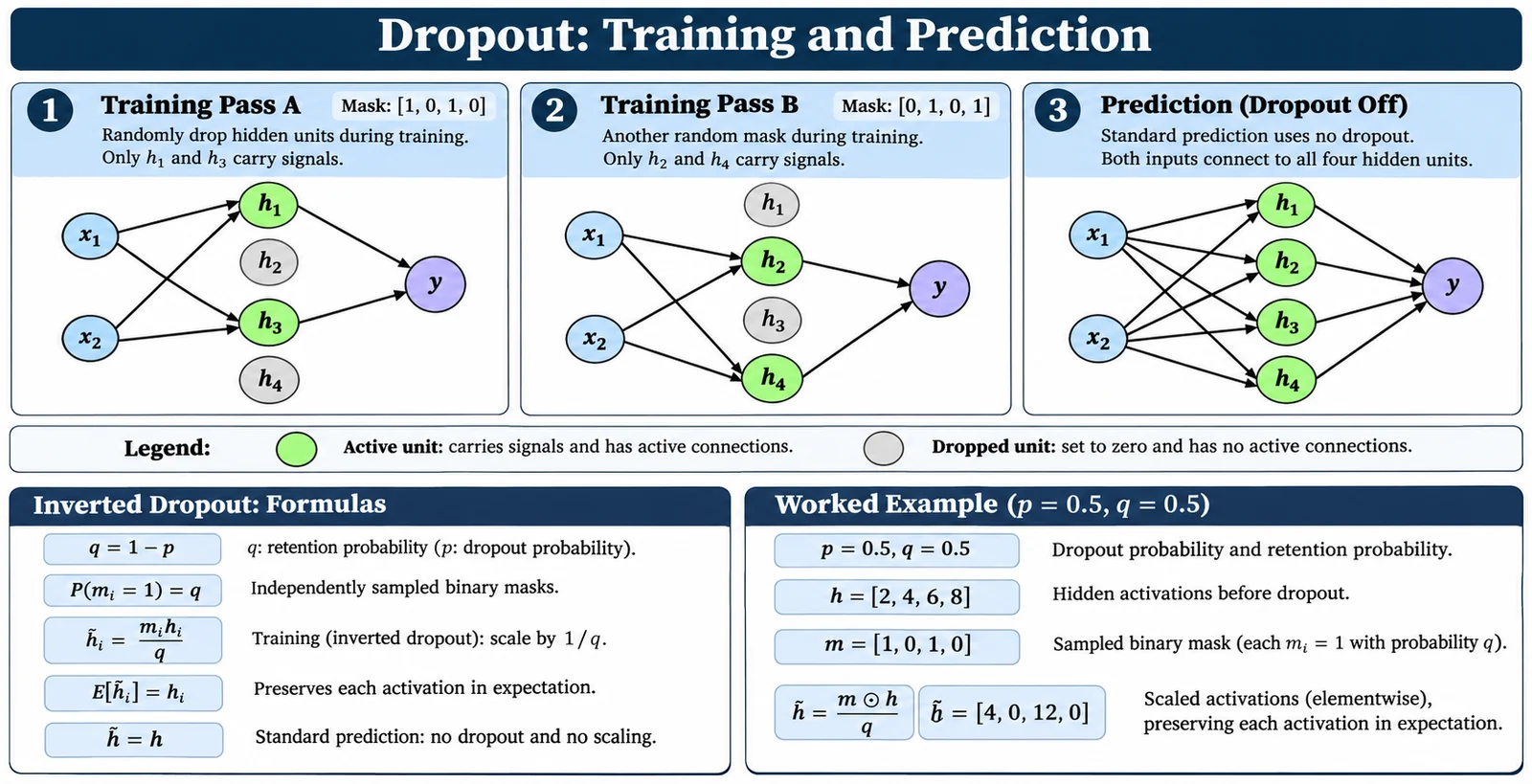
Peng (2024) tested dropout rates of 0.3, 0.5 and 0.7 on a convolutional network trained on CIFAR-10, and the rate of 0.5 paired with a learning rate of 0.001 gave the best balance between learning efficiency and generalization. The learning rate controls how fast the model updates its weights based on training data.[4]
Dropout was first used in 2014. It is now a standard way to improve model generalization. It works by treating each training step as a different subnetwork, effectively training an ensemble of models.[1] Dropout is often used in convolutional and recurrent neural networks.[2][3] Ali and Maseeh (2025) describe overfitting as a significant challenge in training neural networks, one that often leads to poor generalization on unseen data.[3]
Dropout is a method used while training neural networks. It helps prevent overfitting. It stops the model from memorizing training data. This improves generalization. Each training step uses a different subset of active neurons. This prevents neurons from co-adapting to specific input patterns. During testing or prediction, all neurons are used. The outputs are not reduced in size. The network behaves the same each time.[5][6]
The main goal of dropout is to improve generalization by reducing the network's dependence on specific neuron weights.[5][7]
Dropout can be applied to dense layers, convolutional layers, and recurrent layers, so it is used in various neural network types.[6][8][9]
History
History and Development of Dropout
The method turns off some neurons at random during training, which reduces reliance on any one neuron and helps the network learn more general features. Original dropout sets some units to zero during training, and the chance of removal is set by a user-defined rate. It was shown to improve performance across multiple tasks, especially in deep networks where overfitting is common. The math behind dropout includes ensemble averaging and stochastic gradient descent, and this framework explains how dropout lowers model variance. It also helps create sparse representations.[1]
In 2019, researchers introduced Weighted Channel Dropout, which applies dropout to convolutional layers rather than fully connected layers. WCD selects channels based on their activation levels, using a global average pooling step to rank them. This method needs no extra parameters and adds no extra computation during inference. It works well with small datasets. Testing on VGGNet-16, ResNet-101, and Inception-V3 showed WCD improved accuracy across several image tasks. It works with existing models, and no retraining on large datasets like ImageNet is needed.[10]
In 2021, R-Drop was introduced as a way to improve dropout by enforcing consistency between outputs of different sub-models. R-Drop reduces the bidirectional KL-divergence between two outputs from dropout on the same input. This method limits model freedom, and it supports standard dropout by promoting stable outputs. Experiments on 18 datasets across five tasks showed better results, including top performance on translation benchmarks. R-Drop achieved 30.91 BLEU on English-to-German translation and 43.95 BLEU on English-to-French translation.[11]
In 2025, Spectral Adaptive Dropout was created. It changes dropout rates using gradient frequency. The method uses FFT or wavelet decomposition. It finds high-frequency parts linked to overfitting. It keeps low-frequency information. That information holds key patterns while cutting noise. The method adjusts regularization strength to match computational cost. It does this per attention head.[12]
A 2025 method named DDROP uses dynamic dropout, and it removes filters based on how important their activation is. It ranks filters using activation data, and L1 regularization helps reduce weak filters. DDROP was tested on CIFAR-10, CIFAR-100, and ILSVRC2012 with various architectures.[13]
In 2015, researchers found dropout mimics Bayesian inference in deep Gaussian processes, which provided a theoretical basis for its use. This theory lets dropout networks estimate prediction uncertainty, giving a way to measure how sure the model is. On MNIST, dropout's uncertainty estimates improved predictive log-likelihood and reduced root mean squared error. These findings were tested on regression and classification tasks, and both showed success.[14]
Standard dropout does not work well with batch normalization in convolutional neural networks, and this problem makes the method less effective. To fix this, dropout can be placed before convolutional layers, which improves compatibility, or batch normalization can be swapped for group normalization as an alternative. Drop-Conv2d is a dropout variant designed for convolutional layers, and it gives better regularization by matching the layer's structure.[15]
Monte Carlo dropout runs many forward passes with dropout active in each pass, which gives a way to estimate uncertainty in predictions and shows confidence levels. Monte Carlo dropout was tested on a high-dimensional regression problem, and it worked well. The spread in predictions was between 0.012 and 0.174.[16] Monte Carlo dropout allowed interval forecasts in agriculture, which helps predict crop yields. It gave narrower uncertainty ranges than older models, meaning more precise estimates.[17] Monte Carlo dropout became useful in real applications, and it gives reliable confidence estimates.[16][17]
Adaptive methods like concrete dropout change the dropout rate during training, which improves performance and avoids the need for manual selection. It improved shear sonic log predictions with an R² of 0.9548. This method lets one model produce many outputs, giving a range of predictions instead of a single number.[18] Other adaptive methods, like AutoDropout, found good dropout patterns across layers and channels, and they used a controller network to do this.[19]
For recurrent networks, adversarial dropout was introduced. It targets neurons that always help make correct predictions. This method reduced the gap between training and testing performance. It improved results on language modeling and text classification.[8]
Shakeout, another dropout variant, randomly boosts or reverses unit contributions. This leads to sparser weights and better stability. It beat standard dropout on MNIST, CIFAR-10, and ImageNet. It showed better regularization and model compression.[20]
Dropout also found use in shallow neural networks, where it improved performance when combined with early stopping. Dropconnect, which randomly drops connections instead of units, worked slightly better than standard dropout in some shallow models. The results show that dropout works better in some networks than others. It needs careful setup based on size and design.[21]
Dropout compaction trains large models with dropout, then creates smaller, faster models for use in real systems. Adding a sparsity-inducing prior to dropout retention probabilities lets the optimizer remove hidden units during training.[22]
Main ideas
How Dropout Prevents Overfitting
Dropout stops overfitting. It randomly turns off neurons during training to prevent reliance on any single neuron. Turning off neurons at random during training stops the network from depending too much on any one neuron.[2][3]


At test time, all neurons are used. Baldi and Sadowski (2014) analyze dropout using Bernoulli gating variables, a framework general enough to cover dropout on units or on connections, with variable rates. This process is like averaging predictions from many different sub-networks. It improves the model's ability to handle new data.[1]
Randomly turning off neurons during training creates a kind of ensemble learning, and the final model acts like an average of many smaller models. This effect reduces overfitting. Dropout randomly drops units during training to prevent their co-adaptation.[1]
Dropout prevents overfitting by stopping neurons from relying too much on each other during training, a problem called co-adaptation. When dropout is used, some neurons are turned off at random in each training step.[5][1] Ma, Sattar, Zhou, Chen and Su (2020) describe the working mechanism of dropout as an approximate and exponential combination of many different neural network architectures, which yields a powerful ensemble.[5] Randomly dropping neurons creates many versions of the same network.[5][1]
Dropout acts as a regularizer: it causes hidden neuron weights to align along fewer directions, which reduces the network's effective complexity.[7]
On shallow neural networks for stream temperature modeling, dropout with a 1% drop rate improved average performance and reduced the number of poor models.[21] Dropout compaction reduces the number of hidden units by more than half, and the final network keeps high accuracy and runs faster than before.[22][23] A 2020 study showed dropout neural networks can approximate any continuous function.[24]
Variants of the dropout rule
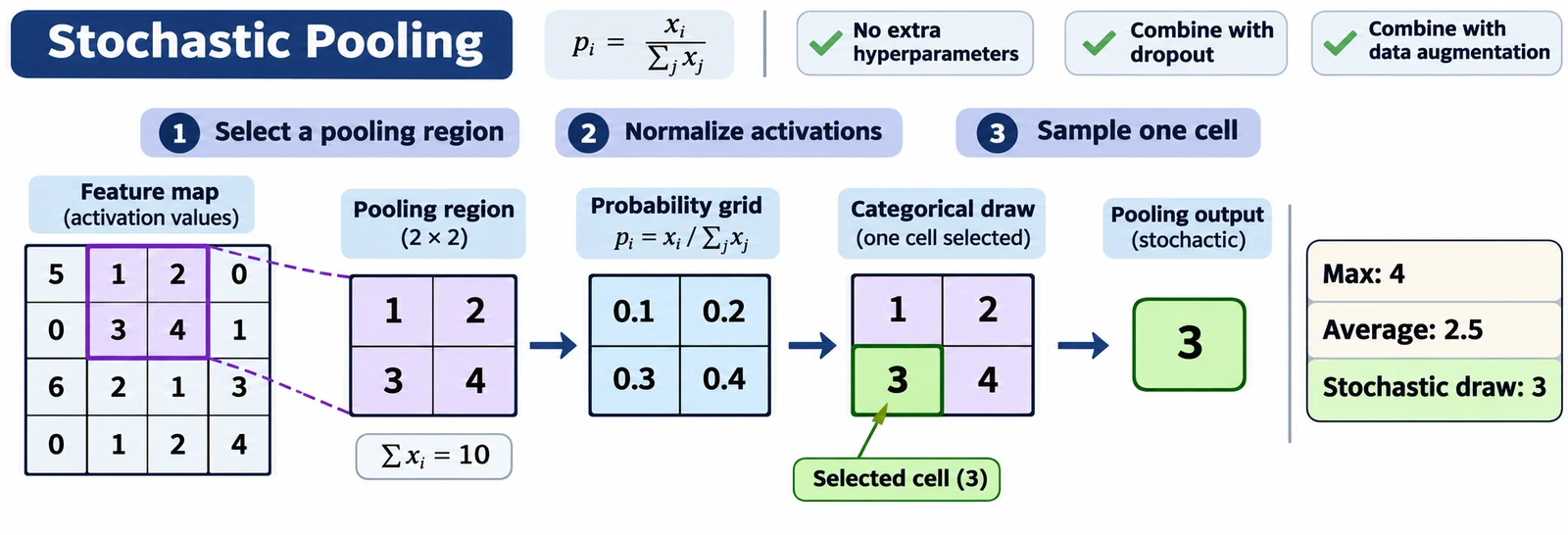
Several dropout variants change what is dropped rather than how often, and one early example sits in the pooling step of a convolutional network. Stochastic pooling replaces the usual fixed pooling operation with a random pick of one activation inside each pooling region, chosen according to a multinomial distribution set by the activities in that region. The procedure has no hyper-parameters to tune and can be combined with dropout and with data augmentation.[26] Feature map distortion takes a different route: instead of setting selected elements of a feature map to zero during training, it replaces randomly selected elements with specific values derived from a bound on generalization error. The method was motivated by an analysis of the empirical Rademacher complexity, a measure of how well a layer's outputs can fit random labels, of intermediate layers, and it was tested on several benchmark image datasets.[27]
Some variants let the label or the model's own predictions decide which units to remove. LGST-Drop was built for spatial-temporal convolutional networks used in action recognition, where a model must capture motion over time as well as spatial detail. It applies structured dropout in the spatial dimension and regularizes motion information in the temporal dimension, and its mask is guided by the categories the model itself predicts, called temporary labels. Experiments on standard action recognition datasets reported gains over earlier methods and their state-of-the-art variants.[28]
Adversarial dropout for recurrent networks also departs from a random mask: it deliberately disconnects the neurons that are most used over time to predict the correct targets. Park, Song, Ji, Lee and Moon showed that this regularizer, the gap between the original and the reconfigured recurrent networks, bounds from above the gap between the training and inference phases of random dropout. Minimizing it improved dropout for recurrent networks on sequential MNIST, semi-supervised text classification and language modeling tasks.[29]
Other variants adjust the dropout rate itself during training. Conditional Dropout with Dynamic Regularization switches dropout off completely for the first four epochs, so features are learned without it. From the fifth epoch the rate is set from the first derivative of the training loss and then held fixed for the rest of training. The same method updates the strength of L2 weight decay according to training dynamics and optionally applies Monte Carlo Dropout at inference to approximate predictive uncertainty.[30] A related proposal merges adaptive sigmoidal dropout with weight amplification, using a sigmoid function driven by a temperature parameter to set the chance of deactivation from weight statistics, activation patterns and neuron history, and adding a neuron recovery step that restores important activations. Tested on CIFAR-10 and CIFAR-100 with four CNN architectures, including deep and residual-based models, it gave higher validation accuracy and lower, more stable validation loss than standard dropout and than models without dropout.[31]
Variational dropout treats the dropout rate as a quantity to be learned, and one extension allows the rates to be unbounded. Molchanov, Ashukha and Vetrov extended Variational Dropout to unbounded dropout rates and gave each weight its own rate. They also proposed a lower variance gradient estimator and reported the first experiments with per weight rates.[32] A separate line of work makes the regularization strength a function of the training loss, so that a large model receives a strong perturbation and a small one a weak perturbation, adjusting the balance between underfitting and overfitting without a predefined schedule.[33]
Dropout as approximate Bayesian inference
Dropout is usually described as a way to stop a network from memorizing its training data, but it also has a probabilistic reading: training with dropout and keeping it switched on at prediction time can be treated as a rough form of Bayesian inference.[34][35] Bayesian inference here means placing a probability distribution over the network's weights and updating that distribution as data arrive, rather than settling on one fixed set of weights.[35] The exact updated distribution is intractable for a large network, so it must be approximated by a simpler distribution, and in this reading the random dropping of units supplies that approximation. A 2015 paper by Yarin Gal placed a probability distribution over the kernels of a convolutional neural network and approximated the resulting posterior with Bernoulli variational distributions, which require no additional model parameters. Gal treated dropout network training as approximate inference in a Bayesian neural network. That view let the model be built from existing deep learning tools without added time complexity. Classification accuracy improved over standard techniques, and published state-of-the-art results on CIFAR-10 were surpassed.[34]
The approximation has a known weakness: variational inference of this kind can severely underestimate model uncertainty. In dropout networks the method gave improved uncertainty estimates and accuracy compared with variational inference, and on adversarial images the model's epistemic uncertainty, meaning uncertainty about the model's own parameters, separated them from ordinary images.[36]
The standard dropout posterior treats the noise on each unit as independent of the others, and a 2021 method called Variational Structured Dropout replaces that factorized structure with an orthogonal transformation that learns a structured representation on the variational Gaussian noise. The transformation induces statistical dependencies in the approximate posterior, and the method's authors argue that it addresses pathologies of earlier variational dropout methods and supplies a standard Bayesian justification. It also induces an adaptive regularization term, and experiments on standard benchmarks showed better predictive accuracy, uncertainty estimation and out-of-distribution detection than state-of-the-art variational methods.[37]
Recurrent networks, which process sequences, have been handled by coupling Monte Carlo dropout, the practice of sampling many dropout masks at prediction time, with a Gaussian prior on the input noise. Sadeghi Tabas and Samadi (2022) applied variational Bayesian dropout to a vanilla recurrent network, long short-term memory and a gated recurrent unit. The aim was to quantify epistemic and aleatory uncertainty, the latter being the inherent randomness of a physical system, in daily rainfall and runoff simulation for a coastal catchment in North Carolina, USA, that mixes urban and rural land. Adding a Gaussian noise term to the recurrent layers implicitly mitigated overfitting, and the analysis reported a considerable improvement in predictive log-likelihood. Across a broad range of simulation strategies the long short-term memory and gated recurrent unit versions outperformed the Sacramento soil moisture accounting conceptual hydrologic model.[38]
Running many dropout samples at prediction time costs computation, which limits use in safety-critical settings such as medical diagnosis and autonomous driving. A 2024 paper by Zhewen Chen and colleagues proposed multi-exit dropout-based Bayesian networks, in which the network can produce an answer at more than one point, with reduced computational and memory overheads, together with a framework that generates field-programmable gate array accelerators for them. The design mixed spatial and temporal mappings to cut resource consumption, and the reported experiments showed higher energy efficiency than central processing units, graphics processing units and other state-of-the-art hardware implementations.[39]
Dropout alongside other regularizers
Dropout belongs to a family of techniques, called regularizers, that limit how closely a trained network fits its training data, and it is usually judged against the alternatives.[40] A 2022 survey groups these techniques by what they change: the input data (data augmentation), the internal feature maps or kernels, and the labels.[41] A second 2022 paper sorts the same territory by mechanism: penalties on the network's parameters such as L1 and L2, stochastic changes to the network such as dropout and Gaussian noise, and transformations of the input such as batch normalization. Weight penalties add a term to the training objective that grows with the size of the weights, while dropout removes units at random during training. Batch normalization rescales the inputs of each layer, and in the second sorting it counts as an input transformation rather than a stochastic change to the network.[40]
Smirnov, Timoshenko and Andrianov compared regularization methods on the ImageNet Large Scale Visual Recognition Challenge 2013 and found empirically that Dropout works better than DropConnect on that dataset. On the ImageNet Large Scale Visual Recognition Challenge 2013, a 2014 comparison reported that dropout worked better than DropConnect, a related method that drops connections between units instead of units themselves.[42] A 2018 comparison trained deep networks on a weather dataset and measured training and validation errors for each scheme. In that experiment an autoencoder, a network trained to reproduce its own input, performed worst among the schemes tested, and data augmentation and batch normalization performed better than the others on prediction accuracy. The comparison was motivated by the difficulty developers face in choosing a scheme, since information on the performance of each one was lacking.[43]
Dropout has also been combined with other regularizers in a single training procedure.[44][45] A 2022 hybrid algorithm applied L2 regularization and dropout together, testing on the MNIST and CIFAR10 image datasets with the LeNet-5 and autoencoder architectures and evaluating by cross-validation. On the MNIST test set the hybrid reached accuracy 2.3% above L2 regularization alone and 0.9% above dropout alone; on CIFAR10 the gains were 0.92% over L2 and 1.31% over dropout. The same hybrid reduced reconstruction error on MNIST by 0.00174 relative to L2 and by 0.00398 relative to dropout, and on CIFAR10 by 0.00078 and 0.00174 respectively. The reported gains came without an increase in time complexity, and the method was also said to lessen the effect of noisy data and bias and to shorten training time.[44]
A 2019 study arranged batch normalization and dropout into a single layer placed before each weight layer, intended to make the inputs of that layer more independent. The authors proved that dropout in this arrangement reduces the mutual information between neurons quadratically and the correlation between any pair of neurons linearly with respect to the dropout parameter p. The combined layer trained more stably, converged faster and reached a better convergence limit than baseline approaches on CIFAR10, CIFAR100 and ILSVRC2012.[45]
A different line of work penalizes confident predictions rather than large weights or active units. The evaluation covered 6 benchmarks: MNIST and CIFAR-10 for image classification, Penn Treebank for language modeling, WMT'14 English-to-German for machine translation, and TIMIT and WSJ for speech recognition. On these, label smoothing and the confidence penalty both improved state-of-the-art models without changes to existing hyperparameters.[46] A 2022 proposal takes yet another route, requiring that each neuron's separating hyperplane, the boundary it uses to divide its inputs, have a minimum number of data points on both sides. Benchmarked on Fashion-MNIST against several regularization techniques, this evidence-based approach produced networks that used every neuron and activated neurons more often and earlier in training. As networks grew deeper at constant width, most regularization approaches failed more often across random seeds, while the evidence-based method trained deep networks significantly better.[40]
Research
Dropout and Uncertainty Quantification
Dropout can estimate uncertainty in predictions. The network is run multiple times during inference with different neurons turned off at random. This method treats each forward pass as a sample from a distribution of possible models, and it allows the network to output a range of predictions instead of a single value. The differences in predictions show how uncertain the result is: larger differences mean less confidence in the prediction.[47][48]
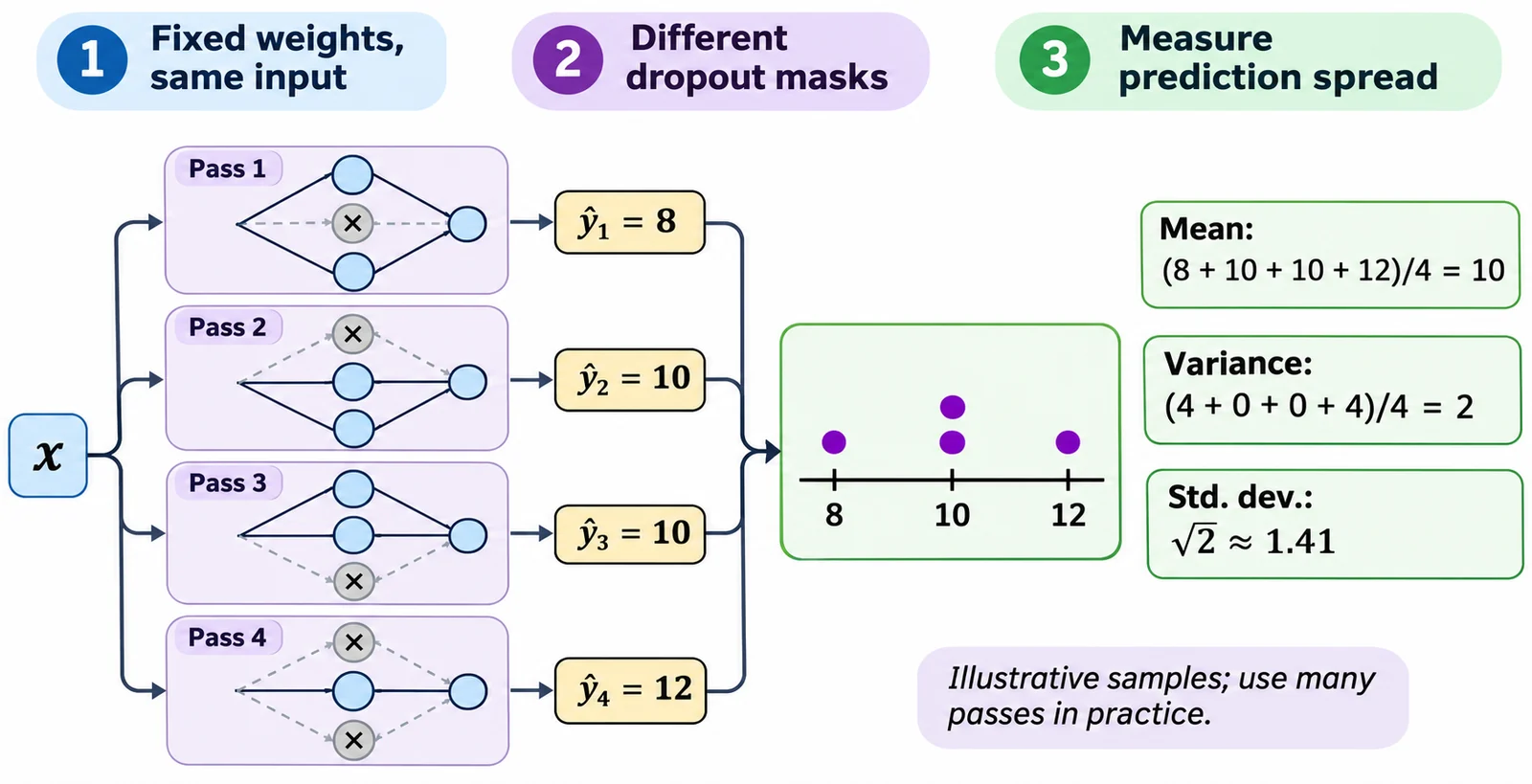
Running the network many times during inference with dropout on is called Monte Carlo dropout. Each forward pass gives a different prediction, because dropout randomly removes neurons, creating a range of outputs that show model uncertainty. This distribution lets us calculate predictive intervals, which show the range of likely outcomes and confidence in them. In regression, the prediction mean gives a point estimate, and the standard deviation shows uncertainty around that estimate. The method is fast, and it uses the same trained model without retraining or complex Bayesian updates.[49][50]
A study on X-ray spectral fitting showed that Monte Carlo dropout networks produced posterior distributions comparable to Bayesian inference but with computational speed improved by about an order of magnitude.[51] The method supports active learning in material science, where uncertainty estimates show which new data to label, and this cuts the number of labeled examples needed.[52]
Theory of convergence and information flow
Theoretical work on dropout asks two separate questions: whether training with randomly removed connections still settles into a stable solution, and what such training does to the information that hidden layers carry about the input.[53][54][55] A 2020 paper by Senen-Cerda and Sanders gives a probability-theoretic proof for fully connected networks whose activation functions are differentiable and grow no faster than a polynomial. For networks shaped like arborescences, tree-like structures of arbitrary depth with linear activation functions, an upper bound on the convergence rate of gradient descent shows that depth can slow convergence exponentially. Experiments on wide networks with only a few dropout layers showed no such dependence on depth, and the paper offers a heuristic argument for the difference. The results suggest that the effect of the dropout probability on convergence rate changes scale according to the width of the network relative to its depth.[54]
A 2022 analysis by Senen-Cerda and Sanders treats shallow linear networks, which can also be viewed as matrix factorization under a particular regularizer. Using a recent result on nonconvex optimization and a careful study of the set of minimizers and the Hessian of the loss, the paper proves local convergence of the gradient flow. Numerical simulations agreed qualitatively with the bound and matched it when training started sufficiently close to a minimizer.[53]
Adilova, Geiger and Fischer reported in 2023 that these measurements depend strongly on the estimator chosen, and that for deterministic networks the mutual information between input and representation can be infinite, so estimated values reflect the estimation method rather than the training process. They showed that dropout with continuously distributed noise keeps the mutual information finite, which makes a meaningful information plane analysis possible for a widely used class of dropout networks.[55]
A 2026 paper by Devlin and Sanders treats the random removal of connections as a percolation problem, the statistical physics model of how connections spread through a medium. If dropout removed enough connections that no path remained between the input and the output, the network could not make predictions informed by the data. New percolation models built to mimic dropout relate network topology to this path problem, and the theory establishes that a percolative effect exists in dropout. That effect can cause a breakdown when networks without biases are trained with dropout, and the paper argues heuristically that the breakdown extends to networks with biases.[56]
Ma, Gao, Hu, Yu, Deng and Hovy formulated dropout in 2016 as a tractable approximation of a latent variable model, a view that clarifies how parameters are shared and permits further analysis. They introduced expectation-linear dropout networks, for which the gap between the training phase and the inference phase can be characterized formally. A measure of that gap can be added to the standard dropout objective, giving explicit control of it at about the same cost as standard dropout. The paper proves upper bounds on the loss in accuracy caused by expectation-linearization and describes classes of input distributions that linearize easily. Experiments on three image classification benchmark datasets showed that reducing the inference gap improved performance consistently.[57]
Randomness quality and randomness sources
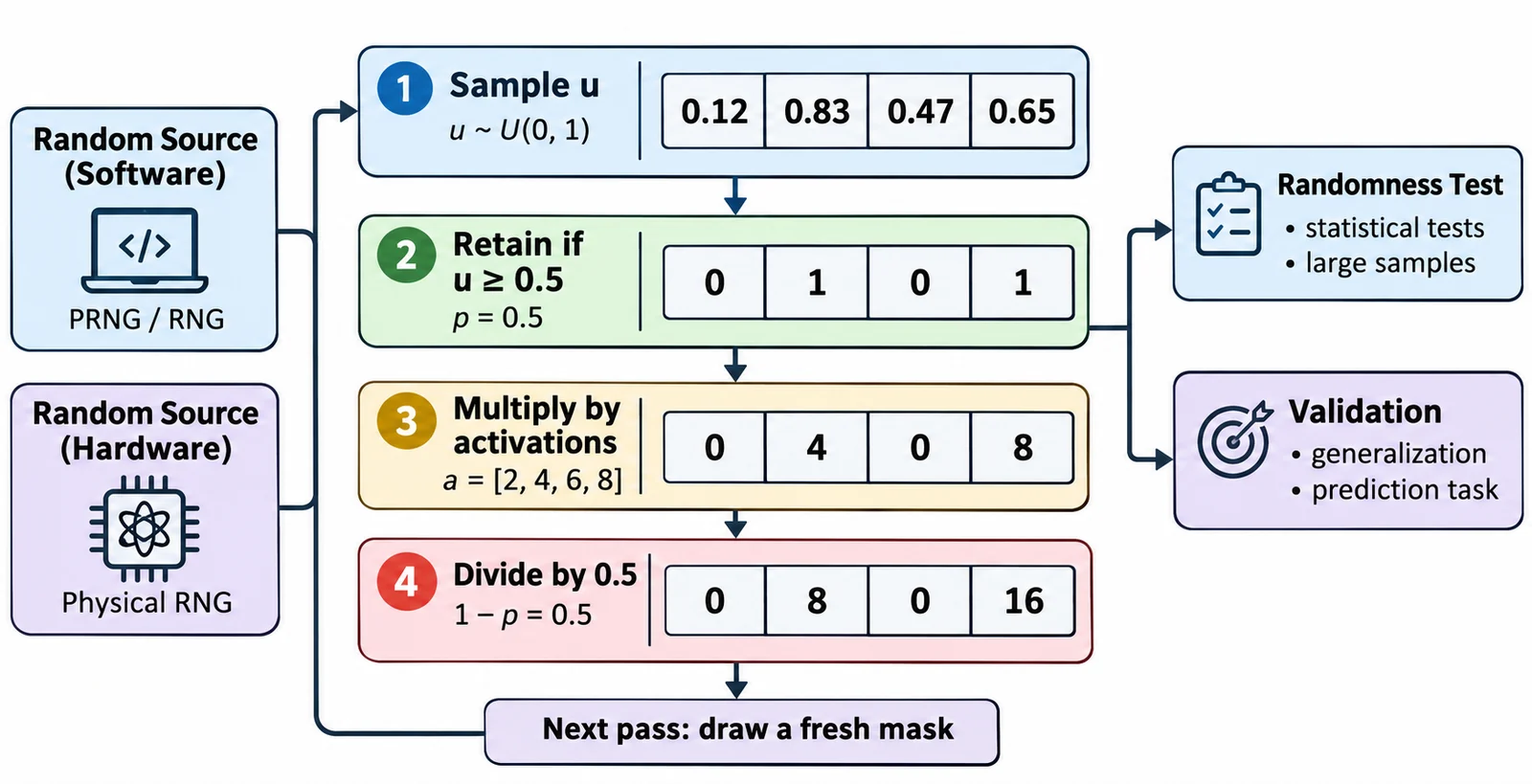
A dropout mask is a set of random numbers, one per unit, that decides which units are switched off in a given training step, so the statistical quality of those numbers can matter for how well dropout regularizes a network. Quality of randomness here means the behavior of a sufficiently random process observed over a sufficiently large sample, and it is assessed with statistical tests that have been proposed over the years. A 2022 study by Koivu, Kakko, Mäntyniemi and Sairanen tested five different random number generators with several statistical tests, then used each generator's output to drive the dropout layer of a neural network in four classification tasks. The study also varied the size of the data and the relevant hyperparameters, and compared the amount of overfitting against the randomness test results for each generator. Its conclusion was that true random number generation in node dropout can help or hurt depending on the dataset and the prediction problem, and that adding random number generation experiments to modeling could improve the fitting of neural networks in general.[58]
Dropout is not the only way to perturb a network's training with randomness, and one 2015 arXiv paper by an author listed as R. compared dropout with dither, a signal processing technique that adds small random fluctuations to a signal. That paper argued that dropout has serious inherent limitations as a regularizer and that dither regularizes deep neural networks more effectively. The comparison was framed through signal processing theory rather than through a large set of benchmark tasks.[59]
The random numbers behind a dropout mask can also come from hardware rather than from software generators. Huang, Xiao, Yang, Yu, He and Wang reported in 2020 that dropout neuronal units can be built from stochastic volatile memristive devices made of Ag/Ta2O5:Ag/Pt, components whose electrical resistance switches unpredictably and then returns to its earlier state. In that work the memristive neural network with dropout units reduced overfitting and offset the harm caused by nonideal memristive synapses, reaching a classification accuracy comparable to the theoretical limit. Transmission electron microscopy and kinetic Monte Carlo simulation attributed the stochastic, volatile switching to random rupture of a silver filament under high electrical stress in the Ta2O5 layer.[60]
The choice of dropout rate itself has been treated as a search problem, separate from the quality of the random numbers. Bacanin, Zivkovic, Al-Turjman, Venkatachalam, Trojovský and Strumberger described in 2022 an automated framework based on a hybridized sine cosine algorithm, a swarm intelligence method, for setting the dropout parameter, since finding its best value by hand is slow and difficult. Their first experiment used four benchmark datasets (MNIST, CIFAR10, Semeion and UPS), and a second experiment addressed classification of brain tumor magnetic resonance images. The reported results showed lower classification error and higher accuracy than several comparable approaches included in the comparison.[61]
Effects on learned representations and variability
Dropout leaves a visible trace in how a trained network responds to repeated presentations of the same input. In a convolutional neural network with dropout applied during both training and testing, the trial-by-trial correlation between neurons, called noise correlation, was positive and low dimensional. Neurons close together within a feature map showed larger noise correlation than neurons farther apart. The researchers described these properties as surprisingly similar to findings in the visual cortex. Different images shared a common trial-by-trial noise covariance subspace, and that subspace was aligned with the global signal covariance.[62]
Pan, Coen-Cagli and Schwartz checked this directly by shuffling trials, a procedure common in neuroscience. Pan, Coen-Cagli and Schwartz point to an aspect of dropout layers that had been overlooked and that can affect how well a network performs. They also suggest that such dropout networks might serve as a computational model of neural variability.[62] A separate line of work asks whether biology contains anything like dropout at all. Lee, Zhang and Janušonis proposed in a proof-of-concept study that brain serotonergic fibers, the axons of serotonin-releasing neurons, meet some of the expected criteria. The criteria they name are the fibers' presence nearly everywhere, their stochastic structure and their capacity to grow across an individual's lifespan.[63]
The trajectories of serotonergic fibers can be described as paths of anomalous diffusion. On that basis, Lee, Zhang and Janušonis tested a dropout algorithm built on superdiffusive fractional Brownian motion. Lee, Zhang and Janušonis report that serotonergic fibers could carry out a dropout-like mechanism in brain tissue that supports neuroplasticity. Their results also suggest that mathematical theories of how such fibers are structured and move can inform the design of dropout algorithms in artificial networks.[63] A broader discussion of how deep learning and neuroscience might inform each other treats the brain as optimizing diverse cost functions within a pre-structured architecture matched to behavioral problems. That discussion does not test dropout directly, so the links between dropout variability and neural population coding remain proposals rather than established results.[64]
Comparisons with biological vision also show where dropout-trained networks fall short. Põder tested three deep neural networks, all pretrained for image classification, on visual search for simple features and for feature configurations. In the tested networks, searches for simple features that pop out in human experiments and searches for feature configurations that show strict capacity limits in human vision were not clearly different. Both kinds of stimuli produced comparable capacity limits in the networks.[65]
In practice
Dropout in Convolutional Neural Networks
Traditional dropout has trouble in CNNs, because random neuron removal causes spatial patterns in feature maps that hurt performance. Researchers created Checkerboard Dropout, which removes neurons in a fixed checkerboard pattern, not at random. This pattern reduces spatial correlation between zeroed-out values and helps the network generalize to new images. On ImageNet, Checkerboard Dropout improved top-1 accuracy by 2.17% over ResNet-50, and it beat DropBlock by 0.3%. On the MS COCO dataset, object detection improved by 0.64% with this method. Visualizations using Grad-CAM and instance segmentation showed Checkerboard Dropout improves object localization and segmentation.[66]
Mixed-Pooling-Dropout combines dropout with pooling to improve regularization in CNNs. This method uses a binary mask to drop features, and it outperforms max-pooling-dropout, reaching 0.926 accuracy versus 0.868.[67] Dropout in fully connected layers also reduces how much different layer designs affect overall model performance. The top model in that study got 85.23% accuracy on test data, and it used fewer parameters than other models.[68]
Recent studies show placing dropout before convolutional layers works better than after Batch Normalization, and using Group Normalization instead of Batch Normalization reduces conflicts with dropout. Drop-Conv2d, a structured dropout variant, offers better regularization efficiency. These gains come from stronger regularization and from an implicit model ensemble effect during training.[15]
Dropout helps models do better on image classification tasks like CIFAR-10 by reducing overfitting and raising validation accuracy.[69] A method assigns dropout rates based on how important each feature is, with the goal of improving regularization.[70]
Dropout in Recurrent Neural Networks
A 2015 study gave dropout a Bayesian interpretation for RNNs, treating it as a way to estimate uncertainty in model weights. This variational dropout method was tested on language modeling and sentiment analysis, using LSTM and GRU networks. It scored 73.4 on a test using the Penn Treebank dataset, the best result for a single model at the time.[71]
Iparraguirre-Villanueva, Guevara-Ponce, Ruiz-Alvarado, Beltozar-Clemente, Sierra-Liñan and Zapata-Paulini (2023) note that long short-term memory networks, a type of recurrent neural network, are used in text generation and prediction, question answering and classification because they can learn long-term dependencies. Long short-term memory networks are sequence-based models, and their ability to learn long-term dependencies is why they are used in text generation and prediction tasks.[72] Dropout helps stop RNNs from overfitting, and special dropout methods were made for RNNs. Adversarial dropout disconnects neurons that keep being used to predict correct outputs, aiming to improve generalization.[8]
Dropout in Practical Applications
A 2020 study used a deep neural network with dropout on the NSL_KDD dataset. It achieved 99.45% accuracy in classifying normal traffic and four attack types: DoS, R2L, U2L, and Probe. Adding feature selection lowered accuracy to 99.27%, and the model was still very effective.[73]
In electric vehicles, dropout helps predict driver actions, using tire-road grip data to improve collision avoidance. A 2022 study built a deep neural network with dropout that estimated safe driving distances using road surface conditions. Simulations using rapid control prototyping and hardware-in-the-loop testing confirmed the model supports safe driving in complex traffic.[74]
Dropout helps measure uncertainty in tool wear predictions, giving a range of possible results instead of one number. A 2023 study used Monte Carlo dropout in a neural network, and it captured both data and model uncertainty in manufacturing.[75]
Dropout improves predicting student dropout in large online courses. It combines convolutional and recurrent neural networks. A 2022 study used a CNN-LSTM model with 43 behavioral features from student learning logs to predict dropouts. The model was tested on the KDD Cup 2015 dataset and improved AUC by 2.7% over LSTM and 1.4% over CNN-RNN.[76]
Dropout increases pneumonia detection accuracy in chest X-ray images, and it prevents overfitting in convolutional neural networks. The model reached 97.2% accuracy, 97.3% recall, 97.4% precision, and an AUC of 0.982. It won a Kaggle competition.[25]
Advanced dropout methods like R-Drop improve results by making output distributions from different submodels more consistent. On 18 datasets across five tasks, including image classification and language translation, R-Drop improved accuracy, and it reached state-of-the-art results on WMT14 translation.[11]
Selective gradient dropout freezes certain connections instead of randomly dropping neurons. It reduces training time and increases sparsity in deep networks. This method beat baseline models on multiple image classification datasets. It reached high accuracy in fewer training epochs. The method keeps performance high while using less computation. It works well on devices with limited resources.[77]
Dropout and Model Efficiency
Dropout makes models more efficient, letting us build smaller, faster networks without losing accuracy. A 2016 study introduced dropout compaction, an approach that trained large models with dropout but extracted compact versions for faster run-time performance.[22]
Energy-based dropout uses a probability model to find the best way to remove neurons in a network. EDropout removed more than half the trainable parameters across several networks and datasets, and Top-1 accuracy dropped by less than 5%.[23]
The proposed method achieved up to 20× speedup in IoT devices, as reported in source, and it improved accuracy on small devices. A few cases showed slight performance loss, according to the source.[78]
Dropout and Hyperparameter Tuning
Dropout works better on smaller or simpler datasets. These datasets are more prone to overfitting, so dropout helps more. On a small dataset of 250 samples, dropout gave different results across network types. Overfitting appeared in the models, according to the source.[79] A model for predicting thermal errors in machine tools used dropout in an unsupervised training method. It stopped neurons from adapting too closely together.[80]
Techniques like dropout are part of a larger group. They control model complexity and improve generalization. These methods are linked to mathematical principles that assume certain smoothness in the functions a model should learn. Different regularization methods create different neural networks. These include those with radial basis functions and additive splines. Dropout acts like a form of implicit regularization. It limits how much any single neuron affects the output, as explained in the source.[81]
Dropout in Federated Learning and Large-Scale Models
In federated learning, many devices train a shared model without sharing raw data. FedOBD reduces communication needs by uploading blocks of data when possible. Experiments on real-world datasets showed FedOBD cut communication overhead by over 88% compared to the best baseline. It also achieved the highest test accuracy. This is the first method to apply dropout at the block level in federated learning. It offers a more efficient way to train large models across many devices.[82]
The method, called EDN, uses one network to estimate fitness and confidence, and it randomly ignores neurons during both training and testing. This design lowers computation needs while keeping performance high on problems with up to 100 decision variables and 20 objectives. The algorithm was tested on a real crude oil distillation problem.[83]
Dropout in scientific and engineering models
Dropout has been built into working models across the physical and life sciences, usually as one layer among several rather than as the subject of study.[84][85][86][87][88][89][90][91] In epilepsy research, a model that combined a one-dimensional convolutional neural network with a long short-term memory network, a recurrent design that keeps information across time steps, reached a test accuracy of 0.993 when dropout layers were added. The long short-term memory network alone reached 0.986, and the bidirectional long short-term memory and gated recurrent unit designs reached 0.983 and 0.984 respectively. That study trained nine deep learning architectures on electroencephalography recordings, which measure the brain's electrical activity, from multiple subjects, and found that the architectures responded differently to feature scaling, principal component analysis and feature selection.[84]
Medical image classification has used dropout in much the same way, as one of several additions to a deep network.[87][90] An eight-layer convolutional neural network combined batch normalization, dropout and data augmentation and was trained on 7399 images from patients with Alzheimer's disease and 7399 from healthy control subjects. On the test set the method reached 97.77% sensitivity, 97.76% specificity, 97.79% precision, 97.76% accuracy, 97.76% F1 and 95.56% MCC. That was the best result among seven methods compared.[87]
For multiple sclerosis, Wang, Tang, Sun, Yang, Huang, Phillips and colleagues built a 14-layer convolutional network that combined dropout with batch normalization and stochastic pooling. In stochastic pooling, the output is drawn by sampling from a multinomial distribution built from the activations of each pooling region. Ten runs were made, each with a randomly chosen hold-out set. The network reached 98.77±0.35% sensitivity, 98.76±0.58% specificity and 98.77±0.39% accuracy, and it beat six other methods, one of them a deep learning approach.[90]
In structural biology, dropout was among the techniques Adhikari tested for predicting which amino acids in a protein lie close together in space, a step toward working out protein shape. Trained on the DeepCov dataset of 3456 proteins and tested on the PSICOV dataset of 150 proteins, the convolutional networks reached up to 15% higher precision than several existing methods when L/2 long-range contacts were evaluated, where L is the protein length. Trained on the DNCON2 dataset of 1426 proteins and tested on 84 domains from the CASP12 dataset, a single network reached 4.8% higher precision than the ensembled DNCON2 method when the top L long-range contacts were evaluated.[89]
Engineering applications use dropout both to classify faults and to forecast physical processes.[85][86] For utility-scale photovoltaic arrays, meaning large solar power installations, customized neural networks with dropout regularizers were built for fault detection, localization and classification, and were judged on accuracy, confusion matrices and a Risk Priority Number. The same work examined network pruning and described a trade-off between classification accuracy and algorithm complexity.[85]
For El Nino-Southern Oscillation forecasting, Hu, Weng, Huang, Gao, Ye and You built a deep residual convolutional network that used dropout and transfer learning to cope with limited training data. With dropout, the model predicted the Nino3.4 Index at a lead time of 20 months over the 1984 to 2017 evaluation period, three months longer than the existing best model. With homogeneous transfer learning it predicted the Oceanic Nino Index up to 18 months ahead. With heterogeneous transfer learning it reached 83.3% accuracy in forecasting the type of El Niño 12 months ahead.[86]
Two further uses treat dropout as a source of uncertainty rather than only as a guard against overfitting.[88][91] Machine learning interatomic potentials approximate the forces between atoms at far lower cost than first-principles methods such as density functional theory, but their accuracy outside the training set is unknown. Wen and Tadmor developed a class of Dropout Uncertainty Neural Network potentials for carbon. Its uncertainty estimates can be understood from both Bayesian and frequentist statistics. These estimates flagged configurations outside the training set and in some cases predicted the accuracy of a calculation.[88] In earthquake engineering, a multilayer perceptron with a dropout mechanism performed probabilistic pushover analysis of reinforced concrete frame structures, a nonlinear procedure that accounts for material plasticity, plastic hinges and the P-Delta effect. The model predicted base shear, lateral displacement and the relation between them, and its probabilistic nature yielded confidence intervals that can help engineers design conservative solutions.[91]
What this looks like in practice
R-Drop adds a consistency penalty to standard dropout training: for each training sample, two sub models are sampled by dropout, and the bidirectional KL-divergence between their output distributions is minimized. Liang and colleagues report that the penalty lowers the freedom of the model parameters and works alongside dropout. They tested it on 5 deep learning tasks covering 18 datasets, among them machine translation, summarization, language understanding, language modeling and image classification.[11]
Tabu dropout marks the units dropped in the previous forward pass and keeps those units selected for dropping in the current pass, so that fewer iterations are needed to produce more distinct sub networks. The scheme adds no extra parameters relative to standard dropout, and experiments on four public datasets showed better generalization than standard dropout.[5]
It is parameter-free, runs only during training, and was evaluated with VGGNet-16, ResNet-101 and Inception-V3 on multiple datasets, where it improved on the baselines.[10] Cai and colleagues traced the weak performance of standard dropout in convolutional networks to a conflict between dropout randomness and the following Batch Normalization, and proposed placing dropout before the convolution or replacing Batch Normalization with Group Normalization. Their Drop-Conv2d variant was tested on CIFAR, SVHN and ImageNet, and the resulting building blocks improved on state-of-the-art convolutional networks, an effect the authors attribute mainly to better regularization and an implicit ensemble.[15]
Concrete dropout adapts the dropout rate to the data instead of fixing it by hand. Applied to an artificial neural network and a convolutional network for shear sonic log prediction across four wells from the Volve field, the concrete dropout ANN reached an R2 of 0.9548, RMSE of 3.6415, MSE of 2.4433 and MAE of 0.0179. It beat the deterministic versions and a Bayesian-optimized multilayer perceptron.[18] Choubineh and colleagues used it to measure uncertainty in skip connection convolutional networks trained on 376,250 generated samples for subterranean fluid flow modeling. They obtained a standard deviation of 0.012 to 0.174, an R2 of 0.7881 to 0.9584 and an MSE of 0.0113 to 0.0508.[16] Dropout compaction places a sparsity-inducing prior on each unit's dropout retention probability so that training prunes hidden units; on speech recognition tasks it matched competing methods with fewer than 50% of the hidden units and gave a 2.5x speedup at run time.[22]
Criticism
Open questions and reported limits
Evidence that dropout can be replaced by other perturbations comes from multi-task learning, where one model is trained on several objectives at once with a shared structure. A 2021 paper reports that gradients derived from each sub-cost often conflict on cost plateaus, leaving a subpar optimum, and proposes Cost-Out, which randomly drops the sub-costs at each iteration instead of dropping neurons. The paper offers theoretical and empirical evidence for an escaping pressure induced by this mechanism, and reports improved performance on two-digit image classification sampled from MNIST and on machine translation between English and French, Spanish and German using WMT14 datasets. In Cost-Out, the sub-costs are dropped at random for each iteration, so the method's randomness acts on the terms of the objective rather than on individual neurons.[92]
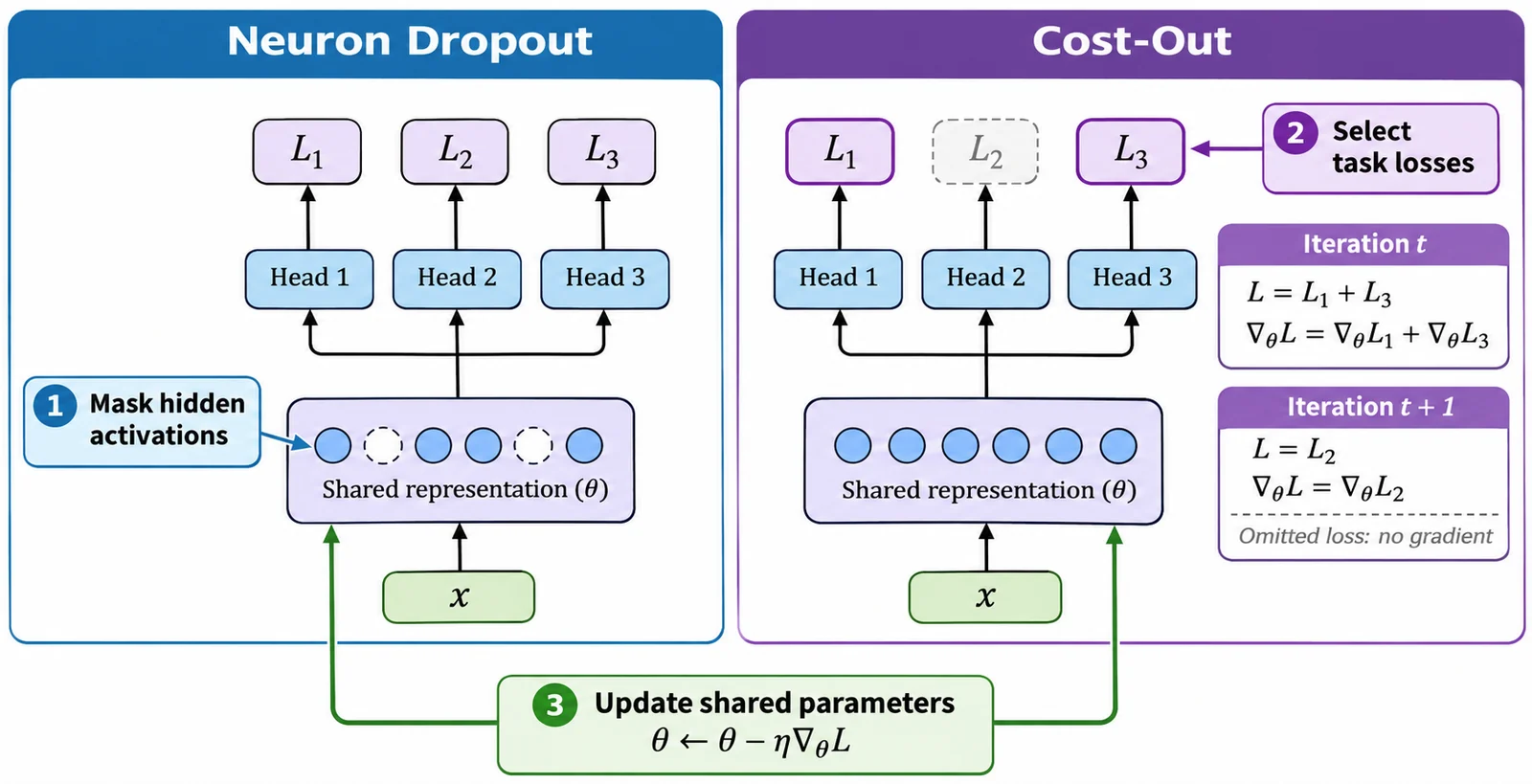
A 2022 paper on detecting out-of-distribution data, meaning inputs that differ from the training distribution, reports that earlier attempts to use the randomized embeddings induced by intermediate layers of a dropout Bayesian neural network can fail because of the distance metric used. Nguyen, Lu, Munoz, Raff, Nicholas and Holt introduce another way to measure embedding uncertainty. They report that including it improves identification of out-of-distribution data on image classification, language classification and malware detection.[93] Carreno-Medrano, Kulic and Burke train a standard network with dropout, which amounts to learning a distribution over predictions. At run time a particle filter keeps a distribution over dropout masks, so the model adapts to changing settings online. That study reports improved performance in control problems requiring online and look-ahead prediction, and it uses the inferred masks to interpret a human behavior modelling task for drone teleoperation.[94]
Key studies
| Year | Study | Sample | Design | Finding |
|---|---|---|---|---|
| 2016 | Kubo et al.[22] | Real-world speech recognition tasks | Systematic comparison | Dropout compaction achieved comparable accuracy to larger models while reducing the number of hidden units to fewer than half, resulting in a 2.5x increase in run-time efficiency. |
| 2019 | Hou & Wang[10] | VGGNet-16, ResNet-101, Inception-V3 on multiple datasets | Experimental evaluation | Weighted Channel Dropout demonstrated consistent improvements over baseline models and does not require re-pretraining on ImageNet. |
| 2019 | Cai et al.[15] | CIFAR, SVHN, ImageNet datasets | Experiments on benchmark datasets including CIFAR, SVHN and ImageNet | Repositioning dropout operations before convolutional layers and using the Drop-Conv2d variant improved performance over state-of-the-art CNNs, primarily due to better regularization and an implicit model ensemble effect. |
| 2020 | Ma et al.[5] | 4 public datasets | Empirical evaluation | Tabu dropout aims to generate more different neural network architectures in fewer iterations by avoiding repeated dropping of units from the previous pass. |
| 2021 | Liang et al.[11] | 5 deep learning tasks, 18 datasets | Experiments on multiple tasks | R-Drop achieved state-of-the-art performance on WMT14 English→German and English→French translation tasks when applied to the vanilla Transformer model. |
| 2022 | Salehinejad & Valaee[23] | ResNets, AlexNet, SqueezeNet on Kuzushiji, Fashion, CIFAR-10, CIFAR-100, Flowers, ImageNet | Evaluation across multiple models and datasets | EDropout achieved over 50% pruning rate with less than 5% drop in Top-1 accuracy and less than 1% in Top-5 accuracy. |
| 2022 | Nguyen et al.[66] | ImageNet, MS COCO datasets | Large-scale image classification and object detection | Checkerboard Dropout improved top-1 accuracy by 2.17% compared to a ResNet-50 baseline on the ImageNet dataset and outperformed DropBlock by 0.64% in average precision on the MS COCO dataset. |
| 2023 | Choubineh et al.[16] | 376,250 generated samples for subterranean fluid flow | High-dimensional regression study | MC dropout achieved a coefficient of determination between 0.7881 and 0.9584 and a standard deviation between 0.012 and 0.174 in the context of subterranean fluid flow modeling. |
| 2025 | Department of Petroleum Engineering, Abubakar Tafawa Balewa University, Bauchi, Nigeria, email (corresponding author): ephene2@gmail.com et al.[18] | 4 wells from the Volve field | Concrete dropout ANN compared with deterministic ANN and CNN models and a Bayesian-optimized multilayer perceptron | The Concrete dropout ANN achieved an R2 of 0.9548 and an RMSE of 3.6415, outperforming deterministic models in the study. |
| 2025 | Huang et al.[12] | Character-level language modeling tasks | Extensive experimentation | Spectral Adaptive Dropout improved validation loss by 1.10% while maintaining competitive inference speed. |
See also
References
- Baldi, P., & Sadowski, P. (2014). The dropout learning algorithm. Artificial Intelligence, 210, 78-122. doi:10.1016/j.artint.2014.02.004
- Salehin, I., & Kang, D. K. (2023). A Review on Dropout Regularization Approaches for Deep Neural Networks within the Scholarly Domain. Electronics, 12(14), 3106. doi:10.3390/electronics12143106
- Ali, S. Y., & Maseeh, H. (2025). Dropout: An Effective Approach to Prevent Neural Networks from Overfitting. Asian Journal of Research in Computer Science, 18(2), 163-185. doi:10.9734/ajrcos/2025/v18i2569
- Peng, C. (2024). Comprehensive Analysis of the Impact of Learning Rate and Dropout Rate on the Performance of Convolutional Neural Networks on the CIFAR-10 Dataset. Applied and Computational Engineering, 102(1), 183-192. doi:10.54254/2755-2721/102/20241161
- Ma, Z., Sattar, A., Zhou, J., Chen, Q., & Su, K. (2020). Dropout with Tabu Strategy for Regularizing Deep Neural Networks. The Computer Journal, 63(7), 1031-1038. doi:10.1093/comjnl/bxz062
- Labach, A., Salehinejad, H., & Valaee, S. (2019). Survey of Dropout Methods for Deep Neural Networks. arXiv. doi:10.48550/arxiv.1904.13310 Free full text
- Zhang, Z., & Xu, Z. Q. J. (2024). Implicit Regularization of Dropout. IEEE Transactions on Pattern Analysis and Machine Intelligence, 46(6), 4206-4217. doi:10.1109/tpami.2024.3357172
- Park, S., Song, K., Ji, M., Lee, W., & Moon, I. (2019). Adversarial Dropout for Recurrent Neural Networks. arXiv. doi:10.48550/arxiv.1904.09816 Free full text
- Srinivas, P. V. V. S., & Mishra, P. (2021). An Improvised Facial Emotion Recognition System using the Optimized Convolutional Neural Network Model with Dropout. International Journal of Advanced Computer Science and Applications, 12(7). doi:10.14569/ijacsa.2021.0120743
- Hou, S., & Wang, Z. (2019). Weighted Channel Dropout for Regularization of Deep Convolutional Neural Network. Proceedings of the AAAI Conference on Artificial Intelligence, 33(01), 8425-8432. doi:10.1609/aaai.v33i01.33018425
- Liang, X., Lijun, W., Li, J., Wang, Y., Meng, Q., Qin, T., Chen, W., Zhang, M., & Liu, T. (2021). R-Drop: Regularized Dropout for Neural Networks. arXiv. doi:10.48550/arxiv.2106.14448 Free full text
- Huang, Z., Chen, M., & Zheng, S. (2025). Spectral Adaptive Dropout: Frequency-Based Regularization for Improved Generalization. Information, 16(6), 475. doi:10.3390/info16060475
- Toulaoui, A., Barik, M., Khalfi, H., & Hafidi, I. (2025). DDROP: Encouraging Filter Sparsity in Convolutional Neural Networks via Dynamic Dropout for Prunable Models. Statistics, Optimization & Information Computing, 15(2), 1012-1023. doi:10.19139/soic-2310-5070-2535
- Gal, Y., & A, Z. G. (2015). Dropout as a Bayesian Approximation: Representing Model Uncertainty in Deep Learning. arXiv. doi:10.48550/arxiv.1506.02142 Free full text
- Cai, S., Yao, S., Chen, G., Ooi, B. C., Wei, W., & Zhang, M. (2019). Effective and Efficient Dropout for Deep Convolutional Neural Networks. arXiv. doi:10.48550/arxiv.1904.03392 Free full text
- Choubineh, A., Chen, J., Coenen, F., & Ma, F. (2023). Applying Monte Carlo Dropout to Quantify the Uncertainty of Skip Connection-Based Convolutional Neural Networks Optimized by Big Data. Electronics, 12(6), 1453. doi:10.3390/electronics12061453
- Srisuradetchai, P., & Phaphan, W. (2024). Using Monte-Carlo Dropout in Deep Neural Networks for Interval Forecasting of Durian Export. WSEAS TRANSACTIONS ON SYSTEMS AND CONTROL, 19, 10-21. doi:10.37394/23203.2024.19.2
- Department of Petroleum Engineering, Abubakar Tafawa Balewa University, Bauchi, Nigeria, email (corresponding author): ephene2@gmail.com, Ojoajogu Enemali, E., Alhaji Dodo Ibrahim, S., Department of Petroleum Engineering, Abubakar Tafawa Balewa University, Bauchi, Nigeria, Salaudeen, I., Department of Petroleum Engineering, Abubakar Tafawa Balewa University, Bauchi, Nigeria, Abubakar Abdulmalik, M., & Department of Petroleum Engineering, Abubakar Tafawa Balewa University, Bauchi, Nigeria (2025). A concrete dropout neural network for shear sonic log prediction. Romanian Journal of Petroleum & Gas Technology, 6 (77)(1), 119-136. doi:10.51865/jpgt.2025.01.08
- Pham, H., & Le, Q. (2021). AutoDropout: Learning Dropout Patterns to Regularize Deep Networks. Proceedings of the AAAI Conference on Artificial Intelligence, 35(11), 9351-9359. doi:10.1609/aaai.v35i11.17127
- Kang, G., Li, J., & Tao, D. (2018). Shakeout: A New Approach to Regularized Deep Neural Network Training. IEEE Transactions on Pattern Analysis and Machine Intelligence, 40(5), 1245-1258. doi:10.1109/tpami.2017.2701831
- Piotrowski, A. P., Napiorkowski, J. J., & Piotrowska, A. E. (2020). Impact of deep learning-based dropout on shallow neural networks applied to stream temperature modelling. Earth-Science Reviews, 201, 103076. doi:10.1016/j.earscirev.2019.103076
- Kubo, Y., Tucker, G., & Wiesler, S. (2016). Compacting Neural Network Classifiers via Dropout Training. arXiv. doi:10.48550/arxiv.1611.06148 Free full text
- Salehinejad, H., & Valaee, S. (2022). EDropout: Energy-Based Dropout and Pruning of Deep Neural Networks. IEEE Transactions on Neural Networks and Learning Systems, 33(10), 5279-5292. doi:10.1109/tnnls.2021.3069970
- Manita, O. A., Peletier, M. A., Portegies, J. W., Sanders, J., & Senen–Cerda, A. (2020). Universal Approximation in Dropout Neural Networks. arXiv. doi:10.48550/arxiv.2012.10351 Free full text
- Szepesi, P., & Szilágyi, L. (2022). Detection of pneumonia using convolutional neural networks and deep learning. Biocybernetics and Biomedical Engineering, 42(3), 1012-1022. doi:10.1016/j.bbe.2022.08.001
- Zeiler, M. D., & Fergus, R. (2013). Stochastic Pooling for Regularization of Deep Convolutional Neural Networks. arXiv. doi:10.48550/arxiv.1301.3557 Free full text
- Tang, Y., Wang, Y., Xu, Y., Shi, B., Xu, C., Xu, C., & Xu, C. (2020). Beyond Dropout: Feature Map Distortion to Regularize Deep Neural Networks. Proceedings of the AAAI Conference on Artificial Intelligence, 34(04), 5964-5971. doi:10.1609/aaai.v34i04.6057
- Cui, H., Huang, R., Zhang, R., & Huang, C. (2022). LGST-Drop: label-guided structural dropout for spatial–temporal convolutional neural networks. Journal of Electronic Imaging, 31(03), 1-17. doi:10.1117/1.jei.31.3.033036
- Park, S., Song, K., Ji, M., Lee, W., & Moon, I. C. (2019). Adversarial Dropout for Recurrent Neural Networks. Proceedings of the AAAI Conference on Artificial Intelligence, 33(01), 4699-4706. doi:10.1609/aaai.v33i01.33014699
- Aykaç, M., Baha Aldin, N., & Safa aldin Baha aldin, S. (2026). Enhanced convolutional neural networks by using adaptive conditional dropout with dynamic regularization. Scientific Reports, 16(1). doi:10.1038/s41598-026-47812-z
- Çapkan, Y., & Yeşildirek, A. (2025). An Efficient Dropout for Robust Deep Neural Networks. Applied Sciences, 15(15), 8301. doi:10.3390/app15158301
- Molchanov, D., Ashukha, A., & Vetrov, D. (2017). Variational Dropout Sparsifies Deep Neural Networks. arXiv. doi:10.48550/arxiv.1701.05369 Free full text
- Wang, Y., Bian, Z. P., Hou, J., & Chau, L. P. (2021). Convolutional Neural Networks With Dynamic Regularization. IEEE Transactions on Neural Networks and Learning Systems, 32(5), 2299-2304. doi:10.1109/tnnls.2020.2997044
- Gal, Y., & A, Z. G. (2015). Bayesian Convolutional Neural Networks with Bernoulli Approximate Variational Inference. arXiv. doi:10.48550/arxiv.1506.02158 Free full text
- Jospin, L. V., Laga, H., Boussaid, F., Buntine, W., & Bennamoun, M. (2022). Hands-On Bayesian Neural Networks—A Tutorial for Deep Learning Users. IEEE Computational Intelligence Magazine, 17(2), 29-48. doi:10.1109/mci.2022.3155327
- Li, Y., & Gal, Y. (2017). Dropout Inference in Bayesian Neural Networks with Alpha-divergences. arXiv. doi:10.48550/arxiv.1703.02914 Free full text
- Nguyen, S. T., Nguyen, D., Khai, N., Than, K. Q., Bui, H., & Ho, N. (2021). Structured Dropout Variational Inference for Bayesian Neural Networks. arXiv. doi:10.48550/arxiv.2102.07927 Free full text
- Sadeghi Tabas, S., & Samadi, S. (2022). Variational Bayesian dropout with a Gaussian prior for recurrent neural networks application in rainfall–runoff modeling. Environmental Research Letters, 17(6), 065012. doi:10.1088/1748-9326/ac7247
- Chen, H., Castelli, L., Ferianc, M., Zhou, H. Y., Liu, S., Luk, W. W., & Fan, H. (2024). Enhancing Dropout-based Bayesian Neural Networks with Multi-Exit on FPGA. arXiv. doi:10.48550/arxiv.2406.14593 Free full text
- Nuti, G., Cross, A. I., & Rindler, P. (2022). Evidence-Based Regularization for Neural Networks. Machine Learning and Knowledge Extraction, 4(4), 1011-1023. doi:10.3390/make4040051
- Santos, C. F. G. D., & Papa, J. P. (2022). Avoiding Overfitting: A Survey on Regularization Methods for Convolutional Neural Networks. ACM Computing Surveys, 54(10s), 1-25. doi:10.1145/3510413
- Smirnov, E. A., Timoshenko, D. M., & Andrianov, S. N. (2014). Comparison of Regularization Methods for ImageNet Classification with Deep Convolutional Neural Networks. AASRI Procedia, 6, 89-94. doi:10.1016/j.aasri.2014.05.013
- Nusrat, I., & Jang, S. B. (2018). A Comparison of Regularization Techniques in Deep Neural Networks. Symmetry, 10(11), 648. doi:10.3390/sym10110648
- Xie, X., Xie, M., Moshayedi, A. J., & Noori Skandari, M. H. (2022). A Hybrid Improved Neural Networks Algorithm Based on L2 and Dropout Regularization. Mathematical Problems in Engineering, 2022, 1-19. doi:10.1155/2022/8220453
- Chen, G., Chen, P., Shi, Y., Hsieh, C., Liao, B., & Zhang, S. (2019). Rethinking the Usage of Batch Normalization and Dropout in the Training of Deep Neural Networks. arXiv. doi:10.48550/arxiv.1905.05928 Free full text
- Pereyra, G., Tucker, G., Chorowski, J., Kaiser, Ł., & Hinton, G. E. (2017). Regularizing Neural Networks by Penalizing Confident Output Distributions. arXiv. doi:10.48550/arxiv.1701.06548 Free full text
- Zhang, Z., Dalca, A. V., & Sabuncu, M. R. (2019). Confidence Calibration for Convolutional Neural Networks Using Structured Dropout. arXiv. doi:10.48550/arxiv.1906.09551 Free full text
- Mae, Y., Kumagai, W., & Kanamori, T. (2021). Uncertainty propagation for dropout-based Bayesian neural networks. Neural Networks, 144, 394-406. doi:10.1016/j.neunet.2021.09.005
- Gawlikowski, J., Tassi, C. R. N., Ali, M., Lee, J., Humt, M., Feng, J., Kruspe, A., Triebel, R., Jung, P., Roscher, R., Shahzad, M., Yang, W., Bamler, R., & Zhu, X. X. (2023). A survey of uncertainty in deep neural networks. Artificial Intelligence Review, 56(S1), 1513-1589. doi:10.1007/s10462-023-10562-9
- Luna, R. d. S., Luna, R. d. S., & Figueiredo, D. R. (2025). Characterizing Monte Carlo Dropout to Quantify Uncertainty in Trained Neural Networks. Anais do XXII Encontro Nacional de Inteligência Artificial e Computacional (ENIAC 2025), 1972-1983. doi:10.5753/eniac.2025.14366
- Tutone, A., Anitra, A., Ambrosi, E., La Placa, R., D’Aì, A., Pinto, C., Del Santo, M., Pintore, F., Pagliaro, A., Anzalone, A., Di Salvo, T., Iaria, R., Burderi, L., & Sanna, A. (2025). X-ray spectral fitting with Monte Carlo dropout neural networks. Astronomy & Astrophysics, 696, A77. doi:10.1051/0004-6361/202553690
- Thaler, S., Mayr, F., Thomas, S., Gagliardi, A., & Zavadlav, J. (2024). Active learning graph neural networks for partial charge prediction of metal-organic frameworks via dropout Monte Carlo. npj Computational Materials, 10(1). doi:10.1038/s41524-024-01277-8
- Senen-Cerda, A., & Sanders, J. (2022). Asymptotic Convergence Rate of Dropout on Shallow Linear Neural Networks. Proceedings of the ACM on Measurement and Analysis of Computing Systems, 6(2), 1-53. doi:10.1145/3530898
- Senen–Cerda, A., & Sanders, J. (2020). Almost Sure Convergence of Dropout Algorithms for Neural Networks. arXiv. doi:10.48550/arxiv.2002.02247 Free full text
- Adilova, L., Geiger, B. C., & Fischer, A. (2023). Information Plane Analysis for Dropout Neural Networks. arXiv. doi:10.48550/arxiv.2303.00596 Free full text
- Devlin, F., & Sanders, J. (2026). Dropout neural network training viewed from a percolation perspective. Physical Review E. doi:10.1103/29cy-4r99
- Ma, X., Gao, Y., Hu, Z., Yu, Y., Deng, Y., & Hovy, E. H. (2016). Dropout with Expectation-linear Regularization. arXiv. doi:10.48550/arxiv.1609.08017 Free full text
- Koivu, A., Kakko, J. P., Mäntyniemi, S., & Sairanen, M. (2022). Quality of randomness and node dropout regularization for fitting neural networks. Expert Systems with Applications, 207, 117938. doi:10.1016/j.eswa.2022.117938
- R., S. A. J. (2015). Dither is Better than Dropout for Regularising Deep Neural Networks. arXiv. doi:10.48550/arxiv.1508.04826 Free full text
- Huang, H., Xiao, Y., Yang, R., Yu, Y., He, H., Wang, Z., & Guo, X. (2020). Implementation of Dropout Neuronal Units Based on Stochastic Memristive Devices in Neural Networks with High Classification Accuracy. Advanced Science, 7(18). doi:10.1002/advs.202001842
- Bacanin, N., Zivkovic, M., Al-Turjman, F., Venkatachalam, K., Trojovský, P., Strumberger, I., & Bezdan, T. (2022). Hybridized sine cosine algorithm with convolutional neural networks dropout regularization application. Scientific Reports, 12(1). doi:10.1038/s41598-022-09744-2
- Pan, X., Coen-Cagli, R., & Schwartz, O. (2024). Probing the Structure and Functional Properties of the Dropout-Induced Correlated Variability in Convolutional Neural Networks. Neural Computation, 36(4), 621-644. doi:10.1162/neco_a_01652
- Lee, C., Zhang, Z., & Janušonis, S. (2022). Brain serotonergic fibers suggest anomalous diffusion-based dropout in artificial neural networks. Frontiers in Neuroscience, 16. doi:10.3389/fnins.2022.949934
- Marblestone, A. H., Wayne, G., & Kording, K. P. (2016). Toward an Integration of Deep Learning and Neuroscience. Frontiers in Computational Neuroscience, 10. doi:10.3389/fncom.2016.00094
- Põder, E. (2022). Capacity Limitations of Visual Search in Deep Convolutional Neural Networks. Neural Computation, 34(11), 2294-2308. doi:10.1162/neco_a_01538
- Nguyen, K. B., Choi, J., & Yang, J. S. (2022). Checkerboard Dropout: A Structured Dropout With Checkerboard Pattern for Convolutional Neural Networks. IEEE Access, 10, 76044-76054. doi:10.1109/access.2022.3190643
- Ait Skourt, B., El Hassani, A., & Majda, A. (2022). Mixed-pooling-dropout for convolutional neural network regularization. Journal of King Saud University - Computer and Information Sciences, 34(8), 4756-4762. doi:10.1016/j.jksuci.2021.05.001
- Hu, H. (2023). Galaxy classification based on convolutional neural networks with dropout technique. Applied and Computational Engineering, 22(1), 42-52. doi:10.54254/2755-2721/22/20231166
- Romanuke, V. V. (2017). Appropriateness of Dropout Layers and Allocation of Their 0.5 Rates across Convolutional Neural Networks for CIFAR-10, EEACL26, and NORB Datasets. Applied Computer Systems, 22(1), 54-63. doi:10.1515/acss-2017-0018
- Ghayoumi, M. (2025). Enhancing Efficiency and Regularization in Convolutional Neural Networks: Strategies for Optimized Dropout. AI, 6(6), 111. doi:10.3390/ai6060111
- Gal, Y., & A, Z. G. (2015). A Theoretically Grounded Application of Dropout in Recurrent Neural Networks. arXiv. doi:10.48550/arxiv.1512.05287 Free full text
- Iparraguirre-Villanueva, O., Guevara-Ponce, V., Ruiz-Alvarado, D., Beltozar-Clemente, S., Sierra-Liñan, F., Zapata-Paulini, J., & Cabanillas-Carbonell, M. (2023). Text prediction recurrent neural networks using long short-term memory-dropout. Indonesian Journal of Electrical Engineering and Computer Science, 29(3), 1758. doi:10.11591/ijeecs.v29.i3.pp1758-1768
- Khalaf Hussien, Z., & N.Dhannoon, B. (2020). Anomaly Detection Approach Based on Deep Neural Network and Dropout. Baghdad Science Journal, 17(2). doi:10.21123/bsj.2020.17.2(si).0701
- Lian, Y., Huang, J., Liu, S., Sun, Z., Li, B., & Nie, Z. (2022). Driving Intention Inference Based on a Deep Neural Network with Dropout Regularization from Adhesion Coefficients in Active Collision Avoidance Control Systems. Electronics, 11(15), 2284. doi:10.3390/electronics11152284
- Dey, A., Yodo, N., Yadav, O. P., Shanmugam, R., & Ramoni, M. (2023). Addressing Uncertainty in Tool Wear Prediction with Dropout-Based Neural Network. Computers, 12(9), 187. doi:10.3390/computers12090187
- Tang, X., Zhang, H., Zhang, N., Yan, H., Tang, F., & Zhang, W. (2022). Dropout Rate Prediction of Massive Open Online Courses Based on Convolutional Neural Networks and Long Short-Term Memory Network. Mobile Information Systems, 2022, 1-11. doi:10.1155/2022/8255965
- Avgerinos, C., Vretos, N., & Daras, P. (2023). Less Is More: Adaptive Trainable Gradient Dropout for Deep Neural Networks. Sensors, 23(3), 1325. doi:10.3390/s23031325
- Ragusa, E., Gianoglio, C., Zunino, R., & Gastaldo, P. (2021). Random-based networks with dropout for embedded systems. Neural Computing and Applications, 33(12), 6511-6526. doi:10.1007/s00521-020-05414-4
- Ilyas, R., Kasyidi, F., & Eriyadi, M. N. (2024). Penanganan Overfitting pada Klasifikasi Berita Hoax berbasis Neural Networks dengan Dropout dan Regularization. Jurnal Teknik Komputer, 10(2), 156-162. doi:10.31294/jtk.v10i2.23121
- Tian, Y., & Pan, G. (2020). An Unsupervised Regularization and Dropout based Deep Neural Network and Its Application for Thermal Error Prediction. Applied Sciences, 10(8), 2870. doi:10.3390/app10082870
- Girosi, F., Jones, M., & Poggio, T. (1995). Regularization Theory and Neural Networks Architectures. Neural Computation, 7(2), 219-269. doi:10.1162/neco.1995.7.2.219
- Chen, Y., Chen, Z., Wu, P., & Yu, H. (2023). FedOBD: Opportunistic Block Dropout for Efficiently Training Large-scale Neural Networks through Federated Learning. Proceedings of the Thirty-Second International Joint Conference on Artificial Intelligence, 3541-3549. doi:10.24963/ijcai.2023/394
- Guo, D., Wang, X., Gao, K., Jin, Y., Ding, J., & Chai, T. (2022). Evolutionary Optimization of High-Dimensional Multiobjective and Many-Objective Expensive Problems Assisted by a Dropout Neural Network. IEEE Transactions on Systems, Man, and Cybernetics: Systems, 52(4), 2084-2097. doi:10.1109/tsmc.2020.3044418
- Omar, A., & Abd El-Hafeez, T. (2024). Optimizing epileptic seizure recognition performance with feature scaling and dropout layers. Neural Computing and Applications, 36(6), 2835-2852. doi:10.1007/s00521-023-09204-6
- Rao, S., Muniraju, G., Tepedelenlioglu, C., Srinivasan, D., Tamizhmani, G., & Spanias, A. (2021). Dropout and Pruned Neural Networks for Fault Classification in Photovoltaic Arrays. IEEE Access, 9, 120034-120042. doi:10.1109/access.2021.3108684
- Hu, J., Weng, B., Huang, T., Gao, J., Ye, F., & You, L. (2021). Deep Residual Convolutional Neural Network Combining Dropout and Transfer Learning for ENSO Forecasting. Geophysical Research Letters, 48(24). doi:10.1029/2021gl093531
- Jiang, X., Chang, L., & Zhang, Y. D. (2020). Classification of Alzheimer’s Disease via Eight-Layer Convolutional Neural Network with Batch Normalization and Dropout Techniques. Journal of Medical Imaging and Health Informatics, 10(5), 1040-1048. doi:10.1166/jmihi.2020.3001
- Wen, M., & Tadmor, E. B. (2020). Uncertainty quantification in molecular simulations with dropout neural network potentials. npj Computational Materials, 6(1). doi:10.1038/s41524-020-00390-8
- Adhikari, B. (2020). DEEPCON: protein contact prediction using dilated convolutional neural networks with dropout. Bioinformatics, 36(2), 470-477. doi:10.1093/bioinformatics/btz593
- Wang, S. H., Tang, C., Sun, J., Yang, J., Huang, C., Phillips, P., & Zhang, Y. D. (2018). Multiple Sclerosis Identification by 14-Layer Convolutional Neural Network With Batch Normalization, Dropout, and Stochastic Pooling. Frontiers in Neuroscience, 12. doi:10.3389/fnins.2018.00818
- Hung, D. V., Thang, N. T., & Dat, P. X. (2021). Probabilistic pushover analysis of reinforced concrete frame structures using dropout neural network. Journal of Science and Technology in Civil Engineering (STCE) - NUCE, 15(1), 30-40. doi:10.31814/stce.nuce2021-15(1)-03
- Woo, S., Kim, K., Noh, J., Shin, J. H., & Na, S. H. (2021). Revisiting Dropout: Escaping Pressure for Training Neural Networks with Multiple Costs. Electronics, 10(9), 989. doi:10.3390/electronics10090989
- Nguyen, A. T., Lu, F., Munoz, G. L., Raff, E., Nicholas, C., & Holt, J. (2022). Out of Distribution Data Detection Using Dropout Bayesian Neural Networks. Proceedings of the AAAI Conference on Artificial Intelligence, 36(7), 7877-7885. doi:10.1609/aaai.v36i7.20757
- Carreno‐Medrano, P., Kulić, D., & Burke, M. (2022). Adapting Neural Models with Sequential Monte Carlo Dropout. arXiv. doi:10.48550/arxiv.2210.15779 Free full text
Cite this page: Atlas Nova editors. (2026). Dropout (neural networks). Atlas Nova. https://velocer.io/atlas/dropout-regularization/