Research methods · Academic publishing
Preprint
Pre-peer-review research paper
A preprint is a research paper posted publicly on a server before it has been through journal peer review. Authors use preprint servers to share work immediately and receive feedback from a wider audience.[1][2]
Articles with a preprint averaged 36% more citations than articles without one.[3]
Key facts
| 36% | more citations for articles with a bioRxiv preprint, in Fu and Hughey 2019[3] |
|---|---|
| 17.2% | of COVID-19 abstracts changed conclusions by publication, in Brierley and colleagues 2022[4] |
| 89% | of epidemiological point estimates persisted through peer review, in Nelson and colleagues 2022[5] |
| 39.6% | of low income country preprints later published, in Eckmann and Bandrowski 2023[6] |
Overview
What a preprint is
A preprint is a piece of scientific work that has not yet gone through the usual path to journal publication. The term covers more than research articles: it can also mean an editorial, a review, a commentary, a report of negative results, or a large data set with its description. It can even describe a paper that was peer reviewed and is waiting for a journal to publish it, or one a journal rejected and the authors still want to share. The word itself is a little odd, because a preprint may never exist in printed form at all.[7]
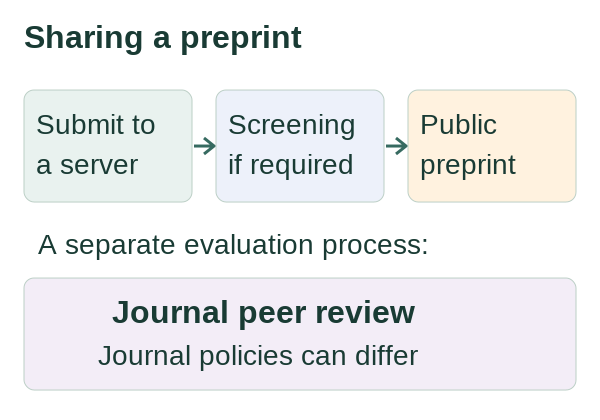
A preprint is posted under the control of its authors, while a journal article is peer reviewed and published under the control of the journal. Preprints themselves are not peer reviewed.[8] Preprints on these servers are often given DOIs, which let other researchers cite them.[9]
Preprints differ from postprints, which are author-formatted versions of a work that have already passed peer review.[10] One review of OSF Preprints warned that branding everything as preprints may confuse users, who will find preprints, postprints and working papers side by side.[11]
Authors are advised to post work only when it is complete and carefully proofread. The cover page should carry a draft date and a note on the paper's status. A license such as CC BY, which permits public use as long as the authors are credited, is recommended for the posted file. After major revisions, authors should update the preprint so the public version stays current.[10]
Posting can come before peer review, during it, or after it, depending on what the authors want to achieve. Common aims include gathering feedback, speeding up dissemination, and achieving open access.[10]
History
Paper circulation before the internet
In 1961, the National Institutes of Health (NIH) began circulating biological preprints through a program called the Information Exchange Groups (IEGs). The system eventually attracted over 3,600 participants and produced over 2,500 different documents. By 1967, it was effectively shut down after journals refused to accept articles that had been circulated as preprints.[12]
In 1991, Paul Ginsparg launched an electronic system at Los Alamos National Laboratory that let interested parties access physics papers not yet peer reviewed. That system grew into arXiv, a preprint server that for many years has been central to how physics, mathematics and related fields share information.[13] The number of physics and astronomy preprints available electronically increased dramatically over the five years before 1998.[14]
In 1996, the American Physical Society (APS), a leading publisher of physics journals in print, went online with an electronic preprint server. That server was still a prototype, and its first goal was to test electronic publication and to offer a point of submission to APS journals. It could eventually compete with the Los Alamos archives, which provided fast, virtually free electronic distribution of unreviewed papers.[15] In 1996, some observers argued that preprint servers, first designed as an informal way to distribute preprints, already carried many features of traditional scholarly publishing.[16]
Main ideas
Quality control without formal peer review
A preprint server does not run the full peer review that journals use. He, Tian and Fu describe preprints as lacking a sufficient quality control mechanism such as peer review. Mathew and Razack describe the review a preprint receives from its readers as informal.[17][18] One visible form of screening is the list of manuscript types a server will accept, which differs from server to server. In a March 2023 examination of 36 preprint servers, 27 of the 36 (75%) accepted opinion papers, two had unclear, unstated or unknown policies, and seven, including some of the most popular servers (bioRxiv, medRxiv and Research Square), did not explicitly accommodate opinion papers. The same examination argued that servers excluding opinion papers should widen the range of manuscript types they accept, to attract more participating scientists and to accommodate a wider range of views.[19]
A 2022 proposal described preprints as passing through an informal peer review by readership and suggested combining the preprint and journal systems, with an optional professional pre-submission review, to ease the load on conventional journal peer review. The same proposal held that openly advertising the downsides of preprints is essential.[18]
Wang and Zhan report that opinion at the time favored a Community Peer Review model for arXiv, after a 2016 arXiv survey in which 58% of users said arXiv should have a peer review system. An arXiv survey of users around the world in 2016 reported that 58% of them wanted a peer review system on the server. A 2019 paper identified two weak points in Community Peer Review and proposed instead a Self-Organizing Peer Review model, in which automated methods match reviewers to articles and rank both users and articles. Wang and Zhan also set out a plan for making work posted in preprint databases more visible and credited among academics. In their account, that recognition would let a second generation of preprint databases publish faster and at lower cost.[20]
Incentive schemes have been proposed to supply reviewers with reasons to take part. A 2021 framework drew on two ideas to design rewards and penalties for reviewers in a self-organizing preprint review system. One was a token economy, a system in which participants earn and spend tokens for their contributions. The other was blockchain technology, a shared and tamper-resistant record of transactions. The framework was studied through Steemit and was designed to run on both permissioned and permissionless blockchains, but it had not been implemented, so its practical effectiveness and acceptance by academia were yet to be evaluated. He, Tian and Fu noted that peer review is voluntary and not profit oriented, so monetary rewards and penalties borrowed from Steemit may conflict with academic ethics. They added that the Ethereum blockchain suffers from a scalability problem, which brings lower performance and longer response times.[17]
Peer Community In (PCI) is a group of active researchers who review publicly accessible preprints and act as editors in recommending them. A recommended preprint can then go to a journal together with the review reports, a sequence Karnani calls a preprint-review-curate model. The system is operated from the core funding of the PCI organization, which keeps the cost of use free for authors and readers, and it currently includes 19 subject specific platforms and has the support of over 200 institutions and universities. Karnani reports that usage statistics for PCI show growing uptake across several fields in the sciences and humanities.[21]
How researchers judge preprint credibility
A preprint server does not supply the signals that journal reputation, selection and peer review provide, and researchers often use those signals as a guide to what is worth reading. To find out which signals researchers would accept in their place, one team surveyed 3759 researchers across a wide range of disciplines. Respondents rated signals about open science content and about independent verification of an author's claims as highly important for judging the credibility of an individual preprint and of a preprint service. Peer views and information about the author were rated as less important.[22]
A scoping review of health and social care settings searched literature from 2017 to 2022 and assessed 379 titles and abstracts and 193 full texts, of which 98 articles met the eligibility criteria. Barriers and challenges were grouped into 26 statements under four main themes, among them quality assurance and trustworthiness, risks related to credibility, and validation. Benefits and value were grouped into 34 statements under six themes, among them openness and transparency, increased visibility and credibility, and open review. The review concluded that preprints allow rapid dissemination but that journals, publishers and funders need clear policies and guidance, with cautionary measures to keep the quality and value of preprints, especially in how findings reach the public.[23]
Journalists treat an unreviewed study as a calculation in which the public benefits and the ease of access that preprints offer are weighed against the risk of spreading misinformation. Fleerackers and colleagues interviewed 19 health and science journalists during the second year of the COVID-19 pandemic. The journalists described reading unreviewed studies with extra skepticism and using a range of strategies to find, check and report on them. Some of those strategies are standard science journalism, while labeling a study as a preprint marks a departure from the norm. Many journalists also said they lacked the expertise or the time to fully understand or check the research, a barrier to covering preprints. The interviews suggest that coverage of preprints is likely to continue after the pandemic.[24]
Research
Who posts preprints and why
Surveys of researchers point to two benefits that matter most: free access to the work and faster sharing of results.[25] Interviews with 38 stakeholders from biology, chemistry and psychology, carried out between October 2018 and January 2019, cited early and fast dissemination as the most appealing feature of preprints. Those interviewees also said preprints give broader access to scientific literature and more chances for informal commenting.[26] A set of 32 interviews with scholars in several fields reported the same two benefits, rapid sharing and open access.[27] A group of early career researchers in the life sciences, writing in 2019, listed rapid dissemination, open access, establishing priority, receiving feedback and finding collaborators as reasons to post.[2]
Respondents in the life and health sciences stressed concerns about posting in particular.[25] Respondents in the United States were very concerned about premature media coverage, reliability and credibility, and public sharing before peer review.[28] The 38 interviewees raised the lack of quality assurance and the Ingelfinger rule, a journal policy that can treat prior disclosure as a reason to reject a paper.[26] The 32 interviewed scholars likewise raised the absence of peer review for studies posted on preprint servers.[27]
Adoption is uneven across countries and fields. The United States and Europe led the way in adoption, and respondents there reported greater familiarity with preprinting than colleagues elsewhere. Adoption is much stronger in physics and astronomy, and in mathematics and computer science, than in other research areas.[25] A Korean survey of 365 editors and researchers ran from December 30, 2019 to January 10, 2020. Of the respondents, 56 had deposited a manuscript on a preprint server and 49 said their journals allowed preprints. Engineering respondents there had more experience with the concept of preprints than medical respondents, and half of the editors saw no need for them.[29]
In the life sciences, peer-reviewed journal papers serve as the main permanent record of work and as the working currency of career progress. The path from submission to publication can be long, with cycles of rejection, revision and resubmission that repeat peer review. Early career researchers depend heavily on timely publication to gain recognition, and a 2019 perspective from an interdisciplinary group of them argued that preprints can help. That group also noted that only a minority of articles in the life sciences and medicine are preprinted.[2]
Researchers see journal workflows and recognition as the levers that would spread preprinting. The global survey found that the most important strategies, in respondents' view, are integrating preprinting into journal submission workflows and giving recognition for posted preprints.[25] A survey of life scientists who posted COVID-19 preprints found most were willing to keep posting, yet counts of preprints on life science servers stagnated or declined. That study concluded that disciplinary norms shape whether preprint posting lasts more than external shocks such as a pandemic.[30]
Speed and attention from posting early
A study of 74,239 articles in 39 journals found that articles with a bioRxiv preprint had, on average, 36% more citations than articles without one.[3] An earlier study of bioRxiv preprints posted between November 2013 and December 2017 matched preprints to their published articles and compared them with articles in the same journals. It found a sizeable citation and altmetric advantage for the deposited articles, and regression analysis showed that other article and author variables did not explain it. That study also found that bioRxiv preprints were cited directly in journal articles whether or not they were later published.[31]
Solar physics papers posted on the Montana State University archive had citation rates 1.7 times higher than similar papers not posted as preprints. Papers posted to the astro-ph section of arXiv got 2.6 times the average. A comparable boost appeared for conference proceedings, which suggests that the higher rates are not simply the result of stronger papers being chosen for posting.[32]
A separate study of papers in the Astrophysical Journal found that posted papers were cited more than twice as often as unposted ones. By 2002, 72% of that journal's papers were posted as astro-ph preprints, though the share ranged from 22% to 95% across subfields. Most of those preprints, 61%, went up only after the paper was accepted by the journal, and 88% were posted or updated after acceptance. That study found that publication in a recognized peer-reviewed journal remained the main determinant of a paper's impact.[33]
Of 39,243 preprints posted from January 2020 to December 2021, 7,712 (20%) later appeared in a journal, with a median gap of 178 days. On bioRxiv and medRxiv, 7,358 of 20,698 preprints (36%) were published, including about half of those labeled biochemistry, biophysics and genomics.[34] A review of 152 randomized clinical trial preprints, trials that assign participants to treatments by chance, found that 119 (78.3%) were published by October 1, 2022. Their median time to publication was 186 days, with a range of 17 to 407 days. Larger trials and trials at low risk of bias were more likely to reach a journal.[35] Risk of bias is the likelihood that a systematic error distorts the estimate of an effect in a comparison of treatments.[36]
In about 240,000 articles from 7 PLOS journals up to January 2021, researchers found 8,460 places where an article cited a preprint. These citations appeared most often in the methods section, which describes how a study was done. arXiv and bioRxiv were the most frequent sources, and bioRxiv supplied more than 70% of preprint citations in three of the biology journals. The wording around preprint citations differed measurably from the wording around citations of peer-reviewed papers.[37] bioRxiv preprints were shared widely on Twitter and in blogs but stayed relatively scarce in mainstream media and Wikipedia compared with peer-reviewed articles.[31]
Preprints during the COVID-19 pandemic
The COVID-19 pandemic produced a surge of scientific manuscripts shared before peer review, the checking of a paper by outside experts before it appears in a journal. Most of these manuscripts were posted as preprints, papers placed openly online before that checking.[38] Within 10 months of the first confirmed case, scientists had released over 125,000 COVID-19-related articles, and more than 30,000 of them were hosted by preprint servers.[39]
How much preprints change before publication
A 2021 study tracked 67 COVID-19 studies on treatment or prevention, each posted as a preprint and later published in a journal. Only 23 of the 67 studies (34%) had no discrepancies in results reporting between the two versions. Fifteen studies (22%) had at least one outcome in the journal article that was missing from the preprint. Eight studies (12%) reported at least one outcome in the preprint only. Where outcomes appeared in both versions, the numbers, statistical significance, extra tests and follow-up times often differed.[40]
Spin means reporting practices that distort how results are interpreted, so that the results look more favorable. At least one instance of spin appeared in both versions of 23 of the 67 studies (34%). Spin appeared in the preprint only in 5 studies (7%) and in the journal article only in 2 studies (3%). Spin was removed between the two versions in 5 studies (7%) and added in 1 study (1%).[40]
A second comparison looked at preprints from bioRxiv and medRxiv that were posted and then published in a journal through April 30, 2020. The count of figure panels and tables barely moved between the preprint and the published article. The conclusions of 7.2% of non-COVID-19-related abstracts and 17.2% of COVID-19-related abstracts changed in a discrete way by publication. Most of those changes did not qualitatively alter the conclusions of the paper.[4]
A 2020 meta-research study, which studies how research itself is done, screened a database of COVID-19 studies published up to 15 August 2020. Of 556 studies, 338 (61%) had been reported in a preprint, and 66 of those (20%) had an associated journal article. The median time from preprint to journal publication was 76 days, with an interquartile range of 55 to 106 days. A total of 139 studies (25% of the overall sample) appeared in more than one source or version. For 63 of these (45%), at least one evidence component changed between or within sources. Study results changed in 42 studies (30%), and 29 studies (21%) had a change classified as important. The abstract conclusion changed in 33 studies (24%). An important change meant an effect estimate moved by 10% or more, or a p value crossed the 0.05 threshold.[41] A p-value is the probability of observing a difference between groups, or an association between two variables, as large as or larger than the one found if only chance were at work.[42]
A 2022 study measured how much epidemiological estimates, the numbers describing disease spread and risk, moved during review. It followed over 1000 estimates first reported in 100 matched preprints studying COVID-19. Of these estimates, 89% persisted through peer review, and the correlation between preprint and published values was 0.99. There was no systematic trend toward estimates rising or falling during review.[5]
Some preprints disappear rather than change. A 2021 paper described COVID-19 preprints that were withdrawn or retracted without clear reasons, leaving only a partial record online, while others vanished entirely. Retracted journal papers usually carry a "RETRACTED" mark on each page, but most preprint servers have no strict, detailed ethical guidelines for preprints. The paper argued that preprint authors accused of misconduct should face the same process and penalties as authors of peer-reviewed literature.[43] A 2022 commentary reported that about 5.7% of preprints in a global sample of 5,061 uploaded to three archives were later converted into journal articles.[44]
Do preprints and journals agree on results
Several studies have checked whether a preprint and the journal article that follows it tell the same story about a treatment's effect.[45][46][47] The median number of randomized controlled trials per meta-analysis was 2, and the median trial sample size was 199 participants. Summary effects did not differ significantly between preprint and peer-reviewed trials: the ratio of odds ratios was 0.88, with a 95% confidence interval of 0.71 to 1.09.[46] An odds ratio is a statistical measure equal to the odds of an outcome in one comparison group divided by the odds of that outcome in another.[48] A ratio of odds ratios below 1 would mean larger effects in preprint trials.[46]
A second study compared each trial with itself, matching 109 COVID-19 randomized trials first posted as preprints with their later journal articles. The median delay between preprint and article was 121 days, and the median sample size was 150 participants. Effect estimates were consistent for all reported outcomes in 81 preprint-article pairs. Nine trials had at least one outcome with a discrepancy in event counts or in the number of participants analyzed, which produced only a minor change in the estimated effect. Six trials had at least one outcome missing from the journal article, and 14 had at least one outcome added. The direction of effect changed in one trial, and no trial changed its statistical significance or its conclusions.[47]
A 2022 retrospective review asked whether COVID-19 trial preprints reported key methods and results completely and consistently with their published reports. Of 356 trials, 101 were available only as preprints, 181 only as journal publications, and 74 as preprints later published in journals. The median time from preprint to publication was about six months, and key methods and results showed few important differences between versions. The review also built 120 meta-analyses, 60 with preprints and 60 without.[45] A meta-analysis is a statistical method that combines the estimates from two or more similar studies into one overall estimate of an effect.[49] The rating of the certainty of evidence differed in nine of 60 comparisons, being higher with preprints in four and lower in five.[45]
Completeness of reporting has been measured directly, and here the gap is small. A 2020 observational study scored articles from bioRxiv and from journals indexed in PubMed in 2016 with a questionnaire on how fully they reported their methods and results. Peer-reviewed articles scored higher on average, by 5.0% of reported items in independent samples and by 4.7% in paired comparisons of preprints with their own published versions. Bigger gaps favoured peer-reviewed articles when raters judged how clearly titles and abstracts presented the main findings. Changes in reporting from preprint to published version did not correlate with the journal's impact factor or with the time lag to publication.[50]
A 2023 study found no important difference in summary effects, yet it advised reviewers to judge preprint inclusion case by case, weighing risk of bias and completeness of reporting.[46] The 2022 review concluded that including preprints could still affect meta-analytic results and the certainty of evidence.[45] A 2021 commentary argued that preprints receive only superficial screening before posting and that stronger ethical policies are needed to screen them.[51] A 2022 forecasting study of 400 high-profile COVID-19 preprints found that 70% were published within 1 year, but it remained untested whether forecasts can spot methodological problems.[52]
Preprints in the news and public understanding
Preprints became a common source for news stories during the COVID-19 pandemic, and researchers have since measured how outlets used them.[53][54] A study of 11,538 preprints from four servers found that media coverage of preprints rose slowly before the pandemic, then spiked sharply. That rise applied only to COVID-19 preprints, and coverage of preprints on other topics changed little.[54]
Whether journalists told readers that a study was unreviewed varied widely between outlets and stories. Outlets in that sample were much less likely to describe a study as preprint research than to describe it simply as research.[53] A study of 76 stories in three newspapers from January to July 2020 found no detailed explanation of what a preprint platform is or how publishing research works. Those newspapers also gave little space to what it means for a study to lack peer review, the checking of a paper by other scientists before publication.[55]
A study of 80 news articles from four South African online outlets found that guidelines for reporting on preprints existed, yet careful use of preprint findings still had far to go.[56] Another analysis found that digital native news media reported preprints better than legacy media, though overall coverage was unsatisfactory. Preprints played an unprecedented part in carrying COVID-19 results to the public, according to that analysis of medRxiv and bioRxiv.[57]
Brief explanations appear to help nonscientists judge preprint findings more carefully. Across five studies in Germany and the United States, people without an explanation rated findings in preprints as equally credible as findings in peer-reviewed articles. An explanation of the peer review process lowered the credibility that nonscientists gave to preprints. A shortened version of that explanation, tested in the fifth study, again let nonscientists tell preprints apart from peer-reviewed articles. The researchers recommend adding the short explanation to preprints themselves.[58]
Discussion of preprints online did not bring experts and the public into one conversation. In an analysis of COVID-19 preprints from bioRxiv and medRxiv, peers made up nearly half of the discussion, but their presence on Twitter was markedly smaller. The themes that biomedical experts discussed and the themes that nonexperts discussed differed considerably. Preprints acted as boundary objects, a term for shared items that different groups use in different ways, and they reinforced the line between scientific and nonscientific talk rather than blurring it.[59]
In practice
Journals, policies and peer review
Most journals now accept submissions that have already been posted as preprints, according to a 2022 review of how preprints and journals interact. That review sorted journal behaviour into six levels of acceptance, from an uneasy relationship up to merger and overlay models. Editors should expect that double-blind review, where reviewers do not know who wrote the paper, is not possible once a paper is posted openly.[60]
A 2020 article for one medical journal listed the questions such a policy must settle. Does a preprint count as prior publication? How should comments left on the preprint be handled? How should changes made on the server after posting be processed?[61]
Authors do not always follow those policies. One biomedical journal checked submissions over 2.5 years and found that about 24% of authors were non-compliant with its preprint policy. Only three of 76 journal articles posted as preprints had received publicly available comments on the preprint. Most preprints and their journal articles were submitted less than 10 days apart, so online comments were unlikely to have changed the submitted text. Plagiarism detection software scored the preprints and articles 83% similar at the median, which the study read as further evidence that posting changes little. Most authors also chose different licence types for the preprint and the journal article, creating a conflict about reuse of nearly the same work.[62]
Separate services now review preprints themselves, before or alongside journal review. A descriptive study of these preprint review services found they could make peer review more transparent and more rewarding, and improve publishing and review workflows. The study described a mixed system in which preprint servers, review services and journals mostly work in complementary ways. Over the longer term, the study said, review services may disrupt scholarly communication more radically.[63] A 2024 call to action by a group of stakeholders argued that preprint review can be more thorough, more inclusive and more collegial than traditional journal peer review.[64]
Funders could push preprints further by requiring them. A 2019 proposal called Plan U suggested that if all funding agencies required grantees to post preprints, free access to the world's scientific output would be achieved with minimal effort. The proposal argued that universal preprinting would also create fertile ground for experiments in peer review and research evaluation, because hosting and archiving costs would already be covered.[65] Not everyone agrees on how far such changes should go. A 2016 commentary backed the goal of immediate publication followed by transparent review but called for research on why biomedical scientists had been slow to post preprints.[66]
Interviews with preprint server managers found no consensus on how servers and journals should interact. Managers also disagreed about who should perform certification, the checking that a paper is sound, and curation, the selection and upkeep of content. Worries about credibility and long-term financial sustainability are pushing independent and community-run servers to align more closely with journals. That shift may weaken the disruptive and emancipatory potential of preprints, the study warned.[67] The 2022 review expected that as preprints become mainstream they will likely benefit authors but disadvantage publishers and journals. It advised authors to post their own work but to be cautious about building their research on preprints.[60]
Finding and citing preprints in practice
Aggregators combine records from several preprint servers in one place. Europe PMC is one such aggregator, and McGill added a preprint search of it to a long COVID scoping review.[68][69] Clarivate's Preprint Citation Index, on the Web of Science platform, indexes preprints from five repositories: arXiv, bioRxiv, ChemRxiv, medRxiv and Preprints.org.[68] Europe PubMed Central works as an aggregator, a service that combines records from multiple preprint servers, and it often supports Boolean search, in which terms are combined with operators such as AND and OR. Aggregators of this kind can have limited search functions or few options for exporting results.[69] The semantic search engine preVIEW integrates preprints from seven preprint servers and uses text mining, automated scanning of text for patterns, to tag topics such as diseases or SARS-CoV-2 specific proteins.[70]
Searching for preprints in a review takes planning, because terminology varies and the volume of records can be large. A scoping review of long COVID, a map of the available evidence rather than a pooled estimate, added a preprint search of Europe PubMed Central and limited that search to the title and abstract fields. The team also ran an extra Internet search for published versions of the preprints it had included. Europe PMC turned up additional preprints for inclusion because it covers more preprint servers.[69]
A commentary from a group that ran many rapid reviews of COVID-19 public health topics recommends that teams set a clear protocol for selecting and covering bibliographic databases. The same commentary advises review teams to flag each included study that is a preprint. It also advises prespecifying any sensitivity analysis, a check of whether the overall results and conclusions change when preprints are included. It further suggests that preprint authors cite the preprint version in a statement inside the final peer-reviewed manuscript.[71]
Automated tools are being built to help reviewers judge which preprints are likely to reach peer-reviewed publication. One framework, AutoConfidenceScore, extracts data with natural language processing, encodes titles and abstracts as semantic embeddings (numeric vectors that capture meaning), and adds evaluation scores from a large language model. Its random forest classifier, a model that combines many decision trees, reached an area under the receiver operating characteristic curve of 0.747 using all features. For binary outcome prediction, a survival cure model reached an area under the curve of 0.731. For time-to-publication risk, the same model reached a concordance index of 0.667. The developers present the framework as a way to support the appraisal stage of systematic reviews, not as a replacement for it.[72]
What this looks like in practice
Researchers who published papers in 2021 and early 2022 were surveyed about how they use preprints and what they think of them, with responses gathered from many countries. Respondents named free accessibility of preprints and faster research communication as the most important benefits of posting.[25]
In a survey of its users, 30% of bioRxiv authors said they post weeks to months ahead of journal submission. The same survey found that 55% post around the time of journal submission. Authors told the survey they were motivated by a desire to share work early and valued the feedback they received. They very rarely experienced any negative consequences of preprint posting.[1]
Higgins and Steiner examined submissions to a single biomedical journal across 2.5 years and found that roughly 24% of authors broke its preprint policy. Of the 76 articles that had been posted as preprints, just three drew public comments on the preprint itself. Preprints and journal submissions usually appeared less than 10 days apart, so even comments posted online would have had little chance to alter the submitted manuscript. The iThenticate plagiarism detection software gave preprints and their articles a median similarity score of 83%, which the authors treat as further evidence that posting a preprint leaves manuscript content largely unchanged.[62]
A survey of 3759 researchers across many disciplines asked how important different cues were for judging the credibility of individual preprints and preprint services. Cues based on what peers think and on author details drew lower ratings. As of early 2020, very few preprint services displayed any of the most important cues.[22]
A guide for psychological scientists recommends that you post preprints that are complete and carefully proof-read. Moshontz and colleagues advise choosing a dedicated preprint server that issues DOIs, lets authors edit metadata, is indexed by Google Scholar, allows review and endorsements, and keeps versions under control.[10]
Later developments
How preprint servers spread across fields
The Center for Open Science (COS) hosts several of these services. A 2019 survey of nine of the largest English-language COS services found that all of them were growing. Their submission rates stayed below those of more mature services such as bioRxiv. The survey also found that all nine services accept postprints, which are non-typeset versions of manuscripts already peer reviewed. Many of the publication venues for papers hosted by these services were not listed in the Directory of Open Access Journals. The services therefore serve as open homes for peer-reviewed papers that would otherwise sit behind a paywall.[73]
Biology gained its own large server in 2013, when bioRxiv launched as a nonprofit community service. The server now hosts papers from all areas of biology. Evolutionary biology, genetics and computational biology dominated its early years. Papers in neuroscience and in cell and developmental biology have since become more common.[1] A sister server, medRxiv, opened in 2019 as a free online repository for preprints in medicine, clinical research and related health sciences.[74] Adoption of bioRxiv was also pushed along by policy changes at journals and funders that favour posting preprints.[1]
Chemistry was slower to adopt preprints, but by 2020 more researchers in chemical and materials sciences were posting manuscripts online before peer review. Supporters argued that preprints can speed up the spread of results and lead to more informal exchanges between researchers.[75] In medicine, preprint use rose sharply in a short period: a 2022 review described preprinting as having grown rapidly across science and medicine within five years. That review counted 473 lipidology preprints on bioRxiv and 231 on medRxiv as of 31 May 2021. All 20 lipidology journals contacted by the review's authors said they accepted preprints.[76]
A 2017 commentary noted that preprint use was still limited in the biological sciences. Early signs suggested preprints could complement and enhance peer-reviewed publications. Posting a preprint can also help recruit a more diverse pool of reviewers before a paper goes to a journal.[77]
Regional servers and unequal access
Some preprint servers serve one region rather than the whole world, and their reach is uneven. A 2024 comparison of six preprint servers found that regional servers are used, but at a modest level next to global and field-specific servers. Preprints on the regional servers drew less academic and public attention than preprints on the other servers. The two regional servers studied covered Africa and Latin America, and the Latin American server, SciELO preprint, showed signs of faster growth and visibility than AfricArxiv. The comparison is limited because the regional servers had existed for a short time, and because reliable counts of researchers by region are missing.[78]
A 2008 study examined three integrated servers in mainland China: the Qiji e-print archive, the Chinese Preprint Server and Chinese Science Papers Online. Submission numbers tracked official promotion and policy closely. Posting concentrated on physics, mathematics and computer science, which matches preprint habits worldwide. At that time the domestic servers attracted little attention from leading scholars and had little impact on scientific communication.[79]
In Southeast Asia, preprint culture is described as young but growing. A 2022 paper points to the RINarxiv server in Indonesia and the Malaysia Open Science Platform as forces behind this growth. Institutional research policies in the region still lean on world university rankings that count publication output, and these policies do not yet include preprints. The paper recommends policy and practical steps to bring preprints into science policy and everyday research practice.[80]
An author's country of origin appears to shape how much attention a preprint receives. A 2024 study of COVID-19 preprints posted in the early months of the pandemic controlled for article quality, topic and the standing of the journal that later published the work. After those controls, preprints from Chinese institutions drew less attention than preprints from the rest of the world, and preprints from U.S. institutions drew more. The effect grew when readers lacked knowledge or expertise and faced time pressure, conditions under which readers seemed to use country of origin as a stand-in for quality. The study concludes that geographic bias may persist or even grow on platforms built to give open access to early findings.[81]
Adoption of one large life sciences server also differs by country. An analysis of 67,885 preprints on bioRxiv found the United States and the United Kingdom overrepresented relative to their overall scientific output. China, Russia and Turkey showed lower levels of adoption. Researchers from some countries, including Uganda, Croatia and Thailand, appeared almost only as non-senior authors on international collaborations. Several journals also published a disproportionate number of preprints from certain countries, a pattern that almost always favored manuscripts from the United States.[82]
Country also tracks whether a preprint later becomes a peer-reviewed paper. A 2023 tool matched preprints from bioRxiv and medRxiv to papers in PubMed. It found that preprints from low income countries reached peer-reviewed publication at a rate of 39.6%, against 61.1% for high income countries. The low income group's preprints were published sooner, at 178 days against 203 days. Those published versions also differed more from the preprint in title, abstract and author list. They gained more new authors, 0.42 against 0.32, a practice significantly more frequent in China than in similar countries. The researchers connect the gap to a lack of resources, a lack of stability and policy choices.[6]
A 2026 analysis covered COVID-19 preprints and peer-reviewed papers from December 2019 to November 2022. It found that countries with lower GDP had significantly higher ratios of preprints to published papers, with a correlation coefficient of −0.38. Peer-reviewed papers with a preprint history drew a median of 10 citations, against 5 for papers without one, and the gap was largest in low and middle income countries.[83]
Costs, fees and the publishing economy
Aquino-Jarquin and colleagues note that arXiv accepts preprint submissions free of charge and lets readers search and download its papers at no cost. Repositories such as arXiv accept preprints at no cost to the author and let any reader search for and download the papers they hold without charge.[91] A 2012 commentary in Nature by Kapovich argued that free access to preprints on arXiv is better than the "author pays" route to open access. In that route, a fee charged on the author's side is meant to remove the paywall for readers. The same commentary noted that posting on a server such as arXiv lets the scientific community scrutinize results promptly, because the work is freely accessible from the moment it appears.[92]
Open access, the movement to make research free to read, has a long history, and the Budapest Open Access Initiative was first announced in 2002. The European Union adopted Plan S in 2018, calling for open access to become a reality by 2020, and Plan S stresses the self-archiving of articles and the role of preprint archives in placing scientific results. Commercial journals with limited reader access have not given up their positions, but journals have become less rigid in their policies toward preprints and post-prints. One proposed arrangement, the overlay journal, reviews an article held on a public preprint server and, if the article is accepted, publishes its metadata on the journal site and re-archives the corrected full text. The cost of an issue of such a journal is described as so low that it can operate on a "free for the author, free for the reader" scheme, which reduces the financial burden on the journal.[93]
Pattinson reports that funders have given more support to early sharing of biomedical research through preprints. Some actively encourage the practice, and others require it. Despite these motivations, few authors routinely deposit their work as a preprint before submitting it to a journal. Some journals began letting authors post work early at the point of submission. PLOS offered a link to bioRxiv, the Cell journals offered posting through SSRN, and Nature Communications offered posting to any preprint plus a link from the journal page. Uptake ranged from 3% for the Nature pilot to 18% for PLOS. One service let authors submitting to BMC Series titles post on Research Square, with control over the review timeline and the chance to share the preprint with colleagues. Among the journals offering it, the average opt-in rate was 40%. Pattinson reports over 3,000 manuscripts posted as of July 2019, since the service launched in October 2018.[94]
Sharing data in an online repository was associated with a smaller positive advantage of 4.3% (±.8) on average, while sharing code showed no significant citation advantage. Colavizza and colleagues used a broad set of control variables to separate the effect of open practices on received citations. They called for further research on measures of impact beyond citations.[95]
Preprint servers are not described as a highly disruptive technology, but they do challenge scientists and librarians to understand them better and to use the information found on them with care. That challenge includes educating the public about peer review and about the importance of well-vetted, good quality science in making important decisions. References to non-peer-reviewed articles from preprint servers have become more common in popular media reports, so most librarians now need to know something about the technology.[96]
Criticism
Criticism, limits and open questions
The main worry about preprints is that readers may act on findings that have not been checked by peer review, the expert reading that journals arrange before publication.[97][98] A 2020 commentary in JAMA asked whether posting medical reports before review improves patient outcomes without causing harm, and called the answer uncertain.[99] A 2023 analysis of 1471 orthopaedic preprints found that these articles reached a substantial audience through brief online interactions, far from the engagement peer review provides. That analysis argued preprints have never been shown to help patients and should not be treated as evidence by clinicians.[100] One case was a preprint on ABO blood groups and COVID-19 severity that drew wide public interest before its drawbacks were addressed.[101]
Preprint servers were meant to collect comments that authors could use to improve papers before journal submission.[102] A 2023 study of dermatology preprints found a low rate of on-site comments, suggesting the servers may not be effective for getting feedback.[98] An analysis of five years of bioRxiv postings found that about 30% of preprints remained unpublished. Most bioRxiv preprints were posted close to or after journal submission, leaving no time for comments to improve them. That analysis concluded authors may use the platform to claim priority, to market papers, or to post them openly, rather than to seek community review.[102]
Some preprints contain "tortured phrases," which are vague jargon or confusing alternative wordings that replace standard terms. A 2023 commentary found such phrases in 213 preprints, 13 of them about COVID-19. The commentary noted that a cluster of these phrases in one preprint might point to a paper mill, an operation that sells authorship, or to unprofessional editing. It also warned against assuming that every such phrase signals misconduct.[103]
Preprint servers also fall short on web accessibility, the design of pages so that people with disabilities can use them. A 2022 test of 47 server homepages with an automated tool found link-purpose errors on 49% and non-text-content errors on 47%. Contrast errors appeared on 45% of the sites, and alerts about headings and labels on 66%. The authors noted that automated tools can miss problems and that manual checks are needed.[104]
Citations of preprints can also mislead when the preprint has since been published in a journal.[105][106] A 2021 study found that leading preprint servers identified only 39.7% of the links between preprints and their published versions.[105] A 2022 study of 205 COVID-19 research articles in four major medical journals found that 60 cited at least one medRxiv preprint. Of the 182 preprints cited, 124 had been published in a peer-reviewed journal, 51 of them before the citing article appeared online. The title, data or conclusions differed between the preprint and the published version for nearly half of them.[106]
A 2022 article on the growing acceptance of preprints, which it called their normalization, recommended changes in academic cultural norms.[107] A 2024 paper reported that 14 of the 29 servers listed by one philanthropic host in June 2024 had stopped hosting preprints, and it raised questions about financial sustainability. The same paper noted that preprints are sometimes deleted silently and that screening is often superficial.[108]
Common misconceptions
A common worry among scientists is that going public before journal publication invites scooping. Paul Ginsparg, who created arXiv, says deliberate scooping hardly happens in physics, since physicists follow the arXiv and will not tolerate it. Preprints carry an uneditable timestamp showing when the article appeared, usually within 24 hours of submission, so anyone can determine the order of priority.[7]
Some researchers voice the concern that preprinting prevents publication in a journal. Most journals in the life sciences now take submissions of manuscripts that were posted as preprints. Other journals have kept policies that are unfriendly to preprints, or that are confusing or contradict themselves. Sarabipour and colleagues argue that clear publisher rules and funder mandates would leave early career researchers less uncertain.[2]
Key studies
| Year | Study | Sample | Design | Finding |
|---|---|---|---|---|
| 2019 | Sever et al.[1] | bioRxiv users | user survey | 30% of authors post preprints weeks to months before journal submission and 55% post around the time of submission. |
| 2020 | Soderberg et al.[22] | 3759 researchers across disciplines | interdisciplinary survey | Information about open science content and independent checks of author claims drew high importance ratings for judging credibility; peer views and author details drew lower ones. |
| 2020 | Carneiro et al.[50] | bioRxiv preprints and PubMed-indexed articles from 2016, plus paired comparisons | observational study with a reporting questionnaire | Peer-reviewed articles had higher quality of reporting than preprints, with absolute differences of 5.0% and 4.7% of reported items. |
| 2020 | the COVID-19 NMA Consortium et al.[41] | Meta-research study of 556 COVID-19 studies, 338 reported in a preprint | Among 139 studies reported in multiple sources or versions, 63 (45%) changed at least one evidence component. | |
| 2021 | Higgins & Steiner[62] | submissions to one biomedical journal over 2.5 years | review of submissions to one biomedical journal over 2.5 years | About 24% of authors did not comply with the journal's preprint policy, and only three of 76 preprints drew public comments. |
| 2021 | Bero et al.[40] | Cross-sectional comparison of 67 COVID-19 preprints and their journal publications | 23 of 67 studies (34%) had no discrepancies in results reporting between preprint and journal versions. | |
| 2022 | Brierley et al.[4] | bioRxiv and medRxiv preprints published in a journal through April 30, 2020 | automated and manual annotation study | By the time of journal publication, the conclusions had shifted in a discrete way for 7.2% of non-COVID-19 abstracts and 17.2% of COVID-19 abstracts, and most of those shifts left the paper's conclusions qualitatively the same. |
| 2022 | Zeraatkar et al.[45] | 356 COVID-19 trials | retrospective review with meta-analyses | In 58 of 60 comparisons, meta-analyses with and without preprints agreed on whether a treatment showed benefit, no appreciable effect, or harm. |
| 2022 | Nelson et al.[5] | 100 matched preprint-journal-article pairs with 1921 data points | quantitative attrition analysis | 89% of point estimates persisted through peer review, with a correlation of 0.99 between preprint and published values. |
| 2022 | Fleerackers et al.[24] | 19 health and science journalists from seven news publications | qualitative interview study | Journalists weighed public benefits against risks of misinformation and viewed unreviewed studies with extra skepticism. |
| 2023 | Davidson et al.[46] | 37 meta-analyses including 114 trials, 44 preprints and 70 peer-reviewed publications | meta-epidemiological study | Summary effect estimates did not differ to a statistically significant degree between preprint and peer-reviewed trials (ratio of odds ratios 0.88; 95% CI 0.71 to 1.09). |
| 2023 | Eckmann & Bandrowski[6] | 139,651 bioRxiv and medRxiv preprints | tool-based matching study | 58% of all preprints were matched to publications, and low income country preprints were published at 39.6% versus 61.1% for high income countries. |
| 2024 | Ni & Waltman[25] | authors of research papers published in 2021 and early 2022 | global researcher survey | The United States and Europe led in preprint adoption, and free accessibility and faster communication were the most important benefits named. |
| 2024 | Davidson et al.[47] | 109 preprint-article randomized controlled trials | retrospective comparison | 81 pairs were consistent for all outcomes, and no changes in statistical significance or conclusions were found. |
See also
References
- Sever, R., Hindle, S., Roeder, T., Fereres, S., Fernández Gayol, O., Ghosh, S., Proietti Onori, M., Croushore, E., Black, K. J., Sussman, L., Argentine, J., Manos, W., Muñoz, M., Sinanan, J., Teal, T. K., & Inglis, J. R. (2019). bioRxiv: the preprint server for biology. openRxiv. doi:10.1101/833400
- Sarabipour, S., Debat, H. J., Emmott, E., Burgess, S. J., Schwessinger, B., & Hensel, Z. (2019). On the value of preprints: An early career researcher perspective. PLOS Biology, 17(2), e3000151. doi:10.1371/journal.pbio.3000151
- Fu, D. Y., & Hughey, J. J. (2019). Releasing a preprint is associated with more attention and citations for the peer-reviewed article. eLife, 8. doi:10.7554/elife.52646
- Brierley, L., Nanni, F., Polka, J. K., Dey, G., Pálfy, M., Fraser, N., & Coates, J. A. (2022). Tracking changes between preprint posting and journal publication during a pandemic. PLOS Biology, 20(2), e3001285. doi:10.1371/journal.pbio.3001285
- Nelson, L., Ye, H., Schwenn, A., Lee, S., Arabi, S., & Hutchins, B. I. (2022). Robustness of evidence reported in preprints during peer review. The Lancet Global Health, 10(11), e1684-e1687. doi:10.1016/s2214-109x(22)00368-0
- Eckmann, P., & Bandrowski, A. (2023). PreprintMatch: A tool for preprint to publication detection shows global inequities in scientific publication. PLOS ONE, 18(3), e0281659. doi:10.1371/journal.pone.0281659
- Bourne, P. E., Polka, J. K., Vale, R. D., & Kiley, R. (2017). Ten simple rules to consider regarding preprint submission. PLOS Computational Biology, 13(5), e1005473. doi:10.1371/journal.pcbi.1005473
- Gordon, S. F. (2022). Preprint and Preprint Server Update. Science Editor. doi:10.36591/se-d-4504-09
- Cox, J. (2019). Preprint Servers: CSE Editorial Policy Committee White Paper Update. Science Editor. doi:10.36591/se-4201-09
- Moshontz, H., Binion, G., Walton, H., Brown, B. T., & Syed, M. (2021). A Guide to Posting and Managing Preprints. Advances in Methods and Practices in Psychological Science, 4(2). doi:10.1177/25152459211019948
- Riegelman, A. (2018). OSF Preprints. The Charleston Advisor, 19(3), 35-38. doi:10.5260/chara.19.3.35
- Cobb, M. (2017). The prehistory of biology preprints: A forgotten experiment from the 1960s. PLOS Biology, 15(11), e2003995. doi:10.1371/journal.pbio.2003995
- Berg, J. (2017). Preprint ecosystems. Science, 357(6358), 1331-1331. doi:10.1126/science.aaq0167
- Youngen, G. K. (1998). Citation Patterns to Traditional and Electronic Preprints in the Published Literature. College & Research Libraries, 59(5), 448-456. doi:10.5860/crl.59.5.448
- Taubes, G. (1996). APS Starts Electronic Preprint Service. Science, 273(5273), 304-304. doi:10.1126/science.273.5273.304
- Lim, E. (1996). Preprint Servers: A New Model for Scholarly Publishing? Australian Academic & Research Libraries, 27(1), 21-30. doi:10.1080/00048623.1996.10754952
- He, Y., Tian, K., & Fu, J. (2021). An incentive mechanism-based framework to assure the quality of self-organizing peer review in preprint. Data Technologies and Applications, 55(5), 609-621. doi:10.1108/dta-08-2020-0181
- Mathew, S. T., & Razack, H. I. A. (2022). Making Conventional Peer Review More Efficient: Are Amalgamated Pre-Submission Peer Review and Preprint Models Helpful? Trends in Scholarly Publishing, 1(1), 17-24. doi:10.21124/2022.006
- Teixeira da Silva, J. A., & Nazarovets, S. (2023). Most Preprint Servers Allow the Publication of Opinion Papers. Open Information Science, 7(1). doi:10.1515/opis-2022-0144
- Wang, L., & Zhan, Y. (2019). A conceptual peer review model for arXiv and other preprint databases. Learned Publishing, 32(3), 213-219. doi:10.1002/leap.1229
- Karnani, M. (2025). Peer Community in Neuroscience: Making Publishing Inclusive and Efficient Through Free Preprint Peer-Review. Edinburgh Open Research, 4. doi:10.2218/eor.2025.10952
- Soderberg, C. K., Errington, T. M., & Nosek, B. A. (2020). Credibility of preprints: an interdisciplinary survey of researchers. Royal Society Open Science, 7(10), 201520. doi:10.1098/rsos.201520
- Blatch-Jones, A. J., Recio Saucedo, A., & Giddins, B. (2023). The use and acceptability of preprints in health and social care settings: A scoping review. PLOS ONE, 18(9), e0291627. doi:10.1371/journal.pone.0291627
- Fleerackers, A., Moorhead, L. L., Maggio, L. A., Fagan, K., & Alperin, J. P. (2022). Science in motion: A qualitative analysis of journalists’ use and perception of preprints. PLOS ONE, 17(11), e0277769. doi:10.1371/journal.pone.0277769
- Ni, R., & Waltman, L. (2024). To preprint or not to preprint: A global researcher survey. Journal of the Association for Information Science and Technology, 75(6), 749-766. doi:10.1002/asi.24880
- Chiarelli, A., Johnson, R., Pinfield, S., & Richens, E. (2019). Preprints and Scholarly Communication: An Exploratory Qualitative Study of Adoption, Practices, Drivers and Barriers. F1000Research, 8, 971. doi:10.12688/f1000research.19619.2
- Aviv-Reuven, S., Bronstein, J., & Rosenfeld, A. (2024). Exploring scholarly perceptions of preprint servers. Information Research an international electronic journal, 29(2), 173-178. doi:10.47989/ir292820
- Ni, R., & Waltman, L. (2023). To Preprint or Not to Preprint: Experience and Attitudes of Researchers Worldwide. 27th International Conference on Science, Technology and Innovation Indicators (STI 2023). doi:10.55835/6442f782b2b5580ba561406b
- Yi, H. J., & Huh, S. (2021). Korean editors’ and researchers’ experiences with preprints and attitudes towards preprint policies. Science Editing, 8(1), 4-9. doi:10.6087/kcse.223
- Biesenbender, K., Toepfer, R., & Peters, I. (2024). Life scientists’ experience with posting preprints during the COVID-19 pandemic. Scientometrics, 129(10), 6407-6434. doi:10.1007/s11192-024-04982-9
- Fraser, N., Momeni, F., Mayr, P., & Peters, I. (2020). The relationship between bioRxiv preprints, citations and altmetrics. Quantitative Science Studies, 1(2), 618-638. doi:10.1162/qss_a_00043
- Metcalfe, T. S. (2006). The Citation Impact of Digital Preprint Archives for Solar Physics Papers. Solar Physics, 239(1-2), 549-553. doi:10.1007/s11207-006-0262-7
- Schwarz, G. J., & Kennicutt, R. C. (2004). Demographic and Citation Trends in Astrophysical Journal papers and Preprints. arXiv. doi:10.48550/arxiv.astro-ph/0411275 Free full text
- Drzymalla, E., Yu, W., Khoury, M. J., & Gwinn, M. (2022). COVID-19-Related manuscripts: lag from preprint to publication. BMC Research Notes, 15(1). doi:10.1186/s13104-022-06231-9
- Bai, A. D., Jiang, Y., Nguyen, D. L., Lo, C. K. L., Stefanova, I., Guo, K., Wang, F., Zhang, C., Sayeau, K., Garg, A., & Loeb, M. (2023). Comparison of Preprint Postings of Randomized Clinical Trials on COVID-19 and Corresponding Published Journal Articles: A Systematic Review. JAMA Network Open, 6(1), e2253301. doi:10.1001/jamanetworkopen.2022.53301
- GET-IT Glossary (plain-language health research terms) (n.d.). risk of bias. GET-IT Glossary (plain-language health research terms). https://getitglossary.org/term/risk+of+bias
- Bertin, M., & Atanassova, I. (2022). Preprint citation practice in PLOS. Scientometrics, 127(12), 6895-6912. doi:10.1007/s11192-022-04388-5
- Vasconcelos, G. L., Cordeiro, L. P., Duarte-Filho, G. C., & Brum, A. A. (2021). Modeling the Epidemic Growth of Preprints on COVID-19 and SARS-CoV-2. Frontiers in Physics, 9. doi:10.3389/fphy.2021.603502
- Fraser, N., Brierley, L., Dey, G., Polka, J. K., Pálfy, M., Nanni, F., & Coates, J. A. (2021). The evolving role of preprints in the dissemination of COVID-19 research and their impact on the science communication landscape. PLOS Biology, 19(4), e3000959. doi:10.1371/journal.pbio.3000959
- Bero, L., Lawrence, R., Leslie, L., Chiu, K., McDonald, S., Page, M. J., Grundy, Q., Parker, L., Boughton, S., Kirkham, J. J., & Featherstone, R. (2021). Cross-sectional study of preprints and final journal publications from COVID-19 studies: discrepancies in results reporting and spin in interpretation. BMJ Open, 11(7), e051821. doi:10.1136/bmjopen-2021-051821
- the COVID-19 NMA Consortium, Oikonomidi, T., Boutron, I., Pierre, O., Cabanac, G., & Ravaud, P. (2020). Changes in evidence for studies assessing interventions for COVID-19 reported in preprints: meta-research study. BMC Medicine, 18(1). doi:10.1186/s12916-020-01880-8
- Principles of Epidemiology in Public Health Practice, glossary (n.d.). P value. Principles of Epidemiology in Public Health Practice, glossary. https://archive.cdc.gov/www_cdc_gov/csels/dsepd/ss1978/glossary.html#Pvalue
- Teixeira da Silva, J. A. (2021). Silently withdrawn or retracted preprints related to Covid-19 are a scholarly threat and a potential public health risk: theoretical arguments and suggested recommendations. Online Information Review, 45(4), 751-757. doi:10.1108/oir-08-2020-0371
- Lo Nostro, P. (2022). To Print or Not to Print?: Preprints and Publication: How the Covid-19 Pandemic Affected the Quality of Scientific Production. Substantia, 6(1), 5-6. doi:10.36253/substantia-1570
- Zeraatkar, D., Pitre, T., Leung, G., Cusano, E., Agarwal, A., Khalid, F., Escamilla, Z., Cooper, M. A., Ghadimi, M., Wang, Y., Verdugo-Paiva, F., Rada, G., Kum, E., Qasim, A., Bartoszko, J. J., Siemieniuk, R. A. C., Patel, C., Guyatt, G., & Brignardello-Petersen, R. (2022). Consistency of covid-19 trial preprints with published reports and impact for decision making: retrospective review. BMJ Medicine, 1(1), e000309. doi:10.1136/bmjmed-2022-000309
- Davidson, M., Evrenoglou, T., Graña, C., Chaimani, A., & Boutron, I. (2023). No evidence of important difference in summary treatment effects between COVID-19 preprints and peer-reviewed publications: a meta-epidemiological study. Journal of Clinical Epidemiology, 162, 90-97. doi:10.1016/j.jclinepi.2023.08.011
- Davidson, M., Evrenoglou, T., Graña, C., Chaimani, A., & Boutron, I. (2024). Comparison of effect estimates between preprints and peer-reviewed journal articles of COVID-19 trials. BMC Medical Research Methodology, 24(1). doi:10.1186/s12874-023-02136-8
- GET-IT Glossary (plain-language health research terms) (n.d.). odds ratio. GET-IT Glossary (plain-language health research terms). https://getitglossary.org/term/odds+ratio
- GET-IT Glossary (plain-language health research terms) (n.d.). meta-analysis. GET-IT Glossary (plain-language health research terms). https://getitglossary.org/term/meta-analysis
- Carneiro, C. F. D., Queiroz, V. G. S., Moulin, T. C., Carvalho, C. A. M., Haas, C. B., Rayêe, D., Henshall, D. E., De-Souza, E. A., Amorim, F. E., Boos, F. Z., Guercio, G. D., Costa, I. R., Hajdu, K. L., van Egmond, L., Modrák, M., Tan, P. B., Abdill, R. J., Burgess, S. J., Guerra, S. F. S., & ... Amaral, O. B. (2020). Comparing quality of reporting between preprints and peer-reviewed articles in the biomedical literature. Research Integrity and Peer Review, 5(1). doi:10.1186/s41073-020-00101-3
- Teixeira da Silva, J. A. (2021). Adjusting the use of preprints to accommodate the ‘quality’ factor in response to COVID-19. Journal of Taibah University Medical Sciences, 16(4), 477-481. doi:10.1016/j.jtumed.2021.04.003
- Gordon, M., Bishop, M., Chen, Y., Dreber, A., Goldfedder, B., Holzmeister, F., Johannesson, M., Liu, Y., Tran, L., Twardy, C., Wang, J., & Pfeiffer, T. (2022). Forecasting the publication and citation outcomes of COVID-19 preprints. Royal Society Open Science, 9(9). doi:10.1098/rsos.220440
- Fleerackers, A., Riedlinger, M., Moorhead, L., Ahmed, R., & Alperin, J. P. (2022). Communicating Scientific Uncertainty in an Age of COVID-19: An Investigation into the Use of Preprints by Digital Media Outlets. Health Communication, 37(6), 726-738. doi:10.1080/10410236.2020.1864892
- Fleerackers, A., Shores, K., Chtena, N., & Alperin, J. P. (2024). Unreviewed science in the news: The evolution of preprint media coverage from 2014–2021. Quantitative Science Studies, 5(2), 297-316. doi:10.1162/qss_a_00282
- Massarani, L., & Neves, L. F. F. (2022). Reporting COVID-19 preprints: fast science in newspapers in the United States, the United Kingdom and Brazil. Ciência & Saúde Coletiva, 27(3), 957-968. doi:10.1590/1413-81232022273.20512021
- van Schalkwyk, F., & Dudek, J. (2022). Reporting preprints in the media during the COVID-19 pandemic. Public Understanding of Science, 31(5), 608-616. doi:10.1177/09636625221077392
- Zeng, L. (2023). Changes in health communication in the age of COVID-19: A study on the dissemination of preprints to the public. Frontiers in Public Health, 11. doi:10.3389/fpubh.2023.1078115
- Wingen, T., Berkessel, J. B., & Dohle, S. (2022). Caution, Preprint! Brief Explanations Allow Nonscientists to Differentiate Between Preprints and Peer-Reviewed Journal Articles. Advances in Methods and Practices in Psychological Science, 5(1). doi:10.1177/25152459211070559
- Henke, J. (2024). Public engagement with COVID-19 preprints: Bridging the gap between scientists and society. Quantitative Science Studies, 5(2), 271-296. doi:10.1162/qss_a_00302
- Smart, P. (2022). The evolution, benefits, and challenges of preprints and their interaction with journals. Science Editing, 9(1), 79-84. doi:10.6087/kcse.269
- Chung, K. J. (2020). Preprints: What is their role in medical journals? Archives of Plastic Surgery, 47(02), 115-117. doi:10.5999/aps.2020.00262
- Higgins, J., & Steiner, R. D. (2021). Author preprint behaviour and non‐compliance with journal preprint policies: One biomedical journal's experience. Learned Publishing, 34(3), 389-395. doi:10.1002/leap.1376
- Henriques, S. O., Rzayeva, N., Pinfield, S., & Waltman, L. (2023). Preprint review services: Disrupting the scholarly communication landscape?. Center for Open Science. doi:10.31235/osf.io/8c6xm
- Avissar-Whiting, M., Belliard, F., Bertozzi, S. M., Brand, A., Brown, K., Clément-Stoneham, G., Dawson, S., Dey, G., Ecer, D., Edmunds, S. C., Farley, A., Fischer, T. D., Franko, M., Fraser, J. S., Funk, K., Ganier, C., Harrison, M., Hatch, A., Hazlett, H., & ... Williams, M. (2024). Recommendations for accelerating open preprint peer review to improve the culture of science. PLOS Biology, 22(2), e3002502. doi:10.1371/journal.pbio.3002502
- Sever, R., Eisen, M., & Inglis, J. (2019). Plan U: Universal access to scientific and medical research via funder preprint mandates. PLOS Biology, 17(6), e3000273. doi:10.1371/journal.pbio.3000273
- Chalmers, I., & Glasziou, P. (2016). Should there be greater use of preprint servers for publishing reports of biomedical science? F1000Research, 5, 272. doi:10.12688/f1000research.8229.1
- Chtena, N., Alperin, J. P., Pinfield, S., Fleerackers, A., & Pasquetto, I. V. (2025). Preprint servers and journals: rivals or allies? Journal of Documentation, 81(4), 847-869. doi:10.1108/jd-09-2024-0215
- Riegelman, A. (2023). Web of Science Preprint Citation Index. The Charleston Advisor, 25(1), 45-49. doi:10.5260/chara.25.1.12
- McGill, S. (2024). Preprint Pointers From a Long COVID Scoping Review: Considerations for Source Selection and Searching. Journal of the Canadian Health Libraries Association / Journal de l'Association des bibliothèques de la santé du Canada, 45(2). doi:10.29173/jchla29741
- Langnickel, L., Darms, J., Baum, R., & Fluck, J. (2021). preVIEW: from a fast prototype towards a sustainable semantic search system for central access to COVID-19 preprints. Journal of EAHIL, 17(3), 8-14. doi:10.32384/jeahil17484
- Clyne, B., Walsh, K. A., O'Murchu, E., Sharp, M. K., Comber, L., O’ Brien, K. K., Smith, S. M., Harrington, P., O'Neill, M., Teljeur, C., & Ryan, M. (2021). Using preprints in evidence synthesis: Commentary on experience during the COVID-19 pandemic. Journal of Clinical Epidemiology, 138, 203-210. doi:10.1016/j.jclinepi.2021.05.010
- Yang, R., Tong, J., Wang, H., Huang, H., Hu, Z., Li, P., Liu, N., Lindsell, C. J., Pencina, M. J., Chen, Y., & Hong, C. (2025). Enabling inclusive systematic reviews: incorporating preprint articles with large language model-driven evaluations. Journal of the American Medical Informatics Association, 32(11), 1718-1725. doi:10.1093/jamia/ocaf137
- Narock, T., & Goldstein, E. B. (2019). Quantifying the Growth of Preprint Services Hosted by the Center for Open Science. Publications, 7(2), 44. doi:10.3390/publications7020044
- Vlasschaert, C., Giles, C., Hiremath, S., & Lanktree, M. B. (2021). Preprint Servers in Kidney Disease Research: A Rapid Review. Clinical Journal of the American Society of Nephrology, 16(3), 479-486. doi:10.2215/cjn.03800320
- Coudert, F. X. (2020). The rise of preprints in chemistry. Nature Chemistry, 12(6), 499-502. doi:10.1038/s41557-020-0477-5
- Perera, S. D., Muleta, A. D., Vlasschaert, C., & Hegele, R. A. (2022). Preprint servers in lipidology: current status and future role. Current Opinion in Lipidology, 33(2), 120-125. doi:10.1097/mol.0000000000000797
- Schloss, P. D. (2017). Preprinting Microbiology. mBio, 8(3). doi:10.1128/mbio.00438-17
- van Schalkwyk, F. (2024). The scientific periphery and new flows of knowledge: the case of regional preprint servers. Online Information Review, 48(6), 1088-1102. doi:10.1108/oir-04-2023-0153
- Yaokun, Z., & Nanqiang, X. (2008). The usage and acceptance of domestic preprint servers in China. Interlending & Document Supply, 36(3), 152-157. doi:10.1108/02641610810897872
- Irawan, D. E., Zahroh, H., & Puebla, I. (2022). Preprints as a driver of open science: Opportunities for Southeast Asia. Frontiers in Research Metrics and Analytics, 7. doi:10.3389/frma.2022.992942
- Fry, C., & MacGarvie, M. (2024). Author Country of Origin and Attention on Open Science Platforms: Evidence from COVID-19 Preprints. Management Science, 70(8), 5426-5444. doi:10.1287/mnsc.2023.4936
- Abdill, R. J., Adamowicz, E. M., & Blekhman, R. (2020). International authorship and collaboration across bioRxiv preprints. eLife, 9. doi:10.7554/elife.58496
- Kim, D. H., Jeon, K., & You, S. C. (2026). Evaluating regional diversity in scientific communication: a comparative analysis of COVID-19 preprints and peer-reviewed publications. Journal of Evidence-Based Practice, 2(2), 73-83. doi:10.63528/jebp.2026.00007
- Nelson, C., & Marshall, K. E. (2025). Preprints in comparative physiology – a guide for the preprint curious. Journal of Experimental Biology, 228(13). doi:10.1242/jeb.250590
- Laporte, S. (2017). Preprint for the humanities – fiction or a real possibility? Studia Historiae Scientiarum, 16, 367-378. doi:10.4467/2543702xshs.17.014.7715
- Yan, C. g., Li, Q., & Gao, L. (2015). PRN: a preprint service for catalyzing R-fMRI and neuroscience related studies. F1000Research, 3, 313. doi:10.12688/f1000research.5951.2
- Vuong, Q. H. (2020). The rise of preprints and their value in social sciences and humanities. Science Editing, 7(1), 70-72. doi:10.6087/kcse.193
- Pourret, O., Irawan, D., & Tennant, J. (2020). On the Potential of Preprints in Geochemistry: The Good, the Bad, and the Ugly. Sustainability, 12(8), 3360. doi:10.3390/su12083360
- Pourret, O., & Ibarra, D. E. (2023). The rise of preprints in earth sciences. F1000Research, 12, 561. doi:10.12688/f1000research.133612.2
- Till, J. E. (2001). Predecessors of preprint servers. Learned Publishing, 14(1), 7-13. doi:10.1087/09531510125100214
- Aquino-Jarquin, G., Valencia-Reyes, J. d. M., Silva-Carmona, A., & Granados-Riverón, J. T. (2023). Preprints in biomedicine: alternative or complement to the traditional model of publication? Gaceta Médica de México, 154(1). doi:10.24875/gmm.m18000116
- Kapovich, I. (2012). Preprint servers: no author fees. Nature, 489(7416), 367-367. doi:10.1038/489367c
- Polilova, T. A. (2021). Preprint as the Material for an Overlay Journal. Russian Digital Libraries Journal, 24(2), 387-407. doi:10.26907/1562-5419-2021-24-2-386-406
- Pattinson, D. (2019). High adoption rates in a new preprint service from Springer Nature and Research Square. Septentrio Conference Series(1). doi:10.7557/5.4897
- Colavizza, G., Cadwallader, L., LaFlamme, M., Dozot, G., Lecorney, S., Rappo, D., & Hrynaszkiewicz, I. (2024). An analysis of the effects of sharing research data, code, and preprints on citations. PLOS ONE, 19(10), e0311493. doi:10.1371/journal.pone.0311493
- Frederick, D. E., & Frederick, D. E. (2021). Will preprint servers disrupt scientific publishing, reference work and information science? Library Hi Tech News, 38(6), 7-14. doi:10.1108/lhtn-10-2021-0071
- Bagdasarian, N., Cross, G. B., & Fisher, D. (2020). Rapid publications risk the integrity of science in the era of COVID-19. BMC Medicine, 18(1). doi:10.1186/s12916-020-01650-6
- Chang, M. J. (2023). Dermatology Articles in Preprint Servers: A Cross-sectional Study. Cutis, 111(1). doi:10.12788/cutis.0711
- Flanagin, A., Fontanarosa, P. B., & Bauchner, H. (2020). Preprints Involving Medical Research—Do the Benefits Outweigh the Challenges? JAMA, 324(18), 1840. doi:10.1001/jama.2020.20674
- Rizk, A. A., Arza, R. A., Jella, T. K., Cwalina, T. B., Sanghvi, P. A., Hadad, M. J., Pumo, T. J., & Kamath, A. F. (2023). Characterization and Reach of Orthopaedic Research Posted to Preprint Servers: Are We “Undercooking” Our Science? Clinical Orthopaedics & Related Research, 481(8), 1491-1500. doi:10.1097/corr.0000000000002621
- Bullerdiek, J. (2020). COVID-19 and blood groups – there is an elephant in the room, but who cares? Do we need additional rules for preprints? F1000Research, 9, 1139. doi:10.12688/f1000research.26333.1
- Anderson, K. R. (2020). bioRxiv: Trends and analysis of five years of preprints. Learned Publishing, 33(2), 104-109. doi:10.1002/leap.1265
- Teixeira da Silva, J. A. (2023). “Tortured phrases” in preprints. Current Medical Research and Opinion, 39(5), 785-787. doi:10.1080/03007995.2023.2201098
- Majdandžić, M., Dobrača, I., Malički, M., & Baždarić, K. (2022). Current state of the preprint servers’ web accessibility. PUBMET, 58-59. doi:10.15291/pubmet.3944
- Cabanac, G., Oikonomidi, T., & Boutron, I. (2021). Day-to-day discovery of preprint–publication links. Scientometrics, 126(6), 5285-5304. doi:10.1007/s11192-021-03900-7
- Gehanno, J. F., Grosjean, J., Darmoni, S. J., & Rollin, L. (2022). Reliability of citations of medRxiv preprints in articles published on COVID-19 in the world leading medical journals. PLOS ONE, 17(8), e0264661. doi:10.1371/journal.pone.0264661
- Drury, L. (2022). The Normalization of Preprints♦. SRELS Journal of Information Management, 79-85. doi:10.17821/srels/2022/v59i2/169462
- Teixeira da Silva, J. A. (2024). A perspective on the Center for Open Science (COS) preprint servers. Science Editor and Publisher, 9(1), 86-95. doi:10.24069/sep-24-05
Cite this page: Atlas Nova editors. (2026). Preprint. Atlas Nova. https://velocer.io/atlas/preprints/