Method · Machine learning
Curriculum learning
Machine learning training strategy
Curriculum learning is a training strategy in which a machine learning model is shown easier examples before harder ones, rather than drawing them in random order from the full training set.[1]
The word curriculum is borrowed from schooling: a student who meets algebra before arithmetic struggles, and the same reasoning is applied to a network learning from data. The strategy is a plug-in rather than a new architecture, so it can be laid over an ordinary training loop without changing the model itself.[1]
Key facts
| 0.89 | AUC for motion artefact detection using curriculum and augmentation, Oksuz et al. 2019[2] |
|---|---|
| 2009 | Year Bengio and colleagues formally proposed curriculum learning at ICML[3] |
| 13.96% | Error rate reduction over FixMatch on CIFAR-100, FlexMatch, Zhang et al. 2021[4] |
| 4.2% | Average training time reduction for ATTAIN across five datasets, Xu et al. 2023[5] |
Overview
Curriculum learning
A concrete case makes the idea tangible. In one medical imaging study, researchers trained a network to spot motion artefacts in cardiac magnetic resonance images, and they built the training set from images corrupted on purpose at known levels of severity. The curriculum presented mildly corrupted images first and more severely corrupted ones later, so the model met the easy cases before the hard ones.[2] Difficulty here was not guessed from the images themselves; it was set by the amount of corruption the researchers had introduced, which gave them a controlled dial for ordering the data.
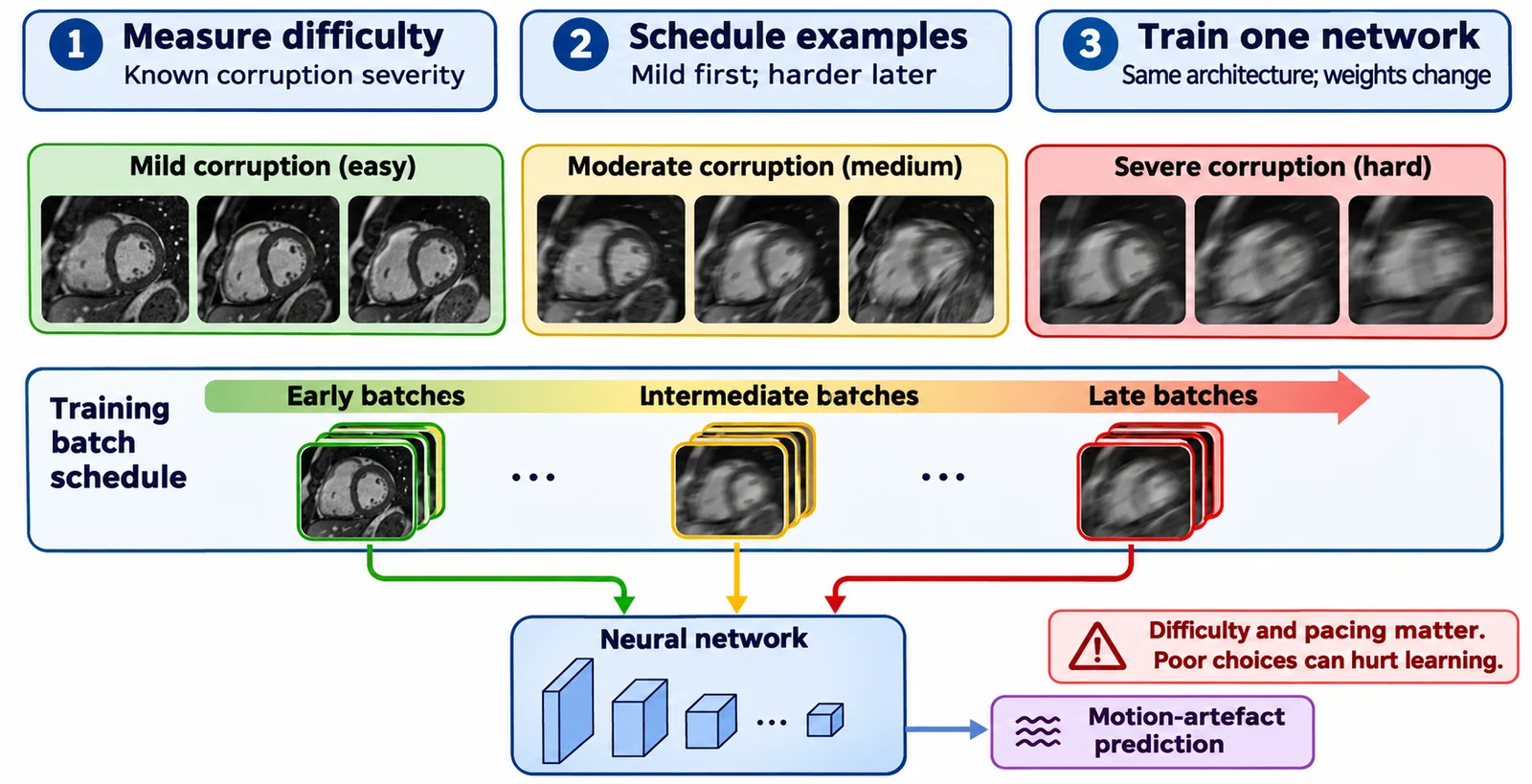
Why should order matter at all? Training a network means searching for parameter values that reduce error, and that search is easier when early examples give a smooth, informative signal. Hard or noisy examples early on can push the parameters toward poor regions before the model has learned anything useful, and a curriculum is a way of steering the search along a gentler path first. The benefit is real but not automatic: it depends on how difficulty is measured and on the pace at which harder examples are introduced, so a curriculum built on a poor difficulty score can fail to help or even hurt.[1] The cardiac study found that its severity-based curriculum improved classification over random sampling and over an anti-curriculum strategy.[2]
Curriculum learning changes the order of the data, not the model; its value rests on getting difficulty and pacing right.
History
Where the idea came from
The formal proposal dates to 2009, when Yoshua Bengio and colleagues presented curriculum learning at the International Conference on Machine Learning. Their framing was that of optimization: begin with smoother, simpler problems and gradually introduce coarser, harder, non-convex ones until the target task can be optimized.[3] The analogy to human schooling is explicit: curriculum learning imitates the meaningful learning order in human curricula.[1] The proposal introduced no new network design; it framed curriculum learning as a continuous optimization approach that starts with smoother, simpler problems and gradually adds coarser, harder, non-convex ones.[3]


How it works
Measuring difficulty and scheduling it
A curriculum cannot be applied until each example has a difficulty score, and the machinery that produces those scores is called a difficulty measurer; the component that decides which examples to show and when is the training scheduler.[1] The two are separable, and most designs differ in one or the other. A hand-designed curriculum fixes both in advance, using a rule the designer trusts. An automatic curriculum computes difficulty from the model's own behaviour as training proceeds, so the order adapts rather than being fixed beforehand.[1]
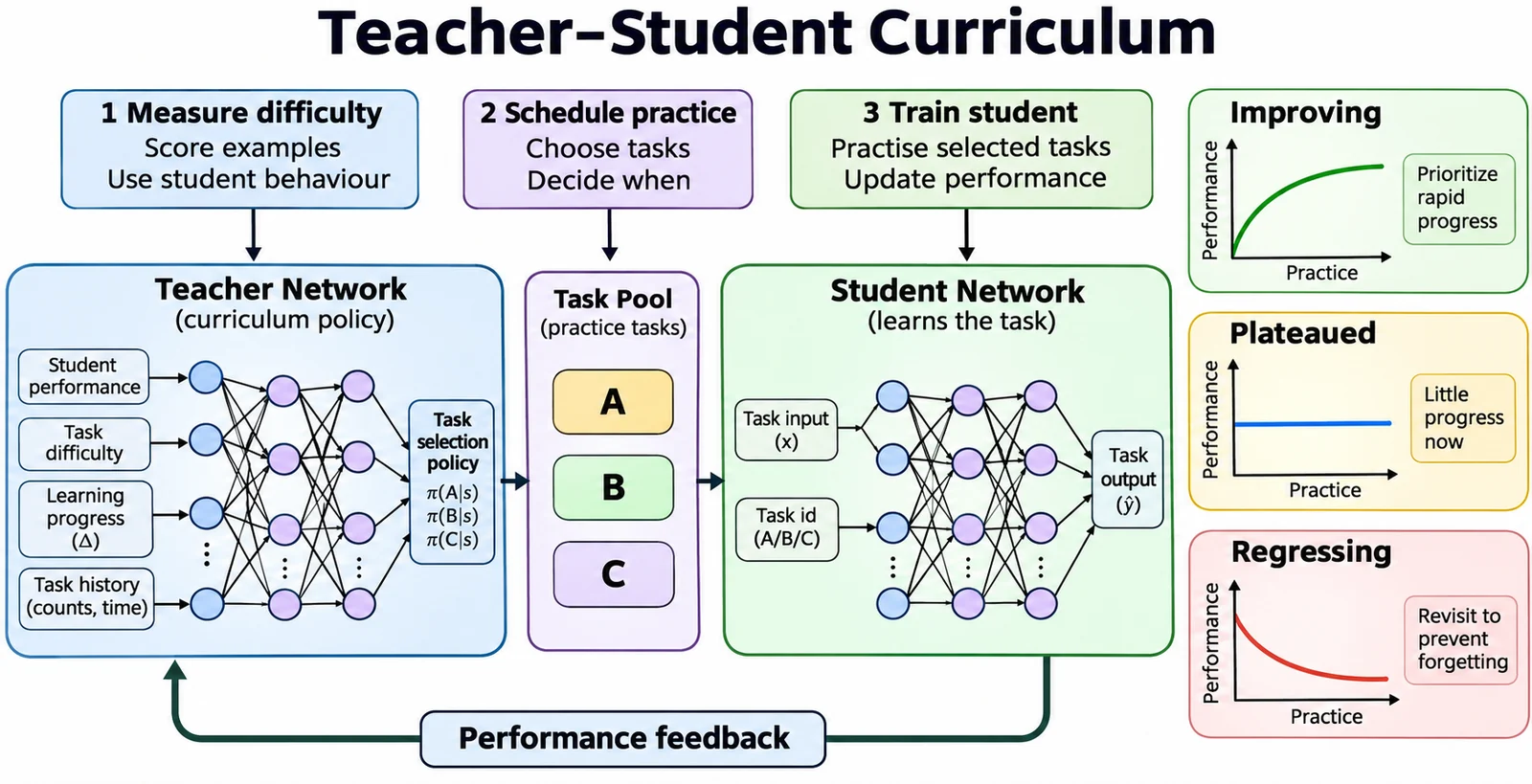
Teacher-student schemes are one family of automatic curricula. A teacher network watches a student learn and chooses which subtasks to practise, favouring those where the student's learning curve is steepest, that is, where progress per unit of practice is fastest; it also revisits tasks on which the student is regressing, to guard against forgetting.[6] A related approach treats the choice of what to train on next as a bandit problem, a setting in which an algorithm repeatedly picks among options and learns from the reward each choice returns, with the reward here being how much the network learned from a sample.[7] Self-paced methods instead let the model weight its own examples by how well it currently handles them.[1]
Difficulty must be measured before it can be scheduled; the measurer and the scheduler are separate design choices.
Research
Does it work, and when
One example of a curriculum helping comes from the cardiac motion artefact study, where the ordering was under the researchers' control. Because the corrupted images were generated at known severity levels, the curriculum could be built on a real dial rather than a guess, and the severity-based order improved classification over both random sampling and an anti-curriculum.[2] That comparison matters: the anti-curriculum is the same data with the order reversed, so the gain cannot be credited to the extra images or to the network, only to the sequence in which they arrived.
Ordering by difficulty also appears to change how quickly training converges. In an analysis of convolutional networks trained on image recognition benchmarks, curricula built by sorting examples with a teacher network or by bootstrapping produced faster learning and better final accuracy on test data than uniform random sampling, and both sorting methods showed similar benefits across a variety of network architectures and datasets.[8]
The gains are conditional, however. An extensive exploration of curriculum learning for German-English neural machine translation found that convergence time could be improved without loss of translation quality, but that the results were highly sensitive to the choice of sample difficulty criteria, the curriculum schedule, and other hyperparameters.[9] A curriculum is therefore a design decision with several dials, and the benefit depends on setting them well rather than on the strategy alone.
A curriculum can speed training and improve final accuracy, but only when difficulty and pacing are chosen well.
Criticism
Limits and open questions
The evidence for curriculum learning is encouraging but conditional, and the conditions are where the open questions lie. Because the benefit depends on the difficulty measure and the pacing schedule, a curriculum assembled from a poor difficulty score can leave training no better off, or worse, than drawing examples at random. The German-English translation exploration makes the fragility concrete: it found it possible to improve convergence time at no loss in translation quality, but results were highly sensitive to the choice of sample difficulty criteria, curriculum schedule and other hyperparameters.[9]
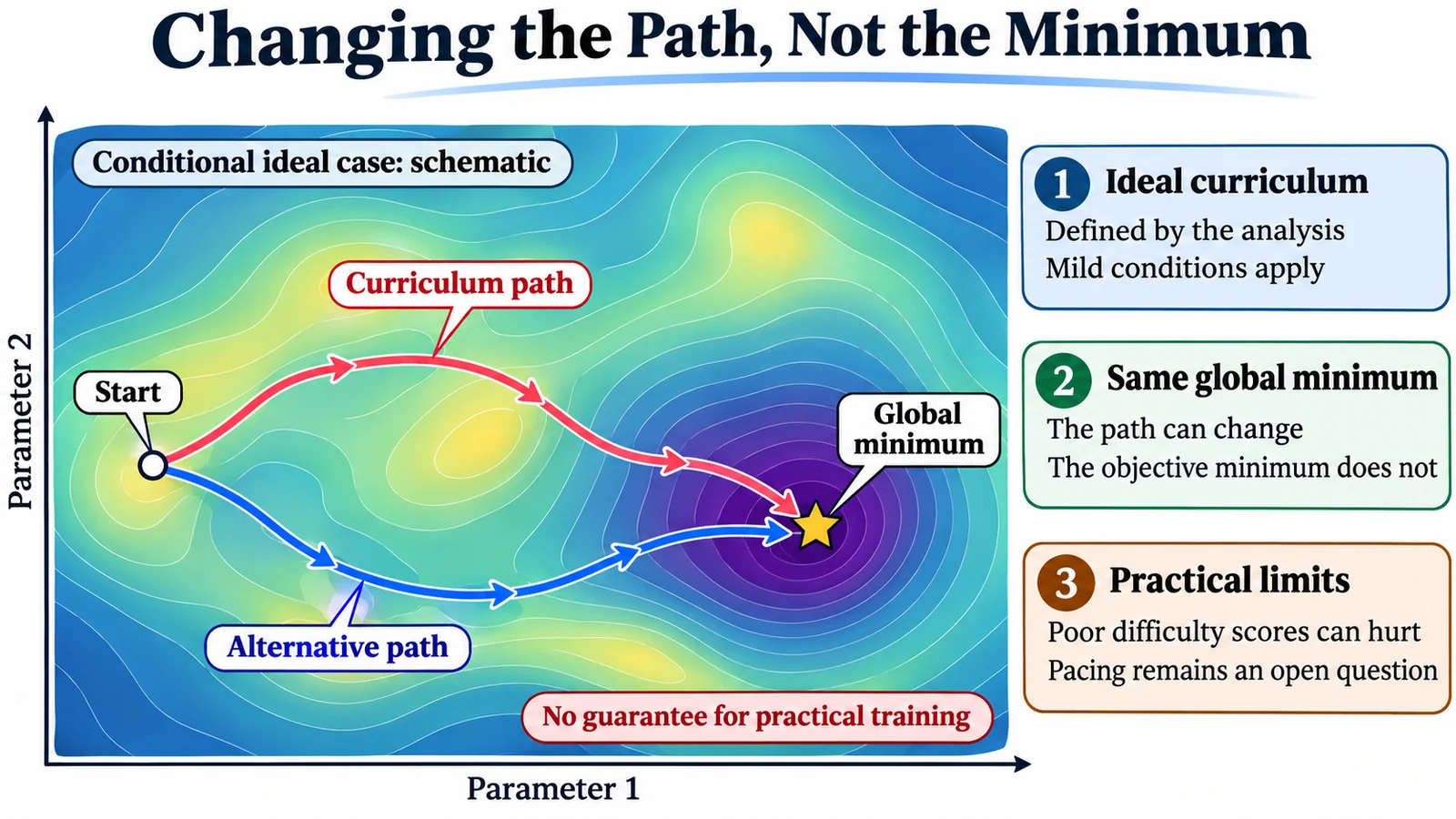
Theory offers a boundary rather than a guarantee. An analysis of curricula in deep networks defines an ideal curriculum and shows that, under mild conditions, it does not change the global minimum of the optimization problem; the curriculum reshapes the path to that minimum, not the destination.[8] What remains unsettled is how to measure difficulty reliably and how to pace it, questions the same analysis leaves open.
Key studies
| Year | Study | Sample | Design | Finding |
|---|---|---|---|---|
| 2017 | Graves et al.[7] | LSTM networks on three curricula | automated curriculum with a bandit algorithm | The method significantly accelerated learning, in some cases halving the time to reach satisfactory performance. |
| 2018 | Zhang et al.[9] | a German-English translation task | empirical exploration of curriculum designs | Convergence time improved at no loss in translation quality, but results were highly sensitive to design choices. |
| 2019 | Hacohen & Weinshall[8] | CNNs on CIFAR-10, CIFAR-100 and subsets of ImageNet | empirical and theoretical analysis | Both difficulty-sorting methods increased learning speed and improved final test performance. |
| 2019 | Oksuz et al.[2] | 3510 cardiac MRI images from the UK Biobank | CNN classification with curriculum and augmentation | The pipeline reached an overall area under the ROC curve of 0.89. |
| 2020 | Matiisen et al.[6] | LSTM networks on decimal addition and a Minecraft agent | teacher-student automatic curriculum experiments | Automatic ordering solved an unsolvable Minecraft maze and learned an order of magnitude faster than uniform sampling. |
| 2021 | Wang et al.[1] | a survey of curriculum learning research | survey article | Curriculum learning improved generalization capacity and convergence rate across computer vision and natural language processing. |
| 2022 | Lin et al.[3] | multi-agent reinforcement learning environments | simulation comparison experiments | K-fold cross-validation curriculum ranking improved the training speed of the MADDPG algorithm. |
See also
References
- Wang, X., Chen, Y., & Zhu, W. (2021). A Survey on Curriculum Learning. IEEE Transactions on Pattern Analysis and Machine Intelligence, 1-1. doi:10.1109/tpami.2021.3069908
- Oksuz, I., Ruijsink, B., Puyol-Antón, E., Clough, J. R., Cruz, G., Bustin, A., Prieto, C., Botnar, R., Rueckert, D., Schnabel, J. A., & King, A. P. (2019). Automatic CNN-based detection of cardiac MR motion artefacts using k-space data augmentation and curriculum learning. Medical Image Analysis, 55, 136-147. doi:10.1016/j.media.2019.04.009
- Lin, Z., Lai, J., Chen, X., Cao, L., & Wang, J. (2022). Curriculum Reinforcement Learning Based on K-Fold Cross Validation. Entropy, 24(12), 1787. doi:10.3390/e24121787
- Zhang, B., Wang, Y., Hou, W., Wu, H., Wang, J., Okumura, M., & Shinozaki, T. (2021). FlexMatch: Boosting Semi-Supervised Learning with Curriculum Pseudo Labeling. arXiv. doi:10.48550/arxiv.2110.08263 Free full text
- Xu, Q., Ali, S., & Yue, T. (2023). Digital Twin-based Anomaly Detection with Curriculum Learning in Cyber-physical Systems. ACM Transactions on Software Engineering and Methodology, 32(5), 1-32. doi:10.1145/3582571
- Matiisen, T., Oliver, A., Cohen, T., & Schulman, J. (2020). Teacher–Student Curriculum Learning. IEEE Transactions on Neural Networks and Learning Systems, 31(9), 3732-3740. doi:10.1109/tnnls.2019.2934906
- Graves, A., Bellemare, M. G., Menick, J., Munos, R., & Kavukcuoglu, K. (2017). Automated Curriculum Learning for Neural Networks. arXiv. doi:10.48550/arxiv.1704.03003 Free full text
- Hacohen, G., & Weinshall, D. (2019). On The Power of Curriculum Learning in Training Deep Networks. arXiv. doi:10.48550/arxiv.1904.03626 Free full text
- Zhang, X., Kumar, G., Khayrallah, H., Murray, K., Gwinnup, J., Martindale, M. J., McNamee, P., Duh, K., & Carpuat, M. J. (2018). An Empirical Exploration of Curriculum Learning for Neural Machine Translation. arXiv. doi:10.48550/arxiv.1811.00739 Free full text
Cite this page: Atlas Nova editors. (2026). Curriculum learning. Atlas Nova. https://velocer.io/atlas/curriculum-learning/