Technology · Machine learning
Federated learning
Machine learning technique
Federated learning is a way of training a machine learning model across several separate data holders, each of which keeps its raw data and never sends it anywhere.
Instead of pooling records in one place, the training is pushed out to where the data already sits. Each participant trains a copy of the model on its own material and sends back only the resulting model parameters, the numerical settings that define what the model has learned. A coordinating server combines those contributions into a shared model and returns it for the next round. The data stay behind the institution's firewall; what travels is a set of numbers describing what the model learned, not the records it learned from.[1]
Key facts
| 99% | Federated models across 10 institutions reached this share of centralized model quality (Sheller et al., 2020)[2] |
|---|---|
| 55% | Accuracy drop for neural networks trained on highly skewed non-IID federated data (Zhao et al., 2018)[3] |
| 38% | Average generalizability gain of the federated EXAM model over single-site models (Dayan et al., 2021)[4] |
| 33% | Delineation improvement for surgically targetable tumour across 71 sites (Pati et al., 2022)[5] |
Overview
Federated learning
A hospital example makes the shape of it concrete. Suppose several cancer centres each hold MRI scans of their own patients. None of them may legally hand those scans to the others, and none of them alone has enough cases to train a reliable tumour detector. Under federated learning, each centre downloads the current model, trains it on its local scans for a while, and uploads its updated parameters. The server averages the updates into a new consensus model and sends it back out. Every pass through this cycle of local training, aggregation and redistribution is called a federated round.[2] Over many rounds the model absorbs patterns from all the participating centres while the scans themselves never leave the building where they were taken.
The motivation is partly legal and partly practical. Health data are highly sensitive and their use is tightly regulated, and removing names and dates of birth is often not enough to make a record safe: it is possible, for instance, to reconstruct a patient's face from a CT or MRI scan. At the same time, modern deep learning models contain millions of parameters and need large, varied datasets to reach clinical-grade accuracy, while the data that would supply that variety sit in separate institutions that cannot easily share them. Federated learning is offered as a way through this standoff, letting institutions gain insights jointly, in the form of a shared model, without moving patient data beyond their own walls. The same logic applies outside medicine, wherever records are siloed and private: a phone keyboard learning from what people type, or a set of hospitals each holding a slice of a rare disease.[1]
It is worth being clear about what federated learning is not. It is not a guarantee of privacy. Participants never directly see each other's data, and in a server-based arrangement they may not even know who the others are, but the model updates they exchange are derived from real records and can, under certain conditions, carry information about them.[1]
Adding stronger protections such as differential privacy, which injects calibrated noise so that no single record can be inferred from the output, is a separate step with its own costs, and the security questions are treated later in this chapter. Nor does federated learning assume that the data at each site look alike. Hospitals serve different populations and use different equipment, so their local datasets are usually not identically distributed, and this unevenness shapes how well the shared model converges. That problem, and the methods devised for it, are covered later.
What the idea promises, then, is a shift in how collaboration works: the model travels to the data rather than the data travelling to the model. A federation can grow by adding institutions without ever assembling a central repository, and each data controller can keep its own governance rules and revoke access if it chooses.[1] Whether that promise holds up in practice, in terms of model quality, communication cost and resistance to attack, is the subject of the sections that follow.
Federated learning moves the model to the data: sites train locally and share only parameters, never records.
History
From data lakes to moving models
The older way to train a model on many institutions' records is collaborative data sharing: each site sends its patient data to a central location, and the model is trained there on the pooled collection. Large repositories built this way exist across radiology, pathology and genomics. They do not scale well to many collaborators, especially across borders, because privacy rules, technical burden and questions of who owns the data all push back at once.[2] The result is a paradox: the knowledge needed to train a broadly useful model exists, scattered across institutions worldwide, but the mechanism for assembling it does not.
The cost of that gap shows up in the models themselves. A model trained on one institution's data can score well on held-out data from the same institution and still fail on data from elsewhere, because it has learned quirks of local equipment and local practice rather than the pathology it was meant to detect. A natural way to increase both data size and diversity is through collaborative learning, where multi-institutional data are used to train a single model.[2] Central pooling would supply it, but the legal and practical obstacles to pooling are the reason the data are siloed in the first place.
Federated learning inverts the arrangement. Rather than bringing data to a computation, it brings the computation to the data: each collaborator trains on its own records and sends only model updates to a central server, which aggregates them into a consensus model and returns it. The approach was introduced in 2017 as federated averaging, and was later applied in training Google's autocomplete keyboard application.[2] That keyboard case is instructive because the federated environment avoids exporting sensitive user data to servers and gives users greater control over the use of their data. The federated algorithm was shown to achieve better prediction recall for next-word prediction, and the environment gives users greater control over the use of their data.[6]
Medicine came next, and for the same underlying reason. Hospitals hold electronic health records and images that are sensitive by nature and regulated accordingly, so the records of different patient populations are difficult to move across institutions, which leaves analytical work fragmented and short of the diverse data it needs. A federated arrangement lets a shared global model be trained with a central server while the data stay in the institutions where they originated.[7] The framing shifted from "how do we get the data to one place" to "how do we get the learning to every place at once."
It is worth seeing what the shift buys, concretely. A federation can add institutions without ever assembling a central repository, and each data controller keeps its own governance rules and can revoke access if it chooses. Storage also behaves differently: high-dimensional medical data need not be duplicated into a central pool and duplicated again by every user who trains on it, because the model travels instead. Originally developed for mobile and edge device use cases, federated learning recently gained traction for healthcare applications.[1]
None of this makes the older approach obsolete on the spot. A centralised pool, where one can be built lawfully, remains the simplest thing to train on, and the question of how much model quality is lost by refusing to pool is the one that decides whether federated learning is a real substitute or only a fallback. That comparison, and the evidence bearing on it, is taken up later. What matters here is the direction of travel: from data lakes that gather records in one place, to a model that visits each site in turn and carries away only what it learned.
How it works
The federated round, step by step
A federation needs somewhere for the shared model to live between rounds, and that is the job of the aggregation server. The server holds the current global model, the version that reflects everything learned so far, and it begins each round by sending a copy of that model out to every participating site. Each site then trains the copy on its own local data for a while, adjusting the model's parameters to fit the records it holds. When local training stops, the site sends back its model update: either the new parameter values themselves or the gradients, the directions in which the parameters should move to reduce error. The server collects these updates, combines them into a single revised global model, and the cycle begins again.[2][7] One pass through local training, upload, aggregation and redistribution is a federated round, and a model typically needs many of them.
The combining step is where the design choices live. A common rule is federated averaging, which forms the new global model by aggregating the sites' model updates into a consensus model.[2][7]
That weighting is not an arbitrary convention. It follows from what the federation is trying to compute. Formally, the goal is to find the parameter setting that minimises a weighted sum of each site's own average loss, where a site's weight is its share of the total sample count across the federation.[7] In plain terms, the shared model is being asked to do well on the pooled data as if that pooled data had been assembled in one place, even though it never is. Federated averaging is a practical procedure for approaching that target without ever computing it directly, because computing it directly would require the data to be together.
The round structure also explains why the process is iterative rather than a single exchange. One round of local training on a site's own records pulls the model toward that site's patterns, and averaging several such pulls produces a compromise that fits none of them exactly. Sending the compromise back out lets each site correct it against its own data again, and repeating the cycle gradually moves the shared model toward something that works across the whole federation. The server's role is narrow but essential: it never sees a record, only numbers, and it is the only party that touches every site's contribution.
Two practical features of this loop shape everything that follows. The first is that the server usually cannot wait for everyone. The second is that the traffic is not free. What crosses the network each round is the model itself, so the upload and download of updates can be a significant cost.
It helps to separate what the round transmits from what it does not. The site sends parameters or gradients, which are summaries of what its data taught the model. It does not send records, and. That separation is the whole point of the architecture, and it is also the source of its limits: a summary is not nothing, and later sections take up what can be reconstructed from one and what can be done to a federation by a participant who submits a dishonest update.
A final piece of the mechanics concerns how the round ends. Because the server sees every participating site's update, local validation results on the same model can be aggregated into global validation results for model selection.[2] A method that passes models from site to site in sequence has no equivalent, since no single party ever holds all the pieces at once. That contrast belongs to the discussion of topologies, but the underlying point belongs here: the round is not only a training step, it is also the moment at which the federation can see, in aggregate, how well it is doing.
Each round: the server broadcasts the global model, sites train locally, updates come back, and a weighted average becomes the new global model.
Topologies and compute plans
The federated round described earlier assumes a particular arrangement: one server in the middle, many sites around it, all training at once. That arrangement is only one of several ways to wire a federation together, and the choice of wiring changes what the participants can do and what they can see. Two questions have to be answered separately. The first is the topology, the communication architecture that decides who talks to whom. The second is the compute plan, the trajectory a model follows as it passes through the participating sites. A federation can pair almost any answer to the first with almost any answer to the second, and the combinations behave quite differently.
One common topology in healthcare is the centralised one, often drawn as a hub with spokes: an aggregation server coordinates the training iterations, collecting the local models, averaging them, and distributing the result back to the training nodes.[1] Its appeal is that the server is the only party that ever touches every contribution, which is what makes a single shared model possible. A second option is peer-to-peer, in which each training node is connected to one or more of its peers and every node performs its own aggregation, with no central coordinator at all. A third is hierarchical, where several sub-federations, each of which may itself be centralised or peer-to-peer, are joined into a larger federation.[1]
The compute plan is a separate axis. In the parallel plan that federated averaging uses, every site trains a copy of the current model at the same time and the server merges the results. In a sequential plan, sometimes called cyclic transfer learning, the model moves from one site to the next, each training it in turn before passing it along.[1] The distinction matters because the two plans aggregate knowledge at different moments and with different degrees of fairness. Parallel training blends all the sites' contributions at the end of each round, so no single site's patterns dominate. Sequential training blends knowledge gradually as the model travels, which means sites that train later in the cycle leave a stronger imprint on the model than sites that trained early.
That asymmetry is not a minor technicality. The parallel plan avoids the problem by construction, since every site's update is combined at once rather than layered one on top of another.
The topology and the compute plan are often confused because the familiar picture, a hub with spokes and simultaneous training, combines one of each. They can be pulled apart. A peer-to-peer federation can still train in parallel, with each node aggregating its neighbours' updates itself. A centralised server can orchestrate a sequential plan, handing the model from site to site and keeping the running version. Which combination suits a given collaboration depends on how much coordination the participants will accept, how reliable their links are, and whether any party is trusted to sit in the middle. The remaining questions of cost, privacy and model quality attach to these choices, and are taken up in the sections that follow.
Topology decides who talks to whom; the compute plan decides whether sites train together or in turn.
Learning without a central server
Every arrangement described so far puts a server in the middle. That server holds the shared model, receives each site's update, and decides what the next version will be. It never sees a patient record, but it receives model updates from participants, which are aggregated over several participants.[1] For a federation of hospitals or competing firms, that is a real concentration of trust. The participants must agree on who runs the server, and each must accept that one party sits in a position to observe, and potentially to misuse, the whole flow of updates.
Swarm learning removes that party. Instead of a dedicated parameter server, the participating nodes exchange model parameters among themselves over a peer-to-peer network, and each node merges what it receives to build the updated model before the next training round.[8] The coordination that the server used to perform is handled by the network itself. To keep that network honest, the implementation uses a private permissioned blockchain: only pre-authorized participants can execute transactions, new nodes enrol through a smart contract and receive the model, and the blockchain keeps a shared, tamper-resistant account of who did what. The implementation uses a private permissioned blockchain in which only pre-authorized participants can execute transactions, supporting data sovereignty, security, and confidentiality.[8]
A related design, blockchained federated learning, exchanges and verifies local model updates through a blockchain consensus mechanism, so that on-device training proceeds without any centralized training data or central coordination. In blockchained federated learning, local model updates are exchanged and verified through a blockchain consensus mechanism, enabling on-device training without centralized training data or central coordination.[9] It also raises its own questions, since the network must now agree on membership and on the rules of exchange without an arbiter. What such an arrangement costs in communication and computation is covered later.
Uses
Hospitals, phones and drug discovery
The clearest way to see what federated learning is for is to look at the problems it has actually been pointed at. They share a shape: the data needed to train a good model exist, but they are scattered across parties that cannot or will not pool them. What differs is the reason for the scattering, and that reason shapes how the federation is built.
Medical imaging supplied the first serious test in a clinical setting. Brain tumour segmentation, the task of drawing the boundary of a tumour on an MRI scan, is a natural candidate because a single hospital sees relatively few such cases and the scans it does hold reflect its own equipment and its own patient population. A study reconstituted the ten institutional contributions to a large public brain-tumour imaging dataset so that each hospital's patients stayed together, matching how data are really distributed, and trained models across the resulting federation. The same work extended its evaluation to data from institutions that had contributed nothing to the federation, which is the situation a model actually faces when it is deployed somewhere new.[2] This is the arrangement that makes federated learning worth the trouble in medicine: the model sees a spread of hospitals without any scan leaving the building where it was taken.
The scale of such collaborations has since grown well beyond ten sites. The Federated Tumour Segmentation initiative, known as FeTS, is an international federation of 30 committed healthcare institutions using an open-source federated learning framework with a graphical user interface, aimed at improving tumour boundary detection across brain glioma, breast tumours, liver tumours and bone lesions in multiple myeloma.[1]
Prediction from routine clinical data has followed the same path. A federated model called EXAM was trained on data from 20 institutes across the globe to predict the future oxygen requirements of symptomatic COVID-19 patients, taking as input vital signs, laboratory results and chest X-rays.[4] The inputs are the ordinary traces of an emergency admission, recorded at each hospital in its own way, and the outcome being predicted is what a clinician most needs to know: whether a patient will need oxygen or a ventilator in the coming hours. Spreading the training across twenty institutes yielded a 16 percent improvement in average AUC across participating sites and an average increase in generalizability of 38 percent compared with models trained at a single site using that site's data.[4]
Imaging and records are not the only materials. A federated collaboration has been used for the assessment of mammograms, where the models produced by federated training performed well on other institutes' data as well as on the data they were trained with.[1] The pattern repeats because the underlying problem repeats: a screening programme at one site sees a narrow slice of the population, and a model that has learned only that slice travels poorly.
Hospitals are the most discussed setting, but the same logic applies wherever records are held by parties with competing interests. The Melloddy project aims to deploy multi-task federated learning across the datasets of 10 pharmaceutical companies, training a common predictive model of how chemical compounds bind to proteins so that the partners can improve drug discovery without revealing their highly valuable in-house data.[1] Federated training lets each firm contribute what its data taught the model while keeping the data itself, which is the only basis on which such a collaboration could happen at all.
Clinical deployment has begun to move out of the research setting as well. The HealthChain project aims to develop and deploy a federated learning framework across four hospitals in France, generating common models that predict treatment response for breast cancer and melanoma patients from histology slides or dermoscopy images, so that oncologists can choose the most effective treatment for each patient.[1]
It was introduced in 2017 as federated averaging and later applied in training Google's autocomplete keyboard application.[2] Federated learning was applied to train the next-word prediction model behind a smartphone keyboard, with training carried out on the devices themselves rather than on a server holding what people typed. A later study trained a recurrent neural network language model for next-word prediction through on-device federated learning and compared it with server-based training, finding that the federated algorithm, which could draw on a higher-quality dataset for this task, achieved better prediction recall. The keyboard case is worth holding alongside the hospital ones because the text is personal, and federated training keeps sensitive user data from being exported to servers.[6]
Beyond medicine and phones, the paradigm has been taken up wherever devices generate data that their owners would rather not upload. Federated learning has been proposed for traffic flow prediction, where a model is updated through a secure parameter aggregation mechanism rather than by sharing raw data among organisations, and a study on a real-world dataset found predictions that were merely 0.76 km/h worse than the state of the art in terms of mean average error under the privacy constraint.[10] The same reasoning extends to the broader family of internet-connected devices, where federated learning allows AI training at distributed IoT devices without the need for data sharing.[11] In each case the federation is a way of using data that would otherwise sit idle.
What these applications have in common is not a technology but a standoff. A hospital cannot release its scans, a company cannot release its assays, a phone user cannot release their typing, and in every case the model that could be built from the withheld data is better than the one that can be built without it. Federated learning is the arrangement that lets the model be built anyway. Whether the resulting model is as good as one trained on pooled data, and how much it costs in communication to get there, are separate questions, covered later.
Who takes part, and what they get out of it
A federation is not a single kind of organisation. The participants can be phones, wearables, hospitals, research consortia or competing firms, and what unites them is only that each holds data it will not hand over. The term client covers all of them: in the formal description of the problem, a client is whatever holds a local dataset and takes part in training, whether that is a mobile phone, a wearable device or a clinical institution's data warehouse.[7] The same mathematics applies to a phone learning from one person's typing and to a hospital learning from thousands of scans; what changes is the reason the data cannot move.
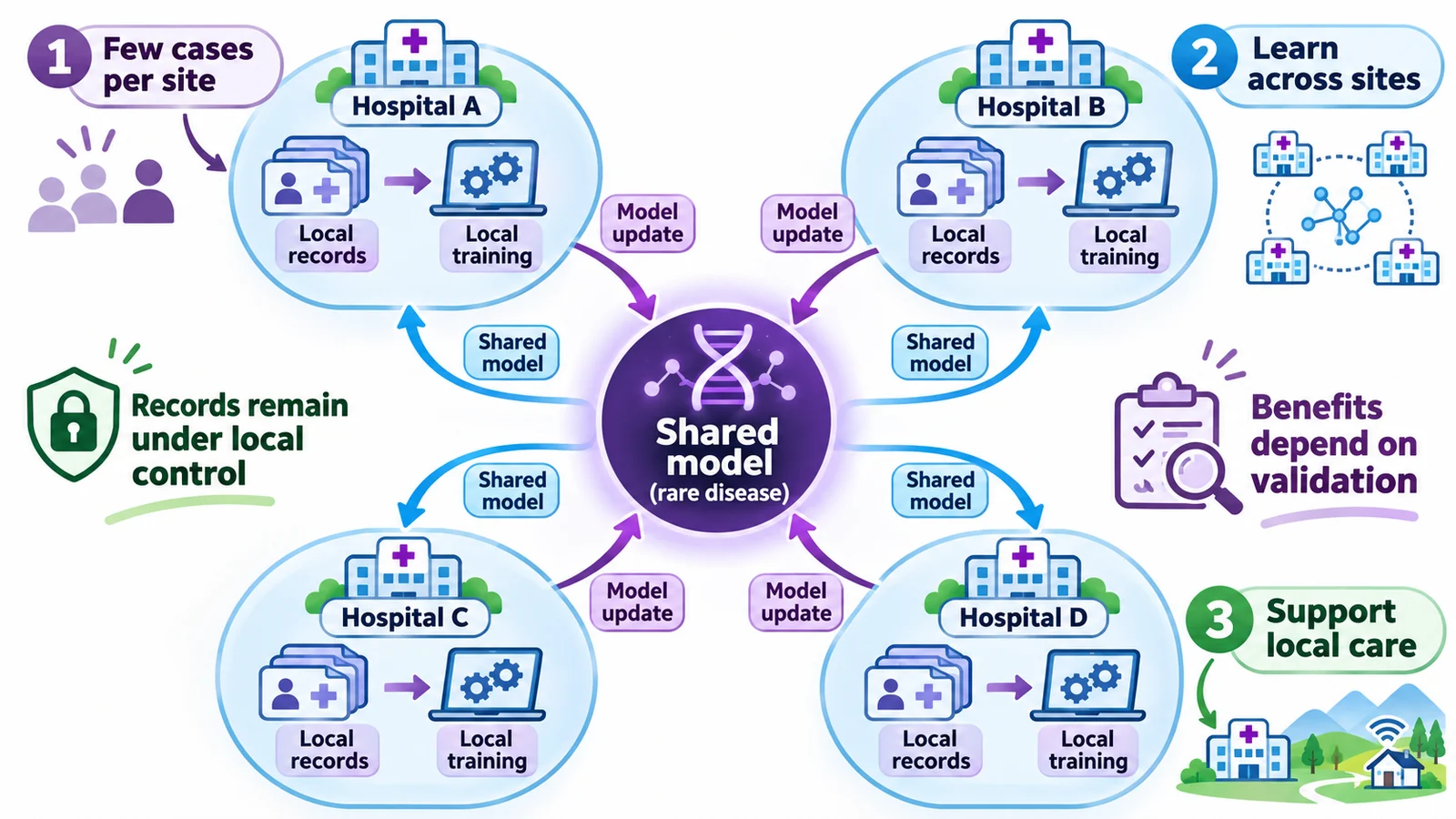
For an individual, the reason is personal. A patient treated locally can be reassured that their records stay with their own institution and that access can be revoked, which lowers the hurdle to becoming a data donor at all. A hospital, for its part, keeps full control and possession of its patient data, with traceability of who accessed it, which limits the risk of misuse by third parties.[1] That control is the concrete thing a participant receives in exchange for the computing it contributes. It is not a promise about what the shared model will do; it is a retained hold on the records themselves.
The clinical payoff is a model that has seen cases the participant could never assemble alone. Rare diseases are the clearest case: incidence is low, so the dataset at any single institution is too small to learn from, and federated training lets a model be built from cases scattered across many sites. A clinician normally sees only the sub-group of the population their location serves, which can bias their sense of how likely a disease is; a model trained across a federation has been exposed to a more complete distribution and may therefore be less biased and more sensitive to rare presentations. Patients in remote areas stand to gain in the same way, receiving diagnoses aided by a model that reflects far more cases than their local hospital holds.[1]
Commercial participants join for a different reason: the model is the only thing they are willing to share. The Melloddy project aims to deploy multi-task federated learning across the datasets of 10 pharmaceutical companies, with partners intending to optimise drug discovery without revealing their in-house data.[1] A compound library and its assay results are assets a firm would not hand to a competitor, and federated training asks them to contribute only what their data taught the model.
Money is not the only motive, and it is not always enough. A federation asks participants to spend computation and bandwidth on a model they do not own outright, and the usual ways of rewarding contribution do not transfer directly, due to information unsharing and difficulties of contribution evaluation.[12] Designing a scheme that pays sites fairly without asking them to reveal their data remains an open problem, taken up later.
Research
Does it match training on pooled data
The question that decides whether federated learning is a substitute for pooling or merely a fallback is a plain one: how much model quality is lost by refusing to gather the data in one place? The comparison has a natural reference point. Train the same model on the same records assembled centrally, train it again across a federation, and measure both on data neither has seen. The gap between the two is the price of privacy, and the size of that price is what institutions weigh when they decide whether a federation is worth joining.
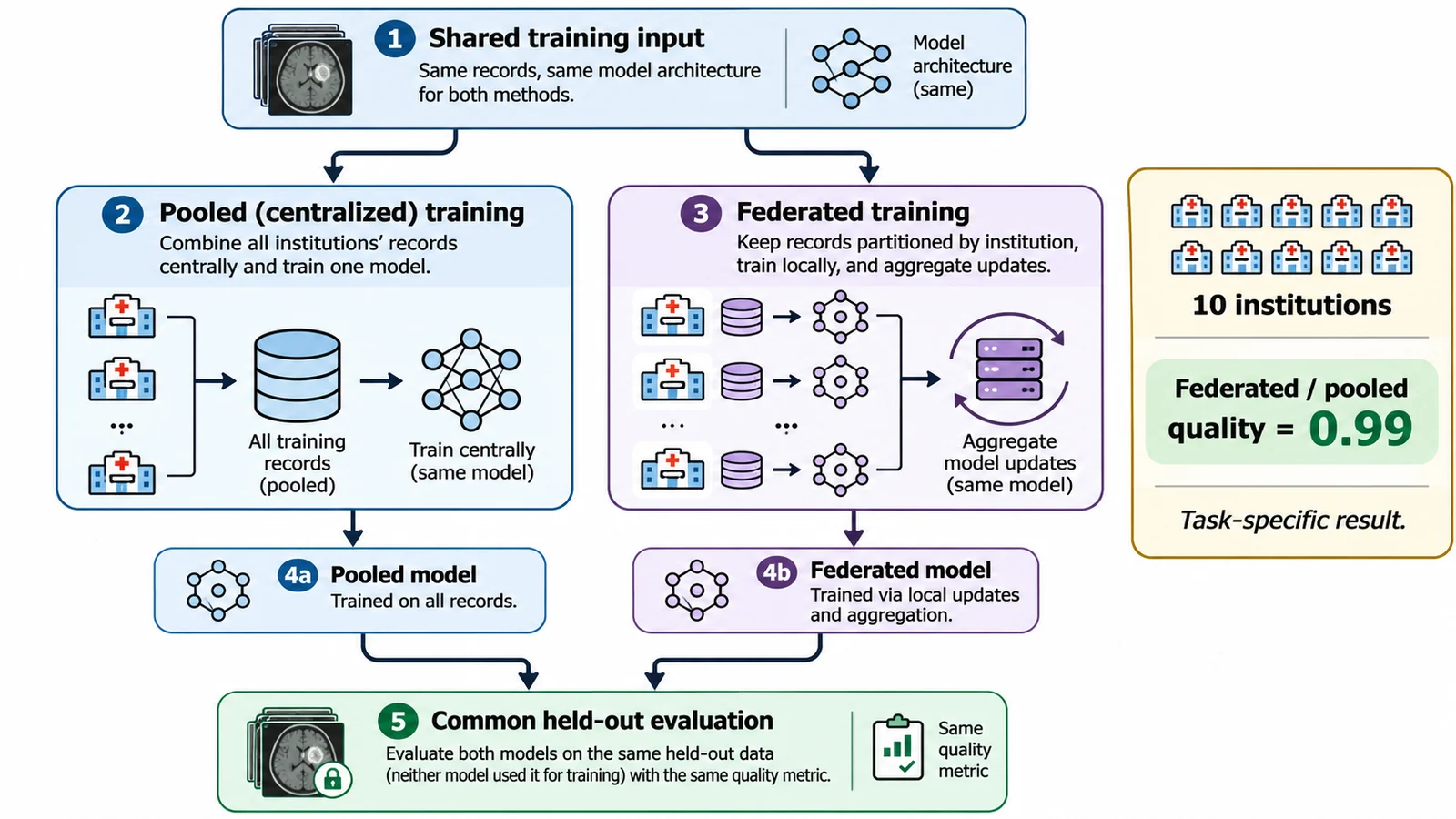
The most direct measurement came from the brain-tumour work described earlier, where the ten institutional contributions to a public imaging dataset were reconstituted so that each hospital's patients stayed together. Training across those ten institutions produced models that reached 99% of the quality achieved with the same data centralised.[2] That figure needs to be read carefully. It says the federation recovered almost all of what pooling would have given, not that it recovered all of it, and it applies to this task, this dataset and this group of institutions. What makes it meaningful is the comparison it sits inside: the same study asked whether the extra data a federation unlocks is worth more than the errors the collaborative method introduces, and concluded that the benefit of access to more data outweighed those errors.[2] In other words, the small loss relative to pooling is smaller than the gain over training at any single site.
That last point is the one that matters to a hospital. A site training alone has only its own patients, and a model fitted to them tends to learn local habits of equipment and practice along with the pathology. The federation's 99% is measured against a centralised model that no single institution could have built, but the relevant alternative for most participants is not the centralised model; it is the model they could train themselves. On that comparison the federated model benefits from the group's data, and the loss relative to pooled training is considerably less than the benefit the group's data brings over single-institution training.[2]
Scale strengthens the case rather than weakening it. The largest federated learning study to date assembled data from 71 sites across 6 continents to build an automatic tumour boundary detector for glioblastoma, a rare cancer, reporting a dataset of 6,314 cases, the largest such dataset in the literature. Trained across that federation, the model showed a 33% improvement in delineation of the surgically targetable tumour and a 23% improvement for the complete tumour extent, both measured against a publicly trained model.[5]
The comparison here is against a model built on public data rather than against a centralised pool of the same 71 sites' records, so it does not measure the price of privacy directly. It measures something adjacent and arguably more useful: what a federation can achieve on a disease too rare for any single institution to study well. A cancer that appears at low rates yields few cases per hospital, and a boundary detector trained on a handful of local examples is not a reliable tool. Spread across six continents, the same rare disease becomes a tractable learning problem.
Prediction from routine clinical data tells a similar story with a different kind of evidence. The EXAM model, trained across 20 institutes to predict the future oxygen requirements of symptomatic COVID-19 patients from vital signs, laboratory results and chest X-rays, achieved an average area under the curve above 0.92 for outcomes at 24 and 72 hours from first presentation.[4] Area under the curve is a summary of how well a model separates patients who will need oxygen from those who will not, with 1.0 representing perfect separation and 0.5 equivalent to guessing. The figure that speaks to the pooling question, though, is the comparison: EXAM provided a 16% improvement in average area under the curve measured across all participating sites, and an average increase in generalizability of 38%, when compared with models trained at a single site using that site's own data.[4] The second number is the important one. A model trained at one hospital and tested at another loses accuracy because the two hospitals record and treat patients differently; training across twenty institutes narrowed that gap, so the shared model held up better on sites it had not learned from.
The same pattern appears in screening. In a federated collaboration for the assessment of mammograms, the models produced by federated training outperformed those trained on a single institute's data and were more generalisable, so that they still performed well on other institutes' data.[1] The finding is stated as a comparison with single-institute models, which is the comparison a screening programme actually faces: adopt a model trained elsewhere and hope it transfers, or train one locally on a narrow sample. Federated training offers a third option, a model that has already absorbed the variation across sites and therefore travels better.
Two cautions belong with these results. The first is that a federation is not a drop-in replacement for a pool, and the studies above measure particular tasks rather than establishing a general rule. The second is that the comparison is not only about accuracy. A centralised model trained on pooled data remains, in the studies that measured it directly, somewhat better than its federated counterpart, and the gap is the honest cost of keeping data where it is. Whether that cost is worth paying depends on what the alternative would be, and for most institutions the alternative is not a pool they could lawfully assemble but a model trained on their own records alone.
There is also a subtler reason the gap may narrow over time. A federation can keep adding institutions and keep learning from new data as it arrives, since the data will be retained within their acquired institutions.[2] The federated model's disadvantage is measured at a moment; its capacity to grow is a property of its design. That does not erase the deficit, but it changes how the deficit should be weighed against a pool that may never be built at all.
Across the studies that measured it directly, federated training came close to pooled training and clearly beat single-site training.
When the data at each site look different
The federated round assumes that each site's contribution can be averaged with the others and that the result will be sensible. That assumption holds only if the sites' data resemble one another. In practice they rarely do. A hospital in one country serves a different population, uses different scanners and follows different clinical conventions from a hospital in another, so the records at each site are drawn from a different distribution. Statisticians call such data non-IID, meaning not independent and identically distributed: the samples at one site are not a fair miniature of the samples across the federation, and the local averages each site computes point in somewhat different directions.[7] The federated setting makes this unavoidable, because the whole point is that data stay where they were generated and are never shuffled into a common pool.
The consequence is that averaging stops being a neutral act. When every site's data look alike, the average of their updates is a good estimate of what training on all the data together would have produced. When the sites differ sharply, each local update is pulled toward its own site's patterns, and averaging those pulls yields a compromise that may fit none of them well. This is the central statistical difficulty of federated learning, and it is distinct from the communication problem covered later: even with unlimited bandwidth, uneven data would still bend the training.
How much the skew costs
Under that extreme skew, the accuracy of neural networks trained federatedly fell by up to 55 percent. The same work traced the drop to weight divergence: the local models drift apart from one another and from the model that training on the pooled data would have produced, and the divergence can be quantified by comparing the distribution of classes at each site with the distribution across the whole population.[3] The finding is a warning about the mechanism rather than a prediction for any real hospital, because partitioning by class is a deliberately artificial form of skew. Real institutional bias arises from demographic differences in the populations served, from differences in instrumentation, and from other local factors. A simulation that assigns data to sites by label may therefore misstate how much harm real-world skew does, and the applicability of such results depends on how well the simulated distributions match the real ones.[2]
Responses that steady the training
Several methods have been devised to keep federated training stable when the sites disagree. The simplest baseline, federated averaging, requires every client to share the same model structure and can work with certain non-IID data, but it does not address strongly skewed distributions, and convolutional networks trained this way can lose considerable performance through weight divergence.[7] One line of work modifies the local training step so that each site's model is held close to the global one. FedProx does this by adding a penalty that discourages a site's local update from straying too far, and it also allows each device to perform a variable amount of work, accommodating devices with different capacities; on realistic federated datasets it converged more robustly than federated averaging, improving absolute test accuracy by 22 percent on average in highly heterogeneous settings.[13]
A second line attacks the drift more directly. SCAFFOLD introduces control variates, a variance-reduction technique, to correct what its authors call client drift in the local updates, and it is designed to need significantly fewer communication rounds while remaining unaffected by data heterogeneity or by which clients are sampled in a given round.[14] The two methods differ in spirit: FedProx restrains each site's step, while SCAFFOLD estimates the direction in which the sites are collectively drifting and subtracts it. Both accept that the sites' data differ and try to make the average behave as though they did not.
When one shared model is the wrong answer
There is a limit to how far correction can go, because sometimes the sites are not disagreeing about the same problem. A federation of hospitals may include several that see mostly one kind of case and others that see mostly another, and forcing a single model on all of them averages away exactly the local knowledge each site holds. Two related ideas respond to this. Clustered federated learning groups the client population into clusters whose data distributions can be trained together, exploiting the geometry of the loss surface to find the grouping, without requiring the number of clusters to be known in advance and without changing the communication protocol; because clustering happens after federated training has converged, it can be applied as a post-processing step that lets clients arrive at more specialised models.[15] A related algorithm, IFCA, alternates between estimating which cluster each user belongs to and optimising the model parameters for each cluster, and is shown to converge under suitable initialisation for linear models and for smooth convex losses.[16]
Personalised federated learning takes the idea further by giving each participant a model of its own rather than a share of a common one. The practical appeal is easy to see. A small clinic and a large specialist centre may both benefit from what the federation has learned in general, while needing different decision boundaries for their own patients. Personalisation lets them keep the general knowledge and adjust the local part.
None of these methods makes heterogeneity disappear. They redistribute its cost: FedProx and SCAFFOLD spend computation and communication to keep a single model honest, while clustering and personalisation give up on the single model and let the federation hold several. Which is right depends on what the collaboration is for. A shared screening tool that must behave identically everywhere wants the first; a set of hospitals each serving a distinct population may want the second. The choice also interacts with the questions taken up later, since a federation that must ship several models, or train them in clusters, pays more in communication than one that ships a single set of parameters.
Sites rarely hold similar data, and averaging dissimilar updates can hurt; the fixes either steady the average or abandon it for several local models.
The cost of talking
A federated round is cheap in data and expensive in traffic. What crosses the network each round is the model itself, or the gradients derived from it, and a modern deep network can hold millions of parameters. Every participating site must download the current global model, train it, and upload its update, and this happens not once but over many rounds. The repeated transmission of parameters from edge devices can induce a delay larger than the model training time by orders of magnitude, which makes communication delay a major bottleneck in federated learning.[17] Training time, in other words, is often not spent computing at all; it is spent waiting for numbers to arrive.
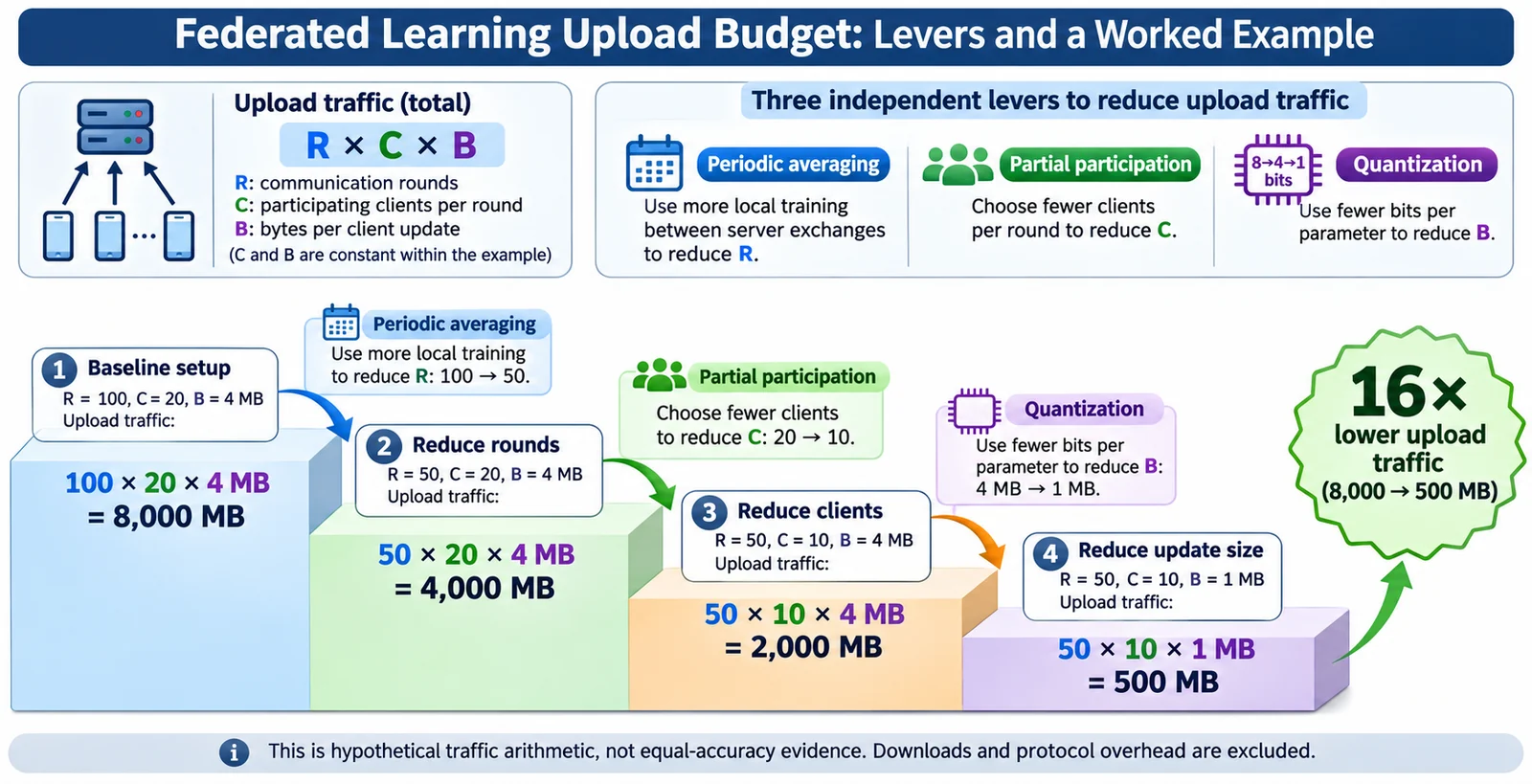
The constraint bites hardest where federated learning began. In the mobile setting the clients are phones on unreliable and relatively slow network connections, and communication efficiency becomes a matter of the utmost importance.[18] A hospital federation has more bandwidth but the same structural problem: the model is large, the rounds are many, and the links between institutions are not free. This is why communication efficiency is treated as a defining constraint of the field rather than an engineering afterthought. A method that reaches a good model in fewer, smaller exchanges is worth more than one that reaches a slightly better model after ten times the traffic.
Shrinking what gets sent
The most direct response is to make each update smaller. One approach learns a structured update, drawing the update from a restricted space parameterised by fewer variables, such as a low-rank matrix or a random mask, so that fewer numbers have to be transmitted. Another compresses a full update after the fact, combining quantization, random rotations and subsampling before sending it to the server; experiments on convolutional and recurrent networks showed that these methods can cut communication cost by two orders of magnitude.[18] The saving is not free in principle, since a compressed update carries less information than the original, but the point of the technique is that the loss in model quality can be small relative to the saving in traffic.
A different lever is to send less often, or from fewer places. FedPAQ rests on three features: periodic averaging, where models are updated locally at the devices and only periodically averaged at the server; partial device participation, where only a fraction of devices take part in each round; and quantized message-passing, where edge nodes quantize their updates before uploading.[19] Each feature attacks a different term in the cost. Periodic averaging reduces the number of rounds, partial participation reduces how many uploads each round contains, and quantization reduces the size of each upload.
Which devices take part turns out to matter as much as how many. A communication-efficient framework has been designed to select devices probabilistically, giving higher selection probability to the devices whose updates are expected to improve convergence speed and training loss most, combined with a quantization method to shrink the parameters exchanged and a wireless resource allocation scheme; in simulation it improved identification accuracy by up to 3.6 percent and convergence time by up to 87 percent compared with standard federated learning.[17] The second figure is the striking one, because it says that most of the wall-clock cost of federated training can be waiting rather than learning, and that choosing participants well recovers much of it.
Compression can also be pushed further than the parameters themselves. FedKD is built on adaptive mutual knowledge distillation and dynamic gradient compression, and in three scenarios requiring privacy protection it reduced communication cost by as much as 94.89 percent while achieving results competitive with centralized model learning.[20] Knowledge distillation here means transferring what a model has learned into a smaller model rather than shipping the full parameter set, so the traffic between sites shrinks to something closer to the size of the distilled model than the original.
The trade-off underneath
These methods are not independent, and the survey literature groups them by which term of the cost they attack: reducing the number of clients, reducing the size of each update, or reducing the number of updates.[7] The grouping is useful because it makes clear that the levers trade against one another. Fewer participating clients means less traffic per round but a noisier average. Smaller updates mean faster rounds but a coarser picture of what each site learned. Fewer rounds means less total traffic but possibly a model that stopped short of converging.
That is why the design of a federation is partly a budgeting exercise. A collaboration with fast links and few sites can afford large updates and many rounds; one with many small devices on slow connections cannot, and must compress aggressively and accept whatever quality that buys. The choice interacts with the statistical questions covered earlier, since a method that samples only a fraction of clients each round is effectively training on a shifting subset of an already uneven population. It also interacts with what comes later: the privacy mechanisms that protect the updates add their own overhead, and the defences against dishonest participants add computation at the server. Communication efficiency is therefore not a separate topic so much as the budget within which every other design choice has to fit.
Federated training is often limited by the network rather than by computation, so most engineering effort goes into sending fewer, smaller updates.
Risks and limits
What the model can still reveal
Keeping the data at home removes the most obvious way to leak it. It does not remove every way. The updates a site sends are computed from real records, and a number computed from a record can carry information about that record. The federated architecture therefore buys a narrower thing than it is sometimes described as buying: participants never directly access each other's data, and in a server-based arrangement they may not even know who the others are, but the parameters they exchange are derived from patient material and can, under certain conditions, retain traces of it.[1] Whether those traces can be read back is a separate question, and the answer turns out to be yes, at least sometimes.
Reconstructing an image from a gradient
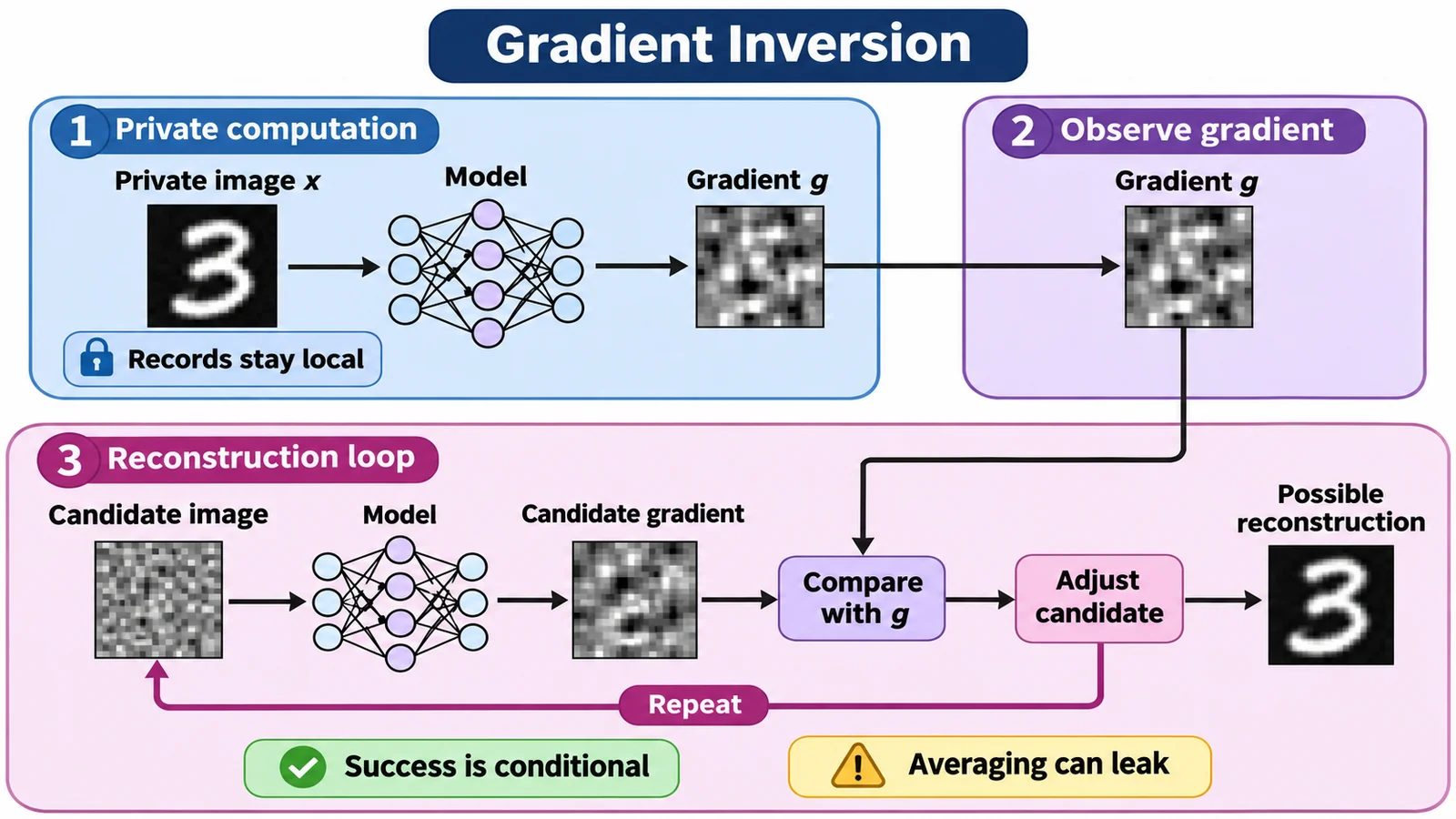
The sharpest demonstration concerns gradients, the directions in which a model's parameters should move to reduce its error on a batch of local data. A gradient is a summary, and the intuition is that a summary of many records should not disclose any one of them. That intuition fails.
By exploiting a magnitude-invariant loss together with optimisation strategies borrowed from adversarial attacks, it is possible to reconstruct images at high resolution from knowledge of their parameter gradients, and the reconstruction works even for trained deep networks. The same work proves that any input to a fully connected layer can be reconstructed analytically, independent of the rest of the architecture, and shows that averaging gradients over several iterations or several images does not protect a user's privacy in computer-vision applications.[21] Averaging, in other words, is not a defence. A site that uploads a gradient has uploaded something from which a picture of its data may be recovered.
This is why the privacy question cannot be settled by the architecture alone. The federated round is designed so that records never travel, and it succeeds at that. What travels instead is a mathematical function of the records, and the security of the arrangement depends on how hard that function is to invert. Against a determined adversary with the right optimisation procedure, it has proved not hard enough.
What else can be inferred
Reconstruction is the most vivid attack, but not the only one. Surveys of the field catalogue privacy attacks and defenses alongside poisoning attacks and defenses, and note that federated protocol designs have been shown to be vulnerable to adversaries inside or outside the system, compromising both data privacy and system robustness.[22] The distinction between an inside and an outside adversary matters for how a federation is governed, because the defences that make sense against one are not the defences that make sense against the other.
The practical upshot is that a federation's privacy properties have to be argued rather than assumed. The claim that no data leaves the building is true and worth having. The claim that nothing about the data can leave the building is a different claim, and it requires additional machinery.
Adding noise, and paying for it
One of the main approaches is differential privacy, which protects individuals by adding noise, either to the data or to the learning parameters, so that an attacker cannot retrieve the sensitive information of any individual in the training set.[23] The guarantee is a bound on how much the output can change when one person's record is added or removed. The cost is accuracy: noise degrades the model, and the design question is how much privacy is worth how much performance.
In federated settings the noise can be added at the client, before aggregation, so that the server never sees a clean update. One framework does exactly this, adding artificial noise to parameters on the clients' side before aggregation, and proves that it satisfies differential privacy at distinct protection levels by adapting the variance of the noise. Its analysis exposes the trade-off in a usable form: better convergence performance corresponds to a lower protection level, increasing the number of participating clients improves convergence at a fixed protection level, and for a fixed protection level there is an optimal number of aggregation rounds in terms of convergence performance. For a fixed protection level, the analysis finds an optimal number of aggregation rounds in terms of convergence performance, so a federation may do best by stopping at a particular point rather than training to convergence.[24]
Client-level differential privacy takes a coarser aim: rather than hiding individual records, it hides whether a given client participated at all. An algorithm for this hides clients' contributions during training and balances privacy loss against model performance, and empirical work suggests that with a sufficiently large number of participating clients it can maintain client-level privacy at only a minor cost in model performance.[25] The qualifier carries the weight. The guarantee depends on many participants, because each one's contribution is buried among the rest, and a small federation cannot lean on that.
Encrypting what is sent
A different strategy avoids degrading the numbers at all. Homomorphic encryption allows computation on encrypted values, so that gradients can be transmitted and combined without ever being exposed in the clear. One framework has learning parties transmit only encrypted gradients, and reports that the resulting model has almost the same accuracy as the unencrypted version, with a deviation of less than 1 percent, while an improved Paillier algorithm speeds training by 25 to 28 percent. The source notes the computational overhead of homomorphic encryption and that an improved Paillier algorithm can speed up training by 25–28%.[26]
The honest summary
None of this makes federated learning a bad idea; it makes it an incomplete one. The architecture removes the need to share patient data between institutions, and that is a real gain [1, 2]. What remains is a set of channels that can be addressed with additional mechanisms: noise buys a provable guarantee at some price in accuracy [11, 50], encryption buys confidentiality at some price in computation, and client-level guarantees buy protection for participation at a price that falls as the federation grows.[26][25] A collaboration that wants a defensible privacy claim has to choose which of these it is paying for, and say so.
Federated learning keeps records in place, but gradients can be inverted and models can be interrogated; differential privacy and encryption close those channels at a measurable cost.
Poisoned updates and dishonest participants
A federation is a trust arrangement as much as a technical one. The server never inspects a site's records, so it cannot check that the update a site submits was honestly computed from those records. It receives a set of numbers and folds them into the shared model. That openness is what makes the collaboration possible, and it is also the opening for a participant who wants the model to fail.
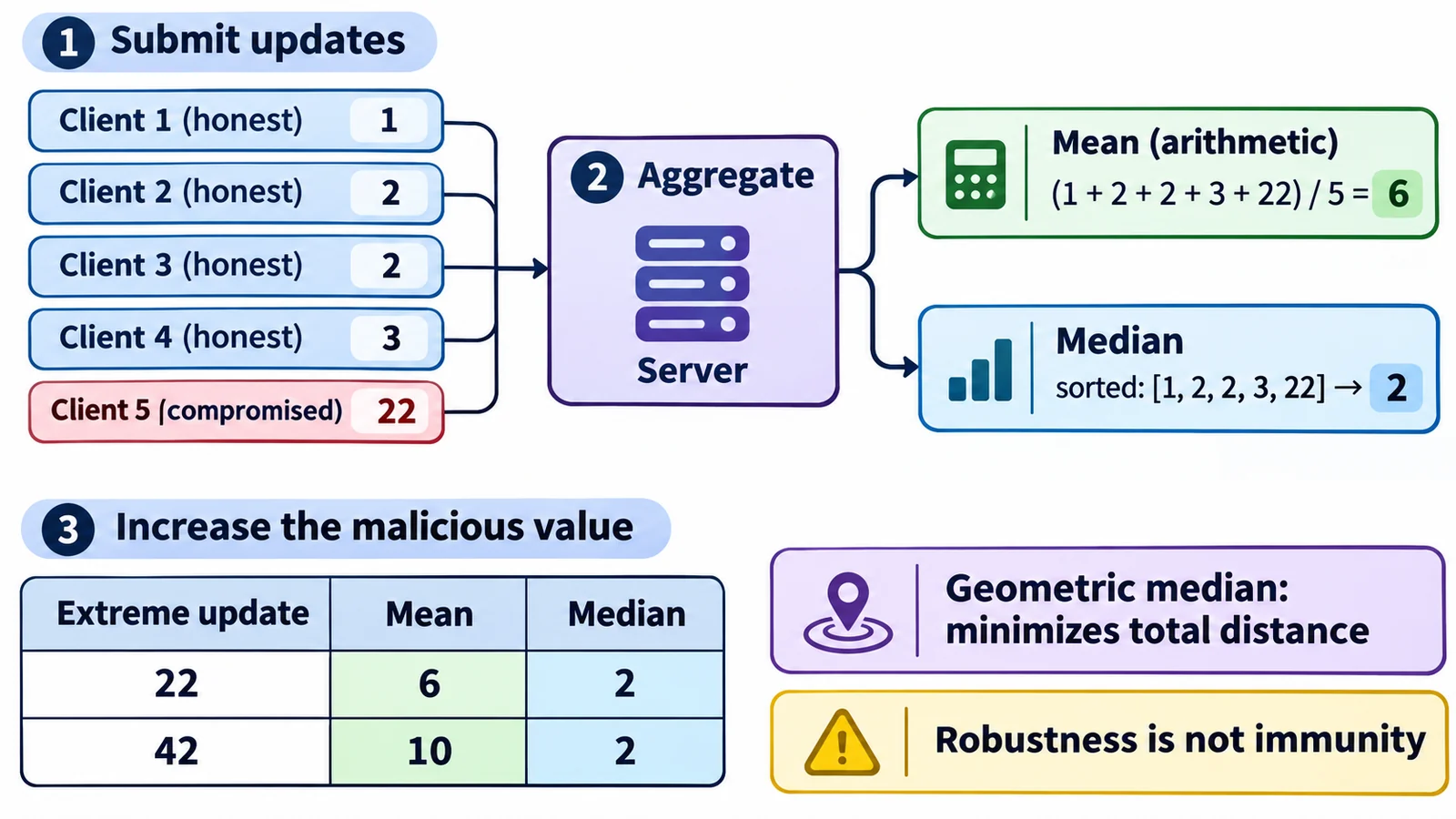
A single, non-colluding malicious agent can manipulate the local model parameters during training so that the global model misclassifies chosen inputs, and can do so while maintaining stealth.[27] The attack does not require breaking any encryption or intercepting any traffic. It requires only joining the federation and lying.
The simplest version is a model poisoning attack, in which a compromised client submits an update designed to corrupt the shared model rather than to improve it. A single non-colluding malicious agent can pursue this by boosting the magnitude of its update to overpower the others, and can make the attack stealthier by alternating between minimising its own training loss and pursuing its adversarial goal, so that its submissions resemble those of a genuine participant. The aim is to make the global model misclassify a specific set of chosen inputs with high confidence. Interpretability techniques applied to the benign and malicious models produced explanations that were nearly visually indistinguishable, which means the usual human checks offer little warning.[27]
Poisoning is made substantially worse by sybils, fake participants that one adversary controls under many identities. Federated learning approaches are susceptible to model poisoning, which is made substantially worse in the presence of sybils. One defence, FoolsGold, identifies poisoning sybils by looking at the diversity of client updates during training, on the reasoning that sybils coordinating an attack will submit suspiciously similar updates; it does not bound the expected number of attackers and needs no information from outside the learning process.[28]
Aggregation that resists a bad contribution
If individual updates cannot be trusted, the aggregation step itself can be hardened. Ordinary federated averaging is fragile by design: a sufficiently large or extreme update drags the mean toward itself, so one determined client can move the model a long way. Robust aggregation replaces the mean with a statistic that a minority cannot shift. One such method, Robust Federated Aggregation, aggregates updates using the geometric median, a generalisation of the median to many dimensions that is computed efficiently with a Weiszfeld-type algorithm, and it aggregates without revealing each device's individual contribution.[29] The median is the natural choice because it ignores extreme values: a handful of corrupted updates at the edge of the distribution do not move it, whereas they would move an average.
The same work offers two variants, a faster one with one-step robust aggregation and another with on-device personalisation, and reports experiments with additive models and deep networks across three tasks in computer vision and natural language processing. There, robust aggregation was competitive with the classical approach when corruption was low, and demonstrated greater robustness under high corruption.[29] The shape of that result is worth noting: robustness costs little when nothing is wrong, and pays off when something is.
When the defence can still be broken
Robust aggregation raises the price of an attack; it does not close the door. A systematic study of local model poisoning formulated the attacker's problem as an optimisation and applied it to four federated learning methods that had been claimed to be robust against Byzantine failures, meaning failures or manipulations by faulty or malicious clients. On four real-world datasets, the attacks substantially increased the error rates of models learned by those methods.[30] The lesson is that a defence designed against one kind of corruption can be defeated by an adversary who knows the defence and optimises against it. Two defences borrowed from work on data poisoning were generalised to counter these attacks; one proved effective in some cases, but the defences were not effective enough in others, leaving a clear need for new ones.[30]
What this means for a federation is that robustness has to be treated as an ongoing contest rather than a setting to be switched on. The geometric median protects against a minority of extreme updates, and sybil detection protects against coordinated duplicates, but an adversary who studies the aggregation rule can shape an update that survives it. The practical responses are the unglamorous ones: limit who may join, authenticate participants so that one adversary cannot hold many identities, and treat the shared model as something to be audited rather than assumed sound. None of these is specific to federated learning; what is specific is that the server has no data of its own against which to check a suspicious update, so the checks must come from the participants and from the design of the aggregation itself.
A federation cannot verify that an update was honestly computed, so it must aggregate in a way that a lying minority cannot steer, and assume that someone will try.
Why federated learning is not simply better
The case for federated learning is easy to state and easy to overstate. It lets institutions train a shared model without pooling records, and on the tasks measured so far it recovers most of what pooling would have given. That is a genuine achievement. It is not the same as saying a federation is the better way to train a model, and the difference matters to anyone deciding whether to join one.
The first limit is quality. A federation is not a drop-in replacement for a central pool, and the study that compared the two directly found that federated models reached 99% of the model quality achieved with centralized data, performing comparably to pooled training.[2] The size of that gap depends on the task, the number of sites and how unevenly their data are spread, so it cannot be read off one result and applied to another. A collaboration weighing the trade is comparing a model it can build lawfully against one it cannot, and the honest framing is that it is paying a modest price in accuracy for a large gain in what is permitted.
The second limit is organisational. Federated learning does not remove the need for agreement; it relocates it. Institutions that train together must settle the scope, the aim and the technologies used, and because the practice is still novel these terms can be difficult to pin down. They must also agree on how data are structured, annotated and reported, so that what one site contributes is intelligible to the others, and that harmonisation is up-front work done before any model is trained.[1] A federation is therefore a governance arrangement with a technical component, not a piece of software that can be installed and forgotten.
Infrastructure is the third cost. Each participating site needs computing capacity on its own premises, or a private cloud arrangement, sufficient to train the model locally, and the amount required depends on whether the site only evaluates the shared model or also trains it. Even relatively small institutions can participate and benefit from the collective model, though each site needs on-premise computing infrastructure or private-cloud provision.[1] The traffic between sites is a recurring cost as well, and the methods that keep it manageable are the subject of an earlier section.
Stability is a subtler drawback. Centralised training on pooled data is a single, well-understood optimisation: the data are shuffled together and the model descends a loss surface that reflects all of them. Federated training is a sequence of local optimisations whose results are averaged, and the averaging introduces behaviour that pooled training does not have. The clearest evidence comes from cyclic institutional incremental learning, the sequential alternative to federated averaging, where a model passed from site to site and cycled repeatedly through institutions shows a quasi-periodic pattern of performance drops as it revisits institutions, a signature of forgetting what it learned earlier. In federated averaging, the results of institutional training are aggregated at the end of each round, mitigating the bias of individual institutional training.[2]
The last limit is the one most easily forgotten. Federated learning keeps records in place, and that is a real privacy gain, but the claim that a federation protects its participants depends on mechanisms added on top of the architecture rather than on the architecture itself. Protocol designs have been shown to be vulnerable to adversaries inside and outside the system, compromising both privacy and robustness.[22] A collaboration that wants a defensible privacy claim has to say which additional mechanism it is relying on and what that mechanism costs.
None of this argues against federated learning. It argues against treating it as a free upgrade. The gains are real and the costs are real, and a federation is worth building when the data it unlocks are worth more than the accuracy, coordination and infrastructure it demands.
Federated learning trades a little accuracy and a lot of coordination for access to data that could not otherwise be used together.
Later developments
Where the field is heading
The problems that remain open are not incidental gaps waiting to be filled by better engineering. They are the places where the paradigm's assumptions are thinnest, and each one points to a direction of travel.
The first is heterogeneity, in both senses the term carries. Data across sites differ, and so do the sites themselves: devices and institutions vary in computing power, connection quality and the amount of data they hold, and training across such a network requires departing from the standard approaches to large-scale machine learning and distributed optimisation.[31] The methods surveyed earlier steady a shared model or replace it with several local ones, but the underlying question of how much a federation should insist on consensus remains unsettled. Personalisation is the live alternative: if heterogeneity is a universal property of real-world data, then adapting the shared model to each client rather than forcing one model on all of them becomes a design goal in its own right.[32]
Incentives are a second open front. A federation asks participants to spend computation and bandwidth training a model they do not own outright, and the usual mechanisms for rewarding contribution do not transfer, because the server cannot see what each participant holds and therefore cannot easily judge what each one is worth.[12] Designing a scheme that pays sites fairly without asking them to reveal their data is a problem in mechanism design as much as in machine learning, and it becomes more pressing as federations grow beyond a handful of willing partners.
Scale brings its own set of unsolved questions. Training across many clients, each with unreliable and relatively slow connections, strains the communication budget in ways that a small collaboration does not feel, and the open problems multiply with the number of participants.[33] A federation of thirty institutions is a different object from one of thousands, and the techniques that work at the smaller scale are not guaranteed to survive the larger.
Standardisation is the quiet prerequisite for all of it. Federated efforts require agreements that define scope, aim and the technologies used, and because the practice is still novel these terms can be difficult to pin down; today's large-scale initiatives are, in effect, the pioneers of tomorrow's standards for safe and fair collaboration.[1] The same point applies to the systems themselves. As researchers try to support more model types and more privacy mechanisms, there is a need for infrastructures that make federated algorithms easier to build, in the way that deep learning frameworks made neural networks easier to build.[34]
What ties these threads together is a shift in what collaboration means. The older model was data sharing: institutions contributed records to a common pool and drew conclusions from it. The federated model is closer to knowledge sharing, in which each participant keeps its data and contributes what the data taught the model, so that collaboration happens at the level of what has been learned rather than what was collected. A large FL study, spanning 71 sites across 6 continents to build a tumour boundary detector for a rare cancer, is offered as evidence that FL works at a scale and task complexity where centralizing data is challenging or infeasible, and as a reason to expect more collaborations of that shape.[5]
Whether the field delivers on that expectation depends less on any single algorithm than on whether the open problems above are treated as first-class research rather than as details to be settled later. The architecture has been shown to work. The institutions, standards and incentives that would let it work routinely are still being built.
The technical core works; what remains is the harder work of making federations fair, standard and large.
Key studies
| Year | Study | Sample | Design | Finding |
|---|---|---|---|---|
| 2016 | Konečný et al.[18] | mobile phone clients with slow, unreliable connections | communication-efficiency experiments on convolutional and recurrent networks | Structured and sketched updates reduced communication cost by two orders of magnitude. |
| 2018 | Zhao et al.[3] | edge devices with skewed local data | federated learning experiments on non-IID data | Accuracy fell by up to 55% for highly skewed non-IID data, and sharing 5% of data globally raised CIFAR-10 accuracy by 30%. |
| 2018 | Hard et al.[6] | smartphone keyboard users | comparison of server-based training and on-device federated averaging | The federated algorithm achieved better prediction recall for next-word prediction. |
| 2018 | Tian et al.[13] | federated networks with heterogeneous devices and data | algorithm comparison on realistic federated datasets | FedProx improved absolute test accuracy by 22% on average over FedAvg in highly heterogeneous settings. |
| 2020 | Sheller et al.[2] | federated learning experiment with five-fold collaborative cross validation | Federated models reached 99% of centralized model quality, and federated training raised quality 2.63% over single-institution models on their own validation data. | |
| 2020 | Liu et al.[10] | organizations contributing traffic flow data | federated gated recurrent unit model with clustering | With privacy preserved, the model's mean average error came within 0.76 km/h of the best published result. |
| 2021 | Dayan et al.[4] | 20 institutes and 16,148 COVID-19 cases | multicontinent federated model development and evaluation | EXAM reached average area under the curve above 0.92 at 24 and 72 hours, with a 16% average area under the curve improvement and 38% generalizability increase over single-site models. |
| 2021 | Fang & Qian[26] | multiple learning parties | privacy-preserving framework using partially homomorphic encryption and federated learning | The trained model had almost the same accuracy with deviation less than 1%, and an improved Paillier algorithm sped training by 25 to 28%. |
| 2021 | Chen et al.[17] | edge devices over resource-limited wireless networks | communication-efficient federated learning framework with device selection and quantization | The framework improved identification accuracy by up to 3.6% and convergence time by up to 87% compared with standard federated learning. |
| 2021 | Warnat-Herresthal et al.[8] | more than 16,400 blood transcriptomes from 127 clinical studies and more than 95,000 chest X-ray images | decentralized Swarm Learning without a central coordinator | Swarm Learning classifiers outperformed those developed at individual sites. |
| 2022 | Pati et al.[5] | 6,314 glioblastoma patients from 71 sites across 6 continents | staged federated training of a tumor boundary detector | Compared with a model trained on public data, the federated model showed a 33% delineation improvement for the surgically targetable tumor and a 23% improvement for the complete tumor extent. |
| 2022 | Wu et al.[20] | three privacy-sensitive scenarios | federated learning with adaptive mutual knowledge distillation and gradient compression | FedKD reduced communication cost by up to 94.89% while achieving competitive results with centralized model learning. |
See also
References
- Rieke, N., Hancox, J., Li, W., Milletarì, F., Roth, H. R., Albarqouni, S., Bakas, S., Galtier, M. N., Landman, B. A., Maier-Hein, K., Ourselin, S., Sheller, M., Summers, R. M., Trask, A., Xu, D., Baust, M., & Cardoso, M. J. (2020). The future of digital health with federated learning. npj Digital Medicine, 3(1). doi:10.1038/s41746-020-00323-1
- Sheller, M. J., Edwards, B., Reina, G. A., Martin, J., Pati, S., Kotrotsou, A., Milchenko, M., Xu, W., Marcus, D., Colen, R. R., & Bakas, S. (2020). Federated learning in medicine: facilitating multi-institutional collaborations without sharing patient data. Scientific Reports, 10(1). doi:10.1038/s41598-020-69250-1
- Zhao, Y., Li, M., Lai, L., Suda, N., Civin, D., & Chandra, V. (2018). Federated Learning with Non-IID Data. arXiv. doi:10.48550/arxiv.1806.00582 Free full text
- Dayan, I., Roth, H. R., Zhong, A., Harouni, A., Gentili, A., Abidin, A. Z., Liu, A., Costa, A. B., Wood, B. J., Tsai, C. S., Wang, C. H., Hsu, C. N., Lee, C. K., Ruan, P., Xu, D., Wu, D., Huang, E., Kitamura, F. C., Lacey, G., & ... Li, Q. (2021). Federated learning for predicting clinical outcomes in patients with COVID-19. Nature Medicine, 27(10), 1735-1743. doi:10.1038/s41591-021-01506-3
- Pati, S., Baid, U., Edwards, B., Sheller, M., Wang, S. H., Reina, G. A., Foley, P., Gruzdev, A., Karkada, D., Davatzikos, C., Sako, C., Ghodasara, S., Bilello, M., Mohan, S., Vollmuth, P., Brugnara, G., Preetha, C. J., Sahm, F., Maier-Hein, K., & ... Bakas, S. (2022). Federated learning enables big data for rare cancer boundary detection. Nature Communications, 13(1). doi:10.1038/s41467-022-33407-5
- Hard, A., Kanishka, R., Mathews, R., Swaroop, R., Beaufays, F., Augenstein, S., Eichner, H., Kiddon, C., & Ramage, D. (2018). Federated Learning for Mobile Keyboard Prediction. arXiv. doi:10.48550/arxiv.1811.03604 Free full text
- Xu, J., Glicksberg, B. S., Su, C., Walker, P., Bian, J., & Wang, F. (2021). Federated Learning for Healthcare Informatics. Journal of Healthcare Informatics Research, 5(1), 1-19. doi:10.1007/s41666-020-00082-4
- Warnat-Herresthal, S., Schultze, H., Shastry, K. L., Manamohan, S., Mukherjee, S., Garg, V., Sarveswara, R., Händler, K., Pickkers, P., Aziz, N. A., Ktena, S., Tran, F., Bitzer, M., Ossowski, S., Casadei, N., Herr, C., Petersheim, D., Behrends, U., Kern, F., & ... Schultze, J. L. (2021). Swarm Learning for decentralized and confidential clinical machine learning. Nature, 594(7862), 265-270. doi:10.1038/s41586-021-03583-3
- Kim, H., Park, J., Bennis, M., & Kim, S. L. (2020). Blockchained On-Device Federated Learning. IEEE Communications Letters, 24(6), 1279-1283. doi:10.1109/lcomm.2019.2921755
- Liu, Y., Yu, J. J. Q., Kang, J., Niyato, D., & Zhang, S. (2020). Privacy-Preserving Traffic Flow Prediction: A Federated Learning Approach. IEEE Internet of Things Journal, 7(8), 7751-7763. doi:10.1109/jiot.2020.2991401
- Nguyen, D. C., Ding, M., Pathirana, P. N., Seneviratne, A., Li, J., & Vincent Poor, H. (2021). Federated Learning for Internet of Things: A Comprehensive Survey. IEEE Communications Surveys & Tutorials, 23(3), 1622-1658. doi:10.1109/comst.2021.3075439
- Zhan, Y., Li, P., Qu, Z., Zeng, D., & Guo, S. (2020). A Learning-Based Incentive Mechanism for Federated Learning. IEEE Internet of Things Journal, 7(7), 6360-6368. doi:10.1109/jiot.2020.2967772
- Tian, L., Sahu, A. K., Zaheer, M., Sanjabi, M., Talwalkar, A., & Smith, V. (2018). Federated Optimization in Heterogeneous Networks. arXiv. doi:10.48550/arxiv.1812.06127 Free full text
- Karimireddy, S. P., Kale, S., Mohri, M., Reddi, S. J., Stich, S. U., & Suresh, A. T. (2019). SCAFFOLD: Stochastic Controlled Averaging for Federated Learning. arXiv. doi:10.48550/arxiv.1910.06378 Free full text
- Sattler, F., Muller, K. R., & Samek, W. (2021). Clustered Federated Learning: Model-Agnostic Distributed Multitask Optimization Under Privacy Constraints. IEEE Transactions on Neural Networks and Learning Systems, 32(8), 3710-3722. doi:10.1109/tnnls.2020.3015958
- Ghosh, A., Chung, J., Yin, D., & Ramchandran, K. (2022). An Efficient Framework for Clustered Federated Learning. IEEE Transactions on Information Theory, 68(12), 8076-8091. doi:10.1109/tit.2022.3192506
- Chen, M., Shlezinger, N., Poor, H. V., Eldar, Y. C., & Cui, S. (2021). Communication-efficient federated learning. Proceedings of the National Academy of Sciences, 118(17). doi:10.1073/pnas.2024789118
- Konečný, J., McMahan, H. B., Yu, F. X., Richtárik, P., Suresh, A. T., & Bacon, D. (2016). Federated Learning: Strategies for Improving Communication Efficiency. arXiv. doi:10.48550/arxiv.1610.05492 Free full text
- Reisizadeh, A., Mokhtari, A., Hassani, H., Jadbabaie, A., & Pedarsani, R. (2019). FedPAQ: A Communication-Efficient Federated Learning Method with Periodic Averaging and Quantization. arXiv. doi:10.48550/arxiv.1909.13014 Free full text
- Wu, C., Wu, F., Lyu, L., Huang, Y., & Xie, X. (2022). Communication-efficient federated learning via knowledge distillation. Nature Communications, 13(1). doi:10.1038/s41467-022-29763-x
- Geiping, J., Bauermeister, H., Dröge, H., & Moeller, M. (2020). Inverting Gradients -- How easy is it to break privacy in federated learning? arXiv. doi:10.48550/arxiv.2003.14053 Free full text
- Lyu, L., Yu, H., Ma, X., Chen, C., Sun, L., Zhao, J., Yang, Q., & Yu, P. S. (2024). Privacy and Robustness in Federated Learning: Attacks and Defenses. IEEE Transactions on Neural Networks and Learning Systems, 35(7), 8726-8746. doi:10.1109/tnnls.2022.3216981
- Ouadrhiri, A. E., & Abdelhadi, A. (2022). Differential Privacy for Deep and Federated Learning: A Survey. IEEE Access, 10, 22359-22380. doi:10.1109/access.2022.3151670
- Wei, K., Li, J., Ding, M., Ma, C., Yang, H. H., Farokhi, F., Jin, S., Quek, T. Q. S., & Vincent Poor, H. (2020). Federated Learning With Differential Privacy: Algorithms and Performance Analysis. IEEE Transactions on Information Forensics and Security, 15, 3454-3469. doi:10.1109/tifs.2020.2988575
- C., G. R., Klein, T., & Nabi, M. (2017). Differentially Private Federated Learning: A Client Level Perspective. arXiv. doi:10.48550/arxiv.1712.07557 Free full text
- Fang, H., & Qian, Q. (2021). Privacy Preserving Machine Learning with Homomorphic Encryption and Federated Learning. Future Internet, 13(4), 94. doi:10.3390/fi13040094
- Bhagoji, A. N., Chakraborty, S., Mittal, P., & Calo, S. B. (2018). Analyzing Federated Learning through an Adversarial Lens. arXiv. doi:10.48550/arxiv.1811.12470 Free full text
- Fung, C., Yoon, C. J. M., & Beschastnikh, I. (2018). Mitigating Sybils in Federated Learning Poisoning. arXiv. doi:10.48550/arxiv.1808.04866 Free full text
- Pillutla, K., Kakade, S. M., & Harchaoui, Z. (2022). Robust Aggregation for Federated Learning. IEEE Transactions on Signal Processing, 70, 1142-1154. doi:10.1109/tsp.2022.3153135
- Fang, M., Cao, X., Jinyuan, J., & Gong, N. Z. (2019). Local Model Poisoning Attacks to Byzantine-Robust Federated Learning. arXiv. doi:10.48550/arxiv.1911.11815 Free full text
- Li, T., Sahu, A. K., Talwalkar, A., & Smith, V. (2020). Federated Learning: Challenges, Methods, and Future Directions. IEEE Signal Processing Magazine, 37(3), 50-60. doi:10.1109/msp.2020.2975749
- Tan, A. Z., Yu, H., Cui, L., & Yang, Q. (2023). Towards Personalized Federated Learning. IEEE Transactions on Neural Networks and Learning Systems, 34(12), 9587-9603. doi:10.1109/tnnls.2022.3160699
- Kairouz, P., & McMahan, H. B. (2021). Advances and Open Problems in Federated Learning. Foundations and Trends® in Machine Learning, 14(1-2), 1-210. doi:10.1561/2200000083
- Li, Q., Wen, Z., Wu, Z., Hu, S., Wang, N., Li, Y., Liu, X., & He, B. (2023). A Survey on Federated Learning Systems: Vision, Hype and Reality for Data Privacy and Protection. IEEE Transactions on Knowledge and Data Engineering, 35(4), 3347-3366. doi:10.1109/tkde.2021.3124599
Cite this page: Atlas Nova editors. (2026). Federated learning. Atlas Nova. https://velocer.io/atlas/federated-learning/