Technology · Machine learning
Gradient boosting
Machine learning technique
Gradient boosting is a machine learning technique that builds a strong predictive model by combining many weak models, such as decision trees, in a sequential way to reduce errors. It uses gradient descent in function space to minimize prediction errors.[1]
It improves predictions by adding trees one at a time to correct errors.[1] It works well with tabular data and handles complex patterns like interactions.[2] The GBMCI model, implemented in R, is designed for survival analysis by optimizing the concordance index through gradient boosting.[3] LGBM may overfit due to its leaf-wise growth strategy.[4]
Key facts
| 157590 | 157,590 models trained to compare gradient boosting variants in QSAR prediction (Boldini et al., 2023)[5] |
|---|---|
| 0.8975 | AUC of 0.8975 for CatBoost in landslide susceptibility mapping (Sahin, 2022)[6] |
| 98.1 | 98.1% accuracy in diabetes diagnosis using LightGBM (Rufo et al., 2021)[7] |
| 0.156 | MAPE of 0.156 in a hybrid LGBM-XGBoost house price model (Sibindi et al., 2023)[4] |
Overview
How Gradient Boosting Works: The Core Algorithm
Friedman frames function estimation differently, calling it numerical optimization in function space rather than parameter space.[1] A loss function measures how wrong predictions are and helps improve the model step by step.[1][8][3] Common loss functions for regression include least-squares, least absolute deviation and Huber-M loss. The algorithm minimizes loss using gradients and moves in the direction of steepest descent, an approach called gradient descent boosting. It uses gradients to guide new model addition.[1][8]
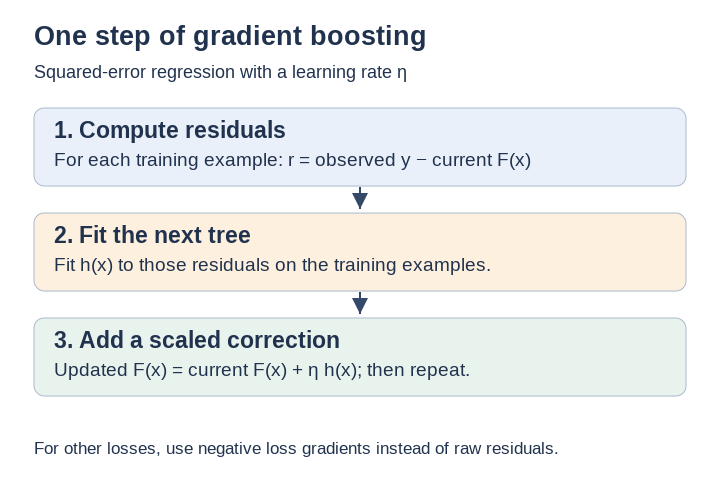
Weak learners are often regression trees that split the data based on feature values.[1][8][3] The final prediction is the sum of all the weak learners' outputs, weighted by learning rates.[1][8][2] Friedman links stagewise additive expansions to steepest-descent minimization.[1]
Gradient boosting can find nonlinear patterns and feature interactions, and it automatically discovers complex data structures, handling nonlinearity and high-order interactions among predictors. It works well with many input features, which suits high-dimensional data.[1][8][2] For survival analysis, it directly improves the concordance index.[3] Some applications are designed to be fair, and a penalty based on optimal transport distances can be added. This in-processing approach adjusts the model during training and improves fairness.[9] TreeBoost models interpret regression and classification results.[1]
Gradient boosting builds a prediction model step by step, adding new components that correct errors made by earlier ones. Each new part is a simple model, often a decision tree trained to fix errors in the current model. The process starts with a basic prediction, like the average of the target values, and then improves it incrementally. At each step, the algorithm calculates the gradient of the loss function, which shows the direction of the largest error in current predictions. This gradient guides the training of the next weak learner, which is fitted to predict the negative gradient values. The new model's predictions are added to the old model, and a small learning rate helps prevent overfitting. This step-by-step addition continues for a set number of steps, or stops when the error no longer drops much. The final model is the sum of all the weak learners, each contributing a small correction to the overall prediction. Natekin and Knoll describe the method as customizable, including learning with different loss functions.[10]
The loss function measures how far the model's predictions are from the true values and guides the learning process. Common loss functions include mean squared error for regression and log loss for classification. The loss function's gradient, taken with respect to the predictions, shows how to adjust the model to reduce error. Each new tree is trained to predict the negative gradient values, effectively learning to fix the model's current mistakes. This approach allows gradient boosting to work with different problems, since changing the loss function enables this flexibility. The algorithm can handle both regression and classification tasks, using the same core idea for each. The model improves slowly and steadily over time, which reduces error gradually. A smaller learning rate leads to more steps but often results in better generalization on unseen data. The number of iterations and learning rate are key settings that control how complex and how well the model performs.[10]
Practitioners use gradient boosting to predict outcomes, and bike-sharing demand is one example, where past data helps forecast future usage. A study used data from Konya and Washington, D.C., with weather and daily details as input for predictions, and CatBoost beat XGBoost and LightGBM when all models used their best settings.[11] In genomics, gradient boosting predicted traits in dairy cattle using 39,714 genetic markers. The original algorithm became random boosting, which picks markers at random at each step to speed up computation. Prediction accuracy was measured with the Pearson correlation, which compared actual values with predicted values. The model was tested on bulls born after 2005, using earlier bulls as training data, in a 2-fold cross-validation setup.[12]
Gradient boosting combines many simple models step-by-step to improve accuracy. Friedman introduced the method in 2001 as a general way to build additive models.[1] The framework works for regression, classification, and survival analysis by changing the loss function.[1][3] Using regression trees as weak learners led to TreeBoost, which is widely used for complex data.[1]
The method improves weak models and reduces errors in a series of steps, similar to steepest-descent optimization.[1] Traditional linear models often fail to capture these patterns.[2] A breast cancer study built a gradient boosting model for the concordance index, and it worked better than standard survival models across different sets of variables.[3] The method can find complex patterns automatically, which makes it good for data with hundreds or thousands of features.[2]
Gradient boosting is a common method in predictive modeling and is often used in clinical medicine.[2] In medicine, it finds high-risk patient groups by spotting complex patterns in data. It also supports monitoring of a deployed model by identifying features whose behavior degrades over time.[13]
Each new model learns from errors made by the last one, which improves accuracy over time.[10] Later researchers applied this idea to regression and other tasks using gradient-based optimization.[10][14] The method follows the negative gradient of the loss function, which reduces prediction error.[10] This let gradient boosting handle classification and regression, and it also worked for other statistical tasks.[10][14]
Gradient boosting trains decision trees one at a time, and each tree fixes errors made by the last one. The model starts with a simple prediction, such as the average value of the target variable. Each new tree learns from the residuals, which are the gaps between actual values and current model predictions. All trees contribute to the final prediction, and later trees have smaller effects to reduce overfitting. This step-by-step correction keeps going. The approach is flexible and can be used with different data types. Changing the loss function adapts it to prediction goals. This flexibility makes gradient boosting useful in many real-world cases.[10]
A 2013 review by Natekin and Knoll explained gradient boosting, covering core mechanics and practical use. The review noted that gradient boosting adjusts to problems by choosing the right loss function. The text explains how to limit model complexity to help avoid overfitting, and Natekin and Knoll discuss model complexity and how to handle it.[10] Binder, Gefeller, Schmid, and Mayr wrote a 2014 paper that traced boosting from machine learning to statistics. They noted that early boosting methods were seen as black-box tools, while newer versions could produce interpretable statistical models. Gradient boosting and likelihood-based boosting use the same basic ideas, though they are often treated as separate methods.[14]
In 2013, González-Recio, Jiménez-Montero and Alenda used gradient boosting for genome-assisted evaluation in dairy cattle.[12] Dombry and Duchamps published a 2024 study that looked at infinitesimal gradient boosting in large samples. When training samples are very large, the model acts like a fixed process that follows a differential equation. The limit on population size shows that test error keeps dropping over time.[15]
History
Origins and Evolution of Boosting
Friedman introduced the Gradient Boosting Machine in 2001.[16][17] This algorithm fits new models to correct previous errors.[17] The method became a leading tool in data competitions.[16] Researchers later developed variants like XGBoost and LightGBM.[18][19]
Traditional boosting processes all data at once in batches, while online learning updates models as new data arrives. Beygelzimer et al. extended boosting theory to this setting, and their work converts weak online learners into strong ones.[20]
Computational speed remains a key challenge for large datasets.[18][19] GPU implementations accelerate tree construction, and a GPU can process ten million instances efficiently.[18] Field-programmable gate arrays reduce energy consumption further: these accelerators use seventy-two times less energy than processors.[19]
Randomization schemes improve efficiency and speed up computational processes. Lu and Mazumder proposed the Randomized Gradient Boosting Machine, a variant that reduces search time in model spaces. It achieves good results with lower costs.[16]
Recent studies apply gradient boosting to neural networks. Emami and Martínez-Muñoz trained final layers sequentially. This approach matches standard solvers in performance and allows dynamic adjustment of model complexity.[21]
Main ideas
Core Algorithm and Mathematical Foundation
XGBoost is a library designed for speed and accuracy [3]. It handles complex systems accurately and clearly [3]. The method uses parallel tree boosting and solves data science problems quickly [3]. Python provides the low-level libraries needed for this performance [3].[22]
Automunge offers default feature encodings, using binarization for categorical features and z-score normalization for numeric data. Benchmarks show these defaults are top performers for tuning duration and performance. One hot encoding was less consistent, while categoric binarization did better.[23]
Algorithmic Mechanics and Structure
Gradient boosting adds models sequentially, combining weak learners into a strong ensemble model.[24] Each new step targets the mistakes made by previous steps.[25]
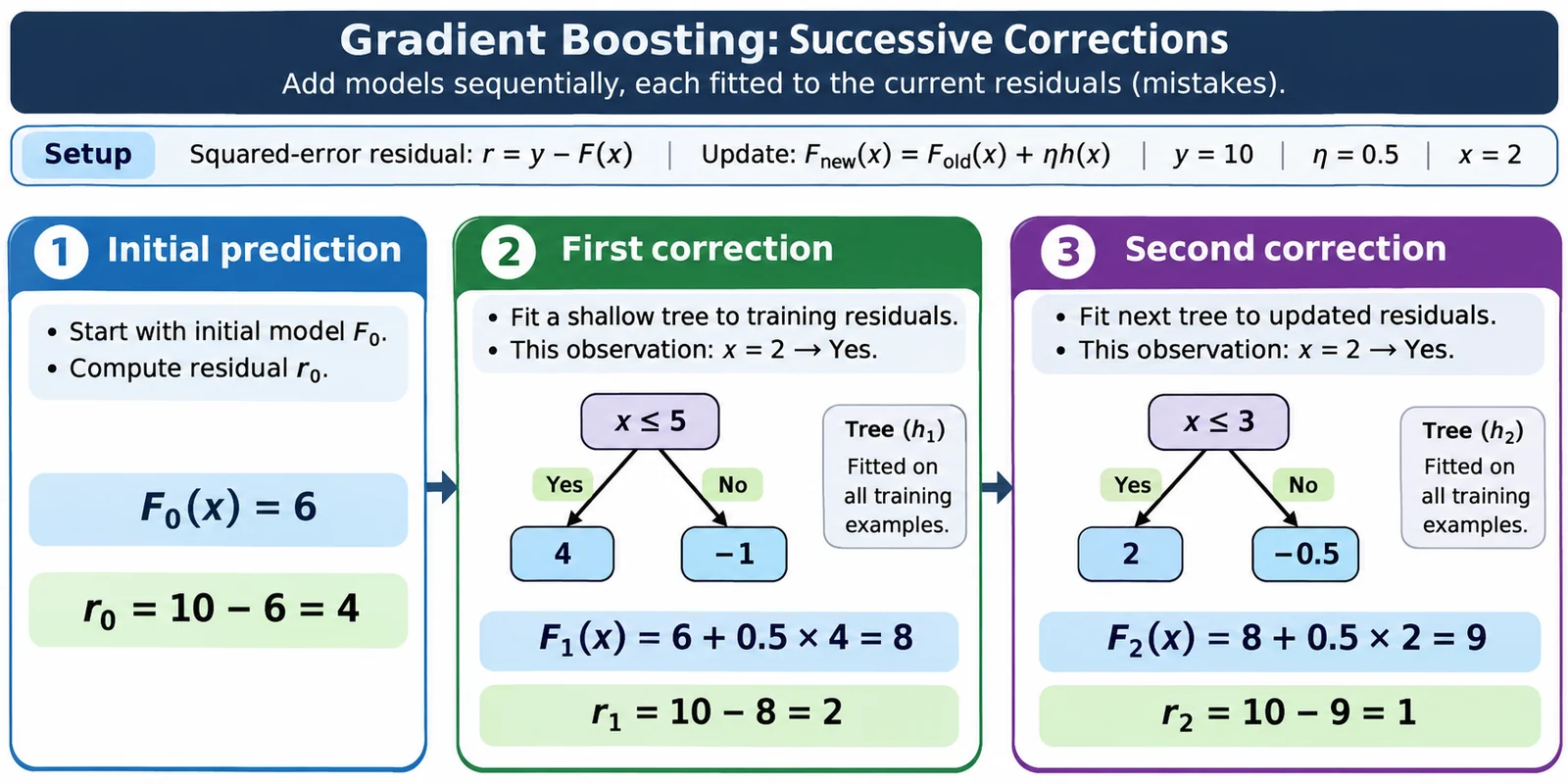
Researchers use shallow neural networks as these basic building blocks, and these networks handle classification and regression tasks within one framework. A fully corrective step fixes errors that come from greedy approximation methods.[25]
Neural Oblivious Decision Ensembles generalize decision trees to tabular data. This architecture uses gradient-based optimization, which enables end-to-end training. It outperforms standard packages on many datasets.[26]
Hopular applies modern Hopfield networks. Each layer accesses original input. It does so via stored data dependencies. The model updates predictions iteratively. It does this at every network layer.[27]
Gradient Boosted Neural Decision Forests merge tree benefits with deep learning. The system learns residuals using neural forests, and parameters update in contiguous steps, which allows efficient joint optimization.[28]
Representational Gradient Boosting estimates nested functions without fixed nodes. Backpropagation happens directly in the space of mathematical functions. This approach optimizes stacking by combining model classes jointly.[29]
Deep Learning for Multi-Output Regression clones models during the boosting process. New dense layers train on residuals from squared loss functions. Frozen previous layers reduce complexity and improve prediction accuracy.[30]
Gradient Boosting in Regression and Quantile Prediction
Gradient boosting works for regression, and Friedman derives algorithms for the least-squares loss function in regression.[31][32][1] A 2016 study compared gradient boosting with the lasso method, and they had similar accuracy and variable selection. Both methods work well with high-dimensional data, in which there are more predictors than data points.[31]
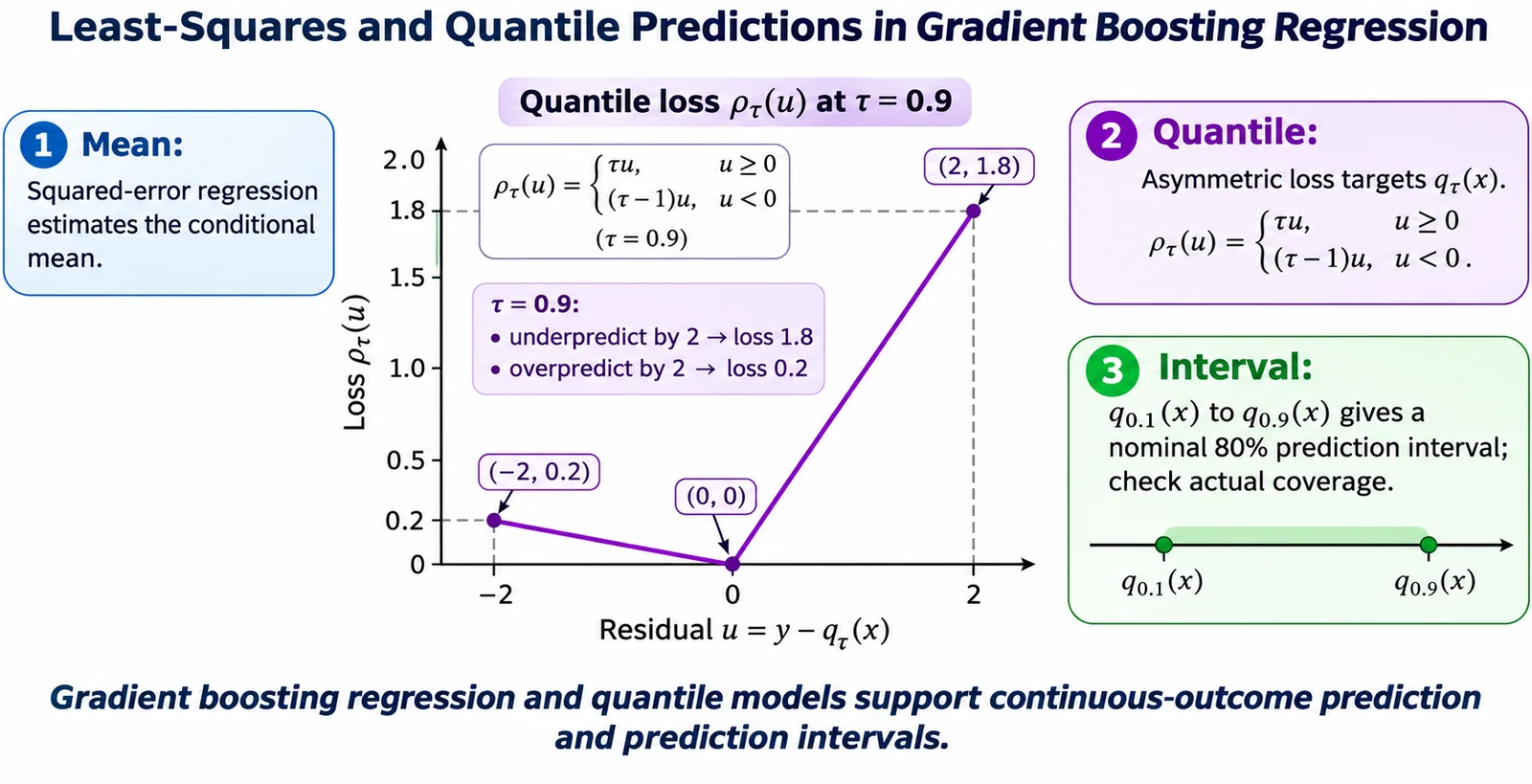
Classical quantile regression struggles with extreme values due to few data points in the tails. A 2023 study used gradient boosting to model extreme quantiles by fitting a generalized Pareto distribution. Tools like variable importance and partial dependence plots explain results and make model outputs easier to understand.[32]
Gradient boosting predicts future electricity use in energy forecasting, using past consumption, weather, and time-of-day data.[33][34] A 2022 study compared XGBoost, LSTM and SVR using one year of 30-minute energy data.[33] Another study used gradient boosting to predict energy demand across seven Italian electricity zones, with air temperature and past customer data as inputs. It worked well even with data from two months ago.[34]
A 2024 study used gradient boosting to predict CO2 solubility in water. It had a root mean square error of 0.137 mol/kg and an R² of 0.9976. The model found physical trends across pressure and temperature, and it labeled fewer than 5% of data points as outliers.[35]
In regression the model predicts a number, not a category, which fits problems where the outcome is measured on a scale.[36][37][38][39] A study forecasted spot truckload freight costs using carrier data from 2022 to 2024, with features including lane, shipment date, distance, and cargo weight.[36] The XGBoost model used previous day groundwater levels and achieved an R² of 0.92, much better than earlier results.[37] Gradient boosting solves regression problems in several fields, including transport, environmental science and water management, using real-world data.[36][37][40][38][39]
SimBoostQuant, from a 2017 study, gives prediction intervals that show how confident we can be in drug-target binding predictions. SimBoostQuant predicts continuous binding affinity values, which allows for a full range of interaction strengths.[38] CatBoost had the highest accuracy in a 2022 study on landslide risk, followed by XGBoost, LightGBM and GBM.[6]
Handling Categorical Features and Imbalanced Data
Imbalanced datasets can cause a problem: standard gradient boosting may favor the majority class and ignore the minority class. Balanced gradient boosting (BalaBoost) adjusts training by assuming equal numbers in each class, which reduces bias and improves detection of rare cases. Teramoto reports a result for BalaBoost: it did better than gradient boosting, Random Forests and Support Vector Machine.[41]
CatBoost handles categorical data without one-hot encoding.[42][43] Prokhorenkova and colleagues describe an algorithm that processes categorical features. CatBoost uses ordered boosting, a method that reduces target leakage by shuffling data to train each tree.[43] CatBoost can use categorical variables directly, which makes it strong for data with many categories, like in environmental and financial research.[42][43][44] A gradient boosting machine modeled how soil and terrain affect water flow across four climate zones in China.[45]
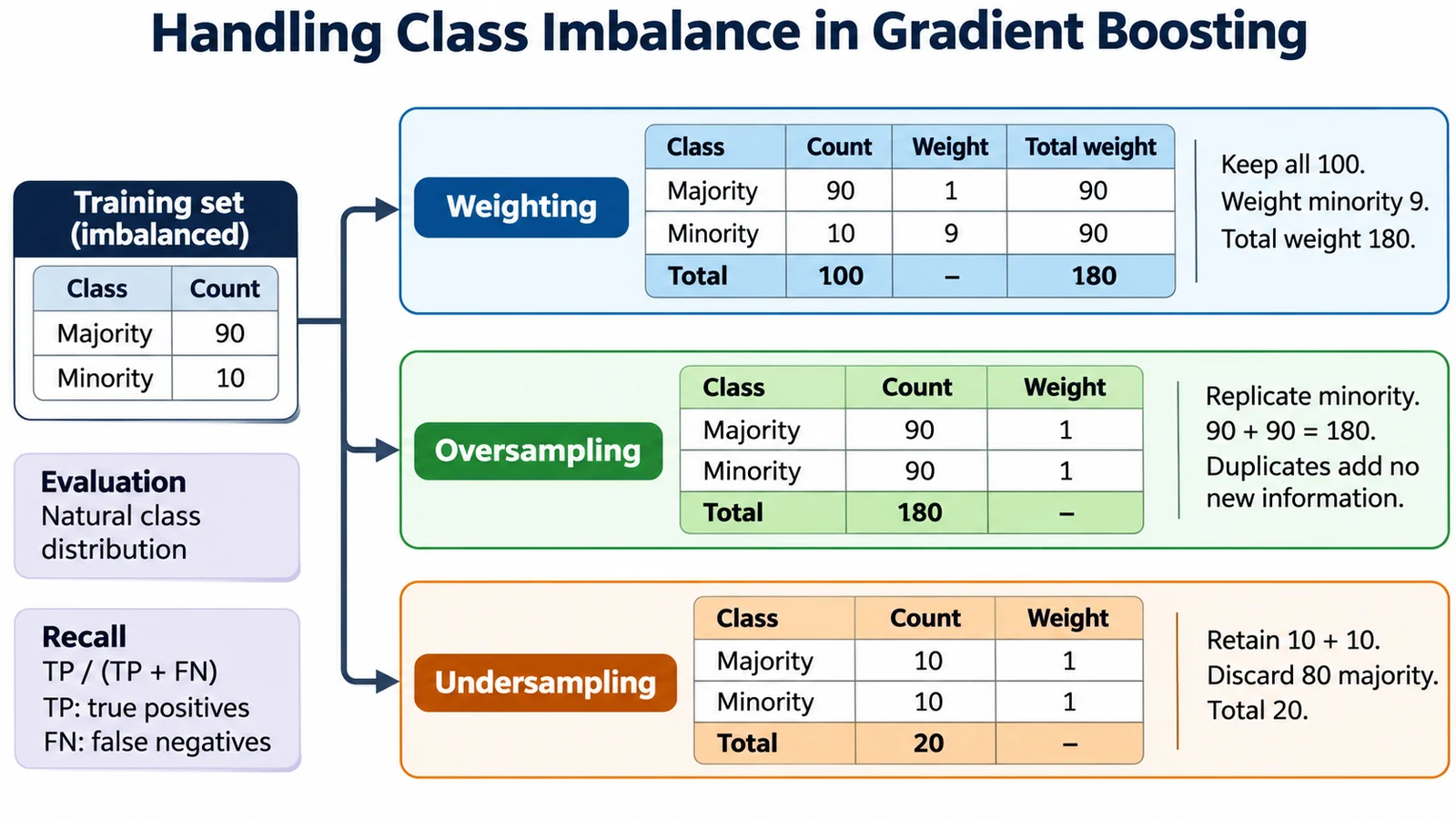
Class imbalance happens when one outcome is rare, and this can hurt model accuracy, especially in medical and fraud detection tasks. Gradient boosting changes how much weight each sample has during training, giving more weight to rare events like phishing attacks or credit defaults.[46][47] A study checked phishing detection, and a gradient boosting classifier worked well, focusing on rare but important malicious URLs.[46] The drought model used variational mode decomposition and past data to predict drought severity over different time periods.[48]
Some models use sampling methods like oversampling the minority class or undersampling the majority class to balance the training data.[47][48] A credit scoring study used bagging and boosting, which increased diversity among base learners and improved results on imbalanced financial data.[49] A gradient boosting model read speech data to find respiratory diseases, and its average accuracy was above 97%.[50] Ignoring sampling weights in gradient boosting can make results seem better than they are, which hurts how well the model works on new data.[51] Some data is hierarchical, as in small area estimation, and mixed effect gradient boosting models add random effects to handle group-level differences and data imbalance.[52]
Explainability and Interpretability in Gradient Boosting
Tools can explain how each prediction is made and show patterns in the data. A 2020 study introduced a method based on game theory that computed optimal local explanations. This method finds which input features most affect each prediction, and it also measures how features interact. Researchers combine many local explanations to show global patterns, such as hidden risk factors. This method revealed rare high-impact risk factors and identified distinct patient groups for mortality. These tools help users understand individual predictions and explain the overall model structure while retaining local faithfulness.[13]
In e-learning, XGBoost models predict student outcomes, including pass/fail status and grade quality. One study used UC Irvine data and found that last semester's GPA and parental education level were key predictors. The task was sorting good grades from not good grades, and course ID, job status and accommodation type had more influence. The model achieved 97.43% accuracy in pass/fail prediction, but only 80.07% in distinguishing good from not good grades.[53]
A 2022 study used a CNN and XGBoost together. They classified arousal, valence, and dominance from EEG signals. The method first converted EEG signals into spectrogram images. Then it used a CNN to extract features before applying XGBoost. This combined method reached 99.712% accuracy for arousal. It reached 99.770% for valence and 99.770% for dominance. High accuracy suggests gradient boosting can classify complex emotional states well. This works when combined with deep learning features.[54]
Gradient boosting models can be understood using tools like SHAP values. These assign each input feature a score. The score shows its contribution to a prediction.[55][56] SHAP values identified key features for hypertension risk. The key factors were blood pressure, BMI, physical activity and waist size. Triglycerides, age and LDL cholesterol also counted.[55]
Another study used SHAP. It showed attitude scores affected predictions. Practical scores had less effect. This revealed that non-academic traits have strong influence.[56]
Gradient Boosting ranked student confidence. This occurred in a science achievement study. It was the most important factor. These differences show feature importance changes. This happens within the same algorithm family. This depends on model tuning and data structure.[57]
Partial dependence plots show how one feature affects predictions. They do this by removing the influence of all other features. These results show how changes in age or blood pressure affect disease risk. All other factors stay the same.[55]
SHAP values rank feature relevance, and this approach aligns well with the structure of decision trees. A 2025 review recommends SHAP for interpreting these algorithms, and other methods are also available, including inTrees and RULECOSI+.[58] LIME helps explain individual predictions for transparency, and XAI techniques enable institutions to comply with regulations such as the EU AI Act. GBMs achieve over ninety-five percent accuracy with SHAP.[59]
FairGBM adds fairness constraints to gradient boosting training using a dual ascent learning framework, and this method causes little impact on performance. Observational fairness metrics are non-differentiable, and smooth convex error rate proxies solve this. Training time sees an order of magnitude speedup, and high-stakes domains like finance benefit from this.[60]
Uncertainty quantification avoids costly mistakes in high-risk apps, and ensembles produce uncertainty estimates. These ensembles detect anomalous inputs successfully, but they can improve total uncertainty only a limited amount. Virtual ensembles reduce complexity significantly, and only one model is needed for benefits.[61]
Research
Performance Evaluation and Benchmarking
A 2023 study compared LGBM, Random Forest, and XGBoost to classify downy mildew in melon leaves. Accuracy changed with different data split sizes, and in the 70% training and 30% test split, XGBoost had the highest accuracy. This shows why testing models in different data settings is important.[62]
A study compared XGBoost and a Transformer-based model on tabular data, and both had similar overall accuracy. The Transformer model improved recall by about 8 percentage points.[63] A 2021 study found no single best model between deep learning and gradient boosting, and many deep learning models for tabular data do not compare well to older, proven methods.[64]
A 2022 study found that standard gradient boosting can give misleading feature importance scores, and this bias affects how results are interpreted even when prediction accuracy is high. The fix used cross-validated, unbiased base learners, which removed feature importance bias with little extra cost. High-performing models can mislead users about which features matter when proper adjustments are not made.[65]
The data came from a chronic kidney disease dataset, and Stochastic Gradient Boosting and Gradient Boosting Classifier both reached 99.2% accuracy, beating decision trees and support vector machines in performance.[66] A hybrid LGBM-XGBoost model lowered variance and improved accuracy in house price prediction, with performance measured using MSE, MAE, and MAPE.[4] In a study of 560,486 emergency visits, XGBoost got a test AUC of 0.92 using triage info and patient history, and it outperformed models with triage data alone.[67]
Hyperparameter Tuning and Optimization Techniques
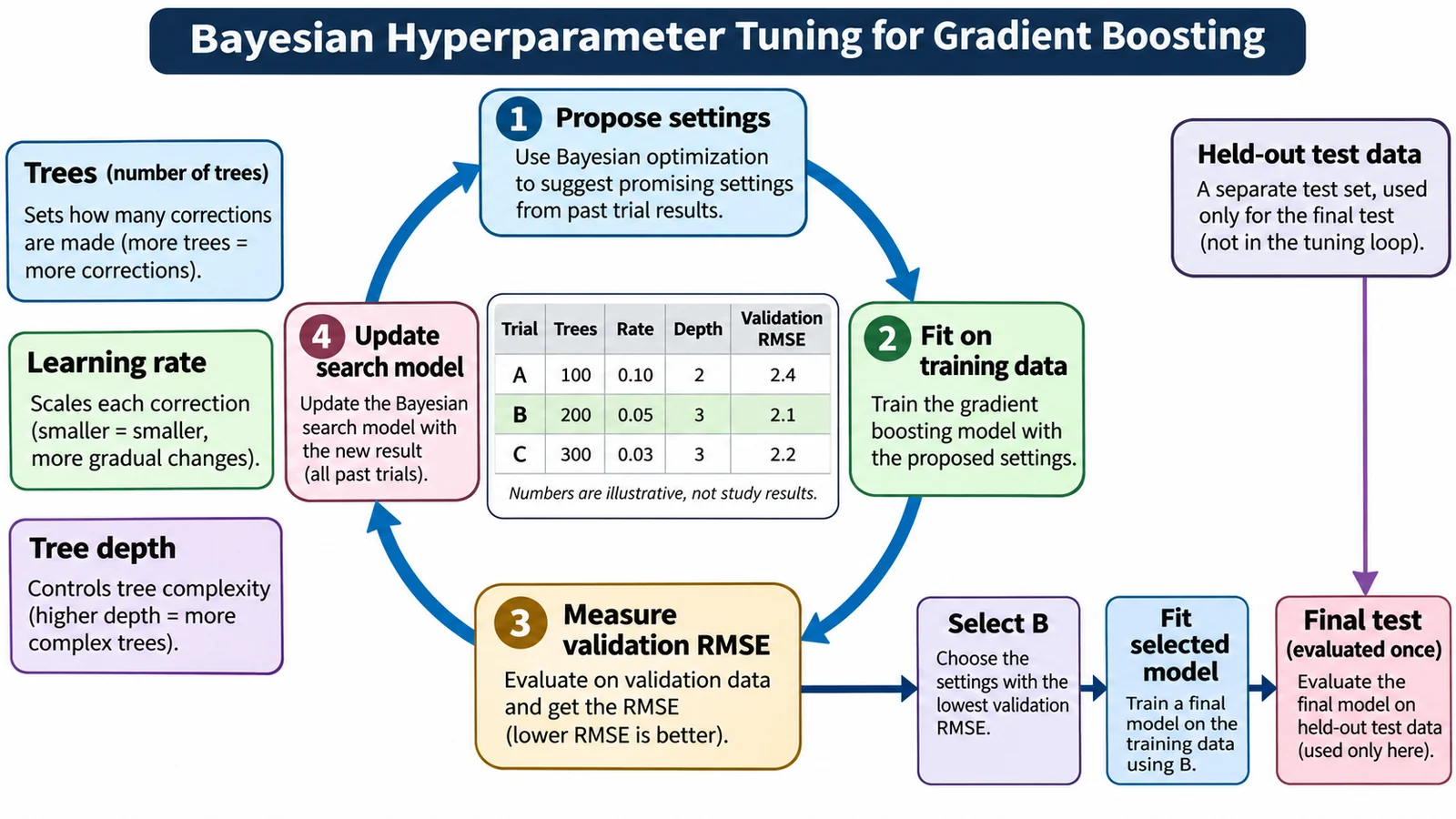
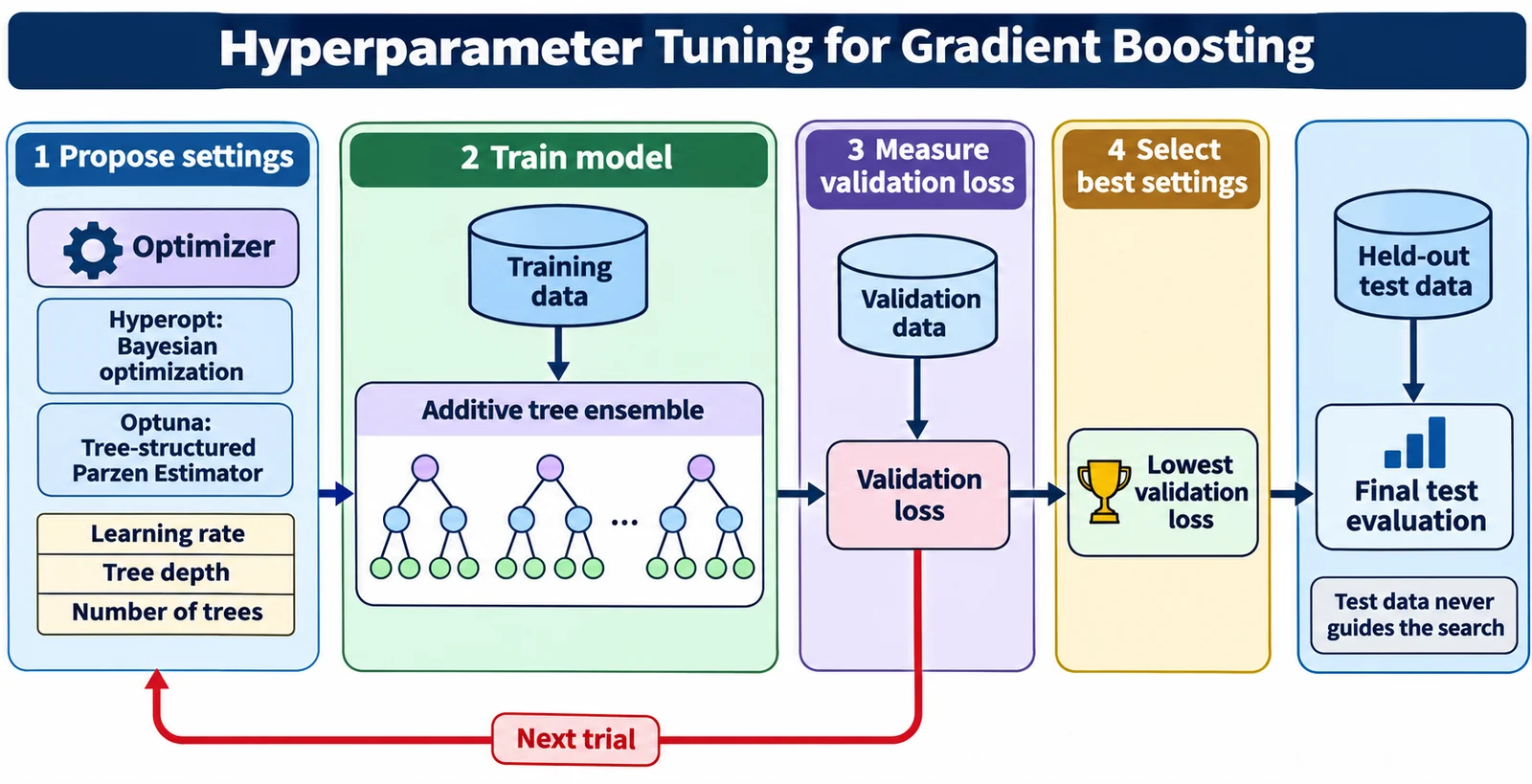
Hyperparameter tuning changes settings like tree depth and learning rate to improve model performance.[68][69][70] A 2026 study used Bayesian optimization to adjust LightGBM to detect microcirculation problems from wearable sensor data, and the model achieved ROC-AUC of 0.8632, accuracy of 88.04%, and recall of 80.00%.[68]
Other optimization methods include metaheuristic algorithms, and the firefly algorithm is one example.[69] The adaptive method used clustering and dual learning to keep diversity in the search process. The method was adaptive particle swarm optimization, and it improved accuracy, F1 score and Brier score on four credit datasets and seven KEEL benchmark datasets.[70]
Some models use built-in dimensionality reduction, and LightGBM uses Gradient-based One-Side Sampling.[71] The GBDT model offered strong interpretability, and it helped power systems run safely, at a steady rate, and cheaply.[72]
Hyperparameter tuning changes settings in gradient boosting models. This includes the number of trees, learning rate, and tree depth.[4][55][57]
The hybrid LGBM-XGBoost model had an MSE of 0.193, a MAE of 0.285 and a MAPE of 0.156. It did better than standalone LGBM, XGBoost, Adaboost, and GBM models.[4] CatBoost scored 0.992 on accuracy, precision, recall, and F1-score, with a ROC-AUC of 0.9987. SHAP showed blood pressure and BMI were top predictors.[55] McNemar’s test was used to assess the statistical significance of differences. CatBoost reached 0.8503 accuracy and 0.8975 AUC, the best results among the compared boosting models and random forest on a landslide database.[6]
The best stroke prediction model was a hybrid of XGBoost and Random Forest, which achieved 96% accuracy, while simpler models did worse.[73] A genetic algorithm tuned Random Forest to assess work readiness in vocational students, and it reached 90.12% accuracy and stayed stable across cross-validation. SHAP analysis showed attitude score mattered most, with the biggest effect on predictions, and practical score came second; tests showed no overfitting and similar results.[56] For science achievement, tuning helped both GB and XGBoost, and GB beat XGBoost on all metrics except training time. Student confidence in science mattered most in GB, while home educational resources mattered most in XGBoost, so tuning can reveal different insights.[57] In energy forecasting, gradient boosting was combined with clustering, which improved results on 40 datasets, and statistical tests showed this method beat single-model approaches.[39]
Performance on Tabular Data
Gradient boosting models performed best. They gave the best overall results on mixed tabular datasets. Tabular data is data stored in tables. This was in the study by Lazar, Pokhrel and Das. These models scored well on three measures. They showed good accuracy. They also showed calibration and interpretability. They worked even when classes were unevenly balanced.[74]
Tabular data means information stored in rows and columns.[75] Researchers tested six datasets with different sizes and types. These datasets included census income and fraud detection records. XGBoost and LightGBM are popular gradient boosting algorithms. They achieved better accuracy than neural networks on these tasks.[74]
Optimization and Acceleration Techniques
Graphics processing units accelerate tree construction tasks. A 2017 study used CUDA in the XGBoost library, and the algorithm processes data entirely on the graphics card rather than the central processor. Researchers tested sparse input matrices and found speedups ranging from three to six times compared to a four-core Intel i7 processor. The implementation supported classification tasks within the library.[18]
Field programmable gate arrays provide hardware acceleration for decision tree execution. An embedded systems accelerator reduces energy use during processing. Tests involved pixel classification on images generated by sensors, and the design processed images at generation speed. The comparison was a high-performance processor, and the system was thirty times faster than an embedded processor.[19]
Federated learning trains models without centralizing data, an approach that addresses data isolation issues. A 2022 study proposed a framework that used secret sharing for multi-party computation. The method reshapes split criterion calculations under a secure setting, and distributed optimization solves leaf weight problems efficiently.[76] Another study introduced Federated Boosting for text recognition tasks. This technique uses homomorphic encryption to protect gradients during sharing, and differential privacy mechanisms guard against gradient leakage attacks.[77]
Hyperparameter tuning optimizes model performance through automated search methods. Hyperopt uses Bayesian optimization to find optimal settings, and a 2021 study applied this to bank telemarketing prediction, where the model achieved ninety percent accuracy on the test data.[78] Optuna provides another framework for optimization and automates hyperparameter optimization using the Tree-structured Parzen Estimator algorithm. LightGBM outperformed baselines in phishing detection research.[79] Particle Swarm Optimization offers a hybrid approach for tuning that improves modeling of nonlinear relationships in software data, and experiments reduced error rates.[80]
Performance on Tabular Data and Small Samples
Deep learning methods now compete with this approach [154]. A hybrid model called SAINT uses row attention and contrastive self-supervised pre-training, which helps when labeled data are scarce [154]. SAINT outperforms XGBoost on average across benchmarks [154].[81]
Small datasets pose specific challenges for machine learning, and constraints like cost and ethics limit data size. Gradient boosting trees are among the reviewed machine learning algorithms for small molecular science data. The review discusses issues like noise and imbalance in small-data settings.[82]
Random forests show stability on small categorical sets [177]. A study used 690 building waste datasets and applied leave-one-out cross-validation techniques [177]. Bagging predictions proved more accurate than boosting, though gradient boosting still showed excellent predictive performance [177]. Some models achieved R-squared values greater than 0.6 [177].[83]
In practice
Applications in Predictive Modeling and Classification
Gradient boosting improves classification. It combines many weak models into one strong model. Zhang and colleagues describe fitting a weak learner. They do this recursively to the residual.[2]
In healthcare, it predicts bone fractures. The patients are women after menopause, and the tool is bone scans. GBM models achieved AUCs close to 1.0 in fracture prediction studies.[84]
Zhang and colleagues state that gradient boosting can find nonlinearity.[2] GBM models made strong predictions. They predicted vertebral fractures. They also predicted forearm fractures. They worked well on real patient data. This shows the model finds risk factors even when single measurements are weak predictors. It combines many small signals.[84]
A LightGBM model helped diagnose diabetes, reaching 98.1% accuracy and 99.9% sensitivity. It outperformed KNN, SVM, and XGBoost on the same dataset, showing strong performance in low-resource settings. High accuracy means it may help detect diabetes early, which is useful where doctors are scarce.[7] XGBoost reached 84.78% accuracy.[85]
A GBM model reached 95.61% accuracy for tuberculosis diagnosis using data from 950 patients. CatBoost and XGBoost came close behind with 94.74% and 94.30% accuracy. When combined in a stacked ensemble, accuracy rose to 96.49%.[86]
Researchers predicted survival in Covid-19 patients, and gradient boosting and XGBoost gave similar results. In balanced data, both models got Concordance Index values near 0.893 and 0.894. XGBoost had a surv.calib_beta index of 0.86 in balanced data, which suggests reliable probability estimates. XGBoost trained faster than gradient boosting, making it more efficient for large-scale clinical use.[87]
XGBoost-Sumo predicts sumoylation sites on protein sequences and finds posttranslational modification sites accurately. XGBoost-Sumo scored 99.68% accuracy on benchmark data and 96.08% on new samples, outperforming earlier models. The model used a transformer for encoding, PsePSSM-DWT for features and SHAP for selection.[88]
Gradient Boosting in Scientific and Industrial Applications
Gradient boosting is used in QSAR modeling to help predict molecular properties. Experts must review data-driven bioactivity explanations, because models alone are not enough.[5]
Gradient boosting predicts genetic traits in animals, such as fiber length, cashmere production and diameter in Inner Mongolian cashmere goats. A 2025 study used genotype and phenotype data from 2,299 Inner Mongolian cashmere goats and compared Random Forest, XGBoost, GBDT, and LightGBM. Researchers tuned hyperparameters before testing, and four machine learning methods improved their accuracy after tuning parameters. The average gains were 2.9%, 2.7%, and 3.8% for the three traits, and mean squared error dropped after hyperparameter tuning across all models.[89]
Gradient boosting models predict physical traits and work in environmental systems. The data covered many pressure and temperature levels. The model matched the real physical trend of CO2 solubility under different conditions, which suggests a broad applicability domain.[35]
In cybersecurity, gradient boosting finds network intrusions by spotting unusual data patterns. A 2018 study used XGBoost on the NSL-KDD dataset to sort traffic and find malicious activity.[90]
Kumar (2025) uses XGBoost to predict stroke risk from patient data. The framework used explainability methods of global and local types, which helped clarify how predictions are made.[73]
In manufacturing, gradient boosting predicts cutting settings, including speed and feed rate in band sawing. XGBoost worked better than four other methods: linear regression, support vector regression, random forest and least squares boosting. It gave more accurate predictions. For cutting speed, XGBoost had an R2 of 0.999, an RMSE of 0.213, and a MAPE of 0.407%. For feed rate, the R2 was also 0.999, with an RMSE of 0.259 and a MAPE of 1.14%. These results show gradient boosting handles nonlinear patterns better than linear or kernel-based models in industrial processes.[91]
Murtiningsih et al. (2025) use CatBoost to predict hypertension risk.[55] In education, gradient boosting helps assess student mental health by classifying psychological states using survey data. The task was classifying mental health status among college students. Random forest had the highest R2 score, 0.8891, and outperformed XGBoost, which scored 0.8618. Feature selection helped find behaviors linked to mental health.[92]
Bayesian hyperparameter optimization found the best settings for its base learners.[4] The benchmark tested 19 classification datasets, and GRANDE beat other gradient-boosting and deep learning models on most of them.[93] A hybrid model combined gradient boosting with graph neural networks, and it worked well on graphs with tabular node features.[94] Recent advances include new training ways and hybrid models that combine boosting with other architectures.[95][93][94]
Applications in Finance and Business
Gradient boosting models forecast daily stock prices for major global indices. A hybrid model combined long short-term memory networks with extreme gradient boosting and analyzed data from markets in Morocco, France, Germany, Britain, the US and Hong Kong. The method helps investors make informed decisions through precise price forecasts.[96]
Financial institutions use these algorithms to detect fraudulent credit card transactions. Taha (2020) reported high accuracy, with an optimized light gradient boosting machine reaching 98.40% on public credit card transaction datasets.[97] Another study combined extreme gradient boosting and found perfect recall scores after researchers applied synthetic minority over-sampling to handle imbalanced fraud data.[98] One analysis noted a risk: near-perfect scores may point to overfitting.[99]
Companies apply gradient boosting to predict corporate bankruptcy events. Syafei (2023) found high accuracy, with a model combining LightGBM with XGBoost feature importance reaching 99.227% on the Taiwanese Bankruptcy dataset. This research used a Taiwanese dataset containing six thousand eight hundred nineteen records that spanned from 1999 to 2009. Parallel processing techniques made the analysis of complex financial information efficient.[100]
Insurers employ gradient boosting to model motor insurance claim frequency, and the algorithm captured non-linear relationships better than linear models. However, traditional linear models outperformed gradient boosting when predicting claim severity amounts. These tools support actuarial decisions regarding pricing and risk management.[101]
E-commerce platforms use gradient boosting to predict customer purchase intentions. Abdullah-All-Tanvir et al. (2023) observed high accuracy. XGBoost classifiers reached 90.65%. This was after applying oversampling methods. Abdullah-All-Tanvir et al. (2023) reported a result for XGBoost classifiers. With feature selection, the area under the ROC curve was 0.937. Early prediction helps websites offer targeted discounts.[102]
Retailers use gradient boosting to set prices and determine optimal selling prices in traditional markets. Models trained on large-scale sales data achieved low errors, with mean absolute percentage errors below two percent. Extreme gradient boosting showed better accuracy on smaller monthly datasets, while standard gradient boosting performed superiorly on the larger annual dataset.[103]
Applications in Science and Medicine
Gradient boosting is used to predict drug activity. A 2016 study tested seven chemical datasets, and the model beat random forest. It detected rare active compounds in imbalanced data.[104]
Researchers use gradient boosting to predict links between diseases. EGBMMDA analyzed associations between microRNA and disease in 2018. The model achieved an AUC of 0.9123, and it confirmed 98% of top predictions for colon cancer.[105]
Voice recordings help diagnose Parkinson's disease with gradient boosting. A 2020 study analyzed 80 patient subjects. Light Gradient Boosting reached an AUC of 0.951, and seven acoustic features were sufficient for high accuracy.[106]
Gradient boosting predicts chronic kidney disease from clinical data. A 2024 analysis used 400 patient entries. Twenty-four attributes gave the best results.[107]
Machine learning detects diabetic retinopathy in eye scans. Hyperparameter tuning improved stability in a 2022 review. The approach reached an accuracy of 0.96, and data augmentation helped overcome the limitations of small datasets.[108]
Gut microbiome data improves the prediction of liver disease risk. A 2022 study followed over 7,115 people. Microbiome models achieved an AUROC of 0.956 for alcoholic liver disease, a performance that exceeded that of conventional risk factors alone.[109]
Gradient boosting predicts crop yields using genomic data. In 2021, LightGBM processed maize breeding data and showed better prediction precision and better stability. CropGBM tools support breeding programs designed at the genomic level.[110]
Environmental models estimate uncertainty in solar irradiance. A 2022 probabilistic model was trained on public data, and kernel density estimation created prediction intervals. The method required less training time than the benchmarks.[111]
Gradient boosting predicts debris flow susceptibility in China. A 2019 model analyzed 3,839 historical events. Prediction accuracy reached 82.0% during cross-validation, and elevation and precipitation were the main predictive features.[112]
Geotechnical engineering uses gradient boosting to estimate soil strength. In 2021, Bayesian optimization tuned hyperparameters for XGBoost. The model predicted undrained shear strength accurately. Feature importance rankings improved interpretability, which helped engineers understand the model better.[113]
Applications in Healthcare and Biology
Gradient boosting models assist in predicting molecular properties, which helps drug development. Researchers compared extreme gradient boosting to random forest using thirty datasets. The method produced accurate predictions, and it did so faster than deep neural networks. It needed less computational time than parallel tree generation methods.[114]
Scientists use these algorithms to find biomarkers. The biomarkers come from biological data. New software applies modern boosting frameworks to survival analysis. This tool screens candidate markers. It helps cancer studies with censored outcomes. Simulations showed it beats traditional stepwise regression. The comparison was against those approaches.[115]
Machine learning classifiers diagnose diabetes using lab tests [121]. One study analyzed four hundred eighty-four patient records [121]. Random forest achieved seventy-two point sixty percent accuracy, and extreme gradient boosting performed well but did not surpass the best model [121].[116]
Algorithms classify heart failure status from clinical data points, and cross-validation techniques made these predictions much more reliable. These tools support early detection efforts for chronic cardiac conditions.[117]
Ensemble methods combine multiple learners to predict type two diabetes, and light gradient boosting machine helps reach high detection accuracy rates [157]. The combined approach handles class imbalance issues effectively [157]. Results passed ninety percent accuracy in fivefold validation tests [157].[118]
Gradient boosting classifies skin disease images, which reduces manual errors in diagnosis [158]. The system identifies atopic dermatitis features with high precision [158].[119]
Models predict mortality risks for hospitalized patients during pandemics. Extreme gradient boosting incorporated vaccination status and lab results, and clinical variables such as blood pressure proved significant for prediction.[120]
Prognostic models estimate survival after liver cancer surgery [167]. A gradient boosting machine analyzed data from over one thousand patients, and seven clinical covariates determined the likelihood of cancer-specific survival [167]. The model stratified risk groups and covered survival rates from zero to fifty-four percent [167].[121]
Algorithms predict outcomes. The events are acute lower gastrointestinal bleeding. Gradient boosting used non-endoscopic measurements. These guided initial triage decisions. Negative predictive values exceeded eighty-eight percent. This was for recurrent bleeding. Performance surpassed conventional logistic regression models. This happened during external validation.[122]
Classification systems detect thyroid diseases by using patterns in clinical data. Extreme gradient boosting achieved ninety-eight percent accuracy in testing. Precision and recall metrics indicated strong performance, and the model performed well across classes. Early detection helps plan treatment for disorders of the gland.[123]
Gradient boosting predicts pregnancy outcomes in clinical care. A 2020 review analyzed 142 studies for this purpose, and the meta-analysis included 62 studies. Only 24 of the 142 reviewed studies had low bias risk. Logistic regression was the most common model used, but gradient boosting outperformed it. Gradient boosting predicted cesarean sections better and also showed better performance for gestational diabetes, while random forest models were superior for preterm delivery. These algorithms help clinicians make informed decisions.[124]
Extreme gradient boosting identifies factors that affect obesity status. Researchers used data from Indonesia's 2013 health survey and applied an algorithm to balance imbalanced data. Female sex was the highest risk factor at 37%. Age between 35 and 54 years increased risk, and strenuous activity was also linked to obesity. Eating vegetables six days a week was a factor.[125]
XGBoost predicts metabolic pathways in biological systems [106]. A 2024 study introduced mlXGPR for this task, using multi-label classification frameworks and correlations between labels via classifier chains [106]. mlXGPR outperformed PathoLogic on single organism benchmarks, achieving lower hamming loss and higher precision [106].[126]
Environmental and Industrial Predictions
Gradient boosting predicts weather patterns and industrial outcomes. Researchers forecast the SYM-H index, which measures disturbances in Earth's magnetic field, using solar wind data. The models improve accuracy over previous methods that used neural networks. Feature contributions change depending on the storm phase.[127]
Scientists predict streamflow in mountainous catchments with gradient boosting, using precipitation and upstream gauge readings as inputs. CatBoost yields the best results with default parameters, while LightGBM performs best after optimizing hyperparameters. These models require at least twelve years of training data.[128]
Engineers estimate atmospheric turbulence for astronomical observations. Gradient boosting outperforms random forest models at most heights, with accuracy improving by up to seven percent above five kilometers. Temperature and wind speed are the most significant predictors.[129]
Predictions for crop yields incorporate environmental variables. Maize grain yield forecasts improve by twenty percent when soil and weather data are added. Temperature and water amounts during growth stages matter most.[130]
Energy power prediction ensures grid stability and supports renewable sources. Hybrid XGBoost models reduce overfitting through regularization, and LightGBM offers superior training speed for large datasets.[131] Construction energy use is also predicted using these methods, where historical features and date features improve building energy estimates.[132]
Industrial processes benefit from precise corrosion modeling. Bootstrap aggregation of XGBoost models predicts steel corrosion well, and neural network corrections enhance zinc corrosion predictions. Sensitivity analysis reveals non-smooth functions in tree-based models.[133]
Electric vehicle charging demand requires accurate forecasting. Stacked ensemble learning cuts mean absolute error, and a covariance matrix adaptation evolution strategy tunes model parameters. This approach handles demand spikes with minimal lag.[134]
Remote sensing and land cover mapping
Researchers tested this method on high-resolution aerial images from two data sets. The UC Merced set included twenty-one scene categories, and the Sydney set contained eight land-use categories. The framework outperformed single model approaches on both sets.[135]
Scientists also use gradient boosting for land cover mapping, in one case replacing neural network layers with boosting algorithms. That study focused on six classes in Hanoi, including vegetation and impervious surfaces. XGBoost achieved an accuracy of 0.8905, and LightGBM reached an accuracy of 0.8956. These results exceeded other comparison methods.[136]
Meta-XGBoost handles hyperspectral image classification tasks and uses multiple booster types for better results, including random forest and linear regression. This method outperformed support vector machines and also beat adaptive boosting techniques. The algorithm improved training efficiency significantly.[137]
Gradient boosting detects diseases in potato crops. The dataset contained two thousand leaf pictures and identified healthy leaves and two blight types, early blight and late blight. The model performed well on affected leaves.[138]
Energy systems and infrastructure monitoring
A 2019 study introduced a detector using three gradient boosting classifiers, and the method raised detection rates. Researchers created stochastic features from daily electricity usage data, including standard deviation and mean values. Feature importance techniques reduced the complexity of the classifier, and this approach minimized storage space and processing time.[139]
Another 2021 study used extreme gradient boosting for detection and analyzed metering data from advanced metering infrastructure. The model trained on both benign and malicious samples, and simulations used the Irish Smart Energy Trails dataset. Six specific attack types were included in the test. The method beat support vector machines in accuracy and also outperformed decision trees and eight other methods. Performance stayed stable with unequal data classes.[140]
Gradient boosting predicts energy power for modern power systems, and accurate predictions enable efficient grid operation and help allocate resources. A 2026 review compared Light Gradient Boosting Machine models and also evaluated a hybrid of extreme gradient boosting. Ensemble learning improves accuracy through bias-variance trade-off techniques. Researchers analyzed data from one grid, the Pennsylvania-New Jersey-Maryland grid, and measured performance using mean absolute percentage error and root mean squared percentage error. Hybrid approaches consistently outperformed single models, and the XGBoost-LGBM hybrid reduced prediction errors by more than one percent.[141]
Gradient boosting forecasts production increases after hydraulic fracturing. A 2019 paper presented a data-driven model for this task, using data from a Siberian oilfield. Features characterized the fracturing jobs and also captured geological information. Machine learning predicted the oil rate after fracturing, and the prediction was compared to engineer experience.[142]
Gradient boosting detects network intrusions with high accuracy. A 2020 study used the NSL-KDD dataset for testing, and the PSO-Xgboost model outperformed Random Forest and Adaboost. It achieved higher precision and recall scores. Particle swarm optimization changed the model structure automatically, and this approach improved detection of rare attack types.[143]
Survey data quality and behavioral analysis
Careless responding ignores survey item content, which threatens measurement validity. Gradient boosted trees identify aberrant responses using machine learning techniques. Researchers compared this method against statistical outlier methods, and the gradient boosting approach outperformed traditional mechanisms in simulated data detection. This advantage included using response times as paradata, which is additional information about responses.[144][145]
Simulation studies often overestimate accuracy and tend to show higher classification scores than reality for careless responders.[145] Real-world online studies showed much more erratic response patterns.[144][145] Precision remained unsatisfactory for all methods in empirical web-based studies.[144] Simulations relied on prototypical patterns and failed to transfer to real data.[145]
Keystroke log data offers a fast alternative. It is an alternative to large language models. A framework uses temporal features. It assesses writing from typing behavior. Gradient boosting evaluates text quality. It uses temporal feature extraction for this task. This method avoids high resource usage. Attention-based models use high resources.[146]
Human intuition was benchmarked against AI models that estimated population density at neighborhood scales. The model reached seventy-five point nine percent accuracy before. A questionnaire benchmark compared human evaluators and also compared multimodal AI models, and researchers analyzed one hundred responses.[147]
The baseline model scored sixteen points on the spatial reasoning task. Human evaluators averaged fifteen point one points on the same test, and experts with domain familiarity also averaged sixteen points.[147]
What this looks like in practice
A gradient boosting procedure estimated distributions. It estimated conditional generalized Pareto distributions. It did better than classical methods from quantile regression and extreme value theory. This held in high-dimensional settings.[32]
In genome-assisted evaluation, random boosting was used to analyze 1,797 bulls with 39,714 SNPs. The new method took only 1% of the time the original needed, and it kept accuracy and bias about the same.[12]
Gradient boosting can predict patient outcomes without assuming a straight-line relationship. It captures links among hundreds of health record predictors, which helps in large-scale analysis.[2]
Later developments
Future Directions and Emerging Trends
Researchers are developing gradient boosting methods that handle multiple outputs more efficiently by treating them as a single task. A 2025 study introduced Condensed-gradient boosting, which uses multi-output regressors as base models. Emami and Martínez-Muñoz (2025) report a speed-generalization trade-off.[148]
Gradient boosting is being adapted for complex data, including longitudinal and clustered data, and random effects are now included. A 2021 algorithm fixed problems in older boosting methods that caused biased random effect estimates and slow convergence.[149]
New designs combine gradient boosting with deep learning. They learn hierarchical patterns in tabular data, and the approach lets gradient boosting learn complex patterns. It does not need backpropagation.[150]
NGBoost was introduced in 2019 and extends gradient boosting to probabilistic prediction by treating distribution parameters as targets. It uses natural gradients to keep training stable when adjusting many parameters at once. NGBoost can use any distribution family and scoring rule, which makes it useful for health and weather forecasts.[151]
Gradient boosting can be combined with other methods in ensemble models that predict more accurately. CalixBoost predicts stock markets by combining them with Bayesian optimization and sentiment analysis.[152]
Gradient boosting is improving by combining with deep learning methods. GRANDE uses end-to-end gradient descent with a straight-through operator and optimizes all model parameters at once.[93]
Sergei and Prokhorenkova (2021) apply the method to graphs.[94] MorphBoost works well on binary and high-dimensional data but does not yet support multiclass classification. HistGradientBoosting was the most stable model tested, and it also had good speed and efficiency across ten benchmark datasets. The study found that model performance depends on dataset traits, and future work should focus on adaptive and hybrid boosting methods.[95]
Criticism
Challenges and Limitations of Gradient Boosting
A 2018 study introduced autoxgboost, a framework that uses only gradient boosting along with model-based tuning and encoding. The test used 16 datasets. On half of them, autoxgboost matched or beat larger AutoML systems, and it ranked first on two.[153]
Deep learning models for tabular data have improved in recent years, but they do not consistently outperform gradient boosting. A 2021 review compared deep learning with gradient boosted decision trees using the same training and tuning steps. The study used two architectures, one of them a ResNet-like architecture, and found two models worked well. Neither consistently beat gradient boosting, and the authors concluded there is no single best model for all tabular data tasks.[64]
In predicting financial distress, XGBoost reached high accuracy, with a best F1 score of 85.1% on 233 companies. The model used 25 financial ratios grouped into four categories. The study measured four factors: liquidity, financial structure, activity and profitability.[154]
Gradient boosting is prone to overfitting, especially when the number of trees or depth of individual trees is too high. Overfitting happens when a model learns random noise in training data. This hurts its ability to predict new cases. Without regularization, gradient boosting may memorize training data. Limiting tree depth or using shrinkage (learning rate) helps.[10]
Gradient boosting struggles with streaming data, where new observations arrive continuously and the model must adapt in real time. Traditional gradient boosting cannot update past trees efficiently, so it cannot learn from new data without retraining from scratch, and models cannot be updated step by step. This limits gradient boosting in online learning.[155]
Fairness in gradient boosting remains a challenge. Models can inherit or amplify biases present in the training data. A 2021 study proposed a way to enforce individual fairness. It focused on gradient boosting. Standard models do not ensure fair treatment by default. Gradient boosting can make biased predictions. This happens without fairness rules, when sensitive traits affect results. Vargo, Fan, Yurochkin and Sun tested their method in 2021. They used 3 machine learning problems prone to bias. Special training goals can make gradient boosting fairer. These include goals that ensure individual fairness.[156]
Data uncertainty makes classification results unreliable.[157] Murtiningsih, Sari and Fajri (2025) preprocessed the data, chose features by a vote of Boruta, RFE and SelectKBest, and balanced classes with SMOTE and ADASYN.[55]
Common misconceptions
On some tabular data tasks, the best deep learning models match Gradient Boosted Decision Trees, and on others they do better. No one model beats all others on every problem, because performance varies by task.[64]
Recent methods like OT-FairBoost add fairness rules during training. These methods aim to reduce bias. They target demographic groups in gradient boosting models.[9]
Key studies
| Year | Study | Sample | Design | Finding |
|---|---|---|---|---|
| 2001 | Friedman[1] | Algorithm development with regression trees | Gradient boosting with regression trees produces models that are both interpretable and effective for regression and classification tasks. | |
| 2013 | González-Recio et al.[12] | 1,797 bulls genotyped for 39,714 SNPs | 2-fold cross-validation with random boosting | Random boosting reduced computation time to 1% of the original while maintaining accuracy. |
| 2013 | Chen et al.[3] | Benchmarking on a breast cancer prognosis dataset | GBMCI outperformed other survival models across multiple covariate settings. | |
| 2021 | Rufo et al.[7] | Diabetes diagnosis on a hospital dataset | LightGBM achieved 98.1% accuracy, 98.1% AUC, 99.9% sensitivity, and 96.3% specificity. | |
| 2023 | Marton et al.[93] | 19 classification datasets | Benchmark evaluation of GRANDE vs. existing models | GRANDE outperformed gradient boosting and deep learning frameworks on most datasets. |
| 2023 | Boldini et al.[5] | 157,590 models on 16 datasets and 94 endpoints | XGBoost achieved the best predictive performance, while LightGBM required the least training time. | |
| 2023 | Sibindi et al.[4] | Hybrid LGBM-XGBoost model on house price prediction | The hybrid model achieved MSE of 0.193, MAE of 0.285, and MAPE of 0.156. | |
| 2025 | Bezek Güre[57] | 2,565 students from TIMSS 2019 | Model comparison with AUC, accuracy, and training time | GB outperformed XGBoost in all metrics except training time. |
| 2025 | Hayber et al.[91] | 1,701 experimental samples from band sawing | Five-fold cross-validation on cutting parameters | XGBoost achieved R2 of 0.999 for cutting speed and feed rate. |
| 2026 | Amalia et al.[56] | 1,211 vocational high school students | Binary classification with SHAP interpretability | The RF+GA model achieved 90.12% accuracy and 0.9582 AUC-ROC in predicting work readiness among vocational high school students. |
See also
References
- Friedman, J. H. (2001). Greedy function approximation: A gradient boosting machine. The Annals of Statistics, 29(5), 1189-1232. doi:10.1214/aos/1013203451
- written on behalf of AME Big-Data Clinical Trial Collaborative Group, Zhang, Z., Zhao, Y., Canes, A., Steinberg, D., & Lyashevska, O. (2019). Predictive analytics with gradient boosting in clinical medicine. Annals of Translational Medicine, 7(7), 152-152. doi:10.21037/atm.2019.03.29
- Chen, Y., Jia, Z., Mercola, D., & Xie, X. (2013). A Gradient Boosting Algorithm for Survival Analysis via Direct Optimization of Concordance Index. Computational and Mathematical Methods in Medicine, 2013, 1-8. doi:10.1155/2013/873595
- Sibindi, R., Mwangi, R. W., & Waititu, A. G. (2023). A boosting ensemble learning based hybrid light gradient boosting machine and extreme gradient boosting model for predicting house prices. Engineering Reports, 5(4). doi:10.1002/eng2.12599
- Boldini, D., Grisoni, F., Kuhn, D., Friedrich, L., & Sieber, S. A. (2023). Practical guidelines for the use of gradient boosting for molecular property prediction. Journal of Cheminformatics, 15(1). doi:10.1186/s13321-023-00743-7
- Sahin, E. K. (2022). Comparative analysis of gradient boosting algorithms for landslide susceptibility mapping. Geocarto International, 37(9), 2441-2465. doi:10.1080/10106049.2020.1831623
- Rufo, D. D., Debelee, T. G., Ibenthal, A., & Negera, W. G. (2021). Diagnosis of Diabetes Mellitus Using Gradient Boosting Machine (LightGBM). Diagnostics, 11(9), 1714. doi:10.3390/diagnostics11091714
- He, Z., Lin, D., Thomas, L., & Wu, M. (2019). Gradient Boosting Machine: A Survey. arXiv. doi:10.48550/arxiv.1908.06951 Free full text
- Shilova, V., Sakho, A., Boumoussou, Y., Risser, L., Loubes, J., & Malherbe, E. (2026). OT-FairBoost: Optimal Transport-Guided Gradient Boosting for Fairness Regularization on Tabular Data. arXiv. doi:10.48550/arxiv.2607.28014 Free full text
- Natekin, A., & Knoll, A. (2013). Gradient boosting machines, a tutorial. Frontiers in Neurorobotics, 7. doi:10.3389/fnbot.2013.00021
- Ergül Aydın, Z., İçmen Erdem, B., & Erzurum Çiçek, Z. İ. (2023). Prediction bike-sharing demand with gradient boosting methods. Pamukkale University Journal of Engineering Sciences, 29(8), 824-832. doi:10.5505/pajes.2023.39959
- González-Recio, O., Jiménez-Montero, J. A., & Alenda, R. (2013). The gradient boosting algorithm and random boosting for genome-assisted evaluation in large data sets. Journal of Dairy Science, 96(1), 614-624. doi:10.3168/jds.2012-5630
- Lundberg, S. M., Erion, G., Chen, H., DeGrave, A., Prutkin, J. M., Nair, B., Katz, R., Himmelfarb, J., Bansal, N., & Lee, S. I. (2020). From local explanations to global understanding with explainable AI for trees. Nature Machine Intelligence, 2(1), 56-67. doi:10.1038/s42256-019-0138-9
- Binder, H., Gefeller, O., Schmid, M., & Mayr, A. (2014). The Evolution of Boosting Algorithms: From Machine Learning to Statistical Modelling. Methods of Information in Medicine, 53(06), 419-427. doi:10.3414/me13-01-0122
- Dombry, C., & Duchamps, J. J. (2024). A large-sample theory for infinitesimal gradient boosting. Bernoulli, 30(3), 1894-1920. doi:10.3150/23-bej1657
- Lu, H., & Mazumder, R. (2020). Randomized Gradient Boosting Machine. SIAM Journal on Optimization, 30(4), 2780-2808. doi:10.1137/18m1223277
- Hosen, M. S., & Amin, R. (2021). Significant of Gradient Boosting Algorithm in Data Management System. Engineering International, 9(2), 85-100. doi:10.18034/ei.v9i2.559
- Mitchell, R., & Frank, E. (2017). Accelerating the XGBoost algorithm using GPU computing. PeerJ Computer Science, 3, e127. doi:10.7717/peerj-cs.127
- Alcolea, A., & Resano, J. (2021). FPGA Accelerator for Gradient Boosting Decision Trees. Electronics, 10(3), 314. doi:10.3390/electronics10030314
- Beygelzimer, A., Hazan, E., Kale, S., & Luo, H. (2015). Online Gradient Boosting. arXiv. doi:10.48550/arxiv.1506.04820 Free full text
- Emami, S., & Martínez-Muñoz, G. (2023). Sequential Training of Neural Networks With Gradient Boosting. IEEE Access, 11, 42738-42750. doi:10.1109/access.2023.3271515
- Arif Ali, Z., H. Abduljabbar, Z., A. Tahir, H., Bibo Sallow, A., & Almufti, S. M. (2023). eXtreme Gradient Boosting Algorithm with Machine Learning: a Review. Academic Journal of Nawroz University, 12(2), 320-334. doi:10.25007/ajnu.v12n2a1612
- Teague, N. J. (2022). Feature Encodings for Gradient Boosting with Automunge. arXiv. doi:10.48550/arxiv.2209.12309 Free full text
- Mienye, I. D., & Sun, Y. (2022). A Survey of Ensemble Learning: Concepts, Algorithms, Applications, and Prospects. IEEE Access, 10, 99129-99149. doi:10.1109/access.2022.3207287
- Badirli, S., Liu, X., Xing, Z., Bhowmik, A., Khoa, D., & S., K. S. (2020). Gradient Boosting Neural Networks: GrowNet. arXiv. doi:10.48550/arxiv.2002.07971 Free full text
- Sergei, P., Morozov, S., & Babenko, A. (2019). Neural Oblivious Decision Ensembles for Deep Learning on Tabular Data. arXiv. doi:10.48550/arxiv.1909.06312 Free full text
- Schäfl, B., Lukas, G., Bitto-Nemling, A., & Hochreiter, S. (2022). Hopular: Modern Hopfield Networks for Tabular Data. arXiv. doi:10.48550/arxiv.2206.00664 Free full text
- Dong, M., Yao, L., Wang, X., Benatallah, B., Zhang, S., & Sheng, Q. Z. (2021). Gradient Boosted Neural Decision Forest. IEEE Transactions on Services Computing, 1-1. doi:10.1109/tsc.2021.3133673
- Valdes, G., Friedman, J. H., Jiang, F., & Gennatas, E. D. (2022). Representational Gradient Boosting: Backpropagation in the Space of Functions. IEEE Transactions on Pattern Analysis and Machine Intelligence, 44(12), 10186-10195. doi:10.1109/tpami.2021.3137715
- Emami, S., & Martínez-Muñoz, G. (2024). Deep Learning for Multi-Output Regression Using Gradient Boosting. IEEE Access, 12, 17760-17772. doi:10.1109/access.2024.3359115
- Schmid, M., Gefeller, O., Waldmann, E., Mayr, A., & Hepp, T. (2016). Approaches to Regularized Regression – A Comparison between Gradient Boosting and the Lasso. Methods of Information in Medicine, 55(05), 422-430. doi:10.3414/me16-01-0033
- Velthoen, J., Dombry, C., Cai, J. J., & Engelke, S. (2023). Gradient boosting for extreme quantile regression. Extremes, 26(4), 639-667. doi:10.1007/s10687-023-00473-x
- Huang, J., Algahtani, M., & Kaewunruen, S. (2022). Energy Forecasting in a Public Building: A Benchmarking Analysis on Long Short-Term Memory (LSTM), Support Vector Regression (SVR), and Extreme Gradient Boosting (XGBoost) Networks. Applied Sciences, 12(19), 9788. doi:10.3390/app12199788
- Di Persio, L., & Fraccarolo, N. (2023). Energy Consumption Forecasts by Gradient Boosting Regression Trees. Mathematics, 11(5), 1068. doi:10.3390/math11051068
- Mahmoudzadeh, A., Amiri-Ramsheh, B., Atashrouz, S., Abedi, A., Abuswer, M. A., Ostadhassan, M., Mohaddespour, A., & Hemmati-Sarapardeh, A. (2024). Modeling CO2 solubility in water using gradient boosting and light gradient boosting machine. Scientific Reports, 14(1). doi:10.1038/s41598-024-63159-9
- Rabimov, N. R., Akharov, A. R., & Nazarov, F. M. (2025). Machine Learning Forecasts of Spot Truckload Prices Using Operational Carrier Data: A Comparative Study of XGBoost and Benchmark Models. Innovative: International Multidisciplinary Journal of Applied Technology (2995-486X), 3(12), 24-35. doi:10.51699/rdsf2d55
- Ibrahem Ahmed Osman, A., Najah Ahmed, A., Chow, M. F., Feng Huang, Y., & El-Shafie, A. (2021). Extreme gradient boosting (Xgboost) model to predict the groundwater levels in Selangor Malaysia. Ain Shams Engineering Journal, 12(2), 1545-1556. doi:10.1016/j.asej.2020.11.011
- He, T., Heidemeyer, M., Ban, F., Cherkasov, A., & Ester, M. (2017). SimBoost: a read-across approach for predicting drug–target binding affinities using gradient boosting machines. Journal of Cheminformatics, 9(1). doi:10.1186/s13321-017-0209-z
- Rizkallah, L. W. (2025). Enhancing the performance of gradient boosting trees on regression problems. Journal of Big Data, 12(1). doi:10.1186/s40537-025-01071-3
- Widiyanto, M. Y., & Hidayat, T. (2025). Analisis Kualitas Air STORET Menggunakan SVM, XGBoost, Gradient Boosting: . JOINTECS (Journal of Information Technology and Computer Science), 9(3), 117-124. doi:10.31328/jointecs.v9i3.7112
- Teramoto, R. (2009). Balanced Gradient Boosting from Imbalanced Data for Clinical Outcome Prediction. Statistical Applications in Genetics and Molecular Biology, 8(1). doi:10.2202/1544-6115.1422
- Dorogush, A. V., Ershov, V., & Gulin, A. (2018). CatBoost: gradient boosting with categorical features support. arXiv. doi:10.48550/arxiv.1810.11363 Free full text
- Prokhorenkova, L., Gusev, G., Vorobev, A., Dorogush, A. V., & Gulin, A. (2017). CatBoost: unbiased boosting with categorical features. arXiv. doi:10.48550/arxiv.1706.09516 Free full text
- Hancock, J. T., & Khoshgoftaar, T. M. (2020). CatBoost for big data: an interdisciplinary review. Journal of Big Data, 7(1). doi:10.1186/s40537-020-00369-8
- Song, Z., Xia, J., Wang, G., She, D., Hu, C., & Hong, S. (2022). Regionalization of hydrological model parameters using gradient boosting machine. Hydrology and Earth System Sciences, 26(2), 505-524. doi:10.5194/hess-26-505-2022
- Narayana Rao Appini (2024). Phishing URL Detection with Gradient Boosting Classifier. Communications on Applied Nonlinear Analysis, 32(3), 661-676. doi:10.52783/cana.v32.2380
- AlShourbaji, I., Helian, N., Sun, Y., Hussien, A. G., Abualigah, L., & Elnaim, B. (2023). An efficient churn prediction model using gradient boosting machine and metaheuristic optimization. Scientific Reports, 13(1). doi:10.1038/s41598-023-41093-6
- Ekmekcioğlu, Ö. (2023). Drought Forecasting Using Integrated Variational Mode Decomposition and Extreme Gradient Boosting. Water, 15(19), 3413. doi:10.3390/w15193413
- Zou, Y., & Gao, C. (2022). Extreme Learning Machine Enhanced Gradient Boosting for Credit Scoring. Algorithms, 15(5), 149. doi:10.3390/a15050149
- Dash, T. K., Chakraborty, C., Mahapatra, S., & Panda, G. (2022). Gradient Boosting Machine and Efficient Combination of Features for Speech-Based Detection of COVID-19. IEEE Journal of Biomedical and Health Informatics, 26(11), 5364-5371. doi:10.1109/jbhi.2022.3197910
- MacNell, N., Feinstein, L., Wilkerson, J., Salo, P. M., Molsberry, S. A., Fessler, M. B., Thorne, P. S., Motsinger-Reif, A. A., & Zeldin, D. C. (2023). Implementing machine learning methods with complex survey data: Lessons learned on the impacts of accounting sampling weights in gradient boosting. PLOS ONE, 18(1), e0280387. doi:10.1371/journal.pone.0280387
- Messer, P., & Schmid, T. (2026). Gradient boosting for hierarchical data in small area estimation. Statistics and Computing, 36(5). doi:10.1007/s11222-026-10970-1
- Madeniyetov, M. (2025). Analyzing e-learning student performance and feature impact using xgboost and SHAP. Вестник КазУТБ, 2(27). doi:10.58805/kazutb.v.2.27-815
- Khan, M. S., Salsabil, N., Alam, M. G. R., Dewan, M. A. A., & Uddin, M. Z. (2022). CNN-XGBoost fusion-based affective state recognition using EEG spectrogram image analysis. Scientific Reports, 12(1). doi:10.1038/s41598-022-18257-x
- Murtiningsih, D. A., Sari, B. W., & Fajri, I. N. (2025). Comparison of Light Gradient Boosting Machine, eXtreme Gradient Boosting, and CatBoost with Balancing and Hyperparameter Tuning for Hypertension Risk Prediction on Clinical Dataset. Journal of Applied Informatics and Computing, 9(5), 2753-2763. doi:10.30871/jaic.v9i5.10400
- Amalia, S., Latifah, N., & Utomo, A. P. (2026). Work Readiness Prediction of Vocational High School Students Using a Genetic Algorithm-Optimized Random Forest and XGBoost as a Benchmark Model with Explainable AI (SHAP). Journal of Applied Informatics and Computing, 10(4), 3369-3374. doi:10.30871/jaic.v10i4.13435
- Bezek Güre, Ö. (2025). Comparison of the Performance of Gradient Boosting and Extreme Gradient Boosting Methods in Classifying Timms Science Achievement. Bitlis Eren Üniversitesi Fen Bilimleri Dergisi, 14(2), 1041-1059. doi:10.17798/bitlisfen.1636812
- Gonçalves, V. S. F., & De Carvalho, V. R. (2025). A Review of Interpretability Methods for Gradient Boosting Decision Trees. Journal of the Brazilian Computer Society, 31(1), 640-654. doi:10.5753/jbcs.2025.5324
- Joshi, S. (2025). Gradient Boosting and Explainable AI for Financial Risk Management: A Comprehensive Review. MDPI AG. doi:10.20944/preprints202504.0817.v1
- Cruz, A. F., Belém, C., Sérgio, J., João, B., Saleiro, P., & Bizarro, P. (2022). FairGBM: Gradient Boosting with Fairness Constraints. arXiv. doi:10.48550/arxiv.2209.07850 Free full text
- Malinin, A., Prokhorenkova, L., & Ustimenko, A. (2020). Uncertainty in Gradient Boosting via Ensembles. arXiv. doi:10.48550/arxiv.2006.10562 Free full text
- Rozikin, C., Buono, A., Wahjuni, S., Arif, C., & -, W. (2023). Benchmarking the LGBM, Random Forest, and XGBoost Models Based on Accuracy in Classifying Melon Leaf Disease. International Journal of Advanced Computer Science and Applications, 14(10). doi:10.14569/ijacsa.2023.0141022
- Vasudevan, J. (2025). Comparitive Analysis of Gradient Boosting and Transformer Based Models for Binary Classification in Tabular Data. International Journal of Innovative Science and Research Technology, 466-470. doi:10.38124/ijisrt/25mar416
- Gorishniy, Y., Rubachev, I., Khrulkov, V., & Babenko, A. (2021). Revisiting Deep Learning Models for Tabular Data. arXiv. doi:10.48550/arxiv.2106.11959 Free full text
- Adler, A. I., & Painsky, A. (2022). Feature Importance in Gradient Boosting Trees with Cross-Validation Feature Selection. Entropy, 24(5), 687. doi:10.3390/e24050687
- Priya Karkare (2024). The Artistry of Stochastic Gradient Boosting and Gradient Boosting Classifiers in Chronic Renal Disease Classification. Journal of Electrical Systems, 20(3), 2405-2415. doi:10.52783/jes.4086
- Hong, W. S., Haimovich, A. D., & Taylor, R. A. (2018). Predicting hospital admission at emergency department triage using machine learning. PLOS ONE, 13(7), e0201016. doi:10.1371/journal.pone.0201016
- Pramudita, T. H., & Arifin, M. Z. (2026). Hyperparameter Optimization of Light Gradient Boosting Machine for Microcirculation Detection Wearable Data: Optimasi Hyperparameter Light Gradient Boosting Machine untuk Deteksi Mikrosirkulasi Data Wearable. Indonesian Journal of Innovation Studies, 27(1). doi:10.21070/ijins.v27i1.1888
- Zivkovic, M., Tair, M., K, V., Bacanin, N., Hubálovský, Š., & Trojovský, P. (2022). Novel hybrid firefly algorithm: an application to enhance XGBoost tuning for intrusion detection classification. PeerJ Computer Science, 8, e956. doi:10.7717/peerj-cs.956
- Qin, C., Zhang, Y., Bao, F., Zhang, C., Liu, P., & Liu, P. (2021). XGBoost Optimized by Adaptive Particle Swarm Optimization for Credit Scoring. Mathematical Problems in Engineering, 2021, 1-18. doi:10.1155/2021/6655510
- Zhang, D., & Gong, Y. (2020). The Comparison of LightGBM and XGBoost Coupling Factor Analysis and Prediagnosis of Acute Liver Failure. IEEE Access, 8, 220990-221003. doi:10.1109/access.2020.3042848
- Wang, J., Li, P., Ran, R., Che, Y., & Zhou, Y. (2018). A Short-Term Photovoltaic Power Prediction Model Based on the Gradient Boost Decision Tree. Applied Sciences, 8(5), 689. doi:10.3390/app8050689
- Kumar, T. A. (2025). Stroke Prediction Using XGboost and a Fusion of XGboost with Random Forest. INTERNATIONAL JOURNAL OF SCIENTIFIC RESEARCH IN ENGINEERING AND MANAGEMENT, 09(05), 1-9. doi:10.55041/ijsrem48840
- Lazar, A., Pokhrel, P., & Das, S. (2026). Beyond Accuracy: A Comprehensive Comparative Study of Gradient Boosting Versus Tabular Deep Learning and Explainability Techniques for Mixed-Type Tabular Data Models Using SHAP and LIME. International Journal on Artificial Intelligence Tools, 35(02). doi:10.1142/s0218213026400038
- Hollmann, N., Müller, S., Purucker, L., Krishnakumar, A., Körfer, M., Hoo, S. B., Schirrmeister, R. T., & Hutter, F. (2025). Accurate predictions on small data with a tabular foundation model. Nature, 637(8045), 319-326. doi:10.1038/s41586-024-08328-6
- Xie, L., Liu, J., Lu, S., Chang, T. H., & Shi, Q. (2022). An Efficient Learning Framework for Federated XGBoost Using Secret Sharing and Distributed Optimization. ACM Transactions on Intelligent Systems and Technology, 13(5), 1-28. doi:10.1145/3523061
- Ren, H., Deng, J., Xie, X., Ma, X., & Wang, Y. (2024). FedBoosting: Federated learning with gradient protected boosting for text recognition. Neurocomputing, 569, 127126. doi:10.1016/j.neucom.2023.127126
- Suryana, S. E., Warsito, B., & Suparti, S. (2021). Penerapan gradient boosting dengan hyperopt untuk memprediksi keberhasilan telemarketing bank. Jurnal Gaussian, 10(4), 617-623. doi:10.14710/j.gauss.v10i4.31335
- Abu Bakar, R. F., & Rahardi, M. (2026). Analysis of Gradient Boosting Algorithms with Optuna Optimization and SHAP Interpretation for Phishing Website Detection. Journal of Applied Informatics and Computing, 10(1), 664-672. doi:10.30871/jaic.v10i1.11857
- Alif Pahlevi, A. F., Hariyadi, M. A., & Almais, A. T. W. (2025). Optimasi Extreme Gradient Boosting dengan Particle Swarm Optimization untuk Estimasi Software Effort: Optimized Extreme Gradient Boosting using Particle Swarm Optimization for Software Effort Estimation. MALCOM: Indonesian Journal of Machine Learning and Computer Science, 5(3), 930-941. doi:10.57152/malcom.v5i3.2055
- Somepalli, G., Goldblum, M., Schwarzschild, A., Bruss, C. B., & Goldstein, T. (2021). SAINT: Improved Neural Networks for Tabular Data via Row Attention and Contrastive Pre-Training. arXiv. doi:10.48550/arxiv.2106.01342 Free full text
- Dou, B., Zhu, Z., Merkurjev, E., Ke, L., Chen, L., Jiang, J., Zhu, Y., Liu, J., Zhang, B., & Wei, G. W. (2023). Machine Learning Methods for Small Data Challenges in Molecular Science. Chemical Reviews, 123(13), 8736-8780. doi:10.1021/acs.chemrev.3c00189
- Cha, G. W., Moon, H. J., & Kim, Y. C. (2021). Comparison of Random Forest and Gradient Boosting Machine Models for Predicting Demolition Waste Based on Small Datasets and Categorical Variables. International Journal of Environmental Research and Public Health, 18(16), 8530. doi:10.3390/ijerph18168530
- Atkinson, E. J., Therneau, T. M., Melton, L. J., Camp, J. J., Achenbach, S. J., Amin, S., & Khosla, S. (2012). Assessing fracture risk using gradient boosting machine (GBM) models. Journal of Bone and Mineral Research, 27(6), 1397-1404. doi:10.1002/jbmr.1577
- Sah, A., Niesa, C., Jafar, R. R., & Muharrom, M. (2025). Analisis Model Prediksi Penyakit Jantung Menggunakan Adaptive Boosting, Gradient Boosting, dan Extreme Gradient Boosting. Jurnal Ilmiah FIFO, 17(1), 46. doi:10.22441/fifo.2025.v17i1.006
- Dinnillah, A. H., & Fuad Abdullah, M. (2025). Stacked Ensemble of Gradient Boosting Machine, Categorical Boosting,and Extreme Gradient Boosting for Enhanced Tuberculosis Diagnosis. IJACI : International Journal of Advanced Computing and Informatics, 2(1), 1-11. doi:10.71129/ijaci.v2i1.pp1-11
- Razavizadeh, N. T., Salari, M., Jafari, M., Sabaghian, E., & Ghavami, V. (2024). Comparison of Two Methods, Gradient Boosting and Extreme Gradient Boosting to Pre- dict Survival in Covid-19 Data. Journal of Biostatistics and Epidemiology. doi:10.18502/jbe.v9i3.15450
- Khan, S., Noor, S., Javed, T., Naseem, A., Aslam, F., AlQahtani, S. A., & Ahmad, N. (2025). XGBoost-enhanced ensemble model using discriminative hybrid features for the prediction of sumoylation sites. BioData Mining, 18(1). doi:10.1186/s13040-024-00415-8
- Liu, J., Yan, X., Li, W., Xue, S. H., Wang, Z., & Su, R. (2025). Genomic Selection for Cashmere Traits in Inner Mongolian Cashmere Goats Using Random Forest, Gradient Boosting Decision Tree, Extreme Gradient Boosting and Light Gradient Boosting Machine Methods. Animals, 15(20), 2940. doi:10.3390/ani15202940
- Dhaliwal, S. S., Nahid, A. A., & Abbas, R. (2018). Effective Intrusion Detection System Using XGBoost. Information, 9(7), 149. doi:10.3390/info9070149
- Hayber, Ş. E., Alisinoğlu, M. B., Kınacı, Y. E., & Uyar, M. (2025). Prediction of Cutting Parameters in Band Sawing Using a Gradient Boosting-Based Machine Learning Approach. Machines, 13(10), 966. doi:10.3390/machines13100966
- Li, Q., & Zhou, J. (2025). A Comparative Analysis of Extreme Gradient Boosting, Decision Tree, Support Vector Machines, and Random Forest Algorithm in Data Analysis of College Students' Psychological Health. Informatica, 49(15). doi:10.31449/inf.v49i15.7004
- Marton, S., Lüdtke, S., Bartelt, C., & Stuckenschmidt, H. (2023). GRANDE: Gradient-Based Decision Tree Ensembles for Tabular Data. arXiv. doi:10.48550/arxiv.2309.17130 Free full text
- Sergei, I., & Prokhorenkova, L. (2021). Boost then Convolve: Gradient Boosting Meets Graph Neural Networks. arXiv. doi:10.48550/arxiv.2101.08543 Free full text
- Agebure, M., Wiredu, J., & Akobre, S. (2026). Gradient Boosting Revisited: Comparative Analysis of Selected Advances on Real-World Tabular Data. Machine Learning Research, 11(1), 37-52. doi:10.11648/j.mlr.20261101.14
- OUKHOUYA, H., KADIRI, H., EL HIMDI, K., & GUERBAZ, R. (2023). Forecasting International Stock Market Trends: XGBoost, LSTM, LSTM-XGBoost, and Backtesting XGBoost Models. Statistics, Optimization & Information Computing, 12(1), 200-209. doi:10.19139/soic-2310-5070-1822
- Taha, A. A., & Malebary, S. J. (2020). An Intelligent Approach to Credit Card Fraud Detection Using an Optimized Light Gradient Boosting Machine. IEEE Access, 8, 25579-25587. doi:10.1109/access.2020.2971354
- Nti, I. K., & Somanathan, A. R. (2024). A Scalable RF-XGBoost Framework for Financial Fraud Mitigation. IEEE Transactions on Computational Social Systems, 11(2), 1556-1563. doi:10.1109/tcss.2022.3209827
- Irawan, H. (2025). Deteksi Fraud Kartu Kredit dengan Logistic Regression, Random Forest, dan Gradient Boosting. Jurnal Informatika Terpadu, 11(2), 92-97. doi:10.54914/jit.v11i2.1826
- Syafei, R. M., & Efrilianda, D. A. (2023). Machine Learning Model Using Extreme Gradient Boosting (XGBoost) Feature Importance and Light Gradient Boosting Machine (LightGBM) to Improve Accurate Prediction of Bankruptcy. Recursive Journal of Informatics, 1(2), 64-72. doi:10.15294/rji.v1i2.71229
- Clemente, C., Guerreiro, G. R., & Bravo, J. M. (2023). Modelling Motor Insurance Claim Frequency and Severity Using Gradient Boosting. Risks, 11(9), 163. doi:10.3390/risks11090163
- Abdullah-All-Tanvir, Ali Khandokar, I., Muzahidul Islam, A. K. M., Islam, S., & Shatabda, S. (2023). A gradient boosting classifier for purchase intention prediction of online shoppers. Heliyon, 9(4), e15163. doi:10.1016/j.heliyon.2023.e15163
- Novianto, B. D., & Kusrini, K. (2025). Analysis of Selling Price Determination With Gradient Boosting Algorithm in Traditional Market Stores. G-Tech: Jurnal Teknologi Terapan, 9(3), 1296-1305. doi:10.70609/g-tech.v9i3.7264
- Babajide Mustapha, I., & Saeed, F. (2016). Bioactive Molecule Prediction Using Extreme Gradient Boosting. Molecules, 21(8), 983. doi:10.3390/molecules21080983
- Chen, X., Huang, L., Xie, D., & Zhao, Q. (2018). EGBMMDA: Extreme Gradient Boosting Machine for MiRNA-Disease Association prediction. Cell Death & Disease, 9(1). doi:10.1038/s41419-017-0003-x
- Karabayir, I., Goldman, S. M., Pappu, S., & Akbilgic, O. (2020). Gradient boosting for Parkinson’s disease diagnosis from voice recordings. BMC Medical Informatics and Decision Making, 20(1). doi:10.1186/s12911-020-01250-7
- Priya Karkare (2024). The Artistry of Stochastic Gradient Boosting and Gradient Boosting Classifiers in Chronic Renal Disease Classification. Journal of Electrical Systems, 20(7s), 2672-2682. doi:10.52783/jes.4115
- Datta, P., Das, P., & Kumar, A. (2022). Hyper parameter tuning based gradient boosting algorithm for detection of diabetic retinopathy: an analytical review. Bulletin of Electrical Engineering and Informatics, 11(2), 814-824. doi:10.11591/eei.v11i2.3559
- Liu, Y., Méric, G., Havulinna, A. S., Teo, S. M., Åberg, F., Ruuskanen, M., Sanders, J., Zhu, Q., Tripathi, A., Verspoor, K., Cheng, S., Jain, M., Jousilahti, P., Vázquez-Baeza, Y., Loomba, R., Lahti, L., Niiranen, T., Salomaa, V., Knight, R., & Inouye, M. (2022). Early prediction of incident liver disease using conventional risk factors and gut-microbiome-augmented gradient boosting. Cell Metabolism, 34(5), 719-730.e4. doi:10.1016/j.cmet.2022.03.002
- Yan, J., Xu, Y., Cheng, Q., Jiang, S., Wang, Q., Xiao, Y., Ma, C., Yan, J., & Wang, X. (2021). LightGBM: accelerated genomically designed crop breeding through ensemble learning. Genome Biology, 22(1). doi:10.1186/s13059-021-02492-y
- Li, X., Ma, L., Chen, P., Xu, H., Xing, Q., Yan, J., Lu, S., Fan, H., Yang, L., & Cheng, Y. (2022). Probabilistic solar irradiance forecasting based on XGBoost. Energy Reports, 8, 1087-1095. doi:10.1016/j.egyr.2022.02.251
- Di, B., Zhang, H., Liu, Y., Li, J., Chen, N., Stamatopoulos, C. A., Luo, Y., & Zhan, Y. (2019). Assessing Susceptibility of Debris Flow in Southwest China Using Gradient Boosting Machine. Scientific Reports, 9(1). doi:10.1038/s41598-019-48986-5
- Zhang, W., Wu, C., Zhong, H., Li, Y., & Wang, L. (2021). Prediction of undrained shear strength using extreme gradient boosting and random forest based on Bayesian optimization. Geoscience Frontiers, 12(1), 469-477. doi:10.1016/j.gsf.2020.03.007
- Sheridan, R. P., Wang, W. M., Liaw, A., Ma, J., & Gifford, E. M. (2016). Extreme Gradient Boosting as a Method for Quantitative Structure–Activity Relationships. Journal of Chemical Information and Modeling, 56(12), 2353-2360. doi:10.1021/acs.jcim.6b00591
- Li, K., Yao, S., Zhang, Z., Cao, B., Wilson, C. M., Kalos, D., Kuan, P. F., Zhu, R., & Wang, X. (2022). Efficient gradient boosting for prognostic biomarker discovery. Bioinformatics, 38(6), 1631-1638. doi:10.1093/bioinformatics/btab869
- Zaky, U., & Agustia, Y. F. (2026). Diabetes Mellitus Prediction from Primary Health Care Laboratory Data Using Random Forest, Extreme Gradient Boosting, and Light Gradient Boosting Machine with Resampling and Optuna-Based Hyperparameter Optimization. Jurnal Teknik Informatika (Jutif), 7(3), 3025-3049. doi:10.52436/1.jutif.2026.7.3.5751
- Anggraini, J. P., Chaya Gladys Zhafirah A, & Desiani, A. (2025). Perbandingan Algoritma Random Forest dan Extreme Gradient Boosting (XGBoost) dalam Klasifikasi Penyakit Gagal Jantung. Komputika : Jurnal Sistem Komputer, 14(2), 149-157. doi:10.34010/komputika.v14i2.16618
- Sai, M. J., Chettri, P., Panigrahi, R., Garg, A., Bhoi, A. K., & Barsocchi, P. (2023). An Ensemble of Light Gradient Boosting Machine and Adaptive Boosting for Prediction of Type-2 Diabetes. International Journal of Computational Intelligence Systems, 16(1). doi:10.1007/s44196-023-00184-y
- Suhendra, R., Suryadi, S., Husdayanti, N., Maulana, A., Noviandy, T. R., Sasmita, N. R., Subianto, M., Earlia, N., Niode, N. J., & Idroes, R. (2023). Evaluation of Gradient Boosted Classifier in Atopic Dermatitis Severity Score Classification. Heca Journal of Applied Sciences, 1(2), 54-61. doi:10.60084/hjas.v1i2.85
- Prado Junior, J. C., Evsukoff, A., & Medronho, R. d. A. (2025). Dynamic evaluation of a COVID-19 death prediction model using Extreme Gradient Boosting Predictive Model. Ciência & Saúde Coletiva, 30(7). doi:10.1590/1413-81232025307.18112024
- Ji, G. W., Jiao, C. Y., Xu, Z. G., Li, X. C., Wang, K., & Wang, X. H. (2022). Development and validation of a gradient boosting machine to predict prognosis after liver resection for intrahepatic cholangiocarcinoma. BMC Cancer, 22(1). doi:10.1186/s12885-022-09352-3
- Ayaru, L., Ypsilantis, P. P., Nanapragasam, A., Choi, R. C. H., Thillanathan, A., Min-Ho, L., & Montana, G. (2015). Prediction of Outcome in Acute Lower Gastrointestinal Bleeding Using Gradient Boosting. PLOS ONE, 10(7), e0132485. doi:10.1371/journal.pone.0132485
- Anita Desiani, Siti Nurhaliza, Tri Febriani Putri, & Bambang Suprihatin (2025). Algoritma Extreme Gradient Boosting (XGBoost) dan Adaptive Boosting (AdaBoost) Untuk Klasifikasi Penyakit Tiroid. Jurnal Rekayasa Elektro Sriwijaya, 6(2), 66-75. doi:10.36706/jres.v6i2.145
- Sufriyana, H., Husnayain, A., Chen, Y. L., Kuo, C. Y., Singh, O., Yeh, T. Y., Wu, Y. W., & Su, E. C. Y. (2020). Comparison of Multivariable Logistic Regression and Other Machine Learning Algorithms for Prognostic Prediction Studies in Pregnancy Care: Systematic Review and Meta-Analysis. JMIR Medical Informatics, 8(11), e16503. doi:10.2196/16503
- Rombe, Y., Thamrin, S. A., & Lawi, A. (2022). Application of Adaptive Synthetic Nominal and Extreme Gradient Boosting Methods in Determining Factors Affecting Obesity: A Case Study of Indonesian Basic Health Research Survey 2013: Aplikasi Metode Adaptive Synthetic Nominal dan Extreme Gradient Boosting dalam Menentukan Faktor yang Memengaruhi Obesitas: Studi Kasus Riset Kesehatan Dasar Indonesia 2013. Indonesian Journal of Statistics and Its Applications, 6(2), 309-317. doi:10.29244/ijsa.v6i2p309-317
- Joe, H., & Kim, H. G. (2024). Multi-label classification with XGBoost for metabolic pathway prediction. BMC Bioinformatics, 25(1). doi:10.1186/s12859-024-05666-0
- Iong, D., Chen, Y., Toth, G., Zou, S., Pulkkinen, T., Ren, J., Camporeale, E., & Gombosi, T. (2022). New Findings From Explainable SYM‐H Forecasting Using Gradient Boosting Machines. Space Weather, 20(8). doi:10.1029/2021sw002928
- Szczepanek, R. (2022). Daily Streamflow Forecasting in Mountainous Catchment Using XGBoost, LightGBM and CatBoost. Hydrology, 9(12), 226. doi:10.3390/hydrology9120226
- Driga, M., Shikhovtsev, A., Kovadlo, P., Kopylov, E., & Potanin, S. (2026). Estimation of the altitude profile of atmospheric optical turbulence intensity using gradient boosting. Solar-Terrestrial Physics, 12(3), 102-108. doi:10.12737/stp-123202612
- Westhues, C. C., Mahone, G. S., da Silva, S., Thorwarth, P., Schmidt, M., Richter, J. C., Simianer, H., & Beissinger, T. M. (2021). Prediction of Maize Phenotypic Traits With Genomic and Environmental Predictors Using Gradient Boosting Frameworks. Frontiers in Plant Science, 12. doi:10.3389/fpls.2021.699589
- Rishu Raj, & Sapna Rani Arora (2026). A Comparative Review on Energy Power Prediction using Light Gradient Boosting Machine and Hybrid of Extreme Gradient Boosting. International Journal of Scientific Research in Computer Science, Engineering and Information Technology, 12(2), 278-283. doi:10.32628/cseit26121344
- Han, J., Shu, K., & Wang, Z. (2023). Predicting energy use in construction using Extreme Gradient Boosting. PeerJ Computer Science, 9, e1500. doi:10.7717/peerj-cs.1500
- Zhang, Z., & Zhang, J. (2026). Ensemble and Boosting of Neural Networks and Extreme Gradient Boosting Models for the Modelling of Atmospheric Corrosion of Steel and Zinc. Algorithms, 19(9), 722. doi:10.3390/a19090722
- Hussain, I., Ching, K. B., Uttraphan, C., Tay, K. G., Memon, S. A., & Aslam, M. (2026). Meta‐Optimized Ensemble Learning With Gradient Boosting for Electric Vehicle Charging Demand Forecasting. International Journal of Energy Research, 2026(1). doi:10.1155/er/9363437
- Zhang, F., Du, B., & Zhang, L. (2016). Scene Classification via a Gradient Boosting Random Convolutional Network Framework. IEEE Transactions on Geoscience and Remote Sensing, 54(3), 1793-1802. doi:10.1109/tgrs.2015.2488681
- Bui, Q. T., Chou, T. Y., Hoang, T. V., Fang, Y. M., Mu, C. Y., Huang, P. H., Pham, V. D., Nguyen, Q. H., Anh, D. T. N., Pham, V. M., & Meadows, M. E. (2021). Gradient Boosting Machine and Object-Based CNN for Land Cover Classification. Remote Sensing, 13(14), 2709. doi:10.3390/rs13142709
- Samat, A., Li, E., Wang, W., Liu, S., Lin, C., & Abuduwaili, J. (2020). Meta-XGBoost for Hyperspectral Image Classification Using Extended MSER-Guided Morphological Profiles. Remote Sensing, 12(12), 1973. doi:10.3390/rs12121973
- PRIYA, D. B. S., & PERUMAL, D. S. M. (2023). Potato disease classification using gradient boosting. International Scientific Journal of Engineering and Management, 02(04). doi:10.55041/isjem00396
- Punmiya, R., & Choe, S. (2019). Energy Theft Detection Using Gradient Boosting Theft Detector With Feature Engineering-Based Preprocessing. IEEE Transactions on Smart Grid, 10(2), 2326-2329. doi:10.1109/tsg.2019.2892595
- Yan, Z., & Wen, H. (2021). Electricity Theft Detection Base on Extreme Gradient Boosting in AMI. IEEE Transactions on Instrumentation and Measurement, 70, 1-9. doi:10.1109/tim.2020.3048784
- Rishu Raj, & Sapna Rani Arora (2026). Implementation of the Energy Power Prediction Using Light Gradient Boosting Machine and Hybrid of Extreme Gradient Boosting. International Journal of Scientific Research in Science, Engineering and Technology, 13(2), 326-337. doi:10.32628/ijsrset2613220
- Makhotin, I., Koroteev, D., & Burnaev, E. (2019). Gradient boosting to boost the efficiency of hydraulic fracturing. Journal of Petroleum Exploration and Production Technology, 9(3), 1919-1925. doi:10.1007/s13202-019-0636-7
- Jiang, H., He, Z., Ye, G., & Zhang, H. (2020). Network Intrusion Detection Based on PSO-Xgboost Model. IEEE Access, 8, 58392-58401. doi:10.1109/access.2020.2982418
- Schroeders, U., Schmidt, C., & Gnambs, T. (2022). Detecting Careless Responding in Survey Data Using Stochastic Gradient Boosting. Educational and Psychological Measurement, 82(1), 29-56. doi:10.1177/00131644211004708
- Schroeders, U., Schmidt, C., & Gnambs, T. (2020). Detecting Careless Responding in Survey Data Using Stochastic Gradient Boosting. Center for Open Science. doi:10.31234/osf.io/f94zk
- Barretto, R., & Barretto, S. (2024). Gradient boosting with temporal feature extraction for modeling keystroke log data. Journal of Emerging Investigators. doi:10.59720/24-087
- Rojradtanasiri, P., & Tamura, J. (2026). Evaluating Human Intuition, Multimodal AI, and an XGBoost Model for Estimating Ambient Population Density: A Questionnaire-Based Benchmark of Accuracy, Reasoning, and Confidence. Urban Science, 10(9), 523. doi:10.3390/urbansci10090523
- Emami, S., & Martínez-Muñoz, G. (2025). Condensed-gradient boosting. International Journal of Machine Learning and Cybernetics, 16(1), 687-701. doi:10.1007/s13042-024-02279-0
- Griesbach, C., Säfken, B., & Waldmann, E. (2021). Gradient boosting for linear mixed models. The International Journal of Biostatistics, 17(2), 317-329. doi:10.1515/ijb-2020-0136
- Feng, J., Yang, Y., & Zhou, Z. (2018). Multi-Layered Gradient Boosting Decision Trees. arXiv. doi:10.48550/arxiv.1806.00007 Free full text
- Duan, T., Avati, A., Ding, D. Y., Thai, K. K., Basu, S., Ng, A. Y., & Schuler, A. (2019). NGBoost: Natural Gradient Boosting for Probabilistic Prediction. arXiv. doi:10.48550/arxiv.1910.03225 Free full text
- Shan Wei, J. Y., & Chai Kiat, Y. (2022). CalixBoost: A Stock Market Index Predictor using Gradient Boosting Machines Ensemble. Artificial Intelligence Trends, 113-128. doi:10.5121/csit.2022.121009
- Thomas, J., Coors, S., & Bischl, B. (2018). Automatic Gradient Boosting. arXiv. doi:10.48550/arxiv.1807.03873 Free full text
- ENGİN, U. (2023). Financial distress prediction from time series data using XGBOOST: Bist100 of borsa istanbul. Doğuş Üniversitesi Dergisi. doi:10.31671/doujournal.1238432
- Feng, J., Xu, Y. X., Jiang, Y. Y., & Zhou, Z. (2020). Soft Gradient Boosting Machine. arXiv. doi:10.48550/arxiv.2006.04059 Free full text
- Vargo, A., Fan, Z., Yurochkin, M., & Sun, Y. (2021). Individually Fair Gradient Boosting. arXiv. doi:10.48550/arxiv.2103.16785 Free full text
- G.V., S., & E.V., S. R. (2022). Uncertain Data Analysis with Regularized XGBoost. Webology, 19(1), 3722-3740. doi:10.14704/web/v19i1/web19245
Cite this page: Atlas Nova editors. (2026). Gradient boosting. Atlas Nova. https://velocer.io/atlas/gradient-boosting/