Technology · Machine learning
Knowledge distillation
Machine learning compression technique
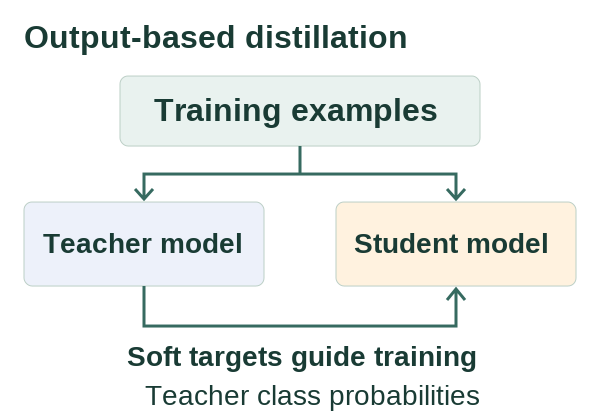
Knowledge distillation is a method in which a large, pre-trained network called the teacher is used to train a smaller network called the student. In distillation, a classifier is trained on the outputs of another classifier, which serve as soft labels in place of ground truth data.[1][2]
Students trained on another model's outputs can learn faster and more reliably than from true labels alone.[2] A student does worse when the size gap to its teacher is very large.[1]
Key facts
| 94.89% | share of communication cost cut by FedKD, Wu and colleagues 2022[3] |
|---|---|
| 32.6% | largest gain for a lightweight medical segmentation network, Qin and colleagues 2021[4] |
| 3.49 | average accuracy points gained on CIFAR100 by self-distillation, Zhang and colleagues 2021[5] |
| 44 | languages handled by one distilled translation model, Tan and colleagues 2019[6] |
Overview
What knowledge distillation is
Knowledge distillation is a way to train a small computer model with help from a large one. The large model is called the teacher model, and the small one is called the student model.[7] The usual aim is to shrink a model without compromising its performance.[8] Deep learning models are often large, and they can be hard to run on devices with limited resources, such as mobile phones and embedded devices.[7] Some models hold millions or even billions of parameters.[9]
A deep neural network is a network model with a complex structure. That cost restricts their use in settings with limited resources and in applications that must respond in real time.[10] Model compression is the general name for methods that make a network smaller, and knowledge distillation is one of them.[11][12] A survey from 2017 grouped compression and speed-up techniques into four families, and knowledge distillation was one of the four.[11]
History
Where the idea came from
Knowledge distillation is one answer to a practical problem in machine learning: the best models are often too big to run on ordinary hardware. By 2017, top systems for computer vision tasks such as image classification and object detection typically involved big models with numerous parameters.[13]
The standard recipe came to be called offline distillation, and it relies on a strong teacher trained in advance. That setup allows favourable knowledge discovery and transfer, but it requires a complex two-phase training procedure.[14] A 2018 paper described a variant that needs no complicated multi-stage setup and no many new hyperparameters. In that scheme, two networks each see a different part of the data and are trained to match the predictions the other would have made. Those predictions can come from an older copy of the other model, so they can be computed from weights that are sent only rarely. The same paper reported that online distillation let extra computing power fit very large datasets about twice as fast, and that it made a model's exact predictions dramatically more reproducible.[15]
On-the-fly Native Ensemble, described in 2018, trains one network with several branches and builds a strong teacher during that same training run.[14] Born-Again Networks, from another 2018 paper, took the idea in a different direction by dropping compression altogether. There the student is given exactly the same number of parameters as its teacher. These students outperformed their teachers significantly, both on computer vision and on language modeling tasks. Born-again networks built on DenseNets reached state-of-the-art validation error of 3.5% on CIFAR-10 and 15.5% on CIFAR-100.[16]
A 2017 method called Apprentice combined low-precision numerics with knowledge distillation and reported state-of-the-art accuracies at ternary and 4-bit precision for variants of the ResNet architecture on ImageNet.[13] A 2019 method, Quantization-aware Knowledge Distillation, noted that combining the two techniques may not work as desired, because distillation's regularizing effect further reduces the already reduced representation power of a quantized model. Its answer coordinated quantization and distillation in three phases: Self-studying, Co-studying, and Tutoring. The middle phase trains a teacher to be more friendly to quantization and more powerful than a fixed teacher would be.[17] Later work continued the compression theme, including a 2023 pruning method that divides model weights into essential and inessential weights by magnitude.[18] A 2025 approach called counterclockwise block-wise knowledge distillation split both teacher and student into sub-network blocks, transferring one teacher block at a time to reduce the gap between the two models.[19]
Main ideas
Why soft targets carry extra signal
A classifier usually ends its work with a list of class probabilities, and only the top score is normally read as the answer. The remaining probability values are generally ignored, yet they carry what researchers call dark knowledge, also known as soft targets.[20] Training one classifier on the outputs of another classifier, rather than on true labels alone, is the technique called knowledge distillation. Classifiers trained this way have been observed to learn much faster and more reliably than classifiers trained on ground truth data.[2]
One account sorts a teacher's knowledge into three levels, each with its own effect on the student. At the broadest level, distillation acts as a kind of smoothing of the labels, which regularizes the student's training. At the middle level, the teacher passes on relationships between classes before the student's output layer is shaped. At the finest level, the teacher rescales the student's per-instance gradients according to how difficult it judged that example to be.[21]
Another theory asks how an ensemble, an average of the outputs of several independently trained networks, can beat each member. The networks in that analysis share the same architecture, algorithm and dataset, and differ only by the random seeds used in initialization. When the data has a structure the authors call multi-view, the ensemble can provably improve test accuracy. That gain in accuracy can also be proved to pass into a single model, trained to copy the ensemble's output rather than the true label.[22]
Soft targets can also mislead, because a teacher's probabilities may rest on a wrong prediction. Making students copy teacher features without regard to how reliable each prediction is can pass the teacher's errors on to the student. One proposed framework quantifies confidence for each sample by ranking the ground truth label among the teacher's outputs. On CIFAR-100 and ImageNet, that method improved accuracy by 0.3 to 0.5 percent over state-of-the-art methods.[23]
The amount of dark knowledge transferred need not be set by guesswork. One method controls the dark knowledge values with an inductive proof on the operating limits of the SoftMax layer. Fitting both the hard targets and the soft targets gave an optimal distillation effect that mitigated catastrophic forgetting, the loss of earlier learning when a model is trained on new material.[20]
What the student can copy
One 2019 framework trained a small model beside a larger, already trained one, then chose which internal layers of the two should be matched. Two matrices, one comparing classes within a layer and one comparing layers with each other, scored how varied and how distinctive the feature maps were. On three publicly available datasets, the framework gave superior performance in model training.[24]
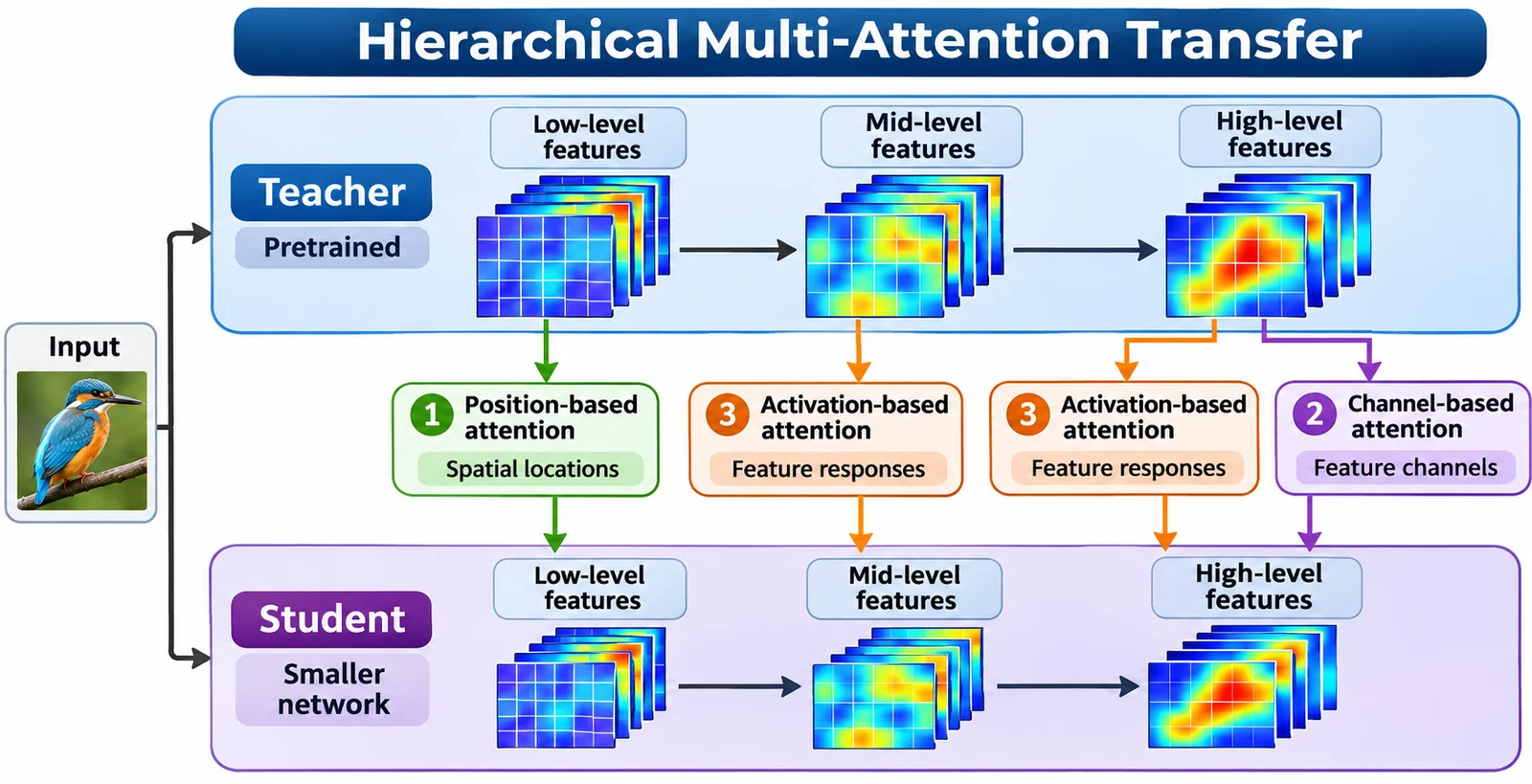
Earlier attention methods transferred similar attention knowledge from the middle layers, leaving the layered structure of deep learning poorly studied. A 2024 framework called hierarchical multi-attention transfer used position-based attention for low-level features and channel-based attention for high-level features. A third type, activation-based attention, covered both mid-level and high-level features. Across image classification, image retrieval and object detection, this framework clearly beat recent state-of-the-art distillation methods.[25]
Channel distillation passed channel information from teacher to student, and a second strategy let the student copy only the teacher's correct outputs. A decay schedule gradually lowered the weight of the distillation loss, so the student gradually took control of the optimization. On ImageNet, the method reached 27.68% top-1 error with ResNet18, and on CIFAR100 the student outperformed the teacher.[26]
A 2023 method built sample correlations from attention maps taken at several middle layers, focusing on the most informative regions of each sample.[27] A 2019 contrastive method argued that matching the teacher's output probabilities ignores important structural knowledge. It trained the student to capture significantly more of the teacher's representation, and it beat standard distillation and other leading methods on single model compression, ensemble distillation and cross-modal transfer. Combined with standard distillation, it sometimes even outperformed the teacher network.[28]
A student can also learn from several teachers at once. One 2021 study trained five distinct lightweight networks for semantic segmentation on several datasets. The student learned from this group of teachers and combined their different kinds of knowledge. The multi-teacher framework improved results by 9% up to 32.18% over the single-teacher version.[29]
Some designs let teacher and student learn from each other. A 2024 scheme ran forward distillation offline and added a feedback step in which the trained teacher received feedback from students and refined its teaching. On five visual recognition datasets, this scheme beat current state-of-the-art distillation methods.[30] Another framework fused different kinds of knowledge, from individual instances and from relations between instances, and let several students guide each other. On six image datasets it clearly outperformed recent state-of-the-art methods.[31]
When the teacher is too far ahead
Another remedy is self-distillation, in which knowledge moves within a single model rather than from a separate teacher. One version attaches attention modules and shallow classifiers at different depths of a network. Knowledge then flows from the deepest classifier to the shallower ones. On average this gave a 3.49 percent accuracy boost on CIFAR100 and 2.32 percent on ImageNet, and it combined with pruning, knowledge distillation and lightweight model design.[5] A 2021 method called Memory-replay Knowledge Distillation uses the model's own earlier copies as teachers, penalizing differences between current and saved backup outputs.[32]
Adjustments on the teacher side can also ease transfer.[33][34] Spot-adaptive knowledge distillation chooses, for each training sample and each training round, which layers of the teacher to distill from.[33] Meta Knowledge Distillation tunes the temperatures in the softmax functions, the settings that turn raw model scores into probabilities, for both teacher and student. Tuning the temperatures properly can greatly reduce both the gap between teacher and student and the trouble that strong data augmentation causes. With the ViT-L model, this approach reached 86.5% accuracy after 600 epochs, short for training passes over the data, which was 0.6% better than a method trained for 1,650 epochs.[34]
Distillation without the original data
Ordinary knowledge distillation needs the training data that taught the teacher, but that data is not always available. The training set may be too large to store, or its release may raise privacy or safety concerns, as with biometrics tasks. Data-free knowledge distillation compresses a trained network using only some extra metadata supplied with the pretrained model. Metadata here means extra information about the model or its task, rather than the original examples.[35] With an imbalanced teacher, adversarial data-free methods favour minority classes while badly hurting majority classes, and the student's overall accuracy falls. A 2024 class-adaptive regularization method mitigates this biased learning and improves overall performance over baselines.[36]
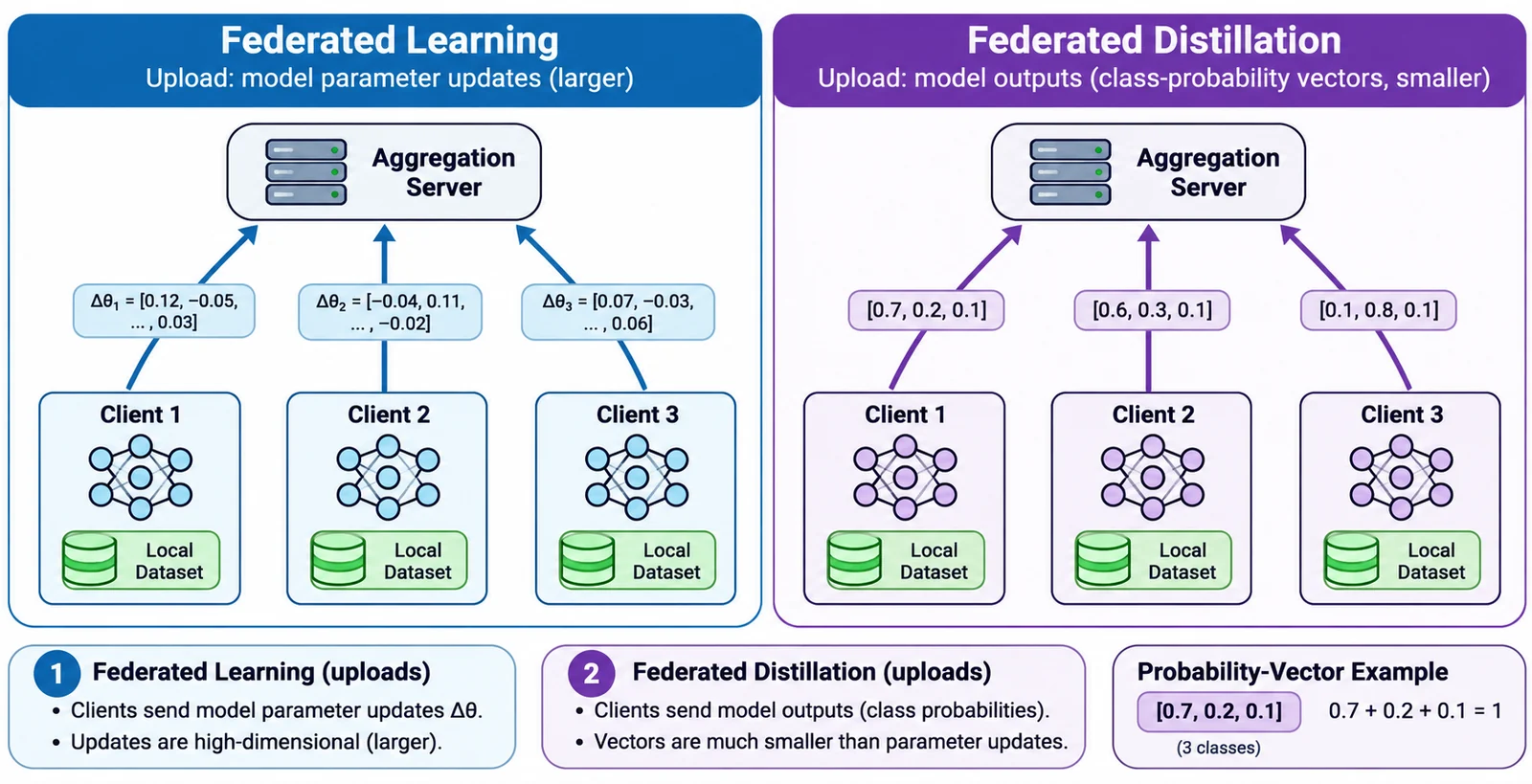
Federated learning trains a shared model from data that stays on separate devices, sending model updates instead of raw data. Those updates can be extremely large when they contain many parameters, and training needs many rounds of communication.[3] Federated distillation instead sends only model outputs, which are usually far smaller than the model, such as 10 labels in the MNIST dataset.[37]
A method called FedKD combined adaptive mutual knowledge distillation with dynamic gradient compression. Tested in three scenarios that need privacy protection, it cut communication cost by up to 94.89% and matched centralized model learning.[3] Another approach has the server learn a lightweight generator in a data-free manner, then broadcast it to users to guide local training. That method generalized better using fewer communication rounds than the state of the art.[38]
Privacy law has created a right to be forgotten, so a trained model may need to forget what it learned from one client. A federated unlearning method removes a client's contribution by subtracting its accumulated historical updates from the model. It then uses knowledge distillation to restore the model's performance without any data from the clients. The method works for any type of neural network and does not require clients to take part.[39]
Distillation also serves as a defense against backdoor attacks on image classifiers. In such an attack, an adversary adds poisoned images with special marks to the training set, and the model misclassifies inputs carrying those marks while scoring well on clean data. A 2020 countermeasure distills the backdoored model using clean unlabeled data, since the backdoor is not triggered by clean inputs. The distilled model performed as well as a clean model without a backdoor.[40]
Teachers built to be copied
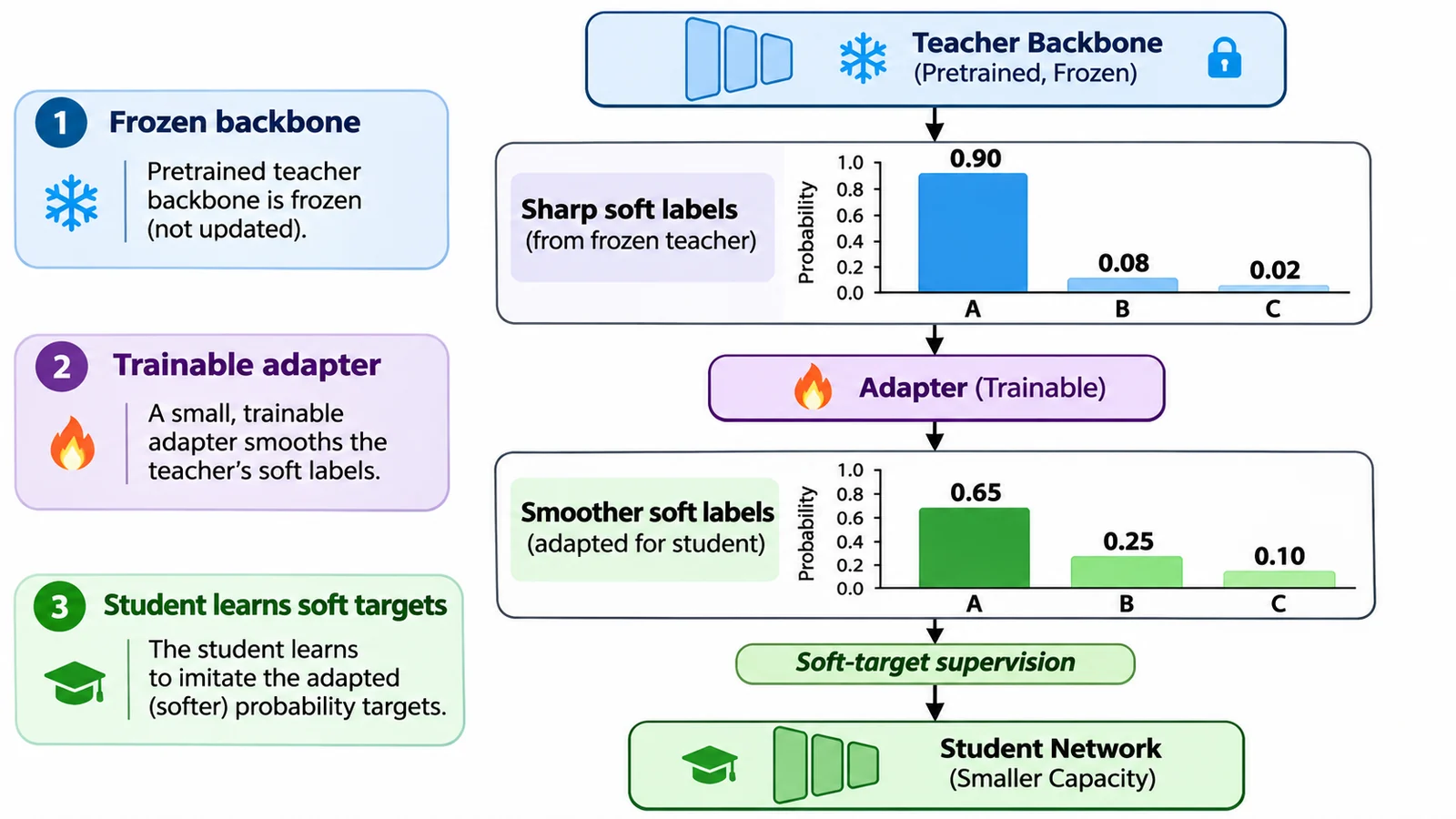
Most distillation methods hold the teacher fixed and train the student to imitate it, but a second line of work changes the teacher instead, so that what the teacher passes on suits the student's smaller capacity. One approach learns the teacher and the student branches together, so that the teacher's internal representations are shaped to be easy for a student to copy. The later distillation step stays simple, so most existing distillation methods can adopt this technique. It improved accuracy and convergence speed across several well-known distillation methods, including cases where teacher and student architectures differ and nothing is known about the student when the teacher is trained.[41] A related method treats the mismatch between teacher and student as a gap in sharpness between their predicted probability distributions and narrows it by smoothing the teacher's soft labels, the graded probability scores the student learns from. That method adds a small adapter module to the teacher and updates only the adapter, which cut training cost while giving results competitive with advanced online distillation methods on computer vision and natural language benchmarks.[42]
Other work lets the teacher evolve during training rather than starting from a fixed pre-trained model. Evolutionary knowledge distillation learns a teacher online and has it pass intermediate knowledge to the student on the fly, with simple guided modules placed between matching teacher and student blocks. The design rests on the observation that a small capability gap between teacher and student helps knowledge transfer, and experiments reported good adaptability in low-resolution and few-sample settings.[43] Collaborative knowledge distillation starts from the finding that good networks are not necessarily suitable teachers and that distillation performance correlates positively with teacher prediction uncertainty. It gives the student a part in the process and helps the teacher distill knowledge suited to the student's learning, an idea the paper describes as tailoring the teaching to the individual. On CIFAR-100 the method raised student accuracy by an average of 3.42% over its baseline and by an average of 1.71% over classical knowledge distillation, and on ImageNet it improved the student's Top-1 accuracy by 2.04%.[44]
Mutual learning removes the fixed roles altogether: two or more small networks train from scratch at the same time and learn from each other, which costs more training than one-way transfer but can give each network better accuracy. Two proposed variants, full deep distillation mutual learning and half deep distillation mutual learning, combine this two-way exchange with distillation losses drawn from variations of existing architectures and were tested on three public benchmark datasets.[45] A teacher-student collaborative method pairs ordinary distillation from a teacher with self-teaching inside the student, building a multi-exit network whose deep features supervise its own training and whose sub-models vote on the final classification. It outperformed both a traditional distillation method and a multi-exit network built on self-distillation.[46] A combined framework adds several shallow classifiers and an attention module so that a network draws on knowledge inside itself as well as knowledge from the teacher, and it continued to work well when applied to lightweight networks built with group convolution.[47]
Research
How large the gains are
In face-based age estimation, student models trained to copy a larger teacher came close to the teacher's accuracy on the LFW+, LAP 2016 and Adience datasets. Those students were up to 15 times faster than the teacher, and some resisted image corruption better than the teacher did.[48] In medical image segmentation, a single distilled network was smaller and faster than the ensemble it learned from, with no loss of performance. The distilled networks also beat the same network trained on the reference segmentations instead of the teacher's outputs.[49]
A small BERT model, a type of language model, reached an average score of 83.6% on GLUE, a standard set of language understanding tasks. That was 4.1% above the same small model distilled in the traditional way, and 2.6% and 3.9% above two other compressed models. With only 13.3% of the parameters of the large BERTBASE teacher, the small model kept over 96.3% of the teacher's performance.[50] For multilingual translation, distillation let one model handle up to 44 languages with accuracy comparable to, or better than, separate models for each language pair.[6]
In acoustic scene classification, which labels short audio clips by setting, a single distilled model reached 77.63% accuracy. That figure was higher than an ensemble of the baseline model and several specialist models.[51] A face recognition network with 0.92M parameters, called PocketNetS-128, matched recent compact models holding up to 4M parameters across nine benchmarks.[52]
Compression ratios can be very large when the teacher is a heavy model. For predicting the remaining useful life of machinery, a compressed model with 12.8 times fewer weights and 46.2 times fewer floating point operations came close to a complex recurrent network.[53]
Compressing models for small devices
A deep neural network can be accurate and still be too large to run on the hardware where its answers are needed. Smartphones, embedded sensor nodes and other edge devices, meaning machines at the edge of a network with limited computing power, cannot host models that are computation intensive, memory demanding and power hungry.[1][54] Some networks hold millions or even hundreds of millions of parameters, the adjustable numbers learned during training, and such a model may not be suitable for direct deployment on units with low computation and low capacity.[55]
Compression methods aim to shrink a trained network so that it fits the target device, and knowledge distillation is one of the popular choices among them, alongside quantization and pruning.[1][54] In distillation, a large pre-trained teacher network is used to train a smaller student network, and the student is meant to keep much of the teacher's accuracy at a fraction of the size.[1][56] Reported compression ratios vary widely with the setting: one 2026 study on CIFAR-10, a standard image classification dataset, reports a 4.1x compression factor and cuts inference time from 140ms to 13ms. The same study reports 92.6% testing accuracy for its distilled model, 1.1 percentage points above the 91.5% of a non-distilled model (p < 0.001).[57]
Size reduction is not free, and the central limit is a performance gap between teacher and student.[58][59] Several research lines attack this problem by inserting an intermediate network or a second small network that absorbs part of the teacher's knowledge before the smallest student is trained.[1][59] One residual approach reaches competitive performance at 18.04%, 23.14%, 53.59% and 56.86% of the teachers' computational costs on CIFAR-10, CIFAR-100, Tiny-ImageNet and ImageNet respectively.[58]
Training a distilled model can itself be expensive, which matters when compression is meant to save resources. Blockwise distillation, which compresses a complex network one block at a time, has seen little adoption because of its long training time. A parallel version ran on a server with four GeForce RTX 2080Ti graphics processors. It reports a 3x speedup with 19 percent energy savings on VGG distillation and a 3.5x speedup with 29 percent energy savings on ResNet distillation, with negligible accuracy loss in both cases. On four RTX6000 graphics processors in a distributed cluster, the ResNet speedup rises to 3.87.[54]
Distilling across tasks and model families
Most distillation research pairs a teacher and a student that solve the same kind of problem, but a smaller group of studies asks what carries over when the task, the model family or the data type changes.[60][61] A 2026 simulation study by Oancea tested this directly on structured data, meaning data arranged in rows and columns rather than images or text, using synthetic datasets with known ground truth and controlled noise. In regression, distillation behaved like target smoothing and denoising: the teacher cut label noise by 17.4%, 13 of 14 students improved numerically, and the mean squared error fell by 7.1%. After multiplicity control, a correction for testing many comparisons at once, the reliable gains were concentrated among multilayer perceptrons.[60]
Classification gains in the same study were smaller: 12 of 15 students improved, by an average of 0.5 percentage points, and soft-label distillation improved calibration for multilayer perceptrons. The study concluded that useful transfer requires a student with sufficient capacity and a teacher whose predictions stay conditionally aligned with the inputs, that is, whose outputs still track the features they are meant to describe. The classification gains were small in absolute accuracy but held across random seeds and came with improvements on selected calibration measures.[60]
Anomaly detection on tabular data offers a second test, because heterogeneous ensembles, mixtures of different detection methods, perform well but cost too much to run where response time or computing power is limited. Krčmar and colleagues distilled such an ensemble into a lightweight neural model and measured which kinds of anomaly knowledge survived. Across ten benchmark datasets, the student kept up to 98.5% of the teacher's AUC-ROC, a standard summary of detection quality, on the nine datasets with enough capacity, and 84.7% on average across all ten, while running 26 to 181 times faster at inference. Transfer was uneven by type: global outliers transferred at 78% and isolation-based detection was retained at 88%, while local outliers transferred at only 20% and neighborhood-based detection was retained at 76%.[61]
Other work examines how a student's shape affects what it can absorb, including a narrow-deep ResNet that adds depth without the overfitting risk of excessive width. Trained by distillation on Cifar-100 and Pascal VOC, that small model reached about the same accuracy as a large model while sharply reducing response time and computation.[62] For dense prediction tasks, where every pixel receives a label, Liu and colleagues argued that distilling each pixel separately borrows a scheme built for image classification and performs below par. Their alternative distills structure instead: pair-wise similarities captured in a static graph, or holistic knowledge through adversarial training, tested on semantic segmentation, depth estimation and object detection.[63]
In practice
Uses in science and industry
A 2023 survey reports that the method was proposed in 2015 for image classification and later extended to other visual tasks. Detection models have grown complex, and their large parameter size makes them impractical for industry applications, the survey states.[64]
Open-vocabulary detection lets a system find objects described by arbitrary text, and training data is the main obstacle. A method called ViLD distils a pretrained open-vocabulary image classifier into a two-stage detector. The teacher encodes category texts and image regions, and the student's detected boxes are aligned with those encodings. On the LVIS benchmark, with all rare categories held out as unseen, ViLD reached 16.1 mask AP with a ResNet-50 backbone. That score beat the supervised counterpart by 3.8, and a stronger teacher raised it to 26.3.[65] A conditional framework for detection treats each target instance as a query and uses attention to weigh which features matter. It raised RetinaNet with a ResNet-50 backbone from 37.4 to 40.7 mAP under a 1x schedule, above the 40.4 mAP of a ResNet-101 teacher under a 3x schedule.[66]
Medical imaging uses distillation to improve segmentation while keeping runtime efficiency. One segmentation method adds a module that makes the student copy how representations differ between tissue regions. The lightweight network improved by up to 32.6% in the experiment, which used the public CT datasets LiTS17 and KiTS19.[4] A second scheme shares all convolutional kernels across CT and MRI scans and keeps only modality-specific normalization layers.[67]
SimCVD distils pairwise similarities between voxels, the small volume elements of a scan, in a semi-supervised setting. With 20% and 10% of labels it reached average Dice scores of 90.85% and 89.03%, gains of 0.91% and 2.22% over the previous best.[68] For diabetic retinopathy grading, self-distillation balanced model performance against time complexity. The method reached an AUC of 0.965 and an accuracy of 92.9% on the Messidor dataset, and 67.96% accuracy on the harder IDRID dataset.[69]
Physics and engineering problems also use the idea. Physics-informed neural networks solve partial differential equations but rely on external loss terms for physical constraints. A distillation method splits physical and parameter regularization between teacher and student, then extracts structures by clustering. Tests on Laplace, Burgers and Poisson equations, and on fluid mechanics, improved accuracy and training efficiency.[70]
For molecular crystals, a distilled neural network potential predicted elastic properties more accurately than the pre-trained model. Raising the share of hard target loss reduced the efficiency of knowledge transfer and led to overfitting.[71] In wireless, distillation transferred knowledge from a complex autoencoder to a lightweight one for channel state information feedback. The student needed 3.05% to 5.28% of the teacher's floating point operations and 13.80% to 14.76% of its inference time.[72]
An evolutionary algorithm called NEMOKD raised inference accuracy by up to 82% at the cost of 38% more latency on a Movidius Myriad X processor. Quantisation found a sweet spot at 3 bit precision, and parallel field-programmable gate array versions of 2 and 3 bit networks reached 373 thousand frames per second.[73] An optical design removes the nonlinear layers between convolutional layers, which normally keep such networks accurate. Simulations showed the optical linear network could approach the nonlinear network on object classification and semantic segmentation.[74] For quantum dynamics, a curriculum of simple training examples taught an emulator the rules of wave packet evolution.[75]
An intrusion detection system for the internet of things and drones cut parameters by 92% to 95% and sped inference by 7% to 11%. Detection performance rose by up to 6.12% across the datasets tested.[76] A distilled model for transformer fault diagnosis reduced memory use by 83.5% and computation time by 73.2%.[77] Lightweight video models reached 92.07% accuracy on UCF101 and 65.56% on HMDB51, against a teacher's 94.74% and 69.48%. Those students used up to 87% fewer parameters and 89% fewer floating-point operations, with 6.7 times faster inference.[78]
In multi-agent reinforcement learning, a method called KnowRU reused knowledge among agents and shortened training for new tasks.[79] A recommender framework for career paths distilled a larger model into a more efficient one to support explanations.[80] Fish species classification in poor-quality underwater images used distillation loss during incremental learning and reached 81.83% accuracy.[81] Emotion recognition distilled fused EEG and EOG signals into an EOG-only model, reaching 70.38% and 60.41% accuracy for valence and arousal on the DEAP dataset.[82] Face photo-sketch synthesis used a teacher trained on a related task to guide two student networks.[83] Generative adversarial networks, which produce images, were compressed at ratios of 1669 to 1, 58 to 1 and 87 to 1 on MNIST, CIFAR-10 and Celeb-A while keeping image quality.[84]
Distillation in language and vision systems
In natural language understanding, distillation has been used to fold an ensemble of multi-task models into a single model that is cheaper to serve. For each task, an ensemble of MT-DNNs served as the teacher, and one MT-DNN was trained as the student to imitate those teachers across all tasks together. The distilled model beat the original MT-DNN on 7 of 9 GLUE tasks, a standard benchmark of language understanding, raising the single-model score to 83.7 percent, an absolute gain of 1.5 percent.[85]
For large language models, a 2025 survey divides distillation methods into white-box and black-box groups, depending on whether the student can see the teacher's internal outputs or only its final answers. The survey treats distillation as a way to speed up inference without greatly compromising performance, and it compares evaluation tasks and measured effects across methods.[86] A separate 2025 review describes known weaknesses of language model distillation: imprecise knowledge transfer, long training, and the buildup of errors over long sequences. The combined method pairs selective teacher intervention with low-rank layers, which replace fully connected layers with smaller ones. Its answers reached 97 percent of the quality of full fine-tuning and 98 percent of the quality of the low-rank method alone on two measures, ROUGE-L and perplexity. Trainable parameters fell by 99 percent against full fine-tuning and by 49 percent against low-rank adaptation. That combination also reduced graphics memory use by 75 percent and 30 percent against the two baselines and inference time by 30 percent.[87]
Small language models are compact systems built to run where memory and computing power are limited, and a 2025 overview lists efficiency, latency, safety and privacy among the reasons they matter.[88] TinyLlama, released in 2024, is a 1.1 billion parameter model pretrained on about 1 trillion tokens for roughly 3 epochs, and it outperformed other open-source models of similar size on a set of downstream tasks.[89]
Distillation also carries over to code search and to questions about video.[90][91] One code retrieval system trained a single student from six monolingual teacher models so that queries in natural language could find code in several programming languages with modest amounts of training text. For Ruby, the student raised the mean reciprocal rank, a measure of how high the correct answer appears in the results, by 20 to 25 percent.[90] In video question answering, a method passed the fused features of a large teacher to a smaller student, which learned appearance and motion features together and improved on earlier methods on the MSVD-QA and MSRVTT-QA datasets.[91]
Vision tasks show the same pattern of a large teacher guiding a lighter student.[92][93][94][95][96] For finding salient objects in paired color and thermal infrared images, a transformer teacher guided a wavelet-based network called WaveNet.[92] An object detection method called Shared Knowledge Distillation breaks the transfer into steps and lets students learn from each other, and it was tested on object detection and instance segmentation.[93]
For image restoration on drones, a student learned from two teachers, one handling degraded images and one handling clean images. Across five datasets and three tasks, deraining, deblurring and dehazing, the student cut floating-point operations by 85.4 percent and parameters by 85.8 percent. It lost an average of 2.6 percent in peak signal-to-noise ratio and 0.9 percent in structural similarity.[94] In agricultural robotics, a compact vision transformer distilled from a ResNet-50 teacher reached a mean average precision of 83.47 percent for weed detection with 5.7 million parameters.[95] For medical image segmentation, pairing distillation with contrastive learning, which trains a model to tell similar and different examples apart, raised Dice scores by 4.92 percent, 4.34 percent and 4.59 percent for the student networks ENet, MobileNetV2 and ResNet-18 on a colorectal cancer tumor dataset.[96]
Distillation under privacy and energy limits
Some settings make the usual arrangement, a pretrained teacher and a student trained on the same data, impossible or wasteful.[97][98] Data samples are not always accessible because of large data sizes, privacy, or confidentiality. One distillation method for graph neural networks, which process data such as molecules and social links rather than images, was designed for the case in which no graph data can be used at training time. The method, called graph-free knowledge distillation, models the graph topology it needs for transfer as a multinomial distribution, a probability distribution over a fixed set of possible outcomes. A gradient estimator trains this framework using only forward propagation through the network. Its experiments report state-of-the-art performance for distilling knowledge from graph neural networks without training data.[97]
Federated learning trains a shared model on data that stays on separate devices, and distillation has been added to it in several ways.[99][100] One distillation-based federated method uploads soft targets, the teacher's probability scores over classes, together with local model gradients to a cloud server for aggregation, and a dynamic adjustment strategy tunes the ratio between the distillation loss and the federated loss. The reported benchmarks show improved model accuracy without significant communication overhead.[99] A decentralized variant built on blockchain, a shared ledger that records transactions across many parties, adds an incentive mechanism that scores client models in two stages and tracks a multi-dimensional reputation based on data quality, activity level, and stability. Its experiments report better contribution assessment accuracy, lower computational overhead, and stronger resilience against malicious attacks.[100]
Personalized federated methods use distillation to keep a local model close to a shared one. One such method pairs a client-side attention module with a server-side attention network that sets aggregation weights from earlier training rounds. It reports faster, more stable convergence and higher personalization accuracy on CIFAR-10, CIFAR-100, and Shakespeare datasets.[101] Another clusters clients by how much their models change each round and has each client's interactive model and personal model distill from each other through middle-layer features and soft predictions, reporting average accuracy gains of 23.4% and 23.8% over FedAvg and FedProx.[102]
Spiking neural networks, which compute with discrete events rather than dense numbers, are studied as energy-efficient alternatives to conventional artificial neural networks.[103][104] Conventional distillation raised the accuracy of student spiking networks but also produced a substantial increase in the number of spikes, the events that carry most of the energy cost. A method using heterogeneous temperature parameters, settings that soften the teacher's outputs differently across the network, produced a student with up to 0.09% higher accuracy and 65% fewer spikes than a student trained with conventional distillation on MNIST.[103] A later approach treats distillation as a hybrid training strategy, aligning features through a lightweight affine projector, and reports that transfer works whether high-precision membrane potentials or binary spike trains serve as features. Applied to ResNet-18 on CIFAR-100, it reached 80.48% accuracy with four timesteps, above the equivalent artificial network at 79.90% and 3.49% above non-distilled spiking networks.[104]
Quantized networks store weights and activations at low bit precision to fit on edge devices, and distillation can improve their accuracy. Stochastic precision ensemble training removes the separate teacher: the teacher shares the student's model parameters, and its soft labels come from randomly changing the bit precision of activations at each layer during the forward pass. The student is trained on those labels with a cosine similarity loss instead of the usual divergence measure, and the method outperformed existing quantization training methods on image classification, question answering, and transfer learning without needing cumbersome teacher networks.[98]
What this looks like in practice
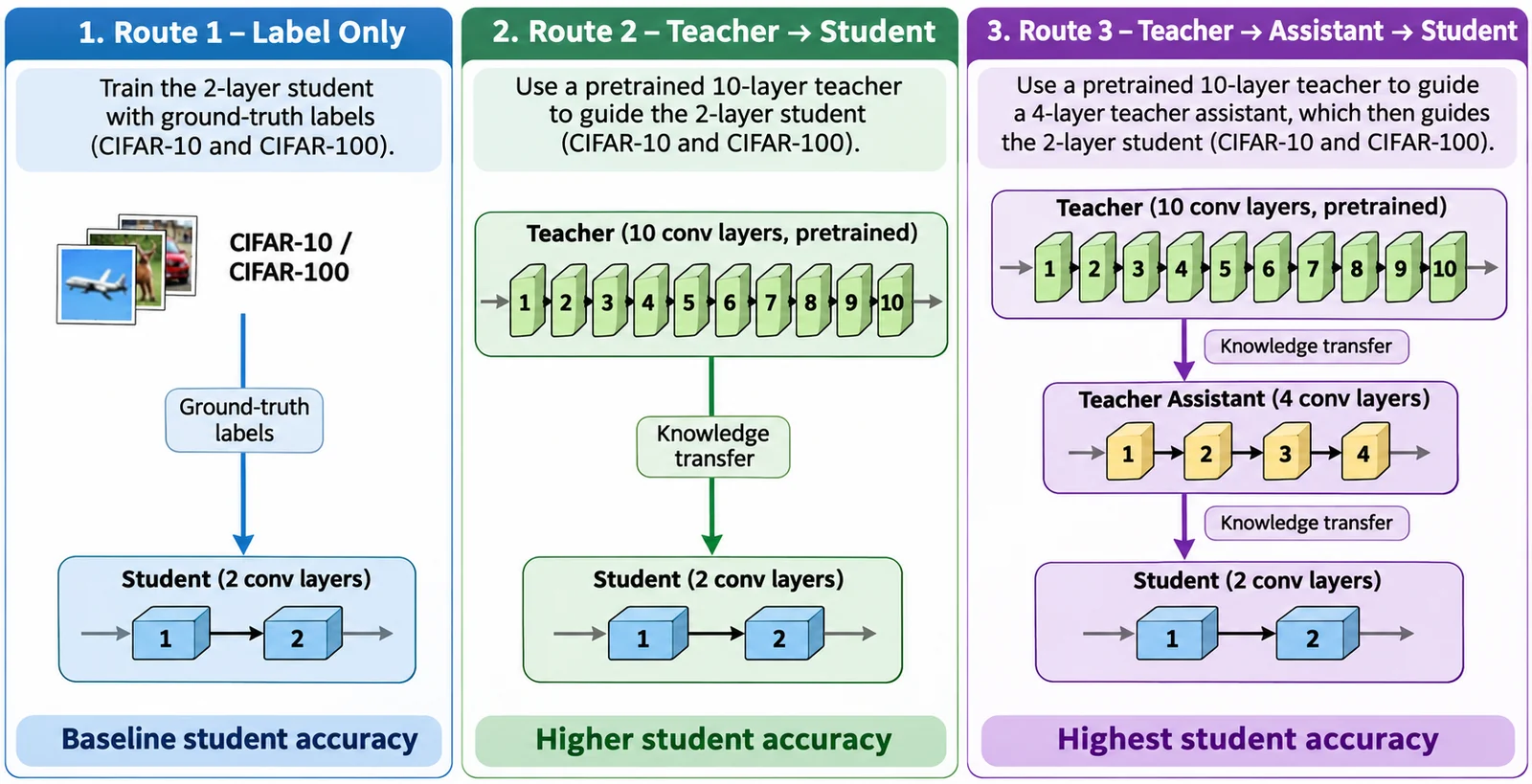
Knowledge distillation trains a smaller student network using a larger, pretrained teacher network. Mirzadeh, Farajtabar, Li, Levine, Matsukawa and Ghasemzadeh (2020) measured student accuracy on CIFAR-10, CIFAR-100 and ImageNet with plain CNN and ResNet architectures. In one set of experiments, a student with 2 convolutional layers learned from a teacher with 10 layers on CIFAR-10 and CIFAR-100. The plain student trained directly on labels did worse than the same student trained with a teacher, and an intermediate network of 4 layers did better still. The authors call the middle network a teacher assistant, and they report that its best size sits near the average accuracy of teacher and student rather than halfway between their layer counts. For ResNet models on CIFAR-10, a teacher assistant of 14 blocks was best, and on CIFAR-100 a teacher assistant of 20 blocks was best.[1]
Some settings have no training data to distill with, so researchers generate substitute inputs. One method compresses a network trained on a large dataset using only extra metadata released with the pretrained model, which matters when the data are private or sensitive, as in biometrics.[35] For graph neural networks, a method called GFKD learns fake graph structures by modeling their topology with a multinomial distribution, a probability rule for counts across categories. GFKD needs only forward propagation through the teacher, so it works with common graph libraries, and it reached the best reported results across six benchmark datasets.[97]
Distillation also serves privacy-preserving training, where many clients keep data locally and share only model updates. A method called FedKD combines mutual distillation with gradient compression and reduced communication cost by up to 94.89% while staying competitive with centralized training. Its tests covered news recommendation on the MIND 30 dataset, adverse drug reaction text detection, and medical named entity recognition, a task of finding and typing medical terms in text.[3]
Distillation can also make a model smaller for a specific job, such as segmenting tissue in medical images.[4] For drones, a dual-teacher student cut floating-point operations by 85.4% and parameters by 85.8%, with average drops of 2.6% in PSNR and 0.9% in SSIM, two image-quality scores.[94] For language models, combining selective teacher intervention with low-rank layers kept 97% of full fine-tuning quality on long sequences while cutting trainable parameters by 99%.[87] Alkhulaifi, Alsahli and Ahmad (2021) propose a distillation metric that combines the ratio of student size to teacher size with the ratio of student accuracy to teacher accuracy, weighted by a parameter between 0 and 1 that the designer sets according to the system's requirements. A distillation score closer to 0 indicates better distillation.[7]
Later developments
Graphs, language and small models
A 2025 survey of knowledge distillation on graphs groups the work by three questions: what to distill, who teaches whom, and how to distill.[105] One line of work keeps the local structure of the teacher's node embeddings, meaning the relationships along edges. A 2024 study instead proposed graph contrastive representation distillation, which aligns student embeddings to the teacher's in a shared space so the overall shape of the graph is kept. Across four datasets and 14 different graph network architectures, that method beat the local structure approach and baselines borrowed from 2-D computer vision.[106]
Different graph networks learn different things from the same graph, so a 2023 method called BGNN passes knowledge from several networks into one student in turn. That method raised node classification by up to 3.05% and graph classification by 6.35% over the plain networks.[107] A 2021 approach trains a group of graph networks together, so the group acts as a changing virtual teacher.[108]
For evolving graphs, a 2021 method called DynGKD cut link prediction error by an average relative 40.60% and sped inference up 30 times. It also reached a compression ratio of 21:100.[109] A 2024 model for spotting anomalies in Internet-of-Things traffic, RG-GLD, kept both local subgraph and global information and beat four baseline methods on two public datasets.[110] Another 2024 method, KDGCL, moved graph knowledge into a simpler network and gained an average 1.63% in transductive settings and 0.8% in inductive settings over baselines.[111]
Pluska, Welke, Gärtner and Malhotra (2024) present a decision-tree based model that distills interpretable logical classifiers from graph neural networks, and they report that the distilled models are interpretable and succinct and reach accuracy similar to the underlying network. A 2024 method distilled a graph network into a decision tree that can be read as logic, and the tree matched the network's accuracy on several architectures. When the true rule could be written in that logic, the tree did better than the network it came from.[112] Distillation can also proceed without the original data: a 2022 framework used a generator to make training graphs, and it beat other data-free baselines on graph classification across six datasets.[113]
Non-autoregressive translation predicts all output words at once, which is much faster than predicting them one by one. A 2019 study found that distillation simplified the training data and helped these fast models handle variation in the output. The study also found a strong link between a model's capacity and the best complexity of distilled data. Using these findings, it closed much of the gap with the slower standard model on the WMT14 English-German benchmark.[114]
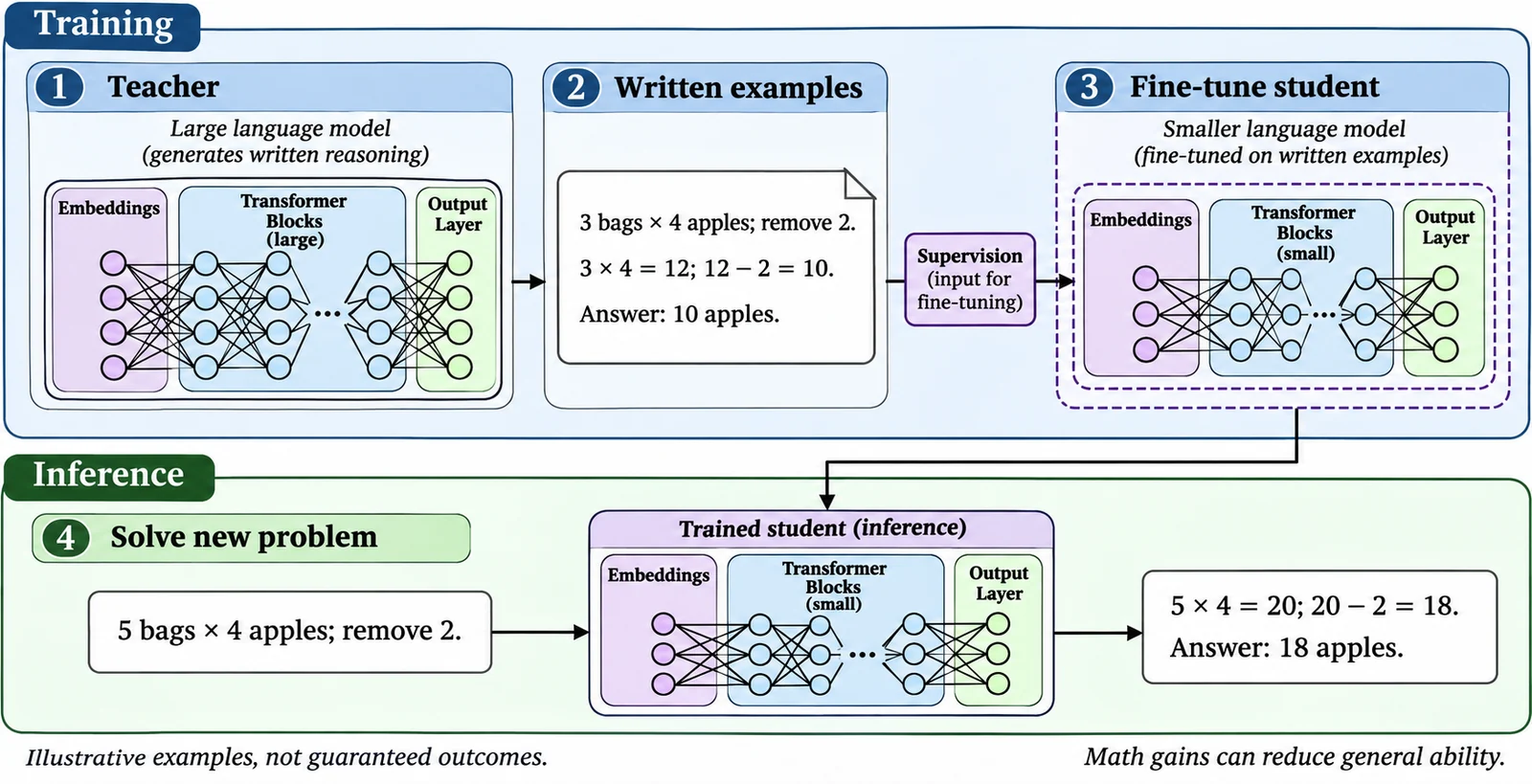
Chain of thought prompting improves reasoning in large language models, and this seemed to work only above 100 billion parameters. A 2022 study finetuned a student on the written reasoning of a larger teacher. On the GSM8K math word problems, the accuracy of T5 XXL rose from 8.11% to 21.99% after training on chains of thought from PaLM-540B.[115] A 2023 study distilled multi-step math reasoning from GPT-3.5, which has at least 175 billion parameters, into T5 variants of at most 11 billion. The gain came at a price: the smaller model's general ability fell as its math ability rose.[116]
A 2024 survey covers small language models for on-device and edge use, with sections on architectures, training and compression methods such as pruning and quantization.[117] Another 2024 survey examined 70 open-source small models with 100M to 5B parameters and tested them on commonsense reasoning, mathematics, in-context learning and long context.[118] A 2025 survey defines small models by their fit for specialized tasks and limited hardware rather than by a fixed size. It notes that large models such as PaLM 540B and Llama-3.1 405B often need cloud access, which raises privacy concerns and slows real-time use.[119] A 2024 survey of distillation for large language models organizes the field around algorithms, skills and verticalization.[120]
Criticism
Limits, failures and open questions
A 2026 study approximated the activations of a trained feedforward neural network's final hidden layer with a symbolic regression model, which writes an explicit mathematical formula instead of a network of weights. Across 20 datasets, the distilled formula kept a substantial fraction of the network's predictive performance. It also cut the root mean square error by 7 to 21 percent compared with a plain symbolic regression model.[121]
In cross-lingual question answering, where the question and the knowledge base are in different languages, machine translation adds noise to the questions. That noise can build up and sharply damage the final performance of the system. A 2021 method trained a teacher on correct data, then fed noisy questions to a student trained on both correct data and the teacher's outputs.[122]
Common misconceptions
With the student network held fixed, a teacher network cannot be made arbitrarily large: a teacher transfers its knowledge effectively only to students up to a certain size. Mirzadeh, Farajtabar, Li, Levine, Matsukawa and Ghasemzadeh (2020) report that this expectation fails once the size difference between the two networks becomes large. Mirzadeh, Farajtabar, Li, Levine, Matsukawa and Ghasemzadeh (2020) report that a student network performs worse as the size difference between it and its teacher grows. A teacher can pass on its knowledge to students only down to some size, not below it. Inserting an intermediate teacher assistant of 4 layers between a 2-layer student and a 10-layer teacher improved results on CIFAR-10 and CIFAR-100.[1]
It is often thought that distillation requires the original training data.[35] Data-free methods compress a pretrained network using only metadata released with it, or by learning fake graph structures when the data are graphs.[35][97]
Key studies
| Year | Study | Sample | Design | Finding |
|---|---|---|---|---|
| 2018 | Furlanello et al.[16] | DenseNet students on CIFAR-10 and CIFAR-100 | DenseNet students on CIFAR-10 and CIFAR-100 | Students with the same architecture as their teachers reached 3.5% and 15.5% validation error on CIFAR-10 and CIFAR-100. |
| 2020 | Mirzadeh et al.[1] | CIFAR-10, CIFAR-100 and ImageNet datasets with CNN and ResNet architectures | Theoretical analysis and experiments on CIFAR-10, CIFAR-100 and ImageNet with CNN and ResNet architectures | A teacher assistant of 4 layers beat 6 or 8 layers between a 2-layer student and a 10-layer teacher on CIFAR-10 and CIFAR-100. |
| 2020 | Allen-Zhu & Li[22] | Formal theory for ensembles of identically trained networks on multi-view data | Ensemble accuracy gains can provably be distilled into a single model trained to match the ensemble's output. | |
| 2021 | Alkhulaifi et al.[7] | four student models on CIFAR-100 with ResNet44 | Results from Walawalkar, Shen and Savvides (2020) on CIFAR-100 with the ResNet44 architecture, with four student models at relative sizes of 62.84%, 35.36%, 15.25% and 3.74% of the teacher | The teacher reached 71.76% accuracy and students at 62.84%, 35.36%, 15.25% and 3.74% of its size reached 69.12%, 67.04%, 62.87% and 43.11%. |
| 2021 | Deng & Zhang[97] | six benchmark datasets and two graph neural network architectures | Six benchmark datasets in different domains with two GNN architectures | GFKD, which learns fake graph structures, achieved the best performance across the datasets without observable graph data. |
| 2021 | Gu et al.[65] | LVIS benchmark with rare categories held out, plus PASCAL VOC, COCO and Objects365 | LVIS with all rare categories held out as novel categories, plus transfer without finetuning to PASCAL VOC, COCO and Objects365 | ViLD reached 16.1 mask AP on rare categories with a ResNet-50 backbone, 3.8 above the supervised counterpart, and 26.3 AP with the ALIGN teacher. |
| 2021 | Qin et al.[4] | two public CT datasets, LiTS17 and KiTS19 | Two public CT datasets, LiTS17 and KiTS19 | The distilled lightweight network improved by up to 32.6% while keeping runtime efficiency. |
| 2021 | Zhang et al.[5] | various neural networks and datasets including CIFAR100 and ImageNet | Various neural networks and datasets, including CIFAR100 and ImageNet | Self-distillation gave average accuracy boosts of 3.49 and 2.32 percent on CIFAR100 and ImageNet. |
| 2021 | Phuong & Lampert[2] | Theoretical analysis of linear and deep linear classifiers | A generalization bound shows fast convergence, with success depending on data geometry, optimization bias and strong monotonicity. | |
| 2022 | Wu et al.[3] | three privacy-sensitive tasks with data split across four clients | Three tasks with user data: personalized news recommendation on MIND 30, ADR mentioning text detection on the SMM4H 2018 dataset, and medical NER on CADEC, ADE and SMM4H | FedKD reduced communication cost by up to 94.89% and stayed competitive with centralized training. |
| 2022 | Magister et al.[115] | T5 XXL student and PaLM-540B teacher on GSM8K | A T5 XXL student finetuned on chains of thought generated by a PaLM-540B teacher, evaluated on GSM8K and other arithmetic, commonsense and symbolic reasoning datasets | T5 XXL accuracy rose from 8.11% to 21.99% after finetuning on teacher-generated chains of thought. |
| 2024 | Zhang et al.[50] | BERTTINY student and BERTBASE teacher on GLUE tasks | BERTTINY-AMKD compared with BERTTINY-KD, BERT4-PKD and DistilBERT4 on GLUE tasks, against the BERTBASE teacher | BERTTINY-AMKD averaged 83.6% on GLUE, 4.1% above BERTTINY-KD, while holding 13.3% of the teacher's parameters and over 96.3% of its performance. |
| 2025 | Liu et al.[70] | Laplace, Burgers and Poisson equations plus fluid mechanics cases | Laplace, Burgers and Poisson equations, plus fluid mechanics cases | The structured network cut L2 error on the Laplace problem from 11.59 for the plain network to 0.7422. |
| 2026 | Krčmar et al.[61] | ten benchmark datasets for tabular anomaly detection | Ten benchmark datasets for tabular anomaly detection | The distilled model kept up to 98.5% of the teacher's AUC-ROC on nine capacity-sufficient datasets and gave 26 to 181 times faster inference. |
See also
References
- Mirzadeh, S. I., Farajtabar, M., Li, A., Levine, N., Matsukawa, A., & Ghasemzadeh, H. (2020). Improved Knowledge Distillation via Teacher Assistant. Proceedings of the AAAI Conference on Artificial Intelligence, 34(04), 5191-5198. doi:10.1609/aaai.v34i04.5963
- Phuong, M., & Lampert, C. H. (2021). Towards Understanding Knowledge Distillation. arXiv. doi:10.48550/arxiv.2105.13093 Free full text
- Wu, C., Wu, F., Lyu, L., Huang, Y., & Xie, X. (2022). Communication-efficient federated learning via knowledge distillation. Nature Communications, 13(1). doi:10.1038/s41467-022-29763-x
- Qin, D., Bu, J. J., Liu, Z., Shen, X., Zhou, S., Gu, J. J., Wang, Z. H., Wu, L., & Dai, H. F. (2021). Efficient Medical Image Segmentation Based on Knowledge Distillation. IEEE Transactions on Medical Imaging, 40(12), 3820-3831. doi:10.1109/tmi.2021.3098703
- Zhang, L., Bao, C., & Ma, K. (2021). Self-Distillation: Towards Efficient and Compact Neural Networks. IEEE Transactions on Pattern Analysis and Machine Intelligence, 1-1. doi:10.1109/tpami.2021.3067100
- Tan, X., Ren, Y. C., He, D., Qin, T., Zhao, Z., & Liu, T. (2019). Multilingual Neural Machine Translation with Knowledge Distillation. arXiv. doi:10.48550/arxiv.1902.10461 Free full text
- Alkhulaifi, A., Alsahli, F., & Ahmad, I. (2021). Knowledge distillation in deep learning and its applications. PeerJ Computer Science, 7, e474. doi:10.7717/peerj-cs.474
- Moslemi, A., Briskina, A., Dang, Z., & Li, J. (2024). A survey on knowledge distillation: Recent advancements. Machine Learning with Applications, 18, 100605. doi:10.1016/j.mlwa.2024.100605
- Wang, L., & Yoon, K. J. (2022). Knowledge Distillation and Student-Teacher Learning for Visual Intelligence: A Review and New Outlooks. IEEE Transactions on Pattern Analysis and Machine Intelligence, 44(6), 3048-3068. doi:10.1109/tpami.2021.3055564
- 韩, 宇. (2020). A Review of Knowledge Distillation in Deep Neural Networks. Computer Science and Application, 10(09), 1625-1630. doi:10.12677/csa.2020.109171
- Cheng, Y., Wang, D., Zhou, P., & Zhang, T. (2017). A Survey of Model Compression and Acceleration for Deep Neural Networks. arXiv. doi:10.48550/arxiv.1710.09282 Free full text
- Li, Z., Li, H., & Meng, L. (2023). Model Compression for Deep Neural Networks: A Survey. Computers, 12(3), 60. doi:10.3390/computers12030060
- Asit, M., & Marr, D. (2017). Apprentice: Using Knowledge Distillation Techniques To Improve Low-Precision Network Accuracy. arXiv. doi:10.48550/arxiv.1711.05852 Free full text
- Xu, L., Zhu, X., & Gong, S. (2018). Knowledge Distillation by On-the-Fly Native Ensemble. arXiv. doi:10.48550/arxiv.1806.04606 Free full text
- Anil, R., Pereyra, G., Passos, A., Ormándi, R., Dahl, G. E., & Hinton, G. E. (2018). Large scale distributed neural network training through online distillation. arXiv. doi:10.48550/arxiv.1804.03235 Free full text
- Furlanello, T., Lipton, Z. C., Tschannen, M., Itti, L., & Anandkumar, A. (2018). Born Again Neural Networks. arXiv. doi:10.48550/arxiv.1805.04770 Free full text
- Kim, J., Bhalgat, Y. S., Lee, J., Chirag, P., & Kwak, N. (2019). QKD: Quantization-aware Knowledge Distillation. arXiv. doi:10.48550/arxiv.1911.12491 Free full text
- Kim, J. (2023). Quantization Robust Pruning With Knowledge Distillation. IEEE Access, 11, 26419-26426. doi:10.1109/access.2023.3257864
- Lan, X., Zeng, Y., Wei, X., Zhang, T., Wang, Y., Huang, C., & He, W. (2025). Counterclockwise block-by-block knowledge distillation for neural network compression. Scientific Reports, 15(1). doi:10.1038/s41598-025-91152-3
- Onchis, D., Istin, C., & Samuila, I. (2024). Optimal Knowledge Distillation through Non-Heuristic Control of Dark Knowledge. Machine Learning and Knowledge Extraction, 6(3), 1921-1935. doi:10.3390/make6030094
- Tang, J., Shivanna, R., Zhao, Z., Dong, L., Singh, A., H., E., & Jain, S. C. (2020). Understanding and Improving Knowledge Distillation. arXiv. doi:10.48550/arxiv.2002.03532 Free full text
- Allen-Zhu, Z., & Li, Y. (2020). Towards Understanding Ensemble, Knowledge Distillation and Self-Distillation in Deep Learning. arXiv. doi:10.48550/arxiv.2012.09816 Free full text
- Shen, T., Cui, Z., & Qi, J. (2025). Logitwise Distillation Network: Improving Knowledge Distillation via Introducing Sample Confidence. Applied Sciences, 15(5), 2285. doi:10.3390/app15052285
- Li, H. T., Lin, S. C., Chen, C. Y., & Chiang, C. K. (2019). Layer-Level Knowledge Distillation for Deep Neural Network Learning. Applied Sciences, 9(10), 1966. doi:10.3390/app9101966
- Gou, J., Sun, L., Yu, B., Wan, S., & Tao, D. (2024). Hierarchical Multi-Attention Transfer for Knowledge Distillation. ACM Transactions on Multimedia Computing, Communications, and Applications, 20(2), 1-20. doi:10.1145/3568679
- Zhou, Z., Zhuge, C., Xinwei, G., & Liu, W. (2020). Channel Distillation: Channel-Wise Attention for Knowledge Distillation. arXiv. doi:10.48550/arxiv.2006.01683 Free full text
- Gou, J., Sun, L., Yu, B., Wan, S., Ou, W., & Yi, Z. (2023). Multilevel Attention-Based Sample Correlations for Knowledge Distillation. IEEE Transactions on Industrial Informatics, 19(5), 7099-7109. doi:10.1109/tii.2022.3209672
- Tian, Y., Krishnan, D., & Isola, P. (2019). Contrastive Representation Distillation. arXiv. doi:10.48550/arxiv.1910.10699 Free full text
- Amirkhani, A., Khosravian, A., Masih-Tehrani, M., & Kashiani, H. (2021). Robust Semantic Segmentation With Multi-Teacher Knowledge Distillation. IEEE Access, 9, 119049-119066. doi:10.1109/access.2021.3107841
- Gou, J., Chen, Y., Yu, B., Liu, J., Du, L., Wan, S., & Yi, Z. (2024). Reciprocal Teacher-Student Learning via Forward and Feedback Knowledge Distillation. IEEE Transactions on Multimedia, 26, 7901-7916. doi:10.1109/tmm.2024.3372833
- Gou, J., Sun, L., Yu, B., Du, L., Ramamohanarao, K., & Tao, D. (2024). Collaborative Knowledge Distillation via Multiknowledge Transfer. IEEE Transactions on Neural Networks and Learning Systems, 35(5), 6718-6730. doi:10.1109/tnnls.2022.3212733
- Wang, J., Zhang, P., & Li, Y. (2021). Memory-Replay Knowledge Distillation. Sensors, 21(8), 2792. doi:10.3390/s21082792
- Song, J., Chen, Y., Ye, J., & Song, M. (2022). Spot-Adaptive Knowledge Distillation. IEEE Transactions on Image Processing, 31, 3359-3370. doi:10.1109/tip.2022.3170728
- Liu, J., Liu, B., Li, H., & Liu, Y. (2022). Meta Knowledge Distillation. arXiv. doi:10.48550/arxiv.2202.07940 Free full text
- Lopes, R. G., Fenu, S., & Starner, T. E. (2017). Data-Free Knowledge Distillation for Deep Neural Networks. arXiv. doi:10.48550/arxiv.1710.07535 Free full text
- Liao, D., Gao, X., & Xu, C. (2024). Impartial Adversarial Distillation: Addressing Biased Data-Free Knowledge Distillation via Adaptive Constrained Optimization. Proceedings of the AAAI Conference on Artificial Intelligence, 38(4), 3342-3350. doi:10.1609/aaai.v38i4.28120
- Seo, H., Park, J., Oh, S., Bennis, M., & Kim, S. (2020). Federated Knowledge Distillation. arXiv. doi:10.48550/arxiv.2011.02367 Free full text
- Zhu, Z., Hong, J., & Zhou, J. (2021). Data-Free Knowledge Distillation for Heterogeneous Federated Learning. arXiv. doi:10.48550/arxiv.2105.10056 Free full text
- Chen, W., Zhu, S., & Mitra, P. (2022). Federated Unlearning with Knowledge Distillation. arXiv. doi:10.48550/arxiv.2201.09441 Free full text
- Yoshida, K., & Fujino, T. (2020). Countermeasure against Backdoor Attack on Neural Networks Utilizing Knowledge Distillation. Journal of Signal Processing, 24(4), 141-144. doi:10.2299/jsp.24.141
- Park, D. Y., Cha, M. H., Jeong, C., Kim, D., & Han, B. (2021). Learning Student-Friendly Teacher Networks for Knowledge Distillation. arXiv. doi:10.48550/arxiv.2102.07650 Free full text
- Rao, J., Meng, X., Ding, L., Qi, S., Liu, X., Zhang, M., & Tao, D. (2024). Parameter-Efficient and Student-Friendly Knowledge Distillation. IEEE Transactions on Multimedia, 26, 4230-4241. doi:10.1109/tmm.2023.3321480
- Zhang, K., Zhang, C., Li, S., Zeng, D., & Ge, S. (2022). Student Network Learning via Evolutionary Knowledge Distillation. IEEE Transactions on Circuits and Systems for Video Technology, 32(4), 2251-2263. doi:10.1109/tcsvt.2021.3090902
- Zhang, W., Guo, Y., Wang, J., Zhu, J., & Zeng, H. (2024). Collaborative Knowledge Distillation. IEEE Transactions on Circuits and Systems for Video Technology, 34(8), 7601-7613. doi:10.1109/tcsvt.2024.3377251
- Lukman, A., & Yang, C. K. (2022). Improving Deep Mutual Learning via Knowledge Distillation. Applied Sciences, 12(15), 7916. doi:10.3390/app12157916
- Xu, C., Gao, W., Li, T., Bai, N., Li, G., & Zhang, Y. (2023). Teacher-student collaborative knowledge distillation for image classification. Applied Intelligence, 53(2), 1997-2009. doi:10.1007/s10489-022-03486-4
- Shuiping Ni, S. N., Shuiping Ni, W. W., Wendi Wang, M. Z., Mingfu Zhu, X. M., & Xinliang Ma, Y. Z. (2024). Combined Knowledge Distillation Framework: Breaking Down Knowledge Barriers. 電腦學刊, 35(4), 109-122. doi:10.53106/199115992024083504008
- Greco, A., Saggese, A., Vento, M., & Vigilante, V. (2022). Effective training of convolutional neural networks for age estimation based on knowledge distillation. Neural Computing and Applications, 34(24), 21449-21464. doi:10.1007/s00521-021-05981-0
- Noothout, J. M. H., Lessmann, N., Van Eede, M. C., van Harten, L. D., Sogancioglu, E., Heslinga, F. G., Veta, M., van Ginneken, B., & Išgum, I. (2022). Knowledge distillation with ensembles of convolutional neural networks for medical image segmentation. Journal of Medical Imaging, 9(05), 1-20. doi:10.1117/1.jmi.9.5.052407
- Zhang, K., Li, J., Wang, B., & Meng, H. (2024). Autocorrelation Matrix Knowledge Distillation: A Task-Specific Distillation Method for BERT Models. Applied Sciences, 14(20), 9180. doi:10.3390/app14209180
- Jung, J. W., Heo, H. S., Shim, H. J., & Yu, H. J. (2020). Knowledge Distillation in Acoustic Scene Classification. IEEE Access, 8, 166870-166879. doi:10.1109/access.2020.3021711
- Boutros, F., Siebke, P., Klemt, M., Damer, N., Kirchbuchner, F., & Kuijper, A. (2022). PocketNet: Extreme Lightweight Face Recognition Network Using Neural Architecture Search and Multistep Knowledge Distillation. IEEE Access, 10, 46823-46833. doi:10.1109/access.2022.3170561
- Xu, Q., Chen, Z., Wu, K., Wang, C., Wu, M., & Li, X. (2022). KDnet-RUL: A Knowledge Distillation Framework to Compress Deep Neural Networks for Machine Remaining Useful Life Prediction. IEEE Transactions on Industrial Electronics, 69(2), 2022-2032. doi:10.1109/tie.2021.3057030
- Blakeney, C., Li, X., Yan, Y., & Zong, Z. (2021). Parallel Blockwise Knowledge Distillation for Deep Neural Network Compression. IEEE Transactions on Parallel and Distributed Systems, 32(7), 1765-1776. doi:10.1109/tpds.2020.3047003
- Yang, J. T., Kao, S. C., & Huang, S. C. H. (2022). Representative Teacher Keys for Knowledge Distillation Model Compression Based on Attention Mechanism for Image Classification. arXiv. doi:10.48550/arxiv.2206.12788 Free full text
- Zhu, E. Y., Zhao, C., Yang, H., Li, J., Wu, Y., & Ding, R. (2024). A Comprehensive Review of Knowledge Distillation- Methods, Applications, and Future Directions. International Journal of Innovative Research in Computer Science and Technology, 12(3), 106-112. doi:10.55524/ijircst.2024.12.3.17
- Hernandez, D. E., Chang, J. R., & Nordling, T. E. M. (2026). Model compression using knowledge distillation with integrated gradients. Neural Computing and Applications, 38(11). doi:10.1007/s00521-026-12137-5
- Li, X., Li, S., Omar, B., Wu, F., & Li, X. (2021). ResKD: Residual-Guided Knowledge Distillation. IEEE Transactions on Image Processing, 30, 4735-4746. doi:10.1109/tip.2021.3066051
- Gao, M., Shen, Y., Li, Q., & Loy, C. C. (2020). Residual Knowledge Distillation. arXiv. doi:10.48550/arxiv.2002.09168 Free full text
- Oancea, B. (2026). Knowledge Distillation Across Tasks and Model Families: A Comparative Simulation Study—Denoising, Dark Knowledge, and the Role of Model Capacity. Electronics, 15(14), 3157. doi:10.3390/electronics15143157
- Krčmar, T., Šabanović, D., Švarcmajer, M., & Lukić, I. (2026). What Knowledge Transfers in Tabular Anomaly Detection? A Teacher–Student Distillation Analysis. Machine Learning and Knowledge Extraction, 8(3), 60. doi:10.3390/make8030060
- Zhou, Y., Wang, Z., & Li, J. (2024). Knowledge Distillation Based on Narrow-Deep Networks. Neural Processing Letters, 56(3). doi:10.1007/s11063-024-11646-5
- Liu, Y., Shu, C., Wang, J., & Shen, C. (2023). Structured Knowledge Distillation for Dense Prediction. IEEE Transactions on Pattern Analysis and Machine Intelligence, 45(6), 7035-7049. doi:10.1109/tpami.2020.3001940
- Li, Z., Xu, P., Chang, X., Yang, L., Zhang, Y., Yao, L., & Chen, X. (2023). When Object Detection Meets Knowledge Distillation: A Survey. IEEE Transactions on Pattern Analysis and Machine Intelligence, 45(8), 10555-10579. doi:10.1109/tpami.2023.3257546
- Gu, X., Lin, T. Y., Kuo, W., & Cui, Y. (2021). Open-vocabulary Object Detection via Vision and Language Knowledge Distillation. arXiv. doi:10.48550/arxiv.2104.13921 Free full text
- Zijian, K., Zhang, P., Zhang, X., Sun, J., & Zheng, N. (2021). Instance-Conditional Knowledge Distillation for Object Detection. arXiv. doi:10.48550/arxiv.2110.12724 Free full text
- Dou, Q., Liu, Q., Heng, P. A., & Glocker, B. (2020). Unpaired Multi-Modal Segmentation via Knowledge Distillation. IEEE Transactions on Medical Imaging, 39(7), 2415-2425. doi:10.1109/tmi.2019.2963882
- You, C., Zhou, Y., Zhao, R., Staib, L., & Duncan, J. S. (2022). SimCVD: Simple Contrastive Voxel-Wise Representation Distillation for Semi-Supervised Medical Image Segmentation. IEEE Transactions on Medical Imaging, 41(9), 2228-2237. doi:10.1109/tmi.2022.3161829
- Luo, L., Xue, D., & Feng, X. (2020). Automatic Diabetic Retinopathy Grading via Self-Knowledge Distillation. Electronics, 9(9), 1337. doi:10.3390/electronics9091337
- Liu, Z., Liu, Y., Yan, X., Liu, W., Nie, H., Guo, S., & Zhang, C. a. (2025). Automatic network structure discovery of physics informed neural networks via knowledge distillation. Nature Communications, 16(1). doi:10.1038/s41467-025-64624-3
- Taniguchi, T. (2025). Knowledge distillation of neural network potential for molecular crystals. Faraday Discussions, 256, 139-155. doi:10.1039/d4fd00090k
- Cui, Y., Guo, J., Cao, Z., Tang, H., Wen, C. K., Jin, S., Wang, X., & Hou, X. (2024). Lightweight Neural Network With Knowledge Distillation for CSI Feedback. IEEE Transactions on Communications, 72(8), 4917-4929. doi:10.1109/tcomm.2024.3377724
- Stewart, R., Nowlan, A., Bacchus, P., Ducasse, Q., & Komendantskaya, E. (2021). Optimising Hardware Accelerated Neural Networks with Quantisation and a Knowledge Distillation Evolutionary Algorithm. Electronics, 10(4), 396. doi:10.3390/electronics10040396
- Xiang, J., Colburn, S., Majumdar, A., & Shlizerman, E. (2022). Knowledge distillation circumvents nonlinearity for optical convolutional neural networks. Applied Optics, 61(9), 2173. doi:10.1364/ao.435738
- Yao, Y., Cao, C., Haas, S., Agarwal, M., Khanna, D., & Abram, M. (2023). Emulating quantum dynamics with neural networks via knowledge distillation. Frontiers in Materials, 9. doi:10.3389/fmats.2022.1060744
- Wisanwanichthan, T., & Thammawichai, M. (2025). A Lightweight Intrusion Detection System for IoT and UAV Using Deep Neural Networks with Knowledge Distillation. Computers, 14(7), 291. doi:10.3390/computers14070291
- Shang, H., Wei, Y., & Zhang, S. (2025). Transformer Fault Diagnosis Based on Knowledge Distillation and Residual Convolutional Neural Networks. Entropy, 27(7), 669. doi:10.3390/e27070669
- Rasras, M., & Marin, I. (2026). Hybrid Knowledge Distillation for Edge-Efficient Video Action Recognition: Improving Lightweight 3D CNNs via Joint Distillation. Computers, 15(6), 371. doi:10.3390/computers15060371
- Gao, Z., Xu, K., Ding, B., & Wang, H. (2021). KnowRU: Knowledge Reuse via Knowledge Distillation in Multi-Agent Reinforcement Learning. Entropy, 23(8), 1043. doi:10.3390/e23081043
- Vultureanu-Albişi, A., Murareţu, I., & Bădică, C. (2025). Explainable Recommender Systems Through Reinforcement Learning and Knowledge Distillation on Knowledge Graphs. Information, 16(4), 282. doi:10.3390/info16040282
- Ben Tamou, A., Benzinou, A., & Nasreddine, K. (2022). Live Fish Species Classification in Underwater Images by Using Convolutional Neural Networks Based on Incremental Learning with Knowledge Distillation Loss. Machine Learning and Knowledge Extraction, 4(3), 753-767. doi:10.3390/make4030036
- Zhang, Z., & Lu, G. (2025). Multimodal Knowledge Distillation for Emotion Recognition. Brain Sciences, 15(7), 707. doi:10.3390/brainsci15070707
- Zhu, M., Li, J., Wang, N., & Gao, X. (2022). Knowledge Distillation for Face Photo–Sketch Synthesis. IEEE Transactions on Neural Networks and Learning Systems, 33(2), 893-906. doi:10.1109/tnnls.2020.3030536
- Aguinaldo, A., Chiang, P. y., Gain, A., Patil, A., Pearson, K., & Feizi, S. (2019). Compressing GANs using Knowledge Distillation. arXiv. doi:10.48550/arxiv.1902.00159 Free full text
- Liu, X., He, P., Chen, W., & Gao, J. (2019). Improving Multi-Task Deep Neural Networks via Knowledge Distillation for Natural Language Understanding. arXiv. doi:10.48550/arxiv.1904.09482 Free full text
- Yang, C., Zhu, Y., Lu, W., Wang, Y., Chen, Q., Gao, C., Yan, B., & Chen, Y. (2025). Survey on Knowledge Distillation for Large Language Models: Methods, Evaluation, and Application. ACM Transactions on Intelligent Systems and Technology, 16(6), 1-27. doi:10.1145/3699518
- Tatarnikova, T. M., & Mokretsov, N. S. (2025). Optimizing knowledge distillation models for language models. Scientific and Technical Journal of Information Technologies, Mechanics and Optics, 25(4), 737-743. doi:10.17586/2226-1494-2025-25-4-737-743
- Zhang, Q., Liu, Z., & Pan, S. (2025). The Rise of Small Language Models. IEEE Intelligent Systems, 40(1), 30-37. doi:10.1109/mis.2024.3517792
- Peiyuan, Z., Zeng, G., Wang, T., & Lu, W. (2024). TinyLlama: An Open-Source Small Language Model. arXiv. doi:10.48550/arxiv.2401.02385 Free full text
- Li, W., Xu, J., & Chen, Q. (2022). Knowledge Distillation-Based Multilingual Code Retrieval. Algorithms, 15(1), 25. doi:10.3390/a15010025
- Shao, Z., Wan, J., & Zong, L. (2023). A Video Question Answering Model Based on Knowledge Distillation. Information, 14(6), 328. doi:10.3390/info14060328
- Zhou, W., Sun, F., Jiang, Q., Cong, R., & Hwang, J. N. (2023). WaveNet: Wavelet Network With Knowledge Distillation for RGB-T Salient Object Detection. IEEE Transactions on Image Processing, 32, 3027-3039. doi:10.1109/tip.2023.3275538
- Guo, Z., Zhang, P., & Liang, P. (2024). Shared Knowledge Distillation Network for Object Detection. Electronics, 13(8), 1595. doi:10.3390/electronics13081595
- Zhang, Y. (2025). Simultaneous Learning Knowledge Distillation for Image Restoration: Efficient Model Compression for Drones. Drones, 9(3), 209. doi:10.3390/drones9030209
- El Alaoui, A., & Mousannif, H. (2025). Enhancing weed detection through knowledge distillation and attention mechanism. Frontiers in Robotics and AI, 12. doi:10.3389/frobt.2025.1654074
- Xiaoxuan Ma, X. M., Xiaoxuan Ma, S. S., & Sihan Shan, D. S. (2024). A Medical Image Segmentation Method Combining Knowledge Distillation and Contrastive Learning. 電腦學刊, 35(3), 363-377. doi:10.53106/199115992024063503024
- Deng, X., & Zhang, Z. (2021). Graph-Free Knowledge Distillation for Graph Neural Networks. Proceedings of the Thirtieth International Joint Conference on Artificial Intelligence, 2321-2327. doi:10.24963/ijcai.2021/320
- Boo, Y., Shin, S., Choi, J., & Sung, W. (2021). Stochastic Precision Ensemble: Self-Knowledge Distillation for Quantized Deep Neural Networks. Proceedings of the AAAI Conference on Artificial Intelligence, 35(8), 6794-6802. doi:10.1609/aaai.v35i8.16839
- Liu, T., Xia, J., Ling, Z., Fu, X., Yu, S., & Chen, M. (2023). Efficient Federated Learning for AIoT Applications Using Knowledge Distillation. IEEE Internet of Things Journal, 10(8), 7229-7243. doi:10.1109/jiot.2022.3229374
- Ying, X., Yan, K., Gao, X., & Huang, J. (2026). IMFLKD: an incentive mechanism for decentralized federated learning based on knowledge distillation. Scientific Reports, 16(1). doi:10.1038/s41598-026-46234-1
- Jin, Y., Zhang, K., Ma, C., Cheng, X., Zhang, L., & Zhang, H. (2025). pFedKA: Personalized Federated Learning via Knowledge Distillation with Dual Attention Mechanism. Computers, 14(12), 504. doi:10.3390/computers14120504
- Zhang, J., & Shi, Y. (2024). A Personalized Federated Learning Method Based on Clustering and Knowledge Distillation. Electronics, 13(5), 857. doi:10.3390/electronics13050857
- Lee, D., Park, S., Kim, J., Doh, W., & Yoon, S. (2021). Energy-efficient Knowledge Distillation for Spiking Neural Networks. arXiv. doi:10.48550/arxiv.2106.07172 Free full text
- Hu, Y., Li, G., & Deng, L. (2025). Knowledge distillation for spiking neural networks: aligning features and saliency. Neuromorphic Computing and Engineering, 5(3), 034002. doi:10.1088/2634-4386/ade821
- Tian, Y., Pei, S., Zhang, X., Zhang, C., & Chawla, N. V. (2025). Knowledge Distillation on Graphs: A Survey. ACM Computing Surveys, 57(8), 1-16. doi:10.1145/3711121
- Joshi, C. K., Liu, F., Xun, X., Lin, J., & Foo, C. S. (2024). On Representation Knowledge Distillation for Graph Neural Networks. IEEE Transactions on Neural Networks and Learning Systems, 35(4), 4656-4667. doi:10.1109/tnnls.2022.3223018
- Guo, Z., Zhang, C., Fan, Y., Tian, Y., Zhang, C., & Chawla, N. V. (2023). Boosting Graph Neural Networks via Adaptive Knowledge Distillation. Proceedings of the AAAI Conference on Artificial Intelligence, 37(6), 7793-7801. doi:10.1609/aaai.v37i6.25944
- Wang, C., Zhe, W., Chen, D., Zhou, S., Yan, F., & Chen, C. (2021). Online Adversarial Knowledge Distillation for Graph Neural Networks. arXiv. doi:10.48550/arxiv.2112.13966 Free full text
- Antaris, S., Rafailidis, D., & Girdzijauskas, S. (2021). Knowledge distillation on neural networks for evolving graphs. Social Network Analysis and Mining, 11(1). doi:10.1007/s13278-021-00816-1
- Zhou, X., Wu, J., Liang, W., Wang, K. I. K., Yan, Z., Yang, L. T., & Jin, Q. (2024). Reconstructed Graph Neural Network With Knowledge Distillation for Lightweight Anomaly Detection. IEEE Transactions on Neural Networks and Learning Systems, 35(9), 11817-11828. doi:10.1109/tnnls.2024.3389714
- Wang, Y., & Yang, S. (2024). A Lightweight Method for Graph Neural Networks Based on Knowledge Distillation and Graph Contrastive Learning. Applied Sciences, 14(11), 4805. doi:10.3390/app14114805
- Pluska, A., Welke, P., Gärtner, T., & Malhotra, S. (2024). Logical Distillation of Graph Neural Networks. Proceedings of the TwentyFirst International Conference on Principles of Knowledge Representation and Reasoning, 920-930. doi:10.24963/kr.2024/86
- Zhuang, Y., Lyu, L., Shi, C., Yang, C., & Sun, L. (2022). Data-Free Adversarial Knowledge Distillation for Graph Neural Networks. Proceedings of the Thirty-First International Joint Conference on Artificial Intelligence, 2441-2447. doi:10.24963/ijcai.2022/339
- Zhou, C., Neubig, G., & Gu, J. (2019). Understanding Knowledge Distillation in Non-autoregressive Machine Translation. arXiv. doi:10.48550/arxiv.1911.02727 Free full text
- Magister, L. C., Jonathan, M., Jakub, A., Malmi, E., & Severyn, A. (2022). Teaching Small Language Models to Reason. arXiv. doi:10.48550/arxiv.2212.08410 Free full text
- Fu, Y., Peng, H. M., Ou, L., Sabharwal, A., & Khot, T. (2023). Specializing Smaller Language Models towards Multi-Step Reasoning. arXiv. doi:10.48550/arxiv.2301.12726 Free full text
- Nguyen, C. V., Shen, X., Aponte, R., Xia, Y., Basu, S., Hu, Z., Chen, J., Parmar, M., Kunapuli, S., Barrow, J., Junda, W., Singh, A. K., Wang, Y., Gu, J., Dernoncourt, F., Ahmed, N. K., Lipka, N., Zhang, R., Chen, X., & ... Nguyen, T. H. (2024). A Survey of Small Language Models. arXiv. doi:10.48550/arxiv.2410.20011 Free full text
- Lu, Z., Xiang, L., Dongqi, C., Yi, R., Liu, F., Zhang, X., Lane, N. D., & Xu, M. (2024). Small Language Models: Survey, Measurements, and Insights. arXiv. doi:10.48550/arxiv.2409.15790 Free full text
- Wang, F., Zhang, Z., Zhang, X., Wu, Z., Mo, T., Lu, Q., Wang, W., Li, R., Xu, J., Tang, X., He, Q., Ma, Y., Huang, M., & Wang, S. (2025). A Comprehensive Survey of Small Language Models in the Era of Large Language Models: Techniques, Enhancements, Applications, Collaboration with LLMs, and Trustworthiness. ACM Transactions on Intelligent Systems and Technology, 16(6), 1-87. doi:10.1145/3768165
- Xu, X., Ming, L., Tao, C., Tao, S., Cheng, R., Jinyang, L., Xu, C., Tao, D., & Zhou, T. (2024). A Survey on Knowledge Distillation of Large Language Models. arXiv. doi:10.48550/arxiv.2402.13116 Free full text
- Shmuel, A., Koren, N., Glickman, O., & Lazebnik, T. (2026). Interpretable knowledge distillation via symbolic regression for feedforward neural networks. Neural Computing and Applications, 38(7). doi:10.1007/s00521-026-12067-2
- Wang, S., & Dang, D. (2021). Robust cross-lingual knowledge base question answering via knowledge distillation. Data Technologies and Applications, 55(5), 661-681. doi:10.1108/dta-12-2020-0312
Cite this page: Atlas Nova editors. (2026). Knowledge distillation. Atlas Nova. https://velocer.io/atlas/knowledge-distillation/