Technology · Machine learning
Recommender system
A recommender system is software that predicts which items a person is likely to want, using what is known about that person's past behaviour and stated preferences.
The prediction is usually delivered as a ranked list: a shopfront, a home screen, or a sidebar rearranged so that the things most likely to interest this particular person appear first. The defining move is that the list is tailored to the individual rather than fixed for everyone. An online store built this way does not show one catalogue to all visitors; it shows a software engineer titles on programming and a new parent baby toys, because the two have left different traces of what they buy, browse, and rate.[1]
Key facts
| 97.4% | Maximum recall when combining plant data sources at 20 km radius, Wittich et al. 2018[2] |
|---|---|
| 1.5 million | Web service invocation results collected from 150 users, Zheng et al. 2011[3] |
| 84 | GNN social recommender papers identified after annotating 2,151, Sharma et al. 2024[4] |
| 23 | Hybrid recommender studies addressing cold start, per Çano and Morisio 2017[5] |
Overview
Recommender system
Filtering of this kind matters because catalogues have outgrown any person's ability to scan them. When a shop holds a handful of goods, a customer can walk the shelves; when it holds millions of items, the shelves are effectively invisible, and a system that narrows the field is the only practical way in. Recommender systems are best understood as a branch of information filtering: their job is to take a large pool of candidates and return the small subset worth a person's attention.[6]
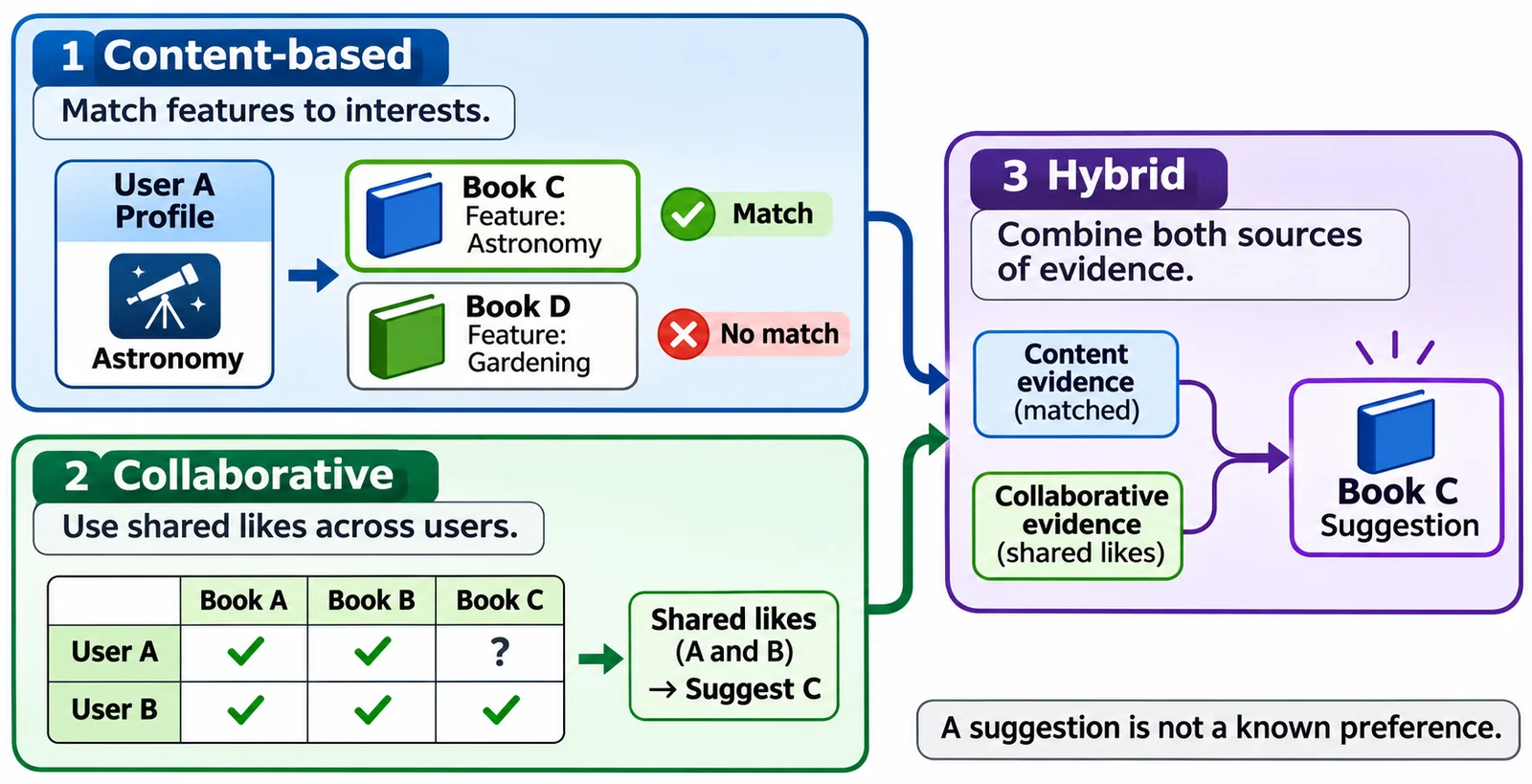
Three classic approaches
The methods for making that selection have traditionally been sorted into three families.[7] Content-based recommendation looks at the attributes of the items themselves and at a profile of the user's interests, then proposes items whose features resemble those the user has already favoured. Collaborative recommendation ignores what items are and looks instead at patterns of behaviour across many people: if two users have agreed on a run of items in the past, items liked by one can be proposed to the other. Hybrid designs combine the two, or combine several strategies, in the hope that the weaknesses of one are covered by the strengths of another.[7]
The distinction is worth holding onto because the two pure approaches fail in different places. A collaborative system can surface unexpected matches, but only where enough shared behaviour exists to compare people at all.[8]
What goes wrong
Several difficulties recur across all three families. The first is sparsity: the table of users against items is mostly empty, because any one person rates or buys only a tiny fraction of what is available, and similarity between people or items is hard to establish from so few shared entries. The second is the cold-start problem, which arises when a new user has no history to reason from or a new item has attracted no interactions yet, so the system has nothing to base a prediction on.[8] A third is bias: the behaviour a system learns from is observed rather than deliberately collected, so what people were shown, and in what position, shapes what they clicked, and a model that fits such data uncritically can amplify the skew rather than correct it.[9]
Evaluation is a further and less obvious difficulty. A recommender can be judged by how accurately it predicts a rating, by how good its ranked list is, or by whether people actually use and value it, and these measures need not agree. The choice of metric, dataset, and task changes the verdict, which makes comparisons between systems treacherous.[10] Accuracy on past data is therefore only one part of the story, and a system that scores well offline may still disappoint the people it serves.[11]
A recommender is a filter that turns a huge catalogue into a short, personal list; its hard problems are empty data, new users, skewed data, and knowing what "good" even means.
History
From mailing-list filters to personalised storefronts
The idea that a group of people can help one another decide what is worth reading predates any commercial recommender. An experimental mail system called Tapestry, built at the Xerox Palo Alto Research Center, started from a familiar complaint: electronic mail was burying people under a stream of incoming documents, and subscribing to mailing lists did not solve it, because the documents a given person cared about rarely mapped neatly onto existing lists.[12] Content filters that scanned a document's text were one answer, but the designers of Tapestry held that more effective filtering could be done by involving humans in the process. Their system supported collaborative filtering, in which people record their reactions to the documents they read, and those annotations become visible to other people's filters.[12] The filtering is collaborative in the plain sense: readers help one another sort the stream by leaving marks that others can use.
That early framing put the social act first and the software second. A recommender, on this view, assists and augments a process people already carry out when they ask a friend what to watch or what to read. In a typical system, people supply recommendations as inputs, the system aggregates them, and the aggregate is directed to the appropriate recipients; in some designs the value lies in the aggregation, in others in making good matches between the person giving advice and the person seeking it.[13] Two incentive problems follow almost immediately from that picture. Once a person has built up a profile of interests, it is easy to free ride on the evaluations others provide; and if anyone may contribute recommendations, sellers have an obvious motive to generate mountains of positive recommendations for their own materials and negative ones for a competitor's.[13] Recommenders, in other words, were understood as a social and economic arrangement from the start, not merely an algorithm.
Amazon and the item-to-item turn
The commercial storefront made the stakes concrete. At Amazon.com, recommendation algorithms were used to personalise the store so that it changed radically with a customer's interests, showing programming titles to a software engineer and baby toys to a new parent.[1] The company described three common approaches to the recommendation problem: traditional collaborative filtering, cluster models, and search-based methods. Its own method, which it called item-to-item collaborative filtering, works from relationships between items rather than between customers, and its online computation scales independently of the number of customers and the number of items in the catalogue, which is what allows recommendations to be produced in real time over a very large product set.[1] The shift in emphasis matters: a store with millions of customers and millions of products cannot afford, at the moment a page is served, to compare the current shopper against everyone else, so the expensive comparisons are pushed into precomputation and the live step is kept cheap.
Netflix and the test
Once a recommender sits inside a business, the question of whether a change to it is an improvement becomes an operational one, and the answer is not settled by offline accuracy alone. Netflix has described its recommender as a set of algorithms serving a business purpose, and its approach to improving them as a combination of A/B testing, in which different versions of the system are shown to different groups of members and compared on outcomes such as member retention and medium-term engagement, and offline experimentation on historical engagement data.[14] The pairing is the point. Offline experiments can be run quickly and repeatedly against logged data, but they measure what the logs contain; the live test measures what the business actually cares about, and the two need not point the same way. The company also notes that designing and interpreting such tests is itself difficult.[14]
Read as a sequence, these three episodes show the same idea being pushed in three directions. Tapestry treated recommendation as something people do for one another and asked how software could carry their annotations. The framing of recommenders as an augmentation of a social process made explicit that the inputs come from people with their own interests, and that aggregation and matching are where the design choices lie.[13] Amazon turned the problem into one of scale and latency, and answered it by comparing items rather than people.[1] Netflix turned it into one of measurement, and answered it by testing changes against the behaviour of real members.[14] What stays constant across all three is the underlying move described at the outset: a large pool of candidates is narrowed to a short list, and the narrowing is driven by recorded behaviour rather than by a fixed editorial choice.
The later sections take up the machinery that grew around that move: the table of users and items that most methods work from, the families of algorithm built on it, and the many settings beyond a shopping cart in which a shortlist is useful.
How it works
The user-item matrix at the centre
Most recommendation methods, whatever their outward form, work from a single object: the user-item matrix. Picture a table with one row per user and one column per item, and in each cell the record of what that user did with that item, such as a rating, a purchase, a view, or a click. A filled cell is an interaction; an empty one means no interaction was recorded, which is not the same as a judgement that the user dislikes the item. The matrix is the raw material of collaborative filtering, the dominant framework for recommendation.[15]
The shape of the table explains both the power and the trouble of the approach. A row is a person's history and a column is an item's audience, so the same matrix can be read in two directions: people who resemble each other in their rows probably want similar things, and items that attract the same people in their columns probably belong together. Nothing about the content of an item is needed for either reading. The system learns what a film or a book is, in effect, from who consumed it.
Comparing rows and columns
The older family of methods, called memory-based collaborative filtering, works directly on the matrix and keeps the whole thing on hand. To predict how a user will rate an item, it finds the users whose recorded ratings most resemble that user's, and averages their opinions of the item, weighted by how close each neighbour is. The item-based version does the same in the other direction, comparing columns rather than rows. The heart of the method is a similarity measure, a number expressing how alike two users or two items are, computed from the entries they share. Common choices include the cosine of the angle between two rating vectors, the Pearson correlation coefficient, and the mean squared difference between paired ratings.[16]
Similarity is a modest idea with sharp consequences. Two users can only be compared on the items they have both rated, so the comparison rests entirely on the overlap, and a large overlap gives a trustworthy number while a small one gives a noisy one. This is where sparsity bites. In a real catalogue any one person touches a tiny fraction of the available items, so most pairs of users share almost nothing, and the similarity that the method depends on is estimated from a handful of coincidences or from none at all.[8] The matrix is enormous and mostly blank, and the blankness is not incidental: it is the central obstacle the field has had to design around.
Learning a compact model
The second family, model-based collaborative filtering, does not keep the matrix. It summarises it. The training step fits a compact model to the observed cells, and prediction then reads from the model rather than from the raw table; for latent semantic models this yields constant time prediction and an explicit, compact model representation.[17]
The most influential form of this idea is matrix factorisation, which explains the observed ratings by positing a small number of hidden attributes for each user and each item. Each user is represented as a short vector of numbers, each item as another short vector, and the predicted rating is roughly the match between the two vectors, high when the user's leanings and the item's qualities line up. These hidden attributes are called latent factors because nobody assigns them a meaning; the fitting procedure discovers whatever dimensions best reproduce the observed cells. A latent factor might end up behaving like a taste for slow, serious films, or it might correspond to nothing a person could name. The point is compression: a table with millions of rows and columns is replaced by two much smaller tables of vectors, and the empty cells can then be filled by arithmetic.
Fitting such a model is an optimisation problem, and the details matter for whether it can be run at industrial scale. One line of work develops a non-negative variant, in which the latent values are constrained to be zero or positive, on the argument that this constraint gives the learned model better representativeness; an alternating-direction-method-based model updates one feature at a time and is reported to keep both computational and storage costs linear in the size of the observed data, which is what makes it usable on the extremely sparse matrices typical of the problem.[18] A related approach uses regularized single-element-based non-negative updates and reports high accuracy and low computational complexity on large industrial datasets while preserving the non-negativity constraint.[19] The technicalities differ, but the shared aim is a model that can be trained on a matrix that is mostly holes without either running out of memory or taking forever.
Why the two families differ
The contrast between the families is worth stating plainly, because it recurs throughout the field. A memory-based method is transparent: the neighbours behind a recommendation can in principle be shown, and new ratings enter the prediction as soon as they are recorded. Its weakness is that it must consult the data at prediction time and that its accuracy depends on overlaps that are often thin. A model-based method pays a large cost once, during training, and is then cheap and fast, but it compresses the data and can lose detail in the process, and updating it as new behaviour arrives is less straightforward.[17] Neither is simply better; the choice depends on how much data there is, how quickly it changes, and whether an explanation of the recommendation is needed.
The user-item matrix is the shared substrate: memory-based methods compare its rows or columns directly, while model-based methods compress it into latent factors and predict from the compression.
What both families inherit from the matrix is the same vulnerability. Because the table records only what happened, and what happened is a thin and uneven sample of what could have happened, every method built on it is reasoning from a partial view. The empty cells are not neutral; they are the space the system is asked to fill, and the quality of the filling depends on how much structure the observed cells happen to reveal.
Content, collaboration and hybrids
The three families named earlier are worth taking one at a time, because each rests on a different kind of evidence and each fails in its own way.


Content-based recommendation
A content-based recommender works from the items themselves. Every item is described by a set of attributes, which may be as simple as a genre label or as rich as the words of a document, and every user is described by a user profile, a stored summary of the attributes that person has favoured in the past. To recommend, the system compares the profile against the attributes of candidate items and proposes those that match. Nothing about other users enters the calculation. If a person has read a run of papers on a topic, the system can propose another paper on that topic without needing anyone else to have read it.
The profile need not be built from explicit ratings. One line of work constructed profiles from behaviour that was monitored unobtrusively and from relevance feedback, representing each profile in terms of an ontology of research paper topics, and used a visualisation of the profile to collect feedback on it; in two small-scale experiments with 24 subjects over three months and a large-scale experiment with 260 subjects over an academic year, ontological inference improved the profiling, external ontological knowledge was used to bootstrap the system, and the profile visualisation improved profiling accuracy.[20] The appeal of the approach is visible here: the system can say why it made a suggestion, in the vocabulary of the attributes it matched, and it can serve an item that no one else has touched.
The limitation follows from the same source. A content-based system can only recommend what resembles what a person already likes, so it tends to confine a user to the neighbourhood of their existing tastes and has little way to surprise them. It also depends on items being described well; where attributes are thin or missing, the match has nothing to work with.
Collaborative recommendation
A collaborative recommender sets the items aside and looks at people. Its input is the record of who interacted with what, and its reasoning is that users who have agreed in the past will probably agree again. To suggest something to one person, it finds others whose histories resemble theirs and draws on what those others liked. The item's own description plays no part; the system learns what an item is, in effect, from the company it keeps.
This is what allows collaboration to surface the unexpected. Because the recommendation comes from the behaviour of similar people rather than from the attributes of the item, it can propose something unlike anything in the user's history, provided someone with a comparable record has already found it. The price is a dependence on shared history. Where overlap between users is thin, there is little to compare, and the method has nothing to reason from, which is the sparsity problem described earlier.
Hybrid designs
A hybrid recommender combines two or more strategies, on the reasoning that the weakness of one is covered by the strength of another. Content-based filtering copes with a new item, since its attributes exist from the day it is listed, but it cannot reach beyond a user's established tastes; collaborative filtering can reach beyond them but needs interactions to work with. Put together, the attributes can carry an item until the behaviour arrives, and the behaviour can widen the range of what is proposed.
A systematic literature review of the last decade of hybrid recommender systems found the pattern clearly. Most of the studies it examined combined collaborative filtering with another technique, often weighting the two contributions together, and the two problems most often addressed were cold start and data sparsity, taken up in 23 and 22 studies respectively; movies and movie datasets were still the most widely used setting. The review also noted a persistent weakness in how such systems are judged: most studies evaluated themselves by comparison with similar methods on accuracy metrics, and providing more credible, user-oriented evaluation remained an open challenge.[5]
Why the families persist side by side
It would be tidy if one approach had displaced the others, and it has not. A survey of the field describes recommender systems as having been formulated first around demographic, content-based and collaborative filtering, with later systems incorporating social information to improve the quality of recommendations.[21] The three families answer different questions from different evidence, and the choice among them is a choice about what data is available and what kind of mistake is tolerable. A system rich in item descriptions but poor in user history is a natural home for content-based methods; one with heavy traffic and long histories is a natural home for collaboration; one facing both a constant stream of new items and a constant stream of new users has reason to combine them.
What the families share is the underlying move: a large pool of candidates is narrowed to a short list, and the narrowing is driven by recorded evidence rather than editorial choice. What differs is which evidence is consulted, the attributes of things or the behaviour of people, and whether the two are allowed to correct each other.
Content-based methods reason from what items are, collaborative methods from what similar people did, and hybrids mix the two so that each covers the other's blind spot.
Learning preferences with neural networks and graphs
The methods described so far rest on a hand-built notion of similarity: two users are alike if their rating vectors point the same way, two items are alike if the same people bought them. A different strategy is to let the system learn its own representation of users and items from raw data, without anyone deciding in advance which features matter. This is the contribution of deep learning to recommendation. A neural network takes the available raw material, which may be the words of a review, the pixels of an image, or a bare record of clicks, and learns intermediate features that prove useful for prediction. The appeal is not only accuracy but the property of learning feature representations from scratch, so that the engineering effort moves from designing features by hand to designing and training the network.[22]
What the network learns
In a matrix factorisation model, the latent factors are fitted but the input is already a tidy table of interactions. A deep model can take messier input. Text describing an item, the sequence of a user's past clicks, and the user's own attributes can all be fed in, and the network discovers how to combine them into a prediction. A survey of the field organises these models into a taxonomy according to the kind of neural architecture and the kind of data they consume, and describes the area as flourishing, with deep learning having shown its effectiveness in information retrieval and recommendation research after transforming vision and language processing.[22] The practical consequence is that a recommender no longer has to be handed a similarity measure; it can be handed the raw data and asked to learn one.
The cost is that such models need data and computation in quantity, and their inner workings are harder to inspect than a list of nearest neighbours. That trade-off, between a transparent method that reasons from thin overlaps and an opaque one that learns rich representations, runs through the rest of the field.
Users and items as a graph
A second line of work starts from an observation about the shape of recommendation data. The user-item matrix is a table, but it can equally be drawn as a network: every user is a point, every item is a point, and every recorded interaction is a line joining a user to an item. Drawn this way, the data has the structure of a graph, a set of nodes connected by edges, and most of the information a recommender holds is naturally of this kind. A graph neural network is a model built to learn from such structures, and it has been widely taken up in recommendation because of its strength in learning representations of graphs.[23]
The mechanism that makes graphs useful here is propagation. Each node begins with a rough representation, and the model repeatedly passes information along the edges, so that a node's representation is refined by the representations of its neighbours. A user's profile is updated by the items they interacted with; an item's profile is updated by the users who interacted with it; and because the process repeats, information travels further than one step. A user can be influenced by an item two hops away, reached through another user who shares a purchase. This is what a survey of the area calls high-order connectivity: the ability to reach beyond a user's direct history to the wider neighbourhood of people and things connected to it.[24]
Why the graph view suits the data
The fit between graph structure and recommendation data is not a coincidence of fashion. Three properties of the data line up with what graph methods do well. The first is that connectivity is the point: the value of the user-item data lies precisely in who is linked to what, and a graph represents links directly rather than as cells in a sparse table. The second is structural: the pattern of connections, not just their number, carries information, so two users with similar neighbourhoods can be recognised as alike even when they share no item directly. The third is that the graph supplies extra supervision, since each observed edge is a signal the model can learn from, which helps when the labelled data is thin.[24]
A related body of work applies the same machinery to social recommendation, where the graph carries user-to-user social relations alongside user-to-item interactions. The reasoning there is that people's tastes are shaped by those around them, through homophily, the tendency of similar people to associate, and through social influence, the tendency of people to adopt the tastes of those they are connected to. A survey of graph-based social recommenders identified 84 relevant papers after annotating 2,151 by following the PRISMA framework, and organised them by the inputs they use and the architectures they build.[4] The scale of that count is itself informative: the combination of social graphs and neural graph models has become a substantial research programme rather than a single technique.
What the two approaches share
Deep models and graph models are often the same thing in practice, since a graph neural network is a neural network, and the propagation step is learned rather than fixed. What unites them is a shift in where the intelligence sits. In the memory-based methods, a human chose the similarity measure and the algorithm applied it. In these methods, the representation itself is learned, either from raw features or from the pattern of connections, and the similarity falls out of the learned representation rather than being imposed on it.
That shift brings its own difficulties, which later sections take up: learned models are hungry for data, hard to interpret, and prone to absorbing whatever skew the recorded behaviour contains. For now the point is structural. A recommender can be built by comparing rows and columns of a table, or it can be built by learning what a user and an item are, from their features or from their place in a network of interactions. The second route is where much current work lies.
Neural methods learn the representation instead of being handed one; graph methods learn it from the pattern of connections, letting information travel along the edges between users and items.
Context, sequence and conversation
A recommendation made from a user's long-run history assumes that the history says what the person wants now. Often it does not. The same shopper wants different things on a weekday lunchtime and a Saturday evening, in a city they are visiting and in their home town, alone and with children in tow. Context-aware recommendation treats the situation surrounding a request as part of the input, so that the same user and the same item can be matched differently depending on when, where, and in what company the request is made.[25] The shift is small in statement and large in consequence: a rating is no longer a single fixed fact about a user-item pair but a fact that may hold only under certain conditions.
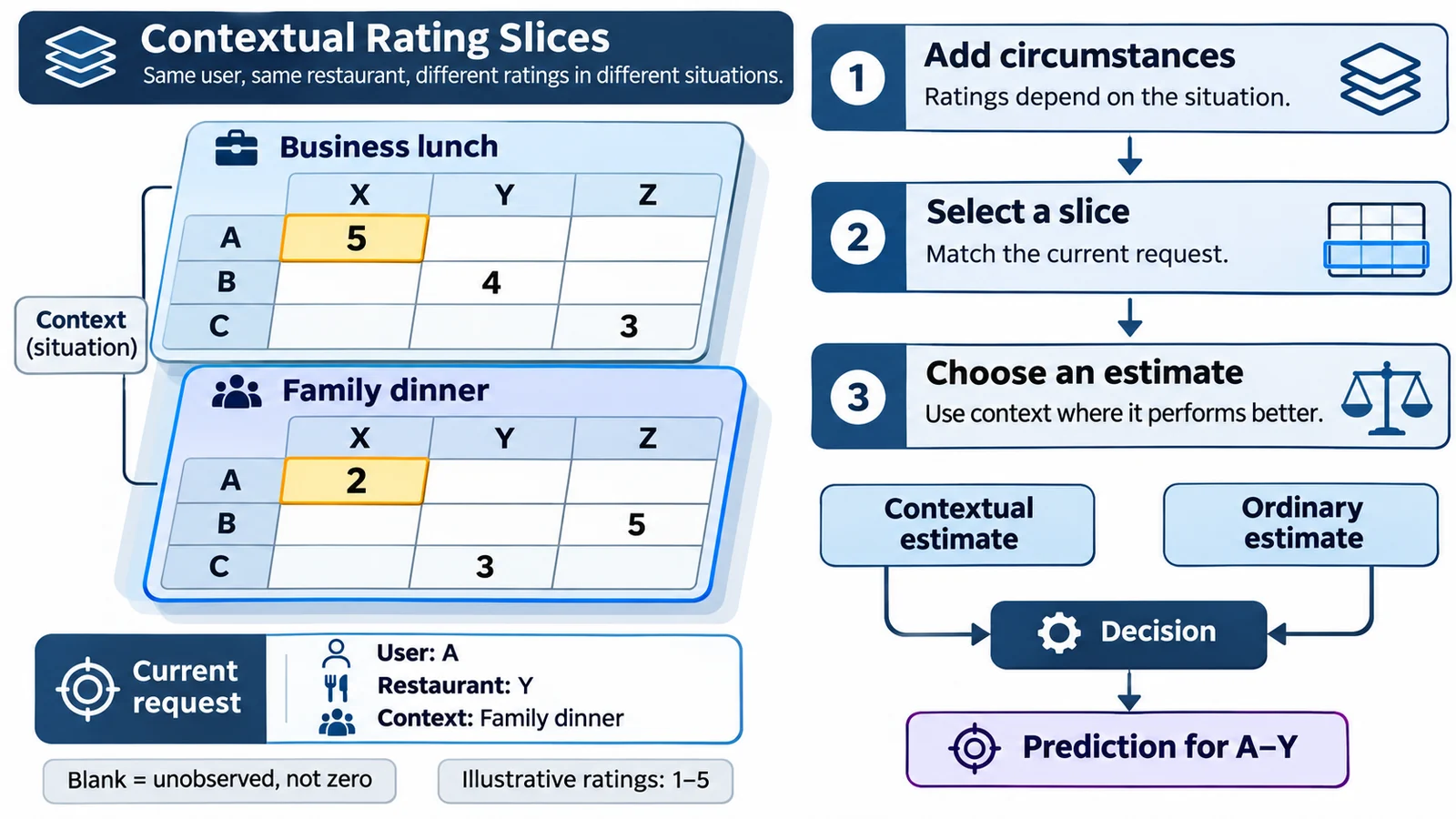
Context as an extra dimension
The cleanest way to see the change is to think of the user-item matrix gaining further axes. A plain collaborative method works on two dimensions, users against items. A multidimensional approach adds dimensions for the circumstances of the rating, so that a person's opinion of a restaurant can be recorded separately for a business lunch and a family dinner, and the recommendation is drawn from the slice of ratings that matches the present situation.[26] The practical difficulty is that each added dimension thins the data further: a slice defined by time, place, and company may contain very few ratings, and the method has to decide when to trust the narrow slice and when to fall back on the broader pool. One study of a multidimensional movie recommender compared the two strategies and proposed a combined method that uses the contextual estimate where it does better and the ordinary two-dimensional estimate elsewhere.[26]
What counts as context is broad and application-dependent. A survey of the area describes the notion as multifaceted and reviews several ways of folding contextual information into the recommendation process, illustrating them across application areas that exploit different kinds of context.[25] The unifying idea is that relevance is situational. A recommendation that ignores the situation is answering a question the user did not quite ask.
Short-term intent and sequences
Context is one way to make a recommender responsive to the moment. Another is to look at the order in which a person's actions arrive. Most classical methods treat the data as a bag of interactions, one entry per user-item pair, and discard the fact that the clicks happened in a particular order. Sequence-aware recommendation keeps that order and uses it, on the observation that multiple interactions of different types recorded over time can support richer individual models and reveal behavioural patterns that a bag of pairs cannot.[27] The difference shows up in what the system can notice: that a person browsed a tent, then a sleeping bag, then a camping stove, is a signal about an intended purchase that the same three items in no order would not convey.
A close relative is the session-based recommender, which narrows the focus to a single visit. A session is a run of interactions within one sitting, and a session-based system aims to capture short-term but dynamic preferences, giving recommendations sensitive to how the session's context is evolving rather than to a long-term profile.[28] This matters where long-term history is thin or misleading: a visitor arriving from a search link may have no account and no past, but the few things they click in the first minute say a great deal about what they are after. The two ideas differ in scope rather than in kind, one tracking order across a history and the other tracking intent within a visit, and both depart from the assumption that a user's taste is a stable quantity to be estimated once.
Conversation as the interface
A third response to the same problem turns the interaction around. Rather than inferring silently from behaviour, a conversational recommender system lets the user and the system talk, so that preferences can be elicited by asking and refined by feedback.[29] The motivation is that a static model, however well fitted, struggles with two questions: what exactly a user likes, and why they like an item. Both are hard to answer from behaviour alone, because behaviour is observed without explicit instruction or active feedback from the person.[30] A conversation supplies exactly that missing instruction.
The design space is wider than a chat window. A conversational system may ask questions to narrow the field, allow the user to ask why an item was suggested, accept corrections, or carry a recommendation across several turns. A survey of the area organises existing approaches along dimensions such as the user intents they support and the background knowledge they draw on, and notes that interest has grown sharply with progress in natural language processing and with the spread of voice assistants and chatbot technology.[29] A second survey frames the central difficulties in five directions, among them question-based elicitation of preferences, multi-turn recommendation strategies, understanding and generating dialogue, the trade-off between exploiting what is already known and exploring what is not, and evaluation, which is awkward when the system's behaviour depends on a conversation that is different every time.[30]
Why the three belong together
Context, sequence, and conversation look like separate lines of work, and in the literature they largely are. They share a diagnosis, though. Each rejects the picture of a user as a fixed vector of tastes to be estimated once and applied everywhere. The context-aware system says the estimate depends on circumstances; the sequence-aware system says it depends on what just happened; the conversational system says it can be asked. All three respond to the same underlying fact, that a recommender's evidence is a thin and indirect trace of what a person actually wants at the moment of the request.
They also share a cost. Each buys responsiveness with data, since a slice defined by context, a session too short to establish a pattern, or a dialogue that has only just begun all leave the system with less to reason from than a long history would provide. That is the same shortage that troubles recommendation generally, and the settings where these methods earn their keep are those where the shortage is unavoidable. How such systems are judged, and how they fare outside the shopping cart, are taken up later.
Context, order, and dialogue all loosen the assumption that a user's taste is fixed: the recommendation is made for this situation, this session, or this question.
Uses
Recommending outside the shopping cart
The storefront is where recommender systems are most visible, but it is not where the idea stops. The same move, narrowing a large pool of candidates to a short list using recorded evidence, applies wherever a person faces more options than they can sift. What changes from one setting to the next is what counts as an item, what counts as evidence, and what a good short list is worth.
Shortlists in the field
Consider a botanist or a curious walker trying to name a plant. The difficulty is not a shortage of information but an excess of candidates: the flora of Germany alone runs to about 3,800 indigenous species, and the flora of Northern America to roughly 20,000 vascular plants.[2] Most species are not spread evenly across a region, because each needs a particular combination of conditions, so the plants that could plausibly be found at a given place on a given day are a small fraction of the whole. A recommender can exploit that.
Using 7.62 million records of plant presence and occurrence for 2,700 taxa across Germany, and testing against 28,000 geo-referenced plant photographs from Flickr, a system that ranked likely taxa by location and date reached an average recall of 82 percent from presence-absence data alone; combining that source with individual occurrence records yielded considerably higher recall, reaching a maximum of 97.4 percent at a 20 km sampling radius, along with improved ranking metrics, and by reducing the list of candidate taxa by an average of 62 percent, the spatio-temporal prior can substantially expedite the overall identification problem.[2] The shortlist does not identify the plant. It removes most of the wrong answers before the hard work begins, which is the same service a shopfront performs when it hides most of the catalogue.
When the item is a treatment
The pattern carries into medicine, where the candidates are not products but courses of action. A doctor choosing a treatment for a patient with a serious illness is weighing options whose effects differ from person to person, and the standard statistical tool for this work, the Cox proportional hazards model, assumes that a patient's risk is a linear combination of their measured characteristics. That assumption is often too simple when the success of a treatment depends on how a patient's features interact with it. DeepSurv, a deep neural network built on the Cox model, was designed to model interactions between a patient's covariates and treatment effectiveness without prior feature selection or domain expertise, and to use them to recommend a treatment for an individual patient. Trained on simulated and real survival data, it predicted patients' risk mostly as well as or better than other linear and nonlinear survival methods, and on real clinical studies its personalised recommendations potentially could increase the median survival time for a set of patients.[31] The recommendation here is consequential in a way a film suggestion is not, which is why the same paper treats the model as a tool for medical researchers rather than a replacement for clinical judgement.
Services, resources and reactions
Some recommenders rank things that have no content to inspect at all. A web service is a piece of software that one program calls over a network, and services that do the same job differ in quality of service, meaning nonfunctional characteristics such as how fast they respond and how reliably they hold up. Choosing among them is a recommendation problem in which the item's "attributes" are measured performance rather than description. One system collected 1.5 million invocation results from 150 service users in 24 countries on 100 real-world web services in 22 countries, then applied collaborative filtering to predict how a service would perform for a given user, and reported better prediction accuracy than other approaches.[3] The evidence is past usage by similar users, exactly as in a product recommender, but the thing being predicted is a number describing behaviour rather than a preference.
Learning is another domain where the pool of candidates outgrows the person. A student looking for material faces an overwhelming variety of resources, and a recommender can identify suitable ones from the range available, which is the promise that has drawn the technology-enhanced learning community to the problem. Learning also happens in rich and varied environments, so work in this area has focused on incorporating contextual information about the learner into the recommendation process, on the argument that a system which accounts for the situation can better anticipate what a person needs.[32] The context machinery described earlier turns out to matter more, not less, when the goal is understanding rather than purchase.
Chemistry offers a starker case, because the candidate space is not a catalogue at all but a set of possible reactions. Computer-aided synthesis planning aims to take a molecular structure and return a sorted list of reaction schemes that connect the target to purchasable starting materials through chemically feasible steps. The first stage of that problem, retrosynthetic planning, requires a recommender system to propose the disconnections that break a target molecule into simpler precursors, and with large reaction corpora it is now possible to construct and validate purely data-driven approaches to synthesis planning.[33] The output is a ranked list of suggestions a chemist then judges, which is the same division of labour seen in the field guide and the clinic: the system proposes, the expert disposes.
What the range shows
Set side by side, these applications share a structure and differ in their stakes. In each, a large candidate set is narrowed by evidence about what has worked for similar cases, whether those cases are plant observations at a location, patients with comparable features, service users with comparable needs, learners in comparable situations, or reactions recorded in a patent corpus. In each, the shortlist is useful precisely because the full set is too large to examine one by one, and the value lies in the reduction rather than in a final answer.
The differences matter just as much. A plant shortlist that misses a species costs a moment of confusion; a treatment recommendation that is wrong costs far more, and the medical work is framed accordingly, as decision support for researchers and practitioners.[31] Some domains supply abundant behavioural data and some, like synthesis planning, depend on curated corpora that must be standardised before they can be used at all.[33] The evidence available also shapes what can be recommended: a service recommender predicts a measured quantity, while a learning recommender must infer a need that the learner may not have articulated.
What holds across all of them is the reason the shopping cart was never the whole story. A recommender is a response to over-choice, and over-choice is not a feature of retail alone. Wherever the number of plausible options exceeds what a person can hold in mind, a ranked shortlist built from past cases is worth having, and the design questions that follow, about what evidence to trust and how to tell whether the list is any good, travel with it into every domain.
The shopping cart is one instance of a general move: wherever candidates outnumber attention, a shortlist built from similar past cases narrows the field, and the stakes of a wrong suggestion set how much the system is trusted to decide.
Research
Measuring whether a recommender works
A recommender that has been built has to be judged, and the judging turns out to be harder than it looks. The difficulty is not a shortage of numbers. A system can be scored on how closely its predicted ratings match the ratings people actually gave, on how good its ranked list is, on whether people click what it suggests, or on whether they come back tomorrow, and these measures can disagree with one another. A change that improves one can leave another untouched or make it worse. Evaluation is therefore not a single act but a set of choices, and the choices determine the verdict as much as the system does.
Two kinds of accuracy
The simplest question to ask of a recommender is how far its predictions fall from the truth. If a system predicts that a person will give a film four stars and they give it three, the error is one star, and averaging that gap over many predictions gives a summary number. This is average absolute deviation, a measure of accuracy over a set of individual predictions, and it treats each prediction as a small estimate to be checked against what happened.[34] It is easy to compute and easy to understand, and it answers a real question: how well does the system know what a person will think of a particular item?
Many recommenders are not used that way, though. A shopfront does not tell a shopper what rating they would give each of a million products; it presents a short ordered list and the shopper looks at the top of it. For that use, the right question is not the average error but the quality of the ordering, and a different measure is needed. One approach estimates the utility of a ranked list by weighting each suggested item by the probability that a user will actually see it in its position, so that a good suggestion buried far down the list counts for less than the same suggestion at the top.[34] The two measures can point in different directions, because a system can be accurate on average and still order its best suggestions badly, or order them well while being unreliable on the items it does not surface.
Precision and recall
A third family of measures comes from information retrieval and asks about the composition of the returned set rather than the accuracy of individual numbers. Precision is the fraction of the recommended items that turn out to be relevant, and recall is the fraction of all the relevant items that the recommendation managed to include. A system that recommends three films a user loves and seven they ignore has high precision and possibly low recall, since other films the user would have loved were never suggested. A system that recommends a hundred films, most of them duds but including every film the user would love, has high recall and poor precision. The two pull against each other, and which one matters depends on the cost of a bad suggestion against the cost of a missed one.
These measures are not interchangeable, and a body of work has examined how they relate. Analysing a range of accuracy metrics on a single content domain, one study found that the tested metrics collapsed roughly into three equivalence classes, groups within which the metrics were strongly correlated with one another while metrics from different classes were uncorrelated.[10] The practical implication is sharp: reporting several metrics that sit in the same class gives an impression of thoroughness without adding information, because they are largely saying the same thing. Two systems compared on a handful of same-class metrics may differ by exactly as much as one metric would have shown.
Offline and online
Behind all of these measures sits a distinction that shapes what any of them can mean. Offline evaluation runs a system against logged historical data, holding back some recorded interactions and asking the system to predict them. It is cheap, fast, and repeatable, and it can be run many times a day while a model is being developed. Its limitation is that it can only measure the system against behaviour that already happened under a different system. The logs record what people did when they were shown a particular set of options, and a new recommender that would have shown different options is being graded on a test it did not set.
Online evaluation, by contrast, exposes real users to the system and measures what they do. The standard form is the A/B test, in which different versions are shown to different groups and compared on an outcome the operator cares about. Netflix has described its approach to improving recommendation algorithms as combining A/B testing focused on member retention and medium-term engagement with offline experimentation on historical engagement data, and it discusses some of the issues in designing and interpreting such tests.[14] The pairing is deliberate. The offline experiment is quick and the online test is meaningful, and the two need not agree, which is why a system that looks strong on held-back data still has to prove itself against the behaviour of real members.
Beyond accuracy
Even a system that predicts well and tests well in an A/B test may not be a good system to use. Accuracy is a property of predictions; the experience of using a recommender is a property of the person. A framework for evaluating recommenders from the user's side links objective aspects of the system to objective user behaviour through a chain of perceptual and evaluative constructs, the user's subjective impressions of the system and their experience of using it, and it incorporates personal and situational characteristics that shape both. The framework was validated with four field trials and two controlled experiments analysed with structural equation modelling, and the results showed that these subjective aspects and experience variables were invaluable in explaining why and how the user experience of a recommender comes about.[11]
What the framework makes visible is that the same objective system can produce different experiences for different people, and that the perceptions in between are not noise to be averaged away but the mechanism by which the system has its effect. Perceptions of recommendation quality and of variety acted as important mediators between the system's objective aspects and three components of experience: process, such as perceived effort and difficulty; system, such as perceived effectiveness; and outcome, such as satisfaction with the choice made. The studies also found trade-offs between system aspects and personal and situational characteristics, among them that the amount of preference feedback a user provides reflects a balance between perceived usefulness and privacy concerns.[11] A recommender that asks for more information may be more accurate and less liked, and a measure that counts only accuracy would miss the exchange entirely.
Why measurement is a design problem
Put together, these strands explain why evaluating a recommender is not a matter of picking the right number. The choice of metric decides which failure the evaluation can see: average absolute deviation sees errors in predicted ratings, ranked-list utility sees the order of suggestions, precision and recall see the composition of the set, and none of them sees whether the person found the experience worthwhile. The choice of setting decides what the numbers mean, since offline results describe fit to old behaviour and online results describe effect on real users. And the choice of whose perspective is measured decides whether the evaluation is about the system or about the person using it.
A survey of the evaluation landscape frames the problem in exactly this way, treating comprehensive evaluation as requiring multiple facets and perspectives to be considered together, and providing a structured framework for assembling an evaluation configuration that covers them.[35] The framing is a warning against the single number. A recommender that reports one accuracy figure has told its audience which question it asked, and left the others unanswered.
Accuracy metrics measure predictions, not people: which metric is chosen decides which failure the evaluation is able to see, and offline scores and live behaviour need not agree.
What the evidence says about accuracy and its rivals
The families described earlier are not equal in measured performance, and the comparisons that have been run are worth taking seriously, because they show that the choice of algorithm changes results by margins larger than most design details. The evidence is uneven, gathered on different datasets with different metrics, so it supports cautious conclusions rather than a league table. Still, a few findings recur.
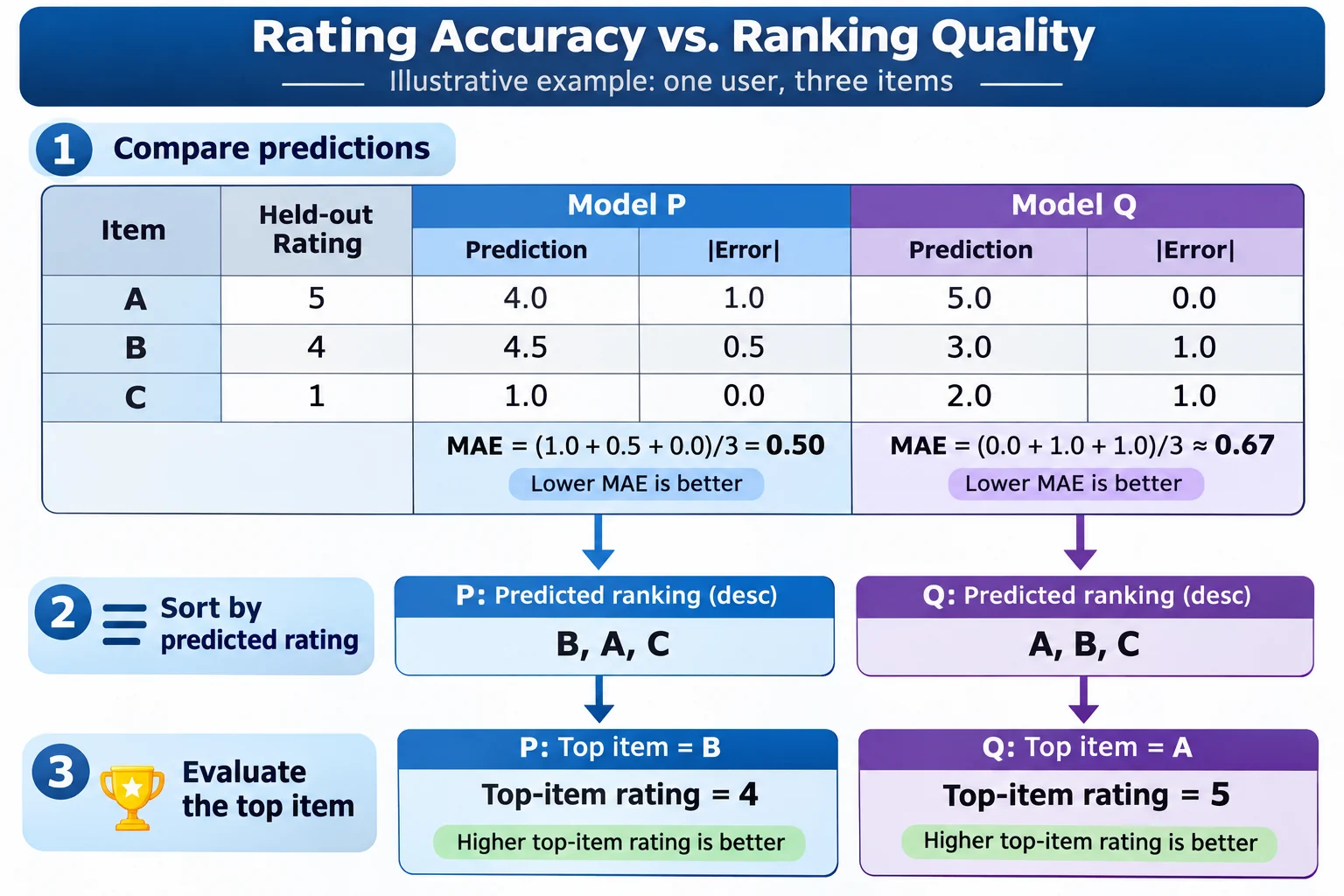
Comparing prediction methods
One of the broadest comparisons set several algorithms against each other across three application areas, four experimental protocols, and two kinds of evaluation metric: average absolute deviation over individual predictions, and the estimated utility of a ranked list.[34] The algorithms included techniques based on correlation coefficients, vector-based similarity calculations, and statistical Bayesian methods. Across a wide range of conditions, Bayesian networks with decision trees at each node and correlation methods outperformed Bayesian-clustering and vector-similarity methods. Between the two leaders, which one was preferable depended on the nature of the dataset, on whether the application presented a ranked list or one suggestion at a time, and on how many votes were available to make predictions from, with the size of the database, speed of prediction, and learning time also entering the choice.[34] The result is instructive precisely because it is not a clean win: the ranking of methods shifted with the conditions, which means a claim that one algorithm is best in general is not supported by the comparison that produced it.
Compressing the matrix
The model-based route described earlier has its own evidence. Latent semantic models for collaborative filtering introduce latent class variables in a mixture model setting to discover user communities and prototypical interest profiles, and were evaluated against standard memory-based methods. The reported advantages were higher accuracy, prediction in constant time, and an explicit and compact model representation, which can also be used to mine for user communities; the experimental evaluation showed substantial improvements in accuracy over existing methods and over published results.[17] This is the compression argument made concrete. The gain is not merely that the model is smaller and faster to query, though it is; it is that summarising the matrix into a small set of discovered profiles can predict better than consulting the raw rows and columns, because the summary pools evidence that any single comparison of two users would miss.
Accuracy against diversity
A more awkward finding concerns what accuracy costs. The most reliably accurate recommendations tend to come from methods that propose objects based on similarity to what a user or an item already resembles, while the most useful individual recommendations are often to be found among diverse niche objects that such methods never surface.[36] This is the diversity-accuracy trade-off: the very mechanism that makes a recommender reliable, leaning on similarity, is the mechanism that narrows what it will ever suggest. The two goals pull in opposite directions, and a system tuned purely for accuracy will drift toward the safe and the familiar.
What makes the finding more than a complaint is that the trade-off was shown to be escapable. A new algorithm was introduced specifically to address diversity, and combined in a hybrid with an accuracy-focused algorithm; by tuning the hybrid appropriately, simultaneous gains in both accuracy and diversity of recommendations were obtained, without relying on any semantic or context-specific information.[36] The lesson is about design rather than about any one method. Accuracy and diversity are separate quantities that a system can be tuned to trade against each other, and a hybrid can be positioned at a point where both improve rather than one being spent to buy the other.
When tastes move
The comparisons above treat a rating as a fixed fact about a user and an item. A further body of evidence says that assumption is itself a source of error, because customer preferences for products drift over time, product perception and popularity keep changing as new selection emerges, and customers' inclinations evolve as they redefine their taste. Modelling that drift is not a matter of discarding old data, since time-window and instance-decay approaches lose too many signals when they throw instances away; a more sensitive approach is needed, one that distinguishes transient effects from long-term patterns and exploits the relevant components of all the data while discarding only what is modelled as irrelevant.[37]
Applied to two leading collaborative filtering approaches and evaluated on the large movie-rating dataset underlying the Netflix Prize contest, the resulting models produced better results than those previously reported on that dataset, and the methods played a significant role in the solution that won the contest.[37] The size of that dataset and the public nature of the contest make the comparison a demanding one, and the improvement came from modelling change rather than from a new similarity measure. A recommender that assumes a user's taste is stable is, on this evidence, fitting a moving target with a fixed aim.
Reading the comparisons together
Set side by side, these results say something more useful than any single ranking. The comparison of prediction methods found that the best choice depended on the data and the application; the latent semantic models found that a compact learned representation could beat direct comparison of rows and columns; the diversity work found that a system tuned for accuracy alone would neglect the niche suggestions users most value, and that a hybrid could recover both; and the temporal work found that letting preferences drift with time improved prediction on a demanding public dataset.[37][17][36][34] Each result undercuts the idea that recommendation quality is a single quantity to be maximised by picking the right algorithm.
What the evidence supports instead is that quality is several quantities, and that the comparisons are only meaningful when the metric and the setting are stated. A method that wins on average absolute deviation may lose on the utility of a ranked list, as the multi-domain comparison showed by finding the preferred method shifting with the mode of presentation.[34] A method that wins on accuracy may lose on diversity, unless it is deliberately combined with something that supplies it.[36] A method fitted to a static snapshot may lose to one that models change, even when both use the same underlying approach.[37] The recurring failure modes that make these trade-offs sharper, and the remedies proposed for them, are taken up next.
Comparisons between recommenders rarely produce a single winner: the best method shifts with the dataset, the metric, and whether tastes are treated as fixed or drifting.
Risks and limits
Sparse data, new users and shifting tastes
The user-item matrix is mostly empty, and the emptiness is not a temporary condition to be fixed by collecting more data. Any one person interacts with a tiny fraction of a catalogue, so the table grows in both directions faster than it fills, and the cells that matter for a particular prediction are usually the ones missing. A survey of collaborative filtering names this data sparsity as a central challenge, alongside a cluster of related difficulties that all trace back to the same shortage of recorded evidence.[8] The methods described earlier were built to work from overlaps between users or items, and sparsity is the condition under which those overlaps shrink toward nothing.
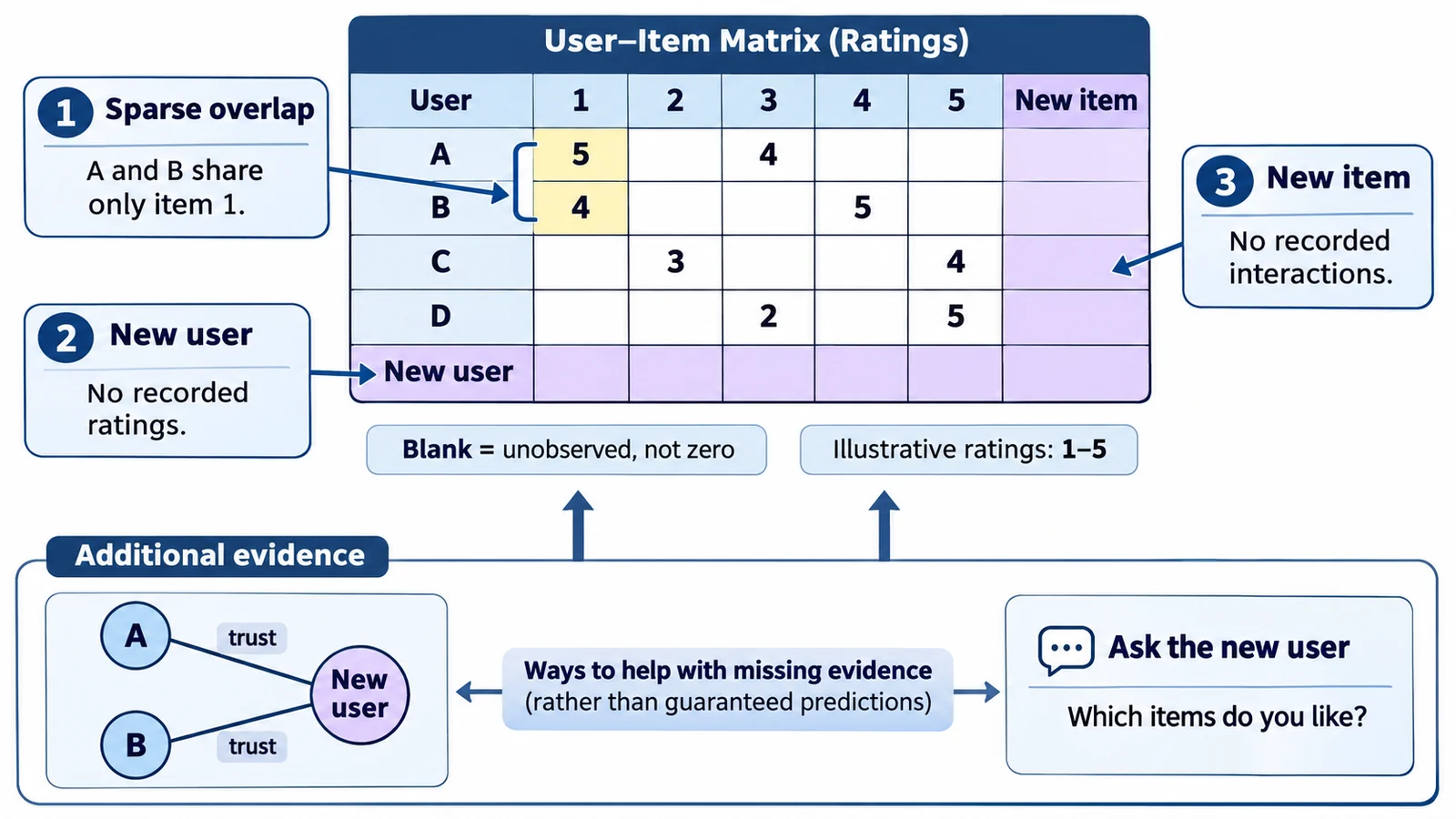
The named failure modes
The problems that follow from thin data have acquired their own vocabulary. Cold start is the case where there is no history at all: a new user has rated nothing, or a new item has been interacted with by nobody, so neither row nor column offers anything to compare. Synonymy is a subtler mismatch: two items may be the same in substance but described in different words, so a system that reasons from labels treats them as unrelated and fails to pool what it knows about them. A grey sheep is a user whose tastes agree with almost no one, so the neighbours a collaborative method relies on are not really neighbours, and the recommendations drawn from them are poor.[8] Shilling is the injection of biased profiles intended to push a system's output in a direction that suits the attacker.[38] Privacy is the last of the recurring concerns, since a profile detailed enough to predict taste is also a record of behaviour a person may not wish to have assembled.[8]
These are not independent faults. Sparsity makes cold start common, because a new user's first interactions are a drop in an empty row; it also makes grey sheep harder to distinguish from ordinary users with short histories, and it leaves a shilling attack easier to hide, since a fabricated profile looks much like a sparse real one.
Borrowing structure to fill the gaps
One response is to stop treating the matrix as the only evidence. Trust-based social filtering brings in a second network, the relations among users, and combines sparse rating data with a sparse social trust network in a model that maps users into a low-dimensional latent feature space according to their trust relationships.[39] The reasoning is that a person's tastes are shaped by those they trust, so a trust link supplies information where a rating is missing. Evaluated on four large-scale datasets, the method performed much better than state-of-the-art trust-based social recommenders, especially for cold-start users.[39] The gain is largest exactly where the ordinary approach has least to work with.
A different route stays inside the interaction record but reads it more widely. Associative retrieval treats past transactions as a network to be traversed, following chains of connection between consumers rather than comparing them directly, so that a person can be linked to another through a shared purchase even when the two share no rating.[40] These transitive associations are a source of information for inferring interests when direct overlap is missing. Tested on data from an online bookstore against several collaborative approaches that ignore such chains, the spreading-activation methods did significantly better on precision, recall, the F-measure and a rank score. The same work found a limit worth noting: when the past data is not sparse, pulling in transitive associations can dilute the evidence used to infer preferences and degrade performance.[40] Borrowed structure helps most when the direct evidence is thin, and can hurt when it is not.
Better measures of likeness
A third response accepts the matrix as it is and asks whether similarity is being estimated well. Standard measures such as cosine, Pearson correlation and mean squared difference are weak when only a few ratings are available to compute them, which is precisely the cold-user condition. A revised user similarity model was built to address this by combining the local context of a user's ratings with the global preference of their behaviour, so that a person with few ratings is still placed sensibly relative to others. Across three real datasets, compared with many state-of-the-art similarity measures, the new model gave superior recommendation performance.[16] The lesson is that sparsity is partly a property of the data and partly a property of the estimator: a measure that uses what little is there more carefully extracts more from the same thin record.
Tastes that move
All of the above assumes that a rating, once recorded, remains a fact about the user. A further difficulty is that it does not. Customer preferences for products drift, product perception and popularity keep changing as new selection appears, and customers' inclinations evolve as they redefine their taste.[37] A model that treats the matrix as a static snapshot is therefore fitting a moving target, and the error it makes is not random but systematic, since old entries describe a person who no longer quite exists.
The remedy is not to discard old data. Time-window and instance-decay approaches throw instances away and lose too many signals in the process; a more sensitive treatment distinguishes transient effects from long-term patterns and uses the relevant components of all the data while discarding only what is modelled as irrelevant. Applied to two leading collaborative filtering approaches and evaluated on the large movie-rating dataset behind the Netflix Prize contest, the resulting models beat results previously reported on that dataset and played a significant role in the contest-winning solution. The improvement came from modelling change over time rather than from a new similarity measure.[37]
A probabilistic view of the same shortage
One framework addresses several of these failures at once by recasting memory-based filtering in probabilistic terms. Probabilistic memory-based collaborative filtering recasts memory-based filtering in a probabilistic framework, and the framework allows a principled solution to the new-user problem: a probabilistic active learning method can query the user directly. The same framework permits the computational cost to be cut by working on a carefully selected subset of user profiles while retaining high accuracy, and experiments on two real-world datasets showed accurate and efficient prediction of preferences.[41] Rather than waiting for a new user's history to accumulate, the system chooses which few questions are worth putting.
What the remedies have in common
Set side by side, these responses share a diagnosis and differ in where they look for the missing evidence. Trust-based filtering looks to the social network; associative retrieval looks to chains of connection through shared transactions; the revised similarity model looks harder at the few ratings present; the probabilistic framework looks to the user directly, by asking; and temporal modelling looks at when each rating was made. Each is a way of extracting signal that the plain user-item matrix, read naively, leaves on the table.
They also share a caution. Each remedy adds a source of information that can itself be thin, noisy, or absent, and the gains reported are measured against particular datasets and particular baselines. A trust network can be sparse too, transitive chains can dilute good evidence, and a similarity model still needs something to work with. The failure modes named at the start are not eliminated by any one of these techniques; they are managed, and the management is a design choice about which additional evidence a given application can realistically obtain.
Sparsity, cold start, synonymy, grey sheep, shilling and privacy all stem from reasoning about people using a thin, uneven record; the remedies work by finding evidence elsewhere, in trust, in chains of transactions, in better similarity estimates, in time, or in asking.
Bias in the data and in the loop
Every method described so far learns from a record of what people did, and it is tempting to treat that record as a neutral sample of preference. It is not. The data a recommender trains on is observational rather than experimental: it was produced by people moving through a system that was already showing them things, in an order it had already chosen, and their clicks and purchases are responses to that arrangement as much as expressions of taste.[9] A shopper who never saw an item could not have chosen it, and one who saw it at the bottom of a page was less likely to click than if it had been at the top. The record therefore mixes preference with the circumstances of exposure, and a model that fits it uncritically inherits the mixture.
Four ways the record is skewed
The distortions that enter this way have been catalogued and named. Selection bias arises because the ratings a system holds are not a random sample of opinions: people choose which items to rate, and they tend to rate what they sought out and liked. Position bias arises because an item shown higher on a page draws more attention and more clicks than the same item shown lower, so its recorded popularity partly reflects where it sat. Exposure bias is the broader case, in which some items were never displayed to some users at all, so their absence from the record says nothing about whether those users would have wanted them. Popularity bias is the tendency of the data to over-represent items that are already popular, since those are the ones most often shown and most often chosen.[9] The four are entangled: popularity drives exposure, exposure drives position, and position drives the clicks that become the training data.
The consequence is not a small calibration error. Fitting such data blindly produces a discrepancy between what offline evaluation reports and what online metrics show, and it can hurt user satisfaction and trust in the service.[9] The model learns the habits of the system that generated the log as though they were the habits of the people in it.
The rich get richer
Popularity bias has a dynamic form that is easier to see in a simulation than in a static table. Because common recommenders propose products on the basis of sales and ratings, they cannot recommend products that have little historical data, even where those products would be rated favourably if anyone saw them. The result is a rich-get-richer effect: popular products are recommended, become more popular, and are recommended more, while unpopular ones are pushed further down and never accumulate the record that would let them compete.[42] The bias is self-reinforcing, and it can prevent what would otherwise have been better matches between consumers and products.
What makes this effect slippery is that it is invisible from the individual's point of view. People report that recommendations have helped them discover new products, and they are often right. Modelling and simulation of recommenders showed that it is possible for diversity at the individual level to increase while diversity in aggregate falls: the system can push each person toward items they have not seen before, yet push many of them toward the same items.[42] Everyone gets novelty; the catalogue as a whole gets narrower. A measure that averages over users will register the first effect and miss the second entirely, which is why the two levels have to be counted separately.
Designing for a wider spread
If the narrowing is a consequence of design, it is also something design can push against. The most reliably accurate recommendations tend to come from methods that propose objects based on user or object similarity, while the most useful individual recommendations are often found among diverse niche objects, a tension described earlier as the diversity-accuracy trade-off.[36] The same tension appears from the policy side, where personalised filtering of search results, social media and media content raises concerns about diversity and the quality of public discourse, and algorithmic adaptation of content to personal preferences is often associated with a decrease in the diversity of information people are exposed to.[43]
One response is to treat diversity as a goal of the design rather than a by-product. Work in this vein asks whether recommenders can be built to stimulate more diverse exposure and to break potential filter bubbles rather than create them, combining insights from democratic theory, computer science and law to propose design principles and to explore the potential and the limits of what it calls diversity-sensitive design.[43] The framing matters because it locates the problem in the objective the system is tuned for, not in a defect of the algorithm. A recommender optimised only for the probability that a person will click will, all else equal, keep showing that person more of what they already click on.
Why the loop is the hard part
The common thread across these findings is that the recommender is not a passive reader of preference but a participant in producing it. It chooses what to show, the showing shapes what gets clicked, and the clicks become the data for the next round. Bias in the data and bias in the loop are therefore the same problem seen at two moments: the record is skewed because of past exposure, and the model trained on it will skew future exposure in the same direction unless something intervenes.
That is why the remedies are not purely statistical. Debiasing a model after the fact can correct a known distortion in a known dataset, but the distortion is regenerated each time the system acts on the world. The design choices that determine how much of the catalogue gets shown, and to whom, sit upstream of any correction applied to the numbers. How recommendations allocate attention and opportunity across people, and what obligations follow from that, are taken up later.
The training data is a record of what the system showed as much as of what people wanted; left alone, that loop concentrates attention on what is already popular.
Fairness, ethics and manipulation
A recommender that decides which job advertisement a person sees is not merely sorting entertainment. Some recommendations allocate things people need, and the question of whether the allocation is fair then becomes a question about the system itself. A survey of fairness in recommendation makes this the starting point: because recommendations involve allocations of social resources, an important issue is whether the recommendations are fair, and unfair recommendations are described as not only unethical but harmful to the recommender system's own long-term interests.[44] The point cuts against the intuition that a biased recommender is a problem only for the people it disadvantages. A system that systematically steers one group away from opportunities loses the trust and the participation it depends on.
What fairness means here
Fairness is harder to define than to demand. The same survey notes that research on the subject is scattered, because recommendation involves multiple complex resource allocation processes and several different definitions of what fairness is, and it reviews more than sixty papers from top conferences and journals to organise the field, summarising the definitions used, classifying the fairness issues, and setting out a taxonomy of methods.[44] The scattering is not an accident of scholarship. A system can be fair in the sense that it treats similar people similarly, or in the sense that it distributes exposure across providers, or in the sense that outcomes across groups come out even, and these can pull against one another. Choosing a definition is a design decision with consequences, not a preliminary.
Six areas of concern
Fairness is one strand of a broader set of ethical questions. A systematic review of the literature on the ethics of recommender systems identified six areas of concern and mapped them onto a proposed taxonomy of different kinds of ethical impact. The review also uncovered a gap: existing user-centred approaches do not consider the interests of a variety of other stakeholders, as opposed to only the receivers of a recommendation, when assessing a system's ethical impacts.[45]
That gap is worth pausing on, because it names a habit of thought. The person being recommended to is the obvious party to consider, and the one whose experience is easiest to measure. But a recommendation also affects the people and businesses whose items are or are not surfaced, the people whose data trained the model, and the public whose attention is being divided up. A framework that asks only whether the recipient was pleased will not see them.
When users attack the system
Some of the harm comes not from the operator but from people who game the system deliberately. A collaborative recommender is publicly accessible and adaptive, which means an attacker who cannot be readily distinguished from an ordinary user may inject biased profiles in an attempt to force the system to adapt in a way that suits them, and such attacks may degrade users' trust in the objectivity and accuracy of the system.[38] The mechanism is the same one that makes collaboration work. The system learns from the profiles it is given, so a fabricated profile is a lesson it will learn.
Work on this problem introduced several attack models and ran extensive simulation-based evaluations to find which attacks were most successful and practical against common recommendation techniques. Both user-based and item-based algorithms turned out to be highly vulnerable to specific attack models, while hybrid algorithms appeared to offer a higher degree of robustness. The same work introduced a classification-based approach for detecting attack profiles and evaluated how well it neutralised them.[38] The finding about hybrids echoes the reasoning that motivates hybrid designs generally: a system drawing on more than one kind of evidence is harder to push in a single direction, because an attacker has to corrupt more than one channel.
Designed to hold attention
A different critique does not concern malice at all. It concerns what the builders are trying to achieve. Fieldwork with developers of recommender systems in the United States found a tendency among them to describe the purpose of their systems as hooking people, enticing them into frequent or enduring usage. The same account traces the rise of what it calls captivation metrics, measures of user retention, enabled by a set of shifts in recommenders' epistemic, economic and technical contexts.[46] The vocabulary is revealing. A system judged by whether people come back is a system whose success is defined by continued use, and the recommendation is the means to that end.
Framing such systems as traps, drawing on anthropological theories about animal trapping, is offered as a way of thinking about how they relate to broader infrastructures of knowledge and technology, and as an alternative to ethical framings that oppose tropes of freedom and coercion.[46] The alternative matters because the usual argument, that a user is either free to ignore the recommendation or coerced into following it, misses the middle ground. A well-built trap does not force; it makes the next step the easiest one available. The retention metric is the measure of how well that works.
Where the strands meet
These concerns look separate, and in the literature they largely are: fairness studied by one group, ethics surveyed by another, security modelled by a third, and the attention critique made from outside the technical field altogether. They converge on a single structural fact. A recommender is a system that allocates attention, and attention is a resource with consequences for the people who receive it, the people whose material is or is not shown, and the people whose behaviour supplies the training data. Whether the allocation is fair, whether it respects the interests of everyone it touches, whether it can be captured by someone with a motive, and whether it is aimed at serving the user or at keeping them, are questions about the same allocation seen from different sides.
That is also why none of them is settled by improving accuracy. A model can predict clicks with great precision and still concentrate opportunity, ignore a stakeholder, fall to a coordinated attack, or hold attention past the point of benefit. The evaluation machinery described earlier measures how well predictions match behaviour; it does not ask whose behaviour, at whose expense, or toward what end. Those questions have to be asked separately, and answered by choices about what the system is for.
A recommender allocates attention, and attention is a resource: fairness, stakeholder interests, resistance to manipulation, and the purpose the system is tuned for are all questions about that allocation, and none of them is answered by accuracy alone.
Later developments
Large language models and the road ahead
Large language models as encoders and reasoners
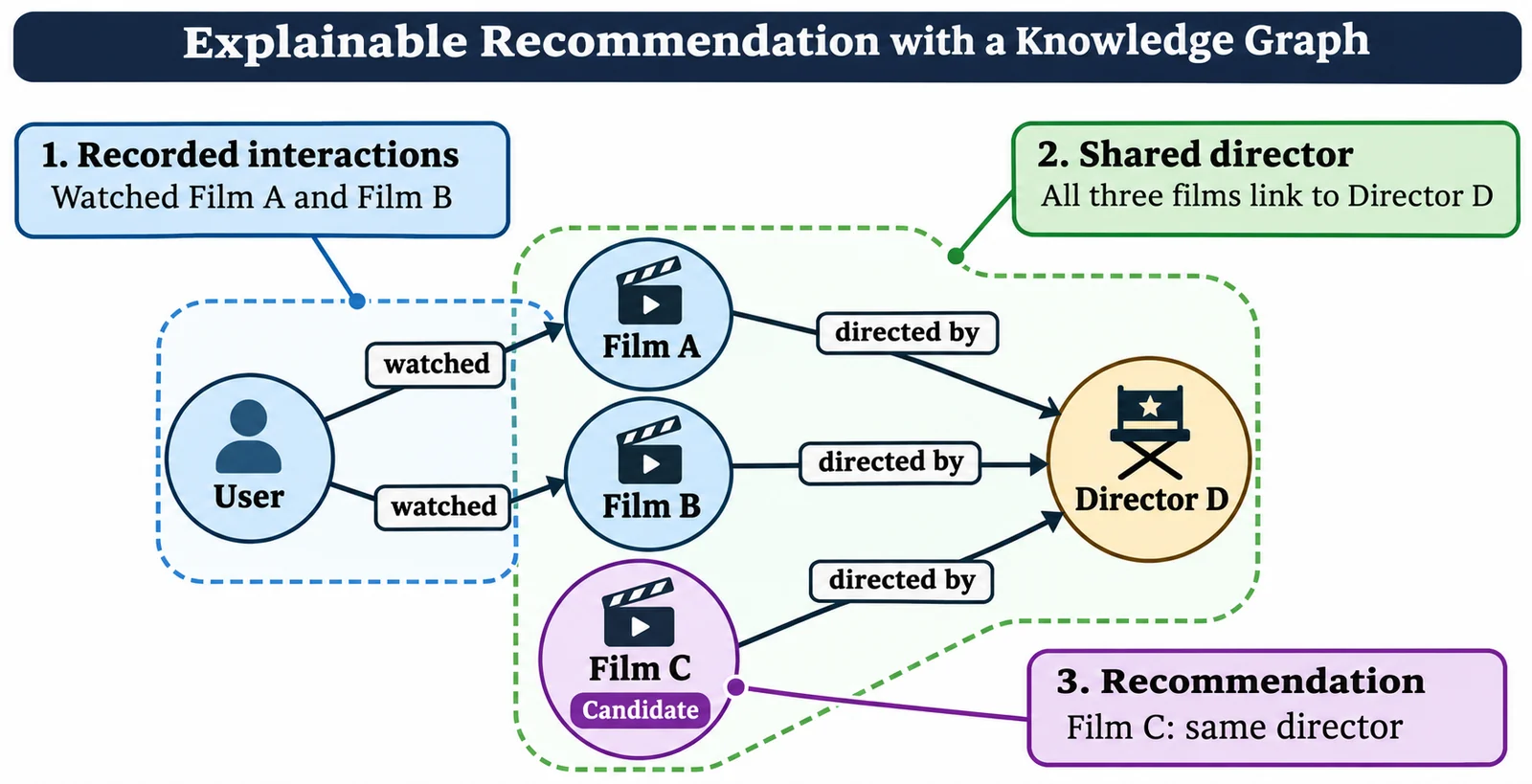
A deep recommender learns a representation of users and items from the data it is given, and the quality of that representation sets a ceiling on everything downstream. The most recent turn in the field asks whether a large language model, a neural network trained on vast quantities of text to predict and generate language, can supply a better representation than a recommender trained on interactions alone. A survey of this direction describes earlier deep models as still limited in effectively understanding users' interests and capturing textual side information, in generalising across seen and unseen recommendation scenarios, and in reasoning about their own predictions, and it reviews the ways large language models are being brought in to address those limits.[47]
The uses fall into recognisable patterns. In one, the language model serves as a feature encoder: it reads the text associated with a user or an item, such as a description, a review, or a profile, and turns it into a representation that the recommender then works with. In another, the model is asked to reason, drawing on its general knowledge of the world to interpret what a person is looking for and to justify a suggestion. The survey organises the work by how the model is adapted to the task, through pre-training, fine-tuning, or prompting, and it notes that the models' capacity for language understanding and generation, together with their generalisation and reasoning skills, is what motivates the attempt.[47] The appeal is plain: a recommender built only from a table of clicks knows nothing about an item except who touched it, while a language model arrives already knowing what the words mean.
Recommendation as a sequence of decisions
A second direction changes the shape of the problem rather than the model. Traditionally, recommendation was framed as a classification or prediction task: estimate the rating, or the probability of a click, for a user and an item. An alternative framing treats it as a sequential decision problem, in which the system's choices now change what the user sees next, which changes what the system can learn, and so on over time. Framed this way, the problem can be expressed as a Markov decision process, a formal description of a situation in which an agent takes actions, receives rewards, and moves between states, and it can then be solved with reinforcement learning, the family of methods that learns a policy by trial and error against such a process.[48]
What this buys is the ability to weigh the long term. A system that recommends only what will be clicked in the next minute may train the user toward a narrow diet; a system that treats each recommendation as a move in an ongoing relationship can account for the effect of today's choice on tomorrow's engagement. The survey notes that the idea of using reinforcement learning for recommendation is roughly two decades old but was long impractical because of scalability problems in traditional methods, and that deep reinforcement learning, which made it possible to apply the approach where the state and action spaces are large, produced a new wave of work.[48] The framing also makes explicit something the prediction framing hides: the recommender is not observing a fixed world but acting in one it partly creates.
Learning from unlabelled data
A third direction attacks the shortage described earlier in this chapter, the mostly empty matrix, with a technique borrowed from elsewhere in machine learning. Self-supervised learning trains a model on tasks constructed from the data itself, without human-supplied labels, so that the model learns structure from whatever is available. In recommendation, where the great majority of the matrix is unobserved, this is an attractive fit, and a survey of the area defines self-supervised recommendation and divides the methods into contrastive, generative, predictive and hybrid categories, releasing an open library of models and benchmarks alongside the review. The survey describes neural recommenders as having achieved considerable success while still falling short when data is highly sparse, which is the gap the approach is meant to close.[49] The idea is that the unobserved cells are not simply absent information; the pattern of what is present, and of what is consistently related to what, can itself be turned into a training signal.
Knowledge graphs as side information
A fourth direction supplies the recommender with structured background knowledge. A knowledge graph is a network of entities and the labelled relations between them, so that a film is connected to its director, the director to a country, the country to a language, and so on. Recommenders that draw on such a graph have attracted interest because the extra structure can alleviate data sparsity and the cold-start problem, and because the paths through the graph can be used to explain why an item was suggested. A survey of the area groups the methods into embedding-based, connection-based and propagation-based approaches, and examines how each uses the graph for accurate and explainable recommendation.[50]
The explanatory use is the one worth dwelling on, because it addresses a weakness that runs through the chapter. A matrix factorisation model can predict well and say nothing about why; its latent factors have no names. A path through a knowledge graph, by contrast, is a statement a person can read: this film was suggested because you watched others by the same director. The same structure that fills gaps in the data also supplies a reason, which is a rare combination.
Where the directions meet
These four lines of work are usually reported separately, and they are not independent. A language model can encode the text that populates a knowledge graph's entities; a graph can supply the structured context that a reinforcement learning agent's state representation needs; self-supervised objectives can be built from the graph's relations as readily as from the interaction matrix. What they share is a common response to the limits of the plain user-item table. Each brings in evidence from outside it, whether that is the meaning of text, the consequence of past actions, the structure latent in unobserved data, or a curated network of facts.
They also share a cost, and it is the same one named throughout. Each added source of evidence is itself large, expensive to obtain, or noisy, and each makes the resulting system harder to inspect. A language model's representation is not a list of neighbours that can be shown to a user; a learned policy's reasons for an action are distributed across its parameters. The tension between a recommender that reasons from thin but transparent evidence and one that learns from rich but opaque evidence has run through every method described, and the newest directions push further toward the second.
What has not changed is the question the chapter opened with. A recommender narrows a large pool of candidates to a short list using recorded evidence, and the choice of which evidence to consult, and how much to trust it, remains a design decision rather than a technical inevitability. The methods multiply; the decision does not go away.
The newest directions all bring in evidence from beyond the interaction table, in language, in consequences, in unobserved structure, and in curated facts, and each trades transparency for reach.
Key studies
| Year | Study | Sample | Design | Finding |
|---|---|---|---|---|
| 1992 | Goldberg et al.[12] | Experimental mail system with collaborative filtering | People recorded reactions to documents they read, and other users' filters could access these annotations, so filtering combined content with human judgment. | |
| 2003 | Linden et al.[1] | Item-to-item collaborative filtering at an online store | Item-to-item collaborative filtering produced recommendations in real time, scaled to massive data sets, and its online computation scaled independently of the number of customers and items. | |
| 2004 | Herlocker et al.[10] | review with empirical analysis of accuracy metrics | The tested metrics collapsed roughly into three equivalence classes, strongly correlated within a class and uncorrelated across classes. | |
| 2009 | Fleder & Hosanagar[42] | analytical model and simulation | Some well-known recommenders can reduce sales diversity, and individual-level diversity can increase while aggregate diversity decreases. | |
| 2012 | Knijnenburg et al.[11] | field trials and controlled experiments analyzed with Structural Equation Modeling | Personalized recommendations gave higher perceived quality than random ones, which led to higher choice satisfaction and system effectiveness, and users watched more clips from beginning to end. | |
| 2013 | Breese et al.[34] | datasets from 3 application areas | comparison of algorithms under 4 experimental protocols and 2 evaluation metrics | Across a wide range of conditions, two methods did better than Bayesian clustering and vector similarity: correlation methods, and Bayesian networks with a decision tree at each node. |
| 2014 | Liu et al.[16] | three real data sets | experiments comparing similarity measures | A new user similarity model using local context and global preference was superior in recommendation performance, especially when few ratings were available. |
| 2016 | Gomez-Uribe & Hunt[14] | A/B tests plus offline experiments | The service combined A/B testing focused on member retention and medium term engagement with offline experimentation on historical engagement data. | |
| 2017 | Çano & Morisio[5] | 76 papers published from 2005 to 2015 | systematic literature review | In the review of 76 hybrid recommender papers, most studies paired collaborative filtering with a second technique, often by weighting the two, and cold start and data sparsity were the two most frequent problems, taken up in 23 and 22 studies respectively. |
| 2017 | Yang et al.[39] | four large-scale datasets | Trust-based collaborative filtering tested on four large-scale datasets | Integrating sparse rating data with a sparse social trust network performed much better than state-of-the-art methods, especially for cold start users. |
| 2018 | Wittich et al.[2] | Plant taxa recommendation tested on labeled images | Location data alone gave an average recall of 82%, combining it with occurrence records gave 96%, and the shortlist cut candidate taxa by an average of 62%. | |
| 2023 | Chen et al.[9] | survey of seven bias types | Popular items are recommended more often than their popularity in the data would warrant. In job recommendation, women saw fewer advertisements about high paying jobs and career coaching services than men did. |
See also
References
- Linden, G., Smith, B., & York, J. (2003). Amazon.com recommendations: item-to-item collaborative filtering. IEEE Internet Computing, 7(1), 76-80. doi:10.1109/mic.2003.1167344
- Wittich, H. C., Seeland, M., Wäldchen, J., Rzanny, M., & Mäder, P. (2018). Recommending plant taxa for supporting on-site species identification. BMC Bioinformatics, 19(1). doi:10.1186/s12859-018-2201-7
- Zibin Zheng, Hao Ma, Lyu, M. R., & King, I. (2011). QoS-Aware Web Service Recommendation by Collaborative Filtering. IEEE Transactions on Services Computing, 4(2), 140-152. doi:10.1109/tsc.2010.52
- Sharma, K., Lee, Y. C., Nambi, S., Salian, A., Shah, S., Kim, S. W., & Kumar, S. (2024). A Survey of Graph Neural Networks for Social Recommender Systems. ACM Computing Surveys, 56(10), 1-34. doi:10.1145/3661821
- Çano, E., & Morisio, M. (2017). Hybrid recommender systems: A systematic literature review. Intelligent Data Analysis, 21(6), 1487-1524. doi:10.3233/ida-163209
- Roy, D., & Dutta, M. (2022). A systematic review and research perspective on recommender systems. Journal of Big Data, 9(1). doi:10.1186/s40537-022-00592-5
- Adomavicius, G., & Tuzhilin, A. (2005). Toward the next generation of recommender systems: a survey of the state-of-the-art and possible extensions. IEEE Transactions on Knowledge and Data Engineering, 17(6), 734-749. doi:10.1109/tkde.2005.99
- Su, X., & Khoshgoftaar, T. M. (2009). A Survey of Collaborative Filtering Techniques. Advances in Artificial Intelligence, 2009, 1-19. doi:10.1155/2009/421425
- Chen, J., Dong, H., Wang, X., Feng, F., Wang, M., & He, X. (2023). Bias and Debias in Recommender System: A Survey and Future Directions. ACM Transactions on Information Systems, 41(3), 1-39. doi:10.1145/3564284
- Herlocker, J. L., Konstan, J. A., Terveen, L. G., & Riedl, J. T. (2004). Evaluating collaborative filtering recommender systems. ACM Transactions on Information Systems, 22(1), 5-53. doi:10.1145/963770.963772
- Knijnenburg, B. P., Willemsen, M. C., Gantner, Z., Soncu, H., & Newell, C. (2012). Explaining the user experience of recommender systems. User Modeling and User-Adapted Interaction, 22(4-5), 441-504. doi:10.1007/s11257-011-9118-4
- Goldberg, D., Nichols, D., Oki, B. M., & Terry, D. (1992). Using collaborative filtering to weave an information tapestry. Communications of the ACM, 35(12), 61-70. doi:10.1145/138859.138867
- Resnick, P., & Varian, H. R. (1997). Recommender systems. Communications of the ACM, 40(3), 56-58. doi:10.1145/245108.245121
- Gomez-Uribe, C. A., & Hunt, N. (2016). The Netflix Recommender System: Algorithms, Business Value, and Innovation. ACM Transactions on Management Information Systems, 6(4), 1-19. doi:10.1145/2843948
- Shi, Y., Larson, M., & Hanjalic, A. (2014). Collaborative Filtering beyond the User-Item Matrix: A Survey of the State of the Art and Future Challenges. ACM Computing Surveys, 47(1), 1-45. doi:10.1145/2556270
- Liu, H., Hu, Z., Mian, A., Tian, H., & Zhu, X. (2014). A new user similarity model to improve the accuracy of collaborative filtering. Knowledge-Based Systems, 56, 156-166. doi:10.1016/j.knosys.2013.11.006
- Hofmann, T. (2004). Latent semantic models for collaborative filtering. ACM Transactions on Information Systems, 22(1), 89-115. doi:10.1145/963770.963774
- Luo, X., Zhou, M., Li, S., You, Z., Xia, Y., & Zhu, Q. (2016). A Nonnegative Latent Factor Model for Large-Scale Sparse Matrices in Recommender Systems via Alternating Direction Method. IEEE Transactions on Neural Networks and Learning Systems, 27(3), 579-592. doi:10.1109/tnnls.2015.2415257
- Xin Luo, Mengchu Zhou, Yunni Xia, & Qingsheng Zhu (2014). An Efficient Non-Negative Matrix-Factorization-Based Approach to Collaborative Filtering for Recommender Systems. IEEE Transactions on Industrial Informatics, 10(2), 1273-1284. doi:10.1109/tii.2014.2308433
- Middleton, S. E., Shadbolt, N. R., & De Roure, D. C. (2004). Ontological user profiling in recommender systems. ACM Transactions on Information Systems, 22(1), 54-88. doi:10.1145/963770.963773
- B.Thorat, P., M. Goudar, R., & Barve, S. (2015). Survey on Collaborative Filtering, Content-based Filtering and Hybrid Recommendation System. International Journal of Computer Applications, 110(4), 31-36. doi:10.5120/19308-0760
- Zhang, S., Yao, L., Sun, A., & Tay, Y. (2020). Deep Learning Based Recommender System: A Survey and New Perspectives. ACM Computing Surveys, 52(1), 1-38. doi:10.1145/3285029
- Wu, S., Sun, F., Zhang, W., Xie, X., & Cui, B. (2023). Graph Neural Networks in Recommender Systems: A Survey. ACM Computing Surveys, 55(5), 1-37. doi:10.1145/3535101
- Gao, C., Zheng, Y., Li, N., Li, Y., Qin, Y., Piao, J., Quan, Y., Chang, J., Jin, D., He, X., & Li, Y. (2023). A Survey of Graph Neural Networks for Recommender Systems: Challenges, Methods, and Directions. ACM Transactions on Recommender Systems, 1(1), 1-51. doi:10.1145/3568022
- Adomavicius, G., Mobasher, B., Ricci, F., & Tuzhilin, A. (2011). Context‐Aware Recommender Systems. AI Magazine, 32(3), 67-80. doi:10.1609/aimag.v32i3.2364
- Adomavicius, G., Sankaranarayanan, R., Sen, S., & Tuzhilin, A. (2005). Incorporating contextual information in recommender systems using a multidimensional approach. ACM Transactions on Information Systems, 23(1), 103-145. doi:10.1145/1055709.1055714
- Quadrana, M., Cremonesi, P., & Jannach, D. (2019). Sequence-Aware Recommender Systems. ACM Computing Surveys, 51(4), 1-36. doi:10.1145/3190616
- Wang, S., Cao, L., Wang, Y., Sheng, Q. Z., Orgun, M. A., & Lian, D. (2022). A Survey on Session-based Recommender Systems. ACM Computing Surveys, 54(7), 1-38. doi:10.1145/3465401
- Jannach, D., Manzoor, A., Cai, W., & Chen, L. (2022). A Survey on Conversational Recommender Systems. ACM Computing Surveys, 54(5), 1-36. doi:10.1145/3453154
- Gao, C., Lei, W., He, X., de Rijke, M., & Chua, T. S. (2021). Advances and challenges in conversational recommender systems: A survey. AI Open, 2, 100-126. doi:10.1016/j.aiopen.2021.06.002
- Katzman, J. L., Shaham, U., Cloninger, A., Bates, J., Jiang, T., & Kluger, Y. (2018). DeepSurv: personalized treatment recommender system using a Cox proportional hazards deep neural network. BMC Medical Research Methodology, 18(1). doi:10.1186/s12874-018-0482-1
- Verbert, K., Manouselis, N., Ochoa, X., Wolpers, M., Drachsler, H., Bosnic, I., & Duval, E. (2012). Context-Aware Recommender Systems for Learning: A Survey and Future Challenges. IEEE Transactions on Learning Technologies, 5(4), 318-335. doi:10.1109/tlt.2012.11
- Coley, C. W., Green, W. H., & Jensen, K. F. (2018). Machine Learning in Computer-Aided Synthesis Planning. Accounts of Chemical Research, 51(5), 1281-1289. doi:10.1021/acs.accounts.8b00087
- Breese, J. S., Heckerman, D. E., & Kadie, C. M. (2013). Empirical Analysis of Predictive Algorithms for Collaborative Filtering. arXiv. doi:10.48550/arxiv.1301.7363 Free full text
- Zangerle, E., & Bauer, C. (2023). Evaluating Recommender Systems: Survey and Framework. ACM Computing Surveys, 55(8), 1-38. doi:10.1145/3556536
- Zhou, T., Kuscsik, Z., Liu, J. G., Medo, M., Wakeling, J. R., & Zhang, Y. C. (2010). Solving the apparent diversity-accuracy dilemma of recommender systems. Proceedings of the National Academy of Sciences, 107(10), 4511-4515. doi:10.1073/pnas.1000488107
- Koren, Y. (2010). Collaborative filtering with temporal dynamics. Communications of the ACM, 53(4), 89-97. doi:10.1145/1721654.1721677
- Mobasher, B., Burke, R., Bhaumik, R., & Williams, C. (2007). Toward trustworthy recommender systems: An analysis of attack models and algorithm robustness. ACM Transactions on Internet Technology, 7(4), 23. doi:10.1145/1278366.1278372
- Yang, B., Lei, Y., Liu, J., & Li, W. (2017). Social Collaborative Filtering by Trust. IEEE Transactions on Pattern Analysis and Machine Intelligence, 39(8), 1633-1647. doi:10.1109/tpami.2016.2605085
- Huang, Z., Chen, H., & Zeng, D. (2004). Applying associative retrieval techniques to alleviate the sparsity problem in collaborative filtering. ACM Transactions on Information Systems, 22(1), 116-142. doi:10.1145/963770.963775
- Kai Yu, Schwaighofer, A., Tresp, V., Xiaowei Xu, & Kriegel, H. (2004). Probabilistic memory-based collaborative filtering. IEEE Transactions on Knowledge and Data Engineering, 16(1), 56-69. doi:10.1109/tkde.2004.1264822
- Fleder, D., & Hosanagar, K. (2009). Blockbuster Culture's Next Rise or Fall: The Impact of Recommender Systems on Sales Diversity. Management Science, 55(5), 697-712. doi:10.1287/mnsc.1080.0974
- Helberger, N., Karppinen, K., & D’Acunto, L. (2018). Exposure diversity as a design principle for recommender systems. Information, Communication & Society, 21(2), 191-207. doi:10.1080/1369118x.2016.1271900
- Wang, Y., Ma, W., Zhang, M., Liu, Y., & Ma, S. (2023). A Survey on the Fairness of Recommender Systems. ACM Transactions on Information Systems, 41(3), 1-43. doi:10.1145/3547333
- Milano, S., Taddeo, M., & Floridi, L. (2020). Recommender systems and their ethical challenges. AI & SOCIETY, 35(4), 957-967. doi:10.1007/s00146-020-00950-y
- Seaver, N. (2019). Captivating algorithms: Recommender systems as traps. Journal of Material Culture, 24(4), 421-436. doi:10.1177/1359183518820366
- Zhao, Z., Fan, W., Li, J., Liu, Y., Mei, X., Wang, Y., Wen, Z., Wang, F., Zhao, X., Tang, J., & Li, Q. (2024). Recommender Systems in the Era of Large Language Models (LLMs). IEEE Transactions on Knowledge and Data Engineering, 36(11), 6889-6907. doi:10.1109/tkde.2024.3392335
- Afsar, M. M., Crump, T., & Far, B. (2023). Reinforcement Learning based Recommender Systems: A Survey. ACM Computing Surveys, 55(7), 1-38. doi:10.1145/3543846
- Yu, J., Yin, H., Xia, X., Chen, T., Li, J., & Huang, Z. (2024). Self-Supervised Learning for Recommender Systems: A Survey. IEEE Transactions on Knowledge and Data Engineering, 36(1), 335-355. doi:10.1109/tkde.2023.3282907
- Guo, Q., Zhuang, F., Qin, C., Zhu, H., Xie, X., Xiong, H., & He, Q. (2022). A Survey on Knowledge Graph-Based Recommender Systems. IEEE Transactions on Knowledge and Data Engineering, 34(8), 3549-3568. doi:10.1109/tkde.2020.3028705
Cite this page: Atlas Nova editors. (2026). Recommender system. Atlas Nova. https://velocer.io/atlas/recommender-systems/