

Method · Motivation and self-regulation
Goal setting
Psychological theory of motivation
Goal setting is described as an important driving force for improving college students' self-management ability.[1]
Specific, challenging goals lead to higher performance than vague or easy ones.[2] Goals can also motivate unethical behavior when people fall just short of them.[3]
Key facts
| 90% | Share of studies where specific challenging goals helped performance, Locke and colleagues 1981[2] |
|---|---|
| 83 | Independent samples in the goal commitment meta-analysis by Klein and colleagues 1999[4] |
| 91 | Sales representatives studied by Barrick and colleagues 1993 on conscientiousness and goals[5] |
| 76 | Organizational members studied across 19 family firms by Kotlar and De Massis 2013[6] |
Overview
What goal setting means
The 2002 summary lists moderators of goal effects. Moderators are conditions that change how strongly a goal affects performance.[7] The 2006 update adds that goals can be self-set, set jointly with others, or assigned by someone else. That update also reports that goal effects hold across people, tasks, countries, time spans and experimental designs.[8]
The 2006 paper describes newer lines of work. These include how people choose their goals and what shapes that choice.[8] The 2002 summary sets out the theory's limits as well as its practical importance. So the account is not one of uniform success.[7] The theory has held up over many years of testing. The later paper on induction treats this as evidence of its usefulness.[9]
History
Where the idea came from
A 1958 paper in the American Sociological Review treated the setting of major organizational purposes as a recurring problem. It did not treat it as a fixed fact. Thompson and McEwen (1958) held that setting goals is purposeful. But it need not follow a rational course. Goals, it suggested, may be set by accident. Careful plans may be undone by events outside an organization's control. It also stressed that organizations depend on one another within the larger society. That society shapes what goals they can pursue. The paper also claimed that goal-setting processes look alike across organizations. Those organizations can have very different aims. These include governmental, military, business, educational, medical and religious groups.[10]
The psychological theory most students meet today grew from inductive findings, meaning patterns drawn upward from many separate experiments rather than from a single grand model. Two researchers, Edwin Locke and Gary Latham, described goal setting in 2007 as an open theory of this kind. Their 2007 summary grouped newer findings under nine headings. These include goals as mediators of personality effects. They also include personality variables as moderators of goal effects.[11]
A 1991 study tested a questionnaire that Locke and Latham had built in 1984. It was meant to measure the core attributes of specificity and difficulty. The questionnaire also asked about performance feedback, supervisor support, conflict and stress. Employees of a large electronics organization on the west coast of the United States took part. A principal components analysis pulled out 10 meaningful factors. On the whole the factors proved meaningful. But the analysis showed that more items were needed.[12]
Later work asked why a person picks one goal rather than another. A 2003 framework put the reasons for choosing a goal into a ranked network of motives. The researchers asked people to justify their goal. They then tested the resulting motives against attitudes, intentions to reenlist and commitment. They applied the method to Italian Army officers (N = 151). They also applied it to three groups of enlisted soldiers (N = 141, N = 144 and N = 150). From these individual answers they drew a general summary. It showed goals arranged in an interconnected hierarchy.[13]
A 2018 review extended the theory to broad, long-term challenges. Goal-setting theory had mainly addressed single, short-term goals. It had given less attention to wide, distant aims. Höchli, Brügger and Messner (2018) argued that long-term aims work best when a person attends to both concrete lower-level goals and abstract higher-level ones. Attending to one kind alone is not enough.[14]
A 1990 laboratory experiment gave clerical-type tasks to 72 students. They were split between participative and assigned goal-setting conditions. Students in the participative condition were placed in one of three strategies. The strategies varied how much participation they were actually allowed. Ashworth (1990) found that the participative condition had no significant impact. Different participative strategies did produce some differences.[15] A 2017 theoretical review added that a goal has no motivational effect without commitment. It called commitment a necessary condition for difficult goals to raise task performance.[16]
Main ideas
Why goals change performance
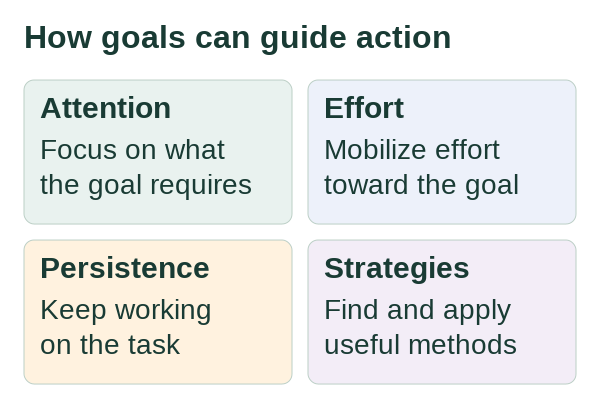
Goal setting theory, as set out by E. Locke and G. Latham in 1990, holds that goals improve performance because they act as standards for self-evaluation. The results suggest that a goal seen as informative may add to goal-setting effects. The prospect of self-evaluation may be why.[17]
Commitment, acceptance and feedback
Locke set out in 1968 that commitment to a goal is a necessary condition. Goal setting cannot work without it. Most studies in the field still ignored commitment. Studies that measured it often found results that did not fit the idea. That idea says commitment moderates the goal effect.[18] A meta-analysis of 83 independent samples gathered the evidence. It covered what raises commitment and what commitment leads to.[4]
Acceptance can change how strongly goal setting affects performance. It can be influenced at every stage, from setting the goal to reaching it.[19] A model of the commitment process traced the widely varying sizes of the goal difficulty effect to the variables in that model.[18]
A 1977 study tested whether goals need feedback to affect performance. It predicted that feedback and goals work together. The link between goals and performance was r = .60 with feedback and r = -.01 without it.[20]
A quasi-experimental study (N = 113) took place at a large telephone company. It compared kinds of feedback added to a goal-setting program. Goal setting alone improved performance. No formal program of knowledge of results was needed. This gave external validity to Locke's theory of goal setting.[21]
Feedback can also push a person toward easier or harder tasks. A 2013 experiment tested this with 413 participants. Participants counted athletes in short video sequences of different sports. They then chose between set options, such as raising or keeping the difficulty level. They most often raised the difficulty level after positive feedback. They kept the level after negative feedback. Repeated negative feedback was followed by more avoidance behavior. The results only partly supported the assumptions of feedback intervention theory.[22]
Goals and self-efficacy
Self-efficacy means a person's belief about his or her own ability. It is the belief that one can learn or perform a behavior at a stated level.[23] Students start a learning activity with goals already in mind. They also start with a sense of self-efficacy for reaching them.[24][23]
As they work, they watch their own performance. They judge how far they have moved toward the goal. Good progress makes students feel more able to improve their skills. Reaching a goal while holding high self-efficacy then leads students to set new, harder goals.[24]
An experiment used sixth-grade children classified as learning disabled in mathematics. It tested whether taking part in setting goals helps. Some children set their own near-term performance goals each session. Others were given similar near-term goals. A third group got the training with no goals. Taking part in goal setting, however, produced the highest self-efficacy. It also led to the best subtraction skill.[25]
A randomized controlled trial published in 2024 tested self-efficacy training. The trial used high school students in Bulgaria. Thirty students were assigned at random. Fifteen were in a training group and 15 in a control group that received no intervention. The training ran for twelve structured sessions of 45 to 60 minutes. It was built on Bandura's self-efficacy theory. It covered goal setting, self-belief, managing emotions and study strategies. Academic persistence in that group rose from 34.87 (SD = 4.11) to 42.27 (SD = 3.65). It then eased slightly to 41.40 (SD = 3.84).[26]
Four traits load on one higher-order trait called core self-evaluations. They are self-esteem, locus of control (a person's sense of control over outcomes), generalized self-efficacy and neuroticism. Across 3 studies, that broad trait was related to task motivation. It was also related to productivity measured as sales volume, and to rated performance of insurance agents.[27]
A study of 91 sales representatives tested a model. In it, conscientiousness affects performance through goal setting. Representatives high in conscientiousness were more likely to set goals. They were also more committed to them. That was in turn linked to greater sales volume. It was also linked to higher ratings from supervisors.[5]
If-then plans and mental contrasting
Two studies tested whether these if-then plans depend on how strong the person's underlying goal intention is. That intention is the general aim to reach the outcome. The plans raised the rate of goal attainment when goal intentions were strong. They did not when goal intentions were weak. Implementation intentions changed performance only when the relevant goal had been activated.[28]
Fantasy realization theory holds that this contrast creates a felt need to act. That need then brings related expectations into use. When expectations of success are good, strong goal commitment follows. When they are unfavorable, commitment stays weak. Some people dwell only on the desired future, and some only on present reality. Either way, this produces moderate commitment. That commitment does not depend on those expectations.[29]
Mental contrasting with implementation intentions raised goal attainment. The effect size was small to medium, g = 0.336. Studies based on interactions between participants and experimenters reached g = 0.465. The review calls the strategy short and effective. It notes that publication bias means the real effect sizes may be smaller.[30]
Goals and motivation in college students
Expectancy theory and goal setting theory were both used. They helped predict academic performance and college retention. Students' academic expectancy motivation at the start of college significantly predicted their cumulative grade point average at the end of the first year. Some students returned for their sophomore year and some did not. Those who returned reported more peer competition over academic goals. Returning students also saw good grades as more attractive. They reported more effort to earn them.[31]
A study looked at 488 Taiwanese college students. Goal setting and perceived control of time together helped turn time management into greater academic self-efficacy. A survey of 488 Taiwanese college students found that time management raised academic self-efficacy. But it mostly worked through other factors rather than directly. Goal setting helped those students prioritize tasks and track progress. Feeling in control of time gave people more independence. It also lowered their stress.[32]
A smaller study of 100 college students in mathematics found that self-efficacy partly explained the link between goal setting and academic motivation. In that study, however, goal setting had an unexpected negative effect on self-efficacy. The researchers suggest this may reflect pressure or unrealistic expectations. The result challenges the idea that goal setting always raises confidence and motivation.[33]
A 2026 paper on college students in China names common problems in how they set goals. Goals may not fit the student's own situation. Preset goals may be poorly carried out, and students may lack the awareness and skill to adjust goals in time. The paper recommends clear development goals and feasible action plans. It also recommends regular review and adjustment of goals.[1]
One study of students at a single university first identified their learning motivation. It then assessed their self-efficacy with a scale developed by R. Schwarzer and M. Jerusalem. That study reports that goal setting and mapping sub-goals help students make progress. They also help students judge whether their efforts lead to the desired result. Students can also judge whether their goals are realistic.[34]
A goal-setting intervention was linked to a greater sense of purpose. This held for students who entered higher education with a low-impact mindset. Researchers measured the motivational mindset of 748 first-year university students. They did this at the start and end of the academic year. On average 58% of the students had changed mindset by the follow-up. Some low-impact students took part in an online narrative goal-setting intervention. They gained a stronger sense of purpose and moved to a social-impact mindset. The researchers call this pattern early support for the intervention.[35]
The effect of an assigned goal on intrinsic motivation depended on the person's achievement orientation. Performance-focused goals with a specific standard raised intrinsic motivation for achievement-oriented individuals. The same performance-focused goals lowered intrinsic motivation for people low in achievement orientation. Both of these measures were also found to mediate the direct effects on intrinsic motivation, meaning they helped explain how the goals had their effect.[36]
Feedback, priming and automatic processes
In one study, 85 students worked on a computer simulation of stock investing. The researchers changed goals, process feedback and outcome feedback, each on its own. Both kinds of feedback worked with goal setting to raise performance. Process feedback and outcome feedback did different work. Goals combined with process feedback were tied more strongly to the quality of information search and task strategy. Outcome feedback combined with goals was more strongly related to self-confidence and effort.[37]
Goals can also be primed in the subconscious. In a first lab experiment, 91 participants were randomly assigned to see a photo of a person lifting 20 pounds, 200 pounds or 400 pounds. These photographs stood for an easy goal, a moderately difficult goal and a difficult goal. Participants first completed an unrelated filler task. Then they were told to press as hard as they could on a digital weight scale. Effort was greatest among participants primed with the difficult goal, ahead of those primed with the moderate or the easy goal. A second experiment with 133 participants tested whether the choice of goal difficulty can be primed. On a brainstorming task, some participants were primed with a difficult goal and others with an easier one. The first group knowingly picked a harder goal. Their performance was significantly higher as well. Conscientiousness moderated the relationship between the subconscious goal and performance. The consciously chosen goal partly mediated that link, meaning it carried part of the effect.[38]
Assigned, task-specific goals affected intrinsic motivation. The effect varied with achievement orientation. One study gave people assigned, task-specific goals while they played an enjoyable pinball game. Some individuals were low in achievement orientation. They showed the highest intrinsic motivation when given mastery-focused goals. Competence valuation and task involvement followed a similar pattern. They were confirmed as mediators of the effects on intrinsic motivation.[39]
A training study looked at goal frame, goal content and goal proximity. It used 524 trainees and a complex computer-based simulation. All three design factors significantly influenced self-regulation. Goal content had the greatest influence. A learning frame paired with learning content helped trainees' self-regulation. It helped more than a matching performance frame with performance content. Mismatched pairs of frame and content did better than matching performance frames and content. The effects of the mismatched pairs were not the same in the two areas.[40]
Newer frameworks beyond SMART goals
A 2011 article argued that SMART targets were widely used by educational practitioners in the United Kingdom. It said they had not been carefully tested against relevant theory and practice. The same article drew on social cognitive theory and achievement goal theory. This included Zimmerman's criteria for appropriate goals. Compared with SMART targets, the article argued, well-formed outcomes take greater account of the learner's identity, feelings and emotions, social relations and values. The approach also encourages mental rehearsal.[41]
A second proposal adapts the six phases of the Appreciative Advising model. It helps higher education administrators mentor future administrative leaders. The model was already used on several college campuses. It helped students name their dreams for the future and make a plan to reach them. The article noted that few frameworks exist to guide mentoring relationships in academia. Yet such relationships help professionals set career and professional goals.[42]
A third line of work builds goal-setting systems with intervention mapping, following steps 1 to 4. One team built MyGoals. This system guides occupational therapy practitioners in setting and managing goals for adults with chronic conditions in community-based rehabilitation. Two pilot tests showed that MyGoals was workable for clients and pointed to areas for improvement. Minor refinements were made after that. The team stated that future studies on effectiveness and implementation are necessary before the system can be scaled in rehabilitation practice.[43]
A companion 2022 paper planned how MyGoals would be delivered in practice. It used implementation mapping with community-based participatory research principles. The planning team found factors at the level of the intervention, such as evidence strength and quality. It also found factors at the level of the therapists, such as knowledge, skills and self-efficacy. It set three performance objectives and 15 change objectives. It named acceptability, appropriateness, feasibility and fidelity as outcome variables. The team produced two tailored strategies: MyGoals Clinician Education and MyGoals Clinician Audit & Feedback. Evaluation plans used a mixed-methods study of therapist-client pairs.[44]
Goals in consumer and everyday behavior
That framework describes how a goal comes about, how it is selected or changed, and how a person then pursues it and reaches it. Consumer researchers had only recently begun to study these questions when the framework appeared. The framework also connects older ideas from consumer research with newer models from cognitive and social psychology. The framework treats goals as something that emerge, shape decisions, and guide choice and action.[45]
A gap between intending to do something and actually doing it appears in gambling behavior. Many people want to stop gambling but cannot turn that intention into changed behavior, a 2022 review reports. Problem gambling can cause serious harm, and rates of gambling continue to rise. Implementation intentions are goal-directed plans that link a specific cue to a specific response. Such plans have helped close the intention-to-action gap for many health behaviors. The strategy is popular in health psychology, yet its use in gambling research has been limited. The review argues that adopting the strategy could reduce the number of people with gambling problems.[46]
Goals and personality
In a first study, the four dispositions loaded on one higher order factor. A second study linked that higher order trait to task motivation and performance in a laboratory setting. The trait was also related to goal-setting behavior, and the four qualities predicted job behaviors more consistently together than alone.[47]
A study tested whether conscientiousness relates to job performance through goal setting. A study of 91 sales representatives used linear structural equation modeling.[48] Structural equation modeling builds causal models that relate several observed measures at the same time to a latent, or underlying, variable.[49] Conscientiousness was also directly related to supervisory ratings, and ability was related to supervisory ratings and, to a lesser extent, to sales volume.[48]
Self-esteem and perceived goal difficulty interacted in their effects on self-set goals, certainty, performance and attributions. In one experiment, perceived goal difficulty was manipulated by having subjects compete against themselves, a difficult competitor, or an easy competitor. Low self-esteem subjects also set lower goals and showed lower certainty and task performance than high self-esteem subjects. Across all subjects, the difficult condition produced higher goals and higher performance than the easy one.[50]
Failure avoidance has been relatively ignored in research on dispositional factors in goal-setting situations. Self-efficacy and personal goals mediated the link between failure avoidance and performance, and goal commitment moderated the link between personal goals and performance.[51]
Time and goal pursuit
A 2004 review by Fried and Slowik examined the role of time in goal-setting theory. That review argues the theory gains validity when time is built into its main parts. The parts named are goal difficulty, goal attainability and goal specificity.[52]
Goals and depression
Research on goals and depression asks two different questions: which goals a person sets, and how that person pursues them. A 2002 review describes a decade of growing interest in both questions. One line of work looks at the content of important goals, meaning what a person cares about most. People who rank relationship goals above achievement goals report a greater sense of wellbeing than people who rank achievement goals first.[53]
A second line of work looks at the process of goal pursuit rather than the goal itself. Researchers have found links between depression and the gap between a person's actual self and ideal self. They have also linked depression to how much progress a person believes they are making toward a goal. How people react when a goal is lost or fails has been another major topic. A vulnerable person may be unable to disengage, meaning to stop investing effort, from an important goal that has already failed.[53]
Most of these theories describe what goals depressed people set and how they pursue them. Little research has asked why certain goals become important to a person in the first place. The review proposes conditional goal setting to explain that gap. The proposal matters because it describes a link between goal setting and depression that holds whether the goal succeeds or fails.[53]
Goals in language learning
Most studies of vision have used the same basic design: learners fill in self-report questionnaires, and researchers look at correlations among a handful of variables. A 2020 critical analysis argues that this design leaves several questions open, including the sensory element of vision and the characteristics of an effective vision. The same analysis lists other gaps: how a vision changes over time, how several visions may conflict, and what mediates between a vision and its results. It also calls for research on collective vision and on the role of emotions and self-satisfaction. Its central question is whether vision can be meaningfully distinguished from a goal at all.[54]
A quasi-experimental study tested whether a positive psychology intervention could improve goal setting and self-regulation in learners of English as a foreign language. A pretest showed that the participants were similar in proficiency, goal setting and self-regulation before the intervention. Data were collected over two months with goal setting and self-regulation questionnaires given before and after one term. The post-test showed a positive and significant effect of the intervention on both goal setting and self-regulation. The findings suggest that positive psychology offers a path for understanding and managing how language students set goals and regulate themselves.[55]
A 2026 article proposes a conceptual shift in how university foreign language courses set goals. Goals would then be adjusted continuously on the basis of predictive analytics.[56]
Goals and creative lifestyles
A 2021 article by Oleksyuk treats goal setting as a factor in forming the creative lifestyle of the future teacher. Lifestyle here means the broadest description of how a social group or a single person lives, showing the activities and life values specific to that group or person. Because the specific features of activity can differ, the article states that lifestyles can be classified in different ways. A person does not always live in only one style, according to the article. Styles mix, and people move from one style to another as age, social status or values change.[57]
That perspective is described as a projection of a person's motivational sphere, meaning the hopes, plans, projects and aspirations the person is aware of, tied to the near and distant future. Once formed, this time perspective gains its own motivating force and influences the further development of the child's personality. A life plan is more than a prediction of a possible future, the article argues: it is also a self-attribution, a definition of the tasks a person sets and must carry out.[57]
Research
How large the effects are
The 1981 review also described when goals help most. Performance improved most when goals were specific and sufficiently challenging. It also improved when people had enough ability to reach them. Feedback showing progress toward the goal made improvement more likely. Rewards such as money for reaching the goal also helped. So did a supportive manager or experimenter. The assigned goals also had to be accepted by the person doing the task.[2]
A meta-analysis published in 2011 combined the results of many group studies. It combined them into a single average effect. Specific, difficult goals led to much higher group performance than goals that were not specific. The effect size was d = 0.80 ± 0.35 across k = 23 effect sizes. Across all group goals together, the overall effect size was d = 0.56 ± 0.19. This was based on k = 49 effect sizes.[58]
The result depended on what the individual goal was aimed at. "Egocentric" goals aim at getting the most from a person's own performance. They had a particularly negative effect on group performance. The effect size was d = -1.75 ± 0.60 across k = 6. "Groupcentric" goals aim to maximize each person's contribution to the group. They showed a positive effect of d = 1.20 ± 1.03 across k = 4. So individual goals can help a group. They should be used with caution when members depend on one another.[58]
Some expected moderators did not change the size of the group goal effect. The meta-analysis also noted a striking lack of recent field studies in organizations. That gap should shape future research.[58]
In one experiment, groups and individuals worked on an additive task. In such a task, each person's output simply adds to the total. Groups and individuals both chose goals that were easier than the goals given to them. The assigned goals required only a small increase in performance. People who were given goals performed better. They did better than those who set their own goals or had no goal. People who set their own goals reported more positive feelings about the situation. People given assigned goals reported fewer.[59]
What changes the result
A meta-analysis tested if-then plans. It covered 29 experimental studies from 18 records. It asked whether they help such people reach their goals. The plans worked across different mental health problems and goals. They also worked across different research methods.[60]
A 2023 meta-analysis of 16 studies found that forming if-then plans cut weekly alcohol consumption by a small amount. The effect size was d = -0.14, CI [-0.24; -0.03]. The same review found no effect on heavy drinking in single sittings. That means drinking a large amount on one occasion (d = -0.01, CI [-0.10; 0.08]). Effects were stronger in community samples than in university samples (d = -0.38 versus -0.04). They were also stronger for paper delivery than for online delivery. The effect sizes were d = -0.26 and -0.04.[61]
Planning to cut fat intake had a moderate overall effect (d = 0.488). The effect was stronger for men than for women. It was also stronger when no monitoring took place during the intervention. The values were d = 0.671 versus d = 0.231.[62]
A 2023 meta-analysis looked at physical activity among university students. It covered 12 studies with 1,916 participants. It found a small positive effect (SMD = 0.31, 95% CI: 0.12, 0.50). Effects were larger for students who were inactive. They were also larger when the intervention included a reinforcement part. They were larger for periods of fewer than six weeks.[63]
A field experiment included nearly 2,100 university students. Their courses had two midterms and a final exam. Motivating students to set goals did not change performance on average. Students whose midterm grades fell below their goal then performed worse. The effect came from students who set goals without being told they could revise them.[64]
How goals are measured in studies
Questionnaires are one such tool. A 2018 study proposed a new questionnaire as an alternative to the traditional open-ended kind. The instrument was built in three phases. An item pool was generated, a pilot study revised weak points, and a final version was tested for practicality. Confirmatory factor analysis showed a good fit between the theoretical model and the data. The researcher argues that this instrument measures goal setting in second language learning more soundly than open-ended questionnaires do.[65]
A study of 98 sophomore students used a set of several tests to identify features of their goal setting. A 2022 study surveyed 98 full-time sophomore students. They studied at the Moscow State University of Psychology and Education. Its set of tests included the Academic Motivation Scale, a life goals questionnaire, an action control questionnaire and a measure of self-regulation style. Frequency and factor analysis in SPSS Statistics 21 then compared students with high and average academic performance. High-performing students were mainly driven by internal motives: educational, cognitive and professional. Average-performing students showed external motives and had trouble planning and detailing their actions.[66]
The Level of Aspiration Indicator was developed in 1981. It assesses aspiration levels in young children. Third, fourth and fifth grade students (N= 84) took it alongside the Piers-Harris Children's Self-Concept Scale. The results supported its reliability and validity as a screening instrument.[67]
The Goal-Setting Evaluation Tool for Diabetes (GET-D) is an observer rating scale. It uses set criteria to rate the quality of patients' diabetes goals and action plans. Trained raters reached 94.4% raw agreement and an inter-rater reliability (Kappa) of 0.66. Scores correlated with patient activation (r=.252, P<.05) and diabetes-specific self-efficacy (r=.376, P<.001).[68]
A 5-year quasi-experimental study followed high school Spanish students over time. Over 5 years, a quasi-experimental study brought LinguaFolio into 23 high schools with 1,273 students in all. The portfolio asks students to judge their own work and set goals. It also asks them to gather evidence of what they have achieved in the language. A hierarchical linear model was used to analyze the link between goal setting and achievement. It looked at both the individual student and teacher levels.[69] Hierarchical linear modeling is a method of analysis that models variables at each level of hierarchical data, such as students within classes and classes within schools.[70] The link between the goal-setting process and language achievement was statistically significant (p < .01).[69]
A two-stage laboratory study tested the effects of performance-based goals against action-based goals. Performance-based goals were not significantly motivating. Students could change their targets during the semester. Whether they changed them, and in which direction, seemed to matter.[71]
How students describe their own goals
Researchers asked 479 senior students at Novosibirsk universities to state their goals. The answers covered family life, work and material prosperity. The horizons were one year ahead, five years ahead, and the whole of life. The sample included 172 male and 307 female respondents. Consumer motivation appeared in these goal statements much more strongly than prosocial motivation. Fewer than one in three of the young men said they meant to start a business of their own. The same survey found little wish to emigrate among the students. Family values remained important, and many students wanted to own housing.[72]
Female respondents were significantly more likely to mention building a family, having children, buying real estate, and getting favorite work. Male respondents paid more attention to high earnings. Narrow social motives tied to personal or family well-being strongly outweighed broad social motives. They also outweighed cognitive and research motives. The researchers called this reversal of priorities an inversion. In an inversion, lower elements of a value hierarchy take the dominant place. They described the result as a source of some anxiety.[73]
Students in Years 3 to 6 saw goal setting in a positive light. They saw it as a tool to help their learning. A case study of Year 3 to 6 students collected data in three ways. It used interviews, an observation, and document analysis.[74]
Researchers interviewed 19 medical students. They came from all years of 6 Canadian medical schools. The students knew little about how they set goals. They also knew little about what they preferred and what followed from their choices. The analysis described two goal-setting scripts, a word for a student's usual pattern: flexible and concrete. External factors sometimes changed a student's script. This produced approaches that did not match the student's preferred style.[75]
Postgraduate students in Saudi Arabia were enrolled in a master's course for teachers of English as a foreign language. They described structured goal setting as useful. In the participants' accounts, goal setting made priorities clearer and turned complex tasks into manageable steps. It also sustained effort through progress tracking. Participants also described feeling pressure at times. This happened when goals were too ambitious or were treated as fixed targets.[76]
Not every group of students reports setting explicit goals before study. An exploratory case study looked at 113 Moroccan English department students in their first semester. It used two advanced-level reading texts and a retrospective questionnaire. Those students used background knowledge to make sense of the texts. They did not set clear, self-directed goals before reading.[77]
Goals and feelings in young learners
A 2023 article describes goal setting as a way to track progress on social and emotional learning goals. The setting is the elementary classroom. The article covers goal setting to support social and emotional learning (SEL) skill acquisition and development. The article offers practical examples of goal setting for elementary students. It also describes ways to monitor progress. It shows how to strengthen goal supports when a child needs more help.[78]
Goal setting develops early, according to a 1998 study of 166 children aged 2 to 4 years. Productive goals here mean children's ideas about what they want to achieve by changing their surroundings. This can be in reality or in imagination. At age 3, half the children could do activities tied directly to reaching the desired outcomes. From the age of 3.6 years, two abilities became stable. One was stating productive goals. The other was reaching productive outcomes.[79]
A 1977 study found that children with learning disabilities set goals less steadily than other children. The boys with learning disabilities varied much more in how they set goals. They were also less systematic in reacting to their own earlier performance. A second prediction was not supported. It said these children would respond less well to induced success and failure. Both groups showed less variability during the success condition. The findings suggest positive feedback might help children with learning disabilities set aspirations more systematically.[80]
A 2022 study of prospective teachers found a positive, moderate and significant link between mindfulness and goal-setting skill. The study used a correlation method with 500 prospective teachers studying for a BS in Education. Of these, 372 returned questionnaires. In other words, prospective teachers who believed they were mindful also tended to report stronger goal-setting skill. The author calls for qualitative and quantitative research to fill gaps in the literature on mindfulness and goal-setting skill.[81]
A 2023 survey in Ibadan, Nigeria, asked adolescents aged 12 to 20 about learning efficacy, goal setting and academic burnout after the covid-19 pandemic. Learning efficacy (OR = 1.02, 95% CI 1.01 to 1.04) was strongly linked to academic burnout. Goal setting (OR = 1.04, 95% CI 1.01 to 1.06) was too. Learning efficacy made the largest contribution (Beta = -.322, t= -12.629, p<0.05). Goal setting came next (Beta = -.234, t= -9.184, p<0.05). The author read this as goal setting and learning efficacy helping to reduce academic burnout. The author recommended that school counsellors support learners.[82]
A 2025 study analysed the interpersonal goals of 217 students in grades 9 and 12. They were studied after a growth mindset intervention. Students set their goals through a task called mental contrasting and implementation intentions (MCII). Most participants set goals about making their friendships better in quantity and quality. The ideal result they named was a better emotional state. The obstacles they described were internal or external. Internal ones were personal characteristics, and external ones were other people. Their planned actions were active or passive. Passive approaches did not match the content of the intervention.[83]
Goal setting also appears in fitness programs. A 2025 narrative study explored first- and second-year students designing and pursuing their own fitness goals at a campus in the Philippines. The study reports that staying engaged relied heavily on support. That support came from family, friends, fitness instructors, and social media. Its findings highlight a connection between physical activity, mental clarity and emotional stability, and it links goal setting to resilience and optimism.[84]
Goals in adult learning and memory
A 2003 study by West, Thorn and Bagwell compared younger and older adults on both measures. Participants first completed memory beliefs questionnaires and a baseline list recall test. After further recall trials, the questionnaires were given again. The study ran two experiments with different goal conditions.[85]
In Experiment 1, participants were assigned either low challenge or high challenge goals. In Experiment 2, moderate challenge goals were compared with a control condition. In both experiments, each person received a specific goal based on their own earlier performance. Participants also received positive feedback when their memory gains appeared.[85]
Both older and younger adults responded to the goals, improving their performance across trials. The control condition showed little change. In the moderate and low challenge goal conditions, participants' beliefs about their own memory shifted, and the shifts were larger for older groups. Those changes in beliefs were more striking for the older groups.[85]
In practice
Goals in classrooms and schools
Self-assessment paired with goal setting has been tested in a controlled classroom trial. The experimental group's mean achievement score after the intervention was higher than its pretest mean. The gain was statistically significant. The control group did worse than the experimental group at posttest. Its performance got worse over the period.[86]
Goal-setting instruction has also been tried with students at risk of academic failure.[87] Goal setting therapy had a clear main effect on academic motivation. It was more effective than study skills training.[88]
Simple linear regression showed that goal setting affected academic procrastination. The F-count was 222.019, with a significance level of 0.001.[89] In a smaller effort, 17 students at SMP Negeri 23 Banjarmasin were identified as high procrastinators. They showed less academic procrastination after goal-setting training.[90]
Goal setting also appears in school improvement work and in surveys of student motivation.[91][92] The study looked at 237 senior high school students in the Philippines, chosen at random. Goal setting was meaningful and linked to academic motivation and to intrinsic motivation.[91]
Language learning and self-directed study
Goal setting has drawn growing attention in research on motivation. That research concerns learning a second or foreign language. One review calls goal setting a cognitive link. It joins motivation to motivated behavior in language study. Goals give language activities a purpose and a direction. They push learners to invest more effort and to keep going.[93]
A study looked at 373 Japanese university learners of English. It compared visualization alone, visualization plus goal setting, and no treatment. Visualization alone did not raise willingness to communicate more than the untreated group. One group combined visualization with goal setting. The gain in willingness to communicate was significantly larger than for visualization alone.[94]
Each student filled in an assignment template. Short phone calls with the researcher checked the self-reports. The analysis found three common goal-setting patterns among these students.[95]
A survey looked at 643 students in massive open online courses. These are large open courses taught online. It compared those who finished with those who did not. Those who finished reported much more use of one subprocess: goal setting.[96]
People were grouped by high or low metacognitive awareness. They were also grouped by whether they set clear goals or did a filler activity. As hypothesized, clear goals and high metacognitive awareness together gave the best performance.[97]
Goals in work, sport and health
A 2004 article on organizations argued that goal setting raises employee motivation. It also argued that goal setting raises commitment to the organization.[98] A 2005 field study put 32 unionized employees into three groups. One group had specific, difficult goals. One had those goals plus training in self-instruction. One was told to do its best. Employees who set specific, difficult goals did much better than both other groups. In that study, self-efficacy (a person's belief in their own ability to succeed) rose with later performance. Peers judged the changes in performance better than the employees or their managers did.[99]
Sport research began from a puzzle. Goal setting reliably improved performance in industrial psychology. In sport, the benefit was not clearly shown. A 1995 meta-analysis combined 36 studies. A meta-analysis combines results from many studies into one statistical estimate. It found that setting goals improved sport performance by 0.34 of a standard deviation. Goals that were moderate, absolute, or both short- and long-term had the largest effects.[100]
A 2023 systematic review examined 27 peer-reviewed studies of goal setting interventions. The studies involved athletes in real sport settings, not laboratories.[101] A 2023 study looked at 42 young swimmers. One group had its goals posted publicly. It attended more training sessions than other groups. It also did better than control participants.[102]
A program lasting one season followed 25 female junior high gymnasts. They were ages 12 to 14. Performance-oriented gymnasts improved over time. Success-oriented gymnasts showed a slight drop.[103]
Helping students set and keep goals
Eight high school dropouts worked through self-paced textbooks. They were aged 16 to 21 and came from low-income backgrounds. They were getting ready for a high school equivalency test. Students talked over weekly work requirements with the teacher. Paying them for meeting the contract raised their productivity a lot. Later, students wrote their own contracts without teacher feedback. Goal setting then proved effective at keeping productivity up.[104]
A separate study looked at 4 parent-child pairs with serious homework problems. It found that goal setting plus contingency contracting improved homework accuracy significantly. Contingency contracting means an agreement that ties a reward to meeting the goal.[105]
Some students have emotional and behavioral disorders. For them, goal setting is an intervention backed by research. It has improved behavioral outcomes. Not every student does well with a standard format. So teachers are advised to plan, run and keep checking more intensive versions.[106]
One section learned study strategies and set individual learning goals. Its students also recorded learning-related behavior during the first 2 units. First-year students in the control section did nonacademic tasks instead. They scored significantly lower than all other students on the first 2 exams. The difference was not significant on the 3rd exam. The first pattern came back on the final exam.[107]
Goals across school subjects and ages
In reading, a 1973 experiment blocked students on sex and earlier reading achievement. It placed them in three groups. One group met a teacher individually each week to set goals. A second met weekly without setting goals. A third had no meetings but the same class lessons. The goal-setting group reached much higher classroom achievement. Its later goal-setting behavior also differed significantly from the other groups.[108]
A 10-year-old received goal setting, feedback and a reward for meeting the goal. This performance package increased the number of correctly spelled words. Adding direct instruction in writing increased the number of complete sentences the child produced.[109]
Foreign-language speaking was studied through 64 extemporaneous speeches delivered over one semester. Moroccan college students had weekly impromptu speaking sessions. They also set individual goals and received teacher feedback. They did this across 90 impromptu speaking activities.[110]
In physical education, a 2015 study compared an intervention school with a comparison school. The comparison school only did the fitness measurements. Students in grades 6 to 8 at the intervention school received one lesson on SMART goal setting. Aerobic fitness was measured with the PACER multistage shuttle run test. Intervention students raised their PACER performance from 40.6 to 45.9 laps. Comparison students fell from 30.2 to 23.4 laps. Intervention students were 10 times as likely as comparison students to keep a healthy fitness status or move up into it.[111]
Music education has approached goals from the design side rather than by testing students. A 2024 paper revised Bloom's cognitive hierarchy. It became a new system of music education goals. Experts weighted the goals. The paper reports a course design system with 4 dimensions and 18 indicators. Among the secondary indicators, inference carried the highest weight, at 0.5723. Interpretation had the lowest score, at 0.2422.[112] A separate study at a conservatory gave mindfulness and goal-setting exercises to 11 students. All but one rated their self-efficacy, their belief in their own capacity to learn and practice music, higher on one questionnaire.[113]
Distance learning has been studied with students in grades 7 to 9 from several public and private schools. It used pre-tests and post-tests of achievement, motivation and self-organization. The experimental group improved on all variables. Individual and collaborative goal setting raised engagement and interest, according to the study. The effect was strongest when the two were combined.[114]
A 2025 study followed 30 seventh graders at a suburban private school in Tennessee for sixteen weeks. Each morning the students set goals and described how they saw their own mindset. They also wrote in a dated journal about whatever was on their mind. Interviews tracked their stress. The qualitative results showed positive feelings. This was especially true for goal setting and reflecting on the day. Students also reported some drop in stress. They felt more organized and ready for the school day. They stressed how much peer relationships affected their stress.[115]
A 2021 article on foreign language teaching in vocational schools argues for building the goal-setting skill. It should start at the beginning of learning. It should be practiced regularly through exercises and tasks.[116]
Students with disabilities and special needs
A 2020 guide for teachers describes explicit, step-by-step instruction. It helps high school students with disabilities set their own goals. The goals cover behavior and academic achievement. The guide argues that students with disabilities often get too little instruction in goal setting at school.[117]
A 2009 article for teachers sets out a sequence. Students are helped to choose school-related goals and build action plans. They also make a self-monitoring sheet that matches the goal. Then they judge whether the goal was reached. Self-monitoring here means the student records their own behavior or progress. The article pairs it with goal setting and gives sample academic goals and sample recording forms.[118]
A 9-year-old boy with autism often showed disruptive behavior. He took part in a study in an inclusive language arts classroom in China. He was trained in self-monitoring outside the classroom. The goal was raised step by step. Each new goal was set from his best score in the previous phase. His academic engagement went up during the intervention. It stayed high at a 1-week follow-up without self-monitoring.[119]
A 2016 systematic review examined 40 studies of behavioral goal setting. The studies covered students with persistent behavior problems. The goal setting was used alone or as one part of a larger intervention. The review notes that goal setting has mostly addressed academic and life skills. Behavioral goal setting has drawn less attention. It also notes that students with lasting behavior problems often struggle to manage their own learning. This group includes students with emotional or behavioral disorders, or at risk for them.[120]
One experiment had 80 adolescents with behavior disorders. It compared long-term goals with short-term plus long-term goals on a 1-minute sit-up task. The task was tested weekly for 10 weeks after a 3-week baseline. The short-plus-long group improved most, and the long-term group also improved significantly.[121]
A 2025 survey in Ibadan, Nigeria, asked 100 senior secondary students with intellectual disabilities about goal setting and counseling. Over 90 percent agreed on core items. These described goal setting as a means to accountability, direction and better wellbeing. Yet 95 percent saw counselors as unapproachable. And 90 percent disagreed that counseling helped them identify vocational skills. Parents were reported to influence career and subject choice more strongly than professional counseling alone. The study recommends structured goal-setting programs tailored to these students. It also recommends training for counselors. It calls for closer work between counselors and parents.[122]
Many students with disabilities have an individualized education plan. This is a team-developed plan required for a child receiving special education services. A 2019 study looked at the plan objectives of five Finnish students with autism. It focused on communication and social behavior. It coded them with a World Health Organization classification of functioning and disability. People used few of the available categories. Goals tied to communication technologies received heavy emphasis. The link between the goals and the general curriculum was vague. The study suggests that teachers and teams may gain from agreeing on a shared framework. They can use it when they set goals for students with disabilities.[123]
Rehabilitation and clinical settings
A 2001 study recorded physical therapists examining 73 older patients. Their mean age was 76.4 years. Therapists said it was important to include patients in goal setting. They said this would improve outcomes. Patients agreed. Yet in most cases therapists did not fully use the chance for patients to take part. They scored between 1 and 19 of 21 possible items on an assessment instrument.[124]
A 2000 workshop used rehabilitation staff from three settings. It found five difficulties with goal setting. Formal goal setting was unusual for many patients. Their goals were often insensitive to people's community roles. Hospital goals did not carry over easily to the community. Staff also named outside factors, such as staff turnover. They noted that goals tended to be owned by the team rather than the patient.[125]
Researchers interviewed occupational therapists, speech pathologists and physiotherapists. They worked in an Australian hospital. The interviews described three approaches: therapist controlled, therapist led and patient centred. Most goals were at the levels of impairment and activity limitation. Barriers to a patient centred approach largely outweighed the things that helped it. Whether patients could take full part largely decided which approach therapists took.[126]
Training can change practice. A Swedish trial covered 16 rehabilitation units for people after a stroke. Occupational therapists who attended a workshop on client-centeredness wrote more about goal setting. The odds ratio was 4.1, with a 95% confidence interval of 1.87 to 8.81.[127] An odds ratio is a statistical measure equal to the odds of an outcome in one comparison group divided by the odds of that outcome in another.[128] The link held after adjusting for setting, client traits and stroke severity.[127]
A 2006 systematic review covered 36 years of research. It found strong evidence that goal attainment scaling is reliable, valid and sensitive. This held for working age and older people in physical and neurological rehabilitation. The review found support for the validity of goal setting itself. Evidence on its reliability and sensitivity was limited.[129]
A 2019 systematic review and meta-analysis pooled 7 randomized controlled trials from 14 studies. There were 1915 participants, with a mean age of 55 to 83 years. It found no statistically significant difference between goal setting and usual care for physical functioning. The confidence interval was −0.32 to 0.10. Quality of life had a standardized mean difference of 0.09. The confidence interval was -0.56 to 0.75. Rehabilitation duration had a mean difference of 13.46 days (confidence interval -2.46 to 29.38). The reviewers rated the evidence as low quality. They judged risk of bias high in several domains in all included studies.[130]
In chronic disease management, reviews report a link between goal setting and health outcomes. A 2023 review analyzed 99 papers qualitatively. It also analyzed 75 quantitative papers in a meta-analysis of adults with chronic disease. The meta-analysis found substantial evidence that goal setting is linked to health-related outcomes.[131]
For diet and physical activity, a 2004 review found 144 studies. Of these, 28 met the inclusion criteria. Eight of the 23 adult studies using an effectiveness design produced positive results. Only 32% of studies were rated as fully supporting goal setting. No studies of adolescents or children used that design. The reviewers knew of no published study. None tested goal setting's independent effect on diet or activity in that age group.[132]
A 2013 review of social psychological research on self-regulation described goal setting as deciding which goals to pursue and the criteria for success. Then comes goal striving: planning, acting, and guarding goals from distractions. It concluded that no single solution helps all people in all situations.[133]
In sports injury rehabilitation, a 5-week goal-setting intervention randomly assigned athletes to one of three groups. They were a goal-setting group, a social support control group and a control group. The goal-setting group stuck to the rehabilitation program significantly better than the other two groups. It also showed the highest level of self-efficacy. Reorganization increased and dispiritedness decreased across time between specific phases.[134]
A 2004 paper argued that rehabilitation research needs more theory. It also needs closer collaboration with social psychology. It cited Deci and Ryan's Self-Determination Model. It also cited Emmons' work on personal strivings. It also cited Karniol and Ross on the influence of time.[135]
A later case series had 7 occupational therapists and 13 adults with chronic conditions. It found the implementation strategies acceptable, appropriate and feasible. Time commitment was a key barrier, though.[136] A quality improvement project ran on a stroke unit with 14 beds. During a pilot, it trained 22 staff. It also moved 9 patients through a new interdisciplinary goal-setting pathway.[137]
Goal setting is described as an integral part of rehabilitation and the rehabilitation process. In rehabilitation, professionals and patients must decide together which aspects of functioning to work on. A formal goal-setting procedure is meant to motivate patients, keep the rehabilitation team working together, reveal problems nobody had noticed, and track how the patient changes. Setting goals also has value in itself, because it can strengthen patients' autonomy. Results for patient motivation and for activity and participation outcomes have been mixed.[138]
A 2023 scoping review included 41 articles on adults over the age of 18 receiving outpatient physiotherapy for musculoskeletal pain. A common finding was a lack of clear definitions for goal-setting terms and approaches. The review found no frameworks to guide goal setting in physiotherapy-led musculoskeletal rehabilitation, and many studies lacked a theoretical basis. Its conclusion was that further research is needed to clarify whether goal setting works and how it should be applied in practice.[139]
For arm spasticity, goals about passive function, tasks done for the person such as personal care, made up 501 of the goals (37%). Pain accounted for 302 arm goals (22%), contracture prevention for 208 (15%), active function for 174 (13%) and involuntary movement for 166 (12%). For leg spasticity the pattern differed. Active function goals made up 356 (44%), passive function 181 (22%), contracture prevention 139 (17%) and pain 117 (15%), while involuntary movement accounted for only 10 (1%). Task practice to improve walking and transferring was reported for leg goals but not often for arm rehabilitation. The analysis suggests that better treatment planning may lead to greater and faster goal attainment and better outcomes.[140]
A 2018 scoping review of 62 articles on children with motor disabilities found family-centred care well represented but goal-setting theories rarely used. No article reviewed addressed a prominent behaviour change theory, and the child's role in setting goals was generally absent or poorly described. Only 6 studies explicitly linked goals to intervention strategies, and only 2 evaluated outcomes associated with goal setting.[141]
Teams, organizations and incentives
A study looked at 49 players from three Portuguese elite male handball teams. It found the players were task-oriented. The same players scored as collectivist. They also reported goal habits at work and in private life. The results suggest a team should weigh members' task orientation when it sets goals. It should also weigh the team's collectivism. The study covered three teams in one sport. So its findings cannot be applied to all sports settings.[142]
In Dutch public organizations, clear goals and self-management both raised team performance. Survey data came from 105 teams in the Dutch public sector. It showed that clear goals had a positive effect on performance. The effect of goal clarity on team performance was not changed by self-management. It was also not changed by information elaboration.[143]
Public sectors in North America and parts of Europe increasingly use a performance management system. It combines goal setting, coaching and evaluation of each employee on goal attainment. A review of this practice discussed how context shapes goal setting. It looked at the United States and Italy. It examined coaching methods meant to raise the chance that employees reach their goals.[144]
Cash rewards produced better performance. This worked through their effect on the difficulty of the goals employees selected. The researchers had predicted that tangible rewards would raise commitment. They also expected rewards to lead employees to choose easier goals. The overall effect would depend on which force was stronger.[145]
Groups with the most pay at risk picked more demanding goals. For those groups, the goal level they chose explained the link. It tied incentives to group performance.[146]
A qualitative study examined goals among 76 organizational members. They came from 19 family firms. It identified goal diversity, a wide spread of aims. This was a direct result of the overlap between family, ownership and business. Goal diversity was expressed more strongly near generational transitions. This led to social interactions in which members compared their goals. Social interactions within the family worked better than professional ones in managing that diversity. They also built collective commitment to family-centered goals.[6]
Support from a supervisor is treated as an important part of the goal-setting process. A scale to measure it was built from four managerial samples totaling 369 people.[147] In schools, goal setting by administrators has been questioned. A 1975 analysis argued that organizational goals are set by committing policies and allocating resources. Committees writing goal statements apart from real decisions do not set them. Hall (1975) concluded that setting goals is a clash of values. Administrators and policy makers, Hall added, clarify school goals better by examining their actions.[148]
For teachers, written performance feedback alone improved classroom management. Adding goal setting also worked. A study of four educators could not tell if the goal-setting part made feedback stronger.[149] In organizations, employees use self-regulated learning to set goals. These goals include better performance and career development.[150]
In groups, the type of goal assigned (group, individual, or both) did not influence whether a leader emerged. In a study of 468 college students working in groups of four on a word-building task, groups received group goals, individual goals, or both. The kind of goal assigned did not change how often a leader emerged within the group. Leadership emergence was instead related to individual task ability and to commitment to the assigned group goal. Groups in which a leader emerged performed better than groups without one, though members' perceptions of free riding, meaning others doing less than their share, did not change. The emergent leader's own personal goal for the group strongly shaped the goal the group then chose.[151]
Two studies compared individual and group goal setting on brainstorming performance. People working alone (nominal participants) set higher personal goals than people working together in interactive groups. Groups that set goals by consensus chose the lowest goals of all.[152]
In innovative projects, teamwork quality moderated the relationships between goal setting and effectiveness and efficiency. Goal setting was directly related to both effectiveness, measured as quality, and efficiency, measured as schedule and budget.[153]
Public posting of team performance data and goal setting were tested together on data collection by direct-care staff. In a residential care setting, a study used a multiple baseline design, in which a practice is introduced at different times across behaviors. The results suggest that posting data publicly and setting goals may improve how often direct-care staff complete data collection.[154]
Parents, counselors and support around the student
One survey of 464 adolescents in 9th and 10th class found a significant link between goal setting and several parts of parental involvement. The students attended CBSE affiliated schools in Ludhiana district of Punjab. Their parents were graduates or undergraduates. The link held when boys and girls were looked at separately. The researcher concluded that parents can provide an environment that helps a child set goals. Teachers and administrators can plan activities that bring parents into that process. The same study described the main task facing a teacher or parent. It is helping students define short-term and long-term goals.[155]
Growing up also means gaining some distance from parents. A study looked at how this distance relates to goal setting. The sample was 23 boys and 42 girls. They were measured with the Psychological Separation Inventory. They were also measured with questionnaires on values and self-regulation. For boys, separation from parents was a leading feature. The study reported specific differences between boys and girls. These were in the parts of separation and goal setting. It was also linked to the operational side.[156]
A second study looked at 49 students from single-parent families. There were 18 males and 31 females. It found real differences in separation and goal setting there as well.[157]
A study looked at third-year Industrial Psychology and Accounting students. It used a revised Goal Setting Support Scale. It measured how much support students felt they received. The two departments did not differ in their perceptions of goal setting support. Having worked full time before enrolling, however, had a significant bearing on those perceptions.[158]
Counsellors negotiate goals with clients rather than handing them down. A study of 12 clients examined how this works in practice. The clients saw counsellors trained in three approaches. These were solution-focused, narrative and collaborative language systems approaches. They met for single sessions on lifestyle concerns. Videotaped passages where goals were stated were analyzed with conversation analysis. Both clients and counsellors later commented on those passages. The results pointed to everyday conversational practices. These can help make the process of stating goals work better for both counsellor and client.[159]
A 2024 study asked 220 graduates at Mid-West University about career goal setting, using email questions and group interviews. Twenty students received a fuller list of questions. The study examined how students viewed the importance of hearing parents, doing internships, pressure and networks in shaping a career path. Six themes emerged. The conclusion was that graduates lacked the analytical skill to put their understanding into context. They did clearly understand activities such as seminars, workshops, networking and planning. These help build a career goal.[160]
Training programs and interventions that teach goal setting
A 2026 study measured learning motivation in secondary school students. It tested them before and after a goal setting training program. It used a pretest and posttest design. Motivation scores rose significantly after the training. The study treated this as evidence that a structured program can run inside ordinary classrooms.[161] A 2025 trial in Indonesia worked with grade XI students. At the start, their learning motivation was very low to low.[162]
A second Indonesian program was called "Goal Getter". It taught goal setting to seven eighth-grade students at a school with an Islamic boarding schedule. The two sessions covered motivational material, a dream tree visualization, goal setting with the SMART method, and reflective discussion. A Wilcoxon Signed-Rank test found a significant rise in learning motivation after the training (Z = -2.028, p < .05). Observations and worksheets also recorded more enthusiasm, confidence and active participation. But this was a one-group pretest-posttest design with no comparison class.[163]
Researchers have tested whether training in a broader mental skill affects goal setting itself. A 2024 study put 40 university students at random into a mental toughness training program. Goal-setting ability was scored with a standardized questionnaire. Scores were taken at pretest, posttest and follow-up. The trained group's mean scores rose significantly and stayed higher at follow-up. A repeated-measures analysis of variance found significant effects for time, group, and their interaction.[164]
Some orientation seminars include goal setting among several topics. These have been compared with no seminar at all. Students who attended earned a mean final grade of 79.5%. Those who did not earned 58.8%, a significant difference (p = .03).[165]
Online training programs have been studied using goal-setting theory. That theory holds that clear, difficult and attainable goals shape effort. A 2025 study reports a positive link. Goal-setting methods went with better online training. It names social interaction, self-efficacy, accessibility and course design as factors in student motivation. The same paper offers practical suggestions. These are for building online training into academic programs.[166]
A 2022 theoretical review describes it as the first phase of management. This means setting a general goal and a set of goals. These should fit the person's problems and strategic attitudes. That review lists the SMART technique, a project system attributed to H. Arkhanhelskyi, and a standard goal-setting strategy, and presents the steps of each. It is an analysis of concepts rather than an evaluation, so it reports no measured outcomes.[167]
Mean football shooting scores rose from 4.08 to 13.03, a mean difference of 8.95 (p < 0.05). Analysis of covariance gave F(1, 38) = 1.484, p < 0.05, with a partial eta squared of 0.309. Females gained a mean of 8.88 and males 8.83. Gender did not significantly change the result.[168]
Goal setting in sport and exercise
Sport psychology has tested goal setting in athletics since at least 1985, when a review of laboratory and workplace studies set out ten hypotheses for sports. Specific, hard goals led to better performance than vague or easy goals. Short-term goals helped people reach long-term goals. Goals worked by directing effort, persistence and attention. Feedback on progress was necessary for goal setting to work. Athletes also had to accept a goal before it changed performance. The review also suggested setting separate goals for practice and for games, and for strength and stamina as well as skill.[169]
A 1994 season-long study tested a specific goal-setting program. It involved 24 men on an NCAA Division III lacrosse team. Players were matched on ability and playing position. They were then randomly assigned to a goal-setting group or a do-your-best control group. The experimenter gave each athlete goals at the start of the season. They met again to revise the goals if needed. Players accepted their goals, judged them realistic and tried hard to reach them. Statistical tests found no significant differences in performance. Still, the size, direction and consistency of the differences favored the goal group.[170]
A 2022 study of basketball free throws found that a goal-oriented focus may prevent performance declines. This held in time-constrained situations. Forty undergraduates shot free throws under timed, untimed and goal-oriented conditions. They were 10 elite players, 15 experienced and 15 inexperienced. In the timed condition they tried to make as many shots as possible in 30 s. The timed condition produced the worst shooting percentage, at 45.20%. That compares with 55.76% untimed and 55.79% with a goal. Joint consistency in the elbow and knee was higher in the untimed condition. The results suggest that a goal-oriented focus may prevent the drop in performance seen under time constraints.[171]
An endurance study with 60 participants tested sit-ups under medium or high goals, with or without competition. A fifth group of 15 people served as a do-best comparison. The effect of goal level was borderline significant (p < .059). Personal goal level and self-efficacy, a person's belief in their own capability, fully carried that effect. Both goal groups significantly outperformed the do-best group, while competition affected neither performance nor commitment.[172]
A 2024 review pooled 13 studies with 1208 insufficiently active adults to test goals for physical activity. Every goal in the included studies was specific. Interventions ran from 3 to 24 wk. Specific goals had a large positive effect on physical activity, g = 1.11. They had only a small positive effect on combined psychological outcomes such as self-efficacy and motivation, g = 0.25. Interventions without rewards changed activity more than those with rewards. The effect sizes were g = 1.30 and 0.60. The review called for research on a wider range of goal types.[173]
A 2017 paper for coaches drew practical advice from this research base. It stressed using short and long term goals. It also stressed setting reasonable goals and building strategies to reach them. It also advised giving athletes feedback whether or not they reach their goals. It suggested that goal setting can improve an athlete's life outside sport.[174]
Goals in health and medical training
Goal setting has been tested as a way to improve blood sugar control. The people had prediabetes or type 2 diabetes. A 2022 systematic review asked a question. The reviewers included randomized controlled trials and experimental studies. Each one had a follow-up of at least 6 months. Blood sugar control was measured two ways. One was glycated haemoglobin, a blood marker of average glucose over recent months. The other was fasting plasma glucose, the glucose level after going without food. Goal setting beat usual care on both measures in prediabetes at 6 months and at 12 months.[175]
A 1998 field study of body weight goals traced a series of phases. These ran from the predecisional phase through goal intention and action start to action outcome. A 1998 field study followed students for one month through a sequence. They formed an intention and began actions such as dieting and exercising. Then they reached an outcome. Goal intentions depended directly on desires. They depended indirectly on confidence in reaching the goal, perceived social norms, and attitudes toward success, failure, and the process itself. Those intentions then shaped attempts to reach the goal and the start of dieting and exercise. These in turn determined how far the goal was reached. A second part of the study asked 197 students about the reasons behind their weight goals. Their reasons formed 12 broad motives. These were arranged in a hierarchy of connected goals for losing or keeping weight.[176]
In medical training, a common problem is the gap between planning to change and actually changing. A 2016 article in Academic Medicine notes that strong commitment to change is only a modest predictor of reaching a goal. It describes implementation intentions, which are if-then plans. Each plan names a future situation and the response planned for it. The pattern is: if situation X arises, then I will do Y. These plans differ from simple goals, which state only a desired behavior or outcome. According to the article, implementation intentions have proved much more effective than goals alone at raising goal attainment. It gives examples for learners, from medical students to attending physicians. It also advises when and how to use such plans.[177]
Structured goal setting has also been tried on geriatric medicine rotations at 2 hospitals. SMART stands for Specific, Measurable, Achievable, Relevant, and Time-Bound. Of 58 residents in the intervention, 12 were interviewed. Eleven completed both questionnaires on the learning climate, before and after the rotation. Scores on that questionnaire favored the geriatric rotation over the preceding one (M=4.29±0.37 versus M=3.84±0.44, P=.002). Interviews yielded 3 themes. Forms and processes shaped which goals were chosen. Talks with faculty and patients, and system factors, affected whether goals were carried out. Loose assessments left residents unsure whether goals were met. Time limits and unpredictable clinical chances were named as challenges. The study concluded that goal setting seemed to help many residents guide their learning. It also helped them work jointly with teaching faculty.[178]
Goals in teacher training and supervision
Goal setting has been tested as a follow-up tool after adults finish a training course, so that new skills carry over to the job. In one exploratory study at a pulp and paper mill, supervisors were trained in communication skills and then followed for 6 months. Supervisors were assigned to mental practice alone, mental practice combined with goal setting, goal setting alone, or a control group. Self-efficacy also correlated significantly with commitment to the goals and with communication skills on the job. Peers observed improved communication behaviour only among supervisors who did mental practice, whether or not they also set goals. Supervisors who set goals without mental practice showed no change in communication behaviour, and neither did the control group.[179]
A second line of work places goal setting inside the mentoring of new teachers. Australia has built mentoring programs for early-career teachers into its teacher education system. A case study examined 6 mentors after they completed a professional learning program focused on setting goals with beginning teachers in their schools. The data came from interviews with semi-structured questions and from documents kept by the mentoring program. The findings indicated that goals negotiated between mentor and mentee support teaching practices that may succeed and that line up with career stage standards. The study also reported findings on mentor-mentee relationships, on the roles, skills and responsibilities of mentors, and on the Australian Professional Standards for Teachers. The authors called for further research, both qualitative studies of paired mentors and mentees and large quantitative studies.[180]
Goal setting has also been taught directly, as one skill within a broader psychological training program. Students were randomly assigned to the training group or to a control group that received no intervention. Goal-setting ability was measured with a standardized questionnaire at pre-test, post-test and follow-up. The training group's mean goal-setting scores rose significantly from pre-test to post-test and stayed at that level at follow-up.[181]
Goals in healthcare self-management
Goal setting is widely used in programmes that help people with diabetes manage their own condition. A systematic review published in 2018 searched for studies in which goal setting was the main way of helping patients. The search found 14 studies, which described 12 separate interventions aimed at controlling diabetes. Two reviewers checked the study features, the outcomes measured and the size of the effects. The reviewers also used a standard list, the behaviour change technique taxonomy v1, to record what each intervention asked patients to do.[186]
Across the studies, average blood glucose levels, measured as HbA1c, fell significantly after the interventions. The pooled improvement was -.22, with a 95% confidence interval from -.40 to -.04. Outcomes such as psychological and behavioural measures were summarised in words rather than pooled in the meta-analysis. The technique labelled goal setting (behaviour) appeared in 84% of the interventions.[186]
A wider narrative review in 2021 looked at how goals and goal setting are defined and classified in the healthcare sector. Its search of online databases produced 65 relevant articles, and further sources were gathered from their reference lists and from textbooks. Most academic authors treat the word goal as a synonym for aim or objective, though the general literature shows some confusion over the term. Classifications of goals vary according to context, structure, function and time.[187]
Many authors in the review agreed that goal setting starts from a problem and aims at change. They also agreed that a goal can motivate attainment when it is written in a specific and challenging form, or in a SMART form. Recent authors give SMART varying definitions. The review found little evidence from studies that actually tested how well these frameworks work for health programmes.[187]
Goals in sport and physical activity
Sport psychologists began testing goal setting systematically only recently, and the results so far have been equivocal. A 1994 review by Weinberg found that studies of goals and performance in sport and exercise gave unclear and conflicting results. That review also listed methodological and interpretive weaknesses, including the influence of other variables that sit between a goal and a performance.[188]
Locke answered in 1991 that goal setting had already been confirmed across more than 500 studies in management and psychology. He argued that the null results in sport came from repeated flaws in method rather than from a failure of the idea. His first example was a failed comparison condition: people told to do their best may quietly set their own specific goals when they receive feedback on past performance. Withholding feedback, or hiding the length of the work periods behind the feedback, prevents that self-set goal.[189]
Smith, Hauenstein and Buchanan reported that specific, difficult goals led to greater performance improvements than do-your-best or no goals.[190] Groups holding subgoals, short targets on the way to a longer one, did significantly better than the do-best groups, while performance under long-term goals alone only approached significance.[191] Participants with higher commitment to the goal, and those who reported more personal goals of their own, improved the most.[190] In archery, 30 university students in beginning classes were assigned either to group conferences with goal setting or to conferences alone. After 10 weeks, the goal-setting group scored significantly higher when the groups were adjusted for initial differences (F = 5.31, p < .05).[192]
In a multiple baseline study of three elite and three nonelite male boxers, elite participants showed consistent improvements in targeted behaviors while nonelite boxers showed inconsistent patterns.[193] A goal-setting package was tested with four female speed skaters aged 12 to 17 in a single-subject design, with one skater kept at baseline to control for training effects. During practices, laps and drills completed rose and off-task behavior fell, and racing times improved for all three skaters who received the package.[194] Among 3 elite and 3 nonelite male boxers aged 15 to 17, the elite boxers showed steady gains in targeted behaviors, more helpful readings of their anxiety symptoms, and greater self-confidence. The nonelite boxers showed inconsistent patterns, and five of the six boxers won a higher share of fights after the program.[193]
High school coaches reported using goal setting extensively for individual and team goals, but they only inconsistently wrote their goals down. Interviews with 8 male and 6 female high school coaches in the Midwest United States found goals set for both practice and competition, and for individuals and teams. These coaches set long-term and short-term goals, but wrote them down only inconsistently, and goals were sometimes dictated and sometimes agreed with players. The coaches named direction and focus as the main purpose of a goal, and described physical, psychological and external barriers that blocked attainment.[195]
A different result came from 104 students in a community college fitness program, split into a goal-setting group, a reading group and a control group over 16 weeks. Written goal-setting information sent every other week, with no personal contact, made no significant difference to adherence. Students enrolled for a letter grade visited the fitness center significantly more often and accumulated more activity hours than those enrolled for credit only (p<.05). Self-motivation was also a significant factor (p<.05).[196] In community conditioning classes, women's confidence in reaching their goal predicted perceived achievement at the end of the program. Exercise self-efficacy was significantly related to later intensity but not frequency of exercise.[197]
For most participants, harder goals went with significantly more physical activity (n = 14) but significantly lower goal achievement (n = 19), and these links were mainly straight-line. The researchers note that higher performance goals may be harder to achieve, which could reduce long-term motivation.[198] In a 12-week workplace trial from fall 2005, 664 employees at 8 worksites set personal goals.[199]
Goals for safety and energy use
A field study published in 1978 tested this idea with families and their summer electricity bills. Eighty families were asked to set a goal for reducing residential electricity consumption over several weeks. Half received a difficult goal of 20% and half an easy goal of 2%. Within each group, half of the families got feedback three times a week about their consumption, and 20 more families served as a control group. The families with the 20% goal plus feedback conserved the most, between 13.0% and 15.1%, and were the only group that used significantly less electricity than the control.[200]
In the safety study, observers completed checklists of critical safety behaviors for each of 14 departments. Critical safety behaviors were identified from accident records and in-depth interviews, and checklists were built for each of 14 departments. Departments then set their own safety improvement goals with employee participation, and performance feedback was shown as graphs in each department every week. Safety performance improved significantly and the plant's accident rate fell, but the study did not find the expected statistical inverse relationship between safety performance and accident rates. The study demonstrated the importance of non-safety variables in accident causation.[201]
A 1990 study combined training, goal setting and feedback to improve occupational safety, and its results largely repeated earlier findings for this behavioral approach. Reber, Wallin and Chhokar emphasized the necessity of feedback in relation to goals.[202]
Goals, pay and performance appraisal
Money and goals interact in ways that are not obvious. In a 1978 experiment, 60 men were hired to work alone for 2 hours on a construction task. Each man was assigned to piece-rate pay (paid per unit produced) or hourly pay, and to one of three goal conditions: no goal, a quantity goal, or a quality goal.[203]
A 2015 laboratory study tested goals that carried no wage at all. Managers set goals that were challenging but attainable for a worker of average ability. Workers raised effort and performance and spent less time on leisure activities at work than in a baseline with no goals. Goal setting was most effective when monetary incentives were strong, which suggests goals can raise performance beyond what monetary incentives alone achieve.[204]
A performance-based bonus plan with participative goal setting arrived alongside lower goals that predicted later sales more accurately. The gain in accuracy came partly from managers meeting goals but not beating them, and partly from new information being built into the goals. The study found significant manager effects but no supervisor effects.[205]
Fairness judgments about appraisal depend on features of the goals. A study of 80 U.S. federal agencies, built from five years of survey data, found a positive link between goal factors and perceived fairness of performance appraisals. The two factors were perceived goal difficulty at the employee level and perceived goal specificity at the agency level. Employees with higher intrinsic motivation, meaning interest in the work for its own sake, also saw appraisals as fairer. The study was limited to U.S. federal agencies, so the results may not hold elsewhere.[206]
A survey of 191 municipal employees in a small southeastern city examined appraisal participation, goal setting and feedback together. Acceptance of the appraisal was the key step linking participation to those outcomes.[207]
In a survey of 451 working adults, a deliberative style had the strongest positive direct link to subordinates' commitment to goals, followed by a directive style. A complaisant style showed no relationship with commitment, and a hostile style showed a negative one.[208]
Goals and organizational performance
A survey of organizations asked how far they used goal setting and whether the users were more profitable than the non-users. The survey found a positive relationship between the use of goal setting and profitability, which the authors called some initial evidence for an effect on organization-level performance.[209] In structured interviews with CEOs of 50 Australian companies, the strength of alignment between strategic goals and performance reporting measures was positively associated with organizational performance. In the same interviews, performance reporting emphasis was also positively associated with organizational performance, but the alignment finding was the stronger of the two.[210]
Under the name Management by Objectives, goal setting and performance appraisal have taken many different shapes and purposes. A 1979 review examined the writings of leading MBO experts and pulled out the elements their definitions of goal setting and performance appraisal shared.[211]
Goals also sit at several levels of an organization, and moving strategic goals down through the organization is a rather complex process. At least one intermediate level can be distinguished between macro goals, meaning strategic ones, and micro goals, meaning operational ones: the level of meso, or tactical, goal setting. A process called strategic dialogue was introduced to reach organizational goal coherence, defined as agreement on goal priorities within single groups and between groups at different levels. A case study applied a statistical method to measure degrees of consensus and demonstrated effects of the strategic dialogue on goal coherence.[212]
A performance contract is one of the initiatives under the reform of state-owned enterprises. Such contracts are one initiative in reforming state-owned enterprises to improve their performance, but studies show mixed results. The general perception is that targets in these contracts are not challenging enough. The findings also suggest that commitment, an element of goal setting theory, is needed to get a desirable outcome from a performance contract used to evaluate performance.[213]
Goals and leadership
A 2015 survey of employees in a Dutch municipality tested how this style relates to work motivation in a public organization. The study found a direct link between transformational leadership and work motivation. The analysis found two indirect effects in addition to a direct effect.[214]
Transformational leaders were able to set more challenging and more specific goals for their employees. Goal setting therefore carried part of the leadership effect on motivation. Goal setting mediates the relationship between transformational leadership and work motivation.[214]
Goals and career management
Career management is the process by which people make informed decisions about their working lives. A 1995 article examined the conditions under which setting a career goal helps this process. The career goal itself sits at the centre of that process, and the article describes which features of goal setting are useful. The article also reviews the concepts of career indecision and career decidedness.[215]
Each student set and kept a clear goal for an ideal future career. The results showed the strategy to be effective, and the authors argue it could be applied across a broad range of disciplines. The authors note that the majority of students today are technologically literate. The project was published in Research in Learning Technology on 20 October 2015.[216]
Goals and entrepreneurship
Goal setting appears to matter at that first stage, according to the same 2002 article. The study supports the claim that setting goals is vital for building entrepreneurial motivation in people who are considering a business.[217]
Goals in adventure and outdoor programs
A 1997 study by Crane, Hattie and Houghton examined goal setting among people taking part in the Leeuwin, a sail training program for long-term unemployed young adults. The researchers held focus groups and individual interviews at different stages of a voyage. They spoke with the trainees and with staff from Leeuwin and from the Department of Education, Employment and Training. Most participants set more than one goal. Intrapersonal and interpersonal goals were the kinds most often stated.[218]
The goals people named tended to be vague rather than specific. As the voyage went on, career-type goals became more important among the trainees. The groups in the study showed common ground in how they set goals.[218]
Goals in religious and character education
A 2018 Russian study examined how teachers set goals when planning lessons in the foundations of Orthodox culture, a school subject about that religious tradition. The study used content analysis and qualitative analysis to identify habits and difficulties in how teachers wrote their goals. It found that teachers often treated the lesson goal as a long-term, strategic aim rather than a concrete task for one lesson. Teachers also tended to describe lesson results as universal learning actions, general skills, and could not break these down into specific actions a single lesson could build.[219]
At university level, character building courses set goals of internalizing institutional values. Both hard skills and soft skills, in this view, should rest on stated values, and the conduct of everyone at the university should express those values. The paper therefore treats character building learning as a goal-setting process for internalizing the university's values, and describes it using Talcott Parsons's concept of social action.[220]
Goals in educational games
One group played with a specific learning goal, one with a specific performance goal, and one with no goal at all. Each test session lasted nearly three hours. The design was a quantitative, empirical experiment, so the groups could be compared on measured outcomes.[221]
Goals changed both cognitive load and affective measures, meaning how much mental effort the game demanded and how players felt about it. Players given a specific learning goal showed lower extraneous cognitive load, the mental effort spent on things unrelated to learning. The same group also showed lower intrinsic cognitive load, the effort tied to the material itself.[221]
The findings have practical implications for building educational video games and theoretical implications for further work in instructional psychology. The study compared three goal conditions in one game with 87 students, so it does not settle how goals should be set in other games or subjects.[221]
Teaching goal setting through activities
The activity was built on the principles of experiential learning. Its aim is to show, in a hands-on way, how setting goals and giving training and feedback can improve motivation and performance. The authors note that this holds even when the task feels like a game of chance. The paper sets out the steps of the activity, its learning objectives, and discussion points for the debrief that follows. It was written for management classes, where instructors can find it hard to show undergraduates why goals matter in the real world.[222]
A second approach addresses problem solving, critical analysis and goal setting. A 2021 paper explains how teachers can analyze assignments and evaluate work in reading, writing, and, with modifications, mathematics. That transfer is meant to support reflection and, eventually, independence. The paper also offers guidelines for teachers' explanations, which are intended to promote critical thinking, questioning, and goal setting. The paper describes independent learners as able to apply taught strategies across contexts and complete challenging tasks unassisted.[223]
Goals in nursing and patient care
A 2026 study tested a training program that taught hospital nurses to set goals this way. The study used an explanatory, sequential mixed-methods design. Researchers checked patient charts before the training and again 1 month and 3 months after it. The chart audits covered 173 records 1 month before the training and 144 and 137 records at the two later points. Nurses' self-efficacy was measured with the Appraisal Inventory Tool. Patients' experience of goal setting was measured with the Patient Experience of Mutual Goal Setting Tool, in groups of 111, 111 and 109 patients across the three time points. Nurses' own views were gathered in focus groups with 16 participants.[224]
Goals were present in charts twice as often 1 month after the training as 1 month before it. The quality of the goals also improved significantly at both the 1-month and 3-month checks. Nurses' self-efficacy in goal setting was significantly higher after the training. Patients' achievement of their goals improved as well.[224]
In the focus groups, nurses described facilitators, barriers and benefits to their practice. The helpful factors were the education itself, getting others involved, using visual reminders, and taking small steps. Nurses also named barriers: patients who were not prepared, medical obstacles, and constraints in the hospital system. Nurses reported benefits to their practice from the change.[224]
What this looks like when you study
In one study, 30 seventh graders at a Tennessee private school began each morning by setting goals and writing in a dated journal for 16 weeks. In interviews, students said they felt more productive when they set two daily goals. Students also linked the goal setting, journal writing and reflection to a perceived drop in stress and to feeling organized and ready for the school day. The same students said peer relationships affected their stress more than anything else.[115]
In another study, 30 Bulgarian high school students received twelve sessions of 45 to 60 minutes that taught goal setting, self-belief, emotional regulation and study strategies. Their average goal-setting score rose from 45.73 before the sessions to 58.60 after them, and it was still 57.80 five months later. Their academic persistence score rose from 34.87 to 42.27 and stayed near that level at follow-up. The authors recommend adding this kind of psychological skills training to school curricula.[26]
In a distance-learning study, students in grades 7 to 9 used individual, collaborative and hybrid goal-setting strategies in specially designed lessons. The experimental group's academic achievement rose by 15.8 percent compared with the control group, and motivation and self-organization also improved. The authors recommend a structured goal-setting framework in distance-learning courses.[114]
Medical students in one interview study described two goal-setting styles, which the researchers called scripts: a flexible script and a concrete script. The students had limited awareness of their own goal-setting process and of its consequences. External factors sometimes pushed students away from their preferred style.[75]
Criticism
When goals go wrong
A growing body of research describes what can go wrong when the goals are missed or set carelessly.[225][226] A 2009 article by Ordóñez, Schweitzer, Galinsky and Bazerman argued that the benefits of goal setting have been overstated. The writers asked managers and scholars to treat goal setting less like an over-the-counter remedy. They asked them to treat it more like a prescription-strength medicine. That means careful dosing and close supervision.[226]
A second cost is emotional. A 2021 paper by Keith Höpfner examined what happens to a person. The person fails a high and specific goal. In Experiment 1, 185 participants received fake feedback. It said they had reached or failed an assigned high and specific goal. Experiment 2 had 86 participants. Goal failure was created through task difficulty. Task choice served as a behavioral measure of motivation. The results suggest that failing a high and specific goal can damage self-related factors. Those factors may matter for long-term results in organizations.[225]
Open questions and limits of the evidence
A 2015 Cochrane review looked at 39 studies with 2846 participants. It found only very low quality evidence that goal setting helps adults in rehabilitation for acquired disability. That review reported moderate effects on health-related quality of life. It also reported moderate effects on emotional status. The standardized mean difference was 0.53. This came from 8 studies with 446 participants. It also found a moderate to large effect on self-efficacy. This came from 3 studies with 108 participants. The same review called the evidence inconclusive for four areas. They were social participation, activity levels, body structure or function, and patient engagement in rehabilitation.[227]
Patients and professionals often read the same goal setting process in different ways. In the stroke review, professionals reported more collaboration than patients did.[228] A 2016 study looked at 19 patients with diabetes in four focus groups. They described collaborative goal setting as a process over time. It happens within a caring relationship. Patients and clinicians had separate duties.[229]
A 2017 scoping review screened 9115 articles. It included 58 that concerned goal setting or action planning for self-management. The review found that 39 of the 58 studies, or 67%, did not include all the phases of goal setting it identified. Most studies, 35 of 58 or 60%, focused on one disease and one preset lifestyle behavior. Only 27 of the articles, or 47%, reported a theoretical framework.[230]
Perfectionism, ethics and side effects
Planning exactly when and where to act on a goal can backfire for some people. Two studies tested whether perfectionism changes how these plans affect goal progress. The plans are called implementation intentions. The first study used a planning exercise. It looked at progress on New Year's resolutions. The second added a repeated planning condition. It tracked mood and monthly progress toward personal goals. In both studies, participants high on socially prescribed perfectionism did significantly worse at reaching their goals after making plans. Planning also stirred bad feelings in these participants. The researchers concluded that planning may be harmful for people with self-critical tendencies.[231]
Goals can also push people toward dishonesty. This happens especially when a target is missed. In a laboratory experiment, people with unmet goals were more likely to behave unethically. This was more common than among people told to do their best. This held whether or not the goals came with money rewards. The link was strongest when people came close to their goals but did not reach them. The researchers pointed to organizational cases of falsified sales reports. They also cited "cooked books" linked to goal setting. Their conclusion was that goal setting can be used constructively but must also be used cautiously.[3]
One 2017 paper responds to a method. That method weighs a person's intentions and motives before judging the act itself. The paper calls that goal-oriented approach solid and sufficient. It argues, however, that ethical goal setting must be framed concretely. It must fit inside a real historical setting.[232]
A 2025 survey looked at 139 faculty and staff at one university. It examined ethical behavior, productivity and goal setting among non-academic scholars. Goal-setting strategies were reported to improve task clarity, motivation and performance outcomes. The study recommended structured evaluation systems. These included grant readjustment for scholars with attendance issues. They also included performance-based allowances for consistent excellence.[233]
A growing body of research suggests that such goals can have unintended consequences inside organizations. Employees may act unethically in order to reach the outcomes tied to the goal. One explanation is that a demanding goal does more than raise the wish to succeed. It can also change how people reason about right and wrong in matters of reaching that goal. Researchers call this shift state moral disengagement.[234]
A 2020 paper integrated goal-setting theory with motivated moral reasoning. The researchers proposed that high performance goals raise unethical behavior indirectly, through state moral disengagement. They also examined goal commitment as a key boundary condition. Goal commitment tends to strengthen the link between high goals and performance.[234]
Debates about goal-setting research
Scholars disagree about how far goal-setting research can be trusted and what it should study next. The four argued that goal setting works like a strong medicine, which can bring real benefits and also cause steady harm.[235]
Common misconceptions
Setting high and specific goals is a well-established management tool for raising performance and motivation. Höpfner (2021) describes a high risk of failing such a goal as one possible downside. A second experiment with 86 participants found the same pattern when failure was created by making the task harder.[225]
It is often assumed that writing an if-then plan helps everyone. One set of studies found a backfire effect, however, for people high in socially prescribed perfectionism, the belief that others demand perfection. Those perfectionists did significantly worse at reaching their personal goals when asked to formulate implementation intentions than when they did a control exercise. The planning also aroused negative affect in this group.[231]
A common belief is that goals only motivate honest effort. Yet a laboratory experiment found that participants whose goals went unmet cheated more often than participants who were told to do their best. The link held for goals with and without economic incentives. It was particularly strong when people fell just short of their goal.[3]
Key studies
| Year | Study | Sample | Design | Finding |
|---|---|---|---|---|
| 1977 | Erez[20] | Experiment with 38 participants given feedback and 48 without | The goal-performance correlation was r = .60 with feedback and r = -.01 without feedback. | |
| 1999 | Klein et al.[4] | Meta-analysis of 83 independent samples | Goal commitment is a critical construct for understanding the link between goals and task performance. | |
| 2003 | West et al.[85] | older and younger adults in two experiments | list recall with assigned goals and feedback | Both age groups improved recall across trials when given specific goals based on their own performance. |
| 2004 | Schweitzer et al.[3] | laboratory experiment participants | experiment on goals and unethical behavior | People with unmet goals were more likely to act unethically, especially when they fell just short. |
| 2005 | Powers et al.[231] | two studies of New Year's resolutions | implementation intention manipulation with follow-up | Socially prescribed perfectionists did significantly worse on goal progress when asked to form implementation intentions. |
| 2006 | Kozlowski & Bell[40] | 524 trainees | computer-based simulation experiment | Goal frame, goal content and goal proximity all influenced self-regulation, with goal content having the greatest influence. |
| 2011 | Kleingeld et al.[58] | meta-analysis | Specific difficult goals raised group performance with d = 0.80, while egocentric individual goals in groups had d = -1.75. | |
| 2013 | Krenn et al.[22] | 413 participants | laboratory experiment with manipulated feedback | Participants most often raised difficulty after positive feedback and kept it after negative feedback, and repeated negative feedback increased avoidance. |
| 2017 | Latham et al.[38] | 91 participants in Experiment 1 and 133 in Experiment 2 | two laboratory experiments with subconscious priming | Participants primed with a difficult goal exerted more effort and chose more difficult goals than those primed with easy ones. |
| 2019 | Smit et al.[130] | 1915 older rehabilitation patients in 14 studies | systematic review and meta-analysis | Goal setting showed no significant effect on physical functioning, but for quality of life and rehabilitation duration a clinically relevant effect could not be excluded. |
| 2021 | Höpfner & Keith[225] | 185 participants in Experiment 1 and 86 in Experiment 2 | two laboratory experiments, the first with fictitious feedback and the second with failure induced by task difficulty | Failing a high and specific goal lowered affect, self-esteem and motivation compared with attaining it. |
| 2022 | Kostrna[171] | 40 undergraduates, including 10 elite basketball players | experiment with timed, untimed and goal-oriented free throws | The goal-oriented condition matched the untimed percentage at 55.79 percent, above the timed 45.20 percent. |
| 2024 | Popescu et al.[26] | 30 Bulgarian high school students, 15 per group | randomized controlled trial with five-month follow-up | Goal-setting scores rose from 45.73 to 58.60 and persistence from 34.87 to 42.27, with gains kept at follow-up. |
| 2025 | Casey[115] | 30 seventh grade students | qualitative study over 16 weeks | Students reported feeling more productive with two daily goals and some decrease in stress. |
See also
References
- Zhang, Y. (2026). The Impact of Goal Setting on the Self-management Ability of College Students. Journal of Research in Vocational Education, 8(2), 31-33. doi:10.53469/jrve.2026.08(02).09
- Locke, E. A., Shaw, K. N., Saari, L. M., & Latham, G. P. (1981). Goal setting and task performance: 1969–1980. Psychological Bulletin, 90(1), 125-152. doi:10.1037/0033-2909.90.1.125
- Schweitzer, M. E., Ordonez, L., & Douma, B. (2004). Goal setting as a motivator of unethical behavior. Academy of Management Journal, 47(3), 422-432. doi:10.2307/20159591
- Klein, H. J., Wesson, M. J., Hollenbeck, J. R., & Alge, B. J. (1999). Goal commitment and the goal-setting process: Conceptual clarification and empirical synthesis. Journal of Applied Psychology, 84(6), 885-896. doi:10.1037/0021-9010.84.6.885
- Barrick, M. R., Mount, M. K., & Strauss, J. P. (1993). Conscientiousness and performance of sales representatives: Test of the mediating effects of goal setting. Journal of Applied Psychology, 78(5), 715-722. doi:10.1037/0021-9010.78.5.715
- Kotlar, J., & De Massis, A. (2013). Goal Setting in Family Firms: Goal Diversity, Social Interactions, and Collective Commitment to Family–Centered Goals. Entrepreneurship Theory and Practice, 37(6), 1263-1288. doi:10.1111/etap.12065
- Locke, E. A., & Latham, G. P. (2002). Building a practically useful theory of goal setting and task motivation: A 35-year odyssey. American Psychologist, 57(9), 705-717. doi:10.1037/0003-066x.57.9.705
- Locke, E. A., & Latham, G. P. (2006). New Directions in Goal-Setting Theory. Current Directions in Psychological Science, 15(5), 265-268. doi:10.1111/j.1467-8721.2006.00449.x
- Locke, E. A., & Latham, G. P. (2020). Building a theory by induction: The example of goal setting theory. Organizational Psychology Review, 10(3-4), 223-239. doi:10.1177/2041386620921931
- Thompson, J. D., & McEwen, W. J. (1958). Organizational Goals and Environment: Goal-Setting as an Interaction Process. American Sociological Review, 23(1), 23. doi:10.2307/2088620
- Latham, G. P., & Locke, E. A. (2007). New Developments in and Directions for Goal-Setting Research. European Psychologist, 12(4), 290-300. doi:10.1027/1016-9040.12.4.290
- Lee, C., Bobko, P., Christopher Earley, P., & Locke, E. A. (1991). An empirical analysis of a goal setting questionnaire. Journal of Organizational Behavior, 12(6), 467-482. doi:10.1002/job.4030120602
- Bagozzi, R. P., Bergami, M., & Leone, L. (2003). Hierarchical representation of motives in goal setting. Journal of Applied Psychology, 88(5), 915-943. doi:10.1037/0021-9010.88.5.915
- Höchli, B., Brügger, A., & Messner, C. (2018). How Focusing on Superordinate Goals Motivates Broad, Long-Term Goal Pursuit: A Theoretical Perspective. Frontiers in Psychology, 9. doi:10.3389/fpsyg.2018.01879
- Ashworth, D. N. (1990). The Effects of Three Participative Goal Setting Strategies on Task Goal Attributes and Perfor Mance. Australian Journal of Management, 15(1), 39-64. doi:10.1177/031289629001500102
- Ginting, S. D., & Ariani, D. W. (2017). Pengaruh goal setting terhadap performance : Tinjauan teoritis. KINERJA, 8(2), 198-208. doi:10.24002/kinerja.v8i2.897
- White, P. H., Kjelgaard, M. M., & Harkins, S. G. (1995). Testing the contribution of self-evaluation to goal-setting effects. Journal of Personality and Social Psychology, 69(1), 69-79. doi:10.1037//0022-3514.69.1.69
- Hollenbeck, J. R., & Klein, H. J. (1987). Goal commitment and the goal-setting process: Problems, prospects, and proposals for future research. Journal of Applied Psychology, 72(2), 212-220. doi:10.1037/0021-9010.72.2.212
- Erez, M., & Kanfer, F. H. (1983). The Role of Goal Acceptance in Goal Setting and Task Performance. The Academy of Management Review, 8(3), 454. doi:10.2307/257834
- Erez, M. (1977). Feedback: A necessary condition for the goal setting-performance relationship. Journal of Applied Psychology, 62(5), 624-627. doi:10.1037/0021-9010.62.5.624
- Kim, J. S., & Hamner, W. C. (1976). Effect of performance feedback and goal setting on productivity and satisfaction in an organizational setting. Journal of Applied Psychology, 61(1), 48-57. doi:10.1037//0021-9010.61.1.48
- Krenn, B., Würth, S., & Hergovich, A. (2013). The Impact of Feedback on Goal Setting and Task Performance: Testing the Feedback Intervention Theory. Swiss Journal of Psychology, 72(2), 79-89. doi:10.1024/1421-0185/a000101
- Schunk, D. H. (2003). Self-efficacy for reading and writing: Influence of modeling, goal setting, and self-evaluation. Reading & Writing Quarterly, 19(2), 159-172. doi:10.1080/10573560308219
- Schunk, D. H. (1990). Goal Setting and Self-Efficacy During Self-Regulated Learning. Educational Psychologist, 25(1), 71-86. doi:10.1207/s15326985ep2501_6
- Schunk, D. H. (1985). Participation in Goal Setting: Effects On Self-Efficacy and Skills of Learning-Disabled Children. The Journal of Special Education, 19(3), 307-317. doi:10.1177/002246698501900307
- Popescu, A., Nikolova, M., & Nasrin, S. (2024). The Impact of Self-Efficacy Training on Goal Setting and Academic Persistence. Journal of Adolescent and Youth Psychological Studies, 5(4), 167-176. doi:10.61838/kman.jayps.5.4.18
- Erez, A., & Judge, T. A. (2001). Relationship of core self-evaluations to goal setting, motivation, and performance. Journal of Applied Psychology, 86(6), 1270-1279. doi:10.1037/0021-9010.86.6.1270
- Sheeran, P., Webb, T. L., & Gollwitzer, P. M. (2005). The Interplay Between Goal Intentions and Implementation Intentions. Personality and Social Psychology Bulletin, 31(1), 87-98. doi:10.1177/0146167204271308
- Oettingen, G., Pak, H. j., & Schnetter, K. (2001). Self-regulation of goal-setting: Turning free fantasies about the future into binding goals. Journal of Personality and Social Psychology, 80(5), 736-753. doi:10.1037/0022-3514.80.5.736
- Wang, G., Wang, Y., & Gai, X. (2021). A Meta-Analysis of the Effects of Mental Contrasting With Implementation Intentions on Goal Attainment. Frontiers in Psychology, 12. doi:10.3389/fpsyg.2021.565202
- Friedman, B. A., & Mandel, R. G. (2009). The Prediction of College Student Academic Performance and Retention: Application of Expectancy and Goal Setting Theories. Journal of College Student Retention: Research, Theory & Practice, 11(2), 227-246. doi:10.2190/cs.11.2.d
- Hsu, P. C., Chang, I. H., & Chen, R. S. (2026). How Time Management Increases Academic Self-Efficacy Among College Students: The Chained Mediation of Goal Setting and Perceived Control of Time. Active Learning in Higher Education. doi:10.1177/14697874261437074
- Ismael W. Baog, El Rhea Mae D. Tura, & Al-Cris Seban (2025). The Mediating Effect of Self–Efficacy on the Relationship Between Goal Setting and Academic Motivation among College Students in Mathematics. International Journal of Educational Research, 2(2), 98-106. doi:10.62951/ijer.v2i2.340
- Tadevosyan, A., Hakobyan, V., & Muradyan, N. (2025). Goal-setting as a condition for achieving self-efficacy (on the example of students of sush). SUSh Scientific Proceedings, 2(B), 231. doi:10.54151/27382559-25.bp2-231
- Hudig, J., Scheepers, A. W. A., Schippers, M. C., & Smeets, G. (2023). Motivational mindsets, mindset churn and academic performance: The role of a goal-setting intervention and purpose in life. Current Psychology, 42(27), 23349-23368. doi:10.1007/s12144-022-03462-8
- Elliot, A. J., & Harackiewicz, J. M. (1994). Goal setting, achievement orientation, and intrinsic motivation: A mediational analysis. Journal of Personality and Social Psychology, 66(5), 968-980. doi:10.1037/0022-3514.66.5.968
- Earley, P. C., Northcraft, G. B., Lee, C., & Lituchy, T. R. (1990). Impact of process and outcome feedback on the relation of goal setting to task performance. Academy of Management Journal, 33(1), 87-105. doi:10.2307/256353
- Latham, G. P., Brcic, J., & Steinhauer, A. (2017). Toward an Integration of Goal Setting Theory and the Automaticity Model. Applied Psychology, 66(1), 25-48. doi:10.1111/apps.12087
- Elliot, A. J., & Harackiewicz, J. M. (1994). Goal setting, achievement orientation, and intrinsic motivation: A mediational analysis. Journal of Personality and Social Psychology, 66(5), 968-980. doi:10.1037/0022-3514.66.5.968
- Kozlowski, S. W. J., & Bell, B. S. (2006). Disentangling achievement orientation and goal setting: Effects on self-regulatory processes. Journal of Applied Psychology, 91(4), 900-916. doi:10.1037/0021-9010.91.4.900
- Day, T., & Tosey, P. (2011). Beyond SMART? A new framework for goal setting. The Curriculum Journal, 22(4), 515-534. doi:10.1080/09585176.2011.627213
- George, H., null, n., null, n., & null, n. (2011). An Appreciative Approach to Goal-Setting for Academic Employees. Academic Leadership: The Online Journal. doi:10.58809/gnly9726
- Kang, E., & Foster, E. R. (2024). Development of a goal setting and goal management system: Intervention Mapping. Frontiers in Rehabilitation Sciences, 4. doi:10.3389/fresc.2023.1274191
- Kang, E., & Foster, E. R. (2022). Use of Implementation Mapping With Community-Based Participatory Research: Development of Implementation Strategies of a New Goal Setting and Goal Management Intervention System. Frontiers in Public Health, 10. doi:10.3389/fpubh.2022.834473
- Bagozzi, R. P., & Dholakia, U. (1999). Goal Setting and Goal Striving in Consumer Behavior. Journal of Marketing, 63(4_suppl1), 19-32. doi:10.1177/00222429990634s104
- St Quinton, T. (2022). How can implementation intentions be used to modify gambling behavior? Frontiers in Psychology, 13. doi:10.3389/fpsyg.2022.957120
- Erez, A., & Judge, T. A. (2001). Relationship of core self-evaluations to goal setting, motivation, and performance. Journal of Applied Psychology, 86(6), 1270-1279. doi:10.1037/0021-9010.86.6.1270
- Barrick, M. R., Mount, M. K., & Strauss, J. P. (1993). Conscientiousness and performance of sales representatives: Test of the mediating effects of goal setting. Journal of Applied Psychology, 78(5), 715-722. doi:10.1037/0021-9010.78.5.715
- ERIC Thesaurus (n.d.). Structural Equation Models. ERIC Thesaurus. https://eric.ed.gov/?ti=Structural+Equation+Models
- Tang, T. L., & Reynolds, D. B. (1993). Effects of self‐esteem and perceived goal difficulty on goal setting, certainty, task performance, and attributions. Human Resource Development Quarterly, 4(2), 153-170. doi:10.1002/hrdq.3920040206
- Heimerdinger, S. R., & Hinsz, V. B. (2008). Failure Avoidance Motivation in a Goal-Setting Situation. Human Performance, 21(4), 383-395. doi:10.1080/08959280802347155
- Fried, Y., & Slowik, L. H. (2004). Enriching Goal-Setting Theory with Time: An Integrated Approach. The Academy of Management Review, 29(3), 404. doi:10.2307/20159051
- Street, H. (2002). Exploring relationships between goal setting, goal pursuit and depression: a review. Australian Psychologist, 37(2), 95-103. doi:10.1080/00050060210001706736
- Al-Hoorie, A. H., & Al Shlowiy, A. (2020). Vision Theory vs. Goal-Setting Theory: A Critical Analysis. Porta Linguarum Revista Interuniversitaria de Didáctica de las Lenguas Extranjeras(33), 217-229. doi:10.30827/portalin.vi33.26656
- Samieh, N., & Mohsen, A. (2018). Flourishing EFL Learner’s Goal Setting and Self-regulation by Positive Psychology Intervention. Journal for the Study of English Linguistics, 6(1), 81. doi:10.5296/jsel.v6i1.13558
- Dyakov, D. V. (2026). Transforming goal-setting in foreign language teaching at university in the context of digitalisation: The potential of big data and intelligent tutoring systems. Научное мнение(4), 102-110. doi:10.25807/22224378_2026_4_102
- Oleksyuk, O. (2021). Technology of goal setting as a method of formation of creative lifestyle of the future teacher. Scientific Visnyk V.O. Sukhomlynskyi Mykolaiv National University. Psychological Sciences(№ 2 (21)), 38-41. doi:10.33310/2078-2128-2021-21-2-38-41
- Kleingeld, A., van Mierlo, H., & Arends, L. (2011). The effect of goal setting on group performance: A meta-analysis. Journal of Applied Psychology, 96(6), 1289-1304. doi:10.1037/a0024315
- Hinsz, V. B. (1995). Goal Setting by Groups Performing an Additive Task: A Comparison With Individual Goal Setting 1. Journal of Applied Social Psychology, 25(11), 965-990. doi:10.1111/j.1559-1816.1995.tb02385.x
- Toli, A., Webb, T. L., & Hardy, G. E. (2016). Does forming implementation intentions help people with mental health problems to achieve goals? A meta‐analysis of experimental studies with clinical and analogue samples. British Journal of Clinical Psychology, 55(1), 69-90. doi:10.1111/bjc.12086
- Cooke, R., McEwan, H., & Norman, P. (2023). The effect of forming implementation intentions on alcohol consumption: A systematic review and meta‐analysis. Drug and Alcohol Review, 42(1), 68-80. doi:10.1111/dar.13553
- Vilà, I., Carrero, I., & Redondo, R. (2017). Reducing fat intake using implementation intentions: A meta‐analytic review. British Journal of Health Psychology, 22(2), 281-294. doi:10.1111/bjhp.12230
- Peng, S., Othman, A. T., Khairani, A. Z., Zhou, Z., Zhou, X., Yuan, F., & Liang, J. (2023). Meta-Analysis of Implementation Intentions Interventions in Promoting Physical Activity among University Students. Sustainability, 15(16), 12457. doi:10.3390/su151612457
- Lent, M. v. (2019). Goal Setting, Information, and Goal Revision: A Field Experiment. German Economic Review, 20(4), e949-e972. doi:10.1111/geer.12199
- Huei-Ju, S. (2018). Promoting Language Learners’ Awareness of Autonomy Through Goal Setting—An Alternative Approach of Assessing Goal Setting Effects. English Language Teaching, 11(10), 52. doi:10.5539/elt.v11n10p52
- Litvinova, A. V. (2022). Goal-Setting among Students with Different Levels of Academic Achievement. Integration of Education, 26(4), 708-721. doi:10.15507/1991-9468.109.026.202204.708-721
- Bagnato, S. J., & French, J. L. (1981). Development and Analysis of a Measure of Children's Goal-setting: The Level of Aspiration Indicator. Diagnostique, 7(1), 43-57. doi:10.1177/073724778100700107
- Teal, C. R., Haidet, P., Balasubramanyam, A. S., Rodriguez, E., & Naik, A. D. (2012). Measuring the quality of Patients’ goals and action plans: development and validation of a novel tool. BMC Medical Informatics and Decision Making, 12(1). doi:10.1186/1472-6947-12-152
- MOELLER, A. J., THEILER, J. M., & WU, C. (2012). Goal Setting and Student Achievement: A Longitudinal Study. The Modern Language Journal, 96(2), 153-169. doi:10.1111/j.1540-4781.2011.01231.x
- ERIC Thesaurus (n.d.). Hierarchical Linear Modeling. ERIC Thesaurus. https://eric.ed.gov/?ti=Hierarchical+Linear+Modeling
- Roy, S., & Saha, B. (2019). Goal Setting as a Motivator for Student Performance: Evidence from Lab Experiments. Journal of Higher Education Theory and Practice, 19(3). doi:10.33423/jhetp.v19i3.2123
- Sevostyanov, D. A., Kaloshina, T. Y., & Gainanova, A. R. (2021). Research on the goal setting by modern students. Professional education in the modern world, 11(3), 33-41. doi:10.20913/2224-1841-2021-3-04
- Sevostyanov, D. A., & Gainanova, A. R. (2019). Goal-Setting of Modern Students: Inverse Analysis. Vysshee Obrazovanie v Rossii = Higher Education in Russia, 28(7), 43-53. doi:10.31992/0869-3617-2019-28-7-43-53
- Grant, H. (2005). case study of students’ perception of goal setting as a tool for learning,. Kairaranga, 6(1), 22-28. doi:10.54322/kairaranga.v6i1.17
- Sillner, C., Cairns, M., Goldstein, C., & Do, V. (2025). Flexible or Concrete: Goal‐Setting Behaviours in Canadian Medical Students. The Clinical Teacher, 22(6). doi:10.1111/tct.70229
- AlMarwani, M. (2026). Postgraduate TEFL students’ experiences of structured goal setting in collaborative learning. Discover Education, 5(1). doi:10.1007/s44217-026-01676-7
- Msaddek, M. (2024). Moroccan EFL university students’ reliance on goal-setting and background knowledge in processing english (l3) written texts: An exploratory case study. European Journal of Education Studies, 11(3). doi:10.46827/ejes.v11i3.5230
- Sanders, S., Rollins, L. H., & McFall, A. (2023). Aiming High: Applying Goal Setting to Social and Emotional Learning Skills in the Elementary Classroom. Beyond Behavior, 32(1), 4-14. doi:10.1177/10742956221145692
- Lysyuk, L. G. (1998). The Development of Productive Goal Setting with 2- to 4-Year-old Children. International Journal of Behavioral Development, 22(4), 799-812. doi:10.1080/016502598384171
- Robbins, R. L., & Harway, N. I. (1977). Goal Setting and Reactions to Success and Failure in Children with Learning Disabilities. Journal of Learning Disabilities, 10(6), 356-362. doi:10.1177/002221947701000610
- Butt, K., & Farooq, M. S. (2022). Mindfulness and Goal Setting Proficiency Relationship: A Case of Prospective Teachers. Global Educational Studies Review, VII(II), 402-413. doi:10.31703/gesr.2022(vii-ii).38
- Lawrence, K. C. (2023). Learning Efficacy, Academic Goal Setting, and Burnout of Adolescent Learners in the Post-Pandemic Era. E-Journal of Humanities, Arts and Social Sciences, 624-637. doi:10.38159/ehass.202345311
- Martow, J. H., Heaman, J. A. L., & Lumley, M. N. (2025). The What, Why, and How of Adolescent Interpersonal Goal Setting Following a Growth Mindset Intervention. Journal of Adolescent Research, 40(1), 3-43. doi:10.1177/07435584221137066
- Falcis-Guevara, P., & Piolo, E. (2025). Exploring Students’ Experiences and Well-Being in Goal Setting and Personal Fitness Programs: A Narrative Inquiry. WVSU Research Journal, 14(1), 48-59. doi:10.59460/wvsurj.141195.2025
- West, R. L., Thorn, R. M., & Bagwell, D. K. (2003). Memory performance and beliefs as a function of goal setting and aging. Psychology and Aging, 18(1), 111-125. doi:10.1037/0882-7974.18.1.111
- Papanthymou, A., & Darra, M. (2022). The Impact of Self-Assessment with Goal Setting on Academic Achievement: Results of a Study on Primary School Students in Greece. Journal of Education and Learning, 12(1), 67. doi:10.5539/jel.v12n1p67
- Rowe, D. A., Mazzotti, V. L., Ingram, A., & Lee, S. (2017). Effects of Goal-Setting Instruction on Academic Engagement for Students At Risk. Career Development and Transition for Exceptional Individuals, 40(1), 25-35. doi:10.1177/2165143416678175
- D. A. ODELEYE, & AIGBEKAEN, A. C. (2025). Goal-setting, study skills training and academic motivation among underachieving students in college of education in south-west nigeria. International Journal of African Innovation and Multidisciplinary Research. doi:10.70382/mejaimr.v9i2.059
- Faizi, M. N., Arsyad, M., & Jamain, R. R. (2025). Pengaruh Goal Setting terhadap Prokrastinasi Akademik Mahasiswa yang Mengikuti Organisasi: The Influence of Goal Setting on Academic Procrastination of Students Who Join Organizations. Edu Cendikia: Jurnal Ilmiah Kependidikan, 5(02), 627-635. doi:10.47709/educendikia.v5i02.6873
- Sulistiyana, S., Arsyad, M., Nurmaulida, E., & Widyanti, W. (2024). Training on Goal Setting: Reducing Academic Procrastination. Bubungan Tinggi: Jurnal Pengabdian Masyarakat, 6(2), 466. doi:10.20527/btjpm.v6i2.10762
- (2024). Goal-Setting and Academic Motivation of Senior High School Students: Basis for Learning Motivation Improvement Program. International Research and Innovation Journal, 1(2). doi:10.62293/irij-328ed
- Dotson, R. (2016). Goal Setting to Increase Student Academic Performance. Journal of School Administration Research and Development, 1(1), 45-46. doi:10.32674/jsard.v1i1.1908
- Cheng, X. (2023). Looking through goal theories in language learning: A review on goal setting and achievement goal theory. Frontiers in Psychology, 13. doi:10.3389/fpsyg.2022.1035223
- Munezane, Y. (2015). Enhancing Willingness to Communicate: Relative Effects of Visualization and Goal Setting. The Modern Language Journal, 99(1), 175-191. doi:10.1111/modl.12193
- Minh Hung, D. (2023). Goal-Setting Displayed by Vietnamese EFL Students. Arab World English Journal, 14(1), 153-165. doi:10.24093/awej/vol14no1.10
- Handoko, E., Gronseth, S. L., McNeil, S. G., Bonk, C. J., & Robin, B. R. (2019). Goal Setting and MOOC Completion. The International Review of Research in Open and Distributed Learning, 20(3). doi:10.19173/irrodl.v20i4.4270
- Ridley, D. S., Schutz, P. A., Glanz, R. S., & Weinstein, C. E. (1992). Self-Regulated Learning: The Interactive Influence of Metacognitive Awareness and Goal-Setting. The Journal of Experimental Education, 60(4), 293-306. doi:10.1080/00220973.1992.9943867
- Latham, G. P. (2004). The motivational benefits of goal-setting. Academy of Management Perspectives, 18(4), 126-129. doi:10.5465/ame.2004.15268727
- Brown, T. C., & Latham, G. P. (2005). The Effects of Goal Setting and Self-Instruction Training on the Performance of Unionized Employees. Relations industrielles, 55(1), 80-95. doi:10.7202/051292ar
- Kyllo, L. B., & Landers, D. M. (1995). Goal Setting in Sport and Exercise: A Research Synthesis to Resolve the Controversy. Journal of Sport and Exercise Psychology, 17(2), 117-137. doi:10.1123/jsep.17.2.117
- Jeong, Y. H., Healy, L. C., & McEwan, D. (2023). The application of Goal Setting Theory to goal setting interventions in sport: a systematic review. International Review of Sport and Exercise Psychology, 16(1), 474-499. doi:10.1080/1750984x.2021.1901298
- Simić, A. (2023). Goal-Setting Interventions in Sports: Public Goal Monitoring Improves Swimmers' Motivation and Performance. Primenjena psihologija, 16(2), 175-203. doi:10.19090/pp.v16i2.2433
- Pierce, B. E., & Burton, D. (1998). Scoring the Perfect 10: Investigating the Impact of Goal-Setting Styles on a Goal-Setting Program for Female Gymnasts. The Sport Psychologist, 12(2), 156-168. doi:10.1123/tsp.12.2.156
- Kelley, M. L., & Stokes, T. F. (1984). Student-Teacher Contracting with Goal Setting for Maintenance. Behavior Modification, 8(2), 223-244. doi:10.1177/01454455840082005
- Miller, D. L., & Kelley, M. L. (1994). The use of goal setting and contingency contracting for improving children's homework performance. Journal of Applied Behavior Analysis, 27(1), 73-84. doi:10.1901/jaba.1994.27-73
- Kumm, S., & Maggin, D. M. (2021). Intensifying Goal-Setting Interventions for Students With Emotional and Behavioral Disorders. Beyond Behavior, 30(1), 14-23. doi:10.1177/1074295621996616
- Fleming, V. M. (2002). Improving Students' Exam Performance by Introducing Study Strategies and Goal Setting. Teaching of Psychology, 29(2), 115-119. doi:10.1207/s15328023top2902_07
- Gaa, J. P. (1973). Effects of Individual Goal-Setting Conferences on Achievement, Attitudes, and Goal-Setting Behavior. The Journal of Experimental Education, 42(1), 22-28. doi:10.1080/00220973.1973.11011437
- Hansen, B. D., & Wills, H. P. (2014). The effects of goal setting, contingent reward, and instruction on writing skills. Journal of Applied Behavior Analysis, 47(1), 171-175. doi:10.1002/jaba.92
- Mortaji, L. E. (2018). Effects of Sustained Impromptu Speaking and Goal Setting on Public Speaking Competency Development: A Case Study of EFL College Students in Morocco. English Language Teaching, 11(2), 82. doi:10.5539/elt.v11n2p82
- McDonald, S. M., & Trost, S. G. (2015). The Effects of a Goal Setting Intervention on Aerobic Fitness in Middle School Students. Journal of Teaching in Physical Education, 34(4), 576-587. doi:10.1123/jtpe.2014-0138
- Li, T. (2024). Goal Setting and Instructional Design in Music Education Based on Bloom’s Cognitive Hierarchy Theory. Applied Mathematics and Nonlinear Sciences, 9(1). doi:10.2478/amns-2024-3224
- Magdalena Morales Hidalgo (2020). Mindful practicing - Mindfulness and goal setting exercises for fostering self-efficacy. Royal Conservatoire Research Portal(1). doi:10.22501/koncon.918458
- Н.В., П., & О.А., К. (2024). Целеполагание при обучении школьников на дистанционном обучении: Goal-setting in distance learning for schoolchildren. Review of pedagogical research, 6(6), 239-245. doi:10.58224/2687-0428-2024-6-6-239-245
- Casey, C. (2025). The influence of goal setting and reflective journals in a post-pandemic middle school classroom. International Journal of Education (IJE), 14(4), 25-33. doi:10.5121/ije.2025.14403
- Приставко, К. В. (2021). Goal setting for foreign language teaching in vocational schools. Pedagogical Review(5(39)), 67-77. doi:10.23951/2307-6127-2021-5-67-77
- Estrapala, S., & Reed, D. K. (2020). Goal-Setting Instruction: A Step-by-Step Guide for High School Students. Intervention in School and Clinic, 55(5), 286-293. doi:10.1177/1053451219881717
- Lee, S. H., Palmer, S. B., & Wehmeyer, M. L. (2009). Goal Setting and Self-Monitoring for Students With Disabilities: Practical Tips and Ideas for Teachers. Intervention in School and Clinic, 44(3), 139-145. doi:10.1177/1053451208326053
- Xu, S., Wang, J., Lee, G. T., & Luke, N. (2017). Using Self-Monitoring With Guided Goal Setting to Increase Academic Engagement for a Student With Autism in an Inclusive Classroom in China. The Journal of Special Education, 51(2), 106-114. doi:10.1177/0022466916679980
- Bruhn, A. L., Mcdaniel, S. C., Fernando, J., & Troughton, L. (2016). Goal-Setting Interventions for Students with Behavior Problems: A Systematic Review. Behavioral Disorders, 41(2), 107-121. doi:10.17988/0198-7429-41.2.107
- Bar-Eli, M., Hartman, I., & Levy-Kolker, N. (1994). Using Goal Setting to Improve Physical Performance of Adolescents with Behavior Disorders: The Effect of Goal Proximity. Adapted Physical Activity Quarterly, 11(1), 86-97. doi:10.1123/apaq.11.1.86
- Molokwu, A. N. (2025). Goal setting, guidance and counseling services, and academic performance of students with intellectual disabilities in senior secondary schools, Ibadan, Nigeria. Journal of Educational Research in Developing Areas, 6(3), 132-144. doi:10.47434/85q2bd73
- Rämä, I., Kontu, E., & Pirttimaa, R. (2019). The usefulness of the ICF framework in goal setting for students with autism spectrum disorder. Journal of International Special Needs Education, 22(2), 43-53. doi:10.9782/16-00027
- Baker, S. M., Marshak, H. H., Rice, G. T., & Zimmerman, G. J. (2001). Patient Participation in Physical Therapy Goal Setting. Physical Therapy, 81(5), 1118-1126. doi:10.1093/ptj/81.5.1118
- Playford, E. D., Dawson, L., Limbert, V., Smith, M., Ward, C. D., & Wells, R. (2000). Goal-setting in rehabilitation: report of a workshop to explore professionals' perceptions of goal-setting. Clinical Rehabilitation, 14(5), 491-496. doi:10.1191/0269215500cr343oa
- Leach, E., Cornwell, P., Fleming, J., & Haines, T. (2010). Patient centered goal-setting in a subacute rehabilitation setting. Disability and Rehabilitation, 32(2), 159-172. doi:10.3109/09638280903036605
- Flink, M., Bertilsson, A. S., Johansson, U., Guidetti, S., Tham, K., & von Koch, L. (2016). Training in client-centeredness enhances occupational therapist documentation on goal setting and client participation in goal setting in the medical records of people with stroke. Clinical Rehabilitation, 30(12), 1200-1210. doi:10.1177/0269215515620256
- GET-IT Glossary (plain-language health research terms) (n.d.). odds ratio. GET-IT Glossary (plain-language health research terms). https://getitglossary.org/term/odds+ratio
- Hurn, J., Kneebone, I., & Cropley, M. (2006). Goal setting as an outcome measure: a systematic review. Clinical Rehabilitation, 20(9), 756-772. doi:10.1177/0269215506070793
- Smit, E. B., Bouwstra, H., Hertogh, C. M., Wattel, E. M., & van der Wouden, J. C. (2019). Goal-setting in geriatric rehabilitation: a systematic review and meta-analysis. Clinical Rehabilitation, 33(3), 395-407. doi:10.1177/0269215518818224
- Tabaei-Aghdaei, Z., McColl-Kennedy, J. R., & Coote, L. V. (2023). Goal Setting and Health-Related Outcomes in Chronic Diseases: A Systematic Review and Meta-Analysis of the Literature From 2000 to 2020. Medical Care Research and Review, 80(2), 145-164. doi:10.1177/10775587221113228
- Shilts, M. K., Horowitz, M., & Townsend, M. S. (2004). Goal Setting as a Strategy for Dietary and Physical Activity Behavior Change: A Review of the Literature. American Journal of Health Promotion, 19(2), 81-93. doi:10.4278/0890-1171-19.2.81
- Mann, T., de Ridder, D., & Fujita, K. (2013). Self-regulation of health behavior: Social psychological approaches to goal setting and goal striving. Health Psychology, 32(5), 487-498. doi:10.1037/a0028533
- Evans, L., & Hardy, L. (2002). Injury Rehabilitation: A Goal-Setting Intervention Study. Research Quarterly for Exercise and Sport, 73(3), 310-319. doi:10.1080/02701367.2002.10609025
- Siegert, R. J., & Taylor, W. J. (2004). Theoretical aspects of goal-setting and motivation in rehabilitation. Disability and Rehabilitation, 26(1), 1-8. doi:10.1080/09638280410001644932
- Kang, E., Chen, J., & Foster, E. R. (2023). Implementation strategies for occupational therapists to advance goal setting and goal management. Frontiers in Health Services, 3. doi:10.3389/frhs.2023.1042029
- Delaney, S., Armstrong, B., Gusha-Zinyemba, N., Barry, E., Johnson, E., & Saju, B. (2022). 146 gold standard goal-setting: Are we hitting the mark? Implementing an interdisciplinary goal-setting pathway in stroke rehabilitation. Age and Ageing, 51(Supplement_3). doi:10.1093/ageing/afac218.123
- Thorsten Meyer, Cornelia Weiss2, & Farooq Azam Rathore (2023). Goal Setting in Medical Rehabilitation: A Narrative Review. Journal of the Pakistan Medical Association, 73(9), 1923-1925. doi:10.47391/jpma.23-68
- Gayton, J., & Monga, A. (2023). Goal setting in physiotherapy‐led adult musculoskeletal care: A scoping review. Musculoskeletal Care, 21(4), 1315-1340. doi:10.1002/msc.1803
- Ashford, S., Jacinto, J., Fheodoroff, K., & Turner-Stokes, L. (2025). Meta-Analysis of Goal Setting and Physical Treatment Categorisation for Focal Spasticity Following Stroke or Other Acquired Brain Injury. Advances in Rehabilitation Science and Practice, 14. doi:10.1177/27536351251343520
- Pritchard-Wiart, L., & Phelan, S. K. (2018). Goal setting in paediatric rehabilitation for children with motor disabilities: a scoping review. Clinical Rehabilitation, 32(7), 954-966. doi:10.1177/0269215518758484
- Arraya, M. A., Pellissier, R., & Preto, I. (2015). Team goal-setting involves more than only goal-setting. Sport, Business and Management: An International Journal, 5(2), 157-174. doi:10.1108/sbm-11-2012-0046
- van der Hoek, M., Groeneveld, S., & Kuipers, B. (2018). Goal Setting in Teams: Goal Clarity and Team Performance in the Public Sector. Review of Public Personnel Administration, 38(4), 472-493. doi:10.1177/0734371x16682815
- Latham, G. P., Borgogni, L., & Petitta, L. (2008). Goal Setting and Performance Management in the Public Sector. International Public Management Journal, 11(4), 385-403. doi:10.1080/10967490802491087
- Presslee, A., Vance, T. W., & Webb, R. A. (2013). The Effects of Reward Type on Employee Goal Setting, Goal Commitment, and Performance. The Accounting Review, 88(5), 1805-1831. doi:10.2308/accr-50480
- Guthrie, J. P., & Hollensbe, E. C. (2004). Group Incentives and Performance: A Study of Spontaneous Goal Setting, Goal Choice and Commitment. Journal of Management, 30(2), 263-284. doi:10.1016/j.jm.2003.02.001
- Ballantine, K., Nunns, C. G., & Brown, S. (1992). Development of the Goal Setting Support Scale GSSS: Subordinate Assessment of Supervisory Support in the Goal-Setting Process. South African Journal of Psychology, 22(4), 208-214. doi:10.1177/008124639202200404
- HALL, F. S. (1975). Goal setting in public schools: A critical analysis. Journal of Educational Administration, 13(2), 62-72. doi:10.1108/eb009734
- Criss, C. J., Konrad, M., Alber-Morgan, S. R., Brock, M. E., & Harris, A. B. (2024). Using Performance Feedback With and Without Goal Setting on Teachers’ Classroom Management Skills. Behavioral Disorders, 49(2), 91-105. doi:10.1177/01987429231201096
- Madhavan, V., & Venugopalan, M. (2024). Formal learning and organizational performance: the interplay of goal setting and flexible learning practices in attaining goal congruence. Benchmarking: An International Journal, 31(3), 955-989. doi:10.1108/bij-10-2021-0623
- de Souza, G., & Klein, H. J. (1995). Emergent Leadership in the Group Goal-Setting Process. Small Group Research, 26(4), 475-496. doi:10.1177/1046496495264002
- Larey, T. S., & Paulus, P. B. (1995). Social Comparison and Goal Setting in Brainstorming Groups 1. Journal of Applied Social Psychology, 25(18), 1579-1596. doi:10.1111/j.1559-1816.1995.tb02634.x
- Hoegl, M., & Parboteeah, K. P. (2003). Goal Setting And Team Performance In Innovative Projects:: On the Moderating Role of Teamwork Quality. Small Group Research, 34(1), 3-19. doi:10.1177/1046496402239575
- Perrin, C. J., Fredrick, A., & Klick, S. (2016). Effects of Public Posting and Goal Setting on Team Performance in a Residential Setting. Behavioral Interventions, 31(3), 300-308. doi:10.1002/bin.1451
- Asstt. Prof. BCM College of Education, Ludhiana, & Bedi, J. K. (2021). Goal Setting Among Adolescents in Relation to Parental Involvement. International Journal of Social Science and Human Research, 04(04). doi:10.47191/ijsshr/v4-i4-19
- Litvinova, A. V. (2020). Psychological Separation from Parents as a Condition for the Development of Students' Goal-Setting. Psychological-Educational Studies, 12(1), 59-71. doi:10.17759/psyedu.2020120105
- Litvinova, A. V. (2020). The impact of psychological separation from parents upon goal-setting of students from single-parent families. Психология и Психотехника(3), 1-16. doi:10.7256/2454-0722.2020.3.33684
- Chipunza., C., & Masiza, N. (2004). An exploratory study of perceptions of goal setting support among students at a tertiary institution. SA Journal of Industrial Psychology, 30(3). doi:10.4102/sajip.v30i3.158
- Strong, T. (2009). Collaborative goal-setting: Counsellors and clients negotiating a counselling focus. Counselling Psychology Review, 24(3-4), 24-37. doi:10.53841/bpscpr.2009.24.3-4.24
- Shahi, S. K. (2024). Career Goal Setting Knowledge and Practices among Mid-West University Students. Journal of Entrepreneurship & Management Studies, 1(1), 1-16. doi:10.3126/jems2.v1i1.64043
- Anto, M. S. F., & Dra. Dwi Nastiti, M.Si (2026). Penerapan Goal Setting Untuk Meningkatkan Motivasi Belajar Siswa: Implementation of Goal Setting to Increase Student Learning Motivation. Academia Open, 10(1). doi:10.21070/acopen.10.2025.10948
- Sahila, S., & Laily, N. (2025). The Effectiveness of Goal Setting Training in Increasing Learning Motivation among Students at X High School. SPEKTRUM: Jurnal Pendidikan Luar Sekolah (PLS), 13(4), 417. doi:10.24036/spektrumpls.v13i4.136308
- Baroroh, E. Z., Amalia, K., Asri Azzahra, M., & Putri, S. R. (2025). Pelatihan goal setting “goal getter” untuk meningkatkan motivasi belajar siswa. PAEDAGOGY : Jurnal Ilmu Pendidikan dan Psikologi, 5(4), 1910-1930. doi:10.51878/paedagogy.v5i4.7705
- Farzad, V., & Karami, A. (2024). Impact of a Mental Toughness Intervention on Goal-Setting in University Students: A Randomized Controlled Study. KMAN Counseling and Psychology Nexus, 2(1), 58-64. doi:10.61838/kman.psychnexus.1.2.10
- McKenna, B. M., Finamore, D., Hewitt, V., Watson, L., Millam, L. A., & Reinhardt, M. (2019). The Effect of a Multifactor Orientation on Student Performance: Organizational Skills, Goal setting, Orientation to Classroom, and Academic Support. Online Learning, 22(4). doi:10.24059/olj.v22i4.1207
- J.Krithika, Sujay Dutta (2025). A study on role of online training on motivating students with special focus on goal-setting theory. Journal of Informatics Education and Research, 5(1). doi:10.52783/jier.v5i1.2154
- Iskerskyi, I. (2022). Goal Setting Technologies in Time Management: Essential Characteristics. Professional Education: Methodology, Theory and Technologies(16), 110-127. doi:10.31470/2415-3729-2022-16-110-127
- Chinonso, O. D., & Nwanego, A. A. (2025). The impact of goal-setting training intervention program on football shooting competencies among students at the bayelsa state sports academy. World Journal of Sport Research, 3(1), 8-14. doi:10.61784/wjsr3006
- Locke, E. A., & Latham, G. P. (1985). The Application of Goal Setting to Sports. Journal of Sport Psychology, 7(3), 205-222. doi:10.1123/jsp.7.3.205
- Weinberg, R., Stitcher, T., & Richardson, P. (1994). Effects of a Seasonal Goal-Setting Program on Lacrosse Performance. The Sport Psychologist, 8(2), 166-175. doi:10.1123/tsp.8.2.166
- Kostrna, J. (2022). Effects of Time Constraints and Goal Setting on Basketball Shooting. Frontiers in Psychology, 13. doi:10.3389/fpsyg.2022.923061
- Lerner, B. S., & Locke, E. A. (1995). The Effects of Goal Setting, Self-Efficacy, Competition, and Personal Traits on the Performance of an Endurance Task. Journal of Sport and Exercise Psychology, 17(2), 138-152. doi:10.1123/jsep.17.2.138
- Garstang, K. R., Jackman, P. C., Healy, L. C., Cooper, S. B., & Magistro, D. (2024). What Effect Do Goal Setting Interventions Have on Physical Activity and Psychological Outcomes in Insufficiently Active Adults? A Systematic Review and Meta-Analysis. Journal of Physical Activity and Health, 21(6), 541-553. doi:10.1123/jpah.2023-0340
- Denison, J. (2017). Goal setting in sport: what coaches can learn from research. Waikato Journal of Education. doi:10.15663/wje.v1i1.532
- Whitehead, L., Glass, C., & Coppell, K. (2022). The effectiveness of goal setting on glycaemic control for people with type 2 diabetes and prediabetes: A systematic review and meta‐analysis. Journal of Advanced Nursing, 78(5), 1212-1227. doi:10.1111/jan.15084
- Bagozzi, R. P., & Edwards, E. A. (1998). Goal setting and goal pursuit in the regulation of body weight. Psychology & Health, 13(4), 593-621. doi:10.1080/08870449808407421
- Saddawi-Konefka, D., Schumacher, D. J., Baker, K. H., Charnin, J. E., & Gollwitzer, P. M. (2016). Changing Physician Behavior With Implementation Intentions: Closing the Gap Between Intentions and Actions. Academic Medicine, 91(9), 1211-1216. doi:10.1097/acm.0000000000001172
- Alston, J., Gandell, D., Kangasjarvi, E., & Brydges, R. (2024). Ready, Set, Goal: A Mixed Methods Study of a Goal-Setting Intervention on 2 Competency-Based Geriatric Medicine Rotations. Journal of Graduate Medical Education, 16(4), 453-460. doi:10.4300/jgme-d-24-00069.1
- Morin, L., & Latham, G. (2000). The Effect of Mental Practice and Goal Setting as a Transfer of Training Intervention on Supervisors’ Self‐efficacy and Communication Skills: An Exploratory Study. Applied Psychology, 49(3), 566-578. doi:10.1111/1464-0597.00032
- Queensland University of Technology, Hudson, P., Hudson, S., & Mentoring beginning teachers and goal setting (2016). Mentoring beginning teachers and goal setting. Australian Journal of Teacher Education, 41(10), 48-62. doi:10.14221/ajte.2016v41n10.4
- Farzad, V., & Karami, A. (2023). Impact of a Mental Toughness Intervention on Goal-Setting in University Students: A Randomized Controlled Study. KMAN Counseling and Psychology Nexus, 1(2), 58-64. doi:10.61838/kman.psynexus.1.2.10
- Stoliaryk, O., & Semigina, T. (2023). Goal-setting in social work interventions: Theory and techniques. Social work and social education(1(10)), 28-41. doi:10.31499/2618-0715.1(10).2023.280915
- Collins, M. E., Mowbray, C. T., & Bybee, D. (1999). Establishing Individualized Goals in a Supported Education Intervention: Program Influences on Goal-Setting and Attainment. Research on Social Work Practice, 9(4), 483-507. doi:10.1177/104973159900900405
- Ogletree, B. T., Howell, A., & Carpenter, D. (2005). A Procedure for Socially Valid Goal Setting. Intervention in School and Clinic, 41(2), 76-81. doi:10.1177/10534512050410020701
- Chen, P., Fineberg, D., & Ogrin, R. (2026). Supporting goal setting to promote social connection in older adults: a rapid review. BMJ Open, 16(9), e120085. doi:10.1136/bmjopen-2026-120085
- Fredrix, M., McSharry, J., Flannery, C., Dinneen, S., & Byrne, M. (2018). Goal-setting in diabetes self-management: A systematic review and meta-analysis examining content and effectiveness of goal-setting interventions. Psychology & Health, 33(8), 955-977. doi:10.1080/08870446.2018.1432760
- Ogbeiwi, O. (2021). General concepts of goals and goal-setting in healthcare: A narrative review. Journal of Management & Organization, 27(2), 324-341. doi:10.1017/jmo.2018.11
- WEINBERG, R. S. (1994). Goal setting and performance in sport and exercise settings: a synthesis and critique. Medicine & Science in Sports & Exercise, 26(4), 469???477. doi:10.1249/00005768-199404000-00012
- Locke, E. A. (1991). Problems With Goal-Setting Research in Sports—and Their Solution. Journal of Sport and Exercise Psychology, 13(3), 311-316. doi:10.1123/jsep.13.3.311
- Smith, J. A., Hauenstein, N. M. A., & Buchanan, L. B. (1996). Goal Setting and Exercise Performance. Human Performance, 9(2), 141-154. doi:10.1207/s15327043hup0902_3
- Hall, H. K., & Byrne, A. T. J. (1988). Goal Setting in Sport: Clarifying Recent Anomalies. Journal of Sport and Exercise Psychology, 10(2), 184-198. doi:10.1123/jsep.10.2.184
- Barnett, M. L., & Stanicek, J. A. (1979). Effects of Goal Setting on Achievement in Archery. Research Quarterly. American Alliance for Health, Physical Education, Recreation and Dance, 50(3), 328-332. doi:10.1080/00345377.1979.10615618
- O’Brien, M., Mellalieu, S., & Hanton, S. (2009). Goal-Setting Effects in Elite and Nonelite Boxers. Journal of Applied Sport Psychology, 21(3), 293-306. doi:10.1080/10413200903030894
- Wanlin, C. M., Hrycaiko, D. W., Martin, G. L., & Mahon, M. (1997). The effects of a goal-setting package on the performance of speed skaters. Journal of Applied Sport Psychology, 9(2), 212-228. doi:10.1080/10413209708406483
- Weinberg, R., Butt, J., & Knight, B. (2001). High School Coaches’ Perceptions of the Process of Goal Setting. The Sport Psychologist, 15(1), 20-47. doi:10.1123/tsp.15.1.20
- Cobb, L. E., Stone, W. J., Anonsen, L. J., & Klein, D. A. (2000). The Influence of Goal Setting on Exercise Adherence. Journal of Health Education, 31(5), 277-281. doi:10.1080/10556699.2000.10604703
- Poag, K., & McAuley, E. (1992). Goal Settings Self-Efficacy, and Exercise Behavior. Journal of Sport and Exercise Psychology, 14(4), 352-360. doi:10.1123/jsep.14.4.352
- Chevance, G., Baretta, D., Golaszewski, N., Takemoto, M., Shrestha, S., Jain, S., Rivera, D. E., Klasnja, P., & Hekler, E. (2021). Goal setting and achievement for walking: A series of N-of-1 digital interventions. Health Psychology, 40(1), 30-39. doi:10.1037/hea0001044
- Dishman, R. K., Vandenberg, R. J., Motl, R. W., Wilson, M. G., & DeJoy, D. M. (2010). Dose relations between goal setting, theory-based correlates of goal setting and increases in physical activity during a workplace trial. Health Education Research, 25(4), 620-631. doi:10.1093/her/cyp042
- Becker, L. J. (1978). Joint effect of feedback and goal setting on performance: A field study of residential energy conservation. Journal of Applied Psychology, 63(4), 428-433. doi:10.1037/0021-9010.63.4.428
- Cooper, M. D., Phillips, R. A., Sutherland, V. J., & Makin, P. J. (1994). Reducing accidents using goal setting and feedback: A field study. Journal of Occupational and Organizational Psychology, 67(3), 219-240. doi:10.1111/j.2044-8325.1994.tb00564.x
- Reber, R., Wallin, J., & Chhokar, J. (1990). Improving Safety Performance With Goal Setting and Feedback. Human Performance, 3(1), 51-61. doi:10.1207/s15327043hup0301_4
- Terborg, J. R., & Miller, H. E. (1978). Motivation, behavior, and performance: A closer examination of goal setting and monetary incentives. Journal of Applied Psychology, 63(1), 29-39. doi:10.1037/0021-9010.63.1.29
- Corgnet, B., Gómez-Miñambres, J., & Hernán-González, R. (2015). Goal Setting and Monetary Incentives: When Large Stakes Are Not Enough. Management Science, 61(12), 2926-2944. doi:10.1287/mnsc.2014.2068
- Anderson, S. W., Dekker, H. C., & Sedatole, K. L. (2010). An Empirical Examination of Goals and Performance-to-Goal Following the Introduction of an Incentive Bonus Plan with Participative Goal Setting. Management Science, 56(1), 90-109. doi:10.1287/mnsc.1090.1088
- Harrington, J., & McCaskill, J. (2022). Does goal setting matter? The impact of employee-level and organizational-level goal properties on public employees' perception of performance appraisal fairness. International Journal of Public Sector Management, 35(2), 133-149. doi:10.1108/ijpsm-02-2021-0042
- Roberts, G. E., & Reed, T. (1996). Performance Appraisal Participation, Goal Setting and Feedback: The Influence of Supervisory Style. Review of Public Personnel Administration, 16(4), 29-60. doi:10.1177/0734371x9601600404
- Van Lill, X., Roodt, G., & De Bruin, G. (2020). The relationship between managers’ goal-setting styles and subordinates’ goal commitment. South African Journal of Economic and Management Sciences, 23(1). doi:10.4102/sajems.v23i1.3601
- Terpstra, D. E., & Rozell, E. J. (1994). The Relationship of Goal Setting to Organizational Profitability. Group & Organization Management, 19(3), 285-294. doi:10.1177/1059601194193004
- Iselin, E. R., Mia, L., & Sands, J. (2008). Multi‐perspective strategic goal setting, performance reporting and organisational performance. Journal of Applied Accounting Research, 9(2), 76-96. doi:10.1108/09675420810900766
- McConkie, M. L. (1979). A Clarification of the Goal Setting and Appraisal Processes in MBO. The Academy of Management Review, 4(1), 29. doi:10.2307/257401
- De Haas, M., Algera, J., Van Tuijl, H., & Meulman, J. (2000). Macro and Micro Goal Setting: In Search of Coherence. Applied Psychology, 49(3), 579-595. doi:10.1111/1464-0597.00033
- Simpson, S. N. Y. (2013). Performance Contract and Performance Evaluation of State-Owned Enterprises: Insights from the Goal Setting Theory. Journal of Public Administration and Governance, 3(2), 22. doi:10.5296/jpag.v3i2.3744
- Bronkhorst, B., Steijn, B., & Vermeeren, B. (2015). Transformational Leadership, Goal Setting, and Work Motivation: The Case of a Dutch Municipality. Review of Public Personnel Administration, 35(2), 124-145. doi:10.1177/0734371x13515486
- Greenhaus, J. H., Callanan, G. A., & Kaplan, E. (1995). The role of goal setting in career management. International Journal of Career Management, 7(5), 3-12. doi:10.1108/09556219510093285
- Antonio, A., & Tuffley, D. (2015). First year university student engagement using digital curation and career goal setting. Research in Learning Technology, 23. doi:10.3402/rlt.v23.28337
- Erikson, T. (2002). Goal-Setting and Entrepreneurial Self-Efficacy. The International Journal of Entrepreneurship and Innovation, 3(3), 183-189. doi:10.5367/000000002101299187
- Crane, D., Hattie, J., & Houghton, S. (1997). Goal setting and the adventure experience. Australian Journal of Psychology, 49(1), 6-13. doi:10.1080/00049539708259844
- Шитякова, Н. П., & Верховых, И. В. (2018). Целеполагание на уроках основ православной культуры в контексте системно-деятельностного подхода: Goal setting in the classroom foundations of orthodox culture in the context of the systemic-activity approach. Журнал "Вестник Челябинского государственного педагогического университета"(5), 225-236. doi:10.25588/cspu.2018.85..5..018
- Ruman, Y. S. (2013). Goal Setting, Values of Binus, dan Pembelajaran Character Building di Binus University. Humaniora, 4(1), 387. doi:10.21512/humaniora.v4i1.3449
- Nebel, S., Schneider, S., Schledjewski, J., & Rey, G. D. (2017). Goal-Setting in Educational Video Games: Comparing Goal-Setting Theory and the Goal-Free Effect. Simulation & Gaming, 48(1), 98-130. doi:10.1177/1046878116680869
- Ross, J., & Miles, J. (2026). Take a Chance on This Game of Chance: A Lesson on Goal-Setting and Strategy. Management Teaching Review. doi:10.1177/23792981251405845
- Traga Philippakos, Z. A., Wilson, H. M., & Picerno, K. (2021). Strategies for Problem Solving, Critical Analysis, and Goal Setting. Educational Practice and Theory, 43(1), 41-55. doi:10.7459/ept/43.1.04
- Jerofke-Owen, T. A., Opper, K., Beiler, J., & Singh, M. (2026). An Educational Intervention on Mutual Goal Setting for Hospital Nurses: A Mixed-Methods Study. Western Journal of Nursing Research, 48(1), 4-14. doi:10.1177/01939459251384711
- Höpfner, J., & Keith, N. (2021). Goal Missed, Self Hit: Goal-Setting, Goal-Failure, and Their Affective, Motivational, and Behavioral Consequences. Frontiers in Psychology, 12. doi:10.3389/fpsyg.2021.704790
- Ordóñez, L. D., Schweitzer, M. E., Galinsky, A. D., & Bazerman, M. H. (2009). Goals Gone Wild: The Systematic Side Effects of Overprescribing Goal Setting. Academy of Management Perspectives, 23(1), 6-16. doi:10.5465/amp.2009.37007999
- Levack, W. M., Weatherall, M., Hay-Smith, E. J. C., Dean, S. G., McPherson, K., & Siegert, R. J. (2015). Goal setting and strategies to enhance goal pursuit for adults with acquired disability participating in rehabilitation. Cochrane Database of Systematic Reviews, 2015(7). doi:10.1002/14651858.cd009727.pub2
- Sugavanam, T., Mead, G., Bulley, C., Donaghy, M., & van Wijck, F. (2013). The effects and experiences of goal setting in stroke rehabilitation – a systematic review. Disability and Rehabilitation, 35(3), 177-190. doi:10.3109/09638288.2012.690501
- Morris, H. L., Carlyle, K. E., & Elston Lafata, J. (2016). Adding the patient’s voice to our understanding of collaborative goal setting: How do patients with diabetes define collaborative goal setting? Chronic Illness, 12(4), 261-271. doi:10.1177/1742395316648748
- Lenzen, S. A., Daniëls, R., van Bokhoven, M. A., van der Weijden, T., & Beurskens, A. (2017). Disentangling self-management goal setting and action planning: A scoping review. PLOS ONE, 12(11), e0188822. doi:10.1371/journal.pone.0188822
- Powers, T. A., Koestner, R., & Topciu, R. A. (2005). Implementation Intentions, Perfectionism, and Goal Progress: Perhaps the Road to Hell Is Paved With Good Intentions. Personality and Social Psychology Bulletin, 31(7), 902-912. doi:10.1177/0146167204272311
- Illathuparampil, M. (2017). Goal-Oriented Ethics: Framing the Goal-Setting Concretely. Religions, 8(10), 228. doi:10.3390/rel8100228
- Caga, L., Siao, R. M., & Prado, N. (2025). Ethical Behavior, Productivity, and Effectiveness of Goal-Setting on the Performance of Non-Academic Scholars. Psychology and Education: A Multidisciplinary Journal, 36(9), 990-994. doi:10.70838/pemj.360902
- Welsh, D. T., Baer, M. D., Sessions, H., & Garud, N. (2020). Motivated to disengage: The ethical consequences of goal commitment and moral disengagement in goal setting. Journal of Organizational Behavior, 41(7), 663-677. doi:10.1002/job.2467
- Ordonez, L. D., Schweitzer, M. E., Galinsky, A. D., & Bazerman, M. H. (2009). On Good Scholarship, Goal Setting, and Scholars Gone Wild. SSRN Electronic Journal. doi:10.2139/ssrn.1382000
Cite this page: Atlas Nova editors. (2026). Goal setting. Atlas Nova. https://velocer.io/atlas/goal-setting/