Learners · Motivation and self-regulation
Academic burnout
Mental health problem
Academic burnout is a state of exhaustion, cynicism and a sense of inadequacy in one's academic work. Burnout is a lasting response to stress that builds up over time in a person's life. Among students, the pressure that comes with their studies can bring it on. Academic burnout is a serious difficulty that goes together with weak academic performance.[1][2][3]
Burnout is a long-lasting response to stress, and for students the stress often comes from study.[3] In a review of 38 studies, many factors contribute to burnout across different student groups.[3] Academic burnout is linked to poorer grades, and it contributes to the high dropout rate among students.[4][5] Academic burnout was negatively correlated with academic self-efficacy among students at private universities in Jakarta.[5]
Overview
What academic burnout is and how it is measured
Academic burnout is a mental health problem with three parts. They are emotional exhaustion, cynicism toward study, and a low sense of academic efficacy.[7] A 2015 study tested whether one job burnout questionnaire also works for students. The questionnaire is the Oldenburg Burnout Inventory.[8]
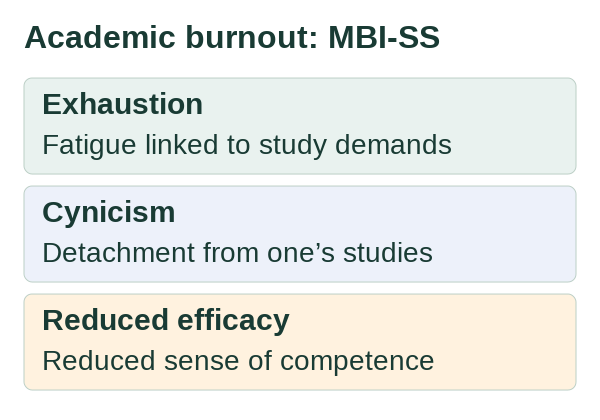
A 2016 Colombian study checked the MBI-SS with 820 health students at universities on the Caribbean coast. The questionnaire matched the expected structure well, but the study questioned the worker norms used to interpret student scores.[9] A 2010 Korean study used the MBI-SS with cluster analysis, a method that sorts students into groups with similar score patterns. It found four groups: distressed, laissez-faire, persevering, and well-functioning.[10]
A 2024 study adapted the School Burnout Inventory for adolescents in Azerbaijan, using 1852 students, 1067 female and 785 male. The adapted version had 9 questions covering three school-related areas, and it showed a satisfactory fit.[11]
History
How the idea developed and what it covers
Burnout is a long-term response to stress in life, and for students, stress related to study can cause it.[3] A 2023 literature review covers academic burnout, looking at its definition, structure, measurement methods and influencing factors. Research on the topic has looked mainly at students in different fields of study.[12]
One model treats burnout as having three parts: exhaustion, cynicism, and reduced academic efficacy.[13] Academic burnout is a state of exhaustion, cynicism, and a sense of incapability in one's academic efforts.[1] A 2024 study looked at 101 Moroccan students in an elite preparatory program.[13]
The Maslach Burnout Inventory-Student Survey is one tool used to measure academic burnout.[14][13] A 2025 review of 38 studies published between 2019 and 2024 recorded which burnout questionnaire each study used.[3] A study of 323 Indonesian students used a 23-item academic burnout scale.[1] In one sample of 101 Moroccan students, exhaustion averaged 4.03 out of 5. Cynicism averaged 3.48, and academic efficacy 3.60.[13]
Main ideas
Stress, self-beliefs and the people around students
Academic self-efficacy, a student's belief in being able to handle academic tasks, is often proposed as a buffer. The study looked at 929 adolescents. Academic self-efficacy weakened the direct link between stress and burnout, and low self-efficacy made academic anxiety a stronger risk for burnout.[15] Higher academic burnout went with lower academic self-efficacy, and students with more stress also had less belief in their own ability.[16] Self-efficacy and student engagement each had a significant negative effect on burnout.[17]
Higher harm avoidance predicted higher burnout scores, and lower self-directedness and cooperativeness also predicted these scores.[18] Socially prescribed perfectionism was measured with a dedicated scale, alongside academic self-efficacy and academic burnout scales, and it was linked to burnout in 244 medical students. Self-efficacy partly explained that link, and perfectionism and self-efficacy together explained 54% of the variance in burnout in that sample.[19]
Parental education anxiety predicted children's academic burnout, and parental burnout fully explained the link.[20] A review of 10 articles from 2020 to 2025 concluded that authoritarian parenting makes burnout worse by raising academic anxiety.[21] Three factors together explained about 40.7% of the variance in burnout: school belongingness, parenting style and academic resilience.[22]
First-year students reported the most burnout, while third- and fourth-year students showed more metacognitive thinking and self-regulation.[23] Four waves of data on 415 Korean students in grades 7 and 8 showed three paths of burnout. Of these students, 51.33% stayed moderate and 38.07% stayed well adjusted, and another 3.61% started low and got worse.[24]
How the three dimensions were defined
A 2012 structural analysis reports that college student burnout has been assessed mainly with that inventory. That analysis appeared in Psychological Reports. It reports that the definition and measurement of the construct with the Maslach Burnout Inventory has drawn several criticisms, and that new inventories have been suggested for evaluating the syndrome. The same paper proposed a redefinition of student burnout using a structural equation model, a statistical method that tests whether measured scores fit a proposed pattern of relationships. In that model, burnout sits at the top as a second order factor, meaning a broad factor defined by narrower factors. Those narrower factors come from three student surveys: the Maslach Burnout Inventory-Student Survey, the Copenhagen Burnout Inventory-Student Survey and the Oldenburg Burnout Inventory-Student Survey.[25]
The standardized regression weights express how strongly each narrower factor reflects the broad one. They were high for Exhaustion and Cynicism on the Maslach survey, Personal Burnout and Studies Related Burnout on the Copenhagen inventory, and Exhaustion and Disengagement on the Oldenburg inventory. Those weights led the analysis to conclude that these factors are strong manifestations of students' burnout. For college students, the paper states, the construct is captured best by 2 dimensions: physical and psychological exhaustion, and cynicism and disengagement.[25]
A Portuguese-language study of university students, published in 2024, describes student burnout as a feeling of exhaustion due to the demands of study. That exhaustion proceeds into an attitude of disbelief and a sense of ineffectiveness of professional training. That description names exhaustion, disbelief or cynicism, and a sense of ineffectiveness, the last of which is often called inefficacy.[26] The English version of the same study gives the same description in parts. It reports which academic stressors predicted burnout scores in the sample, including relationships with teachers, reconciling study and leisure, and having many subjects to take.[27]
Demands, resources and the effort reward balance
The study by Wilson (2026) used the school demands-resources model as its theoretical basis. Wilson and Wood used this model as the basis for their study of psychological safety and burnout. It has been used as the theoretical basis for studying student psychological safety. One survey covered 295 university students at a mid-sized regional university in the Southeast of the United States. In it, student psychological safety significantly predicted student burnout, and the factors of psychological safety correlated with the factors of burnout.[28] The effort reward imbalance account focuses on the ratio between the effort a student puts in and the reward received. It treats a high ratio, meaning high effort for little return, as a stressor that produces strain.[29]
Cross-sectional studies link heavier demands to higher burnout scores.[30] In a sample of 690 high school students, academic stress and school burnout each significantly predicted academic motivation. School burnout fully mediated the link between academic stress and academic motivation.[31] A survey of 412 intermediate English language learners in China found that perceived school climate and growth mindset each had a significant positive impact on student burnout. Perceived school climate was the stronger of the two.[32]
Longitudinal work asks whether the imbalance comes before the strain. In Korean middle school students, latent growth modeling linked the starting level of effort reward imbalance to the starting level of academic burnout. Problem-focused coping moderated the effort reward imbalance to burnout relationship over time, while emotion-focused coping did not.[29]
The paths from imbalance to burnout appear to run through the student's ties to school. Academic buoyancy, the capacity to respond to everyday setbacks, moderated the link between effort reward imbalance and school connectedness and the link between effort reward imbalance and academic burnout.[33]
Self-efficacy, buoyancy and emotion regulation
In a correlational study of 93 final-year high school students at an Islamic boarding school in Indonesia, academic self-efficacy correlated negatively with academic burnout, with a Spearman coefficient of -0.362.[34] A training program for economics students at a Surabaya business college reported lower burnout scores on a post-test than on a pre-test after sessions on academic self-efficacy. The report describes the activity without a comparison group.[35] One study covered 537 international students learning Chinese characters in China (mean age 20.96 years, standard deviation 1.36). Academic self-efficacy mediated the link between learning anxiety and academic burnout, and grade level, sleep quality and parental education level also showed significant effects on the measures.[36]
Grit, the tendency to persist at long-term goals, has been tested as a separate predictor. One study covered 155 vocational students in Gresik, Indonesia. Grit was negatively and significantly associated with burnout (p = 0,020), and support from peers was also negatively associated with it (p = 0,044). Grit was not significantly related to peer support (p = 0,294), so peer support did not mediate the grit and burnout link (p = 0,353). The two resources appeared to work through separate paths.[37] One study covered 248 undergraduate English students at a university in Tabriz, Iran. Academic passion, goal orientation and self-regulation each correlated significantly with academic burnout at the 0.05 level, and burnout fell as each of these rose.[38]
Cognitive emotion regulation strategies are the ways people think about and reinterpret stressful events, such as blaming themselves, catastrophizing (dwelling on the worst possible outcome) or reappraising a situation more positively. A network analysis covered 710 Romanian students aged 9 to 16 (mean age 10.67). It identified emotional exhaustion and cynicism as the main burnout dimensions and catastrophizing and reappraisal as the main regulation strategies in the network. The strongest links joined exhaustion to cynicism, exhaustion to inadequacy, self-blame to catastrophizing, and positive reappraisal to refocus on planning. The networks for females and males did not differ significantly in overall strength or edge weights, though some individual links did.[39]
Why burnout differs between students
Burnout is not spread evenly through a student population. It gathers into a few groups, or profiles, that differ in how severe the exhaustion and detachment are. In a survey of 2,948 Chinese university students, a latent profile analysis, a statistical method that sorts people into subgroups based on their patterns of answers, found three such groups. A Low Burnout profile held 18.15% of the sample, a Medium Burnout profile held 50.88%, and a High Burnout profile held 30.97%. Higher smartphone addiction and poorer sleep quality were each associated with a greater chance of belonging to the Medium or High profile rather than the Low one. Higher mindfulness was associated with a lower chance of belonging to the higher burnout profiles. Because the study was cross-sectional, with all measures taken at one time, it cannot show which conditions came first.[40]
The quality of the academic climate moderated one of these links. When students rated the climate as low in quality, those with more proactive personalities were also more likely to report exhaustion; the relationship reversed when the climate was rated medium or high. Academic climate did not moderate the link between proactive personality and detachment, the second burnout dimension, nor the link with counterproductive academic behavior.[41]
Qualitative studies point to the strain of holding several roles at once. In online interviews with 14 athletic training students, 12 said they had experienced burnout, and all 14 saw a career in athletic training as one that could lead to burnout. Role strain and time came out as the two main sources of burnout. Many of the students drew on social support and personal time to ease the stressors.[42] A photovoice project, in which students submit a photograph and a written reflection, collected images and reflections from 13 radiation therapy students and 44 physical therapy students. Stress and feeling overwhelmed were themes identified by all researchers, and coping strategies and gratefulness followed.[43]
Anxiety, self-concept and connectedness
In a survey of 473 migrant children in grades 5 and 6, anxiety showed a significant positive association with academic burnout, and positive psychological capital and self-concept each mediated that relationship independently. A cross-sectional survey covered 473 migrant children in grades 5 and 6, all of whom had changed schools during the middle-to-upper primary grades. Anxiety on the Spence Children's Anxiety Scale was positively associated with academic burnout on the Adolescent Learning Burnout Inventory.[44] Among 312 students at private universities in Lahore, scores on the Hamilton Anxiety Rating Scale were significantly positively correlated with burnout measured by the Copenhagen Burnout Inventory, student version. Anticipatory anxiety, the worry felt before a coming test or deadline, showed only a weak negative correlation with academic performance in that sample, and no significant relationship with time management skills.[45]
School connectedness, the sense of belonging and attachment a student feels toward the school community, has been tested as another protective factor. Academic self-handicapping, the habit of creating obstacles that excuse poor performance, core self-evaluations and autonomous motivation to learn each mediated the link between connectedness and burnout on its own.[46]
Future time perspective, the extent to which a student thinks about and plans for long-term goals, has been examined alongside burnout in 686 university students. It indicated that future time perspective predicted academic achievement directly and also indirectly, by raising academic engagement and lowering academic burnout. The mediating path through burnout was larger than the path through engagement in that sample.[47]
Research
How common it is and what it predicts
One survey covered 41 elementary school pupils in Lamongan Regency, Indonesia, whose scores on a burnout questionnaire ran from 24 to 96. The mean was 69.39 and the standard deviation was 15.377. Just over half of those pupils, 53.66%, fell in the high burnout category, another 41.46% fell in the moderate category, and the low category held 4.88%. The researchers described burnout as a common condition among these pupils and asked schools and educators to pay attention and step in.[51]
One study of Korean teenagers looked at all four parts of academic burnout: exhaustion, dislike of study, cynicism and a sense of inefficacy. All four rose gradually with age.[52] Grade level and motivation helped tell the groups apart, and students who were doing well scored highest on intrinsic motivation, one of the motivation variables that separated the clusters.[53]
Academic burnout and academic achievement moved in opposite directions. The figures were r (712) = -0.24 and p < 0.01. In that study, academic efficacy was measured with the Maslach Burnout Inventory Student Survey. It significantly predicted achievement (beta = 0.18, p < 0.01).[4] The group that was doing well reported no burnout. These students had the highest grade point average and the most positive self-esteem.[10]
Burnout helps cause high dropout rates. School engagement predicts whether students drop out.[5] One study looked at 144 students. It took place at the Faculty of Psychology, 17th August 1945 University, Samarinda. Academic burnout had a significant effect on academic procrastination (p = 0.000).[54]
Academic workload was positively and significantly linked to academic burnout. The figures were R = 0.284 and p = 0.000. A study at Universitas Muria Kudus looked at 225 students in their third and fifth semesters.[55] Personality, the degree studied, course year and study hours together explained 16.1% of the variance in burnout scores.[56]
What the research links to burnout
Research linking students' life stress to academic burnout remains fairly sparse, even though each topic on its own has received growing attention. Even so, research on the link between the two is fairly limited. A survey of 2640 college students found that stress about identity, relationships, the future and schoolwork could together predict academic burnout.[2] Workload matters mainly as students perceive it. Among 149 college students, subjective workload predicted high burnout. Actual academic and vocational workload had little to do with it.[57]
Researchers have also studied family and classroom conditions.[58][59] The study looked at 871 junior high students and their main caregivers in Eastern China. Parental burnout was linked to student burnout through psychological distress. It was also linked through harsh discipline followed by distress. Parental burnout in fathers affected children's psychological distress more strongly than parental burnout in mothers did.[58] A survey looked at 496 high school students in Turkey. Their burnout levels differed with how they saw the classroom assessment environment.[59]
Several studies look at digital habits, including problematic Facebook use, smartphone addiction and digital teaching in class.[60][61][62] One study followed 115 students for a semester, and rises in cynicism and in how much Facebook mattered predicted greater Facebook intrusion at the end of the term.[60] Researchers studied 214 students in Indonesia, and burnout and smartphone addiction both predicted academic procrastination, with smartphone addiction having the stronger effect.[61] A survey of 100 high school students reported that those using phones more than six hours a day had more trouble keeping focus.[63] Researchers studied 206 Chinese university students, and too much digital teaching in class was linked to higher burnout, with poor integration making this worse.[62]
Burnout has also been studied alongside procrastination, motivation and academic adjustment.[61][64][65] Academic procrastination means putting off study tasks, and burnout predicted it in the Indonesian sample of 214 students.[61]
What may reduce academic burnout
Resilience and dispositional optimism are two personal qualities studied alongside academic burnout. One study looked at 463 students at a Spanish university. Resilience was linked to stronger feelings of academic efficacy, and optimism was linked to less exhaustion. That study found resilience predicted efficacy and optimism predicted exhaustion, while cynicism was linked to neither quality.[66] A survey of 266 preclinical medical students found three factors linked to lower burnout: social support had r = -0.613, problem-focused coping r = -0.634, and resilience r = -0.567. In that sample, 34.6% of students were at high risk of burnout, and a further 30.8% had experienced burnout.[67]
How students handle their emotions also seems to matter. A 2024 meta-analysis found that helpful ways of managing emotions were linked to lower overall burnout scores.[68] A meta-analysis is a statistical method that combines the estimates from two or more similar studies into one overall estimate of an effect.[69] Trouble managing emotions went together with burnout. It also went with its parts: emotional exhaustion, cynicism and a low sense of efficacy. The strength of these links varied with mean age, grade level and the gender mix of the sample.[68]
Mindfulness-based interventions have been tested for preventing or reducing burnout in medical students. A 2024 meta-analysis looked at nine studies with 810 medical students, and four randomised trials showed small to moderate drops in overall burnout (SMD = -0.64).[70] Researchers have also tested physical exercise. A 2026 meta-analysis looked at 35 randomised controlled trials and found that exercise clearly lowered overall academic burnout, with an effect size of SMD = -0.45. Exercise had no significant effect on emotional burnout, cynicism, exhaustion or professional efficacy.[71]
What the numbers show across studies
A cross-sectional survey covered 306 students in three Pakistani institutions: MBBS (the Bachelor of Medicine and Bachelor of Surgery degree), BDS (the Bachelor of Dental Surgery degree) and allied health sciences. On a 12-item questionnaire scored on a 5-point scale, 85.7% showed medium (65.9%) or severe (19.8%) burnout.[72] A survey of 218 medical students at Hail University in Saudi Arabia ran between May and June 2019, with a response rate of 53.8%, and used the Maslach Burnout Inventory-Student Survey. It found high emotional exhaustion in 79.4%, high cynicism in 61.0% and low professional efficacy in 37.6%, with overall high burnout at 27.1% (59 students).[73] At the University of Illinois College of Medicine, 273 students (21.6%) completed the same inventory between February and May 2019, and 110 of the respondents (40.3%) reported burnout they perceived in themselves.[74] A survey-based study of academic burnout at universities in Poland reported that most respondents had experienced the phenomenon, most often in connection with a large number of responsibilities and stress.[75]
Among 200 medical students in years 1 to 5 at the National University of Medical Sciences, burnout scores correlated with academic achievement at r = -.95 (p < .01). Burnout also predicted achievement with a coefficient of -.949 (p < .001), accounting for 90.1% of the variance.[76] A documentary review of 10 studies published between 2020 and 2025 concluded that burnout affects students' academic performance as well as their psychological well-being.[77]
A documentary review of 10 studies published between 2020 and 2025 reports that academic burnout is associated mainly with task overload, academic stress and a lack of institutional psychological support. The same review lists anxiety, depression, insomnia and emotional exhaustion as psychological consequences.[77] Total academic stress correlated with burnout at rho = 0.363 (95% confidence interval 0.257 to 0.470, p < 0.001) in the Pakistani health-science sample. The single stress item with the highest correlation was a lack of revision time (rho = 0.252).[72]
Among 306 Pakistani healthcare students, burnout did not differ significantly by sex, program, year of study or residence (all p > 0.005). The Pakistani health-science study found no significant differences in burnout by sex, programme, year of study or residence (all p > 0.005).[72] At Hail University, female students faced almost double the risk of high emotional exhaustion compared with male students (adjusted odds ratio 2.14, 95% confidence interval 1.06 to 4.34, p = 0.034).[73] Among 385 students at Padang State University surveyed after the pandemic, female students were more likely than male students to report academic burnout, a difference the analysis found significant.[78] In the Illinois sample, being out of phase with the curriculum, rating wellness initiatives as less effective and showing weaker motivation for medical school were associated with burnout. Being female was associated with burnout in only one of the two inventory models tested.[74]
Among 219 undergraduates, students who perceived the university positively had significantly lower exhaustion and depersonalization scores than those who perceived it functionally or negatively. Students with a negative perception had significantly lower efficacy scores than both other groups.[79]
Digital life, pandemic conditions and counselling trials
A three-level meta-analysis of 79 studies, 115 effect sizes and 68,162 participants found a moderate positive correlation between academic burnout and problematic smartphone use (r = 0.438, 95% CI [0.409, 0.467]). That relationship was significantly moderated by the year the data were collected and by the instrument used to measure problematic smartphone use.[80] One sample covered 476 students aged 10 and 13. In it, problematic screen use went with higher academic burnout (r = 0.48, p < 0.01) and with lower overall psychological quality (r = -0.38, p < 0.01). The same study found an unexpected masking pattern rather than a protective one, driven mainly by the adaptability dimension, and its cross-sectional design does not establish temporal ordering or causal processes.[81] A systematic review of articles published between 2012 and 2021 concluded that burnout itself has drawn more study than well-being in digital learning environments. Work on that well-being rests mostly on research on academic emotions.[82]
Among 406 Turkish university students, the shopping, real-time updating and gaming or gambling dimensions of cyberloafing correlated positively and weakly with the exhaustion and desensitization dimensions of academic burnout. A survey covered 406 Turkish university students between September 2021 and June 2022. Academic burnout dimensions together with gender, age, year of study, grade point average, attendance and daily internet duration accounted for 10.4% of the total cyberloafing score.[83]
In a sample of 311 Turkish university students, COVID-19 burnout and emotional distress both predicted academic burnout, and emotional distress partially mediated the link between the two. When the model used only the depression scale of the Depression Anxiety Stress Scale-21, that partial mediation held through depression alone.[84] A survey covered 383 international students in Taiwan in the fall semester of the 2022 to 2023 academic year. The prevalence of high academic burnout was 12.01%, and resilience components showed significant relationships with burnout symptoms.[85]
Trials of interventions for academic burnout have used samples of 100 rural left-behind children in China, 80 Nigerian undergraduates and 120 Chinese undergraduates.[86][87][88] A trial with 120 Chinese undergraduates compared 20 days of daily piano music listening (n = 60) with white noise (n = 60). It found significant reductions in depressive symptoms (p < 0.001) and on academic burnout subscales (p < 0.05), plus a significant rise in mindfulness (p < 0.001).[88]
In practice
What schools and students can try
One randomized controlled trial tested an 8-week mindfulness program with 153 students. In such a trial, students are assigned to groups by chance. In 2025, researchers tested a mindfulness program with a fixed structure. It lasted 8 weeks. The study included 153 undergraduate and graduate students in China. Students were put by chance into the mindfulness group (n = 77) or a minimal-contact control group (n = 76). At week 8, the mindfulness group reported less academic burnout than the control group. The figures were B = 11.31, 95% CI [8.62, 14.00], p < 0.001, d = −1.26. The same group also showed less academic stress and greater psychological resilience. These effects were largely still present at a 2-week follow-up.[6]
One study of university students used structural equation modeling. This is a statistical method for testing chains of influence among variables. It found that mindfulness partly explained the link between unhelpful beliefs about one's own thinking and academic burnout.[89] A study of 764 high school students measured mindfulness, core self-evaluation and academic burnout.[90]
Interventions tested with students
A second quasi-experimental study used a pre-test and post-test design with a two-month follow-up. It drew 30 children aged 7 to 10 with reading learning disabilities from rehabilitation centres in Isfahan in 2022 and randomly assigned them to an experimental and a control group. The attributional retraining intervention had a significant effect on academic burnout and on academic procrastination, and the effect was stable at follow-up.[91]
A descriptive-correlational study surveyed 350 students at Islamic Azad University in Tehran in the academic year 2020-2021 and used structural equation modelling. Mindfulness and academic motivation directly and positively predicted academic engagement; academic burnout and academic self-handicapping, the practice of creating obstacles that excuse poor performance, directly and negatively predicted it.[92] An account of team mindfulness in online academic meetings reported that team mindfulness was compromised in the second year for the group as a whole. It was not compromised in the individual relationship with the facilitator, and the account suggested one-on-one meetings between participant and facilitator to preserve the successful online aspect.[93]
What this looks like when you study
The program added weekly group sessions of 90 minutes and daily individual practices of 15 minutes, and the gains largely held at a two-week follow-up.[6] The standardized mean difference was -0.45. The exercise programs ran from one to eight sessions per week, and single sessions lasted from 5 to 120 minutes.[71]
Yulianti, Permatasari and Meidianawaty (2026) studied 266 preclinical medical students. All three were negatively correlated with academic burnout. Resilience was the strongest predictor in the regression model. Yulianti, Permatasari and Meidianawaty (2026) proposed that institutions build programs around several supports. These were training in resilience and coping skills, peer mentoring, access to counseling and regular psychological screening.[67] Among 149 college students, Jacobs and Dodd (2003) found that a positive temperament, taking part in extracurricular activities and support from friends in particular each predicted lower burnout.[57]
Xu (2026) advised parents to use open-ended questions and active listening in place of blaming language. Xu (2026) also recommended that parents give children more choice. Parents should also train them in communicating about goals.[21]
If you want to try a structured program, look for one that meets weekly for about 90 minutes. It should also add a short daily practice, the format tested in the mindfulness trial.[6] In a study of 266 preclinical medical students, resilience was the strongest predictor of burnout (OR = 36.910). Problem-focused coping came next (OR = 23.010).[67]
Criticism
Open questions and limits of the evidence
A 2026 systematic review of medical student burnout included 15 studies. These were original English-language observational studies published from 2018 to 2024, and the review included only studies that measured burnout with validated tools. The review reported burnout rates from 34.3% to 63.5%.[94]
The 2026 review said higher burnout always went with lower grade point averages and worse examination results. The review reports links between burnout and outcomes such as grades and well-being. The same review linked higher burnout to several problems. These were lower learning motivation, worse quality of life, more anxiety and depression, sleep problems and stress.[94]
Common misconceptions
A study of 41 elementary school students in Lamongan Regency found that 53.66% had a high level of academic burnout. The authors concluded that burnout is a dominant condition among these elementary students.[51]
Key studies
| Year | Study | Sample | Design | Finding |
|---|---|---|---|---|
| 2003 | Jacobs & Dodd[57] | 149 college students (mean age 20.8 years) | measures of social support, personality and workload related to burnout scores among 149 college students | Negative temperament and subjective workload predicted high burnout, while positive temperament, extracurricular activities and support from friends predicted low burnout. |
| 2016 | Yu et al.[19] | 244 medical students in Korea | questionnaire study of 244 medical students; correlation and hierarchical regression | Socially prescribed perfectionism and academic self-efficacy explained 54% of the variance in burnout, with self-efficacy partly mediating the link. |
| 2018 | Lee & Lee[24] | four-wave longitudinal study of 415 Korean seventh and eighth graders | Burnout followed three trajectories: moderate-maintain (51.33%), low-deteriorated (3.61%) and well-adjusted (38.07%). | |
| 2020 | Oyoo et al.[4] | 714 form 4 students from 31 public secondary schools in Kenya | correlational study | Academic burnout correlated negatively with achievement (r = -0.24), and academic efficacy predicted achievement (β = 0.18). |
| 2022 | Wu et al.[20] | survey of 259 parent-child pairs in two Chinese middle schools | Parents' education anxiety predicted children's academic burnout, fully through parental burnout, and family function buffered the first link. | |
| 2023 | Gao[15] | 929 Chinese adolescents (53.71% males, mean age 11.94 years) | questionnaire study of 929 Chinese adolescents, with mediation and moderation analysis | Academic anxiety partly mediated the link between academic stress and burnout, and higher academic self-efficacy buffered the effect of stress. |
| 2024 | Wang et al.[70] | 810 medical students in nine studies | systematic review and meta-analysis | Across four RCTs, mindfulness-based interventions lowered overall burnout (SMD = -0.64). Across four qRCTs, they lowered emotional exhaustion (SMD = -0.27) and raised academic efficacy (SMD = 0.43). |
| 2025 | Munif & Nashr[51] | 41 elementary school students in Lamongan Regency | quantitative descriptive design | 53.66% had high academic burnout, 41.46% moderate and 4.88% low, with a mean score of 69.39. |
| 2025 | Chen & Qi[6] | 153 undergraduate and graduate students in China | randomized controlled trial | An eight-week mindfulness program reduced academic burnout (d = -1.26) and academic stress compared with a control group. |
| 2025 | Chong et al.[3] | review of 38 studies published 2019 to 2024 | Many factors contribute to burnout in different student populations, and the review proposes ways to reduce it. | |
| 2026 | Abdulnabi[23] | 631 undergraduate students in Jordan | questionnaire study of 631 undergraduates; two-way ANOVA, correlation and stepwise regression | Self-regulation and metacognitive thinking predicted lower burnout, and first-year students reported the highest burnout. |
| 2026 | Wang & Zhang[71] | 12,483 students in 35 randomized controlled trials | systematic review and meta-analysis | Physical exercise reduced overall academic burnout (SMD = -0.45) and gave a very small improvement in achievement (SMD = 0.17). |
| 2026 | Yulianti et al.[67] | questionnaire study of 266 preclinical medical students; ordinal logistic regression | Resilience was the strongest predictor of lower burnout (OR = 36.910), followed by problem-focused coping and social support. |
See also
References
- Aisyah Hidayah Putri, Syaf, A., & Nasution, I. N. (2025). Peran Self-Compassion dalam Menurunkan Tingkat Academic Burnout Pada Mahasiswa Indonesia. Psychopolytan : Jurnal Psikologi, 8(2), 55-64. doi:10.36341/psi.v8i2.6576
- Lin, S. H., & Huang, Y. C. (2014). Life stress and academic burnout. Active Learning in Higher Education, 15(1), 77-90. doi:10.1177/1469787413514651
- Chong, L. Z., Foo, L. K., & Chua, S. L. (2025). Student Burnout: A Review on Factors Contributing to Burnout Across Different Student Populations. Behavioral Sciences, 15(2), 170. doi:10.3390/bs15020170
- Oyoo, S., Mwaura, P., Kinai, T., & Mutua, J. (2020). Academic Burnout and Academic Achievement among Secondary School Students in Kenya. Education Research International, 2020, 1-6. doi:10.1155/2020/5347828
- Arlinkasari, F., & Akmal, S. Z. (2017). Hubungan antara School Engagement, Academic Self-Efficacy dan Academic Burnout pada Mahasiswa. Humanitas (Jurnal Psikologi), 1(2), 81. doi:10.28932/humanitas.v1i2.418
- Chen, S., & Qi, X. (2025). A randomized controlled trial of mindfulness: effects on academic stress, academic burnout, and psychological resilience in university students. Frontiers in Psychology, 16. doi:10.3389/fpsyg.2025.1722669
- Moreno Acosta, J. J., Arias Zamora, R. A., & Torres Valdez, K. M. (2026). Predictores psicológicos del agotamiento estudiantil (burnout académico). ASCE MAGAZINE, 5(3), 1935-1959. doi:10.70577/asce.v5i3.1068
- Reis, D., Xanthopoulou, D., & Tsaousis, I. (2015). Measuring job and academic burnout with the Oldenburg Burnout Inventory (OLBI): Factorial invariance across samples and countries. Burnout Research, 2(1), 8-18. doi:10.1016/j.burn.2014.11.001
- Hederich-Martínez, C., & Caballero-Domínguez, C. C. (2016). Validación del cuestionario Maslach Burnout Inventory-Student Survey (MBI-SS) en contexto académico colombiano. Revista CES Psicología, 9(1), 1-15. doi:10.21615/cesp.9.1.1
- Lee, J., Puig, A., Kim, Y., Shin, H., Lee, J. H., & Lee, S. M. (2010). Academic burnout profiles in Korean adolescents. Stress and Health, 26(5), 404-416. doi:10.1002/smi.1312
- Asadov, F., Zalova Nuriyeva, U., Rustamova, N., & Abbasova, G. (2024). An Azerbaijani Adaptation of the School Burnout Inventory: Relations among School Burnout, Academic Self-Efficacy, School Satisfaction, Distress, and Life Satisfaction. Futurity Education, 4(4), 294-305. doi:10.57125/fed.2024.12.25.19
- Liu, X. (2023). Literature Review on Academic Burnout. Journal of Intelligence and Knowledge Engineering, 1(4), 21-24. doi:10.62517/jike.202304405
- Ouhejjou, M. (2024). The Hidden Cost of Academic Excellence: Academic Burnout among Moroccan CPGE Students. International Journal of Language and Literary Studies, 6(2). doi:10.36892/ijlls.v6i2.2635
- Nada, N. A., & Yasmin, M. (2023). Kontribusi hardiness terhadap academic burnout pada mahasiswa baru di universitas negeri padang. CAUSALITA : Journal of Psychology, 1(2), 44-60. doi:10.62260/causalita.v1i2.19
- Gao, X. (2023). Academic stress and academic burnout in adolescents: a moderated mediating model. Frontiers in Psychology, 14. doi:10.3389/fpsyg.2023.1133706
- Safarzaie, H., Nastiezaie, N., & Jenaabadi, H. (2017). The Relationship of Academic Burnout and Academic Stress with Academic Self-Efficacy among Graduate Students. The New Educational Review, 2017(Vol. 49), 65-76. doi:10.15804/tner.2017.49.3.05
- Anggraini, D. P., & Chusairi, A. (2022). PENGARUH ACADEMIC SELF-EFFICACY DAN STUDENT ENGAGEMENT TERHADAP ACADEMIC BURNOUT MAHASISWA DALAM PEMBELAJARAN DARING: The Effect of Academic Self-Efficacy and Student Engagement on Student Academic Burnout in Online Learning. Journal of Community Mental Health and Public Policy, 4(2), 79-94. doi:10.51602/cmhp.v4i2.70
- Lee, S. J., Choi, Y. J., & Chae, H. (2017). The effects of personality traits on academic burnout in Korean medical students. Integrative Medicine Research, 6(2), 207-213. doi:10.1016/j.imr.2017.03.005
- Yu, J. H., Chae, S. J., & Chang, K. H. (2016). The relationship among self-efficacy, perfectionism and academic burnout in medical school students. Korean Journal of Medical Education, 28(1), 49-55. doi:10.3946/kjme.2016.9
- Wu, K., Wang, F., Wang, W., & Li, Y. (2022). Parents’ Education Anxiety and Children’s Academic Burnout: The Role of Parental Burnout and Family Function. Frontiers in Psychology, 12. doi:10.3389/fpsyg.2021.764824
- Xu, Y. (2026). The Impact of Parental Academic Control on Academic Burnout among High School Students. Journal of Education and Educational Research, 18(1), 115-122. doi:10.54097/phyzbd83
- Bazaz Abkenar, S., & Farhadian, A. (2025). Predicting Academic Burnout Based on School Belongingness, Parenting Styles, and Academic Resilience. Journal of Adolescent and Youth Psychological Studies, 6(3), 79-86. doi:10.61838/kman.jayps.6.3.9
- Abdulnabi, A. J. (2026). Metacognitive thinking and academic self-regulation as predictors of academic burnout among university students in Jordan. Frontiers in Education, 11. doi:10.3389/feduc.2026.1918844
- Lee, M. Y., & Lee, S. M. (2018). The effects of psychological maladjustments on predicting developmental trajectories of academic burnout. School Psychology International, 39(3), 217-233. doi:10.1177/0143034318766206
- Maroco, J., & Campos, J. A. D. B. (2012). Defining the Student Burnout Construct: A Structural Analysis from Three Burnout Inventories. Psychological Reports, 111(3), 814-830. doi:10.2466/14.10.20.pr0.111.6.814-830
- Câmara, S. G., & Carlotto, M. S. (2024). Estressores acadêmicos como preditores da síndrome de burnout em estudantes. Revista Brasileira de Educação, 29. doi:10.1590/s1413-24782024290020
- Câmara, S. G., & Carlotto, M. S. (2024). Academic stressors as predictors of burnout syndrome in university students. Revista Brasileira de Educação, 29. doi:10.1590/s1413-24782024290021
- Wilson, A. M., & Wood, C. M. (2026). Student Psychological Safety as a Predictor of Student Burnout. Higher Education Studies, 16(1), 328. doi:10.5539/hes.v16n1p328
- Kim, B., Kim, E., & Lee, S. M. (2017). Examining longitudinal relationship among effort reward imbalance, coping strategies and academic burnout in Korean middle school students. School Psychology International, 38(6), 628-646. doi:10.1177/0143034317723685
- Yongmei, H., & Dan, W. (2022). The Influence of Academic Stress on Academic Burnout among Middle School Students in Guangdong. Advances in Social Sciences Research Journal, 9(9), 404-411. doi:10.14738/assrj.99.13113
- Veyis, F., Seçer, İ., & Ulaş, S. (2019). An Investigation of the Mediator Role of School Burnout Between Academic Stress and Academic Motivation. Journal of Curriculum and Teaching, 8(4), 46. doi:10.5430/jct.v8n4p46
- Liu, X. (2023). Examining student burnout causes among English as a foreign language students: focus on school climate and student growth mindset. Frontiers in Psychology, 14. doi:10.3389/fpsyg.2023.1166408
- Gao, B., Chai, X., Shen, Q., Lu, J., & Li, L. (2025). Linking effort‐reward imbalance to academic burnout among high school students: The roles of school connectedness and academic buoyancy. Psychology in the Schools, 62(1), 202-218. doi:10.1002/pits.23320
- Rahman, A., & Djamhoer, T. (2023). Hubungan antara Academic Self Efficacy dengan Academic Burnout. Bandung Conference Series: Psychology Science, 3(1). doi:10.29313/bcsps.v3i1.5275
- Maulidya, N. (2022). Pelatihan Academic Self Efficacy Untuk Menurunkan Academic Burnout Pada Mahasiswa Ekonomi STIE Perbanas Surabaya. Surya Abdimas, 6(2), 378-385. doi:10.37729/abdimas.v6i2.1586
- Lin, Y. (2025). How does academic self-efficacy influence learning anxiety and academic burnout in Chinese characters learning among international students in China? Frontiers in Psychology, 16. doi:10.3389/fpsyg.2025.1555063
- Firman, T. N., & Asri Rejeki (2026). Pengaruh Grit Terhadap Academic Burnout Dengan Mediasi Dukungan Sosial Teman Sebaya Siswa SMK Semen Gresik. CAUSALITA : Journal of Psychology, 4(1), 56-62. doi:10.62260/causalita.v4i1.643
- Izadpanah, S. (2023). The Mediating Role of Academic Passion in Determining the Relationship Between Academic Self-Regulation and Goal Orientation With Academic Burnout Among English Foreign Language (EFL) Learners. Frontiers in Psychology, 13. doi:10.3389/fpsyg.2022.933334
- Iuga, I. A., Fodor, L. A., & David, O. A. (2025). Cognitive emotion regulation strategies and academic burnout dimensions in children and adolescents: a network analysis approach. Current Psychology, 44(7), 5480-5493. doi:10.1007/s12144-025-07537-0
- Li, Y., Li, Y., Ye, X., & Yan, S. (2026). Academic burnout profiles and their correlates: a latent profile analysis of Chinese university students. Frontiers in Psychology, 17. doi:10.3389/fpsyg.2026.1701455
- Neumann, U., Cernja, R., & Tonkovic, G. (2025). Burnout and counterproductive academic behavior - The role of academic climate and proactive personality. Psihologija(00), 43-43. doi:10.2298/psi240904043n
- Mazerolle, S. M., & Pagnotta, K. D. (2011). Student Perspectives on Burnout. Athletic Training Education Journal, 6(2), 60-68. doi:10.4085/1947-380x-6.2.60
- Theaker, K. V., Trad, M. L., Herrin, S., & Gibbs, K. (2025). Uncovering Academic Burnout in the Health Professions Classroom. Radiologic Technology, 97(1), 15-22. doi:10.64912/qdrp4196
- Ji, X., Wei, T., Zuo, Y., & Wang, M. (2026). Anxiety and academic burnout in migrant children: a chain mediation model of positive psychology and self-concept. Frontiers in Psychology, 17. doi:10.3389/fpsyg.2026.1768621
- Khurram Awan, & Tooba Nadeem (2025). Anticipatory Anxiety and Academic Performance: The Mediating Role of Academic Burnout and Time Management Skills in University Students. Research Journal of Psychology, 3(4), 398-413. doi:10.59075/rjs.v3i4.280
- Zhao, H., Han, M., Wang, Z., & Liu, B. (2024). School Connectedness and Academic Burnout in Middle School Students: A Multiple Serial Mediation Model. Behavioral Sciences, 14(11), 1077. doi:10.3390/bs14111077
- Hong, S. (2025). The impact of future time perspective on academic achievement: Mediating roles of academic burnout and engagement. PLOS ONE, 20(1), e0316841. doi:10.1371/journal.pone.0316841
- Pham, C., Tran, H., & Phuong Le, T. T. (2026). The Relationship Between Social Media Fatigue and Academic Burnout Among Generation Z Students in Dai Nam University. International Journal of Social Science and Human Research, 09(06). doi:10.47191/ijsshr/v9-i6-104
- Setiorini, F., & Soleh, A. (2026). Digital Burnout and Academic Procrastination among University Psychology Students: A Correlational Study. Human Psychology & Behavior, 2(1), 9-15. doi:10.58920/humpsycholbehav0101565
- Mujtaba, Z. A., & Kuntoro, A. (2026). Transmutation of psychological phenomena (academic burnout and FOMO) into cyanotype art creation. Paradigma: Jurnal Kajian Budaya, 16(2), 375-395. doi:10.17510/paradigma.v16i2.2076
- Munif, M. V. M., & Nashr, M. N. A. (2025). Academic Burnout of Elementary School Students in Lamongan. Tarsib: Jurnal Program Studi PGMI, 3(2), 42-50. doi:10.61181/qejasy47
- Lee, J., Puig, A., Lea, E., & Lee, S. M. (2013). AGE-RELATED DIFFERENCES IN ACADEMIC BURNOUT OF KOREAN ADOLESCENTS: Academic Burnout in Korean Adolescents. Psychology in the Schools, 50(10), 1015-1031. doi:10.1002/pits.21723
- Zhang, X., Klassen, R. M., & Wang, Y. (2013). Academic Burnout and Motivation of Chinese Secondary Students. International Journal of Social Science and Humanity, 134-138. doi:10.7763/ijssh.2013.v3.212
- Govicar, D. Y. A., Purwaningrum, E. K., & Umaroh, S. K. (2024). The Influence of Academic Burnout on Academic Procrastination Among Students. KnE Social Sciences. doi:10.18502/kss.v9i30.17513
- Attariq, M. N. H., & Kawuryan, F. (2026). the Hubungan antara Konsep diri dan Academic workload dengan Academic burnout pada Mahasiswa Universitas Muria Kudus. Jurnal Psikologi Ekspresi, 3(1), 39-48. doi:10.24176/ekspresi.v3i1.16846
- Cuevas-Caravaca, E., Sánchez-Romero, E. I., & Antón-Ruiz, J. A. (2024). Academic Burnout, Personality, and Academic Variables in University Students. European Journal of Investigation in Health, Psychology and Education, 14(6), 1561-1571. doi:10.3390/ejihpe14060103
- Jacobs, S. R., & Dodd, D. (2003). Student Burnout as a Function of Personality, Social Support, and Workload. Journal of College Student Development, 44(3), 291-303. doi:10.1353/csd.2003.0028
- Zhang, H., Li, S., Wang, R., & Hu, Q. (2023). Parental burnout and adolescents’ academic burnout: Roles of parental harsh discipline, psychological distress, and gender. Frontiers in Psychology, 14. doi:10.3389/fpsyg.2023.1122986
- İlhan, M., & Çetin, B. (2014). An Analysis of the Relationship between Academic Burnout and Classroom Assessment Environment. Education and Science, 39(176), 51-68. doi:10.15390/eb.2014.3335
- Tomaszek, K., & Muchacka-Cymerman, A. (2021). Be Aware of Burnout! The Role of Changes in Academic Burnout in Problematic Facebook Usage among University Students. International Journal of Environmental Research and Public Health, 18(15), 8055. doi:10.3390/ijerph18158055
- Sujadi, E., & Ahmad, B. (2023). Academic Procrastination in College Students: Do Academic Burnout and Smartphone Addiction Matter? Psychocentrum Review, 5(3), 161-174. doi:10.26539/pcr.531511
- Song, W., Wang, Z., & Zhang, R. (2022). Classroom Digital Teaching and College Students’ Academic Burnout in the Post COVID-19 Era: A Cross-Sectional Study. International Journal of Environmental Research and Public Health, 19(20), 13403. doi:10.3390/ijerph192013403
- Kaur, G. (2026). Academic Workload and Burnout Among High School Students: An Investigation of Sleep, Study Habits, and Academic Demands. International Journal of Social Science Research and Review, 9(9), 24-37. doi:10.47814/ijssrr.v9i9.3479
- Mosavi Hesari, Z., & Solgi, R. (2020). The role of anxiety in academic achievement and academic procrastination in predicting students' academic burnout. Journal of Adolescent and Youth Psychological Studies, 1(1), 48-59. doi:10.61838/kman.jayps.1.1.5
- Jafari, L., & Sadeghi Sayyah, A. (2020). Predicting Academic Motivation Based on Academic Adjustment and Academic Burnout in Students of Islamic Azad University of Hamadan. Journal of Adolescent and Youth Psychological Studies, 1(1), 216-230. doi:10.61838/kman.jayps.1.1.19
- Vizoso-Gómez, C., & Arias-Gundín, O. (2018). Resiliencia, optimismo y burnout académico en estudiantes universitarios. European Journal of Education and Psychology, 11(1), 47-59. doi:10.30552/ejep.v11i1.185
- Yulianti, O. S., Permatasari, T. O., & Meidianawaty, V. (2026). Resilience as Main Predictor of Academic Burnout in Medical Students: Resiliensi sebagai Prediktor Utama Burnout Akademik Mahasiswa Kedokteran. Academia Open, 11(1). doi:10.21070/acopen.11.2026.14357
- Iuga, I. A., & David, O. A. (2024). Emotion Regulation and Academic Burnout Among Youth: a Quantitative Meta-analysis. Educational Psychology Review, 36(4). doi:10.1007/s10648-024-09930-w
- GET-IT Glossary (plain-language health research terms) (n.d.). meta-analysis. GET-IT Glossary (plain-language health research terms). https://getitglossary.org/term/meta-analysis
- Wang, Z., Wu, P., Hou, Y., Guo, J., & Lin, C. (2024). The effects of mindfulness-based interventions on alleviating academic burnout in medical students: a systematic review and meta-analysis. BMC Public Health, 24(1). doi:10.1186/s12889-024-18938-4
- Wang, W., & Zhang, P. (2026). The impact of mindfulness training and physical exercise on student academic burnout and academic achievement: a systematic review and meta-analysis. Frontiers in Psychology, 17. doi:10.3389/fpsyg.2026.1840246
- Imran, M., Khan, S. A., Farooq, I., & Ikram, M. (2026). Prevalence of Burnout and Its Association with Academic Stress among MBBS, BDS, and Allied Health Sciences Students in Pakistan: A Cross-Sectional Study: Prevalence of Burnout and Its Association with Academic Stress. Pakistan BioMedical Journal, 03-08. doi:10.54393/pbmj.v9i6.1374
- Aljadani, A. H., Alsolami, A., Almehmadi, S., Alhuwaydi, A., & Fathuldeen, A. (2021). Epidemiology of Burnout and Its Association with Academic Performance Among Medical Students at Hail University, Saudi Arabia. Sultan Qaboos University Medical Journal, 21(2), e231-236. doi:10.18295/squmj.2021.21.02.011
- Obregon, M., Luo, J., Shelton, J., Blevins, T., & MacDowell, M. (2020). Assessment of burnout in medical students using the Maslach Burnout Inventory-Student Survey: a cross-sectional data analysis. BMC Medical Education, 20(1). doi:10.1186/s12909-020-02274-3
- Ober, J., Kochmańska, A., & Sitinjak, C. (2025). Assessment of Academic Burnout among University Students in Poland. Sage Open, 15(4). doi:10.1177/21582440251387802
- Zainab Ilyas, & Sidra Shehzad (2026). Academic Burnout and Academic Achievement among Medical Students: A Cross-Sectional Study. Pakistan Journal of Positive Psychology, 3(1), 74-80. doi:10.67785/pjpp.1.191
- Sarmiento Muñoz, P. A. (2026). Síndrome de burnout académico en estudiantes universitarios y su impacto psicológico: Academic burnout syndrome in university students and its psychological impact. LATAM Revista Latinoamericana de Ciencias Sociales y Humanidades, 7(3). doi:10.56712/latam.v7i3.6124
- Nadya Nanda Dwi Putri, & Maya Yasmin (2023). Academic Burnout in View of Gender in Post-Pandemic Padang State University Students. Psycho Holistic, 5(1), 17-23. doi:10.35747/ph.v5i1.633
- Salman, N., Dur Öztürk, C., & Uçar, S. S. (2026). Burnout in Undergraduate Students: An Investigation in the Context of University Perceptions. Educational Academic Research(61), 1-10. doi:10.33418/education.1666760
- Wang, X., Madon, Z. B., Ghani, M. S. A., & Long, X. (2026). The relationship between academic burnout and problematic smartphone use: a three-level meta-analysis. Frontiers in Psychology, 17. doi:10.3389/fpsyg.2026.1768092
- Xianghui, Y., Keyu, L., Huiwen, Y., Xianglan, Z., & Yifan, C. (2026). From problematic screen use to stress: psychological quality and academic burnout among 10- and 13-year-olds children. Frontiers in Psychology, 17. doi:10.3389/fpsyg.2026.1819969
- Koivuneva, K., & Ruokamo, H. (2022). Assessing university students’ study-related burnout and academic well-being in digital learning environments: A systematic literature review. Seminar.net, 18(1). doi:10.7577/seminar.4705
- Doğru, M. C., & Kabasakal, Z. (2023). Investigating Cyberloafing and Academic Burnout in University Students during the COVID-19 Pandemic. South Asian Journal of Social Studies and Economics, 1-11. doi:10.9734/sajsse/2023/v17i3636
- TAŞÖREN, A. B., & BURHAN, S. (2022). The Role of Emotional Distress in the Relationship between COVID-19 Burnout and Academic Burnout in University Students. OPUS Toplum Araştırmaları Dergisi, 19(46), 340-353. doi:10.26466/opusjsr.1065787
- Tran, T. X., Vo, T. T. T., & Ho, C. (2023). From Academic Resilience to Academic Burnout among International University Students during the Post-COVID-19 New Normal: An Empirical Study in Taiwan. Behavioral Sciences, 13(3), 206. doi:10.3390/bs13030206
- Ren, H., Yang, Q., Chen, J., Luo, Y., Liu, X., Lu, C., & Liu, Q. (2026). Effects of mindful awareness intervention folk-dance intervention and combined intervention on academic burnout in left-behind children in rural China. Frontiers in Psychology, 17. doi:10.3389/fpsyg.2026.1745058
- Eseadi, C. (2022). An online counseling intervention for Nigerian undergraduates with academic burnout. International Journal of Research in Counseling and Education, 6(1), 35. doi:10.24036/00514za0002
- Yang, L., Yuan, R., & Zheng, Y. (2026). Effects of a piano music listening intervention on depression, academic burnout, and mindfulness: evidence from a randomized controlled trial among Chinese university students. Frontiers in Psychology, 17. doi:10.3389/fpsyg.2026.1745444
- Sapanci, A. (2023). From metacognition to academic burnout in university students: The mediating role of mindfulness. Journal of Pedagogical Research. doi:10.33902/jpr.202313708
- Zhu, M., Bin Abu Talib, M., Yao, X., Xiang, Y., Feng, X., & Geng, Q. (2024). The Effect of Mindfulness Training on Core Self-Evaluation and Academic Burnout. The Effect of Mindfulness Training on Core Self-Evaluation and Academic Burnout. doi:10.53555/kuey.v30i5.1836
- Sarami, P., & Ghasemi, M. (2022). The effectiveness of the intervention based on attributional retraining on academic burnout and academic procrastination of students with reading learning disorder. Journal of Assessment and Research in Applied Counseling, 4(4), 26-41. doi:10.61838/kman.jarac.4.4.3
- Mostafavi, E., Vatankhah, H., & Khalatbari, J. (2024). Prediction of Academic Engagement Based on Mindfulness and Perceived Academic Motivation with the Mediating Role of Academic Burnout and Academic Self-Handicapping. Journal of Adolescent and Youth Psychological Studies, 5(7), 77-89. doi:10.61838/kman.jayps.5.7.9
- Nash, C. (2023). Team Mindfulness in Online Academic Meetings to Reduce Burnout. Challenges, 14(1), 15. doi:10.3390/challe14010015
- Imtiaz, H., Ehsan, M. T., Hassan, B., Saleem, S., Khan, F. M., & Fatima, S. S. (2026). Impact of Burnout on Academic Performance and Well-Being among Medical Students: A Systematic Review: Impact of Burnout on Academic Performance and Well-Being among Medical Students. Pakistan Journal of Health Sciences, 173-181. doi:10.54393/pjhs.v7i4.3815
Cite this page: Atlas Nova editors. (2026). Academic burnout. Atlas Nova. https://velocer.io/atlas/academic-burnout/