Method · Study methods
Pomodoro technique
Time management method
The Pomodoro technique is a way of managing time: it divides work into short stretches of focus, with brief rests between them. It aims to boost productivity and counteract mental fatigue.[1]
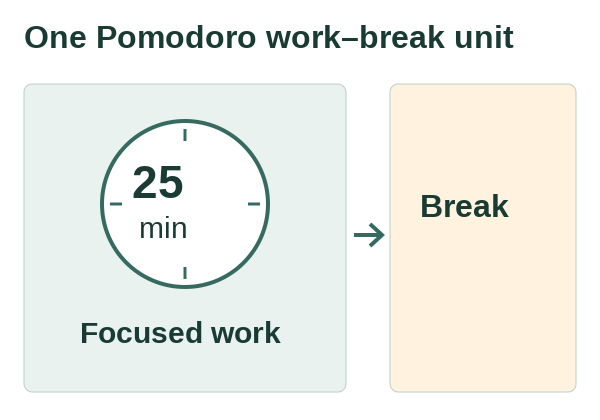
Work is split into 25-minute intervals with 5-minute breaks between them.[2] In one review, 88% of studies showed positive outcomes.[1] One experiment found no significant effect of the technique on memory retention.[3] Students often feel guilty when resting instead of working.[4]
Overview
What the Pomodoro technique is
The Pomodoro technique is a time management method. It is built on 25-minute focused work sessions followed by short breaks. Francesco Cirillo developed the method.[5]
One web-based system combined the Pomodoro technique with productivity analytics, meaning recorded measures of work output. It was evaluated on 120 Pomodoro sessions. These were recorded over a four-week observation period. The system reported a task completion rate of 78.3%. It also reported an average daily focus duration of 142 minutes.[6] A mobile application built on the method was designed to help users manage work and rest periods in a structured way.[7]
History
Where the method came from and how it spread
The timer divides study into work periods, with break time scheduled between them. It follows the Pomodoro pattern.[8] The designers described the feature as an advanced approach to the college's internal operations, meant to improve user convenience and encourage productivity. The college had been storing student data on paper and in an outdated enrollment system. The paper called this inconvenient during the Covid-19 pandemic. The researchers concluded that the proposed portal could work. They said it would address the college's current challenges.[9]
A 2023 project called Virtual Study Space let students pick simple background themes, such as cafes, nature and libraries. It also let them control background noise to reduce distraction. The same space included a Pomodoro timer. Break times were scheduled according to the Pomodoro pattern. It also offered a video call so students could work together as a team. A task list helped them plan priorities. The project's stated aim was to spark motivation, productivity and focus during long to-do lists.[8]
A 2024 paper analyzed and designed responsive web-based learning media for a software engineering course. The media included a Pomodoro feature. Questionnaires given beforehand showed students were unsure how well they understood software engineering materials. Students also reported distractions such as games and social media. These made focus hard to keep while studying. That project used a research and development method with the 4D Thiagarajan development model. Its four stages are define, design, develop and disseminate. Only the definition and design stages were carried out. Research limits stopped the rest.[10]
A 2024 article described a program that changed Verbal Behavior therapy. This is an approach within applied behavior analysis (ABA) used to increase wanted behavior and reduce unwanted problems. The program combined that therapy with a timing technique, namely Pomodoro. The author ran it for 4 meetings. From the first meeting to the fourth, the child's verbal ability increased. The change was not so visible, though. The author reported that results were already visible at the first meeting. The author judged the program to have good results. The article recommended repeating the intervention as a routine. That way children get used to it and reach the best results.[11]
Main ideas
Why short breaks help attention
Research on rest breaks asks a simple question. Does stopping work for a while help the mind perform better afterward?[12][13] A 2016 experiment on mental arithmetic found that rest was generally good for performance. This held whether the rest was active or passive. Walking and watching a video gave similar benefits. The benefits grew as time on task increased. They were larger when the task demanded more. Part of the gain in average response speed came from fewer lapses in attention. Faster responses alone did not explain it.[12]
A 2022 review sorted rest breaks into long, short and micro-rest breaks. It used context and timing to tell them apart. Schumann and colleagues (2022) call for better measurement in rest-break research. They also call for clearer theory.[13]
A meta-analysis of 11 studies with 705 participants tested one question. Is the time lost to extra short breaks paid back in output? Extra short breaks raised work quality, with an effect size of g = 0.23. They raised work quantity with g = 0.12. Working time fell by 9.3 % on average. The gains did not come at the cost of more strain on workers.[14]
A 2026 survey looked at short breaks between study sessions. It covered 578 students at three universities in Shandong province. Micro-breaks showed a significant positive link with learning concentration (β = 0.292, p < 0.01).[15]
A 2017 study reports that rest breaks had a greater effect when sleep pressure was higher. Fifty-seven healthy adolescents aged 15 to 19 lived in a lab for 15 days. They were limited to 5 hours in bed each night. People given a daily 1-hour chance to nap processed information faster. They were also affected less by time on task. Students who did not nap gained more from the rest breaks allowed between blocks of the test.[16]
Breaks also raise a practical problem. Scheduled breaks can get in the way of some tasks. In a laboratory study, 31 undergraduate typists typed lines of words in random order. They typed for 65 minutes. A break was required whenever the breaks people chose did not add up to 30 seconds every 10 minutes. Typists were given feedback on how their own breaks compared with a standard. They took fewer full required breaks and made fewer corrections. Mood, discomfort and body measures were the same in both groups.[17]
Research
Evidence on writing and subject learning
A second writing study paired the technique with video learning. It looked at whether students' critical thinking levels changed the result. Forty-five students in an English language department in Indonesia were split into an experimental group and a control group. Writing was measured with a pre-test and a post-test. A questionnaire given after the post-test recorded the students' critical thinking levels. In the experimental group, students at different critical thinking levels wrote equally well after the treatment.[18]
A third study moved from writing to science, testing whether the technique helped students master Mendelian genetics. The setting was remote learning at the same time. The study used a semi-experimental design. Santiago and Gurat (2023) call this mixed triangulation, which combines several kinds of evidence. The whole sample was 46 students. The researcher wrote a test to measure concept mastery.[19]
Not every comparison favors the method. One study with 30 college students at a Philippine campus compared the technique with breaks the students chose for themselves. Each student did two sessions on the subject Understanding the Self. One had 25 minutes of study followed by a 5-minute break. The other had self-directed breaks. Scores were moderate under the Pomodoro condition (M = 16.87, SD = 4.42). They were high under the self-directed break condition (M = 20.67, SD = 5.00).[20]
Evidence on concentration, memory and motivation
A case study in one eighth-grade class in Indonesia reported a result. Study periods of 25 minutes followed by 5-minute breaks helped students keep attention. They also felt less bored. The researchers collected data by watching, by interviews and from documents. They did not use tests. They also named problems. These were limited face-to-face class time, students needing time to adapt to the intervals, and little awareness of time management. Teachers guided the process and watched how students used their time. They also checked that breaks were used well.[21]
Students said the technique worked well for their English study habits. They named focus, discipline, concentration, productivity and motivation as areas that improved. On the questionnaire, the agree range drew the highest number of responses, at 47.[22]
A quasi-experiment tested a combined approach in eleventh-grade biology classes. It paired the Pomodoro technique with Qur'anic murottal recitation. The sample was three classes, drawn from a population of fewer than 100 students. One class received both treatments. One group received only the Pomodoro technique. Learning motivation gave a p-value of 0.072. The researchers treat this as not statistically significant.[23] A statistically significant result is one with a low probability of occurring by chance alone; in this sense, significant does not mean large or important.[24]
An experiment at a university in Quezon City, Philippines, tested memory retention. It used 75 first-year and second-year students. Participants were split into an experimental group and a control group. The technique had no real effect on memory retention. The result was not statistically significant. The researchers warned that time limits and other conditions faced by researchers and participants may have shaped the result. They called for more study.[3]
A quasi-experiment compared Pomodoro-style breaks with breaks the instructor scheduled. Students did not know the instructor's breaks in advance. Undergraduate nursing students and graduate social work students took part. Their classes were 3-hour in-person classes. After each class they answered an optional survey on engagement and breaks. Among social work students, Pomodoro days scored higher for curiosity about course content before class (p = .039). They also scored higher on understanding learning outcomes (p = .007). They also scored higher for reflection on learning and personal growth (p = .019).[25]
Comparing Pomodoro with self-chosen breaks
Several studies have compared the fixed Pomodoro schedule with breaks that learners time for themselves.[26][27][28] One 2023 study gave an online task to bachelor's and master's students. They were at a Dutch university. They did it during a day of self-study. Students who set their own breaks studied for longer stretches and took longer breaks. That pattern came with more fatigue and more distraction. It also came with lower concentration and motivation than the fixed schedules produced. The groups did not differ in the mental effort they put into the task. They also did not differ in how much of it they finished.[26]
A 2025 study tested a third option called Flowtime. It compared it with Pomodoro and with self-chosen breaks. In Flowtime, the student decides when to take a break. The length of the break depends on how long the study period before it lasted. Ninety-four university students took part in a 2-hour online study session. Of these, 25 chose their own breaks. Another 36 took 5-minute breaks after every 25 minutes of study, and 33 used Flowtime. By the end, however, the groups showed no overall difference in fatigue or motivation. Productivity and task completion did not differ between the groups. Flow, the feeling of being fully absorbed in the work, did not differ either.[27]
A 2026 experiment looked at mood and learning, not effort alone. One hundred seventy-six university students read a text on climate change. They rated their mood several times and took a comprehension test. Students worked under either a fixed short-break schedule or self-chosen breaks. Test performance did not differ much between the two strategies. The researchers noted that the test may have been too insensitive to detect a difference. Students who set their own breaks had more positive moods. They had higher energy, concentration and motivation to study. They were also less distracted.[28]
A 2025 mixed-method study looked at 108 college students at a state university. It reached a different balance. Most respondents preferred Pomodoro for three reasons: its set intervals, its stress-reducing breaks and its tracking of productivity. Some named its rigid schedule as a drawback. A minority favored Flowtime for deep focus and task engagement. They found it less effective when motivation was low. The quantitative results rated Pomodoro as more effective for memory retention, academic performance and time management. Interviews with 12 participants suggested that Pomodoro suits structured settings. This is especially true for students who need uninterrupted focus. The interviews also suggested that Flowtime works well for deep work and creativity. It works less well in less controlled settings.[29]
Active breaks and physical movement between tasks
A 2021 trial in a primary school studied 141 children in six classes. The children were aged 9.61 ± 0.82 years and had three active breaks in a school day. The fitness group differed significantly from the control group on the maths test (p = 0.023). It also differed on the attention test (p = 0.034). Fitness breaks influenced attention and maths performance more than creativity breaks did. The researchers linked this to the work and rest pattern and the pace of the exercises. Both active groups enjoyed the breaks more than the control group did (both ps < 0.001).[30]
A larger trial took place in 39 classes at four upper secondary schools in Southern Italy. It tested two 10-minute active breaks a day for four months. The 529 adolescents (302 females, 227 males, aged 14.3 ± 0.9 years) were split by class. The intervention group had 288 and the control group 241. Concentration was measured by the d2-R Test of Attention. It was higher in the intervention group after the programme. The adjusted between-group difference was 56.7 points (95% CI 21.7 to 91.6; p = 0.003). The effect stayed significant after adjusting for sex, organised sport, sleep duration, smartphone use and diet (p = 0.004). Exploratory analyses found no evidence that the effect differed by any of these characteristics. The researchers called for work on long-term effects.[31]
A 2025 systematic review collected 19 studies of active breaks in primary school classrooms. Thirteen were on active breaks and four on breaks built into the curriculum. Maths performance improved with both kinds of break, especially when active breaks lasted 10 to 20 minutes. Only one of the 19 studies looked at maths anxiety. Few checked whether teachers delivered the breaks as designed. The review's authors judged the findings inconsistent. They asked for research on the best length and format of breaks.[32]
In one experiment, 152 children aged 4 to 6 years were randomly assigned to four combinations of 4 minutes of moderate physical activity and a nature video watched through virtual reality glasses. The group that did activity first and watched the video afterwards showed the only significant gain in visual attention. It was also one of the two groups with the best auditory gains. The other three groups showed a downward trend in visual attention scores. The researchers advised against physical activity in the second half of a class break.[33]
In the exercise condition, reaction time rose from minute 3 to minute 5 of the post-break task. The researchers read this as possible fatigue. The three-way interaction between condition, time and assessment moment had p = .025.[34]
In a study of 27 healthcare workers, 10-minute outdoor breaks and 10-minute breaks using active video games both beat no break on tests of selective attention and executive function (p < 0.001). On the error score of the attention test, the outdoor break scored lower than the game break (p = 0.001).[35] At Ohio State University, one or two student-led exercise breaks of 5 minutes each were placed in 80-minute in-person lectures. This ran across a semester in four psychology courses with 223 students enrolled. Students called the breaks a strength of the courses. They reported better attention, more enjoyment and stronger engagement with peers. Students reported the attention gains themselves. The project set out mainly to show that such breaks can be run in a large lecture.[36]
An active break is a pause from work that involves light exercise rather than sitting still.[37] Researchers have tested whether such breaks help people stay attentive on demanding tasks, and the findings differ by task and by measure.[37][38] In the e-learning task, people recovered from fatigue after active breaks, but their learning effectiveness did not improve. In the mental arithmetic task, active breaks again reduced fatigue, and that recovery may have helped people keep a high rate of correct answers. The team suggested that active breaks may help work efficiency more when a task places a greater load on thinking.[37]
A 2024 study asked whether active breaks change attention in children at school. Two groups of 10 children each took part. One group had regular physical education classes plus slackline classes in free time. The other group had physical education plus free play during break times. Attention was measured with the D-2 test. Comparing the groups over time, the study found no significant change that could be credited to one intervention over the other, with most results showing a medium effect size. Both groups improved their attention scores over time, and the slackline group changed by a slightly greater amount. The authors concluded that free physical activity and balance training are both effective for children's attention during free time.[38]
A 2020 protocol described a planned laboratory trial with 21 laparoscopic surgeons. Each surgeon was to complete three 1.5 hour sessions: one with no breaks, one with 2.5 minute passive breaks for rest, and one with 2.5 minute active breaks for mobility and stretching. Breaks were scheduled after 30 and 60 minutes of work. The main outcome was discomfort on an 11-point rating scale, with performance and muscle activity among the secondary outcomes. The protocol reports no results yet, because the trial was still ongoing when it was published.[39]
What trials show about writing quality
Two papers bear on timed work in writing, and they differ in kind. The other is a search of the research on academic publishing. Septiani, Sulistyaningsih and Syakur (2022) ran a trial in a junior high school. It compared groups rather than assigning students at random.[40][41]
The classroom trial took place in a junior high school in Sidoarjo. Both groups took a pre-test and a post-test. The study also included a control group. The instrument's reliability was checked with Cronbach's alpha, which came out at 0.653, above the 0.6 threshold the researchers set.[40]
Before the treatment the experimental group averaged 77.20 and the control group 79.00. So the experimental group started lower. Septiani, Sulistyaningsih and Syakur (2022) used a paired sample t-test to compare scores before and after the treatment.[40]
Iyengar, Vaishya and Botchu (2024) state that breaking a task such as academic writing into manageable segments can let an author concentrate more fully. The publishing paper extends this to planning, data analysis, editing and revising. It says segmenting can help complete a project on time.[41] The classroom trial by Septiani, Sulistyaningsih and Syakur (2022) measured how well students wrote descriptive texts.[40]
Iyengar, Vaishya and Botchu (2024) describe the method as letting an author concentrate more fully on the task at hand. The method treats a long job as a series of manageable parts. It does not treat it as one unbroken block. Splitting the work this way is meant to help the person focus more fully on the task at hand.[41]
Iyengar, Vaishya and Botchu (2024) report that the technique can be used for planning, data analysis, editing and revising of academic publications.[41] Structured screen breaks of this kind are meant to interrupt long use of digital devices. Long device use is linked to eyestrain, headaches and vision problems. This group of symptoms is called Computer Vision Syndrome.[42]
Iyengar, Vaishya and Botchu (2024) found no published studies on the role of the technique in academic publishing. The same pattern can be repeated across the stages of a project, including planning, data analysis, editing and revising. The same authors state that the technique can be used in academic publishing and in preparing manuscripts.[41] One exploratory study of professional workers found that a stronger belief that breaks improve performance went with higher reported work time efficiency. The 2026 study by Bai used self-report measures. Its findings concern how workers perceive their breaks.[43]
Breaks, fatigue and recovery at work
A 2023 review of nursing research found five suitable articles. One was rated high quality and four were rated good quality. The protection was strongest when breaks came with support from nursing management and enough staff. Other combined strategies helped too. The review also listed threats to validity in the five articles as limitations.[44]
Sagherian, McNeely, Cho and Steege (2023) found that psychological detachment fully explained the link between taking a rest break and lower acute fatigue. Psychological detachment means letting go of work-related thoughts during a break. A 2023 survey looked at 1861 nurses on 12-hour shifts. On average they reported high acute fatigue, heavy workloads, and rare detachment during breaks. But that link held only when workloads were manageable.[45]
An earlier survey looked at 338 nursing staff on 12-hour shifts during the COVID-19 pandemic. Some staff cared for patients with COVID-19. For them, rest breaks showed no significant link with acute fatigue (p = .507). Among staff caring for patients hospitalized for other reasons, breaks were linked to lower acute fatigue (p = .010).[46]
Twelve physicians at the General Hospital of Vienna recorded 115 workdays over 4 weeks. They also logged 93 rest breaks and 800 fatigue assessments. Fatigue was lower in the 30 minutes after a break than in the hour before it. But the number of breaks did not slow the rise of fatigue across a shift. The physicians took an average of 0.81 rest breaks per day. The researchers suggested this low rate may explain the missing effect.[47]
A postal questionnaire went to 720 randomly selected professional drivers. Drivers who had been in an accident preferred to take their breaks at rest places meant for professional drivers. Accident-free drivers chose the timing of breaks more freely.[48]
Park, Lee and Lee (2020) found that injury risk rose with working hours. This was among employees with too few rest breaks. Schinasi, Williams and Schnake-Mahl (2024) found slightly lower injury rates after a rest break law took effect.[49][50] The 4th Korean Working Conditions Survey covered 25,439 employees. The risk was not significant among those with enough breaks.[49]
A study of Dallas County, Texas construction workers compared injury and illness claims before a rest break ordinance (2013 to 2015) and after it (2016 to 2018). Rates among covered workers were modestly lower right after the ordinance. The rate ratio was 0.89, with a 95% confidence interval of 0.72 to 1.11. Trends over time were similar in both groups.[50]
Wendsche, Hacker and Wegge (2017) found that too few staff predicted people leaving. This held only where rest breaks were irregular. The study looked at 80 German geriatric nursing teams.[51] A 2010 review by Witkoski and Dickson noted that hospital nurses often work long hours and back-to-back shifts. They get too few meal or rest breaks. Fatigue from this schedule can threaten the safety of patients and nurses alike.[52]
A 2026 exploratory study asked professional workers to rate their own breaks and work. A stronger belief that breaks improve performance went with greater perceived accuracy in estimating task time. It also came with better self-rated performance. Work-related worry showed little link with break perceptions in that study.[43]
Breaks for tired drivers and shift workers
In one experiment, 15 minutes of napping after 2 hours of simulated driving lowered both brain-wave signs of sleepiness and drivers' own ratings of tiredness. A 15-minute active rest break did not lower the brain-wave measure, and those sleepiness levels eventually rose, though drivers felt less sleepy straight away. Neither break changed the driving performance measure, so the good feeling after moving about may give drivers a false sense of how tired they are.[53]
Breaks that drivers choose themselves also help only briefly. Ninety drivers took a 150-mile simulated highway drive overnight after a day of partial sleep restriction and could stop at rest areas. Lane departures fell right after a break, but performance slid back to its pre-break level within 40 minutes. Breaks that included caffeine delayed the decline more than other breaks did. Rest breaks did not fully remove the effects of drowsiness, and their benefits were fleeting for most drivers.[54] Rest breaks did not restore performance for young men whose sleep was restricted to 5 hours in bed and who then drank alcohol to a breath level under 0.05%. Their performance stayed below baseline until 2.5 hours after drinking, even with breaks between tests.[55]
For standing work, changing the schedule of breaks made little difference. Thirty participants stood for 5 hours under short, medium or long standing periods, with either passive or active breaks. Differences between the work cycles and break types were not significant, and standing for 3 hours or more showed clear harmful effects.[56]
For Chikan embroiderers in West Bengal, a schedule of shorter, more frequent breaks reduced the severity of musculoskeletal discomfort more than the other schedule tested. A field study of 400 Chikan embroiderers in West Bengal, India, found discomfort mainly in the lower back, neck and shoulder, and wrist and forearm. Inadequate rest breaks during the working day, prolonged working time and static sitting posture were among the significant predictors of these symptoms. Two groups of workers followed two break schedules for 4 months, and the schedule with more frequent, shorter breaks gave the larger improvement in discomfort scores.[57]
Farm workers in Florida summer heat often received far fewer breaks than recommended. Across 115 agricultural workers, the median summer heat index was 95°F, and some worked at a heat index as high as 131°F. Workers had only two daily breaks on average, drank about a third of the recommended beverage amount, and 66% finished the workday dehydrated.[58]
In practice
How the method is taught in classrooms
Teachers describe the method as a way of managing time, so that a student's concentration during study is not disturbed.[59] Vaca (2026) reports a case study of a fifth-semester group. The group was at CBTA No. 181 in Michoacán, Mexico. There, classroom activities ran in planned cycles of focused work and short rests. Vaca (2026) describes the method as a low-cost teaching tool that is highly feasible.[60]
Teachers also present the technique as a habit that has to be practiced before students can regulate their own study time. A field study at a vocational high school in Malang, Indonesia, looked at how the method was used. It was used within official guidelines for teaching Islamic religion.[59]
Tahfidz teachers at the Sunan Bonang Tahfidz Female Dormitory in Pesantren Mamba'ul Ma'arif, Denanyar, Jombang, combined the Pomodoro technique with Robert Gagné's Stepwise Learning theory. They also used his Nine Events of Instruction. The case study used observation, interviews and documentation. It reported that the combined approach improved the quality, focus and lasting value of Qur'an memorization. The report states that the method strengthened ziyadah, mura'jaah and tasmi'. It did this through time management, repetition and feedback.[61]
In a quantitative study, 30 ninth-grade students at SMPN 2 Larangan followed the technique. The subject was Islamic Education and Character Education. The design was pre-experimental. One group was tested before and after, with no comparison group. The mean pre-test score was 47.67 and the mean post-test score was 80.67. A paired-samples t-test gave t = -9.912 and p = 0.001. The reported effect size was Cohen's dz = 1.81.[62] An effect size is a statistical calculation of how large a measurable effect is, for example the difference between the averages of two groups divided by the standard deviation.[63] The authors described it as very large.[62]
The subjects were fourth-grade students in semester 2. The design was quantitative and experimental, with learning outcome tests before and after, plus observations and interviews. The results showed a significant increase in learning outcomes, and students were described as more focused, more motivated and better able to understand the concept than under conventional methods. The study recommended wider use of the method in other subjects. It focused on the elementary school level.[64]
Students who struggle with focus and stress
One study set out to test the technique with senior secondary students with ADHD in Aboh Mbaise. Aboh Mbaise is a local government area in Imo State, Nigeria. The students were aged 12 to 25 years. The paper describes the method as 25-minute work periods called Pomodoros. After four Pomodoros comes a longer break of 15 to 30 minutes. It also describes ADHD as a common neurodevelopmental disorder. Its symptoms vary between people and can change with age.[2]
A 2026 pre-experimental study in Pune City, India, tested an information booklet about the technique. It involved 100 first-year nursing students aged 17 and above. Before the booklet, stress was mainly severe for 62% of the students. Afterwards it was 20%, a significant improvement (t = 14.4, p = 0.000). Anxiety was mostly mild before the booklet for 60% of students. It fell further afterwards (t = 12.6, p = 0.000). Stress and anxiety showed only a weak link (r = 0.05). Neither was linked to demographic factors.[5]
An experiment in Indonesia tested an adapted version of the technique against ordinary lessons. It looked at academic boredom in literacy learning. The study took 53 fifth-grade students at one primary school. It assigned them at random to an experimental group (n=27) or a control group (n=26). The experimental group used 15 minutes of focus and 5 minutes of rest. This lasted 6 weeks. The control group had ordinary teaching.[65]
Study habits, stress and student views
One survey asked 280 college students at two institutions about rest. It asked about their attitudes, challenges and experiences. Those students said they valued rest. They saw it as important to their productivity as students.[4]
In the survey of 280 students, the most common sign was body symptoms. Students noticed these when it was time to take a break. Students described a range of leisure and rest activities. These included socializing, watching TV, creative hobbies and walking.[4]
Students differed in how they studied. They chose different break activities, and they took breaks at different rates and lengths. This depended on the study task. Conscientiousness predicted fewer and shorter breaks from some activities. Students saw benefits of taking breaks in both the qualitative and the quantitative assessments. On quantitative items, students disagreed with drawbacks tied to academic performance. In qualitative reports, they described drawbacks in how they took breaks and studied.[66]
Online study communities have grown up around the technique. One university has described how such a community works. The COVID-19 pandemic led the University of Nottingham Libraries' Learning Development team to start 'Study With Us' sessions. These are an online study community that uses the Pomodoro technique. After the pandemic the sessions continued once a week during term time. Between October 2022 and January 2023, attendance averaged 12. The minimum was 4 and the maximum was 23.[67]
A classroom study examined motivation, engagement and time management when the technique was used in a synchronous online class. In such a class, students and teacher meet at the same time. The study involved 53 freshman students from various majors. They were taking a General English Course. The course ran from August to December 2021, with ten meetings using the technique. Students got a 5-minute break in every 25-minute learning session. They then answered a questionnaire with 30 statements about motivation, engagement and time management.[68]
Breaks in workplaces outside the classroom
A 2022 systematic review asked whether short pauses during work change how well doctors perform and how they feel. The reviewers judged most included studies to be of low methodological quality, with a high risk of bias. Study designs and outcomes varied so much that the review did not combine results into a single pooled estimate. The reviewers could not say with confidence whether work breaks improve doctors' well-being or performance. The existing evidence was not strong enough. They also found much inconsistency in how breaks were defined, measured and assessed.[69]
Shorter pauses, often called micro-breaks, have been studied with daily diaries that follow the same employees across a workweek. The effects on well-being differed depending on whether the break activity was work-related. The same study expected psychological capital, a personal resource, to soften the link between workload and well-being. The data did not support that expectation.[70]
Two experience sampling studies followed micro-breaks into the family domain. Study 1 had 490 observations from 98 people. Study 2 had 907 observations from 103 people. Daily micro-breaks were positively related to family role performance the same evening. This worked through daily work vitality and work-to-family enrichment.[71]
Some workplace studies look at discomfort rather than output. One study looked at intensive data entry work. It measured employees at two locations that were introducing a new rest break schedule. The schedule gave five minute breaks every hour. It also gave two midshift breaks and a lunch break. In that study, psychological mood had a direct influence on musculoskeletal discomfort. Psychosocial aspects of work had more of an indirect influence. The researcher read the results as tentative support for two models of working conditions and health. One is by Smith and Carayon (1996) and one by Sauter and Swanson (1996).[72]
Support during longer breaks from study
Many STEM subjects build on each other in strict order. Learning depends on key threshold concepts and on knowledge kept from earlier study. Many science and technology subjects are strongly hierarchical. Support can be offered during regular study periods. The Open University account asks what happens during breaks between studies.[73]
At the Open University, more than 64% of students on one second level mathematics module had completed the earlier required module over a year before starting. During such a gap, the skills needed to study well may have become rusty. Even students who moved on immediately found study holes. These are places where some of the retained knowledge had been lost. The Open University account calls continuity during study breaks vital. It says this lets students close gaps in knowledge and improve their chances of success.[73]
What this looks like when you study
In one junior high classroom in Sidoarjo, Indonesia, ten first-grade students were split into two groups of five for a writing lesson on descriptive text. The Pomodoro group started at a mean of 77.20 and finished at 87.40, while the control group moved only from 79.00 to 79.20. The authors concluded that the technique helped students improve their writing.[40]
Ismail, Putri and Noviyanti (2022) followed 53 first-year university students in online classes from August to December 2021. Ten meetings took place, and each 25-minute learning session was followed by a five-minute break. Afterwards, 33 students reported positively oriented motivation, 40 said they were actively engaged, and 32 reported good time management. The authors suggested that online meetings, which lecturers may assume are less stressful, still need regular breaks.[68] Observations and interviews showed that the intervals helped students keep attention, reduced boredom, and improved time management, though limited class time and students' early adjustment to the system were challenges.[21]
In a study of 46 students learning Mendelian genetics remotely, one group was taught with Pomodoro and another with lecture. The Pomodoro group scored significantly better on a test of genetics concept mastery.[19] Yohana, Fitriana and Kristanti (2025) reported that different levels of critical thinking in the experimental group did not affect writing performance.[18]
A study of 30 ninth-grade students in an Islamic education class used a one-group pretest and posttest design. The mean score rose from 47.67 before the Pomodoro lessons to 80.67 after them, a very large effect size.[62]
Criticism
Limits of the evidence and open questions
A 2025 scoping review searched six databases up to May 2023 and found 6,499 records. A scoping review maps what has been published in an area. The reviewers read 135 full-text articles. Of these, 32 studies met the inclusion criteria. They had 5,270 participants in total. Five were quasi-experiments. Another 24 were observational or comparative studies. The three randomized trials together held just 87 participants.[1]
Sample sizes across the field are small. The review reports a range of 25 to 300 participants, with a median of 87.[1] One classroom quasi-experiment in Indonesia used 60 students. They were split into an experimental class and a control class. The school was a state middle school in Bengkulu.[74]
One within-subjects experiment had each participant experience both conditions. People took short breaks either using a smartphone or sitting quietly. The study found no significant differences in mind wandering during the breaks. It also found none in later task performance or in mind wandering during the task. Participants did feel more positive after smartphone breaks than after quiet ones.[75] A separate study of 74 readers found attention breaks about every 4 minutes. The readers were reading on a computer screen at home.[76]
Common misconceptions
Mabalda and colleagues (2026) compared Pomodoro breaks with self-directed breaks and found self-directed breaks gave higher immediate test scores. In one within-subjects study, 30 college students scored higher after self-directed breaks (mean 20.67) than after Pomodoro breaks (mean 16.87). The difference was statistically significant, with a moderate to large effect size favoring self-directed breaks.[20]
Göksu, Wiradhany and de Bruin (2026) found that self-regulated breaks led to more positive moods than systematic short breaks. Reading comprehension did not differ significantly between the two break conditions.[28]
Key studies
| Year | Study | Sample | Design | Finding |
|---|---|---|---|---|
| 2016 | Wendsche et al.[14] | Meta-analysis of 11 studies, N = 705 | Additional short rest breaks improved work quality (g = 0.23) and work quantity (g = 0.12), with a mean work-time reduction of 9.3%. | |
| 2022 | Septiani et al.[40] | 10 first-grade junior high students in Sidoarjo, Indonesia | quasi-experimental pretest-posttest with control group | The Pomodoro group's mean writing score rose from 77.20 to 87.40, while the control group moved from 79.00 to 79.20. |
| 2022 | Ismail et al.[68] | 53 first-year university students | qualitative study with 53 freshman students and ten meetings | After five-minute breaks every 25 minutes, 33 students reported positive motivation, 40 active engagement, and 32 good time management. |
| 2023 | Santiago & Gurat[19] | 46 students learning Mendelian genetics remotely | mixed triangulation semi-experimental design | Students taught with Pomodoro had significantly better genetics concept mastery than those taught by lecture. |
| 2023 | Biwer et al.[26] | Online experiment with bachelor's and master's students at a Dutch university | Self-regulated breaks produced longer study sessions and more fatigue and distraction than systematic Pomodoro breaks, with no difference in task completion. | |
| 2023 | Que et al.[3] | Experiment with 75 first- and second-year university students | The technique produced no statistically significant change in memory retention. | |
| 2025 | Smits et al.[27] | online intervention with three break conditions | In the study by Smits, Wenzel and de Bruin (2025), fatigue climbed more quickly and motivation dropped more quickly under Pomodoro breaks than under self-regulated breaks. Final fatigue, final motivation and the share of tasks completed were much the same across the groups. | |
| 2025 | Yohana et al.[18] | quasi-experimental pretest-posttest with control group | Pomodoro combined with video learning improved writing performance, and critical thinking level did not affect the gain. | |
| 2025 | Ogut[1] | Scoping review of 32 studies, total N = 5,270 | Structured Pomodoro intervals led to about 20% lower fatigue and a 0.4-point increase in motivation compared with self-paced breaks. | |
| 2026 | Gita Tausyah Sakinah et al.[21] | eighth-grade students and teachers at a madrasah in Waru, Indonesia | qualitative case study with observation and interviews | 25-minute study intervals with 5-minute breaks helped maintain attention, reduce boredom, and improve time management, though limited class time was a challenge. |
| 2026 | Mabalda et al.[20] | 30 college students in the Philippines | within-subjects quasi-experiment without counterbalancing | Students scored higher after self-directed breaks (mean 20.67) than after Pomodoro breaks (mean 16.87), a significant difference with a moderate to large effect. |
| 2026 | Göksu et al.[28] | experimental study with two break conditions | Reading comprehension did not differ significantly, but self-regulated breaks led to more positive moods, higher energy, concentration, and motivation, and less distraction. | |
| 2026 | Qomariyah & Maghfiroh[62] | 30 ninth-grade students in Indonesia | pre-experimental one-group pretest-posttest | The mean score rose from 47.67 to 80.67 after Pomodoro lessons, with a very large effect size. |
| 2026 | Owen & Watts[25] | Quasi-experiment with nursing and social work students in 3-hour classes | Pomodoro days were linked to higher curiosity, understanding of outcomes and reflection among social work students. |
See also
References
- Ogut, E. (2025). Assessing the efficacy of the Pomodoro technique in enhancing anatomy lesson retention during study sessions: a scoping review. BMC Medical Education, 25(1). doi:10.1186/s12909-025-08001-0
- Okoro, F. N., & Magesh, D. R. (2025). Effect of Pomodoro Technique on Senior Secondary Students with Attention-Deficit/Hyperactivity Disorder (ADHD) in Aboh Mbaise Local Government Area in Imo State, Nigeria. Think India, 28(1), 10. doi:10.26643/rb.v118i5.7655
- Que, C. G. L., Adonis, L. V. C., Casus, A. I. A., Hugo, A. J. D., Sino-ag, M. E. L., Tariman, J. M. O., & Angoluan, M. A. S. (2023). Effectiveness of Pomodoro Technique on Memory Retention among Psychology Students in a University in Quezon City, Philippines. European Modern Studies Journal, 7(5), 270-273. doi:10.59573/emsj.7(5).2023.24
- Shaw, S. T., McReynolds, A., Neer, E. M., Zhu, T., & Givvin, K. (2025). An Exploratory Investigation of Undergraduate Students' Values and Experiences with Breaks, Leisure, and Rest. Journal of College Student Development, 66(5), 583-599. doi:10.1353/csd.2025.a970180
- Devi, L. S., Sharma, P., Biju, J. K., & Therolkar, D. (2026). A Pre-Experimental Study To Assess The Effectiveness Of Information Booklet Regarding Pomodoro Technique On Stress And Anxiety Among Students In Selected Educational Institutes Of Pune City. International Journal of Drug Delivery Technology, 16(52s). doi:10.25258/ijddt.16.52s.139
- Pane, S. F., Siregar, M. B., Ardiansyah, Z., & Siregar, M. A. H. (2026). Web Based Task Management System Integrating the Pomodoro Technique with Productivity Analytics. NUANSA INFORMATIKA, 20(2), 79-85. doi:10.25134/ilkom.v20i2.565
- Pratama, F. S., & Widodo, T. (2025). Pengembangan Sistem Manajemen Waktu Berbasis Mobile dengan Pendekatan Teknik Pomodoro. TIN: Terapan Informatika Nusantara, 6(7), 1172-1180. doi:10.47065/tin.v6i7.8977
- Architha, G., Gandham, N. S., Niharika, P., Harshitha, S., & Lakshmi, S. S. (2023). Virtual Study Space: A Novel Way of Focus Management. International Journal for Research in Applied Science and Engineering Technology, 11(4), 4475-4480. doi:10.22214/ijraset.2023.51300
- (2022). Analysis and Design of a Student and Admin Portal with a Pomodoro Technique Feature for Mindanao Kokusai Daigaku (Mindanao International College). International Journal of Advanced Trends in Computer Science and Engineering, 11(3), 80-88. doi:10.30534/ijatcse/2022/021132022
- Patmanthara, S., Perdana Putra, M. R., & Soraya, D. U. (2024). Analysis and Design of Responsive Web-Based Learning Media Equipped with Pomodoro Feature in the Course of Software Engineering. Jurnal Ilmu Pendidikan, 30(1), 8. doi:10.17977/um048v30i1p7-18
- Apriyanti, V. P. (2024). Modification of ABA VB Therapy Methods with Pomodoro to Improve Verbal Communication in Autism Children. Proceeding of International Conference on Special Education in South East Asia Region, 1(1), 89-93. doi:10.57142/picsar.v1i1.31
- Steinborn, M. B., & Huestegge, L. (2016). A Walk Down the Lane Gives Wings to Your Brain. Restorative Benefits of Rest Breaks on Cognition and Self‐Control. Applied Cognitive Psychology, 30(5), 795-805. doi:10.1002/acp.3255
- Schumann, F., Steinborn, M. B., Kürten, J., Cao, L., Händel, B. F., & Huestegge, L. (2022). Restoration of Attention by Rest in a Multitasking World: Theory, Methodology, and Empirical Evidence. Frontiers in Psychology, 13. doi:10.3389/fpsyg.2022.867978
- Wendsche, J., Lohmann-Haislah, A., & Wegge, J. (2016). impact of supplementary short rest breaks on task performance – A meta-analysis. sozialpolitik.ch(2/2016). doi:10.18753/2297-8224-75
- Zhou, H., Fang, L., Song, X., Yin, W., Kang, J., Huang, Y., & Huang, J. (2026). Do micro-breaks between study sessions enhance Chinese university students’ learning concentration? Frontiers in Psychology, 17. doi:10.3389/fpsyg.2026.1714389
- Lim, J., Lo, J. C., & Chee, M. W. L. (2017). Assessing the benefits of napping and short rest breaks on processing speed in sleep‐restricted adolescents. Journal of Sleep Research, 26(2), 219-226. doi:10.1111/jsr.12497
- Henning, R. A., Ortega, A. M., Callaghan, E. A., & Kissel, G. V. (1994). Self Management of Rest Breaks by VDT Users. Proceedings of the Human Factors and Ergonomics Society Annual Meeting, 38(12), 754-758. doi:10.1177/154193129403801208
- Yohana, E., Fitriana, A., & Kristanti, M. (2025). The effect of the pomodoro technique on students’ writing performance across critical thinking levels. Jurnal Bahasa Lingua Scientia, 17(1), 23-43. doi:10.21274/ls.2025.17.1.23-43
- Santiago, C., & Gurat, M. (2023). effect of Pomodoro technique on student Mendelian genetics concept mastery during synchronous remote learning. International research journal of management, IT and social sciences, 10(4), 233-243. doi:10.21744/irjmis.v10n4.2287
- Mabalda, V., Baldomar, F. N., Dela Cruz, K. C., Gaspar, H., Huliganga, R. R., Velasquez, V. E., & Diola, D. (2026). Effects of the Pomodoro Technique and Self-Directed Study Breaks on College Students’ Immediate Post-Test Performance. Psychology and Education: A Multidisciplinary Journal, 57(3), 1327-1335. doi:10.70838/pemj.571009
- Gita Tausyah Sakinah, Agus Prasetyo Kurniawan, & Astarika (2026). Analysis of the Implementation of the Pomodoro Technique in Enhancing the Learning Concentration of Eighth-Grade Students. Journal of Practice Learning and Educational Development, 6(1), 1031-1037. doi:10.58737/jpled.v6i1.944
- Chalimah, A., Utomo, S., & Nurcahyo, A. D. (2023). Students' perceptions of pomodoro study technique for english learning habits in english course of ukir village. Prominent, 6(1), 9-18. doi:10.24176/pro.v6i1.8377
- Annisa Tri Damayanti, Alimuddin Ali, Asham Bin Jamaluddin, Firdaus Daud, & Mushawwir Taiyeb (2026). The effect of the collaborative pomodoro technique and qur’anic murottal on students’ learning motivation in biology lessons. JURNAL ILMIAH DIDAKTIKA: Media Ilmiah Pendidikan dan Pengajaran, 26(2), 134-150. doi:10.22373/jid.v26i2.34264
- ERIC Thesaurus (n.d.). Statistical Significance. ERIC Thesaurus. https://eric.ed.gov/?ti=Statistical+Significance
- Owen, A., & Watts, T. (2026). The Impact of Pomodoro-style Class Breaks on Higher Education Student Engagement. Active Learning in Higher Education. doi:10.1177/14697874261433242
- Biwer, F., Wiradhany, W., oude Egbrink, M. G. A., & de Bruin, A. B. H. (2023). Understanding effort regulation: Comparing ‘Pomodoro’ breaks and self‐regulated breaks. British Journal of Educational Psychology, 93(S2), 353-367. doi:10.1111/bjep.12593
- Smits, E. J. C., Wenzel, N., & de Bruin, A. (2025). Investigating the Effectiveness of Self-Regulated, Pomodoro, and Flowtime Break-Taking Techniques Among Students. Behavioral Sciences, 15(7), 861. doi:10.3390/bs15070861
- Göksu, A., Wiradhany, W., & de Bruin, A. B. H. (2026). When to Take a Break: Comparing Effects of Systematic Short (Pomodoro) and Self-Regulated Breaks on Subjective Experience and Actual Learning. Behavioral Sciences, 16(7), 1158. doi:10.3390/bs16071158
- Renacido, J. M. D., Mayordo, E. L., & Biray, E. T. (2025). A Comparative Study Between Pomodoro and Flowtime Techniques Among College Students. International Journal of Multidisciplinary: Applied Business and Education Research, 6(8), 3953-3973. doi:10.11594/ijmaber.06.08.17
- Fiorilli, G., Buonsenso, A., Di Martino, G., Crova, C., Centorbi, M., Grazioli, E., Tranchita, E., Cerulli, C., Quinzi, F., Calcagno, G., Parisi, A., & di Cagno, A. (2021). Impact of Active Breaks in the Classroom on Mathematical Performance and Attention in Elementary School Children. Healthcare, 9(12), 1689. doi:10.3390/healthcare9121689
- Martone, D., Vitucci, D., Gillo, A., Dei, S., Cosco, L. F., Valerio, G., Ghirelli, R., Alfieri, A., Mancini, A., Orrù, S., & Buono, P. (2026). Classroom Active Breaks Effects on Attention and Concentration Performance Among Adolescents Attending Upper Secondary Schools in Southern Italy. Sports, 14(9), 404. doi:10.3390/sports14090404
- Bellacicco, R., Capone, F., Sorrentino, C., & Di Martino, V. (2025). The Role of Active Breaks and Curriculum-Based Active Breaks in Enhancing Executive Functions and Math Performance, and in Reducing Math Anxiety in Primary School Children: A Systematic Review. Education Sciences, 15(1), 47. doi:10.3390/educsci15010047
- Luo, X., Tao, M., Lu, J., Lu, L., & He, X. (2023). The effect of different combinations of physical activity and natural environment videos on children's attention levels between class breaks. BMC Pediatrics, 23(1). doi:10.1186/s12887-023-03868-8
- Silva, A. F., Silva, R. M., & González-Fernández, F. T. (2026). The effects of active breaks on sustained attention among sports college students. Health Education Journal, 85(3), 236-251. doi:10.1177/00178969251399562
- Fischetti, F., Pepe, I., Greco, G., Ranieri, M., Poli, L., Cataldi, S., & Vimercati, L. (2024). Ten-Minute Physical Activity Breaks Improve Attention and Executive Functions in Healthcare Workers. Journal of Functional Morphology and Kinesiology, 9(2), 102. doi:10.3390/jfmk9020102
- Hayes, S. M. (2024). Establishing the feasibility of exercise breaks during university lectures. Frontiers in Sports and Active Living, 6. doi:10.3389/fspor.2024.1358564
- KODAIRA, M., HAMADA, T., & EGI, H. (2023). Effect of Active Breaks during e-Learning and Mental Arithmetic Tasks. International Conference on Computers in Education. doi:10.58459/icce.2023.1032
- Plaza-Arancibia, P., Achiardi Tapia, O., & Brugnara Mello, J. (2024). Effects of slackline training during active breaks and free-time activities break at school on children's attention: a comparison of two-intervention methods. Retos, 56, 909-916. doi:10.47197/retos.v56.103429
- Luger, T., Rieger, M. A., Bonsch, R., Krämer, B., Seibt, R., & Steinhilber, B. (2020). Active and passive work breaks during simulated laparoscopy among laparoscopic surgeons: study protocol for a controlled, randomised cross-over laboratory trial. BMJ Open, 10(11), e038952. doi:10.1136/bmjopen-2020-038952
- Septiani, W. E., Sulistyaningsih, S., & Syakur, A. (2022). The Effectiveness of Pomodoro Technique on Students' Descriptive Text Writing Quality. Jurnal Basicedu, 6(3), 3384-3390. doi:10.31004/basicedu.v6i3.2619
- Iyengar, K. P., Vaishya, R., & Botchu, R. (2024). Can We Apply Pomodoro Technique in Academic Publishing? Apollo Medicine, 21(2), 176-177. doi:10.4103/am.am_193_23
- Priska Dameria Tampubolon, L., & Alvaro, G. (2024). The Potential of Time Break Reminder Program in Digital Work Environments. International Journal of Research Publications, 142(1). doi:10.47119/ijrp1001421220246022
- Bai, K. (2026). Work Breaks: Associations With Efficiency and Performance Among Professional Workers. Journal of International Scholarship, 1(1), e011003. doi:10.65030/jis.011003
- Stutting, H. L. (2023). The Relationship Between Rest Breaks and Professional Burnout Among Nurses. Critical Care Nurse, 43(6), 48-56. doi:10.4037/ccn2023177
- Sagherian, K., McNeely, C., Cho, H., & Steege, L. M. (2023). Nurses’ Rest Breaks and Fatigue: The Roles of Psychological Detachment and Workload. Western Journal of Nursing Research, 45(10), 885-893. doi:10.1177/01939459231189787
- Sagherian, K., McNeely, C. A., & Steege, L. M. (2021). Did rest breaks help with acute fatigue among nursing staff on 12‐h shifts during the COVID‐19 pandemic? A cross‐sectional study. Journal of Advanced Nursing, 77(12), 4711-4721. doi:10.1111/jan.14944
- Blasche, G., Arlinghaus, A., & Crevenna, R. (2022). The impact of rest breaks on subjective fatigue in physicians of the General Hospital of Vienna. Wiener klinische Wochenschrift, 134(3-4), 156-161. doi:10.1007/s00508-021-01949-1
- Salminen, S., Perttula, P., & Merjama, J. (2005). Use of Rest Breaks and Accidents by Professional Drivers. Perceptual and Motor Skills, 101(2), 665-668. doi:10.2466/pms.101.2.665-668
- Park, S., Lee, W., & Lee, J. H. (2020). Can Workplace Rest Breaks Prevent Work-Related Injuries Related to Long Working Hours? Journal of Occupational & Environmental Medicine, 62(3), 179-184. doi:10.1097/jom.0000000000001772
- Schinasi, L. H., Williams, A., & Schnake-Mahl, A. (2024). Mandated Rest Breaks and Occupational Injuries and Illnesses in Dallas County, Texas Construction Workers: A Quasi-Experimental, Comparative Interrupted Time Series Study. Journal of Occupational & Environmental Medicine, 66(9), 731-736. doi:10.1097/jom.0000000000003144
- Wendsche, J., Hacker, W., & Wegge, J. (2017). Understaffing and registered nurses’ turnover: The moderating role of regular rest breaks. German Journal of Human Resource Management: Zeitschrift für Personalforschung, 31(3), 238-259. doi:10.1177/2397002216683880
- Witkoski, A., & Dickson, V. V. (2010). Hospital Staff Nurses' Work Hours, Meal Periods, and Rest Breaks: A Review from an Occupational Health Nurse Perspective. AAOHN Journal, 58(11), 489-497. doi:10.1177/216507991005801106
- Watling, C. N., Smith, S. S., & Horswill, M. S. (2014). Stop and revive? The effectiveness of nap and active rest breaks for reducing driver sleepiness. Psychophysiology, 51(11), 1131-1138. doi:10.1111/psyp.12256
- Gaspar, J., Tefft, B., Carney, C., & Horrey, W. J. (2025). The impact of self-initiated breaks during drowsy driving. SLEEP, 48(9). doi:10.1093/sleep/zsaf150
- Manousakis, J. E., & Anderson, C. (2017). Impairment due to combined sleep restriction and alcohol is not mitigated by decaying breath alcohol concentration or rest breaks. Human Psychopharmacology: Clinical and Experimental, 32(5). doi:10.1002/hup.2626
- Garcia, M. G., Läubli, T., & Martin, B. J. (2018). Muscular and Vascular Issues Induced by Prolonged Standing With Different Work–Rest Cycles With Active or Passive Breaks. Human Factors: The Journal of the Human Factors and Ergonomics Society, 60(6), 806-821. doi:10.1177/0018720818769261
- Chakrabarty, S., Sarkar, K., Dev, S., Das, T., Mitra, K., Sahu, S., & Gangopadhyay, S. (2016). Impact of rest breaks on musculoskeletal discomfort of Chikan embroiderers of West Bengal, India: a follow up field study. Journal of Occupational Health, 58(4), 365-372. doi:10.1539/joh.14-0209-oa
- Rudner, N., Elon, L., Xiuhtecutli, N., Ruiz, E., & Chicas, R. (2025). Heat Exposure, Rest Breaks, Dehydration, and Heat-Related Illness Among Agricultural Workers in Florida Summer Heat. Journal of Health Care for the Poor and Underserved, 36(2), 590-604. doi:10.1353/hpu.2025.a959115
- Universitas Muhammadiyah Malang, Indonesia, Rafliyanto, M., Mukhlis, F., & Universitas Muhammadiyah Malang, Indonesia (2023). Optimizing Learning: Applying the Pomodoro Technique in Islamic Education. el-Tarbawi, 16(1), 153-176. doi:10.20885/tarbawi.vol16.iss1.art6
- Vaca, M. O. A. (2026). Implementation of pomodoro technique as a continuous improvement strategy in an upper secondary classroom: a case study at a public school in México. South Florida Journal of Development, 7(2), e6193. doi:10.46932/sfjdv7n2-006
- Rachmadini, B. S., Ashoumi, H., Akbar, I. A., & Wafa, M. A. (2025). Optimizing Qur’an Memorization in Pesantren through the Pomodoro Technique Based on Gagné’s Hierarchical Learning Framework. Santri: Journal of Pesantren and Fiqh Sosial, 6(2), 205-220. doi:10.35878/santri.v6i2.1871
- Qomariyah, N., & Maghfiroh, M. (2026). Perubahan Hasil Belajar Pendidikan Agama dan Budi Pekerti melalui Penerapan Teknik Pomodoro pada Siswa Kelas IX. Nusantara: Jurnal Pendidikan Indonesia, 6(1), 234-246. doi:10.62491/njpi.2026.v6i1-18
- ERIC Thesaurus (n.d.). Effect Size. ERIC Thesaurus. https://eric.ed.gov/?ti=Effect+Size
- Pratama, W. P. M. A., Astuti, W., Nahrowi, W., Jannah, W., & Utami, W. (2024). Implementation of the Pomodoro Method to Improve Student Learning Outcomes in Natural and Social Sciences Learning at MIN 20 Banjar. Indonesian Journal of Education and Social Humanities, 1(2), 46-54. doi:10.62945/ijesh.v1i2.663
- Ardilah, R., & Affandi, G. R. (2025). Efektivitas Teknik Pomodoro dalam Mereduksi Kebosanan Akademik pada Pembelajaran Literasi Siswa Sekolah Dasar. Paedagogie, 20(2), 363-372. doi:10.31603/paedagogie.v20i2.15255
- Hamilton, K. L., & Stachowski, A. A. (2025). Should I Study or Take a Break? Students’ Use and Perceptions of Study Breaks. Journal of the Scholarship of Teaching and Learning, 25(2). doi:10.14434/josotl.v25i2.36596
- May, A. (2023). Establishing faculty-based peer-led Pomodoro® online study communities. Journal of Learning Development in Higher Education(29). doi:10.47408/jldhe.vi29.1106
- Ismail, N. M., Putri, Z., & Noviyanti, A. (2022). Pomodoro technique analysis in ZOOM-based classrooms. JEELS (Journal of English Education and Linguistics Studies), 9(1), 75-96. doi:10.30762/jeels.v9i1.4298
- O'Neill, A., Baldwin, D., Cortese, S., & Sinclair, J. (2022). Impact of intrawork rest breaks on doctors’ performance and well-being: systematic review. BMJ Open, 12(12), e062469. doi:10.1136/bmjopen-2022-062469
- Albulescu, P., Macsinga, I., Sulea, C., Pap, Z., Tulbure, B. T., & Rusu, A. (2025). Short Breaks During the Workday and Employee-Related Outcomes. A Diary Study. Psychological Reports. doi:10.1177/00332941251317632
- Su, S., Zong, Z., Long, T., & Yang, B. (2025). Rest for Work and Life: The Mechanisms Underlying the Effect of Micro‐Breaks on Employee Family Role Performance. Stress and Health, 41(5). doi:10.1002/smi.70117
- Conway, F. T. (1998). The Influence of Job Factors in the Introduction of Rest Breaks for Intensive Data Entry Work. Proceedings of the Human Factors and Ergonomics Society Annual Meeting, 42(13), 999-1003. doi:10.1177/154193129804201311
- Pawley, S., & Hughes, C. (2018). Bridging the study gap: Provision of support for mathematics students during breaks in study. New Directions in the Teaching of Physical Sciences(13). doi:10.29311/ndtps.v0i13.2898
- Selviani, A., Ayuni, R., Bahrin, B., & Widiyaningsih, A. (2026). Implementasi Teknik Belajar Pomodoro Untuk Meningkatkan Fokus Belajar Peserta Didik Pada Mata Pelajaran IPS di SMP Negeri 7 Kota Bengkulu. JPEK (Jurnal Pendidikan Ekonomi dan Kewirausahaan), 10(2), 657-664. doi:10.29408/jpek.v10i2.36352
- Yildirim, B., & Rummel, J. (2026). Investigating the Effects of Smartphone Use During Short Breaks on Cognitive Performance and Affective States. Psychological Reports. doi:10.1177/00332941261431151
- Chevet, G., Baccino, T., Vinter, A., & Drai-Zerbib, V. (2022). What breaks the flow of reading? A study on characteristics of attentional disruption during digital reading. Frontiers in Psychology, 13. doi:10.3389/fpsyg.2022.987964
Cite this page: Atlas Nova editors. (2026). Pomodoro technique. Atlas Nova. https://velocer.io/atlas/pomodoro-technique/