Concept · Development and learning differences
Social and emotional learning
Educational learning process
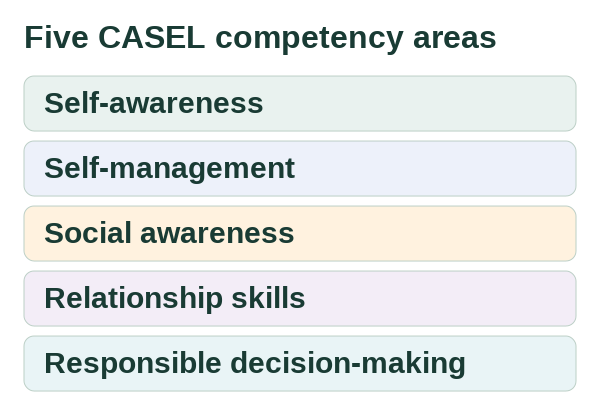
Social and emotional learning is the process through which students develop skills such as self-awareness, self-management, social awareness, relationship skills, and responsible decision-making. Programs in this field aim to improve students' social-emotional competence, behavior, and academic outcomes.[1][2]
A meta-analysis of 86 randomized programs in China found improved social-emotional competence.[3] Programs can be difficult to implement and do not always meet students' needs.[4]
Key facts
| 86 | randomized SEL programs analyzed in Chen's 2022 meta-analysis in China[3] |
|---|---|
| 8,736 | students involved in Chen's 2022 meta-analysis of SEL programs[3] |
| 633 | fourth- to sixth-grade students in Coryn et al.'s 2009 scale evaluation[5] |
| 101 | preschoolers assessed in Denham et al.'s 2014 study of SEL components[6] |
Overview
History
Where the idea came from and how it spread
Advocates argued that traditional systems stressed academic achievement while neglecting students' emotional and social growth, and that this neglect was linked to anxiety, depression and behavioral problems.[10] A 2009 critical review of the field in the United States described how ideas about emotional skills and competencies had shaped the program literature. That literature stressed links between social and emotional learning and academic achievement while also appealing to ideals of caring, community and diversity. The review found the recommended practices across programs tended to work against those ideals. They concentrated on strategies for controlling emotions and behavior that favored individualist models of the self. In practice, the review argued, social and emotional learning became another way to measure and remediate individual deficits rather than a way to redirect educators toward the relational contexts of classrooms and schools.[11]
Every state has set formal social and emotional learning standards and expected outcomes for preschool, and the number of states with standards through grade 12 rose from 1 in 2011 to an expected 16 by the end of 2019. Standards reaching further up the grades spread more slowly: the number of states with social and emotional learning standards through grade 12 rose from 1 in 2011 to an expected 16 by the end of 2019. In higher education, social and emotional learning frameworks are not broadly or systematically implemented, and where they appear they are generally offered as an intervention for targeted students rather than as a universal program for all students. A 2019 commentary proposed a multi-tiered system of support in which social and emotional skills would be taught explicitly to all students, with additional layers of support for those under greater stress or anxiety.[12]
Main ideas
The five competencies and related skills
Empathy belongs to the social awareness cluster, and a chapter on school-based programs warns that the concept is often used loosely. Program designers are advised to keep the two forms distinct and to match activities to the developmental level of the students.[13]
Grit, the tendency to persist at long-term goals, has been studied alongside SEL in a survey of 1,351 high school students in the Philippines. Perseverance and adaptability were positively related to SEL, while consistency of interests was negatively associated with it. Perseverance and adaptability were also indirectly related to positive emotions through SEL, and the researchers concluded that models of grit should be sensitive to culture when they are applied to students in Asian settings.[14]
Self-regulation, the management of one's own attention, emotion and behavior, overlaps with the self-management cluster, and a study of 367 university students examined how it relates to SEL. Critical thinking and self-regulation were both positively related to SEL, and a mediation analysis found that critical thinking carried part of the effect of self-regulation on SEL.[15] A separate study of 289 university students found a significant positive correlation between SEL and critical thinking disposition, the tendency to think in an inquiring and systematic way, and reported that SEL predicted critical thinking positively.[16]
The intrapersonal and interpersonal skills that social and emotional learning emphasizes include leadership, effective communication, accountability, assertiveness, conflict resolution, time and stress management, and motivation, which the review links to productive and efficient work. One review argues that SEL is vital for career success because it covers the intrapersonal and interpersonal skills that people need to be productive at work.[17] A second paper integrates a model of SEL with models of childhood career development and career-related reasoning, proposing that children are better supported when the two domains are taught together.[18]
Research
How large are the effects
In a Japanese meta-analysis of 85 controlled intervention studies the overall effect was 0.26, and in a Korean meta-analysis of 22 peer-reviewed articles covering about 23 programs it was 0.27.[25][26][27] A meta-analysis is a statistical method that combines the estimates from two or more similar studies into one overall estimate of an effect.[28] A meta-analysis of 18 primary-school studies found a pooled estimate of g = 0.89 that fell to g = 0.53 after three higher-risk outliers were excluded and to g = 0.18 when restricted to lower-risk studies.[25][26][27] A 2023 review of 85 controlled intervention studies of universal programs for Japanese children aged 5 to 18 years found a small overall effect of 0.26. The same review reported small effects on social-emotional skills (0.24), attitudes toward the self and others (0.30), positive social behavior (0.31), conduct problems (0.20) and emotional problems (0.22). All were measured at the end of the intervention.[25]
A meta-analysis of 86 randomized programs in China, involving 8,736 students, found significant improvement in social-emotional competence, a combined measure covering skills, attitudes, positive social behavior and reduced emotional distress. That analysis found no significant improvement in behavioral problems. The general area of the school, the SEL framework used, the intervention target and the educational level of participants moderated the positive outcomes. Textbook type, framework, participant features and educational level moderated the negative outcomes.[3]
A 2022 meta-analysis of 22 peer-reviewed articles covering about 23 programs in Korea, where SEL has been studied and applied in classrooms since 2010, found a global effect size of 0.27.[26] An effect size is a statistical calculation of how large a measurable effect is, for example the difference between the averages of two groups divided by the standard deviation.[29] Group composition, the number of sessions and session length accounted for the variability in effect sizes across those studies. The quality analysis in that review found limitations in statistical analysis, use of measurement, control group design, intervention fidelity (whether the program was delivered as intended) and external validity (whether results hold beyond the study setting).[26]
A 2026 meta-analysis of universal programs in primary schools illustrates how much the estimate can move with study quality. From 4,043 records identified in a database search covering 2016 to 2025, 18 studies met the inclusion criteria, representing roughly 11,900 pupils across 13 countries. The pooled estimate across controlled studies was large at g = 0.89, but it was extremely heterogeneous and driven by three higher-risk outliers.[27]
A 2024 meta-analysis of papers in domestic Korean academic journals examined publication patterns rather than pooling effect sizes. Elementary school was the most studied school level, followed by middle school, high school, university and infant school.[30]
Effects on achievement and classroom climate
The strongest causal evidence on social and emotional learning and school achievement comes from a cluster-randomized trial in a large urban school district serving a high-risk population. Twenty-four elementary schools were assigned either to Promoting Alternative Thinking Strategies (PATHS) or to a curriculum that delivered few if any social and emotional learning topics. The trial's authors read the pattern as support for social development instruction as a promising route to academic proficiency. They saw it as especially promising for young people in high-risk school settings.[31]
Some programs are built on the theory that their effects on children run partly through changes in classroom social processes, specifically classroom emotional support and classroom organization. The weighting method showed that the effect on first grade reading achievement was partly explained by an improvement in classroom organization.[32]
A descriptive correlational study of 100 students and 50 teachers in four private schools found a positive correlation between students' level of social and emotional learning and their classroom behavior. Students with higher social and emotional skills showed greater discipline, cooperation and participation. Teachers of students with high levels of social and emotional learning also reported greater job satisfaction and fewer classroom management issues.[33]
Measurement, criticism and open questions
A related question is how much of a student's score reflects a stable trait and how much reflects the time and setting of measurement. The rank ordering of math and reading skills was highly stable over time, whereas the four social and emotional domains appeared more strongly influenced by contextual factors.[34]
Data science methods have been proposed as a way to connect outcome measurement and prediction to specific interventions, with social and emotional learning offered as a case study.[35] A genetics-informed model argues that education-related polygenic signals, meaning scores built from many small genetic variants, interact with environmental context and may produce differential susceptibility rather than deterministic outcomes.[36]
Ferreira, Martinsone and Talić note that teachers mostly implement specific programs but have difficulties incorporating social and emotional learning into the regular curriculum, and they propose a model that integrates SEL standards, formative assessment and classroom instruction across every subject. A conceptual model developed in a European project responds by joining social and emotional learning standards, formative assessment and classroom instruction into a single model for everyday teaching in every subject.[37] A systematic review of 6 studies published between 2015 and 2024 sorted implementation into independent courses, integration into daily teaching and whole-school approaches. That review found deficiencies in evidence on the effectiveness of implementation methods, their applicability at various educational stages and long-term tracking of effects.[38]
Burroughs and Barkauskas (2017) argue that research backing social and emotional learning lacks a clear idea of what ethical competence is. Research supporting social and emotional learning lacks a clear conception of ethical competence, which conflates social, emotional and ethical competencies and draws attention away from the distinct ends of ethical education. The critics accept the documented benefits while arguing that programs should also educate children toward an autonomous ethical orientation.[39] Generative artificial intelligence raises a further set of questions, since it offers real-time emotional feedback and personalized learning experiences but also risks depersonalization, algorithmic bias and privacy loss.[40]
On the prevention side, an editorial asks whether school programs based on social and emotional learning could prevent substance abuse among adolescents. It discusses evidence of other reported outcomes alongside suicide risk.[41] A randomized controlled trial with 79 urban eighth-graders tested a bio-psycho-social program. The program adds controlled yogic breathing to social and emotional and positive youth development content. The trial authors suggest that programs may benefit from adding biologically calming techniques, while noting that few such studies exist.[42]
At a social and emotional learning camp for 93 Secondary Two students in Singapore (mean age 14.1), students improved on all measured competencies from pre-test to post-test. Yet teachers' observations gave students their lowest scores in relationship management. In that camp, self-awareness, social awareness, self-management and relationship management predicted responsible decision-making, with 71% of the variance explained.[43]
Among 364 Turkish high school students aged 14 to 18, self-awareness and relationship skills affected peer relationships, and peer relationships were positively associated with social and emotional learning.[44] A study of 238 adolescents found communication, problem solving, coping and self-esteem enhancing abilities negatively related to educational stress. Social and emotional learning skills were described as a very important predictor of that stress.[45] Among 590 university students in a Turkish faculty of education, lifelong learning and social and emotional learning scores correlated significantly.[46]
Games, arts and other activity-based routes
The 28 players in the experimental group received 12 sessions of educational games built around a social and emotional learning program, while 27 students at the same school kept their usual schedule. Neither group had attended an educational games course before. Scores on the Delaware Social-Emotional Competence Scale and a reflective diary were analyzed with a one-way analysis of covariance, a statistical method that compares group averages while adjusting for starting scores. The study concluded that the 12-week program helped the players develop social and emotional skills, and it reported that the games were successfully adapted to the local culture.[51]
In a questionnaire study at a Romanian university, 200 students from different study programs reported their perceptions of how educational games affected their social and emotional skills and their professional and personal development. A questionnaire study at a university in Bacău, Romania, asked 200 students from different study programs about the effect of educational games on their social and emotional skills, including games played in online education. The study described students' perceptions of how such games affected their professional and personal development and drew suggestions for using games to build these skills in higher education. Because the data were self-reports rather than measured skill gains, the results record what students believed rather than what they could do.[52]
Music programs have been reviewed for their effects on social and emotional competence. One systematic review examined Orff-based music education, a method in which children sing, speak, move and play instruments together. The reviewer screened 50 papers from several databases and selected 15 for review. The reviewed studies measured emotional regulation (the ability to manage one's own emotional reactions), empathy, social skills, self-esteem and self-expression, using self-report questionnaires, standardized assessments and teacher reports. Interventions varied in length and frequency, with some short-term and some longer-term. The review found a positive effect on social and emotional competence and called for further research using rigorous designs and standardized outcome measures.[53]
A 2023 literature review of arts education research published between 2017 and 2022 reached a similar conclusion. It reported that the arts give students a safe space to express themselves, build self-confidence and develop social skills. It also reported that integrating the arts into other subjects supports social and emotional learning.[54]
Drama offers a route in which learners create the material themselves. A qualitative case study of an extracurricular drama program in the United States followed adult students of English for Speakers of Other Languages as they worked together to devise a play and performed it in public. The study read the program through a framework of five core social and emotional competencies. It found that devising the play built awareness of the self and of others and gave students room to explore their emotions within a supportive community. Learner voices were placed at the center. The researchers presented drama as a possible approach to social and emotional learning both inside and beyond traditional learning spaces.[55] A 2025 paper described musical psychodrama, which combines music, drama and psychology, as an artistic method for promoting students' social and emotional learning and for supporting their mental health.[56]
Stories carry the same potential in the elementary music classroom. A 2026 article for music teachers argued that entering the worlds of stories helps children think about themselves in new ways, widen how they think about others and imagine new possibilities. The article pairs children's books that depict one of the five social and emotional competencies with activities teachers can use to explore that competency while continuing to develop musical knowledge and skills.[57]
Bullying, aggression and peer relationships
Students with learning disabilities are a group for whom peer relationships often go badly: most such students have difficulties with social relationships. A 2004 article traces these difficulties to three skill areas of social and emotional learning: recognizing emotions in oneself and in others, regulating and managing strong emotions of both kinds, and recognizing one's strengths and areas of need. That article reviews research supporting the connection between these skill areas and learning disabilities. It presents three examples of interventions that link academic and social and emotional learning: one from language arts, and others that draw on multiple intelligences to help students with projects or reports and with academic and social challenges.[58]
A 2025 survey of 219 students with learning disabilities aged 13 to 16 found that their SEL skill levels and their experiences of peer bullying differed significantly by gender and by the family's socioeconomic status. A significant relationship also existed between their SEL skills and their exposure to peer bullying. In that survey the subdimensions of SEL skills predicted the students' experiences of peer bullying.[59]
A study of Korean middle school students asked two questions. Does the quality of attachment to parents and peers shape aggressive behavior, and do social and emotional competencies act as mediators, meaning skills through which attachment has its effect? A full mediation model, in which attachment worked on aggression only through the skills, better explained the male sample, while a partial mediation model better explained the female sample. For boys, attachment to parents and to peers had indirect effects on aggression through behavioral self-control; for girls, attachment to parents had both direct and indirect effects on aggression through empathy and behavioral self-control.[60]
The main analysis followed a per-protocol approach, comparing the eight classes that finished all sessions (n = 195) with the control classes (n = 281). It found significant intervention effects on social skills, on peer connectedness and on happiness. Classroom climate declined for both groups, apparently because of the school transition, and the expected chain of effects was only partly supported: social and emotional skills significantly predicted connectedness, and peer connectedness significantly predicted happiness for children who reported decreases in connectedness. Analyses including all classrooms found significant differences between groups at different stages of implementation, which indicates that how a program is delivered affects its outcomes. The authors conclude that universal, school-based SEL programs are effective ways to support peer relationships around the school transition. They add that more support for implementation is needed to ensure best-practice delivery and maximal effectiveness.[61]
Trauma, mental health and peace education
Social and emotional learning (SEL) is used with students who have lived through difficult events, and it is often paired with trauma-informed practices (TIP), an approach in which schools try to recognize signs of trauma and respond with safety and trust rather than punishment.[62][63] One review reports that about 25% of children in the United States experience at least one traumatic event by age 16, and that such events affect emotional well-being and school performance. The same review describes SEL as giving students ways to manage emotions, show empathy and form relationships, while giving educators strategies for inclusive classrooms. It also argues that combining TIP and SEL can make schools places of healing, and that SEL supports fairness across a school system by bringing educators, families and communities together.[63] A 2020 collection of papers notes that SEL frameworks and trauma-informed practices are not only popular but are treated as essential in almost every part of the social services sector.[62]
Mindfulness, the practice of paying attention to the present moment, has been studied as a route to social and emotional competence in adolescence. A 2026 review of international and Vietnamese studies found growing evidence that mindfulness helps with outcomes related to social and emotional competence. That review also found most studies fragmented, each focused on a single indicator rather than on social and emotional competence as a whole, multidimensional construct. The indicators named include emotional regulation, self-compassion, empathy, stress reduction and aggression. In Vietnam, the review reports, work on social and emotional competence and mindfulness is still emerging, concentrated on life-skills education, adapting measurement tools and early mindfulness interventions. It calls for programs for Vietnamese adolescents that are culturally responsive, theoretically integrated and tested with data.[64] A 2024 case study described one school community that adopted a school-wide mindfulness intervention after identifying a need for trauma-informed social and emotional support for students with significant needs. Interviews with staff and administrators and observations of the school and its classrooms yielded positive results, including perceived changes in students' behavior, mental health and general outcomes, and in teacher retention.[65]
School counselors became the main link between teachers, parents, administrators and students during the COVID-19 pandemic, and a 2025 review examines their support of students with SEL needs after it. The review describes counselors as working to set an academic tone and design effective counseling programs to improve student outcomes, and it sets out the challenges they faced during the pandemic.[66]
Evidence from evaluations of school programs
Evaluations of school programs report mostly positive effects of social and emotional learning. The size of those effects depends on the students studied and on how well a program is carried out.[20][67] A narrative review covered 26 peer-reviewed articles published between 2017 and 2025. It found that social and emotional learning programs improved social-emotional development across competency domains in elementary schools, and it reported positive associations with academic outcomes at effect sizes from d = 0.17 to d = 0.35. That review also found that effectiveness varied substantially with implementation quality, teacher factors, organizational context and student characteristics, and it singled out whole-school approaches as showing particular promise for lasting impact.[20] A systematic review of interventions for students with special educational needs, drawing on eleven eligible studies published between 1994 and 2020, found some positive but primarily small effects, and most of those intervention studies were conducted in the United States.[67]
A cluster-randomized efficacy trial tested the Social-Emotional Learning Foundations curriculum with kindergarten and first-grade students at risk for emotional and behavioral disorders. The trial found positive main effects on self-regulation, social and emotional learning, social-emotional vocabulary and general behavioral functioning.[68] A quasi-experimental study of 67 fifth-grade students in Indonesia found that a social and emotional learning intervention raised mean social skill scores from 65.07 before treatment to 94.28 after it, while the control group's post-test mean was 63.19 (p < 0.05).[69] A quasi-experimental evaluation of a digital program called EmoLearn with elementary pupils in Saudi Arabia reported a significant increase in post-test emotional regulation scores for the experimental group compared with the control group, and it found that socioeconomic status had a limited impact on outcomes.[70]
Studies of older students link social and emotional learning to motivation, not to test scores alone.[71][72][73] A systematic literature review of social and emotional learning with young learners concluded that implementation improves students' motivation and supports their academic and emotional development.[71] A survey of 400 undergraduates in Lahore found that students with higher social and emotional learning competencies showed more academic motivation, learning engagement and perseverance, with self-awareness and self-management the strongest predictors among the five competencies.[73] A post hoc model that dropped two nonsignificant direct paths produced a small but statistically significant serial indirect relationship (β = 0.043, 95% CI [0.005, 0.082]), which the study's author described as exploratory and in need of replication through longitudinal or experimental research.[72]
In practice
Programs for young children and preschoolers
The years from birth to age six form the period in which children first acquire social and emotional learning skills, and deficits in those skills are addressed in practice by evidence-based intervention programs. All five had positive effects on preschoolers' social and emotional learning skills. The review concluded that such programs work when their content, process, and delivery methods suit the developmental level of the children they serve.[74]
One modeling study tested a social and emotional learning model built on collaborative knowledge construction, in which children build understanding together through peer activity. The study measured 50 children in two large classes of a kindergarten in G city using a peer interaction ability scale, an emotional understanding test, and an interpersonal problem solving test.[75]
A longitudinal study of 101 preschoolers tested whether the components of social and emotional learning predict later classroom adjustment and academic readiness. Self-regulation, emotion knowledge, social problem solving, and social and emotional behaviour were assessed through direct assessment and observation, and teachers reported on classroom adjustment through kindergarten and on academic readiness in kindergarten. Preschoolers' executive control, the mental control that manages attention and behavior, predicted aspects of their social cognition, namely emotion knowledge and social problem solving. It also predicted emotionally negative or aggressive behavior. Emotion knowledge in turn predicted emotionally regulated and prosocial behavior.[6]
Assessment in early childhood settings has also been studied as classroom practice. A qualitative study using interviews and observation found that teachers used three assessment techniques: giving questions, observation based on direct events, and art or craft activities. Teachers reported these assessments by describing the results in a report card book, three times per semester, to parents.[76]
Programs in primary and secondary school
Evaluations of social and emotional learning have taken several forms. A 16-week program based on the Personal and Social Responsibility Model was tested in three school types in Afyon province with 162 students. A 3-year randomized clinical trial of a middle school program followed 123 sixth-grade students with disabilities. An eight-session program was tested with 326 first-year high school students in G Province. A six-session program was tested with 27 primary school students who had difficulties in social and emotional management.[77][78][79][80] Several of these studies used an experimental pretest and posttest design with a control group that continued the current curriculum, including the 16-week program tested with 162 students and the eight-session program tested with 326 first-year students.[77][79]
Two 16-week programs built on existing physical education models were tested in Turkish high schools, and both used the Schutte Emotional Intelligence Scale as the outcome measure.[77][81] The first prepared a program from the Personal and Social Responsibility Model and ran it in three school types: an Anatolian High School (n=55), a Vocational Technical Anatolian High School (n=51) and a Sports High School (n=56). That made 162 students in total. Experimental and control groups were formed in each school type; the experimental groups received the 16-week program and the control groups followed the current curriculum. Total scores on the emotional intelligence scale rose significantly in the experimental groups at all three school types and stayed at the same level in the control groups. The combined effect of program participation and school type was significant.[77]
A pilot study in Hong Kong worked with 27 primary school students whose teachers or parents reported difficulties in managing social and emotional situations. Students were randomly assigned to a treatment group (n=14) and a control group (n=13), and the treatment group attended a six-session program adapted from the Strong Kids Programme, with sessions of about 1 hour in small groups.[80]
Growth models showed a significant intervention effect for bully perpetration. Scores fell across the three years for intervention students relative to control students (δ = −.20, 95% confidence interval = [−.38, −.03]). The authors describe the result as promise that social and emotional learning can reduce bully perpetration among students with disabilities, not as a settled conclusion.[78]
Students with disabilities and other special groups
A systematic review published in 2020 examined peer-reviewed studies from 2007 to 2018 and asked whether social and emotional learning programs work for children and young people with learning disabilities. The review found preliminary evidence that combined programs can be delivered, but little evidence that they are effective. Play-based and social skills programs built on behavioural psychology and social learning theory showed some evidence of improving social skills in this group. The reviewers called for more rigorous designs, with larger samples, random assignment, strong measures and checks that the programs were delivered as intended. They also called for well-conducted single case experimental designs, in which a small number of individuals are followed closely over time.[82]
Depressive adolescents at risk of social exclusion present a different problem, because features of their development such as irritability and co-occurring behavioural disorders make their emotional problems hard to recognize. Research reviewed by Reicher and Matischek-Jauk in 2019 found that teachers tend to overlook depressive feelings in adolescents and that peers also fail to recognize them appropriately. Such emotional problems can lead to underachievement, an inability to learn and difficulty building satisfactory interpersonal relationships. The review found a complex interplay between the social dynamics of exclusion and depression. The authors concluded that systematic social and emotional learning concepts in schools have the potential to recognize depression-related problems early, prevent exclusion and reduce the burden of depressive disorders.[83]
A 2014 study by Castro-Olivo evaluated a culturally adapted version of the Strong Teens program, called Jóvenes Fuertes, with 102 Spanish-dominant Latino English language learners in middle or high school. It used a quasi-experimental design in which whole classrooms were assigned at random. The program produced significant effects on students' knowledge of social and emotional learning and on their social and emotional resiliency, the capacity to recover from difficulty.[84]
Teaching methods and subject integration
A qualitative study of 10th-grade chemistry students in the 2016/2017 school year combined cooperative learning with real-life scenarios across the six stages of group investigation. The study analyzed six stages of Group Investigation combined with the use of real-life scenarios, drawing on observations, interviews, reflective journals and students' worksheet answers. Observations, interviews, reflective journals and student worksheets showed that students developed more positive attitudes toward chemistry and built positive relationships with peers. They practiced cooperative skills and tolerance, and made responsible decisions that took themselves, others and the community into account. The authors presented the approach as a way to develop student character within Indonesia's 2013 curriculum.[85]
Dialogic reading is a shared-reading technique in which an adult asks strategic questions and responds to the child during repeated readings of a book, usually in small groups. A decade of study with children aged 2 to 6 in diverse settings found positive effects on oral language development. The authors call oral language a cornerstone of emergent literacy, the reading and writing skills that appear before formal schooling. In the small group, children also listen to others, take turns and get to know their peers. When teachers choose books with strong social and emotional content, they can follow the readings with activities in which social and emotional skills are modeled, coached and cued.[86]
Physical education has been used as a setting for deliberate social and emotional learning. An intervention of three 45-minute sessions involved 260 students in grades 4 to 6 at two schools in northern Israel. Eight classes took part in the program and three received a standard 45-minute physical education class. The experimental group improved significantly on all the skills evaluated, which covered teamwork, self-awareness and creative thinking. The gains extended to students who had previously avoided physical education classes. Interviews with physical education teachers indicated that the program also strengthened reflective skills in students and teachers and had a positive effect on creative thinking, an aspect the authors had not observed before.[87]
Drama has been tested as a vehicle for social and emotional learning in an experimental study of 255 fourth-grade students. Students with average and below-average scores on a social and emotional skills perception scale were selected for the experimental and control groups. After ten weeks of drama sessions about social and emotional learning, the experimental group scored significantly higher than the control group, and the author suggested that schools could add hours of drama-based social and emotional learning to their curricula. The author recommended future studies with different socioeconomic backgrounds and age groups.[88]
Socio-scientific issues are open problems with a scientific dimension and a social one, and teaching through them has been combined with strategies for developing social and emotional competence. An Emotional-Decision Making Integrated SSI Instructional Model sets out five stages: introduce the issue, establish standards, analyze dialectically, reason and make decisions, and reflect and optimize. Two rounds of issue-based teaching with 12th-grade students in China significantly improved their social decision-making, especially in the dimension of optimization and innovation. The rounds also enhanced their emotional awareness and expression. Students tended to use response suppression to regulate emotion, while cognitive reappraisal proved more beneficial and required more guidance from teachers.[89]
Online, virtual and higher education settings
Virtual learning calls on a different skill set from face-to-face settings, including self-regulation for managing online learning and balancing learning with life at home. Those demands arrived alongside fewer chances for social engagement and a greater potential for isolation, and children needed social and emotional support during this period. One response described in the literature is to build social and emotional learning into daily lessons, with sample activities organized around cognitive regulation, emotional regulation and social skills, delivered through both explicit instruction and ongoing teaching practices.[90] The COVID-19 pandemic also intensified the need for social and emotional supports for children and led educators to look for new ways to make connections and to imagine how students might actively learn with each other. Mixed reality simulations are one such tool that researchers have studied as a way to facilitate social and emotional learning with children. Murphy, Cook and Fallon describe what they learned about using mixed reality simulations to support social and emotional learning with children and what makes the technology a promising active learning tool.[91]
A basic qualitative study explored the perceptions of K-12 online teachers in the United States in order to understand the leadership support that teachers implementing social and emotional learning curricula require. Participants were recruited through a professional social media site, with a target sample of 15 K-12 online teachers. 15 completed an open-ended questionnaire, and five of them took part in a follow-up focus group that added depth to the questionnaire responses. Because 15 further participants could not be located through the professional site, snowball sampling was used, in which current participants help identify other potential subjects.[92]
Teacher education programs have also tried to integrate social and emotional learning into online courses. Analysis of students' reactions found that the approach improved their emotional experience and also enhanced their cognitive learning. The study introduced the concept of social emotional presence as necessary for learning and development to take place online.[93]
In higher education, one line of work describes how social and emotional learning practices can be implemented in courses, including in science, technology, engineering and mathematics programs. An assessment of academic and behavioral outcomes in mineralogy, an Earth science introductory course at a four-year university, reported on instructional practices supporting social and emotional learning. Those practices suited the task of engaging and stimulating learners' multiple intelligences.[94] Simpler classroom techniques have been proposed as well: self-compassion training, which involves treating oneself with the same compassion one would offer a friend in difficulty, and gratitude training, which brings mindful attention to the positive aspects of one's life.[95]
Cooperative learning and classroom climate
Cooperative learning is an instructional method in which students work together in small groups toward shared goals, and several studies treat it as a direct route to social and emotional learning.[96][97] A quasi-experimental study with a mixed-methods design compared an experimental group given structured cooperative learning activities with a control group taught by conventional instruction, and found significant improvements in overall social and emotional competencies. Relationship skills and social awareness showed the strongest gains. Self-management and responsible decision-making came next. Classroom observations in that study recorded more peer interaction, better emotional regulation and a more supportive classroom climate among students in the cooperative condition. The study describes cooperative learning as a setting in which students practice and absorb social and emotional skills through structured interaction and shared responsibility rather than through separate lessons.[96]
A survey of 1,111 early secondary students in Northern Thailand used partial least squares structural equation modeling, a statistical method for estimating chains of influence among several variables at once, to rank the factors acting on social and emotional learning. Cooperative learning was the strongest direct influence, with a medium effect size (f² = 0.176), ahead of growth mindset (f² = 0.076). School environment showed the highest total effect (b = 0.537) and the highest indirect effect (b = 0.447), and most of that indirect influence passed through positive classroom climate and cooperative learning. Fixed and growth mindsets each mediated the pathway from environment to social and emotional learning fully, with variance accounted for of 0.8050 and 0.8255 respectively.[97]
Classroom climate, the shared emotional tone of a classroom, is treated in a 2026 narrative review as one part of a reciprocal system rather than a one-way cause. That review synthesized peer-reviewed studies published between 2010 and 2025 across K-12 and higher education and concluded that a positive climate promotes social and emotional learning, that such learning raises behavioral, emotional and cognitive engagement, and that engagement in turn strengthens a constructive climate.[98]
A related article holds that teachers who know their students' backgrounds, motives and needs can build a positive classroom environment that encourages motivation and self-discipline alongside social and emotional learning.[99] A multiple baseline study with four Head Start educators tested a brief training model: a 1-hour professional development session followed by weekly 15-minute performance feedback. The training largely increased how often educators aligned their classroom management practices with the weekly lessons of the Second Step Early Learning social emotional learning curriculum (ES = .94). The study framed this work as a way to bring school psychologists into preventive consultation in early childhood settings, where preventative frameworks had traditionally been implemented in isolation from one another.[100]
Language classrooms and multilingual learners
A study of 152 Korean university students sorted learners into high, intermediate and low English levels and compared their answers on two questionnaires, one on social and emotional learning in English and one on the social climate of the English classroom. High and intermediate learners rated social awareness and self-management, two of the skill areas on the first questionnaire, significantly higher than low-level learners did. The same two groups also rated teacher emotional support, teacher academic support and mutual respect in the classroom significantly higher than the low-level group. Social and emotional learning, classroom social climate and English competence were positively associated with one another.[101]
A qualitative study of ninth-grade newcomers in an English for speakers of other languages (ESOL) program asked students how well social and emotional learning strategies worked for their emotions and well-being. Data came from daily classroom observations, recorded classroom discussions, surveys and student work. Students reported happiness, feeling good and safe in the classroom, and greater awareness of their emotions. The researcher concluded that such practices belong among the essential elements of English language teaching.[102]
At the American University of Moldova, teachers described how they built social and emotional learning components into classes of English as a foreign language during the pandemic and afterward, in a multicultural setting where instruction had moved online. The approach had to suit online teaching and learning in a highly emotional atmosphere for both teachers and students.[103] A qualitative case study interviewed 10 Palestinian teachers of English as a foreign language. All of them recognized the importance of social and emotional learning, but few put it into practice, citing limited knowledge, curriculum demands and a lack of professional development. The teachers were eager to include it if support and resources were available.[104]
Social and emotional learning has also been studied outside school, with families. A study framed within critical mindfulness and critical peace education followed two refugee-background parents through weekly English tutoring sessions during their resettlement. The parents drew on social and emotional practices to negotiate the sessions, and the study introduced mujamalah, a practice of courteous accommodation, as one such practice in line with peace education. The findings support including social and emotional approaches when working with multilingual refugee-background families.[105]
With the Korean Ministry of Education preparing to require Korean Social-Emotional Learning at all grade levels starting in 2026, one secondary English teacher piloted an AI-based digital textbook for a year. Learners customized avatars and took part in a daily emotion check-in during warm-up routines. These routines gave them chances to express emotions in English, make small talk with the teacher and build rapport while practicing the language. The report sets out benefits, challenges and practical recommendations for sustaining such technology alongside social and emotional learning in English classrooms.[106]
How programs are taught and implemented
A thematic and content analysis of eight effective preschool social and emotional learning programs identified their target skills and their instructional and rehearsal procedures, and described a differential relationship between target skills and those procedures. An analysis of eight effective preschool programs found that the skills targeted and the instructional and rehearsal procedures used were linked in a differential way, so particular procedures suited particular competencies.[107] One approach embeds social and emotional learning in classroom management routines rather than teaching it as a separate subject. The SECURe program builds management on four constant principles: planning and preparation, the quality of relationships in the room, the school environment, and ongoing observation and documentation.[108]
A case study examined ten middle schools with strong student-reported social and emotional outcomes, particularly for African American and Latinx students. It identified six categories of common practice, among them positive school climate and relationships, positive behavior support, elective courses and extracurricular activities, and SEL-specific classroom practices and curricula. Respondents in those schools cited the absence of a common definition of social and emotional learning and a lack of alignment among practices as two challenges.[109]
In a pilot in 8 kindergarten classrooms, the Social-Emotional Learning Foundations curriculum combined early literacy teaching with lessons on self-regulation, and teachers reported gains in executive function, internalizing behavior and school-related competence.[110][111] The SELF curriculum, designed for small-group instruction, combines social and emotional learning with early literacy, including vocabulary development and comprehension, for students at risk of emotional or behavioral problems.[110] In a study of 76 teachers in four schools infusing social and emotional learning into English, mathematics, science and character education, teachers doubted that the approach would raise academic achievement, a belief the study said may impede their infusion of it in class.[111] A review screened 103,090 identified records and analyzed 33 articles on problem-based learning combined with social and emotional learning in elementary social studies. It reported consistent gains in social and emotional skills, collaboration, motivation and academic outcomes, while noting small samples, non-standardized instruments and a lack of digital or hybrid models.[112]
Community service learning offers an out-of-school format in which young people carry out projects, and one account of the Chicago Freedom School describes participants aged 14 to 16 in its 2008 to 2009 Freedom Fellowship. That account argues a restrictive approach to social and emotional learning focuses mainly on containing emotions and behavior rather than developing active citizens.[113]
In a qualitative study at one school, headteachers provided vision, support and resources while program coordinators ensured implementation and evaluation, and the study concluded that collaborative efforts among these stakeholders created a supportive environment for social and emotional learning. A qualitative study at one school found headteachers supplying vision, support and resources while coordinators oversaw implementation and evaluation, and it called for ongoing professional development for teachers.[114] Training for elementary teachers in one Indonesian city, run over three sessions with pretests and posttests, improved understanding on all measured indicators and recommended continued training and classroom mentoring.[115] A mentoring program for high school teachers in classroom action research using social and emotional strategies reported improved classroom dynamics and student engagement.[116]
Among 60 prekindergarten to first-grade teachers in seven schools, the quality of initial lesson delivery was predicted positively only by instructional support. Closer adherence to the curriculum's pacing schedule was predicted by greater self-efficacy for classroom management and by more teaching experience. Teachers who were Latinx or Hispanic adhered to that schedule less often than White, non-Hispanic teachers did.[117]
One line of work argues that school leaders, teachers, school counselors and pre-service teachers should themselves show social and emotional competence. That means the skills of self-awareness, self-management, social awareness, relationship skills and responsible decision-making. That work applies the Collaborative for Academic, Social, and Emotional Learning framework to scholarship on educators' own competence and ends with guiding principles for training programs and professional learning that strengthen educators' understanding of their own social and emotional skills. The aim is to improve daily teaching practice and to make each school-wide social and emotional learning initiative serve school improvement outcomes.[1]
A systematic review searched seven electronic databases and found 1,281 records, plus 19 more from journal and citation sampling, of which 20 articles met the inclusion criteria (19 quantitative and one mixed methods). The review sorted contextual factors into four categories: program support, school, teacher and student. It found wide variety in which factors studies measured. It gave weight to program support factors, namely modeling activities during coaching and the working relationship between teacher and coach, for ensuring implementation quality. The review also reported a link between teacher burnout and program dosage, the amount of the program actually delivered. It treated student baseline self-regulation as a separate contextual level that may affect implementation quality.[118]
In one study, 32 private preschool and Head Start teachers were observed with the Classroom Assessment Scoring System and then compared in focus groups by their observed emotional support.[119] A survey of 250 Vietnamese primary school teachers (142 males and 108 females) used the Teachers' Perceptions of Social Emotional Learning scale. It found significant differences in reported barriers among teachers with different years of experience, and educational background affected perceived necessity and barriers considerably. Regardless of those differences, the teachers recognized both the necessity of social and emotional learning in primary schools and the challenges of implementing it in classrooms.[120]
Infusing social and emotional learning into academic subjects has been tried with trained teachers. Teachers infused social and emotional learning better in Character Education and English than in Mathematics and Science. They generated more questions about self-awareness and social awareness than about relationship management or self-management. The study concluded that scaffolding instruction and responding on the spot to students' inappropriate responses to social and emotional scenarios may need more practice time.[121]
What this looks like when you study
A drama program gave ten weeks of sessions about social and emotional learning to fourth graders selected for average or below-average scores. The experimental and control groups each had 42 students with approximately similar means at the start. The experimental group showed a significant difference in social and emotional learning in its favor.[88]
To try dialogic reading, a shared-reading technique with strategic questioning, read a book with strong social and emotional content several times in a small group. Ask children questions about the story and respond to their answers, then follow the readings with activities where social and emotional skills are modeled, coached and cued.[86]
Later developments
Equity, culture and adaptation
A body of scholarship asks whether social and emotional learning programs serve students of color and other young people affected by structural inequality, and whether the field has a clear account of what fair treatment in such programs would mean. A 2021 content analysis of prekindergarten to grade 5 programs found that few were designed with equity in mind. Fewer still examined how historical and structural inequalities shape both the teaching and the learning of social and emotional skills. The same analysis reported that the field lacked a single agreed definition of equitable social and emotional learning, or of what it looks like in a classroom. It proposed a set of principles and a definition to fill that gap. Its authors noted that many programs now supply materials meant to represent diverse students and to help teachers see how culture shapes the development and expression of social and emotional competencies.[130]
A 2022 framework placed racist structures at the center of the discussion. It proposed an ecological model in which micro-level, meso-level and macro-level structures (the classroom, the school building and the school district) shape students' social and emotional development. The framework contrasts learning with schooling. Learning is described as a holistic process that depends on centering identity and community, while schooling is described as a process that presses students to conform to ways of understanding that uphold the status quo and hinder critical thinking. Its authors distinguished social and emotional learning from what they called social-emotional schooling, and argued that all 3 levels must be engaged for such learning to spread through a school and disrupt racism there.[131]
A 2023 qualitative study of school leaders who run social and emotional learning programs examined how well the programs fit the cultural complexities of minoritized students. The study identified challenges in integrating such learning as a Tier 1 intervention. That means a universal support offered to all students rather than to a selected few. It also found shortcomings in assessing student needs and program outcomes, and difficulties with teacher buy-in and capacity among the staff who deliver the interventions. Leaders further described implementing the programs amid their communities' mixed political views about social and emotional learning and about equity and inclusion efforts.[132]
A related line of work recommends a strategy-based approach in which teachers adapt social and emotional learning to their students' needs and experiences, on the argument that packaged programs can be hard to implement and do not always meet students' needs. That approach rests on a developmental model aimed at specific, age-appropriate skills, and its authors describe how such a program ran in a summer program for prekindergarten through grade 8.[4]
Adaptation across countries and school systems
In Japan, a meta-analysis of 32 studies of universal programs for higher education students found a small to medium overall effect (ES = .34). Effects measured right after the program ended were small to medium for social and emotional skills (ES = .33), attitudes toward the self and others (ES = .37), conduct problems (ES = .37) and emotional problems (ES = .41). That review found the overall effect fell when programs were delivered to larger groups of students, and it could not examine moderators for most single outcome categories because too few eligible studies existed.[133]
In mainland China, the first meta-analysis of universal school-based programs covering pre-kindergarten through grade 12 pooled 52 studies with 13,969 students and reported a medium overall effect (ES = 0.56). Effects there were strongest for social and emotional skills (ES = 0.63). Academic performance followed (ES = 0.34), then behaviors (ES = 0.31) and affect and attitudes (ES = 0.24). Because most of the Chinese studies used quasi-experimental designs with relatively small samples, the review treats the pooled figure as evidence of efficacy under controlled conditions rather than effectiveness in ordinary implementation.[134]
The 630 classroom teachers who delivered it (614 female and 16 male, mean age 45.04 years) received materials for class lessons at each level and regular supervision, and regional supervisors were trained to sustain the practice.[135] An evaluation of an emotional board program at an Islamic primary school in Palangka Raya, Indonesia, used mixed methods with a sequential explanatory design and the CIPP model, a framework that appraises a program's context, input, process and product. The program fit the school's context well, but the evaluation found a large gap in teachers' capacity to validate students' emotions in depth, and the process phase received a score of 2.96, which the report treats as a serious warning. By the product stage, children had become better at labeling what they felt and classroom conflict had begun to subside.[136]
A study of India's Integrated Child Development Services, described as the world's largest early childhood development program, examined social and emotional learning for children aged 3 to 6 in Anganwadi Centres. India's early childhood care and education framework recognizes such learning, but the study found its practical implementation within the program fragmented, and it used the Delphi method, a structured way of combining expert judgments, to identify strategies and barriers. The barriers named include infrastructural constraints, overburdened Anganwadi workers and regional disparities, and the recommendations include a standardized framework, workforce training and community-driven implementation.[137] Accountability rules can also shape results: a multilevel analysis of survey data from schools in Suzhou, China, found that while some accountability measures were associated with improvements in certain social and emotional skills, most had no effect on or negatively affected those competencies.[138]
Criticism
Critiques, equity concerns and open questions
A 2023 call for equity-focused social and emotional learning argued that current curricula mostly carry the beliefs and values of White, middle class Americans. In the paper's account, this keeps disenfranchisement and marginalization in place. The same paper reported that minoritized students consistently describe problems with how well they fit in the classroom environment, and that these perceptions are linked to negative academic and social outcomes. Its authors urged school stakeholders to challenge existing social inequities and to shift the focus of social and emotional learning away from fixing deficits in individual students toward the social contexts and systems that affect an entire classroom, school and community.[139] A 2024 qualitative case study of marginalized elementary school students reached a compatible conclusion, reporting that culturally tailored teaching practices combined with social and emotional learning frameworks improved academic engagement and strengthened students' sense of identity and community.[140]
A 2026 scoping review of the literature combining reading, social and emotional learning and culturally responsive teaching found only 12 works that met its inclusion criteria. None of those works fully integrated all three concepts, and only one measured reading outcomes. The review identified gaps in scholarship: no integrated account of how the three work together, and no construct measurement to establish whether reading is supported when social and emotional learning and culturally responsive teaching are applied.[141] A qualitative study of 14 faculty and staff members at a mid-sized university proposed a culturally responsive teaching model for social and emotional learning aimed at international students, and it found that participants held varying priorities and diverging trajectories.[142]
A psychoanalytic critique published in 2018 argued that social and emotional learning programs, read through Kleinian theory, are mired in a paranoid-schizoid mentality that leaves little room for ambivalence or the exploration of disappointment. Drawing on three vignettes from a qualitative project in a public kindergarten classroom, the article contended that these programs leave too little room for negative affect and difficult feelings, aggression and excitement among them. It argued instead for making room for negative affect, aggression and awareness of the body, on the grounds that working through these phenomena allows for creativity and learning.[143]
A 2026 conceptual analysis examined social and emotional learning against Zygmunt Bauman and Leonidas Donskis's idea of moral blindness, the loss of sensitivity to others that they associated with liquid modernity, a condition of speed, uncertainty and individualization. That analysis concluded that the core components of social and emotional learning support ethical sensitivity in schools, but that social and emotional skills alone cannot prevent moral erosion. It held that the approach must be taught together with open, critical, value-based ethics and character education.[144]
Key studies
| Year | Study | Sample | Design | Finding |
|---|---|---|---|---|
| 2014 | Wong et al.[80] | 27 primary school students (14 treatment, 13 control) | randomized pilot study | Problem behaviors were significantly less frequent in the treatment group after a six-session program (p = .008), but social skills did not change significantly. |
| 2015 | Espelage et al.[78] | 123 sixth-grade students with a disability (47 intervention, 76 control) | 3-year randomized clinical trial | Intervention students' bullying perpetration scores significantly decreased across the 3-year study (δ = −.20). |
| 2015 | Schonfeld et al.[31] | 705 students in 24 elementary schools | cluster-randomized trial | At certain grade levels, students in the schools that received the intervention reached higher odds of basic proficiency in reading, writing and math than students in the control schools. |
| 2018 | Usakli[88] | 255 fourth graders, with 42 students each in experimental and control groups | experimental study | Ten weeks of drama sessions produced a significant difference in social and emotional learning in favor of the experimental group. |
| 2020 | Arikan[77] | 162 students in three Turkish high schools | experimental pre-test final-test control group | A 16-week program raised emotional intelligence total scores in the experimental group in all three school types. |
| 2022 | Chen & Yu[3] | 8,736 students in 86 randomized programs in China | meta-analysis | Participants improved social and emotional competence but showed no significant improvement in behavioral problems. |
| 2022 | Kim et al.[26] | 22 peer-reviewed articles (about 23 SEL programs) in Korea | meta-analysis with quality analysis | The global effect size was 0.27, and group composition, number of sessions and session length accounted for variability. |
| 2023 | Takizawa et al.[25] | 85 intervention studies with control groups of Japanese children aged 5 to 18 years | meta-analysis | Programs had a small overall effect (ES = 0.26) and small effects on skills, attitudes, behavior and problems. |
| 2024 | Pollak et al.[61] | 19 intervention classrooms (n = 399) and 16 waitlist-control classrooms (n = 281) | school-based intervention evaluation | The program produced measurable gains in social skills, in how connected students felt to peers, and in happiness, whereas classroom climate fell in the intervention and the control classrooms alike. |
| 2025 | Sindiani et al.[87] | 260 students in grades 4 to 6 from two schools in northern Israel | convergent mixed model | The experimental group showed significant improvements in teamwork, self-awareness and creative thinking across three 45-minute sessions. |
| 2026 | Edwin et al.[27] | 18 studies representing roughly 11,900 pupils across 13 countries | meta-analysis | The effect stabilized at a moderate g of 0.53 after excluding outliers and fell to g = 0.18 when restricted to lower-risk studies. |
| 2026 | Damrongpanit[97] | 1,111 early secondary students in Northern Thailand | structural equation modeling | Cooperative learning was the strongest direct influencer on SEL with a medium effect size (f² = 0.176). |
See also
References
- Gimbert, B. G., Miller, D., Herman, E., Breedlove, M., & Molina, C. E. (2023). Social Emotional Learning in Schools: The Importance of Educator Competence. Journal of Research on Leadership Education, 18(1), 3-39. doi:10.1177/19427751211014920
- Kim, E. K., Allen, J. P., & Jimerson, S. R. (2024). Supporting Student Social Emotional Learning and Development. School Psychology Review, 53(3), 201-207. doi:10.1080/2372966x.2024.2346443
- Chen, H., & Yu, Y. (2022). The impact of social-emotional learning: A meta-analysis in China. Frontiers in Psychology, 13. doi:10.3389/fpsyg.2022.1040522
- Bailey, R., Stickle, L., Brion-Meisels, G., & Jones, S. M. (2019). Re-imagining social-emotional learning: Findings from a strategy-based approach. Phi Delta Kappan, 100(5), 53-58. doi:10.1177/0031721719827549
- Coryn, C. L. S., Spybrook, J. K., Evergreen, S. D. H., & Blinkiewicz, M. (2009). Development and Evaluation of the Social-Emotional Learning Scale. Journal of Psychoeducational Assessment, 27(4), 283-295. doi:10.1177/0734282908328619
- Denham, S. A., Bassett, H. H., Zinsser, K., & Wyatt, T. M. (2014). How Preschoolers' Social-Emotional Learning Predicts Their Early School Success: Developing Theory-Promoting, Competency-Based Assessments: How Preschoolers' Social-Emotional Learning Predicts. Infant and Child Development, 23(4), 426-454. doi:10.1002/icd.1840
- Moore, B., & Gregory, R. (2024). Decision making as a pedagogy for social emotional learning. Social and Emotional Learning: Research, Practice, and Policy, 3, 100034. doi:10.1016/j.sel.2024.100034
- Khongsankham, W., Pianthaisong,, Y., Meedindam, R., Niyomves, A. P. D. B., & Jedaman, P. (2024). Fostering Emotional Intelligence and Social Competence: A Comprehensive Review of Social-Emotional Learning (SEL) in Education. Journal of Education and Learning Reviews, 1(1), 17-28. doi:10.60027/jelr.2024.764
- Anamitra Basu, & Martial Mermillod (2011). Emotional Intelligence and Social-Emotional Learning: An Overview. Journal of Psychology Research, 1(3). doi:10.17265/2159-5542/2011.03.004
- Martinez, M. E., & Gomez, V. (2024). The Importance of Social-Emotional Learning in Schools. Acta Pedagogia Asiana, 3(2), 101-112. doi:10.53623/apga.v3i2.468
- Hoffman, D. M. (2009). Reflecting on Social Emotional Learning: A Critical Perspective on Trends in the United States. Review of Educational Research, 79(2), 533-556. doi:10.3102/0034654308325184
- Reinert, P. M. (2019). Social-emotional learning: a model for higher education. Journal of Research in Innovative Teaching & Learning, 12(2), 114-115. doi:10.1108/jrit-02-2019-0039
- Maxwell, B., & DesRoches, S. (2010). Empathy and social-emotional learning: Pitfalls and touchstones for school-based programs. New Directions for Child and Adolescent Development, 2010(129), 33-53. doi:10.1002/cd.274
- Datu, J. A. D., & Restubog, S. L. D. (2020). The emotional pay-off of staying gritty: linking grit with social-emotional learning and emotional well-being. British Journal of Guidance & Counselling, 48(5), 697-708. doi:10.1080/03069885.2020.1758922
- Arslan, S. (2018). Social emotional learning and self-regulation: the mediating role of critical thinking. International Journal of Learning and Change, 10(2), 101. doi:10.1504/ijlc.2018.090935
- Department of Educational Sciences, Sakarya University, Turkey, ARSLAN, S., & DEMIRTAS, Z. (2016). Social emotional learning and critical thinking disposition. Studia Psychologica, 58(4), 276-285. doi:10.21909/sp.2016.04.723
- Dr., Winthrop University, USA, acpaolini@gmail.com, & Paolini, A. C. (2020). Social Emotional Learning: Key to Career Readiness. Anatolian Journal of Education, 5(1), 125-134. doi:10.29333/aje.2020.5112a
- Howard, K. A. S., & Ferrari, L. (2022). Social-emotional learning and career development in elementary settings. British Journal of Guidance & Counselling, 50(3), 371-385. doi:10.1080/03069885.2021.1959898
- Aydoğan, R., Akkuş Çutuk, Z., & Çutuk, S. (2025). The Effect of Social Emotional Learning and Emotional Intelligence on Self-Esteem in University Students. Abant İzzet Baysal Üniversitesi Eğitim Fakültesi Dergisi, 25(1), 361-374. doi:10.17240/aibuefd.2025..-1419409
- Romli, F., Prima, E., & Dharin, A. (2025). Social-emotional learning programs in elementary schools: Enhancing student competencies and academic outcomes. JURNAL PENDIDIKAN DASAR, 13(2), 320-336. doi:10.46368/jpd.v13i2.4722
- Damodaran, D. K., Thayyullathil, R. H., Tom, M., & Sivadas, R. K. (2022). Redefining learning through social-emotional learning: A review. International journal of health sciences, 3008-3019. doi:10.53730/ijhs.v6ns3.6250
- Gehlbach, H., & Chuter, C. (2020). Conceptualizing the Core of “Social Emotional Learning”. ACCESS: Contemporary Issues in Education, 40(1), 24-33. doi:10.46786/ac20.8910
- Malathy, M. (2025). Role of Social Emotional Learning on Emotional Intelligence. Shanlax International Journal of Arts, Science and Humanities, 12(S2-Jan), 194-199. doi:10.34293/sijash.v12is2-jan.8912
- Pooja Sharma (2025). To Study the Effect of Ruler Approach based Instructional Strategy on Social Emotional Competence and Achievement in English among Viii Grade Students. Communications on Applied Nonlinear Analysis, 2113-2122. doi:10.52783/cana.v32.5608
- Takizawa, Y., Bambling, M., Matsumoto, Y., Ishimoto, Y., & Edirippulige, S. (2023). Effectiveness of universal school-based social-emotional learning programs in promoting social-emotional skills, attitudes towards self and others, positive social behaviors, and improving emotional and conduct problems among Japanese children: a meta-analytic review. Frontiers in Education, 8. doi:10.3389/feduc.2023.1228269
- Kim, D., Lim, J. H., & An, J. (2022). The quality and effectiveness of Social-Emotional Learning (SEL) intervention studies in Korea: A meta-analysis. PLOS ONE, 17(6), e0269996. doi:10.1371/journal.pone.0269996
- Edwin, E., Franky, J. E., Djohanes, A., Simanjuntak, T. P., & Takahi, S. (2026). Meta-Analysis of Social-Emotional Learning (SEL) Interventions in Primary Schools. Jurnal Pendidikan Progresif, 16(3), 1784-1808. doi:10.23960/jpp.v16i3.pp1784-1808
- GET-IT Glossary (plain-language health research terms) (n.d.). meta-analysis. GET-IT Glossary (plain-language health research terms). https://getitglossary.org/term/meta-analysis
- ERIC Thesaurus (n.d.). Effect Size. ERIC Thesaurus. https://eric.ed.gov/?ti=Effect+Size
- (2024). Meta Analysis on Social Emotional Learning(SEL): Focus on Domestic Academic Journals Papers. Korean Association For Learner-Centered Curriculum And Instruction, 24(15), 659-673. doi:10.22251/jlcci.2024.24.15.659
- Schonfeld, D. J., Adams, R. E., Fredstrom, B. K., Weissberg, R. P., Gilman, R., Voyce, C., Tomlin, R., & Speese-Linehan, D. (2015). Cluster-randomized trial demonstrating impact on academic achievement of elementary social-emotional learning. School Psychology Quarterly, 30(3), 406-420. doi:10.1037/spq0000099
- McCormick, M. P., Cappella, E., O’Connor, E. E., & McClowry, S. G. (2015). Social-Emotional Learning and Academic Achievement: Using Causal Methods to Explore Classroom-Level Mechanisms. AERA Open, 1(3). doi:10.1177/2332858415603959
- Palestinian Ministry of Education and Higher Education, hosain, D. M. j. m., Al-Awadi, D. N., oman Ministry of, Younis, D. M., & Ministry of Education (2026). The Impact of Social Emotional Learning on Students' Classroom the Impact of Social Emotional Learning on Students' Classroom Behaviors and Its Relationship Teachers' Perceptions of School Climate. Journal of Social Science and Human Research Studies, 02(02). doi:10.65150/ep-jsshrs/v2e2/2026-13
- Soland, J., Kuhfeld, M., Wolk, E., & Bi, S. (2019). Examining the State-Trait Composition of Social-Emotional Learning Constructs: Implications for Practice, Policy, and Evaluation. Journal of Research on Educational Effectiveness, 12(3), 550-577. doi:10.1080/19345747.2019.1615158
- Liu, M. C., & Huang, Y. M. (2017). The use of data science for education: The case of social-emotional learning. Smart Learning Environments, 4(1). doi:10.1186/s40561-016-0040-4
- YILDIRIMER, P. D. K. Ş., & ITIRLI ASLAN, D. G. (2026). A Psychology–Genetics–Based Model for Social-Emotional Learning and Individual Differences in Education. International Journal of Social Science and Human Research, 09(03). doi:10.47191/ijsshr/v9-i3-37
- Ferreira, M., Martinsone, B., & Talić, S. (2020). Promoting Sustainable Social Emotional Learning at School through Relationship-Centered Learning Environment, Teaching Methods and Formative Assessment. Journal of Teacher Education for Sustainability, 22(1), 21-36. doi:10.2478/jtes-2020-0003
- Liu, Y. (2024). Implementation Methods of Social Emotional Learning: A Systematic Review. Journal of Education, Humanities and Social Sciences, 40, 136-145. doi:10.54097/yjh7sf09
- Burroughs, M. D., & Barkauskas, N. J. (2017). Educating the whole child: social-emotional learning and ethics education. Ethics and Education, 12(2), 218-232. doi:10.1080/17449642.2017.1287388
- Henriksen, D., Creely, E., Gruber, N., & Leahy, S. (2025). Social-Emotional Learning and Generative AI: A Critical Literature Review and Framework for Teacher Education. Journal of Teacher Education, 76(3), 312-328. doi:10.1177/00224871251325058
- Castaldelli-Maia, J. M., & Matakas, N. K. (2024). Could school programs based on social-emotional learning prevent substance abuse among adolescents? World Journal of Psychiatry, 14(8), 1143-1147. doi:10.5498/wjp.v14.i8.1143
- Newman, R. I., Yim, O., & Stewart, M. (2024). Breathing life into social emotional learning programs: A Bio‐Psycho‐Social approach to risk reduction and positive youth development. Journal of Adolescence, 96(5), 1065-1077. doi:10.1002/jad.12317
- Ee, J., & Ong, C. W. (2014). Which social emotional competencies are enhanced at a social emotional learning camp? Journal of Adventure Education and Outdoor Learning, 14(1), 24-41. doi:10.1080/14729679.2012.761945
- APAYDIN DEMİRCİ, Z., YILDIZ BIÇAKÇI, M., & UYSAL, B. (2022). Investigation of the Effect of Social Emotional Learning on Peer Relationships of Adolescents. Journal of Education and Future(21), 1-13. doi:10.30786/jef.789061
- Ismail, C. (2015). Social emotional learning skills and educational stress. Educational Research and Reviews, 10(7), 799-803. doi:10.5897/err2015.2114
- Akcaalan, M. (2016). Investigation of The Relationships Between Lifelong Learning And Social Emotional Learning. International Journal of Educational Research Review, 1(1), 14-14. doi:10.24331/ijere.309957
- Thomas, C. L., Zolkoski, S. M., & Sass, S. M. (2022). Investigating the Psychometric Properties of the Social-Emotional Learning Scale. Assessment for Effective Intervention, 47(3), 127-136. doi:10.1177/1534508420984522
- Simonton, K., Wei, M., Kulinna, P., & Poulos, A. (2025). Development of a Comprehensive Social-Emotional Learning Questionnaire for Elementary After-School Physical Activity Programs. Journal of Youth Development, 20(1), 1-22. doi:10.34068/jyd.20.01.12
- Lashley, Y., & Halverson, E. R. (2021). Towards a collaborative approach to measuring Social-Emotional Learning in the arts. Arts Education Policy Review, 122(3), 182-192. doi:10.1080/10632913.2020.1787909
- University of Florida, Anthony,, C. J., Grazzani, I., University of Milano-Bicocca, Elliott, S. N., Arizona State University, Cavioni, V., & University of Foggia (2024). Editorial : Introduction to the special issue on assessing children’s social emotional learning to guide improvement programs. International Journal of Emotional Education, 16(1), 1-5. doi:10.56300/fvrf6319
- Fidan, N. A., & Polat, S. Ç. (2024). The Effect of Sustainability Educational Game Activities Supported by the Social-Emotional Learning Program on the Social-Emotional Learning Skills of Young Athletes. International Journal of Religion, 5(11), 3052-3060. doi:10.61707/43xms359
- Boghian, I., & Cojocariu, V. M. (2023). Using Games to Build Social Emotional Learning Skills. Revista Romaneasca pentru Educatie Multidimensionala, 15(1), 622-656. doi:10.18662/rrem/15.1/715
- Zhang, F. (2023). Orff-based Music Education: A Systematic Review of its Effects on Social Emotional Competence in Primary School Students. Educational Administration: Theory and Practice, 29(4), 71-90. doi:10.52152/kuey.v29i4.789
- Subramaniam, M. (2023). Social Emotional Learning (Sel) Through The Arts Education: A Review Of Research Literature. i-manager's Journal on Educational Psychology. doi:10.26634/jpsy.16.4.19223
- McGovern, K. R., & Yeganeh, V. (2024). Devised Drama as Social-Emotional Learning. Anglica. An International Journal of English Studies(33/1), 19-41. doi:10.7311/0860-5734.33.1.02
- Wan, N. (2025). The Path of Music Psychodrama Promoting Students’ Social Emotional Learning. Journal of Contemporary Educational Research, 9(12), 1-6. doi:10.26689/jcer.v9i12.13280
- Harrington, A. M. (2026). Mirrors, Windows, and Sliding Glass Doors: Using Stories to Support Social-Emotional Learning in the Elementary Music Classroom. Music Educators Journal, 113(1), 46-52. doi:10.1177/00274321261478522
- Elias, M. J. (2004). The Connection between Social-Emotional Learning and Learning Disabilities: Implications for Intervention. Learning Disability Quarterly, 27(1), 53-63. doi:10.2307/1593632
- AKIN, M., & İLKER, Ö. (2025). The Role of Social-Emotional Learning Skills in Peer-Bullying Experiences in Students with Learning Disabilities. Ahmet Keleşoğlu Eğitim Fakültesi Dergisi. doi:10.38151/akef.2025.153
- You, S., & Kim, A. Y. (2016). Understanding aggression through attachment and social emotional competence in Korean middle school students. School Psychology International, 37(3), 255-270. doi:10.1177/0143034316631039
- Pollak, I., Stiehl, K. A. M., Birchwood, J., Schrank, B., Zechner, K. A., Wiesner, C., & Woodcock, K. A. (2024). Promoting Peer Connectedness Through Social-Emotional Learning: Evaluating the Intervention Effect Mechanisms and Implementation Factors of a Social-Emotional Learning Programme for 9 to 12-Year-Olds. Journal of Youth and Adolescence, 53(1), 89-116. doi:10.1007/s10964-023-01871-x
- Pyscher, T., & Crampton, A. (2020). Issue 43: Possibilities and Problems in Trauma-Based and Social Emotional Learning Programs. Occasional Paper Series, 2020(43). doi:10.58295/2375-3668.1362
- Ontiveros, J. (2025). The School Counselor’s Corner: The Role of Social Emotional Learning in Supporting Students Facing Trauma. Language Bridge Academic Journal, 1(1), 18. doi:10.63184/950624
- Phi-Bao, N. N., & Thien-Vu, G. (2026). Enhancing Social-Emotional Competence through Mindfulness-based Social-Emotional Learning among Adolescents in Vietnam: An Integrative Literature Review. International Journal of Research and Innovation in Social Science, 10(6), 3045-3064. doi:10.47772/ijriss.2026.100600223
- Henriksen, D., & Gruber, N. (2024). System-wide school mindfulness: addressing elementary students’ social-emotional learning and wellbeing. Frontiers in Education, 9. doi:10.3389/feduc.2024.1272545
- Pierce, M., Hall, C., & Maiden, B. (2025). Review of School Counselors’ Post-Pandemic Support of Students with Social-Emotional Learning Challenges. Educational Justice Journal, 4(1). doi:10.64262/c2y73.v4i1.043
- Hassani, S., & Schwab, S. (2021). Social-Emotional Learning Interventions for Students With Special Educational Needs: A Systematic Literature Review. Frontiers in Education, 6. doi:10.3389/feduc.2021.808566
- Daunic, A. P., Aydin, B., Corbett, N. L., Smith, S. W., Boss, D., & Crews, E. (2023). Social-Emotional Learning Intervention for K–1 Students at Risk for Emotional and Behavioral Disorders: Mediation Effects of Social-Emotional Learning on School Adjustment. Behavioral Disorders, 49(1), 17-30. doi:10.1177/01987429231185098
- Ulfah, M., Supriadi, & Arisetyawan, A. (2026). The Effect of Social Emotional Learning on Elementary School Students' Social Skills: A Quantitative Approach. Indonesian Journal of Education and Social Humanities, 3(2), 34-49. doi:10.62945/ijesh.v3i2.866
- Khasawneh, M. A. S. (2024). Assessing the effectiveness of a digital social-emotional learning program on emotional regulation skills among elementary students. Journal of Southwest Jiaotong University, 59(3). doi:10.35741/issn.0258-2724.59.3.11
- Sri Sulis Kurniawati (2025). Social emotional learning on students’ learning motivation to young learners. JPGENUS: Jurnal Pendidikan Generasi Nusantara, 3(1), 1-8. doi:10.61787/gyzbhw61
- Özbilen, F. M., & Aytaç, A. (2026). The Relationship Between Social-Emotional Learning Skills and Learning Motivation Among University Students: Exploring the Roles of Emotional Intelligence and Emotion Regulation. Behavioral Sciences, 16(9), 1707. doi:10.3390/bs16091707
- Iram Naz ,Dr. Misbah Malik, Dr. Muhammad Irfan (2024). Assessing the effect of social-emotional learning competencies on undergraduate students’ motivation. Contemporary Journal of Social Science Review, 2(04), 25-36. doi:10.63878/cjssr.v2i04.2562
- Aksoy, P., & Gresham, F. M. (2024). Evidence-Based Social-Emotional Learning Intervention Programs for Preschool Children: An Important Key to Development and Learning. International Journal of Psychology and Educational Studies, 11(3), 201-217. doi:10.52380/ijpes.2024.11.3.1227
- Wang, Y., & Zhang, M. (2024). Social Emotional Learning Modeling for Enhancement in Preschool Education. Applied Mathematics and Nonlinear Sciences, 9(1). doi:10.2478/amns-2024-1404
- Aulia, P., & Sitorus, A. S. (2025). Evaluation Analysis of Early Childhood Social Emotional Learning. Jurnal Raudhah, 13(1), 41. doi:10.30829/raudhah.v13i1.4373
- Arikan, N. (2020). Effect of Personal and Social Responsibility-Based Social-Emotional Learning Program on Emotional Intelligence. Journal of Education and Learning, 9(2), 148. doi:10.5539/jel.v9n2p148
- Espelage, D. L., Rose, C. A., & Polanin, J. R. (2015). Social-Emotional Learning Program to Reduce Bullying, Fighting, and Victimization Among Middle School Students With Disabilities. Remedial and Special Education, 36(5), 299-311. doi:10.1177/0741932514564564
- THE KOREAN SOCIETY OF EDUCATIONAL THERAPY, Lee, H. J., & Kim, J. H. (2025). The Effects of a Social-Emotional Learning Program on High School Students' Social-Emotional Competence and Their Social, Emotional, and Psychological Well-Being. Jounral of Educational Therapist, 17(3), 563-590. doi:10.35185/kjet.17.3.4
- Wong, A. S. K., Li-Tsang, C. W. P., & Siu, A. M. H. (2014). Effect of a Social Emotional Learning Programme for Primary School Students. Hong Kong Journal of Occupational Therapy, 24(2), 56-63. doi:10.1016/j.hkjot.2014.11.001
- ARIKAN, N. (2020). Effect of Sport Education Model-Based Social-Emotional Learning Program on Emotional Intelligence. International Education Studies, 13(4), 41. doi:10.5539/ies.v13n4p41
- Hagarty, I., & Morgan, G. (2020). Social-emotional learning for children with learning disabilities: a systematic review. Educational Psychology in Practice, 36(2), 208-222. doi:10.1080/02667363.2020.1742096
- Reicher, H., & Matischek-Jauk, M. (2019). Depressive adolescents at risk of social exclusion: The potentials of social-emotional learning in schools. Improving Schools, 22(1), 43-54. doi:10.1177/1365480218763845
- Castro-Olivo, S. M. (2014). Promoting social-emotional learning in adolescent Latino ELLs: A study of the culturally adapted Strong Teens program. School Psychology Quarterly, 29(4), 567-577. doi:10.1037/spq0000055
- Virginanti, M., Rahmawati, Y., & Kurniadewi, F. (2019). Social Emotional Learning in Chemistry Learning : Group Investigation dan Contextual Learning Integration to Develop Student’s Social Emotional Competencies. JKPK (Jurnal Kimia dan Pendidikan Kimia), 4(1), 7. doi:10.20961/jkpk.v4i1.13142
- Doyle, B. G., & Bramwell, W. (2006). Promoting Emergent Literacy and Social-Emotional Learning Through Dialogic Reading. The Reading Teacher, 59(6), 554-564. doi:10.1598/rt.59.6.5
- Sindiani, M., Schroeder, H. B., & Dunsky, A. (2025). Social-emotional learning in physical education classes at elementary schools. Frontiers in Psychology, 16. doi:10.3389/fpsyg.2025.1499240
- Usakli, H. (2018). Drama Based Social Emotional Learning. Global Research in Higher Education, 1(1), 1. doi:10.22158/grhe.v1n1p1
- Zeng, Y., Peng, J., Chen, Z., Duan, P., & Wei, Z. (2026). A social emotional competence perspective: promoting students’ social decision-making and emotional management through socio-scientific issues learning. Disciplinary and Interdisciplinary Science Education Research, 8(1). doi:10.1186/s43031-026-00166-y
- Kamei, A., & Harriott, W. (2021). Social Emotional Learning in Virtual Settings: Intervention Strategies. lnternational Electronic Journal of Elementary Education, 13(3), 365-371. doi:10.26822/iejee.2021.196
- Murphy, K. M., Cook, A. L., & Fallon, L. M. (2021). Mixed reality simulations for social-emotional learning. Phi Delta Kappan, 102(6), 30-37. doi:10.1177/0031721721998152
- Mulvihill, E. (2025). Implementing K-12 Online Social-Emotional Learning Programs: Implications of Practice for School Leaders. The AIUS Journal of Research & Scholarship, 1(1). doi:10.63289/a11332
- Department of Education, Oranim Academic College of Education, Tivon, Israel Action Research Centre for Social Justice, Max Stern Academic College of Emek Yezreel, Israel, & Lapidot-Lefler, N. (2022). Use of social-emotional learning in online teacher education. International Journal of Emotional Education, 14(2), 19-35. doi:10.56300/hszp5315
- Elmi, C. (2020). Integrating Social Emotional Learning Strategies in Higher Education. European Journal of Investigation in Health, Psychology and Education, 10(3), 848-858. doi:10.3390/ejihpe10030061
- Biber, D. (2020). Social Emotional Learning for a College Classroom. College Teaching, 68(1), 49-52. doi:10.1080/87567555.2019.1709408
- Nurhayati, N., Fariq, A., & Amir, S. (2025). Developing Social-Emotional Learning (SEL) Competencies Through Cooperative Learning Strategies in the Classroom. Research Psychologie, Orientation et Conseil, 2(5), 254-264. doi:10.70177/rpoc.v2i5.2889
- Damrongpanit, S. (2026). Cooperative learning, positive classroom climate, school environment, and mindset: Unraveling their impact on students’ social-emotional learning. Kasetsart Journal of Social Sciences. doi:10.34044/j.kjss.2026.47.3.11
- Penaso, F. G. (2026). The Interplay of Classroom Climate, Social-Emotional Learning, and Engagement in Learning Environment Management. Acta Pedagogia Asiana, 5(2). doi:10.53623/apga.v5i2.1194
- R. Sorbet, D. S. (2020). Motivating and Meeting Students’ Diverse Needs with Positive Classroom Design and Social-Emotional Learning. World Journal of Educational Research, 7(3), p107. doi:10.22158/wjer.v7n3p107
- Kemp, J., & Whitcomb, S. (2023). Aligning Classroom Management Strategies with a Social Emotional Learning Curriculum in Early Childhood. Perspectives on Early Childhood Psychology and Education, 7(2). doi:10.58948/2834-8257.1054
- The Korea English Education Society, & Cho, Y. A. (2023). The Relationship between Social-Emotional Learning and Classroom Social Climate by English Competence. The Korea English Education Society, 22(3), 1-21. doi:10.18649/jkees.2023.22.3.1
- Pentón Herrera, L. J. (2024). Social-emotional learning in ESOL with ninth-grade newcomers. ELT Journal, 78(2), 127-136. doi:10.1093/elt/ccad051
- Singhirei, V. (2023). Social-emotional learning culture through group activities. Moldoscopie(2(97)), 81-99. doi:10.52388/1812-2566.2022.2(97).08
- Hiwari, W., Abdel Razeq, A., & Pentón Herrera, L. J. (2024). A New Frontier: Palestinian English Teachers’ Experiences and Needs for Social-Emotional Learning Integration in EFL Classrooms. Anglica. An International Journal of English Studies(33/1), 43-66. doi:10.7311/0860-5734.33.1.03
- Karam, F. J., & Oikonomidoy, E. (2024). Fostering Social-Emotional Learning during Resettlement: Learning with a Multilingual Refugee-Background Family. Anglica. An International Journal of English Studies(33/1), 67-87. doi:10.7311/0860-5734.33.1.04
- Pak, S., & Choi, L. J. (2026). Teaching social-emotional learning through AIDT in EFL classrooms. Language Learning & Technology, 30(1), 1-11. doi:10.64152/10125/73699
- White, A., Moore, D. W., Fleer, M., & Anderson, A. (2017). A Thematic and Content Analysis of Instructional and Rehearsal Procedures of Preschool Social Emotional Learning Programs. Australasian Journal of Early Childhood, 42(3), 82-91. doi:10.23965/ajec.42.3.10
- Jones, S. M., Bailey, R., & Jacob, R. (2014). Social-emotional learning is essential to classroom management. Phi Delta Kappan, 96(2), 19-24. doi:10.1177/0031721714553405
- Allbright, T. N., Marsh, J. A., Kennedy, K. E., Hough, H. J., & McKibben, S. (2019). Social-emotional learning practices: insights from outlier schools. Journal of Research in Innovative Teaching & Learning, 12(1), 35-52. doi:10.1108/jrit-02-2019-0020
- Daunic, A., Corbett, N., Smith, S., Barnes, T., Santiago-Poventud, L., Chalfant, P., Pitts, D., & Gleaton, J. (2013). Brief Report: Integrating Social-Emotional Learning with Literacy Instruction: An Intervention for Children at Risk for Emotional and Behavioral Disorders. Behavioral Disorders, 39(1), 43-51. doi:10.1177/019874291303900106
- Ee, J., & Cheng, Q. L. (2013). Teachers’ Perceptions of Students’ Social Emotional Learning and their Infusion of SEL. Journal of Teaching and Teacher Education, 1(2), 59-72. doi:10.12785/jtte/010201
- Agustin, R. N., Sholeh, M., Subali, B., & Widiarti, N. (2026). Integration of Social Emotional Learning and Problem-Based Learning in Elementary School Social Studies Education: A Systematic Literature Review (2020-2025). Journal of Innovation and Research in Primary Education, 5(1), 1198-1207. doi:10.56916/jirpe.v5i1.2915
- McKay-Jackson, C. (2014). A Critical Approach to Social Emotional Learning Instruction Through Community-Based Service Learning. Journal of Transformative Education, 12(3), 292-312. doi:10.1177/1541344614543191
- Arifin, M. N., & Saguinsin, I. (2025). The Role of Academic Supervision in Enhancing the Implementation of Social-Emotional Learning Programs in Schools. PPSDP International Journal of Education, 4(1), 121-129. doi:10.59175/pijed.v4i1.397
- Suratmi, Maharani, S. D., Harini, B., Budiansyah, Aswasulasikin, Susanto, I. A., Hikmah, P. D., & Yolanda, P. A. (2025). Developing social-emotional learning programs for elementary school teachers in Prabumulih city. Transformasi: Jurnal Pengabdian Masyarakat, 21(1), 34-43. doi:10.20414/transformasi.v21i1.11750
- Muhammad Najib, Sudarti Sudarti, Didit Pramana Putra, & Nur Hasanah (2025). Classroom Action Research Assistance for Teachers SMA Perjuagan Terpadu Depok Using Social-Emotional Learning Strategies. Jurnal Pengabdian Kepada Masyarakat Multidisiplin, 1(1), 11-19. doi:10.63760/jam.v1i1.11
- Thierry, K. L., Vincent, R. L., & Norris, K. (2022). Teacher-Level Predictors of the Fidelity of Implementation of a Social-Emotional Learning Curriculum. Early Education and Development, 33(1), 92-106. doi:10.1080/10409289.2020.1849896
- Ulla, T., & Poom-Valickis, K. (2023). Program support matters: A systematic review on teacher- and school related contextual factors facilitating the implementation of social-emotional learning programs. Frontiers in Education, 7. doi:10.3389/feduc.2022.965538
- Zinsser, K. M., Shewark, E. A., Denham, S. A., & Curby, T. W. (2014). A Mixed-Method Examination of Preschool Teacher Beliefs About Social-Emotional Learning and Relations to Observed Emotional Support: Teachers' SEL Beliefs and Emotional Support. Infant and Child Development, 23(5), 471-493. doi:10.1002/icd.1843
- (2018). Vietnamese Teachers’ Perceptions of Social-Emotional Learning Education in Primary Schools. European Journal of Contemporary Education, 7(4). doi:10.13187/ejced.2018.4.874
- Ee et. al., J. (2014). Teachers’ Infusion of Social Emotional Learning. Journal of Teaching and Teacher Education, 2(1), 27-45. doi:10.12785/jtte/020103
- Goegan, L. D., Wagner, A. K., & Daniels, L. M. (2017). Pre-service and Practicing Teachers’ Commitment to and Comfort with Social Emotional Learning. Alberta Journal of Educational Research, 63(3), 267-285. doi:10.55016/ojs/ajer.v63i3.56284
- Soutter, M. (2023). Social-Emotional Learning for Teachers: Critical and Holistic Well-Being as a Marker of Success. Journal of Teaching and Learning, 17(1), 7-30. doi:10.22329/jtl.v17i1.7001
- Masry-Herzallah, A. (2025). From social-emotional learning to social-emotional competence in Israeli-Palestinian teachers’ professional development. Teacher Development, 29(3), 555-574. doi:10.1080/13664530.2024.2412041
- Mahardikawati, D., Lyesmaya, D., & Winarni, W. (2026). Kelola Emosi Berbasis Experiential Learning dalam Mengembangkan Kelas Bernuansa Social Emotional Learning: Managing Emotions Based on Experiential Learning in Developing Classes with a Social Emotional Learning Nuance. Edu Cendikia: Jurnal Ilmiah Kependidikan, 6(01), 1393-1401. doi:10.47709/educendikia.v6i01.9012
- Mulvihill, E. (2025). Implementing online social-emotional learning programs for K-12 leaders: A focus on professional development for teachers. International Journal of Professional Development, Learners and Learning, 7(1), e2506. doi:10.30935/ijpdll/15804
- Siraj, A., Jaeen, M., & Akhtar, H. (2025). Impact of Organizational Factors on Effective Integration of Social Emotional Learning in Pre-Service Teacher Training Programs. ProScholar Insights, 161. doi:10.55737/psi.2025d-44136
- Hong Nhung, C. T., & Huyen, H. T. (2025). Training Social Emotional Competence for University Students Preschool Education. VNU Journal of Science: Education Research, 41(3). doi:10.25073/2588-1159/vnuer.5275
- Safonova, N., & Vovkodav, O. (2024). Teacher well-being in the context of social-emotional learning in FLT classroom. English and American Studies(21), 84-88. doi:10.15421/382412
- Ramirez, T., Brush, K., Raisch, N., Bailey, R., & Jones, S. M. (2021). Equity in Social Emotional Learning Programs: A Content Analysis of Equitable Practices in PreK-5 SEL Programs. Frontiers in Education, 6. doi:10.3389/feduc.2021.679467
- Foster, J. L., Louis, L., & Winston, E. (2022). Creating conditions for social-emotional learning: An ecological framework. Theory Into Practice, 61(2), 224-235. doi:10.1080/00405841.2022.2036059
- Vera, E. M. (2023). Social emotional learning and cultural relevancy: Real world challenges. Preventing School Failure: Alternative Education for Children and Youth, 67(4), 233-245. doi:10.1080/1045988x.2022.2109565
- Takizawa, Y., Matsumoto, Y., & Ishimoto, Y. (2024). Effectiveness of universal Social-Emotional Learning programs for Japanese higher education students: A meta-analytic review. Health Open Research, 6, 5. doi:10.12688/healthopenres.13467.1
- Lin, Z., Huang, C., & Shi, J. (2026). Promoting Holistic Student Development Through Universal School-Based Social-Emotional Learning in China: A Meta-Analysis. Behavioral Sciences, 16(3), 368. doi:10.3390/bs16030368
- Martinsone, B. (2016). Social Emotional Learning: Implementation of Sustainability-Oriented Program in Latvia. Journal of Teacher Education for Sustainability, 18(1), 57-68. doi:10.1515/jtes-2016-0005
- Rizky, I. N. A. (2026). Evaluasi Program Pembelajaran Sosial-Emosional Berbasis Papan Emosi Di SD Islam Darussalam Palangka Raya: Evaluation of Emotional Board-Based Social-Emotional Learning Programs at SD Islam Darussalam Palangka Raya. Anterior Jurnal, 25(2), 172-174. doi:10.33084/anterior.v25i2.12890
- -, A. M. (2025). Embedding Social Emotional Learning in Public Early Childhood Programs: Lessons from India’s ICDS. International Journal For Multidisciplinary Research, 7(2). doi:10.36948/ijfmr.2025.v07i02.38826
- Gao (高星原), X., Lin (林琦), Q., & Xia (夏建刚), J. (2026). School Accountability and Student Social-Emotional Learning: Evidence From the OECD's Survey on Social and Emotional Skills. ECNU Review of Education, 9(4). doi:10.1177/20965311231222493
- McCall, C. S., Romero, M. E., Yang, W., & Weigand, T. (2023). A Call for Equity-Focused Social-Emotional Learning. School Psychology Review, 52(5), 586-607. doi:10.1080/2372966x.2022.2093125
- Zhou, L., & Hassan, H. C. (2024). Role of culturally relevant instruction in enhancing social-emotional learning for marginalised students. Conhecimento & Diversidade, 16(44), 450-469. doi:10.18316/rcd.v16i44.12267
- Jerasa, S., Ura, S. K., & Beahm, L. A. (2026). Relationship Between Social-Emotional Learning, Culturally Responsive Teaching, and Reading: A Scoping Review of the Literature. Review of Educational Research. doi:10.3102/00346543261475367
- Yeh, E., Sharma, R., Jaiswal-Oliver, M., & Wan, G. (2021). Culturally Responsive Social Emotional Learning for International Students: Professional Development for Higher Education. Journal of International Students, 12(1). doi:10.32674/jis.v12i1.2976
- Stearns, C. (2018). Unruly affect in the kindergarten classroom: A critical analysis of social-emotional learning. Contemporary Issues in Early Childhood, 19(1), 8-19. doi:10.1177/1463949118762162
- Yeşilbaş Özenç, Y. (2026). Social-Emotional Learning Programs: A Response to Bauman's Critiques of Moral Blindness? Journal of Interdisciplinary Education: Theory and Practice, 8(1), 59-78. doi:10.47157/jietp.1880344
Cite this page: Atlas Nova editors. (2026). Social and emotional learning. Atlas Nova. https://velocer.io/atlas/social-emotional-learning/