

Theory · Learning theories
Multiple intelligences
Psychological theory of intelligence
Multiple intelligences is a theory that treats human intellect as a set of separate faculties rather than one capacity. Gardner calls each faculty an intelligence and says each has abilities that can be observed and measured.[1]
A review of over 500 neuroscience reports proposed five teaching principles, including that every brain is unique.[2] A critic argued the theory has inadequate empirical support and should not be applied in education.[3] Students, teachers and parents all responded warmly to the idea of multiple intelligences.[4]
Key facts
| 1,464 | Chinese gifted students whose perceived intelligences Chan (2006) studied[5] |
|---|---|
| 288 | urban fourth-grade students given the Teele inventory by McMahon and colleagues (2004)[6] |
| 270 | high school students surveyed on intelligences and achievement by Yaghoob and Hossein (2016)[7] |
| 258 | Polish participants who estimated their own and relatives' intelligences in Furnham and colleagues (2005)[8] |
Overview
What the theory claims
Howard Gardner proposed his theory of multiple intelligences. It opposed the traditional view of a single intelligence.[9] That traditional view measured intelligence through a narrow and limited definition. Gardner did not accept that idea.[10]
The theory describes human intellect as a set of separate abilities, not one general ability. Each faculty has its own abilities. These can be seen and measured.[1] The claim is that intelligence is not black and white. Human intelligence has more than one part.[11]
The personal intelligences appear as two entries, interpersonal and intrapersonal, in Gardner's chapter list.[12] Later writing describes at least nine types of human intelligence, so the number of intelligences in the theory has grown over time.[11]
Gardner gives a chapter to the question of what an intelligence is. Gardner also links the intelligences to biology. One chapter covers the biology behind intelligence.[12]
The theory asks teachers and others involved to consider all the sides of intelligence a student may have. They should do this before grading that student.[10] One review argues that the theory found no new intelligences at all. That review describes the theory instead as a new framing of what other writers had called cognitive styles.[1]
A 2019 article says the theory changed how teaching views intelligence. A 2019 article by Chura, Huayanca and Maquera concludes that the theory's bases lie in humanistic educational psychology and neuropsychology. It also rests on a holistic model of education.[9]
History
Where the idea came from
The theory has caused debate in psychology. In education, people received it more warmly. The review explains that the theory matched what educators sensed. Children are smart in different ways. It also fit the idea that different teaching methods may suit some students better. This happens when curriculum, instruction and assessment take favored ways of learning into account.[13]
A 2011 article took the theory in a new direction. It argued for a moral intelligence. Gardner and his colleagues have found it hard to define.[14]
How the theory reached ordinary classrooms
South Africa supplied one clear case. Outcomes-based education formed the foundation of the new school curriculum there. A 2007 article argued that Gardner's theory could help teachers in the classroom. It could help them meet the different needs of each learner. Many of those learners had been disadvantaged before. The article said the theory could help them reach their maximum potential. The same article explained how teachers worldwide could build the different intelligences into their lessons. They could also build them into activities.[15]
Taiwan took a third route, through a joint research project. It ran for 4 years, from 1999 to 2003. It was called "The Development of Multiple Talents". The National Science Council, R.O.C. (Taiwan), funded it.[16]
The 14 were discussion, action research, classification, analogy, identification, sociodrama, character portrayal, flashcards, visual images, puppet shows, applied learning, movie learning, environment learning and service learning.[17] Teacher preparation was another starting point. A case study described the change in two graduate-level teacher preparation courses. That study collected and analysed both qualitative and quantitative data. It drew out what multiple intelligences means for teacher education.[18][19]
A 2005 article noted that many educators welcomed Gardner's theory. Yet most of the writing on it focused on primary schools. That article weighed what multiple intelligences means for primary and secondary schools. It suggested why secondary schools had responded less.[20]
Where the theory was not taken up, the gap could be visible in daily lessons. The same study described Indonesian high schools in general. It said they fill the learning process with memorisation. Learning sat in the domain of cognition. It was aimed at the most basic level of mental development. The same study concluded that the learners' complex intelligences therefore did not develop well.[21]
Papers in 2010 set out to study the educational system of Mexico and the place of multiple intelligences within it.[22][23] A 2024 paper on adult higher education in China started from multiple intelligences theory. It looked at development problems and the steps proposed to fix them.[24]
A 2020 study looked at 346 pre-service teachers in Turkey. It compared their multiple intelligences profiles by gender, field of study and year of college. Those pre-service teachers scored lowest in the musical-rhythmic and verbal/linguistic areas. Several areas showed significant differences by gender, department and year of college.[25]
Howard Gardner, a professor of education at Harvard, put forward the theory of multiple intelligences in 1983.[26] The book was called Frames of Mind: The Theory of Multiple Intelligences. It argued that people have several different ways of learning and handling information. These ways are fairly independent of one another.[27]
The theory moved attention away from an older idea. That idea treated intelligence as a single score from an I.Q. test.[26] By 1999 Gardner had named eight intelligences. He was still considering a ninth, existential intelligence, but did not add it.[27]
The theory was widely adopted by educators. One researcher drew on 10 years of work to ask why.[28] Gardner argues that intelligence depends on how much stimulation a person receives and on effort. So it can improve or stay the same.[29]
Published accounts include a class at a lyceum in Cahul, Moldova, students at one secondary school in Padang, Indonesia, and 45 teachers at the University of Hosanna.[30][31][29] A 2021 article looked at the Republic of Moldova. It examined how the model could be applied to one class at a lyceum in Cahul.[30]
A study at SMPN 22 Padang in Indonesia described the multiple intelligences of the students there.[31] At one university, 45 teachers were surveyed about multiple intelligences in higher education. Those teachers reported mixed views on the theory and its use. The study found areas that still needed more training and support.[29]
A systematic review of research from 2015 to 2025 found a clear rise in MI-related studies in recent years. The review analysed 23 empirical studies. It found a strong concentration at the elementary education level. Most research still describes classrooms in words rather than numbers. Few studies follow students over years or cover large groups. Musical and naturalistic intelligences remain underrepresented in this work. The review found that schools adapt the theory to their teaching. They use selected parts only, and it does not remake the whole system.[32]
Main ideas
The eight or nine intelligences described
Howard Gardner's theory says intelligence is not one single ability. It is several abilities. One 2016 paper lists eight kinds of intelligence. They are linguistic, logical-mathematical, spatial, musical, kinesthetic, interpersonal, intrapersonal and naturalistic.[33]
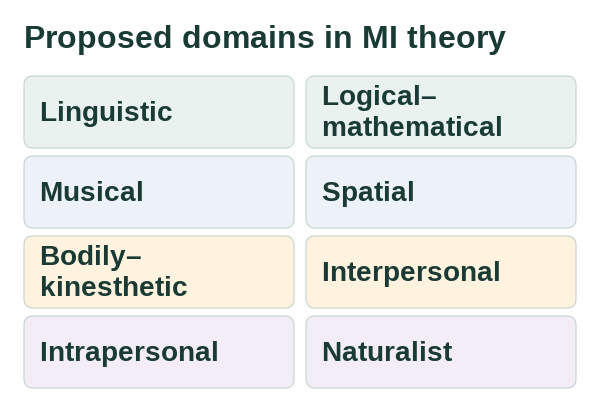
A 2018 article counts 9. It adds existential intelligence to that list.[34] The 2022 paper treats all of these types as being on an equal footing.[35]
The theory treats the intelligences as a combination of cognitive capacities rather than a single general ability. A 2016 paper describes testing each child's tendency. It used a tool called Multiple Intelligences Research (MIR).[33]
A 2020 paper also says teachers should use MIR. It can help them find a student's strongest intelligence. That 2020 paper also sets out its own basic intelligences. They are intellectual (IQ), spiritual (SQ), emotional (EQ) and physical (PQ).[36]
One 2022 paper reports Gardner's list of nine types. It builds teaching suggestions on them.[35] One article on early childhood says the brain takes in information only when it is happy and open. It says teachers should therefore make learning fun.[34]
Links to learning styles and other ideas
In classrooms and training rooms, the theory of multiple intelligences is often combined with other ideas about how people learn.[37][38] A 2018 study looked at students at a state secondary school. It gave them two questionnaires. These were the Perceptual Learning-Style Preference Questionnaire and the Multiple Intelligence Inventory. In that sample, the highest scores were naturalistic, visual and kinesthetic. In the study, most intelligence types and learning styles showed a moderate positive link. The study also found a significant difference between males and females.[37]
A 2001 article describes training that uses online tools to fit each student. These tools find a person's learning preferences, personality traits and intelligence profile. That article lists testing tools found on the internet. It offers teaching methods that allow for different learning styles.[38]
A second pairing links the intelligences to Kolb's theory of learning styles. Those stages are concrete experience, reflective observation, abstract conceptualization and active experimentation. A 2017 paper tries to link this cycle with Gardner's eight intelligences. It aims to answer criticisms of both theories. The paper says the cycle model has enough evidence from studies but lacks scientific backing. The theory of multiple intelligences lacks research evidence. It rests on clinical research on the central nervous system. Its aim is a compound theory. It would be built from the ideas in each theory that are scientifically accurate and backed by evidence. The paper also presents a real life model. It suggests changes in learning methods for general teaching practice.[39]
A third use applies the intelligences to career advice. There, clients plan their education and work. A 2009 article argues for using Gardner's 1993 theory in career counseling. It discusses how it can add to planning for education and careers. The article introduces the Multiple Intelligences Developmental Assessment Scales. This measure asks people to rate their own intellectual disposition. It is based on research. The article gives a case study of its use in counseling.[40]
One 2003 paper treats the two ideas as separate theories, each with its own difficulties. It reports that both theories have run into many problems. These problems are in theory, in evidence and in teaching. One claim has been challenged: that students fall into modality types. The claim also says topics can be turned into forms specific to each modality.[41]
Research
Evidence offered and evidence questioned
Gardner and Moran answered a critical review in 2006. They restated what they see as the theory's usefulness. They also restated what it means.[42] Waterhouse replied in the same year. She wrote that Gardner and Moran had given no evidence to support multiple intelligences.[3]
Waterhouse's review argues that the theory lacks enough research evidence.[43][3] Waterhouse compared multiple intelligences with rival theories. The comparison covered cognitive psychology and cognitive neuroscience. She decided that other theories had stronger evidence. She concluded that all three ideas lacked enough research evidence. They were multiple intelligences, the Mozart effect and emotional intelligence.[43]
A 2025 critical review reached a similar conclusion. It reported that the theory lacks enough scientific support. It also lacks reliable, valid measures for its core intelligences.[44]
Waterhouse argues that schools should not use the theory.[43][44] The 2025 review noted that Gardner himself admitted good assessments for multiple intelligences are scarce. It also looked at how the theory might affect students' academic achievement and merit. That question matters for education policy.[44]
Waterhouse argues that the theory does not match findings in cognitive neuroscience.[43][3] She asked why these theories attract educators even though support for them is weak. She closed by urging that theories of thinking be judged against findings from cognitive neuroscience.[43]
A 2022 paper looked at a long-running debate in educational psychology. The debate asks whether the theory holds up in general use. That analysis compared what intelligence means in the theory of multiple intelligences. It also compared this with what learning styles theory means.[45]
What the achievement studies show
A meta-analysis from Turkey pooled 71 studies of multiple intelligence applications. Combining the results showed a large, positive effect on academic achievement. The effect did not change with the type of course or the class level. The type of research made no difference either.[46]
A study in Indonesia compared two teaching strategies. One class used multiple intelligences. The other used traditional teaching. The setting was junior high school. Two schools were chosen by stratified random sampling. The experimental group had 63 students and the control group had 61. The study ran for 12 weeks. Students taught with the strategy improved on four kinds of intelligence. These were visual spatial, intrapersonal, kinesthetic and musical. Interpersonal logic did not change. Scores in mathematical logic fell after the treatment. Science process skills got better. This included the ability to ask questions.[47]
A study in Bandar Abbas described and measured links between intelligences and school results. It looked at 270 high school students. Students were chosen by cluster random sampling. They filled in Gardner's questionnaire about multiple intelligences. Two intelligences showed a moderate link with academic achievement. These were verbal-linguistic intelligence and visual-spatial intelligence. Musical intelligence was a tunable negative predictor of achievement.[7]
An action research project in Indonesia studied reading comprehension. The class had 32 eighth graders. The project ran from 16 March to 9 April 2022, in 2 cycles with 2 meetings in each cycle. Multiple intelligences strategies matched students' intelligences with activities meant to be fun. Every student said on a questionnaire that the strategies were interesting. An observation sheet showed very good results on study habits. The mean score rose from 89.06 points in the first cycle to 95.6 points in the second.[48]
A qualitative study in Indonesia used interviews and observations. It looked at teachers, students and other interested groups. It reported that using multiple intelligences raises student engagement and academic achievement. The study named teacher training and assessment systems as issues that must be fixed.[49]
Assessment and measurement problems
A 2004 study gave the Teele Inventory of Multiple Intelligences to 288 urban fourth-grade students in the United States.[6] A newer questionnaire was made in Tehran. It had 304 participants. It reported a Cronbach's alpha of 0.929. That questionnaire also showed a link of 0.881 with an existing multiple intelligences questionnaire. Its split-half correlation was 0.765.[50] Cronbach's alpha, also called coefficient alpha, is a number that expresses the internal consistency of a test, that is, how closely its parts, such as its items, relate to one another.[51]
The 2004 study looked at reading levels. Students who scored higher on the logical-mathematical scale were more likely to read at or above grade level. No other intelligence scale predicted how well students did.[6]
A factor analysis looked at the 10 self-estimated scores. It then looked at 8 of them. It did not confirm Gardner's grouping of the intelligences.[52] Factor analysis is a set of mathematical methods used to explain the relationships observed among a large number of variables in terms of a smaller number of underlying factors.[53]
People's own estimates also differ by sex and by culture.[52][8] In the British and American samples, males rated themselves higher than females on four intelligences. These were verbal, logical, spatial and spiritual intelligence.[52] In the Polish sample, men rated their own general, spatial and musical intelligence higher than women did. The Polish study also compared its 258 participants with 185 British participants. It found effects of culture, mainly in estimates for the father and the mother.[8]
A study of 1,464 gifted Chinese students in Hong Kong tested one question. Did the structure of perceived intelligences hold for both boys and girls? The number and nature of the dimensions were largely similar for the two groups. The links among the 8 intelligences were also measured. That study still found small differences between boys and girls. The differences were in perceived strengths on the 8 individual intelligences.[5]
The British and American data did not reproduce the proposed classification. In the 2004 study, only one scale predicted reading achievement.[6][52] The Hong Kong analyses suggested students may group the 8 intelligences into two kinds. These are the personal and nonpersonal groups. That is a simpler pattern than the full list.[5]
The Polish regressions found that three intelligences best predicted estimated general intelligence. They were verbal, mathematical and intrapersonal intelligence.[8] The British and American regressions pointed to four intelligences as the best predictors.[52]
How the intelligences are measured
Many practical tools for profiling learners are questionnaires. On them, people rate themselves. Several studies below use these self-report inventories.[54][55][56] One scale was built for secondary students in Gujarat, India. It had 80 items on a 3-point scale. It was reported to have high reliability and validity.[57]
A checklist version was given to 192 Chinese secondary students in Hong Kong. It asked them to rate seven intelligences. The students treated those seven as fairly separate abilities. Those self-estimates usually did not predict the students' scores on standard tests. The tests covered IQ, creativity and leadership. So the two kinds of information looked independent. They may also add to each other.[54]
A study of 187 undergraduates in West Bengal used a Multiple Intelligence Test. It reported an overall mean of 96.95. The standard deviation was 17.41.[56]
Before a self-report tool can be trusted, researchers check that it measures consistently. Several studies report these checks in detail.[58][59] A 2020 study retested a tool based on nine constructs. It used 140 tutors at Universitas Terbuka in Pekanbaru, Indonesia. All items were reported as valid and reliable. The average Cronbach alpha was 0.763. Item values ran from 0.786 to 0.887, and the total construct value was 0.859.[58]
A 2025 standardization of Gardner's scale used 70 items. They covered 7 types of intelligence. It covered 584 students at Al-Istiqlal University in Jericho, Palestine. The scale showed face validity, internal consistency, construct validity and discriminant validity. Its reliability was high by Cronbach's alpha, test-retest and split-half methods.[59] A 2005 study set out to test whether an inventory was valid. Teachers may use it to assess student abilities in Gardner's seven intelligence areas.[60]
Researchers translated McKenzie's 2017 Multiple Intelligences Inventory into Brazilian Portuguese. They used the Functional Assessment of Chronic Illness Therapy method. This procedure is built from a series of steps. Expert judges fluent in Portuguese and English checked meaning and content. The translated and back-translated versions came out very similar in words and meaning. A pre-test with one student found the instrument was easy to understand. Judges found the final version clear and equal to the original English.[61]
Observation of students doing real tasks offers an alternative to questionnaires, though one study found the observers effective only for intelligences measured through specific tasks. A 1999 study compared reports from a performance-based assessment called DISCOVER with two independent ratings. One rating came from a teacher and one from an observer. The three accounts agreed on which students were strong and weak. They agreed on spatial, logical-mathematical and linguistic intelligence. This suggested the observers worked well for those areas. Agreement was low for three intelligences: bodily-kinesthetic, interpersonal and intrapersonal. The study concluded that specific tasks should be designed to judge those intelligences fairly.[62]
Profiles found in different student groups
Researchers studied 261 British adults. Men rated their own mathematical intelligence much higher than women did.[63] One study looked at 90 international students. They were learning English at three universities in America. Men preferred activities that use logical and mathematical intelligence. Women preferred activities that use intrapersonal intelligence.[64]
The students were 140 Belgian, 227 British and 177 Slovakian. They did not rate their verbal or cultural intelligence higher.[65] Researchers compared 212 British students with 154 Iranian students.[66]
Not every sample agrees. Researchers studied 349 students at a Jordanian science and technology university. Differences by gender and academic year were not statistically significant.[67] In a Turkish sample of 450 students, men reported bodily intelligence more often. It reported intrapersonal and logical intelligence more often in women.[68]
Existential intelligence ranked first and musical last. The ranking matched their science specialisation.[69] The sample was 917 students at King Saud University. Medical-track students scored higher than engineering and humanities students on most intelligence patterns.[70] The students were in science and technology faculties at a Malaysian university. Most reported introspective intelligence.[71]
A group of 140 engineering students showed naturalistic intelligence as dominant. Their main learning style, however, was pragmatic.[72] Language students show a mixed picture. In Kuwait, 250 English students were strongest in interpersonal, visual and kinesthetic intelligence; English majors at a Chinese university were weakest in musical intelligence and strongest in naturalist intelligence.[73][74] The most common types were naturalist, intrapersonal, logical and bodily. Musical intelligence was one of the least common types.[75]
In the three-country European sample, the sex differences were consistent across cultures. They also rated their fathers' intelligence higher. This is the reverse of the Belgian pattern.[65] Parents show similar leanings. 120 parents rated their sons' IQs higher than their daughters' (115.21 against 107.49).[76]
The Jordanian study found no significant differences by academic year. The Saudi science study found no significant link between level of study and the measures it examined.[69][67] In the parental study, parents tended to rate sons as more numerate. This was stronger for the first child than the second.[77]
A study of 60 secondary school students in Iraq ranked visual intelligence first. Interpersonal intelligence came last. There was a significant difference by gender.[78] A class of grade 8 students in Indonesia averaged an IQ score of 86. Musical intelligence was the most common type. That class also shows why group averages hide variation: the five highest English scorers and the five lowest shared several of the same intelligence types.[79]
A study looked at 485 students training to be secondary school teachers, and 22 of their own teachers. It found interpersonal and intrapersonal intelligence dominant in both groups. The students and teachers matched significantly in Technology and Livelihood Education and in Music, Arts, Physical Education and Health. They did not match in Filipino, English or Mathematics.[80] Students' views of their own intelligences also differed by stream, Tawalbeh reported. The differences favored students in the health stream.[81]
Students in information technology and information management were compared across three countries. The comparison covered emotional, social and cultural intelligence. Differences in emotional intelligence and social intelligence were significant. Cultural intelligence and emotional intelligence showed no significant difference.[82] A study of 40 twelfth-grade biology pupils in Indonesia reported naturalistic intelligence highest at 81.5%. Linguistic intelligence was at 76.15%, and both were in the high category.[83]
Among 256 Grade 11 students in the Philippines, intrapersonal intelligence was highest for students with Very Satisfactory academic performance.[84] A study of 31 students at gifted schools in Misan Governorate found all types of multiple intelligences present. They appeared in varying proportions in both genders. That study found one significant gender difference: females scored higher in musical intelligence.[85]
Gender differences also appear in a sample of 215 university students. There, men scored higher on bodily-kinesthetic, interpersonal, logical-mathematical, musical and spatial intelligence. Women in that sample scored higher on word, self-knowledge and nature intelligences.[86]
Age and class year may matter as well. A study of 44 pupils in Jakarta tested them in first grade and again in second grade. It found changes in kinesthetic, spatial, interpersonal and musical intelligence. The researchers linked those changes to the classroom environment. This included teachers, learning methods, facilities and seating arrangement.[87]
What the reviews and meta-analyses find
A 2022 meta-analysis pooled six articles on social science teaching. It found a small positive effect on students' performance in that subject. The same analysis reported that the effect size changed with education level. It also changed with how long the teaching lasted and with the subject type. The meta-analysis used six articles that met its inclusion criteria.[88]
Four themes stood out. They were achievement, attitudes, retention, and what teachers and students thought about whether the teaching worked. Achievement was the most studied theme. Experimental designs were more common than qualitative ones. The review found a mismatch. The nature of the theory did not fit the methods researchers chose to test it. It also recorded that attention to the topic rose and later fell over the period studied.[89]
A 2025 review of learning management strategies searched five databases. It kept 45 eligible studies from 2015 to 2024. It sorted the strategies into three groups. These were teaching that fits each student, varied ways to assess, and learning in groups. The review reports good effects on student engagement, academic achievement and overall development. This happens when schools combine these strategies. Its opening claim is that practice remains uneven. More people now see that children learn differently.[90]
A critical narrative review published in 2026 sets out the case against the theory's evidence base. It argues that factor-analytic work does not support the claim of separate, independent intelligences. Factor analysis is the statistical study of how test scores group together. No study has measured brain activity during a task typical of a named intelligence. So such comparisons cannot work as tests of validity.[91]
How the eight intelligences are tested
A 2020 study in Mexico gave a self-administered questionnaire to 161 elementary school students. It compared their mean scores across the eight categories.[92] A study of 162 adolescents in Bosnia and Herzegovina used a questionnaire called Subjective assessment of multiple intelligences (SAMI). The title shows the scores are the student's own opinion.[93]
One inventory for junior secondary students in Makassar, Indonesia, was given to 302 students. It aimed to identify each student's strongest intelligence.[94] A study of 10th standard students in Tiruchirappalli, in the Indian state of Tamilnadu, collected responses from 2230 students. They used a 95-item multiple intelligence inventory.[95]
Before an inventory is trusted, researchers check its reliability and its validity. The Marwaha and Nanda survey of 120 students in and around Chandigarh reported that the Multiple Intelligence Level Scale was a valid and reliable measure of intelligence levels. One team tested a standard Multiple Intelligence Level Scale (MILS) built on Gardner's theory. The 120 school students were aged 7 to 16, in and around Chandigarh, India. It measured multiple intelligence levels and dominant thinking patterns.[96]
At Universitas Negeri Medan in Indonesia, Lubis and colleagues gathered their data with a questionnaire. Its validity and reliability had first been checked.[97] A Philippine study turned an MI test by Chapman and V Chislett MSc into a Likert type questionnaire.[98]
Aydoğan and Akbarov reported on 162 adolescents in Bosnia and Herzegovina. Almost all links between the different intelligence scores were statistically significant.[93] The only significant gender difference was in intrapersonal intelligence, where males reported higher scores.[92] One study looked at 400 upper primary students in Salt city government schools. It found big differences in all intelligence fields by academic level, with excellent students scoring higher than normal students.[99]
What the classroom trials measured
A quasi-experimental study in Singapore gave a pre-test and a post-test. The 476 students were aged 13 to 15, from four secondary schools. Of these, 197 students went through a multiple intelligences programme. The other 279 went through mediated learning, which means close coaching by a teacher. Three independent teacher-examiners judged group reports and projects, and all students took tests before and after. Both approaches helped students learn and apply information literacy skills, the skills of finding and judging information.[100]
An experiment at Vinh University in Vietnam followed 59 students who were not English majors for fifteen weeks. It used five projects built around multiple intelligences. Students in the project groups became more self-controlled in using information sources, in managing their learning process and in learning the language. Students in the control groups did not. The project groups also showed a significant increase in motivation.[101]
In practice
How schools have applied it
In primary education, the theory helps teachers plan many kinds of activities. These suit children's different strengths and ways of learning.[102] A second recent article makes a related point about fairness. It says teaching and testing everyone the same way is unfair when minds differ.[103]
A 2025 article also calls for tests that reflect diverse intelligences. It also calls for training teachers in the theory. This covers curriculum design and assessment. That article warns against giving teachers too many extra curriculum requirements. It prefers chances for hands-on learning instead. It links seeing a student's strengths to more self-direction. That means the student takes more charge of their own learning.[104]
A research and development project in Indonesia built a creative curriculum for early childhood settings. It was based on multiple intelligences. The product was tried with 100 children in Sleman Regency. It was then used at wider scale with 200 children in Yogyakarta Province. The new tests rated the children in the very good category. Teacher readiness fell in the good group. So did the benefits of the product.[105]
The 2024 paper also gives examples at later school stages. It names personalized learning modules at Lincoln High School. It also names project workshops in different subjects at Stanford University. The paper expects future uses to rely on large data sets and artificial intelligence. These would design a separate learning path for each student.[106]
Teacher beliefs and adoption
One analysis looked at the theory's effect on schooling over 20 years. Its strongest effect was on how educators talk about differences in children's intelligence. The same analysis rated the theory's influence on the formal curriculum as moderate to high. It gave the same rating for instructional materials.[107]
A 10-year research effort asked why educators adopt the theory. It also asked whether practice really changes once schools adopt it. And it asked what is happening when educators say it works.[108] Researchers studied one large elementary school in the suburbs. Students, teachers and parents all liked the idea of multiple intelligences. But use of the ideas in classrooms varied from one classroom to another.[4]
A survey looked at senior high school teachers and their students. It found the teachers knew Gardner's theory well enough. Teachers and students mostly agreed on one point. All eight intelligences were used and often practiced in the classroom. How often some practices were used was clearly linked to four teacher traits. These were age, gender, specialization and highest level of education. As teachers grew older, they were less likely to use visual aids. These include maps, charts and diagrams. Older teachers were also less likely to let students use drama, dance or physical activity. Teachers with more education were less likely to use visual presentations in class. The study advised teachers to keep using the theory. It also said they should learn more about it through reading and study. It also said high school teachers should get more resources. These would help them support these practices.[109]
Planning tools for mixed classrooms
One example combines the intelligences with Bloom's taxonomy. Teachers used the tool to plan and run units of work through learning centers. The work was tracked over 18 months in two small elementary schools. The teachers said they felt more confident about widening their curriculum. They also felt better able to meet different strengths across the intelligences. They also felt better able to challenge students in thinking. This came first with the original taxonomy. Then it came with the revised one. The same teachers judged that this curriculum change had made their students more successful learners.[110]
A 2001 review gathered and combined research on gifted and talented children. It covered how Gardner's 1983 theory has been used to find and teach them. That review set out the benefits of the multiple intelligences approach for these students. It also set out the cautions that come with it.[111]
How much the teacher put the approach into practice was strongly related to positive changes. These changes were in problem solving in Pablo activities. They were also in math activities. It was also linked to mean math performance. It was linked too to the number of students named gifted on the post-assessment. The results were seen as support for the DISCOVER approach in general classrooms. Those classrooms have many children who speak Spanish or are bilingual.[112]
Expert reviewers checked the lesson plans themselves for validity. It used both word-based and number-based methods. Two expert judges rated the plans. One knew language and one knew mathematics. The language checker scored the language parts at 3.35. The mathematics reviewer scored the substance, or content, parts at 3.82.[113]
Use in particular school subjects
A case study followed Dave, a high school science teacher. He worked in an action research group. He used the theory to decide how to arrange learning for his grade nine students. The unit was on space and astronomy. Dave reported that the unit became more student-centered and more engaging. He said it met individual learning needs. The case was presented as a way to make science accessible. It was also meant to help students reach high levels of scientific literacy. The account rests on one teacher's experience.[114]
One 2025 article lists ways to teach English. Each is matched to the mental traits of individual students. It advises teachers to change how they teach. It also suggests varied activities that match the range of abilities in the class.[115]
A 2015 review looked at how the intelligences relate to learning English as a foreign language. It also looked at teaching it. That review compared results from different studies. It concluded that the link between the intelligences and language learning is disputed. The same review notes that Gardner's 2001 list has nine intelligences. Each is said to affect a particular language skill.[116]
People have rethought how literature is taught. Students are now asked to study the same texts from several points of view. A 2012 discussion compares usual literature teaching with a different approach. The other choice rests on Gardner's 1983 theory. Its starting point is that people have different ways of gaining knowledge and of learning. The practical proposal is to build those different ways through literature. Texts would be studied from all of these perspectives.[117]
A music education study tested a multiple intelligences model against a comparison class. A 2024 study designed teaching strategies and a way to judge them. Both bring the theory into music teaching. The study took two classes of music majors. It studied a Students' Music Performance Rating Scale. It found four main factors. Together they explained 33.36% of the results. One class was taught with multiple intelligences methods. It scored much higher in music performance than the control class. After one year, the experimental class showed highly significant gains in three intelligences (P<0.01). They were body movement intelligence, musical intelligence and self-knowledge intelligence. Logical-mathematical intelligence showed no significant improvement (P>0.05).[118]
Intelligences in students with disabilities
Hearne and Stone wrote a 1995 article on learning disabilities. They argued that traditional deficit models had produced a very low cure rate. The same article reported that some research in the field had begun to focus on creativity. It also looked at less common strengths and talents. Schools had not valued these highly. Hearne and Stone summed up their search for the talents of students labeled learning disabled. They offered a first set of practical suggestions. They called Gardner's theory a call to rebuild schools around ways of learning and inquiry. It was not a call for deficit approaches.[119]
Vidhyanathan (2017) argues that a teacher should build an intelligence profile for each student. Knowing how each one learns helps decide what to teach and how to present information. A 2017 survey studied 120 upper primary students with hearing impairment. It used a changed version of Thomas Armstrong's Multiple Intelligence Scale. That scale had a Cronbach alpha of 0.82. That study found that students with hearing impairment differed significantly in verbal, interpersonal and bodily/kinesthetic intelligence. Its author advised training students to build logical and intrapersonal intelligence. This would help them improve themselves and reach set goals.[120]
A separate study looked at 82 deaf adult students at two universities. It used a scale by Walter Mackenzie. The scale has 80 statements across 8 areas. That study reported higher scores for females on four kinds of intelligence. These were self/inner, verbal/linguistic, social/external and visual/spatial. Females also scored higher on the full scale. It also found higher verbal and language scores among students at Tabuk University in Saudi Arabia.[121]
The framework has been used with students who have attention deficit hyperactivity disorder. It has described their profiles and helped plan teaching.[122][123] A 2017 study compared 50 children aged 6 to 13, with and without ADHD. It used a clinical interview, a Raven intelligence quotient test and a multiple intelligences test. The control group showed more kinds of multiple intelligences than the ADHD group. The difference was significant in logic, people skills and self-knowledge intelligence. Average IQ scores were 102.42 in the control group and 96.72 in the ADHD group. The study concluded that ADHD is likely linked to three profiles.[123]
Kristanto (2022) used a qualitative literature study to identify ADHD traits. It also described teaching strategies, including assessment and tools, that can develop 9 multiple intelligences. That review noted that many children with ADHD are seen as marginal students at school. They cannot meet academic standards.[122]
Some studies have tested activities built around particular intelligences. The children in them have Down syndrome.[124][125] A 2022 study built a speech therapy program around the theory. It reported big gains in language and communication for children with Down syndrome.[124]
A qualitative case study observed 10 children with Down syndrome, aged 7 to 12. Researchers observed them before and after an intervention that used cultural games. The games were linked to gains in interpersonal qualities. These included cooperation, empathy, having many friends and understanding other people. That study found the children did not show the leadership and problem-solving traits of intelligence.[125]
A 2025 paper described a dance teaching model. It was for vocational students with special educational needs. The model targets bodily, musical, spatial and interpersonal intelligences. The paper reported that dance is a nonverbal form of education. It also crosses subject areas. It can stir intellectual potential. It can also improve physical coordination, social skills and emotional expression. It also argued that personalized curriculum design and group collaborative teaching can raise students' self-confidence and learning motivation.[126]
Coaching, counselling and out-of-school uses
A 2006 action research study asked whether Gardner's theory could be built into a model for coaching and mentoring. Six coach-mentors worked with six learners. They designed coaching that used several intelligences during the process. The study reported that stressing a range of intelligences pushed learners to make progress. Trying to use all of the intelligences also pushed the coach-mentors to take risks. They took these risks when they designed hands-on activities. The project produced a Model and a Toolbox for Coaching and Mentoring. These gave coaches a structure and shared words for discussing their work.[127]
Counsellors have also used the framework to plan clinical work with individual clients. A 2020 paper proposed that spotting a client's existing abilities through multiple intelligences can help. It can help the transactional analyst diagnose ego states and plan an intervention. In that proposal, knowing a client's competencies helps the analyst plan an intervention. It also helps the client's Adult ego state become clearer and more energized. The paper sets out links between the two sets of concepts. It does not report trial results.[128]
Howard Gardner himself discussed how the framework might apply to negotiation. He wrote this in a 2000 question-and-answer article. The discussion covered how people understand the world around them. It also covered how scripts and stereotypes shape that understanding. Gardner closed with advice for negotiators. They might drop unproductive theories and replace them with better frameworks to guide their practice.[129]
According to an unpublished master's thesis by Julia E. The first known toy library opened in Los Angeles in 1935, during the Great Depression. It lent games and toys to children free of charge. In the 1980s, lekoteks came to America. These toy libraries give children with a disability access to special play materials. They also advise families on how play helps development.[130] A 1999 paper argued that businesses can use the theory to plan workshops and training sessions. These can improve teamwork, develop human potential and encourage creativity.[131]
A 2023 analysis looked at how the intelligences Gardner describes add to the job skills adolescents need. It also looked at how school guidance might change. The aim was to fit each student's abilities and interests.[132]
A 2021 study looked at 786 master's level students in Pakistan. It found a positive and strong correlation between contextualised multiple intelligences, abilities understood in relation to a particular setting, and future job market prospects. The link was stronger for public university students (r=.631, p=.000). The link was weaker for private university students (r=.556, p=.000). Male and female students differed in their contextualised multiple intelligences. In the qualitative phase, experts said universities should take an active role. They should retrain students to make them more employable.[133]
One study in the Philippines followed graduates of a school for exceptional children into working life. It surveyed 85 people, 53% of the SPED-ISEC graduates in Iloilo City from 1978 to 1988. They were picked by incidental sampling. The graduates were forceful communicators with varied intelligences. They were satisfied with their jobs. The study advised regular review of the curriculum and of teachers' professional growth. This would help them keep pace with each student's changing gifts.[134]
Early childhood and kindergarten practice
Children aged 0 to 8 often have talents that no one notices. This can limit what they later achieve. Parents and teachers are the main observers of young children. Yet they sometimes miss these abilities. One study at RA Bani Malik, Ledug, mapped each child's main strength. It used observation, interviews and documents. It found that each child had unique potential. Particular activities could identify that potential and bring it out. Puzzles were used to test logical-mathematical intelligence. Letter writing was used to teach language. Dancing was used for musical intelligence, gymnastics for kinesthetic and painting for spatial intelligence. Caring for plants used naturalist intelligence. Asking yourself questions helped intrapersonal intelligence. Role-playing drew on interpersonal intelligence.[135]
Academics and teachers ran a research project together. It was tested with 40 kindergarten children in groups 1 and 2. It produced tested tools for kindergarten children. These were built on four main instruments. These were a behavior log, skill games, intelligence function, and complex problems and discovery. The project also produced guidelines for a detection model. It also produced guidelines for encouraging multiple intelligences in kindergarten. In group 1, the largest gain was in linguistic intelligence, at 33.84. Interpersonal was the lowest, at 23.89. In group 2 the largest gain was again linguistic at 32.27. The lowest was physical kinesthetic, at 24.50.[136]
A drawing programme was tested with 50 boys and girls. They attended Al-Qasiyah Kindergarten in Nineveh Governorate. It had 9 different activities. Goodenough measured intelligence with the Draw-a-Person test. The programme's reliability reached 0.82 on the test-retest method. Scores differed significantly between pre-test and post-test, in favour of the post-test. A child's rank among siblings showed no significant difference at the 0.05 level.[137]
Interactive multimedia built with the ADDIE model was rated 93.53% valid on design. It scored 90.00% on media and 95.00% on content. Its practicality reached 96.67% in individual testing. It also reached 96.67% in small groups. The effectiveness test showed gains in five areas.[138]
The Korean Project Spectrum study asked a question. Do young children show distinct profiles of strengths and weaknesses? Most children had some strength or weakness. They showed fairly strong and weak areas for each person. In their strong areas, children were described as easy to engage and confident. They were also described as focused and persistent. They were also thoughtful about their own work. The study concluded that finding and building strengths is one of the best ways to build positive working styles.[139]
The partner kindergarten is one of 40 kindergartens across Malaysia. The training covered how a child's brain works and the types of children's intelligence. It also covered how to train intelligence according to each child's potential.[140] A review of multiple intelligences in early childhood education warns that practice often slips into labelling a child with a single intelligence or equating the theory with learning styles. That review treats the intelligences as a heuristic, a practical guide for varying learning pathways. It does not treat them as a fixed classification of children's abilities.[141]
Technology, materials and blended settings
A 2007 article matched each intelligence with a technology tool. It gave examples from the classroom.[142] A 2005 article looked at how the theory applies to online training of English language teachers. It used a course on teaching writing.[143]
A 2021 qualitative study described student activity in e-learning. It found that using multiple intelligences in e-learning lets students be flexible in how they learn. That review also described e-learning as a setting where students work together and interact.[144]
Several studies report on materials designed around the intelligences. Experts rated them as valid or workable.[145][146][147][148] Interactive civics teaching materials scored 93.2% for validity. They scored 90% for effectiveness. The study involved 44 university students in a teacher education program.[145] A math module built on realistic mathematics education drew an average of 80% from media experts. It drew 84% from subject experts.[148]
One study used animal material with class X students. The teaching material scored 82.1% for how easy it was to read. Also, 80.8% of students gave positive responses. That study found moderate gains in the intelligences. It also found gains in higher-order thinking skills. The gains were in the class that used the materials.[146] A textbook of learning strategies based on the intelligences was judged valid, practical and effective. It helped students reach learning goals.[149]
Researchers have studied blended learning as a way to support the intelligences.[150][151] A 2021 meta-analysis pooled 21 national and international journal articles from the COVID-19 period. It found that blended learning combined with STEM raised students' multiple intelligences. The average value was 76.25. Character education reached 75, with an effect size of 0.44. Its N-Gain was 0.65, in the medium category.[150]
A 2023 paper described blended practices. In these, teachers used digital platforms and social media. They did this to build students' different intelligences.[151]
Short recorded lessons, called micro-lectures, have also been designed around the intelligences. A 2026 study made short micro-lectures for teaching Chinese characters. It tested them in two rounds of classroom action research. The students were in third grade, aged 7 to 9. They fit students' learning needs better. They raised interest. They also improved test results. The study named five factors that shaped how well the micro-lectures worked in class.[152]
An online music theory course for adults was built on the intelligences. Ten experienced music teachers named what it requires. Three experts then checked it. Adults in that module valued the flexibility. They wanted more interactive support.[153]
Researchers have tested teaching in business education. This teaching uses technology and is based on the intelligences. High expectations and changed viewpoints improved students' self-concept, ability and motivation. This led to better learning results. The effect on learning gain varied when viewpoints changed. The study called for more research on that difference.[154]
Researchers have studied artificial intelligence tools under the same theory.[155][156] A 2024 essay argued that a chat-based AI tool is flexible enough to suit differences between the intelligences. It falls short in practical aspects. It advised students and teachers to watch the gap between virtual and real work. It also urged them to build critical thinking when using such tools.[155]
A 2024 music education study built an AI question-and-answer system. It tested the system with real data. Students in the experimental class showed large gains in bodily-kinesthetic and musical intelligence. The result was at P<0.01.[156]
What teachers do differently in the classroom
In one field study, Grade 7 students and their science teacher took Chislett's multiple intelligence test. They used it to assess learning needs. The students' strongest intelligences then shaped the enrichment activities in the lesson module. The teacher reported that lesson planning got easier. It helped once the students' strongest intelligences guided those activities. Observers described the students as attentive and participative during the lessons.[157]
A study of student teachers at one Indonesian university found three main tendencies. Logical was 16%, interpersonal 29% and naturalist 20%. The lecture design was then built around those three sets of characteristics. The study concluded that building a lecture around students' intelligence types could make the lecture more effective. It could also raise student enthusiasm.[158]
Teachers can also group students by shared interests. They can then match each group with a learning approach that suits it. A case study looked at seventh-grade students. It reported that this method added variety to class activities and held students' attention.[159]
One language teaching article argues for using the theory through portfolios, project work and team teaching. It sets out the advantages and difficulties of each.[160] The findings showed that pairing cooperative learning with the theory raised students' school achievement. This held across several subjects.[161]
Some teachers build whole units and teaching kits around chosen intelligences. One development project made a teacher's manual and a student handbook for fifth grade. Both drew on interpersonal, intrapersonal and naturalist intelligences. The tools were designed to raise social awareness. Field trials found them suitable, practical and effective for that aim.[162] A six-week science unit on food was planned with intelligence-based activities for 23 fourth-grade students in Istanbul. Students, parents and the teacher judged that it helped course achievement, attitudes and everyday problem solving.[163]
A survey asked 100 senior high school economics teachers about their teaching. It found they often used interpersonal intelligence. Use of the bodily-kinesthetic approach differed much with teaching experience, but not with gender. The researchers recommended training so teachers could also use logical-mathematical, spatial, bodily-kinesthetic, musical and naturalistic approaches.[164]
A survey asked 45 teacher education mentors and 559 students. It found that mentors often used verbal-linguistic, mathematical-logical, interpersonal, intrapersonal, naturalistic and existential teaching styles. Bodily-kinesthetic, musical and spatial styles were rarely used. The mentors' styles did not fully match the students' intelligences.[165]
The theory says intelligences are best measured by tests tied to real settings. It calls these tests intelligence-fair. Project Spectrum was a program for young children. Its data showed that even 4- and 5-year-old children have distinct patterns of strength and weakness. The measures of the different intelligences were mostly independent of each other. They tested abilities other than those measured by standard intelligence tests.[166]
One case study had 15 participants, including a teacher, students and administrators. Planning meant designing activities around students' varied intelligence profiles.[167] A 2003 overview named three parts of the theory that change classroom practice. They are teaching strategies, changes to the curriculum and student assessment. The article describes three parts of the theory. They are for including students with mild to moderate disabilities in general classrooms. Curricular adaptations are one of them.[168] A 2021 review of the literature reported that multiple intelligences can be used through strategies, models and learning methods in elementary classrooms.[169]
Lessons used discussions, presentations, case analyses and group activities. These got students actively involved.[167] A qualitative study looked at fourteen students from two schools. It found that an active method in moral education developed eight intelligences. These ran from verbal linguistic to naturalistic. That study described active learning as giving every learner time and help to reach their potential.[170]
Group work is a common form. Students sit in small groups of 4 or 5, of mixed ability, and help one another.[171] A 2017 program combined group work with multiple intelligences. It supported students with learning difficulties in an inclusive classroom.[172]
The madrasah study used a qualitative case study design with 15 participants. It checked findings by comparing observations, interviews and documents.[167] One 2024 study interviewed 70 lecturers. It asked how they understood and used the theory, and what challenges they met.[173]
A 2021 case study at one elementary school linked multiple intelligences classroom management to students taking in character values such as discipline and responsibility.[174] An experiment compared 168 young adults under two teaching styles. Mean scores were higher when visual animation and multiple intelligences were combined. They were higher than under the usual style.[175]
Language classrooms as a testing ground
A 2004 teacher action research study reported higher success rates for second language learners. The theory shaped their teaching, curriculum and assessment.[176] A 2016 study at a Saudi university compared students. Those who learned their intelligence profiles grew more motivated. That motivation helped them improve their language skills.[177]
A 2019 quasi-experiment with ninth graders in Jakarta used a single group post-test. It reported that multiple intelligences instruction developed speaking skills.[178] A Vietnamese study of 88 first-year students found much higher post-test scores in the experimental group than in the control group.[179] A study of 50 students in Gorontalo found a medium link of 0.464. The link was between multiple intelligences and speaking achievement. It noted that other factors also affect achievement.[180]
A 2025 quasi-experiment had 60 pre-university students in Malaysia. Teaching built on multiple intelligences improved their English writing.[181] The link to writing quality was weak or not significant.[182] A study of 27 English department students found no real link between writing performance and intelligence profile. This held for the profile as a whole and for linguistic intelligence alone.[183]
A study of 120 Iranian learners found that no single intelligence could predict writing strategies alone.[184] In Jordan, a ten-week reading program with 110 tenth graders had a positive effect. It helped reading comprehension skills and all the sub-skills tested.[185] A study of 60 Iranian students found no real link between listening scores and any intelligence. It also found no real difference in attitudes.[186]
Several studies suggest that teachers' own intelligence profiles shape what happens in class.[187][188] The study looked at 30 EFL instructors. Only teachers of the logical-mathematical type were swayed by their strongest intelligence. It shaped the activities they chose.[187]
A survey of 18 instructors and 50 sophomores found a link between instructors' intelligences and their teaching approaches.[188] A survey of English teachers in Punjab found only a weak link of 0.240. The link was between their intelligences and their preferred teaching strategies.[189] Instructors at Mustansiriyah and Baghdad Universities said the theory was hard to put into practice. They cited outside pressure, too little time and limited knowledge of the theory.[190]
A 2014 study in Beirut watched eighty kindergartners aged 5 and eight teachers. The classes were English as a second language. Students learned new vocabulary faster with traditional teaching methods. Those students remembered that vocabulary much less well. They remembered words from multiple intelligences classes better. Teachers who used multiple intelligences in lessons also used higher order thinking skills less.[191]
The strategy improved students' academic writing across eight intelligences. It followed a writing process: creating, outlining, drafting and polishing. The report concluded that the instruction works better when students take an active part in every step of that process.[192]
A separate experiment had 39 master's students of foreign language teaching. It tested multiple intelligences for note-taking in literature reviews. Students tended to use linguistic intelligence to improve their writing and note-taking. They reported more motivation than with traditional methods.[193]
University students in Vietnam tried vocabulary homework built around different intelligences. The test ran for four weeks. Students used different strategies to learn new words. They showed creativity and more enthusiasm for learning vocabulary.[194]
Textbook analyses have asked how often each intelligence appears in language activities.[195][196][197][198] One analysis looked at a single unit of a Cambridge University Press course book. It found an unfair spread of the four language skills and the eight intelligences.[195]
Three textbooks of a Persian language series mostly served verbal/linguistic, visual/spatial, logical/mathematical and interpersonal intelligences. That analysis found no example of bodily/kinesthetic intelligence. Skill level made no significant difference to the intelligences used.[196] Eight textbooks for young learners were mainly verbal/linguistic. Naturalistic intelligence appeared only at intermediate and advanced levels.[197]
What this looks like when you study
Şener and Çokçalışkan (2018) note that students can learn their strengths and weaknesses. This comes from exploring their learning style and intelligence type. The same authors add that teachers who know their students' learning styles and intelligences can set goals. They can also design student-centered activities for different intelligences.[37]
Noble (2004) combined Gardner's theory with the revised Bloom's taxonomy as a planning tool.[110] A review of 45 studies grouped these practices into three clusters. They were differentiated instruction, varied assessment and collaborative learning. The review reports positive effects on engagement and achievement when teachers use these strategies together.[90]
Later developments
Cross-cultural and religious framings
Chongde and Tsingan (2003) compare Gardner's theory with the view of intelligence in the Six Arts. The Six Arts was an old Chinese program of education. The same paper also noted key differences between the two views. It set out Lin Chongde's own theory. In that theory, the parts of intellectual structure are diverse.[199]
A 2020 classroom action research study asked a question. It was about Islamic education lessons built around multiple intelligences. Could they make the subject easier for students and improve their achievement? That study described multiple intelligences as part of an effective way to teach the subject. Students solved problems and made something useful in their lives.[200]
A 2024 library study looked at pesantren. This is the oldest Islamic educational institution in Indonesia. It asked what chances and barriers these schools face in developing the intelligences.[201]
A 2025 case study looked at a madrasah in Pekanbaru, Indonesia. It reported on lessons matched to students' intelligence profiles. Engagement and comprehension rose. That case study named limited facilities as a problem. It also named partial teacher readiness.[202]
A 2024 case study at a madrasah in South Tangerang combined multiple intelligences with Qur'anic values. It called the result a spiritual dimension of learning. The study reported more student involvement and stronger character. It even reported progress in both academic and spiritual work. It listed three supports: a Qur'anic institutional vision, teacher commitment and a flexible curriculum. Three barriers stand out.[203]
A 2023 library study argued that Gardner left out existential intelligence. Islam treats this intelligence as part of human nature. The same study said religious teaching has not yet fully developed students' range of potentials.[204] A 2024 review from an Islamic education view counted nine kinds of intelligence. It held that no human being is stupid.[205]
A 2019 case study took place in an Indonesian elementary school. It grouped students by intelligence. It used interviews and a multiple intelligences test run by a school team. Arabic teachers then chose a method for each class to fit that class's needs. Lessons sometimes took place outdoors. The school grounds and facilities gave students room to be creative.[206]
A 2020 study at SD Al-Kautsar Malang found that mufradat (vocabulary) teaching was organised through classroom management based on the intelligences. It had strong funding, reliable staff management and good facilities.[207] A 2021 study at SD Plus Al-Kautsar Malang named portfolio assessment, self-assessment and project work as evaluation methods suited to these classes.[208] A 2024 desk study argued that Arabic assessment should use non-test activities as well as tests. Tests reach only linguistic, logical-mathematical and visual-spatial intelligence. That study placed emotional and spiritual intelligence in the assessment of student attitudes.[209]
A 2026 case study at Markaz Arabiyah Pare in Kediri, Indonesia, looked at a multiple intelligences curriculum for speaking practice in Arabic. Planning began by mapping each student's intelligences. Lessons built seven kinds of intelligence into speaking activities. A daily reflection activity called Ashfu Dzihni built intrapersonal intelligence before students spoke. The study reported limits in how well instructors understood the theory. It also noted limits in the assessment tools. These did not yet cover non-linguistic dimensions.[210]
A 2025 literature review linked the nine intelligences to Pancasila, the founding principles of the Indonesian state. The review held that in Indonesia these intelligences should be developed alongside Pancasila values. Learning should aim at character as well as mental achievement. It described intelligence as shaped by biology, social settings, and meaningful learning experiences. The review concluded that joining the theory with Pancasila values supports inclusive, humanistic learning. This fits the goals of the Pancasila Student Profile.[211]
Criticism
Criticism, limits and open questions
A 2013 paper on gifted education reviewed the theory's history and main features. It then set out criticisms of its ideas and of how it has been applied. It looked closely at Turkey. That paper treats the theory as one of several pluralistic views of intelligence. It also notes that the theory supports seeing learners as active in teaching and learning. This fits some practices in gifted education.[212]
A second question is how the theory relates to standard measures of general intelligence. These are often called g or IQ. A 2004 article set the search for a single g factor against Gardner's list of specific intelligences. It placed the theory within a longer history of interest among psychometricians. That interest was in finding the core processes that make up human intelligence. On that view, the theory is very different from older models of mind. Those models explain how people think and make intelligent choices. The same article argued that Gardner's view clashes sharply with a standards-driven approach to school improvement. That approach stresses standard, predictable results. It said that growing individual tendencies, interests and intelligences would produce different outcomes. This would happen among children with different kinds of intelligence.[213]
A 2018 review used mixed methods. It summed up more than 500 neuroscience reports. It asked whether general intelligence and multiple intelligences can be combined. The question rests on shared and unique brain systems. From that reading the review drew five principles for teaching and curriculum. Among them: culture matters, and every brain is unique. The other principles were know thyself, and embodied cognition with an emotional rudder. A third was making learning mean something. The review proposed this framework as a model for educational cognitive neuroscience. It would help both neuroscience and teachers. The principles came from one reading of the reports.[2]
A 2021 study looked at multiple intelligences and learning problems among upper basic level students. It took place in one school unit in Manabí Province, Ecuador. That study used a method based on published sources. It gathered scientific information from reliable sources. It added the watching of students. It reported problems that students and teachers both face. These arise in teaching and learning.[214]
Public beliefs about the intelligences add another open question. A 2023 survey asked 123 people over 18 to rate jobs tied to each intelligence. They answered a questionnaire online. It did find a significant difference in mean rank between professions. The paper discussed what such differences might mean for one child. It also asked what they might mean for society more broadly.[215]
Common misconceptions
Shearer (2018) notes that general intelligence has a century of test data behind it. No tests exist to measure the eight intelligences. A review of over 500 brain studies matched neural activity to each intelligence. The same review states that general intelligence is considered valid because of more than 100 years of test data.[2]
Furnham and colleagues (2002) asked 253 British and 318 American students to rate ten multiple intelligences. They rated themselves and others. The factor structure of those self-estimates did not support Gardner's classification.[52]
Key studies
| Year | Study | Sample | Design | Finding |
|---|---|---|---|---|
| 1996 | Maker et al.[112] | two teachers' classrooms with many Spanish-speaking or bilingual children | pre- and post-assessment comparison | The level of teacher implementation was significantly related to gains in problem solving, mean math performance and the number of students identified as gifted. |
| 2001 | Chan[54] | 192 Chinese secondary students in Hong Kong | self-report checklist compared with standardized measures | Students' own ratings of their seven intelligences were largely unrelated to their scores on the standard tests of IQ, creativity and leadership. |
| 2002 | Furnham et al.[52] | 253 British and 318 American students | self-estimate survey with factor analysis | When the ten self-estimated scores were analyzed, the resulting factors did not match Gardner's grouping of the intelligences. |
| 2004 | Noble[110] | teachers in two small elementary schools | 18-month documentation of planning and implementation | Teachers reported greater confidence in broadening the curriculum and catering to different strengths after using a planning tool that combined multiple intelligences with the revised Bloom's taxonomy. |
| 2006 | Chan[5] | 1,464 Chinese gifted students in Hong Kong | multigroup confirmatory factor analysis | The structure of perceived multiple intelligences was largely similar for boys and girls. |
| 2006 | Harding[127] | six coach-mentors and six learners | qualitative action research | Emphasizing a range of multiple intelligences during coaching stimulated learners to progress, and coaches took more risks in designing experiential interventions. |
| 2006 | Waterhouse[43] | critical review of three theories and their evidence | The review argues that multiple intelligences theory has too little empirical backing and should not guide what schools do. | |
| 2006 | Gardner & Moran[42] | response to a critical review | The authors argue that the critic misunderstands and oversimplifies the theory and that her own argument undermines her claim. | |
| 2006 | Waterhouse[3] | reply to critics of an earlier review | The author reasserts that the theory has inadequate empirical support and that proponents offered no validating evidence. | |
| 2017 | Najafi et al.[123] | 50 children aged 6 to 13, with and without ADHD | cross-sectional descriptive analytical study | The control group showed more kinds of multiple intelligences, with significant differences in logical, interpersonal and intrapersonal intelligence. |
| 2021 | Universitas Pendidikan Indonesia, Indonesia, mubiar@upi.edu et al.[136] | 40 kindergarten children in two groups | collaborative action research | Average stimulation scores were 28.81 in group 1 and 29.38 in group 2, with linguistic intelligence gaining most in both groups. |
| 2023 | SynthesisHub Advance Scientific Research[109] | 129 senior high school teachers | descriptive-correlational survey | Of 129 senior high school teachers, 48 (37.21 percent) were adequately familiar with Gardner's theory and 37 (28.68 percent) were very familiar. Teachers and students generally agreed that all eight intelligences were applied and frequently practiced in class. |
| 2024 | Ni et al.[118] | two classes of music majors | teaching experiment with fuzzy evaluation | The experimental group scored significantly higher in music performance, with significant improvement in bodily-kinesthetic, musical and self-cognitive intelligences. |
| 2026 | Yong[152] | a group of third-grade students aged 7 to 9 | two cycles of classroom action research | Micro-lectures designed with the multiple intelligences framework better matched students' needs, raised interest and improved assessment outcomes. |
See also
References
- Morgan, H. (1996). An analysis of gardner's theory of multiple intelligence. Roeper Review, 18(4), 263-269. doi:10.1080/02783199609553756
- Shearer, B. (2018). Multiple Intelligences in Teaching and Education: Lessons Learned from Neuroscience. Journal of Intelligence, 6(3), 38. doi:10.3390/jintelligence6030038
- Waterhouse, L. (2006). Inadequate Evidence for Multiple Intelligences, Mozart Effect, and Emotional Intelligence Theories. Educational Psychologist, 41(4), 247-255. doi:10.1207/s15326985ep4104_5
- Mettetal, G., Jordan, C., & Harper, S. (1997). Attitudes Toward a Multiple Intelligences Curriculum. The Journal of Educational Research, 91(2), 115-122. doi:10.1080/00220679709597529
- Chan, D. W. (2006). Perceived Multiple Intelligences Among Male and Female Chinese Gifted Students in Hong Kong: The Structure of the Student Multiple Intelligences Profile. Gifted Child Quarterly, 50(4), 325-338. doi:10.1177/001698620605000405
- McMahon, S. D., Rose, D. S., & Parks, M. (2004). Multiple Intelligences and Reading Achievement: An Examination of the Teele Inventory of Multiple Intelligences. The Journal of Experimental Education, 73(1), 41-52. doi:10.3200/jexe.71.1.41-52
- Yaghoob, R. A., & Hossein, Z. P. (2016). The correlation of multiple intelligences for the achievements of secondary students. Educational Research and Reviews, 11(4), 141-145. doi:10.5897/err2015.2532
- Furnham, A., Wytykowska, A., & Petrides, K. V. (2005). Estimates of Multiple Intelligences: A Study in Poland. European Psychologist, 10(1), 51-59. doi:10.1027/1016-9040.10.1.51
- Chura, E., Huayanca, P., & Maquera, M. (2019). Bases epistemológicas que sustentan la teoría de las inteligencias múltiples de Howard Gardner en la pedagogía. Revista Innova Educación, 1(4), 589-598. doi:10.35622/j.rie.2019.04.012
- ., A. (2019). Review of theory of multiple intelligences. International Journal of Engineering Applied Sciences and Technology, 4(3), 492-495. doi:10.33564/ijeast.2019.v04i03.075
- Abidin, Z. (2017). Pengembangan kecerdasan majemuk (multiple intelligences) di madrasah. Elementary: Jurnal Ilmiah Pendidikan Dasar, 3(2), 120. doi:10.32332/elementary.v3i2.832
- Klitgaard, R., & Gardner, H. (1984). Frames of Mind: The Theory of Multiple Intelligences. Journal of Policy Analysis and Management, 3(4), 627. doi:10.2307/3324560
- Allix, N. M. (2000). The Theory of Multiple Intelligences: A Case of Missing Cognitive Matter. Australian Journal of Education, 44(3), 272-288. doi:10.1177/000494410004400306
- Altan, M. Z. (2011). The Theory of Multiple Intelligences and values education. Pegem Eğitim ve Öğretim Dergisi, 1(4), 53-57. doi:10.14527/c1s4m6
- Gouws, F. E. (2007). Teaching and learning through multiple intelligences in the outcomes-based education classroom. Africa Education Review, 4(2), 60-74. doi:10.1080/18146620701652705
- Wu, W. T. (2004). Multiple Intelligences, Educational Reform, and a Successful Career. Teachers College Record: The Voice of Scholarship in Education, 106(1), 181-192. doi:10.1111/j.1467-9620.2004.00327.x
- Kurniawati, V. (2023). Strategi Pembelajaran Berbasis Multiple Intelligences di Sekolah Dasar. Jurnal Studi Pendidikan Dasar, 1(2), 159-166. doi:10.54180/jsped.v1i2.310
- Shore, J. R. (2004). Teacher Education and Multiple Intelligences: A Case Study of Multiple Intelligences and Teacher Efficacy in Two Teacher Preparation Courses. Teachers College Record: The Voice of Scholarship in Education, 106(1), 112-139. doi:10.1111/j.1467-9620.2004.00323.x
- Shore, J. R. (2004). Teacher Education and Multiple Intelligences: A Case Study of Multiple Intelligences and Teacher Efficacy in Two Teacher Preparation Courses. Teachers College Record: The Voice of Scholarship in Education, 106(1), 112-139. doi:10.1177/016146810410600112
- Scapens, M., & Fraser, D. (2005). Multiple intelligences: fashionable or foundational? Set: Research Information for Teachers(3), 26-30. doi:10.18296/set.0603
- Ansharullah, A. (2020). Pendidikan islam dalam perspektif kecerdasan jamak (multiple intelligences). Instruksional, 1(2), 181. doi:10.24853/instruksional.1.2.181-204
- Hernández, J. G. V., Reza Noruzi, M., & Sariolghalam, N. (2010). Multiple Intelligences as a New Paradigm in the Education of Mexico. International Journal of Education, 2(1). doi:10.5296/ije.v2i1.394
- Hernández, J. G. V., Noruzi, M. R., & Sariolghalam, N. (2010). Multiple Intelligences and the Future of Education in Mexico. Asian Social Science, 6(6). doi:10.5539/ass.v6n6p139
- Zhao, H. (2024). Problems of Adult Higher Education Development in China Based on Multiple Intelligences Theory and Related Countermeasures. Applied Mathematics and Nonlinear Sciences, 9(1). doi:10.2478/amns.2023.2.01204
- Erdem, D., & Keklik, İ. (2020). Multiple Intelligences Profiles in Prospective Teachers. Education Reform Journal, 5(1), 27-44. doi:10.22596/erj2020.05.01.27.44
- Javed, S., & Khan, F. N. (2010). Multiple Intelligences in Communication Classroom. JISR management and social sciences & economics, 8(1), 189-202. doi:10.31384/jisrmsse/2010.08.1.14
- University of Alba Iulia, Romania, & Bărbuleț, G. (2014). Multiple intelligences in the EFL class. The Journal of Linguistic and Intercultural Education, 7, 19-38. doi:10.29302/jolie.2014.7.2
- Kornhaber, M. L. (2004). Multiple Intelligences: From the Ivory Tower to the Dusty Classroom— but Why? Teachers College Record: The Voice of Scholarship in Education, 106(1), 67-76. doi:10.1177/016146810410600108
- De La Cruz Medina, S. (2025). Inteligencias múltiples en la educación universitaria: un enfoque innovador: Multiple intelligences in university education: an innovative approach. LATAM Revista Latinoamericana de Ciencias Sociales y Humanidades, 6(1). doi:10.56712/latam.v6i1.3390
- ", Chiciuc, C., Ioan Vodă", & Theoretical Lyceum, Republic of Moldova (2021). Theory of multiple intelligences: arguments and applications. Univers Pedagogic(2(70)), 14-22. doi:10.52387/1811-5470.2021.2.03
- Mulyani, K., Darrusyamsu, R., Selaras, G. H., & Fitri, R. (2019). Multiple Intelligences of Students in SMPN 22 Padang. Jurnal Atrium Pendidikan Biologi, 4(2), 112. doi:10.24036/apb.v4i2.5855
- Septianti, W., Widiarti, N., & Widiyatmoko, A. (2026). Trends, patterns, and gaps in the implementation of multiple intelligences in school learning: A systematic review (2015–2025). El Midad, 18(1), 92-102. doi:10.20414/elmidad.v18i1.14741
- Kusniati, E. (2016). Strategi pembelajaran berbasis multiple intelligences. Nuansa : Jurnal Studi Islam dan Kemasyarakatan, 9(2). doi:10.29300/nuansa.v9i2.385
- Murniati, W. (2018). Edutainment dalam pengembangan multiple intelligences teori howard gardner pada anak usia dini. ThufuLA: Jurnal Inovasi Pendidikan Guru Raudhatul Athfal, 6(2), 301. doi:10.21043/thufula.v6i2.4775
- AHMAD, P. (2022). Integrating multiple intelligences theory in english language teaching. Premise: Journal of English Education, 11(2), 348. doi:10.24127/pj.v11i2.4823
- Syaikhu, A. (2020). Strategi Pembelajaran Berbasis Multiple Intelligences. Auladuna : Jurnal Prodi Pendidikan Guru Madrasah Ibtidaiyah, 2(2), 59-75. doi:10.36835/au.v2i2.416
- Şener, S., & Çokçalışkan, A. (2018). An Investigation between Multiple Intelligences and Learning Styles. Journal of Education and Training Studies, 6(2), 125. doi:10.11114/jets.v6i2.2643
- Vincent, A., & Ross, D. (2001). Personalize training: determine learning styles, personality types and multiple intelligences online. The Learning Organization, 8(1), 36-43. doi:10.1108/09696470110366525
- Kaushik, P. (2017). Redefining Learning: Kolb's Theory of Learning Styles with Gardner's Multiple Intelligences. International Journal of Learning and Teaching, 9(1), 330-339. doi:10.18844/ijlt.v8i5.1889
- Shearer, C. B., & Luzzo, D. A. (2009). Exploring the Application of Multiple Intelligences Theory to Career Counseling. The Career Development Quarterly, 58(1), 3-13. doi:10.1002/j.2161-0045.2009.tb00169.x
- Klein, P. D. (2003). Rethinking the multiplicity of cognitive resources and curricular representations: Alternatives to 'learning styles' and 'multiple intelligences'. Journal of Curriculum Studies, 35(1), 45-81. doi:10.1080/00220270210141891
- Gardner, H., & Moran, S. (2006). The Science of Multiple Intelligences Theory: A Response to Lynn Waterhouse. Educational Psychologist, 41(4), 227-232. doi:10.1207/s15326985ep4104_2
- Waterhouse, L. (2006). Multiple Intelligences, the Mozart Effect, and Emotional Intelligence: A Critical Review. Educational Psychologist, 41(4), 207-225. doi:10.1207/s15326985ep4104_1
- Harb, H., El Hajj, M., Alyasin, A., & Nasser, R. (2025). Multiple Intelligences Theory and Educational Implications: A Critical Review. TEM Journal, 2557-2569. doi:10.18421/tem143-58
- Attwood, A. I. (2022). A Conceptual Analysis of the Semantic Use of Multiple Intelligences Theory and Implications for Teacher Education. Frontiers in Psychology, 13. doi:10.3389/fpsyg.2022.920851
- Yurt, E., & Polat, S. (2015). The Effectiveness of Multiple Intelligence Applications on Academic Achievement: A Meta-Analysis. Journal of Social Studies Education Research, 6(1). doi:10.17499/jsser.75161
- Winarti, A., Yuanita, L., & Nur, M. (2019). The effectiveness of multiple intelligences based teaching strategy in enhancing the multiple intelligences and science process skills of junior High School students. Journal of Technology and Science Education, 9(2), 122. doi:10.3926/jotse.404
- Afriyanti (2021). Multiple Intelligences Strategies, Students’ Motivation, Reading Comprehension. Journal of Innovative and Creativity (Joecy), 2(1), 25-34. doi:10.31004/joecy.v2i1.27
- Maspul, K. A. (2023). Maximizing Multiple Intelligences for Unprecedented Academic Achievement. Cognitive Development Journal, 1(2), 53-59. doi:10.32585/cognitive.v1i2.10
- Salahi, A., Gavzani, M. A., & Ebrahimiasl, S. (2022). Specialized Intelligences: A Novel Questionnaire with Subscales for Measuring Gardner’s Multiple Intelligences. Information Technology, Education and Society, 18(1), 57-72. doi:10.7459/ites/18.1.05
- NCME Glossary of Important Assessment and Measurement Terms (n.d.). coefficient alpha. NCME Glossary of Important Assessment and Measurement Terms. https://ncme.org/resources/professional-learning/glossary/
- Furnham, A., Li-Ping Tang, T., Lester, D., O'Connor, R., & Montgomery, R. (2002). Estimates of Ten Multiple Intelligences: Sex and National Differences in the Perception of Oneself and Famous People. European Psychologist, 7(4), 245-255. doi:10.1027//1016-9040.7.4.245
- ERIC Thesaurus (n.d.). Factor Analysis. ERIC Thesaurus. https://eric.ed.gov/?ti=Factor+Analysis
- Chan, D. W. (2001). Assessing Giftedness of Chinese Secondary Students in Hong Kong: A multiple intelligences perspective. High Ability Studies, 12(2), 215-234. doi:10.1080/13598130120084348
- Al-Faoury, O. H. A., Khataybeh, A., & Al-Sheikh, K. (2012). Multiple Intelligences Of Students At Jordanian Universities. Journal of International Education Research (JIER), 7(4), 83-94. doi:10.19030/jier.v7i4.6869
- Biswas, A. (2025). Multiple Intelligences in Higher Education: A Study of Undergraduate Students. RESEARCH REVIEW International Journal of Multidisciplinary, 10(12), 342-351. doi:10.31305/rrijm.2025.v10.n12.041
- Panchal, J. (2023). Gender differences in multiple intelligences among secondary school students: A comparative study. ShodhKosh: Journal of Visual and Performing Arts, 4(2). doi:10.29121/shodhkosh.v4.i2.2023.4857
- Berlian, M., Mujtahid, I. M., Vebrianto, R., & Thahir, M. (2020). Multiple intelligences instrument development: Identification system of multiple intelligences tutor. REID (Research and Evaluation in Education), 6(2), 119-129. doi:10.21831/reid.v6i2.35120
- Dabous, M., & Assaf, M. (2025). Standardization of Gardner's Multiple Intelligences Scale for Al-Istiqlal University Students. Journal of Social Studies, 31(2), 397-418. doi:10.20428/jss.v31i2.2748
- Bordelon, D. E., & Banbury, M. M. (2005). Pursuing the Parameters: Validating The Multiple Intelligences Inventory for Teachers. Assessment for Effective Intervention, 30(3), 33-51. doi:10.1177/073724770503000303
- Oliveira, A. P. S. d., & Rangni, R. d. A. (2025). Multiple Intelligences Inventory: tradução para o português brasileiro. Educação. doi:10.5902/1984644486601
- Sarouphim, K. M. (1999). Discovering Multiple Intelligences through a Performance-Based Assessment: Consistency with Independent Ratings. Exceptional Children, 65(2), 151-161. doi:10.1177/001440299906500201
- Szymanowicz, A., & Furnham, A. (2013). Gender and Gender Role Differences in Self- and Other-Estimates of Multiple Intelligences. The Journal of Social Psychology, 153(4), 399-423. doi:10.1080/00224545.2012.754397
- Loori, A. A. (2005). Multiple intelligences: A comparative study between the preferences of males and females. Social Behavior and Personality: an international journal, 33(1), 77-88. doi:10.2224/sbp.2005.33.1.77
- Furnham, A., Rakow, T., Sarmany-Schuller, I., & De Fruyt, F. (1999). European Differences in Self-Perceived Multiple Intelligences. European Psychologist, 4(3), 131-138. doi:10.1027//1016-9040.4.3.131
- Furnham, A., Shahidi, S., & Baluch, B. (2002). Sex and Culture Differences in Perceptions of Estimated Multiple Intelligence for Self and Family: A British-Iranian Comparison. Journal of Cross-Cultural Psychology, 33(3), 270-285. doi:10.1177/0022022102033003004
- Ayasrah, S. M., & Aljarrah, A. H. (2020). The Differences in Multiple Intelligences between the Students of Jordan University of Science and Technology. International Journal of Higher Education, 9(4), 35. doi:10.5430/ijhe.v9n4p35
- Aytac, S., & Bilgel, N. (2018). Multiple Intelligences and Attachment among University Students and Their Influence on Life Satisfaction and Happiness. International Journal of Science and Management Studies (IJSMS), 82-90. doi:10.51386/25815946/ijsms-v1i4p111
- Alnajjar, E. (2021). College Majors and their Harmony with Students’ Multiple Intelligences. Humanities and Management Sciences - Scientific Journal of King Faisal University. doi:10.37575/h/edu/0049
- Kandeel, R. A. A. (2016). Multiple Intelligences Patterns among Students at King Saud University and Its Relationship with Mathematics’ Achievement. Journal of Education and Learning, 5(3), 94. doi:10.5539/jel.v5n3p94
- Husin, N., & Md Adnan, W. N. W. (2023). Exploring multiple intelligences and language learning strategies among science and technology students in a Malaysian university. Journal of Language and Cultural Education, 11(1), 46-58. doi:10.2478/jolace-2023-0004
- Terry Borjas, M. C. (2025). Correlation analysis between multiple intelligences and learning styles in engineering students. Universidad Ciencia y Tecnología, 29(126), 46-55. doi:10.47460/uct.v29i126.905
- Alrabah, S., Wu, S. h., & Alotaibi, A. M. (2018). The Learning Styles and Multiple Intelligences of EFL College Students in Kuwait. International Education Studies, 11(3), 38. doi:10.5539/ies.v11n3p38
- Lin, Y., & Lu, Q. (2020). An Investigation on the Multiple Intelligences of English Major Undergraduates in a University in Jiangxi Province. Studies in Linguistics and Literature, 4(4), p131. doi:10.22158/sll.v4n4p131
- Muniruzzaman, S. M., & Afrin, S. (2026). Investigating Learners’ Multiple Intelligences and L2 English Proficiency among Bangladeshi University Students. International Journal of Language Education and Applied Linguistics, 88-97. doi:10.15282/ijleal.v16i1.13069
- Furnham, A., Reeves, E., & Budhani, S. (2002). Parents Think Their Sons Are Brighter Than Their Daughters: Sex Differences in Parental Self-Estimations and Estimations of Their Children's Multiple Intelligences. The Journal of Genetic Psychology, 163(1), 24-39. doi:10.1080/00221320209597966
- Furnham, A. (2000). Parents’ estimates of their own and their children's multiple intelligences. British Journal of Developmental Psychology, 18(4), 583-594. doi:10.1348/026151000165869
- Shalash, A. I. H. A., & Khudair, R. A. A. N. (2019). Extent of Iraqi EFL Students' Multiple Intelligences in Secondary. مجلة أبحاث الذكاء(27), 712-699. doi:10.36302/jir.v0i27.33
- Rahmawati, L. E., Mayasari, L., & Wijaya, S. D. (2020). Multiple intelligences profile of EFL students at SMP muhammadiyah 15 surabaya. Scientia: Jurnal Hasil Penelitian, 5(1), 16-20. doi:10.32923/sci.v5i1.1334
- Fabian, A. C., Amath, S. R., Canlas, H., Dimal, S., & Mercado, P. (2014). Multiple Intelligences: Learners VS Teachers. Proceedings Journal of Education, Psychology and Social Science Research, 1(1), 61-67. doi:10.21016/icepss.14039
- Tawalbeh, T. I. (2016). Investigating EFL Learners’ Multiple Intelligences in the Preparatory Year at Taif University. Theory and Practice in Language Studies, 6(7), 1347. doi:10.17507/tpls.0607.03
- Huang, Q., Davis, M. M., & Harris, R. T. (2021). A Comparative Analysis of Some Multiple Intelligences of IT Students. Journal of Management World, 2021(2), 122-129. doi:10.53935/jomw.v2021i2.149
- Manik, V. L., & Nurhayati, I. (2023). Analysis of Students' Multiple Intelligences in Biology Learning Activities. Indonesian Journal of Education Research (IJoER), 4(3), 70-74. doi:10.37251/ijoer.v4i3.607
- Southern de Oro Philippines College, Cagayan de Oro City, Philippines, Malaran, J. G., Pañares, N. C., & DepEd-Region 10 Office, Cagayan de Oro City, Philippines (2025). Multiple Intelligences Among Senior High School and Their Academic Performance. INTERNATIONAL JOURNAL OF MULTIDISCIPLINARY RESEARCH AND ANALYSIS, 08(05). doi:10.47191/ijmra/v8-i05-03
- Dijla Abbood Shareef Al-Turfi (2026). Multiple Intelligences Levels among Students at the Gifted School in Misan Governorate. Journal of Humanities and Social Sciences Studies, 8(6), 57-65. doi:10.32996/jhsss.2026.8.6.6
- Ubago-Jiménez, J. L., Zurita-Ortega, F., San Román-Mata, S., Puertas-Molero, P., & González-Valero, G. (2020). Impact of Physical Activity Practice and Adherence to the Mediterranean Diet in Relation to Multiple Intelligences among University Students. Nutrients, 12(9), 2630. doi:10.3390/nu12092630
- ., I., Eminita, V., & Muthmainnah, R. N. (2022). The Effects of Class Environment on Multiple Intelligence. International Journal of Early Childhood Special Education, 14(1), 233-239. doi:10.9756/int-jecse/v14i1.221028
- Syafii, A., Machali, I., Putro, N. H. P. S., Retnawati, H., & 'Aziz, H. (2022). The effects of multiple intelligences theory on learning success: A meta-analysis in social science. International Journal of Evaluation and Research in Education (IJERE), 11(2), 736. doi:10.11591/ijere.v11i2.22223
- Karakuş Özdemirci, Ö. (2025). A Systematic Review of Research Articles on the Effects of Multiple Intelligences-Based Instruction in Türkiye. Kastamonu Eğitim Dergisi, 33(2), 304-321. doi:10.24106/kefdergi.1683457
- Amini, A., & Abdulkadir, A. (2025). Learning Management Strategies Based on Multiple Intelligences to Optimize Children’s Potential: Systematic Review 2015-2024. Cendekiawan : Jurnal Pendidikan dan Studi Keislaman, 4(3), 840-855. doi:10.61253/cendekiawan.v4i3.406
- Panda, N., Meher, B., & Panda, R. (2026). Multiple Intelligences Based Instructional Strategies and their Educational Implications: A Critical Narrative Review of Theoretical Warrant, Evidential Quality and Classroom Consequence. Asian Journal of Education and Social Studies, 52(9), 112-132. doi:10.9734/ajess/2026/v52i93288
- González-Treviño, I. M., Núñez-Rocha, G. M., Valencia-Hernández, J. M., & Arrona-Palacios, A. (2020). Assessment of multiple intelligences in elementary school students in Mexico: An exploratory study. Heliyon, 6(4), e03777. doi:10.1016/j.heliyon.2020.e03777
- Aydoğan, H., & Akbarov, A. (2015). Subjective assessments of multiple intelligences among bosnian and turkish students. Problems of Education in the 21st Century, 67(1), 7-16. doi:10.33225/pec/15.67.07
- Emmiyati, N., Rasyid, M. A., Rahman, M. A., Arsyad, A., & Dirawan, G. D. (2014). Multiple Intelligences Profiles of Junior Secondary School Students in Indonesia. International Education Studies, 7(11). doi:10.5539/ies.v7n11p103
- JEEVANANTHAM, V., & JAYARAMAN, K. (2025). A study of multiple intelligences of secondary school students of tiruchirappalli city of tamilnadu state. Open Access Journal of Multidisciplinary Research, 1(9), 1-9. doi:10.47760/oajmr.2025.v01i09.001
- Research and Development, Centre for Research in Applied Cognitive Sciences, Marwaha, S., Nanda, G. S., & Research and Development, Centre for Research in Applied Cognitive Sciences (2017). “Ascertaining Concurrent Validity & Reliability of ‘Multiple Intelligence Level Scale’ to trace Multiple Intelligence Level of subjects”. International Journal of Advanced Multidisciplinary Research, 4(4), 32-39. doi:10.22192/ijamr.2017.04.04.005
- Lubis, N. F. R., Pardosi, S. S., Sastra, N. A., Siregar, D. M., Sinaga, D. J., & Syahputri, T. D. (2026). Profil Kecerdasan Jamak Mahasiswa Fakultas Ilmu Pendidikan Universitas Negeri Medan: Analisis Deskriptif Berbasis Multiple Intelligences. Jurnal Pena Pendidikan Dasar, 2(1), 14-18. doi:10.66851/pena-pendas.v2i1.142
- Pritzel Lee G. Capili (2014). Multiple intelligences of freshmen education students. Journal of Educational and Human Resource Development (JEHRD), 2, 9-19. doi:10.61569/tpqnyg08
- Al-Salameh, E. M. (2012). Multiple Intelligences of the High Primary Stage Students. International Journal of Psychological Studies, 4(1). doi:10.5539/ijps.v4n1p196
- Azura Mokhtar, I., Majid, S., & Foo, S. (2007). Information literacy education through mediated learning and multiple intelligences: A quasi‐experimental control‐group study. Reference Services Review, 35(3), 463-486. doi:10.1108/00907320710774328
- Tien, T. B., & Hanh, L. T. T. (2020). Multiple Intelligences-Related Projects and EFL University Students’ Autonomy. International Journal of English Linguistics, 10(3), 85. doi:10.5539/ijel.v10n3p85
- Ahammed, M. N. (2025). Use of Multiple Intelligences Theory (Gardner) in Teaching–Learning Practices. International Journal For Multidisciplinary Research, 7(6). doi:10.36948/ijfmr.2025.v07i06.61800
- HAXHIHYSENI, E., & ANDONI, B. (2023). Multiple intelligence and its implications in education. Polis, 22(1), 58-67. doi:10.58944/oxku3277
- SITHARA, H. (2025). Transforming Education through Multiple Intelligences: Theory, Implementation, and Impacts. Crossroads of Social Inquiry, 1(3), 57-67. doi:10.64851/csi.v1i3.36
- Setiawan, R., Mardapi, D., Aman, A., & Karyanto, U. B. (2020). Multiple Intelligences-based Creative Curriculum: The Best Practice. European Journal of Educational Research, volume-9-2020(volume-9-issue-2-april-2020), 611-627. doi:10.12973/eu-jer.9.2.611
- Meng, F. (2024). Application of multiple intelligences theory in modern education: cultivating well-developed students. Educational Research and Practice, 1(1), 14-16. doi:10.63807/erp.056019020105
- Cuban, L. (2004). Assessing the 20-Year Impact of Multiple Intelligences on Schooling. Teachers College Record: The Voice of Scholarship in Education, 106(1), 140-146. doi:10.1111/j.1467-9620.2004.00324.x
- Kornhaber, M. L. (2004). Multiple Intelligences: From the Ivory Tower to the Dusty Classroom— but Why? Teachers College Record: The Voice of Scholarship in Education, 106(1), 67-76. doi:10.1111/j.1467-9620.2004.00319.x
- (2023). The Practice of Gardner’s Multiple Intelligences Theory in the Classroom. Journal for Educators, Teachers and Trainers, 14(4). doi:10.47750/jett.2023.14.04.006
- Noble, T. (2004). Integrating the Revised Bloom's Taxonomy with Multiple Intelligences: A Planning Tool for Curriculum Differentiation. Teachers College Record: The Voice of Scholarship in Education, 106(1), 193-211. doi:10.1111/j.1467-9620.2004.00328.x
- Fasko, D. (2001). An analysis of multiple intelligences theory and its use with the gifted and talented. Roeper Review, 23(3), 126-130. doi:10.1080/02783190109554083
- Maker, C. J., Rogers, J. A., Nielson, A. B., & Bauerle, P. R. (1996). Multiple Intelligences, Problem Solving, and Diversity in the General Classroom. Journal for the Education of the Gifted, 19(4), 437-460. doi:10.1177/016235329601900404
- Kristanto, V. H., & Rahajeng, R. (2017). Validitas Lesson Plan Berbasis Multiple Intelligences untuk Pembelajaran Matematika. Al-Jabar : Jurnal Pendidikan Matematika, 8(2), 111-120. doi:10.24042/ajpm.v8i2.1580
- Goodnough, K. (2001). Multiple Intelligences Theory: A Framework for Personalizing Science Curricula. School Science and Mathematics, 101(4), 180-193. doi:10.1111/j.1949-8594.2001.tb18021.x
- Hanoi Law University, & Nguyen, H. T. T. (2025). Diversifying Foreign Language Teaching Activities Through the Application of Multiple Intelligences Theory. International Journal of Human Research and Social Science Studies, 02(12). doi:10.55677/ijhrsss/10-2025-vol02i12
- Derakhshan, A., & Faribi, M. (2015). Multiple Intelligences: Language Learning and Teaching. International Journal of English Linguistics, 5(4). doi:10.5539/ijel.v5n4p63
- Oprescu, M., & Oprescu, F. (2012). Multiple Intelligences in Teaching Literature. Romanian Journal of English Studies, 9(1), 113-119. doi:10.2478/v10319-012-0012-0
- Ni, M., Yang, F., & Liu, M. (2024). Effective Application of Multiple Intelligences Theory in Music Education. Applied Mathematics and Nonlinear Sciences, 9(1). doi:10.2478/amns-2024-0501
- Hearne, D., & Stone, S. (1995). Multiple Intelligences and Underachievement: Lessons From Individuals with Learning Disabilities. Journal of Learning Disabilities, 28(7), 439-448. doi:10.1177/002221949502800707
- Vidhyanathan, S (2017). A Study on Multiple Intelligences of Students with Hearing Impairment. International Journal of Indian Psychology, 4(2). doi:10.25215/0402.018
- Et. al., D. Z. K. E. (2021). The Level of Multiple Intelligences of Deaf Adult Students at Al-Ain University and The University of Tabuk. Turkish Journal of Computer and Mathematics Education (TURCOMAT), 12(4), 549-567. doi:10.17762/turcomat.v12i4.537
- Kristanto, Y. (2022). Identifying Attention Deficit Hyperactivity Disorder (ADHD) Children and Effective Teaching Strategies That Develop Their Multiple Intelligences. Edunesia: Jurnal Ilmiah Pendidikan, 4(1), 1-13. doi:10.51276/edu.v4i1.289
- Najafi, M., Akouchekian, S., Ghaderi, A., Mahaki, B., & Rezaei, M. (2017). Multiple Intelligences Profiles of Children with Attention Deficit and Hyperactivity Disorder in Comparison with Nonattention Deficit and Hyperactivity Disorder. Advanced Biomedical Research, 6(1). doi:10.4103/abr.abr_222_15
- Anghel, E. E., & Agheana, V. (2022). Improving language disorders in children with Down syndrome by applying a multimodal intervention program structured in accordance with the Theory of Multiple Intelligences. Review of Psychopedagogy, 11(1), 31-42. doi:10.56663/rop.v11i1.39
- Wirahadikusumah, A., Ali Hanafiah, N., & Jamaluddin, Z. (2026). The Intervention Model Illustrates the Use of “Cultural Games” to Enhance Multiple Intelligences, Particularly “Interpersonal Intelligence,” in Children With Disabilities, Especially Those With Down Syndrome. Simulation & Gaming, 57(2), 205-226. doi:10.1177/10468781251387747
- Zhang, Y. (2025). Developing Multiple Intelligences through Dance: An Inclusive Teaching Model for Vocational Students with Special Educational Needs. Educational Innovation Research, 3(5), 33-40. doi:10.18063/eir.v3i5.588
- Harding, C. (2006). Using the Multiple Intelligences as a learning intervention: A model for coaching and mentoring. International Journal of Evidence Based Coaching and Mentoring, 4(2), 19-42. doi:10.1177/174183050600400204
- Berard, R. (2020). Transactional Analysis and Multiple Intelligences – A Proposed Diagnosis and Intervention. International Journal of Transactional Analysis Research & Practice, 11(2), 35-40. doi:10.29044/v11i2p35
- Gardner, H. (2000). Using Multiple Intelligences to Improve Negotiation Theory and Practice. Negotiation Journal, 16(4), 321-324. doi:10.1111/j.1571-9979.2000.tb00760.x
- Duncan, M. K. W. (2020). More Than Just Play: University-Based, Multiple Intelligences–Inspired Toy Library. Children and Libraries, 18(1), 6-13. doi:10.5860/cal.18.1.6
- Weller, L. D. (1999). Application of the multiple intelligences theory in quality organizations. Team Performance Management: An International Journal, 5(4), 136-146. doi:10.1108/13527599910283493
- Călin, M. F., & Stambuli, E. (2023). Analysis of multiple intelligences and professional competences in the school guidance of adolescents. The „Black Sea” Journal of Psychology, 14(2), 125-137. doi:10.47577/bspsychology.bsjop.v14i2.240
- Hina Amin, Abid Hussain Chaudhary (2021). Implications of pentagon theory of contextualized multiple intelligences (cmis) for future job prospects of university students. Pakistan Journal of Educational Research, 4(3). doi:10.52337/pjer.v4i3.268
- JUDITH, V. J. Z. (2014). Communication Styles, Multiple Intelligences, and Job Satisfaction of the SPED-Integrated School for Exceptional Children Graduates. IAMURE International Journal of Multidisciplinary Research, 7(1). doi:10.7718/iamure.v7i1.719
- Santi, K. (2024). Mapping the Leading Potential Based on Multiple Intelligences in Early Children Education. Early Childhood Education & Parenting, 1(2), 49-57. doi:10.17509/ecepa.v1i2.74710
- Universitas Pendidikan Indonesia, Indonesia, mubiar@upi.edu, Agustin, M., Puspita, R. D., Institut Keguruan dan Ilmu Pendidikan Siliwangi, Indonesia, Indonesia, ryan.dwi@ikipsiliwangi.ac.id, Inten, D. N., Universitas Islam Bandung, Indonesia, Indonesia, dinar_nurinten@unisba.ac.id, Setiyadi, R., & Institut Keguruan dan Ilmu Pendidikan Siliwangi, Indonesia, Indonesia, setiyadiruli@ikipsiliwangi.ac.id (2021). Early Detection and Stimulation of Multiple Intelligences in Kindergarten. International Journal of Instruction, 14(4), 873-890. doi:10.29333/iji.2021.14450a
- محمد, م. م. ح. (2025). The Effect of a Drawing Program on Developing Multiple Intelligences in Kindergarten Children. College of Basic Education Research Journal, 21(2.1), 114-129. doi:10.33899/berj.2025.vol21.iss2.1.51258
- Astiti, P. J., Parwati, N. N., Tegeh, I. M., & Sudarma, I. K. (2024). Multiple Intelligences-based Interactive Multimedia to Improve Students’ Multiple Intelligences in Kindergarten. Journal of Education Technology, 8(1), 194-204. doi:10.23887/jet.v8i1.73411
- Jung, T., & Kim, M. H. (2005). The Application of Multiple Intelligences Theory in South Korea: The Project Spectrum Approach for Young Children. School Psychology International, 26(5), 581-594. doi:10.1177/0143034305060798
- Universitas Muhammadiyah Sumatera Utara, Harfiani, R., Mavianti, M., Universitas Muhammadiyah Sumatera Utara, Zahriani, N., & Universitas Muhammadiyah Sumatera Utara (2023). Strengthening Multiple Intelligences Approach for Kindergarten Teachers Al-Fikh Orchard Malaysia. International Journal of Social Science and Human Research, 6(11). doi:10.47191/ijsshr/v6-i11-06
- M. Arzani, Ismail, & Abdulloh Fuadi (2026). Integrating Multiple Intelligences and Islamic Values in Early Childhood Education: An Integrative Literature Review and a Tauhid-Oriented Pedagogical FrameworkMultiple Intelligences (MI) theory is wterature and a Monotheism-Oriented Pedagogical Framework. International Journal of Educational and Life Sciences, 4(8), 1357-1370. doi:10.59890/ijels.v4i8.77
- McCoog, I. J. (2007). Integrated Instruction: Multiple Intelligences and Technology. The Clearing House: A Journal of Educational Strategies, Issues and Ideas, 81(1), 25-28. doi:10.3200/tchs.81.1.25-28
- Green, C., & Tanner, R. (2005). Multiple intelligences and online teacher education. ELT Journal, 59(4), 312-321. doi:10.1093/elt/cci060
- Hilyana, F. S., & Khotimah, T. (2021). Analysis of Student Activities in E-learning Based on Multiple Intelligences. Journal of Physics: Conference Series, 1779(1), 012054. doi:10.1088/1742-6596/1779/1/012054
- Rozhana, K. M. (2022). Development of Interactive Teaching Materials Based on Multiple Intelligences and Character: Pengembangan Bahan Ajar Interaktif Berdasarkan Multiple Intelligences dan Nilai Karakter. Pedagogia : Jurnal Pendidikan, 11(2), 113-121. doi:10.21070/pedagogia.v11i2.1510
- Sholiah, U., Saefudin, & Priyandoko, D. (2020). Development of teaching material based on multiple intelligences to improve multiple intelligences and higher order thinking skills of students in vertebrata material. Journal of Physics: Conference Series, 1521(4), 042026. doi:10.1088/1742-6596/1521/4/042026
- Prasetyawan, E., & Gunawan, H. I. (2020). Pengembangan LKS Matematika Saintifik SMP Kelas VIII Berbasis Multiple Intelligences Gardner. Jurnal Cendekia : Jurnal Pendidikan Matematika, 4(2), 914-925. doi:10.31004/cendekia.v4i2.329
- Faidah, N., Masykur, R., Andriani, S., & Haerlina, L. (2019). Realistic Mathematics Education (RME) Sebagai Sebuah Pendekatan pada Pengembangan Modul Matematika Berbasis Teori Multiple Intelligences Howard Gardner. Indonesian Journal of Science and Mathematics Education, 2(3), 328-332. doi:10.24042/ijsme.v2i3.4396
- Afandi, M. (2021). Development of Learning Strategies Textbook Based on Multiple Intelligences: Theoretical and Practical Overview in SD/MI / Pengembangan Buku Teks Strategi Pembelajaran Berbasis Multiple Intelligences: Tinjauan Teoritis dan Praktis di SD/MI. Journal AL-MUDARRIS, 4(1), 74-90. doi:10.32478/al-mudarris.v4i1.639
- Oktarina, K., Suhaimi, S., Santosa, T. A., Razak, A., Irdawati, I., Ahda, Y., Lufri, L., & Putri, D. H. (2021). Meta-Analysis: The Effectiveness of Using Blended Learning on Multiple Intelligences and Student Character Education During the Covid-19 Period. IJECA (International Journal of Education and Curriculum Application), 4(3), 184. doi:10.31764/ijeca.v4i3.5505
- Hao, L. (2023). Blended learning practices based on the theory of multiple intelligences. International Journal of Education Humanities and Social Science, 06(05), 201-206. doi:10.54922/ijehss.2023.0588
- Yong, H. W. (2026). Applying micro-lectures based on multiple intelligences: Teaching chinese characters to children. International Journal of Modern Education, 8(29), 1314. doi:10.35631/ijmoe.829077
- (2024). Developing an Online Music Theory Module for Adults Based on Multiple Intelligences. Proceedings of the International Music and Performing Arts Conference, 2, 1-7. doi:10.37134/impac.v2.1.2024
- Gunawan, S., & Shieh, C. J. (2023). Enhancing business students’ self-efficacy and learning outcomes: A multiple intelligences and technology approach. Contemporary Educational Technology, 15(4), ep470. doi:10.30935/cedtech/13647
- Li, Y. (2024). The Influence and Reasonable Application of ChatGPT to College Students under the Theory of Multiple Intelligences. Journal of Education, Humanities and Social Sciences, 38, 207-212. doi:10.54097/9j7stf17
- Chen, P. (2024). An empirical study of AI-assisted teaching method in music education based on multiple intelligences theory. Applied Mathematics and Nonlinear Sciences, 9(1). doi:10.2478/amns-2024-3282
- Malapad, L. P., & Quimbo, M. A. T. (2021). Designing an Instructional Module for Classroom Teaching Based on the Multiple Intelligences Theory. Philippine Social Science Journal, 4(3), 9-18. doi:10.52006/main.v4i3.372
- Mardiana, T., Purwandari, S., Purnanto, A. W., & Pradana, A. B. A. (2021). Multiple Intelligence Research as An Alternative of Learning Design. Urecol Journal. Part A: Education and Training, 1(1), 43-50. doi:10.53017/ujet.62
- Lisdiyanti, T., & Maulana, M. K. (2023). Assessing the Relevance of Multiple Intelligences-Based Learning Methods for Seventh Grade Students. Tadibia Islamika, 3(1), 44-53. doi:10.28918/tadibia.v3i1.349
- Cárdenas Ramos, R. (2007). Incorporating the Multiple Intelligences theory in language teaching: portfolios, projects and team teaching. Lenguaje, 35(2), 221-240. doi:10.25100/lenguaje.v35i2.4862
- Venkateshwar Rao D (2016). Transforming Learning–Empowering Children through Multiple Intelligences. International Journal of Indian Psychology, 4(1). doi:10.25215/0401.029
- UIN Prof. K.H. Saifuddin Zuhri Purwokerto. Indonesia, & Dharin, A. (2022). Developing of a Multiple Intelligences-Based Elementary School Learning Kits to Improve Student Character of Social Awareness. International Journal of Multidisciplinary Research and Analysis, 05(05). doi:10.47191/ijmra/v5-i2-39
- Doğan, M. F., & Gültekin, M. (2025). Opinions of Students, Parents and Classroom Teachers on Implementing a Science Course with Activities Based on Multiple Intelligences Theory. Journal of Qualitative Research in Education(44). doi:10.14689/enad.44.1975
- Yidana, M. B., Arthur, F., & Ababio, B. T. (2022). Teachers’ Application of Multiple Intelligences Approach in Teaching Economics. Education Research International, 2022, 1-16. doi:10.1155/2022/2875555
- Castil, M. L. G. (2016). Mentors' Multiple Intelligences (MI) Teaching Styles and Students’ Multiple Intelligences. International Journal of Education and Learning, 5(2), 37-46. doi:10.14257/ijel.2016.5.2.05
- Gardner, H., & Hatch, T. (1989). Educational Implications of the Theory of Multiple Intelligences. Educational Researcher, 18(8), 4-10. doi:10.3102/0013189x018008004
- Prastian Aditia Putra, J., Andrie Wijaya, S., & Usman Kurniawan, M. (2026). Multiple Intelligences-Based Active Learning in Economics Education: Fostering Student Engagement and Holistic Development. Konstruktivisme : Jurnal Pendidikan dan Pembelajaran, 18(2), 545-561. doi:10.35457/bsqn1853
- Stanford, P. (2003). Multiple Intelligence for Every Classroom. Intervention in School and Clinic, 39(2), 80-85. doi:10.1177/10534512030390020301
- Maulidiyah, N., & Rezania, V. (2021). Literature Study of Multiple Intelligences Implementation on Learning Outcomes in Elementary Schools. Academia Open, 4. doi:10.21070/acopen.4.2021.1739
- Thambu, N., Prayitno, H. J., & Zakaria, G. A. N. (2021). Incorporating Active Learning into Moral Education to Develop Multiple Intelligences: A Qualitative Approach. Indonesian Journal on Learning and Advanced Education (IJOLAE), 17-29. doi:10.23917/ijolae.v3i1.10064
- Hasnidar, H., Sulihin, S., & Elihami, E. (2020). Developing of Multiple Intelligences in students with the Two Stay Two Strays Type. Edumaspul: Jurnal Pendidikan, 4(2), 7-12. doi:10.33487/edumaspul.v4i2.680
- González Castellano, N. (2017). Multiple intelligences and learning difficulties. MLS Educational Research, 1(1), 19-38. doi:10.29314/mlser.v1i1.26
- Mariappan, L. (2024). Mindful Teaching, Diverse Learning: Harnessing Multiple Intelligences for Students Success. Journal of Electrical Systems, 20(7s), 1720-1725. doi:10.52783/jes.3768
- Febriani, S. R., Yusnawati, Y., & Anasrudin, A. (2021). Character Building based on Multiple Intelligences Classroom for Elementary School in The Digital Era. PAKAR Pendidikan, 19(2), 50-63. doi:10.24036/pakar.v19i2.195
- University Tunku Abdul Rahman, & THURAIRAJ, S. (2015). Multiple intelligences for young adults. Asia Pacific Journal of Youth Studies, 13(1), 1-14. doi:10.56390/apjys2024.13.9
- Haley, M. H. (2004). Learner-Centered Instruction and the Theory of Multiple Intelligences with Second Language Learners. Teachers College Record: The Voice of Scholarship in Education, 106(1), 163-180. doi:10.1111/j.1467-9620.2004.00326.x
- Madkour, M., & Mohamed, R. A. A. M. (2016). Identifying College Students’ Multiple Intelligences to Enhance Motivation and Language Proficiency. English Language Teaching, 9(6), 92. doi:10.5539/elt.v9n6p92
- Rizqiningsih, S., & Hadi, M. S. (2019). Multiple Intelligences (MI) on Developing Speaking Skills. English Language in Focus (ELIF), 1(2), 127. doi:10.24853/elif.1.2.127-136
- Tan, H. N., & Khuong, L. Q. (2026). An investigation into the implementation of multiple intelligences theory to enhance English speaking competence of English - majored students at a Vietnamese university. The University of Danang - Journal of Science and Technology, 90-96. doi:10.31130/ud-jst.2026.24(6b).103e
- Mokodompit, A., Mohammad, T. F., & Basalama, N. (2023). The Correlation between Students’ Multiple Intelligences to Students’ Achievement in English Speaking Subject. Jambura Journal of English Teaching and Literature, 4(2), 92-107. doi:10.37905/jetl.v4i2.24476
- ISMAIL, I. H., & NOORHASSANAH, U. N. (2025). Integrating multiple intelligences to enhance the ESL writing skills among malaysian pre-university students. MANU Jurnal Pusat Penataran Ilmu dan Bahasa (PPIB), 36(2), 51-61. doi:10.51200/manu.v36i2.7075
- Haddaji, H. (2022). Incorporating Multiple Intelligences in L2 Writing Classes: New Horizons in Redefining the Classroom. International Journal of Language and Literary Studies, 4(3), 76-94. doi:10.36892/ijlls.v4i3.984
- Islam, R. F. (2019). Revisiting the Universality of Multiple Intelligences Theory in English Writing Classroom: Putting Theory Into Practice. ELS Journal on Interdisciplinary Studies in Humanities, 2(1), 148-155. doi:10.34050/els-jish.v2i1.6238
- Moheb, N., & Bagheri, M. S. (2013). Relationship between Multiple Intelligences and Writing Strategies. Journal of Language Teaching and Research, 4(4). doi:10.4304/jltr.4.4.777-784
- Mayyas, M. (2020). The Effect of a Multiple Intelligences Theory-Based Program on Tenth-Grade Students' Reading Comprehension Skills in Jordan. Jordan Journal of Applied Science-Humanities Series. doi:10.35192/jjoas-h.v23i2.8
- Naeini, M. B., & Pandian, A. (2010). On the Relationship of Multiple Intelligences With Listening Proficiency and Attitudes Among Iranian TEFL University Students. TESL Canada Journal, 28(1), 97. doi:10.18806/tesl.v28i1.1062
- Dolati, Z., & Tahriri, A. (2017). EFL Teachers’ Multiple Intelligences and Their Classroom Practice. Sage Open, 7(3). doi:10.1177/2158244017722582
- Darwesh, L. (2024). Investigating English vocabulary teaching to EFL Students from the Perspective of Multiple Intelligences Theory Abstract. گۆڤاری ئەکادیمیای کوردی, 2(60), 22-41. doi:10.56422/ka.2.60.341
- Sadaf Siddiq, Dr. Riaz Hussain, & Muhammad Amjad (2021). Correlation between Multiple Intelligences and English Language Teaching Strategies. Research Journal of Social Sciences and Economics Review, 2(2), 37-46. doi:10.36902/rjsser-vol2-iss2-2021(37-46)
- جبر, م. م. ص. (2021). The Use of Multiple Intelligences Theory in TEFL. مجلة أبحاث الذكاء, 14(30), 346-361. doi:10.36302/irj.v14i30.295
- Ghamrawi, N. (2014). Multiple Intelligences and ESL Teaching and Learning: An Investigation in KG II Classrooms in One Private School in Beirut, Lebanon. Journal of Advanced Academics, 25(1), 25-46. doi:10.1177/1932202x13513021
- Pelenkahu, N. (2017). Multiple Intelligences-Based Instructional Strategy of English Academic Writing Skill Instruction (MIB-IS of EAWSI): A Classroom Action Research at One of Indonesia Senior High School. Studies in English Language Teaching, 5(4), 792. doi:10.22158/selt.v5n4p792
- Ghounane, N. (2021). Using gardner's multiple intelligences to develop students' notetaking techniques for literature review at foreign language teaching. Global Journal of Foreign Language Teaching, 11(4), 231-242. doi:10.18844/gjflt.v11i4.5995
- Hanh, L. T. T., & Tien, T. B. (2017). Multiple Intelligences-Based Homework and EFL Students’ Vocabulary Learning. International Journal of English Linguistics, 7(6), 73. doi:10.5539/ijel.v7n6p73
- Mahmoud, S. S., & Alaraj, M. M. (2019). Integrating Multiple Intelligences in the EFL Syllabus: Content Analysis. Theory and Practice in Language Studies, 9(11), 1410. doi:10.17507/tpls.0911.06
- Ebadi, S. (2016). Investigating The Representation Of Multiple Intelligences Theory In Tpsol Textbooks. i-manager's Journal on English Language Teaching. doi:10.26634/jelt.6.2.5978
- Estaji, M., & Nafisi, M. (2014). Multiple intelligences and their representation in the EFL young learners’ textbooks. International Journal of Research Studies in Language Learning, 1(1). doi:10.5861/ijrsll.2014.731
- Fitriyani, A., & Ma’mun, N. (2022). The representation of multiple intelligences on english textbooks in indonesia. The Journal Of English Teaching For Young And Adult Learners, 1(2), 36-54. doi:10.21137/jeeyal.2022.2.2.1
- Chongde, L., & Tsingan, L. (2003). Multiple Intelligence and the Structure of Thinking. Theory & Psychology, 13(6), 829-845. doi:10.1177/0959354303136004
- Mansir, F., & Purnomo, H. (2020). Islamic education learning strategies based on multiple intelligences in islamic school. Psikis : Jurnal Psikologi Islami, 6(1), 48-57. doi:10.19109/psikis.v6i1.4011
- Hidayat, A., & Tufail, I. (2024). Pesantren and multiple intelligences: Opportunities and obstacles of pesantren in developing the eight intelligences. Tsaqofah : Jurnal Pendidikan Islam, 9(2), 52-68. doi:10.58883/tsaqofah.v9i2.121
- Junaidi (2025). Islamic Religious Education Strategy Based on Multiple Intelligences. Journal La Edusci, 6(6), 1229-1245. doi:10.37899/journallaedusci.v6i6.2817
- Fakhrurozi, F., Hude, D., & Shunhaji, A. (2024). Multiple Intelligences Qur’ani: Strategi Pengembangan Kecerdasan Siswa: Qur’anic-Based Multiple Intelligences: A Strategy for Developing Students’ Intelligence. Jurnal Bimas Islam, 18(1), 251-290. doi:10.37302/jbi.v18i1.1507
- Jumiati, E. (2023). The multiple intelligences of primary school students according to howard gardner in the perspective of islamic education. Al-Mujahidah, 4(1), 30-39. doi:10.51806/al-mujahidah.v4i1.63
- Nurmansyah, I. (2024). Application of Multiple Intelligences in Learning: An Islamic Educational Perspective. Bestari, 21(2), 149. doi:10.36667/bestari.v21i2.1804
- Mahmudi, A., Febriani, S. R., Hasanah, M., & Arifa, Z. (2019). Classroom management and arabic learning process based on multiple intelligences in elementary school. Arabiyat : Jurnal Pendidikan Bahasa Arab dan Kebahasaaraban, 6(2), 222-237. doi:10.15408/a.v6i2.11365
- Widayanti, R., & Febrianingsih, D. (2020). Mufradat learning strategy with multiple intelligences-based classroom management: Case study at SD al-kautsar malang. Lughawiyah: Journal of Arabic Education and Linguistics, 2(2), 132-142. doi:10.31958/lughawiyah.v2i2.2453
- Febriani, S. R., & Widayanti, R. (2021). Evaluation of Arabic Learning based on Multiple Intelligences Classroom. International Journal of Arabic Language Teaching, 2(02), 131. doi:10.32332/ijalt.v2i02.2486
- Husna, W., Waro, R., & Chamidah, D. (2024). Evaluating arabic language education based on the foundations of multiple intelligences by howard gardner. Abjadia : International Journal of Education, 9(3), 573-588. doi:10.18860/abj.v9i3.28344
- Asshidiqi, A. A. R., Rizal Rafid Ariqoh, Alfiyyatur Rahmah, Zakiya Arifa, & Trilaksito, T. (2026). Implementasi Kurikulum Berbasis Multiple Intelligences Dalam Pembelajaran Maharah Kalam Di Markaz Arabiyah Pare. EL-FUSHA: Jurnal Bahasa Arab dan Pendidikan, 7(2), 292-307. doi:10.33752/el-fusha.v7i2.12472
- Trisno, B., S, N., & Afdal (2025). Integration of Multiple Intelligences Theory in Learning Processes Based on Pancasila Values: A Literature Review. BiCED Proceeding, 3(1), 15-19. doi:10.30983/biced.v3i1.924
- Calık, B. (2013). Multiple Intelligence Theory for Gifted Education: Criticisms and Implications. Journal for the Education of the Young Scientist and Giftedness, 1(2), 1-1. doi:10.17478/jeysg.201329002
- Eisner, E. W. (2004). Multiple Intelligences: Its Tensions and Possibilities. Teachers College Record: The Voice of Scholarship in Education, 106(1), 31-39. doi:10.1111/j.1467-9620.2004.00315.x
- Zambrano, A. S. B., Zambrano, G. A. B., & Vergara, G. M. M. (2021). Multiple intelligences and learning problems. International research journal of engineering, IT & scientific research, 7(1), 33-45. doi:10.21744/irjeis.v7n1.1250
- -, V. N. (2023). Societal Perception of Multiple Intelligences. International Journal For Multidisciplinary Research, 5(5). doi:10.36948/ijfmr.2023.v05i05.6332
Cite this page: Atlas Nova editors. (2026). Multiple intelligences. Atlas Nova. https://velocer.io/atlas/multiple-intelligences/