

Research finding · Motivation and self-regulation
Stereotype threat
Social psychology phenomenon
Stereotype threat is the risk a person runs of confirming, as a trait of their own, a negative belief held about a group they belong to. A stigmatized group member may enter a setting where a negative stereotype could explain how they behave. The chance of being judged through that stereotype can then produce a disruptive state that lowers performance and aspirations in that field.[1][2]
In one study, Black students underperformed on a difficult verbal test when told it measured ability.[1] A meta-analysis found an overall mean effect size of about .26.[3] Teaching students about stereotype threat improved women's math performance in one experiment.[4]
Key facts
| .26 | Overall mean effect size in Nguyen and Ryan's 2008 meta-analysis.[3] |
|---|---|
| -0.22 | Mean effect size for girls in Flore and Wicherts's 2015 meta-analysis.[5] |
| 120 | College students in Gonzales, Blanton and Williams's 2002 experiment.[6] |
| 60 | Female participants in Cadinu and colleagues' 2005 negative-thinking study.[7] |
Overview
What stereotype threat means
Stereotype threat is the risk of confirming a negative stereotype about one's group as a personal trait. Claude Steele and Joshua Aronson defined the term this way in a 1995 paper. It appeared in the Journal of Personality and Social Psychology.[1][8]
A later review describes the same situation in other words. A negative stereotype offers a possible framework for interpreting one's behavior. In that situation, a person risks being judged through the stereotype. This can create a disruptive state that lowers performance and aspirations in the field.[2]
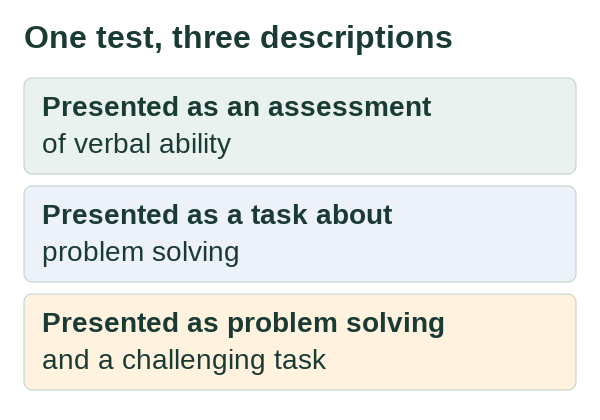
In Studies 1 and 2, Steele and Aronson changed one thing. They varied whether a hard verbal test was said to measure ability. In the ability-diagnostic condition, the test was said to measure ability. A poor score could then confirm the racial stereotype about intellectual ability. Scholastic Aptitude Test scores were held constant. Black participants then scored below White participants. No such gap appeared when it was not. A third study found that making the test ability-diagnostic brought the racial stereotype to mind. It made participants want to avoid fitting it or being judged by it. A fourth study showed that simply making the stereotype noticeable could lower Black participants' performance. This happened even when the test did not measure ability.[1][8]
A 2012 study compared threat with priming, in which a stereotype is simply brought to mind. Threatened women wanted to disprove the negative maths stereotype. They did worse because they were more likely than the control group to use a wrong but habitual approach. Women primed with female gender ideas performed poorly for a different reason. They withdrew effort.[9]
The 1995 paper examined Black participants taking a verbal test. The 2012 study examined women taking a math test.[1][8][9] A review notes that the topic is still hotly debated and studied. The work spans educational, social and organizational psychology.[2]
Over time, this discomfort can lead to defensive responses. One example is pulling away from fields where the stereotype applies. That pulling away can then harm intellectual growth. A person may end up matching the reputation.[10]
History
Where the idea came from
The idea began with a 1995 experiment by C. The students were high-ability African Americans. Their scores dropped when race was made noticeable.[12]
The 1995 result was widely misread. This happened in both popular and scholarly publications. Readers took it as proof that removing stereotype threat removes the African American-White score gap. That reading goes beyond the data. The scores were adjusted by statistics. This corrected for differences in the students' earlier SAT performance. Without stereotype threat, the two groups differed by about the amount their earlier SAT scores would predict. Sackett, Hardison and Cullen therefore warned against treating the experiment as evidence. It does not show that stereotype threat is the main cause of African American-White differences on tests.[12]
A 2005 comment argued about the statistical method used to adjust those scores. That method, analysis of covariance, does not fit stereotype threat experiments. This method compares group averages after adjusting for a related measure. Stereotype threat theory implies that the assumptions behind that method are broken. This can distort the adjusted averages and the error rates.[13]
Some psychologists have raised concerns about the quality of stereotype threat research. They suggested that its apparent effects are too large. A 2024 protocol set out a planned meta-analysis. It was limited to African Americans.[14] A meta-analysis is a statistical method that combines the estimates from two or more similar studies into one overall estimate of an effect.[15]
How the idea was first tested
Steele and Aronson set out this idea in a 1995 paper in the Journal of Personality and Social Psychology. Their first experiments asked whether that risk could change how well Black students did on a hard verbal test. The studies differed in one way. They varied whether participants were told a hard verbal test measured ability. In Studies 1 and 2, they varied whether performance was ostensibly diagnostic of ability. This varied whether participants faced the racial stereotype about intellectual ability.[16]
When it was not, that difference did not appear. Study 3 found that calling the test ability-diagnostic activated the racial stereotype in these participants. That activation also gave them a reason not to fit the stereotype.[16]
Claude M. In Studies 1 and 2, one thing varied. Was the test presented as diagnostic of ability? That wording decided whether they faced the risk of confirming the racial stereotype about intellectual ability.[17]
Main ideas
Working memory and mental load
One leading account of stereotype threat is a mental load account. The situation uses up working memory. In 2003, three experiments tested one idea. Does stereotype threat lower test scores by reducing this capacity? Priming a negative stereotype about their group reduced women's working memory capacity in the first experiment. It reduced Latinos' capacity in the second. A third experiment found that a drop in working memory capacity carried the effect of stereotype threat on women's math scores.[18]
Later work asked which kinds of problems suffer most when working memory is under strain. Five experiments used math problem solving. Stereotype threat harmed problems that rely heavily on working memory. The harm was strongest for the phonological part of the system. The same work showed one route to relief. Practice once-susceptible problems heavily, so answers come straight from long-term memory instead of being worked out by a method that strains working memory. It also showed when the effect carries over onto later tasks. Those tasks are unrelated to the stereotype but depend on the same mental resources.[19]
A 2014 study examined three basic executive functions: inhibition, shifting and updating. In Experiments 1 and 2, women under threat showed weaker inhibition and weaker updating. Their math scores were also lower. This was compared with women in a control condition and with men. Only updating explained the women's poor math performance under threat.[20]
A 2004 experiment used heart rate variability to measure mental workload. Participants took a modified version of the Raven Advanced Progressive Matrices Test. It was presented as a measure of cognitive ability. Some people face a reputation of lower intellectual ability. When the same test was not presented that way, the gap between the targeted group and the control group disappeared.[21]
Not every study finds the classic pattern. A 2025 paper reports both a null result and a moderator. Two experiments used the verbal and quantitative sections of the Graduate Record Exam. Experiment 1 ended with 447 participants. It was 166 in Experiment 2. Holden, Goodwin and Conway found little strong evidence for the usual race by condition interaction. For Black students, however, higher trait working memory capacity was linked to higher standardized test scores under race-related stereotype threat. That pattern makes capacity a moderator of the threat effect. It is not only a mediator.[22]
Anxiety, worry and negative thinking
One proposed route from that unease to weaker test scores runs through anxiety. One study recorded skin conductance, skin temperature and blood pressure. Students worked on a hard math task at the time. Students were assigned at random to a high or a low stereotype threat condition. Skin conductance, skin temperature and blood pressure all changed significantly with the condition.[23]
O'Brien and Crandall tested whether arousal explains the score effects. Each participant took one difficult math test and one easy math test. Some women were told the test was known to show gender differences. On the easy test, they scored better than women in a no differences condition. On the difficult test the same women scored worse. The instruction did not affect men's performance. The data did not fit explanations based on expectancy, evaluation apprehension or persistence.[24]
Negative thinking offers a more specific candidate: thoughts about the test and the subject. One experiment put 60 female participants in a stereotype threat condition or a no-threat condition. They then took a difficult math task. A thought-listing method recorded the thoughts women reported. Women under threat reported more negative thoughts. These were tied to the test itself and to mathematics. Their performance also fell sharply. The drop was largest in the second half of the test. In statistical terms, the rise in negative thinking accounted for that drop.[7]
A systematic review searched electronic databases for studies published between 1995 and 2015. The topic was what mediates stereotype threat. It found 45 experiments in 38 articles. They tested 17 proposed mediators. The review sorted these into 6 emotional or subjective mechanisms, 7 cognitive mechanisms and 4 motivational mechanisms. Support was found for anxiety, negative thinking and mind-wandering. These are said to use up working memory under threat. No single mediator got clear support. Threat seems to affect different social groups in different ways.[25]
Worry can also be measured from written thought records. An experiment used 102 university students in courses where maths matters. It first lowered or preserved their self-control capacity. Threat was then induced for the women but not the men. Students reported their thoughts three times during a math task. When self-control capacity was fairly low, women reported stronger worry than men. This held in the first two thought reports. When capacity was fairly high, women and men did not differ much in reported worry at any point.[26]
One study asked people of North African origin living in France how they judged a stereotype threat situation. Did they see it as a threat or as a challenge? They read the situation as more of a threat and less of a challenge. Only the challenge appraisal linked stereotype threat and performance. The threat appraisal did not.[27]
Effort, strategies and appraisals
One explanation holds that stereotype threat makes people try harder.[28] This is the mere effort account. It argues that people facing a negative stereotype about their group become motivated to prove it wrong. That extra motivation strengthens a prepotent response. This is the response that comes most readily. Where the prepotent response is correct, performance holds up; where it is wrong, performance falls.[28][29]
In a later study, women under stereotype threat chose more equation-style math questions than estimation questions. This fits the idea that they were motivated to perform. In a second experiment, a stronger ability to hold back impulses protected overall math scores. Inhibitory ability is the capacity to hold back an automatic response. It did not protect the estimation questions.[29]
Seibt and Förster examined how switched-on self-stereotypes shape the strategies people use to solve a task.[30] A negative stereotype about a group's ability is said to cause a prevention focus. That is a state of watchfulness.[30][31] A positive stereotype causes a promotion focus, a state of eagerness. In one set of studies, a negative group stereotype led to better recall of statements about avoidance.[30]
The regulatory mismatch account adds the reward structure of the task. People are more flexible when their focus matches the task's reward structure. Stereotype threat is said to arise when a prevention focus meets a task with a gains reward structure. When the task instead rewards avoiding losses, people holding a negative stereotype showed flexible performance. This pattern appeared in Experiment 1, with long-held stereotypes and Graduate Record Examination math problems. Experiments 2A and 2B found it using primed stereotypes and a category learning task.[31]
Cadinu, Maass, Frigerio, Impagliazzo and Latinotti studied expectancy. They asked whether it helps explain lower performance under stereotype threat. In one experiment, female students were told that women do worse than men on logic and math tests. Women told that women perform equally or better did not show this. Expectancy partly explained how the stereotype affected performance. A second experiment studied Black Americans who live in Italy. Negative information about the group led to lower expectations and weaker performance. This held in both the minority and majority conditions. Expectancy explained the drop for participants in the Black condition. It did not explain the drop for those in the American condition. This suggests the processes behind similar gaps may differ.[32]
Cadinu, Maass, Lombardo and Frigerio tested locus of control beliefs as a moderator of stereotype threat effects. In two experiments, participants with an internal locus of control generally performed better. They also showed a sharper drop under stereotype threat. This was more than those with an external locus of control.[33]
One further finding concerns whether the experimenter can evaluate performance at the level of the group. This was the first direct test of the idea that an evaluative source is needed. Participants were told their scores would be pooled across gender or kept separate by gender. The gender stereotype was equally strong in both conditions. But performance dropped only when scores were split by gender. That result suggests someone else must do the evaluating. Only then does stereotype threat lower performance.[34]
Different threats for different groups
A 2007 framework proposed that the single label "stereotype threat" hides six separate threats. The six come from two dimensions. One is the target of the threat. The other is its source. The source of the threat can be the self, outgroup others, or ingroup others.[35]
Some groups are less likely to accept the stereotype. These include groups defined by religion, race or ethnicity, and people blind from birth. They reported fewer self-as-source threats. Some groups identify less with the group. These include people with mental illness, people with obesity, and people who went blind later in life. They reported fewer group-as-target threats.[36]
Belonging to a stereotyped group can push performance toward the stereotype. This happens for positive stereotypes as well as negative ones. One study compared Asian Americans, who face a positive math stereotype, with Latinos, who face a negative one in the same subject. An ethnicity cue was present in the test setting. Highly identified Asian Americans then did better, and highly identified Latinos did worse. The cue did not affect the performance of participants with low ethnic identification.[37]
A study in Germany looked at migrants of Turkish origin. People often stereotype this group as low in verbal ability. It compared them with German students. The first study had 107 participants. It confirmed that the groups held similar views about the nature of intelligence. Two experiments followed, with 182 and 190 participants. A test was described as a measure of verbal intelligence. A stronger belief that intelligence is fixed then predicted threat effects for Turkish-origin students. The same belief predicted lift effects for German students in the third study.[38]
The conditions were a stereotype favoring boys, a reverse stereotype favoring girls, and no information. Girls showed no significant differences between the control and experimental conditions. In the counter-stereotypical condition, boys' self-esteem and performance fell a lot compared with the control condition. Boys also showed a significant rise in both measures in the stereotypical condition, compared with the control.[39]
Stereotypes can also work through the identities a person holds at the same time. Four experiments paired a positive self-relevant stereotype with a negative one. This removed stereotype threat effects. The positive stereotype made women's college student identity easier to bring to mind. It held back their gender identity. This removed the working memory deficits. It also removed the drop in math performance that came with it.[40]
A study looked at high-achieving Black and Asian STEM college students. It described both threat and lift in their experiences. The students reported anti-Black and pro-Asian feeling. The study framed this through stereotype threat and stereotype lift. Both groups felt emotional distress. It came from a constant drive to succeed that carried big costs. The students felt weighed down by being stereotyped and judged unfairly. This happened even when they were praised for fitting or defying stereotypes.[41]
What makes some people more vulnerable
A 2006 study put African American students at random into a low threat, a medium threat, or a high threat condition. Students scored much better on a verbal task taken from the GRE in the low threat condition. Racial identity attitudes changed the picture. Under low threat, students who strongly endorsed Internalization status attitudes solved more items than students who did not. That gap held after controlling for SAT verbal score.[42]
One study looked at 220 students in Austria. A strong tie to one's ethnic and cultural group reduced the stereotype threat effect. So did a school climate seen as warm. The study notes that evidence on these questions in German-speaking countries is limited and contradictory.[43]
In a 2023 study, women filled out a gender role orientation inventory. They then did a two-dimensional mental orientation task under gender stereotype threat. Women with a female gender role orientation performed worse than those without it. Telling some participants that stereotype threat could interfere with spatial performance did not change that relation.[44] A 2020 latent class analysis of 413 undergraduates in the U.S. and Colombia sorted students into susceptibility profiles.[45]
Across 4 experiments, people under threat tried to control how they showed anxiety. That emotion regulation used up mental resources needed for the test. Threatened people were given a way to cope, such as rethinking the situation or what their anxiety meant. Those resources came back and test scores rose.[46]
Engagement regulation means raising or lowering how much self-esteem is invested in a domain after good or bad outcomes. In 2 experiments with women, positive feedback raised engagement most strongly under stereotype threat. Under threat, greater engagement after positive feedback improved performance. Greater engagement after negative feedback lowered self-esteem and performance.[47]
Across 4 experiments, women primed with competition did worse in math. They feared confirming the negative stereotype about women's math ability. The same priming made men do worse than women on a verbal task, where men face a negative stereotype.[48] Two experiments treated stereotype threat as a case of status concern. In Study 1, women with high testosterone levels did poorly on a math test. This came after a negative performance stereotype was primed.[49]
In a statistics course, women taught by a female instructor failed the first exam at higher rates than men at first. More time with that female role model reduced the deficit for women. This held by the end of the semester. For women, math anxiety and anxiety about that particular class both went with endorsing the gender and math stereotype. For men, neither the instructor's gender nor support for the stereotype was linked to anxiety or performance.[50]
A 2014 analysis looked at black college students in a national survey. It found weak and mixed evidence that institutional features shape stereotype threat. The effect was conditioned more consistently by individual factors. These included skin color, multiracial origins, and an integrated upbringing. Most of the effect on grades came through internalization. Students took in negative stereotypes and tried less, which in turn lowered their grades. Immigrant origin offered some protection, though its final effect on grades was rather small.[51]
How threat changes what students do
A 2008 process model asks a question. How does a negative stereotype about a group actually damage a test score? The model names three mechanisms that work together. They are a bodily stress response, close watching of one's own performance, and efforts to push away bad thoughts and feelings. Together these mechanisms use up executive resources. These are the mental control processes that complex cognitive and social tasks require. Stress is said to harm prefrontal processing directly. On sensorimotor tasks, which need automatic rather than controlled processing, the watching mechanism disrupts performance by itself.[52]
A 2010 account breaks the process into smaller steps. A reminder of a negative stereotype prompts doubt and a search for signs that one is proving it true. Watching for failure and holding back negative thoughts and feelings then take over working memory. This is the mental workspace needed for complex cognitive tasks. The account also offers hope: if stigmatized individuals reinterpret their experience, the performance gap between groups can shrink or even close.[53]
Threat can also interfere before a solution is reached, at the stage of choosing a strategy. In one study, women did worse than men on a word problem test. Women and men did equally well once the same problems were turned into their numerical equivalents. A second study used difficult problems. Women were less able to form problem-solving strategies when threat was high than when it was reduced. The 2001 paper links this difficulty to cognitive resources. It also links it to gender differences on math tests.[54]
What students expect of themselves may carry part of the effect. On a math test, women first listed academic traits that men and women share. They then gave themselves higher predicted scores than a baseline group did. The study found that performance expectancies partly explained the link between the task and math performance. No effects appeared for men's performance expectancies on an English test.[55]
Emotion is another route, and one study tested it in ordinary classrooms. The experiment changed whether a math test was described as gender fair. It ran in high school classrooms, not a laboratory. The threat effect appeared in this everyday setting. Dejection emotions, a low and discouraged mood, mediated the effect of the threat manipulation on women's math performance.[56]
Domain identity and racial identity act as boundary conditions on when threat appears. One study asked whether threat would occur on a test whose consequences were linked to performance. It also asked whether threat from one test would spread to another measure in the same session. Threat did affect test scores, but the link depended on both domain identity and racial identity. Black test-takers who stopped identifying with their race during the session did better on the cognitive ability test. No such link held for Whites. Those in the threat condition also performed significantly better on a personality test, for which no stereotype exists, so threat can generalize.[57]
Threat in mathematics and science
A 2003 study used a shortened version of the Fundamental of Engineering Exam. When the test was described as a measure of ability, women scored worse than men. The same test was then described as non-diagnostic, or as one that does not produce gender differences. Women did just as well as men.[58] A 2005 review noted that girls' math grades are often higher than boys'. Yet their math test scores start to differ from boys' in early adolescence.[59]
A 2016 pre-registered experiment tested 484 undergraduates, 242 women and 242 men. They were matched on SAT-M scores within plus or minus 40 points. The threat condition lowered women's scores on a 20-item GRE-Q test by 2.84 items, an effect size of d=0.42. It did not lower men's scores (d=0.04). Working memory capacity, measured by the operation span task, mediated 48.4% of the link between threat and performance in women.[60]
Not every study agrees. A 2024 study looked at 40 female undergraduates. It found no effect of a gender-related prime on scores on the D'Amore Test of elementary arithmetic. In that study, 67.5% of the subjects failed the D'Amore Test. No consistent correlation appeared between those scores and IQ scores.[61]
Threat may also shape choices rather than only scores. A 2023 study used random classroom assignments in the China Educational Panel Survey. It found that a higher class rank raised STEM aspirations less for girls than for boys. That gender gap in the effect of rank was larger among students exposed to more gender-math stereotypes from classmates.[62]
A 2026 qualitative study interviewed five Chinese pre-university students. It reported that gendered treatment and biased attributions triggered self-identity threat, while family support and female role models buffered it.[63] A 2017 mixed-methods study looked at 77 sixth graders in two urban Midwestern elementary schools. African American girls gained more in math in single-sex classrooms than in coeducational ones.[64]
A 2013 review brought together findings on maths anxiety and on stereotype threat. The review proposed that the two share a common underlying mechanism that disturbs mathematics performance and can lead students to avoid mathematics and related fields.[65]
The scale was tested on 1,241 Polish secondary school students aged 13 to 16, chosen to match the national population. The scale came in two parallel versions: one for girls in mathematics and one for boys in language arts. The scale measured one general factor, and its variances were equal for boys and girls.[66]
In computer science, women remain significantly underrepresented. The gap shows in traditional classrooms and on online learning platforms. One analysis looked at 338,459 negative reviews from 8,067 IT and software courses on a single online course provider. It found that men and women criticize similar topics. Within each topic, however, male and female reviews differed in communication styles, demands and areas of emphasis. Ten expert interviews helped the researchers build propositions and seven guidelines for gender-inclusive online courses. They drew on stereotype threat theory.[67]
A separate review looked at inclusive design in massive open online courses, or MOOCs, which are large open courses delivered online. It notes that women and racial minorities remain underrepresented in computer science and mathematics. That review calls for further investigation into how such courses should be designed.[68]
It is also the worry of being judged through that stereotype. A 2024 paper reports that it affects women on math and logic tasks. It also affects African Americans on intelligence or verbal tasks. The review adds that the immediate effect is often worse performance in the stereotyped field. It also states that the threat appears in children at an early school age.[69] Classroom and test studies have looked for these effects in particular subjects and conditions.[70][71][72]
One physics paper examines Evidence-Based Active Engagement (EBAE) strategies. These require students to take an active part in their learning. The paper calls such research-based approaches Evidence-Based Active Engagement strategies.[73]
A 2013 study looked for gaps in three introductory science courses. The courses were biology, biochemistry and physics. A short writing exercise on personal values had no effect on performance in those courses. The researchers read this as evidence that gaps and threat depend on context. They called for replication across student populations.[70]
A 2004 study looked at the Graduate Record Examinations General Test, or GRE. It reduced item difficulty through a computer-adaptive version of the test. Easier items did not significantly change test performance or explicit measures of threat for Black and White students or for men and women. Some symptoms or after-effects of threat did change, mainly for White students and women.[74]
A 2023 experiment used 10th-grade high school students. It gave them two kinds of threat instructions before a math test. Among female students, the groups did not differ much in academic success. Among males, the first threat group scored higher, and that group showed the greatest gap between genders. State anxiety rose in the female experimental groups. Anxiety explained the link between threat and success. Awareness of the stereotypes was low in both genders, and boys were more aware than girls.[75]
A study of a female maths teacher treated her as the actor in her own conduct. It did not treat her as an object of observation. It reports that the easiest way to reduce the threat, in psychological terms, is for the teacher to lessen her sense of gender identity.[76]
Research on younger students is thinner, and a 2010 paper notes that little had been published on threat with K-12 students. That study examined a middle school that was mostly Latino and African American. There, prior standardized test scores correlated significantly with expectancy and performance. Threat status significantly lowered expectancy only for moderately performing students, those likely working at the edge of their knowledge.[71]
A 2017 study tested 81 African American and Latina/o elementary children together in Miami, Florida. Presenting a reading test as a measure of ability hindered African American children. It did not hinder Latina/o children. They trended toward stereotype lift, a gain rather than a loss.[72]
Research
Groups and domains studied
A 2007 study of 476 Italian elementary school children found gender gaps in confidence about math. It also found gaps in the belief that mathematics is a male subject. The same study looked at 10-year-old girls. They did worse on a math task after a reminder that great math achievement is usually male. There the patterns seen in elementary school become fixed. The stereotypes begin to lower girls' performance.[77] A lab experiment used 120 Latino and White college students. It found a gender-based threat effect on a test of math and spatial ability.[6]
Social class is another area. A 1998 experiment changed the instructions given with an intellectual test. The test was described as a measure of intellectual ability. Students from poorer families then did worse than students from wealthier families. The same test was then presented as giving no information about intellectual ability. The low-income students' performance did not suffer. That result challenges claims of socioeconomic differences in intellectual ability.[78]
Boys have been studied as a threatened group in schoolwork. Men have been studied as a threatened group in language.[79][80] One study looked at 238 children aged 4 to 10. Girls from age 4, and boys from age 7, believed boys do worse than girls in school. There were 162 children, aged 7 to 8. They were told that boys usually do less well than girls at school. Boys then scored lower on a reading, writing and math test. Girls' scores did not change. There were 184 children, aged 6 to 9. Boys did better and girls were not affected.[79]
The language case is less settled. Four experiments with 542 participants tested whether the belief that women have better language skills would harm men. Those experiments found little evidence of threat effects on men's language task scores. They also found little effect on men's sense of belonging in language fields.[80]
Roma students in Slovakia have also been tested. A 2021 experiment used both online and face-to-face testing. Stereotype threat did affect the academic performance of Roma participants. They were tested face to face.[81]
Older adults face a different threat: the belief that thinking skills decline with age. A 2017 review argues that this age-based threat is a self-concept threat. It is a worry about one's own abilities. It is not a group-reputation threat, a worry about how the group looks.[82]
How large the effects are
One 2008 meta-analysis of stereotype threat experiments found an overall mean effect size of |.26|. That figure covers studies of minority students and of women.[3] An effect size is a statistical calculation of how large a measurable effect is, for example the difference between the averages of two groups divided by the standard deviation.[83] The review reported that effects varied by group.[3]
A 2015 meta-analysis looked only at girls under 18. It found a mean effect size of -0.22 on math, science and spatial skills tests. That estimate was clearly different from zero. But the review found several signs of publication bias.[5]
In the 2008 review, women showed smaller drops in performance than minority students. This was when tests were hard. The mean ds were |.36| and |.43|. For women, subtle cues that raised the stereotype gave the largest effect, at |.24|. Blatant cues came next at |.18|. Then came moderately explicit cues at |.17|. For minorities, the pattern reversed. Moderately explicit cues gave the largest effect at |.64|, then blatant cues at |.41|, then subtle cues at |.22|. How strongly women identified with math also mattered. Moderately identified women showed |.52|, highly identified women |.29|, and low-identified women |.11|.[3]
Other meta-analyses have measured effects in different settings and groups.[84][85] A 2011 meta-analysis found a moderate improvement of d = 0.52 for African American and Hispanic American students when the stereotype threat was nullified. That review found no differences between the two groups. It also found none between the methods used to create the threat.[84]
A meta-analysis looked at 33 experiments with 1,831 participants. It examined threats created by media portrayals of negatively stereotyped groups. It found an overall mean effect size of d = -0.38, which supports the stereotype threat assumption.[85]
How the effect is measured in studies
The 1995 studies that named the effect had Black participants take a hard verbal test. The researchers changed how the test was described. Sometimes they called it a measure of ability. They did not when it was described as nondiagnostic. Scholastic Aptitude Test scores were controlled. A fourth study in that set showed that just noticing the stereotype could hurt Black participants' performance.[86]
In one experiment, 194 undergraduates were told that men outperform women on a visuospatial test. Others were given no gender information, or told that men and women do not differ. The effect was strongest on the difficult line judgments.[87] A study of 102 elementary statistics students used four conditions: explicit threat, implicit threat, reverse threat, and nullified threat. That study found no gender differences by condition in statistics self-efficacy, test anxiety, or performance.[88]
A job description quietly carried the stereotype that women are not suited to managerial jobs. Four HR managers rated the interviews. Women in the threat condition did worse than the control group and worse than men in the threat condition.[89] In a physical education study, 114 schoolgirls were told that boys sprint faster. Girls under that condition sprinted much more slowly than the control group.[90]
One set of field experiments asked students about their ethnicity and gender before they took the Advanced Placement Calculus AB Examination or the Computerized Placement Tests. That inquiry had no effects on test performance for Black, female, or other subgroups. None were both statistically and practically significant.[91]
Two field experiments with Palestinian citizens of Israel used tests like psychometric tests. The first had 135 Arab high school students. Activating the stereotype of lower academic ability lowered performance compared with a control group. The second had 115 Arab students in preparatory courses. A direct manipulation produced stereotype reactance and raised performance. An indirect manipulation lowered it.[92]
One study tested men and women on math. Men did better under threat than under lift, while women did better under lift than under threat.[93] Other studies test whether threat affects groups that work together. An experiment compared individual women with groups of women on a math and logic problem under threat. Threatened groups did better than the best individuals and did as well as non-threatened groups. They avoided problem-solving errors.[94]
One experiment put 216 deaf, 128 hard of hearing and 152 hearing college students into a threat or no-threat group at random. The test items covered arithmetic, modular arithmetic, and quantitative problems like those on the Graduate Record Examination. Deaf and hard-of-hearing participants under threat scored lower than those in the no-threat condition. Exploratory analyses also found that female participants scored below male participants.[95]
Threat and memory in later life
Older adults can show weaker memory on tests when a negative cultural belief about aging and memory is activated, a pattern studied as age-based stereotype threat.[96][97] In a 2003 study, 48 young and 48 older adults took a recall test. Conditions varied how strongly the negative aging stereotype was brought to mind. The strongest threat condition lowered older adults' recall below that of younger adults. It also fell below older adults who did not experience threat. The drop was larger for older adults who valued their memory ability more. Threat also changed the memory strategies they used.[96] A 2009 study found that older adults who reported feeling more threatened by the stereotype recalled less of a prose passage. They also reported a greater loss of positive emotion.[98]
Threat appears to draw on working memory, the mental workspace used to hold and handle information for a short time. One experiment found that threat weakened the controlled use of memory. At the same time, it made automatic responses stronger.[99]
A 2025 review pooled 20 studies with 22 samples of adults 59 and older. Subtle threat cues harmed working memory in five of eight samples (62.5%). Blatant cues did so in only three of 14 samples (21.4%). The review found no steady link between participants' demographic traits and threat effects.[100] In a 2020 study of 66 independent older adults, threat instructions lowered memory self-efficacy but did not change memory scores.[101]
Threat can also affect memory distortion, which one review defines as errors in memory associated with gist-based errors or source misattributions.[102][103] Older adults under threat had lower intrusion rates in free recall. They made fewer false alarms on a recognition test, though they also recalled fewer correct items.[102]
A 2021 review found that some experiments link threat to age differences in memory distortion. Others report little or no impact.[103] In a study of 82 adults aged 60 to 70, perceived threat alone did not raise false recall. Among more educated adults, it did.[104]
Threat improved scores on practice exercises and a later knowledge test.[105] Over 24 months, threat levels fell in a memory training group but not a health training group. The change was moderately related to change in verbal memory.[97]
Culture may buffer the effect. Chinese older adults in the United States showed impaired memory under threat, but a reminder of Confucian filial piety removed the deficit.[106] Education may matter too. The 2020 study's participants were highly educated, and the researchers suggested this may have protected them.[101]
In practice
Threat in real classrooms and tests
A 2007 study gave the first evidence that middle school girls show a performance deficit in near-ordinary classroom conditions. The girls were simply led to believe that the task at hand measured mathematical skills. The gap appeared when girls worked alone. It also appeared in mixed-gender groups. It did not appear in same-gender groups.[11]
Another classroom study tested 108 high school students. They solved maths problems of different difficulty levels. Half were told the test had been shown to produce gender differences. Female students who identified strongly with maths did worse under the threat condition. On hard items, low identifiers did better under threat than without it. High identifiers showed the opposite pattern. This interaction did not appear on easy items.[107]
A study of 498 middle school girls compared a stereotype threat condition with a control group. The girls were in standard and honors math classes. Whether that identity protected a girl or put her at risk differed by math education setting. For girls in honors math, gender identity protected their attitudes. It was a risk factor for their math performance.[108]
One study looked at 198 African American children at an urban elementary school. It presented a reading test as a measure of ability. This diagnostic framing lowered the performance of children who knew about racial stereotypes. It did not hinder children who did not know about them. For stereotype-aware children, the effect was strongest among those who placed greater value on achievement. Identifying with a field also came with more anxiety and lower self-efficacy.[109]
A study at working GRE General Test centers looked at the testing environment. It asked which parts might cue stereotype threat. These parts included the gender and ethnicity of test proctors. They also included how large, how busy and how sociable each test center was. The analyses found several links between surroundings and test score changes for all groups. The study found no direct support for stereotype threat. Some effects for proctor ethnicity even went against a stereotype-threat explanation.[110]
A large assessment study used math and reading tests from the Education Longitudinal Study of 2002. These are low-stakes tests. Neither their reading scores nor young women's math scores fell. How strongly test takers identified with math and reading did not change the size of any score decrease. This held for Black test takers and for women.[111]
The National Assessment of Educational Progress is a large, representative assessment of U.S. children. Its data allowed a natural field experiment. By a quirk of the design, students are randomly assigned test blocks. Some blocks include gender prime questions and others do not. For some primes, girls did better than boys. The study calls this stereotype reactance. For other primes, girls did no worse. The findings suggest that stereotype priming effects matter outside labs. They also suggest that the effects depend on the exact wording of the primes.[112]
Threat as a barrier to learning
Stereotype threat does more than lower a score on the day of a test. It also harms the studying done before the test. It harms the learning that should follow from mistakes.[113][114][115]
Black students in the threatening condition did worse, even on the warm-up. The warm-up itself was not threatening. White students were not affected. A value affirmation removed the learning effect in a second experiment.[113]
Threat also gets in the way of test preparation. That is the work of building an ability rather than showing it. A survey asked 1058 people. Respondents knew a stereotype: women are less able than men at preparing for science and math tests.[114]
Women took a maths test in the style of the Graduate Record Examination. They got feedback on accuracy after each problem. They could then enter an optional tutorial that gave step-by-step instruction. Learning was measured as success in applying the tutorial to the first errors. This was on a surprise retest 24 hours later. Without threat, emotional responses to negative feedback did not reduce use of the tutorial. How much they explored predicted learning success. Under threat, a stronger first reaction to failure predicted less exploration. Paying steady attention to the negative feedback predicted poor learning from what was explored.[115]
Even basic perceptual learning can be blocked. In one task, women searched a display of two or four Chinese characters for a target character. Search rate normally speeds up with training. Search rate rose across a training session for a control group of women. It did not rise for women under stereotype threat. A later color task showed that women trained under threat had not learned the automatic attention response to the target at all.[116]
Threat can also lower the wish to improve. In a study of 80 participants, 54 of them female, women were told one of two things. Either men do better than women on a mathematics test, or men and women perform equally well. Women under threat got negative feedback. They were also less motivated than other women to attend free mathematics tutorials. Feedback had no effect on women's self-esteem. Men's self-esteem was higher after positive feedback than after negative feedback.[117]
Over years, threat may push people out of a field. A national panel of minority science students was followed for 3 academic years. The experience of stereotype threat was linked to scientific disidentification. This means a pulling away of the self from the field. That loss of identification, in turn, predicted a significant drop in the intention to pursue a science career. Race and ethnicity changed the size of the effect. It showed up for Hispanic and Latino students. It did not show up for all African American students.[118]
Reducing threat in practice
Researchers have tested simply telling students about stereotype threat as an intervention. Women did worse than men when the problems were called a math test and threat was not discussed. For women, linking their anxiety to gender stereotypes went with lower performance in the math-test condition. It went with better performance after the teaching intervention.[4]
The number of women present during a test has also been varied. One hundred and forty-four women took a modular arithmetic test. They took it alone or in same-sex groups of 3 to 5. Women solved fewer problems under two forms of stereotype threat when tested alone. These deficits disappeared in single-sex groups.[119]
Coping sense of humor has been linked to better math performance under threat. This was a correlational study. Women low in coping sense of humor rated their performance on standardized math tests lower than men did. It did not go with better performance without threat. They felt less anxiety during the test.[120]
Retraining has been used to change attitudes and stereotypes themselves. Women trained to hold a more positive math attitude showed more math motivation. The effect was larger when negative stereotypes were primed in subtle ways. It was also larger when they were reinforced indirectly. Attitudes did not affect working memory capacity. Women trained to link being female with being good at math gained working memory capacity. That increase in turn led to their improved math performance.[121]
Interventions may need to match the kind of threat a person experiences.[122] Timing may matter as well. In one experiment, 140 women and 60 men were randomly assigned to one of four conditions. There were four conditions: control, threat only, threat removed before learning, and threat removed after learning. Learning and transfer were poorer for two groups of women. One group was in the threat-only condition. In the other, the threat was removed after learning but before assessment.[123] A separate study with 44 women found that only women given both a misattribution cue and a chance to affirm the self outperformed counterparts given neither strategy.[124]
Interventions that reduce threat
Several tested approaches try to weaken stereotype threat, the apprehension people feel when a negative belief about their group could apply to them.[125][126] A 2021 meta-analytic review, which pools results across many studies, sorted these approaches into three types. These were belief-based, identity-based and resilience-based. The review pooled 251 effect sizes from 181 experiments. It reported an overall d = 0.44 in favor of the intervention group over the control group. All three types helped counter stereotype threat. The review traced 11 specific strategies. It found that 9 of them produced significant effect sizes.[126]
A 2015 paper on first-year logic classes counts telling students about stereotype threat among the successful strategies. It also counts questioning the view that logical intelligence is fixed at birth. The same paper recommends making students in threatened groups feel welcomed. It also recommends role models who do not fit the stereotype. It proposes presenting logic through angles that do not clash with students' current thinking. Examples are logic as a language and logic as aesthetic enjoyment.[125]
In an experiment with grade-11 girls, a growth mindset shielded students from math-gender stereotype threat, while a fixed mindset left them exposed to it. Growth mindset training for girls with a fixed mindset reduced the effect of that threat on their math performance.[127]
Interventions that ask students to reflect on their several identities, rather than a single one, have also been tested. In a randomized classroom quasi-experiment in Austria (N = 452, mean age 15.15, 67.7% female), second-generation students of migrant descent did worse when a stereotype was activated. For those students, the multiple identity intervention went with better performance. But the effect appeared with or without stereotype activation, so it warrants caution. First-generation students of migrant descent showed no significant effects. Their small numbers may have left the study with limited statistical power.[128]
Self-affirmation, in which people write about values that matter to them, has been tested against a different kind of threat. Three experiments examined White participants. They took the race Implicit Association Test (IAT). Participants showed a stereotype threat effect when they believed the test was diagnostic of racism, scoring more pro-White. The effect was larger for those highly motivated to control prejudice.[129]
Larger support programs may change how stereotype threat affects students' choices rather than removing the threat itself. The analysis drew on a national sample. It followed students in the National Institutes of Health Research Initiative for Scientific Enhancement training program, alongside a matched comparison group, for 6 years. Program membership did not shield students from stereotype threat. But it changed their later responses and in the end their academic outcomes. Nonprogram students were less likely than program students to stay in the sciences. Part of the reason was that stereotype threat feelings curbed their mastery goals.[130]
Threat in classrooms and at work
A 2013 article by Johnson-Ahorlu in The Journal of Negro Education takes its title from the phrase "Our biggest challenge is stereotypes". It addresses the academic experiences of African American undergraduates.[131] A 2015 narrative study of African American female engineering students found five shared themes. One was excessive competitiveness with other students, especially other females. The themes also covered unease in cold and unwelcoming settings, staying quiet, and relying on knowledge from others.[132]
A 2015 study looked at three African American male preservice teachers, people training to become teachers. It described intense forms of threat in teacher education. Its themes were stereotype threat, dealing with marginalization, and important role models.[133]
A 2022 mixed-methods study interviewed preservice teachers after an intervention. On average, the intervention reduced bias as measured by the implicit association test. Participants also believed the intervention had made them aware of their own biases. They believed they could change them.[134]
A 2019 survey of 159 prenursing students found stereotype threat significantly related to race and ethnicity. It found no significant relationship between threat and academic success. That survey used Picho and Brown's Social Identities and Attitudes Scale.[135]
A 2019 study used a pupil survey database from Flemish urban secondary education. That system sorts students into separate tracks by level. Ethnic minority pupils in vocational education experienced the most negative teacher-pupil relations. They were also the most vulnerable to psychological disengagement. To protect their academic self-concept from stereotype threat, these pupils were also most vulnerable to discounting negative teacher feedback and to disidentification from education.[136]
A field experiment studied 11,624 Chinese vocational high school students. It primed half of them about their track before technical skill and math exams. The priming had no effect on technical skills and modestly improved math performance, contrary to the hypotheses. The authors proposed that vocational tracking may fix stereotypes in place while also weakening threat. This is because academic performance stops being the main yardstick of merit.[137]
A 2023 study used a mixed-methods design with 22 participants in two countries, all working in one large organisation. It examined performance on a leadership activity during video conference calls. Female leaders exposed to a male-gendered background felt more anxiety. On average, they scored lower than male colleagues or women shown a female-gendered background. The leaders knew the stereotype that leadership is White and male. They showed signs of long exposure to threat at work. The researchers said a larger sample in a more controlled setting could give firmer results.[138]
Stereotype threat is the worry that one might confirm a negative view of one's group. It can create subtle barriers to success for women and minorities in school and at work. A 2014 policy review calls it a subtle barrier. It can hold back women and minorities even where formal discrimination is banned. The review weighs four policies for narrowing group gaps in school and work. They are affirmative action, diversity training, identity-safe settings, and teaching coping strategies.[139]
Interviews with four Community Scholars at Texas Christian University examined how stereotypes about students of color shaped their classroom and social lives. The paper reports that these students faced identity contingencies, meaning situations where performance could be read as evidence about their group.[140] A qualitative case study looked at minority students majoring in science, technology, engineering and mathematics. It found that peer support could either lessen or increase stereotype threat. Support came from educators and family. It also came from internships and from using subject knowledge in practice. It used stereotype threat as its conceptual framework.[141]
Immigrant students may face stereotypes about their ability, and one set of experiments asked whether a teacher from the same minority background helps. The preservice teachers averaged 26.29 years old, and 75.2% were female. They rated a teacher with a Turkish name as less biased and more motivating than one with a German name, even when she voiced the stereotype. School students averaged 14.88 years of age, and 49.9% were female. Among them, the minority teacher was not seen as less biased than the majority teacher. Immigrant students with Turkish roots worried more than majority students that the teacher was biased. This held whatever her background. Immigrant students whose backgrounds were not Turkish learned less when the Turkish origin teacher voiced the stereotype. Students of Turkish origin showed no such loss.[142]
Teachers in Huaulu, a minority ethnic group on North Seram Island, face challenges. These come from their group's experience and from customary law. A questionnaire study of teachers in Huaulu, on North Seram Island in Indonesia, found that stereotype threat affected their academic performance. Ethnic identity and self-efficacy, a person's belief in their own capacity, each had a direct influence on performance as well. The study analyzed its survey data with multiple regression and with ANOVA, short for analysis of variance.[143]
Men can also meet negative stereotypes when they take jobs dominated by women. Among primary school teachers, men reported more stereotype threat than women. That feeling was linked to negative job attitudes for men only. That threat was in turn linked to intending to resign. It was also linked to feeling expected to do stereotypically masculine tasks.[144]
Neurodivergent employees, whose differences are not visible, respond to workplace cues much as other minority groups do. Two studies in a UK government organisation looked at anticipation of stereotype threat. One had 53 participants and one had 44 interviews. Participants used past personal and work experiences to judge whether a setting was threatening. They then adjusted that judgment after the event. Those judgments shaped whether they concealed or revealed their invisible difference. The researchers describe the work as interpretivist. They note that the sample came from staff within a UK government organisation.[145]
Stereotype threat has also been reported in dental training. There, a curriculum change made tensions between two groups of students worse. In a predoctoral dental program, students on a new curriculum (n = 44) felt heightened performance pressure. Students on the past curriculum (n = 43) saw them as overconfident. Stereotype threat was named as a factor that made these tensions worse and affected clinical performance.[146]
There were 114 participants: 53 reported a history of ADHD and 61 did not. Those with ADHD scored lower on verbal and quantitative GRE questions. Participants aged 18 to 24 with ADHD were openly exposed to the stereotype.[147]
What this looks like when you study
A study of 40 women in science and technology found that women under stereotype threat took poorer notes than women not under threat. A further study of 79 women found the note-taking drop was largest for women who cared most about the subject. A fourth study looked at 88 women. Threat also lowered how well they judged other people's notes.[114]
Boys did worse after hearing this on tests of reading, writing and math. Girls' scores were unchanged. That message improved boys' performance and did not affect girls.[79]
The experimental group heard their migrant background and group differences named outright. That mention lowered performance. A strong sense of belonging to the ethnic-cultural group and a positive school climate reduced the effect.[43]
Later developments
Threat across the lifespan and in new settings
A study of 124 children found that stereotype threat hurt girls' math performance from kindergarten through 2nd grade. In that study, the strength of the effect depended on the mother's beliefs. Girls whose mothers strongly rejected the math-gender stereotype did not drop under threat.[148]
A separate study of 240 six-year-old children found no sign that the children believed the math-gender stereotype. Yet girls, but not boys, held automatic associations that matched it. Those girls did worse on math when the setting matched the stereotype than when it contradicted it. Automatic associations carried part of that link.[149]
Older adults are another group studied for age-based stereotype threat. It is tied to negative age stereotypes about competence. A review and meta-analysis covered 22 published and 10 unpublished articles. It had 82 effect sizes from 3,882 people whose mean age was 69.5. It found a small-to-medium effect of age-based stereotype threat (d = .28). The effect was larger when the instructions invoked the stereotype rather than stating facts (d = .52). It appeared reliably when performance was measured soon after the manipulation.[150]
One small study looked at 33 adults aged 55 or older. It found no difference between a threat condition and a control on a smartphone task, time taken or anxiety. That study did find that the group aged 76 and over scored lower on the smartphone task than the other age groups. The researchers read this as a possible cohort effect.[151]
Roberson and Kulik (2007) summed up 12 years of findings. They looked at how often stereotype threat happens at work.[152] A later meta-analysis looked at 61 independent samples and 40,134 people. It found threat positively related to exhaustion, turnover intentions and negative affect. The same analysis found it negatively related to job satisfaction, job performance, self-efficacy and career aspirations. Some of those negative links were stronger for older employees than for female employees as the stereotyped group.[153]
A 2004 review asked whether athletic performance can be threatened. It noted that the mental processes blamed for drops on academic tests may not carry over cleanly to sport skills.[154] Scores fell significantly in the athletic ability condition. It tended to fall in the technical condition, compared with the control. Participants also endorsed a performance-avoidance goal over a performance-approach goal when the stereotypes were activated. That endorsement was not related to performance.[155]
Chess offers a case where the stereotype reached beyond the group it targets. In an online study, players faced an opponent. The opponent was really a computer program. It carried either a male or a female nickname. Those who faced the female nickname scored worse and lost more games. They also made more mistakes and blunders than those who faced the male nickname. The researcher called this pattern reversed stereotype threat. The effect fell on the opponent rather than on the stereotyped group.[156]
Money choices have also been tested. Across three studies, women who faced a stereotype threat in academic and business settings showed more loss aversion than men and women who did not. No gender difference in loss aversion appeared without the threat. The same pattern held for risk aversion. In one of those studies, a state of depleted self-control, called ego depletion, carried the effect of threat on women's decisions.[157]
Adults with developmental dyslexia have also been studied. People often stereotype them as less intelligent. The sample had 30 adults with dyslexia and 33 without. People with dyslexia scored lower when told the test measured their intelligence. This was lower than with the other instructions.[158] High school students with learning disabilities who were more sensitive to threat had lower academic scores later. This held even after controlling for earlier scores.[159]
Among 182 low-achieving Chinese junior-high students, threat lowered performance on a mental rotation task. The drop was larger for those with high self-esteem.[160] Not every study finds an effect. The study looked at 240 fourth-grade language minority students in Germany. Learning difficult vocabulary from two texts was unaffected by threat.[161] A small early study of Japanese university students reported that threat played a part in learning English. It also called for more research.[162]
Threat outside school and in later life
Stereotype threat, the worry of confirming a negative stereotype about one's group, appears in settings beyond the classroom. A 2024 review of women in business calls stereotype threat a possible cause of the gender gap in male-dominated business fields. The review reports that repeated threat may lead some women to withdraw from a male domain, and that women under threat make lower salary requests.[163] A 2017 study looked at male and female business majors. It asked them to rate their own management skills, guess how others would rate those skills, and state their workplace goals.[164]
In healthcare, threat can arise from cues that make a patient's group status salient. A 2010 paper for medical educators argues that such cues may contribute to disparities in care and offers suggestions for reducing threat in exam rooms and clinics.[165] A 2017 article suggests healthcare stereotype threat may be one factor in health gaps between lesbian, gay, and bisexual people and heterosexuals.[166] Tentative language was highest for a male patient in the empathy frame. But the students' communication was not consistently affected, which the author calls encouraging.[167]
Among older adults, different ways of priming the age stereotype are linked to different kinds of outcomes. A 2019 systematic review of 1113 articles, most published after 2003, sorted age-based threat manipulations into three types. These were by instruction, by tests, and by interpersonal exposure. The review found that different methods may produce different effects on functional performance. The mechanism remains unclear.[168] A 2016 driving-simulator study looked at drivers with a mean age of 70 years. Warning them about age-related risk impaired their self-regulation and their working memory.[169]
A 2021 study in France and Indonesia found that threat lowered Digit Span performance only among older people with little or no contact with young people.[170] A 2016 study tested 115 adults aged 41 to 67. People in their late 50s and 60s rated their hearing worse under threat. People in their 40s and early 50s did not.[171] A 2021 experiment found that framing an emotion recognition task as a test of cognitive ability raised older adults' reported threat concerns. Their performance stayed the same.[172]
In sports, a 2014 field experiment at a selective college primed student-athletes' awareness of their stereotyped identity. The priming cut athletes' test scores by 12% compared with non-athletes. The effects were strongest among male athletes, who also tried to answer more questions.[173]
In consumer settings, a 2026 meta-analysis looked at 247 effects from 83 experiments (N = 11,683). It found a marginal to small overall effect. Effects appeared on identity-protective responses such as domain distancing and interest. They did not appear on effort, negative task evaluation, or perceived performance. The effect was weaker in individualistic cultures. It was absent for adult men and for groups the authors defined as other ethnic minorities.[174]
In politics, a 2024 preregistered replication with a pooled N = 1,502 confirmed a gender gap in political knowledge. It found no effect of stereotype activation on that gap. The authors suggest the gap may be an artifact of how knowledge is measured.[175]
Criticism
Limits, replication and criticism
One study used decision tasks. How much people identified with the affective domain changed the size of the stereotype threat effect.[176] A 2001 measure of identification within mathematics and English was built to help study these differences in susceptibility.[177]
A study of 168 undergraduates found that task difficulty affected the number of correct words on a letter fluency task. It did not interact with the stereotype threat cues. In that study, threat cues changed nothing for men or women. The counts of correct words and errors stayed the same, as did clustering and switching.[178]
A reanalysis of that work made an argument. A strict standard for evidence led the researchers to miss significant effects.[179] A preregistered conceptual replication took place in the UK Mathematics Trust's Junior Mathematical Challenge. It found no evidence of this effect. Its authors concluded that moving demographic questions on answer sheets is unlikely to fix deep gender inequalities in math education.[180]
Some articles had experimental designs that could have repeated the original results. Of these, 55% did so. Half of those replications were confounded. The problem was statistical adjustment of earlier math exam scores. Only 30% of the unconfounded experiments repeated the original result. A meta-analysis of these effects found the stereotype threat effect only in studies whose math scores had been adjusted. The review concluded that current knowledge does not justify the present level of enthusiasm. Stereotype threat is not yet shown to be a mechanism behind the gender gap in mathematics.[181]
Ganley, Mingle, Ryan, Ryan, Vasilyeva and Perry ran 3 studies with a total sample of 931 students. They found no evidence that stereotype threat affected the mathematics performance of school-age girls. In 2 of those studies, gender differences on the math assessment appeared whether or not threat was switched on.[182]
A large survey covered 3,570 African American respondents. A stereotype threat group scored significantly lower on a neurocognitive test. The effect became nonsignificant once gender, age, income and education were adjusted for. Demographic variables had a much larger average effect size than threat group classification. This limits how much stereotype threat can explain racial disparities on that test.[183]
Open questions and mixed findings
Warne (2022) reassessed a meta-analysis of stereotype threat in females. He found basic errors that weaken confidence in it. A 2021 meta-analysis put the average effect for females at d = .28. A meta-analysis pools the results of many experiments. Even setting the errors aside, the reassessment concluded that the results fit a population effect size of zero. He also found no strong evidence that stereotype threat is real in females.[184]
A second line of criticism asks what a test score actually measures when threat is present. A 2005 paper linked stereotype threat to measurement invariance, the requirement that a test measure the same ability in the same way for every group. On this view, a threat effect is a form of measurement bias. It distorts what the test is measuring. The paper used a statistical model on 3 experiments. In these, threat for minorities and women was controlled by the researchers. The results showed that stereotype threat creates measurement bias on intelligence and math tests.[185]
Schouten (2015) judged the stereotype threat idea from the philosopher's armchair. The setting was the philosopher's classroom. A 2015 assessment examined whether the stereotype threat hypothesis explains why women leave undergraduate philosophy programs. The hypothesis holds that fear of confirming a gender stereotype causes anxiety in high-stakes settings. That anxiety lowers performance and drives women away from math-intensive fields. The assessment found differences between STEM fields and philosophy. These seem to limit how well the hypothesis applies to philosophy. It argued that these differences are either only apparent or not relevant to the explanation.[186]
Other open questions concern how long threat lasts and what else it touches. A 2011 review presented evidence that coping with stereotypes can linger. It can affect behaviors even in areas unrelated to the stereotyped ability. This spillover is said to occur because coping with negative stereotypes leaves self-control resources used up for later challenges.[187]
A 2015 overview called for careful review of the mechanisms said to moderate and mediate stereotype threat effects. The same overview noted that the theory has wide effects on schools. It also affects efforts to reduce achievement gaps among minority groups.[188]
Common misconceptions
Chaffee, Lou and Noels (2020) tested whether the belief that women are better than men at language would affect men, much as the math stereotype can affect women. Bayesian analysis favored the null hypothesis. Mini-meta analyses showed effect sizes near zero.[80]
Key studies
| Year | Study | Sample | Design | Finding |
|---|---|---|---|---|
| 1995 | Steele & Aronson[1] | experiments varying whether the test was described as diagnostic of ability | When the test was presented as a measure of ability, Black students scored below White students. When it was not, the gap did not appear, once SAT scores were taken into account. | |
| 1998 | Croizet & Claire[78] | students from low and high socioeconomic backgrounds | experiment varying test instructions | Low socioeconomic status students performed worse than high socioeconomic status students when the test was described as a measure of intellectual ability, but not when it was described as nondiagnostic. |
| 2003 | Schmader & Johns[18] | experiments priming self-relevant negative stereotypes | Priming negative stereotypes reduced working memory capacity, and that reduction mediated the effect on women's math performance. | |
| 2003 | O'Brien & Crandall[24] | experiment comparing a gender-differences condition with a no-differences condition | Women told of gender differences scored better on the easy test and worse on the difficult test than women in the no-differences condition. | |
| 2005 | Cadinu et al.[7] | 60 female participants | experiment with a thought-listing technique | Women under stereotype threat reported more negative thoughts about the test and math, and their performance dropped most in the second half of the test. |
| 2005 | Johns et al.[4] | Experiment with men and women solving difficult math problems. | Women performed worse than men when the task was called a math test, but not when they were taught about stereotype threat. | |
| 2008 | Nguyen & Ryan[3] | experimental studies of stereotype threat | meta-analysis | The overall mean effect size was |.26|, with larger effects for moderately explicit cues among minorities (d = |.64|) than for subtle cues (d = |.22|). |
| 2011 | Taylor & Walton[113] | two experiments with a recall test one to two weeks later | Black students who studied in a threatening environment performed worse even on a nonthreatening warm-up, and a value affirmation eliminated the learning-threat effect. | |
| 2011 | Appel et al.[114] | four studies | Women under stereotype threat took poorer notes, especially when domain identification was high, and evaluated others' notes less well. | |
| 2012 | Stoet & Geary[181] | experimental replication attempts of the original gender and math result | review and meta-analysis | Only 30% of unconfounded experiments replicated the original result, and the effect appeared only in studies with adjusted mathematics scores. |
| 2013 | Hartley & Sutton[79] | 238 children aged 4 to 10, 162 children aged 7 to 8, and 184 children aged 6 to 9 | three studies | Telling children that boys do worse hindered boys' performance, and telling them boys and girls were expected to perform similarly improved boys' performance. |
| 2015 | Flore & Wicherts[5] | Meta-analysis of 47 effect sizes from studies with girls under 18. | The mean effect size was -0.22, but publication bias may distort the literature. | |
| 2020 | Chaffee et al.[80] | 542 participants in four experiments | experiments testing explicit stereotype threats on men's language performance | There was little evidence of stereotype threat effects on men in language, with effect sizes near zero. |
| 2022 | Bertrams et al.[26] | experiment manipulating self-control capacity and stereotype threat | When self-control capacity was low, women reported more intense worry than men in the first two thought reports; when it was high, women and men did not differ. |
See also
References
- Steele, C. M., & Aronson, J. (1995). Stereotype threat and the intellectual test performance of African Americans. Journal of Personality and Social Psychology, 69(5), 797-811. doi:10.1037/0022-3514.69.5.797
- Spencer, S. J., Logel, C., & Davies, P. G. (2016). Stereotype Threat. Annual Review of Psychology, 67(1), 415-437. doi:10.1146/annurev-psych-073115-103235
- Nguyen, H. H. D., & Ryan, A. M. (2008). Does stereotype threat affect test performance of minorities and women? A meta-analysis of experimental evidence. Journal of Applied Psychology, 93(6), 1314-1334. doi:10.1037/a0012702
- Johns, M., Schmader, T., & Martens, A. (2005). Knowing Is Half the Battle: Teaching Stereotype Threat as a Means of Improving Women's Math Performance. Psychological Science, 16(3), 175-179. doi:10.1111/j.0956-7976.2005.00799.x
- Flore, P. C., & Wicherts, J. M. (2015). Does stereotype threat influence performance of girls in stereotyped domains? A meta-analysis. Journal of School Psychology, 53(1), 25-44. doi:10.1016/j.jsp.2014.10.002
- Gonzales, P. M., Blanton, H., & Williams, K. J. (2002). The Effects of Stereotype Threat and Double-Minority Status on the Test Performance of Latino Women. Personality and Social Psychology Bulletin, 28(5), 659-670. doi:10.1177/0146167202288010
- Cadinu, M., Maass, A., Rosabianca, A., & Kiesner, J. (2005). Why Do Women Underperform Under Stereotype Threat?: Evidence for the Role of Negative Thinking. Psychological Science, 16(7), 572-578. doi:10.1111/j.0956-7976.2005.01577.x
- Steele, C. M., & Aronson, J. (1995). Stereotype threat and the intellectual test performance of African Americans. Journal of Personality and Social Psychology, 69(5), 797-811. doi:10.1037/0022-3514.69.5.797
- Jamieson, J. P., & Harkins, S. G. (2012). Distinguishing between the effects of stereotype priming and stereotype threat on math performance. Group Processes & Intergroup Relations, 15(3), 291-304. doi:10.1177/1368430211417833
- McGlone, M. S., & Pfiester, R. A. (2007). The Generality and Consequences of Stereotype Threat. Sociology Compass, 1(1), 174-190. doi:10.1111/j.1751-9020.2007.00021.x
- Huguet, P., & Régner, I. (2007). Stereotype threat among schoolgirls in quasi-ordinary classroom circumstances. Journal of Educational Psychology, 99(3), 545-560. doi:10.1037/0022-0663.99.3.545
- Sackett, P. R., Hardison, C. M., & Cullen, M. J. (2004). On Interpreting Stereotype Threat as Accounting for African American-White Differences on Cognitive Tests. American Psychologist, 59(1), 7-13. doi:10.1037/0003-066x.59.1.7
- Wicherts, J. M. (2005). Stereotype Threat Research and the Assumptions Underlying Analysis of Covariance. American Psychologist, 60(3), 267-269. doi:10.1037/0003-066x.60.3.267
- Warne, R. T., & Larsen, R. A. A. (2024). Protocol for a meta-analysis of stereotype threat in African Americans. PLOS ONE, 19(7), e0306030. doi:10.1371/journal.pone.0306030
- GET-IT Glossary (plain-language health research terms) (n.d.). meta-analysis. GET-IT Glossary (plain-language health research terms). https://getitglossary.org/term/meta-analysis
- Steele, C. M., & Aronson, J. (1995). Stereotype threat and the intellectual test performance of African Americans. Journal of Personality and Social Psychology, 69(5), 797-811. doi:10.1037/0022-3514.69.5.797
- Steele, C. M., & Aronson, J. (1995). Stereotype threat and the intellectual test performance of African Americans. Journal of Personality and Social Psychology, 69(5), 797-811. doi:10.1037/0022-3514.69.5.797
- Schmader, T., & Johns, M. (2003). Converging evidence that stereotype threat reduces working memory capacity. Journal of Personality and Social Psychology, 85(3), 440-452. doi:10.1037/0022-3514.85.3.440
- Beilock, S. L., Rydell, R. J., & McConnell, A. R. (2007). Stereotype threat and working memory: Mechanisms, alleviation, and spillover. Journal of Experimental Psychology: General, 136(2), 256-276. doi:10.1037/0096-3445.136.2.256
- Rydell, R. J., Van Loo, K. J., & Boucher, K. L. (2014). Stereotype Threat and Executive Functions: Which Functions Mediate Different Threat-Related Outcomes? Personality and Social Psychology Bulletin, 40(3), 377-390. doi:10.1177/0146167213513475
- Croizet, J. C., Després, G., Gauzins, M. E., Huguet, P., Leyens, J. P., & Méot, A. (2004). Stereotype Threat Undermines Intellectual Performance by Triggering a Disruptive Mental Load. Personality and Social Psychology Bulletin, 30(6), 721-731. doi:10.1177/0146167204263961
- Holden, L. R., Goodwin, K. A., & Conway, A. R. A. (2025). Higher trait working memory capacity may benefit standardized test performance under race-related stereotype threat. Memory & Cognition, 53(8), 2509-2534. doi:10.3758/s13421-025-01723-y
- Osborne, J. W. (2007). Linking Stereotype Threat and Anxiety. Educational Psychology, 27(1), 135-154. doi:10.1080/01443410601069929
- O'Brien, L. T., & Crandall, C. S. (2003). Stereotype Threat and Arousal: Effects on Women's Math Performance. Personality and Social Psychology Bulletin, 29(6), 782-789. doi:10.1177/0146167203029006010
- Pennington, C. R., Heim, D., Levy, A. R., & Larkin, D. T. (2016). Twenty Years of Stereotype Threat Research: A Review of Psychological Mediators. PLOS ONE, 11(1), e0146487. doi:10.1371/journal.pone.0146487
- Bertrams, A., Lindner, C., Muntoni, F., & Retelsdorf, J. (2022). Self-Control Capacity Moderates the Effect of Stereotype Threat on Female University Students’ Worry During a Math Performance Situation. Frontiers in Psychology, 13. doi:10.3389/fpsyg.2022.794896
- Berjot, S., Roland-Levy, C., & Girault-Lidvan, N. (2011). Cognitive Appraisals of Stereotype Threat. Psychological Reports, 108(2), 585-598. doi:10.2466/04.07.21.pr0.108.2.585-598
- Jamieson, J. P., & Harkins, S. G. (2007). Mere effort and stereotype threat performance effects. Journal of Personality and Social Psychology, 93(4), 544-564. doi:10.1037/0022-3514.93.4.544
- Hutter, R. R. C., Davies, L. C., Sedikides, C., & Conner, M. (2019). Women's stereotype threat‐based performance motivation and prepotent inhibitory ability. British Journal of Social Psychology, 58(3), 691-713. doi:10.1111/bjso.12298
- Seibt, B., & Förster, J. (2004). Stereotype Threat and Performance: How Self-Stereotypes Influence Processing by Inducing Regulatory Foci. Journal of Personality and Social Psychology, 87(1), 38-56. doi:10.1037/0022-3514.87.1.38
- Grimm, L. R., Markman, A. B., Maddox, W. T., & Baldwin, G. C. (2009). Stereotype threat reinterpreted as a regulatory mismatch. Journal of Personality and Social Psychology, 96(2), 288-304. doi:10.1037/a0013463
- Cadinu, M., Maass, A., Frigerio, S., Impagliazzo, L., & Latinotti, S. (2003). Stereotype threat: the effect of expectancy on performance. European Journal of Social Psychology, 33(2), 267-285. doi:10.1002/ejsp.145
- Cadinu, M., Maass, A., Lombardo, M., & Frigerio, S. (2006). Stereotype threat: the moderating role of Locus of Control beliefs. European Journal of Social Psychology, 36(2), 183-197. doi:10.1002/ejsp.303
- Jamieson, J. P., & Harkins, S. G. (2010). Evaluation is necessary to produce stereotype threat performance effects. Social Influence, 5(2), 75-86. doi:10.1080/15534510903512409
- Shapiro, J. R., & Neuberg, S. L. (2007). From Stereotype Threat to Stereotype Threats: Implications of a Multi-Threat Framework for Causes, Moderators, Mediators, Consequences, and Interventions. Personality and Social Psychology Review, 11(2), 107-130. doi:10.1177/1088868306294790
- Shapiro, J. R. (2011). Different Groups, Different Threats: A Multi-Threat Approach to the Experience of Stereotype Threats. Personality and Social Psychology Bulletin, 37(4), 464-480. doi:10.1177/0146167211398140
- Armenta, B. E. (2010). Stereotype boost and stereotype threat effects: The moderating role of ethnic identification. Cultural Diversity & Ethnic Minority Psychology, 16(1), 94-98. doi:10.1037/a0017564
- Froehlich, L., Martiny, S. E., Deaux, K., Goetz, T., & Mok, S. Y. (2016). Being smart or getting smarter: Implicit theory of intelligence moderates stereotype threat and stereotype lift effects. British Journal of Social Psychology, 55(3), 564-587. doi:10.1111/bjso.12144
- Kwiatkowska, A., & Mróz, M. (2016). Stereotype threat and stereotype lift: The case of 10 year old girls and boys. Civitas et Lex, 12(4), 21-32. doi:10.31648/cetl.2339
- Rydell, R. J., McConnell, A. R., & Beilock, S. L. (2009). Multiple social identities and stereotype threat: Imbalance, accessibility, and working memory. Journal of Personality and Social Psychology, 96(5), 949-966. doi:10.1037/a0014846
- McGee, E. (2018). “Black Genius, Asian Fail”: The Detriment of Stereotype Lift and Stereotype Threat in High-Achieving Asian and Black STEM Students. AERA Open, 4(4). doi:10.1177/2332858418816658
- Davis, C., Aronson, J., & Salinas, M. (2006). Shades of Threat: Racial Identity as a Moderator of Stereotype Threat. Journal of Black Psychology, 32(4), 399-417. doi:10.1177/0095798406292464
- Mocevic, H., & Gniewosz, B. (2025). Stereotype Threat: Die Rolle der ethnisch-kulturellen Identifikation und des Schulklimas für Schüler*innen mit Migrationshintergrund. Zeitschrift für Bildungsforschung, 15(3), 549-566. doi:10.1007/s35834-025-00482-9
- Wang, M. (2023). Whether Informing Participants with High Self-Relevance of Gender Stereotype Alleviates Stereotype Activation Threat. Lecture Notes in Education Psychology and Public Media, 3(1), 398-404. doi:10.54254/2753-7048/3/2022512
- Picho, K., Rojas-Ospina, T., & Caicedo, A. M. (2020). Exploring Latent Profiles of Stereotype Threat Susceptibility in U.S. and Colombian Students. Electronic Journal of Research in Education Psychology, 18(52), 473-506. doi:10.25115/ejrep.v18i52.2729
- Johns, M., Inzlicht, M., & Schmader, T. (2008). Stereotype threat and executive resource depletion: Examining the influence of emotion regulation. Journal of Experimental Psychology: General, 137(4), 691-705. doi:10.1037/a0013834
- Leitner, J. B., Jones, J. M., & Hehman, E. (2013). Succeeding in the Face of Stereotype Threat: The Adaptive Role of Engagement Regulation. Personality and Social Psychology Bulletin, 39(1), 17-27. doi:10.1177/0146167212463083
- Van Loo, K. J., Boucher, K. L., Rydell, R. J., & Rydell, M. T. (2013). Competition in stereotyped domains: Competition, social comparison, and stereotype threat. European Journal of Social Psychology, 43(7), 648-660. doi:10.1002/ejsp.1977
- Josephs, R. A., Newman, M. L., Brown, R. P., & Beer, J. M. (2003). Status, Testosterone, and Human Intellectual Performance: Stereotype Threat as Status Concern. Psychological Science, 14(2), 158-163. doi:10.1111/1467-9280.t01-1-01435
- Kapitanoff, S., & Pandey, C. (2017). Stereotype threat, anxiety, instructor gender, and underperformance in women. Active Learning in Higher Education, 18(3), 213-229. doi:10.1177/1469787417715202
- Massey, D. S., & Owens, J. (2014). Mediators of stereotype threat among black college students. Ethnic and Racial Studies, 37(3), 557-575. doi:10.1080/01419870.2013.786110
- Schmader, T., Johns, M., & Forbes, C. (2008). An integrated process model of stereotype threat effects on performance. Psychological Review, 115(2), 336-356. doi:10.1037/0033-295x.115.2.336
- Schmader, T. (2010). Stereotype Threat Deconstructed. Current Directions in Psychological Science, 19(1), 14-18. doi:10.1177/0963721409359292
- Quinn, D. M., & Spencer, S. J. (2001). The Interference of Stereotype Threat With Women's Generation of Mathematical Problem‐Solving Strategies. Journal of Social Issues, 57(1), 55-71. doi:10.1111/0022-4537.00201
- Rosenthal, H. E. S., Crisp, R. J., & Suen, M. (2007). Improving performance expectancies in stereotypic domains: task relevance and the reduction of stereotype threat. European Journal of Social Psychology, 37(3), 586-597. doi:10.1002/ejsp.379
- Keller, J., & Dauenheimer, D. (2003). Stereotype Threat in the Classroom: Dejection Mediates the Disrupting Threat Effect on Women’s Math Performance. Personality and Social Psychology Bulletin, 29(3), 371-381. doi:10.1177/0146167202250218
- McFarland, L. A., Lev-Arey, D. M., & Ziegert, J. C. (2003). An Examination of Stereotype Threat in a Motivational Context. Human Performance, 16(3), 181-205. doi:10.1207/s15327043hup1603_2
- BELL, A. E., SPENCER, S. J., ISERMAN, E., & LOGEL, C. E. R. (2003). Stereotype Threat and Women's Performance in Engineering. Journal of Engineering Education, 92(4), 307-312. doi:10.1002/j.2168-9830.2003.tb00774.x
- Ryan, K. E., & Ryan, A. M. (2005). Psychological Processes Underlying Stereotype Threat and Standardized Math Test Performance. Educational Psychologist, 40(1), 53-63. doi:10.1207/s15326985ep4001_4
- Sivertsen, N. M., Osei, K. T., & Sondergaard, V. N. (2016). Stereotype Threat, Working Memory Load, and Math Performance in Women: A Pre-Registered Replication and Extension With Process Measures in 484 Undergraduate Participants. Princeton Journal of Pre-Collegiate Research. doi:10.67698/pjpcr.2026.0054
- Falardeau, V. L., & Standing, L. G. (2024). Adult Innumeracy: Are Students' Arithmetic Scores Affected by Gender-Related Stereotype Threat or IQ? Individual Differences Research, 22. doi:10.65030/idr.22005
- Kim, J., Liu, R., & Zhao, X. (2023). A big (male) fish in a small pond? The gendered effect of relative ability on STEM aspirations under stereotype threat. European Sociological Review, 39(2), 177-193. doi:10.1093/esr/jcac037
- Yu, J., & Zhang, Y. (2026). The Impact of Stereotype Threat on Female Students' Learning Experiences in STEM: Mechanisms and Coping Strategies. Journal of Education and Educational Research, 18(1), 778-783. doi:10.54097/s4tyen66
- Bowe, A. G., Desjardins, C. D., Covington Clarkson, L. M., & Lawrenz, F. (2017). Urban Elementary Single-Sex Math Classrooms: Mitigating Stereotype Threat for African American Girls. Urban Education, 52(3), 370-398. doi:10.1177/0042085915574521
- Maloney, E. A., Schaeffer, M. W., & Beilock, S. L. (2013). Mathematics anxiety and stereotype threat: shared mechanisms, negative consequences and promising interventions. Research in Mathematics Education, 15(2), 115-128. doi:10.1080/14794802.2013.797744
- Bedyńska, S., Rycielski, P., & Jabłońska, M. (2021). Measuring Stereotype Threat at Math and Language Arts in Secondary School: Validation of a Questionnaire. Frontiers in Psychology, 12. doi:10.3389/fpsyg.2021.553964
- Stattkus, D., Göritz, L., Illgen, K. M., Beinke, J. H., & Thomas, O. (2025). Overcome the gender gap: analyzing massive open online courses through the lens of stereotype threat theory. Information Systems and e-Business Management, 23(3), 673-716. doi:10.1007/s10257-024-00696-w
- Illgen, K. M., Göritz, L., Stattkus, D., Beinke, J. H., & Thomas, O. (2025). Inclusive MOOCs as an antidote to stereotype threat in education: state of the art and future directions. Discover Education, 4(1). doi:10.1007/s44217-025-00565-9
- Warsaw University of Life Sciences, Poland, & Rędzio, A. M. (2024). Stereotype Threat in Children. Viae Educationis: Studies of Education and Didactics, 3(1), 83-88. doi:10.15804/ve.2024.01.10
- Lauer, S., Momsen, J., Offerdahl, E., Kryjevskaia, M., Christensen, W., & Montplaisir, L. (2013). Stereotyped: Investigating Gender in Introductory Science Courses. CBE—Life Sciences Education, 12(1), 30-38. doi:10.1187/cbe.12-08-0133
- Howard, K. E., & Anderson, K. A. (2010). Stereotype threat in middle school. Middle Grades Research Journal, 5(3), 119-137. doi:10.1108/mgrj-09-2010-0003
- Wasserberg, M. J. (2017). Stereotype threat effects on African American and Latina/o Elementary students tested together. Journal for Multicultural Education, 11(1), 51-60. doi:10.1108/jme-03-2016-0024
- Maries, A., Karim, N. I., & Singh, C. (2020). Active Learning in an Inequitable Learning Environment Can Increase the Gender Performance Gap: The Negative Impact of Stereotype Threat. The Physics Teacher, 58(6), 430-433. doi:10.1119/10.0001844
- Stricker, L. J., & Bejar, I. I. (2004). Test Difficulty and Stereotype Threat on the GRE General Test 1. Journal of Applied Social Psychology, 34(3), 563-597. doi:10.1111/j.1559-1816.2004.tb02561.x
- Yağan, E., & Avcı, S. (2023). The Effect of Stereotype Threat on Academic Success of Female Students. International Journal of Psychology and Educational Studies, 10(4), 1102-1113. doi:10.52380/ijpes.2023.10.4.1169
- Turska, D. (2011). Female Maths Teachers – Will They Fall Prey to Stereotype Threat? The New Educational Review, 2011(Vol. 26), 263-271. doi:10.15804/tner.11.26.4.21
- Muzzatti, B., & Agnoli, F. (2007). Gender and mathematics: Attitudes and stereotype threat susceptibility in Italian children. Developmental Psychology, 43(3), 747-759. doi:10.1037/0012-1649.43.3.747
- Croizet, J. C., & Claire, T. (1998). Extending the Concept of Stereotype Threat to Social Class: The Intellectual Underperformance of Students from Low Socioeconomic Backgrounds. Personality and Social Psychology Bulletin, 24(6), 588-594. doi:10.1177/0146167298246003
- Hartley, B. L., & Sutton, R. M. (2013). A Stereotype Threat Account of Boys' Academic Underachievement. Child Development, 84(5), 1716-1733. doi:10.1111/cdev.12079
- Chaffee, K. E., Lou, N. M., & Noels, K. A. (2020). Does Stereotype Threat Affect Men in Language Domains? Frontiers in Psychology, 11. doi:10.3389/fpsyg.2020.01302
- Slobodnikova, A., & Randolph-Seng, B. (2021). The effects of stereotype threat on Roma academic performance in Slovakia: role of academic self-efficacy and social identity. Journal for Multicultural Education, 15(2), 152-167. doi:10.1108/jme-08-2020-0080
- Barber, S. J. (2017). An Examination of Age-Based Stereotype Threat About Cognitive Decline: Implications for Stereotype-Threat Research and Theory Development. Perspectives on Psychological Science, 12(1), 62-90. doi:10.1177/1745691616656345
- ERIC Thesaurus (n.d.). Effect Size. ERIC Thesaurus. https://eric.ed.gov/?ti=Effect+Size
- NADLER, J. T., & CLARK, M. H. (2011). Stereotype Threat: A Meta-Analysis Comparing African Americans to Hispanic Americans1: STEREOTYPE THREAT: A META-ANALYSIS. Journal of Applied Social Psychology, 41(4), 872-890. doi:10.1111/j.1559-1816.2011.00739.x
- Appel, M., & Weber, S. (2021). Do Mass Mediated Stereotypes Harm Members of Negatively Stereotyped Groups? A Meta-Analytical Review on Media-Generated Stereotype Threat and Stereotype Lift. Communication Research, 48(2), 151-179. doi:10.1177/0093650217715543
- Steele, C. M., & Aronson, J. (1995). Stereotype threat and the intellectual test performance of African Americans. Journal of Personality and Social Psychology, 69(5), 797-811. doi:10.1037/0022-3514.69.5.797
- Campbell, S. M., & Collaer, M. L. (2009). Stereotype Threat and Gender Differences in Performance on a Novel Visuospatial Task. Psychology of Women Quarterly, 33(4), 437-444. doi:10.1111/j.1471-6402.2009.01521.x
- Taasoobshirazi, G., Edwards, O., & Eldridge, B. (2023). Stereotype threat and gender differences in statistics. Contemporary Mathematics and Science Education, 4(1), ep23014. doi:10.30935/conmaths/13064
- Shantz, A. (2017). The Effect of Stereotype Threat on the Interview Performance of Women. Advancing Women in Leadership Journal, 32, 92-106. doi:10.21423/awlj-v32.a91
- Hermann, J. M., & Rumrich, K. (2018). Empirische Arbeit: Stereotype Threat im Sportunterricht. Psychologie in Erziehung und Unterricht, 65(4). doi:10.2378/peu2018.art17d
- Stricker, L. J., & Ward, W. C. (2004). Stereotype Threat, Inquiring About Test Takers' Ethnicity and Gender, and Standardized Test Performance 1. Journal of Applied Social Psychology, 34(4), 665-693. doi:10.1111/j.1559-1816.2004.tb02564.x
- Hakim, C., Kurman, J., & Eshel, Y. (2017). Stereotype Threat and Stereotype Reactance: The Effect of Direct and Indirect Stereotype Manipulations on Performance of Palestinian Citizens of Israel on Achievement Tests. Journal of Cross-Cultural Psychology, 48(5), 667-681. doi:10.1177/0022022117698040
- Johnson, H. J., Barnard-Brak, L., Saxon, T. F., & Johnson, M. K. (2012). An Experimental Study of the Effects of Stereotype Threat and Stereotype Lift on Men and Women's Performance in Mathematics. The Journal of Experimental Education, 80(2), 137-149. doi:10.1080/00220973.2011.567312
- Aramovich, N. P. (2014). The Effect of Stereotype Threat on Group Versus Individual Performance. Small Group Research, 45(2), 176-197. doi:10.1177/1046496414523508
- Kelly, R. R., Hauser, P. C., Berent, G. P., Rizzo, S., Contreras, J., & Jamieson, J. P. (2026). Stereotype threat effects on deaf and hard-of-hearing college students’ mathematics performance. Journal of Deaf Studies and Deaf Education, 31(3), 435-448. doi:10.1093/jdsade/enaf088
- Hess, T. M., Auman, C., Colcombe, S. J., & Rahhal, T. A. (2003). The Impact of Stereotype Threat on Age Differences in Memory Performance. The Journals of Gerontology Series B: Psychological Sciences and Social Sciences, 58(1), P3-P11. doi:10.1093/geronb/58.1.p3
- McDougall, G. J., Monroe, T. B., Pituch, K. A., Carter, M. A., & Abbott, L. (2022). The Impact of Stereotype Threat on Memory and Cognition in Older Adults. Western Journal of Nursing Research, 44(11), 1016-1026. doi:10.1177/01939459211029718
- Kang, S. K., & Chasteen, A. L. (2009). The Moderating Role of Age-Group Identification and Perceived Threat on Stereotype Threat among Older Adults. The International Journal of Aging and Human Development, 69(3), 201-220. doi:10.2190/ag.69.3.c
- Mazerolle, M., Régner, I., Morisset, P., Rigalleau, F., & Huguet, P. (2012). Stereotype Threat Strengthens Automatic Recall and Undermines Controlled Processes in Older Adults. Psychological Science, 23(7), 723-727. doi:10.1177/0956797612437607
- Pham, J., Ritz, T., & Bowen, H. (2025). Age-Related Stereotype Threat and Its Impact on Working Memory in Older Adults: A Systematic Review of the Literature. Innovation in Aging, 9(Supplement_2). doi:10.1093/geroni/igaf122.3880
- Fredriksen, L., Zucchero, R., Partlow, B., Infante, R., Taylor, J., & Washburn, H. (2020). The Impact of Memory Stereotype Threat on Memory and Memory Self-Efficacy in Older Adults. Innovation in Aging, 4(Supplement_1), 326-327. doi:10.1093/geroni/igaa057.1047
- Barber, S. J., & Mather, M. (2013). Stereotype Threat can Reduce Older Adults' Memory Errors. Quarterly Journal of Experimental Psychology, 66(10), 1888-1895. doi:10.1080/17470218.2013.840656
- Mazerolle, M., Smith, A. M., Torrance, M., & Thomas, A. K. (2021). Understanding Older Adults' Memory Distortion in the Light of Stereotype Threat. Frontiers in Psychology, 12. doi:10.3389/fpsyg.2021.628696
- Gilet, A. L., Evrard, C., Galharret, J. M., & Colombel, F. (2021). The Moderating Role of Education on the Relationship Between Perceived Stereotype Threat and False Memory in Aging. Frontiers in Psychology, 11. doi:10.3389/fpsyg.2020.606249
- Fritzsche, B. A., DeRouin, R. E., & Salas, E. (2009). The Effects of Stereotype Threat and Pacing on Older Adults' Learning Outcomes. Journal of Applied Social Psychology, 39(11), 2737-2755. doi:10.1111/j.1559-1816.2009.00546.x
- Tan, S. C., & Barber, S. J. (2020). Confucian Values as a Buffer Against Age-Based Stereotype Threat for Chinese Older Adults. The Journals of Gerontology: Series B, 75(3), 504-512. doi:10.1093/geronb/gby049
- Keller, J. (2007). Stereotype threat in classroom settings: The interactive effect of domain identification, task difficulty and stereotype threat on female students' maths performance. British Journal of Educational Psychology, 77(2), 323-338. doi:10.1348/000709906x113662
- Casad, B. J., Hale, P., & Wachs, F. L. (2017). Stereotype Threat Among Girls: Differences by Gender Identity and Math Education Context. Psychology of Women Quarterly, 41(4), 513-529. doi:10.1177/0361684317711412
- Wasserberg, M. J. (2014). Stereotype Threat Effects on African American Children in an Urban Elementary School. The Journal of Experimental Education, 82(4), 502-517. doi:10.1080/00220973.2013.876224
- Walters, A. M., Lee, S., & Trapani, C. (2004). Stereotype threat, the test‐center environment, and performance on the GRE general test. ETS Research Report Series, 2004(2). doi:10.1002/j.2333-8504.2004.tb01964.x
- Stricker, L. J., Rock, D. A., & Bridgeman, B. (2015). Stereotype Threat, Inquiring About Test Takers' Race and Gender, and Performance on Low‐Stakes Tests in a Large‐Scale Assessment. ETS Research Report Series, 2015(1), 1-12. doi:10.1002/ets2.12046
- Wei, T. E. (2012). Sticks, Stones, Words, and Broken Bones: New Field and Lab Evidence on Stereotype Threat. Educational Evaluation and Policy Analysis, 34(4), 465-488. doi:10.3102/0162373712452629
- Taylor, V. J., & Walton, G. M. (2011). Stereotype Threat Undermines Academic Learning. Personality and Social Psychology Bulletin, 37(8), 1055-1067. doi:10.1177/0146167211406506
- Appel, M., Kronberger, N., & Aronson, J. (2011). Stereotype threat impairs ability building: Effects on test preparation among women in science and technology: Stereotype threat and ability building. European Journal of Social Psychology, 41(7), 904-913. doi:10.1002/ejsp.835
- Mangels, J. A., Good, C., Whiteman, R. C., Maniscalco, B., & Dweck, C. S. (2012). Emotion blocks the path to learning under stereotype threat. Social Cognitive and Affective Neuroscience, 7(2), 230-241. doi:10.1093/scan/nsq100
- Rydell, R. J., Shiffrin, R. M., Boucher, K. L., Van Loo, K., & Rydell, M. T. (2010). Stereotype threat prevents perceptual learning. Proceedings of the National Academy of Sciences, 107(32), 14042-14047. doi:10.1073/pnas.1002815107
- Fogliati, V. J., & Bussey, K. (2013). Stereotype Threat Reduces Motivation to Improve: Effects of Stereotype Threat and Feedback on Women’s Intentions to Improve Mathematical Ability. Psychology of Women Quarterly, 37(3), 310-324. doi:10.1177/0361684313480045
- Woodcock, A., Hernandez, P. R., Estrada, M., & Schultz, P. W. (2012). The consequences of chronic stereotype threat: Domain disidentification and abandonment. Journal of Personality and Social Psychology, 103(4), 635-646. doi:10.1037/a0029120
- Pennington, C. R., & Heim, D. (2016). Creating a critical mass eliminates the effects of stereotype threat on women's mathematical performance. British Journal of Educational Psychology, 86(3), 353-368. doi:10.1111/bjep.12110
- Ford, T. E., Ferguson, M. A., Brooks, J. L., & Hagadone, K. M. (2004). Coping Sense of Humor Reduces Effects of Stereotype Threat on Women’s Math Performance. Personality and Social Psychology Bulletin, 30(5), 643-653. doi:10.1177/0146167203262851
- Forbes, C. E., & Schmader, T. (2010). Retraining attitudes and stereotypes to affect motivation and cognitive capacity under stereotype threat. Journal of Personality and Social Psychology, 99(5), 740-754. doi:10.1037/a0020971
- Shapiro, J. R., Williams, A. M., & Hambarchyan, M. (2013). Are all interventions created equal? A multi-threat approach to tailoring stereotype threat interventions. Journal of Personality and Social Psychology, 104(2), 277-288. doi:10.1037/a0030461
- Boucher, K. L., Rydell, R. J., Van Loo, K. J., & Rydell, M. T. (2012). Reducing stereotype threat in order to facilitate learning. European Journal of Social Psychology, 42(2), 174-179. doi:10.1002/ejsp.871
- Jones, P. R. (2017). Reducing the Impact of Stereotype Threat on Women‘s Math Performance: Are Two Strategies Better Than One? Electronic Journal of Research in Education Psychology, 9(24), 587-616. doi:10.25115/ejrep.v9i24.1458
- Lehan, V. (2015). Reducing Stereotype Threat in First-Year Logic Classes. Feminist Philosophy Quarterly, 1(2). doi:10.5206/fpq/2015.2.4
- Liu, S., Liu, P., Wang, M., & Zhang, B. (2021). Effectiveness of stereotype threat interventions: A meta-analytic review. Journal of Applied Psychology, 106(6), 921-949. doi:10.1037/apl0000770
- Song, S. (2022). Growth Mindset Training and the Effect of Math-Gender Stereotype Threat on Girl Students. Best Evidence in Chinese Education, 12(2), 1629-1634. doi:10.15354/bece.22.ab012
- Mocevic, H., & Gniewosz, B. (2026). Stereotype Threat and a Multiple Identity Intervention Among First‐ and Second‐Generation Students of Migrant Descent. Journal of Community Psychology, 54(1). doi:10.1002/jcop.70065
- Frantz, C. M., Cuddy, A. J. C., Burnett, M., Ray, H., & Hart, A. (2004). A Threat in the Computer: The Race Implicit Association Test as a Stereotype Threat Experience. Personality and Social Psychology Bulletin, 30(12), 1611-1624. doi:10.1177/0146167204266650
- Woodcock, A., Hernandez, P. R., & Schultz, P. W. (2016). Diversifying Science: Intervention Programs Moderate the Effect of Stereotype Threat on Motivation and Career Choice. Social Psychological and Personality Science, 7(2), 184-192. doi:10.1177/1948550615608401
- Robin Nicole Johnson-Ahorlu (2013). “Our biggest challenge is stereotypes”: Understanding Stereotype Threat and the Academic Experiences of African American Undergraduates. The Journal of Negro Education, 82(4), 382. doi:10.7709/jnegroeducation.82.4.0382
- Gregory, S. L. (2015). African American female engineering students' experience with stereotype threat: A narrative inquiry. QScience Proceedings, 2015(4). doi:10.5339/qproc.2015.elc2014.3
- Scott, S. V., & Rodriguez, L. F. (2015). “A Fly in the Ointment”: African American Male Preservice Teachers’ Experiences With Stereotype Threat in Teacher Education. Urban Education, 50(6), 689-717. doi:10.1177/0042085913519335
- Pepis, T. A. (2022). Stereotype threat and colorblindness. Journal for Multicultural Education, 16(2), 184-194. doi:10.1108/jme-09-2020-0095
- Sullivan, K., Guzman, A. S., & Ghaffari, D. (2019). The Relationship Between Social Identity, Stereotype Threat, and Academic Success Among Prenursing Students. Nursing Education Perspectives, 40(6), E16-E18. doi:10.1097/01.nep.0000000000000578
- Nouwen, W., & Clycq, N. (2019). The Role of Teacher–Pupil Relations in Stereotype Threat Effects in Flemish Secondary Education. Urban Education, 54(10), 1551-1580. doi:10.1177/0042085916646627
- Chu, J., Loyalka, P., Li, G., Gao, L., & Song, Y. (2018). Stereotype Threat and Educational Tracking: A Field Experiment in Chinese Vocational High Schools. Socius: Sociological Research for a Dynamic World, 4. doi:10.1177/2378023118782011
- Donnelly, R., & Ryan, A. (2023). Workplace implications for female leaders from stereotype threat in a video conferencing context. International Journal of Organizational Analysis, 31(8), 106-130. doi:10.1108/ijoa-04-2023-3741
- Schmader, T., & Hall, W. M. (2014). Stereotype Threat in School and at Work: Putting Science Into Practice. Policy Insights from the Behavioral and Brain Sciences, 1(1), 30-37. doi:10.1177/2372732214548861
- Wulbrun, K. (2019). Beyond the Numbers: The Experiential Effects of Stereotype Threat on Students of Color at TCU. The Boller Review, 4. doi:10.18776/tcu/br/4/112
- Meador, A. (2018). Examining Recruitment and Retention Factors for Minority STEM Majors Through a Stereotype Threat Lens. School Science and Mathematics, 118(1-2), 61-69. doi:10.1111/ssm.12260
- Frühauf, M., Hildebrandt, J., Mros, T., Zander, L., McElvany, N., & Hannover, B. (2024). Does an immigrant teacher help immigrant students cope with negative stereotypes? Preservice teachers' and school students' perceptions of teacher bias and motivational support, as well as stereotype threat effects on immigrant students' learning. Social Psychology of Education, 27(3), 709-749. doi:10.1007/s11218-023-09793-z
- Utari, T. I. (2022). Stereotype threat to teacher academic performance in Huaulu, North Seram Island: the role of self-efficacy and ethnic identity. Khazanah Pendidikan Islam, 4(3), 103-110. doi:10.15575/kp.v4i3.20020
- Kalokerinos, E. K., Kjelsaas, K., Bennetts, S., & von Hippel, C. (2017). Men in pink collars: Stereotype threat and disengagement among male teachers and child protection workers. European Journal of Social Psychology, 47(5), 553-565. doi:10.1002/ejsp.2246
- Priscott, T., & Allen, R. A. (2021). Human capital neurodiversity: an examination of stereotype threat anticipation. Employee Relations: The International Journal, 43(5), 1067-1082. doi:10.1108/er-06-2020-0304
- Novak, R. T., Patil, S., Bailey, E., Soffe, B., & Jensen, J. (2025). Curriculum reform and stereotype threat in medical education: Implications for student well‐being. Journal of Dental Education, 89(1), 62-71. doi:10.1002/jdd.13686
- Foy, S. L. (2018). Challenges From and Beyond Symptomatology: Stereotype Threat in Young Adults With ADHD. Journal of Attention Disorders, 22(3), 309-320. doi:10.1177/1087054715590159
- Tomasetto, C., Alparone, F. R., & Cadinu, M. (2011). Girls' math performance under stereotype threat: The moderating role of mothers' gender stereotypes. Developmental Psychology, 47(4), 943-949. doi:10.1037/a0024047
- Galdi, S., Cadinu, M., & Tomasetto, C. (2014). The Roots of Stereotype Threat: When Automatic Associations Disrupt Girls' Math Performance. Child Development, 85(1), 250-263. doi:10.1111/cdev.12128
- Lamont, R. A., Swift, H. J., & Abrams, D. (2015). A review and meta-analysis of age-based stereotype threat: Negative stereotypes, not facts, do the damage. Psychology and Aging, 30(1), 180-193. doi:10.1037/a0038586
- Robison, A., & Houston, J. (2025). The Impact of Stereotype Threat on Technology Usage in Older Adults. Innovation in Aging, 9(Supplement_2). doi:10.1093/geroni/igaf122.3667
- Roberson, L., & Kulik, C. T. (2007). Stereotype Threat at Work. Academy of Management Perspectives, 21(2), 24-40. doi:10.5465/amp.2007.25356510
- von Hippel, C., Kühner, C., Coundouris, S. P., Lim, A., Henry, J. D., & Zacher, H. (2026). Stereotype Threat at Work: A Meta-Analysis. Personality and Social Psychology Bulletin, 52(4), 927-948. doi:10.1177/01461672241297884
- Beilock, S. L., & McConnell, A. R. (2004). Stereotype Threat and Sport: Can Athletic Performance Be Threatened? Journal of Sport and Exercise Psychology, 26(4), 597-609. doi:10.1123/jsep.26.4.597
- Chalabaev, A., Sarrazin, P., Stone, J., & Cury, F. (2008). Do Achievement Goals Mediate Stereotype Threat?: An Investigation on Females’ Soccer Performance. Journal of Sport and Exercise Psychology, 30(2), 143-158. doi:10.1123/jsep.30.2.143
- Rikers, R. (2022). Samantha Green vs. Peter Stevens: Reversed Gender Stereotype Threat in Online Chess. Education Sciences, 12(7), 433. doi:10.3390/educsci12070433
- Carr, P. B., & Steele, C. M. (2010). Stereotype Threat Affects Financial Decision Making. Psychological Science, 21(10), 1411-1416. doi:10.1177/0956797610384146
- Piotrowska, B., & Barratt, J. (2024). Investigating low intelligence stereotype threat in adults with developmental dyslexia. Dyslexia, 30(2). doi:10.1002/dys.1766
- Zhao, F., Li, S., Li, T., & Yu, G. (2019). Does Stereotype Threat Deteriorate Academic Performance of High School Students With Learning Disabilities? The Buffering Role of Psychological Disengagement. Journal of Learning Disabilities, 52(4), 312-323. doi:10.1177/0022219419849107
- Wang, Q., Yu, G., Pedram, C., & Chen, C. (2018). Higher Self-Esteem is Linked to Greater Stereotype Threat Among Academically Low-Achieving Students. Social Behavior and Personality: an international journal, 46(7), 1123-1132. doi:10.2224/sbp.5410
- König, S., Stang-Rabrig, J., Hannover, B., Zander, L., & McElvany, N. (2023). Stereotype threat in learning situations? An investigation among language minority students. European Journal of Psychology of Education, 38(2), 841-864. doi:10.1007/s10212-022-00618-9
- Miyagi University, Sendai, & Nall, M. (2021). Investigating Stereotype Threat in Foreign Language Acquisition: A Preliminary Study. Mextesol Journal, 45(4), 1-11. doi:10.61871/mj.v45n4-12
- REDZIO, A. M. (2024). Stereotype Threat: An Enemy of Women in Business. Communications of International Proceedings. doi:10.5171/2024.4450824
- Flanagan, J. (2017). Gender and the Workplace: The Impact of Stereotype Threat on Self- Assessment of Management Skills of Female Business Students. Advancing Women in Leadership Journal, 35, 166-171. doi:10.21423/awlj-v35.a127
- Burgess, D. J., Warren, J., Phelan, S., Dovidio, J., & van Ryn, M. (2010). Stereotype Threat and Health Disparities: What Medical Educators and Future Physicians Need to Know. Journal of General Internal Medicine, 25(S2), 169-177. doi:10.1007/s11606-009-1221-4
- Fingerhut, A. W., & Abdou, C. M. (2017). The Role of Healthcare Stereotype Threat and Social Identity Threat in LGB Health Disparities. Journal of Social Issues, 73(3), 493-507. doi:10.1111/josi.12228
- Tollison, A. C. (2018). Stereotype Threat in Male Nurse–Patient Interactions. Journal of Nursing Education, 57(10), 614-619. doi:10.3928/01484834-20180921-08
- Riboni, F. V., & Pagnini, F. (2019). Age-based stereotype threat: A systematic review of priming techniques and their effects. Innovation in Aging, 3(Supplement_1), S455-S456. doi:10.1093/geroni/igz038.1705
- Brelet, L., Moták, L., Ginet, M., Huet, N., Izaute, M., & Gabaude, C. (2016). Enhancing Older Drivers’ Safety: On Effects Induced by Stereotype Threat to Older Adults’ Driving Performance, Working Memory and Self-Regulation. Geriatrics, 1(3), 20. doi:10.3390/geriatrics1030020
- Febriani, A., & Sanitioso, R. B. (2021). Stereotype Threat, Intergenerational Contact, and Performance among the Elderly across Cultures: A Comparative Study of France and Indonesia. Cross-Cultural Research, 55(2-3), 127-147. doi:10.1177/1069397121997074
- Barber, S. J., & Lee, S. R. (2016). Stereotype Threat Lowers Older Adults' Self-Reported Hearing Abilities. Gerontology, 62(1), 81-85. doi:10.1159/000439349
- Atkinson, L., Murray, J. E., & Halberstadt, J. (2021). Older Adults’ Emotion Recognition Ability Is Unaffected by Stereotype Threat. Frontiers in Psychology, 11. doi:10.3389/fpsyg.2020.605724
- DEE, T. S. (2014). Stereotype threat and the student‐athlete. Economic Inquiry, 52(1), 173-182. doi:10.1111/ecin.12006
- Dallabrida, Y. M., Bagatini, F. Z., & Botelho, D. (2026). A Meta‐Analysis on Stereotype Threat and Consumer‐Related Outcomes: Reconciling Evidence by Advancing Theory. Psychology & Marketing, 43(2), 468-482. doi:10.1002/mar.70067
- Azevedo, F., Micheli, L., & Bolesta, D. S. (2024). Does Stereotype Threat Contribute to the Political Knowledge Gender Gap? A Preregistered Replication Study of Ihme and Tausendpfund (2018). Journal of Experimental Political Science, 11(1), 102-113. doi:10.1017/xps.2022.35
- Leyens, J. P., Désert, M., Croizet, J. C., & Darcis, C. (2000). Stereotype Threat: Are Lower Status and History of Stigmatization Preconditions of Stereotype Threat? Personality and Social Psychology Bulletin, 26(10), 1189-1199. doi:10.1177/0146167200262002
- Smith, J. L., & White, P. H. (2001). Development of the Domain Identification Measure: A Tool for Investigating Stereotype Threat Effects. Educational and Psychological Measurement, 61(6), 1040-1040. doi:10.1177/001316401128774627
- Wulandari, S. W., & Hendrawan, D. (2020). Trust your Abilities More than the Stereotype: Effect of Gender-stereotype Threat and Task Difficulty on Word Production, Clustering, and Switching in Letter Fluency. Pertanika Journal of Social Sciences and Humanities, 28(4). doi:10.47836/pjssh.28.4.05
- Danaher, K., & Crandall, C. S. (2008). Stereotype Threat in Applied Settings Re‐Examined. Journal of Applied Social Psychology, 38(6), 1639-1655. doi:10.1111/j.1559-1816.2008.00362.x
- Inglis, M., & O’Hagan, S. (2022). Stereotype threat, gender and mathematics attainment: A conceptual replication of Stricker & Ward. PLOS ONE, 17(5), e0267699. doi:10.1371/journal.pone.0267699
- Stoet, G., & Geary, D. C. (2012). Can Stereotype Threat Explain the Gender Gap in Mathematics Performance and Achievement? Review of General Psychology, 16(1), 93-102. doi:10.1037/a0026617
- Ganley, C. M., Mingle, L. A., Ryan, A. M., Ryan, K., Vasilyeva, M., & Perry, M. (2013). An examination of stereotype threat effects on girls’ mathematics performance. Developmental Psychology, 49(10), 1886-1897. doi:10.1037/a0031412
- Whaley, A. L. (2021). Stereotype Threat and Neuropsychological Test Performance in the U.S. African American Population. Archives of Clinical Neuropsychology, 36(7), 1361-1366. doi:10.1093/arclin/acab020
- Warne, R. T. (2022). No Strong Evidence of Stereotype Threat in Females: A Reassessment of the Meta-Analysis. Journal of Advanced Academics, 33(2), 171-186. doi:10.1177/1932202x211061517
- Wicherts, J. M., Dolan, C. V., & Hessen, D. J. (2005). Stereotype Threat and Group Differences in Test Performance: A Question of Measurement Invariance. Journal of Personality and Social Psychology, 89(5), 696-716. doi:10.1037/0022-3514.89.5.696
- Schouten, G. (2015). The Stereotype Threat Hypothesis: An Assessment from the Philosopher's Armchair, for the Philosopher's Classroom. Hypatia, 30(2), 450-466. doi:10.1111/hypa.12148
- Inzlicht, M., Tullett, A. M., Legault, L., & Kang, S. K. (2011). Lingering Effects: Stereotype Threat Hurts More than You Think. Social Issues and Policy Review, 5(1), 227-256. doi:10.1111/j.1751-2409.2011.01031.x
- Pennington, C. R. (2015). The contributions of stereotype threat research to social psychology. PsyPag Quarterly, 1(97), 10-14. doi:10.53841/bpspag.2015.1.97.10
Cite this page: Atlas Nova editors. (2026). Stereotype threat. Atlas Nova. https://velocer.io/atlas/stereotype-threat/