Method · Online and digital learning
Blended learning
Teaching and learning method
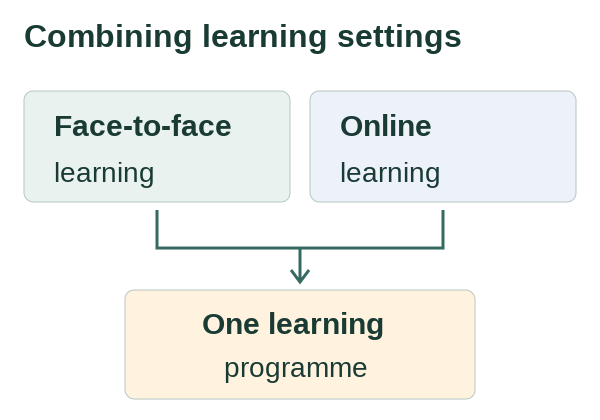
Blended learning combines traditional face-to-face learning with asynchronous or synchronous e-learning. Its use has spread quickly, and it is now common in education.[1]
In health education, blended learning showed consistently better knowledge outcomes than traditional learning.[2] Heterogeneity across studies was large, so Liu and colleagues advise treating the conclusion with caution.[1]
Key facts
| 1.07 | Standardized mean difference for knowledge, all blended learning versus traditional, Vallée 2020[2] |
|---|---|
| 1.40 | Pooled effect size for blended learning versus no intervention, Liu 2016[1] |
| 0.81 | Pooled effect size for blended learning versus nonblended instruction, Liu 2016[1] |
| 0.5 | Medium effect of AI on achievement in blended learning, Wu 2025[3] |
Overview
What blended learning means
Blended learning generally means a course that combines online activities with classroom activities. Writers often say blended or hybrid course design when they mean this combination.[4] For many years most universities around the world have offered something they call blended learning. In much of that practice, the online part was added to ordinary classroom teaching to varying degrees.[5]
Defining a blended course only by its delivery mode suggests that where students meet and how they use technology are all that matter. Courses defined that way risk missing teaching strategies that have been shown to improve learning.[4]
Blended learning is not simply a matter of putting online learning and face-to-face learning side by side. It is dynamic and depends on context. Different settings need different blends. One proposed model, the quadrant of blended learning, lists four quadrants. These are live synchronous learning, virtual synchronous learning, collaborative asynchronous learning, and self-directed asynchronous learning. Whatever the blend, the model states one shared aim. It is to find the mix that gives the best learning experience.[6]
A 2005 paper on language teaching offered a definition of blended learning. It also gave guidelines for designing a blended setting. The central design question it posed is which combination of modes gives the best basis for learning. The answer depends on the conditions at hand. Those parameters came from designing one language course. The paper hoped they would help in designing others.[7] A 2019 framework for designing blended learning lists four things to weigh. They are facilitating a learning experience, meeting four standards of the learning process, choosing teaching strategies, and choosing tools across four learning settings.[8]
The word planned matters. A 2021 essay draws a clear line between emergency remote teaching and carefully designed hybrid learning. That essay argues the pandemic showed the older pattern was no longer enough. That pattern added online elements to classroom teaching. It also notes that teaching some students on campus and others remotely at once can take many resources and much time. This is sometimes called dual mode. The essay adds that such an arrangement may not be feasible for long in many universities and countries. The essay also argues that current provision favors students who can afford the campus experience. It short-changes students with poor access to WiFi, computers or study space.[5]
History
Where the idea came from
In 1997, the University of British Columbia created a new course in treatment planning. It used a mixed format based on problem-based learning. The course was built to address three problems. Students did not enjoy the learning process, they were poorly prepared for clinical treatment planning, and their critical thinking skills were underdeveloped. Half of the second-year class was picked at random for the new course. The other half got the standard lectures. Students in the hybrid course said they enjoyed the learning process. Later they rated themselves as better prepared than their peers. They also said they improved more. Those differences were not usually significant (p < 0.1). Clinical instructors did not know which students had taken the new course. They judged each student on the same criteria.[9]
A thematic review of the international literature traced how publications on blended learning in higher education changed from 2000 to 2016. Instructional design came first. Then came disposition, exploration, learner outcomes, comparison, technology, interactions, professional development and demographic themes. The review concluded that much remains to be done on frameworks for blended learning.[10]
Main ideas
Why it works the community of inquiry
A meta-analysis of 19 empirical studies examined how each presence related to three outcomes. These were actual learning, perceived learning and satisfaction. Teaching presence and actual learning were moderately linked, with r = .353.[11]
For perceived learning, the correlations were r = .663 for cognitive presence and r = .432 for social presence. Teaching presence had r = .392. For satisfaction, cognitive presence (r = .586) and teaching presence (r = .510) were strongly correlated. Social presence was moderately correlated (r = .447).[11]
Khodabandelou and colleagues compared perceived learning across three blended environments. The settings were public universities in Malaysia.[12] A 2025 study of 150 to 200 students compared blended and traditional courses. It used surveys built on the framework and looked for links between answers. Students in blended settings rated three things much higher than students in traditional courses. These were clear expectations, good feedback and interactive discussions.[13]
Ginting and Putri report that students mostly found online learning enjoyable. This happened when facilitators created a triggering situation, guided the learning process, gave comments and feedback, and used several media. In a blended course on pragmatics, the study of language use in context, students mostly found online learning enjoyable under several conditions.[14]
Taylor and colleagues suggest other dimensions also matter for understanding cognitive presence. An exploratory case study looked at graduate students in a blended course. It used interviews, a questionnaire, a focus group, 100 discussion posts and 20 student learning autobiographies.[15]
Suwantarathip found that among the variables studied, attitudes toward hybrid learning were the only significant predictor of satisfaction. Computer literacy, views of the instructor and views of online learning were tied to satisfaction. They did not predict it. Gender did not affect satisfaction.[16]
Design models and course structures
The station rotation model is a blended design. It combines face-to-face and online learning in one teaching strategy. The size of that effect varied with the level of education and the subject. It also varied with the length of the intervention and the location of the research. The same analysis says station rotation gives flexibility in learning time. It also supports differentiated learning, in which tasks are adjusted to different students.[17]
A 2024 paper on post-pandemic Indian classrooms argues that a rotation model can help teachers who face students of many different ability levels. It adds that the model may lower teacher workload. That paper gives planning suggestions, not results from a controlled trial.[18]
Some designs combine several approaches in one course. A 2022 proposal was for a hybrid course in English for specific purposes, the English of a particular job or field. It joined blended learning, the flipped classroom and project-based learning. The proposal reports that most of its activities reached a high fulfilment indicator. It links careful choice of teaching materials to student achievement and satisfaction.[19]
Project-based blended learning pairs project work with a mix of online and face-to-face teaching. A 2020 article proposed it as a universal teaching model. It described a trial in a course on single chip microcomputers. The teaching case reports that the model used the strengths of both project work and blended learning. It also says the model improved students' self-learning, practical application and innovation.[20]
A 2020 development study built a Blended Cooperative Learning model for a numerical methods course in informatics engineering. Two validators judged the design and materials feasible to use.[21]
One model pairs blended learning with self-paced progress. It also uses mastery-based grading. A 2025 meta-analysis looked at this model in K-12 science education. It covered studies published between 2019 and 2024. It reports that the model supports autonomy, motivation and mastery of concepts. It does this through flexible routes and teaching for each person. The same analysis names three difficulties: adapting laboratory instruction, ensuring fair access to technology and managing teacher workload.[22]
How blended courses are built
A blended course combines online learning activities with activities held on campus. The ways of combining them vary.[23] One hybrid mathematics methods course for new teachers met face-to-face for about 60% of a fifteen-week semester. It used an online format for the other 40%. The online share of that course held asynchronous discussion board postings, whole-class synchronous chats, small-group synchronous chats, evaluation of technology tools and electronic surveys.[24]
A flexible programme called FLEX cut face-to-face instruction by 51 per cent. Learning in its courses was statistically equal to traditional formats. A systematic review cited in that work found no significant effect of reduced classroom time on learning effectiveness.[25] There are many ways to combine online activities with campus ones. These include flipped classroom, podcast and peer learning.[23]
A survey of 105 Master of Education students found a clear link. The design of that system was tied to how well blended learning was managed. The survey questionnaire had a reliability of 0.85. That is the figure Sankaran and Saad (2021) report for it.[26]
One proposed design framework splits a course into four parts. These are checking learners before class, situation and interaction during class, extension after class, and evaluation that weighs process and results equally. That framework answered problems the authors named. These were poor analysis of learners, rigid planning, weak interaction in activities and unreasonable evaluation.[27]
Feedback needs its own plan. Guidelines for putting feedback into practice have been scarce. Its role in education, however, is well studied. A first six-phase model gives designers leading questions and criteria for each phase of a blended course. A small usability pilot and an expert appraisal rated the model's overall quality as sufficient. But experts advised major revisions before daily use.[28]
In the FLEX programme, quick feedback and teacher presence were essential. How well the courses were run shaped student engagement. It also shaped student success. Students valued flexibility. Lecturers worried about engagement during self-learning phases.[25]
Freeman and Parker (2004) describe an action research project. In it, an academic and a librarian worked together. They studied how electronic resources could change teaching and learning. Freeman and Parker (2004) found that regular exchange among the librarian, the academic and the students was one of the main factors. It helped build blended solutions that could work.[29]
The design of the physical room matters too. A room built for student activity signals different expectations from one built for instruction. An Active Learning Classroom is a room set up to encourage student activity. It can make students co-creators of knowledge.[23]
Even the basic definition can stall a project. One campus spent over a year debating how to define hybrid. That campus studied four courses. It offered early recommendations for handling hybrid space, including during a crash.[30]
Gamification and project work online
A 2025 paper set out a design framework for a gamified hybrid course. It rests on four elements: achievement, usefulness, enjoyment and competition. The framework covered course content, activities and assessments.[31]
A second study looked at a gamified blended course in web design and programming. It checked learning outcomes against midterm exam questions. Each exam question was tied to a course topic outcome. Each outcome was sorted by level using Bloom's taxonomy. Kermek and Kaniški (2022) used that scheme to classify outcomes. The study asked which outcomes were harder to reach. It also asked whether outcome levels, exam points, project points and total course points were linked.[32]
Barbosa (2022) notes that project-based learning is common in software engineering and project management education. Barbosa calls its use in blended settings blended project-based learning. A 2022 study followed an undergraduate software engineering project management course. The course was at a private university in Brazil. The course used this method. Students answered a questionnaire. They were also invited to name lessons learned. Barbosa (2022) assessed these using content analysis. Student opinions on performance and satisfaction were mixed. Still, students judged more ready for blended study were very satisfied and wanted another such course.[33]
Hikmawati and Suryaningsih (2020) studied a blended problem-based learning course in a biology class. The course ran through Google Classroom. The study was qualitative and descriptive. Data came from observation rather than from tests. Observers watched each step of the blended problem-based lessons. They also recorded behavior off the task. Hikmawati and Suryaningsih (2020) found that all students actively took part in searching for information on the topics covered.[34]
A 2008 practice article described a learner-centred law course built on an action-learning cycle. In that cycle, each round of teaching is improved after feedback and reflection. Ireland (2008) named three elements as essential. These were a supportive social environment, a format that mixes small group discussion with formal presentations, and an assessment scheme based on learning chronicles.[35]
Xiao and Jiang (2023) note that learners can feel isolated. Their pilot study at Shanghai Open University added mobile learning to a blended synchronous setting. The aim was to reduce that sense of isolation. The study looked at satisfaction and engagement surveys from 51 students. Xiao and Jiang (2023) found that satisfaction with instruction and with interaction significantly predicted behavioral engagement.[36]
Research
How large are the effects
Vallée and colleagues combined 56 studies with 9943 participants. For knowledge outcomes they reported a standardized mean difference of 1.07 (95% CI 0.85 to 1.28).[2] A standardized mean difference (SMD) is the difference between the mean values of two groups, divided by the standard deviation.[37] A 2020 review of health education searched the medical literature from January 1990 to July 2019.[2]
Vallée and colleagues sorted blended courses by the kind of support they added. They compared each kind with traditional teaching. Online support gave a standardized mean difference of 0.73. The 95% CI was 0.60 to 0.86. Computer-assisted instruction gave 1.13 (95% CI 0.47 to 1.79). Virtual patient support gave 0.62 (95% CI 0.18 to 1.06). Offline support, by contrast, gave 0.08 (95% CI -0.63 to 0.79), and digital support gave 0.04 (95% CI -0.45 to 0.52). Neither result was significant.[2]
An earlier review of health professions education, published in 2016, found 56 articles that qualified. It also reported large variation. I2 was at or above 93.3 in every analysis. Compared with no intervention at all, blended learning reached a pooled effect size of 1.40.[1] An effect size is a statistical calculation of how large a measurable effect is, for example the difference between the averages of two groups divided by the standard deviation.[38]
The 95% CI was 1.04 to 1.77, with n=20 interventions. The comparison was against nonblended teaching. That means pure e-learning or pure face-to-face classes. The pooled effect size was 0.81 (95% CI 0.57 to 1.05; n=56 interventions). The 2016 review found larger effects in three cases. These were when studies used a pre-posttest design, included exercises, or measured knowledge with an objective test.[1]
A 2022 meta-analysis used a different set of studies. It took 30 peer-reviewed journal articles. These gave 70 effect sizes. It concluded that blended learning results were significantly higher than traditional results. The effect size was medium.[39]
A 2023 meta-analysis covering many countries found a similar split. Blended learning improved performance, attitude and achievement in most countries. The same analysis found no significant difference in student performance between blended and non-blended learning in the USA.[40]
Not every comparison favors the blended format. A 2005 study compared two introductory courses. One was in teacher education and one in health services. Similar methods were taught in three formats: face-to-face, internet-based and hybrid. It found significant differences among the formats. In its view, the internet-based format might produce better student outcomes than face-to-face or hybrid teaching.[41]
A 2025 meta-analysis looked at 18 experimental and quasi-experimental studies. It reported effectiveness by broad field of study. In the humanities the effect was g = 0.795 (P < 0.01). In science and engineering it was g = 1.017 (P < 0.01).[42] The pooled figures are averages across many courses. The reviews report big differences between studies.[2][1]
Results in school subjects
Samritin and colleagues report an effect of d = 0.725 (p < 0.05) on mathematics achievement. They compared it with traditional learning.[43] A 2025 meta-analytic review combined 34 studies published between 2014 and 2023. They studied 2,996 students. It reported a larger positive effect on mathematics achievement (g = 1.090; p < 0.05). That review found educational level and digital platform significantly separated the results. Class size and geographical location did not.[44]
Antonio pooled 53 effect sizes from 49 studies of science teaching. The overall weighted effect was g=1.349. In that review, the effect was largest for learning achievement (g = 1.499). Effects were smaller for scientific attitudes (g = 0.472) and scientific process skills (g = 0.277).[45]
A 2019 Indonesian review looked at 35 journals from 2012 to 2018. It covered blended learning in biology, physics and chemistry. It reported that 48.15% of the studies measured learning outcomes. It also reported that 62.86% of the reviewed studies used a quasi-experimental design.[46]
Two Indonesian meta-analyses looked at blended learning and students' science literacy.[47][48] A 2023 meta-analysis drew on 10 national and international journals published from 2017 to 2023. It concluded that STEM-integrated blended learning raised Indonesian students' science literacy. The effect size was 0.71 and the N-gain was 0.82.[47] A 2024 meta-analysis of 14 articles published from 2017 to 2022 reported a smaller gain for SMA/MA students in Indonesia, with an effect size of 0.494 and an n-Gain of 0.391.[48]
Rohmanurmeta reviewed 10 articles on blended learning and social studies learning outcomes. It reported that the model improved student learning outcomes by 1.65% to 64.32%. The average was 23.32%.[49]
Thinking skills and self-regulation
A meta-analysis of 10 studies from 2015 to 2023 found an average effect size of 0.79 on critical thinking. The review calls this moderate.[50] A second meta-analysis combined 24 studies. They ran from 2014 to 2022. It found blended learning effective for critical thinking. The results varied a lot, and there was no sign of publication bias.[51] A third review looked at science studies from 2016 to 2022. It found the largest effects in physics, medium effects in chemistry, and the largest effects in high school.[52]
Creative thinking has drawn separate reviews, and their effect sizes differ.[52][53] Another meta-analysis looked at studies from journals indexed by Google Scholar. It reported a summary effect of 6.74 for blended groups over conventional ones. The confidence interval ran from 4.68 to 8.80.[53]
Two meta-analyses report gains in problem solving and in broad thinking skills. The gains appear when blended learning is combined with another method.[54][55] The combined model improved 21st-century thinking skills more than conventional teaching. The effect was g = 1.062 (p < 0.001). The review reports that four things each changed the size of the effect. They were model type, education level, subject and kind of skill.[55]
A meta-analysis looked at 15 studies from 2017 to 2022. It found that self-regulated learning strategies had a moderate effect of 0.65 on outcomes. The settings were online and blended. That review found no significant difference by strategy type, course type, school level or learning context. The studies varied widely, though.[56]
One study at SMKN 7 Majene, a school in Indonesia, makes the picture harder to read. Before the course, 85% of students scored in the medium category for self-regulated learning. Afterward, 63% scored in the low category. The paired test showed a significant change (0.007 < 0.05). The researchers concluded that the blended model did not improve self-regulated learning there. Interviews pointed to two reasons. These were weak technology resources and trouble using an unfamiliar course platform.[57]
Digital literacy has its own small evidence base. A meta-analysis covered 11 effect sizes from 2019 to 2023 and 220 students. It reported a summary effect of 0.793 for blended learning on digital literacy. This was on medium criteria.[58]
Differences by subject and setting
Balakrishnan and colleagues note that the parts of blended learning can be very mixed. That makes its effectiveness hard to measure. A 2021 review of pharmacy education noted that blended courses vary greatly in their parts. This makes their effects hard to compare. That review pooled 20 studies with 4525 participants. It found a positive effect on knowledge and a smaller one on skill.[59]
A 2026 review of online and blended learning in Pakistan drew on just three studies. They ranged from Grade 8 up to undergraduate medical students. Its pooled effect size was 0.603, with a 95% confidence interval from 0.147 to 1.059. The spread between studies was low. The review read this as similar benefits across different educational settings.[60]
A 2022 meta-analysis examined blended learning in physics teaching. It found a significant effect of the blended model on achievement. The effect was larger in grade XI than at other grade levels. Within physics, the topic of optics showed a larger effect than other topics. The learning media used also mattered. Courses built on the Schoology application showed a larger effect than other media.[61]
A 2021 study at one Indonesian vocational school compared a hybrid schedule with ordinary face-to-face classes. Changing the time spent in hybrid learning worked well for improving learning outcomes. Learning activity was strongly linked to those outcomes. The significance value was 0.000. The different hybrid schedules had significantly different effects. The significance was 0.037.[62]
A 16-week quasi-experiment used 100 second-year pharmacy students. It split teaching time across three settings. 40% went to pre-class mobile micro-learning, 35% to in-class simulation and 25% to post-class online activities. Assignment scores rose from 50.0% to 85.0%. Simulation completion rose from 60.0% to 90.0%. Mobile records showed 65% of micro-lecture access happened on smartphones between 20:00 and 22:00. About 23% of students reported small-screen tiredness during simulations.[63]
One dental school taught an online hybrid course in oral histology and embryology. Dental students and dental hygiene students took it together. This ran in 2009, 2010 and 2011.[64]
Rodrigo-Peiris and colleagues designed a hybrid research experience. It served 119 second-semester freshmen in science majors. Institutional data and student views from its first run looked promising.[65]
In higher education, a meta-analysis of student satisfaction used two broad categories. These were course content and instruction format. It concluded that both the method of interaction and the content need careful attention. This applies when a course is built and taught. The blended approach appeared to draw the instructor more fully into students' positive views of their learning outcomes. The analysis called for more work to find the smaller parts within those two categories.[66][67]
Language teaching and writing
A 2020 study of 653 students compared blended English courses with face-to-face and fully online ones. Students rated the blended courses as more effective than traditional lessons. This held on all seven principles of good practice in undergraduate education. Gender was linked to how students rated all seven principles. Year of study and subject area mostly were not.[68]
Listening is a skill that needs repeated practice. It means understanding and interpreting meaning, not just hearing. One lecturer mixed classroom work with online practice for a class of 28 university students. There were 9 men and 19 women. The study used interviews with the lecturer, classroom observation and a student questionnaire. These showed that the blended setup improved the students' listening skill. It covered a single class of 28 students.[69]
Huda reports that a writing course using blended learning gave students more chances to practise writing outside class. In a writing course on personal experience, blended learning generally raised student participation. Interaction between students and the lecturer was described as optimal. Assessment also became more open and clear. The researcher proposed adding literary readings to regular course activities. This would let reading be tracked.[70]
Zalunin studied blended learning in English teaching in grade 6 at a school called Lexis. A 2021 survey at one private school was anonymous. It asked grade 6 students how they viewed blended language learning. The weaknesses listed include more hours spent preparing for classes. They also include possible technical problems in remote learning during COVID-19.[71]
A 2024 account of German courses at one economics university found the Moodle platform a usable tool. It helped build support materials for online use. The same account noted some weak points of the platform, which other tools can cover. It also noted extra work for teachers who build the online materials.[72]
Blended learning in mathematics
Akti Aslan (2022) screened 1299 research studies and 72 theses. After applying the PRISMA selection method, the review included 11 articles and 4 theses. A 2022 thematic review by Akti Aslan searched several electronic databases. The reviewer used the PRISMA method, a standard set of steps for choosing which studies to keep, and narrowed the field to 11 articles and 4 theses. Those studies reported that blended learning affected students' views, problem solving skills and self-regulation skills, the ability to plan and monitor one's own work. More than half of the independent variables measured in the reviewed studies were affected positively.[73]
A 2024 meta-analysis, which pools the results of separate experiments into one average, examined 6 experimental articles on blended learning in mathematics published between 2015 and 2022. Banunaek (2024) reported that blended learning had a strong overall effect on mathematics achievement. The mean eta-squared value was 1,83. The size of the effect also differed by level of education.[74]
Ahmad (2021) studied a flipped classroom type of blended learning. It was used in a junior high school maths class in Sokaraja. A quasi-experimental study, one that compares existing classes rather than assigning students at random, tested this model with two classes in a junior high school in Sokaraja during the 2019/2020 academic year. Ahmad (2021) measured learning independence in mathematics with an independence test. It found differences in learning independence between the flipped class and the class taught in the usual way.[75]
A 2015 experiment compared two groups of secondary students learning Algebra II. Both groups had the same teacher for 4 weeks. The treatment group of 32 students received embedded blended learning. In this format, recorded multimedia lessons sat inside normal classroom teaching.[76]
Loch, Borland and Sukhorukova (2016) report students' views on how educators can engage students in a blended mathematics course. The course has a face-to-face part and an online part. Students also suggested ways to catch up after missing a class. The researchers note that courses are often built without asking students during development.[77]
Science, literacy and vocational subjects
Arwaty, Mustamin and Rahmah (2023) pooled 13 studies of biology students in Indonesia.[78] They covered blended learning and science literacy among SMA/MA students in Indonesia. Ichsan and colleagues (2022) measured scientific literacy among SMA/MA students in Indonesia. Ichsan and colleagues (2022) reported an effect size of 0.494 and an n-Gain of 0.391, a normalized gain score in which higher values mean more of the possible improvement was achieved.[79]
It included only studies with a blended class and a conventional control class and more than 20 students. Across a total sample of 1,070 students, the summary effect size was 1.05. The review calls this high.[78]
A chemistry classroom study tested a five-stage teaching cycle combined with blended learning. The cycle is called learning cycle 5E. The topic was redox, a set of abstract chemistry concepts. Winata (2022) says these often cause students trouble and errors in ideas. The study ran two action research cycles with a class at SMA N 1 Tuban, Indonesia. Winata (2022) reported that average knowledge scores rose from 61,91 before the cycles. They were 74,74 in cycle I and 84,09 in cycle II. Winata (2022) reported that the share of students meeting the mastery standard rose from 12,50% to 62,50%. It then rose to 90,63%.[80]
IsmeyL (2025) tested blended learning in English grammar teaching for foreign language learners. The students were first-year intermediate school students. IsmeyL (2025) reported that blended learning strategies affected the grammar test results of the experimental group.[81]
A 2020 study of 100 ninth-grade girls compared two approaches. One was a computerized program added to traditional teaching. The other was traditional teaching alone. The blended group scored higher in English achievement and in motivation to learn English. Its abstract describes the experimental group as studying through a computerized program in the traditional method, which makes the blend hard to pin down.[82]
Wang, Tu and Hsu (2020) found that a green food and beverage blended course helped students. It raised their knowledge of green food and their sense of responsibility. It also raised their commitment and their civic behavior. The 2020 study enrolled 99 junior hospitality students in an 18-week Green Food and Beverage course. A control group was taught in the traditional way. It also raised students' sense of psychological empowerment for green food practices. It raised their problem solving for food sustainability. Students found the course better at holding attention and more satisfying than traditional teaching.[83]
What the research base shows and where it is thin
A 2022 meta-analysis combined results from 84 studies of blended learning in kindergarten through Grade 12. The studies were published between 2000 and 2020. In total, they studied 30,377 students. The effect size was g = 0.65. The pooled difference between blended and face-to-face classes was g = 0.65. The 95% confidence interval ran from 0.54 to 0.77. The gain was larger in the cognitive domain, at g = 0.74.[84]
Poirier, Law and Veispak (2019) reviewed K-12 blended learning research published between 2009 and February 2017. Only 11 articles met their quality criteria. A 2019 systematic review searched for studies of blended learning in K-12 settings. Findings across that literature were mixed about whether blended learning helps K-12 students. The reviewers concluded that this area needs much more research.[85]
Hafeez (2021) reviewed 36 published articles. Most of the studies found blended learning more effective than the traditional lecture method.[86] Ranjan (2020) ran a two-year experiment with students in a Bachelor of Education (B.Ed) course in India. It found higher average achievement scores in blended mode than in online mode. That study suggested that interaction between the instructor and the learners helped explain the better blended results.[87]
A 2025 systematic review looked at 54 studies with 10,425 participants. It found blended learning generally more effective than traditional instruction in mathematics. That review also reported a lot of variation between studies. Study design, educational level and intervention duration changed the results.[88]
A 2020 meta-analysis of 28 primary studies found a positive link between blended learning and learning outcomes.[89] A 2026 quasi-experiment took place in Kerala, India, with 120 ninth-grade students. It compared eight weeks of blended teaching with normal lectures. The blended group scored much higher on a 40-item achievement test. The effect size was large (partial eta squared = .20). That group also reported higher engagement on behavioural, emotional and cognitive measures.[90] A 2019 literature review of 15 journal articles and 6 books warned against generalizing widely from such findings.[91]
In practice
What students and teachers do
Student involvement in blended learning has three aspects: behavioral, cognitive, and emotional. A 2025 review of studies from the Scopus database found something mixed. Not every study found a rise in student involvement in blended learning. Some studies did not separate these three kinds of engagement. Even so, the evidence points to better engagement in blended courses.[92]
A 2025 systematic review covered research from the past five years. It looked at primary, secondary, and vocational education. It found that blended learning had positive effects on four things. These were academic performance, student engagement, learning autonomy and 21st-century skills. The 21st-century skills named in that review include critical thinking, collaboration, communication, and digital literacy. The same review reports gaps in infrastructure readiness and in teacher skill. Its findings point to a need for supportive policy and stronger teacher skills. They also point to a need for spending on digital infrastructure.[93]
A 2026 study of working vocational teachers in China looked at five dimensions of digital literacy. Digital application got the lowest rating of the dimensions. Yet it directly drives professional development.[94]
Tambunan and colleagues compared three blends. One was 25% face-to-face and 75% online. One was an equal balance. The experiment also sorted students into four learning style types. These were Diverger, Assimilator, Converger and Accommodator. In some combinations, both the blend and the learning style clearly changed competence results.[95]
A survey of 95 athletic training students found a significant link between course delivery mode and self-efficacy scores for upper extremity injury evaluation (P = .001). No significant differences appeared between students with and without earlier online or hybrid course experience. The researchers suggest that the content area and its difficulty may need attention when a course is planned.[96]
Feedback practices and comfortable learning environments were the areas a 2025 survey of 124 second-year non-English majors in Vietnam found most in need of improvement. Autonomy, clear goals, and recognition were the main factors that helped raise those students' motivation. The study stresses building students' ability to learn on their own. It also stresses changing teaching methods to fit modern educational trends.[97]
Teachers, leaders and adoption
One proposal treats teachers as creators of blended environments. It uses a model called the Social Construction of Technology. The model is used to study the processes teachers go through. That view shifts attention away from trying to produce a perfect product. It turns instead to sharing how the process develops.[98]
A study of a part-time higher education programme for mature students traced how the teaching changed over time. Evidence came from observations, staff and student focus groups, and interviews. The interviews asked what students expected. The research began with the technology itself. In the first cycles, though, the focus moved to the role of the practitioners involved.[99]
Teacher preparation programmes have also used blended courses to train future language teachers. One exploratory case study involved student teachers of English as a Second Language in the United States. The two groups worked together over the Internet to create Task-Based Language Teaching units. The student teachers became more skilled users of technology. They also gained from working with future colleagues abroad. The author offers suggestions for language teacher training.[100]
A mixed-methods case-study evaluation looked at the Leadership in Blended Learning program. The program uses face-to-face and online sessions. It prepares school leaders to carry out blended learning initiatives. The evaluation found that the designers used all four models of blended learning in the program. The findings suggest the program improved how well participants could lead blended learning efforts. This applied in their school, district, or organization. Participants said the sessions were especially effective in deepening their understanding of several topics. These were planning for and using technology to support professional learning, leadership roles and duties, definitions and models of blended learning, and old versus new teaching models. Some participants completed the End-of-Program survey. Of these, 88% said they had changed something in their school or professional practice. The findings suggest a blended approach can help bring high quality professional development to more principals.[101]
Adopting blended learning across a campus requires knowing what motivates academics to teach that way. A qualitative study at a Ghanaian university interviewed 22 academics. It asked about their real experience of adopting blended learning.[102]
What adult learners say about it
In the Turkish program, most participants chose to attend the online lessons regularly. The reasons were availability concerns, travelling and the comfort of studying at home.[103] Students of English at one Turkish university, 167 of them at level B2 of the Common European Framework of Reference, a six-level scale of language proficiency, liked the flexibility of online learning. The same students still preferred talking face to face with a teacher and with classmates.[104]
Saltan (2016) reported that participants found the face-to-face sections more applied, authentic and effective than the online part. Participants in the Turkish formation program called the face-to-face sections more applied, authentic and effective. They said this compared with the online part.[103] Pre-service teachers are students training to become teachers. Those in technology integration courses at a large Midwestern university also preferred a blended format to a traditional face-to-face one. That study could not say whether students would be more motivated in a blended course than in a face-to-face one.[105]
Wiguna (2022) found that 11th grade students at SMA Negeri 2 Negara preferred face-to-face learning over blended and online learning. At one Indonesian senior high school, all 11th grade students were surveyed. The survey asked about the learning system they wanted after the COVID-19 pandemic. Talking directly with teachers and classmates helped them understand the material.[106] The Turkish English students were mostly positive about the online platforms attached to their course books. Their views on those platforms varied, though.[104]
Lecturers and teacher educators
Maarop and Embi (2016) reviewed eight articles. They found that some academicians were still worried about teaching in blended learning. A review of 8 articles published between January 2010 and December 2013 found that instructors faced a heavier workload. They also faced greater demands on their time. The same review reported that some instructors lacked the teaching and technical skills needed to run a blended program. Instructors in the eight reviewed studies also found it hard to balance the face-to-face and online parts. A workable balance was hard to find. The review concluded that staff training, support and networking help instructors cope with these problems.[107]
A smaller qualitative study interviewed 8 college teachers. They worked at one large university in the United Kingdom. Those teachers held contrasting views on how motivated their learners were in the blended setting. The study drew on the theory of situational leadership. It suggested that educators can delegate more to highly motivated students. These students mainly need autonomy and challenging materials. Students who lack motivation need a supporting style instead. It rests on online presence and strong student-teacher relationships.[108]
A meta-analysis pooled 14 articles published between 2020 and 2022. They covered lecturers' views of blended learning in higher education. A random-effects model lets the true effect differ from study to study. Under that model, the average correlation was positive and moderate, at 0.3528. The analysis used the Q-test for heterogeneity. It also used the I² statistic to measure how much the 14 results differed. The study used JAMOVI software.[109]
A 2026 comparative meta-synthesis by Gaur, Singh and Kumar examined blended learning and the flipped classroom. The focus was teacher education. The flipped classroom instead changes when and how content and active learning happen. The research suggests it may especially help participation, collaboration, application and higher-order thinking. The synthesis therefore treats blended and flipped teaching as ways of arranging teaching. It does not treat them simply as technological innovations.[110]
Questions, discussion and communication
Professors used those questions to prepare an in-person question and answer session. The researchers sorted the questions into types. Then they grouped students by the kinds of questions they asked. Two clusters appeared in every analysis. One group was students with lower than average grades who asked popular questions. The other was students with higher than average grades who asked unpopular ones.[111]
Online discussion can take place inside the classroom itself, next to the usual spoken exchange. A 2007 study compared three settings. These were online discussion during class, online discussion outside class, and face-to-face oral discussion. Online discussion held during class brought out a wider range of views. It also gave more students an equal share of the talk. It also supported critical thinking. Students processed information more deeply. The written exchanges could start later spoken discussion. Two problems limited the approach. Students lost face-to-face contact, and they needed time to write their posts.[112]
Learning was acquired gradually. Students took on more autonomy as virtual interaction increased. The researchers linked that rise in virtual interaction to richer content and less dependence on the teacher. Peer collaboration and more social interaction came with greater participation and achievement.[113]
Jaswal and Behera (2026) studied 29 secondary school students and found eight themes. These included listening to others, supporting others and sharing online. A 2026 study gave a standard communication scale to 29 secondary school students in a blended course. The scale had four parts. These were awareness of one's own communication style, valuing others' styles, practising empathy, and interaction during blended learning. Field notes, focus group interviews and learning logs gave eight themes. Among them were listening to others, accepting others' views, online sharing and encouraging others. Jaswal and Behera (2026) say the communication scale served a supplementary, exploratory purpose. It helped check the qualitative findings against other data.[114] A 2024 study looked at collaborative blended learning with written small group discussion. It reported significant improvement in high school students' English writing, including how well they organised and supported ideas.[115]
How students and teachers describe it
A 19-item questionnaire went to 176 university students in Greece shortly after the pandemic. It found mostly positive views of blended learning behavior. Agreement was highest for two things. One was audio-visual online resources that help students learn alone. The other was student motivation in blended education. The same students agreed less about working in small groups with peers. Some were unsure.[116]
A survey asked 51 students who had taken an Object-Oriented Programming course. Their views on content, organization, communication and evaluation were mostly positive. The study named areas to improve.[117]
Attitudes toward blended learning were high. The field related to the teacher ranked first. Statements about the teacher came first. Statements about teaching ranked second. Statements about the student ranked third. Attitudes differed significantly by gender, by educational orientation and by academic achievement. In interviews, 10 female students said blended learning suits some subjects. They also named the difficulties it faces.[118]
Teachers held varied attitudes as they tried to meet students' learning needs. They also had to meet standards set by the Department of Higher Education. They had to meet standards set by Cagayan State University too.[119]
Lynch and Dembo (2004) tested whether five self-regulation attributes predicted grades in a blended undergraduate course. Verbal ability and self-efficacy together explained 12 percent of the variance in course grades. Self-efficacy alone accounted for 7 percent.[120] A systematic review found that blended learning raises student engagement. This held across four areas: academic, behavioral, cognitive and affective. The same review reported that unequal access to technology and a gap in digital literacy remain challenges in Indonesia.[121]
Teachers in blended classrooms do boundary work. They cross between virtual and actual spaces so problems get solved and off-task behavior redirected. A narrative inquiry in a middle level classroom described diligent dialogue and social presence. Participants used both together for this purpose.[122]
One review concluded that two things were important parts of the blended format. These were active student participation and new teaching methods. The same review noted that completion rates for online and blended courses are still rather low.[123] Students can also be grouped into three clusters by their motivation to learn online. This may help instructors predict usability problems for a new student.[124]
What this looks like when you study
In a review of health professions teaching, researchers combined 56 studies with 9,943 participants. Blended learning beat traditional teaching on knowledge tests. The effect size was 1.07.[2] An earlier meta-analysis of 56 health professions articles found blended learning beat no intervention. It beat nonblended instruction with 0.81.[1]
In a secondary Algebra II classroom, 32 students learned through embedded blended learning. Another 24 students got live lectures over four weeks. The blended group showed significantly greater test score gains. They also rated their experience more positively. Also, 80% preferred the blended format for future math learning. Students said they valued four things. These were controlling the pace of instruction, the teacher's new role, fewer distractions, and access to multimedia lessons outside class.[76] A biology meta-analysis looked at 13 studies with 1,070 students. Online blended learning gave an effect size of 1.05 on critical thinking skills, compared with conventional teaching.[78]
A gamified hybrid business course had 294 students. It used four gamification elements. These were achievement elements, utilitarian value, hedonic benefits and competition. Useful value had the largest effect on student engagement (0.409). Competition came next (0.270), then hedonic benefits (0.210). Engagement then predicted academic achievement (0.712) and satisfaction (0.675).[31]
First-year medicine and pharmacy students asked 6,457 questions on an online platform before class. Two clusters kept showing up. Students below the average grade tended to ask questions many classmates read.[111] Jaswal and Behera (2026) argue that blended courses should be built for practice. Learners should be able to practise face-to-face lesson material at any time and place.[114]
Later developments
Open questions and new tools
A 2025 meta-analysis combined 21 studies with 2,873 participants. It found a medium effect of artificial intelligence on learning achievement in blended learning. The value was g = 0.5.[3] A separate 2023 meta-analysis used 14 journals published from 2018 to 2023. It found that blended learning built on artificial intelligence had a significant effect on students' science literacy, with an effect size of 0.93.[125]
Shi tested a framework for AI-generated content in a 16-week experiment. It covered three design majors that use digital tools. A 2026 study in art and design education built a teaching framework with three parts. It was built around content made by artificial intelligence. It tested the framework over 16 weeks across several majors. The experimental group did better than the control group on creative ability, design skills and design efficiency. The largest gap between majors was only 0.5 points.[126]
A 2021 account of a doctoral course moved three in-person sessions to video meetings during the pandemic. It reported that small-group breakout sessions came close to the discussions the physical classroom had allowed. In the same course, some students struggled with the online modules and readings. They felt less than proficient online, and a few preferred classes in person.[127]
Course platforms record what students do. Kim used those records to look for factors that affect grades. In the blended setting, access to announcements and videos was linked to better grades. But regression analysis found no variable that affected grades. Kim presents the study as a way to identify more accurate variables, not as a finished model.[128]
Criticism
Equity, belonging and criticism
One line of criticism asks who is included and who is pushed to the edge when part of a course moves online. A theoretical study of higher education students looked at how they presented themselves online. It focused on profile information and avatars. It argues that students face hard choices when they show an online self to a group that also meets in person. A virtual self can be accurate, ideal or very different from the offline self. Each of these meets some form of exclusion or marginalization. These responses follow the usual offline rules. They also follow online ideas about strangeness and being fake. The study concludes that offline marginalization tied to how identity is performed is at best equally represented online. At worst it is compounded there.[129]
Marinagi and Skourlas studied what disabled students need. They also studied the costs and benefits of blended learning for them. The tool at its core was Multimedu, a web-based tool made for disabled students. The model was used in a course called Database I. The course ran at the Technological Educational Institute of Athens, Greece.[130]
Casanova and Moreira argue that higher education institutions need to think more critically about how they use technology-enhanced learning.[131] A study of six teachers found that blended learning has led many teachers and leaders to focus on innovation. They focus less on practices based on research. That study watched and interviewed the teachers. It found that old practices still had a big effect in blended classrooms. These included flexibility, using assessment in teaching, and engaging students.[132]
The identity argument is a theoretical study. The belonging findings come from one university.[129][133] The case for disabled students rests on one experiment in one course.[130] The teacher study rests on six teachers.[132]
Problems, limits and open questions
Grotlüschen (2006) argues that income and prior education decide who can take part in blended learning. This widens an existing gap into a digital one.[134] A 2026 review of 10 scientific articles published between 2020 and 2025 found that Ecuador uses blended learning. But it does not fully grasp its teaching, technical and institutional effects. That gap produces unequal access and differences in the quality of learning, the review reported. The same review named four limiting factors: the digital divide, too little teacher training, poor technological infrastructure and resistance to change.[135]
One study used mixed methods with 86 teachers in the Betong district. It also included interviews with five teachers. The teachers had little contact with blended learning and knew too little about it. Those teachers named their main challenges. These were a lack of facilities and technological limits, time, limited skills in information and communication technology, and teacher readiness.[136] A 2021 paper on Saudi higher education said blended learning takes time and teacher effort. Teachers need this time to give feedback and follow up students.[137]
Chafla and colleagues (2026) list self-directed learning as one benefit of blended learning.[134][135] The 2006 article asked who actually learns with media under their own control. It drew on the Berichtssystem Weiterbildung and the München-Studie surveys. It reported on an evaluation of a support project. It also described how far online parts reached in learning settings for learners with low qualifications. It showed where those parts stopped.[134]
A 2018 article on continuing education for early childhood staff gave a warning. Blended learning must not be treated as a cheap way to meet training needs when staff resources are scarce. That article added that courses offered and the target group only partly match so far.[138]
A 2021 study looked at students and lecturers in higher education. It found support for online blended learning over face-to-face teaching alone. The support was for inquiry-based work and for group work. That study did not fully dismiss traditional face-to-face teaching.[139] Haji (2022) measured views and attitudes toward online platforms, not achievement scores.[140]
Key studies
| Year | Study | Sample | Design | Finding |
|---|---|---|---|---|
| 2005 | Reasons et al.[41] | Two introductory courses in teacher education and health services | comparison of three delivery formats | Significant differences existed among formats, and the internet-based format possibly led to better outcomes than face-to-face and hybrid. |
| 2015 | Smith & Suzuki[76] | quasi-experimental pretest-posttest | The blended group showed significantly greater Algebra II test score gains, and 80% preferred blended learning for future math. | |
| 2016 | Liu et al.[1] | systematic review and meta-analysis | Blended learning had an effect size of 1.40 versus no intervention and 0.81 versus nonblended instruction. | |
| 2016 | Maarop & Embi[107] | 8 articles published 2010-2013 | literature review | Instructors faced increased workload, lacked pedagogical and technical skills, and struggled to find the right blend. |
| 2019 | Harrak et al.[111] | 6,457 questions from first-year medicine and pharmacy students | learning analytics with K-Means clustering | The clustering sorted students into two recurring groups. One group scored below the average grade and asked questions that drew many readers. The other scored above the average grade and asked questions that drew few. |
| 2020 | Vallée et al.[2] | 9,943 participants in 56 studies | systematic review and meta-analysis | Blended learning showed significantly better knowledge outcomes than traditional learning, with a standardized mean difference of 1.07. |
| 2021 | Balakrishnan et al.[59] | Systematic review of 26 studies; meta-analysis of 20 studies with 4,525 participants | Blended learning improved knowledge (standardized mean difference 1.35) and skill (0.68) compared with traditional teaching. | |
| 2022 | Yu et al.[39] | Meta-analysis of 30 peer-reviewed articles and 70 effect sizes | Blended learning outcomes were significantly higher than traditional outcomes, with a medium effect size, and attitudes were more positive. | |
| 2023 | Arwaty et al.[78] | 1,070 biology students in 13 studies | meta-analysis | Online blended learning had an effect size of 1.05 on critical thinking skills compared with conventional learning. |
| 2023 | Cao[40] | Meta-analysis of studies across different countries | Blended learning improved performance, attitude and achievement in most countries, but in China and the USA it did not significantly improve student engagement in academic activities. | |
| 2024 | Guntur & Purnomo[56] | Meta-analysis of 15 studies from 2017 to 2022 on self-regulated learning | Self-regulated learning strategies showed a moderate effect (Q=0.65) on outcomes in online and blended settings. The effect did not differ significantly by strategy type or school level. | |
| 2025 | Thi Binh et al.[31] | 294 students in a hybrid business course | design science approach tested with 294 students | Utilitarian value had the largest effect on engagement (0.409), and engagement predicted achievement (0.712) and satisfaction (0.675). |
| 2026 | Wang et al.[63] | 100 second-year pharmacy students | 16-week quasi-experiment | Knowledge accuracy rose from 65.0% to 82.0%, with a Cohen's d of 2.61. |
| 2026 | Jaswal & Behera[114] | 29 secondary school students | partially mixed-methods sequential dominant status | Blended learning enabled positive experiences in improving communication skills across eight themes. |
See also
References
- Liu, Q., Peng, W., Zhang, F., Hu, R., Li, Y., & Yan, W. (2016). The Effectiveness of Blended Learning in Health Professions: Systematic Review and Meta-Analysis. Journal of Medical Internet Research, 18(1), e2. doi:10.2196/jmir.4807
- Vallée, A., Blacher, J., Cariou, A., & Sorbets, E. (2020). Blended Learning Compared to Traditional Learning in Medical Education: Systematic Review and Meta-Analysis. Journal of Medical Internet Research, 22(8), e16504. doi:10.2196/16504
- Wu, J., Tlili, A., Salha, S., Mizza, D., Saqr, M., López-Pernas, S., & Huang, R. (2025). Unlocking the potential of artificial intelligence in improving learning achievement in blended learning: a meta-analysis. Frontiers in Psychology, 16. doi:10.3389/fpsyg.2025.1691414
- McGee, P. (2014). Blended Course Design: Where's the Pedagogy? International Journal of Mobile and Blended Learning, 6(1), 33-55. doi:10.4018/ijmbl.2014010103
- Locke, W. (2021). A Provocation: Blended learning is dead, long live blended learning! Pacific Journal of Technology Enhanced Learning, 3(1), 1. doi:10.24135/pjtel.v3i1.105
- Chaeruman, U. A., & Maudiarti, S. (2018). Quadrant of Blended Learning: a Proposed Conceptual Model for Designing Effective Blended Learning. Jurnal Pembelajaran Inovatif, 1(1), 1-5. doi:10.21009/jpi.011.01
- NEUMEIER, P. (2005). A closer look at blended learning — parameters for designing a blended learning environment for language teaching and learning. ReCALL, 17(2), 163-178. doi:10.1017/s0958344005000224
- Chaeruman, U. A. (2019). Merancang model blended learning designing blended learning model. Jurnal Teknodik, 053-063. doi:10.32550/teknodik.v17i4.577
- Walton, J., Clark, D., & Glick, N. (1997). An outcomes assessment of a hybrid‐PBL course in treatment planning. Journal of Dental Education, 61(4), 361-367. doi:10.1002/j.0022-0337.1997.61.4.tb03126.x
- Pima, J. M., Odetayo, M., Iqbal, R., & Sedoyeka, E. (2018). A Thematic Review of Blended Learning in Higher Education: . International Journal of Mobile and Blended Learning, 10(1), 1-11. doi:10.4018/ijmbl.2018010101
- Martin, F., Wu, T., Wan, L., & Xie, K. (2022). A Meta-Analysis on the Community of Inquiry Presences and Learning Outcomes in Online and Blended Learning Environments. Online Learning, 26(1). doi:10.24059/olj.v26i1.2604
- Khodabandelou, R., Jalil, H. A., Ali, W. Z. W., & Daud, S. M. (2015). Presence and Perceived Learning in Different Higher Education Blended Learning Environments: . International Journal of Mobile and Blended Learning, 7(3), 59-70. doi:10.4018/ijmbl.2015070104
- Priyanka Shandilya , Dr. Ravinder Kaur (2025). Comparative Analysis Of Blended Learning Vs. Traditional Learning On Knowledge Retention. Cuestiones de Fisioterapia, 54(3), 5096-5102. doi:10.48047/tx9xhe54
- Ginting, D., & Putri, Y. R. T. (2022). Implementing blended learning in a pragmatic class for college students: What makes blended learning engaging? Journal of English Educational Study (JEES), 5(1), 39-48. doi:10.31932/jees.v5i1.1448
- Taylor, M. C., Atas, S., & Ghani, S. (2019). Alternate Dimensions of Cognitive Presence for Blended Learning in Higher Education: . International Journal of Mobile and Blended Learning, 11(2), 1-18. doi:10.4018/ijmbl.2019040101
- SUWANTARATHIP, O. (2019). Predictors of Students' Satisfaction with a Hybrid English Course. Turkish Online Journal of Distance Education, 20(1), 115-130. doi:10.17718/tojde.522427
- Ramadan, S., Istiyono, E., Farisiyah, U., Setyaningsih, K., & Mustakim, S. S. B. (2025). Evaluating the effectiveness of the blended learning station rotation model: A meta-analysis of student learning outcomes. Harmoni Sosial: Jurnal Pendidikan IPS, 12(2), 226-239. doi:10.21831/hsjpi.v12i2.91592
- Pandya, S. (2024). INTEGRATION OF ROTATION MODEL OF BLENDED LEARNING IN TEACHING DIFFERENT ABILITY STUDENTS IN POST COVID SITUATION Sub-Theme: Blended Model in Learning. Towards Excellence, 366-373. doi:10.37867/te160329
- Montalbán, N. (2022). Developing a hybrid didactic course in ESP. Journal of Teaching English for Specific and Academic Purposes, 675. doi:10.22190/jtesap2104675m
- Tong, Y., Kinshuk, & Wei, X. (2020). Teaching Design and Practice of a Project-Based Blended Learning Model: . International Journal of Mobile and Blended Learning, 12(1), 33-50. doi:10.4018/ijmbl.2020010103
- Aminah, S. (2020). Pengembangan desain model pembelajaran blended learning pada metode numerik: Blended cooperative learning. Refleksi Edukatika : Jurnal Ilmiah Kependidikan, 11(1), 8-15. doi:10.24176/re.v11i1.4093
- Almerino, J., & Mangansat, N. J. (2025). Modern Classrooms Project: A Meta-Analysis of Blended, Self-Paced, and Mastery-Based Learning in K-12 Science Education. The QUEST: Journal of Multidisciplinary Research and Development, 4(1). doi:10.60008/thequest.v4i1.233
- Larsson, A. K., Gullberg, S., & Ekstrand, M. (2020). Blended learning, Active Learning Classroom and information literacy in higher military education. Septentrio Conference Series(3). doi:10.7557/5.5403
- Johnston, C. J. (2013). Evaluation of a Hybrid Mathematics Methods Course for Novice Teachers: . International Journal of Online Pedagogy and Course Design, 3(1), 33-52. doi:10.4018/ijopcd.2013010103
- Müller, C. (2025). Facilitating Flexible Learning by Implementing Blended Learning with Reduced Classroom Time: Research Insights and Implications for Practice. Ubiquity Proceedings, 21. doi:10.5334/uproc.189
- Sankaran, S., & Saad, N. (2021). Reka Bentuk LMS dan Pengurusan Pembelajaran berasaskan Blended Learning dalam kalangan Pelajar Sarjana Pendidikan: LMS Design and Blended Learning-Based Learning Management among Master of Education Students. Sains Insani, 6(1), 59-65. doi:10.33102/sainsinsani.vol6no1.240
- Yan, J. (2022). Online Open Course Blended Learning Instructional Design Research. Interscience Management Review, 134-141. doi:10.47893/imr.2022.1126
- Hummel, H. G. K. (2006). Feedback Model to Support Designers of Blended Learning Courses. The International Review of Research in Open and Distributed Learning, 7(3). doi:10.19173/irrodl.v7i3.379
- Freeman, M., & Parker, L. (2004). Blended Learning: Blended Resources – a Collaborative Approach to Supporting Students. Proceedings of the International Conference on Networked Learning, 4, 601-606. doi:10.54337/nlc.v4.9568
- Gerard, J. G., Gerard, R. L., & Casile, M. (2009). Course Crash in Hybrid Space: An Exploration and Recommendations for Virtual Course Space. Journal of Educational Technology Systems, 38(2), 165-179. doi:10.2190/et.38.2.h
- Thi Binh, A. D., Hoang, T. H., & Quang, H. T. (2025). Designing Effective Hybrid Course Curriculum: A Design Science Approach to Gamification and Student Outcomes Validation. Evaluation Review, 49(3), 453-486. doi:10.1177/0193841x241291752
- Kermek, D., & Kaniški, M. (2022). Analysis of Learning Outcomes in Gamified Blended E-learning Course. Journal of Higher Education Theory and Practice, 22(3). doi:10.33423/jhetp.v22i3.5077
- Barbosa, M. W. (2022). Using Blended Project-Based Learning to Teach Project Management to Software Engineering Students: . International Journal of Mobile and Blended Learning, 14(1), 1-18. doi:10.4018/ijmbl.291978
- Hikmawati, V. Y., & Suryaningsih, Y. (2020). Implementing blended-problem based learning through Google classroom in biology learning. JPBI (Jurnal Pendidikan Biologi Indonesia), 6(2), 217-224. doi:10.22219/jpbi.v6i2.12112
- Ireland, J. (2008). Blended Learning in Intellectual Property: The Best of Both Worlds. Legal Education Review, 18(1). doi:10.53300/001c.6210
- Xiao, J., & Jiang, Z. (2023). An M-Learning Model in the Context of the Blended Synchronous Learning Environment: A Pilot Study. International Journal of Mobile and Blended Learning, 15(2), 1-16. doi:10.4018/ijmbl.318243
- NAEP Glossary of Terms (n.d.). standardized mean difference. NAEP Glossary of Terms. https://nces.ed.gov/nationsreportcard/glossary.aspx#standardized_mean_difference
- ERIC Thesaurus (n.d.). Effect Size. ERIC Thesaurus. https://eric.ed.gov/?ti=Effect+Size
- Yu, Z., XU, W., & Sukjairungwattana, P. (2022). Meta-analyses of differences in blended and traditional learning outcomes and students' attitudes. Frontiers in Psychology, 13. doi:10.3389/fpsyg.2022.926947
- Cao, W. (2023). A meta-analysis of effects of blended learning on performance, attitude, achievement, and engagement across different countries. Frontiers in Psychology, 14. doi:10.3389/fpsyg.2023.1212056
- Reasons, S. G., Valadares, K., & Slavkin, M. (2005). Questioning the hybrid model: Student outcomes in different course formats. Online Learning, 9(1). doi:10.24059/olj.v9i1.1804
- Shi, F., Wu, Y., & He, R. (2025). Meta-analysis reveals the effectiveness evaluation of blended learning models across different academic disciplines. Forum for Education Studies, 3(2), 2501. doi:10.59400/fes2501
- Samritin, S., Susanto, A., Manaf, A., & Hukom, J. (2023). A meta-analysis study of the effect of the blended learning model on students’ mathematics learning achievement. Jurnal Elemen, 9(1), 15-30. doi:10.29408/jel.v9i1.6141
- Putri, A. D., Juandi, D., Turmudi, & Suparman (2025). Blended Learning and Math Achievement: A Meta-Analytic Review Highlighting the Effectiveness and Heterogeneity. Electronic Journal of e-Learning, 23(1), 113-128. doi:10.34190/ejel.23.1.3781
- Antonio, R. P. (2022). Effectiveness of Blended Instructional Approach in Improving Students’ Scientific Learning Outcomes: A Meta-Analysis. Journal of Higher Education Theory and Practice, 22(5). doi:10.33423/jhetp.v22i5.5217
- Pitaloka, E. D., & Suyanto, S. (2019). Meta analisis: Blended learning pada pembelajaran biologi, kimia, fisika dan matematika di indonesia. Jurnal Pendidikan Biologi, 11(1), 32. doi:10.17977/um052v11i1p32-39
- Agus Supriyadi, Desy Desy, Yayat Suharyat, Tomi Apra Santosa, & Aulia Sofianora (2023). The Effectiveness of STEM-Integrated Blended Learning on Indonesia Student Scientific Literacy: A Meta-analysis. International Journal of Education and Literature, 2(1), 41-48. doi:10.55606/ijel.v2i1.53
- Ichsan Ichsan, Erwinsyah Satria, Tomi Apra Santosa, Sisi Yulianti, & Khodzijah Nur Amalia (2024). Implementation Of Blended Learning In Improving Science Literacy Of SMA/MA In Indonesia : A Meta-Analysis. International Journal of Education and Literature, 3(1), 52-61. doi:10.55606/ijel.v3i1.31
- Rohmanurmeta, F. M. (2021). Meta Analisis Pengaruh Model Blended Learning terhadap Hasil Belajar IPS. Jurnal Pendidikan: Teori, Penelitian, dan Pengembangan, 6(9), 1481-1484. doi:10.17977/jptpp.v6i9.15025
- Suryono, W., Haryanto, B. B., Santosa, T. A., Rahman, A., Suharyat, Y., & Sappaile, B. I. (2023). The Effect of the Blended Learning Model on Student Critical Thinking Skill: Meta-analysis. Edumaspul: Jurnal Pendidikan, 7(1), 1386-1397. doi:10.33487/edumaspul.v7i1.6087
- Martiana, A., Dwiningrum, S. I. A., & Aw, S. (2025). Is Blended Learning Effective in Developing Critical Thinking Skills? : A Meta-Analysis Study. Journal of Social Studies (JSS), 21(1), 51-64. doi:10.21831/jss.v21i1.77810
- Hikmah, N., Febriya, D., Daulay, H., Akmam, & Asrizal (2023). Impact of Blended Learning on Students’ Critical and Creative Thinking Skills in Science Learning: A Meta-Analysis. Jurnal Penelitian Pendidikan IPA, 9(11), 1060-1068. doi:10.29303/jppipa.v9i11.4405
- Sisrayanti, Ambiyar, Wulansari, R. E., & Sabrina, E. (2024). The Effect of Blended Learning on Students' Creative Thinking Ability: A Meta-Analysis. The Indonesian Journal of Computer Science, 13(2). doi:10.33022/ijcs.v13i2.3866
- Judijanto, L., Oktavio, A., Saudale, J., Mitasari, R., Sutarto, S., Amri, M., & Santosa, T. A. (2024). Meta-analysis of The Ethopedagogical Based Blended Learning Model on Students' Problem Solving Ability. Edumaspul: Jurnal Pendidikan, 8(1), 905-915. doi:10.33487/edumaspul.v8i1.7738
- Sujarwo, S., Apra santosa, T., Happy, N., Safira, I., Fatima Hiola, S., Manahor, A., & Binti Sulaiman Rasyid, F. (2025). Integration of Blended Learning and Inquiry based learning on Students' 21st Century Thinking Ability: A Meta-analysis. IJORER : International Journal of Recent Educational Research, 6(4), 1324-1339. doi:10.46245/ijorer.v6i4.871
- Guntur, M., & Purnomo, Y. W. (2024). A Meta-Analysis of Self-Regulated Learning Interventions Studies on Learning Outcomes in Online and Blended Environments. Online Learning, 28(3). doi:10.24059/olj.v28i3.4025
- Bulqia Mas'ud, Hajina, & Darwis (2024). The Effectiveness of Blended Learning in Improving Students' Self-Regulated Learning in Islamic Religious Education Subjects: Efektivitas Blended Learning dalam Meningkatkan Self-Regulated Learning Siswa Pada Pelajaran Pendidikan Agama Islam. Edulab : Majalah Ilmiah Laboratorium Pendidikan, 9(1), 33-50. doi:10.14421/edulab.2024.91.03
- Komari, K., Dewanto, D., Santosa, T. A., Susanto, Y. N., & Rachmaningsih, ,. D. M. (2023). The Influence of the Blended Learning Model on Students Digital Learning : Meta-Analysis. Edumaspul: Jurnal Pendidikan, 7(2), 2696-2704. doi:10.33487/edumaspul.v7i2.6776
- Balakrishnan, A., Puthean, S., Satheesh, G., M. K., U., Rashid, M., Nair, S., & Thunga, G. (2021). Effectiveness of blended learning in pharmacy education: A systematic review and meta-analysis. PLOS ONE, 16(6), e0252461. doi:10.1371/journal.pone.0252461
- Rafiq-uz-Zaman, M., Shih, Y. H., & Muthmainnah (2026). Effectiveness of Online and Blended Learning on Students’ Academic Achievement in Pakistan: A Systematic Review and Meta-Analysis. ProScholar Insights, 5(1), 116. doi:10.55737/psi.2026a-51164
- Asrizal, A., Khairi, U., Yulkifli, Murtiani, M., & Mardian, V. (2022). Effect of Blended Learning Model (BLM) on Student Achievements: A Meta-Analysis. Jurnal Penelitian Pendidikan IPA, 8(5), 2451-2459. doi:10.29303/jppipa.v8i5.2260
- SMKN 5 Malang, & Kulsum, U. (2021). Hybrid learning time modification can improve learning activity and learning outcomes. SCHOOL EDUCATION JOURNAL PGSD FIP UNIMED, 11(3), 263-268. doi:10.24114/sejpgsd.v11i3.27922
- Wang, L., Ge, Y., & Xu, X. (2026). Mobile-First Blended Learning for Pharmacology Education Reform: An Empirical Study. International Journal of Mobile and Blended Learning, 18(1), 1-18. doi:10.4018/ijmbl.408838
- Gadbury‐Amyot, C. C., Singh, A. H., & Overman, P. R. (2013). Teaching with Technology: Learning Outcomes for a Combined Dental and Dental Hygiene Online Hybrid Oral Histology Course. Journal of Dental Education, 77(6), 732-743. doi:10.1002/j.0022-0337.2013.77.6.tb05525.x
- Rodrigo-Peiris, T., Xiang, L., & Cassone, V. M. (2018). A Low-Intensity, Hybrid Design between a “Traditional” and a “Course-Based” Research Experience Yields Positive Outcomes for Science Undergraduate Freshmen and Shows Potential for Large-Scale Application. CBE—Life Sciences Education, 17(4), ar53. doi:10.1187/cbe.17-11-0248
- Cordie, L., Lin, X., Fowler, W., & Wooten, M. (2019). Blended Learning Research: Components critical to student learning from a meta-analysis. eLearn, 2019(5). doi:10.1145/3360724.3331168
- Cordie, L., Lin, X., Fowler, W., & Wooten, M. (2019). Blended Learning Research: Components critical to student learning from a meta-analysis. eLearn, 2019(5). doi:10.1145/3329488.3331168
- Zhang, W., & Zhu, C. (2020). Blended Learning as a Good Practice in ESL Courses Compared to F2F Learning and Online Learning: . International Journal of Mobile and Blended Learning, 12(1), 64-81. doi:10.4018/ijmbl.2020010105
- Aji, M. P. P. (2017). English listening blended learning: The implementation of blended learning in teaching listening to university students. Kajian Linguistik dan Sastra, 2(1), 25. doi:10.23917/kls.v2i1.5349
- Huda, M. (2020). Blended Learning: Improvisasi dalam Pembelajaran Menulis Pengalaman (Blended Learning: Improvisation in Experience Writing Learning). Lensa: Kajian Kebahasaan, Kesusastraan, dan Budaya, 8(2), 117. doi:10.26714/lensa.8.2.2018.117-130
- Zalunin, A. E. (2021). Blended learning in teaching English in secondary school. KANT, 39(2), 323-328. doi:10.24923/2222-243x.2021-39.55
- Jeřábková, P. (2024). Blended learning jakožto nová realita – Možnosti platformy Moodle pro blended learning ve výuce německého jazyka. CASALC Review, 13(2), 41-56. doi:10.5817/casalc2023-2-3
- AKTI ASLAN, S. (2022). Thematic Content Analysis of Blended Learning Studies in the Field of Mathematics Education. Journal of Computer and Education Research, 10(20), 572-589. doi:10.18009/jcer.1135113
- Banunaek, I. M. A. (2024). Pengaruh Blended Learning Pada Pembelajaran Matematika (Tinjauan Meta-Analisis). FRAKTAL: JURNAL MATEMATIKA DAN PENDIDIKAN MATEMATIKA, 5(1), 1-7. doi:10.35508/fractal.v5i1.13480
- Ahmad, A. (2021). The Impact of Blended Learning Type Flipped Classroom on Autonomous Mathematics Learning. INOMATIKA, 3(2), 164-171. doi:10.35438/inomatika.v3i2.288
- Smith, J. G., & Suzuki, S. (2015). Embedded blended learning within an A lgebra classroom: a multimedia capture experiment. Journal of Computer Assisted Learning, 31(2), 133-147. doi:10.1111/jcal.12083
- Loch, B., Borland, R., & Sukhorukova, N. (2016). How to engage students in blended learning in a mathematics course: The students' views. ASCILITE Publications, 375-380. doi:10.14742/apubs.2016.850
- Arwaty, Mustamin, K., & Rahmah, A. (2023). Effectiveness of Online Blended Learning and Critical Thinking Skills of Biology Students in Indonesia: Meta-Analysis Study. Jurnal Penelitian Pendidikan IPA, 9(12), 1284-1291. doi:10.29303/jppipa.v9i12.5761
- Ichsan Ichsan, Erwinsyah Satria, Tomi Apra Santosa, Sisi Yulianti, & Khodzijah Nur Amalia (2022). Implementation of blended learning in improving science literacy of SMA/MA in indonesia : A meta-analysis. International Journal of Education and Literature, 1(2), 74-83. doi:10.55606/ijel.v1i2.31
- Winata, A. (2022). Learning cycle 5e berbasis blended learning sebagai solusi peningkatan hasil belajar materi konsep redoks di masa pandemi covid 19: Blended learning. Jurnal Teladan: Jurnal Ilmu Pendidikan dan Pembelajaran, 7(2), 103-116. doi:10.55719/jt.v7i2.509
- Inst. Taghreed Abd-AL-Razak IsmeyL (2025). The Impactof Blended Learning in EFL Teaching Grammar for Intermediate School Students: The Impactof Blended Learning in EFL Teaching Grammar for Intermediate School Students. مداد الآداب, 15(38), 2137-2154. doi:10.58564/ma.v15i38.1765
- Hijazi, D. A., & AlNatour, A. S. (2020). The Effect of Using Blended Learning Method on Students' Achievement in English and Their Motivation Towards Learning It: Blended Learning, Achievement, and Motivation. International Journal of Virtual and Personal Learning Environments, 10(2), 83-96. doi:10.4018/ijvple.2020070106
- Wang, Y. F., Tu, C. M., & Hsu, L. (2020). Learning Outcomes of a Blended Learning System for Green Food and Beverage Education: . International Journal of Mobile and Blended Learning, 12(3), 66-78. doi:10.4018/ijmbl.2020070105
- Li, S., & Wang, W. (2022). Effect of blended learning on student performance in K‐12 settings: A meta‐analysis. Journal of Computer Assisted Learning, 38(5), 1254-1272. doi:10.1111/jcal.12696
- Poirier, M., Law, J. M., & Veispak, A. (2019). A Spotlight on Lack of Evidence Supporting the Integration of Blended Learning in K-12 Education: A Systematic Review. International Journal of Mobile and Blended Learning, 11(4), 1-14. doi:10.4018/ijmbl.2019100101
- Hafeez, M. (2021). A Critical Review on Blended Learning Versus Traditional Lecture Method. International Journal of Learning and Teaching, 13(2), 62-76. doi:10.18844/ijlt.v13i2.5668
- Ranjan, P. (2020). Is Blended Learning Better than Online Learning for B.Ed Students? Journal of Learning for Development, 7(3), 349-366. doi:10.56059/jl4d.v7i3.412
- Quintuña Padilla, S. X., & Herrera Caldas, V. A. (2025). Efectividad del Blended Learning en Matemáticas en el Sistema Educativo como Método de Intervención: Una Revisión Sistemática. Revista Multidisciplinaria Investigación Contemporánea, 3(3). doi:10.58995/redlic.rmic.v3.n3.a136
- Atika, A., Machmud, A., & Suwatno, S. (2020). Pendekatan Meta-Analisis : Blended Learning terhadap Hasil Belajar DI Era Covid-19. Jurnal Basicedu, 4(4), 919-926. doi:10.31004/basicedu.v4i4.488
- P, S. (2026). Learning Beyond the Classroom: Examining Achievement and Engagement in Blended Learning Environments. International Journal of Education and Pedagogy (IJEP), 2(4), 27. doi:10.63090/ijep/3108.1800.0040
- ABDUKADIROVA, G., & KHAMROEVA, G. (2019). Blended learning: Supporting students’ learning and enhancing their experience — a literature review. Foreign Languages in Uzbekistan, 45-51. doi:10.36078/1570168729
- Nugroho, N. (2025). Review: Students’ engagement in blended learning. Jurnal Muara Pendidikan, 10(1), 1-8. doi:10.52060/mp.v10i1.2285
- Hafiz, M., Agustini, K., & Suartama, I. K. (2025). Blended Learning and its Impact on 21st Century Student Learning: Blended Learning dan Dampaknya terhadap Pembelajaran Siswa Abad 21. Indonesian Journal of Innovation Studies, 26(3). doi:10.21070/ijins.v26i3.1449
- Huang, X. (2026). Investigating the Structural Relationships of Vocational Teachers' Digital Literacy for Blended Learning: . International Journal of Mobile and Blended Learning, 18(1), 1-18. doi:10.4018/ijmbl.410609
- Tambunan, H., Silitonga, M., & Sidabutar, U. B. (2021). Blended Learning in Teaching Technical Teacher Candidates With Various Types of Learning Styles: . International Journal of Mobile and Blended Learning, 13(3), 1-13. doi:10.4018/ijmbl.2021070104
- Fukunaga, M. M., & Kasamatsu, T. M. (2022). Purposeful Course Planning: Considering Student Self-Efficacies When Selecting an Online, Hybrid, or Face-to-Face Course Delivery Modality. Athletic Training Education Journal, 17(3), 201-209. doi:10.4085/1947-380x-21-038
- Thi Ngoc Bich, P. (2025). Effects of blended learning on students’ motivation. Journal of Science Educational Science, 60-69. doi:10.18173/2354-1075.2025-0069
- Wood, Y. (2012). ‘Being in the kindergarten of blended learning’: Exploring teachers’ processes for sustainable blended learning practices. ASCILITE Publications, 1082-1090. doi:10.14742/apubs.2012.1531
- Heinze, A., & Procter, C. (2010). The Significance of the Reflective Practitioner in Blended Learning: . International Journal of Mobile and Blended Learning, 2(2), 18-29. doi:10.4018/jmbl.2010040102
- Fuchs, C. (2010). Cross-Institutional Blended Learning in Teacher Education: A Case Study. International Journal of Mobile and Blended Learning, 2(2), 30-49. doi:10.4018/jmbl.2010040103
- Acree, L., Gibson, T., Mangum, N., Wolf, M. A., Kellogg, S., & Branon, S. (2017). Supporting School Leaders in Blended Learning with Blended Learning. Journal of Online Learning Research, 3(2), 105-143. doi:10.70725/973559mjaqcz
- Antwi-Boampong, A. (2023). Transitioning into Fully Blended Learning: A Model for Faculty Blended Learning Adoption. Nordic and Baltic Journal of Information & Communications Technologies. doi:10.13052/nbjict1902-097x.2023.001
- Saltan, F. (2016). Blended Learning Experience of Students Participating Pedagogical Formation Program: Advantages and Limitation of Blended Education. International Journal of Higher Education, 6(1), 63. doi:10.5430/ijhe.v6n1p63
- Istifci, I. (2016). Perceptions of Turkish EFL Students on Online Language Learning Platforms and Blended Language Learning. Journal of Education and Learning, 6(1), 113. doi:10.5539/jel.v6n1p113
- Ketsman, O. (2019). Perspectives of Pre-Service Teachers About Blended Learning in Technology Integration Courses: . International Journal of Mobile and Blended Learning, 11(4), 15-31. doi:10.4018/ijmbl.2019100102
- Wiguna, I. G. N. W. (2022). Students’ Preferences Toward Virtual, Classroom, and Blended Learning. Journal of Educational Study, 2(1), 65-71. doi:10.36663/joes.v2i1.262
- Maarop, A. H., & Embi, M. A. (2016). Implementation of Blended Learning in Higher Learning Institutions: A Review of Literature. International Education Studies, 9(3), 41. doi:10.5539/ies.v9n3p41
- Zavyalova, K. (2020). Unlocking students’ motivation in the blended higher education classroom: Lecturers’ perspectives. E-Learning and Digital Media, 17(5), 425-441. doi:10.1177/2042753020931774
- Ahmed, S. A. S. (2023). A meta-analysis on publications for lecturers’ perception of blended learning in higher education from 2020-2022. European Journal of Education Studies, 10(8). doi:10.46827/ejes.v10i8.4923
- Gaur, R., Singh, D., & Kumar, B. (2026). Transforming Pedagogy in Teacher Education: A Comparative Meta-Synthesis of Blended Learning and Flipped Classroom Approaches. International Journal For Multidisciplinary Research, 8(5). doi:10.36948/ijfmr.2026.v08i05.87301
- Harrak, F., Bouchet, F., & Luengo, V. (2019). From Students’ Questions to Students’ Profiles in a Blended Learning Environment. Journal of Learning Analytics, 6(1). doi:10.18608/jla.2019.61.4
- Chen, W., & Looi, C. K. (2007). Incorporating online discussion in face to face classroom learning: A new blended learning approach. Australasian Journal of Educational Technology, 23(3). doi:10.14742/ajet.1255
- Turpo-Gebera, O., Diaz-Zavala, R., Gutiérrez-Salcedo, E. L., Delgado-Sarmiento, Y., & Gonzales-Miñán, M. (2023). Interacciones didácticas en el blended learning: dinámicas de construcción del conocimiento. HUMAN REVIEW. International Humanities Review / Revista Internacional De Humanidades, 21(2), 465-475. doi:10.37819/revhuman.v21i2.1733
- Jaswal, P., & Behera, B. (2026). Understanding Communication Skill during Blended Learning: A Partially Mixed-Methods Analysis. Journal of Education and Learning Environments, 2(1). doi:10.55121/jele.v2i1.1169
- Mulyadi, E., Riyanto, Y., & Kristanto, A. (2024). The Influence Of Collaborative Blended Learning Through Written Small Group Discussion Model On High School Students’ English Writing Skills. The Influence Of Collaborative Blended Learning Through Written Small Group Discussion Model On High School Students’ English Writing Skills. doi:10.53555/kuey.v30i5.3051
- Nikolopoulou, K., & Zacharis, G. (2023). Blended Learning in a Higher Education Context: Exploring University Students’ Learning Behavior. Education Sciences, 13(5), 514. doi:10.3390/educsci13050514
- University of Plovdiv “Paisii Hilendarski” (Bulgaria), Gaftandzhieva, S., Doneva, R., University of Plovdiv “Paisii Hilendarski” (Bulgaria), Hussain, S., Dibrugarh University (India), Talukder, A., Khulna University (Bangladesh), Australian National University (Australia), Chetia, G., Dibrugarh University (India), Gohain, N., & Dibrugarh University (India) (2023). Quality of blended learning courses: Students’ perspective. Mathematics and Informatics, 66(6), 607-623. doi:10.53656/math2023-6-4-qua
- H. Al-Qassim, D. H., & . Nazzal, H. O. (2024). Attitudes Of Tenth Degree Students Towards The Blended Learning In The Directorate Of Education- Qabatia. Attitudes Of Tenth Degree Students Towards The Blended Learning In The Directorate Of Education- Qabatia. doi:10.53555/kuey.v30i4.828
- Mendoza, M. C. (2023). Blended Learning Attitudes and Perceptions Toward Blended Learning: The Case of Cagayan State University. AIDE Interdisciplinary Research Journal, 2, 84-91. doi:10.56648/aide-irj.v2i1.19
- Lynch, R., & Dembo, M. (2004). The Relationship Between Self-Regulation and Online Learning in a Blended Learning Context. The International Review of Research in Open and Distributed Learning, 5(2). doi:10.19173/irrodl.v5i2.189
- Wibowo, A. A. (2024). A Comprehensive Systematic Review on Effective Strategies for Student Engagement in Blended Learning Environments. Journal of Blended and Technical Education, 1(1), 87-101. doi:10.70764/gdpu-jbte.2024.1(1)-08
- Stevens, M., & Rice, M. (2016). Inquiring into Presence as Support for Student Learning in a Blended Learning Classroom. Journal of Online Learning Research, 2(4), 447-473. doi:10.70725/492597rcbgmr
- Chitkara Business School, Chitkara University, Punjab, India., Saini, R., Dawra, S., & Chitkara Business School, Chitkara University, Punjab, India. (2023). Fostering Dynamic Learner engagement in the Era of Blended learning- A Systematic ReviewFostering Dynamic Learner engagement in the Era of Blended learning- A Systematic Review. Journal of Technology Management for Growing Economies, 14(2), 61-71. doi:10.15415/jtmge/2023.142007
- Rentroia-Bonito, M. A., Gonçalves, D., & Jorge, J. A. (2015). Clustering Students Based on Motivation to Learn: A Blended Learning Approach. International Journal of Mobile and Blended Learning, 7(3), 18-39. doi:10.4018/ijmbl.2015070102
- Abdul Rahman, Tomi Apra Santosa, Ilwandri Ilwandri, Yayat Suharyat, Sanju Aprilisia, & Suhaimi Suhaimi (2023). The Effectiveness of AI Based Blended Learning on Student Scientific Literacy: Meta-analysis. LITERACY : International Scientific Journals of Social, Education, Humanities, 2(1), 141-150. doi:10.56910/literacy.v2i1.542
- Shi, H. (2026). Artificial Intelligence-Generated Content in Blended Learning: Teaching Reform Study in Art and Design Education. International Journal of Mobile and Blended Learning, 18(1), 1-25. doi:10.4018/ijmbl.416290
- PRİCE, T. (2021). Blended Learning and the Videoconferencing Modality for the Teaching and Learning Doctoral Candidate. Sınırsız Eğitim ve Araştırma Dergisi, 6(1), 1-10. doi:10.29250/sead.866425
- The English Teathers Association in Korea, & Kim, J. E. (2023). Data-Based Learning Analysis and Its Application to English Education: Focusing on Online and Blended Learning Environment. The English Teachers Association in Korea, 29(1), 23-39. doi:10.35828/etak.2023.29.1.23
- Heikoop, W. (2013). Blended Identities: Identity Work, Equity and Marginalization in Blended Learning. E-Learning and Digital Media, 10(1), 53-67. doi:10.2304/elea.2013.10.1.53
- Marinagi, C., & Skourlas, C. (2013). Blended Learning in Personalized Assistive Learning Environments: . International Journal of Mobile and Blended Learning, 5(2), 39-59. doi:10.4018/jmbl.2013040103
- Casanova, D., & Moreira, A. (2017). A Model for Discussing the Quality of Technology-Enhanced Learning in Blended Learning Programmes: . International Journal of Mobile and Blended Learning, 9(4), 1-20. doi:10.4018/ijmbl.2017100101
- Anthony, E. (2019). (Blended) Learning: How Traditional Best Teaching Practices Impact Blended-Learning Classrooms. Journal of Online Learning Research, 5(1), 23-48. doi:10.70725/310262fgtpwl
- Syska, A., & Pritchard, C. (2023). Blended learning as a site of struggle: A critical realist analysis of students’ perceptions of blended learning and its impact on their sense of belonging. Journal of University Teaching and Learning Practice, 20(6). doi:10.53761/1.20.6.15
- Grotlüschen, A. (2006). Blended Learning für gering qualifizierte Lerner? MedienPädagogik: Zeitschrift für Theorie und Praxis der Medienbildung, 1-23. doi:10.21240/mpaed/00/2006.05.24.x
- Chafla, A. L., Quito Moya, Y. d. R., Chase Bohórquez, J. A., & Guamán Ávila, A. S. (2026). Aprendizaje híbrido (blended learning): Tendencias, ventajas y limitaciones. Revista Científica Multidisciplinaria InvestiGo, 7(20), 1-17. doi:10.56519/e9waxx48
- Jerry, M., & Yunus, M. M. (2021). Blended Learning in Rural Primary ESL Classroom: Do or Don’t. International Journal of Learning, Teaching and Educational Research, 20(2), 152-173. doi:10.26803/ijlter.20.2.9
- Alharbi, S. (2021). Blended Learning in Saudi Higher Education Framework, Implications, and limitations. Advances in Social Sciences Research Journal, 8(1), 386-392. doi:10.14738/assrj.81.9593
- Buschle, C., & König, A. (2018). E-Learning und Blended-Learning-Angebote: Möglichkeiten beruflicher Weiterbildung für Kita-Fachkräfte. MedienPädagogik: Zeitschrift für Theorie und Praxis der Medienbildung, 30, 50-72. doi:10.21240/mpaed/30/2018.03.01.x
- Ntim, S., Opoku-Manu, M., & Addai-Amoah Kwarteng, A. (2021). Post COVID-19 and the Potential of Blended Learning in Higher Institutions: Exploring Students and Lecturers Perspectives on Learning Outcomes in Blended Learning. European Journal of Education and Pedagogy, 2(6), 49-59. doi:10.24018/ejedu.2021.2.6.162
- HAJI, S. A. (2022). Students' use of online learning platforms to support blended Learning at Cameroonian University. Journal of Educational Technology and Online Learning, 5(2), 422-431. doi:10.31681/jetol.1028410
Cite this page: Atlas Nova editors. (2026). Blended learning. Atlas Nova. https://velocer.io/atlas/blended-learning/