Method · Teaching
Child-centred education
Educational teaching approach
Child-centred education is an approach to teaching that places the student at the centre of the learning process, with the teacher acting as a guide rather than a transmitter of information. It is also called learner-centred teaching, and the term covers a range of methods including flexible, experiential and self-directed learning.[1]
A meta-analysis of 119 studies found positive teacher-student relationships linked to better outcomes.[2] Students in student-centred science classes had higher learning outcomes than those in teacher-centred classes.[3] Students often still value formal teaching methods alongside student-centred techniques.[4]
Key facts
| 119 | studies in Cornelius-White's 2007 meta-analysis of learner-centred relationships[2] |
|---|---|
| 355,325 | students included in Cornelius-White's 2007 meta-analysis[2] |
| 120 | lecturers surveyed by Katawazai (2021) on student-centred learning in Afghanistan[5] |
| 24 | rural schools in Taiwan studied by Cheng and Yang (2023)[6] |
Overview
What child-centred education means
Child-centred education is a family of related terms rather than a single fixed method. The overlap causes trouble: one review notes that many terms have been linked with learner-centred teaching, including flexible learning, experiential learning and self-directed learning, so the label can mean different things to different people.[1] A 2026 conceptual review of learner-centred pedagogy in the global and Tanzanian contexts found significant similarity, with a slight variation, between how the concept is framed internationally and locally, and it recommends contextualisation of the concept.[7]
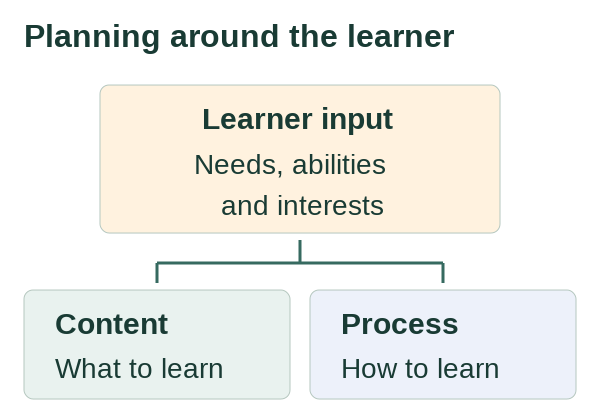
Student-centred learning is described as prioritising learners' needs, experiences and interests, in contrast to traditional teacher-centred methods.[8] One account of the paradigm shift says the power to decide moves from the teacher to the student, and that teacher-focused formats built on transmission of information, such as lecturing, have been increasingly criticised.[1] A 2024 article on student-centred learning in the preparation of future educators ties the approach to outcome-based processes tailored to an individual student's educational route and to the ability to solve professional problems independently.[9]
Learner-centred tasks are often designed on constructivist lines, the view that learners build understanding from their own activity and prior knowledge rather than receiving it ready-made. In a before and after survey, the study found that despite increased complexity and workload, students' motivation to deal with the topics of the subject remained stable.[10]
History
Origins and the long policy history
Learner-centred pedagogy has been recommended in education policy for more than a century, yet its practical implementation remains an illusion in many classrooms.[11] The idea is older still: two of the first educators to stress the learner were Confucius and Socrates, in the 5th to 4th centuries B.C. Another two hundred years passed before the European educators Pestalozzi, Herbart and Froebel designed and popularised experience-based, learner-centred curricula.[1]
In Indian social science education, learner-centred teaching has been a key focus of reform since the National Curriculum Framework of 2005, and it was reinforced in the National Curriculum Framework for School Education of 2023. Many Indian classrooms nonetheless still focus mainly on textbooks and exams, a gap between policy intent and classroom practice documented across various Indian educational contexts.[12]
Zambia offers a case in which the curriculum framework itself carries the child-centred discourse. The teacher-directed approach is described as a historically based dominant discourse within Zambian kindergartens, one that is translated into institutional arrangements.[13]
Zimbabwe's recent curriculum reform tested the policy commitment through project-based learning, an approach in which students work on extended projects and which has gained acceptance for developing creativity, critical thinking, research and problem-solving. A qualitative multiple-case study observed and interviewed four history teachers implementing project-based learning at four secondary schools.[11]
Malaysia's educational system long depended on a didactic approach built on teachers' instructions, and its movement toward a student-centred paradigm has been examined from an Islamic educational perspective. That analysis finds the newer paradigm could develop more active learners who have acquired problem-solving, independent thinking and autonomous learning.[14]
How the idea spread through school systems
In Estonia, the transition to child-centred education became one of the central aims of early childhood education after the country regained independence, and the Step by Step programme supported teachers in that work by stressing each child's individuality through choice and supportive teaching practice. A written survey in 2008 compared preschool teachers who used the Step by Step programme with those who did not, and the programme teachers reported applying child-centred practice more often than teachers in preschools outside the programme. When the same instrument was used again in 2016, teachers outside the programme rated their own child-centred activity significantly higher than in 2008, and their ratings no longer differed statistically from those of programme teachers.[15] At the technical teacher level, a learner-centred in-service programme was launched at Tallinn University of Technology's Estonian Centre for Engineering Pedagogy. It has run since 2012 and combines mentoring, peer support and cognitive apprenticeship, a model in which an expert demonstrates and gradually hands over real tasks.[16]
India's National Education Policy 2020 sets a new direction for teaching English in higher education, calling for experiential, inquiry-driven and learner-centred study.[17] In South Africa, curriculum policies call for learner-centred strategies to serve diverse learners, an approach prompted in part by concern about mathematics performance.[18] Mozambique's education system has been undergoing transformation since national independence in 1975, yet teaching there has traditionally been teacher centred, with attention and activities focused on the teacher and little paid to learners. A 2025 action research case study at Samora Machel Secondary School in Manjacaze, Mozambique, reported that learner-centred approaches were not adopted accordingly in some schools, and that student performance was consequently not desirable.[19]
In Eritrea, student-centred teaching has been advocated, yet teacher-centred teaching dominates instructional settings. Eritrea's reforms called for replacing passive learning and didactic pedagogy, meaning instruction dominated by the teacher's exposition, with interactive student-centred teaching, and teacher education programmes were meant to prepare student teachers for that shift. A survey covered 61 educators at two Eritrean teacher education institutions, the Eritrea Institute of Technology's College of Education and Asmara Community College of Education. Teacher-centred teaching dominated instructional settings, and analysis of variance showed no significant differences between teaching styles and educators' demographic features.[20]
At the University of Rwanda's College of Education, a mixed-method study of 278 teacher educators and student teachers found positive teacher perceptions of learner-centred pedagogy (grand mean 3.70), moderate student perceptions (mean 3.01) and a moderate level of implementation (mean 3.23). That study tied the level of implementation to several obstacles, each rated on a mean scale. Teachers' heavy workload scored 4.07 and limited resources and facilities scored 4.00. Students' reluctance to be active participants and insufficient time allocated to lessons each scored 3.47, lack of funding scored 3.33 and perceived students' low ability scored 3.17.[21]
In KwaZulu-Natal, South Africa, a qualitative multiple case study examined 10 mathematics teachers in the Intermediate Phase (Grades 4 to 6). Participants had limited understanding of learner-centred strategies and misinterpreted how to implement them. They also adapted strategies prescribed by policy to suit how they taught, with contextual factors shaping their practice. The study recommended professional development in learner-centred strategies and networks among mathematics teachers for collaboration on culturally responsive methods for multilingual and multicultural learners.[18]
Main ideas
How it differs from teacher-centred teaching
In the teacher-centred pattern, the teacher stands at the centre of the lesson and leads it through direct explanation, with students taking organised notes and following the teacher's structure. In the child-centred pattern, students take an active part in shaping what happens in the lesson, working through inquiry, group tasks and classroom debate.[22]
A four-week quasi-experiment with 60 Grade 10 students in two schools, split into a student-centred group of 30 and a teacher-centred group of 30, set the two side by side in science teaching. The student-centred group worked through inquiry-based learning, combined group work and classroom debates, while the teacher-centred group received lecture-based teaching with direct teacher-led explanations and structured note-taking. Scores on a researcher-developed achievement test rose more in the student-centred group from pre-test to post-test than in the teacher-centred group. The study's authors connected that gain to active involvement in the learning process and to the greater communication, serious thinking and independence that the student-centred tasks encouraged.[22]
A paper on online teaching during the COVID-19 pandemic notes that teachers use both teacher-centred and student-centred approaches, that each has advantages and disadvantages in online settings, and that both must be redefined when the context changes. That paper proposes an integrated-centred approach, with practical guidelines, as a way for online teachers to combine the two.[23] A Chinese Tai Chi model makes a similar argument from a different direction, holding that student-centred and teacher-centred learning each have strengths and challenges, and that education is a combination of interacting factors rather than a dichotomy of teaching and learning. In that model the student is compared to yin and the teacher to yang, and the focus falls on their dynamic interaction.[24]
Motivation, attitudes and relationships
A 2017 review of research on student-centred teaching separates conscious motivation from subconscious motivation, and separates mastery goals, in which a learner aims to understand the material, from performance goals, in which a learner aims to look capable or avoid looking weak. The same review treats the teacher as an adviser rather than a director, and it argues that giving students more responsibility for their own learning and individualising tasks affect their motivation and their capacity to become successful, independent life-long learners.[25]
Students do not respond to student-centred activities as a single group. Beginners judged teacher-fronted grammar better for learning than student-centred grammar, and intermediate students found teacher-fronted grammar less fun. Both of those groups found student-centred fluency more fun and more relaxing than teacher-fronted fluency, yet neither group perceived any difference in learning outcomes between the two. Elementary learners rated teacher-fronted fluency better for learning than student-centred fluency but saw no difference between them in enjoyment or relaxation.[26]
A 2023 study of twelve elementary English reading classes used an observation checklist and interviews to examine how far learners took up student-centred reading. When reading activities called for deeper, personalised discussion, learners engaged less and relied more on their teachers for help. With non-communicative tasks the students took full ownership of their learning, but with communicative tasks they needed teacher prompting. Collaboration between learners on reading tasks was in most cases done to some extent or only in a very limited range. The study concludes that learners kept a dependent approach, preferring non-communicative tasks, and that communicative reading activities need prompting, encouragement and guidance if students are to engage with them.[27]
The author reviewed about 1,000 articles and synthesised 119 studies published from 1948 to 2004, covering 1,450 findings and 355,325 students, and coded 9 independent variables, 18 dependent variables and 39 moderators. Correlations varied widely, and the mean correlation of r = .31 was above average compared with other educational innovations for cognitive outcomes and especially for affective and behavioural ones. Methodological and sample features accounted for some of that variability, so the average hides real differences between studies.[2]
Why it is thought to work
A second proposal comes from Vygotsky's zone of proximal development, the span of tasks a learner can manage with help but not yet alone. A study of English teachers of Form Two students on Pemba Island, Zanzibar, used the zone of proximal development as its guiding theory when examining how far learner-centred pedagogy was practised in public secondary schools. The study drew on a target population of 585 individuals, including 420 English teachers, 25 subject inspectors and 140 school heads, and worked with a sample of 167 respondents from 42 schools. It reported that teachers practised learner-centred pedagogy to a high extent, and that the extent of use did not differ significantly by teachers' years of working experience.[28]
Scaffolding is the third mechanism: temporary support that a teacher or peer provides and then withdraws as competence grows. A conceptual study of Bangladesh Open University found that its instructional practice was dominated by teacher-centred pedagogy, and it developed three model lesson plans that combined scaffolding with positive reinforcement and with assessment tasks aimed at both lower-order and higher-order thinking skills.[29]
A fourth mechanism is self-efficacy, a person's belief in their own capacity to carry out the actions a task requires. Analysed with confirmatory factor analysis and structural equation modelling, the data showed that both forms of interaction significantly enhanced learning achievement, with self-efficacy acting as a critical mediator.[30]
What changes the results: age, subject and setting
In the earliest years of school, one foundation-year teacher in a study of 16 children used her knowledge of what standardized reading assessments required as a minimum expectation and then moved beyond that content when informal assessments showed it was warranted. Every child in that class met the minimum reading standards by the end of the year, and many exceeded them, while the children in four adjacent classrooms reached less advanced reading outcomes. The study concluded that an individualized, child-centred approach informed by both standardized and informal assessment let the teacher support a range of reading abilities.[31] Children's literature teaching in preschools is presented as a way to combine language development, emotional growth, cultural appreciation and creativity, illustrated by a case analysis of the picture book "Miss Rumphius".[32]
In science at the primary level, a Turkish study of two fifth grade classes compared creative-drama activities with student-centred inquiry-based teaching on the topic of classifying living things during the fall semester of 2017. The drama activities contributed significantly more to the expansion of pupils' cognitive structures, meaning the connected ideas they hold about a topic, than the inquiry-based teaching did. The teacher researcher found it difficult to control the ideas pupils produced, and some of those ideas promoted misconceptions.[33] In mathematics, an embedded case study of undergraduate science, technology, engineering and mathematics students combined blended teaching with a student-centred active learning environment and social activities on a platform. Quantitative results showed considerable benefits in how students used and coordinated several systems of semiotic representation, meaning the different ways a mathematical idea can be written or drawn, and a satisfaction test showed most students accepted the alternative methods.[34] In geography, an analysis of learner-centred pedagogy in Chinese secondary schools argued that active, collaborative and learner-driven approaches can complement the existing knowledge-based curriculum and develop critical thinking and collaborative skills, though cultural and systemic obstacles in the examination-oriented system remain.[35]
In English language learning, a study at a Japanese university divided pre-intermediate learners into a teacher-centred group, whose online vocabulary activities used items the teacher selected, and a learner-centred group, who compiled their own lists and entered them into a system that built the activities.[36] In religious education, a paper on Catholic schooling described a shift from content-centred to student-centred teaching as a move toward a constructivist approach and toward "Adaptive Religious Education", which aims to educate children in all six dimensions of the human being at once. The paper noted that the change was proposed more than 50 years ago and is still difficult to handle and implement in practice.[37]
The auditing projects and the Sri Lankan classroom both reported that active involvement was achievable in large groups, which is the setting student-centred methods are usually thought unsuited to.[38][39] The mathematics case study placed blended teaching alongside traditional lessons rather than replacing them, so its results describe a mixed arrangement.[34] The vocabulary study shows that an online system can be built around either teacher-selected or learner-selected material, which makes the teacher's role a design choice rather than a fixed feature of the technology.[36]
Group work, team teaching and peer collaboration
May and Doob (1937) found that people who worked cooperatively were more successful than those who pursued the same goals independently, because the combined effect of their individual contributions made the group stronger. Its intellectual roots reach back before the second world war. Allport, Watson, Shaw, Mead and other social scientists began building cooperative learning theory after finding that group work produced more and better output than working alone. May and Doob in 1937 reported that people working cooperatively succeeded more often than people pursuing the same goals independently, because the combined contributions of group members had a synergic effect. Cooperative learning later became a common way of placing learners at the centre of teaching, and a study of English First Additional Language teachers examined how they used the approach and why.[40]
In one qualitative study of 94 college students in liberal arts classes, each lesson began with an instructor lecture and individual study of learning materials, after which teams worked on tasks tied to the content. Students reported that the attitude of teammates, including communication, participation and courtesy, mattered most to them, followed by positive experiences and emotional support. They also described gains in self-expression, discussion and presentation, initiative, and overcoming anxiety about presenting, while noting that negative behaviour among members could block interaction. The study concluded that team-based classes demand more active communication and voluntary participation than students' earlier learning experiences, and that clear motivation, suitable content, instructor support and evaluation plans are needed to address early dissatisfaction.[41]
Team teaching, in which two or more teachers share responsibility for the same students, entered schools partly because it looked likely to make education more student-centred. A 1984 paper tested that assumption in management education, where team teaching is frequently used, and examined the variety of structural arrangements it can take.[42]
A study applied student-centred learning through lesson study to students of the Informatics Education Study Program at the University of Trunojoyo Madura, in their fourth semester, on the material Elektronik, Analog dan Digital. In a study of fourth-semester Informatics Education students at the University of Trunojoyo Madura working on electronics material, documentation, observation and tests were used to judge learning quality and outcomes.[43]
An evaluation on a single level-four Psychology module of 140 students found that grades and gaps on that module did not differ significantly from other modules. Written feedback showed that students valued the authenticity of interactions the approach allowed, and staff saw growing confidence in students' expression of views in class, peer interactions and group activities. The evaluation treated these as signs of possible benefit from large-scale implementation rather than as evidence of it.[44]
Research
Evidence on achievement and engagement
The strongest design in this literature is a large-scale randomized-cluster experiment that compared student-centred and teacher-centred approaches to space-science concepts in elementary school classrooms. Learning outcomes were higher for students in classrooms where scientific practices were taught through a student-centred approach, and the analysis identified two moderators, variables that change the size of the effect.[3]
A meta-analysis pooled 22 students' final assignments from an informatics engineering program, each comparing a student-centred learning model with teacher-centred instruction in a quasi-experimental design.[45] A meta-analysis is a statistical method that combines the estimates from two or more similar studies into one overall estimate of an effect.[46] The effect size for the whole sample was 1.109, which the authors place in the high category, and every t value in the pooled theses exceeded the t-table value at a significance level of 0.05.[45] An effect size is a statistical calculation of how large a measurable effect is, for example the difference between the averages of two groups divided by the standard deviation.[47] The sample is narrow, drawn from one program's student theses rather than from published trials across subjects and ages, so the size of the pooled effect should be read with that limit in mind.[45]
A systematic review of algebra instruction published between 2015 and 2025 reached a more conditional conclusion. Student-centred strategies generally improved achievement and engagement when they were deliberately scaffolded, meaning the teacher supplied structured support while students worked. The review also found that many algebra difficulties are conceptual rather than merely procedural, and that motivation, confidence, attitude and prior knowledge influenced how well any intervention worked.[48]
A survey of 315 undergraduate students in various academic departments measured student-centred practices and engagement by questionnaire and used self-reported cumulative academic outcomes as the achievement measure. Covariance-based structural equation modeling, a method for testing chains of relationships among measured constructs, showed that student-centred learning had a significant positive impact on both engagement and achievement, and that engagement significantly predicted achievement. A bootstrap confidence interval test indicated that engagement partially mediated the link between student-centred learning and achievement, so part of the association ran through engagement and part did not. The achievement scores were self-reported rather than taken from institutional records, which weakens the achievement half of the chain.[49]
Engagement itself is not uniform across student-centred settings. A descriptive, exploratory study of accelerated nursing students used the Student Course Engagement Questionnaire to examine a student-centred learning and assessment strategy. The findings gave positive support for the strategy overall, and of the four engagement factors, performance engagement ranked highest while participation engagement ranked lowest. The author concluded that students are more engaged in student-centred environments but that room for improvement remains.[50]
A questionnaire study of English language learning in elementary public schools reported a mean score of 4.15 with a standard deviation of 0.52 on a 30-item instrument, and 83% of respondents agreed or strongly agreed with its statements. Internal consistency was high, with a Cronbach's alpha of 0.91, and cooperative learning, classroom interaction and feedback strategies each correlated positively with English language development at p < 0.01.[51] Cronbach's alpha, also called coefficient alpha, is a number that expresses the internal consistency of a test, that is, how closely its parts, such as its items, relate to one another.[52] A regression model in which student-centred teaching predicted English language skills reached an R-squared of 0.64, with feedback and motivation the strongest predictors.[51]
Technology, digital tools and artificial intelligence
A meta-analysis of 24 rural schools in Taiwan compared 48 classes, pairing experimental classes that used smart classrooms with student-centred pedagogies against comparison classes taught in traditional classrooms with teacher-centred pedagogies. The experimental classes outperformed the comparison classes on academic achievement, collaboration and problem-solving skills. Among the pedagogies tested, project-based learning produced the largest gain in problem-solving skills, followed by problem-based learning and then team-based learning. The effect on problem-solving was small after four weeks of intervention and reached a significant size after eight weeks, which bears on the concern that gains reflect the novelty of new equipment rather than the pedagogy. The review concluded that combining smart classrooms with project-based learning for more than two months gave the largest improvement in rural students' learning outcomes.[6]
Personal response systems, known as clickers, are hand-held devices that let each student answer a lecture question and let the class see a histogram of the answers immediately. In large undergraduate physiology lectures, students answered questions voluntarily, and the pattern of responses set the focus of the discussion that followed. Students who took part in answering questions achieved better results than those who chose not to, and active lectures raised both motivation and engagement. Students entering with prerequisite physiology marks below 60% gained significantly more from clickers than both middle-achieving students (60 to 75%) and high-achieving students (above 75%). Mid-semester and end-semester exam results improved compared with cohorts from preceding years, although the study notes that many other factors could have contributed. Lecturing staff most often named increased engagement and the immediate feedback during lectures as the advantages.[53]
Interactive multimedia tools, including Canva, Powtoon and learning games, were tested with 35 primary-level students aged 8 to 9 at a private school, using pre-tests and post-tests for achievement and a questionnaire for academic behaviour. Post-test scores improved significantly over pre-test scores, and the tools were reported to raise cognitive engagement and self-regulation.[54] A separate development study built web-based instructional media for exponent and logarithm topics, validated by 7 teachers and tried by 2 teachers and 80 senior high school students. Experts rated the media Very Good (3.90) and users rated it Good (3.48), with technical accessibility its main strength, and the study concluded that it supports learner autonomy while calling for more interactivity and content personalization.[55]
E-portfolios move assessment from a single examination to a collected record of a student's work, and a descriptive survey found students held positive attitudes toward them, saw them as a very useful learning tool and treated them as an important grade component.[56] A usability evaluation of a student-centred e-learning environment used for about 10 years in an undergraduate computer science faculty, in blended mode, gathered questionnaires from students and interviews with lecturers and students, and produced seven main recommendations plus one extra. The recommendations addressed identified usability problems, while the extra recommendation was judged to have potential to improve usability without being tied to a specific problem.[57]
A study of e-learning in a United Arab Emirates public institution used a web-based course management system as the delivery tool and analyzed student motivation toward the e-learning approach. The paper reports that active use of interactive features increased motivation and, as a result, led to better learning results.[58]
A mixed-method study of artificial intelligence as a learning assistant examined personalized learning, student engagement and autonomy, using structured surveys and performance measures alongside interviews and open-ended responses.[59] Across these tools, the studies that report a shift in control describe a specific arrangement: questions whose answers steer the next discussion, projects that run for more than two months, or records of work that students assemble and reflect on.[6][53][56]
In practice
Main classroom methods and designs
Problem-based learning gives students a complex, open-ended problem drawn from the real world and asks them to work through it toward the principles and concepts behind it. It is described both as a teaching method and as an approach to the curriculum, and it has spread from its early use into law, education, economics, business, social studies and engineering. Advocates credit the method with developing critical thinking, problem-solving ability, communication skills and lifelong learning, largely because students work inside a team. In a language classroom where English is taught as a foreign language, trained teachers can design problems to fit the needs of the learners and to make English useful in a social setting.[60]
The teacher's support for those student-coaches was a non-linear process, adjusted according to how far the coaches had mastered instruction, how complex the subject matter was, and which sport was being played. As the student-coaches learned more about the content and about teaching, they became increasingly able to run the activities without help. Their main achievements were using simplified questioning to draw on teammates' prior experience, prompting teammates to analyse game problems and find solutions, and adjusting instruction to the situation, and the study concludes that specific training is needed before student-coaches can engage teammates actively.[61] A related approach called collaborative learning by teaching, tested in a field experiment at a Chinese public university, was designed to be both learner-centred and learner-driven.[62]
Students move through a staged preparation process, with defined student and instructor roles before, during and after the conference. In a first-year undergraduate course, students gave conference-style oral presentations and virtual poster presentations while the instructor guided the staged preparation. The model is not tied to one discipline or course level and can be used in a variety of teaching contexts.[63]
Teachers, training and implementation barriers
In Afghanistan, a questionnaire answered by 120 lecturers and interviews with 7 outcome-based education experts and lecturers found positive attitudes and a willingness to implement student-centred learning, yet the approach was in practice at a low level. The same study named a content-based curriculum, existing policies of teaching, learning and assessment, a lack of basic infrastructure and information infrastructure, a lack of facilities, and teachers' workload among the main obstacles.[5] In Botswana, most teacher educators who completed a questionnaire had a pedagogic rather than an andragogic orientation, meaning an orientation toward teacher-centred rather than learner-centred practice, and interviews with student teachers confirmed this picture.[64] In five colleges of education in the Northern Zone of Ghana, 14 chemistry tutors (10 male and 4 female) were observed and interviewed, and their classroom strategies and assessment methods did not match those prescribed in the new 4-year Bachelor of Education Chemistry Curriculum.[65]
Learner experience and cultural variation
Discussion in small learning groups is one tool of student-centred education, and its Western origin, together with cross-cultural differences in communication styles, may limit how well it travels. A comparative case study using problem-based learning as the student-centred model was run in three medical schools in East Asia, Western Europe and the Middle East. The conclusion drawn was that student-centred education is feasible in different cultural contexts, but that processes and outcomes are likely to differ across them.[66]
An autoethnographic account of teaching in internationalised undergraduate classrooms at a South Korean university describes student-led and reflexive approaches disrupting traditional learning hierarchies, with classroom discussions on media framing, privilege and cultural assumptions. That account argues for reflexivity, meaning deliberate examination of one's own assumptions, as a way for students and educators to engage with power structures in the classroom.[67] At a university in Singapore that adopts student-centric learning, 66 international graduate students preparing to serve as teaching assistants generally reported more exposure to teacher-centred practices in their earlier education. Their orientation indicators and reflections showed greater acceptance of student-centric methods by the end of a short course, and awareness of when to use teacher-centred and student-centred methods.[68]
The methods subject described above combined groupwork and role-play with case study teaching and more formal instruction, and its gains were attributed to that integration rather than to activity alone.[4] In a 2-year physical education teacher education programme followed through focus group interviews, reflexive logs and participant observations with 11 preservice teachers, student-centred strategies such as peer-teaching, micro-teaching, questioning and reflexive practices encouraged more constructivist-aligned understandings in the first year. The transition to school placements brought a reality shock and temporary regression toward control-oriented and authority-based beliefs, before the preservice teachers re-engaged with student autonomy, collaboration and active learning in the second year.[69]
Practice questions for students and teachers
Guidance: about one quarter of the programs had no learning outcomes for the Teaching Principles and Methods course, and this absence was very rare in accredited programs compared with non-accredited ones. Where outcomes existed, they sat at the knowledge and comprehension levels of the cognitive domain and at the receiving and reacting levels of the affective domain. The review suggests giving more attention to outcomes at the application level and above, while noting that learning outcomes are not the only indicator of student-centred learning.[70]
Assessment and evaluation in child-centred classrooms
Alberta introduced a child-centred programme called the Enterprise curriculum in 1936, and historians have suggested that it was never fully implemented because teachers struggled to assess students' learning. A historical case study of the programme found that it did contain a theory of assessment built on four major principles, all consistent with a child-centred view of curriculum and pedagogy. The programme also pointed teachers toward resources and strategies that might have helped them change how they assessed students. In 1943 the Department of Education began to weaken this vision. Revisions to the programme then gave traditional testing and grading practices a defined place inside a pedagogically progressive framework.[71]
Students can take part in deciding the evaluation criteria for a course and in deciding who evaluates. In a student-centred horticulture course, students helped develop the syllabus. They took part in setting course objectives, deciding the evaluation criteria and who would evaluate, choosing and delivering some course content, and approving the class code of conduct. Students who helped in these areas could see how the course related to their own needs and interests, tended to take greater interest in it, and participated more actively in class. The approach requires several steps and specific techniques, which the paper sets out.[72]
Feedback sits at the centre of student-centred learning, and its medium matters. Written feedback has certain limitations and can be read by students as generic rather than personal. Video feedback, made by recording a tutor's audio narration and screen capture over a student's electronic submission, offers a personalised and individualised alternative that students greatly value. A webcam can capture the tutor's facial expression to make the exchange more personal still. This personal connection between tutor and student raises the student's motivation and improves the chance for self-assessment and self-reflection. An initial pilot of video-based feedback drew a positive reaction from students, and the author judged further experimentation greatly desirable.[73]
Online threaded discussion in writing courses raises its own problems of facilitation and grading, and one learner-centred pedagogy addresses them by combining two sets of concepts, called WRITE and WRONG, with Bloom's Taxonomy of 1956. The combination is used to plan a discussion pool and tree that keeps students engaged while moving them from lower to higher levels of learning. Students' progress on this cognitive scale, together with timely, well thought out and interactive participation, can then be encouraged and assessed. The paper examines whether the method is advantageous and workable for graduate and undergraduate writing classes taught online or in hybrid form, across universities and learning management systems.[74]
In Pakistan, exams control learning and teaching, and pedagogies and strategies revolve around the examination. Assessment methods shape how students study: when an exam demands recall of factual information, students adopt a surface-level approach, or rote learning. Those exams carry predefined goals: moving students to the next grade, giving them jobs and admitting them to higher education. The review traces these goals to the requirements of colonial rule on the subcontinent and finds them unchanged decades after independence. Rather than testing critical, analytical and creative ability, the exams test memory, so students and teachers adopt rote learning to score better. The review argues for shifting from an examination-centred approach to a student-centred one, and offers empirical recommendations for improving the examination system.[75]
Subject-specific examples from classrooms
In mathematics, a study of pre-university students in Malaysia examined a student-centred learning approach against the constructivist theory of learning, in a setting where students were described as exam-oriented and inclined to memorise facts for grades. Students in that approach showed more interaction and cooperation in and outside the classroom, planned their lessons and their learning better, and displayed some elements of analytic skill. These students received knowledge less passively and responded more readily, and they could link the material to their own experience. The study also found a gap between what students expected from their learning and what teachers taught, in both curriculum design and assessment.[76]
In physiology, a review of active and student-centred practices set out what physiology students should be expected to learn and the specific difficulties that make physiology principles hard to teach. The review treats the design of instruction as a problem of securing agreement from students and from other faculty members, and it draws on cognitive psychology for ways to improve physiology teaching.[77] In accounting, a teaching module for English for specific purposes writing used sustainability reports as its base and guided students through genre analysis and corpus analysis, meaning the study of the typical language of a text type and of patterns across a body of texts. Students in that setting were reported to enjoy writing genres connected to their discipline and to be more prepared to take part.[78]
In business studies, a qualitative case study in KwaZulu-Natal province, South Africa, interviewed six secondary school teachers and observed their classrooms to see whether learner-centred methods were used to build problem-solving and creative thinking skills. Most of the teachers succeeded in using learner-centred pedagogy and activities that built those skills. The study concluded that the teachers understood the value of equipping learners for the demands of the business environment. The study still recommended workshops and short courses so that teachers could embed and sustain the approach in their instruction.[79] In undergraduate science, a one-group pre-test and post-test study tested an argumentation-based intervention on socio-scientific issues, which are controversial science topics shaped by social, ethical and moral norms.[80]
In programming at the tertiary level, a student-centred technology integration model was proposed as a guide for teaching the basic concepts of programming, algorithm design, and the syntax and logic of programs.[81] Compared with a previous cohort taught in the traditional way, the multimodal group's average exam scores rose by 5 to 7 percentage points (p < 0.001), and 85 to 90 percent of surveyed students agreed that the interactive tools improved their learning. The digital resources also allowed a reduction of about 20 percent in the number of cadavers used, in line with the 3Rs principles of animal welfare.[82]
In music education, a qualitative collective case study interviewed 39 participants, among them Chinese master's students in music education studying in the United Kingdom, their UK tutors and graduates who had returned to China. The students first struggled with open-ended questioning, reflective teaching and safeguarding restrictions, then gradually developed greater pedagogical awareness and responsiveness to learners.[83] In physical education, an ethnographic study followed students in a student-centred programme guided by four preservice teachers and found that students often set up hegemonic participation patterns, meaning settled habits about who got to do what during practice, and that other students often complied. Over time, compliant students began to renegotiate tasks, roles, groupings and interactions, and these renegotiations could widen how learning opportunities were distributed. The negotiations became embedded in the lesson.[84]
Guidance, counselling and student support roles
Student-centred ideas have been applied directly to the training of guidance workers, not only to the pupils they later serve. Data came from observation and interviews with students enrolled in the course. The study concluded that the approach raised student activeness in the guidance and counselling classes B and C in the odd semester of 2023. That rise showed itself in better critical thinking, communication and problem solving, while the lecturer acted as a facilitator responsible for overseeing the whole learning process.[85]
In vocational education, guidance becomes a shared task spread across several groups of adults. A study of Finnish initial vocational education and training, which combines competence-based and student-centred methods, asked how holistic guidance supports the building of a student's competence identity, meaning the student's developing sense of what he or she can do. Holistic guidance is formal when a personal competence development plan is drawn up for each student, and informal in everyday interaction during studies, work and leisure time. Interviews were carried out with 15 vocational students and 29 vocational teachers, and the analysis combined data-based and abductive qualitative content analysis. The guidance actors fell into five levels. The first was teachers, tutors and workplace instructors. The second was study counsellors and special needs teachers, the third student welfare personnel, the fourth leisure time actors and hobby instructors, and the fifth employment specialists. From these results the researchers designed a framework for holistic student-centred guidance, in which active student agency and multidisciplinary guidance work together to build and update competence identity. The study found guidance processes complex and concluded that many actors, not only guidance specialists, are needed for the task.[86]
Information literacy, the set of skills for finding and judging information sources, is presented as a support for resource-based student-centred learning, a practice the paper describes as still a distant dream in India. One paper describes a shift from rote learning to resource-based student-centred learning and highlights the part information literacy plays in supporting it. The same paper reports that the concept and practice of resource-based student-centred learning remained a distant goal in India, and it presents survey results on student awareness of information literacy and on the roles of IFLA and UNESCO in promoting it. It recommends integrating information literacy course components into syllabi at all levels of higher education.[87] A separate analysis drew a random sample from 2,930 applications for library books to a private foundation in the United States, all from schools where 75% or more of students received free or reduced-price lunch.[88]
Language classrooms and intercultural settings
A 2024 discussion of English as a foreign language classes in China describes a classroom that is at once communicative, learner-focused and intercultural, built on student independence, closer teacher-student engagement, and instruction adjusted to learners' proficiency levels and learning preferences. The same account stresses that language and culture depend on each other, that learners need intercultural communication competence (the ability to communicate effectively across cultures), and that cultural material belongs in language lessons. It names teacher training, class numbers and student motivation as the difficulties that arise when communicative teaching is introduced in China, and it recommends teaching approaches tailored to each local setting.[89]
Film and television have been used to supply authentic language and cultural perspectives that textbooks may not provide.[90][91] A 2023 study taught English for specific purposes to first-year tertiary students with two documentary television series and compared student-centred activities, which set no requirements and left room for creativity, with teacher-directed ones. Students surveyed after both sets of activities were satisfied with each, gave a slight preference to the student-centred set, and described it as interesting, motivating and engaging, though time-consuming.[90] A 2025 study at the University of Ghana examined short films, which can be reached through digital platforms such as YouTube and TikTok and avoid the time constraints and disengagement that full-length films can bring, in Spanish classes. Short films improved vocabulary and cultural understanding, and students favoured comedy, educational and romantic genres.[91]
Learner-centred methods have also been applied to sensitive subject matter in language courses for future health professionals. A 2016 article from the Slovak context describes materials for teaching English as a foreign language to medical and health studies students through the topics of organ transplant and euthanasia. Students choose and direct the course of the lesson, and they use the internet to build up-to-date materials. The article argues that this approach suits ethical concerns that may be sensitive, and that involving students in this way helps them become more autonomous and more confident with authentic English outside the classroom.[92]
At university level, teaching content courses in English in countries where English is not the first language is called English Medium Instruction, or EMI. A 2021 systematic thematic synthesis appraised and combined 40 qualitative articles covering 1769 participants in 20 non-Anglophone countries and jurisdictions, all local or international students who were not native English speakers. Most learner-centred EMI studies located the main challenges in English comprehension, the first three domains, and fewer included factors of the learning environment, the last three.[93]
Distance study has been examined from a learner-centred standpoint during the coronavirus period and similar conditions. In a qualitative study, 14 international learners in Turkey answered an online form about distance theses, and 85.70 percent confirmed a positive view of the format while 78.57 percent said they would choose it in case of necessity. The listed advantages included flexibility, time saving, cost saving, access to information in the digital world, a chance for working learners, uninterrupted supervision, online meetings, collaboration with peers and experts from different institutions, and the achievement of self-management skill.[94]
Research with children in second language education raises ethical questions that adult researchers must settle before and during a project. A 2022 overview holds that these questions are complex and rooted in political, legal and contextual concerns, so what counts as ethical in a given project depends on the researcher's convictions about research paradigms, epistemological stance, and beliefs and priorities in the situation. The overview proposes five main questions for research with children, all equally important, with decisions about one influencing all the others in the framework.[95]
A 2025 qualitative study interviewed 24 learners and held focus group discussions in three culturally mixed schools in Windhoek, Namibia, and drew on intercultural competence, learner-centred education, multicultural education and sociocultural theory. Three core themes emerged: facing cultural differences, pedagogical responsiveness, and identity and belonging. Learner-centred education built cultural awareness and collaboration, but language barriers and marginalisation kept it from delivering its full benefits.[96]
Early childhood and primary settings
The idea that young children should choose what they do has a long history in early childhood education, traced by one Latvian study to the pedagogical ideas of Froebel and Montessori. That study notes that the theoretical framework of the term, and of what it contains, is incomplete and fragmented in modern early childhood education, offering no detailed description. To partly fill the gap between theory and practice, the study held focus group discussions with early childhood teachers who were carrying out the early childhood curriculum in municipal institutions in Riga, the capital of Latvia. Analysis of the discussions by qualitative content analysis, a method that sorts recorded talk into categories, found a very positive attitude among teachers towards children's freedom of choice. Teachers also held personal meanings of the term and its contents, and the study identified benefits and possible risks of putting freedom of choice into practice, along with factors that enable and hinder it.[97]
A quantitative study of 580 preschool teachers in private preschools in Selangor and Kuala Lumpur, Malaysia, measured beliefs and classroom practices of child-centred learning with a 52-item questionnaire. Descriptive statistics and Pearson correlational analysis, a method for measuring how closely two sets of scores move together, showed a high degree of practice and a strong relationship between teachers' beliefs and their practices. The findings also showed room for improvement in the two-way relationship between teachers and parents. The study situates this work in a Malaysian mission to shift preschool education from teacher-centred to child-centred teaching in order to promote active learning.[98]
Child-centred practice has been extended to education for sustainability, on the argument that children now being taught will spend their whole lives in the climate change era, so an effective education for sustainable citizenship is essential. One account describes how sustainability education was integrated into child-centred practice at a day nursery in Wareham.[99] A qualitative case study of a Qur'anic early childhood setting in Jember, Indonesia, describes a related pattern in which child-centred learning was combined with tradition rather than replacing it. Traditional practices remained the base of Qur'anic learning: talaqqi (learning directly from a teacher), repetition, memorisation, teacher modelling and direct guidance. Digital and audiovisual resources worked alongside them as complementary tools for engagement, multisensory experience and variation in learning.[100]
Children can also take part in the evaluation and design work that shapes the services and products made for them.[101][102] One reflection on evaluation practice describes involving children from 8 years to 18 years in evaluation and research assignments in five African countries, using data collection and dissemination methods adapted to children. The experiences showed that children can be engaged successfully through consultations that are safe and ethical and through communication materials and channels adapted to them, which supports horizontal accountability, meaning that the people affected can hold decision makers to account. The same account notes that a child-focused approach brings challenges and questions of its own, which evaluators can work through with help from relevant stakeholders.[101]
A qualitative design research study examined 16 design students who collaborated online with children around the world. It analysed their experiences and reflections on the challenges and opportunities of working this way. One case showed a student named Paula coming to understand a child named Pedro and his everyday life better, and uncovering cultural obstacles to the child's chance to play. The study concludes that when the design process is more balanced and includes collaboration with children, design students can become more aware of the cultural context they design for. Play experiences may then become more relevant to children.[102]
What this looks like when you study
In a study of 60 Grade 10 students in Pakistan, the student-centred group took part in inquiry-based learning, combined group work and classroom debates for four weeks. The student-centred group reached a mean post-test score of 78.5, compared with 68.2 for the teacher-centred group, a mean difference of 10.3 points. The difference was statistically significant (t = 5.12, p = 0.000).[22]
A meta-analysis across 24 rural schools in Taiwan compared 48 classes, each school having one comparison class and one experimental class. The experimental classes used smart classrooms with team-based learning, problem-based learning or project-based learning, while the comparison classes used teacher-centred pedagogies in traditional classrooms. The authors conclude that smart classrooms combined with project-based learning, run for more than two months, give the largest gains for rural students.[6]
Criticism
Criticisms, weak results and open questions
A mixed-methods study of public primary schools in Maswa District, Tanzania, reported in 2022, found that most teachers used group discussion and question and answer sessions, while songs and role plays were rarely used. The same study traced the pattern to a shortage of teachers, insufficient teaching and learning materials and crowded classrooms, and concluded that learner-centred teaching was not adequately implemented.[103] A survey of 53 public school teachers and 32 private school teachers in Ghana, published in 2024, found discussion, brainstorming and cooperative learning to be the most used learner-centred strategies.[104]
In Nyamagana District, Tanzania, a study of 165 informants found that teachers and students held positive views of the learner-centred approach, yet its implementation in public secondary schools was minimal because of environmental challenges, which the study linked to poor academic performance.[105] Resource-intensive methods were rarely used: the flipped classroom scored a mean of 0.73 and contextual learning 0.82. The strongest barriers reported there were funding constraints (mean 3.95), limited access to educational technology (3.73), insufficient institutional support (3.71) and inadequate teacher training (3.49).[106]
A study in Moshi Municipality, Tanzania, drawing on 43 English teachers and 202 Form four students, found that learner-centred pedagogy was valued for improving communication in English but that its effective use required targeted support.[107] In advanced mathematics at one secondary school in Dar es Salaam, a qualitative study of 30 students and 2 teachers found that students had not been made aware of learner-centred approaches, and that teachers were rigid about moving from transmitting knowledge to acting as facilitators. Teachers there believed the approaches would improve performance, yet reported a lack of relevant resources, an overloaded syllabus, learners' inability to pursue advanced mathematics, limited lesson time, no in-service training and poor cooperation among students.[108]
A 2012 review of student-centred learning in Oman, based on focus group discussions, identified language, culture, lack of student exposure, exported teaching materials and students' poor perception of the approach as major obstacles. The review recommended an attitudinal change among students and encouraged students of opposite genders to work together in a disciplined process of inquiry.[109] A 2022 study of 100 respondents in Longido District, Tanzania, concluded that the challenges of learner-centred pedagogy for English could be reduced if seminars, workshops and enough resources were offered to both teachers and students. It recommended that school management and the ministry motivate teachers with incentives, instructional resources and physical facilities, and that teachers develop positive self-esteem, attitude and perception of themselves.[110]
Institutional resistance and teacher autonomy
A 2004 essay on learner-centred outcomes in subject-centred institutions describes this ethos as dominant in university centres and treats the mismatch as a standing challenge for anyone introducing the approach. The same essay warns that institutional structures in disciplinary education are frequently altered, leaving faculty and students to cope with organisational turbulence. It adds further warnings: that individual learners are easily distracted from family and career goals, and that learning has value for students only when they take personal ownership of it and it fits their aims.[111] One proposal for easing the split is to organise pedagogic research around threshold concepts, ideas that are hard to grasp and that change how a subject looks once grasped, and to do so through partnerships among students, academics and educational developers. That argument turns attention toward the difficulty of the subject itself rather than toward general education theory.[112]
A descriptive survey of 210 faculty members in government, government-aided and private arts and science colleges in Theni District, Tamil Nadu, found moderate perceived instructional autonomy, with a mean of 3.42 on the scale used and a standard deviation of 0.84. Autonomy over curricular design was markedly lower in affiliated colleges that lack self-governing status, at a mean of 2.68 with a standard deviation of 0.98. Learner-centred methods were adopted selectively: collaborative assignments and formative feedback, which informs learning while it is under way, scored highest, while evaluations negotiated with students remained marginal. The survey was conducted as India's National Education Policy 2020 pressed higher education institutions toward structural and pedagogical change.[113]
A second study in the same district surveyed 64 English faculty members in government-aided and private colleges during 2022 and 2023, using a validated questionnaire grounded in self-determination theory, which holds that people learn best when their needs for autonomy, competence and connection are met. These teachers reported actively motivating students (90.6%), acknowledging their achievements (93.8%) and using autonomy-supportive strategies such as goal setting and sharing responsibility (92.2%). Job satisfaction was reported by 84.4% and access to professional development by 79.7%, while satisfaction with pay was lower, at 48.4%. Institutional support was evident, yet barriers persisted: burnout from rigid schedules was reported by 93.8%, job insecurity by 81.3% and heavy administrative burdens by 84.4%. The study concludes that structural constraints hinder the full practice of learner autonomy even where teachers promote it, and that institutional reform is needed to strengthen teacher agency.[114]
Resistance can also come from outside the faculty, and teachers sometimes overturn it. In Sandefjord, Norway, between 2011 and 2014, local politicians wanted top national exam grades in Years 5, 8 and 9. They introduced half-yearly grading in all municipal schools, starting with six-year-olds in Year 1, although the Norwegian Education Act forbids grading children in the first six years of schooling. One teacher refused on the ground that the scheme ranked his pupils inhumanely; another joined him, and after the municipality hired a law firm to enforce compliance, 38 more teachers joined the protest. Parents wrote to newspapers in support, the whole community studied the legal rules on grading young children, the case drew nationwide coverage, and the scorecards were abolished. On 13 January 2015 the two original protesters received the Zola Prize for civil courage.[115]
In an Irish Educate Together school, teachers taking part in Philosophy for/with Children sought to reconcile that practice with their own educational and democratic outlooks, and the children in their classrooms then learned through democratic processes. A multi-year study of Philosophy for/with Children in Irish Educate Together schools found teachers working to harmonise the programme with their own educational and democratic outlooks, so that children learned through democratic processes rather than having democracy prescribed to them. The researcher describes a rough ground of practice in which varied perspectives appear only when practitioners and their communities are approached through deep, immersive and sensitive enquiry.[116]
Nazari (2019) concluded that innovative pedagogies should be anchored in the demands of the teaching context so that their advantages are protected against possible discrepancies. A study of learner-centred pedagogy in Iranian state school and private language classes found learners reporting gains in meeting their needs, alongside problems with curriculum coverage. The teacher became more adaptable as classroom events and his own experience reshaped his views. That study advises anchoring new pedagogies in the demands of the teaching context so that their benefits are not lost to discrepancies with it.[117]
Equity, inclusion and disadvantaged learners
A 2025 literature review of learner-centred education in China examined obstacles to adoption through Pierre Bourdieu's theory of capital forms, meaning the cultural, social, linguistic and economic resources a family holds. The review found that students whose families hold more capital take to learner-centred education more readily, while students from disadvantaged backgrounds often struggle. The result is unequal educational outcomes. Its recommendations were to build inclusive classroom environments, to introduce learner-centred methods gradually, and to address disparities in resources so that educational opportunities become more equal.[118]
A 2022 book by Nozomi Sakata, reviewed in 2023, used a case-based, mixed methods design to study learner-centred pedagogy in the global South, a topic previously examined mainly through qualitative methods. The review describes the book as linking students' learning attitudes to their academic achievement, particularly for low-income students, and as connecting early education, still founded on culture, with modern education shaped by political philosophy in low-income communities.[119]
A quasi-experimental study in Imo state, Nigeria, randomly selected 15 students with visual impairment from two integrated secondary schools and measured English achievement with an English Language Achievement Test. The student-centred strategy had a larger effect on English language achievement than conventional teaching, and it improved achievement for both male and female students with visual impairment. The study recommended that the government arrange regular in-service training so that teachers of students with visual impairment learn how to use the strategy and why it matters.[120]
A qualitative study at a South African university examined how accounting teachers used information and communication technology to support student-centred learning, drawing on interviews with 17 third-year accounting students and 4 accounting teachers. Inadequate infrastructure, limited internet connectivity, students' technological literacy and faculty readiness were named as barriers that reduce opportunities for student-centred learning. The study recommended improving technological infrastructure and providing continuous training and support for both teachers and students.[121]
A survey of 285 teachers in Indonesian schools used structural equation modelling to test links between educational technology integration, classroom management, student-centred learning, teaching effectiveness and student learning outcomes. Irwanto (2024) collected data from 285 teachers through a structured questionnaire using a Likert scale from 1 to 5 and analysed the data with structural equation modeling, partial least squares (SEM-PLS 3). All the examined relationships were positive and significant: technology integration improved teaching effectiveness and student outcomes, and effective classroom management supported a student-centred environment that in turn led to better learning outcomes. The study reports that all the relationships it examined were positive and significant, including the link between student-centred learning and student learning outcomes.[122]
Teacher beliefs and gendered perceptions
A survey of 364 teachers in 28 basic schools in Hohoe, Ghana, tested five approaches: constructivist, collaborative, inquiry-based, integrative and reflective pedagogy. A one-way multivariate analysis of variance, a statistical test of whether groups differ across several measures at once, found no significant gender differences for the constructivist, collaborative, inquiry-based and integrative approaches. Female teachers did report significantly more positive perceptions of reflective pedagogy than male teachers, a practice built on self-evaluation and looking back on one's own teaching. The study recommended professional learning that draws male teachers further into reflective techniques.[123]
Among four Post Graduate Certificate in Education students in a qualitative case study, espoused beliefs and enacted beliefs appeared to mismatch when they used information and communication technology in science lessons. The four described learner-centred beliefs but used the technology mainly in teacher-centred ways, although learner-centred activities did occur in their lessons. The study suggested that the student-teachers' own schooling in teacher-centred classrooms, and their tertiary experience, may have shaped how they taught. It argued that lecturers should model constructivist learner-centred teaching and give student-teachers chances to plan and rehearse it.[124]
In Kigali preschools, teachers' academic degree was found to affect which teaching methods they chose, with highly educated teachers favouring child-centred approaches, and teachers' attitudes shifted from teacher-centred to child-centred as their ages increased. A descriptive survey of pre-school teachers in Kigali, Rwanda, reported that the teacher's academic degree affected the methods chosen, with highly educated teachers favouring child-centred instruction. It also reported that less tax compliance was observed during trainings, which it said influenced pre-school teachers' views on the shift from teacher-centred to child-centred teaching.[125]
Two models of learner-centred teaching appeared in the schools studied. Each model gives the same label a different meaning for who controls learning. Whyte (2017) found two models of learner-centred teaching in schools, one in which the teacher controls learning and one in which teachers and students share ownership. Interviews and observations of primary school principals and teachers in one study produced two models of learner-centred teaching. In the first model, learning follows a pre-determined sequence that can be met once needs are determined, and control over learning stays with the teacher. In the second, learning is treated as a complex process, an holistic approach is used to provide for the variety of individuals in a class, and teachers and students share ownership.[126]
Common misconceptions
Many people believe that student-centred teaching means group work is the only method, a belief the study reports among teachers. The teachers in that study had a limited understanding of learner-centred strategies and used group work mainly so that stronger peers helped weaker ones. The study recommends professional development in a wider range of learner-centred strategies.[18]
A common assumption is that introducing team teaching automatically makes education more student-centred. Easterby-Smith and Olve conclude that the link between team teaching and student-centred education is far from simple, and that whether team teaching works depends heavily on the skills of the teachers and the circumstances in which they work.[42]
Key studies
| Year | Study | Sample | Design | Finding |
|---|---|---|---|---|
| 2002 | Garrett & Shortall[26] | 103 Brazilian EFL students at beginner, elementary and intermediate levels | survey with 5-point scales and written reasons | Beginners rated teacher-fronted grammar better for learning, while intermediate students found it less fun and both groups found student-centred fluency more fun and relaxing. |
| 2009 | Gauci et al.[53] | undergraduate science students in large-group physiology lectures | active learning with a personal response system, attitudes surveyed and correlated with exam results | Students who answered clicker questions achieved better results, and those with prerequisite marks below 60% showed significantly better outcomes than middle- and high-achieving students. |
| 2012 | Granger et al.[3] | Large-scale randomized-cluster experiment with elementary school students learning space-science concepts | Learning outcomes were higher for students in classrooms using a student-centred approach through scientific practices. | |
| 2021 | Katawazai[5] | Mixed-method study with a questionnaire of 120 lecturers and interviews with 7 experts and lecturers in Afghanistan | Teachers had positive attitudes towards outcome-based education but implementation was at a low level of practice, with content-based curriculum and lack of infrastructure among key challenges. | |
| 2022 | Abdella & Fataar[20] | 61 educators at two teacher education institutions in Eritrea | survey using the Principles of Adult Learning Scale | Teacher-centred teaching dominated, with a total mean score of 119.69 against an established mean of 146, and no significant differences by demographic features. |
| 2022 | Ngarukiye et al.[21] | 278 teacher educators and student teachers in Rwanda | mixed methods study | Teachers held positive perceptions of learner-centred pedagogy (grand mean 3.70) while students were moderate (mean 3.01), and implementation was moderate (mean 3.23), with heavy workload the strongest barrier (mean 4.07). |
| 2023 | Cheng & Carolyn Yang[6] | 24 rural schools in Taiwan, 48 classes | meta-analysis comparing experimental and comparison classes | Smart classrooms with student-centred pedagogies improved learning outcomes, with project-based learning giving the largest gain in problem-solving and effects becoming significant after eight weeks. |
| 2023 | Minalla[27] | twelve EFL elementary reading classes and their teachers | observation checklist and interviews | Learners engaged less and depended more on teachers when reading tasks demanded deeper discussion, and their collaboration was limited. |
| 2023 | Muzammil Asghar[49] | 315 undergraduate students | quantitative explanatory survey with structural equation modeling | Student-centred learning had a significant positive impact on engagement and achievement, and engagement partially mediated the link between them. |
| 2025 | Bakar Moh'd et al.[28] | 167 respondents from 42 schools in Pemba Island, Zanzibar | mixed methods study with questionnaires, interviews and observation | English teachers practised learner-centred pedagogy to a high extent, with no significant difference across working experience categories. |
| 2025 | Dr Asia Khatoon et al.[22] | 60 Grade 10 students in two schools in Pakistan | pre-test and post-test quasi-experiment over four weeks | The student-centred group reached a mean post-test score of 78.5 against 68.2 for the teacher-centred group, a significant difference of 10.3 points. |
| 2025 | Dewodo & Attakumah[123] | 364 teachers across 28 basic schools in Hohoe, Ghana | descriptive survey with one-way MANOVA | In the survey of 364 teachers, male and female teachers did not differ significantly on constructivist, collaborative, inquiry-based or integrative pedagogy. Women rated reflective pedagogy significantly more positively than men did. |
| 2026 | K. Rajesh & C. Palanivelrajan[114] | 64 English faculty members in the Theni District, Tamil Nadu | survey using a validated questionnaire | Most teachers used autonomy-supportive strategies (92.2%), but burnout from rigid schedules (93.8%) and administrative burdens (84.4%) hindered practice. |
| 2026 | Brock-Utne[115] | teachers and parents in Sandefjord, Norway, 2011 to 2014 | case study of community protest | One teacher refused to grade six-year-olds, 38 others joined, and the protests succeeded in doing away with the scorecards. |
See also
References
- Kumar Shah, R. (2020). Concepts of Learner-Centred Teaching. Shanlax International Journal of Education, 8(3), 45-60. doi:10.34293/education.v8i3.2926
- Cornelius-White, J. (2007). Learner-Centered Teacher-Student Relationships Are Effective: A Meta-Analysis. Review of Educational Research, 77(1), 113-143. doi:10.3102/003465430298563
- Granger, E. M., Bevis, T. H., Saka, Y., Southerland, S. A., Sampson, V., & Tate, R. L. (2012). The Efficacy of Student-Centered Instruction in Supporting Science Learning. Science, 338(6103), 105-108. doi:10.1126/science.1223709
- Barraket, J. (2005). Teaching Research Method Using a Student-Centred Approach? Critical Reflections on Practice. Journal of University Teaching and Learning Practice, 2(2), 17-27. doi:10.53761/1.2.2.3
- Katawazai, R. (2021). Implementing outcome-based education and student-centered learning in Afghan public universities: the current practices and challenges. Heliyon, 7(5), e07076. doi:10.1016/j.heliyon.2021.e07076
- Cheng, C. C., & Carolyn Yang, Y. T. (2023). Impact of smart classrooms combined with student-centered pedagogies on rural students’ learning outcomes: Pedagogy and duration as moderator variables. Computers & Education, 207, 104911. doi:10.1016/j.compedu.2023.104911
- Mkimbili, S. T. (2026). Unpacking Learner-Centred Pedagogy: Conceptualisation and Operationalisation. International Journal of Educational Reform. doi:10.1177/10567879261419101
- Senior Teacher, Tashkent Perfect University, Uzbekistan, & Ayubovna, M. N. (2025). Student Centered Learning Methods. International Journal of Pedagogics, 5(11), 66-74. doi:10.37547/ijp/volume05issue11-13
- Radzitskaya, Y., Abay Myrzakhmetov Kokshetau University, Tasbulatovа, G., & Abay Myrzakhmetov Kokshetau University (2024). Student-centered learning as a pedagogical problem. 3i intellect idea innovation - интеллект идея инновация, 2, 191-198. doi:10.52269/22266070_2024_2_191
- Li, J. (2021). Learner-Centred Learning Tasks in Higher Education: A Study on Perception among Students. Education Sciences, 11(5), 230. doi:10.3390/educsci11050230
- Chimbi, G. T., & Jita, L. C. (2021). Policy Failures with Learner-Centred Pedagogy: Case Studies from the Zimbabwean Experiment on Project-Based Learning. Interdisciplinary Journal of Problem-Based Learning, 15(1). doi:10.14434/ijpbl.v15i1.29268
- Sarver, I. (2026). Learner-Centred Pedagogy in Indian Social Science Education: Policy Intent, Classroom Realities, and Global Insights. Journal of Transformative Pedagogies and Learner Engagement, 1(2), 1-13. doi:10.63960/sp.2026.jtple.1.2.8
- Eriksen, E. A. B. (2021). A Child-Centred Discourse in Zambian Kindergartens? Nordic Journal of Comparative and International Education (NJCIE), 5(1), 34-49. doi:10.7577/njcie.4148
- Tengku Kasim, T. S. A. (2014). Teaching Paradigms: an Analysis of Traditional and Student-Centred Approaches. Journal of Usuluddin, 40(-), 199-218. doi:10.22452/usuluddin.vol40.8
- Tuul, M., Õun, T., & Botvina, U. (2018). Perception of Step by Step and non-Step by Step preschool teachers about the child-centred activities. Eesti Haridusteaduste Ajakiri. Estonian Journal of Education, 6(1), 102-135. doi:10.12697/eha.2018.6.1.05
- Rüütmann, T., & Kipper, H. (2014). Design, Implementation and Analysis of Learner-Centered Guided In-Service Programme for Technical Teacher Education. International Journal of Engineering Pedagogy (iJEP), 4(2), 4. doi:10.3991/ijep.v4i2.3363
- Chavda, N. (2025). Teaching english after NEP 2020: Learner-centred pedagogy, blended learning and inclusive classrooms. Towards Excellence, 833. doi:10.37867/te170465
- Meeran, S. (2024). Intermediate Phase mathematics teachers’ conceptions of learner-centred teaching. Waikato Journal of Education. doi:10.15663/wje.a1111
- Cavele, A. I. B. (2025). An Action Research for the Implementation of Learner Centred Approach for Students’ Achievement: A Case Study of Samora Machel Secondary School Manjacaze, Mozambique. Archives of Current Research International, 25(9), 322-344. doi:10.9734/acri/2025/v25i91499
- Abdella, A. S., & Fataar, A. (2022). 3 - Teaching Styles of Educators in Higher Education in Eritrea: Teacher-centred or Student-centred? Journal of Higher Education in Africa, 19(1), 45-61. doi:10.57054/jhea.v19i1.1888
- Ngarukiye, V., Tuyishime, D., Habimana, O., Nsengimana, V., Nzabahimana, J., Bazimaziki, G., Nzabalirwa, W., & Mtika, P. (2022). Teacher Educators and Student Teachers’ Perceptions on the Implementation of Learner-Centred Pedagogy in Higher Education in Rwanda. Journal of Education, Society and Behavioural Science, 84-95. doi:10.9734/jesbs/2022/v35i121197
- Dr Asia Khatoon, Dr. Ann Samson, & Salika Marghoob (2025). A comparative study of student-centered and teacher-centered approaches in enhancing learning outcomes of secondary school students. Qualitative Research Journal for Social Studies, 2(3), 1511-1518. doi:10.63878/qrjs476
- Eksangkul, N., Li, Z., & Liu, N. (2023). Integrating Teacher-Centred and Student-Centred Approaches for Effective Online Teaching. Asia Social Issues, 17(2), e255453. doi:10.48048/asi.2023.255453
- Fan Yang, & Jing Lin (2016). A Chinese Tai Chi Model: An Integrative Model beyond the Dichotomy of Student-Centered Learning and Teacher-Centered. Asian Education Studies, p44. doi:10.20849/aes.v1i2.61
- Mullamaa, K. (2017). Student centred teaching and motivation. Advances in Social Sciences Research Journal, 4(16), 95-108. doi:10.14738/assrj.416.3593
- Garrett, P., & Shortall, T. (2002). Learners’ evaluations of teacher-fronted and student-centred classroom activities. Language Teaching Research, 6(1), 25-57. doi:10.1191/1362168802lr096oa
- Minalla, A. A. (2023). The Effect of Shifting to Student-Centered Learning: Implementing Student-Centered Reading. Journal of Curriculum and Teaching, 12(4), 107. doi:10.5430/jct.v12n4p107
- Bakar Moh'd, Dr. Timothy Mandila, & Dr. Gadi Koda (2025). Implementation of Learner-Centred Pedagogy by Teachers of English Language Subject to Enhance Teaching in Public Ordinary Secondary Schools. International Journal of Innovative Research and Development. doi:10.24940/ijird/2025/v14/i6/jun25024
- Ahmed, M. M., Rahman, A., Hossain, M. K., & Tambi, F. B. (2022). Ensuring learner-centred pedagogy in an open and distance learning environment by applying scaffolding and positive reinforcement. Asian Association of Open Universities Journal, 17(3), 289-304. doi:10.1108/aaouj-05-2022-0064
- Zhang, L., & Vongurai, R. (2025). Exploring the relationship between student-content interaction, student-student interaction, self-efficacy, and learning achievements in a student-centered classroom. F1000Research, 14, 709. doi:10.12688/f1000research.165290.2
- Nicholas, M., Rouse, E., & Paatsch, L. (2021). Child-Centred Teaching: Helping Each Child to Reach Their Full Potential. Education Sciences, 11(6), 280. doi:10.3390/educsci11060280
- Center of Teacher Education, Minghsin University of Science and Technology, Hsinchu, Taiwan, Shih, Y. H., Kao, S. C., & Department of Early Childhood and Family Education, National Taipei University of Education,Taipei, Taiwan (2025). Child-Centred Teaching for Children’s Literature: The Case of “Miss Rumphius”. RA JOURNAL OF APPLIED RESEARCH, 11(06). doi:10.47191/rajar/v11i6.04
- Küçük, A. (2022). Which ıs more valuable ın constructing cognitive structures - teaching science through creative-drama activities or student centred ınquiry-based teaching?: Research Article. Journal of Turkish Science Education, 19(2). doi:10.36681/tused.2022.145
- Capone, R. (2022). Blended Learning and Student-centered Active Learning Environment: a Case Study with STEM Undergraduate Students. Canadian Journal of Science, Mathematics and Technology Education, 22(1), 210-236. doi:10.1007/s42330-022-00195-5
- Chen, Z. (2025). From Rote to Real: To What Extend can Learner-Centred Pedagogy Enhance Knowledge-Based Geography Learning in Chinese Secondary Schools? International Educational Research, 8(2), p151. doi:10.30560/ier.v8n2p151
- Stockwell, G. (2011). Online Approaches to Learning Vocabulary: Teacher-Centred or Learner-Centred? International Journal of Computer-Assisted Language Learning and Teaching, 1(1), 33-44. doi:10.4018/ijcallt.2011010103
- Sultana, C. M. (2022). Religious Education in Transition: From Content-Centred to Student-Centred. Religions, 13(10), 986. doi:10.3390/rel13100986
- Kirstein, M., & Kunz, R. (2015). Student-centred approach to teaching large classes: friend or foe? Meditari Accountancy Research, 23(2), 222-246. doi:10.1108/medar-06-2013-0025
- Karunarathna, P., & Gunatilaka, H. (2026). Large classroom as a community of practice: implementing learner-centred pedagogy in a Sri Lankan state university. Journal of International Education in Business, 19(1), 114-128. doi:10.1108/jieb-04-2025-0048
- Amponsah, S. (2015). Shifting from teacher-centred to learner-centred approach to teaching English First Additional Language: the use of the Cooperative Learning Approach. African Journal of Pedagogy and Curriculum, 2, 21-32. doi:10.63569/ayk62t81
- Korean Association For Learner-Centered Curriculum And Instruction, & Moon, H. (2024). Learner-centered, team-based learning experience in college liberal arts classes. Korean Association For Learner-Centered Curriculum And Instruction, 24(9), 287-308. doi:10.22251/jlcci.2024.24.9.287
- Easterby-Smith, M., & Olve, N. G. (1984). Team Teaching: Making Management Education More Student-Centred? Management Education and Development, 15(3), 221-236. doi:10.1177/135050768401500305
- Saputro, S. D. (2018). The application of student centered learning through lesson study on quality and learning results. ISLLAC : Journal of Intensive Studies on Language, Literature, Art, and Culture, 2(2), 84-91. doi:10.17977/um006v2i22018p084
- Premkumar, P., Churchill, T., Elward, R., & Alford, A. (2024). Embedding student-centred active learning environment with upside-down pedagogies in teaching practice: What works for psychology? Psychology Teaching Review, 30(1), 7-31. doi:10.53841/bpsptr.2024.30.1.7
- Agustini, K., Wahyuni, D. S., Mertayasa, I. N. E., Wedhanti, N. K., & Sukrawarpala, W. (2021). Student-centered learning models and learning outcomes: meta-analysis and effect sizes on the students’ thesis. Journal of Physics: Conference Series, 1810(1), 012049. doi:10.1088/1742-6596/1810/1/012049
- GET-IT Glossary (plain-language health research terms) (n.d.). meta-analysis. GET-IT Glossary (plain-language health research terms). https://getitglossary.org/term/meta-analysis
- ERIC Thesaurus (n.d.). Effect Size. ERIC Thesaurus. https://eric.ed.gov/?ti=Effect+Size
- Wilson, E. (2026). Effectiveness of problem-solving and student centred instructional strategies on students’ achievement in algebra: A systematic review. African Quarterly Social Science Review, 3(4), 123-135. doi:10.51867/aqssr.3.4.10
- Muzammil Asghar, M. (2023). Student-Centered Learning and Academic Achievement: The Mediating Role of Student Engagement. Responsible Education Learning and Teaching in Emerging Economies, 5(2), 01-10. doi:10.26710/relate.v5i2.3932
- Gaffney, T. (2022). Examining the Impact of a Student-Centered Learning and Assessment Strategy on Engagement among Nursing Students. Journal of Quality in Health Care & Economics, 5(4), 1-4. doi:10.23880/jqhe-16000293
- Sonia Ishaq, & Dr. Jam Muhammad Zafar (2026). Effect of student-centered teaching strategies on learning outcomes in english language skills at elementary level in public schools. Journal of Innovative Research and Technology, 1(1), 1-10. doi:10.66857/55c3
- NCME Glossary of Important Assessment and Measurement Terms (n.d.). coefficient alpha. NCME Glossary of Important Assessment and Measurement Terms. https://ncme.org/resources/professional-learning/glossary/
- Gauci, S. A., Dantas, A. M., Williams, D. A., & Kemm, R. E. (2009). Promoting student-centered active learning in lectures with a personal response system. Advances in Physiology Education, 33(1), 60-71. doi:10.1152/advan.00109.2007
- Meziane Cherif, K. (2025). The impact of interactive multimedia on young learners' achievement and academic behaviour in the classroom in the context of student-centred learning. CTE Workshop Proceedings, 12, 176-184. doi:10.55056/cte.779
- Gapila Patihah, Y., & Amami Pramuditya, S. (2026). The Effectiveness of Google Sites in Supporting Exponent and Logarithm Learning Based on Student Centered Learning. Journal Of Education And Teaching Learning (JETL), 8(1), 29-46. doi:10.51178/jetl.v8i1.3066
- C. Bangalan, R., & B. Hipona, J. (2021). E-portfolio: A potential e-learning tool to support student-centered learning, reflective learning and outcome-based assessment perspective. Globus An International Journal of Management and IT, 12(1), 32-37. doi:10.46360/globus.mgt.120202006
- Junus, I. S., Santoso, H. B., Isal, R. Y. K., & Utomo, A. Y. (2015). Usability Evaluation of the Student Centered e-Learning Environment. The International Review of Research in Open and Distributed Learning, 16(4). doi:10.19173/irrodl.v16i4.2175
- (2020). The Impact of E-Learning Technologies on Student’s Motivation: Student Centered Interaction in Business Education. International Journal of Research in Tourism and Hospitality, 6(2). doi:10.20431/2455-0043.0601002
- Lee, B. N. (2026). Artificial intelligence as a learning assistant: A student-centered learning study. Jurnal Cakrawala Pendidikan, 45(2). doi:10.21831/cp.v45i2.94220
- Ali, S. S. (2019). Problem Based Learning: A Student-Centered Approach. English Language Teaching, 12(5), 73. doi:10.5539/elt.v12n5p73
- Farias, C., Hastie, P. A., & Mesquita, I. (2018). Scaffolding student–coaches’ instructional leadership toward student-centred peer interactions: A yearlong action-research intervention in sport education. European Physical Education Review, 24(3), 269-291. doi:10.1177/1356336x16687303
- Zhou, X., Chen, L. H., & Chen, C. L. (2019). Collaborative Learning by Teaching: A Pedagogy between Learner-Centered and Learner-Driven. Sustainability, 11(4), 1174. doi:10.3390/su11041174
- Kumar, K. (2011). 4. A Learner-Centred Mock Conference Model for Undergraduate Teaching. Collected Essays on Learning and Teaching, 4, 20-24. doi:10.22329/celt.v4i0.3266
- Kasozi, J. A., & Van Rooy, M. P. (2014). Teacher Educators’ Educational Orientations: Do They Support Learner Centred Education? African Journal of Pedagogy and Curriculum, 1. doi:10.63569/952ees72
- Amadu, C. D., Fevlo, E. S., & Gato, C. C. (2023). Implementation of learner-centred curriculum in the colleges of education in ghana: An assessment of chemistry tutors’ classroom practices. European Journal of Education Studies, 10(2). doi:10.46827/ejes.v10i2.4665
- Frambach, J. M., Driessen, E. W., Beh, P., & van der Vleuten, C. P. M. (2014). Quiet or questioning? Students' discussion behaviors in student-centered education across cultures. Studies in Higher Education, 39(6), 1001-1021. doi:10.1080/03075079.2012.754865
- Anderson, B. (2026). Autoethnographic Reflections of Constructivist and Student-Centred Teaching in Internationalised Undergraduate Classrooms. Journal of University Teaching and Learning Practice. doi:10.53761/pm6kcm75
- SOCKALINGAM, N. (2024). Preparing International Graduate Students to be Teaching Assistants in a Student-centred Learning Context. Asian Journal of the Scholarship of Teaching and Learning, 14(1), 22-41. doi:10.24112/ajsotl.143185
- Barros, M., Mesquita, I., Valério, C., & Queirós, P. (2026). The interplay between student-centred pedagogical strategies and preservice teachers’ epistemological development in physical education teacher education. European Physical Education Review, 32(4), 800-818. doi:10.1177/1356336x251413438
- UYSAL, F., & ELGÜN, İ. (2022). Examining the Learning Outcomes of the Teaching Principles and Methods Course in the Context of Student-Centered Learning. Sakarya University Journal of Education, 12(2), 327-343. doi:10.19126/suje.1050680
- Rempel, J., & Von Heyking, A. (2018). “Some Reckoning of Gains Is Made”: Theories of Assessment in Alberta’s Child-Centred Curricula, 1936–1950. Historical Studies in Education / Revue d'histoire de l'éducation. doi:10.32316/hse/rhe.v30i2.4610
- McMahon, M. (2000). Student Participation in Syllabus Development as a Student-centered Learning Technique in Horticulture Classes. HortTechnology, 10(2), 290-293. doi:10.21273/horttech.10.2.290
- Gladovic, C. (2016). Video-based feedback: Path toward student centered learning. ASCILITE Publications, 237-239. doi:10.14742/apubs.2016.894
- Vengadasalam, S. S. (2014). A Learner-Centered Pedagogy to Facilitate and Grade Online Discussions in Writing Courses. Writing & Pedagogy, 5(2), 269-299. doi:10.1558/wap.v5i2.269
- Khan, Q., & Ashraf, S. (2023). Examination-centered Approach Instead of Student-centered; Negative Washbacks, Spoiling Real Learning in Education. Bulletin of Education and Research, 45(2), 93-106. doi:10.68490/ber.2023.2.552
- Zain, S. F. H. S., Rasidi, F. E. M., & Abidin, I. I. Z. (2012). Student-Centred Learning In Mathematics Constructivism In The Classroom. Journal of International Education Research (JIER), 8(4), 319-328. doi:10.19030/jier.v8i4.7277
- Goodman, B. E., Barker, M. K., & Cooke, J. E. (2018). Best practices in active and student-centered learning in physiology classes. Advances in Physiology Education, 42(3), 417-423. doi:10.1152/advan.00064.2018
- Osman, H., & Turiman, S. (2022). Technology-Based Student-Centred ESP Writing With Genre-Based Teaching Approach. LSP International Journal, 9(1), 45-59. doi:10.11113/lspi.v9.18387
- Gcabashe, N. B. (2024). Adopting Learner-Centred Pedagogy to Develop Business Studies Learners' Problem-Solving and Creative Thinking Skills in Selected Schools in South Africa. Research in Social Sciences and Technology, 9(2), 31-50. doi:10.46303/ressat.2024.24
- Anwar, N. P., & Ali, M. A. (2020). The effect of socio-scientific issue (SSI) based discussion: A student-centred approach to the teaching of argumentation. Scholarship of Teaching and Learning in the South, 4(2), 35-62. doi:10.36615/sotls.v4i2.76
- (2022). Meaningful programming learning: A Student-Centered Technology Integration Model. Jurnal Pendidikan Bitara UPSI(15), 29-40. doi:10.37134/bitara.vol15.1.4.2022
- Aiyan, A. A. (2025). Enhancing Veterinary Anatomy Education Outcomes through a Multimodal, Student-Centered Approach. International Journal of Learning, Teaching and Educational Research, 24(6), 142-159. doi:10.26803/ijlter.24.6.7
- Liu, X., & Haddon, E. (2026). Chinese Music Education Students and Graduates Negotiating Student-Centred Pedagogy in Intercultural Contexts. International Journal of Music Education. doi:10.1177/02557614261441348
- Ribeiro, E., Mesquita, I., & Farias, C. (2026). “We have to make it fair”: an ethnographic account of students’ negotiating equity and inclusion in student-centred physical education. Frontiers in Education, 11. doi:10.3389/feduc.2026.1934424
- Purnika Sari, N. J., Dwi Ratnasari, & Sri Purnami (2024). Application of Student-Centered Learning Model in Guidance and Counseling Course for Students: Penerapan Model Student-Centered Learning pada Mata Kuliah Bimbingan dan Konseling Bagi Mahasiswa. Edulab : Majalah Ilmiah Laboratorium Pendidikan, 9(1), 120-136. doi:10.14421/edulab.2024.91.08
- Raudasoja, A., Rinne, S., & Heino, S. (2024). A holistic student-centred guidance framework supports Finnish vocational education and training students in building competence identity. Nordic Journal of Vocational Education and Training, 14(1), 53-78. doi:10.3384/njvet.2242-458x.2414153
- Singh, B. (2014). Student Awareness of Information Literacy and Resource-based Student-centered Learning: An Analytical Study. Library Herald, 52(4). doi:10.5958/0976-2469.2014.01412.2
- Dresang, E. T., & Kotrla, M. B. (2021). Breaking Barriers with Student-Centred Teaching and Learning using Library Books in the United States' Poorest Schools. IASL Annual Conference Proceedings. doi:10.29173/iasl7535
- Sun, M., & Wang, J. (2024). Creating a Communicative, Learner-Centred, Intercultural EFL Classroom. New Explorations in Education and Teaching, 2(4). doi:10.18686/neet.v2i4.4369
- Tataurova, V., & Martinova, J. (2023). Student-centered and Teacher-centred approaches to the application of TV Series in ESP Teaching. Contemporary Educational Researches Journal, 13(4), 276-287. doi:10.18844/cerj.v14i4.9321
- Ofori, J. A. D., & Kabio-Danlebo, F. (2025). The role of short films in vocabulary and cultural learning in the Spanish language classroom in Ghana: A learner-centred perspective. Revista Cedotic, 10(2), 196-216. doi:10.15648/cedotic.2.2025.4545
- Jamrichová, V., & Zamborová, K. (2016). Medical ethics and the learner-centred approach: Developing materials on organ transplant and euthanasia in an English as a foreign language classroom in higher education. Language Learning in Higher Education, 6(1). doi:10.1515/cercles-2016-0006
- Ismailov, M., Chiu, T. K. F., Dearden, J., Yamamoto, Y., & Djalilova, N. (2021). Challenges to Internationalisation of University Programmes: A Systematic Thematic Synthesis of Qualitative Research on Learner-Centred English Medium Instruction (EMI) Pedagogy. Sustainability, 13(22), 12642. doi:10.3390/su132212642
- Uysal, Ö. (2024). A Learner-Centred International Perspective on the Advantages of Distance Thesis. Kastamonu Eğitim Dergisi, 306-318. doi:10.24106/kefdergi.1473628
- Pinter, A. (2022). Child-centred ethics in second language education: Navigating the ‘ethical maze’ when working with child participants in research. Language Teaching for Young Learners, 4(1), 4-29. doi:10.1075/ltyl.21019.pin
- Chata, L. (2025). Learner-Centred Education and Intercultural Competence: Learners’ Experiences in Multicultural Classrooms in Namibia. International Journal For Multidisciplinary Research, 7(5). doi:10.36948/ijfmr.2025.v07i05.58608
- Ozola, A. (2017). Young children’s freedom of choice in child-centred educational practice. SOCIETY. INTEGRATION. EDUCATION. Proceedings of the International Scientific Conference, 2, 308. doi:10.17770/sie2017vol2.2300
- Leng, A. P. W., Hui-Shen, C. L., Dhamotharan, M., & Che Mustafa, M. (2021). Preschool teachers’ beliefs and classroom practices of child-centred learning at private preschools in central region, Malaysia. Southeast Asia Early Childhood Journal, 10(2), 69-83. doi:10.37134/saecj.vol10.2.5.2021
- Siraj-Blatchford, J., & Willets, N. (2023). The integration of sustainability education into child-centred practice at Wareham Tops day nursery. Early Years Educator, 23(21), 29-33. doi:10.12968/eyed.2023.23.21.29
- Wahidah, F. (2026). Transforming Qur’anic Education Management In Early Childhood: Integrating Tradition, Digital Innovation, And Child-Centred Learning In Paud Al-Qur’an. CHILDHOOD EDUCATION: Jurnal Pendidikan Anak Usia Dini, 7(1), 9-26. doi:10.53515/cej.v7i1.277
- Maillard, C. (2024). Child-centred evaluations from child-friendly design to dissemination: Lessons from 5 African countries. African Evaluation Journal, 12(1). doi:10.4102/aej.v12i1.685
- Feder, K. (2022). Child-centred design decisions – how children’s participation in the design process influences design students’ decisions when designing for play. Conjunctions, 9(2), 1-14. doi:10.2478/tjcp-2022-0011
- Angelina, W. J., & Demetria, G. M. (2022). Implementation of Learner-Centred Pedagogy through Innovative Teaching in Public Primary Schools in Maswa, Tanzania. Direct Research Journal of Education and Vocational Studies, 238. doi:10.26765/drjevs20268504
- Donkoh, S., & Amoakwah, A. (2024). The Use and Challenges of Learner-Centered Pedagogy: Basic School Teachers’ Perspective. European Journal of Education and Pedagogy, 5(1), 66-71. doi:10.24018/ejedu.2024.5.1.774
- Mgyabuso, G., & Mkulu, D. G. (2022). The Implementation of Learner Centred Approach and Reposition of Education in Public Secondary Schools in Nyamagana District, Mwanza-Tanzania. Journal of Humanities and Education Development, 4(1), 85-99. doi:10.22161/jhed.4.1.10
- Onen, D., & Ayiorwoth, H. (2025). Barriers to Adopting Learner-Centred Methods: Implications for Curriculum Implementation in Gulu City’s Private Secondary Schools. Journal of Curriculum Development, Evaluation, and Education (JCDEE), 1(2), 153-169. doi:10.64948/jcdee.v1.i2.2025.116
- Novatus Massawe, L., & Abdi Sheshe, B. (2025). Use of Learner-Centred Pedagogy in Enhancing Students’ Communication in English Language in Public Secondary Schools in Moshi Municipality Tanzania: Challenges and Remedies. International Journal of Advanced Multidisciplinary Research and Studies, 5(5), 819-833. doi:10.62225/2583049x.2025.5.5.5011
- Zuberi Hussein, M., Mtitu, E. A., & Ogondiek, M. (2020). Implementation of Learner-Centred Teaching and Learning Approaches in Advanced Mathematics in Secondary Schools in Tanzania: Achievements and Challenges. JOURNAL OF ISSUES AND PRACTICE IN EDUCATION, 11(2). doi:10.61538/jipe.v11i2.847
- Emenyeonu, O. C. (2012). Student-Centered Learning in Oman: Challenges and Pitfalls. International Journal of Learning and Development, 2(5), 243. doi:10.5296/ijld.v2i5.2549
- Olokwani, N. R., Mandila, T., & Semali, L. M. (2022). Teaching and Learning Challenges On Implementation of Learner-Centred Pedagogy for English Language Subject in Selected Secondary Schools in Longido District. international journal of Education, Learning and Development, 10(9), 104-116. doi:10.37745/ijeld.2013/vol10n9104116
- Fulcher, L. (2004). Learner-Centered Outcomes in Subject-Centered Institutions: Metaphors for Muggle Learning. Learning and Teaching in Higher Education: Gulf Perspectives, 1(1), 54-60. doi:10.18538/lthe.v1.n1.05
- Cousin, G. (1969). Neither teacher-centred nor student-centred: threshold concepts and research partnerships. Journal of Learning Development in Higher Education(2). doi:10.47408/jldhe.v0i2.64
- Rajesh, K., & Palanivelrajan, C. (2022). Assessing faculty autonomy and learner-centred pedagogy in higher education: A descriptive statistical analysis. ShodhKosh: Journal of Visual and Performing Arts, 3(2). doi:10.29121/shodhkosh.v3.i2.2022.9339
- K. Rajesh, & C. Palanivelrajan (2026). Teacher Autonomy and Its Constraints in Higher Education:Implications for Learner-Centred Pedagogy. Journal of English Language Teaching, 68(1), 3-11. doi:10.66121/7xjq0x75
- Brock-Utne, B. (2026). The application of civil courage to oppose structural violence and defend child-centred education: A Norwegian case study. International Review of Education, 72(2), 301-322. doi:10.1007/s11159-025-10161-6
- Motherway, G. (2022). A democratic school: Teacher reconciliation, child-centred dialogue and emergent democracy. Journal of Philosophy of Education, 56(6), 998-1013. doi:10.1111/1467-9752.12718
- Nazari, M. (2019). Learner-centered Pedagogy: A Double-edged Sword? Relay Journal, 359-373. doi:10.37237/relay/020210
- Zhou, Y., Wang, Y., & Sun, X. (2025). Implement Learner-Centred Pedagogy in China: What Kind of Inequality Issues Make the Pedagogy Hard to Work? World Journal of Educational Research, 12(2), p48. doi:10.22158/wjer.v12n2p48
- Marlina, R., & Hamdani, H. (2023). The Challenges of Educating Children in Low-Income Contexts: A Book Review of Learner-Centred Pedagogy in the Global South Pupils and Teachers’ Experience. The Qualitative Report. doi:10.46743/2160-3715/2023.6312
- Gertrude Egwim (2024). Effect of student-centred learning strategy on English language achievement of students with visual impairment in Imo state, Nigeria. Journal of Educational Research in Developing Areas, 5(2), 129-138. doi:10.47434/w8a2r362
- Seleke, Z. (2024). ICT Enhanced Approaches for Student Centred Learning: A Case of Accounting Education Pedagogy Implementation at a Selected University in South Africa. Journal of Education and Learning Technology, 9-23. doi:10.38159/jelt.2024521
- Irwanto, I. (2024). The Relationship between Educational Technology Integration, Classroom Management, and Student-Centred Learning on Teaching Effectiveness and Student Learning Outcomes in Indonesian. West Science Social and Humanities Studies, 2(08), 1310-1324. doi:10.58812/wsshs.v2i08.1177
- Dewodo, C. Y., & Attakumah, D. (2025). Do Male and Female Teachers Teach Differently in Hohoe, Ghana? Exploring Gendered Perceptions of Learner-Centred Pedagogy. Journal of Education and Learning, 15(1), 467. doi:10.5539/jel.v15n1p467
- du Plessis, A. (2016). Student-teachers’ pedagogical beliefs: Learner-centred or teacher-centred when using ICT in the science classroom? Journal of Baltic Science Education, 15(2), 140-158. doi:10.33225/jbse/16.15.140
- Mugisha, P. Y. (2022). Factors Impacting Kigali, Rwanda Pre-School Teachers' Attitude towards Teacher-Centred and Child-Centred Teaching Methods. Journal of Education and Teaching Methods, 1(1), 1-13. doi:10.58425/jetm.v1i1.46
- Whyte, B. (2017). Learner-centred teaching style: perceptions and practices of teachers. Waikato Journal of Education. doi:10.15663/wje.v1i1.529
Cite this page: Atlas Nova editors. (2026). Child-centred education. Atlas Nova. https://velocer.io/atlas/child-centred-education/