Method · Teaching
Microteaching
Teacher training technique
Microteaching is a scaled-down form of teaching practice used in teacher training: a trainee plans a short lesson, teaches it to a small group of learners, and then reviews what happened.[1]
A study of 97 pre-service science teachers found microteaching significantly improved teaching skills.[2] Reviews are limited by selection bias and a focus on English-only studies.[3] Students valued the exercise for the class experience and the evaluation process.[4]
Overview
What microteaching is and where it began
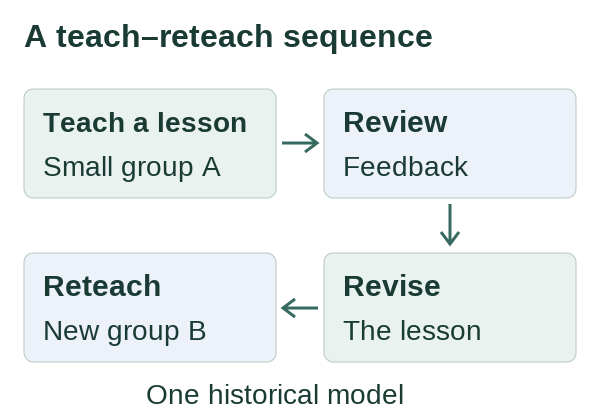
In the version described in one review, the lesson runs from 5 to 20 minutes and the group of students numbers 3 to 10. The lesson is usually video recorded so that it can be reviewed by the trainee alone or with peers. The recorded micro-lesson is then discussed, analysed and evaluated, and the feedback it produces is used when the trainee teaches the same lesson again.[1] Microteaching is best understood as a device for practising skills rather than as a teaching method in its own right.[8]
The most commonly practised form of microteaching in teacher training derives from the Stanford model of the early 1960s.[9] That early version was a method for changing the classroom behaviour of pre-service teachers, and it made use of new portable video technology. Over nearly six decades the practice has changed along with trends in educational theory and technology, from recorded sessions with portable equipment to mini-lessons filmed on students' phones.[10]
Which skills a programme practises depends to a large extent on the trainer's view of what good teaching is, and that view is largely a subjective matter. Some skills show themselves only in a real classroom, which limits what microteaching can do for them, particularly when the microclass consists of other trainees. Organizational skills and the giving of instructions are named as an area well suited to microteaching for trainee language teachers.[9]
Teacher education programmes use microteaching to give trainee teachers opportunities to develop effective teaching strategies.[11] It is also used as a professional development tool in both pre-service and in-service teacher training, where it is intended to help teachers understand the processes of teaching and learning, learn teaching skills, and study their own teaching and the teaching of others.[1]
Main ideas
The cycle of teach, review and reteach
Microteaching is usually organised as a repeating cycle rather than a single lesson: the trainee plans a short lesson, teaches it to a small group, collects feedback, revises, and teaches again. The cycle is small by design, so that a trainee can practise previously learned teaching skills and try new ones without the demands of a full class. Feedback is the hinge of the cycle, and the usefulness of a microteaching programme can be judged in part from the feedback that participants report receiving.[12] One account describes microteaching as a training technique in which a teacher receives constructive feedback from a peer or a faculty member in order to improve teaching skills, with sessions run at departmental level.[13]
A Japanese study of 27 pre-service teachers presented automated video-based evaluation, peer evaluation and self-evaluation side by side, an arrangement the researchers called three-point comparison feedback. Agreement between the automated and peer ratings depended heavily on which behaviour was rated: the correlation was 0.853 for voice volume but 0.164 for facial expression. The Japanese findings rest on a single cohort and the indicators are described as exploratory and sensitive to how prompts are worded.[14]
Pre-service teachers of English as a foreign language who received video-recorded feedback from their instructor during Covid-19 lockdown lessons reported that the feedback was extensive and detailed. It gave an objective view they could review many times. The same trainees named drawbacks: nervousness about sharing their recordings with classmates, doubts about how authentic the process was, and a wish for more interaction with peers about the feedback.[15]
How feedback and reflection drive the cycle
Feedback in microteaching comes from at least two directions: the trainer who observes the lesson and the peers who sit in the same course. Analyses of those data showed traceable improvement in the trainees' understanding and performance, which the study read as evidence that the existing feedback strategies improved the quality of students' microteaching.[16] Peers can also serve as assessors rather than only as commentators. In a qualitative descriptive study of Class 6A of the primary teacher education program at Nahdlatul Ulama University, South Kalimantan, in the 2023-2024 academic year, an observation sheet for reinforcement skills recorded students' use of reinforcement techniques at an average in the good category. That study concluded that peer assessment can work as an alternative way to strengthen basic teaching skills in microteaching courses, particularly the skill of reinforcement.[17]
Self-evaluation supplies a second channel of feedback, and its form shapes what trainees notice. Four pre-service teachers of English as a foreign language evaluated their own questioning through a structured procedure called Self-Evaluation of Teacher Talk, or SETT, keeping reflective journals and sitting interviews. The procedure raised their awareness of the language they used in teaching, including how they managed that language to help students respond.[18]
Video review extends self-evaluation by letting trainees watch their own lessons. One class of 16 fifth-semester primary teacher education students at HKBP Nommensen University in Pematangsiantar combined video-based self-evaluation with a flipped classroom approach, in which course content is studied before class and class time is used for practice. The quality of microteaching performance rose significantly (mean = 9.81; t = 6.96; p < 0.05), with improvement visible in material mastery, questioning skills, classroom management and use of learning media. Written reflections from those students described greater teaching readiness, more sensitivity to students' learning needs and more contextual, participatory lesson designs.[19]
Digital tools have been described as changing how performance is recorded, analysed and discussed. A qualitative descriptive review grounded in systematic literature analysis reported that information and communication technology enables more accurate self-evaluation and improves the quality of feedback in microteaching, alongside gains in teaching performance.[20] An artificial intelligence system built for this purpose compared recorded demonstrations with a structured rubric, pointing to time-stamped behavioral evidence. Users could review and revise the evaluation through chatbot dialogue, after which the system produced personalized feedback. Undergraduate special education students at a private university in South Korea used the system for a semester in two required courses. Valid pre-use questionnaire responses numbered 42, posttest responses 65, and matched pairs 33; 20 students were interviewed over the semester's two demonstration cycles. Acceptance was high before use, with composite means from 4.22 to 4.63 on a 5-point scale, and did not decline after the semester; a modest rise in performance expectancy (d = 0.36) was described as suggestive rather than established. Interviewees attributed their continued acceptance to evidence-grounded, time-stamped feedback, to score discrepancies that prompted questioning and reflection, and to uptake into lesson planning and re-teaching, while locating the limits in context-recognition errors, inconsistent feedback and interface friction.[21]
Reflection does not always reach the depth that trainers intend. An exploratory case study of sixth-semester mathematics education students found five patterns in their oral communication during microteaching: selecting main ideas before speaking, losing those ideas during elaboration, strong influence of content mastery on the structure of communication, limited development of ideas, and irregular delivery. The study concluded that these students had not fully engaged in reflective thinking while speaking in front of the class and recommended building a cognitive-reflective approach into microteaching training.[22] Reflection on microteaching also carries an emotional dimension, since competing discourses can position pre-service teachers in ways that produce disappointment, isolation and frustration, and this emotional dissonance led some of the six Hong Kong pre-service teachers interviewed in depth to question whether microteaching works.[23] Fourteen fourth-year Bachelor of Education student teachers in South Africa, interviewed in a focus group and analyzed narratively, reported that micro lessons develop professional skills including reflection, decision making and responsibility, and that presentations should progress from friendship groupings to random groupings to peer presentations.[24]
Basic teaching skills practised in micro lessons
Indonesian studies of microteaching courses commonly describe eight basic teaching skills. One observation study of Biology Education students in a 2022/2023 microteaching class found that all eight were applied at a very good average level, although individual indicators ranged from quite good to very good.[25][26] A separate analysis of 12 sixth-semester English Education students found that all eight skills appeared in their micro lessons with differing levels of proficiency, and that set induction, explanation, reinforcement and stimulus variation were the ones students used most.[27] Set induction, also called opening or import, is the short opening a teacher uses to draw students into a topic, and it appears as a skill in its own right in chemistry teaching guides for micro lessons.[28][29]
Questioning is rehearsed as a skill of its own, and a mixed-methods case study of Mathematics Education students in a collaborative microteaching course found that 72.7% reached the good or very good category, with clear questions that matched the lesson objectives. The same study found that higher-level questions and the use of student answers as feedback remained limited, which fits its opening observation that prospective teachers' questions tend to sit at low levels of thinking.[30] Explanation is another named skill, and in a study of 16 fifth-semester English students it was applied in 82% of observed micro lessons, second only to the use of teaching media at 95%. Opening reached 78% and variation skills 75% in the same group, while small-group discussion reached 20%, organizing small-group and individual work 43% and reinforcement 48%. That pattern led the study to conclude that the students showed stronger teacher-directed skills than interactive, learner-centred ones.[31]
Reinforcement, the responses a teacher gives to encourage or confirm student behaviour, is taught alongside blackboard writing in Chinese chemistry microteaching practice, which groups import, questioning, blackboard writing and reinforcement as four key skills for chemistry majors.[28] Closure, the planned ending that draws a lesson together, and classroom control belong to the same family of basic skills. A survey of 372 students in colleges of education in northwest Nigeria found that the skill of classroom control had a significant impact on student teachers' performance during teaching practice. The Nigerian study recommended that clear rules and regulations be established for students so that their behaviour can be monitored effectively.[32]
Communication itself has been broken into observable parts. A descriptive study of biology teacher candidates at one Indonesian university scored calmness at 72, voice clarity at 75, clarity of material at 81 and response to the audience at 78, for an overall score of 76, all classified as competent.[33] A review of simulation-based microteaching adds that the format develops the ability to lead discussions, to pose critical questions, to explain material in a structured way and to vary instruction.[34]
In the study by Rusmiati, 16 fifth-semester students at Panca Sakti University Bekasi were observed during the 2024/2025 academic year, and the share of performances that demonstrated each skill ranged from 20% for small-group discussion to 95% for using teaching media.[31] A development study that built video materials for basic teaching skills reported an N-gain of 0.7 in students' basic teaching skills after the materials were used in a microteaching course, with media expert validation at 86.7% and user response at 87.9%.[35]
A quasi-experimental study of pre-service chemistry teachers used a pre-test and post-test design with a control group over a six-week course in the second semester of the 2020-21 academic year at a faculty of education in Vietnam. The experimental group worked through microteaching combined with information technology, while the control group received traditional lectures, and the two groups did not differ significantly on the pre-test. After the course, the microteaching group had gained significantly more in the skills of organizing STEM teaching, a term for lessons that combine science, technology, engineering and mathematics.[36]
Research
Effects on confidence, self-efficacy and anxiety
Several studies have asked whether microteaching changes how confident student teachers feel, and most report gains, though the size of the gain and the conditions that produce it vary.[37][38][39] A study of 95 pre-service teachers of English as a foreign language at a university in Thailand found that microteaching used across two methodology courses improved self-efficacy for student engagement, for instructional strategies and for classroom management.[37] A smaller study of 19 pre-service elementary school teachers in Korea reported a positive effect of microteaching on English teacher efficacy. Participants also described greater confidence and satisfaction, and the gain from the first microteaching session carried over into the next one.[39]
In a pretest-posttest control group design with pre-service elementary science teachers, the treatment group planned mini-lessons, watched videotapes of them, replanned and retaught with detailed feedback, while the control group taught mini-lessons with only brief feedback.[40] A study of pre-service geography teachers found self-efficacy in teaching mapwork rose after microteaching. Yet some participants still reported difficulty with magnetic declination, bearing, cross-sections, intervisibility and map interpretation, and the study concluded that microteaching should be paired with targeted support for those topics.[41] In a survey of 211 physical education students who had completed a microteaching course, 34.59% fell in the sufficient category for self-competence and 35.07% in the sufficient category for microteaching skills, a result the study read as a call for more practice in speaking skills.[42]
Research on stress during microteaching has measured both what trainees say they feel and what their bodies do. In an experiment with 44 pre-service teachers randomly assigned to biofeedback training, relaxation training or a control condition, feelings of calm increased across time, which indicated that repeated practice made participants more comfortable with the microteaching situation. None of the physiological interventions reduced stress, and the study concluded that practice is a useful way to lower stress in microteaching and that stress-reduction techniques should be chosen on evidence.[7]
A quasi-experimental study of 19 sixth-semester English education students at a university in Indonesia found that a microteaching intervention significantly reduced teaching anxiety compared with a control group. Anxiety was measured with the Teaching Anxiety Scale, and the effect size was very large. The same study examined pedagogical mental models, meaning the organised ideas a trainee holds about how a lesson works, and found improvement that was not statistically significant, with a medium effect size.[43] An effect size is a statistical calculation of how large a measurable effect is, for example the difference between the averages of two groups divided by the standard deviation.[44]
A survey of 272 student teachers of English as a foreign language, analysed with structural equation modeling, a method for testing how several measured variables relate to one another, found that public speaking anxiety had no statistically significant impact on self-efficacy. The same analysis found negative relationships between teaching experience and lesson-delivery competence, between speaking competence in English and lesson-delivery competence, and between lesson-delivery competence and self-efficacy.[6] A quasi-experimental study of 240 student teachers at Zarqa University reported significant pre-test to post-test gains in intentions to use the principles of the theory of planned behaviour, a model of how intentions shape behaviour, with a mean of 2.39 before and 3.11 after.[45]
What changes the results
In interviews with 30 sixth semester English education student teachers, participants said microteaching had helped them with lesson preparation, explaining content, managing time and teaching with confidence.[46] A qualitative study of the winner of a university microteaching contest in mathematics found that the student built several possible activities at the idea stage and adapted them to the conditions and the time of the lesson.[47]
A survey of 177 prospective biology teachers found a preference for microteaching integrated with project-based learning. A model built on that preference set out six steps: introduction to the concept, planning, teaching, feedback and reflection, project collection, and project evaluation. Trials of that model with 36 fourth semester biology students indicated a positive effect on the prospective teachers' 4C skills, a shorthand for critical thinking, collaboration, creativity and communication.[48] A quasi-experimental study at one Indonesian university combined a project-based biology microteaching model with blended learning, which mixes face-to-face and online work, and reported a positive response from the student teachers.[49]
Microteaching in subject and regional settings
In science education, a mixed-methods study of 97 pre-service science teachers found that microteaching had a significant effect on teaching skills, visible in introducing a lesson, classroom management, time management and planning, communication and concluding a lesson, and in self-confidence. Written responses and individual interviews with those pre-service teachers supported the quantitative findings.[2] A separate experimental study of science primary pre-service teachers reported excellent performance in knowledge and mastery of subject matter and in the art of questioning after exposure to microteaching, and judged the method very effective in improving teaching performance.[50] In physics, 18 fourth-year Bachelor of Secondary Education students majoring in physical science took part in a pre-test and post-test quasi-experiment comparing a microteaching multiple-representation lesson study with a traditional instructional planning approach. Scores differed significantly between the two groups in overall critical thinking and in its sub-domains, which the researchers read as a benefit of the microteaching lesson study.[51]
In the study by Moustaghfir, 35 undergraduate pre-service teachers took part in six structured microteaching sessions, and the quantitative analysis showed statistically significant improvements in all speaking components.[52] A case study of 11 future English teachers in a microteaching practicum led by two senior lecturers found near-unanimous agreement that contact in English between teacher and students is one of the most significant parts of teaching and learning the language.[53] A study using the Beliefs About Language Learning Inventory before and after a microteaching lesson study class at Universitas Muria Kudus found that student teachers' beliefs did not change significantly, and it named time as one of the most influential factors hindering change.[54] The qualitative findings pointed to greater confidence, less anxiety, and favorable views of peer feedback and of reflection on one's own practice.[52] A qualitative study of six pre-service English teachers at a private university in Central Java reported that the microteaching course improved their lesson plans, gave them teaching practice and let them evaluate their own teaching. It also helped them identify students' characteristics, reflect, understand students' learning, develop students' potential, communicate and carry out assessment.[55]
Challenges remained in developing and implementing lesson plans, and the study calls for more intensive guidance from lecturers and mentor teachers.[56] An analysis of the microteaching course at the Faculty of Tarbiya and Teacher Training, IAIN Purwokerto, drew on observation and interviews with the microteaching manager and study program heads. It identified several conditions that could make implementation less effective: technical briefings that merged all study programs at once, overcrowded participants, speakers not representative of each program, supervisors not matched to the program, and schedules that clashed with lectures. It recommends that each study program coordinate with the laboratory, that briefing material be enriched with learning strategies relevant to the program, and that one lecturer teach small classes on the regular lecture schedule.[57]
In the study by Wantika, the ability to open lessons rose to 88% and the skill of providing reinforcement to 82%, while interactive classroom management reached 79% and the use of innovative media was limited by a lack of supporting facilities such as projectors. A descriptive qualitative study observed eight basic teaching skills in the microteaching laboratory of an Islamic Religious Education study program. The same study found significant challenges in interactive classroom management (79%) and limits on innovative media because of missing facilities such as projectors, and it recommends more emphasis on creative media, digital literacy and conflict management simulations.[58]
A controlled trial in India assigned 80 Bachelor of Education students at random to a group that received a designed microteaching programme and a group that did not, and measured both with scales developed by Bawa and Nagpal in 2010. Teaching competencies differed significantly between the groups after the intervention, with marked improvement in the experimental group.[59] A literature review of empirical work from 2006 to 2023 concluded that microteaching goes together with favorable results in teacher education. The review names selection bias, a focus on English-only studies and the chosen time period among its own limitations.[3]
Anxiety, attitudes and the practicum transition
Microteaching is a teacher training technique in which a trainee teaches a short lesson to a small group, and it is practised worldwide as a way to build teaching skills.[60][61] Higgins and Nicholl report that students experienced anxiety during microteaching but still judged it a valuable teaching method in nurse education. A study of lecturers and students in nurse education found that students' evaluations described the method as a valuable teaching methodology despite the anxiety they experienced. The same report observed that a novice teacher will find little guidance on planning or running a teaching session with this strategy.[62]
A small qualitative study measured anxiety among mathematics education students in their sixth semester during microteaching lessons organized around lesson study, a cycle of planning, teaching and joint reflection. Of the eight students studied, 2 showed no anxiety, 3 showed light anxiety and 3 showed moderate anxiety, so the observed levels ran from none to moderate. The study traced anxiety to external factors, namely friends and observers, and to internal ones: inadequate preparation for the practice, thin preparation of material, weak adaptability, and gender. These findings come from a purposive sample of eight students at one university, and the study reports no comparison group.[63]
Attitudes toward microteaching have been studied through pre-service teachers' own accounts.[64] A qualitative study of fourth-year Bachelor of Education students at a private higher education institution in Durban, South Africa, found that students valued a piloted online microteaching model and saw it as improving their preparedness to teach across diverse educational contexts.[65]
Whether performance in microteaching carries over into field experience has been examined directly. One study followed 10 pre-service teachers into their Field Experience Program after they had taken a microteaching class, using their report books as data. The results indicated that microteaching helped these pre-service teachers improve and reach good teaching performance in the classroom, and that they used appropriate learning methods and classroom management. With a sample of 10 and data drawn from report books, the study offers a small, descriptive basis for that conclusion.[66]
Students also report difficulties in the microteaching course itself. In a mixed methods study of 10 participants in an English education program, lesson study within microteaching classes was found to improve teaching skills through collaborative planning and reflective sessions. The same participants named three significant hurdles: limited time, scheduling difficulties of a logistical kind, and bringing technology into the work.[67]
In practice
Lesson study and collaborative versions
In one Turkish English language teaching department, three third-year prospective teachers formed an MLS group and designed a single research lesson around the Content and Language Integrated Learning approach, in which subject content and a second language are taught together. A different member of the group taught that lesson three times, each time to a fresh set of five peers who acted as young learners, and after each run the group met to review the presenter's self-reflection, peer and instructor feedback, and the recorded lesson. Those revision meetings showed an instructional improvement cycle, and interviews found the group members generally satisfied with collaborative planning and peer feedback, though a few concerns were raised. The study drew on three group members, 15 peers and one instructor, and its author recommended that MLS be built into English language teaching programmes.[68]
An online version, run as a case study with eight prospective physics teachers, used recorded meetings, session documents, interviews and observation, and it built and enhanced the participants' pedagogical knowledge. The stages and cycles pushed the participants to collaborate, exchange ideas for active learning in the lesson plan, and repair weaknesses, and the trial, analysis, discussion and revision reduced a cognitive discrepancy, a mismatch between what the teachers intended and what the lesson produced. That study covered only prospective physics teachers over two cycles and drew on a small group analysed qualitatively, so its findings are not generalizable.[69] A descriptive qualitative study of mathematics pre-service teachers at one Indonesian university scored lesson plans and found gains from average to good in planning, pre-learning, learning and closing activities, and gains from average to good in concept mastery and material understanding. Pedagogical knowledge in that study rose from average to excellent for clarity of learning scenarios and from average to good for use of learning media and for matching assessment techniques to learning objectives.[70]
In a one-year initial teacher education programme in England, prospective secondary teachers of geography, history, citizenship and social science worked in cross-curricular groups of three or four to co-design two research lessons on thinking skills for advanced-level content. The peer micro-teaching lesson study helped the student-teachers develop between their two school placements. It let them share placement experience, learn from each other's practice and improve subject knowledge inside and outside their own specialism.[71] A qualitative case study of 70 student-teachers at one Indonesian university examined collaborative learning in microteaching classrooms and expected to find that it significantly enhances teaching practice performance, with gains in communication, teamwork, management, problem-solving and active participation.[72]
Use with pre-service and practising teachers
A study of 35 undergraduates in a Japanese Language Education programme found that students generally viewed microteaching positively, especially for building self-confidence, teaching readiness and adaptability to student characteristics. The same study found no significant relationship between students' perceptions of microteaching and their academic achievement in the course, and students described a gap between simulated teaching and actual classroom conditions.[73] A correlation study of 54 English majors at Riau University reported a Pearson correlation of 0.879 between microteaching skills and teaching readiness, above the table value of 0.268 at the 0.05 confidence level.[74]
A descriptive study of prospective Arabic teachers at Muhammadiyah University of Yogyakarta scored them at 74.1% for drawing up a lesson plan, 76.4% for providing supporting media, 77% for using teaching methods and 75% for variation, discussion and explanation, for an average of 76.4%. The difficulties those students reported included a lack of teacher confidence, trouble using learning media, a mismatch between the plan and classroom reality, and basic skills such as opening and closing lessons, classroom management, group forming, explaining and making variations.[75]
A study of 60 pre-service English language teaching students in Turkey, 38 female and 22 male, aged 20 to 26, used interviews and micro-teaching sessions to examine critical thinking. The participants valued it but applied it only superficially, citing a lack of training and pedagogical constraints.[76] A study of 64 prospective English language teachers at Erzincan Binali Yıldırım University in the 2022-2023 academic year found positive attitudes toward teaching very young learners, together with a stated need for training in that area.[77] A case study of four Vietnamese pre-service teachers who conducted microteaching in groups of three as an obligatory part of an English teacher education programme used activity theory, a sociocultural framework, to trace peer scaffolding, contradictions in the activity system and teacher identity construction.[78]
Planning lessons and materials for micro sessions
Before a micro lesson, a pre-service teacher assembles a written lesson plan and the materials that will be used in the short session.[79][80] In one study of 11 mathematics education students, assessors scored the written lesson plan and the teaching performance separately across three open lessons.[79]
In the study by Stevanić and Milenković, 90% of the lesson plans from the control group contained flaws in teacher and student activities, compared with 46% of the plans from the experimental group that used the Microteaching Lesson Study approach. One qualitative comparison of prospective mathematics teachers used Microteaching Lesson Study, a cycle in which a group plans, teaches, observes, receives feedback and revises. Students whose practical lessons were organized through that cycle showed significantly fewer deficiencies in their written lesson plans than peers who did not have the same opportunity. The improvement was linked to the strengths, weaknesses and suggestions classmates gave in peer feedback and to the reflections students wrote after teaching.[80]
In the study by Santoso and Roviudin, expert assessment of the module's presentation scored 82.85%, and the accuracy of the module scored 94.4%.[81] One course had students produce teaching designs and teaching videos, and short film projects with mathematical themes were made and uploaded for others to view. Recordings of students' own practice remained collections of the learning and laboratory work of the students concerned, and the course used them as examples for discussing mastery of material, delivery and class management.[82] A module written for a microteaching course at an Islamic teacher training institute in Surabaya went through needs analysis, initial design, development, expert validation and revision. Expert ratings gave 37.5 percent for content, 94.4 percent for accuracy and 82.85 percent for presentation, and the combined score of 71.56 percent placed the module in the valid category with partial revisions required before group testing.[81] For early reading instruction, a lesson study based microteaching design was developed with the Dick and Carey instructional development method across seven stages and presented in video tutorials covering a pre-reading phase, a reading phase and a post-reading phase.[83]
What this looks like when you study
In another study, eight prospective physics teachers took part in an online microteaching lesson study with two cycles. The stages and cycles pushed the participants to work together, share ideas for active learning in the lesson plan and its teaching practice, and fix weaknesses as they went. Trying out, analyzing, discussing and revising lessons reduced the prospective teachers' cognitive discrepancy, the term the study uses for the mismatch it measured.[69]
In a Chinese normal university, 41 pre-service teachers took part in a 12-week microteaching intervention built on a practice, feedback and journal model. Each participant submitted five online reflective journals, and content analysis with Nvivo 20 software suggested that the model has the potential to enhance critical thinking. Reflective feedback and case-based teaching strategies appeared supportive, and cooperative learning emerged as a promising approach because it simulates both the student and the teacher perspective.[84]
In a Tunisian institute, 30 videotaped microteaching lessons, two in-class discussions and a survey tracked third-year students' progress in light of feedback from their trainer and peers. The data showed measurable gains in how well the trainees understood the feedback and how well they performed.[16]
In a South African university during the COVID-19 lockdown, 10 Post Graduate Certificate in Education students, in two groups of five, presented four lessons each online. Their digital skills, knowledge and critical thinking skills were enhanced, and conducting microteaching virtually also resulted in inclusive learning.[85]
In one Indonesian mathematics education program, 11 students took a microteaching course based on lesson study, conducted online through YouTube, a Moodle learning system, Zoom and WhatsApp. Across Open Lessons I, II and III, the average lesson plan score rose from 76.636 to 84,182 to 88,364, and the average teaching skills score rose from 76,818 to 83,909 to 87,182.[79]
If you are preparing a micro lesson, one source recommends that you plan a short lesson and teach it to a reduced group of three to ten students for 5 to 20 minutes. The same source recommends that you reflect on the lesson afterwards, since the lesson is video recorded for individual or peer review. It then recommends that you re-teach the micro lesson, incorporating the points raised during the discussion and analysis of the feedback.[1]
Later developments
Online, video and digital forms
Lockdown conditions pushed microteaching programmes that had been face to face onto digital devices. One South African case study followed two groups of Post Graduate Certificate in Education students, five in each group and 10 in total, through observations and semi-structured interviews. All 10 student teachers completed their microteaching virtually, with better marks in the second round than in the first. The study reported that their digital skills, knowledge and critical thinking skills improved and that virtual delivery produced inclusive learning. The study concluded that technology resources were central to the programme's effectiveness during the lockdown and argued for keeping technology in microteaching after it ended.[85]
Interactive media have been built specifically for microteaching courses, and one development study at an Indonesian teacher education faculty tested Canva-based materials with 60 students, 20 in a limited trial and 40 in a large-scale trial. The materials included infographics, instructional videos and interactive quizzes. Expert validation scored ease of use at 85 percent, clarity at 88 percent, curriculum alignment at 90 percent and visual design at 82 percent, with test-retest reliability coefficients from 0.72 to 0.85.[86]
Simulation combined with microteaching, described as Micro-teaching 2.0, pairs traditional practice with human-operated simulated classroom scenarios. A study of 376 pre-service teachers reported increased self-efficacy along with benefits and challenges for initial teacher education.[5] Digital microteaching has also been used with school pupils: a descriptive evaluative study at a Philippine senior high school had Grade 11 students record voice messages of pronunciation drills and post them in a group chat for the teacher to check. The study reported significantly improved speech delivery and attributed pupil engagement partly to preferences for technology-driven, interactive and visual learning with immediate feedback.[87]
Generative artificial intelligence has entered microteaching lesson study, and a mixed-methods study followed 21 prospective secondary mathematics teachers through a 9-day online summer camp with two rounds of lesson study, expert lectures and group discussions. Scores on a mathematics-specific measure of technological pedagogical content knowledge rose significantly in every sub-domain. That knowledge is the knowledge of how subject matter, teaching methods and digital tools fit together, and the size of the gain varied from large to small across participants.[88] A study of 15 female pre-service physics teachers who made online learning videos scored their overall knowledge at 2.1 on a four-point scale, described as sufficient, with high pedagogical knowledge but weaker technological pedagogical knowledge.[89]
Criticism
Criticisms, limits and open questions
A qualitative study of a sociology teacher education program at a university in Yogyakarta, conducted in the 2008 academic year, compared a version in which real school students came to the campus with lessons held in a dedicated microteaching laboratory. The real-student version required more time and adequate space, because pupils had to travel to the campus. The study also reported that the presence of a supervisor in the room made the atmosphere more tense and less natural than in the laboratory, where a place for the supervisor had been prepared in advance.[90]
What the research still cannot settle
Rieker writes that there is a lack of consensus on what it means to engage in microteaching and on how teacher educators can make the practice relevant for teacher development.[91] A review of literature and empirical evidence published between 2006 and 2023 describes microteaching as a widely used training method. In it, teachers sharpen techniques, try out strategies and get feedback in a setting kept under control, a definition broad enough to cover many formats.[3]
Trent interviewed six pre-service teachers at a tertiary institution in Hong Kong, and Birisci, Keles and Senyildiz surveyed 27 undergraduates in a German Language Teaching program.[23][92] A qualitative study in Hong Kong drew on in-depth interviews with six pre-service teachers as they planned and taught microlessons.[23] An exploratory mixed-methods study of attitudes to a generative artificial intelligence tool in lesson preparation involved 27 undergraduates in a German Language Teaching program, and its authors describe the evidence as context-specific and call for research across diverse settings and experience levels.[92] The 2006 to 2023 review likewise recommends further research on pre-service teachers' perspectives and on whether microteaching foundations improve student learning.[3]
De Almeida and Weber (2025) collected data through focus group interviews with fourth-year Bachelor of Education students at a private higher education institution in Durban, South Africa, and analysed the transcripts with reflexive thematic analysis. De Almeida and Weber (2025) gathered data through focus group interviews with fourth-year Bachelor of Education students at a private institution in Durban, South Africa.[65] In the South African study, fourth-year Bachelor of Education students described the online model as a valuable learning experience that improved their readiness to teach in varied settings.[65][16] An exploratory practice study in Tunisia combined 30 videotaped microteaching lessons, two in-class discussions and a survey of trainees' responses to feedback from their trainer and peers, and reported traceable improvement in understanding and performance.[16]
Iliasova, Nekrasova, Mena and Estrada-Molina call for research that tests whether microteaching foundations improve student learning, and Taufikin argues that traditional microteaching practices stress temporary performance rather than sustained professional learning. Iliasova, Nekrasova, Mena and Estrada-Molina call for further research on whether microteaching foundations improve student learning, and Taufikin argues that traditional microteaching often rewards temporary performance rather than sustained professional learning.[3][93] A systematic review of empirical findings published between 2017 and 2025 argues that traditional microteaching often emphasises temporary performance rather than sustained professional learning, and that project-based learning can turn microteaching into a longer cycle of lesson development, implementation, reflection and revision.[93]
Common misconceptions
Amobi and Irwin (2009) observed that microteaching is often reduced to a technical exercise aimed at judging performance rather than a process of reflective learning. One study notes that microteaching is often reduced to technical practice oriented toward performance assessment, and that this narrowing worsens when feedback comes only from the lecturer. In that study, 16 fifth-semester students used video-based self-evaluation within a flipped classroom, and the quality of their microteaching performance rose significantly (mean = 9.81; t = 6.96; p < 0.05).[19]
The most widely used form of microteaching follows the Stanford model of the early 1960s, which centers on general educational skills. Cripwell (1982) argues that for language teachers those general educational skills need not be the ones that matter most. Which skills get practised rests heavily on how the trainer defines good teaching, and that definition is mostly a matter of personal judgment. Cripwell (1982) also doubts that microteaching can do much for skills that show up only in a real classroom, especially when trainees teach a microclass made up of fellow trainees.[9]
Key studies
| Year | Study | Sample | Design | Finding |
|---|---|---|---|---|
| 2014 | Bakır[2] | 97 pre-service science teachers | mixed research design | Microteaching had a significant effect on teaching skills, including lesson introduction, classroom management, time management, communication and lesson conclusion. |
| 2018 | Horgan et al.[7] | 44 pre-service teachers | experimental study with random assignment to biofeedback, relaxation or control | Feelings of calm increased with repeated practice, but no physiological intervention reduced stress. |
| 2019 | Danday & Monterola[51] | Pretest-posttest quasi-experimental design with 18 fourth year Bachelor of Secondary Education-Physical Science majors | There were significant differences in scores between the microteaching Multiple-Representation Lesson Study group and the control group in overall critical thinking and its sub-domains. | |
| 2021 | Coşkun[68] | three third-year prospective English language teachers, 15 peers and an instructor at a Turkish state university | qualitative study of a microteaching lesson study | The group was generally satisfied with collaborative planning and peer feedback, and the revision meetings showed an instructional improvement cycle. |
| 2021 | Susanto et al.[79] | 11 mathematics education students in Indonesia | descriptive qualitative study of online lesson-study-based microteaching | Average lesson plan scores rose from 76.636 to 84,182 to 88,364 and teaching skills scores from 76,818 to 83,909 to 87,182 across Open Lessons I, II and III. |
| 2022 | Handayani & Triyanto[69] | eight prospective physics teachers | case study of online microteaching lesson study with two cycles | The online lesson study built and enhanced pedagogical knowledge and reduced cognitive discrepancy. |
| 2023 | Fki[16] | third-year Education and Teaching students in Tunisia | exploratory practice with 30 videotaped lessons, two discussions and a survey | Traceable improvement in trainees' understanding and performance established the efficacy of the feedback strategies. |
| 2023 | Sithole[85] | 10 Post Graduate Certificate in Education students in South Africa | qualitative case study during the COVID-19 lockdown | All completed their microteaching virtually, marks improved between semesters, and digital and critical thinking skills were enhanced. |
| 2025 | Tan et al.[84] | 41 pre-service teachers at a Chinese normal university | 12-week intervention with content analysis of five reflective journals each | The practice, feedback and journal model has the potential to enhance critical thinking. |
| 2025 | Stevanić & Milenković[80] | prospective mathematics teachers in an experimental and a control group | qualitative analysis of written lesson plans | The experimental group had fewer flaws: 46% versus 90% for teacher and student activities, and 17% versus 55% for content selection. |
| 2025 | Yudi Hari Rayanto, Dies Nurhayati[43] | 19 sixth-semester English education students in Indonesia | quasi-experimental study with experimental and control groups | Microteaching significantly reduced teaching anxiety, with a very large effect, and had a medium but nonsignificant effect on pedagogical mental models. |
| 2026 | Sianturi & Saragih[19] | 16 fifth-semester elementary teacher education students in Indonesia | explanatory sequential mixed methods with video-based self-evaluation and flipped classroom | Microteaching performance quality rose significantly (mean = 9.81; t = 6.96; p < 0.05). |
| 2026 | Lee et al.[21] | 42 pre-use and 65 posttest responses, with 33 matched pairs, among undergraduate special education students in South Korea | convergent mixed-methods UTAUT study | Before any use, acceptance was already high, with composite means from 4.22 to 4.63 on a 5-point scale, and it held steady over a semester of use. |
See also
References
- Reddy, K. (2019). Teaching How to Teach: Microteaching (A Way to Build up Teaching Skills). Journal of Gandaki Medical College-Nepal, 12(1), 65-71. doi:10.3126/jgmcn.v12i1.22621
- Bakır, S. (2014). The effect of microteaching on the teaching skills of pre-service science teachers. Journal of Baltic Science Education, 13(6), 789-801. doi:10.33225/jbse/14.13.789
- Iliasova, L., Nekrasova, I., Mena, J., & Estrada-Molina, O. (2025). Microteaching on pre-service teachers' education: literature review. Frontiers in Education, 10. doi:10.3389/feduc.2025.1562975
- Popovich, N. G., & Katz, N. L. (2009). A Microteaching Exercise to Develop Performance-based Abilities in Pharmacy Students. American Journal of Pharmaceutical Education, 73(4), 73. doi:10.5688/aj730473
- Ledger, S., & Fischetti, J. (2020). Micro-teaching 2.0: Technology as the classroom. Australasian Journal of Educational Technology. doi:10.14742/ajet.4561
- Luo, Z., & Li, H. (2024). Competence, preparation, and relaxation: Contributing factors to EFL student teachers' self-efficacy and teaching performance in microteaching training. Heliyon, 10(4), e26216. doi:10.1016/j.heliyon.2024.e26216
- Horgan, K., Howard, S., & Gardiner-Hyland, F. (2018). Pre-service Teachers and Stress During Microteaching: An Experimental Investigation of the Effectiveness of Relaxation Training with Biofeedback on Psychological and Physiological Indices of Stress. Applied Psychophysiology and Biofeedback, 43(3), 217-225. doi:10.1007/s10484-018-9401-9
- Chaudhary, N., Mahato, S. K., Chaudhary, S., & Bhatia, B. D. (2015). Micro Teaching Skills for Health Professionals. Journal of Universal College of Medical Sciences, 3(1), 60-64. doi:10.3126/jucms.v3i1.13264
- Cripwell, K. (1982). The development of organizational skills through micro-teaching. ELT Journal, 36(4), 232-236. doi:10.1093/elt/36.4.232
- Cavanaugh, S. (2022). Microteaching: Theoretical Origins and Practice. Educational Practice and Theory, 44(1), 23-40. doi:10.7459/ept/44.1.03
- Koross, R. (2016). Micro Teaching an Efficient Technique for Learning Effective Teaching Skills: Pre-service Teachers’ Perspective. IRA International Journal of Education and Multidisciplinary Studies (ISSN 2455–2526), 4(2), 289. doi:10.21013/irajems.v4.n2.p7
- Thangaraju, P., & Medhi, B. (2023). Microteaching: Overview and examination evaluation. Indian Journal of Pharmacology, 55(4), 257-262. doi:10.4103/ijp.ijp_912_21
- Deshpande, S. R., & Shastri, S. (2020). A cross-sectional study to evaluate teaching skills of postgraduate medical students using component skill approach in microteaching. Journal of Education and Health Promotion, 9. doi:10.4103/jehp.jehp_743_19
- Shirasaka, S., Imagawa, T., & Enokida, S. (2026). Exploring Pre-Service Teachers’ Reflection on Nonverbal Behavior in Microteaching Through Three-Point Comparison Feedback. Education Sciences, 16(5), 760. doi:10.3390/educsci16050760
- Murphy Odo, D. (2022). An Action Research Investigation of the Impact of Using Online Feedback Videos to Promote Self-Reflection on the Microteaching of Preservice EFL Teachers. Systemic Practice and Action Research, 35(3), 327-343. doi:10.1007/s11213-021-09575-8
- Fki, N. (2023). Towards More Effective Feedback Strategies to Enhance Microteaching for Pre-service Teachers at ISEAH Mahdia. Studies in Applied Linguistics and TESOL, 23(2). doi:10.52214/salt.v23i2.12090
- Marlina, Siti Rahmah, & Fathony, M. H. (2024). Penilaian Sejawat dalam Keterampilan Dasar Mengajar Memberikan Penguatan pada Mata Kuliah Microteaching: Improving Basic Teaching Skills Provides Strengthening Through Peer Assessment in Microteaching Courses. Jurnal Ilmiah Edukatif, 10(1), 72-82. doi:10.37567/jie.v10i1.2891
- Muroda, N., Munir, A., & Setiawan, S. (2020). Evaluating Questioning Skills of Pre-Service EFL Teachers Through Self-Evaluation of Teacher Talk (SETT) in Microteaching Class. Linguistic, English Education and Art (LEEA) Journal, 3(2), 426-440. doi:10.31539/leea.v3i2.1212
- Sianturi, C. L., & Saragih, S. (2026). Transformasi Kesadaran Pedagogik Mahasiswa PGSD melalui Evaluasi Diri Berbasis Video dan Flipped Classroom dalam Praktik Microteaching: Transformation of Pedagogical Awareness of Elementary School Teacher Education Students through Video-Based Self-Evaluation and Flipped Classroom in Microteaching Practice. Edu Cendikia: Jurnal Ilmiah Kependidikan, 5(03), 1425-1440. doi:10.47709/educendikia.v5i03.7848
- ., Y., & Vedic, B. (2026). Role of information and communication technology in enhancing micro teaching skills with reference to national education policy 2020. International Journal of Research in Management, 8(8), 46-50. doi:10.33545/26648792.2026.v8.i8a.973
- Lee, G., Yoo, Y., & Lee, S. (2026). Preservice Special Education Teachers’ Acceptance of an AI-Based Microteaching Evaluation and Feedback System: A Pre–Post UTAUT Mixed-Methods Study. Behavioral Sciences, 16(10), 1818. doi:10.3390/bs16101818
- Nurrahmah, N., Rahman, A., & Annas, S. (2025). Exploring Thinking and Speaking Patterns of Pre-service Teachers in Microteaching: A Cognitive-Reflective Perspective. Jurnal Pendidikan Matematika, 2(3), 12. doi:10.47134/ppm.v2i3.1652
- Trent, J. (2023). How are Preservice Teachers Discursively Positioned During Microteaching? The Views of Student Teachers in Hong Kong. Australian Journal of Teacher Education, 48(6). doi:10.14221/1835-517x.6124
- Msimanga, M. R. (2020). The Impact of Micro Teaching Lessons on Teacher Professional Skills: Some Reflections from South African Student Teachers. International Journal of Higher Education, 10(2), 164. doi:10.5430/ijhe.v10n2p164
- Kusmiyati, & Merta, I. W. (2024). Analysis of Students Basic Teaching Skills on Teaching Practice of Micro-Teaching Courses. Jurnal Pijar Mipa, 19(2), 235-239. doi:10.29303/jpm.v19i2.6579
- Amanda, B., Sari, D. E., & Tarahilta, T. (2024). Analysis of Micro Teaching Course Implementation to Improve 8 Basic Teaching Skills for Accounting Education Students. Ideguru: Jurnal Karya Ilmiah Guru, 9(2), 743-751. doi:10.51169/ideguru.v9i2.946
- Anggraini, T. A., Sujana, I. M., Amrullah, A., & Amin, M. (2026). An Analysis of Students Ability in Implementing Basic Teaching Skills in The Micro Teaching Class at Fkip Unram. Journal of English Education Forum (JEEF), 6(1), 1-5. doi:10.29303/jeef.v6i1.996
- Wang, C., Jia, T., & Sun, L. (2023). Research on Chemistry Teaching Skills in Middle School Under Micro-Teaching Environment. Advances in Social Sciences Research Journal, 10(6), 281-289. doi:10.14738/assrj.106.14837
- Cui, Y., Sun, Y., Zhao, W., Zhang, Z., & Sun, L. (2025). Research on the Import Skills Based on Micro-Teaching in Junior Middle School. Advances in Social Sciences Research Journal, 12(01), 71-76. doi:10.14738/assrj.1201.18141
- Rahayuningsih, S., Widayanti, F. D., Pribadi, N. W., Yuniarto, E., Christian, S., Sahara, Y. P., Walida, S. E., Marsitin, R., & Nursit, I. (2026). Questioning Skills of Prospective Teachers in Collaborative Microteaching. Jurnal Pendidikan dan Pengajaran, 59(1), 179-186. doi:10.23887/jpp.v59i1.105791
- Rusmiati, Y. (2026). English Students’ Teaching Skills Applied in Micro Teaching Class at the 5th Semester of Panca Sakti University Bekasi. JPGENUS: Jurnal Pendidikan Generasi Nusantara, 4(2), 160-171. doi:10.61787/vv6esb53
- GARBA, Lawal Sani, & ALIYU, Mustapha (2025). Impact of Micro-Teaching Skills on Performance in Classroom Control Strategy among Colleges of Education Students in Northwest, Nigeria. Federal University Gusau Faculty of Education Journal, 5(4), 219-224. doi:10.64348/zije.2025112
- Arwita, W., Hasruddin, H., Ningsih, W., Mukra, R., & Rangkuty, S. M. (2025). Keterampilan Komunikasi Mahasiswa Calon Guru Biologi Melalui Pembelajaran Microteaching: (Communication Skills of Biology Teacher Candidates Through Microteaching Learning). BIODIK, 11(1), 110-117. doi:10.22437/biodik.v11i1.41644
- Euis Latipah, Lisda Aulia Apriani, Silvi Sofiatul Alawiyah, & Tri Fatmah Nurhalizah (2026). The Effectiveness of Simulation-Based Micro Teaching Model in Improving Students' Teaching Skills as Prospective Teachers. Amandemen: Journal of Learning, Teaching and Educational Studies, 4(1), 1-8. doi:10.61166/amd.v4i1.101
- Rahayu, S., Lestari, N., & Mertha, I. G. (2018). Development Teaching Basic Skill’s VCD Media to Improve Teaching Skills in Subjects Micro Teaching. Jurnal Pendidikan Fisika dan Teknologi, 4(2), 247-252. doi:10.29303/jpft.v4i2.837
- Nguyen Thi Thuy, T., Pham Thi, B., & Dang Thi, O. (2021). Effectiveness of micro teaching: Developing STEM teaching organizing skills for pre-service chemistry teachers. Journal of Science Educational Science, 66(5), 217-225. doi:10.18173/2354-1075.2021-0250
- Kwangsawad, T. (2022). Developing EFL Pre-service Teachers’ Self-efficacy through Microteaching. Studies in English Language Teaching, 10(2), p83. doi:10.22158/selt.v10n2p83
- Nasar, A., & Kaleka, M. B. U. (2020). The Effect of Distance Learning With Learner Center Micro Teaching Model On Student’ Teaching Confidence and Teaching Skills. JIPF (Jurnal Ilmu Pendidikan Fisika), 5(3), 159. doi:10.26737/jipf.v5i3.1834
- Center For Educational Research, & Cha, S. M. (2023). The Effects of Microteaching on English T eachers’ Efficacy with Pre-service Elementary School Teachers. Korean Journal of Teacher Education, 39(5), 49-70. doi:10.14333/kjte.2023.39.5.03
- Kartal, T., & Dilek, I. (2021). Developing Pre-service Elementary Science Teachers’ Science Teaching Efficacy Beliefs through Microteaching by Promoting Efficacy Sources. International Journal on Social and Education Sciences, 3(4), 710-731. doi:10.46328/ijonses.124
- Thenga, M. (2026). The effects of microteaching on preservice teachers’ self-efficacy in teaching mapwork. The Journal of Geography Education in Africa, 9, 91-103. doi:10.46622/jogea.v9i.6907
- Apriani, L., Alpen, J., & Arismon, A. (2020). Tingkat percaya diri dan keterampilan micro teaching. Edu Sportivo: Indonesian Journal of Physical Education, 1(1), 42-49. doi:10.25299/es:ijope.2020.vol1(1).5155
- Yudi Hari Rayanto, Dies Nurhayati (2025). Microteaching and Its Effects on Anxiety and Pedagogical Mental Models in Pre-Service Teachers. Journal of Educational Studies, 3(3), 483-501. doi:10.58218/jes.v3i3.3476
- ERIC Thesaurus (n.d.). Effect Size. ERIC Thesaurus. https://eric.ed.gov/?ti=Effect+Size
- Almajali, A. F. (2026). The Effectiveness of Micro Teaching for Promoting Childhood Teachers’ Skills According to a Theory of Planned Behavior Perspective. Education Quarterly Reviews, 9(3). doi:10.31014/aior.1993.09.03.720
- Sihite, D., Jaya, A., & Mortini, A. V. (2023). Microteaching lesson on increasing the student teachers’ ability in teaching english. Esteem Journal of English Education Study Programme, 7(1), 132-143. doi:10.31851/esteem.v7i1.12687
- Murtafiah, W., Lukitasati, M., Lestari, N. D. S., Zayyadi, M., & Widodo, S. A. (2022). Decision making students winning microteaching contest in design lesson plan and its implementation in mathematics learning. Cypriot Journal of Educational Sciences, 17(6), 2045-2060. doi:10.18844/cjes.v17i6.7497
- Sadikin, A., Rusdi, M., Hasibuan, M. H. E., & Siburian, J. (2024). Improving teaching quality: Development of the PjBL microteaching model for prospective biology teachers. Biosfer, 17(2), 523-532. doi:10.21009/biosferjpb.45294
- Sadikin, A., Siburian, J., Saudagar, F., & Pratama, R. (2026). Implementasi model microteaching biologi berbasis PjBL dan blended learning. Jurnal Penelitian Pendidikan IPA, 12(1), 35-41. doi:10.29303/jppipa.v12i1.13069
- Clemente H. Cobilla (2014). Exposure of pre-service teachers to microteaching. Journal of Educational and Human Resource Development (JEHRD), 2, 207-215. doi:10.61569/ym97a444
- Danday, B. A., & Monterola, S. L. C. (2019). Effects of microteaching multiple-representation physics lesson study on pre-service teachers’ critical thinking. Journal of Baltic Science Education, 18(5), 692-707. doi:10.33225/jbse/19.18.692
- Moustaghfir, S. (2026). The role of microteaching in enhancing pre-service EFL teachers’ speaking skills: A quasi-experimental study. European Journal of Applied Linguistics Studies, 9(2). doi:10.46827/ejals.v9i2.706
- Herdiawan, R. D. (2023). EFL Pre-Service Teachers' Beliefs in Microteaching Practicum. Allure Journal, 3(1), 48-55. doi:10.26877/allure.v3i1.13815
- Suryani, F. B., & Rismiyanto, R. (2021). The effect of microteaching lesson study on the beliefs of EFL student teachers. EduLite: Journal of English Education, Literature and Culture, 6(1), 1. doi:10.30659/e.6.1.1-9
- Purwanti, E., & Suhargo, G. I. (2024). Enhancing pedagogical competencies in pre-service teachers’ through microteaching: A qualitative study. Indonesian Journal of Learning and Instruction, 7(1). doi:10.25134/ijli.v7i1.9553
- Rahmah, M., Rosyid, A., Vonti, L. H., Yani, I., & Adela, A. (2024). Efektifitas pembelajaran microteaching terhadap kemampuan kompetensi calon guru. Jurnal Pendidikan Dasar, 15(2), 316-323. doi:10.21009/jpd.v15i2.43088
- Subur, S. (2022). Strengthening the Micro Teaching Role in the Development of Teacher Candidates Teaching Skills. INSANIA : Jurnal Pemikiran Alternatif Kependidikan, 27(1), 1-12. doi:10.24090/insania.v27i1.4681
- Wantika, W. (2026). Implementation of Micro Teaching in Developing Basic Teaching Skills of Prospective Islamic Religious Education Teacher Students. JISEI: Journal of Islamic Studies and Educational Innovation, 2(2), 709-722. doi:10.61094/jisei.v2i2.203
- Rajni, & Prof. (Dr) Vijay Phogat (2024). From Theory to Practice: Implementing Micro-Teaching Skills on Teaching Competencies among B.Ed. Prospective Teachers. International Journal of Scientific Research in Science and Technology, 11(6), 461-472. doi:10.32628/ijsrst24114310
- Hembram, B. (2021). Micro teaching: A way to build up teaching skills. SCHOLARLY RESEARCH JOURNAL FOR INTERDISCIPLINARY STUDIES, 9(66), 15401-15413. doi:10.21922/srjis.v9i66.6835
- Otsupius, I. (2014). Micro-Teaching: A Technique for Effective Teaching. African Research Review, 8(4), 183. doi:10.4314/afrrev.v8i4.15
- Higgins, A., & Nicholl, H. (2003). The experiences of lecturers and students in the use of microteaching as a teaching strategy. Nurse Education in Practice, 3(4), 220-227. doi:10.1016/s1471-5953(02)00106-3
- Hadiprasetyo, K., Exacta, A. P., & Susilowati, D. (2022). Tingkat Kecemasan Mahasiswa pada Mata Kuliah Microteaching Berbasis Lesson Study. Absis: Mathematics Education Journal, 4(2), 77-83. doi:10.32585/absis.v4i2.2510
- Elias, S. K. (2018). Pre-Service Teachers’ Approaches to the Effectiveness of Micro-Teaching in Teaching Practice Programs. Open Journal of Social Sciences, 06(05), 205-224. doi:10.4236/jss.2018.65016
- De Almeida, I., & Weber, J. (2025). Pre-service teachers’ experiences of online microteaching in South Africa. African Journal of Teacher Education and Development. doi:10.4102/ajoted.v4i1.90
- Meutia, P. D., Elyza, F., & Yusnila, Y. (2018). Pre-service teachers’ performance post microteaching class in field experience program. Englisia Journal, 5(2), 102. doi:10.22373/ej.v5i2.2889
- Darsih, E., Agustiana, V., & Rahmatunisa, W. (2024). Implementation of lesson study in microteaching: Benefits and challenges in english education study program. Indonesian Journal of Learning and Instruction, 6(2). doi:10.25134/ijli.v6i2.10942
- Coşkun, A. (2021). Microteaching lesson study for prospective english language teachers: Designing a research lesson. Psycho-Educational Research Reviews, 10(3). doi:10.52963/perr_biruni_v10.n3.23
- Handayani, R. D., & Triyanto (2022). Online microteaching lesson study: a recipe to enhance prospective physics teachers' pedagogical knowledge. International Journal for Lesson & Learning Studies, 11(3), 221-234. doi:10.1108/ijlls-02-2022-0017
- Murtafiah, W., & Lukitasari, M. (2019). Developing pedagogical content knowledge of mathematics pre-service teacher through microteaching lesson study. Jurnal Pendidikan Matematika, 13(2), 201-218. doi:10.22342/jpm.13.2.7663.201-218
- Griffiths, J. (2016). Bridging the school placement gap with peer micro-teaching lesson study. International Journal for Lesson and Learning Studies, 5(3), 227-238. doi:10.1108/ijlls-11-2015-0035
- Amala Malik, Fitrotun Maulani, Farikah, & Dwi Winarsih (2024). Micro-Teaching and Collaborative Learning: A Synergy for Developing Student-Teacher Performance and Collaborative Skills. Metathesis: Journal of English Language, Literature, and Teaching, 8(2), 125-138. doi:10.31002/metathesis.v8i2.1603
- Nurwahidah, R. R., & Wahyuni, Y. (2026). Student Perceptions of the Role of Microteaching Courses as Preparation for Implementing Field Experience Practices. JPI (Jurnal Pendidikan Indonesia), 15(2), 501-510. doi:10.23887/jpi-undiksha.v15i2.107064
- Jannah, S., Daud, A., & Novitri, N. (2024). Micro teaching skills and teaching readiness of english study program students : A correlation study. TELL-US JOURNAL, 10(2), 591-603. doi:10.22202/tus.2024.v10i2.8093
- Fadillah, R. (2021). Analysis of the Teaching Difficulty by University Students of Arabic Language Education through Microteaching Practices/ Analisis Kesulitan Mengajar Mahasiswa Pendidikan Bahasa Arab Melalui Praktik Microteaching. ATHLA : Journal of Arabic Teaching, Linguistic and Literature, 2(1), 17-36. doi:10.22515/athla.v2i1.3399
- Tunaz, M. (2024). Integrating critical-thinking skills into foreign language teaching: Micro-teaching practices of pre-service teachers. Eğitimde Yeni Yaklaşımlar Dergisi, 7(2), 183-192. doi:10.70325/eyyad.1560708
- KOÇ, H. K. (2023). The Perceptions and Views of Prospective ELT Teachers on Teaching English in Preschools: A Microteaching Lesson Study and Practical Experiences. International Primary Education Research Journal. doi:10.38089/ekuad.2023.144
- Phan, A. N. Q. (2022). Learning to Teach: Vietnamese Preservice Teacher Development Through Microteaching. International Journal of Teacher Education and Professional Development, 5(1), 1-15. doi:10.4018/ijtepd.295545
- Susanto, H. A., Astutiningtyas, E. L., & Susilowati, D. (2021). Microteaching dalam jaringan berbasis lesson study dan peningkatan keterampilan mengajar serta pengembangan lesson plan. Delta: Jurnal Ilmiah Pendidikan Matematika, 9(2), 243. doi:10.31941/delta.v9i2.1406
- Stevanić, J., & Milenković, A. (2025). Developing lesson planning and delivery skills of prospective mathematics teachers through the microteaching lesson study approach. Journal of Educational Studies in Mathematics and Computer Science, 2(1), 18-31. doi:10.5937/jesmac2501018s
- Santoso, B., & Roviudin, M. (2024). Penyusunan Modul Pembelajaran Mata Kuliah Microteaching di STAI Ali Bin Abi Thalib Surabaya. Alamtara: Jurnal Komunikasi dan Penyiaran Islam, 8(2), 87-102. doi:10.58518/alamtara.v8i2.3098
- Rudhito, M. A. (2018). Using exelsa moodle to develop mathematics teaching skills and spirit in the micro teaching course. IJIET (International Journal of Indonesian Education and Teaching), 2(2), 177-186. doi:10.24071/ijiet.v2i2.1175
- Rini, T. A., Cahyanto, B., & Nurdianasari, N. (2024). Lesson Study-based Microteaching Design in Early Reading Instructional for Prospective Elementary School Teachers. Sekolah Dasar: Kajian Teori dan Praktik Pendidikan, 33(1), 59-72. doi:10.17977/um009v33i12024p59-72
- Tan, Z., Gong, Q., Liu, J., Liu, F., Lu, L., & Deng, W. (2025). The Impact of “Practice–Feedback–Journal” Microteaching Model on Critical Thinking Development in Chinese Pre-Service Teachers. Behavioral Sciences, 15(12), 1745. doi:10.3390/bs15121745
- Sithole, N. V. (2023). The Efficacy of Microteaching in a Teacher Education Programme During the Lockdown at a University in South Africa. International Journal of Learning, Teaching and Educational Research, 22(2), 76-91. doi:10.26803/ijlter.22.2.5
- Lasaiba, D., Ratumanan, T. G., Kempa, R., Lokollo, L. J., & Lasaiba, M. A. (2025). Development of Canva-Based Interactive Media to Enhance Basic Teaching Skills in Micro Teaching Courses. AL-ISHLAH: Jurnal Pendidikan, 17(4). doi:10.35445/alishlah.v17i4.7310
- L. Roces, R. (2026). Enhancing the retentivity of students' phonological skills through digital micro-teaching. International Journal of Science and Research Archive, 18(3), 711-719. doi:10.30574/ijsra.2026.18.3.0514
- Yuan, Z., Zhong, X., Huang, W., Li, Z., Tang, X., & Tan, Q. (2025). GenAI-enabled microteaching lesson study: developing prospective secondary mathematics teachers’ TPACK in an online summer camp. International Journal for Lesson & Learning Studies, 14(3), 298-317. doi:10.1108/ijlls-11-2024-0273
- Putri, S. A., Damayanti, P., Nuryadin, A., & Sulaeman, N. F. (2024). Online Microteaching: Unveiling Female Pre-service Physics Teachers Technological Pedagogical and Content Knowledge (TPACK). KnE Social Sciences. doi:10.18502/kss.v9i13.16015
- *, V. I. S. P. (2015). Efektifitas real microteaching pada program ppl i (microteaching) di program studi pendidikan sosiologi FISE UNY. DIMENSIA: Jurnal Kajian Sosiologi, 2(2). doi:10.21831/dimensia.v2i2.3402
- Rieker, J. (2022). Making microteaching matter. Second Language Teacher Education, 1(1), 3-23. doi:10.1558/slte.20306
- Birisci, S., Keles, N., & Senyildiz, A. (2026). Pre-service foreign language teachers' acceptance of ChatGPT in microteaching lesson planning: A sequential mixed-methods study. Acta Psychologica, 268, 107362. doi:10.1016/j.actpsy.2026.107362
- Taufikin, T. (2025). Developing Microteaching Competence through Project-Based Learning for Primary Teacher Education Students. Ludi Litterarri, 2(3), 50-61. doi:10.62872/k2zzfk84
Cite this page: Atlas Nova editors. (2026). Microteaching. Atlas Nova. https://velocer.io/atlas/micro-teaching/