Method · Language teaching
Content and language integrated learning
Bilingual teaching approach
Content and language integrated learning (CLIL) is an approach in which students learn a school subject through a foreign language, so that both the subject content and the language are learned together.[1][2]
In CLIL, a school subject is taught through a language that is not the students' mother tongue.[1] A review of the published studies found mostly positive or neutral effects on language and content outcomes.[3] Many studies have methodological problems, so strong conclusions are difficult.[3] At one elementary school in Taiwan, students enjoyed the CLIL approach and expected to learn other subjects in English.[4]
Overview
What CLIL is and where it came from
Content and language integrated learning is a way of teaching a school subject through an extra language.[8] The subject might be mathematics, physics, chemistry or engineering. The language is studied at the same time. Content and language are treated as partners. Each one serves the purpose of the other. Supporters put it simply: there is no language without content and no content without language.[9] The approach is also described as a way to keep linguistic diversity. It is also called a tool with a strong effect on how a foreign language is learned.[10]
Teaching a subject in another language is old, but the name for it dates from 1994. In Europe, the driving force behind its development was the birth of the European Union. The reasoning was practical. If European citizens want the benefits of an integrated Europe, they need to communicate in at least one foreign language. The European Commission has named the approach as one of the innovative methods that can improve the quality of language teaching. One early obstacle to spreading it widely was a lack of suitable teaching materials. A document analysis found no suitable published material. None existed for teaching first aid in English. A five-hour course was therefore written for Grade 8 pupils. The pupils were in three bilingual primary schools in Budapest.[8] The approach is a little over thirty years old. It has been used and studied at primary, secondary and tertiary levels.[11]
Two versions are usually distinguished, called soft and hard.[12] In a school that adopts the approach fully, a foreign language taught as a separate subject slowly leaves the timetable. The approach then becomes part of the school's educational programme. Special programmes of this kind help to form learners. In these classes, schoolchildren take an active part in tasks with a social purpose. They use the foreign language. They may join projects with peers from other countries. They may also hold videoconferences. So the learning environment in secondary school aims at learning a foreign language. It also aims at building the ability to communicate in it.[13]
The approach is also said to widen what a traditional curriculum can do, because subjects are integrated with one another rather than each taught on its own. It is described as creating a whole, active and stimulating learning environment.[10] In higher education, some voices over the past decade have raised a question. Does the approach suit courses taught in English to students whose first language is not English? Other names have been proposed instead, such as English Medium Instruction and English Medium Education.[11]
History
National contexts and policy adoption
In Latvia, CLIL is part of national policy. It is treated as one element of bilingual education. Latvian education policy aims to strengthen ethnic minority learners' knowledge of Latvian. It also aims to shift attention from separate language outcomes to an integrated view of language and subject content.[14]
Austria's bilingual schools and bilingual lessons began as separate efforts started by the schools themselves. The main precondition for those Austrian lessons was the subject and language skill of the CLIL teachers. Subject materials in a foreign language were also needed. Austrian schools adapted their CLIL models to school type, subject-language pairing, curriculum, study group and school situation. The article also presents a concept of continuous education for teachers. This is part of the CLIL programme.[15]
Greece ran a small experimental study. It tested whether CLIL fits its existing school system. The pilot class used project-based learning, with collaborative work supported by an online platform. Progress was shared through a wiki.[16]
Azerbaijan has traditions of using several languages. CLIL was examined there as a possible answer to communication problems among different language groups. Participants supported CLIL. English was the most preferred foreign language. Attitudes to the method and to the language itself differed by income level. They also differed by existing language skills.[17]
China has used CLIL ideas in College English. One study surveyed 2513 College English students and 230 College English teachers. They came from 45 universities at three levels and of three major types.[7]
Kazakhstan's trilingual education system has drawn a body of CLIL research. A scoping study reviewed 26 journal articles and master's theses. Most of those studies centred on students' English language skills. The review grouped the work into perceptions and beliefs, positive outcomes and challenges, and pedagogy and methodology.[18]
Japan has used CLIL at university level. One course covered Japanese international history. That growth appeared to raise willingness to communicate in the second language. It also seemed to stimulate critical thinking.[19]
In Cameroon, CLIL was changed for English teaching in language centres. There, 43 of 64 students were leaving with much general English. They had little language for their academic or professional fields.[20]
In Colombia, a nursing programme at a higher education institution treated students' English communication skills as a priority. The project guided six teachers across the seven subjects of the programme. It built 17 applications from the 4Cs: content, cognition, communication and culture. At the start, the control group's mean English score was much higher than the experimental group's. After the CLIL applications, the experimental group's mean had improved. It was now statistically similar to the control group's.[21]
Brazil's Base Nacional Comum Curricular forms the policy background for one proposal. The proposal is to use CLIL in public secondary schools. That proposal drew on an example at the Federal Institute of Espírito Santo, Montanha campus. There, students had lessons in geography and cultural studies taught in English.[22]
Main ideas
The 4Cs and how lessons are built
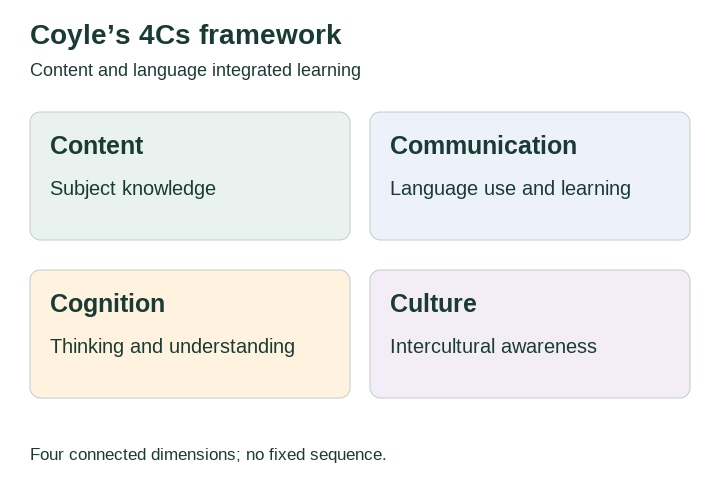
The best known is the 4Cs framework, set out by Coyle and applied to university teaching of international relations in a 2026 article by Sun. The four Cs are content, communication, cognition and culture.[23]
Two novice CLIL teachers helped design the project. It was tested in their subjects, recycling technology and control engineering. Both are taught at Austrian technical colleges. There, cognitive demand is high in content and language alike. Bacovsky-Novak observes that content teachers in Austrian CLIL programmes rarely get training. They get little training in subject literacy or in foreign language teaching methods. Putting an integrated model into practice is therefore especially hard for them.[24]
A third strand of planning looks at how subject knowledge and language connect at the level of meaning.[25] That article presents CLIL as an umbrella term. It calls it an ideal teaching practice for building such content-specific literacies by joining cognition and language in a multilingual learning setting.[26]
Shchukina (2026) supports a steady, step-by-step structure for the integrated lesson in foreign-language education. The article sets out possible stages for developing receptive and productive skills. These stages put interdisciplinary links into practice. Its worked example is Russian taught as a foreign language. The materials come from history and culture. Shchukina places weight on problem-solving and creative tasks. She also favours harder tasks for students working together.[27] George and Jacob (2022) trace the language side of such lessons to second language acquisition theories. These theories hold that a second language is acquired when a subject is learned through interaction.[28]
Assessment of content and language together
Coyle and colleagues called in 2010 for an explicit account of how assessment works in CLIL. More than a decade later, the issues on the agenda still need research. Clear solutions cannot yet be offered to teachers and students. A 2022 review of a book on assessment and learning in CLIL classrooms describes the book. It links theoretical perspectives with different research paradigms.[29]
A scoping review made the first attempt to bring together theoretical and empirical work on CLIL assessment from around the world. The reviewers selected 77 publications from 763 search results. They analysed them by theme. The analysis found three main research themes. They were assessment issues, assessment practices and assessment frameworks.[30]
A further problem is that language and subject assessment often follow monolingual practices. These do not reflect how students actually use their languages. Such practices may reinforce English dominance and linguistic hierarchies, according to a 2026 narrative review of multilingual assessment. The reviewers also ask how educators can build and widen multilingual ways of assessing students in bilingual education. That work would challenge the traditional focus on standardized language norms and on isolated skills.[31]
First language use and translanguaging
In CLIL classrooms, one question is whether learners' first language (L1) should be used alongside the target language. CLIL allows more freedom in the choice of teaching languages than strict monolingual teaching does.[32] A study in a third-grade class in Drama, North-eastern Greece, followed 13 students. Eight were Greek students and 5 were students of Albanian background born in Greece. Interviews, pre-tests and post-tests, and observations were combined. They were used to study a translanguaging CLIL lesson. Students' experiences in that lesson helped build intercultural awareness. They also improved English language skills. The study concluded that teachers need more training. It also said monolingual policies need to be revised.[33]
One study looked at 335 undergraduates in a large content-based English as a foreign language programme. It used questionnaires and tests. English proficiency was the strongest predictor of learners' overall attitude to L1 use in class. Content proficiency and language learning motivation came next as predictors. Gender did not significantly predict the overall view of L1 use. But it was related to using the L1 for social purposes. Male students in that sample needed more translanguaging support of this kind. The paper advises teachers to encourage and guide translanguaging for different instructional purposes as classroom needs change.[32]
Language mixing has been tested for its effect on memory. In an Old/New recognition task, people had to pick out concepts they had seen before from new ones. They did this in three language conditions: single-language L1, single-language L2, and mixed. Recall was tested again 36 hours after the first test. Response times and accurate recall scores were analysed. Mixed-language input lowered both immediate and delayed recall of information. This was compared with L1 input. Mixed-language input produced better recall than L2 input alone. It therefore partly offsets the recall disadvantage of a single-language L2 setting.[34]
Teachers in a bilingual context generally viewed CLIL positively. This came from a mixed-methods case study that collected data from teachers, students and parents. Students there favoured the CLIL language, English, over their mother tongue, Bangla. This points to a gap in proficiency. Parents raised concerns about slow language development and motivational difficulties. They also raised concerns about translation from the second language into the first. The study focused on students with language-based learning disabilities (LBLD). It found challenges for this group. It calls for a balanced approach. This pairs CLIL principles with planned use of the mother tongue and attention to motivation.[35]
How lessons are planned and taught
Fernández Fontecha (2012) argues that the order of non-linguistic content should come first. The order of language content should follow it. One proposal for language-oriented CLIL settings states that non-linguistic content should come first. Its order should set the order of the language work. That proposal describes a tool called the Content and Language Processing Sequence. It helps with choosing the non-linguistic content, treating the language part, and designing digital materials. The same proposal notes that teachers' preparation before materials reach the class will differ with each CLIL setting. In content-oriented versions, the non-linguistic content is already fixed in the official curriculum. In language-oriented versions, the language teacher sets the order of that content. The teacher also keeps the goals of the foreign language curriculum.[36]
A five-step process for teaching primary science through CLIL was developed. It came from the CLIL framework and the features of primary science education. The process used document analysis and synthesis, a questionnaire survey, and a teaching experiment. A teaching experiment with Grade 5 students gave early support.[37]
One qualitative case study looked at two elementary school teachers. The teachers used five main kinds of strategy. They taught vocabulary specific to the subject to strengthen students' subject terms. They also used scaffolding techniques. The teachers applied scaffolding techniques. This was one of five strategy types Marshalina (2026) observed in two elementary classrooms. The teachers also used translanguaging, active learning and multimodal resources. They switched among these strategies flexibly. They used these strategies flexibly to handle students' language limits. They kept the content objectives at the same time.[38]
Content compression is the deliberate cutting of the content to be taught. One paper argues that CLIL practice generally neglects it. The CLIL literature often warns against cutting down and simplifying content. The fear is that this may harm students' grasp of the subject. The paper explains why compression can still improve students' understanding of content. This holds when it is applied correctly. It gives principles and methods for making content shorter in CLIL teaching.[39]
One study took place at an Indonesian bilingual school. Teachers there reported gains in students' language and content knowledge. The same teachers had limited prior knowledge of CLIL. They found it hard to teach beginners while handling content and language at once. The study drew on eight teachers who taught subjects in English. Two of them were interviewed in depth. Its implications include ongoing professional development for teachers. They also include careful attention to students' language proficiency levels.[40]
Research
What the evidence says about language gains
The largest recent summary of language results is a 2023 meta-analysis, a study that pools the numbers from many separate studies. It combined 44 samples with 7,434 students in total. These came from 38 primary studies of secondary-level students. The approach it measured was English-medium instruction and content and language integrated learning taken together. This was compared with a mainstream condition. The overall effect on English competence was d = 0.73 in the short term. The standard error was 0.06 and the 95% confidence interval ran from 0.61 to 0.86.[5] A confidence interval is a range of values below and above an estimate that has a given probability of including the true value.[41] Over the longer term the effect was larger, at d = 1.01, with a standard error of 0.06 and a 95% confidence interval from 0.88 to 1.15.[5]
The size of the gain depended on the conditions of the study, and the meta-analysis named four factors that changed it. Effects were much higher for learners whose first language was related to English. Effects were lower in primary studies that had checked the two groups were similar before teaching began. Effects were also lower when the test measured speaking or writing rather than understanding, and higher when the test focused on vocabulary.[5]
One study tested 79 primary learners in such classes and 331 learners outside them. The tests came at the end of primary and secondary school, using the 2k Vocabulary Levels Test. All groups scored within the most common 1000 words. The secondary students outside the classes did better than the primary students. The difference between those secondary students and the students in the classes was not statistically significant. No significant differences appeared between boys and girls. The classes had received less exposure to English. So similar scores were read as a possible benefit for vocabulary.[42]
Academic vocabulary in writing shows a different pattern. A Swedish study followed 146 students in content and language integrated learning classes. It also followed 84 students outside them through upper secondary school. It counted academic words in four writing assignments over three years. It used two published wordlists, the AWL and the AVL. Students in the classes used more academic vocabulary from the start. But their use did not grow more than that of the other students. The AVL gave a more detailed picture of progress than the AWL. Only the AVL result was backed by other findings.[6]
Most studies showed either positive or neutral effects for content-based teaching. The review also found several problems with method. These make strong conclusions difficult. It noted that Spain has received a lot of research attention while other countries remain understudied. It called for work across more countries that corrects the flaws it identified.[3]
A classroom observation study took place in Spanish-based and Catalan-based primary schools. It applied a taxonomy of academic language to lesson talk. It found that classroom talk in the classes had a conversational style. That style helps academic language skills develop. Its results on intersubjective cooperation, meaning shared understanding between partners, were somewhat inconclusive.[43]
Content learning and subject knowledge
One study looked at science lessons taught through content and language integrated learning, or CLIL. The lessons took place at an elementary school in Taiwan. The researcher collected graphic organizers, individual interviews, student self-assessments and tests. The findings showed that CLIL helped enlarge student vocabulary and strengthen student science knowledge. Students also enjoyed the approach. But they showed limited knowledge about the school flower.[4]
A 2024 study asked 11 researchers of English as a lingua franca to rate essays. The essays were research-based arguments from a CLIL course, and the rating was for content quality. The raters spoke their thoughts aloud as they scored the essays. These spoken records are called think-aloud protocols. The study found essay features that language assessment has not treated as relevant. These features matter in CLIL. These include the accuracy of the content and the presence and quality of research. They also include the elements required in academic essays. It also confirmed that components often addressed in language assessment remain pertinent to writing assessment in CLIL. These include elaboration and logicality. The study argued that the usual definition of content in second language writing assessment may underrepresent what CLIL is meant to develop.[44]
Motivation, attitudes and socioeconomic context
CLIL programs are often praised for making foreign language learning fairer. Students with the lowest socioeconomic status were mostly in the LE track. Those with the highest status were mostly in the HE track. Students with lower English proficiency were often of lower socioeconomic status. For them, fewer meaningful learning opportunities may limit access to the cultural and economic capital that knowledge of English brings.[45]
In the monolingual setting of Jaén, Spain, questionnaires went to 745 people in eight secondary schools. These were 692 students and 53 teachers. A large evaluation found a mostly positive view from both the student and teacher groups toward the bilingual programme in the Andalusian region.[46]
At the University of Cádiz, opinions were collected from 88 respondents. This happened during the second phase of a Legal English course for Law students. Students were somewhat against the idea before the course began. Their view became positive once they understood the teaching method well.[47]
A comparison tested whether CLIL raises motivation compared with traditional English as a foreign language teaching. The statistical analyses showed that CLIL students had stronger motivation to learn English as a second language. This was stronger than students in traditional English as a foreign language classes.[48]
In Taiwan, an exploratory study looked at local CLIL students. It asked how they reacted when native English speakers joined their English as a Foreign Language classroom. Most local students were glad the exchange students were there. The study also raised questions about an internationalised curriculum. It raised questions about mixing cultures in a monolingual setting.[49]
Effects on specific skills and subjects
A quasi-experiment took place at one junior high school. It split 52 seventh-grade students into 26 in a CLIL class and 26 in a control class. The CLIL group's mean reading score rose from 41.54 on the pre-test to 68.19 on the post-test. An independent samples t-test gave a significance value of 0.000 (p < 0.05).[50]
A quasi-experiment with 60 eleventh-grade social class students in Kuningan found a significant difference in factual report writing. The significance level was 0.000 against an alpha of 0.005.[51] In a Kuwait college course, 27 students were interviewed in five focus groups. They were also surveyed online during the 2015-2016 academic year. About 80% of those students thought the course improved their writing within the sentence (punctuation, capitalization) and beyond it (paragraph organization, transition words, cause-and-effect paragraphs). About 20% did not think it improved their writing beyond the sentence level.[52]
A project-based CLIL English course for 88 mathematics students at the University of Lampung was judged effective. The judgment came from group work, project completion and student presentations.[53] CLIL students used more instances and a wider range of negotiation moves, such as clarification requests, confirmation checks and self-repairs.[54] In a translation study at secondary level, 30% of interviews mentioned confidence in speaking. Another 25% mentioned new vocabulary.[55]
Two studies report vocabulary gains. One found gains in maritime terms in an Indonesian course, and one in science vocabulary among Thai secondary students taught with word lists.[56][57] Thai secondary students at three levels received science word lists with CLIL. They showed mean score increases significant at 0.05 on both a science vocabulary test and a science content test.[57] The translation study also reported better vocabulary learning and use in everyday contexts.[55]
A 12-week mixed-method study looked at 28 students in an Introductory Algebra class in Saudi Arabia. It identified and classified their language difficulties and proposed a CLIL model to reduce them. Eltoum (2023) identified and sorted the language difficulties students met.[58] A legal English institute used a modified CLIL format. Four substantive U.S. law classes ran alongside a core legal English class that reused the same authentic readings.[59]
A survey of 123 Iranian university students found that CLIL had a positive role in developing transversal skills. Emotional intelligence mediated this relationship. The finding on transversal skills comes from a questionnaire written for the study. It went to 123 university students in Iran.[60]
In practice
Teachers, training and professional development
Italy responded by building specific teacher education programs for this work.[2] A Ukrainian paper describes how the training of future English teachers is changing. The change comes as CLIL is adopted.[61] A study from Kazakhstan concludes that English language teachers are key members of CLIL. They need steady support in teaching methods and from their institutions.[62]
In Madrid, six English teachers in bilingual secondary schools answered a questionnaire. They also sat for interviews. Their views on CLIL did not agree with one another. This included its benefits and the place of language in it. Even so, their beliefs fit the principles behind CLIL. They also held that their expertise as language specialists should count for more. The researcher suggests that teacher education programmes take such beliefs into account.[63]
The case school was in eastern Turkey. Science and mathematics teachers there described their own difficulties. They named a thin vocabulary, problems with translation, and weak foundational knowledge in their students. Their answers included group work and activities that cross subject lines. They also included individual feedback and questions that push students toward higher-order thinking.[64]
In Bangkok, 14 future Social Studies teachers took a CLIL training program. Their knowledge of the approach, of CLIL material design and of CLIL teaching rose by a statistically significant amount. The same teachers rated the program well on its training, its learning experiences, its material design and its teaching. The study recommends that more such programs be offered to pre-service teachers.[65] Interviews after the course found a positive effect on professional development. Video improved the trainees' grasp of CLIL and their awareness of their own teaching.[66]
One such study paired a researcher with an English teacher. Her Grade 4 class joined for five months. The two worked as equals to design and carry out a single CLIL unit. They did this through several stages of making resources.[67]
CLIL across subjects and school levels
In one Japanese junior high school, a physical education teacher taught a basketball class in English. The lesson aimed at basketball skills, English expressions and situational English. Students came to understand the English structures being taught. They also learned the basketball terms and strategies. The teacher had expected the lesson to be hard for the students. But it was well received, and she gained confidence.[68]
A separate study of physical education lessons asked a question. Could teaching in a second language distort the subject's basic purposes? It began with interviews with 12 participants, 8 teachers and 4 students. It then ran a quasi-experimental comparison with 49 students wearing motion sensors. Moderate to vigorous physical activity was higher in the CLIL group than in the control group. A questionnaire on social relationships showed no statistically significant changes. Slight signs of an effect by gender did appear.[69]
One lesson taught 175 elementary students in Nara, Japan about Nara Fans, a traditional local product. It covered their history, their present situation and how they are made. Students used many different English expressions during the lesson. It did not matter to them whether the lesson was in Japanese or English. They focused on the content. They also learned that Nara is popular among foreigners. They learned that many ruins lie in the surrounding area. The researcher recommended continuing CLIL lessons in various subjects. Each student should get individual support, and lesson targets and content should be checked often.[70] At university level, a tennis class at the Faculty of Sport Science of Universitas Negeri Semarang combined CLIL with another method. That method breaks academic texts down into their features.[71]
Engineering is another setting. In this case a Spanish school of engineering taught English within a Telecommunications Engineering programme. The course combined specialized language and content with information and communication technologies. It also aimed to develop generic competences, or transferable skills, and learner autonomy. Its designers presented it as preparation for lifelong learning and linked it to study plans set up after the Bologna Declaration in 1999.[72]
A course for architecture students used CLIL to build communication skills. It also built a working knowledge of professional architectural terms.[73] Professional English for law and for the sea has also been organized around CLIL.[74][75] For future sailors, CLIL in maritime English lessons aimed to teach the language in a short period. It did this by using professional contexts. Activities included warm-ups, reading, listening, viewing, speaking and writing tasks, role plays, simulated professional situations, practice of Standard Marine Communication Phrases and case studies.[75]
Business writing has been tested with a comparison group design. The experiment lasted eight weeks and involved 80 third year Business English students. They were at Shaoyang University in Hunan Province, China, split into two classes of 40. The CLIL group scored much higher than the group taught the usual way. This held for overall Business English Writing and for report, memo and letter writing. The researcher suggested using CLIL as an alternative method. It could be used in future writing classes.[76]
Adult learners outside formal degree programmes have been included too. The interviews pointed to a better self-image and strong motivation. They also pointed to gains in social skills and improved speaking in the target language.[77]
Technology, materials and games in CLIL
A classroom wall can carry subject content in the target language. One small Spanish study tested whether such displays raise motivation. The study was quasi-experimental and involved 43 bilingual primary students in Spain. The materials were curricular and hands-on. The researchers collected data through questionnaires. After the intervention, the findings showed that a CLIL-based wall display raised motivation somewhat. The study concluded that resources for teaching content in English should differ from those used for curricular content in Spanish.[78]
Serious videogames have been proposed as a way to add playful practice to CLIL lessons. One article argues that the benefits of joining language and content could grow if exposure time were higher and students were highly motivated to learn.[1] A coding-themed example comes from primary English writing in Korea, where a CLIL model built on the 4Cs framework was applied to teach coding. The framework covered content, communication language, cognition and culture. These were described in detail as codes, computational thinking, English commands, thinking levels, motivation and interest. The teaching was laid out as 17 lessons. Each was a template for a coding and English class built on the 4C components. In the experimental class, learners showed a positive change in English writing fluency. They also improved their coding problem-solving ability and their interest in it.[79]
Online teaching and hybrid learning have both been studied as ways of delivering CLIL.[80][81] A quasi-experimental study compared Class 8th students receiving hybrid CLIL instruction with peers following traditional CLIL methods. It measured vocabulary, grammar, reading comprehension and writing skills. The hybrid group did better than the traditional group in all measured areas. The study describes the blended setting of digital tools and in-person instruction as an adaptive, learner-centered approach. It supports both content understanding and language development.[80]
The COVID-19 pandemic pushed CLIL teachers into fully online teaching for long periods. A mixed-methods study examined what that shift demanded. The study used 20 teachers from an established CLIL school in mainland China. It set out the challenges they faced online.[81]
STEAM projects add the arts to science, technology, engineering and mathematics. They have been proposed as a way to improve CLIL teaching. One framework, called 6Es, runs through engage, explore, explain, engineer, enrich and evaluate. Its author showed that these stages aligned with the 4Cs of CLIL's pluriliteracies approach. A case study applied the 6Es to 204 Indonesian tertiary students. The CLIL lessons ran for 16 meetings and covered ecosystem protection. The findings showed positive results across the measured dimensions. The variables were positively correlated. A regression analysis showed that self-directed learning predicted all the key variables. So did authentic problem solving and creativity.[82]
A knowledge graph is a network of linked concepts. One study used it as adaptive scaffolding in a CLIL course, meaning support that adjusts to the learner. The 16-week intervention involved 51 undergraduate English majors at a Chinese application-oriented university and was evaluated within an Outcome-Based Education framework, which organizes teaching around stated learning outcomes. Overall course objective attainment was 0.78. It was 0.81 for disciplinary knowledge and 0.82 for language proficiency. Practical skills reached 0.73. The researchers described a gap between knowledge and action that persisted there. The study concluded that the knowledge graph was strong for conceptual scaffolding. It also found that additional immersive simulations were needed to build high-order procedural knowledge.[83]
CLIL uses a foreign or non-native language as the tool for studying a discipline. A questionnaire survey looked at how CLIL was being carried out in higher education. The students were in biological programs with a teaching focus. The data showed that putting CLIL into practice requires taking account of the specifics and recommendations of all participants in the learning.[84]
What happens in real classrooms
Two classroom studies describe teachers switching between languages during CLIL lessons. One was in a Chinese university science course and one in a Thai university.[85][86] One study audio-recorded 130 minutes of an English-medium science course. The teacher there switched languages to supply background knowledge. The switch also deepened students' understanding of the material. The same teacher used the switches to make teaching more efficient, to engage students and to keep classroom interactions going.[85] Structured classroom observation, field notes and audio recordings showed that switching served mainly a preventive purpose. The main reason was that students' proficiency was low.[86]
This stressed content words and the learning points of the lesson. The Thai instructor used self-repetition most often. It was the emphasis technique used most. The lecturer also switched to give clear explanations of difficult concepts and to clear up confusion. The study reports that this helps learning.[86]
Papaja and Wysocka-Narewska (2020) used a questionnaire with secondary school CLIL learners. They studied when these learners switch codes. That study also asked about the good and bad effects of the practice on the foreign language being learned.[87]
In Spain, observers watched twenty classes in two bilingual schools. Fifteen of these were Natural Science and Social Science classes in primary school. Five were Music classes at secondary school. The observers recorded a wide range of teaching practices and patterns of student and teacher interaction. They also recorded a positive learning environment.[88]
In Australia, a Year 8 science class was taught in Japanese through CLIL. A monolingual science teacher co-taught with a Japanese language teacher. Observations, interviews, a student survey and work samples showed students highly engaged with the Japanese part of their science lessons. Kanji was positioned as a way for students to deepen their grasp of scientific concepts. Yet teachers and students seemed to talk about Japanese use and about learning science as two separate things.[89]
A case study at a joint-venture university in China followed one undergraduate student who spoke several languages. The student drew on her full set of language resources. She used them to understand, deepen and broaden her grasp of research content. These practices helped her build understanding of new concepts and vocabulary. They also improved her academic writing. The study reports that they also showed her different language structures, conventions and vocabulary.[90]
In an Australian secondary school, a teacher of Japanese and Humanities through CLIL made decisions. These were about when and how to let learners use their multilingual resources. Complex social and cultural factors shaped those decisions. This came from an in-depth analysis of qualitative data. As the teacher saw it, her approach helped students keep working through hard tasks. It helped them reach the desired outcomes.[91]
Projects, tasks and student products
Tavella and Fernández (2026) describe a CLIL project at an Argentine national university. It produced a bilingual audioguide for a local museum. A 2026 article on classroom practice describes one such project. It took place at a state-run national university in Argentina. Students training as tour guides made it. The students met twice a week in synchronous online classes of 75 minutes. Their English ranged from A1 to A2 on the Common European Framework of Reference for Languages. This is a scale of language ability. The report reads the students' text development through the Pluriliteracies Model for Deeper Learning. This is a framework for building and communicating knowledge across languages and cultures. The article argues that working toward a defined and relevant purpose pushed learners to use their languages in real situations.[92]
Martínez, Fernández Medina and Zabala (2023) describe CLIL activities. These use collaborative work, real-time communication and feedback with digital tools. A 2023 paper describes two classroom activities. In the first, students create sentences using Google Photos. In the second, a shared messaging space serves as a mediation resource for listening and speaking practice. The paper treats authentic material on topics of student interest as central to motivation and success in CLIL. It pairs this material with collaborative work.[93]
Annury, Fridolini and Sutrisno (2025) combined CLIL with corpus-based analysis. They say this supplies authentic, subject-specific language input. A 2025 mixed-methods study combined test scores with surveys, interviews and case studies. It compared an experimental group using corpus-based CLIL tools with a control group taught by traditional CLIL methods. The experimental group showed 80%-100% gains on vocabulary acquisition, grammar accuracy and subject-specific terminology comprehension. The control group showed 30%-50%. The study reports that corpus tools give real language input tied to the subject. They also support critical thinking, cultural awareness and learners working on their own.[94]
What this looks like when you study
In one Spanish primary school, 43 bilingual students worked with wall displays built around CLIL lessons. Questionnaires showed that motivation rose somewhat after the intervention. Gómez Ramos and Lozano Barrios (2020) concluded that content lessons in English need different teaching resources. The same content taught in Spanish needs different ones.[78]
At one elementary school in Taiwan, students studied science through CLIL. The data came from graphic organizers, individual interviews, self-assessment and tests. Those students grew their vocabulary and gained science knowledge. They said they wanted to learn other subjects in English.[4]
A CLIL business course at a Colombian university ran for three semesters. The teacher deliberately reduced the amount of content taught, a practice called content compression. That experience suggested that content compression, combined with other practices, raised students' linguistic confidence. It also raised their perceived learning in both content and language.[39]
In a Thai university CLIL class, the instructor switched between languages mainly to prevent misunderstanding. Explanations came in the first language. The students' low proficiency level would otherwise have made the lesson hard to follow. The instructor also switched languages to substitute words and phrases. The switches also emphasized content words and learning points and clarified difficult concepts.[86]
Bacovsky-Novak (2023) presents a lesson design template. It lists content objectives, language objectives, materials and media, scaffolding, and a lesson sequence with activities and interaction formats. It also has a space for scaffolding.[24]
Criticism
Criticisms, limits and open questions
A research agenda named areas that were then underrepresented in the literature. These were policy statements and how people involved view CLIL, classroom talk, and differences between CLIL and non-CLIL lessons.[95] A review looked at research published in Spain between 2003 and 2012. It gave a critical overview of work on CLIL, young language learners and technology-enhanced language learning.[96]
One small-scale study notes its own size. That study found that children with lower proficiency in the target language sometimes showed cognitive overload, meaning the mental demands of the task exceeded what they could hold at once. Those children needed extra help. Teachers gave it through pictures, gestures or translation.[97]
A teacher development model for CLIL in the Friulian minority language in Italy was piloted. The pilot involved a small group of teachers of Friulian. The paper behind it argued that minority languages cannot be lastingly revived unless functional literacy in them becomes an explicit educational goal.[98]
Learning a subject in a second language adds cognitive load for students.[99] An analysis of CLIL in Indonesia argued that putting it into practice raises issues in both cognition and communication. It added that the approach should be reconsidered unless better English language education is set up. More research in educational linguistics is also needed.[100] Differences in storage capacity and in attention and task switching affected the accuracy of their writing. Attentional abilities mattered more than memory.[101]
A study of 219 learners aged 11 to 12 compared high-CLIL, low-CLIL and non-CLIL tracks, with 85, 82 and 52 pupils respectively. Without counting outside exposure, the high-CLIL group scored significantly higher in reading. The groups did not differ significantly in listening. Exposure to English outside school was frequent, especially among high-CLIL pupils. Reading, watching television and listening to music correlated positively with scores. Private English lessons were linked to higher scores in the non-CLIL group.[102]
A study in French-speaking Belgium found that CLIL predicted second-language writing outcomes in both Dutch and English. Formal exposure mattered for English and informal exposure for Dutch. The researchers linked that difference to status. Each language holds a different standing among the pupils.[103]
Doubts about the claims
Supporters of content and language integrated learning have often presented it as a near-panacea, a cure for many educational problems at once. A 2013 review argued that supporters credit the approach with many benefits. It said research does not support all of them. The same review proposed a difference between weak and strong forms of the approach. It also pointed to gaps in the research base. It suggested that these gaps come from policies. These policies put a second language ahead of other school subjects. Where the approach seemed to succeed, success was often tied to strong student selection. Students were chosen on several criteria. Success was also tied to a high level of investment in teachers and teaching. As a result, the approach often favors students who already do well in both language and content.[104]
A 2023 systematic review looked at 28 research articles from 2013 to 2022. It found that most studies in China took place in higher education, with English as the main teaching language. Most of those findings supported benefits of the approach. These covered different aspects of learning. The review also found that research concentrated on learners' perceptions and on language learning outcomes. Other topics got less attention. These included assessment, shifting between languages in class, mixed levels of learning, learning materials and the learning process. The reviewers concluded that the research agenda in China should be widened and deepened.[105]
Charunsri (2020) describes CLIL in Thailand as a big challenge. It is hard for content teachers and for professional development programs. A 2020 review of the Thai context described the approach as a big challenge. In Thailand, English is a foreign language. The approach is not easy for teachers or learners whose first language is not English.[106]
A 2019 study at the University of Azuay in Ecuador compared two groups. The other was taught through English for Specific Purposes, a course focused on the language of a job or field. Both groups were taught for about five hours a week. This lasted two semesters in a row. The study found no meaningful rise in language proficiency. It found no difference in achievement between the two groups. The result suggested that learners' starting language level shaped the outcome of the CLIL program.[107]
Classroom language use is a further concern. Learners may lean heavily on their first language. A 2026 study of Moroccan high school students argued that discourse knowledge is held back when the first language dominates classroom talk. Discourse knowledge is a part of language competence. The study ran an intervention in three stages. It introduced five strategies: categorize, explain, give an example, act and contextualize. The results showed that these strategies worked well. They reduced how much learners relied on their first language. Labzar and colleagues (2026) aimed to improve teacher assessment. They focused it on learners' target language use rather than their first language responses.[108]
The 2013 review pointed to lacunae, meaning missing pieces, in research on the approach.[104] The 2023 review found only 28 eligible articles across four databases. These covered a full decade of work in China. That review also noted a paucity of knowledge, meaning very little is known. It concerns how the approach develops and is applied in China.[105] One 2021 article looked at students of technical specialties. It weighed the advantages and disadvantages for building foreign language communicative competence.[109]
Common misconceptions
Many people believe CLIL makes foreign language learning fairer. The source says CLIL programs are often praised for this claim. In the low exposure track, CLIL and English teachers used English less often. Students also showed lower intrinsic motivation.[45]
Key studies
| Year | Study | Sample | Design | Finding |
|---|---|---|---|---|
| 1970 | Canga Alonso[42] | 79 CLIL primary learners and 331 non-CLIL learners | comparison using the 2k Vocabulary Levels Test | Receptive vocabulary sizes fell within the most frequent 1000 words, and the difference between the CLIL group and non-CLIL secondary students was not statistically significant. |
| 2015 | Olsson[6] | 146 CLIL and 84 non-CLIL students in Swedish upper secondary school | comparison of four writing assignments over three years | CLIL students used academic vocabulary more from the start, but their use did not progress more than that of non-CLIL students. |
| 2018 | Ito[70] | 175 elementary students in Nara, Japan | CLIL lesson with post-test and questionnaire | In Ito (2018), students used various English target expressions, and the share who enjoyed the lesson was higher than the share who said they liked English classes [57]. |
| 2018 | Graham et al.[3] | systematic review of the articles that met its inclusion criteria, on CLIL and EMI outcomes | Most studies showed positive or neutral effects of content-based instruction on language and content outcomes, but methodological issues prevent strong conclusions. | |
| 2019 | Ito[68] | 23 junior high school students in Japan | case study of three basketball lessons taught in English | Students understood the English structures and basketball terms, and the teacher gained confidence after expecting the lesson to be difficult. |
| 2019 | Vega & Moscoso[107] | tourism students at the University of Azuay, Ecuador | randomized comparison of CLIL and ESP instruction over two semesters | Vega and Moscoso (2019) found no significant gain in language proficiency and no difference in achievement between the CLIL and non-CLIL groups [134]. |
| 2020 | Salvador-García et al.[69] | 12 interviewees (8 teachers, 4 students) and 49 students measured by accelerometry | mixed methods with interviews and a quasi-experimental design | The CLIL group showed higher moderate to vigorous physical activity than the control group, while social relationships showed no statistically significant change. |
| 2020 | Van Mensel et al.[103] | regression study of CLIL and non-CLIL learners in French-speaking Belgium writing in Dutch and English | CLIL was a significant predictor of second-language writing outcomes for both target languages, but the relative impact of formal and informal input differed by language. | |
| 2021 | Rong & Nair[76] | 80 third-year Business English college students in China | quasi-experimental study over eight weeks | The CLIL group scored significantly higher in overall writing, report writing, memo writing and letter writing than the conventional group. |
| 2021 | Wentzel[39] | students in a CLIL business course at a Colombian university | three-semester teaching experience | Content compression combined with other practices increased linguistic confidence and perceived learning in both content and language. |
| 2022 | Tompkins[45] | year 10 students at a bilingual secondary school in a low socioeconomic town in Madrid | questionnaire study comparing high and low exposure tracks | Students of lowest and highest socioeconomic status were concentrated in the low and high exposure tracks, and the low exposure track had less teacher English use and lower intrinsic motivation. |
| 2023 | Lee et al.[5] | 44 samples (N = 7,434) from 38 primary studies | multilevel meta-analysis | EMI-CLIL showed an overall effect size of 0.73 in the short term and 1.01 in the longer term for English competence, with lower gains when productive skills were tested. |
| 2023 | Charunsri & Sripicharn[65] | 14 pre-service Social Studies teachers in Bangkok | quasi-experimental mixed-methods training study | Knowledge of the CLIL approach, material design and teaching improved with a statistically significant difference, and opinions of the program were favorable. |
| 2025 | Caira et al.[34] | CLIL pupils in an auditory recall experiment | Old/New recognition task with immediate and delayed recall | Mixed-language input led to worse recall than first-language input but better recall than second-language input. |
See also
References
- Casañ Pitarch, R. (2017). Gamifying Content and Language Integrated Learning with Serious Videogames. Journal of Language and Education, 3(3), 107-114. doi:10.17323/2411-7390-2017-3-3-107-114
- Lopriore, L. (2020). Reframing teaching knowledge in Content and Language Integrated Learning (CLIL): A European perspective. Language Teaching Research, 24(1), 94-104. doi:10.1177/1362168818777518
- Graham, K. M., Choi, Y., Davoodi, A., Razmeh, S., & Dixon, L. Q. (2018). Language and Content Outcomes of CLIL and EMI: A Systematic Review. Latin American Journal of Content & Language Integrated Learning, 11(1), 19-38. doi:10.5294/laclil.2018.11.1.2
- Huang, Y. C. (2020). The Effects of Elementary Students’ Science Learning in CLIL. English Language Teaching, 13(2), 1. doi:10.5539/elt.v13n2p1
- Lee, J. H., Lee, H., & Lo, Y. Y. (2023). Effects of EMI-CLIL on secondary-level students’ English learning: A multilevel meta-analysis. Studies in Second Language Learning and Teaching, 13(2), 317-345. doi:10.14746/ssllt.38277
- Olsson, E. (2015). Progress in English academic vocabulary use in writing among CLIL and non-CLIL students in Sweden. Moderna Språk, 109(2), 51-74. doi:10.58221/mosp.v109i2.7927
- Li, S. (2021). CLIL model of teaching in the College English curriculum in China: policies, perceptions, and practices. Onomázein, 2-19. doi:10.7764/onomazein.ne9.01
- Lászlóné, K. (2020). Course Material Adaptation for Content and Language Integrated Learning. Freeside Europe Online Academic Journal(1 (Alumni)). doi:10.51313/alumni-2020-7
- Hussain, S. S. (2022). Content and Language Integrated Learning (CLIL) in ELT as a Link between Language Learning and Content Development. Arab World English Journal, 13(2), 386-400. doi:10.24093/awej/vol13no2.26
- Teacher Of The Department Of The English Language, Faculty Of Foreign Languages, Fergana State University, Fergana City, Republic Of Uzbekistan, & Rafailovna, T. G. (2021). Theoretical Rationale For Content-Language Integrated Learning (Clil) In Educational Institutions. The American Journal of Social Science and Education Innovations, 03(06), 118-122. doi:10.37547/tajssei/volume03issue06-20
- Blaszk, M. (2025). Content and Language Integrated Learning (CLIL) in higher education: The use of a CLIL conceptual tool for research into a university elective course. Beyond Philology An International Journal of Linguistics, Literary Studies and English Language Teaching(22/4), 97-126. doi:10.26881/bp.2025.4.04
- Šulistová, J. (2013). The Content and Language Integrated Learning Approach in Use. Acta Technologica Dubnicae, 3(2), 47-54. doi:10.1515/atd-2015-0018
- (2019). History and main components of content and language integrated learning approach (CLIL). Philology matters, 152-160. doi:10.36078/987654355
- University of Latvia, Karapetjana, I., Roziņa, G., & University of Latvia (2017). Implementation of Content and Language Integrated Learning at Schools in Latvia. Issues and Ideas in Education, 5(2), 175-184. doi:10.15415/iie.2017.52011
- М.Х. Дулати атындағыТараз өңірлік университеті, Issabekova, G., Duisenova, N., & М.Х. Дулати атындағы Тараз өңірлік университеті (2020). Austrian experience of content and language integrated learning (CLIL). Bulletin of the Karaganda University. Pedagogy series, 100(4), 189-197. doi:10.31489/2020ped4/189-197
- Theodosiou, C. G. (2016). Content and language integrated learning (CLIL): An experimental study on CLIL compatibility with the modern greek educational system. English Review: Journal of English Education, 4(2), 149. doi:10.25134/erjee.v4i2.330
- Mammadova, J. I. (2016). Feasibility of CLIL Implementation in the Education System of Azerbaijan: Attitude towards CLIL and the English Language in Higher Educational Institutions. International Journal of English Linguistics, 6(5), 188. doi:10.5539/ijel.v6n5p188
- Satayev, M., Varis, S., Ashirbayev, Y., Koshanova, Z., & Balta, N. (2025). Content and language integrated learning in Kazakhstan: A scoping review. Journal of Immersion and Content-Based Language Education, 13(2), 193-215. doi:10.1075/jicb.23034.sat
- Lockley, T. (2015). Promoting international posture through history as content and language integrated learning (CLIL) in the Japanese context. Studies in Second Language Learning and Teaching, 5(1), 87-108. doi:10.14746/ssllt.2015.5.1.5
- Akumbu, P. W., & Simo, C. D. (2018). Enhancing EFL Learning in Cameroon’s Language Centres through Content and Language Integrated Learning. Journal of English Language Teaching and Linguistics, 3(2), 163. doi:10.21462/jeltl.v3i2.116
- Salamanca, C., & Montoya, S. I. (2018). Using CLIL Approach to Improve English Language in a Colombian Higher Educational Institution. English Language Teaching, 11(11), 19. doi:10.5539/elt.v11n11p19
- Corrêa, T. H. (2025). Aplicação do CLIL no ensino médio- caminhos para o ensino de língua inglesa. LUMEN ET VIRTUS, 16(47), 3237-3249. doi:10.56238/levv16n47-022
- Sun, X. (2026). Integrating Content and Language: Applying the 4Cs Framework of Content and Language Integrated Learning to International Relations Education in Chinese Universities. Education, Language and Sociology Research, 7(2), p31. doi:10.22158/elsr.v7n2p31
- Bacovsky-Novak, T. (2023). Operationalising Pluriliteracies in a Lesson Planning Tool for Vocational CLIL Teachers: 實施多元素養 : 職業學校 CLIL 教師的課程計劃工具. English Teaching & Learning, 47(3), 385-402. doi:10.1007/s42321-023-00153-w
- Hill, K. (2020). Cognitive Linguistics, Sociocultural Theory and Content and Language Integrated Learning. Language and Sociocultural Theory, 6(2), 133-157. doi:10.1558/lst.35805
- Agaidarova, S. (2025). Building Disciplinary Literacies in Content and Language Integrated Learning. Journal of Teaching and Learning, 19(5). doi:10.22329/jtl.v19i5.9931
- SHCHUKINA, I. V. (2026). Planning an integrated lesson within content-integrated language learning in foreign- language education. #Ученичество(3), 12-16. doi:10.22405/2949-1061-2026-3-12-16
- George, A., & Jacob, J. (2022). Theoretical perspectives on language acquisition in content and language integrated learning (CLIL): Bridging content and communication. ShodhKosh: Journal of Visual and Performing Arts, 3(2). doi:10.29121/shodhkosh.v3.i2.2022.1751
- Ciel Hu, H. (2022). Assessment and Learning in Content and Language Integrated Learning (CLIL) Classrooms: Approaches and Conceptualisations. Language Value, 15(2), 112-117. doi:10.6035/languagev.6618
- Liang, W., & Wu, Y. (2024). A scoping review of the literature on content and language integrated learning assessment. Journal of Immersion and Content-Based Language Education, 12(1), 101-124. doi:10.1075/jicb.21025.lia
- Van Viegen, S., Lau, S. M. C., & Lin, A. M. Y. (2026). A social justice research agenda for multilingual assessment in diverse educational contexts. Applied Linguistics Review, 17(3), 1369-1387. doi:10.1515/applirev-2025-0278
- Hu, H. (2022). Factors Pertinent to First Language Use in Foreign Language Classroom: A Case of Content and Language Integrated Learning. Arab World English Journal, 13(2), 177-191. doi:10.24093/awej/vol13no2.12
- Charalampoglou, N., & Karras, I. (2023). To CLIL on Translanguaging or not to CLIL? Exploring Students’ Experiences towards Translanguaging CLIL in an EFL Class. International Journal of English Language and Linguistics Research, 11(2), 39-60. doi:10.37745/ijellr.13/vol11n23960
- Caira, T., Declerck, M., & Struys, E. (2025). Language-mixing in Content and Language Integrated Learning: benefit or burden? An auditory recall perspective. Frontiers in Education, 9. doi:10.3389/feduc.2024.1520791
- Arju, S., & Chaudhury, T. A. (2025). Impact of Content Language Integrated Learning (CLIL) Schooling on L1 Competence: A Case Study on Students with Language-Based Learning Disability (LBLD). Mother Language, 9(1), 132-168. doi:10.3329/ml.v9i1.86042
- Fernández Fontecha, A. (2012). CLIL in the Foreign Language Classroom: Proposal of a Framework for ICT Materials Design in Language-Oriented Versions of Content and Language Integrated Learning. Revista Alicantina de Estudios Ingleses(25), 317. doi:10.14198/raei.2012.25.22
- Pham Viet Quynh, & Phan Thanh Ha (2026). A process for teaching primary science through content and language integrated learning (CLIL). HNUE Journal of Science: Journal of Educational Science, 118-128. doi:10.18173/2354-1075.2026-0094
- Marshalina, A. (2026). Teachers' strategies in implementing Content and Language Integrated Learning (CLIL) in the international classroom program of elementary schools. Journal of Integrated Elementary Education, 6(1), 114-131. doi:10.21580/jieed.v6i1.28802
- Wentzel, A. (2021). Less is more: Content compression in CLIL. Latin American Journal of Content & Language Integrated Learning, 14(1), 9-40. doi:10.5294/laclil.2021.14.1.1
- Mustafa, H., Suryani, S., & Elyza, F. (2025). Content and language integrated learning (CLIL) in the classroom: Indonesian teachers’ experiences and challenges. Jurnal Dedikasi Pendidikan, 9(1), 77-84. doi:10.30601/dedikasi.v9i1.5204
- HTA Glossary (health technology assessment) (n.d.). confidence interval (CI). HTA Glossary (health technology assessment). https://htaglossary.net/confidence-interval-%28CI%29
- Canga Alonso, A. (1970). Receptive Vocabulary of CLIL and Non-CLIL Primary and Secondary School Learners. Complutense Journal of English Studies, 23, 59-77. doi:10.5209/rev_cjes.2015.v23.51301
- Nightingale, R., & Safont, P. (2019). Conversational Style and Early Academic Language Skills in CLIL and Non-CLIL Settings: A Multilingual Sociopragmatic Perspective. English Language Teaching, 12(2), 37. doi:10.5539/elt.v12n2p37
- Sato, T. (2024). Assessing the content quality of essays in content and language integrated learning: Exploring the construct from subject specialists’ perspectives. Language Testing, 41(2), 316-337. doi:10.1177/02655322231190058
- Tompkins, F. L. (2022). Socioeconomic Status, English Exposure and CLIL Motivation in High and Low Exposure CLIL Groups. CLIL Journal of Innovation and Research in Plurilingual and Pluricultural Education, 5(1), 41-52. doi:10.5565/rev/clil.67
- Lancaster, N. K. (2016). Stakeholder Perspectives on CLIL in a Monolingual Context. English Language Teaching, 9(2), 148. doi:10.5539/elt.v9n2p148
- Contero Urgal, C. (2019). Law and Business Students’ Attitudes towards Learning English for Specific Purposes within CLIL and Non-CLIL Contexts. Languages, 4(2), 45. doi:10.3390/languages4020045
- Fontalvo Rodriguez, O. D., & Rivadeneira Barreiro, D. M. P. (2023). The impact of Content and Language Integrated Learning on students’ motivation on second language learning: A study on academic motivation to second language learning. Revista Científica Sinapsis, 23(1). doi:10.37117/s.v23i1.889
- Gosling, M., & Yang, W. (2022). Introducing Internationalisation at Home: Learning satisfaction under the Content and Language Integrated Learning approach. Learning and Teaching, 15(1), 44-66. doi:10.3167/latiss.2022.150104
- Rinaldi, I., Imran, F., & Muhlisin, M. (2026). The Effect of Content and Language Integrated Learning on Students' Reading Skills. Pendidikan Bahasa dan Sastra, 5(2), 81-89. doi:10.58258/jtqbmj37
- Kusmayadi, Y., & Suryana, Y. (2017). Improving students’ factual report writing skill by using content and language integrated learning (CLIL) method. Indonesian EFL Journal, 3(1), 21. doi:10.25134/ieflj.v3i1.650
- Alrabah, S., & Wu, S. h. (2017). Promoting Writing Competence and Positive Attitudes among College Students in a CLIL English Course. International Journal of English Linguistics, 7(1), 58. doi:10.5539/ijel.v7n1p58
- Yufrizal, H., Huzairin, & Hasan, B. (2017). Project Based - Content Language Integrated Learning (Clil) at Mathematics Department Universitas Lampung. English Language Teaching, 10(9), 131. doi:10.5539/elt.v10n9p131
- Maria Juan-Garau (2014). CLIL Instruction and its Effects on the Development of Negotiation Strategies. Miscelánea: A Journal of English and American Studies, 47, 125-144. doi:10.26754/ojs_misc/mj.20139229
- Saraswathi, M. (2024). Lexical Analysis through Content and Language Integrated Learning in Translation. Shanlax International Journal of English, 13(1), 18-22. doi:10.34293/english.v13i1.8265
- Simbolon, N. E. (2020). CLIL practice in a maritime English course: EFL students’ perception. EduLite: Journal of English Education, Literature and Culture, 5(2), 263. doi:10.30659/e.5.2.263-276
- Kruawong, T., & Phoocharoensil, S. (2024). Enhancing Science Vocabulary and Content Knowledge of Thai EFL students through Content and Language Integrated Learning (CLIL) and English Science Textbooks Word Lists (ESTWL). rEFLections, 31(1), 275-294. doi:10.61508/refl.v31i1.272797
- Eltoum, R. A. (2023). Content and language integrated learning (CLIL) and the linguistic difficulties of Saudi students learning algebra. Journal of Immersion and Content-Based Language Education, 11(1), 55-89. doi:10.1075/jicb.20009.elt
- Dundon, J. T. (2021). Teaching Legal English with “Modified Clil”. Studies in Logic, Grammar and Rhetoric, 66(1), 25-44. doi:10.2478/slgr-2021-0003
- Jiang, P., Akhter, S., Azizi, Z., Gheisari, A., & Kumar, T. (2022). Exploring the role of content and language integrated learning approach in developing transversal skills in university students with respect to the mediating role of emotional intelligence. Frontiers in Psychology, 13. doi:10.3389/fpsyg.2022.988494
- State Institution Luhansk Taras Shevchenko National University, & Sura, N. (2025). CLIL Methodology (Content and Language Integrated Learning) as an Innovative Tool for the Vocational Training of Future English Language Teacher. Education and Pedagogical Sciences(3 (190)), 93-104. doi:10.12958/2227-2747-2025-3(190)-93-104
- Mukhanbetzhanova, A., & Abdrakhmanova, N. (2026). The role of english language teachers in CLIL instruction in kazakhstan. Батыс Қазақстан инновациялық-технологиялық университетінің Хабаршысы, 38(2), 302-311. doi:10.62724/202620307
- Jaén Campos, M. (2023). English teachers in CLIL secondary schools in madrid: Beliefs, attitudes and knowledge. Elia(23), 217-249. doi:10.12795/elia.2023.i23.07
- Metlí, A., & Akıs, D. (2022). Challenges and Strategies on the Content and Language Integrated Learning Approach (CLIL): A Case Study from the Turkish Context. Latin American Journal of Content & Language Integrated Learning, 15(1), 1-27. doi:10.5294/laclil.2022.15.1.4
- Charunsri, K., & Sripicharn, P. (2023). Effects of Content and Language Integrated Learning (CLIL) Training Program on Thai Pre-Service Teachers’ Knowledge of CLIL Approach, CLIL Material Design, and CLIL Teaching. International Journal of Education and Literacy Studies, 11(4), 3-12. doi:10.7575/aiac.ijels.v.11n.4p.3
- Díaz-Martín, C. (2023). Professional Development of Pre-Service Language Teachers in Content and Language Integrated Learning: A Training Programme Integrating Video Technology. Languages, 8(4), 232. doi:10.3390/languages8040232
- Gupta, K. C. L. (2020). Researcher-teacher collaboration in adopting critical content and language integrated learning (CLIL): Processes, challenges and outcomes. Trabalhos em Linguística Aplicada, 59(1), 42-77. doi:10.1590/010318136014125912020
- Ito, Y. (2019). The Effectiveness of a CLIL Basketball Lesson: A Case Study of Japanese Junior High School CLIL. English Language Teaching, 12(11), 42. doi:10.5539/elt.v12n11p42
- Salvador-García, C., Capella-Peris, C., Chiva-Bartoll, O., & Ruiz-Montero, P. J. (2020). A Mixed Methods Study to Examine the Influence of CLIL on Physical Education Lessons: Analysis of Social Interactions and Physical Activity Levels. Frontiers in Psychology, 11. doi:10.3389/fpsyg.2020.00578
- Ito, Y. (2018). CLIL in Practice in Japanese Elementary Classrooms: An Analysis of the Effectiveness of a CLIL Lesson in Japanese Traditional Crafts. English Language Teaching, 11(9), 59. doi:10.5539/elt.v11n9p59
- Nurrachmad, L. (2019). Content and language integrated learning within tennis bilingual class. Jurnal Lingua Idea, 10(1), 29. doi:10.20884/1.jli.2019.10.1.1417
- Argüelles Álvarez, I. (2019). A holistic experience in the integrated learning of specialized English and content in engineering degrees. Language Value, 5(1). doi:10.6035/languagev.2013.5.4
- Allanyazov, M. (2026). CLIL methodology in teaching english for architecture students: Integrating language and professional content. TAMADDUN NURI JURNALI, 7(I qism 82), 7-9. doi:10.69691/d3yr5b57
- Vyushkina, E. G. (2017). CLIL Approach to Legal English Courses: Analysis of Practice and Experience. Sustainable Multilingualism, 10(1), 136-149. doi:10.1515/sm-2017-0007
- Смелікова, В. (2020). Applying CLIL method to teaching maritime english. New pedagogical thought, 102(2), 98-102. doi:10.37026/2520-6427-2020-102-2-98-102
- Rong, H., & Nair, S. M. (2021). Analyzing the Effects of CLIL Method in Teaching Business English Writing in China. Research in Social Sciences, 4(1), 8-15. doi:10.53935/2641-5305.v4i1.61
- Bekirogulları, H., Burgul, N., & Yagcı, E. (2022). Promoting language development in physically disabled adults through sports: The content and language integrated learning method. Frontiers in Psychology, 13. doi:10.3389/fpsyg.2022.969877
- Gómez Ramos, J. L., & Lozano Barrios, L. (2020). Content and language integrated learning through wall display. Escuela Abierta, 23, 29-46. doi:10.29257/ea23.2020.03
- The Korea Association Of Primary English Education, & Park, H. w. (2023). Content-language integrated learning (CLIL) in EFL primary English writing based on coding theme. The Korea Association of Primary English Education, 29(4), 179-200. doi:10.25231/pee.2023.29.4.179
- Preksha, M., & Kaur, D. K. (2024). Integrating Hybrid Learning in Content and Language Integrated Learning (CLIL) approach for Enhanced Language Proficiency. International Journal of English Language, Education and Literature Studies (IJEEL), 3(5), 103-109. doi:10.22161/ijeel.3.5.10
- Zhu, R., & Chan, S. S. Y. (2023). The Clash between CLIL and TELL: Effects and Potential Solutions of Adapting TELL for Online CLIL Teaching. Applied Sciences, 13(7), 4270. doi:10.3390/app13074270
- Imamyartha, D. (2026). Predictive and experiential effects of STEAM-based CLIL on learners’ emotions, motivation, and efficacy. Studies in English Language and Education, 13(1), 61-77. doi:10.24815/siele.v13i1.131
- Yin, X., & Chen, F. (2026). Knowledge graph as an adaptive cognitive scaffolding: enhancing learning outcomes in CLIL-based international trade practice course under the OBE framework. Frontiers in Psychology, 17. doi:10.3389/fpsyg.2026.1802856
- Tuktassinova, A., & Bakirova, K. (2022). On the use of learning materials in content and language integrated learning. THE BULLETIN(5), 173-182. doi:10.32014/2022.2518-1467.368
- Ding, Y. (2022). Translanguaging in content and language integrated learning (CLIL): Practices in the classroom of a Chinese university. OLBI Journal, 12, 311-331. doi:10.18192/olbij.v12i1.5992
- Domalewska, D. (2017). Discourse Analysis of Teacher Talk: Code Switching in Content and Language Integrated Learning (CLIL) Classrooms in Thailand. Asian Journal of Education and e-Learning, 5(2). doi:10.24203/ajeel.v5i2.3962
- Papaja, K. L., & Wysocka-Narewska, M. (2020). Investigating Code-switching in a Content and Language Integrated Learning (CLIL) Classroom. Theory and Practice of Second Language Acquisition, 6(1), 51-63. doi:10.31261/tapsla.7808
- Department of Humanities and Management, Manipal Institute of Technology, Manipal Academy of Higher Education, Manipal, Karnataka-576104, India, Rani, D., Inamdar, N., & Manipal Centre for European Studies, Manipal Academy of Higher Education, Manipal, Karnataka-576104, India (2022). Content and Language Integrated Learning in Castilla-La Mancha, Spain: Exploring Pedagogical Practices and Experiences through Classroom Observations. Issues and Ideas in Education, 10(1), 39-47. doi:10.15415/iie.2022.101005
- Turner, M. (2019). The positioning of Japanese in a secondary CLIL science classroom in Australia: Language use and the learning of content. Journal of Immersion and Content-Based Language Education, 7(2), 192-211. doi:10.1075/jicb.18021.tur
- Xie, D., & Sun, Y. (2024). Pedagogical implications of translingual practices for content and language integrated learning. Applied Linguistics Review, 15(6), 2475-2492. doi:10.1515/applirev-2023-0057
- Ohki, S. (2026). Language teacher cognition on mobilizing learners’ multilingual resources: A case study from a content and language integrated classroom in Australia. Language Teaching Research. doi:10.1177/13621688251412526
- Tavella, G. N., & Fernández, S. C. (2026). CLIL and Deeper Learning: A Language-Learning Experience with Student Tour Guides. Latin American Journal of Content and Language Integrated Learning, 19(1), 1. doi:10.5294/laclil.2026.19.1.2
- Martínez, L., Fernández Medina, D., & Zabala, C. (2023). Can WhatsApp Enhance Students’ Learning in CLIL? Latin American Journal of Content & Language Integrated Learning, 15(2), 1-11. doi:10.5294/laclil.2022.15.2.2
- Annury, M. N., Fridolini, F., & Sutrisno, D. (2025). Fusing Corpus-Based Analysis with Content and Language Integrated Learning: Transforming Online Language Proficiency Development. Global Synthesis in Education Journal, 3(2), 1-18. doi:10.61667/p0kmy083
- Dalton-Puffer, C., & Smit, U. (2013). Content and Language Integrated Learning: A research agenda. Language Teaching, 46(4), 545-559. doi:10.1017/s0261444813000256
- Dooly, M., & Masats, D. (2015). A critical appraisal of foreign language research in content and language integrated learning, young language learners, and technology-enhanced language learning published in Spain (2003–2012). Language Teaching, 48(3), 343-372. doi:10.1017/s0261444815000117
- Abdurasulova, N. (2026). Content and language integrated learning (CLIL) in developing the language competence of bilingual children. Science and Innovation, 5(7), 51. doi:10.67620/sai.57b0008
- Menegale, M., & Bier, A. (2020). Doing Content and Language Integrated Learning With a Minority Language: A Teacher Development Model. International Journal of Linguistics, 12(3), 61. doi:10.5296/ijl.v12i3.16921
- Abraimova, N. U. (2022). Goals, content, methodology of content and language integrated learning (clil) in university education. ACADEMICIA: An International Multidisciplinary Research Journal, 12(1), 149-155. doi:10.5958/2249-7137.2022.00020.9
- Hapsari, A. (2012). English Bilingual Education: The Challenge Of Communication And Cognition Aspects Of Content Language Integrated Learning (CLIL) In Indonesia. Journal of English and Education (JEE). doi:10.20885/jee.v6i2.4419
- Sánchez, L. (2019). Weighing up the Effects of Working Memory and Cognitive Abilities in CLIL Learning. English Language Teaching, 12(2), 113. doi:10.5539/elt.v12n2p113
- Lázaro-Ibarrola, A., & Roothooft, H. (2026). The impact of CLIL intensity and extramural English on the receptive skills of young EFL learners: CLIL intensity and extramural English. Journal of Immersion and Content-Based Language Education, 14(2), 141-171. doi:10.1075/jicb.24021.laz
- Van Mensel, L., Bulon, A., Hendrikx, I., Meunier, F., & Van Goethem, K. (2020). Effects of input on L2 writing in English and Dutch: CLIL and non-CLIL learners in French-speaking Belgium. Journal of Immersion and Content-Based Language Education, 8(2), 173-199. doi:10.1075/jicb.18034.van
- Paran, A. (2013). Content and Language Integrated Learning: Panacea or Policy Borrowing Myth? Applied Linguistics Review, 4(2), 317-342. doi:10.1515/applirev-2013-0014
- Hu, H., Mohd Said, N. E., & Hashim, H. (2023). Sustaining Content and Language Integrated Learning in China: A Systematic Review. Sustainability, 15(5), 3894. doi:10.3390/su15053894
- Charunsri, K. (2020). The Challenges of Implementing Content Language Integrated Learning in Tertiary Education in Thailand: A Review and Implication of Materials. Advances in Language and Literary Studies, 10(4), 125. doi:10.7575/aiac.alls.v.10n.4p.125
- Vega, M., & Moscoso, M. (2019). Challenges in the Implementation of CLIL in Higher Education: From ESP to CLIL in the Tourism Classroom. Latin American Journal of Content & Language Integrated Learning, 12(1), 144-176. doi:10.5294/laclil.2019.12.1.7
- Labzar, M., Far-hat, M., Darkaoui, E. H. S., & Ouchouid, J. (2026). Content and Language Integrated Learning: Strategic Interventions to Minimize L1 Dependency Among Moroccan High School Students. International Journal of Language & Linguistics. doi:10.30845/ijll.v13p2
- Євтушенко, Н. (2021). Content-language integrated learning (CLIL) in the training of students of technical specialties. Молодий вчений(10.1 (98.1)), 45-48. doi:10.32839/2304-5809/2021-98.1-11
Cite this page: Atlas Nova editors. (2026). Content and language integrated learning. Atlas Nova. https://velocer.io/atlas/clil/