Test · Learning strategies
Judgments of learning
Metacognitive prediction in learning
Judgments of learning are predictions learners make about how likely they are to remember an item on a future test. Learners can use these predictions to guide their study decisions.[1]
Delaying a prediction until shortly after study makes it much more accurate.[2] Predictions can be thrown off by a lecturer's fluency, which in one set of experiments also raised actual learning.[3] Students can use predictions to decide which items need more study.[4]
Key facts
| 4,554 | participants in a meta-analysis of delayed versus immediate predictions (Rhodes and Tauber, 2011)[5] |
|---|---|
| 0.93 | benefit to relative accuracy from delaying predictions (Rhodes and Tauber, 2011)[5] |
| 28 | experiments in a meta-analysis of font size and delayed predictions (Luna and colleagues, 2018)[6] |
Overview
What judgments of learning are
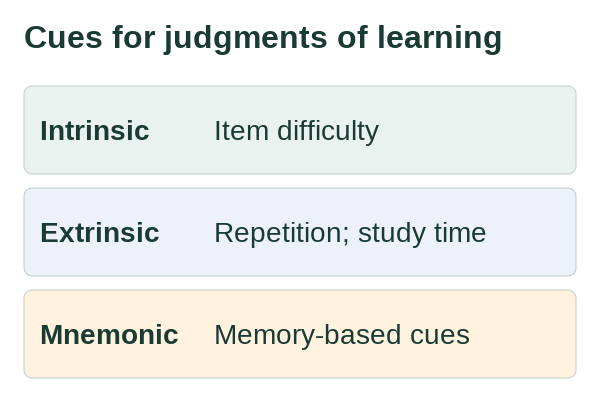
The cue-utilization view groups these cues into 3 types: intrinsic, extrinsic and mnemonic. Intrinsic cues concern the material itself, such as how hard an item is. Extrinsic cues concern the conditions of study. Examples are how often a list is repeated, how often an item appears within a list, and how long a stimulus is shown. There were 4 experiments using paired associates. Item difficulty shaped predictions and recall about equally.[7]
When predictions run too high, learners overestimate their learning. They believe material is well learned when it is not.[8] A 2018 study of 262 university students found the illusion of knowing in all types of metacognitive judgment. That illusion was more evident in prospective judgments, those made before a test. It depended on the type, length and style of the information and on the task. It was more common among younger students.[9]
A person's emotional state can also sway predictions. Across four studies, participants rated how much they had learned. Their ratings were higher when an emotion had been caused than in neutral control conditions. Objective tests showed no such difference in actual learning.[10]
Main ideas
When predictions change memory itself
Asking learners to predict their memory can change what they later remember. This effect is called JOL reactivity.[1][11] In 3 experiments, participants judged each related word pair. They recalled more than participants who did not, after a 3 min interval and after 2 days. The effects were strong: d = .66 for long-term learning and d = .71 for short-term performance.[12]
Reactivity appeared on a percentage scale, a Likert scale and a yes/no scale.[11] In foreign language vocabulary, the effect can go the other way. German-English non-cognate pairs were remembered worse by the group that made judgments. Cognate pairs showed no difference. Study time data suggested the judging group moved study time from non-cognates to cognates.[1]
Age matters for this reactive effect. Across 5 experiments, younger adults judged each word pair. The pairs were related or weakly related. They recalled much more than those who did not. Older adults' memory was not affected. One proposed reason is age-related deficits in processing. These limited how much the judgments strengthened cue-target relationships.[13]
Students watched a lecturer in three experiments. Some people watched a fluent lecturer, others a disfluent one. The first group generally gave higher judgments.[3] Font contrast changes judgments too. With contrast, small-font words were rated lower than without contrast. Large-font words were rated higher.[14]
The kind of encoding matters. Judgments were more accurate after intentional learning than after incidental learning. They were also more accurate when responses were generated than when read.[15] Study time cuts both ways, depending on how learners read their own effort. Judgments rise with study time when effort is goal driven. They fall with study time when it is data driven.[16]
Cues people use to predict memory
A judgment of learning is a person's prediction of how well they will later remember something they have just studied. Research treats these predictions as inferences. People build them from cues. Cues are pieces of information available during study that may or may not signal later performance.[17]
One common cue is fluency, the ease with which material is processed. People tend to give higher judgments to items they encode more easily. This happens even when they later recognize the harder items better. In one study, words encoded more fluently drew higher predictions than words encoded less fluently. Yet recognition was better for the less fluent ones.[18]
Beliefs about how memory works can drive predictions even when fluency does not. People predict better memory for identical word pairs, such as dog-dog, than for related pairs, such as dog-cat. Four experiments tested this. Beliefs about how pair type affects memory explained the pattern better than differences in processing fluency did.[19]
Familiarity with the cue is another basis for prediction. This is especially true when judgments are made after a delay. Some people were made to judge quickly. Their predictions followed how familiar the cue felt, not whether they could retrieve the answer. Unspeeded judgments were more accurate at predicting later test performance. They also improved memory itself.[20] A 2026 review proposed that people making judgments for someone else use some cues that they do not use for themselves.[17]
Illusions that mislead prediction
Some illusions make learners predict better memory for material they in fact remember worse.[21][22] Learners often expect to remember a repeated word pair such as DOG-DOG better than a related pair such as DOG-CAT. In fact, they remember the related pairs more accurately. A 2025 study ran three experiments to test whether the illusion extends to pictures. Identical image pairs received higher judgments than related ones. Their recall was equal or poorer. Identical pairs were also identified more quickly, which reflects greater processing fluency, meaning the ease with which the mind handles the material. Identification speed did not consistently predict the judgments. So fluency alone cannot explain the illusion.[21]
A 2020 study assessed four such illusions at once. They were about font type, word-pair identity, volume, and font size. The usual illusions appeared in all samples. One shared factor could explain them. That factor was not related to the belief that fluency benefits memory. It was also not related to the belief that more is generally better.[23]
A 2019 study used masked priming followed by a recognition test. It measured brain activity during the task. Memory illusions appeared for low confidence decisions. The brain activity behind them differed when fluency changed at random across trials rather than staying constant.[24]
Expectancy illusions arise when learners predict better memory for information. That information fits what they expect. In one experiment, participants saw words for bathroom and kitchen items. Each word came with a room as its source. The room was either what one would expect or not. Participants incorrectly predicted better memory for the expected sources. In a second experiment, participants played repeated rounds of a prisoner's dilemma game. Their partners looked either trustworthy or untrustworthy. They either cooperated or cheated. Participants predicted better source memory for behaviors that the partners' faces made them expect. This stands in contrast to an established finding. Actual source memory is better for unexpected information than for expected information. Asking for judgments during study improved source memory for the expected information. This happened only for that information. A third experiment raised the possibility that people hold special beliefs about memory for social information. One example is the belief that cheaters are easy to remember.[22]
What reduces the illusion of competence
A judgment of learning is a person's estimate, made during study, of the chance of recalling an item later. These estimates often run too high. Researchers call this gap the illusion of competence. In two experiments, researchers tested whether deeper study tasks shrink the gap for word pairs. Participants rated their likelihood of recalling the second word of a pair when shown only the first word at test. Some pairs ran in a backward direction, such as card then credit. Some pairs were unrelated, such as artery and bronze. For these pairs, predictions had overestimated later recall.[25]
Two study strategies brought predictions closer to actual recall. Compared with silent reading, both strategies cut the overestimation of recall. The better calibration came mainly from improved recall. It did not come from a change in how people made their predictions. The researchers concluded that these strategies act mainly on retrieval, the process of pulling information back out of memory, not on the thinking done while studying.[25]
One study ran two experiments on multimodal information. This combines words with pictures, or adds sound to what is seen. The first experiment compared word-only with word-plus-picture materials. It also compared visual-only with visual-plus-auditory presentation, under a fixed study rate. It did so on computer and on paper, with learners setting their own pace. Recall was better on computer than on paper. Multimodal information did not change the size of people's judgments. Participants were overconfident in every condition. They were more overconfident on computer than on paper.[26]
Undorf and Bröder report that memory for naturalistic pictures is exceptionally good. People studied pictures of naturalistic scenes and predicted their chance of recognizing each picture later. Their judgments were largely accurate. People based those judgments on several cues, and most of them did predict recognition. The cues included whether a scene contained people and how often it had appeared.[27]
Research
How accurate are the predictions
For many years, such predictions were found to be almost never very accurate at forecasting later recall. In 1991, Nelson and Dunlosky reported a striking exception. Predictions became very accurate when they were delayed until shortly after study. They were not made at once.[2]
A 1997 replication found that the delay also changed how people used the rating scale. More than 50% of delayed judgments used the ends of the scale. Simulations showed that this shift raised accuracy somewhat. Most of the gain came from better calibration, meaning closer agreement between predicted and actual recall.[28]
A 2011 meta-analysis pooled the evidence on delay. It covered 4,554 participants and 112 effect sizes. Delaying predictions gave a large benefit for relative accuracy. Relative accuracy means how well the items judged more memorable are the ones actually remembered. The effect size was g = 0.93. The same review found only a modest gain in memory itself from delayed predictions. The gain was reliable.[5]
A delay weakens the effect of font size on predictions. The effect is still significant after a delay. A 2018 meta-analysis of 28 experiments found a font effect. People gave higher predictions to items printed in large font than to items in small font.[6]
Predictions also change over repeated study-test cycles on the same material. In a 2002 study, participants studied paired associates over several study-test cycles. On the first cycle they were fairly well calibrated. They were slightly overconfident. From the second cycle onward, they shifted toward marked underconfidence. This pattern is called the underconfidence-with-practice effect. That effect held across feedback conditions. It also held for self-paced and fixed-rate presentation. It held for different incentives too. It also held for both item-by-item and aggregate predictions.[29]
Judgments of improvement are weaker still. A 2011 study asked people to estimate how much they improved between trials. Their estimates tracked their actual improvement poorly. In one case the two moved in opposite directions.[30]
Preschoolers can make moderately accurate predictions. They can do this after a second study trial with feedback. In a 2013 study, preschoolers were taught proper names for animals. Asked right after study, nearly all predicted they would recall every name. Children who got extra practice with feedback were less overconfident than those who did not.[31]
Why some learners judge poorly
A study of 100 adults aged 65 to 86 split them into a 65-75 group and a 76-86 group. Each group learned the Spanish meaning of Latin keywords. One group used a habitual method. The other used the keyword mnemonic method. Campos and Ameijide (2011) compared older adults' usual study method with the mnemonic keyword method. The task was learning the Spanish meanings of Latin keywords. The older group tended to use its own habitual method. It reached higher judgment accuracy than the younger group.[32]
Academic skill also matters. At the start, successful fifth graders were far more likely than less successful peers to see that sentences with arbitrary relationships are harder to remember. Academically successful and less successful fifth graders judged how easy various sentences would be to understand and remember. That difference grew after students tried to remember some of the sentences they had judged. Less successful students could improve with suitable training. They could then base their difficulty judgments on how arbitrary the relationships were. The training also helped them remember.[33]
Reyes, Morales and Bajo (2023) found that people judged second-language learning as more difficult than first-language learning. Yet they monitored their learning in both languages. Across three experiments, people judged second-language learning as harder than first-language learning. Judging the second-language material as harder did not hold learning back. Recognition of those items matched or exceeded recognition of first-language items.[34]
Sun and Jiang (2023) found that younger adults showed an emotional salience effect in both memory and judgments. Older adults' judgments showed a positivity effect that their memory did not match. The study showed younger and older adults pictures of three emotional kinds. It recorded their learning judgments. Then it tested recognition. Older adults' actual memory was still influenced by emotion. This mismatch between judgment and performance is a metacognitive illusion.[35] A 2024 review of aging research looked at judgments of learning, feeling of knowing and tip of tongue. It looked at such age differences in monitoring.[36]
How the judgments are measured
A judgment of learning is a rating people give while learning material. It is used to assess how well they monitor their own learning.[37][38] Researchers collect these predictions to measure how well a person monitors their own learning.[38]
In a typical procedure, a learner studies a set of items, such as pairs of faces and scenes, and rates each one as it is studied. The ratings are then compared with actual memory performance on a later test. One laboratory study asked 38 healthy young adults (17 males, 21 females) to complete three trials of a face-scene associative learning task. In each trial they rated their judgments of learning while studying a new set of pairs.[37]
The act of rating may itself change memory. This possibility is called reactivity. Researchers have raised this issue since the early days of metamemory monitoring research. Recent experiments have tested it directly. Four hypotheses have been proposed to explain the reactivity effect. The overview concludes that more research on educationally relevant materials is needed before reactivity can be used in educational settings.[38]
Age, experience and repeated study
Judgments of learning are predictions people make about how well they will later remember something. Tauber and Rhodes studied how healthy aging affects predictions. They asked whether people use past test scores as a basis for those predictions. A 2012 study compared young adults with healthy older adults. Both groups learned word pairs across three study-test trials on the same material. Both groups relied on memory for past tests. They used how they did on an earlier test to predict the next one. Changes in this reliance across trials were nominal, that is, small. Only the most recent past test influenced judgments. Earlier tests were unrelated to later predictions. Judgments also followed the previous trial's judgments. They were also related to memory performance on the same trial. Tauber and Rhodes concluded that both age groups used the same bases for their predictions. This held in the repeated-study setting.[39]
Hayashi reported that older participants overestimated their memory. This happened in both an episodic and a lexical memory task. A 2021 study tested 40 healthy older adults and 34 young adults. They were tested on memory for ten Kanji words and on a task about writing Kanji words. The younger group performed significantly better than the older group on both memory tasks, on a task of attention control, and on a memory self-rating scale. The results suggest that older people overestimate their memory performance on both tasks. In that study, memory self-ratings were linked to the predictions in both groups for the word task, but only in the older group for the Kanji writing task. No correlation was found between either memory task and the attention control test.[40]
Friedman found that children came to understand different features of memory for time. This happened at ages from 8 to 12 or later. Two studies included 178 children aged 5 through 13 and 40 adults. They answered questions about how they would remember when past events happened. The adults knew a good deal, and accurately, about the central features of memory for when events happened. The various features were grasped for the first time between age 8 and age 12. Some people grasped them even later. Knowledge of how people reconstruct times and judge time distances appeared well after children already used those methods.[41]
A 1980 study tested children at ages 7, 10 and 17. It asked what they knew about sorting words by category before a memory task. Performance was then assessed with a stricter, more valid criterion. Under that criterion, such knowledge was a necessary condition for actually using the grouping strategy. Age differences appeared both in the knowledge and in its use. Prompting the knowledge beforehand did not remove the difference in use.[42]
In practice
Using and questioning the judgments
Judgments of learning can guide how learners give extra study to harder items. Extra study may or may not show up in later recall. It depends on how the gain from studying again weighs against the loss from which items were chosen. Nelson wrote a commentary in 1993. He said the item labor-in-vain effect differs from the labor-in-vain effect he and Leonesio reported in 1988. The two differ in the role of item selection.[4]
A second-order judgment asks a person to rate confidence in the accuracy of each prediction. In one experiment, participants studied paired-associate items, which are word pairs. They made a judgment for each item, either at once or after a delay. Second-order judgments were higher for extreme predictions (0 and 100) than for middle predictions (40 and 50). Prediction accuracy was greater for delayed judgments than for immediate ones. Second-order judgments were also greater for delayed ones.[43]
Three cued recall experiments with many trials tested this. Accuracy rose equally in both groups across study blocks. One group practiced making judgments, the other did not.[44]
Age matters too. Predictions were strongly tied to items the learner could recollect. They were not tied to items that merely felt familiar. This pattern was weaker in older adults.[45]
One open question is whether mindfulness training can make predictions more accurate. The study recruited 203 undergraduates. Of these, 198 gave usable data. Some students have high test anxiety. For them, acting with awareness predicted how accurate their predictions were. For those with low test anxiety, it did not.[46]
Judgments as tools for study decisions
Ingendahl and Undorf (2026) asked a question. Does making judgments of learning change which word pairs people choose to restudy? Two preregistered experiments had 140 and 202 participants. Learners judged related and unrelated word pairs. They then chose which pairs to restudy. The restudy choices for related and unrelated pairs did not differ reliably. This was true whether or not learners had given judgments.[47]
Learners also explain the basis of their judgments when asked. Two samples totalled 115 senior sport students in a developmental psychology course. They gave reasons for their judgments. The justifications fell into ten categories. These included study of the learning materials, confidence in answering correctly, memory, general knowledge and common sense. How often each justification appeared varied between local and global judgments. It also varied between more and less accurate judges. It varied between higher and lower performers as well.[48]
Students at risk of failing a gross anatomy course were identified. The signs came from formative feedback and lab practical scores. They were paired with near-peer mentors. The course ran 7 weeks. These students mostly reread textbooks or class slides. They rarely used extra lab time or other resources. Mentors redirected them toward recall practice, self-written questions, flashcards, mind maps and board-style questions. They averaged 3 hours of mentored time between tests. The mentored group's average practical score rose from 62% to 79%, and all 7 reached at least 70%.[49]
What this looks like when you study
In Experiment 1 of one study, 193 participants studied related and unrelated word pairs. Some of them made a judgment of learning after each pair. The students who made judgments recalled fewer unrelated pairs than students who did not. The authors call this drop negative reactivity. A second experiment with 200 students repeated the pattern, and the authors traced it to a change in how students studied. In Experiment 1, one group was told to use mental imagery on the unrelated pairs. This removed the negative reactivity of making judgments of learning.[50]
Other researchers asked students to study three kinds of material. These were key-term definitions, country outlines with names, and animal pictures with species names. Making a judgment after each item did not improve test scores on any of these materials. In the country-outline experiment, judgments actually lowered scores when the material was hard.[51]
A separate set of three experiments had students read texts about education. Students answered practice questions, then made judgments. The judgments gave no extra boost to the final test. This held whether the study ran in a laboratory or online.[52]
In a study of foreign language vocabulary, students learned German-English pairs. Half were cognates such as haar-hair, and half were non-cognates such as korb-basket. Students who judged every pair spent less time on the harder non-cognates and recalled fewer of them, 24 percent against 35 percent.[1]
One study tested deep item-specific and relational encoding tasks against silent reading. The aim was to reduce overestimation of recall. Both deep encoding tasks improved the match between predicted and actual recall. The main reason was that recall itself rose. Two experiments tested item-specific and relational encoding tasks. Both tasks reduced the illusion of competence for backward associates and for unrelated pairs.[25] In a seven-week anatomy course, seven at-risk students met a near-peer mentor for about three hours between tests.[49]
Criticism
Open questions and mixed findings
Double (2023) reports that the evidence is mixed. The question is whether asking for judgments of learning while studying word pairs changes later recall.[53] Reactivity means that asking for such a judgment changes later memory itself.[54]
Double (2023) reports that most studies have found positive reactivity when word pairs are related. That pattern suggests a benefit appears in one case. It appears when the final test rewards the cues people used to make the judgment. Making JOLs impaired later recall when study time was limited. It also impaired recall when font size was a clear cue. So the direction of reactivity depends on the cues used during the judgment. It depends on how useful those cues are for the test.[53]
Ingendahl and Undorf (2026) note that tests of whether immediate judgments of learning help with educationally relevant materials remain rare. Some made immediate JOLs and some did not. When difficulty was high, it lowered performance.[51]
A 2023 set of three experiments tested whether JOLs made after retrieval practice add to the benefits of testing. The materials were education-related texts. All three found no reactivity effect, in the laboratory and online. This held with the same language or a different one. It held with or without the original sample pool. An earlier study found a medium benefit of making JOLs after retrieval practice. This was an incidental finding. Cohen's d was 0.44.[52]
Ingendahl and Undorf (2026) link negative reactivity to changes in learning strategies. These changes come once people are asked to judge. Two experiments had N = 193 and N = 200. Making JOLs without strategy instructions impaired memory for unrelated word pairs. Telling learners to use mental imagery removed that negative reactivity. Telling them to use any learning strategy did the same. The results fit accounts that blame negative reactivity on dual-task costs. Other accounts blame changes in learning goals.[50]
Chang and Brainerd (2024) found that judgments made item by item helped recall. The lists were categorized but shown in random order. They did not help for lists shown in blocked order. That benefit was tied to a familiarity judgment process linked to gist processing. It was not tied to item-specific recollective processes. The finding challenges the item-specific processing explanation of JOL reactivity.[54]
Double, Tran and Goldwater (2026) found that judgments of learning impaired discovery of a categorization rule. This happened when a visual feature could also be used. Two experiments let people sort items. They could use either a relational rule or visual features. Judgments of learning (JOLs) hurt rule discovery. They did not affect memory for visual features. When only a relational rule could be used, there was no evidence of reactivity.[55]
A 2025 study of memory in groups found that making JOLs improved item memory. It had no clear effect on sequential memory. Item recognition was lower in the collaborative group than in the nominal group. Sequential memory was lower too. This pattern is called collaborative inhibition. Luo, Xiao and Tang (2025) conclude that the reactivity effect and collaborative inhibition are separate phenomena. Each operates without altering the other.[56] A 2026 study found that making JOLs for other people, like making them for oneself, produced positive reactivity for related word pairs but not unrelated pairs.[57]
Delayed judgments are made some time after study. They may prepare learners for what comes next, but only under some conditions. A 2023 study found that delayed JOLs clearly improved retention of new information. The forward effect appeared only for material with a certain degree of difficulty. It did not appear for easy material. It was repeated in category learning.[58]
An early 1992 critique noted that the delayed-JOL procedure invited hidden recall practice. Participants said they did this. Retrieval practice is a known factor in later recall. So delayed judgments may change the memory they are meant to measure.[59] A 2015 set of three experiments tested one assumption. The assumption was that asking for metacognitive judgments does not affect learning itself.[60]
Key studies
| Year | Study | Sample | Design | Finding |
|---|---|---|---|---|
| 1982 | Stein & et al[33] | academically successful and less successful fifth graders | experiment on judgments of sentence difficulty, with training in Experiment 2 | Successful students were more likely to see that arbitrary sentences are harder to remember, and training helped less successful students use that information. |
| 1991 | Nelson & Dunlosky[2] | predictions made immediately or after a delay | Predictions were extremely accurate when delayed until shortly after study rather than made immediately. | |
| 2011 | Rhodes & Tauber[5] | meta-analysis of delayed versus immediate judgments | Delaying judgments raised relative accuracy with g = 0.93 and gave a small memory benefit with g = 0.08. | |
| 2013 | Lipowski et al.[31] | preschoolers in three experiments | three experiments in which preschoolers were taught proper names for animals and made judgments of learning | With minimal task experience, most preschoolers understood that they would not remember everything. |
| 2016 | Salem et al.[49] | 7 at-risk medical students in a seven-week anatomy course | near-peer mentoring program with formative feedback | The mentored group's average practical score rose from 62 percent to 79 percent. |
| 2017 | Witherby & Tauber[12] | participants in three experiments | experiment with related word pairs and a two-day or three-minute retention interval | Participants who made judgments outperformed those who did not, and the effect sizes were d = .66 for long-term learning and d = .71 for short-term performance. |
| 2019 | Tauber & Witherby[13] | older and younger adults across five experiments | experiment with related and weakly related word pairs | Younger adults who made judgments recalled more, while older adults' memory was not affected. |
| 2023 | Zhao et al.[52] | participants in three experiments, one pre-registered | replication of a reported benefit of judgments after retrieval practice | No reactivity effect appeared in any experiment, in the laboratory or online. |
| 2024 | Maxwell et al.[25] | participants in two experiments | experiment comparing item-specific and relational encoding tasks with silent reading | Item-specific and relational encoding tasks reduced the illusion of competence for backward associates and for unrelated pairs. |
| 2025 | Besken & Filiz[21] | 24, 24, and 26 participants in three experiments | experiment with identical, related, similar, and unrelated image pairs | Identical pairs received higher judgments than related pairs despite equal or poorer recognition. |
| 2026 | Elsden & Witherby[1] | experiment with German-English vocabulary pairs, half cognates and half non-cognates | In Experiment 1, students who made judgments recalled 24 percent of non-cognate pairs, against 35 percent for students who did not. Cognate recall averaged 68 percent overall. | |
| 2026 | Ingendahl & Undorf[50] | 193 students in Experiment 1 and 200 in Experiment 2 | experiment comparing judgments alone, judgments with a strategy instruction, and no judgments | Judgments without instruction lowered recall of unrelated pairs, and a mental imagery or general strategy instruction removed the drop. |
| 2026 | Ingendahl & Undorf[51] | participants in three experiments | experiment with key-term definitions, country outlines, and animal species | Making immediate judgments did not improve test performance, and lowered it when difficulty was high. |
| 2026 | Double et al.[55] | category learning where a rule or visual features could be used | Predictions impaired rule discovery but did not affect memorization of visual features. |
See also
References
- Elsden, A., & Witherby, A. E. (2026). Do judgments of learning have reactive effects on learning of foreign language vocabulary? Metacognition and Learning, 21(1). doi:10.1007/s11409-026-09465-1
- Nelson, T. O., & Dunlosky, J. (1991). When People's Judgments of Learning (JOLs) are Extremely Accurate at Predicting Subsequent Recall: The “Delayed-JOL Effect”. Psychological Science, 2(4), 267-271. doi:10.1111/j.1467-9280.1991.tb00147.x
- Wilford, M. M., Kurpad, N., Platt, M., & Weinstein‐Jones, Y. (2020). Lecturer fluency can impact students' judgments of learning and actual learning performance. Applied Cognitive Psychology, 34(6), 1444-1456. doi:10.1002/acp.3724
- Nelson, T. O. (1993). Judgments of learning and the allocation of study time. Journal of Experimental Psychology: General, 122(2), 269-273. doi:10.1037/0096-3445.122.2.269
- Rhodes, M. G., & Tauber, S. K. (2011). The influence of delaying judgments of learning on metacognitive accuracy: A meta-analytic review. Psychological Bulletin, 137(1), 131-148. doi:10.1037/a0021705
- Luna, K., Martín-Luengo, B., & Albuquerque, P. B. (2018). Do delayed judgements of learning reduce metamemory illusions? A meta-analysis. Quarterly Journal of Experimental Psychology, 71(7), 1626-1636. doi:10.1080/17470218.2017.1343362
- Koriat, A. (1997). Monitoring one's own knowledge during study: A cue-utilization approach to judgments of learning. Journal of Experimental Psychology: General, 126(4), 349-370. doi:10.1037/0096-3445.126.4.349
- Carpenter, S. K., Witherby, A. E., & Tauber, S. K. (2020). On students’ (mis)judgments of learning and teaching effectiveness. Journal of Applied Research in Memory and Cognition, 9(2), 137-151. doi:10.1016/j.jarmac.2019.12.009
- Avhustiuk, M. M., Pasichnyk, I. D., & Kalamazh, R. V. (2018). The illusion of knowing in metacognitive monitoring: Effects of the type of information and of personal, cognitive, metacognitive, and individual psychological characteristics. Europe’s Journal of Psychology, 14(2), 317-341. doi:10.5964/ejop.v14i2.1418
- Baumeister, R. F., Alquist, J. L., & Vohs, K. D. (2015). Illusions of Learning: Irrelevant Emotions Inflate Judgments of Learning. Journal of Behavioral Decision Making, 28(2), 149-158. doi:10.1002/bdm.1836
- Halamish, V., Meer, Y., & Undorf, M. (2026). Judgments of learning modify memory even when made covertly or using a non-numerical scale. Metacognition and Learning, 21(1). doi:10.1007/s11409-026-09471-3
- Witherby, A. E., & Tauber, S. K. (2017). The influence of judgments of learning on long-term learning and short-term performance. Journal of Applied Research in Memory and Cognition, 6(4), 496-503. doi:10.1016/j.jarmac.2017.08.004
- Tauber, S. K., & Witherby, A. E. (2019). Do judgments of learning modify older adults’ actual learning? Psychology and Aging, 34(6), 836-847. doi:10.1037/pag0000376
- Wan, B., Zha, J., Zheng, X., & Li, H. (2023). Perceptual contrast reduces the judgments of learning of small‐font words and increases the judgments of learning of large‐font words compared with the no‐contrast conditions. PsyCh Journal, 12(5), 670-679. doi:10.1002/pchj.679
- Mazzoni, G., & Nelson, T. O. (1995). Judgments of learning are affected by the kind of encoding in ways that cannot be attributed to the level of recall. Journal of Experimental Psychology: Learning, Memory, and Cognition, 21(5), 1263-1274. doi:10.1037/0278-7393.21.5.1263
- Koriat, A., Nussinson, R., & Ackerman, R. (2014). Judgments of learning depend on how learners interpret study effort. Journal of Experimental Psychology: Learning, Memory, and Cognition, 40(6), 1624-1637. doi:10.1037/xlm0000009
- Wei, Y., Soderstrom, N. C., & Meade, M. L. (2026). Making judgments of learning (JOLs) for oneself versus others: A review and proposed model. Psychonomic Bulletin & Review, 33(1). doi:10.3758/s13423-025-02816-0
- Gaynor, A. M., & Chua, E. F. (2019). Transcranial Direct Current Stimulation over the Prefrontal Cortex Alters Encoding and Judgments of Learning Based on Fluency. Journal of Cognitive Neuroscience, 31(11), 1710-1725. doi:10.1162/jocn_a_01449
- Mueller, M. L., Dunlosky, J., & Tauber, S. K. (2016). The effect of identical word pairs on people's metamemory judgments: What are the contributions of processing fluency and beliefs about memory? Quarterly Journal of Experimental Psychology, 69(4), 781-799. doi:10.1080/17470218.2015.1058404
- Metcalfe, J., & Finn, B. (2008). Familiarity and retrieval processes in delayed judgments of learning. Journal of Experimental Psychology: Learning, Memory, and Cognition, 34(5), 1084-1097. doi:10.1037/a0012580
- Besken, M., & Filiz, G. (2025). Testing the Identical Effect on Predicted and Actual Memory Through Pictorial Stimuli. Experimental Psychology, 72(2), 70-85. doi:10.1027/1618-3169/a000646
- Mieth, L., Schaper, M. L., Kuhlmann, B. G., & Bell, R. (2021). Memory and metamemory for social interactions: Evidence for a metamemory expectancy illusion. Memory & Cognition, 49(1), 14-31. doi:10.3758/s13421-020-01071-z
- Kuhlmann, B. G., Frank, D. J., & Danner, D. (2020). Louder = Larger = Clearer: Examining the Consistency of Metamemory Illusions. Zeitschrift für Psychologie, 228(4), 296-300. doi:10.1027/2151-2604/a000427
- Gomes, C. A., Mecklinger, A., & Zimmer, H. (2019). The neural mechanism of fluency-based memory illusions: the role of fluency context. Learning & Memory, 26(2), 61-65. doi:10.1101/lm.048637.118
- Maxwell, N. P., Cates, E. E., & Huff, M. J. (2024). Item-specific and relational encoding are effective at reducing the illusion of competence. Psychological Research, 88(3), 1023-1044. doi:10.1007/s00426-023-01891-z
- Chen, G., & Fu, X. (2003). Effects of Multimodal Information on Learning Performance and Judgment of Learning. Journal of Educational Computing Research, 29(3), 349-362. doi:10.2190/j54f-b24d-thn7-h9ph
- Undorf, M., & Bröder, A. (2021). Metamemory for pictures of naturalistic scenes: Assessment of accuracy and cue utilization. Memory & Cognition, 49(7), 1405-1422. doi:10.3758/s13421-021-01170-5
- Weaver, C. A., & Kelemen, W. L. (1997). Judgments of Learning at Delays: Shifts in Response Patterns or Increased Metamemory Accuracy? Psychological Science, 8(4), 318-321. doi:10.1111/j.1467-9280.1997.tb00445.x
- Koriat, A., Sheffer, L., & Ma'ayan, H. (2002). Comparing objective and subjective learning curves: Judgments of learning exhibit increased underconfidence with practice. Journal of Experimental Psychology: General, 131(2), 147-162. doi:10.1037/0096-3445.131.2.147
- Townsend, C. L., & Heit, E. (2011). Judgments of learning and improvement. Memory & Cognition, 39(2), 204-216. doi:10.3758/s13421-010-0019-2
- Lipowski, S. L., Merriman, W. E., & Dunlosky, J. (2013). Preschoolers can make highly accurate judgments of learning. Developmental Psychology, 49(8), 1505-1516. doi:10.1037/a0030614
- Campos, A., & Ameijide, L. (2011). The accuracy of judgments of learning (JOLs) and the mnemonic keyword method in elderly adults. International Journal of Psychological Research, 4(2), 64-71. doi:10.21500/20112084.782
- Stein, B. S., & et al (1982). Differences in judgments of learning difficulty. Journal of Experimental Psychology: General, 111(4), 406-413. doi:10.1037//0096-3445.111.4.406
- Reyes, M., Morales, M. J., & Bajo, M. T. (2023). Judgments of learning in bilinguals: Does studying in a L2 hinder learning monitoring? PLOS ONE, 18(12), e0286516. doi:10.1371/journal.pone.0286516
- Sun, X., & Jiang, Y. (2023). Metacognitive Illusions: A Positivity Effect in Judgments of Learning for Older but Not Younger Adults. Journal of Intelligence, 11(3), 40. doi:10.3390/jintelligence11030040
- METIN, A. N. (2024). A literature review about judgments of learning, feeling of knowing, and tip of tongue on aging effect. Scientific Annals of the “Alexandru Ioan Cuza” University, Iaşi. New Series SOCIOLOGY AND SOCIAL WORK Section, 17(2). doi:10.47743/asas-2024-2-774
- Yeung, M. K. (2022). Stability and consistency of metamemory judgments within a session. Frontiers in Psychology, 13. doi:10.3389/fpsyg.2022.917576
- Le, N. D. (2025). Is Metamemory Judgements Reactivity a Topic Worth Investigating? An Overview of Literature and Future Directions. Roczniki Psychologiczne, 27(4), 299-329. doi:10.18290/rpsych2024.0017
- Tauber, S. K., & Rhodes, M. G. (2012). Multiple bases for young and older adults' judgments of learning in multitrial learning. Psychology and Aging, 27(2), 474-483. doi:10.1037/a0025246
- Hayashi, A. (2021). Evaluation of Episodic and Lexical Metamemory and Executive Function in Healthy Older Adults. Innovation in Aging, 5(Supplement_1), 700-700. doi:10.1093/geroni/igab046.2623
- Friedman, W. J. (2007). The Development of Temporal Metamemory. Child Development, 78(5), 1472-1491. doi:10.1111/j.1467-8624.2007.01078.x
- Wimmer, H., & Tornquist, K. (1980). The Role of Metamemory and Metamemory Activation in the Development of Mnemonic Performance. International Journal of Behavioral Development, 3(1), 71-81. doi:10.1177/016502548000300107
- Dunlosky, J., Serra, M. J., Matvey, G., & Rawson, K. A. (2005). Second-Order Judgments About Judgments of Learning. The Journal of General Psychology, 132(4), 335-346. doi:10.3200/genp.132.4.335-346
- West, J. T., Kuhns, J. M., Touron, D. R., & Mulligan, N. W. (2025). Increased metamemory accuracy with practice does not require practice with metamemory. Quarterly Journal of Experimental Psychology, 78(7), 1280-1302. doi:10.1177/17470218241269322
- Daniels, K. A., Toth, J. P., & Hertzog, C. (2009). Aging and recollection in the accuracy of judgments of learning. Psychology and Aging, 24(2), 494-500. doi:10.1037/a0015269
- Yin, Y., Li, B., Hu, X., Guo, X., Yang, C., & Luo, L. (2023). The Relationship between Dispositional Mindfulness and Relative Accuracy of Judgments of Learning: The Moderating Role of Test Anxiety. Journal of Intelligence, 11(7), 132. doi:10.3390/jintelligence11070132
- Ingendahl, F., & Undorf, M. (2026). Are restudy decisions reactively altered by judgments of learning? Insights from related and unrelated word pairs. Psychonomic Bulletin & Review, 33(8). doi:10.3758/s13423-026-03030-2
- Kolovelonis, A. (2023). Exploring University Students’ Justifications for Making Metacognitive Judgments of Learning. Trends in Higher Education, 2(3), 421-433. doi:10.3390/higheredu2030025
- Salem, P., Schmelkin, L., Lachman, N., & Pawlina, W. (2016). Steering Illusions of Competence: A near‐peer driven integrated approach to improving performance of at‐risk students in a gross anatomy course. The FASEB Journal, 30(S1). doi:10.1096/fasebj.30.1_supplement.565.4
- Ingendahl, F., & Undorf, M. (2026). Instructed learning strategy use eliminates negative reactivity of immediate judgments of learning. Psychonomic Bulletin & Review, 33(1). doi:10.3758/s13423-025-02844-w
- Ingendahl, F., & Undorf, M. (2026). Immediate judgments of learning do not improve performance for educationally relevant materials: Evidence from key-term definitions, country outlines, and animal species. Metacognition and Learning, 21(1). doi:10.1007/s11409-026-09479-9
- Zhao, W., Xu, M., Xu, C., Li, B., Hu, X., Yang, C., & Luo, L. (2023). Judgments of Learning Following Retrieval Practice Produce Minimal Reactivity Effect on Learning of Education-Related Materials. Journal of Intelligence, 11(10), 190. doi:10.3390/jintelligence11100190
- Double, K. S. (2023). Do Judgments of Learning Impair Recall When Uninformative Cues Are Salient? Journal of Intelligence, 11(10), 203. doi:10.3390/jintelligence11100203
- Chang, M., & Brainerd, C. (2024). Judgments of Learning Reactivity on Item-Specific and Relational Processing. Journal of Intelligence, 12(1), 4. doi:10.3390/jintelligence12010004
- Double, K. S., Tran, D., & Goldwater, M. B. (2026). Judgments of learning impair rule-based discovery. Memory & Cognition, 54(1), 45-58. doi:10.3758/s13421-025-01737-6
- Luo, X., Xiao, Q., & Tang, W. (2025). The Influence of Judgments of Learning on Collaborative Memory for Items and Sequences. Behavioral Sciences, 15(7), 905. doi:10.3390/bs15070905
- Wei, Y., Soderstrom, N. C., & Meade, M. L. (2026). Making Judgments of Learning (JOLs) for Others Produces Positive Reactivity. Behavioral Sciences, 16(9), 1542. doi:10.3390/bs16091542
- Wang, X., Liu, X., Chen, L., Feng, K., Ye, Q., & Zhu, H. (2023). The Forward Effect of Delayed Judgments of Learning Is Influenced by Difficulty in Memory and Category Learning. Journal of Intelligence, 11(6), 101. doi:10.3390/jintelligence11060101
- Spellman, B. A., & Bjork, R. A. (1992). When Predictions Create Reality: Judgments of Learning May Alter What They Are Intended to Assess. Psychological Science, 3(5), 315-317. doi:10.1111/j.1467-9280.1992.tb00680.x
- Soderstrom, N. C., Clark, C. T., Halamish, V., & Bjork, E. L. (2015). Judgments of learning as memory modifiers. Journal of Experimental Psychology: Learning, Memory, and Cognition, 41(2), 553-558. doi:10.1037/a0038388
Cite this page: Atlas Nova editors. (2026). Judgments of learning. Atlas Nova. https://velocer.io/atlas/judgments-of-learning/