Concept · Reading
Reading fluency
Reading skill
Reading fluency is the ability to read connected text accurately, at a conversational pace and with appropriate expression. Prosody is the pattern of pitch, stress and timing that gives oral reading expression. Fluent reading also depends on recognizing words automatically.[1][2]
Fluent reading has three parts: accurate words, a conversational rate, and expressive prosody.[1] Repeated reading improved fluency and comprehension for students with and without learning disabilities.[3] One-minute word-count scores can wrongly flag some students as at risk and miss others.[4] Students with learning disabilities often struggle with fluency, which affects their comprehension.[5]
Overview
What reading fluency means
Reading fluency is the ability to read connected text accurately, at a speed close to normal conversation, and with suitable expression.[1] That description is short. But it hides many processes and skills that a fluent reader carries out with little visible effort.[8] Accuracy means reading words correctly, either by recognizing them or by sounding them out. Rate covers both automatic word recognition and speed in reading connected text. Expression, called prosody, means changes in pitch, stress and length that help make reading expressive.[1]
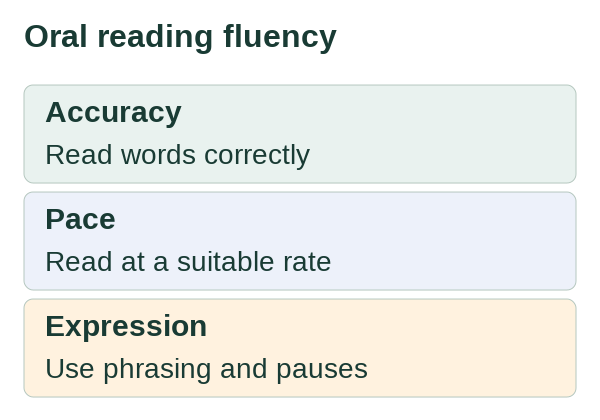
Researchers have offered several definitions of fluency. One 2010 article examined four major ones and their links to accuracy, automaticity and prosody. That article argued that much recent work on fluency used a narrow definition. It focused only on automatic word recognition. It proposed a broader definition. It also suggested rethinking fluency's place in the literacy curriculum.[9]
The place of fluent oral reading in the curriculum has shifted over the past century. As a result, the goal of developing fluent oral readers almost disappeared from the reading curriculum. The change was large enough that Allington, in work published in 1983 and 1984, called reading fluency a neglected goal of reading instruction. The National Reading Panel Report appeared in 2000. After that, developing students' oral reading fluency moved to the center of classrooms across the United States.[10]
A 2001 article named definition as one of three large gaps in fluency research. The other two were component structure and theory-based intervention. It described several past approaches to fluency. It also described the parts of fluent reading that each one implies. The article then offered its own definition. It was built on development and on the parts of fluent reading.[11] A 2008 article noted that the common definition sounds simple. The article argued that in young readers these elements relate to one another in layers.[8]
History
Where the idea came from
Speech carries prosodic cues, and print has no matching graphic signals for them. A 1980 paper argued that the child must learn to use the meaning cues and grammar cues that print does keep. On this account, the decisive step is the beginner's recognition that other parsing strategies are needed to read with sense. The same paper proposed why repeated readings and similar methods work. They help the reader find the right sentence structure in the written text.[12]
A second line of theory asked how word recognition and comprehension fit together in readers of different skill. The review looked beyond the first stages of learning to read. It found that stronger readers were not more inclined to use the redundancy built into natural language to speed word recognition. Instead, general comprehension strategies and rapid word recognition without context most clearly separated good readers from poor ones.[13]
Later work described fluent reading as the product of skill in several cognitive sub-skills, and of coordinating them. A 2012 brain imaging study tested this idea by changing reading speed in 13 right-handed adults. Participants read sentences and letters at their normal fluent speed, at a slowed speed and at an accelerated speed. Reading regions responded selectively to fluent sentence reading at every speed. As speed increased, activation rose in one reading-related region, occipital/fusiform cortex, more on the left than the right.[14]
The problems listed included defining fluency as reading fast. Another was teaching students to read fast. Other problems were treating fluency as only an oral reading activity, as an issue only for the primary grades, and as a separate form of instruction cut off from reading for meaning. The commentary argued for fluency instruction that is authentic and based on meaning. It should also be part of the core reading program.[15]
A 2010 review looked back over 35 years of work on fluency. It noted fast growth in fluency research, extensive reading and speed training in English as a first language. That growth may be little known among teachers of English as a second language, though the review drew implications for second language reading research and teaching. The review also asked why fluency studies often fail to show large gains in reading comprehension. Its answer was that fluency and reading comprehension both develop gradually, so gains arrive in small steps.[16]
Research
How fluency relates to comprehension
A study of 278 fifth graders tested whether fluency at three levels relates uniquely to comprehension. Each level was linked to scores on a standardized reading comprehension test. This held even after the analysis allowed for inferencing skill and background knowledge. The results support an automaticity effect for word recognition speed. The same study found a similar effect for skill at processing groups of words. Longitudinal data suggested that fluency and comprehension influence each other in both directions.[6]
One study followed 143 young Korean-speaking children. They were tested at a mean age of 5 years 2 months and again at 6 years 1 month. At both time points, passage fluency was linked to reading comprehension. Vocabulary and grammatical knowledge were each independently related to passage fluency and to comprehension. Theory of mind was related to comprehension but not to passage fluency.[17]
In a study of 113 fourth graders, context fluency predicted comprehension better than list fluency. Which mattered more depended on whether fluency was scored as speed or as time per correct word. The results suggest that word-level processes matter more for fluency at lower levels. Comprehension matters more at higher levels.[18]
Oral reading fluency has been proposed as a sign of overall reading skill.[19] Prosody, not reading rate, then explained additional variance in reading comprehension.[20]
Among 316 first graders, silent and oral reading fluency were related yet distinct. Silent fluency predicted comprehension better for skilled readers than for average readers.[21] A study of fourth graders reached a different conclusion. Oral and silent fluency were separate constructs, but only oral fluency contributed to reading comprehension. Vocabulary added something unique to comprehension in that study, even after fluency was controlled for.[22]
The link between fluency and comprehension is not automatic. Some readers understand well without strong fluency. Struggling readers can improve comprehension despite weak skills. This happens if they know how to make up for them, want to understand, and face no limits. This happens under time pressure, at a forced fast rate, or when reading silently. Such readers are less likely to make up for it and often understand less. At the other end, older fluent readers sometimes read without engagement. They then comprehend below their potential.[23]
Different oral fluency measures also predict comprehension differently in second grade. One sample of 146 second graders had difficulties with nonsense-word fluency, real-word fluency, and connected-text fluency. This held in both samples and across average and poor comprehension. Reading real words aloud predicted reading comprehension best.[24]
Repeated reading and how large the gains are
A 2004 meta-analysis, a statistical pooling of results across studies, found that repeated reading raised both reading fluency and comprehension. The gains held for students without disabilities. Which parts of the procedure mattered most depended on the study. It mattered whether the study tested reading the same passage or different passages.[3]
A 2017 meta-analysis focused on students with reading disabilities. The search found 34 repeated reading studies published from 1990 to 2014. All had students in kindergarten through 12th grade. The average Hedges' g was positive across 39 independent effect sizes. This means students read more words correctly per minute after the intervention. Gains were especially strong in the elementary grades. The same review found that repeated reading worked best when paired with a listening passage preview. This was the most effective combination for these students.[26]
A 2017 review of research from 2001 to 2014 looked at elementary students with learning disabilities. That search yielded 19 studies. Repeated reading, multicomponent interventions, and assisted reading with audiobooks all produced gains in fluency and comprehension. The synthesis concluded that repeated reading is still the strongest way to improve fluency. Its stated limits were small sample sizes, just three group design studies, and rare use of standardized measures, meaning tests given under the same conditions to all students.[5]
An earlier synthesis from 2002 examined 24 published and unpublished studies. These were studies of fluency interventions for elementary students with learning disabilities. It found that effective interventions shared an explicit model of fluent reading and multiple chances to reread familiar text with corrective feedback. They also set rules for when a student moves to harder text.[7] A 2006 practitioner article described repeated reading as widely used and suitable for students with and without disabilities. It set out the parts that make the technique more efficient.[27]
Not every writer treats speed as the goal. A 2009 article argued against mechanical methods that make reading rate the main aim of fluency teaching. It made the case for approaches that use texts meant to be practiced and performed.[28]
Why rereading works
The size of the gain from rereading depends on how many words the passages share. One study looked at students with learning disabilities who read slowly and with effort. They read passages on a computer under three conditions. In the first two conditions, students read the same passage four times. A new story came in the next session. The stories in the second condition shared three times as many words as those in the first. When stories had few shared words, rereading was no better for speed than an equal amount of nonrepetitive reading.[29]
In two studies, fourth-grade poor readers practiced reading a list of single words. The children then read stories repeatedly. Some stories were built around the trained words and some around words outside the training set. Practicing single words helped children read text better. This held even for children who were very slow at naming words.[30]
Rereading may also build orthographic knowledge, the researchers suggested. One study tested this by measuring the effect of word length on reading speed. The participants were dyslexic children in fourth and fifth grade and normal readers in second and fourth grade. A length effect showed up among the dyslexic readers and the younger normal readers. It did not show up among the older normal readers. That length effect stayed the same from pre-test to post-test. Every group still improved a great deal in reading speed overall.[31]
Cueing readers to comprehension was a more efficient route to understanding than cueing them to fluency. Both fluency and comprehension rose as the number of repeated readings increased. Students told to focus on fluency read faster but understood less than students told to focus on comprehension.[32]
Rereading has been compared directly with continuous reading. In continuous reading, a student reads new material instead of the same passage again. Poor readers in Grades 2 and 4 took part: 17 with learning disabilities and 20 without. They were randomly assigned to one of two practice variations or to a control group. In the treatment conditions, students read aloud to an adult listener for 15 minutes a session, 3 days a week, across 14 weeks. Growth curve analyses showed significant differences in fluency and reading comprehension over the control group. The study found no significant differences between the repeated practice and continuous practice conditions.[33]
Other work points to processes beyond word recognition, which may limit what rereading alone can do. Thirty-seven second graders were tracked until Grade 4. Some were poor readers and some average. Every year, each child reread passages at a difficulty suited to that child. Phonological awareness was measured by phoneme deletion. It and digit-naming speed went consistently with speed and errors both on a first reading of a text and on a fourth. The analysis controlled for word-recognition skill. Only digit-naming speed then added significant extra variance to reading speed before practice and especially after it, even across more than 2 years. That link to fluency stands on its own. Theories that stress phonemic sensitivity need revision to include processes measured by simple symbol-naming speed.[34]
Measuring fluency and its limits
In oral reading fluency measures, a child reads aloud while a teacher marks mistakes.[35] The score is words correct per minute, or wcpm. A 2010 study compared wcpm scores with separate measures of rate, accuracy, prosody and comprehension in grades 2, 4 and 6. Assessments that included several indicators of oral reading fluency predicted general comprehension better. The link between oral reading and comprehension also differed across the three grade levels.[4]
Hasbrouck and Tindal gathered norms for oral reading fluency. The norms covered grades 1 through 8. In 1992 two researchers built a set of oral reading fluency norms for grades 2 to 5. The norms support three tasks. They are screening students for possible reading problems, diagnosing fluency deficits, and tracking progress during extra instruction.[36]
A 1992 study tested 114 third graders and 124 fifth graders on decoding, comprehension and oral reading fluency. For third graders, one general reading factor fit the data. Every measure contributed to it. For fifth graders, a two-factor model fit. This matches current ideas about reading measurement. Under either model, the oral reading fluency score was a good index of reading proficiency, comprehension included.[37]
Form effects remained despite the criteria used when the passages were written. One study had about 572 students per grade read benchmark and progress-monitoring passages from grades 1 to 6. In all, 3,092 students provided at least one data point. The researchers described three equating methods: mean, linear and equipercentile.[38]
A second study fitted measurement models to second-grade passages. It found nonlinear relations among passage scores. That pattern showed that equipercentile equating was the best choice. The study had 600 participants. The standard error of equating stayed under two correct words per minute for scores from 0 to 150. In a separate sample of second graders, the equating table removed every difference between forms.[39]
Oral reading fluency tests can be given on a computer. A 2023 study compared the two modes in German. It involved 359 students in their second and third years, some with and some without special education needs. Reliability was similar and high in both modes (r > 0.76). No item behaved differently across modes. Students read much faster on paper. Reading accuracy showed no difference.[35]
Commonly used benchmarks were applied to wcpm scores. Both false positives and false negatives appeared. The study applied common benchmarks to find students at risk of reading difficulty. The researchers raised questions about how well fluency definitions match fluency tests. They also asked about the widespread use of wcpm scores and benchmarks to identify at-risk students and plan instruction.[4]
A 2001 study of fourth graders tested whether oral reading fluency predicted a state reading test given in May. September scores predicted later failure with a probability of .41 and later success with a probability of .90. Those rates were higher than the sample's base rates. The failure base rate was 20% and the pass base rate was 80%.[40]
A survey asked 77 teachers and 875 students about possible harms. They came from two districts that use one-minute oral reading measures.[41] A case example showed that a slow oral reading rate can hide word reading difficulties. A fuller assessment can identify them.[42]
Who struggles and what changes the result
Fluency problems are not limited to young children. A separate study measured prosody, the expressiveness of oral reading, in third, fifth and seventh graders. At all three grade levels, fluency was moderately strongly linked to silent reading comprehension.[43][44]
A 2024 meta-analysis pooled 27 effects from 21 studies of reading fluency interventions. The largest weighted effect, ES = 1.14, was for students with reading disabilities. A study compared children with fluency-defined disabilities, who read words accurately but slowly, with children whose disabilities were defined by accuracy. In the first phase, the fluency group made greater gains in fluency, while the accuracy group made larger gains in word reading accuracy. By the end of the program, the mean fluency score of the fluency group had come within the average range, as had reading comprehension for both groups.[45][46]
Attention and working memory also shape fluency. Children with ADHD who decode words accurately can still read inefficiently. This creates a bottleneck for other mental processes. One study compared 41 children with ADHD and 21 controls, ages 9 to 14. They did reading and processing speed tasks. The ADHD group read more slowly both aloud and silently. They also processed information more slowly. The analysis controlled for copying speed, sex, symptom severity and general ability. Slowed processing speed was then tied to verbal span and working memory, not to response inhibition or reaction time.[47]
Naming speed, the pace of retrieving familiar names, is a related predictor. A review describes rapid automatized naming tasks, in which a person names letters, digits or objects as fast as possible, as a small model of the processes that support reading. A longitudinal study followed English-speaking and Greek-speaking children from Grade 1 into Grade 2. Phonological and orthographic processing each contributed uniquely to reading ability in both grades. The weight of these predictors differed between the two languages, especially for word decoding. The authors argue that the writing system a child learns is an important factor when models of reading development are applied across languages.[48][49]
Passages chosen by leveling systems or written at the students' current grade level produced small weighted effects. The way difficulty was set accounted for 11% of the variance in the effect, beyond student group and intervention type. A 2026 comparison gave 110 third graders scoring below the 40th percentile either an intervention using texts at Grades 4 to 5 complexity or a traditional control. The challenging-text group made significantly greater accuracy gains, g = 0.47, and was 2.79 times more likely to reach 98% accuracy. Oral reading fluency outcomes were equivalent between the two conditions, g = 0.03.[45][50]
Some groups remain thinly studied. A 2026 single-case study tested an 8-week adapted repeated reading program. It involved three adolescents with intellectual disability. Correct words per minute rose and errors per minute fell on trained texts, with moderate to large effect sizes. Gains in automaticity carried over to untrained texts, with large effect sizes. Drops in errors were small or not significant. A 2026 survey study of middle school students reported that repeated reading went with better student-reported motivation and more willingness to take part in reading tasks.[51][52]
How fluency develops over the school years
An 8-year follow-up tracked 115 German-speaking students from the start of Grade 1 to Grade 8. Word reading fluency was highly stable across that span. Of the children who read dysfluently in Grade 1, 70% were still poor readers in Grade 8. Reading accuracy sat close to the ceiling in every assessment. So fluency differences did not come from errors. Rapid automatized naming was the strongest specific predictor of later reading fluency.[53]
Fluency also grows during the first years of school. In one large study, the rate of that growth in first grade best predicted third-grade reading comprehension. One study followed 12,536 children from kindergarten to Grade 3. Among Grade 1 predictors, the rate of growth in oral reading fluency contributed most to reading comprehension in Grade 3. It ranked ahead of vocabulary. In Grades 2 and 3, a child's starting level in oral reading fluency was the strongest predictor of Grade 3 comprehension.[54]
A smaller study of first graders found large gaps in fluency growth. The gaps were between children at risk of reading failure and those not at risk, and they appeared early. Growth in oral reading fluency during first grade explained the largest share of unique variance in second grade. This held for both growth and end-of-year performance.[55]
About 100 Greek children in each of Grades 1, 3 and 5 did naming tasks with matched items. Some items came one at a time and some in series. Serial and single-item naming formed separate factors in every grade. Serial performance differed more between grades. Word reading fluency matched the serial factor more closely in higher grades. This suggests growing skill at handling several items in a row.[56]
Naming speed and other predictors of fluency
A 3-year longitudinal study measured RAN with nonalphabetic stimuli before reading instruction began. Those scores predicted later growth in reading fluency. After instruction started, RAN kept influencing fluency growth over the next 2 years. Reading fluency did not appear to influence the growth of RAN. The researchers proposed that RAN reflects object-recognition and naming circuits in the left hemisphere. These circuits become part of the child's visual word-recognition system.[57]
One study followed 286 children from Grade 1 to Grade 2. RAN uniquely predicted oral reading fluency but not silent reading fluency. It made little difference to that relationship whether the RAN tasks used letters and digits or pictures. Phonological awareness and orthographic processing each partly explained RAN's effects on reading fluency.[58]
One study followed 200 children from age 5 to 10. Both counting and RAN predicted later calculation and later reading fluency. These effects held after statistical control for phonological awareness. They held in part after control for verbal short-term memory. The researchers concluded that counting and RAN were not skill-specific predictors. They added that other mental processes behind the two abilities still need study.[59]
Among fifth graders, syntactic awareness was strongly related to reading fluency, with a correlation of r= .625. Its correlation with reading comprehension was r = .816. Lower awareness of sentence structure went with poorer fluency and poorer comprehension in these readers.[60]
Brain imaging shows how reading fluency is reflected in the brain. An fMRI study looked at 30 children, some with and some without a reading disability. They read sentences at constrained, comfortable and accelerated speeds. Each speed was set from the child's own reading speed. At faster speed, children with a reading disability showed less activity in the fusiform gyrus than typically developing children. Activity in that region was linked to behavioral reading performance.[61]
A study of beginning readers found that measures based on how much naming times varied separated dyslexic from average responders. These measures also related strongly to how severe the impairment was. That result suggested dyslexia may come from unstable coordination among the many parts needed to read.[62]
In practice
Other methods that build fluency
A 12-week program combined wide reading and practice, timed reading, and repeated oral reading. All of it took place during class time. It served 56 elementary-level learners of English as a foreign language. Silent reading rates rose by 46 standard words per minute. The rates were held at a comprehension level of at least 75 percent. Learners who did more extensive reading gained more in rate. They also improved their listening and reading scores on a standard English test.[63]
One study compared timed reading with repeated oral reading over 13 weeks. A 13-week study included 18 adult learners who did timed reading. They read 52 passages and gained 50 words per minute, a rise of 49 percent. A second group of 17 did repeated oral reading. Most of these gains remained six weeks after practice stopped. Comprehension scores for the timed reading group were 53 percent, 67 percent and 63 percent at the three test points. The repeated oral reading group scored 53 percent, 60 percent and 53 percent at pretest, posttest and delayed posttest.[64]
One study had students read each passage five times and answer comprehension questions after the first and the fifth reading. Thirteen students read 26 passages five times each over 13 weeks. Another 13 read the same passages without repetition. They answered questions once. The repeated reading group gained 47 words per minute on practiced texts. It gained 45 on unpracticed texts. The non-repeated group gained 13 and 7 words per minute. For the repeated reading group, comprehension rose 19 percent and 17 percent. The other students rose 5 percent and 3 percent.[25]
A 10-week online extensive reading program served first-year students in Vietnam. Under conservative analysis, it raised reading speed by about 20 percent.[65] A meta-analysis pooled 71 samples from 49 studies published between 1980 and 2014. There were 5,919 participants in total. It found small to medium effects for extensive reading on reading skill under two study designs. Effects were higher for adults than for children and adolescents. They were also higher in foreign language settings than in second language settings. Web-based stories had higher effects than paper books. Extensive reading built into the curriculum had the highest mean effect.[66]
A semester-long study compared two programs for 20 adult learners at a community college. One was modified extensive reading alone; the other added a repeated reading intervention. It found no significant difference between the groups in fluency or comprehension. Reading rate and accuracy did improve within each group.[67]
A 1990 study compared repeated reading and reading while listening with third-grade students. Students practiced one passage alone. They practiced another while hearing a fluent oral version. Both methods produced significant gains in reading speed and word recognition accuracy. There was no significant difference between them.[68]
A 2004 study paired repeated reading with an auditory model. The students were at a Japanese university. Assisted repeated reading raised silent reading rate as well as extensive reading did. It also improved learners' views of reading activities. The repetition and listening parts each played a specific role in supporting comprehension.[69]
A 2023 study looked at shadow reading techniques. The students were in their first year at a university in Hanoi. A classroom study with 123 first-year students in Vietnam found low fluency at the start. The mean was 2.74. After shadow reading practice, students read words more accurately and quickly. They held a steadier pace and used more suitable expression and intonation. Students also said they enjoyed reading more.[70]
A 2008 article reports that repeated reading of poetry works for students reading at levels between the first and third grades. Reading repeatedly for 10 to 15 minutes a day over a long period worked for fluent readers and nonfluent readers alike.[71] In whole-class choral reading, all students read a text aloud together. This gives weaker readers support while they practice. It suits older elementary students who need fluency work. It takes only a few minutes a day and works with stories and with factual texts.[72]
One second-grade teacher used whole-class repeated reading with English learners. The aim was to build social interaction and reading confidence. That account recommends preparing carefully and choosing texts thoughtfully. It also recommends keeping students actively involved and supporting public performance and family involvement.[73]
Performance reading adds an audience to repeated practice. One classroom practice built around performance reading stresses repeated readings, feedback, practice and performance. Children read aloud to one another. It was used in a second-grade classroom and in a college reading clinic.[74]
A program called Reading Together combines repeated readings with the Neurological Impress Method. Sixteen trained volunteers delivered it to struggling readers in third through fifth grade. The 29 students in the treatment group and 23 in the comparison group differed significantly on the outcome measures. Treated students showed more reading expression, a faster rate and higher overall reading scores.[75]
Fluency in classrooms and beyond
She gave only limited attention to timed readings. Students found the new fluency curriculum engaging and productive. Data from three years of use showed large gains in several parts of reading development. Those gains were larger than gains found in years before fluency instruction was joined with the reading curriculum.[76]
A randomized study compared the Schoolwide Enrichment Reading Model with basal reading programs in Grades 3 to 5. The model added planned enrichment strategies and blocks of independent reading. Students and teachers were assigned to one of two groups. One group got 1 hr of the enrichment model plus 1 hr of basal instruction; the other got 2 hr of basal instruction alone. The enrichment group scored significantly higher on oral reading fluency. The results suggest that a richer program that challenges and engages students may produce higher oral reading fluency than a standard basal program.[77]
In the early grades, reading aloud to children can be organized as a routine. Repeated interactive read-alouds read a storybook three times in slightly different ways. The first reading introduces the story's problem and inserts comments. It asks a few key questions and ends with a why question that calls for a long explanation. The second reading gives fuller vocabulary explanations. It also adds inference and explanation questions. In the third reading, children rebuild the story and offer explanations and commentary. In preschool and kindergarten settings, these techniques have been shown to raise children's engagement, understanding, and appreciation of literature.[78]
Fluency instruction can also reach students at a distance. Four of the five students received special education services. The fifth was served entirely through general education. Parents reported high acceptability and feasibility. They felt optimistic about continuing the procedures after the study ended. The project gives initial support for remote repeated reading. The researchers called for larger samples and a randomized control design.[79]
A study of 489 Italian children in grades 4, 5, 6, 8, and 9 found that reading fluency predicted all school marks in literacy-based subjects. The analysis controlled for reading comprehension. Reading speed was the most important predictor. School level did not change the relationship.[80]
One study took place in low-performing, high-poverty schools. It followed four cohorts of students in Grades 1 to 3, each of about 2,400 students. It supported using oral reading fluency to screen students for reading problems. It also supported using it to track reading growth over time.[81]
Fluency in reading connects to fluency in other school skills. A longitudinal study of 449 children measured arithmetic and reading fluency twice per year in third, fourth, and fifth grades. The study controlled for background cognitive variables. After that, only multiplication fluency showed significant short- and long-term links to reading fluency. Reading fluency in early third grade predicted later multiplication fluency scores. It also predicted how fast multiplication fluency grew in later grades.[82]
One study looked at 94 fifth-grade students in Kars. It found that fluency skills were related to one another in some ways, including accuracy and speed. In that study, no other skill was linked to as many of the others as vocabulary was.[83]
What this looks like when you study
In one classroom study, a fourth-grade teacher spent three years making fluency part of her reading curriculum. Her fluency curriculum drew on Readers Theatre, partner reading, and passages on writer's craft. Timed reading was only a small part of the work. Students made substantial gains in several aspects of reading, and those gains were larger than in years before the change.[76]
One study looked at struggling second and fourth graders. Some read passages repeatedly and others read continuously. Both groups beat a control group in fluency and comprehension. The two practice conditions did not differ significantly from each other.[33]
One study looked at five elementary students below the 25th percentile. It delivered repeated reading over video conference. Graduate students were trained in five one-hour sessions. They learned to run the sessions and score the reading. Participants made fluency gains with a large effect size. Parents rated the remote format as acceptable and workable.[79]
Variations on repeated reading are useful for building rate and accuracy, according to Hudson, Lane and Pullen (2005).[1] Burns (2024) found that passages chosen as an instructional level by accuracy criteria produced a large weighted effect (ES = 1.03).[45] Set a performance criterion for each practice and get feedback on your reading.[5]
Later developments
Fluency in second languages and other scripts
Sometimes the text is in an additional language, not the reader's first language. Then the link between oral reading fluency and comprehension varies. Yet the same children scored much lower in reading comprehension in English than in Kiswahili, Dholuo or Gikuyu. The study concluded that stressing English reading fluency is a poor route to reading comprehension. Pupils reached only minimal oral reading fluency in English and modest comprehension in their own languages. It also reported on Kenya's policy of teaching early primary grades in the mother tongue. In practice, the policy was consistently ignored.[84]
An early-grade Arabic reading curriculum was tested in Ras Al Khaimah. It was built on findings from linguistics and cognitive science. Students in intervention classrooms read more letters and made fewer errors than their peers. The report called for expanding the pilot to more schools across the United Arab Emirates. It also asked future studies to control for time spent on task. They should also consider family income and parental involvement.[85]
In Ethiopia, a community outreach reading project produced a significant difference in oral reading fluency between the study and control groups. It produced no statistically significant differences in reading comprehension, academic achievement or listening comprehension. Questionnaires and observations in that study found no positive impact on students' reading performance. It recommended practical training for the targeted schools.[86]
Criticism
Criticisms and open questions
Fluency alone does not guarantee successful reading. Cognitive and metacognitive reading strategies also matter for building meaning from text. So do the schemata readers use. Most research still shows that good reading ability is nearly impossible without fast and accurate word recognition.[69] It found rate gains of 13 to 27 standard words per minute, and comprehension rose too. Even so, comprehension stayed just below 70% in both trained groups.[87]
Sentences were shown word by word at slow, medium and fast rates. As the rate rose, adults judged meaning less accurately and more slowly. Accuracy fell disproportionately for readers with dyslexia.[88] Children with weaker reading comprehension also paused at the wrong times more often. They made more errors on content words than stronger comprehenders. A study of 103 primary school children linked these fluency problems to poorer understanding of written texts.[89]
Frey and Fisher studied 88 classroom observations. They looked for actions that told students rereading was not valuable. An analysis of 88 classroom observations found three teaching practices during shared, guided and independent reading. These practices signaled to students that rereading was not valuable. The same observations recorded teachers building repeated reading into instruction in four ways. They changed the purpose, asked strong questions, pressed for evidence and provided an audience.[90]
In one study, a program without passage repetition raised fluency as well as the version with repetition, if not better. One program had no passage repetition. It raised oral reading fluency about as well as the version with repetition, perhaps better.[91]
Gorsuch and Taguchi based their evidence on open-ended student reports. Students wrote them over an 11-week repeated reading treatment. The treatment was 11 weeks of repeated reading with 30 young adult learners of English in Vietnam. Student reports suggested growing awareness of the link between fluency and comprehension. Those reports also suggested that repeated reading helped cause growth in listening, writing and speaking skills.[92]
Common misconceptions
Fluency has usually been seen as a goal taught and mastered in the elementary grades.[43][44] Rasinski and colleagues (2005) tested a large number of ninth graders. They found that fluency and overall reading proficiency, measured by a standardized achievement test, were moderately strongly correlated. A significant number of those students were well below norms for fluency.[43] Studies of third, fifth, and seventh graders found moderately strong links between prosody and silent reading comprehension at all three levels.[44]
Fluency has three elements: accuracy, automaticity and prosody. Rasinski (2006) describes them as a gateway to comprehension.[2] Hudson, Lane and Pullen (2005) describe fluent reading as having three parts. A fluent reader reads connected text accurately and at a conversational rate. The reader also uses appropriate prosody, the pitch, stress and duration changes that make oral reading expressive.[1] Prosody is an important part of fluency. It should be considered in measures and in instruction.[44]
Some approaches to reading instruction and assessment assume that fluency is necessary for good comprehension. Some influential theories of reading assume this too. Some struggling readers must read under time pressure or read silently. Walczyk and Griffith-Ross (2007) report that these readers are less likely to compensate and often understand less.[23]
Key studies
| Year | Study | Sample | Design | Finding |
|---|---|---|---|---|
| 1985 | Rashotte & Torgesen[29] | nonfluent learning disabled students | experiment with three reading conditions | Gains from repeated reading depended on how many words stories shared; with few shared words it was no better than nonrepetitive reading. |
| 2004 | Therrien[3] | Meta-analysis of repeated reading studies with nondisabled students and students with learning disabilities | Repeated reading improved fluency and comprehension both on the passage practiced and, as an intervention, in overall ability. | |
| 2007 | O'Connor et al.[33] | randomized experiment with 14 weeks of practice | Repeated and continuous reading both beat a control group in fluency and comprehension, with no significant difference between the two practice conditions. | |
| 2008 | Klauda & Guthrie[6] | 278 fifth graders heterogeneous in reading ability | hierarchical regression with longitudinal data | Fluency at the word, syntactic unit, and passage levels each related uniquely to comprehension, and fluency and comprehension had a bidirectional relationship. |
| 2008 | Landerl & Wimmer[53] | 115 German-speaking students followed for almost 8 years | longitudinal study | Of the dysfluent readers in grade 1, 70 percent were still poor readers in grade 8, and rapid automatized naming was the strongest predictor of fluency. |
| 2010 | Valencia et al.[4] | students in grades 2, 4, and 6 | validity study comparing fluency measures | Multiple fluency indicators predicted comprehension better than words correct per minute alone, and common benchmarks produced both false positives and false negatives. |
| 2011 | Kim et al.[21] | Latent variable study of 316 first-grade readers | Silent and oral reading fluency were related yet distinct; silent fluency predicted comprehension better for skilled readers. | |
| 2012 | Chang[64] | 35 adult English as a foreign language students | 13-week comparison of timed reading and repeated oral reading | The timed reading group gained 50 words per minute and the repeated oral reading group gained 23, and most gains were retained after six weeks. |
| 2013 | Chang & Millett[25] | 26 English as a foreign language students in two groups | 13-week comparison of repeated and non-repeated reading | Repeated readers gained 47 and 45 words per minute on practiced and unpracticed texts, while non-repeated readers gained 13 and 7. |
| 2017 | Lee & Yoon[26] | 34 studies from 1990 to 2014 with 39 independent effect sizes, students with reading disabilities in K-12 | meta-analysis | Repeated reading had positive effects on fluency gains, especially at the elementary level, and combining it with a listening passage preview was most effective. |
| 2021 | Milliner[63] | 56 elementary-level English as a foreign language learners at a Japanese university | quasi-experimental 12-week study | Silent reading rates rose by 46 standard words per minute at 75 percent comprehension or better, and more extensive reading brought greater gains. |
| 2024 | Burns[45] | 27 effects from 21 studies | meta-analysis | Passages at an instructional level set by accuracy produced a large weighted effect of 1.03, larger than the 0.29 for rate-based levels. |
| 2026 | Longhurst et al.[79] | five elementary students below the 25th percentile in fluency | single-case multiple baseline design with remote delivery | Participants made fluency gains with a large effect size (PAND = 0.8) and parents rated the remote format as acceptable and feasible. |
| 2026 | Zourou et al.[51] | three adolescents with intellectual disability | single-case experimental study with multiple baselines | An 8-week adapted repeated reading intervention raised correct words per minute with moderate to large effects, and gains generalized to untrained texts. |
See also
References
- Hudson, R. F., Lane, H. B., & Pullen, P. C. (2005). Reading Fluency Assessment and Instruction: What, Why, and How? The Reading Teacher, 58(8), 702-714. doi:10.1598/rt.58.8.1
- Rasinski, T. (2006). Reading Fluency Instruction: Moving Beyond Accuracy, Automaticity, and Prosody. The Reading Teacher, 59(7), 704-706. doi:10.1598/rt.59.7.10
- Therrien, W. J. (2004). Fluency and Comprehension Gains as a Result of Repeated Reading: A Meta-Analysis. Remedial and Special Education, 25(4), 252-261. doi:10.1177/07419325040250040801
- Valencia, S. W., Smith, A. T., Reece, A. M., Li, M., Wixson, K. K., & Newman, H. (2010). Oral Reading Fluency Assessment: Issues of Construct, Criterion, and Consequential Validity. Reading Research Quarterly, 45(3), 270-291. doi:10.1598/rrq.45.3.1
- Stevens, E. A., Walker, M. A., & Vaughn, S. (2017). The Effects of Reading Fluency Interventions on the Reading Fluency and Reading Comprehension Performance of Elementary Students With Learning Disabilities: A Synthesis of the Research from 2001 to 2014. Journal of Learning Disabilities, 50(5), 576-590. doi:10.1177/0022219416638028
- Klauda, S. L., & Guthrie, J. T. (2008). Relationships of three components of reading fluency to reading comprehension. Journal of Educational Psychology, 100(2), 310-321. doi:10.1037/0022-0663.100.2.310
- Chard, D. J., Vaughn, S., & Tyler, B. J. (2002). A Synthesis of Research on Effective Interventions for Building Reading Fluency with Elementary Students with Learning Disabilities. Journal of Learning Disabilities, 35(5), 386-406. doi:10.1177/00222194020350050101
- Hudson, R. F., Pullen, P. C., Lane, H. B., & Torgesen, J. K. (2008). The Complex Nature of Reading Fluency: A Multidimensional View. Reading & Writing Quarterly, 25(1), 4-32. doi:10.1080/10573560802491208
- Kuhn, M. R., Schwanenflugel, P. J., & Meisinger, E. B. (2010). Aligning Theory and Assessment of Reading Fluency: Automaticity, Prosody, and Definitions of Fluency. Reading Research Quarterly, 45(2), 230-251. doi:10.1598/rrq.45.2.4
- Reutzel, D. R. (2009). Reading Fluency: What Every SLP and Teacher Should Know. The ASHA Leader, 14(5), 10-13. doi:10.1044/leader.ftr1.14052009.10
- Wolf, M., & Katzir-Cohen, T. (2001). Reading Fluency and Its Intervention. Scientific Studies of Reading, 5(3), 211-239. doi:10.1207/s1532799xssr0503_2
- Schreiber, P. A. (1980). On the Acquisition of Reading Fluency. Journal of Reading Behavior, 12(3), 177-186. doi:10.1080/10862968009547369
- Stanovich, K. E. (1980). Toward an Interactive-Compensatory Model of Individual Differences in the Development of Reading Fluency. Reading Research Quarterly, 16(1), 32. doi:10.2307/747348
- Benjamin, C. F. A., & Gaab, N. (2012). What's the story? The tale of reading fluency told at speed. Human Brain Mapping, 33(11), 2572-2585. doi:10.1002/hbm.21384
- Rasinski, T. V. (2012). Why Reading Fluency Should Be Hot! The Reading Teacher, 65(8), 516-522. doi:10.1002/trtr.01077
- Grabe, W. (2010). Fluency in reading—Thirty-five years later. Reading in a Foreign Language, 22(1), 71-83. doi:10.64152/10125/66645
- Kim, Y. S. G. (2015). Developmental, Component-Based Model of Reading Fluency: An Investigation of Predictors of Word-Reading Fluency, Text-Reading Fluency, and Reading Comprehension. Reading Research Quarterly, 50(4), 459-481. doi:10.1002/rrq.107
- Jenkins, J. R., Fuchs, L. S., van den Broek, P., Espin, C., & Deno, S. L. (2003). Sources of Individual Differences in Reading Comprehension and Reading Fluency. Journal of Educational Psychology, 95(4), 719-729. doi:10.1037/0022-0663.95.4.719
- Fuchs, L. S., Fuchs, D., Hosp, M. K., & Jenkins, J. R. (2001). Oral Reading Fluency as an Indicator of Reading Competence: A Theoretical, Empirical, and Historical Analysis. Scientific Studies of Reading, 5(3), 239-256. doi:10.1207/s1532799xssr0503_3
- Veenendaal, N. J., Groen, M. A., & Verhoeven, L. (2015). What oral text reading fluency can reveal about reading comprehension. Journal of Research in Reading, 38(3), 213-225. doi:10.1111/1467-9817.12024
- Kim, Y. S., Wagner, R. K., & Foster, E. (2011). Relations Among Oral Reading Fluency, Silent Reading Fluency, and Reading Comprehension: A Latent Variable Study of First-Grade Readers. Scientific Studies of Reading, 15(4), 338-362. doi:10.1080/10888438.2010.493964
- Price, K. W., Meisinger, E. B., Louwerse, M. M., & D’Mello, S. (2016). The Contributions of Oral and Silent Reading Fluency to Reading Comprehension. Reading Psychology, 37(2), 167-201. doi:10.1080/02702711.2015.1025118
- Walczyk, J. J., & Griffith‐Ross, D. A. (2007). How Important Is Reading Skill Fluency for Comprehension? The Reading Teacher, 60(6), 560-569. doi:10.1598/rt.60.6.6
- Wise, J. C., Sevcik, R. A., Morris, R. D., Lovett, M. W., Wolf, M., Kuhn, M., Meisinger, B., & Schwanenflugel, P. (2010). The Relationship Between Different Measures of Oral Reading Fluency and Reading Comprehension in Second-Grade Students Who Evidence Different Oral Reading Fluency Difficulties. Language, Speech, and Hearing Services in Schools, 41(3), 340-348. doi:10.1044/0161-1461(2009/08-0093)
- Chang, A. C. S., & Millett, S. (2013). Improving reading rates and comprehension through timed repeated reading. Reading in a Foreign Language, 25(2), 126-148. doi:10.64152/10125/66864
- Lee, J., & Yoon, S. Y. (2017). The Effects of Repeated Reading on Reading Fluency for Students With Reading Disabilities: A Meta-Analysis. Journal of Learning Disabilities, 50(2), 213-224. doi:10.1177/0022219415605194
- Therrien, W. J., & Kubina, R. M. (2006). Developing Reading Fluency With Repeated Reading. Intervention in School and Clinic, 41(3), 156-160. doi:10.1177/10534512060410030501
- Rasinski, T., Homan, S., & Biggs, M. (2009). Teaching Reading Fluency to Struggling Readers: Method, Materials, and Evidence. Reading & Writing Quarterly, 25(2-3), 192-204. doi:10.1080/10573560802683622
- Rashotte, C. A., & Torgesen, J. K. (1985). Repeated Reading and Reading Fluency in Learning Disabled Children. Reading Research Quarterly, 20(2), 180-188. doi:10.1598/rrq.20.2.4
- Levy, B. A., Abello, B., & Lysynchuk, L. (1997). Transfer from Word Training to Reading in Context: Gains in Reading Fluency and Comprehension. Learning Disability Quarterly, 20(3), 173-188. doi:10.2307/1511307
- Martens, V. E. G., & De Jong, P. F. (2008). Effects of repeated reading on the length effect in word and pseudoword reading. Journal of Research in Reading, 31(1), 40-54. doi:10.1111/j.1467-9817.2007.00360.x
- O'Shea, L. J., Sindelar, P. T., & O'Shea, D. J. (1985). The Effects of Repeated Readings and Attentional Cues on Reading Fluency and Comprehension. Journal of Reading Behavior, 17(2), 129-142. doi:10.1080/10862968509547535
- O'Connor, R. E., White, A., & Swanson, H. L. (2007). Repeated Reading versus Continuous Reading: Influences on Reading Fluency and Comprehension. Exceptional Children, 74(1), 31-46. doi:10.1177/001440290707400102
- Bowers, P. G. (1993). Text Reading and Rereading: Determinants of Fluency beyond Word Recognition. Journal of Reading Behavior, 25(2), 133-153. doi:10.1080/10862969309547807
- Jungjohann, J., DeVries, J. M., & Gebhardt, M. (2023). Measuring Oral Reading Fluency (ORF) Computer-Based and Paper-Based: Examining the Mode Effect in Reading Accuracy and Reading Fluency. Education Sciences, 13(6), 624. doi:10.3390/educsci13060624
- Hasbrouck, J., & Tindal, G. A. (2006). Oral Reading Fluency Norms: A Valuable Assessment Tool for Reading Teachers. The Reading Teacher, 59(7), 636-644. doi:10.1598/rt.59.7.3
- Shinn, M. R., Knutson, N., Good, R. H., Tilly, W. D., & Collins, V. L. (1992). Curriculum-Based Measurement of Oral Reading Fluency: A Confirmatory Analysis of its Relation to Reading. School Psychology Review, 21(3), 459-479. doi:10.1080/02796015.1992.12085629
- Cummings, K. D., Park, Y., & Bauer Schaper, H. A. (2013). Form Effects on DIBELS Next Oral Reading Fluency Progress- Monitoring Passages. Assessment for Effective Intervention, 38(2), 91-104. doi:10.1177/1534508412447010
- Stoolmiller, M., Biancarosa, G., & Fien, H. (2013). Measurement Properties of DIBELS Oral Reading Fluency in Grade 2: Implications for Equating Studies. Assessment for Effective Intervention, 38(2), 76-90. doi:10.1177/1534508412456729
- Stage, S. A., & Jacobsen, M. D. (2001). Predicting Student Success on a State-mandated Performance-based Assessment Using Oral Reading Fluency. School Psychology Review, 30(3), 407-419. doi:10.1080/02796015.2001.12086123
- Deeney, T. A., & Shim, M. K. (2016). Teachers’ and Students’ Views of Reading Fluency: Issues of Consequential Validity in Adopting One-Minute Reading Fluency Assessments. Assessment for Effective Intervention, 41(2), 109-126. doi:10.1177/1534508415619905
- Murray, M. S., Munger, K. A., & Clonan, S. M. (2012). Assessment as a Strategy to Increase Oral Reading Fluency. Intervention in School and Clinic, 47(3), 144-151. doi:10.1177/1053451211423812
- Rasinski, T. V., Padak, N. D., McKeon, C. A., Wilfong, L. G., Friedauer, J. A., & Heim, P. (2005). Is Reading Fluency a Key for Successful High School Reading? Journal of Adolescent & Adult Literacy, 49(1), 22-27. doi:10.1598/jaal.49.1.3
- Rasinski, T., Rikli, A., & Johnston, S. (2009). Reading Fluency: More Than Automaticity? More Than a Concern for the Primary Grades? Literacy Research and Instruction, 48(4), 350-361. doi:10.1080/19388070802468715
- Burns, M. K. (2024). Assessing an Instructional Level During Reading Fluency Interventions: A Meta-Analysis of the Effects on Reading. Assessment for Effective Intervention, 49(4), 214-224. doi:10.1177/15345084241247064
- Metsala, J. L., & David, M. D. (2022). Improving English reading fluency and comprehension for children with reading fluency disabilities. Dyslexia, 28(1), 79-96. doi:10.1002/dys.1695
- Jacobson, L. A., Ryan, M., Martin, R. B., Ewen, J., Mostofsky, S. H., Denckla, M. B., & Mahone, E. M. (2011). Working memory influences processing speed and reading fluency in ADHD. Child Neuropsychology, 17(3), 209-224. doi:10.1080/09297049.2010.532204
- Norton, E. S., & Wolf, M. (2012). Rapid Automatized Naming (RAN) and Reading Fluency: Implications for Understanding and Treatment of Reading Disabilities. Annual Review of Psychology, 63(1), 427-452. doi:10.1146/annurev-psych-120710-100431
- Georgiou, G. K., Parrila, R., & Papadopoulos, T. C. (2008). Predictors of word decoding and reading fluency across languages varying in orthographic consistency. Journal of Educational Psychology, 100(3), 566-580. doi:10.1037/0022-0663.100.3.566
- Downs, J., Hiebert, E., Conradi Smith, K., & Martz, K. (2026). Promoting Reading Accuracy and Fluency Outcomes With Complex Texts: A Grade 3 Intervention Comparison. Reading Research Quarterly, 61(2). doi:10.1002/rrq.70117
- Zourou, F., Martinet, C., Portmann, Z., Martinez, M., & Sermier Dessemontet, R. (2026). Effects of a repeated reading intervention on the reading fluency of adolescents with intellectual disability. Reading and Writing, 39(7), 2935-2954. doi:10.1007/s11145-025-10744-7
- Blackburn, K. (2026). Repeated Reading Intervention to Improve Middle School Reading Motivation. Journal of Educational Practice and Technology, 1(1). doi:10.54093/jept.v2i1.1172
- Landerl, K., & Wimmer, H. (2008). Development of word reading fluency and spelling in a consistent orthography: An 8-year follow-up. Journal of Educational Psychology, 100(1), 150-161. doi:10.1037/0022-0663.100.1.150
- Kim, Y. S., Petscher, Y., Schatschneider, C., & Foorman, B. (2010). Does growth rate in oral reading fluency matter in predicting reading comprehension achievement? Journal of Educational Psychology, 102(3), 652-667. doi:10.1037/a0019643
- Speece, D. L., & Ritchey, K. D. (2005). A Longitudinal Study of the Development of Oral Reading Fluency in Young Children At Risk for Reading Failure. Journal of Learning Disabilities, 38(5), 387-399. doi:10.1177/00222194050380050201
- Protopapas, A., Katopodi, K., Altani, A., & Georgiou, G. K. (2018). Word Reading Fluency as a Serial Naming Task. Scientific Studies of Reading, 22(3), 248-263. doi:10.1080/10888438.2018.1430804
- Lervåg, A., & Hulme, C. (2009). Rapid Automatized Naming (RAN) Taps a Mechanism That Places Constraints on the Development of Early Reading Fluency. Psychological Science, 20(8), 1040-1048. doi:10.1111/j.1467-9280.2009.02405.x
- Papadopoulos, T. C., Spanoudis, G. C., & Georgiou, G. K. (2016). How Is RAN Related to Reading Fluency? A Comprehensive Examination of the Prominent Theoretical Accounts. Frontiers in Psychology, 7. doi:10.3389/fpsyg.2016.01217
- Koponen, T., Salmi, P., Eklund, K., & Aro, T. (2013). Counting and RAN: Predictors of arithmetic calculation and reading fluency. Journal of Educational Psychology, 105(1), 162-175. doi:10.1037/a0029285
- Mokhtari, K., & Thompson, H. B. (2006). How problems of reading fluency and comprehension are related to difficulties in syntactic awareness skills among fifth graders. Reading Research and Instruction, 46(1), 73-94. doi:10.1080/19388070609558461
- Langer, N., Benjamin, C., Minas, J., & Gaab, N. (2015). The Neural Correlates of Reading Fluency Deficits in Children. Cerebral Cortex, 25(6), 1441-1453. doi:10.1093/cercor/bht330
- Wijnants, M. L., Hasselman, F., Cox, R. F. A., Bosman, A. M. T., & Van Orden, G. (2012). An interaction-dominant perspective on reading fluency and dyslexia. Annals of Dyslexia, 62(2), 100-119. doi:10.1007/s11881-012-0067-3
- Milliner, B. (2021). The Effects of Combining Timed Reading, Repeated Oral Reading, and Extensive Reading. Reading in a Foreign Language, 33(2), 191-211. doi:10.64152/10125/67400
- Chang, A. C. S. (2012). Improving reading rate activities for EFL students: Timed reading and repeated oral reading. Reading in a Foreign Language, 24(1), 56-83. doi:10.64152/10125/66667
- Bui, T., & Macalister, J. (2021). Online extensive reading in an EFL context: Investigating reading fluency and perceptions. Reading in a Foreign Language, 33(1), 1-29. doi:10.64152/10125/67391
- Jeon, E. Y., & Day, R. R. (2016). The effectiveness of ER on reading proficiency: A meta-analysis. Reading in a Foreign Language, 28(2), 246-265. doi:10.64152/10125/66901
- Malakowsky, D. (2023). A Modified Extensive Reading and Repeated Reading Intervention with Adult ESL Students. Reading in a Foreign Language, 35(1), 72-99. doi:10.64152/10125/67439
- Rasinski, T. V. (1990). Effects of Repeated Reading and Listening-While-Reading on Reading Fluency. The Journal of Educational Research, 83(3), 147-151. doi:10.1080/00220671.1990.10885946
- Taguchi, E., Takayasu-Maass, M., & Gorsuch, G. J. (2004). Developing reading fluency in EFL: How assisted repeated reading and extensive reading affect fluency development. Reading in a Foreign Language, 16(2), 70-96. doi:10.64152/10125/66783
- Dai Nam University – Hanoi, Vietnam, & Nhung, M.A., N. T. (2023). The Impact of Shadow Reading Techniques on Enhancing Reading Fluency among First-Year Students: A Classroom-Based Intervention Study. International Journal of Social Science and Human Research, 6(11). doi:10.47191/ijsshr/v6-i11-68
- Faver, S. (2008). Repeated Reading of Poetry Can Enhance Reading Fluency. The Reading Teacher, 62(4), 350-352. doi:10.1598/rt.62.4.8
- Paige, D. D. (2011). “That Sounded Good!”: Using Whole‐Class Choral Reading to Improve Fluency. The Reading Teacher, 64(6), 435-438. doi:10.1598/rt.64.6.5
- Monobe, G., Bintz, W. P., & McTeer, J. S. (2017). Developing English Learners’ Reading Confidence With Whole‐Class Repeated Reading. The Reading Teacher, 71(3), 347-350. doi:10.1002/trtr.1642
- Calo, K. M., Woolard‐Ferguson, T., & Koitz, E. (2013). Fluency Idol: Using Pop Culture to Engage Students and Boost Fluency Skills. The Reading Teacher, 66(6), 454-458. doi:10.1002/trtr.1148
- Young, C., Mohr, K. A. J., & Rasinski, T. (2015). Reading Together: A Successful Reading Fluency Intervention. Literacy Research and Instruction, 54(1), 67-81. doi:10.1080/19388071.2014.976678
- Griffith, L. W., & Rasinski, T. V. (2004). A Focus on Fluency: How One Teacher Incorporated Fluency With Her Reading Curriculum. The Reading Teacher, 58(2), 126-137. doi:10.1598/rt.58.2.1
- Reis, S. M., Eckert, R. D., McCoach, D. B., Jacobs, J. K., & Coyne, M. (2008). Using Enrichment Reading Practices to Increase Reading Fluency, Comprehension, and Attitudes. The Journal of Educational Research, 101(5), 299-315. doi:10.3200/joer.101.5.299-315
- McGee, L. M., & Schickedanz, J. A. (2007). Repeated Interactive Read‐Alouds in Preschool and Kindergarten. The Reading Teacher, 60(8), 742-751. doi:10.1598/rt.60.8.4
- Longhurst, D., Callan, G., Crowson, K., & Bundock, K. (2026). Effectiveness of a Remote Repeated Reading Intervention on Reading Fluency. Contemporary School Psychology. doi:10.1007/s40688-026-00583-w
- Bigozzi, L., Tarchi, C., Vagnoli, L., Valente, E., & Pinto, G. (2017). Reading Fluency As a Predictor of School Outcomes across Grades 4–9. Frontiers in Psychology, 8. doi:10.3389/fpsyg.2017.00200
- Baker, S. K., Smolkowski, K., Katz, R., Fien, H., Seeley, J. R., Kame'enui, E. J., & Beck, C. T. (2008). Reading Fluency as a Predictor of Reading Proficiency in Low-Performing, High-Poverty Schools. School Psychology Review, 37(1), 18-37. doi:10.1080/02796015.2008.12087905
- Rinne, L. F., Ye, A., & Jordan, N. C. (2020). Development of arithmetic fluency: A direct effect of reading fluency? Journal of Educational Psychology, 112(1), 110-130. doi:10.1037/edu0000362
- Bilge, H., & Kalenderoğlu, İ. (2022). The Relationship Between Reading Fluency, Writing Fluency, Speaking Fluency, Reading Comprehension, and Vocabulary. Education and Science, 47(209), 25-53. doi:10.15390/eb.2022.9609
- Piper, B., Schroeder, L., & Trudell, B. (2016). Oral reading fluency and comprehension in Kenya: reading acquisition in a multilingual environment. Journal of Research in Reading, 39(2), 133-152. doi:10.1111/1467-9817.12052
- Eckert, M., Wilson, E., Abadzi, H., & Jeon, S. (2020). Improving Arabic Reading Fluency: Results from Iqra, an Early-Grade Reading Intervention in Ras Al Khaimah. Al Qasimi Foundation. doi:10.18502/aqf.0142
- Tsegaw, S. A. (2023). Impacts of Reading for Ethiopia’s Achievement Developed Community Outreach Project Intervention on Students’ Oral Reading Fluency, Reading Comprehension, and Academic Achievements. Journal of Education, 203(4), 795-811. doi:10.1177/0022057421996246
- Shimono, T. R. (2018). L2 reading fluency progression using timed reading and repeated oral reading. Reading in a Foreign Language, 30(1), 152-179. doi:10.64152/10125/66743
- Christodoulou, J. A., Del Tufo, S. N., Lymberis, J., Saxler, P. K., Ghosh, S. S., Triantafyllou, C., Whitfield-Gabrieli, S., & Gabrieli, J. D. E. (2014). Brain Bases of Reading Fluency in Typical Reading and Impaired Fluency in Dyslexia. PLoS ONE, 9(7), e100552. doi:10.1371/journal.pone.0100552
- Álvarez-Cañizo, M., Suárez-Coalla, P., & Cuetos, F. (2015). The Role of Reading Fluency in Children’s Text Comprehension. Frontiers in Psychology, 6. doi:10.3389/fpsyg.2015.01810
- Frey, N., & Fisher, D. (2018). Addressing Unintended Instructional Messages About Repeated Reading. The Reading Teacher, 71(4), 441-449. doi:10.1002/trtr.1617
- Therrien, W. J., Kirk, J. F., & Woods-Groves, S. (2012). Comparison of a Reading Fluency Intervention With and Without Passage Repetition on Reading Achievement. Remedial and Special Education, 33(5), 309-319. doi:10.1177/0741932511410360
- Gorsuch, G., & Taguchi, E. (2010). Developing reading fluency and comprehension using repeated reading: Evidence from longitudinal student reports. Language Teaching Research, 14(1), 27-59. doi:10.1177/1362168809346494
Cite this page: Atlas Nova editors. (2026). Reading fluency. Atlas Nova. https://velocer.io/atlas/reading-fluency/