

Method · Reading
Phonics
Method of reading instruction
Phonics names the set of letter-to-sound links that learners use to work out words, and it also names the teaching that builds those links.[1]
Phonics teaches learners to connect letters with the sounds they represent.[1] A large review found that systematic phonics instruction helps children learn to read better than other forms of instruction.[2] Phonics training seems to help poor readers with some of their reading skills.[3]
Key facts
| d = 0.41 | Overall effect of phonics instruction on reading in Ehri and colleagues' 2001 meta-analysis.[2] |
|---|---|
| g = 1.42 | Overall effect of phonics instruction on decoding for students with intellectual disability in Sermier Dessemontet and colleagues' 2019 meta-analysis.[4] |
| SMD 0.47 | Effect of phonics training on word reading accuracy in McArthur and colleagues' 2012 review.[3] |
| dw = 0.22 | Follow-up effect size for reading interventions in Suggate's 2016 meta-analysis.[5] |
Overview
What phonics is and what it is not
A related description calls phonics the links between the sounds of a language and its written symbols or letters.[6] One review defines systematic phonics instruction as teaching that stresses learning letter-sound links. It also stresses using them to read and spell words.[7]
The word itself causes confusion. It has named a method of teaching reading and also a set of activities about sound-letter links. People also speak of phonic analysis, a strategy for identifying words by studying their sounds. They also speak of phonic generalisations, the rules about why letters represent particular sounds.[8]
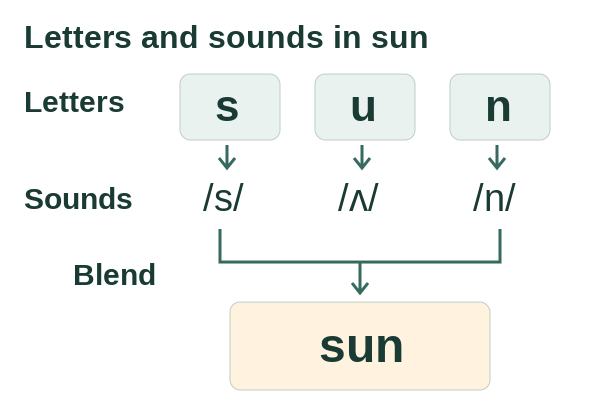
Two technical terms sit at the centre of phonics: phoneme and grapheme. A phoneme is one speech sound of a language, and a grapheme is a written symbol or letter that stands for it. English does not match the two one to one: it has at least 40 phonemes but only 26 letters.[6] One account links the difficulty to how irregular English spelling is compared with other languages.[9]
Phonics instruction and phonological awareness instruction are treated as necessary parts of beginning reading instruction. Phonics instruction requires teachers to hold specialised content knowledge, pedagogical knowledge and pedagogical content knowledge.[10] One researcher holds that beginners do not need phonemic awareness first. English beginners can take a phonemic approach as well as beginners in other languages can. That argument holds that beliefs to the contrary rest on misunderstanding. It reports test results in support.[9]
Phonics instruction can be compared with sight word training. That method teaches irregular words as whole units.[11] Skilled reading means recognising written words automatically from memory, by sight. Beginners need phonemic segmentation, the ability to pull a spoken word apart into its separate sounds, along with grapheme-phoneme knowledge, decoding and spelling skills. When learners use these skills, the spellings of words become bonded to their pronunciations and meanings. They are stored in memory. Beginners move through four alphabetic phases as they gain these skills. Systematic phonics instruction helps them move through those phases.[12]
The label explicit, systematic phonics has a long history. It runs through studies, reviews of instruction and policy documents. A survey of teachers showed that systematic and explicit instruction takes many forms. This led to a proposed definition. Under that definition, clear, systematic phonics instruction is matched to students' developmental levels. It includes a scope and sequence for delivering content. It also includes a variety of word-study activities. It also seeks student engagement and accountability through direct teaching.[1]
Phonics instruction was designed mainly for two groups. One is first-language beginners in the primary grades, and the other is children who have trouble learning to read. The same review notes that it can be used with second-language learners. They use sound-symbol links, vocabulary and meaning to decode and understand texts. For a beginner in English, learning to read calls for many mental processes. They must work together at the same time. These include recognizing words and building the meanings of sentences and texts. They also include holding what they read in memory. Beginners must also learn the alphabetic system, which covers letter-sound links and spelling patterns. They must learn to use that knowledge while reading.[7]
Teachers who know about phonics and its part in reading development are better placed to support learning. Such teachers can spot the phonics knowledge and skills children show. They can also see how best to support and guide phonics learning.[13] A review looked at basic principles behind word learning and phonics instruction. It found those principles applicable to many primary-grade classrooms.[14]
History
A short history of the reading wars
Frank Smith argued in 1973 that phonics need not be taught in the classroom. He said it makes learning to read harder for children.[15] Smith returned to the attack in 1999. He called systematic phonics an educational hazard that is bound to fail. He claimed that phonics instruction ignores how children actually learn to read, that any phonics is best learned during reading, and that phonemic awareness is spurious.[16]
Phonemic awareness is the ability to notice and work with the separate sounds inside spoken words.[10] Smith also pointed to what he called the ideological and commercial focus of phonics methods.[16] Not every teacher accepted this position. Writing in 1982, one teacher argued that phonics does have a place in the classroom. This was especially true for bilingual Aboriginal children in a society without writing. That teacher noted that much of the advice from reading specialists came from work with native English-speaking children raised among newspapers and bedtime stories.[15]
By 1999, most people agreed that reading teaching should include some phonics. They disagreed sharply about what form it should take. Synthetic approaches had recently drawn much publicity. A 1999 article set out what synthetic phonics involves. It compared this with a more balanced approach. The comparison covered the phonic content taught and the way the teaching is carried out. It also covered how phonics relates to other parts of learning to read.[17] Another 1999 article called phonics teaching a site of challenge and conflict. It called it the battleground of the reading wars.[18]
In Britain the argument entered national policy through the National Literacy Strategy. The British National Literacy Strategy was meant to settle the reading debate. It did this by taking a clear position and prescribing it for all schools. Policy makers claimed that the strategy rested on research evidence. A 2000 review tested that claim by asking whether research justified the greater emphasis on phonics in the strategy's teaching framework.[19]
One camp held that systematic phonics does harm, while another held that phonics belongs in the classroom but should be balanced with other parts of reading.[16][17] A third line of argument held that the research base for prescribed phonics was weaker than policy makers claimed.[19]
Main ideas
How English spelling maps onto sounds
That irregularity affects the early learning of decoding. Researchers discuss this property under the name orthographic depth hypothesis. A study of primary school pupils in the north of England tested a regularised form of English spelling alongside the conventional system. That study reported helpful effects for the regularised form. It drew on a case study and a small group experiment.[20]
A large phoneme-grapheme frequency count was carried out in 1966. That count had implications for the teaching of phonics and spelling. Its results were presented in a complicated and unwieldy way. The original study is also out of print. A 2004 summary put the Hanna results into a shorter form. It was meant for researchers and teachers of reading and spelling.[21]
One proposal is that literacy can be taught as a scientific subject. Instruction would then target all the thinking skills needed to understand the logic of English spelling. The 2017 article gave theoretical and evidence-based arguments for that hypothesis.[22]
Developmental spelling research began in the 1970s. It studies spelling from a developmental perspective. A 2025 article on the topic addresses teachers of students in grades 3 to 12.[23]
A 2025 study looked at students learning English as a foreign language. It tested morpheme identification, awareness of morphological structure and reading comprehension. Students who did well on the morphological awareness tests also scored higher on the reading comprehension tests. Video analysis of phonics instruction suggested that repeated activities in matching sounds to letters can support morphological awareness.[24]
How beginners learn words by sight
Ehri describes readers moving through four developmental phases. In these phases they learn how the alphabetic writing system works and apply it to reading and writing words.[25] It teaches the letter-sound knowledge and skills that word reading depends on.[25][12]
The theory offers practical advice for teaching beginners. Decoding is best taught with grapheme-phoneme subunits rather than whole syllables. Beginners should read words in text aloud rather than silently. This helps meanings bond to spellings in memory. Showing students the spellings of new vocabulary words when those words are taught improves their memory for the words.[12]
How phonics and fluency work together
The two skills are usually taught as separate parts of the reading curriculum. Yet rhyming poetry can teach them together. A 2008 article in The Reading Teacher described how children can practise rhyming poetry by reading it again and performing it. This supports accurate, automatic and expressive reading of words. In that account, repeated reading and performing of rhyming poetry supports accurate, automatic reading with meaningful expression.[26]
A 2015 study of beginning readers in low-decile New Zealand schools found that children given explicit phonological-based instruction made superior progress in word reading skills. Children in the other programmes made similar progress in every reading-related skill measured. Word reading was the one exception. Classes that put strong emphasis on explicit phonological instruction also saw their word reading scores grow more alike over time.[27]
A 2008 article proposes one activity for building accurate, automatic and expressive reading. The 2008 article proposed that rereading and performing rhyming poetry lets children practise the same words until recognition becomes automatic.[26] A review of 44 peer-reviewed articles published from 2020 onwards reported that phonics teaching worked best when explicit, systematic and suited to the child's stage. It worked especially well alongside spoken language. That review also found that combined phonemic awareness and phonics instruction produced more enduring literacy outcomes than stand-alone methods. This was particularly true among beginning readers.[28]
A 2026 review of the research looked at 163 studies that other experts had checked. Together they cover four and a half decades of publication. It concluded that phonics teaching can help overall reading performance. The size of that help varies, however. It depends on the teaching methods used and the conditions in which they are delivered. The review also reported significant variation in the scale, duration and year levels of the research it examined.[29]
One 2008 whole-class trial taught phonics and phonological awareness inside mixed-ability reading lessons. It covered 251 children from Reception to the end of Year 1. A comparison group of 213 children got standard teaching methods. The strategy significantly improved reading performance for normally developing readers and for children with poor phonological awareness. Reading difficulties fell from 20% in comparison schools to 5% in intervention schools.[30] A 2001 review of New Zealand practice noted that children there responded with relatively faster reading procedures under receptive phonics teaching. Much remained to be learned about sharpening those practices.[31]
A 2025 conceptual review describes systematic phonics instruction as a basic mechanism for early reading. The review says this mechanism can be transferred. That review examined how phonics-based and sight-word approaches add to decoding, reading fluency and comprehension. It argues that sight-word learning, in which whole words are learned by sight, plays a complementary role within a balanced literacy framework.[32]
A 2006 study followed 40 children with reading disabilities in Grades 2 to 5 who received systematic phonics instruction. It compared oral reading fluency, a timed measure of reading passages aloud, with an intervention aligned word list. The word list explained part of the change in decoding and word identification. The other measure did not explain that part. The oral reading fluency measure explained unique variance in gains in passage reading fluency. The word list showed adequate reliability and construct validity. The scheme used to rank each word's difficulty was not as effective.[33]
A 2026 randomized controlled trial tested a phonics-based computer game with children in Grades 0 to 4 who had developmental language disorder, a condition that affects language learning. Children were assigned to the game, to an active control group playing a math game, or to teaching as usual. This lasted 5 weeks. The analysis found no significant differences between the groups in how much they improved. Every group raised its decoding scores from the start to the follow-up 10 to 12 weeks later.[34]
A 2024 meta-analysis pooled 11 randomized controlled trials of computer-assisted reading instruction. The trials covered 510 learners in kindergarten to Grade 3 with intellectual, developmental and learning disabilities. For phonics and phonemic awareness, the awareness of individual speech sounds, the average effect was d = 0.41. The 95% confidence interval was 0.175 to 0.644. The authors warn that these results rest only on published studies.[35]
A 2014 review found 96 imaging studies of reading intervention. Of these, 22 met its inclusion criteria for descriptive analysis. A meta-analysis of 8 experiments with post-intervention data found changed activation in the left thalamus, right insula and inferior frontal regions. It also found change in the right posterior cingulate and left middle occipital gyri. The authors urge caution. So few studies were available, and their methods differed.[36]
A 2022 review of 39 neuroimaging studies of reading intervention reported shifts in brain activation, connectivity and structure. These appeared within the reading network. They also appeared in right hemisphere, frontal and sub-cortical regions. Its meta-analysis looked at activation changes from before to after intervention in 8 studies. It found no significant effects. Methodological differences among studies may explain the absence of significant pooled findings.[37]
Technology-based reading instruction shows small average effects on comprehension (Hedges' g = 0.13). A 2026 meta-analysis found 25 articles reporting 26 studies of such instruction. They were published from 2000 to 2025. The overall effect on reading comprehension was small-to-medium. Hedges' g was 0.13, with a 95% confidence interval of 0.03 to 0.23. Interventions that added extrinsic incentives such as points and badges were associated with smaller effects. The review used a framework with four components: instructional quality, appropriate levels of instruction, incentives and sufficient time for practice and feedback. Only nine studies included all four.[38]
Research
The National Reading Panel and its effect sizes
A 2001 article by Ehri, Nunes, Stahl and Willows reported a meta-analysis of the National Reading Panel's phonics findings. The pool held 66 treatment-control comparisons. They came from 38 experiments. Each comparison set a group taught with systematic phonics against a group given unsystematic phonics or no phonics.[2]
Across the studies, phonics instruction raised reading by a moderate amount, d = 0.41. The benefit did not stop when the lessons stopped. Effects lasted after instruction ended. Phonics produced gains in decoding, word reading, text comprehension and spelling across many readers. The pooled result favored systematic phonics over every form of control group instruction. That includes whole language.[2]
Timing mattered: phonics begun early gave d = 0.55, against d = 0.27 when it began after first grade. The type of program mattered less. Synthetic phonics and systematic programs working with larger units gave a similar advantage in reading.[2]
The panel drew a direct conclusion: systematic phonics instruction proved effective and should be part of literacy programs. This applies to beginning reading and to preventing and remediating reading difficulties.[2] A 2009 experiment with kindergarten children tested the word systematic directly. It compared a systematic phonics program with a nonsystematic one built from the same Dutch letter-sound pairs. Both trained groups gained the same amount in producing letter sounds as a control group. The systematic program also made more progress on spelling and on reading.[39]
Long-term effects and later reading
A 2016 meta-analysis gathered 71 intervention-control groups. The studies reported both a posttest and a later follow-up. The groups held 8,161 children at posttest. The average follow-up came 11.17 months after the posttest. Across all interventions, the average effect size was 0.37 at posttest. It fell to 0.22 at follow-up. The pattern differed by type of intervention. Comprehension and phonemic awareness programs kept most of their effect and carried over to skills they did not directly teach. Phonics and fluency interventions tended not to hold their gains in the same way. So did interventions for preschool and kindergarten children. Several features of study design also related to effect sizes at follow-up. These were experimental design, dosage, sample attrition, risk status and gender balance.[5]
A separate meta-analysis looked at 22 studies of phonics. The studies covered the achievement of urban minority elementary school children. It found a significant link between phonics instruction and higher academic achievement. The size was about .23 to .33 of a standard deviation unit. That relationship held for studies of all minority students. It also held when the analysis was limited to the higher quality studies. This meta-analysis reported overall achievement associations rather than a separate follow-up period, so it speaks to later achievement only in a general sense.[40]
Phonics knowledge has been tracked alongside comprehension and vocabulary to see which changes come first. One study measured all three in 504 second-grade students. It tested them at the start and end of a school year. A path analysis model confirmed these relationships. A second set of data from 1,585 second-grade students in another school year confirmed them again. The researchers concluded that early reading instruction should stress the consistent letter-sound patterns of English. It should also be comprehension focused, encouraging children to make sense of what they read. They called for more research using other assessment tools and at higher grade levels.[41]
A 1998 study compared grade 3 children taught by whole language since they began reading with grade 3 children in a phonics program. The phonics group spelled more words correctly than the whole language group. The phonics children's spellings of nonwords also had more conventional patterns. These patterns matched the sounds more accurately.[42]
One study gave 18 weeks of supplemental phonics instruction from trained paraeducators to low-skilled kindergarteners. The group included 84 language minority children and 64 others, at 10 urban public schools. Language minority students tended to score lower at posttest than other students. The average difference was -0.30. They also showed much less response to treatment on word reading. The treatment effect on spelling was larger for students in classrooms with less phonics time. Among language minority students, pretest English receptive vocabulary predicted most posttests.[43]
Some later work asks how phonics teaching can fit the identities and home languages of the children who receive it. One researcher describes a study in an urban second grade classroom. It used both numbers and descriptions. There, children of Color co-wrote decodable stories. They drew on the phonics skills they had been taught, their lived experiences and their home languages. The report argues that traditional decodable readers are written in White Mainstream English and may show diverse characters in experiences more familiar to the White dominant group.[44] A practitioner inquiry study described 39 pre- and in-service teachers adapting lessons from a phonics program for K-2 students. They did this in a graduate literacy methods course.[45]
What the classroom studies measured and found
A quasi-experiment in Indonesia compared 40 kindergarten children in a bilingual school. The phonics group had structured phonics lessons for six weeks. The control group carried on with its usual alphabet-based reading instruction. Tests before and after measured letter recognition, phonemic awareness (the ability to hear and separate the sounds inside words), word reading accuracy and word decoding. The phonics group averaged 87.6 on reading scores, against 70.05 for the control group. A t-test put the difference below the 0.05 level of statistical significance.[46]
A second quasi-experiment worked with Year 4 and Year 5 pupils in a rural district of Sarawak, Malaysia. All of them had low English proficiency. The treatment group had five weeks of structured phonics instruction from a remedial teaching toolkit. The control group followed the standard English curriculum. Reading was checked in three areas: sound patterns, single letter sounds, and understanding what was read. The treatment group improved significantly on all three measures. The strongest gains were in letter-sound recognition. Between the two groups, however, only letter-sound recognition differed significantly, so the comprehension advantage did not clearly separate the classes.[47]
A study in Thailand gave 40 primary school students either traditional book-based instruction or synthetic phonics. The treatment lasted eight weeks within a ten-week schedule. The phonics group did better on both receptive and productive word recognition. It also showed significant gains in phonological awareness, working memory and decoding.[48]
A smaller case study followed 30 Grade 3 students at one school in Ubon Ratchathani Province, Thailand, through five phonics lesson plans. Tests given before and after the lessons showed a significant difference in oral reading ability. The result was P < .001.[49]
Some studies measured pronunciation in children learning English as a foreign language. In one Ecuadorian study, mean word reading scores rose from 5.25 to 7.79.[50] One class of 30 Grade 5 students in Yunnan Province, China, rose from a mean pre-test pronunciation score of 9.17 (SD = 2.24) to a post-test mean of 15.63 (SD = 1.90). Students reported satisfaction with the phonics lessons. The overall mean was 3.52 (SD = 1.10) across 15 questionnaire items.[51]
One group of Ecuadorian children was taught letter sounds rather than letter names. Errors on the same word reading test fell from 4.33 to 0.285. This was reported as a standard error of the mean.[50]
Some classroom studies report uneven results. In a Thai school, most teachers said students developed reading skills through phonics. But some students did not improve.[52]
At one school in Lampung, Indonesia, Grade 2 students first mispronounced English words. They applied Bahasa Indonesia sound rules. After phonics lessons they made correct sounds more often and read more fluently. But the sounds /θ/ and /ð/ stayed hard, and lesson time was short.[53]
One long study looked at phonics teaching and learning in eight whole language first-grade classrooms. They were observed weekly from October through May. They tracked 178 students on four tests of encoding and decoding, given alone and in context. All three clusters gained. The largest composite gain, 8.61, went to 42 students who began with scores of 15 to 26. The 123 students who began with scores of 27 to 37 gained 7.15. The 13 students who began with scores of 2 to 14 gained a statistically similar 6.08.[54]
Later work asked how phonics sits alongside other teaching rather than whether it works alone.[55][56] A survey of 254 Australian teachers found they reported mixing decontextualised synthetic phonics with contextualised analytic phonics. Many of those teachers also described shared reading. They described other activities aimed at comprehension too.[55] In Victoria, 45 teachers and 220 students in 18 schools took part in a reform effort. Phonics taught within rich contexts was linked to gains in early literacy skills.[56]
One small study tested 36 seventh graders in East Lombok before and after phonics teaching. Their mean score rose significantly (t with 35 degrees of freedom = 23.314, p = 0.001).[57] A second-grade class in Sumarorong averaged 60.800 on the first test and 79.52 on the final test. The t-value was 12.046 against a table value of 2.046.[58]
A classroom action study of first graders in Tasikmalaya reported better letter recognition, word spelling, reading of simple sentences and understanding of what was read. The gains came after two cycles of phonics lessons.[59] A case study of 10 third-grade students in China found that phonics teaching helped them. It helped them link printed words to their pronunciation and decode and spell new words.[60]
A Jakarta kindergarten class had 10 five-year-olds. Their spelling scores rose from 63 before teaching to 68 after the first cycle and 73 after the second. The same action research reported that children improved at remembering the letter that stands for each sound. They also improved at saying letter sounds correctly and spelling words correctly.[61]
A survey of Grade 2 learners in the Masinloc District found that home reading helpers used phonics often. Mean ratings ran from 3.03 to 3.07. The learners were proficient in letter recognition, phonemic awareness, word decoding and reading comprehension in Filipino. Those helpers' use of phonics was linked to learners' reading skill levels. The link was moderate and significant.[62]
A quasi-experimental study of 30 literature students learning English found that phonics instruction significantly improved pronunciation accuracy. It also improved the ability to decode the vowel pair <ai>. Those students also held a positive view of phonics learning.[63]
A study looked at 44 fifth graders in Luang Prabang. Their pronunciation after phonics lessons was rated high, with a mean of 3.06 and a standard deviation of 0.28. Within that rating, finding sounds in words scored highest (mean 3.38, SD 0.27). Blending scored lowest (mean 2.75, SD 1.05).[64]
A six-month mixed-method study compared 30 Year 3 English learners in one school. The group taught with Jolly Phonics blending showed an overall rise in scores and interest. The control group was taught phonics in the traditional way.[65]
On the post-test the blended group scored 88.38 and the control group 87.17. The mean difference was 1.21 points, which the analysis called significant.[66] A development study at a Medan kindergarten reported that reading materials built on phonics passed validation by 2 expert validators. An effectiveness test showed the materials worked.[67]
Assessment of phonics knowledge
Tests of phonics knowledge check whether a child can turn printed letters into spoken sounds, a skill called decoding. England introduced a Phonics Screening Check for children in Year 1 in 2012, to make sure all children develop decoding skills.[68] A screening check is a short test given to every child to flag those who may need extra help. One analysis concluded that the Department for Education had placed too much confidence in the check. It had trusted both its validity and its reliability too much. Validity means the test measures what it claims to measure; reliability means it gives consistent results. The same analysis found that important sources of measurement error had not been explored. It asked whether the check was fit for purpose.[69]
How accurate a screening check looks depends heavily on the standard it is compared against. One study compared the phonics check with a standardised reading test. It also compared it with teachers' judgments of children's phonic phases. The positive predictive value of the check was low, at 0.31, against the reading test. It was high, at 0.84, against the teachers' judgments. Positive predictive value is the share of children who fail the check and also do poorly on the reference measure. Agreement between the two reference tests was poor, with a kappa of 0.27, a statistic where 1 means perfect agreement. The researchers noted that longitudinal data are needed to judge how well the check predicts later reading. Such data follow children over time.[68]
A test of letter sounds or decoding shows a child's grasp of one part of reading, not reading as a whole. The National Reading Panel's meta-analysis concluded that phonics instruction was better than other approaches. It was based on mean effect sizes labelled d. An effect size is a number expressing how large a difference between groups is. Two researchers recomputed the panel's figures as correlations, called r, and r-squares. They reached a different conclusion. They argued that the advantages of phonics instruction over non-phonics instruction had not been shown clearly. This held when practical significance was considered.[70]
Another critic examined the panel's comparison through tests of reading comprehension. The critic found that skills-based methods were not shown to be better.[71] A 2008 response defended the panel's report against later critiques. It also acknowledged some points of agreement.[72]
Screening results have also been used in policy arguments that go beyond what a decoding test can show. One analysis said the phonics screening check was evidence gathered to fit a policy. It was not a policy built on evidence.[69] Researchers reviewing England's policy found that from 2008 to 2024 the Department for Education increasingly treated synthetic phonics as the only way to teach early reading.[73] A 2019 review noted that a definitive trial comparing approaches to teaching reading was recommended in 2006. It was never undertaken.[74]
The Tile Test, described in 2004, is a hands-on instrument. It checks phoneme awareness, letter-sound links, decoding and spelling of words, and sight-word reading. It also checks decoding and spelling within sentences. The test puts metalinguistic questions, which ask children to think about language itself, inside hands-on activities with tiles. These embedded questions show the problem-solving strategies children use to decode and spell words. The authors report evidence that the instrument is valid and reliable. The test is given to one child at a time. Teachers can adapt it to fit their curriculum and to work in small groups.[75]
A study of the task's measurement was done with 25 elementary grade disabled readers. The study asked how reliable the subtests were and whether they detected change from instruction. It also asked whether subskills grouped meaningfully and how they related to an outside criterion. The findings were mostly encouraging. Some had sampling and design problems. The authors recommended a large-sample study to improve subtest reliability.[76]
Critics have questioned whether it is a reliable and suitable way to assess early reading. Supporters of the check regard it as a useful means of securing progress in reading. A government-funded evaluation found no evidence that pupils' literacy performance or progress improved in ways clearly traceable to the check's introduction. A doctoral study using illuminative evaluation, a method for describing how a programme is experienced, gathered the views of Year 1 children and their teachers in schools in a large city.[77]
What the classroom trials measured
Data came from classroom observations, semi-structured interviews and documents. The design was qualitative and descriptive. Students began to recognize sound-letter links more systematically. They relied less on Indonesian spelling patterns when saying English words. The report also lists limits. There were few teaching materials, children had trouble hearing unfamiliar English sounds, and the teacher had little experience using phonics consistently.[78]
Some studies measure broader outcomes, such as confidence, engagement or overall literacy. A study of Chinese primary teaching found that children's core literacy levels were uneven. It also found that phonics improved language ability, learning ability and quality of thinking to some extent.[79]
In practice
Synthetic, analytic and other teaching choices
In England, policy has pushed a pure and exclusive form of this method. In it, children learn letter sounds and blend them in order to read text. All five year olds in England sit a universal phonics check. The results are widely reported. Andrew Davis argued in 2013 that this claim has a basic problem. Researchers who study synthetic phonics are not studying a specifiable method of teaching reading.[80]
Davis gave two reasons for that judgment. First, he held that teaching methods cannot be specified in advance, since teaching is a complex activity of practical judgments that respond to the many contingencies of classroom life. Reading, in his account, is a matter of grasping meaning conveyed by text. Sustained attention to letter-sound correspondences can help some novice readers. But Davis said we should not assume it helps all of them.[80]
A 2008 analysis looked at the review behind the change. It found no reliable empirical evidence that synthetic phonics is the best route to skilled reading for the vast majority of beginners. The English data instead supported approaches based on systematic tuition in phonics. There was also evidence that contextualised systematic phonics instruction is effective. That analysis called for more research, particularly with typically developing readers. The aim was to test whether contextualised systematic phonics beats discrete systematic phonics.[81]
One national change in England refocused the teaching of reading around synthetic phonics. It did so at low cost, by changing how existing teachers taught. An evaluation of the pilot and first phase of the national rollout found strong early effects. On average, these tend to fade out.[82]
Named programs and classroom materials
Several named phonics programs have been studied in classrooms, and the studies differ in size, design and country.[83][84][85] A 2010 case study compared two schools teaching Jolly Phonics with one school teaching THRASS. That program's name stands for Teaching Handwriting, Reading and Spelling Skills. All the schools taught children aged 4 to 5 at Reception level over a one-year period. Reading of words and non-words improved in every school. So did short-term memory for words and phonemes. Reading improved more in one Jolly Phonics school than in the THRASS school. The other Jolly Phonics school showed no difference from the THRASS school. The paper suggests that particular variables may hide the effect of a teaching method. It calls for future evaluations that take such factors into account.[83]
Two trials in Nigeria reported gains for Jolly Phonics over conventional teaching.[84][85] One study used a quasi-experimental design, which compares existing classes rather than assigning children at random, with 324 pupils in Lower Basic 1 and 9 teachers from three schools in Lagos State. Pupils taught with Jolly Phonics did better on reading achievement. They also had a more positive attitude to reading than pupils taught by the conventional method.[84]
Jolly Phonics has also been examined as a set of classroom practices. It was not examined as a score on a test. A study in Libya used multimodal discourse analysis to examine teachers' lessons. This method studies how gesture, vocalization, visual materials, movement and rhythm work together. It argues that literacy learning in these classrooms comes from several ways of communicating used together. Language alone does not explain it. The findings stress gesture, effective discourse and embodied interaction. These help children understand speech sounds.[86]
A comparative study in the United Arab Emirates added the Jolly Phonics Lessons application to literacy lessons for kindergarten children aged 4 to 6. Children whose classes used the application outperformed those taught by traditional methods. They showed large growth in letter-sound recognition and letter formation, and a substantial increase in blending and segmenting sounds.[87]
A randomized controlled study compared an iPad-based supplementary reading program with a control condition. The 90 kindergarteners were learning English and Chinese, and the program used picture-embedded cues at the letter, word and text levels. The reading group showed better gains in word reading. Data from the app showed that inconsistent letter-sound pairings and sounds specific to English were harder to learn.[88]
A third project built an augmented reality mobile game based on the Jolly Phonics approach. It tested the game with primary school students. Those students improved their phonics performance. They also reported positive attitudes toward the application.[89]
A case study in Indonesia surveyed and interviewed 20 teachers of English as a foreign language. The topic was using phonics songs with young learners. The teachers held positive views of phonics songs in early reading classes. They also named benefits and drawbacks that teachers should weigh when choosing a song. The study notes one obstacle. English letters sound different from Bahasa Indonesia letters, which may confuse learners.[90]
A quasi-experimental study with 31 children compared phonics teaching helped by sandpaper letters with a control group. The mean early reading score of the experimental group rose from 72.63 to 89.81. The control group rose from 73.33 to 80.93, a significant difference with a significance value of 0.040.[91]
A small action research study in rural Sarawak had five preschool learners. It compared sandpaper letters with QR Code-Integrated Phonics Cards, which add audio-visual support through a scannable code. With sandpaper letters, mastery took an average of 4.8 instructional cycles. With the cards, it took 2.4, about a 50% drop in teacher-led interventions. Observers also noted a shift away from passive reliance on the teacher. They saw active engagement, self-correction and independent learning.[92]
Visual Phonics is meant to make the link between spoken English and print clearer. It can be learned in a 2-day workshop. A 2006 review of the field said Visual Phonics had almost no research base. It called on teachers and speech pathologists to collect data on it.[93]
Later studies followed that call. One involved 20 students in kindergarten and first grade who were deaf or hard of hearing, plus 4 teachers. A year of a phonics-based curriculum supplemented by Visual Phonics produced statistically significant improvements in beginning reading on standardized assessments.[94] An earlier study found improvements in word reading, pseudoword decoding and reading comprehension. The gains showed no link to how much hearing a student had lost.[95]
A quasi-experimental study worked with middle school students who were deaf or hard of hearing. The treatment group learned and applied the phonic skills taught. This held regardless of degree of hearing loss.[96]
A 2022 systematic review concluded that Visual Phonics can be an effective strategy for code-related skills. This holds for at-risk hearing kindergarteners and for deaf and hard of hearing students. That review also found limitations in a number of the studies. These included small samples, trouble obtaining a randomized sample, no control group and difficulty generalizing findings. It called for more research before the tool is called an evidence-based practice.[97]
Phonics in second and foreign language settings
Phonics has been studied as a way to teach reading to learners of English as a second or foreign language. It has not been studied only with first-language beginners. A meta-analysis searched research published from 1990 to 2019. It found 45 articles with 46 studies, covering 3,841 participants in total. Instruction in phonological awareness (noticing the sound units inside spoken words) and phonics had a moderate effect on second-language word reading, with an effect size of g = 0.53. The size of the effect varied with the testing method. It also varied with the type of phonological awareness or phonics intervention and the setting where the teaching took place.[98]
In Indonesia, a pre-experimental study took place with 36 seventh graders at a state junior high school in East Lombok. It gave a read-aloud test before and after phonics teaching. Mean scores rose a lot between the pre-test and the post-test, t(df=35) = 23.314 at p = 0.001.[99]
In Nepal, a participatory action research study tracked reading progress. It followed students in rural schools in Lamjung district. Researchers compared students taught by different methods. The comparisons supported phonics as a way of raising reading attainment. The study also reported that effective phonics instruction reduced barriers. These included a negative home situation, low socioeconomic status and gender. In that study, the main drivers of success were teacher motivation and expertise, along with student attendance.[100]
In Pakistan, an experiment took place in four non-formal basic education schools in village Nara, Attock. It involved 32 students split into two paired classes. The experimental group was taught with phonics. The control group used traditional read-aloud and reading techniques over one month, with 26 lesson plans of 40 minutes each.[101]
When two phonics methods are compared, the results can favour one over the other. In Nigeria, a quasi-experimental study used a non-equivalent, non-randomized control group design. It involved 118 primary one pupils from four public primary schools in Enugu, South East. Synthetic phonics improved reading achievement significantly more than analytic phonics. The study recommended that pre-service and in-service teachers be properly exposed to synthetic phonics techniques.[102]
In China, a quasi-experimental study gave 12 weeks of English phonics instruction to 71 first-year English majors. A comparison group of 67 received 12 weeks of English phonology instruction without phonics. The phonics group improved significantly more on some graphemes. This was especially true for graphemes absent from Pinyin, the alphabetic system used to write spoken Chinese. An analysis of learners' errors found three common types of decoding error. It also highlighted the influence of Pinyin.[103]
A survey of 213 primary school English teachers in two Chinese provinces found that most held positive attitudes towards phonics. Most saw it mainly as a word-attack skill. A better educational background predicted a better phonics teaching effect. Even so, the teachers still needed systematic phonics knowledge. Teaching materials and teaching strategies were strongly correlated with the teaching effect. The study concluded that phonics should be built into regular textbooks.[104]
A documentary analysis looked at essays on phonics teaching in mainland China. It found that phonics, Pinyin and the International Phonetic Alphabet were the main topics discussed. Misconceptions about phonics appeared in some of the collected essays. At the same time, localization of phonics was emerging.[105]
In China, a newly compiled phonics teaching guide had already been shown to help. It improved pre-service English teachers' content knowledge by 23 per cent. Content knowledge reliably predicted pedagogical content knowledge and self-perception. This suggests that strengthening content knowledge supports phonics teaching competency.[106]
A survey of instructors in Spanish schools ran from May to October 2023. It found that teachers think phonics is beneficial, especially for reading and writing skills, and also for oral competence. Experience of phonics and training in phonics both shaped what teachers believed. They also shaped how teachers taught.[107] A systematic review likewise recommended putting teacher professional development first. It also recommended designing culturally responsive phonics materials.[108]
An analysis of published and unpublished research reached a conclusion. More skilled readers gain fully from reading strategy instruction alone. Less skilled readers need phonics taught as part of the whole program. Only then can they gain fully. That conclusion rests on one view. Reading proficiency comes from linguistic knowledge together with strategic behaviour.[109]
Teachers, training and policy mandates
A two-phase mixed-methods study looked at early childhood teachers. It found a link between play-based, child-centred literacy beliefs and reported holistic phonics practices. Some teachers said they would never consider a commercial phonics program. These teachers were also likely to say children learn letters and sounds by chance. In interviews, these teachers described phonics instruction as an isolated skill-and-drill activity. They held strong views against heavily scripted commercial programs. The same interviews reported play-based and everyday phonics examples. They did not report explicit systematic instruction. Teachers' knowledge, experience and confidence in resisting parental pressure for formal phonics lessons helped explain their reported practices.[110]
In one Australian study, 162 pre-service teachers answered a questionnaire. It asked about their attitudes to phonics, their knowledge of phonemic awareness, and how prepared they felt to teach beginning reading. Most could not use that knowledge to count phonemes in words. Most also did not feel well prepared to teach beginning readers. The study suggested these teachers need clear training in the sound structure of language. That would help them teach reading well.[111]
A large survey in England found that primary phonics and reading teaching had changed a lot. It was the first such change in modern history. The survey covered 2205 teachers. The paper also reported a qualitative synthesis of 55 experimental trials that included longitudinal designs. Compared with other English-dominant regions, England stood out as an outlier. The paper recommended changing national curriculum policy. It also called for rethinking how much political control is exercised over curriculum, pedagogy and assessment.[112]
England and New Zealand drew on a shared body of literacy research. They adopted phonics to very different degrees.[113] In England, policy came to focus most effort on synthetic phonics programs in the early years. One analysis argued that direct political control of the early years literacy curriculum has left the lines between research, policy and practice increasingly fragile. It also examined why the Clackmannanshire phonics intervention became the study most often cited. That study is used to justify government policy.[114]
The phonics screening check was introduced in June 2012. It reflects England's emphasis on systematic synthetic phonics for early reading.[115][116] The check is meant to show whether 6-year-old children reach an appropriate standard in phonic decoding. It also finds children who struggle with phonic skills.[115]
A review of the check's first three years, from 2012 to 2014, questioned what the test actually measures. The check is meant to cover 85 grapheme-phoneme correspondences. These are pairings of a written letter or letter group with a sound. Just 15 of the 85 letter-sound pairs accounted for 67% of all occurrences. Another 27 of the 85 (31.8%) did not appear at all. Sometimes one grapheme stood for more than one phoneme. In those cases the most frequent pronunciation was the one tested in 72.2% of cases. Reading real words correctly also required vocabulary knowledge. Students used it to choose among possible pronunciations. The review concluded that the letter-sound pairs assessed do not reflect the full range expected. A systematic synthetic phonics approach would expect more.[116]
One account describes a ninth-grade teacher. She worked to meet the demands of a district-mandated scripted reading program while serving her students' needs. It argues that a one-size-fits-all scripted approach may work for no one. That happens when it meets real students and teachers in real classrooms.[117]
In South Africa, a case study of four foundation phase Setswana teachers used interviews and classroom observations. In Grades 2 and 3, the teachers spent more time on phonics and oral language activities. They spent less time on the language comprehension skills that support reading comprehension. The study called this imbalance a problem. Skilled reading needs both word recognition and language comprehension.[118]
In Meru County, Kenya, a study sampled 400 learners and 248 teachers from 234 schools. The full pool was 61,870 learners and 1,397 teachers. It found that phonics, especially the phonemic and phonological components, was minimally used in classrooms. Training on phonemic and phonological awareness was insufficient. Teachers' level of training in phonics was linked to higher reading achievement among grade one learners. The relationship was statistically significant (p = 0.000, below the 5 per cent level). The study recommended training programs that cover a wide range of phonics elements. It also recommended continuous professional development for teachers.[119]
Policy can also narrow what else happens in a literacy classroom. A pilot study used the Early Language and Literacy Classroom Observation tool in six early childhood settings. It found a range of strengths and weaknesses. There was little evidence that shared picture book reading was a basic part of the early childhood literacy programs. Shared reading was absent in some settings. Elsewhere books were chosen for their length or for a phonics focus. The article argued that shared reading of good children's literature can support a range of reading strategies, phonics among them. It can also build a joy for reading.[120]
Phonics teaching also happens outside ordinary schools. Thousands of UK school children spend a lot of time learning to read a religious classical language. This liturgical language is tied to their faith.[121]
In England, the debate over how to teach reading became official policy in March 2006, when the Rose Report was published. The government had already begun changing the National Curriculum. The changes were to match the report's recommendations. Two researchers argued in 2007 that this change in teaching method was not justified by research. Their review of international research on early reading found that the report's main recommendation contradicted a large body of evidence. That evidence had built up over the last 30 years.[122]
The dispute did not begin with the Rose Report. A 1997 historical review traced the conflict between whole language and phonics. The conflict was about approaches to beginning reading. The paper looks at a long dispute between Whole Language and phonics. Both are competing emphases in beginning reading. One theme ran through the paper: how educational research shapes practice in beginning reading instruction.[123]
In the United States, phonics has a policy history of its own. A 2025 paper set out to describe how the phonics approach there changed over time. The paper compares systematic and non-systematic phonics. It also explains the main differences between them. The paper takes a qualitative approach, drawing out clear differences between the two and explaining how English is taught to children who speak it at home. It said its findings would be useful to educators and linguists. Both groups work on English literacy development.[124]
How phonics lessons are sequenced and paced
Published programs give varying guidance on which letter-sound regularities to teach. They also vary on the order in which to introduce them. A 2026 review in Perspectives on Psychological Science observes that this uneven guidance can shape what students learn, and that researchers understand these effects poorly.[125]
One proposed tool is the Phonetic Continuum Matrix. It offers a step-by-step system for choosing words for early decoding instruction. Its designers built it around the developmental continua of phonemic awareness, the ability to notice individual speech sounds, and phonics. The model is meant to help teachers pick words for word making, word breaking and sorting activities. The activities follow a set order.[126]
One classroom report describes lessons on grapheme-to-phoneme decoding for early learners, moving on to simple syllables and contextual vocabulary. Pre-test scores were as low as 25 percent. After the intervention all six reached mastery levels between 75 percent and 100 percent.[127]
A separate first-grade report describes activities that began with phonological awareness, then letter sounds, then the link between phonemes and graphemes. The activities then moved to reading and writing simple words and sentences.[128] A 2025 study combined systematic phonics with beginning reading media. It reported posttest scores of 82 to 100, against pretest scores of 28.46 to 70.76.[129]
One case study gave a phonics intervention to an 8-year-old grade 1 student. It ran over 4 sessions in 10 days, and the student's letter recognition improved.[130] A classroom action study of five second-grade pupils ran two cycles. It reported mean scores rising from 49.7 to 73.2.[131]
A second-grade study of 26 students ran two cycles. Mean reading scores were 55.38 at pretest, 69.80 in Cycle I and 81.30 in Cycle II. In that study, mastery rose from 26.9% to 65.4% and then to 92.3%. Reading speed rose from 5.1 to 15.7 words per minute. The same study credits sound cards, phonemic songs and repeated blending practice. It cautions that its findings are limited to the classroom studied and are not a controlled test of effectiveness.[132]
The 2026 review states that gaps in current knowledge remain. It calls for further work to help design phonics content.[125] A 2022 article for teachers addresses 10 questions teachers ask about applying reading research, covering phonemic awareness, phonics and morphology, the study of word parts, in developmental order.[133]
Another 2022 article offers 8 principles for answering common questions about phonics instruction. These include questions about approaches and about adapting teaching to different learners.[134] A 2025 study of grade 1 students describes learning tasks designed at various difficulty levels. Findings were refined after pilot programs at selected primary schools.[135]
One teacher in a bilingual school in Denpasar, Bali, was observed. The teacher worked through all 5 skills using activities that involved sight, sound and movement.[136] A 16-week programme for Grade 5 learners in Taiwan taught grapheme-phoneme correspondences. These are the links between written letters and the sounds they stand for. That programme targeted specific patterns. These included letter-name vowel mappings for /ɛ/ and /æ/, nasals before stops, consonant clusters, and the -tion and -sion endings pronounced /ʃən/.[137]
The Jolly Phonics account describes a sequence of skills rather than a timetable. It gives no number of weeks for each step.[136] The Taiwan programme spread its teaching of letter-sound links over 16 weeks. 12 students completed the course. Every lesson in that programme ran through the same steps. These went from explaining the rule and guided decoding to read-alouds, word sorting, dictation and brief writing tasks.[137]
Dictation accuracy on a 50-word test rose from 56.00% before teaching to 78.00% at posttest. It reached 88.83% on a delayed test 15 weeks later. Every learner kept or improved on their posttest score at that delayed test. Six targeted spelling areas improved significantly. Only a small relapse appeared at the delayed test. The researcher recommended spaced micro-retrieval: short recall tasks spread over time. She also suggested spiral review and rule-prompted revision. The study's limits include one group only and a small sample of high achievers. It also used the same test form at each testing point.[137]
Word boxes and word sorts are two phonics approaches. Children move materials and respond often, which the article says keeps them engaged. These approaches were usually used one to one. The article gives step-by-step procedures for adapting them to small groups and whole classes.[138]
A 2025 review of 20 articles found that phonics teaching improved children's reading and spelling. It did this by teaching the systematic link between letters and sounds. That review also reported that teamwork between teachers and parents sped up children's progress.[139]
A single-subject study of one 5-year-old used letter cards with the Jolly Phonics method. It recorded scores of 2, then 4, then 6, then 8 across two baseline and two intervention phases.[140] A quasi-experimental study of 20 children aged 4 to 5 split them into two groups. The control group had 10 and the experimental group had 10. The phonics group reached a mean score of 27.5 (85.9%). The control group reached 20.4 (63.75%). The difference was significant at p < 0.05.[141]
Technology, songs and multisensory materials
One urban public school system gave first graders computer programs with systematic word-attack exercises. These students gained significantly over the school year. Their post-test scores were only slightly higher than those of control children taught without the programs. The gap was not significant. Among low-performing children eligible for Title I services, a federal aid program for schools serving low-income families, the treatment group scored significantly higher than the control group. Those Title I children in the treatment group finished at levels like non-Title I students.[142]
A separate trial built an iPad-based phonics curriculum for students with developmental disabilities who could not speak and used augmentative and assistive communication, meaning other means of expression such as picture systems. Text-to-speech software, time delay and a least-prompts system let these students practise several skills. They worked on segmenting, decoding, sight words and understanding a short decodable passage. Students were randomly assigned to an iPad phonics group. They outperformed a control group that received sight word instruction on the iPad.[143]
The design of the images in phonics software may be a significant feature. It may shape the software's educational value. A quasi-experimental study in three first-year classrooms from one school compared two kinds of picture cues in tablet applications against activity led by the teacher. Teacher-led activity was significantly more effective than integrated picture cues. The researchers called the study small-scale. They recommended more research on how image design affects the value of phonics applications.[144]
A qualitative case study at a preschool in South Jakarta described phonics taught through an application. The lessons were part of a required language and literacy curriculum. It ran from the youngest Pre-Nursery level to Kindergarten 2. The study reported that the method supported early reading and early literacy skills and smoother pronunciation. It linked this to greater self-confidence.[145]
Games and songs have been tested with young learners. One study used an online game with 15 Year 1 students in Johor. Another gave 30 kindergarten children phonics with alphabet songs for 4 weeks.[146][147] Most improved, according to questionnaire, interview and pre- and post-test data.[146] At a kindergarten in Surabaya, 30 children aged 5 to 6 were split into two groups. The group given phonics with alphabet songs for 4 weeks showed a significant gain in language and cognitive abilities (p <0.05).[147]
In Taiwan, 52 third graders aged 8 to 9 learned alphabet phonics on an online platform. The group with added game features scored higher on the post-test than the group without them. The gamified group also reported more goal-setting, help-seeking, environmental management and personal effort. There was no difference in self-directed learning strategies. Self-regulation scores related strongly to learning outcomes (r = .73). Learning emotions related moderately to outcomes (r = .54). The study states these links are not causal.[148]
Multisensory phonics instruction draws on visual, auditory, tactile and kinesthetic modalities. In one Thai study, the experimental group's mean phoneme identification score rose from 2.95 to 14.05. The control group rose from 3.05 to 11.35. In Thailand, 40 first-grade English learners in two classes were split into two groups of 20 for six weeks. Its phoneme segmentation score rose from 2.10 to 14.15, against 2.05 to 11.40. Interviews with six students found enjoyment and motivation. They also found challenges with oral confidence, language barriers and performance anxiety.[149]
In an East Kalimantan primary school, 18 first graders, including seven with learning barriers, worked through two cycles of action research, a teacher-led process of planning, teaching and revising. Classical mastery, the share of students reaching the set standard, rose from 33% to 61% and then 100%. Mean class scores rose from 56.89 to 82.67. The focal students' mean normalized gain was 0.59, a moderate value. Engagement rose from 59.05% to 82.54%.[150] At a kindergarten, 60% of students who had not improved at first made clear progress in the second cycle. They used Play-Doh, sand and flashcards.[151]
Sixty kindergarten and Grade 1 learners in a Pakistani government school were taught letter-sound correspondence, blending and segmenting of CVC words, meaning consonant-vowel-consonant words, with digital tools for 27 weeks. Pre- and post-test comparison showed significant improvement in all three areas (p = 0.000). Results were positive across gender, age and interest variables.[152] Two fourth graders with lasting reading difficulty in rural East Kalimantan took part. Their scores rose from 34 and 24 out of 100 to 76 and 72 after two cycles of multisensory phonics. Fluency improved too, but stayed below the grade-level benchmark for one student.[153]
A grade II case study using digital phonics media reported average reading time falling from 10 minutes to 6 minutes. All students answered questions correctly. The researcher credited teacher guidance and support as well as the technology.[154] A quasi-experimental study of 64 Grade 1 learners found the group given a technology-aided phonics strategy moved from Satisfactory to Outstanding performance. The control group made minimal gains.[155]
Visual phonics is a system of 45 hand and symbol cues for the sounds of spoken English. It has been used with deaf and hard-of-hearing students for over 20 years. Ten such students in kindergarten through Grade 3 could use sound information to judge rhymes and to decode. But time spent with visual phonics showed no link to reading ability.[156]
A randomized controlled trial in a low-income setting tested a computer program called GraphoLearn-Rime. It was tested alongside teacher-led phonics for Grade 1 children. The trial put 234 students into three groups. There were 83 children in phonics only, 89 in phonics plus the computer program, and 62 in usual instruction. Both phonics groups ran for 5 months. They improved more than the control group on every measure of phonological awareness and reading skill. One group used the computer program, and another used phonics only. The computer group did better on a paper test of letter-sound knowledge. Progress inside the game predicted gains in phonological awareness and word reading outside it. Time spent in the game did not.[157]
One study gave a computer-assisted phonics reading program to 48 deaf and hard of hearing children aged 5, 6 and 7 in Sweden. Sixteen children with normal hearing served as a reference group. The intervention improved word decoding accuracy, passage comprehension and reduced errors on decoding made-up words, in both the hearing and the deaf and hard of hearing children. Reading improvement went with complex working memory and phonological processing in the hearing children. It went with visual working memory and letter knowledge in the deaf and hard of hearing children.[158]
A crossover study looked at children with Down syndrome aged 5 to 16. It used an intensive computer phonics program over 8 weeks. At the group level the program gave very little benefit. Still, several children with mild to severe intellectual disabilities decoded more trained words.[159]
One study tested an interactive smartboard game called Phonics Explorer with 5-year-old preschool children at a single school. It used pre and post tests and observations by three preschool teachers.[160] One study used a pre-test post-test control-group design. It tried video phonics lessons with 50 children in Kindergarten B at a Jakarta kindergarten. The report describes the design and the analysis by t test but states no results in its abstract.[161]
A development study built sign language video for vowel letters. It was aimed at children with a kinesthetic learning style, meaning children who learn best through physical activity. It reported that 83.33% of students in two groups made significant progress in recognizing vowel sounds. The average n-gain was 0.81 in one group and 0.83 in the other. About 20% of the students had trouble with the speed of recognizing and copying letter shapes.[162]
A quasi-experimental pretest-posttest study gave 164 third-grade children aged eight to 10 a 10-week music program. The program built rhythm skills and used content from the Fundations phonics program. The music group grew more in rhythm skills (d = 0.57, p < 0.001). Rhythm and literacy scores were correlated at both time points (ρ = 0.20 to 0.35, p < 0.01). Growth in rhythm and growth in literacy were not correlated. The two groups did not differ in literacy growth. The researchers concluded there was no evidence that musical growth carried over to literacy growth.[163]
Visual Phonics is a multisensory method that teaches phonological skills through visual, auditory and kinesthetic modalities, meaning seeing, hearing and movement. A 2023 paper describes the method and reviews selected studies on how well it works. It argues that methods designed for deaf students or students with learning disabilities can be generalized to other students.[164]
Augmented reality lays digital images over a live view of the physical world. It has been tried as a phonics tool for children with autism. A 2019 paper describes a mobile prototype. It helps a child capture pictures of nearby objects and link them to letter sounds. The children could say and tell apart the vowels a, i and u. They answered most of the exercises.[165] A 2023 paper on information and communication technology in phonics teaching sets out principles for using such tools and the challenges involved, and reports no student outcomes.[166]
Phonics for older and struggling readers
The Cochrane review included adolescents and adults as well as children. All were English-speaking poor readers. The studies came from Australia, Canada, the UK and the USA. Each study compared phonics training with no training or with a different kind of training. Training ran for up to four hours per week and up to seven months. It took place in individual sessions and small groups, run by people or by computer. Phonics training probably improved fluency for reading words that follow the letter-sound rules. The standardised mean difference was 0.45. Each estimate has a 95% confidence interval (CI) around it.[167]
Moderate-quality evidence suggested gains in non-word reading fluency, at 0.39, and in accuracy for irregular words, at 0.84. Spelling showed a possible gain of 0.47. But the confidence interval ran from -0.07 to 1.01, so the result is uncertain. Reading comprehension improved only slightly, at 0.28. The review called for more studies. These would test whether training type, intensity, duration, group size or the person delivering it changes the result.[167]
Students with moderate intellectual disability have been taught word-analysis skills. The study used a changing-criterion design across sound and word sets. Reading instruction for students with moderate intellectual disability usually stops at teaching whole words by sight. A study taught 3 elementary and 2 middle-school students with moderate intellectual disability. It covered sounds, letter-sound pairs, fast retrieval of those sounds and blending. Every student met the mastery standard for each phase. They also used the blending skill on untaught words, community words and phrases in connected text.[168]
A Korean study taught Hangul phonics to 3 students with intellectual disability in grades 3 to 5. They had 20 to 38 sessions of 30 minutes, 3 times per week. Hangul reading rose during the intervention and held after it ended. Alphabet knowledge and decoding scores were higher after the programme than before. The size of the decoding gain differed from one student to another.[169]
A classroom action study worked with three fourth-grade students with mild intellectual disabilities. It reported reading scores rising from 0-20% at baseline to 80-100% by Cycle II. Three 9-year-old students with mild intellectual disability in Indonesia received two cycles of phonics teaching. Each cycle had three 90-minute sessions. Their scores on recognising CV and CVCV word patterns began at 0 to 20%. They reached 60% after the first cycle and ended at 80 to 100% after the second.[170]
A further Indonesian study looked at third-grade students with intellectual disability. It reported reading mastery rising from a pre-intervention maximum of 58% to 81%, 94% and 88%.[171] Ten fifth-grade students in East Kalimantan worked in cooperative groups, and 5 of them were struggling readers. The work used letter-sound instruction, blending, cards and peer help. The largest gains went to the students who had scored lowest at the start.[172]
A quasi-experimental study in Kwara State, Nigeria, compared 87 senior secondary students taught oral English with phonics charts against students taught by the usual method. After teaching, the phonics chart group averaged 32.00 on the achievement test. The comparison group averaged 24.78, a statistically significant difference.[173]
Four Grade VII students with specific learning difficulties in Indonesia received two cycles of audiovisual phonics instruction. The lessons used slow-paced videos and visual aids. All four passed the 80% mastery threshold by the end of the second cycle. Teacher implementation scores rose from 77% to 97%. That study recommends further research in broader and more diverse settings before the method can be judged effective.[174]
Students aged 10 to 12, with and without learning disabilities, learned a phonics rule without meaning to. Their implicit knowledge did not differ significantly. But when asked to state the rule in words, the two groups differed a lot.[175]
A 1991 study compared pattern detection training with a synthetic phonics lesson. The lesson taught specific letter-sound pairs. Specific correspondence training raised decoding scores but did not transfer to new correspondences. Pattern detection training transferred to a first post-test. On a second post-test the two groups did not differ in decoding score.[176]
A 2023 meta-analysis covered students from kindergarten to Grade 5. It included 6,053 students in total.[177] A 2021 review of targeted school interventions included 607 studies. The studies it analysed held 226,745 student observations. That review found that interventions in higher grades tended to have somewhat lower effect sizes.[178]
The programme, called Own-Voice Intensive Phonics, was tried with 33 students in years 7 to 9. They came from four schools, over 8 weeks. Students were checked three times for word reading, phonic decoding and phonological skills. The programme was linked to greater gains in word reading. These gains were larger than those from the students' usual teaching or intervention approaches. Those gains bore no relation to whether a student scored as at risk. The risk was of serious literacy difficulties. Interviews pointed to three factors in how the programme worked: hearing their own voice, having agency and working at their own pace. The evaluation was a pilot with a quasi-experimental design.[179]
In one case study, a 46-year-old woman with dyslexia had 28 sessions of phonics work. The work was built on phonological processing skills. The sessions were 3 baseline, 22 intervention and 3 maintenance sessions. Her performance was assessed with tests modified by the researcher. Her decoding, spelling and phonological awareness all improved. Her spelling errors most often involved single vowels, basic consonants and basic final consonants. By phonological awareness task, her difficulties ran from deletion to blending to substitution to discrimination. Final consonant discrimination was the hardest.[180]
Intensive small-group teaching by adults is among the better supported methods for students who struggle. In the 2021 review, small-group instruction by adults and peer-assisted instruction had large, statistically significant average effect sizes. These were around 0.35 to 0.45. Follow-up results came almost entirely from studies of small-group teaching by adults. The overall follow-up effect size was 0.27. Across all the interventions included, the short-term average was 0.30. Most of those studies carried a moderate to high risk of bias. Effects varied substantially between studies.[178]
A 2024 meta-analysis of 81 studies found an average effect of spelling instruction of 0.319 in group designs. Single-case designs, which track one student at a time, gave a Tau-U of 0.578. The comparison condition and the outcome measure were named as possible moderators. The review concluded that experimental spelling approaches improve on existing approaches. The gain is modest.[181]
Adult second-language learners took an intensive English reading class at a university. Those given an adapted phonics-based intervention improved significantly at judging whether English words were spelled correctly, compared with two control groups. Word features and the participants' first writing system also affected spelling performance.[182]
Small samples make it hard to detect real gains. A 2021 review of dyslexia treatment studies put the overall average effect at 0.38. That review argued that most published studies claim effectiveness through liberal use of multiple testing. This raises the risk that significant results overstate effects. It proposed measuring a reading outcome three times before treatment and three times after. Simulations suggested this could reach adequate power with 30 to 40 participants. The review also warned that publication bias means we need more cautious assumptions.[183]
Teacher knowledge, beliefs and training
Teachers' knowledge of phonics is often limited, and researchers have only recently begun to study what makes training in phonics teaching work. In 2017 and 2018, England's Department for Education funded 1-day training events in 14 regions. Those regions did poorly on the Year 1 phonics screening check. A team of academics designed and delivered these "phonics roadshows". Practitioners from 379 schools attended. Teachers rated the day as interesting and helpful. They said it was likely to change their practice. One year later, 100 people answered a follow-up survey, and officials from 9 of the 14 regions were interviewed. The follow-up pointed to several needs. Teachers wanted a consistent school-wide approach to phonics. They also wanted further training to build their subject knowledge, and better skill at assessing children's phonic progress and targeting help to low attainers.[184]
Researchers studying teachers' beliefs about phonics note that beliefs cannot be seen or measured directly. They must be inferred from other evidence. A qualitative case study looked at kindergarten teachers. It found their beliefs rested on knowledge, experience, perspective, assumption, truth and perception about teaching English. Three factors reflected those beliefs. They were knowledge about teaching reading with phonics, behavior in teaching reading, and the creation of conditions and environments. The researcher recommended that principals provide training or workshops. That would let teachers carry out the lessons properly.[185] Classroom observations mostly matched what those teachers said about their practice.[186]
In Pakistan, 230 government school teachers cited lack of proficiency in phonics skills. They also cited insufficient training. A questionnaire study surveyed 230 government primary school teachers in Multan, Pakistan. It found gender to be the most significant factor in beliefs and practices, while qualifications and teaching experience were statistically non-significant. Those teachers named three real problems. They were lack of skill in phonics, the complexity of phonics, and too little training. The study recommended content-based pre-service and in-service training. It also recommended knowledge assessments and classroom observations.[187]
Chinese teachers of English as a foreign language reported enthusiasm for play-based phonics. They felt tension between play and traditional academic objectives, and named limited resources and conflicting priorities as barriers.[188] In a private language course in Jember, Indonesia, four teachers found phonics more complex than expected. Researchers concluded it should be combined with meaning-based reading approaches and adequate training.[189]
Training content is itself a subject of study. In-service teachers of English as a foreign language in China often lack sufficient training in phonics instruction. One project built a provisional framework of needed knowledge from the literature. It refined the framework with a focus group of six experienced educators, then surveyed serving teachers and held a second focus group. The results put knowledge of phonics decoding rules and of effective instructional approaches at the core of teacher training. Other areas, such as phonemic awareness (noticing the separate sounds in spoken words), sound system knowledge, lesson planning and sight word instruction, could be adapted to different teacher groups. The project proposed a needs assessment first. This would come before training teachers from varied settings.[190]
Observers also warn that a heavy phonics focus can crowd out other work, and that lessons can carry cultural assumptions.[191][192] Three Grade 2 isiXhosa teachers in two multilingual primary schools in the Eastern Cape, South Africa, followed curriculum guidelines closely. Their instruction strongly privileged phonics and code-breaking. That left limited room for sustained meaning making and for learner creativity. It also left little room for learners' multilingual resources. The researchers concluded that a dominant phonics focus may present reading as a technical skill. It may not present reading as a meaningful communicative activity.[191]
One Black mother studied a first grade lesson on saying the ending "-ed". She described it as an unintended place where anti-Blackness appeared. She argued that White Mainstream English was put first in teaching, assessment and justification.[192]
The wider debate has been heated. A 2022 paper argued that England's synthetic phonics approach was too narrow. Greg Brooks wrote a 2023 critique of it. Its authors replied that the critique contained too many errors. They said it was too selective to count as reasonable.[193]
A qualitative multi-case study looked at pre-service elementary teachers in a literacy methods course. It collected pre-test and post-test scores, literacy life maps, interviews and questionnaires. Those same trainees were able to overcome the difficulties during the course. They reported that their confidence and sense of readiness to teach these skills had grown. They valued hands-on practice.[194]
In Libya, a study of Jolly Phonics classrooms used multimodal discourse analysis. It examined how teachers support phoneme learning. It points to gesture, good discussion and bodily interaction as aids for understanding speech sounds.[195]
In China, a case study of English as a foreign language teachers examined a play-based approach to phonics. It used in-depth interviews and classroom observations. The study notes that traditional methods may not fully engage students or meet their varied needs. It treats play-based activities as a possible answer.[196]
Researchers disagree among themselves about which evidence should guide phonics teaching.[197][198] A 2006 open peer review response argued that no good research evidence shows synthetic phonics to be better than analytic phonics or other forms.[197] A 2021 reply in a journal debate agreed on one point. Children need to learn the links between letters and sounds, called GPCs. That reply held that this need does not require systematic phonics or any other form of phonics. It also reviewed reading outcomes in England after more than a decade of legally mandated phonics.[198]
Phonics in second and foreign language classrooms
Some children learn to read in a language that is not spoken at home. They must build reading skills and a new language at the same time. A Vietnamese design model for first-grade learners from ethnic minorities describes this double task as particularly hard. The model argues that learning materials help most when they fit learners' language, culture and experience.[199] Synthetic phonics instruction includes teaching children to blend and to segment.[200]
A qualitative study in Malaysian primary schools asked teachers and students in Standard 1 and 2 about synthetic phonics lessons. These lessons were built on blending and segmenting. Interviews with both groups showed effective teaching practices. They also showed a gap between those practices and classroom realities. Class size and students' lack of prior exposure to English drove that gap.[200]
Evidence from Spain suggests that synthetic phonics does not transfer neatly to every setting. A study looked at 640 students aged 8 to 9 in bilingual schools in Madrid. It compared spelling errors in a dictation of 15 common words. Students given no specific method instruction made fewer errors than students taught with synthetic phonics. The link between them was weak. It pointed in no clear direction. The researchers concluded that synthetic phonics does not seem to guarantee efficient spelling learning for these Spanish students. They called for adapting the method.[201]
A two-year intervention with 49 German-speaking children compared phonics and whole word instruction. It looked at reading and spelling in English. Phonics instruction produced significantly better spelling of real English words. It also produced better English vocabulary knowledge. Children's phonological short-term memory, the brief holding of sound information, also scored significantly higher over time after phonics instruction.[202]
A study of 117 Taiwanese children compared phonics alone with phonics plus reading of decodable texts, simple texts built from the letter-sound patterns already taught. Both groups improved on immediate and delayed word reading tests. The phonics plus decodable text group did better on both tests. But the difference was significant only on the delayed test. That pattern suggests better long-term retention when phonics lessons include meaningful text reading.[203]
In Japan, a rural town has run a six-year literacy programme. The programme complements regular English lessons. An outside consultant helped design the programme. It starts with receptive understanding of English sounds and words. It aims to bring students to reading and writing sentences and paragraphs with their own ideas.[204]
In China, English became a core subject from the third grade. This followed national curriculum standards for compulsory education from the Ministry of Education. Rural schools, however, have far too few English teachers. Their students are at a disadvantage compared with urban peers. A phonics-oriented training programme brought scholars and practitioners together. They trained teachers and future trainers in rural west China. Teachers found the training helpful. Their students got significantly better scores. The findings suggest that phonics-focused professional support can keep teacher development going over the long run.[205]
In Korea, 17 elementary school students with dyslexia, a persistent difficulty with reading and spelling, took part in a camp-based English phonics group intervention. The camp ran over four days in a row. It included 12 sessions of small-group instruction.[206]
Large classes and little prior exposure to English can widen the distance between a phonics method and its classroom use.[200] The Madrid spelling results show that a method successful elsewhere may not transfer to bilingual learners without adaptation.[201] Adding meaningful text to phonics lessons, and training the teachers who deliver them, are two ways the studies tested for improving outcomes.[205][203]
Learners with disabilities and special needs
Dyslexia is one of the disabilities studied with phonics.[207][208] A study of 52 children with dyslexia compared their spelling errors with those of 105 typically developing spellers. The comparison came before an intervention. Both groups made the most morphological errors, which involve word parts that carry meaning, followed by orthographic errors, which involve spelling patterns, and phonological errors, which involve sounds. Children with dyslexia made more errors in every category. The largest gap was in phonological errors. After a phonics through spelling intervention, the children with dyslexia reduced all three error types. They reduced the orthographic errors most of all. Children with better developed semantic representations, meaning their stored knowledge of word meanings, made fewer errors and showed a larger decline in errors after the intervention.[207]
One randomized controlled trial tested a short, intensive Hangeul phonics group intervention. It involved twenty-four first-grade children with developmental dyslexia. The intervention group received five days of teaching in one week, with four sessions per day. The intervention group improved decoding accuracy at the grapheme, syllable and word levels. This held for both words and nonwords. Compared with the control group, the gains were significantly greater at the grapheme and syllable units for words and at the syllable and word units for nonwords. Reading attitudes also improved a lot in the intervention group. The researchers concluded that the syllable is a key unit of size in decoding development.[208]
A longitudinal study in Brazilian public schools gave a structured multisensory phonics intervention to seventy-six preschool and early elementary students identified as showing risk signs for dyslexia. The intervention ran for 28 sessions across four progressive cycles. Small-group prevention sessions came first, then individual intensive support for higher-risk students. More children reached the initial and consolidated literacy stages. By the fifth measurement point, the risk groups and the comparison group no longer differed significantly. A small subset of students showed persistent difficulties. They needed ongoing individualized support.[209]
One study of dyslexic students found the whole-word group did better than the phonics group on reading skill. Thirty elementary students in Ardabil, Iran, were put by chance into one of two groups. One group got phonics instruction. The other got whole-word instruction, which treats a word as one complete unit of meaning. Both groups got 12 sessions of 60 minutes each. Both groups made average progress in vocabulary. But the whole-word group did better than the phonics group on reading skill, at a significance level below 0.05.[210]
It looked at 18 elementary children with poor reading. One was based on phonological awareness, which is awareness of speech sounds. The other also included morphological awareness, which is awareness of meaningful word parts. Reading comprehension and fluency rose significantly only in the group that also trained morphological awareness.[211]
A study put fifty-two children with significant cognitive disability, aged 5 to 12 years, into one of three groups by chance. The groups were synthetic phonics, analogy phonics and a control group. Each instructed group received twelve individual sessions. The findings suggested that systematic phonics instruction helps many of these students. The researcher called for more work on how the children kept and applied the phonics skills they gained.[212] A group intervention with 24 sessions improved word decoding in three first-grade students with intellectual disability at a special school. The gains held three weeks after the intervention ended.[213]
A word sort technique groups words by shared sound and spelling patterns. The study compared it between children with mental retardation and struggling readers without identified disabilities. The groups were adjusted for pretest scores. They did not differ significantly on word recognition, pseudoword recognition, phonological awareness or spelling. Performance varied within groups, especially among the children with mental retardation. On a pseudoword naming task, the children without disabilities gained more.[214]
Some students with intellectual disability use augmentative and alternative communication, or AAC. They took part in a phonics program adapted for them. The adaptations let students answer by pointing and do some tasks in their heads rather than aloud. Reading and spelling activities ran on a tablet application. With these changes, all three participating students improved their reading skills. Two also improved their spelling.[215]
Three children with Down syndrome, aged 9 to 11 years, had five lessons on letter-sound knowledge. The lessons used words that were easy to picture and easy to decode. The study added direct spelling instruction. It measured spelling for both taught and untaught words. Letter-sound accuracy rose for all three participants. Spelling results were mixed, and most students made little progress. Better letter-sound knowledge did not carry over to spelling on its own. This supports the view that children with Down syndrome may need explicit teaching to make that transfer.[216]
One adolescent had autism, profound intellectual disability and a limited behavioral repertoire. The student received intensive phonics training alongside intensive behavioral intervention based on the UCLA-Young Autism Project model. Early reading comprehension appeared without direct teaching of comprehension. This was shown by matching words to pictures and responding to written instructions. The authors suggested that similar interventions could change opportunities for people with autism who began behavioral intervention only in adolescence.[217]
Three preschool children who were deaf or hard of hearing had a phonics-based program for 40 weeks. One child had it for 50 weeks. The program combined individual and group phonics instruction with Visual Phonics in a language-rich preschool classroom. All three showed some use of phonemic awareness and phonics skills when explicitly trained. These skills lasted into early elementary school. All three were tested in early elementary school. Each read at or above the level expected for their age.[218]
A single-subject study with a profoundly hearing-impaired child trained six target phonemes. Three used multisensory techniques alone, and three used multisensory techniques plus Visual Phonics hand cues. All targets improved, but adding Visual Phonics did not produce further gains in speech production. The gains carried over to new words and were maintained.[219]
A 10-session online program served fourteen children in first and second grade. The children had speech sound disorders and reading difficulties. It combined minimal pairs, Metaphon tasks and phonics. The program integrated minimal pairs, Metaphon and phonics. The program focused on the percent of consonants correct for late-developing phonemes. Scores for late-developing phoneme accuracy and decoding improved significantly for all participants. The authors noted that the gains came despite a fairly short period and the online setting.[220] A qualitative legal study argued that the phonics method can serve as an alternative therapy for dyslexic children in Indonesian public schools. It framed this as support for their right to education under Law Number 20 of 2003.[221]
A 2012 Cochrane review searched many databases in July 2012. It looked for trials of phonics training with English-speaking poor readers. It included 11 studies with 736 participants. Their word reading fell at least one standard deviation, one year or one grade below the expected level. The effect on nonword reading accuracy was large, at 0.76. The 95% confidence interval was 0.25 to 1.27, across eight studies. Letter-sound knowledge showed a small-to-moderate effect of 0.35 (95% confidence interval 0.04 to 0.65; three studies).[3]
Several other outcomes in the same review had effect sizes. Word reading fluency gave a standardized mean difference of -0.51 (95% confidence interval -1.14 to 0.13; two studies). Spelling gave 0.36 (95% confidence interval -0.27 to 1.00; two studies) and phonological output gave 0.38 (95% confidence interval -0.04 to 0.80; four studies).[3]
In one trial, 36 children did 8 weeks of phonics training, then 8 weeks of sight word training. Another 36 did the reverse. A third group of 32 did both at once for two 8-week periods. Sight word training produced larger gains on sight word reading. Both types of training produced significant gains in general reading of about the same size. Training phonics first had a slight advantage.[11] A separate study followed 73 children at genetic risk of dyslexia and 73 matched controls. It ran through the first 5 months of phonics-based reading instruction.[222]
That team built a teacher-led program of about 15 to 20 minutes a day. It teaches students to use known words to read unknown ones. Early evidence suggested the program improved students' decoding skills.[223] A 1998 review concluded that phonics works for children with reading problems when it is new to them and systematic. It recommended one clear, consistent program plus plenty of reading of connected text.[224] Adding a material reward made no clear difference beyond the instruction itself.[225]
None of those studies tested direct, explicit phonics instruction. But the 7 studies suggested these students can benefit from letter-sound strategies.[226] A later review covered the 12 years after 2004. It reported that students with intellectual disability still respond to phonics-based interventions, and that published studies have increased.[227]
A 2019 meta-analysis pooled eight single-case experiments and six group studies, 297 participants in all. It found an overall effect of g = 1.42 (95% confidence interval 0.75 to 2.10). Single-case studies gave a larger average effect (g = 1.94, 95% confidence interval 1.10 to 2.78) than group studies (g = 0.41, 95% confidence interval 0.13 to 0.69). Tests designed by researchers gave larger effects than standardized tests. Who delivered the instruction was not a significant moderator. Most of those studies used systematic direct instruction with one student at a time.[4]
A randomized trial assigned 48 French-speaking elementary students with intellectual disability to a phonics program or a control group. The students could not decode words. Most participants, 75%, had nonverbal IQs below 55. Teachers ran the program for seven months, mainly in small groups of two to four students. On a test designed by the researchers, the treatment group improved much more in word and nonword reading. The effect size was medium. Differences on spelling (p = .058) and on a standardized reading test (p = .060) fell just short of significance. These effect sizes were also medium.[228] Three elementary students with moderate intellectual disability or autism improved on phoneme identification and blending. A speech-generating device let them produce sounds and receive feedback.[229]
A 2020 qualitative study looked at students with visual impairment. It observed 1 teacher and 4 students in four meetings of an English extracurricular class at a special school. Two students were at the novice alphabetic stage and were still learning letter names. Two were at the mature stage and knew all letter names. The novice students received systematic and explicit phonics instruction. They gained decoding knowledge even without full alphabet knowledge. The mature students understood the instruction more easily and coped with it faster, and the instruction raised confidence in reading English words.[230]
Materials, illustrations and games
Researchers have studied the illustrations that go with phonics lessons as a factor in their own right. Neither study found a significant interaction between illustration and gender. The Njikoka study found no significant main effect of gender at all, F(1,153) = 1.082, p=.300. Both teams recommended that textbook authors include children-generated illustrations in primary school materials.[231][232]
The letters around a vowel can be varied on purpose. A 2013 experiment tested this with 224 first-grade students. Children were trained on a small set of letter-sound patterns for vowels. They met these vowels in words whose consonants were either very similar or very varied. Changing the irrelevant consonants gave a steady benefit over similarity. This held for trained words and for new words and tasks.[233]
A 2022 randomized controlled trial in India tested a computer game, GraphoLearn English Rime. It involved 136 first and second graders in six classrooms. Children were assigned at random to play the phonics game or a control math game for 5 weeks. The gains were larger for children who already had stronger English literacy skills at the start. No differences between the groups appeared on the oral and paper-based tasks. The report says this opens the door for further discussion of how such interventions are carried out.[234]
A 2025 development study built a phonics method around a "Magic Board". Expert review gave the media part a score of 90%. It gave the material part 97%. A one-to-one evaluation with three children reached 92% effectiveness. A small group evaluation with nine children gave a practicality score of 93%.[235]
A 2026 quasi-experimental study with 120 participants compared two groups. One was taught reading, spelling and writing with Jolly Phonics, and the other without it. Vocabulary achievement scores differed significantly between the two groups at the 0.5 level of significance. The design was quasi-experimental, with a control group tested before and after without random assignment.[236]
Phonics can also be taught through children's literature when the teacher plans the reading. A 2025 pilot in Queensland, Australia, trialled a planning tool with 24 pre-service early childhood teachers. It used books such as Pig the Pug and Snail and the Whale. Before the training, most participants rated themselves well prepared or somewhat prepared. They were rating their readiness to teach beginning reading and vocabulary. All could define phonics. Yet their understanding of phonological and phonemic awareness was mixed. After the activity, participants knew more about phonological awareness and phonemic awareness. They also planned better for phonics teaching through children's literature.[237]
One 2025 article argues that reading comprehension and overall literacy need both phonics and whole language elements. It notes that English's 26 letters stand for about 44 speech sounds. Those sounds have roughly 70 common spellings.[238] A 2024 article makes a related case for oral tradition, saying that storytelling and phonics together strengthen listening and communication in early childhood.[239]
Teachers, training and classroom realities
A 2023 article on preparing teachers describes the knowledge and skills needed for effective phonics intervention. It offers methods that teacher educators can use to build those skills in their students. That article states that students with learning disabilities in word-level reading usually need explicit, systematic and intensive phonics intervention. It adds that a teacher's capacity to provide such intervention depends largely on how deeply the teacher understands language. It also depends on how well the teacher uses evidence-based instructional methods.[240]
Training programs for new teachers have been trialled on this knowledge. The tool was designed to help these trainees teach phonics, phonological awareness and phonemic awareness alongside vocabulary. It used quality children's literature such as picture books.[237]
A pilot study took place in one rural school district in the Midwestern United States. It examined whether teachers changed how they taught. The change came after new curriculum material was adopted. It was meant to support the response to intervention framework. The district had put instructional intervention practices in place. It did so under the response to intervention framework. The researcher observed phonics intervention instruction in kindergarten to grade 3 classrooms in four elementary buildings. The researcher also surveyed teachers about professional development and instructional practices. Existing student data were used to ask a question. Did teachers' practices support the framework after the new materials arrived?[241]
In the Malaysian classrooms studied, a gap appeared. This method teaches the sounds of letters and how to blend them into words and segment words into sounds. The study identified several effective teaching practices. Two things drove that gap: the size of classes, and students' lack of earlier exposure to the language. The paper concludes that successful blending and segmenting practices in phonics teaching are best achieved through collaboration among teachers, education leaders and policymakers.[200]
Speech, language and the youngest learners
Phonics instruction has been tested with children aged three to six.[242][243][244] Phonics is a way of teaching reading and speech. It stresses the regular link between letters and the sounds they stand for, called phonemes.[244] In one kindergarten study, 19 children in each of 2 classes, aged 4 to 6, were taught beginning English reading with the phonics method.[243]
A study followed one 3-year-old child, known by the initials MDE. The child attended routine therapy twice a week at a hospital in Gresik, Indonesia. The phonics sessions combined vowels and consonants into syllables and sentences. The child scored 8 on the first day's post-test. The score rose to 14, then 16, then 18 on the fourth day. The report concluded that the method was functional for a child of 3.[242]
A 2025 review searched 660 publications from 2020 to 2025. It kept 21 studies of phonics for children aged 3 to 6 with speech delay. That review found phonics interventions effective for children with autism spectrum disorder, developmental language disorder, hearing impairments, and children in bilingual settings. Success rested on spotting the problem early and correctly. It also depended on frequent, structured sessions, on digital tools that adapt, and on professional help that lasts. The review called for more field trials in Indonesia to test how well these findings apply there. It named standardized diagnostic tools and parental involvement in therapy as areas to test.[244]
Some phonics exercises present sounds by ear. These depend on a child hearing the sounds accurately, and some children at risk of dyslexia hear them less well. A child is described as at cognitive risk when early tests suggest it may develop. The suspected cause is poorer sensitivity to rise times. These are the rhythmic sound cues present in the speech envelope. A study compared speech-in-noise perception in 28 5-year-old pre-readers at risk of dyslexia. It compared them with 30 peers without that risk. The at-risk group's perception grew more slowly. A gap appeared at the end of kindergarten. A second sample of 62 at-risk 5-year-olds all received a 12-week phonics-based intervention. They also listened to stories. In 31 of them the story recordings had artificially enhanced rise times. The other 31 heard unprocessed stories. Both groups improved equally in speech perception and other reading-related skills. The enhancement gave no extra benefit. The results support a link between speech perception problems and dyslexia. They do not support the auditory intervention in its current form.[245]
What this looks like when you study
One meta-analysis compared systematic phonics with unsystematic or no phonics in 38 experiments. The overall effect on reading was moderate, d = 0.41. Small groups and whole classes did as well as one-to-one tutoring.[2]
A study looked at 504 second graders. Their phonics knowledge at the start of the year predicted later gains in reading comprehension and vocabulary. A second sample of 1,585 second graders showed the same pattern. The authors recommended that early reading lessons stay comprehension focused while teaching the consistent letter patterns of English.[41]
A Cochrane review pooled 11 studies with 736 poor readers. Phonics training improved nonword reading accuracy (SMD 0.76) and word reading accuracy (SMD 0.47). The 2012 Cochrane review found a small effect on reading comprehension (SMD 0.14, 95% CI -0.46 to 0.74; three studies). It did not reach statistical significance.[3] A later update with 14 studies and 923 participants found moderate-quality evidence for fluency gains (SMD 0.45). It found low-quality evidence for comprehension gains (SMD 0.28).[167]
The National Reading Panel meta-analysis reported that systematic phonics instruction produced better reading gains than every kind of control instruction it was compared with. That included whole language.[2] Ehri recommends teaching decoding with letter-sound units rather than syllable units.[12]
Criticism
Criticisms, disputed evidence and open questions
Systematic phonics has firm supporters. But a body of published criticism disputes how strong its evidence is.[246][247] In 2020, one researcher reviewed 12 meta-analyses of systematic phonics. The researcher concluded that the case for it was not justified.[246]
Supporters of systematic phonics answered the challenge in print.[247][248] One reply examined the 2020 review in detail and judged its analysis flawed. The same reply disputed a 2022 critique by two British authors. That critique offered four strands of evidence against systematic phonics. The reply notes that those authors admitted they could not draw conclusions from two of the four strands. The reply also called their survey of primary school teachers in England unrepresentative, and so unreliable. It also argued that their rules for judging earlier reviews were so strict that the conclusions could not be accepted.[247]
A second reply found that even a cautious reanalysis of the research showed systematic phonics to be more effective than any existing alternative. That reply agreed researchers should test new practices. But it called it irresponsible to steer teachers away from the best-supported methods.[248]
A response said the criticisms of 4 of the 12 meta-analyses were themselves flawed. It said their conclusions were not warranted. It also examined recent PIRLS results, an international reading study. These had been read as showing that required synthetic phonics improved reading comprehension in England.[249] The exchange therefore leaves the central question open, with each side calling the other's analysis flawed.[247][249]
A separate criticism concerns how people have used the National Reading Panel's report. A 2023 commentary describes a phonics-first ideology that twists research to promote laws limiting how reading is taught. The commentary's writers say they support teaching phonics. They say a majority of reading professionals do too. Such a program fits each student's needs and uses several ways of teaching phonics. They point to a required training course for teachers in Tennessee. It shows phonics-first thinking written into law. In their account, the course claims a national reading crisis without foundation. It traces the crisis to poor or missing phonics instruction. They say the course also twists or leaves out relevant findings, most clearly from the National Reading Panel report. They add that it wrongly presents balanced literacy teaching as whole language in disguise. The commentary contrasts the course with a more collaborative, balanced approach. That approach was developed under the previous governor and was not required by law.[250]
Some researchers argue the debate itself is too narrow for the reading problems children now face. A 2020 article asks what reading and reading research look like beyond the science of reading dispute. It lists daily challenges for readers: too much information, misleading or malicious online content, weak use of evidence, and simple treatment of complex issues. It says carrying them out would take a combined effort. That effort would come from researchers, educators, school leaders, parents, policymakers and students.[251]
Small studies suggest phonics can work as one part of a wider early intervention. One case study added phonics and semiotics, the study of signs and meaning-making, to Reading Recovery, a one-to-one tutorial program. Three at-risk first graders drew, role-played and told stories. They also used invented spelling and made physical movements to build meaning from texts.[252]
Open questions and disputed claims
The evidence is thinner for some groups of learners than for others. A 2025 article states that explicit, code-oriented instruction in early literacy is well researched for learners in general. Children in the intervention classrooms gained more phonological skill than peers given typical instruction. The effect size was η2 = 0.49, which Cohen's guidelines call large.[253]
A 2024 study of 30 students with reading difficulties found a statistically significant interaction: explicit phonemic awareness and phonics instruction combined had a significant impact on reading achievement.[254] A 2015 conference paper reports two longitudinal studies. In both, the method of reading instruction influenced which reading-related and cognitive skills predicted children's initial reading development.[255] A 1977 study used 5 second-grade children per group. It found that eye movements during word reading depended on two things. One was reading achievement, the other was the method of initial reading instruction, and the two combined.[256]
Claims that a particular program works are sometimes tested and not supported. A 2011 systematic review examined Fast ForWord. This is a set of computer-based language programs meant to improve children's reading and oral language skills. The review included six papers that met its criteria. The criteria required randomized controlled trials or matched group comparisons with equal baselines.[257]
An older line of work treats phonics as one component skill to be taught in sequence. A 1972 paper describes an approach that breaks reading into component parts. Instruction is ordered so that each part depends on the one before. In that approach, each component skill is learned through systematic control of the environment. This most often means consequences for responses. The paper gives an example in which subjects learn a single phonics discrimination.[258]
Common misconceptions
One commentary argues that a phonics-first ideology wrongly claims its views of phonics rest on a settled science of reading. The commentary argues that phonics instruction works better inside a broader literacy program. That program should meet individual needs. It also says a legislated training course in Tennessee distorted or left out findings from the National Reading Panel report.[250]
Key studies
| Year | Study | Sample | Design | Finding |
|---|---|---|---|---|
| 1990 | Lloyd Eldredge et al.[41] | 504 second graders, then 1,585 second graders | cross-lagged panel and path analysis | Phonics knowledge at the start of the year predicted later gains in reading comprehension and vocabulary. |
| 2001 | Ehri et al.[2] | 66 treatment-control comparisons from 38 experiments | meta-analysis | Systematic phonics had a moderate overall effect on reading (d = 0.41), larger when begun early (d = 0.55) than after first grade (d = 0.27). |
| 2008 | Jeynes[40] | 22 studies of urban minority elementary students | meta-analysis | Phonics instruction was associated with achievement gains of about .23 to .33 of a standard deviation unit. |
| 2009 | de Graaff et al.[39] | Experiment with kindergarten children comparing systematic and nonsystematic phonics computer programs. | On phonemic awareness, spelling and reading, the systematic phonics group improved more than the nonsystematic phonics group and the control group. | |
| 2010 | Vadasy & Sanders[43] | 84 low-skilled language minority and 64 non-language-minority kindergarteners | randomized supplemental instruction trial | Treated students outperformed controls with an average effect of d = 0.83, though language minority students were less responsive on word reading (d = -0.30). |
| 2012 | McArthur et al.[3] | 736 poor readers in 11 studies | Cochrane systematic review | Phonics training improved nonword reading accuracy (SMD 0.76) and word reading accuracy (SMD 0.47), with small nonsignificant comprehension effects (SMD 0.14). |
| 2015 | McArthur et al.[11] | trial comparing two orders of training | Sight word training improved sight word reading more, phonics training improved nonword reading more, and both improved general reading similarly. | |
| 2016 | Suggate[5] | 71 intervention-control groups, N = 8,161 at posttest | meta-analysis of follow-up effects | Posttest effects (dw = 0.37) decreased to follow-up (dw = 0.22), and phonics and fluency interventions tended not to maintain effects. |
| 2016 | Nicholas et al.[144] | three first-year classrooms in one school | quasi-experimental study | Teacher-led activity was significantly more effective than integrated picture cues in tablet phonics apps. |
| 2017 | Darnell et al.[116] | review of the check's content | Just 15 of 85 grapheme-phoneme correspondences accounted for 67% of occurrences, and 27 did not appear at all. | |
| 2018 | McArthur et al.[167] | 923 poor readers in 14 studies | Cochrane systematic review update | Phonics training probably improved word reading fluency (SMD 0.45) and nonword reading fluency (SMD 0.39), with low-quality evidence for comprehension (SMD 0.28). |
| 2018 | Gwernan‐Jones et al.[179] | 33 secondary students in years 7 to 9 with persistent literacy difficulties | quasi-experimental mixed-methods evaluation | The Own-Voice Intensive Phonics program was associated with greater word reading gains than usual teaching over 8 weeks. |
| 2019 | Sermier Dessemontet et al.[4] | Meta-analysis of 8 single-case and 6 group studies with 297 participants with intellectual disability. | Overall effect of phonics instruction on decoding was large, g = 1.42; single-case studies yielded g = 1.94 and group studies g = 0.41. | |
| 2026 | Yeh[137] | 12 Grade 5 Taiwanese EFL learners | single-group mixed-methods classroom study | Mean dictation accuracy rose from 56.00% at pretest to 78.00% at posttest and 88.83% at a 15-week delayed test. |
See also
References
- Mesmer, H. A. E., & Griffith, P. L. (2005). Everybody's Selling It-But Just What Is Explicit, Systematic Phonics Instruction? The Reading Teacher, 59(4), 366-376. doi:10.1598/rt.59.4.6
- Ehri, L. C., Nunes, S. R., Stahl, S. A., & Willows, D. M. (2001). Systematic Phonics Instruction Helps Students Learn to Read: Evidence from the National Reading Panel’s Meta-Analysis. Review of Educational Research, 71(3), 393-447. doi:10.3102/00346543071003393
- McArthur, G., Eve, P. M., Jones, K., Banales, E., Kohnen, S., Anandakumar, T., Larsen, L., Marinus, E., Wang, H. C., & Castles, A. (2012). Phonics training for English-speaking poor readers. Cochrane Database of Systematic Reviews. doi:10.1002/14651858.cd009115.pub2
- Sermier Dessemontet, R., Martinet, C., de Chambrier, A. F., Martini-Willemin, B. M., & Audrin, C. (2019). A meta-analysis on the effectiveness of phonics instruction for teaching decoding skills to students with intellectual disability. Educational Research Review, 26, 52-70. doi:10.1016/j.edurev.2019.01.001
- Suggate, S. P. (2016). A Meta-Analysis of the Long-Term Effects of Phonemic Awareness, Phonics, Fluency, and Reading Comprehension Interventions. Journal of Learning Disabilities, 49(1), 77-96. doi:10.1177/0022219414528540
- (2001). Finding out about phonics. Practical Pre-School, 2001(26), 8-8. doi:10.12968/prps.2001.1.26.40878
- Sitthitikul, P. (2014). Theoretical Review of Phonics Instruction for Struggling/ Beginning Readers of English. PASAA, 48(1), 113-126. doi:10.58837/chula.pasaa.48.1.5
- Owens, B. (2001). Putting phonics into practice. Practical Pre-School, 2001(26), 3-5. doi:10.12968/prps.2001.1.26.40876
- Chew, J. (1997). Traditional Phonics: What It Is and What It Is Not. Journal of Research in Reading, 20(3), 171-183. doi:10.1111/1467-9817.00031
- Piasta, S. B., & Hudson, A. K. (2022). Key Knowledge to Support Phonological Awareness and Phonics Instruction. The Reading Teacher, 76(2), 201-210. doi:10.1002/trtr.2093
- McArthur, G., Castles, A., Kohnen, S., Larsen, L., Jones, K., Anandakumar, T., & Banales, E. (2015). Sight Word and Phonics Training in Children With Dyslexia. Journal of Learning Disabilities, 48(4), 391-407. doi:10.1177/0022219413504996
- Ehri, L. C. (2022). What Teachers Need to Know and Do to Teach Letter–Sounds, Phonemic Awareness, Word Reading, and Phonics. The Reading Teacher, 76(1), 53-61. doi:10.1002/trtr.2095
- Owens, B. (2001). Phonics in the early years. Practical Pre-School, 2001(26), 1-2. doi:10.12968/prps.2001.1.26.40875
- Stahl, S. A., Duffy‐Hester, A. M., & Stahl, K. A. D. (1998). Everything You Wanted to Know About Phonics (But Were Afraid to Ask). Reading Research Quarterly, 33(3), 338-355. doi:10.1598/rrq.33.3.5
- Gale, M. A. (1982). Phonics for the Aboriginal Classroom. The Australian Journal of Indigenous Education, 10(5), 32-37. doi:10.1017/s0310582200012402
- Smith, F. (1999). Why Systematic Phonics and Phonemic Awareness Instruction Constitute an Educational Hazard. Language Arts, 77(2), 150-155. doi:10.58680/la199985
- Dombey, H. (1999). Towards a Balanced Approach to Phonics Teaching. Reading, 33(2), 52-58. doi:10.1111/1467-9345.00111
- Harrison, C. (1999). When scientists don’t agree: the case for balanced phonics. Reading, 33(2), 59-63. doi:10.1111/1467-9345.00112
- Wyse, D. (2000). Phonics—the Whole Story? A critical review of empirical evidence. Educational Studies, 26(3), 355-364. doi:10.1080/03055690050137150
- Spencer, K. (2006). Phonics self‐teaching materials for foundation literacy. Literacy, 40(1), 42-50. doi:10.1111/j.1467-9345.2006.00422.x
- Fry, E. (2004). Phonics: A Large Phoneme - Grapheme Frequency Count Revised. Journal of Literacy Research, 36(1), 85-98. doi:10.1207/s15548430jlr3601_5
- Bowers, J. S., & Bowers, P. N. (2017). Beyond Phonics: The Case for Teaching Children the Logic of the English Spelling System. Educational Psychologist, 52(2), 124-141. doi:10.1080/00461520.2017.1288571
- Templeton, S. (2025). The Implications and Applications of Developmental Spelling After Phonics Instruction. Education Sciences, 15(2), 195. doi:10.3390/educsci15020195
- Situmorang, R. K., & Dewanti, R. (2025). Morphological awareness in students’ reading comprehension: A connection with phonics instruction. Wiralodra English Journal, 9(1), 27-40. doi:10.31943/wej.v9i1.354
- Ehri, L. C. (2020). The Science of Learning to Read Words: A Case for Systematic Phonics Instruction. Reading Research Quarterly, 55(S1). doi:10.1002/rrq.334
- Rasinski, T., Rupley, W. H., & Nichols, W. D. (2008). Two Essential Ingredients: Phonics and Fluency Getting to Know Each Other. The Reading Teacher, 62(3), 257-260. doi:10.1598/rt.62.3.7
- Senior, T., Arrow, A., & Greaney, K. (2015). Whole Language and Phonics: Which Instructional Practices are Most Effective in Teaching At-Risk Students to Read? Kairaranga, 16(2), 45-54. doi:10.54322/kairaranga.v16i2.259
- Hasu, M. A. (2026). Thematic Review of Teaching Phonics and Phonemic Awareness in Early English Literacy. Journal of Applied Linguistics, 6(1), 192-203. doi:10.52622/joal.v6i1.674
- Exley, B., Bradfield, K. Z., Heinrichs, D. H., & Clancy, S. (2026). A Systematic Quantitative Literature Review of the Contribution of Phonics to Overall Reading Performance for Primary Students. Encyclopedia, 6(3), 61. doi:10.3390/encyclopedia6030061
- Shapiro, L. R., & Solity, J. (2008). Delivering phonological and phonics training within whole‐class teaching. British Journal of Educational Psychology, 78(4), 597-620. doi:10.1348/000709908x293850
- Thompson, B. (2001). Teaching and the Phonics Debate: What Can We Learn? The New Zealand Annual Review of Education, 11. doi:10.26686/nzaroe.v0i11.1420
- Farah Nadeem, & Dr Saima Shaheen (2025). Phonics-based and sight-word approaches in early reading development: A conceptual review. Journal of Applied Linguistics and TESOL (JALT), 8(4), 1608-1621. doi:10.63878/jalt1705
- Olinghouse, N. G., Lambert, W., & Compton, D. L. (2006). Monitoring Children with Reading Disabilities' Response to Phonics Intervention: Are There Differences between Intervention Aligned and General Skill Progress Monitoring Assessments? Exceptional Children, 73(1), 90-106. doi:10.1177/001440290607300105
- Nilsson, K., Habbe, M., Tammimies, K., & Kalnak, N. (2026). Evaluating a phonics-based reading intervention for children with developmental language disorder – A single-blinded randomized controlled trial. Child Language Teaching and Therapy, 42(1), 45-62. doi:10.1177/02656590251411097
- Liana, L. H., Mrutu, S. I., & Mselle, L. (2024). Computer-assisted instruction for transparent language reading for K-3 learners with intellectual, developmental and learning disabilities: a systematic review with meta-analysis. Journal of Enabling Technologies, 18(1), 28-49. doi:10.1108/jet-06-2023-0018
- Barquero, L. A., Davis, N., & Cutting, L. E. (2014). Neuroimaging of Reading Intervention: A Systematic Review and Activation Likelihood Estimate Meta-Analysis. PLoS ONE, 9(1), e83668. doi:10.1371/journal.pone.0083668
- Perdue, M. V., Mahaffy, K., Vlahcevic, K., Wolfman, E., Erbeli, F., Richlan, F., & Landi, N. (2022). Reading intervention and neuroplasticity: A systematic review and meta-analysis of brain changes associated with reading intervention. Neuroscience & Biobehavioral Reviews, 132, 465-494. doi:10.1016/j.neubiorev.2021.11.011
- Shen, L., Yan, X., Peng, P., & Clemens, N. H. (2026). The Effect of Technology-Based Reading Comprehension Instruction for Students With or at Risk for Reading Difficulties: A Systematic Review and Meta-Analysis. Journal of Learning Disabilities. doi:10.1177/00222194261491768
- de Graaff, S., Bosman, A. M. T., Hasselman, F., & Verhoeven, L. (2009). Benefits of Systematic Phonics Instruction. Scientific Studies of Reading, 13(4), 318-333. doi:10.1080/10888430903001308
- Jeynes, W. H. (2008). A Meta-Analysis of the Relationship Between Phonics Instruction and Minority Elementary School Student Academic Achievement. Education and Urban Society, 40(2), 151-166. doi:10.1177/0013124507304128
- Lloyd Eldredge, J., Quinn, B., & Butterfield, D. D. (1990). Causal Relationships Between Phonics, Reading Comprehension, and Vocabulary Achievement in the Second Grade. The Journal of Educational Research, 83(4), 201-214. doi:10.1080/00220671.1990.10885957
- Bruck, M., Treiman, R., Caravolas, M., Genesee, F., & Cassar, M. (1998). Spelling skills of children in whole language and phonics classrooms. Applied Psycholinguistics, 19(4), 669-684. doi:10.1017/s0142716400010419
- Vadasy, P. F., & Sanders, E. A. (2010). Efficacy of supplemental phonics-based instruction for low-skilled kindergarteners in the context of language minority status and classroom phonics instruction. Journal of Educational Psychology, 102(4), 786-803. doi:10.1037/a0019639
- Lawson, A. (2024). “We Can Draw and Think About It Ourselves”: Putting Culture and Race in Phonics Reading Research. Reading Research Quarterly, 59(1), 5-31. doi:10.1002/rrq.524
- Jang, B. G., & Franz, K. (2026). When Science of Reading Meets Equity: Understanding and Applying Equity‐Oriented Models to Enhance a Phonics Intervention. Reading Research Quarterly, 61(2). doi:10.1002/rrq.70109
- Susanti, R. R. D. (2026). The Effectiveness of the Phonics Method in Improving English Reading Proficiency in Kindergarten Students. Journal of Nusantara Education, 5(2), 78-88. doi:10.57176/jn.v5i2.201
- Ghani, K. A., & Bahal, S. R. (2026). The effect of phonics instruction on reading skills among primary school students in a rural district in Sarawak, Malaysia. Journal of Cognitive Sciences and Human Development, 12(1). doi:10.33736/jcshd.10363.2026
- Lakthong, T., Sukying, A., & Yothachai, N. (2025). The Influence of Synthetic Phonics Instruction in Enhancing Word Recognition of Thai Primary School Students. Forum for Linguistic Studies, 7(6). doi:10.30564/fls.v7i6.9756
- Thaen-nga, J., & Leenam, W. (2016). The use of phonics instruction to enhance students’ reading ability: A case study of grade 3 students at nam yuen school, nam yuen district, ubon ratchathani province. International Journal of Research -GRANTHAALAYAH, 4(10), 65-71. doi:10.29121/granthaalayah.v4.i10.2016.2493
- Moncayo Herrera, E. (2023). Achieving reading skills in a group of EFL Ecuadorian children through English phonics. Research, Society and Development, 12(5), e26512541906. doi:10.33448/rsd-v12i5.41906
- Lu, Y., & Pianchana, T. (2025). The development of english pronunciation skill of grade 5 students through the phonics instruction in yunnan province, china. The EUrASEANs: journal on global socio-economic dynamics(5(54)), 267-282. doi:10.35678/2539-5645.5(54).2025.267-282
- Suminto, E., & Bram, B. (2021). Phonics Instruction and Perceptions of Teachers in Ave Maria Amnatcharoen School in Thailand. NOBEL: Journal of Literature and Language Teaching, 12(1), 1-14. doi:10.15642/nobel.2021.12.1.1-14
- Citra, L. (2025). An Analysis of Second Grade Students’ Pronunciation Through Phonics-Based Learning. Journal of Linguistics and Social Sciences, 3(2), 53-62. doi:10.24042/sdnbev75
- Dahl, K. L., Scharer, P. L., Lawson, L. L., & Grogan, P. R. (1999). Phonics Instruction and Student Achievement in Whole Language First‐Grade Classrooms. Reading Research Quarterly, 34(3), 312-341. doi:10.1598/rrq.34.3.4
- Naidu, R., Campbell, S., & Walker, S. (2026). Beyond the phonics debate: Blending code and context in classroom reading instruction. British Educational Research Journal, 52(5), 3566-3585. doi:10.1002/berj.70153
- Scull, J., & Lyons, D. (2024). Teaching phonics in context—stories of teachers’ practice and students’ outcomes. The Australian Journal of Language and Literacy, 47(2), 181-201. doi:10.1007/s44020-024-00058-6
- Faris, A. S. (2018). The Effectiveness of Phonics Approach in Teaching Reading. IJECA (International Journal of Education and Curriculum Application), 52. doi:10.31764/ijeca.v0i0.1981
- Arniati, F., Ningsih, S., Devianti, D., & Hamzah, A. A. (2019). Phonics Reading Strategy: An Alternative Strategy to Improve EYL Students’ Reading Skill. Utamax : Journal of Ultimate Research and Trends in Education, 1(2), 74-83. doi:10.31849/utamax.v1i2.6353
- Al Humaira, S. A., & Lu`luil Maknun (2025). The implementation of the phonics method in improving the reading skills of grade 1 students at SDN 4 geresik tasikmalaya. Multidisciplinary Indonesian Center Journal (MICJO), 2(2), 2362-2375. doi:10.62567/micjo.v2i2.1014
- Xiaojing, L., Zhang, J., & Jing, H. (2016). Case Study of Phonics among Primary School Students. International Journal for Innovation Education and Research, 4(10), 11-16. doi:10.31686/ijier.vol4.iss10.593
- Novena Srikandewie, Y., & A. E., Y. (2021). Improving students spelling skills through using jolly phonics method (age 5 years). Dialectical Literature and Educational Journal, 6(2), 44-49. doi:10.51714/dlejpancasakti.v6i2.51.pp.44-49
- Bermudez, R. S. (2025). Utilization of phonics approach and reading skill levels in filipino of grade 2 learners: Foundation for an enhanced school reading program. International Journal of Education Humanities and Social Science, 08(02), 282-302. doi:10.54922/ijehss.2025.0920
- Putra, R. A. (2023). Efficacy of English Phonics Instruction in Helping EFL Students to Decode Vowel Digraph Letters. Pulchra Lingua: A Journal of Language Study, Literature & Linguistics, 2(1), 56-66. doi:10.58989/plj.v2i1.20
- PHOUTSAVATH, P. (2026). Developing English Vocabulary Reading Skills Using Phonics Teaching Method at Alounsavath School Luang Prabang District, Luang Prabang Province. Souphanouvong University Journal Multidisciplinary Research and Development, 12(2), 194-205. doi:10.69692/sujmrd1202194
- Ahmad, Z., & Md Yunus, M. (2019). The effectiveness of using jolly phonics blending phonemes to year 3 english language classroom. International Journal of Humanities, Philosophy and Language, 2(8), 150-162. doi:10.35631/ijhpl.280011
- Luza, A. (2026). A Blended Phonics and Play-Based Literacy Intervention: Effects on Reading Fluency and Comprehension Among Key Stage 1 Learners. International Journal of Sustainability and Advanced Integrated Research, 2(2), 1807-1813. doi:10.65339/ijsair.v2.i2.386
- Yohana, S., Tambusai, A., & Asnawi (2024). The Development of Reading Teaching Material through Phonics Method for Kindergarten Students at DD2 School Medan in 2023/2024. International Journal of Educational Research Excellence (IJERE), 3(2), 1007-1012. doi:10.55299/ijere.v3i2.1001
- Gilchrist, J. M., & Snowling, M. J. (2018). On the validity and sensitivity of the phonics screening check: erratum and further analysis. Journal of Research in Reading, 41(1), 97-105. doi:10.1111/1467-9817.12095
- Grundin, H. U. (2018). Policy and evidence: a critical analysis of the Year 1 Phonics Screening Check in England. Literacy, 52(1), 39-46. doi:10.1111/lit.12124
- Hammill, D. D., & Swanson, H. L. (2006). The National Reading Panel’s Meta‐Analysis of Phonics Instruction: Another Point of View. The Elementary School Journal, 107(1), 17-26. doi:10.1086/509524
- Krashen, S. (2001). The NRP Comparison of Whole Language and Phonics: Ignoring the Crucial Variable in Reading. Talking Points, 13(2), 22-28. doi:10.58680/tp20022578
- Camilli, G., Kim, S. H., & Vargas, S. (2008). A response to Steubing et al., "Effects of systematic phonics instruction are practically significant": The origins of the National Reading Panel. Education Policy Analysis Archives, 16, 16. doi:10.14507/epaa.v16n16.2008
- Bradbury, A., & Wyse, D. (2025). The dominance of synthetic phonics in reading policy in England. Education Policy Analysis Archives, 33. doi:10.14507/epaa.33.8942
- Torgerson, C., Brooks, G., Gascoine, L., & Higgins, S. (2019). Phonics: reading policy and the evidence of effectiveness from a systematic ‘tertiary’ review. Research Papers in Education, 34(2), 208-238. doi:10.1080/02671522.2017.1420816
- Norman, K. A., & Calfee, R. C. (2004). Tile Test: A Hands‐on Approach for Assessing Phonics in the Early Grades. The Reading Teacher, 58(1), 42-52. doi:10.1598/rt.58.1.4
- Parker, R., Hernandez, M., & Hasbrouck, J. (1992). The Diagnostic Names Task: Naturalistic Phonics Assessment. Diagnostique, 18(1), 85-98. doi:10.1177/153450849201800108
- Carter, J. (2020). Listening to the voices of children: an illuminative evaluation of the teaching of early reading in the light of the phonics screening check. Literacy, 54(1), 49-57. doi:10.1111/lit.12187
- Rahmat, W. A., Islam, M. H., & Ferdiyanto, F. (2026). Phonics-Guided Reading for Students’ Pronunciation Accuracy. Journal of English Language and Education, 11(3), 941-946. doi:10.31004/jele.v11i3.2481
- Wu, D. (2022). A Study on the Application of Phonics in the Cultivation of Children’ English Core Literacy. Learning & Education, 10(8), 203. doi:10.18282/l-e.v10i8.3125
- Davis, A. (2013). To read or not to read: decoding Synthetic Phonics. Impact, 2013(20), 1-38. doi:10.1111/2048-416x.2013.12000.x
- Wyse, D., & Goswami, U. (2008). Synthetic phonics and the teaching of reading. British Educational Research Journal, 34(6), 691-710. doi:10.1080/01411920802268912
- Machin, S., McNally, S., & Viarengo, M. (2018). Changing How Literacy Is Taught: Evidence on Synthetic Phonics. American Economic Journal: Economic Policy, 10(2), 217-241. doi:10.1257/pol.20160514
- Callinan, C., & van der Zee, E. (2010). A comparative study of two methods of synthetic phonics instruction for learning how to read: Jolly Phonics and THRASS. Psychology of Education Review, 34(1), 21-31. doi:10.53841/bpsper.2010.34.1.21
- Okoroafor, S. N., Komolafe, A. T., & Sopekan, O. S. (2024). Effects Of Jolly Phonics Strategy on Pupils’ Reading Achievement and Attitudes in Lagos State Lower Basic Schools. Edumania-An International Multidisciplinary Journal, 02(03), 159. doi:10.59231/edumania/9064
- MUSTAPHA BAYARO, DANBURAM IBRAHIM, & CATHERINE A. MUSA (2025). Using jolly phonics for teaching reading and achievement of primary school pupils: Focus on northwest region. International Journal of Educational Research and Library Science. doi:10.70382/tijerls.v08i8.040
- Hana A. Barakat, & Sewar N.Alhajrasi (2026). Exploring Teachers’ Perspectives on Multimodal Phonics Instruction and Jolly Phonics Practices in Early Childhood Education. مجلة العلوم الشاملة, 11(41), 1206-1217. doi:10.65405/444bwz68
- Almansoori, N., Ogdol, R., & Alteneiji, A. (2024). The impact of integrating Jolly Phonics Lessons application into English literacy lessons on UAE preschoolers’ phonics skills. Journal of Childhood, Education & Society, 5(1), 41-60. doi:10.37291/2717638x.202451299
- O’Brien, B. A., Seward, R., & Zhang, D. (2022). Multisensory Interactive Digital Text for English Phonics Instruction with Bilingual Beginning Readers. Education Sciences, 12(11), 750. doi:10.3390/educsci12110750
- LIMSUKHAWAT, S., KAEWYOUN, S., WONGWATKIT, C., & WONGTA, J. (2016). A Development of Augmented Realitysupported Mobile Game Application based on Jolly Phonics Approach to Enhancing English Phonics Learning Performance of ESL Learners. International Conference on Computers in Education. doi:10.58459/icce.2016.1286
- Utami, S., & Musthafa, B. (2023). The Utilization of Phonics Songs in Phonics Reading Classes in Indonesia: Teachers’ Perspectives. Jurnal Pendidikan Bahasa dan Sastra, 22(2), 201-208. doi:10.17509/bs_jpbsp.v22i2.55911
- Erdaliameta, A., Budi Maryatun, I., Winda Sherly Utami, & Laila Fitriana (2026). The Influence of the Sandpaper Letter Phonics Method on Early Reading Skills: A Quasi-Experimental Study. Jurnal Pendidikan Anak Usia Dini Undiksha, 14(2), 358-366. doi:10.23887/paud.v14i2.74591
- Hui, C. H., & Ngadni, I. (2026). A Comparative Study of Sandpaper Letters and QR Code–Integrated Phonics Cards in Supporting Early English Phonics Learning Among Young Learners. International Journal of Research and Innovation in Social Science, 10(6), 6820-6831. doi:10.47772/ijriss.2026.100600471
- Woolsey, M. L., Satterfield, S. T., & Roberson, L. (2006). Visual Phonics: An English Code Buster? American Annals of the Deaf, 151(4), 452-457. doi:10.1353/aad.2006.0049
- Trezek, B. J., Wang, Y., Woods, D. G., Gampp, T. L., & Paul, P. V. (2007). Using Visual Phonics to Supplement Beginning Reading Instruction for Students Who Are Deaf or Hard of Hearing. Journal of Deaf Studies and Deaf Education, 12(3), 373-384. doi:10.1093/deafed/enm014
- Trezek, B. J. (2005). Implications of Utilizing a Phonics-Based Reading Curriculum With Children Who Are Deaf or Hard of Hearing. Journal of Deaf Studies and Deaf Education, 11(2), 202-213. doi:10.1093/deafed/enj031
- Trezek, B. J. (2005). The Efficacy of Utilizing a Phonics Treatment Package with Middle School Deaf and Hard-of-Hearing Students. Journal of Deaf Studies and Deaf Education, 10(3), 256-271. doi:10.1093/deafed/eni028
- Kart, A. N. (2022). Systematic Review of Studies on Visual Phonics. Communication Disorders Quarterly, 43(4), 261-271. doi:10.1177/15257401211024536
- Murphy Odo, D. (2021). A Meta-Analysis of the Effect of Phonological Awareness and/or Phonics Instruction on Word and Pseudo Word Reading of English as an L2. Sage Open, 11(4). doi:10.1177/21582440211059168
- Paris, A. S. (2019). Phonics Approach in Teaching Reading. International Journal of Multicultural and Multireligious Understanding, 6(3), 204. doi:10.18415/ijmmu.v6i3.739
- Ransom, J. (2025). The Impact of Phonics on Reading Ability - A Social Justice Perspective: Implementation of a Phonics Approach to Teaching Reading in a Remote District of Nepal. Journal of NELTA, 30(1), 106-127. doi:10.3126/nelta.v30i1.87832
- Muhizma Kanwal (2025). Unlocking Power of Phonics for Literacy: Revolutionizing Reading Literacy Skills Development through Phonics Technique in Non-Formal Basic Education Schools. IJLTP, 2(2), 51-64. doi:10.30971/ijltp.v2i2.2789
- Amadi, E. A., & Offorma, G. C. (2019). Effects of Two Phonics Instructional Modes on English as Second Language Learners’ Achievement in Reading. Studies in English Language Teaching, 7(2), p236. doi:10.22158/selt.v7n2p236
- Li, S., & Woore, R. (2023). How Chinese Learners Decode L2 English Words: Evidence from a Phonics Instruction Program. Reading Research Quarterly, 58(4), 584-600. doi:10.1002/rrq.515
- Zhong, B., & Kang, Y. (2021). Chinese EFL Teachers’ Perception and Practice of Phonics Instruction. Journal of Language Teaching and Research, 12(6), 990-999. doi:10.17507/jltr.1206.15
- Cao, M. (2017). An Analysis of Phonics Teaching in Mainland China. Journal of Language Teaching and Research, 8(2), 286. doi:10.17507/jltr.0802.09
- Chen, M. J., Wong, W. L., Yin, G. J., Soo, R. S., & Dong, Y. L. (2024). Effectiveness of a Phonics Instructional Guide on the PCK of Teaching Phonics among Pre-service EFL Teachers. World Journal of English Language, 14(2), 400. doi:10.5430/wjel.v14n2p400
- Quesada Vázquez, L., Álvarez-Cofiño, Á., & Jenkins, S. (2026). Synthetic phonics: Beliefs and teaching techniques among EFL instructors in spain. Encuentro Journal, 34, 50-73. doi:10.37536/ej.2026.34.3356
- Valladolid, G., & Estremera, M. (2026). Theoretical Perspectives on Phonics Instruction: A Systematic Literature Review in English as a Second Language (ESL). EIKI Journal of Effective Teaching Methods, 4(1). doi:10.59652/t7ncvg73
- Da Costa, N. (2022). Integrating reading strategy and phonics instruction to enhance foreign language reading comprehension: A complex approach to a complex phenomenon. Journal of Language Teaching, 2(10), 1-5. doi:10.54475/jlt.2022.011
- Campbell, S. (2020). Teaching phonics without teaching phonics: Early childhood teachers’ reported beliefs and practices. Journal of Early Childhood Literacy, 20(4), 783-814. doi:10.1177/1468798418791001
- Fielding-Barnsley, R. (2010). Australian pre-service teachers' knowledge of phonemic awareness and phonics in the process of learning to read. Australian Journal of Learning Difficulties, 15(1), 99-110. doi:10.1080/19404150903524606
- Wyse, D., & Bradbury, A. (2022). Reading wars or reading reconciliation? A critical examination of robust research evidence, curriculum policy and teachers' practices for teaching phonics and reading. Review of Education, 10(1). doi:10.1002/rev3.3314
- Soler, J., & Openshaw, R. (2007). `To be or not to be?': The politics of teaching phonics in England and New Zealand. Journal of Early Childhood Literacy, 7(3), 333-352. doi:10.1177/1468798407083662
- Ellis, S., & Moss, G. (2014). Ethics, education policy and research: the phonics question reconsidered. British Educational Research Journal, 40(2), 241-260. doi:10.1002/berj.3039
- Duff, F. J., Mengoni, S. E., Bailey, A. M., & Snowling, M. J. (2015). Validity and sensitivity of the phonics screening check: implications for practice. Journal of Research in Reading, 38(2), 109-123. doi:10.1111/1467-9817.12029
- Darnell, C. A., Solity, J. E., & Wall, H. (2017). Decoding the phonics screening check. British Educational Research Journal, 43(3), 505-527. doi:10.1002/berj.3269
- Wickstrom, C. D. (2004). High School Students Need More Than Mandated Phonics Instruction. English Journal, 93(5), 66-71. doi:10.58680/ej20044799
- Kgoadi, N., & Khasu, M. N. (2026). Teaching reading in Setswana foundation phase classrooms: How much phonics is too much? Reading & Writing, 17(1). doi:10.4102/rw.v17i1.636
- M’amai, M. K., Githinji, W., & Mwoma, T. (2025). Teachers’ level of training in phonics and grade one learner’s achievement in reading skills in meru county, kenya. European Journal of Education Studies, 12(8). doi:10.46827/ejes.v12i8.6124
- Campbell, S. (2021). What’s Happening to Shared Picture Book Reading in an Era of Phonics First? The Reading Teacher, 74(6), 757-767. doi:10.1002/trtr.2004
- Rosowsky, A. (2013). Faith, phonics and identity: reading in faith complementary schools. Literacy, 47(2), 67-78. doi:10.1111/j.1741-4369.2012.00669.x
- Wyse, D., & Styles, M. (2007). Synthetic phonics and the teaching of reading: the debate surrounding England's ‘Rose Report’. Literacy, 41(1), 35-42. doi:10.1111/j.1467-9345.2007.00455.x
- Hempenstall, K. (1997). The Whole Language‐Phonics Controversy: an historical perspective. Educational Psychology, 17(4), 399-418. doi:10.1080/0144341970170403
- Myjavec, D., & Mesko, T. (2025). Phonics approach in the united states of america. Slavonic Pedagogical Studies Journal, 14(2), 129-137. doi:10.18355/pg.2025.14.2.05
- Ungerer, T., Rastle, K., & Armstrong, B. C. (2026). Bringing the Reading Sciences Into the Classroom: Insights for Phonics Instruction. Perspectives on Psychological Science, 21(5), 488-510. doi:10.1177/17456916261438004
- Grote-Garcia, S., Pletcher, B., & Patton-Elliott, H. (2024). Phonetic Continuum Matrix: A Research-Informed Approach to Selecting Decodable Words for Phonics Instruction. Georgia Journal of Literacy, 46(2), 4-19. doi:10.56887/galiteracy.165
- S, S. A., & Amrullah, M. (2026). Phonics Method Optimizes Early Reading Skills In First Grade Students: Metode Fonik Mengoptimalkan Kemampuan Membaca Permulaan Pada Siswa Kelas Satu. Indonesian Journal of Education Methods Development, 21(4). doi:10.21070/ijemd.v21i4.1138
- De Lourdes Andrade Jovial Macarini, S. (2026). The use of the phonics method in the literacy process of 1st grade elementary school students: An experience report. Revista Gênero e Interdisciplinaridade, 7(03), 585-591. doi:10.51249/gei.v7i03.3057
- Ayuningtyas, T., Iswara, P. D., Sopandi, W., & Sujana, A. (2025). The Effect of the Phonics Method Using Beginning Reading Media on Primary School Students' Beginning Reading Skills. Mimbar Sekolah Dasar, 12(1), 63-81. doi:10.53400/mimbar-sd.v12i1.81908
- Faradiba Permatahati, & Niken Titi Pratitis (2024). Phonics Reading Method to Overcome Beginning Reading Difficulties on Elementary School Student in Surabaya. Jurnal Multidisiplin Madani, 4(11), 1657-1663. doi:10.55927/mudima.v4i11.12418
- R., N., & Hermanto, H. (2026). Phonics Method Resolves Early Reading Difficulties In Elementary School Students: Metode Fonik Menyelesaikan Kesulitan Membaca Permulaan Pada Siswa Sekolah Dasar. Academia Open, 11(2). doi:10.21070/acopen.11.2026.15099
- Synthia, Triya Fitriyani, Indah Puspita Sari, & Tedy Kurniawan (2026). Improving Reading Skills of Grade II Students at SD Negeri 26 Tanjung Raja Through the Phonics Method. DIDAKTIKA : Jurnal Penelitian Tindakan Kelas, 4(1), 1-8. doi:10.63757/jptk.v4i1.112
- Mesmer, H. A., & Kambach, A. (2022). Beyond Labels and Agendas: Research Teachers need to Know about Phonics and Phonological Awareness. The Reading Teacher, 76(1), 62-72. doi:10.1002/trtr.2102
- Flanigan, K., Solic, K., & Gordon, L. (2022). The “P” Word Revisited: 8 Principles for Tackling Today’s Questions and Misconceptions about Phonics Instruction. The Reading Teacher, 76(1), 73-83. doi:10.1002/trtr.2101
- Minh Chau, N. (2025). Developing language competence for grade 1 students through phonics instruction. International Journal of Education Humanities and Social Science, 08(03), 601-612. doi:10.54922/ijehss.2025.1025
- Ariati, N. P. P., Padmadewi, N. N., & Suarnajaya, I. W. (2018). Jolly phonics: effective strategy for enhancing children english literacy. SHS Web of Conferences, 42, 00032. doi:10.1051/shsconf/20184200032
- Yeh, T. F. N. (2026). Principle-based phonics instruction for grapheme-phoneme correspondences and long-term spelling retention in Grade 5 EFL classrooms. Language Teaching for Young Learners. doi:10.1075/ltyl.25060.yeh
- Joseph, L. M. (2002). Helping Children Link Sound to Print: Phonics Procedures for Small-Group or Whole-Class Settings. Intervention in School and Clinic, 37(4), 217-221. doi:10.1177/105345120203700404
- Indriani, I. S., Christianti, M., & Hayati, N. (2025). Application of Phonics Method for Early Literacy Development of Preschool Children. Jurnal Pendidikan Progresif, 15(1), 119-138. doi:10.23960/jpp.v15i1.pp119-138
- Mayarita, Y., Amelasasih, P., & Yulyanto, Y. (2024). The effectiveness of the jolly phonics method on letter recognition ability in 5-year-old children through letter card media. Jurnal Impresi Indonesia, 3(2), 176-183. doi:10.58344/jii.v3i2.4640
- Noventy, E. S., Fitri, R., Setyowati, S., & Lasarus, M. (2026). The Effect of the Phonics Method on the Development of English Reading and Speaking Abilities in Children Aged 4–5 Years. International Journal of Emerging Research and Review, 4(2), 000175. doi:10.56707/ijoerar.v4i2.175
- Macaruso, P., Hook, P. E., & McCabe, R. (2006). The efficacy of computer‐based supplementary phonics programs for advancing reading skills in at‐risk elementary students. Journal of Research in Reading, 29(2), 162-172. doi:10.1111/j.1467-9817.2006.00282.x
- Ahlgrim-Delzell, L., Browder, D. M., Wood, L., Stanger, C., Preston, A. I., & Kemp-Inman, A. (2016). Systematic Instruction of Phonics Skills Using an iPad for Students With Developmental Disabilities Who Are AAC Users. The Journal of Special Education, 50(2), 86-97. doi:10.1177/0022466915622140
- Nicholas, M., McKenzie, S., & Wells, M. A. (2016). Using Digital Devices in a First Year Classroom: A Focus on the Design and Use of Phonics Software Applications. Journal of Education and Learning, 6(1), 267. doi:10.5539/jel.v6n1p267
- Wahjusaputri, S., Zulviana, D., Putri Apriliana, L., Handayani, E., & Rohman Hakim, A. (2023). Metode Phonics Menggunakan Aplikasi Oxford Phonics World dalam Pembelajaran Bahasa Inggris bagi Siswa. Murhum : Jurnal Pendidikan Anak Usia Dini, 4(2), 1-15. doi:10.37985/murhum.v4i2.266
- Baharudin, N. A. A., & Md Yunus, M. (2019). English phonics learning using online game among malaysian primary school students: The upshots and their perceptions. International Journal of Humanities, Philosophy and Language, 63-77. doi:10.35631/ijhpl.26006
- Latifah, N., Setyowati, S., & Khotimah, N. (2024). The Effect of the Phonics Method with Alphabet Songs on the Language and Cognitive Abilities of Children Aged 5-6 Years. Journal of Islamic Education Students (JIES), 4(2), 355-369. doi:10.31958/jies.v4i2.13500
- Lu, C. Y., Lin, H. C. K., Wang, T. H., & Hsieh, C. L. (2026). Gamified Online Learning for Phonics: Effects on Elementary Students’ Emotions, Self-Regulation, and Achievement. Language Teaching Research. doi:10.1177/13621688261493240
- Limprachan, K., & Phusawisot, P. (2026). Using Multisensory Phonics Instruction in Enhancing Phonemic Awareness Among Thai EFL Primary Learners. Journal of Education and Learning, 15(4), 247. doi:10.5539/jel.v15n4p247
- Jayati, D., & Jabar, C. S. A. (2026). Multisensory Phonics Instruction as an Early Literacy Intervention for Students With Learning Barriers. Journal of Innovation and Research in Primary Education, 5(2), 3884-3892. doi:10.56916/jirpe.v5i2.3819
- Catur Putri, A. V., Sutapa Yuliana, Y. G., & Sada, C. (2025). The study of multisensory as teaching phonics approach to improve the students’ decoding skill. EXPOSURE : JURNAL PENDIDIKAN BAHASA INGGRIS, 14(2), 386-399. doi:10.26618/8kyvaz71
- Malik, S., Imdadullah, M., & Munaza Javed (2024). Effectiveness of Technology-Enhanced Language Learning (TELL) Tools for Phonics Instruction: Implications for Very Young Learners. Linguistics and Literature Review, 10(1), 01-24. doi:10.32350/llr.101.01
- Nurwahidah, N., & Nopembri, S. (2026). Multisensory-Assisted Phonics Instruction to Improve Beginning Reading Skills of Fourth-Grade Students with Reading Difficulty. Journal of Innovation and Research in Primary Education, 5(3), 5386-5394. doi:10.56916/jirpe.v5i3.3980
- Bali, M. M. E. I., & Robby, A. A. (2026). Digital Phonics Ecosystem: Implementation of a Digital Learning Environment to Improve Reading Literacy in Madrasah Ibtidaiyah Students. MAGISTRA: Media Pengembangan Ilmu Pendidikan Dasar dan Keislaman, 17(1), 10-22. doi:10.31942/mgs.v17i1.15547
- Labastida, M., & Ferenal, E. (2025). Technology-Aided Phonics Reading Strategy on Learners' Performance in English. International Journal on Science and Technology, 16(3). doi:10.71097/ijsat.v16.i3.7756
- Narr, R. F. (2008). Phonological Awareness and Decoding in Deaf/Hard-of-Hearing Students Who Use Visual Phonics. Journal of Deaf Studies and Deaf Education, 13(3), 405-416. doi:10.1093/deafed/enm064
- Bora, D., Richardson, U., Poikkeus, A., & Torppa, M. (2026). Supporting Early Literacy and Reading Skills Development in Grade 1: Findings From a Randomized Control Trial With GraphoLearn ‐Rime and Teacher‐Led Phonics Instruction. Reading Research Quarterly, 61(3). doi:10.1002/rrq.70128
- Nakeva von Mentzer, C., Lyxell, B., Sahlén, B., Dahlström, Ö., Lindgren, M., Ors, M., Kallioinen, P., & Uhlén, I. (2014). Computer‐assisted reading intervention with a phonics approach for children using cochlear implants or hearing aids. Scandinavian Journal of Psychology, 55(5), 448-455. doi:10.1111/sjop.12149
- Nakeva von Mentzer, C., Kalnak, N., & Jennische, M. (2021). Intensive computer-based phonics training in the educational setting of children with Down syndrome: An explorative study. Journal of Intellectual Disabilities, 25(4), 636-660. doi:10.1177/1744629520911297
- Savarinathan, J. a., & Karim, A. B. A. (2025). Enhancing Phonemic Awareness and Letter-Sound Correspondence in 5-Year-Old Children through Interactive Smartboard Games: Assessing the Impact of Technology- Enhanced Phonics Instruction. International Journal of Research and Innovation in Social Science, IX(III), 2600-2608. doi:10.47772/ijriss.2025.90300203
- Patrisia, W., Widayat, E., & Huda, N. (2025). Application of Video Phonics Media Towards Pronunciation and Coqnitive Development of English Learning Children of Preschool Age Saint Nicholas Kindergarten Pantai Indah Kapuk Jakarta. Jurnal Teknologi Pendidikan : Jurnal Penelitian dan Pengembangan Pembelajaran, 10(1), 154. doi:10.33394/jtp.v10i1.14028
- Komalasari, D., Sukartiningsih, W., Hendratno, H., Suryanti, S., & Adi, A. S. (2025). Teaching Phonics Through Video: Connecting Letter Sounds and Sign Language for Kinesthetic Children. International Journal of Language Education, 1(2), 313. doi:10.26858/ijole.v1i2.74997
- Dees, L., & Cooper, P. K. (2025). Effects of a phonics-integrated music rhythm intervention on reading fluency and accuracy with children. Frontiers in Human Neuroscience, 19. doi:10.3389/fnhum.2025.1636278
- Faculty of Education, Duzce University, Düzce, Türkiye, & Nur Kart, A. (2023). Visual phonics: Relevant for all early readers, especially struggling readers. Journal Human Research in Rehabilitation, 13(1), 141-147. doi:10.21554/hrr.042316
- Mahayuddin, Z. R., & Mamat, N. (2019). Implementing Augmented Reality (AR) on Phonics-based Literacy among Children with Autism. International Journal on Advanced Science, Engineering and Information Technology, 9(6), 2176-2181. doi:10.18517/ijaseit.9.6.6833
- Ahmad Sani, M., & Rabiu Abubakar, S. (2023). The role of ICT in teaching english language phonics. GLOBAL JOURNAL FOR RESEARCH ANALYSIS, 15-17. doi:10.36106/gjra/7009205
- McArthur, G., Sheehan, Y., Badcock, N. A., Francis, D. A., Wang, H. C., Kohnen, S., Banales, E., Anandakumar, T., Marinus, E., & Castles, A. (2018). Phonics training for English-speaking poor readers. Cochrane Database of Systematic Reviews, 2018(11). doi:10.1002/14651858.cd009115.pub3
- Fredrick, L. D., Davis, D. H., Alberto, P. A., & Waugh, R. E. (2013). From Initial Phonics to Functional Phonics: Teaching Word-Analysis Skills to Students with Moderate Intellectual Disability. Education and Training in Autism and Developmental Disabilities, 48(1), 49-66. doi:10.1177/215416471304800106
- The Korean Society of Special Education, Jung, G., Kim, G., & Jung, P. G. (2023). Effects of Data-Based Individualized(DBI) Hangul Phonics Instruction on Reading Achievement of Elementary School Students With Intellectual Disabilities. Korean Journal of Special Education, 58(1), 1-24. doi:10.15861/kjse.2023.58.1.1
- Suwarsih, A., & Pujaningsih, P. (2025). Phonics-Based Contextual Learning for Early Reading Development in Students with Intellectual Disabilities. Journal of Innovation and Research in Primary Education, 4(4), 2574-2586. doi:10.56916/jirpe.v4i4.2367
- Widarmika, I. K., & Suyantiningsih, S. (2026). Multisensory Phonics Method Innovation to Improve Beginning Reading Ability in Intellectually Impaired Students.: Inovasi Metode Fonik Multisensori untuk Meningkatkan Kemampuan Membaca Permulaan pada Siswa Tunagrahita. Indonesian Journal of Innovation Studies, 27(4). doi:10.21070/ijins.v27i4.2222
- Ihsan, N., & Pamungkas, B. (2026). Cooperative Phonics-Based Learning to Improve Early Reading Skills of Fifth-Grade Students with Reading Difficulties. Journal of Innovation and Research in Primary Education, 5(3), 5294-5302. doi:10.56916/jirpe.v5i3.3976
- Suleiman, M. I., & Adam, M. (2019). Effects of Phonics Charts on Senior Secondary School Students’ Achievement in Oral English in Edu, Kwara State. Britain International of Linguistics Arts and Education (BIoLAE) Journal, 1(2), 33-41. doi:10.33258/biolae.v1i2.76
- Nurhidaya, N., & Pujaningsih, P. (2025). Enhancing English Vocabulary Reading Skills Through Audiovisual Phonics Instruction: A Classroom Action Research on Students with Specific Learning Difficulties. Journal of Innovation and Research in Primary Education, 4(3), 1501-1515. doi:10.56916/jirpe.v4i3.1640
- McNamara, J. K., & Wagner, J. (2001). Implicit and Explicit Awareness of a Phonics Rule in the Word Recognition of Students With and Without Learning Disabilities. Alberta Journal of Educational Research, 47(1). doi:10.55016/ojs/ajer.v47i1.54843
- Gelzheiser, L. M. (1991). Learning sound/symbol correspondences: Transfer effects of pattern detection and phonics instruction. Applied Cognitive Psychology, 5(4), 361-371. doi:10.1002/acp.2350050406
- Hall, C., Dahl‐Leonard, K., Cho, E., Solari, E. J., Capin, P., Conner, C. L., Henry, A. R., Cook, L., Hayes, L., Vargas, I., Richmond, C. L., & Kehoe, K. F. (2023). Forty Years of Reading Intervention Research for Elementary Students with or at Risk for Dyslexia: A Systematic Review and Meta‐Analysis. Reading Research Quarterly, 58(2), 285-312. doi:10.1002/rrq.477
- Dietrichson, J., Filges, T., Seerup, J. K., Klokker, R. H., Viinholt, B. C. A., Bøg, M., & Eiberg, M. (2021). Targeted school-based interventions for improving reading and mathematics for students with or at risk of academic difficulties in Grades K-6: A systematic review. Campbell Systematic Reviews: Better Evidence for a Better World, 17(2). doi:10.1002/cl2.1152
- Gwernan‐Jones, R., Macmillan, P., & Norwich, B. (2018). A pilot evaluation of the reading intervention ‘Own‐voice Intensive Phonics’. Journal of Research in Special Educational Needs, 18(2), 136-146. doi:10.1111/1471-3802.12400
- Kim, K. j. (2022). The Effect of Phonics Intervention for Adult with Dyslexia: Case Study. Communication Sciences & Disorders, 27(3), 558-576. doi:10.12963/csd.22918
- Petersen‐Brown, S., & Kromminga, K. R. (2024). Systematic review and meta‐analysis of the implementation and effectiveness of spelling instruction and intervention. Psychology in the Schools, 61(8), 3315-3338. doi:10.1002/pits.23223
- Martin, K. I. (2024). How a Phonics-Based Intervention, L1 Orthography, and Item Characteristics Impact Adult ESL Spelling Knowledge. Education Sciences, 14(4), 421. doi:10.3390/educsci14040421
- Toffalini, E., Giofrè, D., Pastore, M., Carretti, B., Fraccadori, F., & Szűcs, D. (2021). Dyslexia treatment studies: A systematic review and suggestions on testing treatment efficacy with small effects and small samples. Behavior Research Methods, 53(5), 1954-1972. doi:10.3758/s13428-021-01549-x
- Flynn, N., Powell, D., Stainthorp, R., & Stuart, M. (2021). Training teachers for phonics and early reading: developing research‐informed practice. Journal of Research in Reading, 44(2), 301-318. doi:10.1111/1467-9817.12336
- Kharisma, D., Charisma, D., & Adiantika, H. N. (2022). Teachers’ Beliefs for Using Phonics to Develop Kindergarten School Students’ Reading. International Social Sciences and Humanities, 2(1), 211-217. doi:10.32528/issh.v2i1.133
- Asrul, R. A., Weda, S., & Fitriyani, F. (2025). From Belief to Practice: Teacher Self-Efficacy in Teaching Phonics to Preschool Students. ELS Journal on Interdisciplinary Studies in Humanities, 8(3), 978-984. doi:10.34050/els-jish.v8i3.45825
- Malik, S., Sadiq, U., & Khan, J. A. (2021). Belief, practices, and challenges of pakistani primary grade government school teachers: Variable analysis affecting pronunciation and phonics teaching. Humanities & Social Sciences Reviews, 9(1), 206-217. doi:10.18510/hssr.2021.9122
- -, Q. Y., & -, P. P. (2025). Unveiling Chinese EFL Teachers' Perspectives on Implementing a Play-Based Approach to Phonics Instruction. International Journal For Multidisciplinary Research, 7(1). doi:10.36948/ijfmr.2025.v07i01.35219
- Utami, S., Subhan, U. M., Maidah, A. N., & Shalihah, I. (2025). Critical Analysis of Phonics Reading Approach Implementation for Very Young Learners in Non-Formal Education. E-Structural, 8(01), 1-17. doi:10.33633/es.v8i01.12069
- Jie, C. M., Wei Lun, W., & Mihat, W. (2025). Developing Phonics Instruction Competencies in Chinese EFL Teachers: A Needs-Based Approach. Sage Open, 15(4). doi:10.1177/21582440251400859
- Bussiahn, J. C., & Mbelani, M. (2026). Investigating phonics instruction, meaning making, and heteroglossia within Grade 2 foundation phase isiXhosa classrooms. Reading & Writing, 17(1). doi:10.4102/rw.v17i1.646
- Penn, J. I. (2026). Little Letters, Heavy Lessons: A Black Mother's Critique of a “Simple” Phonics Lesson and the Myths of Neutral Instruction. The Reading Teacher, 80(2). doi:10.1002/trtr.70085
- Wyse, D., & Bradbury, A. (2023). Teaching phonics and reading effectively: ‘A balancing act’ for teachers, policy makers and researchers. Review of Education, 11(3). doi:10.1002/rev3.3429
- Cairn University, & Bose, S. (2022). Challenges in Learning Phonics and Phonemic Awareness: Case Studies of Pre-Service Elementary Teachers. Pennsylvania Teacher Educator, 21(2), 1-15. doi:10.46951/202221
- Hana A. Barakat, Emhammed Al Bakai, & Sewar N.Alhajrasi (2026). Exploring Teachers’ Perspectives on Multimodal Phonics Instruction and Jolly Phonics Practices in Early Childhood Education. مجلة العلوم الشاملة, 11(41), 1206-1217. doi:10.65405/ad4g5y82
- Yating Qu, & Princess Policarpio (2025). Unveiling Chinese EFL Teachers' Perspectives on Implementing a Play-Based Approach to Phonics Instruction. International Journal of Education and Humanities, 5(3), 509-525. doi:10.58557/(ijeh).v5i3.339
- Goswami, U. (2006). Open Dialogue peer review: Research evidence and teaching phonics: A response to Stuart. Psychology of Education Review, 30(2), 23-26. doi:10.53841/bpsper.2006.30.2.23
- Bowers, J. S. (2021). Yes Children Need to Learn Their GPCs but There Really Is Little or No Evidence that Systematic or Explicit Phonics Is Effective: a response to Fletcher, Savage, and Sharon (2020). Educational Psychology Review, 33(4), 1965-1979. doi:10.1007/s10648-021-09602-z
- Tam Dang, T. L., & To, T. C. (2026). Designing Supplementary Phonics Materials for Ethnic Minority First-Grade Learners: A Design Model from Vietnam. International Journal of Social Science and Human Research, 09(07). doi:10.47191/ijsshr/v9-i7-54
- Ashrof, A. B., & Zainuddin, A. (2026). Implementing Synthetic Phonics in Malaysian English as a Second Language (ESL) Primary School: An Analysis of Pedagogical Practices and Classroom Realities. International Journal of Research and Innovation in Social Science, 10(26), 2689-2709. doi:10.47772/ijriss.2026.1026edu0220
- Antropova, S., Carrasco Polaino, R., & Anguita Acero, J. M. (2023). Synthetic Phonics in Spanish Bilingual Education: Spelling Mistakes Analysis. Porta Linguarum Revista Interuniversitaria de Didáctica de las Lenguas Extranjeras(39), 299-314. doi:10.30827/portalin.vi39.25091
- Mlakar, H., & Schilk, M. (2025). L2 English Reading, Spelling, and Cognitive-Linguistic Development: Evaluating the Effects of Phonics versus Whole Word Instruction in L1 German Elementary Students. Language and Literacy, 27(2), 160-200. doi:10.20360/langandlit29711
- Chu, M. C., & Chen, S. H. (2014). Comparison of the Effects of Two Phonics Training Programs on L2 Word Reading. Psychological Reports, 114(1), 272-291. doi:10.2466/28.10.pr0.114k17w0
- Pratt, L. (2025). Implementing a Synthetic Phonics Programme in a Japanese Elementary School. JALT Postconference Publication, 2024(1), 119-126. doi:10.37546/jaltpcp2024-15
- Kang, Y., & Liang, L. (2018). The Effect of EFL Teachers’ Training in Rural West China: Evidence From Phonics-oriented Program. English Language Teaching, 11(3), 40. doi:10.5539/elt.v11n3p40
- Kim, S., Kwon, S., Kang, J. S., Cheon, H., Shin, M. J., Jung, K. H., Pae, S., & Jeon, J. A. (2026). Preliminary Study of a Tiered Camp-Based and Individual English Phonics Intervention for Korean EFL Students with Dyslexia. Communication Sciences & Disorders, 31(2), 315-331. doi:10.12963/csd.260225
- van Rijthoven, R., Kleemans, T., Segers, E., & Verhoeven, L. (2021). Semantics impacts response to phonics through spelling intervention in children with dyslexia. Annals of Dyslexia, 71(3), 527-546. doi:10.1007/s11881-021-00233-1
- Kim, A. J., Kang, J. S., & Pae, S. (2026). The Effect of Hangeul Phonics Group Intervention on Reading Ability and Attitude of Children with Developmental Dyslexia. Communication Sciences & Disorders, 31(1), 60-73. doi:10.12963/csd.260182
- de Oliveira, V. R. V., Guimarães, S. R. K., Roza, S. A., & Conerado, S. A. (2026). Effects of a structured multisensory phonics-based intervention on children identified as showing risk signs for dyslexia: a longitudinal study in Brazilian public schools. Frontiers in Education, 11. doi:10.3389/feduc.2026.1703169
- Department of Education Language and Literature English, Faculty of Humanities, University of Mohaghegh Ardabili, Ardabil, Iran., & Mohammadi, V. (2022). The Effectiveness of Phonics and Whole-word Techniques on Improving English Reading Skills of Dyslexic Students. Journal of Learning Disabilities, 10(2), 268-281. doi:10.32598/jld.10.2.6
- Byun, S. J., Kim, S. K., & Jung, K. (2024). The Effects of Phonics Training based on Phonological and Morphological Awareness on Reading and Writing Abilities in Children with Reading Difficulties. Communication Sciences & Disorders, 29(2), 289-309. doi:10.12963/csd.240036
- Finnegan, E. G. (2012). Two Approaches to Phonics Instruction: Comparison of Effects with Children with Significant Cognitive Disability. Education and Training in Autism and Developmental Disabilities, 47(3), 269-279. doi:10.1177/215416471204700303
- Special Education Research Institute, Moon, B., & Ko, S. H. (2024). Effects of Group Reading Intervention Using Phonics Principle on Decoding Ability of Students with Intellectual Disability. Special Education Research Institute, 29(2), 113-136. doi:10.56460/kdps.2024.29.2.113
- Joseph, L. M., & Mccachran, M. (2003). Comparison of a Word Study Phonics Technique between Students with Moderate to Mild Mental Retardation and Struggling Readers without Disabilities. Education and Training in Developmental Disabilities, 38(2), 192-199. doi:10.1177/215416470303800207
- Linder, A. L., Geyer, M., Atzemian, M., Meuli, N., Martinet, C., de Chambrier, A. F., & Dessemontet, R. S. (2023). Effects of adaptations of a phonics-based reading intervention program on reading and spelling skills of students with intellectual disability who require augmentative and alternative communication. Frontiers in Education, 8. doi:10.3389/feduc.2023.1190838
- Leutzinger, B., Rodgers, D. B., & Savaiano, M. E. (2024). Phonics and Spelling Intervention for Three Children with Down Syndrome. Education and Training in Autism and Developmental Disabilities, 59(3), 307-322. doi:10.1177/215416472405900306
- Nicolosi, M., & Dillenburger, K. (2024). The effect of phonics skills intervention on early reading comprehension in an adolescent with autism: A longitudinal study. Behavioral Interventions, 39(3). doi:10.1002/bin.2007
- Wang, Y., Spychala, H., Harris, R. S., & Oetting, T. L. (2013). The Effectiveness of a Phonics-Based Early Intervention for Deaf and Hard of Hearing Preschool Children and Its Possible Impact on Reading Skills in Elementary School: A Case Study. American Annals of the Deaf, 158(2), 107-120. doi:10.1353/aad.2013.0021
- Zaccagnini, C. M., & Antia, S. D. (1993). Effects of Multisensory Speech Training and Visual Phonics on Speech Production of a Hearing-Impaired Child. Journal of Childhool Communication Disorders, 15(2), 3-8. doi:10.1177/152574019301500201
- Ko, A. R., & Kim, S. J. (2026). Effects of a Telepractice Metaphon Phonics Program on Speech Production and Decoding Skills in Children with Articulation Disorders Accompanied by Reading Difficulties. Communication Sciences & Disorders, 31(3), 659-674. doi:10.12963/csd.260236
- Yusmulyadi, Y., & Kurniasari, T. W. (2024). Phonics method as an alternative to fulfill the right to education of dyslexic children in review of law number 20 of 2003 concerning the national education system. PIONIR: JURNAL PENDIDIKAN, 13(2), 38-46. doi:10.22373/pjp.v13i2.24503
- Schaars, M. M. H., Segers, E., & Verhoeven, L. (2017). Word Decoding Development during Phonics Instruction in Children at Risk for Dyslexia. Dyslexia, 23(2), 141-160. doi:10.1002/dys.1556
- Gaskins, I. W., Downer, M. A., Anderson, R. C., Cunningham, P. M., Gaskins, R. W., & Schommer, M. (1988). A Metacognitive Approach to Phonics: Using What You Know to Decode What You Don't Know. Remedial and Special Education, 9(1), 36-41. doi:10.1177/074193258800900107
- Stahl, S. A. (1998). Teaching children with reading problems to decode: Phonics and “not‐phonics” instruction. Reading & Writing Quarterly, 14(2), 165-188. doi:10.1080/1057356980140203
- Bradley, R. L., & Noell, G. H. (2018). The effectiveness of supplemental phonics instruction employing constant time delay instruction for struggling readers. Psychology in the Schools, 55(7), 880-892. doi:10.1002/pits.22148
- Joseph, L. M., & Seery, M. E. (2004). Where Is the Phonics?: A Review of the Literature on the Use of Phonetic Analysis with Students with Mental Retardation. Remedial and Special Education, 25(2), 88-94. doi:10.1177/07419325040250020301
- Hill, D. R. (2016). Phonics Based Reading Interventions for Students with Intellectual Disability: A Systematic Literature Review. Journal of Education and Training Studies, 4(5). doi:10.11114/jets.v4i5.1472
- Sermier Dessemontet, R., de Chambrier, A. F., Martinet, C., Meuli, N., & Linder, A. L. (2021). Effects of a phonics-based intervention on the reading skills of students with intellectual disability. Research in Developmental Disabilities, 111, 103883. doi:10.1016/j.ridd.2021.103883
- Ahlgrim-Delzell, L., Browder, D., & Wood, L. (2014). Effects of Systematic Instruction and an Augmentative Communication Device on Phonics Skills Acquisition for Students with Moderate Intellectual Disability Who Are Nonverbal. Education and Training in Autism and Developmental Disabilities, 49(4), 517-532. doi:10.1177/215416471404900404
- Syuhadi, M. R., Susanto, S., & Setiawan, S. (2020). Decoding Ability of Students with Visual Impairment under Systematic and Explicit Phonics Instruction. IJET (Indonesian Journal of English Teaching), 9(2), 148-161. doi:10.15642/ijet2.2020.9.2.148-161
- (2022). Evidence of gender equity in pupils’ achievement in phonics, when exposed to adult and children-generated illustrations. Advances in Sexual & Reproductive Health Research, 1(1). doi:10.33140/asrhr.01.01.04
- Ibenegbu, C. I., Ubah, R. E., & Okwo, F. A. (2020). Effect of Children ‐ Generated Illustrations in text on Pupils’ Achievement in Phonics. International Journal of Art & Design Education, 39(3), 616-634. doi:10.1111/jade.12306
- Apfelbaum, K. S., Hazeltine, E., & McMurray, B. (2013). Statistical learning in reading: Variability in irrelevant letters helps children learn phonics skills. Developmental Psychology, 49(7), 1348-1365. doi:10.1037/a0029839
- Patel, P., Torppa, M., Aro, M., Richardson, U., & Lyytinen, H. (2022). Assessing the effectiveness of a game‐based phonics intervention for first and second grade English language learners in India: A randomized controlled trial. Journal of Computer Assisted Learning, 38(1), 76-89. doi:10.1111/jcal.12592
- Humaeroh, D., & Suryani, Y. D. (2025). Development of Phonics Method through Magic Board to Stimulate Reading Skill of Children Aged 5 – 6 Years. Journal of English Language and Education, 10(2), 572-586. doi:10.31004/jele.v10i2.758
- Ogbemudia, M. I., & Alasa, V. M. (2026). The Impact of Jolly Phonics on the Vocabulary Achievement of Pupils in Primary Schools. Jurnal Pendidikan Abad Ke-21, 4(1), 44-56. doi:10.53889/jpak.v4i1.867
- Campbell, S., Neumann, M. M., & Friend, L. (2025). Teaching Phonics and Vocabulary Through Children’s Literature in Early Childhood Initial Teacher Education: Trial of the Non-Scripted Intentional Teaching (N-SIT) Tool. Education Sciences, 15(6), 684. doi:10.3390/educsci15060684
- Williams, C. Y. (2025). PHONICS and WHOLE LANGUAGE: Working Together to Accomplish a Common Goal. International Social Sciences and Education Journal, 3(4), 82-92. doi:10.61424/issej.v3i4.487
- Montero Ramirez, A. M. (2024). Enhancing communicative skills in early childhood education: the role of the oral tradition and phonics. Child Studies(4), 89-102. doi:10.21814/childstudies.5532
- Lane, H. B., Contesse, V. A., & Gallingane, C. (2023). Phonics 101: Preparing Teachers to Provide Effective Intervention in Word Reading Skills. Intervention in School and Clinic, 59(1), 9-19. doi:10.1177/10534512221130065
- Thoma, J. (2021). A Model of Professional Development on Phonics Instruction: A Case Study of One Midwestern District. Journal of Education, 201(1), 3-9. doi:10.1177/0022057420903266
- Salsabilah, R., & Amelasasih, P. (2023). Early Interview of Speech Delay with Phonics Method in Children with Speech Delay Age 3 Years at Graha Husada Hospital Gresik. Indonesian Vocational Research Journal, 3(1), 1. doi:10.30587/ivrj.v3i1.6757
- Wulandari, S., Prasetyo, A., & Santoso, D. A. A. (2024). The Effectiveness of Phonics Method on Beginning Reading English Ability for Children Aged 4-6 Years. JEdu: Journal of English Education, 4(1), 72-77. doi:10.30998/jedu.v4i1.11150
- Firsiyanti, A., & Rayhani, S. (2025). The role of the phonics method in stimulating reading and language skills in children aged 3–6 years with speech delay. International Journal of Health Science & Medical Research, 4(2), 73-93. doi:10.37905/ijhsmr.v4i2.33332
- Vanden Bempt, F., Van Herck, S., Economou, M., Vanderauwera, J., Vandermosten, M., Wouters, J., & Ghesquière, P. (2022). Speech perception deficits and the effect of envelope-enhanced story listening combined with phonics intervention in pre-readers at risk for dyslexia. Frontiers in Psychology, 13. doi:10.3389/fpsyg.2022.1021767
- Bowers, J. S. (2020). Reconsidering the Evidence That Systematic Phonics Is More Effective Than Alternative Methods of Reading Instruction. Educational Psychology Review, 32(3), 681-705. doi:10.1007/s10648-019-09515-y
- Brooks, G. (2023). Disputing recent attempts to reject the evidence in favour of systematic phonics instruction. Review of Education, 11(2). doi:10.1002/rev3.3408
- Buckingham, J. (2020). Systematic phonics instruction belongs in evidence-based reading programs: A response to Bowers. The Educational and Developmental Psychologist, 37(2), 105-113. doi:10.1017/edp.2020.12
- Bowers, J. S. (2023). There is still little or no evidence that systematic phonics is more effective than common alternative methods of reading instruction: Response to Brooks (2023). Review of Education, 11(3). doi:10.1002/rev3.3432
- Reinking, D., Hruby, G. G., & Risko, V. J. (2023). Legislating Phonics: Settled Science or Political Polemics? Teachers College Record: The Voice of Scholarship in Education, 125(1), 104-131. doi:10.1177/01614681231155688
- Alexander, P. A. (2020). What Research Has Revealed About Readers’ Struggles With Comprehension in the Digital Age: Moving Beyond the Phonics Versus Whole Language Debate. Reading Research Quarterly, 55(S1). doi:10.1002/rrq.331
- Lu, L. Y. (2010). Phonics and Semiotics for Early Intervention. International Education Studies, 3(2). doi:10.5539/ies.v3n2p17
- Ventriglia‐Navarrette, L., & Moylan, A. R. (2025). Rethinking English Phonics Instruction for Early Childhood English Learners. TESOL Journal, 16(3). doi:10.1002/tesj.70049
- Anku, F. K. (2024). The Impact of Phonemic Awareness and Phonics Instructions on the Reading Skills of Learners with Reading Difficulties. International Journal of Research and Scientific Innovation, XI(I), 88-107. doi:10.51244/ijrsi.2024.1101008
- McGeown, S. (2015). Annual Conference 2014 paper: Synthetic phonics vs. an eclectic approach to reading instruction: Implications for the skills predicting early reading acquisition and development. Psychology of Education Review, 39(2), 31-36. doi:10.53841/bpsper.2015.39.2.31
- Peoples, A. C., & Nelson, R. O. (1977). The Differential Effects of Phonics versus Sight-Recognition Methods of Teaching Reading on the Eye Movements of Good and Poor Second-Grade Readers. Journal of Reading Behavior, 9(4), 327-337. doi:10.1080/10862967709547238
- Strong, G. K., Torgerson, C. J., Torgerson, D., & Hulme, C. (2011). A systematic meta‐analytic review of evidence for the effectiveness of the ‘Fast ForWord’ language intervention program. Journal of Child Psychology and Psychiatry, 52(3), 224-235. doi:10.1111/j.1469-7610.2010.02329.x
- Lahey, B. B., Weller, D. R., & Brown, W. R. (1972). The Behavior Analysis Approach to Reading: Phonics Discriminations. Journal of Reading Behavior, 5(3), 200-206. doi:10.1080/10862967209547048
Cite this page: Atlas Nova editors. (2026). Phonics. Atlas Nova. https://velocer.io/atlas/phonics/