Concept · Writing
Argumentative writing
Persuasive writing genre
Argumentative writing is a kind of writing in which a writer makes claims and supports them with reasons and evidence. Dornbrack and Dixon (2014) call the argumentative essay a high-stakes genre in school. Ferretti and colleagues (2026) note that many students, English Language Learners among them, struggle to build written arguments from evidence.[1][2]
Widyastuti (2018) analysed students' essays for claims, reasoning, evidence, opposing arguments and refutation, and fallacies.[3] In a study of 802 middle school students, attendance and engagement with aligned tasks predicted posttest gains in argumentative writing.[2] Many students write weak arguments because they give too few reasons and too little evidence.[3]
Key facts
| 802 | middle school students in a dialogic instruction study (Ferretti et al., 2026)[2] |
|---|---|
| 90 | argumentative essays compared across Chinese and English writers (Yeung, 2019)[4] |
| 250 | Iranian graduate students in a self-regulated learning study (Amini Farsani et al., 2019)[5] |
| 66 | argumentative essays analyzed in an Iranian EFL study (Ghanbari & Salari, 2022)[6] |
Overview
What argumentative writing asks of a writer
Argumentative writing is a genre that asks students to investigate a topic and collect and judge evidence. They then take a position on it in a concise way.[7] Dornbrack and Dixon (2014) call the argumentative essay a high-stakes genre.[1]
Higher education expects students to argue. Writing is a common way to test how well they do it.[8] Ghanbari and Salari (2022) call argumentative writing the type undergraduates most need. It helps them meet their academic requirements.[6]
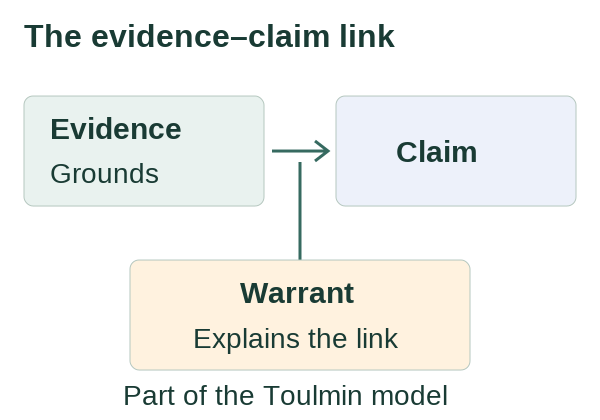
Mursidin (2026) analysed student essays with Toulmin's Argumentation Model. This model looks at claims, data and warrants. The warrant is the logical link between evidence and claim. One study looked at 20 undergraduates in Indonesia. 85% knew the difference between fact and opinion well enough, but only 10% built clear logical warrants.[9]
Yeung (2019) compared expert Chinese writers with expert English writers. The study looked at how each group handles opposing positions in argument. The English essays tended to use a combative style. This style persuades by defeating the opposing arguments. Many of the Chinese essays weighed opposing positions. They did not side with either one. They then rose above them to settle the conflict; Yeung (2019) calls this the dialectical style.[4]
Dornbrack and Dixon (2014) analysed work from one Grade 10 student. The student was at a township school in Cape Town, South Africa. The student was identified as high performing. They concluded that social and school resources are not enough on their own. Students also need clear teaching of the genre's conventions.[1]
One study looked at 66 essays. The writers were Iranian undergraduates studying English literature. The writers had a weak grasp of argumentation. Their texts struggled with the supporting parts of an argument.[6]
First-year students in an academic literacy module reported challenges. These may not come from cognitive ability. They may not come from not knowing the parts of an argument. Bharuthram (2026) suggests they may come instead from lack of practice and discomfort with the topic.[8]
Main ideas
What argumentative writing is
Argumentative writing is also called persuasive writing. It aims to persuade a reader to agree with the writer's ideas about a controversial topic. The goal is persuasion, so such an essay must rest on logic rather than emotion. This comes from a 2024 discussion of best practices in academic writing. The same discussion states that the essay must include an opposing viewpoint, or counterargument. This gives it credibility and strength.[10]
A 2016 study of 64 English argumentative essays describes the purpose of this writing in similar terms. It aims to influence and convince readers.[11] Carrascal Platas and Mori Igoa (2025) chose to focus on written argumentation. In their view, the parts that shape an argument work differently in speech and in writing.[12]
Nurfitriana, Drajati and Sulistyawati (2019) analyzed argument structure. They used an adapted version of a model from Toulmin (1958, 2003). In one version of the model, an argument has six parts. They are claim, data, counterargument claim, counterargument data, rebuttal claim and rebuttal data.[13]
In that study, half of the participants wrote a one-sided argument. The other half used the argument and counterargument structure. The students' use of counterarguments was related to the overall quality of their essays. An automated writing evaluation program judged that quality.[14]
Claims came second. The other parts appeared only in small amounts. The remaining elements appeared only in small amounts. The position and relevance of the papers varied.[13]
A 2025 study of expository texts by high school students found three levels of argument pattern. These were basic, simple and complex. The basic pattern combined a claim and a ground in 31 texts. The simple pattern added a warrant in 21 texts. Gay, Suyono, Suwignyo and Harsiati (2025) listed complex patterns in these counts. C-G-W-B appeared in 10 texts, C-G-W-B-Q in 12, C-G-W-B-Q-R in 7, C-G-Q in 8, C-G-W-Q in 11, C-G-B in 7 and C-G-W-R in 6. Gay, Suyono, Suwignyo and Harsiati (2025) report that students used "is" to state a definition as a claim. They also used words such as "therefore," "so," "which," "even" and "must" to restate a point.[15]
Liu and Furneaux (2015) compared argument structures in essays by three groups. The groups were native English speakers, Chinese speakers, and Chinese learners of English as a foreign language. The Chinese students' English writing showed influence from both English and Chinese. A 2015 contrastive study examined four sets of argumentative essays. They came from three groups of university students. The English writing of the Chinese participants was shaped by both English and Chinese.[16]
Research
How instruction improves argumentative writing
Maharani (2022) studied process writing teaching in an EFL argumentative writing class. The class had 28 sophomores in an English Language Education Study Program. The researcher used observations, interviews and one focus group discussion. The researcher concluded that the approach helped students' argumentative writing. Students also responded well.[17]
Mitiku, Alemu and Tesfa (2025) tested process genre teaching against a usual approach. Two tenth-grade classes of 38 and 40 students each had eight argumentative writing lessons. Each class was taught by one of the two approaches. Process genre instruction had a significant positive direct effect on argumentative writing ability (B = 5.078, p < .05).[18]
One study tested a genre-based approach that students used in groups. A quasi-experiment studied 60 second-year students who were not English majors. They were at a Chinese university. The experimental group got this instruction. Both groups improved. The experimental group improved much more. The gain was largest in the ideational and textual meta-functions.[19]
Stasaitis (2017) tested an Integrated Writing program in a seventh-grade classroom.[20] A design experiment tested a broader teaching model in content-area classes. It used frequent writing and taught analytic genres such as arguments and explanations. It also used revision as a way to learn. On the posttests, the experimental class learned much more while writing than a comparison class did. It also showed much more knowledge of the argument genre.[21]
That version was tested with 802 sixth, seventh and eighth graders. They were in the mid-Atlantic region of the United States. The study measured how much instruction students actually received. This included attendance and work on aligned tasks. These measures strongly predicted posttest gains for both groups. English Language Learners with stronger reading skills gained more. They gained most from assignments that matched the curriculum. Students with lower proficiency gained more from regular attendance.[2]
A separate analysis of two classroom discussions looked at how talk during lessons relates to dialogic literary argumentative writing as a social practice. That analysis treated the teaching of argument as something worked out locally over time. So practices are unique to each classroom.[22]
Robillos (2025) combined argument mapping with translanguaging teaching. Pre-test and post-test scores showed a clear difference in how much writing content and writing coherence grew. The participants also welcomed the approach.[23]
Zhang (2018) taught mind mapping at the pre-writing stage. Thirty-nine first-year English majors in two classes were split at random into two groups. One group was taught mind mapping. The other was taught writing in the traditional way. The mind mapping group did much better than the other group. Their argumentative essays scored higher on content and organization.[24]
Computer-assisted instruction has also been tested. One group of students was randomly assigned to use a computer program called Hermes. Another was assigned to a control group. The program group wrote essays that were more effective in a dialectical way. The size of the gap between the groups was linked to students' level of intellectual development. The researcher concluded that this kind of teaching can improve argumentative writing. It must also take account of how well each student can benefit from it.[25]
What learners find hard and what changes results
Almi (2024) lists adapting to the academic setting as one problem first-year students faced. They met it in argument paragraphs. Almi (2024) asked 34 first-year students to write one argument paragraph. Many could not keep their writing formal, clear and objective. Grammar was another problem. Students had trouble with sentence structure, articles and punctuation. Some also struggled with the paragraph format itself.[26]
Zhu's (2001) study looked at Mexican graduate students. They found the rhetorical side of English argumentative writing hard. They also rarely used strategies for thinking about their own learning.[27] Mustafa's (2011) study looked at undergraduates from Kosovo. They showed interest in the panning for gold approach. They did not feel at ease, however, when a decision needed a careful step-by-step check of their thinking.[28]
Widyastuti (2018) studied students' essays. The analysis used Stapleton's (2001) criteria for critical thinking. These include claims, reasoning, evidence, opposing arguments and refutation, and fallacies. A study of Indonesian students' essays found many weak arguments. The reasons and evidence were not enough. Students also lacked refutation skills, the ability to answer opposing views. They tended to accept a claim from another source without judging it. Fallacies appeared mostly as generalization and over-simplification.[3]
Four critical thinking traits predicted argumentative writing performance. They were cognitive maturity, truth-seeking, analyticity and justice.[29] Even that group did not master using credible evidence, answering alternative arguments, supporting conclusions or keeping ideas in a logical flow.[30]
Amini Farsani, Abdollahzadeh and Beikmohammadi (2019) tested whether self-regulated learning and metacognitive awareness predict argumentative writing performance. A survey of 250 Iranian graduate students found a good statistical fit for a model. The same analysis found no clear effect of self-regulated learning on writing performance. It also found no significant influence of metacognitive awareness.[5]
Differences between individuals matter too. Among 105 Korean students, higher-rated essays went with larger vocabulary scores. They also went with more use of self-structured writing strategies. Higher-rated essays also used a wider range of words. They repeated content words more often across the text.[31]
Xie and Lv (2022) compared three conditions set before the task. One gave reading materials with content. One taught planning by outlining. One gave no resources. Three classes of college students wrote after getting one of three things. They got reading materials, outlining instructions, or no resources. Both instructed groups reached better overall coherence. The reading group used more lexical cohesion devices than the outline group. This is a sign of greater genre awareness.[32]
Tasks based on sources in history show uneven development. The study looked at 207 middle and high school students. Their writing varied a lot in language use, presentation of ideas and use of evidence.[33]
Teacher development is another condition. One article describes collaborative professional development that changed how argumentative writing was taught.[34] A case study of two lecturers found that two kinds of teaching beliefs led to different processes in the argumentative writing class. The beliefs were human-oriented and task-oriented.[35]
Thinking, talk and motivation
One study looked at 35 second-semester medical record students at an Indonesian university. They wrote argumentative essays scored with a rubric. Their critical thinking was at a middling level. Only 35% scored above that level. These students struggled to back ideas with relevant, credible arguments. They also struggled to offer useful solutions. Students with high and very high scores preferred learning activities that demand high order thinking. The reverse held for low scorers.[36] A qualitative content analysis looked at blog texts by Indonesian students of English education. It found that levels of critical thinking in argumentative essays varied from student to student.[37]
Li, Zhang and Parr (2020) recorded eight hours of small-group talk before individual writing. Ferretti and colleagues (2026) studied exposure to a dialogic instruction intervention.[38][39] One study recorded 8 hours of prewriting discussion from 8 small groups. Small-group talk helped students produce content, language and organization. They used these in essays they wrote alone afterwards. It also gave them chances to solve language problems together. They could use their first language to ask for and clarify information. Students shared feelings but kept group harmony at a surface level. The talk produced no direct positive or negative affective expressions.[38] Students in the highest exposure group did better than peers in lower exposure groups. They did better on the quality of their written arguments and on their knowledge of argument concepts.[39]
Shi and Iordanou (2025) tested an intervention that taught argument through dialogue. In it, seventh graders worked with conflicting information from multiple texts. A quasi-experimental study compared seventh-grade students who received a dialogue-based argument curriculum with a control group. The control group did not take part. On a post-test about genetically modified foods, intervention students were better at integrating evidence that contradicted their own position. Students in the intervention group were also better at combining two pieces of conflicting information. When judging trustworthiness, they trusted a primary source more. They also weighed the epistemological aspect and their own or a text's position on the issue.[40]
A review looked at 57 studies of climate fiction published from 2015 to 2025. It found positive effects on climate literacy and on engagement. Evidence that such reading improves argumentative writing stayed limited and mostly qualitative. Few experimental studies exist.[41]
Three studies link motivation and emotion to argumentative writing. Surmiyati and Rezeki (2024) found moderate motivation. Andeani and colleagues (2026) found a correlation of 0.753. Xiaomeng and Xiaobao (2026) compared emotional profiles.[42][43][44] Among 84 eleventh-grade students, writing motivation and skill in English argumentative texts had a correlation of 0.753. This was a strong positive correlation that was statistically significant.[44]
A questionnaire study of 20 students found a moderate level of motivation to write argumentative essays. Scores ranged from 3.01 to 3.03. Those students were willing to receive instructor feedback. They also worked hard at revising. They also believed writing skills mattered for future careers.[43]
The profiles were based on their writing emotions. The three groups were highly positive, moderately positive and slightly negative. The two positive groups did better than the slightly negative group on several measures of linguistic complexity in argumentative writing.[42] A scaffolding intervention, meaning temporary teacher support, raised 50 students' confidence in organizing ideas, summarizing sources and revising essays. It did not significantly change their confidence in judging evidence strength. It also did not change their confidence in finding weak points in arguments or in writing a counterargument.[45]
In practice
How argumentative writing is taught
Studies of teaching argumentative writing have tested explicit instruction, writing conferences, collaborative writing, prewriting activities, flipped classrooms and structured workshops.[46][47][48][49][50][51][52][53][54] One direct approach is to teach argument structure explicitly. O'Hallaron (2014) studied a fifth-grade classroom. The teacher named the stages expected in an argument. She gave students supports built for that genre. The study took place in one fifth-grade English language arts classroom. The teacher had taken part in professional development. The same students wrote arguments twice, about 3 months apart. The first came after discussing the source text in detail. There was no genre-specific support for writing. An analysis of the writing found text-level and stage-level features in the students' responses. It paid close attention to the reason stage. There, a writer explains how the evidence backs their position on a question about a character or theme. The findings described a range of responses. They also pointed to features of texts and prompts that may shape children's written argumentation.[46] One experimental study used a pre-test and post-test design. Students who received explicit teaching of argumentative writing improved significantly compared with control group students.[47]
A mixed-methods study looked at 20 junior high school students in an Integrated High School. It used writing conferences built on the Toulmin model, with prewriting and post-writing activities. The conferences clearly improved the argument structure and the writing quality of the students' papers. Mean scores differed clearly between the pre-writing and post-writing activities, which showed this. Themes from the students' responses included building claims and arguments, presenting and gathering evidence, and expressing ideas. They also included staying on the topic and judging how reliable and truthful resources are.[48]
Moonma and Kaweera (2021) compared argumentative writing done in groups of four, in pairs and alone. Abbas and Herdi (2018) used a collaborative writing strategy with 23 students.[49][55] In a study of 32 students, three raters scored the papers on content, language use and organization. A total of 15 points was available. Group work produced the highest scores at every proficiency level. Novice learners averaged 11.22 in groups and 10.19 in pairs. Alone, they averaged 8.98. Intermediate learners averaged 11.50 in groups, 10.32 in pairs and 9.04 alone. Advanced learners averaged 11.95 in groups and 10.45 in pairs. Alone, they averaged 9.45.[49]
A classroom action research study worked with 23 students in Indonesia. They were in an English Education Department. It used a collaborative writing strategy to address their problems in developing and organizing ideas, in grammar and word choice, and in writing mechanics. These mechanics include capital letters, spelling and punctuation. The mean score rose from 54.9 on the mid-term test to 74.3 on the cycle test. Field notes, an observation checklist and interviews showed that students were active and creative. They also enjoyed the process.[55]
Rashtchi and Porkar (2020) compared three forms of brainstorming before writing. These used mobile devices, Wordle and cooperative work. One mixed-methods study gave 68 university students in three whole classes one of three kinds of brainstorming. Mobile-assisted brainstorming had n=26, wordle-assisted had n=23, and cooperative had n=20. The wordle-assisted group did better than the other two groups on two tests. One was an immediate post-test on a seen topic. The other was a delayed post-test on an unseen topic.[50]
Soltanpour and Valizadeh (2018) describe flipped teaching as reversing the usual order of classroom lectures and homework. Roohani and Shafiee Rad (2022) tested a hybrid-flipped model.[51][52] This often uses instructional materials such as videos or PowerPoint files. One experiment studied 55 Iranian learners of English as a foreign language. It compared a flipped classroom with a traditional classroom over 3 sessions of treatment. The flipped group significantly outperformed the traditional group on overall essay quality. It stayed ahead over time. It showed no significant change in the long run. The results were credited to learners taking an active part. They were also credited to techniques such as video screencasting, collaborative writing, and in-class teacher-learner interaction and negotiation.[51]
A hybrid-flipped model was tested with 50 learners of English as a foreign language at a language institute. It also had a significant effect on argumentative writing performance. This was based on an analysis of covariance of pre-test and post-test scores. Interviews in that study pointed to learner-teacher and learner-to-learner interaction. They also named more learner responsibility, easy makeup for absences, and help from the teacher.[52]
Poon, Huy, Lin and Akira (2026) combined structured writing workshops with metacognitive instruction. This instruction prompts students to set goals and monitor their own writing. A qualitative study in Vietnam looked at 4 teachers of English as a foreign language and 13 secondary-school learners. It used interviews and classroom observations, analyzed thematically. Metacognitive prompts and tools helped learners set goals and think about audience. They also helped them watch claim-evidence relationships, spot weaknesses and judge what to revise first. Progress was uneven. Planning improved more steadily than monitoring and independent self-evaluation. Weaker learners still relied on teacher guidance, peer support and checklists. The quality of peer feedback varied.[53] The 38 students in the experimental class did better than the 38 in the comparison class on post-writing. The differences were significant in all aspects except organization and grammar.[54]
Digital tools and artificial intelligence
Studies have tested several digital supports for argumentative writing. These include digital writing tools, the Padlet application, a chatbot built for argumentative writing practice, and spherical video virtual reality.[56][57][58][59] One quasi-experimental study split secondary students aged 17 to 19 into three groups. The control group had 28 students, and the two experimental groups had 31 and 26. The two experimental groups used digital writing tools. Their mean writing scores rose by 16.6% and 18.7%. The study called the comparison with paper-based writing less conclusive.[56]
A second study taught fourth-year English language and translation majors. The teaching lasted two and a half months. The students were 19 to 20 years old. One group used a process writing approach with the Padlet application. The other group used ordinary methods. The Padlet group scored much higher on argumentative writing after the course. The students were quite enthusiastic about the application.[57]
A multilingual web-based writing model called ECM was tested over three months. It was tested with 150 students in an experimental group and 150 in a control group. Students using ECM improved on writing metacognition, meaning their awareness of how they plan, regulate and revise their own writing, and on written argumentative self-efficacy, their belief in their own writing ability. Three steps showed no clear difference: reason summary, formulation of premise, and reasons for.[60]
In a three-week study, Chinese English majors were assigned at random to feedback from ChatGPT or from a teacher. Learners given teacher feedback made more writing progress (mean rank = 27.39). Those given ChatGPT feedback made less (mean rank = 19.19). Low-proficiency students improved least with AI feedback (mean rank = 13.63). ChatGPT raised the writing self-efficacy of low-level learners without a matching gain in their writing performance. Teacher feedback improved writing results and students' belief in their own ability. The study warned that over-reliance on AI may inhibit writing growth.[61]
A GPTs-based chatbot was built for college writing courses. It was designed to refuse direct requests to write a draft for the student. Instead it broke student texts into claims, evidence, warrants, examples and counterarguments. It checked common reasoning errors. It gave feedback on revision at the sentence, paragraph and whole-structure levels.[58]
A quasi-experimental study with third-year undergraduates tested AI-generated model essays combined with explicit editing instruction. It compared them with example handouts from teachers. The sessions ran for six weeks, 90 minutes each. The experimental group gained more on timed argumentative tasks (d = 0.72). The largest effects were in lexical range and organization.[62]
One study tested GPT-4.1 at predicting revision patterns. It compared first and second drafts of argument writing by young students. It compared two ways of prompting the model. These were few-shot prompting and few-shot Chain-of-Thought prompting. The model agreed with itself closely across repeated runs. This is called excellent intra-rater reliability. Chain-of-Thought prompting made predictions more accurate. The predictions were about revision patterns focused on explanations.[63]
A quasi-experimental study compared spherical video virtual reality in a flipped classroom with conventional teaching. It involved 200 students training to teach Indonesian, with 100 in each group. The virtual reality group improved its argumentative writing skills, its use of evidence and data, its lexical complexity and its class engagement. It also reported positive views.[59]
A shared argument mapping tool called Kialo Edu was used with 50 Chinese postgraduate students of English as a foreign language. It produced no significant improvement in writing scores but a significant improvement in global cohesion. Those students reported stronger critical thinking and argument structuring. They also reported problems such as too much information and uneven attention to language forms.[64]
What this looks like when you study
One study looked at 28 third-semester students in an English language education program in Indonesia. They practiced argumentative writing through a process approach. The lecturer first taught basic terms and had students practice linking claims, reasons, and evidence. Students then used an organizer to plan an essay on plastic trash on Bali beaches before drafting.[17]
A quasi-experiment in Ethiopia compared eight argumentative writing lessons taught through a process genre approach with lessons taught the conventional way. The instruction also raised writing self-efficacy, which is a person's belief in their own writing ability. Self-efficacy partly explained the writing gain.[18] A control class followed traditional writing instruction. The experimental group's mean post-test score was 27.20. The control group's was 22.40, a significant difference (p < .001).[19]
A study of 802 middle school students in the United States looked at a dialogic instruction program. It was built on small-group discussion, teaching of vocabulary, and close reading of argumentative texts. Students did well on the teacher's assigned activities, which matched the instructional goals. That success strongly predicted better writing quality (p < .0001).[2] Students described mind maps as useful for planning.[24]
In the Indonesian study, students set the purpose of an essay before writing it. The stated goal was to make sure they chose suitable foundations for arguing a controversial issue. Students in that study organized their writing with an organizer. They put the claim and thesis statement in a larger box. The topic sentence went in a smaller one.[17]
Abbas and Herdi (2018) did classroom action research. Students revised and edited their drafts after comments. They worked on language features, word choice, spelling, punctuation and capital letters.[55]
Criticism
Open questions about argumentative writing
Ten Peze and colleagues (2024) asked a question. Would a creative writing unit improve the quality of students' creative texts? They used a switching replications design. In the first panel, creative writing instruction improved the quality of creative texts. Argumentative writing instruction did not produce the same gain. That pattern suggested that creative writing instruction carried over. It improved the quality of argumentative texts too. The second panel did not show this pattern.[65]
Swee (2025) argues that historical writing in Singapore schools is often pushed aside. Convenient writing frames take its place. Swee (2025) says such frames often put writing outcomes ahead of the growth of students' thinking.[66]
The 2024 study tracked students' writing processes with keystroke logging software. It also measured students' Creative Self-Concept. It rated the quality of their texts as a whole. Creative Self-Concept changed the transfer effect. The effects were larger for participants who scored fairly high in it. In the first panel, students wrote more slowly. The exception was those with a fairly high Creative Self-Concept. In the second panel their speed increased.[65]
Open questions and limits of the evidence
Several studies of argumentative writing draw on small samples. Lismay (2020) had 28 students, Jaya (2025) had 40, Al Khotaba (2022) had 15, and Ulhaq and colleagues (2022) had 5.[67][68][69][70] One analysis of logical fallacies drew on 28 students at one Indonesian department. Logical fallacies are errors in reasoning.[67]
A study of cohesion, the links that hold a text together, used 15 third-year students at one Saudi university.[69] One error analysis of argumentative essays looked at 5 second-semester students at a single Indonesian university.[70] One mixed-methods study looked at linguistic, structural and cognitive difficulties. It surveyed 40 undergraduates in one Indonesian course.[68] A quasi-experimental study in a Basque medium of instruction program compared 61 students given extra argumentation sessions with 44 who were not.[71]
Lismay (2020) found that 76% of 28 students wrote an inductive fallacy. That means drawing a conclusion without enough evidence. Saputri, Ilma and Dalilan (2024) found 257 grammatical errors across 34 essays. Omission was most common.[67][72][69][70] In 34 essays from one Indonesian university, researchers counted 257 grammatical errors, of which 110 (42.80%) were omissions, meaning missing words or endings.[72]
At another Indonesian university, errors in using prepositions were the most frequent among 5 students. There were 6 such errors (25.24%).[70] In a separate study, the most common grammatical error was also the use of prepositions, at 36.8%, often caused by interference from the first language.[73] Among 40 undergraduates, 82% lacked a clear thesis statement. Also, 69% left out counterarguments.[68]
Jaya (2025) reports that 72% of 40 students improved after instructor feedback and guided instruction. Garro Larrañaga and colleagues (2025) found that three one-hour sessions raised secondary students' use of argumentation strategies.[68][71][74] After that, 72% showed measurable improvement in their writing.[68] In the Basque study, one group was given three one-hour sessions on argumentation. It increased its use of argumentation strategies significantly.[71] A study at one Indonesian university found that students taught with metacognitive strategies, which involve planning and monitoring one's own thinking, wrote better than students taught with concept maps.[74]
Common misconceptions
A survey asked 66 Iranian undergraduate English majors about argumentative writing. The category "argumentative writing is similar to other essay genres" drew 52 mentions. "Argumentative writing is for expressing personal opinions" drew 49. Most of these students did not know the particular structure of an argumentative essay. They applied their previous writing experience to the genre.[6]
Key studies
| Year | Study | Sample | Design | Finding |
|---|---|---|---|---|
| 2018 | Zhang[24] | two convenient classes randomly assigned to experimental and control groups | The mind-mapping group significantly outperformed the control group in content and organization of argumentative writing. | |
| 2018 | Nejmaoui[30] | 36 Moroccan EFL learners | experimental study with pre-test and post-test | The experimental group's mean score rose from 13.11 to 18.83, while the control group rose only from 10.72 to 11.33. |
| 2018 | Abbas & Herdi[55] | 23 English Education Department students in Indonesia | classroom action research | The mean score rose from 54.9 on the mid-term test to 74.3 on the cycle test after collaborative writing strategy. |
| 2018 | Soltanpour & Valizadeh[51] | 55 Iranian EFL learners | experimental pre-test, post-test, and delayed post-test | The flipped classroom group significantly outperformed the traditional classroom group in overall essay quality. |
| 2021 | Moonma & Kaweera[49] | 32 students | comparison of group, pair, and individual writing activities | Group work produced the highest scores at all proficiency levels, for example 11.22 for novice groups against 8.98 for novice individuals. |
| 2022 | Ghanbari & Salari[6] | 66 undergraduate English majors and 20 writing instructors in Iran | multiple data sources including essays, questionnaires, and interviews | 52 of 66 students described argumentative writing as similar to other essay genres, and 49 saw it as expressing personal opinions. |
| 2022 | Roohani & Shafiee Rad[52] | 50 EFL learners at a language institute | pre-test and post-test with ANCOVA | Hybrid-flipped instruction had a significant effect on argumentative writing performance. |
| 2022 | Anak Agung Putri Maharani[17] | descriptive qualitative study with observation, interview, and focus group | The process approach had a good impact on argumentative writing development, and students responded positively. | |
| 2024 | Almi & Almi[26] | 34 first-year EFL students | mixed-method study with essay analysis and questionnaire | 88% found writing argument paragraphs a hard task, and 63% considered argument paragraphs the most difficult type. |
| 2025 | Mitiku et al.[18] | quasi-experimental pre-test and post-test with control group | Process genre instruction had a significant positive direct effect on argumentative writing ability (B = 5.078, p < .05) and on writing self-efficacy (B = .899, p < .05). | |
| 2025 | Association for Researcher of Skills and Vocational Training[19] | 60 second-year non-English major university students in China | quasi-experimental pre-test and post-test with control group | The genre-based group writing group had a mean post-test score of 27.20 against 22.40 for the control group (p < .001). |
| 2025 | Shi (石雨晨) & Iordanou[40] | seventh-grade students in China | quasi-experimental pre-assessment and post-assessment | Intervention students outperformed control students in integrating position-inconsistent information from multiple texts. |
| 2026 | Ferretti et al.[2] | 802 middle school students in the United States | mixed-effects regression analysis of a dialogic instruction intervention | Performance on teacher-assigned activities aligned with instructional goals strongly predicted gains in writing quality (p < .0001). |
| 2026 | Zhang[61] | random assignment to ChatGPT feedback or teacher feedback groups | Teacher feedback led to greater writing progress (mean rank 27.39) than ChatGPT (mean rank 19.19), but ChatGPT improved self-efficacy for low-level learners. |
See also
References
- Dornbrack, J., & Dixon, K. (2014). Towards a more explicit writing pedagogy: The complexity of teaching argumentative writing. Reading & Writing, 5(1). doi:10.4102/rw.v5i1.40
- Ferretti, R. P., Van Horne, S., May, H., Mead, H., Zhang, H., Song, Y., & Sabatini, J. (2026). Improving argumentative writing and argumentative knowledge of English Language Learners and non-English Language Learners through dialogic instruction: a mixed-effects regression analysis. Reading and Writing, 39(3), 1055-1083. doi:10.1007/s11145-025-10754-5
- Widyastuti, S. (2018). Fostering Critical Thinking Skills Through Argumentative Writing. Jurnal Cakrawala Pendidikan. doi:10.21831/cp.v37i2.20157
- Yeung, L. (2019). Dialectics versus polemics in Chinese rhetoric: A study of indirection in Chinese and Chinese ESL argumentative writing as compared with English argumentative writing. Chinese as a Second Language Research, 8(1), 29-55. doi:10.1515/caslar-2019-0002
- Amini Farsani, M., Abdollahzadeh, E., & Beikmohammadi, M. (2019). Self-regulated Learning, Metacognitive Awareness, and Argumentative writing. Writing & Pedagogy, 11(2), 195-222. doi:10.1558/wap.37051
- Ghanbari, N., & Salari, M. (2022). Problematizing Argumentative Writing in an Iranian EFL Undergraduate Context. Frontiers in Psychology, 13. doi:10.3389/fpsyg.2022.862400
- Dewi, D. S. (2018). An analysis of EFL college level learner’s writing competence in writing an argumentative essay. CAHAYA PENDIDIKAN, 4(1). doi:10.33373/chypend.v4i1.1279
- Bharuthram, S. (2026). Students’ perspectives on writing an argumentative essay in an academic literacy module. Reading & Writing, 17(1). doi:10.4102/rw.v17i1.571
- Mursidin, M., & Mursidin, I. I. (2026). Bridging the Gap Between Evidence and Argument: Exploring Undergraduate EFL Students’ Struggles with Logical Warrants in Academic Writing. Prominent, 9(2), 150-159. doi:10.24176/pro.v9i2.17204
- SARR, B. (2024). Investigating Best Practices in Academic Writing: Suggestions for Argumentative Essay Writing Instructions. Asian Journal of Education and Social Studies, 50(7), 322-330. doi:10.9734/ajess/2024/v50i71466
- Yang, Y. (2016). Appraisal Resources in Chinese College Students' English Argumentative Writing. Journal of Language Teaching and Research, 7(5), 1002. doi:10.17507/jltr.0705.23
- Carrascal Platas, B., & Mori Igoa, M. (2025). The role of argumentation schemes in the process of writing argumentative texts. Revista Iberoamericana de Argumentación(3). doi:10.15366/ria2011.3.001
- Nurfitriana, N., Drajati, N. A., & Sulistyawati, H. (2019). A Content Analysis of Argumentative Structure in Pre-Service Teachers’ Writing. EDULANGUE, 2(2), 172-186. doi:10.20414/edulangue.v2i2.1710
- Du, F. (2017). The Analysis of Argument-Counterargument Structure in Chinese EFL Learners’ Argumentative Writing. Journal of Studies in Education, 7(3), 121. doi:10.5296/jse.v7i3.11275
- Gay, M., Suyono, S., Suwignyo, H., & Harsiati, T. (2025). Argument schematic patterns in expository text writing for high school students. IJIET (International Journal of Indonesian Education and Teaching), 9(1), 90-104. doi:10.24071/ijiet.v9i1.9551
- Liu, X., & Furneaux, C. (2015). Argument structures in Chinese university students’ argumentative writing: A contrastive study. English Text Construction, 8(1), 65-87. doi:10.1075/etc.8.1.03liu
- Anak Agung Putri Maharani (2022). Exploring writing instruction-based process writing approach in tertiary level of EFL argumentative writing classroom. Jurnal Santiaji Pendidikan (JSP), 12(2), 158-167. doi:10.36733/jsp.v12i2.5196
- Mitiku, M., Alemu, M., & Tesfa, A. (2025). The effects of process genre writing instruction on argumentative writing ability and writing self- efficacy. Ethiopian Renaissance Journal of Social Sciences and Humanities, 12(1), 115-133. doi:10.4314/erjssh.v12i1.6
- (2025). Developing Argumentative Writing Proficiency in Chinese EFL Classrooms: A Genre-Based Group Writing Approach. Uniglobal Journal of Social Sciences and Humanities(4), 299-306. doi:10.53797/ujssh.v4i1.36.2025
- Stasaitis, M. P. (2017). Intervention Instruction in Argumentative Writing. Journal of Education, 197(3), 4-13. doi:10.1177/0022057418782325
- Klein, P. D., & Rose, M. A. (2010). Teaching Argument and Explanation to Prepare Junior Students for Writing to Learn. Reading Research Quarterly, 45(4), 433-461. doi:10.1598/rrq.45.4.4
- Brady, J. (2018). Investigating the Relationship between Classroom Conversation and Argumentative Writing Using Writing Moves and Types of Talk. Acta Paedagogica Vilnensia, 40, 94-110. doi:10.15388/actpaed.2018.0.11890
- Robillos, R. J. (2025). Examining the impact of translanguaging-enriched argument mapping on higher education EFL students’ argumentative writing skills. Journal of Applied Research in Higher Education, 17(6), 2384-2402. doi:10.1108/jarhe-05-2024-0218
- Zhang, Y. (2018). A Contrastive Study on the Application of Mind Maps in Argumentative Writing Instruction for EFL Learners. English Language Teaching, 11(12), 93. doi:10.5539/elt.v11n12p93
- Irwin, R. R. (1995). Using Computer-Assisted Instruction and Developmental Theory to Improve Argumentative Writing. Informal Logic, 17(2). doi:10.22329/il.v17i2.2411
- Almi, H., & Almi, H. (2024). Writing Academic Argument Paragraph A Challenge For Efl Students. AL-Lisaniyyat, 30(1), 159-169. doi:10.61850/allj.v30i1.655
- Zhu, W. (2001). Performing Argumentative Writing in English: Difficulties, Processes, and Strategies. TESL Canada Journal, 19(1), 34. doi:10.18806/tesl.v19i1.918
- Mustafa, B. (2011). Investigating Undergraduate Students’ Experiences with Argumentative Writing in a Post-War Kosovo. Journal of Academic Writing, 1(1), 180-190. doi:10.18552/joaw.v1i1.13
- Hu, Y., & Saleem, A. (2023). Insight from the association between critical thinking and English argumentative writing: catering to English learners’ writing ability. PeerJ, 11, e16435. doi:10.7717/peerj.16435
- Nejmaoui, N. (2018). Improving EFL Learners’ Critical Thinking Skills in Argumentative Writing. English Language Teaching, 12(1), 98. doi:10.5539/elt.v12n1p98
- The Korea English Education Society, & Kim, M. (2023). The Roles of Individual Differences and Linguistic Features in EFL Argumentative Writing. The Korea English Education Society, 22(4), 27-47. doi:10.18649/jkees.2023.22.4.27
- Xie, Y., & Lv, X. (2022). Effects of Content Support and Planning Instruction on Discourse Connection in EFL Argumentative Writing. Frontiers in Psychology, 13. doi:10.3389/fpsyg.2022.912311
- Steiss, J., Wang, J., Kim, Y. S. G., & Booth Olson, C. (2024). U.S. Secondary Students’ Source-Based Argument Writing in History. Written Communication, 41(4), 693-725. doi:10.1177/07410883241263549
- S. Collet, V. (2015). Transforming Instruction: How Collaborative Professional Development Changed the Teaching of Argumentative Writing. English Leadership Quarterly, 38(2), 2-5. doi:10.58680/elq201527532
- Chen, Z. (2020). A Case Study on the Conceptualization and Teaching Practice of L2 Argumentative Writing Instruction. English Language Teaching, 13(11), 30. doi:10.5539/elt.v13n11p30
- Ade Johan (2024). Analysis of critical thinking skills through argumentative essay writing. English Journal Literacy Utama, 8(1), 36-45. doi:10.33197/ejlutama.v8i1.232
- Efendi, N. (2018). Analysis of student's critical thinking in writing argumentative essays. IJLECR - INTERNATIONAL JOURNAL OF LANGUAGE EDUCATION AND CULTURE REVIEW, 4(2), 132-137. doi:10.21009/ijlecr.042.15
- Li, H. H., Zhang, L. J., & Parr, J. M. (2020). Small-Group Student Talk Before Individual Writing in Tertiary English Writing Classrooms in China: Nature and Insights. Frontiers in Psychology, 11. doi:10.3389/fpsyg.2020.570565
- Ferretti, R. P., Song, Y., Zhang, H., Van Horne, S., Mead, H., Collier, Z., Sabatini, J., & May, H. (2026). Is exposure to dialogic instruction associated with improvements in middle-school students’ argumentative writing and knowledge of argument concepts? Evidence from propensity score analyses. Reading and Writing, 39(3), 875-910. doi:10.1007/s11145-025-10740-x
- Shi (石雨晨), Y., & Iordanou, K. (2025). A Dialogic Approach to Enhancing Argumentative Writing From Multiple Texts. ECNU Review of Education, 8(2), 530-556. doi:10.1177/20965311241310884
- Quinaluisa-Narváez, K. B., Pacheco-Mendoza, S. R., & Peralta-Gamboa, D. A. (2026). Cli-fi in the language and literature classroom: impact of reading and argumentative writing. Frontiers in Education, 11. doi:10.3389/feduc.2026.1802685
- Xiaomeng, Z., & Xiaobao, W. (2026). Foreign Language Writing Emotions and Linguistic Complexity in Argumentative Writing: A Latent Profile Analysis. International Journal of Applied Linguistics. doi:10.1111/ijal.70125
- Surmiyati, S., & Rezeki, Y. S. (2024). Students’ Motivation to Write Argumentative Essay Writing. Journal of English Education Program, 5(2). doi:10.26418/jeep.v5i2.81948
- Yolanda Putri Andeani, Widi Syaftinentias, & Destri Wahyuningsih (2026). The correlation between students’ writing motivation and their skill in writing english argumentative texts. J-Shelves of Indragiri (JSI), 8(1), 288-300. doi:10.61672/jsi.v8i1.3589
- Allagui, B. (2024). A scaffolding intervention to improve self-efficacy in source-based argumentative writing. Frontiers in Psychology, 15. doi:10.3389/fpsyg.2024.1454104
- O’Hallaron, C. L. (2014). Supporting Fifth-Grade ELLs’ Argumentative Writing Development. Written Communication, 31(3), 304-331. doi:10.1177/0741088314536524
- Gruda, Z. (2025). Developing EFL Students' Argumentative Writing Through Explicit Teaching. XLinguae, 18(4), 243-260. doi:10.18355/xl.2025.18.04.16
- Baylon, M. (2024). Developing Argumentative Essay Writing Skills among Junior High School Students through a Writing Conference using the Toulmin Model. Philippine Journal of Education Studies, 2(2), 36-63. doi:10.61839/29848180m6
- Moonma, J., & Kaweera, C. (2021). Collaborative Writing in EFL Classroom: Comparison on Group, Pair, and Individual Writing Activities in Argumentative Tasks. Asian Journal of Education and Training, 7(3), 179-188. doi:10.20448/journal.522.2021.73.179.188
- Rashtchi, M., & Porkar, R. (2020). Brainstorming Revisited: Does Technology Facilitate Argumentative Essay Writing? Language Teaching Research Quarterly, 18, 1-20. doi:10.32038/ltrq.2020.18.01
- Soltanpour, F., & Valizadeh, M. (2018). A Flipped Writing Classroom: Effects on EFL Learners’ Argumentative Essays. Advances in Language and Literary Studies, 9(1), 5. doi:10.7575/aiac.alls.v.9n.1p.5
- Roohani, A., & Shafiee Rad, H. (2022). Effectiveness of hybrid-flipped classroom in improving EFL learners’ argumentative writing skill. TEFLIN Journal - A publication on the teaching and learning of English, 33(2), 349. doi:10.15639/teflinjournal.v33i2/349-366
- Poon, M., Huy, V. L., Lin, C. L., & Akira, H. (2026). Integrating Structured Writing Workshops with Metacognitive Instruction to Enhance Vietnamese Secondary Students’ Argumentative Writing. Journal of Languages and Language Teaching, 14(4), 1029-1048. doi:10.33394/jollt.v14i4.22176
- Liao, M., & Liao, Y. (2022). Improving Chinese College Students’ Argumentative Writing: A Presentation-Assimilation-Discussion-Exercise Approach. Frontiers in Psychology, 13. doi:10.3389/fpsyg.2022.874531
- Abbas, M. F. F., & Herdi, H. (2018). Solving the students’ problems in writing argumentative essay through collaborative writing strategy. English Review: Journal of English Education, 7(1), 105. doi:10.25134/erjee.v7i1.1499
- Alqarawi, R., & Aljasir, T. (2025). Reimaging Argumentative Writing: Innovative Approaches with Digital Tools. Arab World English Journal, 11, 43-64. doi:10.24093/awej/call11.3
- Mohammed AbdAlgane, & Rabea Ali (2023). Using the Process Writing Approach based on Padlet Application (PA) to Enhance EFL Argumentative Writing Competence. Journal of Namibian Studies : History Politics Culture, 33. doi:10.59670/jns.v33i.487
- Korean Association for Literacy, & Park, S. (2026). A Study on Argumentative Writing Using Generative AI in College Writing Education : Focusing on the Outcomes of Using the GPTs Chatbot. Korean Association for Literacy, 17(1), 65-95. doi:10.37736/kjlr.2026.02.17.1.03
- Yuki, L. K., & Anoegrajekti, N. (2026). The Impact of Immersive Teaching Assisted by Spherical Video Virtual Reality (SVVR) with a Flipped Classroom Model on Argumentative Essay Writing Skills, Classroom Engagement, and Perceptions. International Journal of Learning, Teaching and Educational Research, 25(4), 475-493. doi:10.26803/ijlter.25.4.22
- Arroyo González, R., Fernández-Lancho, E., & Maldonado Jurado, J. A. (2021). Learning Effect in a Multilingual Web-Based Argumentative Writing Instruction Model, Called ECM, on Metacognition, Rhetorical Moves, and Self-Efficacy for Scientific Purposes. Mathematics, 9(17), 2119. doi:10.3390/math9172119
- Zhang, C. (2026). The Effects of ChatGPT Feedback on College Students’ Argumentative Writing Self-Efficacy and Writing Performance. Journal of Contemporary Educational Research, 10(7), 99-118. doi:10.26689/jcer.v10i7.15751
- Tobbi, S. (2026). Effects of AI-Generated Model Essays on Argumentative EFL Writing: A Quasi-Experimental Study. The New Educational Review, 2026(Vol. 83), 197-207. doi:10.15804/tner.2026.83.1.13
- Li, T., Matsumura, L. C., Wang, E., Litman, D., Liu, Z., Correnti, R., & Hong, M. (2026). AI-assisted evaluation of revision patterns in young students’ argument writing. Frontiers in Education, 11. doi:10.3389/feduc.2026.1736489
- Gu, Y., Mei, B., & Jing, G. (2026). Enhancing EFL students' argumentative writing with collaborative argument mapping in the GenAI era. RELC Journal. doi:10.1177/00336882261471566
- ten Peze, A., Janssen, T., Rijlaarsdam, G., & van Weijen, D. (2024). Instruction in creative and argumentative writing: transfer and crossover effects on writing process and text quality. Instructional Science, 52(3), 341-383. doi:10.1007/s11251-023-09647-3
- Swee, G. (2025). Beyond the PEEL: Reflections and explorations on instruction in argumentative writing in Singapore history classrooms. HSSE Online, 13(1). doi:10.32658/hsseo.2025.13.1.5
- Lismay, L. (2020). Logical fallacies on students’ argumentative writing. ELP (Journal of English Language Pedagogy), 5(2), 21-27. doi:10.36665/elp.v5i2.321
- Jaya, S. (2025). Linguistic, structural, and cognitive challenges in indonesian EFL students' argumentative writing. English Review: Journal of English Education, 13(2), 831-848. doi:10.25134/erjee.v13i2.11876
- Al Khotaba, E. (2022). Cohesive connectivity in argumentative writing by EFL students: . Global Journal of Foreign Language Teaching, 12(4), 293-300. doi:10.18844/gjflt.v12i4.6993
- Ulhaq, H. D., Suryana, Y., Asikin, N. A., & Fadhly, F. Z. (2022). A morpho-syntactic error analysis of university students’ argumentative writing. Indonesian Journal of Learning and Instruction, 5(2). doi:10.25134/ijli.v5i2.6844
- Garro Larrañaga, E., Antón, E., Arias-Hermoso, R., & Carmona, U. (2025). The effects of instruction on students’ argumentative scientific writing in a Basque medium of instruction setting. Journal of Immersion and Content-Based Language Education, 13(2), 248-270. doi:10.1075/jicb.23014.gar
- Saputri, N. K. E., Ilma, R., & Dalilan, D. (2024). Grammatical error analysis on students’ argumentative essay writing. English Community Journal, 7(2), 93. doi:10.32502/ecj.v7i2.6764
- Zahraa, S. A., & Aswandi, A. (2016). Common students’ grammatical errors in argumentative essay writing. INOVISH JOURNAL, 1(1), 29. doi:10.35314/inovish.v1i1.14
- Oktoma, E., Rafli, Z., & Rahmat, A. (2020). Metacognitive learning strategies in argumentative writing skills. English Review: Journal of English Education, 9(1), 183-192. doi:10.25134/erjee.v9i1.3795
Cite this page: Atlas Nova editors. (2026). Argumentative writing. Atlas Nova. https://velocer.io/atlas/argumentative-writing/