Concept · Reading
Critical reading
Reading analysis skill
Critical reading is the analysis and assessment of how a text develops its claims, uses evidence and reaches its conclusions. The related practice of critical literacy asks readers to think hard about any text, to ask where it came from and what it is meant to do, and then to act.[1][2]
Students who read laterally investigate a source by looking beyond it, checking claims and tracing information to its original context.[3] Students said earlier experience and bias judgements did not affect their assessments, yet both behaviours featured strongly in what researchers observed.[4] In one study of 90 students, critical reading skills and reading comprehension correlated at r = 0.844.[5]
Overview
What critical reading means
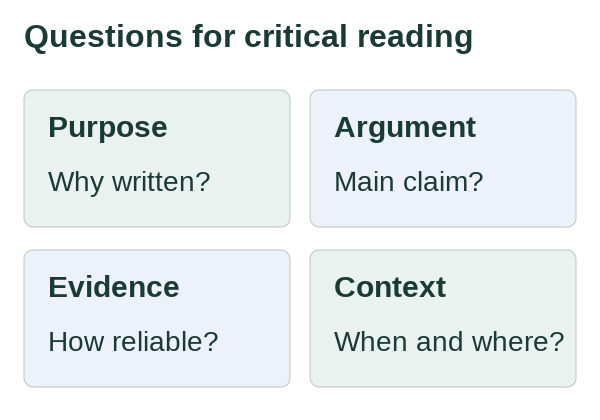
Critical reading goes beyond that surface understanding. It asks the reader to interpret, analyse, question and evaluate what the text says. It also asks the reader to notice the assumptions a text rests on. The reader should weigh the evidence it offers. A critical reader links the ideas in a text to wider settings. These include academic, cultural and social settings.[8]
A 1972 psychometric research program ran two parallel series of statistical analyses. One was at fifth grade and one at twelfth grade. The scores came from five tests. These were reading, critical reading, critical thinking, scholastic aptitude and scholastic achievement.[9]
A study of 90 fourth semester undergraduates in an English education program tested critical thinking, critical reading and reading comprehension. Critical thinking skills correlated with reading comprehension at an r-value of 0.810. Together, the two predictor variables contributed 71.3% to reading comprehension.[5]
A 2025 study tested the links among critical listening, critical reading and critical thinking. The 201 students were training to teach Turkish. Critical listening had a direct, strong effect on critical reading. It explained 65% of the total variance related to critical reading. The effect of critical reading on critical thinking was not significant. It did not predict critical thinking at a significant level. The study concluded that critical listening was the main predictor of critical thinking.[10]
History
From library checklists to lateral reading
Technology and reading habits have changed over the last decade. A new information setting has followed. The Internet is now the main way children and adults come to understand the world. Online, readers pick from what amounts to an endless supply of websites. They take a more active part in choosing the ideas they meet. Nash (2021) linked these changes to a post-truth era. Nash quoted Janks (2018, p. 98) for the claim that identity shapes how people respond to texts. Nash observed that few resources existed for preparing students to read online in that era, even though the teaching literature on online reading was ample.[11]
Henry (2006) predicted that in the 21st century the Internet would become the technology that shapes reading, writing and communication. Henry also warned about a limit. Students need to find information quickly and well. Without that skill, their access to information on the Internet is limited. Henry (2006) designed SEARCH for classroom teachers. It sets a purpose and uses effective search strategies. It also analyses search engine results. Then it reads critically, combines sources, cites them, and ends with a reflection on how well the search went.[12]
Burnett and Merchant (2019) saw an urgent case for critical literacy. They pointed to environmental crisis, financial instability, mass migration and political extremism. The same authors added that criticality in the digital age is challenging, because digital media, devices and architectures are bound up with wider social, cultural, commercial and political activity. They proposed that critical literacy should do more than study texts within networks of humans. They built a model for a relational approach. The model draws on a sociomaterial perspective. This view looks at how wider social and material networks help create meanings.[13]
How the CRAAP test became standard
Checklists for judging sources are part of the history of information literacy teaching. Kamela surveys that field. A 2024 chapter traces the history of these source evaluation methods. It notes that the field itself keeps changing. That chapter also weighs one widely used method, the CRAAP Test, and finds it wanting.[14]
The chapter's author argues for replacing this checklist with lateral reading. The author says this approach encourages students to engage more deeply. They do so when they judge digital resources in an online information setting. The chapter also offers strategies for adding lateral reading to information literacy instruction in higher education.[14]
Libraries have taken on part of this judging work for university students. A 2025 questionnaire study asked 50 students and 15 academic librarians about informational reading and source criticism in a digital culture. The study reported that libraries help make sure what students read online is credible and trustworthy. It described several library strategies. These were digital tools that gather credible sources by topic. They also included ongoing Online Reference Services and chosen reading lists of credible sources in various fields. The same study found that social media sites were the most visited of the listed digital platforms. It also reported that doing several things online at once increases distraction. This harms students' reading abilities.[15]
Main ideas
How readers judge whether a source can be trusted
Students gather information from many sources. Those sources differ in how far they can be trusted. How far a source can be trusted should shape how much weight its information carries. It should also shape where that information sits in a student's grasp of a topic. For a long time there was little empirical evidence of this relationship.[16]
Epistemic trust works best as a middle course. Students should not accept claims without question, and should not reject them all either. That balance lets students rely on credible expertise. It also keeps them responsible for checking.[17]
Students' evidence-based thinking depends on more than mental skills. Analysis and comparison are examples of such skills. It also depends on mental processes. These include watching out for claims, trusting in line with the evidence, judging whether a source is credible, thinking independently, and controlling one's own reasoning. Evaluating sources is the everyday activity that keeps that trust in check. Building evidence-based thinking therefore requires systematic educational conditions, not only general reasoning practice.[17]
Observed behaviour does not always match what students say they value. Silva, Green and Walker (2018) at Brigham Young University studied how first-year students judged open-access news material on popular, non-academic subjects. The researchers recorded students thinking aloud and their screens. They then coded which evaluation behaviours appeared most and least often. Students did not think earlier experience shaped how they judged sources. They did not believe bias judgements did either. Yet both of those behaviours showed up strongly in the evaluation techniques the researchers observed.[4]
Why reading laterally works
The term means opening new browser tabs to look for further information. The search may be about how credible a source is. It may be about whether its claims are accurate. A 2026 study looked at students' reasoning during lateral reading lessons. They found that judging a source's credibility and checking whether a claim is accurate use different kinds of reasoning. McGrew and Reynolds (2026) concluded that the two kinds of reasoning should be taught as separate skills. Then students can find credible information online.[18]
This was a disputed episode in U.S. history. The documents ranged from primary sources, such as legislative bills and eyewitness accounts, through secondary sources, such as editorials, to tertiary sources, such as textbooks. Students read at least two documents. After that, their mental models of the event, meaning their internal picture of what happened, grew more internally consistent. Those models did not become more consistent after that. Compared with knowledgeable readers, the students showed no growth after a first reading.[19]
In a 2006 study at the University of Connecticut, seventh graders could not discredit a hoax website about a tree octopus. A later qualitative study used the same website with 68 elementary students. It gathered their reasons for judging whether the source was real. The student responses showed how web literacy skills were applied. They also said teaching needs to stress critical thinking more.[7]
In the 1996 history study, students wrote literal notes whatever the final task was. This suggests they used the first readings to collect facts. When asked for a description, they kept close to the text. When asked for an opinion, they tended to set aside what the texts said. They did this even if they had taken many notes.[19]
Critical literacy and questions of power
Literature circles are student-led book clubs. They are an old teaching tradition built around reading literature and responding to it. Critics of the format argue that student-led discussion can limit how far students engage with political, social and cultural issues. Jocius and Shealy (2018) answer this with a four-phase model for critical book clubs. It is meant to help students question the world around them and speak up for social change. The model draws on a yearlong study. In it, third-grade students examined how disability and difference are represented. They also examined stereotypes.[20]
Response from a critical stance was for a long time limited to discussion. A 2020 article reports that it has recently expanded to other modes of response. The authors call this shift critical expressionism. McLaughlin and DeVoogd (2020) hold that critical literacy and critical expressionism produce deep comprehension, an understanding that goes further than the surface.[2]
A 2016 study describes the reading practices of a township high school in Cape Town, South Africa. The researcher studied classroom talk and text-based tasks. She asked what views of text learners were offered. The views she found centred on the surface meaning of texts. They showed no critical engagement. That absence appeared even though the national Curriculum and Assessment Policy Statement required critical engagement. Lloyd (2016) argues that power relations from South Africa's racist past still shape teaching. So do common ideas about gender, class and race. Together these limit learners' access to English resources.[21]
Critical literacy is the name for this practice. It encourages learners to think critically about linguistic hierarchy. It also asks them to be aware of cultural domination.[22]
One line of work is critical pedagogy. It brings three principles into the reading class. They are dialogic education, a democratic classroom, and reading the world and the word. Dialogic education is one of the three critical pedagogy principles used in a case study of EFL reading. A case study looked at a teaching program of eight meetings. It involved 59 second-year students at a teacher education institution in Bandung. It tied these principles to four kinds of activity. The activities offered difficult topics tied to students' lives. They also pushed students to read between the lines. They also shared classroom power and made room for student voices. The program reported two benefits: language growth, and new knowledge and experience. It reported three challenges. There were few classroom-friendly, real, controversial reading materials. There was a passive culture. And the classroom was unpredictable.[23]
Critical discourse analysis also framed a study of four adolescent boys in a homeschooling setting. They discussed masculinity in written and spoken texts. The boys noticed more how masculinities were shown. They began to question how fixed these practices were. Their awareness of gender identities and unfairness was uneven. At times it was also uncertain. Power relations in local, school and wider society shaped how they took part.[24]
With younger students, media literacy work asks children to unpack the messages of advertising and popular culture. In one project, a fourth-grade class studied popular media and advertising texts. An artist inspired them. The artist uses culture jamming: acts that criticise the consumer values spread by mass advertising. The fourth graders spoke clearly and thought critically. They also showed a strong sense of humor when given curriculum space to talk back to their popular culture texts. The teachers also described tensions in balancing students' pleasure with social critique.[25]
Teachers in three early primary reading settings used varied children's books. The settings were in the Northeast and Southwest of the United States. They got children to make critical, social and political meaning from texts.[26]
A four-year ethnographic study watched young girls' reading practices closely. It argued that constant links to one's own life push early readers to agree with a text's views. They should question those views instead. That argument extended to students marginalized by mainstream children's literature for early readers. This literature treats class-privileged lives as normal. The study suggested that marginalized readers may first need a sense of entitlement. Only then can they position themselves as text analysts.[27]
A review of research and practice on 21st-century literacy learning found little classroom research on democratic engagement and fairness. It also found that teachers were reluctant to use digital literacies to reach wider publics. The review judged that current classroom understanding of 21st-century literacy learning is weakly defined.[28]
Critical consciousness in online reasoning
Checking whether a source is accurate is only part of evaluating it, according to a 2023 argument about how students read online. That argument holds that source evaluation stays incomplete. Students must also use critical consciousness skills. Without them, the judging stays incomplete. Dobbs, Forzani and Leider expand the critical online reasoning and evaluation (CORE) framework. The expanded version helps students read in a critically conscious way. The longer version is meant to help middle-grade students read in a critically aware way. The writers describe critical consciousness as a key way for students to learn and strengthen critical literacy skills. They tie this to the goal of helping students read the word and the world.[29]
A 2025 article states that the word critical is commonly tied to Freire. It is also tied to one main critical reading practice, suspicious critique. The writer surveys four leading models of critical literacy. She shows how critique and suspicion work inside them. She re-reads three of her own earlier publications. She shows how suspicious critique shaped her research. She then presents data never published before to show another method, reparative description. It lets researchers study power in a different way in critical literacy research.[30]
A 2002 article separates two research frames, functionalist research and critical analyses, by the questions each one asks.[31] Dobbs, Forzani and Leider argue that judging sources is incomplete without critical consciousness skills. Coleman asks what other methods and moods of reading could serve literacy research.[29][30]
Metacognition and self-efficacy in critical reading
Gavia and Ferenal (2026) describe metacognitive reading skills as the skills that help learners control their comprehension. Gavia and Ferenal measured these practices in three areas: planning, monitoring and evaluating. A 2026 study looked at 180 Grade 7 learners in public districts of Cagayan de Oro City. It found that monitoring had the highest mean among these practices. The same learners showed limited overall critical reading performance. They did best at combining key information. Monitoring and evaluating strongly predicted critical reading performance. Planning did not.[32]
Bozgun and Can (2023) measured preservice teachers' critical reading self-efficacy. They used a self-efficacy perception questionnaire about critical reading skills. A 2023 survey of 482 preservice teachers at a state university in Turkey's Central Black Sea Region tested how these factors connect. Metacognitive reading strategies significantly predicted both reading motivation and critical reading self-efficacy. Bozgun and Can chose their participants by convenience sampling.[33]
A 2026 study looked at vocabulary knowledge and strategy use together. It looked at 30 ninth-grade students learning English as a foreign language. Vocabulary knowledge, use of metacognitive strategies and critical reading skill all sat at a middle level among the students. Metacognitive reading strategies had the strongest link to critical reading ability, at r = 0.89. Vocabulary mastery helped students understand texts. It was not a significant predictor once metacognitive strategies were included.[34]
How and why the routines work
One study looked at 148 Grade 6 students in nine classes. One programme taught strategy knowledge directly. Another gave guided practice with feedback on written summaries. Strategy knowledge rose by the same amount in both groups. The guided practice group gained more in reading comprehension. The researchers concluded that intensive practice with individual corrective feedback worked better. It beat explicit teaching of strategy knowledge alone.[35]
In a directed reading-thinking activity, students make predictions before reading. They draw on background knowledge to support them. The same routine asks students to analyse the facts that support a prediction. They then confirm or revise it, and evaluate the text and its context.[36]
A classroom action research study reported that this routine improved reading comprehension and critical thinking. The reason is that it focuses on student engagement with the text. Students had to predict and then prove their predictions as they read. This made the process more interactive and the students more active.[37]
One program taught 155 Grade 9 English first additional language learners in Gauteng, South Africa. It built six strategies on Bloom's taxonomy categories. The six were pre-reading knowledge, extracting meaning, asking questions, reflection, outlining key concepts and decision-making, and summarising. Both groups improved, but the group taught the strategy scored much better on the post-test. The researcher credited the result to clear explanations and teacher guidance in using the strategies.[38]
One study looked at 27 third-year English for Communication students. A KWL chart recorded their reflective writing during a critical reading course. Scores rose from a pre-test mean of 19.00 to a post-test mean of 34.19. The researchers coded the students' reflective writing. It showed that monitoring was the strategy students used most while reading.[39] Metacognitive strategies of this kind help students think about how they learn. Students then adjust their reading strategies to match.[40]
One critical reading of text routine for middle school content classes includes peer-mediated instruction. In it, students work through the text together. The same article describes changes teachers can make for students with reading difficulties and disabilities. These fit within the same subject classroom.[41]
Methods such as Socratic questioning are said to encourage active dialogue. In that dialogue, students question and analyze texts. Reciprocal teaching methods are described as creating an interactive setting. There, students share interpretations and challenge one another's views.[40]
In the WWWDOT routine, the D asks: Does this help meet my needs? The O stands for the organization of the website.[42]
Reading, writing and thinking together
One classroom study combined reading and writing instruction. It watched students through the lessons. It used an open-ended questionnaire to record how well they learned English. That study reported that the combined instruction helped students build prior knowledge and critical thinking. It did so through appropriate task-based activities. The same study described the approach as a way to make teaching strategies work better in language teaching.[43]
A 1999 review described reading-to-write tasks. In these, students read articles or literary selections. They then respond to them in a critical way. That review noted that researchers in first and foreign languages have studied the mental processes readers and writers manage during such tasks.[44]
Writing from sources, meaning composing a text that draws on other texts, is an important academic skill that students find hard to learn. The lesson went to 150 first-year students in a Critical Skills module. The team analyzed the students' texts to see how they brought sources into their writing. The analysis found significant improvement in some skills. These included finding, interpreting and combining content from several sources. Other skills improved less clearly. These included judging sources and writing new text.[45]
A required first-year university course, ELIT200 Critical Reading and Writing, was taught in English. English is the official language of the institution. It aims to prepare students to examine reading materials, audio and video critically and analytically. By the end of the course, students can write proper argument essays. They can also join academic debates on controversial topics. Examples are discrimination and the effects of social media. Its assessment combines reading assignments, video assignments, an argumentative essay, a speech or presentation, one mid-term exam and one final exam.[46]
Textual criticism is academic writing based on close reading. A 2012 article argued that critical editing suits undergraduate study. It trains readers to be more careful and more skeptical. Such assignments ask students to weigh historical evidence for themselves. They also ask them to weigh aesthetic judgment. This includes questions of literary value.[47]
A 2020 article recommended letting students choose texts. It also advised teaching changing reading skills directly. It also recommended social reading practices. It also recommended process-based assessments for learning.[48]
Research
What the classroom studies measured
The sample was 232 students, picked by random sampling, in the 2016-2017 academic year. Scores on both measures rose. t-tests and ANOVA showed the change was statistically significant. Interviews and document review in the same study pointed the same way.[6]
A quasi-experiment on the island of Lombok compared 40 students. They were split into an experimental group and a control group. The result was t = 2.169, against a t-table value of 1.679. The report concludes that the method helped a lot with critical reading comprehension.[49]
A 2026 study in Indonesia paired English reading lessons with Indonesian historical narratives. It covered 60 Grade XI students at one senior high school. Thirty students got the narratives plus clear critical reading activities. Another 30 received conventional instruction. The analysis controlled for pre-test scores. It found a significant group effect, F(1, 57) = 11.190, p = .001. The partial eta squared was .164, which the report calls a moderate-to-large effect.[50]
In one study, a subset of 316 students sat in classes matched with control classes of 287 students. Also, 994 students took a delayed post-test. The size of the gain varied with demographic factors. It did not change with differences in how the curriculum was taught.[3]
Students also reported more use, support and knowledge of Wikipedia. The curriculum used it as a tool for investigating sources. Confidence in fact-checking COVID-19 news rose. But it was only weakly linked to actual lateral reading.[51]
One Swedish intervention defined critical reading as three abilities. The first skill is identifying written argumentative structure. The second is analyzing arguments for relevance and sustainability. The third is judging arguments through a written, critical response. That study tested 74 ninth grade students in four Swedish classes. It used a pretest and a posttest around a six-week unit of 15 lessons.[52]
A 2025 study made a questionnaire called the Survey of Critical Reading Strategies. It measures how students use these strategies to understand English texts. It was tested on 799 undergraduate students in Vietnam who were learning English as a foreign language. The three subscales had reliability scores of 0.85, 0.89 and 0.83. The overall value was 0.91.[53] A separate study of 32 Indonesian undergraduates used a four-point rating questionnaire. It linked strategy use to how hard students found their texts and how they felt about reading.[54]
Fifty graduate students at a private Malaysian university filled in a questionnaire. They also took a reading test taken from the Malaysian University English Test reading paper. The gap between the two performances was significant. Students rated their own ability higher than their test scores showed.[55]
A survey looked at students in an Indonesian language teaching program. It found their critical responses were low. They took only the stated information and made very little attempt to find implied meanings.[56]
One study used 100 second-year students at the University of Tikrit in Iraq. A questionnaire and a diagnostic test showed a positive link between critical thinking level and reading comprehension achievement.[57] A study at Arak University in Iran began with 121 English learners. Data from 98 of them were analyzed. The question was whether critical thinking and critical reading of literary texts are related.[58]
A qualitative study looked at 140 students at a private Indonesian university. It compared their reading scores with the Common European Framework of Reference for Languages. It reported that most were very weak in both critical thinking and reading.[59]
A reading habit questionnaire and a critical reading test were given to 37 English education students. They attended one Indonesian university. They showed no significant link between the two.[60]
By contrast, a study of 446 fifth grade students in Uşak Province, Turkey, reported a positive link. Critical reading skill scores went up as creative reading perception scores went up. The correlation was r =.886. The Turkish study of 446 fifth grade students also found critical reading skill to be a significant predictor of creative reading perception. The R2 was .785.[61]
New texts, new tests of judgement
In an experiment with high-school students, texts labelled as written by ChatGPT were judged less credible. The same texts labelled as written by a human scored higher. This held across both topics in the study. When a text was presented as machine-generated, students more often justified their credibility judgments by pointing to how the text was made. Readers of the ChatGPT-generated texts showed a more integrated understanding of the two topics than readers of the human-generated texts.[62]
In one survey, about 75% of students used AI tools often. They most often used them to summarize text. Students who leaned heavily on those tools scored lower on a critical reading test.[63]
A qualitative case study in one junior high school examined digital texts built around students' local culture and social setting. The study had 25 students. The researchers watched lessons, analysed written reading responses and interviewed the teacher. Digital texts based on local context were linked to higher engagement. Students connected the content to everyday experience and prior knowledge. Written answers showed how well students interpreted texts and reflected on them. The teacher also reported limited digital infrastructure. Reading proficiency varied as well. The researchers state that the findings cover 25 students in one school. They should not be generalized.[64]
In practice
Reading several documents in history and science
Writing for reading includes prereading tasks, such as analysing a text's form, topic, audience and purpose, and writing during reading includes tasks such as notetaking. Reading for writing includes prewriting work. One example is analyzing what a task requires. Reading during writing includes fixing errors and checking the quality of content. It also includes going back to source texts for information. Reading after writing includes self-evaluation and peer review.[65]
Critical reading in a second language
The program adapted two existing methods. One was a technique for forming questions. The other was a set of comprehension strategies for answering questions. After the lessons, students questioned facts given in the text. They named the issues it raised and supported their arguments with valid examples. The study reported that the instruction helped students think differently. It also helped them use prior background knowledge. They could connect themselves with the text and with the world.[66]
The experimental group was taught with methods that turn on knowledge students already have. The control group received conventional methods. Both groups began with comparable pre-test mean scores, 1.9 and 1.8. After the lessons the experimental group reached a post-test mean of 2.3. The control group reached 2.1. The t-value was 3.92, above the critical value of 1.96.[67]
One article on method discusses how authenticity relates to linguistic competence, critical thinking and reading strategies. It sets out principles for choosing authentic materials and for using them in class. It pays special attention to activities before, during and after reading. It says these turn reading into a process of analysis and judgement, not passive recall of facts.[68]
Students have been asked which strategies they use in a critical reading class. The students said that frequent practice with inferring, monitoring understanding, paraphrasing, a critical lens and a contrarian stance would strengthen their critical reading. They named analysing data, working out writers' intentions and evaluating the author's arguments as challenges, and said their skills improved through suitable strategy practice drawing on cognitive processes, cultures and language.[69]
A smaller case study used qualitative methods. It looked at how 10 final-semester students in an English education program reflected on their own mastery experiences in critical reading. Interviews and reflective journals showed three linked dimensions. They were a sense of success, engagement with difficulty, and growing confidence. The study describes these as a dynamic and recursive process, one that loops back on itself. In it, mastery experiences are read as meaningful learning episodes. One program had 10 participants. The findings describe that setting and do not establish an effect size.[70]
What changes the result
The strategies included pre-scanning, contextualizing, seeking clarification, reflecting on values, summarizing key ideas and evaluating authors' arguments. The experimental group improved significantly on reading comprehension and reading motivation scores after the intervention, compared with the control group.[71] At university level, a survey of 386 non-English major students in China and 82 English teachers found only moderate engagement with critical reading. Students reported a mean of 3.151 for their use of critical reading skills. Teachers reported a mean of 3.045 for their implementation of critical reading instruction. That study recommends building skills from lower-level to progressively higher-level tasks rather than starting at the top.[72]
Researchers interviewed four instructors of critical reading courses. The instructors struggled to define critical reading. The same instructors had no specific strategies for teaching the course. An analysis of the course syllabus showed that the class developed none of the social levels of critical reading proficiency.[73]
A qualitative study looked at 4 faculty members teaching critical reading courses. A syllabus analysis pointed the same way. The course built no social levels of critical reading skill. In that setting critical reading was treated mainly as a cognitive skill, a mental ability. Its critical dimension was left out.[74]
Observations of university reading courses in Nepal found a mismatch between what teachers knew and what they did. Teachers knew that students needed to take part in reading activities. Yet lessons leaned toward traditional lecturing. Critical reading courses took an uncritical approach. The study traced this gap to long courses, traditional classrooms, student expectations, students without course books, and too little training and orientation for teachers.[75]
An analysis of junior high school English reading lessons noted a pattern. Teachers' questions often put too much weight on pulling out facts. Question chains were missing. These are sequences of linked questions that guide students into deep analysis, evaluation and creation.[76]
A case study of a high school English unit found that linked tasks kept students using higher-order thinking. The tasks were built around four activities. Students predicted from titles, summarized structure, questioned viewpoints and switched roles.[77]
An action research study at a Ugandan university linked rising student numbers and large classes to poorer quality. It used educational technology to cope. Learning there moved from lower-order to higher-order thinking skills. Technology use moved from simple substitution, which was teacher-centred, to a more complex redefinition that was learner-centred.[78]
One quasi-experimental study looked at 37 students. They were in their second semester of an English for Academic Purposes course. A flipped classroom raised their mean scores on critical thinking for critical reading. The scores went from 12.4865 to 18.3243. The gains appeared in accuracy, clarity, precision, depth, relevance and logic. Students viewed the model positively for self-directed learning.[79]
An experiment with 212 senior high school ESL learners in the Philippines gave both groups 15 lessons. Both the flipped and lecture-discussion groups improved their critical thinking and reading comprehension. But the flipped group did significantly better than the conventional group.[80] A quasi-experimental study of 60 students at a private Indonesian university reported a result. Combining brain-targeted teaching with students' content schema was effective.[81]
One quasi-experimental study taught critical reading strategies. The students were in twelfth grade in Indonesia. These combined previewing, annotating, questioning, summarizing and judging arguments. Students taught this way did significantly better than those taught by conventional methods. In the experimental group, female and male students both scored higher than their control-group peers. The effect of teaching strategy did not depend on gender. The difference was not statistically significant. The strategies helped students whatever their gender.[82]
The high school case study added critical thinking practice to reading news stories. It used a unit titled 'Scientists Who Changed the World' from a Yilin Press edition.[77] A meta-analysis of 23 articles published between 2011 and 2024 found a pattern. Critical reading programs tied to local culture worked better than programs without that tie. That analysis also reported statistically significant results when grouped by education level, country and publication type.[83]
An action research study worked with 36 eleventh-grade vocational high school students in Makassar. It ran two cycles of tasks. These included prediction, annotation, questioning, summarizing and retelling. Students got better at finding main ideas and making inferences. They also improved at summarizing texts. They also relied less on dictionaries. Problems with learning vocabulary remained. The study advised looking at vocabulary support in future work.[84]
Writing, feedback and self-evaluation
A 2019 discussion of university writing classes in Indonesia argued one point. Critical reading is a useful strategy for instructors. It helps when they want students to write a paper in English. That article described the goal of such courses as both linguistic and literacy competence, meaning language skill plus the ability to read and write as an informed person. Its proposal was to build the writing class around the link between reading and writing. That way classroom activities carry more meaning for students.[85]
A small 2021 study asked students about their critical reading strategies. It then compared those answers with the proposal texts they wrote. Far less often did they question an author's assumptions, turn ideas into visuals or judge arguments. The same gap appeared in their writing. It stated a purpose, defined key terms and managed references. But its argument development was shallow and its writing was format-based. The study began with an observation. Students lacked confidence in their ability to question the arguments and evidence of respected academics.[86]
A 2017 article described an approach. It teaches specific evaluation criteria, the standards a reviewer applies to a paper. Then it leads group practice in reviewing papers by unknown peers. That article reported that the practice supports self-evaluation and peer review. It also adds to students' knowledge of effective writing. It improves the quality of their own writing.[87]
A semester-long action research study at a federal university in the United Arab Emirates tested one idea. Could online blended modules link critical reading to academic writing? The modules mix online work with classroom teaching. They ran across four first-year composition courses and served as class activities or extra practice. The evidence came from student interviews, written work, reflections and an instructor's reflective diary, so the findings are qualitative rather than measured as scores. Those findings indicated one result. Teaching critical reading through the modules helped students build academic writing skills. The courses were second-language writing courses taught in English. The study concluded that writing courses should include critical reading. They should also make good use of links between reading and writing. They should also use reflection and keep accurate records of each learner's critical reading ability.[88]
What students do when they evaluate online
Many studies show that college students struggle to tell fact from fiction on the internet.[89] Interviews and classroom observations showed that the students lacked skills in judging online information. The same students also showed little interest in taking part in the evaluation activities. They reported that past studies had already challenged it.[90]
Breakstone, Smith, Connors, Ortega, Kerr and Wineburg (2021) placed modules in an online college nutrition course. The course ran at a large state university. The course included modules that taught students to check websites using the methods of professional fact checkers. The central strategy was lateral reading. This means leaving an unknown website to consult other sources about the original site. Students did lateral reading more often after the program than before it. The study reported significant improvement from pretest to posttest. The researchers presented these results as a way to spread this kind of teaching in higher education.[89]
Lateral reading asks readers to leave a site and check it against other sources, rather than judge it from the page itself.[89] In the Malaysian classrooms, students who lacked evaluation skills also declined to join the activities meant to build them. The Malaysian researchers described information literacy education in the country as an ongoing challenge. They said it needs further research.[90] The 2021 study took place in one nutrition course with no fixed class times.[89]
Questioning, discussion and reading groups
Muliana, Annaningtyas and Maulidah Khabib (2026) tested the Socratic Questioning Method (SQM). They measured its effect on reading comprehension and critical thinking in an EFL classroom. A classroom action research study tested this method. It worked with 50 eleventh-grade students in a boarding school English class. Muliana and colleagues ran classroom action research in two cycles. Each cycle had planning, acting, observing and reflecting stages. The study ran two such cycles. The students' mean score rose from 59.8 on the pre-test to 71.2 after Cycle I. It reached 83.6 after Cycle II. The share of students reaching the mastery level climbed from 36% to 90%. Observations and questionnaires also pointed to more participation, confidence and analytical thinking during reading.[91]
Sripradith and Phoocharoensil (2025) combined 5E inquiry-based instruction with Socratic seminars in a flipped classroom. The participants were 33 second-year English students in Thailand. Their placement test results marked them as having low critical reading skills. The study ran over 12 weeks, with pre-tests and post-tests. Critical reading comprehension improved significantly. The result was p = 0.001 at the 0.05 significance level (t = 8.586). Engagement was moderate in the feelings domain (M = 3.85, SD = 0.716). It was also moderate in the cognitive domain (M = 3.71, SD = 0.773). It was high in the behavioural domain (M = 4.35, SD = 0.651). The design had one group only, with no comparison class. The researchers asked for wider testing in other settings.[92]
Taufik Ismail and Suhaili (2025) report that structured group roles in literature circles helped students engage more deeply with texts. They also encouraged peer collaboration. Teachers at one English language education program observed that many students struggled to identify main ideas, analyze arguments and evaluate evidence. They blamed dull teaching for low motivation. They then tried literature circles with fourth-semester students. The classroom action research ran two cycles of planning, acting, observing and reflecting. It used questionnaires and end-of-cycle tests. The structured roles were reported to deepen engagement with texts, encourage peer collaboration and improve analytical and evaluative reading.[93]
Setiawan, Suwandi and Rohmadi (2025) combined 28 articles. They found that cooperative learning models improve critical reading more effectively than traditional ones. It measured the approach's effect on critical reading. Cooperative learning beat traditional instruction. The overall standardized mean difference was 0.784 (95% CI, 0.689 to 0.880) and p = 0.00. The result depended on the quality of the facilitators. It also depended on the teaching methods used.[94]
A reading group activity described in a 2018 conference paper began with six volunteer secondary students. They were in grades 9 to 11. Within three months the activity grew to fifteen groups of six or seven students each. Groups gave presentations and held a book interview. Their work was shown on posters during Libraries Week. The paper reports that interest in reading and the library rose. Students learned to direct their reading, choose books and tell strong works from weak ones. Koçak (2018) reports that the reading group activity spread through the school quickly. It raised students' interest in reading and the library.[95]
Critical reading in English language classrooms
Several classroom studies have tested whether teaching critical reading to second-language learners changes their comprehension, their attitudes or their thinking.[96][97][98][99] A 2024 study in Indonesia compared usual reading lessons with critical reading lessons. The students were in second grade of high school at SMA Negeri 15 Samarinda. The same students took both treatments, with a washout period between them to reduce bias. On a standardized reading comprehension test, the mean score rose from 24.83 before the sessions to 66.67 after them. The study reports that critical reading strategies clearly improved comprehension. It used t-tests on post-test scores.[98]
One study of university students looked at critical reading skills used in group work. Data came from three sources. These were an open-ended questionnaire given before the lessons, learning logs, and observations of the participants. The results showed that critical reading skills had significant effects on comprehension at different levels. A wide set of critical reading skills helped students read what was communicated between and beyond the lines, the study reports.[97]
A quasi-experimental study in Ethiopia tested how critical reading instruction affected reading attitude. It used a control group design without random assignment at Sena Ghimbi Secondary School in Ghimbi Town, Oromia region. Students filled in questionnaires before and after the lessons. The researcher checked their validity and reliability first. Students taught with the critical reading approach held more positive attitudes toward reading than students who did not receive this instruction. The t-test analysis found this. The study advises subject area teachers to give students more chances to practice critical reading strategies. Teachers should not rely on only a few strategies.[96]
A 2024 quasi-experimental study in Spain compared two ways of teaching English. One was content and language integrated learning, or CLIL, where subject matter is taught in English. The other was English as a foreign language, or EFL. The students were in the 6th year of primary education, aged 10 to 11. They were in two schools, one in the Basque Country and one in Cantabria. Four groups took part: CLIL-experimental, CLIL-control, EFL-experimental and EFL-control. The experimental groups got seven weeks of teaching in critical reading strategies. The control groups continued with regular classes. Students in both programmes gained greater mastery of critical reading after the teaching, the one-way ANCOVA results showed. The EFL experimental students did better than the CLIL learners. This went against the researchers' first hypothesis. The researchers suggest the new procedure was more of a novelty for the EFL students. Those students were less familiar with strategy learning. They suggest that this newness helped these students build higher order critical reading skills.[99]
A 2024 review looked at content-based teaching in college English reading courses. In this approach, subject matter is combined with English language learning. The review reports that students taught with content-based instruction improved significantly at analysing, evaluating and synthesizing information in English. It calls these key parts of critical thinking. It also describes case studies in which critical thinking and academic performance improved. In these cases, content-based instruction was effectively implemented. The review argues that using language within relevant subject matter improves reading comprehension. It also encourages deeper intellectual engagement.[100]
Multimodal and digital tasks for critical reading
Several studies have tested whether multimodal tasks can improve critical reading. These include work with Thai university students and with rural senior high school students in Inner Mongolia.[101][102] Varaporn and Sitthitikul (2019) gave Thai university students tasks with several modes. They compared their critical reading test scores with those of a control group. A 2019 study of Thai university students put them into experimental and control groups at random. The tasks helped them propose critical reading ideas and build analytical thinking skills. They also raised intrinsic motivation and learning autonomy.[102]
A 2024 quasi-experimental study in Hohhot, Inner Mongolia, tested multimodal tasks with Grade 2 rural senior high school students. The study set out from a problem: lessons that stress grammar may raise comprehension scores but not critical reading ability. The experimental group was taught with lessons that combined critical reading content and multimodal tasks. This group scored higher on a critical reading test than the control group. Two questionnaires showed that the same group also had significantly better motivation and confidence to read critically after the intervention.[101]
A 2024 study of college students found high levels of critical thinking in several areas. Yet most student performance showed failure. Most students taught with instruction using several modes showed high levels of critical thinking. This included spotting faulty arguments and weighing different views on issues. Yet a majority of the same students failed on their critical thinking performance, a result the study links to the difficulty of improving critical reading abilities.[103]
Technology-integrated instruction has also been tested in ordinary classrooms. A 2022 mixed methods study in one private school in Indonesia chose 30 upper primary pupils by purposive sampling. For three months the pupils had at least three science sessions a week. These used multimedia technology. Students also said they were highly satisfied. They found the lessons easier to grasp, more engaging and more interesting.[104]
Munir, Noni and Asfah Rahman (2023) explored how 20 university English students learned critical reading. They learned in a virtual learning environment. Students engaged collaboratively and with enthusiasm. Some showed slightly non cognitive engagement, and none showed negative engagement.[105]
All were surveyed and 12 were interviewed. Students preferred online reading. This was especially true for those already used to electronic reading devices. Online reading seemed flexible and easy to move through. But small screens and screen light caused eye irritation for some students.[106]
Pinchai and Sojisirikul (2024) tested micro-content modules as a way to teach critical reading directly. A 2024 quasi-experimental study gave a treatment group of 28 students nine critical reading micro-content modules. A control group of 26 received traditional language teaching. Both groups took critical reading tests before and after. Only the treatment group gave feedback on the modules. The treatment group improved significantly more than the control group. Those students praised the modules for convenience, ease of use, clear visuals and sound. They also praised the support for self-directed learning and the push to think critically. They also asked for activities that were more hands-on and more exciting. These would keep the modules working over the long term.[107]
Reading habits, materials and differentiated support
Indonesia's score on the 2022 Programme for International Student Assessment (PISA) literacy test fell by 12 points to 359. The country placed 62nd among 72 participants. One study looked at 11th-grade students in three schools in Aceh. It noted low interest in reading among high school students there. Their reading levels also varied. It measured critical reading with a test based on the SAT, a United States college entrance exam. The experimental group got differentiated instruction combined with gamification in English lessons. The experimental group improved much more than the control group. A questionnaire reported greater engagement, better comprehension and clearer teacher instructions.[108]
A separate study at Universitas Negeri Makassar used a differentiated instruction model. It applied the model to two critical reading classes over one semester. The model let students look closely at the target language. It also let them see their own abilities in new ways. Results showed a positive effect on students' reading interest and reading level. Most participants called the model an effective way to support communication and understanding in the class.[109] The Aceh study measured results with a critical reading test based on the SAT. It also used a questionnaire on student views.[108]
By contrast, one study found no significant link between reading habits and critical reading. That study looked for connections between the two. That study surveyed 37 of 112 undergraduate English education students. They were at Tridinanti University in the 2017/2018 academic year. It used a reading habit questionnaire and a critical reading test. A Pearson correlation found the link between the two measures was not significant. Iqbal Risca and Rahma Dianti (2021) chose 37 students from a population of 112. They used purposive sampling.[110]
Marmita (2021) tested sustained silent reading (SSR) together with reading response. The classroom action research ran through 3 cycles. Data came from field notes, observation and rubric scores on students' work. Students' interest in reading improved. Their reading comprehension and critical thinking skills improved too. Marmita also set out to describe the problems met during implementation.[111]
Some argue that real-world texts and resources build students' critical reading ability. These are called authentic materials. A 2024 article argues that lessons built around textbooks often leave students uninterested. Such lessons are also too simple and too distant from real life for critical thinking. The article describes ways to bring such materials into the classroom. It claims they motivate students and support analysis, evaluation and synthesis. The 2024 article examines ways to use real materials in the classroom. It discusses their benefits across subjects and age groups.[112]
What this looks like when you study
One study looked at 232 university students in Turkey. They spent seven weeks on reading activities built around critical reading questions. The researchers compared scores before and after. The students' critical thinking and reading skills rose by a statistically significant amount. Qualitative data from the same study also backed up the test results.[6]
In another study, 60 Grade XI students in Indonesia read Indonesian historical narratives with explicit critical reading activities. Their mean score rose from 56.68 to 66.24. A control class taught in the usual way rose from 56.15 to 61.78. The researchers adjusted for starting scores. The difference remained significant, with an effect size of .164.[50] An effect size is a statistical calculation of how large a measurable effect is, for example the difference between the averages of two groups divided by the standard deviation.[113]
Before instruction, students said they liked some lateral strategies. They rarely used them, though. After the lessons, they used lateral reading more often. What they said they preferred also matched what they did more closely. The gains held on a delayed posttest.[3]
In a college civics course, 221 students learned lateral reading. They did online assignments on their own schedule. Their use of lateral reading improved. The number of assignments they completed predicted how much they used it.[51]
When 68 elementary students examined a hoax website about a tree octopus, their explanations showed gaps in reliability reasoning, the thinking used to judge whether a source can be trusted. The authors recommend explicit modeling of that reasoning during online searches.[7] In one study, first-year university students said past experience and bias did not affect their judgments. Yet screen recordings showed both played a large part.[4]
One source describes a student who weighs a claim by asking whether credible data support it and whether the source has relevant expertise. The same student asks whether other explanations exist. The student also asks whether the conclusion follows from the evidence.[17]
For a web search, the SEARCH routine advises setting a purpose and choosing search strategies. Then analyze the results, read critically, cite sources, and ask how successful the search was.[12] In one reading group activity, students take on role-tasks offered by the group readings. They learn to direct their own reading and to tell qualified works from weaker ones.[95]
Criticism
Criticisms and open questions
A 2026 qualitative case study followed 56 second-year pre-service English teachers. They took a fourteen-week critical reading and writing course. The pre-service teachers reported a shift from passive reading to critical engagement. They also reported more analytical, evidence-based writing. They also described difficulties with uncertainty, argumentation and competing viewpoints. They generally saw these as valuable learning.[114] A 2023 systematic review looked at 23 Indonesian articles. It found that 87% of the writing institutions were colleges and 13% were schools.[115]
A South African study notes that the national CAPS policy document calls for critical reading in secondary schools. Some learners still find critical reading hard. This is true even at university level. That qualitative reflective study reported this. The study argues that critical reading can carry basic knowledge of a text into everyday life. It can also support learner-centred teaching.[116]
A 2026 article responds to calls for universal structured literacy approaches. The calls come from sponsors of the Science of Reading movement. It challenges one-size-fits-all teaching taken from interventions designed for students with reading difficulties. It also accepts that teaching focused on code is a foundation of reading development.[117]
A review of 39 studies of phonological awareness intervention, which trains children to notice the sound units inside words, judged each study against standards for sound design. Only seven of the 39 met two thirds or more of the criteria. Every one of those seven still had at least one fatal flaw. Troia listed several flaws. One was assigning participants to conditions without random assignment. Another was giving control groups no alternate intervention. Several studies also failed to check that the planned lessons were actually delivered, used insensitive measures, or described their samples poorly.[118] A 1997 paper on reading intervention research makes a related point. Training one reading skill may not automatically improve the others.[119]
A two-year comparison looked at two comprehension approaches and a control condition. It found no difference on one measure of lesson text comprehension. Some students were taught through open questions about text content. They did better than students taught reading strategies on narrative recall and on expository learning probes. Sometimes the control students also did better than the strategies students. The control group was taught with questions from the published teacher's edition. The advantage for content students on one transfer test was modest. All students were fifth graders in a single low-performing urban district.[120]
Miscue analysis studies the errors a reader makes when reading aloud. A 1979 review found it had no normative data to guide interpretation. That review also found miscue patterns varied with the teaching method, the reader's background and skills, the purpose for reading, and the text itself.[121]
A 2008 content analysis looked at eight informal reading inventories. It found that they varied in technical rigor. Only one of the eight gave enough reliability data to support use of alternate forms.[122] A 2023 review of Response to Intervention in reading found many different screening and progress monitoring tools in use. That variety may explain why the studies differ so much in how well they worked. The review named validity, reliability and replicability as main concerns.[123]
A meta-analysis of 33 experiments with 2,799 participants found that reading from screens lowered reading performance compared with paper. The screen disadvantage appeared for expository texts but not narrative texts. Readers also judged their own performance more accurately on paper.[124]
An analysis looked at the five most widely used core reading programs. It found that teachers recommended many more skills and strategies than researchers do. The programs rarely followed the gradual release of responsibility model, in which the teacher hands control to students step by step. They also rarely used the amounts of practice seen in the original studies.[125] A 2020 paper warns against turning basic research findings into wide-scale teaching practice too soon. Instructional experiments should test them first.[126]
A review looked at 82 studies chosen from a pool of 298. It found that reading teacher preparation programs were fairly good at changing future teachers' knowledge and beliefs. Fewer studies showed that pedagogical knowledge changed actual teaching practice. This happened only under certain conditions. Very few studies included pupil achievement as a measure.[127]
Common misconceptions
A common assumption holds that current students are digital natives, meaning they grew up with the internet. Yet past studies found that Malaysian undergraduates struggled to judge online information. They had trouble telling whether it was credible. Malaysian undergraduates in one study showed limited ability to evaluate the accuracy of online information. Interviews and classroom observations showed a lack of evaluation skills and little interest in the activities.[90]
Follman and Lowe (1972) found that critical reading and critical thinking carry little or no variance of their own. Language ability explained almost all of both. Vocabulary in particular explained almost all of both. A psychometric study of fifth and twelfth graders found that critical reading and critical thinking had little or no unique variance.[9]
Stahl and colleagues (1996) found that high school students may not learn well from several texts. This is especially true when the texts conflict. This happens without direct teaching in how to combine information across texts. High school students read about the Tonkin Gulf Incident. After two documents they had more consistent mental models. They did not improve further after that.[19]
Key studies
| Year | Study | Sample | Design | Finding |
|---|---|---|---|---|
| 1996 | Stahl et al.[19] | Study of high school students reading multiple documents about the Tonkin Gulf Incident | Students' mental models grew more internally consistent once they had read at least two documents, but reading more did not make them more consistent still. | |
| 2009 | Bråten et al.[16] | Study in which participants read seven texts on global warming that varied in source characteristics | Both trustworthiness ratings of the most reliable documents and use of document type as a rating criterion independently predicted comprehension. | |
| 2018 | YILDIRIM & SÖYLEMEZ[6] | 232 university students in Turkey | Mixed design: a quasi-experimental quantitative strand used a self-evaluation form for critical thinking and a critical reading scale, both given before and after a 7-week application. A qualitative strand used document review and interviews. The sample was 232 university students in 2016-2017. | Reading activities with critical reading questions had a statistically significant effect on critical thinking and reading skills. |
| 2018 | Silva et al.[4] | first-year university students at Brigham Young University | think-aloud protocols and screen-recording | Students most used an article's sources, previous experience, or a bias judgment to decide reliability, and their stated views differed significantly from observed behavior. |
| 2019 | Pilgrim et al.[7] | 68 elementary students | qualitative study using a hoax website | Students' rationales showed gaps in reliability reasoning and a need for explicit modeling during online searches. |
| 2021 | Breakstone et al.[89] | college students in an asynchronous nutrition course at a large state university | Asynchronous remote instruction: modules embedded in a college nutrition course at a large state university taught fact checkers' strategies, chiefly lateral reading | Students improved significantly from pretest to posttest and engaged in lateral reading more often after the intervention. |
| 2021 | Brodsky et al.[51] | 221 college students in an online civics course | asynchronous online instruction with pretest and posttest | Students improved in lateral reading, and use was predicted by the number of assignments completed and reading comprehension scores. |
| 2023 | Brodsky et al.[3] | 2,278 Canadian middle and high school students, with a subset of 316 in teacher-matched control groups | Instruction study with pretest, posttest and delayed posttest; 2,278 students, with a teacher-matched control subset (316 CTRL-F, 287 control) and 994 students in the delayed posttest | Students who took the CTRL-F curriculum preferred lateral reading more than students in control classes, and they used it more often. Their scores on a delayed posttest stayed at the level they had reached at posttest. |
| 2024 | Universiti Pendidikan Sultan Idris[101] | Grade 2 rural senior high school students in Hohhot, Inner Mongolia, China | Quasi-experimental design with pretest and posttest comparing experimental and control groups of Grade 2 rural senior high school students | The experimental group had higher critical reading test scores and significantly better motivation and confidence than the control group. |
| 2024 | Putri Rahmasari & Sunarti[98] | second-grade students at SMA Negeri 15 Samarinda | within-subject design with conventional and critical reading treatments | The average score rose from 24.83 before the lessons to 66.67 after them. |
| 2024 | Pinchai & Sojisirikul[107] | 28 students in a treatment group and 26 in a control group | quasi-experimental study with micro-content modules | The treatment group's mean rose from 16.43 to 21.61, compared with 14.58 to 18.35 for the control group. |
| 2025 | Sripradith & Phoocharoensil[92] | 33 second-year English students in Thailand | quasi-experimental one-group pretest-posttest design over 12 weeks | Critical reading comprehension improved significantly (t = 8.586, p = 0.001), with high behavioral engagement (M = 4.35). |
| 2026 | Surismiati et al.[50] | 60 Grade XI students in Indonesia, 30 in an experimental group and 30 in a control group | quasi-experimental pretest-posttest control group design with ANCOVA | The experimental group's mean rose from 56.68 to 66.24, and ANCOVA showed a significant effect with ηp² = .164. |
| 2026 | Muliana et al.[91] | 50 eleventh-grade students in an EFL boarding school | classroom action research in two cycles | Mean scores rose from 59.8 to 71.2 in Cycle I and 83.6 in Cycle II, with mastery rising from 36% to 90%. |
See also
References
- Knott, D. (n.d.). Critical Reading Towards Critical Writing. University of Toronto. https://advice.writing.utoronto.ca/researching/critical-reading/
- McLaughlin, M., & DeVoogd, G. (2020). Critical Expressionism: Expanding Reader Response in Critical Literacy. The Reading Teacher, 73(5), 587-595. doi:10.1002/trtr.1878
- Brodsky, J. E., Brooks, P. J., Pavlounis, D., & Johnston, J. L. (2023). Instruction Increases Canadian Students’ Preference for and Use of Lateral Reading Strategies to Fact-Check Online Information. AERA Open, 9. doi:10.1177/23328584231192106
- Silva, E., Green, J., & Walker, C. (2018). Source evaluation behaviours of first-year university students. Journal of Information Literacy, 12(2). doi:10.11645/12.2.2512
- Hidayati, M., Inderawati, R., & Loeneto, B. (2020). The correlations among critical thinking skills, critical reading skills and reading comprehension. English Review: Journal of English Education, 9(1), 69-80. doi:10.25134/erjee.v9i1.3780
- YILDIRIM, S., & SÖYLEMEZ, Y. (2018). The Effect of Performing Reading Activities with Critical Reading Questions on Critical Thinking and Reading Skills. Asian Journal of Education and Training, 4(4), 326-335. doi:10.20448/journal.522.2018.44.326.335
- Pilgrim, J., Vasinda, S., Bledsoe, C., & Martinez, E. (2019). Critical Thinking Is Critical: Octopuses, Online Sources, and Reliability Reasoning. The Reading Teacher, 73(1), 85-93. doi:10.1002/trtr.1800
- Rusieshvili, M., Dolidze, R., & Totibadze, S. (2025). Unlocking Reading – Developing Reading and Critical Thinking Skills. International Journal of Multilingual Education, 26(3), 146-153. doi:10.22333/ijme.2025.10432
- Follman, J., & Lowe, A. J. (1972). Empirical Examination of Critical Reading and Critical Thinking-Overview. Journal of Reading Behavior, 5(3), 159-168. doi:10.1080/10862967209547043
- Baki, Y. (2025). The Impact of Critical Listening and Critical Reading on Critical Thinking. Behavioral Sciences, 15(1), 34. doi:10.3390/bs15010034
- Nash, B. L. (2021). Constructing Meaning Online: Teaching Critical Reading in a Post‐Truth Era. The Reading Teacher, 74(6), 713-722. doi:10.1002/trtr.1980
- Henry, L. A. (2006). SEARCHing for an Answer: The Critical Role of New Literacies While Reading on the Internet. The Reading Teacher, 59(7), 614-627. doi:10.1598/rt.59.7.1
- Burnett, C., & Merchant, G. (2019). Revisiting Critical Literacy in the Digital Age. The Reading Teacher, 73(3), 263-266. doi:10.1002/trtr.1858
- Kamela, M. (2024). Cut the CRAAP: Replacing vertical evaluation with lateral reading. New Directions for Teaching and Learning, 2024(180), 49-58. doi:10.1002/tl.20608
- Chukwunaza. N, E. (2025). Informational Reading and Source Criticism in A Digital Culture Among University Students: The Role of The Library. Asian Journal of Information Science and Technology, 15(2), 1-10. doi:10.70112/ajist-2025.15.2.4323
- Bråten, I., Strømsø, H. I., & Britt, M. A. (2009). Trust Matters: Examining the Role of Source Evaluation in Students' Construction of Meaning Within and Across Multiple Texts. Reading Research Quarterly, 44(1), 6-28. doi:10.1598/rrq.44.1.1
- Davranbekovna, R. A. (2026). Epistemic Trust and Source Evaluation as Psychological Mechanisms of Students’ Evidence-Based Thinking. Journal of Social Sciences and Humanities Research Fundamentals, 06(06), 50-55. doi:10.55640/jsshrf-06-06-10
- McGrew, S., & Reynolds, E. C. (2026). Discussing Credibility and Corroboration: Students’ Reasoning About Digital Sources and Claims During Lateral Reading Lessons. American Educational Research Journal, 63(3), 611-649. doi:10.3102/00028312261426323
- Stahl, S. A., Hynd, C. R., Britton, B. K., McNish, M. M., & Bosquet, D. (1996). What Happens When Students Read Multiple Source Documents in History? Reading Research Quarterly, 31(4), 430-456. doi:10.1598/rrq.31.4.5
- Jocius, R., & Shealy, S. (2018). Critical Book Clubs: Reimagining Literature Reading and Response. The Reading Teacher, 71(6), 691-702. doi:10.1002/trtr.1655
- Lloyd, G. (2016). Are we teaching critical literacy? Reading practices in a township classroom. Reading & Writing, 7(1). doi:10.4102/rw.v7i1.97
- Mas Pupah, E. (2023). Critical Literacy Practice for EFL Reading Classroom. Journal of Literature Language and Academic Studies, 2(03), 92-97. doi:10.56855/jllans.v2i03.852
- Yulianto, S. W. (2016). Critical Pedagogy Principles in Teaching EFL Reading. English Review: Journal of English Education, 4(1), 25. doi:10.25134/erjee.v4i1.305
- Young, J. P. (2000). Boy Talk: Critical Literacy and Masculinities. Reading Research Quarterly, 35(3), 312-337. doi:10.1598/rrq.35.3.1
- Gainer, J. S., Valdez‐Gainer, N., & Kinard, T. (2009). The Elementary Bubble Project: Exploring Critical Media Literacy in a Fourth‐Grade Classroom. The Reading Teacher, 62(8), 674-683. doi:10.1598/rt.62.8.5
- Johnson, W. F., Vlach, S. K., & Leija, M. (2025). Enacting Reading Comprehension: Using Diverse Literature to Engage Children's Critical, Sociopolitical Knowledge. Reading Research Quarterly, 60(1). doi:10.1002/rrq.584
- Jones, S. (2013). Critical literacies in the making: Social class and identities in the early reading classroom. Journal of Early Childhood Literacy, 13(2), 197-224. doi:10.1177/1468798411430102
- Mirra, N., & Garcia, A. (2021). In Search of the Meaning and Purpose of 21st‐Century Literacy Learning: A Critical Review of Research and Practice. Reading Research Quarterly, 56(3), 463-496. doi:10.1002/rrq.313
- Dobbs, C. L., Forzani, E., & Leider, C. M. (2023). How Critical is Critical Enough: Forefronting Critical Consciousness When Engaging in Critical Online Reasoning and Evaluation ( CORE ). The Reading Teacher, 77(2), 217-225. doi:10.1002/trtr.2238
- Coleman, J. J. (2025). Reading Orientations: Reading Power Otherwise in Critical Literacy Research. Reading Research Quarterly, 60(2). doi:10.1002/rrq.614
- Edmondson, J. (2002). Asking Different Questions: Critical Analyses and Reading Research. Reading Research Quarterly, 37(1), 113-119. doi:10.1598/rrq.37.1.5
- Gavia, M., & Ferenal, E. (2026). Metacognitive Reading Skills Practices and Learners’ Critical Reading Performance. International Journal on Science and Technology, 17(3). doi:10.71097/ijsat.v17.i3.11594
- Bozgun, K., & Can, F. (2023). The Associations between Metacognitive Reading Strategies and Critical Reading Self-Efficacy: Mediation of Reading Motivation. International Journal on Social and Education Sciences, 5(1), 51-65. doi:10.46328/ijonses.383
- Nora, W. E., Utari, Z., Rahmayuni, S., & Arifmiboy, A. (2026). The Correlation Between Students’ Vocabulary Mastery and Metacoginitive Reading Strategies on Students’ Critical Reading Ability. Journal of English Language and Education, 11(1), 114-125. doi:10.31004/jele.v11i1.1820
- Lenhard, W., Baier, H., Endlich, D., Schneider, W., & Hoffmann, J. (2013). Rethinking strategy instruction: direct reading strategy instruction versus computer‐based guided practice. Journal of Research in Reading, 36(2), 223-240. doi:10.1111/j.1467-9817.2011.01505.x
- Sudirman, S., & Firman, E. (2019). A Directed Reading-Thinking Activity (Dr-Ta) Towards Students ‘Critical Reading. JUPE : Jurnal Pendidikan Mandala, 4(4). doi:10.36312/jupe.v4i4.991
- Anaktototy, K., & Lesnussa, I. (2022). Improving EFL Students’ Reading Comprehension and Critical Thinking Skill through Directed Reading Thinking Activity. Eralingua: Jurnal Pendidikan Bahasa Asing dan Sastra, 6(1), 244. doi:10.26858/eralingua.v6i1.27711
- Olifant, F. M. (2024). Breaking the cycle of poor critical reading comprehension: A strategy-based intervention. Literator, 45(1). doi:10.4102/lit.v45i1.2080
- Samarng, C. (2023). Effects of Using the KWL Chart on Fostering EFL University Students’ Critical Reading. Parichart Journal, Thaksin University, 36(1), 182-197. doi:10.55164/pactj.v36i1.259611
- Associate Professor, Department of English, BGMEA University of Fashion & Technology, Dhaka, Bangladesh, Hasan, D. M. K., Azad, D. M. A. K., Professor, Department of English, Dhaka International University, Dhaka, Bangladesh, Hossain, D. M. S., & Professor, Department of English, Dhaka International University, Dhaka, Bangladesh (2025). Developing Critical Thinking and Reading Skills in ESL Classrooms: Strategies, Challenges, and Innovations. International Journal of Social Science and Human Research, 08(05). doi:10.47191/ijsshr/v8-i5-79
- Wexler, J., Swanson, E., Kurz, L. A., Shelton, A., & Vaughn, S. (2020). Enhancing Reading Comprehension in Middle School Classrooms Using a Critical Reading Routine. Intervention in School and Clinic, 55(4), 203-213. doi:10.1177/1053451219855738
- Zhang, S., Duke, N. K., & Jiménez, L. M. (2011). The WWWDOT Approach to Improving Students’ Critical Evaluation of Websites. The Reading Teacher, 65(2), 150-158. doi:10.1002/trtr.01016
- Aprizani, Y., & Islamiah, N. (2019). Integrating Reading and Writing Instruction for Cultivating Students' Critical Thinking. EDULANGUE, 2(2), 130-147. doi:10.20414/edulangue.v2i2.1251
- Ruiz‐Funes, M. (1999). Writing, Reading, and Reading‐to‐Write in a Foreign Language: A Critical Review. Foreign Language Annals, 32(4), 514-526. doi:10.1111/j.1944-9720.1999.tb00880.x
- Cooney, A., Darcy, E., & Casey, D. (2018). Integrating reading and writing: supporting students' writing from source. Journal of University Teaching and Learning Practice, 15(5). doi:10.53761/1.15.5.3
- Lagumdžija, E., & Eminović-Ljevo, A. (2022). Analyzing ELIT200 Critical Reading And Writing Course: How Is Critical Thinking Developed And Applied Through Critical Reading And Writing? Academic Perspective Procedia, 5(1), 344-350. doi:10.33793/acperpro.05.01.35
- Kelemen, E. (2012). Critical Editing and Close Reading in the Undergraduate Classroom. Pedagogy, 12(1), 121-138. doi:10.1215/15314200-1416549
- Nguyen, H. T. T., & Henderson, A. (2020). Can the reading load be engaging? Connecting the instrumental, critical and aesthetic in academic reading for student learning. Journal of University Teaching and Learning Practice, 17(2). doi:10.53761/1.17.2.6
- ., K. (2021). Effect of Collaborative Strategic Reading (CSR)-Aided Instruction on Students’ Critical Reading in Post-Covid 19 Pandemic. Cordova Journal language and culture studies, 11(2), 115-128. doi:10.20414/cordova.v11i2.4550
- Surismiati, Mustofa, Danto, Supriatini, Wulandari, A., & Refson (2026). Integrating indonesian historical narratives into EFL reading instruction: Effects on senior high school students' critical reading skills. Indonesian EFL Journal, 12(3), 971-988. doi:10.25134/ieflj.v12i3.217
- Brodsky, J. E., Brooks, P. J., Scimeca, D., Galati, P., Todorova, R., & Caulfield, M. (2021). Associations Between Online Instruction in Lateral Reading Strategies and Fact-Checking COVID-19 News Among College Students. AERA Open, 7. doi:10.1177/23328584211038937
- Tengberg, M., & Olin-Scheller, C. (2016). Developing Critical Reading of Argumentative Text: Effects of a Comprehension Strategy Intervention. Journal of Language Teaching and Research, 7(4), 635. doi:10.17507/jltr.0704.02
- Nguyen, T. B. T., & Trinh, T. H. (2025). A proposed instrument to investigate university students’ critical reading strategy use in english reading comprehension. VNU Journal of Foreign Studies, 41(4), 151-169. doi:10.63023/2525-2445/jfs.ulis.5480
- Samsudin, S., Asbar, A., & Jazadi, I. (2026). The Relationship Between Perceived Difficulty, Reading Perceptions, and Critical Reading Strategy: A Lesson from EFL University Students. Journal of Language and Literature Studies, 6(1), 354-367. doi:10.36312/jolls.v6i1.4692
- Shamida, A., Kaur Sidhu, G., & Md Nawi, S. (2021). Postgraduate Students’ Perceived and Actual Performance in Critical Reading Skills. Asian Journal of University Education, 17(3), 76. doi:10.24191/ajue.v17i3.14518
- ., S., Rofi’uddin, A., ., N., & Tri Priyatni, E. (2017). Critical Responses To Texts: Reading Attitudes Of University Students In Indonesian Learning Context. KnE Social Sciences, 1(3), 195. doi:10.18502/kss.v1i3.739
- Mohammed, H. A., & Majeed, N. T. (2024). The Correlation between EFL University Students Critical Thinking and Reading Comprehension. Journal of Tikrit University for Humanities, 31(4), 28-52. doi:10.25130/jtuh.31.4.2024.24
- Kohzadi, H., Aziz Mohammadi, F., & Samadi, F. (2014). Is there a Relationship between Critical Thinking and Critical Reading of Literary Texts: A Case Study at Arak University (Iran). International Letters of Social and Humanistic Sciences, 33, 63-76. doi:10.18052/www.scipress.com/ilshs.33.63
- Silalahi, R. M. (2017). Assessing University Students’ Critical Thinking Skill by Using the TOEFL ITP Reading Test. Lingua Cultura, 11(2), 79. doi:10.21512/lc.v11i2.1518
- Risca, I., & Dianti, R. (2021). A correlational study on tertiary students’ reading habits and their critical reading skills. Language and Education Journal, 6(02), 74-84. doi:10.52237/lej.v6i02.280
- Ocak, G., & Karslı, E. (2022). Relationship between Critical Reading Skills and Creative Reading Perceptions of Fifth Grade Students. International Journal of Education and Literacy Studies, 10(3), 91-100. doi:10.7575/aiac.ijels.v.10n.3p.91
- Latini, N., Bråten, I., & Strømsø, H. I. (2026). Mind Over Model? Students' Evaluation and Use of ChatGPT ‐Generated Versus Human‐Generated Texts. Reading Research Quarterly, 61(1). doi:10.1002/rrq.70087
- Cahyani, R. Y. D., Dewi, O. C., & Darmawan, A. (2024). AI AND CRITICAL READING SKILL AMONG UNIVERSITY STUDENTS (The impact of artificial intelligence (AI) on Al-Ghifari University Students’ critical reading skills). The GIST, 6(1). doi:10.53675/gist.v6i1.1374
- Abid, S., & Satinem, Y. (2026). Local Context-Based Digital Texts in Critical Reading Instruction: A Qualitative Case Study. Alinea: Jurnal Bahasa, Sastra dan Pengajaran, 6(3), 2109-2124. doi:10.58218/alinea.v6i3.4437
- Deane, P., & Traga Philippakos, Z. A. (2024). Writing and Reading Connections: A before, during, and after Experience for Critical Thinkers. The Reading Teacher, 77(5), 770-780. doi:10.1002/trtr.2284
- Rani, K. R. V. (2016). Promoting students’ critical thinking through reading strategy instruction in a reading class. Indonesian JELT: Indonesian Journal of English Language Teaching, 11(2), 133-151. doi:10.25170/ijelt.v11i2.1494
- Mustapha, J. (2026). Effects of Prior Knowledge-Based Instruction on Students’ Critical and Evaluative Reading Comprehension Performance. INTERNATIONAL JOURNAL OF EDUCATION AND EVALUATION, 219. doi:10.56201/ijee.v12.no.1.2026.pg219.233
- qızı, B. G. I. (2026). Developing Critical Reading Skills Through Authentic English Texts. International Journal of Pedagogics, 6(9), 39-42. doi:10.37547/ijp/volume06issue09-09
- Nurhayati, D. A. W. (2023). The EFL Students’ Viewpoints on the Contributing Critical Reading Strategies in Critical Reading Comprehension Class. IJELTAL (Indonesian Journal of English Language Teaching and Applied Linguistics), 8(2), 295. doi:10.21093/ijeltal.v8i2.1629
- Abdul, A. R. A., Wahyu, R. W. E., Hartono, H., & Hari, H. S. (2026). EFL Students’ Reflections on Mastery Experience in Critical Reading. Foreign Language Instruction Probe, 5(1). doi:10.54213/flip.v5i1.941
- Gebremariam, H. T., & Weldeyohannes, M. Z. (2025). Cultivating Students’ Reading Skills: Inspiring Reading Comprehension and Motivation Through Critical Reading Strategies. SAGE Open, 15(3). doi:10.1177/21582440251367189
- He, D., & AlSaqqaf, A. (2025). Needs Analysis for Developing Critical Reading: Perspectives from EFL Undergraduates and Teachers. International Journal of Instruction, 18(4), 421-440. doi:10.29333/iji.2025.18423a
- Mahayanti, N. W. S., Suwastini, N. K. A., Riastini, P. N., Rachman, D., & Rajab, A. (2025). On Becoming 21st Century Reading Educators: “Are Teacher Educators and the Curriculum Critical Enough in Critical Reading Instruction?”. Jurnal Pendidikan Bahasa Inggris undiksha, 13(1), 32-43. doi:10.23887/jpbi.v13i1.85454
- Mahayanti, N. W. S., Putro, N. H. P., & Widodo, P. (2025). Becoming 21st-century reading educators: The role of faculty members and curriculum in critical reading instruction. Cypriot Journal of Educational Sciences, 20(1), 1-13. doi:10.18844/cjes.v20i1.7995
- Adhikari, B. R. (2026). Reading Instruction at the Tertiary Level: A Critical Inquiry into Classroom Practices. Journal of NELTA Gandaki, 9(1-2), 18-30. doi:10.3126/jong.v9i1.99973
- Zhao, Q. (2026). A Study on Classroom Questioning in Junior High School English Reading Classes for Critical Thinking Development. Occupation and Professional Education, 3(3), 6-12. doi:10.62381/o262302
- Yu, X. (2025). Case Study Analysis of High School English Reading Instruction for Developing Critical Thinking Competencies. Occupation and Professional Education, 2(8), 74-79. doi:10.62381/o252811
- School of Education, Kyambogo University, NAMATENDE-SAKWA, L., WILSON KASULE, G., School of Education, Kyambogo University, KASAMBA, J., & School of Education, Kyambogo University (2024). Affordances of Using Educational Technology in Teaching Critical Reading: Insights from an Action Research Study in a Ugandan University. The Uganda Higher Education Review, 11(2), 114-126. doi:10.58653/nche.v11i2.10
- Yulian, R. (2021). The flipped classroom: Improving critical thinking for critical reading of EFL learners in higher education. Studies in English Language and Education, 8(2), 508-522. doi:10.24815/siele.v8i2.18366
- FULGUERAS, M. J., & BAUTISTA, J. (2020). Flipped Classroom: Its Effects on ESL Learners’ Critical Thinking and Reading Comprehension Levels. International Journal of Language and Literary Studies, 2(3), 257-270. doi:10.36892/ijlls.v2i3.228
- Yogyakarta State University, Indonesia, Rukmi, N. S., ., B., Yogyakarta State University, Indonesia, ., R., & PGRI Jombang University (2025). The Impact of Combining Brain-Targeted Teaching Model and Students Content Schema in Teaching EFL Critical Reading. INTERNATIONAL JOURNAL OF MULTIDISCIPLINARY RESEARCH AND ANALYSIS, 08(02). doi:10.47191/ijmra/v8-i02-12
- Mala Sari, W., & Ratmanida (2026). The implementationof critical reading strategies on EFL students’ reading comprehension in the tkacontext: Examining gender as amoderating variable. English Review: Journal of English Education, 14(1), 303-314. doi:10.25134/englishreview.v14i1.167
- Setiawan, A., Suwandi, S., & Rohmadi, M. (2025). The Effectiveness of Critical Reading Skills Teaching Programs Integrated With Local Culture: A Meta-Analysis Study. Theory and Practice in Language Studies, 15(6), 2047-2058. doi:10.17507/tpls.1506.32
- Munir (2025). Enhancing Vocational High School Students’ Reading Comprehension Through Critical Reading Tasks: An Action Research Study in Indonesia. Celebes Journal of Language Studies, 199-210. doi:10.51629/cjls.v5i2.257
- Fatkurochman, H. (2019). Promoting Critical Reading Strategy in Literacy Based-Writing Instruction: Indonesian Context. ELLITE: Journal of English Language, Literature, and Teaching, 4(2), 59-66. doi:10.32528/ellite.v4i2.2972
- Royani, I., & Arwida, H. (2021). Critical Reading for Self-Critical Writing. Syntax Literate ; Jurnal Ilmiah Indonesia, 6(2), 1252. doi:10.36418/syntax-literate.v6i2.5111
- Philippakos, Z. A. (2017). Giving Feedback: Preparing Students for Peer Review and Self‐Evaluation. The Reading Teacher, 71(1), 13-22. doi:10.1002/trtr.1568
- Hanafy, S. (2026). Promoting critical reading and academic writing skills using online blended modules in English medium of instruction environments. International Journal of Education and Practice, 14(1), 612-627. doi:10.18488/61.v14i1.4773
- Breakstone, J., Smith, M., Connors, P., Ortega, T., Kerr, D., & Wineburg, S. (2021). Lateral reading: College students learn to critically evaluate internet sources in an online course. Harvard Kennedy School Misinformation Review. doi:10.37016/mr-2020-56
- Md Naw, S. i., Ahmad, H., Kadir@Shahar, H., & Sain, N. (2018). ESL Students’ Evaluation of Online Information in Academic English Reading Classrooms. LSP International Journal, 5(1). doi:10.11113/lspi.v5n1.67
- Muliana, S., Annaningtyas, C., & Maulidah Khabib, E. (2026). Socratic Questioning Method (SQM) to Enhance Critical Thinking and Reading Engagement in EFL Classroom. Radiant, 7(2), 204-214. doi:10.52187/rdt.v7i2.405
- Sripradith, R., & Phoocharoensil, S. (2025). Critical reading and engagement matters: Integrating the flipped 5E inquiry instruction with Socratic seminars. Studies in English Language and Education, 12(3), 1362-1377. doi:10.24815/siele.v12i3.41770
- Taufik Ismail, M., & Suhaili, M. (2025). Enhancing students’ critical reading through literature circles in classroom reading activities. Journal of English Education and Literature, 76-78. doi:10.67045/joeeal.vi.109
- Setiawan, A., Suwandi, S., & Rohmadi, M. (2025). The Effectiveness of the Cooperative Learning Model in Enhancing Critical Reading Skills: A Meta-Analysis Study. European Journal of Educational Research, 14(3), 743-760. doi:10.12973/eu-jer.14.3.743
- Koçak, M. (2018). An Effective Method of Acquiring Efficient-Critical Reading Skills For Students: Reading Group Activity. IASL Annual Conference Proceedings. doi:10.29173/iasl7139
- Emiru, Y., Tirunhe, D., & Tadesse, E. (2026). The Effects of Critical Reading Instruction on Students’ Reading Attitude in Efl Class. Academic Journal of Interdisciplinary Studies, 15(3), 21. doi:10.36941/ajis-2026-0118
- A. Al Roomy, M. (2022). Investigating the Effects of Critical Reading Skills on Students’ Reading Comprehension. Arab World English Journal, 13(1), 366-381. doi:10.24093/awej/vol13no1.24
- Putri Rahmasari, A., & Sunarti (2024). Investigating the Role of Critical Reading Strategies in Developing Students’ Reading Comprehension. Journal of English Language Learning, 8(1), 518-529. doi:10.31949/jell.v8i1.9854
- Ruiz de Zarobe, Y., & Gutierrez, A. (2024). Teaching critical reading in the classroom: A comparison of CLIL and EFL across contexts. Vigo International Journal of Applied Linguistics(21). doi:10.35869/vial.v0i21.4658
- Zhang, M., & Tang, L. (2024). A Review of Content-Based Instruction on Critical Thinking in College English Reading Instruction. International Journal of Education and Humanities, 16(1), 177-181. doi:10.54097/3xwwds97
- (2024). Investigating the effects of multimodal tasks-critical reading integrated instruction on rural senior high school students’ reading achievement, reading motivation and confidence in Hohhot Inner Mongolia, China. Journal of Research, Policy & Practice of Teachers & Teacher Education(14), 100-115. doi:10.37134/jrpptte.vol14.2.9.2024
- Varaporn, S., & Sitthitikul, P. (2019). Effects of multimodal tasks on students’ critical reading ability and perceptions. Reading in a Foreign Language, 31(1), 81-108. doi:10.64152/10125/66751
- M. Fajutagana, M. E. (2024). Exploring Multimodal Literacy Instruction on Reading Comprehension and Abilities in Critical Thinking of College Students. Research Journal of Humanities and Social Sciences, 175`-179. doi:10.52711/2321-5828.2024.00026
- Sutrisno, D. (2022). Fostering student's critical reading through technology integrated instruction. Teaching English as a Foreign Language Journal, 1(2), 125-134. doi:10.12928/tefl.v1i2.215
- Munir, Noni, N., & Asfah Rahman, M. (2023). Students’ Engagement in Learning Critical Reading via Virtual Learning Environment. Himalayan Journal of Education and Literature, 04(01), 1-9. doi:10.47310/hjel.2023.v04i01.010
- Ningsih, S. K. (2022). Integrating online reading activity in a critical reading course: A course evaluation. English Review: Journal of English Education, 10(2), 629-636. doi:10.25134/erjee.v10i2.6285
- Pinchai, P., & Sojisirikul, P. (2024). Using Micro-Content Modules to Enhance Students' Critical Reading Ability. rEFLections, 31(3), 1386-1407. doi:10.61508/refl.v31i3.277703
- Aini, R. M., Syahputra, M., & Maulizan, M. (2025). Pembelajaran berdiferensiasi (differentiated instruction) melalui pendekatan gamifikasi untuk meningkatkan kemampuan critical reading sma DI aceh. Jurnal Metamorfosa, 13(1), 60-71. doi:10.46244/metamorfosa.v13i1.3137
- Sahril, S., N, A. S., & Nur, M. S. (2021). The Impact of Differentiated Instruction on Students’ Performance in Critical Reading. Eralingua: Jurnal Pendidikan Bahasa Asing dan Sastra, 5(1), 275. doi:10.26858/eralingua.v5i1.18937
- Iqbal Risca, & Rahma Dianti (2021). A correlatioal study on tertiary students’ reading habits and their critical reading skills. Language and Education Journal, 6(2), 74-84. doi:10.52237/vfyg5k33
- Marmita, L. (2021). Meningkatkan minat baca, kemampuan memahami bacaan, dan berpikir kritis siswa melalui penerapan sustained silent reading (SSR) dan reading response [improving students' reading interest, reading comprehension, and critical thinking through the implementation of sustained silent reading (SSR) and reading response]. Jurnal Teropong Pendidikan, 1(2), 126. doi:10.19166/jtp.v1i2.3462
- Second-year student of the ", Gulnara, A., English", & department, Nukus State Pedagogical Institute named after Ajiniyaz, Uzbekistan (2024). Using authentic materials to develop students’ critical reading ability. International Journal Of Literature And Languages, 4(6), 7-11. doi:10.37547/ijll/volume04issue06-02
- ERIC Thesaurus (n.d.). Effect Size. ERIC Thesaurus. https://eric.ed.gov/?ti=Effect+Size
- Saglam, M. (2026). From Critical Reading to Critical Teacherhood: Exploring the Development of Critical Literacy and Professional Identity in ELT Teacher Education. Innovative Research Journal of Sociology and Humanities, 03(06). doi:10.58806/irijsh.2026.v3i6n07
- Setiawan, A., Hang, N. T. T., Fauzan, F., & Derana, G. T. (2023). Critical reading research and its implications for critical reading skills for Indonesian language teachers: A systematic literature review. BAHASTRA, 43(2), 152-182. doi:10.26555/bs.v43i2.500
- Simango, J. (2013). Critical reading for critical engagement with English literature: a critical reflective study. Perspectives in Education, 41(4). doi:10.38140/pie.v41i4.6990
- Stouffer, J., Sutherland, K., & Matczuk, A. (2026). Broadening the Conversation: Critical Questions Amidst Narrowing Views of Classroom Reading Instruction. Language and Literacy, 28(1), 40-75. doi:10.20360/langandlit29751
- Troia, G. A. (1999). Phonological Awareness Intervention Research: A Critical Review of the Experimental Methodology. Reading Research Quarterly, 34(1), 28-52. doi:10.1598/rrq.34.1.3
- Lyon, G. R., & Moats, L. C. (1997). Critical Conceptual and Methodological Considerations in Reading Intervention Research. Journal of Learning Disabilities, 30(6), 578-588. doi:10.1177/002221949703000601
- McKeown, M. G., Beck, I. L., & Blake, R. G. K. (2009). Rethinking Reading Comprehension Instruction: A Comparison of Instruction for Strategies and Content Approaches. Reading Research Quarterly, 44(3), 218-253. doi:10.1598/rrq.44.3.1
- Wixson, K. L. (1979). Miscue Analysis: A Critical Review. Journal of Reading Behavior, 11(2), 163-175. doi:10.1080/10862967909547319
- Nilsson, N. L. (2008). A Critical Analysis of Eight Informal Reading Inventories. The Reading Teacher, 61(7), 526-536. doi:10.1598/rt.61.7.2
- Hurlbut, A. R., Young, J., Boggs, C., & Young, J. (2023). Response to Intervention in Reading: A Literature Review and Critical Synthesis. International Journal of Literacy, Culture, and Language Education, 4, 64-81. doi:10.14434/ijlcle.v4i.33175
- Clinton, V. (2019). Reading from paper compared to screens: A systematic review and meta‐analysis. Journal of Research in Reading, 42(2), 288-325. doi:10.1111/1467-9817.12269
- Dewitz, P., Jones, J., & Leahy, S. (2009). Comprehension Strategy Instruction in Core Reading Programs. Reading Research Quarterly, 44(2), 102-126. doi:10.1598/rrq.44.2.1
- Shanahan, T. (2020). What Constitutes a Science of Reading Instruction? Reading Research Quarterly, 55(S1). doi:10.1002/rrq.349
- Risko, V. J., Roller, C. M., Cummins, C., Bean, R. M., Block, C. C., Anders, P. L., & Flood, J. (2008). A Critical Analysis of Research on Reading Teacher Education. Reading Research Quarterly, 43(3), 252-288. doi:10.1598/rrq.43.3.3
Cite this page: Atlas Nova editors. (2026). Critical reading. Atlas Nova. https://velocer.io/atlas/critical-reading/