Method · Language teaching
Language exchange
Language learning method
In language exchange, two people who speak different first languages each help the other learn that language. First used face to face, it now often links partners in different countries through electronic communication, a form called eTandem.[1]
In one study, the e-tandem group outperformed the classroom group in speaking and willingness to communicate.[2] Virtual exchanges do not generate teaching-with-technology skills and language competence by osmosis.[3] Interviewees felt that real conversations with first-language users and one-on-one feedback raised their enjoyment.[4]
Key facts
| 19 | in-depth interviews in Resnik and Schallmoser's 2019 e-tandem study[4] |
|---|---|
| 58 | Chinese postgraduate students in Zhou's 2023 comparison of e-tandem and classroom[2] |
| 150 | students in Lee and Song's 2019 comparison of study abroad, telecollaboration and on-campus study[5] |
| 622 | pre-service teachers in Rienties and colleagues' 2022 review of 23 virtual exchanges[3] |
Overview
What language exchange is and where it came from
Language exchange pairs two people, and each one is learning the language the other already speaks.[6] The arrangement is also called tandem language learning. Each partner both practises the language being learned and helps with the language already known.[1] Both principles were set out by Little and Brammerts in 1996.[6]
Tandem learning was first used in face-to-face settings, where the two partners met in person. Partners then began working together from different countries, linked by electronic communication. This newer form became known as eTandem.[1] One early project paired Irish university students learning German with German university students learning English by e-mail.[6]
Electronic tandem has since used a wide range of media, both asynchronous (messages sent at different times) and synchronous (conversation in real time). These media run from the telephone and e-mail to amateur radio and business-quality videoconferencing. A Web-based service called the Electronic Network for Language And Culture Exchange (ENLACE) let users of Windows, Macintosh and Unix computers find partners. Those partners could then work together by synchronous text chat alone, or with video, audio or both added.[1]
Tandem has also been used inside formal education, not only in informal exchanges. One account describes 25 years of tandem learning between international and home students in higher education. The settings included a language exchange programme outside the formal curriculum, a translation class and an online forum. Over the last ten years of that period, the activities moved towards new ways of grouping learners. Preliminary results suggest a possible causal link between how the tasks were taught and how engaged students were in the partnership.[7]
A 2023 introduction to a special issue traced how the central definitions of virtual exchange changed over time and how those changes shaped practice and research. Intercultural competence is a prominent part of virtual exchange in foreign language education. Virtual exchange is most often found in formal education, and researchers have debated whether it is an educational approach or a method.[8]
Tandem courses have covered both widely taught languages such as German, French and Spanish and less common ones such as Swedish, Finnish and Japanese. One semester-long tandem course taught in Czech drew university students, who kept reflective diaries and answered open-ended questionnaires. Students drew on languages beyond the two target ones to keep communication going and to compare language and culture. These findings call into question the long-standing separation of languages and the rule of using only the target language.[9]
Main ideas
Negotiation of meaning and corrective feedback
Researchers call this repair work negotiation of meaning: the process through which speakers go to clearly comprehend one another. The process is thought to help learning by giving learners understandable input and chances to produce pushed output, speech they must stretch to make clear.[10] A widely used way to describe these repairs is the discourse model of Varonis and Gass, published in 1985. The model describes negotiation of meaning as a sequence of moves, and Wang and Tian used it to judge the quality of negotiation between partners.[11]
Studies of exchanges show that partners signal confusion in patterned ways. In one study, 13 Italian learners of Chinese met 6 native Chinese speakers face to face for a three-month tandem program, and their recorded talk was coded by strategy, form and language. Those learners showed a strong preference for repetitions and often switched into Italian, a shift between languages known as code-switching. Clarification requests and confirmation checks were also spread unevenly: clarification requests mainly opened a repair, while confirmation checks mostly appeared when a routine was repeated. The researcher observed that few studies have examined negotiation in Chinese as a second or foreign language.[10]
In a study of tandem virtual exchanges, college students at a Canadian and a Spanish university carried out oral collaborative tasks online in their target languages. Their entire linguistic repertoires scaffolded the conversations, meaning the full range of their languages supported the talk, and this contributed to mutual understanding. Practices that mix languages, called translanguaging, occurred mostly in questions and explanations about language points, where reflection on language played an important part.[12] A separate study of 32 English and Spanish learners at two universities compared talk carried out in one language or in a mix of both. Episodes in English showed slightly more explicit corrective feedback, while episodes in Spanish contained significantly more modified output, the learner's corrected attempt. When an episode began in Spanish, the presence of translanguaging changed the amount of interactional feedback and modified output by a statistically significant margin.[13]
In one email exchange, 38 learners in a second-semester German course at a US university wrote weekly to partners learning English at a German high school. The learners were split into a peer feedback group of 15, a teacher feedback group of 10 and a control group of 13 that received no feedback. All groups strongly believed in the value of the exchange and of feedback during it. Yet the teacher feedback group found the exchange significantly less enjoyable than the peer feedback group, and both feedback groups preferred correction from an email partner over correction from a teacher.[14]
A three-month email exchange paired post-secondary learners of Spanish and German, and five pairs completed the full project. Analysis of those exchanges found frequent use of error correction, but remediation led to a higher percentage of errors recycled, meaning the same errors reappeared in later writing. The small number of completed pairs in the accuracy study is one limit worth keeping in view.[15]
Interaction in tandem sessions and word learning
Ahn (2016) interviewed language-exchange partners and found wide variation in how they took up learning opportunities in face-to-face interaction, with their choices shaped by how they viewed the exchange and by their relationship with the partner. In a study of face-to-face language-exchange interactions, participants differed substantially in how they turned talk about the target language or culture into chances to learn, and these choices depended on how each person understood exchange learning and on the relationship between the partners. Talk about language itself and about culture did not arise automatically from pairing two learners; it came from deliberate efforts to create openings for learning, and the study suggests participants may gain a stronger sense of control over their own learning through such exchanges.[16] Help given within a learner's zone of proximal development, the range of tasks a learner can manage with help but not alone, rested on two factors: drawing on shared learning experience and negotiating how much help to give.[17]
One study followed word learning across four months of conversation between two Japanese speakers and two learners of Japanese. It read the conversations through metapragmatics, the study of how people signal what kind of talk they are doing and what it means. In that analysis, the state of "someone has learned something" was created through the interaction itself, as frames that focused attention on learning objects and related acts faded, which points to learning that is nonlinear, dynamic and tied to context.[18]
Recordings covered 86 tandem video calls over one teaching semester, made by 19 English-speaking students of French at lower intermediate to intermediate level (B1/B2). Individual engagement changed very differently from meeting to meeting: some students took a more active part as the calls went on, while others showed no change in interaction level. The data did not show why engagement changed as it did. The researchers asked for closer study of the interactions, among other things whether some lower intermediate students found the topics of discussion too hard.[19]
Opening sessions have also been examined as a genre, meaning a communicative event with a recognizable structure shared by a community of speakers. One analysis looked at the first 15 minutes of ten initial teletandem oral sessions, the first virtual meeting of speakers of different languages who want to learn each other's language. The sessions showed a rhetorical organization close to that found in an earlier analysis of nine such sessions, with differences that followed the learning context.[20]
Research
What the evidence shows about language gains
Studies of language exchange measure different things, and the results differ by skill.[21][22][23] In a Swiss study, 392 pupils in 5th and 6th grade took part in exchange activities over one school year, with two physical meetings with the partner class. Pupils who took part spoke better and scored higher on a general language test called a C-test. The same study found no significant impact on the pupils' writing skills.[21]
A semester-long synchronous exchange between novice learners of German in the United States and advanced learners of English in Germany left speaking proficiency no stronger than that of a control group.[22] In a study of 58 Chinese postgraduate students, an e-tandem group that spoke online with foreign English speakers outperformed a class-based group on speaking skills. Both of those groups improved, so the comparison concerns the size of the gain.[2]
Comprehensibility means how easy a listener finds a speaker to understand. Thirty learners of Japanese in the United States took a semester-long video-based eTandem course. Improvement in overall comprehensibility varied considerably from person to person. A faster speech rate was the strongest predictor of which individuals improved their comprehensibility. The researchers concluded that large gains in comprehensibility may need a longer exchange.[23]
A study at a university in Ecuador tested B1-level English students over 12 weeks of videoconferencing exchanges. Native-speaker volunteers judged the students before and after the exchange. The exchange group gained 1% in comprehensibility over the control group, which had done other speaking and listening activities.[24]
Vocabulary grew in a video-based eTandem course and in an international teaching exchange.[23][25] The video eTandem learners of Japanese made significant vocabulary gains over a semester.[23] Six Indonesian students who joined an international teaching exchange reported growth in oral proficiency, vocabulary and pronunciation. That report rests on interviews with six students, so it describes their own accounts rather than test scores.[25]
In an asynchronous video exchange, 15 university learners of Japanese in the United States worked with 26 English-learning peers in Japan. Each learner made a video self-introduction in the second language, studied model videos, then made a second self-introduction. The second attempts used richer wording, but the grammar of the sentences did not become more complex.[26]
One study tested writing directly and found no significant effect. The Swiss primary study assessed writing with communicative tasks at the start and end of the year. Its authors suggest that short encounters between beginners can still spur language development if they are well embedded in teaching.[21] Two studies compare an exchange with another form of speaking practice rather than with doing nothing.[24][2]
Enjoyment, anxiety and willingness to talk
Anxiety of this kind is a situational fear that one in three foreign language students suffers, and it holds back communication and learning.[27] Willingness to communicate and motivation are two further learner attributes that exchange studies measure. A study of 53 undergraduates compared a group doing digital language exchanges with a control group taught face to face. The exchange group showed statistically significant gains in motivation, willingness to communicate and intercultural competence.[28]
Interviews with 19 students in an e-tandem, a pairing of learners of each other's language, found that most felt the partnership added to their enjoyment. The interviewees named real conversations with first-language users, one-on-one feedback, visible improvement and new friendships as sources of pleasure. They also said the different power relations, compared with a classroom, made them feel more at ease.[4] A survey of 88 students in an informal online exchange found that the same features could bring discomfort as well as pleasure. Its informality, learner independence and intercultural contact were strong triggers of emotion, linked both to anxiety and stress and to enjoyment and speaking confidence. The researchers concluded that support balancing learner freedom with instructor guidance matters for such projects.[29]
One study measured speaking anxiety in 100 Indonesian undergraduates before and after a course that used a language exchange website. The number of students reporting anxiety fell after the course, and six students were then interviewed about their feelings.[30] To measure that challenge, researchers built the Telecollaborative Foreign Language Anxiety Scale, a 21-item questionnaire with a five-point scale.[27]
Skidmore found that some motives for learning English rose after a virtual exchange while others fell. Afterwards, participants saw themselves as more capable speakers and felt more motivated to improve for their ideal future. They also gained a broader view of their place in the wider world. By contrast, their motivation to learn English as a duty towards others decreased.[31]
Early work on exchange by e-mail examined the emotional side of the experience. Ushioda drew on a small set of data to trace how obstacles interact with what learners find intrinsically motivating. It proposed that the emotional experience of exchange, built on the give and take between partners, can help learners take charge of their own learning.[32]
Intercultural learning and cultural sensitivity
One semester-long exchange linked students at three American universities learning Arabic with students at a Saudi university learning English. The pairs wrote to each other asynchronously on topics such as cultural knowledge, values, practices and products. Al Khateeb and Hassan applied Byram's 2021 model and its objectives, and found that many of those objectives were reflected in the students' exchanges. Students also showed a noticeable rise in interest in learning about other cultures.[33]
One group held 52 students on study abroad programs in Korea, China, Japan, France and Spain. Another held 54 students in telecollaboration, which is online exchange between partner classes, and a third held 44 students studying on their home campuses. The study-abroad and telecollaboration groups improved significantly on cognitive, affective and behavioral aspects of intercultural competence, while the on-campus group changed little on any aspect. The study-abroad group showed significantly higher intercultural knowledge than the telecollaboration group, but the two groups improved by similar degrees on the affective and behavioral aspects. Lee and Song argued that online contact with people from the target culture can help as much as study abroad, and more than ordinary classroom study.[5]
Freiermuth and Huang note that cultural information in language classes is primarily viewed as passing one way, from the native-speaking culture to the learner. In settings where English is a foreign language, the cultural norms most familiar to learners are often those of the country where they live. A video exchange between 11 university students, six Japanese and five Taiwanese, tested a two-way version in which each group offered its own local culture. The findings suggest the exchange was mutually beneficial for sharing local cultural information. They also suggest it built intercultural competence through greater verbosity, polite language and personal relationships.[34]
A 12-week electronic exchange paired a third-year German class at a United States college with an advanced English class at a German high school. It used e-mails between partners, blogs, videoconferences between the classes and class essays. Students' interest in learning about culture was high before the exchange and high after it, and students believed cultural learning is an important part of language study.[35]
Two Spanish classes in Western Canada and two English classes in Spain completed a six-week asynchronous virtual exchange with four assignments based on an intercultural framework published by Deardorff in 2006. The study found a significant association between how much students engaged in the exchange and how much intercultural growth they reported. Learners also rated the activities as highly interesting, valuable to their learning and worth recommending.[36]
A separate project paired engineering students at Spanish and Ukrainian universities who made a video about differences between the two countries. On a global-mindedness scale published by Hett in 1993, the experimental group gained and the control group showed no progress. Global-mindedness, in this sense, is the capacity to grasp other people's views, experiences and backgrounds and to communicate well across cultures.[37]
An e-tandem program linked a private high school in Vancouver, Canada, with a public high school in Mexico City. Students first exchanged online letters, handwritten letters and souvenirs, then met in video conferences. Despite large differences in the students' backgrounds, writing letters and replying to them gave students space to reflect and to learn about themselves as well as others. Acosta Fuentes and Valdiri Suesca describe cultural sensitivity as spotting differences, recognizing similarities and, most of all, valuing one's own culture. That base, they suggest, helps students handle intercultural encounters and difficult topics and develop genuine interest in others.[38]
What changes the result: age, level and task design
A project with school-aged beginners paired English learners in Colombia with Spanish learners in New Zealand and measured free writing before and after the exchange. The beginner writers made statistically significant gains in foreign language writing, and their attitudes toward both the foreign and the native language changed for the better.[39]
Brandl asked whether a task is required or optional changes how much learners produce and how accurately they produce it. The optional task produced significantly more learner output, counted both in target language words and in c-units. Students made fewer errors when performing the required task than the optional one. The effect of the setting was mixed, with the synchronous mode favoured, and the study drew implications for task design in online environments.[40]
With young learners, the teacher's choices during a task affect the opportunities the exchange creates. Two case studies examined synchronous telecollaboration in primary schools with children aged 7 to 10 at A1 level. The presence or absence of the teacher could change the task outcome and shift the interaction toward focus on form or toward spontaneous second language production. The researchers concluded that synchronous interaction can drive language learning for young learners, not only motivation and participation.[41]
Machine translation is a further variable in tandem work, and its value depends on the learner as well as the tool. Two low-proficiency self-directed learners of Turkish and Danish, both less commonly taught languages, explored machine translation in a tandem partnership through an autoethnographic approach, a study of their own experience. A tandem partnership could be used effectively to overcome the tool's limitations for low-proficiency learners of less commonly taught languages.[42]
Between 2013 and 2014, an Australia-China Council project had middle school students in both countries share digital stories. The stories covered everyday life, local cultures, and traditional tales given a modern twist. In the teachers' view, the exchange partly succeeded in supporting language, intercultural understanding and twenty-first-century skills, among them digital literacies and technical skills. Challenges also arose, and both successes and challenges fell into four linked domains labelled structures, practices, capabilities and technologies.[43] Telecollaboration, the use of online links between distant classes, has also served teacher education since the early 2000s, when pioneers worked with small groups of students. Two telecollaborative projects adapted an established model to develop trainees' techno-semiopedagogical competences.[44]
Virtual exchange and intercultural outcomes
A synthesis of studies published between 2010 and 2015 examined language and intercultural learning in such projects under five themes, among them participants' overall views of their experiences, intercultural learning, and the challenges projects faced. The synthesis notes that not every language student has a chance to meet people from different backgrounds face to face, and that telecollaboration creates digital settings for such contact.[45] Two studies of telecollaboration judged intercultural communicative competence against the objectives Byram proposed in 1997. Di Sarno-García found traces of all of those objectives in students' posts and videoconference transcripts.[46][47]
Bohinski and Leventhal (2015) ran a six-week e-mail exchange in which two learners of Spanish and three learners of English discussed specific holidays. Two learners of Spanish and three learners of English exchanged e-mail for six weeks about specific holidays, and the analysis found that participants experienced transformation through the telecollaboration. That study concluded that finer categories were needed to assess intercultural communicative competence. A Web 1.0 resource, without the interactive tools of Web 2.0, still remained a valuable setting for telecollaboration.[48]
A project linking two European and two United States institutions prepared students to give online peer feedback on collaborative writing, and its switch to emergency remote teaching during the Covid-19 pandemic revealed the resiliency of telecollaboration under extreme disruption. That project also found that virtual exchange can build learning strategies, such as ways of giving and receiving peer feedback. It can also build awareness of how language works in real use, for example what follows from English serving as a lingua franca.[49] A 10-week exchange between 16 university students in China and 18 in Portugal compared the two groups' perceived development of technological and foreign language skills and the relations they formed, using diaries, pre-post measures and social network analysis.[50] A German-Moroccan virtual exchange course reported awareness of cultural differences, improved language skills through practice, and some development of digital skills.[51]
Instructional support can shape what learners take from an exchange. The study involved 65 students, 46 in Taiwan and 19 in New Zealand. Their telecollaboration used the Quality Talk model, an instructional framework that supplies linguistic resources for constructive discussion, and it raised intercultural understanding and sensitivity on a pre-post intercultural sensitivity scale and in reflective essays. Those learners reported that meaningful conversations with counterparts deepened their understanding of their own and others' cultures and encouraged reflection on cultural differences.[52]
In a Spain-Canada e-tandem exchange, learners' introspective accounts showed appreciation of multiculturalism and a tendency to speak about their own culture when describing the intercultural understanding they gained.[53] A six-week project paired B2 learners of English in Spain with B1 students of Spanish in Britain. Written posts and videoconference transcripts showed traces of all of Byram's objectives, and the number of videoconference sessions rose together with spontaneous talk about cultural topics.[46]
Chen and Yang (2016) studied the UBOD 12-15 project, which connected learners in five countries through a Wiki platform and a Moodle. Taiwanese seventh graders in the project showed gains in critical cultural awareness and foreign language use, and the researchers reported that learners discarded cultural stereotypes.[54] The Erasmus+ Virtual Exchange pilot sought to bring young people in Europe and Southern Mediterranean countries into online dialogue with one another. Its first year was evaluated qualitatively for intercultural learning and for attitudes to language use.[55]
Study abroad and exchange programmes compared
Spenader (2011) followed four U.S. students during a year in Sweden, all of them beginners in the target language, and rated their speaking with an unofficial Oral Proficiency Interview after 5 and 10 months. American sojourners to Sweden, all with no prior knowledge of the target language, followed a year-long pre-collegiate exchange and compared descriptions of their acculturation with an unofficial Oral Proficiency Interview taken after 5 and 10 months. Higher levels of acculturation went with higher levels of proficiency, while rejection of the host culture went with lower proficiency. The researcher drew implications for study abroad programme designs that support language learning.[56]
Eighteen English-speaking high-school students of French kept diaries during three months in Quebec. All of them described some linguistic and cultural shock at the start, and by the end all expressed satisfaction with the exchange for their language learning and personal growth. Those initial feelings of frustration and anxiety gradually subsided as the students became acclimatized and began to make linguistic progress, and by the end all the diarists expressed satisfaction with the exchange for both language learning and personal growth. The diaries also showed much about differences among individual learners. Warden, Lapkin, Swain and Hart held that firm statements about students' language learning strategies must wait for the study to be repeated.[57]
In practice
How partnerships are set up in practice
In one email project, students worked with a partner and also took part in a discussion forum. An email project run in the first semester of 2004 to 2005 linked students at Antonio de Nebrija University in Madrid with students at the University of Massachusetts Amherst. Each student worked with a single partner, exchanging personal, linguistic and sociocultural information and correcting each other's English and Spanish.[58] Kung's study tested a team model in which teams of four students worked together on an electronic bulletin board. In one online programme, teams of four college students of English as a foreign language worked on an electronic bulletin board with adult first-language speakers of English. The team design was built to solve two weaknesses of earlier online exchanges: partners who did not answer and tasks with no clear purpose.[59]
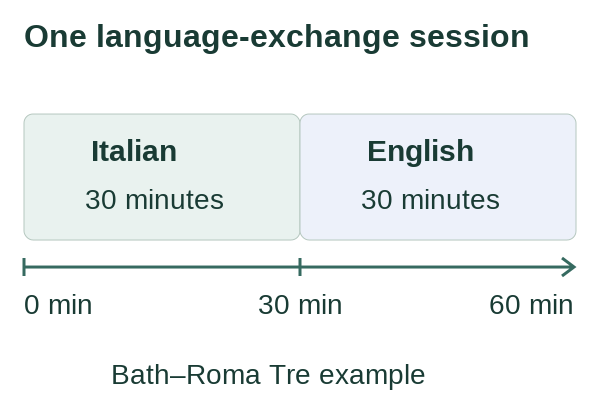
At the University of Limerick, a tandem language exchange run by the Language Learning Hub brings these two groups together in both semesters of the academic year. It attracts over two hundred students, including undergraduates, some postgraduates and international students of many nationalities. The scheme is offered across the faculties of Humanities, Business, Education and Engineering, to students whose second language competence ranges from elementary to advanced. The organisers drew on 15 years of experience of pairing foreign and home students to describe the organisational and pedagogical challenges such schemes meet. The Language Learning Hub added support measures of several kinds, aimed at building cultural awareness and supporting linguistic diversity among students.[60]
A teletandem project joined English speaking Spanish students at Georgia College in the USA with Spanish speaking English students at Universidad de Concepción in Chile. Students held monthly synchronous conversations over Skype and Google Hangouts, interviewing each other and exchanging information about their lives and cultures. The project added a monthly blog and a video report in which students talked about their partner and reflected on the learning experience.[61] A pilot in a Brazilian university merged blended learning with tandem learning inside a regular English course in a School of Business and Hospitality.[62]
AlpConnectar, launched in 2013, is a Swiss project that uses digital technology for language exchange in primary schools. It involves three Swiss cantons where German, French and Italian are spoken and are taught as foreign languages from the third grade of primary school. The project collected data from both pupils and teachers to judge how the exchanges worked. Its results suggest that digital technology brings significant benefits for language exchanges but is no silver bullet, since the impact depends on a number of contextual variables.[63]
In a tandem project between two universities, a small block of managed work was built into the course programme. When academic exchange programmes became harder to run, teachers of Serbian and Russian as foreign languages chose e-tandem learning and added a small block of managed tandem work to the course. The project involved 8 third-year students from Belarusian State University and 16 third-year students from the University of Belgrade. The authors tested and described techniques for organising this controlled work and identified the main problems in applying the method.[64] The Limerick organisers likewise treated pairing as a pedagogical task and offered recommendations for running this kind of peer-to-peer exchange in universities.[60]
Learners, teachers and institutions
One program paired students at a university in the U.S. with students at a university in Korea for six online video sessions in the fall semester of 2023. A survey and informal interviews afterwards indicated that the exchange improved the learners' Korean speaking skills and cultural comprehension.[65] During the pandemic, intermediate German courses at a private research university on the East Coast of the U.S. began linking students with German-speaking older adults. The partners lived in Germany and in the U.S. Since Spring 2021, those students have met their partners in tandem, whole-group or mixed formats, using landlines, video calls and messaging tools. The program set course outcomes that include intergenerational, intercultural and language learning, and greater awareness of the challenges older adults face.[66]
Teachers who run tandem inside a course interact with students less than in face-to-face tandem or ordinary classroom instruction. A Finnish case study of virtual classroom tandem, in which two students with different first languages learn from each other in a two-way partnership, recorded teacher activity on video and screen. It found that tandem lessons were strongly student-centred, and that teacher interaction during them was clearly narrower than in face-to-face tandem or in classroom teaching generally.[67] Teacher educators who build such projects into language teacher preparation courses describe practical complexities alongside benefits for trainees and for themselves. Three teacher educators based in the United States and Poland drew those themes from their own conversations and reflective essays about multinational telecollaborative projects.[68]
One German programme tied its exchange work to institutional goals for diversity, equity, inclusion and belonging. The German service-learning program aims to support the institution's strategic goals for diversity, equity, inclusion and belonging through community engagement and partnership formation. It also creates opportunities for instructors to collaborate with each other and with students, and for community-engaged research.[66]
A large quantitative study followed 622 pre-service teachers in 23 virtual exchanges across 34 institutions in 16 countries. Its first study compared 151 pre-service teachers in an experimental group with 77 in a control group, and its second study used 20 exchanges and 394 participants. Contrary to the researchers' expectations, the experimental group did not show greater growth in technological, pedagogical and content skills, which combine technology knowledge with subject and teaching knowledge. Participants who strengthened those skills during the exchange were more likely to develop language competence. The researchers concluded that exchanges do not produce such skills and language competence by osmosis, and urged researchers to reflect carefully on claims that something worked when no comparison group was included.[3]
Tandem learning in university language courses
One German-Polish example was a joint cooperation seminar run in real time on both sides between Adam Mickiewicz University in Poznań and the Technical University of Darmstadt. In mixed German-Polish tandems, students from the Darmstadt Language Centre and Applied Linguistics students in Poznań made video podcasts of their own and presented them. The author drew on a quantitative and qualitative analysis of student questionnaires to discuss possible forms of tandem work and the main achievements of the cooperation, then set out new questions for developing an e-tandem model for university language courses.[69]
Tandem arrangements have also been attached to formal exam preparation. An online learning system for Italian and German was created to help residents of the Autonomous Province of Bolzano/Bozen prepare the bilingual proficiency exam, and it combined a dictionary with e-mail tandem.[70]
For teachers, a separate interface was built for the Electronic Tandem Resources site, which supports placing e-mail tandem activities inside foreign language classes and addresses the difficult issue of assessing performance and evaluating tasks. Monitoring computer-mediated exchanges between students in different countries is hard for teachers, yet there is evidence that monitoring helps in certain situations. The teacher interface requires only basic computer skills. It reports when the latest messages were sent, how many words each student wrote, and what share of text each student produced in the first and second language, but not what the messages said. A slightly different version was designed for researchers evaluating second language learning in an electronic tandem setting, with features for setting up experiments and controlling variables, and it records time stamps for sent and received messages.[71]
Online platforms and self-directed exchange
One evaluation of an online language exchange platform took self-directed learning and e-tandem language learning as part of its theoretical framework. It gathered interviews with the founder, an administrator and some users, and surveyed 413 users with a 26-item instrument in 7 dimensions. One evaluation of the Free4Talk website drew on interviews with its founder, an administrator and several users, and on a 26-item questionnaire with 7 dimensions answered by 413 people on the site. Users described the platform as free and reasonably safe. They reported gains in expressive language competency, the ability to produce language in speech or writing, and a social setting that gave them reason to keep learning. The same evaluation found the platform served both people who had finished their formal foreign language training and students still enrolled at schools.[72]
One qualitative study interviewed five eighth-semester English Education students at the State Islamic University of North Sumatera, chosen by purposive sampling. The students said the application helped them improve their speaking and that its call and video call features helped most.[73] Three students at Muhammadiyah University Surakarta who had taken part in a 6-month virtual exchange with a partner university said in interviews, using the same 8 questions for each, that their English speaking had improved.[74]
Chat rooms can also be built into a class so that each partner alternately acts as the expert and as the novice. A longitudinal case study paired Korean-speaking and English-speaking peers who were each learning the other's language and set them chat homework. The chats showed learners taking up language practices, becoming more aware of themselves in relation to others, and building meaning as each partner in turn took the expert and the novice role.[75]
What this looks like when you study
The intervention included two physical reunions with the partner class, plus preparatory and follow-up activities. German-speaking pupils' speaking skills and general language competence improved, but their writing skills did not improve significantly. The researchers concluded that short encounters at primary school level can spur language development if they are well embedded in teaching.[21]
The project followed two principles: reciprocity, meaning partners support one another equally, and learner autonomy, meaning partners are responsible for their own learning.[6] In a Spanish-English e-mail exchange between a university in Madrid and one in Massachusetts, students exchanged personal, linguistic and sociocultural information and corrected each other's language. The project also included a discussion forum, and the researchers noted that more work is needed on how best to assess language improvement through e-mail tandem learning.[58]
In a telecollaboration study, 38 learners of German at a US university were assigned to peer feedback, teacher feedback, or no feedback conditions. Every week, each learner wrote two messages to the partner, one in German and one in English. All learners strongly believed in the effectiveness of telecollaboration and corrective feedback, which is feedback that points out and corrects errors.[14]
Later developments
Tools and modes from e-mail to virtual reality
One five-month project paired 53 learners of English in Taiwan with 56 learners of Chinese in the United States through voicemail. That project reported a change in the English speaking performance and intercultural awareness of the learners in Taiwan, and it raised their motivation to use English to express ideas.[76]
Wang and Fang and Han and Chen (2016) describe an instant messenger that carries interaction in real time, in semi-synchronous turns, or as messages read later, through text, audio and video.[77] In a survey of 30 students at universities in Indonesia, most reported significant benefits from chat technology inside tandem exchange, and most felt comfortable or very comfortable using it. The same survey recorded some obstacles, and the researchers called for better guidance and support so that chat use becomes more effective and satisfying.[78] A review of one tandem application found that it offered customized learning preferences, practice of productive skills, feedback in more than one mode, and intercultural awareness. That review also listed concerns: misuse of the application, the linguistic expertise of participants, possible cultural issues, and data security.[79]
In one video-based partnership between universities in the United States and Mexico, 18 students formed 9 pairs of English and Spanish speakers. Analysis of the talk found a remarkably even spread of language related episodes, which are moments when partners work on a language problem. First-language and second-language speakers took equal responsibility for understanding and output. The researchers read this as evidence that each partner held the roles of learner and expert at the same time.[80]
An earlier satellite exchange linked a class at the University of California, Los Angeles with students in Spain. The device was a photophone, which showed a still picture of the partner on a small screen during the call. That project was judged a success for motivation, language learning and cultural awareness, yet the report noted its limitations and asked for more projects and substantial research.[81]
Virtual reality exchanges rest on immersion, presence, authentic simulation and perspective-taking. A review of virtual reality exchanges found that they can raise motivation, engagement and confidence by giving contextualized practice in safe environments. The same review found the evidence inconclusive on whether virtual reality builds better overall intercultural competence than telecollaboration or study abroad. Methodological limitations and confounding variables, which are outside factors that may explain a result, weaken the comparisons. Cost, technical issues, cybersickness (the nausea some people feel in headsets), and the need for teaching design and teacher training all limit what virtual reality can deliver.[82] One social virtual reality application for German paired tandem partners with entertaining team tasks inside a narrative adventure, aiming at oral discourse skills and fluency. Its designers built the tasks to relieve pairs of overstraining autonomy and self-guidance, and they studied the recorded interaction for role behaviour and the link between task design and communication.[83]
Criticism
Problems, limits and open questions
A first problem is trust: a language exchange app may not be used mainly for language practice. A 2024 case study of two identical language exchange applications asked whether users were genuinely exchanging a target language or using the apps as a disguise for finding friends and building relationships.[84]
Partners can also disagree about what counts as taking part. In a six-week online project, American learners of Japanese and Japanese learners of English discussed set topics and completed reflective tasks in pairs across the Pacific. Two pairs developed conflicts because the partners defined successful participation differently. In one pair, the Japanese participant negotiated an imbalanced division of labor caused by her passiveness by deliberately changing her behavior. In the other, the American participant felt frustration and disappointment because his partner treated prompt replies, rather than active engagement in discussion, as success. Each partner's local definition shaped both their actions and their overall judgment of the exchange.[85]
Turnbull and colleagues describe the American teacher candidates' monolingual backgrounds as challenged during the collaboration. The American students defined translanguaging, the mixing of languages within one piece of communication, in varied ways. Some described several languages in one discourse; others described using or not using translation to aid understanding. The analysis found little evidence that they adopted a translanguaging stance, and no sudden insights that connected these negotiations to their future classrooms. Even so, the experience loosened the walls between single-language thinking and real-world language use.[86]
Virtual exchange began with bilingual North-North partnerships and has since expanded to North-South exchanges and partnerships with conflict zones. A 2025 article names six areas of concern, among them structural inequalities in project design that risk reproducing dominance of the Global North. It also lists communication barriers in lingua franca settings, where a shared language such as English gives privileged learners an advantage. Further concerns are the psychological risks of pairing students with partners in conflict zones, political and institutional pressure around controversial partnerships, and whether projects produce genuine social impact or only token engagement. The article also asks how programs can keep students motivated when those students already have international experience.[87]
Lee and Sauro group common assessment practices in virtual exchange into three kinds. These are tracking change in learners' language use over time, comparing pretest and posttest scores, and relying on students' own reports or records of learning. The paper offers guidelines from the field of language assessment for choosing classroom-based and standardized tools, worked through with an existing exchange scenario. Its stated aim is to improve practitioners' assessment literacy, the ability to choose and use tests well.[88]
Research on virtual exchange has left some areas underexplored, misapplied or even over applied in formal teaching. A 2022 reflection on research and practice covers language development, assessment of that development, and intercultural competence, across primary, secondary and university settings.[89]
Common misconceptions
Many people believe that virtual exchange automatically builds technological and language skills, but a large-scale study found this is not so. In a study of 622 pre-service teachers in 23 virtual exchanges across 16 countries, participants in the experimental condition did not have higher technological pedagogical and content skills growth than the control condition. The authors concluded that virtual exchanges do not generate these skills by osmosis, meaning without deliberate effort.[3]
Key studies
| Year | Study | Sample | Design | Finding |
|---|---|---|---|---|
| 2005 | Cziko[1] | overview paper on tandem and eTandem history and media | Tandem began in face-to-face settings and now links partners in different countries through electronic communication, called eTandem. | |
| 2012 | Brandl[40] | 86 beginning learners of German | experimental study comparing optional and required tasks under synchronous and asynchronous conditions | Learners produced significantly more output on the optional task, measured by target language counts and by c-unit counts, and they made fewer errors on the required task. |
| 2016 | AKIYAMA & SAITO[23] | 30 learners of Japanese in the United States | longitudinal study of video-based eTandem course | Vocabulary grew significantly and grammar improved somewhat, while gains in overall comprehensibility varied widely among the 30 learners; a rise in speech rate was the strongest predictor of which individuals improved. |
| 2019 | Lee & Song[5] | 150 students in study abroad, telecollaboration, and on-campus conditions | mixed-methods study comparing three conditions over 6 weeks | Study abroad and telecollaboration groups showed significant improvement in perceived cognitive, affective, and behavioral aspects of ICC, while the on-campus group showed little change. |
| 2019 | Resnik & Schallmoser[4] | qualitative interview study of 19 students of English at an Austrian university paired with students of German in the UK and the USA | A majority of interviewees felt e-tandem contributed to their foreign language enjoyment. | |
| 2021 | Conti[10] | 13 Italian learners and 6 speakers of Chinese as a first language met face to face in a tandem program lasting three months, and the sessions were recorded and transcribed | Empirical evidence shows a strong preference for repetitions and frequent code-switching to Italian; clarification requests were mainly used to initiate negotiation routines, and confirmation checks mostly occurred in routine reiterations. | |
| 2022 | Rienties et al.[3] | 622 pre-service teachers in 23 virtual exchanges across 16 countries | large-scale quantitative two-study design | The experimental group showed no greater growth in TPACK skills than the control group, a result confirmed in the larger second study. In that study, learners who already had stronger TPACK skills and strengthened them further during the exchange were more likely to develop perceived foreign language competence. |
| 2022 | Smeaton et al.[19] | 19 English-speaking students at lower intermediate-intermediate level (B1/B2) in French | analysis of conversational volatility in 86 tandem telecollaboration calls over one semester | Engagement changed in markedly different ways from one meeting to the next: some students took a more active part as the meetings went on, and others showed no change in how they interacted. |
| 2023 | Heinzmann et al.[21] | 392 pupils from German- and French-speaking Switzerland in 5th and 6th grade | quasi-experimental pre-test post-test with intervention and control group | The intervention had a positive impact on speaking skills and general language competence, but no significant impact on writing skills. |
| 2024 | Sippel & Martin[14] | 38 learners from a second-semester German course at a US university | mixed-methods study with peer feedback, teacher feedback, and control conditions | All learners strongly believed in the effectiveness of telecollaboration and corrective feedback, but the teacher feedback group found telecollaboration significantly less enjoyable than the peer feedback group. |
| 2025 | Cadoux & Quezada[24] | 35 B1-level English students in Ecuador | quantitative experimental study with pre- and post-test | The experimental group showed a 1% increase in comprehensibility over the control group, while the control group showed a higher increase in intelligibility. |
| 2025 | Převrátilová[9] | thematic analysis of reflective diaries and open-ended questionnaires | Learners brought in languages other than the two target ones to keep talk going, to work out meaning, and to compare linguistic and cultural features; translanguaging served as a strategy in interaction and as a resource in writing. | |
| 2025 | You et al.[52] | 65 students, including 46 Taiwanese and 19 New Zealand students | mixed-methods design using an intercultural sensitivity scale administered before and after the course, together with students' reflective essays | The Quality Talk model integrated with telecollaboration enhanced students' intercultural understanding and sensitivity, helped build confidence, and made telecollaboration more enjoyable. |
| 2026 | Skidmore[31] | students learning English in a 10-week multicultural virtual exchange project with participants from 10 different countries | mixed-methods study using a survey based on Dörnyei's L2 motivational self system and Yashima's theories | After the 10-week exchange, participants saw themselves as more capable speakers, were more motivated to improve for their ideal future selves, and held a broader view of their place in the wider world; motivation rooted in responsibility towards others declined. |
See also
References
- Cziko, G. (2005). Electronic Tandem Language Learning (eTandem). CALICO Journal, 22(1), 25-39. doi:10.1558/cj.v22i1.25-39
- Zhou, A. (2023). Investigating the impact of online language exchanges on second language speaking and willingness to communicate of Chinese EFL learners: a mixed methods study. Frontiers in Psychology, 14. doi:10.3389/fpsyg.2023.1177922
- Rienties, B., Lewis, T., O’Dowd, R., Rets, I., & Rogaten, J. (2022). The impact of virtual exchange on TPACK and foreign language competence: reviewing a large-scale implementation across 23 virtual exchanges. Computer Assisted Language Learning, 35(3), 577-603. doi:10.1080/09588221.2020.1737546
- Resnik, P., & Schallmoser, C. (2019). Enjoyment as a key to success? Links between e-tandem language learning and tertiary students’ foreign language enjoyment. Studies in Second Language Learning and Teaching, 9(3), 541-564. doi:10.14746/ssllt.2019.9.3.6
- Lee, J., & Song, J. (2019). Developing intercultural competence through study abroad, telecollaboration, and on-campus language study. Language Learning & Technology, 23(3), 178-198. doi:10.64152/10125/44702
- Little, D., & Ushioda, E. (1998). Designing, implementing and evaluating a project in tandem language learning via e-mail. ReCALL, 10(1), 95-101. doi:10.1017/s0958344000004304
- Batardière, M. T., & Jeanneau, C. (2020). Towards Developing Tandem Learning in Formal Language Education. Recherche et pratiques pédagogiques en langues de spécialité - Cahiers de l'APLIUT, Vol. 39 N°1. doi:10.4000/apliut.7842
- Dooly, M. (2023). Language Teaching, Language Learning, and Virtual Exchange in an Age of Complexity: . International Journal of Computer-Assisted Language Learning and Teaching, 12(3), 1-18. doi:10.4018/ijcallt.316459
- Převrátilová, S. (2025). Tandem language exchange as a space to foster plurilingualism in higher education: reflections on languages other than English. Journal of Multilingual and Multicultural Development, 1-18. doi:10.1080/01434632.2025.2566382
- Conti, S. (2021). Negotiation in Chinese as a foreign language: Italian learners’ signal strategies in a tandem-learning context. Quaderni di Linguistica e Studi Orientali, 7, 289-313. doi:10.13128/qulso-2421-7220-12012
- Wang, Y., & Tian, J. (2013). Negotiation of Meaning in Multimodal Tandem Learning via Desktop Videoconferencing: . International Journal of Computer-Assisted Language Learning and Teaching, 3(2), 41-55. doi:10.4018/ijcallt.2013040103
- Canals, L. (2023). Translanguaging practices and metalinguistic reflection during negotiation of meaning in tandem virtual exchanges. Bellaterra Journal of Teaching & Learning Language & Literature, 16(3), e1135. doi:10.5565/rev/jtl3.1135
- Canals, L. (2022). The role of the language of interaction and translanguaging on attention to interactional feedback in virtual exchanges. System, 105, 102721. doi:10.1016/j.system.2022.102721
- Sippel, L., & Martin, I. A. (2024). Learners’ perceptions of corrective feedback during written telecollaboration. Language Teaching Research. doi:10.1177/13621688241298741
- Vinagre, M., & Muñoz, B. (2011). Computer-mediated corrective feedback and language accuracy in telecollaborative exchanges. Language Learning & Technology, 15(1), 72-103. doi:10.64152/10125/44238
- Ahn, T. y. (2016). Learner agency and the use of affordances in language-exchange interactions. Language and Intercultural Communication, 16(2), 164-181. doi:10.1080/14708477.2015.1125911
- Nishioka, H. (2014). Activiating the Zone of Proximal Development of Japanese Language Learners: Language-Exchange Partnerships (LEPs) at an Australian University. New Voices, 6, 45-171. doi:10.21159/nv.06.06
- Jiwon Lee (2022). Application of Metapragmatics to Language-Learning Research: A Longitudinal Study of Word Learning in Language Exchange Conversations. English as a Foreign Language International Journal, 26(3), 47-75. doi:10.56498/3312632022
- Smeaton, A., Dey-Plissonneau, A., Lee, H., Liu, M., & Scriney, M. (2022). Analysis of Individual Conversational Volatility in Tandem Telecollaboration for Second Language Learning. European Conference on e-Learning, 21(1), 390-397. doi:10.34190/ecel.21.1.590
- Rampazzo, L., & Aranha, S. (2019). Telecollaboration and genres: a new perspective to understand language learning. Journal of Virtual Exchange, 2, 7-28. doi:10.21827/jve.2.35637
- Heinzmann, S., Paul, S., Hilbe, R., Schallhart, N., & Cuenat, M. E. (2023). Development of productive language skills through language exchange in primary schools in Switzerland – An exploratory intervention study. European Journal of Applied Linguistics, 11(1), 98-131. doi:10.1515/eujal-2021-0024
- Schenker, T. (2017). Synchronous Telecollaboration for Novice Language Learners: Effects on Speaking Skills and Language Learning Interests. Alsic, Vol. 20, n° 2. doi:10.4000/alsic.3068
- AKIYAMA, Y., & SAITO, K. (2016). Development of Comprehensibility and its Linguistic Correlates: A Longitudinal Study of Video‐Mediated Telecollaboration. The Modern Language Journal, 100(3), 585-609. doi:10.1111/modl.12338
- Cadoux, S., & Quezada, H. (2025). The effects of language exchange via videoconferencing on comprehensibility and intelligibility as perceived by native English speakers. Mamakuna(25), 34-44. doi:10.70141/mamakuna.25.1152
- Ariyanti, A. (2020). EFL Students’ English Language Development: In Participation of International Exchange Program. IJELTAL (Indonesian Journal of English Language Teaching and Applied Linguistics), 4(2), 309. doi:10.21093/ijeltal.v4i2.492
- Hirotani, M., & Lyddon, P. A. (2013). The Development of L2 Japanese Self‐Introductions in an Asynchronous Computer‐Mediated Language Exchange. Foreign Language Annals, 46(3), 469-490. doi:10.1111/flan.12044
- Fondo, M., & Jacobetty, P. (2020). Exploring affective barriers in virtual exchange: the telecollaborative foreign language anxiety scale. Journal of Virtual Exchange, 3(SI), 37-61. doi:10.21827/jve.3.36083
- Aladini, A., & Gheisari, A. (2025). Exploring motivation, willingness to communicate, and intercultural competence development in digital language exchanges: An integrative theoretical approach. Computers in Human Behavior Reports, 20, 100819. doi:10.1016/j.chbr.2025.100819
- Vierendeels, I., & Mettewie, L. (2024). Can a Tandem Tame a Bed Monster? Foreign Language Speaking Anxiety, Enjoyment, and Informality in a Tertiary Chitchatting E-Tandem. Journal for the Psychology of Language Learning, 6(2). doi:10.52598/jpll/6/2/3
- Pakpahan, E. M., & Gultom, I. (2022). Overcoming foreign language speaking anxiety by using a language exchange website in online learning. PROJECT (Professional Journal of English Education), 5(2), 385. doi:10.22460/project.v5i2.p385-394
- Skidmore, M. (2026). Effects of participation in an online intercultural exchange on drivers of L2 learning motivation. Language Teaching Research, 30(1), 430-448. doi:10.1177/13621688231153622
- USHIODA, E. (2000). Tandem language learning via e-mail: from motivation to autonomy. ReCALL, 12(2), 121-128. doi:10.1017/s0958344000000124
- Al Khateeb, A. A., & Hassan, M. (2023). Initiating Intercultural Communicative Competence through Telecollaboration: A Case of Language-Exchange Classrooms of Arabic and English. Journal of Ethnic and Cultural Studies, 10(4), 175-192. doi:10.29333/ejecs/1718
- Freiermuth, M. R., & Huang, H. (2021). Zooming across cultures: Can a telecollaborative video exchange between language learning partners further the development of intercultural competences? Foreign Language Annals, 54(1), 185-206. doi:10.1111/flan.12504
- Schenker, T. (2013). The Effects of a Virtual Exchange on Students' Interest in Learning About Culture. Foreign Language Annals, 46(3), 491-507. doi:10.1111/flan.12041
- Robinson, L., & Manegre, M. (2025). Fostering intercultural competence through an asynchronous virtual exchange in secondary-level foreign language classes. Journal of Virtual Exchange, 8, 105-126. doi:10.21827/jve.8.42104
- Casañ-Pitarch, R., & Candel-Mora, M. Á. (2026). Developing global-mindedness in the foreign language classroom through telecollaboration. Journal of Virtual Exchange, 9, 29-51. doi:10.21827/jve.9.41516
- Acosta Fuentes, R., & Valdiri Suesca, A. A. (2025). Cultivating Language Learning Through Cultural Sensitivity and Empathy. An e-Tandem Case Study of Mexican and Canadian Students. Revista Lengua y Cultura, 6(12), 29-35. doi:10.29057/lc.v6i12.14337
- Tolosa, C., Ordóñez, C. L., & Guevara, D. C. (2017). Language Learning Shifts and Attitudes Towards Language Learning in an Online Tandem Program for Beginner Writers. PROFILE Issues in Teachers' Professional Development, 19(1), 105. doi:10.15446/profile.v19n1.53955
- Brandl, K. (2012). Effects of required and optional exchange tasks in online language learning environments. ReCALL, 24(1), 85-107. doi:10.1017/s0958344011000309
- Wigham, C. R., & Whyte, S. (2024). Teacher role in synchronous oral interaction: Young learner telecollaboration. Language Learning & Technology, 28(1), 1-27. doi:10.64152/10125/73599
- Türkel, T., & Brogaard, C. (2025). Using Machine Translation as a Self-Directed Language Learning Tool for Low-Proficiency LCTL Learners in a Tandem Partnership. CALICO Journal, 42(1), 143-164. doi:10.3138/calico-2024-1219
- Oakley, G., Pegrum, M., Xiong, X. B., Lim, C. P., & Yan, H. (2018). An online Chinese-Australian language and cultural exchange through digital storytelling. Language, Culture and Curriculum, 31(2), 128-149. doi:10.1080/07908318.2017.1386193
- Cappellini, M., & Hsu, Y. Y. (2020). When future teachers meet real learners through telecollaboration: an experiential approach to learn how to teach languages online. Journal of Virtual Exchange, 3, 1-11. doi:10.21827/jve.3.35751
- Çiftçi, E. Y., & Savaş, P. (2018). The role of telecollaboration in language and intercultural learning: A synthesis of studies published between 2010 and 2015. ReCALL, 30(3), 278-298. doi:10.1017/s0958344017000313
- Di Sarno-García, S. (2023). The Development of Foreign Language Students’ Intercultural Communicative Competence through Telecollaboration. The EuroCALL Review, 30(1), 35-51. doi:10.4995/eurocall.2023.16693
- Schuetze, U. (2008). Exchanging Second Language Messages Online: Developing an Intercultural Communicative Competence? Foreign Language Annals, 41(4), 660-673. doi:10.1111/j.1944-9720.2008.tb03323.x
- Bohinski, C. A., & Leventhal, Y. (2015). Rethinking the ICC Framework: Transformation and Telecollaboration. Foreign Language Annals, 48(3), 521-534. doi:10.1111/flan.12149
- Ennis, M. J., Verzella, M., Montanari, S., Sendur, A. M., Simeonova Pissarro, M., Kaiser, S., & Wimhurst, A. (2021). A Telecollaboration Project on Giving Online Peer Feedback: Implementing a Multilateral Virtual Exchange During a Pandemic. Journal of Language and Education, 7(4), 66-82. doi:10.17323/jle.2021.11914
- Rienties, B., & Rets, I. (2022). The impact of virtual exchange on East–West social relations: lessons from a China-Portugal foreign language exchange. Journal of China Computer-Assisted Language Learning, 2(1), 1-19. doi:10.1515/jccall-2021-0003
- Machwate, S., Bendaoud, R., Henze, J., Berrada, K., & Burgos, D. (2021). Virtual Exchange to Develop Cultural, Language, and Digital Competencies. Sustainability, 13(11), 5926. doi:10.3390/su13115926
- You, H. J., Yeh, H. C., & Qi, G. Y. (2025). Fostering intercultural sensitivity in language learning: Quality talk in telecollaboration. Language Learning & Technology, 29(1), 1-26. doi:10.64152/10125/73624
- Canals, L. (2024). “It was like a mental Erasmus!” Perceptions of language learning and intercultural understanding in an e-tandem virtual exchange. Journal of Virtual Exchange, 7, 60-83. doi:10.21827/jve.7.41056
- Chen, J. J., & Yang, S. C. (2016). Promoting cross-cultural understanding and language use in research-oriented Internet-mediated intercultural exchange. Computer Assisted Language Learning, 29(2), 262-288. doi:10.1080/09588221.2014.937441
- Helm, F., & Acconcia, G. (2019). Interculturality and language in Erasmus+ Virtual Exchange. European Journal of Language Policy, 11(2), 211-233. doi:10.3828/ejlp.2019.13
- Spenader, A. J. (2011). Language Learning and Acculturation: Lessons From High School and Gap‐Year Exchange Students. Foreign Language Annals, 44(2), 381-398. doi:10.1111/j.1944-9720.2011.01134.x
- Warden, M., Lapkin, S., Swain, M., & Hart, D. (1995). Adolescent Language Learners on a Three‐Month Exchange: Insights from their Diaries. Foreign Language Annals, 28(4), 537-550. doi:10.1111/j.1944-9720.1995.tb00827.x
- Vinagre, M. (2005). Fostering language learning via email: An English – Spanish exchange. Computer Assisted Language Learning, 18(5), 369-388. doi:10.1080/09588220500442749
- KUNG, S. C. (2002). Evaluation of a team model of digital language exchange. ReCALL, 14(2), 315-326. doi:10.1017/s0958344002000824
- Batardière, M. T., & Jeanneau, C. (2015). Facilitating a Face-To-Face Tandem Language Exchange on a University Campus. Studies in Self-Access Learning Journal, 288-299. doi:10.37237/060305
- Castillo-Scott, A. (2015). Pan-American teletandem language exchange project. The EuroCALL Review, 23(1), 36. doi:10.4995/eurocall.2015.4661
- De Oliveira, U. T. V. (2017). Language learning in Blended And Tandem with Brazilian partners: flexible learning models / Ensino de línguas em Blended e Tandem com parceiros brazileiros: modelos de ensino flexíveis. Texto Livre: Linguagem e Tecnologia, 10(2), 123-144. doi:10.17851/1983-3652.10.2.123-144
- Botturi, L., Kapler, D., & Negrini, L. (2018). Digitally-supported language exchanges in primary school: The AlpConnectar project. Studies in Second Language Learning and Teaching, 8(4), 795-843. doi:10.14746/ssllt.2018.8.4.5
- Наумова, А. В., & Меденица, Л. (2022). Tandem learning a foreign language (an experience of cooperation between two universities). Russkii iazyk za rubezhom(5(294)), 105-111. doi:10.37632/pi.2022.294.5.013
- The Research Society for the Korean Language Education, Na, E., & Na, E. (2024). A Case Study on Learning Korean Using Online Language Exchange. The Research Society for the Korean Language Education, 22, 93-112. doi:10.25022/jkler.2024.22.093
- Fuchs, C. (2024). Intergenerational service-learning through virtual exchange across a foreign language program. Journal of Virtual Exchange, 7, 107-122. doi:10.21827/jve.7.41313
- Hansell, K., Pörn, M., & Bäck, S. (2021). Teachers’ interaction in combined physical and virtual learning environments:: A case study of tandem language learning and teaching in Finland. Apples - Journal of Applied Language Studies. doi:10.47862/apples.98339
- Wach, A., Tanghe, S., & Zhang, D. (2024). Multinational telecollaboration in language teacher education: Teacher educators’ perspectives. Language Learning & Technology, 28(1), 1-13. doi:10.64152/10125/73590
- Adamczak-Krysztofowicz, S. (2018). Wie nützlich ist Sprachlerntandem? Formen, Potenziale und Grenzen der Tandemarbeit beim E-Tandemlernen in universitären Sprachkursen. Glottodidactica, 45(2), 39-54. doi:10.14746/gl.2018.45.2.01
- WEBER, V., & ABEL, A. (2003). Preparing language exams: an online learning system with dictionary and email tandem. ReCALL, 15(2), 169-176. doi:10.1017/s0958344003000326
- APPEL, C., & MULLEN, T. (2002). A new tool for teachers and researchers involved in e-mail tandem language learning. ReCALL, 14(2), 195-208. doi:10.1017/s0958344002000228
- Ondokuz Mayis University Faculty of Education, Gelen, İ., English Language Teacher, & Tozluoglu, E. (2021). Evaluation of Online Language Exchange Platforms: The Example of 'Free4Talk'. International Journal of Progressive Education, 17(2), 352-368. doi:10.29329/ijpe.2021.332.22
- Nurul Mifta Lubis, Emeliya Sukma Dara Damanik, & Maryati Salmiah (2024). Students’ Perception on Tandem: Language Exchange Application As a Learning Media to Improve Speaking Skills. Jurnal Nakula : Pusat Ilmu Pendidikan, Bahasa dan Ilmu Sosial, 2(5), 327-345. doi:10.61132/nakula.v2i5.1090
- Desla Fitria, & Agus Wijayanto (2024). Students’ Perception about Online Language Exchange Program to Enhancing Their English-Speaking Ability. Ethical Lingua: Journal of Language Teaching and Literature, 11(2). doi:10.30605/25409190.761
- Chung, Y. G., Graves, B., Wesche, M., & Barfurth, M. (2005). Computer-Mediated Communication in Korean-English Chat Rooms: Tandem Learning in an International Languages Program. The Canadian Modern Language Review, 62(1), 49-86. doi:10.3138/cmlr.62.1.49
- Wang, A. Y., & Chang, W. J. (2011). Developing Intercultural Awareness and Language Speaking Proficiency for Foreign Language Learners through Cross–Cultural Voicemail Exchange: . International Journal of Computer-Assisted Language Learning and Teaching, 1(4), 17-32. doi:10.4018/ijcallt.2011100102
- Wang, Y., Fang, W. C., Han, J., & Chen, N. S. (2016). Exploring the affordances of WeChat for facilitating teaching, social and cognitive presence in semi-synchronous language exchange. Australasian Journal of Educational Technology. doi:10.14742/ajet.2640
- Ambas, J., Touwe, Y. S., Wenny J, S., & Abdullah, D. (2024). Integration of Chatting Technology in the Tandem Language Exchange Learning Process. International Journal of Language and Ubiquitous Learning, 1(4). doi:10.70177/ijlul.v1i4.697
- Topal, I. H. (2024). Tandem language exchange application: A telecollaborative experience of linguistic and cultural exchange. Journal of Digital Educational Technology, 4(1), ep2408. doi:10.30935/jdet/14298
- Strawbridge, T. (2021). Modern language: Interaction in conversational NS-NNS video SCMC eTandem exchanges. Language Learning & Technology, 25(2), 94-110. doi:10.64152/10125/73435
- Gallego, J. C. (1992). Tele‐Classes: The Way of the Future A Report on a Language Exchange Via Satellite. Foreign Language Annals, 25(1), 51-58. doi:10.1111/j.1944-9720.1992.tb00513.x
- Zhao, Z. (2025). Immersive Language Exchanges Via Virtual Reality Increase Intercultural Competence in Modern Languages Degrees. International Journal of Education and Social Development, 3(1), 46-57. doi:10.54097/m8fqk863
- Ahlers, T., Bumann, C., Kölle, R., & Lazović, M. (2022). Foreign Language Tandem Learning in Social VR: Conception, Implementation and Evaluation of the Game-Based Application Hololingo! i-com, 21(1), 203-215. doi:10.1515/icom-2021-0039
- Wardak, M. (2024). It’s Tandem, not Tinder! Interrogating Authenticity and Trustworthiness of Language Exchange Applications in Adult Learners: A Central Asian and Middle Eastern Perspective. World Journal of English Language, 14(2), 293. doi:10.5430/wjel.v14n2p293
- Nishio, T., & Nakatsugawa, M. (2020). ‘Successful’ participation in intercultural exchange: Tensions in American-Japanese telecollaboration. Language Learning & Technology, 24(1), 154-168. doi:10.64152/10125/44714
- Turnbull, J., Yazan, B., Uzum, B., & Akayoglu, S. (2025). ‘That was crazy’: Confronting monolingual ideologies and courting translanguaging in international telecollaboration. Language Teaching Research. doi:10.1177/13621688251349519
- O'Dowd, R. (2025). Virtual Exchange in the new educational landscape: Challenges for foreign language teachers. Language Learning & Technology, 29(1), 1-16. doi:10.64152/10125/73659
- Lee, J., & Sauro, S. (2021). Assessing language learning in virtual exchange: suggestions from the field of language assessment. Journal of Virtual Exchange, 4, 33-49. doi:10.21827/jve.4.36087
- Dooly, M., & Vinagre, M. (2022). Research into practice: Virtual exchange in language teaching and learning. Language Teaching, 55(3), 392-406. doi:10.1017/s0261444821000069
Cite this page: Atlas Nova editors. (2026). Language exchange. Atlas Nova. https://velocer.io/atlas/language-exchange/