Theory · Second language acquisition
Interaction hypothesis
Second language acquisition theory
The interaction hypothesis holds that input and interaction with conversation partners let learners notice differences between their own wording and the partners' language. Partners also give feedback that changes the input and pushes learners to change their output.[1]
Learners notice gaps between their own language and a partner's language during talk.[1] A review of many studies found interaction helps second language development.[2] Learners often do not notice grammar feedback, though they notice word and sound feedback.[3] Children negotiate for meaning and use a variety of strategies, and the evidence indicates that primary school learners benefit from the process, though their pattern of use differs from that of adults.[4]
Overview
What the interaction hypothesis claims
The interaction hypothesis is a claim about how people learn a second language, meaning a language learned after the first one.[1] Long's interaction hypothesis dates from 1980, and he set out an updated version in 1996.[7][8] The hypothesis treats talk with other speakers as a main source of learning chances.[1]
In his 1996 version, Long proposed that the language environment shapes learning. This happens through selective attention and the learner's processing capacity while negotiating meaning. Negotiation for meaning is the talk in which partners work through a communication problem. They use moves such as clarification requests, confirmation checks and comprehension checks.[8] The claim is that second language development is better helped when learners take part in this kind of negotiated interaction.[9]
Input and interaction let learners see where their own version of the target language differs from the version their conversation partners use. Feedback is a partner's reply that modifies the language input the learner receives and pushes the learner to modify output.[1] The hypothesis is credited with helping learning in two basic areas: noticing and feedback.[10] Learners do this repair work with interactional modification techniques. These include comprehension checks, confirmation checks, and clarification requests.[9]
In Long's 1996 proposal, selective attention and the learner's processing capacity shape what the environment adds to acquisition.[8] People have called the hypothesis one of the most influential in applied linguistics and language learning.[10]
History
Where the idea came from
The interaction hypothesis comes from a 1980 proposal by Michael Long. The hypothesis gives face-to-face contact between learner and facilitator a central place. That place is in second language teaching.[7] Later writers describe interaction as an essential part of second language acquisition.[2]
The hypothesis drew on three core constructs: input, negotiation for meaning, and output. A 2018 review of instructed second language acquisition research covers classroom and laboratory studies. That review reports that interaction helps second language development. Many factors affect how well it works.[2]
A 1995 review examined second language interaction from the angle of syntax. Syntax is the grammar of sentence structure. That review concluded that earlier studies had described the grammatical nature of interaction in broad terms. It added that they had not shown how interaction affects grammatical development. The review called for closer study of specific grammar structures. These should be judged by relevance, availability, accessibility, and effect. It also asked for finer grammatical measures. These would trace effects on second language syntactic development.[11]
The 2018 review treats the measurement of noticing of linguistic forms during interaction as a methodological issue in its own right. It compares the strengths of classroom studies with those of laboratory studies. It also reviews several methods for measuring what learners notice.[2]
The 2018 review lists output as one of the core constructs of the interactionist approach. It then surveys interaction research on the traits of conversation partners. Those characteristics include first language status, peer interaction, participation structure, second language proficiency, and individual differences. Task features form a second topic. These include task conditions such as information distribution and task goals, task complexity, and participation structure.[2]
Tshering (2021) reports that conversational interaction improved the language development of Bhutanese children at a young age.[12] A 2025 position paper argues that social interaction is the main setting for learning a second language. It uses recordings of one learner of Danish in everyday social activities. It concludes that the interactional histories she builds with friends are central to understanding her learning.[13]
The hypothesis has also been applied to teaching practice. A 2022 paper assesses old and new classroom strategies for oral language development. The original proposal did not cover these. It aims to show teachers and learners new techniques and to reinforce the classical ones.[7]
Main ideas
How negotiation of meaning works in talk
Negotiation of meaning is one of four negotiation types in peer interaction. The others are negotiation of form, of content and of procedure. Xu and Shu (2024) report that each negotiation type starts through particular negotiation strategies. Xu and Shu (2024) studied how groups interacted. Clarification requests were the strategy that most often started negotiation of meaning.[14] Masrizal (2014) discusses three strategies for negotiating meaning.[8]
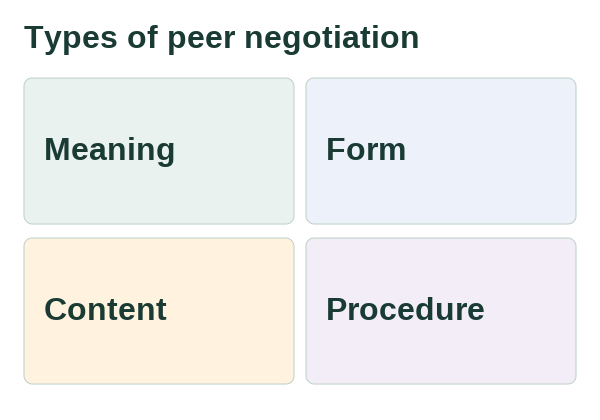
Xu and Shu (2024) found that negotiation of content happened significantly more often than negotiation of meaning and negotiation of form. One study followed 52 Chinese postgraduate students of English. They did five rounds of group work in one semester. Each type had its main strategy. The same study reported both competitive and supportive patterns as the groups developed across the semester.[14]
In Li's (2025) study, negotiation happened more often in information gap tasks than in decision-making tasks. Sixteen Chinese learners of English were observed in an intensive English program. Those students relied mainly on confirmation checks. Their most frequent communication strategies were direct ones, such as switching between languages and mime. Indirect strategies came next, and repetition was the most common of them. Co-construction and appeals for help were used less often.[15]
Lee (2001) reports that quick exchanges in online chat stopped students from producing correct and coherent discourse. This was especially true when learner talked with learner. One study looked at forty students of Spanish chatting in a private room. Learners at every proficiency level used a range of communication strategies. They tended to use comprehension checks, clarification checks, requests and self-repairs when negotiating with one another.[16]
Wang (2020) distinguishes two negotiation types in teacher-student talk. Negotiation of meaning serves a conversational and a teaching function, while negotiation of form is only for teaching. A qualitative study looked at three English teachers and their students at a university in China. It recorded 13 hours and 50 minutes of classroom talk over 11 weeks. The two types differed only slightly in how learners took up the repair, except when negotiation of meaning was didactic in function.[17] In a pragmatics class, negotiation drew students in emotionally, behaviourally and cognitively. The teacher reported one difficulty: how well students grasped vocabulary, idiom and meaning.[18]
Why interaction is thought to help learning
The interaction hypothesis proposes that talk between learners can help language learning. It offers reasons for why that might happen. One reason is that during interaction a learner may get feedback on what he or she says. Feedback in this research covers responses focused on morphosyntactic, lexical and phonological forms. Mackey, Gass and McDonough (2000) state the open question in two parts. How do learners see feedback? Do those views affect their later second language development?[3]
A central question is whether learners actually notice the feedback that researchers believe they receive. One study looked at this with 10 people learning English and 7 learning Italian. The learners did tasks in pairs. Afterwards the learners watched recordings of their own interactions. They reported what had been in their minds during each exchange.[3]
The results showed that learners were fairly accurate about lexical, semantic and phonological feedback. The nature of the feedback and its content may both have shaped how learners perceived it. Mackey, Gass and McDonough (2000) treat learners' views as an issue that has challenged interactional research.[3]
Later work has looked at feedback and repair in interaction between learners in different settings. In one study, 36 students took part in a virtual exchange. They were at two universities in two countries. It had three 40-minute video calls in pairs. The researchers transcribed and analyzed the first call and the last call. The two calls were two and a half months apart. In the last interactive task, learners gave much more feedback than in the first. More repairs and a higher resolution rate followed in one case only. That was when second language speakers had started the episode. The presence of metalinguistic information, meaning talk about language itself, led to an increased number of repairs.[19]
A study of 20 Saudi learners of English examined peer corrective feedback in synchronous computer-mediated communication, where messages are exchanged in real time. Learners were assigned at random to one of two conditions. One group had negotiation on form. The other group had peer interaction only. Peer corrective feedback prompted negotiation on form. This produced significantly more corrective feedback and immediate uptake.[20]
A small clinical study in rural Ghana found that tasks stimulating interaction helped Gonja speakers learning English. The tasks helped them develop question forms. That study used a controlled, small, fast-response design. It argues for scaling up the work in classrooms.[21]
Research
What the evidence shows and how strong it is
A 2010 meta-analysis looked only at 15 classroom-based studies of oral corrective feedback. A meta-analysis combines the results of separate studies. Those 15 studies together included 827 learners. Lyster and Saito (2010) found larger effects for prompts than for recasts. Corrective feedback had its clearest effects on measures that ask for free constructed responses.[5]
The class was either a second language setting or a foreign language setting. This did not count as a contributing factor. Long treatments produced larger effects than short or medium treatments. Those effects could not be told apart from those of brief treatments. A simple regression analysis found an effect for age. Younger learners benefited from corrective feedback more than older learners.[5]
A 2016 meta-analysis compared interaction in two modes. One was face-to-face talk. The other was synchronous computer-mediated communication (SCMC). The analysis covered 14 primary studies. These are the individual studies it pooled. These were published as journal articles and dissertations between 1990 and 2012. Interaction in both modes had a significant effect on second language development. Computer-mediated interaction had a small advantage on measures of overall second language learning outcomes. Further analyses gave computer-mediated interaction a small edge on productive and written measures. Face-to-face interaction had a small edge on listening and speaking outcomes.[22]
A 1997 quasi-experimental study used three groups of 16 child learners of Dutch. The children described pictures aloud to a partner in a communicative task. The children changed their output by different amounts during negotiation. How much depended on the type of negative feedback they received. The negotiations also had significant delayed effects on a later task with a different partner. Learners who had been pushed in earlier negotiations produced a significantly greater quantity of output. A comparison group that had not been pushed produced less. They also gave more essential information. They used a wider range of vocabulary. On that later task, the negotiations did not significantly change how complex the learners' output was in its grammar. They also did not change how grammatically correct it was.[23]
A 1999 pretest-posttest study tested whether conversation helps grammar. It used 34 adult learners of English as a second language. They came from different first-language backgrounds. The results supported a link between interaction and grammatical development. They also stressed how much active participation in the interaction matters. That study noted that other research had not found effects for interaction on grammatical development.[6]
A 2016 experiment tested whether negotiation helps learners learn specific vocabulary words. Forty-three adult students at an intermediate level first took the Preliminary English Test. Thirty of them scored one standard deviation above or below the mean. They were then placed at random in three experimental groups. The treatment ran for 10 sessions. After that, the students took one written test and one oral test. Negotiation improved how well learners understood the targeted second language vocabulary items. It also improved how well they produced them. Adding pushed output to negotiation of input did not lead to more use of the vocabulary. Negotiation of input on its own did just as well.[24]
Age, task type and group size
A common claim in second language research holds that children negotiate meaning less often than adults. They do so at different rates and with fewer moves to check comprehension. That claim rested on comparisons between children and adults from separate studies, not from one study. A 2022 study compared 14 adults and 20 children directly. Both groups were at similar levels of proficiency. They worked on a spoken communicative task with partners matched in level and age. Children negotiated meaning as much as adults did. Both age groups aimed their moves mainly at stopping misunderstandings. The study therefore questions some earlier claims about age. It also sharpens them.[25]
An earlier study looked at 192 children aged 8 to 13. They were paired into 96 pairs matched for age and gender. It found that children do negotiate for meaning and use a variety of strategies. The pattern of use differed from that of adults. But the differences lay in how often each strategy was used, not in whether it appeared at all. The children gained the same kinds of benefit adults are said to gain. These were input they could understand, output they could produce, and feedback on their attempts. The results led the researcher to argue one point. Adult studies cannot be applied to children without research on children themselves.[4]
A 2002 study put 192 children aged 8 to 13 into 96 pairs. The pairs were 32 nonnative with native, 48 nonnative with nonnative, and 16 native with native. The pairing shaped how much negotiation occurred. The least native-like pairs, matched at low proficiency, produced the most negotiation. Amounts fell as pairings became more native-like. Unlike adult studies, age and gender comparisons among these children showed no significant differences.[26]
Task design changes how much negotiation young learners produce. A 2025 study worked with 110 students in Hong Kong aged 10 to 12. They were mainly from Pakistan, India, the Philippines and Nepal. They did tasks in Cantonese. The students were asked to do four tasks. The tasks differed in type. They also differed in how complex they were. Complex tasks drew much more confirmation checks than simple tasks.[27]
Ten medical students at a language centre took speaking tests. The tests used focused and unfocused tasks. They also reported their views. Most found the unfocused task enjoyable. But it did not give them input that improved their language quality, because during negotiation they attended more to meaning. The focused task suited higher proficiency students, and the study judged it unsuitable for lower proficiency students.[28]
Interaction online and across modes
One study looked at four groups of learners of Spanish. The students discussed content questions about a reading assignment in a live text chat. The transcripts showed that negotiation, defined by the Varonis and Gass (1985b) model, did occur in the electronic medium. One special concern was the habit of answering most routines in the native language. That does not produce modified output in the target language. Modified output is said to be fundamental for second language acquisition (Swain, 1985).[29]
Aitsiselmi (1999) analyzed a communicative activity with English learners of French. He weighed its advantages and drawbacks for teachers. That activity was framed within Stephen Krashen's language acquisition theory. The theory separates language acquisition from language learning. In that account, email interaction may address both processes.[30]
Korean university students who lack daily chances to communicate in English can get more practice and more meaning negotiation from a mobile instant messaging application. They did this on different tasks. They found it interesting and useful for their English learning. Some English translation applications were used during the task-based activities.[31]
An evaluation looked at desktop videoconferencing tasks. The tasks were done by distance learners of Chinese. It found that meaning negotiation there may support second language acquisition at a distance. That setting had its own distinct features. The study used the Varonis and Gass (1985) model to find moments of focus on form.[32]
The average number of negotiation exchanges was higher in the face-to-face mode. Task durations were higher there too. Yet the SCMC group noticed more negotiation instances on average (M = 10.72) than the face-to-face group (M = 9.13). The difference was significant. On those results, face-to-face talk gives a better setting for producing negotiation. The SCMC setting leads to more noticing.[33]
Chen and Sevilla-Pavón (2023) studied an exchange in immersive virtual reality. Learners appeared there through avatar-mediated representations. Ten learners using English as a lingua franca took part in a Taiwan-Spain virtual exchange. They completed two tasks on an immersive virtual reality platform. Avatars and other sign systems helped learners signal and clear up moments when they did not understand. Space proxemics and object handling were the two distinct features. They belonged to the virtual reality-supported environment. The study reports that in virtual reality, social interaction shifts from flat to three-dimensional. It also shifts from spoken to physically enacted.[34]
Erawanto, Wijayanti and Farih (2026) used a qualitative descriptive design. They took a digital ethnography approach. They studied Arabic language errors on a social media platform. Errors in Arabic morphology, syntax, vocabulary and speech sounds did not happen at random. They formed patterns that followed a system. Those patterns were shaped by Indonesian as the users' native language, by the demand for rapid digital communication, and by dialectal forms taken from popular culture. Erawanto, Wijayanti and Farih (2026) argue that such errors are not just faults. They can also be read as adaptation by the language and as joint work to settle meaning. User communities frequently normalized the errors as identity expression and communicative creativity.[35]
Negotiation of meaning in real conversations
One project recorded two adult learners of English in Hong Kong. They worked on a shared task about cultural topics. One was stronger in the language than the other. The pair had to reach agreement within a limited time. An observer stayed mostly silent. Clarification requests and recasts, which are indirect kinds of feedback, appeared more often than open correction in this adult talk. A recast was sometimes dropped. This happened when the listener focused on the content of English rather than its form. It was also dropped when the recast ran long. The analyst concluded that a short, precise recast gives more effective feedback in conversation.[36]
Children also negotiate meaning with each other. A field study watched sixty-two children aged two to four in day care centers. The researcher used intensive participant observation. They described four stances that children take as they consider another child's perspective. These stances form a range of interaction. It moves from private understandings to shared objects of attention.[37]
Conversation analysis shows that meaning is managed locally, turn by turn. The ethnography of communication shows that genres set usual expectations. These cover what may be said and what may be inferred. One theoretical paper tries to reconcile these two findings. It combines a model of discourse space with a model of situated conceptualization. It illustrates the argument with two extracts from spoken tourist-information transactions.[38]
Meaning can also be built word by word. In one case, a physician and a patient made up a new compound word for the patient's symptoms. Each turn added specific meaning features, the parts of the new word's meaning. This went on until it fitted usual word-formation patterns while carrying a situated, creative sense. That paper presents a single case study rather than general claims.[39]
Interaction, participation and achievement in classrooms
One 2017 experiment with elementary learners of English as a foreign language compared two ways of organizing grammar practice. Both classes received grammar instruction for twenty sessions. They took multiple-choice grammar tests before and after. Students working in groups negotiated more. Yet their grammar scores were significantly lower than those of students working in pairs. The pair-work students took part less but reached better grammar achievement.[40]
One qualitative study used the Flanders Interaction Analysis Categories System. It found that teachers used all the categories of the system. Teacher talk dominated: the teacher spoke about 77 per cent of the time. Students spoke about 13 per cent. The study advised teachers to give students more chances to speak and interact.[41]
One descriptive study looked at one English teacher and 36 twelfth-grade students. The students were at a vocational school. It coded the exchanges between them. It recorded 54 exchanges about knowledge, 36 about students and 6 about assessment. The researchers read these patterns in one way. The teacher focused on checking understanding of a text. The teacher also worked on reading and speaking skills.[42]
A qualitative study of a third-semester speaking class in Indonesia used observation, a questionnaire and interviews. It found two kinds of interaction during task-based instruction. One was between students and the lecturer, and the other was among students.[43] A study of a language course in Makassar also found the teacher-student pattern to be the dominant one. That study reported good effects from the interaction the teacher used. It linked the most common exchange to the material being taught.[44]
Rooms with technology have been built partly to increase interaction. One study compared them with ordinary rooms. In a quasi-experiment, one experienced English teacher taught one class in a smart classroom. The teacher taught another class in a traditional classroom for one semester. Researchers coded 8 class videos and measured engagement with a questionnaire. There were no significant differences in interaction between people. There were also none in the interaction between people and technology. Students in the smart classroom did report much more engagement.[45]
One study looked at Grade 6 to 9 English lessons in rural Eastern Cape classrooms. It found five turn-taking patterns. Three language varieties were in use: isiMpondo, isiXhosa and English. The study found that turn-taking types were valued differently in class than in everyday settings. It also found that institutional goals and participants' roles shaped turn-taking. They shaped it more than the step-by-step sequence of talk.[46]
One questionnaire study looked at 524 undergraduates in China. It examined how two forms of interaction relate to achievement. A questionnaire study measured two forms of interaction, self-efficacy and learning achievement. It covered 524 undergraduates at Chinese application-oriented universities. Student-content interaction was significantly linked to higher learning achievement. Interaction between students was too. Self-efficacy mediated that relationship, meaning it carried part of the effect. Higher self-efficacy was itself directly linked to better achievement.[47]
A survey of university students majoring in English used a 48-item questionnaire on teacher interaction. It compared teachers' views of their own style with students' views. The researchers proposed that such comparisons can help teachers develop professionally.[48]
How interaction research is measured
Abelson and Prentice (1997) argued that contrasts should test interaction hypotheses set in advance. These were for two-way analysis of variance designs. A 1997 article argued for such contrasts. It described three underused types of interaction contrast test. One is a matching pattern for cognate levels of the row and column factors. A third contrast compares how sharply two profiles curve when both bend the same way. Abelson and Prentice (1997) also gave a way to measure effect size for contrasts.[49]
A second approach adds a multiplicative term to a statistical equation. This models an interaction effect. A 2004 article explained that the statistical significance of the lower-order coefficients is then largely useless. That holds for the usual purposes of hypothesis testing. The article said political science had mostly missed that fact. It offered ideas for reading it in a more meaningful way.[50]
Frequency data, which count how often categories occur, bring a separate problem: dependence, a violation of the assumption that observations are independent. A 1999 study noted that dependence in frequency data is a common problem in second language acquisition research. Researchers usually treat the data as independent. Saito (1999) also named a second problem: interaction terms often get left out. Researchers may run chi-square tests. Multifactorial analyses of frequency data may still be uncommon. Reanalyzing a couple of published data sets, it argued for multifactorial frequency data analyses over multiple chi-squares, so that dependence and interaction are taken into account.[51]
Sutherland and colleagues (2013) noted something about children who show chronic problem behavior. They are more likely to develop negative relationships with their teachers. The system was meant to show whether a classroom intervention changed the pattern of teacher-child interaction. Sutherland and colleagues (2013) gave early results on reliability, meaning how far the system's ratings agree. They also set out the difficulties of gathering observational data directly in classrooms.[52]
In practice
What teachers and learners do with it
Yufrizal (2015) gave Indonesian learners of English as a foreign language three tasks to do in pairs. These were information gap, jigsaw and role-play tasks. In one study, 40 undergraduate learners of English as a foreign language worked in pairs. The information gap tasks produced more negotiation of meaning than the other two types. Pairs of the same gender and the same proficiency level negotiated more. This happened when they were given the information gap and jigsaw tasks.[53]
A replication kept the original methods of collecting and analyzing data. It changed the conditions. It studied students at the Benemérita Universidad Autónoma de Puebla.[54]
One study looked at a university English class in China. It followed 25 undergraduate students and their Chinese teacher as they negotiated meaning and form. Teacher-student dialogue was the main way that negotiation was built. Scaffolding worked as a structured teaching tool. Learners moved from relying on others to regulating their own work. The teacher then used openings in the talk to give learners more control. The study stressed how well the teacher controlled how much support was offered.[55]
A teacher-researcher worked with graduate students from several Southeast Asian countries in an intensive English program. Surveys and interviews let students help plan targets based on needs they had identified. Abello (2015) contrasts this with the common practice of using set content from commercially available texts. Abello reports that working together and negotiating give learners more power.[56]
Teachers can be trained to notice and choose negotiation strategies more deliberately. Two English teachers at a private university in Türkiye took part in two recall interviews. Between them came an activity to raise awareness of meaning negotiation strategies. After that activity, the teachers used more strategies. They also used more types of strategy. They began reflecting themselves and made more deliberate strategy choices. The study presents such reflection as a tool for professional development. It can improve teaching and, through it, learners' language learning.[57]
There were 30 five-minute online sessions. In each, one of 15 native-speaker teachers and 15 non-native-speaker teachers talked with a basic-level adult learner of English from Vietnam. Both groups used similar negotiation functions. Teachers who spoke English as a first language used more elaboration. The others used more confirmation checks, clarification requests and reply clarification. The non-native-speaker teachers gave more useful support. They also encouraged learner output more than the native-speaker teachers did. The study advises teachers of either status to manage online talk well. Learners need understandable input and chances to produce pushed output, language stretched by the demand to be understood.[58]
Rees (1998) compared interactive and non-interactive learning with more than 240 students. In a language laboratory in France, more than 240 students were taught with an interactive method. Pairs of learners who were not first language speakers of the target language solved communication problems together. It used short-term and long-term memory tests.[59]
Interaction in second language classrooms
Azizah and Hapsari (2026) coded seven teaching videos. Each was fifty minutes to one hour long. They used the Flanders Interaction Analysis Categories (FIAC, 1970). One analysis coded seven recorded lessons. The lessons came from student teachers in Indonesian junior high schools. Talk dominated by the teacher is called direct influence. It averaged 68.83% of the coded time, with a standard deviation of 13.61. Indirect influence averaged 31.17%. The coders found no error handling at all in these lessons, a share of 0%.[60]
Niza (2024) studied two English teachers at SMP Negeri 40 Makassar. The study looked at the questioning strategies they used in class. One study looked at two English teachers at a state junior high school in Makassar. It described two questioning strategies. Question-planning covered questions tied to the students, closed questions, follow-up questions, yes/no questions and display questions. Question-controlling covered repeating a question, rephrasing it and naming a student to answer. The teachers said they asked questions to check understanding and hold attention. They also asked them to bring back memory and break up boredom. Niza (2024) found that students gave more positive responses than negative ones.[61]
Fitriyah (2023) analysed politeness violations in three English classes taught by three lecturers. An ethnographic study of three lecturers and their English classes counted politeness violations by type. Agreement violations came next at 25 %, then modesty at 13,46 %, approbation at 9,61 %, sympathy at 5,76 % and generosity at 3,85 %.[62] A separate study set out to describe moments of humour during peer oral interaction. It started from the view that positive emotion can make language learning easier.[63]
Tian and Dumlao (2020) explored how positioning, power and resistance may affect how learners build their identity. A six-month language and culture programme in Thailand ran from August 2018 to January 2019. It followed one teacher and 24 English majors at a public university. The analysis produced three themes. They were choosing a code as passive resistance, circulating power and struggles over it, and multiple positioning in interaction. Tian and Dumlao (2020) concluded that the classroom setting is a learning space. It shapes the outlines of how learners position their identities.[64]
The survey covered student-content interaction, student-student interaction, self-efficacy and achievement. Self-efficacy helped explain the link.[65] A study of middle secondary English learners examined teacher responsiveness and the relational climate. It looked at how these might help or hinder engagement.[66]
What this looks like when you study
In one study, 40 learners of Spanish held online talks with other learners. They used a private chatroom. They did this when they worked through trouble with each other. The quick chat exchanges made correct, coherent talk hard for them. The researcher advised telling students to write correctly. Students should also review and revise their exchanges with guided instruction.[16]
Cantonese is the main Chinese dialect of the city. Information gap tasks, where each partner holds information the other needs, produced significantly more clarification requests, confirmation checks and repetitions than decision-making tasks. The authors drew a practical lesson: design tasks that push learners to use these negotiation strategies in class.[27]
A third study asked 16 children learning Dutch to describe pictures aloud to a partner. Some spoke Dutch as a first language and some were learning it. The negotiations did not significantly improve the syntactic complexity of that later output. They also did not significantly improve its grammatical correctness.[23]
Choose a task in which partners must exchange information the other person does not have, since such tasks drew significantly more negotiation than decision-making tasks in one study of 110 young learners.[27] If you are writing in a chat, check your exchanges afterwards. Correct them with guidance, as one researcher recommended.[16]
Later developments
Negotiation of meaning across languages and settings
Negotiation of meaning is how speakers work to understand one another clearly. Conti (2021) followed 13 Italian learners of Chinese for three months. They met 6 Chinese speakers in face-to-face tandem sessions. Conti (2021) found a strong preference for repetitions. The study also found frequent switching to Italian. Clarification requests mostly started a negotiation routine. Confirmation checks mostly occurred in routine repeats.[74]
Yonata (2021) asked what type of commodity graduate learners exchange in unplanned casual talk. The thing exchanged was information, given through statements. The learners took the part of initiators or responders. They kept the conversation going.[75]
Collet (2018) argued that citations can help settle what a term means within a text. A 2018 article says citations do several jobs at once. They acknowledge property rights, link ideas, and strengthen persuasion. This answers readers' likely need for clarification. The article sets out a typology, or classification, of citations used this way.[76]
Johnson (1991) reported that deaf and hearing people can miscommunicate. This happens when sign language interpreters are used in university classrooms. Johnson (1991) videotaped thirty-two hours of university classroom sessions. The sessions had deaf and hearing participants. The study compared what was said with what reached the deaf student. Many misunderstandings led straight to confusion for the deaf student. Confusion was most frequent in two cases. Interpreters did not know the subject. Or they had to interpret diagrams or spoken descriptions. Deaf students also struggled to watch the board and the interpreter at the same time.[77]
Criticism
Limits, criticisms and open questions
A 2026 proposal looks at digital human partners in English speaking practice. It argues that low willingness to talk and thin collaborative support often stop peer interaction from becoming real meaning negotiation. Yang and Meng (2026) propose a three-part closed-loop interaction mechanism. Its parts are pre-adaptation, process synergy and feedback iteration.[78]
A 2023 report on Chinese tutoring likewise notes problems in applying comprehensible input and negotiation of meaning in teaching Chinese as a foreign language. Its evidence comes from two teaching observations and reflections. It does not come from a controlled comparison.[79]
Feng, Zhao and Heo (2025) tested an extended technology acceptance model. In it, negotiation of meaning had no significant direct effect on perceived usefulness. Comprehensible input, pushed output and feedback did show significant direct effects in that survey. The survey measured acceptance of a tool, not gains in grammar.[80]
Matsumoto (2007) notes that claims about language made from one language can be checked against similar constructions. The check uses languages of a different type. Claims about how learners acquire relative clauses rested mostly on English. They also rested on other European languages. These included French, Italian and Swedish.[81]
Kachinske and DeKeyser (2019) randomly put 128 learners of Spanish into four treatments. Different mixes of rules and practice drew on language aptitude and working memory to different extents.[82] A 2000 study looked at 91 university students and 30 native-speaker controls. One week of form-focused instruction added the Spanish morpheme se to many learners' grammars. First-language forms and overgeneralization errors were not completely prevented. This points to several sources of knowledge at work.[83]
Key studies
| Year | Study | Sample | Design | Finding |
|---|---|---|---|---|
| 1997 | Van den Branden[23] | three groups of 16 child learners of Dutch | quasi-experiment | Learners pushed in negotiation later produced more output, more essential information and a wider vocabulary, but not better grammar or syntax. |
| 1998 | OLIVER[4] | 192 students aged 8 to 13 in 96 matched dyads | task-based interaction study | Children negotiated for meaning and used a variety of strategies, with proportional differences from adults rather than categorical ones. |
| 1999 | Mackey[6] | pretest-posttest experiment with 34 adult learners of English as a second language | Active participation in interaction was linked to grammatical development, supporting a link between interaction and grammar learning. | |
| 2000 | Mackey et al.[3] | 10 learners of English and 7 learners of Italian | introspective study with video recall | Learners perceived lexical, semantic and phonological feedback fairly accurately, but morphosyntactic feedback was generally not perceived as feedback. |
| 2002 | Oliver[26] | 192 children aged 8 to 13 in 96 dyads | dyad comparison | Non-native with non-native pairs used more negotiation strategies than non-native with native pairs, who used more than native with native pairs. |
| 2010 | Lyster & Saito[5] | 15 classroom-based studies with 827 learners | meta-analysis | Oral corrective feedback had significant and durable effects, larger for prompts than recasts, and younger learners benefited more than older learners. |
| 2014 | Yuksel & Inan[33] | study of 32 pairs doing two jigsaw tasks, one face to face and one in online chat | Face-to-face mode produced more negotiation exchanges and longer task times, but the online chat group noticed more negotiation instances on average (10.72 versus 9.13). | |
| 2016 | Ziegler[22] | 14 primary studies published between 1990 and 2012 | meta-analysis | Interaction in both chat and face-to-face contexts significantly helped second language development, with no significant difference between the two modes. |
| 2016 | Azizi[24] | experiment over 10 sessions | Negotiation improved comprehension and production of targeted vocabulary, and pushed output added nothing beyond negotiation without output. | |
| 2017 | Saboonchi & Mahmoudi[40] | Two intact elementary English classes received grammar instruction for twenty sessions and took multiple-choice grammar tests before and after; pair work negotiated less but scored higher on grammar than group work. | Group work led to more participation but pair work led to significantly better grammatical achievement. | |
| 2018 | Loewen & Sato[2] | review of classroom and laboratory studies of instructed second language learning | Research has found interaction effective in promoting second language development, but many factors affect how well it works. | |
| 2022 | Lázaro-Ibarrola & Azpilicueta-Martinez[25] | 14 adults and 20 children at similar proficiency | matched-peer comparison | Children produced as much negotiation of meaning as adults, and both groups used moves mainly to prevent misunderstandings. |
| 2025 | Yan & Goh[27] | 110 students aged 10 to 12 in Hong Kong | task comparison | Information gap tasks, which require learners to exchange missing information, produced significantly more of these negotiation moves than decision-making tasks. The study counted them in total and per 100 Chinese characters. Complex tasks also drew significantly more confirmation checks than simple ones. |
See also
References
- Gass, S. M., & Mackey, A. (2006). Input, Interaction and Output: An Overview. AILA Review, 19, 3-17. doi:10.1075/aila.19.03gas
- Loewen, S., & Sato, M. (2018). Interaction and instructed second language acquisition. Language Teaching, 51(3), 285-329. doi:10.1017/s0261444818000125
- Mackey, A., Gass, S., & McDonough, K. (2000). How do learners perceive interactional feedback? Studies in Second Language Acquisition, 22(4), 471-497. doi:10.1017/s0272263100004010
- OLIVER, R. (1998). Negotiation of Meaning in Child Interactions. The Modern Language Journal, 82(3), 372-386. doi:10.1111/j.1540-4781.1998.tb01215.x
- Lyster, R., & Saito, K. (2010). ORAL FEEDBACK IN CLASSROOM SLA: A Meta-Analysis. Studies in Second Language Acquisition, 32(2), 265-302. doi:10.1017/s0272263109990520
- Mackey, A. (1999). INPUT, INTERACTION, AND SECOND LANGUAGE DEVELOPMENT: An Empirical Study of Question Formation in ESL. Studies in Second Language Acquisition, 21(4), 557-587. doi:10.1017/s0272263199004027
- Owusu, E., Sawalmeh, M. H. M., Senior, C. A., Victoria N.A.F. Adu, Quampah, B., & Tutu, P. K. (2022). Pedagogic Strategies for Stimulating Long’s (1980) Interaction Hypothesis in the Second Language Classroom. International Journal of Linguistics, Literature and Translation, 5(10), 176-183. doi:10.32996/ijllt.2022.5.10.21
- Masrizal, M. (2014). The Role of Negotiation of Meaning in L2 Interactions:An Analysis from the Perspective of Long’s Interaction Hypothesis. Studies in English Language and Education, 1(2), 96-105. doi:10.24815/siele.v1i2.1829
- Ortega-Auquilla, D. P., Hidalgo-Camacho, C. S., & Heras-Urgiles, G. E. (2019). The Facilitative Role of the Interaction Hypothesis: Using Interactional Modification Techniques in the English Communicative Classroom. Polo del Conocimiento, 4(3), 3. doi:10.23857/pc.v4i3.913
- Al Khateeb, A. A. (2014). Hypothesis of Interaction: Reflections on its Theoretical and Practical Contributions for Second Language Acquisition (SLA). Studies in English Language Teaching, 2(3), 294. doi:10.22158/selt.v2n3p294
- Braidi, S. M. (1995). Reconsidering the Role of Interaction and Input in Second Language Acquisition. Language Learning, 45(1), 141-175. doi:10.1111/j.1467-1770.1995.tb00965.x
- Tshering, K. (2021). Language Learning through Interaction: Issues in Second Language Acquisition. Bhutan Journal of Research and Development, 10(2). doi:10.17102/bjrd.rub.10.2.001
- Eskildsen, S. W. (2025). The road of second language discovery. Language, Interaction and Acquisition, 16(2), 199-228. doi:10.1075/lia.23046.esk
- Xu, J., & Shu, J. (2024). Negotiation in group interaction: Longitudinal evidence from Chinese postgraduate EFL learners. Language Teaching Research. doi:10.1177/13621688241269177
- Li, C. (2025). Negotiating Meaning via Communication Strategies: EFL Learners’ Behavior in Peer Interaction. Behavioral Sciences, 15(7), 976. doi:10.3390/bs15070976
- LEE, L. (2001). Online interaction: negotiation of meaning and strategies used among learners of Spanish. ReCALL, 13(2), 232-244. doi:10.1017/s0958344001000829a
- Wang, Q. (2020). Negotiation of meaning and negotiation of form in Chinese EFL classroom discourse. International Review of Applied Linguistics in Language Teaching, 58(2), 239-262. doi:10.1515/iral-2016-0088
- Maarif, A. S. (2020). The strategy of meaning negotiation in pragmatic class. Jurnal Wahana Pendidikan, 7(2), 223. doi:10.25157/wa.v7i2.3759
- Canals, L. (2022). The interplay between metalanguage, feedback, and meaning negotiation in oral interaction. Language Learning & Technology, 26(1), 1-24. doi:10.64152/10125/73486
- Al-wossabi, S. A. N. (2026). EFL Learners’ Negotiation on Form During Synchronous Computer-Mediated Communication: The Role of Corrective Feedback in EFL Learners’ Uptake. Theory and Practice in Language Studies, 16(4), 1175-1186. doi:10.17507/tpls.1604.13
- Sherris, A., & Burns, M. S. (2015). New border crossings for the interaction hypothesis: the effects of feedback on Gonja speakers learning English in a rural school in Ghana. Pedagogies: An International Journal, 10(3), 238-255. doi:10.1080/1554480x.2015.1050026
- Ziegler, N. (2016). Synchronous computer-mediated communication and interaction: A meta-analysis. Studies in Second Language Acquisition, 38(3), 553-586. doi:10.1017/s027226311500025x
- Van den Branden, K. (1997). Effects of Negotiation on Language Learners' Output. Language Learning, 47(4), 589-636. doi:10.1111/0023-8333.00023
- Azizi, A. (2016). Effects of Non-negotiated Pre-modified Input, Negotiation of Input without Output, and Negotiation of Input plus Pushed Output on EFL Learners’ Vocabulary Learning. Journal of Language Teaching and Research, 7(4), 773. doi:10.17507/jltr.0704.19
- Lázaro-Ibarrola, A., & Azpilicueta-Martinez, R. (2022). Negotiation of meaning in child-child vs. adult-adult interactions: Evidence from low proficiency EFL learners. International Review of Applied Linguistics in Language Teaching, 60(2), 463-489. doi:10.1515/iral-2019-0013
- Oliver, R. (2002). The Patterns of Negotiation for Meaning in Child Interactions. The Modern Language Journal, 86(1), 97-111. doi:10.1111/1540-4781.00138
- Yan, J., & Goh, C. C. M. (2025). Impact of task type and task complexity on negotiation of meaning in young learners of Chinese as a second language. International Review of Applied Linguistics in Language Teaching, 63(4), 2665-2693. doi:10.1515/iral-2023-0327
- Hamzah, I. (2023). Students’ Perception during Negotiation of Meaning in Unfocused and Focused Tasks. English Learning Innovation, 4(1), 1-11. doi:10.22219/englie.v4i1.22513
- Fernandez-Garcia, M., & Martinez-Arbelaiz, A. (2002). Negotiation of Meaning in Nonnative Speaker-Nonnative Speaker Synchronous Discussions. CALICO Journal, 19(2), 279-284. doi:10.1558/cj.v19i2.279-284
- Aitsiselmi, F. (1999). Second language acquisition through email interaction. ReCALL, 11(2), 4-11. doi:10.1017/s0958344000004900
- Hwang, J. (2024). Task-Based Negotiation of Meaning Through a Mobile Messaging Platform. STEM Journal, 25(4), 32-44. doi:10.16875/stem.2024.25.4.32
- WANG, Y. (2006). Negotiation of meaning in desktop videoconferencing-supported distance language learning. ReCALL, 18(1), 122-145. doi:10.1017/s0958344006000814
- Yuksel, D., & Inan, B. (2014). The effects of communication mode on negotiation of meaning and its noticing. ReCALL, 26(3), 333-354. doi:10.1017/s0958344014000147
- Chen, H. I., & Sevilla-Pavón, A. (2023). Negotiation of meaning via virtual exchange in immersive virtual reality environments. Language Learning & Technology, 27(2), 118-154. doi:10.64152/10125/73506
- Erawanto, V., Wijayanti, J., & Farih, M. (2026). Meaning Negotiation and Linguistic Adaptation of Arabic Language Learners on Social Media. Journal of Multidisciplinary Science: MIKAILALSYS, 4(2), 2682-2692. doi:10.58578/mikailalsys.v4i2.10900
- Lam Tsz Ching, J. (2021). Interactional modifications between ESL learners in the specification of negotiation of meaning and negative feedback. International Journal of Second and Foreign Language Education, 1(3), 1-12. doi:10.33422/ijsfle.v1i3.169
- Mandell, N. (1984). Children's negotiation of meaning*. Symbolic Interaction, 7(2), 191-211. doi:10.1525/si.1984.7.2.191
- LANGLOTZ, A. (2015). Local meaning-negotiation, activity types, and the current-discourse-space model. Language and Cognition, 7(4), 515-545. doi:10.1017/langcog.2015.21
- Kutscher, A. (2025). Grounding the meaning – negotiation of semantic features in conversation. Cahiers de praxématique, 84. doi:10.4000/15b3w
- Saboonchi, F., & Mahmoudi, A. (2017). Effect of Elementary EFL Learners’ Negotiation on Their Classroom Participation and Grammatical Achievement. Journal of Language Teaching and Research, 8(2), 411. doi:10.17507/jltr.0802.26
- Rizkiyah, F., & Salamah, U. (2023). Analysis of Classroom Verbal Interaction Using Fiacs (Flanders Interaction Analysis Categories System). Darussalam English Journal (DEJ), 3(1), 31-66. doi:10.30739/dej.v3i1.2234
- Al-Munawwarah, S. F. (2021). Teacher-Students’ Interaction in EFL Teaching: Analyzing Patterns of Classroom Interaction. Eralingua: Jurnal Pendidikan Bahasa Asing dan Sastra, 5(2), 416. doi:10.26858/eralingua.v5i2.19811
- Arisandi, B. (2018). Classroom Interaction Patterns in EFL Task- Based Classroom. Journal of ELT Research, 3(2), 186. doi:10.22236/jer_vol3issue2pp186-192
- Fibri, L. A. I. (2018). Classroom interaction patterns in EFL classroom at jakarta intensive learning centre (JILC). IDEAS: Journal on English Language Teaching and Learning, Linguistics and Literature, 6(2). doi:10.24256/ideas.v6i2.509
- Yu, H., Shi, G., Li, J., & Yang, J. (2022). Analyzing the Differences of Interaction and Engagement in a Smart Classroom and a Traditional Classroom. Sustainability, 14(13), 8184. doi:10.3390/su14138184
- Ramadiro, B. (2023). Turn-taking in multilingual classroom interaction. Per Linguam, 39(1). doi:10.5785/39-1-1027
- Zhang, L., & Vongurai, R. (2025). Exploring the relationship between student-content interaction, student-student interaction, self-efficacy, and learning achievements in a student-centered classroom. F1000Research, 14, 709. doi:10.12688/f1000research.165290.2
- Szabó, L. D., & Horváth, K. (2024). Teacher Interaction from the Perspective of University Students: Teacher Interaction in the Classroom. R&E-SOURCE, 266-280. doi:10.53349/resource.2024.is1.a1260
- Abelson, R. P., & Prentice, D. A. (1997). Contrast tests of interaction hypothesis. Psychological Methods, 2(4), 315-328. doi:10.1037/1082-989x.2.4.315
- Braumoeller, B. F. (2004). Hypothesis Testing and Multiplicative Interaction Terms. International Organization, 58(4), 807-820. doi:10.1017/s0020818304040251
- Saito, H. (1999). Dependence and interaction in frequency data analysis in SLA research. Studies in Second Language Acquisition, 21(3), 453-475. doi:10.1017/s0272263199003046
- Sutherland, K. S., Conroy, M. A., Vo, A., Abrams, L., & Ogston, P. (2013). An Initial Evaluation of the Teacher–Child Interaction Direct Observation System: Measuring Teacher–Child Interaction Behaviors in Classroom Settings. Assessment for Effective Intervention, 39(1), 12-23. doi:10.1177/1534508412463814
- Yufrizal, H. (2015). Negotiation of Meaning and Language Acquisition by Indonesia EFL Learners. TEFLIN Journal - A publication on the teaching and learning of English, 12(1), 60. doi:10.15639/teflinjournal.v12i1/60-87
- Palma, G. (2014). A Classroom View of Negotiation of Meaning With EFL Adult Mexican Pupils. Sage Open, 4(2). doi:10.1177/2158244014535941
- Danli, L. (2017). Autonomy in Scaffolding as Learning in Teacher-Student Negotiation of Meaning in a University EFL Classroom. Chinese Journal of Applied Linguistics, 40(4). doi:10.1515/cjal-2017-0024
- Abello, L. C. (2015). Engaging Adult Learners of English Using Collaboration and Negotiation. Journal of Education and Training, 3(1), 14. doi:10.5296/jet.v3i1.8351
- Arıcan Yiğit, İ., & Alagözlü, N. (2025). Teachers’ Stimulated Recall Reflections on their Negotiation of Meaning Strategies. Journal of Language Research, 9(2), 106-124. doi:10.51726/jlr.1711897
- Chi, P. K., & Loi, N. V. (2020). Online learning negotiation: Native-speaker versus nonnative speaker teachers and Vietnamese EFL learners. Language Learning & Technology, 24(3), 120-135. doi:10.64152/10125/44743
- Rees, D. (1998). The negotiation of meaning in EFL learning in the language laboratory. ASp, 19-22, 283-309. doi:10.4000/asp.2867
- Azizah, N. A., & Hapsari, C. T. (2026). English Education Teaching Practice Program: Classroom Interaction and Classroom Language Analysis. Linguistic, English Education and Art (LEEA) Journal, 9(2), 128-141. doi:10.31539/hgeccr22
- Niza, A. K. (2024). Teachers’ Questioning Strategies in Classroom Interaction. JELITA, 5(1), 1-8. doi:10.56185/jelita.v5i1.589
- Fitriyah, F. (2023). Politeness violation in EFL classroom: An ethnography of communication approach to classroom interaction. JOURNAL OF LANGUAGE, 5(1), 23-34. doi:10.30743/jol.v5i1.6924
- Leslie, C. (2015). Humour in Peer Interaction in the L2 Classroom. e-TEALS, 6(1), 51-67. doi:10.1515/eteals-2016-0004
- Tian, W., & Dumlao, R. (2020). Impacts of Positioning, Power, and Resistance on EFL Learners’ Identity Construction through Classroom Interaction: A Perspective from Critical Classroom Discourse Analysis. The Qualitative Report. doi:10.46743/2160-3715/2020.4161
- Zhang, L., & Vongurai, R. (2025). Exploring the Relationship between Student-Content Interaction, Student-Student Interaction, Self-Efficacy, and Learning Achievements in a Student-Centered Classroom. F1000Research, 14, 709. doi:10.12688/f1000research.165290.1
- Regragui, D. A. (2026). Beyond the Teacher–Learner Relationship: A Didactic Analysis of Classroom Interaction and Learner Engagement in English Language Learning. Engineering and Technology Journal, 11(09). doi:10.47191/etj/v11i09.03
- Alobaid, M. (2017). Revisiting Comprehensible Input, Output Hypothesis and the Use of the L1 in the L2 Classroom. International Journal of Linguistics, 9(6), 115. doi:10.5296/ijl.v9i6.12381
- Miran Abdulrahman Abdullah, & Omar Fouad Ghafor (2026). Application of Krashen’s Input Hypothesis in a Listening Comprehension Blended Learning Classroom. Zanco Journal of Humanity Sciences, 30(SpB), 721-737. doi:10.21271/zjhs.30.spb.36
- Hazrat, M., & Read, J. (2022). Enhancing the Involvement Load Hypothesis as a Tool for Classroom Vocabulary Research. TESOL Quarterly, 56(1), 387-400. doi:10.1002/tesq.3051
- Yanagisawa, A., & Webb, S. (2021). To What Extent Does the Involvement Load Hypothesis Predict Incidental L2 Vocabulary Learning? A Meta‐Analysis. Language Learning, 71(2), 487-536. doi:10.1111/lang.12444
- Jackson, D. O., & Suethanapornkul, S. (2013). The Cognition Hypothesis: A Synthesis and Meta‐Analysis of Research on Second Language Task Complexity. Language Learning, 63(2), 330-367. doi:10.1111/lang.12008
- Liu, S. (2022). The Implication of Krashen’s Affective Filter Hypothesis on College Students’ Listening Learning. Learning & Education, 10(8), 163. doi:10.18282/l-e.v10i8.3105
- (2023). Reflections of Krashen’s Affective Filter Hypothesis in Language Classroom: A Study amongst Undergraduates. British Journal of Arts and Humanities, 142-149. doi:10.34104/bjah.02301420149
- Conti, S. (2021). Negotiation in Chinese as a foreign language: Italian learners’ signal strategies in a tandem-learning context. Quaderni di Linguistica e Studi Orientali, 7, 289-313. doi:10.13128/qulso-2421-7220-12012
- Yonata, F. (2021). Negotiation of Meaning of Indonesian EFL Learners in Casual Conversation: An SFL Study. ELE Reviews: English Language Education Reviews, 1(1), 41-53. doi:10.22515/ele-reviews.v1i1.3528
- Collet, T. (2018). Meaning negotiation in academic discourse: A typology of citations as semantic markers. Discourse and Interaction, 11(2), 5-26. doi:10.5817/di2018-2-5
- Johnson, K. (1991). Miscommunication in Interpreted Classroom Interaction. Sign Language Studies, 70(1), 1-34. doi:10.1353/sls.1991.0005
- Yang, Y., & Meng, Q. (2026). Mechanisms of Digital Human-Driven Collaborative English Speaking Learning: An Interaction Hypothesis Perspective. Education Research and Development, 5(1), 17-22. doi:10.57237/j.edu.2026.01.003
- Ding, Z. (2023). Research on the Application of Language Input and Interaction Hypothesis in HSK Personalized Tutoring. Lecture Notes in Education Psychology and Public Media, 2(1), 408-423. doi:10.54254/2753-7048/2/2022318
- FENG, Y., ZHAO, X., & HEO, G. (2025). Exploring University Students’ Acceptance of AI Chatbots in Language Learning: An Extended TAM Model Based on the Interaction Hypothesis. THE JOURNAL OF FISHERIES AND MARINE SCIENCES EDUCATION, 37(6), 1528-1537. doi:10.13000/jfmse.2025.12.37.6.1528
- Matsumoto, Y. (2007). Interaction of Multiple Factors in Relative Clause Construal and Acquisition. Studies in Second Language Acquisition, 29(2), 367-374. doi:10.1017/s0272263107070234
- Kachinske, I., & DeKeyser, R. (2019). The interaction between timing of explicit grammar explanation and individual differences in second language acquisition. Journal of Second Language Studies, 2(2), 197-232. doi:10.1075/jsls.19003.kac
- Toth, P. D. (2000). The interaction of instruction and learner-internal factors in the acquisition of L2 morphosyntax. Studies in Second Language Acquisition, 22(2), 169-208. doi:10.1017/s0272263100002023
Cite this page: Atlas Nova editors. (2026). Interaction hypothesis. Atlas Nova. https://velocer.io/atlas/interaction-hypothesis/