Concept · Second language acquisition
Language aptitude
Language learning ability
Language aptitude names the talent some people show for picking up a foreign or second language. It is separate from motivation, shares ground with intelligence while remaining distinguishable from it, and goes with lower anxiety.[1][2]
It is a particular gift for learning a foreign or second language.[2] A meta-analysis of 66 studies found that aptitude measured with full-length tests was a strong predictor of general second language proficiency.[1] The same meta-analysis found low predictive validity for vocabulary learning and for second language writing.[1] Aptitude correlated more strongly with explicit treatments than with implicit ones.[3]
Overview
What language aptitude means
One broad definition describes second language aptitude as how fast and how easily a learner takes up a second language at the start.[6] Another account treats it as a special gift for learning a foreign or second language.[2]
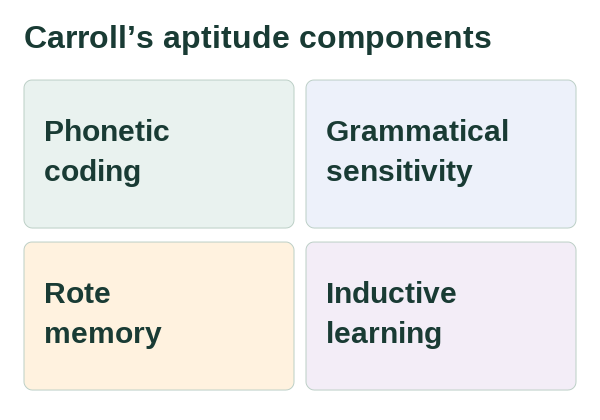
The term is closely tied to John Carroll. His work shaped early ideas about foreign language aptitude.[2] Carroll later described aptitude as having four parts. They are sound coding, grammar sensitivity, inductive learning and rote memory for words. That four-part scheme became the blueprint for most later research on the topic.[7]
Aptitude is not the same as motivation or attitude. Aptitude tests tend to predict achievement in language capacity. They do not tend to predict the ability to communicate with other people.[8]
Early writing often described aptitude as a fixed trait. A stable trait is a quality that lasts a long time and resists training.[9] People saw aptitude as a fixed and stable trait. For a long period this made it a fairly neglected area of research.[6]
The idea has moved from one fixed trait to several sets of abilities. These can change.[7] Much of this change followed wide agreement on one point. Working memory should count as an important part of language aptitude.[9]
Working memory is the ability to hold language material and process it at the same time.[7] Working memory was once seen as a trait too. It is now seen as open to the influence of experience and instruction.[9] Recent reviews describe new interest in aptitude research. They also describe a fuller grasp of the concept and its parts.[6]
Main ideas
The four parts of aptitude
The parts do not always predict success in the same way across teaching methods. Sáfár and Kormos concluded that aptitude matters little in one case. That case is communicative teaching combined with focus-on-form instruction.[10]
Aptitude for words, grammar and writing
In one vocabulary study, 88 English speakers saw a picture of a noun. They then rehearsed 20 Turkish nouns in one of 4 ways.[11] A 2025 systematic review looked at nine empirical studies. It reported a strong link between aptitude and success in learning grammar. That review also found the link changed with how grammar was taught. It named uneven ways of measuring aptitude and grammar knowledge. These could be confounds.[12]
The link to grammar depends on which structure is taught. It also depends on which part of aptitude is measured. On a spoken production task, a different component predicted gains on the past progressive. That component was associative memory. The results support this claim. Different aptitude parts help with difficult and easy structures in different ways.[13] There, aptitude separated response times rather than accuracy scores. This suggests the sentences were processed in different ways.[14]
For writing, findings differ from study to study.[1][15] One study looked at storytelling tasks, both written and spoken. Two aptitude parts stood out. Inductive ability and grammatical sensitivity were most closely tied to how complex and accurate the production was. In that study, participants used more varied vocabulary in writing than in speech. Their sentence structure was about as complex in both modes.[16]
A study of 60 Korean learners of English, aged 18 to 21, gave one group model texts. They compared these with their first drafts before revising. The model group improved more in vocabulary, content and organization. A control group corrected its own errors without a model. Receptive and productive vocabulary sizes predicted how much learners gained from the models.[17]
For listening, Zhang (2020) studied 13 beginner learners of Chinese. Aptitude, measured by LLAMA_D, had no significant effect on listening gains. That study followed 13 Spanish-Catalan bilingual beginners studying Chinese in Barcelona. It ran over 3 months. It used a pre-test and three monthly listening tests. Motivation strongly predicted gains in listening. Strategy use helped most in the first stages.[18]
Yavas Celik and Yavuz (2020) reported that language aptitude affects how well Turkish learners of English achieve.[19] One study looked at 20 grammatical collocations. The learners were Persian speakers learning English. Elaborated input with more focus on form removed differences in aptitude for receptive knowledge of them. Working memory explained gains in productive knowledge of those collocations under all input conditions.[20]
Research
How strong the evidence is
A meta-analysis of research on aptitude and second language grammar gathered 33 study reports. It covered 309 effect sizes from 3,106 learners. Across those studies, aptitude had a moderate overall link with grammar learning. The result was r = .31, 95% CI = .25 to .36.[3]
A second meta-analysis tested what the aptitude tests actually measure. It used 66 studies, 109 separate samples and 13,035 foreign language learners. That analysis found that aptitude was separate from motivation. It also found a negative link with anxiety.[1]
The pooled figures hide real differences between groups and settings, and the grammar meta-analysis tested for these. Aptitude mattered more among high school students than among university students. In predictive studies, aptitude mattered more for younger learners than for older ones. In interactional studies, the opposite was found.[3]
The construct validity meta-analysis also found one more result. How well aptitude predicted depended on what was being predicted. Aptitude measured with full-length tests strongly predicted general second language proficiency. The same analysis found low predictive validity for vocabulary learning and for second language writing.[1]
The other review covered 60 years of research, from 1959 to 2019. It looked at close to one hundred journal articles and PhD dissertations. A diagnostic focus was once used to pick out possibly gifted learners. Tests such as the Modern Language Aptitude Test were used. An explanatory view had replaced it.[6]
Aptitude, intelligence and first language
Language aptitude tests overlap with intelligence tests, but the two are not the same thing.[21][22] A 1982 study gave two tests to 793 English-speaking Canadian public servants. They were in intensive French training. The tests were the Modern Language Aptitude Test and the Primary Mental Abilities Test. A second analysis found three separate factors. They were first language verbal knowledge, abstract reasoning ability, and the ability to learn new language elements and associations.[21]
The general second language proficiency factor and the general cognitive factor were not identical. But they were correlated at 0.65. The cognitive factor could not explain more than half of the variance in general proficiency, 58%.[22] However, among students who scored high on the foreign language test, aptitude showed no significant links with the intelligence measures.[23]
Researchers gave three tests to 509 first-year undergraduates learning French. The tests covered metalinguistic knowledge, language aptitude and French proficiency. Levels of metalinguistic knowledge varied a lot. But the link between that knowledge and French proficiency was weak.[4]
Two studies in 1998 compared high, average and low proficiency high school learners. The learners studied Spanish, French and German. The three proficiency groups differed overall on native-language and foreign-language aptitude measures. Most differences fell between the high and low groups.[24]
Early first-language skills were strongly linked to later second-language proficiency. Even so, the Modern Language Aptitude Test was the best single predictor of overall proficiency. It also predicted most proficiency subtests. Word decoding in the first language best predicted word decoding in the second. Motivation and anxiety added only a little to the prediction.[25]
Studies with U.S. secondary students have found that differences in second-language achievement mirror differences in first-language skills.[26][27] Three measures best told apart students who completed 2 years of Spanish from those who completed 3. They were first-language literacy, first-language working memory and second-language aptitude.[26] First-language achievement in reading, writing, vocabulary and print exposure explained much unique variance in second-language reading, writing, listening comprehension and speaking. Aptitude explained more unique variance at the end of each year. The share explained by first-language skills rose from the first year to the third.[27]
Age, starting point and final level
One common claim holds that children reach a native-like command of a second language. The claim says this happens whatever their aptitude. So aptitude should matter little for them. The results confirmed earlier work. Adults need a high degree of language aptitude to reach a level indistinguishable from that of mother-tongue speakers. The same results also found small but significant aptitude effects. These appeared in child second language acquisition. This went against earlier studies.[28]
Some studies looked at learners who began at different ages. They suggest that different parts of aptitude matter at different starting points. One study followed 65 students in the 11th grade. They came from continuing early and late French immersion programs. Late immersion began in the teen years. In it, second language outcomes were positively linked to an analytical part of aptitude. Early immersion began in grade 1. In that setting, results were linked to memory ability instead.[29]
One study looked at 65 Chinese learners of Spanish and 12 mother-tongue controls. It sorted learners by age of onset: 3 to 6, 7 to 15, and 16 to 29 years. It found that windows of opportunity closed first for phonology, the sound system. They closed next for vocabulary and word combinations. Finally, in the mid-teens, they closed for morphosyntax, the grammar of sentences. One group began between 16 and 29 years. In that group, aptitude scores were strongly linked to pronunciation scores, and to vocabulary and word-combination scores.[5]
The picture is less settled than these findings suggest. Researchers define and measure aptitude in different ways. One review looks at a common claim: that older learners learn explicitly, by conscious analysis, while younger learners learn implicitly, without awareness. It argues that this claim is not particularly safe. The same review is just as cautious about another idea. That idea says some older learners beat the critical period thanks to high aptitude.[30]
One review covers a researcher's work from 2014 to 2020. It looks at questions about the concept of aptitude. It also looks at age-related work on learning in childhood, adolescence and midlife.[31]
Forty first-year Japanese university students practiced English over one academic year. They practiced in class and outside class. Their speech was sampled at the beginning, middle and end. In the first semester, explicit learning aptitude helped some learners improve pronunciation. This covered associative memory and phonemic coding. It also worked through fluency and prosody. In the second semester, one incidental learning skill predicted who kept improving to advanced understanding. That skill was recognizing sound sequences. The gains came mostly from better accuracy on single sounds.[32]
Tone languages use voice pitch to signal word meaning. They add another test case. Learners whose native language does not use pitch this way face a special challenge. Native English speakers with no tone language experience learned Mandarin words. They took tests of pitch ability, musicality, second language aptitude and general thinking ability. Measures of pitch ability improved predictions of learning beyond the other three measures and also predicted transfer of learning to new talkers. The researchers concluded that pitch measures are the main parts of an aptitude for tone.[33]
Researchers have studied Chinese as a second language at an advanced level. The study had 96 native English speakers. The learners completed the Modern Language Aptitude Test. They also took a test of phonological working memory. They also filled in questionnaires about motivation and the strategies they used. The researchers tested four parts of aptitude. Rote memory helped most. Working memory helped least. Aptitude, strategy use and motivation each had about equal impact on learning. They differed in how well they predicted each skill.[34]
Sixty child learners of English as a foreign language were split into two groups. One group did simple information tasks and the other did complex decision-making tasks. Both groups received recasts. A recast is a corrected restatement of what a learner said. Scores on one aptitude subtest predicted gains. The gains were measured by elicited imitation. Scores on another test predicted growth in speaking and writing. This held for complex task conditions.[35]
A study of early childhood learners found that aptitude was significantly related to their attainment on grammatical agreement structures when the test allowed time for thought. That result was read as aptitude making up for age effects. This happens where those effects are strongest.[36]
Where aptitude comes from and how it changes
Ma, Yao and Zhang (2018) compared second and third language learners. The third language learners scored higher on a test of aptitude.[37] One long-running argument holds that first-language literacy builds metalinguistic awareness, and that this awareness then supports second-language aptitude. Sparks's 2022 review of the evidence found that differences in first-language achievement are universal. They can be found early and stay stable over time.[38] Second-language achievement had a direct and large effect on anxiety. The pattern held across six ages and for both genders.[39]
Ma, Yao and Zhang (2018) ran a study. One study looked at Chinese students majoring in English. The 46 who had also studied French or Japanese scored higher on an aptitude measure. The 41 who had not scored lower. The gap appeared on explicit language analytical abilities. Among the third-language learners, those studying Japanese did better on a vocabulary learning task. Features shared between languages may explain this.[37]
Schooling may matter too. In one study, 67 Italian lower secondary students had four years of activities comparing many languages, and they scored higher than a control group on two parts of the LLAMA aptitude test. The two parts were matching sounds to symbols and inferring grammar rules.[40]
Biedroń (2011) notes that most studies find only weak links between personality factors and cognitive abilities. Personality makes a small contribution to final results. A 2011 study compared gifted and nongifted language learners on five broad traits. The traits were openness, conscientiousness, extraversion, agreeableness and neuroticism. Most research finds these traits weakly related to thinking abilities. It also finds them of minor importance for how far learners get. The same study argues that personality still belongs in aptitude research. It forms part of how cognitive ability develops.[41]
Cochran, McCallum and Bell (2010) found that attitudes predicted aptitude. Calafato (2025) found that anxiety was positively linked to aptitude in multilingual teachers.[42][43] Cochran, McCallum and Bell (2010) studied 648 university students. They were learning Spanish, French and German. The best-fitting model ran from attitudes to aptitude to exam grades. Links between variables ranged from r = −.12 to r = .45. Students' own reasons for success or failure did not predict their grades.[42]
A 1985 test of a model of second-language proficiency used data from 1,180 French-speaking students in grades 7, 9 and 11 in Québec, and the proposed causal order held in every grade.[44] Metalinguistic knowledge, anxiety and formally learned multilingualism all related positively to aptitude. Teachers with high aptitude also kept up their languages. Their methods differed in amount and in kind from those with weaker aptitude.[43]
In practice
Aptitude and the way a class is taught
A teaching method can work well on average. It can still help some learners far more than others.[45] A 2001 framework proposed that cognitive abilities should be studied together with learning conditions, not on their own.[46]
Practice distribution is one condition where aptitude matters in a different way. In one exploratory study, learners of Japanese practiced a grammar point. The gap between sessions was either 7 days or 1 day.[47]
One experiment used 128 Spanish learners. They were put into four groups at random. The treatments combined rules and comprehension practice. Different mixes of rules and practice asked different things of learners. They also used language aptitude and working memory, but by different amounts.[48]
One study looked at 91 adult intermediate learners of English. Two written feedback groups did better than a control group on immediate posttests. Gains were positively linked to language analytic ability. The link was stronger in the group that received explanations.[49]
A later study of 151 learners found a link. Learners with stronger language-analytic ability gained more from direct feedback. Learners with weaker ability gained more from feedback that included explanations.[50]
The timing of feedback also changes which abilities predict success. One study looked at 112 seventh-grade learners of English. Procedural memory, the memory system for learned skills, predicted how well immediate feedback worked. Working memory predicted success with both immediate and delayed feedback.[51] A study of 55 fifth-grade learners found that language aptitude was linked to the value of feedback moves. The pattern varied by target structure and test type.[52]
Language analytic ability and working memory did not predict the effects. This was true for all three approaches.[53] In a New Zealand secondary school study, 60 learners of French took part. They received deductive, inductive or structured input instruction. Deductive instruction gives students chances to produce language. It seemed to cancel out individual differences in aptitude.[45]
One study analyzed think-aloud reports from six university learners of Japanese. They had done well or struggled under two feedback conditions. Learners with similar strengths in the relevant abilities used different mental processes. They reached different outcomes.[54]
Aptitude in classrooms and beyond
A study of 76 first-year university students in Jiangxi, China, found a positive link between language aptitude and English achievement (r=0.621). In that sample, aptitude alone accounted for 38.9% of the variance in English achievement. Aptitude here means grammatical sensitivity and associative memory ability. Aptitude together with online self-regulated learning, meaning the students' own planning and monitoring of study, accounted for 52.4% of the variance.[55] Rote learning ability and grammatical sensitivity showed a moderate link with English achievement levels, while phonetic coding ability showed a weak one.[56]
Military language programs have used aptitude and achievement measures. They used them to predict how much proficiency students gain. One analysis followed 80 students in a US Department of Defense foreign language program. It tracked them across three time intervals. The program combined domestic immersion with study abroad. Aptitude scores and quantitative aptitude scores each separated outcomes. This happened during the intensive part at home. Later, on the study abroad portion, measures of quantitative aptitude and native language verbal aptitude separated the learners.[57]
How similar their first language was to Swedish explained at least as much of the variance in achievement as language aptitude did. Aptitude mattered more for learners whose first language was Germanic. That made it similar to Swedish. It mattered less for learners with a distant first language.[58]
Aptitude testing has also been drawn into the diagnosis of a foreign language learning disability, a proposed condition in which a student struggles specifically with language courses.[59][60] One article listed five ethical concerns. They concern using the Modern Language Aptitude Test (MLAT) to diagnose such a disability. Its authors argued the practice is ethical when good safeguards are in place. They also said relevant professionals must approach the task carefully.[59]
Two comparison studies tested one question. Do students classified as learning disabled differ from other at-risk students? They compared native language skill, foreign language aptitude and foreign language proficiency. The first study found no significant differences between the two groups on those measures.[61]
One measure was the Foreign Language Classroom Anxiety Scale, a questionnaire about nervousness in language class. Scores on it predicted growth in first language skills from elementary to high school. The researchers concluded that the scale likely measures students' language skills. It may also measure their beliefs about those skills. It probably does not measure anxiety that only second language learning causes.[62] Grit, the tendency to persist at long-term goals, has been compared with aptitude as a predictor.[63][64]
Among 156 English majors in China, aptitude and second language grit both positively predicted achievement. Aptitude showed the stronger effect. Boredom in foreign language learning carried those effects. It worked negatively for aptitude and for the consistency-of-interest side of grit, but positively for the perseverance-of-effort side.[63]
The sample was 236 English majors. In it, aptitude and grit predicted achievement in similar, positive ways. A growth mindset had no direct effect.[64]
Even a small amount of earlier language learning was linked to higher aptitude scores. Students with no experience beyond English scored lower.[65] A further study of Chinese university students found that all learners improved in some parts of aptitude and working memory. This happened over one academic year. Among first-year students, those learning two foreign languages at once improved more in working memory. Those learning one improved less.[66]
One study looked at 629 bilingual students in grades 3 to 7. They did better than the mostly monolingual samples used to set the test's norms. The researchers read this as support for one idea. Bilingualism leads to higher aptitude.[67]
Grammaticality judgement scores, which measure how well a person spots errors in sentences, correlated positively with aptitude. Bilinguals whose aptitude was above average were more likely than those below average to score within the range of mother-tongue speakers. In the below-average group, judgement scores were linked to daily use of Spanish. The researchers suggested aptitude has a compensatory function. It helps people keep first language proficiency despite less contact.[68]
The bilinguals scored lower than the control group. Aptitude did not significantly influence their judgement scores. The only significant predictor was identification with the language. Stronger identification went with more accurate judgements.[69]
Using aptitude tests in schools and selection
Young learners' aptitude is little studied because good tests are lacking. Children, unlike adults, are still acquiring their first language. So a language-dependent aptitude test must be designed carefully to be valid. So a test that depends on the first language needs careful design before it can be called valid. The Modern Language Aptitude Test, Elementary version, was translated and adapted from Spanish into Catalan. It was made for the bilingual Catalan and Spanish community in Catalonia.[70]
The Polish version kept all four parts of foreign language aptitude that Carroll proposed in 1981. The pilot test involved about 200 secondary school learners aged 19. The first validation used about 250 subjects. They were aged 18 to 22.[71]
In German-speaking countries, language learning aptitude has not yet played a role in school education. No easily accessible, reliable instrument existed for measuring it in children. A newer tool is German Language Learning Aptitude Diagnostics. It was made for German-speaking schools. Teachers could use it to build individual language learning profiles. They could then adjust their teaching methods.[72]
Vocabulary tests also need checking before use, and one study examined the LLAMA_B3 test by Meara and Rogers (2022) with data from 314 participants. A Rasch analysis, a statistical method for checking whether test items measure one trait, reported reliability of .96 for items and .84 for participants. The items seemed to measure one single underlying construct. The test was judged valid for that sample of students. The conclusion held only for the present sample. The test was said to need more study and fine-tuning.[73]
Aptitude testing can be used to select people. Rafalska (2025) describes an assessment with three stages. It is used to select candidates for Ukrainian higher military education institutions. A Foreign Language Aptitude Assessment has three stages. It is used at Yevhenyi Bereznyak Military Academy in Ukraine. It runs on the Moodle platform. Its purpose is to select applicants who can master foreign languages in a limited time. These languages are needed for professional tasks.[74]
Interpreter training uses its own selection exercises. The University of Ottawa has described each exercise in the admission test. The test is for its interpretation program.[75]
Recall across languages has long been treated as a valid way to assess candidates for interpreting. It is thought to test their linguistic, cognitive and communicative abilities. Most of that support came from the shared view or professional experience of researchers, practitioners and trainers. It did not come from grounded research. A data-driven study in the Chinese context found that recall test performance predicted candidates' end-of-year interpreting performance. This held in both language directions. Language was the stronger predictor in the Chinese-to-English recall (β1 = .45).[76]
A long-term study tested 46 students at the SSLMIT of Trieste. It used a paraphrasing exercise done at the same time for admission to conference interpreting courses. Test results were significantly related to interpreting exam marks. They also related to the time students took to complete their training.[77]
University admission is another setting. A Saudi study tested the General Aptitude Test against English performance. The scores came from 84 foundation-year students and 127 level 2 students. All were in a faculty of English. The test predicted English performance for level 2 students. The error detection task best predicted English reading. The results support using the test to decide who is admitted to English language courses in the Arabic-speaking world.[78]
That appraisal set out points for improving the instrument. It used basic statistical techniques. It also used scientific agreement in aptitude research.[79]
The aim was to justify keeping unqualified students out of high school foreign language classes.[80] One early test was the Symonds Foreign Language Prognostic Test. It was used to predict grades and to place students in modern foreign languages. Its scores correlated .64±.046 with first semester grades. The test was proposed as an aid in selecting good risks for language study.[81]
After the second world war, government language programmes in the United States paid for aptitude research. The aim was to improve how learners were selected. A study by one group of psychologists failed, and later work by John B. Carroll and colleagues made language aptitude tests that could be used.[80]
Carroll led the team that developed the Modern Language Aptitude Test, usually shortened to MLAT. Schools and U.S. government agencies used the MLAT for selection, placement and guidance. This lasted more than 40 years.[82]
One team built, piloted and validated an aptitude test for Hungarian learners of English. The main study involved 419 twelve-year-old children in 10 schools. It collected aptitude scores, English proficiency tests and a measure of motivation. A multiple-regression analysis found that language aptitude explained over 20% of the variation. The variation was in English performance. It was the best predictor of outcomes in that study.[83]
The Hi-LAB was designed for a different question. It asks what predicts very high proficiency, not progress at the beginning and intermediate stages. Its participants were adults in the United States. Their success in second language learning varied. One group had high proficiency, shown by standardized tests and on-the-job language use.[84]
What this looks like when you study
In a New Zealand secondary school, 60 students learning French were split into three groups. Each group was taught direct object pronouns by a different method. All students were assessed on three aptitude measures. These were language analytic ability, phonemic coding ability and working memory.[45]
A study of 66 secondary English learners used three existing classes. Each class received four hours of instruction on two structures. The passive was called difficult, and the past progressive was called easy. The researchers measured aptitude with the LLAMA test. Researchers checked learning with a written grammar judgment task. They also used a task where people speak. Grammatical inferencing helped learners with the passive on the written test. It did not help on the past progressive. Associative memory helped learners with the past progressive on the oral measure.[13]
In a vocabulary study, 88 English speakers heard 20 Turkish nouns three times each. They looked at pictures as they listened. They then practiced the words in one of four ways. They said them aloud with their own feedback, or aloud with feedback blocked by white noise. They also said them silently, or not at all. Students with high aptitude recalled and recognized more words than students with low aptitude. Rehearsing without disturbance gave the best results at every aptitude level. This worked aloud or silently. The authors recommend early training for students with low aptitude. This training should cover phonological sensitivity and learning strategies.[11]
Wesche (1981) and Erlam (2005), as summarized by Wen (2012), suggest a possible benefit. Learners may learn better when teaching methods match their aptitude profiles.[7] Li (2016) found that different aptitude components predict different aspects of learning, so a learner's strong and weak components may matter for different skills.[1] In the Turkish vocabulary study, rehearsal without interruption gave the best recall and recognition. This held whether it was aloud or silent, and at every level of aptitude.[11]
Later developments
Implicit aptitude and the brain
A newer line of aptitude research asks whether people can learn language without noticing they are learning.[85] One proposal splits implicit aptitude into two parts. These are an implicit learning ability and an implicit memory ability.[86] The construct is still unsettled. Researchers have called language aptitude one of the most confounded constructs in the study of individual differences in second language learning. The definition is especially disputed.[87]
Sound recognition, the LLAMA D subtest, became a common measure. This followed Gisela Granena's influential work. Few people know how valid it is. Results with it have been somewhat mixed. Whatever the instructions, LLAMA D scores did not match the implicit aptitude test scores. So there was no clear evidence that the test measures something implicit.[88]
Syntactic priming is another candidate. It is the habit of reusing a sentence structure after hearing it recently. Priming was negatively correlated with sequence learning, and sequence learning negatively predicted learners' metalinguistic knowledge, which is knowledge about language rules stated in words. The results suggest implicit aptitude has more than one part. More work is needed on whether syntactic priming is a valid measure of it.[89]
Some studies ask whether implicit learning abilities matter for real progress. The answer seems to depend on how the language was learned. One study tested 71 Polish-English long-term bilinguals. Their age of onset ranged from 1 to 35 years. They also differed in how they learned. Some learned mainly by immersion in English, others by instruction. Among immersed learners, the gap between performance on grammatical and ungrammatical sentences grew as age of onset was delayed. For taught learners, results depended on the age they started. They also depended on whether a sentence was grammatical. It was not linked to either cognitive predictor. This suggests that learning without awareness was not involved.[90]
A 2017 study compared the auditory cortices of 30 German-speaking adults aged 20 to 40. The adults had scored high or low on language aptitude tests. Aptitude was measured with a Hindi speech imitation task. It was also measured with an assessment of English pronunciation. The number of instruments played correlated significantly with all the aptitude measures. It also correlated with musicality. The number of foreign languages showed no links.[91]
A 2021 review proposed an early neurocognitive model. In it, differences in the morphology of the bilateral auditory cortex limit individual neural plasticity, as seen in the speed and efficiency of language learning. That model also ties learning success to efficient auditory-motor connections, the links between hearing and speaking, and to the structure of dorsal and ventral fibre tracts during learning.[92]
A 2019 study looked at 48 Chinese learners of English in the UK. It separated explicit from implicit aptitude using behaviour tests and electroencephalography, a recording of the brain's electrical activity. Pronunciation at the level of single sounds was linked to explicit aptitude. This aptitude was measured as phonemic coding. It was also linked to implicit aptitude. This is seen as stronger neural encoding of spectral peaks in sound. Skill at the level of rhythm and intonation was linked to explicit aptitude to some degree. This was measured as rhythmic imagery. But the quality and amount of the most recent learning experience mainly shaped it.[93] Reviews of this work note that only limited research has found brain markers typical of speech imitation and overall language aptitude.[94]
Working memory as a second view of aptitude
A newer view of language aptitude treats working memory as one of its parts.[95][96] Working memory is a set of mental processes. It holds a small amount of information briefly available for thinking.[97]
A 2011 paper by Wen and Skehan argued that this mental workspace should count as part of foreign language aptitude. The argument drew on research from cognitive psychology. It also drew on the study of how people learn second languages.[95] A 2016 chapter made the same proposal. It reviewed evidence linking working memory to second language reading, listening, speaking, writing, interpretation, vocabulary and grammar.[96]
The case rests partly on how working memory is measured. Some tasks combine holding items in mind with a separate processing step. A 2005 study found these tasks predict aptitude scores well. The study argued that the processing step matters. It blocks rehearsal and grouping. So the test shows how many separate chunks of information attention can hold at once. Some measures test only the scope of attention. They have no separate processing step. These also related well to aptitudes in that study of development. So did digit span in children too young to rehearse.[97]
Studies of working memory in language learning report different results. Suzuki (2019) found working memory played a limited role at best. Mujtaba, Kamyabi Gol and Parkash (2021) found it a strong predictor of writing performance.[98][15] Suzuki (2019) asked people to study grammar rules of a made-up language. They used two practice schedules. An ability to rehearse rules predicted performance mainly under the longer-spaced schedule.[98]
A 2021 study of 50 graduate students found that working memory strongly predicted second language writing accuracy. Two aptitude subtests and receptive vocabulary size also predicted it.[15] A 2019 eye-tracking study looked at 100 learners of a made-up language. Aptitude measures did not change how well learners guessed upcoming words.[99]
A 2021 review compared two current views. It argued that working memory and traditional aptitude parts play different roles. The two roles work together. Their prominence shifts from stage to stage. Traditional aptitude matters most for spotting patterns. Working memory matters most for feedback. Both views give working memory and language aptitude equal weight. This happens when input is processed.[100]
A 2011 article on Cantonese tests argued one point. Non-word repetition comes close to Carroll's phonemic coding ability. Non-word repetition is a measure of working memory. Phonemic coding is one part of the older model.[101]
Aptitude and the sounds of a new language
Learners differ in how quickly they pick up the sounds of a new language. Saito (2017) and Saito (2019) measured several abilities in adult classroom learners. They linked these abilities to speech production.[102][103]
One study looked at 50 Japanese learners of English. Higher phonemic coding scores went with better performance on a fairly easy feature of English /ɹ/. That feature was a lower second formant, a measure of tongue retraction. Learners with stronger associative memory, the ability to link items in memory, did better on the harder features of the same sound. The role of sequence recognition, a more implicit kind of aptitude, stayed unclear in that study.[103]
Reiterer and colleagues (2011) scanned 140 German speakers. Their skill at imitating sentences and words varied. The imitations were in English, or in Hindi and Tamil. The speakers had never met those languages before. High imitators had more gray matter in a left-hemisphere speech network. They had lower brain activation there. Low imitators showed the opposite. Surprisingly, the males in that sample were the better mimics of foreign speech.[104]
Aptitude subtests and phonological memory were used together. Together they predicted 29% of the variance in second language proficiency. In the higher proficiency subgroup, none of the variables predicted proficiency. Phonological memory predicted it only in the lower group.[105]
Musical ability has been studied as one source of good pronunciation. Pujazón Rodríguez (2021) found a positive link between musical aptitude and recognizing foreign language sounds. Zheng, Saito and Tierney (2022) found that music aptitude only weakly predicted the rhythm and stress parts of pronunciation.[106][107] The study looked at 71 children aged 7 to 8 in a bilingual Spanish school. Musical aptitude was linked to telling foreign language sounds apart.[106]
Musically trained students also had stronger musical aptitude. They outperformed untrained peers on suprasegmental production.[108] A study of 48 Chinese learners of English in the United Kingdom found that music aptitude only weakly predicted the prosodic, or melodic, side of pronunciation. Individual differences in domain-general auditory processing, the basic handling of sound not specific to music or language, were significantly associated with several dimensions of pronunciation proficiency. Music aptitude and hearing-based processing partly overlapped. Neither was tied to the learners' past or current language experience.[107]
The design of training can decide who benefits. Perrachione and colleagues (2011) found that high-variability training helped only learners with strong perceptual abilities. It made weaker ones worse. In one experiment, training with highly variable sound examples helped only learners with strong perceptual abilities. Learners with weaker perceptual abilities did worse under high variability than under low variability. The harmful part was the amount of trial-by-trial variability. It hid the target sound feature.[109]
Criticism
Criticisms and open questions
A 1987 Israeli study looked at 824 students at one university. English aptitude scores overpredicted the first-year grades of students of Oriental ethnicity. They underpredicted the grades of Western students. The same scores showed a small bias by gender. They predicted men's grades slightly too high and women's too low. Scores also predicted slightly less well for students aged 30 and over than for younger groups.[110]
Researchers disagree about what belongs in the idea of aptitude and how to measure it. They also disagree about whether it is innate or built from experience.[30] Learners who knew more languages made larger gains. Those who felt less outside pressure to learn Dutch also gained more. Using a second language affected gains. So did attitudes toward the Dutch community. They did so through proficiency level and length of residence.[111]
Its validity is little known, and results with it have been inconsistent. Scores were negatively linked to the Serial Reaction Time task. This held only when instructions drew focused attention to the stimuli.[88]
A 2017 review calls for new aptitude tests. These would predict how fast a learner automatizes. They would also predict how well a learner picks up language implicitly. They would also predict how much control a learner gains over an emerging language system. The same review asks whether aptitude tests are specific to language. Or are they general to many domains? It argues that this question may bring aptitude theory closer to the centre of applied linguistics.[2] A 1975 paper had already argued that aptitude, as generally defined and measured, is not a valid predictor of achievement. It also argued that what teachers and learners think matters.[112]
Common misconceptions
Many people think language aptitude is a fixed gift for languages. On this view, a person either has it or lacks it from birth. People have long questioned that trait view. The questioning has become stronger in recent years.[9]
Wesche, Edwards and Wells (1982) note that we do not fully understand what aptitude tests measure. Nor is how those abilities relate to intelligence.[21] A meta-analysis of 66 studies found aptitude overlapped with intelligence. The two could still be told apart.[1]
Some people assume that early second language exposure raises a child's language aptitude. A study looked at 65 eleventh-grade French immersion students. The idea that early immersion students would have higher aptitude was not supported.[29]
Key studies
| Year | Study | Sample | Design | Finding |
|---|---|---|---|---|
| 1982 | Wesche et al.[21] | 793 English-speaking Canadian public servants | correlational and factor analysis | Three second-order factors appeared: first language verbal knowledge, abstract reasoning, and ability to learn new language elements. |
| 1993 | Sasaki[22] | Structural equation modeling with 160 Japanese college students | General second language proficiency and general cognitive ability correlated at .65, and 58% of proficiency variance was not explained by cognitive ability. | |
| 1997 | Harley & Hart[29] | 65 eleventh-grade French immersion students | empirical study of early and late immersion | Late immersion outcomes related to analytical aptitude, early immersion outcomes to memory ability; early exposure did not raise aptitude. |
| 1997 | Alderson et al.[4] | Study of 509 first-year French undergraduates | Metalinguistic knowledge and language proficiency were weakly related and appeared to be two separate factors. | |
| 2005 | Erlam[45] | 60 secondary school students in New Zealand | experimental study with three instructional groups | Deductive instruction with output opportunities may neutralize individual differences in language aptitude. |
| 2013 | Winke[34] | 96 native English speakers studying advanced Chinese | structural equation modeling | Rote memory contributed most and working memory least among four aptitude components. |
| 2013 | Dahlen & Caldwell–Harris[11] | 88 English speakers learning Turkish nouns | experiment with four rehearsal conditions | High-aptitude students recalled more words, and undisturbed rehearsal gave the best results at all aptitude levels. |
| 2015 | Li[3] | 3,106 second language learners in 33 study reports | meta-analysis | Aptitude showed an overall moderate association with grammar learning, r = .31. |
| 2016 | Li[1] | 13,035 foreign language learners in 109 samples from 66 studies | meta-analysis | Aptitude stood apart from motivation, went with lower anxiety, and shared some ground with intelligence while remaining distinct from it. |
| 2016 | Yalçın & Spada[13] | 66 secondary-level English learners in three classes | quasi-experimental study | Grammatical inferencing helped on the passive in writing, associative memory helped on the past progressive in speech. |
| 2016 | Bowles et al.[33] | Native English speakers with no tone language experience | word learning experiment | Pitch ability improved predictions of tone learning beyond musicality, aptitude and general cognitive ability. |
| 2021 | Mujtaba et al.[15] | 50 graduate first-semester students | correlational and regression study | LLAMA B, LLAMA E, receptive vocabulary size and working memory were strong predictors of writing accuracy. |
| 2023 | L. Sparks et al.[27] | US secondary students followed over three years of Spanish | longitudinal study | First language achievement accounted for substantial unique variance in second language outcomes, and aptitude added more. |
| 2024 | Iizuka & DeKeyser[88] | experiment with three instruction conditions | Whatever the instructions given, LLAMA D scores showed no correspondence with the implicit aptitude measures, so the test gave no clear sign of being implicit. |
See also
References
- Li, S. (2016). THE CONSTRUCT VALIDITY OF LANGUAGE APTITUDE: A Meta-Analysis. Studies in Second Language Acquisition, 38(4), 801-842. doi:10.1017/s027226311500042x
- Wen, Z. (., Biedroń, A., & Skehan, P. (2017). Foreign language aptitude theory: Yesterday, today and tomorrow. Language Teaching, 50(1), 1-31. doi:10.1017/s0261444816000276
- Li, S. (2015). The Associations Between Language Aptitude and Second Language Grammar Acquisition: A Meta-Analytic Review of Five Decades of Research. Applied Linguistics, 36(3), 385-408. doi:10.1093/applin/amu054
- Alderson, J. C., Clapham, C., & Steel, D. (1997). Metalinguistic knowledge, language aptitude and language proficiency. Language Teaching Research, 1(2), 93-121. doi:10.1177/136216889700100202
- Granena, G., & Long, M. H. (2013). Age of onset, length of residence, language aptitude, and ultimate L2 attainment in three linguistic domains. Second Language Research, 29(3), 311-343. doi:10.1177/0267658312461497
- Chalmers, J., Eisenchlas, S. A., Munro, A., & Schalley, A. C. (2021). Sixty years of second language aptitude research: A systematic quantitative literature review. Language and Linguistics Compass, 15(11). doi:10.1111/lnc3.12440
- Wen, Z. (2012). Foreign language aptitude. ELT Journal, 66(2), 233-235. doi:10.1093/elt/ccr068
- Vyas, H. (2017). The impact of intelligence and aptitude in the second language learning: A brief study. Towards Excellence, 199-206. doi:10.37867/te090228
- Singleton, D. (2017). Language aptitude: Desirable trait or acquirable attribute? Studies in Second Language Learning and Teaching, 7(1), 89-103. doi:10.14746/ssllt.2017.7.1.5
- Sáfár, A., & Kormos, J. (2008). Revisiting problems with foreign language aptitude. IRAL - International Review of Applied Linguistics in Language Teaching, 46(2). doi:10.1515/iral.2008.005
- Dahlen, K., & Caldwell–Harris, C. (2013). Rehearsal and aptitude in foreign vocabulary learning. The Modern Language Journal, 97(4), 902-916. doi:10.1111/j.1540-4781.2013.12045.x
- Duan, X. (2025). A Systematic Review on the Relationship Between Language Aptitude and Second Language Grammar Acquisition: Do Different Instructional Approaches Play a Role? Journal of Education, Humanities, and Social Research, 2(2), 105-117. doi:10.71222/skf2yh80
- Yalçın, Ş., & Spada, N. (2016). LANGUAGE APTITUDE AND GRAMMATICAL DIFFICULTY: An EFL Classroom-Based Study. Studies in Second Language Acquisition, 38(2), 239-263. doi:10.1017/s0272263115000509
- Öztekin, E., & Candan, E. (2024). The role of language aptitude probed within extensive instruction experience: morphosyntactic knowledge of advanced users of L2 English. International Review of Applied Linguistics in Language Teaching, 62(2), 693-721. doi:10.1515/iral-2021-0201
- Mujtaba, S. M., Kamyabi Gol, A., & Parkash, R. (2021). A study on the relationship between language aptitude, vocabulary size, working memory, and L2 writing accuracy. Foreign Language Annals, 54(4), 1059-1081. doi:10.1111/flan.12584
- Kormos, J., & Trebits, A. (2012). The Role of Task Complexity, Modality, and Aptitude in Narrative Task Performance. Language Learning, 62(2), 439-472. doi:10.1111/j.1467-9922.2012.00695.x
- Kang, E. Y. (2024). Model‐based feedback for L2 writing revision: The role of vocabulary size and language aptitude. International Journal of Applied Linguistics, 34(1), 103-116. doi:10.1111/ijal.12480
- Zhang, P. (2020). The role of motivation, strategy use and second language aptitude in the development of listening skills by adult chinese learners. European Journal of Foreign Language Teaching, 5(2). doi:10.46827/ejfl.v5i2.3465
- Yavas Celik, G., & Yavuz, F. (2020). The role of the language aptitude and self-reported strategy use on the achievement of EFL learners. Global Journal of Foreign Language Teaching, 10(1), 32-48. doi:10.18844/gjflt.v10i1.4412
- Farshi, N., & Tavakoli, M. (2021). Effects of differences in language aptitude on learning grammatical collocations under elaborated input conditions. Language Teaching Research, 25(3), 476-499. doi:10.1177/1362168819858443
- Wesche, M., Edwards, H., & Wells, W. (1982). Foreign language aptitude and intelligence. Applied Psycholinguistics, 3(2), 127-140. doi:10.1017/s0142716400006664
- Sasaki, M. (1993). Relationships Among Second Language Proficiency, Foreign Language Aptitude, and Intelligence: A Structural Equation Modeling Approach. Language Learning, 43(3), 313-344. doi:10.1111/j.1467-1770.1993.tb00617.x
- Gavrilova, E. V. (2018). Individual differences in foreign language aptitude and its relation to fluid and crystallized intelligence. Journal of Modern Foreign Psychology, 7(2), 16-27. doi:10.17759/jmfp.2018070202
- Sparks, R. L., Artzer, M., Ganschow, L., Siebenhar, D., Plageman, M., & Patton, J. (1998). Differences in native-language skills, foreign-language aptitude, and foreign-language grades among high-, average-, and low-proficiency foreign-language learners: two studies. Language Testing, 15(2), 181-216. doi:10.1177/026553229801500203
- SPARKS, R. L., PATTON, J., GANSCHOW, L., & HUMBACH, N. (2009). Long-term relationships among early first language skills, second language aptitude, second language affect, and later second language proficiency. Applied Psycholinguistics, 30(4), 725-755. doi:10.1017/s0142716409990099
- Sparks, R. L., Patton, J., & Luebbers, J. (2019). Individual differences in L2 achievement mirror individual differences in L1 skills and L2 aptitude: Crosslinguistic transfer of L1 to L2 skills. Foreign Language Annals, 52(2), 255-283. doi:10.1111/flan.12390
- L. Sparks, R., S. Dale, P., & M. Patton, J. (2023). Individual differences in L1 attainment and language aptitude predict L2 achievement in instructed language learners. The Modern Language Journal, 107(2), 479-508. doi:10.1111/modl.12841
- Abrahamsson, N., & Hyltenstam, K. (2008). The robustness of aptitude effects in near-native second language acquisition. Studies in Second Language Acquisition, 30(4), 481-509. doi:10.1017/s027226310808073x
- Harley, B., & Hart, D. (1997). Language aptitude and second language proficiency in classroom learners of different starting ages. Studies in Second Language Acquisition, 19(3), 379-400. doi:10.1017/s0272263197003045
- Singleton, D. (2014). Apt to change: The problematic of language awareness and language aptitude in age-related research. Studies in Second Language Learning and Teaching, 4(3), 557-571. doi:10.14746/ssllt.2014.4.3.9
- Singleton, D., & Flynn, C. J. (2021). Language aptitude, language interaction and age of language learning: One researcher’s recent perspective. Language, Interaction and Acquisition, 12(2), 284-305. doi:10.1075/lia.21013.sin
- Saito, K., Suzukida, Y., & Sun, H. (2019). Aptitude, experience, and second language pronunciation proficiency development in classroom settings: A longitudinal study. Studies in Second Language Acquisition, 41(1), 201-225. doi:10.1017/s0272263117000432
- Bowles, A. R., Chang, C. B., & Karuzis, V. P. (2016). Pitch Ability As an Aptitude for Tone Learning. Language Learning, 66(4), 774-808. doi:10.1111/lang.12159
- Winke, P. (2013). An Investigation Into Second Language Aptitude for Advanced Chinese Language Learning. The Modern Language Journal, 97(1), 109-130. doi:10.1111/j.1540-4781.2013.01428.x
- Kourtali, N., & Révész, A. (2020). The Roles of Recasts, Task Complexity, and Aptitude in Child Second Language Development. Language Learning, 70(1), 179-218. doi:10.1111/lang.12374
- Granena, G. (2014). Language Aptitude and Long-term Achievement in Early Childhood L2 Learners. Applied Linguistics, 35(4), 483-503. doi:10.1093/applin/amu013
- Ma, D., Yao, T., & Zhang, H. (2018). The effect of third language learning on language aptitude among English-major students in China. Journal of Multilingual and Multicultural Development, 39(7), 590-601. doi:10.1080/01434632.2017.1410162
- Sparks, R. L. (2022). Where Does Language Aptitude Come From? Redux. Language Teaching Research Quarterly, 31, 19-40. doi:10.32038/ltrq.2022.31.03
- Sparks, R. L., & Alamer, A. (2025). Long-term impacts of L1 language skills on L2 anxiety: The mediating role of language aptitude and L2 achievement. Language Teaching Research, 29(5), 2071-2092. doi:10.1177/13621688221104392
- Carbonara, V. (2022). The effect of multilingual pedagogies on language aptitude: A study on lower secondary school students based on the LLAMA test. EuroAmerican Journal of Applied Linguistics and Languages, 9(2), 1-16. doi:10.21283/2376905x.1.9.2.272
- Biedroń, A. (2011). Personality factors as predictors of foreign language aptitude. Studies in Second Language Learning and Teaching, 1(4), 467. doi:10.14746/ssllt.2011.1.4.2
- Cochran, J. L., McCallum, R. S., & Bell, S. M. (2010). Three A's: How Do Attributions, Attitudes, and Aptitude Contribute to Foreign Language Learning? Foreign Language Annals, 43(4), 566-582. doi:10.1111/j.1944-9720.2010.01102.x
- Calafato, R. (2025). Language aptitude and its links with metalinguistic knowledge, self-efficacy, anxiety, and language maintenance in multilingual language teachers. Language Awareness, 34(1), 100-118. doi:10.1080/09658416.2024.2337663
- Clément, R., & Kruidenier, B. G. (1985). Aptitude, Attitude and Motivation in Second Language Proficiency: A Test Of Clément's Model. Journal of Language and Social Psychology, 4(1), 21-37. doi:10.1177/0261927x8500400102
- Erlam, R. (2005). Language aptitude and its relationship to instructional effectiveness in second language acquisition. Language Teaching Research, 9(2), 147-171. doi:10.1191/1362168805lr161oa
- Robinson, P. (2001). Individual differences, cognitive abilities, aptitude complexes and learning conditions in second language acquisition. Second Language Research, 17(4), 368-392. doi:10.1177/026765830101700405
- SUZUKI, Y., & DEKEYSER, R. (2017). Exploratory research on second language practice distribution: An Aptitude × Treatment interaction. Applied Psycholinguistics, 38(1), 27-56. doi:10.1017/s0142716416000084
- Kachinske, I., & DeKeyser, R. (2019). The interaction between timing of explicit grammar explanation and individual differences in second language acquisition. Journal of Second Language Studies, 2(2), 197-232. doi:10.1075/jsls.19003.kac
- SHEEN, Y. (2007). The Effect of Focused Written Corrective Feedback and Language Aptitude on ESL Learners' Acquisition of Articles. TESOL Quarterly, 41(2), 255-283. doi:10.1002/j.1545-7249.2007.tb00059.x
- Benson, S., & DeKeyser, R. (2019). Effects of written corrective feedback and language aptitude on verb tense accuracy. Language Teaching Research, 23(6), 702-726. doi:10.1177/1362168818770921
- Fu, M., & Li, S. (2021). The associations between implicit and explicit language aptitude and the effects of the timing of corrective feedback. Studies in Second Language Acquisition, 43(3), 498-522. doi:10.1017/s0272263121000012
- Park, S., & Goo, J. (2017). Teacher Feedback and Language Aptitude. Studies in English Education, 22(4), 227-250. doi:10.22275/see.22.4.09
- Liang, Y., & Jun Zhang, L. (2024). The associations between individual differences in language aptitude and working memory, and the effectiveness of input and output based instruction. Language Teaching Research. doi:10.1177/13621688241248734
- Sachs, R., Akiyama, Y., & Nakatsukasa, K. (2019). The value of introspective measures in aptitude-treatment interaction research: A window on individual differences in action. Journal of Second Language Studies, 2(2), 336-364. doi:10.1075/jsls.19001.sac
- Liu, C. y., Jiao, Y., & Qiu, W. t. (2022). The Roles of Language Aptitude and Online Self-regulated Learning in Foreign Language Achievements. Language Teaching Research Quarterly, 31, 83-100. doi:10.32038/ltrq.2022.31.07
- Aksak, K., & Cubukcu, F. (2020). A comparison between academic achievement and language aptitude among pre-service language teachers. Lenguaje, 48(1), 143-159. doi:10.25100/lenguaje.v48i1.7395
- Wagener, T. (2018). Aptitude measures in SLA: Aptitude and achievement measures as predictors of growth in second language proficiency. Study Abroad Research in Second Language Acquisition and International Education, 3(1), 1-31. doi:10.1075/sar.16012.wag
- Bokander, L. (2020). Language Aptitude and Crosslinguistic Influence in Initial L2 Learning. Journal of the European Second Language Association, 4(1), 35. doi:10.22599/jesla.69
- Reed, D. J., & Stansfield, C. W. (2004). Using the Modern Language Aptitude Test to Identify a Foreign Language Learning Disability: Is it Ethical? Language Assessment Quarterly, 1(2-3), 161-176. doi:10.1080/15434303.2004.9671783
- Sparks, R. L., Javorsky, J., & Ganschow, L. (2005). Should the Modern Language Aptitude Test Be Used to Determine Course Substitutions for and Waivers of the Foreign Language Requirement? Foreign Language Annals, 38(2), 201-210. doi:10.1111/j.1944-9720.2005.tb02485.x
- Sparks, R. L., Artzer, M., Javorsky, J., Patton, J., Ganschow, L., Miller, K., & Hordubay, D. (1998). Students Classified As Learning Disabled and Non‐Learning Disabled: Two Comparison Studies of Native Language Skill, Foreign Language Aptitude, and Foreign Language Proficiency. Foreign Language Annals, 31(4), 535-551. doi:10.1111/j.1944-9720.1998.tb00598.x
- Sparks, R. L., & Patton, J. (2013). Relationship of L1 Skills and L2 Aptitude to L2 Anxiety on the Foreign Language Classroom Anxiety Scale. Language Learning, 63(4), 870-895. doi:10.1111/lang.12025
- Zhao, H., & Zhang, Y. (2025). Exploring the roles of language aptitude and L2 grit in L2 achievement: Mediation of foreign language learning boredom. Language Teaching Research. doi:10.1177/13621688251383245
- Teimouri, Y., Tahmouresi, S., & Tabandeh, F. (2024). The interplay of mindsets, aptitude, grit, and language achievement: What role does gender play? Studies in Second Language Acquisition, 46(3), 869-892. doi:10.1017/s0272263124000330
- Thompson, A. S. (2013). The interface of language aptitude and multilingualism: Reconsidering the bilingual/multilingual dichotomy. The Modern Language Journal, 97(3), 685-701. doi:10.1111/j.1540-4781.2013.12034.x
- Huang, T., Loerts, H., & Steinkrauss, R. (2022). The impact of second- and third-language learning on language aptitude and working memory. International Journal of Bilingual Education and Bilingualism, 25(2), 522-538. doi:10.1080/13670050.2019.1703894
- Suárez, M. d. M., & Stansfield, C. W. (2023). Young learners’ bilingual status and cognitive development in foreign language aptitude testing. ITL - International Journal of Applied Linguistics, 174(2), 291-315. doi:10.1075/itl.22017.sua
- Bylund, E., Abrahamsson, N., & Hyltenstam, K. (2010). The Role of Language Aptitude in First Language Attrition: The Case of Pre-pubescent Attriters. Applied Linguistics, 31(3), 443-464. doi:10.1093/applin/amp059
- Bylund, E., & Ramírez-Galan, P. (2016). Language Aptitude in First Language Attrition: A Study on Late Spanish-Swedish Bilinguals. Applied Linguistics, 37(5), 621-638. doi:10.1093/applin/amu055
- Suárez, M. d. M. (2022). A Need for an Aptitude Test for Young Learners in Catalan: The Case of the Modern Language Aptitude Test – Elementary in Catalan. Language Teaching Research Quarterly, 31, 101-118. doi:10.32038/ltrq.2022.31.08
- Rysiewicz, J. (2008). Measuring Foreign Language Learning Aptitude. Polish Adaptation of The Modern Language Aptitude Test By Carroll and Sapon. Poznań Studies in Contemporary Linguistics, 44(4). doi:10.2478/v10010-008-0027-6
- Matz, F., Gut, U., Battenfeld, A., Lillich, L., & Utesch, T. (2026). Language learning aptitude diagnostics for classroom practice. Babylonia Journal of Language Education, 3, 62-67. doi:10.55393/babylonia.v3i.625
- NEJATI, R., & JABBARI, M. (2023). Evaluating the validity of meara and rogers’ vocabulary aptitude test: A rasch measurement model analysis. Issues in Language Studies, 12(2), 37-55. doi:10.33736/ils.5290.2023
- Rafalska, M. (2025). Conceptual Principles of the Foreign Language Aptitude Assessment of Candidates to Ukrainian Higher Military Education Institutions. Political Science and Security Studies Journal, 6(1), 27-33. doi:10.33445/psssj.2025.6.1.5
- Lambert, S. (2002). Aptitude Testing for Simultaneous Interpretation at the University of Ottawa. Meta, 36(4), 586-594. doi:10.7202/003383ar
- Shang, X., & Xie, G. (2020). Aptitude for interpreting revisited: predictive validity of recall across languages. The Interpreter and Translator Trainer, 14(3), 344-361. doi:10.1080/1750399x.2020.1790970
- Russo, M., & Salvador, P. (2004). Aptitude to Interpreting: Preliminary Results of a Testing Methodology Based on Paraphrase. Meta, 49(2), 409-432. doi:10.7202/009367ar
- Aldurayheem, A. (2024). The effectiveness of the general aptitude test in Saudi Arabia in predicting performance of English as a foreign language. PSU Research Review, 8(2), 341-355. doi:10.1108/prr-01-2021-0002
- (2019). Uzbekistan mod foreign language aptitude test: A critical evaluation. Philology matters, 138-151. doi:10.36078/987654354
- Spolsky, B. (1995). Prognostication and language aptitude testing, 1925-62. Language Testing, 12(3), 321-340. doi:10.1177/026553229501200304
- Richardson, H. D. (1933). Discovering aptitude for the modern languages. The Modern Language Journal, 18(3), 160-170. doi:10.1111/j.1540-4781.1933.tb00074.x
- Stansfield, C. W., & Reed, D. J. (2004). The Story Behind the Modern Language Aptitude Test: An Interview With John B. Carroll (1916-2003). Language Assessment Quarterly, 1(1), 43-56. doi:10.1207/s15434311laq0101_4
- Kiss, C., & Nikolov, M. (2005). Developing, Piloting, and Validating an Instrument to Measure Young Learners’ Aptitude. Language Learning, 55(1), 99-150. doi:10.1111/j.0023-8333.2005.00291.x
- Linck, J. A., Hughes, M. M., Campbell, S. G., Silbert, N. H., Tare, M., Jackson, S. R., Smith, B. K., Bunting, M. F., & Doughty, C. J. (2013). Hi‐LAB: A New Measure of Aptitude for High‐Level Language Proficiency. Language Learning, 63(3), 530-566. doi:10.1111/lang.12011
- Li, S., & DeKeyser, R. (2021). Implicit language aptitude: Conceptualizing the construct, validating the measures, and examining the evidence: Introduction to the special issue. Studies in Second Language Acquisition, 43(3), 473-497. doi:10.1017/s0272263121000024
- Tang, Y., & Luo, S. (2022). Possibilities and Caveats of Implicit Language Aptitude Measurements. Language Teaching Research Quarterly, 31, 119-135. doi:10.32038/ltrq.2022.31.09
- Lew, W. M. A. (2020). From Language Aptitude to Implicit Language Aptitude: A Discussion of Definitional Issues. Studies in Applied Linguistics and TESOL, 20(2). doi:10.52214/salt.v20i2.7472
- Iizuka, T., & DeKeyser, R. (2024). Scrutinizing LLAMA D as a measure of implicit learning aptitude. Studies in Second Language Acquisition, 46(1), 28-50. doi:10.1017/s0272263122000559
- Li, S., & Qian, J. (2021). Exploring syntactic priming as a measure of implicit language aptitude. Studies in Second Language Acquisition, 43(3), 574-605. doi:10.1017/s0272263120000698
- Bolibaugh, C., & Foster, P. (2021). Implicit Statistical Learning in Naturalistic and Instructed Morphosyntactic Attainment: An Aptitude‐Treatment Interaction Design. Language Learning, 71(4), 959-1003. doi:10.1111/lang.12465
- Turker, S., Reiterer, S. M., Seither-Preisler, A., & Schneider, P. (2017). “When Music Speaks”: Auditory Cortex Morphology as a Neuroanatomical Marker of Language Aptitude and Musicality. Frontiers in Psychology, 8. doi:10.3389/fpsyg.2017.02096
- Turker, S., Seither-Preisler, A., & Reiterer, S. M. (2021). Examining Individual Differences in Language Learning: A Neurocognitive Model of Language Aptitude. Neurobiology of Language, 1-27. doi:10.1162/nol_a_00042
- SAITO, K., SUN, H., & TIERNEY, A. (2019). Explicit and implicit aptitude effects on second language speech learning: Scrutinizing segmental and suprasegmental sensitivity and performance via behavioural and neurophysiological measures. Bilingualism: Language and Cognition, 22(5), 1123-1140. doi:10.1017/s1366728918000895
- Turker, S., & Reiterer, S. M. (2021). Brain, musicality, and language aptitude: A complex interplay. Annual Review of Applied Linguistics, 41, 95-107. doi:10.1017/s0267190520000148
- Wen, Z., & Skehan, P. (2011). A new perspective on foreign language aptitude research: building and supporting a case for "working memory as language aptitude" DOI:10.5007/2175-8026.2011n60p015. Ilha do Desterro A Journal of English Language, Literatures in English and Cultural Studies, 0(60). doi:10.5007/2175-8026.2011n60p015
- Grymska, B. (2016). New Conceptualizations of Language Aptitude - The Potential of Working Memory in Second Language Acquisition (SLA). Theory and Practice of Second Language Acquisition, 2(1). doi:10.31261/tapsla.3947
- Cowan, N., Elliott, E. M., Scott Saults, J., Morey, C. C., Mattox, S., Hismjatullina, A., & Conway, A. R. A. (2005). On the capacity of attention: Its estimation and its role in working memory and cognitive aptitudes. Cognitive Psychology, 51(1), 42-100. doi:10.1016/j.cogpsych.2004.12.001
- Suzuki, Y. (2019). Individualization of practice distribution in second language grammar learning: The role of metalinguistic rule rehearsal ability and working memory capacity. Journal of Second Language Studies, 2(2), 169-196. doi:10.1075/jsls.18023.suz
- Curcic, M., Andringa, S., & Kuiken, F. (2019). The Role of Awareness and Cognitive Aptitudes in L2 Predictive Language Processing. Language Learning, 69(S1), 42-71. doi:10.1111/lang.12321
- Wen, Z. (., & Skehan, P. (2021). Stages of Acquisition and the P/E Model of Working Memory: Complementary or contrasting approaches to foreign language aptitude? Annual Review of Applied Linguistics, 41, 6-24. doi:10.1017/s0267190521000015
- Chan, E., Skehan, P., & Gong, G. (2011). Working memory, phonemic coding ability and foreign language aptitude: potential for construction of specific language aptitude tests - the case of cantonese DOI:10.5007/2175-8026.2011n60p045. Ilha do Desterro A Journal of English Language, Literatures in English and Cultural Studies, 0(60). doi:10.5007/2175-8026.2011n60p045
- Saito, K. (2017). Effects of Sound, Vocabulary, and Grammar Learning Aptitude on Adult Second Language Speech Attainment in Foreign Language Classrooms. Language Learning, 67(3), 665-693. doi:10.1111/lang.12244
- SAITO, K. (2019). The role of aptitude in second language segmental learning: The case of Japanese learners’ English /ɹ/ pronunciation attainment in classroom settings. Applied Psycholinguistics, 40(1), 183-204. doi:10.1017/s0142716418000528
- Reiterer, S. M., Hu, X., Erb, M., Rota, G., Nardo, D., Grodd, W., Winkler, S., & Ackermann, H. (2011). Individual Differences in Audio-Vocal Speech Imitation Aptitude in Late Bilinguals: Functional Neuro-Imaging and Brain Morphology. Frontiers in Psychology, 2. doi:10.3389/fpsyg.2011.00271
- HUMMEL, K. M. (2009). Aptitude, phonological memory, and second language proficiency in nonnovice adult learners. Applied Psycholinguistics, 30(2), 225-249. doi:10.1017/s0142716409090109
- Pujazón Rodríguez, A. (2021). Musical Aptitude and foreign language receptive pronunciation. PHONICA, 17, 72-89. doi:10.1344/phonica.2021.17.72-89
- Zheng, C., Saito, K., & Tierney, A. (2022). Successful second language pronunciation learning is linked to domain-general auditory processing rather than music aptitude. Second Language Research, 38(3), 477-497. doi:10.1177/0267658320978493
- Pei, Z., Wu, Y., Xiang, X., & Qian, H. (2016). The Effects of Musical Aptitude and Musical Training on Phonological Production in Foreign Languages. English Language Teaching, 9(6), 19. doi:10.5539/elt.v9n6p19
- Perrachione, T. K., Lee, J., Ha, L. Y. Y., & Wong, P. C. M. (2011). Learning a novel phonological contrast depends on interactions between individual differences and training paradigm design. The Journal of the Acoustical Society of America, 130(1), 461-472. doi:10.1121/1.3593366
- Zeidner, M. (1987). A comparison of ethnic, sex and age bias in the predictive validity of English language aptitude tests: some Israeli data. Language Testing, 4(1), 55-71. doi:10.1177/026553228700400106
- Freeborn, L., Andringa, S., & Rispens, J. (2025). Aptitude complexes: Expanding our view of language aptitude. The Modern Language Journal, 109(4), 775-799. doi:10.1111/modl.70002
- Hubbard, L. J. (1975). Aptitude, Attitude, and Sensitivity. Foreign Language Annals, 8(1), 33-37. doi:10.1111/j.1944-9720.1975.tb01518.x
Cite this page: Atlas Nova editors. (2026). Language aptitude. Atlas Nova. https://velocer.io/atlas/language-aptitude/