Technology · Language models
Multimodal learning
Machine learning approach
Multimodal learning is a research problem that includes multiple modalities, where a modality is the way in which something happens or is experienced. Multimodal machine learning builds models that take in data from more than one modality and relate those inputs to one another.[1]
A modality is how something happens or is experienced, such as sight or sound.[1] When predicting student posttest performance and interest, models using multimodal data either matched or outperformed models using a single modality.[2] Real-world data often have missing modalities, which is a core problem for conversation understanding.[3] In medicine, data arrive in several forms at once, and informed clinical decisions depend on them.[4]
Key facts
| 42 | papers included in Sharma and Giannakos's 2020 review of multimodal data for learning[5] |
|---|---|
| 65 | students whose gameplay, eye tracking and facial expressions Emerson and colleagues studied in 2020[2] |
| 27 | certified radiologists who evaluated AI and human reports in Tanno and colleagues' 2025 study[6] |
| 52,929 | skin disease images used to train SkinGPT-4 in Zhou and colleagues' 2024 study[7] |
Overview
What multimodal learning means
A research problem counts as multimodal when it involves more than one such channel. Multimodal machine learning aims to build models that process and relate information from several modalities at once.[1] Machine multimodal learning is adapted from the human perceptual system, which draws on sight, hearing, smell, taste and touch. Machine systems follow a similar pattern: they accept inputs such as images, audio and text, then model the connections among them.[8]
Each data modality has its own commonness and its own uniqueness, and the survey analyses both. A 2024 survey compares modalities such as vision, audio, text and motion and asks what they share and where they differ. The survey points to links across formats, such as the match between the objects named in a caption and the objects in a picture. It also notes a rhythm correspondence between dance moves in a video and the beats of the music.[9]
A 2019 survey set out a shared taxonomy of the core problems, going beyond the older split into early and late fusion.[1] Fusion refers to the stage at which separate modality features are combined, and the conventional taxonomy names early fusion, late fusion and intermediate fusion.[10] The taxonomy lists representation, translation, alignment, fusion and co-learning as the challenges the field faces.[1]
A 2017 survey of deep multimodal learning first classifies architectures into groups. It then discusses methods for fusing learned multimodal representations. That survey names two areas as promising for future work. The first is regularization strategies, and the second is methods that learn or optimize multimodal fusion structures. The second is methods that learn or improve the structure of the fusion step.[11] A 2025 survey organizes the field by how modalities are combined and by the application setting, and reviews the methods and datasets used in multimodal research. It identifies substantial challenges and possible directions for the field, and aims to serve researchers who work on one modality as well as those who work on one task.[8]
Two senses of the term
In machine learning, the phrase describes work that builds artificial intelligence by drawing on unlike kinds of data, among them text, images, audio and sensor readings.[12] A 2024 survey defines multimodal machine learning as a multi-disciplinary field that aims to design computer agents able to understand, reason and learn by integrating communicative modalities that include linguistic, acoustic, visual, tactile and physiological messages.[13] A 2020 technical review notes that deep learning methods had transformed speech recognition, image recognition and natural language processing since 2010, and that each of those tasks takes a single modality as input. Many artificial intelligence applications involve several modalities at once, which the review treats as a harder and more complex problem of modeling and learning across modalities. The same review concentrates on combining vision with natural language, a pairing it calls an important topic in both computer vision and natural language processing.[14]
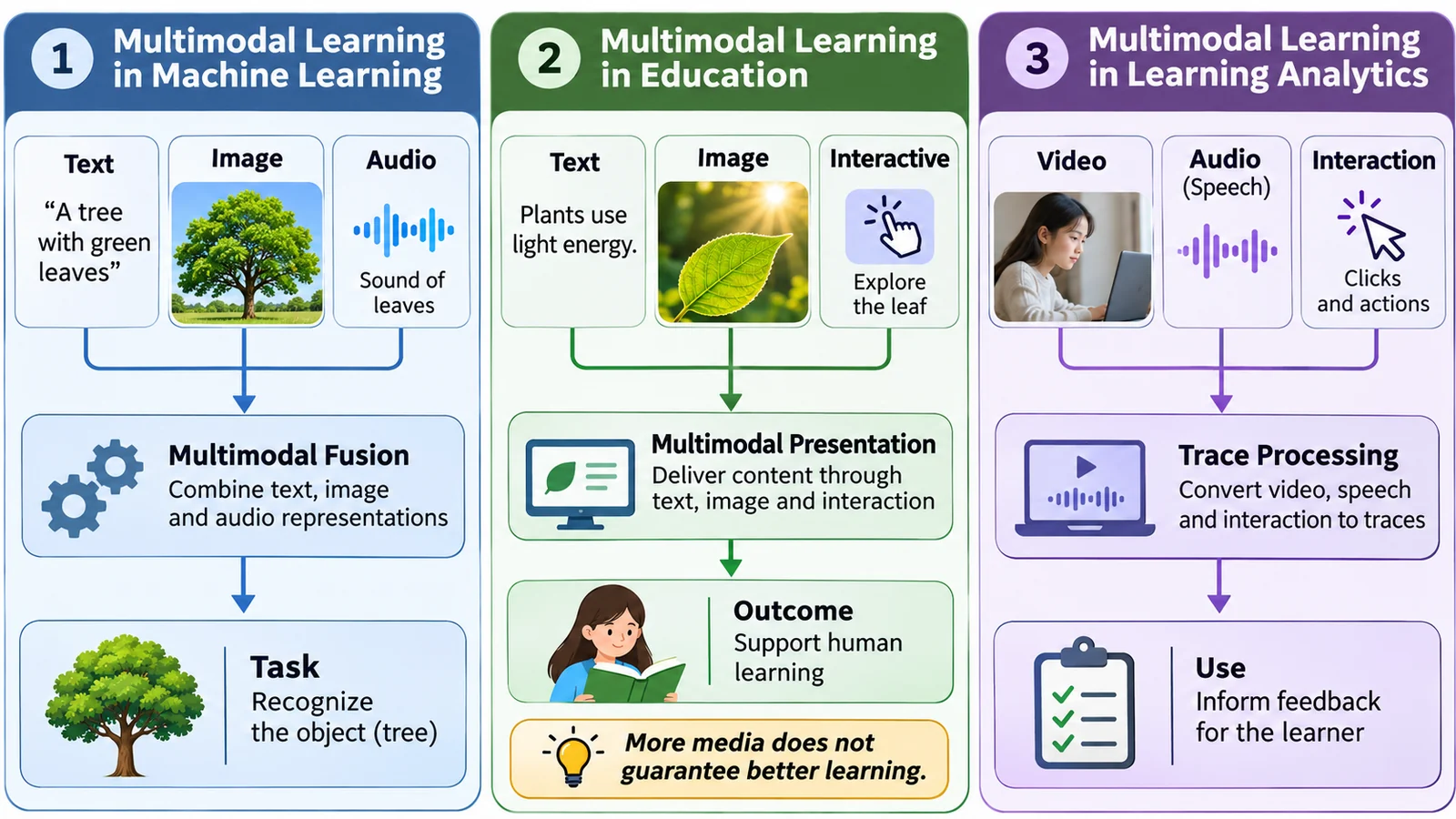
In education research, the phrase appears in reviews of multimodal learning models for language teaching and in experiments on presenting content in several forms at once.[15][16] A 2011 literature review places multimodality within discourse studies, the psychology of learning and computer-assisted language learning, and discusses multimodal conceptions of reading and writing through hypertextuality and literacy.[15] A 2010 study of teaching with educational technologies describes the growing use of multimedia in teaching as a way to present multiple representations of content, namely text, video, audio, images and interactive elements. That study found no discernible improvement in learning performance from multiple representations of content, although students reported very favourably on the multimodal elements and believed they had helped their comprehension and retention of the material.[16] A 2009 model for blended courses, called Blending with Purpose, advises teachers and instructional designers to combine face-to-face methods with online technologies so that a wide spectrum of students is served. The model holds that course and program goals and objectives should drive the pedagogical approaches and technologies chosen.[17]
Sun (2015) defines mode as the way human sensory organs interact with the external environment, and calls interaction through a single sensory organ single mode. One online teaching paper defines mode as the way human sensory organs interact with the external environment. In that usage, interaction through only one sensory organ is a single mode, and simultaneous interaction through more sensory organs is multiple modes.[18]
Machine learning surveys use modality for a kind of data, listing text, images, audio and sensor data among the examples.[12][13] Fusion is the step that integrates the representations of single-modality signals for a particular task, and the 2020 review treats it as one of three perspectives for organizing work on multimodal deep learning, alongside representation learning and applications. Embedding, in that review, means placing signals from different modalities into a single vector space so that cross-modality processing becomes possible.[14] A 2024 survey organizes the same territory around three principles, modality heterogeneity, connections and interactions, and six technical challenges: representation, alignment, reasoning, generation, transference and quantification.[13]
A third use of the phrase appears in learning analytics, a field whose stated goal is to understand and improve learning. Learning does not always happen inside a technological system able to record digital traces. A 2016 editorial argues that in such settings video, audio and similar signals should be captured and processed, so that the actions and interactions of the people involved leave traces. When the modalities carried by those signals are used together, the field is called multimodal learning analytics.[19]
A 2018 literature survey of experiments that used multimodal data set out a model with three objectives. The first maps multimodal data to better feedback in a learning context. The second concerns how machine learning and multimodal data can be combined.[20]
History
From early fusion to transformer models
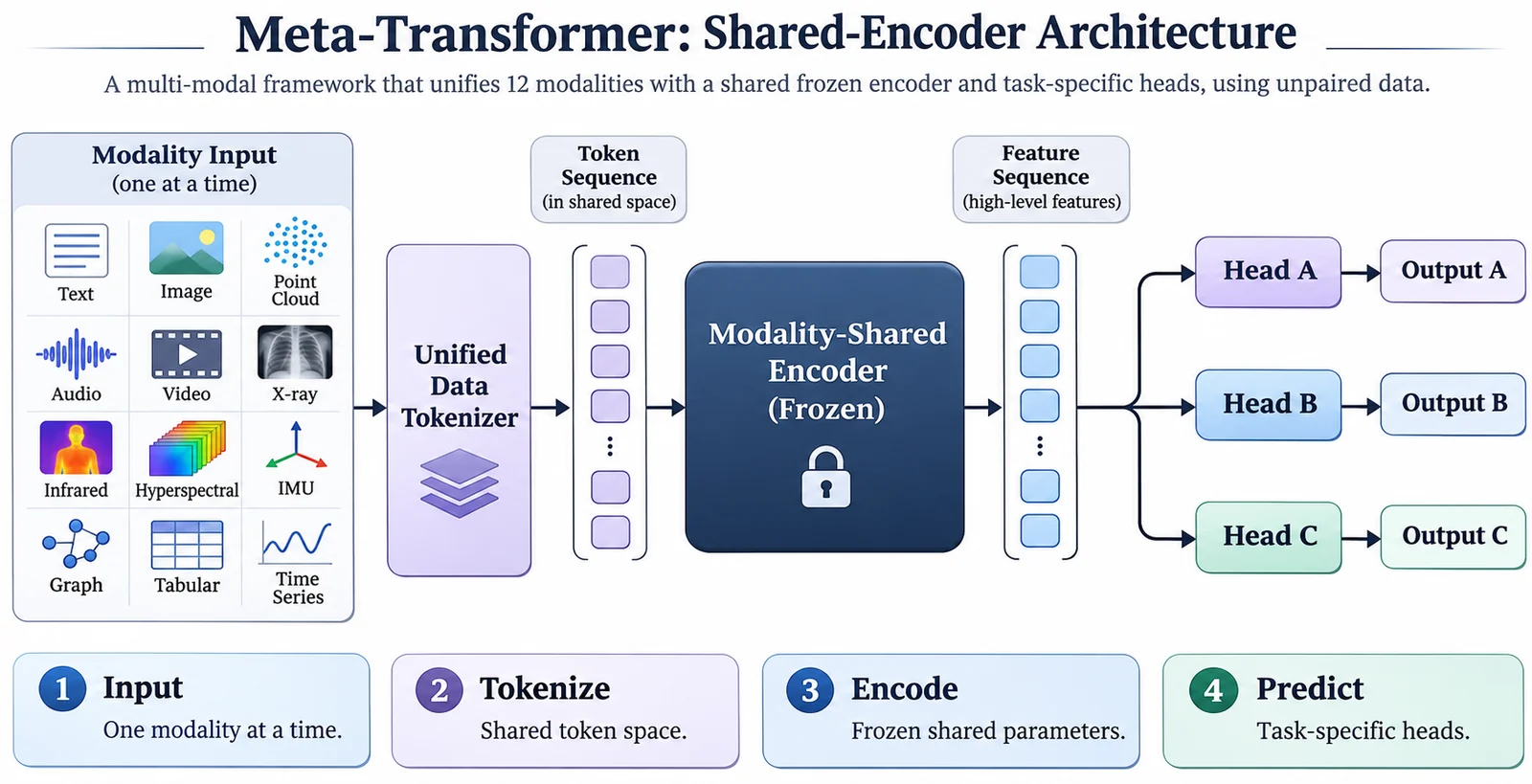
A 2023 paper by Zhang, Gong, Zhang and colleagues proposed Meta-Transformer, which maps raw input from each modality into a shared token space. After that mapping, an encoder with frozen parameters extracts high-level semantic features from the input. A unified data tokenizer prepares input from any modality, a modality-shared encoder processes it, and task-specific heads turn the features into answers. Meta-Transformer was the first framework to perform unified learning across 12 modalities using unpaired data, according to its authors. Meta-Transformer handles fundamental perception tasks in text, image, point cloud, audio and video, and applied tasks in X-Ray, infrared, hyperspectral and IMU data. It also covers data mining tasks in graphs, tabular data and time series. The authors note that building one network for so many data types remains hard because of the inherent gaps among them.[21]
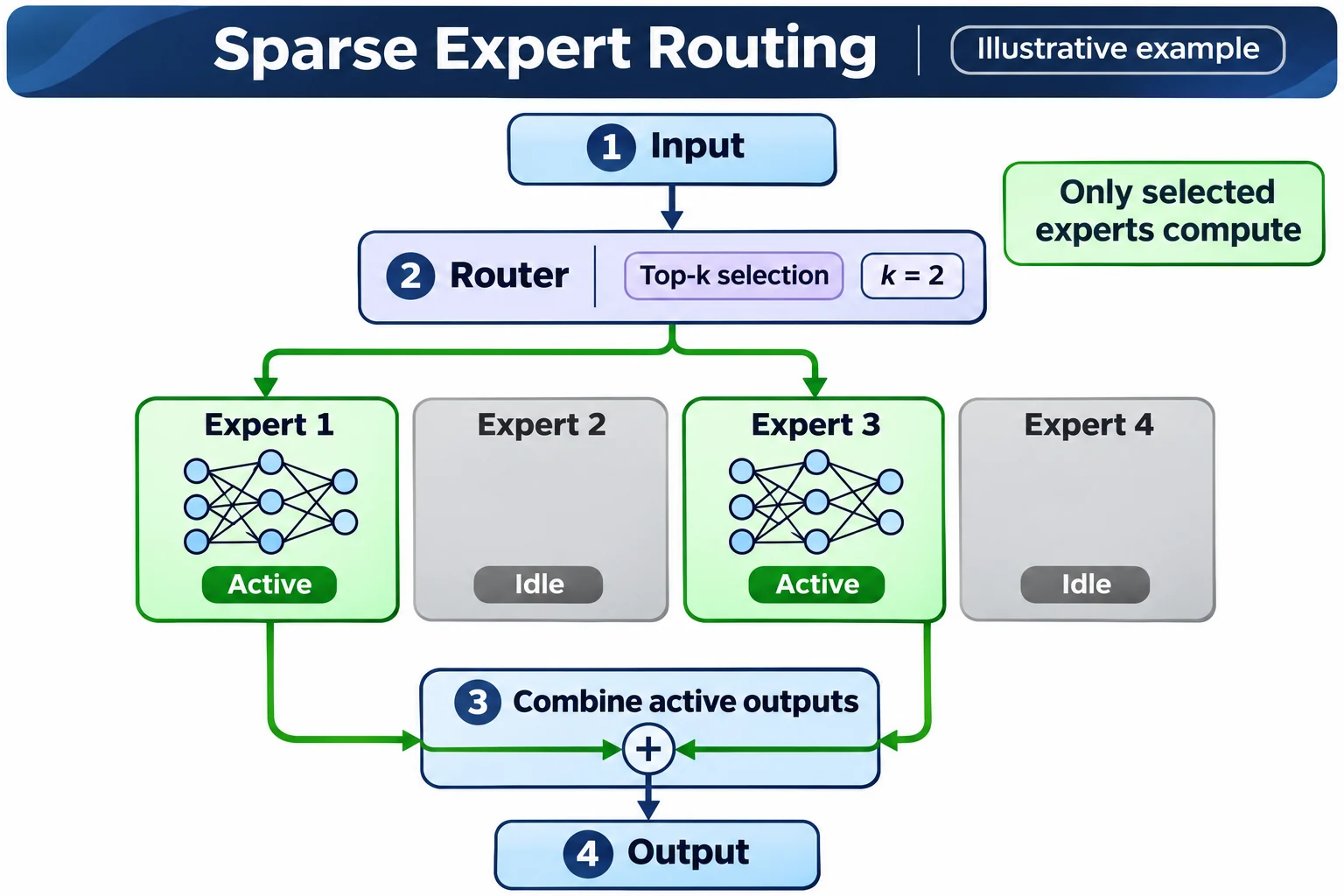
Sparse mixture-of-expert layers let large language models grow in size without a matching rise in computational cost. MoE-LLaVA is a sparse vision-language model built on mixture-of-expert layers, and routers switch on only the top-k experts during deployment. A 2026 paper by Lin, Tang, Ye and colleagues reports that fine-tuning a language model directly into a sparse vision-language model often leads to training collapse. The collapse showed two symptoms: a large gap between the feature distributions of the two modalities, and an uneven load across experts. The team's fix is a three-stage decoupled weight training process, and the first two stages adapt the language model into a vision-language model. In the third stage, weights from the second stage serve as lossless initialization for the expert weights. With only 2.2B active parameters, it scored 87.0 on the POPE benchmark against 85.9 for LLaVA-1.5-13B, a comparable result.[22]
A 2025 survey by Liu and Liu describes multimodal large language models as built on top of language models, which keeps their reasoning strength. That survey says the limits of single-modality models in cross-modal understanding and complex reasoning have become increasingly evident as multimodal data has grown. It sorts current systems by architecture, by training and fine-tuning strategy, and by task classification, and it gives a structured account of evaluation methods. The survey also points to a trend toward balanced integration across modalities, tasks and components. It gives particular attention to reasoning-oriented models, with DeepSeek-R1 as its main example.[23]
Main ideas
How vision-language models are built
The 2025 survey groups modality alignment methods into four kinds: multimodal converters, multimodal perceivers, tool learning and data-driven methods. Multimodal converters transform data into a format the language model can understand, and multimodal perceivers improve how the model perceives different types of data. Tool learning calls on outside tools to turn data into one shared format, usually text. Data-driven methods instead teach the model to understand particular data types inside datasets. The survey warns that choosing the wrong alignment method might require more parameters without significant performance improvements.[24]
Qwen-VL shows the recipe in practice: its builders started from the Qwen-LM language model and added visual capacity through a visual receptor and an input-output interface. Training ran in 3 stages, and the team assembled a multilingual multimodal cleaned corpus of text and images. Beyond describing images and answering questions about them, Qwen-VL gained grounding and text-reading ability by aligning image-caption-box tuples, meaning pictures paired with captions and marked regions.[25]
Kosmos-2 is a multimodal large language model that grounds text to the visual world. It writes refer expressions as Markdown links, with a text span followed by bounding boxes, and each object description is a sequence of location tokens. The builders assembled a large set of grounded image-text pairs, named GrIT, and trained the model on it. Kosmos-2 was evaluated on multimodal grounding tasks such as referring expression comprehension and phrase grounding, and on multimodal referring tasks such as referring expression generation.[26]
OpenFlamingo is an open-source replication of DeepMind's Flamingo models. The family ranges from 3B to 9B parameters, and each model is autoregressive. On seven vision-language datasets, OpenFlamingo models average between 80 and 89% of corresponding Flamingo performance. The project shares its models and code openly.[27]
Mini-Gemini improved consistently with a stronger language model, a stronger visual encoder and better data in experiments.[28] The 2024 introduction notes that the field still faces many challenges in improving the reliability of these models.[29] The 2025 survey adds that multimodal systems still struggle with the semantic gap in multimodal data, and that this gap may produce wrong outputs.[24]
Training with less labelled data
Supervised multimodal learning depends heavily on data paired with expensive human annotations, and that dependence makes it hard to scale models up. Self-supervised learning has become an attractive strategy for easing the annotation bottleneck.[30]
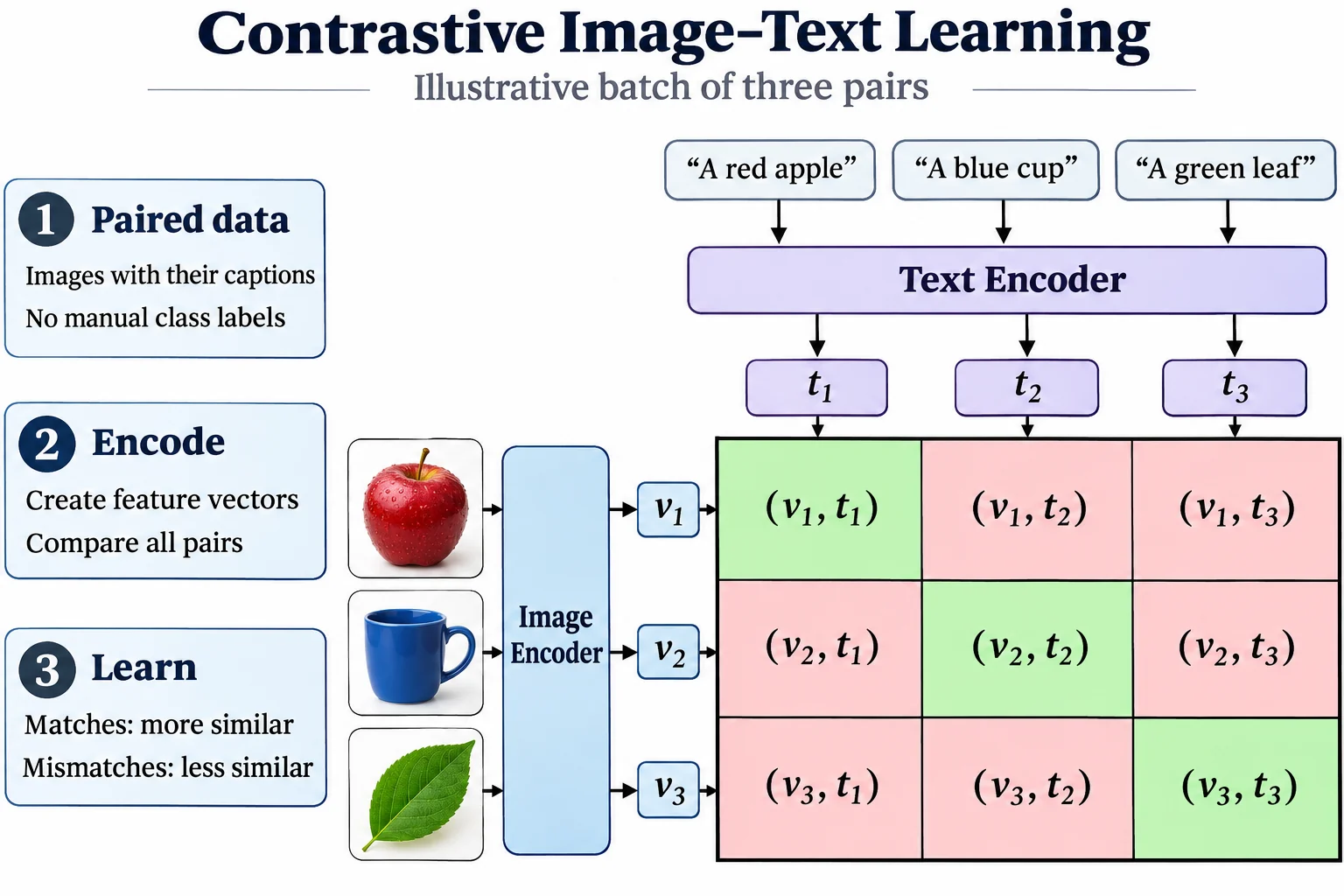
Contrastive vision-language models such as CLIP need a carefully designed text description, called a prompt, to classify images correctly at inference. Earlier methods such as CoOp, CLIP-Adapter and Tip-Adapter adapt these models to new image recognition tasks using a small set of labeled data. Needing labels from the target dataset can still limit how far such methods scale. Unsupervised prompt learning (UPL) instead adapts the model when target labels are unavailable. UPL outperformed the original CLIP with prompt engineering on ImageNet and on 10 other datasets.[31]
Prompt learning is a lightweight way to adapt a large pretrained model, because it optimizes only a few learnable vectors. A 2026 paper notes that most prompt methods design prompts for one modality and ignore effective fusion of multimodal meaning and label alignment. Its Hierarchical Interactive Semantic Fusion framework adds visual and textual signals at intermediate layers of a Transformer. Across 11 few-shot image classification benchmarks, the framework raised average accuracy by around 0.7% over state-of-the-art methods.[32] Color-based Prompt Tuning recasts visual grounding as a fill-in-the-blank problem, using color markers in both image and text. It reached 75.1 zero-shot accuracy in RefCOCO evaluation, well ahead of fine-tuned models and other prompt-tuned models.[33]
With CoOp, test accuracy on base classes first improved and then worsened during training, while accuracy on novel classes kept decreasing. Gradient analysis found that CoOp relied on generalizable features early in training and spurious features later. Subspace Prompt Tuning together with a Novel Feature Learner was tested on 11 classification datasets. The combination consistently improved on CoOp and outperformed the CoCoOp approach.[34] Test-time prompt tuning takes another route: it learns a prompt on the fly from a single test sample. It improved CLIP's zero-shot top-1 accuracy by 3.6% on average under natural shifts in the data distribution.[35]
A 2023 study applied it to vision-language models built on pretrained BLIP-2, gathering 26 publicly available datasets and rewriting them in instruction format. The resulting model, InstructBLIP, was trained on 13 held-in datasets and reached state-of-the-art zero-shot performance on all 13 held-out datasets. InstructBLIP substantially outperformed BLIP-2 and larger Flamingo models, and reached 90.7% accuracy on ScienceQA questions with image contexts after fine-tuning.[36]
Fine-tuning and adapting large models
Finetuning is the adaptation step that links a multimodal model's pretrained knowledge to the requirements of a specialised downstream task. The 2025 review of finetuning covers efficiency-oriented methods, capability-specific techniques and task-unifying approaches.[37]
Fine-tuning can damage what the model already knew, a failure called catastrophic forgetting. Researchers built a test called EMT that treats each multimodal large language model as an image classifier and checks it on standard image classification tasks. Almost all of the open-source fine-tuned models they evaluated failed to match the performance of their own vision encoders on those tasks. The picture is not simply one of loss: early fine-tuning on one image dataset improved performance on other image datasets by improving the alignment of text and visual features. As fine-tuning continued, however, the models began to hallucinate and lost generalizability, even with the image encoder held frozen.[38]
Continual learning, also called class-incremental learning, aims to let a system take on new tasks without forgetting earlier ones. Vision-language models trained on new classes often suffer catastrophic forgetting of the concepts they learned before. One proposed method, called PROjectiOn Fusion or Proof, keeps the image and text encoders frozen and trains small task-specific projections instead. When a new task arrives, new projections are added and the earlier ones are fixed, which reduces forgetting of old concepts. A separate fusion module adjusts visual and textual features together so the model captures task-specific meaning that helps recognition. Experiments on nine benchmark datasets, across several continual learning scenarios and several vision-language models, reported state-of-the-art performance for this method.[39]
Wang, Hu, Zhang, Li, Wang, Zhang et al. (2020) describe building a lightweight model as being of great value in practice, and they present MiniVLM as a step toward on-the-edge applications. MiniVLM, a compact vision-language model, was designed to be fine-tuned on various downstream tasks with good performance, like its larger counterpart. Its designers reported a 73% reduction in model size and a 94% reduction in inference time cost, while keeping 94-97% of the accuracy on multiple vision-language tasks. The large models used to prepare its training data were applied offline, adding no overhead during fine-tuning or inference.[40]
Making large models cheaper to run
Multimodal large language models are costly to run because of their extensive model size and their high training and inference costs.[41] Vision-language models, which pair pictures with words, face the same problem in real-time use. A second 2025 survey describes their high computational demands as a challenge for real-time applications.[42]
The 2025 survey of efficient vision-language models reviews compact architectures and frameworks for constrained devices. It gives detailed insights into the trade-offs between performance and memory in efficient vision-language models.[42]
Fusing data from several sources
A multimodal model takes in more than one kind of data, such as images, text, audio, body gestures, facial expressions, physiological signals, depth maps or point clouds, and learns to link the information they carry.[43] The central technical difficulty is the heterogeneity gap among modalities, which multimodal representation learning aims to narrow. A survey of the field groups deep methods for narrowing this heterogeneity gap into three frameworks. Joint representation maps modalities into one shared space. Coordinated representation keeps a separate space for each modality but ties the spaces together. Encoder-decoder models encode one modality and decode another from it.[44] A systematic review of multimodal machine learning examined 1032 articles and treats representation, translation, alignment, fusion and co-learning as the field's core challenges.[45]
The conventional taxonomy of multimodal data fusion is organized by the stage at which fusion occurs, and majority vote is one example of decision-making in such systems.[46] Intermediate fusion combines features specific to each modality during the learning process itself, and a systematic review of biomedical applications reports that this placement improves predictive performance and captures complex relationships between modalities. That review also proposes a structured notation to standardize how intermediate fusion architectures are described.[10] One survey argues that the early and late labels no longer fit modern practice, because deep networks increasingly merge feature extraction, fusion and decision-making into a single model, blurring the boundaries between the stages.[46]
Generative approaches model the joint distribution of modalities, meaning the probability of seeing combinations of inputs together, and can produce one modality from another in either direction. A joint multimodal variational autoencoder, a generative model that compresses inputs into a shared latent code and reconstructs them, conditions every modality independently on a joint representation, and its extension JMVAE-kl was trained to generate missing modalities from the ones present.[47] A later model, the multimodal variational autoencoder, infers through a product-of-experts network and trains on sub-sampled data. It shares parameters across modality combinations, and on four datasets it matched state-of-the-art performance with many fewer parameters.[48]
Missing modalities are a practical problem, because real systems often lose a sensor or an input channel at test time. Redundancy across modalities might be expected to protect multimodal systems from such losses, yet several existing multimodal networks deteriorate significantly when one or more modalities are absent. A proposed remedy modulates intermediate features of a pretrained network to compensate for the absent input, and it needs fewer than 1% of the total parameters. It was tested on five multimodal tasks across seven datasets, partially bridging the performance drop and in some cases outperforming dedicated networks trained for the available modality combinations.[49] Generative designs address the same problem by construction: the multimodal variational autoencoder learns under any combination of missing modalities, and the JMVAE-kl variant was built specifically to generate missing modalities from the remaining ones.[48][47]
Learning without full supervision
Traditional multimodal models usually need a large amount of labelled data for training, which one 2025 review calls costly and inefficient.[50][51] A 2025 review of self-supervised learning in multimodal models describes the usual alternative: training tasks are designed so that a model learns feature representations from unlabelled data without any manual labelling. The review groups the main methods into contrastive learning, masked modelling and generative learning. Contrastive learning pulls matching pairs of samples together and pushes mismatched ones apart. Tu (2025) lists masked modelling among the main self-supervised learning methods used in multimodal models. Generative learning is the third of the methods Tu (2025) reviews, alongside contrastive learning and masked modelling.[50]
Co-learning asks a different question: whether a model should learn from several senses even when the task it is tested on uses only one. A 2020 study in Information Fusion contrasts the common practice of modelling language from the verbal modality alone with human learning, which is rarely unimodal and often multisensory. Working through information entropy, a measure of uncertainty in a signal, and the behaviour of deep neural networks, that study sets out theoretical arguments in favour of multimodal co-learning.[52]
Zero-shot learning aims at accurate class identification for categories that were not seen during training, by building prior knowledge into a data-driven model. A 2023 review in WIREs Data Mining and Knowledge Discovery calls the combination of zero-shot learning with multimodal learning multimodal zero-shot learning, and presents its definition, typical algorithms, representative applications and open issues.[53] In a few-shot setting, a model is prompted with just a few examples of a new task. A 2021 study trained a vision encoder on aligned image and caption data so that each image became a sequence of continuous embeddings, which are numeric vectors, and fed that prefix to a pretrained language model whose weights were kept frozen. The resulting system learned words for new objects, handled novel visual categories and answered questions about images from a few examples, and it drew on outside knowledge across a range of established and new benchmarks.[54]
A 2023 study in Applied Sciences reports that image-text datasets gathered from network media are short of data, carry simple text and offer abstract image information. Such shortcomings, the study argues, call for outside knowledge to supplement and reason. That study applies multimodal relation data augmentation to the scarcity problem and a flexible threshold loss to the imbalanced distribution of entity pairs and to long-tailed classes, which are classes with very few examples. A small model supplies prompt information as a guide, and a large language model then acts as a knowledge engine for common sense and reasoning, with each stage replaceable by another model. The framework reached an 82.95% F1 score on the test set of the MNRE dataset, where F1 combines precision and recall into one score.[55]
Research
Benchmarks and measured performance
A second 2024 review organized evaluation around three questions: what to evaluate, where to evaluate, and how to evaluate. Under what to evaluate, it listed general multimodal recognition, perception, reasoning and trustworthiness. It added domain-specific areas, among them socioeconomic applications, natural sciences and engineering, medical use, AI agents, remote sensing, video and audio processing, and 3D point cloud analysis. Under where to evaluate, it divided benchmarks into general and specific ones. Under how to evaluate, it reviews and illustrates evaluation steps and metrics. It argues that evaluation should be treated as a critical discipline for advancing the field of multimodal large language models.[56]
One large test hub, described in a 2025 paper, evaluated 13 representative large vision-language models, including InstructBLIP and LLaVA. The hub combined a quantitative capability evaluation with an online arena platform where users judge model answers to open-world questions. The quantitative part scored five categories of multimodal capability, such as visual question answering and object hallucination, across 42 in-domain text-related visual benchmarks. The study examined how model configurations, modality alignment mechanisms and training data affect multimodal understanding.[57]
A 2025 comparative study scored 17 large language models on multimodal tasks, including Qwen2-Audio, LaMini-Flan-T5, VTimeLLM, LITA and MERITS-L. The metrics were word error rate, SPIDEr score, classification accuracy and computational efficiency. MERITS-L performed best at multimodal emotion recognition, CoNeTTE stood out in automated audio captioning, and VTimeLLM led on video temporal localization. The study reported remaining problems with real-time deployment, cross-lingual adaptability and computational cost. It also named gaps in scalability, dataset biases and ethical considerations.[58]
In practice
Medicine and scientific research
Medicine suits multimodal learning because clinical decisions draw on many kinds of data at once. These include medical images such as MRI and CT scans, sensor readings from wearables, heart and breathing sounds, clinical notes, surgical videos and genomic data. Most large language models process only text-based content and often overlook the other data modalities used in clinical practice.[4] A multimodal large language model can interpret and generate text, images, videos and sound, and researchers describe this as a significant step for artificial intelligence in healthcare. One 2023 paper argued that such systems could act as a gateway between health care professionals and AI tools, while calling the human touch in medicine irreplaceable.[59]
A 2024 review examined 18 public medical vision-language datasets. It also analysed the designs of 16 recent medical vision-language models built for report writing and for visual question answering, where a model answers questions about an image.[60] In a 2025 study, 27 certified radiologists in the United States and India judged reports written by a system called Flamingo-CXR against reports written by clinicians. For intensive care chest x-rays, 55.4% of the system's reports were rated preferable or equivalent to clinician reports by at least half the panel. That share rose to 77.7% for outpatient x-rays and to 94% for cases with no pertinent abnormal findings.[6]
An open-source model called CXR-LLaVA was trained on 592,580 chest x-rays. It reached an average F1 score of 0.81 on six major findings in an internal test set and 0.56 in an external test set. Radiologists accepted 72.7% of its reports as autonomous reporting, against 84.0% for the original human reports.[61]
SkinGPT-4 is an interactive dermatology diagnostic system built on multimodal large language models. SkinGPT-4 joined a vision transformer, a network that learns from images, to a language model using 52,929 skin disease images with clinical concepts and doctors' notes. It was then tested on 150 real cases with board-certified dermatologists, and users could upload their own skin photos for analysis and treatment suggestions.[7] In pathology, a 2024 study gave GPT-4V examples inside its prompts, a method called in-context learning, and the model matched or beat specialized networks on three cancer tasks. Those tasks were classifying tissue subtypes in colorectal cancer, subtyping colon polyps, and detecting breast tumors in lymph node sections.[62]
A 2026 review of neurosurgery found only seven eligible studies, and it judged the evidence insufficient for routine clinical use or proven patient benefit. In that review, zero-shot SAM and MedSAM, models used without task-specific training, scored below a supervised network called nnU-Net on segmentation metrics.[63] Precision medicine, which tailors treatment to the individual patient, combines records, imaging, genomics, clinical text, biosignals and wearable outputs. A 2026 review of this field is a preprint, a paper posted before peer review, and it states that it is not for clinical use. That review reports encouraging results in retrospective studies, meaning analyses of past data, but limited translation into routine care.[64]
Security is a separate concern, because a model can be steered by hidden instructions. A prompt injection attack hides instructions in the input so the model produces harmful output without any access to its internal settings. In a 2025 study, researchers tested 594 such attacks on four current vision-language models: Claude-3 Opus, Claude-3.5 Sonnet, Reka Core and GPT-4o. All four were susceptible, and prompts embedded in medical images were not obvious to human observers. The researchers concluded that this vulnerability should be fixed before widespread clinical adoption.[65] The neurosurgery review likewise calls for prospective testing under human supervision, so clinicians can detect and correct erroneous outputs.[63]
Driving, remote sensing and industry
Vision-language models have been applied to autonomous driving, remote sensing, industrial fault detection, construction safety and food energy estimation.[66][67][68][69][70] A 2025 survey describes how these models are used in self-driving cars for perception, navigation and planning, decision-making and control, and data generation.[66] A second 2025 review covers the same field and adds prediction, multitask processing and human-machine interaction as application areas.[71]
Remote sensing is a field where the scientific literature on artificial general intelligence remains relatively scant. A 2024 review argues that earlier remote sensing work concentrated on visual recognition and neglected the meaning of objects and their relationships.[67] Progress depends on data, and one team released RS5M, a dataset of 5 million remote sensing images with English descriptions. Fine-tuning the CLIP model on RS5M produced GeoRSCLIP, which improved on the baseline or the previous best model by 3% to 20% in zero-shot classification. The same model gained 3% to 6% in cross-modal text-image retrieval and 4% to 5% in semantic localization tasks.[72]
Other systems let users point at parts of an image. EarthMarker accepts boxes and points as visual prompts. EarthGPT was trained on over 1M image-text pairs drawn from 34 remote sensing datasets.[73][74]
Most earlier studies of construction falls focused on detecting predefined hazards, with less consideration of the context in which hazardous conditions arise.[69] One 2024 framework uses a large language model for fault detection and diagnosis, and adds synthetic datasets generated by language models to handle imbalanced cases. Its design combines live data streams with fine-tuned models, with attention to security concerns in industrial settings.[68] On construction sites, falls cause more than one-third of fatalities, and earlier systems mainly detected hazards defined in advance. A 2026 framework turns site images into hazard descriptions that match legal safety standards, then analyses the hazard texts with natural language inference to recognise risk.[69]
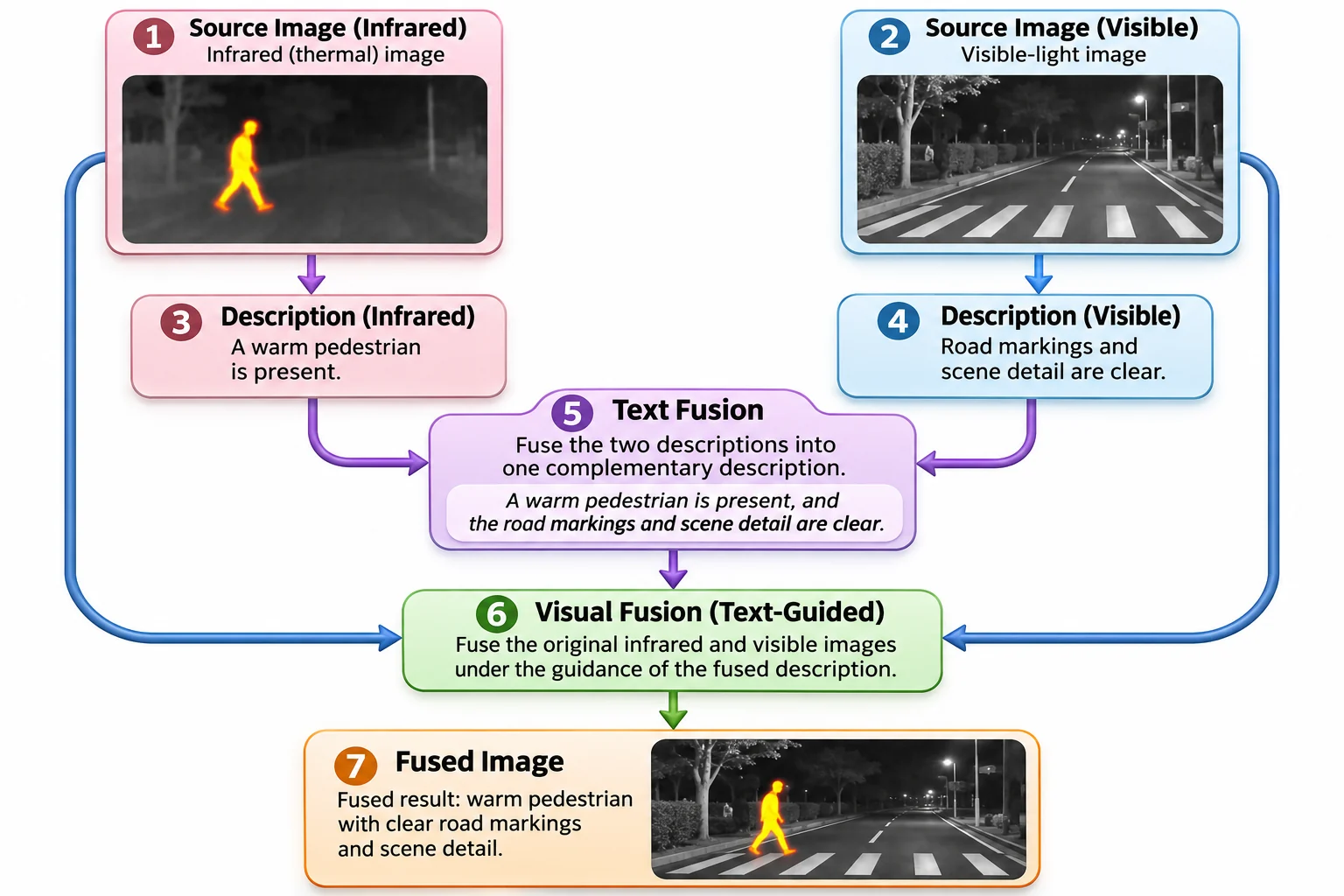
A 2024 method called FILM generates text descriptions of the source images and fuses those descriptions first, then uses them to guide the visual fusion. The method was tested on four tasks: infrared-visible, medical, multi-exposure and multi-focus fusion. The team also released a dataset of generated paragraph descriptions covering eight fusion datasets.[75]
Food energy estimation from a photograph could let people track diet with a phone or augmented reality device. Older deep learning approaches struggle with the variety of foods, partly because labelling images by hand is labor-intensive. A 2025 study tested fine-tuning and volume-aware prompting, which asks the model to reason about portion size, on the Nutrition5k dataset. Both approaches improved estimation accuracy, and adapting LoRA also enhanced food energy estimation performance. The results point to a remaining limit: the ability to estimate food energy is hindered by limits in recognizing food size.[70]
Multimodal learning in classrooms
One 2011 review discusses multimodal learning models in language teaching, and a 2018 study examines a pedagogy of multiliteracies with young children.[76][77] Teachers in that study designed tablet activities, and the researchers treated digital tools as additions to traditional modes rather than replacements for them. The paper illustrates how multimodal learning ecologies can support emergent literacy, which it views as a foundational skill needed by all children.[77] A 2018 study proposed a design that combines universal design for learning with computer-assisted language learning.[78]
A 2023 qualitative study with 25 beginner Chinese learners found that video media can improve students' vocabulary skills.[79] A design project for elementary mathematics asked 101 teachers to rate which arithmetic and geometric concepts children find hard, and the hard concepts differed by school level. Workshops with teachers and children then fed into a game called Space Shapes, which uses visual and touch or body-position information to support mental rotation, 2D to 3D transformation and percentages.[80] A 2026 systematic review of 42 peer-reviewed articles published between 2020 and 2025 found vision-language models used in classrooms from K-12 through higher education.[81]
Most earlier work on learning analytics and educational data mining focused on online courses and cognitive tutors, which are restricted to interactions in front of a computer screen. Multimodal learning analytics instead targets open-ended work, such as computer programs, robots and engineering solutions, where each student produces a unique artifact.[82] In one study, 65 students played a game called Crystal Island while the researchers recorded gameplay, eye movements and facial expressions. Models using several of these data streams together matched or beat models using just one when predicting posttest performance and interest.[2]
Another study recorded small groups working with physical computing parts, using computer vision and data from the parts themselves. The distance between learners' hands and faces was a strong predictor of the quality of the artifact the group built. The researchers reported that neural networks and traditional regression methods could both classify these data, each with advantages and disadvantages that depend on the research question.[83] A gesture-recognition system let students define their own physical movements for a computer-assisted learning environment, and it beat a pretrained model on repeatability and recall.[84]
A 2023 semi-systematic review examined the role of learning theory in multimodal learning analytics research. Most theory-driven papers used theory only to inform the study design, and the review argued that the field is mature enough to contribute to theory rather than only borrow it.[85] The 2020 review reached a related conclusion, calling for a framework that ties the capacities of multimodal data to the design of learning.[5]
Applications across research fields
Several research fields apply multimodal methods to their own recordings, among them single-cell genomics, brain research and affective analysis of social media.[86][87][88] In brain research, one line of work pairs images with recordings of neural activity. A model called EEG-ChannelNet first learned a representation of electroencephalography (EEG, the electrical signal recorded at the scalp) for classification. A later system trained image and EEG encoders together so that visual features and brain signals were pulled into a shared space. That shared space supported image classification and saliency detection, which marks the parts of an image that attract attention, and the learned brain-visual features improved performance on classes not seen in training.[87] A second method, BraVL, combined brain, visual and linguistic features in a deep generative model and found that decoding novel visual categories from human brain activity was practically possible with good accuracy. Decoding models that used visual and linguistic features together performed much better than models using either alone, and the results suggested that visual perception may carry linguistic influences on how the meaning of a stimulus is represented.[88]
Work on emotion in social media and in video treats emotion as an expression of multimodal experience, combining visual, auditory and textual signals.[89][90][91] One system built a joint density model over visual, auditory and textual inputs with a deep Boltzmann machine, a network that learns a probability distribution over its inputs, and trained it on user-generated social media content without labeling. The joint representation allowed retrieval across media, such as finding videos from a text query, and improved both emotion classification and cross-modal retrieval in experiments on web videos and images.[89] Tests of multimodal large language models on the Hume-Reaction benchmark found that they could not yet beat the best existing methods overall, but were more effective than traditional transformer models at recognizing emotions whose intensity departs from the average of the samples.[90] A review of facial expression recognition reported that multimodal large language models show human-level capability on that task and allow contextual variables to be quantified for context-aware emotion inferences.[91]
Single-cell genomics has produced multimodal datasets on a large scale, including a reference atlas built from 211,000 human peripheral blood mononuclear cells.[86][92] A weighted-nearest-neighbor framework learned how useful each data type was in each cell. It was applied to a dataset of 211,000 human peripheral blood mononuclear cells with antibody panels extending to 228 antibodies, producing a reference atlas of the circulating immune system and identifying previously unreported lymphoid subpopulations.[86] A later method, bridge integration, used a multiomic dataset as a molecular bridge to place datasets measuring chromatin accessibility, histone modifications, DNA methylation or protein levels into a shared space. It also harmonized 8.6 million human immune cell profiles collected by sequencing and by mass cytometry.[92] A survey of multimodal learning for multi-omics data, in which several molecular layers are measured in the same samples, catalogued fusion approaches, datasets and open-source tools and identified limited access to such tools as one obstacle to progress.[93]
In materials science and chemistry, one multimodal model predicts the properties and uses of a metal-organic framework from the information available as soon as it is synthesized.[94][95] An automated experiment for piezoresponse force microscopy, a scanning technique that maps a sample's electrical response, combined ensembled deep kernel learning with a reinforcement learning policy for channel selection and identified amplitude as the best predictive channel for the hysteresis loop areas studied.[94] A model for metal-organic frameworks, a class of crystalline porous materials, used the powder X-ray diffraction pattern and the chemicals used in synthesis, both available as soon as a material is made. It predicted pore structure, chemistry-reliant and quantum-chemical properties accurately even when little data was available. Over 5000 new metal-organic frameworks were reported in the year before that study, and the model was paired with a recommendation system to identify promising frameworks for applications different from those originally reported.[95]
Archaeology has been described as a proving ground for multimodal models because its data are heterogeneous, sparse and uncertain. A 2025 review of applications from 2023 onward covered ancient texts, artifacts, field data and knowledge graphs, and judged current work exploratory and fragmented while noting potential for problems of data heterogeneity, knowledge integration and interpretation.[96] Fake news detection, where a post may combine an image and text, has been surveyed for deep learning methods published from 2019 to 2024. The review argued that simple fusion by concatenation or element-wise product ignores how each modality affects the other and lowers accuracy.[97]
Remote sensing image matching and sensor security each pose their own problems for multimodal methods.[98][99] Matching images of the same area taken by different imaging modes, wavebands or platforms is difficult because of nonlinear radiometric differences and geometric distortions, and a method combining a Unet-like feature extractor with transformer attention outperformed handcrafted and learned alternatives on same-scene and different-scene datasets.[99] On the security side, adversarial examples are inputs designed to make a machine learning system produce incorrect outputs. Experiments on a human activity recognition model, with sensors on the chest, wrist and ankle, showed that attacks were possible by hacking only a small number of sensors rather than all of them.[98]
Evidence from classrooms and museums
A qualitative multiple-case study of one English-language classroom found that gesture, posture, gaze and head movement played a prominent part, alongside speech and writing, in activities such as checking for understanding. A qualitative multiple-case study at a private Colombian university videotaped English as a foreign language lessons and analyzed brief moments in which the instructor and the researcher believed learning was being helped or hindered. In those episodes, gesture, posture, gaze and head movement played a prominent rather than marginal part: they focused shared attention, strengthened alignment between teacher and students, helped the class make visual sense of morphological and syntactical units, and served as checks on understanding.[100] A quasi-experiment in a high school in the Selayar Islands compared a genre-based multimodal writing model with ordinary monomodal instruction for 60 students, 29 in the experimental group and 31 in the control group, over five lessons.[101]
Two museum projects paired digital media with physical objects: a virtual museum built from learner-made artifacts, and a mobile scavenger hunt linking narratives to museum objects.[102][103] In the Italian project "Io vado al museo", adult migrants interacted with artworks in a local museum and then made creative artifacts in class. Those artifacts became formal museum objects in a virtual museum. A qualitative critical ethnography drawing on focus groups, teacher interviews and the artifacts found a positive impact across linguistic, personal and affective, social, and civic and democratic dimensions.[102]
A second project, "Letters from the Past", sequenced three phases for middle-school students: digital storytelling through historical letters, a mobile scavenger hunt linking narratives to museum objects, and collaborative creative writing from historically situated perspectives. An exploratory mixed-method field study with 37 students aged 12 to 15 used questionnaires, interviews, observations and analysis of the written letters. It reported high engagement and perceived learning, and the letters showed perspective-taking and affective connection as students adopted historical voices and produced imaginative yet historically plausible elaborations.[103]
A case study of one team in a workshop examined bidirectionally responsive design, in which wearable games respond through both physical and digital interfaces. The analysis described how such making adds tangible and integrative dimensions to multimodal learning theory, giving learners further ways to make meaning and exercise metacognition and agency, and how designing integrated systems offers practice with complex systems.[104] Smaller studies report narrower outcomes: a video game designed for students with special education needs encouraged users to exercise their voice, and the measures of goal achievement identified which prosodic skills were most affected.[105]
Two learning analytics studies drew on sensor and platform records: body posture, head posture, facial expressions and question-answering logs in one, and sensor data from mobile devices in the other.[106][107] One course evaluation of a preschool hygiene class fused body posture, head posture, facial expressions and question-answering records from an interactive cloud platform; among 40 participating students the median integration rating was 0.706, and most ratings fell in the middle to high range. In the case study of five students, two spent 90% and 89% of their time in attentive behavior, and the same two held an emotion of interest for 66% and 70% of the time.[106] A framework for mobile English learning in higher education aligns sensor data in time, fuses features across modes, and uses multitask learning to judge interaction quality and cognitive load at once, with hierarchical feedback for intervention.[107] A review of multimodal large language models, systems that process text, sound and images together, sets out scenarios for science education in content creation, tailored support, scientific practices, and assessment and feedback, while naming data protection and ethical concerns as open challenges.[108] A discussion of large language models in dental education, illustrated with periodontal charting, lists personalized feedback, case scenarios and educational content as benefits and bias, inaccuracy, privacy and overreliance as risks.[109]
What this looks like in practice
Meta-Transformer maps raw data from 12 modalities into a shared token space and passes them through a frozen encoder, with no paired multimodal training data. The framework has three components: a tokenizer that handles data from every modality in the same way, one encoder whose parameters are shared across modalities, and separate heads that carry out each downstream task. The authors tested it on text, image, point cloud, audio and video perception, plus X-ray, infrared, hyperspectral and IMU data, and on graph, tabular and time-series data.[21]
HISF adds visual and textual signals in intermediate layers of a Transformer through cross-attention, on top of frozen CLIP backbones.[32] Proof trains task-specific projections on frozen image and text encoders, expands new projections for new tasks and fixes former ones, and was tested on nine benchmark datasets.[39]
MiniVLM uses a Two-stage Efficient feature Extractor to cut visual feature extraction time by 95 percent, and it reduces model size by 73 percent and inference time by 94 percent.[40] During deployment, routers send each input to only the top-k experts and leave the rest idle.[22]
A 2024 survey defines hallucination in large vision-language models as misalignment between factual visual content and the generated text. It reviews benchmarks, root causes in training data and model components, and mitigation methods.[110]
A review of vision-language models in neurosurgery found seven eligible studies, and zero-shot SAM and MedSAM scored below supervised nnU-Net on segmentation metrics for lumbar-spine MRI. A task-adapted SAM2-UNet reached a mean Dice score of 0.771 for brain-tumour segmentation, with mean IoU 0.569 against 0.571 for Mask R-CNN.[63]
A fall-hazard framework uses BLIP-2 to caption images of openings, scaffolding and worker behavior, then applies natural language inference to label each image Safe or Risk. It achieved an F1-score of 0.84.[69]
A four-year case study with children aged 2 to 12, reporting on ages 4 to 8 in low socio-economic schools in one Australian state, documented teachers designing multimodal experiences with tablets. The study treated digital technologies as complementary to traditional modalities rather than as alternatives.[77]
Multimodal learning analytics captures video and audio to produce traces of learners' actions and interactions in settings not centered on technology.[19] A conceptual model for the field maps multimodal data to feedback, combines machine learning with that data, and aligns terminology between machine learning and learning science.[20]
A semi-supervised study derives lower and upper bounds on multimodal interactions using only labeled unimodal data and naturally co-occurring unlabeled multimodal data. Liang, Ling, Cheng and colleagues note that the bounds can help estimate how well a multimodal model will perform, plan which data to collect, and choose a model suited to a given task.[51]
Babu and Krishnan (2026) observe that a single material or experiment in materials science may be described at the same time by its atomic structure, its spectra, microscopy images, simulations, the conditions under which it was processed, and written records. Babu and Krishnan frame each modality as a constraint that complements the others on one shared physical state, and they point to inverse design and self-driving laboratories that run closed loops as open opportunities.[111]
A 2016 editorial introduces multimodal learning analytics as the use and integration of different modalities in signals such as video and audio.[19] A 2018 literature survey notes that sensors capture observable events such as behavior and context, while latent attributes such as cognitions and emotions need human-driven interpretation.[20]
Criticism
Hallucination and limits of visual reasoning
A vision-language model can produce a sentence that does not match what the picture shows. Researchers call this a hallucination: a misalignment between factual visual content and the text the model generates. A 2024 survey by Liu, Xue, Chen, Chen, Zhao, Wang and colleagues catalogued the symptoms of hallucination in large vision-language models. Benchmarks and methods built specifically to measure these visual hallucinations form a further part of the survey.[110]
A 2026 exploratory study by Ibrišagić and Domijan asked four chat models to find and draw a path through a maze shown as an image, without crossing the walls. The models were Grok, Gemini-3, ChatGPT-4o and ChatGPT-5.2, tested on 20 mazes: 10 with a path from start to exit and 10 without one. Each problem appeared five times in random order, and separate prompts in English and Croatian brought the total to 200 trials per model, 100 per language. Only ChatGPT-5.2 gave consistently correct answers in both words and images. The other models made drawing errors: inventing a new, unrelated maze, leaving the start unconnected to the exit, crossing walls, and walking along the walls. The study was exploratory, and its authors also ran a small side study of whether the models could judge their own performance.[112]
Schulze Buschoff, Akata, Bethge and Schulz (2025) ran a series of controlled experiments on intuitive physics, causal reasoning and intuitive psychology, and report that the vision-based models they tested still fall short of human capabilities in these areas. Some of these models showed proficiency in processing and interpreting visual data, yet they still fell short of human capabilities in these areas. The researchers concluded that models need better mechanisms for understanding causality, physical dynamics and social cognition, and called for benchmarks inspired by human cognition.[113]
A different line of work asks whether models tie words to the world the way people do. Jones, Bergen and Trott (2024) ran four pre-registered studies, adapting tasks used to test embodied simulation in human readers. The models were sensitive to some features implied but not stated in an event description, such as color and shape, but not to size, orientation or volume. Even where the models showed that sensitivity, they could not fully account for human behavior on the same task. One architecture, ViLT, predicted human responses about shape better than CLIP, despite training on orders of magnitude less data.[114]
Open questions and criticism
Through extensive empirical studies, the 2023 paper found that multimodal classification methods give unreliable predictive confidence that tends to rely on partial modalities. In the study's tests, estimated confidence could even rise when some of the model's input types were corrupted. The researchers proposed a simple rule: confidence should not go up when one input type is removed.[115]
A second open problem is imbalance: joint training with one shared objective can leave some input types poorly learned. A 2025 paper notes that one input type often carries more telling information than the others, such as the picture of a football game versus the sound of wind. That stronger input type can dominate training, so the remaining ones end up significantly under-optimized. The paper's fix weakens the dominant input during the forward pass and reduces its share of the learning signal during the backward pass.[116] A 2026 perspective on scientific machine learning lists modality imbalance among the field's challenges, alongside cross-scale alignment, interpretability and data stewardship.[111]
In real-world environments, incomplete modalities are a core issue for conversation understanding. A 2023 framework for conversations, called GCNet, combines classification with reconstruction to use both complete and incomplete data. On three benchmark conversational datasets it beat existing state-of-the-art methods for incomplete multimodal learning.[3] The 2026 perspective argues that scientific evidence is rarely complete either, since each measurement type offers a different and often partial view of the same physical state.[111]
The 2024 survey on multimodal large language models discusses existing challenges and points out promising research directions. Surveys of multimodal large language models, which pair a large language model with other input types, treat hallucination as a central research topic. The same survey describes capabilities such as writing stories from images and optical character recognition-free math reasoning as emergent, and notes that they are rare in traditional multimodal methods.[117]
The 2024 survey of vision-language models for vision tasks includes benchmarking, analysis and discussion of the reviewed methods. A 2024 survey of vision-language models, which learn links between images and text, lists research challenges and possible future directions for visual recognition.[118] Another 2024 survey of visual multimodal large language models compares existing models on performance and on the computing power they need.[119] A 2024 review of large multimodal models offers potential research directions and examines the development of large-scale models from a global viewpoint.[120] The 2026 perspective goes further and proposes an evaluation framework that can be audited, meaning checked by outsiders. It rests on how much information each input type carries, how well the modalities correspond, and how useful the predictions are.[111]
Common misconceptions
A 2025 study reports that joint training with a uniform objective can leave one modality dominant and the others under-optimized. Its on-the-fly prediction and gradient modulation strategies improved results across a variety of multimodal tasks.[116]
Key studies
| Year | Study | Sample | Design | Finding |
|---|---|---|---|---|
| 2018 | Yelland[77] | children aged 2 to 12 over four years, with reported data on ages 4 to 8 in Australian schools | case study using participant observation | Teachers designed multimodal tablet experiences that supported emergent literacy, with digital technologies treated as complementary to traditional modalities. |
| 2019 | Baltrusaitis et al.[1] | Survey and taxonomy of multimodal machine learning research | The authors identify broad challenges that the field faces: representation, translation, alignment, fusion and co-learning. | |
| 2020 | Wang et al.[40] | MiniVLM and a baseline vision-language model | model design and evaluation on multiple vision-language tasks | Model size fell by 73 percent and inference time by 94 percent, while 94 to 97 percent of accuracy was retained. |
| 2020 | Sharma & Giannakos[5] | Systematic literature review of 42 papers on multimodal data for human learning | The review identifies six main objectives, including behavioral trajectories, learning outcome and engagement. | |
| 2021 | Palazzo et al.[87] | EEG recordings during image viewing | siamese network training of EEG and image encoders | EEG classification reached an average accuracy of 48.1 percent, above the 31.9 percent maximum of EEGNet. |
| 2022 | Huang et al.[31] | ImageNet and 10 other datasets | unsupervised prompt learning compared with CLIP prompt engineering and 8-shot methods | Unsupervised prompt learning beat original CLIP with prompt engineering and was competitive with 8-shot CoOp and 8-shot TIP-Adapter on most datasets. |
| 2023 | Awadalla et al.[27] | OpenFlamingo models ranging from 3B to 9B parameters | technical report with evaluation on seven vision-language datasets | The models averaged between 80 and 89 percent of corresponding Flamingo performance. |
| 2025 | Xu et al.[57] | 13 representative large vision-language models including InstructBLIP and LLaVA | benchmark evaluation on 42 in-domain text-related visual benchmarks plus an online arena | The hub evaluated five categories of multimodal capability, including visual question answering and object hallucination. |
| 2025 | Clusmann et al.[65] | 594 attacks on four vision-language models | quantitative security study with prompt injection on medical images | All four models were susceptible to prompt injection that could produce harmful output. |
| 2025 | Tanabe & Yanai[70] | 3265 food images in Nutrition5k, split into 2759 training and 506 test samples | fine-tuning and zero-shot experiments with large vision-language models | Fine-tuned LLaVA-1.5 models outperformed GPT-4V and GPT-4o on all metrics, and LoRA beat full-parameter tuning. |
| 2026 | Lin et al.[22] | MoE-LLaVA with 2.2B active parameters and LLaVA-1.5-13B | benchmark comparison across nine visual understanding benchmarks | MoE-LLaVA scored 87.0 against 85.9 for LLaVA-1.5-13B on POPE and improved by 4.6 on average across nine benchmarks. |
| 2026 | Feng & Li[32] | 11 few-shot image classification benchmarks | benchmark comparison of a prompt-learning framework on frozen CLIP backbones | HISF improved average accuracy by around 0.7 percent over state-of-the-art methods. |
| 2026 | Jeong & Yang[69] | Images of openings, scaffolding and worker behavior in construction | vision-language captioning with natural language inference for hazard classification | The framework achieved an F1-score of 0.84 for Safe versus Risk classification. |
| 2026 | Uzoechina et al.[63] | seven studies published between January 2020 and August 2026 | narrative review of visual and vision-language foundation models in neurosurgery | Zero-shot SAM and MedSAM scored below supervised nnU-Net on lumbar-spine MRI segmentation, and SAM2-UNet reached a mean Dice score of 0.771. |
See also
References
- Baltrusaitis, T., Ahuja, C., & Morency, L. P. (2019). Multimodal Machine Learning: A Survey and Taxonomy. IEEE Transactions on Pattern Analysis and Machine Intelligence, 41(2), 423-443. doi:10.1109/tpami.2018.2798607
- Emerson, A., Cloude, E. B., Azevedo, R., & Lester, J. (2020). Multimodal learning analytics for game‐based learning. British Journal of Educational Technology, 51(5), 1505-1526. doi:10.1111/bjet.12992
- Lian, Z., Chen, L., Sun, L., Liu, B., & Tao, J. (2023). GCNet: Graph Completion Network for Incomplete Multimodal Learning in Conversation. IEEE Transactions on Pattern Analysis and Machine Intelligence, 1-14. doi:10.1109/tpami.2023.3234553
- AlSaad, R., Abd-alrazaq, A., Boughorbel, S., Ahmed, A., Renault, M. A., Damseh, R., & Sheikh, J. (2024). Multimodal Large Language Models in Health Care: Applications, Challenges, and Future Outlook. Journal of Medical Internet Research, 26, e59505. doi:10.2196/59505
- Sharma, K., & Giannakos, M. (2020). Multimodal data capabilities for learning: What can multimodal data tell us about learning? British Journal of Educational Technology, 51(5), 1450-1484. doi:10.1111/bjet.12993
- Tanno, R., Barrett, D. G. T., Sellergren, A., Ghaisas, S., Dathathri, S., See, A., Welbl, J., Lau, C., Tu, T., Azizi, S., Singhal, K., Schaekermann, M., May, R., Lee, R., Man, S., Mahdavi, S., Ahmed, Z., Matias, Y., Barral, J., & ... Ktena, I. (2025). Collaboration between clinicians and vision–language models in radiology report generation. Nature Medicine, 31(2), 599-608. doi:10.1038/s41591-024-03302-1
- Zhou, J., He, X., Sun, L., Xu, J., Chen, X., Chu, Y., Zhou, L., Liao, X., Zhang, B., Afvari, S., & Gao, X. (2024). Pre-trained multimodal large language model enhances dermatological diagnosis using SkinGPT-4. Nature Communications, 15(1). doi:10.1038/s41467-024-50043-3
- Yuan, Y., Li, Z., & Zhao, B. (2025). A Survey of Multimodal Learning: Methods, Applications, and Future. ACM Computing Surveys, 57(7), 1-34. doi:10.1145/3713070
- Zhu, Y., Wu, Y., Sebe, N., & Yan, Y. (2024). Vision + X: A Survey on Multimodal Learning in the Light of Data. IEEE Transactions on Pattern Analysis and Machine Intelligence, 46(12), 9102-9122. doi:10.1109/tpami.2024.3420239
- Guarrasi, V., Aksu, F., Caruso, C. M., Di Feola, F., Rofena, A., Ruffini, F., & Soda, P. (2025). A systematic review of intermediate fusion in multimodal deep learning for biomedical applications. Image and Vision Computing, 158, 105509. doi:10.1016/j.imavis.2025.105509
- Ramachandram, D., & Taylor, G. W. (2017). Deep Multimodal Learning: A Survey on Recent Advances and Trends. IEEE Signal Processing Magazine, 34(6), 96-108. doi:10.1109/msp.2017.2738401
- Ateş, A. H., & Yurtsever, U. (2026). An overview of multimodal learning: Concepts, challenges, applications and datasets. Konya Journal of Engineering Sciences, 14(2), 917-950. doi:10.36306/konjes.1716813
- Liang, P. P., Zadeh, A., & Morency, L. P. (2024). Foundations & Trends in Multimodal Machine Learning: Principles, Challenges, and Open Questions. ACM Computing Surveys, 56(10), 1-42. doi:10.1145/3656580
- Zhang, C., Yang, Z., He, X., & Deng, L. (2020). Multimodal Intelligence: Representation Learning, Information Fusion, and Applications. IEEE Journal of Selected Topics in Signal Processing, 14(3), 478-493. doi:10.1109/jstsp.2020.2987728
- Farías, M., Obilinovic, K., & Orrego, R. (2011). Implications of Multimodal Learning Models for foreign language teaching and learning. Colombian Applied Linguistics Journal(9), 174. doi:10.14483/22487085.3150
- Sankey, M., Birch, D., & Gardiner, M. (2010). Engaging students through multimodal learning environments: The journey continues. ASCILITE Publications, 852-863. doi:10.14742/apubs.2010.2003
- Picciano, A. G. (2009). Blending with purpose: The multimodal model. Online Learning, 13(1). doi:10.24059/olj.v13i1.1673
- Sun, M. (2015). Application of Multimodal Learning in Online English Teaching. International Journal of Emerging Technologies in Learning (iJET), 10(4), 54. doi:10.3991/ijet.v10i4.4697
- Ochoa, X., & Worsley, M. (2016). Editorial: Augmenting Learning Analytics with Multimodal Sensory Data. Journal of Learning Analytics, 3(2), 213-219. doi:10.18608/jla.2016.32.10
- Di Mitri, D., Schneider, J., Specht, M., & Drachsler, H. (2018). From signals to knowledge: A conceptual model for multimodal learning analytics. Journal of Computer Assisted Learning, 34(4), 338-349. doi:10.1111/jcal.12288
- Zhang, Y., Gong, K., Zhang, K., Li, H., Qiao, Y., Ouyang, W., & Yue, X. (2023). Meta-Transformer: A Unified Framework for Multimodal Learning. arXiv. doi:10.48550/arxiv.2307.10802 Free full text
- Lin, B., Tang, Z., Ye, Y., Huang, J., Zhang, J., Pang, Y., Jin, P., Ning, M., Luo, J., & Yuan, L. (2026). MoE-LLaVA: Mixture of Experts for Large Vision-Language Models. IEEE Transactions on Multimedia, 28, 4408-4419. doi:10.1109/tmm.2026.3654458
- Liu, X., & Liu, H. (2025). Symmetry-Aware Advances in Multimodal Large Language Models: Architectures, Training, and Evaluation. Symmetry, 17(9), 1400. doi:10.3390/sym17091400
- Song, S., Li, X., Li, S., Zhao, S., Yu, J., Ma, J., Mao, X., Zhang, W., & Wang, M. (2025). How to Bridge the Gap Between Modalities: Survey on Multimodal Large Language Model. IEEE Transactions on Knowledge and Data Engineering, 37(9), 5311-5329. doi:10.1109/tkde.2025.3527978
- Bai, J., Bai, S., Yang, S., Wang, S., Tan, S., Wang, P., Lin, J., Zhou, C., & Zhou, J. (2023). Qwen-VL: A Versatile Vision-Language Model for Understanding, Localization, Text Reading, and Beyond. arXiv. doi:10.48550/arxiv.2308.12966 Free full text
- Peng, Z., Wang, W., Dong, L., Hao, Y., Huang, S., Ma, S., & Wei, F. (2023). Kosmos-2: Grounding Multimodal Large Language Models to the World. arXiv. doi:10.48550/arxiv.2306.14824 Free full text
- Awadalla, A., Gao, I., Gardner, J., Hessel, J., Hanafy, Y., Zhu, W., Marathe, K., Bitton, Y., Gadre, S. Y., Sagawa, S., Jitsev, J., Kornblith, S., Koh, P. W., Ilharco, G., Wortsman, M., & Schmidt, L. (2023). OpenFlamingo: An Open-Source Framework for Training Large Autoregressive Vision-Language Models. arXiv. doi:10.48550/arxiv.2308.01390 Free full text
- Li, Y., Zhang, Y., Wang, C., Zhong, Z., Chen, Y., Chu, R., Liu, S., & Jia, J. (2026). Mini-Gemini: Mining the Potential of Multi-Modality Vision Language Models. IEEE Transactions on Pattern Analysis and Machine Intelligence, 48(3), 3530-3543. doi:10.1109/tpami.2025.3637265
- Bordes, F., Pang, R. Y., Anurag, A., Li, A. C., Bardes, A., Petryk, S., Mañas, O., Lin, Z., Anas, M., Jayaraman, B., Ibrahim, M., Hall, M. A., Xiong, Y., Lebensold, J., Ross, C., Jayakumar, S., Guo, C., Bouchacourt, D., Al-Tahan, H., & ... Chandra, V. (2024). An Introduction to Vision-Language Modeling. arXiv. doi:10.48550/arxiv.2405.17247 Free full text
- Zong, Y., Aodha, O. M., & Hospedales, T. M. (2025). Self-Supervised Multimodal Learning: A Survey. IEEE Transactions on Pattern Analysis and Machine Intelligence, 47(7), 5299-5318. doi:10.1109/tpami.2024.3429301
- Huang, T. J., Jack, C., & Wei, F. (2022). Unsupervised Prompt Learning for Vision-Language Models. arXiv. doi:10.48550/arxiv.2204.03649 Free full text
- Feng, H., & Li, C. (2026). HISF: Hierarchical Interactive Semantic Fusion for Multimodal Prompt Learning. Multimodal Technologies and Interaction, 10(1), 6. doi:10.3390/mti10010006
- Yao, Y., Zhang, A., Zhang, Z., Liu, Z., Chua, T. S., & Sun, M. (2024). CPT: Colorful Prompt Tuning for pre-trained vision-language models. AI Open, 5, 30-38. doi:10.1016/j.aiopen.2024.01.004
- Ma, C., Liu, Y., Deng, J., Xie, L., Dong, W., & Xu, C. (2023). Understanding and Mitigating Overfitting in Prompt Tuning for Vision-Language Models. IEEE Transactions on Circuits and Systems for Video Technology, 33(9), 4616-4629. doi:10.1109/tcsvt.2023.3245584
- Shu, M., Nie, W., Huang, D. A., Yu, Z., Goldstein, T., Anandkumar, A., & Xiao, C. (2022). Test-Time Prompt Tuning for Zero-Shot Generalization in Vision-Language Models. arXiv. doi:10.48550/arxiv.2209.07511 Free full text
- Dai, W., Li, J., Li, D., Tiong, A. M. H., Zhao, J., Wang, W., Li, B., Fung, P., & Hoi, S. C. H. (2023). InstructBLIP: Towards General-purpose Vision-Language Models with Instruction Tuning. arXiv. doi:10.48550/arxiv.2305.06500 Free full text
- Wang, Z., Li, L., & Chen, L. (2025). Recent advances in finetuning multimodal large language models. AI Magazine, 46(3). doi:10.1002/aaai.70025
- Zhai, Y., Tong, S., Xiao, L., Cai, M., Qu, Q., Lee, Y. J., & Ma, Y. (2023). Investigating the Catastrophic Forgetting in Multimodal Large Language Models. arXiv. doi:10.48550/arxiv.2309.10313 Free full text
- Zhou, D. W., Zhang, Y., Wang, Y., Ning, J., Ye, H. J., Zhan, D. C., & Liu, Z. (2025). Learning Without Forgetting for Vision-Language Models. IEEE Transactions on Pattern Analysis and Machine Intelligence, 47(6), 4489-4504. doi:10.1109/tpami.2025.3540889
- Wang, J., Hu, X., Zhang, P., Li, X., Wang, L., Zhang, L., Gao, J., & Liu, Z. (2020). MiniVLM: A Smaller and Faster Vision-Language Model. arXiv. doi:10.48550/arxiv.2012.06946 Free full text
- Jin, Y., Li, J., Gu, T., Liu, Y., Zhao, B., Lai, J., Gan, Z., Wang, Y., Wang, C., Tan, X., & Ma, L. (2025). Efficient multimodal large language models: a survey. Visual Intelligence, 3(1). doi:10.1007/s44267-025-00099-6
- Shinde, G., Ravi, A., Dey, E., Sakib, S., Rampure, M., & Roy, N. (2025). A Survey on Efficient Vision‐Language Models. WIREs Data Mining and Knowledge Discovery, 15(3). doi:10.1002/widm.70036
- Jabeen, S., Li, X., Amin, M. S., Bourahla, O., Li, S., & Jabbar, A. (2023). A Review on Methods and Applications in Multimodal Deep Learning. ACM Transactions on Multimedia Computing, Communications, and Applications, 19(2s), 1-41. doi:10.1145/3545572
- Guo, W., Wang, J., & Wang, S. (2019). Deep Multimodal Representation Learning: A Survey. IEEE Access, 7, 63373-63394. doi:10.1109/access.2019.2916887
- Barua, A., Ahmed, M. U., & Begum, S. (2023). A Systematic Literature Review on Multimodal Machine Learning: Applications, Challenges, Gaps and Future Directions. IEEE Access, 11, 14804-14831. doi:10.1109/access.2023.3243854
- Zhao, F., Zhang, C., & Geng, B. (2024). Deep Multimodal Data Fusion. ACM Computing Surveys, 56(9), 1-36. doi:10.1145/3649447
- Suzuki, M., Nakayama, K., & Matsuo, Y. (2016). Joint Multimodal Learning with Deep Generative Models. arXiv. doi:10.48550/arxiv.1611.01891 Free full text
- Wu, M., & Goodman, N. D. (2018). Multimodal Generative Models for Scalable Weakly-Supervised Learning. arXiv. doi:10.48550/arxiv.1802.05335 Free full text
- Reza, M. K., Prater-Bennette, A., & Asif, M. S. (2025). Robust Multimodal Learning With Missing Modalities via Parameter-Efficient Adaptation. IEEE Transactions on Pattern Analysis and Machine Intelligence, 47(2), 742-754. doi:10.1109/tpami.2024.3476487
- Tu, Y. (2025). A Review of the Applications of Self-Supervised Learning in Multimodal Models. Advances in Engineering Technology Research, 14(1), 1491. doi:10.56028/aetr.14.1.1491.2025
- Liang, P. P., Ling, C. K., Cheng, Y., Obolenskiy, A., Liu, Y., Pandey, R., Wilf, A., Morency, L., & Salakhutdinov, R. (2023). Multimodal Learning Without Labeled Multimodal Data: Guarantees and Applications. arXiv. doi:10.48550/arxiv.2306.04539 Free full text
- Zadeh, A., Liang, P. P., & Morency, L. P. (2020). Foundations of Multimodal Co-learning. Information Fusion, 64, 188-193. doi:10.1016/j.inffus.2020.06.001
- Cao, W., Wu, Y., Sun, Y., Zhang, H., Ren, J., Gu, D., & Wang, X. (2023). A review on multimodal zero‐shot learning. WIREs Data Mining and Knowledge Discovery, 13(2). doi:10.1002/widm.1488
- Tsimpoukelli, M., Menick, J., Cabi, S., Eslami, S. M. A., Vinyals, O., & Hill, F. (2021). Multimodal Few-Shot Learning with Frozen Language Models. arXiv. doi:10.48550/arxiv.2106.13884 Free full text
- He, W., Ma, H., Li, S., Dong, H., Zhang, H., & Feng, J. (2023). Using Augmented Small Multimodal Models to Guide Large Language Models for Multimodal Relation Extraction. Applied Sciences, 13(22), 12208. doi:10.3390/app132212208
- Huang, J., & Jingyi, Z. (2024). A Survey on Evaluation of Multimodal Large Language Models. arXiv. doi:10.48550/arxiv.2408.15769 Free full text
- Xu, P., Shao, W., Zhang, K., Gao, P., Liu, S., Lei, M., Meng, F., Huang, S., Qiao, Y., & Luo, P. (2025). LVLM-EHub: A Comprehensive Evaluation Benchmark for Large Vision-Language Models. IEEE Transactions on Pattern Analysis and Machine Intelligence, 47(3), 1877-1893. doi:10.1109/tpami.2024.3507000
- Aditya Kadam (2025). Comparative Analysis of Large Language Models in Multimodal Processing. Vidhyayana, 10(si4). doi:10.58213/qgvag190
- Meskó, B. (2023). The Impact of Multimodal Large Language Models on Health Care’s Future. Journal of Medical Internet Research, 25, e52865. doi:10.2196/52865
- Hartsock, I., & Rasool, G. (2024). Vision-language models for medical report generation and visual question answering: a review. Frontiers in Artificial Intelligence, 7. doi:10.3389/frai.2024.1430984
- Lee, S., Youn, J., Kim, H., Kim, M., & Yoon, S. H. (2025). CXR-LLaVA: a multimodal large language model for interpreting chest X-ray images. European Radiology, 35(7), 4374-4386. doi:10.1007/s00330-024-11339-6
- Ferber, D., Wölflein, G., Wiest, I. C., Ligero, M., Sainath, S., Ghaffari Laleh, N., El Nahhas, O. S. M., Müller-Franzes, G., Jäger, D., Truhn, D., & Kather, J. N. (2024). In-context learning enables multimodal large language models to classify cancer pathology images. Nature Communications, 15(1). doi:10.1038/s41467-024-51465-9
- Uzoechina, G., Osajiuba, T., & Marvellous, E. (2026). Vision-language models and visual foundation models in neurosurgery. Discover Computer Vision, 1(1). doi:10.1007/s44584-026-00008-7
- Magwenzi, S. (2026). Beyond Single Biomarkers: Multimodal Machine Learning for Precision Medicine Across Clinical Specialties: Multimodal Machine Learning in Precision Medicine. Journal of Precision Medicine and Artificial Intelligence. doi:10.64949/kap5fa07
- Clusmann, J., Ferber, D., Wiest, I. C., Schneider, C. V., Brinker, T. J., Foersch, S., Truhn, D., & Kather, J. N. (2025). Prompt injection attacks on vision language models in oncology. Nature Communications, 16(1). doi:10.1038/s41467-024-55631-x
- Zhou, X., Liu, M., Yurtsever, E., Zagar, B. L., Zimmer, W., Cao, H., & Knoll, A. C. (2025). Vision Language Models in Autonomous Driving: A Survey and Outlook. IEEE Transactions on Intelligent Vehicles, 1-20. doi:10.1109/tiv.2024.3402136
- Li, X., Wen, C., Hu, Y., Yuan, Z., & Zhu, X. X. (2024). Vision-Language Models in Remote Sensing: Current progress and future trends. IEEE Geoscience and Remote Sensing Magazine, 12(2), 32-66. doi:10.1109/mgrs.2024.3383473
- Alsaif, K. M., Albeshri, A. A., Khemakhem, M. A., & Eassa, F. E. (2024). Multimodal Large Language Model-Based Fault Detection and Diagnosis in Context of Industry 4.0. Electronics, 13(24), 4912. doi:10.3390/electronics13244912
- Jeong, M., & Yang, K. (2026). Fall-Related Safety Hazard Analysis in Construction Using Vision-Language Models and Natural Language Inference. Buildings, 16(20), 4131. doi:10.3390/buildings16204131
- Tanabe, H., & Yanai, K. (2025). Reasoning-Driven Food Energy Estimation via Multimodal Large Language Models. Nutrients, 17(7), 1128. doi:10.3390/nu17071128
- Li, J., Li, J., Yang, G., Yang, L., Chi, H., & Yang, L. (2025). Applications of Large Language Models and Multimodal Large Models in Autonomous Driving: A Comprehensive Review. Drones, 9(4), 238. doi:10.3390/drones9040238
- Zhang, Z., Zhao, T., Guo, Y., & Yin, J. (2024). RS5M and GeoRSCLIP: A Large-Scale Vision- Language Dataset and a Large Vision-Language Model for Remote Sensing. IEEE Transactions on Geoscience and Remote Sensing, 62, 1-23. doi:10.1109/tgrs.2024.3449154
- Zhang, W., Cai, M., Zhang, T., Zhuang, Y., Li, J., & Mao, X. (2025). EarthMarker: A Visual Prompting Multimodal Large Language Model for Remote Sensing. IEEE Transactions on Geoscience and Remote Sensing, 63, 1-19. doi:10.1109/tgrs.2024.3523505
- Zhang, W., Cai, M., Zhang, T., Zhuang, Y., & Mao, X. (2024). EarthGPT: A Universal Multimodal Large Language Model for Multisensor Image Comprehension in Remote Sensing Domain. IEEE Transactions on Geoscience and Remote Sensing, 62, 1-20. doi:10.1109/tgrs.2024.3409624
- Zhao, Z., Deng, L., Bai, H., Cui, Y., Zhang, Z., Zhang, Y., Qin, H., Chen, D., Zhang, J., Wang, P., & Gool, L. V. (2024). Image Fusion via Vision-Language Model. arXiv. doi:10.48550/arxiv.2402.02235 Free full text
- Gilakjani, A. P., Ismail, H. N., & Ahmadi, S. M. (2011). The Effect of Multimodal Learning Models on Language Teaching and Learning. Theory and Practice in Language Studies, 1(10). doi:10.4304/tpls.1.10.1321-1327
- Yelland, N. J. (2018). A pedagogy of multiliteracies: Young children and multimodal learning with tablets. British Journal of Educational Technology, 49(5), 847-858. doi:10.1111/bjet.12635
- Kasch, H. (2018). New Multimodal Designs for Foreign Language Learning. Learning Tech(5), 28-59. doi:10.7146/lt.v4i5.111561
- Dessy Astutiningtyas, Zuliati Rohmah, & Hamama (2023). Learning Mandarin Using Multimodal Based Video Media: Learning Mandarin Using Multimodal Based Video Media. Santhet (Jurnal Sejarah Pendidikan Dan Humaniora), 7(1), 206-214. doi:10.36526/santhet.v7i2.1954
- Cuturi, L. F., Cappagli, G., Yiannoutsou, N., Price, S., & Gori, M. (2022). Informing the design of a multisensory learning environment for elementary mathematics learning. Journal on Multimodal User Interfaces, 16(2), 155-171. doi:10.1007/s12193-021-00382-y
- Tian, J. (2026). Vision-Language Models in Teaching and Learning: A Systematic Literature Review. Education Sciences, 16(1), 123. doi:10.3390/educsci16010123
- Blikstein, P., & Worsley, M. (2016). Multimodal Learning Analytics and Education Data Mining: using computational technologies to measure complex learning tasks. Journal of Learning Analytics, 3(2), 220-238. doi:10.18608/jla.2016.32.11
- Spikol, D., Ruffaldi, E., Dabisias, G., & Cukurova, M. (2018). Supervised machine learning in multimodal learning analytics for estimating success in project‐based learning. Journal of Computer Assisted Learning, 34(4), 366-377. doi:10.1111/jcal.12263
- Junokas, M. J., Lindgren, R., Kang, J., & Morphew, J. W. (2018). Enhancing multimodal learning through personalized gesture recognition. Journal of Computer Assisted Learning, 34(4), 350-357. doi:10.1111/jcal.12262
- Giannakos, M., & Cukurova, M. (2023). The role of learning theory in multimodal learning analytics. British Journal of Educational Technology, 54(5), 1246-1267. doi:10.1111/bjet.13320
- Hao, Y., Hao, S., Andersen-Nissen, E., Mauck, W. M., Zheng, S., Butler, A., Lee, M. J., Wilk, A. J., Darby, C., Zager, M., Hoffman, P., Stoeckius, M., Papalexi, E., Mimitou, E. P., Jain, J., Srivastava, A., Stuart, T., Fleming, L. M., Yeung, B., & ... Satija, R. (2021). Integrated analysis of multimodal single-cell data. Cell, 184(13), 3573-3587.e29. doi:10.1016/j.cell.2021.04.048
- Palazzo, S., Spampinato, C., Kavasidis, I., Giordano, D., Schmidt, J., & Shah, M. (2021). Decoding Brain Representations by Multimodal Learning of Neural Activity and Visual Features. IEEE Transactions on Pattern Analysis and Machine Intelligence, 43(11), 3833-3849. doi:10.1109/tpami.2020.2995909
- Du, C., Fu, K., Li, J., & He, H. (2023). Decoding Visual Neural Representations by Multimodal Learning of Brain-Visual-Linguistic Features. IEEE Transactions on Pattern Analysis and Machine Intelligence, 45(9), 10760-10777. doi:10.1109/tpami.2023.3263181
- Pang, L., Zhu, S., & Ngo, C. W. (2015). Deep Multimodal Learning for Affective Analysis and Retrieval. IEEE Transactions on Multimedia, 17(11), 2008-2020. doi:10.1109/tmm.2015.2482228
- Vaiani, L., Cagliero, L., & Garza, P. (2024). Emotion Recognition from Videos Using Multimodal Large Language Models. Future Internet, 16(7), 247. doi:10.3390/fi16070247
- Bian, Y., Küster, D., Liu, H., & Krumhuber, E. G. (2023). Understanding Naturalistic Facial Expressions with Deep Learning and Multimodal Large Language Models. Sensors, 24(1), 126. doi:10.3390/s24010126
- Hao, Y., Stuart, T., Kowalski, M. H., Choudhary, S., Hoffman, P., Hartman, A., Srivastava, A., Molla, G., Madad, S., Fernandez-Granda, C., & Satija, R. (2024). Dictionary learning for integrative, multimodal and scalable single-cell analysis. Nature Biotechnology, 42(2), 293-304. doi:10.1038/s41587-023-01767-y
- Tabakhi, S., Suvon, M. N. I., Ahadian, P., & Lu, H. (2023). Multimodal Learning for Multi-omics: A Survey. World Scientific Annual Review of Artificial Intelligence, 01. doi:10.1142/s2811032322500047
- Liu, Y., Vasudevan, R. K., Kelley, K. P., Funakubo, H., Ziatdinov, M., & Kalinin, S. V. (2023). Learning the right channel in multimodal imaging: automated experiment in piezoresponse force microscopy. npj Computational Materials, 9(1). doi:10.1038/s41524-023-00985-x
- Khan, S. T., & Moosavi, S. M. (2025). Connecting metal-organic framework synthesis to applications using multimodal machine learning. Nature Communications, 16(1). doi:10.1038/s41467-025-60796-0
- Qi, X., & Wen, R. (2025). Large Language and Multimodal Models in Archaeological Science: A Review. Electronics, 14(22), 4507. doi:10.3390/electronics14224507
- Abduljaleel, I. Q., & Ali, I. H. (2024). Deep Learning and Fusion Mechanism-based Multimodal Fake News Detection Methodologies: A Review. Engineering, Technology & Applied Science Research, 14(4), 15665-15675. doi:10.48084/etasr.7907
- Kurniawan, A., Ohsita, Y., & Murata, M. (2022). Experiments on Adversarial Examples for Deep Learning Model Using Multimodal Sensors. Sensors, 22(22), 8642. doi:10.3390/s22228642
- Zhang, Y., Lan, C., Zhang, H., Ma, G., & Li, H. (2024). Multimodal Remote Sensing Image Matching via Learning Features and Attention Mechanism. IEEE Transactions on Geoscience and Remote Sensing, 62, 1-20. doi:10.1109/tgrs.2023.3348980
- Mejía-Laguna, J. A. (2023). Critical learning episodes in the EFL classroom: a multimodal (inter)action analytical perspective. Multimodal Communication, 12(1), 23-44. doi:10.1515/mc-2023-0006
- Rusli, N. H. (2026). Integrasi model pembelajaran multimodal dalam pembelajaran teks eksposisi di sekolah menengah atas: Integration of multimodal learning models in learning exposition texts in high school. Jurnal Pendidikan Bahasa dan Sastra Indonesia Undiksha, 16(1), 41-50. doi:10.23887/jpbsi.v16i1.112230
- Meneghetti, C. (2026). Broadening the classroom walls: translanguaging and multimodal co-creation in museum-based language learning. EuroAmerican Journal of Applied Linguistics and Languages, 13(1), 1-32. doi:10.21283/2376905x.1.13.1.3605
- Petousi, D., Katifori, A., Koukouli, M., Servi, K., Boile, M., & Roussou, M. (2026). Letters from the Past: Sequenced Multimodal Learning for Historical Empathy in Museums. Multimodal Technologies and Interaction, 10(10), 101. doi:10.3390/mti10100101
- Richard, G. T., & Giri, S. (2019). Digital and Physical Fabrication as Multimodal Learning: Understanding Youth Computational Thinking When Making Integrated Systems Through Bidirectionally Responsive Design. ACM Transactions on Computing Education, 19(3), 1-35. doi:10.1145/3243138
- Aguilar, L. (2019). Learning Prosody in a Video Game-Based Learning Approach. Multimodal Technologies and Interaction, 3(3), 51. doi:10.3390/mti3030051
- Wang, C. (2024). Course evaluation of preschoolhygiene under the multimodal learning model. Applied Mathematics and Nonlinear Sciences, 9(1). doi:10.2478/amns-2024-3194
- Zhao, R., & Dong, N. (2026). A Multimodal Interaction Mechanism for Mobile English Learning in Higher Education. International Journal of Interactive Mobile Technologies (iJIM), 20(16). doi:10.3991/ijim.v20i16.62751
- Bewersdorff, A., Hartmann, C., Hornberger, M., Seßler, K., Bannert, M., Kasneci, E., Kasneci, G., Zhai, X., & Nerdel, C. (2025). Taking the next step with generative artificial intelligence: The transformative role of multimodal large language models in science education. Learning and Individual Differences, 118, 102601. doi:10.1016/j.lindif.2024.102601
- Claman, D., & Sezgin, E. (2024). Artificial Intelligence in Dental Education: Opportunities and Challenges of Large Language Models and Multimodal Foundation Models. JMIR Medical Education, 10, e52346-e52346. doi:10.2196/52346
- Liu, H., Xue, W., Chen, Y., Chen, D., Zhao, X., Wang, K., Hou, L., Li, R., & Peng, W. (2024). A Survey on Hallucination in Large Vision-Language Models. arXiv. doi:10.48550/arxiv.2402.00253 Free full text
- Babu, A., & Krishnan, N. M. A. (2026). Multimodal and cross-modal learning techniques. APL Machine Learning, 4(3). doi:10.1063/5.0346744
- Ibrišagić, E., & Domijan, D. (2026). Visual Maze Solving by Multimodal Large Language Models. Multimodal Technologies and Interaction, 10(10), 102. doi:10.3390/mti10100102
- Schulze Buschoff, L. M., Akata, E., Bethge, M., & Schulz, E. (2025). Visual cognition in multimodal large language models. Nature Machine Intelligence, 7(1), 96-106. doi:10.1038/s42256-024-00963-y
- Jones, C. R., Bergen, B., & Trott, S. (2024). Do Multimodal Large Language Models and Humans Ground Language Similarly? Computational Linguistics, 50(4), 1415-1440. doi:10.1162/coli_a_00531
- Zhang, H., Zhang, C., Wu, B., Fu, H., Zhou, J. T., & Hu, Q. (2023). Calibrating Multimodal Learning. arXiv. doi:10.48550/arxiv.2306.01265 Free full text
- Wei, Y., Hu, D., Du, H., & Wen, J. R. (2025). On-the-Fly Modulation for Balanced Multimodal Learning. IEEE Transactions on Pattern Analysis and Machine Intelligence, 47(1), 469-485. doi:10.1109/tpami.2024.3468315
- Yin, S., Fu, C., Zhao, S., Li, K., Sun, X., Xu, T., & Chen, E. (2024). A survey on multimodal large language models. National Science Review, 11(12). doi:10.1093/nsr/nwae403
- Zhang, J., Huang, J., Jin, S., & Lu, S. (2024). Vision-Language Models for Vision Tasks: A Survey. IEEE Transactions on Pattern Analysis and Machine Intelligence, 46(8), 5625-5644. doi:10.1109/tpami.2024.3369699
- Caffagni, D., Cocchi, F., Barsellotti, L., Moratelli, N., Sarto, S., Baraldi, L., Baraldi, L., Cornia, M., & Cucchiara, R. (2024). The Revolution of Multimodal Large Language Models: A Survey. arXiv. doi:10.48550/arxiv.2402.12451 Free full text
- Huang, D., Yan, C., Li, Q., & Peng, X. (2024). From Large Language Models to Large Multimodal Models: A Literature Review. Applied Sciences, 14(12), 5068. doi:10.3390/app14125068
Cite this page: Atlas Nova editors. (2026). Multimodal learning. Atlas Nova. https://velocer.io/atlas/multimodal-ai/