Technology · Language models
Open-source artificial intelligence
Open-source AI practice
Open-source artificial intelligence is AI that anyone may use, study, change and redistribute for any purpose. The Open Source Initiative's definition requires access to model parameters and the code for training and running the system. It also requires enough information about the training data to recreate a substantially equivalent system. Releasing weights alone does not meet that definition.[1]
Key facts
| 13B | LLaMA-13B outperformed GPT-3 (175B) on most benchmarks (Touvron et al., 2023).[2] |
|---|---|
| 72.6% | OpenMedLM accuracy on MedQA, beating prior state of the art by 2.4% (Maharjan et al., 2024).[3] |
| 0.760 | Llama-3.3-70B highest utility score on Dutch clinical extraction tasks (Builtjes et al., 2025).[4] |
| 96.8% | ADAE sensitivity for melanoma at a 95% threshold (Marchetti et al., 2023).[5] |
Overview
What open-source AI means
A 2024 position paper defines open foundation models as models whose weights are broadly available. Llama 2 and Stable Diffusion XL are given as examples of models released this way. A 2024 position paper lists five distinctive properties of open foundation models, among them greater customizability and poor monitoring.[6]
The framework in the 2026 article separates openness at the model level from openness at the system level. It also notes that much past discussion of open sourcing was either overly abstract or focused narrowly on a limited set of technical components. Making these distinctions explicit, the article says, gives a basis for judging how openness strategies advance goals such as safety and accountability.[7]
History
Origins in the free software movement
The idea of open-source software began with Richard Stallman and his argument that software should be free to use. After the GNU project was launched, Stallman founded the Free Software Foundation to oppose large technology companies that were monopolizing the tech economy of that period. Open-source software is defined as applications or tools developed by their own community rather than by a single owner. Community-built programs such as Apache and the Linux operating system resulted from this approach and were still in use decades later.[8]
Open-source practice has since spread beyond software development into fields that include 3D rendering, mobile applications and artificial intelligence.[8] Open-source software has long served as a catalyst for innovation. A 2025 systematic literature review examined how artificial intelligence is changing open-source work, sorting the effects into categories covering code development, project management and community contributions. That review reported that artificial intelligence prompts new open-source projects to be created and spurs innovation in them, and that it strengthens how the community develops code and manages projects. The review further reported that artificial intelligence can raise the quality and security of projects while also raising ethical questions. Its tools, the review found, may help or hinder tasks such as reviewing code and managing repositories.[9]
The column's opening piece invited readers to submit short articles for later installments, which could appear in the print magazine or on an interactive site then under development.[10] A 2024 paper argued that open-source development of generative artificial intelligence is needed to promote transparency, accountability and inclusion in how these technologies are built and deployed. That paper argued that when models and datasets are open to many kinds of stakeholders, innovation, collaboration and knowledge-sharing can grow, and potential risks and harms can be found and reduced. It asked the AI community, policymakers and society at large to act together. Its recommendations for researchers, industry practitioners and policymakers covered responsible development practices, institutional frameworks and public involvement in decision-making.[11]
Main ideas
Why smaller open models can compete
A 2024 study tested open models of 7B to 70B parameters on four medical question sets and built a prompting platform called OpenMedLM on the Yi34B model. OpenMedLM reached 72.6% accuracy on MedQA, 2.4% above the previous best open result, and 81.7% on the medical subset of MMLU. Those scores beat earlier open models that had used costly and extensive fine-tuning, and the 81.7% figure made it the first open model above 80% on that benchmark.[3]
Fine-tuning does not always pay off, however. A 2026 study of stance classification, the task of predicting an author's viewpoint on a subject, tested 10 open models under 7 prompting schemes. The models were competitive with supervised models trained on the same kind of data, but their performance was not consistent.[16]
A 2026 study evaluated 12 small open-weight models, from 0.5B to 8B parameters, on refactoring 3453 Python programs, a task that rewrites code without changing what it does. Most models improved code quality, and larger models preserved behaviour more consistently. Letting models write out reasoning traces helped only those above 4B parameters, and for smaller models it reduced reliability.[17]
Tool use and agentic capability
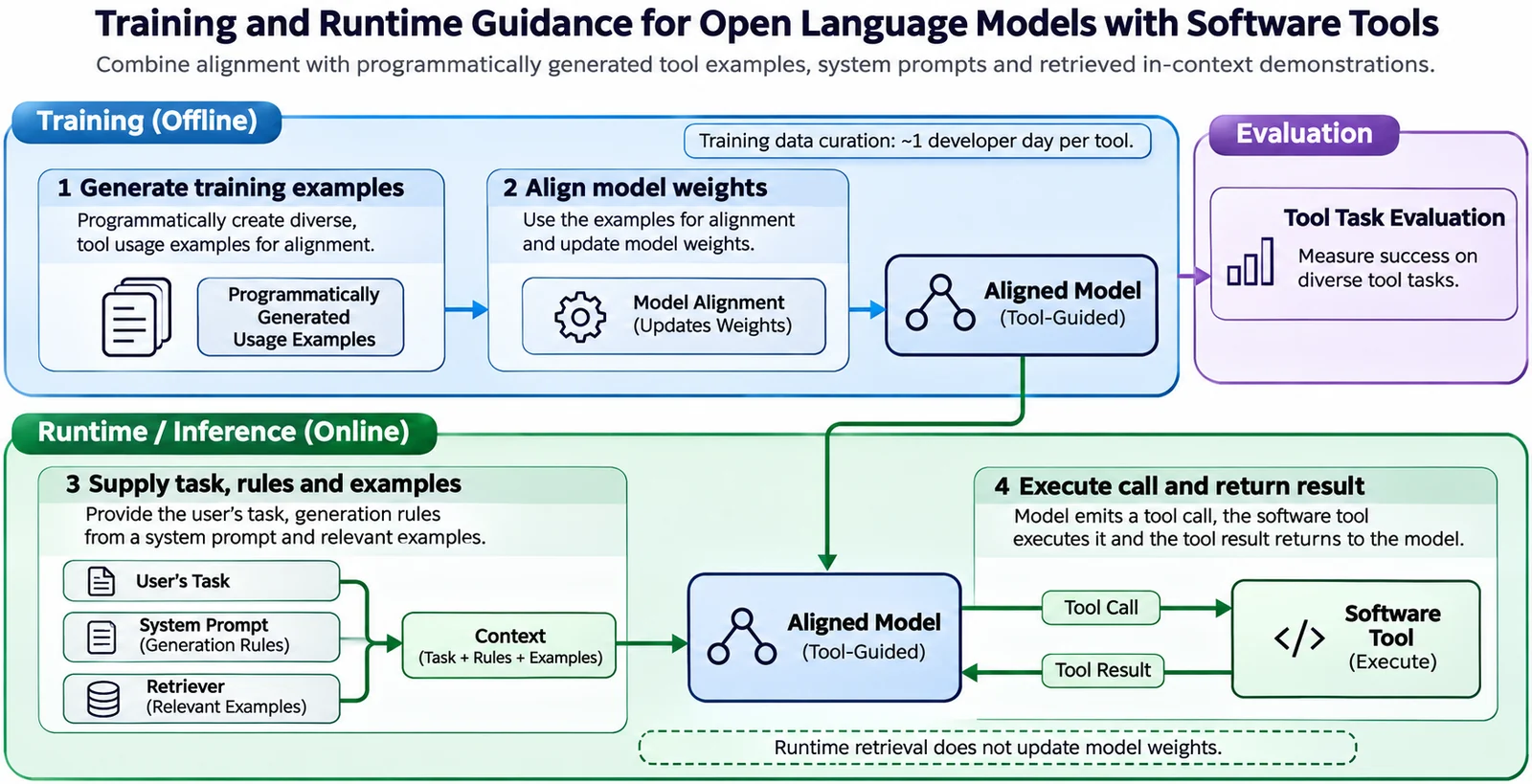
Tool manipulation is the task studied by Xu, Hong, Li, Hu, Chen and Zhang in 2023, who examined how open-source large language models handle software tools. Much of the early research on tool manipulation with large language models relied on closed model APIs, meaning the model runs on a company's remote servers and receives the user's information. A 2023 study argued that industry adoption of such models is held back by the security and reliability risks of exposing information to closed API services. It asked whether open-source models could match leading closed APIs with a practical amount of human supervision. By analyzing common tool manipulation failures, the study found that open-source models may need training on usage examples, in-context demonstrations and rules about generation style before those failures clear. The team adapted classical methods, including model alignment with programmatic data generation, system prompts and retrievers for in-context demonstrations, and built ToolBench, a benchmark of diverse software tools for real-world tasks. The techniques raised leading open-source models by up to 90% success rate, reaching capabilities competitive with OpenAI GPT-4 on 4 out of 8 ToolBench tasks. Curating data for each tool typically took about one developer day.[18]
A 2026 case-study blueprint described an open-source workflow for early-stage drug discovery, motivated by the cost of bringing a new drug to market, which can exceed $1 billion, and by integrated commercial computational-chemistry platforms that cost $200,000 to $5,000,000 per year. Three computational case studies each ran two tiers: screening a target-enriched ZINC20 library, then docking with GNINA v1.1 and CNN rescoring plus SwissADME and ADMETlab 2.0 profiling, with two further tiers proposed as future work. A tiered agent built on Claude Opus 4 and Sonnet 4 orchestrated the workflow, reducing each library of roughly 154,000 to 400,000 compounds to 200 or fewer docked and 10 prioritized candidates per case. Independent checking against PubMed put the orchestration agent's citation accuracy at 88%, 78% and 90% across the three cases (pooled 85%, 23/27). API use cost $1,450 to $1,800, and no experimental assays were run. The blueprint was offered as a reproducible, low-cost aid to prioritization where resources are limited, not as a validated drug-discovery platform. Its prioritized compounds are computational predictions that need later experimental confirmation.[19]
Research
The main evidence on performance
One 2024 study tested several open models against GPT-4 and Claude 2 on 858 multiple-choice questions in nephrology, a branch of medicine about the kidneys. The open models answered 17.1 to 30.6% of the questions correctly. Claude 2 answered 54.4% correctly, and GPT-4 reached 73.3%.[20]
A 2025 study of healthcare records scored open and commercial models on pulling patient details from free text, such as age, gender, BMI and blood markers. Accuracy scores across the named criteria were 0.59, 1, 0.84, 0.56 and 0.92.[21]
In cybersecurity, a 2025 study tested 21 open models on spotting phishing links, which are web addresses built to trick people into giving away information. The models were used without fine-tuning, meaning no extra training on the phishing task itself. Open models with 27 billion parameters or more scored above 90% on the F1 measure, a combined score for precision and recall. Few-shot prompting, which shows the model a few worked examples first, worked best and reached 91.24% F1 with Llama3.3_70b. Chain-of-thought prompting, which asks a model to write out its reasoning steps, lowered accuracy and increased the time needed to answer.[22]
A 2025 study compared 22 open models with ChatGPT-4 and with human annotators on Indonesian tweets, sorting them by sentiment and by emotion. ChatGPT-4 had the highest macro F1-score, 0.84, on both tasks, slightly ahead of the human annotators. The best open models, such as LLaMA3.1_70B and Gemma2_27B, reached over 90% of ChatGPT-4's performance, while smaller models lagged behind. Some mid-sized models did better than their size suggests: Phi-4 at 14B parameters matched much larger models on select categories. Two classes stayed hard for every model, Neutral sentiment and Fear emotion, and even the human annotators agreed less on them. Speed varied widely, since optimized models finished predictions in under an hour and some large models needed several days.[23]
On the full binary benchmark, open models came close to commercial performance. Most errors fell in transient and resonance-sticking cases, where the pattern is unclear or shifts over time. Even small open models reached accuracy the study called practically useful, without any training or fine-tuning.[24]
A 2024 study of chemistry research tested six open models on tasks from metal-organic frameworks, a class of porous materials. The tasks ran from basic chemistry knowledge to database reading, script writing and paper polishing. The models handled most of the tasks, and Llama2-7B and ChatGLM2-6B did particularly well with moderate computing resources.[25]
Running models locally and on premises
For some organisations this is not a preference but a rule, because regulated or proprietary source code may not be sent to outside providers. A 2026 benchmark tested whether self-hosted open-weight models could take their place on ordinary developer hardware. The test set was 120 annotated web-application code snippets spanning five weakness categories. The self-hosted models beat the previous-generation cloud flagship and trailed the current one by 4.7 points. The benchmark also warned that F1 alone hides weak behaviour, since some setups scored near a classifier that labels every input as vulnerable.[26]
A 2024 study hosted a Llama-2-70B-chat model on site and used it to turn free-text chest radiograph reports into structured data. The dataset held 202 English reports from a public collection and 197 German reports from one university hospital, all de-identified. A senior radiologist wrote a template of 48 question-answer pairs, and two human readers structured the same reports for comparison. Differences between the model and the human readers fell inside a pre-set range of practical equivalence for both languages.[27]
A 2025 comparison asked whether privacy-compliant open models can find errors in radiology reports as well as closed commercial ones. The team compiled 120 reports, 30 each from X-ray, ultrasound, CT and MRI, and inserted 397 errors of five kinds into 100 of them. Two open models, Llama 3-70b and Mixtral 8x22b, faced two closed models, GPT-4 and GPT-4o, with identical prompts. The open models needed less processing time per report, 6 seconds against 13 seconds. The closed models detected more errors: GPT-4o found 88% (348 of 397) and GPT-4 found 83%, against 79% for Llama 3-70b and 73% for Mixtral 8x22b. Numerical errors were caught more often (88%) than typographical errors (75%), mismatches between findings and impression (73%), or interpretation errors (70%).[28]
Llama-3.3-70B led with a utility score of 0.760, followed by Phi-4-14B at 0.751, Qwen-2.5-14B at 0.748 and DeepSeek-R1-14B at 0.744. These models matched or beat a fine-tuned RoBERTa baseline on 17 of the 28 tasks, especially regression and structured classification. Name-finding performance stayed low for every model, and translating the text into English consistently lowered scores.[4]
Open models in medicine and biology
A 2019 review by the International Medical Informatics Association Open Source Working Group found that open science is well established in AI development generally. Inside healthcare, the same review warned that adoption may be slowed by "black-box" systems, whose inputs and outputs are understood but whose workings are not. The review also noted that studies of clinical effectiveness and implementation were missing.[29]
A 2022 study trained a convolutional neural network, a model built for images, to trace the outlines of nerve fibres in microscope images of stained rat nerve tissue.[30] A 2026 study paired a vision transformer, an image model, with open-source large language models to write descriptions of cells in lung cytology samples. Tested on 1059 cytological images, the model scored well on language-based measures and sorted cells well using its own generated descriptions.[31]
One open-source tool, Dx29, was built to help clinicians diagnose Mendelian disorders in acutely ill infants, and a separate open-source pipeline, RareCure, was built to assemble ranked treatment options for rare solid tumors.[32][33] Dx29 is an open-source tool that reads a patient's symptoms and gene variants and returns a ranked list of possible diagnoses. Symptoms reached the tool by three routes: automatic extraction from records, extraction with manual review, and manual entry. Across these routes, the correct diagnosis appeared in the top 10 in 92% to 96% of cases.[32]
RareCure, described in 2026, is an open-source pipeline that assembles ranked treatment options for rare solid tumours. It was tested retrospectively on 260 soft tissue sarcoma patients from a public cancer genome cohort. At least one approved or genomically matched drug match was found for 30.0% of patients, and a biomarker-driven match for 78.8%. Interpretation cost $303.74 in total, or $1.17 per patient, excluding the sequencing done beforehand.[33]
Heart traces have also drawn a foundation model, a large model pretrained on broad data and then adapted to many tasks. ECG-FM, published in 2025, was pretrained on 1.5 million 12-lead electrocardiograms, recordings of the heart's electrical activity. The abstract reports a figure of 0.929 without stating which measure it belongs to.[34]
Text extraction and clinical language tasks
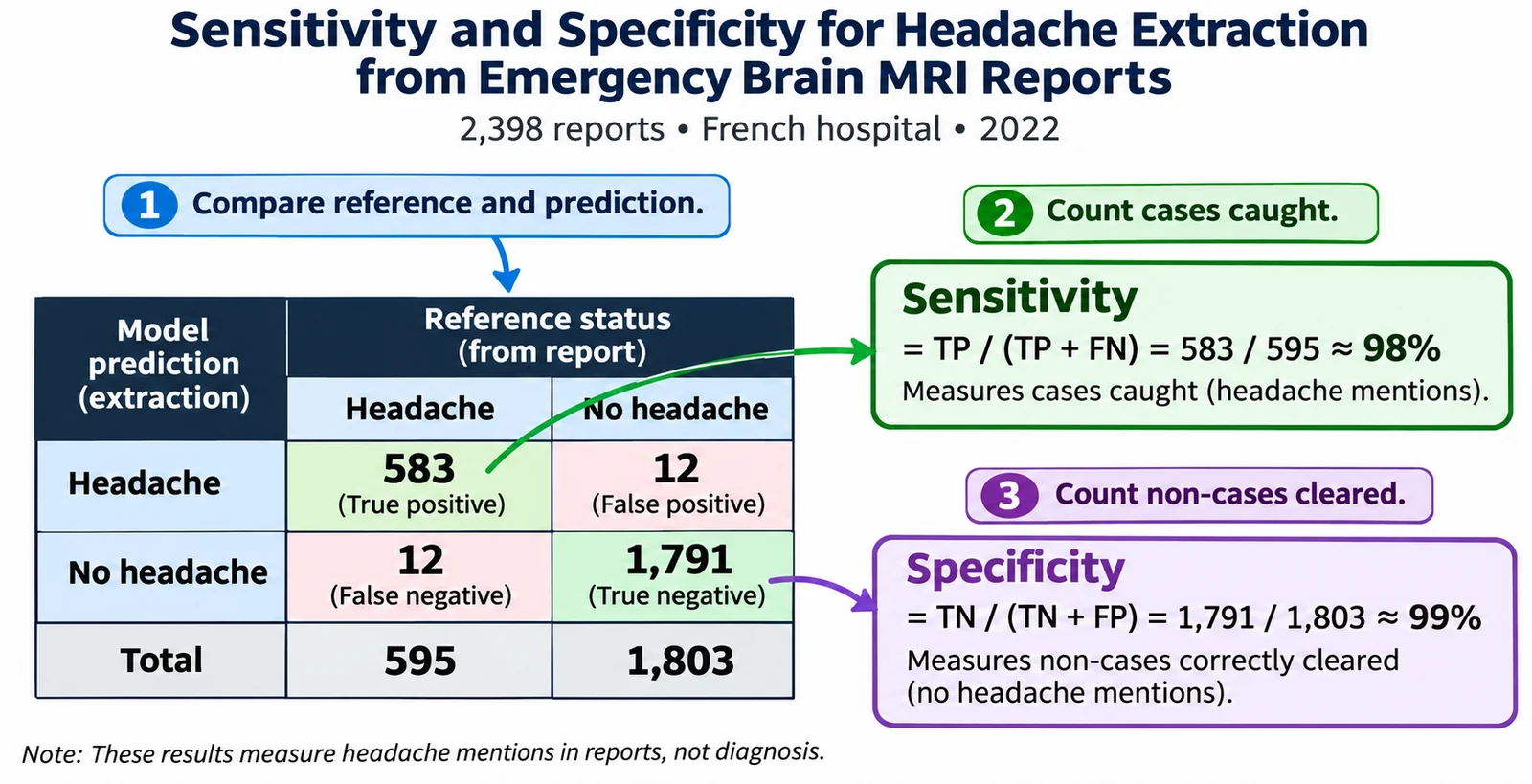
One study asked whether an open-source large language model, a program trained on text to predict and produce language, could pull facts from real emergency brain MRI reports. Researchers reviewed all 2398 consecutive emergency brain MRI reports written in 2022 at a French quaternary center, a large referral hospital. Sensitivity, the share of true cases the model caught, was 98% (583/595) for detecting headache in the clinical context, with specificity, the share of non-cases correctly cleared, at 99% (1791/1803). It reached 97% sensitivity (219/227) and 99% specificity (364/368) for sorting studies as normal or abnormal.[35]
Two readers annotated 250 randomly sampled adult discharge summaries from 2018 to 2023 for tobacco smoking status, marked as smoker, never smoker or unknown. Six open models, including Llama-3 versions from 1B to 70B parameters, gpt-oss-20B and MedGemma-27B, were scored against the readers' consensus. The authors report that lightweight models can handle varied clinical extraction tasks without task-specific fine-tuning, the extra training that adapts a model to one job. They single out gpt-oss-20B for high accuracy and efficiency, and call it a practical open alternative to traditional clinical text processing.[36]
Open models can also generate synthetic medical data, artificial records that stand in for real ones when training other systems. Most such work uses English text, so one study generated medical texts in a non-English mixed language and judged them two ways. The team compared the generated sets statistically with the original data and trained a classifier to tell original from synthetic examples. Across thirteen open and proprietary models, Llama-3.2-3B produced the hardest-to-spot data, with an F1 score of 0.821 ± 0.007 and accuracy of 0.816 ± 0.016. Aya-23, Phi-3 and SmoLLM variants reached high F1 scores of 0.945 to 0.948, which meant their output was easy to distinguish from real records.[37]
A 2025 commentary responded to a comparison of large language models answering questions in immuno-oncology, the study of immune-based cancer treatment. The commentary argues that commercial models keep their training data and methods private, which blocks full transparency and reproducibility. It points to BioGPT, a model built on publicly available research literature, as a promising direction for open models trained on biomedical text. It also stresses that expert verification of model answers is needed before any clinical use.[38]
Each model was tried with four prompting strategies, meaning four ways of wording the request, in English and in Chinese. The best model size was about 32B parameters, and English prompts beat Chinese prompts even on native Chinese text.[39]
Software engineering and code models
Code Llama, released in 2023, is a family of large language models for code built on Llama 2. The 7B, 13B and 70B variants can fill in missing code from the surrounding content, a task called infilling. The smallest Python model, Code Llama - Python 7B, outperformed the much larger Llama 2 70B on both benchmarks. It was released under a permissive license allowing research and commercial use.[40]
Earlier language-model locators depended on a test case that triggers the bug and on proprietary models, which carry data privacy risks. FlexFL, a framework proposed in 2025, works in two stages with open-source models and can use different kinds of bug-related information. The first stage narrows the search to a candidate list of methods, and the second stage has the model double-check those code snippets. On the Defects4J benchmark, FlexFL with Llama3-8B, a lightweight open model, located 42 more bugs than AutoFL and 63 more than AgentFL, two methods that both use GPT-3.5. It also localized 93 bugs at the top 1 that non-language-model techniques could not localize at all. On a dataset Llama3-8B had not seen before, FlexFL still performed well, which addresses concerns about test data leaking into training.[41]
Writing bug reports is another task where open models have been tested. In a 2025 study, the reward came from a five-part score covering completeness, traceability, quality, reproducibility and specificity. Training ran in three stages, and the loss fell from 1.9 to 1.3 during the first stage. The reward value rose from 0.42 to 0.63, and the final reports reached peak scores of 0.76 on the five-part measure and 0.85 on a sentence-embedding measure of meaning.[42]
A 2025 framework called KCTC works in two stages: it first extracts the key columns named in the question, then uses the table contents to guide query generation. On the Chinese dataset TableQA, tested with several open-source models, execution accuracy rose by an average of 60.29% and reached up to 91.22%.[43] Combined with classical techniques, it also beat the DoDuo model on the fine-tuned SOTAB benchmark.[44]
Comparing named open model families
Gemma was released in two sizes, 2 billion and 7 billion parameters, as both pretrained and fine-tuned checkpoints. Gemma, introduced in 2024, is a family of lightweight open models that draws on the research and technology behind the Gemini models. On 11 out of 18 text-based tasks it outperformed open models of similar size.[45] A 2025 comparison examined DeepSeek, Mistral, Qwen and LLaMA as local models, weighing their specialization, their optimization methods (quantization, which stores weights at lower precision, and distillation, which trains a small model to imitate a larger one) and their performance. That comparison set out the key features of the models, including code generation, multilingualism and general-purpose use, together with the hardware resources each requires.[46]
One study of information extraction from digitized documents compared open models of 7 to 14 billion parameters with a proprietary model having trillions of parameters. One 2024 study evaluated open-source models of 7 to 14 billion parameters on extracting information from the OCR text of digitized documents, where OCR means optical character recognition, the conversion of page images into machine-readable text. The documents came from a state treasury department in Brazil and consisted of personal verification documents, and skewed images and blurred photographs left the text unstructured and error-prone. On this task the entry-level open models scored 18% lower than a leading proprietary model with trillions of parameters. The study treated that gap as small enough to make the open models viable free alternatives.[47]
A 2026 comparative review placed open-weight models within a wider field of generative systems and treated vendor benchmark claims as not directly comparable scores. Closed frontier systems offered strong managed capabilities and integrated tools but tied adopters to provider controls, pricing and service architecture. Open-weight models gave greater control over deployment and adaptation, and moved the burdens of security, evaluation and governance to the adopter.[48]
Domain models in finance and cybersecurity
A 2023 paper by Wang, Yang and Wang introduced an instruction-tuning benchmark for open-source large language models on financial datasets. Instruction tuning trains a model on pairs of written instructions and desired responses so that it follows new instructions without further training. The benchmark was designed as an end-to-end scheme for training and testing at low cost, and it proceeds in stages. The first stage assesses basic competencies and fundamental tasks, including named entity recognition (finding names of organizations, people and places in text) and sentiment analysis (judging whether a passage is positive, negative or neutral). The second stage combines all the instructional tunings into a single multi-task model to examine versatility, and the third sets aside unseen tasks and new datasets to probe zero-shot capability, meaning performance on tasks the model was not trained on. The paper argues that this approach supports openness and reproducibility, and it frames the scheme as a foundation for later work on open financial large language models.[49]
In cybersecurity, a 2026 systematic literature review by Basbas, Djamaa and Senouci organized the contributions of large language models against the NIST Cybersecurity Framework (CSF 2.0), a widely used structure of security functions published by the U.S. National Institute of Standards and Technology. The review notes that the rising rate of cyberattacks and a shortage of skilled cybersecurity professionals create demand for approaches beyond traditional security measures, and that systematic research aligning language models with established cybersecurity frameworks had been lacking. The authors highlight the Awareness and Training category of the framework's Protect function as an overlooked area of potential. Citing the accessibility and privacy benefits of open-source models, the review built a benchmarking method using multiple-choice question answering. It evaluated 21 open-source large language models known for strong performance, including Llama-3-70B and Qwen2-72B, both above 80% on the MMLU benchmark, across two publicly available datasets. Larger models generally outperformed smaller ones, but medium-sized models of 7B to 27B parameters reached accuracy within 5 to 9 percentage points of models with 70B or more parameters, a result the authors present as evidence against the claim that model size alone determines effectiveness. It concludes that advanced prompting and unbiased datasets both matter for reliable evaluation of open models in security work.[50]
Validation studies in clinical imaging
The PROVE-AI study was a prospective, observational clinical study that tested an open-source algorithm, ADAE, on dermoscopy images from patients who had consented to a skin biopsy to exclude melanoma. The PROVE-AI study, published in 2023, enrolled 435 participants who contributed 603 skin lesions, 95 of them melanomas, all confirmed by biopsy. The participants averaged 59 years of age. Of the group, 54% were female and 96% were White individuals. The open-source, non-commercial algorithm, called ADAE, was tested at a predefined sensitivity threshold of 95%, meaning the cutoff was set so that the model would flag most true melanomas. At that threshold ADAE reached a sensitivity of 96.8% (95% CI: 91.1-98.9%) and a specificity of 37.4% (95% CI: 33.3-41.7%), so it missed few melanomas but also flagged many benign lesions. Dermatologists who saw the model's scores improved their ability to assess melanoma risk, with the area under the curve rising from 0.7798 to 0.8161 (p = 0.042), and their management choices after exposure had net benefit equal to or higher than biopsying every lesion. The investigators concluded that larger randomized trials are needed before the algorithm enters routine clinical workflows.[5]
Chest radiographs have been used to test whether a free, open-source model can support emergency departments, where radiologist availability is limited after hours. A 2026 retrospective study in Singapore applied the open-source model CheXNeXt to 1006 anonymized after-hours emergency chest X-rays and compared its outputs with radiologists' reports as the reference standard. At the published default thresholds, sensitivity was low: 0.234 for consolidation, 0.176 for pneumonia and 0.622 for pleural effusion, while specificity was high at 0.990, 0.995 and 0.949 respectively. Areas under the receiver operating characteristic curve were 0.900 for consolidation, 0.856 for pneumonia and 0.916 for pleural effusion. After threshold optimization using the Youden index, sensitivity rose to 0.894, 0.681 and 0.852 while specificity remained acceptable at 0.765, 0.881 and 0.848. The study's limitations included single-radiologist reporting and the use of radiographic findings as a surrogate for infection, and the authors called for external validation and real-world integration studies.[51]
Fracture detection has been compared across two open-source models on the MURA (Musculoskeletal Radiographs) dataset, using a random sample of 100 radiographs split evenly between 50 fracture and 50 non-fracture cases. YOLOv7-BoneFractureDetection reached 82% accuracy, precision of 90%, specificity of 0.92, an F1 score of 0.80 and an area under the curve of 0.89, a profile suited to ruling in fractures with few false positives. The BoneFractureClassification model detected more fractures, with sensitivity of 0.88, but had lower specificity of 0.64 and precision of 71%, and its F1 score was 0.786 with an area under the curve of 0.85. McNemar's test, which compares paired classifications, found no statistically significant difference in overall performance between the two models (P=0.55). The authors suggested the first model for confirmatory support and the second for triage in settings where a missed fracture is less acceptable than a false alarm, and noted that larger, multi-center validations are needed before clinical deployment.[52]
Video-based examinations raise a different problem, because small bowel capsule endoscopy produces long recordings that take time to review and are prone to missed lesions. A 2027 retrospective analysis of 249 PillCam SB3 examinations performed between 2007 and 2022 at six hospitals used a two-reader crossover design to compare the open-source pretrained model SEE-AI, at a confidence threshold of 0.1, with conventional reading. Across 1550 adjudicated lesions, AI-assisted reading found more lesions than conventional reading, with per-lesion sensitivity of 98.8% (1532/1550) versus 86.4% (1339/1550) and per-patient sensitivity of 99.1% (464/468) versus 80.3% (376/468), both p < 0.0001. Mean reading time fell from 17.9 to 13.7 minutes (p < 0.0001). In the 131 cases of suspected small-bowel bleeding, sensitivity for the hemorrhagic lesions classed P1+P2 improved from 82.8% to 98.2% per lesion and from 73.5% to 98.6% per patient, with reading time of 14.1 versus 18.0 minutes.[53]
Reuse of open-source clinical software depends on how it is licensed and documented, and a 2026 survey of dental artificial intelligence repositories found gaps on both counts. The survey retrieved public repositories through a search interface and inspected the root file listings of the most popular ones. Of the 78 repositories, 23 (29.5%) had a license and 74 (94.9%) had a description. Among the 30 most popular, all 30 had a README file but only 8 (26.7%) listed their dependencies, and the median star count was 6. The authors concluded that missing licenses and dependency specifications limit reuse and reproduction despite near-universal README documentation.[54] Data preparation is a related concern: a 2024 survey of members of the Society of Imaging Informatics in Medicine outlined the steps of curating imaging data and compiled tools for each stage, arguing that standardized preparation supports reproducible models and reduces bias.[55]
Medical chatbots and clinical text
PharmaLLM, described in 2024, adapts the open-source Llama 2 model through fine-tuning to supply medicine prescription information. It accepts and returns both text and speech to widen access. Its fine-tuning used Low-Rank Adaptation, a method that adjusts a small number of added parameters rather than retraining the whole model, at a rank of 16, a learning rate of 2e-4 and a batch size of 12. The system reached 87% accuracy, an F1 score of 92.16%, 94% sensitivity, 66% specificity and 90% precision; the F1 score combines precision and recall into one number. In a usability study of 33 participants using the Chatbot Usability Questionnaire, which asked about error handling, response generation, navigation and personality, participants found the system easy to use and its responses useful and relevant. The developers present the tool as a way to support patient-physician interaction where healthcare resources are scarce and literacy rates are low.[56]
CareBot, presented in 2025, is a bilingual medical language model trained in stages: continued pre-training on domain text, supervised fine-tuning on curated examples, and reinforcement learning from human feedback, in which people rank outputs that the model then learns to prefer. Its two-stage pre-training method, called Stable CPT and Boost CPT, is designed to move the model gradually from general text to medical text, and a companion model called DataRater scores the quality of training data during that stage. For the fine-tuning stage the developers assembled a large bilingual dataset and introduced ConFilter, a measure for improving the quality of multi-turn dialogue. Evaluations on Chinese and English benchmarks were reported to confirm the model's effectiveness in medical consultation and education.[57]
Long patient records pose a separate problem: clinical notes accumulated over years often exceed the context window, the amount of text a language model can process at once, and they are costly to process. A 2026 preprint describes a context-reduction framework that fine-tunes an open-source Flan-T5 large model to pull out the visit reason, chief complaint and history of present illness from notes and discard the rest. The work took place within Kaiser Permanente Southern California and used notes from adults with mild asthma, with manual annotation of 1,500 training notes and 250 independent validation notes. On the validation set, fine-tuning lifted contextual precision from 0.342 to 1.000 and recall from 0.305 to 0.958. Relevancy rose from 0.329 to 0.991 and faithfulness from 0.128 to 0.984, with a separate open model, GPT-OSS-20B, acting as the evaluation judge. Applied to 3,815,537 notes from 198,667 patients, the method cut mean note length from 213.1 to 27.7 tokens, a token being a word fragment, and mean patient-level token burden from 4,093.6 to 518.1, a 7.90-fold reduction. The share of patients whose records fit within 500 tokens rose from 4.9% to 65.6%, while the share above 5,000 tokens fell from 23.3% to 0.2%.[58]
Privacy rules and proprietary versus open weights
Alzoubi and Mishra assess large language models against six evaluation dimensions drawn from the General Data Protection Regulation, the European Union's data protection law. A 2026 study assessed six leading large language models against six evaluation dimensions drawn from the regulation, using a multi-criteria framework informed by the literature and weighted scoring to compare how mature each model's privacy governance was. The six models were GPT-4/5, Claude 3, Gemini, Llama 3, Mistral and Falcon. The study found strong performance on security and risk-based controls, particularly among proprietary models, which are systems whose weights and internal details are not released publicly. Gaps remained in purpose limitation (using data only for the stated aim), data minimization (collecting no more than needed) and documentation of lawful bases, the legal grounds on which processing rests.[59]
Open models in applied science and engineering
Saoudi and colleagues review open-source tools and libraries for autonomous vehicle development, which they say make it cheaper and easier for developers and researchers to take part in the field. Zhang and colleagues released DeepRec so that recommendation models built with different languages and packages could be reproduced and compared.[60][61] A 2023 review of autonomous vehicle technology focused on open-source tools and libraries for vehicle development, arguing that shared code lowers the cost and effort of entering the field. The same review covered sensors and their performance in different environments, simultaneous localization and mapping (the process by which a vehicle builds a map while tracking its own position), open-source driving simulators, embedded operating systems, and vehicle-to-vehicle communication. It also set out the five levels of vehicle automation and compared commercial and open-source advanced driver assistance systems.[60]
Driving models that combine vision, language and action, called vision-language-action models, have been trained on a purpose-built open dataset for unstructured road situations. The Impromptu VLA dataset holds over 80,000 video clips selected from more than 2 million source clips drawn from 8 open large-scale datasets, with question-answering annotations and action trajectories organized under a taxonomy of four unstructured categories. The code, data and models were released publicly.[62]
Silicon validation, the testing of a finished chip design before it ships, produces very large volumes of log files that are hard to debug by hand. A 2026 conference talk described a workflow in which open-source artificial intelligence and data science tools collect, preprocess, model and analyze validation data, with machine learning applied to structured records and large language models to unstructured logs and documentation. The talk presented generative and agentic workflows as support for automated debugging pipelines and framed the aim as augmenting engineers rather than replacing them.[63]
Three-dimensional scene understanding has an open foundation model built on the MindSpore framework, L3DM, which aligns text with geometry and adapts the key-value cache, a memory store that speeds repeated computation in transformer models. Sun and colleagues describe L3DM as the first full, scalable and open-source implementation of a 3D foundation model on MindSpore. They supply training and inference code, pre-trained weights and pipelines, resources they say did not exist before. The work also tested zero-shot chain-of-thought reasoning, in which a model works through intermediate steps without task-specific training, for multi-view 3D understanding and reported its limits on complex spatial reasoning. Empirical validation was reported on the ScanQA benchmark.[64]
Spiking neural networks are brain-inspired models that carry signals as discrete spikes and are intended for energy-efficient neuromorphic chips, and conventional programming frameworks did not meet their needs for automatic differentiation, parallel acceleration and integration with neuromorphic datasets. Fang and colleagues released SpikingJelly as a toolkit covering the whole pipeline: preparing neuromorphic datasets, constructing deep spiking networks, tuning their parameters and running them on neuromorphic chips. Its developers reported that training of deep spiking networks can be accelerated 11 times compared with existing methods, and that multilevel inheritance and semiautomatic code generation let users accelerate custom models at low cost.[65]
Recommender systems, which rank items for users, gained an open toolkit when DeepRec was released to address the difficulty of reproducing published models written in different languages and deep learning packages. DeepRec implements several deep learning recommendation algorithms in Python with TensorFlow across three scenarios: rating prediction, top-N item ranking and sequential recommendation. It is distributed under the GNU General Public License and was designed for modularity so that new models can be added.[61]
A 2026 article in Publizistik notes that automated content analysis is growing in communication science, yet easy-to-use tools for it have been lacking. Ready-made open models on Hugging Face can be used for text coding with only a few lines of Python code, the article states. The article describes three model types for coding text: category-specific encoder models, task-specific encoder models, and general-purpose decoder models.[66]
The method then corrects errors and finds coordinates by querying GeoNames, Nominatim, and ArcGIS in turn until a result is found. Across seven datasets containing 83,365 place names worldwide, the methods beat 20 existing methods, with the Mistral-based method leading. The models run on one general graphics processor and need 14 GB of memory for 7B models and 27 GB for 13B models.[67]
Small open tools in specialised measurement
A 2020 study tested an open-source visible and near infra-red spectrophotometer, a low-cost instrument that measures how much light a sample absorbs at each wavelength, together with a dedicated app, for tracing the origin of extra virgin olive oil. The researchers analysed 67 Italian and 25 foreign oil samples and processed the spectral data with an artificial intelligence algorithm. A multivariate analysis of variance, a statistical test for differences between groups across several measurements at once, found significant differences between the Italian and foreign samples (p < 0.001). An artificial neural network, a model loosely modelled on connected brain cells, classified 94.6% of samples correctly on an external test. Both methods pointed to the wavelength ranges 308 to 373 nm and 594 to 605 nm as the most informative for origin. Those ranges correspond to where phenolic components, carotenoids, chlorophylls and anthocyanins absorb light.[68]
Nichols and colleagues built an open-source, freely available web-based graphical interface, Artificial Intelligence for Astrobiology Investigations, for teaching and developing machine learning models on tabular astrobiology datasets. A freely available web-based graphical user interface called Artificial Intelligence for Astrobiology Investigations lets educators, students, and researchers build explainable machine learning models from tabular astrobiology datasets, such as csv files. The project is aimed at novices, and its standardized workflow shows how certain machine learning approaches work and how to use them reliably. The same interface can serve as a means of rapid prototyping, with or without technical expertise, which frees researchers to spend time exploring their data.[69]
Two studies apply open software to faces. Topsakal and colleagues released 3D morphing software that alters landmark locations on facial models, and Bustamante Araya and colleagues evaluated an open-source age-progression tool alongside a mobile application.[70][71] Twenty synthetic models were generated with deep learning tools, and their measurements were checked against facial statistics to confirm they were realistic; because the models are synthetic, no institutional review board approval is required.[71]
A 2026 retrospective observational study compared a mobile age-progression application with open-source Style-Based Age Manipulation software on 18 original photographs, producing 180 age-progressed outputs for target ages of 5, 11, 15, 18, and 26 years. The mobile application sorted images more accurately (55%, P < .001). The open-source tool gave more realistic progressions for ages 11 to 18, with a mean absolute error of 2.7 years against 3.7 years (P < .001). For the youngest group (age 5) and the oldest (age 26), neither tool worked well. The open-source tool averaged 9 seconds per image, against 5 minutes for the application (P < .001).[70]
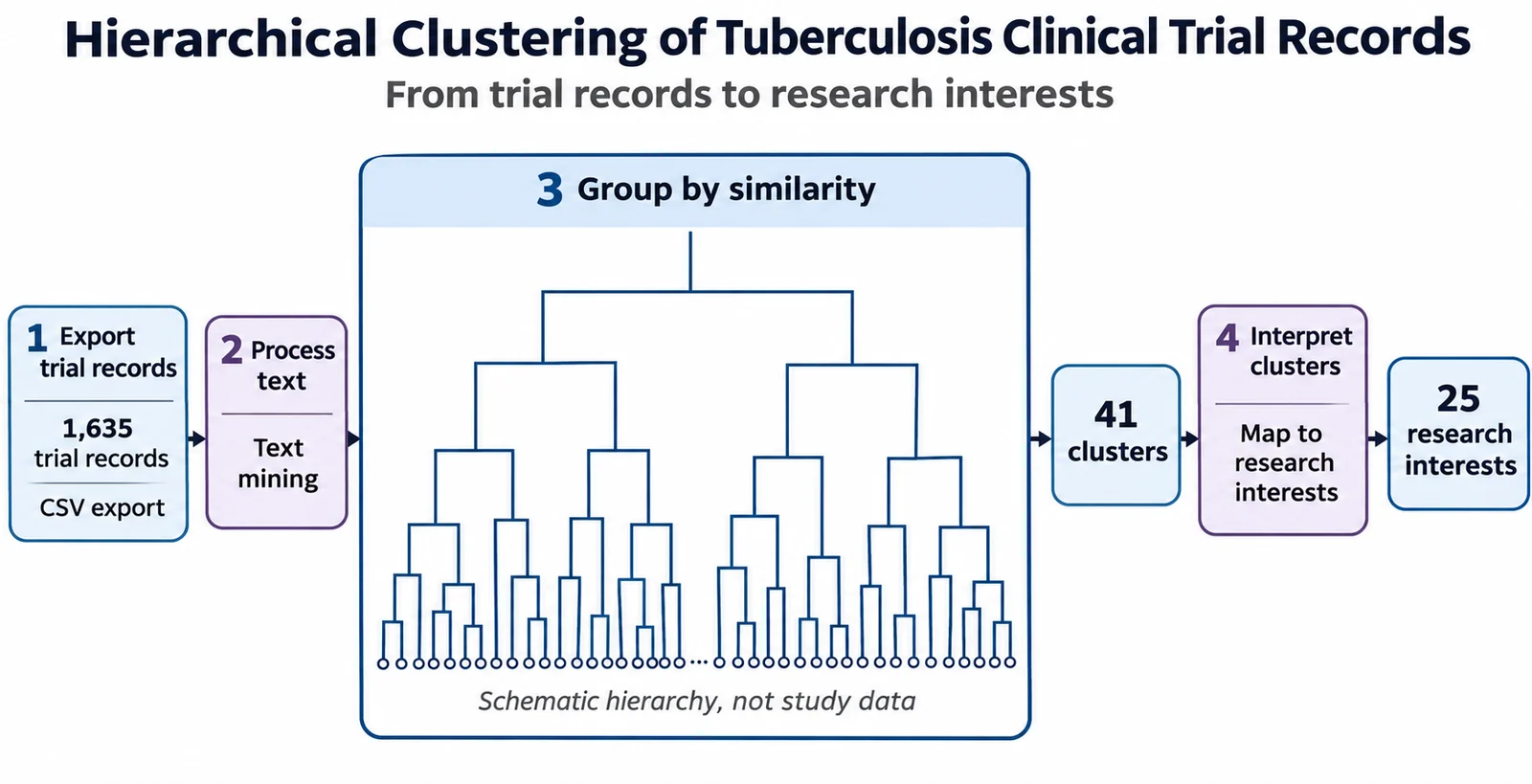
Text mining offers a fourth example, applied here to records of tuberculosis clinical trials rather than to images or spectra. A 2022 study exported 1,635 tuberculosis clinical studies from the International Clinical Trial Registry Platform in comma-separated format and processed them with the text mining widget of the open-source tool Orange Canvas. Hierarchical cluster analysis, a method that groups records by similarity, produced 41 clusters that were mapped onto 25 different research interests among the trials. Because the tool is open-source and graphical, the researchers suggest that any researcher with working knowledge of text mining could apply the technique to other clinical trials.[72]
In practice
Education, libraries and public institutions
The project trained its data on the written standards plus community content posted on a code-sharing site, then cleaned and labelled the material before training. The aim was to help newcomers query and interpret the standards on their own time, especially when organization members were unavailable. An older, cheaper commercial model gave results the project called less than satisfactory, which shows the trade-off between model capability and cost.[73]
A 2022 paper presents an openly available toolbox of guidelines, templates and pictures for building personas for AI applications, with an example from a medical context. The paper notes that many successful AI systems are black boxes, meaning their internal process is opaque to the user and their output is often not intuitive. The toolbox is free to the international research and development community, and the team calls it the first of its kind for personas for AI.[74]
Open models in classrooms and libraries
Open-source toolkits have also driven the adoption of artificial intelligence in machine learning, image recognition, video analysis and other areas relevant to library systems. The communities behind open-source library software rank among the largest and most active in the library world. The Koha library management system, probably the most widely adopted such system in the world, draws on developers, librarians, service providers and participating libraries across the globe. A 2024 article argues that open-source solutions can let libraries introduce artificial intelligence while keeping agency over how models are developed and implemented.[77]
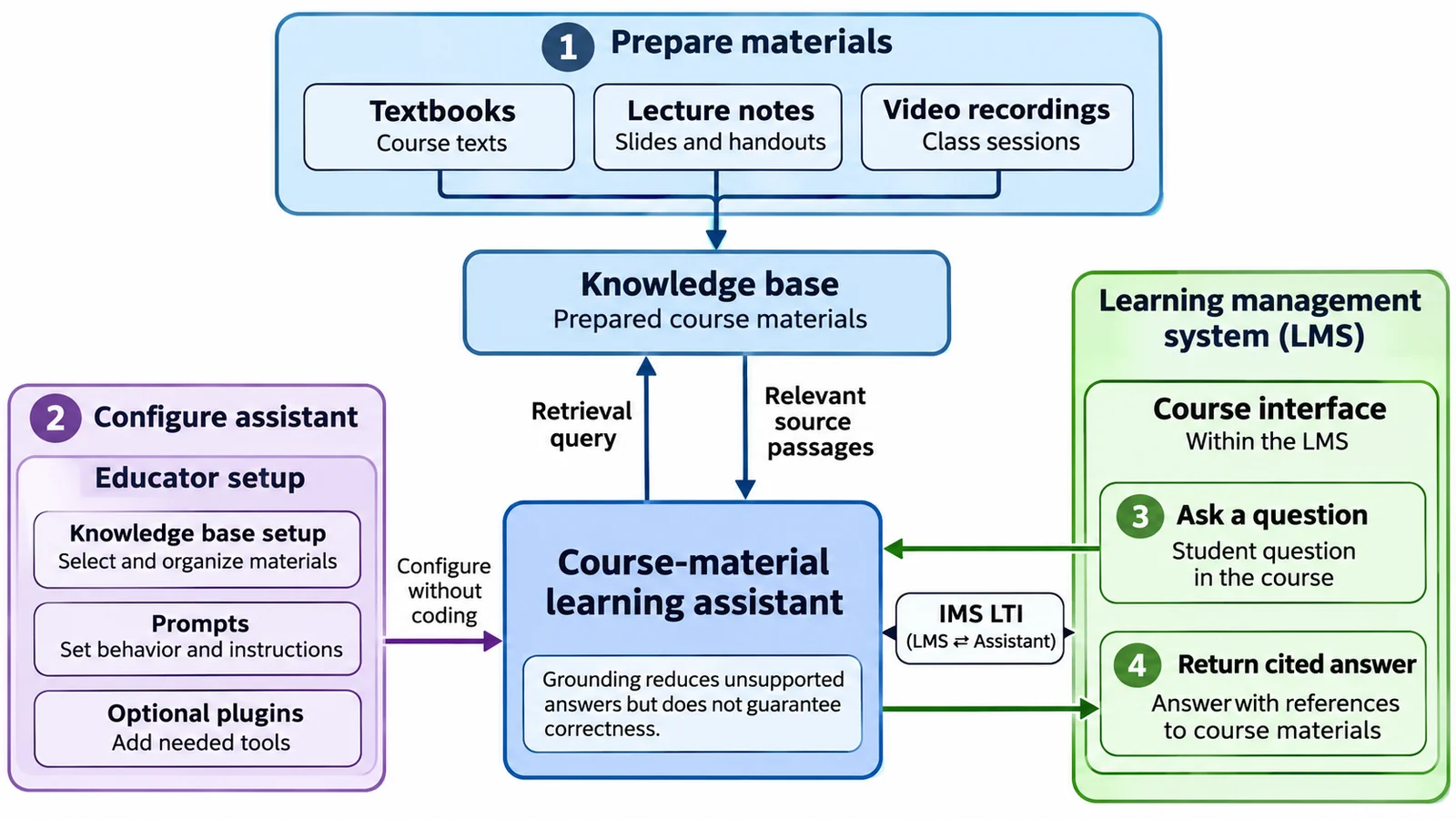
One open-source framework, LAMB (Learning Assistant Manager and Builder), is designed to create artificial intelligence assistants that run inside a learning management system, the software a school or university uses to host courses and materials. LAMB builds assistants from an institution's own teaching material, such as textbooks, lecture notes and video recordings. Educators can manage knowledge bases, write prompts and add plugins without coding skills. The assistants connect to the learning management system through the IMS LTI interoperability protocol, a standard for plugging external tools into course platforms. Because answers are drawn from a prepared knowledge base, the assistants cite references and are less prone to hallucinations, meaning confident statements that are not supported by the source material, than ordinary chatbots built on large language models.[78]
Automated essay scoring and automated essay revising are meant to relieve teachers of time-consuming marking, but earlier models needed large amounts of training data, lacked generalizability, and commercial services charged high fees and raised security concerns about uploading student work. A 2024 study tested open-source large language models on a human-scored essay dataset of 600 essays collected in an online assessment, using zero-shot, few-shot and p-tuning methods, in which the model is prompted or lightly trained rather than fully retrained. Open-source models with a 10B parameter size came close to some deep learning baseline models on scoring, and performance improved when comments were combined with scores in the prompts or training. Similarity and score difference tests showed that the models could revise essays effectively, raising quality while keeping revisions similar to the originals.[79]
Libraries have adopted chatbots to improve services to patrons, and a shortage of open-source conversational platforms has been described as the main obstacle to wider use. A 2020 paper conceptualized a library chatbot built on the Rasa Stack, an artificial intelligence powered open-source conversational software platform, and set out how its technical components could be used to develop one.[80]
Teaching artificial intelligence through hands-on construction has been tried with open-source electronics platforms including Arduino, Snap Circuits, Raspberry Pi and Circuit Playground. In one interactive methodology, workshops for high school and non-engineering students are run by engineering students who were trained beforehand as volunteers, following a philosophy of learning by doing. The organizers planned a survey of participants to gather evidence on whether the approach improved knowledge of artificial intelligence, and they encouraged instructors to bring artificial intelligence concepts into general education courses through similar activities.[81]
Robotics suits inquiry-based learning, in which students act rather than watch, because trial and error matters and students can implement their own ideas while practicing programming, problem solving and electro-mechanical skills. RoboGen is a web-based platform, with open software and hardware, for robotics and artificial intelligence, with a focus on evolutionary robotics, an approach in which robot designs and control programs are improved through repeated variation and selection.[82]
What this looks like in practice
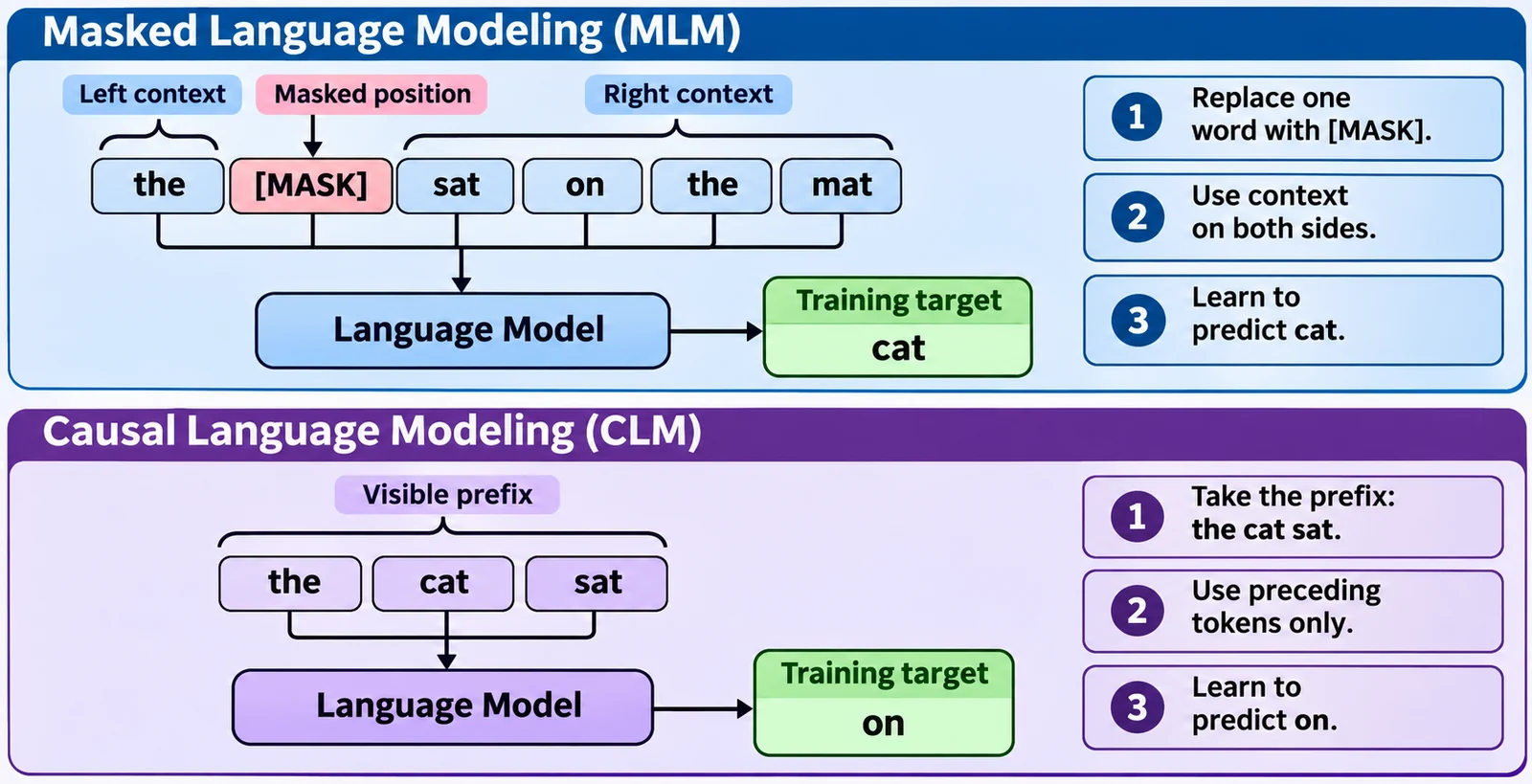
A behavioral scientist can use the open-source Hugging Face ecosystem to extract features from text, fine-tune a model for prediction, and generate behavioral responses. The tutorial supplies executable code so that a researcher can repeat each step. It also explains two pre-training modes, masked language modeling and causal language modeling, so that a researcher can choose a model for the task at hand. In masked language modeling a special token replaces a randomly selected word, and the model learns to predict that word from its context. In causal language modeling the model predicts the next token from the tokens that precede it and cannot see future tokens.[75]
The strongest local configuration reached an F1-score of 0.900, which trailed the current cloud flagship by 4.7 points. The authors report that F1 alone hides degenerate behaviour, because some configurations approach the score of a classifier that labels every input as vulnerable. They propose reporting specificity alongside F1 as a minimum requirement.[26]
A hospital can host an open-source model locally to turn free-text chest radiograph reports into structured data. A locally hosted Llama-2-70B-chat model structured 202 English reports from a public dataset and 197 German reports from a university hospital against a template of 48 question-answer pairs. The model reached an average Matthews correlation coefficient of 0.75 for English reports and 0.66 for German reports, close to the two human readers. It generated a valid structured report in every case and took between 10 and 30 seconds per report, against 30 seconds to 3 minutes for a human reader.[27]
A cybersecurity team can benchmark open models on multiple-choice questions aligned with the NIST Cybersecurity Framework 2.0. Twenty-one open models were evaluated, and medium-sized models of 7B to 27B parameters came within 5 to 9 percentage points of models above 70B parameters. Advanced prompt engineering with the DSPy framework narrowed the gap further for the smaller models. The authors also added structural changes and new exit options to reduce position and forced-choice biases in the question sets.[50]
An educator can build a learning assistant inside a learning management system with the open-source LAMB framework, which needs no coding skills. LAMB builds knowledge bases for retrieval-augmented generation, a method that supplies the model with passages from course materials before it answers. Its example assistant, the Macroeconomics Study Coach, drew on lecture transcriptions and other course materials. The authors report that assistants built this way give answers with references and are less prone to hallucinations than ordinary chatbots.[78]
Later developments
Governance, sovereignty and open questions
The appeal is access to frontier architectures without prohibitive capital investment. A 2026 paper asks whether open-source AI is a credible route to autonomy or a new form of structural dependency.[83]
Defects in such applications can arise and be understood in ways that differ from ordinary software. The study set 20 root-cause categories for defects found in 5 or more of the 10 projects. Its results are meant to support quality work such as tracing where a defect sits and suggesting code fixes.[84]
The open-source model is a collaborative one, in which software is developed through shared knowledge and skills. Hosting platforms enable that collaboration, and free access with participative development has driven migration to open-source alternatives in almost every area of application.[85]
Licensing, donations and business motives
Companies often describe the release of artificial intelligence (AI) models, or the donation of AI open source software to non-profit foundations, as a way of democratising AI, but the word carries more than one meaning in that setting. A 2024 study of commercial incentives examined 43 donations of AI open source software to the Linux Foundation, using a mixed-methods approach that combined quantitative and qualitative analysis. The study built a taxonomy of individual and organisational incentives, sorted into social, economic and technological categories, for what it calls AI democratisation. In that taxonomy, democratising the governance and control rights of a project, meaning the transfer of decision rights from one company to open governance, works as a structural enabler for downstream goals. Among those downstream goals, Osborne lists drawing in outside contributors, cutting the cost of development and shaping industry standards.[86]
Donations of this kind are often championed by individual developers inside companies, which points to bottom-up incentives alongside the organisational ones. The study presents its taxonomy as a framework for judging the incentives behind other democratisation efforts, including the release of AI models. Osborne argues that because AI's effects on society and the economy keep growing, it matters to know what commercial motives drive these efforts, so that the efforts can be judged against interests wider than commercial ones.[86]
Open licensing also shapes how released models and tools are governed once they circulate, and a 2025 paper on blockchain governance for open source AI communities describes the artifacts such communities steward. Governing these artifacts requires balancing openness, safety, sustainability and inclusivity. Wilson writes that the available governance models, ranging from simple token-weighted voting to quadratic and reputation-weighted schemes, differ sharply in how far they draw participants in, how resilient they are and how fairly they treat members.[87]
For organisations that adopt open models, licensing terms are one of several supply-chain concerns, alongside malicious serialized artifacts and vulnerable dependencies. A 2026 paper on enterprise supply-chain security notes that existing software bill of materials frameworks and emerging AI-specific schema standards, such as CycloneDX ML-BOM and the SPDX 3.0 AI profile, address these issues at the data-format level rather than at the level of operational governance. The paper proposes an Artificial Intelligence Bill of Materials with 8 categories, set inside a 10-layer governance framework, and reports an evaluation across 10 Hugging Face natural language processing models. In that evaluation all 10 models used pickle-serialized weights, all carried the same dependency vulnerability, and 1 model was rejected as high risk while 9 received conditional medium-risk approval.[88]
Criticism
Privacy, security and misuse risks
Open models can carry hidden functions that stay quiet until a particular input pattern sets them off. A 2024 review describes such triggers changing how a system behaves, for example causing self-driving cars to disregard other vehicles. The harm from a successful privacy or security attack can run from a small service disruption to physical injury.[89]
Several recent studies have proposed safeguards meant to survive such changes to the model's weights. A 2024 paper by Qi, Carlini and colleagues urges more careful description of where these defenses stop working. Through several case studies, the paper shows that even testing these defenses is exceedingly difficult. A poorly designed test can easily mislead audiences into thinking safeguards are more durable than they really are.[90]
Supply chain risk in open model adoption
Anuguthala and Namani examine the supply-chain risks that come with adopting open-source AI models in an enterprise: malicious serialized artifacts, vulnerable dependencies and licensing violations. A 2026 paper names three such hazards: malicious serialized artifacts, vulnerable dependencies and licensing violations. Existing software bills of materials list the parts of a program. Anuguthala and Namani report that these, and newer AI-specific schema standards such as CycloneDX ML-BOM and SPDX 3.0 AI profile, address such risks only at the level of data format, not at the level of day-to-day governance. Anuguthala and Namani propose a schema of their own, the Artificial Intelligence Bill of Materials (AI-BOM), with eight categories, set inside a ten-layer governance framework they call the Enterprise AI Supply Chain Security Architecture. That framework scores each model with a Weighted Risk Score equal to 0.35 times an availability rating plus 0.30 times a security rating plus 0.25 times a dependency rating plus 0.10 times a privacy rating.[88]
A test of the framework on ten Hugging Face natural language processing models found that all ten used pickle-serialized weights. All ten also carried CVE-2024-3568, a vulnerability rated 9.6 Critical on the Common Vulnerability Scoring System, in their transformers dependency. One model was rejected as High Risk with a score of 5.60, and the other nine received conditional Medium-Risk approval. Anuguthala and Namani state that their framework is consistent with NIST AI RMF 1.0, ISO/IEC 42001:2023 and the requirements of the EU AI Act. Its raw experimental data are available from the authors on request.[88]
Dependency analysis is the work of tracing which outside components a project relies on and which of those carry known flaws. A 2024 study built a model that combines a deep reinforcement learning algorithm called DQN with a LightGBM classifier, and reported accuracy, checking accuracy, checking completeness, AUC and F1 all above 0.9, with a mining completion time of 54 seconds. The same study's TextACBL algorithm identified vulnerability types with accuracy above 94%, and the seven items it measured carried danger levels it lists as high, low, high, high, high, medium and high. Hu and colleagues also report that normal and vulnerable samples differ plainly in their global graph features, and that the opcode probability graphs of vulnerable samples show dependencies occurring often.[91]
Quality is harder to assume for open components than for purchased software, because the deliverables come from a developer community rather than a provider that guarantees them. A 2021 study defined the quality of an open-source project as the rate at which its developers resolve reported issues, together with how promptly and continuously they do so. Across 44 large-scale projects selected from GitHub, the study found three patterns in the growth of issue creation and three patterns in the relation between rising creation and rising resolution, with multiple cases of each pattern affecting the final resolution rate.[92]
Governance of the wider open-source ecosystem is a related line of work. Ghag (2022) sets out a theoretical framework that ties together how communities take part, how projects are governed and how secure the software is. That paper rests on a literature survey and conceptual analysis rather than on measurements, and it presents policy recommendations intended to protect open-source projects.[93]
Common misconceptions
Basbas, Djamaa, Senouci (2026) tested the claim that model size alone dictates efficacy, and their results contest it. Advanced prompting narrowed the gap further, which contests the claim that model size alone dictates efficacy.[50]
Several recent studies have proposed methods for building safeguards in open-weight models that hold up when an adversary fine-tunes the weights directly, which would raise the cost of misuse even under that strong threat model. Through several case studies, Qi, Boyi, Carlini, Huang, Xie, He et al. (2024) show that judging such defenses is itself very hard, and that a weak evaluation can leave audiences with an inflated sense of how well a safeguard holds up. The authors recommend that future research cabin claims to constrained, well-defined threat models.[90]
Key studies
| Year | Study | Sample | Design | Finding |
|---|---|---|---|---|
| 2023 | Marchetti et al.[5] | 435 participants with 603 lesions, including 95 melanomas | prospective observational clinical study | At a 95% sensitivity threshold the open-source ADAE algorithm had sensitivity of 96.8% and specificity of 37.4%. |
| 2023 | Reiley et al.[32] | 25 acutely ill infants with a Mendelian disorder | retrospective analysis with the Dx29 open-source tool | Dx29 ranked the correct diagnosis in the top 10 in 92 to 96% of cases across three phenotyping approaches. |
| 2023 | Touvron et al.[2] | Model release and benchmark comparison of LLaMA models from 7B to 65B parameters. | LLaMA-13B outperformed GPT-3 (175B) on most benchmarks, and LLaMA-65B was competitive with Chinchilla-70B and PaLM-540B. | |
| 2024 | Le Guellec et al.[35] | 2398 emergency brain MRI reports, of which 595 included headaches | retrospective information extraction study | The open-source Vicuna model reached sensitivity of 98% and specificity of 99% for detecting headache in the clinical context. |
| 2024 | Woźnicki et al.[27] | 202 English and 197 German chest radiograph reports | retrospective structuring study with human readers | The locally hosted Llama-2-70B-chat model reached an average Matthews correlation coefficient of 0.75 for English and 0.66 for German reports. |
| 2024 | Maharjan et al.[3] | Evaluation of open foundation models (7B to 70B) on four medical benchmarks using prompting strategies. | OpenMedLM reached 72.6% accuracy on MedQA and 81.7% on the MMLU medical subset without specialized fine-tuning. | |
| 2025 | Salam et al.[28] | 120 radiology reports with 397 inserted errors | comparative error detection study | GPT-4o detected 88% of errors, GPT-4 83%, Llama 3-70b 79% and Mixtral 8x22b 73%. |
| 2025 | Nasution et al.[22] | 21 open-source models on a balanced phishing URL dataset | prompt engineering benchmark without fine-tuning | Models of 27B parameters or more exceeded 90% F1-score, and few-shot prompting with Llama3.3_70b reached 91.24% F1. |
| 2026 | Shelestov[26] | 120 annotated web-application code snippets in five weakness categories | benchmark of five quantised open-weight models on a laptop | The strongest local configuration reached an F1-score of 0.900, trailing the current cloud flagship by 4.7 points. |
| 2026 | Basbas et al.[50] | 21 open-source models on two public cybersecurity datasets | multiple-choice question answering benchmark | Medium-sized models of 7B to 27B parameters came within 5 to 9 percentage points of 70B+ models. |
| 2026 | Dávila-García et al.[36] | 250 randomly sampled adult discharge summaries | comparison of six lightweight open models with cTAKES | The cTAKES baseline reached a weighted F1-score of 0.97, comparable to or above most evaluated models. |
| 2026 | Jalal et al.[52] | 100 musculoskeletal radiographs from the MURA dataset | comparative validation of two open-source models | YOLOv7 reached 82% accuracy and the BoneFractureClassification model had higher sensitivity of 0.88 but lower specificity of 0.64. |
| 2026 | Anuguthala & Namani[88] | ten Hugging Face NLP models | supply-chain security audit with an AI bill of materials | All ten models used pickle-serialized weights and carried CVE-2024-3568 in their transformers dependency. |
| 2027 | Miyazono et al.[53] | 249 PillCam SB3 capsule endoscopy examinations | two-reader crossover study | AI-assisted reading raised per-lesion sensitivity to 98.8% from 86.4% and cut mean reading time to 13.7 from 17.9 minutes. |
See also
References
- Open Source Initiative (2024). The Open Source AI Definition – 1.0. Open Source Initiative. https://opensource.org/ai/open-source-ai-definition
- Touvron, H., Lavril, T., Izacard, G., Martinet, X., Lachaux, M. A., Lacroix, T., Rozière, B., Goyal, N., Hambro, E., Faisal, A., Rodriguez, A., Joulin, A., Grave, É., & Lample, G. (2023). LLaMA: Open and Efficient Foundation Language Models. arXiv. doi:10.48550/arxiv.2302.13971 Free full text
- Maharjan, J., Garikipati, A., Singh, N. P., Cyrus, L., Sharma, M., Ciobanu, M., Barnes, G., Thapa, R., Mao, Q., & Das, R. (2024). OpenMedLM: prompt engineering can out-perform fine-tuning in medical question-answering with open-source large language models. Scientific Reports, 14(1). doi:10.1038/s41598-024-64827-6
- Builtjes, L., Bosma, J., Prokop, M., van Ginneken, B., & Hering, A. (2025). Leveraging open-source large language models for clinical information extraction in resource-constrained settings. JAMIA Open, 8(5). doi:10.1093/jamiaopen/ooaf109
- Marchetti, M. A., Cowen, E. A., Kurtansky, N. R., Weber, J., Dauscher, M., DeFazio, J., Deng, L., Dusza, S. W., Haliasos, H., Halpern, A. C., Hosein, S., Nazir, Z. H., Marghoob, A. A., Quigley, E. A., Salvador, T., & Rotemberg, V. M. (2023). Prospective validation of dermoscopy-based open-source artificial intelligence for melanoma diagnosis (PROVE-AI study). npj Digital Medicine, 6(1). doi:10.1038/s41746-023-00872-1
- Kapoor, S., Bommasani, R., Klyman, K., Longpre, S., Ramaswami, A., Cihon, P., Hopkins, A., Bankston, K., Biderman, S., Bogen, M., Chowdhury, R., Engler, A. C., Henderson, P., Jernite, Y., Lazar, S., Maffulli, S., Nelson, A., Pineau, J., Skowron, A., & ... Narayanan, A. (2024). On the Societal Impact of Open Foundation Models. arXiv. doi:10.48550/arxiv.2403.07918 Free full text
- François, C., Basdevant, A., Storchan, V., Bankston, K., Bdeir, A., Behlendorf, B., Debbah, M., Kapoor, S., LeCun, Y., Surman, M., King-Turvey, H., Lambert, N., Maffulli, S., Marda, N., & Shivkumar, G. (2026). Unpacking Open Source Artificial Intelligence: Toward a Framework for Openness in Foundation Models. Communications of the ACM, 69(8), 80-87. doi:10.1145/3778264
- Hassri, M. H., & Man, M. (2023). The Impact of Open-Source Software on Artificial Intelligence. Journal of Mathematical Sciences and Informatics, 3(2). doi:10.46754/jmsi.2023.12.006
- Ahuja, V. K., Clark, J., & WurtenBerg, J. (2025). Impact of Artificial Intelligence on Open-Source Software Development. The International FLAIRS Conference Proceedings, 38. doi:10.32473/flairs.38.1.139001
- Spohrer, J. (2021). The Role of Open‐Source Software in Artificial Intelligence. AI Magazine, 42(1), 93-94. doi:10.1002/j.2371-9621.2021.tb00017.x
- Merilehto, J. (2024). On Generative Artificial Intelligence: Open-Source is the Way. Center for Open Science. doi:10.31235/osf.io/jnmzg
- Almazrouei, E., Alobeidli, H., Alshamsi, A., Alessandro, C., Cojocaru, R., Debbah, M. A., Goffinet, É., Hesslow, D., Julien, L., Malartic, Q., Mazzotta, D., Noune, B., Baptiste, P., & Penedo, G. (2023). The Falcon Series of Open Language Models. arXiv. doi:10.48550/arxiv.2311.16867 Free full text
- Luo, Y., Kong, Q., Xu, N., Cao, J., Hao, B., Qu, B., Chen, B., Zhu, C., Zhao, C., Zhang, D., Feng, F., Zhao, F., Sun, H., Yang, H., Pan, H., Hongyu, L., Guo, J., Du, J., Wang, J., & ... Zeng, D. D. (2023). YAYI 2: Multilingual Open-Source Large Language Models. arXiv. doi:10.48550/arxiv.2312.14862 Free full text
- Zhu, Y., Zhou, K., Mao, K., Chen, W., Sun, Y., Chen, Z., Qian, C., Wu, Y., Chen, Y., Wang, F., Zhang, L., Li, J., Wang, X., Wang, L., Zhang, B., Dong, Z., Cheng, X., Chen, Y., Tang, X., & ... Wen, J. R. (2024). YuLan: An Open-source Large Language Model. arXiv. doi:10.48550/arxiv.2406.19853 Free full text
- Zeng, A., Liu, X., Du, Z., Wang, Z., Lai, H., Ding, M., Yang, Z., Xu, Y., Zheng, W., Xia, X. L., Tam, W. L., Ma, Z., Xue, Y., Zhai, J., Chen, W., Zhang, P., Dong, Y., & Tang, J. (2022). GLM-130B: An Open Bilingual Pre-trained Model. arXiv. doi:10.48550/arxiv.2210.02414 Free full text
- Cruickshank, I. J., & Ng, L. H. X. (2026). Prompting and Fine-Tuning Open Source Large Language Models for Stance Classification. ACM Transactions on Intelligent Systems and Technology, 17(4), 1-25. doi:10.1145/3725816
- Márton, T., Szalontai, B., Pintér, B., & Gregorics, T. (2026). Investigating the Refactoring Capabilities of Small Open-Weight Language Models. Software, 5(2), 19. doi:10.3390/software5020019
- Xu, Q., Hong, F., Li, B., Hu, C., Chen, Z., & Zhang, J. (2023). On the Tool Manipulation Capability of Open-source Large Language Models. arXiv. doi:10.48550/arxiv.2305.16504 Free full text
- Sumarsono, B. (2026). Agentic AI-Orchestrated Computational Drug Discovery: A Case-Study-Demonstrated Open-Source Workflow Blueprint. Journal of Artificial Intelligence and Knowledge Engineering. doi:10.37819/jaike.26.0011
- Wu, S., Koo, M., Blum, L., Black, A., Kao, L., Fei, Z., Scalzo, F., & Kurtz, I. (2024). Benchmarking Open-Source Large Language Models, GPT-4 and Claude 2 on Multiple-Choice Questions in Nephrology. NEJM AI, 1(2). doi:10.1056/aidbp2300092
- Nemati, A., Assadi Shalmani, M., Lu, Q., & Luo, J. (2025). Benchmarking Large Language Models from Open and Closed Source Models to Apply Data Annotation for Free-Text Criteria in Healthcare. Future Internet, 17(4), 138. doi:10.3390/fi17040138
- Nasution, A. H., Monika, W., Onan, A., & Murakami, Y. (2025). Benchmarking 21 Open-Source Large Language Models for Phishing Link Detection with Prompt Engineering. Information, 16(5), 366. doi:10.3390/info16050366
- Nasution, A. H., Onan, A., Murakami, Y., Monika, W., & Hanafiah, A. (2025). Benchmarking Open-Source Large Language Models for Sentiment and Emotion Classification in Indonesian Tweets. IEEE Access, 13, 94009-94025. doi:10.1109/access.2025.3574629
- Smirnov, E., & Carruba, V. (2026). Evaluating multimodal commercial and open-source large language models for dynamical astronomy: a benchmark study of resonant behavior classification. Scientific Reports, 16(1). doi:10.1038/s41598-026-45926-y
- Bai, X., Xie, Y., Zhang, X., Han, H., & Li, J. R. (2024). Evaluation of Open-Source Large Language Models for Metal–Organic Frameworks Research. Journal of Chemical Information and Modeling, 64(13), 4958-4965. doi:10.1021/acs.jcim.4c00065
- Shelestov, I. A. (2026). On-premise open-weight large language models for interpretable web vulnerability detection: A benchmark against cloud models and rule-based static analysis. TSARKA Science, 1(3), 17-28. doi:10.66571/tsarka-3134-6057-11
- Woźnicki, P., Laqua, C., Fiku, I., Hekalo, A., Truhn, D., Engelhardt, S., Kather, J., Foersch, S., D’Antonoli, T. A., Pinto dos Santos, D., Baeßler, B., & Laqua, F. C. (2024). Automatic structuring of radiology reports with on-premise open-source large language models. European Radiology, 35(4), 2018-2029. doi:10.1007/s00330-024-11074-y
- Salam, B., Stüwe, C., Nowak, S., Sprinkart, A. M., Theis, M., Kravchenko, D., Mesropyan, N., Dell, T., Endler, C., Pieper, C. C., Kuetting, D. L., Luetkens, J. A., & Isaak, A. (2025). Large language models for error detection in radiology reports: a comparative analysis between closed-source and privacy-compliant open-source models. European Radiology, 35(8), 4549-4557. doi:10.1007/s00330-025-11438-y
- Paton, C., & Kobayashi, S. (2019). An Open Science Approach to Artificial Intelligence in Healthcare: A Contribution from the International Medical Informatics Association Open Source Working Group. Yearbook of Medical Informatics, 28(01), 047-051. doi:10.1055/s-0039-1677898
- Daeschler, S. C., Bourget, M. H., Derakhshan, D., Sharma, V., Asenov, S. I., Gordon, T., Cohen-Adad, J., & Borschel, G. H. (2022). Rapid, automated nerve histomorphometry through open-source artificial intelligence. Scientific Reports, 12(1). doi:10.1038/s41598-022-10066-6
- Teramoto, A., Kiriyama, Y., Tsukamoto, T., Yazawa, N., Imaizumi, K., & Fujita, H. (2026). Cytological Image-Finding Generation Using Open-Source Large Language Models and a Vision Transformer. Computers, 15(2), 115. doi:10.3390/computers15020115
- Reiley, J., Botas, P., Miller, C. E., Zhao, J., Malone Jenkins, S., Best, H., Grubb, P. H., Mao, R., Isla, J., & Brunelli, L. (2023). Open-Source Artificial Intelligence System Supports Diagnosis of Mendelian Diseases in Acutely Ill Infants. Children, 10(6), 991. doi:10.3390/children10060991
- Arogyasami, D. (2026). RareCure: An Open-Source Artificial Intelligence Pipeline for Context-Adaptive Treatment Discovery in Rare Solid Tumors. Cureus. doi:10.7759/cureus.109744
- McKeen, K., Masood, S., Toma, A., Rubin, B., & Wang, B. (2025). ECG-FM: an open electrocardiogram foundation model. JAMIA Open, 8(5). doi:10.1093/jamiaopen/ooaf122
- Le Guellec, B., Lefèvre, A., Geay, C., Shorten, L., Bruge, C., Hacein-Bey, L., Amouyel, P., Pruvo, J. P., Kuchcinski, G., & Hamroun, A. (2024). Performance of an Open-Source Large Language Model in Extracting Information from Free-Text Radiology Reports. Radiology: Artificial Intelligence, 6(4). doi:10.1148/ryai.230364
- Dávila-García, D. M., Schuelke, M. J., & Wilcox, A. B. (2026). Lightweight open-source large language models versus cTAKES for information extraction from discharge summaries: tobacco smoking status test case. JAMIA Open, 9(1). doi:10.1093/jamiaopen/ooaf182
- Dolinar, L., Calcina, E., & Novak, E. (2025). Evaluating Open-Source Large Language Models for Synthetic Non-English Medical Data Generation Using Prompt-Based Techniques. Informatica, 49(27). doi:10.31449/inf.v49i27.7763
- Ray, P. P. (2025). Servicing open-source large language models for oncology. The Oncologist, 30(8). doi:10.1093/oncolo/oyae264
- Yang, S., Liu, S., Ma, Y., Gai, B., Liu, J., Wang, L., Gao, F., & Zhou, Z. (2026). Real-world performance of open-source large language models in diabetes diagnosis. Frontiers in Endocrinology, 17. doi:10.3389/fendo.2026.1747468
- Rozière, B., Gehring, J., Gloeckle, F., Sootla, S., Itai, G., Tan, X. E., Adi, Y., Liu, J., Romain, S., Remez, T., Rapin, J., Kozhevnikov, A., Evtimov, I., Bitton, J., Bhatt, M., Ferrer, C. C., Grattafiori, A., Xiong, W., Alexandre, D., & ... Synnaeve, G. (2023). Code Llama: Open Foundation Models for Code. arXiv. doi:10.48550/arxiv.2308.12950 Free full text
- Xu, C., Liu, Z., Ren, X., Zhang, G., Liang, M., & Lo, D. (2025). FlexFL: Flexible and Effective Fault Localization With Open-Source Large Language Models. IEEE Transactions on Software Engineering, 51(5), 1455-1471. doi:10.1109/tse.2025.3553363
- Yang, G. (2025). CTQRS-Based Reinforcement Learning Framework for Reliable Bug Report Generation Using Open-Source Large Language Models. Applied Sciences, 15(23), 12545. doi:10.3390/app152312545
- Liu, C., Liao, W., & Xu, Z. (2025). Staged Multi‐Strategy Framework With Open‐Source Large Language Models for Natural Language to SQL Generation. IEEJ Transactions on Electrical and Electronic Engineering, 20(7), 1056-1065. doi:10.1002/tee.24268
- Feuer, B., Liu, Y., Hegde, C., & Freire, J. (2024). ArcheType: A Novel Framework for Open-Source Column Type Annotation Using Large Language Models. Proceedings of the VLDB Endowment, 17(9), 2279-2292. doi:10.14778/3665844.3665857
- Team, G., Thomas, M., Hardin, C., Dadashi, R., Bhupatiraju, S., Pathak, S., Sifre, L., Rivière, M., Kale, M., Love, J., Tafti, P. D., Hussenot, L., Sessa, P. G., Chowdhery, A., Roberts, A., Barua, A., Botev, A., Castro-Ros, A., Slone, A., & ... C, D. E. (2024). Gemma: Open Models Based on Gemini Research and Technology. arXiv. doi:10.48550/arxiv.2403.08295 Free full text
- Lipetsk State Technical University, DUVANOV, E. S., PYATIH, A. V., & Lipetsk State Technical University (2025). Comparison of open source local large language models. Vestnik LSTU(2), 32-37. doi:10.53015/30343275_2025_2_32
- Almeida, F. C., & Caminha, C. (2024). Evaluation of Entry-Level Open-Source Large Language Models for Information Extraction from Digitized Documents. Anais do XII Symposium on Knowledge Discovery, Mining and Learning (KDMiLe 2024), 25-32. doi:10.5753/kdmile.2024.243859
- Chia, S. K. (2026). Selecting Generative AI Systems for Education and Business in 2026: A Capability–Risk Framework for Comparing Frontier and Open-Weight Model Ecosystems. CHIATECH JOURNAL, 1(1). doi:10.68232/cj.e010
- Wang, N., Yang, H., & Wang, C. D. (2023). FinGPT: Instruction Tuning Benchmark for Open-Source Large Language Models in Financial Datasets. arXiv. doi:10.48550/arxiv.2310.04793 Free full text
- Basbas, M., Djamaa, B., & Senouci, M. R. (2026). Unleashing the Power of Open Source Large Language Models for Cybersecurity: Key Insights and Challenges. SECURITY AND PRIVACY, 9(3). doi:10.1002/spy2.70223
- Toh, Y. J., Tan, S. Y. Y., Eng, C. W., Lee, B. K., M Yogendra, P., & Tan, M. O. (2026). Diagnostic performance of an open-source artificial intelligence model for detecting chest infections on after-hours emergency department chest radiographs in Singapore. BMJ Health & Care Informatics, 33(1), e101958. doi:10.1136/bmjhci-2025-101958
- Jalal, A., Jalal, F., Theirl, E., Hashim, U., Jaura, F., Park, K., & Tarankanti, V. (2026). Comparative validation of open-source artificial intelligence models for fracture detection using the MURA dataset. Journal of Medical Artificial Intelligence, 9, 60-60. doi:10.21037/jmai-2026-1-0041
- Miyazono, S., Umeno, J., Nagasue, T., Saiki, T., Kaku, H., Torisu, T., Yokote, A., Kawasaki, K., Ihara, Y., Matsuno, Y., Imazu, N., Moriyama, T., Mohamed, A. N., Hirakawa, K., Yamagata, H., Okamoto, Y., Kurahara, K., Yada, S., Harada, A., & Ago, T. (2027). Improved Efficiency and Lesion Detection in Small Bowel Capsule Endoscopy Using the Open‐Source Artificial Intelligence Model SEE‐AI. DEN Open, 7(1). doi:10.1002/deo2.70346
- Escalante Freitez, F. M., Vega Bonilla, R. A., & Moreno Benítez, D. B. (2026). Reproducibility of open-source software for dental artificial intelligence. SAP Artificial Intelligence in Dentistry, 2, 144. doi:10.62486/aid2026144
- Vahdati, S., Khosravi, B., Mahmoudi, E., Zhang, K., Rouzrokh, P., Faghani, S., Moassefi, M., Tahmasebi, A., Andriole, K. P., Chang, P., Farahani, K., Flores, M. G., Folio, L., Houshmand, S., Giger, M. L., Gichoya, J. W., & Erickson, B. J. (2024). A Guideline for Open-Source Tools to Make Medical Imaging Data Ready for Artificial Intelligence Applications: A Society of Imaging Informatics in Medicine (SIIM) Survey. Journal of Imaging Informatics in Medicine, 37(5), 2015-2024. doi:10.1007/s10278-024-01083-0
- Azam, A., Naz, Z., & Khan, M. U. G. (2024). PharmaLLM: A Medicine Prescriber Chatbot Exploiting Open-Source Large Language Models. Human-Centric Intelligent Systems, 4(4), 527-544. doi:10.1007/s44230-024-00085-z
- Zhao, L., Zeng, W., Shi, X., & Zhou, H. (2025). CareBot: A Pioneering Full-Process Open-Source Medical Language Model. Proceedings of the AAAI Conference on Artificial Intelligence, 39(24), 26039-26047. doi:10.1609/aaai.v39i24.34799
- Xie, F., Rozema, E., Puttock, E. J., Zhou, B., Zeiger, R. S., Crawford, W., Schatz, M., Xu, S., & Chen, W. (2026). Scalable Context Reduction of Longitudinal Clinical Notes for Downstream Artificial Intelligence Applications Using a Fine-Tuned Open-Source Language Model (Preprint). JMIR Publications Inc.. doi:10.2196/preprints.106749
- Alzoubi, Y. I., & Mishra, A. (2026). Assessing privacy risks of proprietary and open-weight large language models: A GDPR-oriented comparative analysis. Journal of Responsible Technology, 27, 100187. doi:10.1016/j.jrt.2026.100187
- Saoudi, O., Singh, I., & Mahyar, H. (2023). Autonomous Vehicles: Open-Source Technologies, Considerations, and Development. Advances in Artificial Intelligence and Machine Learning, 03(01), 669-692. doi:10.54364/aaiml.2023.1145
- Zhang, S., Tay, Y., Yao, L., Wu, B., & Sun, A. (2019). DeepRec: An Open-source Toolkit for Deep Learning based Recommendation. Proceedings of the Twenty-Eighth International Joint Conference on Artificial Intelligence, 6581-6583. doi:10.24963/ijcai.2019/963
- Haohan, C., Gao, H. a., Ziming, L., Liu, J., Liu, C., Li, J., Yang, K., Yu, Y. T., Wang, Z., Li, W., Wang, L., Hu, X., Sun, H., Zhao, H., & Zhao, H. (2025). Impromptu VLA: Open Weights and Open Data for Driving Vision-Language-Action Models. arXiv. doi:10.48550/arxiv.2505.23757 Free full text
- Grandhi, S. (2026). Open-Source AI and Data Science for Silicon Validation. Journal of Artificial Intelligence & Cloud Computing, 5(2), 21. doi:10.47363/jaicc/icmlaids2026/2026(5)21
- Sun, S., Lin, J., Ye, Y., Li, G., & Gao, W. (2026). L3DM: An Open-Source Large 3D Multi-Modality Model on MindSpore with Text-Geometry Alignment. CAAI Artificial Intelligence Research. doi:10.26599/air.2026.9150017
- Fang, W., Chen, Y., Ding, J., Yu, Z., Masquelier, T., Chen, D., Huang, L., Zhou, H., Li, G., & Tian, Y. (2023). SpikingJelly: An open-source machine learning infrastructure platform for spike-based intelligence. Science Advances, 9(40). doi:10.1126/sciadv.adi1480
- Possler, D., Dietrich, F., Scheper, J., Lammers, A., & Spatzenegger, A. (2026). Gebrauchsfertige, Open Source Large Language Models auf Hugging Face als Forschungsinfrastruktur für die standardisierte Inhaltsanalyse von Texten. Publizistik. doi:10.1007/s11616-026-00942-w
- Hu, X., Kersten, J., Klan, F., & Farzana, S. M. (2026). Toponym resolution leveraging lightweight and open-source large language models and geo-knowledge. International Journal of Geographical Information Science, 40(3), 670-697. doi:10.1080/13658816.2024.2405182
- Violino, S., Ortenzi, L., Antonucci, F., Pallottino, F., Benincasa, C., Figorilli, S., & Costa, C. (2020). An Artificial Intelligence Approach for Italian EVOO Origin Traceability through an Open Source IoT Spectrometer. Foods, 9(6), 834. doi:10.3390/foods9060834
- Nichols, F., Major, G., & Felton, R. (2026). Artificial intelligence for astrobiology investigations (AI2): an open-source graphical user interface. Frontiers in Astronomy and Space Sciences, 13. doi:10.3389/fspas.2026.1933473
- Bustamante Araya, M. I., Muradas Odriozola, G., Coudyzer, W., & Jacobs, R. (2026). Evaluation of artificial intelligence-driven mobile and open-source applications for facial growth assessment: A retrospective observational study. Digital Dentistry Journal, 3(1), 100077. doi:10.1016/j.ddj.2026.100077
- Topsakal, O., Glinton, J., Akbas, M. I., & Celikoyar, M. M. (2024). Open-Source 3D Morphing Software for Facial Plastic Surgery and Facial Landmark Detection Research and Open Access Face Data Set Based on Deep Learning (Artificial Intelligence) Generated Synthetic 3D Models. Facial Plastic Surgery & Aesthetic Medicine, 26(2), 152-159. doi:10.1089/fpsam.2023.0030
- Patel, S., Patel, A., Shah, U., Patel, M., Solanki, N., Patel, M., & Patel, S. (2022). Data Analysis and Mapping of Research Interest in Clinical Trials of Tuberculosis by Text Mining Platform of Artificial Intelligence using Open-Source Tool Orange Canvas. The Chinese Journal of Artificial Intelligence, 1(1). doi:10.2174/2666782701666220113102751
- Lewers, K. ". (2024). Comparative Methods for Building Chatbots: Open Source, Hybrid, and Fully Integrated Large Language Models. Biodiversity Information Science and Standards, 8. doi:10.3897/biss.8.143032
- Holzinger, A., Kargl, M., Kipperer, B., Regitnig, P., Plass, M., & Muller, H. (2022). Personas for Artificial Intelligence (AI) an Open Source Toolbox. IEEE Access, 10, 23732-23747. doi:10.1109/access.2022.3154776
- Hussain, Z., Binz, M., Mata, R., & Wulff, D. U. (2024). A tutorial on open-source large language models for behavioral science. Behavior Research Methods, 56(8), 8214-8237. doi:10.3758/s13428-024-02455-8
- Bildirici, F. (2024). Open-Source AI: An Approach to Responsible Artificial Intelligence Development. Istanbul Bilgi University. doi:10.47613/reflektif.2024.145
- Balnaves, E. (2024). Open source as a gateway to artificial intelligence. South African Journal of Library and Information Science. doi:10.7553/90-2-2385
- Alier, M., Pereira, J., García-Peñalvo, F. J., Casañ, M. J., & Cabré, J. (2025). LAMB: An open-source software framework to create artificial intelligence assistants deployed and integrated into learning management systems. Computer Standards & Interfaces, 92, 103940. doi:10.1016/j.csi.2024.103940
- Song, Y., Zhu, Q., Wang, H., & Zheng, Q. (2024). Automated Essay Scoring and Revising Based on Open-Source Large Language Models. IEEE Transactions on Learning Technologies, 17, 1880-1890. doi:10.1109/tlt.2024.3396873
- Bagchi, M. (2020). Conceptualising a Library Chatbot using Open Source Conversational Artificial Intelligence. DESIDOC Journal of Library & Information Technology, 40(06), 329-333. doi:10.14429/djlit.40.06.15611
- Danny Xie-Li, & Esteban Arias Mendez (2023). Artificial Intelligence in STEM Education: Interactive Handson Environment using Open Source Electronic Platforms. Revista Tecnología en Marcha. doi:10.18845/tm.v36i6.6759
- Auerbach, J. E., Concordel, A., Kornatowski, P. M., & Floreano, D. (2019). Inquiry-Based Learning With RoboGen: An Open-Source Software and Hardware Platform for Robotics and Artificial Intelligence. IEEE Transactions on Learning Technologies, 12(3), 356-369. doi:10.1109/tlt.2018.2833111
- Shonubi, O. A. (2026). The Open‐Source Paradox: Africa's Digital Sovereignty and the Structural Limits of Artificial Intelligence Autonomy. AI & Innovation, 1(1). doi:10.1002/aiv2.70004
- Choi, Y. H., Lee, C., & Nam, J. (2022). An Empirical Study on Defects in Open Source Artificial Intelligence Applications. Journal of KIISE, 49(8), 633-645. doi:10.5626/jok.2022.49.8.633
- Kanwal, P. (2025). Status of User Interest in Open Source Artificial Intelligence Software: An Explorative Case Study. International Journal of Computer Applications, 186(82), 35-40. doi:10.5120/ijca2025924823
- Osborne, C. (2024). Why Companies "Democratise" Artificial Intelligence: The Case of Open Source Software Donations. arXiv. doi:10.48550/arxiv.2409.17876 Free full text
- Wilson, P. (. C. (2025). Blockchain Governance Models for Open Source AI Communities. Scientific Journal of Artificial Intelligence and Blockchain Technologies, 2(1). doi:10.63345/sjaibt.v2.i1.101
- Anuguthala, S. K., & Namani, H. (2026). Enterprise AI Supply Chain Security Governance: A Framework for Secure Open-Source AI Model Adoption Using an Artificial Intelligence Bill of Materials (AI-BOM). International Journal For Multidisciplinary Research, 8(3). doi:10.36948/ijfmr.2026.v08i03.78068
- Al-Kharusi, Y., Khan, A., Rizwan, M., & Bait-Suwailam, M. M. (2024). Open-Source Artificial Intelligence Privacy and Security: A Review. Computers, 13(12), 311. doi:10.3390/computers13120311
- Qi, X., Boyi, W., Carlini, N., Huang, Y., Xie, T., He, L., Jagielski, M., Nasr, M., Mittal, P., & Henderson, P. (2024). On Evaluating the Durability of Safeguards for Open-Weight LLMs. arXiv. doi:10.48550/arxiv.2412.07097 Free full text
- Hu, J., Zhao, Z., Hang, F., & Yin, J. (2024). Effective Application of Artificial Intelligence Techniques in Security Risk Assessment and Dependency Analysis of Open Source Components. Applied Mathematics and Nonlinear Sciences, 9(1). doi:10.2478/amns-2024-0040
- Akatsu, S., Masuda, A., Shida, T., & Tsuda, K. (2021). A study of quality prediction for large-scale open source software projects. Artificial Intelligence Research, 10(1), 34. doi:10.5430/air.v10n1p34
- Ghag, O. M. (2022). A Theoretical Framework for Enhancing Open-Source Software Security. Journal of Artificial Intelligence & Cloud Computing, 1(2), 1. doi:10.47363/jaicc/2022(1)249
Cite this page: Atlas Nova editors. (2026). Open-source artificial intelligence. Atlas Nova. https://velocer.io/atlas/open-weight-models/