Technology · Language models
Artificial intelligence in education
AI in education field
Artificial intelligence in education (often shortened to AIEd) is the use of artificial intelligence technologies or application programs in educational settings to facilitate teaching, learning, or decision making.[1]
The term covers a wide family of systems rather than a single product. What unites them is that the software takes in data about learners, teaching, or institutions and uses it to make inferences, judgments, or predictions that would otherwise fall to a person.[1] A school that lets an algorithm decide which practice problem a pupil sees next, or which essay gets flagged for a teacher's attention, is already working in this territory.
Key facts
| 23,218 | higher education students surveyed across 109 countries on ChatGPT perceptions (Ravšelj et al., 2025)[2] |
|---|---|
| 2,853 | K-12 students covered by 20 studies of intelligent tutoring systems (Létourneau et al., 2025)[3] |
| 0.20 | standard deviation gain in algebra from Cognitive Tutor in year two (Létourneau et al., 2025)[3] |
| 63 | percent of fake ChatGPT abstracts reviewers correctly identified in 2023 (Dergaa et al., 2023)[4] |
Overview
What artificial intelligence in education is and does
The applications are easiest to grasp through examples. Intelligent tutoring systems are programs that carry structured subject content and adjust it to the learner as they work; Duolingo, the language app, is a familiar case.[3] Automated assessment systems score essays, exams, and assignments, and some have been built into large online course platforms to grade the writing of hundreds of students at once. Personalized learning platforms select materials according to an individual's needs and prior knowledge. Chatbots answer administrative and course questions in conversational language, and predictive analytics tools comb records to spot patterns, such as students at risk of failing a course. Facial recognition software reads students' expressions to give teachers a signal about engagement.[5] These tools differ enormously in ambition, but each turns some trace of learning into an automated response.


The roles AI plays
A useful way to organize this variety is by the part the machine plays in the classroom. One scheme identifies four roles: AI as intelligent tutor, as tutee, as learning tool or partner, and as policy-making advisor.[6] As a tutor, the system instructs and gives feedback. As a tutee, the system is the thing the student teaches.[6] As a tool or partner, it supports a task the student is already doing. As an advisor, it works one level up, informing decisions about courses, resources, or institutions.
Running alongside that scheme is a shift in who holds the initiative. Early work treated the learner as a recipient of AI-directed instruction; later designs treat the learner as a collaborator with the system, and the most recent aim is to empower the learner to take the lead, with the AI adapting to the person rather than the reverse.[7] The direction of travel matters because it changes what counts as success. A system that delivers the right next exercise is judged on accuracy; a system meant to hand control back to the student is judged on whether the student reflects, plans, and directs their own work.
Why it draws attention, and what is disputed
The appeal rests on problems that ordinary schooling struggles with. AI systems promise personalized learning tailored to individual needs, along with relief from grading and administrative load.[8][5] The field has attracted confident predictions from proponents and warnings from skeptics.[9]
The dispute is chiefly about evidence. Applications have moved well past proof-of-concept demonstrations into substantial adoption, yet the research base has not kept pace: only a small number of studies have examined whether learning analytics programs and AI applications actually work, even as reports of their use multiply.[10] Where evaluations exist, they tend to be short and narrow. A systematic review of intelligent tutoring systems in primary and secondary schooling found the designs used to test them were mostly quasi-experimental, with half of the interventions classed as very short, which the review notes may amplify the effect size due to the novelty effect.[3] The gap between what the technology can do and what has been shown to help learners is the recurring theme of the sections that follow, which take up the field's history, the workings of tutoring systems, classroom uses, the outcome evidence, the ethical risks, and the direction of travel.
AI in education is a broad set of data-driven tools for teaching, learning, and school decisions; its promise is large, but the evidence for learning gains is thinner than the adoption.
History
From SCHOLAR to ChatGPT: how the field developed
The idea of putting a machine in the teaching role is older than most people assume. Computer tutoring first appeared in classrooms in the late 1960s, and the first system built specifically as an intelligent tutor was SCHOLAR, designed to support geography learning and able to generate interactive responses to what a student said.[3][10] What made it a landmark was not scale but the attempt itself: the program held subject matter and responded to the learner rather than playing a fixed sequence of pages.
For decades afterward, the field worked on the same family of tools. Research over the past few decades has concentrated on intelligent computing technologies, chiefly tutoring systems, along with robotic systems and chatbots.[10] Expectations ran well ahead of delivery. Designers envisioned systems that would not merely teach but confirm that learning had happened, that would care about the student, and that would improve with experience the way a human teacher does; the gap between that vision and what the systems could actually do was substantial and persistent.[11]
Two developments changed the setting. The first was data. Social media, online course platforms, tutoring systems, learning management systems, sensors and mobile devices began producing continuous streams of records about what students did, how they performed, and even their physiological signals, and learning analytics, the measurement, collection, analysis and reporting of data about learners and their contexts in order to understand and optimize learning, grew up to make sense of it.[10]
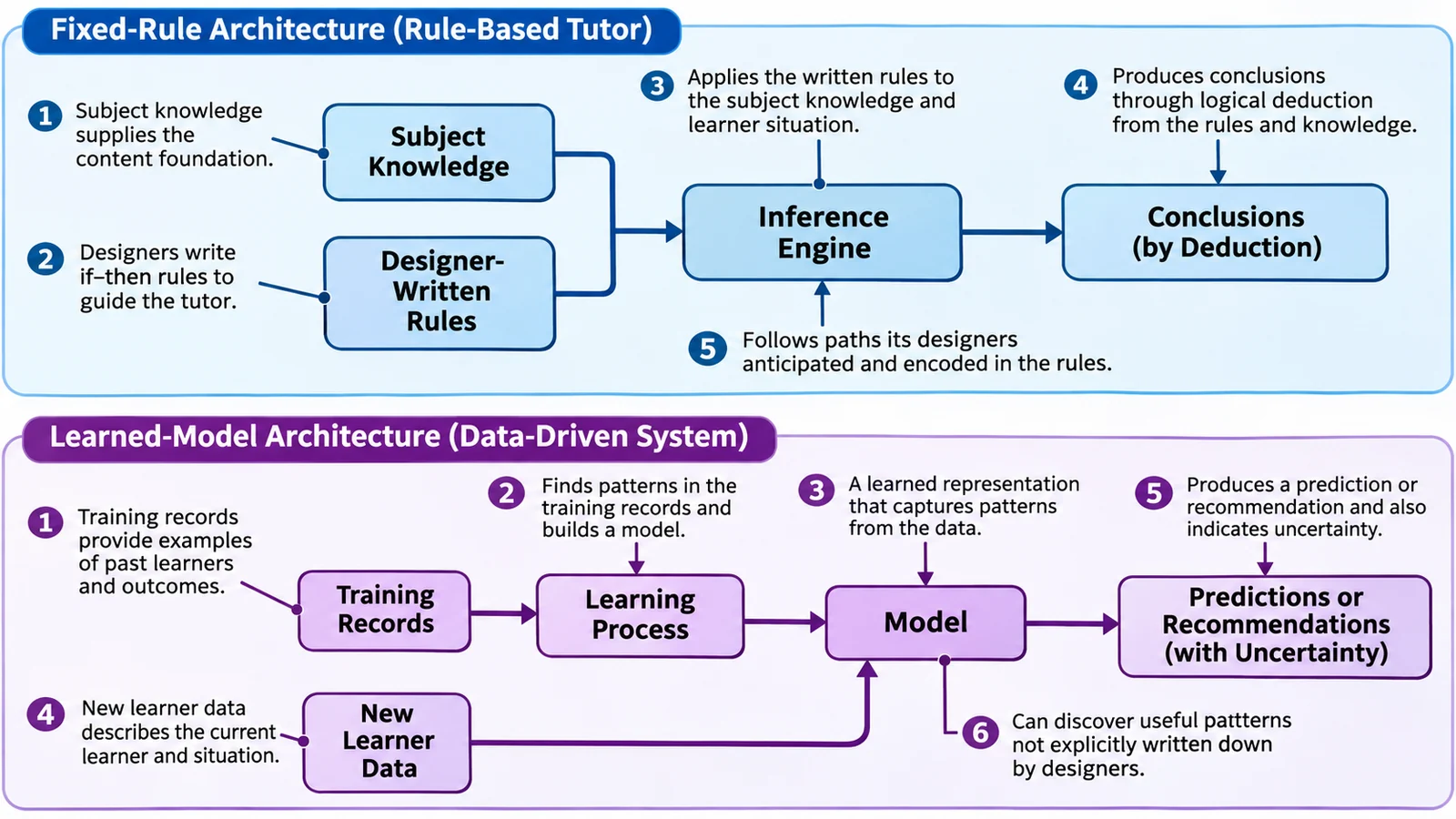
The second was a shift in the underlying computing. Early systems rested on deterministic reasoning, in which rules and inference engines produced conclusions by deduction; modern machine learning is dynamic and stochastic, meaning its outputs involve some randomness and uncertainty.[10] A tutor built on fixed rules can only follow the paths its designers anticipated. A system that learns from data can, in principle, adjust to patterns nobody wrote down.
The arrival of large language models made that difference visible to the public. Natural language processing, the branch of AI that enables computers to understand, interpret and generate human language, underpins large language models: algorithms trained on very large amounts of text that can produce human-like responses across a wide range of language tasks. ChatGPT, developed by OpenAI and first released on 30 November 2022, was built as a conversational model on this basis and made freely accessible on multiple platforms. Its reception in education was immediate; teachers and students in higher education began using it soon after release, and researchers turned quickly to asking what it could and could not do for learning.[2] Earlier language models had already been developed over several years, with GPT appearing in 2018 and later versions following.[4]
Set against this long history, the three paradigms described earlier look less like a straight line of progress than a widening of what the machine is for. The field began with AI directing instruction and the learner receiving it, moved to AI supporting a learner who collaborates with it, and now aims at AI empowering a learner who takes the lead.[7] Each stage reuses the machinery of the one before but asks something different of it, and the newest tools, fluent and general-purpose, sit awkwardly across all three: they can lecture, they can assist, and they can be directed by the student, depending entirely on how they are used.
The field's history is one of steady technical ambition checked by modest results, until cheap data and learned models widened what the software could attempt.
How it works
How intelligent tutoring systems work
An intelligent tutoring system is a software program equipped with AI programming that can detect, comprehend, and adapt to the learner's progress.[3] The defining behaviour is a loop: the system watches what the student does, works out where they are going wrong, and chooses what to present next so that the difficulty and the content fit the person in front of it. That loop is what separates a tutor from an ordinary digital textbook, which shows every student the same page in the same order regardless of what they understood.
The loop is usually built from several cooperating parts. Designers describe a domain model, which holds the subject matter and the relationships among its concepts; a pedagogical model, which holds the teaching strategy, such as when to give a hint, when to demand a step, and when to move on; and a learner model, which tracks what the individual student appears to know. Later designs added further parts, including a strategy model, a knowledge-base model and a communication model, to enhance students' learning experience.[11] The learner model is the pivot. Everything the tutor decides depends on its estimate of the student's state, and that estimate is built from the record of their answers, pauses, errors and revisions.
Three features do most of the instructional work in systems that function well. Immediate feedback corrects an error at the moment it happens, rather than days later when a marked sheet comes back. Guided practice breaks a complex skill into steps the student works through with support. Adaptivity adjusts the content and difficulty to the individual, based on prior knowledge and on performance as it unfolds. These are not decorative extras bolted onto the software; they are grounded in decades of instructional theory and have demonstrable positive effects on learning. A tutor that personalizes the path, as systems such as Yixue and UZWEBMAT do by adjusting difficulty and scaffolding in real time, can enhance learning gains.[3]
Duolingo, the language app, is one well-known example of an ITS. It personalizes instruction for each user, tailoring the exercises and their difficulty to that individual. The subject is narrow, but the mechanism is the general one: a model of the learner steering the choice of what comes next.[3]
Where machine learning enters
The adaptive behaviour can be hand-built or learned. In a hand-built tutor, a programmer or subject expert writes the rules that decide what follows what. Machine learning, a subset of AI, instead builds computer systems that learn from and adapt to data automatically, without explicit programming of each step.[10] A machine-learning algorithm is exposed to large amounts of training data, analyses it to find patterns, and builds a model that can then predict future values or choose actions.[5] Fed enough good data, such a model can produce accurate results and support informed decisions.[10]
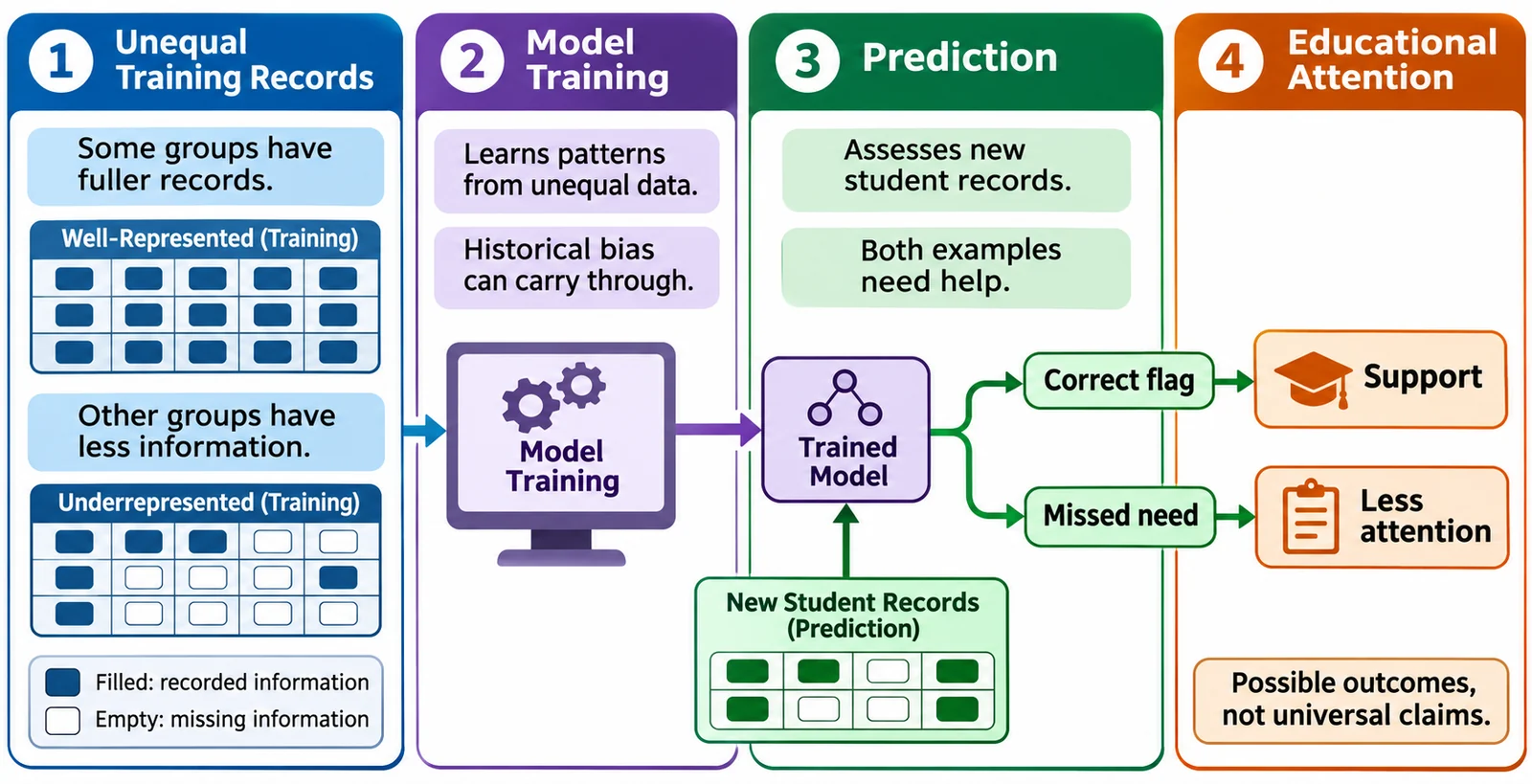
For a tutor, this changes where the intelligence sits. Rather than an expert anticipating every wrong turn a student might take, the system can learn from training data to find patterns and build a model that predicts or chooses actions.[5][10] A model trained on unbalanced or unrepresentative records will reproduce the patterns in those records, including the unfair ones.[10] The learner model is only as good as the evidence it is built from.
An intelligent tutoring system is a feedback loop: a model of the subject, a model of the teaching strategy, and a model of the learner, with the last of these steering what the student sees next.
Uses
What AI is used for in classrooms and campuses
The tools that reach an actual classroom fall into a small number of recognizable jobs. One is to choose and sequence what a student works on. Personalized learning systems, also called adaptive learning platforms, give students access to different materials according to their individual needs and the subject at hand; instead of practising chemistry on a worksheet or reading a textbook, a student may work through an adaptive, interactive multimedia version of the same course content.[5] The platform builds a picture of what the learner knows and adjusts accordingly. What such systems model, so far, is knowledge and cognition; the existing platforms do not yet provide models of learners' social, emotional, and motivational states.[5]
A second job is marking. Automated assessment systems score essays, exams, and assignments, and the largest open online course providers have built automated scoring engines into their platforms to assess the writing of hundreds of students at once. A tool called Gradescope has been used by more than 500 universities to streamline scoring, flagging wrong answers and marking correct ones so that instructors spend less time on manual grading. The distinction that matters here is between numeric tests, where an answer is right or wrong, and essays, where judgment is involved; the two are handled very differently, and the essay case is where the difficulty lies.[5]
A third job is answering questions. Chatbots, also called dialogue systems or conversational agents, respond in natural conversational language, and a text-based chatbot named Pounce was used at Georgia State University to help students through registration, admission, financial aid, and other administrative tasks.[5]
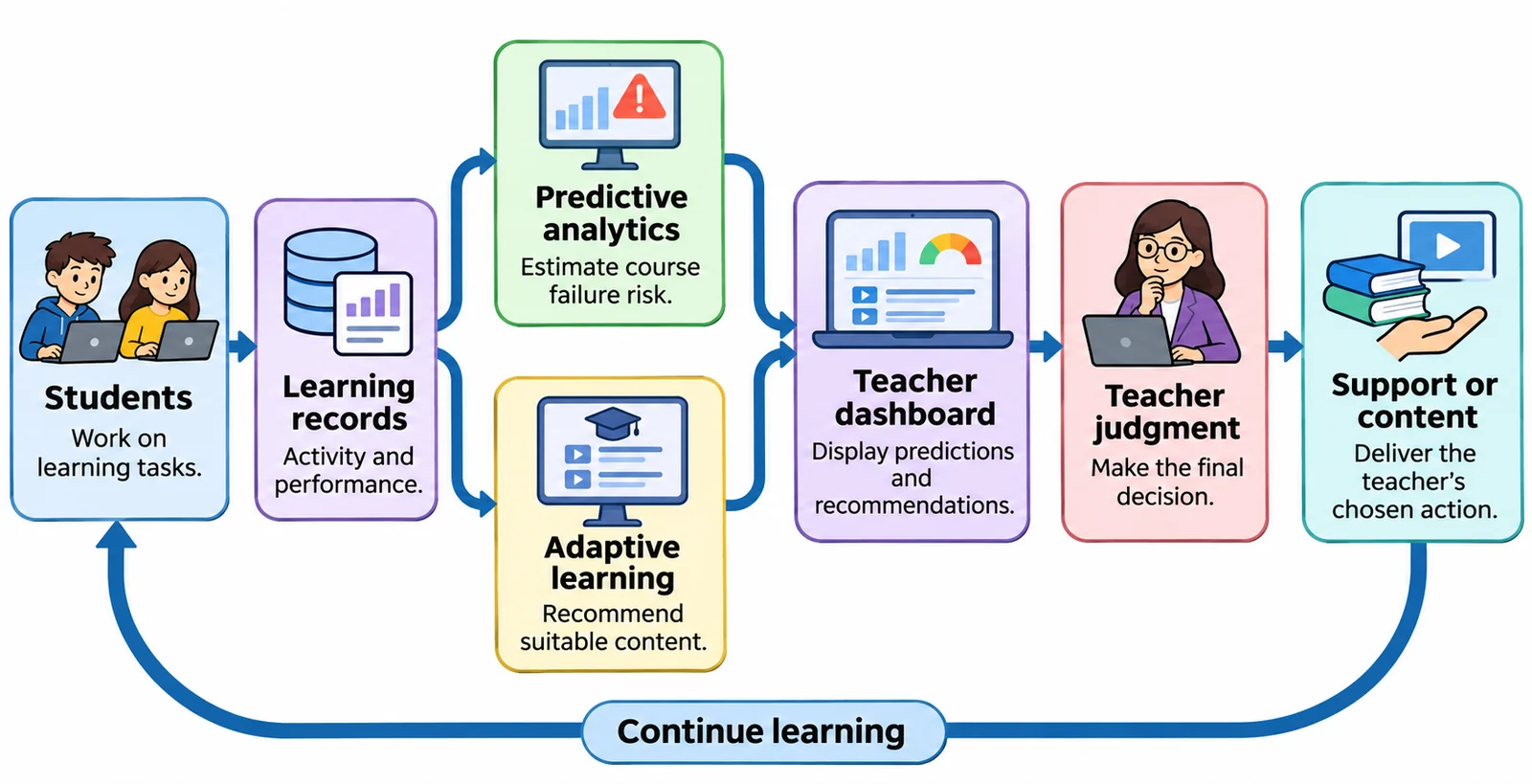
A fourth job is prediction. Predictive analytics tools apply statistical analysis to learner records to detect patterns, for instance identifying university students at risk of failing or not completing a course so that an instructor can intervene and get them help. A fifth is attention monitoring: facial recognition software captures and monitors students' facial expressions to give teachers insight into behaviour during learning, which in turn is meant to support learner-centred practice and increase engagement.[5] This last application sits closest to the ethical questions taken up later, since it turns a student's face into data without the student doing anything to supply it.
The teacher's side of the screen
Much of the classroom use is designed for the teacher rather than the student. Teacher dashboards collect what students are doing and present it while the lesson is still running. One example, Inq-Blotter, is driven by big data techniques and informs teachers' instruction in real time while students simultaneously work in a separate inquiry environment called Inq-ITS.[10]
That assumption runs through the administrative uses as well. In one high-level overview of the field, the purpose of AI in education is described as reducing teachers' workload without impacting learning outcomes, and most work within AIEd is divided into four main subdomains: reducing teachers' workload, contextualized learning for students, revolutionizing assessments, and intelligent tutoring systems.[11] Teachers spend substantial time on tasks that are not teaching, and applications in learning analytics, virtual reality, grading and assessment, and admissions are described as cutting that administrative load so that more of a teacher's time goes to instructing and guiding students.[12] The claim is about time reallocated, not about teachers replaced.
The arrangement is often described as keeping the teacher in the loop: the AI provides predictions about student performance or recommends content, and the teacher approves and makes the final decision. A system called SAGLET was built on this approach, visualizing and modelling students' activity for teachers in real time so that teachers could intervene more effectively when needed.[11] The loop can also break. A formative intervention with sixteen secondary school mathematics teachers found systemic contradictions between the teachers' own opinions and the tutoring system's recommendations, which eventually led to the tool being abandoned.[11] A recommendation a teacher does not trust is not a recommendation; it is friction.
What students do with general-purpose tools
The newest entry did not arrive as a school product at all. Students took up ChatGPT for study on their own initiative, and the largest picture of that behaviour comes from a survey of 23,218 higher education students across 109 countries and territories in early 2024. The uses students reported most were brainstorming, summarizing texts, and finding research articles, with fewer using it for professional and creative writing.[2]
The same survey found students judging the tool useful for simplifying complex information and summarizing content, and less reliable for providing information and supporting classroom learning, though some found its information clearer than what they got from peers and teachers. Students also agreed that AI regulations were needed at every level, citing concerns that ChatGPT promotes cheating, plagiarism, and social isolation.[2] The picture is of a student body using a general tool for the ordinary labour of studying while doubting its authority on facts, a combination that puts the burden of verification back on the person doing the learning.
Across classrooms and campuses, AI is used to choose content, mark work, answer routine questions, flag at-risk students, watch engagement, and give teachers a live view of the room; the teacher is meant to stay in charge, and students have added general chatbots to their own study habits.
Research
What the evidence says about learning outcomes
The question that matters most to a school is not what a system can do but whether students learn more with it. Answering that requires comparison: a class taught with the system set against a class taught without it, with the same material and some measure of what students know before and after. The evidence base is built mostly from such comparisons, and its shape is as informative as its results. A systematic review of intelligent tutoring systems in primary and secondary education gathered 20 studies covering 2,853 students, drawn largely from middle and high school classes in science, technology, engineering and mathematics. The studies mostly used quasi-experimental designs, with experimental and control groups tested before and after the intervention, and the duration of those interventions varied widely, with half classed as very short.[3]
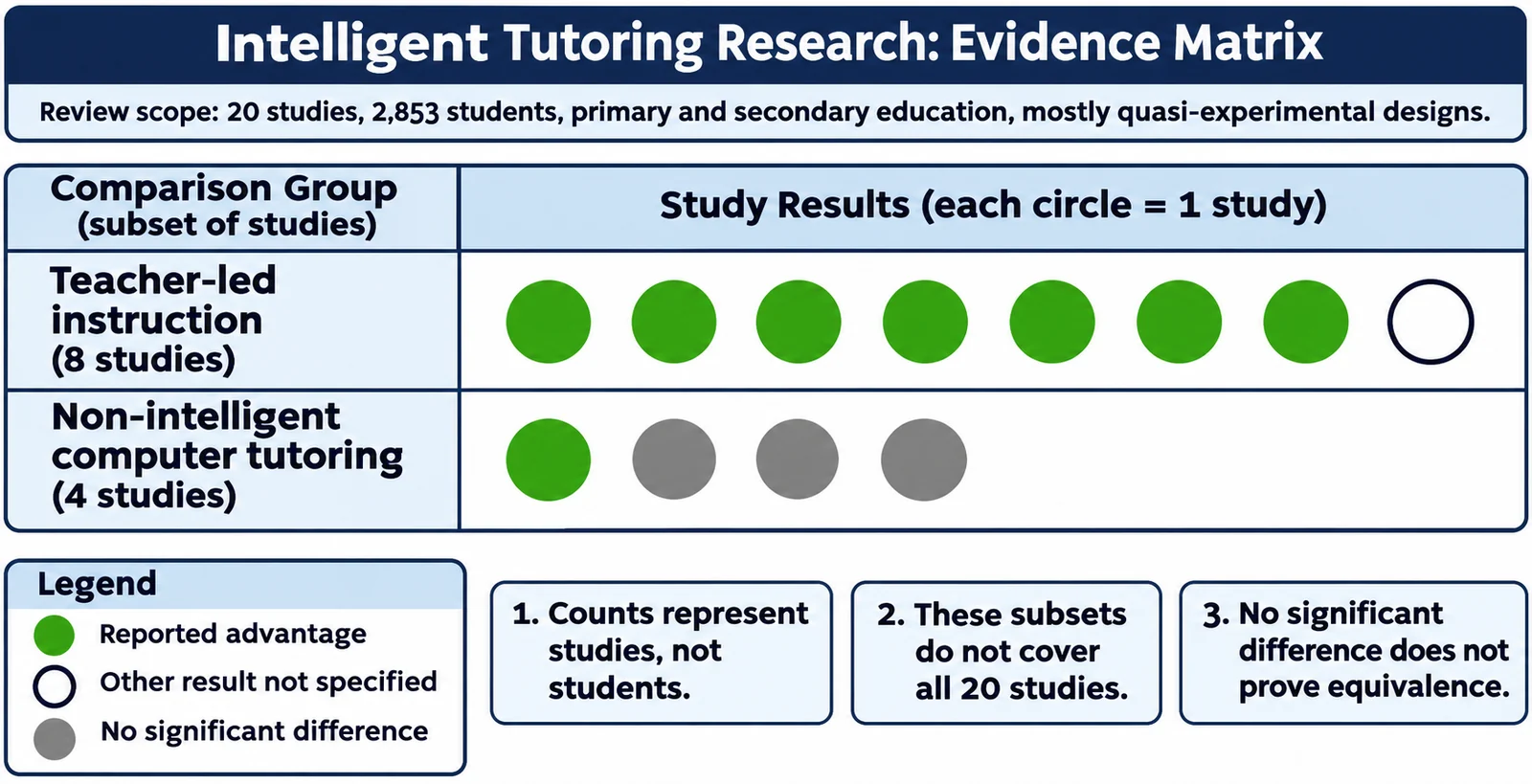
Taken together, the effects of tutoring systems on learning and performance in that age range were generally positive.[3] The pattern becomes clearer when the comparison group changes. Against ordinary teacher-led instruction, seven of eight studies reported an advantage for the tutoring system, with effect sizes in the medium to large range. Against a non-intelligent tutoring system, meaning a computer-based tool without the adaptive machinery, the picture was contradictory: only one of four studies showed an advantage for the intelligent system, while the other three found no significant difference.[3]
The contrast is the important finding. Much of what a tutoring system achieves may come from the ordinary business of giving students a computer to practise on with feedback, rather than from the intelligence layered on top. The review's authors also caution that "traditional teaching" was not defined the same way across studies and that the subject matter varied, which makes a single general conclusion hard to draw.[3]
Duration turns out to matter as much as design. The Cognitive Tutor Algebra I program, which gives individualized instruction through diagrams, equations, text and problems set in real-world scenarios, was tested in a large randomized controlled trial. Improvement in algebra proficiency appeared only after sustained implementation: notable gains showed up in the second year of the study, particularly in high schools, where students outperformed control groups by roughly 0.20 standard deviations, an effect the researchers describe as comparable to the benefit of an additional year of algebra instruction. Middle schools showed a similar but non-significant trend. One reading is that the right features were in place but the conditions for using them were met only in high schools, and the authors note that other factors, such as how quickly teachers and schools adapted to the blended model during the first year, may have differed between school tiers.[3]
The short duration of many studies raises a specific worry. When an intervention lasts only a few weeks, part of any measured gain may come from novelty: new software holds attention simply by being new, and attention alone can lift performance. The review notes that the wide range of intervention durations, with many very short, may amplify effect size for this reason, and that only one of the studies it examined addressed the potential bias.[3] A gain that fades once the software stops being interesting is not the same as learning, and short trials cannot tell the two apart.
What the systems are made of matters too. Personalization and adaptivity appear to sit at the core of what makes a tutoring system effective, with systems that tailor content to individual needs, prior knowledge and learning styles tending to produce better outcomes, and those that adjust difficulty and scaffolding in real time, such as Yixue and UZWEBMAT, producing larger learning gains. Immediate, data-driven feedback during the task is a second core component, and systems such as Rimac and TECH8 have shown how adaptive feedback can speed comprehension. The benefits also appear to grow with prolonged exposure, as repeated interactions let students internalize concepts, and with teachers' growing familiarity with the tool. Lower-performing students often gain more, because the tailored scaffolding addresses gaps that a whole-class lesson cannot.[3]
Evidence from general-purpose chatbots
The arrival of conversational models created a different kind of evidence problem, because these tools were not designed for classrooms and are used in ways researchers cannot easily control. The most comprehensive large-scale global study to date comes from a survey of 23,218 higher education students across 109 countries and territories in early 2024, which recorded perceptions rather than test scores. Students found the tool useful for simplifying complex information and summarizing content, and less reliable for providing information and supporting classroom learning, though some judged its information clearer than what they received from peers and teachers. They also reported that it could potentially improve their learning experience, study efficiency and chances of achieving good grades.[2] These are beliefs about a tool, held by the people using it, and they sit alongside the same respondents' doubts about its accuracy.
Smaller studies test the tool itself. A three-week science learning study with 74 Secondary 4 students in Hong Kong compared a generative AI chatbot built to support self-regulated learning against a rule-based chatbot. The generative version enhanced students' science knowledge, behavioural engagement and motivation, and the number of interactions with it significantly predicted variation in self-regulated learning; students valued the personalized recommendations and the way responses adjusted to their own learning situations, and the design was reported to reduce learning anxiety.[13] The comparison is instructive because both groups had a chatbot. What differed was the flexibility of the responses, which suggests that the value of a generative model lies in adapting to the individual rather than in the mere presence of a machine to talk to.
A single pilot with 74 students cannot settle whether chatbots improve learning in general, and the survey of perceptions cannot show that they do.[2] What the two together indicate is narrower and more useful: students get real help with comprehension and organization, they do not trust the tool as a source of fact, and a chatbot that adapts to the learner can outperform one that follows fixed rules. The evidence on tutoring systems points in a similar direction. Effects are real but modest, they depend on which features are built in and which comparison is made, they grow with time, and short trials tend to overstate them. The risks that accompany these tools, and the conditions under which they help rather than harm, are taken up in the sections that follow.
The evidence supports a cautious claim: AI tutoring generally helps more than ordinary teaching, helps much less when compared with other computer-based tutoring, and needs long implementation and sound instructional design before its gains are dependable.
Risks and limits
Risks, ethical concerns and limits
Every educational AI system runs on data about learners, and that dependence is the source of its sharpest risks. The data can be personal records, learning logs, physiological signals, or a student's face, and once collected it can be stored, combined, and reused in ways the student never anticipated. Ethical analysis of the field groups the concerns under a recognizable set of headings: privacy and surveillance, autonomy, bias and discrimination, and the fairness of the arrangements that govern who holds the data and who may use it.[5] What makes these concerns acute in schools is the asymmetry. The student supplies the data within institutional systems, and the institution or the vendor decides what happens to it.
Privacy, bias and the data behind the model
Algorithmic bias is the systematic and repeatable error an AI system produces when its training data misrepresents the people it acts on. The mechanism is not malice but arithmetic: an algorithm adapts to the qualitative and quantitative characteristics of the data it is given, so if the records contain disproportionately better information about students from the general population than about minorities, the model will produce errors that disadvantage minorities, consistently and at scale.[10] The same logic explains why algorithms should not be treated as neutral. They reflect the values of the people who build them, and the data they learn from carry society's historical and systemic biases, which then reappear as the system's output even when no one intended it.[5] In a classroom the consequence is concrete: a model that flags who needs help, or who is at risk of failing, can route attention away from the students who most need it.
Privacy and data protection sit alongside this. The questions that transparency requires are specific: what the data is, where it is collected, what it shows, what happens to it, and how it is used.[6] Ownership is contested. One argument holds that students, as the people providing the data, should own it and control how it is used to benefit their own learning; a competing claim holds that institutions have rights to the data because the interactions and performance were recorded inside a learning system the institution provides.[6] Neither position settles the practical question of what a school may do with a record once a course ends.
Integrity, overreliance and the widening gap
The arrival of general-purpose chatbots added a concern that tutoring systems had largely avoided: the authenticity of submitted work. In the global survey of 23,218 students across 109 countries and territories, respondents agreed on the need for AI regulations at all levels, amid concerns about ChatGPT promoting cheating, plagiarism, and social isolation.[2] The worry is not imaginary. Large language models can produce well-written student essays and research abstracts that scientists found difficult to distinguish from human writing, and in one 2023 test reviewers identified only 63 percent of fake abstracts created by ChatGPT.[4]
A subtler risk is that the tool does the thinking the student was meant to do. ChatGPT can reduce cognitive load by handling complex tasks and freeing working memory, but it may equally produce dependency and cognitive overload by replacing deep thinking. The distinction turns on how the student uses it: some employ it to set goals, prepare questions, and check their own understanding, while others use it to complete assignments without developing a critical grasp of the task.[2] A review of 155 empirical studies published between 2015 and 2025 lists challenges including students' ethical use of AI, teachers' resistance to using AI systems, and the digital dependency these systems can generate.[14] The pattern is a familiar one in the evidence: the same tool supports learning or substitutes for it, depending on the design of the task and the competence of the user.
Access divides the risk unevenly. The widespread ramifications of educational AI have led to emerging concerns over negative realities such as widening gaps of inequality among learners, the commercialization of education, and the home-school divide.[6]
Governance, and the limits of the machine
Most higher education institutions lack rules for the use of ChatGPT. Most higher education institutions lack rules for the use of ChatGPT, and opinions on generative tools are divided between those who emphasize the ease and comfort they bring and those who warn of cheating and integrity problems if rules are not established.[2] Governance of educational AI means establishing and implementing policies, procedures and standards for its proper development, use and management, while stewardship means the careful and responsible management of its design and use in practice; governance is a structure, stewardship an activity. Governance refers to a structure or pattern, while stewardship is an activity; taking action on issues such as building capacity or developing transparency can be seen as good stewardship.[6]
The most basic limit is that the software is not a teacher. AI cannot substitute for human interaction, and although it can be a time-saving cognitive aid, it is one tool in a teacher's toolkit rather than a replacement for the person using it. Existing platforms generate models of learners using their knowledge and cognition, but do not yet provide models for learners' social, emotional, and motivational states.[5] One analysis of the field argues that AI will never in any sense take over the role of teacher, because how machine intelligence works and what it does are profoundly different from human intelligence, though within those limits it could make education more human rather than less.[15]
A final concern is that many systems are built without reference to what is known about learning. There is a notable gap between contemporary technological capability and its use in education, and the fast-growing industry has developed numerous applications that may not be guided by current theoretical frameworks or by findings from the psychology of learning and teaching.[10] A review of 45 influential studies found a lack of work that both employs AI technologies and engages deeply with educational theory.[16]
The risks cluster around data and design: biased or intrusive data, tools that do the student's thinking, unequal access, thin regulation, and systems built without a theory of how people learn.
Later developments
Where the field is heading and what remains open
The research agenda is shifting from what the software can compute to what the learner is doing. Work in educational AI is moving away from a purely computational focus, which demonstrates use cases of new technology, toward a cognitive focus that builds perception, emotion and cognitive thinking into the design of the system itself. The same shift crosses disciplinary lines, from a single domain toward collaboration and transfer across domains. Underneath sits a change in the kind of reasoning the software performs: deterministic learning, aimed at deduction and inference engines, gave way to dynamic and stochastic learning whose outcomes involve some randomness and uncertainty.[10] A tutor built on fixed rules can only follow paths its designers foresaw; a system that learns from data can adjust to patterns nobody wrote down, and the design question becomes which patterns it should be encouraged to find.


Generative models have pushed that question to the front of the field. Large language models trained on vast amounts of text data can generate human-like responses and perform a wide range of language tasks with high accuracy and versatility.[2] The models behind them developed over several years, with GPT developed by OpenAI in 2018 and more capable versions such as GPT-2 in 2019 and GPT-3 in 2020 following, before OpenAI made updates to ChatGPT in November 2022. The same model can create essays, summarize research papers, answer questions, and generate computer code.[4]
That generality has drawn attention to a different aim for the field. One line of argument holds that AI should be approached from a human perspective, taking account of human conditions and contexts, rather than treating the technology only as a way to extend human performance.[17] A related proposal goes further, arguing for hybrid intelligence: tightly coupled human–AI systems in which the machine extends human cognition rather than replacing the learning opportunity, alongside teaching people about AI and reshaping educational systems so they remain relevant in a world where the technology is everywhere.[18] The emphasis falls on the coupling. A system that answers for the student and a system that prompts the student to think are built from similar parts and produce opposite effects.
None of this happens without teachers who can use the tools and judge them. Teachers need to become tech savvy enough to evaluate new educational tools as they appear, to develop analytical skills for interpreting the data those tools display, and to manage the new resources in their daily routines.[11] The preparation gap is not marginal: there is an urgent need for research and development in teacher preparation, and in the philosophy of technology in education, to bridge the distance between fast-moving AI and the careful application education requires.[19] Utterberg et al. showed why teachers have abandoned technology in some instances because it was counterproductive, finding systemic contradictions between teachers' opinions and ITS recommendations.[11]
Several questions remain genuinely open. The gap between what the technology can do and how it is used in education is wide, and the rapid pace of technical progress against the relatively slow pace of educational adoption has widened it further.[10] The evidence base is thin in specific ways: the systematic review of tutoring systems in primary and secondary schooling found mostly quasi-experimental designs, many with very short interventions, and called for additional research with longer interventions and larger, more diverse samples, together with investigation of the ethical implications of using AI for teaching.[3] Building that evidence, and closing the gap between capability and practice, requires people who do not usually work together to do so. The field's own assessment is that researchers, educators, policy-makers and professionals need productive collaboration across disciplines and sectors, and that technologies should be guided by relevant theoretical frameworks and empirically tested.[10] Whether the next decade produces tools that make education more human, or merely more automated, will depend less on what the models can do than on whether that collaboration takes hold.
Key studies
| Year | Study | Sample | Design | Finding |
|---|---|---|---|---|
| 2020 | Chen et al.[16] | 45 influential AIEd articles | systematic review | Little work had brought deep learning into educational contexts, and few studies combined AI technologies with deep engagement with educational theory. |
| 2020 | Chen et al.[8] | literature on AI applications in administration, instruction and learning | qualitative literature review | AI has been adopted in education in forms from computer technologies to web-based chatbots and humanoid robots, and adaptive systems have customized curriculum to students' needs. |
| 2020 | Luan et al.[10] | research, policy and industry work on big data and AI in education | discussion paper on challenges and future directions of big data and AI in education | Research trends center on assessment, individualized learning and precision education, and technologies should be guided by theory and empirically tested. |
| 2021 | Ouyang & Jiao[7] | published work on AI in education | position paper | Ouyang and Jiao (2021) describe three paradigms of artificial intelligence in education. In the first, AI directs cognitive learning and the learner receives its service. In the second, AI supports learning and the learner works alongside it as a collaborator. In the third, AI empowers learning and the learner exercises agency. |
| 2022 | Akgun & Greenhow[5] | K-12 educational contexts | paper defining AI and addressing ethical challenges in K-12 settings | AI applications include personalized learning platforms, automated assessment systems and facial recognition, and their ethical drawbacks are rarely fully considered in K-12. |
| 2023 | Nguyen et al.[6] | international organizations' policies and guidelines on ethical AI in education | thematic analysis | The analysis mapped ethical principles for AI in education, covering personal data, learner autonomy, informed consent, privacy and fairness. |
| 2024 | Ng et al.[13] | 74 Secondary 4 students in Hong Kong | three-week comparative study | A generative AI chatbot improved science knowledge, behavioural engagement and motivation compared with a rule-based chatbot. |
| 2025 | Ravšelj et al.[2] | 23,218 higher education students from 109 countries and territories | global study of 23,218 students in 109 countries and territories | In the survey, 71% of students had already used ChatGPT; 29% used it for brainstorming and 11% for creative writing. Students favored AI regulations at every level. |
| 2025 | Létourneau et al.[3] | 2,853 K-12 students across 20 studies | systematic review of 20 studies (2,853 students) using quasi-experimental designs | Effects of intelligent tutoring systems on learning were generally positive but smaller against non-intelligent tutoring systems, and half of the studies were very short. |
| 2025 | Garzón et al.[14] | 155 peer-reviewed empirical studies published between 2015 and 2025 | systematic literature review | Benefits included enhanced learning outcomes, personalized instruction and increased motivation, while challenges included ethical use, teacher resistance and digital dependency. |
See also
References
- Hwang, G. J., Xie, H., Wah, B. W., & Gašević, D. (2020). Vision, challenges, roles and research issues of Artificial Intelligence in Education. Computers and Education: Artificial Intelligence, 1, 100001. doi:10.1016/j.caeai.2020.100001
- Ravšelj, D., Keržič, D., Tomaževič, N., Umek, L., Brezovar, N., A. Iahad, N., Abdulla, A. A., Akopyan, A., Aldana Segura, M. W., AlHumaid, J., Allam, M. F., Alló, M., Andoh, R. P. K., Andronic, O., Arthur, Y. D., Aydın, F., Badran, A., Balbontín-Alvarado, R., Ben Saad, H., & ... Aristovnik, A. (2025). Higher education students’ perceptions of ChatGPT: A global study of early reactions. PLOS ONE, 20(2), e0315011. doi:10.1371/journal.pone.0315011
- Létourneau, A., Deslandes Martineau, M., Charland, P., Karran, J. A., Boasen, J., & Léger, P. M. (2025). A systematic review of AI-driven intelligent tutoring systems (ITS) in K-12 education. npj Science of Learning, 10(1). doi:10.1038/s41539-025-00320-7
- Dergaa, I., Chamari, K., Zmijewski, P., & Ben Saad, H. (2023). From human writing to artificial intelligence generated text: examining the prospects and potential threats of ChatGPT in academic writing. Biology of Sport, 40(2), 615-622. doi:10.5114/biolsport.2023.125623
- Akgun, S., & Greenhow, C. (2022). Artificial intelligence in education: Addressing ethical challenges in K-12 settings. AI and Ethics, 2(3), 431-440. doi:10.1007/s43681-021-00096-7
- Nguyen, A., Ngo, H. N., Hong, Y., Dang, B., & Nguyen, B. P. T. (2023). Ethical principles for artificial intelligence in education. Education and Information Technologies, 28(4), 4221-4241. doi:10.1007/s10639-022-11316-w
- Ouyang, F., & Jiao, P. (2021). Artificial intelligence in education: The three paradigms. Computers and Education: Artificial Intelligence, 2, 100020. doi:10.1016/j.caeai.2021.100020
- Chen, L., Chen, P., & Lin, Z. (2020). Artificial Intelligence in Education: A Review. IEEE Access, 8, 75264-75278. doi:10.1109/access.2020.2988510
- Schiff, D. (2021). Out of the laboratory and into the classroom: the future of artificial intelligence in education. AI & SOCIETY, 36(1), 331-348. doi:10.1007/s00146-020-01033-8
- Luan, H., Geczy, P., Lai, H., Gobert, J., Yang, S. J. H., Ogata, H., Baltes, J., Guerra, R., Li, P., & Tsai, C. C. (2020). Challenges and Future Directions of Big Data and Artificial Intelligence in Education. Frontiers in Psychology, 11. doi:10.3389/fpsyg.2020.580820
- Chaudhry, M. A., & Kazim, E. (2022). Artificial Intelligence in Education (AIEd): a high-level academic and industry note 2021. AI and Ethics, 2(1), 157-165. doi:10.1007/s43681-021-00074-z
- Ahmad, S. F., Alam, M. M., Rahmat, M. K., Mubarik, M. S., & Hyder, S. I. (2022). Academic and Administrative Role of Artificial Intelligence in Education. Sustainability, 14(3), 1101. doi:10.3390/su14031101
- Ng, D. T. K., Tan, C. W., & Leung, J. K. L. (2024). Empowering student self‐regulated learning and science education through ChatGPT : A pioneering pilot study. British Journal of Educational Technology, 55(4), 1328-1353. doi:10.1111/bjet.13454
- Garzón, J., Patiño, E., & Marulanda, C. (2025). Systematic Review of Artificial Intelligence in Education: Trends, Benefits, and Challenges. Multimodal Technologies and Interaction, 9(8), 84. doi:10.3390/mti9080084
- Cope, B., Kalantzis, M., & Searsmith, D. (2021). Artificial intelligence for education: Knowledge and its assessment in AI-enabled learning ecologies. Educational Philosophy and Theory, 53(12), 1229-1245. doi:10.1080/00131857.2020.1728732
- Chen, X., Xie, H., Zou, D., & Hwang, G. J. (2020). Application and theory gaps during the rise of Artificial Intelligence in Education. Computers and Education: Artificial Intelligence, 1, 100002. doi:10.1016/j.caeai.2020.100002
- Yang, S. J. H., Ogata, H., Matsui, T., & Chen, N. S. (2021). Human-centered artificial intelligence in education: Seeing the invisible through the visible. Computers and Education: Artificial Intelligence, 2, 100008. doi:10.1016/j.caeai.2021.100008
- Cukurova, M. (2025). The interplay of learning, analytics and artificial intelligence in education: A vision for hybrid intelligence. British Journal of Educational Technology, 56(2), 469-488. doi:10.1111/bjet.13514
- Pham, S. T. H., & Sampson, P. M. (2022). The development of artificial intelligence in education: A review in context. Journal of Computer Assisted Learning, 38(5), 1408-1421. doi:10.1111/jcal.12687
Cite this page: Atlas Nova editors. (2026). Artificial intelligence in education. Atlas Nova. https://velocer.io/atlas/ai-in-education/