Technology · Language models
Generative pre-trained transformer
Deep learning language model
Generative pre-trained transformer (GPT) is a deep neural network built on the transformer architecture, a design for natural language processing tasks. GPT models are pre-trained on large text corpora and can converse and perform language tasks.[1]
GPT-3 has 175 billion parameters and learns tasks from a few examples.[2] Few-shot accuracy varies widely with prompt format and example order.[3] ChatGPT reached over 100 million users by January 2023.[4]
Key facts
| 175 billion | parameters in GPT-3, reported by Brown and colleagues in 2020[2] |
|---|---|
| 137B | parameters in the model instruction-tuned as FLAN, by Wei and colleagues in 2021[5] |
| 284 | medical questions graded in the chatbot accuracy study by Goodman and colleagues in 2023[6] |
| 550 | studies reviewed on large language models in medicine by Meng and colleagues in 2024[7] |
Overview
What a GPT model is
A generative pre-trained transformer, usually shortened to GPT, is a type of artificial intelligence that uses machine learning algorithms to produce text in natural language.[8] Large language models gain general-purpose language understanding and generation by training billions of parameters on massive text data. GPT is one of three popular large language model families named in a 2024 survey, alongside LLaMA and PaLM.[9]
The key idea is to learn a general, hidden representation of language from one broad task, then share it across separate language tasks. Language modelling serves as that general task, because abundant self-supervised text is available for extensive training. Large pre-trained language models such as BERT and GPT have drastically changed the field of natural language processing.[10]
Later versions such as GPT-2 and GPT-3 addressed these problems and added the ability to handle more complex language tasks. Those versions can still produce biased or inappropriate output when they are not used responsibly. The first version also lacked control over the content it generated, because it could not fully grasp the context or meaning of the words used.[8]
History
From GPT-1 to ChatGPT and beyond
A 2023 bibliometric analysis describes GPT as a deep learning language model architecture that OpenAI developed.[11] A 2023 capability study selected six representative models from the series, including two from the GPT-3 group (davinci and text-davinci-001) and four from the GPT-3.5 group (code-davinci-002, text-davinci-002, text-davinci-003, and gpt-3.5-turbo). The study evaluated these models on nine natural language understanding tasks using 21 datasets, comparing their performance in zero-shot and few-shot settings.[12]
OpenAI launched the public chatbot ChatGPT on November 30, 2022, and it allowed ordinary people to hold conversations with a machine on many subjects. By January 2023 more than 100 million users had tried ChatGPT, the fastest growth recorded for a consumer application at that time.[4] A 2023 perspective article describes ChatGPT as a user-centered chatbot and traces the evolution of large language models (LLMs) to understand the change it brought to the artificial intelligence field. Many authors used it to write parts of their articles, and some papers even listed ChatGPT as an author.[13]
The GPT series includes models such as GPT-3, CodeX, InstructGPT, and ChatGPT, which have gained considerable attention for their natural language processing capabilities. A 2023 analysis of the GPT-3 and GPT-3.5 series found that overall ability on natural language understanding tasks does not rise gradually as the models evolve. RLHF enhanced the models' ability to generate human-like responses, but it also compromised their ability to solve some tasks. The same analysis found room for improvement in areas such as model steadiness, meaning how well a model keeps working when conditions change.[12]
A 2023 perspective article warned that LLMs can produce large amounts of text quickly. That speed could spread misinformation on a scale not seen before, creating an "AI-driven infodemic" and a new public health threat. That article also noted that no method yet reliably tells machine-written text apart from text written by people.[13]
Main ideas
How pre-training and fine-tuning work
Instruction tuning is a form of fine-tuning in which the model is trained on many tasks described in plain language instructions. A 2021 study took a 137B parameter pretrained language model and instruction-tuned it on over 60 natural language processing tasks, written out with instruction templates. The resulting model, called FLAN, was then tested on task types it had not seen. FLAN substantially improved on its unmodified counterpart and surpassed zero-shot 175B GPT-3 on 20 of 25 tasks evaluated.[5]
Few-shot learning from a prompt
The method works, but the same model can score very differently on the same task depending on how the prompt is built. A 2021 study found that the choice of prompt format, the training examples, and even the order of those examples can move accuracy from near chance to near state-of-the-art. The instability comes from the model's bias toward predicting certain answers, such as answers placed near the end of the prompt or answers common in the pre-training data.[3]
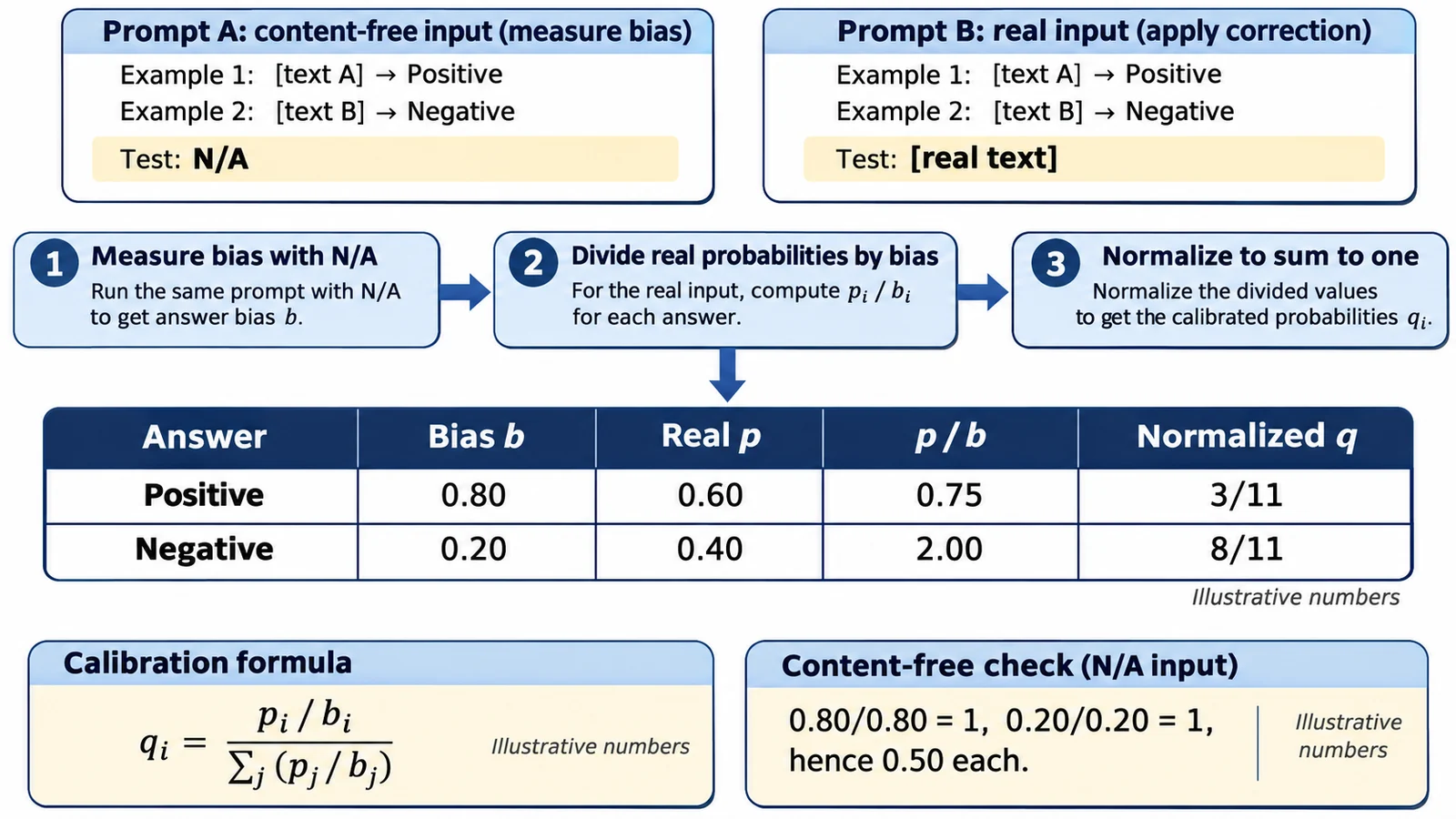
One fix, called contextual calibration, first estimates the model's bias toward each answer by giving it the training prompt plus a content-free test input such as "N/A". Calibration parameters are then fitted so that the prediction for this empty input is spread evenly across the possible answers. Across a diverse set of tasks, this procedure raised the average accuracy of GPT-3 and GPT-2 by up to 30.0% absolute and reduced the variance across different prompt choices.[3]
Scale, cost and smaller alternatives
Very large GPT models carry extremely high computing and storage costs, and even running one to produce text can require several powerful graphics processors, the chips that do the arithmetic.[14] Training a model on the scale of GPT-3 demands a huge amount of computing resources, which makes such work hard for researchers to attempt. Yuan 1.0, described in 2021 as the largest single language model at the time, has 245 billion parameters and was trained on thousands of graphics processors.[15]
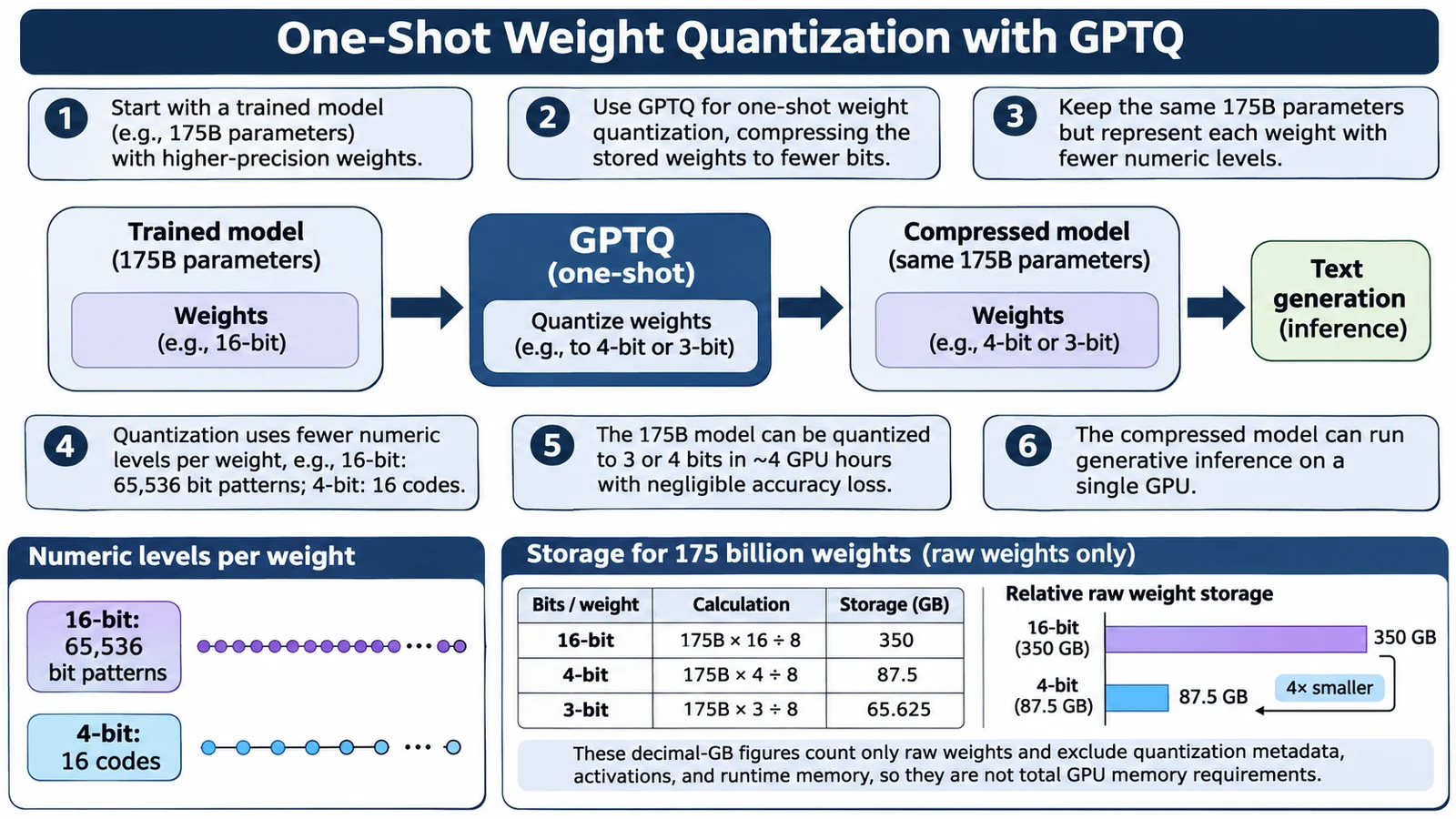
Compression offers a second route: shrinking a finished model so it fits on less hardware. Quantizing a model with 175 billion parameters this way took about four graphics processor hours, with negligible loss of accuracy compared with the uncompressed version. The compression gains were more than double those of earlier one-shot quantization methods, and for the first time a 175 billion parameter model ran for text generation inside a single graphics processor. Even at 2 bits per weight, or at three-level ternary values, the method kept reasonable accuracy.[14]
The transformer architecture and attention
A transformer is a neural network design that turns input data into feature representations by means of an attention mechanism, a procedure that weighs how strongly each part of the input bears on each other part.[16] The design grew out of sequence-to-sequence models, which map one sequence of items to another, such as a sentence in one language to a sentence in another. Early sequence-to-sequence models handled the whole input without attention; later versions added attention so that the model could focus on relevant parts of the input while producing each part of the output. Self-attention applies the same idea within a single sequence, letting each position draw information from the other positions in that sequence.[17]


The transformer's distinguishing feature is that it uses no recurrence at all. Earlier recurrent designs processed a sequence one step at a time and carried a hidden state forward from step to step; the transformer instead computes attention across positions directly. A full transformer is assembled from an encoder and a decoder, each built from stacked layers. The encoder and decoder contain positional encoding, which supplies information about the order of items in the sequence, multihead self-attention, cross-attention between encoder and decoder, and masked multihead attention in the decoder. Masking restricts which positions a decoder may attend to, so that predictions at a given position depend only on what precedes it.[17]
The generative pre-trained transformer, or GPT, is a stack of transformer decoder layers, while BERT, the bidirectional encoder representations from transformers model, is a stack of encoder layers.[17] A mathematical treatment describes GPT models as encoding knowledge into low-dimensional vectors through an autoregressive self-supervised learning mechanism, and it frames language generation in terms of projection functions between a natural language space and a knowledge space. That analysis also notes limits, including trade-offs between model complexity and generalization and the consequences of inverse projection functions that are incomplete.[18]
Attention is not confined to text. In visual transformers, an input image is first divided into local patches, and representations of those patches and of their relationships are then computed. One variant, called Transformer in Transformer, treats local patches of 16 by 16 pixels as visual sentences and divides them further into smaller patches of 4 by 4 pixels as visual words, computing attention among the words within each sentence at negligible computational cost. On ImageNet this architecture reached 81.5% top-1 accuracy, roughly 1.7% above the leading visual transformer of comparable computational cost.[16]
Pre-trained transformers have become widely used in natural language processing and have surpassed the previous state of the art on a wide variety of tasks. Their practical use carries costs: fine-tuning on a target domain is expensive because of the high number of hyper-parameters, which affects model selection and the reliability of experimental assessment. A controlled comparison across many tasks found that only 20% of recent natural language processing papers using pre-trained transformers reported multiple runs, and 10% reported standard deviation or statistical significance, which hurts replicability and reproducibility. The same comparison showed that hyper-parameters and the initial random seed affect results, and it drew attention to how little the models withstand such changes.[19]
How autoregressive next-word prediction works
A generative pre-trained transformer (GPT) is trained on a self-supervised task: given the tokens that come before a position in a text, predict the token that comes next. The task is called self-supervised because the correct answer at every position is simply the next token of the original text, so no human labels are needed.[18][20] A 2022 study recorded brain responses in nine participants listening to a 30-minute podcast and reported that the human brain and autoregressive deep language models both predict the next word continuously before that word is heard.[20]
In mathematical terms, the model learns a probability distribution over the next token conditioned on the tokens already seen. That analysis separates a natural language space from a knowledge space and studies the projection functions between them, along with their inverses.[18]
Open models and alternative implementations
Several research groups have released GPT-style transformers with open weights, meaning the trained parameters can be downloaded and run rather than only queried through a remote service.[21][22] GPT-NeoX-20B is a 20 billion parameter autoregressive language model trained on a text collection called the Pile, and its weights are released under a permissive license. At the time of its submission, its developers described it as the largest dense autoregressive model with publicly available weights; a dense model uses all of its parameters for every input. The release also included the code for training and evaluation. When tested with five examples in the prompt, the model improved far more than GPT-3 and FairSeq models of similar size.[21]
The OPT suite is a set of decoder-only pre-trained transformers with 125M to 175B parameters. Its developers intended to share the models fully and responsibly with researchers who want to use them. The developers reported that OPT-175B performs comparably to GPT-3, and that developing it took one seventh of the carbon footprint.[22]
PMC-LLaMA was built for medicine by injecting knowledge from 4.8M biomedical academic papers and 30K medical textbooks, then fine-tuning on medical question answering, reasoning rationales and conversational dialogues with 202M tokens. The resulting model has only 13B parameters, yet on public medical question-answering benchmarks and manual rating it performed better than ChatGPT. Its models, code and instruction-tuning datasets were to be released to the research community.[23] ProtGPT2 applies the same approach to proteins, generating new amino acid sequences in a matter of seconds and freely available. Predictions of disorder suggest that 88% of the proteins ProtGPT2 generates are globular, as natural sequences are. Structure prediction on its sequences also revealed topologies that current structure databases do not contain.[24]
Comparisons across pre-trained transformer families show that reported results often rest on thin evidence. A 2022 empirical comparison of five popular transformer models found that only 20% of recent NLP papers using pre-trained transformers reported multiple runs, and only 10% reported standard deviation or statistical significance.[19]
Research
Evidence from tests and benchmarks
On four question sets, ChatGPT scored 44% (44/100) and 42% (42/100) on the two AMBOSS sets and 64.4% (56/87) and 57.8% (59/102) on the two free national board sets. ChatGPT beat InstructGPT by 8.15% on average across all four sets, while GPT-3 scored about as well as random guessing. Accuracy fell significantly as question difficulty rose (P=.01) within the first AMBOSS set. A logical reason for the chosen answer appeared in 100% of outputs on the national board sets, and information from inside the question appeared in 96.8% (183/189) of all questions. On one national board set the model passed the 60% mark, which the study treats as the passing level for a third-year medical student.[25]
On the 2021 and 2022 American College of Gastroenterology self-assessment tests, ChatGPT-3 scored 65.1% on 455 included questions and GPT-4 scored 62.4%, both below the 70% needed to pass. The researchers did not recommend the tool for gastroenterology education in its current form.[26] On the Japanese Medical Licensing Examination, GPT-4 outperformed GPT-3.5 on accuracy, especially on general, clinical and clinical sentence questions, and met the passing criteria. That study analyzed 254 questions from the 117th exam in 2023.[27] With few-shot prompts and combined prompting methods, GPT-3.5 reached the passing score on three medical datasets: MedQA-USMLE (60.2%), MedMCQA (62.7%) and PubMedQA (78.2%). The open-source model Llama 2 70B also passed MedQA-USMLE, at 62.5% accuracy.[28]
A 2024 evaluation of GPT-4o found high accuracy and efficiency in language and reasoning, with clear gains over earlier models on tasks that mix images and text. The 2024 evaluation found variability and limits on complex or ambiguous inputs, particularly in audio and vision. That evaluation called for broader benchmarks that include human judgment and error analysis.[29]
Where GPT models are used
A 2024 systematic review examined 412 scholarly works and kept 77 contributions on three questions: generating research data, analyzing data, and designing research. The review found that GPT models can help researchers generate ideas, work through writer's block, and improve drafts. It also reported a role for these models in critical analysis of research data and in shaping research design.[30]
A 2025 study compared four large language models, GPT-4, GPT-3.5-Turbo, LLaMA-2-70B and BLOOM-176B, with a supervised baseline called NLLB-200-3.3B across ten translation directions at four resource levels. A single example, however, did worse than none, with an average BLEU drop of 1.4 points across low-resource directions. The supervised baseline beat all the language models in the zero-shot setting on eight of the ten directions. Five-shot GPT-4 closed that gap to within 1.0 BLEU point on mid-resource pairs.[31]
A 2023 study tested ChatGPT on radiology reports from 62 low-dose chest scans and 76 brain scans collected in the first half of February. Radiologists scored the plain-language versions at an average of 4.27 on a five-point scale, with 0.08 places of information missing and 0.07 places of misinformation. Responses varied, sometimes oversimplifying or dropping information, and a more detailed prompt reduced this problem. GPT-4 significantly improved the quality of the translated reports compared with ChatGPT.[32]
Medicine and health care
The chatbot placed the correct diagnosis within its ten-item lists in 28 of 30 cases, or 93.3%. Physicians still beat the chatbot within five-item lists, at 98.3% against 83.3% (p = 0.03). The chatbot's top-ranked diagnosis was correct more often than the physicians' top choice, at 93.3% against 53.3% (p < 0.001).[33]
Thirty-three physicians across 17 specialties wrote 284 medical questions and rated each as easy, medium or hard. The physicians then graded the chatbot's answers for accuracy on a 6-point scale, where 1 meant completely incorrect and 6 meant completely correct. The median accuracy score was 5.5, between almost completely correct and completely correct, and the mean score was 4.8. Median accuracy fell slightly with question difficulty, from 6.0 for easy questions to 5.0 for hard ones (P = .05). Of 36 questions that scored 1.0 to 2.0, 34 were asked again 8 to 17 days later and improved, with a median score rising from 2.0 to 4.0 (P < .01). Regenerating a subset of questions with the newer GPT-4 version raised the mean accuracy score from 5.2 to 5.7 (P = .002).[6]
A 2023 study put all 36 published clinical vignettes from the MSD Clinical Manual into the chatbot to test a full sequence of clinical decisions. Overall accuracy across the vignettes was 71.7% (95% CI 69.3%-74.1%). The chatbot did best at naming a final diagnosis, with 76.9% accuracy, and worst at an initial differential diagnosis, with 60.3%. Compared with general medical knowledge questions, it scored lower on differential diagnosis (β=-15.8%; P<.001) and clinical management (β=-7.4%; P=.02).[34]
Detection, plagiarism and oversight
A 2021 paper raised questions about plagiarism and intellectual property soon after GPT-3, the third generative pre-trained transformer, appeared in a preprint in May 2020. The author used the examples to ask who owns such content and whether the tool could help people commit plagiarism, which means presenting someone else's words or ideas as one's own.[35]
Researchers have built machine learning systems to tell human text from text written by ChatGPT, the chat tool built on GPT models. One 2023 model combined a long short-term memory recurrent neural network, a network designed to handle sequences of words, with a Tunicate Swarm Algorithm, a search method used to tune its settings. On benchmark databases the system reached a maximum accuracy of 93.17% on human text and 93.83% on ChatGPT-generated text, above other recent methods.[36]
A 2023 paper warned that without human oversight, guidance and responsible design, generative AI could spread misinformation or harmful and inaccurate content at unprecedented scale. Used instead as companions that assist people in decision making and knowledge retrieval, such tools could become efficient and trustworthy aids for managing information.[37]
For education, a 2023 study modeled the choices of schools and students as an evolutionary game, a method for tracking how each side's best strategy changes over time. Its results indicated that schools should supervise positively to standardize AI use in education. Students, in turn, should take a more active part in the technology.[38]
A 2023 paper on the labor market compared two ways of judging which jobs AI can affect. One uses expert judgments about what a model could do; the other uses records of what people actually asked it to do. Across 434 occupations, a task-based capability score correlated strongly with an earlier capability rating (Spearman's rho = 0.747), a measure of how closely two rankings agree. Among the 286 occupations with usage records, the capability score still correlated strongly with the earlier rating (rho = 0.718) but only weakly with actual usage volume (rho = 0.254). The authors called this directionally consistent with a usage-gating mechanism, in which tasks show little measured exposure only because few people have tried them in chat. Estimated coverage ranged from 9.4 to 81.7 percent across 22 major occupational groups, so no group was immune to AI and none neared full automation.[39]
In practice
Domain-specific GPT models in science
On the BC5CDR, KD-DTI and DDI relation extraction tasks, scored end to end, it reached F1 scores of 44.98%, 38.42% and 40.76%. F1 combines precision and recall into one score. The same model scored 78.2% accuracy on PubMedQA, a question-answering benchmark built from research abstracts, which the authors describe as a new record. A case study on text generation found that BioGPT produced fluent descriptions of biomedical terms.[40]
One model, ProGen, was trained on 280 million protein sequences from more than 19,000 families and augmented with control tags that specify protein properties. Artificial proteins tuned to five separate lysozyme families had catalytic efficiencies close to those of natural lysozymes. Their sequence identity to natural proteins was as low as 31.4%.[41] A larger effort trained a deep contextual language model on 86 billion amino acids drawn from 250 million protein sequences. Its learned representations carried information about secondary and tertiary structure, which linear projections could recover.[42] A 2021 review of the field noted that such models distill evolutionary, structural and functional organization from sequence data alone, while arguing that stronger biological priors and broader access are still needed.[43]
Genomic models extend the approach to DNA. Evo, a long-context genomic foundation model trained on millions of prokaryotic and phage genomes, generalized across DNA, RNA and proteins and generated functional CRISPR-Cas and transposon systems. The same work reported the first cases of a language model designing protein-RNA and protein-DNA systems together. It also generated sequences at the megabase scale with plausible genomic architecture.[44]
Molecule and materials design has produced several domain variants. cMolGPT conditions its attention on a specified target protein and generates SMILES strings, a text notation for chemical structures, that correspond to drug-like and active compounds.[45] CatGPT was trained to generate string representations of inorganic catalyst structures and, after fine-tuning on a binary alloy data set for the two-electron oxygen reduction reaction, produced catalysts specialized for that reaction.[46] A graph-based variant, G2PT, represents graphs as sequences of node and edge sets and learns them by next-token prediction, with reported gains on generic graph and molecule datasets.[47]
Other scientific sequences have been tried as well. AVP-GPT, pre-trained on a respiratory syncytial virus dataset and adapted to influenza A, generated 10,000 unique peptides and identified candidates within two days on a GPU system. It reported lower perplexity than LSTM and SVM baselines (2.09 versus 16.13) and a higher AUC (0.90 versus 0.82), and four generated peptides showed EC50 values around 0.02 uM against RSV.[48] AB-Gen used a GPT as the policy network of a reinforcement learning agent for antibody library design, and 509 generated sequences passed all property filters for the HER2 target.[49] BatteryGPT applied autoregressive prediction to charging data, reaching a root mean square error of 0.213% for state-of-health variation when given the first 30% of a battery's lifetime, and still performed well with the first 5%.[50] TEMPO adapted the architecture to time series forecasting by decomposing trend, seasonal and residual components and adding prompts, and reported better zero-shot performance than prior methods on several benchmark datasets.[51]
Writing, annotation and office tasks
One study trained a GPT model with 355 million parameters on 2.3 billion text tokens gathered from Reddit submissions and tested whether it could generate business text paragraphs that are grammatically accurate and stay on a given topic. One business writing study trained a model with 355 million parameters for three months on graphics processors, using 2.3 billion text tokens gathered from company and industry discussion forums and from 1.8 million working web addresses. Both of its sampling modes, conditional interactive and random sampling, produced paragraphs that were grammatically accurate and stayed on the given topic.[52][53] A separate comparison set GPT-4 against an expert-written template system for professional clinical notes and found that GPT-4 documents may contain invented text, may be incomplete and poorly ordered, and may include patient identifiers. The template system triggered every element of a document from the user, issued computer codes for each text element, and cost vastly less.[54]
In a test of scientific abstracts, ChatGPT produced believable abstracts from titles and journal names, but the data in them were completely generated. In one study, researchers took research abstracts from five high-impact medical journals and asked ChatGPT to write abstracts from the titles and journal names alone. An AI output detector scored the generated abstracts at a median of 99.98% likely to be machine-written, against a median of 0.02% for the originals, with an area under the receiver operating characteristic curve of 0.94. Blinded human reviewers identified 68% of generated abstracts as machine-written but also flagged 14% of original abstracts as generated, and they described the suspected fakes as vaguer and more formulaic.[55]
Annotation, the labelling of text for training or evaluation, is a task where GPT models have been compared directly with paid human workers. Using four samples of tweets and news articles totaling 6,183 items, ChatGPT beat crowd workers on relevance, stance, topic and frame detection, exceeding their zero-shot accuracy by about 25 percentage points on average. Its agreement with itself across repeated coding also exceeded that of both crowd workers and trained annotators on all tasks, at a per-annotation cost below $0.003, about thirty times cheaper than the crowdsourcing platform.[56] A separate approach fine-tunes pretrained models such as GPT-3 and Llama-2 to extract structured records of scientific knowledge, returned as plain English sentences or as a list of JSON objects. Fine-tuned GPT-3 and Llama-2 models extracted dopant and host material links, metal-organic framework records, and composition, phase, morphology and application details from single sentences or whole paragraphs, returning plain sentences or lists of JSON objects.[57]
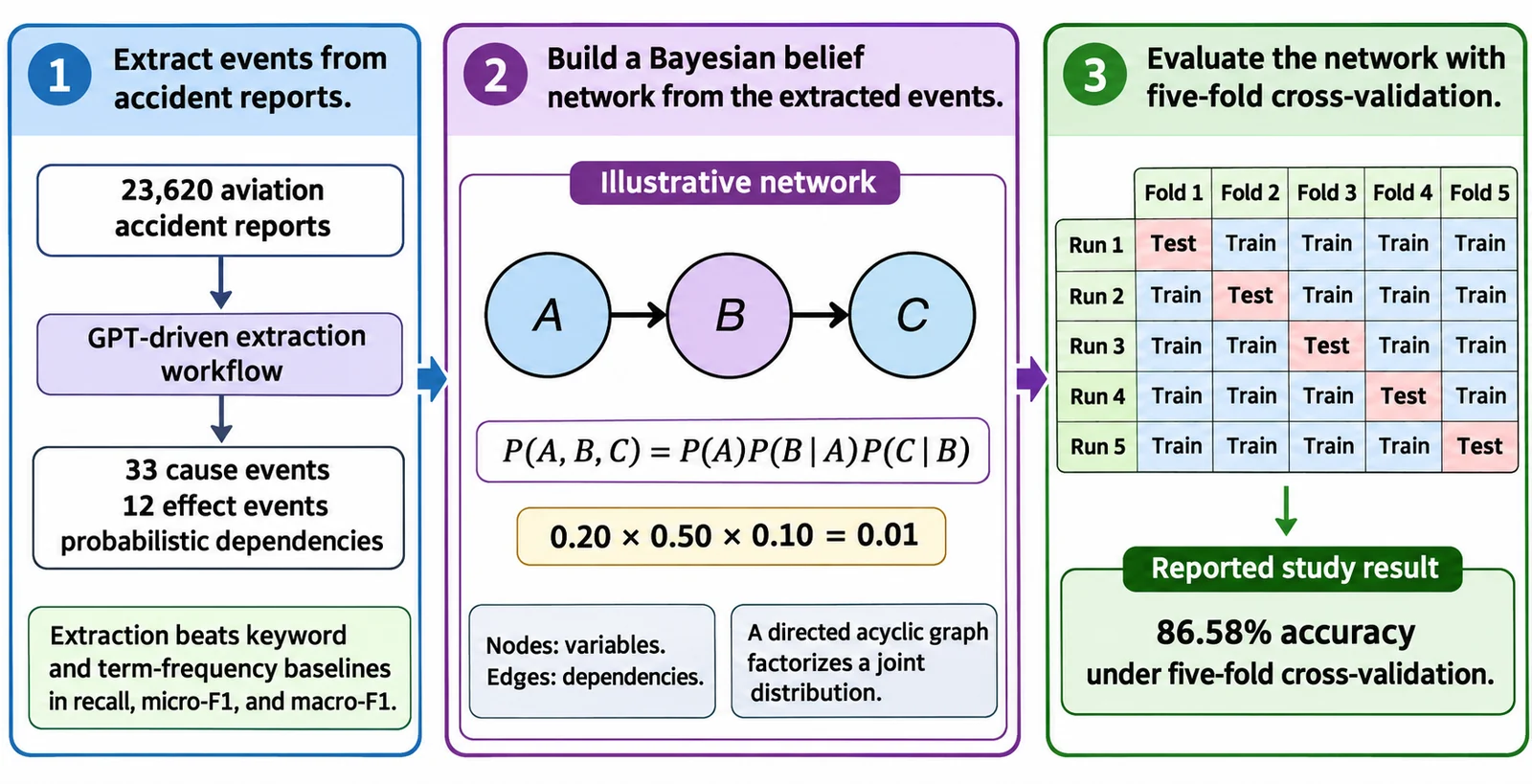
A GPT-driven workflow read 23,620 aviation accident reports and identified 12 effect events, 33 cause events and their probabilistic dependencies, feeding a Bayesian belief network that reached 86.58% accuracy under five-fold cross-validation. On a benchmark judged by experts, that extraction step scored higher on recall, micro-F1 and macro-F1 than baselines built on keywords and on term frequency.[58] A related study found that a model could supply a consistent human factors framework for flight operations and populate its dimensions with moderate accuracy, with fine-tuning left for future work.[59] A fine-tuned GPT model sorted 15,000 construction accident records into six accident types with 82% accuracy, and a saliency method highlighted the words that drove each prediction.[60]
In English-Chinese interpreting assessment, eight electronic raters per model scored more than 500 pre-scored samples, and both GPT-4o and DeepSeek-R1 proved more reliable than human raters, with correlations to human scores from .586 to .700. DeepSeek-R1 scored significantly more harshly, GPT-4o was more accurate, and performance shifted with reference availability, scoring granularity and model randomness.[61] For code, one project built a bug-fixing tool called D-bugger through three design iterations and evaluated a prototype with Python users, noting that ChatGPT sometimes offers fixes without seeking further information.[62] Another experiment used two GPT-3.5 models to generate and debug optimisation models in MiniZinc, and some models met the requested specifications while others needed further refinement.[63]
Education and student use
A qualitative document analysis of teacher education found that generative language models can supply specific materials and support, such as lesson plans, to schoolteachers and student teachers. The same analysis reported that ChatGPT evened out access by making lesson plans available to every teacher. It also argued that these models should be approached with caution and their limitations and potential biases evaluated critically, since they support teaching and learning rather than replace teachers.[64] A 2024 study of question generation found that ChatGPT could quickly produce multiple-choice questions on the pharmacology of diabetes that covered cognitive and affective domains with correct answers, varied in difficulty, corrected mistakes, and could be framed as negative-type or case-based items. That study also reported limitations: a lack of medical expertise, weak context comprehension, no answer verification, and no production of visual aids, and it recommended that teachers validate generated questions for accuracy and alignment with the curriculum.[65]
Writing instruction has been studied with process-based frameworks, in which a chatbot accompanies students through planning, drafting, revising and editing. In a sequential mixed methods study, 30 university students learning English as a foreign language took part in 10 sessions with a GPT-based chatbot inside such a framework, and their mean post-test writing score was 17.03 against a pre-test mean of 9.13. Four of five writing components improved across the first to fourth quizzes, namely organization, content, coherence and cohesion, and argumentation, while the logical connection component dipped during the second and third quizzes before rebounding in the fourth.[66] A paper on high school English continuation writing, in which students read a text and then extend it, described strategies such as selecting original materials, integrating multimodal resources, using model essays, and giving evaluation and feedback. That paper also named limitations: students' tendency to rely on the tool, effects on teachers' status, academic ethics questions, and inaccurate information.[67]
A mixed methods survey of 405 undergraduates drew on state universities and colleges (48.59%), local colleges (31.71%) and private institutions (19.7%). It found an overall positive perception, with an average weighted mean of 3.85 for support in understanding complex concepts, improving writing and critical thinking, engagement and collaborative learning. That survey reported a significantly higher impact among male students than female students (t = -4.38, p < .001). It also found a greater positive effect at state universities than at local and private institutions (F = 3.23, p = .044), while concerns about overreliance, accuracy and academic integrity remained.[68]
A questionnaire study of 303 second-semester students in an essay writing course found that most used ChatGPT to understand essay writing concepts, build confidence and obtain feedback, and perceived it as useful for grammar and sentence structure, creativity, and developing ideas and arguments.[69] A case study of Indonesian university students learning chemistry drew on questionnaires, interviews and usage logs. Students valued answers for being easy to understand, detailed, fairly accurate, fast and helpful, while also recognizing that answers could be unreliable, hard to understand, inaccurate or potentially unethical. Those students checked responses by stimulating their own thinking, confirming answers, combining the tool with other sources, copying directly or paraphrasing before use, and the study called for concrete policies where usage rules are lacking.[70]
Interviews with 20 faculty members at a state university in the Philippines found both beneficial and detrimental effects: ChatGPT was seen as a helpful learning tool, especially for introverted students, and as a way to simplify repetitive tasks and encourage self-directed critical thinking. The same faculty members worried that it could harm students' critical thinking and promote excessive dependence on technology, and they said its value depended on how conscientiously faculty and administrators used it to build students' analytical and evaluative skills.[71] A commentary on GPT models in education and human development noted that their impact is currently unknown and may carry substantial ethical implications, and it called for policy decisions and ethical consideration before these technologies are incorporated into educational settings.[72]
Applications outside text
Flamingo, a family of visual language models described in 2022, connects a pretrained vision-only model to a pretrained language-only model and accepts sequences in which images and text are interleaved in any order, including images and videos as inputs.[73] In medical imaging, a 2023 model paired the Show-Attend-Tell and GPT-3 language models to turn chest X-ray scans and structured patient records into radiology descriptions, and it was tested on the Open-I, MIMIC-CXR and MS-COCO datasets.[74] A later system combined a Vision Transformer, which extracts features from images, with a GPT-2 decoder that writes the caption, and it reported 98.42% accuracy on the IU X-Ray benchmark under BLEU, METEOR and ROUGE measures.[75]
VLN-GPT uses a GPT-2 decoder to model the sequence of locations and actions taken by an agent that follows written instructions through real-world scenes, so past positions are read directly from the trajectory instead of being stored by a separate encoder. Its training runs in two stages, offline pre-training by imitation learning and online fine-tuning by reinforcement learning, and it surpassed encoder-based models on a Vision-and-Language Navigation dataset.[76] GPT-NAS trains a GPT model on a dataset of neural architectures so that it predicts each next layer from the structure of the layers before it. After the GPT model was introduced, searched architectures reached up to about 9% higher accuracy on an image dataset.[77] In building energy management, GPT-4 generated energy load prediction code, diagnosed device faults and detected abnormal operating patterns, and a 2024 evaluation reported that it could handle most of the data mining tasks tested in the domain.[78] A deep Q-network, a reinforcement learning method, lowered energy use by 24.1% on the same objective, but the ChatGPT-based control needed no learning process to develop its control behavior.[79]
GPTFuzzer fine-tunes a GPT language model with reinforcement learning to produce attack payloads token by token for testing web application firewalls. On two open-source firewalls it found up to 7.8 times as many bypassing payloads (3.2 times on average) within 1,250,000 requests, or found all bypassing payloads with up to 8.1 times fewer requests (3.3 times on average).[80] A 2023 study used GPT models to simulate honeypots, decoy systems that engage attackers and record their activity, without the risk that an attacker breaks out of a real device. The way these models generate output can give the deception away to a determined attacker over long sessions. Managing the inputs and outputs cut token usage by up to 77% in several multi-step attack scenarios compared with a baseline that left them unmanaged.[81] A 2023 overview of GPT models in cyber security traced the line from GPT-2, a multitask unsupervised learner that works in a zero-shot setting with no examples, through GPT-3, which extends few-shot learning without gradient updates or task-specific fine-tuning. It went on to InstructGPT, which is fine-tuned with human feedback and improved in truthfulness while remaining slightly less toxic than GPT-3, though bias and simple mistakes persisted.[82]
What this looks like in practice
BioGPT was pre-trained on large-scale biomedical literature and then tested on six biomedical natural language processing tasks. On the BC5CDR chemical-disease relation extraction task it reached an F1 score of 44.98%, and on the KD-DTI drug-target interaction task 38.42%. On the DDI drug-drug interaction task it reached 40.76% F1, and on PubMedQA it answered with 78.2% accuracy. The authors report that these results outperform previous models on most of the six tasks.[40]
A systematic review examined 412 scholarly works and distilled 77 contributions on GPT use in research data, data analysis and research design. Data augmentation was the central focus, covering 48 of those contributions. The review classifies the literature into six categories and 14 sub-categories and compares 54 pieces of literature on research domains and methods. For a researcher planning a study, the review treats GPT as a tool for generating synthetic data and for shaping research design, not only for drafting text.[30]
GPTQ is a one-shot weight quantization method that compresses a model's stored weights to fewer bits. It quantized a 175 billion parameter model in approximately four GPU hours, down to 3 or 4 bits per weight, with negligible accuracy loss. That allowed a 175 billion parameter model to run for generative inference inside a single GPU for the first time. In the same study, inference run from start to finish was about 3.25 times faster than in FP16 on a high-end NVIDIA A100 graphics processor and about 4.5 times faster on the cheaper NVIDIA A6000.[14]
Later developments
Open questions and future directions
General reasoning remains a long-standing and formidable challenge in artificial intelligence, according to a 2025 study in Nature. Large language models and chain-of-thought prompting, which asks a model to write out intermediate steps, have had considerable success on foundational reasoning tasks. That success depends heavily on extensive human-annotated demonstrations, and model capabilities are still insufficient for more complex problems. The 2025 Nature study showed that reasoning abilities can be encouraged through pure reinforcement learning, a training method that rewards good answers without human-written reasoning steps. The trained model then did better on checkable tasks, including mathematics, coding competitions and STEM subjects, than models trained on human demonstrations.[83]
Prompt engineering, the practice of designing and refining the instructions given to a large language model, is a relatively new field of research. A 2023 tutorial argues that improving this skill is a challenge that must be addressed, since more patients and medical professionals now use AI-based tools.[84]
General-purpose foundation models often struggle with domain-specific problems because they have limited access to private training data in a particular field. In biomedicine, molecules, proteins and cells are encoded in a language of life that differs greatly from ordinary human language. BioMedGPT, an open model published in 2023, was built to connect biological data with natural language through free text.[85]
A 2021 study compared transformer models with brain activity and found that the strongest models predicted nearly 100% of the explainable variance in neural responses to sentences. A model's fit to brain responses and to behavior both correlated strongly with its accuracy at predicting the next word, but not with other language tasks.[86] Adding predictions that span multiple timescales improved how well the models mapped onto brain responses, and these predictions were organized hierarchically across brain regions.[87]
A 2025 evaluation of four large language models on 12 biomedical benchmarks found that traditional fine-tuning beat zero-shot or few-shot use of the models on most tasks. Closed models such as GPT-4 did excel at reasoning-related tasks such as medical question answering, while open models still needed fine-tuning to close performance gaps. The evaluation also found missing information and hallucinations, meaning confident output that is not supported by fact, in model responses.[88]
Criticism
Errors, hallucinations and weak spots
Telling machine-written text from human text is a separate problem, and cheaper methods can compete with costly ones. The classifier matched far more expensive methods and was offered as an accessible first line of defense against misuse of language models.[89]
A 2024 paper describes task contamination: test sets released before a model's training data was created may have been seen during training. Using GPT-3 series models and several recent open-source models, and controlling for dataset difficulty, the study found that older datasets performed surprisingly better than newer ones. Inspecting training data, extracting text from it and a membership inference attack, a test of whether a model recognizes specific data, gave further evidence of contamination. For tasks where contamination was impossible, the models rarely beat a simple majority baseline by a statistically significant margin, in zero-shot or few-shot settings.[90]
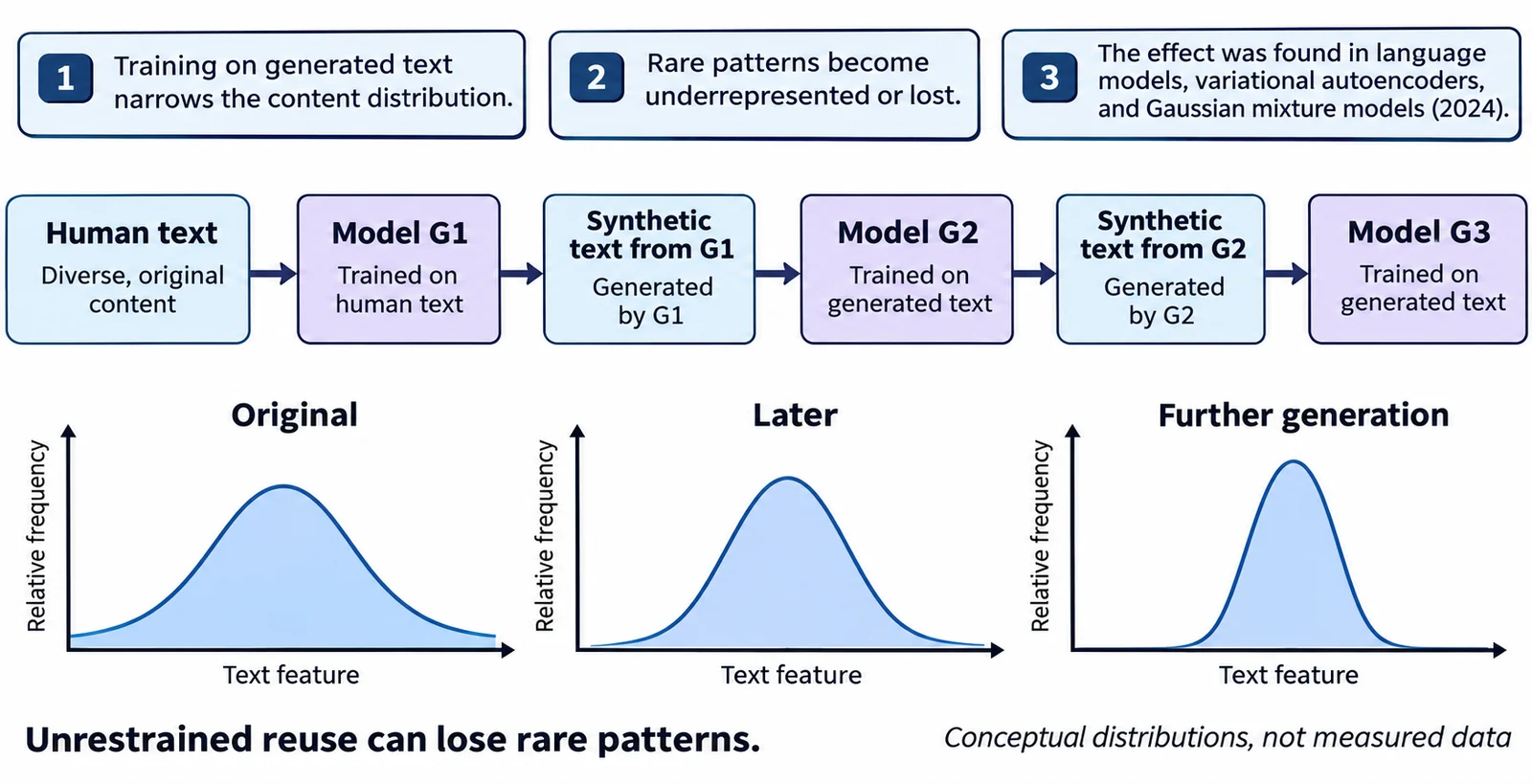
Training new models on text that older models wrote brings a further risk. A 2024 study in Nature found that training on model-generated content without restraint causes lasting defects in the resulting models. The tails of the original content distribution disappear. The researchers called this effect model collapse and showed it can occur in large language models, in variational autoencoders and in Gaussian mixture models. They argued it must be taken seriously to sustain the benefits of training on large-scale data scraped from the web. Data on genuine human interactions, they added, will grow more valuable as model-generated text spreads online.[91]
Reliability, bias and academic integrity
Encouraging truthfulness through supervision or reinforcement learning has been only partially successful.[92] In one documented case, clinicians asked ChatGPT to write about the pathogenesis of homocystinuria-associated osteoporosis and of late-onset Pompe disease, a rare metabolic disorder, and recorded positive, negative and troubling aspects of the chatbot's performance.[93] A commentary in Arthroscopy reported that ChatGPT gives misinformation when asked medical questions. ChatGPT answers medical questions at the reading level of a college freshman, while the U.S. National Institute of Health recommends a 6th-grade level.[94]
In-context learning, in which a model is given examples inside the prompt rather than retrained, has been described as fragile across different hand-crafted templates and orderings of the demonstrations. A calibration method that estimates a decision boundary from prototypical clusters made GPT less sensitive to templates, permutations and class imbalance on a diverse set of tasks.[95] Metaphor is a further weak point: in zero-shot and few-shot experiments with LLaMa and GPT models, no model reached satisfactory performance at detecting all linguistic metaphors or at detecting extended metaphors, which use several metaphoric words to express the same domain mapping. LLaMa in particular showed problematic overgeneralization, and its errors indicated it could not construct the domain mappings that metaphor understanding requires.[96]
Fabricated scholarship is a documented output rather than a hypothetical one. In a proof-of-concept study, researchers prompted GPT-3 to produce a fraudulent neurosurgery article, refining the prompts iteratively, and obtained a paper of 1992 words with 17 citations in about 1 hour without special training of the user. The article included standard sections and a data sheet and resembled a genuine paper in word usage, sentence structure and overall composition, but expert reviewers in neurosurgery, psychiatry and statistics found specific mistakes, particularly in the references. The researchers concluded that expert readers may identify semantic inaccuracies and errors on closer inspection and called for better detection methods.[97]
A review of 156 Scopus-indexed articles on ChatGPT published between November 2022 and April 2023 found a predominance of negative sentiment across disciplines, though attitudes varied by subject. The review raised concerns about employment opportunities and ethical considerations in healthcare, and it concluded that further research was needed on the model's capabilities and limits.[98] Commentators on clinical use have argued that regulatory oversight should let medical professionals and patients use large language models without harm to patients or compromise of their data and privacy.[99]
Reporting standards have been proposed to make studies of these models easier to judge. TRIPOD-LLM extends the TRIPOD + artificial intelligence statement for prediction models. It provides a checklist of 19 main items and 50 subitems that runs from the title to the discussion. Its modular format fits different research designs and tasks, with 14 main items and 32 subitems applying across all categories, and it was developed through an expedited Delphi process and expert consensus. The guideline stresses transparency, human oversight and reporting of performance for each specific task, and is intended as a living document that will change as the field develops.[100]
Common misconceptions
Ye and colleagues tested six GPT series models on nine natural language understanding tasks using 21 datasets and found that overall ability did not rise steadily from one version to the next. The authors report that reinforcement learning from human feedback improved human-like responses but compromised the ability to solve some tasks.[12]
Key studies
| Year | Study | Sample | Design | Finding |
|---|---|---|---|---|
| 2020 | B. et al.[2] | Training and few-shot testing of GPT-3, a 175 billion parameter model, on many NLP datasets | GPT-3 performed well on translation, question answering and arithmetic without fine-tuning, but struggled on some datasets. | |
| 2021 | Wei et al.[5] | a 137B parameter model tuned on over 60 tasks | instruction tuning experiment | FLAN surpassed zero-shot 175B GPT-3 on 20 of 25 unseen tasks. |
| 2021 | Zhao et al.[3] | a diverse set of tasks with GPT-3 and GPT-2 | prompt calibration experiment | Contextual calibration raised average accuracy by up to 30.0% absolute. |
| 2022 | Luo et al.[40] | six biomedical natural language processing tasks | domain-specific model evaluation | BioGPT reached 44.98%, 38.42% and 40.76% F1 on BC5CDR, KD-DTI and DDI, and 78.2% accuracy on PubMedQA. |
| 2022 | Frantar et al.[14] | a 175 billion parameter model | quantization experiment | Quantization took about four GPU hours and gave 3.25x to 4.5x inference speedups over FP16. |
| 2022 | Goldstein et al.[20] | Electrocorticography recording from nine participants listening to a 30-minute podcast | Human brain responses and autoregressive deep language models shared three computational principles of next-word prediction. | |
| 2023 | Gilson et al.[25] | 4 data sets of USMLE-style questions | multiple-choice question evaluation | ChatGPT scored 64.4% on NBME-Free-Step1 and outperformed InstructGPT by 8.15% on average. |
| 2023 | Hirosawa et al.[33] | 30 clinical vignettes for ten common chief complaints | pilot diagnostic accuracy study | ChatGPT-3 included the correct diagnosis in 28/30 (93.3%) of its ten-item lists. |
| 2023 | Goodman et al.[6] | 284 questions from 33 physicians across 17 specialties | cross-sectional grading study | Median accuracy was 5.5 on a 6-point scale, with a mean of 4.8. |
| 2023 | Katib et al.[36] | benchmark databases of human and ChatGPT text | machine learning detection experiment | On benchmark databases the detector reached a maximum accuracy of 93.17% on the human-text dataset and 93.83% on the ChatGPT-generated dataset. |
| 2023 | Gao et al.[55] | research abstracts from five high-impact medical journals | blinded human review and detector comparison | Reviewers correctly identified 68% of generated abstracts but wrongly flagged 14% of original ones. |
| 2023 | Májovský et al.[97] | one fabricated neurosurgery article | proof-of-concept generation study | The generated article had 1992 words and 17 citations and took about 1 hour to create. |
| 2024 | Sufi[30] | 412 scholarly works, with 77 contributions distilled | systematic literature review | Data augmentation was the central focus, covering 48 of the 77 contributions. |
| 2024 | Wu et al.[23] | 4.8M biomedical papers and 30K medical textbooks | open medical model development | The 13B parameter PMC-LLaMA surpassed ChatGPT on medical QA benchmarks. |
See also
References
- Yenduri, G., Ramalingam, M., Selvi, G. C., Supriya, Y., Srivastava, G., Maddikunta, P. K. R., Raj, G. D., Jhaveri, R. H., Prabadevi, B., Wang, W., Vasilakos, A. V., & Gadekallu, T. R. (2024). GPT (Generative Pre-Trained Transformer)— A Comprehensive Review on Enabling Technologies, Potential Applications, Emerging Challenges, and Future Directions. IEEE Access, 12, 54608-54649. doi:10.1109/access.2024.3389497
- B., B. T., Mann, B., Ryder, N., Subbiah, M., A, J. K., Dhariwal, P., Neelakantan, A., Shyam, P., Sastry, G., Askell, A., Agarwal, S., Herbert-Voss, A., Krueger, G. M., Henighan, T., Child, R., Aditya, R., M., Z. D., Wu, J., Winter, C., & ... Amodei, D. (2020). Language Models are Few-Shot Learners. arXiv. doi:10.48550/arxiv.2005.14165 Free full text
- Zhao, T. Z., Wallace, E., Feng, S., Klein, D., & Singh, S. (2021). Calibrate Before Use: Improving Few-Shot Performance of Language Models. arXiv. doi:10.48550/arxiv.2102.09690 Free full text
- Eysenbach, G. (2023). The Role of ChatGPT, Generative Language Models, and Artificial Intelligence in Medical Education: A Conversation With ChatGPT and a Call for Papers. JMIR Medical Education, 9, e46885. doi:10.2196/46885
- Wei, J., Bosma, M., Zhao, V. Y., Guu, K., Yu, A. W., Brian, L., Du, N., Dai, A. M., & Le, Q. V. (2021). Finetuned Language Models Are Zero-Shot Learners. arXiv. doi:10.48550/arxiv.2109.01652 Free full text
- Goodman, R. S., Patrinely, J. R., Stone, C. A., Zimmerman, E., Donald, R. R., Chang, S. S., Berkowitz, S. T., Finn, A. P., Jahangir, E., Scoville, E. A., Reese, T. S., Friedman, D. L., Bastarache, J. A., van der Heijden, Y. F., Wright, J. J., Ye, F., Carter, N., Alexander, M. R., Choe, J. H., & ... Johnson, D. B. (2023). Accuracy and Reliability of Chatbot Responses to Physician Questions. JAMA Network Open, 6(10), e2336483. doi:10.1001/jamanetworkopen.2023.36483
- Meng, X., Yan, X., Zhang, K., Liu, D., Cui, X., Yang, Y., Zhang, M., Cao, C., Wang, J., Wang, X., Gao, J., Wang, Y. G. S., Ji, J. m., Qiu, Z., Li, M., Qian, C., Guo, T., Ma, S., Wang, Z., & ... Tang, Y. D. (2024). The application of large language models in medicine: A scoping review. iScience, 27(5), 109713. doi:10.1016/j.isci.2024.109713
- ГОЛУБЕНКО, О. І., & ПІДМОГИЛЬНИЙ, О. О. (2022). Generative pre-trained transformer 3. ITSynergy(2), 19-27. doi:10.53920/its-2022-2-2
- Minaee, S., Mikolov, T., Narjes, N., Asgari-Chenaghlu, M., Socher, R., Amatriain, X., & Gao, J. (2024). Large Language Models: A Survey. arXiv. doi:10.48550/arxiv.2402.06196 Free full text
- Min, B., Ross, H., Sulem, E., Veyseh, A. P. B., Nguyen, T. H., Sainz, O., Agirre, E., Heintz, I., & Roth, D. (2024). Recent Advances in Natural Language Processing via Large Pre-trained Language Models: A Survey. ACM Computing Surveys, 56(2), 1-40. doi:10.1145/3605943
- Gómez Cano, C. A., Sánchez Castillo, V., & Clavijo Gallego, T. A. (2023). Unveiling the Thematic Landscape of Generative Pre-trained Transformer (GPT) Through Bibliometric Analysis. Metaverse Basic and Applied Research, 2, 33. doi:10.56294/mr202333
- Ye, J., Chen, X., Nuo, X., Zu, C., Shao, Z., Liu, S., Cui, Y., Zeyang, Z., Gong, C., Shen, Y., Zhou, J., Chen, S., Gui, T., Zhang, Q., & Huang, X. (2023). A Comprehensive Capability Analysis of GPT-3 and GPT-3.5 Series Models. arXiv. doi:10.48550/arxiv.2303.10420 Free full text
- De Angelis, L., Baglivo, F., Arzilli, G., Privitera, G. P., Ferragina, P., Tozzi, A. E., & Rizzo, C. (2023). ChatGPT and the rise of large language models: the new AI-driven infodemic threat in public health. Frontiers in Public Health, 11. doi:10.3389/fpubh.2023.1166120
- Frantar, E., Ashkboos, S., Hoefler, T., & Alistarh, D. (2022). GPTQ: Accurate Post-Training Quantization for Generative Pre-trained Transformers. arXiv. doi:10.48550/arxiv.2210.17323 Free full text
- Wu, S., Zhao, X., Yu, T., Zhang, R., Shen, C., Liu, H., Li, F., Zhu, H. C., Jiangang, L., Xu, L. J., & Zhang, X. (2021). Yuan 1.0: Large-Scale Pre-trained Language Model in Zero-Shot and Few-Shot Learning. arXiv. doi:10.48550/arxiv.2110.04725 Free full text
- Han, K., Xiao, A., Wu, E., Guo, J., Xu, C., & Wang, Y. (2021). Transformer in Transformer. arXiv. doi:10.48550/arxiv.2103.00112 Free full text
- Ghojogh, B., & Ghodsi, A. (2020). Attention Mechanism, Transformers, BERT, and GPT: Tutorial and Survey. Center for Open Science. doi:10.31219/osf.io/m6gcn
- Lee, M. (2023). A Mathematical Interpretation of Autoregressive Generative Pre-Trained Transformer and Self-Supervised Learning. Mathematics, 11(11), 2451. doi:10.3390/math11112451
- Casola, S., Lauriola, I., & Lavelli, A. (2022). Pre-trained transformers: an empirical comparison. Machine Learning with Applications, 9, 100334. doi:10.1016/j.mlwa.2022.100334
- Goldstein, A., Zada, Z., Buchnik, E., Schain, M., Price, A., Aubrey, B., Nastase, S. A., Feder, A., Emanuel, D., Cohen, A., Jansen, A., Gazula, H., Choe, G., Rao, A., Kim, C., Casto, C., Fanda, L., Doyle, W., Friedman, D., & ... Hasson, U. (2022). Shared computational principles for language processing in humans and deep language models. Nature Neuroscience, 25(3), 369-380. doi:10.1038/s41593-022-01026-4
- Black, S., Biderman, S., Hallahan, E., Anthony, Q. G., Gao, L., Golding, L., He, H., Leahy, C., McDonell, K., Phang, J., Pieler, M., Prashanth, U. S., Purohit, S., Reynolds, L., Tow, J., Wang, B., & Weinbach, S. (2022). GPT-NeoX-20B: An Open-Source Autoregressive Language Model. arXiv. doi:10.48550/arxiv.2204.06745 Free full text
- Susan, Z., Stephen, R., Naman, G., Artetxe, M., Chen, M., Chen, S., Dewan, C., Diab, M., Li, X., Lin, X. V., Mihaylov, T., Ott, M., Shleifer, S., Shuster, K., Simig, D., Koura, P. S., Sridhar, A., Wang, T., & Zettlemoyer, L. (2022). OPT: Open Pre-trained Transformer Language Models. arXiv. doi:10.48550/arxiv.2205.01068 Free full text
- Wu, C., Lin, W., Zhang, X., Zhang, Y., Xie, W., & Wang, Y. (2024). PMC-LLaMA: toward building open-source language models for medicine. Journal of the American Medical Informatics Association, 31(9), 1833-1843. doi:10.1093/jamia/ocae045
- Ferruz, N., Schmidt, S., & Höcker, B. (2022). ProtGPT2 is a deep unsupervised language model for protein design. Nature Communications, 13(1). doi:10.1038/s41467-022-32007-7
- Gilson, A., Safranek, C. W., Huang, T., Socrates, V., Chi, L., Taylor, R. A., & Chartash, D. (2023). How Does ChatGPT Perform on the United States Medical Licensing Examination (USMLE)? The Implications of Large Language Models for Medical Education and Knowledge Assessment. JMIR Medical Education, 9, e45312. doi:10.2196/45312
- Suchman, K., Garg, S., & Trindade, A. J. (2023). Chat Generative Pretrained Transformer Fails the Multiple-Choice American College of Gastroenterology Self-Assessment Test. American Journal of Gastroenterology, 118(12), 2280-2282. doi:10.14309/ajg.0000000000002320
- Takagi, S., Watari, T., Erabi, A., & Sakaguchi, K. (2023). Performance of GPT-3.5 and GPT-4 on the Japanese Medical Licensing Examination: Comparison Study. JMIR Medical Education, 9, e48002. doi:10.2196/48002
- Liévin, V., Hother, C. E., Motzfeldt, A. G., & Winther, O. (2024). Can large language models reason about medical questions? Patterns, 5(3), 100943. doi:10.1016/j.patter.2024.100943
- Shahriar, S., Lund, B. D., Mannuru, N. R., Arshad, M. A., Hayawi, K., Bevara, R. V. K., Mannuru, A., & Batool, L. (2024). Putting GPT-4o to the Sword: A Comprehensive Evaluation of Language, Vision, Speech, and Multimodal Proficiency. Applied Sciences, 14(17), 7782. doi:10.3390/app14177782
- Sufi, F. (2024). Generative Pre-Trained Transformer (GPT) in Research: A Systematic Review on Data Augmentation. Information, 15(2), 99. doi:10.3390/info15020099
- Minhao Li, Xu Wang, & Mingzhuo Yu (2025). Comparative Evaluation of Zero-Shot and Few-Shot Performance of Large Language Models in Low-Resource Language Machine Translation. Journal of Global Engineering Review, 3(2), 59-68. doi:10.66372/jger.v3i2.5
- Lyu, Q., Tan, J., Zapadka, M. E., Ponnatapura, J., Niu, C., Myers, K. J., Wang, G., & Whitlow, C. T. (2023). Translating radiology reports into plain language using ChatGPT and GPT-4 with prompt learning: results, limitations, and potential. Visual Computing for Industry, Biomedicine, and Art, 6(1). doi:10.1186/s42492-023-00136-5
- Hirosawa, T., Harada, Y., Yokose, M., Sakamoto, T., Kawamura, R., & Shimizu, T. (2023). Diagnostic Accuracy of Differential-Diagnosis Lists Generated by Generative Pretrained Transformer 3 Chatbot for Clinical Vignettes with Common Chief Complaints: A Pilot Study. International Journal of Environmental Research and Public Health, 20(4), 3378. doi:10.3390/ijerph20043378
- Rao, A., Pang, M., Kim, J., Kamineni, M., Lie, W., Prasad, A. K., Landman, A., Dreyer, K., & Succi, M. D. (2023). Assessing the Utility of ChatGPT Throughout the Entire Clinical Workflow: Development and Usability Study. Journal of Medical Internet Research, 25, e48659. doi:10.2196/48659
- Dehouche, N. (2021). Plagiarism in the age of massive Generative Pre-trained Transformers (GPT-3). Ethics in Science and Environmental Politics, 21, 17-23. doi:10.3354/esep00195
- Katib, I., Assiri, F. Y., Abdushkour, H. A., Hamed, D., & Ragab, M. (2023). Differentiating Chat Generative Pretrained Transformer from Humans: Detecting ChatGPT-Generated Text and Human Text Using Machine Learning. Mathematics, 11(15), 3400. doi:10.3390/math11153400
- Harrer, S. (2023). Attention is not all you need: the complicated case of ethically using large language models in healthcare and medicine. eBioMedicine, 90, 104512. doi:10.1016/j.ebiom.2023.104512
- You, Y., Chen, Y., You, Y., Zhang, Q., & Cao, Q. (2023). Evolutionary Game Analysis of Artificial Intelligence Such as the Generative Pre-Trained Transformer in Future Education. Sustainability, 15(12), 9355. doi:10.3390/su15129355
- Eloundou, T., Sam, M., Mishkin, P., & Daniel, R. (2023). GPTs are GPTs: An Early Look at the Labor Market Impact Potential of Large Language Models. arXiv. doi:10.48550/arxiv.2303.10130 Free full text
- Luo, R., Sun, L., Xia, Y., Qin, T., Zhang, S., Poon, H., & Liu, T. Y. (2022). BioGPT: generative pre-trained transformer for biomedical text generation and mining. Briefings in Bioinformatics, 23(6). doi:10.1093/bib/bbac409
- Madani, A., Krause, B., Greene, E. R., Subramanian, S., Mohr, B. P., Holton, J. M., Olmos, J. L., Xiong, C., Sun, Z. Z., Socher, R., Fraser, J. S., & Naik, N. (2023). Large language models generate functional protein sequences across diverse families. Nature Biotechnology, 41(8), 1099-1106. doi:10.1038/s41587-022-01618-2
- Rives, A., Meier, J., Sercu, T., Goyal, S., Lin, Z., Liu, J., Guo, D., Ott, M., Zitnick, C. L., Ma, J., & Fergus, R. (2021). Biological structure and function emerge from scaling unsupervised learning to 250 million protein sequences. Proceedings of the National Academy of Sciences, 118(15). doi:10.1073/pnas.2016239118
- Bepler, T., & Berger, B. (2021). Learning the protein language: Evolution, structure, and function. Cell Systems, 12(6), 654-669.e3. doi:10.1016/j.cels.2021.05.017
- Nguyen, E., Poli, M., Durrant, M. G., Kang, B., Katrekar, D., Li, D. B., Bartie, L. J., Thomas, A. W., King, S. H., Brixi, G., Sullivan, J., Ng, M. Y., Lewis, A., Lou, A., Ermon, S., Baccus, S. A., Hernandez-Boussard, T., Ré, C., Hsu, P. D., & Hie, B. L. (2024). Sequence modeling and design from molecular to genome scale with Evo. Science, 386(6723). doi:10.1126/science.ado9336
- Wang, Y., Zhao, H., Sciabola, S., & Wang, W. (2023). cMolGPT: A Conditional Generative Pre-Trained Transformer for Target-Specific De Novo Molecular Generation. Molecules, 28(11), 4430. doi:10.3390/molecules28114430
- Mok, D. H., & Back, S. (2024). Generative Pretrained Transformer for Heterogeneous Catalysts. Journal of the American Chemical Society, 146(49), 33712-33722. doi:10.1021/jacs.4c11504
- Xiaohui, C., Wang, Y., He, J., Du, Y., Hassoun, S., Xu, X., & Liu, L. (2025). Graph Generative Pre-trained Transformer. arXiv. doi:10.48550/arxiv.2501.01073 Free full text
- Zhao, H., & Song, G. (2024). Antiviral Peptide-Generative Pre-Trained Transformer (AVP-GPT): A Deep Learning-Powered Model for Antiviral Peptide Design with High-Throughput Discovery and Exceptional Potency. Viruses, 16(11), 1673. doi:10.3390/v16111673
- Xu, X., Xu, T., Zhou, J., Liao, X., Zhang, R., Wang, Y., Zhang, L., & Gao, X. (2023). AB-Gen: Antibody Library Design with Generative Pre-Trained Transformer and Deep Reinforcement Learning. Genomics, Proteomics & Bioinformatics, 21(5), 1043-1053. doi:10.1016/j.gpb.2023.03.004
- Hu, J., Fu, P., Wei, Z., Huang, Y., Early, J., Fly, A., & Zhang, Y. (2025). Early prediction of lithium-ion battery degradation with a generative pre-trained transformer. Nature Communications, 17(1). doi:10.1038/s41467-025-66819-0
- Cao, D., Jia, F., Arık, S. Ö., Pfister, T., Zheng, Y., Ye, W., & Liu, Y. (2023). TEMPO: Prompt-based Generative Pre-trained Transformer for Time Series Forecasting. arXiv. doi:10.48550/arxiv.2310.04948 Free full text
- Khalil, F., & Pipa, G. (2022). Transforming the generative pretrained transformer into augmented business text writer. Journal of Big Data, 9(1). doi:10.1186/s40537-022-00663-7
- Khalil, F., & Pipa, P. D. G. (2021). Transforming the Generative Pretrained Transformer Into Augmented Business Text Writer. Research Square Platform LLC. doi:10.21203/rs.3.rs-1170589/v1
- Macfarlane, D. (2023). Professional Report Generation Using Lexeme Theories and Openai's Generative Pretrained Transformer, GPT-4: A Comparison. Medical Research Archives, 11(11). doi:10.18103/mra.v11i11.4700
- Gao, C. A., Howard, F. M., Markov, N. S., Dyer, E. C., Ramesh, S., Luo, Y., & Pearson, A. T. (2023). Comparing scientific abstracts generated by ChatGPT to real abstracts with detectors and blinded human reviewers. npj Digital Medicine, 6(1). doi:10.1038/s41746-023-00819-6
- Gilardi, F., Alizadeh, M., & Kubli, M. (2023). ChatGPT outperforms crowd workers for text-annotation tasks. Proceedings of the National Academy of Sciences, 120(30). doi:10.1073/pnas.2305016120
- Dagdelen, J., Dunn, A., Lee, S., Walker, N., Rosen, A. S., Ceder, G., Persson, K. A., & Jain, A. (2024). Structured information extraction from scientific text with large language models. Nature Communications, 15(1). doi:10.1038/s41467-024-45563-x
- Zhang, L., Hou, Y., & Wu, B. (2026). Learning Bayesian Belief Networks from Aviation Accidents with a Generative Pre-Trained Transformer Model. Aerospace, 13(10), 962. doi:10.3390/aerospace13100962
- Li, W. C., Saunders, D., & Amanzadeh, H. (2026). Developing Prompts to Facilitate Generative Pre-Trained Transformer Classifying Decision-Errors in Flight Operations. Proceedings of the INCOSE HSI 2024. doi:10.65351/hsi24.011
- Yoo, B., Kim, J., Park, S., Ahn, C. R., & Oh, T. (2024). Harnessing Generative Pre-Trained Transformers for Construction Accident Prediction with Saliency Visualization. Applied Sciences, 14(2), 664. doi:10.3390/app14020664
- Han, C., & Lu, X. (2026). Large language models as zero-shot evaluators of English–Chinese interpreting: A comparison of GPT-4o and DeepSeek-R1. Language Testing, 43(3), 263-289. doi:10.1177/02655322251406297
- Cao, Z., & Ren, Q. (2024). Towards python program repair with generative pre-trained transformer (GPT-3.5). Theoretical and Natural Science, 43(1), 102-112. doi:10.54254/2753-8818/43/20240782
- Almonacid, B. L. (2023). Towards an Automatic Optimisation Model Generator Assisted with Generative Pre-trained Transformer. arXiv. doi:10.48550/arxiv.2305.05811 Free full text
- van den Berg, G., & du Plessis, E. (2023). ChatGPT and Generative AI: Possibilities for Its Contribution to Lesson Planning, Critical Thinking and Openness in Teacher Education. Education Sciences, 13(10), 998. doi:10.3390/educsci13100998
- PRATIK R CHABHADIYA, RIDHDHI HIRAPARA, & ARUN KESHWALA (2024). Potential of large language model chat generative pre-trained transformer in constructing multiple choice questions on pharmacology of diabetes. Asian Journal of Pharmaceutical and Clinical Research, 94-96. doi:10.22159/ajpcr.2024v17i8.51308
- Robillos, R. (2024). Synergizing Generative Pre-Trained Transformer (GPT) Chatbots in a Process-Based Writing Paradigm to Enhance University Students’ Writing Skills. Journal of Language and Education, 10(3), 79-94. doi:10.17323/jle.2024.18708
- Ou, Y. (2025). Innovative Strategies for High School English Continuation Writing Teaching Empowered by Chat Generative Pre-trained Transformer. Education, Language and Sociology Research, 6(2), p164. doi:10.22158/elsr.v6n2p164
- Malang, B. (2025). The Impact on using Chat-Generative Pre-Trained Transformer on students. International Journal on Culture, History, and Religion, 7(1), 373-392. doi:10.63931/ijchr.v7i1.85
- Sodiq, S., & Rokib, M. (2024). Indonesian students’ use of Chat Generative Pre-trained Transformer in essay writing practices. International Journal of Evaluation and Research in Education (IJERE), 13(4), 2698. doi:10.11591/ijere.v13i4.28956
- Ardyansyah, A., Yuwono, A. B., Rahayu, S., Alsulami, N. M., & Sulistina, O. (2024). Students’ Perspectives on the Application of a Generative Pre-Trained Transformer (GPT) in Chemistry Learning: A Case Study in Indonesia. Journal of Chemical Education, 101(9), 3666-3675. doi:10.1021/acs.jchemed.4c00220
- Goli-Cruz, M. J. (2024). Perceptions of Higher Education Faculty Regarding the Use of Chat Generative Pre-Trained Transformer (ChatGPT) in Education. International Journal on Open and Distance e-Learning, 9(2). doi:10.58887/ijodel.v9i2.249
- Kurian, D., Alizadeh, A., & Peebles, C. M. (2023). The Future of Education and Human Development in The Era of Generative Pre-Trained Transformer (GPT) Models. Qeios Ltd. doi:10.32388/mzqcd3
- Alayrac, J. B., Donahue, J., Luc, P., Miech, A., Iain, B., Hasson, Y., Lenc, K., Mensch, A., Millican, K., Reynolds, M., Ring, R., Rutherford, E., Cabi, S., Han, T., Zhitao, G., Samangooei, S., Monteiro, M., Menick, J., Borgeaud, S., & ... Simonyan, K. (2022). Flamingo: a Visual Language Model for Few-Shot Learning. arXiv. doi:10.48550/arxiv.2204.14198 Free full text
- Selivanov, A., Rogov, O. Y., Chesakov, D., Shelmanov, A., Fedulova, I., & Dylov, D. V. (2023). Medical image captioning via generative pretrained transformers. Scientific Reports, 13(1). doi:10.1038/s41598-023-31223-5
- Dhar, M., Sen, M., Chakraborty, B., Biswas, S., & Chatterjee, S. (2026). Automated Medical Image Captioning Using Vision Transformer and Generative Pre-trained Transformer-2. International Research Journal of Multidisciplinary Scope, 07(02), 793-811. doi:10.47857/irjms.2026.v07i02.08290
- Hanlin, W. (2024). Vision-and-Language Navigation Generative Pretrained Transformer. arXiv. doi:10.48550/arxiv.2405.16994 Free full text
- Yu, C., Liu, X., Wang, Y., Liu, Y., Feng, W., Deng, X., Tang, C., & Lv, J. (2025). GPT-NAS: Neural Architecture Search Meets Generative Pre-Trained Transformer Model. Big Data Mining and Analytics, 8(1), 45-64. doi:10.26599/bdma.2024.9020036
- Zhang, C., Lu, J., & Zhao, Y. (2024). Generative pre-trained transformers (GPT)-based automated data mining for building energy management: Advantages, limitations and the future. Energy and Built Environment, 5(1), 143-169. doi:10.1016/j.enbenv.2023.06.005
- Ahn, K. U., Kim, D. W., Cho, H. M., & Chae, C. U. (2023). Alternative Approaches to HVAC Control of Chat Generative Pre-Trained Transformer (ChatGPT) for Autonomous Building System Operations. Buildings, 13(11), 2680. doi:10.3390/buildings13112680
- Liang, H., Li, X., Xiao, D., Liu, J., Zhou, Y., Wang, A., & Li, J. (2024). Generative Pre-Trained Transformer-Based Reinforcement Learning for Testing Web Application Firewalls. IEEE Transactions on Dependable and Secure Computing, 21(1), 309-324. doi:10.1109/tdsc.2023.3252523
- Ragsdale, J., & Boppana, R. V. (2023). On Designing Low-Risk Honeypots Using Generative Pre-Trained Transformer Models With Curated Inputs. IEEE Access, 11, 117528-117545. doi:10.1109/access.2023.3326104
- Gao, M. (2023). The Advance of GPTs and Language Model in Cyber Security. Highlights in Science, Engineering and Technology, 57, 195-202. doi:10.54097/hset.v57i.10001
- Guo, D., Yang, D., Zhang, H., Song, J., Wang, P., Zhu, Q., Xu, R., Zhang, R., Ma, S., Bi, X., Zhang, X., Yu, X., Wu, Y., Wu, Z. F., Gou, Z., Shao, Z., Li, Z., Gao, Z., Liu, A., & ... Zhang, Z. (2025). DeepSeek-R1 incentivizes reasoning in LLMs through reinforcement learning. Nature, 645(8081), 633-638. doi:10.1038/s41586-025-09422-z
- Meskó, B. (2023). Prompt Engineering as an Important Emerging Skill for Medical Professionals: Tutorial. Journal of Medical Internet Research, 25, e50638. doi:10.2196/50638
- Luo, Y., Zhang, J., Fan, S., Yang, K. S., Wu, Y., Mu, Q., & Nie, Z. (2023). BioMedGPT: Open Multimodal Generative Pre-trained Transformer for BioMedicine. arXiv. doi:10.48550/arxiv.2308.09442 Free full text
- Schrimpf, M., Blank, I. A., Tuckute, G., Kauf, C., Hosseini, E. A., Kanwisher, N., Tenenbaum, J. B., & Fedorenko, E. (2021). The neural architecture of language: Integrative modeling converges on predictive processing. Proceedings of the National Academy of Sciences, 118(45). doi:10.1073/pnas.2105646118
- Caucheteux, C., Gramfort, A., & King, J. R. (2023). Evidence of a predictive coding hierarchy in the human brain listening to speech. Nature Human Behaviour, 7(3), 430-441. doi:10.1038/s41562-022-01516-2
- Chen, Q., Hu, Y., Peng, X., Xie, Q., Jin, Q., Gilson, A., Singer, M. B., Ai, X., Lai, P. T., Wang, Z., Keloth, V. K., Raja, K., Huang, J., He, H., Lin, F., Du, J., Zhang, R., Zheng, W. J., Adelman, R. A., & ... Xu, H. (2025). Benchmarking large language models for biomedical natural language processing applications and recommendations. Nature Communications, 16(1). doi:10.1038/s41467-025-56989-2
- Fröhling, L., & Zubiaga, A. (2021). Feature-based detection of automated language models: tackling GPT-2, GPT-3 and Grover. PeerJ Computer Science, 7, e443. doi:10.7717/peerj-cs.443
- Li, C., & Flanigan, J. (2024). Task Contamination: Language Models May Not Be Few-Shot Anymore. Proceedings of the AAAI Conference on Artificial Intelligence, 38(16), 18471-18480. doi:10.1609/aaai.v38i16.29808
- Shumailov, I., Shumaylov, Z., Zhao, Y., Papernot, N., Anderson, R., & Gal, Y. (2024). AI models collapse when trained on recursively generated data. Nature, 631(8022), 755-759. doi:10.1038/s41586-024-07566-y
- Farquhar, S., Kossen, J., Kuhn, L., & Gal, Y. (2024). Detecting hallucinations in large language models using semantic entropy. Nature, 630(8017), 625-630. doi:10.1038/s41586-024-07421-0
- Alkaissi, H., & McFarlane, S. I. (2023). Artificial Hallucinations in ChatGPT: Implications in Scientific Writing. Cureus. doi:10.7759/cureus.35179
- Li, L. T. (2025). Editorial Commentary: Chat Generative Pre‐Trained Transformer (ChatGPT) Provides Misinformed Responses to Medical Questions. Arthroscopy, 41(1), 53-54. doi:10.1016/j.arthro.2024.06.027
- Han, Z., Hao, Y., Li, D., Yutao, S., & Furu, W. (2022). Prototypical Calibration for Few-shot Learning of Language Models. arXiv. doi:10.48550/arxiv.2205.10183 Free full text
- Reimann, S., & Scheffler, T. (2025). The Struggles of Large Language Models with Zero- and Few-Shot (Extended) Metaphor Detection. Journal for Language Technology and Computational Linguistics, 38(2), 97-109. doi:10.21248/jlcl.38.2025.287
- Májovský, M., Černý, M., Kasal, M., Komarc, M., & Netuka, D. (2023). Artificial Intelligence Can Generate Fraudulent but Authentic-Looking Scientific Medical Articles: Pandora’s Box Has Been Opened. Journal of Medical Internet Research, 25, e46924. doi:10.2196/46924
- Watters, C., & Lemanski, M. K. (2023). Universal skepticism of ChatGPT: a review of early literature on chat generative pre-trained transformer. Frontiers in Big Data, 6. doi:10.3389/fdata.2023.1224976
- Meskó, B., & Topol, E. J. (2023). The imperative for regulatory oversight of large language models (or generative AI) in healthcare. npj Digital Medicine, 6(1). doi:10.1038/s41746-023-00873-0
- Gallifant, J., Afshar, M., Ameen, S., Aphinyanaphongs, Y., Chen, S., Cacciamani, G., Demner-Fushman, D., Dligach, D., Daneshjou, R., Fernandes, C., Hansen, L. H., Landman, A., Lehmann, L., McCoy, L. G., Miller, T., Moreno, A., Munch, N., Restrepo, D., Savova, G., & ... Bitterman, D. S. (2025). The TRIPOD-LLM reporting guideline for studies using large language models. Nature Medicine, 31(1), 60-69. doi:10.1038/s41591-024-03425-5
Cite this page: Atlas Nova editors. (2026). Generative pre-trained transformer. Atlas Nova. https://velocer.io/atlas/gpt/