Method · Language models
Instruction tuning
Language model training stage
Instruction tuning is a stage of training that comes after a language model has already learned to predict text.
A pretrained model is optimized for one job: given the words so far, produce a plausible next word. That objective is not the same as doing what a person asks. A model trained only to complete text may answer a question with another question, continue a list that was never requested, or drift into whatever phrasing its training text makes likely. Instruction tuning is further supervised training on a dataset of (instruction, output) pairs, which pairs a request written in ordinary language with the response a helpful model should give.[1] The model is shown (instruction, output) pairs, and it is further trained in a supervised fashion on them.[1]
Key facts
| 52K | GPT-4-generated English and Chinese instruction examples used to fine-tune LLaMA (Peng et al., 2023)[2] |
|---|---|
| 75.16% | Average accuracy reached by larger models after instruction tuning in crypto sentiment study (Wahidur et al., 2024)[3] |
| 46.2% | HumanEval Python pass@1 for a 16B model tuned on CommitPack (Muennighoff et al., 2023)[4] |
| 93.75% | Trained judge model's share of GPT-3.5's evaluation ability in F1 (PandaLM, Wang et al., 2023)[5] |
Overview
Instruction tuning
A single pair makes the shape clear. The instruction might read "Summarize the paragraph below in two sentences," followed by a paragraph and then a two-sentence summary. Nothing in that example is a new fact about the world; what is being taught is a mapping from a stated goal to a form of output.
This matters because it turns a text-completion engine into something a user can direct. The survey literature frames the purpose of instruction tuning as bridging the gap between the next-word prediction objective of large language models and the user's objective of having the model adhere to instructions.[1] Two consequences follow. The second is zero-shot use, meaning the ability to handle a task from its description with no task-specific training examples.
It is worth being precise about why this is a separate stage. That division of labour is the reason the stage exists at all: the capabilities are largely already present, and the tuning is what makes them accessible on request.
Two questions about the stage remain genuinely open, and they organize much of the research on it. The first is data quality versus quantity. The survey of instruction tuning treats the construction of instruction datasets, including how outputs are generated and how large the dataset should be, as a central design question.[1]
A survey devoted to data selection goes further, reporting that existing work indicates dataset quality matters more than quantity during instruction tuning, and that recently a lot of studies focus on selecting high-quality subsets from instruction datasets to reduce training costs and enhance instruction-following.[6] The second question is whether tuning adds knowledge or only reshapes what is there. One close analysis found that instruction tuning fails to enhance knowledge or skills in the models studied, and that full-parameter tuning can even lead to knowledge degradation.[7] Read together, these findings suggest a model of the stage in which the tuning mostly changes how existing ability is expressed, while the evidence on whether it can reliably add new ability is unsettled.
Instruction tuning is supervised training on (instruction, output) pairs. It reshapes how a pretrained model responds to requests; whether it adds new knowledge is disputed.
The mechanics of building the pairs, the evidence on how well the stage works, and its extension to images, code and specialized domains are taken up in the sections that follow.
History
From next-word prediction to following requests
A pretrained language model is a next-word predictor. It has been trained on a very large body of text with one objective: given the words so far, assign high probability to the word that actually comes next. That objective rewards fluency and statistical fit to text, and it says nothing about what a person wants. A model that has only done this can be impressively knowledgeable and still behave badly in conversation, because the most probable continuation of a user's question is often not an answer to it. The survey literature describes instruction tuning as the stage that bridges exactly this gap, between the next-word prediction objective of large language models and the user's objective of having the model adhere to instructions.[1]
The first response to the gap was prompting. A user writes a request, and the model continues from it, so a well-phrased prompt can coax out a usable answer. Prompting works because the pretrained model has already seen countless examples of questions followed by answers, instructions followed by compliance, and it can be nudged into one of those patterns. The weakness is that the nudge is fragile. The model is still doing text completion, so it may answer a question with another question, keep listing items past the point where the list was wanted, or slide into the register of whatever document its prompt most resembles. Nothing in prompting changes the model's weights; it only changes the text the model is continuing from.
Supervised tuning on instruction data changes the weights. The model is trained on pairs of a request and the response a helpful model should give, and its parameters are adjusted so that responses of that kind become more probable. The shift is from hoping the model infers the goal from context to showing it, many times, what meeting a goal looks like. Once the mapping is learned, a new request phrased in the same ordinary way can be handled without any examples of that particular task, which is what makes the stage worth its cost.
Building the pairs by hand is slow and expensive, and one line of work asks whether a stronger model can write them instead. The first attempt to use GPT-4 for this purpose generated 52K English and Chinese instruction-following examples and used them to fine-tune LLaMA models; the resulting models showed better zero-shot performance on new tasks than models tuned on instruction-following data generated by previous state-of-the-art models.[2] The significance is not only the quality of any single example. It is that the supply of instruction data can be scaled by machine rather than by human labour, with a capable model acting as the author of both the requests and the desired replies.
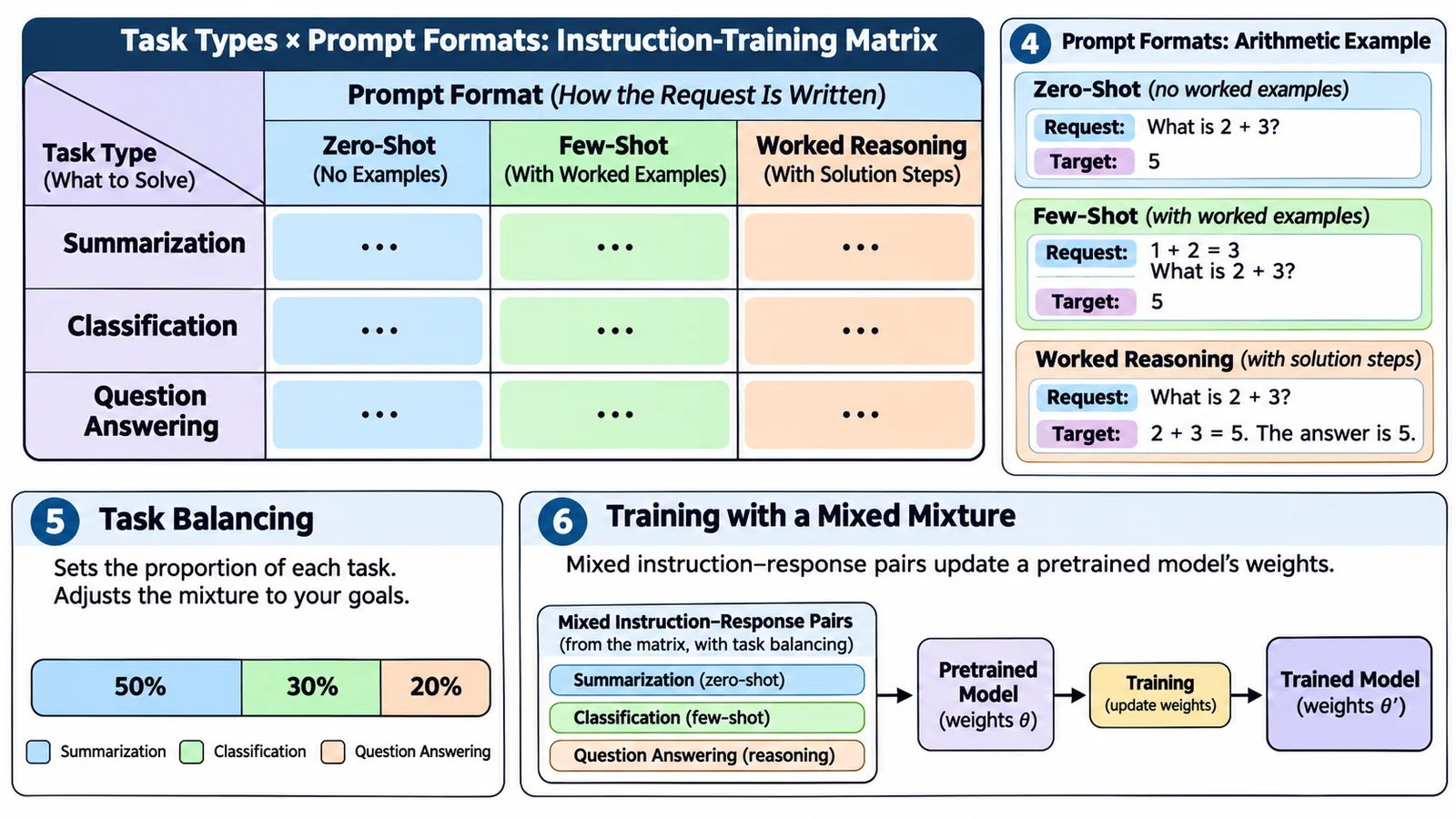
A second line of work treats the composition of the data as a design problem in its own right. The Flan Collection is a body of tasks, templates and methods assembled for instruction tuning, and the work around it ran controlled comparisons, called ablation studies, that switch one design choice at a time to see what each contributes. Task balancing, meaning how much of each kind of task goes into the mixture, and enrichment of the data turned out to be easily overlooked but critical to effective tuning; training with mixed prompt settings, where the same task appears sometimes with no examples, sometimes with a few, and sometimes with worked reasoning steps, yielded stronger performance in all settings by more than two percent.[8] The lesson is that an instruction dataset is not a heap of pairs but a mixture with proportions, and the proportions matter.
Put together, these developments describe a change in what tuning is for. In pretraining, the model learns from text as it is found. In instruction tuning, the training text is manufactured to a specification: requests written the way users write them, replies written the way a helpful model should reply, and a deliberate balance across task types and prompt formats. The model is no longer being asked to model the distribution of prose. It is being asked to model the distribution of good responses to stated requests, and the data is constructed so that this distribution is what the training signal rewards.
The gap that instruction tuning closes is therefore narrow but decisive. The knowledge and language ability are already in the pretrained model; what is missing is the disposition to use them on request. Prompting appeals to that disposition without teaching it, and succeeds only as far as the model's existing text patterns happen to align with the user's goal. Tuning on instruction data teaches it directly, by making compliant, well-formed responses the likely continuation of a request. How the pairs are actually assembled, formatted and trained on, and how well the resulting models perform, are taken up in the sections that follow.
Pretraining optimizes for plausible next words; instruction tuning retrains the model so that a fitting response to a stated request becomes the likely continuation.
How it works
What the training stage actually does
Assembling the pairs
The raw material of instruction tuning is a set of (instruction, output) pairs, and the first practical question is where they come from. One answer is to convert existing labelled datasets. A collection of task examples already has inputs and correct answers; the work is to wrap each one in a written request and a written reply so that it reads as an instruction followed by a response. The medical dataset MedS-Ins shows the anatomy of this approach at scale. It aggregates 58 open-source biomedical language-processing corpora drawn from five kinds of text, including exams, clinical notes, academic papers, medical knowledge bases and everyday conversation, and converts them into a unified format, yielding 5 million instances carrying 19,000 distinct instructions across 122 clinical tasks, each task accompanied by a hand-written definition.[9] The numbers are worth pausing on because they show what "a dataset" means here: not a list of questions but a structured catalogue in which many source corpora are mapped onto a common shape, and every task is named and described so the model can tell them apart.
That last point is the task definition, a short written description of what a task asks for, included so that the model can distinguish one kind of request from another rather than treating all instructions as interchangeable. A second element is the template, a fixed wording that turns a raw example into an instruction-response pair. Templates matter more than they look, because the same underlying task can be phrased many ways, and the phrasing is part of what the model learns. The Flan Collection work treated the mixture of phrasings as a design choice and found that training with mixed prompt settings, where a task appears sometimes with no worked examples, sometimes with a few, and sometimes with step-by-step reasoning shown, yielded stronger performance (2%+) in all settings.[8] The practical reading is that variety in format during training is not decoration; it teaches the model to respond to the request itself rather than to one habitual phrasing of it.
Making instructions harder, and choosing fewer of them
Hand-written instructions are expensive and tend to be simple, because people find it tedious to compose genuinely difficult requests. One response is to let a model rewrite them. Evol-Instruct starts from an initial set of instructions and rewrites them step by step into more complex versions, then mixes the generated instructions together to fine-tune a model; human evaluations on a complexity-balanced test bed found the rewritten instructions superior to human-created ones.[10] The mechanism is a kind of curriculum: begin with what is easy to write, then push each example toward more steps, more constraints or more indirection, so the training set covers difficulty levels a human author would rarely bother to produce.
The opposite instinct, collecting as many pairs as possible, runs into a different problem. More data costs more to train on and does not automatically help. A model-oriented selection method called MoDS scores candidate instructions on quality, coverage and necessity, then keeps a small subset; a model fine-tuned on 4,000 pairs chosen this way could perform better than a model fine-tuned on the full original dataset, which includes 214k instruction data.[11] The result is a single comparison on one setup, but it makes the underlying idea concrete: what matters is whether an example teaches something the model does not already do, and most examples do not. A related approach, LESS, estimates which training examples are most influential for a target capability and trains on a selected fraction of the data, reporting that training on a selected 5 percent can often outperform training on the full dataset across diverse downstream tasks.[12]
Supervised fine-tuning and its evaluation
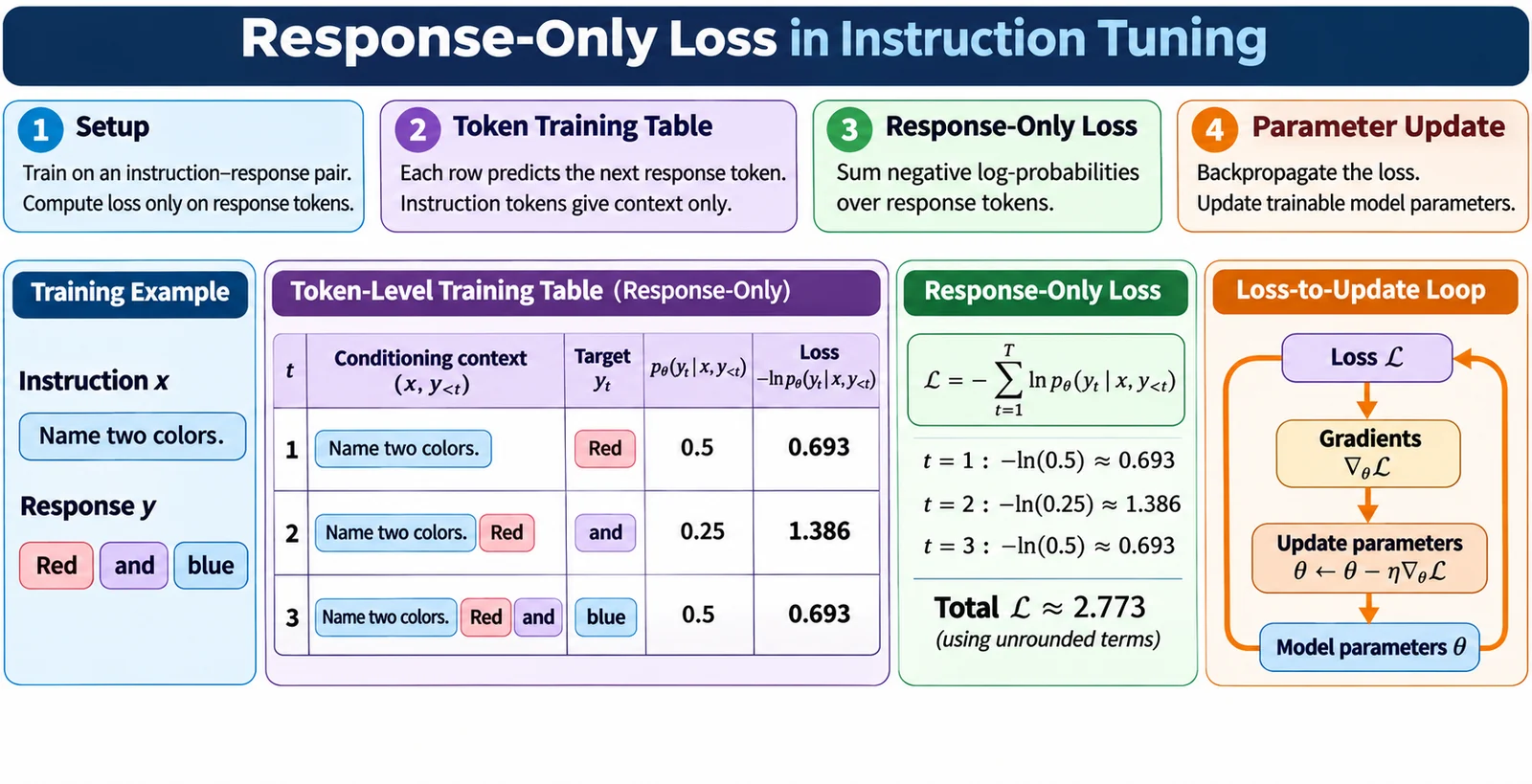
With pairs in hand, the training itself is ordinary supervised fine-tuning: the model is shown an instruction and its paired response, and its weights are adjusted so that the response becomes more probable, using the same next-word prediction machinery as pretraining but with the loss counted on the response rather than on arbitrary text. The stage is small relative to pretraining, and the tuning is often done on a subset of parameters to keep it cheap. Because the objective is narrow, the choices around it, such as how much data, which parameters to update, and how to set the learning rate, carry real weight; one study treats the fine-tuning pipeline as a black box and searches the space of hyperparameters with a black-box optimization algorithm, reporting a boost in performance and human alignment of the tuned model.[13]
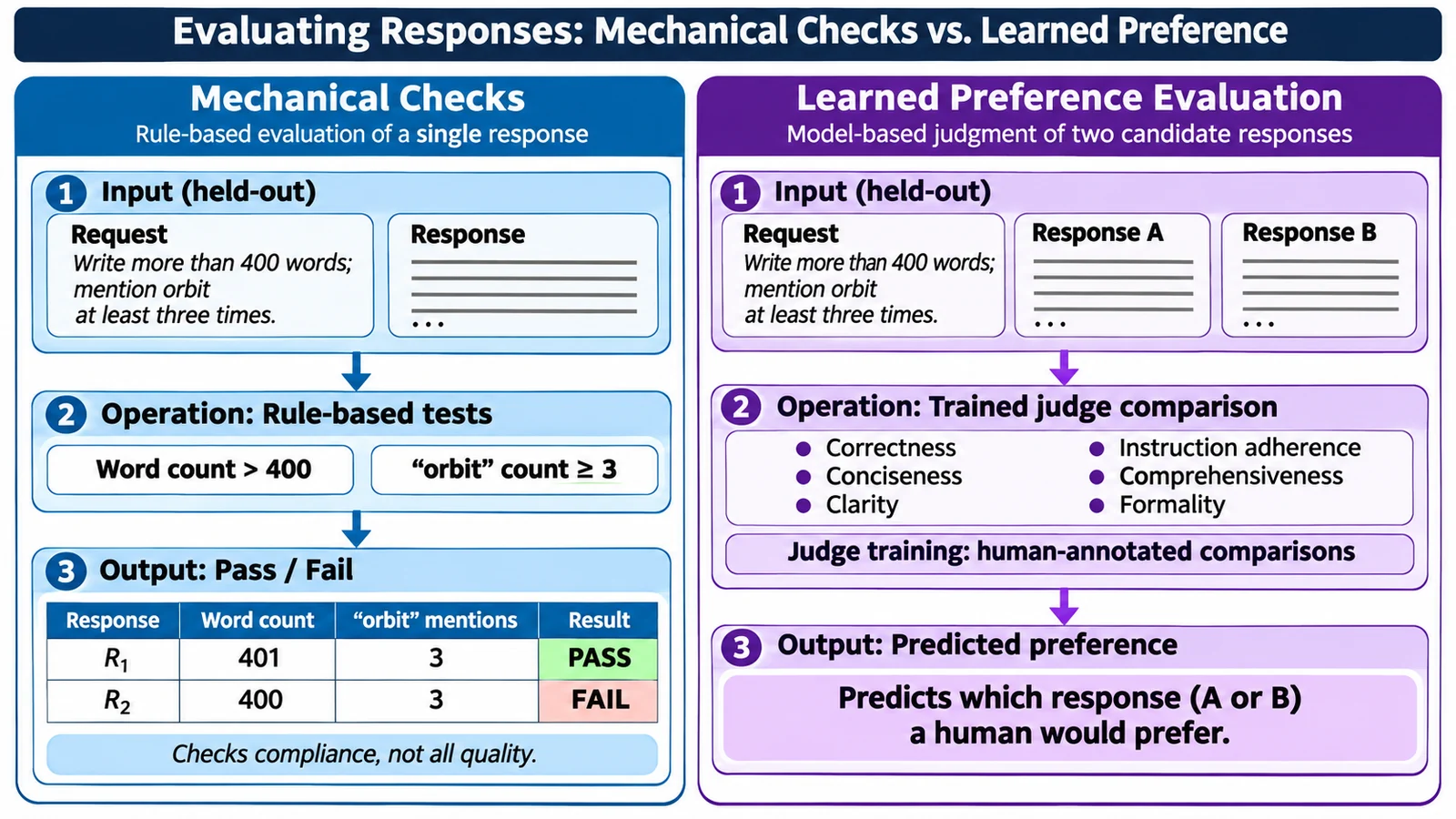
Evaluation closes the loop, and it is harder than it sounds. A tuned model must be checked on tasks it was not trained on, and judging free-form responses automatically is unreliable. Two responses can both be reasonable and differ in conciseness, clarity or adherence to the instruction, qualities that exact-match scoring cannot see. One benchmark focuses on verifiable instructions, requests whose satisfaction can be checked mechanically, such as writing more than 400 words or mentioning a keyword at least three times; it identified 25 types of such instructions and built around 500 prompts, each containing one or more of them.[14] Another approach trains a separate model to act as a judge, comparing two candidate responses and learning to prefer the one closer to human preferences; the resulting judge reached 93.75 percent of GPT-3.5's evaluation ability and 88.28 percent of GPT-4's in F1 score on a human-annotated test set.[5] Neither solves evaluation, but together they show the shape of the problem: the training stage produces a model whose output must be judged on qualities that resist simple scoring, so the field builds instruments for judging as carefully as it builds the data.
The stage is a pipeline: source or generate pairs, wrap them in task definitions and templates, mix formats and difficulty deliberately, fine-tune, then evaluate with instruments built for open-ended output.
Research
Does it work, and for whom
The question of whether instruction tuning works splits into two narrower ones: whether a tuned model does better than the same model untuned, and whether the tuning transfers to tasks nobody trained it on. The second is the one that matters, because a model that only improves on the tasks in its tuning set has learned a test, not a skill. The evidence is mostly of the second kind, and it is uneven: strong gains in some settings, modest or absent gains in others, and a recurring pattern in which the tuning helps most when the base model is large and the data is broad.
The clearest case is a domain model built from a general one. MedS-Ins, the medical instruction dataset described earlier, was used to tune a lightweight open-source medical model, and the resulting system, MMedIns-Llama 3, is reported to outperform existing models including GPT-4 and Claude-3.5 across a range of clinical benchmarks covering different text sources.[9] The model has 8 billion parameters, which is small next to the closed systems it is compared against, and that is the point worth taking from the result: a modest model given a large, well-organized body of instruction data in one domain can beat far larger general models on that domain's tasks. The comparison is on benchmarks, not in clinics, and the authors present the model as a proof of concept rather than a validated clinical tool.[9] Still, the direction of the finding is unambiguous, and it shows what the stage is for when the target is a specialized field.
The same pattern appears when the input is an image rather than a paragraph. InstructBLIP took a pretrained vision-language model and tuned it on instruction data assembled from 26 public datasets, holding out 13 of them from training. On all 13 held-out datasets it reached state-of-the-art zero-shot performance, substantially outperforming the model it was built from and larger models of a competing design.[15] Held-out means the model never saw those datasets during tuning, so the result measures transfer rather than memorization. A model that can be pointed at an unfamiliar kind of image question and answer it without further training is doing the thing instruction tuning is supposed to make possible.
Where the tuning data comes from turns out to matter less than whether it is well made. The first use of GPT-4 to generate instruction-following data produced 52,000 English and Chinese examples, and LLaMA models tuned on them showed better zero-shot performance on new tasks than models tuned on data from earlier state-of-the-art generators.[2] Machine-written instructions, in other words, can substitute for human-written ones, at least on this comparison. That finding is what made large instruction datasets practical, since the alternative was paying people to write hundreds of thousands of request-response pairs by hand.
The Flan Collection work gives a sense of the size of the effect when the data and methods are designed carefully. Flan-T5, tuned on that collection, outperformed prior work by 3 to 17 percent or more across evaluation settings, and the same work found that the tuned model needed less fine-tuning to converge, and converged higher and faster, than the untuned T5 on single downstream tasks.[8] The second half of that result is easy to overlook. It says an instruction-tuned model is a better starting point for any later task-specific training, which changes the economics of the whole pipeline: tune once on broad instructions, then adapt cheaply to whatever comes next.
Who benefits, and who does not
The benefits are not spread evenly, and two variables seem to govern them: the size of the model and the match between the tuning data and the target task. On the size question, a study of crypto sentiment analysis found that larger models benefited from instruction tuning, reaching an average accuracy of 75.16 percent, while smaller models could see reduced generalization, which the authors attribute to the tuning using up the model's full capacity. The same study found that short and simple instructions achieved an average accuracy of 72.38 percent, outperforming long and complex instructions by over 12 percent, a reminder that the format of the instruction is itself a variable and that more elaborate wording is not automatically better.[3]
The match between tuning and target shows up when a tuned model is later adapted to something narrower. In a study of financial text classification, models were fine-tuned on four financial classification tasks and then tested zero-shot on three unseen complex financial tasks. Base-model fine-tuning led to greater degradation of the model's general ability, while instruction-tuned models maintained more robust performance.[16] The interpretation is that instruction tuning leaves a model more resilient to later specialization, in the same way that a broad education makes it easier to pick up a trade. This is a comparison within one study's setup, not a law, but it points at a real cost of narrow fine-tuning that instruction tuning appears to soften.
The most surprising evidence comes from outside behavioural benchmarks altogether. A study comparing 25 vanilla and instruction-tuned models against human brain recordings, taken while people read naturalistic stories and sentences, found that instruction tuning generally enhanced brain alignment, the similarity between a model's internal representations and neural activity in the human language system, by about 6 percent, while having no similar effect on behavioural alignment, the similarity between model and human behaviour on a reading task. The improvement in brain alignment correlated strongly with model size and with performance on tasks requiring world knowledge.[17] What this suggests is that the tuning is not merely teaching a surface style of reply; it is reshaping internal representations in a direction that happens to resemble how the human language system organizes meaning. The absence of a matching behavioural gain is equally informative, and it warns against assuming that any internal change shows up as better output.
Set against these gains is a body of work arguing that the stage does less than it appears to. One close analysis found that instruction tuning failed to enhance knowledge or skills in the models studied, that low-rank tuning was limited to learning response initiation and style tokens, and that full-parameter tuning led to knowledge degradation.[7] That finding is taken up with the other criticisms later. For the present question, it marks the boundary of the claim: instruction tuning reliably changes how a model responds, and the evidence that it adds new capability is much weaker than the evidence that it makes existing capability usable.
Instruction tuning reliably improves how a model responds to requests, and transfers to unseen tasks in several reported settings; evidence that it adds new knowledge or skill is much weaker.
A fair summary of the outcome evidence is that the stage works best as a shaping step applied to a capable base model with broad, well-built data, and that its gains are largest where the target domain is narrow enough for a domain dataset to cover it. The medical and vision-language results show what happens when those conditions are met. The size and instruction-format findings show what happens when they are not. How the method is applied across medicine, code, finance and other fields, and how it compares with prompting and plain fine-tuning, are covered later.
In practice
Instruction tuning across domains and modalities
The same recipe travels well. Take a capable pretrained model, assemble a body of instruction-response pairs in the target field, tune the model on them, and compare the result against larger general systems. The pattern recurs so often that it is worth naming as the standard shape of applied instruction tuning, and the interesting variation lies in where the pairs come from and what the comparison shows.
Medicine and images
The medical case is the most fully documented. MedS-Ins was built by converting 58 open biomedical language corpora into a unified instruction format, and the model tuned on it, MMedIns-Llama 3, is reported to outperform existing models including GPT-4 and Claude-3.5 across a range of clinical benchmarks. The model has 8 billion parameters, and the authors present it as an academic proof of concept, noting it has not yet undergone extensive clinical validation.[9] What the result demonstrates is the leverage of a well-organized domain dataset: a modest open model, given enough instruction data of the right kind, can be preferred on that domain's benchmarks to systems many times its size.
Vision-language models follow the same path with an extra input. InstructBLIP gathered 26 public datasets covering a wide range of tasks, converted them to instruction format, and tuned on 13 of them while holding the other 13 out; on all 13 held-out datasets it reached state-of-the-art zero-shot performance, substantially outperforming the model it was built from and larger models of a competing design.[15] The held-out split is what makes the claim meaningful, since it measures transfer to datasets the tuning never touched. A related line of work adds a further ingredient: the MIMIC-IT dataset supplies over 3 million multimodal instruction-response pairs, including roughly 2.2 million unique instructions drawn from images and videos, and each pair arrives with in-context examples, earlier exchanges that show the model what kind of answer is wanted.[18][19] Training with these in-context examples was found to substantially enhance model convergence and generalization.[18]
Code, finance and structured extraction
Code is a natural fit because the training pairs already exist in abundance. Git commits pair a change to a program with the human instruction that motivated it, and one project compiled 4 terabytes of commits across 350 programming languages into a dataset called CommitPack; tuning a 16-billion-parameter model on it reached 46.2 percent pass@1 on the HumanEval Python benchmark, the best among models not trained on OpenAI outputs.[4] A different route reaches similar ground from the other direction. Evol-Instruct, the method that rewrites instructions into harder versions, was adapted to code and used to tune a code model, which surpassed other open-source code models by a substantial margin and outperformed Anthropic's Claude and Google's Bard on HumanEval and HumanEval+.[20] The two approaches differ in where difficulty comes from, real human commits in one case and machine-rewritten instructions in the other, and both show that the stage works when the domain supplies a large stock of instruction-response material.
Finance shows the same shape at smaller scale. One project assembled 136,000 instruction samples spanning financial tasks, document types and data modalities, tuned LLaMA on them to produce a model called FinMA, and paired it with a benchmark of five tasks and nine datasets.[21] A second effort went the other way on data volume, hand-curating a small but diverse set of investment instructions, from exam questions to regulatory filings to forum discussions, and tuning a 65-billion-parameter model on it; financial experts including hedge fund managers and research analysts rated its responses as comparable to those of commercial models such as GPT-3.5, GPT-4 and Claude-2.[22] The contrast between the two is instructive. One builds breadth by collecting widely, the other by choosing carefully, and both report usable domain models, which fits the broader finding that quality of instruction data can matter more than quantity.[6]
Information extraction, the task of pulling structured facts such as names, relations and events out of text, had been a weak spot for general models. One framework unified 32 extraction datasets into a single text-to-text format with expert-written instructions and tuned a model on the result; the tuned system matched a strong task-specific model in the supervised setting and significantly outperformed both the prior state of the art and GPT-3.5 when neither had task-specific training.[23] The comparison with GPT-3.5 is the pointed one, since it shows a general model failing at a structured task that a tuned model handles, and it illustrates why domain datasets are built at all: the general model has the language ability but not the disposition to produce output in the required shape.
Social science and practical choices
Text classification in social research brings its own question, which is not whether tuning works but which training regime to use. A comparison of 10 models ranging from tens of millions to hundreds of billions of parameters tested four regimes on stance detection, the task of identifying attitudes in text: zero-shot prompting, few-shot prompting, fine-tuning, and instruction tuning, which combines prompting with fine-tuning. The largest models generally gave the best predictions even with little or no training data, while fine-tuning smaller models was a competitive option given their relatively high accuracy and low cost; instruction tuning the latest generative models extended classification to more complex tasks than had previously been feasible.[24] The practical reading is that the choice depends on budget and task difficulty rather than on a single winner, and that instruction tuning earns its place by widening the range of tasks a classifier can attempt.
Two decisions recur across all these projects and are worth separating from the domain question. The first is which examples to train on. A selection method that estimates the influence of individual training examples reported that training on a chosen 5 percent of the data can often outperform training on the full dataset across diverse downstream tasks, and that smaller models can be leveraged to select useful data for larger models.[12] The second is how to set the training itself. Treating the fine-tuning pipeline as a black box and searching its hyperparameters with a black-box optimization algorithm produced a measurable boost in performance and human alignment of the tuned model.[13] Neither decision is specific to any domain, which is part of why the recipe transfers: the domain changes the data, while selection and tuning choices stay recognizably the same.
Across medicine, images, code, finance and extraction, the recurring pattern is a domain dataset, an open base model, and a comparison against larger closed systems.
How instruction tuning compares with prompting and with plain fine-tuning, and where the approach runs into its limits, are taken up in the sections that follow.
Alternatives
How it compares with prompting and plain fine-tuning
There are three broad ways to get a pretrained model to do a task, and they differ in what they change. Zero-shot prompting changes nothing inside the model: the request is written into the input and the model continues from it. Few-shot prompting adds a handful of worked examples to that input, so the model can imitate their pattern. Fine-tuning changes the weights, training the model on examples of the task itself. Instruction tuning sits between the last two: it changes the weights, but on a broad diet of requests and replies rather than on one task.
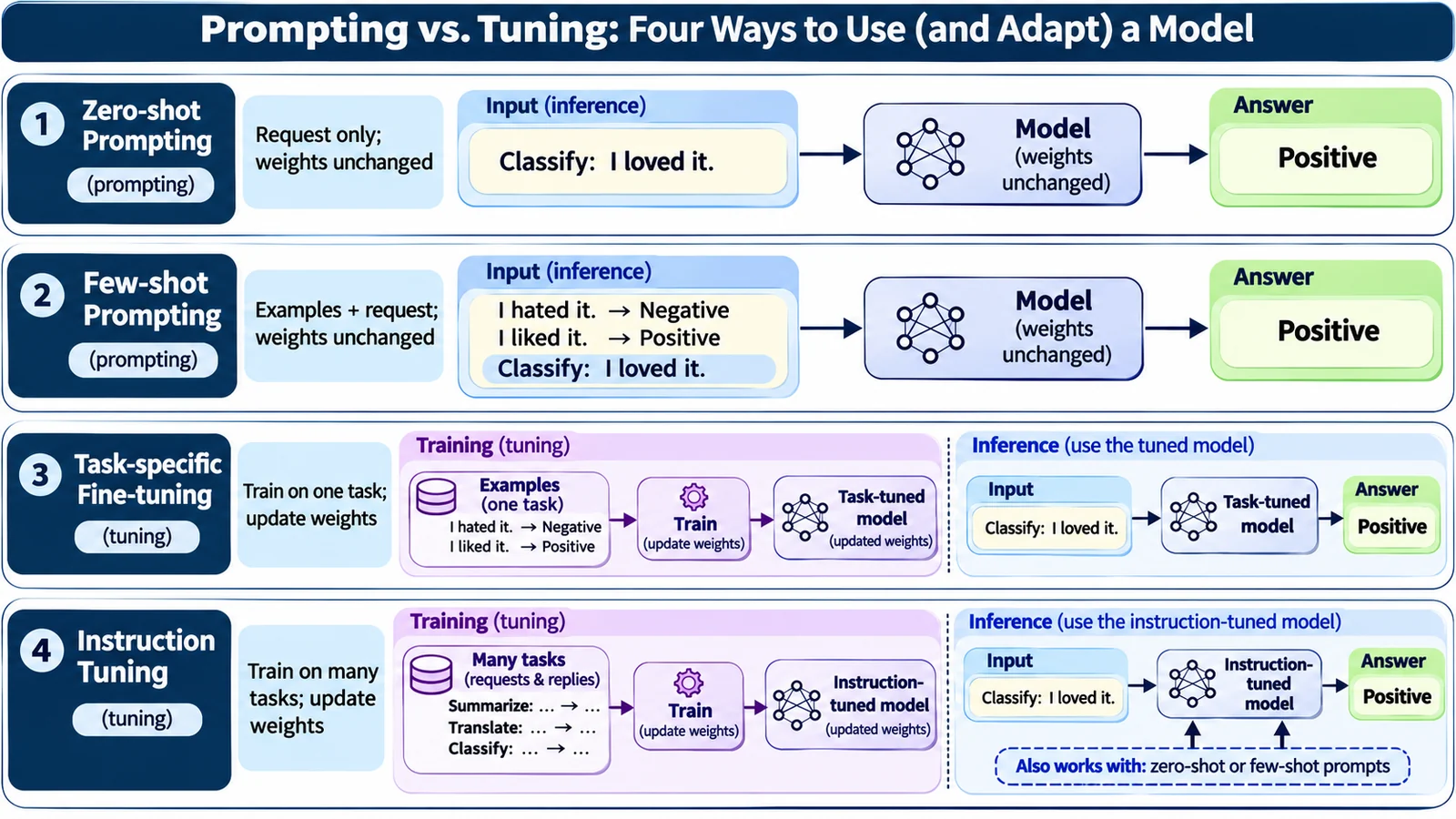
A comparison of 10 models, ranging from tens of millions to hundreds of billions of parameters, tested four training regimes on stance detection, the task of identifying attitudes expressed in text: prompt-based zero-shot learning, few-shot learning, fine-tuning, and instruction-tuning. The largest models gave the best predictions even with little or no training data, while fine-tuning smaller models was a competitive option because of their relatively high accuracy and low cost; instruction tuning the latest generative models widened the range of classification tasks that could be attempted at all.[24] The ordering is not a single ladder. Prompting asks the least of the model and costs the least to try; tuning asks more and buys more, but mostly for models and tasks where the base capability is already there.
The distinctive property of an instruction-tuned model is that it can be redirected without further training. Because it has practiced reading a stated request, a new domain can often be handled by placing the relevant documents and an instruction in front of it, with no additional tuning at all. A study of question answering evaluated instruction-following models on two fronts: correctness, how well the response satisfies the user's information need, and faithfulness, whether the response stays supported by the knowledge supplied in the input. On correctness, the instruction-following models performed comparably to models specifically fine-tuned for the task.
On faithfulness they were weaker: they struggled to judge the relevance of the provided knowledge and often hallucinated in their responses.[25] The comparison is the useful part. A general model steered by an instruction can match a specialist model on getting the answer right, which is a strong argument for skipping task-specific training, while its tendency to add unsupported material is the price of that flexibility.
An instruction-following model is broad and steerable, and its breadth is what lets it wander. The practical division follows from this. The stance-detection comparison found fine-tuning smaller models a competitive solution due to their relatively high accuracy and low cost.[24]
A further result complicates the picture of what the tuning actually teaches. Instruction tuning is normally described as training on pairs of a request and its response, and the pairing seems essential: the model learns to map the one onto the other. One investigation found that the pairs are not necessary. Training solely on responses, with no corresponding instructions at all, still yielded instruction following, which suggests that a pretrained model already contains a mapping from requests to responses and that teaching it the desired distribution of responses is enough to reveal that mapping. The same work found that instruction-response training on narrow-domain data, poetry for instance, still produced broad instruction-following behaviour such as recipe generation, and that when instructions were very different from the narrow training domain, the responses did not take on the style of that domain. The authors account for this with a hypothesis rather than a mechanism: very simple changes to a model's output distribution, such as slowly raising the probability of ending a sequence, penalizing repetition, and uniformly shifting the probabilities of a small set of words, can produce instruction following when combined with a pretrained model.[26]
If that account holds, the boundary between prompting and tuning is less sharp than it first appears. Prompting works by making some continuations more likely given the input; tuning works by making some continuations more likely in general. Both are ways of shifting a distribution the pretrained model already carries, one at the input and one in the weights.
The combination is one of the regimes the stance-detection comparison tested: it describes instruction-tuning as combining prompting and fine-tuning.[24] A model tuned on general instructions, then given a task description and a few examples at the moment of use, draws on both. The tuning supplies the disposition to follow a request; the prompt supplies the specifics of this request, this document, this format. Neither alone covers both.
Prompting shifts the model's output distribution at the input; tuning shifts it in the weights. Instruction-tuned models can match task-specific models on answer correctness while remaining more prone to unsupported additions.
Where the approach runs into its limits, including evidence that the stage may not add knowledge and can degrade it, is covered later.
Criticism
Limits, costs and criticism
The case for instruction tuning rests on the claim that it makes a pretrained model's existing ability usable. The criticism begins by asking whether that is all it does, and whether it might cost something in the process. The sharpest version of the argument comes from a close analysis of what changes inside a model during tuning. Low-rank tuning, the cheap variant that updates only a small set of added parameters, was limited to learning response initiation and style tokens, the opening moves and surface register of a reply rather than its substance.
Full-parameter tuning, which updates the whole model, went further in the wrong direction and led to knowledge degradation. The same work reported that copying response patterns from instruction datasets derived from knowledgeable sources led to a decline in response quality, and that full-parameter tuning increased hallucination by inaccurately borrowing tokens from conceptually similar examples in the tuning data.[7] The picture that emerges is not of a stage that adds a skill but of one that reshapes style and can erode content, which is a serious charge against the assumption that more tuning is better tuning.
That charge has a corollary about where the model's answers come from. If the tuning data does not supply new knowledge, then a tuned model's correct answers are drawn from what pretraining gave it, and its incorrect ones may be borrowed from the tuning set. The analysis found that responses generated solely from pre-trained knowledge consistently outperformed responses from models that learned any form of new knowledge from instruction tuning on open-source datasets.[7] This is a narrow comparison on a particular collection of datasets, and it does not show that tuning is useless. It does show that the stage can trade away some of the base model's grounding for a more agreeable surface, and that the trade is not always worth making.
A second line of criticism looks not at knowledge but at judgement. Instruction tuning and the preference-based tuning that often accompanies it are meant to align a model with human objectives, and alignment is usually discussed as a gain. One investigation asked whether the same methods import human failings as well. It tested three cognitive biases known to affect human decision-making, the decoy effect, the certainty effect and the belief bias, across models from the GPT-3, Mistral and T5 families.
The biases were present in various models, and notably stronger in models that had undergone instruction tuning, such as Flan-T5, Mistral-Instruct, GPT-3.5 and GPT-4.[27] A model that follows instructions more reliably is not thereby a better reasoner, and this result suggests the tuning can make a model's reasoning more human-like in the wrong respect. The finding is a comparison across model families rather than a controlled demonstration of cause, so it marks a risk rather than a settled mechanism, but it undercuts the assumption that better instruction following means better thinking.
The data problem
If the tuning mostly teaches form, then the form of the data is where the leverage lies, and that is exactly where the field is least settled. The survey literature treats dataset construction, including how outputs are generated and how large a dataset should be, as a central design question rather than a solved one.[1] A survey devoted to data selection reports that existing work indicates dataset quality matters more than quantity during instruction tuning, which is why effort has shifted from collecting more pairs to choosing better ones.[6] Choosing well is not straightforward.
A selection method that scores candidate instructions on quality, coverage and necessity kept 4,000 pairs from an original set of 214,000, and the model tuned on the smaller set performed better than one tuned on the whole.[11] A different method estimated the influence of individual training examples and found that training on a selected 5 percent often outperformed training on the full dataset across diverse downstream tasks.[12] Both results point the same way, and both are single comparisons on their own setups. What they establish is that the composition of the data dominates its size, and that no agreed method exists for finding the right composition. Selection remains an open problem, and a model builder choosing a dataset is making a judgement call with real consequences and little settled guidance.
Judging the result
The difficulty of evaluation compounds the difficulty of data. A tuned model must be judged on open-ended output, where two responses can both be defensible and differ in conciseness, clarity or how closely they followed the request. Exact-match scoring cannot see those differences, and human evaluation is slow, expensive and hard to reproduce. One response is to restrict the test to requests whose satisfaction can be checked mechanically. A benchmark built on verifiable instructions, meaning requests with a condition a program can confirm, such as writing more than 400 words or mentioning a keyword at least three times, identified 25 types of such instructions and assembled around 500 prompts, each carrying one or more of them.[14] The design makes scoring objective and repeatable, at the cost of measuring only the slice of instruction following that can be reduced to a checkable condition.
The other response is to automate the judge. A model can be trained to compare two candidate responses and predict which one a person would prefer, learning to weigh not just correctness but relative conciseness, clarity, adherence to the instruction, comprehensiveness and formality. One such judge, trained for this purpose, reached 93.75 percent of GPT-3.5's evaluation ability and 88.28 percent of GPT-4's in F1 score on a human-annotated test set.[5] A trained judge is cheaper and more reproducible than a panel of people, and it avoids sending evaluation data to an external service. It also inherits whatever preferences its own training data encoded, so the instrument used to measure alignment is itself an aligned model, and its blind spots become the benchmark's blind spots.
Instruction tuning can sharpen a model's compliance while leaving its knowledge intact at best and degraded at worst; the data that shapes it and the instruments that judge it are both unsettled.
None of this makes the stage worthless. It relocates the claim. Instruction tuning reliably changes how a model responds, and the evidence that it adds capability is weak, with some evidence that it can subtract. The practical questions that follow, how to build data that teaches without eroding, and how to measure the result honestly, are the ones the field is still working on, and the directions now being explored are covered later.
Open problems and current direction
The criticisms of instruction tuning point at a practical question rather than a verdict: if the composition of the tuning data matters more than its size, where should the data come from, and who should decide what goes into it? Several lines of work answer that question in different ways, and each is best read as a reported direction rather than a settled result.
Building the data from a map of knowledge
One answer is to stop collecting instructions and start generating them from a structured plan. Generalized Instruction Tuning, called GLAN, takes as its only input a pre-curated taxonomy of human knowledge and capabilities, built by decomposing human knowledge into fields, sub-fields and ultimately distinct disciplines, and then generates large-scale synthetic instruction data across all of them. From that taxonomy the method produces a list of subjects for each discipline, designs a syllabus for each subject, and uses the detailed key concepts in every class session to generate diverse instructions. Tuning a model such as Mistral on this material improved performance across mathematical reasoning, coding, academic exams, logical reasoning and general instruction following, without using task-specific training data for any of those tasks.[28] The appeal of the approach is that the coverage is designed rather than discovered: a new field can be added by adding a node to the taxonomy, so the dataset can in principle be extended deliberately instead of waiting for someone to write more examples by hand.
Choosing the examples that matter
A second direction accepts that large collections exist and asks which small part of them to use. The LESS method estimates the influence of individual training examples and performs a low-rank gradient similarity search to select them, adapting existing influence formulations to work with the Adam optimizer and with variable-length instruction data. Training on a LESS-selected 5 percent of the data often outperformed training on the full dataset across diverse downstream tasks, and the selected data transferred: smaller models could be used to choose useful data for larger models and for models from different families.[12] The transferability is the part worth noticing, because it means the selection step does not have to be repeated from scratch for every model a lab trains. A related survey frames the whole area as an open problem, noting that existing work indicates dataset quality matters more than quantity and that selecting a high-quality subset remains an active question.[6]
Data that cannot be pooled
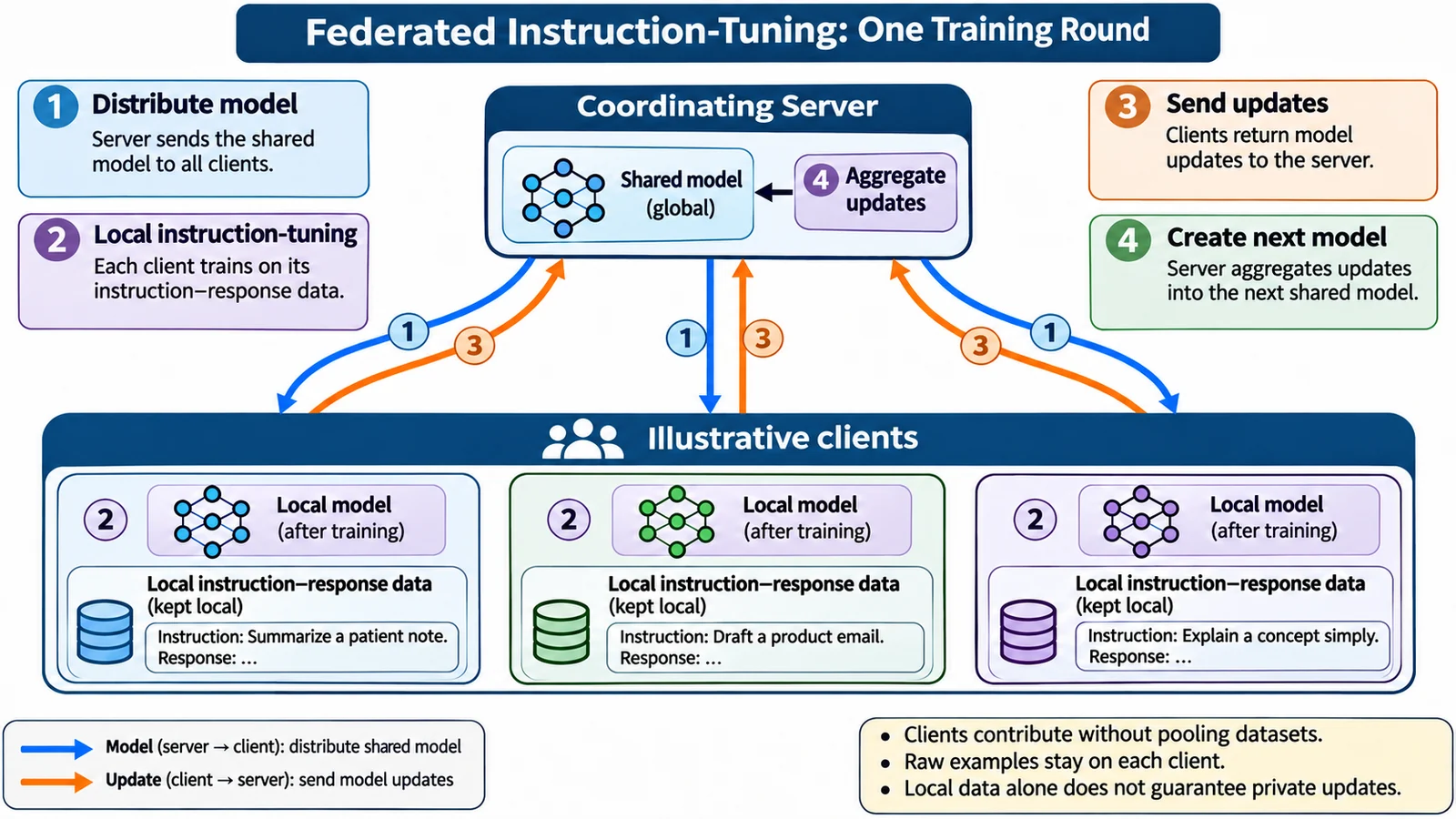
Both of those directions assume the data can be gathered in one place. A third assumes the opposite. Federated Instruction Tuning, or FedIT, applies federated learning, a training setup in which a model is improved from data held on many separate devices without the data ever being collected centrally, to the instruction-tuning stage. The motivation is that high-quality instruction data is costly and hard to obtain, and that privacy concerns limit access to text generated by end users, which sits on local devices. In the reported experiments, exploiting heterogeneous and diverse sets of instructions held on clients improved model performance compared with centralized training on a limited set of local instructions, as measured by GPT-4 auto-evaluation.[29] The direction matters because it changes who can contribute tuning data: a hospital, a firm or a group of individuals could each tune a shared model on instructions they are not permitted to publish.
One model, more than one job
A fourth direction uses the instruction itself as a switch between kinds of work. Generative Representational Instruction Tuning, or GRIT, trains a single model to handle both generation and embedding tasks, where an embedding is a numerical representation of text used for search and comparison, by distinguishing between the two through instructions. The resulting 7-billion-parameter model set a new state of the art on the Massive Text Embedding Benchmark and outperformed all models up to its size on a range of generative tasks, and the method was reported to match training on only generative or only embedding data, so the two capabilities were unified without a measured performance loss. Among the practical consequences reported is a speed-up of retrieval-augmented generation, a setup in which a model looks up documents before answering, by more than 60 percent for long documents, since separate retrieval and generation models are no longer needed.[30]
Architecture and tuning together
A fifth direction looks at the model rather than the data. Sparse mixture-of-experts architectures add learnable parameters to a model without raising inference cost, by routing each input through only some of the parameters. Comparing dense and mixture-of-experts models across three setups, one study found that the mixture-of-experts models overall underperformed dense models of identical computational capacity when simply fine-tuned on individual tasks, but that the picture changed once instruction tuning was introduced, used alone or together with task-specific fine-tuning. The most powerful model in that work, FLAN-MOE-32B, surpassed FLAN-PALM-62B on four benchmark tasks while using only a third of the FLOPs.[31] The suggestion is that instruction tuning and sparse architecture suit each other, though the comparison is one study's set of benchmarks.
Read together, these directions share a theme. Each tries to make the tuning stage cheaper, broader or more controllable than hand-writing pairs allows, whether by generating data from a taxonomy, selecting a fraction of what exists, training without pooling it, letting one model serve two purposes, or pairing the stage with an architecture that spends its parameters sparingly. None of them resolves the questions raised earlier about what the stage adds and how to measure it, and each is reported on its own setup. What they indicate is where the effort has moved: away from collecting more instruction-response pairs and toward designing, selecting and governing the data, and toward fitting the stage to the shape of the model it tunes.
Key studies
| Year | Study | Sample | Design | Finding |
|---|---|---|---|---|
| 2023 | Longpre et al.[8] | Flan Collection of tasks and methods | ablation studies on instruction tuning design decisions | Flan-T5 outperformed prior work by 3 to 17% or more across evaluation settings, and mixed prompt settings yielded 2% or more stronger performance. |
| 2023 | Peng et al.[2] | 52K English and Chinese instruction-following data generated by GPT-4 | early experiments on instruction-tuned LLaMA models | The GPT-4 generated data led to superior zero-shot performance on new tasks compared with data from previous state-of-the-art models. |
| 2023 | Dai et al.[15] | 26 publicly available datasets, with 13 held-in and 13 held-out | vision-language instruction tuning study based on BLIP-2 | InstructBLIP reached the best zero-shot results reported at the time on each of the 13 held-out datasets, and after finetuning on individual tasks it scored 90.7% accuracy on ScienceQA questions that include image contexts. |
| 2023 | Muennighoff et al.[4] | 16B parameter StarCoder model and 4 terabytes of Git commits across 350 programming languages | instruction tuning with code data benchmarked on HumanEval | The model achieved 46.2% pass@1 on the HumanEval Python benchmark, state-of-the-art among models not trained on OpenAI outputs. |
| 2023 | Wang et al.[23] | 32 diverse information extraction datasets in the IE INSTRUCTIONS benchmark | multi-task instruction tuning for unified information extraction | In supervised settings InstructUIE performed about as well as Bert, and in zero-shot settings it did clearly better than both the previous best method and gpt3.5. |
| 2023 | Shen et al.[31] | FLAN-MOE-32B and FLAN-PALM-62B models | empirical studies across three experimental setups | FLAN-MOE-32B, the strongest model in the study by Shen and colleagues (2023), did better than FLAN-PALM-62B on four benchmark tasks and used one third of the FLOPs. |
| 2023 | Aw et al.[17] | 25 vanilla and instruction-tuned large language models | comparison of brain alignment and behavioral alignment on three datasets | Instruction tuning generally enhanced brain alignment by about 6% but had no similar effect on behavioral alignment. |
| 2023 | Du et al.[11] | 4,000 instruction pairs selected by MoDS versus a full dataset of 214k instruction data | model-oriented data selection for instruction tuning | A model tuned on the 4,000 instruction pairs chosen by MoDS scored higher than a model tuned on the entire original set of 214k pairs. |
| 2023 | Wang et al.[5] | PandaLM-7B judge model evaluated on a human-annotated test dataset | automatic evaluation benchmark for instruction-tuned models | On the human-annotated test set that Wang and colleagues (2023) built, PandaLM-7B matched 93.75% of GPT-3.5's evaluation ability and 88.28% of GPT-4's, measured by F1-score. |
| 2024 | Wahidur et al.[3] | models of varying scales tested on crypto sentiment tasks | fine-tuning experiments with different instruction setups | Short, simple instructions gave an average accuracy of 72.38%, which was more than 12% above the score for long, complex instructions. |
| 2024 | Xia et al.[12] | LESS-selected 5% of instruction data | targeted instruction tuning with gradient similarity search | Training on the LESS-selected 5% of the data often outperformed training on the full dataset across diverse downstream tasks. |
| 2025 | Wu et al.[9] | 58 medically oriented language corpora totaling 5M instances with 19K instructions across 122 tasks | instruction tuning of a lightweight open-source medical language model | MMedIns-Llama 3, the model produced by instruction tuning on MedS-Ins, did clearly better than existing models on a range of clinical tasks. |
See also
References
- Zhang, S., Dong, L., Li, X., Zhang, S., Sun, X., Wang, S., Li, J., Hu, R., Zhang, T., Wang, G., & Wu, F. (2026). Instruction Tuning for Large Language Models: A Survey. ACM Computing Surveys, 58(7), 1-36. doi:10.1145/3777411
- Peng, B., Li, C., He, P., Galley, M., & Gao, J. (2023). Instruction Tuning with GPT-4. arXiv. doi:10.48550/arxiv.2304.03277 Free full text
- Wahidur, R. S. M., Tashdeed, I., Kaur, M., & Lee, H. N. (2024). Enhancing Zero-Shot Crypto Sentiment With Fine-Tuned Language Model and Prompt Engineering. IEEE Access, 12, 10146-10159. doi:10.1109/access.2024.3350638
- Muennighoff, N., Liu, Q., Zebaze, A. R., Zheng, Q., Hui, B., Zhuo, T. Y., Singh, S., Tang, X., Werra, L. v., & Longpre, S. (2023). OctoPack: Instruction Tuning Code Large Language Models. arXiv. doi:10.48550/arxiv.2308.07124 Free full text
- Wang, Y., Yu, Z., Zeng, Z., Yang, L., Wang, C., Chen, H., Jiang, C., Xie, R., Wang, J., Xing, X., Ye, W., Zhang, S., & Zhang, Y. (2023). PandaLM: An Automatic Evaluation Benchmark for LLM Instruction Tuning Optimization. arXiv. doi:10.48550/arxiv.2306.05087 Free full text
- Zhang, B., Wang, J., Du, Q., Zhang, J., Tu, Z., & Chu, D. (2025). A Survey on Data Selection for LLM Instruction Tuning. Journal of Artificial Intelligence Research, 83. doi:10.1613/jair.1.17625
- Ghosh, S., Evuru, C. K. R., Kumar, S., Ramaneswaran, S., Aneja, D., Jin, Z., B, R. D., & Manocha, D. (2024). A Closer Look at the Limitations of Instruction Tuning. arXiv. doi:10.48550/arxiv.2402.05119 Free full text
- Longpre, S., Hou, L., Vu, T., Webson, A., Chung, H. W., Tay, Y., Zhou, D., Le, Q. V., Zoph, B., Jason, W., & Adam, R. (2023). The Flan Collection: Designing Data and Methods for Effective Instruction Tuning. arXiv. doi:10.48550/arxiv.2301.13688 Free full text
- Wu, C., Qiu, P., Liu, J., Gu, H., Li, N., Zhang, Y., Wang, Y., & Xie, W. (2025). Towards evaluating and building versatile large language models for medicine. npj Digital Medicine, 8(1). doi:10.1038/s41746-024-01390-4
- Xu, C., Sun, Q., Kai, Z., Geng, X., Zhao, P., Feng, J., Tao, C., Qingwei, L., & Daxin, J. (2023). WizardLM: Empowering large pre-trained language models to follow complex instructions. arXiv. doi:10.48550/arxiv.2304.12244 Free full text
- Du, Q., Zong, C., & Zhang, J. (2023). MoDS: Model-oriented Data Selection for Instruction Tuning. arXiv. doi:10.48550/arxiv.2311.15653 Free full text
- Xia, M., Malladi, S., Gururangan, S., Arora, S., & Chen, D. (2024). LESS: Selecting Influential Data for Targeted Instruction Tuning. arXiv. doi:10.48550/arxiv.2402.04333 Free full text
- Tribes, C., Benarroch-Lelong, S., Lu, P., & Kobyzev, I. (2023). Hyperparameter Optimization for Large Language Model Instruction-Tuning. arXiv. doi:10.48550/arxiv.2312.00949 Free full text
- Zhou, J., Lu, T., Mishra, S. R., Brahma, S., Sujoy, B., Yi, L., Zhou, D., & Hou, L. (2023). Instruction-Following Evaluation for Large Language Models. arXiv. doi:10.48550/arxiv.2311.07911 Free full text
- Dai, W., Li, J., Li, D., Tiong, A. M. H., Zhao, J., Wang, W., Li, B., Fung, P., & Hoi, S. C. H. (2023). InstructBLIP: Towards General-purpose Vision-Language Models with Instruction Tuning. arXiv. doi:10.48550/arxiv.2305.06500 Free full text
- Fatemi, S., Hu, Y., & Mousavi, M. (2025). A Comparative Analysis of Instruction Fine-Tuning Large Language Models for Financial Text Classification. ACM Transactions on Management Information Systems, 16(1), 1-30. doi:10.1145/3706119
- Aw, K. L., Montariol, S., AlKhamissi, B., Schrimpf, M., & Bosselut, A. (2023). Instruction-tuning Aligns LLMs to the Human Brain. arXiv. doi:10.48550/arxiv.2312.00575 Free full text
- Li, B., Zhang, Y., Chen, L., Wang, J., Pu, F., Cahyono, J. A., Yang, J., Li, C., & Liu, Z. (2025). Otter: A Multi-Modal Model With In-Context Instruction Tuning. IEEE Transactions on Pattern Analysis and Machine Intelligence, 47(9), 7543-7557. doi:10.1109/tpami.2025.3571946
- Bo, L., Zhang, Y., Chen, L., Wang, J., Pu, F., Yang, J., Li, C., & Liu, Z. (2023). MIMIC-IT: Multi-Modal In-Context Instruction Tuning. arXiv. doi:10.48550/arxiv.2306.05425 Free full text
- Luo, Z., Xu, C., Zhao, P., Sun, Q., Geng, X., Hu, W., Tao, C., Ma, J., Lin, Q., & Jiang, D. (2023). WizardCoder: Empowering Code Large Language Models with Evol-Instruct. arXiv. doi:10.48550/arxiv.2306.08568 Free full text
- Xie, Q., Han, W., Xiao, Z., Lai, Y., Peng, M. C., Lopez-Lira, A., & Huang, J. (2023). PIXIU: A Large Language Model, Instruction Data and Evaluation Benchmark for Finance. arXiv. doi:10.48550/arxiv.2306.05443 Free full text
- Yi, Y., Tang, Y., & Tam, K. Y. (2023). InvestLM: A Large Language Model for Investment using Financial Domain Instruction Tuning. arXiv. doi:10.48550/arxiv.2309.13064 Free full text
- Wang, X., Zhou, W., Zu, C., Han, X., Chen, T., Zhang, Y., Zheng, R., Ye, J., Zhang, Q., Gui, T., Kang, J., Yang, J., Li, S., & Du, C. (2023). InstructUIE: Multi-task Instruction Tuning for Unified Information Extraction. arXiv. doi:10.48550/arxiv.2304.08085 Free full text
- Chae, Y., & Davidson, T. (2026). Large Language Models for Text Classification: From Zero-Shot Learning to Instruction-Tuning. Sociological Methods & Research, 55(2), 501-567. doi:10.1177/00491241251325243
- Adlakha, V., BehnamGhader, P., Lu, X. H., Meade, N., & Reddy, S. (2024). Evaluating Correctness and Faithfulness of Instruction-Following Models for Question Answering. Transactions of the Association for Computational Linguistics, 12, 681-699. doi:10.1162/tacl_a_00667
- Hewitt, J., Liu, N. F., Liang, P., & Manning, C. D. (2024). Instruction Following without Instruction Tuning. arXiv. doi:10.48550/arxiv.2409.14254 Free full text
- Itzhak, I., Stanovsky, G., Rosenfeld, N., & Belinkov, Y. (2024). Instructed to Bias: Instruction-Tuned Language Models Exhibit Emergent Cognitive Bias. Transactions of the Association for Computational Linguistics, 12, 771-785. doi:10.1162/tacl_a_00673
- Li, H., Dong, Q., Tang, Z., Wang, C., Zhang, X., Huang, H., Huang, S., Huang, X., Zeqiang, H., Zhang, D., Gu, Y., Xin, C., Wang, X., Chen, S., Dong, L. M., Lü, W., Sui, Z., Wang, B., Wai, L., & Wei, F. (2024). Synthetic Data (Almost) from Scratch: Generalized Instruction Tuning for Language Models. arXiv. doi:10.48550/arxiv.2402.13064 Free full text
- Zhang, J., Vahidian, S., Kuo, M., Li, C., Zhang, R., Tong, Y., Yufan, Z., Guoyin, W., & Yiran, C. (2023). Towards Building the Federated GPT: Federated Instruction Tuning. arXiv. doi:10.48550/arxiv.2305.05644 Free full text
- Muennighoff, N., Su, H., Wang, L., Yang, N., Wei, F., Yu, T., Singh, A., & Kiela, D. (2024). Generative Representational Instruction Tuning. arXiv. doi:10.48550/arxiv.2402.09906 Free full text
- Shen, S., Hou, L., Zhou, Y., Du, N., Longpre, S., Jason, W., Chung, H. W., Zoph, B., Fedus, W., Chen, X., Vu, T., Wu, Y., Chen, W., Webson, A., Li, Y., Zhao, V., Yu, H., Keutzer, K., Darrell, T. J., & Zhou, D. (2023). Mixture-of-Experts Meets Instruction Tuning:A Winning Combination for Large Language Models. arXiv. doi:10.48550/arxiv.2305.14705 Free full text
Cite this page: Atlas Nova editors. (2026). Instruction tuning. Atlas Nova. https://velocer.io/atlas/instruction-tuning/