Method · Language models
Fine-tuning (machine learning)
Machine learning technique
Fine-tuning (machine learning) is the step that comes after pre-training, in which a pre-trained model is further trained on a smaller, task-specific dataset so that its general knowledge is bent toward one concrete purpose.
A language model, for instance, may have absorbed enormous quantities of text in order to learn how language works in general. The model is not built from scratch. It starts from what it already knows and is nudged, with examples of the new task, toward the behaviour that task requires.
Key facts
| 9.1 | Fine-tuned GPT-3.5 beat fine-tuned BERT by this percent in scoring accuracy (Latif & Zhai 2024)[1] |
|---|---|
| 97.29 | Fine-tuned models reached this F1-score on phishing URL detection (Trad & Chehab 2024)[2] |
| 87.3 | LoRA gain in MCC for signal peptides with small samples (Zeng et al. 2024)[3] |
| 664 | Configurations at 20 percent of data matched from-scratch training (Radova et al. 2025)[4] |
Overview
What fine-tuning is and why it matters
The reason this matters is easiest to see in a case where general knowledge is not enough. A model trained on journals and encyclopedias has learned the language of published writing, but students answering a science question do not write like a journal. Their phrasing is partial, informal, sometimes ungrammatical, and scoring them correctly depends on context that general text does not supply. The gain came from showing the model the specific kind of writing it would be judged on, not from giving it more general language.
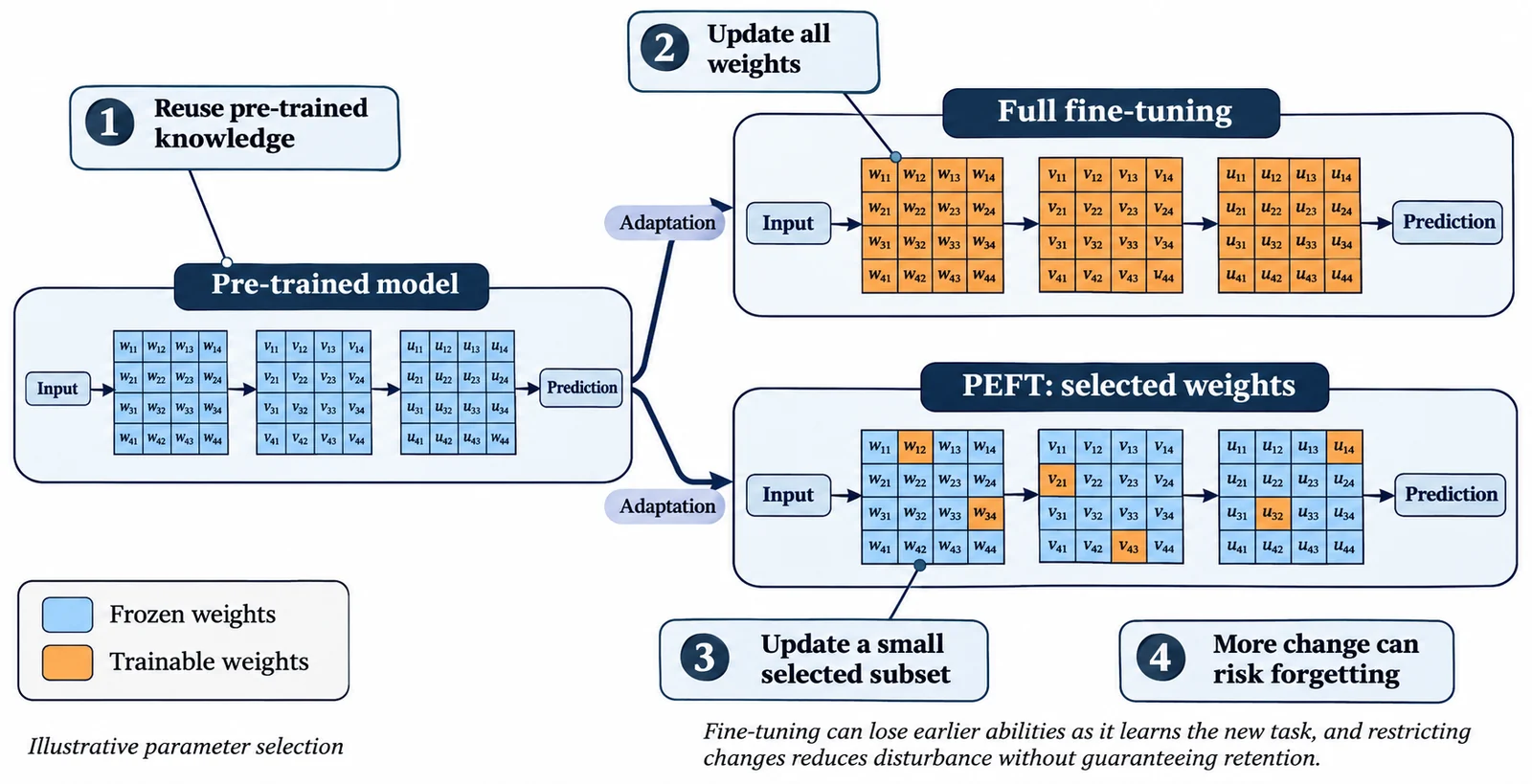
The economy of the approach is the second reason it is so widely used. Training a large model from the beginning demands vast data and computation, but fine-tuning reuses what that training already produced. The same logic appears far from language: in atomistic materials modelling, a foundation model pre-trained on diverse chemical structures can be fine-tuned for one specific system, and with partially frozen weights it reached accuracy similar to models trained from scratch on the full dataset while using only 10 to 20 percent of the data, hundreds of data points rather than thousands.[4] The pre-trained model acts as a stepping stone, and the task-specific data only has to cover the gap between general and particular.
That gap is where the main tension of the field sits. The simplest form of fine-tuning updates every weight in the model, which is expensive and, on a small dataset, risky. The alternative is to update only a small portion of the model, an approach known as parameter-efficient fine-tuning, or PEFT, which keeps most of the pre-trained weights fixed and trains a limited set of new or selected ones. The trade-off between the two, and the methods that sit between them, are taken up later.
So is the hazard that accompanies updating everything: a model can lose some of its earlier abilities as it absorbs the new task, a phenomenon called catastrophic forgetting.[5] Fine-tuning is therefore not simply a matter of training longer on new data. It is a choice about how much of a model to change, and that choice shapes both what the model gains and what it may lose.
Fine-tuning adapts a model that already knows a great deal; the central question is how much of it to disturb.
History
From pre-training to task adaptation
The habit of training a network on one problem and then adapting it to another is older than the large language models that made it famous. A learning procedure for deep Boltzmann machines, networks with many layers of hidden variables, used a layer-by-layer pretraining phase to give the weights a sensible starting point, and the features learned that way proved an effective way to initialize the hidden layers of an ordinary feedforward network, which was then discriminatively fine-tuned on the task at hand.[6] The pattern was already visible: a long, general stage builds useful internal representations, and a short, targeted stage bends them toward a particular job. What changed over the following decade was the scale of the first stage and the cost of the second.
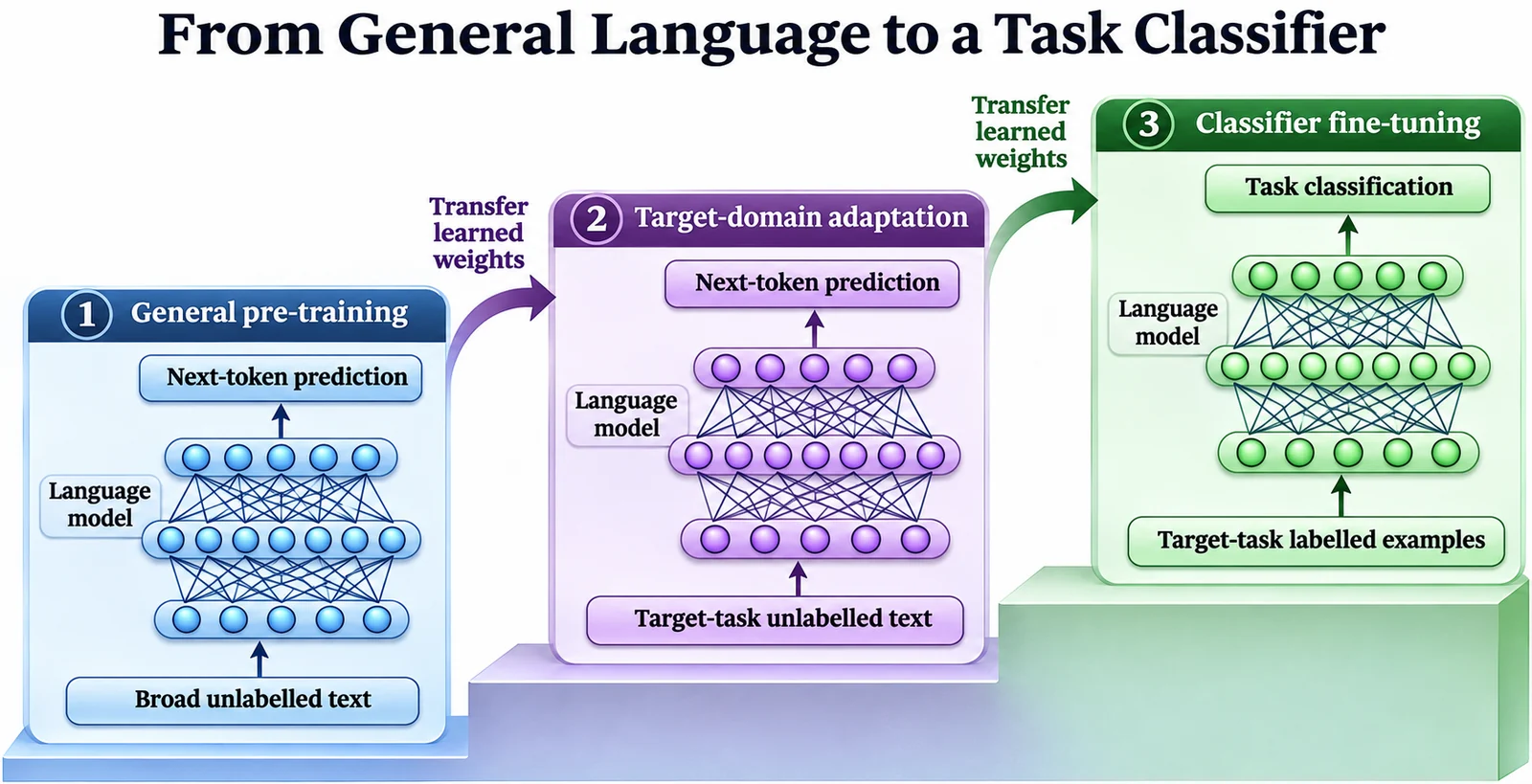
As pre-trained language models became the standard infrastructure for text tasks, fine-tuning every parameter on every downstream task turned into the default recipe, and it worked well enough to become the de-facto learning paradigm in natural language processing.[7] An early and influential version of the idea was Universal Language Model Fine-tuning, or ULMFiT, an efficient transfer learning method that can be used for any NLP task, whose training ran in three steps: pretraining a general language model on text taken from Wikipedia, fine-tuning that language model on the target task, and then fine-tuning a classifier on the target task.[8] The design made the point that a model could carry general language knowledge into a narrow job, and that the second stage could be short.
The trouble is arithmetic. Fine-tuning all the parameters of a model means storing and training a full copy for each task, and as models grew into the billions of parameters, retaining separate instances for different tasks became practically infeasible, which is what pushed research toward adapting a model while touching only a small part of it.[9] The same pressure is described from the engineering side: the parameter scale of large models makes adapting them to a specific downstream task a serious challenge on hardware with limited compute and memory, and parameter-efficient fine-tuning addresses it by adjusting the model while minimizing the extra parameters and resources required.[10][11] The field's centre of gravity thus moved from whether to fine-tune to how much of the model a fine-tuning run should be allowed to change.
That question is the subject of the sections that follow. The mechanics of the training loop, the families of parameter-efficient methods and the evidence for and against them, and the failure modes that appear when adaptation goes wrong are all taken up later. What matters here is the shape of the trajectory: a general model is built once at great expense, and each new task is met by a smaller, cheaper act of adaptation on top of it.
How it works
The mechanics: what changes during fine-tuning
Fine-tuning begins from a model whose weights already encode what it learned during pre-training. Those weights are the starting point, not the goal. The task supplies a dataset of examples with the right answers attached, and a loss function turns the model's errors on those examples into a single number that measures how wrong it currently is. Training then adjusts the weights so that number falls. The standard procedure is gradient descent: the loss is differentiated with respect to each trainable weight to show which direction would reduce it, and every weight is nudged a small step that way. Repeat over many batches of examples and the model's behaviour drifts toward the task.

What distinguishes one fine-tuning method from another is which weights are allowed to move. In full fine-tuning, every parameter is trainable, so the whole model is reshaped by the new data. The alternative is to freeze most of the network and update only part of it. Freezing means marking a set of weights as fixed: the loss still depends on them, but the gradient is never applied, so they keep their pre-trained values. In a layered network, the early layers tend to hold general features and the later layers hold more task-specific ones, which is why freezing is often applied from the bottom up. The frozen layers carried general structure; the trainable ones absorbed the particular system.
A third option sits between these: leave the pre-trained weights alone and add a small number of new trainable pieces, or select a small subset of existing parameters to update. Adapters insert tiny trainable modules between layers; prefix tuning prepends trainable vectors to the input; bias-only tuning trains just the bias terms. These are the parameter-efficient methods, and their families and trade-offs are covered later. The mechanical point is the same in each case: the gradient is computed and applied to a deliberately restricted set of parameters, and the bulk of the model stays as it was.
The choice has a cost that shows up as a failure mode. When every weight is free to move, a small task-specific dataset can pull the model far from what it knew, and general abilities can degrade. This is catastrophic forgetting, and it is a direct consequence of unrestricted updating: the same gradient steps that fit the new task overwrite representations the model relied on before. The effect has been observed in continual instruction tuning of LLMs ranging from 1b to 7b parameters, and in low-resource text classification a fully fine-tuned model on a small dataset performed no better than random chance, having memorized noise rather than learned the task.[12][5] Restricting which weights move limits how far the model can drift, which is one reason the parameter-efficient methods exist. The failure modes and their mitigations are taken up in a later section.
Fine-tuning is a controlled disturbance: the loss decides the direction, and the choice of which weights are trainable decides how much of the model is allowed to change.
Parameter-efficient fine-tuning: adapters, LoRA and friends
The starting point for every parameter-efficient method is the same: freeze the bulk of the pre-trained model and train only a small, deliberately chosen set of parameters. What separates the methods is where those trainable parameters live. One widely used way of sorting them divides the field into three groups: addition-based methods, which add new trainable pieces to the model; specification-based methods, which pick a subset of the existing parameters and train only those; and reparameterization-based methods, which rewrite the update to a weight matrix in a cheaper form.[9] The grouping is a convenience rather than a law, but it makes the design space easy to hold in mind.
Adding something small
Adapters are the clearest case of addition. A small trainable module is inserted into each transformer block, and the original weights around it stay frozen.[7] Because the adapter is narrow, it introduces few parameters, and because it sits inside the network it can reshape the representations flowing through. Prefix tuning and prompt tuning add small trainable components rather than modifying the model's own weights.[13][14] The trainable part is tiny in every case, and the frozen part does the heavy lifting.
Choosing among what is already there
Specification-based methods skip the new modules and decide which existing parameters to unfreeze. One version trains only a small selected subset of existing parameters.[15] Another version trains the normalization layers.[12][16] The same logic underlies the frozen-layer approach described earlier, where the lower layers of a network were held fixed and the upper ones retrained.
Low-rank updates
LoRA, short for Low-Rank Adaptation, belongs to the third group.[9] Rather than changing a large weight matrix directly, LoRA leaves it frozen and learns a small correction to it, factored into two thin matrices whose product has a low rank, meaning it can express only a limited set of directions of change. The number of trainable values is set by that rank, which the user chooses, so the cost of adaptation can be dialled up or down. The original weight matrix is left frozen while a low-rank correction is learned.[9][17] Variants adjust how the budget is spent: some allocate the parameter budget among weight matrices according to their importance, and some add trainable parameters incrementally during training rather than fixing them in advance.[17][18]
The claim that justifies all this machinery is that a small number of trainable parameters can be enough. Reviews of the area report that a range of these methods, despite tuning only a small fraction of a model's parameters, reach performance on a par with full-parameter fine-tuning.[9] A unified framework that re-frames the methods as modifications to specific hidden states found that design elements could be borrowed across approaches, and that new combinations tuned fewer parameters than earlier methods while matching full fine-tuning on the tasks tested.[7] That is the promise of the family: most of the model stays as pre-training left it, and a modest, targeted change does the adapting. How the methods compare in practice, and where the promise holds and fails, is covered later.
Parameter-efficient fine-tuning does not avoid changing the model; it confines the change to a small, chosen part of it.
Freezing layers: how much of a model to leave alone
The middle ground between changing everything and adding something


Full fine-tuning lets every weight move; the parameter-efficient methods covered earlier leave the pre-trained weights untouched and train a small addition or a chosen subset. Between them sits a simpler idea: keep some layers of the network fixed and train the rest. The model keeps its original architecture and its original weights, and the only decision is where the boundary between frozen and trainable falls. In a layered network the early layers tend to hold general features and the later ones more task-specific ones, so the usual choice is to freeze from the bottom up and let the top adapt.
The mechanics are the same gradient descent described earlier, applied to a smaller set of parameters. Freezing a layer means marking its weights as fixed: the loss still depends on them, the gradient is still computed through them, but no update is applied, so they keep their pre-trained values. Only the active layers receive the step. This is why the approach is often called frozen transfer learning: the knowledge in the frozen part is transferred rather than relearned, and the trainable part is fitted to the new task. The justification is that common patterns learned in the original training are general and worth keeping, while the remaining adjustable parameters can be fitted reliably from scarce data. Fixing layers also shortens training, since backpropagation need not run through the whole model.
What the materials study shows
A study of machine-learned interatomic potentials makes the trade-off concrete. These are models that predict the forces between atoms, and a foundation model trained on a wide range of chemical structures can be adapted to one specific system. The researchers took a pre-trained potential and fine-tuned it on two challenging cases, the dissociative adsorption of molecular hydrogen on copper surfaces and a ternary alloy, freezing progressively fewer layers in each variant.[4] One variant fixed everything except the final readout layers; another also allowed the product layer to vary; a third opened up the interaction parameters as well; a fourth left all layers active.
The results traced a clear curve. In the low-data regime, where models were trained on a small percentage of the available data, every frozen variant except the most restrictive one performed better than a model trained from scratch on the same data, and accuracy improved as fewer layers were frozen, peaking at the variant with four frozen layers.[4] Opening up still more layers did not help: the fully active model had similar validation errors to the four-frozen-layer version, while the frozen version trained more cheaply because it had fewer trainable parameters. The lower layers, in other words, did not benefit from further tuning and could be reused as they were. Freezing too much did hurt, though: the variant that fixed everything but the readouts was the one that fell behind.
The payoff appears in the data requirement. At 20 percent of the training set, 664 configurations, the four-frozen-layer model reached a level of accuracy on energies and forces similar to the from-scratch model trained on all 3,376 configurations. It also predicted forces on the hydrogen atoms more accurately than the from-scratch model, and its predictions of reaction barriers and surface structure agreed closely with first-principles calculations even when trained on only 10 percent of the data.[4]
How much to leave alone
The lesson is that the boundary is a tunable choice with an optimum, not a rule to be applied blindly. Freeze too little and the model is expensive to train and free to drift; freeze too much and it cannot bend to the new task. The materials study found its optimum at four frozen layers, and also found that the size of the foundation model did not significantly change the accuracy of the adapted models, though larger ones were more demanding to train.[4] A smaller base was therefore the sensible starting point.
This places frozen-layer tuning within the broader family of parameter-efficient methods, which differ mainly in where the trainable parameters sit and how many there are.[9] Freezing whole layers is the coarsest version of the idea; adapters, low-rank updates and the rest are finer-grained ways of confining the change. The same design question recurs across them, and the evidence from one domain does not automatically transfer to another. What the materials work establishes is narrower but useful: when a foundation model already holds general knowledge of a domain, the cheapest useful adaptation may be to retrain only its upper layers and leave the rest as pre-training left them.
Freezing is a dial, not a switch: the useful setting is the one that keeps general knowledge while leaving enough room to learn the task.
Research
Evidence that fine-tuning works
The case for fine-tuning rests on a simple comparison: the same model, given the same task, does better when it has been trained on examples of that task than when it has not. The clearest demonstrations put a fine-tuned model against a strong alternative and measure the gap.
Scoring student answers
Automatic scoring of written responses is a task where the language of the input matters as much as the subject matter. Students do not write like the textbooks and journals a general model was trained on, so a model that has only read published prose is being asked to judge a kind of writing it has rarely seen. In one study, GPT-3.5 was fine-tuned on six assessment tasks drawn from science education, using a diverse dataset of middle-school and high-school student responses paired with expert scores; the six tasks comprised two multi-label and four multi-class problems.[1] The comparison was against a fine-tuned BERT model trained on in-domain science corpora, which reached an average accuracy of 0.838 with a standard deviation of 0.069. The fine-tuned GPT-3.5 came out ahead by an average of 9.1 percent in automatic scoring accuracy across the six tasks, a difference reported as statistically significant, with significantly higher accuracy than BERT across all labels on the two multi-label tasks and an average increase of 10.6 percent on the four multi-class items.[1] What the result shows is narrow but pointed: when the training examples are the actual kind of text the model must judge, the model's judgements improve, and they improve over a competitor that was also fine-tuned but on different data.
Detection tasks with a right answer
Phishing URL detection offers a harder test, because the question is whether a specialised model is worth building at all when a general chat model can be instructed instead. One study set the two approaches side by side on the same test set of 1,000 samples. Prompt-engineering strategies applied to GPT-3.5-turbo and Claude 2 reached a maximum F1-score of 92.74 percent, where F1-score is a single measure balancing how often the model flags a phishing URL correctly against how often it raises false alarms. Fine-tuning a set of base models developed for text generation, among them GPT-2, Bloom, Baby LLaMA and DistilGPT-2, exclusively for the detection task pushed the peak to an F1-score of 97.29 percent and an AUC of 99.56 percent on that same test set. The fine-tuned models were base models developed primarily for text generation, and the study concludes that while prompt-engineered LLMs can achieve decent performance, they are not as effective as dedicated, task-specific LLMs.[2]
Adapting a model to a specialised domain
A third kind of evidence concerns domains with their own vocabulary and conventions, where a general model's fluency is not the same as domain competence. Chinese patent medicine instructions, the guidance sheets that accompany traditional Chinese medicine preparations, are one such domain. A study assembled a dataset of 3,906 labelled consultation records spanning seven medical specialties and used it to fine-tune the ChatGLM-6B base model, producing a model called CPMI-ChatGLM. Evaluated with BLEU, ROUGE and BARTScore, automatic measures of how closely generated text matches reference text, the model scored 0.7641 on BLEU-4, 0.8188 on ROUGE-1, 0.7738 on ROUGE-2, 0.8107 on ROUGE-L and −2.4786 on BARTScore, and in comparison experiments and human evaluation against four large language models of similar parameter scale it showed state-of-the-art performance.[19] The fine-tuning here did not make the base model larger or more generally capable; it taught a general model the conventions of a specific body of instructions.
Doing it with less data
Fine-tuning's practical value depends on how much task-specific data it demands, since in many fields each labelled example is expensive to produce. The materials-science work described earlier speaks to this directly. Using transfer learning with partially frozen weights, models fine-tuned on 10 to 20 percent of a dataset, hundreds of data points, achieved similar accuracies to models trained from scratch on thousands of datapoints, with the 20 percent model (664 configurations) showing accuracy similar to a from-scratch model trained on all 3376 configurations.[4] The pre-trained model supplied the general structure and the small task-specific set supplied the particular, which is why the data requirement fell so far. The same economy appears in the scoring study, where the fine-tuned model's advantage came from a dataset of student responses rather than from a corpus of general text.[1]
Taken together, these results describe what fine-tuning reliably buys: better performance on a defined task, often from a model smaller than the general-purpose alternative, and often from a modest set of examples. They do not settle when fine-tuning is the right choice, since a well-prompted general model can sometimes match it, a comparison taken up later.
Fine-tuning earns its place by turning general competence into task-specific accuracy, frequently with far less data than training from scratch would need.
Fine-tuning across domains: images, molecules, proteins and code
The pattern described so far belongs to language, but nothing in it depends on words. A pre-trained model learns structure from a large body of data; fine-tuning bends that structure toward a narrow job. Wherever data has structure a network can absorb, the same two-stage recipe applies, and the domains below show what changes when the data is an image, a molecule, a protein sequence or a line of code.


Images
Medical imaging is the clearest case of a domain where labelled data is scarce and expensive. A network trained on ordinary photographs has already learned to detect edges, textures and shapes, and those low-level features transfer to a scan. A study of brain tumour classification from MRI images took a pre-trained ResNet-50, added dense layers with dropout and rectified linear units after the flattened features, and passed the output to a support vector machine for the final decision, a fine-tuning strategy the authors designed for the task. On a public dataset of three tumour types, meningioma, glioma and pituitary, the fine-tuned ResNet-50 reached 99.61 percent accuracy, while a custom convolutional network built for the same job and fine-tuned the same way reached 99.35 percent.[20] What the case adds to the general picture is that fine-tuning can be more than a single act: the pre-trained network supplies features, and a separate classifier is trained on top of them, so the adaptation is split between reshaping the network and fitting a decision rule to its output.
A structured benchmark makes the broader claim for this domain. Seventeen parameter-efficient algorithms were evaluated across convolutional and transformer-based networks, on image classification and text-to-image generation, using six medical datasets of varying size, modality and complexity; across more than 700 controlled experiments the methods proved effective, with gains of up to 22 percent on discriminative and generative tasks, particularly in the low-data regimes common in medical imaging.[21] The finding matters because medical images are exactly the setting where a full fine-tuning run has little data to work with, and it shows the parameter-efficient family carrying over from text to pixels without losing its advantage.
Molecules
Designing a molecule with a desired property is a search through an astronomically large space, and the data problem is the reverse of the usual one: there are far more possible structures than anyone can make or test. A generative model can be trained on the structures that are known, but a model that reproduces the statistics of known molecules will not, on its own, produce one with a property nobody has specified to it. The adaptation here is not supervised fine-tuning on labelled examples but tuning by reward.
A recurrent neural network was first trained on a large database of known molecules, represented as text strings in a standard chemical notation, so that it learned to write plausible structures. It was then tuned with reinforcement learning, a training scheme in which the model generates candidates, each candidate is scored by a function the user defines, and the model's parameters are shifted to make high-scoring candidates more likely.[22] The scoring function can encode almost any goal. Tuned to avoid sulphur, the model produced sulphur-free structures while keeping the properties of the molecules it had learned from; tuned toward similarity to a query drug, it began generating that drug after about 100 training steps and predominately generated it after 200. Tuned toward compounds predicted to be active against a dopamine receptor, more than 95 percent of its output was predicted active, including compounds confirmed experimentally that had appeared in neither the generative model's training data nor the activity predictor.[22]
The case adds a distinct idea to the picture: fine-tuning does not require a dataset of correct answers. It requires a way to score what the model produces, and the score can be a prediction from another model, a similarity measure, or a simple rule. It also shows the hazard that comes with a learned score. In a REINFORCE baseline where the sole reward was to avoid sulphur, the model quickly learned to exploit the reward by generating sequences consisting predominantly of 'C'; including the prior likelihood in the reward, as in the 'REINFORCE + Prior' method, made this no longer a viable strategy.[22] A fine-tuning objective is only as good as the function that measures success.
Proteins
Protein sequences are strings over a small alphabet of amino acids, which makes them a natural fit for the language-model machinery. A model trained on hundreds of millions of sequences, 86 billion amino acids in all, learns representations that carry information about biological structure without ever being told what structure is. Adapting that model to a specific prediction task is then a matter of fine-tuning, and the work reports that fine-tuning produces results matching the state of the art on predicting the effect of mutations, with predictions made directly from sequence using features the model learned rather than features chosen by domain experts.[23]
The domain also shows how sharply the economics of adaptation can shift. Applying LoRA to protein language models for predicting protein-protein interactions and the symmetry of protein complexes proved competitive with traditional fine-tuning while requiring less memory and substantially fewer parameters, and for the interaction task training only the small output layer that turns representations into a prediction also remained competitive, using five orders of magnitude fewer parameters.[24] On signal peptide prediction, integrating LoRA into a protein model produced a maximum gain of 87.3 percent in a balanced classification measure for peptide types with small training samples, and an overall gain of 6.1 percent.[3] What proteins add is a caution about borrowed settings: the recommended LoRA configuration for protein data differed from the one originally proposed for text, and protein language did not admit as low a rank.[24] A method's defaults carry assumptions about the data they were tuned on.
Code
Code generation looks like language and is not quite. A program must be syntactically valid and must do what the instruction asks, so a model can produce fluent text that fails to run. A study of parameter-efficient methods for code generation across several language models and three Python datasets found the methods superior to in-context learning, where worked examples are placed in the prompt, and to retrieval-augmented generation, which supplies relevant documents at query time. The same study reported that combining these methods with quantization allowed larger models to be tuned and cut memory use substantially.[25] The case adds a task where correctness is checkable, which makes the gains from adaptation easier to trust than a score on generated prose.
Across all four domains the shape is the same: a large model absorbs general structure once, and a small, targeted stage bends it to a particular job. What varies is what counts as data, what counts as a score, and which part of the model is worth changing.
Data efficiency and the low-data regime
The reason fine-tuning can work on a few hundred examples is that most of what a model needs to know is already in its weights. Pre-training on a broad body of data leaves the model with general structure: the patterns of language, the regularities of chemical bonding, the low-level features of an image. A new task usually needs only a small adjustment on top of that structure, and the adjustment is what the task-specific examples have to supply. Training from scratch has to learn the structure and the task at once, so it needs enough examples to cover both. This is why the same dataset can be too small for one approach and sufficient for the other.
The size of the gap is easiest to see when a fine-tuned model is compared against a classical model trained on far more data. In a study of political text classification, a language model adapted through a two-stage procedure was fine-tuned on between 100 and 2,500 texts and tested on eight different tasks. Across those tasks, the adapted model performed on average 10.7 to 18.3 percentage points better than classical models built without a pre-trained starting point. The more striking comparison is one of scale: the adapted model fine-tuned on 500 texts reached performance similar to classical models trained on around 5,000 texts, roughly a tenfold reduction in the labelled data required. The advantage was not uniform: the source reports that transfer learning works particularly well on imbalanced data, where one class heavily outnumbers another.[26]
Frozen transfer learning shows the same economy in a domain where each data point is expensive. In the materials work described earlier, a pre-trained interatomic potential was adapted to two specific systems by holding most of its layers fixed and training only the upper ones. At 20 percent of the training set, 664 configurations, the adapted model reached accuracy on energies and forces similar to a model trained from scratch on all 3,376 configurations. The saving is not a marginal trim: the frozen model used a fifth of the data and was significantly more accurate on hydrogen-atom forces.[4]
The advantage is largest exactly where labelled data is scarcest, and medical imaging is the standard example. A structured benchmark evaluated 17 parameter-efficient algorithms across convolutional and transformer-based networks, on image classification and text-to-image generation, using six medical datasets of varying size, modality and complexity. Across more than 700 controlled experiments the methods proved effective, with performance gains of up to 22 percent in discriminative and generative tasks, and the source notes PEFT's particular effectiveness in the low-data regimes common in medical imaging.[21] The pattern across all three fields is the same: the smaller the dataset, the more the pre-trained starting point is worth.
There is a limit to how far the saving stretches, and it has two parts. The first is that the advantage depends on the pre-trained model having learned something relevant. A model trained on published prose carries general language, but a task whose inputs look nothing like that prose gains less from it, which is why the political study's gains varied by task rather than holding at a fixed size.[26] The second is that a small dataset constrains what can safely be trained. When the trainable portion is large, a small training set (the source used 1,000 examples) is not enough to fit it without memorizing noise, which is the failure that makes parameter-efficient methods a condition for working at all in low-resource settings rather than a convenience.[12] The data efficiency of fine-tuning is therefore real but conditional: it comes from reusing what the model already knows, and it holds only while the part being trained stays small enough for the available examples to support.
Fine-tuning trades data for prior knowledge, and the trade holds only while the model already knows something relevant and the trainable part stays small.
In practice
Parameter-efficient fine-tuning in practice
Choosing among the methods
The parameter-efficient family offers many ways to confine a fine-tuning run to a small part of a model, and the practical question is which one to pick. The answer depends on what the deployment can afford, because the methods differ less in whether they work than in what they cost. A controlled comparison makes the trade-off concrete.
Three methods were tested against a full fine-tuning baseline on low-resource versions of two text classification datasets, using a DistilBERT base model and measuring accuracy, F1 score, trainable parameter count and GPU memory.[12] LoRA delivered the highest F1 scores of the group, reaching 0.909 on the Amazon Reviews data. A representation fine-tuning strategy, which trains only the normalization layers that rescale activations between blocks, came within about 98 percent of LoRA's F1 while training only about 3 percent of the parameters, and it used the least GPU memory of the methods tested.[12] The practical reading is a frontier rather than a winner: one method buys the last few points of accuracy, another buys most of that accuracy for a small fraction of the cost.
That frontier maps onto hardware. The same study frames the choice in deployment terms, noting that a group with a single GPU may prefer the normalization-only approach for its small memory footprint, while a laboratory with a multi-GPU cluster may prefer LoRA to maximize accuracy.[12] The low-resource setting is where the comparison matters most, because a full fine-tuning run on the same small datasets failed outright, performing no better than random chance, a failure covered later. Under those conditions every parameter-efficient method tested adapted the model successfully, which makes efficiency the deciding factor rather than a secondary concern.[12]
Beyond text
The methods were developed for language models, but nothing in their design is specific to language, and the evidence extends well beyond it. In medical image analysis, a structured benchmark evaluated 17 parameter-efficient algorithms across convolutional and transformer-based networks, on image classification and text-to-image generation, using six medical datasets of varying size, modality and complexity; across more than 700 controlled experiments the methods proved effective, with gains of up to 22 percent on discriminative and generative tasks, particularly in the low-data regimes common in medical imaging.[21] A segmentation foundation model built for natural images has been adapted to land-cover classification on radar satellite imagery by freezing most of its parameters and adding lightweight adapters, a design that balanced accuracy against computational demand.[27] Protein language models, trained on hundreds of millions of amino acid sequences, have been adapted the same way: applying LoRA to predict protein-protein interactions and the symmetry of protein complexes proved competitive with traditional fine-tuning while requiring less memory and substantially fewer parameters.[24]
The pattern across these domains is consistent. A large model is trained once on a broad body of data, and each new task is met by training a small addition rather than a new model. What changes from domain to domain is which part of the model is worth adapting, and the answer is not always the same as in language. The protein work found that its recommended settings for LoRA differed from those originally proposed for text, with protein language not admitting as low a rank, which is a reminder that a method's defaults carry assumptions about the data they were tuned on.[24]
Working within limits
The reason these methods matter in practice is that they change what a small team can do. Fine-tuning the ChatGLM-6B base model for Chinese patent medicine instructions was completed with 4-bit quantization on a single consumer-grade graphics card, consuming roughly 8 GB of GPU memory, which the authors describe as accessible for most researchers to deploy locally.[19] That is a concrete measure of the barrier the methods lower: a model with billions of parameters adapted on hardware an individual can own, rather than on a cluster.
Low-data settings sharpen the same advantage. When labelled examples are scarce, the choice is not between an expensive method and a cheap one but between a method that generalizes and one that fails, since a full update on too little data can memorize noise instead of learning the task.[12] Parameter-efficient methods act as a form of regularization here, constraining what the model can learn and forcing it to adapt representations it already has. The comparison of methods above was run precisely under those conditions, and the finding that all of them succeeded where full fine-tuning collapsed is the practical case for the family.[12]
The methods differ mainly in cost, and in low-data or low-hardware settings that difference decides whether adaptation happens at all.
Choosing a fine-tuning method: the performance-efficiency trade-off
The decision in front of a practitioner
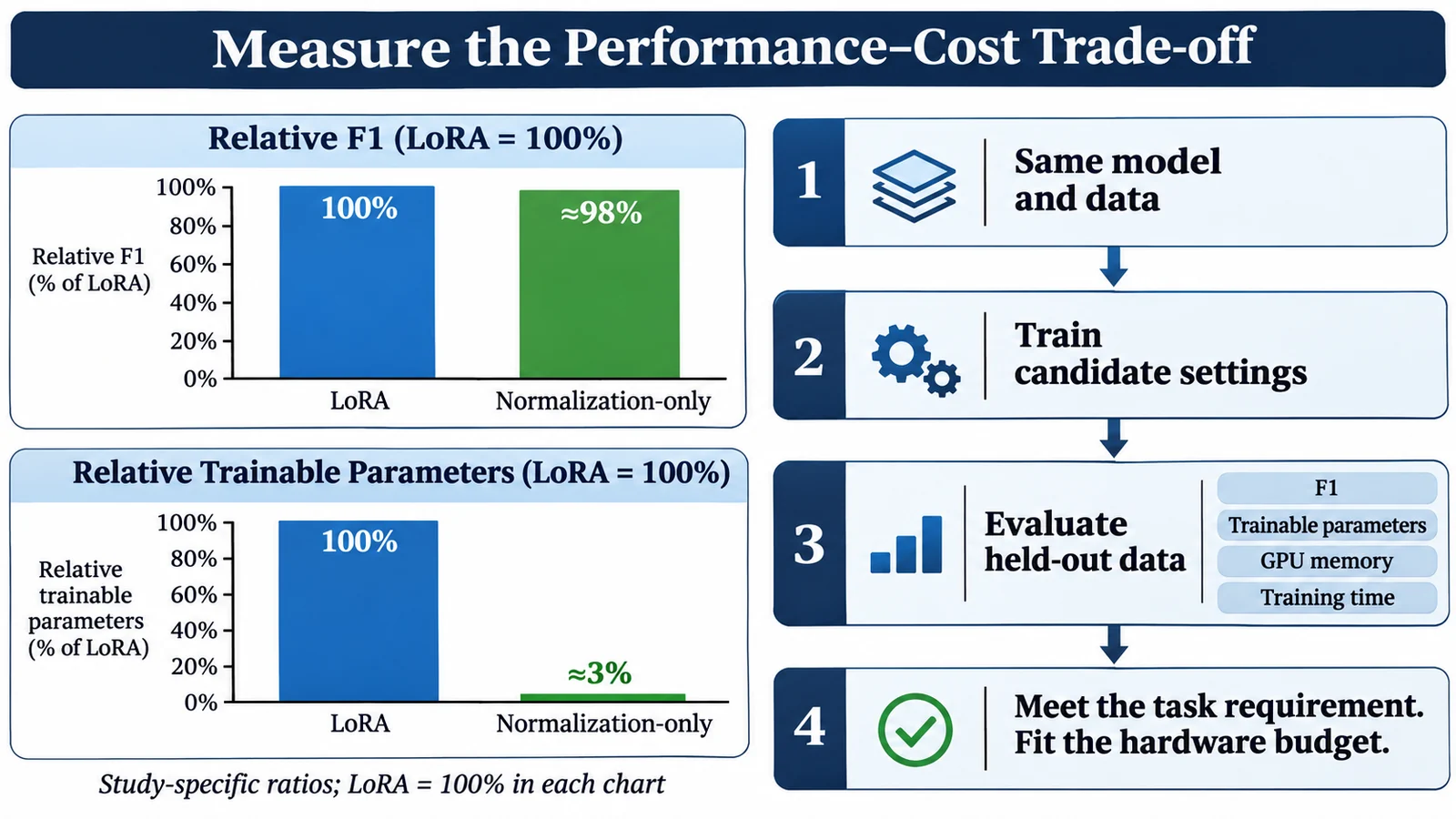
By the time a model is ready to be adapted, the question has narrowed to a practical one: which tuning strategy, run with which settings, on which hardware. The answer is rarely a single best method. It is a point on a frontier, where accuracy on one side is traded against trainable parameters, memory and training time on the other. A method that wins on one task can lose on another, and the same method can behave differently depending on how its few free choices are set.
The clearest map of that frontier comes from a controlled comparison run under deliberately scarce conditions. Three parameter-efficient methods were set against a full fine-tuning baseline on low-resource versions of two text classification datasets, using a DistilBERT base model, with accuracy, F1 score, trainable parameter count and GPU memory recorded for each.[12] Because every method faced the same data and the same model, the differences between them can be read as properties of the methods rather than of the setup.
LoRA came out on top for raw accuracy, with the highest F1 scores of the group and 0.909 on the Amazon Reviews data. A representation-tuning strategy, which trains only the normalization layers that rescale activations between blocks, reached about 98 percent of LoRA's F1 while training roughly 3 percent of the parameters and using the least GPU memory of the methods tested. The third method, which rescales activations rather than modifying weights or normalization statistics, performed well but sat slightly behind the other two.[12] The ordering is not a ranking of quality. It describes what each method buys: LoRA spends parameters and memory for the last few points of accuracy, while the normalization-only approach gives up a sliver of accuracy for a large saving in both.
Matching the method to the constraint
That trade maps directly onto what a team can afford. The same study frames the choice in deployment terms: a group with a single graphics card may prefer the normalization-only method for its small memory footprint, while a laboratory with a multi-GPU cluster may prefer LoRA to maximize accuracy. In latency-sensitive pipelines the reduced overhead of the lighter method may outweigh a small accuracy difference, whereas a high-stakes setting such as clinical text classification may justify LoRA's extra cost.[12] The reasoning is general even where the numbers are not: the right method is the one whose cost fits the budget and whose accuracy clears the bar the task sets.
The low-resource setting sharpens the decision, because there the alternative to a parameter-efficient method is not a more expensive method but failure. The full fine-tuning baseline in that comparison updated roughly 67 million parameters on 1,000 training examples and performed no better than random chance, having memorized noise instead of learning the task.[12] Every parameter-efficient method tested adapted the model successfully under the same conditions. When data are scarce, efficiency stops being a secondary concern and becomes the condition for the model working at all.
When the task changes the answer
Results from one domain do not carry over intact, and the protein language model literature shows why. Protein language models are trained on very large corpora of amino acid sequences, and adapting them to tasks such as predicting protein-protein interactions or the symmetry of protein complexes with LoRA proved competitive with traditional fine-tuning while requiring less memory and substantially fewer parameters. In one of those tasks, training only the classification head, the small output layer that turns the model's representations into a prediction, also remained competitive with full fine-tuning while using five orders of magnitude fewer parameters.[24] That is an unusually extreme point on the frontier, and it belongs to that task and that model, not to fine-tuning in general.
The same body of work shows that defaults borrowed from text can mislead. The recommended settings for LoRA in proteomics, including its rank and which attention matrices to adapt, differed from the conclusions originally drawn for natural language, and protein language did not seem to admit as low a rank as the text work had suggested.[24] A practitioner who copies a recipe from one field to another may therefore be running a configuration that was never tuned for the data in front of them.
A signal peptide study makes the same point from the other direction, comparing parameter-efficient methods against each other on a single prediction task. Signal peptides are short stretches of a protein that direct its transport within the cell, and the study integrated LoRA into ESM-2 protein models, reporting a maximum gain of 87.3 percent in the Matthews correlation coefficient, a balanced measure of classification quality, for signal peptide types with small training samples, and an overall gain of 6.1 percent. Adapter tuning, a different parameter-efficient approach, also improved on the previous state of the art, by up to 28.1 percent for types with small samples and 3.8 percent overall, while requiring far more trainable parameters than LoRA and more memory during training. Prompt tuning, which had shown strong results on many other tasks, did not reproduce that success here, possibly because the base model was too small.[3] Three methods from the same family, on the same task, produced three different verdicts, and the ranking depended on which signal peptide types were being predicted.
Settings matter as much as methods
The lesson running through these comparisons is that a method is not a fixed quantity. Its behaviour depends on hyperparameters, the settings chosen before training begins, such as how much trainable capacity to allow and where to place it. The protein work recommends testing the chosen settings against a validation set to reach maximum performance when adapting a large foundation model, rather than assuming the published defaults will hold.[24] The low-resource comparison likewise notes that its single fixed set of hyperparameters isolates the methods from one another but means the reported figures are conservative baselines rather than the ceiling each method could reach.[12]
For someone choosing a strategy, this argues for a short, disciplined experiment rather than a decision made on reputation. Run the candidate methods on a held-out slice of the actual task data, measure both the accuracy achieved and the memory and time consumed, and pick the point on that frontier that the deployment can live with. The evidence supports that procedure more firmly than it supports any single recommendation.
The best method is the one whose accuracy clears the task's bar at a cost the hardware and data allow, and that has to be measured on the task itself.
Alternatives
When fine-tuning beats prompting, and when it does not
A general model can often be steered toward a task without any training at all, by writing the instruction carefully. Prompt engineering is the practice of designing that instruction, and its variants, so the model produces the wanted behaviour from what it already knows. It is described in the sources as a less costly option for model improvement than fine-tuning.[28] The question for anyone adapting a model is therefore not whether fine-tuning works but whether it is worth doing when a well-crafted prompt might do as well.
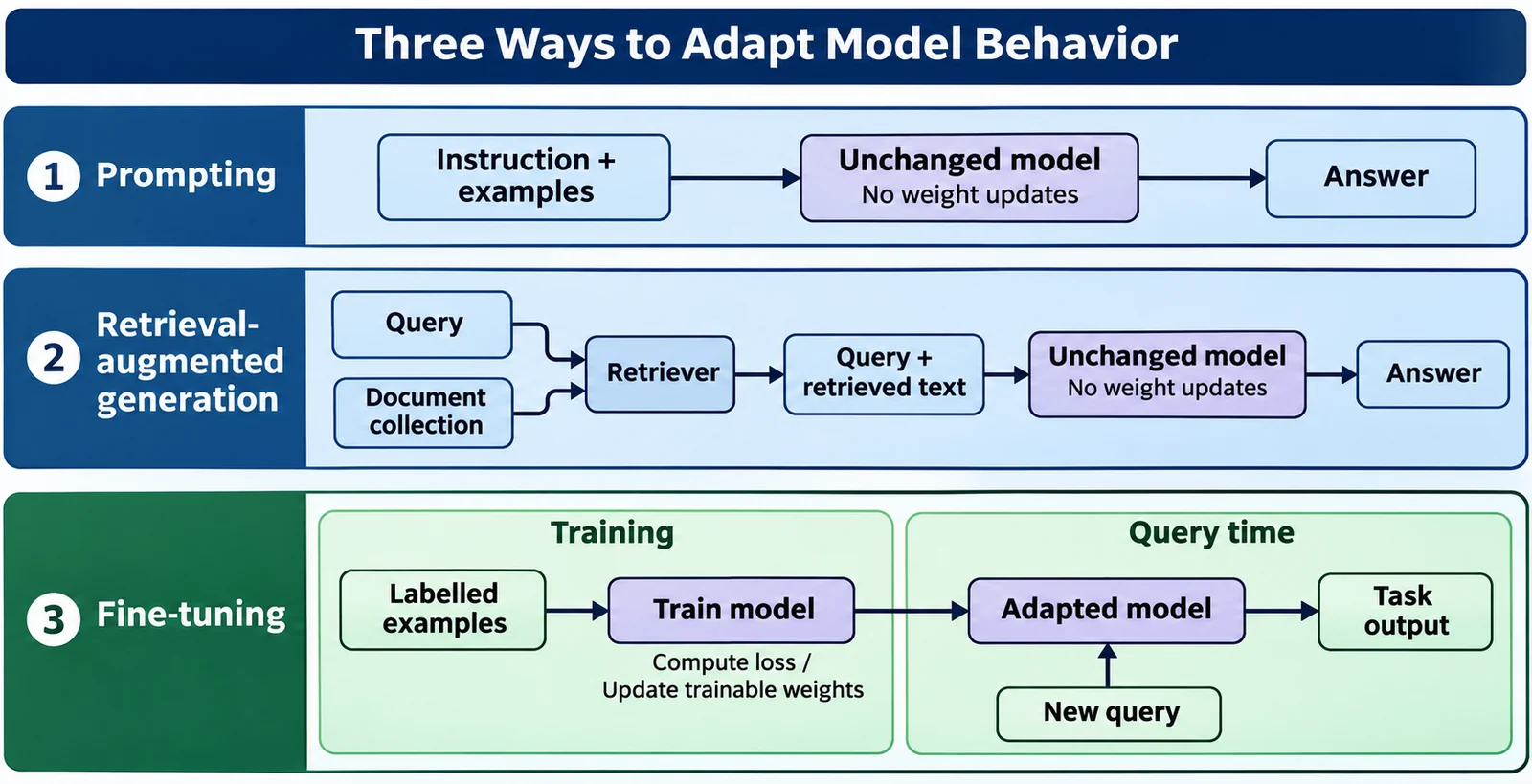
The answer depends on the task. Where the job has a definite right answer and the wrong answers are costly, dedicating a model to it has paid off. In the phishing detection comparison described earlier, prompt-engineering strategies applied to two general chat models reached a maximum F1-score of 92.74 percent on a test set of 1,000 samples, while fine-tuning base models developed for text generation exclusively for the detection task reached 97.29 percent. The fine-tuned models were base models developed primarily for text generation and trained exclusively for the detection task, and the source concludes that prompt engineering is not as effective as dedicated, task-specific LLMs.[2] A narrow, well-defined classification problem with a clear signal in the input is the kind of case where that specialisation earns its cost.
Prompting can also close the gap, or erase it, when the task is one a large model already understands in general terms. Medical question answering is the sharpest example. The techniques involved few-shot prompting, in which worked examples are placed in the instruction, chain-of-thought prompting, which asks the model to reason step by step, and self-consistency, which samples several answers and takes the majority, and each addition contributed a measurable gain.[28]
A third option sits between the two. Retrieval-augmented generation, or RAG, leaves the model's weights untouched and supplies relevant documents at the moment of the query, so the model answers from retrieved text rather than from memory. In a comparison across several model architectures, RAG-based systems outperformed domain-specific fine-tuning by an average of 17 percent on the ROUGE metric, 13 percent on BLEU and 36 percent on a coverage score the authors designed, while fine-tuning held only a modest advantage on METEOR, a measure that rewards creative phrasing.[29] The pattern is that each approach has strengths that depend on what is being measured.
What separates the cases is not a single rule but three practical conditions. Fine-tuning needs labelled examples of the task; source notes that for automatic scoring, students do not use the same language as journals or Wikipedia and contextual information is required for accurate scoring.[1] It also needs the compute to run the training, though parameter-efficient methods reduce the computational and memory costs.[9][12][24] Prompting and retrieval avoid the cost of training, and the evidence above shows prompting can match or beat fine-tuning on some tasks, such as medical question answering, while fine-tuning retained an advantage on others.[2][28] The choice is therefore a judgement about how far the task lies from what the model already knows, and how much task-specific data is on hand to close the distance.
Prompting and retrieval are the cheap first attempt; fine-tuning earns its cost when the task needs knowledge or phrasing that no instruction can supply.
Criticism
Catastrophic forgetting and other failure modes
What forgetting looks like


A model's weights are not a filing cabinet in which new material can be added without disturbing what is already there. They are a single set of numbers that together produce every behaviour the model has, and a gradient step taken to improve one behaviour changes those numbers everywhere they are used. When the training set for the new task is small, the steps needed to fit it can be large and repeated, and the model can drift far from the region of weight space in which its earlier abilities lived. The result is catastrophic forgetting: the model gains the new task and loses some of what it could do before.
The effect has been measured directly. In a study of continual instruction tuning, models from 1 billion to 7 billion parameters were trained on a sequence of instruction tasks and then re-tested on earlier ones, and forgetting was generally observed across that range, with the severity of the loss growing as model scale increased within it, a pattern also seen when the comparison was extended from 3 billion to 14 billion parameters in another model family. The finding is counterintuitive at first: the larger models started from a higher level, so they had more to lose, and the drop was correspondingly steeper.[5] Forgetting is therefore not a defect of small models that scale will cure. It is a consequence of updating weights that carry general knowledge, and it appears wherever that updating is done without protection.
Overfitting, the companion failure
A related failure appears when data are scarce rather than when training runs long. Overfitting is the case where a model learns the particular examples it was trained on, including their noise and quirks, instead of the pattern that generalizes to new ones. A large model has enormous capacity to memorize, and a small dataset gives it little else to do. The two failures compound: the same unrestricted update that fits the training examples too closely is the one that overwrites prior knowledge.
The extreme case is stark. In the low-resource text classification comparison described earlier, a full fine-tuning run updated roughly 67 million parameters on only 1,000 training examples and performed no better than random chance, having memorized the noise of the small set rather than the sentiment it was meant to detect. The failure was not a small loss of accuracy but a collapse to uselessness, which is why the parameter-efficient methods in that study were described as a prerequisite for robust generalization rather than a convenience.[12]
Forgetting without unfreezing everything
Freezing most of a model is the obvious defence, and it helps, but it does not guarantee protection. In multimodal models, which pair a language model with a vision encoder, one evaluation treated each model as an image classifier and compared it against its own vision encoder on standard image classification tasks; almost all of the fine-tuned models evaluated failed to retain the encoder's performance. Further fine-tuning of one such model showed a more complicated course: early training on an image dataset improved performance across other image datasets, apparently by sharpening the alignment between text and visual features, but as training continued the model began to hallucinate and its generalizability fell sharply, even though the image encoder itself stayed frozen.[30] The damage travelled through the parts that were still being trained and degraded behaviour in the parts that were not.
What mitigation can and cannot do
Constraining which weights move limits how far the model can drift, which is the mechanism behind much of the parameter-efficient family's robustness in low-data settings. It is a reduction of risk, not its removal. Forgetting has been observed during continual instruction tuning across model sizes, and the study that documented it also found that general instruction tuning beforehand helped alleviate forgetting during later fine-tuning, a mitigation rather than a cure.[5] The prompting comparison points the same way from the other side: a generalist model steered by prompting alone can match or beat fine-tuned models on some benchmarks, which sidesteps forgetting entirely by never changing a weight.[28] The choice between adapting a model and leaving it intact is therefore a trade between what the task gains and what the model may lose, and the balance is covered in the sections that follow.
Updating weights is the only way to teach a model something new, and it is also the only way to make it forget.
Open questions and current directions
Making adaptation cheaper still
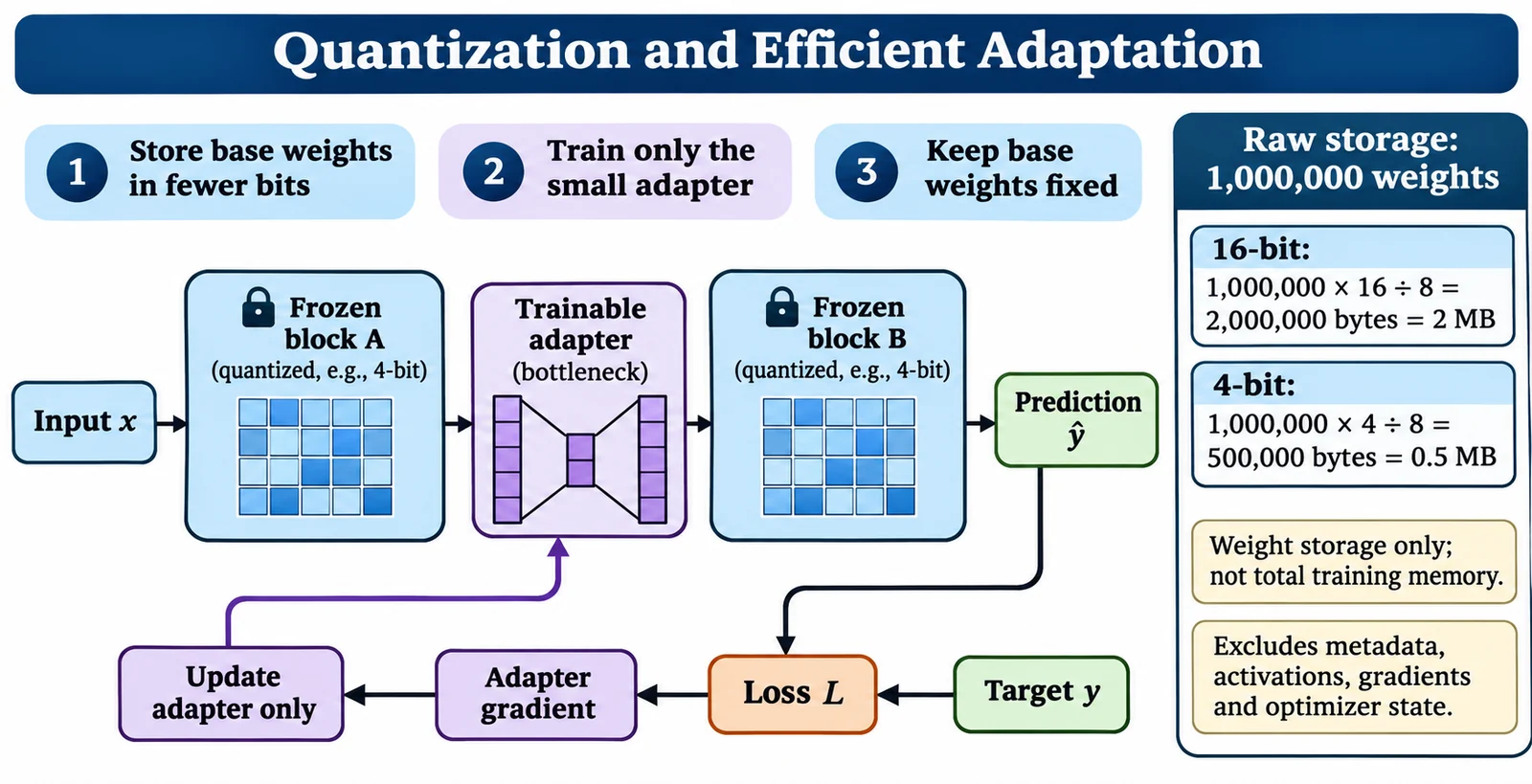
The cost of a fine-tuning run has two parts: the parameters that must be trained and the memory those parameters and their gradients occupy. Parameter-efficient methods attack the first, and a second line of work attacks the second by storing the frozen model in a compressed form. Quantization represents the model's weights in fewer bits, so a model that would not fit in a given graphics card's memory can be loaded and adapted there. The two techniques combine naturally, and the combination is where much current effort sits.
The Chinese patent medicine work described earlier ran its fine-tuning in 4-bit quantization on a single consumer card.[19] In code generation, a study of parameter-efficient methods across several language models and three Python datasets highlighted the potential for combining them with quantization to tune larger models and significantly reduce memory usage.[25] Protein language models tell the same story from a different field, where the authors single out quantized low-rank adaptation as especially promising for memory-intensive tasks such as modelling very long proteins.[24]
Searching for the configuration
Every parameter-efficient method leaves design choices to its user: which layers to adapt, how large the trainable budget should be, which of several modules to insert. These are usually settled by hand, and hand-chosen settings are unlikely to be the best available. One response is to search the space automatically. A framework called AutoPEFT defines a search space whose building blocks are several representative tuning modules, then uses multi-objective Bayesian optimization to find configurations that trade performance against cost. On GLUE and SuperGLUE, the discovered configurations outperformed existing parameter-efficient methods and were on par with or better than full fine-tuning without substantial training-efficiency costs.[31]
New domains
The methods were built for text, and a growing share of current work carries them into data with different structure. Remote sensing foundation models face dense prediction tasks such as segmentation, where methods designed for classification fall short; one framework adds a quantization adapter and a context-aware prompt module and, by updating 0.73 percent of a ConvNeXt-B model's parameters, outperforms full tuning on three scene-classification datasets.[32] Point cloud models, which represent three-dimensional shapes as sets of points, have been adapted by moving their internal tokens into a spectral representation and tuning a small adapter there, using 0.67 percent of the trainable parameters while surpassing the fully fine-tuned model on several benchmarks.[33] Graph neural networks posed a harder case, since methods transplanted directly from transformers proved less effective; an adapter designed for them outperformed full fine-tuning by 1.6 percent in the chemistry domain and 5.7 percent in biology while tuning 5 and 4 percent of parameters respectively.[34] Each domain, in other words, needed its own answer to the question of which part of the model is worth changing.
What is still not settled
Two gaps run through the field. The first is measurement. Comparing methods is difficult when studies differ in model, data and training budget, and a structured benchmark for medical imaging was assembled precisely because one was missing, evaluating 17 algorithms across six datasets and more than 700 experiments.[21] A critical review of the methods notes that the demands for fine-tuning have led to a surge in parameter-efficient methods and conducts experiments to better understand their effectiveness in parameter and memory efficiency.[35]
The second gap is expectation. Scale does not reliably deliver. In the protein work, embeddings from a 650-million-parameter model outperformed those from a 3-billion-parameter version on the interaction task, and the authors note that larger models do not guarantee better performance, suggesting that data, rather than compute, is presently the bottleneck.[24] Whether a small tuned addition matches a full update appears to depend on the task, the data and the architecture, and pinning down that dependence is the work now under way.
Key studies
| Year | Study | Sample | Design | Finding |
|---|---|---|---|---|
| 2023 | Mo et al.[13] | the Multi-WOZ 2.0 dialogue benchmark | parameter-efficient fine-tuning experiment | The method used about 4% of the parameters, improved the combined score by 4%, cut training time by 20% and saved up to 95% of storage. |
| 2023 | Dutt et al.[21] | six medical datasets of varying size and modality | over 700 controlled experiments on 17 PEFT algorithms | Parameter-efficient fine-tuning helped most in low data regimes, which are common in medical imaging, with gains reaching 22% on discriminative and generative tasks. |
| 2024 | Trad & Chehab[2] | a test set of 1000 samples | comparison of prompt engineering and fine-tuning | Prompt engineering reached an F1-score of 92.74%, while fine-tuning reached 97.29% and an AUC of 99.56%. |
| 2024 | Zeng et al.[3] | signal peptide datasets across organism groups | LoRA and adapter tuning on ESM-2 protein models | LoRA gave a maximum MCC gain of 87.3% on small samples and 6.1% overall; adapter tuning gave up to 28.1% and 3.8%. |
| 2024 | Liu et al.[19] | a new Chinese patent medicine instruction dataset | LoRA versus P-Tuning v2 on ChatGLM-6B | P-Tuning v2 beat LoRA by 33.81% on ROUGE-1, 46.93% on ROUGE-2, 33.53% on ROUGE-L and 55.09% on BLEU. |
| 2024 | Maharjan et al.[28] | four medical question-answering benchmarks | prompting platform versus fine-tuned models | The prompted Yi 34B model reached 72.6% on MedQA and 81.7% on the MMLU medical subset without specialized fine-tuning. |
| 2024 | Laurer et al.[26] | eight political text tasks with 100 to 2,500 texts | deep transfer learning with BERT-NLI | BERT-NLI performed 10.7 to 18.3 percentage points better than classical models, and 500 texts matched around 5,000. |
| 2024 | Latif & Zhai[1] | middle-school and high-school student responses on six science tasks | fine-tuned GPT-3.5 versus fine-tuned BERT for automatic scoring | GPT-3.5 scored 9.1% higher on average, with a 10.6% average gain on multi-class items. |
| 2024 | Basu et al.[16] | Meta-Dataset and ORBIT few-shot benchmarks | over 1.8k controlled experiments on PEFT for few-shot image classification | Tuning only the LayerNorm parameters, which Basu and colleagues call LN-Tune, proved an extremely strong baseline across vision transformers pre-trained with self-supervised and with supervised objectives. For self-supervised vision transformers, a set of scaling parameters for each attention matrix, called Attn-Scale, combined with a domain-residual adapter module gave state-of-the-art performance on Meta-Dataset while using about 9x fewer parameters. |
| 2025 | Nwaiwu[12] | low-resource versions of AG News and Amazon Reviews | comparison of LoRA, IA3 and ReFT against full fine-tuning | LoRA reached the highest F1-scores (0.909 on Amazon Reviews), and ReFT reached about 98% of LoRA's score with about 3% of its parameters. |
| 2025 | Lakatos et al.[29] | several language model architectures and datasets | retrieval-augmented generation versus domain-specific fine-tuning | Across the datasets tested, retrieval-augmented generation beat domain-specific fine-tuning on average by 17% in ROUGE, 13% in BLEU and 36% in a cosine similarity-based coverage score. |
| 2025 | Luo et al.[5] | language models from 1b to 7b parameters, plus Qwen-2.5-Inst from 3B to 14B | continual instruction tuning experiments | Catastrophic forgetting was generally observed, and its severity intensified as model scale increased in that range. |
See also
References
- Latif, E., & Zhai, X. (2024). Fine-tuning ChatGPT for automatic scoring. Computers and Education: Artificial Intelligence, 6, 100210. doi:10.1016/j.caeai.2024.100210
- Trad, F., & Chehab, A. (2024). Prompt Engineering or Fine-Tuning? A Case Study on Phishing Detection with Large Language Models. Machine Learning and Knowledge Extraction, 6(1), 367-384. doi:10.3390/make6010018
- Zeng, S., Wang, D., Jiang, L., & Xu, D. (2024). Parameter-efficient fine-tuning on large protein language models improves signal peptide prediction. Genome Research, 34(9), 1445-1454. doi:10.1101/gr.279132.124
- Radova, M., Stark, W. G., Allen, C. S., Maurer, R. J., & Bartók, A. P. (2025). Fine-tuning foundation models of materials interatomic potentials with frozen transfer learning. npj Computational Materials, 11(1). doi:10.1038/s41524-025-01727-x
- Luo, Y., Yang, Z., Meng, F., Li, Y., Zhou, J., & Zhang, Y. (2025). An Empirical Study of Catastrophic Forgetting in Large Language Models During Continual Fine-Tuning. IEEE Transactions on Audio, Speech and Language Processing, 33, 3776-3786. doi:10.1109/taslpro.2025.3606231
- Salakhutdinov, R., & Hinton, G. (2012). An Efficient Learning Procedure for Deep Boltzmann Machines. Neural Computation, 24(8), 1967-2006. doi:10.1162/neco_a_00311
- He, J., Zhou, C., Ma, X., Berg-Kirkpatrick, T., & Neubig, G. (2021). Towards a Unified View of Parameter-Efficient Transfer Learning. arXiv. doi:10.48550/arxiv.2110.04366 Free full text
- Reddy, R. N. (2023). Universal Language Model Fine-Tuning for Text Classification. International Journal for Research in Applied Science and Engineering Technology, 11(6), 3111-3116. doi:10.22214/ijraset.2023.53887
- Ding, N., Qin, Y., Yang, G., Wei, F., Yang, Z., Su, Y., Hu, S., Chen, Y., Chan, C. M., Chen, W., Yi, J., Zhao, W., Wang, X., Liu, Z., Zheng, H. T., Chen, J., Liu, Y., Tang, J., Li, J., & Sun, M. (2023). Parameter-efficient fine-tuning of large-scale pre-trained language models. Nature Machine Intelligence, 5(3), 220-235. doi:10.1038/s42256-023-00626-4
- Han, Z., Gao, C., Liu, J., Jeff, & Qian, Z. S. (2024). Parameter-Efficient Fine-Tuning for Large Models: A Comprehensive Survey. arXiv. doi:10.48550/arxiv.2403.14608 Free full text
- Wang, L., Chen, S., Jiang, L., Pan, S., Cai, R., Yang, S., & Yang, F. (2025). Parameter-efficient fine-tuning in large language models: a survey of methodologies. Artificial Intelligence Review, 58(8). doi:10.1007/s10462-025-11236-4
- Nwaiwu, S. (2025). Parameter-efficient fine-tuning for low-resource text classification: a comparative study of LoRA, IA3, and ReFT. Frontiers in Big Data, 8. doi:10.3389/fdata.2025.1677331
- Mo, Y., Yoo, J., & Kang, S. (2023). Parameter-Efficient Fine-Tuning Method for Task-Oriented Dialogue Systems. Mathematics, 11(14), 3048. doi:10.3390/math11143048
- Prottasha, N. J., Mahmud, A., Sobuj, M. S. I., Bhat, P., Kowsher, M., Yousefi, N., & Garibay, O. O. (2024). Parameter-efficient fine-tuning of large language models using semantic knowledge tuning. Scientific Reports, 14(1). doi:10.1038/s41598-024-75599-4
- Chen, J., Zhang, A., Shi, X., Li, M., Smola, A. J., & Yang, D. (2023). Parameter-Efficient Fine-Tuning Design Spaces. arXiv. doi:10.48550/arxiv.2301.01821 Free full text
- Basu, S., Hu, S., Massiceti, D., & Feizi, S. (2024). Strong Baselines for Parameter-Efficient Few-Shot Fine-Tuning. Proceedings of the AAAI Conference on Artificial Intelligence, 38(10), 11024-11031. doi:10.1609/aaai.v38i10.28978
- Zhang, Q., Chen, M., Bukharin, A., Nikos, K., He, P., Cheng, Y., Chen, W., & Zhao, T. (2023). AdaLoRA: Adaptive Budget Allocation for Parameter-Efficient Fine-Tuning. arXiv. doi:10.48550/arxiv.2303.10512 Free full text
- Zhang, F., Li, L., Chen, J., Jiang, Z., Wang, B., & Qian, Y. (2023). IncreLoRA: Incremental Parameter Allocation Method for Parameter-Efficient Fine-tuning. arXiv. doi:10.48550/arxiv.2308.12043 Free full text
- Liu, C., Sun, K., Zhou, Q., Duan, Y., Shu, J., Kan, H., Gu, Z., & Hu, J. (2024). CPMI-ChatGLM: parameter-efficient fine-tuning ChatGLM with Chinese patent medicine instructions. Scientific Reports, 14(1). doi:10.1038/s41598-024-56874-w
- Karim, P. J., Mahmood, S. R., & Sah, M. (2023). Brain Tumor Classification using Fine-Tuning based Deep Transfer Learning and Support Vector Machine. International Journal of Computing and Digital Systems, 13(1), 83-96. doi:10.12785/ijcds/130108
- Dutt, R., Ericsson, L., Sanchez, P., Tsaftaris, S. A., & Hospedales, T. M. (2023). Parameter-Efficient Fine-Tuning for Medical Image Analysis: The Missed Opportunity. arXiv. doi:10.48550/arxiv.2305.08252 Free full text
- Olivecrona, M., Blaschke, T., Engkvist, O., & Chen, H. (2017). Molecular de-novo design through deep reinforcement learning. Journal of Cheminformatics, 9(1). doi:10.1186/s13321-017-0235-x
- Rives, A., Meier, J., Sercu, T., Goyal, S., Lin, Z., Liu, J., Guo, D., Ott, M., Zitnick, C. L., Ma, J., & Fergus, R. (2021). Biological structure and function emerge from scaling unsupervised learning to 250 million protein sequences. Proceedings of the National Academy of Sciences, 118(15). doi:10.1073/pnas.2016239118
- Sledzieski, S., Kshirsagar, M., Baek, M., Dodhia, R., Lavista Ferres, J., & Berger, B. (2024). Democratizing protein language models with parameter-efficient fine-tuning. Proceedings of the National Academy of Sciences, 121(26). doi:10.1073/pnas.2405840121
- Weyssow, M., Zhou, X., Kim, K., Lo, D., & Sahraoui, H. (2025). Exploring Parameter-Efficient Fine-Tuning Techniques for Code Generation with Large Language Models. ACM Transactions on Software Engineering and Methodology, 34(7), 1-25. doi:10.1145/3714461
- Laurer, M., van Atteveldt, W., Casas, A., & Welbers, K. (2024). Less Annotating, More Classifying: Addressing the Data Scarcity Issue of Supervised Machine Learning with Deep Transfer Learning and BERT-NLI. Political Analysis, 32(1), 84-100. doi:10.1017/pan.2023.20
- Pu, X., Jia, H., Zheng, L., Wang, F., & Xu, F. (2025). ClassWise-SAM-Adapter: Parameter-Efficient Fine-Tuning Adapts Segment Anything to SAR Domain for Semantic Segmentation. IEEE Journal of Selected Topics in Applied Earth Observations and Remote Sensing, 18, 4791-4804. doi:10.1109/jstars.2025.3532690
- Maharjan, J., Garikipati, A., Singh, N. P., Cyrus, L., Sharma, M., Ciobanu, M., Barnes, G., Thapa, R., Mao, Q., & Das, R. (2024). OpenMedLM: prompt engineering can out-perform fine-tuning in medical question-answering with open-source large language models. Scientific Reports, 14(1). doi:10.1038/s41598-024-64827-6
- Lakatos, R., Pollner, P., Hajdu, A., & Joó, T. (2025). Investigating the Performance of Retrieval-Augmented Generation and Domain-Specific Fine-Tuning for the Development of AI-Driven Knowledge-Based Systems. Machine Learning and Knowledge Extraction, 7(1), 15. doi:10.3390/make7010015
- Zhai, Y., Tong, S., Xiao, L., Cai, M., Qu, Q., Lee, Y. J., & Ma, Y. (2023). Investigating the Catastrophic Forgetting in Multimodal Large Language Models. arXiv. doi:10.48550/arxiv.2309.10313 Free full text
- Zhou, H., Wan, X., Vulić, I., & Korhonen, A. (2024). AutoPEFT : Automatic Configuration Search for Parameter-Efficient Fine-Tuning. Transactions of the Association for Computational Linguistics, 12, 525-542. doi:10.1162/tacl_a_00662
- Dong, Z., Gu, Y., & Liu, T. (2024). UPetu: A Unified Parameter-Efficient Fine-Tuning Framework for Remote Sensing Foundation Model. IEEE Transactions on Geoscience and Remote Sensing, 62, 1-13. doi:10.1109/tgrs.2024.3382734
- Liang, D., Feng, T., Zhou, X., Zhang, Y., Zou, Z., & Bai, X. (2025). Parameter-Efficient Fine-Tuning in Spectral Domain for Point Cloud Learning. IEEE Transactions on Pattern Analysis and Machine Intelligence, 47(12), 10949-10966. doi:10.1109/tpami.2025.3594749
- Li, S., Han, X., & Bai, J. (2024). AdapterGNN: Parameter-Efficient Fine-Tuning Improves Generalization in GNNs. Proceedings of the AAAI Conference on Artificial Intelligence, 38(12), 13600-13608. doi:10.1609/aaai.v38i12.29264
- Xu, L., Xie, H., Qin, S. J., Tao, X., & Wang, F. L. (2026). Parameter-Efficient Fine-Tuning Methods for Pretrained Language Models: A Critical Review and Assessment. IEEE Transactions on Pattern Analysis and Machine Intelligence, 48(6), 6107-6126. doi:10.1109/tpami.2026.3657354
Cite this page: Atlas Nova editors. (2026). Fine-tuning (machine learning). Atlas Nova. https://velocer.io/atlas/fine-tuning-models/