Method · Language models
Direct preference optimization
Preference optimization method
Direct preference optimization is a fine-tuning method: a way of adjusting the weights of a model that has already been trained, so that it becomes more likely to produce outputs of a kind someone has said they prefer.
The adjustment is driven by examples of the form "for this input, this output is better than that one." The model is nudged toward the better output and away from the worse one, and it learns the preference from the contrast between the two rather than from a description of what makes an output good. The name is usually shortened to DPO.
Key facts
| 36% | Clinical reasoning accuracy for Llama3 after DPO, up from 28% after SFT (Savage et al., 2025)[1] |
|---|---|
| 86.13% | MiniGPT-4 POPE accuracy after hallucination-aware DPO, up from 51.13% (Zhao et al., 2023)[2] |
| 56 | Unseen protein targets on which CycDiff-DPO was benchmarked for permeability gains (Sun et al., 2026)[3] |
| 0.0086% | Share of trainable parameters used by RoPO's rotational weight updates (Yang et al., 2024)[4] |
Overview
Direct preference optimization
A concrete case makes the shape of the data clear. Suppose a chatbot is given a question and produces two candidate answers. A person reads both and marks one as the better reply: perhaps it addresses the question directly, while the other drifts or hedges. That judgement is the entire training signal. The pair of answers, one chosen and one rejected, is what the method consumes. Nothing needs to be written down about why the chosen answer was better, and no separate scoring machinery has to be built to recognise good answers in general. The preference is recorded once, as a comparison, and the model is fitted to it.


What the fitting does is raise the likelihood of the preferred output and lower the likelihood of the rejected one, measured against a fixed copy of the model as it stood before tuning. That fixed copy is called the reference model, and it acts as an anchor: the tuned model is allowed to move, but the training objective penalises it for drifting too far from where it started. The reason for the anchor is that a model told only to make some outputs more likely will happily exaggerate, pushing its probabilities toward whatever satisfies the comparison while losing the broader behaviour it had before. Holding it near the reference keeps the change local. The method therefore reshapes preferences on top of existing competence rather than replacing that competence.
The practical appeal is that this is a single supervised-style training step on a fixed dataset of comparisons. The older route to the same goal, reinforcement learning from human feedback, is a longer pipeline: human comparisons are used to train a separate reward model, and that reward model then drives a reinforcement learning loop that updates the language model. DPO was derived by showing that a particular version of that pipeline, the one where feedback consists of people choosing between two generated responses, optimises the same objective as a supervised fine-tuning task.[5] The reward model and the reinforcement learning loop drop out, and what remains is a loss computed on preference pairs. Prior work describes DPO as an offline alternative to reinforcement learning from human feedback that offers improvements in stability and scalability while maintaining competitive performance.[6] The word offline matters: training runs over a collected set of comparisons, not over responses the model generates and has judged during training.
That stability claim is worth taking literally rather than as a slogan. A reinforcement learning loop has moving parts that interact: the reward model, the policy being trained, and the sampling that feeds one to the other. Each can misbehave, and the failure modes compound. DPO removes the loop, so the training signal is fixed before training begins and the optimisation is the ordinary kind that fits a model to a dataset. Fewer moving parts means fewer ways for a run to go wrong, and results are easier to reproduce.
The method has since spread well beyond the setting it was designed for. It has been used to tune a protein design model so that the sequences it proposes are less visible to the immune system, with the role of human judgement played by a predictor of which protein fragments get displayed on a cell's surface.[7] It has been applied to clinical language tasks, where the question of when the extra step is worth its cost has been tested directly.[1] Those applications, and the mechanics of how preference pairs are constructed and weighted, are taken up later.
DPO turns pairwise judgements into a training signal directly, raising the preferred output and lowering the rejected one while staying close to the model it started from.
History
From human ratings to a training signal
The problem DPO was built to solve is not the shortage of human judgements but the awkwardness of using them. The standard route, reinforcement learning from human feedback (RLHF), turns a collection of comparisons into a reward model: a second network trained to score any response the way the human raters would have scored it. That scorer then drives a reinforcement learning loop, which generates responses, reads their rewards, and updates the language model to earn higher ones. The loop is where the trouble lives. The reward model is an approximation, the policy being trained keeps shifting, and the sampling that connects them changes as the policy changes, so errors in one part feed into the others. Tuning a model this way can be difficult in practice, which is what motivated a simpler route for getting preferences into a model.[5]
The derivation behind DPO is a statement about what that pipeline is actually doing. For the version of RLHF in which feedback consists of a person choosing a preferred response from two generated ones, the authors showed that this setting optimises the same objective as a supervised fine-tuning task they called direct preference optimization.[5] In other words, the reward model and the reinforcement learning loop are not load-bearing: the same optimum can be reached by fitting the model directly to the comparisons with an ordinary loss. The pipeline collapses into one training step on a fixed dataset, and the separate scorer disappears because the model itself comes to encode the preference.
The lineage matters for understanding what was kept and what was dropped. RLHF then relies on a reinforcement learning training step, typically using proximal policy optimization (PPO).[7] Later work treats the two families as distinct: offline methods such as DPO, which optimise directly on preference data, emerged as attractive alternatives to online PPO-based RLHF, offering improvements in stability and scalability while maintaining competitive performance.[6] The comparison is not between a good method and a bad one but between an online loop and an offline fit, with the trade-offs that follow from that difference.
A review of the method's literature frames DPO as an RL-free alternative to reinforcement learning from human feedback and organises the work that followed around its theoretical analyses, its variants, the preference datasets it consumes, and its applications.[8] That framing is a fair picture of how the idea developed: a derivation showing an equivalence, then a family of methods that keep the direct-on-preferences structure while changing some part of it. The variants differ in what they adjust, whether the anchoring to the original model, the treatment of individual tokens, or the handling of data quality, and those adjustments are covered later.
What the derivation bought, in plain terms, is a change in what counts as the hard part. In RLHF the difficulty is spread across building a reliable reward model and keeping a reinforcement learning run stable. In DPO the difficulty moves to the data: the quality and coverage of the comparison pairs, and the choice of how tightly the tuned model is held to its starting point. That shift explains why so much subsequent work concerns the construction and filtering of preference pairs rather than the optimiser. It also explains why the method transfers so readily to settings where a person is not doing the comparing, since any reliable scorer can stand in for the human rater and produce the pairs.
The equivalence is worth stating carefully, because it is a statement about objectives under stated conditions, not a guarantee that two training runs will land in the same place. The derivation shows that a particular RLHF setting and a particular supervised task share an optimum; it does not say the two are equally easy to optimise, equally sample-efficient, or equally robust to bad data. Those questions are separate, and they are the subject of the comparisons taken up later. What the derivation establishes is narrower and more useful: that the reward model is a detour rather than a necessity, and that preferences can be fed to a model as a supervised problem.
DPO's founding result is an equivalence: for pairwise human choices, the RLHF objective and a direct supervised objective share an optimum, so the reward model and the RL loop can be dropped.
How it works
How the preference pairs are built and used
A preference pair has three parts, and the first is easy to overlook. There is a prompt, the input the model is asked to respond to; then a chosen response, the one a judge preferred; and a rejected response, the one it did not. The prompt is what makes the comparison meaningful, because a judgement about two answers is only informative relative to the question they were answering. In the clinical comparison taken up later, the prompts are clinical tasks and the responses are the model's attempts at them.[1] In a protein design setting, the prompt is not text at all but a backbone structure, and the responses are amino acid sequences proposed for it.[7] The same three-part shape holds in both cases, which is part of why the method travels.
The pair is used by computing, for each of the two responses, how likely the model considers it under the prompt. Training then works on the difference between those two likelihoods. The loss is arranged so that the gap between the chosen and rejected likelihoods is widened: the chosen response is pushed up and the rejected one is pushed down, and the quantity being optimised is the margin between them rather than either likelihood on its own. This is the mechanical heart of the method, and it explains why the rejected response is not decoration. A model trained only on good examples is being told what to say; a model trained on a pair is being told what to say rather than something else, and the contrast is where the information lives.
That contrast is the reason the method can do something imitation cannot. Supervised fine-tuning, the conventional alternative, supplies prompts alongside desirable reference responses and adjusts the weights to make those responses more likely.[1] It is, in effect, training the model to mimic. The difficulty is that many different responses are acceptable and only some are shown, so the model learns to reproduce the examples without learning what distinguishes them from the near-misses it will actually produce. A pair supplies the near-miss directly. The rejected response is typically plausible, often fluent, and wrong in some specific way, and the training signal is precisely the instruction to separate it from its better sibling. Work comparing the two techniques attributes DPO's advantage on harder tasks to this: because it is trained with both positive and negative examples, the contrast lets the model recognise more complex patterns than word association alone would support.[1]
The anchor and the dial
Two pieces of machinery shape how far this pushing is allowed to go. The first is the reference model, a frozen copy of the model as it stood before preference tuning. The loss does not compare the tuned model's likelihoods to each other in the abstract; it compares the tuned model's ratio of chosen to rejected likelihood against the same ratio under the reference. A model that merely raises the chosen response's probability has not necessarily improved the margin, because it may have raised the rejected one too. Measuring against the frozen copy keeps the target relative: what matters is the shift in preference, not raw confidence.
The second is beta, a parameter that controls how far the tuned model is permitted to steer from the original. It appears in the loss as a coefficient on the divergence between the tuned and reference models, and its role is a trade-off rather than a setting with one right answer. A small beta lets the model move freely toward the preferences, which risks losing the broad competence it started with; a large beta holds it close, which risks learning too little from the pairs. The parameter has been analysed directly, with the finding that the best value varies with how informative the pairwise data is, which is why one line of work calibrates beta dynamically at the batch level rather than fixing it for the whole run.[9] A separate proposal modulates beta through two feedback loops, one responding to uncertainty in a batch and one tracking drift from the reference policy over time.[10] Both are responses to the same underlying fact: beta is the dial that decides how much of the original model survives the tuning.
The reference model also explains a practical convention. Because the anchor is the model before tuning, and because preference data is usually scarce relative to pretraining data, DPO is typically applied to a model that has already undergone supervised fine-tuning rather than to a raw pretrained one.[1] The supervised stage installs the basic behaviour; the preference stage then sharpens it against the comparisons. Running preference tuning on a model that has not learned the task gives the anchor nothing worth preserving.
What the pairs must contain
Since the signal is the contrast, the quality of the pairs is not a detail but the main input to whether training helps. A pair whose two responses are nearly identical carries almost no information, because there is little for the margin to separate. A pair where the rejected response is obviously bad teaches something shallow. The most useful pairs sit where the two responses are close enough that the judgement reflects something real about quality. This is why the construction of pairs, and the filtering of them, occupies so much of the work built on the method, and why the failure modes that follow from bad pairs are treated separately later.
The judge that produces the pair need not be a person. Any reliable scorer can rank two candidate responses and designate the better one, and the training proceeds identically. That substitution is what allows the method to reach domains where human comparison would be slow, expensive or impossible, and it is the subject of the applications covered in a later section.
A preference pair is a prompt plus a chosen and a rejected response; the loss widens the margin between them, measured against a frozen reference model and scaled by beta.
Research
Evidence from language models and clinical tasks
A controlled comparison in medicine
The clearest test of when the extra step pays off comes from clinical medicine, where the tasks are varied enough to separate what DPO can do from what it cannot. The question was whether preference tuning adds anything over ordinary supervised fine-tuning, and if so, on which kinds of task. Two open models, Llama3 8B and Mistral 7B v2, were put through four core clinical language tasks: text classification, clinical reasoning, text summarization, and clinical triage.[1] Each model was tested as it came, then after supervised fine-tuning alone, then after DPO applied on top of that. Holding the models and the tasks fixed while changing only the tuning method is what makes the comparison informative: any difference in outcome can be attributed to the method rather than to the model or the data.
The pattern that emerged was consistent across tasks and split cleanly along a line between simple and complex. Clinical reasoning accuracy, the share of reasoning questions answered correctly, rose from 7% and 22% with the two base models to 28% and 33% after supervised fine-tuning, and then to 36% and 40% after DPO. Summarization quality, graded on a five-point Likert scale, climbed in the same order, from 4.11 and 3.93 at baseline through 4.21 and 3.98 after supervised tuning to 4.34 and 4.08 after DPO. Provider triage showed a large movement: the F1-score went from 0.55 and 0.49 at baseline to 0.58 and 0.52 after supervised tuning, and then to 0.74 and 0.66 after DPO, while urgency triage F1 showed mixed results (0.81 and 0.88 at baseline, 0.79 and 0.87 after SFT, and 0.91 and 0.85 after DPO).[1] In each of these, the preference stage added something the supervised stage had not.
Text classification behaved differently, and the contrast is the point. Its F1-scores rose from 0.63 and 0.73 at baseline to 0.98 and 0.97 after supervised fine-tuning, and then barely moved under DPO, to 0.95 and 0.97.[1] Once the supervised stage had taught the model to attach labels to clear textual cues, the preference stage had almost nothing left to add. The explanation offered is that supervised fine-tuning strengthens simple word-association reasoning, which is enough when the criteria are well defined, such as recognising the markers of a urinary tract infection; DPO, trained on both positive and negative examples, lets the model pick up more complex patterns, which is what tasks like triage and summarization require.[1] The split is not about difficulty in the abstract but about whether the task can be solved by matching cues or demands weighing competing considerations.
The gain is not free. DPO fine-tuning required roughly two to three times the compute of supervised fine-tuning alone in this comparison.[1] That figure reframes the decision. For a task the supervised stage already solves, the extra cost buys nothing measurable; for reasoning, summarization and triage, it buys a substantial improvement. The practical rule the results suggest is to reach for the preference stage when the task involves judgement rather than lookup, and to accept the higher cost as the price of that judgement.
Preference tuning where the data is thin
Two further results show the method working under conditions quite unlike a well-resourced English-language benchmark. The first concerns a language with few resources. Kazakh lacks the large corpora and preprocessing tools that mainstream alignment pipelines assume, so a team built a 1.94-billion-parameter model from scratch on a cleaned, mixed-domain Kazakh corpus, with a tokenizer designed for the language's agglutinative morphology, its mixed scripts and its diacritics.[11] The model was trained in stages, first by causal language modeling and then by instruction tuning, and DPO was applied last to refine alignment. Because human preference pairs in Kazakh are scarce and noisy, the DPO step was extended with contrastive and entropy-based regularization to keep training stable, and it drew on two sources of pairs: a crowd-sourced set of human comparisons and an automatically generated alternative that repurposes existing instruction data to avoid the cost of fresh annotation. Qualitative and task-specific assessments found that the targeted monolingual training and this DPO variant markedly improved factuality, coherence and cultural fidelity over instruction-only and multilingual counterparts.[11]
What makes this case instructive is the substitution at its centre. The method's signal is a comparison, and a comparison can be manufactured from data that already exists rather than collected from people. The automatically generated pairs are weaker than human judgements, which is why the training needed regularization to cope with the noise, but they are enough to move the model. The same logic explains why the method travels to languages and domains where a large pool of annotators is not available: the bottleneck is a reliable way to rank two candidate outputs, and that ranking can come from a person, a crowd, or a rule.
The second result concerns a failure mode rather than a language. Multimodal models, which take an image and produce text about it, are prone to hallucination: describing content that is not in the picture, or fabricating it outright. One approach reframes the problem as a choice between two responses to the same image, one accurate and one hallucinatory, and trains the model to prefer the accurate one, an application called Hallucination-Aware Direct Preference Optimization. The construction of the pairs was treated as its own problem, with a pipeline built to produce positive and negative examples that are consistent in style so that the only thing distinguishing them is factual grounding. Applied to three mainstream multimodal models, the method reduced hallucination and improved generalization; on MiniGPT-4, accuracy on the POPE benchmark rose from 51.13% to 86.13%, and the MME score from 932.00 to 1326.46.[2]
The size of that jump is worth reading carefully: the method reduced hallucination and improved generalization on MiniGPT-4, with POPE accuracy rising from 51.13% to 86.13% and the MME score from 932.00 to 1326.46.[2] The preference pairs did not teach the model to see; they taught it to choose among the descriptions it could already generate. That is the same shape as the clinical result, where the preference stage sharpened behaviour the supervised stage had installed rather than installing new capability. In both settings the method works on the margin between two plausible outputs, and its leverage depends on that margin being real.
Across clinical tasks, a low-resource language and multimodal hallucination, DPO improved outcomes that depend on judgement between plausible alternatives, while adding little where simple cue-matching already sufficed, and at a real cost in compute.
In practice
Beyond chatbots: proteins, macrocycles and images
The judge need not be a person
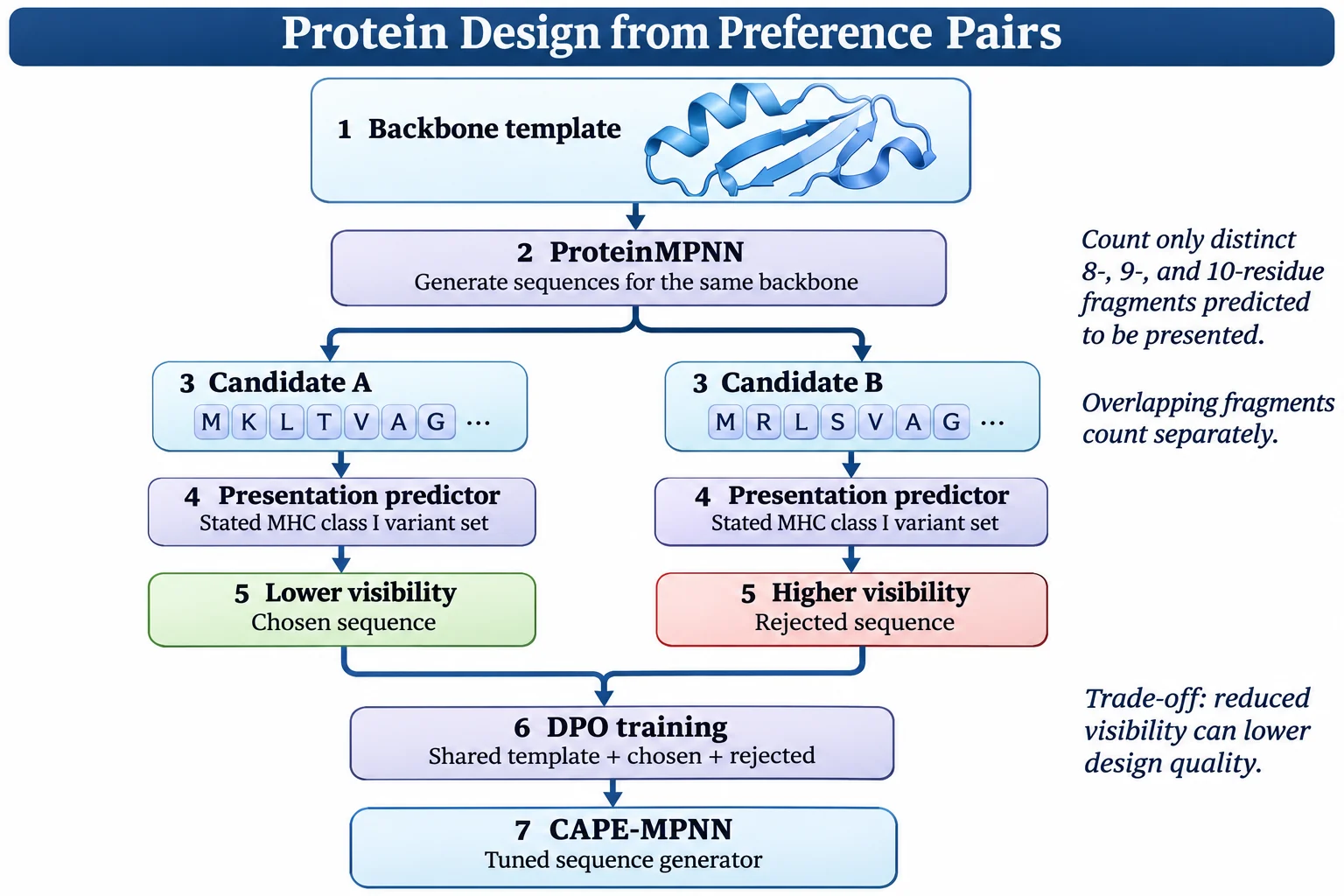
The clinical and language results rest on a judge who reads two responses and says which is better. Nothing in the machinery requires that judge to be human. The loss only needs a prompt, two candidate outputs, and a verdict on which one is preferred; any reliable scorer can supply the verdict, and training then proceeds exactly as before. This substitution is what carries the method into domains where asking people would be slow, expensive or simply impossible, and it changes what the method is for. In text, preference tuning usually sharpens a behaviour the model already has. In molecular design, the scorer encodes a property that the generative model was never trained to optimise, so the preference signal supplies information the base model lacked.
Protein design is the clearest case. ProteinMPNN is a message-passing neural network that takes a desired three-dimensional protein backbone, called a template, and predicts amino acid sequences expected to fold into that geometry.[7] Its decoder generates residues one at a time in an arbitrary order, much as a language model generates tokens, which is why language-model fine-tuning techniques transfer to it at all. The property a designer may want to suppress is immune visibility. Cells display short fragments of the proteins they express, mostly eight to ten amino acids long, on their surface in complex with MHC Class I proteins, where cytotoxic T lymphocytes inspect them; a therapeutic protein expressed inside a cell that presents many such fragments risks being attacked. Visibility can be counted: the number of distinct 8-, 9- and 10-mers in a sequence that a predictor judges likely to be presented, with overlaps counted separately, gives an absolute visibility score for a stated set of MHC variants.[7]
The predictor plays the role the human rater plays in chatbot tuning. Sequences generated for a template are scored for predicted presentation, the less visible one becomes the chosen member of a pair and the more visible one the rejected member, and DPO adjusts the model's weights to favour the first kind. Applied this way, the tuned model, named CAPE-MPNN, produced designs with reduced visibility while keeping the intended structure.[7] The trade-off is the interesting part. Across checkpoints tuned with different settings, visibility reduction and design quality pulled against each other: the base model's designs were high quality but about as visible as the natural template, and the more visibility fell, the lower the predicted quality. For one target, GB1 of Staphylococcus aureus (PDB: 2QMT), tuned checkpoints produced candidates with predicted visibility of zero while retaining a predicted TM-score above 90 percent; more generally, the ProteinMPNN base model regularly generated candidates with over half the template's visibility and never generated a zero-visibility design.[7]
That pattern is a general feature of tuning against a predictor, not a quirk of proteins. The predictor defines a direction, and the model moves in it until it runs out of room, because the property being optimised is not the only thing that matters. A sequence with no predicted presentation is useless if it no longer folds. The anchor to the reference model and the beta dial, covered earlier, are what keep the movement from going too far, and the protein results show the shape of what happens when the dial is set loosely.
A second protein result shows the same machinery pointed at a different property, and at real measurements rather than predictions. Generative models trained on unlabeled protein data learn biological regularities without being told which ones matter, and that leaves a gap when a specific function is wanted. One line of work describes this as an alignment gap and closes it with DPO, using experimental stability measurements to decide which of two sequences for the same backbone is preferred. The resulting model, ProteinDPO, was the first structure-conditioned language model preference-optimised to experimental data; it achieved competitive stability prediction and consistently outperformed both the unsupervised and fine-tuned versions of the model. It also predicted absolute stability for large proteins and binding affinity for multi-chain complexes, domains outside its training data, which suggests the tuning taught something general about the biophysics rather than memorising the pairs.[12]
Macrocycles and the permeability problem
Macrocyclic peptides sit between small-molecule drugs and large biologics: large enough to engage flat protein-protein interfaces that small molecules struggle with, constrained enough to bind selectively and resist degradation.[3] Their weakness is membrane permeability, which limits both access to targets inside the cell and oral dosing. Structure-based generative methods for cyclic peptides have concentrated on binding affinity and structural validity, leaving permeability out, and conditioning a generator directly on permeability would require paired structure-permeability data that is scarce for these molecules.[3]
The way around the missing data is the same substitution as before. A pretrained diffusion model generates candidate macrocycles for a target, a predictor of Caco-2 permeability ranks them, and the ranking yields winner-loser pairs. The framework, CycDiff-DPO, then applies a diffusion form of DPO to shift the generative distribution toward the more permeable candidates while keeping binding competence. Benchmarked across 56 unseen protein targets, the designs showed higher predicted permeability on multiple independent predictors and on an orthogonal assay, alongside the most favorable Rosetta interface energies among all methods tested across peptide-length categories and sampling depths, and stereochemical quality comparable to baseline methods. The generated sequences were enriched in leucine and alanine, and the designs formed more hydrophobic contacts at the binding interface with a modest reduction in hydrogen bonds, a shift toward hydrophobically driven binding consistent with reduced polarity. Case studies on two intracellular targets found that top designs retained the key hot-spot contacts and stable bound poses in molecular dynamics simulations.[3]
Two cautions belong with this result, and both follow from where the signal came from. The permeability gains rest entirely on computational predictors, though the work supports them with several independent lines of evidence and notes that experimental measurement of the top designs remains the necessary next step. And the preference signal contained nothing about binding, yet binding metrics held steady, which the authors attribute partly to a reconstruction regularizer and partly to the fact that the hydrophobic residues permeability optimisation favours also pack well at the interface.[3] When the property being optimised happens to point the same way as the property being preserved, the trade-off is mild; when it does not, as in the protein visibility case, it is not.
Images and reports
The same pattern appears wherever a quality judgement can be automated. Super-resolution models reconstruct a high-resolution image from a low-resolution one, and a generative adversarial network called ESRGAN produces sharp results that nonetheless often fail to recover local detail, leaving blurry or unnatural artifacts that people do not prefer. Adding a DPO loss to the ESRGAN generator produced higher perceptual quality and higher human preference than ESRGAN and other ESRGAN variants; on the BSD100 and Set14 benchmarks the method lowered PieAPP and NIQE scores and raised PSNR relative to ESRGAN.[13] In radiology, a vision-language model writing chest X-ray reports sometimes hallucinates prior exams that were never performed, wasting clinician time. Preference tuning against that specific unwanted behaviour reduced the lines hallucinating prior exams by a factor of 3.2 to 4.8 while holding clinical accuracy metrics steady.[14]
What unites these cases is that the preference signal is narrow and targeted. The pairs do not describe good radiology reporting in general; they contrast a report that invents a prior exam with one that does not. The model is pushed away from one specific failure while everything else is held in place by the anchor. That is the method's characteristic strength outside conversation, and also its limit: it can suppress a named behaviour or push toward a measurable property, but it can only be as good as the scorer that ranks the pairs, and it will trade away whatever the scorer does not measure.
Where a predictor can rank two candidate outputs, DPO tunes a generative model toward that predictor's notion of better, at the cost of whatever the predictor does not see.
Alternatives
How DPO compares with supervised fine-tuning and RLHF
Three ways to change a model
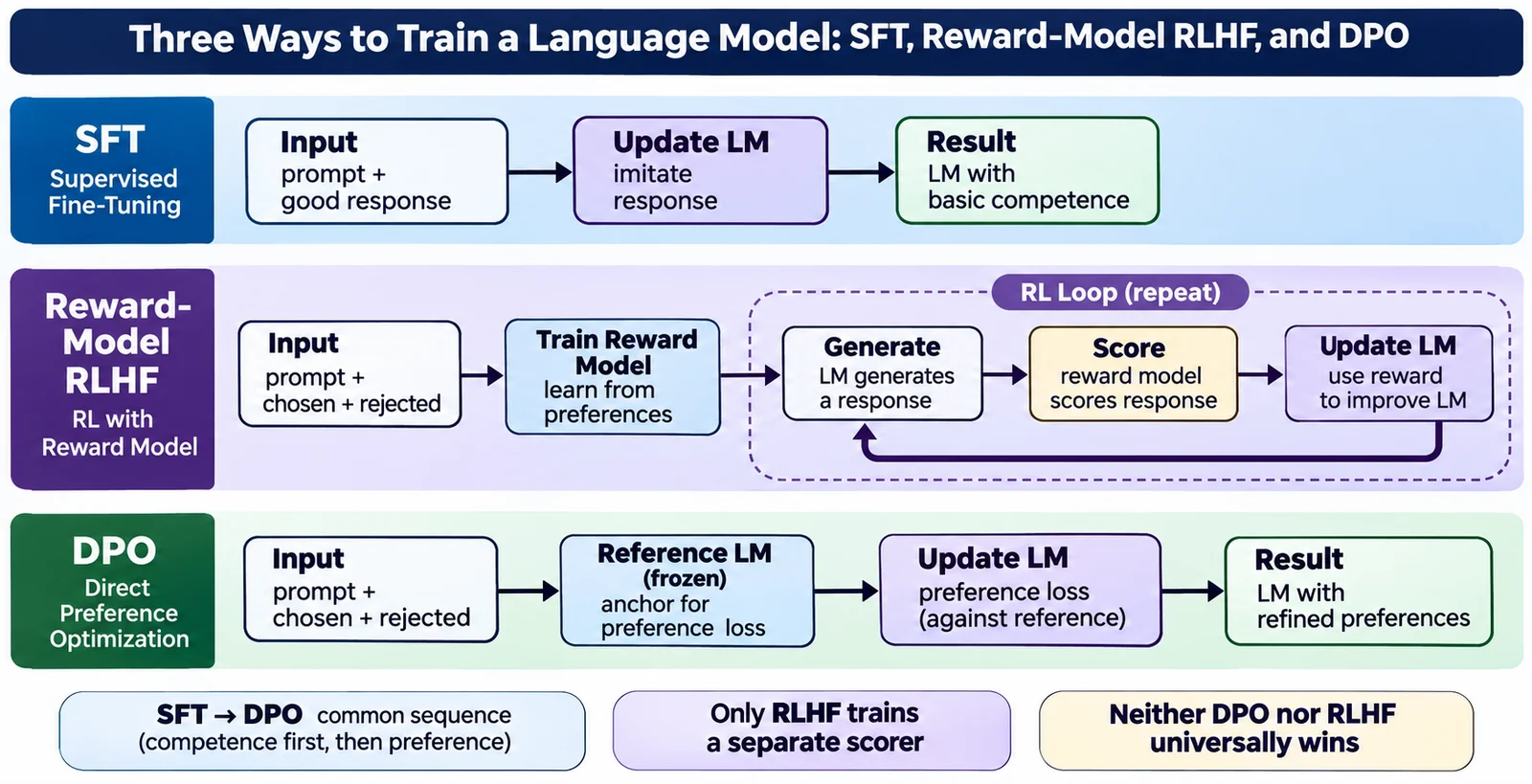
The three methods are easiest to hold apart by asking what each one is given. Supervised fine-tuning (SFT) receives prompts paired with reference responses that someone has judged good, and it adjusts the weights to make those responses more likely; in effect it trains the model to imitate the examples it is shown.[1] Reward-model RLHF receives comparisons instead, uses them to train a separate scorer, and then runs a reinforcement learning loop that pushes the language model toward higher scores. DPO receives the same kind of comparisons but skips the scorer and the loop, fitting the model to the pairs with an ordinary loss. The first method learns from good examples alone, the second and third learn from good-against-bad contrasts, and only the second builds a standing reward model as an intermediate artifact.
That difference in inputs predicts where each will help. Imitation is enough when the task has a right answer that can be written down and copied, because the model only needs to associate the prompt with the response. It is thinner when many responses are acceptable and the interesting question is which of two plausible attempts is better, since a single gold response does not say what separates it from a fluent near-miss. The clinical comparison described earlier bears this out: after SFT had taught the models to attach labels to clear textual cues, DPO added almost nothing to text classification, but on clinical reasoning and summarization the preference stage improved on the supervised one, while triage results were mixed. The same study put a price on the difference, finding that DPO fine-tuning needed roughly two to three times the compute of SFT alone.[1] Read together, the two results give the shape of the decision rather than a verdict: the extra stage costs more and pays off only where the task turns on judgement between alternatives.
What the theory says about the two-stage route
The comparison with RLHF is harder, because the two methods are not the same procedure done more or less carefully. A theoretical treatment compared them under matched assumptions, taking policies that assign probabilities in a loglinear form and rewards that are linear in the features, and derived bounds on how far each method's final policy falls short of the best achievable.[15] The comparison is not a single ranking. The gap depends jointly on how much preference data is available, on the dimensions of the policy and reward classes, and on the regularization temperature, so which method comes out ahead shifts with the setting rather than being fixed once.
One result from that analysis is worth singling out because it cuts against the intuition that dropping the reward model must cost something. When the true reward cannot be represented exactly by the model class being used, RLHF carries a constant additional error that does not shrink as data grows, whereas DPO's gap still decays toward zero provided the temperature is tuned appropriately.[15] The reward model, on this account, is a bottleneck as well as a convenience: whatever the scorer fails to capture becomes a floor on the two-stage method's performance, while the direct method has no such intermediate object to be wrong. That is a statement about the models assumed in the analysis, not a demonstration that DPO wins in practice, but it explains why the missing reward model is not automatically a loss.
A later analysis decomposed the gap between the two families into two sources, one arising under exact optimization from the relative capacities of the reward and policy model classes, and one arising under finite samples from how each method represents what it has learned. The exact-optimization picture is that either family can come out ahead depending on how the models are misspecified, and that an online variant of DPO can beat both the standard offline form and RLHF when the reward and policy classes are structurally similar and both are wrong.[16] The sample-side picture is less even. In a construction where the true reward is sparse, RLHF needed significantly fewer samples than DPO to recover an effective reward model, a statistical advantage of two-stage learning.[16]
Why the order of stages matters
A separate line of work examined what happens when policy optimization is allowed to use data beyond the preference set. Comparing DPO with reward-model-based policy optimization in controlled synthetic experiments, it found that DPO performed poorly while the variant that additionally drew on policy-generated and preference-free data performed best, and that out-of-preference data significantly improved performance even when the policy model was given a good feature representation.[17] The lesson is about where generalization comes from. A reward model trained on comparisons can be queried on inputs that were never compared, and a policy optimized against it inherits that reach; DPO's signal is confined to the pairs it was given, so its ability to generalize beyond them depends on the pairs covering the space.
None of this makes the choice a matter of picking a winner. The two-stage route buys sample efficiency and reach at the cost of a reward model that can be wrong in ways the policy will faithfully exploit, and at the cost of a training loop with interacting parts. The direct route buys simplicity and the absence of a scorer-shaped bottleneck at the cost of leaning harder on the coverage of its preference data. The compute figures from the clinical comparison sit alongside these arguments rather than settling them, since they measure one pair of models on four tasks.
What the comparisons do establish is a division of labour that matches how the methods are used in sequence. SFT installs the basic behaviour, and DPO is typically applied to a model that has already been through it, because the anchor to the reference model is only worth having if there is something worth preserving.[1] The preference stage is a refinement of competence, not a substitute for acquiring it. The ways that refinement can go wrong, from length bias to noisy pairs, are taken up later.
SFT imitates good examples, RLHF learns a scorer and optimizes against it, and DPO fits the comparisons directly; the theory says neither of the last two dominates, and the evidence says the preference stage earns its extra cost mainly on tasks that require judgement.
Criticism
Known failure modes and open problems
A method that trains on comparisons inherits the weaknesses of its comparisons, and DPO has a set of failure modes that follow directly from the shape of its loss. The most visible is verbosity: tuned models tend to produce longer answers than they should. The cause is not mysterious once the loss is examined. The implicit reward the method optimises correlates strongly with the length of the response, and that correlation misdirects the optimisation, so the model learns that longer is safer rather than that better is better.[18]
The fix proposed for this is to separate the length preference from the rest. A method called LD-DPO decouples explicit length preference, treated as relatively insignificant, from the other implicit preferences the pairs encode, so that training learns the substantive judgement rather than the length confound; across several model families it produced responses 10 to 40 percent shorter than DPO while scoring better on standard benchmarks. The lesson drawn from is that a property correlated with preference in the training data, such as length, can be learned alongside the substantive judgement. Length is one such property, and the mechanism is general.[18]
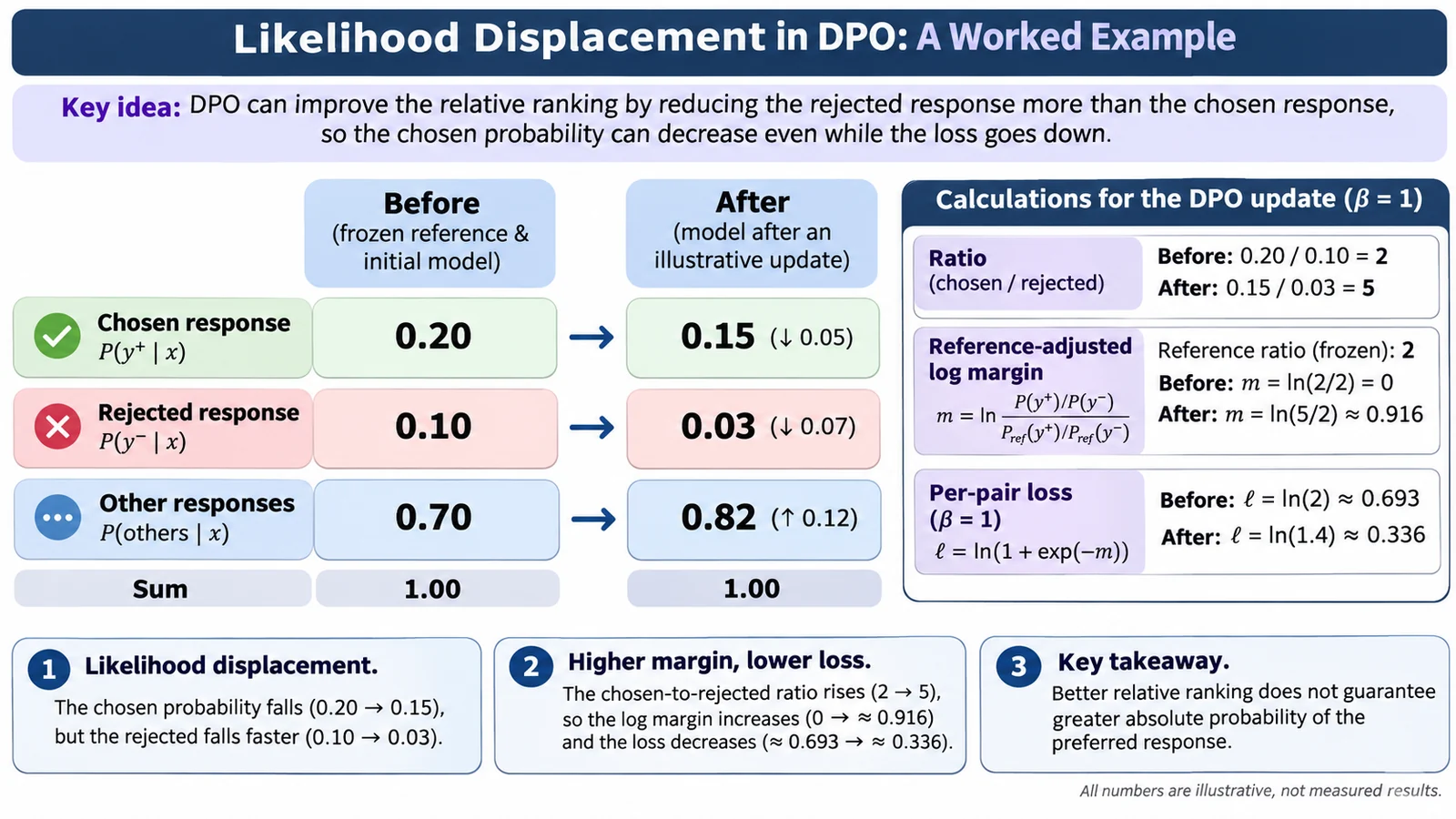
A second failure is subtler and cuts the other way. Likelihood displacement is the observation that the probability of the chosen response often falls during training, even as the margin between chosen and rejected widens.[19] The loss rewards the difference between the two likelihoods, not the chosen likelihood on its own, so a model can improve its margin by pushing the rejected response down faster than it pushes the chosen one up, or by letting both fall while the rejected falls further. The result is a model that ranks preferences correctly but has become less likely to produce the very responses it was taught to prefer. A correction called DPO-Shift controllably shifts the distribution of the chosen probability, and the work shows a trade-off between raising that probability and preserving the reward margin.[19] The displacement is a symptom of optimising a relative quantity when what is wanted is an absolute one.
When the data or the dial is wrong
The parameter beta, which sets how far the tuned model may drift from its reference, is a known source of fragility. A poorly chosen beta produces one of two failures: too small and the gradients are weak so the model fails to learn from the pairs, too large and the updates are amplified so the model drifts excessively from its reference policy.[10]
Noisy pairs are the other half of the problem. A study of preference data relabelled by AI teachers found that the teachers flipped approximately 50 percent of the original human preferences, a level of noise that degrades standard DPO; a variant that reweights each pair by confidence and filters low-confidence pairs was the only configuration that recovered competitive alignment, reaching about 60 percent versus about 49 to 50 percent for vanilla DPO.[20] Poisoning is the adversarial version of the same weakness. Injecting poisonous preference pairs amounting to 1 to 5 percent of a dataset was enough to manipulate a model into generating a target entity in a target sentiment, which shows that the training signal is only as trustworthy as the process that produced it.[21]
Overfitting on the rejected examples is a further failure with a characteristic signature: generations that grow long and lose diversity, as though the model has learned to avoid the rejected responses without learning what to do instead. One response regularises the weight update itself, restricting tuning to rotational and magnitude-stretching updates that keep the hyperspherical energy invariant and preserve the knowledge encoded in the angles between neurons, and achieves alignment using only 0.0086 percent of the trainable parameters while enhancing generation diversity.[4]
Alignment as redirection
The most striking finding about what preference tuning actually does comes from looking inside the model rather than at its outputs. Working with GPT2-medium and a carefully built pairwise dataset designed to reduce toxicity, researchers traced how toxicity is represented and elicited in the pretrained model, applied DPO, and then examined how the tuned model avoided toxic output. The capabilities learned in pretraining were not removed but bypassed.[22] The tuned model had not lost the ability to produce toxic text; it had learned a route around it. The demonstration that follows is that a simple method can un-align the model and revert it to its earlier behaviour.[22]
This reframes what a successful tuning run means. The preference stage does not erase a behaviour, it suppresses the path to it, and a suppression that depends on a route can fail when the model is pushed onto a different one. It also explains why the anchor to the reference model matters so much: the original capability is still there, and the tuning is a thin layer of redirection on top of it.
Open problems
Two limits recur across the applied work. The first is the predictor. When the judge ranking the pairs is a computational model rather than a person, the tuned generator is optimised against that model's notion of better, including its blind spots. In the macrocycle work, permeability gains rested entirely on computational predictors, supported by several independent lines of evidence, with experimental measurement of the top designs named as the necessary next step.[3]
The second is coverage. DPO's signal is confined to the pairs it was given, so its ability to generalise beyond them depends on those pairs spanning the space of inputs the model will meet. Where the pairs are narrow, the tuning is narrow.
Preference tuning redirects a model rather than retraining it, so its failures are the failures of its pairs and its predictors, and its successes can be shallower than they look.
Key studies
| Year | Study | Sample | Design | Finding |
|---|---|---|---|---|
| 2023 | Zhao et al.[2] | three mainstream multimodal models including MiniGPT-4 | hallucination-aware DPO evaluation | MiniGPT-4 with HA-DPO rose from 51.13% to 86.13% POPE accuracy and from 932.00 to 1326.46 on the MME score. |
| 2024 | Wei et al.[18] | Llama2-13B, Llama3-8B, and Qwen2-7B in Base and Instruct settings | length-desensitization DPO variant evaluation | LD-DPO produced responses 10 to 40% shorter than DPO while outperforming DPO and other baselines on MT-Bench and AlpacaEval 2. |
| 2024 | Yang et al.[4] | DPO-tuned language models evaluated on MT-Bench and AlpacaEval 2 | orthogonal fine-tuning variant experiment | RoPO used only 0.0086% of trainable parameters and outperformed DPO by up to 10 points on MT-Bench and up to 2.8 points on AlpacaEval 2, with 6 points more generation diversity on average. |
| 2024 | Widatalla et al.[12] | ProteinDPO models trained on the Megascale dataset with native backbones | protein stability prediction experiment | ProteinDPO reached Pearson R = 0.72 to 0.73 and AUROC of 0.82 to 0.84, surpassing vanilla ESM-IF1 (Pearson R = 0.55, AUROC 0.74) and SFT (Pearson R = 0.59, AUROC 0.76). |
| 2024 | Banerjee et al.[14] | pretrained vision-language models generating chest X-ray reports | radiology report generation experiment | DPO fine-tuning achieved a 3.2 to 4.8 times reduction in lines hallucinating prior exams while maintaining clinical accuracy. |
| 2024 | Baumgärtner et al.[21] | two widely used preference datasets | preference poisoning attack experiment | Injecting 1 to 5% poisonous preference data effectively manipulated the language model to generate a target entity in a target sentiment. |
| 2025 | Savage et al.[1] | Llama3 8B and Mistral 7B v2 models on four medical natural language tasks | comparative fine-tuning evaluation | Clinical reasoning accuracy rose from 7% and 22% at baseline to 28% and 33% with SFT and then 36% and 40% with DPO. |
| 2025 | Gasser et al.[7] | ProteinMPNN base model and CAPE-MPNN checkpoints on validation backbone structures | protein design tuning experiment | DPO reduced MHC-I visibility by up to 70% while predicted TM-scores stayed high until a sudden fall at roughly 20% of original visibility. |
| 2025 | Toleu et al.[20] | preference dataset with heavy synthetic noise (30% flips) and a 5k relabeled set | Evaluation of nrDPO and nrDPO-gated, two DPO variants built to tolerate noisy preference labels | nrDPO-gated improved preference accuracy by +3.8% over vanilla DPO on the noisy dataset and reached about 60% on the 5k relabeled set versus about 49 to 50% for vanilla DPO. |
| 2025 | Yun & Park[13] | ESRGAN and ESRGAN variants on BSD100 and Set14 benchmark datasets | image super-resolution experiment | DPO-ESRGAN achieved on average 0.32 lower PieAPP and 0.79 lower NIQE values on BSD100, and 0.32 lower PieAPP and 0.32 lower NIQE on Set14, compared with ESRGAN. |
| 2025 | Kadyrbek et al.[11] | 1.94B parameter LLaMA-based Kazakh model | small-scale language model development | DPO with contrastive and entropy-based regularization improved factuality, coherence, and cultural fidelity over instruction-only and multilingual baselines. |
| 2026 | Sun et al.[3] | 56 protein targets with reference peptide lengths from 5 to 16 residues | macrocyclic peptide design benchmark | CycDiff-DPO achieved Ramachandran acceptance and favored rates of 72.5% and 42.2%, the highest log P of -1.84, and the lowest polar SASA ratio of 0.20 among compared models. |
See also
References
- Savage, T., P Ma, S., Boukil, A., Rangan, E., Patel, V., Lopez, I., & Chen, J. (2025). Fine-Tuning Methods for Large Language Models in Clinical Medicine by Supervised Fine-Tuning and Direct Preference Optimization: Comparative Evaluation. Journal of Medical Internet Research, 27, e76048-e76048. doi:10.2196/76048
- Zhao, Z., Wang, B., Ouyang, L., Dong, X., Wang, J., & He, C. (2023). Beyond Hallucinations: Enhancing LVLMs through Hallucination-Aware Direct Preference Optimization. arXiv. doi:10.48550/arxiv.2311.16839 Free full text
- Sun, H., Tan, H., Chu, Y., Li, J., Wang, R., & Wei, D. Q. (2026). Design of permeability-optimized target-binding macrocycles via direct preference optimization. Chemical Science, 17(20), 10223-10236. doi:10.1039/d6sc01722c
- Yang, C., Jia, R., Naibin, G., Lin, Z., Chen, S., Pang, C., Yin, W., Yu, S., Wu, H., & Wang, W. (2024). Orthogonal Finetuning for Direct Preference Optimization. arXiv. doi:10.48550/arxiv.2409.14836 Free full text
- Rafailov, R., Sharma, A., Mitchell, E., Ermon, S., Manning, C. D., & Finn, C. (2023). Direct Preference Optimization: Your Language Model is Secretly a Reward Model. arXiv. doi:10.48550/arxiv.2305.18290 Free full text
- Liu, T., Zhao, Y., Joshi, R., Khalman, M., Mohammad, S., Liu, P. J., & Liu, J. (2023). Statistical Rejection Sampling Improves Preference Optimization. arXiv. doi:10.48550/arxiv.2309.06657 Free full text
- Gasser, H. C., Oyarzún, D. A., Alfaro, J. A., & Rajan, A. (2025). Tuning ProteinMPNN to reduce protein visibility via MHC Class I through direct preference optimization. Protein Engineering, Design and Selection, 38. doi:10.1093/protein/gzaf003
- Xiao, W., Wang, Z., Gan, L., Zhao, S., Li, Z., Lei, R., He, W., Tuan, L. A., Chan, L., Jiang, H., Zhao, Z., & Wu, F. (2026). A Survey of Direct Preference Optimization: Datasets, Theories, Variants, and Applications. IEEE Transactions on Pattern Analysis and Machine Intelligence, 48(10), 13079-13098. doi:10.1109/tpami.2026.3704314
- Wu, J., Xie, Y., Yang, Z., Wu, J., Gao, J., Ding, B., Wang, X., & He, X. (2024). $β$-DPO: Direct Preference Optimization with Dynamic $β$. arXiv. doi:10.48550/arxiv.2407.08639 Free full text
- Chai, Y. K. (2026). Adaptive KL Control for Direct Preference Optimization in Instruction-Following LLMs. Proceedings of the AAAI Conference on Artificial Intelligence, 40(48), 41480-41482. doi:10.1609/aaai.v40i48.42313
- Kadyrbek, N., Tuimebayev, Z., Mansurova, M., & Viegas, V. (2025). The Development of Small-Scale Language Models for Low-Resource Languages, with a Focus on Kazakh and Direct Preference Optimization. Big Data and Cognitive Computing, 9(5), 137. doi:10.3390/bdcc9050137
- Widatalla, T., Rafailov, R., & Hie, B. (2024). Aligning protein generative models with experimental fitness via Direct Preference Optimization. openRxiv. doi:10.1101/2024.05.20.595026
- Yun, W., & Park, H. (2025). DPO-ESRGAN: Perceptually Enhanced Super-Resolution Using Direct Preference Optimization. Electronics, 14(17), 3357. doi:10.3390/electronics14173357
- Banerjee, O., Zhou, H. Y., Adithan, S., Kwak, S., Wu, K., & Rajpurkar, P. (2024). Direct Preference Optimization for Suppressing Hallucinated Prior Exams in Radiology Report Generation. arXiv. doi:10.48550/arxiv.2406.06496 Free full text
- Nika, A., Mandal, D., Kamalaruban, P., Tzannetos, G., Radanović, G., & Singla, A. K. (2024). Reward Model Learning vs. Direct Policy Optimization: A Comparative Analysis of Learning from Human Preferences. arXiv. doi:10.48550/arxiv.2403.01857 Free full text
- Shi, R., Minhak, S., Zhou, R., Zhang, Z., Fazel, M., & Du, S. S. (2025). Understanding the Performance Gap in Preference Learning: A Dichotomy of RLHF and DPO. arXiv. doi:10.48550/arxiv.2505.19770 Free full text
- Li, Z., Xu, T., & Yu, Y. (2023). Policy Optimization in RLHF: The Impact of Out-of-preference Data. arXiv. doi:10.48550/arxiv.2312.10584 Free full text
- Wei, L., Bai, Y., Chengcheng, H., Weng, R., Xu, J., Cao, X., Wang, J., & Cai, X. (2024). Length Desensitization in Direct Preference Optimization. arXiv. doi:10.48550/arxiv.2409.06411 Free full text
- Yang, X., Feng, J., Zhang, Q., Lei, Z., & Xiao, L. (2025). DPO-Shift: Shifting the Distribution of Direct Preference Optimization. arXiv. doi:10.48550/arxiv.2502.07599 Free full text
- Toleu, A., Tolegen, G., Pak, A., & Jaxylykova, A. (2025). Noise-Aware Direct Preference Optimization for RLAIF. Applied Sciences, 15(19), 10328. doi:10.3390/app151910328
- Baumgärtner, T., Gao, Y., Alon, D., & Metzler, D. (2024). Best-of-Venom: Attacking RLHF by Injecting Poisoned Preference Data. arXiv. doi:10.48550/arxiv.2404.05530 Free full text
- Lee, A., Xiaoyan, B., Pres, I., WATTENBERG, M. P., Kummerfeld, J. K., & Mihalcea, R. F. (2024). A Mechanistic Understanding of Alignment Algorithms: A Case Study on DPO and Toxicity. arXiv. doi:10.48550/arxiv.2401.01967 Free full text
Cite this page: Atlas Nova editors. (2026). Direct preference optimization. Atlas Nova. https://velocer.io/atlas/direct-preference-optimization/